1. Introduction
The ongoing digital transformation of industrial systems is fundamentally reshaping the role of maintenance in modern manufacturing and service ecosystems. In the digital economy, maintenance is no longer perceived solely as a technical support function but increasingly as a strategic capability that directly influences product performance, service continuity, and customer experience. High levels of system availability, reliability, and operational resilience are critical determinants of consumer trust, perceived product quality, and long-term brand value, particularly in environments characterized by smart products, connected services, and data-driven business models [
1,
2].
The emergence of Industry 4.0 technologies, such as the Internet of Things, artificial intelligence, digital twins, and cyber–physical systems, has significantly expanded the scope of maintenance strategies, enabling predictive and autonomous maintenance approaches [
3,
4]. Digital transformation and data-driven services have been shown to create new forms of sustainable customer value and resilience-based competitive advantage in digitally mediated ecosystems [
5,
6]. These technologies not only enhance operational efficiency but also create new expectations among consumers regarding product reliability, transparency, and sustainability. In this context, maintenance becomes an integral component of digital value creation, influencing both technical system performance and consumer perception in digitally mediated product–service ecosystems.
From a sustainability perspective, maintenance plays a pivotal role in extending product lifecycles, reducing material and energy consumption, and supporting circular economy principles [
3,
7]. Effective maintenance strategies contribute to responsible production and consumption patterns by minimizing premature failures, enabling remanufacturing and reuse, and facilitating product–service systems and servitization models. Circular economy research emphasizes that product design, business models, and maintenance practices are key enablers of sustainable value creation and lifecycle extension [
8]. Consequently, maintenance can be considered a key enabler of Sustainable Development Goal 9 (Industry, Innovation and Infrastructure) and Sustainable Development Goal 12 (Responsible Consumption and Production), bridging technological innovation with sustainable industrial and consumer practices. Digital technologies further reinforce circular economy practices by enabling lifecycle data collection, predictive analytics, and sustainable asset management [
9,
10,
11].
Despite its strategic relevance, existing research on maintenance maturity predominantly focuses on internal organizational and technical capabilities, such as reliability, safety, and operational efficiency [
1,
12]. In parallel, consumer satisfaction and perceived sustainability have been extensively studied in the marketing and service management literature, often without explicit consideration of underlying maintenance practices and operational resilience mechanisms [
9,
13]. Recent studies have demonstrated that sustainability-oriented strategies, value co-creation, and consumer environmental concerns significantly influence perceived customer value, satisfaction, and green innovation outcomes [
14,
15,
16]. This separation has resulted in a fragmented understanding of how maintenance maturity influences consumer-perceived sustainability, trust, and satisfaction in the digital economy. Although related studies exist separately in maintenance maturity and consumer sustainability domains, their mathematical integration within a unified fuzzy-based framework remains underexplored.
To address this research gap, this study investigates the following research questions:
RQ1: How does maintenance maturity influence consumer-perceived sustainability and trust in the digital economy?
RQ2: How can operational resilience be quantitatively linked to consumer satisfaction and perceived sustainability using a customer-centric modeling layer?
RQ3: Which maintenance strategy is associated with the highest combined operational and consumer sustainability value?
The primary objective of this paper is to extend the Integrated Maintenance Maturity Model (IMMM), given in [
17], by introducing a novel Customer-Centric Sustainability Layer (CCSL), designed to capture the external impacts of maintenance practices on consumers and sustainability perceptions. To the best of the authors’ knowledge, this study proposes a conceptual integrative framework that mathematically links maintenance maturity assessment with customer-centric sustainability perception. Furthermore, the framework is demonstrated through an illustrative single-case study comparing reactive, preventive, predictive, and AI-enhanced maintenance strategies in a manufacturing environment.
The main contributions of this research are threefold. First, it introduces a conceptual extension of maintenance maturity modeling by incorporating consumer-centric sustainability dimensions into engineering-based maturity frameworks. Second, it proposes a fuzzy-based methodological approach to support the linkage between operational and consumer perspectives in a unified assessment model. Third, it provides illustrative insights into how different maintenance strategies influence sustainable consumer value creation in the digital economy. However, these contributions should be interpreted within the scope of a conceptual and illustrative modeling study rather than as empirically validated or universally generalizable findings. The framework is intended to support exploratory analysis and decision-making rather than definitive predictive assessment.
The remainder of this paper is structured as follows.
Section 2 reviews the theoretical background on maintenance maturity, sustainable development in the digital economy, and consumer behavior related to perceived sustainability.
Section 3 presents the research methodology, including the fuzzy inference system design and data collection approach.
Section 4 introduces the proposed IMMM–CCSL framework and defines the customer-centric sustainability dimensions.
Section 5 presents the application and evaluation of the model through an industrial case study.
Section 6 discusses the theoretical and managerial implications of the findings. Finally,
Section 7 concludes the paper and outlines limitations and directions for future research.
2. Literature Review and Theoretical Background
The relationship between maintenance practices, digital transformation, sustainability, and consumer perception spans multiple research domains. These include maintenance engineering, production systems, digital economy, and consumer behavior theory. This section synthesizes the relevant theoretical foundations and prior research to position the proposed framework within existing knowledge. First, the evolution of maintenance maturity models and their role in operational resilience is reviewed. Next, the sustainability implications of digital transformation and circular economy paradigms are discussed. Finally, the literature on consumer behavior and perceived sustainability is analyzed to establish the conceptual linkage between internal maintenance capabilities and external customer-centric outcomes.
2.1. Maintenance Maturity and Operational Resilience
Maintenance maturity models have been extensively developed as structured frameworks to evaluate the evolution of maintenance practices and organizational capabilities. Previous research [
17] classifies these models into one-dimensional, two-dimensional, and multidimensional approaches, reflecting an evolution from isolated maintenance assessment toward integrated and strategic capability evaluation.
Foundational approaches, including Total Productive Maintenance (TPM) and asset management standards (e.g., ISO 55000 [
18]), emphasize reliability, availability, and lifecycle performance as core dimensions of maintenance excellence. These frameworks are grounded in continuous improvement, risk-based decision-making, and lifecycle-oriented asset management. Early maturity models primarily focused on process standardization, IT-enabled maintenance, and organizational capability development [
19,
20,
21], while more recent studies extend this perspective toward digital transformation and Industry 4.0 readiness, incorporating cyber–physical systems, data analytics, and digital platforms into maintenance management structures [
22,
23]. This shift highlights the growing role of predictive and AI-enhanced maintenance in improving system performance and decision-making.
In parallel, operational resilience has emerged as a critical concept in production systems, defined as the ability to anticipate, absorb, recover from, and adapt to disruptions. Existing research introduces quantitative metrics and systemic evaluation approaches for resilience assessment [
24], while organizational frameworks such as CERT-RMM emphasize structured capability development and continuous improvement processes [
25,
26]. Subsequent studies extend resilience maturity concepts across domains, including SMEs, business processes, and infrastructure systems [
27,
28,
29].
Within the maintenance domain, resilience is increasingly integrated with maintenance planning and asset management strategies. Resilience-oriented approaches to maintenance scheduling and cost planning demonstrate improvements in operational continuity and lifecycle risk reduction [
30,
31]. At the same time, fuzzy-based frameworks incorporate uncertainty and expert knowledge into maintenance decision-making processes [
32]. incorporate uncertainty and expert knowledge into maintenance decision-making processes [
33,
34].
The integration of Industry 4.0 technologies further strengthens the link between maintenance maturity and resilience. Digital solutions, including condition monitoring, data analytics, machine learning, and digital twins, enable predictive and AI-enhanced maintenance strategies. These approaches support failure anticipation, maintenance optimization, and reduction in unplanned downtime, thereby enhancing adaptability, fault tolerance, and recovery capabilities in complex production environments [
35,
36].
In addition, the emergence of Maintenance-as-a-Service (MaaS) and digital servitization models reflects a transition toward service-oriented maintenance ecosystems, where predictive diagnostics, remote monitoring, and outcome-based contracts align maintenance performance with broader business value creation [
37,
38].
More recent developments, including Maintenance 5.0 and human-centric maintenance, further extend this paradigm by integrating human expertise, decision support systems, and collaborative human–AI interactions into maintenance processes [
39,
40,
41]. These approaches emphasize that digital technologies augment, rather than replace, human decision-making in resilient and adaptive systems.
Overall, the literature indicates a clear convergence between maintenance maturity and operational resilience, driven by digitalization and the increasing complexity of industrial systems. However, despite these advances, existing frameworks remain predominantly focused on internal operational and technical dimensions, with limited attention to how maturity-driven resilience translates into external outcomes such as customer perception and sustainability value. This limitation highlights the need for integrative approaches that connect internal maintenance capabilities with external stakeholder-oriented outcomes, which is further addressed in
Section 2.4.
2.2. Sustainable Development in the Digital Economy
Sustainable development in contemporary industrial systems is increasingly framed within the digital economy paradigm, where digital technologies reshape production, consumption, and organizational sustainability strategies. Overall, the literature consistently positions digital transformation as a systemic enabler of sustainability, primarily through improved resource efficiency, transparency, and real-time system optimization across socio-technical environments [
42,
43]. In this context, Sustainable Development Goals (SDGs), particularly SDG 9 (Industry, Innovation and Infrastructure) and SDG 12 (Responsible Consumption and Production), provide a comprehensive framework for aligning industrial digitalization with sustainability objectives [
44]. Overall, the literature consistently positions digital transformation as a systemic enabler of sustainability, primarily through improved resource efficiency, transparency, and real-time system optimization across socio-technical environments [
45,
46,
47].
The digital economy introduces data-intensive and platform-mediated ecosystems, in which cyber–physical integration and real-time analytics directly influence sustainability outcomes across environmental, economic, and social dimensions [
48,
49]. Key enabling technologies such as artificial intelligence, blockchain, and IoT support continuous monitoring, predictive optimization, and lifecycle transparency, leading to reductions in resource consumption and improvements in governance and traceability [
50,
51]. Empirical evidence suggests that digital economy development positively correlates with urban and industrial sustainability indicators, although heterogeneous effects across regions and sectors remain [
52,
53]. At the same time, recent evidence highlights that digital transformation generates both sustainability opportunities and new resource and energy pressures, indicating a dual-effect dynamic rather than a purely positive impact [
54,
55].
Table 1 summarizes the main digital economy enablers and their associated sustainability mechanisms and SDG linkages. Rather than individual descriptive studies, this synthesis highlights recurring functional patterns across the literature.
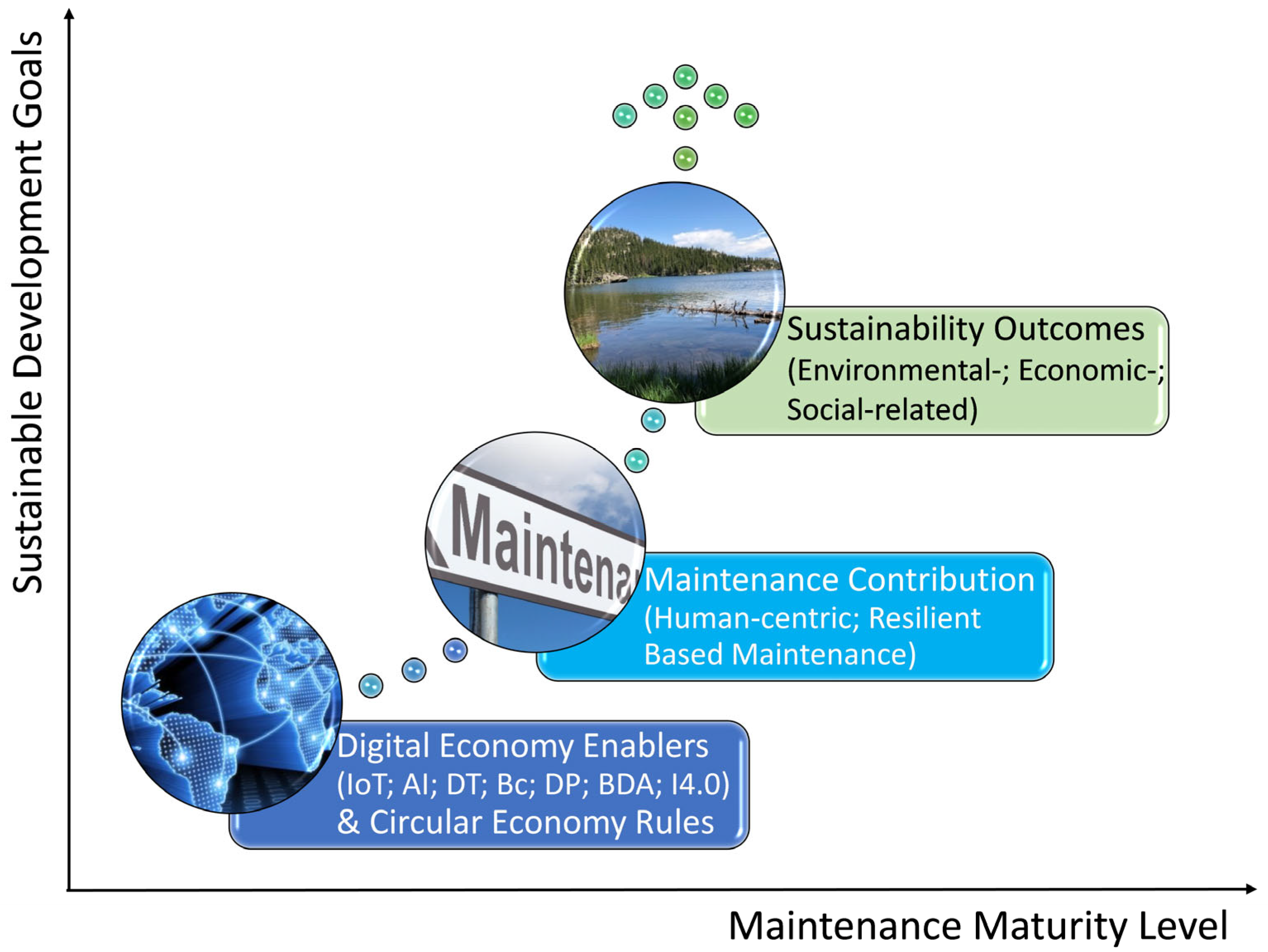
Industry 4.0 technologies play a crucial role in advancing circular economy principles by enabling closed-loop systems, predictive lifecycle management, and digital product passports. Across the literature, digital circular economy frameworks are consistently identified as key mechanisms for linking technological infrastructure with sustainability performance improvement (see, e.g., [
56,
57,
60,
61]). These technologies enable more efficient resource utilization and support the transition toward regenerative production systems. As illustrated in
Figure 1, these elements form a structured causal pathway in which digital enablers act as the foundational layer that enables circular economy mechanisms, which in turn translate into measurable sustainability outcomes at the system level.
Servitization and product–service systems (PSS) represent a second dominant research stream, emphasizing the shift from product ownership to service-based value delivery. Digital servitization integrates predictive maintenance, platform ecosystems, and outcome-based contracts, aligning business models with sustainability [
62] and lifecycle efficiency objectives [
59]. This transformation is increasingly supported by digital platforms that enable SMEs and larger organizations to embed sustainability within operational and strategic decision-making [
58,
63]. Recent research on digital business models and online platforms confirms that digital servitization strategies can reduce environmental footprints while supporting sustainable growth trajectories [
64].
Within this causal structure, servitization acts as a bridging mechanism that connects digital technologies with circular economy practices, reinforcing the transition toward outcome-based and lifecycle-oriented value creation models, as depicted in
Figure 1.
From a broader perspective, digital sustainability research emphasizes that technological transformation is closely linked with organizational change [
65,
66], governance mechanisms, and socio-economic restructuring [
67,
68]. However, despite the breadth of these studies, conceptual integration across technological, organizational, and sustainability dimensions remains fragmented, particularly in linking operational mechanisms to measurable sustainability outcomes.
To provide a structured macro-level synthesis,
Table 2 maps SDGs to maintenance-related sustainability mechanisms. This synthesis highlights that maintenance is increasingly recognized as a cross-cutting operational enabler of sustainability objectives rather than an isolated technical function.
Despite extensive research on digital transformation and sustainability, a key limitation of the existing literature is the weak integration between digital-enabling studies, circular economy frameworks, and operational maintenance mechanisms. In particular, the role of maintenance as a structured enabler of sustainability value creation remains under-theorized and fragmented across research domains. This gap is further elaborated in
Section 2.4.
2.3. Consumer Behavior and Perceived Sustainability
In the context of the digital economy, consumer behavior is increasingly shaped by perceptions of sustainability, reliability, and digital service quality embedded in smart products and connected services. The literature consistently indicates that sustainability perception has become a key determinant of trust, satisfaction, and long-term customer relationships in digitally mediated markets [
72,
73].
Consumer behavior theories, including the Theory of Planned Behavior (TPB) and stimulus–organism–response (S-O-R) frameworks, provide a well-established theoretical basis for explaining sustainable consumption decisions through cognitive, normative, and affective mechanisms [
74,
75]. These frameworks highlight the role of attitudes, subjective norms, and perceived behavioral control in shaping behavioral intentions. Empirical studies further confirm that environmental knowledge, perceived risk, and social influence significantly affect sustainable consumption, although an attitude–behavior gap remains a persistent issue [
76,
77,
78].
Perceived sustainability encompasses multiple dimensions, including perceived environmental performance, social responsibility, and governance transparency. Across studies, trust emerges as a central mediating variable linking perceived sustainability to behavioral intentions and perceived value [
79,
80]. Trust in digital products and services is strongly associated with system reliability, service availability, and the perceived competence of organizations in managing complex cyber–physical systems. In smart manufacturing and digital product ecosystems, operational disruptions, service failures, and inconsistent performance can significantly undermine consumer confidence and perceived sustainability credibility [
81,
82].
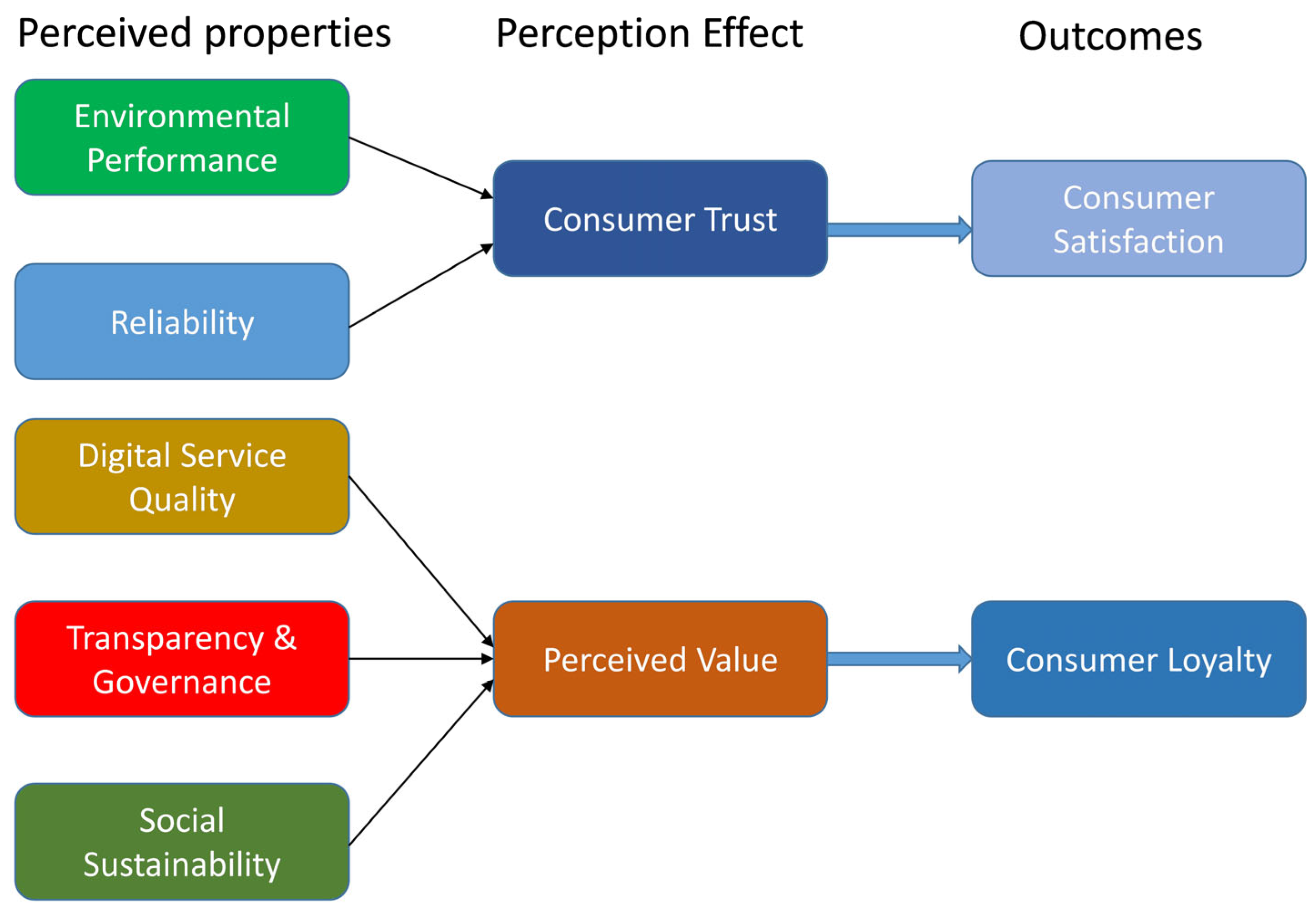
The structure illustrated in
Figure 2 organizes consumer perception into three interconnected layers: (i) perceived dimensions, (ii) perception effects, and (iii) behavioral intention outcomes. These layers jointly explain how sustainability-related stimuli embedded in digital product–service systems are cognitively and affectively processed by consumers, ultimately shaping trust and behavioral responses.
Perceived value in digital and sustainable products arises from the integration of functional performance, environmental benefits, and service quality. Consumers increasingly expect digitally enabled sustainability features, such as transparency dashboards, eco-feedback systems, predictive service alerts, and lifecycle impact information. These features reinforce satisfaction and loyalty and support long-term engagement with product–service systems [
86,
87]. Within the logic of
Figure 2, perceived value acts as a mediating construct between perceived sustainability and behavioral intention. At the same time, trust functions as a central mechanism that stabilizes this relationship under conditions of uncertainty in digitally enabled service environments.
Table 3 summarizes the customer-perceived sustainability dimensions.
Digital customer experience has emerged as a critical mediator between operational performance and consumer perceptions. Smart product ecosystems, digital twins, and IoT-enabled services enable continuous interaction between users and systems, making maintenance activities visible to end users. In particular, predictive maintenance, remote diagnostics, and personalization functions directly influence perceived quality and trust [
89,
90]. Consequently, maintenance performance becomes part of the customer-facing value creation process rather than an exclusively internal operational function.
Recent studies further indicate that sustainability perception is influenced by cultural, demographic, and institutional factors, highlighting its multi-level and context-dependent nature [
86,
91]. Additionally, digitalization significantly reshapes consumer expectations regarding transparency, interactivity, and sustainability communication [
81,
82].
Despite extensive research on sustainable consumer behavior, a key limitation of the literature is the weak integration between consumer perception models and operational maintenance mechanisms. In particular, maintenance-driven reliability and service continuity are rarely conceptualized as antecedents of perceived sustainability in digital ecosystems. This gap is addressed in
Section 2.4.
2.4. Research Gap and Conceptual Positioning
Despite the extensive literature on maintenance management, sustainability, and digital transformation, existing research remains conceptually fragmented across engineering, management, and consumer behavior domains. A closer examination of the literature reviewed in
Section 2.1,
Section 2.2 and
Section 2.3 reveals several critical limitations that constrain the current state of knowledge.
First, existing maintenance maturity models predominantly focus on internal operational and technical performance indicators (e.g., reliability, availability, and cost efficiency), while largely neglecting external stakeholder perspectives, particularly consumer perception and perceived sustainability value.
Second, sustainability research in the digital economy primarily operates at macro- and organizational levels, with limited consideration of maintenance systems as operational enablers of sustainable value creation.
Third, consumer behavior studies extensively analyze perceived sustainability, trust, and digital service quality, yet rarely incorporate underlying operational mechanisms such as maintenance strategies or system resilience.
Fourth, existing studies do not provide a quantitative or formalized mechanism linking maintenance maturity, operational resilience, and consumer-perceived sustainability within a unified modeling framework.
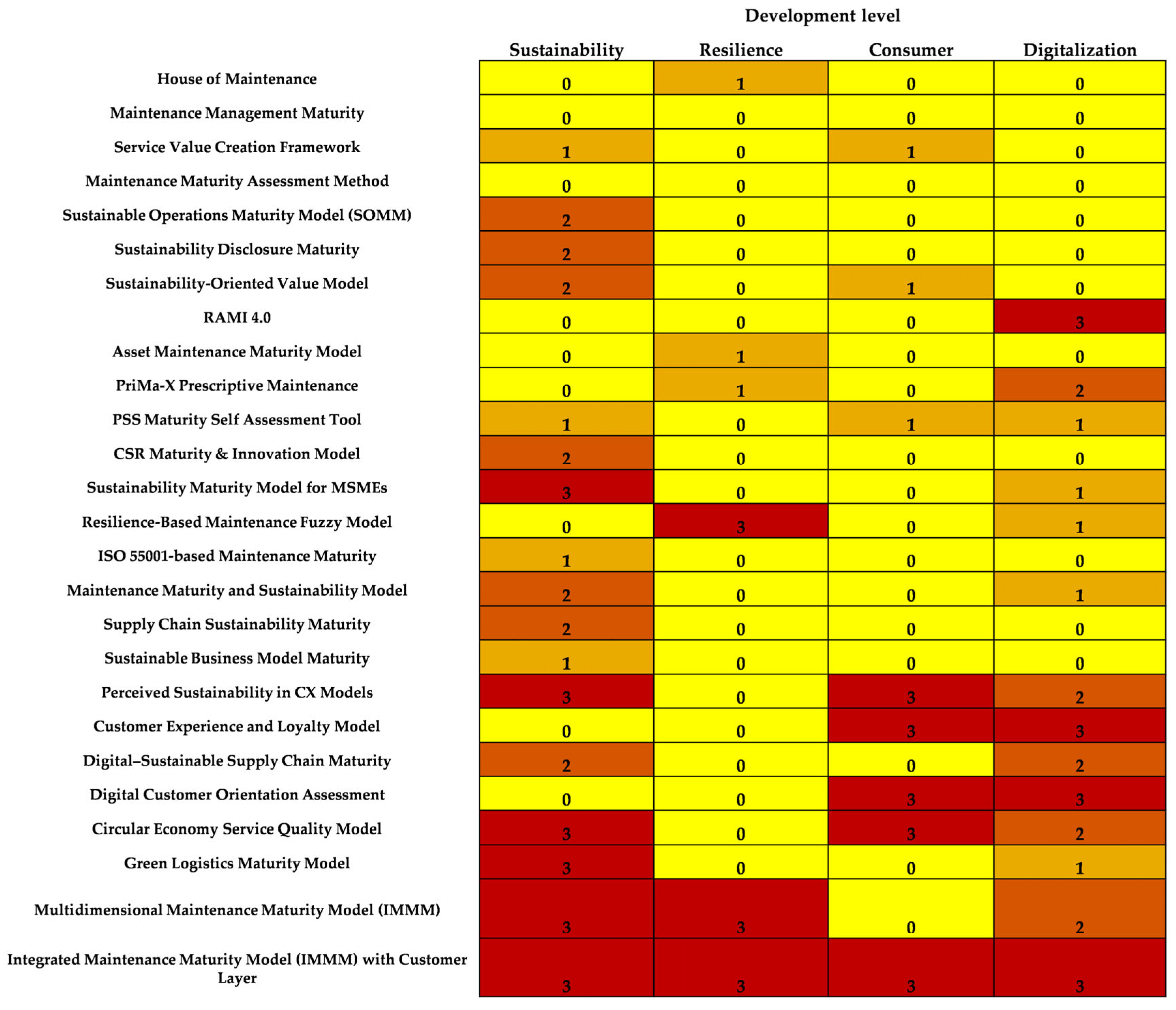
These gaps are further evidenced by the comparative analysis presented in
Table A1 and the qualitative synthesis shown in
Figure 3, which demonstrate that existing frameworks typically address maintenance, sustainability, digitalization, or consumer perception in isolation, with very limited cross-domain integration. In particular, the absence of models simultaneously integrating operational maturity, resilience mechanisms, and customer-centric sustainability outcomes highlights a significant research deficiency.
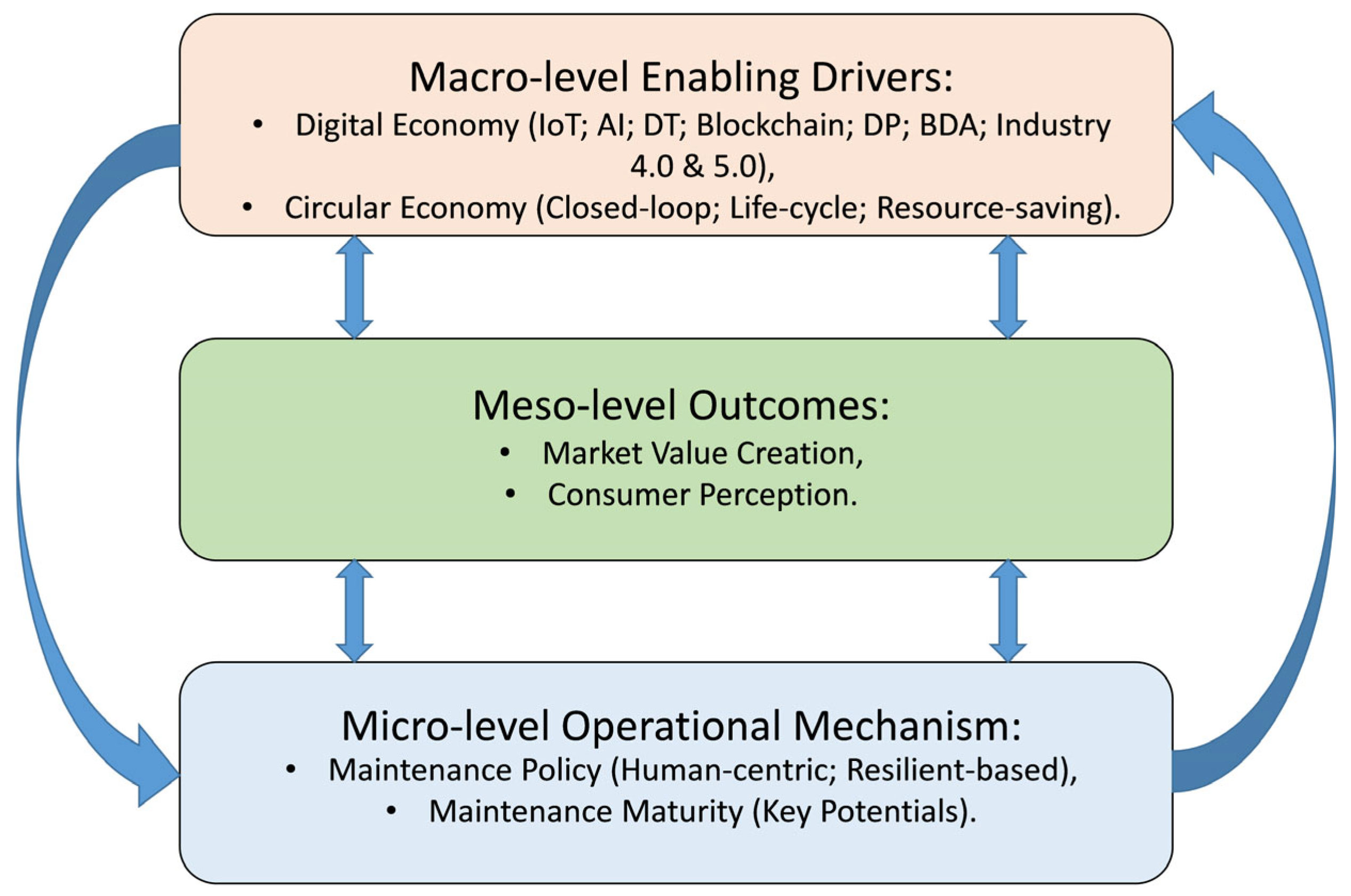
To address these gaps, this study proposes a multilevel and integrative conceptual positioning of maintenance maturity within the sustainability paradigm. Specifically, maintenance maturity is conceptualized as a micro-level operational capability, digital economy, and Industry 4.0 technologies are treated as macro-level enabling drivers, and consumer perception is positioned as a meso-level outcome that translates operational performance into market-level sustainability value. This hierarchical structuring reflects the causal logic shown in
Figure 4, where digital economy enablers constitute the top-level drivers, maintenance maturity operates as an internal system mechanism, and consumer perception emerges as an intermediate market-level response layer.
From a systems perspective, maintenance maturity represents an internal system capability layer, operational resilience functions as a system dynamic property, and consumer-perceived sustainability constitutes an emergent system outcome observable at the market interface.
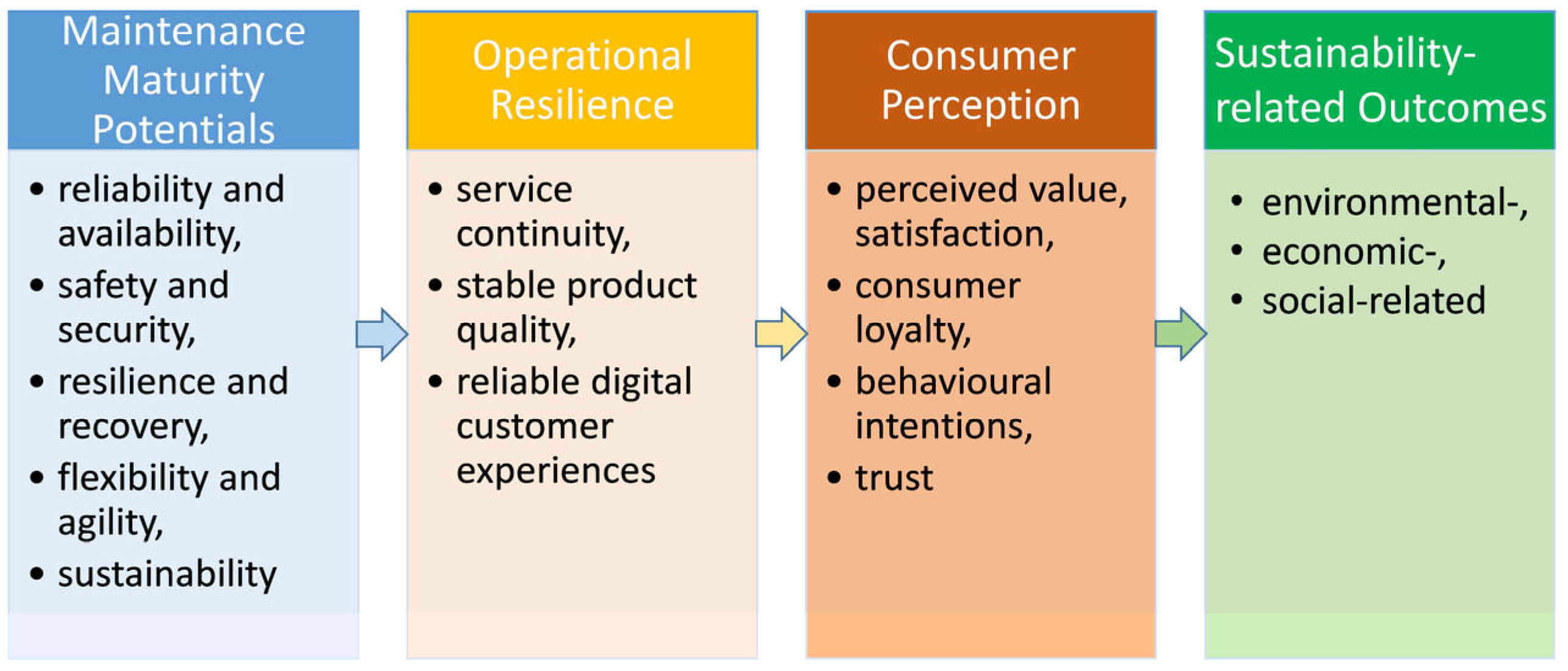
Figure 5 builds on this positioning by transforming the hierarchical structure into a causal pathway model, explicitly linking maintenance maturity potentials to operational resilience and further to consumer perception and sustainability outcomes. Building on this positioning, the study develops a conceptual framework linking maintenance maturity, operational resilience, consumer perception, and sustainability outcomes. Maintenance maturity is operationalized through five key potentials: reliability and availability, safety and security, resilience and recovery, flexibility and agility, and sustainability. These dimensions collectively determine system robustness and adaptive capacity. Operational resilience is assumed to mediate the relationship between maintenance maturity and consumer perception by ensuring service continuity, stable product quality, and reliable digital customer experiences. Consumer perception, in turn, influences perceived value, satisfaction, loyalty, and behavioral intentions, which ultimately translate into sustainability-related outcomes aligned with TBL and SDGs.
In contrast to
Figure 4, which provides a structural (hierarchical) positioning,
Figure 5 explicates the functional causal mechanisms between constructs, highlighting mediation effects of operational resilience and feedback effects of consumer perception within digitally enabled industrial ecosystems.
Building upon this conceptual foundation, this study advances the literature by proposing the Integrated Maintenance Maturity Model with Customer-Centric Sustainability Layer (IMMM–CCSL), which addresses the identified gaps through three key contributions.
First, it integrates maintenance maturity assessment with consumer-perceived sustainability, thereby extending traditional engineering-oriented maturity models toward external value creation.
Second, it introduces a structured customer-centric sustainability layer that translates operational indicators into measurable perception-based outcomes.
Third, it operationalizes these relationships using a fuzzy inference-based modeling approach, enabling the quantitative representation of uncertain and qualitative interactions between maintenance performance and consumer perception.
To highlight the novelty of the proposed Integrated Maintenance Maturity Model (IMMM), a comparative analysis of existing maintenance maturity frameworks is provided in
Table A1. Existing models predominantly emphasize technical and organizational capabilities, with limited integration of resilience, sustainability, and consumer-centric dimensions. In contrast, the proposed Integrated Maintenance Maturity Model with Customer-Centric Sustainability Layer (IMMM-CCSL) integrates engineering maturity assessment with consumer perception modeling. Together with
Table 2 and
Table 3 and the synthesis presented in
Figure 3, this comparison positions the proposed framework as a cross-level integrative approach spanning macro (SDGs), meso (consumer perception), and micro (maintenance maturity) domains.
Table A1 in
Appendix A provides a comparative synthesis of existing maturity models across process capability, digital transformation, maintenance, sustainability, and resilience domains. The analysis reveals that most existing models address digitalization or maintenance performance, while sustainability and resilience are rarely integrated in a unified framework. Moreover, customer-oriented outcomes are almost entirely neglected. These limitations motivate the development of the proposed Integrated Maintenance Maturity Model (IMMM), which combines sustainability, resilience, and customer perception dimensions within a quantitative fuzzy decision-support framework.
Figure 3 presents a qualitative scoring-based heat-map (0–3 scale) synthesizing the degree of integration of sustainability, resilience, consumer perception, and digitalization across representative maturity and conceptual frameworks. The heat-map highlights a strong fragmentation of existing research streams. Engineering-oriented maintenance maturity models primarily focus on technical and organizational capabilities, with limited or no integration of sustainability and consumer perception dimensions. Sustainability and circular economy maturity models emphasize environmental and social aspects but lack operational maintenance mechanisms and resilience constructs. Consumer behavior and service quality models explicitly address perceived sustainability and digital customer experience but remain disconnected from operational and maintenance perspectives. In contrast, the proposed IMMM-CCSL framework simultaneously integrates operational maturity, resilience mechanisms, digitalization, and consumer-perceived sustainability, thereby bridging micro-, meso-, and macro-level sustainability domains.
3. Research Methodology
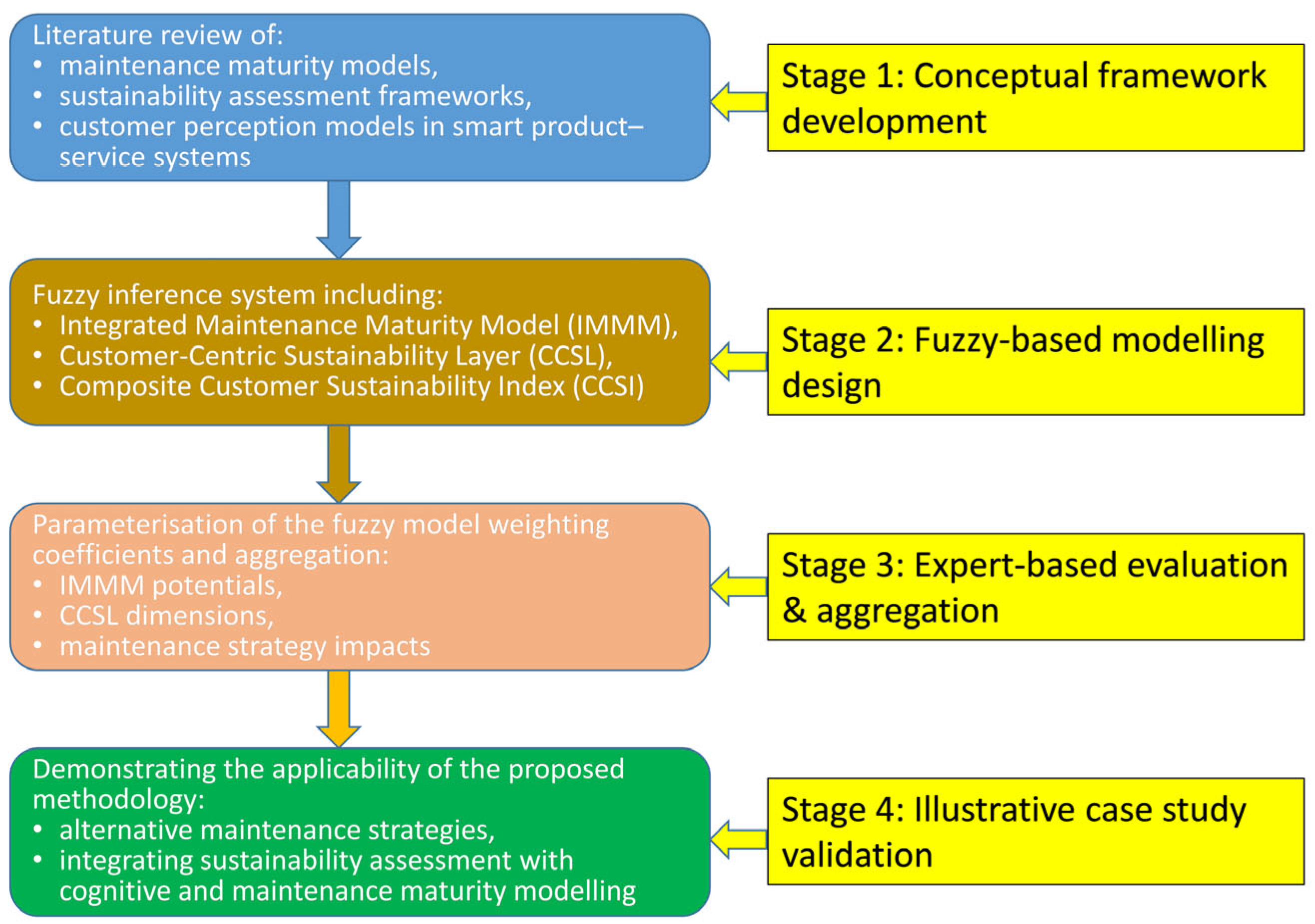
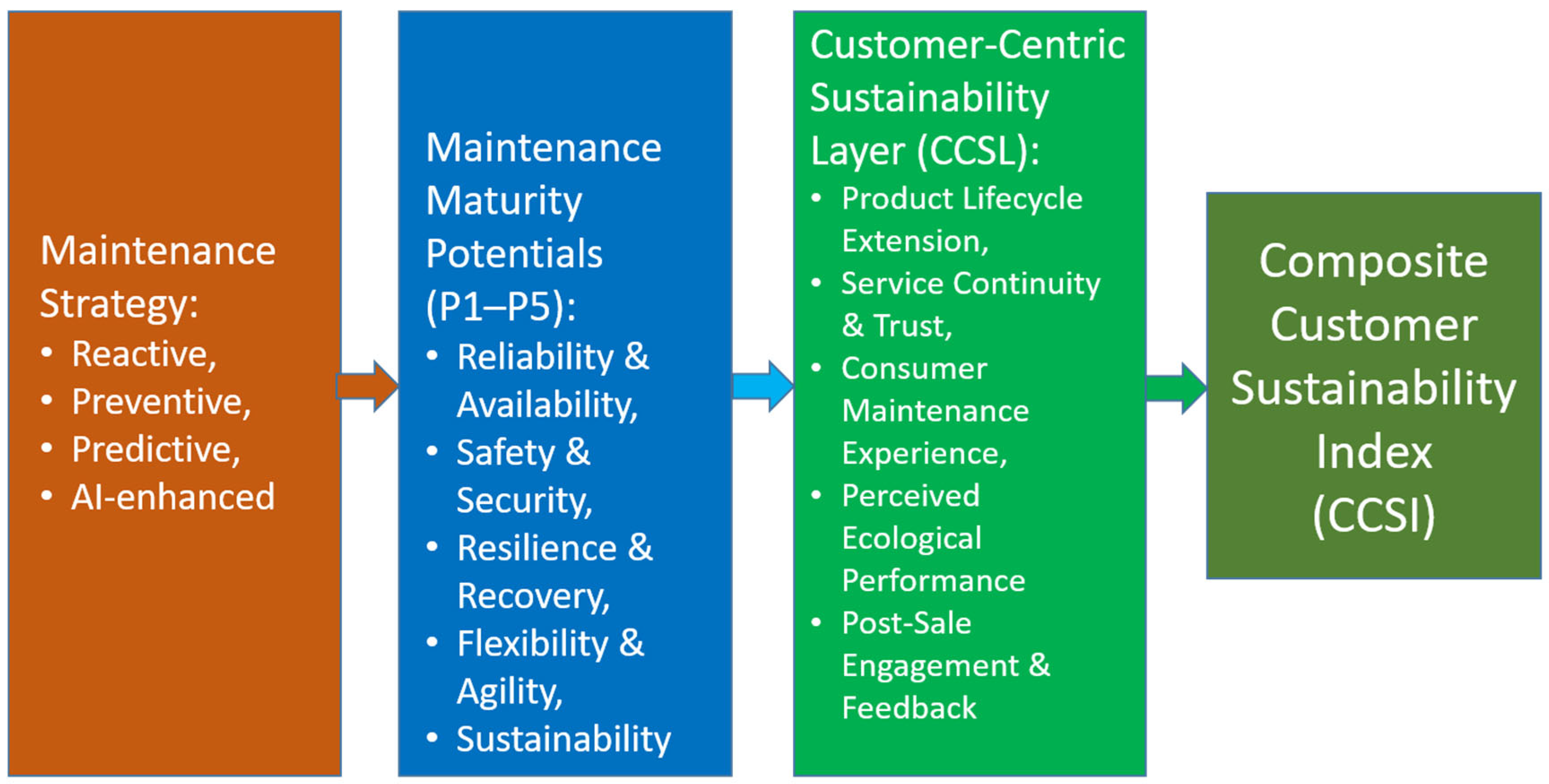
This study adopts a design science and conceptual modeling research methodology to develop and demonstrate an integrated framework linking maintenance maturity, customer-centric sustainability perception, and composite sustainability performance. The research process consists of four main stages: (i) conceptual framework development, (ii) fuzzy-based modeling design, (iii) expert-based evaluation and aggregation, and (iv) illustrative case study validation. As illustrated in
Figure 6, these stages are sequentially structured to ensure traceability from conceptual assumptions to quantitative assessment outputs.
The conceptual framework was developed based on an extensive literature review of maintenance maturity models, sustainability assessment frameworks, and customer perception models in smart product–service systems. The Integrated Maintenance Maturity Model (IMMM) was used as the internal engineering assessment layer, while a novel Customer-Centric Sustainability Layer (CCSL) was proposed to capture stakeholder-perceived sustainability outcomes. In the first stage (conceptual framework development), the output is a structured multi-layer model integrating micro-level maintenance maturity with meso-level consumer perception and macro-level sustainability objectives, as depicted in the upper part of
Figure 6. The framework establishes causal and analytical links between maintenance maturity potentials, maintenance strategies, customer perception dimensions, and the Composite Customer Sustainability Index (CCSI).
Given the qualitative, uncertain, and expert-driven nature of maintenance and sustainability assessments, a fuzzy inference system (FIS) was employed. Linguistic variables were defined using multi-level scales to capture expert judgments on maintenance maturity and customer perception constructs. Triangular and trapezoidal membership functions were used to represent linguistic terms due to their interpretability and suitability for expert-based assessments.
In the second stage (fuzzy-based modeling design), the conceptual relationships are transformed into a computational fuzzy inference structure, where IMMM and CCSL constructs are operationalized into linguistic variables, membership functions, and rule-based mappings.
A rule-based fuzzy inference mechanism was designed to link IMMM potentials with CCSL dimensions, enabling the translation of internal technical maturity into customer-perceived sustainability constructs. The centroid method was applied for defuzzification to obtain crisp maturity and perception scores.
In the third stage (expert-based evaluation and aggregation), expert knowledge is used as the primary input for parameterizing the fuzzy system, where linguistic assessments are aggregated using arithmetic mean operators and fuzzy aggregation techniques to reduce subjectivity and improve robustness. Weighting coefficients are derived through structured elicitation procedures, including Delphi rounds and multi-criteria decision support approaches. Experts were selected from three domains: maintenance engineering, sustainability management, and marketing/customer experience management to ensure a socio-technical perspective. Experts provided linguistic assessments for IMMM potentials, CCSL dimensions, and maintenance strategy impacts.
Finally, in the fourth stage (illustrative case study validation), the calibrated model is applied to a manufacturing case study to demonstrate its practical applicability. This stage produces comparative outputs for different maintenance strategies (reactive, preventive, predictive, and AI-enhanced), resulting in quantified IMMM–CCSL performance profiles and the Composite Customer Sustainability Index (CCSI).
At the end, an illustrative case study of a manufacturing company producing durable goods was used to illustrate the applicability of the proposed methodology. The case study analyzes alternative maintenance strategies (reactive, preventive, predictive, and AI-enhanced maintenance) and evaluates their impact on maintenance maturity, customer-centric sustainability perception, and composite sustainability performance. Company-specific information was anonymized to ensure confidentiality, and synthetic or representative data were used where empirical data were unavailable.
The methodology integrates sustainability assessment with cognitive and maintenance maturity modeling, enabling organizations to evaluate environmental, economic, and social impacts within a unified fuzzy decision-support framework.
Unlike traditional maturity models, the proposed approach explicitly incorporates uncertainty, expert knowledge, and sustainability-driven performance indicators, supporting strategic planning toward resilient and sustainable supply chains.
Overall,
Figure 6 synthesizes the methodological logic of the study by explicitly linking (i) theoretical development, (ii) fuzzy system construction, (iii) expert knowledge integration, and (iv) empirical illustration into a coherent and traceable research design.
4. Proposed Maturity Model with Customer-Centric Sustainability Layer (CCSL)
This section introduces the proposed extension of the Integrated Maintenance Maturity Model (IMMM) toward a customer-centric sustainability perspective. Building on the conceptual positioning and research gaps identified in
Section 2, the model is expanded from an internal operational maturity framework to a multilevel system linking maintenance capabilities, operational resilience, and consumer-perceived sustainability outcomes. The proposed IMMM with Customer-Centric Sustainability Layer (IMMM–CCSL) provides a systemic bridge between engineering-based maintenance maturity assessment and sustainability value creation at the market interface.
In this study, a clear distinction is made between closely related sustainability perception constructs used in the context of maintenance-driven value creation. Customer-centric sustainability refers to the overarching conceptual framework that integrates operational maintenance capabilities with external stakeholder-oriented sustainability outcomes. Consumer-perceived sustainability is defined as the end-user evaluative construct capturing how customers perceive environmental, social, and service-related sustainability attributes of products and services influenced by maintenance performance. It reflects subjective judgments related to product reliability, lifecycle extension, service continuity, and ecological performance. In turn, consumer-oriented sustainability outcomes refer to aggregated measurable results derived from these perceptions, including indicators such as satisfaction, trust, engagement, and the Composite Customer Sustainability Index (CCSI). This study adopts consumer-perceived sustainability as the primary analytical construct within the CCSL layer to ensure conceptual consistency across the proposed framework.
4.1. Integrated Maintenance Maturity Model (IMMM) Overview
The Integrated Maintenance Maturity Model (IMMM) serves as the foundational internal capability layer of the proposed framework. The IMMM was originally developed and validated as a multidimensional, fuzzy-based maturity assessment model integrating reliability, safety, resilience, flexibility, and sustainability dimensions of maintenance systems [
17]. In the present study, the IMMM is adopted as a baseline engineering framework and conceptually extended with an external customer-oriented sustainability layer.
The IMMM conceptualizes maintenance not only as a technical support function but also as a strategic enabler of operational continuity, organizational adaptability, and sustainable system performance. The model integrates five key maintenance maturity potentials: (P1) Reliability and Availability, (P2) Safety and Security, (P3) Resilience and Recovery, (P4) Flexibility and Agility, and (P5) Sustainability. These potentials jointly represent the technical, organizational, and environmental capabilities required to ensure robust and adaptive system operation under uncertainty. The IMMM follows a five-level maturity hierarchy (L1–L5), aligned with established capability frameworks such as CMMI, PAS 55 [
95], and ISO 55000, enabling structured benchmarking and progressive improvement assessment.
In its original formulation, the IMMM was supported by a fuzzy logic-based assessment methodology designed to capture the inherent uncertainty and subjectivity of maintenance decision-making. Expert-driven linguistic evaluations, fuzzy aggregation, and Mamdani-type inference mechanisms were used to derive quantitative maturity scores for each potential and for overall system maturity. Detailed methodological foundations, including membership function design, rule base development, and validation procedures, are reported in Bukowski and Werbinska-Wojciechowska [
17] and are not repeated here for brevity.
In the context of this study, the IMMM is conceptualized as an internal operational maturity backbone that determines the system’s capability to deliver reliable, resilient, and sustainable performance. However, prior applications of maintenance maturity models, including the IMMM, have predominantly focused on internal engineering and organizational performance indicators, with limited consideration of how maintenance-driven operational performance translates into consumer-perceived sustainability and market-level value creation. This represents a critical gap, particularly in the digital economy, where customer experience, trust, and perceived sustainability increasingly shape competitive advantage.
To address this limitation, the present study extends the IMMM by introducing a Customer-Centric Sustainability Layer (CCSL). The CCSL positions maintenance maturity as a micro-level operational mechanism, operational resilience as a meso-level system property, and consumer perception as an emergent outcome observable at the market interface. In contrast to prior work, where sustainability was primarily assessed through internal environmental metrics, the proposed framework explicitly links maintenance maturity outcomes with consumer-perceived sustainability, trust, and behavioral intentions in smart product ecosystems.
Conceptually, the IMMM in this study is not reintroduced as a new maturity model but rather employed as a foundational capability layer enabling sustainable value creation. The novelty lies in integrating engineering-based maturity assessment with a customer-centric sustainability modeling layer, thereby bridging maintenance engineering, resilience science, and consumer behavior research. This extension enables the translation of internal maintenance capabilities into externally perceived sustainability outcomes, forming a dual-layer maturity framework for digital and sustainable industrial systems.
The extended IMMM–CCSL framework is further elaborated in the following subsections.
Section 4.2 defines the CCSL dimensions and their mapping to sustainability frameworks (TBL and SDGs).
Section 4.3 conceptual integration of the customer perspective layer into the IMMM model, 4.4 presents the fuzzy-based assessment approach integrating IMMM and CCSL layers, and
Section 4.5 conceptualizes the linkage between maintenance strategies and consumer value creation.
4.2. Definition of Customer-Centric Sustainability Layer (CCSL) Dimensions
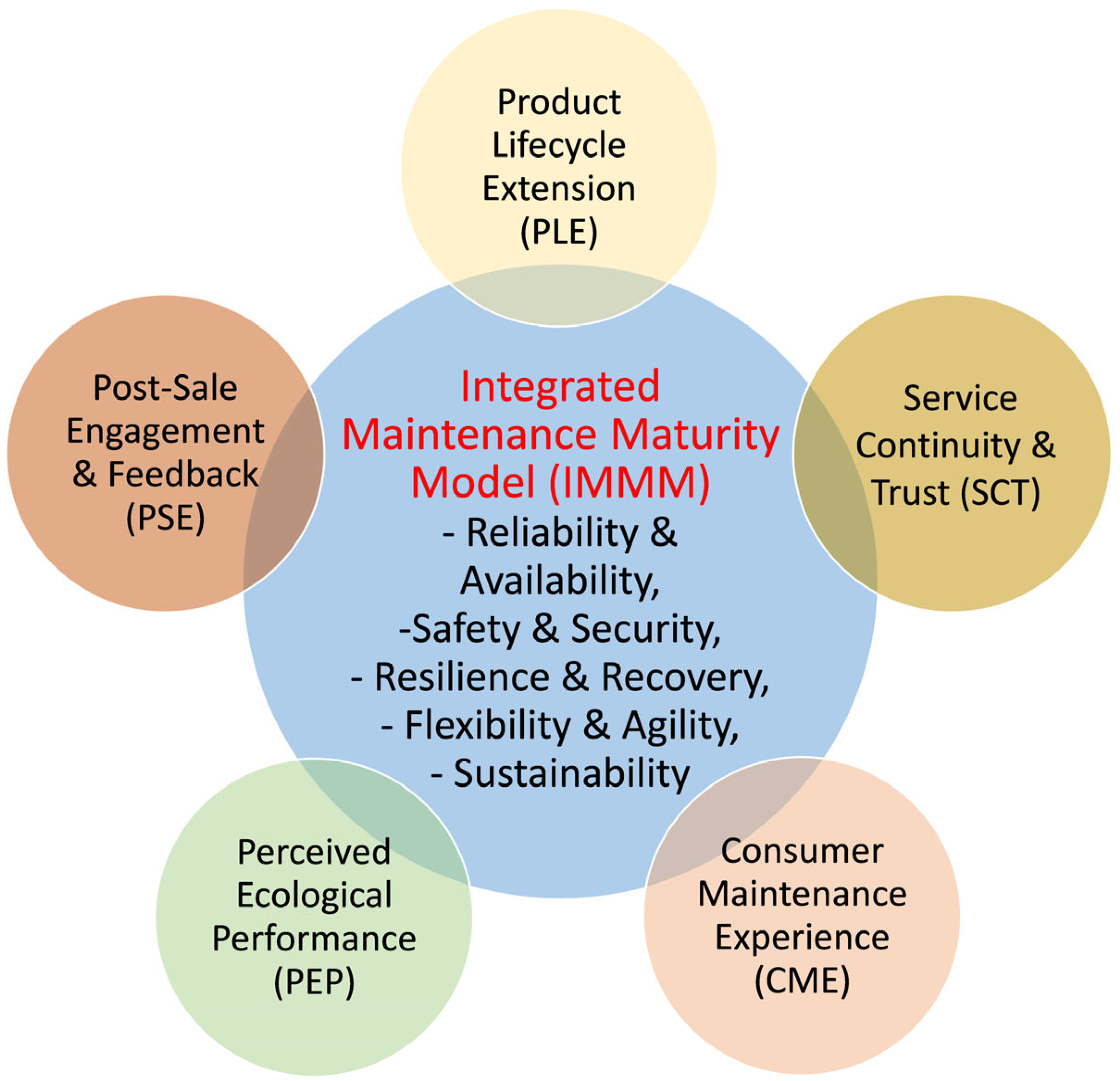
The Customer-Centric Sustainability Layer (CCSL) is proposed as an external stakeholder-oriented extension of the Integrated Maintenance Maturity Model (IMMM), capturing how internal maintenance capabilities translate into consumer-perceived sustainability outcomes. While IMMM evaluates engineering, organizational, and environmental maturity from an internal operational perspective, CCSL operationalizes sustainability at the interface between technical systems and end-users. This extension acknowledges that sustainability outcomes are not only driven by technical performance but also by consumer perception, experience, and engagement across the product and service lifecycle.
Figure 7 illustrates the conceptual positioning of CCSL as an external layer built upon IMMM maturity potentials. The figure highlights the cause–and–effect relationship between internal maintenance maturity and externally perceived sustainability value.
The CCSL integrates five interrelated dimensions that jointly reflect how maintenance strategies shape perceived product value, trust, and sustainability performance in digital and smart product ecosystems. First, Product Lifecycle Extension (PLE) reflects the contribution of maintenance activities to prolonging the functional and economic lifespan of products and assets. Maintenance-induced lifecycle extension reduces material consumption, waste generation, and premature obsolescence, aligning maintenance decisions with circular economy principles. From the consumer perspective, extended product lifetimes influence perceived durability, quality, and value-for-money, thereby strengthening trust and reducing perceived technological and financial risk.
Second, Service Continuity and Trust (SCT) captures the role of maintenance maturity in ensuring reliable service delivery and operational continuity. High maintenance maturity reduces unplanned downtime, stabilizes service performance, and enhances predictability, which are critical determinants of consumer trust in digital services, smart products, and cyber-physical systems. SCT reflects the linkage between engineering reliability and psychological trust formation, where stable technical performance reduces uncertainty and perceived risk in consumer decision-making.
Third, Consumer Maintenance Experience (CME) addresses the consumer-facing dimension of maintenance, including service responsiveness, transparency, digital interaction quality, and perceived ease of maintenance-related communication. In increasingly digitalized service ecosystems, maintenance is no longer an invisible back-end function but a component of the digital customer experience. CME captures social sustainability aspects related to accessibility, fairness, transparency, and customer empowerment through maintenance-related digital interfaces and communication mechanisms.
Fourth, Perceived Ecological Performance (PEP) represents the consumer’s perception of the environmental performance enabled by maintenance practices. While IMMM internally quantifies sustainability through energy use, emissions, and resource efficiency, PEP translates these outcomes into market-level perceptions of green performance, eco-efficiency, and corporate environmental responsibility. This dimension recognizes that consumer sustainability judgments are often perception-driven and mediated by transparency, certifications, and sustainability communication strategies rather than direct environmental measurements.
Finally, Post-Sale Engagement and Feedback (PSE) reflects the mechanisms through which consumers interact with maintenance systems after product purchase, including predictive maintenance notifications, digital twin-based service platforms, feedback systems, and participatory maintenance ecosystems. PSE operationalizes the co-creation of sustainability value, where consumer feedback and behavioral data support adaptive maintenance strategies, continuous improvement, and stakeholder-driven sustainability governance.
Together, these five CCSL dimensions extend the IMMM from an internally focused engineering maturity framework toward a multi-stakeholder sustainability assessment architecture. By integrating consumer perception, service experience, and engagement mechanisms, CCSL enables the evaluation of how maintenance maturity contributes to broader sustainability outcomes across the Triple Bottom Line (TBL) pillars and the United Nations Sustainable Development Goals (SDGs), as summarized in
Table 4. However, CCSL remains a conceptual stakeholder-oriented layer and does not provide an operational evaluation mechanism by itself. Therefore,
Section 4.3 introduces the integrated IMMM–CCSL framework, where CCSL dimensions are mapped onto IMMM maturity potentials and operationalized through fuzzy inference rules and decision-support structures to enable quantitative sustainability assessment and managerial recommendations.
4.3. Conceptual Integration of CCSL into the IMMM Framework
The Customer-Centric Sustainability Layer (CCSL) is integrated with the Integrated Maintenance Maturity Model (IMMM) to establish a multi-layer framework linking internal maintenance maturity to externally perceived sustainability outcomes. While IMMM evaluates organizational, technical, and sustainability capabilities from an engineering and operational perspective, CCSL translates these capabilities into consumer-perceived value, trust, and sustainability performance. This integration enables a systemic evaluation of how maintenance maturity influences stakeholder perception, service quality, and sustainability reputation in digital and cyber-physical systems.
The mapping between IMMM potentials and CCSL dimensions is summarized in
Table 5, which establishes conceptual and analytical linkages between internal maintenance capabilities and customer-facing sustainability constructs.
This mapping illustrates that each IMMM potential contributes to multiple CCSL dimensions, highlighting the systemic and cross-cutting nature of maintenance-driven sustainability perception. For instance, the Reliability and Availability potential (P1) primarily affects Service Continuity and Trust (SCT) and Product Lifecycle Extension (PLE). At the same time, Sustainability (P5) directly influences Perceived Ecological Performance (PEP) and indirectly shapes consumer engagement and trust mechanisms. Similarly, Safety and Security (P2) and Resilience and Recovery (P3) contribute to perceived service reliability and digital trust. In contrast, Flexibility and Agility (P4) enhances Consumer Maintenance Experience (CME) through adaptive and responsive maintenance strategies.
To operationalize CCSL for empirical assessment, a structured taxonomy of measurable indicators is proposed. The taxonomy includes survey-based perceptual indicators, operational service indicators, and digital interaction indicators, enabling mixed-method data collection. The full indicator taxonomy is provided in
Table A2 (
Appendix A). Each indicator is defined using Likert-scale linguistic variables and mapped to fuzzy membership functions to enable integration with the fuzzy IMMM maturity assessment framework.
To formally link internal maintenance maturity with customer-perceived sustainability outcomes, a multi-stage mathematical model integrating IMMM and CCSL is proposed.
Let the IMMM maturity score for each maintenance potential
Pk (
k = 1, …, 5) be expressed as a normalized defuzzified value obtained from the fuzzy inference system:
where
represents the maturity level of the
k-th IMMM potential (Reliability and Availability, Safety and Security, Resilience and Recovery, Flexibility and Agility, and Sustainability).
Let the CCSL dimensions be denoted as:
where
PLE is Product Lifecycle Extension,
SCT is Service Continuity and Trust,
CME is Consumer Maintenance Experience,
PEP is Perceived Ecological Performance, and
PSE is Post-Sale Engagement and Feedback.
Each CCSL dimension is modeled as a function of IMMM potentials using a weighted transformation function:
In this study, Equation (3) represents the general (conceptual) dependency structure between maintenance maturity and customer-centric sustainability perception.
In this study, the linear aggregation structure is adopted as a baseline interpretability layer, while potential non-linear relationships between variables are captured within the fuzzy inference system described in
Section 4.4. This allows maintaining transparency of the analytical formulation while preserving modeling flexibility.
For operationalization, a linear weighted aggregation form is adopted:
subject to:
where
denotes the influence weight of IMMM potential
Pk on CCSL dimension
Ci.
The normalization constraint ensures comparability of influence weights while implicitly assuming independence of across CCSL dimensions for the baseline formulation. In practice, these weights are derived from expert consensus, which may reflect weak interdependencies captured implicitly in the elicitation process.
Equation (4) represents the deterministic baseline formulation of CCSL computation, which is later extended into a fuzzy inference framework (
Section 4.4).
In the next step, to represent overall customer-perceived sustainability, a Sustainability Perception Index (SPI) is defined as a weighted aggregation of CCSL dimensions:
with:
where
represents stakeholder-defined importance weights reflecting the relative significance of each CCSL dimension from the customer perspective.
Similarly as for Equation (5), weights are assumed to be independent and normalized to enable consistent aggregation across CCSL dimensions, reflecting equal validity of dimensions in the absence of empirical calibration data.
It should be emphasized that Equation (6) represents the aggregation of defuzzified CCSL outputs. In the full fuzzy implementation (
Section 4.4.3), the SPI is first computed as a fuzzy quantity (Equation (13)) and subsequently defuzzified (Equation (14)), yielding the crisp form used in Equation (6).
To integrate internal technical maturity with external sustainability perception, a Composite Customer Sustainability Index (CCSI) is proposed as the principal novelty of the framework. The model assumes monotonic relationships, meaning that improvements in IMMM potentials lead to non-decreasing CCSL outcomes, and higher CCSL values contribute positively to the Composite Customer Sustainability Index (CCSI). This assumption reflects standard behavior in sustainability perception models and is consistent with value-increasing system dynamics.
First, the overall IMMM technical maturity score is defined as:
The arithmetic mean is used as it reflects an equal contribution assumption across IMMM potentials and avoids introducing additional weighting bias at the aggregation stage of the baseline model.
In this study, Equation (8) represents the final aggregated IMMM score derived from fuzzy-defuzzified potential-level evaluations and is consistently used in the empirical case study. The value
MIMMMagg represents the overall internal maintenance maturity obtained as the arithmetic mean of the five IMMM potentials after defuzzification. In the empirical case study, this value may differ from intermediate or subsystem-level maturity scores reported for specific analytical purposes. Therefore, it should be interpreted as the global aggregated maturity indicator used in the CCSI formulation. In addition, the arithmetic aggregation in Equation (8) is used as a baseline assumption of equal contribution of IMMM potentials, ensuring interpretability and comparability across maturity dimensions. Non-uniform importance is handled within the fuzzy weighting structure in
Section 4.4.
The CCSI is then formulated as:
where
CCSI ∈ [0, 1] is the Composite Customer Sustainability Index,
represents internal maintenance maturity,
represents customer-perceived sustainability,
λ ∈ [0, 1] is a balancing coefficient reflecting the strategic emphasis on engineering performance versus customer perception (with λ = 0.5 as a neutral default). In this study, λ is assumed as a fixed parameter reflecting strategic preference between internal engineering performance and customer-perceived sustainability. Unless otherwise stated, a neutral value of λ = 0.5 is adopted. In more advanced implementations, λ can be modeled as a fuzzy variable or estimated based on stakeholder preferences. Indeed, the parameter λ = 0.5 is assumed under an equal importance assumption between internal engineering performance (IMMM) and customer-perceived sustainability (SPI) in the absence of empirical calibration data. This choice ensures neutrality of the baseline model and allows future calibration based on stakeholder-specific preferences or empirical studies.
This formulation represents the final hybrid aggregation layer combining internal engineering maturity with external perception-based sustainability outcomes.
The CCSI provides a unified decision-support metric for evaluating how maintenance strategies simultaneously influence engineering performance and customer-perceived sustainability, enabling benchmarking, scenario analysis, and sustainability-driven maintenance policy design.
To explicitly address uncertainty and linguistic vagueness, Equations (4)–(9) are extended within a fuzzy inference framework in
Section 4.4. In this context, crisp formulations represent defuzzified outcomes of the fuzzy system rather than independent alternative models.
4.4. Fuzzy-Based Assessment of IMMM-CCSL System Layers
The proposed Integrated Maintenance Maturity Model with the Customer-Centric Sustainability Layer (IMMM–CCSL) is operationalized using a fuzzy logic-based assessment framework. In this framework, Equations (4)–(9) do not represent an alternative deterministic model, but rather the analytical (post-defuzzification) form of the fuzzy inference system. All crisp values used in subsequent aggregation steps are obtained as defuzzified outputs of the fuzzy model described in
Section 4.4. This ensures methodological consistency between the fuzzy inference process and the final quantitative indicators. In the following, variables marked with the tilde symbol (~) denote fuzzy quantities, while variables without the tilde represent their defuzzified (crisp) counterparts.
Fuzzy set theory is adopted to address the inherent uncertainty, subjectivity, and linguistic nature of expert evaluations and customer perception data, which are typical in sustainability and maturity assessments. Unlike deterministic scoring approaches, fuzzy modeling enables the transformation of qualitative judgments into quantitative maturity scores while preserving semantic meaning and epistemic uncertainty. Thus, the IMMM–CCSL framework is a hybrid fuzzy–crisp system in which fuzzy inference generates intermediate representations that are subsequently defuzzified for aggregation and decision-making.
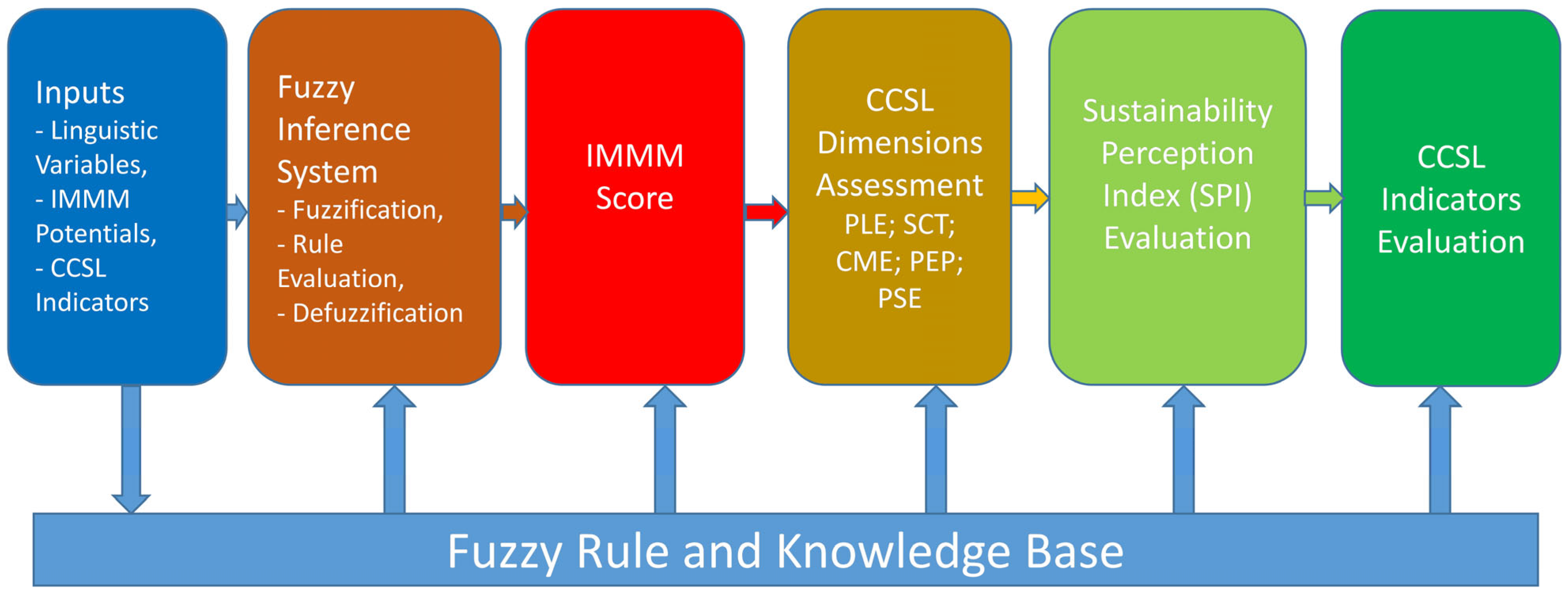
Figure 8 illustrates the complete fuzzy inference workflow used to operationalize the IMMM–CCSL model, including the transformation of linguistic inputs into quantitative sustainability and maturity outputs.
As shown in
Figure 8, the fuzzy inference process follows a structured sequence: (i) definition of linguistic input variables derived from IMMM potentials and CCSL perception dimensions, (ii) fuzzification of expert and survey-based evaluations using membership functions, (iii) rule-based inference linking maintenance maturity, sustainability, and consumer perception constructs, and (iv) defuzzification to generate crisp Composite Customer Sustainability Index (CCSI) outputs. The fuzzy inference system is implemented using a Mamdani-type architecture in the MATLAB R2020a Fuzzy Logic Toolbox environment. A Mamdani-type inference system is selected due to its high interpretability and its ability to incorporate linguistic IF–THEN rules, which is particularly suitable for expert-driven sustainability and maintenance maturity assessment. The inference mechanism follows standard operator definitions: the minimum operator is used for logical conjunction (AND), the maximum operator for rule aggregation, and the centroid of area (CoA) method for defuzzification. This configuration ensures transparency, interpretability, and compatibility with widely adopted fuzzy modeling practices in engineering applications. For full reproducibility, detailed specifications of the fuzzy inference system, including membership function parameterization, rule base structure, and implementation settings, are provided in
Appendix B.
The proposed fuzzy-based framework for IMMM-CCSL assessment is therefore not only a conceptual representation but a computational workflow that enables systematic integration of qualitative expert knowledge with quantitative decision-support outputs in a unified evaluation structure.
Additionally, it is important to emphasize that the analytical expressions presented in Equations (4)–(9) do not constitute an independent deterministic model. Instead, they represent the defuzzified outputs of the underlying fuzzy inference system. All crisp values used in subsequent aggregation and case study analysis are obtained through the fuzzification–inference–defuzzification process described in this section. This ensures full methodological consistency between the fuzzy modeling framework and its numerical implementation.
4.4.1. Fuzzy Representation of IMMM Potentials
Each IMMM potential
Pk (Reliability and Availability, Safety and Security, Resilience and Recovery, Flexibility and Agility, and Sustainability) is assessed using linguistic variables expressed on a predefined maturity scale (e.g., Very Low, Low, Medium, High, Very High). Triangular or trapezoidal fuzzy numbers represent these linguistic terms:
where
define the membership function parameters. Expert evaluations of IMMM indicators are aggregated using fuzzy arithmetic operators (e.g., arithmetic mean or OWA operators) to obtain a fuzzy maturity score for each potential.
Triangular fuzzy numbers are chosen due to their computational simplicity, interpretability in expert elicitation contexts, and widespread use in maintenance and sustainability assessment models. In addition, the triangular membership functions used in this study are defined over the normalized domain [0, 1] and follow the standard form [
17], according to
Appendix B.3. The same set of membership functions is consistently applied to both IMMM potentials and CCSL dimensions to ensure methodological coherence across internal maturity assessment and customer-perceived sustainability evaluation. All linguistic variables are defined using the triangular fuzzy numbers specified in
Table 6, which ensures interpretability and consistency with expert-based qualitative assessments.
A Mamdani-type fuzzy inference system is employed to model the relationships between maintenance indicators and IMMM potentials. The inference rules follow the structure:
As a result, we may state that the fuzzy rule base linking input indicators to IMMM potentials was constructed using expert knowledge reflecting causal relationships between maintenance performance attributes and maturity levels. The rule structure follows a standard IF–THEN format, for example:
IF reliability is High AND failure frequency is Low THEN P1 is High
IF system flexibility is Low AND response time is High THEN P4 is Low
IF sustainability practices are Medium THEN P5 is Medium
The rule base was designed to ensure coverage of all relevant combinations of input linguistic variables while maintaining interpretability and avoiding redundancy. Due to space limitations, the complete set of fuzzy inference rules is provided in
Appendix B.
Defuzzification is performed using the Centroid of Area (CoA) method to obtain normalized maturity scores, as for Equation (1). These scores constitute the internal engineering maturity layer of the IMMM–CCSL framework and provide the inputs used in Equation (8). The centroid method is adopted due to its balance between computational efficiency and interpretability and its established use in engineering fuzzy inference systems.
4.4.2. Fuzzy Modeling of CCSL Dimensions
The CCSL dimensions (PLE, SCT, CME, PEP, and PSE) are evaluated using customer perception indicators and service performance metrics expressed in linguistic terms. Survey responses and operational metrics are transformed into fuzzy membership functions to capture perception vagueness and subjective judgments.
For each CCSL dimension
Ci, a fuzzy aggregation function is applied, based on Equation (3):
where
gi(⋅) represents a fuzzy mapping operator linking internal maintenance maturity to external perception-based sustainability constructs. Expert-derived fuzzy weights
are used to model the influence of IMMM potentials on CCSL dimensions.
Equation (11) is the fuzzy extension of Equation (3), representing the same structural relationship in a fuzzy domain.
Defuzzified CCSL dimension scores are obtained as:
which represent normalized customer-perceived sustainability performance.
4.4.3. Fuzzy Aggregation of Sustainability Perception and Composite Index
To evaluate overall customer-perceived sustainability, a fuzzy weighted aggregation operator is applied to CCSL dimensions:
where
are fuzzy stakeholder importance weights and ⊗ denote fuzzy multiplication. The aggregated fuzzy Sustainability Perception Index is subsequently defuzzified to obtain:
The Composite Customer Sustainability Index (CCSI) is then computed using a hybrid fuzzy–crisp integration approach, where defuzzified IMMM and CCSL outputs are combined according to Equation (9). Alternatively, λ can be modeled as a fuzzy variable to capture strategic uncertainty in balancing engineering performance and perception-based sustainability.
4.4.4. Expert Elicitation and Parameter Determination Procedure
The proposed framework relies on expert-based evaluation for the determination of influence coefficients, weighting parameters, and the construction of the fuzzy rule base. All weighting parameters (, , ) are derived from expert consensus obtained through structured elicitation and aggregated using arithmetic mean normalization. This approach ensures consistency across evaluators while maintaining interpretability of the model structure. In future extensions, these parameters may be further validated using AHP or structural equation modeling techniques.
To ensure transparency and reproducibility, the expert elicitation procedure was structured as follows.
First, a panel of six experts was selected based on their professional experience in maintenance engineering, sustainability management, and product–service systems. All experts had at least five years of experience, with the majority exceeding ten years, ensuring both practical and strategic perspectives. The panel composition included maintenance engineers, sustainability specialists, and service strategy experts to provide interdisciplinary coverage.
Second, the evaluation process followed a structured elicitation approach inspired by the Delphi method. Experts independently assessed relationships between IMMM potentials and CCSL dimensions using predefined linguistic scales. Due to the exploratory nature of the study, a single-round evaluation was conducted, and the results were aggregated using arithmetic mean operators. Although a single-round elicitation was adopted due to the exploratory nature of the study, consistency of expert judgments was verified through convergence analysis of linguistic assessments.
Third, linguistic evaluations were converted into numerical values using the centroid values of the predefined triangular membership functions. This ensured consistency between the expert judgment stage and the fuzzy inference system.
Fourth, expert knowledge was also used to support the construction of the fuzzy rule base, ensuring that inference rules reflect realistic cause–effect relationships between maintenance performance variables and maturity outcomes.
Finally, normalization procedures were applied to all influence matrices to satisfy model constraints (Equations (5) and (7)) and to ensure comparability across CCSL dimensions.
The complete specification of the fuzzy inference system, including representative rule sets, membership function definitions, and implementation details, is provided in
Appendix B to support reproducibility of the proposed model.
4.4.5. Linguistic Classification of Maturity and Sustainability Levels
To support managerial interpretation, the resulting IMMM maturity levels, CCSL sustainability perception levels, and CCSI values are mapped to linguistic classes using predefined fuzzy membership functions. This classification enables benchmarking, maturity road-mapping, and sustainability-driven maintenance strategy formulation.
Table 6 summarizes the linguistic input scales and TFN used in the IMMM-CCSL FIS. The linguistic scales were defined to capture both technical maintenance maturity (IMMM potentials) and customer-perceived sustainability performance (CCSL dimensions). Triangular fuzzy numbers were selected due to their transparency, interpretability, and suitability for expert-based qualitative assessments commonly applied in maintenance maturity studies. The dual interpretation enables direct coupling between internal operational maturity and external customer perception, which represents a key methodological novelty of the proposed IMMM–CCSL framework. The overlap between adjacent membership functions is intentional and ensures smooth transitions between linguistic states.
The output scale and interpretation for both maintenance maturity and customer-perceived sustainability are presented in
Table 7.
Unlike traditional maintenance maturity models focusing solely on internal operational performance, the proposed IMMM–CCSL framework introduces a dual interpretation of fuzzy maturity outputs, linking technical maturity levels with customer-perceived sustainability outcomes. This enables a holistic evaluation of maintenance-driven sustainability from both organizational and market perspectives.
The dual-layer interpretation reflects the Triple Bottom Line logic, where technical maintenance maturity primarily influences the economic and operational dimensions. In contrast, CCSL outputs reflect environmental and social perception dimensions from the customer perspective. The integration of both interpretations enables the derivation of the Composite Customer Sustainability Index (CCSI), supporting sustainable product–service system evaluation.
To sum up, the fuzzy-based IMMM–CCSL assessment framework provides several methodological advantages. First, it integrates heterogeneous data sources, including expert judgments, operational performance indicators, and customer perception data, within a unified mathematical structure. Second, it explicitly captures epistemic uncertainty and vagueness inherent in sustainability perception and maintenance maturity assessments. Third, it enables multi-level aggregation and scenario analysis through adjustable fuzzy weights and rule bases. Finally, the framework is compatible with empirical validation techniques, including regression analysis and structural equation modeling, facilitating quantitative hypothesis testing of the IMMM–CCSL relationships.
4.5. Conceptual Link Between Maintenance Strategies and Consumer Value—Interpretation of Layer-Level and Organizational Maturity Scores
It should be noted that the maintenance strategy mapping presented in this section serves as an interpretative extension of the IMMM–CCSL framework. While
Section 4.1,
Section 4.2,
Section 4.3 and
Section 4.4 define the core computational model,
Section 4.5 provides an additional analytical layer linking maintenance strategies to consumer-perceived outcomes through the IMMM and CCSL constructs.
Maintenance strategies represent the operational manifestation of organizational maintenance maturity and directly shape customer-perceived value in smart product–service systems. Within the proposed IMMM–CCSL framework, maintenance strategies constitute the intermediate translation layer between internal engineering maturity (IMMM potentials) and external customer-centric sustainability perception (CCSL dimensions).
In this study, four archetypal maintenance strategies are considered: reactive, preventive, predictive, and AI-enhanced intelligent maintenance. Each strategy reflects a distinct maturity level and technological sophistication and influences consumer outcomes such as perceived product quality, service reliability, environmental perception, and post-sale engagement. Additionally, the strategies are not mutually exclusive and may coexist within a hybrid maintenance policy, which is reflected in the continuous representation of the strategy vector in Equation (15).
4.5.1. Maintenance Strategy Typology and Organizational Maturity Alignment
Reactive maintenance represents the lowest maturity level, characterized by failure-driven interventions with limited planning and learning mechanisms. Preventive maintenance introduces scheduled interventions based on time or usage thresholds, partially reducing failure uncertainty. Predictive maintenance leverages condition monitoring and data analytics to anticipate failures, enabling optimized intervention timing. AI-enhanced maintenance extends predictive approaches through machine learning, digital twins, and autonomous decision-making, enabling adaptive and resilience-driven maintenance governance. The survey of the proposed strategies in relation to the IMMM Maturity levels and CCSL dimensions is given in
Table 8.
These strategies correspond to progressive levels of organizational maintenance maturity as defined by IMMM and influence CCSL dimensions through service continuity, lifecycle extension, perceived ecological performance, and consumer engagement mechanisms.
To operationalize the relationship between maintenance strategies and consumer-perceived value, a conceptual mapping matrix is proposed linking maintenance strategies with key consumer outcomes (
Table 9).
To illustrate the translation mechanism from maintenance strategy to consumer value, a conceptual pathway architecture is proposed (
Figure 9).
Figure 9 illustrates the complete causal transformation pathway in which maintenance strategies are first translated into corresponding IMMM maturity levels, which then determine operational resilience characteristics and subsequently influence CCSL consumer perception dimensions. These intermediate transformations collectively lead to the final output of the model, the Composite Customer Sustainability Index (CCSI), which represents the aggregated sustainability value perceived by customers. Arrows represent causal pathways from technical maturity drivers to consumer-perceived outcomes.
More specifically, the directional arrows in
Figure 9 represent sequential cause–effect relationships: (i) maintenance strategy selection determines the level of maintenance maturity, (ii) maintenance maturity influences operational resilience and system performance stability, (iii) these operational outcomes shape consumer perception of sustainability, trust, and service quality, and (iv) consumer perception is aggregated into the CCSI as the final evaluative construct.
4.5.2. Mathematical Mapping Framework Between Maintenance Strategies and Consumer Outcomes
To formalize the conceptual mapping, the maintenance strategy’s influence on consumer outcomes is expressed through a transformation matrix.
Let the maintenance strategy vector be:
where
denote normalized maturity levels (0–1) for reactive, preventive, predictive, and AI-enhanced maintenance dominance.
Let the consumer outcome vector be:
where
is downtime perception,
perceived quality,
perceived ecological performance,
trust/service continuity, and
engagement potential.
The transformation is defined as:
where
is the Maintenance Strategy–Outcome Influence Matrix:
with:
The linear transformation in Equation (17) is assumed as a first-order approximation of strategy–outcome relationships, while non-linear perception effects are captured through fuzzy inference and expert-based weighting in the extended model. All influence coefficients (, , ) are assumed to be time-invariant in the baseline model formulation. This static assumption is adopted to ensure analytical tractability; however, dynamic extensions incorporating time-dependent learning or adaptive weighting mechanisms are identified as a direction for future research.
The matrix can be interpreted as a perception transfer function, capturing how technical maintenance strategies are cognitively translated into consumer-perceived value and sustainability signals. The coefficients αij represent the relative influence strength of maintenance strategy i on consumer outcome j and constitute behavioral perception transfer parameters within the IMMM–CCSL framework. These coefficients capture how operational maintenance practices are cognitively translated into perceived product quality, trust, and sustainability value by consumers.
Empirically, αij coefficients can be estimated using multiple data sources: (i) expert elicitation methods such as Delphi studies or Analytic Hierarchy Process (AHP), (ii) survey-based structural equation modeling (SEM) linking maintenance practices to customer perception constructs, or (iii) regression models using operational maintenance KPIs and customer satisfaction and sustainability perception data. Alternatively, fuzzy expert weighting schemes can be applied when empirical datasets are unavailable, ensuring model applicability in early-stage conceptual or exploratory studies.
The normalization constraint (Equation (19)) ensures that the influence contributions of each maintenance strategy on a given consumer outcome sum to unity, enabling comparative interpretation of strategy dominance and sensitivity analysis.
The consumer outcome vector O feeds into CCSL dimension scores and ultimately into the Composite Customer Sustainability Index (CCSI). Thus, organizational maintenance maturity scores are interpreted not only as internal operational capabilities but also as drivers of market-perceived sustainability value.
This enables organizations to interpret maturity scores at two levels:
layer-level interpretation: Influence of specific IMMM potentials on CCSL dimensions,
organizational-level interpretation: Strategic impact of dominant maintenance strategy on customer-perceived sustainability and brand value.
The proposed maintenance strategy–consumer value mapping framework extends traditional maintenance maturity models by explicitly quantifying how maintenance strategies translate into customer-perceived quality, trust, and sustainability outcomes. Unlike existing frameworks that treat maintenance as an internal operational function, the proposed approach conceptualizes maintenance strategies as socio-technical value creation mechanisms within smart product–service ecosystems.
5. Application and Demonstration of the Proposed Model via an Industrial Case Study
5.1. Case Study and Digital Economy Context and System Description
To illustrate the applicability of the extended IMMM–CCSL framework, the study builds upon the same industrial case previously analyzed using the baseline Integrated Maintenance Maturity Model (IMMM). The detailed operational assessment and full maturity evaluation procedure were presented in [
17], introducing the IMMM model. In the present study, the case is revisited to illustrate the additional analytical value provided by the Customer-Centric Sustainability Layer (CCSL) and the Composite Customer Sustainability Index (CCSI).
The analyzed organization is a large-scale manufacturing facility operating in the automotive sector and serving global OEM clients. The plant is part of an international production network and specializes in safety-critical systems for commercial vehicles. Due to the strategic nature of its products and its high level of automation, operational continuity, reliability, and compliance with safety standards are of central importance.
In the context of the analyzed case, the term “customer” primarily refers to B2B OEM clients and downstream industrial partners within the supply chain, rather than individual end users. These customers evaluate supplier performance based on criteria such as product reliability, delivery continuity, compliance with quality standards, and increasingly, sustainability-related attributes.
Due to data confidentiality constraints and the lack of direct access to customer survey data, customer perception variables within the CCSL were operationalized using expert-informed proxy indicators. These proxies were derived from established relationships between operational performance metrics (e.g., failure rates, downtime, maintenance responsiveness) and customer-relevant outcomes such as perceived reliability, service continuity, and trust.
The perception-oriented indicators included in
Appendix A,
Table A2 (e.g., trust in system reliability, perceived product quality, digital service interaction quality), therefore represent conceptual and analytically inferred constructs, rather than direct survey measurements. Their values were estimated through expert evaluation and fuzzy inference mechanisms, enabling the translation of internal operational states into approximated customer perception outcomes within an illustrative modeling framework.
From the perspective of the digital economy, the facility represents an advanced Industry 4.0 production environment. Its maintenance system integrates:
IoT-based condition monitoring sensors,
real-time machine data acquisition systems,
predictive analytics tools,
digital work-order management platforms,
pilot implementations of AI-supported diagnostic algorithms.
Maintenance activities are increasingly data-driven and supported by digital decision-support tools. Smart assets continuously generate operational data, enabling condition-based and predictive maintenance strategies. In addition, the company is gradually integrating digital service components, including remote diagnostics and centralized performance dashboards.
The plant’s production system is characterized by:
high product variability,
precision assembly processes,
safety-critical quality verification,
strong dependence on equipment uptime,
integration with a global supply chain network.
Given these characteristics, maintenance is not only an operational support function but also a strategic enabler of production stability and sustainability performance. Equipment failures directly affect delivery reliability, energy consumption, waste generation, and downstream customer satisfaction.
In the original IMMM-based assessment, five Maintenance Maturity Potentials (P1–P5) were evaluated: reliability and availability, safety and security, resilience and recovery, flexibility and agility, and environmental impact. These potentials were weighted using expert-based prioritization methods and assessed through quantitative and qualitative indicators aligned with relevant standards (e.g., asset management and maintenance performance frameworks). The present study does not replicate the full maturity evaluation process. Instead, it adopts the previously determined IMMM maturity structure and weight configuration as the internal technical baseline and extends the analysis toward the customer-oriented sustainability dimension.
The primary objective of this extended case application is therefore twofold:
- I.
To examine how different dominant maintenance strategies (reactive, preventive, predictive, AI-enhanced) influence not only operational maturity but also consumer-perceived (B2B-oriented) sustainability outcomes.
- II.
To assess the additional interpretative value of the CCSL layer compared to the baseline IMMM model.
In the digital economy context, this extension is particularly relevant because smart products and connected assets blur the boundaries between production systems and end-user experience. Maintenance performance increasingly affects customer perception through product reliability, service continuity, lifecycle extension, and environmental signaling. Therefore, the case provides an appropriate illustrative empirical environment to evaluate the proposed IMMM–CCSL integration under realistic digital manufacturing conditions.
In addition, due to data confidentiality constraints, part of the dataset used in this study is based on anonymized, representative, and partially synthetic data, complemented by expert-informed assumptions. Therefore, the case study should be interpreted as an illustrative application of the proposed framework rather than a full empirical validation. In addition, in this study, customer perception should therefore be interpreted as a modeled and proxy-based representation of B2B client evaluation, rather than direct end-user feedback.
5.2. Maintenance Maturity Assessment (IMMM)
The baseline maintenance maturity assessment was conducted using the Integrated Maintenance Maturity Model (IMMM
base), as presented in the authors’ previous study [
17]. In that work, a fuzzy inference system based on Mamdani-type reasoning and centroid defuzzification was applied to evaluate five Maintenance Maturity Potentials (P1–P5) and to determine the overall Maintenance Maturity Level (MML) of the analyzed company.
For the present study, the IMMM results serve as the internal operational benchmark against which the extended Customer-Centric Sustainability Layer (CCSL) is evaluated.
The defuzzified scores obtained in [
17] for the analyzed manufacturing plant are summarized in
Table 10.
The results indicate strong performance in Reliability and Availability (P1), reflecting advanced preventive and partially predictive maintenance practices supported by digital monitoring systems. The remaining potentials demonstrate medium maturity, suggesting structured but not yet fully optimized resilience, flexibility, and sustainability capabilities.
The aggregation of the five potentials into three system-level dimensions yielded the following results:
System Dependability: 0.687 (Standardized level)
System Adaptability: 0.654 (Standardized level)
System Sustainability: 0.677 (Standardized level)
The overall Integrated Maintenance Maturity Index reached: IMMMbase = 0.544 (L3 − Standardized).
This result positions the organization at a Standardized maturity level, characterized by consistent preventive maintenance practices, structured safety and recovery procedures, and initial integration of sustainability measures. However, the company has not yet achieved the fully predictive, adaptive, and innovation-driven characteristics associated with higher maturity levels (L4–L5).
Based on the IMMM outcomes and qualitative analysis in [
17], the company’s maintenance strategy can be classified as predominantly preventive with emerging predictive elements.
The high P1 score confirms operational stability and reliability-driven management. In contrast, medium scores in P3–P5 suggest that resilience, agility, and sustainability mechanisms are still evolving toward a fully predictive and AI-enhanced paradigm.
This baseline maturity profile provides the necessary reference for the subsequent CCSL assessment. While the IMMM framework captures internal technical and organizational capability, it does not explicitly quantify how these capabilities translate into consumer-perceived sustainability value. The next section, therefore, extends the evaluation toward the Customer-Centric Sustainability Layer and the Composite Customer Sustainability Index (CCSI).
It is important to note that this value corresponds to the original IMMM aggregation procedure defined in [
17], which is based on a hierarchical fuzzy inference structure and system-level aggregation logic. In contrast, within the proposed IMMM–CCSL framework, an alternative aggregated maturity measure is introduced (see Equation (8)), defined as the arithmetic mean of defuzzified potential-level scores. This distinction is essential, as IMMM
base reflects the original model structure, while
MIMMMagg is used for consistency and compatibility with the CCSL aggregation layer.
5.3. CCSL Evaluation Results
The evaluation of the Customer-Centric Sustainability Layer (CCSL) was conducted using the fuzzy inference model introduced in
Section 4. The purpose of this stage was to translate the technical maintenance maturity results obtained for the five IMMM potentials into consumer-oriented sustainability perception indicators, enabling interpretation of maintenance maturity not only from an operational perspective but also from a customer value creation perspective. The CCSL evaluation represents the second layer of the proposed fuzzy assessment framework described in
Section 4.4. While the IMMM potentials are evaluated using a Mamdani-type fuzzy inference system, the CCSL layer operates as a hybrid transformation stage in which the defuzzified maturity scores are mapped to customer-centric sustainability outcomes using expert-derived influence coefficients. Consequently, the IMMM–CCSL framework combines fuzzy reasoning for maturity assessment with a structured crisp aggregation model that translates internal engineering performance into externally perceived sustainability value.
The CCSL computations presented in this section are based on defuzzified outputs of the fuzzy IMMM model; therefore, the weighted aggregation procedures represent the operational implementation of the fuzzy mappings defined in
Section 4. Detailed model parameters and inference configuration are provided in
Appendix B.
The analysis follows a three-step procedure. First, the maturity scores obtained for the five IMMM potentials are treated as input variables to the CCSL transformation layer. Second, the influence relationships between maintenance maturity potentials and customer-centric sustainability dimensions are operationalized using an expert-derived influence matrix. Third, the CCSL dimension scores are aggregated to determine the Sustainability Perception Index (SPI) and the Composite Customer Sustainability Index (CCSI).
5.3.1. Input Data: IMMM Maturity Results
The CCSL evaluation uses the defuzzified maturity scores obtained from the IMMM fuzzy inference model presented in
Section 5.2. In the IMMM assessment, expert evaluations expressed on linguistic scales were transformed into fuzzy numbers using triangular membership functions and processed through a Mamdani-type fuzzy inference system. The final maturity scores were obtained through centroid defuzzification.
The defuzzified maturity values represent normalized performance levels of the five maintenance maturity potentials on a scale from 0 to 1.
The resulting IMMM maturity vector is therefore defined according to Equation (1), and the results are:
These values represent the quantitative outcome of the fuzzy maturity assessment process and constitute the primary input to the CCSL evaluation model.
The results indicate that the analyzed organization demonstrates the highest maturity in reliability-oriented maintenance practices (P1) and the lowest maturity in safety and environmental governance dimensions (P2 and P5).
The input maturity scores used in this study originate from a previously validated case study [
17] and represent real industrial data obtained through expert-based fuzzy evaluation. No synthetic data were generated for the IMMM layer. However, in the CCSL layer, the transformation relies on expert-derived influence coefficients, which represent structured approximations of real-world relationships rather than direct empirical measurements.
5.3.2. Determination of the IMMM–CCSL Influence Matrix
The relationship between maintenance maturity potentials and customer-centric sustainability outcomes was operationalized using the transformation Equation (4) defined in
Section 4. In the fuzzy modeling framework presented in
Section 4.4.2, the coefficients
βik are initially defined as fuzzy weights representing uncertain expert judgments. For computational transparency and replicability in the case study, the fuzzy weights were defuzzified using centroid values of the linguistic membership functions defined in
Table 6. The coefficients
βik quantify the strength of influence between the
k-th IMMM potential and the
i-th CCSL dimension. These coefficients were obtained through a structured expert elicitation procedure combined with linguistic-to-numerical transformation and normalization.
The influence matrix was derived using a structured expert elicitation procedure involving six experts representing maintenance engineering, sustainability management, and product service strategy. Each expert had more than ten years of experience in industrial maintenance or sustainability-oriented product lifecycle management.
The evaluation procedure consisted of five steps:
A panel of six experts was invited to evaluate the relationships between IMMM potentials and CCSL dimensions. Expert profiles included:
two maintenance engineers,
two sustainability and circular economy specialists,
one product lifecycle management expert,
one service strategy and customer experience specialist.
All experts had more than five years of professional experience in industrial maintenance systems or sustainability-oriented product lifecycle management.
Experts evaluated the strength of influence between each IMMM potential
Pi and CCSL dimension
Ck using a five-level linguistic scale (
Table 11).
The numerical values correspond to the centroids of the fuzzy linguistic membership functions defined in
Section 4.4, ensuring methodological consistency between the expert evaluation stage and the fuzzy inference system used in the CCSL assessment.
Each expert evaluated 25 relationships (5 IMMM potentials × 5 CCSL dimensions). An example evaluation for Product Lifecycle Extension (PLE) is shown in
Table 12.
Using
Table 11, the linguistic values were converted into numerical scores (
Table 13).
The influence values were aggregated using the arithmetic mean operator. Example calculation for PLE–P1:
Analogous calculations were performed for the remaining relationships.
The aggregated vector for PLE is given below (
Table 14):
To obtain the final transformation matrix, the aggregated values were normalized so that the sum of each row equals one, according to Equation (5). Rounded values produce the final coefficients presented in the influence matrix (
Table 15).
The obtained influence matrix reflects the theoretical relationships discussed in
Section 4. The Product Lifecycle Extension (PLE) dimension is strongly influenced by reliability and predictive maintenance capabilities (P1 and P3), as these directly reduce failure probability and extend the operational lifetime of products.
Service Continuity and Trust (SCT) depends primarily on reliability, safety, and resilience potentials (P1–P3), which together determine service availability and consumer confidence in product performance.
The Consumer Maintenance Experience (CME) dimension shows the strongest relationship with flexibility and agility (P4), reflecting the importance of responsive service processes and adaptive maintenance support.
Perceived Ecological Performance (PEP) is predominantly driven by sustainability-oriented maintenance practices (P5), including energy-efficient operation, environmentally responsible repair policies, and lifecycle-oriented maintenance strategies.
Finally, Post-Sale Engagement (PSE) reflects a more balanced influence of multiple potentials, particularly resilience and agility (P3 and P4), which enable continuous service interaction and customer support throughout the product lifecycle.
This interpretation ensures full consistency between fuzzy membership definitions (
Table 6), output linguistic scale (
Table 7), and numerical CCSL results.
This normalization is consistent with the theoretical constraint defined in Equation (5), ensuring that the influence weights for each CCSL dimension sum to unity.
In addition, it should be noted that the applied procedure represents a simplified Delphi-inspired approach rather than a full iterative Delphi process, as no multiple feedback rounds were conducted.
5.3.3. Computation of CCSL Dimension Scores
In accordance with the fuzzy formulation defined in Equation (11), the CCSL dimensions conceptually represent fuzzy mappings between IMMM potentials and customer perception constructs.
However, in the empirical implementation presented in this case study, the defuzzified form of this relationship is applied using the deterministic aggregation model defined in Equation (4). Thus, Equation (4) represents the operational (crisp) realization of the fuzzy mapping expressed in Equation (11). Indeed, in accordance with Equation (11) defined in
Section 4.4.2, the CCSL dimensions represent the defuzzified outcomes of the fuzzy mapping between internal maintenance maturity and customer perception constructs. In the empirical implementation presented in this study, this fuzzy mapping is operationalized using a normalized influence matrix derived from expert evaluations. Using the transformation equation, the CCSL dimension values were calculated. It should be emphasized that the IMMM maturity scores used as inputs to the CCSL layer are already defuzzified outputs of the fuzzy inference system (
Section 4.4.1). Therefore, the CCSL transformation operates on crisp values, ensuring consistency between the fuzzy evaluation stage and the subsequent aggregation procedures.
Example calculation for product lifecycle extension (PLE) (according to Equation (4)):
The same procedure was applied to all CCSL dimensions.
The resulting values are summarized in
Table 16.
The obtained CCSL scores range from 0.709 to 0.749, indicating a consistently high level of customer-oriented sustainability outcomes generated by the maintenance system.
The highest value was obtained for Product Lifecycle Extension (PLE) (0.749), suggesting that the maintenance practices implemented in the analyzed company strongly support the extension of product operational lifetime. This outcome is primarily associated with the high maturity level of reliability-oriented and predictive maintenance capabilities (P1) and resilience-oriented maintenance practices (P3), which reduce failure frequency and improve long-term asset performance.
Similarly, the dimension Service Continuity and Trust (SCT) achieved a high score (0.741), reflecting the importance of reliable system operation for maintaining customer confidence in product performance. The result is consistent with the relatively strong influence of reliability, safety, and resilience potentials (P1–P3) observed in the influence matrix presented in
Section 5.3.2.
The dimension Consumer Maintenance Experience (CME) reached a slightly lower value (0.723), indicating that although the maintenance system supports operational reliability, its direct impact on the customer’s service experience remains somewhat limited. This may be attributed to the fact that many advanced maintenance activities remain internal operational processes and are not always directly visible to end users.
A comparable value was obtained for Post-Sale Engagement (PSE) (0.719), suggesting a moderate level of integration between maintenance practices and customer-facing service activities. While the maintenance system ensures high operational stability, opportunities remain for improving customer communication, digital service platforms, and proactive maintenance-related support.
Finally, the Perceived Ecological Performance (PEP) dimension achieved the lowest score (0.709). Although sustainability-oriented maintenance practices are present within the organization, their environmental benefits are only partially translated into customer perception. This result suggests that environmental improvements achieved through maintenance activities, such as energy efficiency or waste reduction, are not yet fully communicated or integrated into the product value proposition from the customer perspective.
The interpretation of CCSL scores follows the fuzzy linguistic output mapping defined in
Table 6 and
Table 7. Specifically, the defuzzified CCSL values are mapped onto linguistic maturity levels using the normalized fuzzy output intervals, where values in the range 0.0–0.2 correspond to L1 (Initial), 0.2–0.4 to L2 (Managed), 0.4–0.6 to L3 (Standardized), 0.6–0.8 to L4 (Predictable), and 0.8–1.0 to L5 (Innovating). Accordingly, the obtained CCSL results (0.709–0.749) fall consistently within the L4 (Predictable) interval, indicating a high but not maximal level of customer-perceived sustainability performance. This classification is directly derived from the fuzzy output scale defined in
Table 7 and ensures consistency between linguistic modeling, defuzzification, and final interpretation. In this study, all qualitative interpretations are explicitly grounded in the fuzzy linguistic classification scheme rather than subjective thresholds.
5.3.4. Sustainability Perception Index (SPI)
To obtain an aggregated perception indicator, the CCSL dimensions were combined using the weighted aggregation model, based on Equation (6). In the baseline scenario, equal weights were assumed for all CCSL dimensions, reflecting the assumption that each dimension contributes equally to the overall perception of sustainability. Indeed, the
is equal to 0.2. As a result, we may estimate the index:
This value represents the overall perceived sustainability level of maintenance practices from the customer perspective.
In the fuzzy modeling framework described in
Section 4.4.3, the aggregation weights
may be represented as fuzzy variables. In this study, equal crisp weights were adopted (
= 0.2) in order to provide a neutral baseline scenario for evaluating customer-perceived sustainability outcomes. The equal weighting assumption represents a neutral baseline scenario and is commonly used in multi-criteria decision-making models when no prior preference structure is available.
5.3.5. Composite Customer Sustainability Index (CCSI)
The CCSI calculation represents the final hybrid integration step of the IMMM–CCSL framework, where the defuzzified outputs of the fuzzy maturity model (IMMM layer) and the aggregated customer-perceived sustainability indicator (SPI_CCSL) are combined into a single composite performance measure.
To integrate the internal maintenance maturity perspective with the externally perceived sustainability outcomes, a Composite Customer Sustainability Index (CCSI) was calculated. The index represents the final synthetic indicator of the proposed IMMM–CCSL framework and combines two complementary dimensions:
internal maintenance system maturity, measured using the IMMM potentials, and
customer-centric sustainability perception, evaluated through the CCSL dimensions.
This aggregation enables the simultaneous assessment of operational maintenance performance and its translation into perceived customer value within the digital economy.
The first step involved calculating the overall internal maintenance maturity score based on the five IMMM potentials. Based on Equation (8) and the previously obtained fuzzy evaluation results for the five maintenance potentials, the aggregated maturity level equals:
This value is obtained as the arithmetic mean of the five defuzzified IMMM potential scores reported in
Table 10. In addition, it represents the overall maturity level of the internal maintenance system, integrating reliability, safety, resilience, flexibility, and sustainability capabilities.
The second step involved combining the internal maturity score with the Sustainability Perception Index derived from CCSL, which represents the aggregated value of the five customer-centric sustainability dimensions. The final composite index was calculated using Equation (9).
In this study, a balanced scenario was assumed, where both perspectives, i.e., internal maintenance capabilities and external customer perception, are treated as equally important. Therefore: λ = 0.5. The choice of a balanced weight reflects the conceptual objective of the proposed framework, which aims to bridge technical operational excellence with market-oriented sustainability value creation. In digitally enabled production systems, maintenance strategies increasingly influence not only internal efficiency but also product reliability perception, lifecycle extension, and sustainable consumption patterns. Assigning equal weights ensures that neither internal operational performance nor customer perception dominates the final evaluation.
Moreover, the balanced assumption provides a neutral reference scenario suitable for comparative analysis. In practice, organizations may adjust the value of λ depending on strategic priorities—for example, prioritizing operational efficiency (higher λ) or customer-oriented sustainability perception (lower λ). The implications of different λ values are further explored through sensitivity analysis presented later in this section. The parameter λ was intentionally varied in the sensitivity analysis to assess the robustness of the model under different strategic priorities.
Assuming the balanced scenario, the composite index is calculated:
The obtained CCSI value of 0.729 indicates that the analyzed organization operates at a high maturity level in terms of both internal maintenance performance and customer-perceived sustainability outcomes.
This result illustrates that the maintenance system does not function solely as an internal operational support process but also contributes to the creation of customer value through increased reliability, extended product lifecycle, and improved sustainability perception.
From a strategic perspective, the composite index highlights the alignment between operational maintenance capabilities and market-oriented sustainability outcomes. In particular, the relatively small difference between the internal maturity score (0.729) and the customer-perceived sustainability score (0.728) suggests that the organization is able to translate internal maintenance excellence into tangible benefits perceived by customers.
At the same time, the slight gap between these two indicators indicates opportunities for strengthening communication and service mechanisms that make maintenance-related sustainability benefits more visible to customers, particularly in areas such as ecological performance transparency and post-sale engagement.
The use of MIMMMagg in the CCSI formulation ensures methodological consistency between the internal maturity representation and the CCSL aggregation structure, as both components are expressed on a normalized and directly comparable scale.
5.3.6. Sensitivity Analysis of λ
To evaluate the robustness of the proposed model, a sensitivity analysis was conducted with respect to the parameter λ, which controls the relative importance of internal engineering maturity and external sustainability perception.
Three strategic scenarios and the obtained results are given in
Table 17.
The results show only minor variation across scenarios, indicating that the model is stable and that both internal maturity and consumer perception dimensions evolve consistently in the analyzed system.
This stability suggests that the organization has successfully aligned its maintenance strategy with customer-oriented sustainability objectives, meaning that improvements in engineering maturity translate directly into perceived value for customers.
5.4. Maintenance Strategy Interpretation and Consumer Value Mapping
This section operationalizes the conceptual framework introduced in
Section 4.5 by linking the identified maintenance maturity level with expected consumer outcomes through the mathematical mapping between maintenance strategies and consumer perception dimensions. The objective of this analysis is to demonstrate how internal maintenance practices translate into customer-perceived product quality, service continuity, ecological performance, and engagement potential within the proposed IMMM–CCSL framework.
The mapping procedure follows the mathematical formulation introduced in
Section 4.5.2, where the influence of maintenance strategies on consumer outcomes is expressed using a strategy dominance vector and a strategy–outcome influence matrix.
5.4.1. Identification of the Dominant Maintenance Strategy and Strategy Vector Definition
Based on the results presented in
Section 5.2, the analyzed organization achieved an aggregated IMMM maturity score of 0.729 (
MIMMMagg), as defined in Equation (8). According to the maturity scale defined in
Table 7, this value corresponds to the Predictable maturity level (L4). At this maturity stage, maintenance processes are characterized by systematic failure monitoring, predictive analytics, and proactive intervention planning. While the baseline IMMMbase assessment suggests a predominantly preventive strategy, the aggregated maturity profile (
MIMMMagg) indicates a transition toward predictive maintenance dominance.
Within the maintenance strategy typology defined in
Section 4.5.1, the Predictable maturity level is primarily associated with predictive maintenance strategies, supported by condition monitoring technologies and data-driven decision-making mechanisms. However, in real industrial environments, maintenance systems typically represent a hybrid configuration of multiple strategies rather than a single dominant approach.
To capture this operational reality, the maintenance strategy configuration of the analyzed organization is represented by the strategy dominance vector defined in Equation (15). Based on expert assessment of the maintenance system configuration, the following vector was assumed:
This configuration reflects the operational structure of the analyzed organization (
Table 18).
The results indicate that the organization relies predominantly on predictive maintenance supported by condition monitoring systems and predictive diagnostics. Preventive maintenance procedures are still partially applied for regulatory and safety compliance, while reactive interventions occur only in rare emergency situations. Early elements of AI-supported diagnostics are present but not yet fully integrated.
5.4.2. Maintenance Strategy–Consumer Outcome Influence Matrix
To translate maintenance strategy dominance into consumer-perceived outcomes, the Maintenance Strategy–Outcome Influence Matrix introduced in Equation (18) was applied.
The matrix represents the relative influence strength of each maintenance strategy on the key consumer outcome dimensions defined in
Section 4.5.2. These outcomes correspond to the main value signals perceived by customers in product–service ecosystems:
downtime perception (DT),
perceived product quality (PQ),
perceived ecological performance (EP),
trust and service continuity (TR),
customer engagement potential (EN).
The coefficients
represent expert-estimated influence strengths and satisfy the normalization constraint defined in Equation (19). The results are given in
Table 19.
Each row of the matrix satisfies the normalization condition given in Equation (19), ensuring that the total influence of maintenance strategies on a given consumer outcome is distributed proportionally across the strategy set.
The matrix can therefore be interpreted as a perception transfer function, describing how operational maintenance practices are cognitively translated into perceived product reliability, sustainability performance, and customer interaction quality.
5.4.3. Computation of Consumer Outcome Vector
Following the mathematical formulation presented in Equation (17), the consumer outcome vector
was calculated. For example, the perceived downtime reduction level can be calculated as:
The same computation procedure was applied to all outcome dimensions (
Table 20).
The results indicate that predictive maintenance practices primarily strengthen service continuity and reliability perception, which corresponds with the high CCSL scores obtained earlier for the Service Continuity and Trust (SCT) dimension. Similarly, the relatively moderate ecological perception value reflects the lifecycle extension benefits generated by maintenance optimization, although these effects remain partially indirect from the consumer perspective.
The lowest value was obtained for customer engagement potential, suggesting that while internal maintenance capabilities are technologically mature, their translation into interactive digital service interfaces and customer co-creation mechanisms remains limited.
Overall, the mapping analysis suggests that predictive maintenance practices contribute significantly to customer-perceived reliability and sustainability value. At the same time, further improvements in digital service integration and customer interaction could enhance the overall sustainability perception of the product–service ecosystem.
A deeper interpretation of these results reveals an important structural imbalance between operational maturity and customer-facing value creation mechanisms. While the relatively high values of downtime perception ( = 0.345) and trust/service continuity (0.355) indicate that predictive maintenance effectively translates into reliability-based customer value, the comparatively lower engagement potential (0.295) suggests that this operational maturity is not fully leveraged at the customer interface. This indicates the presence of a ‘digital translation gap’, where internal technical capabilities are not yet fully transformed into interactive, customer-centric service experiences.
From a system perspective, this implies that maintenance maturity alone is not sufficient to maximize perceived sustainability value. Instead, complementary investments in digital service platforms, user interfaces, and customer engagement mechanisms are required to fully activate the CCSL dimensions, particularly Post-Sale Engagement and Feedback (PSE).
5.5. Strategic Interpretation and Framework Integration
The final step of the analysis involves integrating all previously presented components of the framework in order to interpret the strategic implications of the obtained results. The proposed methodology connects four analytical layers that together describe the transformation of internal maintenance capabilities into customer-perceived sustainability value:
Layer 1—Maintenance maturity assessment (IMMM)
Evaluation of internal operational capabilities across five maintenance maturity potentials: reliability and availability, safety and security, resilience and recovery, flexibility and agility, and sustainability.
Layer 2—Customer-centric sustainability evaluation (CCSL)
Layer 3—Maintenance strategy–consumer perception mapping
Operationalization of the relationship between maintenance strategies and perceived consumer value through the mathematical mapping defined in
Section 4.5.2.
Layer 4—Composite sustainability integration (CCSI)
The complete analytical structure of the framework can therefore be expressed as the following functional relationship:
where
IMMM represents the internal maintenance maturity level,
CCSL denotes the vector of customer-centric sustainability outcomes,
is the maintenance strategy–consumer outcome influence matrix, and
S represents the maintenance strategy dominance vector.
This formulation highlights that customer-perceived sustainability is not determined solely by operational efficiency, but rather by the interaction between maintenance maturity, strategy configuration, and the mechanisms through which operational improvements are translated into consumer value.
From a managerial perspective, the results indicate that the analyzed organization has already achieved a relatively high level of operational maturity through predictive maintenance practices. However, further improvements in sustainability perception may require expanding the maintenance ecosystem toward AI-enhanced intelligent maintenance systems that integrate predictive analytics, digital service platforms, and customer-oriented information interfaces.
Such systems can strengthen not only reliability and lifecycle performance but also customer engagement, transparency, and sustainability communication, which are becoming increasingly important within circular economy and product–service system paradigms.
Overall, the proposed framework provides a structured decision-support tool that enables organizations to evaluate how maintenance maturity contributes to sustainability performance and consumer value creation. By integrating operational, technological, and perceptual dimensions, the model supports strategic planning of maintenance transformation toward sustainability-oriented and customer-centric maintenance ecosystems.
6. Discussion
The results obtained in this study provide important insights into the relationship between maintenance maturity, operational resilience, and customer-perceived sustainability within digitally enabled industrial systems. The proposed IMMM–CCSL framework allows the integration of internal operational capabilities with external perception of sustainability value, thereby extending the traditional understanding of maintenance as a purely technical function. However, it should be explicitly emphasized that the presented results are derived from an illustrative case study supported by fuzzy expert-based modeling, derived from a proof-of-concept case study supported by fuzzy expert-based modeling, serving as a methodological and computational validation of the proposed framework. Therefore, they should be interpreted as indicative patterns and conceptual evidence rather than statistically generalizable empirical findings. The case study was intentionally designed to validate the internal logical consistency, computational feasibility, and decision-support applicability of the IMMM–CCSL framework rather than to provide statistically generalizable results.
The findings provide indicative answers to the research questions formulated in this study. First, the analysis suggests that maintenance maturity significantly influences consumer-perceived sustainability and trust in the digital economy. The analyzed organization achieved a maintenance maturity level corresponding to the Predictable stage (L4), which is characterized by predictive maintenance practices, systematic monitoring of equipment condition, and data-driven decision-making. These capabilities contribute to improved operational stability, reduced downtime, and extended product lifecycle, which in turn are likely to be associated with customer perceptions related to reliability, service continuity, and sustainability. In digitally connected product–service environments, customers increasingly evaluate sustainability not only through environmental indicators but also through perceived product durability, service availability, and long-term reliability. As a result, maintenance maturity becomes an important determinant of consumer trust and perceived sustainability value within the boundaries of the analyzed illustrative case.
Importantly, the results indicate that not all dimensions of customer-perceived sustainability are equally sensitive to maintenance maturity. The strongest effects are observed in reliability-driven dimensions such as service continuity and trust, while weaker effects are visible in engagement-related outcomes. This suggests that maintenance maturity primarily acts as a ‘stability driver’ rather than an ‘interaction driver’, reinforcing the need to complement technical excellence with customer-oriented digital capabilities.
From a methodological perspective, the proposed framework is validated at multiple levels: (i) conceptually, through consistency with existing literature and identified research gaps, (ii) computationally, through the implementation of a transparent and reproducible fuzzy inference system (
Appendix B), and (iii) experientially, through structured expert elicitation procedures. This multi-level validation approach supports the robustness and applicability of the model despite the exploratory nature of the empirical illustration.
Second, the study illustrates that operational resilience can be quantitatively linked to consumer satisfaction and perceived sustainability through the introduction of a customer-centric modeling layer. The Customer-Centric Sustainability Layer (CCSL) enables the translation of internal engineering capabilities, such as recovery capability, reliability, and maintenance responsiveness, into measurable consumer-oriented outcomes. In particular, resilience-related maintenance potentials contribute to CCSL dimensions associated with service continuity, perceived product quality, and customer trust. The integration of fuzzy logic within the IMMM framework allows the aggregation of qualitative expert knowledge and operational indicators into a unified maturity assessment, which can then be mapped to customer perception variables. This modeling approach demonstrates that operational resilience generates not only technical performance benefits but also perceptual value for end users. However, the strength of these relationships should be further validated in multi-case or large-sample studies.
Third, the results suggest that predictive maintenance currently delivers the highest combined operational and consumer sustainability value within the analyzed system. Predictive maintenance strategies reduce unexpected failures and improve system reliability, thereby strengthening customer confidence in product performance. At the same time, the analysis suggests that the transition toward AI-enhanced intelligent maintenance systems may represent the next stage of value creation. Such systems integrate predictive analytics with digital platforms and advanced monitoring technologies, enabling greater transparency, improved lifecycle optimization, and stronger alignment with circular economy principles. In this context, maintenance evolves from an operational support activity into a strategic capability that contributes to both sustainability performance and customer value creation as observed in the case context.
From a theoretical perspective, this study contributes to the literature by conceptualizing maintenance maturity as a driver of consumer-perceived sustainability. Traditional maintenance maturity models typically focus on internal operational performance indicators such as reliability, availability, and cost efficiency. In contrast, the proposed IMMM–CCSL framework expands this perspective by illustrating how maintenance practices influence external stakeholder perceptions. This approach bridges two research domains that are usually analyzed separately: maintenance engineering and consumer behavior. While engineering-oriented studies focus on system reliability and operational efficiency, consumer research emphasizes trust, perceived quality, and brand value. The framework developed in this study integrates these perspectives. It demonstrates that maintenance strategies represent a key mechanism linking operational capabilities with consumer perception of sustainability and reliability in digitally enabled service ecosystems. However, the strength and directionality of these relationships require further empirical confirmation.
Another important contribution relates to the role of the digital economy as an enabling environment in this relationship. Digital technologies, such as condition monitoring systems, predictive analytics platforms, and data-driven maintenance management tools, facilitate the translation of internal operational performance into visible service outcomes. Through digital connectivity and data transparency, maintenance performance becomes increasingly visible to customers and stakeholders. Consequently, maintenance activities may function as a digital sustainability service, generating intangible value through reliability, lifecycle extension, and improved transparency of sustainability performance. This interpretation remains conceptual and should be validated through longitudinal or real-time industrial datasets in future research.
While the insights should be interpreted with caution due to the illustrative nature of the case study, they point to several relevant managerial implications.
First, organizations should increasingly recognize maintenance not only as an operational cost center but also as a strategic lever for shaping customer-perceived sustainability and trust. The results suggest that investments in predictive maintenance technologies primarily strengthen reliability and service continuity perception; however, to fully capitalize on these benefits, organizations should complement such investments with customer-facing digital solutions, such as predictive service notifications, user dashboards, and interactive maintenance platforms.
Second, the relatively low engagement potential identified in the results highlights the need to develop post-sale interaction mechanisms. Organizations should consider integrating maintenance systems with digital customer interfaces, enabling feedback collection, usage transparency, and co-creation of service improvements.
Third, the proposed CCSI metric can be used as a decision-support tool for prioritizing maintenance investments. For instance, organizations can evaluate whether increasing technical maturity (IMMM) or improving customer-facing dimensions (CCSL) yields greater overall sustainability value, depending on strategic objectives.
The findings also have implications for industrial policy and digital transformation strategies. Policymakers increasingly emphasize the importance of sustainable industrial systems and the digitalization of manufacturing processes. The results of this study suggest that maintenance capabilities should be considered a key component of these strategies. Policies promoting digital monitoring technologies, predictive diagnostics, and data-driven maintenance systems may simultaneously improve industrial efficiency, reduce environmental impacts through lifecycle extension, and strengthen the reliability of digital product–service ecosystems. In particular, the results suggest that policies supporting the integration of operational technologies with customer-facing digital platforms may play a critical role in enhancing both industrial sustainability and user-oriented value creation. Nonetheless, broader policy conclusions require validation across sectors and institutional contexts.
6.1. Comparison with Existing Studies
The results obtained in this study extend and complement existing research on maintenance maturity, sustainability assessment, and digital industrial systems. Traditional maintenance maturity models primarily focus on internal operational performance, emphasizing indicators such as reliability, availability, and cost efficiency (see
Table A1). While these models provide valuable insights into maintenance management practices, they typically do not consider how maintenance strategies influence external stakeholder perceptions, particularly those related to customer trust and perceived sustainability.
Similarly, most existing sustainability assessment frameworks concentrate on environmental performance indicators, including energy consumption, emissions, and resource efficiency. Although these indicators remain essential, they often overlook the role of operational practices, such as maintenance strategies, in shaping customer perceptions of sustainability and product value. In many cases, sustainability assessments are conducted primarily from the perspective of environmental impact or corporate reporting requirements rather than from the perspective of end users.
The framework proposed in this study proposes several methodological advancements compared with these traditional approaches. First, it integrates maintenance maturity assessment with a customer-centric sustainability perspective, enabling the analysis of how internal operational capabilities influence perceived sustainability value. Second, the introduction of the Customer-Centric Sustainability Layer (CCSL) provides a structured mechanism for translating engineering-oriented maintenance indicators into consumer-oriented outcomes, such as perceived product durability, service reliability, and trust. Third, the use of fuzzy logic and linguistic expert evaluation allows the integration of heterogeneous information sources, including qualitative assessments and incomplete operational data, which are common in real-world industrial contexts.
By combining maintenance maturity modeling, fuzzy logic aggregation, and consumer perception analysis, the proposed IMMM–CCSL framework therefore represents a novel approach to evaluating sustainability performance in digitally enabled industrial systems. This integrative perspective contributes to bridging the gap between engineering-oriented operational management research and studies focusing on customer value and sustainability perception.
These findings are consistent with prior empirical and conceptual studies in predictive maintenance and digital service systems. In particular, earlier work by Bukowski and Werbinska-Wojciechowska [
17] demonstrated that higher levels of maintenance maturity, especially in predictive and resilience-oriented configurations, are associated with improved operational continuity and system reliability, which form the foundation for value creation in uncertain environments. This is further supported by studies on predictive maintenance and Industry 4.0 systems, which indicate that improvements in system reliability, uptime, and lifecycle performance significantly contribute to overall system effectiveness and sustainability-related outcomes [
1,
38,
71]. At the same time, research in the domain of digital economy and consumer behavior suggests that customer satisfaction and perceived value are increasingly shaped not only by operational performance but also by digital interaction quality, transparency, and opportunities for value co-creation [
5,
6,
15,
80,
84]. The results obtained in this study align with these observations, suggesting that while maintenance maturity plays a critical role in strengthening reliability perception and service continuity, additional mechanisms, such as digital service integration, customer interaction interfaces, and sustainability communication, are necessary to enhance customer engagement and fully translate operational capabilities into perceived sustainability value.
6.2. Limitations and Future Research
Despite the contributions of this study, several limitations should be acknowledged. First, the empirical validation of the proposed framework was conducted using a single proof-of-concept case study, which limits the statistical generalizability of the results. The case study was intentionally designed to demonstrate the operational feasibility and applicability of the IMMM–CCSL framework rather than to provide large-scale empirical validation. Although the case study demonstrates the practical applicability of the IMMM–CCSL framework, future research should apply the model to a larger number of organizations and industries to verify its robustness and broader applicability. Comparative studies across sectors such as manufacturing, logistics, and service-based product–service systems could provide deeper insights into how maintenance maturity influences consumer perception in different contexts.
Second, several parameters used in the model, such as the maintenance strategy dominance vector and the maintenance strategy–consumer outcome influence matrix, were based on expert-based assumptions and conceptual reasoning. While expert evaluation is commonly used in early-stage modeling and fuzzy decision-support systems, it introduces potential subjectivity and context-dependence that may influence the stability of the results. Future studies could improve the robustness of the model by incorporating empirical data from customer surveys, operational performance datasets, or service analytics platforms. Such extensions would enable empirical calibration of the proposed relationships and reduce reliance on purely expert-driven parameterization.
Third, the current framework focuses primarily on consumer perception as the external evaluation dimension, while other stakeholder perspectives were not explicitly included in the analysis. Sustainability evaluation in industrial systems often involves multiple stakeholders, including regulators, supply chain partners, investors, and service providers. Future research could therefore extend the proposed framework toward a multi-stakeholder sustainability assessment model, integrating additional perception layers beyond the customer perspective. This would allow a more holistic representation of sustainability value in industrial ecosystems.
Finally, further methodological development may involve integrating the IMMM–CCSL framework with advanced analytical techniques, such as structural equation modeling, system dynamics simulations, or digital twin environments. Such approaches could enable deeper exploration of causal relationships between maintenance maturity, operational resilience, and perceived sustainability value, while also supporting scenario-based analysis of future maintenance strategies within digitally connected industrial ecosystems. However, at the current stage, the proposed framework should be considered a conceptually grounded and methodologically validated decision-support model, rather than a fully statistically validated predictive system.
7. Conclusions
This study addressed the growing need to understand better how operational capabilities within industrial systems contribute to sustainability value creation in the digital economy. While maintenance management has traditionally been analyzed primarily from the perspective of reliability and operational efficiency, this research suggests that maintenance maturity also plays a significant role in shaping customer-perceived sustainability and trust in digitally enabled product–service ecosystems.
It should be noted that the findings are based on a proof-of-concept case study and should therefore be interpreted as indicative rather than statistically generalizable evidence.
The main objective of the study was to develop and empirically illustrate an integrated framework that connects internal maintenance capabilities with external consumer perception of sustainability value. To achieve this objective, this study introduced the Integrated Maintenance Maturity Model—Customer-Centric Sustainability Layer (IMMM–CCSL) framework, which links engineering-oriented maintenance maturity assessment with consumer-oriented sustainability evaluation through a structured modeling approach supported by fuzzy logic.
The findings of the study provide direct answers to the research questions formulated in the Introduction. With regard to RQ1, the results indicate that higher levels of maintenance maturity, particularly those associated with predictive maintenance practices, are linked to stronger consumer perceptions of reliability, service continuity, and product lifecycle extension. These factors contribute to increased customer trust and perceived sustainability value within digitally enabled product–service systems.
Regarding RQ2, the study demonstrates that operational resilience can be quantitatively linked to consumer satisfaction and perceived sustainability through the Customer-Centric Sustainability Layer (CCSL). The proposed modeling approach enables the transformation of internal maintenance capabilities, such as reliability, recovery capacity, and responsiveness, into measurable consumer-oriented outcomes, thereby providing a structured mechanism for connecting engineering performance with customer perception.
In relation to RQ3, the results of the case study suggest that predictive maintenance represents the strategy associated with the highest combined operational and consumer sustainability value within the analyzed system. This is reflected in improved system stability, reduced downtime, and enhanced customer perception of reliability and service continuity. The results further suggest that future value creation may be enhanced through AI-enabled maintenance systems and improved digital customer interaction mechanisms.
It should be emphasized that these findings are based on a proof-of-concept case study and should therefore be interpreted as indicative rather than statistically generalizable results.
The case study results confirm that higher maintenance maturity levels are associated with stronger consumer perceptions of reliability, lifecycle extension, and service continuity. Predictive maintenance emerges as the dominant strategy in terms of combined operational and consumer sustainability value, primarily due to its ability to reduce unexpected failures, stabilize system performance, and strengthen customer trust.
The case-based results also indicate the potential practical applicability of the proposed conceptual model. The integration of fuzzy maturity assessment with the customer-centric sustainability layer enables the translation of internal operational indicators into measurable consumer-oriented sustainability outcomes. The resulting Composite Customer Sustainability Index (CCSI) demonstrates how engineering-oriented maintenance capabilities can be quantitatively linked to customer perception variables, providing a structured mechanism for evaluating sustainability performance from both operational and market perspectives.
From a broader perspective, the findings contribute to the literature on the sustainable digital economy and industrial sustainability transformation. The study highlights that maintenance may be considered not only an operational support function but rather as a strategic capability that generates both tangible and intangible sustainability value. In digitally connected industrial ecosystems, maintenance increasingly functions as a digital sustainability service, contributing to lifecycle optimization, reliability transparency, and customer trust.
The contributions of this study can be summarized in three main dimensions. First, from a conceptual perspective, the research introduces a novel integrative framework that connects maintenance maturity with customer-perceived sustainability through the Customer-Centric Sustainability Layer. This approach expands traditional maintenance maturity models by incorporating external stakeholder perception into sustainability evaluation.
Second, from a methodological perspective, the study proposes a hybrid modeling approach combining fuzzy logic, linguistic expert evaluation, and composite sustainability indicators. This approach enables the integration of qualitative knowledge and incomplete operational data into a coherent decision–support framework, which is particularly relevant in complex industrial environments where precise quantitative data may not always be available.
Third, from a managerial perspective, the results highlight the strategic role of maintenance in supporting customer trust, sustainability communication, and service-based business models. Organizations that invest in predictive and intelligent maintenance systems may benefit not only from improved operational performance but also from stronger market positioning and enhanced brand credibility in sustainability-oriented markets.
Despite these contributions, the study also has several limitations that should be acknowledged. First, the empirical analysis was based on a single illustrative case study, which limits the generalizability of the results. Future research should apply the proposed framework across multiple industries and organizational contexts in order to validate its robustness and broader applicability.
Second, the evaluation of maintenance maturity and sustainability outcomes relied partly on expert-based fuzzy assessments. Although this approach is widely used in decision-support modeling and early-stage framework validation, future studies could enhance the accuracy of the model by incorporating empirical datasets, including operational performance metrics and customer perception surveys.
Future research may therefore focus on several promising directions. One important avenue involves multi-sector empirical validation of the proposed framework, enabling comparative analysis across different industrial environments. Another direction concerns the integration of the model with customer survey data and digital feedback platforms, which would allow more precise estimation of the relationship between maintenance performance and consumer perception of sustainability.
Further methodological development could also involve the integration of the framework with machine learning-based digital twins and real-time monitoring systems, enabling dynamic analysis of maintenance strategies and their impact on sustainability outcomes. In addition, the development of real-time sustainability dashboards integrating operational data with customer feedback could provide organizations with practical tools for monitoring and communicating sustainability performance.
Finally, future studies may explore the development of hybrid fuzzy–machine learning models for predictive consumer sustainability assessment. Such approaches could enable real-time forecasting of how operational decisions, maintenance strategies, and system performance influence customer perception and trust in digitally connected markets. Accordingly, the findings should be interpreted as exploratory and context-dependent rather than universally generalizable.
Overall, the study provides a conceptually grounded and methodologically validated foundation for integrating maintenance maturity with customer-centric sustainability assessment. The results demonstrate how maintenance strategies influence not only operational performance but also consumer perception and sustainability value creation, directly addressing the research questions posed in this study. The proposed IMMM–CCSL framework offers a promising direction for future research and practical applications in data-driven sustainability management within the digital economy.