Artificial Intelligence in Atmospheric Composition Studies for Sustainable Air Quality Management: Spatiotemporal Concentration Forecasting and Emission Inference from Mobile and Point Sources

Abstract
1. Introduction
2. From Classical to Modern AI
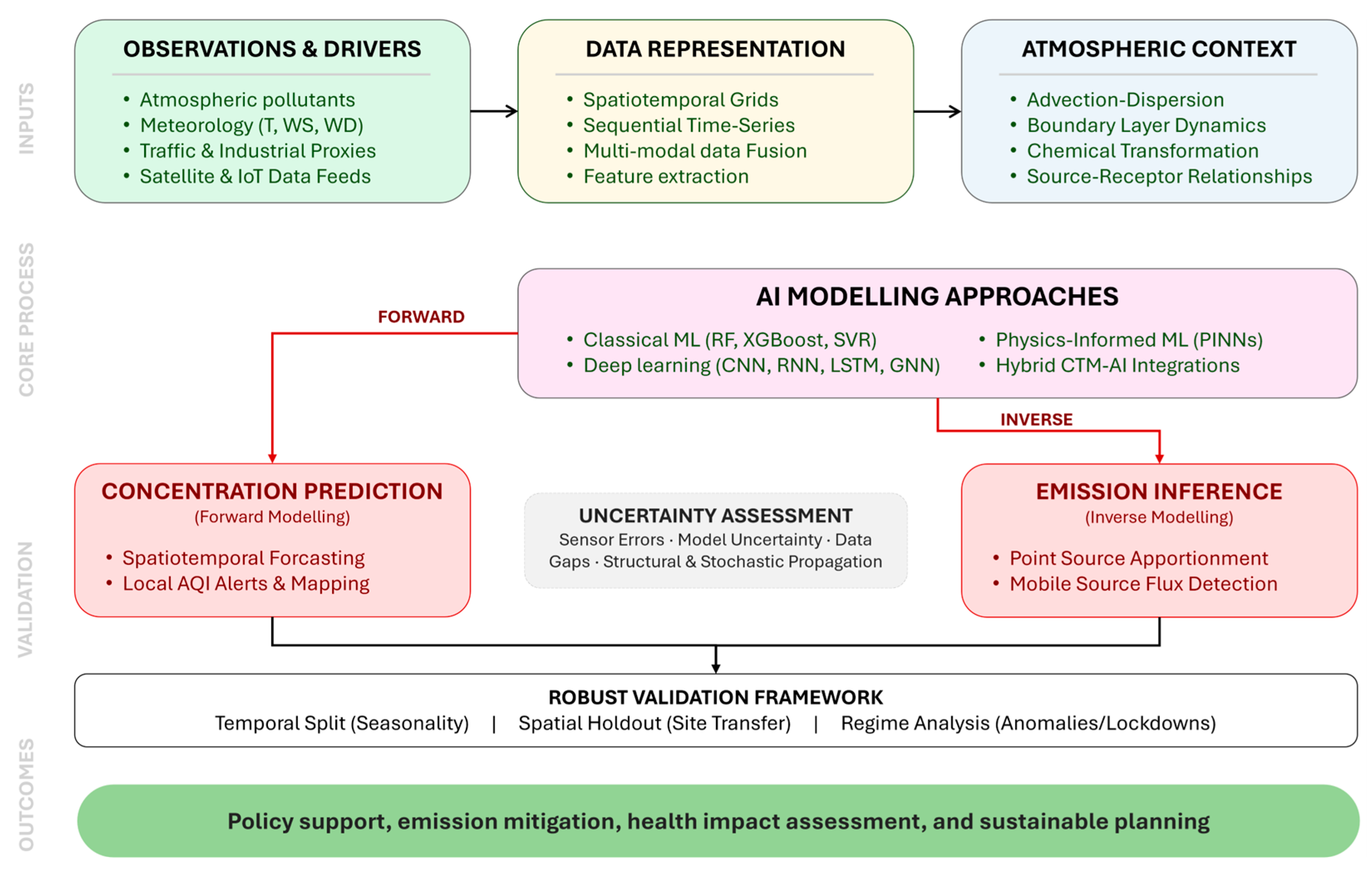
2.1. Structure of AI-Based Modelling in Atmospheric Studies
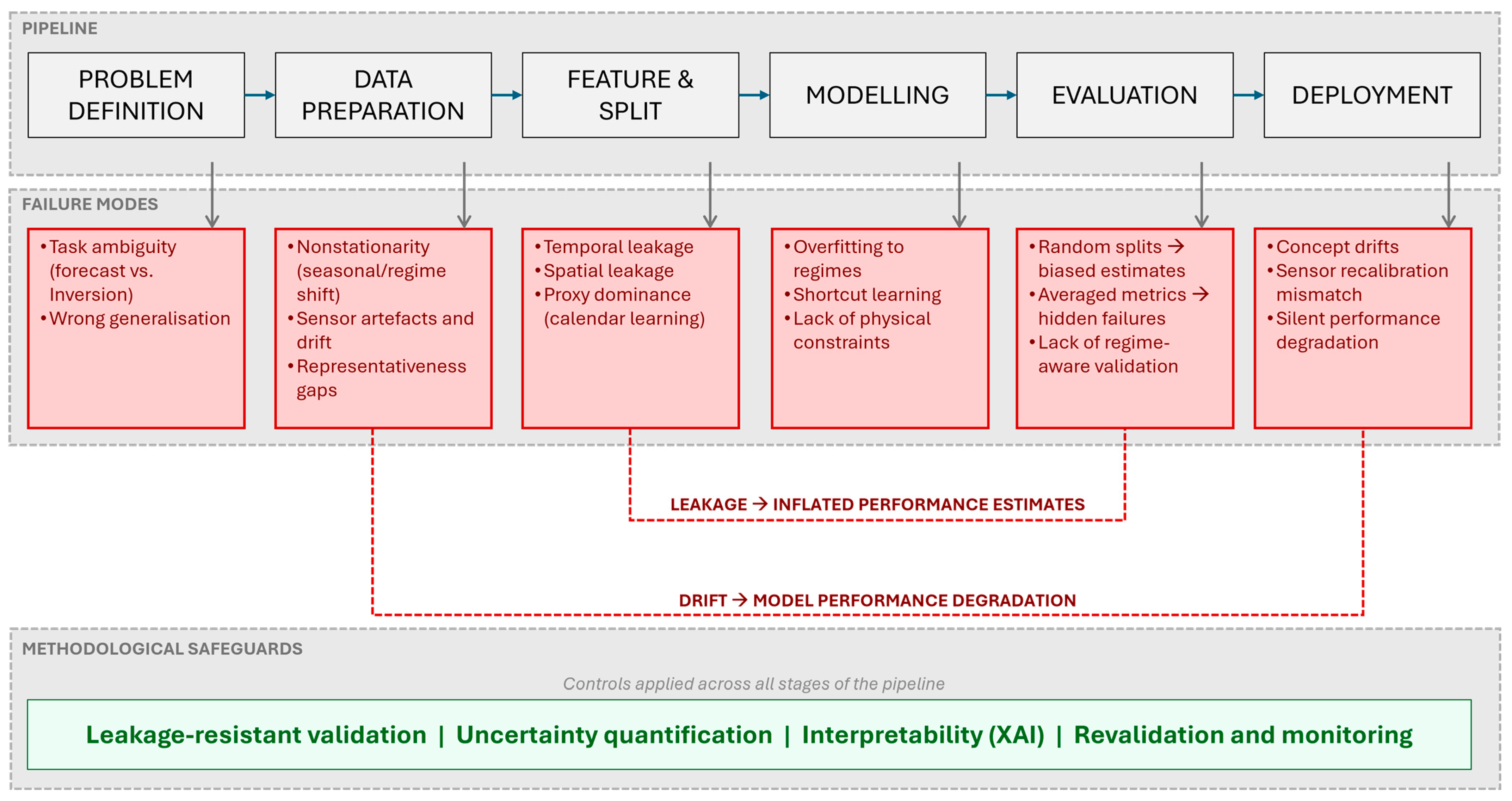
2.2. AI-Based Data-Science Procedure for Environmental and Atmospheric Data
2.3. From Classical ML to Modern DL: Architectures Matched to Data Structure
3. Methodological Foundations for AI in Atmospheric Sciences: Data Preparation, Evaluation, and Trustworthy Deployment
3.1. Governing Equations and Inverse Problem Framing
- —wind field (advection velocity),
- —effective diffusion/turbulent mixing coefficient,
- —source term (emissions from mobile and point sources),
- —chemical production processes,
- —chemical loss and removal processes (including deposition).
- —ML/DL model parameterised by ,
- —past concentration observations,
- —meteorological inputs,
- —emission proxies or auxiliary predictors,
- —prediction horizon.
- —observed concentrations,
- —forward operator (transport, mixing, chemistry),
- —emission source term represented in the observation model,
- —observation error,
- Ŝ—estimated emission source term obtained from the inversion,
- —observation-error covariance matrix,
- —regularization term (e.g., smoothness, sparsity, inventory constraints),
- —emissions,
- —activity level,
- —emission factor.
3.2. Data Preparation Under Nonstationarity: Representativeness, Leakage Control, and Regimes
3.3. Validation in Time and Space: Realistic Generalization, Episode Testing, and External Datasets
3.4. Transfer, Domain Shift, and Drift: From “One-Off Accuracy” to Life-Cycle Performance
3.5. Uncertainty and Trustworthiness: Probabilistic Outputs, Calibration, and Integrity of Monitoring Pipelines
4. Applications: Atmospheric Fields and Emission Sources as a Coupled System
4.1. Atmospheric Pollution Forecasting and Spatiotemporal Inference
4.2. Automotive Exhaust Emissions and Toxicity: AI Methods Relevant to Atmospheric Pollution from Mobile Sources
4.3. Stationary Combustion Diagnostics and Emission-Relevant Modelling: Methods Relevant to Atmospheric Pollution from Point Sources

| Application/Problem | Model/Architecture | Input Data and Preprocessing | Evaluation Metrics (Typical Reporting) | Key Findings (AAS-Relevant Takeaway) | Year |
|---|---|---|---|---|---|
| Stability boundary mapping for industrial gas burners [69] | ANN/MLP classifier–regressor for stability regimes/limits | Burner operating parameters + measured signals; normalization; train/test split | Accuracy/F1 (classification); boundary error; false-alarm rate (where reported) | Learns empirical stability maps that support operation within low-risk regimes, reducing probability of unstable combustion associated with CO/NOx excursions | 2021 |
| Fast instability detection from diagnostic signals (deep sequence classifier) [68] | LSTM–CNN hybrid (feature extraction + temporal classification) | High-frequency sensor/diagnostic time series (as provided in study); standardization; supervised training | Detection accuracy/sensitivity; lead time; latency (if reported) | Enables early detection of thermoacoustic instability, supporting mitigation before oscillations trigger emission spikes | 2021 |
| Neural prediction of combustion instability (early ANN approach) [70] | Feed-forward ANN/neural predictor | Experimental/sensor signals; normalization; supervised training | Prediction error; classification accuracy (as reported) | Early evidence that data-driven predictors can anticipate instability regimes, motivating modern real-time diagnostics for point-source emissions control | 2002 |
| Sparse-sensing digital twins for industrial combustion monitoring [71] | Adaptive digital twin with sparse sensing strategies (hybrid physics–data) | Sparse sensor signals + numerical priors; sparse reconstruction/updating | Reconstruction error; stability of adaptation; robustness to sensor sparsity | Demonstrates feasible monitoring under limited instrumentation, enabling estimation of emission-relevant states in point sources | 2023 |
| Predictive modelling for H2/NG/Diesel dual-fuel operation (emission-relevant operating regimes) [72] | Predictive ML model (as proposed in study) | Engine operating variables; preprocessing per study; train/test split | RMSE/MAE/R2 (as reported) | Supports mapping of operating regimes for low-carbon fuels; relevant for characterizing point-source emissions under fuel switching scenarios | 2023 |
| Chemistry acceleration for NH3/H2 combustion (NOx/NH3-slip pathways) [73] | DL surrogate for chemical kinetics/closure terms | Simulation datasets; state→source mapping; validation vs. detailed chemistry | Speed-up factor; error vs. detailed chemistry | Reduces cost of detailed chemistry while retaining fidelity, enabling broader inclusion of NOx/NH3-slip-relevant pathways in CFD/LES for point-source characterization | 2025 |
| Emission prediction under controlled experimental conditions [74] | ANN (feed-forward) | Heating devices operational parameters, environmental performance of heating devices | Random train/test split | High predictive accuracy, potentially influenced by temporal dependence and leakage effects | 2024 |
| Time-series emission modelling under dynamic combustion conditions [75] | LSTM/sequence-based models | Heating devices operational parameters, environmental performance of heating devices | Time-aware splitting | Lower but more realistic performance, highlighting regime dependence and modelling difficulty under temporal variability | 2025 |
5. Conclusions and Future Directions: Toward Robust, Physics-Consistent AI for Atmospheric Composition and Emission Sources
Author Contributions
Funding
Institutional Review Board Statement
Informed Consent Statement
Data Availability Statement
Conflicts of Interest
References
- Seinfeld, J.H.; Pandis, S.N. Atmospheric Chemistry and Physics: From Air Pollution to Climate Change, 2nd ed.; John Wiley & Sons: Hoboken, NJ, USA, 2006. [Google Scholar]
- Zhang, Y.; Bocquet, M.; Mallet, V.; Seigneur, C.; Baklanov, A. Real-Time Air Quality Forecasting, Part II: State of the Science, Current Research Needs, and Future Prospects. Atmos. Environ. 2012, 60, 656–676. [Google Scholar] [CrossRef] [Scilit]
- Yu, M.; Huang, Q.; Li, Z. Deep Learning for Spatiotemporal Forecasting in Earth System Science: A Review. Int. J. Digit. Earth 2024, 17, 2391952. [Google Scholar] [CrossRef] [Scilit]
- Reichstein, M.; Camps-Valls, G.; Stevens, B.; Jung, M.; Denzler, J.; Carvalhais, N.; Prabhat. Deep Learning and Process Understanding for Data-Driven Earth System Science. Nature 2019, 566, 195–204. [Google Scholar] [CrossRef] [Scilit]
- Enting, I.G. Inverse Problems in Atmospheric Constituent Transport; Cambridge University Press: Cambridge, UK, 2002. [Google Scholar]
- Turner, A.J.; Jacob, D.J. Balancing Aggregation and Smoothing Errors in Inverse Models. Atmos. Chem. Phys. 2015, 15, 7039–7048. [Google Scholar] [CrossRef] [Scilit]
- Szramowiat-Sala, K.; Styszko, K.; Samek, L.; Kistler, M.; Macherzyński, M.; Ryšavý, J.; Krpec, K.; Horák, J.; Kasper-Giebl, A.; Gołaś, J. Comparative Analysis of Real-Emitted Particulate Matter and PM-Bound Chemicals from Residential and Automotive Sources: A Case Study in Poland. Energies 2023, 16, 6514. [Google Scholar] [CrossRef] [Scilit]
- Szramowiat-Sala, K.; Marczak-Grzesik, M.; Karczewski, M.; Kistler, M.; Giebl, A.K.; Styszko, K. Chemical Investigation of Polycyclic Aromatic Hydrocarbon Sources in an Urban Area with Complex Air Quality Challenges. Sci. Rep. 2025, 15, 6987. [Google Scholar] [CrossRef] [Scilit]
- Raissi, M.; Perdikaris, P.; Karniadakis, G.E. Physics-Informed Neural Networks: A Deep Learning Framework for Solving Forward and Inverse Problems Involving Nonlinear Partial Differential Equations. J. Comput. Phys. 2019, 378, 686–707. [Google Scholar] [CrossRef] [Scilit]
- Karpatne, A.; Atluri, G.; Faghmous, J.H.; Steinbach, M.; Banerjee, A.; Ganguly, A.; Shekhar, S.; Samatova, N.; Kumar, V. Theory-Guided Data Science: A New Paradigm for Scientific Discovery from Data. IEEE Trans. Knowl. Data Eng. 2017, 29, 2318–2331. [Google Scholar] [CrossRef] [Scilit]
- Bi, K.; Xie, L.; Zhang, H.; Chen, X.; Gu, X.; Tian, Q. Accurate Medium-Range Global Weather Forecasting with 3D Neural Networks. Nature 2023, 619, 533. [Google Scholar] [CrossRef] [Scilit]
- Lam, R.; Sanchez-Gonzalez, A.; Willson, M.; Wirnsberger, P.; Fortunato, M.; Alet, F.; Ravuri, S.; Ewalds, T.; Eaton-Rosen, Z.; Hu, W.; et al. Learning Skillful Medium-Range Global Weather Forecasting. Science 2023, 382, 1416–1421. [Google Scholar] [CrossRef] [Scilit]
- Bodnar, C.; Bruinsma, W.P.; Lucic, A.; Stanley, M.; Allen, A.; Brandstetter, J.; Garvan, P.; Riechert, M.; Weyn, J.A.; Dong, H.; et al. A Foundation Model for the Earth System. Nature 2025, 641, 1180–1187. [Google Scholar] [CrossRef] [Scilit]
- Gui, K.; Zhang, X.; Che, H.; Li, L.; Zheng, Y.; An, L.; Miao, Y.; Zhao, H.; Dubovik, O.; Holben, B.; et al. Advancing Operational Global Aerosol Forecasting with Machine Learning. Nature 2026, 651, 658–665. [Google Scholar] [CrossRef] [Scilit]
- Charafeddine, M.; Brijesh, M.; Krushna, M.; Shobhakar, D. Strategies to Accelerate Climate Risk Management in the Building Sector Using Data-Driven Methods and Tools. Commun. Sustain. 2026, 1, 59. [Google Scholar] [CrossRef] [Scilit]
- Roberts David, R.; Volker, B.; Simone, C.; Boyce Mark, S. Cross-Validation Strategies for Data with Temporal, Spatial, Hierarchical, or Phylogenetic Structure. Ecography 2016, 40, 913–939. [Google Scholar] [CrossRef] [Scilit]
- Hastie, T.; Tibshirani, R.; Friedman, J. The Elements of Statistical Learning Data Mining, Inference, and Prediction; Springer: Berlin/Heidelberg, Germany, 2008. [Google Scholar]
- Friedman, J.H. Greedy Function Approximation: A Gradient Boosting Machine. Ann. Stat. 2001, 29, 1189–1232. [Google Scholar] [CrossRef] [Scilit]
- Breiman, L. Random Forests. Mach. Learn. 2001, 45, 5–32. [Google Scholar] [CrossRef] [Scilit]
- Cortes, C.; Vapnik, V.; Saitta, L. Support-Vector Networks. Mach. Learn. 1995, 20, 273–297. [Google Scholar] [CrossRef] [Scilit]
- Christiansen, B. Atmospheric Circulation Regimes: Can Cluster Analysis Provide the Number? J. Clim. 2007, 20, 2229–2250. [Google Scholar] [CrossRef] [Scilit]
- Lecun, Y.; Bengio, Y.; Hinton, G. Deep Learning. Nature 2015, 521, 436–444. [Google Scholar] [CrossRef] [Scilit]
- LeCun, Y.; Bottou, L.; Bengio, Y.; Haffner, P. Gradient-Based Learning Applied to Document Recognition. Proc. IEEE 1998, 86, 2278–2323. [Google Scholar] [CrossRef] [Scilit]
- Hochreiter, S.; Schmidhuber, J. Long Short-Term Memory. Neural Comput. 1997, 9, 1735–1780. [Google Scholar] [CrossRef] [Scilit] [PubMed]
- Cho, K.; Van Merriënboer, B.; Gulcehre, C.; Bahdanau, D.; Bougares, F.; Schwenk, H.; Bengio, Y. Learning Phrase Representations Using RNN Encoder-Decoder for Statistical Machine Translation. In Proceedings of the 2014 Conference on Empirical Methods in Natural Language Processing (EMNLP); Association for Computational Linguistics: Stroudsburg, PA, USA, 2014; pp. 1724–1734. [Google Scholar] [CrossRef] [Scilit]
- Vaswani, A.; Brain, G.; Shazeer, N.; Parmar, N.; Uszkoreit, J.; Jones, L.; Gomez, A.N.; Kaiser, Ł.; Polosukhin, I. Attention Is All You Need. In Proceedings of the Advances in Neural Information Processing Systems; Curran Associates, Inc.: Red Hook, NY, USA, 2017; pp. 5998–6008. [Google Scholar]
- Kipf, T.N.; Welling, M. Semi-Supervised Classification with Graph Convolutional Networks. In Proceedings of the 5th International Conference on Learning Representations, ICLR 2017, Toulon, France, 24–26 April 2017. [Google Scholar]
- Bergmeir, C.; Hyndman, R.J.; Koo, B. A Note on the Validity of Cross-Validation for Evaluating Autoregressive Time Series Prediction. Comput. Stat. Data Anal. 2018, 120, 70–83. [Google Scholar] [CrossRef] [Scilit]
- Koçak, E. Comprehensive Evaluation of Machine Learning Models for Real-World Air Quality Prediction and Health Risk Assessment by AirQ+. Earth Sci. Inform. 2025, 18, 447. [Google Scholar] [CrossRef] [Scilit]
- Zhang, Z.; Johansson, C.; Engardt, M.; Stafoggia, M.; Ma, X. Improving 3-Day Deterministic Air Pollution Forecasts Using Machine Learning Algorithms. Atmos. Chem. Phys. 2024, 24, 807–851. [Google Scholar] [CrossRef] [Scilit]
- Hua, V.; Nguyen, T.; Dao, M.-S.; Nguyen, H.D.; Nguyen, B.T.; Chi Minh City, H. The Impact of Data Imputation on Air Quality Prediction Problem. PLoS ONE 2024, 19, e0306303. [Google Scholar] [CrossRef] [Scilit]
- Lee, J.-Y.; Han, S.-H.; Kang, J.-G.; Lee, C.-Y.; Lee, J.-B.; Kim, H.-S.; Yun, H.-Y.; Choi, D.-R.; Lee, J.-Y.; Han, S.-H.; et al. Comparison of Models for Missing Data Imputation in PM-2.5 Measurement Data. Atmosphere 2025, 16, 438. [Google Scholar] [CrossRef] [Scilit]
- Zafeirelli, S.; Kavroudakis, D. Comparison of Outlier Detection Approaches in a Smart Cities Sensor Data Context. Int. J. Smart Sens. Intell. Syst. 2024, 17, 20240004. [Google Scholar] [CrossRef] [Scilit]
- Dai, Y.; Liu, B.; Tong, C.; Carslaw, D.C.; Mackenzie, A.R.; Shi, Z. Rethinking Machine Learning Weather Normalisation: A Refined Strategy for Short-Term Air Pollution Policies. Atmos. Chem. Phys. 2025, 25, 13585–13596. [Google Scholar] [CrossRef] [Scilit]
- Yang, X.; Li, J.; Jiang, X. Research on Information Leakage in Time Series Prediction Based on Empirical Mode Decomposition. Sci. Rep. 2024, 14, 28362. [Google Scholar] [CrossRef] [Scilit] [PubMed]
- Maciąg, P.S.; Bembenik, R.; Piekarzewicz, A.; Del Ser, J.; Lobo, J.L.; Kasabov, N.K. Effective Air Pollution Prediction by Combining Time Series Decomposition with Stacking and Bagging Ensembles of Evolving Spiking Neural Networks. Environ. Model. Softw. 2023, 170, 105851. [Google Scholar] [CrossRef] [Scilit]
- Jakovljevic, A.; Charlin, L.; Barbeau, B. Applying Recurrent Neural Networks and Blocked Cross-Validation to Model Conventional Drinking Water Treatment Processes. Water 2024, 16, 1042. [Google Scholar] [CrossRef] [Scilit]
- Tsokov, S.; Lazarova, M.; Aleksieva-Petrova, A.; Tsokov, S.; Lazarova, M.; Aleksieva-Petrova, A. A Hybrid Spatiotemporal Deep Model Based on CNN and LSTM for Air Pollution Prediction. Sustainability 2022, 14, 5104. [Google Scholar] [CrossRef] [Scilit]
- Ma, J.; Li, Z.; Cheng, J.C.P.; Ding, Y.; Lin, C.; Xu, Z. Air Quality Prediction at New Stations Using Spatially Transferred Bi-Directional Long Short-Term Memory Network. Sci. Total Environ. 2020, 705, 135771. [Google Scholar] [CrossRef] [Scilit] [PubMed]
- Wang, C.; Zhu, Y.; Zang, T.; Liu, H.; Yu, J. Modeling Inter-Station Relationships with Attentive Temporal Graph Convolutional Network for Air Quality Prediction. In Proceedings of the 14th ACM International Conference on Web Search and Data Mining, WSDM 2021, Virtual, 8–12 March 2021; pp. 616–624. [Google Scholar] [CrossRef] [Scilit]
- Liu, H.; Han, Q.; Sun, H.; Sheng, J.; Yang, Z. Spatiotemporal Adaptive Attention Graph Convolution Network for City-Level Air Quality Prediction. Sci. Rep. 2023, 13, 13335. [Google Scholar] [CrossRef] [Scilit]
- Ni, Q.; Wang, Y.; Yuan, J. Adaptive Scalable Spatio-Temporal Graph Convolutional Network for PM2.5 Prediction. Eng. Appl. Artif. Intell. 2023, 126, 107080. [Google Scholar] [CrossRef] [Scilit]
- Heidari, P.; Milan, A. Combining K-Fold Cross Validation with Bayesian Hyperparameter Optimization for Accuracy Enhancement of Land Cover and Land Use Classification. Sci. Rep. 2025, 15, 39758. [Google Scholar] [CrossRef] [Scilit]
- Ahmed, M.; Kong, J.; Jiang, N.; Duc, H.N.; Puppala, P.; Azzi, M.; Riley, M.; Barthelemy, X.; Ahmed, M.; Kong, J.; et al. A Bayesian-Optimized Surrogate Model Integrating Deep Learning Algorithms for Correcting PurpleAir Sensor Measurements. Atmosphere 2024, 15, 1535. [Google Scholar] [CrossRef] [Scilit]
- Flora, M.L.; Potvin, C.K.; McGovern, A.; Handler, S. A Machine Learning Explainability Tutorial for Atmospheric Sciences. Artif. Intell. Earth Syst. 2024, 3, e230018. [Google Scholar] [CrossRef] [Scilit]
- Bai, S.; Kolter, J.Z.; Koltun, V. An Empirical Evaluation of Generic Convolutional and Recurrent Networks for Sequence Modeling. arXiv 2018, arXiv:1803.01271. [Google Scholar] [CrossRef] [Scilit]
- Tian, X.; Zhang, C.; Liu, H.; Zhang, B.; Lu, C.; Jiao, P.; Ren, S. Research on Air Quality in Response to Meteorological Factors Based on the Informer Model. Sustainability 2024, 16, 6794. [Google Scholar] [CrossRef] [Scilit]
- Gilmer, J.; Schoenholz, S.S.; Riley, P.F.; Vinyals, O.; Dahl, G.E. Neural Message Passing for Quantum Chemistry. In Proceedings of the 34th International Conference on Machine Learning; PMLR: Sydney, Australia, 2017. [Google Scholar]
- Tarantola, A. Inverse Problem Theory and Methods for Model Parameter Estimation; Society for Industrial and Applied Mathematics: Philadelphia, PA, USA, 2005. [Google Scholar]
- Eugenia, K. Atmospheric Modeling, Data Assimilation and Predictability; Cambridge University Press: Cambridge, UK, 2003. [Google Scholar]
- Rodgers, C.D. Inverse Methods for Atmospheres: Theory and Practice; World Scientific Publishing: Singapore, 2000; Volume 2. [Google Scholar]
- Evensen, G. The Ensemble Kalman Filter: Theoretical Formulation and Practical Implementation. Ocean Dyn. 2003, 53, 343–367. [Google Scholar] [CrossRef] [Scilit]
- Galaz, V.; Centeno, M.A.; Callahan, P.W.; Causevic, A.; Patterson, T.; Brass, I.; Baum, S.; Farber, D.; Fischer, J.; Garcia, D.; et al. Artificial Intelligence, Systemic Risks, and Sustainability. Technol. Soc. 2021, 67, 101741. [Google Scholar] [CrossRef] [Scilit]
- Gama, J.; Žliobaitė, I.; Bifet, A.; Pechenizkiy, M.; Bouchachia, A. A Survey on Concept Drift Adaptation. ACM Comput. Surv. (CSUR) 2014, 46, 1–37. [Google Scholar] [CrossRef] [Scilit] [PubMed]
- Irrgang, C.; Boers, N.; Sonnewald, M.; Barnes, E.A.; Kadow, C.; Staneva, J.; Saynisch-Wagner, J. Towards Neural Earth System Modelling by Integrating Artificial Intelligence in Earth System Science. Nat. Mach. Intell. 2021, 3, 667–674. [Google Scholar] [CrossRef] [Scilit]
- Jin, X.; Fiore, A.; Boersma, K.F.; Smedt, I.D.; Valin, L. Inferring Changes in Summertime Surface Ozone–NOx–VOC Chemistry over U.S. Urban Areas from Two Decades of Satellite and Ground-Based Observations. Environ. Sci. Technol. 2020, 54, 6518–6529. [Google Scholar] [CrossRef] [Scilit]
- Yao, T.; Lu, S.; Wang, Y.; Li, X.; Ye, H.; Duan, Y.; Fu, Q.; Li, J. Revealing the Drivers of Surface Ozone Pollution by Explainable Machine Learning and Satellite Observations in Hangzhou Bay, China. J. Clean. Prod. 2024, 440, 140938. [Google Scholar] [CrossRef] [Scilit]
- Huang, L.; Liu, S.; Yang, Z.; Xing, J.; Zhang, J.; Bian, J.; Li, S.; Sahu, S.K.; Wang, S.; Liu, T.Y. Exploring Deep Learning for Air Pollutant Emission Estimation. Geosci. Model Dev. 2021, 14, 4641–4654. [Google Scholar] [CrossRef] [Scilit]
- Cui, S.; Yang, Y.; Liu, G.; Shen, L. Air Quality Index Prediction Based on Spatio-Temporal Graph Neural Networks: An Empirical Study of Xi’an, China. Eng. Appl. Artif. Intell. 2026, 166, 113547. [Google Scholar] [CrossRef] [Scilit]
- Ali, D.; Singh, M.; Khan, A.A.; Vidyarthi, A.K.; Ahmed, S. Impact of Meteorological Drivers on Air Quality Index: A Case Study from Delhi. Environ. Pollut. 2026, 388, 127324. [Google Scholar] [CrossRef] [Scilit]
- Wu, Y.; Jin, G.; Li, X.; Huang, H.; Sheng, Z.; Liao, Q. A Novel IDBO-VMD-ITransformer Framework for Air Quality Index Prediction: Multi-Strategy Optimization and Environmental Sustainability Assessment. Process Saf. Environ. Prot. 2026, 207, 108379. [Google Scholar] [CrossRef] [Scilit]
- Li, J.; Yu, Y.; Wang, Y.; Zhao, L.; He, C.; Li, J.; Yu, Y.; Wang, Y.; Zhao, L.; He, C. Prediction of Transient NOx Emission from Diesel Vehicles Based on Deep-Learning Differentiation Model with Double Noise Reduction. Atmosphere 2021, 12, 1702. [Google Scholar] [CrossRef] [Scilit]
- Liao, J.; Hu, J.; Chen, P.; Zhu, L.; Wu, Y.; Cai, Z.; Wu, H.; Wang, M. Prediction of the Transient Emission Characteristics from Diesel Engine Using Temporal Convolutional Networks. Eng. Appl. Artif. Intell. 2024, 127, 107227. [Google Scholar] [CrossRef] [Scilit]
- Li, S.; Tong, Z.; Haroon, M. Estimation of Transport CO2 Emissions Using Machine Learning Algorithm. Transp. Res. D Transp. Environ. 2024, 133, 104276. [Google Scholar] [CrossRef] [Scilit]
- Ge, Y.; Hou, P.; Lyu, T.; Lai, Y.; Su, S.; Luo, W.; He, M.; Xiao, L. Machine Learning-Aided Remote Monitoring of NOx Emissions from Heavy-Duty Diesel Vehicles Based on OBD Data Streams. Atmosphere 2023, 14, 651. [Google Scholar] [CrossRef] [Scilit]
- Wei, N.; Men, Z.; Ren, C.; Jia, Z.; Zhang, Y.; Jin, J.; Chang, J.; Lv, Z.; Guo, D.; Yang, Z.; et al. Applying Machine Learning to Construct Braking Emission Model for Real-World Road Driving. Environ. Int. 2022, 166, 160–4120. [Google Scholar] [CrossRef] [Scilit]
- Mehnatkesh, H.; Gordon, D.; Koch, C.R. Dynamic Emission Analysis of a Hydrogen/Diesel Dual-Fuel Engine Using Clustering Method. Int. J. Hydrogen Energy 2025, 136, 371–382. [Google Scholar] [CrossRef] [Scilit]
- Lyu, Z.; Jia, X.; Yang, Y.; Hu, K.; Zhang, F.; Wang, G.; Lyu, Z.; Jia, X.; Yang, Y.; Hu, K.; et al. A Comprehensive Investigation of LSTM-CNN Deep Learning Model for Fast Detection of Combustion Instability. Fuel 2021, 303, 121300. [Google Scholar] [CrossRef] [Scilit]
- Zhang, L.; Xue, Y.; Xie, Q.; Ren, Z. Analysis and Neural Network Prediction of Combustion Stability for Industrial Gases. Fuel 2021, 287, 119507. [Google Scholar] [CrossRef] [Scilit]
- Cammarata, L.; Fichera, A.; Pagano, A. Neural Prediction of Combustion Instability. Appl. Energy 2002, 72, 513–528. [Google Scholar] [CrossRef] [Scilit]
- Procacci, A.; Amaduzzi, R.; Coussement, A.; Parente, A. Adaptive Digital Twins of Combustion Systems Using Sparse Sensing Strategies. Proc. Combust. Inst. 2023, 39, 4257–4266. [Google Scholar] [CrossRef] [Scilit]
- Sehili, Y.; Loubar, K.; Tarabet, L.; Cerdoun, M.; Lacroix, C. Development of Predictive Model for Hydrogen-Natural Gas/Diesel Dual Fuel Engine. Energies 2023, 16, 6943. [Google Scholar] [CrossRef] [Scilit]
- Wu, S.; Liang, W.; Luo, K.H. Deep Learning Based Combustion Chemistry Acceleration Method for Widely Applicable NH3/H2 Turbulent Combustion Simulations. Combust. Flame 2025, 278, 114218. [Google Scholar] [CrossRef] [Scilit]
- Szramowiat-Sala, K.; Penkala, R.; Horák, J.; Krpec, K.; Hopan, F.; Ryšavý, J.; Borovec, K.; Górecki, J. AI-Based Data Mining Approach to Control the Environmental Impact of Conventional Energy Technologies. J. Clean. Prod. 2024, 472, 143473. [Google Scholar] [CrossRef] [Scilit]
- Szramowiat-Sala, K.; Krpec, K.; Penkala, R.; Ryšavý, J. Data-Driven Prediction of Pollutants Emission from Small-Scale Heating Units Using Temporal Deep Learning. Energy Convers. Manag. X 2025, 28, 101322. [Google Scholar] [CrossRef] [Scilit]


| Application/Problem | Model/Architecture | Input Data and Preprocessing | Evaluation Metrics | Key Findings | Year |
|---|---|---|---|---|---|
| Emission inventory estimation/top-down correction for CTM applications [58] | NN-CTM (neural-network surrogate of a comprehensive CTM) + gradient-based emission updating | CTM simulations + surface monitoring constraints; surrogate training + iterative emission adjustment | Surrogate similarity vs. CTM; concentration error reduction (MAE/RMSE as reported); emission increments | Demonstrates that a NN surrogate can emulate CTM behaviour and support inventory updating that improves agreement with observations—directly relevant for building better emission inputs for atmospheric modelling | 2021 |
| City-scale PM2.5 prediction (scalable graph learning) [42] | Adaptive scalable spatio-temporal graph convolutional network (ST-GCN) | Station-network time series; graph construction; scaling/normalization | RMSE/MAE/R2 (as reported) | Captures space–time dependencies across monitoring networks and scales to larger city deployments, supporting operational forecasting | 2023 |
| City-level air-quality prediction (adaptive attention on graphs) [41] | Spatiotemporal adaptive attention graph convolution network | Multi-station time series; adaptive graph attention; standard preprocessing | RMSE/MAE/R2 (as reported) | Learns dynamic inter-station influence patterns, improving city-level predictions in heterogeneous monitoring networks | 2023 |
| Hybrid deep spatiotemporal forecasting [38] | CNN–LSTM hybrid spatiotemporal model | Historical pollutant time series + spatiotemporal features; scaling; train/val/test split | RMSE/MAE/R2 (as reported) | Illustrates a strong “classic” deep baseline for capturing nonlinear dynamics and space–time coupling in air-pollution forecasting | 2022 |
| Deterministic air-pollution forecast improvement (3-day) [30] | ML post-processing/algorithm comparison for forecast correction | Monitoring + meteorological predictors (and/or model outputs, per setup); standard preprocessing | RMSE/MAE, bias/skill (as reported) | Shows that ML correction layers can improve short-range deterministic forecasts and reduce systematic error | 2024 |
| Real-world AQ prediction + health risk assessment [29] | Comprehensive ML evaluation suite (model benchmarking) | Air-quality time series; model-specific preprocessing (as reported) | Forecast errors (RMSE/MAE/R2) + task-specific metrics (as reported) | Provides a structured benchmark illustrating how model choice impacts predictive skill under real-world conditions, useful as a reference baseline | 2025 |
| Application/Problem | Model/Architecture | Input Data and Preprocessing | Evaluation Metrics | Key Findings | Year |
|---|---|---|---|---|---|
| Virtual NOx sensing under real driving conditions (RDE) [62] | Signal decomposition + sequence learning (e.g., SSA/ICEEMDAN + GRU) with regression (e.g., SVR) | On-road time series (engine/aftertreatment/vehicle signals); denoising + decomposition; component selection; normalization | RMSE, MAE, R2 (often segment-/route-wise) | Enables high-frequency NOx estimation from operational signals, supporting time-resolved emission profiles for near-road air-quality and exposure applications | 2021 |
| Low-latency transient emission prediction for on-board monitoring [63] | Temporal convolutional network (TCN; dilated causal conv + residual blocks) | Driving-cycle sequences (e.g., WHTC/RDE segments); scaling; train/validation/test splits | RMSE/MAE/R2; inference latency (where reported) | Provides fast transient emission predictions suitable for real-time monitoring and generation of high-resolution emission time series | 2024 |
| Dynamic emission modelling from real-world vehicle activity data (CO2) [64] | Supervised ML (e.g., gradient boosting or LSTM-based sequence models) | PEMS + GPS/road context; kinematic features (speed/acceleration/grade), VSP; filtering; normalization | RMSE/R2; bias across road types/driving regimes | Derives driving-regime-dependent emission factors from real-world data, improving link-level inventories and supporting coupled air-quality–climate assessments | 2023–2024 |
| Fleet-scale detection of high-emission events (high-NOx/high emitters) [65] | ML classification/early-warning (e.g., random forest or related ensembles) | Remote OBD/telematics streams + operating context; feature engineering; imbalance handling | Classification metrics (F1/AUROC), detection rate/false alarms | Identifies high-emission episodes/vehicles at scale, enabling targeted mitigation and dynamic inventory corrections for urban modelling | 2023 |
| Non-exhaust PM source modelling under real-world driving (brake emissions) [66] | Data-driven emission model (ML regression with context features) | Driving kinematics + braking intensity/context + measured non-exhaust PM; preprocessing aligned to measurement protocol | Prediction error vs. baseline; scenario sensitivity | Quantifies non-exhaust PM contributions that can dominate urban particulate exposure in specific settings, improving source representation | 2022 |
| Emission regime discovery and state identification from high-frequency streams [67] | Unsupervised clustering + regime statistics (e.g., k-means/state identification) | Instantaneous emissions + driving/engine states; scaling; validity checks | Cluster validity indices; regime-wise emission deltas | Converts raw RDE/PEMS streams into interpretable operating regimes with distinct emission signatures, supporting regime-conditioned parameterizations | 2025 |
Disclaimer/Publisher’s Note: The statements, opinions and data contained in all publications are solely those of the individual author(s) and contributor(s) and not of MDPI and/or the editor(s). MDPI and/or the editor(s) disclaim responsibility for any injury to people or property resulting from any ideas, methods, instructions or products referred to in the content. |
© 2026 by the authors. Licensee MDPI, Basel, Switzerland. This article is an open access article distributed under the terms and conditions of the Creative Commons Attribution (CC BY) license.
Share and Cite
Korzeniewska, A.; Szramowiat-Sala, K. Artificial Intelligence in Atmospheric Composition Studies for Sustainable Air Quality Management: Spatiotemporal Concentration Forecasting and Emission Inference from Mobile and Point Sources. Sustainability 2026, 18, 4838. https://doi.org/10.3390/su18104838
Korzeniewska A, Szramowiat-Sala K. Artificial Intelligence in Atmospheric Composition Studies for Sustainable Air Quality Management: Spatiotemporal Concentration Forecasting and Emission Inference from Mobile and Point Sources. Sustainability. 2026; 18(10):4838. https://doi.org/10.3390/su18104838
Chicago/Turabian StyleKorzeniewska, Anna, and Katarzyna Szramowiat-Sala. 2026. "Artificial Intelligence in Atmospheric Composition Studies for Sustainable Air Quality Management: Spatiotemporal Concentration Forecasting and Emission Inference from Mobile and Point Sources" Sustainability 18, no. 10: 4838. https://doi.org/10.3390/su18104838
APA StyleKorzeniewska, A., & Szramowiat-Sala, K. (2026). Artificial Intelligence in Atmospheric Composition Studies for Sustainable Air Quality Management: Spatiotemporal Concentration Forecasting and Emission Inference from Mobile and Point Sources. Sustainability, 18(10), 4838. https://doi.org/10.3390/su18104838