1. Introduction
Designing effective computer-assisted learning (CAL) environments for children presents ongoing challenges in the learning sciences [
1,
2]. Primary school students often struggle to maintain attention, motivation, and sustained engagement with abstract concepts in traditional learning settings [
3,
4,
5]. These challenges are particularly evident in contexts that require both conceptual understanding and behavioral change. In response, interactive and game-based CAL approaches have been explored as potential means to support learner engagement, sustain attention, and facilitate knowledge retention [
6,
7,
8].
Educational games represent an important component of CAL by integrating learning objectives within structured and interactive activities that combine challenge and enjoyment. This approach enables learners to actively construct knowledge while maintaining motivation throughout the learning process [
6,
7,
8]. Empirical studies across various domains suggest that gamification strategies may support improvements in learning performance and learner engagement when appropriately designed and implemented [
9,
10,
11].
Despite the increasing use of Game-Based Learning and learning analytics, three key limitations remain in the existing literature [
12,
13,
14]. First, analytics techniques such as clustering and sentiment analysis are predominantly used for post hoc evaluation rather than as explicit inputs to the design process. Second, the integration of data-driven insights and pedagogical frameworks remains limited, with relatively few studies systematically linking analytical outputs to theory-informed design decisions. Third, although learning outcomes and engagement are often discussed, these contributions are rarely framed within an explicit and operationalized perspective of educational sustainability. These limitations indicate the need for approaches that more directly connect analytics, pedagogy, and sustainability within a coherent design-oriented framework.
Building on these limitations, this study addresses the problem that existing research does not provide a systematic mechanism for translating analytics-derived insights into theory-informed design decisions within educational game environments. In particular, the lack of integration between learning analytics, pedagogical frameworks, and sustainability-oriented design limits the development of learning environments that are both data-informed and pedagogically grounded. This study responds to this gap by proposing a structured framework in which analytics outputs are operationalized as explicit design drivers, linking user-generated data, pedagogical theory, and learning outcomes within a coherent design-oriented process.
In this study, sustainability is conceptualized as a design-oriented property of learning environments. It refers to their capacity to support (1) continuity of learner engagement across instructional sessions, (2) consistency of learning outcomes under different interaction conditions, and (3) adaptability of design features to diverse learner needs and usage contexts. Within this perspective, sustainability is treated as a set of observable learning dynamics reflected in engagement patterns, learning outcomes, and stakeholder feedback, rather than as an abstract or system-level construct. Accordingly, this study focuses on educational sustainability at the level of learning design and classroom implementation.
This study is further situated within the broader context of sustainable development, particularly in relation to SDG 3 (Good Health and Well-being) and SDG 4 (Quality Education). In China, childhood nutrition education remains an important concern due to rapid socio-economic changes, evolving dietary patterns, and increasing digital exposure. These conditions highlight the need for context-sensitive and engaging educational approaches. Despite the availability of large-scale user-generated data, limited research has examined how these data can be systematically incorporated into the design of educational systems.
Moreover, this limitation appears in the literature, where only a limited number of studies have explicitly examined the combined use of clustering and sentiment analysis in conjunction with pedagogical frameworks such as user-centered design, gamification, and interactive learning theory [
15,
16,
17,
18,
19]. This gap suggests that the integration of computational methods and educational theory remains limited, indicating the need for approaches that more explicitly connect analytical techniques with pedagogical design principles.
To address this gap, this study presents a data-driven, theory-informed design framework for computer-assisted learning (CAL) environments across multiple interaction formats [
20,
21,
22]. The key contribution of this work lies not in the use of analytics itself, but in explicitly operationalizing review clustering and sentiment-informed insights as design drivers that directly inform the development of a dual-format learning environment. Rather than aiming to establish causal relationships, this study provides an exploratory and illustrative examination of how analytics-informed design can be applied in practice.
This study extends our prior work [
12], which focused solely on clustering-based analysis of educational game reviews to identify user perception patterns. In contrast, the present study advances this line of work by integrating analytics outputs into a broader design and evaluation framework. Specifically, the contribution is threefold: (1) the translation of clustering results into explicit design drivers within a structured, theory-informed framework; (2) the integration of data analytics with pedagogical theories, including user-centered design, gamification, and interactive learning, in the development of dual-format learning environments; and (3) the inclusion of classroom-based empirical evaluation involving 120 primary school students, incorporating cognitive, behavioral, and perceptual dimensions. Accordingly, the present work represents a substantial extension and a distinct contribution, rather than a replication of prior work.
The proposed framework combines clustering analysis of educational game reviews with sentiment analysis of stakeholder feedback and links these insights to pedagogical principles derived from user-centered design, gamification, and interactive learning theory. Using nutrition education for primary school students as an application context, two learning environments—a board-based game and a computer-based game—were developed to demonstrate the implementation of the proposed approach. While demonstrated in a specific context, the applicability of the framework to other domains remains to be explored.
The empirical component adopts a within-subject, design-based implementation involving a single cohort of 120 Grade 2 students. All participants engaged with both board-based and computer-based learning formats, which delivered the same instructional content while differing in interaction modality. Learning outcomes, behavioral engagement, and stakeholder perceptions were examined using a multi-method approach. Accordingly, the analysis focuses on within-group patterns rather than comparisons between independent conditions.
This study therefore examines how analytics-derived insights can inform design-relevant knowledge for CAL systems, how dual-format learning environments are associated with patterns of learner engagement and knowledge-related outcomes, and how different stakeholder groups perceive these interaction formats. The results are structured to reflect key analytical components, including clustering-based design drivers, expert validation, learning outcomes, behavioral engagement, and stakeholder perceptions.
The subsequent sections of this work are structured as follows.
Section 2 examines the pertinent literature,
Section 3 delineates the suggested framework,
Section 4 discusses the evaluation and findings, and
Section 5 ends this study.
2. Literature Review
Educational games have been widely adopted as an approach to support learning, particularly in engaging young learners and sustaining attention in contexts where traditional instructional methods may be less effective [
23,
24]. Across domains such as mathematics, science, and language learning, studies consistently report that well-designed game-based environments can support knowledge acquisition, engagement, and motivation through interactive and goal-oriented learning processes [
25,
26,
27,
28].
Within this broader body of work, educational games have also been applied in domain-specific contexts such as nutrition and health education. Both digital and board-based game formats have been used to introduce concepts such as food groups, calorie balance, and healthy meal planning. Findings indicate improvements in knowledge and more positive attitudes toward nutrition-related behaviors among children [
29,
30,
31]. However, these domain-specific studies are typically evaluated as standalone instructional interventions. They focus primarily on learning outcomes or behavioral indicators, with limited attention to how design decisions are systematically derived or informed.
In parallel, theoretical perspectives such as user-centered design (UCD), gamification, and interactive learning theory provide a foundation for understanding how educational games can be designed to support learner engagement and meaningful learning experiences [
32,
33,
34,
35,
36]. These frameworks emphasize usability, motivation, and active participation, and are frequently applied in the development of Game-Based Learning environments. In contrast to domain-specific applications, these approaches focus on general design principles but are rarely combined with empirical insights derived from large-scale user-generated data.
Recent developments in learning analytics have introduced methods such as clustering, sentiment analysis, and behavioral tracking to better understand how learners interact with educational systems [
36,
37,
38,
39,
40]. These approaches help identify engagement patterns and user preferences beyond what traditional assessments capture. However, unlike pedagogical frameworks that guide design, learning analytics techniques are predominantly applied for post hoc analysis. Only a limited number of studies incorporate analytics outputs directly into the design phase of educational games [
41,
42,
43]. This separation between analysis and design is particularly evident in multimodal or dual-format learning environments. Most studies focus on either digital or physical formats in isolation, rather than examining how different interaction modalities may support complementary forms of engagement.
From a sustainability perspective, these strands of research can be interpreted in relation to broader educational and health objectives. Sustained engagement and motivation in learning environments may be associated with educational sustainability goals aligned with SDG 4 (Quality Education), while applications in nutrition and health education relate to SDG 3 (Good Health and Well-being) [
25,
26,
27,
28,
29,
30,
31]. However, these connections are rarely made explicit in the literature. Domain-specific studies emphasize learning outcomes, pedagogical frameworks focus on design principles, and analytics studies concentrate on behavioral patterns. Sustainability is often treated as an implicit or interpretive layer rather than as an explicit design objective supported by data-driven insights.
These limitations become more pronounced in context-specific settings such as China, where rapid socio-economic changes, evolving dietary patterns, and increasing exposure to digital technologies have intensified the need for effective and engaging nutrition education among children. Although large-scale user-generated data are increasingly available in such environments, few studies have explored how analytics-informed design approaches—such as clustering and sentiment-informed insights—can be systematically connected to pedagogical design, multimodal interaction, and sustainability-oriented objectives.
Taken together, the reviewed literature highlights four related but insufficiently integrated strands: (1) domain-specific applications of Game-Based Learning, particularly in nutrition education [
29,
30,
31], which primarily emphasize learning outcomes and behavioral awareness but rarely adopt analytically informed design processes; (2) pedagogical design frameworks, including user-centered design, gamification, and interactive learning theory [
32,
33,
34,
35,
36], which provide general design principles but are typically not grounded in empirical insights derived from large-scale user-generated data; (3) learning analytics approaches for understanding learner behavior [
36,
37,
38,
39,
40], which introduce data-driven methods but are predominantly applied for post hoc analysis instead of integration into the design phase, particularly in multimodal or dual-format learning contexts; and (4) sustainability-oriented perspectives in educational design [
25,
26,
27,
28], which interpret learning processes in terms of engagement continuity, outcome consistency, and adaptability, but are often treated as outcome-level constructs rather than explicit, data-supported design objectives.
While each strand provides valuable insights, they are typically addressed in isolation. Domain-specific studies prioritize outcomes, pedagogical frameworks emphasize design principles, and analytics approaches focus on behavioral interpretation. Sustainability perspectives offer an overarching lens without direct operationalization. This limited integration indicates the need for approaches that explicitly connect analytics-informed insights with pedagogical design across multiple interaction formats while positioning sustainability as a design-oriented objective. This gap provides the basis for the present study.
To provide a clearer theoretical grounding, this study conceptualizes the relationship between learning analytics, pedagogical design, and learning outcomes within a structured framework. Learning analytics (e.g., clustering and sentiment analysis) function as mechanisms for identifying user experience patterns, which inform design drivers. These design drivers are operationalized through pedagogical frameworks grounded in psychological learning theories, including constructivist learning principles and self-determination theory, where learner engagement, autonomy, and meaningful interaction are central. Within this conceptualization, gamification and user-centered design act as mediating mechanisms that translate analytics-informed insights into learning experiences, which are in turn associated with cognitive outcomes (knowledge acquisition), behavioral engagement (persistence), and perceptual responses (stakeholder sentiment).
3. The Study Design
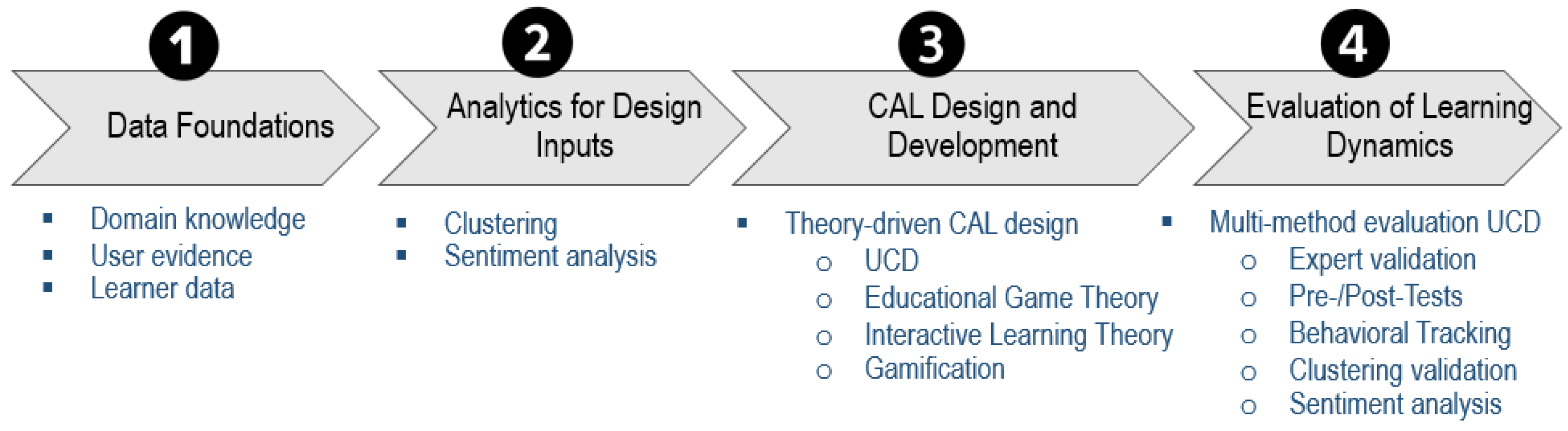
This study adopts a design-based approach that integrates data-driven analytics with established educational theories to support the development and evaluation of computer-assisted learning (CAL) environments. The overall framework consists of four interconnected stages: (1) data foundations, including domain knowledge and user-generated data; (2) analytics for design inputs through clustering and sentiment analysis; (3) theory-informed design and development of learning environments; and (4) multi-method evaluation of learning dynamics.
As illustrated in
Figure 1, these stages are integrated within a continuous design cycle, where insights from data analysis inform design decisions, and evaluation outcomes provide feedback for refinement. This structure enables the proposed framework to connect computational analysis with pedagogical reasoning and empirical validation in a coherent manner. In addition, the framework defines model selection, validation procedures, and statistical analysis strategies to support methodological transparency and alignment with the study’s design-oriented objectives.
3.1. Study Design Overview
This study adopts a design-based, multi-method research approach structured around the four-stage framework shown in
Figure 1. The proposed design-based CAL framework integrates data, analytics, pedagogical theory, and evaluation within a unified design cycle. The framework comprises four interconnected stages:
- (1)
Data Foundations: This stage involves preparing domain knowledge and data sources, including nutrition content derived from the China Nutrition and Health Survey (CHNS), user-generated review data from educational platforms, and learner-related data collected during this study.
- (2)
Analytics for Design Inputs: In this stage, learning analytics techniques—specifically clustering and sentiment analysis—are applied to user-generated review data to identify recurring patterns and design-relevant themes. These outputs serve as structured inputs for the subsequent design process.
- (3)
CAL Design and Development: The identified design drivers are integrated with established pedagogical frameworks, including user-centered design (UCD), educational game theory, interactive learning theory, and gamification. Based on this integration, two learning environments—a board-based game and a computer-based game—are developed to reflect different interaction modalities.
- (4)
Evaluation of Learning Dynamics: The developed learning environments are evaluated using a multi-method framework that includes expert validation, pre-test/post-test assessment, behavioral tracking, clustering validation, and sentiment analysis. This stage integrates internal model validation, expert-based external validation, and empirical evaluation to examine learning-related outcomes across cognitive, behavioral, and perceptual dimensions, while ensuring consistency between analytical results, design implementation, and observed learning dynamics.
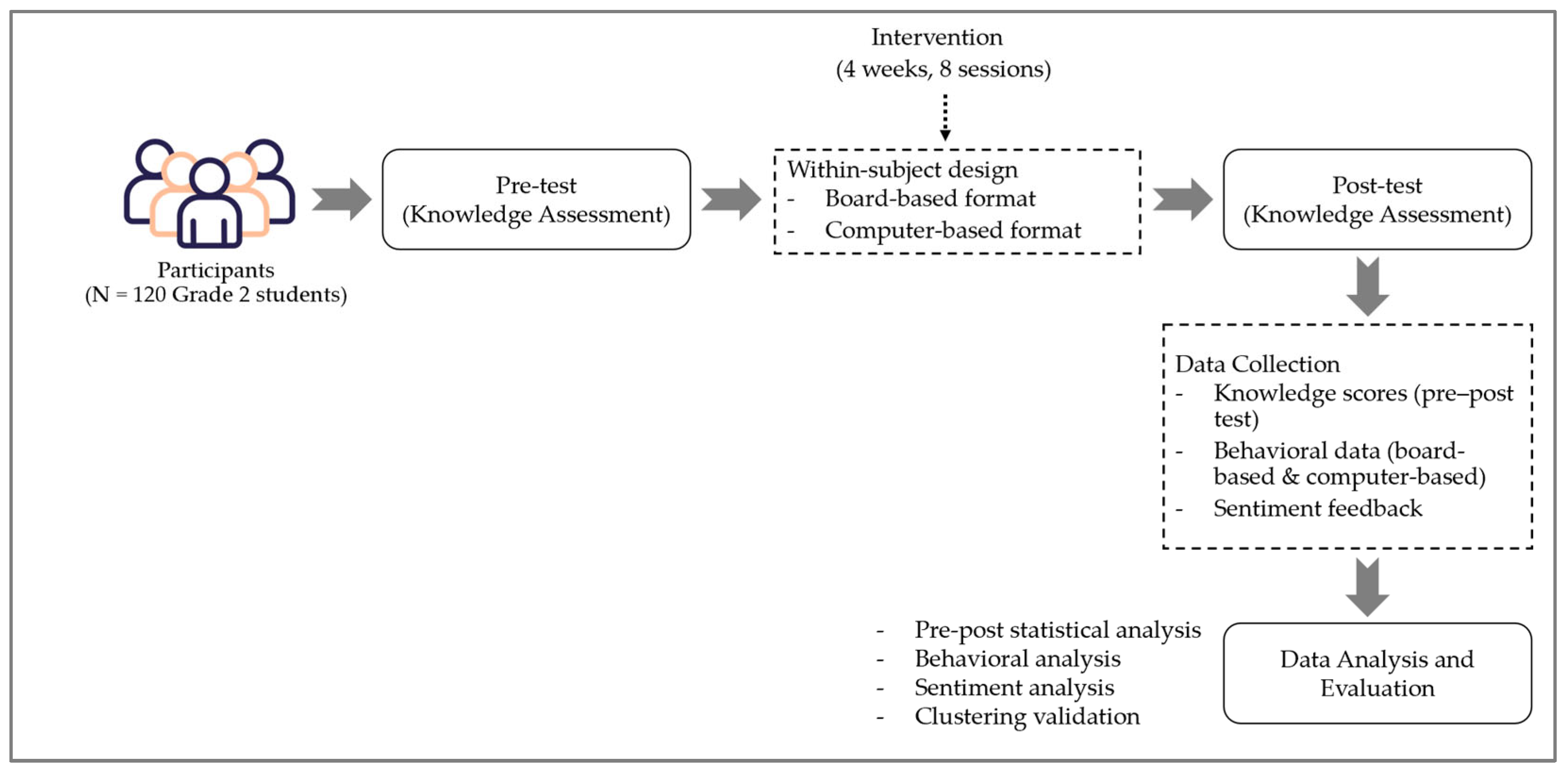
The empirical evaluation involved 120 Grade 2 students from Huanhu Primary School in Foshan, China. All students participated in the instructional activities and completed both pre-test and post-test assessments. During the intervention, all participants engaged with both the board-based and computer-based learning environments, reflecting a within-subject design in which the same group experienced both interaction formats.
The intervention was conducted over four weeks, comprising eight sessions integrated into regular classroom activities. Both learning environments delivered the same instructional content and differed only in interaction modality. To reduce potential order effects, the two formats were implemented in alternating sessions, ensuring balanced exposure throughout the intervention period. Each session followed a consistent structure, consisting of brief instruction, guided gameplay, and short reflection activities to reinforce learning outcomes.
The data collection process followed a structured sequence: (1) pre-test administration, (2) intervention sessions, (3) collection of behavioral and observational data during gameplay, (4) post-test assessment, and (5) collection of stakeholder feedback.
Learning outcomes were assessed using pre- and post-test measures. Behavioral engagement was examined using observational and system log data. Stakeholder perceptions were analyzed through sentiment analysis of student and parent feedback. All comparisons therefore reflect differences between interaction formats within the same participant cohort and represent context-specific observations rather than controlled experimental effects.
To ensure coherence within this multi-method design, this study follows a sequential and functionally integrated approach. Analytics-derived inputs (clustering and sentiment analysis) inform design decisions, and complementary evaluation methods capture different dimensions of learning. Pre–post assessment reflects cognitive outcomes, behavioral indicators capture engagement patterns, and sentiment analysis represents stakeholder perceptions. These components are jointly interpreted as complementary sources of evidence within the same participant cohort.
The overall study design and participant flow are illustrated in
Figure 2.
3.2. Data Sources and Participants
This study integrates three complementary data sources to support both the design and evaluation of the proposed framework.
First, domain-specific knowledge was derived from the China Nutrition and Health Survey (CHNS), which provides structured content related to food classification, nutrient identification, and balanced diet planning. This dataset served as the foundation for constructing learning materials used in both game formats.
Second, user-generated review data were collected from Common Sense Media for three widely recognized educational games: Endless Alphabet, Prodigy Math Game, and Minecraft: Education Edition. These games were selected based on three key considerations. First, they target children aged approximately 5–8 years, which aligns with the primary school students for whom the nutrition learning environments were developed. Second, the selected games represent diverse educational experiences, including language learning, mathematics, and exploratory learning, allowing the identification of a broad range of design-relevant features. Third, these games are widely used and highly popular on educational platforms, providing a large and diverse set of user-generated reviews for analysis.
The review dataset was constructed by applying inclusion criteria to ensure relevance to this study’s design objective. Specifically, only reviews with a minimum length of 50 words were retained to ensure sufficient descriptive content. The reviews were further filtered to include those that explicitly referred to aspects of game design (e.g., usability, visual elements, interaction, or engagement features). Given the large volume of available reviews, a subset of reviews was selected for analysis. The final dataset consisted of 1500 reviews (Endless Alphabet: 200, Prodigy Math Game: 500, and Minecraft: Education Edition: 800). This sample was considered sufficient to capture representative design-related patterns and to support this study’s exploratory objectives, rather than to exhaust all available user feedback.
The selected sample size was considered sufficient to capture recurring design-relevant patterns in large-scale user-generated text within an exploratory clustering context. The objective is to interpret dominant themes rather than to achieve statistical generalization. This selection process ensured that the dataset provided meaningful and design-relevant information to support the subsequent analysis. The review data included perspectives from parents, teachers, and students, enabling the identification of design-relevant themes across multiple stakeholder groups.
It should be noted that the review dataset used in this study is consistent with that used in our earlier work [
12]. However, the role of the dataset in the present study is different. In the earlier work, the dataset was used solely for clustering-based analysis to identify user perception patterns. In contrast, in this study, the dataset serves as a foundational input within a broader design-oriented framework, integrating sentiment-informed analysis, theory-driven design, and classroom-based empirical evaluation. This shift reflects a transition from analytical exploration to a full design and evaluation pipeline.
Third, the empirical evaluation involved the same cohort of 120 Grade 2 students described in
Section 3.1, where all participants experienced both board-based and computer-based learning formats. Pre-test and post-test assessments were used to examine changes in knowledge within this cohort.
Prior to participation, written informed consent was obtained from the parents or legal guardians of all participating students. In addition, age-appropriate verbal assent was obtained from the children before the study activities were conducted. The study procedures were explained to the students in a simple and understandable manner, and participation was entirely voluntary. Students were informed that they could withdraw from the activities at any time without consequences. No personally identifiable information was collected, and all data were anonymized prior to analysis.
The sample size for the empirical evaluation (n = 120) was determined based on the practical constraints of a classroom-based implementation and the study’s design-oriented and exploratory objective. As this study adopts a within-subject design in which all participants engage with both learning formats, the selected sample size is considered sufficient to capture within-group variation in learning outcomes, behavioral engagement, and stakeholder perceptions, rather than to support population-level generalization.
Participants were selected using a convenience sampling approach, based on accessibility and collaboration with a partner primary school. All Grade 2 students in the selected classes were included in this study, provided that parental consent and student assent were obtained. No additional exclusion criteria were applied, as this study aims to reflect authentic classroom conditions. Accordingly, the sample is interpreted as context-specific and is not intended to be representative of a broader population.
3.3. Analytics for Design Inputs: Clustering of Educational Game Reviews
To identify design–relevant themes, the collected review data were analyzed using a clustering-based approach. The objective of this analysis was not limited to descriptive summarization but also aims to identify interpretable patterns.
The textual data were first preprocessed using standard natural language processing techniques, including lowercasing, tokenization, stop-word removal, and stemming. The processed texts were then transformed into numerical feature vectors using TF–IDF weighting. The data were represented using document-level TF–IDF features constructed from the preprocessed corpus, without additional domain-specific feature engineering, in order to preserve generalizability.
K-means clustering was applied to group reviews based on thematic similarity [
44]. To determine the appropriate number of clusters (k), a range of candidate values (k = 2 to 6) was examined. Clustering quality was evaluated using the Silhouette Score and Davies–Bouldin Index (DBI). Based on these evaluations, a three-cluster solution (k = 3) was selected as a practically suitable configuration for interpretability rather than an optimal statistical solution.
This selection considered both internal evaluation metrics and the interpretability of the resulting clusters for design-oriented analysis. The choice of k = 3 reflects a balance between cluster interpretability and thematic distinctiveness. Higher values of k resulted in fragmented themes with limited additional design relevance, while lower values reduced conceptual differentiation.
The clustering process was implemented using standard machine learning libraries in Python (e.g., Python 3.9 with scikit-learn version 1.2). Default parameter settings were used unless otherwise specified. To ensure stability of the results, clustering was performed with multiple random initializations, and the solution with the best internal evaluation metrics was selected.
The resulting clusters were interpreted through an iterative open coding process. For each cluster, representative keywords and sample review excerpts were examined to generate initial codes reflecting recurring themes. These codes were iteratively refined and grouped into higher-level thematic categories.
The coding process was reviewed and refined by three domain experts (n = 3) with experience in educational game design and learning sciences. The experts evaluated the thematic coherence of each cluster, the relevance of the identified codes to educational design, and the consistency of interpretation across clusters. Discrepancies were resolved through discussion to reach a shared interpretation. Given the exploratory and design-oriented nature of this study, formal inter-rater agreement statistics were not calculated. Instead, consensus-based validation was adopted to ensure interpretability and practical relevance of the identified themes.
Three main themes were identified within the dataset: (1) content engagement, (2) visual appeal, and (3) motivational mechanisms. These themes were subsequently operationalized as design drivers for the development of the learning environments.
K-means clustering was selected in this study due to its interpretability and suitability for design-oriented analysis. Compared with more complex clustering approaches such as hierarchical or density-based methods (e.g., DBSCAN), which may better capture intricate data structures, K-means provides a straightforward partitioning that facilitates the identification of dominant themes through cluster centroids and representative terms. This property is particularly important for translating analytical outputs into actionable design drivers. Accordingly, the selection of K-means reflects a deliberate trade-off between model complexity and interpretability, aligned with this study’s objective of deriving design-relevant insights rather than optimizing predictive performance.
3.4. CAL Design and Development: Theory–Analytics Integration in Dual-Format Games
In this study, analytics are not limited to descriptive analysis. Instead, clustering of educational game reviews and sentiment-informed insights are used to derive design drivers, which are then translated into concrete design decisions across two interaction formats (board-based and computer-based).
This stage translates analytics-derived insights into design decisions through the structured integration of multiple pedagogical frameworks. Rather than treating theories as isolated components, this study treats them as complementary mechanisms that guide the design of learning environments.
Specifically, the three design drivers identified from the clustering analysis—content engagement, visual appeal, and motivational mechanisms—were systematically mapped to relevant theoretical constructs. Content engagement was aligned with user-centered design (UCD), emphasizing age-appropriate content representation, usability, and clarity of instructional materials. Visual appeal was informed by both UCD and gamification principles, supporting the use of visually engaging elements to maintain attention and reduce cognitive load. Motivational mechanisms were guided by gamification and interactive learning theory, emphasizing reward structures, progression systems, and active learner participation.
This mapping is further grounded in psychological learning theories. Content engagement aligns with constructivist learning principles, in which learners actively construct knowledge through interaction with meaningful content. Motivational mechanisms are informed by self-determination theory, emphasizing intrinsic motivation, autonomy, and competence through reward structures and progression systems. Visual and interaction design elements are also interpreted in relation to cognitive load considerations, where well-structured visual representations support comprehension and reduce extraneous cognitive processing.
These mappings were used to guide the translation of analytical insights into design features. For example, content-related themes guided the simplification and structuring of nutrition cards to improve comprehension. Visual themes influenced the use of color, layout, and animation to support engagement. Motivation-related themes guided the design of reward systems such as points, progression, and feedback loops.
To clarify the integration of analytical and theoretical components, the proposed framework treats learning analytics as a mechanism for deriving empirically grounded design drivers. Pedagogical theories provide the interpretive and operational structures through which these drivers are translated into design decisions. In this relationship, clustering and sentiment analysis function as data-driven inputs that identify recurring patterns in user experience. User-centered design, gamification, and interactive learning theory then define how these patterns are interpreted and implemented within learning environments. This complementary relationship allows analytics outputs to be operationalized within a theory-informed design process, rather than being treated as independent or post hoc analytical components.
From this perspective, the proposed framework can be interpreted as a conceptual model in which data-driven inputs are translated through pedagogical mechanisms into observable learning outcomes across cognitive, behavioral, and perceptual dimensions.
Based on this design logic, two complementary learning environments were developed to reflect different modes of interaction while maintaining a shared instructional structure:
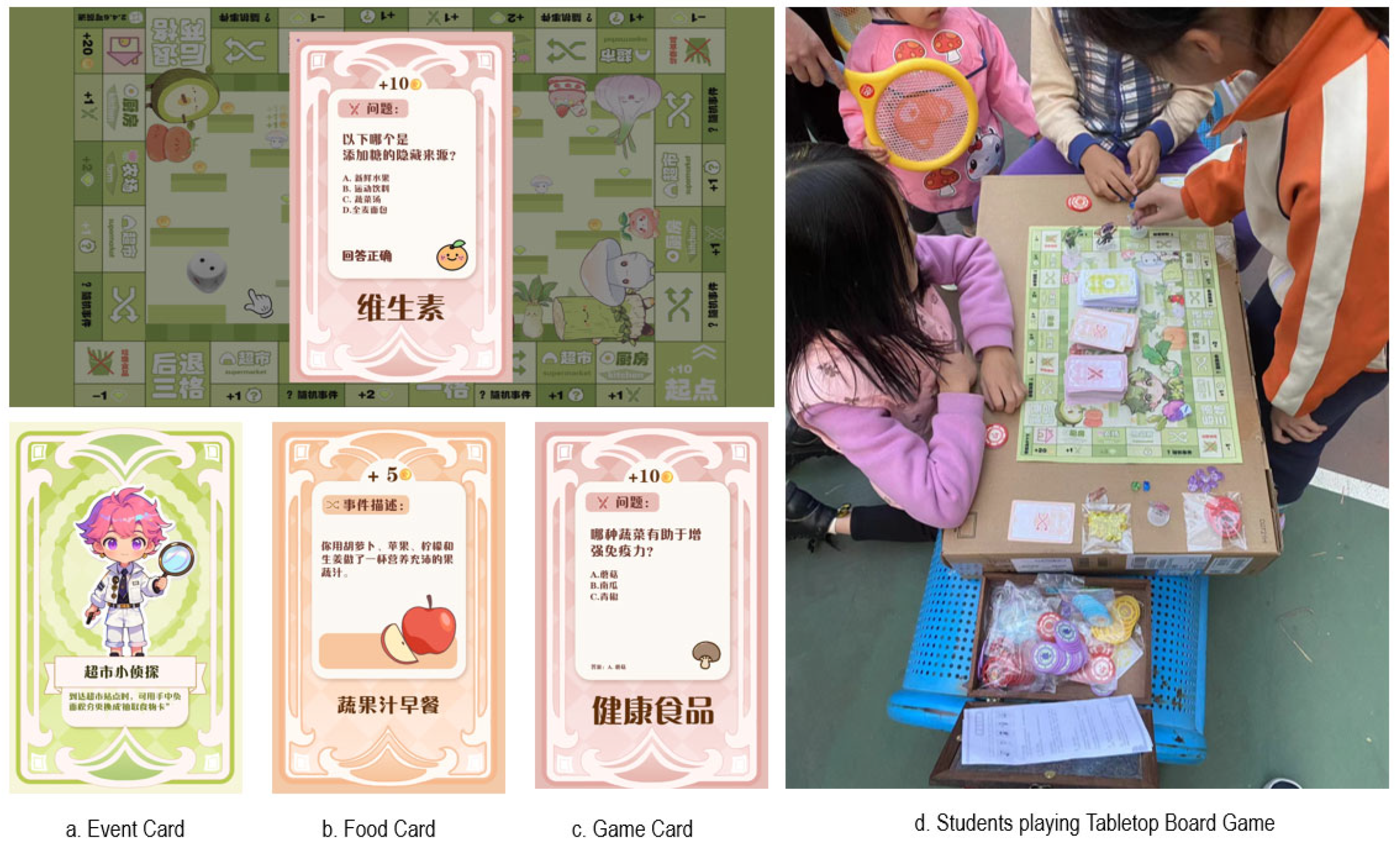
Board-based game (Little Nutrition Explorers): This format supports collaborative and socially mediated learning. It incorporates physical elements such as maps, tokens, and nutrition cards, enabling peer interaction and family participation. User feedback indicated a preference for tangible and cooperative learning experiences, especially among parents.
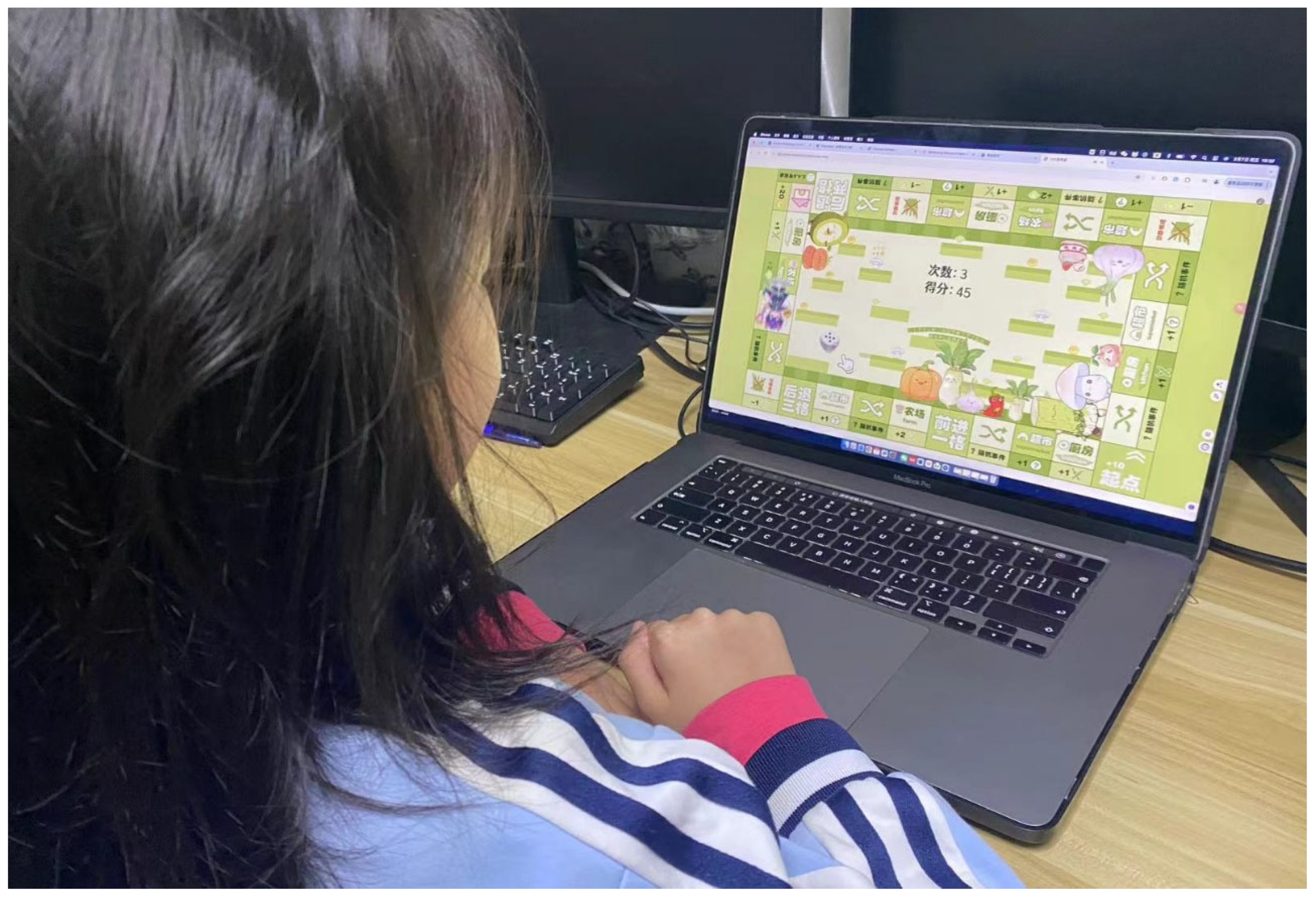
Computer-based game: This format supports individual interaction and immediate feedback. It includes interactive elements such as animations, drag-and-drop tasks, and automated scoring. These features reflect analytics-derived insights related to visual engagement and sustained interaction, particularly among student users.
The tabletop board-based gameplay and the computer-based game interface are illustrated in
Figure 3 and
Figure 4, respectively. These examples demonstrate how the design drivers were implemented across the two formats.
Although the two formats differ in delivery, both were developed using the same set of design drivers and theoretical mappings. This ensures that variations between formats reflect differences in interaction modality rather than differences in instructional content or learning objectives.
Overall, this stage shows how analytics-informed insights can be operationalized through theory-informed design decisions. Rather than claiming full theoretical synthesis, this approach provides a structured and practical alignment between data-driven inputs and pedagogical design in a specific educational context.
3.5. Evaluation of Learning Dynamics: A Multi-Method Framework
The developed learning environments were evaluated using a structured multi-method framework that integrates analytical, educational, and behavioral perspectives. The evaluation combines quantitative analysis, expert-based assessment, and observational data to examine both design validity and learning-related outcomes.
To ensure coherence across these complementary methods, this study adopts a triangulation approach by integrating multiple data sources and analytical perspectives. These include: (1) clustering-based design validation, (2) expert evaluation of educational quality, (3) pre–post knowledge assessment, (4) behavioral engagement analysis, and (5) sentiment analysis of stakeholder feedback. These components represent complementary perspectives across cognitive, behavioral, and perceptual dimensions and are jointly interpreted to provide an integrated understanding of learning dynamics.
The statistical analysis plan is defined in alignment with the within-subject study design. It includes (1) paired sample t-tests to assess pre–post changes in knowledge outcomes, (2) effect size estimation using Cohen’s d to indicate the magnitude of observed differences, (3) confidence interval estimation (95%) to reflect the precision of mean differences, (4) descriptive statistical analysis of behavioral indicators across interaction formats, and (5) classification-based evaluation of sentiment analysis using precision, recall, F1-score, and macro-F1 under cross-validation. All analytical results are interpreted as indicative patterns rather than as causal or generalizable effects.
Each analytical component aligns with the study objectives. Clustering analysis informs the derivation of design drivers, expert evaluation supports the assessment of educational quality, pre–post testing examines knowledge-related outcomes, behavioral analysis captures engagement patterns, and sentiment analysis reflects stakeholder perceptions.
Given the within-subject, design-based nature of this study and its exploratory objective, the analysis focuses on within-group pattern interpretation rather than modeling causal relationships between variables. Accordingly, more complex inferential approaches such as ANOVA or regression analysis were not applied. This study does not aim to estimate population-level effects or test predictive relationships, but rather to examine learning dynamics across complementary dimensions within this study framework.
3.5.1. Evaluation of Thematic Coherence and Design Relevance
To assess the validity and usefulness of clustering-derived themes, both internal and external validation approaches were employed.
Internal validation was conducted using the Silhouette Score (S.S.) [
45] and Davies–Bouldin Index (DBI) [
45] to evaluate cluster cohesion and separation. Given that the primary objective of clustering in this study is interpretability rather than strict statistical optimization, these metrics are used as supporting indicators rather than definitive criteria. The obtained values (S.S. = 0.33, DBI = 2.16) indicate a moderate level of cluster separation. This suggests that the underlying structure of the data is only weakly to moderately partitioned. Accordingly, the clustering results are interpreted with caution as indicative patterns rather than well-defined or statistically optimal group structures.
External validation was conducted through expert review. A group of domain-relevant experts (n = 3) with backgrounds in educational game design and nutritional education examined the identified clusters. The experts were selected based on their academic and professional experience in educational game design, learning sciences, and nutrition education. All experts had a minimum of five years of experience in their respective domains and prior involvement in the evaluation or development of educational materials. All experts were independent from this study participants and the data collection process.
This combined validation approach allows the clustering results to be considered from both analytical and practical perspectives. Rather than relying solely on quantitative metrics, the inclusion of expert evaluation supports the interpretability and applicability of the identified themes.
3.5.2. Expert Evaluation of Educational Quality
The educational quality of the developed games was assessed using the N–GUT scale. This instrument measures dimensions such as scientific accuracy, content coverage, instructional appropriateness, and behavioral relevance.
The evaluation was conducted by three domain-relevant experts (n = 3) with backgrounds in nutrition education and instructional design. Internal consistency of the instrument was assessed using Cronbach’s alpha.
All evaluation procedures and reported results were systematically rechecked to ensure consistency with this study design. This included verification of datasets, calculations, and reported statistics, as well as checking for the presence of unrelated or erroneous data. No discrepancies requiring reanalysis were identified during this process.
In addition, the manuscript was reviewed to eliminate any residual template artifacts or unintended content carryover from prior drafts or unrelated sources.
3.5.3. Pre- and Post-Test Knowledge Assessment
Learning outcomes were evaluated using a structured questionnaire developed from CHNS-based nutrition content. The instrument assessed students’ abilities in food classification, nutrient identification, meal planning, and health-related decision-making. Each knowledge dimension consists of 12 items, resulting in a score range of 0–12 per dimension. Students completed the assessment before and after the intervention, and learning gains were analyzed using paired sample t-tests.
The intervention was conducted over multiple sessions within a classroom setting. All participants received the same instructional content, delivered through the developed Game-Based Learning environments. Pre-test scores were used to examine baseline equivalence across participants and to ensure comparability before the intervention.
As multiple outcome variables were examined, the issue of multiple comparisons was considered. Given the exploratory and design-oriented nature of this study, formal correction procedures (e.g., Bonferroni adjustment) were not applied. Instead, the results are interpreted cautiously, with emphasis on overall patterns across outcome measures rather than on isolated statistical significance.
Confidence intervals (95%) for the mean differences were calculated based on paired sample statistics to reflect the within-subject design and to estimate the precision of the observed changes. Since all p-values were below 0.001, they are reported in threshold form (p < 0.001) for clarity and consistency.
Expert review established the content validity of the knowledge assessment instrument, ensuring alignment with curriculum-based nutrition concepts. Although formal reliability coefficients were not calculated due to the structured and domain-specific nature of the instrument, measurement consistency was supported through standardized administration procedures. Internal consistency is therefore considered sufficient for exploratory evaluation within a controlled classroom setting.
3.5.4. Behavioral Engagement and Persistence
Behavioral engagement and persistence were assessed using a combination of direct observation (for the board-based game) and system log data (for the computer-based game). Observational data captured task completion, interaction patterns, and persistence during gameplay. System logs recorded task attempts, duration of engagement, and retry behavior.
All 120 participating students engaged with both the board-based and computer-based learning environments during the intervention period. Accordingly, this study adopts a within-subject design, in which behavioral indicators are examined across two interaction formats within the same participant cohort rather than between independent groups.
Both learning environments delivered the same instructional content and differed only in interaction modality. Behavioral measures—including task completion rate, repeated engagement (e.g., login frequency), retry frequency, time on task, and reward usage—were recorded separately for each format to enable a consistent comparison of engagement patterns.
Reward usage behavior was further examined using the variability of Health Coin consumption. This measure is operationalized as the standard deviation (σ) of reward usage per student within each format, providing an indication of the dispersion of reward usage across individual students based on total Health Coin consumption per student over the intervention period.
For analytical purposes, descriptive statistics and effect sizes (Cohen’s d) were calculated to indicate the relative magnitude of behavioral differences across formats. Given the within-subject design, effect sizes are derived from paired observations and reflect standardized differences between interaction formats for the same participant cohort.
Calculating effect sizes assumes that observed behavioral measures are continuous or treated as approximately continuous and are interpreted within comparable measurement contexts across conditions. It also assumes that paired differences provide a consistent basis for comparison. Since all behavioral indicators derive from standardized activity measures within the same instructional context, these assumptions are considered reasonable for within-subject descriptive comparison. Accordingly, effect sizes are interpreted as indicators of relative magnitude rather than as inferential evidence of statistically significant differences.
Thus, the findings indicate format-related differences in behavioral engagement rather than providing evidence of causal effects. This approach supports the examination of how interaction design may relate to learner behavior while maintaining ecological validity in a real classroom setting.
3.5.5. Sentiment Analysis of Stakeholder Feedback
Stakeholder perceptions were analyzed using sentiment analysis [
46] of comments collected from students and parents across two learning formats. For each format, a total of 240 comments were obtained, comprising 120 comments from students and 120 comments from parents. The same participants provided feedback for both the board-based and computer-based formats, resulting in two format-specific datasets derived from this shared cohort.
The comments, originally in Chinese, were preprocessed using natural language processing techniques suitable for Chinese language corpora. Because Chinese text lacks explicit word boundaries, word segmentation was performed using a standard segmentation tool (e.g., Jieba version 0.42.1) to tokenize the text into meaningful units. Following segmentation, common stop words were removed, and text normalization procedures were applied, including the unification of character formats and the removal of non-informative symbols and punctuation. Stemming or lemmatization was not applied, as these operations are not directly applicable to Chinese morphology. The processed texts were then transformed into numerical feature vectors using TF–IDF weighting.
Sentiment labels were manually annotated by a single domain expert with experience in educational evaluation and child-centered learning contexts. This expert was independent from the expert evaluation group (n = 3). Each comment was categorized into one of three sentiment classes: positive, neutral, or negative. A single-annotator approach was adopted to ensure labeling consistency for this small-scale, exploratory dataset, while acknowledging the potential for subjective bias.
For model development, the annotated dataset was randomly divided into two subsets (development set: 50% and test set: 50%) while preserving the balance between stakeholder groups. A stratified random sampling strategy was applied to maintain proportional representation of sentiment classes and stakeholder groups in both subsets. The development set was used for model training and internal validation. A 10-fold cross-validation procedure was applied within this subset to support stable model estimation.
A supervised learning model based on Logistic Regression was employed. This model was selected for its suitability for small datasets, robustness in text classification tasks, and interpretability. The model was implemented using standard Python machine learning libraries (e.g., Python 3.9 with scikit-learn version 1.2). Default parameter settings were used as a baseline, with limited tuning of key hyperparameters, including regularization strength (C), to maintain stable performance and reduce the risk of overfitting. More complex models such as deep learning-based classifiers were not employed due to the relatively small dataset and this study’s emphasis on interpretability rather than predictive optimization.
Final classification performance was evaluated on the test set using precision [
47], recall [
47], and F1-score [
47], with particular attention to macro-averaged F1 [
48] to account for potential class imbalance. Class weighting was applied during model training to ensure that minority classes contributed proportionally to the learning process. In addition to classification performance metrics, the distribution of sentiment labels was analyzed using the full annotated dataset to provide a direct representation of stakeholder perceptions.
To ensure reproducibility, all experiments were conducted in a controlled computational environment (Python 3.9, scikit-learn version 1.2). The Logistic Regression model was implemented with the ‘liblinear’ solver and a maximum of 1000 iterations to ensure convergence. TF–IDF feature extraction and Chinese word segmentation were consistently applied across all samples. A fixed random seed was used during cross-validation to ensure consistent data partitioning.
It should be noted that the primary objective of this analysis is interpretive rather than predictive. Sentiment classification is used to capture stakeholder feedback and support the evaluation of learning environments, rather than to develop a standalone predictive model. Accordingly, model selection prioritizes interpretability, stability for small datasets, and alignment with the design-oriented objective of this study. The use of TF–IDF features and a Logistic Regression classifier reflects a balance between model complexity and interpretability, enabling outputs that can be meaningfully linked to educational design decisions.
4. Evaluation
To ensure consistency with the research objectives, each subsection corresponds to a specific analytical component of this study framework: design drivers, educational quality, learning outcomes, behavioral engagement, and stakeholder perceptions.
4.1. Evaluation of Information Using the K-Means Clustering Method to Leverage Insights from Educational Game Reviews
Cluster analysis identified three predominant themes within the user reviews: content engagement, visual appeal, and motivational mechanisms. These themes are used as design-relevant categories to inform the development of the educational game environments. The clustering results are summarized in
Table 1.
The internal validation metrics, including the average Silhouette Score (S.S. = 0.33) and Davies–Bouldin Index (DBI = 2.16), indicate a moderate level of cluster separation. This suggests that the underlying structure of the data is not strongly partitioned. Therefore, the clustering results should be interpreted with caution. Rather than representing sharply distinct groupings, the identified clusters reflect approximate patterns that are interpretable within the design context.
This interpretation is consistent with the design-oriented objective of this study, where clustering is used to support the identification of design-relevant themes rather than to achieve statistically optimal partitioning. In line with the methodological choice of K-means described in
Section 3.3, the emphasis is placed on interpretability and practical applicability.
To enhance the reliability of these patterns, the clustering results were further examined through expert validation. The identified clusters were considered meaningful and relevant within the educational design context.
The three themes—content engagement, visual appeal, and motivational mechanisms—are therefore interpreted as indicative design drivers rather than definitive or exhaustive categories. These themes provide a structured way to organize user feedback and inform subsequent design decisions, particularly in relation to learner engagement and interaction design.
4.2. Expert Evaluation of the Nutrition Educational Game Using the N–GUT Scale
The educational quality of the developed nutrition games was assessed using the N–GUT scale, based on evaluations conducted by three domain-relevant experts (n = 3) with expertise in nutrition education and instructional design. This scale assesses scientific accuracy, knowledge coverage, instructional appropriateness, and behavioral application. The evaluation reflects expert judgments based on the defined assessment criteria and provides context-specific insights into the educational quality and alignment of the developed games.
Table 2 presents the expert evaluation results.
The results of the expert evaluation are presented in
Table 2. High mean scores were observed across all dimensions, particularly in scientific accuracy (M = 4.53, SD = 0.61; 93.3% ≥ 4) and knowledge coverage (M = 4.47, SD = 0.64; 86.2% ≥ 4). These results indicate that the nutritional content is accurate and comprehensive. Instructional appropriateness (M = 4.33, SD = 0.58; 85.0% ≥ 4) suggests that the learning materials are aligned with the cognitive level of primary school students.
The behavioral application dimension (M = 4.20, SD = 0.55; 81.0% ≥ 4) suggests that the game-based approach may support awareness of healthy eating practices. From an educational sustainability perspective, these findings can be interpreted in relation to the consistency dimension, particularly in terms of alignment between instructional objectives and learning outcomes. The results may also reflect the potential of the learning environments to support engagement and awareness of health-related behaviors in classroom settings.
The reliability of the evaluation instrument was high (Cronbach’s α = 0.87), indicating strong internal consistency. Overall, the findings suggest that the developed games are generally aligned with scientific content, pedagogical expectations, and behavior-related learning objectives. These findings also highlight the role of evidence-based and context–aware educational design in supporting sustainable educational practices, particularly in relation to health-related behaviors among young learners. It should be noted that the expert evaluation is based on a small number of domain specialists and therefore reflects informed judgments within a specific context rather than generalized conclusions.
4.3. Pre- and Post-Test Comparison Using a Paired Sample t-Test
The intervention lasted four weeks, with two sessions per week, for a total of eight learning sessions. Each session lasted approximately 40–50 min and was integrated into regular classroom activities.
To ensure consistency in instructional delivery, all sessions were conducted under the supervision of the same classroom teachers, who followed a standardized activity guideline provided by the researchers. Teachers facilitated the gameplay process but did not provide additional instructional support beyond the predefined procedures. This approach was intended to minimize instructor-related variability while maintaining ecological validity in the school setting.
Knowledge assessment was conducted with second-grade students (N = 120) using a structured questionnaire developed with input from nutrition and educational experts. The instrument evaluated four dimensions of nutrition knowledge: food knowledge, nutrition understanding, food classification, and health risk assessment. Students completed the assessment before and after the intervention, and learning gains were analyzed using paired sample t-tests.
Prior to hypothesis testing, key assumptions of the paired sample t-test were examined. The normality of the difference scores was assessed using the Shapiro–Wilk test, indicating no significant deviation from normality (p > 0.05). Given the within-subject design and continuous measurement scale, the paired t-test was considered appropriate.
The results presented in
Table 3, derived from paired sample
t-tests applied to within-subject pre–post comparisons, indicate that post-test scores were higher than pre-test scores across all four dimensions (
p < 0.001). The observed mean differences ranged from +1.95 to +2.32, indicating improvements in knowledge-related outcomes.
In addition to statistical significance, effect sizes (Cohen’s d) were calculated to assess the magnitude of learning gains. The results indicate moderate to large effect sizes across all dimensions (d = 0.82–1.12), suggesting that the observed improvements are meaningful within the context of this study.
To provide additional information on the precision of the estimated effects, 95% confidence intervals (CIs) were calculated for the mean differences between pre-test and post-test scores. The observed improvements across all dimensions were associated with positive confidence intervals that did not include zero, indicating consistent improvement patterns. These intervals serve as descriptive indicators of estimation precision rather than inferential evidence of generalizable effects.
Overall, the findings indicate improvements in knowledge-related outcomes. From an educational sustainability perspective, these improvements can be interpreted in terms of the consistency dimension, reflected in stable learning outcomes across instructional sessions and continuity of knowledge acquisition. While the use of interactive and gamified elements may support engagement and knowledge application, the extent to which these effects translate into long-term behavioral change requires further investigation.
While these results indicate improvements in learning outcomes, it is also important to consider how learners engaged with the activities, as discussed in the following section. From an interpretive perspective, these knowledge-related improvements can be considered in relation to the clustering-derived design drivers identified earlier. In particular, the emphasis on content engagement in the design phase is consistent with the observed improvements in knowledge acquisition, suggesting a possible alignment between analytics-informed design inputs and cognitive learning outcomes.
4.4. Gameplayer Behavior Analysis
To complement the analysis of learning outcomes, behavioral engagement and persistence were examined to better understand how students interacted with the learning environments across different interaction formats.
Behavioral data were collected using a combination of direct observation (for the board-based format) and system log analysis (for the computer-based format). Observational data captured task completion, interaction patterns, and persistence during gameplay, while system logs recorded task attempts, duration of engagement, and retry behavior.
All 120 participating students engaged with both formats during the intervention period. Accordingly, the analysis reflects within-subject differences in engagement patterns across interaction modes within the same participant cohort rather than comparisons between independent groups.
The indicators examined include task completion rate, repeated engagement (daily login rate), number of retries per task, and variability in reward usage (Health Coin consumption). Reward usage variability is represented by the standard deviation (σ) of Health Coin consumption per student within each format, indicating the degree of consistency in reward-related behavior across gameplay sessions. The results are summarized in
Table 4.
All 120 students contributed behavioral data for both formats (n = 120 per condition under a within-subject design).
The results show that the board-based format is associated with higher task completion rates (83.7%) and repeated engagement levels (72.9%) compared to the computer-based format (61.2% and 37.4%, respectively). Effect sizes are large (Cohen’s d > 1.5), indicating substantial differences in magnitude between the two interaction formats. These values are interpreted descriptively and do not constitute inferential evidence of statistically significant differences.
Similarly, the number of retries per task is higher in the board-based format (2.8 attempts per task) than in the computer-based format (0.9 attempts per task). This pattern may reflect greater persistence during task completion within the observed setting and may be related to the collaborative and socially mediated nature of interaction in the board-based environment.
In contrast, the computer-based format shows greater variability in reward usage (σ = 0.87) than the board-based format (σ = 0.32), indicating greater dispersion in total Health Coin consumption across individual students within the computer-based format.
Overall, the results suggest that different interaction formats may be associated with distinct engagement patterns. The board-based format appears to be associated with higher persistence and more consistent engagement, while the computer-based format reflects more variable interaction behaviors. These observations are consistent with the dual-format design of the learning environments and provide descriptive insights into how interaction modalities may relate to learner engagement.
From an educational sustainability perspective, these behavioral patterns can be interpreted in relation to the continuity of learner engagement across interaction formats and the adaptability of learning environments to support different modes of participation.
From an integrated perspective, these behavioral patterns can also be considered in relation to the motivational mechanisms identified in the clustering analysis. In particular, the higher persistence and repeated engagement observed in the board-based format are broadly consistent with the emphasis on reward structures and interaction design derived from the analytics-informed design drivers.
4.5. Sentiment Analysis for Board- and Computer-Based Games
To complement the cognitive and behavioral findings, stakeholder perceptions of the two learning formats were examined through sentiment analysis of feedback collected from students and parents. For each format, the sentiment distributions are based on 120 student comments and 120 parent comments (n = 240 per format).
To provide a direct descriptive representation of stakeholder perceptions, the distribution of sentiment labels is summarized in
Table 5 using the full annotated dataset (n = 240). The results for sentiment classification performance are presented in
Table 6 and
Table 7 for the board-based and computer-based formats, respectively. These classification results are evaluated on a held-out test set, following model development and internal validation on a separate development subset, as described in
Section 3.5.5. In addition to class-wise precision, recall, and F1-scores, macro-averaged F1 values are reported to provide an overall summary of classification performance across sentiment categories.
As shown in
Table 5, both students and parents exhibited predominantly positive and neutral sentiment toward the board-based format, with no negative labels observed in the annotated data. This pattern suggests generally favorable and relatively consistent perceptions of the board-based learning experience. However, given the dataset size and the use of single-expert annotation, the absence of negative sentiment should be interpreted with caution.
For the computer-based format, students demonstrated a high proportion of positive sentiment, indicating favorable engagement with the interactive features of the digital environment. Parent feedback, however, showed a more varied distribution, including a noticeable proportion of negative sentiment. This pattern suggests that while students may respond positively to interactive digital elements, parents may hold more diverse perceptions regarding the appropriateness of the digital format for learning and supervision.
It should be noted that the sentiment distribution presented in
Table 5 is derived from the full annotated dataset, whereas the classification performance reported in
Table 6 and
Table 7 is evaluated on the held-out test set. Accordingly, class imbalance or the absence of specific sentiment categories in certain groups (for example, the absence of negative sentiment in the board-based format) is reflected in the corresponding classification results, where performance for the negative class is reported as zero.
The classification performance in
Table 6 and
Table 7 shows that the model can distinguish between sentiment categories with reasonable consistency under the observed data conditions. These results should be interpreted in relation to both the underlying sentiment distribution and the data partitioning strategy described in
Section 3.5.5.
For the board-based format (
Table 6), no negative sentiment instances are present in the annotated dataset. As a result, the negative class receives zero scores across all evaluation metrics for both students and parents. This outcome reflects the absence of negative labels in the data rather than a limitation of the classification model. Consequently, evaluation for this format focuses on the positive and neutral classes, where the model shows strong performance, particularly in precision (P = 1.0 across classes) and F1-scores.
In contrast, the computer-based format (
Table 7) shows a more heterogeneous sentiment distribution, especially in parent feedback, where all three sentiment classes are represented. This allows for a broader evaluation of classification performance across categories. The model performs well in identifying positive sentiment for both students (F1 = 0.95) and parents (F1 = 0.83). However, performance for neutral sentiment is lower in parent feedback (F1 = 0.50), indicating greater variability in neutral evaluations. The model also shows strong performance for the negative class in parent feedback (F1 = 0.93), suggesting that negative sentiment, when present, is relatively distinct and consistently identified.
Interpreting these findings, the results indicate that classification performance is closely aligned with the underlying sentiment distribution in each format. In the board-based condition, the absence of negative sentiment limits the coverage of all classes and therefore constrains the scope of performance evaluation. In the computer-based condition, the presence of all sentiment categories allows a more balanced assessment across classes.
It is important to note that classification performance is evaluated on a held-out test set derived from a relatively small annotated dataset. As a result, the presence or absence of specific sentiment classes in the test subset directly influences the reported metrics. In particular, the absence of negative samples in the board-based condition leads to zero scores for this class and reduces macro-F1 values due to incomplete class coverage. Therefore, the reported results should be interpreted as context-specific indicators of classification behavior under the observed data conditions rather than as generalizable measures of model performance.
The board-based format is associated with more homogeneous and consistently positive or neutral responses, whereas the computer-based format reflects a broader range of evaluative perceptions, particularly among parents. These differences are reflected in both the sentiment distributions (
Table 5) and the corresponding classification outcomes (
Table 6 and
Table 7).
From an integrated perspective, these perception patterns can be considered in relation to the visual appeal and interaction-related design drivers identified through clustering. The generally positive sentiment toward both formats, together with the variability observed in parent feedback for the computer-based format, reflects how different stakeholder groups perceive design features.
Overall, the findings indicate that the two learning formats are associated with distinct patterns of stakeholder perception. These observations are descriptive and exploratory in nature and should be interpreted as indicative rather than causal. From an educational sustainability perspective, the results highlight the potential value of offering multiple interaction formats to accommodate diverse user perceptions and engagement preferences. Further investigation is required to assess longer-term effects and broader applicability.
4.6. Discussion
This study examines how data-driven approaches can be integrated with established educational theories to support the design and evaluation of computer-assisted learning (CAL) environments. Rather than focusing solely on post hoc performance evaluation, this study shows how review clustering and sentiment-informed insights can be operationalized as design drivers within a structured dual-format Game-Based Learning context.
Compared to prior work and existing studies in Game-Based Learning and learning analytics, this study extends previous approaches in several ways. Earlier research has primarily emphasized the analytical exploration of user-generated data and has often treated learning analytics as a post hoc evaluation tool. In contrast, this study embeds analytics outputs within a theory-informed design framework. These outputs are used as design inputs that inform the development of learning environments. In addition, whereas many studies focus on a single interaction modality, this work adopts a dual-format implementation within the same participant cohort. This allows observation of complementary engagement patterns across interaction contexts. Furthermore, sustainability is not treated as an implicit outcome. Instead, it is defined and operationalized through observable dimensions, including engagement continuity, outcome consistency, and design adaptability.
The clustering analysis identified three design drivers—content engagement, visual appeal, and motivational mechanisms—which were applied during the development of the learning environments. Expert evaluation results indicate alignment with instructional expectations and domain-relevant content, suggesting that translating analytical insights into design implementation is feasible in this setting.
Empirical findings provide consistent evidence across multiple dimensions. Pre–post assessment results indicate improvements in knowledge-related outcomes, with moderate to large effect sizes across all dimensions. Given the within-subject design, these findings should be interpreted as indicative of learning improvements rather than evidence of causal effects. Behavioral analysis further shows that interaction formats are associated with distinct engagement patterns. The board-based format is associated with higher persistence and more consistent task completion, whereas the computer-based format reflects more variable interaction behaviors. These patterns are interpreted as format-related differences within the same participant cohort.
Sentiment analysis provides complementary insights into stakeholder perceptions. Both students and parents generally expressed positive responses. However, parent feedback for the computer-based format showed greater variability, including the presence of negative sentiment. This pattern suggests that perceptions of interaction formats may differ across stakeholder groups and contexts. Taken together, the clustering-derived design drivers, expert validation results, cognitive outcomes, behavioral patterns, and stakeholder perceptions provide complementary evidence. This supports the internal coherence of the proposed analytics-informed design framework.
From an interpretive perspective, it is important to distinguish between findings directly supported by empirical evidence and broader implications. The observed improvements in knowledge outcomes, behavioral engagement patterns, and sentiment distributions reflect context-specific results obtained under a within-subject design. In contrast, interpretations regarding the complementary roles of interaction formats and their potential to support diverse learning experiences should be considered exploratory. Long-term sustainability, transfer to real-world behavior, and applicability across different educational contexts remain untested.
From an educational sustainability perspective, the findings illustrate how sustainability can be operationalized through design-oriented mechanisms. Continuity of engagement is reflected in sustained participation across interaction formats. Consistency of outcomes is reflected in stable improvements in knowledge-related measures. Adaptability is supported through analytics-informed design drivers that can be iteratively refined based on behavioral and perceptual feedback. In contrast to prior literature, where sustainability is often treated as an implicit outcome, the present study positions it as an observable property of learning environments that can be supported through the integration of analytics and pedagogical design.
These findings contribute to addressing the gap identified in
Section 2, where the integration of learning analytics with pedagogical design in sustainability-oriented educational frameworks was noted as insufficiently articulated. While the findings are context-specific, they suggest that analytics-informed design provides a structured approach for linking user-generated data, pedagogical theory, and empirical evaluation within a unified framework.
This study has several limitations. First, the empirical evaluation was conducted within a specific educational and cultural context with a relatively limited sample size (n = 120), which may limit generalizability. Second, the intervention period was relatively short and focused on immediate learning outcomes. Therefore, it does not provide evidence of long-term effects. Third, the analytical approach prioritizes interpretability over model complexity, which may limit predictive performance compared to more advanced techniques. In addition, the within-subject design without a control group, along with the use of a single annotator for sentiment labeling, may introduce methodological constraints. These should be considered when interpreting the findings.
Furthermore, as this study adopts a design-based research approach, the same research team was involved in multiple stages of this study, including design, implementation, and evaluation. While this supports coherence between design decisions and analytical interpretation, it may introduce researcher bias. In particular, the absence of fully independent evaluators in certain stages may affect the objectivity of the evaluation process. Future studies may address this limitation by incorporating independent evaluators or adopting more neutral experimental designs to strengthen methodological rigor.
Future research may extend this work by incorporating larger and more diverse participant samples, examining long-term learning effects, and exploring analytics-informed design across different subject domains and educational contexts. In addition, although sustainability is conceptualized in terms of engagement continuity, outcome consistency, and design adaptability, the short duration of the intervention limits the ability to assess the durability of these effects over time.
Overall, this study highlights the role of learning analytics as a design-support mechanism rather than solely an evaluation tool. While the findings remain exploratory and context-specific, they illustrate how analytics-informed design can support the development of learner-centered and adaptable CAL systems and provide a foundation for future work on sustainability-oriented educational design.
5. Conclusions
This study shows how learning analytics outputs—specifically review clustering and sentiment-informed insights—can be used as design drivers within a theory-informed framework for computer-assisted learning (CAL). By integrating analytics with pedagogical principles, this study presents a design-oriented approach that translates user-generated data into actionable decisions for the development of learning environments.
The results indicate that clustering-derived themes can be incorporated into the design process and that dual-format learning environments are associated with distinct but complementary patterns of engagement. These findings suggest the feasibility of analytics-informed design and illustrate how different interaction modalities may relate to diverse forms of learner engagement.
From a sustainability perspective, this study frames learning environments in terms of continuity of engagement, consistency of outcomes, and adaptability of design. The proposed framework contributes to this perspective by showing how behavioral patterns and stakeholder feedback can be incorporated into iterative design processes, supporting context-sensitive and evolving learning systems.
From a pedagogical perspective, the findings suggest several practical implications for the design and implementation of Game-Based Learning environments. First, analytics-derived insights can be used to support alignment between instructional content and learner engagement mechanisms, contributing to more targeted and learner-centered design. Second, incorporating multiple interaction formats within the same instructional context may help address diverse learner preferences by combining collaborative and individual learning experiences. Third, the integration of motivational elements such as reward systems and progression structures should be carefully designed to support sustained engagement rather than short-term interaction.
Based on these findings, it is suggested that educators and instructional designers (1) consider using user-generated data to inform design decisions, (2) adopt multimodal learning formats where feasible to support diverse interaction patterns, and (3) incorporate behavioral and perceptual feedback into iterative design processes.
In addition, this study highlights the potential role of AI-driven extensions in advancing analytics-informed design. While the present work emphasizes interpretable and structured analytics, future integration of adaptive AI techniques—such as reinforcement learning or recommendation-based systems—may support dynamic personalization and continuous refinement of learning environments. Future work may extend this approach through larger-scale implementations and longitudinal evaluation to examine longer-term learning effects and broader applicability.
This study has several limitations that should be considered when interpreting the findings. The empirical evaluation was conducted within a specific educational context with a relatively small sample size, which may limit generalizability. The short duration of the intervention does not allow conclusions regarding long-term learning effects or behavioral change. In addition, the within-subject design without a control group and the use of a single annotator for sentiment analysis may introduce methodological constraints. Accordingly, the findings should be interpreted as context-specific and exploratory.
Overall, while the findings remain context-specific and exploratory, they provide an example of how analytics-informed design can be implemented in practice and offer a foundation for future work on scalable and adaptable CAL systems grounded in data-informed design.