Article

Energy Intensity Convergence and Sustainable Energy Transition in the European Union: Evidence from Fourier-Based Quantile Methods


by
Yunus Gulcu
1,*,
Esma Gultekin Tarla
2 and
Tayfur Bayat
3
1
Department of Finance, Faculty of Economics and Administrative Sciences, Firat University, Elazig 23119, Turkey
2
Department of Economics, Faculty of Economics and Administrative Sciences, Firat University, Elazig 23119, Turkey
3
Department of Economics, Faculty of Economics and Administrative Sciences, Inonu University, Malatya 44280, Turkey
*
Author to whom correspondence should be addressed.
Sustainability 2026, 18(10), 4740; https://doi.org/10.3390/su18104740
Submission received: 27 March 2026 / Revised: 2 May 2026 / Accepted: 3 May 2026 / Published: 9 May 2026
(This article belongs to the Section Energy Sustainability)

Abstract

This study investigates the convergence of energy intensity in the member states of the European Union (EU) between 1993 and 2021. To assess convergence, sigma and stochastic (beta) convergence analyses are performed using conventional, Fourier transform, and quantile-based unit root tests. Unlike previous studies, this work combines Fourier transform and quantile approaches to capture both gradual structural breaks and distributional differences between EU countries. The results show that convergence was strong between 1993 and 2009 but weakened after 2009, indicating increasing structural divergence between member states. The results also show that the convergence behavior is not uniform, suggesting that linear methods alone provide an incomplete picture. These findings imply that a single EU policy may not be sufficient and that a sustainable energy transition requires coordinated yet flexible strategies that take national differences into account. All empirical analyses were performed using R (version 4.3.2) and Stata (version 18).

1. Introduction

Achieving sustainable growth through increased energy efficiency has become a key policy priority for the European Union (hereafter, EU), particularly within the framework of the European Green Deal and the carbon neutrality targets by 2050. Given the current conditions, it can be seen that there is a significant increase in carbon emissions. If measures are not taken regarding this issue, it is likely that bigger problems will be encountered in the future. Therefore, suitable opportunities should be created to transition to low-carbon economies, and relevant practices should be accelerated [1]. It is also known that carbon emissions form the basis for measuring climate change. Additionally, energy consumption is closely related to carbon emissions as a result of this situation [2].
Increasing energy consumption brings along problems related to environmental degradation, climate change, air pollution, sustainable development, and energy supply security. To eliminate these problems, the aim is to reduce energy intensity and prevent the related issues. It is estimated that energy intensity is closely related to income. It is known that high-income countries have lower energy intensity compared to low-income countries [3,4]. Energy intensity can be expressed as the amount of energy consumed in the process of contributing one unit to Gross Domestic Product (GDP), indicating that the concept of intensity implies higher energy consumption in the production sector [5].
Increasing energy efficiency will result in a decrease in greenhouse gas emissions. Energy intensity is often used to express energy efficiency. In this case, understanding the phenomenon of energy intensity will also lead to an increase in energy efficiency and prevention of environmental degradation [6]. The levels of energy intensity and the differences between countries are related to sectoral structure and energy efficiency. In this case, it is important to determine the level of energy intensity correctly and to carry out dynamic and static applications to detect efficiency in order to implement appropriate policies. It is important, especially in terms of appropriate use of energy, to focus on sectors with high energy efficiency [7].
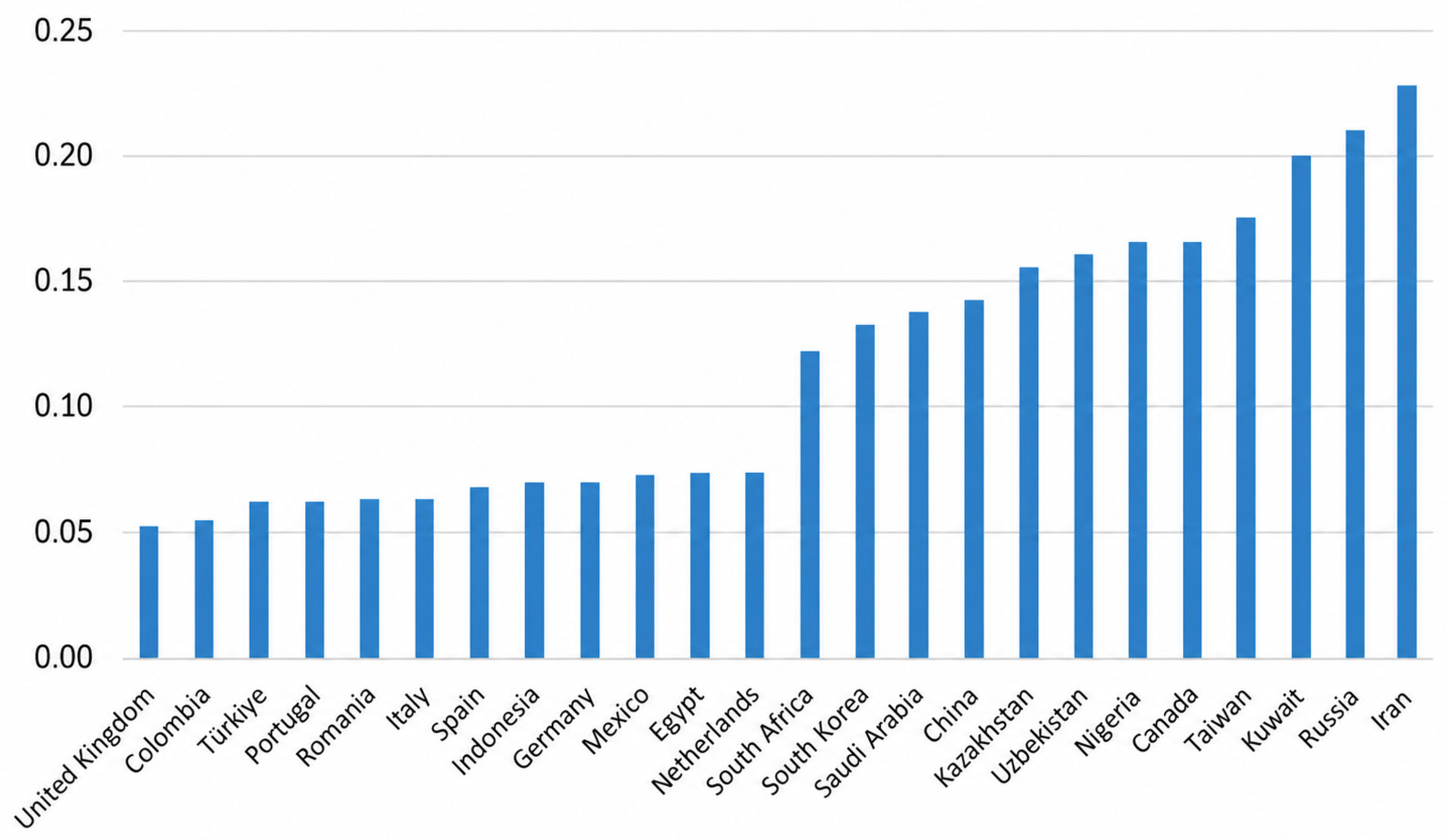
Assuming that energy consumption and economic growth go hand in hand, evaluating energy intensity expressed as energy use per GDP yields a slightly more challenging result. Reducing energy intensity emerges as an important factor [8]. Energy intensity is also seen as a simple yet effective way to measure the efficiency of energy sources [9,10]. Countries are now developing policies to reduce energy intensity and promote energy efficiency [11]. Figure 1 presents the energy intensity levels of the twelve countries with the highest and lowest energy intensity values.
Figure 1 consists of countries with the lowest and highest energy intensity as of 2021. It can be observed that among the top 12 countries with the highest energy intensity, there is no EU member country. The countries with the highest energy intensity are primarily providers of fossil energy sources to the world (Iran, Russia, Kuwait). Additionally, as stated by Chen [13], China, one of the intensive countries, accounted for 27% of global carbon emissions in 2020, while constituting 20.3% of energy consumption. Considering that it is currently the largest contributor to carbon emissions and fossil energy consumption in the world, its presence on the list is inevitable. It is observed that the relevant intensive countries are generally the countries with the highest energy consumption or classified as less developed countries. Among the lowest 12 countries, six of them (Portugal, Romania, Italy, Spain, Germany, and the Netherlands) are EU member countries, which highlights the importance of formulating policies based on the results obtained. Despite significant progress having been made in energy policies within the EU, substantial differences in energy intensity remain among member states. The EU has established comprehensive policy frameworks to improve energy efficiency and reduce energy intensity, in particular within the framework of the European Green Deal [14] and the “Fit for 55” package [15], which aim to achieve climate neutrality by 2050.
Recent empirical research highlights the importance of energy efficiency and environmental policies in shaping macroeconomic outcomes. However, the convergence dynamics of energy intensity remain insufficiently explored within nonlinear and distribution-sensitive frameworks. This study addresses this gap by focusing on EU member states and employing both fractional Fourier unit root tests (FQADF) developed by Omay [16] and Fourier quantile unit root tests (FQKS) developed by Bahmani-Oskooee et al. [17]. Unlike existing studies, these methods are applied jointly, allowing for a more comprehensive assessment of structural breaks and distributional heterogeneity. The findings are expected to provide relevant insights for policymakers aiming to improve energy efficiency and coordinate energy policies across the EU.
The contributions of this study can be summarized as follows:
  • This study examines the convergence of energy intensity in EU countries using unit root tests based on the Fourier transform and quantile tests.
  • It captures both smooth structural breaks and distributional heterogeneity, which are often overlooked in previous studies.
  • The study provides data on convergence dynamics at the national level and reveals heterogeneous patterns across EU member states.
  • It offers policy-relevant insights by demonstrating that uniform energy policies may not be sufficient to achieve convergence.
In this context, the study will proceed as follows: Section 2 will present an extensive review of the relevant literature. Section 3 will explain the methodology and materials and presents the empirical results. Section 4 will present conclusion, limitations, and policy implications.

2. Literature Review

The concept of convergence has been extensively discussed in the literature on economic growth. In particular, Sala-i-Martin [18] distinguishes between sigma and beta convergence and emphasizes the importance of transition dynamics between economies. While sigma convergence describes a reduction in dispersion over time, beta convergence implies that economies with a higher starting level tend to grow more slowly and thus catch up with others. More recent approaches, such as the theoretical framework proposed by Phillips and Sul [19], consider heterogeneous convergence paths and the existence of “convergence groups.” These developments illustrate that convergence does not necessarily proceed uniformly across all countries and can follow nonlinear and distribution-dependent patterns. Building on this theoretical foundation, this study investigates the convergence of energy intensity using both linear and nonlinear approaches.
Convergence analysis has been tested through various variables in the economic literature. In particular, testing the per capita GDP convergence among countries from a macroeconomic perspective has been extensively conducted. In the ongoing process, convergence analysis has also been applied to energy concepts. In this context, the expanded literature on energy intensity has primarily conducted research through different methods and variables on a country basis. It also has applications in sector-specific areas. The relevant studies are as follows.
The first study examining energy intensity convergence for different country groups was conducted by Kiran [20]. The study conducted convergence analysis for 21 Organisation for Economic Co-Operation and Development (OECD) countries during the period of 1980–2010. Convergence was tested using Geweke and Porter-Hudak fractional cointegration test. The presence of convergence was found for Canada, Chile, Denmark, Finland, Germany, Iceland, Ireland, the Netherlands, and Turkey. Another study using the OECD country group was conducted by Bulut and Durusu-Ciftci [21] analyzing the period of 1980–2014 for 27 countries. Four different unit root tests (Augmented Dickey–Fuller-ADF-, Zivot and Andrews-ZA-, Narayan and Popp-NP-, and Enders and Lee-EL-) were used for stochastic convergence analysis. Convergence was detected in one or more of the tests in all OECD countries examined. Jiang et al. [22] studied interprovincial energy intensity convergence using kernel density, sigma, conditional, and unconditional beta convergence tests for 29 Chinese provinces during the period of 2003–2015. The results indicate a decrease in provincial energy intensity gap throughout the examined period. At the provincial level, it is observed that those with higher total energy intensity experience a faster decline. Additionally, Bello and Ch’ng [23] conducted convergence analysis for 15 West African countries during the period of 1988–2018 using sigma, beta, and stochastic tests. Most countries in the applied country group are found to exhibit convergence. The main inference of the study is that shocks related to most energy intensities will have short-term effects on GDP and that changes occurring in the overall equilibrium will be rapidly filled.
Markandya et al. [24] examine the energy intensity relationship between 12 transition countries and 15 EU countries. The estimated energy intensity values for the transition economies show significant convergence towards the EU level between 2000 and 2020. It is expected that the Czech Republic, Hungary, Latvia, Lithuania, Poland, and Slovak Republic will converge to the EU by 2020. Hajko [25] analyzed the energy intensity convergence of the countries that later joined the EU15 using beta and sigma convergence tests for the period of 1990–2008. According to the results, all of the EU27 show a general declining trend. It also indicates that the new members are approaching the EU15, but they have not reached the current levels. The findings suggest that all countries will converge in the future, whereas no evidence of convergence is found for the EU15 countries.
Studies that test energy intensity convergence using different analysis methods include Mulder and Groot [26], who examined 18 OECD countries and 50 sectors for the period of 1970–2005 using the EU Capital, Labour, Energy, Materials, and Services (KLEMS) growth and productivity calculation method. They found that energy intensity decreases in the manufacturing sector while the opposite is true for the service sector. The notable part in the results is that the total convergence models result from the convergence of sector-specific energy intensity levels rather than sectoral compositions. Herrarias [27] conducted a large club analysis using most of the world countries for the period of 1971–2008. The study is important in terms of allowing the observation of changes among country groups based on their current characteristics, such as developed/developing. In addition to energy intensity, fossil fuel and nuclear energy intensities were also used in the convergence analysis. The findings indicate higher energy intensity for developing countries, with the existence of the highest and lowest clubs among developed countries. In another study, Mussini [28] examined convergence presence and inequality changes through spatial analysis for 28 EU countries during the period of 2003–2014. Convergence was found to occur between countries with higher energy intensity, especially from countries with higher intensity to those with lower intensity between 2003 and 2007. Between 2007 and 2014, convergence decreased, and some convergence occurred in non-neighboring countries, albeit to a lesser extent. Another study that employed spatial analysis for testing is conducted by Balado-Naves et al. [29] for world countries for the period of 1999–2018, aiming to have a clearer distinction between developed and developing countries through club analysis involving 153 countries. The results show a positive correlation between energy intensity and the relevant countries. Basílio [30] analyzed energy efficiency and renewable energy performance for 27 EU member states over the period 2015–2022 using DEA and fractional regression models; he found that energy prices, energy intensity, the share of renewable energy and patents are the main determinants of energy efficiency. In another study, Degirmenci et al. [31], in their analysis covering the period 1990–2020 in the G7 countries, examined the effects of energy intensity, energy resource depletion, green energy transition and the stringency of environmental policies on environmental sustainability using the Common Correlated Effects Mean Group (CCEMG) and Augmented Mean Group (AMG) methods; they revealed that energy intensity and energy resource depletion reduced environmental quality, while the green energy transition had positive effects only in Japan. To provide a clearer framework for the convergence literature, selected studies are summarized and compared in Table 1.
Recent empirical studies, particularly in advanced economies, increasingly emphasize the role of energy efficiency, ecological transition, and policy frameworks in shaping macroeconomic and environmental outcomes. Although a significant amount of research has been conducted on the convergence of energy intensity among different country groups using classical econometric techniques, the EU has received little attention within a framework that simultaneously considers its structural breaks and the heterogeneity of its distribution. Existing studies largely rely on linear approaches, which can obscure nonlinear convergence paths and heterogeneous convergence dynamics among member states. This study fills this gap by integrating fractional Fourier transforms and quantile-based unit root tests, offering a more comprehensive assessment of the convergence behavior of EU economies.
A review of the existing literature reveals that energy intensity convergence is mostly addressed using linear methods, and that cross-country differences are largely assessed using average values. However, this approach has limitations, especially during periods of intense structural disruption and when heterogeneous dynamics are observed across countries. Despite growing interest in the use of nonlinear methods in recent years, it is noteworthy that studies combining Fourier transform-based approaches with quantile-based analyses are rather limited. The existing literature on EU energy convergence considers linear unit root tests or mean-based panel methods. Although these studies provide a basic understanding of convergence tendencies, they remain limited in two respects. First, by assuming that structural breaks are instantaneous and linear, they fail to capture soft and gradual changes in energy policies. Second, by focusing on the average behavior of the Union, they conceal distributional heterogeneity among member economies. This study attempts to fill these gaps by combining Fourier-based smooth structural breaks with quantile dynamics. Thus, beyond merely testing the existence of convergence, it reveals how convergence behavior varies across different levels of energy intensity. In this context, a significant gap in the literature exists, both methodologically and in terms of application.
As Table 1 shows, previous studies generally relied on linear or mean-based approaches and often neglected structural breaks and distributional heterogeneity. This study addresses these limitations by employing Fourier- and quantile-based methods, thus providing a more comprehensive analysis of energy intensity convergence.

3. Materials, Methods and Results

3.1. Data and Model

In the study, the convergence of energy intensity in the share of GDP was tested in the period of 1993–2021 in 27 EU member countries. The data used was obtained from the International Energy Statistics section of the Energy Information Administration, United States (U.S.). To test whether convergence exists, different unit root tests were applied. In the linear domain, Dickey and Fuller ([36], hereafter ADF) and Kwiatkowski et al. ([37], hereafter KPSS) unit root tests, in the Fourier domain, Enders and Lee ([38], hereafter FADF) and Becker et al. ([39], hereafter FKPSS) tests, and in the fractional Fourier domain, the Fourier quantile unit root (FQKS) test developed by Omay ([16], hereafter FQADF) and Bahmani-Oskooee et al. [17] were applied. While testing the convergence of energy intensity, the studies by Herrerias and Liu [40] and Bello and Ch’ng [23] were followed.
R E I i t = ln E I i t A E I t
where ln denotes the natural logarithm, REIit relative energy intensity, EIit is the energy intensity of each country, AEIit is the average energy intensity for all country. Before proceeding to the empirical analysis, we first tabulated some statistical features of data in Table 2.
Among the EU member countries, Bulgaria has the highest energy intensity, while Ireland has the lowest energy intensity and therefore the most efficient energy use. Energy efficiency has reached its highest value in many countries after 2019. However, in countries that transitioned from centralized planning to a free market economy (Eia, Latvia, Lithuania, Romania, Slovak Republic, Slovenia), the highest value was reached in the 1990s. Conversely, the founding countries of the EU have been following policies to reduce energy intensity since the 1990s. Malta has the highest standard deviation value, while Denmark, Hungary, and Slovenia have the lowest standard deviation value. Energy intensity does not follow a normal distribution in the economies of Cyprus, Ireland, Latvia, and Poland.

3.2. Methodology

The most important difference between sigma and beta convergence is that while sigma is expressed as a continuous decrease over time within a group of series, beta convergence refers to the partial negative correlation of the change in the series with the initial level [41].
Sigma Convergence:
C V = 1 n i = 1 n ( Y i Y ¯ ) 2 Y ¯
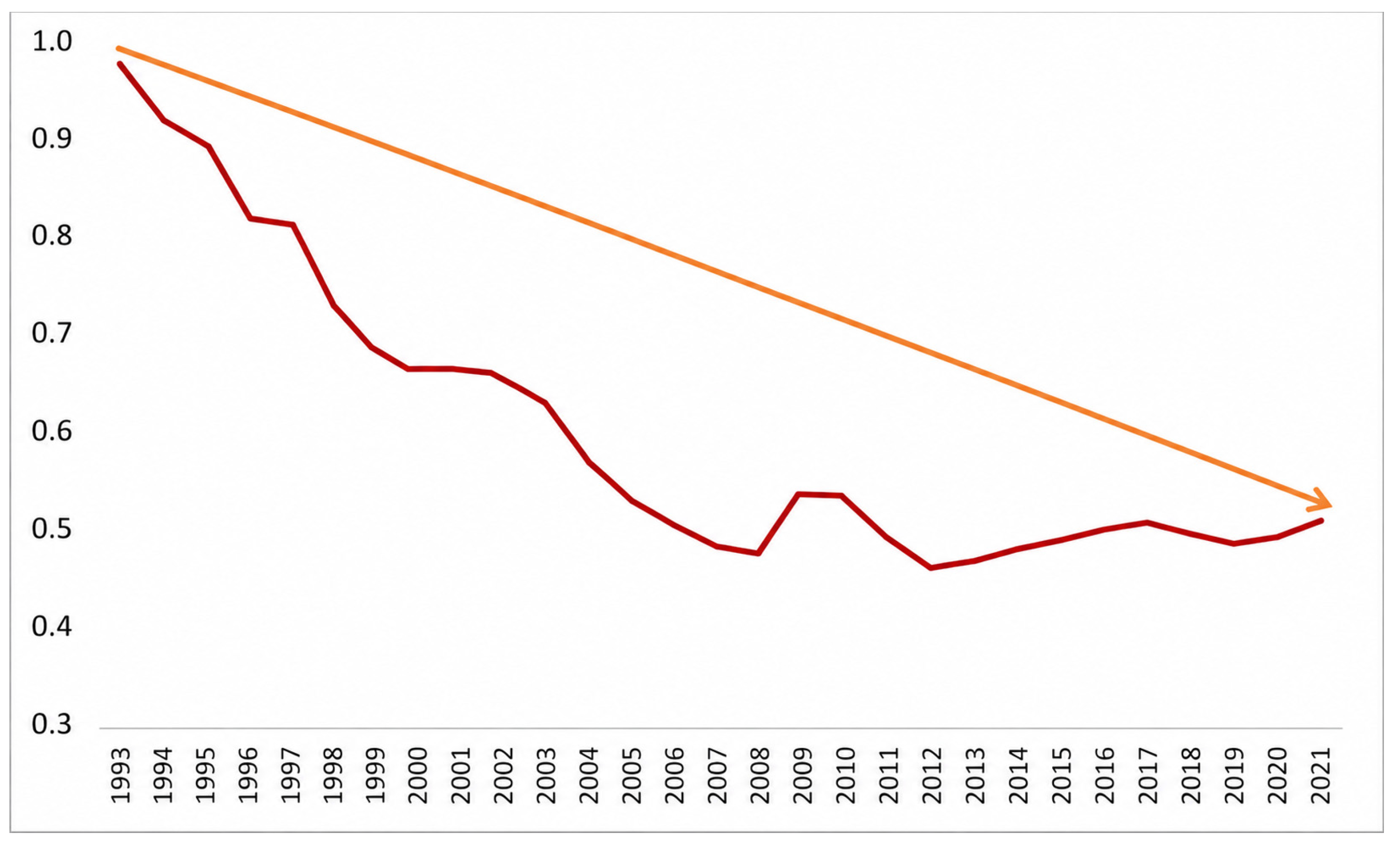
The occurrence of convergence or divergence is initially tested with sigma convergence. Sigma convergence is tested using the coefficient of variation (CV). Let “n” be the number of observations, “Y” be the independent variable, and be the arithmetic mean of the independent variable. The calculations is as below [32,42]:
A decreasing trend in the CV criterion indicates convergence, and an increasing trend indicates divergence.
As shown in Figure 2, there is a clear convergence in energy intensity during the period of 1993–2009. However, the increasing energy costs after 2009 do not allow the convergence phenomenon to occur. Additionally, 12 countries joined the EU in 2004 and 2007, leading to a change in the distribution of energy intensity. As a result, the divergence from the convergence phenomenon occurred after 2009. Similar results were obtained in the studies by Sebestyén Szép [43] and Mussini [28]. It is important to evaluate the analysis results with beta convergence for the relevant countries, especially after significant participation.
The slowing of convergence after 2009 is likely also related to significant economic and political shocks. The global financial crisis of 2008 and the subsequent Eurozone crisis affected countries asymmetrically, leading to different recovery paths. Furthermore, the EU enlargement of 2004 and 2007 significantly altered the distribution of energy intensity, impacting countries with varying structural characteristics. Finally, the increasing heterogeneity of national energy policies and transformation strategies likely contributed to the divergence observed after 2009.
Unit Root Test Stochastic Convergence (Beta Convergence):
According to Perron [44], traditional unit root tests do not consider structural breaks and cyclical fluctuations, leading to low power and bias problems. The choice of unit root tests based on the Fourier transform and quantiles in this study is justified primarily by their ability to better capture nonlinear fitting processes and progressive structural breaks that may appear in energy intensity series. Traditional tests, on the other hand, can ignore these dynamics and, consequently, give a misleading picture of convergence behavior. On the other hand, dummy variables used to demonstrate the impact of structural breaks create a precise structure. Fourier unit root tests have been developed to overcome the impact of these problems. Trigonometric terms are used in Fourier unit root tests to detect deviations from the mean in deterministic terms. Becker et al. [39] conduct stationarity tests using a selected frequency component of Fourier function to estimate the deterministic components of the model. FKPSS [39] model uses trigonometric terms to detect unknown nonlinearities and suggests a KPSS [29] type stationary test by emphasizing the decreased power of the unit root hypothesis in stationary series. Omay [16] has further developed the Fourier unit root test by testing whether there is a unit root in each conditional quantile. According to Bahmani-Oskooee et al. [17] Fourier unit root test, Yt represents the stochastic variable, k represents the number of frequencies, T represents the number of samples;
Y t = ψ 0 + ψ 1 sin ( 2 π k t T ) + ψ 2 cos ( 2 π k t T ) + ε t
In the model, the null hypothesis states that there is a unit root in the variable. The equation is shown as; ε t = ε t 1 + ν t . It is assumed that ν t in the equation is distributed independent and identically. The optimal k* frequency number that minimizes the residual sum of squares is selected and OLS is applied. In the model that minimizes the residual sum of squares, τ is tested in the conditional quantile.
γ t ( τ | ε t 1 ) = β 0 ( τ ) + θ 1 ( τ ) ε t 1 + p = 1 p θ 1 + p ( τ ) Δ ε t p + e t
The estimated β 0 ( τ ) value captures the magnitude of the shock to the energy intensity at each quantile. Koenker and Xiao [45] calculate the Kolmogorov–Smirnov (QKS) statistic based on quantile regression as follows:
Q K S = sup τ i [ min , max ] t n ( τ )
Traditional unit root tests model structural breaks as instantaneous and sharp changes through dummy variables. However, transformations in energy policies are processes characterized by gradual and smooth transitions. For this reason, nonlinear fluctuations are tracked through trigonometric terms by means of the Fourier transformation. Thus, convergence processes interrupted by crises or policy transformations are carefully addressed without the need to predefine break dates. With the quantile dimension, it is possible to examine the entire distribution rather than only an average EU economy. Because an energy transition policy that works in efficiency-leading economies may fail in lagging countries. Through different quantiles, it is revealed whether convergence occurs more rapidly in economies with high energy intensity or in those with low energy intensity. In fact, the main limitation of the method stems from its sensitivity to frequency selection. If a very high frequency is chosen, there is a risk of overfitting random fluctuations rather than capturing the true structural trend. The results of beta convergence will be evaluated in the next section.

3.3. Empirical Results and Discussion

It is important to make the distinction between convergence/divergence among country groups. Especially convergence can represent the transfer of energy technologies among existing countries, while divergence enables the derivation of important policies to support energy conservation measures [27]. The results of the convergence indicate that technological diffusion and institutional integration within the EU play a decisive role in energy efficiency.
The level value of the ratio of energy intensity to GDP having a unit root implies that the effects of internal and external shocks on the variable are permanent, while the absence of a unit root indicates that the effects of shocks are temporary. ADF [38], FADF [40], FQADF [16], and FQKS [17] tests establish the zero hypothesis that the ratio of energy intensity to GDP has a unit root and experiences divergence, while the alternative hypothesis suggests that the ratio is stationary and convergence occurs. KPSS [37] and FKPSS [39] unit root tests are formulated in the opposite way. The relevant results are presented in Table 2.
According to the obtained results, according to the ADF [36] and KPSS [37] unit root tests, there is convergence for Cyprus, Czech Republic, Denmark, Estonia, France, Hungary, Lithuania, Luxembourg, Malta, Poland, Slovenia, and Spain. According to the Fourier unit root tests FADF [38] and FKPSS [39], convergence is detected for Cyprus, Czech Republic, Estonia, Hungary, Luxembourg, and Slovak Republic. Finally, according to the fractional Fourier tests FQADF [16] and FQKS [17], convergence is observed for Croatia, Estonia, Finland, Germany, Greece, Hungary, Italy, Malta, Netherlands, Slovak Republic, and Slovenia. From the EU member countries, Austria, Belgium, Bulgaria, Ireland, Latvia, Portugal, Romania, and Sweden are in a unit root process and divergence is mentioned. The lack of convergence in these countries can be attributed to several structural factors. First, differences in the composition of the energy sector are crucial: economies with a higher proportion of energy-intensive industries or those still dependent on fossil fuels may adapt more slowly. Second, the pace and structure of the energy transition vary across Member States, impacting the speed of efficiency improvements. Third, heterogeneity in technology adoption and energy efficiency measures can delay convergence, particularly in countries with lower investment in energy-saving technologies. The observed deviations in founding members such as Austria and Belgium may reflect specific structural characteristics of the respective countries rather than institutional weaknesses. In particular, their industrial structure, energy mix, and differing political priorities could lead to temporary deviations from the EU average, despite their long integration. Conversely, transition countries like Bulgaria and Romania may still face structural rigidities inherited from previous economic systems, which could slow down the adjustment process.
The energy-related policies of the EU are based on its establishment. The common concept of energy security formed the basis of its establishment as the European Coal and Steel Community in 1951. In order to prevent the potential damages that coal dependence could cause for Europe, the foundations of the organization were laid, and with the emergence of problems in energy supply in the 1970s, it became an even more important issue [46]. Nowadays, one of the most important policies is energy policy. It has been stated that a transition to a cleaner and more environmentally friendly approach will be achieved with the policy of zero greenhouse gas emissions by 2050 [14]. In this context, examining the convergence of energy intensity at the country level can provide important insights for the Union and facilitate the spread of this situation to a broader context.
For this purpose, it is possible to use the indicator of energy intensity used in the analysis to distinguish energy consumption growth from GDP growth by reducing energy consumption through technological progress without abandoning the development phenomenon, especially in industrialized countries [47]. As a result, technological transfer can be mentioned among countries that have convergence. Estonia and Hungary are common in all three different test groups. It can be seen that they converge towards the average. The accession process of both countries to the EU coincides with 2004 and onwards. In this case, it is expected that there will be convergence towards the core EU member countries. The study by Chang [48] supports this. Although Estonia and Hungary have a high energy intensity, they have made significant reductions during the EU membership and post-membership period. It is natural for convergence to occur as a result of budget and technology transfer with EU membership. In this case:
Using energy intensity to measure energy efficiency in the production process [35] can be used to show that energy use in the production process does not converge to the Union average. In this regard, the presence of convergence for most EU countries enables progress towards the goals of the Union.
An important detail to note is that all founding members, except for Belgium, are in a convergent state. It has been achieved for most EU countries through various tests. Twelve EU countries are included in convergence through traditional unit root tests, while fourteen countries are included in convergence through Fourier and fractional Fourier tests. In this regard, it is possible to conclude that there is energy intensity convergence among EU countries during the examined period. It is inevitable for the Union to act together with common policies. In the longer term, it is predicted that all countries will have the convergence phenomenon. The results obtained are similar to the studies by Hajko [25] and Mussini [28]. The important point here is that the increasing energy consumption after the period of major expansion has been made efficient. Of course, the most important issue is the transfer of technological advantages of the first EU members to the new members to maintain the unity order.
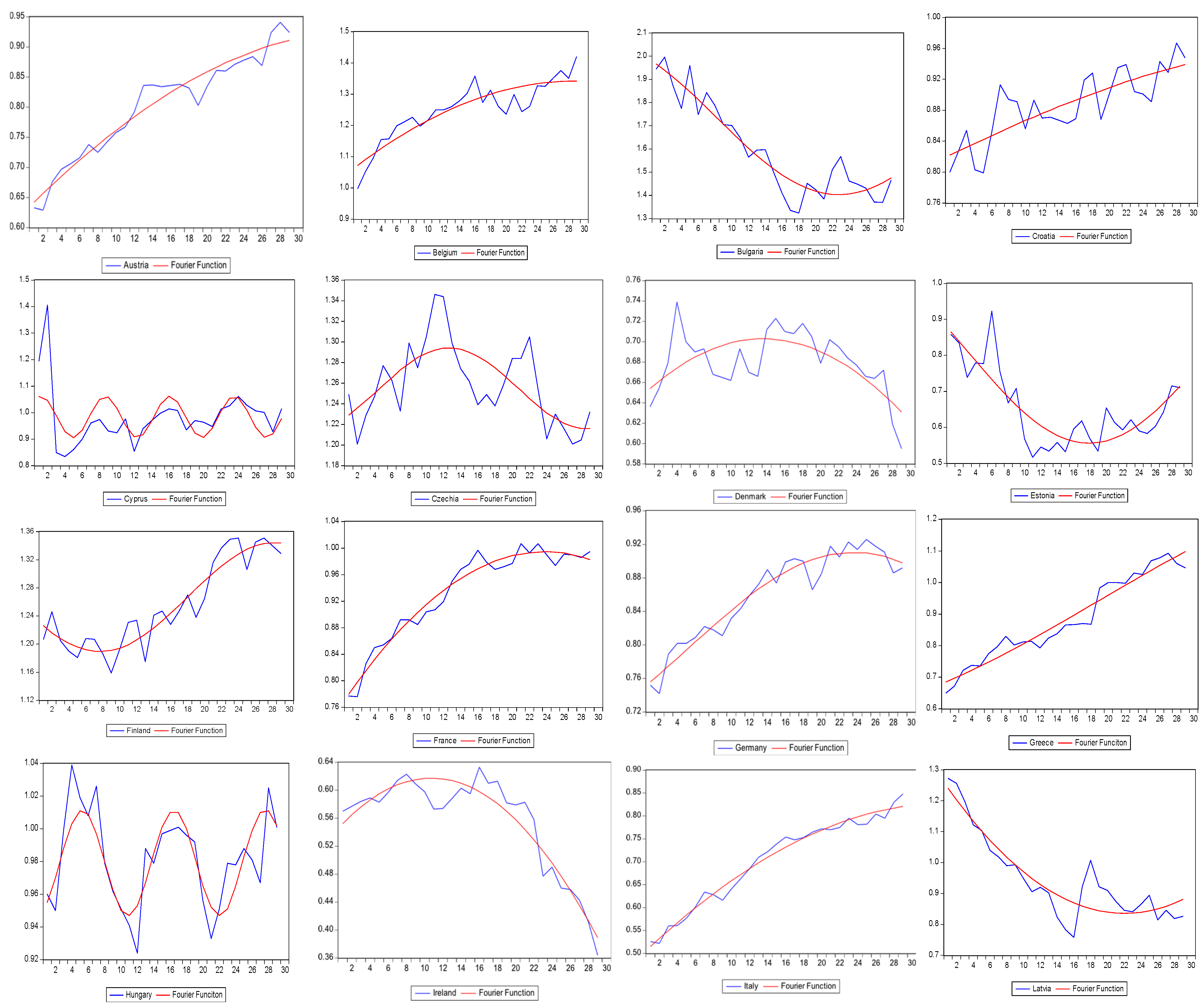
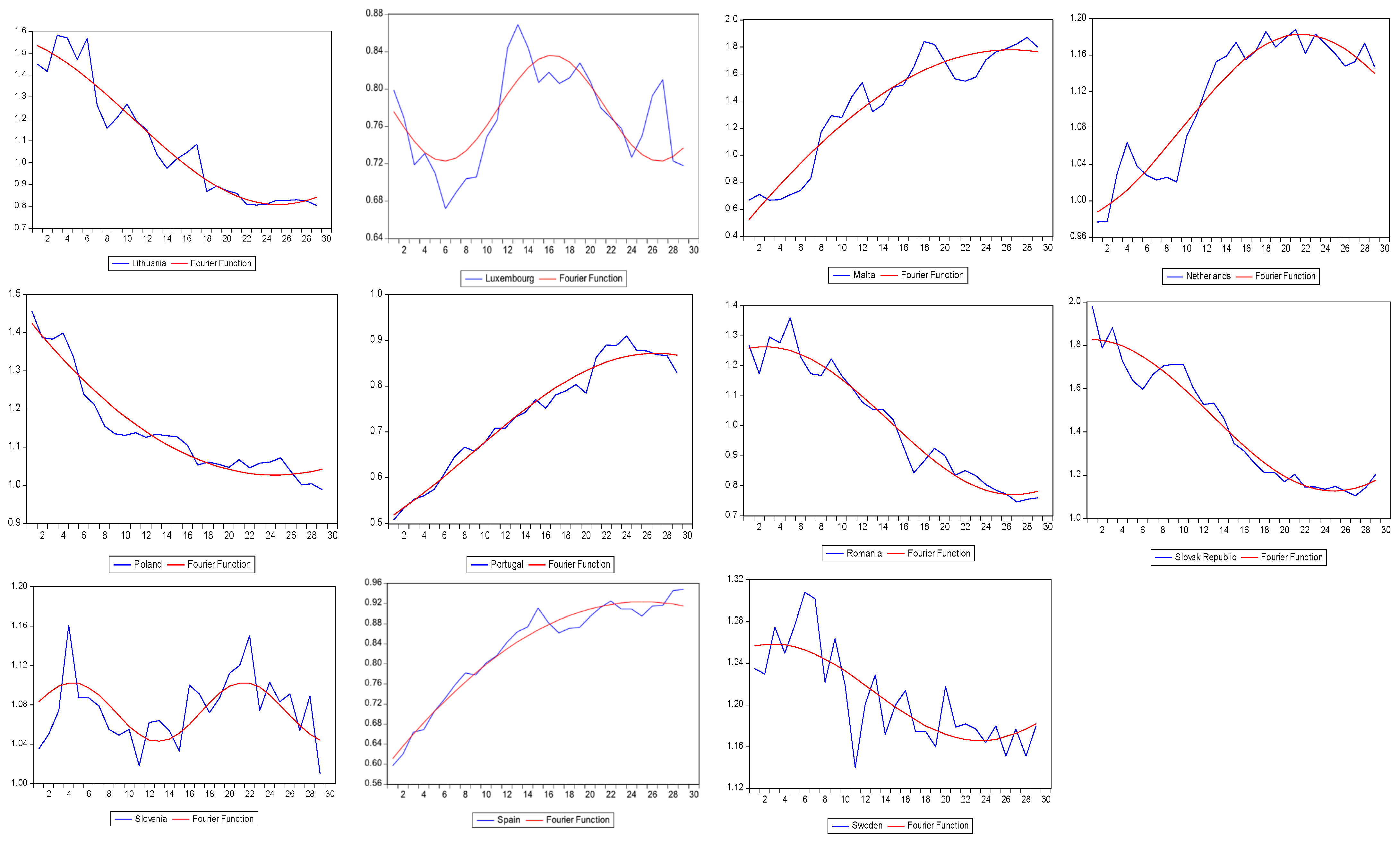
The Fourier graphs presented in Figure 3 are important for us to see the individual changes among countries.
The evaluation of the test results is based on the corresponding critical values reported in the literature. Specifically, the critical values for the ADF and KPSS tests follow Dickey and Fuller [36] and Kwiatkowski et al. [37], respectively. For Fourier-based tests (FADF and FKPSS), the critical values are obtained from Enders and Lee [38] and Becker et al. [39]. In addition, the critical values for the FQADF and FQKS tests are based on Omay [16] and Bahmani-Oskooee et al. [17], with the latter computed using bootstrap procedures.
The superiority of Fourier-based unit root tests over traditional unit root tests stems from their ability to detect convergence in the presence of unknown structural changes. In the EU context, REI is affected by gradual policy transitions and global economic shocks. Since traditional unit root tests interpret nonlinear processes as permanent deviations, the null hypothesis may be incorrectly not rejected. However, with a flexible Fourier form, these shifts are treated as a smooth and deterministic process. In Figure 3, Fourier functions (red lines) show nonlinear trajectories. Therefore, in economies where traditional unit root tests cannot produce significant results, Fourier-type unit root tests exhibit behavior converging to the mean after accounting for smooth structural transitions. Thus, the power of the Fourier approach to distinguish between genuine convergence and divergence and policy-driven structural changes is revealed. Table 3 reveals the difference in the Fourier transformation from traditional tests in capturing nonlinear policy changes and structural shifts. In the economies of Croatia and the Slovak Republic, traditional tests could not reject the unit root null hypothesis (divergence). However, when Fourier-type structural transitions are modeled, these economies show significant convergence at the 5% and 1% levels, respectively. In this case, rather than the divergence suggested by traditional tests, this reflects a situation arising from their failure to account for the smooth and nonlinear transitions exhibited during the process of compliance with energy standards following EU accession. On the other hand, as seen in the case of the Netherlands, the quantile dimension also reveals the heterogeneous nature of the convergence process. It indicates that energy intensity does not converge at a single speed, but rather follows different trajectories depending on whether an economy is in a high or low energy intensity state.
The differences observed in some EU countries can be explained by several structural factors. First, differences in the composition of the energy sector play a significant role, as countries with a greater reliance on fossil fuels or energy-intensive industries tend to experience slower convergence. Second, the pace of the energy transition varies considerably between Member States, particularly between early and late EU members, which affects their capacity to adapt to low-carbon strategies. Third, disparities in technological development and improvements in energy efficiency can contribute to persistent divergence. Countries with slower innovation dissemination and limited investment in energy efficiency are more likely to deviate from the convergence path. In particular, transition economies such as Bulgaria and Romania may still suffer from structural rigidities inherited from centrally planned systems, which slow down their adaptation processes. These results suggest that convergence is not merely a statistical outcome, but also reflects deeper structural and political differences between countries.
It is observed in Figure 3 that conjunctural fluctuations occur in Cyprus, Hungary, and Slovenia in the period of 1993–2021. When Fourier functions are taken into account, Austria, Belgium, Finland, France, Germany, Greece, Italy, Malta, Netherlands, Portugal, and Spain have higher energy efficiency than the average of the Union due to overflow effect. In addition, increasing trend countries (Austria, Belgium, Croatia, Finland, France, Germany, Greece, Italy, Malta, Netherlands, Portugal, Spain), decreasing trend countries (Bulgaria, Estonia, Ireland, Latvia, Lithuania, Poland, Romania, Slovak Rep., Sweden), and fluctuating trend countries (Cyprus, Czech, Denmark, Hungary, Luxembourg, Slovenia) can be seen. Fourier functions also indicate that the trends of countries within the Union differ from each other. The convergence results obtained imply that most countries are in a state of convergence, indicating that the trends will converge on the same plane in the long term. The pronounced convergence process observed during the 1993–2009 period is related to the institutional pressure created by compliance with the EU Acquis and the rapid catch-up performance of new member states. During this period, transition economies in particular initiated a green transformation process in their energy-intensive sectors in order to comply with EU regulations and environmental requirements and were supported by EU Cohesion Funds [49]. According to Hajko [50], the integration process created a catalyst for technological diffusion. However, the slowdown after 2009 revealed an investment gap resulting from the Global Financial Crisis. In transition economies, contractionary fiscal policies reduced energy infrastructure regulations, while core economies continued the green transformation process [28]. These heterogeneities revealed by quantile-based findings show that uniform EU policies ignore national fiscal constraints and the differing technological starting points of economies [27].
The differences observed in some EU countries can be explained by several structural factors. First, differences in the composition of the energy sector play a significant role, as countries with a greater reliance on fossil fuels or energy-intensive industries tend to experience slower convergence. Second, the pace of the energy transition varies considerably between Member States, particularly between early and late EU members, which affects their capacity to adapt to low-carbon strategies. Third, disparities in technological development and improvements in energy efficiency can contribute to persistent divergence. Countries with slower innovation dissemination and limited investment in energy efficiency are more likely to deviate from the convergence path.

4. Conclusions

This study analyzes the dynamics of energy intensity convergence in the member states of the EU between 1993 and 2021. It combines conventional unit root tests based on the Fourier transform with quantile analysis. Unlike traditional approaches, the methodology used here allows for the simultaneous consideration of gradual structural changes and distributional differences between countries.
The results obtained show two important points: (i) With the Sigma convergence analysis, convergence is clearly observed for EU countries in the period 1993–2009, but not in the period 2009–2021. (ii) Through the testing of stochastic (Beta) convergence using unit root tests, it is observed that most of the EU countries have convergence. Only Austria, Belgium, Bulgaria, Ireland, Latvia, Portugal, Romania, and Sweden do not show convergence. This indicates that many countries in the EU will quickly return to general equilibrium in the face of shocks in energy consumption and that the effects of shocks in the series will be short-term. This indicates that energy policies implemented within the Union are moving together.
Methodologically, the results underscore the importance of considering nonlinearities and structural breaks when analyzing convergence processes. Fourier transforms can identify incremental, politically driven changes, while quantile methods provide more detailed insights into heterogeneous adaptation pathways between countries. In this sense, the study contributes to existing research by offering a more comprehensive and flexible framework for analyzing energy convergence.
Despite these contributions, the study has some limitations. The analysis is limited to energy intensity as a single indicator and does not consider other relevant dimensions such as renewable energy consumption, CO2 emissions, or sectoral composition. Future research could broaden this framework by incorporating additional environmental and structural variables and examining convergence patterns at the sectoral or regional level within the EU.
In future studies, particularly with the inclusion of spatial analysis in addition to sigma and beta convergence, conducting regional convergence analysis within the Union can yield different and significant results. In addition, convergence analysis can be conducted by including variables such as energy usage, fossil or renewable energy usage, in addition to the existing energy intensity variable.

5. Limitations

This study has several limitations that should be considered. First, although the analysis includes institutional elements such as the EU acquis, cohesion funds, and post-2009 financial regulations, these aspects are not explicitly modeled within the empirical framework. Therefore, the analysis provides descriptive evidence about convergence dynamics rather than identifying the causal effects of EU policies. Future research could expand the model by including policy-related variables to better capture these mechanisms.
Second, although the study analyzes energy intensity convergence patterns at the national level, it does not provide detailed quantitative diagnoses for each country. Such an analysis would require a different empirical design and is outside the scope of this study. Future research could focus on country-level heterogeneity using more detailed econometric approaches.

6. Policy Implications

Based on the empirical findings, several conclusions can be drawn for the design and implementation of energy policy in the European Union.
First, the results clearly show that the convergence of energy intensity across Member States is uneven, particularly after 2009. This suggests that a “one-size-fits-all” policy approach is unlikely to be effective. Instead, EU energy strategies should be more flexible and take into account the specific circumstances of each country, such as its energy infrastructure, technological capacities, and level of development.
Second, the heterogeneous convergence patterns identified through quantile analysis suggest that the effectiveness of policy measures varies depending on energy intensity. Countries with higher energy intensity may require more comprehensive policy interventions, including targeted investments in energy-efficient technologies, infrastructure upgrades, and financing mechanisms. Conversely, countries already closer to the EU average could benefit more from strategies focused on innovation and optimization.
Third, the slowdown in convergence after 2009 underscores the role of economic shocks and asymmetric adjustment processes. This finding suggests that macroeconomic stability and sustainable investment capacity are crucial for maintaining energy efficiency convergence. Therefore, EU financing instruments such as the Cohesion Fund and green transition financing should be strengthened and deployed more strategically to support lagging Member States.
Fourth, the significance of structural differences, such as energy mix and industry structure, suggests that energy transition policies should be integrated into broader industrial and technological strategies. Measures to promote renewable energy, technology transfer, and energy-efficient production processes should be adapted to specific national circumstances and not implemented uniformly across the EU.
Finally, the findings underscore that convergence is not merely a technical or statistical outcome, but rather an expression of deeper institutional and structural dynamics. In this context, strengthening policy coordination while simultaneously preserving national adaptability appears essential for a sustainable and balanced energy transition across the EU. These results are consistent with existing EU energy policy frameworks, such as the European Green Deal and the “Fit for 55” package, which highlight the importance of a coordinated yet flexible transition to a low-carbon economy.

Author Contributions

Conceptualization, E.G.T. and T.B.; methodology, E.G.T. and T.B.; software, Y.G.; formal analysis, E.G.T.; data curation, Y.G.; writing—original draft preparation, Y.G.; writing—review and editing, T.B. and E.G.T.; supervision, T.B. All authors have read and agreed to the published version of the manuscript.

Funding

This research was funded by the Firat University Scientific Research Projects Coordination Unit (FUBAP), Turkiye, grant number İİBF.25.05.

Institutional Review Board Statement

Not applicable.

Informed Consent Statement

Not applicable.

Data Availability Statement

The raw data used in this study are publicly available from the World Bank and the Global Energy Institute databases. The processed dataset prepared for the empirical analysis is available from the corresponding author upon reasonable request.

Conflicts of Interest

The authors declare no conflicts of interest.

References

  1. Yu, B.L.; Fang, D.B.; Kleit, A.N.; Xiao, K. Exploring the driving mechanism and the evolution of the low-carbon economy transition: Lessons from OECD developed countries. World Econ. 2022, 45, 2766–2795. [Google Scholar] [CrossRef]
  2. Ma, Y.; Zhao, Y.Y.; Jia, R.; Wang, W.X.; Zhang, B. Impact of financial development on the energy intensity of developing countries. Heliyon 2022, 8, e09904. [Google Scholar] [CrossRef]
  3. Sadorsky, P. Do urbanization and industrialization affect energy intensity in developing countries? Energy Econ. 2013, 37, 52–59. [Google Scholar] [CrossRef]
  4. Shabani, Z.D.; Shahnazi, R. Energy intensity convergence in Iranian provinces: Evidence from energy carriers’ consumption intensity. Environ. Sci. Pollut. Res. 2021, 28, 26697–26716. [Google Scholar] [CrossRef] [PubMed]
  5. Samargandi, N. Energy intensity and its determinants in OPEC countries. Energy 2019, 186, 115803. [Google Scholar] [CrossRef]
  6. Kang, M.; Kang, S. Energy intensity efficiency and the effect of changes in GDP and CO2 emission. Energy Effic. 2022, 15, 8. [Google Scholar] [CrossRef]
  7. Duro, J.A.; Alcantara, V.; Padilla, E. International inequality in energy intensity levels and the role of production composition and energy efficiency: An analysis of OECD countries. Ecol. Econ. 2010, 69, 2468–2474. [Google Scholar] [CrossRef]
  8. Cornillie, J.; Fankhauser, S. The energy intensity of transition countries. Energy Econ. 2004, 26, 283–295. [Google Scholar] [CrossRef]
  9. Freeman, S.L.; Niefer, M.J.; Roop, J.M. Measuring industrial energy intensity: Practical issues and problems. Energy Policy 1997, 25, 703–714. [Google Scholar] [CrossRef]
  10. Proskuryakova, L.; Kovalev, A. Measuring energy efficiency: Is energy intensity a good evidence base? Appl. Energy 2015, 138, 450–459. [Google Scholar] [CrossRef]
  11. Mishra, V.; Smyth, R. Convergence in energy consumption per capita among ASEAN countries. Energy Policy 2014, 73, 180–185. [Google Scholar] [CrossRef]
  12. Energy Information Administration (U.S.). International Energy Statistics. Available online: https://www.eia.gov/international/data/world (accessed on 28 October 2024).
  13. Chen, P. Is the digital economy driving clean energy development? New evidence from 276 cities in China. J. Clean. Prod. 2022, 372, 133783. [Google Scholar] [CrossRef]
  14. European Commission. The European Green Deal; European Commission: Brussels, Belgium, 2019; Available online: https://eur-lex.europa.eu/ (accessed on 20 April 2025).
  15. European Commission. Fit for 55: Delivering the EU’s 2030 Climate Target on the Way to Climate Neutrality; European Commission: Brussels, Belgium, 2021; Available online: https://eur-lex.europa.eu/legal-content/EN/TXT/?uri=CELEX%3A52021DC0550 (accessed on 20 April 2025).
  16. Omay, T. Fractional frequency flexible Fourier form to approximate smooth breaks in unit root testing. Econ. Lett. 2015, 134, 123–126. [Google Scholar] [CrossRef]
  17. Bahmani-Oskooee, M.; Chang, T.; Elmi, Z.; Ranjbar, O. Re-testing Prebisch–Singer hypothesis: New evidence using Fourier quantile unit root test. Appl. Econ. 2018, 50, 441–454. [Google Scholar] [CrossRef]
  18. Sala-i-Martin, X.X. The classical approach to convergence analysis. Econ. J. 1996, 106, 1019–1036. [Google Scholar] [CrossRef]
  19. Phillips, P.C.B.; Sul, D. Transition modeling and econometric convergence tests. Econometrica 2007, 75, 1771–1855. [Google Scholar] [CrossRef]
  20. Kiran, B. Energy intensity convergence in OECD countries. Energy Explor. Exploit. 2013, 31, 237–247. [Google Scholar] [CrossRef]
  21. Bulut, U.; Durusu-Ciftci, D. Revisiting energy intensity convergence: New evidence from OECD countries. Environ. Sci. Pollut. Res. 2018, 25, 12391–12397. [Google Scholar] [CrossRef] [PubMed]
  22. Jiang, L.; Folmer, H.; Ji, M.; Zhou, P. Revisiting cross-province energy intensity convergence in China: A spatial panel analysis. Energy Policy 2018, 121, 252–263. [Google Scholar] [CrossRef]
  23. Bello, M.O.; Ch’ng, K.S. Convergence in energy intensity of GDP: Evidence from West African countries. Energy 2022, 254, 124217. [Google Scholar] [CrossRef]
  24. Markandya, A.; Pedroso-Galinato, S.; Streimikiene, D. Energy intensity in transition economies: Is there convergence towards the EU average? Energy Econ. 2006, 28, 121–145. [Google Scholar] [CrossRef]
  25. Hajko, V. Changes in the energy consumption in EU-27 countries. Rev. Econ. Perspect. 2012, 12, 3–21. [Google Scholar] [CrossRef]
  26. Mulder, P.; De Groot, H.L. Structural change and convergence of energy intensity across OECD countries, 1970–2005. Energy Econ. 2012, 34, 1910–1921. [Google Scholar] [CrossRef]
  27. Herrerias, M.J. World energy intensity convergence revisited: A weighted distribution dynamics approach. Energy Policy 2012, 49, 383–399. [Google Scholar] [CrossRef]
  28. Mussini, M. Inequality and convergence in energy intensity in the European Union. Appl. Energy 2020, 261, 114371. [Google Scholar] [CrossRef]
  29. Balado-Naves, R.; Baños-Pino, J.F.; Mayor, M. Spatial spillovers and world’s energy intensity convergence. Energy Econ. 2023, 124, 106807. [Google Scholar] [CrossRef]
  30. Basílio, M. Renewable energy and energy efficiency: An exploratory study in EU countries. Sustain. Futures 2025, 9, 100514. [Google Scholar] [CrossRef]
  31. Degirmenci, T.; Sofuoglu, E.; Aydin, M.; Adebayo, T.S. The role of energy intensity, green energy transition, and environmental policy stringency on environmental sustainability in G7 countries. Clean Technol. Environ. Policy 2025, 27, 2981–2993. [Google Scholar] [CrossRef]
  32. Liddle, B. Revisiting world energy intensity convergence for regional differences. Appl. Energy 2010, 87, 3218–3225. [Google Scholar] [CrossRef]
  33. Stern, D.I. Modeling international trends in energy efficiency. Energy Econ. 2012, 34, 2200–2208. [Google Scholar] [CrossRef]
  34. Csereklyei, Z.; Stern, D.I.; Schuh, B. Energy and economic growth: The stylized facts. Energy J. 2016, 37, 223–255. [Google Scholar] [CrossRef]
  35. Zhu, J.; Lin, B. Convergence analysis of city-level energy intensity in China. Energy Policy 2020, 139, 111357. [Google Scholar] [CrossRef]
  36. Dickey, D.A.; Fuller, W.A. Likelihood ratio statistics for autoregressive time series with a unit root. Econometrica 1981, 49, 1057–1072. [Google Scholar] [CrossRef]
  37. Kwiatkowski, D.; Phillips, P.C.B.; Schmidt, P.; Shin, Y. Testing the null hypothesis of stationarity against the alternative of a unit root: How sure are we that economic time series have a unit root? J. Econom. 1992, 54, 159–178. [Google Scholar] [CrossRef]
  38. Enders, W.; Lee, J. The flexible Fourier form and Dickey–Fuller type unit root tests. Econ. Lett. 2012, 117, 196–199. [Google Scholar] [CrossRef]
  39. Becker, R.; Enders, W.; Lee, J. A stationarity test in the presence of an unknown number of smooth breaks. J. Time Ser. Anal. 2006, 27, 381–409. [Google Scholar] [CrossRef]
  40. Herrerias, M.J.; Liu, G. Electricity intensity across Chinese provinces: New evidence on convergence and threshold effects. Energy Econ. 2013, 36, 268–276. [Google Scholar] [CrossRef]
  41. Young, A.T.; Higgins, M.J.; Levy, D. Sigma convergence versus beta convergence: Evidence from US county-level data. J. Money Credit Bank. 2008, 40, 1083–1093. [Google Scholar] [CrossRef]
  42. Aldy, J.E. Divergence in state-level per capita carbon dioxide emissions. Land Econ. 2007, 83, 353–369. [Google Scholar] [CrossRef]
  43. Sebestyén Szép, T. Energy convergence of the European Union toward 2020. Deturope 2016, 8, 88–107. [Google Scholar] [CrossRef]
  44. Perron, P. The great crash, the oil price shock, and the unit root hypothesis. Econometrica 1989, 57, 1361–1401. [Google Scholar] [CrossRef]
  45. Koenker, R.; Xiao, Z. Unit root quantile autoregression inference. J. Am. Stat. Assoc. 2004, 99, 775–787. [Google Scholar] [CrossRef]
  46. Maltby, T. European Union energy policy integration: A case of European Commission policy entrepreneurship and increasing supranationalism. Energy Policy 2013, 55, 435–444. [Google Scholar] [CrossRef]
  47. Mielnik, O.; Goldemberg, J. Converging to a common pattern of energy use in developing and industrialized countries. Energy Policy 2000, 28, 503–508. [Google Scholar] [CrossRef]
  48. Chang, M.C. Energy intensity, target level of energy intensity, and room for improvement in energy intensity: An application to the study of regions in the EU. Energy Policy 2014, 67, 648–655. [Google Scholar] [CrossRef]
  49. European Commission. Cohesion Policy 2021–2027; European Commission: Brussels, Belgium, 2021; Available online: https://ec.europa.eu/regional_policy/ (accessed on 18 April 2026).
  50. Hajko, V. The energy intensity convergence in the transport sector. Procedia Econ. Financ. 2014, 12, 199–205. [Google Scholar] [CrossRef]
Figure 1. Energy intensity, twelve countries with the highest and lowest energy intensity (koe, $2015price). Source: Authors’ calculations based on data from [12].
Sustainability 18 04740 g001
Figure 2. Sigma convergence of energy intensity across EU member states, measured by the coefficient of variation (CV) over the period 1993–2021. The horizontal axis represents years, while the vertical axis shows the CV. Source: Authors’ calculations.
Sustainability 18 04740 g002
Figure 3. Raw data and FQKS [17] Fourier quantile function.
Sustainability 18 04740 g003aSustainability 18 04740 g003b
Table 1. Summary of selected studies on energy intensity convergence.
StudyMethodRegionKey FindingLimitation/Gap
Liddle [32]Time seriesOECD/globalWeak convergence evidenceNo nonlinear dynamics or structural breaks
Stern [33]Econometric modelingGlobalEnergy efficiency improves over timeDoes not explicitly test convergence
Csereklyei et al. [34]Panel convergenceOECDPartial convergenceLimited cross-country heterogeneity
Phillips and Sul [19]Nonlinear convergence (club)Cross-countryConvergence clubs existFocuses on income, not energy
Kiran [20]Fractional cointegrationOECDConvergence in selected countriesNo structural break consideration
Bulut and Durusu-Ciftci [21]Unit root testsOECDConvergence detectedRelies on linear framework
Jiang et al. [22]Kernel density and beta convergenceChina (provinces)Regional convergence existsNo nonlinear modeling
Herrerias [27]Distribution dynamicsGlobalClub convergence patternsLimited structural break analysis
Mussini [28]Spatial analysisEUConvergence varies across regionsIgnores nonlinear dynamics
Shabani and Shahnazi [4]Convergence testsIranRegional convergence existsNo distributional analysis
Bello and Ch’ng [23]Sigma, beta, stochasticWest AfricaConvergence observedLimited heterogeneity analysis
Balado-Naves et al. [29]Spatial panelGlobalSpatial spillovers matterNo quantile-based approach
Zhu and Lin [35]Convergence analysisChinaEvidence of convergenceNo structural breaks or quantiles
Basílio [30]DEA + fractional regressionEUEfficiency determinants identifiedDoes not analyze convergence dynamics
Degirmenci et al. [31]CCEMG/AMGG7Energy intensity affects sustainabilityNo convergence focus
This studyFourier + quantile unit root testsEUReveals nonlinear and heterogeneous convergenceSensitive to frequency selection and model specification
Table 2. Definitions.
CountriesMeanMedianMaxMinStd. Dev.SkewnessKurtosisJarque–Bera
Austria0.800.830.94 [2020]0.63 [1993]0.09−0.402.251.45 (0.48)
Belgium1.251.261.42 [2021]0.99 [1993]0.09−0.753.583.16 (0.21)
Bulgaria1.591.571.99 [1993]1.32 [2010]0.200.542.082.41 (0.3)
Croatia0.890.890.97 [2020]0.79 [1993]0.04−0.322.490.81 (0.67)
Cyprus0.980.971.41 [1994]0.83 [1996]0.112.129.3270.04 a (0.00)
Czech1.261.251.35 [2004]1.20 [1994]0.040.482.691.22 (0.54)
Denmark0.680.680.72 [2007]0.59 [2021]0.03−0.703.783.09 (0.21)
Estonia0.650.620.92 [1998]0.51 [2003]0.110.812.783.27 (0.20)
Finland1.251.241.34 [2020]1.15 [2001]0.060.351.772.42 (0.3)
France0.930.971.01 [2013]0.78 [1994]0.07−0.892.673.93 (0.14)
Germany0.860.870.91 [2019]0.74 [1994]0.05−0.652.362.55 (0.28)
Greece0.880.871.09 [2019]0.64 [1993]0.130.091.791.81 (0.40)
Hungary0.980.981.04 [1996]0.92 [2004]0.03−0.072.380.49 (0.78)
Ireland0.560.580.63 [2008]0.36 [2021]0.07−1.323.628.93 b (0.01)
Italy0.700.740.85 [2021]0.52 [1994]0.10−0.451.942.35 (0.31)
Latvia0.950.911.27 [1993]0.76 [2008]0.140.993.194.76 c (0.09)
Lithuania1.091.041.58 [1995]0.80 [2015]0.270.602.032.88 (0.24)
Luxembourg0.770.770.87 [2005]0.67 [1998]0.050.012.001.20 (0.55)
Malta1.381.521.87 [2020]0.67 [1993]0.42−0.651.993.30 (0.19)
Netherlands1.111.151.19 [2015]0.98 [1993]0.07−0.681.903.66 (0.16)
Poland1.141.131.46 [1993]0.99 [2021]0.131.123.126.10 c (0.05)
Portugal0.740.750.91 [2016]0.51 [1993]0.12−0.341.951.90 (0.39)
Romania1.011.021.36 [1997]0.75 [2020]0.200.161.612.47 (0.29)
Slovak Republic1.431.351.98 [1993]1.10 [2019]0.270.361.732.56 (0.28)
Slovenia1.081.071.16 [1996]1.01 [2003]0.030.453.381.15 (0.56)
Spain0.830.870.95 [2021]0.60 [1993]0.10−0.922.694.21 (0.12)
Sweden1.211.201.31 [1998]1.14 [2003]0.050.662.502.41 (0.30)
Note: [] shows related dates, () shows probability value. a, b, c means 1%, 5% and 10% significance levels respectively.
Table 3. Conventional and Fourier-type unit root test results.
CountriesConventionalFourier TypeQuantile Fourier Type
ADFKPSSFADFFKPSSFQADFFQKS10%5%1%
Austria−1.4620.682 b−1.320 (4)0.373 a (1)−2.961 (0.1)6.549 (0.1)20.61036.423158.345
Belgium−2.2040.635 b−0.628 (2)0.374 a (1)−1.772 (0.1)2.903 (0.1)27.01046.578244.590
Bulgaria−1.7900.600 b−0.342 (1)0.332 a (1)−2.492 (0.4)16.665 (0.5)20.99640.242261.934
Croatia−2.3370.644 b−1.318 (3)0.345 a (1)−3.759 b (0.1)2.798 (0.1)11.44515.46433.987
Cyprus−4.035 a0.106−1.077 (4)0.140 (4)−0.995 (3.9)3.802 (3.9)19.66232.459124.566
Czech−2.0360.218−3.104 (1)0.055 (1)−2.671 (2.6)21.823 (0.9)23.18052.794254.078
Denmark−1.5970.205−0.372 (3)0.180 b (1)−3.085 (0.1)5.674 (0.1)20.26234.19795.093
Estonia−1.7360.332−4.656 a (1)0.191 b (1)−4.134 b (0.5)6.667 (0.5)19.72335.166152.280
Finland−1.1260.589 b−1.704 (1)0.312 a (1)−4.445 b (0.8)5.222 (0.7)21.95240.393194.890
France−2.684 c0.631 b−2.047 (4)0.377 a (1)−3.592 (0.1)15.534 (0.1)17.53334.049148.093
Germany−2.1540.630 b−1.419 (3)0.339 a (1)−5.174 c (0.4)9.235 c (0.4)8.41310.53018.372
Greece−1.3640.672 b−1.050 (5)0.351 a (1)−3.504 (0.7)25.203 c (0.2)22.49439.264149.882
Hungary−5.680 a0.074−6.399 (3)0.165 (3)−4.796 c (2.6)2.984 (2.6)11.83416.06132.934
Ireland−1.5590.467 b−1.451 (5)0.298 a (1)−2.171 (0.1)4.534 (0.1)13.08420.88649.353
Italy−1.1210.679 b−1.924 (4)0.389 a (1)−3.488 (0.1)23.192 c (0.1)19.24833.246114.973
Latvia−2.4910.557 b−2.141 (4)0.344 a (1)−2.141 (4)2.975 (0.1)5.1966.63014.092
Lithuania−5.959 a0.636 b−4.837 (5)0.328 a (1)−2.472 (0.3)15.158 (0.5)17.70426.59866.973
Luxembourg−1.6130.163−3.349 (1)0.075 (1)−3.334 (1.1)7.959 (1.4)11.67917.33955.570
Malta−3.527 b0.617 b−4.079 (3)0.329 a (1)−3.717 a (3.4)7.768 (0.2)12.84517.28255.969
Netherlands−2.0650.576 b−1.083 (1)0.361 a (1)−4.131 (0.7)22.636 b (0.6)12.00117.27040.549
Poland−2.900 c0.615 b−2.560 (3)0.326 a (1)−2.560 (3)2.330 (0.1)6.0047.18612.083
Portugal−2.2030.655 b−2.686 (1)0.306 a (1)−2.391 (0.6)10.242 (0.4)22.64638.543152.158
Romania−0.4860.660 b−0.747 (1)0.353 a (1)−2.741 (0.6)13.851 (0.6)23.07947.476207.851
Slovak Republic−1.3650.658 b−4.754 a (1)0.357 a (1)−6.642 c (0.8)5.147 (0.6)18.17629.86598.866
Slovenia−2.424 b0.121−1.439 (2)0.397 c (2)−6.501 c (1.6)6.423 (1.7)7.96010.43119.715
Spain−3.098 b0.640 b−3.229 (4)0.380 a (1)−3.138 (4.1)4.000 (0.1)23.90241.458167.230
Sweden−1.1030.535 b−1.249 (1)0.187 b (1)−1.732 (0.5)11.969 (0.7)22.93143.233218.564
Notes: a, b and c show the null hypothesis of unit root is rejected at 1%, 5% and 10%, respectively. Values reported in parentheses () indicate the selected frequency parameter.
Disclaimer/Publisher’s Note: The statements, opinions and data contained in all publications are solely those of the individual author(s) and contributor(s) and not of MDPI and/or the editor(s). MDPI and/or the editor(s) disclaim responsibility for any injury to people or property resulting from any ideas, methods, instructions or products referred to in the content.