Article

Global Lake Color Phenology Changes Since the 1980s Based on Landsat Images

School of Earth Sciences and Engineering, Hohai University, Nanjing 211100, China
*
Authors to whom correspondence should be addressed.
Sustainability 2026, 18(10), 4732; https://doi.org/10.3390/su18104732
Submission received: 28 March 2026 / Revised: 25 April 2026 / Accepted: 6 May 2026 / Published: 9 May 2026
(This article belongs to the Special Issue Advances in Management of Hydrology, Water Resources and Ecosystem)

Abstract

Lake color is an intuitive indicator reflecting the ecological and physicochemical status of lakes and is of great value for both ecological monitoring and environmental assessment. However, the types, spatiotemporal variations, and driving mechanisms of global lake color phenology remain unclear. In this study, we systematically analyzed the color phenology of 975 global lakes based on Landsat remote sensing data from 1984 to 2021. The results indicate that lake color phenology can be categorized into six types, including the perennial green type, evergreen type, and seasonal patterns (spring green, summer green, autumn green, and winter green). Approximately 43.9% of the lakes are classified as the evergreen type, mainly concentrated in the Southern Hemisphere. Further research reveals notable spatial differences in the change in lake color phenology: about 69.4% of lakes in the Southern Hemisphere exhibit relatively stable phenological patterns (frequency of changes within the study area ≤ 2), while approximately 64.4% in the Northern Hemisphere show phenological variations. This dynamic disparity is closely related to lake attributes (area, water depth, elevation) as well as external climatic and watershed conditions (precipitation, wind speed, vegetation). Our findings contribute to developing the interannual patterns of lake color into a novel ecological indicator, thereby advancing the dynamic monitoring and assessment of global lake status.

1. Introduction

Lakes are key ecosystems that maintain regional freshwater supply [1], support biodiversity [2,3], and regulate nutrient cycling [4,5,6], and they are highly sensitive to pressures such as climate change and land use [7,8]. In recent years, under the combined influence of climate change and human activities [6,9], the productivity and ecological status of many lakes worldwide have changed [1], manifested as eutrophication, frequent algal blooms [10], reduced transparency [2], widespread lake warming [11], and deoxygenation [12]. These processes are often directly reflected in the optical characteristics of lakes, especially in lake color changes [13]. Lake color has been regarded as a comprehensive optical indicator closely related to the state of lake ecosystems [14] and has been officially included in the list of essential climate variables of the Global Climate Observing System (GCOS) in recent years [15]. Its changes can simultaneously reflect the dynamics of key water quality components such as chlorophyll-a [16,17], suspended particulate matter [18,19], and colored dissolved organic matter [1,20,21]. It can be stated that changes in lake color phenology represent one of the most intuitive signals of global ecosystems under the dual pressures of climate change and human activities. Exploring such phenological variations not only enables the quantitative assessment of anthropogenic and climatic impacts on freshwater ecosystems but also provides a solid scientific foundation for formulating targeted aquatic conservation measures and independently evaluating the effectiveness of ecological restoration and governance. From a sustainability perspective, research on lake color phenology directly contributes to multiple core global sustainable development goals. It is closely linked to clean water and sanitation (SDG 6) by supporting early warning of eutrophication and water quality degradation. Moreover, it maintains aquatic biodiversity and ecosystem health (SDG 14), and delivers highly sensitive ecological indicators to support climate action (SDG 13). Accordingly, lake color phenology is not only a cutting-edge research direction in environmental science but also acts as a critical bridge connecting fundamental ecological research with sustainable management practices. It serves as an essential tool for achieving long-term freshwater sustainability and promoting the harmonious coexistence between human societies and natural environments. Although in situ observations have provided important insights into understanding lake color changes [22,23,24], their limited spatial coverage and observation frequency make it difficult to support large-scale monitoring. Satellite remote sensing provides an effective means for regular global monitoring of lake color [15], but existing studies are either limited to specific regions or use inconsistent methods to retrieve color changes and their driving factors [14], resulting in insufficient comparability of results. Existing studies have shown that at regional to continental scales, the spatiotemporal patterns of inland water color are mainly regulated by latitude, elevation, landscape characteristics, and lake morphology [1,25,26,27,28], while the temporal variations and long-term trends of color remain rarely systematically documented [15,29,30]. On this basis, there is still a lack of systematic understanding of the seasonal dynamics of lake color at the intra-annual scale, namely color phenology. Specifically, it remains unclear whether stable types of color phenology exist at the global scale, what laws their spatiotemporal distribution follows, and what natural and human factors regulate them. Existing studies mostly focus on specific regions or rely on limited time series [14,28], making it difficult to reveal the overall pattern and driving mechanisms at large scales, thus limiting our understanding of the response and adaptation processes of lake systems to global environmental changes from the perspective of ecological phenological rhythms.
To address this issue, this study constructed a global-scale long-term lake color dataset based on Landsat series satellite remote sensing images covering nearly 40 years from 1984 to 2021, and systematically analyzed lake color phenology on this basis. This study aims to systematically identify the typical patterns and geographical distribution characteristics of global lake color phenology, clarify the spatiotemporal differentiation laws of lake color phenology stability, and deeply analyze the impact mechanisms of multiple factors such as climate conditions, watershed landscape attributes, human activity intensity, and lake morphological characteristics on phenological dynamics. Our research results aim to serve the scientific management of regional ecosystems, providing key support for early warning of environmental risks and the introduction of forward-looking environmental policies.

2. Data and Methods

2.1. Data

To obtain continuous and large-scale satellite observations of lake color, we used the Landsat Collection 1 Tier 1 dataset (1984–2021) with a spatial resolution of 30 m on the Google Earth Engine (GEE) platform. This dataset integrates high-quality images from Landsat 5, 7, and 8. The Landsat 5 and 7 Surface Reflectance (SR) products were atmospherically corrected using the Landsat Ecosystem Disturbance Adaptive Processing System (LEDAPS) [6], while the Landsat 8 SR data were processed with the Landsat Surface Reflectance Code (LaSRC) [31] to ensure consistent quality across time series and sensors, making it suitable for long-term change analysis [32]. Meanwhile, the CFMask flag in the quality assurance band of SR images was used to remove clouds and shadows from the images [33], further enhancing the reliability of the data. It should be noted that after strict quality control (with at least two valid observations per month), the lake samples adopted in this study are predominantly concentrated in America and Europe. Such spatial distribution bias may reflect more reliable long-term satellite data archives in these regions, while lake coverage in Asia, Africa and high-latitude areas remains relatively sparse.
To identify changes in global lake color phenological patterns and their driving factors, we first extracted attribute information—including location, area, water depth, and elevation—for approximately 180,000 lakes with area ≥ 1 km2 from the HydroLAKES dataset [34], which covers natural lakes and reservoirs ≥ 0.1 km2 worldwide. Meanwhile, we derived the color information (dominant wavelength, λd) for each lake from Landsat reflectance data (see Section 2.2.1 for details). Multiple environmental datasets were integrated and uniformly processed to the annual scale for analysis, as detailed below:
Global lake basin vector datasets released by Sikder et al. (2023) [35] were used to accurately match each lake with its corresponding watershed through spatial alignment. Global 13-class climate zone raster data with a spatial resolution of 10 km were obtained from Beck et al. (2018) [36]. Climate data, including monthly air temperature, total precipitation, and wind speed, were collected from the ERA5 reanalysis dataset provided by the European Centre for Medium-Range Weather Forecasts (ECMWF). The dataset has a spatial resolution of 10 km and hourly temporal resolution, covering the period 1984–2021. The MODIS 16-day Normalized Difference Vegetation Index (NDVI) dataset from 2000 to 2021 was employed. The maximum value composite (MVC) method was used to remove cloud and atmospheric noise, and the annual mean NDVI of each watershed was calculated to characterize watershed vegetation coverage and landscape conditions. Global annual gridded population data with a spatial resolution of 1 km released by Oak Ridge National Laboratory (2021) [37] were utilized. The annual total population of each lake watershed from 2000 to 2021 was calculated based on watershed boundaries and used as a proxy for human activity intensity. The global lake water volume variation dataset for 1992–2020 provided by Yao et al. (2023) [38] was incorporated, with a spatial resolution consistent with the HydroLAKES lake boundaries, to reflect hydrological changes.

2.2. Methods

2.2.1. Generation of Lake Color Phenology Record

We characterized the surface color of individual lakes using the visible-light dominant wavelength (λd) at the lake center [2]. The specific processing workflow was as follows: First, given that lake-bottom reflectance interfered with the surface reflectance recorded by satellite sensors, with stronger interference in shallower waters, we only retained lakes with an average water depth greater than 2.2 m [29]. Second, although Landsat 5, 7, and 8 belonged to the same satellite series, systematic differences existed in surface reflectance among their sensors. To ensure consistency in the long-term time series dataset from 1984 to 2021, we cross-calibrated data from Landsat 5 and Landsat 8 using Landsat 7 surface reflectance as the baseline. Specifically, we collected paired surface reflectance values for the same lake and band observed on the same day, removed extreme values outside the 1st–99th percentiles, and fitted the conversion relationship using second-order polynomial regression. The derived equations were then applied to the reflectance data of Landsat 5 and Landsat 8 to align multi-source data to a unified scale. Third, to ensure data reliability, we used quality flags in the Landsat dataset to identify and exclude pixels contaminated by clouds, cloud shadows, snow, and ice [39]. This operation was applied not only to a single lake-center pixel but also to all pixels within a 4-pixel radius centered on the lake center. This strategy effectively filtered contaminated pixels and avoided collecting spectral signals from land or vegetation surrounding the lake [14]. Fourth, to further improve the accuracy of water body identification, we adopted the Dynamic Surface Water Extent (DSWE) algorithm [40] to detect and exclude pixels affected by aquatic vegetation. Finally, we only retained lakes with at least nine high-confidence water pixels in the area surrounding the lake center [1]. Fifth, to reduce potential noise and weaken lake boundary effects, we calculated the median surface reflectance of all retained pixels in the red, green, and blue bands. Finally, the dominant wavelength λd was retrieved based on the satellite surface reflectance observations processed above [41].
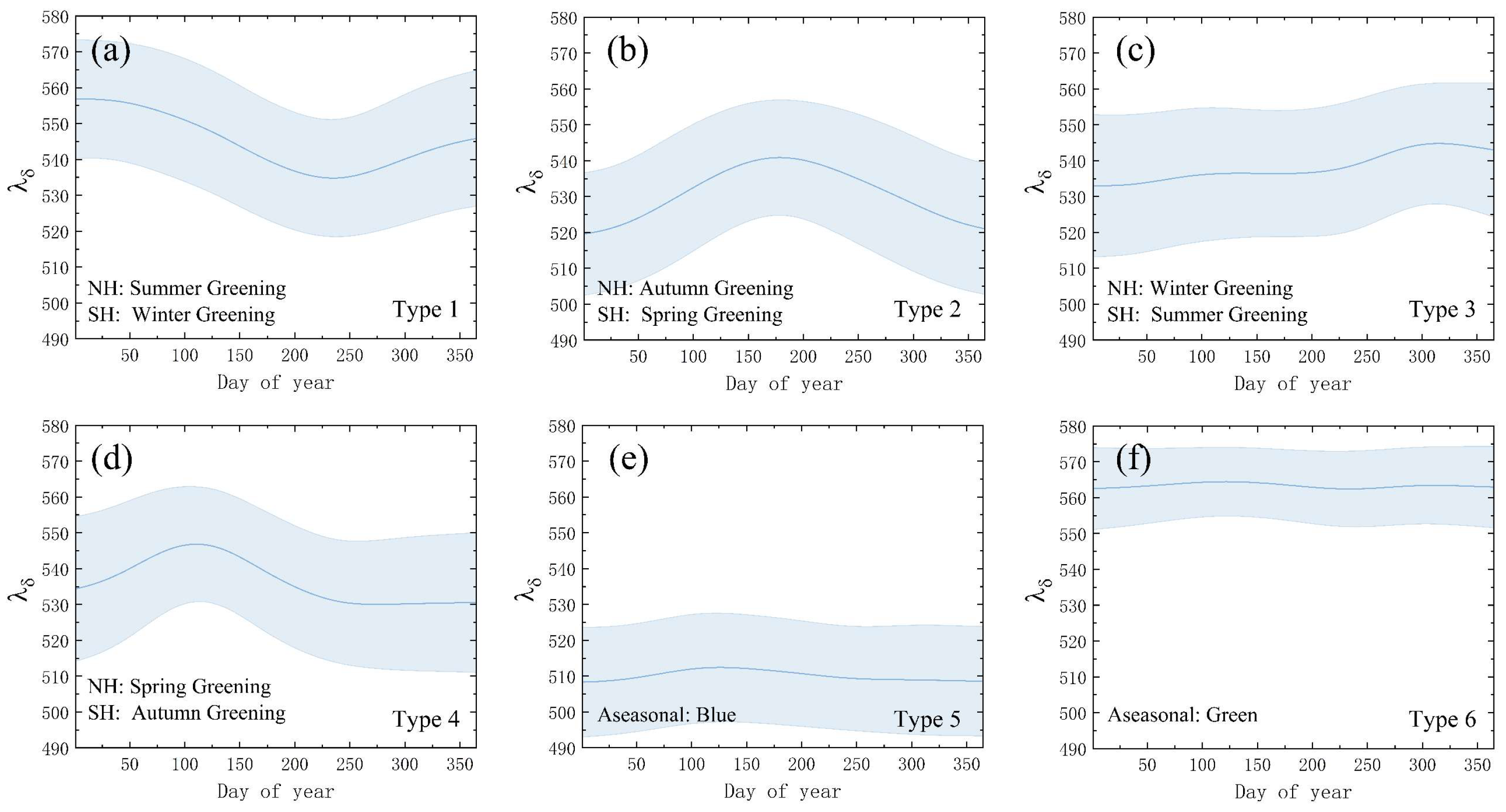
Having retrieved the dominant wavelength λd from the satellite surface reflectance observations as described above, we then constructed intra-annual time series of lake color and synthesized color observations for each lake during six separate periods: [1984, 1991], [1992, 1997], [1998, 2003], [2004, 2009], [2010, 2015], and [2016, 2021]. A total of six intra-annual color observations were conducted for each lake. Selecting six periods ensures sufficient data for each period. Each lake was observed at least twice a month to ensure the continuity of intra-annual lake color observations, resulting in a total of 975 lakes for studying. That is to say, only lakes with at least two valid observations per month were retained. Based on these valid observations, daily time series of dominant wavelength (λd) were constructed for the entire year, and Nadaraya-Watson kernel regression (see below) was then applied to smooth the raw series, yielding the intra-annual phenology curves shown in Figure 1. In addition, Nadaraya–Watson kernel regression was used to further smooth the original time series to eliminate possible noise [42]. To identify the patterns of lake color phenology, we calculated the shape in-dices of individual intra-annual time series and then used the K-means classifier to classify global lake color phenology. Seven shape indices were employed in this study, including the mean and standard deviation of the time series curve (p1 and p2), the difference between the dates of extreme values (p3), the ordinal day of the annual maximum value (p4), the number of days from the annual maximum to the end of the year (p5), the kurtosis (p6), and the skewness (p7) of the time series. The formulas for these indices are as follows:
P 3 = i m a x ( c ) i m i n ( c )
P 4 = i m a x ( c )
P 5 = 365 P 4
P 6 = ( c i P 1 ) 4 365 · P 2 4
P 7 = ( c i P 1 ) 3 365 · P 2 3
where c is the intra-annual time series curve and i is a certain day of the year. c i represents the observed value of the time series c on the i-th day of the year. i m a x ( c ) corresponds to the ordinal day on which the maximum value of time series c occurs. i m i n ( c ) corresponds to the ordinal day on which the minimum value of time series c occurs.
P 1 represents the mean value of time series c ( P 1 = c ¯ ) and P 2 denotes the standard deviation of time series c. Before classification, the standard deviation of the dominant wavelength was used to identify lakes without significant seasonal changes; values less than 5 nm were classified as non-seasonal lakes [42] to reduce classification uncertainty. These lakes were further divided into two categories, namely the perennial green type (with an average dominant wavelength value greater than 526 nm [28]) and the evergreen type (with an average value less than 526 nm). For the remaining lakes, K-means clustering analysis was performed on the normalized intra-annual lake color time series. We compared the classification results by setting the number of types from 1 to 6. Through manual interpretation, the four-category division was the most representative, showing significant inter-class differences. More categories result in smaller differences between classes, while fewer divisions conceal some phenological characteristics. Four types of lake phenology with maximum dominant wavelengths occurring in spring, summer, autumn, and winter in the Northern Hemisphere were identified and designated as Types 1–4, while the perennial green and evergreen types correspond to Type 5 (with lower average annual dominant wavelengths concentrated around 510 nm, corresponding to a more blue–green spectral region visually) and Type 6 (with higher average annual dominant wavelengths concentrated around 560 nm, corresponding to spectral signals biased towards yellow–green to brown tones).

2.2.2. Statistical Analysis

It should be noted that the environmental driver datasets (including MODIS and lake volume data) are fully available only from 2000 onward. For this reason, the stability analysis and driver attribution presented in this section are limited to the last three periods, [2004–2009], [2010–2015], and [2016–2021], during which climate, landscape, human activity, and lake property data are all complete. For the first three periods ([1984–1991], [1992–1997], [1998–2003]), data availability constraints meant that we only computed the lake color phenological patterns and did not perform further linkage with environmental drivers.
The stability of lake color phenology was evaluated by calculating the number of changes in phenological patterns over six time periods. To systematically reveal the relationship between the stability of lake phenological patterns and various environmental driving factors, we collected datasets of climate (temperature, precipitation, and wind speed), landscape (vegetation growth status, characterized by watershed NDVI), human activities (reflected as total population), and lake characteristics (area, water depth, elevation) for each lake. We classified the phenological stability of lakes based on their temporal changes in color (with a change frequency of 0–5 levels) and compared the distribution characteristics of factors such as climate, landscape, human activities, and lake morphology at different levels. The relationship between each factor and the stability of lake phenological patterns is shown as box plot graphs, which can intuitively reflect the median, interquartile range, and dispersion of factors within each stability level. This method can not only identify the trend correlation between stability and a single factor but also help reveal potential patterns under the joint action of multiple factors, thus providing a visual basis for understanding the driving mechanism of global lake phenological changes.

3. Results

3.1. Patterns of Global Lake Color Phenology

By extracting shape indices from time series and adopting K-means clustering analysis, we identified for the first time six lake color phenological patterns with significant differences at the global scale (Figure 1). These six patterns include four seasonal types—spring green type (type 1), summer green type (type 2), autumn green type (type 3), and winter green type (type 4)—as well as two year-round stable types—the perennial green type (type 5) and the evergreen type (type 6). As shown in Figure 1, the average dominant wavelength time series curves of each pattern exhibit unique morphological characteristics: the spring green type shows a clear peak in late spring and early summer and then gradually decreases, while the summer green type reaches its greenest state in midsummer. The peak values of the autumn green type and the winter green type appear in autumn and winter, respectively, while the curves of the perennial green and evergreen types are relatively flat with weak seasonal fluctuations. The above six types of lake color phenology are not merely spectral changes, but comprehensive optical reflections of the seasonal dynamics of three key water quality components in the water: chlorophyll-a, suspended particulate matter, and colored dissolved organic matter (CDOM). The dominant wavelength peaks of the spring, summer, autumn, and winter greening types all correspond to the increase in chlorophyll-a concentration caused by elevated phytoplankton biomass, directly reflecting the seasonal phenological characteristics of phytoplankton growth in lakes. The evergreen type exhibits stable annual spectra with weak fluctuations, representing a long-term stable oligotrophic state with low chlorophyll-a, low suspended particulate matter, and low CDOM. The perennial green type, with consistently higher dominant wavelengths, is mainly driven by the continuous input of colored dissolved organic matter or non-algal suspended particles from the watershed rather than strong seasonal algal signals. Consistent with existing lake optical research, lake color, as a comprehensive proxy of water-leaving reflectance, can effectively capture continuous changes in water quality components and serves as an important optical indicator reflecting the ecological status of lakes.
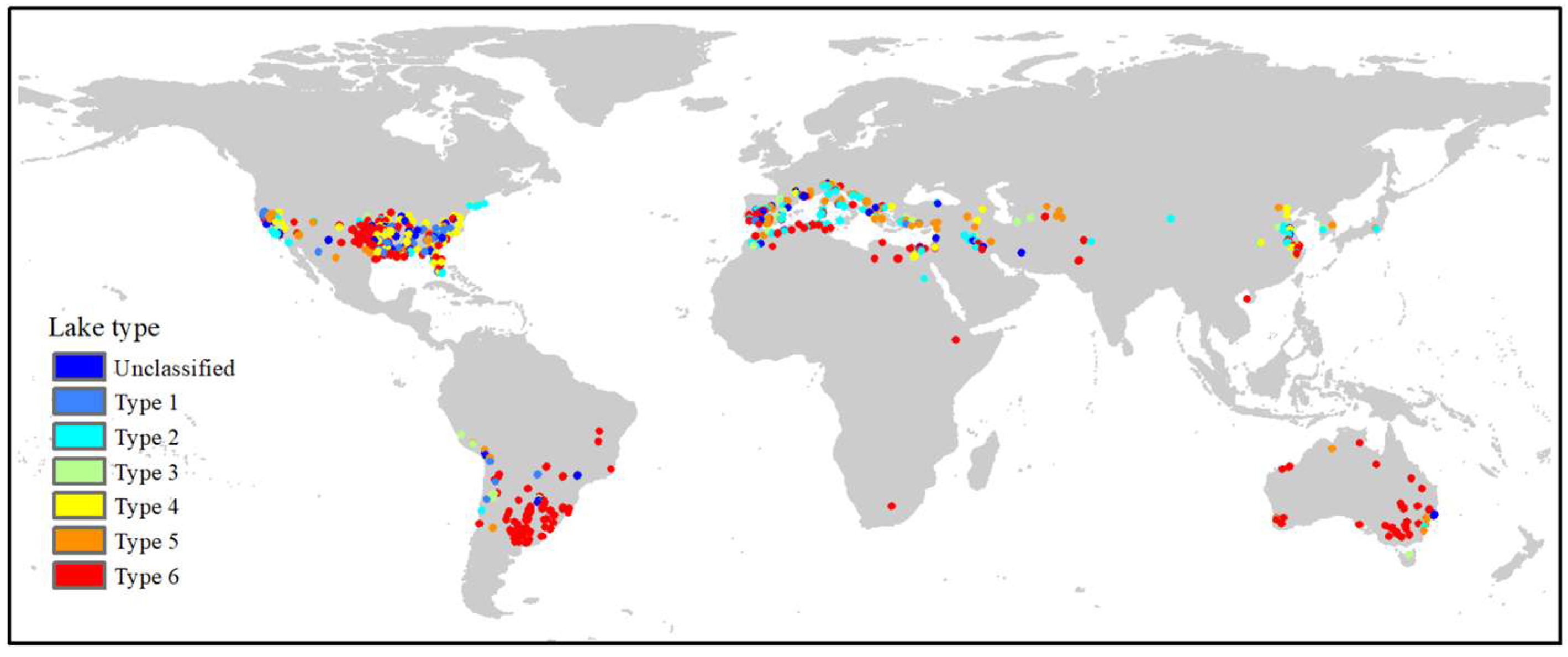
Spatial distribution analysis (Figure 2) revealed a significant hemispheric differentiation pattern. Evergreen lakes (accounting for about 43.9% of the total) are highly concentrated in the Southern Hemisphere, especially showing contiguous distribution in Australia and southern South America. This is consistent with the relatively stable level of human interference and climate conditions in the mid-to-high latitudes of the Southern Hemisphere [43,44]. In contrast, lakes in the Northern Hemisphere exhibit higher ecological diversity, dominated by summer green and winter green types. The former is concentrated in the Mediterranean coastal regions, central and eastern United States, and western coastal Europe, while the latter is distributed in southern North America, the Mediterranean coastal regions, and southeastern Asia. Spring green and autumn green lakes are sporadically distributed, usually associated with local eutrophication conditions or specific hydroclimatic driving factors. This spatial differentiation directly confirms the macro law that lake color phenology is controlled by large-scale climate zones.

3.2. Long-Term Changes in Lake Color Phenology

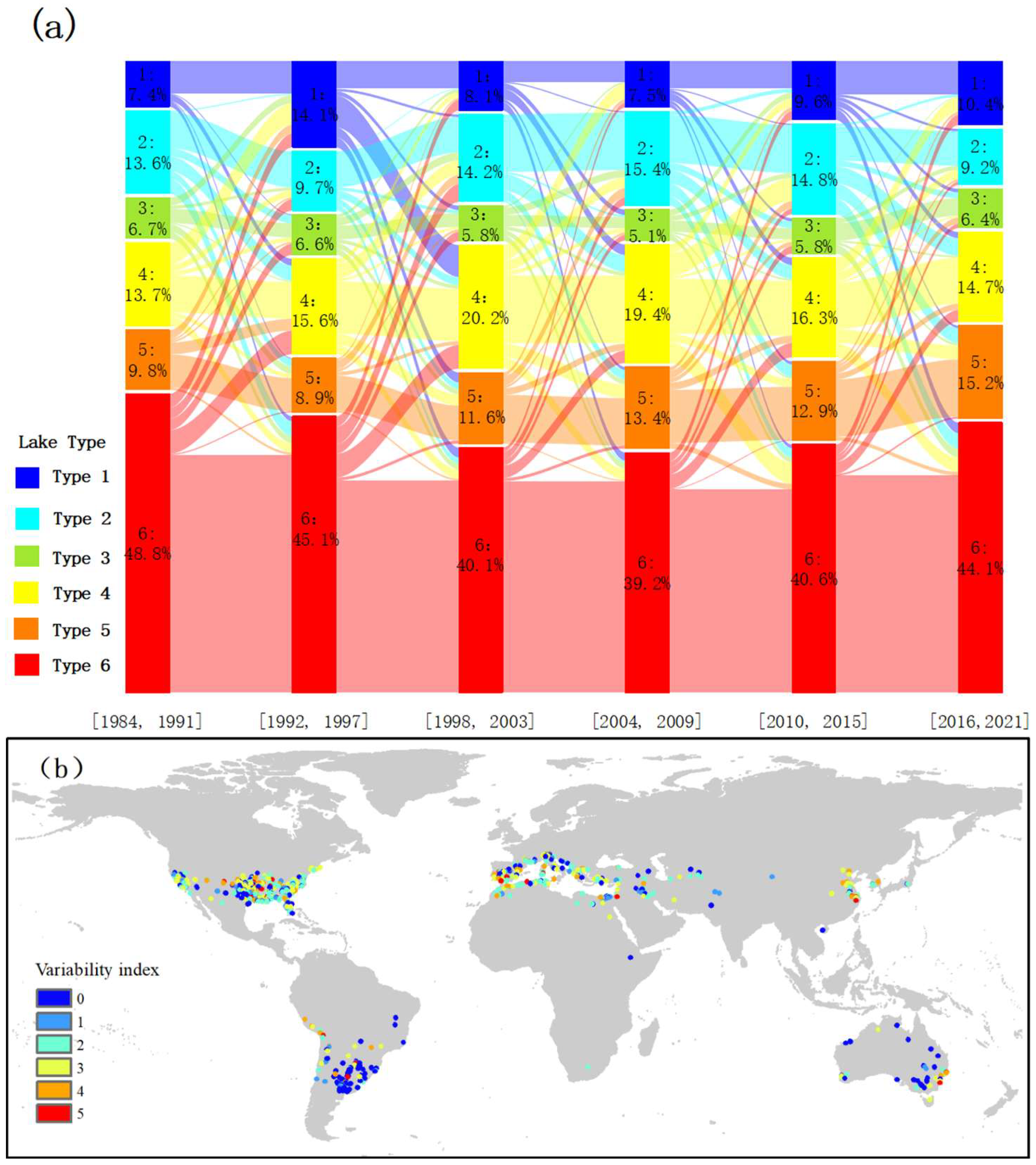
Based on clarifying the direction of long-term changes, we explored the underlying mechanisms constituting these long-term trends, namely the transformation of phenological patterns between different time periods. The Sankey diagram in Figure 3a systematically visualizes the phenological pattern transition paths and fluxes of all 975 lakes over six time periods. Analysis shows that the evergreen type is consistently the dominant type, with its proportion fluctuating between 39% and 49%; winter green and summer green are the secondary types, mostly accounting for 10–20%; spring green and autumn green account for a relatively low and stable proportion. Overall, although the overall composition of phenological types remains relatively stable, the proportion of each type fluctuates significantly over time, indicating that lake phenological types in the study area exhibit remarkable spatiotemporal dynamics. The transitions are not random but show a tendency to shift towards patterns with similar spectral characteristics; for example, the mutual conversion between the summer green and winter green types (the transition rate between the two types during adjacent periods was approximately 6%), and between the perennial green and evergreen types (on average, 7% of perennial green lakes transitioned to the evergreen type between two consecutive periods), occurs at a higher frequency.
To quantify this dynamism, we counted the number of phenological pattern transitions experienced by each lake during the study period (0–5 times) and used it as an indicator to evaluate stability. The spatial distribution of this indicator reveals the macro geographical pattern of phenological stability (Figure 3b). Lakes in the Southern Hemisphere generally exhibit higher stability, with approximately 69.4% of lakes undergoing no more than two transformations. In contrast, in the Northern Hemisphere, up to 55.4% of lakes undergo two or more transformations, especially in densely populated and economically active areas such as East Asia, Western Europe, and eastern North America, where lake phenological patterns exhibit the strongest dynamism.

3.3. Driving Factors for the Lake Color Phenology Changes

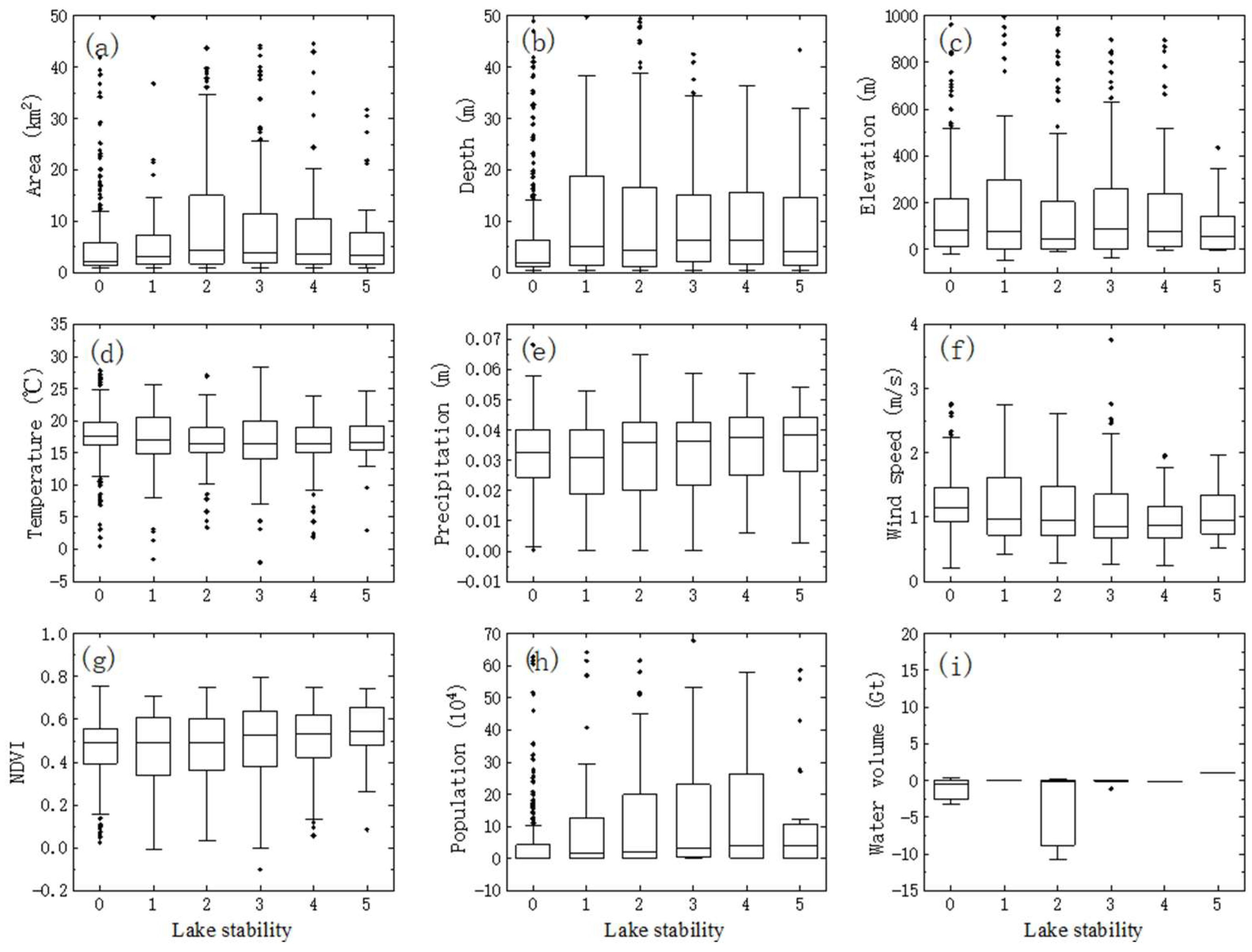
It should be noted that, due to the lack of MODIS and complete lake volume data before 2000, the driver analysis presented here is restricted to the last three periods ([2004, 2009], [2010, 2015], and [2016, 2021]). The box plot analysis in Figure 4 further reveals the relationship between stability and multiple factors. The analysis indicates that watershed vegetation conditions are the primary natural regulatory factor. Lakes with highly unstable phenology (4–5 changes) have a higher median watershed NDVI compared to stable lakes. This suggests that higher vegetation coverage enhances the seasonal sensitivity of water optical properties; higher watershed vegetation cover reduces terrestrial sediment and nutrient inputs, lowers concentrations of suspended particulate matter and CDOM, weakens seasonal fluctuations in lake color, and stabilizes phenological patterns. Meanwhile, lower average watershed wind speeds are also associated with instability, possibly because calm wind conditions promote the surface aggregation of algae or particulate matter, amplifying seasonal differences in chlorophyll-a and making color phenology more prone to shifts. Lake morphology is the physical basis determining its buffering capacity. Lakes with smaller areas and shallower water depths exhibit significantly higher phenological instability, as low environmental capacity corresponds to weak buffering ability, allowing nutrient and suspended matter concentrations to fluctuate rapidly and thereby destabilize color phenology. This is consistent with the ecological principle that small shallow water ecosystems are more sensitive to environmental disturbances and have weaker buffering capabilities [45]. The impact of human activities presents non-linear threshold characteristics. The impact of watershed population density on phenological stability is most prominent in lakes with moderate instability (2–3 changes). This pattern indicates that there is a “human disturbance threshold”; when the activity intensity (such as agricultural non-point source pollution, land use change) reaches this critical level, it is most likely to trigger the systematic transformation of phenological patterns. In summary, the phenological stability of lake color is regulated by the natural base composed of watershed NDVI, lake area, and water depth, and is non-linearly driven by human activities within a specific intensity range.

4. Discussion

4.1. Ecological Significance of Lake Color Phenological Patterns

For the first time, this study identified six types of lake color phenological patterns at the global scale, which exhibit significant latitudinal differentiation and seasonal characteristics spatially (Figure 2). The evergreen type accounts for a relatively high proportion at approximately 43.9% and is predominantly distributed in the Southern Hemisphere. Attributed to the regional environmental background of relatively stable climate, low nutrient inputs and weak human disturbances, around 69.4% of Southern Hemisphere lakes present relatively stable phenological patterns (with variation frequencies ≤ 2 during the study period). The Southern Hemisphere is dominated by the evergreen type, reflecting the environmental background of relatively stable climate, low nutrient input, and weak human interference in this region. Conversely, lakes in the Northern Hemisphere exhibit distinct seasonal characteristics. The spring green and autumn green types are widely distributed in mid-to-high latitude temperate regions, each accounting for less than 10% and maintaining overall relative stability. The summer green type accounts for approximately 15% and is mostly found in eutrophic water bodies, while the winter green type accounts for 14–20% and is primarily associated with specific hydroclimatic conditions such as optical variations during ice-sealing periods. Against this backdrop, about 64.4% of Northern Hemisphere lakes experience phenological variations. Shen et al. (2025) [14] analyzed 67,579 global lakes (area > 1 km2) and revealed an overall declining trend in the global lake dominant wavelength from 1984 to 2021, with an average rate of –0.39 nm/yr. Consistently, Cao et al. (2023) [2] reported an average decline rate of –0.4 ± 0.8 nm/yr based on 2550 Chinese lakes (area > 1 km2), indicating a prominent blueshift trend of lake color across China within the global context. Further analysis demonstrates that transitions between different phenological patterns tend to occur among categories with similar spectral features. For instance, the conversion frequency between the perennial blue type and the evergreen type is relatively high, with an average of 7% of evergreen lakes transitioning to the perennial blue type between consecutive periods.
The formation of these patterns is a multifactorial and complex process, which is jointly regulated by solar radiation, seasonal temperature cycles, precipitation regimes, and watershed material transport processes [1]. As a fundamental driving factor, solar radiation directly affects phytoplankton community succession and variations in dominant wavelength by regulating water surface light intensity and photosynthetically active radiation. For instance, phenological peaks in mid-to-high latitude lakes often coincide with periods of maximum radiation, whereas low-latitude lakes exhibit weaker fluctuations due to their small annual radiation range. As the primary energy source for lake warming, enhanced solar radiation directly drives the rise in surface water temperature, especially in seasonally ice-free regions. Based on satellite observations of 188 large global lakes from 2002 to 2016, Kraemer et al. (2017) [46] confirmed a significant correlation between lake surface temperature and chlorophyll-a concentration, where warming leads to increased chlorophyll-a levels in eutrophic lakes. Solar radiation is negatively correlated with lake color wavelength, and elevated radiation may promote a clear-water state, particularly in deep lakes [2]. Seasonal temperature cycles drive phenological dynamics by modulating the thermal structure of lake water, ice cover duration, and biological metabolic rates. For example, declining greenness in Arctic–boreal lakes is significantly correlated with rising air temperature, as warming enhances lake–land connectivity and increases dissolved organic carbon input [8]. Furthermore, elevated temperatures may promote plankton growth, resulting in a greener lake appearance [2]. Global statistical evidence further quantifies this relationship: according to statistics of 85,360 global lakes, blue lakes (dominant wavelength peak at 495 nm) only account for 31% and are mainly concentrated in regions with high precipitation and low temperatures. In areas with summer temperatures below 19 °C, 35.7% of lakes are blue, whereas the proportion drops to merely 9.4% in warmer summer regions [29]. This indicates that rising temperature acts as a critical climatic driver for the transition of blue lakes to non-blue status.
The box plot results show that the median precipitation of lakes with phenological variation times ≤ 1 is less than 0.035 m, while that of lakes with 2–5 variation times ranges from 0.035 m to 0.04 m. Precipitation regimes indirectly influence phenology by altering watershed runoff and nutrient transport. Rainy periods generally increase particulate matter and colored dissolved organic matter loading, leading to a “redshift” in lake color, whereas dry periods may favor a clear-water state. The negative correlation between phenological stability and precipitation variability in U.S. lakes reflects this mechanism [47]. Watershed material transport processes, such as vegetation cover and anthropogenic activities, collectively regulate phenology by modulating nutrient and particulate inputs. High NDVI values tend to reduce suspended solid input and promote a “blueshift” in color. A study on 64 Tibetan Plateau lakes (area > 50 km2) conducted by Pi et al. (2020) [48] verified a significant positive correlation between watershed vegetation coverage and lake water transparency, with lakes in regions of high vegetation coverage generally presenting higher water clarity. Meanwhile, agricultural or urbanization activities may trigger a shift toward greener or browner lake types [14]. In addition, land cover change is strongly correlated with chlorophyll-a dynamics: the strong positive correlation between construction land and chlorophyll-a (r = 0.763) and the strong negative correlation between vegetation coverage and chlorophyll-a (r = –0.766) directly reveal the intensive impacts of human activities on lake optical properties [49]. As the primary macroscale factor, latitude dominates spatial differentiation in phenology by determining climatic zones and seasonal intensity gradients. For example, the dominance of evergreen-type lakes in the Southern Hemisphere reflects climatic stability, whereas the high phenological diversity in the Northern Hemisphere aligns with gradients in temperature and precipitation [1]. Moreover, the ratio of total nitrogen (TN) to total phosphorus (TP) is significantly positively correlated with latitude [50], demonstrating that latitude serves as a vital controlling factor for lake trophic status and chlorophyll-a concentration.
From an ecological perspective, different phenological patterns directly correspond to the seasonal rhythms of biogeochemical processes within lakes. For example, the peak of the spring green type is often synchronized with the spring bloom of phytoplankton in temperate lakes, while the summer green type often indicates the dominant period of algal communities in summer [51]. The stable spectral characteristics of evergreen lakes usually reflect low biomass and low suspended solids concentration under oligotrophic conditions. Data from U.S. lakes suggest that the median dominant wavelength of summer green lakes is 524 nm, significantly higher than 513 nm of spring green lakes (p < 0.0001), accompanied by mild intra-annual color variations. Relevant research has linked the summer green type to prolonged phytoplankton growing seasons driven by high algal biomass [1]. Therefore, lake color phenology can serve as a comprehensive optical indicator reflecting the seasonal dynamics and nutritional status of lake ecosystems, filling the gap in spatial and temporal coverage of traditional fixed-point observations and providing a new perspective for regional water quality remote sensing monitoring and ecological health assessment [25].

4.2. Driving Mechanism of Changes in Lake Color Phenology

Phenological patterns are not static and exhibit distinct dynamic characteristics both temporally and spatially. Our comprehensive multi-factor analysis indicates that the stability of lake color phenology is controlled by a synergistic driving network composed of natural and human factors. In terms of natural factors, regression tree analysis by Shen et al. (2025) [14] further quantified the relative contribution of different drivers to lake color changes. Their results identified watershed NDVI as the dominant factor regulating lake color variations. In high-NDVI regions (watershed NDVI ≥ 0.57), lake dominant wavelengths tend to be shorter and are closely associated with water volume reduction (<−0.23 Gt/yr). By contrast, in low-NDVI regions (watershed NDVI < 0.57), population density and lake area exert stronger correlations with lake color changes. These findings are highly consistent with our observations: lakes with high NDVI in this study (corresponding to those with fewer phenological variations in Figure 4) also present higher color phenological stability, further confirming the core role of watershed vegetation conditions in regulating lake color phenology. Watershed vegetation coverage (NDVI) is the core driving factor: vegetation interception in high-NDVI areas can reduce the input of terrestrial debris and nutrients, lower the concentrations of suspended sediment and chlorophyll-a in water bodies, and thus weaken the seasonal fluctuations of color. The box plot analysis shows that the median wind speed of lakes with unchanged phenological patterns exceeds 1 m/s, while the average wind speed of lakes with phenological variations ranges from 0.8 m/s to 1 m/s. This indicates that low wind speed weakens vertical water mixing, facilitates algal accumulation on the water surface, and further amplifies seasonal color discrepancies. Lower wind speeds weaken vertical mixing of water bodies, promote the surface aggregation of algae, and further amplify the seasonal differences in color. The influence of lake morphology on stability is also significant, with smaller and shallower lakes being more sensitive to environmental changes [2]. This is also validated by the box plots in Figure 4: lakes with zero phenological variations have an average water depth of less than 5 m, while the median water depth of lakes with 1–5 variation times ranges from 5 m to 10 m. Global evidence further supports such conclusions: Kuhn and Butman (2021) [15] found that the greenness decline rate of shallow lakes (water depth < 10 m) was 34% higher than that of deep lakes (water depth > 10 m) across Arctic–boreal regions, and this difference was statistically significant (p < 0.05). In this study, shallow lakes with water depth less than 5 m showed higher phenological stability, which is consistent with the inference of Kuhn and Butman: shallow water lakes are more vulnerable to external disturbances, with more drastic color variation ranges and less stable phenological patterns.
The impact of human activities presents non-linear and threshold characteristics. In watersheds with medium population density, agricultural non-point source pollution and land use transformation activities become key disturbance sources triggering changes in phenological patterns [52]; under extremely high or low population pressure, this correlation actually weakens. This discovery suggests that there may be a “human disturbance threshold”, beyond which the color phenological rhythms of lakes will undergo significant changes. This provides a key scientific entry point for regional lake management: targeted control of pollution sources and optimization of land use in critical areas with medium population density can effectively maintain the natural rhythm of lake phenology [1].

4.3. Limitations and Implications

Although this study systematically reveals the typical patterns and driving mechanisms of lake color phenology at the global scale based on long-term remote sensing data, there are still several limitations that need to be further deepened and improved in future work. In terms of data coverage, the lakes analyzed in this study are mainly distributed in easily monitored areas in eastern Asia, North America, Europe, and parts of the Southern Hemisphere. Insufficient coverage of lakes in remote areas, highly turbid waters, and areas with complex terrain may affect the overall representativeness of the patterns. In addition, small lakes (<1 km2), which are not fully included in this research, dominate the total number of global lakes [53]. Pi et al. (2022) [48] further pointed out that although small lakes only account for 15% of the global total lake area, they dominate more than half of the inland lake area changes worldwide, acting as core contributors to global trends in water area variability and carbon emissions. Future research should incorporate multi-source satellite data (e.g., Sentinel-2, MODIS) and advanced gap-filling methods to improve sample coverage in Asia, Africa, and high-latitude regions, thereby yielding more globally representative conclusions. In addition, as an integrated optical indicator, changes in the dominant wavelength of color are jointly driven by multiple components such as suspended solids, chlorophyll-a, and colored dissolved organic matter. Currently, quantitative analysis of the contributions of each component has not been achieved, which limits the in-depth interpretation of the underlying ecological processes [25]. Wang et al. (2015) [41] developed a Forel–Ule color index extraction and classification method for inland waters based on MODIS data with Taihu Lake as the case study, demonstrating the close linkage between water color and water composition. Seyoum and Dooley (2023) [54] further extracted dominant wavelength and FUI using Landsat and Sentinel-2 data, and compared them with in situ water quality measurements. They found that satellite-retrieved FUI was strongly correlated with water quality indicators such as Secchi disk depth (SDD) and turbidity, while highlighting high spatial variability in the water color–water quality relationship across different sites. These studies indicate that remote sensing-based water color monitoring has broad application prospects as a comprehensive water quality indicator, yet sufficient in situ data are still required for verification and calibration.
On the temporal scale, this study was divided into six periods for analysis. Although it can identify phased changes, the capture of intra-annual high-frequency dynamics, responses to extreme climate events, and long-term cumulative effects of climate change (such as shortened ice periods and extended growing seasons) is still insufficient [55]. Long-term global lake ice phenology records provide quantitative references: Sharma et al. (2021) [56] analyzed ice regimes of 60 Northern Hemisphere lakes and found that ice-on dates delayed by 11.0 days per century, ice-off dates advanced by 6.8 days per century, and the annual ice duration shortened by 17.0 days per century, with the changing rate in the recent 25 years six times higher than that in the previous 25 years. Basu et al. (2024) [57] further used ice data from 2499 lakes and confirmed that the annual mean ice cover duration of Northern Hemisphere lakes has decreased continuously at a rate of 9 days per decade over the past 50 years. These findings reveal that global lakes are undergoing rapid temporal changes far beyond the capture capacity of this study. Meanwhile, due to the limitation of remote sensing resolution, smaller lakes were not fully included in this study, and such water bodies are of great significance to regional ecology and human communities [54]. Furthermore, limited by the incomplete availability of MODIS and lake water volume data prior to 2000, our analysis of the relationships between environmental drivers and lake color phenology only covers limited years. Specifically, it only includes the latter three periods (2004–2009, 2010–2015, 2016–2021). Longer time series of driving variables will be required in future work to fully explore the causes of lake color changes during the earlier periods.
Despite the above limitations, this study systematically characterizes the spatiotemporal pattern and stability mechanism of lake color phenology by integrating multi-source remote sensing data and environmental driving factors. Its conclusions are consistent with the theoretical framework of existing inland water optical research, providing a scientific basis for the development of phenology-based lake ecological remote sensing monitoring methods and laying an important foundation for the formulation of regional water environment management and ecological protection strategies.

5. Conclusions

Based on long-term Landsat remote sensing data (1984–2021), this study systematically reveals the typical patterns, stability patterns, and driving mechanisms of color phenology in 975 global lakes. The results show that lake color phenology can be classified into six typical patterns, namely spring green, summer green, autumn green, winter green, evergreen type and perennially green type, with approximately 43.9% of the lakes belonging to the evergreen type and mainly distributed in the Southern Hemisphere, while lakes in the Northern Hemisphere exhibit higher phenological diversity and are dominated by seasonal green shift patterns. The phenological stability of lake color presents distinct north–south differentiation: 69.4% of Southern Hemisphere lakes have phenological variation frequencies no more than twice, reflecting stable phenological conditions; by contrast, 64.4% of Northern Hemisphere lakes present obvious color phenological changes. Further analysis indicates that phenological stability is jointly regulated by natural factors such as watershed vegetation conditions, lake area, and water depth, and is non-linearly influenced by human activities, with phenological pattern changes most likely to occur under moderate disturbance intensity. This study provides a scientific basis for developing lake ecological phenological indicators based on remote sensing technology, realizing large-scale dynamic monitoring and early warning, and has important value in supporting the sustainable management of lakes.

Author Contributions

Conceptualization, X.S.; methodology, C.W. and X.S.; writing—original draft preparation, C.W. and X.S.; writing—review and editing, C.W., X.W. and X.S. All authors have read and agreed to the published version of the manuscript.

Funding

This research was supported by Nature Science Foundation of Jiangsu Province [No. BK20251492] and the Fundamental Research Funds for the Central Universities [No. B250201056].

Institutional Review Board Statement

Not applicable.

Informed Consent Statement

Not applicable.

Data Availability Statement

All data used in this study are derived from publicly available databases or published research findings. The surface reflectance data of the Landsat series satellites (Collection 1 Tier 1) can be obtained from the Earth Resources Observation and Science Center of the United States Geological Survey (USGS). The Hydrolakes lake outline and attribute dataset was provided and publicly released by Messager et al. (2016) [34]. Climate data (ERA5 reanalysis dataset) was produced and publicly provided by the European Centre for Medium-Range Weather Forecasts (ECMWF). The MODIS NDVI dataset (MOD13Q1) was released by NASA LP DAAC. Global gridded population data was provided by Oak Ridge National Laboratory (2021) [37]. The lake water volume change dataset is derived from the research findings of Yao et al. (2023) [38]. All codes and analysis workflows processed based on the Google Earth Engine platform in this study can be obtained by contacting the corresponding author.

Conflicts of Interest

The authors declare no conflicts of interest.

References

  1. Topp, S.N.; Pavelsky, T.M.; Dugan, H.A.; Yang, X.; Gardner, J.; Ross, M.R.V. Shifting patterns of summer lake color phenology in over 26,000 US lakes. Water Resour. Res. 2021, 57, e2020WR029123. [Google Scholar] [CrossRef]
  2. Cao, Z.; Melack, J.M.; Liu, M.; Kutser, T.; Duan, H.; Ma, R. Shifts, trends, and drivers of lake color across China since the 1980s. Geophys. Res. Lett. 2023, 50, e2023GL103225. [Google Scholar] [CrossRef]
  3. Dudgeon, D.; Arthington, A.H.; Gessner, M.O.; Kawabata, Z.I.; Knowler, D.J.; Lévêque, C.; Naiman, R.J.; Prieur-Richard, A.H.; Soto, D.; Stiassny, M.L.; et al. Freshwater biodiversity: Importance, threats, status and conservation challenges. Biol. Rev. 2006, 81, 163–182. [Google Scholar] [CrossRef]
  4. Pekel, J.-F.; Cottam, A.; Gorelick, N.; Belward, A.S. High-resolution mapping of global surface water and its long-term changes. Nature 2016, 540, 418. [Google Scholar] [CrossRef]
  5. Schindler, D.W. The dilemma of controlling cultural eutrophication of lakes. Proc. R. Soc. B 2012, 279, 4322–4333. [Google Scholar] [CrossRef]
  6. Adrian, R.; O’Reilly, C.M.; Zagarese, H.; Baines, S.B.; Hessen, D.O.; Keller, W.; Livingstone, D.M.; Sommaruga, R.; Straile, D.; Van Donk, E.; et al. Lakes as sentinels of climate change. Limnol. Oceanogr. 2009, 54, 2283–2297. [Google Scholar] [CrossRef]
  7. Woolway, R.I.; Kraemer, B.M.; Lenters, J.D.; Merchant, C.J.; O’Reilly, C.M.; Sharma, S. Global lake responses to climate change. Nat. Rev. Earth Environ. 2020, 1, 388–403. [Google Scholar] [CrossRef]
  8. Martinuzzi, S.; Januchowski-Hartley, S.R.; Pracheil, B.M.; McIntyre, P.B.; Plantinga, A.J.; Lewis, D.J.; Radeloff, V.C. Threats and opportunities for freshwater conservation under future land use change scenarios in the United States. Glob. Change Biol. 2014, 20, 113–124. [Google Scholar] [CrossRef]
  9. Bennett, E.M.; Carpenter, S.R.; Caraco, N.F. Human impact on erodable phosphorus and eutrophication: A global perspective. BioScience 2001, 51, 227–234. [Google Scholar] [CrossRef]
  10. Huisman, J.; Codd, G.A.; Paerl, H.W.; Ibelings, B.W.; Verspagen, J.M.H.; Visser, P.M. Cyanobacterial blooms. Nat. Rev. Microbiol. 2018, 16, 471–483. [Google Scholar] [CrossRef] [PubMed]
  11. O’Reilly, C.M.; Sharma, S.; Gray, D.K.; Hampton, S.E.; Read, J.S.; Rowley, R.J.; Schneider, P.; Lenters, J.D.; McIntyre, P.B.; Kraemer, B.M.; et al. Rapid and highly variable warming of lake surface waters around the globe. Geophys. Res. Lett. 2015, 42, 10773–10781. [Google Scholar] [CrossRef]
  12. Jane, S.F.; Hansen, G.J.; Kraemer, B.M.; Leavitt, P.R.; Mincer, J.L.; North, R.L.; Pilla, R.M.; Stetler, J.T.; Williamson, C.E.; Woolway, R.I.; et al. Widespread deoxygenation of temperate lakes. Nature 2021, 594, 66–70. [Google Scholar] [CrossRef] [PubMed]
  13. Mason, P.J.; Zillman, J.W.; Simmons, A.; Lindstrom, E.J.; Harrison, D.E.; Dolman, H.; Bojinski, S.; Fischer, A.; Latham, J.; Rasmussen, J.; et al. Implementation Plan for the Global Observing System for Climate in Support of the UNFCCC (2010 Update); World Meteorological Organization: Geneva, Switzerland, 2010; Available online: https://eprints.soton.ac.uk/162953/ (accessed on 1 March 2026).
  14. Shen, X.; Ke, C.-Q.; Duan, Z.; Cai, Y.; Li, H.; Xiao, Y. Satellite observations reveal widespread color variations in global lakes since the 1980s. Water Resour. Res. 2025, 61, e2023WR036926. [Google Scholar] [CrossRef]
  15. Kuhn, C.; Butman, D. Declining greenness in Arctic-boreal lakes. Proc. Natl. Acad. Sci. USA 2021, 118, e2021219118. [Google Scholar] [CrossRef]
  16. Cao, Z.; Ma, R.; Duan, H.; Pahlevan, N.; Melack, J.; Shen, M.; Xue, K. A machine learning approach to estimate chlorophyll-a from Landsat-8 measurements in inland lakes. Remote Sens. Environ. 2020, 248, 111974. [Google Scholar] [CrossRef]
  17. Lin, S.; Novitski, L.N.; Qi, J.; Stevenson, R.J. Landsat TM/ETM+ and machine-learning algorithms for limnological studies and algal bloom management of inland lakes. J. Appl. Remote Sens. 2018, 12, 026003. [Google Scholar] [CrossRef]
  18. Dekker, A.G.; Vos, R.J.; Peters, S.W.M. Comparison of remote sensing data, model results and in situ data for total sus-pended matter (TSM) in the southern Frisian lakes. Sci. Total Environ. 2001, 268, 197–214. [Google Scholar] [CrossRef]
  19. Ritchie, J.C.; Cooper, C.M. Comparison of measured suspended sediment concentrations with suspended sediment concentrations estimated from Landsat MSS data. Int. J. Remote Sens. 1988, 9, 379–387. [Google Scholar] [CrossRef]
  20. Griffin, C.G.; McClelland, J.W.; Frey, K.E.; Fiske, G.; Holmes, R.M. Quantifying CDOM and DOC in major Arctic rivers during ice-free conditions using Landsat TM and ETM+ data. Remote Sens. Environ. 2018, 209, 395–409. [Google Scholar] [CrossRef]
  21. Olmanson, L.G.; Page, B.P.; Finlay, J.C.; Brezonik, P.L.; Bauer, M.E.; Griffin, C.G.; Hozalski, R.M. Regional measurements and spatial/temporal analysis of CDOM in 10,000+ optically variable Minnesota lakes using Landsat 8 imagery. Sci. Total Environ. 2020, 724, 138141. [Google Scholar] [CrossRef] [PubMed]
  22. Kutser, T. The possibility of using the Landsat image archive for monitoring long time trends in coloured dissolved organic matterconcentration in lake waters. Remote Sens. Environ. 2012, 123, 334–338. [Google Scholar] [CrossRef]
  23. Weyhenmeyer, G.A.; Müller, R.A.; Norman, M.; Tranvik, L.J. Sensitivity of freshwaters to browning in response to future climatechange. Clim. Change 2016, 134, 225–239. [Google Scholar] [CrossRef]
  24. Williamson, C.E.; Overholt, E.P.; Pilla, R.M.; Leach, T.H.; Brentrup, J.A.; Knoll, L.B.; Mette, E.M.; Moeller, R.E. Ecological consequences of long-termbrowning in lakes. Sci. Rep. 2015, 5, 18666. [Google Scholar] [CrossRef]
  25. Gardner, J.R.; Yang, X.; Topp, S.N.; Ross, M.R.V.; Altenau, E.H.; Pavelsky, T.M. The color of rivers. Geophys. Res. Lett. 2021, 48, e2020GL088946. [Google Scholar] [CrossRef]
  26. Giardino, C.; Kõks, K.; Bolpagni, R.; Luciani, G.; Candiani, G.; Lehmann, M.K.; Van der Woerd, H.J.; Bresciani, M. The Color of Water from Space: A Case Study for Italian Lakes from Sentinel-2. In Geospatial Analyses of Earth Observation (EO) Data; Pepe, A., Zhao, Q., Eds.; IntechOpen: London, UK, 2019. [Google Scholar] [CrossRef]
  27. Lehmann, M.K.; Nguyen, U.; Allan, M.; Van der Woerd, H.J. Colour classification of 1486 lakes across a wide range of optical water types. Remote Sens. 2018, 10, 1273. [Google Scholar] [CrossRef]
  28. Lehmann, M.K.; Nguyen, U.; Muraoka, K.; Allan, M.G. Regional trends in remotely sensed water clarity over 18 years in the Rotorua Lakes, New Zealand. N. Z. J. Mar. Freshw. Res. 2019, 53, 513–535. [Google Scholar] [CrossRef]
  29. Yang, X.; O’Reilly, C.M.; Gardner, J.R.; Ross, M.R.V.; Topp, S.N.; Wang, J.; Pavelsky, T.M. The color of Earth’s lakes. Geophys. Res. Lett. 2022, 49, e2022GL098925. [Google Scholar] [CrossRef]
  30. Oleksy, A.I.; Collins, S.M.; Sillen, S.J.; Topp, S.N.; Austin, M.; Hall, E.K.; O’Reilly, C.M.; Yang, X.; Ross, M.R. Heterogenous controls on lake color and trends across the high-elevation U.S. Rocky Mountain region. Environ. Res. Lett. 2022, 17, 104041. [Google Scholar] [CrossRef]
  31. Vermote, E.; Justice, C.; Claverie, M.; Franch, B. Preliminary analysis of the performance of the Landsat 8/OLI land surface reflectance product. Remote Sens. Environ. 2016, 185, 46–56. [Google Scholar] [CrossRef] [PubMed]
  32. U.S. Geological Survey (USGS). Landsat Collection 1 Level 1 Product Definition; Department of the Interior: Reston, VA, USA, 2019.
  33. Foga, S.; Scaramuzza, P.L.; Guo, S.; Zhu, Z.; Dilley, R.D.; Beckmann, T.; Schmidt, G.L.; Dwyer, J.L.; Hughes, M.J.; Laue, B. Cloud detection algorithm comparison and validation for operational Landsat data products. Remote Sens. Environ. 2017, 194, 379–390. [Google Scholar] [CrossRef]
  34. Messager, M.L.; Lehner, B.; Grill, G.; Nedeva, I.; Schmitt, O. Estimating the volume and age of water stored in global lakes using a geostatistical approach. Nat. Commun. 2016, 7, 13603. [Google Scholar] [CrossRef]
  35. Sikder, S.; Wang, J.; Allen, G.H.; Sheng, Y.; Yamazaki, D.; Song, C.; Ding, M.; Crétaux, J.-F.; Pavelsky, T.M. Lake-TopoCat: A global lake drainage topology and catchment database. Earth Syst. Sci. Data 2023, 15, 3483–3511. [Google Scholar] [CrossRef]
  36. Beck, H.E.; Zimmermann, N.E.; McVicar, T.R.; Vergopolan, N.; Berg, A.; Wood, E.F. Present and future Köppen-Geiger climate classification maps at 1-km resolution. Sci. Data 2018, 5, 180214. [Google Scholar] [CrossRef]
  37. Oak Ridge National Laboratory. LandScan Global—Global Population Distribution Data (2000–2021) [Dataset]. Available online: https://landscan.ornl.gov (accessed on 1 March 2026).
  38. Yao, F.; Livneh, B.; Rajagopalan, B.; Wang, J.; Crétaux, J.-F.; Wada, Y.; Berge-Nguyen, M. Satellites reveal widespread decline in global lake water storage. Science 2023, 380, 743–749. [Google Scholar] [CrossRef] [PubMed]
  39. Zhu, Z.; Wang, S.; Woodcock, C.E. Improvement and expansion of the Fmask algorithm: Cloud, cloud shadow, and snow detection for Landsats 4–7, 8, and Sentinel 2 images. Remote Sens. Environ. 2015, 159, 269–277. [Google Scholar] [CrossRef]
  40. Jones, J.W. Improved automated detection of subpixel-scale inundation—Revised dynamic surface water extent (DSWE) partial surface water tests. Remote Sens. 2019, 11, 374. [Google Scholar] [CrossRef]
  41. Wang, S.; Li, J.; Shen, Q.; Zhang, B.; Zhang, F.; Lu, Z. MODIS-based radiometric color extraction and classification of inland water with the Forel-Ule scale: A case study of Lake Taihu. IEEE J. Sel. Top. Appl. Earth Obs. Remote Sens. 2015, 8, 907–918. [Google Scholar] [CrossRef]
  42. Topp, S.N.; Pavelsky, T.M.; Yang, X.; Gardner, J.; Ross, M.R. LimnoSat-US: A Remote Sensing Dataset for U.S. Lakes from 1984–2020 [Dataset]. Available online: https://doi.org/10.5281/zenodo.4139695 (accessed on 1 March 2026).
  43. Lamy, F.; Kilian, R.; Arz, H.W.; Francois, J.-P.; Kaiser, J.; Prange, M.; Steinke, T. Holocene changes in the position and intensity of the southern westerly wind belt. Nat. Geosci. 2010, 3, 695–699. [Google Scholar] [CrossRef]
  44. Chown, S.L.; Lee, J.E.; Shaw, J.D. Conservation of Southern Ocean Islands: Invertebrates as exemplars. J. Insect Conserv. 2008, 12, 277–291. [Google Scholar] [CrossRef]
  45. Scheffer, M.; van Nes, E.H. Shallow lakes theory revisited: Various alternative regimes driven by climate, nutrients, depth and lake size. Hydrobiologia 2007, 584, 455–466. [Google Scholar] [CrossRef]
  46. Kraemer, B.M.; Mehner, T.; Adrian, R. Reconciling the opposing effects of warming on phytoplankton biomass in 188 large lakes. Sci. Rep. 2017, 7, 10762. [Google Scholar] [CrossRef]
  47. Topp, S.N.; Pavelsky, T.M.; Stanley, E.H.; Yang, X.; Griffin, C.G.; Ross, M.R. Multi-decadal improvement in US lake water clarity. Environ. Res. Lett. 2021, 16, 055025. [Google Scholar] [CrossRef]
  48. Pi, X.; Feng, L.; Li, W.; Zhao, D.; Kuang, X.; Li, J. Water clarity changes in 64 large alpine lakes on the Tibetan Plateau and the potential responses to lake expansion. ISPRS J. Photogramm. Remote Sens. 2020, 170, 192–204. [Google Scholar] [CrossRef]
  49. Yeboah, E.; Nyasulu, M.; Omoregie, A.I.; Rajasekar, A.; Oduro, C.; Okrah, A.; Shwe, M.M.; Quist, I.; Mensah, A.O.K.N.; Sarfo, I. Unraveling Causal Drivers of Eutrophication in Chao Lake: A Three-Decade Analysis of Land Use, Climate, and Chlorophyll-A Dynamics. Water 2026, 18, 650. [Google Scholar] [CrossRef]
  50. Abell, J.M. Variability in Nutrient Loading to Lake Ecosystems and Associated Impacts on Water Quality. Doctoral Dissertation, University of Waikato, Hamilton, New Zealand, 2013. [Google Scholar]
  51. Sommer, U.; Gliwicz, Z.M.; Lampert, W.; Duncan, A. The PEG-model of seasonal succession of planktonic events in fresh waters. Arch. Hydrobiol. 1986, 106, 433–471. [Google Scholar] [CrossRef]
  52. Stets, E.G.; Sprague, L.A.; Oelsner, G.P.; Johnson, H.M.; Murphy, J.C.; Ryberg, K.; Vecchia, A.V.; Zuellig, R.E.; Falcone, J.A.; Riskin, M.L. Landscape drivers of dynamic change in water quality of U.S. rivers. Environ. Sci. Technol. 2020, 54, 4336–4343. [Google Scholar] [CrossRef]
  53. Downing, J.A.; Prairie, Y.T.; Cole, J.J.; Duarte, C.M.; Tranvik, L.J.; Striegl, R.G.; McDowell, W.H.; Kortelainen, P.; Caraco, N.F.; Melack, J.M.; et al. The global abundance and size distribution of lakes, ponds, and impoundments. Limnol. Oceanogr. 2006, 51, 2388–2397. [Google Scholar] [CrossRef]
  54. Seyoum, W.; Dooley, A. Remotely Sensed Water Color as a Proxy for Monitoring Water Quality in Inland Lakes. In Proceedings of the EGU General Assembly 2023, Vienna, Austria, 24–28 April 2023. [Google Scholar] [CrossRef]
  55. Sharma, S.; Blagrave, K.; Magnuson, J.J.; O’reilly, C.M.; Oliver, S.; Batt, R.D.; Magee, M.R.; Straile, D.; Weyhenmeyer, G.A.; Winslow, L.; et al. Widespread loss of lake ice around the Northern Hemisphere in a warming world. Nat. Clim. Change 2019, 9, 227–231. [Google Scholar] [CrossRef]
  56. Sharma, S.; Richardson, D.C.; Woolway, R.I.; Imrit, M.A.; Bouffard, D.; Blagrave, K.; Daly, J.; Filazzola, A.; Granin, N.; Korhonen, J.; et al. Loss of ice cover, shifting phenology, and more extreme events in Northern Hemisphere lakes. J. Geophys. Res. Biogeosci. 2021, 126, e2021JG006348. [Google Scholar] [CrossRef]
  57. Basu, A.; Culpepper, J.; Blagrave, K.; Sharma, S. Phenological shifts in lake ice cover across the Northern Hemisphere: A glimpse into the past, present, and the future of lake ice phenology. Water Resour. Res. 2024, 60, e2023WR036392. [Google Scholar] [CrossRef]
Figure 1. Six global lake color phenological patterns, (a) Type 1, (b) Type 2, (c) Type 3, (d) Type 4, (e) Type 5 and (f) Type 6. The blue line represents the average dominant wavelength (λd) of lakes belonging to this type; the shaded area represents the standard deviation of λd. The lake color phenological patterns are classified in the figure, and the main characteristics of the phenological patterns are described. Lake dominant wavelength data were retrieved from all studied lakes during 1984–2021. Note: The term “greening” used here does not necessarily mean that the color becomes visually greener. On the contrary, it represents the shift in the dominant wavelength (λd) towards the green spectrum, which may be imperceptible to the human eye.
Sustainability 18 04732 g001
Figure 2. Spatial distribution of color phenological patterns in 975 lakes with color phenological records from 1984 to 2021. The final lake color phenological type was determined by the mode value of phenological patterns across the six divided periods. Lakes with no valid mode result, namely without a dominant phenological pattern, were defined as unclassified, accounting for 9.74% of all investigated lakes.
Sustainability 18 04732 g002
Figure 3. (a) A Sankey diagram for the conversion of lake color phenological patterns in 975 lakes from 1984 to 2021, showing the dynamic conversion paths and flow intensities among various phenological types across six time periods and labeling the overall proportions of each pattern during the observation period. (b) Spatial distribution of phenological pattern stability. Note: The driver analysis is based only on the last three periods (2004–2021), because MODIS and lake volume data are unavailable for earlier periods. The first three periods (1984–2003) are shown for color phenology patterns only.
Sustainability 18 04732 g003
Figure 4. Relationships between the stability of lake phenological patterns and climate, landscape, human factors, and lake morphology: (a) Aera, (b) Depth, (c) Elevation, (d) Temperature, (e) Precipitation, (f) Wind speed, (g) NDVI, (h) Population and (i) Water volume. Changes in lake color phenological patterns are divided into different levels (i.e., the number of changes in lake color phenological patterns, ranging from 0 to 5) and the corresponding factor value distributions within each level are displayed.
Sustainability 18 04732 g004
Disclaimer/Publisher’s Note: The statements, opinions and data contained in all publications are solely those of the individual author(s) and contributor(s) and not of MDPI and/or the editor(s). MDPI and/or the editor(s) disclaim responsibility for any injury to people or property resulting from any ideas, methods, instructions or products referred to in the content.