1. Introduction
Since 1949, large-scale infrastructure epitomized by the Three Gorges Hydropower Project has generated immense socioeconomic benefits. However, such projects have invariably produced numerous involuntary resettlers. The number of reservoirs of various types nationwide increased from approximately 1200 prior to the founding of the People’s Republic of China in 1949 to nearly 100,000, while total storage capacity rose from around 20 billion m
3 to over 900 billion m
3 [
1]. Due to the Three Gorges Project, more than 1.3 million people were relocated, among whom 125,000 moved across provincial boundaries [
2]. This mass migration entailed not only spatial displacement but also comprehensive social and cultural restructuring.
Relocation fractures the social networks and cultural ecologies which rural communities depend on. Consequently, traditions are exposed to shock, adaptation, rupture and reconstruction [
3]. Resettlers’ livelihood adaptation, identity, social integration and sense of belonging are directly shaped by cultural change. These are factors ultimately determining resettlement success and long-term social sustainability.
Three Gorges migrants were resettled on a large scale in the late 1990s. Since then, the issue has attracted sustained scholarly attention in China and other countries, producing a substantial body of research. This body of literature can be broadly classified into three thematic clusters. The first cluster focuses on the economic reconstruction of migrants’ livelihoods and explores patterns of livelihood transition, income dynamics and employment diversification. The three aspects are issues systematically examined in a series of empirical studies [
4,
5,
6,
7,
8,
9,
10,
11]. The second cluster centers on social adaptation and psychological well-being, and covers the reconfiguration of social networks, related mental health risks and obstacles to social integration [
12,
13,
14]. The third line of inquiry evaluates resettlement policies, critically assesses their implementation and proposes refinements [
15]. Cultural change has also received some attention. Several studies document shifts in migrants’ dialects, dietary practices, and marriage and funeral customs [
16,
17]. Nevertheless, a majority of these studies still describe cultural content in a static and compartmentalized way. They are lacking in systematic investigations into the dynamic processes, inherent patterns and underlying drivers of cultural change. Crucially, existing work generally portrays resettlers as passive recipients of cultural change and neglects their agency. Over two decades, resettlers have optionally processed cultural elements guided by an identifiable logic.
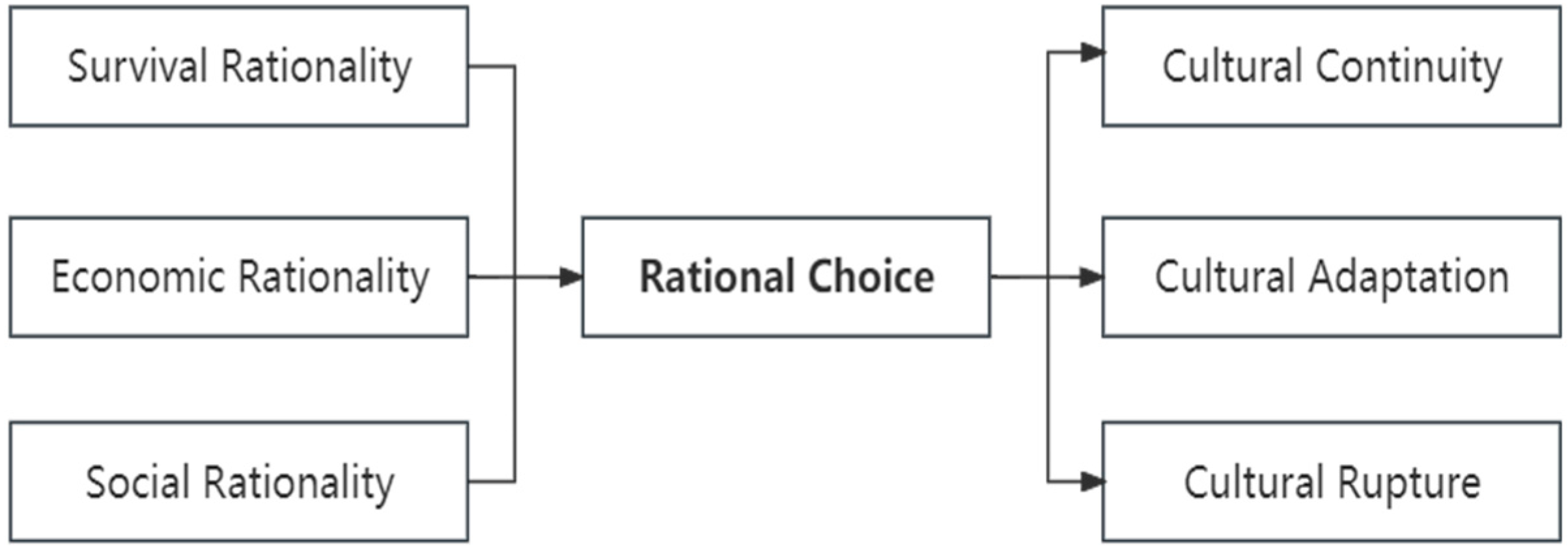
This study addresses the following three core questions: What cultural changes have Three Gorges resettlers experienced for more than two decades? What modalities do these changes take? What deep logic drives them? In-depth interviews and participant observation in Li Village, Anhui are used for constructing a “rationality-driven cultural formation” model to illuminate the internal mechanisms of cultural change. This provides fresh theoretical and policy perspectives for involuntary resettlement. Recently, development-induced displacement and resettlement (DIDR) programs in China have been critically analyzed. This further highlights tensions between official sustainability goals and resettlers’ lived realities, particularly concerning power asymmetries and livelihood precarity [
18].
3. Methodology
3.1. Case Selection
As one of the largest hydroelectric stations worldwide, the Three Gorges Hydropower Project began construction in 1994 after prolonged deliberation. The relocation of about one million people was the pivotal challenge. Flooding inundated 129 towns and areas covering 632 km2 in Hubei and Chongqing. Over 100,000 people were resettled annually from 1998 to 2009. The number of people resettled totaled about 1.3 million. Of these people, 125,000 were relocated across provincial boundaries to Anhui, Jiangsu, Shanghai and elsewhere.
Li Village is the focus of this study. It was originally located in Wushan County, Chongqing, in the heart of the Three Gorges Reservoir Zone. In 2000, around 402 residents were relocated en bloc to Langxi County, Anhui Province. Thus, an independent resettlement community retaining the original village name was formed. Over two decades, the registered population has grown to about 430, which makes Langxi County one of the larger resettlement communities in Anhui [
47].
The original site of Li Village in Wushan County was hallmarked by a complex terrain, high mountains, steep slopes and numerous waterways, in a subtropical humid climate. It had fertile soil but scarce arable land. Agriculture centered on maize, rice and wheat, with pronounced vertical zonation. Dwellings were scattered, single-story square structures. Overland transport was limited. The primary means of travel was river navigation on the Daning River. Local culture prized kinship and native-place ties, with strong mutual aid and family cohesion [
48].
Langxi County, the present site of Li Village, lies on the southeastern frontier of Anhui. It is adjacent to Jiangsu and Zhejiang, and at the junction of the Yangtze Plain and the southern Anhui hill country. Langxi County has a predominantly flat terrain and an evenly distributed hydrological network. It is a Jiangnan rice-producing region deeply influenced by Hui and Wu cultures. Agricultural mechanization was adopted early. After resettlement, migrants adapted to large-scale flatland cultivation step by step. From 2005, working-age migrants mostly began seeking off-farm employment. By around 2010, off-farm income had become the main household economic source. The township adjoins the economic development zone of the county economic development zone, with good transport links. From 2006 onward, it attracted plenty of Yangtze Delta enterprises, which provided abundant employment opportunities. Culturally, Langxi is shaped by Wu and Hui cultures, and contrasts with the original Ba culture of migrants.
This study adopts a qualitative research paradigm and selects Li Village as a case for the deep understanding of migrant cultural change. Case study methodology makes it possible to comprehensively and deeply investigate specific social phenomena [
49]. Li Village is highly typical. It involves cross-provincial Three Gorges resettlers relocated over a great distance, with marked cultural distance between the Ba culture of origin and the Wu-Hui culture of the destination. The mode of resettlement is a classic concentrated community. About 402 relocated migrants are taken as an integrated unit. A relatively independent settlement is formed. The mode is particularly suited to observing communal solidarity and collective cultural identity. Migrants arrived in 2000 and fieldwork was conducted in 2025. The 25-year span is sufficient for cultural change outcomes to manifest. Finally, the research team has a long-standing longitudinal tracking foundation in this community, with rich historical data and background information. Comparative research on Three Gorges out-migrants has further verified that resettlement mode (concentrated versus dispersed) produces divergent integration trajectories. Concentrated communities foster stronger internal cohesion at the cost of slower cultural fusion with the host society [
50].
3.2. Data Collection and Analysis
Primary data collection was conducted in February 2025, over a period of one month. Multiple qualitative data collection methods were employed in this study to comprehensively and deeply understand the complex processes of migrant cultural change.
In-depth interviewing was the primary data source. Researchers used a semi-structured interview guide and conducted in-depth interviews with representatives of 22 migrant households in Li Village. Respondents were chosen through purposive sampling. Priority was given to individuals who “had experienced the entire resettlement process” and “were already adults at the time of relocation and got familiar with their own cultural traditions”. Meanwhile, diversity across gender, age and household structure was ensured. Interview content encompassed household basic situation, livelihood strategies, household division of labor, language use, dietary habits, social interactions, agricultural production before and after resettlement, and wedding and funeral customs. Each interview lasted approximately 1.5 to 2.5 h. All interviews were audio-recorded with respondent consent and fully transcribed. Basic information on the 22 respondents is presented in
Table 1.
The 22 respondents were purposively selected to reflect the demographic and economic diversity of approximately 430 residents of Li Village. The sample spans an age range from 39 to 63 and includes both genders (13 males and nine females). It covers the major livelihood categories present in the community, from subsistence farming and day labor to factory work and self-employment. All respondents were adults at the time of relocation (aged 14 to 38), which ensured the firsthand experience of the full resettlement trajectory. Participant observation provided a critical complementary data stream. Researchers adopted a “semi-participatory” role and immersed themselves in migrant community life for one-month participant observation, including attending field observations, market visits, neighborly socializing and family meals. Their purpose was to observe migrants’ behaviors, social interaction modes and emotional expressions in naturalistic settings, which effectively verified and supplemented interview data. Detailed field notes were maintained throughout fieldwork. They recorded key events, conversation excerpts and researcher reflections.
Archival and documentary materials provided essential background support. Before and after fieldwork, researchers systematically gathered academic literature on the Three Gorges resettlement and cultural change. They also consulted the Wushan County Gazetteer, the Langxi County Gazetteer and local government archives on resettlement policy. In this study, they expected to understand the migration background and resettlement policy context.
After data collection, thematic analysis was adopted for the systematic analysis of interview transcripts and field notes. The analysis followed the six-phase framework proposed by Braun and Clarke [
51]: (1) familiarizing oneself with the data—reading transcripts and field notes repeatedly; (2) generating initial codes—coding specific statements mirroring migrant cultural phenomena; (3) searching for themes—clustering codes into potential themes; (4) reviewing themes—guaranteeing internal coherence and external distinctiveness; (5) defining and naming themes—specifying the core meaning of each theme; and (6) writing up—choosing representative evidence to present analytic results. In order to ensure analytic validity, a “member-checking” strategy was employed, and preliminary findings were shared with the selected respondents to validate interpretive accuracy.
3.3. Ethical Norms and Researcher Positioning
This study adhered to the ethical principles of qualitative research. Every participant was informed of the research purpose and their rights. They provided written informed consent and could withdraw anytime without explanation. Personal information was anonymized and coded to ensure non-identification. Formal ethical review was waived in accordance with the institutional guidelines for studies involving non-sensitive, non-interventional and anonymized data. Researchers disclosed their academic affiliations to the community. As “outsiders” to migrants and locals, this positionality helped participants speak candidly about sensitive issues like migrant-local relations while limiting the intuitive grasp of daily internal dynamics. Given that a number of events occurred over two decades ago, narratives inevitably involve memory reconstruction and personal filtering. Reflexive field memos were maintained throughout the fieldwork to document subjective influences and researcher-community interactions. They acted as a reference for data analysis.
4. Findings
Cultural change is the central process of migrants’ adaptation to a new environment. For Three Gorges resettlers relocated across provincial boundaries, the move transformed their natural and social environment, and subjected their existing cultural system to profound disruption. Through examining more than two decades of life history in Li Village, this study notes that cultural change among resettlers does not constitute a unidirectional cultural loss or passive assimilation. Rather, it constitutes a complex landscape where three basic modalities, adaptation, rupture and continuity, coexist in dynamic interplay.
4.1. Cultural Adaptation
Cultural adaptation means that migrants consciously reshape and update their own culture in response to environmental change. Thus, migrants enhance their fitness within the new environment. This modality primarily occurs in domains directly connected to survival and development, and reflects the flexible responsiveness of migrants to practical pressures.
The transformation of livelihood strategies and household labor divisions is the most emblematic form of cultural adaptation. Before resettlement, Li Village migrants had lived for generations in the mountainous Wushan region of Chongqing. Wushan is shaped by a typical highland agricultural pattern of “70% mountains, 20% farmland and 10% waters”. Per capita arable land was limited. However, the temperate climate and diverse produce supported the cultivation of maize, sweet potatoes and potatoes as staples supplemented by rice, wheat and vegetables. Agricultural production was marked by intensive cultivation, relatively manageable labor intensity and gender-integrated labor arrangements where men and women worked side by side without the rigid division of roles. This livelihood pattern shaped the agricultural rhythms of migrants and cultivated a deep cultural bond with the land in them.
Upon arrival in Langxi, Anhui, migrants confronted a radically different flatland agricultural environment: incipient agricultural mechanization, substantially higher labor intensity, and vast field parcels dominated by rice cultivation. The majority of migrants found it difficult to adapt to these conditions. Among the 22 respondents, 18 explicitly expressed that the unfavorable income differential between farming and off-farm employment was the decisive reason for abandoning cultivation. As one respondent said, “The fields are too big and weeds grow fast. You can’t keep up with the hoeing.” Moreover, the higher degree of market economic development in the destination increased daily living expenses far beyond self-sufficient home patterns. One woman (R1) described the contrast: “Up there, we basically had no need to spend much money. We piped water down from the mountain… Here, tap water costs money; water quality is poor; the weather is bad; the wind is terrible and the cold is biting. We have to use electric heating every day. We even have to buy oranges that we used to just pick off trees.” Under the pressure of livelihood, migrants began to adjust survival strategies. During the first two years, they attempted to strike a balance between farming and off-farm labor. With the increase of familiarity with the surroundings, particularly the development of an industrial zone attracting numerous enterprises by the township hosting Li Village, a growing proportion of migrant households transferred or sublet their farmland to local cultivators and shifted to wage labor or small-scale self-employment. One respondent (R7) recalled: “We have four mu of farmland at home now. All of the farmland has been given to others to farm… When we came, there was not much machinery, the land area was huge and no water could be seen in the fields. We had no idea of what to do. Thus, we just transferred it to someone else.” Off-farm income progressively became the primary household economic source. Of the 22 households interviewed, 20 had transferred all or part of their farmland to local cultivators and depended primarily on off-farm income by 2010.
The fundamental shift in livelihood strategy resulted in a thoroughgoing reconstruction of household labor divisions. Male laborers became the main contributors to household income and left early for factories or construction sites. Women remained at home and assumed responsibility for childcare, household management and child schooling. This produced a pattern of “men managing external affairs and women managing the home” characteristic of the modern urban family division of labor. This shift in division also completely transformed the daily rhythms of migrants: the agricultural cycle of “working at sunrise and resting at sunset” gave way to men’s clock-governed factory shifts and women’s ample leisure time for neighborly socializing and sunbathing after the completion of household duties. This division of labor is far from marginalizing women. It embodies a household-level economic rationality widely observed across rural China. That is to say, aggregate income is maximized by allocating the higher-earning member to off-farm employment and the other to the management of domestic responsibilities. The concentrated resettlement pattern further enabled women to sustain dense social bonds with fellow migrant women, which counteracted any tendency toward social isolation.
The negotiation and adaptation of wedding customs illuminate the pragmatic choices of migrants pressured by family perpetuation. Marriage is a momentous life event carrying deep cultural significance. To make sure that families can continue and develop in the new environment, however, migrants have found it necessary to adjust certain wedding customs. In their place of origin, weddings conventionally took place during the day and formal banquets were held at noon to accommodate guests traveling from afar. In Langxi, local custom dictates evening weddings and banquets. It is a practice rooted in differences between the two environments. In the mountains, difficult transport forced guests to complete the round trip in a single day, which led to daytime celebrations. In the plains, convenient transport and dense population preserved the ancient custom of the “twilight rite”. Migrants initially struggled to understand this difference. One woman (R4) depicted the local practice of evening weddings as “sneaky” and declared that “Chongqing people do things openly and above board”.
Pragmatic considerations prevailed when it came to the marriages of their own children. To facilitate betrothals, migrant families started to adopt flexible accommodations in their customs. When marrying off a daughter, migrant families would give her a daytime send-off according to their own customs and then follow the evening banquet tradition of the groom’s family at the groom’s home. When their son married a bride, they would bring her back to the resettlement village and host the noon banquet entirely as per their own customs. The more significant adaptation concerned bride price. In the local marriage market, a substantial bride price frequently exceeds hundreds of thousands of yuan. It constitutes a non-negotiable demand placing enormous financial strain on migrant families. Nevertheless, migrant households felt compelled to comply with this local norm to ensure that a son could marry and continue the family line. As one respondent (R3) reflected: “My son found a local woman and got married here. The betrothal gift was given first, followed by bride price negotiations between the two families… At the time, my son paid more than two hundred thousand yuan, which was considered mid-range… Here, the number of men is greater than that of women. Most of men cannot find a wife. Many remain unmarried in their 30s. It is a matter of money. Back home, none of this existed.” Conversely, migrant families adopted a starkly different attitude when marrying off their daughters. They rarely demanded high bride prices and frequently contributed dowries: “We are marrying our daughter instead of selling her.” This strategy is differentiated, namely “accepting local standards when their son brought a bride home, and following their own customs when they married off a daughter”. It represents the pivotal cultural adaptation made under the pressure of family perpetuation.
The reconstruction of neighborly relations is another important dimension of cultural adaptation. Before resettlement, migrant dwellings were dispersed along mountain slopes; neighbors lived at considerable distances; agricultural demands left little time for visiting. Therefore, a habit of casual neighboring was uncommon. After relocation into concentrated settlement, neighbors were immediately adjacent and in constant proximity. With the transfer of land and the off-farm redirection of the labor force, lots of migrant women found themselves at home with extensive free time. Casual visiting and conversation became their primary means of passing the day. One respondent (R3) compared: “Back home, you were not that familiar with nearby neighbors because everyone lived far apart. Here, the distances are short. You can see each other just by walking out. When you see someone, you can chat a bit.” In the meantime, migrants developed dense mutual-aid networks among themselves. On occasions of celebration and mourning, migrants followed the principle that “the event of one household concerns three or four others”. They actively helped and jointly managed affairs. One respondent (R12) noted: “We migrants cook and eat together. It suits our palates… The locals all go to restaurants. The money is more. The plates are small. The dishes are few. Sometimes, you cannot even eat your fill.” The perpetuation and strengthening of mutual-aid culture represents not merely a reconstitution of original native-place relations but a natural choice for seeking emotional support and practical assistance in an unfamiliar environment.
4.2. Cultural Rupture
Cultural rupture occurs when migrants judge that certain cultural elements are no longer suited to the new environment or the costs of maintaining them are too high, and actively choose to sever or abandon those elements. This represents a more decisive form of cultural choice. It typically occurs in highly substitutable domains directly relevant to survival and development.
The rapid abandonment of agricultural cultivation most emblematically illustrates cultural rupture. As noted above, migrants quickly ceased farming after resettlement. By approximately 2010, no one in the village was engaged in large-scale agricultural production aside from small vegetable gardens for subsistence use. Behind this behavior lay migrants’ “physical and cultural incompatibility” with high-intensity flatland agriculture. Highland cultivation involved small, fragmented parcels amenable to intensive methods at manageable labor intensity. The flatland cultivation of large open fields was labor-intensive and reliant on mechanization. This was something migrants found exhausting and alienating. One respondent (R10) stated plainly: “My household only farmed for two years. Farming did not earn much money. In addition, it is too tiring here. It is better to go out and work for wages.” More significantly, farming income was meager compared with off-farm earnings. The two were incomparable. With the availability of stable employment, the opportunity cost of continuing to farm grew prohibitively high. Hence, the universal choice was to transfer farmland, which could receive a modest grain subsidy while freeing labor for higher-paying off-farm work. This pattern echoes the findings from other Global South contexts. In these contexts, land-based livelihoods are rapidly abandoned after involuntary resettlement due to the mismatch between new agro-ecological conditions and traditional agricultural skills [
52]. This rupture in the core livelihood culture symbolized that the identity transformation of migrants from traditional farmers to modern wage workers was completed.
In a similar way, the severing of distant kinship ties significantly manifests cultural rupture. Before resettlement, kinship networks were the bedrock of individual social life in the relatively closed rural community. Beyond parents and siblings, distant cousins and collateral relatives maintained close ties by means of geographical proximity and frequent reciprocal exchanges. After relocation, such maintenance was difficult because of the dramatic increase in spatial distance. Sustaining distant kinship ties called for economic outlays like gifts at weddings and funerals, and the cost of long-distance visits. These costs were particularly burdensome for migrants who just established their households with fragile economic foundations. One respondent (R2) noted: “More distant relatives still had some contact in the beginning. Some would ask how life was going here… However, it faded gradually. When we first arrived, it was nothing like now when people can reach anyone by WeChat or phone. Even now that you can reach them, it is impossible to actually visit them. It is been a number of years.” Another respondent (R8) noted that scores of distant relatives had lost all contact after resettlement: “We do not even know where they moved to.” A third respondent (R5) calculated: “I can only go back to see my elderly father once every two or three years. One trip costs over ten thousand yuan. We simply cannot afford to go back often.” The severing of distant kinship ties results from migrants “slimming down” their social relational networks under the condition of limited resources. Migrants selectively retain strong ties with close kin while actively relinquishing weak ties with distant relatives for the purpose of reducing the economic burden of social reciprocity.
The limitedness of interactions with local residents also reflects the nature of cultural rupture in part. Despite more than two decades of cohabitation, migrants predominantly maintain a marked social distance from locals aside from the minority of families establishing fictive kinship or intermarried with locals. Of the 22 respondents, 17 stated that their daily social interactions were confined primarily to fellow migrants. Only three households reported regular visits to the homes of local residents. One respondent (R22) reported directly: “We don’t visit locals’ homes. We basically just visit among migrants. If having relatives [who are locals], we might visit. If not, we don’t.” Another (R11) observed: “I think the people here are ordinary. They are neither particularly good nor bad. However, we haven’t gotten very close. A sense of barrier still exists. They see us as outsiders. It’s hard to integrate. I always feel a barrier although we eat and drink together sometimes.” This social distance arises from cultural differences and the cohesiveness of the migrant community. Within the “small world” of the resettlement village, the mutual-aid networks of migrants largely satisfy their social needs. This substantially reduces the necessity of forging deep connections with locals.
4.3. Cultural Continuity
While migrants have undergone dramatic changes, certain core cultural elements among migrants have been tenaciously preserved. They serve as vital symbols through which migrants affirm their selfhood and sustain their spiritual homeland. Cultural continuity typically occurs in domains closely associated with everyday comfort, personal identity and traditional moral-ethical obligations.
In rural Chinese society, such obligations are anchored in core ethical values, especially filial piety and reciprocity. These ethical values provide powerful normative motivation for cultural persistence. The preservation of language and cuisine is the most salient form of cultural continuity. More than two decades on, Li Village migrants have retained their authentic Chongqing dialect in daily communication, which leads to the formation of a distinctive “dialect island”. All 22 households reported that they used Chongqing dialect as their primary language at home. Among them, 21 maintained the practice of preparing homemade chili paste and pickled vegetables. One respondent (R5) observed: “The local dialect is easy to understand. It is not that different from Mandarin or our Chongqing dialect. The tones are just a bit different.” This suggests that migrants have not been linguistically assimilated to the local variety, with no major barrier in communication. This linguistic continuity displays clear generational differentiation. The older generation maintains a pure Chongqing accent. The middle generation speaks Mandarin tinged with a Chongqing lilt. The second and third generations use Chongqing dialect at home and freely code-switch to Mandarin or local dialect in school and social contexts. Language transmission sustains emotional bonds within the migrant community and constitutes a crucial boundary distinguishing “us” from “them”.
Speaking the native dialect activates shared memories and intimacy at once. This creates an emotional safe zone reinforcing collective belonging in a strange environment. The continuity of food culture is even more vivid. The numbing-spicy-fresh-aromatic flavor profile is the foundational taste memory of Chongqing migrants. Virtually every respondent household grows Sichuan pepper trees in their kitchen gardens and produces homemade chili paste. Pickling culture has been wholly transplanted. Carried thousands of miles from home, large and small fermentation crocks stand in neat rows in kitchen corners. They are used for preserving various kinds of seasonal vegetables. One respondent (R9) recalled: “We brought over a small seedling because of liking the numbing-spicy flavor. We didn’t bring it when first arriving. We didn’t know we would need it. We brought it back later when returning for a visit.” Smoked preserved meat is most emblematic. This labor-intensive traditional food carries deep homesick longing. In spite of no longer producing it themselves, many families ask relatives back home to smoke it on their behalf and bring or ship it over. One respondent (R10) explained: “We still eat smoked meat at present. We ask people up there (siblings) to smoke it for us and then they bring it here or send it over. Sometimes, we go up and get it ourselves.” This persistent pursuit of home tastes turns food culture into the most vivid and emotionally resonant dimension of migrant cultural continuity.
Maintaining close kinship ties and funerary customs mirrors the steadfast adherence of migrants to moral-ethical obligations. In stark contrast to the severing of distant kinship ties, the bonds of migrants with parents and siblings are tenaciously maintained through modern communications and substantive mutual support. Working children remit money to parents on a regular basis. Siblings remaining in the hometown care for aging parents on their behalf. One respondent (R5) explained: “Ties with your own brothers and sisters can never be severed. Several of us siblings: just my younger sister and I, relocated. A brother and sister are still up there and live with our elderly father. How could we possibly cut ties?” The maintenance of strong ties embodies both emotional need and the moral obligations of the traditional ethic of filial piety.
This adherence is equally exemplified by the continuity of funerary customs. In the traditional worldview of migrants, a funeral is one of the three great events in life. It must be held with solemnity and festivity to demonstrate filial devotion to the deceased. Migrants observe elaborate funerary rites. They select an auspicious date, lay out the body, keep vigil and conduct the procession to burial. All of these follow strict procedural requirements, and are accompanied throughout by music and the hosting of the whole village. These customs have been totally preserved within the migrant community. One respondent (R18) contrasted: “When dying, a local person is just directly sent off for cremation. Their customs aren’t as elaborate as ours… We here still attach great importance to the passing of our elders.” Another (R7) stressed: “When an elder passes away, we follow our own customs. That is what we do now, whatever it was like back home. When an elder is about to leave, we make the funeral lively and festive. The band performs for several days and nights.” Within the close-knit community formed via concentrated resettlement, migrants can cooperate in completing these complex rituals. This allows this cultural tradition rooted in their homeland to persist with tenacity and become an important site for the expression of collective identity and the cohesion of the migrant community.
5. Discussion and Implications
5.1. Theoretical Contributions
First, the empirical findings in
Section 4 reveal a structured yet non-rigid relationship between the three rationalities and the three modalities of cultural change. Survival rationality, oriented toward household security and intergenerational continuity, functions as the primary driver of cultural adaptation in livelihood-related domains—particularly the restructuring of household economic strategies and labor division—while also prompting selective rupture when resource constraints require trimming non-essential social ties. Economic rationality, centered on maximizing material returns, is the principal engine of cultural rupture, most notably the abandonment of traditional farming and the attenuation of distant kinship ties, yet it also facilitates certain forms of adaptation, such as the recalibration of household division of labor. Social rationality, rooted in identity and moral obligations, serves as the strongest anchor of cultural continuity, sustaining core markers like dialect, cuisine, close kin ties, and funerary rituals; paradoxically, it also underlies certain forms of rupture, as the dense mutual-aid solidarity within the migrant community reduces the instrumental necessity of engaging with locals. These correspondences are neither exclusive nor mechanical: the three rationalities interact across life domains, shaping a composite logic in which migrants flexibly draw upon different rationalities to navigate specific situational demands. When these rationalities come into tension, a discernible hierarchy emerges. Survival rationality commands the highest priority, as vividly illustrated by the willingness to incur substantial bride price debt to secure a son’s marriage. Economic rationality generally prevails over social rationality in domains directly linked to material livelihood, as seen in the abandonment of farming and distant kin ties. Social rationality, however, retains veto power in identity-defining domains such as funerary rituals, where cultural obligations override cost considerations. This hierarchical yet context-sensitive ordering is not a fixed calculus but a situated judgment, shaped by the specific domain of conflict.
Second, the salience of these rationalities shifted markedly over time. In the initial post-resettlement period, survival rationality dominated as migrants grappled with subsistence in an unfamiliar environment. As familiarity with the labor market grew, economic rationality became ascendant, driving the abandonment of farming for wage labor. Social rationality persisted throughout but asserted itself most strongly in the later years, as dialect, cuisine, and funerary rituals consolidated into enduring markers of collective distinctiveness. This domain-differentiated, rationality-driven selection among adaptation, rupture, and continuity is what we conceptualize as “segmented acculturation.” The framework resonates with Sen’s capability approach: the three rationalities represent the evaluative criteria through which migrants assess what constitutes a valued cultural life, and the modalities of adaptation, rupture, and continuity are expressions of their capability to choose among different cultural configurations.
Third, this study develops a “rationality-driven cultural formation” framework integrating rational choice theory with acculturation research. Prior research has tended to treat cultural change among displaced populations as either a passive outcome of external pressures or a binary choice between preservation and loss. The framework developed challenges this by demonstrating that resettlers’ cultural practices, adaptation, rupture and continuity, are structured by the composite operation of survival, economic and social rationalities. These three rationalities are not mutually exclusive but cumulative and contextually contingent. They offer a nuanced analytical tool for figuring out how displaced populations navigate the tension between heritage preservation and adaptation imperatives.
Fourth, this study advances acculturation theory by identifying a domain-differentiated pattern of cultural change. The classic acculturation framework of Berry conceptualizes migrants as adopting relatively consistent strategies: integration, assimilation, separation and marginalization, across domains of life [
53]. The findings of this study reveal a more complex picture. The same resettlers may assimilate in the livelihood domain (abandoning traditional farming for wage labor) and separate in the domain of social relations (maintaining dense intra-group networks while limiting interaction with locals). They may demonstrate a hybrid pattern in identity-related domains, including language, cuisine, funerary rites, etc. (preserving core cultural markers while pragmatically adapting to local norms). This cross-domain inconsistency challenges the assumption of strategic coherence in acculturation theory and resonates with Swidler’s perspective of “culture as toolkit”. The perspective of Swidler posits that actors selectively deploy different cultural resources across different life spheres. Currently, dialect and cuisine function as identity-sustaining tools in the intimate sphere. The abandonment of farming is regarded as an economic optimization tool. The differentiated marriage strategy exemplifies the situational deployment of various tools for social integration. By revealing how resettlers flexibly combine assimilation, separation and continuity in ways that vary by domain, the developed framework moves beyond one-dimensional acculturation models. It provides a more empirically grounded account of how workable cultural configurations are constructed by displaced populations in new environments. Unlike traditional assimilation theories viewing cultural convergence as the inevitable endpoint, segmented acculturation constitutes a stable, long-term equilibrium in its own right rather than a transitional stage toward full integration.
Fifth, the present study complements the structural models of displacement risk by underscoring the agency of resettlers in cultural reconstruction. The “impoverishment risks and reconstruction” model of Cernea identifies structural risks: landlessness, joblessness and social disarticulation, and calls for policy intervention [
54]. The findings show that resettlers actively manage these risks through strategic cultural choices. Resettlers rupture distant kin ties to reduce economic burden while maintaining close kin ties and mutual aid networks to buffer against social disarticulation. By revealing the micro-level agency through which resettlers navigate displacement, the framework developed adds a crucial agential dimension to structural resettlement models. Agency is highlighted. Meanwhile, it is acknowledged that the rational choices of migrants operate within structural constraints emphasized by theorists like Bourdieu. Bourdieu’s concepts of habitus and field capture how the repertoire of available strategies is shaped by prior socialization and positional constraints.
5.2. Policy Implications
5.2.1. Beyond Economic Compensation: Addressing Cultural and Social Rationalities
Resettlement policy has traditionally concentrated on economic compensation: cash payments, housing and land allocation. The findings of this study suggest that this narrow focus is insufficient, particularly for Three Gorges migrants experiencing economic loss and comprehensive cultural dislocation. Resettlers’ decisions about livelihood, social relations and cultural practices are shaped by not only economic incentives but also survival (risk avoidance and family continuity) and social rationalities (habitual dispositions and moral obligations). As a result, policy should adopt a more holistic approach, namely providing skill training tailored to the flatland agricultural or urban employment contexts faced by migrants (addressing economic rationality). Such training should be accompanied by employment stabilization measures to buffer the market risks that survival rationality seeks to avoid. These measures include job placement services and income support during economic downturns. Basic subsistence security should be ensured during the vulnerable transition period when farming is abandoned (addressing survival rationality). Crucially, cultural autonomy should be respected by preserving space for dialect use, traditional cuisine and customary practices instead of considering these as obstacles to modernization (addressing social rationality). For Three Gorges migrants whose displacement was involuntary and permanent, the recognition of cultural rights is a precondition for meaningful social sustainability rather than a secondary concern.
5.2.2. Leveraging Concentrated Resettlement While Building Cross-Group Bridges
As implemented for Three Gorges migrants in Li Village, concentrated resettlement offers distinct advantages. It preserves intra-group networks providing crucial emotional and practical support, and buffers the shock of displacement. The findings show that these networks enabled the persistence of mutual aid, dialect and funerary rituals. Therefore, policy should recognize and support the institutionalization of these mechanisms, such as through community funds or cooperative initiatives managed by migrants themselves. In specific terms, local governments could offer matching grants to migrant community funds. Management committees are elected by community members, and oversight is ensured through regular public accounting. Nevertheless, concentrated resettlement also carries a documented risk: social encapsulation. The case of Li Village confirms that cross-group social integration remains limited even after 25 years. To mitigate this, policy must consciously build bridging and bonding social capital. Structured platforms for cross-group economic cooperation can create shared interests motivating interaction beyond the enclave. These platforms encompass joint agricultural cooperatives, mixed-ownership small enterprises and shared infrastructure projects. The goal is not to dissolve migrant communities but to ensure that they are not isolated from the economic and social opportunities of the wider society.
5.2.3. Addressing Marriage Pressures Through Social Policy
High bride price demands in local marriage markets impose severe financial strain on migrant families with marriageable sons. This pressure is compounded by the demographic vulnerability of Three Gorges migrants: as relative newcomers with limited local social networks, they occupy a disadvantaged position in the marriage market. The findings reveal that bride price compliance is driven by survival rationality, namely the imperative of family continuity. Survival rationality overrides economic calculations and forces households into potentially impoverishing financial commitments. Policy responses should be culturally sensitive rather than merely prohibitive. A practical model would be to set up community-based mediation committees comprising migrant elders and local village representatives. These committees are tasked with facilitating bride price negotiations that respect the economic realities of both parties while preserving cultural dignity. Local governments could consider: (1) working with migrant community leaders to develop community-endorsed marriage norms respecting both local customs and migrants’ economic realities; (2) providing public matchmaking platforms reducing information asymmetries between migrant and local families; and (3) offering targeted microcredit or interest-free loans designed specifically for the marriage-related expenses of resettled households facing this transitional burden. Addressing this issue is a matter of economic relief and vital for reducing intergroup resentment and fostering sustainable cohabitation.
5.2.4. Long-Term, Phased Support for Cultural Adaptation
The 25-year trajectory documented in this study implies that cultural adaptation is not a short-term process. For Three Gorges migrants, the temporal sequencing of rationality dominance calls for a correspondingly phased policy approach. This sequencing involves survival rationality in the initial years, economic rationality in the following decade and social rationality persisting throughout. In the immediate post-resettlement period (0–5 years), policy should prioritize intensive livelihood support, subsistence security and migrant-local conflict mediation. In the medium term (5–15 years), emphasis should shift toward economic integration, skill upgrading, and infrastructure connecting resettlement communities to broader labor markets. Targeted microcredit programs should be established for migrant entrepreneurs, especially those who leverage hometown culinary and craft traditions, to transform cultural heritage into sustainable livelihoods. In the long term (15+ years), policy should address intergenerational dynamics: supporting language and cultural heritage transmission for migrants wishing to maintain it, while respecting the autonomy of second-generation migrants probably developing hybrid or host-oriented identities. Critically, follow-up monitoring should extend well beyond the conventional five-year window to 15 or even 20 years to capture the full arc of cultural adaptation and identify emerging needs invisible in shorter-term assessments.
5.3. Comparison with Other Migration Cases
The findings from Li Village can be usefully situated alongside other cases of displacement induced by development in China. For instance, the studies of Yi minority ecological migrants in southwestern China document a trajectory of gradual economic integration and social inclusion facilitated by tourism based on cultural heritage [
21]. In that context, the distinctiveness of ethnic culture became a resource for economic adaptation. Among Li Village migrants sharing Han ethnicity with the host population, however, cultural continuity chiefly serves as an internal identity anchor rather than an external economic asset. Similarly, research on Sanjiangyuan ecological migrants reported the acute experiences of “cultural shock” and a pervasive sense of marginality [
28,
33]. By contrast, Li Village migrants were buffered from such psychological distress by the dense mutual-aid networks sustained via concentrated resettlement. These comparisons demonstrate that the rationality-driven framework developed here is likely to operate differently depending on two key contextual variables. The two variables are the mode of resettlement (concentrated versus dispersed) and the degree of cultural distance between migrants and the host community. The segmented acculturation pattern observed in Li Village is possibly most pronounced where migrants possess both the demographic critical mass for community cohesion and a distinct subcultural identity worth preserving. This pattern includes economic assimilation, social separation and cultural continuity. Future comparative research could test these boundary conditions in a systematic way. Resettlement mode is a particularly important boundary condition. In dispersed resettlement, migrants lack the demographic critical mass for the sustaining of dialect, mutual aid and collective rituals. Under such conditions, social rationality may lose the structural support required for cultural continuity. This potentially shifts outcomes toward more rapid assimilation than the segmented acculturation pattern noticed in Li Village. Comparative work juxtaposing concentrated and dispersed settlements would clarify the scope conditions of the rationality-driven framework.
5.4. Limitations and Future Research Directions
The focus on a single case of concentrated resettlement influences the insights of this study and may limit generalizability. In addition, the retrospectiveness of the interview data, with respondents recalling events up to 25 years ago, introduces potential biases from selective memory and post hoc rationalization. To mitigate these effects, individual accounts were cross-validated against multiple interviews within the same community. Interview data were triangulated with field observations and archival records. The causal attributions of respondents were seen as interpretive data reflecting their current meaning-making rather than as unmediated factual records. This temporal limitation was acknowledged, and future prospective or real-time data collection designs were encouraged where feasible. In future research, a comparative design could be employed for examining whether similar patterns of rationality-driven cultural change emerge in the context of dispersed resettlement. In this context, migrants lack the critical mass for collective action. Longitudinal, mixed-methods approaches involve integrating attitudinal surveys, panel data and social network analysis. They could systematically test the “rationality-driven cultural formation” framework proposed here and identify conditions under which adaptation, rupture and continuity accelerate, stall or reverse.
Furthermore, the experiences of the second generation who were children at the time of relocation or born at the resettlement site constitute a critical avenue for future inquiry. This cohort may inhabit a fundamentally different cultural landscape. With weaker ties to the ancestral home and greater fluency in the local dialect, this cohort potentially weighs survival, economic and social rationalities differently. The investigation of how cultural continuity and rupture are reproduced or transformed across generations will yield valuable insights into the evolving dynamics of cultural adaptation and the long-term outcomes of development-induced migration in resettlement communities. However, it is acknowledged that the current data cannot directly speak to these generational dynamics. The 22 respondents of this study were all adults at the time of relocation. The observations of younger generations reported in
Section 4.3 are derived from first-generation respondents’ accounts of their children and grandchildren rather than from interviews with second- or third-generation migrants. A dedicated study of these younger cohorts would be performed to determine whether the segmented acculturation pattern documented here persists, breaks down or transforms into something new. Such a study should employ methods suited to capturing the subjective experiences of identity and belonging.
6. Conclusions
This study examines the cultural change experienced by Three Gorges resettlers relocated across provincial boundaries to Li Village, Anhui Province, over a 25-year period. In-depth interviews, participant observation and longitudinal case-study methodology are used. The study finds that cultural change unfolds through three coexisting modalities: adaptation, rupture and continuity. Each of these modalities is shaped by the composite operation of survival, economic and social rationalities. The resulting pattern is one of domain-differentiated acculturation: resettlers may assimilate in some domains (livelihood), separate in others (social relations) and preserve in still others (language and diet).
These findings carry important implications for theory and policy. Theoretically, the current study develops a “rationality-driven cultural formation” framework integrating rational choice theory with acculturation research. Berry’s classic model is extended by highlighting domain specificity. Structural displacement models (e.g., Cernea) are also complemented by highlighting the agency of resettlers in cultural reconstruction. Policy-wise, it is argued that resettlement governance must go beyond economic compensation to address survival and social rationalities. Additionally, resettlement governance must leverage the strengths of concentrated resettlement while building cross-group bridges. It also must attend to marriage pressures as a source of intergroup tension and adopt long-term, phased support mechanisms.
Ultimately, this study shows that involuntary resettlement is not a matter of passive cultural loss or traumatic assimilation. It is an active, strategic process where displaced populations mobilize cultural resources for building workable, meaningful lives in new environments. Recognizing this agency and designing policies respecting and supporting it play a vital role in achieving the social sustainability of resettlement communities in China and beyond.