Article

Sustainable Rural Livelihoods and Equity: A Comparative Analysis of Land Transfer and Non-Farm Employment in Sichuan Province, China

1
School of Economics and Management, Neijiang Normal University, Neijiang 641100, China
2
School of Economics, Sichuan Agricultural University, Chengdu 611130, China
3
School of Management, Sichuan University of Science & Engineering, Yibin 644002, China
*
Author to whom correspondence should be addressed.
Sustainability 2026, 18(10), 4725; https://doi.org/10.3390/su18104725
Submission received: 9 April 2026 / Revised: 3 May 2026 / Accepted: 7 May 2026 / Published: 9 May 2026

Abstract

While agricultural modernization improves productivity, it may worsen rural inequality. Without systematic guidance and institutional rules, it harms inclusive and sustainable rural development. To examine the income distribution effects of two distinct modernization pathways, this study uses an innovative dual-mode framework integrating resource endowment, mechanism, and distribution to compare Land Transfer and Non-farm Employment. Based on a survey of 963 farm households in modern agricultural parks of Sichuan Province, we apply regression, endogeneity correction, mechanism and heterogeneity analysis. The study found that Land Transfer exhibits a significant positive correlation with income growth through economies of scale and labor release effects, yet its benefits primarily flow to local elite groups with superior resource endowments, demonstrating an “elite capture” tendency; Non-farm Employment is closely linked to income growth by raising wage levels, enhancing skill levels, and improving employment stability. Its benefits are more likely to reach ordinary, low-income, and less-educated farmers, reflecting the characteristic of “inclusive growth.” The framework reveals divergent equity outcomes of efficiency-oriented reforms, providing new insights for building fair and sustainable agricultural systems. It also provides micro-level policy references for SDG 10 (reduced inequalities) and SDG 8 (decent work and economic growth).

1. Introduction

1.1. Research Background and Problem Statement

Income inequality poses a global challenge to sustainable development. Within China’s policy context of “rural revitalization” and “common prosperity,” a key issue is whether agricultural modernization can avoid exacerbating rural inequality. This issue is central to assessing the inclusiveness of relevant institutions [1]. As agricultural modernization accelerates, China’s farming system has moved beyond traditional fragmented management. The Modern Agricultural Industrial Park has become a key platform for resource integration. By 2024, there will be 95 star-rated industrial parks in Sichuan Province, China [2]. Modern agricultural parks in the province have the core functions of aggregating elements, integrating industrial chains, and benefiting farmers. They generally adopt a multi-level management model of “management committee + platform company + cooperative + farmers” [3]. Through organizational and institutional innovations, these parks reorganize land and labor allocation. They are widely seen as effective tools for boosting smallholder incomes [4,5]. In practice, however, ordinary farmers often lack sufficient land, labor, or social capital. This limits their ability to share equally in the benefits of development [6,7,8,9]. Therefore, Land Transfer and Non-farm Employment are core pathways through which modern agricultural parks integrate resources. They also serve as key arenas for examining the inclusiveness of agricultural modernization institutions. Their income distribution effects require systematic evaluation [10,11,12,13].

1.2. International Experience and Chinese Practice

An in-depth exploration of this issue must necessarily focus on the specific pathways through which modern agricultural parks achieve resource integration. International experiences provide diverse points of reference. For instance, Thailand in Southeast Asia has promoted its “One Village One Product” initiative to develop rural specialties [14], while Vietnam has relied on cooperatives to integrate smallholders into value chains [15,16]. In Africa, countries such as Ethiopia have attempted to integrate agriculture with tourism to revitalize rural areas [17,18]. Such developing countries generally face common developmental challenges, including fragmented small-scale farming operations and insufficient industrial drive [19,20]. Their success and failure experiences provide crucial comparative benchmarks for understanding the China model. The common lesson from these practices is that, in the absence of systematic national policies and infrastructure support, small farmers’ participation is often limited in depth, making it difficult to achieve inclusive development. In contrast, China’s Modern Agricultural Industrial Park, characterized by “government guidance and market dominance,” see their “guidance” specifically manifested in planning, land consolidation, basic investment, and rule-setting, while the “dominance” grants market operation rights to the operating entities [21,22]. This approach has established a more localized and diversified agricultural ecosystem, providing a unique platform for the deep integration of small-scale farmers.
Although farmer integration models are diverse in form [23,24,25,26], they can be summarized into two core pathways from both theoretical and practical perspectives. The first is the land resource integration model centered on Land Transfer, which achieves intensive production through consolidating land-management rights [27]. The second is the labor resource absorption model oriented toward Non-farm Employment, which provides farmers with Non-farm job opportunities within industrial chains [28]. The two differ in their distributional effects. Land Transfer, by revitalizing land assets and enabling scale operations, theoretically offers multiple benefits to farmers, including rental income, dividends, and Non-farm Employment opportunities [29,30]. This process is often embedded in the existing rural social power structure, with elite groups frequently dominating the transfer process due to their resource and informational advantages. As a result, ordinary smallholders, after receiving fixed rents, may still be excluded from the distribution of value-added benefits, falling into the dilemma of “elite capture” and experiencing increased livelihood vulnerability [31,32].
Non-farm Employment more directly promotes farmer income by providing Non-farm jobs [33]. Evidence from numerous developing countries demonstrates that Non-farm Employment is a crucial pathway for rural poverty reduction, from Indonesia’s promotion of high-value agriculture and rural Non-farm Employment to tribal villages in eastern India where non-agricultural wage income accounts for 63% to 74% of total household income [34,35]. The wage income earned through such employment has a significant poverty-reduction effect for low-income households and contributes to skill accumulation and employment stability [36,37]. In the Chinese context, the development of secondary and tertiary industries within parks is regarded as an important avenue for achieving “inclusive growth,” enabling the benefits of growth to reach ordinary farmers more broadly [38].

1.3. Research Questions and Potential Marginal Contributions

In summary, while both Land Transfer and Non-farm Employment can theoretically enhance household income, their underlying distributional logic and potential social effects may differ substantially. Land Transfer may reinforce resource endowment disparities [39], whereas Non-farm Employment tends to be more inclusive [40]. Distinguishing between these two pathways and their underlying benefit-distribution mechanisms is of great significance for building equitable and sustainable agricultural systems. Therefore, this study focuses on the following key questions: Can Land Transfer and Non-farm Employment significantly increase farmers’ income? How do different modes of participation affect farmers with varying resource endowments? Does the Modern Agricultural Industrial Park policy alleviate or exacerbate income inequality within rural areas?
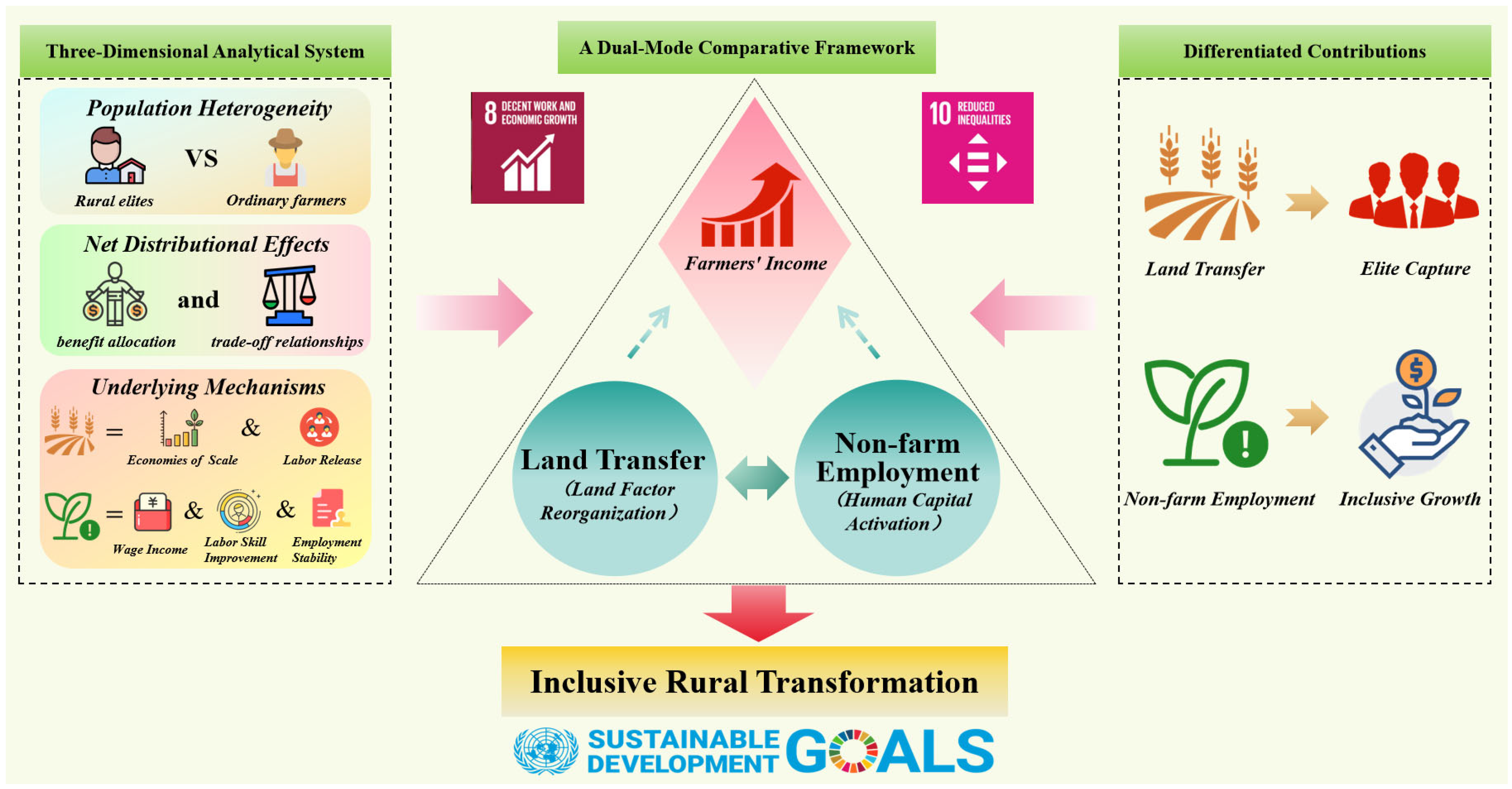
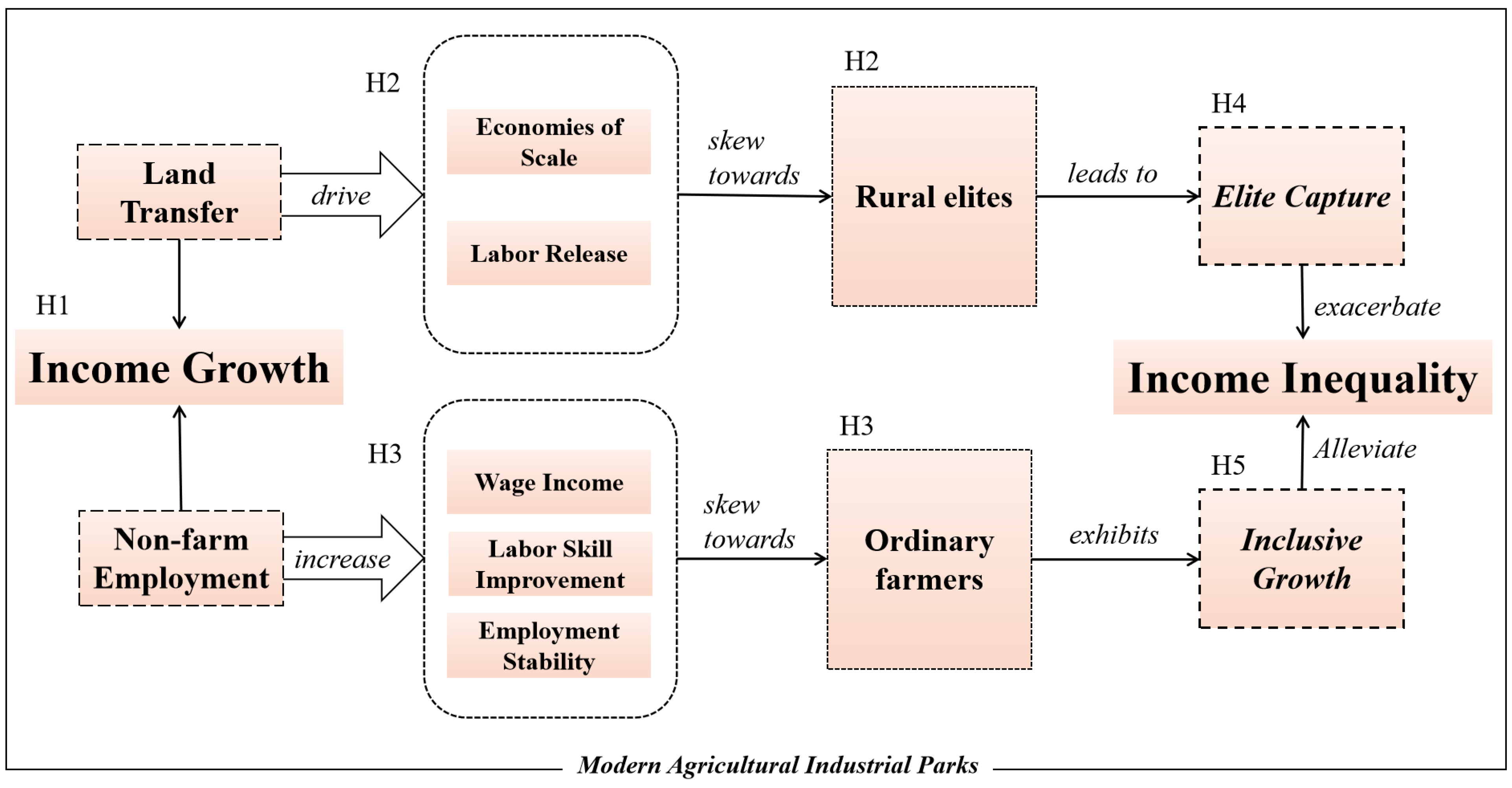
Departing from previous studies that examine a single engagement mode in isolation, this research develops a dual-mode comparative analytical framework (Figure 1).
Its potential marginal contributions are as follows: First, it highlights the interaction and contrasting distributional logics of Land Transfer and Non-farm Employment within a complex rural governance setting, providing a renewed perspective for assessing institutional inclusiveness. Second, drawing on the phenomena of “elite capture” and “inclusive growth,” the study constructs a three-dimensional analytical system encompassing “group heterogeneity, net distributional effects, and intrinsic mechanisms,” establishing a more refined analytical toolkit. Third, this framework aids in a deeper understanding of the trade-offs and distributional differences in benefits among households with different endowments under the two participation modes. It further sheds light on the politics of distribution during China’s rural transition, providing empirical evidence for achieving equitable and sustainable rural revitalization.

2. Theoretical Analysis and Research Hypotheses

2.1. Theoretical Analysis

2.1.1. Distinguishing Rural Elites from Ordinary Farmers

This study defines “rural elites” based on their typical characteristics in terms of resource control and community influence. If a farmer’s household has members serving as village officials, establishing or operating enterprises, or being large-scale farmers and breeders, any of these identities will classify the household as a rural elite. These three groups were selected mainly because they usually have significant advantages in political resources, economic capital, or production scale and are more likely to occupy advantageous positions in the allocation of resources such as Land Transfer. This simplified operation is necessary for empirical measurability, but this paper also acknowledges that other types of elites that exert influence through implicit resources such as social capital and information networks may play more covert roles in the allocation of park resources, providing an expansion direction for subsequent research. Households meeting none of these criteria are defined as “ordinary farmers.” Comparing benefits between these two groups clarifies the distributional bias.

2.1.2. Theoretical Distinction: “Elite Capture” Versus “Inclusive Growth”

Since the rural elite group may rely on their resource endowment advantages to gain an advantage in the park’s income distribution, thereby excluding the interests of ordinary farmers [41], this study’s core theoretical concern lies in distinguishing between two distribution logics. “Elite Capture” refers to the fact that rural elites, by virtue of their endowment advantages, occupy a dominant position in resource allocation and thereby consolidate or even expand the existing inequality [42]; “Inclusive Growth” emphasizes providing low-barrier participation opportunities to enable growth outcomes, especially income increments, to be more equitably distributed to disadvantaged groups [43]. For instance, large-scale farmers in the park rent out the land of ordinary farmers at low prices and then obtain scale operation benefits, which is a typical example of “Elite Capture”; while the park provides processing jobs without experience requirements for low-educated farmers and offers training and skills development, this reflects “Inclusive Growth”. These two concepts provide ideal types for describing the tendencies of distribution outcomes, but in reality, they may not be mutually exclusive but coexist or interweave in different fields.

2.1.3. Theoretical Framework Construction

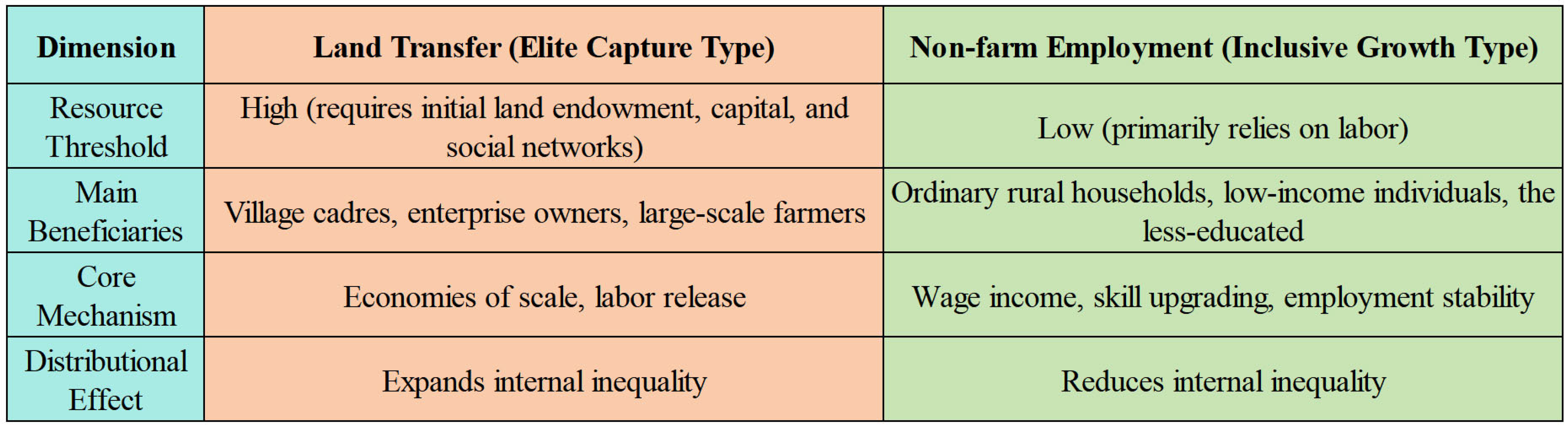
Based on these concepts, we build a comparative theoretical framework (Figure 2). Land Transfer requires initial land endowment, capital, and social networks. The entry barrier is high. Non-farm Employment mainly depends on personal labor. The barrier is low [44,45,46]. This determines the different primary beneficiary groups. Land Transfer benefits village cadres, enterprise owners, and large-scale farmers more. Non-farm Employment provides broader participation and income channels for ordinary farmers, low-income households, and less-educated groups [47]. Regarding core mechanisms, Land Transfer promotes income growth through agricultural economies of scale and labor release [48]. Non-farm Employment raises income directly through wages, skill accumulation, and stable Non-farm jobs [49]. However, their distributional effects may differ sharply. Land Transfer may worsen community inequality due to resource disparities, showing “elite capture” features [50,51]. Non-farm Employment helps narrow income gaps, demonstrating stronger “inclusive growth” attributes [52]. This framework delineates logical distinctions between the two path tendencies rather than definitive correspondences. Specific contexts and policies modulate their actual manifestation, and the two effects may coexist; this contrast provides the analytical foundation for subsequent empirical testing in this study.

2.2. Research Hypotheses

The construction of modern agricultural parks provides farmers with two ways to increase their income by reshaping the allocation of the two core elements of land and labor (Figure 3).
Land Transfer generates stable asset-based income for households through rental returns, equity dividends, and value-added benefits from scaled operations, while also releasing surplus labor to engage in other economic activities [53]. Non-farm Employment, on the other hand, directly raises total household income via wage compensation and facilitates sustained income growth through skill training and occupational advancement [54,55]. Both forms of participation effectively overcome the income limitations inherent in traditional smallholder farming, diversify income sources, and demonstrate robust and significant positive effects on raising household income. Accordingly, the following hypothesis is proposed:
Hypothesis 1.
Both Land Transfer and Non-farm Employment within modern agricultural parks can significantly boost farm household income.
While both Land Transfer and Non-farm Employment can contribute to farmers’ income growth, their underlying operational mechanisms may differ. Land Transfer directly activates a core rural production factor. Land Transferees can reduce unit production costs and more easily introduce modern inputs such as machinery and improved seeds by consolidating fragmented plots, thereby capturing returns to scale [56,57]. Land Transferors, on the other hand, are able to reallocate labor to sectors with higher productivity. Through the labor transfer effect, they gain wage income, leading to a structural increase in total household income [58]. Consequently, the distribution of benefits from Land Transfer may be asymmetric: gains from scale operations flow mainly to elite groups with capital advantages, whereas benefits from labor reallocation accrue more to ordinary farmers.
The income growth mechanism of Off-farm employment in agricultural parks focuses more on empowering the local labor market. It not only provides stable wage income that exceeds agricultural earnings but also enhances human capital through enterprise-based training. Moreover, by offering relatively standardized labor contracts, it helps reduce income volatility and strengthens the sustainability of income growth [59]. This pathway places lower demands on initial resource endowments and is thus more inclusive. Accordingly, the following hypotheses are proposed:
Hypothesis 2.
Land Transfer promotes income growth through economies of scale and labor release, primarily benefiting rural elites.
Hypothesis 3.
Off-farm employment promotes income growth by raising wage income, accumulating labor skills, and enhancing employment stability, with particularly empowering effects for ordinary farmers.
Furthermore, the distribution of benefits from the two pathways may exhibit heterogeneity. Resource endowment theory suggests that differences in households’ economic, social, and human capital affect their ability to capture opportunities [60]. Rural elites with higher resource endowments (e.g., village cadres, large-scale farmers), leveraging advantages in capital and information, tend to dominate Land Transfers. They obtain excess profits through scale operations and value-chain extension, creating a “rich-get-richer” cycle [61]. Ordinary smallholders often passively transfer out their land, receiving only fixed rents and struggling to share in the value-added gains [62,63]. This results in a progressive income effect from Land Transfer, which may exacerbate income inequality and reflect a tendency toward “elite capture” [64,65,66].
The income growth mechanism of Non-farm Employment is more inclusive. The theory of inclusive growth emphasizes that the benefits of growth should particularly reach disadvantaged and ordinary groups [67,68]. Off-farm jobs in agricultural parks (e.g., in processing, logistics, or services) require lower initial physical capital and rely more on labor and skills, thereby providing a relatively equitable channel for income growth for low-resource-endowment households [69]. This not only directly delivers wage income higher than farming but also enhances long-term capabilities through skill training [70]. The marginal income effect is especially pronounced for low-income, small-scale, and less-educated farmers, helping mitigate distributional imbalances caused by resource disparities. Accordingly, the following hypotheses are proposed:
Hypothesis 4.
Land Transfer exhibits a tendency toward “elite capture”, which has a stronger effect on high-income and large-crop farmers with better resource endowments or may exacerbate income inequality.
Hypothesis 5.
Non-farm Employment has the characteristic of “inclusive growth”, which has a more significant effect on low-income, small-crop, and low-education farmers and can alleviate income inequality.

3. Study Area and Data Sources

3.1. Study Area

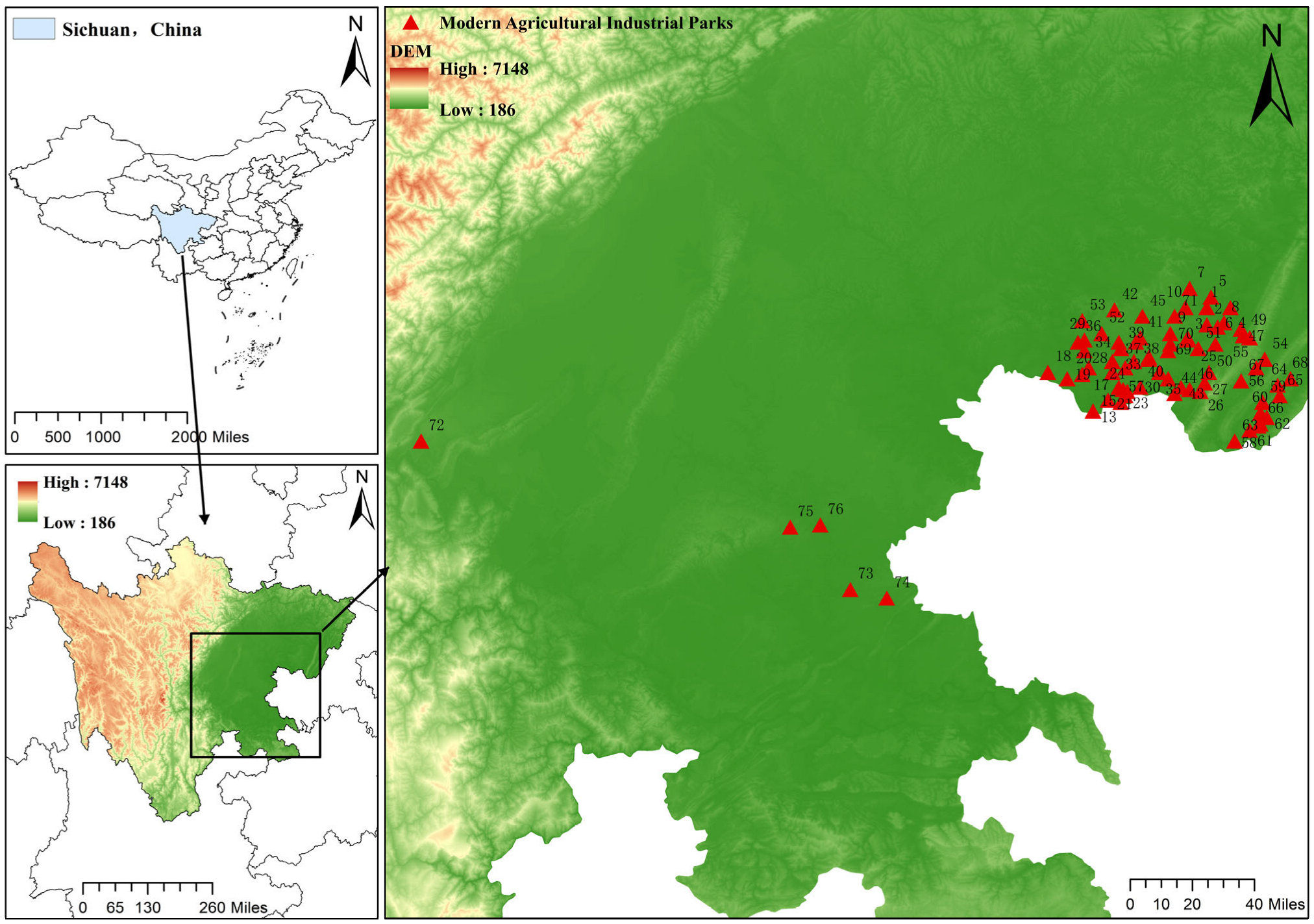
As illustrated in Figure 4, this study selected Sichuan Province, China as an exploratory case study. The selection of this study area was based on three primary considerations. First, as a major agricultural province in western China and a key grain-producing region nationwide, Sichuan is regionally representative in terms of farmer income increase and rural revitalization [71]. Second, boasting a leading number of agricultural parks across the country, Sichuan has intensive practices of Land Transfer and Non-farm Employment, which facilitates the simultaneous observation of elite capture risks and actual effects of inclusive growth [72]. Third, the province features diverse landforms including plains, hills, mountains and plateaus, with remarkable differences in agricultural development conditions, thus bearing typical research value [73].

3.2. Data Sources

The data were obtained from field surveys conducted at representative agricultural parks in Sichuan Province from 1 March 2024 to 31 March 2025. The study employed a purposeful sampling strategy based on terrain heterogeneity, with sampling density aligned with the actual weight and theoretical significance of each terrain type in small-scale farming. To ensure balance, randomly selected farming households were surveyed within each park. Specifically, 71 parks in the hilly areas of eastern Sichuan were selected for saturated surveys as the main sample, where smallholders are the densest and agricultural models the most complex, to fully present the mechanism spectrum of Land Transfer and Non-farm Employment. One park in the alpine and canyon areas of western Sichuan was chosen as an extreme terrain test site to verify the external validity of the main case conclusions in high-altitude environments. Four parks in the plain areas of southern Sichuan were included as a scale operation control group to test the robustness of Non-farm Employment effects in highly commercialized agricultural areas. Simultaneously, regional fixed effects are employed to control for regional heterogeneity, balancing sampling efficiency with scientific rigor. Data collection combines structured questionnaires with semi-structured interviews; the questionnaires cover modules such as household income and expenditure, land-management practices, and employment participation, while interviews verify key information to ensure data authenticity. The sampling process strictly adheres to terrain weighting principles to guarantee sample representativeness. In total, the study covered 76 parks at four administrative levels (county, municipal, provincial and national). At least 15 farmer households were randomly selected from each park for a questionnaire survey, resulting in 963 valid farmer samples with an effective response rate of 84.47%. Among these samples, 68.63% and 44.86% of the farmers participated in Land Transfer and Non-farm Employment, respectively.

4. Research Methodology and Variable Selection

4.1. Research Methodology

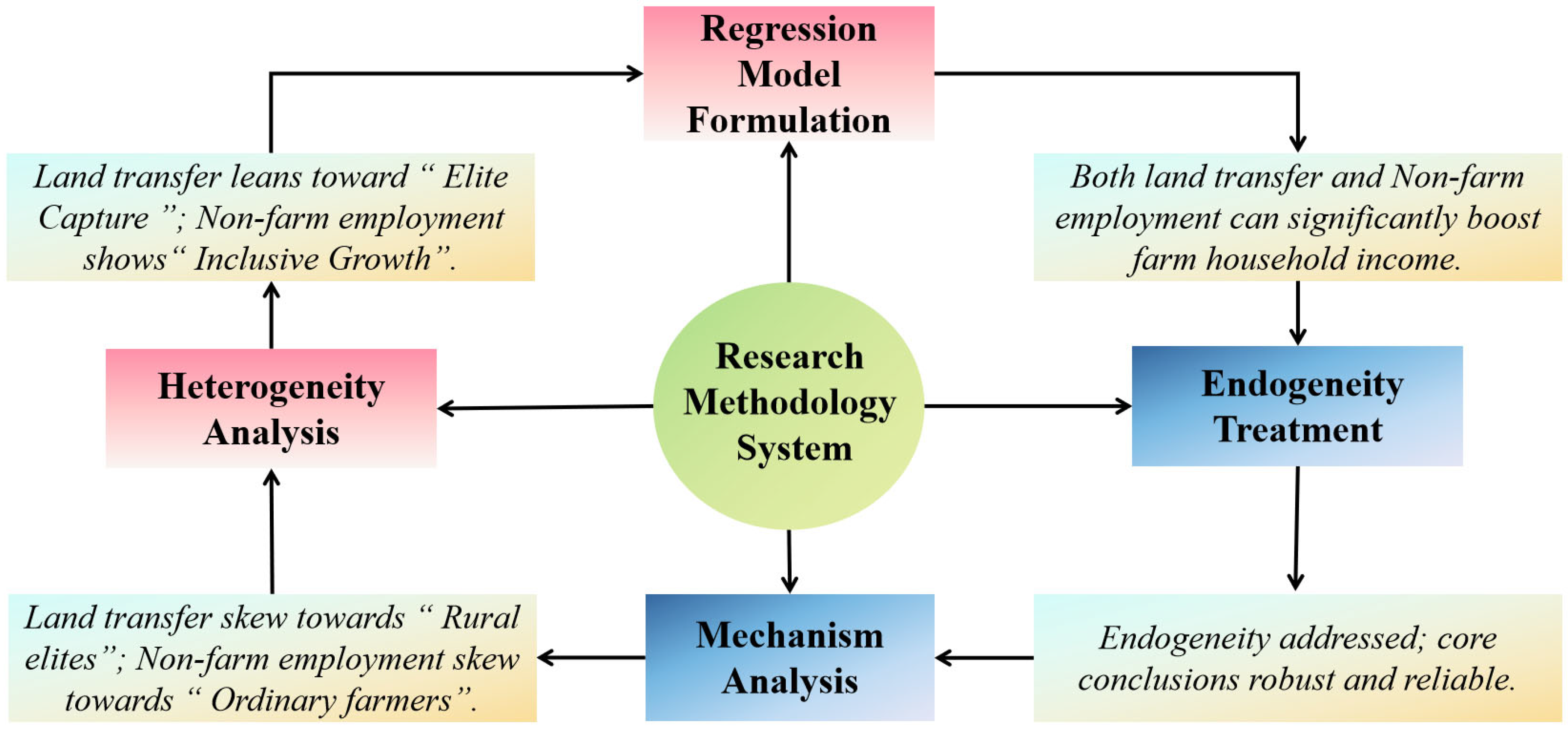
This study develops a comprehensive methodological framework to systematically assess the impact of Land Transfer and Non-farm Employment on farmers’ net income (Figure 5).
First, a binary regression model was constructed to confirm that both Land Transfer and Non-farm Employment significantly promote rural income growth. Second, potential endogeneity issues were addressed to ensure the robustness of the core findings. Subsequently, the analysis examined the dual mechanisms of Land Transfer and the heterogeneous effects of three Non-farm Employment pathways on farmers with different resource endowments. Finally, heterogeneity analysis reveals that Land Transfer exhibits a tendency toward “elite capture,” while Non-farm Employment demonstrates characteristics of “inclusive growth.” This multi-angle, step-by-step approach provides solid methodological support for understanding income growth paths and distributional differences.

4.2. Model Construction

4.2.1. Binary Regression Model Construction

To examine the impacts of Land Transfer and Non-farm Employment on the income growth of farm households within parks, a binary regression model is constructed as follows [74]:
Yir = α0 + α1LTir + α2NEir + α3Zir + δr + εir
where Yir denotes the net income growth of household i in region r, serving as the dependent variable; the core explanatory variables LTir and NEir are binary dummy variables, coded as 1 if the household participates in Land Transfer or Non-farm Employment respectively, and 0 otherwise; α1 and α2 represent the estimated coefficients of the core explanatory variables, while α3 is the coefficient vector of control variables; Zir denotes the control variables; δr stands for the regional fixed effects; and εir is the random error term.

4.2.2. Mediating Effect Model

To explore the impact mechanisms of Land Transfer and Non-farm Employment on the income growth of farm households, the specific model is designed as follows [75]:
Mkir = β0 + β1Xir + β2Zir + δr + μkir
where Mkir denotes the mediating variable, with 2 mediating variables corresponding to Land Transfer and 3 to Non-farm Employment, and k represents the serial number of the mediating variable; Xir is the core explanatory variable, i.e., Land Transfer (LTir) or Non-farm Employment (NEir); β1 is the estimated coefficient of the core explanatory variable on the mediating variable, and β2 is the coefficient vector of control variables; the definitions of other variables are consistent with those in Equation (1); and μkir is the random error term.

4.3. Variable Selection

4.3.1. Dependent Variable

Income growth. This was obtained through a questionnaire survey, covering all income sources such as household operating income, wage income, property income and transfer income. The total household income before and after the farmers’ participation in the park was separately calculated. Then, referring to existing studies [76], the extent of income growth achieved by farmers through participating in the modern agricultural park was selected as the explained variable. This indicator directly captures the net economic gain from park involvement and is used to assess the scale of impact that contributing land or labor has on household income. To prevent interference from the initial income level, the growth rate, binary variables, and quantile regression were also added subsequently.

4.3.2. Explanatory Variables

Based on field survey data and combined with the actual process of agricultural production and operation, two modes of household participation in modern agricultural parks were incorporated into the benchmark regression model. Land Transfer is defined as 1 if a farmer engaged in Land Transfer-in or out of the park and 0 otherwise. Non-farm Employment, defined as 1 if a farmer gained wage employment within a park enterprise and 0 otherwise.

4.3.3. Mechanism Variables

To test the transmission mechanisms in Hypotheses 2 and 3, we specify the following mediator variables. For Land Transfer, we draw on Xu et al. [77] and measure economies of scale by “actual operating area after Land Transfer-in.” Following Huang et al. [78] we measure labor release by “proportion of Non-farm or part-time income.” For Non-farm Employment, drawing on Su et al. [79], Nakano et al. [80], and Bhattacharya et al. [81], we measure skill upgrading by “Proportion of farmers in the park who receive skill training,” wage income improvement by “proportion of wage income,” and employment stability by “proportion of formal workers in park enterprises.”

4.3.4. Control Variables

In addition to the two park participation modes, other variables also influence farmers’ income growth. Based on questionnaire design and prior studies [82,83], this study selects control variables across three dimensions (Table 1): farmer characteristics (age, gender, political affiliation, health status, and education level); household characteristics (family size, social capital, labor ratio, and farmland area); and park characteristics (park level, planned area, number of villages, output value, number of enterprises, support policies, and dominant industries). To control for potential biases from regional socioeconomic conditions, regional fixed effects are included in the model.

5. Empirical Results

5.1. Binary Regression Results

5.1.1. Binary Regression and Robustness Tests

This study examines the income growth effects of two primary pathways for farmer participation in the park, based on a binary regression analysis of 963 farm household samples. As presented in columns 1 and 2 of Table 2, both Land Transfer and Non-farm Employment show a statistically significant positive impact on farm household income growth at the 1% level, regardless of whether control variables are included. This provides preliminary evidence for the effectiveness of these two models in raising incomes. To verify the robustness of the findings, this paper conducts robustness checks using three alternative approaches (columns 3–7): first, re-estimating the regression by re-measuring the dependent variable as the income growth rate of the sample households (column 3); second, re-specifying the dependent variable as a binary indicator of whether a household achieved income growth (1 = yes, 0 = no) and re-estimating the model (column 4); third, performing quantile regression analyses at the 25th, 50th, and 75th percentiles, corresponding to low, medium, and high levels of income growth, respectively (columns 5–7). The results from these robustness checks are consistent with the conclusions from the main regression analysis, thereby validating Hypothesis 1.

5.1.2. Income Effects Comparison and Distributional Differences

Farm households participating in park-based Non-farm Employment gained about 10,000 RMB on average. This exceeds the 7400 RMB for Land Transfer households. This gap likely stems from different mechanisms and beneficiary structures. Non-farm Employment mainly provides stable wage income. It has low barriers and wide coverage. It particularly boosts income for middle- and low-income groups. Land Transfer income shows sharp polarization. Most farmers only receive fixed rents. High returns concentrate among a few who can integrate resources and expand operations. Thus the overall mean is lower.
Quantile regression further confirms this. The income effect of Land Transfer strengthens steadily as quantiles rise. This shows high-income farmers gain excess returns from Land Transfer-in. Low-income farmers hardly share value-added benefits. The income effect of Non-farm Employment peaks at the 50th quantile. This indicates that middle-segment farmers effectively convert employment opportunities. It remains significant at low quantiles, providing stable income growth for low-income earners. At high quantiles, its marginal effect is limited due to diversified income sources. This creates a more inclusive income growth path.
In summary, Non-farm Employment raises average income gains through universal benefits. Land Transfer intensifies internal differentiation among farmers due to heavy reliance on capital and scale. This difference essentially reflects how the two modes depend differently on farmers’ initial endowments. It also suggests they may have opposite effects on rural income distribution. Therefore, further analysis from a heterogeneity perspective is needed. We should explore income mechanisms and distributional effects of the two modes across different groups.

5.2. Endogeneity Treatment

5.2.1. Instrumental Variable Test

  • IV Selection and Justification for Land Transfer
To address endogeneity concerns arising from omitted variables, reverse causality, and measurement bias, this study employs an instrumental variable (IV) approach to estimate the effects of two significant models (Table 3).
For Land Transfer, drawing on existing research [84,85], we select the average altitude of the township where the park is located and whether the park has Land Transfer support policies as instruments. Altitude is relevant because high-altitude areas in Sichuan are mostly mountains and plateaus with scattered plots and difficult cultivation, making farmers more willing to transfer land, while low-altitude plains and hilly areas have the opposite situation (Column 1). Supportive policies such as subsidies and standardized contracts significantly reduce transfer costs and enhance farmers’ willingness to engage in Land Transfer (Column 2). In terms of exogeneity, altitude, as a natural geographical endowment, is not influenced by farmers’ income or operational decisions, nor does it directly affect income levels. Farmland Transfer policies are formulated by the government based on regional development planning aimed at optimizing agricultural layout rather than targeting individual household income, thus satisfying the exclusion restriction.
2.
IV Selection and Justification for Non-farm Employment
For Non-farm Employment, with reference to existing studies [86], the distance from the park to the city center and whether the park implements employment support policies are selected as instrumental variables. The spatial distance between parks and city centers significantly influences farmers’ employment choices. While nearby parks attract farmers to urban jobs due to the urban pull effect, distant parks, limited by high commuting costs and unfamiliar environments, cause farmers to prioritize local park employment (Column 4). Employment support policies in parks (e.g., labor subsidies, vocational training, and entrepreneurship incentives) directly stimulate enterprises to expand employment scale and improve job supply, thereby significantly enhancing parks’ capacity to absorb employment (Column 5). The relative position between the park and the city center is an objective geographical attribute, not affected by farmers’ employment decisions or income levels. Employment support policies are formulated by the government based on regional economic plans, focusing on macroeconomic industrial layout and employment growth, not directly intervening in farmers’ income, thus meeting the exogeneity requirement. Therefore, both variables satisfy the relevance and exogeneity conditions required for valid instruments.
3.
IV Tests and Second-Stage Regression Results
Endogeneity tests show the following results: the Kleibergen-Paap rk LM statistic rejects the null hypothesis of underidentification at the 1% significance level (p < 0.01). The Kleibergen-Paap rk Wald F statistic exceeds the 10% critical value of the Stock-Yogo weak identification test, indicating that the instruments are not weak. The Hansen J statistic yields p > 0.1, supporting the exogeneity of the instruments. Additionally, the endogeneity test of the endogenous regressors returns p < 0.01, confirming the necessity of the IV approach. The results of the second stage regression (columns 3 and 6) indicate that both participation methods in the two parks have contributed to the increase in farmers’ income, thereby further verifying Hypothesis 1.

5.2.2. Propensity Score Matching Test

  • PSM Design and Tests
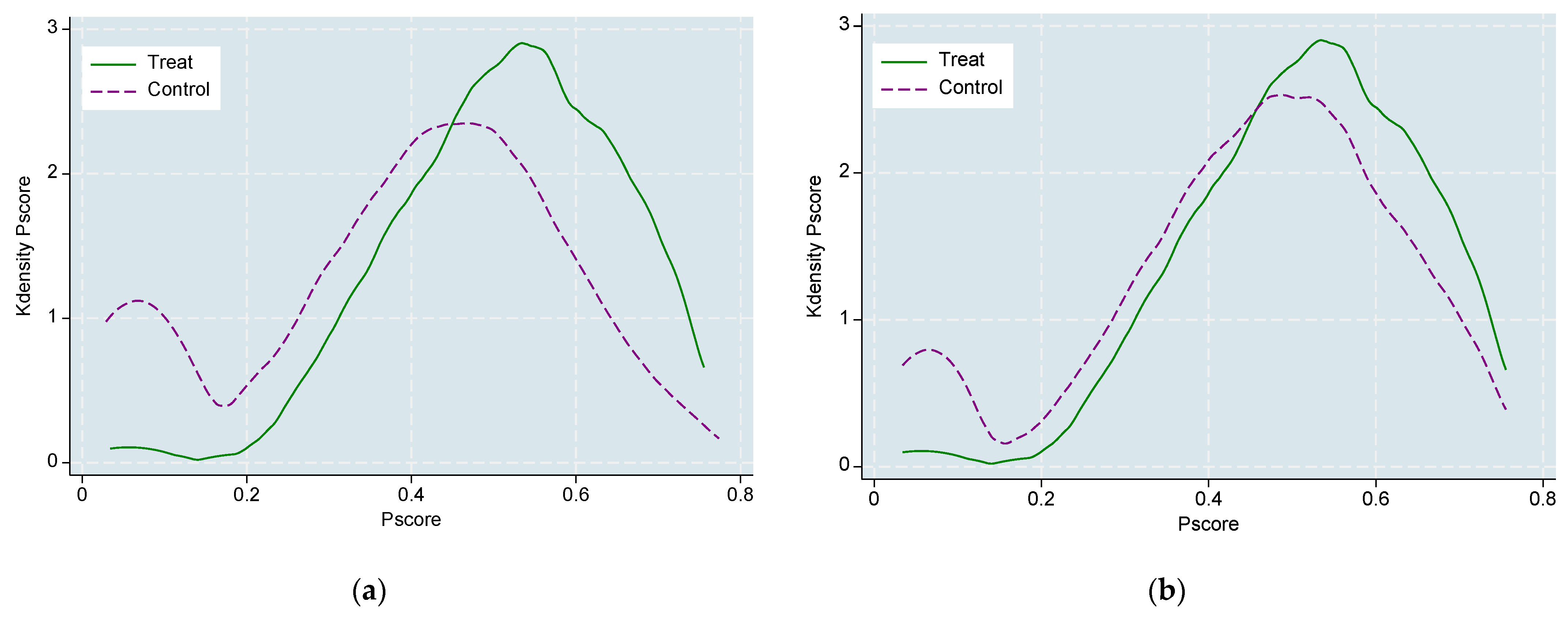
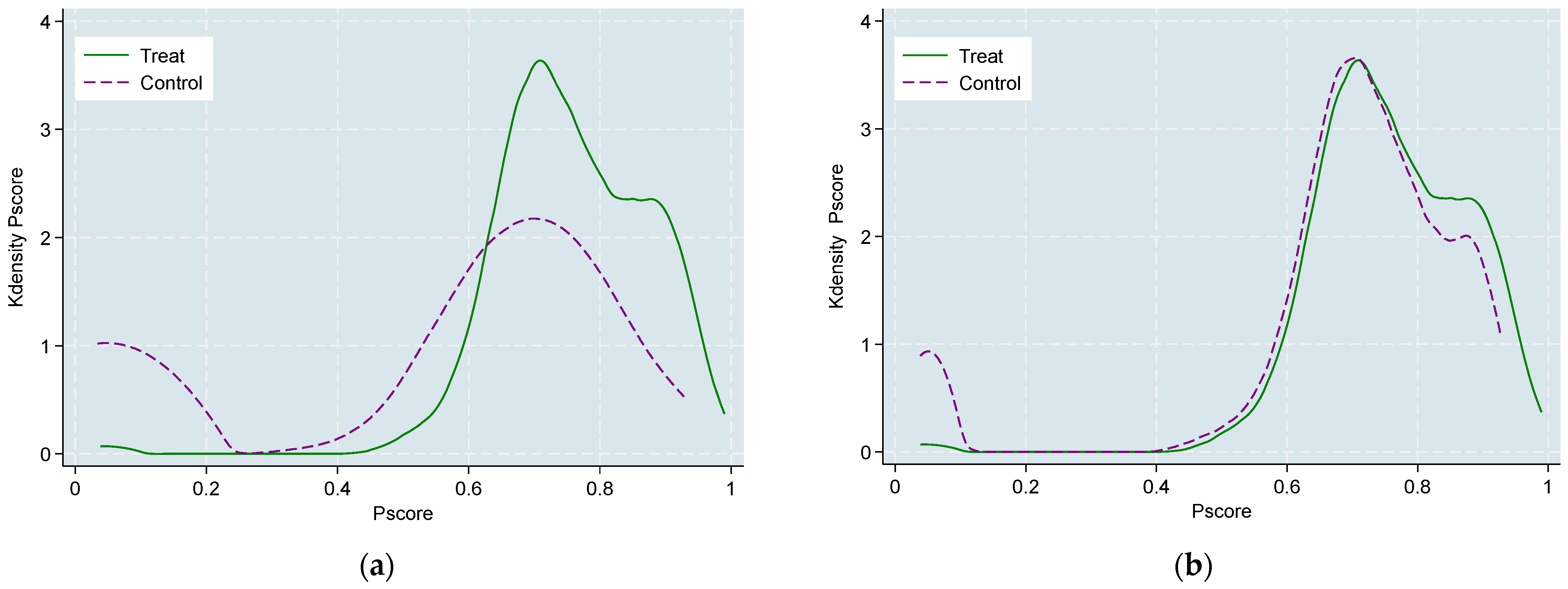
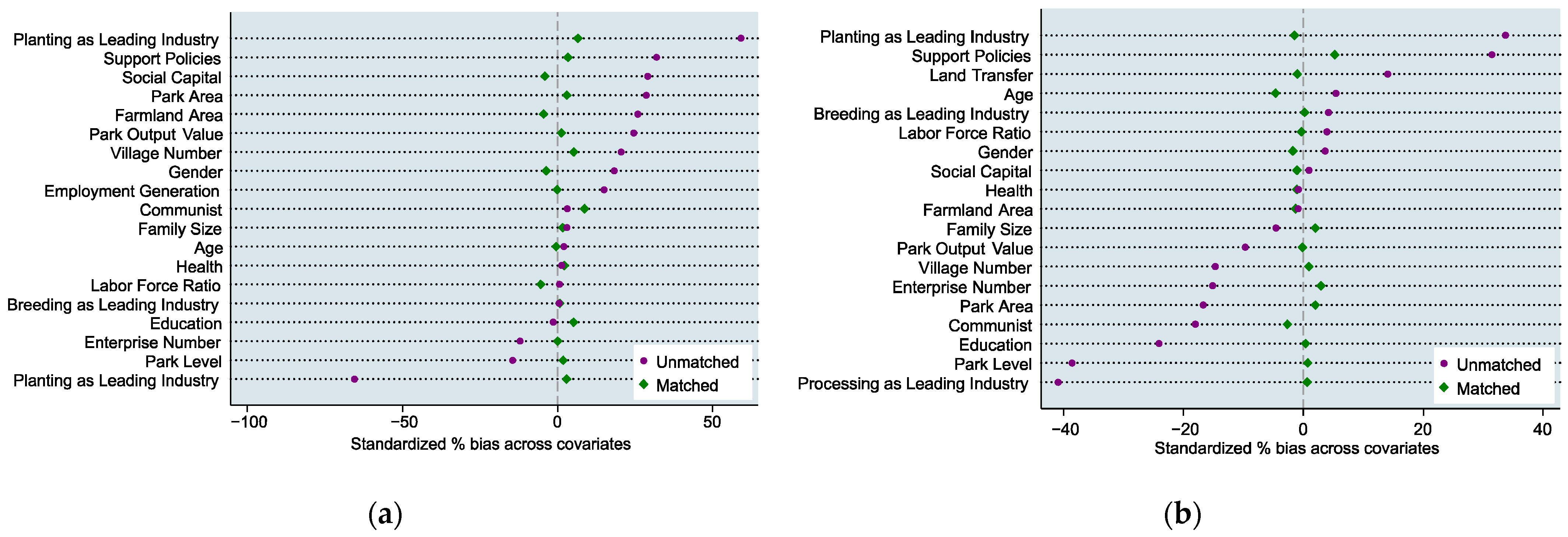
To mitigate sample selection bias, this study further adopts the Propensity Score Matching (PSM) method, designating farm households participating in Land Transfer or Non-farm Employment as the treatment group and non-participants as the control group. The matching variables include all regression control variables and county-level dummy variables. We first perform kernel matching for the two participation modes, followed by the common support test and balancing test. For the common support test, the kernel density plots in Figure 6 and Figure 7 show a higher degree of overlap in the kernel density curves after matching, which satisfies the common support assumption and attests to the reliability of the matching results. In terms of the balancing test, the standardized bias plot in Figure 8 reveals that the standardized bias of nearly all variables is reduced post-matching, verifying the validity of the matching and confirming that the balancing test is passed.
2.
Matching Results and Robustness Verification
To enhance result robustness, we conduct nearest-neighbor matching and radius matching again. After matching, the Land Transfer sample sizes are 334, 899, and 908 under nearest-neighbor, radius, and kernel matching respectively. The Non-farm Employment sample sizes are 454, 903, and 957 under the three methods. We input the successfully matched samples into the benchmark regression model (Table 4). Results show that both modes positively affect park farmers’ income at the 1% significance level across all three matching methods. Endogeneity test results are basically consistent with benchmark regressions. This verifies Hypothesis 1.

5.3. Mechanism Analysis

5.3.1. Mechanism Analysis of Land Transfer

  • Mechanism Tests: Economies of Scale and Labor Release Paths
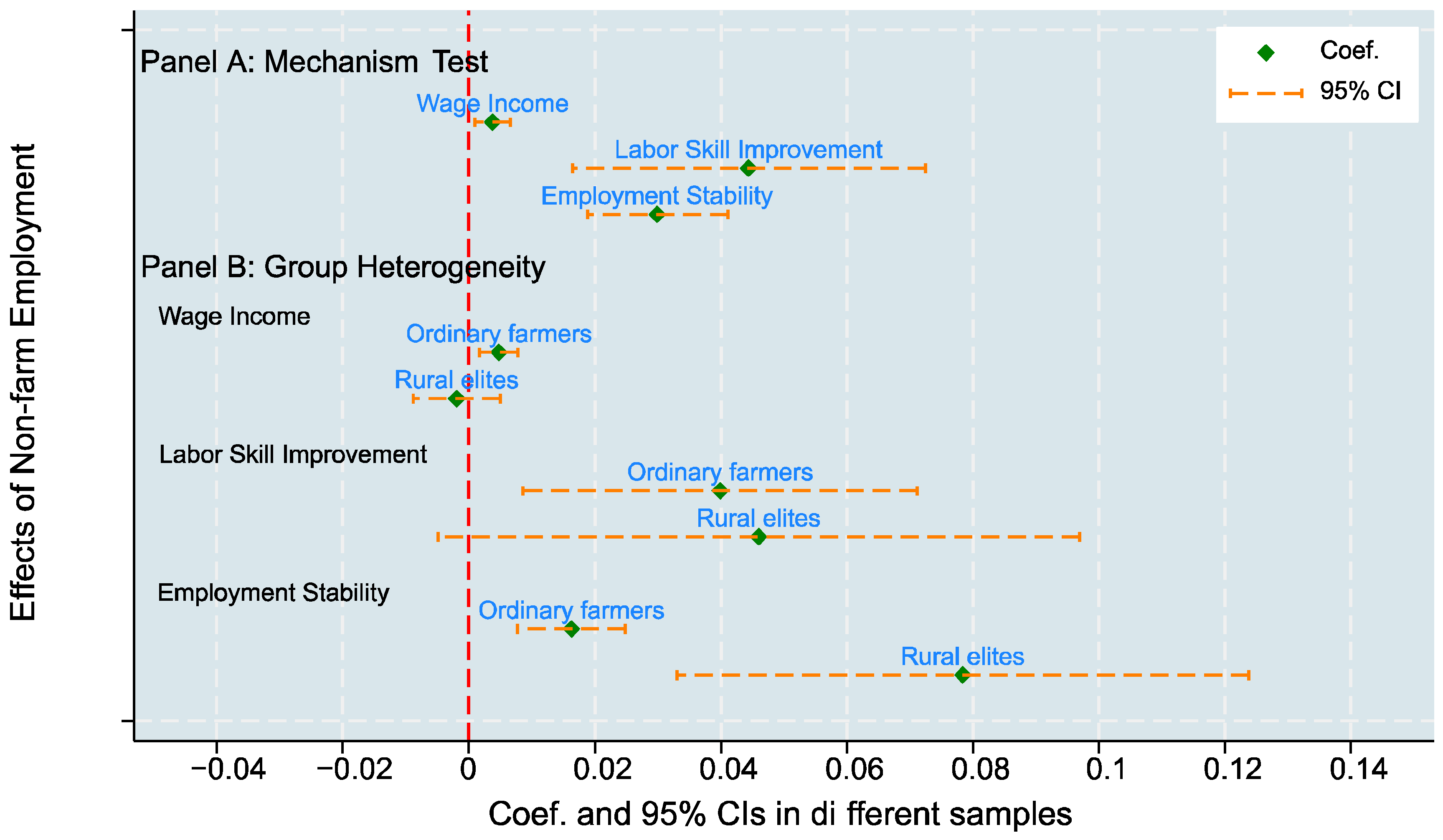
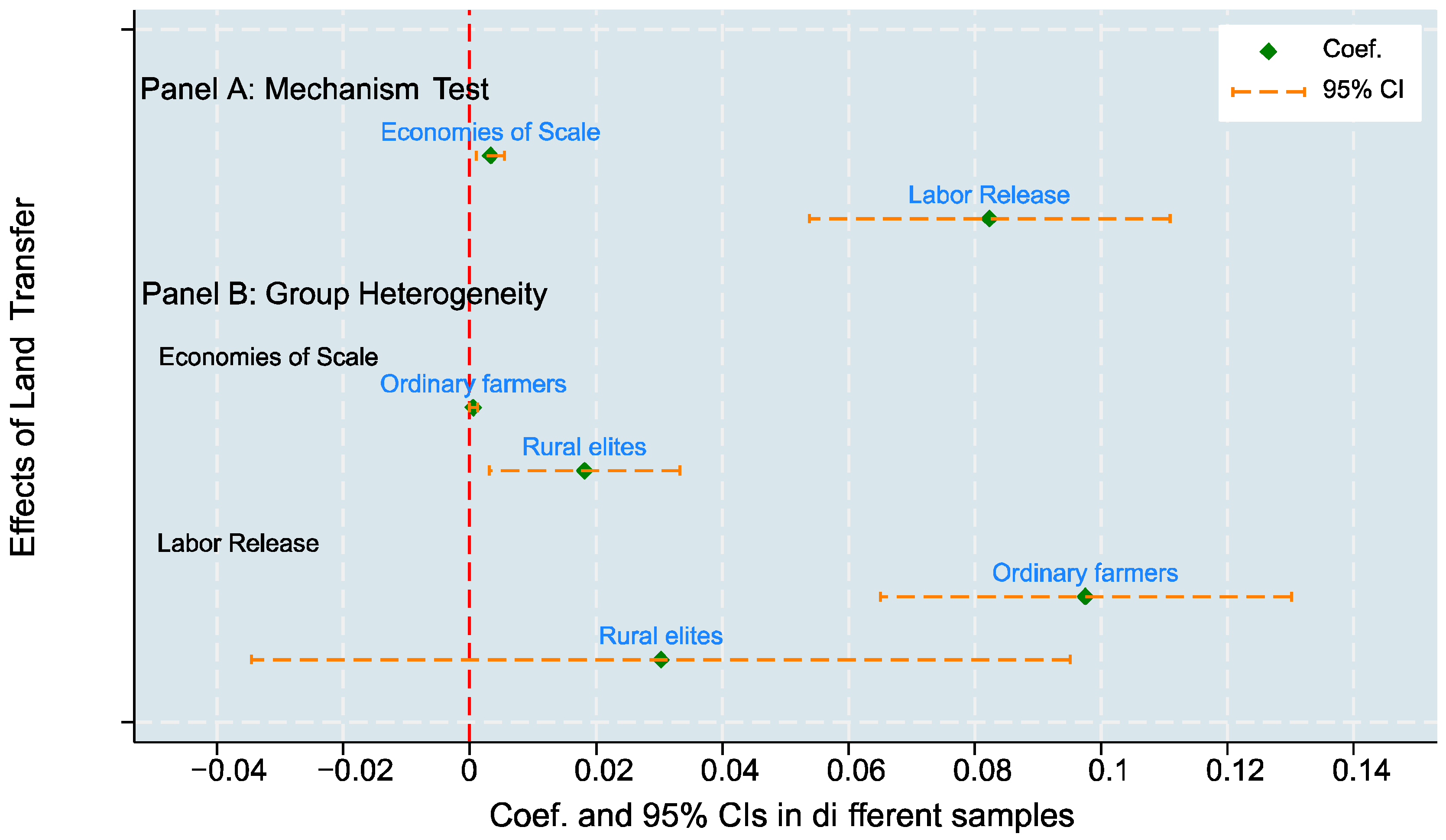
Based on Hypothesis 2, Land Transfer affects farm income through economies of scale and labor release. According to the “Panel A: Mechanism Test” in Figure 9 (detailed results in Appendix A, Table A3), the 95% confidence intervals for both “Economies of Scale” and “Labor Release” exclude zero and lie entirely to the right of zero. This indicates that both mechanisms are statistically significant. The results confirm the theoretical hypothesis. Land Transfer boosts production efficiency by integrating land resources and expanding the operation scale. It also frees farmers from land constraints, allowing them to shift to Non-farm Employment or more efficient activities. This generates dual positive effects.
2.
Group Heterogeneity: Elite Dominance and Ordinary Farmer Constraints
We further analyze group heterogeneity under these two mechanisms. As illustrated in the “Panel B: Economies of Scale” of Figure 9, ordinary farmers’ confidence interval crosses zero, showing no significant effect. Rural elites’ 95% confidence interval excludes zero, showing a significantly positive effect. This indicates that scale economies only significantly benefit rural elites. These groups possess sufficient capital, technology, and market resources. They can integrate land more efficiently to achieve scale-based value addition. Ordinary farmers struggle to gain from this path.
In “Panel B: Labor Release”, ordinary farmers’ 95% confidence interval excludes zero, showing a significantly positive effect. Rural elites’ confidence interval crosses zero, showing no significant effect. This means ordinary farmers mainly rely on Land Transfer-out to release family labor and obtain Off-farm income. Rural elites have diversified income structures. Their labor is not highly bound to land. Thus Land Transfer has weak marginal effects on labor release for them. Hypothesis 2 is verified. They also imply that future policies should emphasize the inclusiveness of Land Transfer and adopt differentiated measures to promote more balanced income distribution.

5.3.2. Mechanism Analysis of Non-Farm Employment

  • Mechanism Tests: Triple Optimization of Wages, Skills, and Stability
Consistent with Hypothesis 3, Non-farm Employment optimizes farm income structure and employment quality through three mechanisms: wage income growth, labor skill accumulation, and employment stability enhancement. In Figure 10 (detailed results in Appendix A, Table A4), the “Panel A: Mechanism Test” shows that the effect coefficients for “Wage Income,” “Labor Skill Improvement,” and “Employment Stability” all lie to the right of zero. Their 95% confidence intervals all exclude zero. This indicates all three mechanisms are statistically significant. Non-farm Employment clearly promotes all three aspects. The results confirm that Non-farm Employment comprehensively optimizes farmers’ income structure and employment quality by improving income composition, accumulating human capital, and reducing employment risks.
2.
Group Heterogeneity: Universal Benefits for Ordinary Farmers and Limited Marginal Gains for Elites
We further analyze group heterogeneity under these three mechanisms. As shown in Figure 10, in the “Panel B: Wage Income, Labor Skill Improvement”, ordinary farmers’ 95% confidence intervals exclude zero, showing significantly positive effects. Rural elites’ confidence intervals cover zero, showing no significant effects. This indicates that wage growth and skill enhancement from Non-farm Employment only significantly benefit ordinary farmers. These groups have weaker initial income and skill bases. They can quickly improve core income capacity and market skills through Non-farm Employment. Rural elites have solid skill foundations and diversified income sources. The marginal returns from this path are limited for them.
In “Panel B: Employment Stability”, both groups’ 95% confidence intervals exclude zero, showing significantly positive effects. However, the elite group benefits more significantly from employment opportunities. This disparity suggests potential stratification within the Non-farm Employment sector. Leveraging their educational advantages and social capital, elites are more likely to secure long-term, stable positions such as managerial or technical roles, whereas ordinary farmers predominantly occupy seasonal or temporary jobs. Although these positions offer greater income stability compared to farming, they still expose workers to higher employment volatility risks. This finding indicates that the ‘inclusiveness’ of Non-farm Employment primarily manifests in the broad accessibility of job opportunities rather than in equal employment quality. Policy design should focus on optimizing job structures to prevent Non-farm employment positions from becoming new arenas for elite capture. Yet ordinary farmers still significantly gain employment protection. This reflects the basic universal nature of this path. Overall, although all three transmission mechanisms of Non-farm Employment are significant overall, their effects are more pronounced for ordinary farmers. Hypothesis 2 is verified.
This provides empirical evidence for improving park employment policies and promoting inclusive growth. Future policies can continue strengthening wage growth and skills training support for ordinary farmers. Meanwhile, employment stability should be guaranteed for all farmer types. This will advance inclusive rural transformation.

5.4. Heterogeneity Analysis

5.4.1. Framework and Grouping Design

Based on earlier hypotheses and mechanism tests, we systematically examine elite capture effects in Land Transfer and inclusive features of Non-farm Employment. Besides classifying farmers into ordinary and elite groups, we build a heterogeneity identification system using three dimensions of resource endowment: economic capital, physical capital, and human capital (Table 5).
First, we divide the sample into low-, middle-, and high-income groups by initial household income. This captures participation ability differences under varying wealth accumulation. Second, we split farmers into high and low groups by median farmland area. This reflects divergence in land element control rights. Finally, we divide groups by education level using high school as the cutoff. This identifies stratification in information access and skill accumulation [87]. This grouping design operationalizes farmer resource endowment differences into observable group characteristics. It provides clear analytical boundaries for revealing “elite bias” versus “universal benefits” distribution logics under the two modes.

5.4.2. Heterogeneity Results

  • Multi-dimensional Heterogeneity
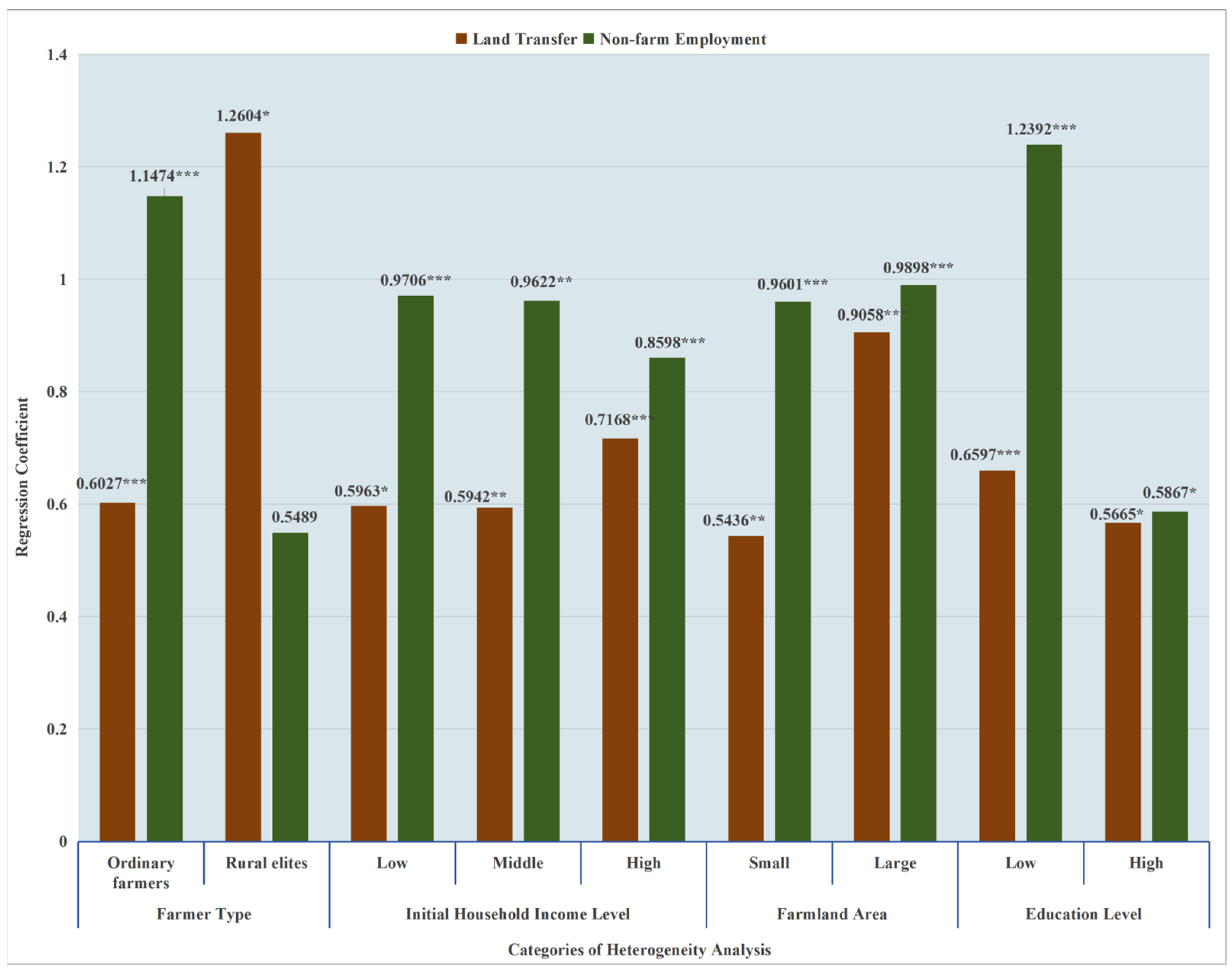
Heterogeneity results are shown in Figure 11. By farmer identity, the income growth coefficient for Land Transfer is much higher for rural elites (1.2604*) than ordinary farmers (0.6027***). Non-farm Employment only shows strong significant income effects for ordinary farmers (1.1474***). It has no significant effect on rural elites. This directly confirms that Land Transfer benefits skew toward elites with better resource endowments. It shows “elite capture” characteristics. Non-farm Employment precisely covers ordinary farmers. This matches the core logic of inclusive growth.
By initial household income, the Land Transfer income coefficient expands as income level rises (low-income group 0.5963* → high-income group 0.7168***). This shows high-income groups (close to elites) gain more from Land Transfer. The Non-farm Employment coefficient narrows as income rises (low-income group 0.9706*** → high-income group 0.8598***). This means low-income farmers are the main beneficiaries of Non-farm Employment. It further strengthens the pro-poor nature of Non-farm Employment.
By farmland area, Land Transfer income effects are significantly higher for large-area farmers (0.9058***) than for small-area farmers (0.5436**). Large-area farmers can better achieve scaled operations through Land Transfer. This is essentially a benefit concentration among resource-advantaged groups (elite-like). Non-farm Employment significantly boosts income for both small- and large-area farmers. The coefficient gap is small. This shows ordinary farmers with small land areas can also stably benefit from Non-farm Employment.
By education level, the Non-farm Employment coefficient is much higher for low-education farmers (1.2392***) than high-education groups (0.5867*). This shows ordinary farmers with low education rely more on Non-farm Employment to raise income. In Land Transfer, the higher coefficient for low-education farmers may stem from their lower income base. They depend on passive Transfer-out for short-term rents. This seems to show significant income growth. High-education elites have lower coefficients but gain high added value through management rights control. This reinforces elite capture through resource control.
2.
Divergent Distribution Effects
These multi-dimensional heterogeneity results jointly show that Land Transfer benefits continuously concentrate among high-income, large-farmland, high-resource elites. This is essentially “elite capture” under “management rights consolidation.” High-income farmers gain higher value-added returns from Land Transfer through stronger resource integration capacity. Large-farmland farmers further amplify the benefits through scaled operations. High-education elites gain high added value on the value chain through land-management rights control. Ordinary farmers often can only passively transfer out of land and obtain short-term rents. They are marginalized not only in economic returns but also lose long-term opportunities for independent development based on land. This verifies Hypothesis 4.
In sharp contrast, Non-farm Employment precisely covers low-income, small-farmland, low-education ordinary farmers. It shows clear “inclusive growth” characteristics. Low-income groups obtain the most prominent income growth effects through Non-farm Employment. Small-farmland farmers can stably benefit without relying on land scale. Low-education farmers can break skill bottlenecks and raise income levels through Non-farm Employment. This effect exactly compensates for the elite bias of Land Transfer. It provides ordinary farmers an income growth path bypassing resource endowment constraints. This verifies Hypothesis 5. This also signals potential fairness risks in modern agricultural parks. Without policy intervention, the elite bias of Land Transfer will solidify urban-rural value chain polarization. Measures such as strengthening ordinary farmers’ bargaining power and promoting benefit sharing are needed to achieve inclusive income growth.

5.4.3. Quantitative Validation of Income Inequality Indicators

To further confirm the different effects of Land Transfer and Non-farm Employment on income inequality, we follow existing studies [88,89]. We use household per capita income as the baseline. We calculate changes in the Gini coefficient and Theil index before and after participation. Results are shown in Table 6. For farmers only participating in Land Transfer, both indicators rise significantly. The Gini coefficient increases by 15.97%. The Theil index increases by 37.37%. This shows Land Transfer intensifies income differentiation. For farmers only participating in Non-farm Employment, both indicators drop significantly. The Gini coefficient decreases by 19.77%. The Theil index decreases by 37.25%. Income gaps narrow markedly. For farmers participating in neither activity, income gaps continue expanding. For farmers participating in both activities, income distribution remains relatively stable. These clear quantitative changes directly confirm the essential distributional differences between Land Transfer and Non-farm Employment. They further verify Hypotheses 4 and 5. They provide strong evidence for understanding distribution issues in agricultural transformation.

6. Discussion

6.1. Research Framework Innovation and Core Marginal Contributions

This study builds a comprehensive dual-mode comparative framework. It innovatively introduces “elite capture” and “inclusive growth” into the evaluation of distributional effects in modern agricultural parks. This represents a breakthrough in inclusive rural transformation research. Our method offers three advantages over existing literature [90,91,92]. First, it moves beyond the isolated examination of single farmer-linkage modes. It systematically reveals the mechanism differences between the two income growth paths. Second, through multi-dimensional heterogeneity analysis, it first quantitatively verifies the progressive distribution characteristics of Land Transfer and the inclusive poverty reduction effects of Non-farm Employment. Third, it discovers a fundamental tension between land factor marketization and labor factor empowerment. Land Transfer benefits skew toward rural elites and easily intensify rural class differentiation [93,94,95]. Non-farm Employment benefits more ordinary farmers and helps to narrow the income gap [96,97]. This finding provides new analytical perspectives for constructing equitable and sustainable agricultural systems. It has important academic value and theoretical significance.

6.2. Potential Interaction Between Land Transfer and Non-Farm Employment

This study treats Land Transfer and Non-farm Employment as independent income growth paths. The aim is to clearly identify their net effects. Yet in reality, the two modes may have complex complementary or substitutive relationships [98,99]. From the perspective of complementarity, surplus labor released by Land Transfer may supply workers for park-based Non-farm Employment. After rural elites profit from Land Transfer, if they invest in agricultural product processing industries, they may create more Non-farm jobs [100,101]. This forms a positive cycle of “Land Transfer—industrial upgrading—employment expansion.” From an alternative perspective, for elite farmers with sufficient capital and operational capabilities, the economies of scale from land transfer may prompt them to forgo Non-farm Employment opportunities, establishing a substitution relationship [102]. If elites monopolize Land Transfer benefits without investing in local industries or allocate resources only for self-interest, they may squeeze ordinary farmers’ employment space [103,104]. For ordinary farmers who cannot secure stable non-agricultural jobs, they may face livelihood crises due to land loss [105], in which case the two approaches exhibit forced substitution rather than positive complementarity. In this study, the Gini coefficient of the 312 farming households participating in both types of activities showed no significant change, suggesting that the distribution effects of the two pathways may offset each other within the group. However, future systematic testing using an interaction effect model is still required to examine whether the two pathways exhibit synergistic, substitutive, or crowding-out effects.

6.3. The Potential Risks of Non-Farm Employment

The current non-agricultural employment participation rate in the park stands at only 44.86%, indicating a potential gap in job supply. If farmers cannot secure stable non-agricultural employment after transferring their land rights, they will face the livelihood dilemma of “having no land to cultivate and no work to do.” Long-term non-agricultural employment suffers from low-wage traps and inadequate social security coverage, while seasonal employment leads to fluctuating income levels and stagnant skill development, exacerbating “employment poverty” [106]. Should an economic crisis disrupt the job market, the intergenerational loss of agricultural skills leaves farmers unable to return to farming while lacking alternative income sources, exposing them to systemic risks [107]. These risks suggest that the “inclusiveness” of non-agricultural employment primarily manifests in entry barriers rather than equal quality standards. Policies should expand employment opportunities while optimizing job structures, enhancing social security integration, and establishing crisis safeguards to prevent non-agricultural positions from becoming new arenas for elite capture.

6.4. Methodological Advancement and Targeted Policy Implications

Methodologically, this study advances regional agricultural economic research from average effects to distributional effects [108,109]. It does so through systematic mechanism testing and group heterogeneity decomposition. This progressive analysis not only strengthens the “efficiency-equity” trade-off theoretical framework but also provides policymakers with operable dual-mode synergy allocation schemes. While encouraging Land Transfer to boost efficiency, Non-farm Employment must be strengthened to ensure fairness [110,111]. The study also reveals the moderating roles of park grade, geographic location, and policy support. This highlights the importance of context-specific institutions.

6.5. Research Extensions and Future Directions

This study provides clear and targeted directions for subsequent research on sustainable agricultural systems and inclusive rural transformation. Future research can deepen in three directions. First, collect panel data. Track long-term livelihood trajectories and intergenerational income mobility of farmers after different park participation modes. Second, expand the definition of rural elites. Include hidden resources (social capital, information networks, psychological cognition) in the analytical framework. This more comprehensively depicts diverse mechanisms of “elite capture” and their deep impacts on community power structures. Third, this study treats Land Transfer and Non-farm Employment as independent pathways and fails to adequately examine their interaction effects in the model; future research could enhance the analysis by employing structural equation modeling or similar approaches. Fourth, conduct cross-regional comparative studies. Explore how regional heterogeneity moderates the effects of the two park participation modes. Deepening these research directions will help build a fairer, more sustainable agricultural modernization practice path. This path will truly benefit vast numbers of smallholders.

7. Conclusions and Policy Recommendations

7.1. Research Conclusions

This study evaluates the income effects and distribution logic of two park participation modes using survey data from 963 households across 76 modern agricultural parks in Sichuan Province. The core findings are the following:
First, both Land Transfer and Non-farm Employment significantly boost farmers ‘income, but their effects differ in nature. Non-farm Employment yields a stronger average income increase, particularly pronounced among low- and middle-income farmers, demonstrating a more inclusive benefit pattern; in contrast, the income enhancement from Land Transfer grows with farmers’ income quintile, with benefits concentrating primarily among high-income households.
Second, the mechanisms differ, leading to different group adaptability. Land Transfer relies on two pathways: “economies of scale” and “labor force release.” However, the scale benefits are more likely to be captured by rural elites with resource advantages, while ordinary farmers primarily benefit by transferring their land to release labor capacity. Non-farm Employment, on the other hand, delivers empowerment through three pathways: wage increases, skill acquisition, and job stability. Its core mechanisms better align with the needs of ordinary farmers while offering relatively limited benefits to the elite group.
Third, income distribution exhibits heterogeneous tendencies. Land Transfer exhibits a “capture by elites” tendency, with the benefits more concentrated among rural elites and high-income and large-crop farmers. This reflects the potential inequality risks brought about by the “concentration of the right to operate”. Non-farm Employment, on the other hand, demonstrates a stronger “inclusive growth” tendency, which can more effectively benefit low-income, small-crop, and low-education-level ordinary farmers, providing them with an income-generating channel that is not dependent on initial endowments and helping to alleviate income inequality. These two distribution logics are not absolutely mutually exclusive in practice but rather represent two dominant path dependencies and risk tendencies.

7.2. Policy Recommendations

Based on research findings, this study proposes a “trinity” institutional synergy scheme. It aims to achieve a dynamic balance between efficiency and fairness.
(1) Land System Level: Promote the “guaranteed base income plus dividend by shares” model. Mandate that agricultural park projects set minimum shareholding ratios for ordinary farmers. This ensures they share land value-added benefits and prevents elite monopolies. The experience of “Land Share Cooperatives” can be adopted, where farmers contribute their contracted land-management rights as shares to receive guaranteed dividends [112]. A minimum dividend ratio should be established, with joint supervision of fund flows conducted by the village committee and the platform company. This model not only reduces implementation costs but also qualifies for special fiscal subsidies.
(2) Employment Promotion Level: In areas with concentrated Land Transfer, build labor-intensive processing or service industries. Embed “work-based training” skill-upgrading programs. This converts released labor into local Non-farm Employment. It forms a positive cycle of “transfer promotes employment.” For remote farmers without park coverage, efforts should be made to move the “county employment service center” down to the townships and integrate rural public welfare positions with cross-regional labor matching. Drawing on Zhejiang’s “Mountain-Sea Cooperation” model [113], a targeted job placement mechanism from developed regions should be established to ensure these households can share the benefits of non-agricultural employment.
(3) Linkage Mechanism Level: Establish one-stop service platforms for “land exit—employment resettlement—social security continuation.” This reduces livelihood vulnerability during the farmer transition. Simultaneously, proactive contingency plans for adverse scenarios must be established. Prior to entering the industrial park, enterprises shall specify a minimum year-round employment ratio and implement a cross-enterprise seasonal job allocation mechanism. Incorporate flexible employment personnel into urban and rural residents’ pension insurance systems; activate emergency mechanisms during economic crises, allowing unemployed rural households to redeem their operational rights at original prices. Implement a supplementary “work-for-relief” emergency employment channel to mitigate the risk of “loss of land and income.”
This systematic design, through the coordinated efforts of land revenue sharing, employment expansion, empowerment, and risk guarantee, can not only leverage the scale efficiency of Land Transfer but also rely on non-agricultural employment to ensure fairness. It provides institutional support for building a fair and sustainable agricultural system path.

Author Contributions

All authors contributed to the research and manuscript preparation. S.L. and Y.S. designed the study and analyzed the data; J.L. participated in data collection and manuscript revision; Y.S. supervised the research and finalized the manuscript. All authors have read and agreed to the published version of the manuscript.

Funding

This research was supported by the General Project of the National Social Science Foundation of China (23BJL103), the Key Project of Education Science Planning in Sichuan Province (SCJG24B025); the Key Laboratory of Digital Analysis and Intelligent Decision making for the Integration of Urban and Rural Industries in Sichuan Province (CXCYRH25B-09), the Key Research Base of Social Sciences in Sichuan Province-Research Center for Science and Technology Finance and Entrepreneurial Finance (KJJRR202501), the Sichuan Social Science Fund Special Project for Beautiful Sichuan Construction (SC25ST002), and the Special Project of Neijiang Normal University (2025ZMS03).

Institutional Review Board Statement

This study involves questionnaire surveys and field interviews with human participants, and all procedures performed in this study were in accordance with the ethical standards of the institutional research committee and with the 1964 Helsinki Declaration and its later amendments. Ethical approval was obtained from the Academic Ethics Committee of Neijiang Normal University (Approval No. NJNU-KJC-2024004 and approval date: 15 March 2024).

Informed Consent Statement

Verbal informed consent was obtained from the participants. Verbal consent was obtained rather than written because the field investigation site lacks standardized writing conditions and a formal signing environment.

Data Availability Statement

Due to privacy restrictions to protect respondent anonymity, partial data supporting the findings of this study are available on request from the corresponding author.

Conflicts of Interest

The authors declare no conflicts of interest.

Appendix A

Table A1. Stationarity tests result for Land Transfer.
VariablesUnmatchedMean% BIAS% Reductt-Test
MatchedTreatedControl|Bias|tp > |t|
AgeU55.5220 55.2850 2.0 76.1 0.28 0.776
M56.0500 56.1070 −0.5 −0.09 0.932
CommunistU0.3359 0.3212 3.1 −179.2 0.45 0.654
M0.3365 0.2956 8.7 1.56 0.120
GenderU0.6959 0.6093 18.3 80.1 2.66 0.008
M0.6891 0.7063 −3.6 −0.66 0.508
HealthU2.7610 2.7550 1.3 −69.2 0.19 0.851
M2.7564 2.7463 2.2 0.39 0.697
EducationU2.0663 2.0794 −1.4 −282.8 −0.19 0.847
M2.0301 1.9800 5.2 0.94 0.347
Social CapitalU0.1891 0.0894 29.1 85.9 3.97 0.000
M0.1506 0.1647 −4.1 −0.68 0.497
Family SizeU4.4111 4.3609 3.0 41.8 0.42 0.673
M4.3762 4.3470 1.7 0.30 0.762
Labor Force RatioU0.6304 0.6285 0.6 −748.2 0.09 0.928
M0.6297 0.6452 −5.4 −0.95 0.341
Farmland AreaU0.0084 0.0019 25.9 82.6 3.30 0.001
M0.0026 0.0037 −4.5 −1.20 0.229
Park LevelU1.8593 1.9934 −14.5 87.6 −2.10 0.036
M1.8478 1.8312 1.8 0.31 0.755
Park AreaU3.2186 1.5743 28.6 89.4 3.84 0.000
M3.2450 3.0702 3.0 0.44 0.660
Number of villages in ParkU8.2978 4.2439 20.5 74.4 2.75 0.006
M8.7209 7.6829 5.2 0.80 0.422
Park Output ValueU9.5385 5.1353 24.6 94.8 3.31 0.001
M10.0430 9.8131 1.3 0.19 0.848
Number of Enterprises in ParkU8.0231 9.4438 −12.1 99.5 −1.72 0.086
M8.0598 8.0524 0.1 0.01 0.992
Support PoliciesU0.7413 0.5927 31.9 89.4 4.69 0.000
M0.7388 0.7231 3.4 0.62 0.532
Planting as Leading IndustryU0.9153 0.6887 59.2 88.9 9.39 0.000
M0.9183 0.8931 6.6 1.52 0.128
Breeding as Leading IndustryU0.1543 0.1523 0.6 −29.0 0.08 0.937
M0.1539 0.1513 0.7 0.13 0.900
Processing as Leading IndustryU0.0514 0.2848 −65.6 95.6 −10.76 0.000
M0.0449 0.0345 2.9 0.94 0.349
Off-farm
Employment
U0.4720 0.3974 15.1 99.2 2.16 0.031
M0.4824 0.4830 −0.1 −0.02 0.983
Table A2. Stationarity tests result for Non-farm Employment.
VariablesUnmatchedMean% Bias% Reductt-Test
MatchedTreatedControl|Bias|tp > |t|
AgeU55.8070 55.1560 5.4 14.4 0.84 0.403
M55.8070 56.3630 −4.7 −0.69 0.488
CommunistU0.2847 0.3691 −18.0 85.2 −2.78 0.006
M0.2847 0.2972 −2.7 −0.40 0.686
GenderU0.6782 0.6610 3.7 52.2 0.56 0.573
M0.6782 0.6865 −1.8 −0.26 0.795
HealthU2.7569 2.7608 −0.8 −27.9 −0.13 0.897
M2.7569 2.7619 −1.1 −0.16 0.875
EducationU1.9424 2.1746 −24.1 98.5 −3.70 0.000
M1.9424 1.9390 0.4 0.05 0.957
Social CapitalU0.1597 0.1563 0.9 −12.3 0.14 0.885
M0.1597 0.1636 −1.1 −0.15 0.879
Family SizeU4.3519 4.4308 −4.6 56.7 −0.71 0.477
M4.3519 4.3176 2.0 0.29 0.774
Labor Force RatioU0.6361 0.6246 3.9 91.5 0.61 0.544
M0.6361 0.6371 −0.3 −0.05 0.961
Farmland AreaU0.0062 0.0065 −0.9 −44.5 −0.14 0.891
M0.0062 0.0066 −1.3 −0.19 0.850
Park LevelU1.7106 2.0565 −38.6 98.1 −5.91 0.000
M1.7106 1.7042 0.7 0.12 0.907
Park AreaU2.1434 3.1582 −16.7 88.2 −2.53 0.012
M2.1434 2.0237 2.0 0.40 0.690
Number of villages in ParkU5.3181 8.4163 −14.7 93.7 −2.25 0.025
M5.3181 5.1216 0.9 0.16 0.874
Park Output ValueU7.1363 8.9886 −9.7 98.6 −1.49 0.138
M7.1363 7.1631 −0.1 −0.02 0.982
Number of Enterprises in ParkU7.4675 9.2832 −15.2 80.8 −2.36 0.019
M7.4675 7.1188 2.9 0.41 0.679
Support PoliciesU0.7732 0.6309 31.5 83.4 4.82 0.000
M0.7732 0.7495 5.2 0.81 0.415
Planting as Leading IndustryU0.9097 0.7910 33.7 95.6 5.12 0.000
M0.9097 0.9149 −1.5 −0.27 0.787
Breeding as Leading IndustryU0.1620 0.1469 4.2 95.0 0.65 0.517
M0.1620 0.1613 0.2 0.03 0.976
Processing as Leading IndustryU0.0532 0.0513 −40.9 98.5 −6.16 0.000
M0.0532 0.0499 0.6 0.13 0.896
Land TransferU0.7222 0.6573 14.1 92.8 2.16 0.031
M0.7222 0.7269 −1.0 −0.15 0.877
Table A3. Mechanism test results for Land Transfer.
VariablesEconomies of ScaleLabor ReleaseEconomies of ScaleLabor Release
Ordinary FarmersRural ElitesOrdinary FarmersRural Elites
(1)(2)(3)(4)(5)(6)
Land Transfer-in0.0033 ** 0.00060.0182 *
(0.0011) (0.0004)(0.0076)
Land Transfer-out 0.0823 *** 0.0975 ***0.0303
(0.0146) (0.0166)(0.0327)
Constant0.00320.3966 ***−0.00200.06860.3903 ***−0.0706
(0.0058)(0.0761)(0.0022)(0.0507)(0.0797)(0.2821)
Controlsyesyesyesyesyesyes
Region fixed effectyesyesyesyesyesyes
R-squared0.79370.43100.87100.76420.41400.5021
Sample size963963811152811152
Standard errors in parentheses; * p < 0.05, ** p < 0.01, *** p < 0.001.
Table A4. Mechanism test results for Non-farm Employment.
VariablesWage IncomeLabor Skill ImprovementEmployment StabilityWage IncomeLabor Skill ImprovementEmployment Stability
Ordinary FarmersRural ElitesOrdinary FarmersRural ElitesOrdinary FarmersRural Elites
(1)(2)(3)(4)(5)(6)(7)(8)(9)
Non-farm Employment0.0038 **0.0444 **0.0299 ***0.0048 **−0.00190.0399 *0.04600.0163 ***0.0784 ***
(0.0014)(0.0143)(0.0057)(0.0016)(0.0035)(0.0159)(0.0257)(0.0044)(0.0230)
Constant0.2315 ***0.5928 ***0.00010.2311 ***0.2025 ***0.5300 ***1.3672 ***0.00680.3363
(0.0071)(0.0881)(0.0319)(0.0075)(0.0225)(0.0904)(0.3359)(0.0229)(0.2634)
Controlsyesyesyesyesyesyesyesyesyes
Region fixed effectyesyesyesyesyesyesyesyesyes
R-squared0.13060.65880.28000.17020.03690.68870.53270.30210.2692
Sample size963963963811152811152811152
Standard errors in parentheses; * p < 0.05, ** p < 0.01, *** p < 0.001.

References

  1. Xue, Y.; Mao, K.; Weeks, N.; Xiao, J. Rural Reform in Contemporary China: Development, Efficiency, and Fairness. J. Contemp. China 2020, 30, 266–282. [Google Scholar] [CrossRef]
  2. People’s Government of Sichuan Province. Notice on Announcing the Star-Rated Modern Agricultural Parks of Sichuan Province in 2024. Available online: https://www.sc.gov.cn/10462/zfwjts/2025/1/26/4a710cb544634c40bb310d782cb4a426.shtml (accessed on 1 May 2026).
  3. Ling, L.; Chen, X.; Wu, Y.; Li, S.; Wei, J.; Zhou, Q. National Modern Agricultural Industrial Parks: Development Characteristics, Regional Differences, and Experience Inspiration—Case Study of 200 NMAIPs in China. Agronomy 2023, 13, 653. [Google Scholar] [CrossRef]
  4. Li, X.; Huang, W.; Liu, J. The Impact of China’s National Modern Agricultural Industrial Parks on Fertilizer Use from the Perspective of Food Security. Sustainability 2025, 17, 11227. [Google Scholar] [CrossRef]
  5. Yang, X.; Wen, J. The Impact of National-Level Modern Agricultural Industrial Parks on County Economies: The Analysis of Lag Effects and Impact Pathways. Agriculture 2025, 15, 1773. [Google Scholar] [CrossRef]
  6. Gao, J.; Liu, Y.; Chen, J.; Cai, Y. Demystifying the geography of income inequality in rural China: A transitional framework. J. Rural. Stud. 2022, 93, 398–407. [Google Scholar] [CrossRef]
  7. Ma, L.; Zhang, Q.; Wang, S.; Yang, Z.; Cheng, L. Exploring the farmland-livelihood nexus among vulnerable rural households: A case study from a main grain production region of Northeast China. J. Rural. Stud. 2026, 123, 103986. [Google Scholar] [CrossRef]
  8. Marino, M.; Rocchi, B.; Severini, S. Conditional Income Disparity between Farm and Non-farm Households in the European Union: A Longitudinal Analysis. J. Agric. Econ. 2021, 72, 589–606. [Google Scholar] [CrossRef]
  9. Tan, X.; Kamaruddin, R.B.; Hu, S.; Peng, L.; Que, Y.; Cai, W. Rural revitalization and urban-rural income gap: A perspective from land transfer scale. Financ. Res. Lett. 2025, 83, 107705. [Google Scholar] [CrossRef]
  10. Zhang, J.; Mishra, A.K.; Zhu, P.; Li, X. Land rental market and agricultural labor productivity in rural China: A mediation analysis. World Dev. 2020, 135, 105089. [Google Scholar] [CrossRef]
  11. Lu, H.; Xie, H.; Yao, G. Impact of land fragmentation on marginal productivity of agricultural labor and non-agricultural labor supply: A case study of Jiangsu, China. Habitat Int. 2019, 83, 65–72. [Google Scholar] [CrossRef]
  12. Zhao, X. Land and labor allocation under communal tenure: Theory and evidence from China. J. Dev. Econ. 2020, 147, 102526. [Google Scholar] [CrossRef]
  13. Beg, S. Digitization and Development: Property Rights Security, and Land and Labor Markets. J. Eur. Econ. Assoc. 2022, 20, 395–429. [Google Scholar] [CrossRef]
  14. Noble, V. Mobilities of the One-Product policy from Japan to Thailand: A critical policy study of OVOP and OTOP. Territ. Politics Gov. 2018, 7, 455–473. [Google Scholar] [CrossRef]
  15. Nhan Quoc, T.; Thong Van, N.; Nay Van, N.; Thanh Ngoc, D.; Can Duy, N.; Tu Duong, Q.; De Van, L. Impact of New-Type Agricultural Cooperatives on Profitability of Rice Farms: Evidence from Vietnam’s Mekong River Delta. Economies 2022, 10, 306. [Google Scholar] [CrossRef]
  16. Betseha, H.; Tolossa, D.; Muleta, S. Community Based Tourism, Livelihood Asset and Poverty: Evidence from Rural Ethiopia. J. Poverty 2024, 29, 493–517. [Google Scholar] [CrossRef]
  17. Bires, Z.; Raj, S. Tourism as a pathway to livelihood diversification: Evidence from biosphere reserves, Ethiopia. Tour. Manag. 2020, 81, 104159. [Google Scholar] [CrossRef]
  18. Woyesa, T.; Kumar, S. Potential of coffee tourism for rural development in Ethiopia: A sustainable livelihood approach. Environ. Dev. Sustain. 2020, 23, 815–832. [Google Scholar] [CrossRef]
  19. Shamdasani, Y. Rural road infrastructure & agricultural production: Evidence from India. J. Dev. Econ. 2021, 152, 102686. [Google Scholar] [CrossRef]
  20. Bravo-Ureta, B.E.; Higgins, D.; Arslan, A. Irrigation infrastructure and farm productivity in the Philippines: A stochastic Meta-Frontier analysis. World Dev. 2020, 135, 105073. [Google Scholar] [CrossRef]
  21. Ma, H.; Liu, J. Planning and Design of Modern Agricultural Industrial Park Based on Rural Revitalization Strategy—A Case Study of Fenghuang, Mingshan, Ya’an, Sichuan Province. Adv. Econ. Dev. Manag. Res. 2023, 1, 147. [Google Scholar] [CrossRef]
  22. Qin, X.; Li, Y.; Lu, Z.; Pan, W. What makes better village economic development in traditional agricultural areas of China? Evidence from 338 villages. Habitat Int. 2020, 106, 102286. [Google Scholar] [CrossRef]
  23. Yang, G.; Zhou, C.; Zhang, J. Does industry convergence between agriculture and related sectors alleviate rural poverty: Evidence from China. Environ. Dev. Sustain. 2022, 25, 12887–12914. [Google Scholar] [CrossRef]
  24. Hu, Y.; Xu, S. Income-Growth Effects of the Rural Industry Integration in Zhejiang Province of China—An Application of the New GRA Embedded Panel Data Regression Model. J. Grey Syst. 2020, 32, 34–49. [Google Scholar]
  25. Chen, J.; Zhou, H. The Role of Contract Farming in Green Smart Agricultural Technology. Sustainability 2023, 15, 10600. [Google Scholar] [CrossRef]
  26. MJ, C.G.; Rana, R.K.; Singh, R.; Singh, R.K.; Gautam, U.S. Technology application driven farmers’ income enhancement: Evidences for spatial, sectoral and social inclusiveness. Indian J. Agric. Sci. 2024, 94, 124–131. [Google Scholar] [CrossRef]
  27. Kong, L.; Gao, M.; Ji, Y. Organized Land Transfer and Improvement in Agricultural Land Allocation Efficiency: Effects and Mechanisms. Land 2025, 14, 1640. [Google Scholar] [CrossRef]
  28. Machuca, L.; Tortolero, A. From haciendas to rural elites: Agriculture and economic development in the historiography of rural Mexico. Hist. Agrar. Rev. Agric. Hist. Rural. 2020, 81, 31–62. [Google Scholar] [CrossRef]
  29. Zhang, W.; Zhao, S.; Wang, J.; Xia, X.; Jin, H. Rural Land Circulation and Peasant Household Income Growth—Empirical Research Based on Structural Decomposition. Sustainability 2024, 16, 6717. [Google Scholar] [CrossRef]
  30. Nguyen, T.T.; Tran, V.T.; Nguyen, T.-T.; Grote, U. Farming Efficiency, Cropland Rental Market and Income Effect: Evidence from Panel Data for Rural Central Vietnam. Eur. Rev. Agric. Econ. 2021, 48, 207–248. [Google Scholar] [CrossRef]
  31. Chatterjee, S.; Pal, D. Is there political elite capture in access to energy sources? Evidence from Indian households. World Dev. 2021, 140, 105288. [Google Scholar] [CrossRef]
  32. Yu, H.; Chen, K.; Zhu, Q.; Guo, B. Farmland Transfer Mode and Livelihood Capital Endowment Impacts on Income Inequality: Rural Survey Data of Hubei Province, China. Sustainability 2024, 16, 509. [Google Scholar] [CrossRef]
  33. Chen, L.; Peng, J.; Zhang, Y. Research on the Impact of Rural Land Transfer on Non-Farm Employment of Farm Households: Evidence from Hubei Province, China. Int. J. Environ. Res. Public Health 2022, 19, 15587. [Google Scholar] [CrossRef]
  34. Sudaryanto, T.; Erwidodo; Dermoredjo, S.K.; Purba, H.J.; Rachmawati, R.R.; Irawan, A.R. Regional rural transformation and its association with household income and poverty incidence in Indonesia in the last two decades. J. Integr. Agric. 2023, 22, 3596–3609. [Google Scholar] [CrossRef]
  35. Kumar, A.; Singh, R.K.P.; Kumar, P.; Singh, K.M.; Kumar, U.; Mishra, J.S. Rural labour employment and livelihoods in tribal villages of eastern India. Indian J. Agric. Sci. 2019, 89, 426–432. [Google Scholar] [CrossRef]
  36. Drall, A.; Mandal, S.K. Investigating the existence of entry barriers in rural non-farm sector (RNFS) employment in India: A theoretical modelling and an empirical analysis. World Dev. 2021, 141, 105381. [Google Scholar] [CrossRef]
  37. Wu, J.; Hu, M.; Fu, X.; Deng, H.; Wu, G. Income impacts of rural household livelihood strategies: Insights from Chongqing, Southwest China. Int. J. Sustain. Dev. World Ecol. 2025, 32, 341–354. [Google Scholar] [CrossRef]
  38. Zhao, X.; Liu, P. Research on the Impact of Rural Financial Development on the Income of Agricultural Product Processing Personnel: A Case Study of Shanxi Province. J. Food Process Eng. 2025, 48, e70232. [Google Scholar] [CrossRef]
  39. Wang, Y.; Xing, J. The impact of land expropriation on income gap among farm households. Evidence from China. Econ. Anal. Policy 2025, 88, 151–171. [Google Scholar] [CrossRef]
  40. Zhang, A.; Chandio, A.A.; Yang, T.; Ding, Z.; Liu, Y. Examining how internet use and non-farm employment affect rural households’ income gap? Evidence from China. Front. Sustain. Food Syst. 2023, 7, 1173158. [Google Scholar] [CrossRef]
  41. Faguet, J.-P.; Sánchez, F.; Villaveces, M.-J. The perversion of public land distribution by landed elites: Power, inequality and development in Colombia. World Dev. 2020, 136, 105036. [Google Scholar] [CrossRef]
  42. Streinzer, A. Real dystopias Over-commoning and elite capture in Austria. Crit. Anthropol. 2025, 45, 96–107. [Google Scholar] [CrossRef]
  43. Johnson, L.; Eccleston, R. Interrogating inclusive growth: Implications for conceptualisation, measurement and policy practice. Aust. Econ. Pap. 2023, 62, 362–376. [Google Scholar] [CrossRef]
  44. Tao, S.; Chen, W.; Su, F.; Ying, R. How can farms constrained by resource endowment improve misallocation? Evidence from China. Appl. Econ. 2025, 58, 3051–3066. [Google Scholar] [CrossRef]
  45. Kong, R.; Castella, J.-C. Farmers’ resource endowment and risk management affect agricultural practices and innovation capacity in the Northwestern uplands of Cambodia. Agric. Syst. 2021, 190, 103067. [Google Scholar] [CrossRef]
  46. Deng, J.; Zhang, X. The Impact of Resource Endowment on the Sustainable Improvement of Rural Project Quality: Causal Inference Based on Dual Machine Learning. Sustainability 2025, 18, 218. [Google Scholar] [CrossRef]
  47. Hao, P.; He, S. What is holding farmers back? Endowments and mobility choice of rural citizens in China. J. Rural. Stud. 2022, 89, 66–72. [Google Scholar] [CrossRef]
  48. Jiao, M.; Xu, H. How do Collective Operating Construction Land (COCL) Transactions affect rural residents’ property income? Evidence from rural Deqing County, China. Land Use Policy 2022, 113, 105897. [Google Scholar] [CrossRef]
  49. Deming, J.; Macken-Walsh, Á.; O’Brien, B.; Kinsella, J. ‘Good’ farm management employment: Emerging values in the contemporary Irish dairy sector. Land Use Policy 2020, 92, 104466. [Google Scholar] [CrossRef]
  50. Zhang, X.; Hu, L.; Yu, X. Farmland Leasing, misallocation Reduction, and agricultural total factor Productivity: Insights from rice production in China. Food Policy 2023, 119, 102518. [Google Scholar] [CrossRef]
  51. Wang, X.; Xu, Z.; Li, G.; Zhuo, Y.; Zou, W. Farmland Transfer and Income Distribution Effect of Heterogeneous Farmers with Livelihood Capital: Evidence from CFPS. Land 2023, 12, 1398. [Google Scholar] [CrossRef]
  52. Xin, B.; Ye, X. Robotics applications, inclusive employment and income disparity. Technol. Soc. 2024, 78, 102621. [Google Scholar] [CrossRef]
  53. Fei, R.; Lin, Z.; Chunga, J. How land transfer affects agricultural land use efficiency: Evidence from China’s agricultural sector. Land Use Policy 2021, 103, 105300. [Google Scholar] [CrossRef]
  54. Li, F.; Feng, S.; Lu, H.; Qu, F.; D’Haese, M. How do non-farm employment and agricultural mechanization impact on large-scale farming? A spatial panel data analysis from Jiangsu Province, China. Land Use Policy 2021, 107, 105517. [Google Scholar] [CrossRef]
  55. Dzanku, F.M. Food security in rural sub-Saharan Africa: Exploring the nexus between gender, geography and off-farm employment. World Dev. 2019, 113, 26–43. [Google Scholar] [CrossRef]
  56. Vasa, L.; Wang, P.; Wang, F. A study of the impact of land transfer decisions on household income in rural China. PLoS ONE 2022, 17, e0276559. [Google Scholar] [CrossRef]
  57. Tian, G.; Duan, J.; Yang, L. Spatio-temporal pattern and driving mechanisms of cropland circulation in China. Land Use Policy 2021, 100, 105118. [Google Scholar] [CrossRef]
  58. Zhang, L.; Feng, S.; Heerink, N.; Qu, F.; Kuyvenhoven, A. How do land rental markets affect household income? Evidence from rural Jiangsu, P.R. China. Land Use Policy 2018, 74, 151–165. [Google Scholar] [CrossRef]
  59. Cairo, I.; Cajner, T. Human Capital and Unemployment Dynamics: Why More Educated Workers Enjoy Greater Employment Stability. Econ. J. 2018, 128, 652–682. [Google Scholar] [CrossRef]
  60. Oyinbo, O.; Chamberlin, J.; Vanlauwe, B.; Vranken, L.; Kamara, Y.A.; Craufurd, P.; Maertens, M. Farmers’ preferences for high-input agriculture supported by site-specific extension services: Evidence from a choice experiment in Nigeria. Agric. Syst. 2019, 173, 12–26. [Google Scholar] [CrossRef]
  61. Tabetando, Y.K.R. Efficiency and Equity of Rural Land Markets and the Impact on Income Evidence in Kenya and Uganda from 2003 to 2015. Land Use Policy 2019, 91, 104416. [Google Scholar] [CrossRef]
  62. Nuhu, A.S.; Liverpool-Tasie, L.S.O.; Awokuse, T.; Kabwe, S. Do benefits of expanded midstream activities in crop value chains accrue to smallholder farmers? Evidence from Zambia. World Dev. 2021, 143, 105469. [Google Scholar] [CrossRef]
  63. Guido, Z.; Knudson, C.; Finan, T.; Madajewicz, M.; Rhiney, K. Shocks and cherries: The production of vulnerability among smallholder coffee farmers in Jamaica. World Dev. 2020, 132, 104979. [Google Scholar] [CrossRef]
  64. Ruan, J.; Wang, P. Elite Capture and Corruption: The Influence of Elite Collusion on Village Elections and Rural Land Development in China. China Q. 2022, 253, 107–122. [Google Scholar] [CrossRef]
  65. Mtero, F.; Gumede, N.; Ramantsima, K. Elite Capture in South Africa’s Land Redistribution: The Convergence of Policy Bias, Corrupt Practices and Class Dynamics. J. S. Afr. Stud. 2023, 49, 5–24. [Google Scholar] [CrossRef]
  66. Jiang, J.; Zeng, Y. Countering Capture: Elite Networks and Government Responsiveness in China’s Land Market Reform. J. Politics 2020, 82, 13–28. [Google Scholar] [CrossRef]
  67. Xetor, L.E.; Mensah, J. Inclusive Growth and Sustainable Development Nexus: Where Is the Synergy? Sustain. Dev. 2025, 33, 6189–6197. [Google Scholar] [CrossRef]
  68. Amponsah, M.; Agbola, F.W.; Mahmood, A. The relationship between poverty, income inequality and inclusive growth in Sub-Saharan Africa. Econ. Model. 2023, 126, 106415. [Google Scholar] [CrossRef]
  69. Ndlovu, P.N.; Thamaga-Chitja, J.M.; Ojo, T.O. Factors influencing the level of vegetable value chain participation and implications on smallholder farmers in Swayimane KwaZulu-Natal. Land Use Policy 2021, 109, 105611. [Google Scholar] [CrossRef]
  70. Amare, M.; Mariara, J.; Oostendorp, R.; Pradhan, M. The impact of smallholder farmers’ participation in avocado export markets on the labor market, farm yields, sales prices, and incomes in Kenya. Land Use Policy 2019, 88, 104168. [Google Scholar] [CrossRef]
  71. Liang, X.; Jin, X.; Liu, J.; Yin, Y.; Gu, Z.; Zhang, J.; Zhou, Y. Formation mechanism and sustainable productivity impacts of non-grain croplands: Evidence from Sichuan Province, China. Land Degrad. Dev. 2022, 34, 1120–1132. [Google Scholar] [CrossRef]
  72. Leimer, K.; Levers, C.; Sun, Z.; Müller, D. Market proximity and irrigation infrastructure determine farmland rentals in Sichuan Province, China. J. Rural. Stud. 2022, 94, 375–384. [Google Scholar] [CrossRef]
  73. Wang, F.; Ye, Y.; Fang, X. Reconstruction of cropland cover in topographically complex areas: The case of Sichuan Province, China, from 1671 to 2019. Glob. Planet. Change 2024, 236, 104417. [Google Scholar] [CrossRef]
  74. Albert, J.H.; Chib, S. Bayesian-Analysis of Binary and Polychotomous Response Data. J. Am. Stat. Assoc. 1993, 88, 669–679. [Google Scholar] [CrossRef]
  75. Baron, R.M.; Kenny, D.A. The moderator–mediator variable distinction in social psychological research Conceptual, strategic, and statistical considerations. J. Personal. Soc. Psychol. 1986, 51, 1173–1182. [Google Scholar] [CrossRef] [PubMed]
  76. Li, G.; Qin, J. Income effect of rural E-commerce: Empirical evidence from Taobao villages in China. J. Rural. Stud. 2022, 96, 129–140. [Google Scholar] [CrossRef]
  77. Xu, D.; Ma, Z.; Deng, X.; Liu, Y.; Huang, K.; Zhou, W.; Yong, Z. Relationships between Land Management Scale and Livelihood Strategy Selection of Rural Households in China from the Perspective of Family Life Cycle. Land 2020, 9, 11. [Google Scholar] [CrossRef]
  78. Huang, K.; Cao, S.; Qing, C.; Xu, D.; Liu, S. Does labour migration necessarily promote farmers’ land transfer-in?—Empirical evidence from China’s rural panel data. J. Rural. Stud. 2023, 97, 534–549. [Google Scholar] [CrossRef]
  79. Su, B.; Li, Y.; Li, L.; Wang, Y. How does nonfarm employment stability influence farmers’ farmland transfer decisions? Implications for China’s land use policy. Land Use Policy 2018, 74, 66–72. [Google Scholar] [CrossRef]
  80. Nakano, Y.; Tsusaka, T.W.; Aida, T.; Pede, V.O. Is farmer-to-farmer extension effective? The impact of training on technology adoption and rice farming productivity in Tanzania. World Dev. 2018, 105, 336–351. [Google Scholar] [CrossRef]
  81. Bhattacharya, T.; Bhandari, B.; Bairagya, I. Where are the jobs? Estimating skill-based employment linkages across sectors for the Indian economy: An input-output analysis. Struct. Change Econ. Dyn. 2020, 53, 292–308. [Google Scholar] [CrossRef]
  82. Ojo, T.O.; Baiyegunhi, L.J.S. Determinants of climate change adaptation strategies and its impact on the net farm income of rice farmers in south-west Nigeria. Land Use Policy 2020, 95, 103946. [Google Scholar] [CrossRef]
  83. Yang, D.; Zhang, H.-w.; Liu, Z.-m.; Zeng, Q. Do cooperatives participation and technology adoption improve farmers’ welfare in China? A joint analysis accounting for selection bias. J. Integr. Agric. 2021, 20, 1716–1726. [Google Scholar] [CrossRef]
  84. Zhuang, L.; Zhang, E.; Wang, G.; Su, Y.; Chen, G. A study on the influencing factors of rural land transfer willingness in different terrain areas—Based on the questionnaire survey data of Anhui Province and Qinghai Province, China. PLoS ONE 2024, 19, e0303078. [Google Scholar] [CrossRef]
  85. Rogers, S.; Wilmsen, B.; Han, X.; Wang, Z.J.-H.; Duan, Y.; He, J.; Li, J.; Lin, W.; Wong, C. Scaling up agriculture? The dynamics of land transfer in inland China. World Dev. 2021, 146, 105563. [Google Scholar] [CrossRef]
  86. Ha, J.; Lee, S.; Kim, J.H.; Hipp, J.R. Do employment centers matter? Consequences for commuting distance in the Los Angeles region, 2002–2019. Cities 2024, 145, 104669. [Google Scholar] [CrossRef]
  87. Ji, X.; Wang, Y.; Yang, L.; Li, C.; Chen, L. The impact of cropland transfer on rural household income in China: The moderating effects of education. Land Use Policy 2025, 148, 107399. [Google Scholar] [CrossRef]
  88. Tang, C.S.; Wang, Y.; Zhao, M. The Impact of Input and Output Farm Subsidies on Farmer Welfare, Income Disparity, and Consumer Surplus. Manag. Sci. 2024, 70, 3144–3161. [Google Scholar] [CrossRef]
  89. Sun, M.; Chen, G.; Xu, X.; Zhang, L.; Hubacek, K.; Wang, Y. Reducing Carbon Footprint Inequality of Household Consumption in Rural Areas: Analysis from Five Representative Provinces in China. Environ. Sci. Technol. 2021, 55, 11511–11520. [Google Scholar] [CrossRef]
  90. Zhou, Y.; Li, Y.; Xu, C. Land consolidation and rural revitalization in China: Mechanisms and paths. Land Use Policy 2020, 91, 104379. [Google Scholar] [CrossRef]
  91. Zhao, C.; Qu, X. Place-based policies, rural employment, and intra-household resources allocation: Evidence from China’s economic zones. J. Dev. Econ. 2024, 167, 103210. [Google Scholar] [CrossRef]
  92. Neyret, M.; Peter, S.; Le Provost, G.; Boch, S.; Boesing, A.L.; Bullock, J.M.; Hölzel, N.; Klaus, V.H.; Kleinebecker, T.; Krauss, J.; et al. Landscape management strategies for multifunctionality and social equity. Nat. Sustain. 2023, 6, 391–403. [Google Scholar] [CrossRef]
  93. Xu, G.; Chen, H. Inclusive growth dilemma: Weighing the pros and cons of land market reform. China Econ. Rev. 2025, 91, 102415. [Google Scholar] [CrossRef]
  94. Zhang, H.; Jin, R.; Ankrah Twumasi, M.; Xiao, S.; Chandio, A.A.; Sargani, G.R. How Does the Heterogeneity of Family Structure Affect the Area of Land Transferred Out in the Context of Rural Revitalization?—Experience from CHIP 2013. Land 2022, 12, 110. [Google Scholar] [CrossRef]
  95. Li, Y.; Qin, X.; Sullivan, A.; Chi, G.; Lu, Z.; Pan, W.; Liu, Y. Collective action improves elite-driven governance in rural development within China. Humanit. Soc. Sci. Commun. 2023, 10, 600. [Google Scholar] [CrossRef]
  96. Hammond, J.; Pagella, T.; Caulfield, M.E.; Fraval, S.; Teufel, N.; Wichern, J.; Kihoro, E.; Herrero, M.; Rosenstock, T.S.; van Wijk, M.T. Poverty dynamics and the determining factors among East African smallholder farmers. Agric. Syst. 2023, 206, 103611. [Google Scholar] [CrossRef] [PubMed]
  97. Li, Y.; Xi, T.; Zhou, L.-A. Drinking water facilities and inclusive development: Evidence from Rural China. World Dev. 2024, 174, 106428. [Google Scholar] [CrossRef]
  98. Zhao, Q.; Bao, H.X.; Zhang, Z. Off-farm Employment and Agricultural Land Use Efficiency in China. Land Use Policy 2020, 101, 105097. [Google Scholar] [CrossRef]
  99. Xu, C.; Wang, Q.; Fahad, S.; Kagatsume, M.; Yu, J. Impact of Off-Farm Employment on Farmland Transfer: Insight on the Mediating Role of Agricultural Production Service Outsourcing. Agriculture 2022, 12, 1617. [Google Scholar] [CrossRef]
  100. Wang, J.; Xin, L.; Wang, Y. How farmers’ non-agricultural employment affects rural land circulation in China? J. Geogr. Sci. 2020, 30, 378–400. [Google Scholar] [CrossRef]
  101. Li, R.; Wang, H.; Li, Y.; Xu, D. The impact of non-farm employment on the stable land contracting willingness of farm households: Evidence from rural China. Land Use Policy 2025, 157, 107688. [Google Scholar] [CrossRef]
  102. Tabe-Ojong, M.P., Jr.; Molua, E.L.; Nanfouet, M.A.; Mkong, C.J.; Kiven, V.; Ntegang, V.A. Oil palm production, income gains, and off-farm employment among independent producers in Cameroon. Ecol. Econ. 2023, 208, 107817. [Google Scholar] [CrossRef]
  103. Xu, M.; Chen, C.; Xie, J. Off-farm employment, farmland transfer and agricultural investment behavior: A study of joint decision-making among North China Plain farmers. J. Asian Econ. 2024, 95, 101839. [Google Scholar] [CrossRef]
  104. Fan, D.; Wang, C.a.; Wu, J.; Wang, Q.; Liu, X. Nonfarm employment, large-scale farm enterprises and farmland transfer in China: A spatial econometric analysis. J. Asia Pac. Econ. 2021, 27, 84–100. [Google Scholar] [CrossRef]
  105. Deng, Z.; Kang, J. Study on the Impact of Land Transfer on Farmers’ Welfare: Theoretical and Empirical Evidence from China. Land 2025, 14, 2384. [Google Scholar] [CrossRef]
  106. Belton, B.; Fang, P.; Reardon, T. Combine harvester outsourcing services and seasonal rural non-farm employment in Myanmar. Appl. Econ. Perspect. Policy 2024, 47, 97–124. [Google Scholar] [CrossRef]
  107. Tang, S.; Hao, P. Coping strategies of rural migrant workers in China during and after the pandemic. Cities 2025, 165, 106141. [Google Scholar] [CrossRef]
  108. Zhang, Y.; Zhao, W. Social capital’s role in mitigating economic vulnerability: Understanding the impact of income disparities on farmers’ livelihoods. World Dev. 2024, 177, 106515. [Google Scholar] [CrossRef]
  109. Adam, I.A.A.; Adam, Y.O.; Olumeh, D.E.; Mithöfer, D. Livelihood strategies, baobab income and income inequality: Evidence from Kordofan and Blue Nile, Sudan. For. Policy Econ. 2024, 158, 103116. [Google Scholar] [CrossRef]
  110. Nguyen, H.-T.-M.; Do, H.; Kompas, T. Economic efficiency versus social equity: The productivity challenge for rice production in a ‘greying’ rural Vietnam. World Dev. 2021, 148, 105658. [Google Scholar] [CrossRef]
  111. Li, M.; Fu, Q.; Singh, V.P.; Liu, D.; Li, T.; Zhou, Y. Managing agricultural water and land resources with tradeoff between economic, environmental, and social considerations: A multi-objective non-linear optimization model under uncertainty. Agric. Syst. 2020, 178, 102685. [Google Scholar] [CrossRef]
  112. Times, K. Chengdu Pidu: “Four-Wheel” Drive Boosts the Revitalization of New Rural Collective Economy. Available online: https://mtz.china.com/touzi/2025/0930/195488.html (accessed on 1 May 2026).
  113. Department of Economy and Information Technology of Zhejiang Province. Mountain-Sea Industrial Chain Cooperation Action Plan for Common Prosperity in Zhejiang Province. Available online: https://jxt.zj.gov.cn/art/2022/3/16/art_1229600052_58928350.html (accessed on 1 May 2026).
Figure 1. Dual-mode comparative framework for the impacts of Land Transfer and Non-farm Employment on farm household income differences.
Sustainability 18 04725 g001
Figure 2. Theoretical framework.
Sustainability 18 04725 g002
Figure 3. Diagram of the mechanism underlying the impacts of Land Transfer and Non-farm Employment on farm household income.
Sustainability 18 04725 g003
Figure 4. Map of the study area.
Sustainability 18 04725 g004
Figure 5. The research methodology system of this study.
Sustainability 18 04725 g005
Figure 6. K-density distributions of propensity scores before and after matching for Land Transfer. (a) Propensity score kernel density before matching (Land Transfer); (b) Propensity score kernel density after matching (Land Transfer).
Sustainability 18 04725 g006
Figure 7. K-density distributions of propensity scores before and after matching for Non-farm Employment. (a) Propensity score kernel density before matching (Non-farm Employment); (b) Propensity score kernel density after matching (Non-farm Employment).
Sustainability 18 04725 g007
Figure 8. Diagram of standardized bias for each variable in Land Transfer (a) and Non-farm Employment (b).
Sustainability 18 04725 g008
Figure 9. Heterogeneous mechanism effects of Land Transfer: coefficients and 95% confidence intervals across farmer groups.
Sustainability 18 04725 g009
Figure 10. Heterogeneous mechanism effects of Non-farm Employment: coefficients and 95% confidence intervals across farmer groups.
Sustainability 18 04725 g010
Figure 11. Comparative analysis of heterogeneous effects: Land Transfer vs. Non-farm Employment. Standard errors in parentheses; * p < 0.05, ** p < 0.01, *** p < 0.001.
Sustainability 18 04725 g011
Table 1. Variable definitions and descriptive statistics.
Variable TypeVariable NameVariable Definition or AssignmentMeanStd. Dev.
Dependent VariableIncome GrowthAbsolute income growth of smallholders after joining parks (10,000 RMB)1.7726 1.7539
Explanatory VariablesLand Transfer1 = engaged in Land Transfer-in or out within the park, 0 = otherwise0.6864 0.4642
Non-farm Employment1 = engaged in wage employment within the park, 0 = otherwise0.4486 0.4976
Mediating VariablesEconomies of ScaleActual operating area of farmland after land inflow (10,000 mu)0.0053 0.0260
Labor ReleaseProportion of non-agricultural or part-time income in total household income0.5576 0.2510
Wage IncomeProportion of wage income in total income0.2278 0.0220
Labor Skill ImprovementProportion of farmers in the park who receive skill training0.7373 0.3301
Employment StabilityProportion of regular employees in enterprises within the park0.0467 0.0983
Control VariablesAgeAge of the farmer at the time of the survey55.4533 12.0127
CommunistFarmer’s political status, 1 = Communist Party member, 0 = Otherwise0.3313 0.4709
GenderGender of the farmer, 1 = Male, 0 = Female0.6687 0.4709
HealthFarmer’s health level, 1 = Poor, 2 = Average, 3 = Good2.7591 0.4606
EducationFarmer’s education level, 1 = Junior high school or below, 2 = Junior high school, 3 = Senior high school/vocational secondary school, 4 = Junior college or above2.0704 0.9760
Social Capital1 = Have family members or direct relatives working as public servants, 0 = Otherwise0.1578 0.3648
Family SizeNumber of people in the farmer’s household4.3954 1.7133
Labor Force RatioNumber of people aged 18–65 in the household/Total number of people in the household0.6298 0.2919
Farmland AreaArea of farmland owned by the farmer (10,000 mu)0.0064 0.0287
Park LevelCounty-level = 1, Municipal-level = 2, Provincial-level = 3, National-level = 41.9014 0.9197
Park AreaPlanned area of the park (10,000 mu)2.7030 6.2164
Village NumberNumber of villages in the Park7.0265 21.3266
Park Output ValueAnnual output value of the park (10,000 RMB)8.1577 19.2462
Enterprise NumberNumber of enterprises in the park8.4686 11.9204
Support Policies1 = with government policy support, 0 = otherwise0.6947 0.4608
Planting as
Leading Industry
1 = the park takes planting as the leading industry, 0 = otherwise0.8442 0.3628
Breeding as Leading Industry1 = the park takes breeding as the leading industry, 0 = otherwise0.1537 0.3608
Processing as Leading Industry1 = the park takes the processing industry as the leading industry, 0 = otherwise0.1246 0.3304
Table 2. Binary regression and robustness test results.
VariablesIncome GrowthRate of
Income Growth
Binary VariableQuantile25Quantile50Quantile75
(1)(2)(3)(4)(5)(6)(7)
Land Transfer0.7465 ***0.7416 ***0.1066 ***0.2300 ***0.6439 ***0.8079 ***0.9983 ***
(0.1169)(0.1152)(0.0204)(0.0334)(0.0886)(0.1104)(0.0414)
Non-farm Employment1.0795 ***1.0770 ***0.1282 ***0.2945 ***0.7535 ***1.2454 ***1.0005 ***
(0.1115)(0.1106)(0.0223)(0.0281)(0.1047)(0.1235)(0.0405)
Constant0.7760 ***2.0477 **0.5064 ***0.4631 **0.28941.5654 *3.0014 ***
(0.0999)(0.6435)(0.1384)(0.1665)(0.3848)(0.6856)(0.6976)
Controlsnoyesyesyesyesyesyes
Region fixed effectyesyesyesyesyesyesyes
R-squared0.19790.27340.21990.3370
Sample size963963963963963963963
Standard errors in parentheses; * p < 0.05, ** p < 0.01, *** p < 0.001.
Table 3. Instrumental variable regression results.
VariablesLand TransferLand TransferIncome GrowthNon-Farm EmploymentNon-Farm EmploymentIncome Growth
(1)(2)(3)(4)(5)(6)
Altitude0.0007 ***
(0.0001)
Farmland Transfer Support Policy 0.2566 ***
(0.0284)
Land Transfer 2.3437 ***
(0.4012)
Park Location 0.0051 **
(0.0019)
Employment Support Policy 0.3850 ***
(0.0360)
Non-farm Employment 2.6605 ***
(0.3412)
Constant0.4932 **0.6885 ***0.91380.5963 *0.5133 **0.7782
(0.1892)(0.1768)(0.7502)(0.2355)(0.1891)(0.7042)
Controlsyesyesyesyesyesyes
Region fixed effectyesyesyesyesyesyes
R-squared0.22680.25980.13040.10320.20140.0909
Sample size963963963963963963
Kleibergen-Paap rk LM statistic95.281
(0.0000)
101.280
(0.0000)
Kleibergen-Paap Wald rk F statistic57.02459.230
Stock-Yogo weak ID test critical values:10%19.9319.93
Hansen J statistic0.735
(0.3913)
0.077
(0.7814)
Endogeneity test17.815
(0.0000)
29.199
(0.0000)
Standard errors in parentheses; * p < 0.05, ** p < 0.01, *** p < 0.001.
Table 4. PSM regression results.
Income Growth
Matching MethodOne-to-One Near NeighborRadiusKernelOne-to-One Near NeighborRadiusKernel
Variables(1)(2)(3)(4)(5)(6)
Land Transfer0.7011 ***0.7017 ***0.7250 ***
(0.1715)(0.1146)(0.1147)
Non-farm Employment 0.9483 ***1.0518 ***1.0576 ***
(0.1528)(0.1111)(0.1113)
Constant2.05721.9826 **1.9907 **2.2842 *2.2900 ***2.2314 ***
(1.1012)(0.6355)(0.6325)(1.0378)(0.6898)(0.6664)
Controlsyesyesyesyesyesyes
Region fixed effectyesyesyesyesyesyes
R-squared0.28530.25790.25940.19920.24570.2718
Sample size334899908454903957
Standard errors in parentheses; * p < 0.05, ** p < 0.01, *** p < 0.001.
Table 5. The heterogeneity analysis of the regression results.
VariablesFarmer TypeInitial Household Income LevelFarmland AreaEducation Level
Ordinary FarmersRural ElitesLowMiddleHighSmallLargeLowHigh
(1)(2)(3)(4)(5)(6)(7)(8)(9)
Land Transfer0.6027 ***1.2604 *0.5963 *0.5942 **0.7168 ***0.5436 **0.9058 ***0.6597 ***0.5665 *
(0.1157)(0.5000)(0.2400)(0.2117)(0.1881)(0.1759)(0.1634)(0.1293)(0.2538)
Non-farm Employment1.1474 ***0.54890.9706 ***0.9622 ***0.8598 ***0.9601 ***0.9898 ***1.2392 ***0.5867 *
(0.1133)(0.3421)(0.2477)(0.1882)(0.1725)(0.1857)(0.1517)(0.1240)(0.2457)
Constant1.8874 **11.2453 ***1.31072.6576 *3.17593.1351 **1.55662.1657 **4.1945 *
(0.6282)(2.9245)(1.0648)(1.1336)(1.6764)(1.1133)(0.8269)(0.7094)(1.7685)
Controlsyesyesyesyesyesyesyesyesyes
Region fixed effectyesyesyesyesyesyesyesyesyes
R-squared0.25940.15500.24730.29870.29750.22840.29130.29620.2719
Sample size811152321328314355608701262
Standard errors in parentheses; * p < 0.05, ** p < 0.01, *** p < 0.001.
Table 6. Changes in Gini coefficient and Theil index before and after participation in Land Transfer and Non-farm Employment.
GroupSample SizeGini CoefficientChange RateTheil IndexChange RateConclusion
BeforeAfterBeforeAfter
Participated in neither1820.3473 0.3984 0.1472 0.2006 0.2724 0.3580 Widened income gap
Land Transfer only3490.2196 0.2547 0.1597 0.0790 0.1085 0.3737 Widened income gap
Non-farm Employment only1200.3387 0.2717 −0.1977 0.2109 0.1323 −0.3725 Reduced income gap
Participated in both3120.1901 0.1889 −0.0062 0.0625 0.0644 0.0297 No significant change in income gap
The change rate is calculated as (after − before)/before.
Disclaimer/Publisher’s Note: The statements, opinions and data contained in all publications are solely those of the individual author(s) and contributor(s) and not of MDPI and/or the editor(s). MDPI and/or the editor(s) disclaim responsibility for any injury to people or property resulting from any ideas, methods, instructions or products referred to in the content.