Article

A Permanganate Index Prediction Model for Surface Water Based on Ensemble Empirical Mode Decomposition–Temporal Convolutional Network–Bidirectional Long Short-Term Memory Optimized by the Runge–Kutta Algorithm

School of Hydraulic and Electric Power, Heilongjiang University, Harbin 150080, China
*
Author to whom correspondence should be addressed.
Sustainability 2026, 18(10), 4703; https://doi.org/10.3390/su18104703
Submission received: 16 March 2026 / Revised: 28 April 2026 / Accepted: 2 May 2026 / Published: 8 May 2026
(This article belongs to the Section Sustainable Water Management)

Abstract

To fully explore the short-term fluctuation characteristics of water quality monitoring data and improve the accuracy of water quality prediction models, this study proposes a hybrid water quality prediction model based on the Runge–Kutta optimization algorithm, ensemble empirical mode decomposition (EEMD), Temporal Convolutional Network (TCN), and Bidirectional Long Short-Term Memory (BiLSTM) network. The optimized EEMD-TCN-BiLSTM model was applied to predict the permanganate index at the Sandao Section, and its prediction performance was compared with five mainstream models widely used in environmental science research, namely Bidirectional Long Short-Term Memory (BiLSTM) network, Back Propagation (BP) neural network, Long Short-Term Memory (LSTM) network, extreme gradient boosting (XGBoost), and Temporal Convolutional Network (TCN). The comparison results show that the proposed model can extract the characteristic information of short-term fluctuations in water quality data more effectively and significantly improve the accuracy of water quality prediction. The Mean Absolute Error (MAE), Root Mean Square Error (RMSE), and coefficient of determination (R2) of the model reach 0.08288, 0.13152, and 0.95084, respectively, indicating reduced error indices and significantly improved fitting performance. The proposed model has superior prediction performance, higher prediction accuracy, and stronger generalization ability, which can provide scientific and quantitative technical support for real-time water quality monitoring, pollution risk early warning, and refined water environment management. Meanwhile, this model offers an integrated scientific approach for the sustainable development and utilization of water resources, and provides technical support for addressing water pollution and environmental sanitation, one of the core global sustainable development challenges.

1. Introduction

Water is the source of life and a fundamental strategic resource for the survival and development of human society, and the sustainable utilization of water resources and the maintenance of water environmental sustainability are core components of the United Nations 2030 Agenda for Sustainable Development and global sustainable development goals [1,2,3,4].With the rapid advancement of global industrialization, urbanization, and the intensive development of agricultural activities, water pollution has become an increasingly severe global sustainability challenge, seriously threatening the integrity of aquatic ecosystems, drinking water safety, industrial and agricultural production, human well-being, and the overall stability of socioeconomic sustainability. The frequent occurrence of sudden water pollution incidents (such as industrial spills and algal blooms) and the accumulation of long-term pollution (e.g., eutrophication and heavy metal deposition) have severely impaired the sustainability of water environments and aquatic ecosystems, highlighting the critical importance of efficient water environmental management, quantitative sustainability monitoring, and risk early warning for achieving sustainable development. Water pollution caused by human activities disrupts the ecological balance of water resources and hinders the achievement of sustainable water resource utilization goals [5,6,7,8]. Therefore, the development of high-precision water quality prediction models is essential for mitigating the impacts of pollution, quantifying water environmental sustainability, and supporting integrated scientific approaches to sustainable development.
The permanganate index represents the amount of potassium permanganate consumed during the oxidation of water samples under prescribed conditions, and is regarded as a critical indicator for evaluating water pollution levels in environmental water quality monitoring [9,10,11]. Under specified experimental conditions, reductive organic compounds as well as inorganic substances such as nitrites and sulfides present in water react with potassium permanganate, resulting in its consumption [12,13,14]. Accordingly, the permanganate index is widely adopted to comprehensively reflect the pollution intensity imposed by reductive components in aquatic environments. Quantification of this index enables effective characterization of the abundance and oxidative properties of organic pollutants in water bodies, thereby supporting the assessment of their potential ecological risks [15,16,17,18]. Consequently, continuous monitoring and regulation of the permanganate index are practically essential in industrial production and daily life. Furthermore, analyzing its temporal dynamics facilitates the timely identification of pollution sources and evolutionary trends, providing a scientific foundation for decision-making in environmental water management and remediation.
Existing water quality prediction models can be mainly divided into two categories: mechanistic models and non-mechanistic models. Although mechanistic models take into account the physical, chemical, and biological factors that drive water quality changes, their complex structures and massive data requirements limit their wide application. In recent years, with technological advances, non-mechanistic models have become a research focus in water quality prediction. These include traditional linear prediction methods such as early statistical regression [19], probabilistic statistics, and gray system theory [20]. Among ML models, shallow architectures such as support vector machines (SVMs) [21], random forest (RF) [22], and extreme gradient boosting (XGBoost) [23] have been widely applied. While they capture certain nonlinear patterns, their ability to model long-term temporal dependencies remains limited.
In recent years, deep learning (DL) models have shown superior performance in time series forecasting. Recurrent neural networks (RNNs) [24], Long Short-Term Memory (LSTM) [25], and Bidirectional LSTM (BiLSTM) [26] can learn sequential dependencies, but they often suffer from gradient vanishing/exploding and insufficient feature extraction when dealing with highly non-stationary signals. Temporal convolutional networks (TCNs) [27] offer an alternative with dilated convolutions to capture multi-scale patterns, yet they may still be affected by noise and non-stationarity. Moreover, most existing DL models rely on manually tuned hyperparameters, which is time-consuming and often suboptimal.
Another common limitation is the neglect of signal preprocessing. Ensemble empirical mode decomposition (EEMD) has been shown to reduce non-stationarity by decomposing a signal into intrinsic mode functions (IMFs) [28]. However, few studies integrate EEMD with advanced DL architectures in a systematic and optimized manner for water quality prediction. Furthermore, the hyperparameter optimization problem is rarely addressed in an automated fashion, leaving model performance highly dependent on empirical settings.
Given the above, the key scientific problem is as follows: how to effectively reduce the non-stationarity of water quality time series, extract multi-scale temporal features, capture bidirectional dependencies, and simultaneously obtain optimal hyperparameters to achieve high prediction accuracy and robustness. Existing studies typically address only one or two of these aspects, lacking a holistic solution.
To fill this gap, this study proposes a novel hybrid model named RUN-EEMD-TCN-BiLSTM. The main novelties are: (1) EEMD preprocesses the raw CODMn series to mitigate non-stationarity and noise. (2) TCN extracts multi-scale temporal features using dilated convolutions. (3) BiLSTM captures forward and backward temporal dependencies. (4) Runge–Kutta optimizer (RUN) automatically searches for the optimal hyperparameters (e.g., number of filters, kernel size, dropout rate, BiLSTM hidden units) to avoid manual trial-and-error.
The model is systematically validated using data from multiple monitoring sections in the Songhua River Basin. Quantitative results (MAE = 0.0829, RMSE = 0.1315, R2 = 0.9508) and ablation studies demonstrate the individual contribution of each component. Generalization experiments on three other sections within the same basin show R2 > 0.93, confirming cross-site robustness.

2. Materials and Methods

2.1. Ensemble Empirical Mode Decomposition (EEMD)

EEMD is an improved and extended signal decomposition method based on the Empirical Mode Decomposition (EMD) [29]. The decomposition process of EEMD is similar to that of EMD, but randomness is introduced in each iteration. The specific steps are as follows:
  • Initialization: Select the original signal as the starting point of the first decomposition and define it as the current intrinsic mode function (IMF).
  • Iterative decomposition: Add different random noises to the signal each time, decompose to obtain IMFs, and repeat the process multiple times.
  • Result summarization: Average or sum the IMFs obtained from each iteration to get the final IMFs.
EEMD has good performance in processing nonlinear and non-stationary signals and can better handle noise components in signals. By introducing randomness, EEMD considers the influence of noise in the decomposition process, making the results more stable and reliable. Due to the different noises in each iteration, the IMFs obtained from each decomposition have certain differences. Finally, the influence of noise on the decomposition results can be reduced by summarizing these results [30].

2.2. Temporal Convolutional Network (TCN)

TCN is a deep learning model specially designed for sequence data and is widely used in time series prediction, sequence classification and other tasks. By introducing causal convolution and dilated convolution, TCN can effectively capture long-term dependencies in sequences. The core idea of TCN is to extend the traditional Convolutional Neural Network (CNN) to process sequence data, replacing recurrent neural networks such as RNN and LSTM, and overcoming their gradient vanishing and explosion problems when processing long sequences.
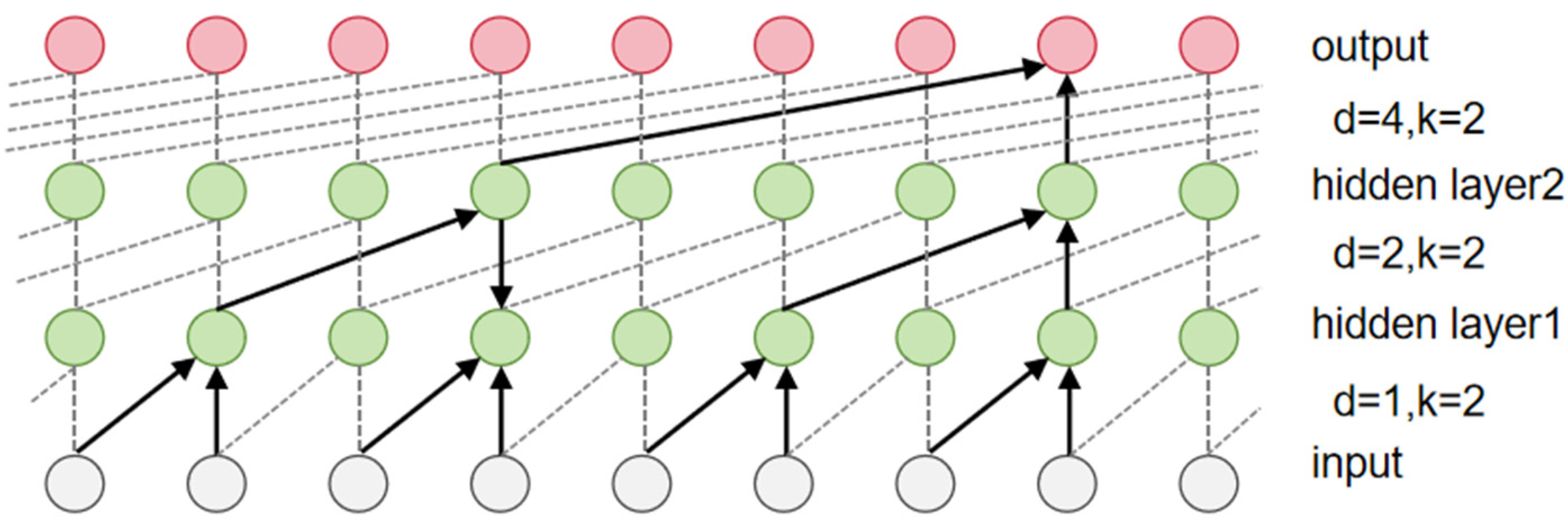
TCN is an improved form of CNN, composed of causal convolution, dilated convolution and residual modules, which can effectively handle time series problems. Causal convolution ensures the causal time sequence when the feature information of data is extracted; dilated convolution allows interval sampling of convolution inputs, making neurons respond to input data in a wider area, which is conducive to TCN capturing longer time series dependencies; the residual module is used to alleviate the problem of gradient instability, solve the interference caused by the increase in network depth, and improve the accuracy of model prediction.
By introducing the dilation coefficient and causal coefficient, the convolution kernel is expanded to enlarge the receptive field of the model and strengthen its ability to capture long-range sequence dependencies. The computational formula is given in Equation (1) [31]:
y [ x ] = m = 0 k 1 w [ m ] x [ t d m ]
In this formulation, y[x] denotes the output of the convolution operation, w[m] represents the weight of the convolution kernel, x[t − d·m] refers to the corresponding element in the input sequence, and d stands for the dilation rate.
Meanwhile, to mitigate gradient vanishing and network degradation, these layers are stacked with residual connections, allowing the TCN to extract and fuse features across multiple time scales. The ReLU activation function employed in this module is defined in Equation (2), with detailed computational expressions provided in Equation (3). Equation (4) summarizes the convolutional layer stacking and residual connection mechanism of the TCN.
ReLU ( x ) = max ( 0 , x )
f ( x ) = ReLU Weight Norm ( y [ x ] )
output TCN = TCN ( x ) = dropout ( f ( x ) ) , n { 1 , 2 , 3 }

2.3. Bidirectional Long Short-Term Memory (BiLSTM) Network

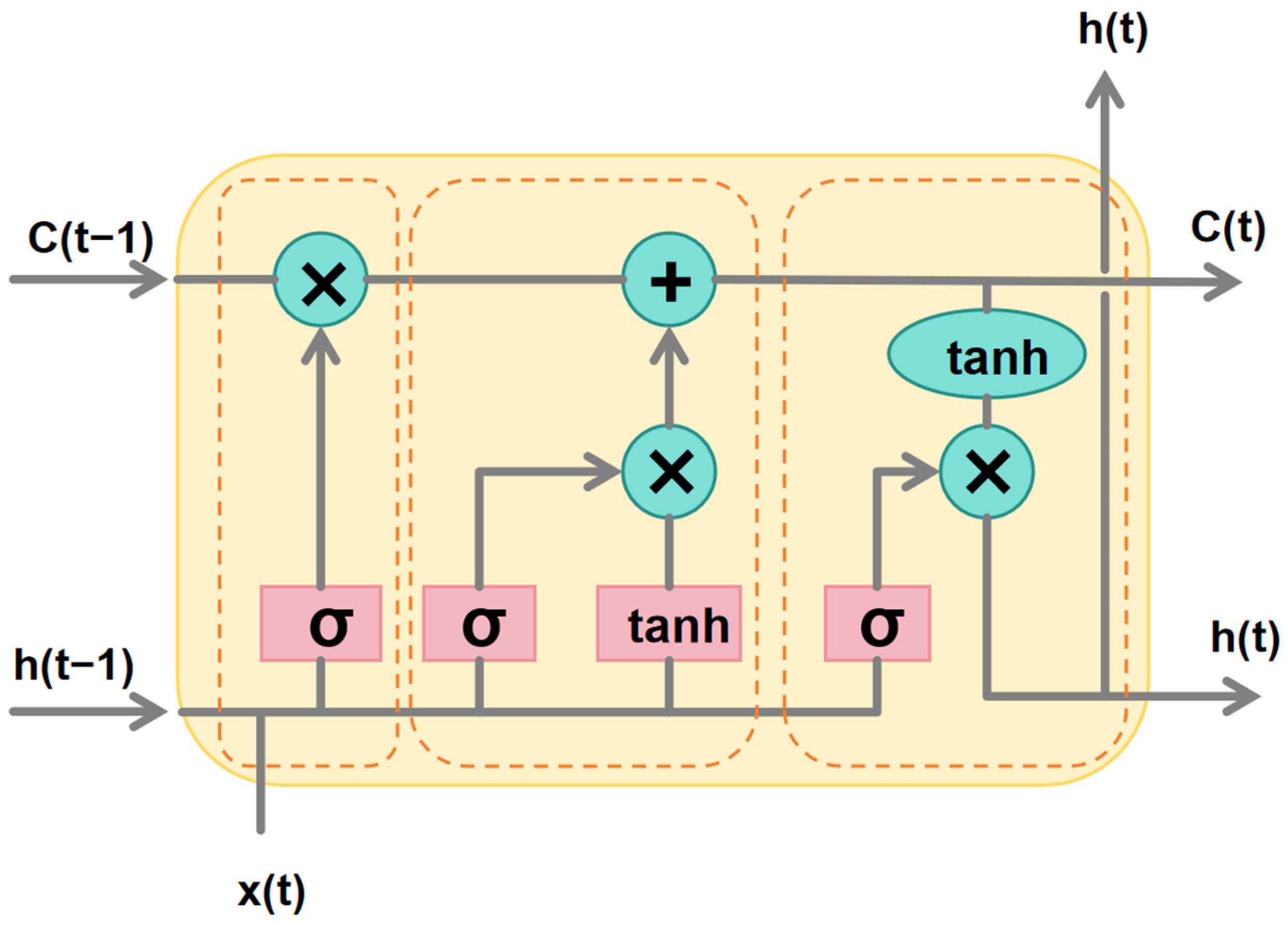
The LSTM network is an advanced recurrent neural network (RNN), specially designed to solve the limitations of traditional RNNs, especially the gradient vanishing problem, thus being able to model long-term dependencies in sequential data [32].
As a special network structure in recurrent neural networks [33], its network structure consists of a forget gate, an input gate and an output gate from left to right. X(t) is the input state at time t, h(t) is the hidden layer output state at time t, and C(t) is the memory cell state at time t. ft, it and Ot are the calculation results of the forget gate, input gate and output gate states, respectively; tanh is the activation function. These gating mechanisms use the Sigmoid function to control the degree of information flow [34].
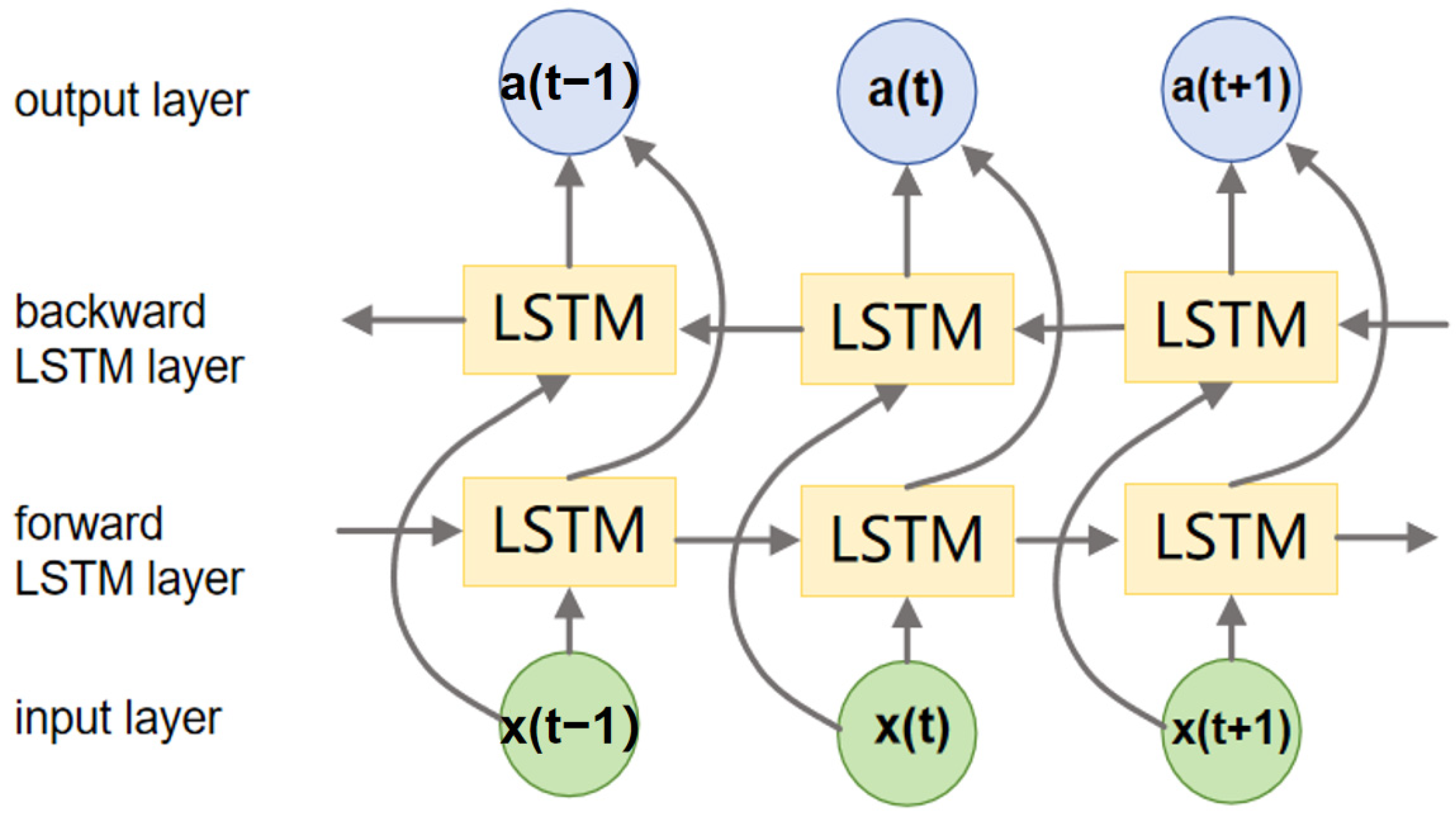
Although the LSTM model is very effective in predicting nonlinear and extended time patterns, its traditional architecture processes information in a single time direction and only relies on past data, so LSTM may not fully capture the time dependencies in the data [35]. To overcome this limitation, the BiLSTM architecture is introduced. BiLSTM consists of two parallel LSTM layers that process the input sequence in opposite directions: one layer processes the sequence from start to finish (forward), and the other layer processes it from finish to start (backward). This bidirectional approach enables the network to utilize both forward and backward time information at each time step, thereby improving the model’s ability to capture dependencies and ultimately improving prediction accuracy. BiLSTM calculates the bidirectional hidden state by running the LSTM layer forward and backward along the time axis, and predicts the data at the current moment by combining the data features in the two forward and backward directions. Its dynamic is controlled by the following equations [36]:
h ( t ) = L S T M f o r w a r d ( h T C N ( t ) ,   h ( t 1 ) )
h ( t ) = L S T M b a c k w a r d ( h T C N ( t ) ,   h ( t 1 ) )
h B i L S T M ( t ) = h ( t ) ; h ( t )
where for time step t, the output of the forward LSTM is h ( t ) , and the output of the backward LSTM is k 1 . h ( t ) represents the output of BiLSTM at time step t.

2.4. TCN-BiLSTM Model

To further improve the accuracy and robustness of time series prediction, a joint model of Temporal Convolutional Network (TCN) and Bidirectional Long Short-Term Memory Network (BiLSTM) is proposed and constructed to capture the local features and long-term dependencies of time series data. This joint model is mainly composed of three functional modules: the TCN feature extraction module, the BiLSTM temporal modeling module, and the fully connected output module. Specifically, the TCN module adopts a two-layer convolution structure, where the first layer uses standard convolution for feature extraction, and the second layer employs dilated convolution to expand the receptive field. After each convolution layer, a ReLU activation function and a Dropout layer are connected to effectively prevent overfitting. The BiLSTM module consists of two LSTM layers (forward and backward) to capture bidirectional temporal features. Finally, the features are mapped to the prediction space through the fully connected layer, and the model structure is shown in Figure 1.

2.5. Runge–Kutta Optimization Algorithm (RUN)

The Runge–Kutta optimizer (RUN) is a new intelligent optimization algorithm proposed in 2021 [37]. Based on the computational gradient search concept proposed in the Runge–Kutta method to guide optimization, it has the characteristics of strong optimization ability and fast convergence speed [38,39,40].
The structures of LSTM and BiLSTM networks are shown in Figure 2 and Figure 3, respectively.
The specific steps for optimizing model hyperparameters using the Runge–Kutta algorithm are as follows:
Step 1: Initialize experimental parameters and hyperparameter population.
Set the core parameters of the RK algorithm: population size N (each population corresponds to a set of hyperparameter combinations) and maximum number of iterations Max _ i ter to ensure algorithm convergence. Define the search ranges for hyperparameters, and initialize N hyperparameter combinations via uniform random sampling to form the initial population X = [ X 1 , X 2 , , X N ] .
Step 2: Calculate fitness values of the initial population.
The fitness function directly reflects the prediction error of the model on the validation set. For each hyperparameter combination X i in the initial population, perform the following operations:
  • Construct the TCN-BiLSTM network architecture according to the hyperparameters in X i .
  • Train the network using the training set.
Predict on the validation set using the trained model and compute the Mean Absolute Error (MAE) as the fitness value:
fitness ( P i ) = 1 N val t = 1 N val y ^ t y t  
where N val is the number of samples in the validation set, and y ^ t and y t are the predicted and true values, respectively.
A smaller fitness value indicates a better hyperparameter combination. Record the optimal fitness value F best in the initial population and its corresponding hyperparameter combination X best .
Step 3: Iteratively update the hyperparameter population via the RK algorithm.
Each individual in the population is iteratively updated using the fourth-order Runge–Kutta update formula to guide hyperparameters toward the optimal direction. The detailed update process is as follows:
  • Calculate the fourth-order slopes k 1 , k 2 , k 3 , k 4 for each individual, where k 1 , k 2 , k 3 , k 4 are randomly generated normally distributed search direction vectors with the same dimension as the number of hyperparameters.
  • Update the individual position (hyperparameter combination) according to the fourth-order Runge–Kutta formula, as shown below:
    X i t + 1 = X i t + h 6 × k 1 + 2 k 2 + 2 k 3 + k 4
    where X i t denotes the hyperparameter combination of the i -th individual at the t -th iteration, X i t + 1 denotes the updated hyperparameter combination at the t + 1 -th iteration, and h is the step size of the RK algorithm.
  • Hyperparameter boundary constraints: Given the definite search ranges of hyperparameters, clip the updated hyperparameter combination X i t + 1 to ensure all hyperparameter values fall within the preset ranges, preventing model training failure caused by invalid hyperparameters.
Step 4: Update fitness values and optimal hyperparameters.
After iterative population update, recalculate the fitness value of each individual X i t + 1 . Compare the optimal fitness value of the current population with the historical optimal fitness value F best : if the current optimal value is smaller, update F best and its corresponding hyperparameter combination X best ; otherwise, retain the historical optimal value.
Step 5: Judge the iteration termination condition.
Check whether the current number of iterations reaches Max _ i ter , or the variation in the optimal fitness value F best is less than the preset threshold. If either condition is satisfied, terminate the iteration; otherwise, return to Step 3 for further iterative updates.
Step 6: Output optimal hyperparameters and train the final model.
Upon iteration termination, output the globally optimal hyperparameter combination X best . Substitute this set of hyperparameters into the TCN-BiLSTM model, train the model using the full training set, and obtain the final optimized TCN-BiLSTM model for subsequent prediction experiments.

2.6. Construction of the River Water Quality Prediction

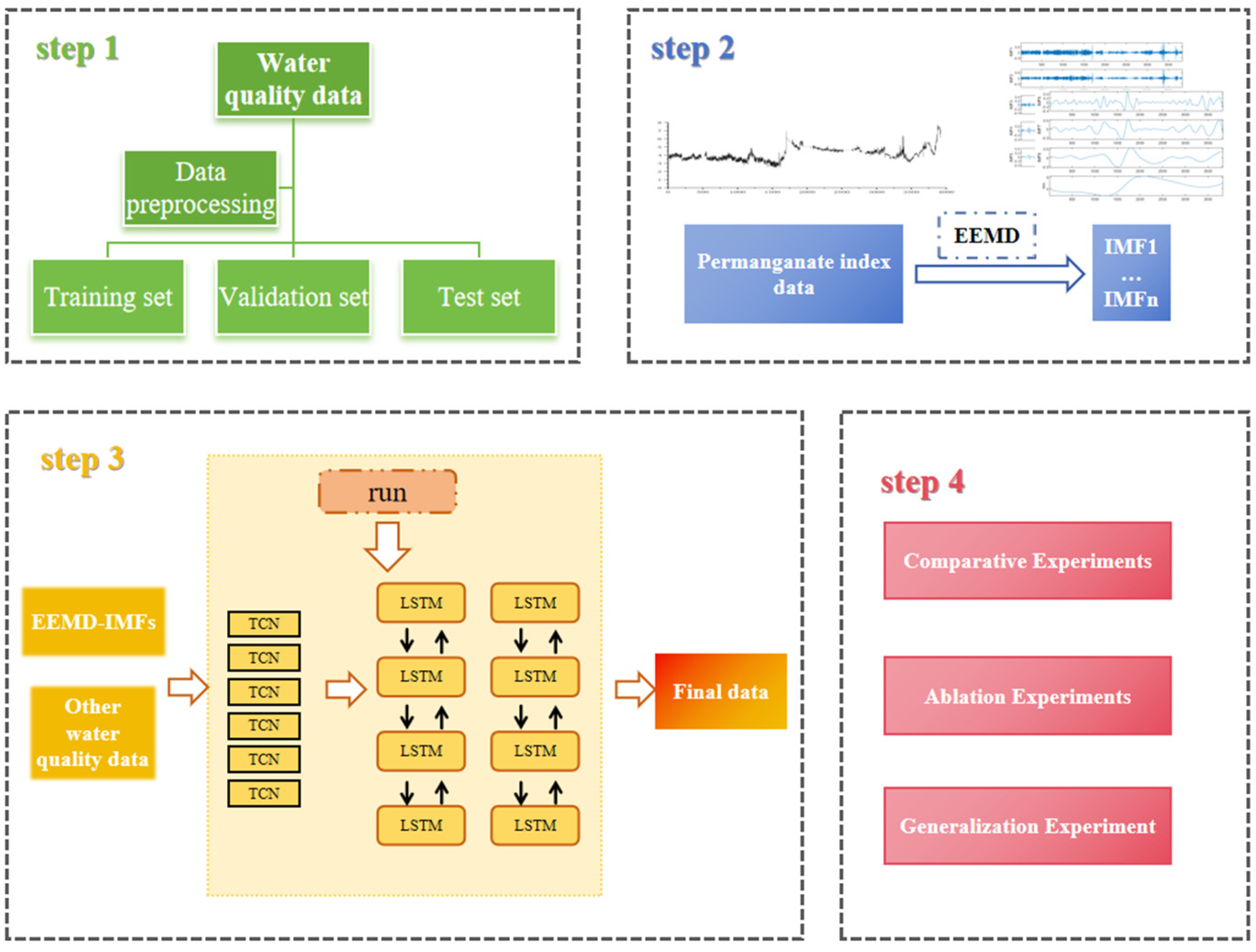
Water quality data usually exhibit high volatility, strong randomness, and lack of periodicity, requiring a model that can effectively capture their variation patterns with strong learning ability [41]. The TCN-BiLSTM model combines the feature extraction capability of TCN with the bidirectional modeling capability of BiLSTM. This hybrid not only inherits the parallel processing and multi-scale feature extraction of TCN, but also leverages the gated structure of LSTM to handle complex temporal dependencies. To avoid manual parameter tuning, the Runge–Kutta optimization algorithm (RUN) is employed to automatically search for key hyperparameters, including the number of filters, kernel size, dropout rate, and the number of BiLSTM hidden units. RUN improves prediction accuracy and generalization while reducing the uncertainty of manual configuration. The overall technical roadmap of the research is shown in Figure 4. The specific steps of the proposed RUN-EEMD-TCN-BiLSTM model are as follows:
  • Collect raw water quality data and use linear interpolation to fill missing values and correct outliers.
  • Two methods are adopted for feature selection: Spearman correlation analysis is used to select features with strong correlations, and SHAP analysis based on the random forest model is used to rank feature importance. The top-ranked features are comprehensively selected as model inputs.
  • Decompose the permanganate index (CODMn) sequence using EEMD to obtain K intrinsic mode functions (IMFs).
  • For each IMF component, build a TCN-BiLSTM model whose hyperparameters are optimized by the RUN algorithm. The input to each model consists of the selected external features and the respective IMF component as the target.
  • Sum the prediction outputs of all IMF components to obtain the final CODMn prediction.
Figure 4. Technical roadmap of the study.
Sustainability 18 04703 g004

2.7. SHAP

Machine learning models are often regarded as “black boxes” due to their limited interpretability in practical applications. To address this limitation, explainable artificial intelligence (XAI) algorithms have received increasing attention in recent years. In this study, the SHapley Additive exPlanations (SHAP) method, rooted in cooperative game theory, is employed to quantify the contribution of individual input variables to the model output. SHAP assigns an importance value (i.e., SHAP value) to each feature by calculating its marginal contribution to the model’s prediction. For a given instance, the SHAP value quantifies the extent to which a specific feature increases or decreases the predicted permanganate index relative to the model’s baseline output. By averaging the SHAP values across all samples, we quantify the relative contributions of the predictor variables to the model output and identify the most influential variables for surface water permanganate index prediction. The mathematical formulation of the SHAP-based interpretation is given by
ϕ i , j = S F { i } | S | ! | F | | S | 1 ! | F | ! f j ( S { i } ) f j ( S )
ϕ i , j : the SHAP value of the i-th input feature for the j-th sample, representing the marginal contribution of the feature to the predicted permanganate index;
F: the set of all input features, with |F| denoting the total number of features;
S: a subset of F that excludes the i-th feature;
f j ( S ) : the model’s predicted output for the j-th sample when only the features in subset S are used;
f j ( S { i } ) : the model’s predicted output for the j-th sample after adding the i-th feature to subset S.

2.8. Evaluation Metrics

MATLAB was used to calculate the coefficient of determination (R2), Root Mean Square Error (RMSE), and Mean Absolute Error (MAE) of the test set to evaluate the prediction accuracy and generalization ability of the model [41]. R2 is used to measure the model’s ability to explain data variation; the closer the value is to 1, the better the model fitting, and a model with R2 exceeding 0.8 is generally considered to have high goodness of fit. RMSE reflects the deviation between the predicted and true values and is more sensitive to large errors; MAE is the average of the absolute values of prediction errors and is more robust to outliers. Generalization ability usually refers to the prediction performance of a machine learning algorithm on new data or samples not involved in training, reflecting the adaptation level of the learning model to out-of-distribution samples under the independent and identically distributed assumption. The closer the R2, RMSE and MAE of the test set are to those of the training set, the better the prediction accuracy and the stronger the generalization ability of the model. The calculation formulas of the three metrics are as follows:
M A E = 1 n i = 1 n y i y i ^
R 2 = 1 i = 1 n ( y i y i ^ ) 2 i = 1 n ( y i y ¯ ) 2
where n is the number of samples; y i ^ is the predicted value of the i-th sample; y i is the measured value of the i-th sample; and y ¯ is the average value of all measured values.

3. Experimental Process and Results

3.1. Data Source

This study used water quality monitoring data from the Sandao monitoring section (129.522687, 44.780159) in the Songhua River Basin, Mudanjiang City, Heilongjiang Province, for analysis. The Sandao monitoring section mainly monitors the surface water quality of the river, including 11 water quality indicators: water temperature (WT), pH value, turbidity (TU), electrical conductivity (EC), dissolved oxygen (DO), ammonia nitrogen (NH3-N), permanganate index (CODMn), total phosphorus (TP), total nitrogen (TN), chlorophyll-α (Chl-a), and algae density (AD). The monitoring data were collected at 4 h intervals. The dataset was obtained from the national surface water quality automatic monitoring station data released by the China National Environmental Monitoring Center (https://szzdjc.cnemc.cn:8070/GJZ/Business/Publish/Main.html) (accessed on 10 January 2026). All monitoring parameters and methods comply with the Environmental Quality Standards for Surface Water (GB 3838-2002 [42]). The permanganate index was selected as the prediction index in this study, and the dataset included water quality monitoring data from 1 November 2022 to 31 July 2024. All monitoring data of the study area generally meet the Class III surface water standard of GB 3838-2002, except for total nitrogen (TN) which slightly exceeds the standard limit, indicating that the overall water quality is at a medium-good level. The water quality data of the Sandao monitoring section are presented in Table 1.

3.2. Data Preprocessing

Missing values exist in the data due to power outages, equipment inspection and maintenance, and other reasons. All parameters were measured in accordance with the Environmental Quality Standards for Surface Water (GB3838-2002) at 4 h intervals. The monitoring dataset used in this study has missing values of water quality indicators at certain time points. The existence of missing values weakens the integrity of sequence information and disturbs the data mining process. Preprocessing missing values is a key step to ensure data quality and analysis validity. Direct deletion of missing values will lead to discontinuous time series due to the presence of certain missing data points in the original water quality data. In this study, linear interpolation was used to fill in the missing values of the permanganate index data for interpolation, with a total of 815 interpolated values, and a total of 3831 data points for the permanganate index after interpolation. After interpolation, the distribution of variables becomes more complete and smooth, the range is restored to the normal value, and the extreme values appear more reasonable.
Since time series models are very sensitive to scale, this study adopted min-max normalization to normalize the original data values of the 11 influencing factors to the range of [0, 1]. Data normalization helps to simplify calculations, improve data comparability and model performance. The normalization formula is as follows:
Y = X X m i n X m a x X m i n
where Y is the result after normalization of each factor; X is the measured value of the water quality indicator; X m i n is the minimum measured value of the water quality indicator; X m a x is the maximum measured value of the water quality indicator.
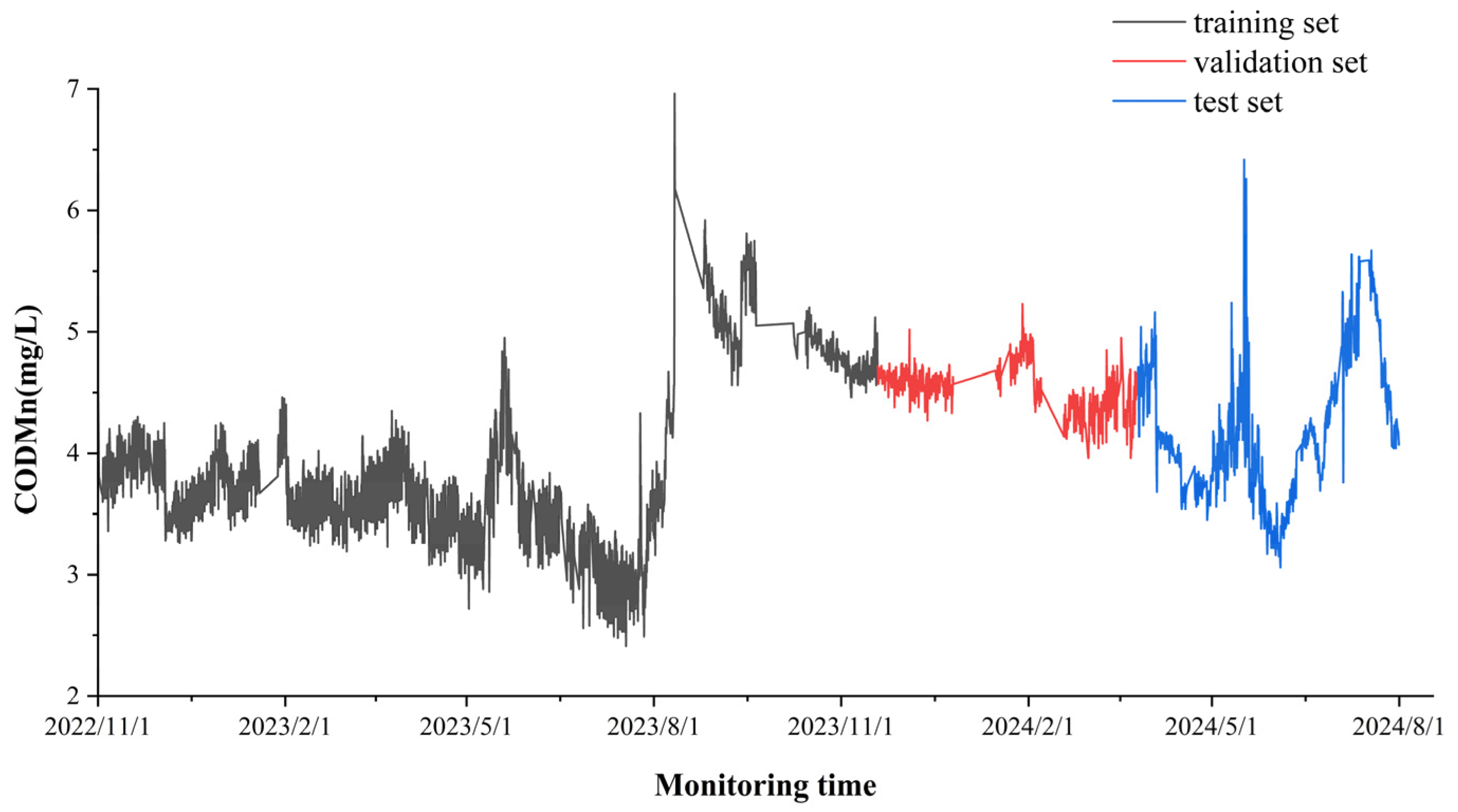
The measured data of permanganate index at the Sandao monitoring section show significant periodic and seasonal characteristics with strong volatility. To ensure effective learning and evaluation of the model, the dataset was divided into a training set, validation set and test set at a ratio of 3:1:1 in this experiment. The training set samples are used to establish and train the model; the validation set is used to debug and complete the optimization setting of the model’s structural parameters and calculation parameters; the test set samples usually do not participate in the model’s training and optimization process, and are only used to test the optimized model and its parameters to determine the model’s validity and prediction ability. The permanganate index data from river monitoring sections are summarized in Figure 5.

3.3. Selection of Input Factor Set

3.3.1. Spearman Correlation Analysis

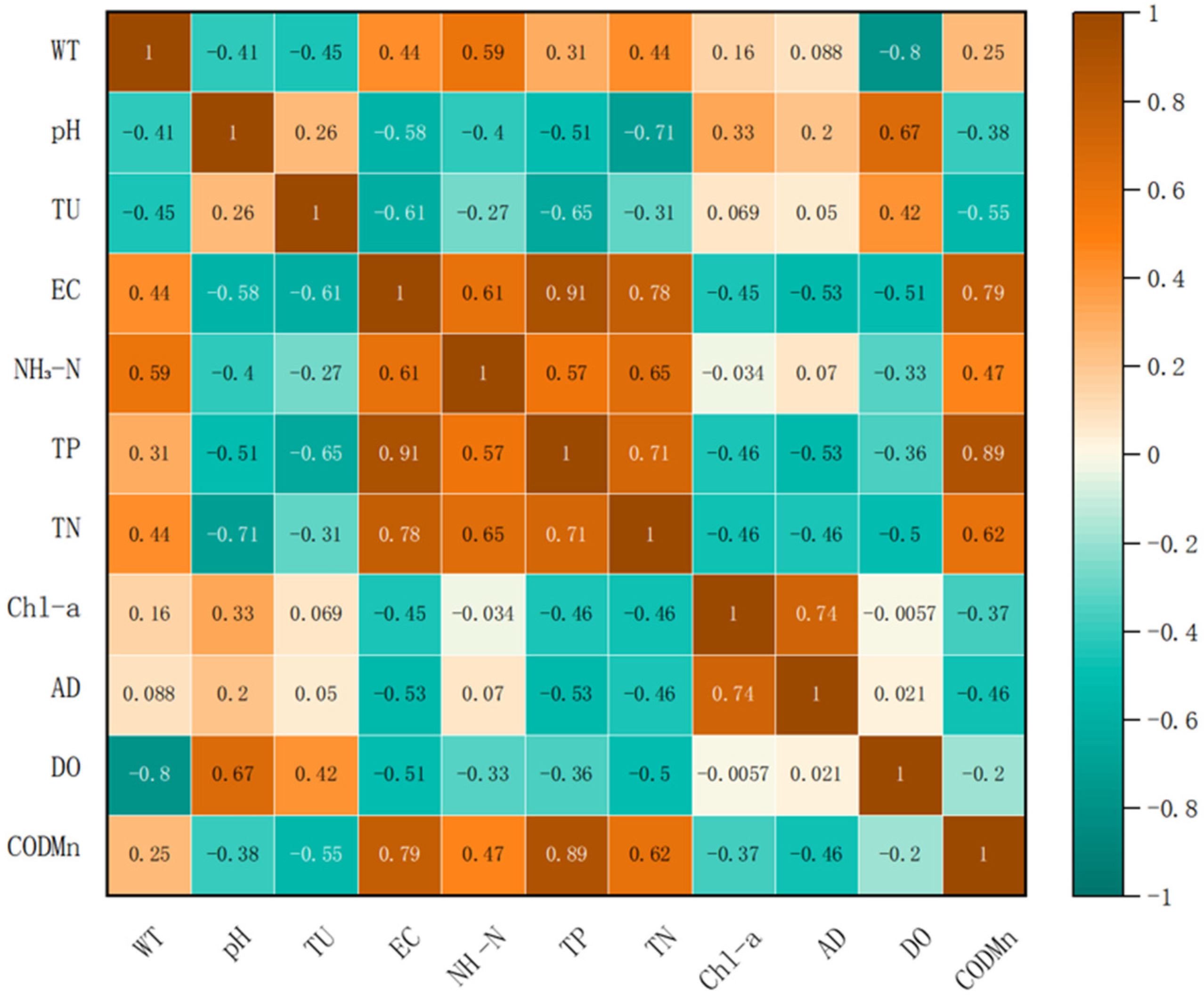
Spearman correlation analysis was first performed on the raw dataset. The heatmap (Figure 6) visualizes correlations through color intensity, with darker shades indicating stronger relationships—brown for positive and green for negative correlations.
The absolute Spearman correlation coefficients with permanganate index (CODMn) ranked from highest to lowest are: total phosphorus (TP, 0.89), electrical conductivity (EC, 0.79), total nitrogen (TN, 0.62), turbidity (TU, −0.55), ammonia nitrogen (NH3-N, 0.47), algae density (AD, −0.46), pH (0.38), chlorophyll-α (Chl-a, −0.38), water temperature (WT, 0.25), and dissolved oxygen (DO, −0.20).
Mechanistic Interpretation: Higher TP concentrations provide sufficient nutrients for phytoplankton growth, thereby increasing organic matter production and elevating CODMn. The positive correlation between EC and CODMn likely reflects common sources of ionic and organic pollutants in the watershed. Similarly, TN and NH3-N show positive correlations with CODMn as they indicate biological productivity and organic pollution levels.
In contrast, turbidity (TU) is negatively correlated with CODMn (−0.55): Elevated turbidity reduces light penetration, thereby restricting photosynthesis and inhibiting algal growth and organic matter synthesis. Concurrently, the adsorption and sedimentation of suspended particles facilitate organic matter removal, consequently lowering CODMn. Similarly, both algae density and chlorophyll-α exhibit negative correlations, possibly attributable to the dominance of non-algal suspended solids or light limitation effects in this specific environment. Water temperature shows a weak positive correlation, whereas dissolved oxygen demonstrates a negative correlation due to oxygen consumption during organic matter degradation.

3.3.2. SHAP-Based Feature Importance Analysis

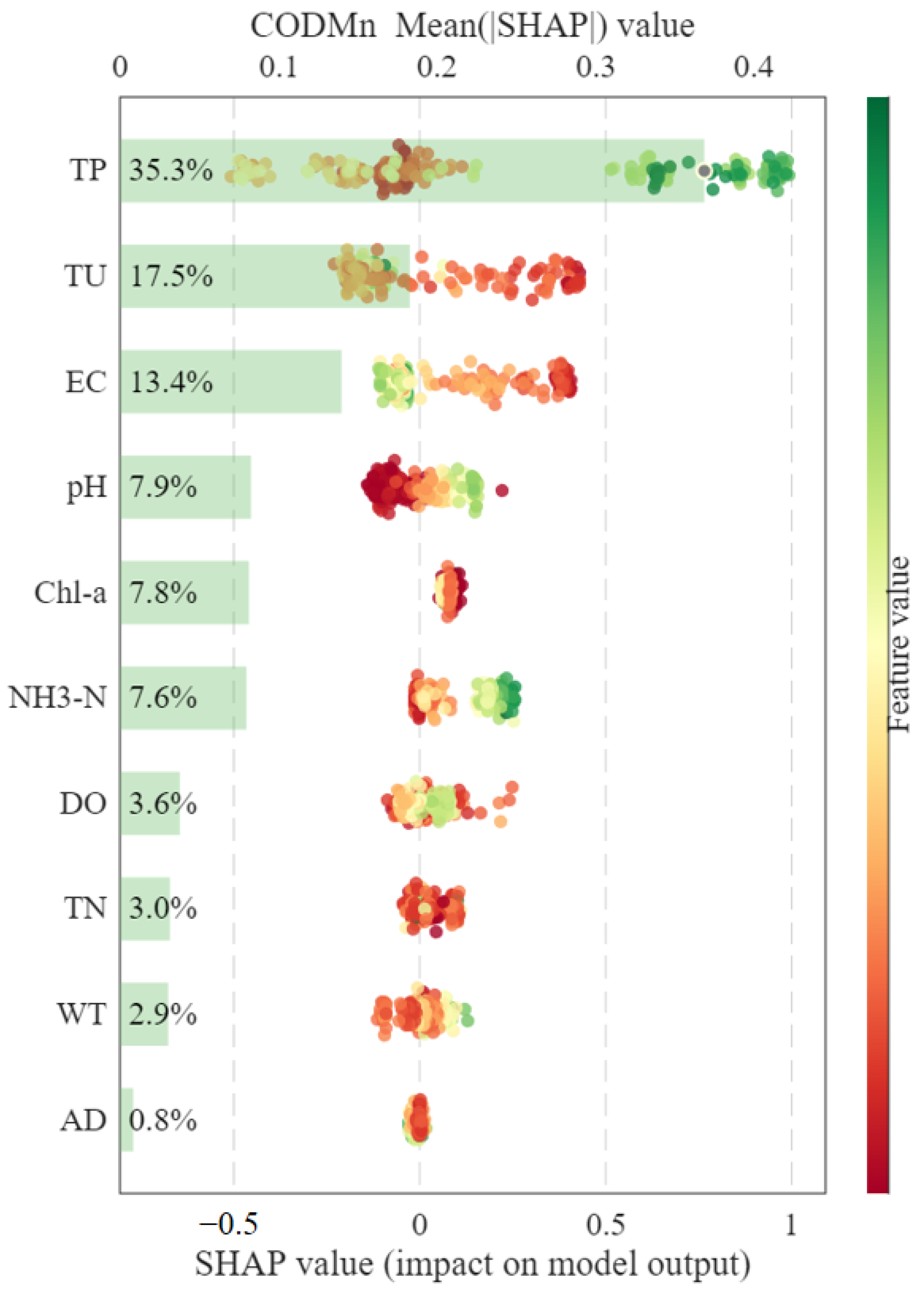
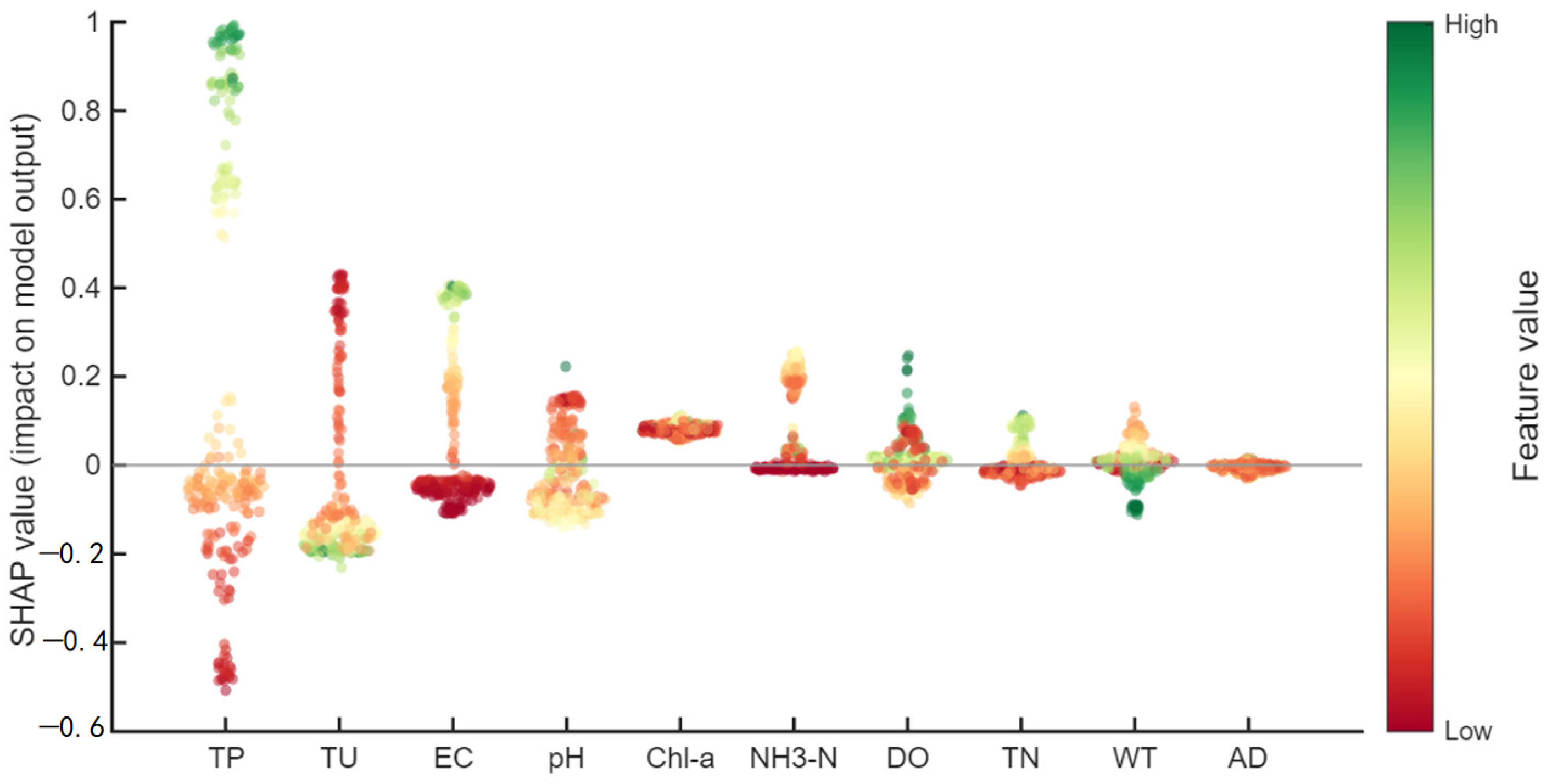
To enhance model interpretability and capture nonlinear interactions, SHAP (Shapley Additive exPlanations) analysis was employed based on the random forest model using all 11 features (Figure 7).
SHAP analysis reveals that total phosphorus (TP) is the dominant driver of CODMn predictions, exerting a significant positive effect. This aligns with aquatic chemistry principles that eutrophication accelerates organic matter accumulation.
Notably, both turbidity (TU) and electrical conductivity (EC) exhibit negative regulatory effects on CODMn predictions (Figure 8). High turbidity inhibits algal photosynthesis through light attenuation and reduces dissolved organic matter via adsorption and sedimentation of suspended particles, resulting in lower predicted CODMn. High EC indicates elevated ionic strength, which imposes osmotic stress on algae and microorganisms and promotes flocculation and sedimentation of organic matter, also leading to decreased CODMn predictions.
These results are consistent with the Spearman correlation analysis regarding the direction of TU’s effect, validating the negative impact of turbidity on CODMn. Collectively, TP, TU, and EC demonstrate significant synergistic effects: Environments characterized by high TP, low TU, and low EC tend to induce intensive algal growth and elevated CODMn, whereas the opposite conditions suppress organic matter production and accumulation.

3.3.3. Optimal Feature Subset Selection

To determine the optimal input feature set for the prediction model, six feature selection schemes were designed and compared experimentally (Table 2). Scheme 1, Scheme 2 and Scheme 3 apply Spearman correlation absolute value |ρ| thresholds, while Scheme 4, Scheme 5 and Scheme 6 utilize SHAP-based importance rankings.
Each subset was used to train the RUN-EEMD-TCN-BiLSTM model, with performance evaluated using MAE, RMSE, and R2. As shown in Table 3, Scheme 5 (SHAP top-6) achieved optimal performance with the highest R2 (0.93534) and competitive error metrics (MAE: 0.10265, RMSE: 0.15084).
While Scheme 1 yielded a marginally lower MAE (0.10219), Scheme 5 demonstrates superior overall performance considering the combined metrics of MAE, RMSE, and particularly the coefficient of determination (R2). The inclusion of pH and Chl-a in Scheme 5, which were excluded by simple correlation thresholds, appears to capture important biological processes (algal photosynthesis and physiological stress responses) that improve model robustness. This indicates that selecting the top six features through SHAP analysis optimally balances model complexity and predictive accuracy for the CODMn prediction task.

3.4. Model Hyperparameter Setting

All experiments in this study were conducted based on the MATLAB2023b platform on a Windows 10 system with an Intel(R) Core(TM) i5-10210U CPU @ 1.60GHz 2.11 GHz and 16.0 GB of memory.
In this study, the water quality prediction model is trained on the normalized dataset. The proposed model adopts a hybrid architecture combining TCN and BiLSTM. The fixed structural and training settings are summarized in Table 4.
To avoid the subjectivity of manual parameter tuning and to improve prediction accuracy and robustness, the Runge–Kutta optimization algorithm (RUN) is employed to automatically search for five key hyperparameters: number of filters, filter size, number of TCN residual blocks (fixed to 2 in the final architecture but can be optimized), dropout rate, and number of BiLSTM hidden units. The search ranges of these hyperparameters are listed in Table 5. The RUN algorithm parameters are provided in Table 6.
During the optimization process, the fitness of each hyperparameter combination is evaluated by training the TCN-BiLSTM model on the training set and computing the MAE on the validation set. The RUN algorithm iteratively updates the population to minimize the validation MAE. After the optimal hyperparameter combination is obtained, the final model is retrained on the full training set using the fixed settings in Table 6. For example, the optimal configuration found in this study yields 37 filters, 3 filterSize, a dropout rate of 0.016, and 32 BiLSTM hidden units.

3.5. EEMD Decomposition

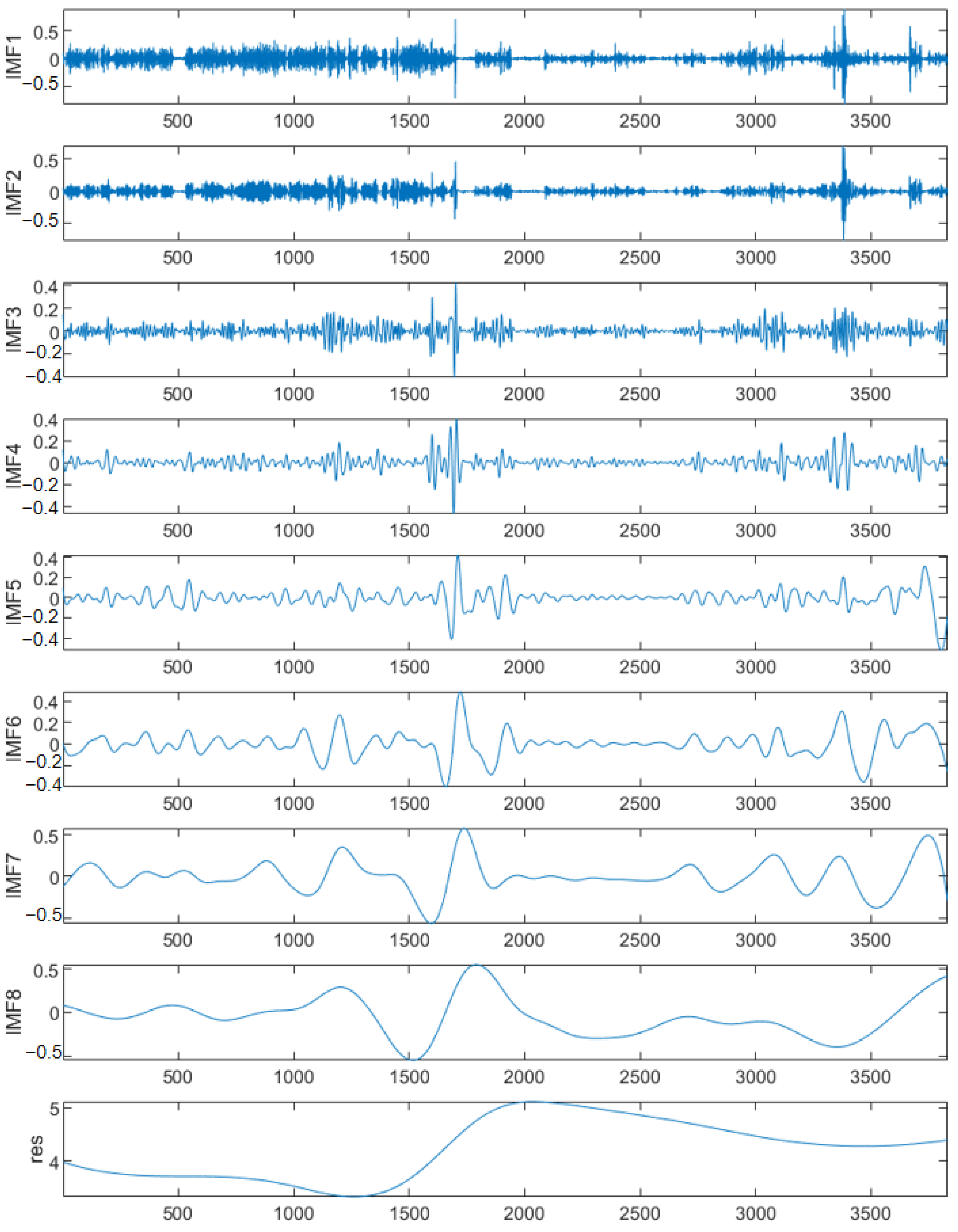
In this study, by in-depth analysis of the variation law of the central frequency of the terminal sequence of adjacent decomposition modes, combined with the conventional parameter settings and experimental verification, the optimal decomposition value K = 8 was finally selected. After the original data were decomposed by EEMD, eight intrinsic mode functions (IMF1~IMF8) were successfully extracted (Figure 9), and each IMF corresponds to a specific mode of the signal, together forming a complete characterization of the original signal. Among them, the first five IMF sequences change gently with small volatility, which can effectively reflect the fluctuation trend of the permanganate index; the last three IMF sequences have obvious periodicity, which can reflect the periodic characteristics of the permanganate index. Compared with directly using the original water quality data for prediction, EEMD decomposition can effectively reduce the interference of the non-stationarity of water quality data on prediction accuracy, thereby improving the prediction effect of the model.

3.6. Prediction Result Analysis of the Runge–Kutta–EEMD–TCN–BiLSTM Model

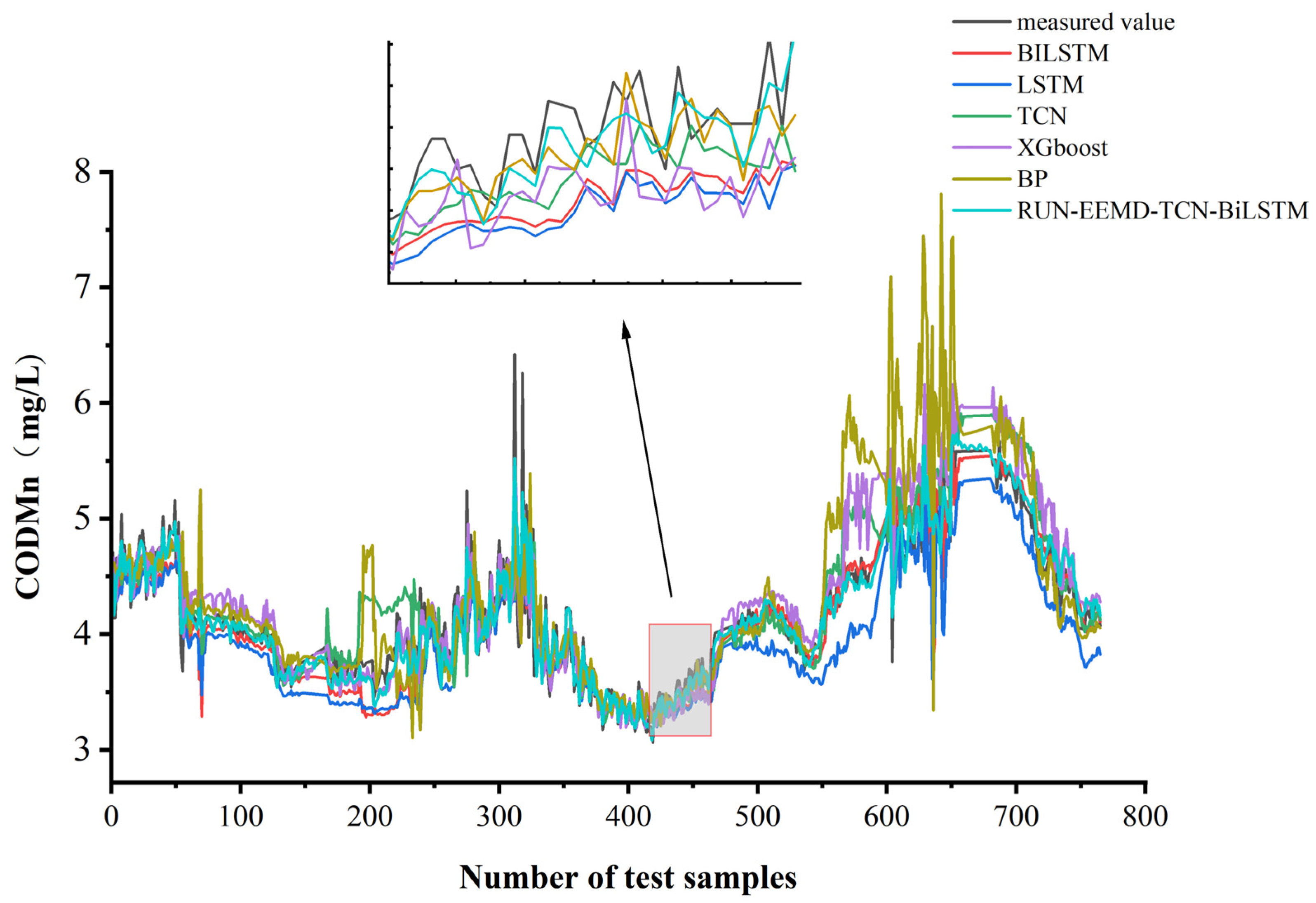
The Runge–Kutta–EEMD–TCN–BiLSTM combined model was adopted, with the permanganate index data of the Sandao monitoring section from 1 November 2022 to 30 November 2023 as the training set, the permanganate concentration data from 1 December 2023 to 31 March 2024 as the validation set, and the permanganate concentration data from 1 April 2024 to 31 July 2024 as the test set input into the model for training and prediction. The prediction results of the permanganate index show that the model can better predict the trend of water quality conditions, and the volatility of the predicted values is consistent with that of the measured values (Figure 10).

3.7. Comparative Experiments

3.7.1. Experimental Design

To benchmark the proposed RUN-EEMD-TCN-BiLSTM model, we compared it against five commonly used baseline models: BiLSTM, LSTM, TCN, XGBoost, and the BP neural network. All models were trained and tested on the same dataset with identical input features (SHAP top-6: TP, TU, EC, pH, Chl-a, NH3-N) and the same training/testing split. To enable statistical comparison, each model was run three times. Performance was evaluated using MAE, RMSE, and R2. The mean values across three runs are reported, along with standard deviations. Pairwise Student’s t-tests were conducted between the proposed model and each baseline to assess statistical significance.

3.7.2. Results and Analysis

Pairwise t-tests between the proposed model and each baseline (based on MAE and R2 over three runs) all yielded p-values < 0.001, indicating that the improvements achieved by the proposed model are statistically significant at the 90% confidence level. The prediction accuracy and stability of each model are compared in Table 7.

3.7.3. Discussion

The proposed model consistently and significantly outperforms all baseline models across all metrics. Among the baselines, BiLSTM achieves the best performance (R2 = 0.7752), followed by XGBoost (R2 = 0.7236) and TCN (R2 = 0.7213). BP performs the worst, likely due to its shallow architecture and inability to capture long-term temporal dependencies.
Compared with the best baseline (BiLSTM), the proposed model reduces MAE by 60.6% (0.2103 → 0.0829) and RMSE by 53.2% (0.2813 → 0.1315), and improves R2 from 0.7752 to 0.9508. The substantial performance gap can be attributed to three key factors: (1) EEMD effectively decomposes the non-stationary CODMn signal into relatively stationary components, reducing noise and complexity; (2) RUN provides optimal hyperparameters that are difficult to obtain manually; and (3) the TCN-BiLSTM cascade captures both multi-scale and bidirectional temporal features, which is superior to using TCN, LSTM, or BiLSTM alone.
These results demonstrate that the proposed hybrid framework is highly suitable for CODMn prediction and offers a significant advancement over conventional machine learning and deep learning models.

3.8. Ablation Experiments

3.8.1. Experimental Design

To validate the contribution of each key component in the proposed RUN-EEMD-TCN-BiLSTM hybrid model, five ablation experiments were conducted. All ablation models share the same dataset split, input feature set (the SHAP top-6 features: TP, TU, EC, pH, Chl-a, NH3-N), and training/testing partition. Performance is evaluated using Mean Absolute Error (MAE), Root Mean Square Error (RMSE), and coefficient of determination (R2). The experimental results are summarized in Table 8.

3.8.2. Results and Analysis

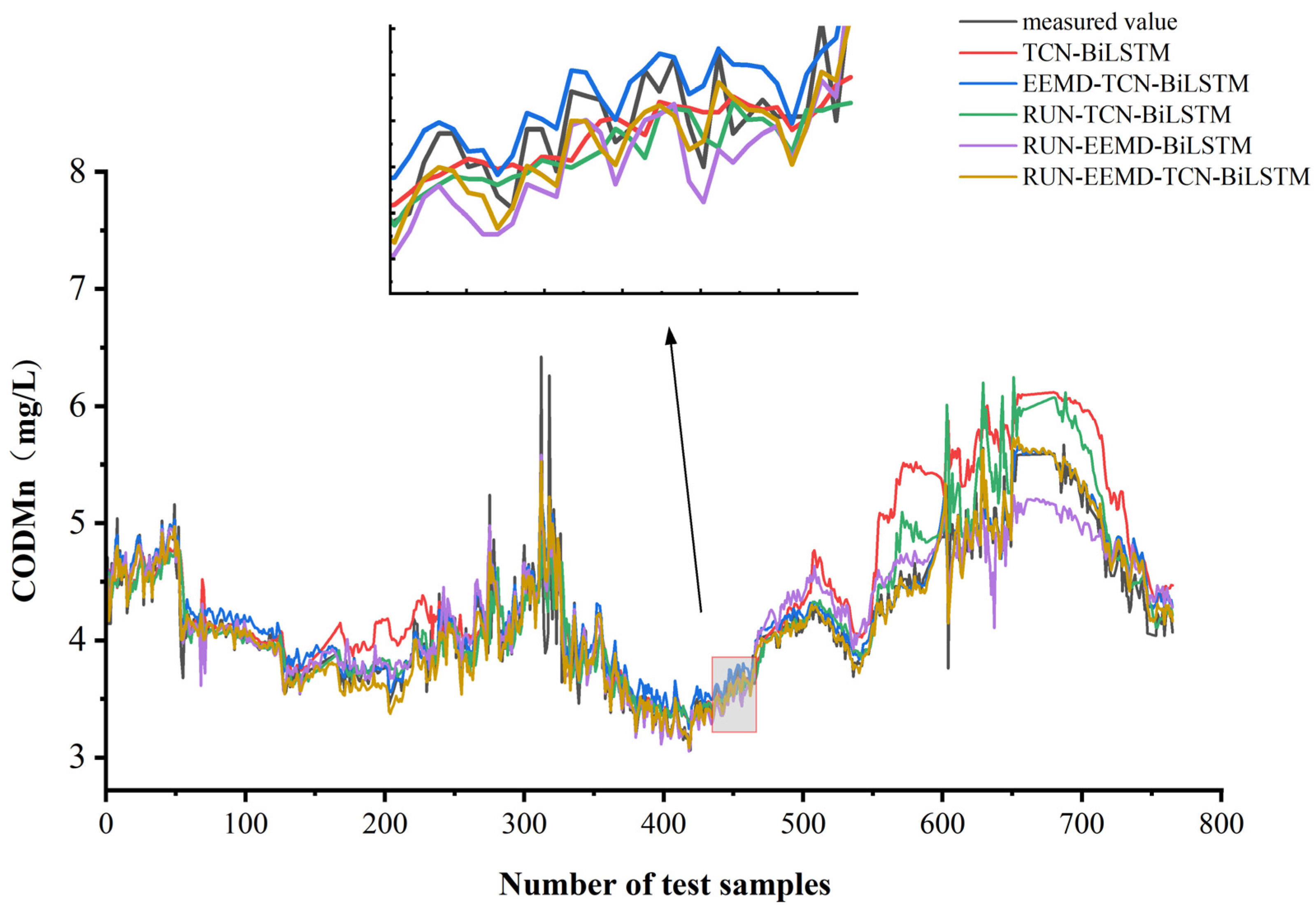
The contrast between measured and predicted permanganate index values under different module elimination schemes is displayed in Figure 11.
  • Contribution of EEMD
Comparing TCN-BiLSTM with EEMD-TCN-BiLSTM, the introduction of EEMD reduces MAE from 0.31143 to 0.11649 (a decrease of 62.6%) and RMSE from 0.42229 to 0.16669 (a decrease of 60.5%), while R2 increases from 0.4932 to 0.9210. This demonstrates that EEMD effectively decomposes the non-stationary CODmn signal into several relatively stationary IMF components, substantially reducing temporal complexity and noise. Consequently, the modeling capability of TCN-BiLSTM is greatly enhanced.
2.
Contribution of RUN Optimization
Comparing TCN-BiLSTM with RUN-TCN-BiLSTM, RUN optimization lowers MAE by 40.3% and RMSE by 33.6%, and raises R2 from 0.4932 to 0.7769. Even without EEMD, RUN-searched hyperparameters (e.g., number of filters, kernel size, dropout rate, BiLSTM hidden units) significantly improve model performance. Furthermore, comparing EEMD-TCN-BiLSTM with RUN-EEMD-TCN-BiLSTM shows that adding RUN on top of EEMD further reduces MAE by 28.9% and RMSE by 21.1%, and increases R2 from 0.9210 to 0.9508. These results confirm that RUN avoids subjective manual tuning and finds hyperparameter configurations better adapted to the data characteristics.
3.
Contribution of the TCN Module
Comparing RUN-EEMD-BiLSTM (which uses BiLSTM alone without TCN) with the full RUN-EEMD-TCN-BiLSTM model shows that incorporating TCN reduces MAE by 51.6% (from 0.17132 to 0.08288) and RMSE by 43.8%, and improves R2 from 0.8445 to 0.9508. This indicates that TCN, with its dilated convolutions, effectively captures multi-scale temporal dependencies and provides more representative features for the subsequent BiLSTM layer. TCN and BiLSTM exhibit significant complementary enhancement.
4.
Overall Performance
The complete model RUN-EEMD-TCN-BiLSTM achieves the lowest MAE (0.08288) and RMSE (0.13152) and the highest R2 (0.95084). Compared with the baseline TCN-BiLSTM, MAE is reduced by 73.4%, RMSE by 68.9%, and R2 is improved from a poor 0.4932 to an excellent 0.9508. The ablation study strongly demonstrates the necessity of the synergistic combination of EEMD decomposition, RUN hyperparameter optimization, and the TCN-BiLSTM cascade; none of the components can be omitted without significant performance degradation.
Figure 11. Comparison of measured permanganate index values and predicted values with each module eliminated at Sandao section.
Sustainability 18 04703 g011

3.8.3. Discussion

The quantitative results of the ablation study validate the positive contribution of each component in the proposed model. Among them, EEMD yields the most substantial improvement (increase in R2 of approximately 0.43), which is attributable to the strong nonlinearity and non-stationarity of CODmn time series caused by multiple interacting factors (hydrology, meteorology, human activities). EEMD effectively separates fluctuations at different frequency scales. RUN optimization provides an additional “icing-on-the-cake” gain, enabling the model to approach the optimal configuration based on a solid architectural foundation. The combination of TCN and BiLSTM reflects the advantage of “multi-scale feature extraction + bidirectional temporal memory”. Using BiLSTM alone (RUN-EEMD-BiLSTM) yields acceptable performance but is far inferior to the synergy of both modules.
In summary, the ablation study robustly supports the conclusion that the proposed RUN-EEMD-TCN-BiLSTM is the optimal model for CODMn prediction among the compared architectures.

3.9. Generalization Experiment

3.9.1. Experimental Design

To evaluate the generalization ability of the proposed RUN-EEMD-TCN-BiLSTM model across different water quality monitoring sections, three additional monitoring sections within the Songhua River Basin (Liu Yuan, Fuyuan Village, and Chahayang Township) were selected for independent testing, in addition to the Sandao section. These three sections differ to some extent in hydrological conditions, water quality characteristics, and pollution sources, which enables an effective assessment of the model’s cross-site applicability.
The model used the same input features (SHAP top-6: TP, TU, EC, pH, Chl-a, NH3-N) and hyperparameter configuration (i.e., the optimal parameters determined from training on the Sandao section) for all sections, and directly performed predictions on the target sections without retraining or fine-tuning.

3.9.2. Results

The prediction performance for the three sections is summarized in Table 9.

3.9.3. Analysis

The R2 values for all three sections exceed 0.93, with the Fuyuan Village section achieving the best performance (0.9468). The RMSE at the Liu Yuan section is slightly higher (0.3438), which may be attributed to local hydrological disturbances or greater variability in water quality. Overall, the model maintains high prediction accuracy on three external sections without retraining, demonstrating that the RUN-EEMD-TCN-BiLSTM model has strong cross-site generalization capability and can be applied to different water quality monitoring sections within the Songhua River Basin.

4. Conclusions

Based on water quality monitoring data from the Sandao section of the Songhua River Basin in Mudanjiang City, Heilongjiang Province, this study addresses the problems of non-stationarity, nonlinearity, and strong temporal dependence in water quality time series, which lead to low accuracy of traditional prediction methods. A hybrid prediction model integrating the Runge–Kutta optimization algorithm (RUN), ensemble empirical mode decomposition (EEMD), Temporal Convolutional Network (TCN), and Bidirectional Long Short-Term Memory (BiLSTM) is proposed. The main conclusions are as follows:
(1)
The proposed RUN-EEMD-TCN-BiLSTM model effectively overcomes the shortcomings of traditional models, such as gradient vanishing, insufficient feature extraction, and weak generalization ability. The RUN algorithm provides automatic hyperparameter optimization, EEMD reduces data non-stationarity, and BiLSTM captures bidirectional temporal dependencies, offering a new and effective method for accurate water quality prediction.
(2)
In the prediction task of the permanganate index (CODMn) at the Sandao section, the proposed model significantly outperforms baseline models (BiLSTM, BP, LSTM, XGBoost, TCN) in terms of MAE, RMSE, and R2. Generalization experiments conducted on multiple sections within the Songhua River Basin further verify the stability and applicability of the model, demonstrating its capability to meet the requirements of real-time water quality monitoring and control.
(3)
Extracting intrinsic mode functions using EEMD decomposition can effectively mitigate the interference of non-stationarity in water quality data, thereby improving the prediction performance of the model.
(4)
Optimization with the RUN algorithm enhances prediction accuracy and generalization ability, while reducing errors caused by manual parameter tuning.
Despite these achievements, certain limitations exist in this study. First, the model was developed and validated only for the permanganate index (CODMn); its predictive performance for other water quality parameters (e.g., total phosphorus, total nitrogen, ammonia nitrogen) has not been examined. Second, the generalization experiments were conducted only on multiple sections within the Songhua River Basin, without validation using data from other basins (e.g., the Yangtze River or Yellow River). Therefore, the cross-basin generalization capability of the model under different hydrological, climatic, and pollution characteristics remains unclear. Third, this study focuses only on short-term prediction and does not incorporate external driving factors such as meteorology, hydrology, or pollution source emissions. The model’s adaptability to medium-to-long-term trends and extreme pollution events remains limited. Additionally, the EEMD decomposition and RUN optimization algorithm introduce certain computational costs.
Future work will extend the model to predict multiple water quality indicators, integrate multi-source spatiotemporal data, develop lightweight network architectures to improve computational efficiency, and validate the approach across more watersheds, thereby enhancing the model’s practicality and applicability.


Author Contributions

Conceptualization, J.W. and Z.L.; methodology, J.W.; software, J.W.; validation, J.W. and Z.L.; formal analysis, J.W.; investigation, J.W.; resources, Z.L.; data curation, J.W.; writing—original draft preparation, J.W.; writing—review and editing, Z.L.; visualization, J.W.; supervision, Z.L.; project administration, Z.L.; funding acquisition, Z.L. All authors have read and agreed to the published version of the manuscript.

Funding

This research received no external funding.

Institutional Review Board Statement

Not applicable.

Informed Consent Statement

Not applicable.

Data Availability Statement

The data presented in this study are openly available in National Surface Water Quality Automatic Monitoring Real-time Data Release System, China National Environmental Monitoring Center at https://szzdjc.cnemc.cn:8070/GJZ/Business/Publish/Main.html (accessed on 10 January 2026).

Conflicts of Interest

The authors declare no conflicts of interest.

References

  1. Chen, P. Unlocking policy effects: Water resources management plans and urban water pollution. J. Environ. Manag. 2024, 365, 121642. [Google Scholar] [CrossRef]
  2. Tomislav, K. The concept of sustainable development: From its beginning to the contemporary issues. Zagreb Int. Rev. Econ. Bus. 2018, 21, 67–94. [Google Scholar] [CrossRef]
  3. Long, R.; Chaves, M.R. Bridging the Ocean, Water and Climate Action Goals under the 2030 Agenda on Sustainable Development. In The Marine Environment and United Nations Sustainable Development Goal 14; Brill Nijhoff: Leiden, The Netherlands, 2018; pp. 83–110. [Google Scholar]
  4. Keesstra, S.D.; Bouma, J.; Wallinga, J.; Tittonell, P.; Smith, P.; Cerdà, A.; Montanarella, L.; Quinton, J.; Pachepsky, Y.; Van Der Putten, W.H. Forum paper: The significance of soils and soil science towards realization of the UN sustainable development goals (SDGS). Soil Discuss. 2016, 2016, 111–128. [Google Scholar]
  5. Zahoor, I.; Mushtaq, A. Water pollution from agricultural activities: A critical global review. Int. J. Chem. Biochem. Sci. 2023, 23, 164–176. [Google Scholar]
  6. Garg, D.K. Environmental challenges and sustainable development. J. Glob. Values 2023, 14, 203–210. [Google Scholar]
  7. Singh, P.K.; Kumar, U.; Kumar, I.; Dwivedi, A.; Singh, P.; Mishra, S.; Seth, C.S.; Sharma, R.K. Critical review on toxic contaminants in surface water ecosystem: Sources, monitoring, and its impact on human health. Environ. Sci. Pollut. Res. 2024, 31, 56428–56462. [Google Scholar] [CrossRef]
  8. Fu, X.; Jiang, J.; Wu, X.; Huang, L.; Han, R.; Li, K.; Liu, C.; Roy, K.; Chen, J.; Mahmoud, N.T.A. Deep learning in water protection of resources, environment, and ecology: Achievement and challenges. Environ. Sci. Pollut. Res. 2024, 31, 14503–14536. [Google Scholar] [CrossRef]
  9. Pang, Z.; Cai, Y.; Xiong, W.; Xiao, J.; Zou, J. A spectrophotometric method for measuring permanganate index (CODMn) by N, N-diethyl-p-phenylenediamine (DPD). Chemosphere 2021, 266, 128936. [Google Scholar] [CrossRef]
  10. Feng, Z.; Zhang, Z.; Zuo, Y.; Wan, X.; Wang, L.; Chen, H.; Xiong, G.; Liu, Y.; Tang, Q.; Liang, T. Analysis of long term water quality variations driven by multiple factors in a typical basin of Beijing-Tianjin-Hebei region combined with neural networks. J. Clean. Prod. 2023, 382, 135367. [Google Scholar] [CrossRef]
  11. Hu, W.; Niu, X.-Z.; Chen, H.; Ye, B.; Liang, J.-K.; Guan, Y.-T.; Wu, Q.-Y. Molecular insight of dissolved organic matter and chlorinated disinfection by-products in reclaimed water during chlorination with permanganate preoxidation. Chemosphere 2024, 349, 140807. [Google Scholar] [CrossRef]
  12. Wang, L.; Guo, J.; Li, J.; Pei, S.; Zhang, Y.; Li, Z.; Turlana, Y.; Zhou, X.; Yu, R. Determination of the Permanganate Index in High-Chlorine Water Bodies. ACS EST Water 2025, 5, 5395–5404. [Google Scholar] [CrossRef]
  13. Chavhan, N.; Gawande, G. Emerging Chemical Oxygen Demand Detection Techniques for Wastewater: Advances in Sustainable Analytical Methods. Water Air Soil Pollut. 2025, 236, 829. [Google Scholar] [CrossRef]
  14. Emmanuel, A.; Wei, Y.; Ramzan, M.N.; Yang, W.; Zheng, Z. Dynamics of bacterial communities and their relationship with nutrients in a full-scale shrimp recirculating aquaculture system in brackish water. Animals 2025, 15, 1400. [Google Scholar] [CrossRef]
  15. Yang, J.; Shi, Q.; Deng, R.; Ma, Y.; Lei, C.; Zhang, R.; Hua, Z. Retrieval, Spatiotemporal Characteristics, and Regional Differentiation Analysis of Potassium Permanganate Index in the Dongjiang River Basin Based on Sentinel-2 Satellite and Machine Learning Models. IEEE J. Sel. Top. Appl. Earth Obs. Remote Sens. 2025, 18, 24357–24373. [Google Scholar] [CrossRef]
  16. Shen, J.; Liu, C.; Lv, Q.; Gu, J.; Su, M.; Wang, S.; Chai, Y.; Cheng, C.; Wu, J. Novel insights into impacts of the COVID-19 pandemic on aquatic environment of Beijing-Hangzhou Grand Canal in southern Jiangsu region. Water Res. 2021, 193, 116873. [Google Scholar] [CrossRef]
  17. Xu, S.; Li, S.; Liu, R.; Wu, Y.; Zhang, J.; Minakata, D.; Sun, P. Enhanced Modeling of Chlorine-Organic Reaction Kinetics to Assess the Fate of Environmental Chemicals in Disinfection Process. Water Res. 2026, 292, 125356. [Google Scholar] [CrossRef] [PubMed]
  18. Wang, X.; Li, H.; Zhang, R.; Liu, X.; Nan, F.; Liu, Q.; Lv, J.; Feng, J.; Xie, S.; Liu, Y. Bacterial community and dissolved organic matter networks in urban river: The role of human influence. Environ. Res. 2024, 263, 120021. [Google Scholar] [CrossRef] [PubMed]
  19. Lokman, A.; Ismail, W.Z.W.; Aziz, N.A.A. A review of water quality forecasting and classification using machine learning models and statistical analysis. Water 2025, 17, 2243. [Google Scholar] [CrossRef]
  20. Delgado, A.; Culqui, J.; Lazo, M.; Guerrero, V.; Delgado, I. Grey Systems Model to Assess Water Quality in Mantaro River in Peru. Computation 2023, 11, 223. [Google Scholar] [CrossRef]
  21. Del Castillo, A.F.; Garibay, M.V.; Díaz-Vázquez, D.; Yebra-Montes, C.; Brown, L.E.; Johnson, A.; Garcia-Gonzalez, A.; Gradilla-Hernández, M.S. Improving river water quality prediction with hybrid machine learning and temporal analysis. Ecol. Inform. 2024, 82, 102655. [Google Scholar] [CrossRef]
  22. Zhang, H.; Ren, X.; Chen, S.; Xie, G.; Hu, Y.; Gao, D.; Tian, X.; Xiao, J.; Wang, H. Deep optimization of water quality index and positive matrix factorization models for water quality evaluation and pollution source apportionment using a random forest model. Environ. Pollut. 2024, 347, 123771. [Google Scholar] [CrossRef]
  23. Jain, S.; Bawa, A.; Mendoza, K.; Srinivasan, R.; Parmar, R.; Smith, D.; Wolfe, K.; Johnston, J.M. Enhancing prediction and inference of daily in-stream nutrient and sediment concentrations using an extreme gradient boosting based water quality estimation tool-XGBest. Sci. Total Environ. 2025, 963, 178517. [Google Scholar] [CrossRef]
  24. Wongburi, P.; Park, J.K. Prediction of wastewater treatment plant effluent water quality using recurrent neural network (RNN) models. Water 2023, 15, 3325. [Google Scholar] [CrossRef]
  25. Li, Q.; Yang, Y.; Yang, L.; Wang, Y. Comparative analysis of water quality prediction performance based on LSTM in the Haihe River Basin, China. Environ. Sci. Pollut. Res. 2023, 30, 7498–7509. [Google Scholar] [CrossRef] [PubMed]
  26. Jamshidzadeh, Z.; Ehteram, M.; Shabanian, H. Bidirectional Long Short-Term Memory (BILSTM)-Support Vector Machine: A new machine learning model for predicting water quality parameters. Ain Shams Eng. J. 2024, 15, 102510. [Google Scholar] [CrossRef]
  27. Fu, Y.; Hu, Z.; Zhao, Y.; Huang, M. A long-term water quality prediction method based on the temporal convolutional network in smart mariculture. Water 2021, 13, 2907. [Google Scholar] [CrossRef]
  28. Van Jaarsveldt, C.; Peters, G.W.; Ames, M.; Chantler, M. Tutorial on empirical mode decomposition: Basis decomposition and frequency adaptive graduation in non-stationary time series. IEEE Access 2023, 11, 94442–94478. [Google Scholar] [CrossRef]
  29. Wang, W.-C.; Chau, K.-W.; Xu, D.-M.; Chen, X.-Y. Improving forecasting accuracy of annual runoff time series using ARIMA based on EEMD decomposition. Water Resour. Manag. 2015, 29, 2655–2675. [Google Scholar] [CrossRef]
  30. Wang, W.-C.; Chau, K.-W.; Qiu, L.; Chen, Y.-B. Improving forecasting accuracy of medium and long-term runoff using artificial neural network based on EEMD decomposition. Environ. Res. 2015, 139, 46–54. [Google Scholar] [CrossRef]
  31. Yang, Y. TCN-QV: An attention-based deep learning method for long sequence time-series forecasting of gold prices. PLoS ONE 2025, 20, e0319776. [Google Scholar] [CrossRef]
  32. Kaddes, M.; Ayid, Y.M.; Elshewey, A.M.; Fouad, Y. Breast cancer classification based on hybrid CNN with LSTM model. Sci. Rep. 2025, 15, 4409. [Google Scholar] [CrossRef]
  33. Liu, B.; Zhang, X.; Gao, Y.; Xu, M.; Wang, X. China’s Energy Stock Price Index Prediction Based on VECM–BiLSTM Model. Energies 2025, 18, 1242. [Google Scholar] [CrossRef]
  34. Xie, K.; Zhang, T. Forecasting Significant Wave Height Intervals Along China’s Coast Based on Hybrid Modal Decomposition and CNN-BiLSTM. J. Mar. Sci. Eng. 2025, 13, 1163. [Google Scholar] [CrossRef]
  35. Han, J.; Zeng, P. Residual BiLSTM based hybrid model for short-term load forecasting in buildings. J. Build. Eng. 2025, 99, 111593. [Google Scholar] [CrossRef]
  36. Xu, Z.; Zhang, B.; Fan, L.L.; Yan, E.H.; Li, D.; Zhao, Z.; Yip, W.S.; To, S. Deep-learning-driven intelligent tool wear identification of high-precision machining with multi-scale CNN-BiLSTM-GCN. Adv. Eng. Inform. 2025, 65, 103234. [Google Scholar] [CrossRef]
  37. Ahmadianfar, I.; Heidari, A.A.; Gandomi, A.H.; Chu, X.; Chen, H. RUN beyond the metaphor: An efficient optimization algorithm based on Runge Kutta method. Expert Syst. Appl. 2021, 181, 115079. [Google Scholar] [CrossRef]
  38. Khurma, R.A. The runge–kutta optimization algorithm: A comprehensive survey of methodology, variants, applications, and performance evaluation: Ra khurma. Arch. Comput. Methods Eng. 2025, 32, 5075–5122. [Google Scholar] [CrossRef]
  39. Dhal, K.G.; Das, A.; Bharasa, T.; Sasmal, B.; Saha, R. A Comprehensive Survey on Runge Kutta Optimizer. Arch. Comput. Methods Eng. 2025, 1–40. [Google Scholar] [CrossRef]
  40. Kalita, K.; Jangir, P.; Pandya, S.B.; Alzahrani, A.I.; Alblehai, F.; Abualigah, L.; Ezugwu, A.E. MORKO: A multi-objective Runge–Kutta optimizer for multi-domain optimization problems. Int. J. Comput. Intell. Syst. 2025, 18, 3. [Google Scholar] [CrossRef]
  41. Niknam, A.R.R.; Sabaghzadeh, M.; Barzkar, A.; Shishebori, D. Comparing ARIMA and various deep learning models for long-term water quality index forecasting in Dez River, Iran. Environ. Sci. Pollut. Res. 2025, 32, 10206–10222. [Google Scholar] [CrossRef]
  42. GB 3838-2002; Environmental Quality Standards for Surface Water. National Standard of China: Beijing, China, 2002.
Figure 1. Causal convolution of TCN.
Sustainability 18 04703 g001
Figure 2. LSTM network architecture.
Sustainability 18 04703 g002
Figure 3. BiLSTM network architecture.
Sustainability 18 04703 g003
Figure 5. Permanganate index data of the river monitoring section.
Sustainability 18 04703 g005
Figure 6. Heatmap of Spearman correlation coefficient matrix.
Sustainability 18 04703 g006
Figure 7. SHAP feature importance and contribution distribution for CODMn prediction based on full-feature random forest.
Sustainability 18 04703 g007
Figure 8. SHAP impact distribution of key features on the output of random forest model for CODMn prediction.
Sustainability 18 04703 g008
Figure 9. Decomposition diagram of permanganate index sequence.
Sustainability 18 04703 g009
Figure 10. Comparison of measured permanganate index values and predicted values by different models at Sandao section.
Sustainability 18 04703 g010
Table 1. Water quality data of the Sandao monitoring section.
IndicatorUnitMaximumMinimumAverageStandard DeviationClass III Standard Limit (GB 3838-2002)
Water temperature°C25.73.610.9656.688
pHDimensionless9.176.4857.2030.2376–9
Electrical conductivityμS/cm1404.40.2135.49525.088
TurbidityNTU402.41.234.40841.325
Ammonia nitrogenmg/L2.9160.0250.0380.058≤1.0
Total phosphorusmg/L0.1980.0050.0720.029≤0.4
Total nitrogenmg/L18.381.362.4580.637≤1.0
Chlorophyll-αmg/L0.1220.0290.0530.018≤10
Algae densitycells/L333,82426,62454,056.84626,567.837
Dissolved oxygenmg/L19.660.039.2321.961≥5
Permanganate indexUnit6.962.414.1460.686≤6
Table 2. Input parameter schemes.
SchemeCriterionSelected Input Features
1Spearman |p| > 0.4TP, EC, TN, TU, NH3-N, AD
2Spearman |p| > 0.5TP, EC, TN, TU
3Spearman |p| > 0.6TP, EC, TN
4SHAP top-3TP, TU, EC
5SHAP top-6TP, TU, EC, pH, Chl-a, NH3-N
6SHAP top-10TP, TU, EC, pH, Chl-a, NH3-N, DO, TN, WT, AD
Table 3. Model evaluation metrics under different input feature schemes.
SchemeMAERMSER2
10.10510.161460.92591
20.103670.156470.93042
30.168420.229880.84982
40.157740.206550.87876
50.102650.150840.93534
60.105560.160950.92638
Table 4. Fixed model architecture and training settings.
PartParameterValue/Description
TCNDilation rates2
Activation functionReLU
BiLSTMNumber of layers1
Training settingsOptimizerAdam
Initial learning rate0.001
Learning rate schedulerReduceLROnPlateau (monitor = ‘val_loss’, factor = 0.5, patience = 5)
Loss functionMean Absolute Error (MAE)
Batch size32
Maximum epochs50
Input sequence length6
Table 5. Hyperparameter search ranges (optimized by RUN).
HyperparameterSymbolRangeType
Number of filtersNum Filters[6, 64]Integer
Filter sizeFilter Size[1, 10] (odd integers)Integer
Number of TCN residual blocksNum Blocks[1, 2]Integer
Dropout rateDropout Rate[0.001, 0.5]Real
Number of BiLSTM hidden unitsHidden Units[1, 50]Integer
Table 6. RUN algorithm parameter settings.
ParameterValue
Population size30
Maximum iterations50
Search step factor0.01
Convergence threshold1 × 10−5
Table 7. Performance comparison of different models (mean ± std over 3 runs).
Model Type MAERMSER2
BiLSTM0.2103 ± 0.0140.28128 ± 0.0210.77515 ± 0.058
LSTM0.28371 ± 0.0200.35178 ± 0.0250.64831 ± 0.045
TCN0.22221 ± 0.0150.31316 ± 0.0220.72129 ± 0.050
XGBoost0.22695 ± 0.0140.31186 ± 0.020.7236 ± 0.047
BP0.28793 ± 0.0220.47777 ± 0.0350.3513 ± 0.028
RUN-EEMD-TCN-BiLSTM0.08288 ± 0.0060.13152 ± 0.010.95084 ± 0.057
Table 8. Evaluation indicators of prediction models in ablation experiments.
Model TypeMAERMSER2
TCN-BiLSTM0.311430.422290.49320
RUN-TCN-BiLSTM0.185920.280220.77685
EEMD-TCN-BiLSTM0.116490.166690.92104
RUN-EEMD-BiLSTM0.171320.233930.84448
RUN-EEMD-TCN-BiLSTM0.082880.131520.95084
Table 9. Generalization prediction results for different monitoring sections.
Monitoring SectionMAERMSER2
Liu Yuan0.194510.343790.93433
Fuyuan Village0.177030.309410.94684
Chahayang Township0.190980.316770.94431
Disclaimer/Publisher’s Note: The statements, opinions and data contained in all publications are solely those of the individual author(s) and contributor(s) and not of MDPI and/or the editor(s). MDPI and/or the editor(s) disclaim responsibility for any injury to people or property resulting from any ideas, methods, instructions or products referred to in the content.