1. Introduction
Architecture schools are now operating under a dual pressure that is no longer peripheral to curriculum design: the accelerating climate and sustainability agenda on the one hand, and the rapid reconfiguration of professional knowledge through digital transformation on the other. In the built environment disciplines, this means that architecture programs are increasingly expected to prepare graduates who can respond simultaneously to environmental performance, resilience, regulatory responsibility, social inclusion, and technologically mediated design and delivery processes. Recent scholarship therefore frames sustainability in architectural education not as an optional enrichment, but as a structural curricular issue linked to climate preparedness, professional relevance, and institutional transformation [
1,
2,
3,
4]. In the context of this study, the term “higher education transformation” refers specifically to curriculum-level and pedagogical reorganization within undergraduate architectural education. It is used here not to describe the entire higher education system in a macro-political sense, but to capture how sustainability, digitalization, and professional demands reshape program structure, teaching methods, and institutional coherence.
The theoretical background of this study draws on three intersecting perspectives. The first treats sustainability in higher education as a problem of curricular and institutional restructuring. The second addresses sustainability in architecture education through pedagogical and studio-based integration. The third frames digital transformation as a broader shift in learning environments, professional workflows, and institutional adaptation. Taken together, these perspectives frame the curriculum not as a neutral list of courses, but as an organized educational system through which environmental, social, and technological priorities are selectively embedded, distributed, and reinforced. Accordingly, the literature reviewed below is organized through these three strands in order to establish a coherent theoretical basis for the study. Within this framework, curriculum theory serves as the primary analytical anchor of the article, while sustainability education and institutional transformation function as complementary lenses for interpreting pedagogical meaning and broader institutional change. A useful comparative perspective is provided by recent work on latent dimensions of innovation and development in Eastern European contexts, which suggests that transformation capacity is shaped not only by isolated technical variables but also by broader structural patterns of institutional development [
5].
Recent scholarship on sustainability in higher education increasingly treats sustainability not as an additive topic, but as a curricular and institutional restructuring problem. In this line of work, the central issue is not merely whether sustainability appears in a program, but how coherently it is aligned with learning outcomes, course structures, and institutional priorities [
2,
6,
7,
8,
9]. Studies in higher education and the built environment therefore emphasize curriculum alignment, competence-based integration, and the need to move beyond symbolic commitment toward structurally embedded models of change [
7,
10,
11]. This perspective is particularly important for architecture, where sustainability must be negotiated simultaneously across environmental performance, technical knowledge, professional responsibility, and public value.
A second body of literature focuses more specifically on architecture and design education. Here, research has shown that sustainability is often visible in isolated modules, studio experiments, or targeted pedagogical interventions, yet less consistently distributed across the formal architecture of an entire undergraduate program [
12,
13,
14,
15,
16,
17,
18]. This literature is valuable because it demonstrates how sustainability can be activated through studio culture, project-based learning, and course-specific innovation. At the same time, however, much of this work remains concentrated at the level of individual courses, design studios, or thematic interventions, making it less effective for explaining how sustainability is institutionally sequenced and scaffolded across program learning outcomes, course learning outcomes, contents, and teaching methods.
A third and increasingly important stream concerns digital transformation. Recent studies make clear that digital transformation in architecture education should not be reduced to software acquisition alone; rather, it involves broader shifts in learning environments, collaboration regimes, representational practices, and institutional adaptation [
4,
19,
20,
21,
22,
23]. From this perspective, BIM, visualization, and digital coordination are only one layer of a larger pedagogical transition associated with hybrid learning, interactive educational models, and emerging debates around AI-supported design education [
4,
22]. Recent 2025 studies further show that AI is entering architectural education through studio pedagogy, ethical reflection, and students’ technological awareness, while parallel review work in sustainable architectural design highlights its growing role in resource optimization, environmental performance, and sustainability-oriented design intelligence [
24,
25]. Yet in many curriculum studies, sustainability and digital transformation are still treated as parallel discussions rather than as interrelated dimensions of program restructuring [
7,
11,
22,
26]. As visualized in
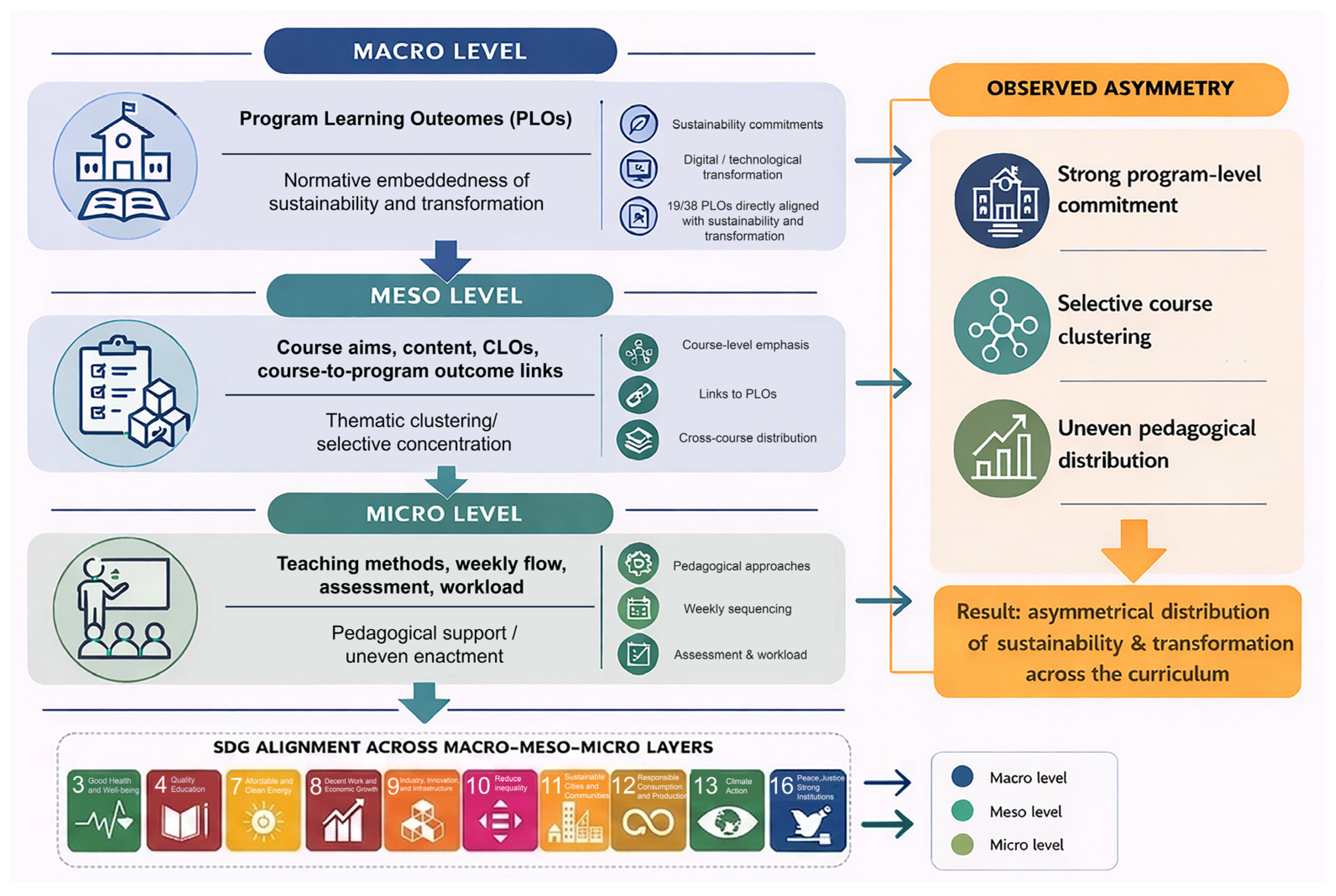
Figure 1, this study therefore treats digitalization not merely as a technical course-content issue located at the meso level, but as a cross-level dimension of curricular restructuring. At the macro level, digital transformation relates to strategic program commitments concerning technological adaptation, innovation, and professional competence; at the meso level, it becomes visible through course contents, CLOs, and digital/BIM-oriented course clusters; and at the micro level, it depends on teaching methods, learning environments, critique formats, and digitally mediated pedagogical practices. This cross-level reading supports the article’s broader argument that sustainability and digital transformation should be interpreted as interdependent dimensions of institutional coherence rather than as separate curricular additions. This separation limits our ability to understand how contemporary architecture curricula respond simultaneously to ecological, social, and technological pressures, and it reinforces the need for analyses that examine program architecture, curricular alignment, and institutional coherence together rather than as separate layers [
7,
10,
11,
22].
Taken together, these three strands constitute the theoretical background of the study and reveal an important analytical gap. Although recent research has advanced SDG integration models, curriculum alignment tools, climate-oriented curriculum redevelopment, and studio-based sustainability pedagogy [
3,
7,
10,
11,
17], fewer studies have examined how an undergraduate architecture curriculum distributes sustainability and transformation across its full formal structure through a document-based, program-wide lens. What remains insufficiently explored is the institutional coherence of this distribution: the relationship between program-level commitments and course-level implementation, the alignment between thematic domains and specific SDGs, and the extent to which teaching methods reinforce or weaken those declared ambitions. The present study addresses this analytical gap through the concept of asymmetrical distribution. In this article, asymmetry refers to the structural gap between normative commitment at the macro level of Program Learning Outcomes and its uneven translation into course-level content, clustering, pedagogy, and assessment. The concept therefore does not indicate the absence of sustainability in the curriculum; rather, it describes a condition in which sustainability and transformation are visible as institutional commitments but become selectively concentrated and pedagogically fragmented across meso- and micro-level curricular structures. In this sense,
Figure 1 should be read not only as a synthesis of the findings, but also as a conceptual representation of the central research problem addressed in the study.
This theoretical framing is important not only for interpreting the present case, but also for understanding why curriculum reform matters in higher education more broadly. If sustainability and transformation are approached as issues of institutional coherence rather than isolated thematic insertion, curriculum analysis can provide longer-term insight into how architecture programs build professional relevance, pedagogical continuity, and organizational capacity for future educational change.
Against this background, the present study examines an undergraduate architecture program in a foundation university in Istanbul through a document-based curriculum analysis of publicly available institutional program and course documents. This context is analytically relevant beyond its local setting because it brings together, within a single curriculum, many of the pressures currently shaping architectural education internationally, including climate resilience, disaster awareness, regulatory responsibility, digital transformation, and inclusive design. The case was selected because it provides a bounded yet analytically rich curriculum setting in which sustainability, disaster resilience, digital transformation, inclusivity, and governance can be traced across multiple formal curricular layers within a single undergraduate program. The study asks three interrelated questions, each corresponding to one analytical level of the macro–meso–micro hierarchy used in this article:
RQ 1. At the macro level, how do Program Learning Outcomes (PLOs) embed sustainability and higher education transformation as normative program-level commitments?
RQ 2. At the meso level, how do sustainability- and SDG-related thematic domains leave a structural footprint across Course Learning Outcomes (CLOs), course contents, and course clusters, and where do their concentrations, gaps, or weak links become visible within the program architecture?
RQ 3. At the micro level, to what extent do teaching methods, weekly course flow, assessment formats, and workload components support the sustainability and transformation agenda articulated in the formal curricular structure?
This level-based formulation aligns the research questions with the analytical hierarchy summarized in
Figure 1 and operationalized in the methodological framework. By focusing on the curriculum as an institutional text rather than on a single intervention, this study moves beyond course-specific innovation and addresses the architecture program as a structured educational system. Accordingly, the article is structured around research questions rather than formal hypotheses, and the discussion interprets the findings in direct relation to the macro, meso, and micro levels represented by RQ1, RQ2, and RQ3.
The figure illustrates the relationship between the macro, meso, and micro analytical levels and shows how program-level commitments, course-level clustering, and pedagogical arrangements interact to produce the asymmetrical distribution of sustainability and transformation across the curriculum.
2. Methodological Framework
2.1. Research Design
This study adopts a document-based embedded single-case design to examine how sustainability and higher education transformation are institutionally organized within an undergraduate architecture curriculum. An embedded single-case design was considered methodologically appropriate because the study does not treat the curriculum as a single undifferentiated whole; rather, it examines a bounded institutional case through analytically nested subunits, namely Program Learning Outcomes (PLOs), course packages, and pedagogical arrangements. In this respect, the design follows the logic of embedded case study research, which is particularly suitable when a case must be interpreted through its internal layers and relationships rather than through surface-level description alone [
27]. At the same time, because the empirical material consists of publicly accessible institutional curriculum documents, the study also draws on document analysis as a systematic qualitative research strategy for selecting, reviewing, interpreting, and organizing documentary evidence [
28].
Within this design, the analytical strategy combines curriculum mapping, directed qualitative content analysis, and intensity coding. This combination was selected because the research aim is not merely to identify whether sustainability-related expressions appear in the curriculum, but to determine how they are distributed, clustered, and pedagogically supported across multiple curricular layers. Curriculum mapping made it possible to trace the alignment between program-level commitments and course-level components. Directed qualitative content analysis enabled the use of theoretically informed categories to interpret the documentary corpus. Intensity coding moved the analysis beyond a binary presence/absence logic by distinguishing between limited, moderate, and high thematic visibility across focal courses [
29,
30]. Comparable curriculum-wide studies on SDG alignment, curriculum mapping, and program-level coherence in higher education and architectural education likewise demonstrate the value of combining document-based curriculum analysis with alignment-focused interpretive frameworks [
7,
10,
11]. Within this methodological logic,
Figure 1 functions not as a post-hoc illustration, but as the organizing scheme that structures the movement from the research questions to coding, analysis, and reporting. Its three levels guide the analytical sequence of the study: macro-level analysis identifies normative embeddedness in Program Learning Outcomes; meso-level analysis examines how these commitments are distributed through course aims, Course Learning Outcomes, course contents, and course-to-program links; and micro-level analysis evaluates whether teaching methods, weekly course flows, assessment formats, and workload components provide pedagogical support.
Section 3 follows the same sequence so that the conceptual hierarchy, methodological procedure, and empirical reporting remain terminologically aligned. Accordingly, the study does not seek statistical generalization; rather, it aims to generate an analytical generalization about how sustainability and transformation are structured within the curriculum of a particular architecture program. For this reason, the study should be read as an analysis of the documented curriculum rather than as a direct evaluation of lived pedagogical implementation, since no interviews, observations, or student-output data were included in the empirical design.
2.2. Case and Dataset
The object of analysis is an eight-semester undergraduate architecture program offered by a foundation university in Istanbul. The dataset was compiled from official program and course documents published in the publicly accessible institutional course information database of Istanbul Aydın University. The institutional documentation examined includes course titles, course codes, semester placement, ECTS credits, course aims and content, Course Learning Outcomes, weekly course schedules, teaching and learning methods, assessment structures, workload calculations, and contribution matrices showing how courses relate to Program Learning Outcomes. The same documentation also presents the PLOs systematically under the categories of knowledge, skills, and competencies. This data structure makes it possible to trace relationships between the program and course levels and to evaluate outcome-content-method alignments within a single analytical framework. In particular, the presence of themes such as sustainable design strategies, environmental systems, energy use, legislation, professional ethics, lifelong learning, and social responsibility at the program level, together with their corresponding expressions in course aims, contents, and methods, made the dataset well suited to curriculum mapping. For this reason, the program was treated not as a statistically representative case, but as an analytically appropriate case for examining how sustainability and transformation are distributed, aligned, and pedagogically supported across a complete curricular structure.
No sampling procedure was applied. Instead, the full body of official curriculum documentation related to the program under study was included in the analysis using a census logic. At the PLO level, a total of 38 outcomes were examined. At the course level, all 73 course packages in the eight-semester curriculum were reviewed as part of the census-stage analysis. At the course level, course packages distributed across all eight semesters were first reviewed holistically, after which those courses displaying the highest concentration of sustainability and transformation themes were selected as focal courses for detailed analysis. Courses with limited or no visible sustainability-related content were therefore not omitted from the overall reading of the curriculum; rather, they informed the program-wide assessment of uneven distribution at the census stage. They were not included in the focal-course matrix because the study was designed to trace institutional concentration patterns, not to construct an experimental contrast between high-visibility and neutral cases. This selection was based on the explicit presence of content related to sustainability, climate, disasters, environmental performance, accessibility, law, ethics, and digitalization in the course aims, contents, and learning outcomes. Within this framework, Physical Environmental Control (Studio), Communication Techniques II, Communication Techniques IV, and Design for All emerged as key nodes for detailed examination. In addition, climate- and disaster-oriented courses discussed in the findings section were evaluated according to the same selection logic. The principal reasons for selecting these courses included the emphasis in Physical Environmental Control on energy-efficient passive climatization, thermal comfort, environmental standards, and user safety; the focus in Communication Techniques II on Photoshop, Lumion, digital visualization, and project critique processes; the Revit, parametric family, BIM, and Navisworks-based coordination structure of Communication Techniques IV; and the emphasis in Design for All on applicability for all users, software, production methods, and applied components.
2.3. Units of Analysis
The study defines three nested units of analysis. Consistent with the hierarchy presented in
Figure 1, these units were operationalized as Macro level (PLOs), Meso level (Courses), and Micro level (Pedagogy). This terminology was used not only as a descriptive classification, but also as the coding sequence of the study. The macro-level coding first identified the normative embeddedness of sustainability and transformation in Program Learning Outcomes. The meso-level coding then examined how these commitments were translated into course aims, Course Learning Outcomes, course contents, and course-to-program outcome relationships. The micro-level coding finally assessed whether teaching methods, weekly course flows, assessment formats, and workload components provided pedagogical support for the commitments identified at the macro and meso levels. At the first level, the macro unit of analysis consists of the Program Learning Outcomes. This level was used to determine the normative framework through which the program constructs sustainability and transformation. Expressions such as environment-human interaction, sustainable design strategies, life safety, energy use, cultural heritage, legal responsibility, professional ethics, monitoring current developments, and taking responsibility with regard to limited energy resources therefore became the primary focus of analysis.
At the second level, the meso unit of analysis consists of the course information packages. At this level, each course was examined through a combined reading of its aim, content, learning outcomes, teaching methods, and relationship to program outcomes. This made it possible to trace not only the declarative, but also the substantive and structural manifestations of sustainability and transformation. Physical Environmental Control was included at this level through its focus on energy-efficient passive climatization and user comfort; Communication Techniques II and IV through digital representation, visualization, BIM, and interdisciplinary model coordination; and Design for All through inclusivity, technological tools, and practice-oriented production.
At the third level, the micro unit of analysis consists of teaching methods, weekly topic flows, assessment formats, and workload components. This level ensured that the study would not be confined to the question of “what is taught?” but would also address “how is it taught?” For this reason, lectures, readings, assignments, project preparation, applications, group work, web-based learning, critique sessions, and workshop-like components were also assessed. Within this design, the “Observed Asymmetry” shown in
Figure 1 was not treated as a predetermined hypothesis to be verified. Rather, it functioned as an emergent analytical result generated through the cross-reading of the three levels. After the macro-level commitments were coded, they were compared with meso-level course clustering and micro-level pedagogical support. Asymmetry was therefore identified when strong normative visibility at the program level was not matched by equally distributed course-level integration or by sustained pedagogical and assessment support at the micro level. The relationship between the data structure, the units of analysis, and the coding logic is summarized in
Table 1.
The analytical framework summarized in
Table 1 constitutes the methodological sequence of the coding, intensity scoring, and SDG alignment procedures elaborated in the following subsections.
The use of lectures, readings, assignments, project preparation, and web-based learning together in Physical Environmental Control; the explicit inclusion of assignments, project preparation, and application in Design for All; and the presence of project applications and group critique processes in the content of Communication Techniques II directly informed the analysis at this level.
2.4. Coding Framework
The study employs directed qualitative content analysis. Following Hsieh and Shannon, a directed approach is appropriate when prior theory and existing research provide the initial analytical frame, while still allowing categories to be refined in relation to the empirical material [
29]. This approach was methodologically suitable here because sustainability and higher education transformation in architectural education already constitute an established field of research. For this reason, the aim of the analysis was not to generate an entirely inductive coding structure from an unframed corpus, but to test, organize, and refine a theoretically informed set of categories against the institutional curriculum documents.
The initial codes were therefore defined in advance on the basis of recurring domains in the literature and were then refined in relation to the dataset. The final codebook consists of six main dimensions: climate action and environmental performance, disaster resilience and safety, digital/technological transformation, governance–-law–-ethics, inclusivity and user well-being, and lifelong learning and professional adaptability. The codes were not left as broad thematic labels alone; explicit decision rules were defined for each. For example, where climate, energy, acoustics, lighting, climatization, comfort, or passive systems were clearly mentioned, the code “climate action and environmental performance” was assigned. Where earthquakes, disasters, risk, safety, or resilience were emphasized, the code “disaster resilience and safety” was used. References to CAD, 3D modeling, visualization, BIM, Navisworks, or parametric family triggered the code “digital/technological transformation.” Mentions of regulations, law, ethics, conservation, or legal responsibility were coded as “governance-law-ethics.” References to accessibility, users, human-space relations, or design for all were coded as “inclusivity and user well-being.” Finally, statements related to following current developments, lifelong learning, independent work, and responsibility taking were coded as “lifelong learning and professional adaptability.”
These thematic codes were subsequently aligned with relevant Sustainable Development Goals (SDGs). The alignment was limited to areas that had an explicit or strong textual basis in the data. No separate external alignment guide, such as a UNESCO or IAU curriculum-mapping instrument, was used as a scoring tool in this stage. Instead, the SDG framework was used as a reference taxonomy, and the alignment was established through interpretive but rule-bound qualitative judgement based on explicit textual anchors in the curriculum documents. The procedure was therefore not based on keyword counting alone. A thematic expression was linked to an SDG only when the wording of the PLO, CLO, course aim, course content, or teaching-method description provided a direct or strongly inferable substantive relationship with that goal. Ambiguous or weak associations were excluded in order to avoid over-extension of SDG labels. Accordingly, SDG 3 was associated with health, safety, comfort, and user well-being; SDG 4 with lifelong learning and educational competence; SDG 7 with energy and environmental systems; SDG 8 with professional development and entrepreneurship; SDG 9 with digital and technological innovation; SDG 10 with accessibility and inclusivity; SDG 11 with sustainable settlements, conservation, and urban resilience; SDG 12 with material and resource-related selection logics; SDG 13 with climate action and disaster resilience; and SDG 16 with law, ethics, and governance. The purpose at this stage was not to mechanically multiply SDG labels across the text, but to make analytically visible the goals with which the curriculum resonates most strongly. Expressions in the program outcomes concerning environment-human interaction, sustainable design strategies, energy use, and legal responsibility formed the principal institutional basis for this alignment.
2.5. Coding and Scoring Procedure
The coding process was conducted in five stages. The coding and scoring procedure was conducted manually rather than through qualitative data analysis software such as NVivo or ATLAS.ti. In the first stage, all course packages were systematically reviewed and an extraction template was created for each course, covering course type, semester, aim, content, Course Learning Outcomes, teaching methods, assessment, and contribution to Program Learning Outcomes. This stage was intended to treat the dataset not as fragmented material, but as an integrated institutional whole. The PLOs presented under the categories of knowledge, skills, and competencies, together with the course contribution matrices linked to these outcomes, were assessed together during this first pass.
In the second stage, the 38 Program Learning Outcomes were screened according to a three-part logic: direct match, indirect match, and no match. A “direct match” referred to the explicit presence of concepts related to sustainability or transformation in the wording of an outcome, whereas an “indirect match” referred to outcomes that supported these domains without using explicit sustainability language. The quantitative reporting in the findings section was based only on direct matches. This decision was adopted in order to tighten the decision rules and reduce the risk of over-coding rather than expanding the interpretive field. Clear statements in the program outcomes regarding sustainable design strategies, energy use, legislation, professional ethics, lifelong learning, and responsibility for environmental protection were coded directly at this stage.
In the third stage, all course packages were screened and focal courses were selected. The selection of focal courses rested on three criteria: the course had to display an explicit alignment with at least one SDG; it had to contain key concepts related to sustainability or transformation in its aims, content, and learning outcomes; and it had to present a distinctive or dense pedagogical pattern relative to other courses. This made it possible to trace clusters such as climate-disaster, environmental performance, digitalization, inclusivity, and application intensity. For this reason, the focal-course selection was interpretive rather than contrastive: the aim was to examine how strong sustainability signals are organized within the curriculum, not to create a control comparison with a deliberately neutral course. Physical Environmental Control, Communication Techniques II, Communication Techniques IV, and Design for All were selected at this stage as the courses offering the clearest matches within the dataset.
In the fourth stage, a 0 to 3 intensity coding scheme was applied to the focal courses, where 0 = absent, 1 = limited, 2 = moderate, and 3 = high intensity. This scoring step was informed by qualitative coding literature that treats coding not only as a classificatory device but also as an analytic means of distinguishing degree, emphasis, and salience across the dataset [
30]. To improve replicability,
Table 2 provides an illustrative rubric indicating the kind of textual evidence that typically corresponded to scores of 0, 1, 2, and 3. Intensity scores were not assigned on the basis of a single word; rather, they were determined through a combined reading of the course aim, content, learning outcomes, and teaching methods. This made it possible to distinguish, for example, between a course that merely mentioned “energy” once and a course that integrated thermal comfort, passive systems, environmental standards, and user safety. Likewise, content limited to naming software tools was distinguished from content that defined BIM, coordination, parametric production, and clash detection processes together. The energy-efficient design, comfort, and web-based learning dimension of Physical Environmental Control; the BIM and Navisworks coordination structure of Communication Techniques IV; and the emphasis in Design for All on project preparation, application, and universal applicability served as typical examples for this scoring process.
In the fifth stage, the macro- and meso-level findings were cross-read. This made it possible to test how the sustainability and transformation domains strongly defined in the program outcomes were actually represented at the course level, in which courses, with what intensity, and through which pedagogical forms. This cross-reading allowed the study to move beyond normative discourse and make inferences at the level of institutional embeddedness. For example, it became possible to show how the program-level emphasis on energy, legislation, ethics, and lifelong learning was concretized at the course level through environmental control, digital techniques, and inclusivity.
2.6. Reliability and Traceability
In this study, reliability was established less through statistical coefficients and more through the clarity of decision rules, the stability of the codebook, and analytical traceability. In the absence of multiple coders, the assignment of the 0–3 intensity scores was conducted by a single researcher; therefore, an inter-rater reliability coefficient was not calculated. Reliability was instead pursued through explicit decision rules, repeated intra-coder checking, two rounds of reading, and cross-checking across multiple documentary layers. First, all codes were defined before the analysis began. As the process advanced, only the definitions were refined; the main coding structure itself was not altered. Second, coding was conducted in two rounds. The first involved preliminary coding, and the second consisted of a full re-reading of the dataset in order to tighten the distinctions between direct match, indirect match, and no match. Third, care was taken to ensure that each result was supported, wherever possible, by more than one layer of data. A course was not coded on the basis of a single aim statement alone; rather, its content, learning outcomes, teaching methods, and relationship to program outcomes were considered together. This approach reduced the risk of over-interpretation based on isolated textual expressions. The PLOs and the tables showing how courses contribute to these outcomes formed the key institutional data layers supporting this traceability.
The study also systematically recorded institutional gaps, not only strong alignments. The absence of teaching formats such as technical visits, field implementation, fieldwork, social responsibility projects, panels, case discussions, and similar practices from many course packages, as well as the limited visibility of hybrid or online pedagogical arrangements, was noted analytically alongside positive findings. For this reason, the method produced not a confirmatory but a critical and balanced reading. The explicit visibility of web-based learning in Physical Environmental Control, contrasted with the absence of many other teaching formats; the presence of application and project preparation in Design for All, contrasted with the absence of technical visits and fieldwork; and the presence in Communication Techniques IV of software- and coordination-oriented content without broader field-based pedagogies are concrete examples of this comparative reliability reading.
2.7. Research Ethics
This research is based on the document analysis of publicly accessible institutional curriculum documents. No data were collected from human participants, and no field procedures involving interviews, surveys, observation, or intervention were conducted. The study does not use personal data, sensitive data, or individually identifiable information. The unit of analysis is not individuals, but institutional course and program documents. The study therefore constitutes a public document review that does not involve human participants. All analyses at the program and course levels were conducted on the basis of publicly available course aims, contents, learning outcomes, teaching methods, and course contribution tables linked to program outcomes.
2.8. Limitations
The primary limitation of the study is that it is based exclusively on official course information packages and other publicly accessible institutional curriculum documents. This provides a high-resolution view of the designed and declared curriculum, but not of the lived curriculum as enacted in studios, classrooms, critiques, or assessment settings. In other words, the study identifies how sustainability and transformation are formally structured, distributed, and expressed in institutional documentation; it does not directly verify how consistently these themes are implemented in practice, interpreted by instructors, experienced by students, or translated into actual design outputs. Because no triangulation was carried out through interviews, direct observations, student work, or assessment evidence, the findings should be interpreted as evidence of institutional curricular design rather than as a full empirical account of pedagogical enactment. For the same reason, even courses coded as 3 (high intensity) should be understood as showing high visibility in the documented curriculum rather than empirically verified intensity in actual teaching and learning practice. A related methodological limitation is that the coding was conducted by a single researcher, which increases the importance of transparent decision rules and analytical traceability.
A second limitation is that the research was conducted as a single-case study. However, the purpose of the study is not to produce statistical representativeness, but to propose a rich descriptive and analytical model for understanding how SDG integration and transformation logics can be organized in architectural education. For this reason, the single-case approach represents a deliberate methodological choice aimed at achieving contextual depth. A third limitation concerns the interpretive nature of the 0 to 3 intensity scoring system. This risk was reduced through explicit decision rules, two rounds of coding, and cross-reading across multiple layers of data, but it was not entirely eliminated. The intensity matrix should therefore be understood not as a definitive quantitative measurement, but as an analytical tool that reveals comparative visibility across courses. The clearly structured nature of the program outcomes and the course contribution matrices linked to them nevertheless provide a significant advantage by making institutional comparison possible despite this limitation.
3. Results
Following the organizing logic of
Figure 1, the results are presented across the same three analytical levels used in the methodological framework: macro-level program outcomes, meso-level course clustering, and micro-level pedagogical arrangements. Sustainability and higher education transformation were examined through six thematic codes: climate action and environmental performance; disaster resilience and safety; digital and technological transformation; governance, law, and ethics; inclusivity and user well-being; and lifelong learning and professional adaptability. These codes were aligned with the relevant United Nations Sustainable Development Goals (SDGs). At the program level, coding showed that 19 of the 38 PLOs were directly related to sustainability and transformation themes. This proportion indicates that approximately half of the curriculum produces a professional formation language oriented toward the SDGs.
3.1. SDG Visibility at the Program Level
The PLOs define sustainability not as a one-dimensional environmental discourse, but as one of the constitutive components of architectural education. Expressions such as evaluating environment-human interaction through psychological, sociological, and ecological data; developing flexible and sustainable design strategies; ensuring life safety and comfort; interpreting lighting, acoustics, climatization, and energy use in environmental systems; investigating cultural heritage; evaluating earthquake-resistant design principles; demonstrating command of zoning, earthquake, and fire regulations; and embracing professional ethics, social responsibility, and lifelong learning show that the program constructs sustainability as a field of competence that incorporates environmental, technical, social, and managerial dimensions together.
This structure can most clearly be associated with SDG 11 (Sustainable Cities and Communities), SDG 13 (Climate Action), SDG 7 (Affordable and Clean Energy), SDG 3 (Good Health and Well-Being), SDG 16 (Peace, Justice and Strong Institutions), SDG 9 (Industry, Innovation and Infrastructure), and SDG 10 (Reduced Inequalities). However, although SDG visibility is strong at the program level, it does not appear to be distributed with equal intensity across all semesters at the course level. Accordingly, the first principal finding is that the curriculum exhibits a strong program-level SDG embeddedness that becomes clustered across courses rather than evenly distributed, as shown in
Table 3.
Table 3 shows that the program’s strongest axes are concentrated in the areas of climate–environmental performance, governance–law–ethics, and inclusivity/user well-being. This is significant because it indicates that the SDGs are constructed within the program not only under the heading of technological modernization, but also through professional responsibility, social welfare, safety, and regulatory awareness. By contrast, the digital transformation dimension appears more limited at the PLO level and more strongly represented at the course level.
3.2. Clustering at the Course Level
Moving from the macro level of program outcomes to the meso level of course structure, the next step is to examine how this institutional commitment is distributed across course clusters. When the CLOs and course content are examined together, SDG alignment does not appear to be distributed horizontally across the curriculum. Instead, it becomes concentrated within specific course clusters. This clustering can be read through three main trajectories. The first concerns Climate-Resilient Development. The second concerns digital representation and BIM-based technical transformation. The third concerns law–ethics–accessibility–conservation. The principal characteristic of the program is therefore not a fully integrated model in which every course carries sustainability and transformation equally, but rather a structure in which these themes are concentrated in specific strategic courses.
The first trajectory, here reframed as Climate-Resilient Development, is related to climate action, disaster resilience, environmental performance, energy use, comfort, and risk-informed design decision-making. In Disasters and Sustainable Development, emphasis is placed on multiple disaster risks, climate change, sustainable settlements, and the translation of risk data into design decisions. In Earthquake and Disaster Management, the focus shifts to understanding disaster management as a system, the effects of design decisions on seismic behavior, the behavior of building clusters and urban fabric under earthquake conditions, and knowledge related to risk reduction. Physical Environmental Control strengthens environmental performance knowledge through climatic comfort, energy-efficient passive climatization, and the control of light, sound, fire, and health. Taken together, these three courses show that the area in which the program establishes its strongest relationship with SDG 11, SDG 13, SDG 7, and SDG 3 is the Climate-Resilient Development trajectory.
The second trajectory is digital transformation. In Communication Techniques I, the program establishes a technical representation and 3D modeling infrastructure through Autodesk AutoCAD 2025, AIA US National CAD Standards, and SketchUp 2025. In Communication Techniques II, digital visualization and project critique processes are foregrounded through Photoshop, presentation boards, Lumion, rendering, and animation production. In Communication Techniques IV, interdisciplinary coordination logic is taught through Revit, parametric family modeling, BIM, Navisworks, and clash detection. This trajectory makes the digital transformation dimension of the program that can be associated with SDG 9 clearly visible. This association should be understood not in terms of software naming alone, but in terms of BIM-based coordination, parametric system logic, clash detection, and model-based workflow integration, through which digital competencies begin to function as infrastructural and process-oriented capacities rather than as isolated drawing skills. However, this transformation is represented mainly at the level of professional software use and technical coordination. Artificial intelligence, data ethics, hybrid studio infrastructures, and digital learning ecosystems do not appear with the same degree of clarity. This finding is important for interpreting the program’s relationship with SDG 9. If digitalization remains primarily software-centric, it supports representation, visualization, and technical coordination, but its contribution to sustainability-oriented innovation remains limited. A more data-centric interpretation would require digital competences to be connected to performance evidence, environmental simulation, energy-use scenarios, lifecycle reasoning, material and resource data, and collaborative decision-making within complex projects. In this broader sense, SDG 9 is not only about introducing digital tools into the curriculum; it also concerns whether these tools enable students to use data for innovation, infrastructure thinking, and sustainability-oriented design judgement. The present curriculum therefore shows a strong foundation for digital transformation, but the results also indicate a need to move from software operation toward data-informed sustainable design education.
The third trajectory concerns law, ethics, accessibility, and conservation. The program outcomes explicitly define command of zoning, earthquake, and fire regulations, awareness of legal responsibilities, investigation of cultural heritage, professional ethics, and social responsibility. The course Design for All makes inclusivity visible by approaching design for every individual, together with production methods and software use. This indicates that SDG 10, SDG 11, and SDG 16 are constructed in the curriculum, especially through the axes of accessibility, governance, and professional responsibility. The course clusters and their SDG orientations are presented in
Table 4.
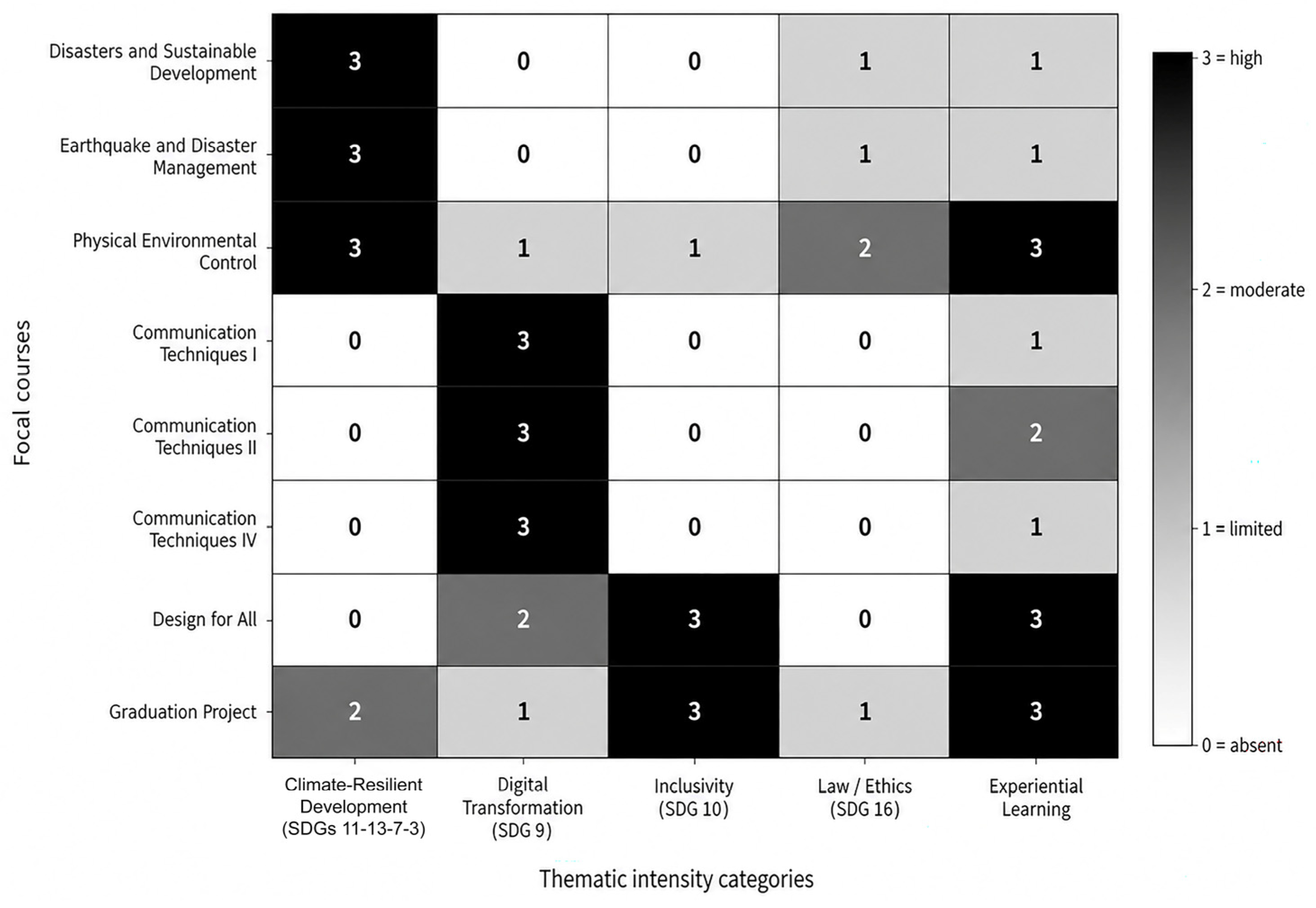
The intensity pattern underlying these course clusters is further visualized in the heatmap presented in
Figure 2, which translates the 0–3 scoring matrix into a graphical reading of high-intensity nodes and curricular blind spots.
3.3. Intensity Matrix
In order to read courses not only in terms of presence or absence, but also in terms of degree of intensity, a 0 to 3 coding scale was applied to eight focal courses. Here, 0 = absent, 1 = limited, 2 = moderate, and 3 = high intensity. The intensity scores reported in
Table 5 were assigned by a single researcher through a combined reading of course aims, content, learning outcomes, and teaching methods. The scoring followed the 0–3 rubric presented in
Table 2 and was checked through repeated intra-coder review rather than through inter-rater reliability, since the coding procedure did not involve multiple coders.
Figure 2 visualizes the thematic intensity scores reported in
Table 5 as a heatmap. The figure makes visible the curriculum’s high-intensity nodes, such as Climate-Resilient Development in climate- and disaster-oriented courses, digital transformation in the Communication Techniques sequence, inclusivity in Design for All and Graduation Project, and experiential learning in Physical Environmental Control, Design for All, and Graduation Project. It also shows blind spots, particularly the absence or weak visibility of digital transformation in climate- and disaster-oriented courses, the limited distribution of inclusivity beyond specific courses, and the weak integration of law/ethics across most focal courses. This graphical reading supports the interpretation that the curriculum contains a strong SDG-oriented core, but that this core is asymmetrically distributed across selected course nodes rather than evenly diffused across the full focal-course network.
Heatmap of thematic intensity across focal courses. The heatmap visualizes the 0–3 intensity scores reported in
Table 5. Darker cells indicate higher thematic intensity, while lighter or empty cells indicate limited or absent visibility. The figure highlights both maximum-intensity nodes and curricular blind spots, thereby supporting the argument that sustainability and transformation are present but unevenly distributed across the focal-course network.
Table 5 and
Figure 2 reveal three critical results. First, Climate-Resilient Development and digital transformation form the two highest-intensity cores within the curriculum. Second, although inclusivity and law/ethics are visible, they appear to be concentrated in a smaller number of courses. Third, experiential learning functions as a micro-level indicator of pedagogical enactment rather than as another thematic SDG category. Its high intensity in Physical Environmental Control, Design for All, and Graduation Project shows that sustainability and transformation become pedagogically stronger when they are connected to application, project preparation, critique, iterative production, or integrated design work. By contrast, the lower experiential-learning scores in several climate-, disaster-, and digital-oriented courses indicate that strong thematic or technical visibility does not automatically produce equally strong pedagogical activation. The program is therefore not weak in terms of sustainability; rather, it exhibits a structure marked by asymmetrical concentration. In other words, the SDGs have entered the curriculum, but they have not yet been institutionalized with equal intensity across the entire course network.
This asymmetrical concentration appears to reflect the curriculum architecture documented in the dataset at both meso and micro levels. Sustainability-related themes become most visible where the formal identity of the course is already defined through environmental control, disaster literacy, technical coordination, accessibility, or regulatory responsibility. By contrast, these themes are less visible in the broader horizontal sequence of the program. This suggests that sustainability is currently institutionalized through specialized curricular carriers rather than through program-wide diffusion. In this sense, the uneven distribution identified here is not simply a numerical imbalance; it indicates a structural condition in which sustainability has been secured in selected nodes but has not yet become a common organizing principle across the full course network.
3.4. Pedagogical Structure
After identifying macro-level SDG visibility and meso-level thematic concentration, the analysis turns to the micro level in order to assess whether these concentrations are supported by pedagogical arrangements. An examination of teaching methods shows that the curriculum does not consist solely of theoretical courses; however, pedagogical transformation has not advanced to the same degree as content transformation. In Design for All, assignments, project preparation, and application are used together. The content of Communication Techniques II explicitly refers to group work and project critique processes. In Earthquake and Disaster Management, group work and reading components are visible. Physical Environmental Control combines lectures, reading, assignments, project preparation, and web-based learning within the same framework. These data show that traces of experiential learning are present in the curriculum.
At the same time, extended experiential learning tools such as technical visits, on-site implementation, fieldwork, social responsibility projects, panels, case discussions, and meetings with practitioners do not appear to be used in many courses. In addition, a large number of focal courses are explicitly defined as face-to-face teaching formats, while hybrid, online, or mixed pedagogical arrangements are not systematically foregrounded. The principal limitation of the curriculum, therefore, is that although it incorporates SDG-related content to a considerable extent, it does not consistently support this content through renewed teaching regimes. In short, the program’s transformation is currently more advanced in terms of “what to teach” than in terms of “how to teach it.”
This pedagogical pattern also helps explain why strong thematic visibility does not automatically produce strong curricular integration. The documented curriculum gives much clearer institutional visibility to content domains, software competencies, and formally declared learning outcomes than to extended teaching regimes such as field-based inquiry, technical visits, live projects, or multi-actor learning environments. A related limitation is visible in the assessment layer: although course packages document assessment structures, the available documentation does not systematically make sustainability-specific evaluation criteria explicit, which suggests that curricular commitment is more visible in content than in formal grading logic. As a result, the program appears stronger in declaring sustainability-related knowledge than in operationalizing it through a consistently renewed pedagogy. The gap identified here is therefore not only thematic but also pedagogical: sustainability is present as content, yet less systematically translated into the teaching infrastructure required for horizontal curricular continuity. Based on these results, an integrated assessment system would need to connect SDG-related content with explicit grading criteria rather than leaving sustainability as a background theme. Such a system could operate through three linked assessment layers. First, at the course-assignment level, rubrics should require students to demonstrate how climate resilience, energy performance, accessibility, user well-being, material/resource awareness, digital coordination, or governance-related criteria are addressed in their design decisions. Second, at the studio and jury level, project reviews should include sustainability-specific evaluation prompts, for example asking whether environmental performance evidence, inclusive design reasoning, risk–response logic, or BIM-supported coordination has informed the design process. Third, at the graduation or capstone level, final evaluation should require students to make explicit the SDG-related contribution of their projects through a short reflective statement, performance diagram, or assessment checklist. In this way, sustainability would be assessed not only as declared content, but as a design criterion, a process criterion, and an evaluative criterion. Without such assessment linkage, SDG-related themes may remain visible in the curriculum while still appearing secondary to conventional technical, formal, or representational criteria.
3.5. Synthesis
Taken together, the findings indicate three main empirical patterns. First, sustainability and transformation are clearly legitimized at the program level. Second, this institutional commitment does not diffuse evenly across the curriculum, but becomes concentrated in specific course clusters, especially around Climate-Resilient Development, digital transformation, and law-ethics-accessibility. Third, pedagogical arrangements do not yet extend this core with equal strength across the wider curriculum. The results therefore point to a visible sustainability core structured through selective clustering and uneven pedagogical extension.
4. Discussion
4.1. Program-Level Configuration
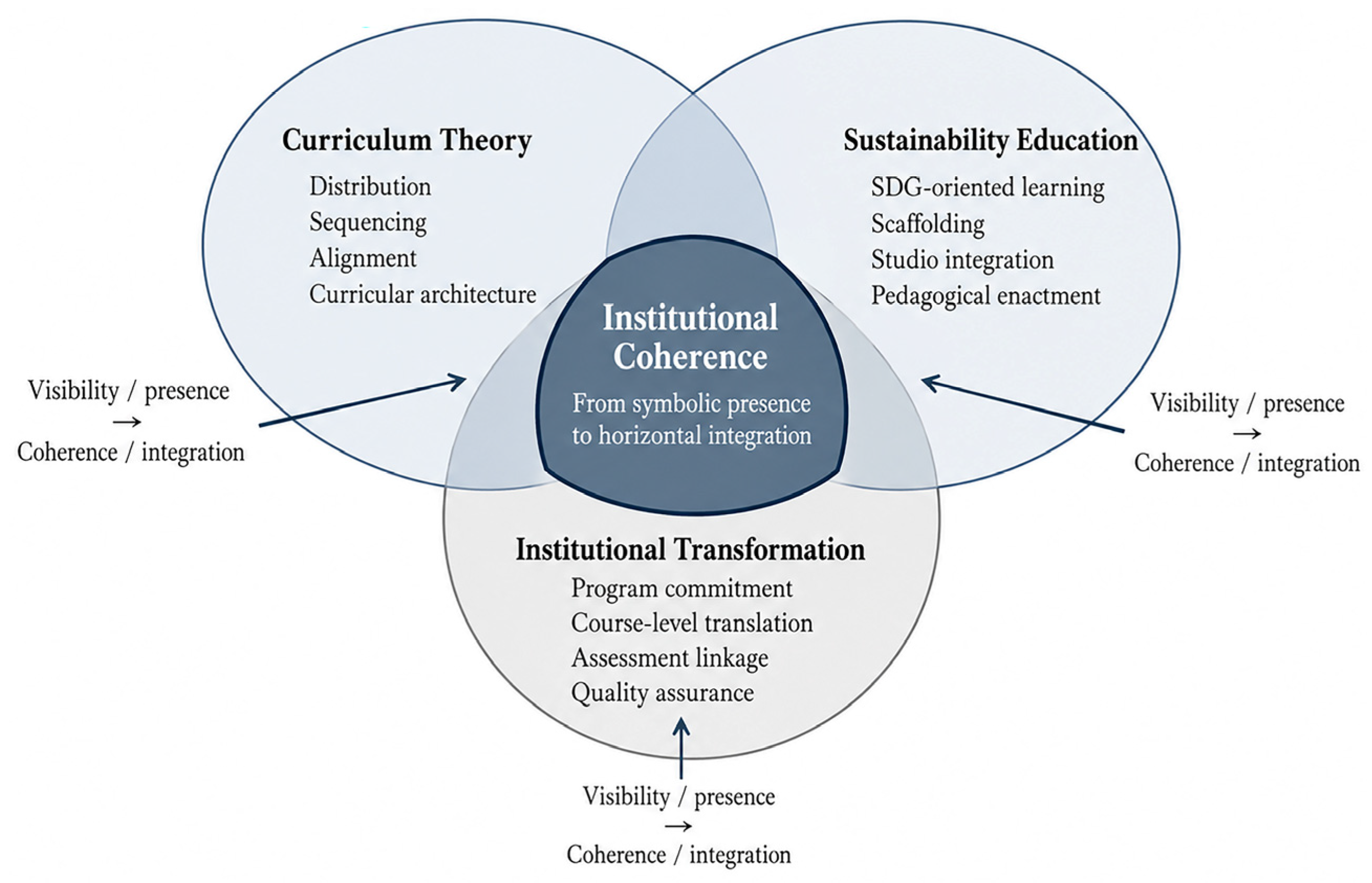
The findings can be interpreted through three interrelated lenses: curriculum theory, sustainability education, and institutional transformation. From a curriculum-theory perspective, the key issue is not whether sustainability is present, but how it is distributed, sequenced, and made coherent across the formal architecture of the program. From a sustainability-education perspective, the issue is not limited to thematic visibility, but extends to whether sustainability is embedded as a scaffolded educational logic rather than as a set of isolated concentrations. From an institutional-transformation perspective, the critical question is whether program-level commitments are translated into course-level and pedagogical arrangements with sufficient continuity. Read through these lenses, the present case does not represent a curriculum lacking sustainability; rather, it represents a curriculum in which sustainability has achieved institutional legitimacy without yet reaching full horizontal integration. In relation to the study design, this discussion addresses RQ1 through institutional distribution across curricular layers, RQ2 through SDG visibility and thematic concentration, and RQ3 through the pedagogical interpretation developed in the subsequent sections. Although these three perspectives remain interrelated throughout the discussion, curriculum theory provides the principal analytical frame through which the findings are interpreted, while the other two perspectives clarify their pedagogical and institutional significance. The interaction among these three lenses is summarized in
Figure 3. The figure positions institutional coherence as the theoretical intersection between curriculum theory, sustainability education, and institutional transformation. In this model, curriculum theory clarifies whether sustainability is distributed, sequenced, and aligned across the formal architecture of the program; sustainability education clarifies whether SDG-related content becomes pedagogically scaffolded rather than remaining thematically visible; and institutional transformation clarifies whether normative commitments are translated into durable course-level, pedagogical, and assessment structures. The intersection of these three lenses defines the article’s central theoretical claim: sustainability integration should not be evaluated only by its presence or visibility in curriculum documents, but by the degree to which it becomes coherent across program structure, course organization, pedagogy, and assessment.
The diagram shows how curriculum theory, sustainability education, and institutional transformation converge around institutional coherence. This convergence transforms sustainability from symbolic presence or thematic visibility into horizontal integration across program structure, course organization, pedagogy, and assessment.
This distinction is theoretically important. Much of the debate in architectural education still tends to frame sustainability integration in terms of inclusion: whether sustainability topics, SDGs, or climate-related concerns have entered the curriculum at all. The present findings suggest that this binary framing is no longer sufficient for interpreting curricular change in a program where sustainability is already visible at multiple levels. Instead, the more analytically meaningful distinction is between presence and coherence. In this sense, the case examined here is best understood as a transitional curriculum formation: one in which sustainability has moved beyond symbolic declaration, but remains selectively institutionalized through concentrated course clusters rather than fully diffused through the broader curriculum structure. More specifically, the transition identified here points toward a more fully integrated curriculum model in which SDG-related commitments are horizontally distributed across semesters, linked more consistently to studio and assessment structures, and pedagogically reinforced across the program, rather than toward an undifferentiated transdisciplinary dissolution of course specializations. This shifts the discussion from curricular addition to curricular architecture, and from thematic inclusion to institutional translation. Accordingly, the article argues that curriculum-wide institutional coherence, rather than SDG visibility alone, should function as the primary evaluative criterion in architectural education research.
4.2. Climate Core
The strongest axis emerging from the findings is organized around climate action, environmental performance, and disaster resilience. The concentration of content in courses such as Physical Environmental Control, Disasters and Sustainable Development, and Earthquake and Disaster Management indicates that the program establishes its strongest link to SDG 11, SDG 13, SDG 7, and partly SDG 3 through this trajectory. This is consistent with recent studies arguing that climate competencies in built environment programs should be embedded not only at the level of environmental awareness, but also at the level of design decision-making, risk literacy, and performance-based analysis [
3,
10,
12]. In particular, Hurlimann et al.’s climate-oriented curriculum redevelopment framework for built environment degrees shows that climate knowledge should be constructed not in a fragmented way across isolated courses, but sequentially and deliberately at the scale of the program as a whole [
3]. The present findings suggest that there is a significant institutional intention in this direction, yet climate action has not fully become a horizontal design principle structuring the entire studio sequence.
Burton and Salama’s discussion of SDG-centered architectural pedagogies emphasizes that climate action should not be confined to technical environmental courses, but should instead be addressed together with studio, theory, representation, and social responsibility [
17]. In this respect, the present case can be read in two ways. On the one hand, the climate and resilience axis is visible and well established in the curriculum. On the other hand, the strong concentration of these themes in specific courses indicates that a more systematic horizontal integration across the studio and project backbone is still needed. Several barriers may explain why this translation into the studio sequence remains incomplete. One barrier concerns faculty and tutor preparedness: climate-responsive design requires studio tutors to translate environmental performance, disaster-risk literacy, energy reasoning, and resilience criteria into design critique, feedback, and jury evaluation rather than treating them as knowledge confined to technical courses. A second barrier concerns curricular and credit-structure rigidity. When environmental control, disaster management, building technology, and design studios operate through separate course sheets, assessment regimes, and workload logics, climate knowledge may remain institutionally visible but pedagogically difficult to synthesize. A third barrier concerns the limited use of integrative studio briefs that require students to test climate-risk scenarios, energy-performance assumptions, user comfort, and resilience strategies within the same design process. In this respect, studio pedagogy should be understood as the principal space of synthesis in architectural education: it is where technical evidence, environmental responsibility, spatial judgement, social use, and representational decisions can be brought together as design criteria. The climate core identified in this curriculum therefore provides a strong foundation, but its educational value depends on whether it is progressively translated into studio briefs, critique cultures, assessment rubrics, and design decision-making across the project sequence. This means that asymmetry should not be interpreted as a defect in purely formal terms, since architecture curricula often rely on technically specialized courses as initial carriers of SDG 7- and SDG 13-related knowledge; it becomes a limitation only when this concentration is not progressively translated into broader studio and program-wide integration. Kastner and Langenberg’s reading of sustainable transformations in architecture curricula as a socio-technical transition further reinforces this interpretation, since change often begins with individual courses, whereas institutional diffusion and continuity emerge only later [
26]. For this reason, the strength of the program’s climate axis lies not only in its content density, but also in its production of a core capacity that could eventually be extended across the full design sequence.
4.3. Digital Transformation
The findings indicate that the program has established a visible and technically structured digital trajectory; however, the analytical significance of this trajectory depends on how digital transformation is interpreted. At the documented curriculum level, digitalization is most clearly expressed through CAD, digital visualization, BIM, model coordination, parametric family logic, and clash detection. This is especially evident in the Communication Techniques sequence, where software-based competencies are linked to representation, coordination, and professional workflow. Yet the more important question is whether these components function merely as software skills or as elements of a broader educational transformation. In the present case, the evidence points to a curriculum that is strong in digital instrumentality, but still less developed in translating digital capacity into a wider pedagogical regime. This distinction can also be read in performance terms: as Stoenoiu and Jäntschi show, computer-skill development is linked to broader organizational performance and efficiency, which suggests that digital competencies in architectural education should be interpreted not merely as software literacy, but as part of a data-driven professional regime [
31]. This interpretation also clarifies the meso-level role of digital competences in the framework presented in
Figure 1. At the course-cluster level, BIM-oriented teaching does not merely expand students’ representational repertoire; it can also serve as an intermediate pillar connecting environmental performance, energy-efficiency reasoning, and project coordination. In this sense, the BIM-related components identified in the Communication Techniques sequence should be read as meso-level mechanisms through which digital transformation may support both sustainable design decision-making and interdisciplinary coordination. However, this potential becomes fully educational only when BIM is connected to performance evaluation, energy-use scenarios, material/resource decisions, and collaborative design judgement rather than remaining confined to software operation.
This distinction becomes clearer when digital transformation is read through the literature on sustainable digital transformation and Education 4.0. In this literature, digital transformation is not reduced to technology use alone; it is associated with institutional structure, learning design, flexibility, interaction, personalization, and new modes of collaboration. From this perspective, BIM, visualization, and digital coordination represent only one layer of transformation. The broader horizon includes hybrid learning environments, AI-aware design processes, critical data literacy, online collaboration ecosystems, and digitally mediated pedagogical interaction. In practical curricular terms, integrating computer skills into Education 4.0 means converting software operation into evidence-based design reasoning. CAD, visualization, BIM, parametric modelling, Navisworks coordination, and AI-aware workflows become pedagogically transformative only when they are used to compare design alternatives, test energy and daylight scenarios, evaluate material and resource implications, coordinate architectural-structural-mechanical systems, and support collaborative decision-making. In this sense, digital competence becomes a support for sustainable design decision-making when students are asked not only to represent a project, but also to use digital information to justify why one design option performs better than another in terms of energy, comfort, accessibility, coordination, lifecycle implications, or resilience. This is the point at which the “computer skills” discussed by Stoenoiu and Jäntschi [
31] can be connected to Education 4.0: they become part of a data-informed pedagogical environment in which representation, simulation, coordination, feedback, and decision-making are integrated. Without this connection, digital transformation remains primarily instrumental; with it, digital skills become part of the curriculum’s capacity to support sustainable design intelligence. Read against this framework, the current program demonstrates a strong technical infrastructure for digital production, yet a more limited visibility in relation to these broader educational dimensions.
For this reason, the digital trajectory identified in the present study should be interpreted as only a partial form of higher education transformation. It represents a meaningful shift from analogue representation toward data-based and coordination-oriented professional workflows, but it does not yet fully demonstrate the wider pedagogical and institutional horizon implied by AI integration and Education 4.0. In other words, the current program appears more advanced in digital tool incorporation than in digital pedagogy. The next stage of transformation would therefore require digitalization to move beyond software-centered competence and become more explicitly tied to collaborative learning design, hybrid studio environments, critical data literacy, and AI-aware educational practice.
4.4. Accessibility and Governance
The findings of this study show that the sustainability debate in the current program is constructed not only in relation to energy and environmental performance, but also through accessibility, ethics, legislation, and governance. El-Kholei and Yassein’s KAP study on sustainability and SDG integration in architecture and planning education emphasizes the importance of making the social and institutional dimensions of sustainability visible in the curriculum [
13]. The continuation of this line of inquiry in the Menoufia graduation project review similarly demonstrates that the pedagogical effectiveness of the SDGs increases when they become visible at the project scale [
32]. In the program examined here, the emphasis on Design for All, legislative literacy, and ethical responsibility suggests that sustainability is framed not only environmentally, but also in rights-based and public terms.
This is consistent with the multilayered approach emphasized by Burton and Salama in their work on SDG-centered architectural pedagogies, since they likewise draw attention to the importance of social justice, equality, and institutional accountability alongside ecological responsibility in the future of architectural education [
17]. Salama, Burton, and Patil’s ADAPT2SDG typology also argues that architectural pedagogy should respond not only to environmental indicators, but also to community engagement, historical awareness, and social equity [
18]. In this context, the strength of the present curriculum lies in the fact that it does not push legislation, conservation, ethics, and inclusivity outside the domain of technical education. Its limitation, however, is that these areas remain more visible at the level of course content and normative definitions, and do not yet appear to have fully converged with studio production, field engagement, and participatory learning modes.
4.5. Pedagogical Openness
The pedagogical findings can be interpreted more clearly when the curriculum is read through three overlapping educational models: experiential learning, studio-based learning, and active learning. In the present dataset, experiential learning appears where students are expected to work through application, project preparation, critique, and iterative production rather than through lecture-only delivery. Studio-based learning appears where sustainability-related knowledge is connected to design judgment, feedback cycles, and the synthesis of technical and social criteria within project work. Active learning appears where students are positioned not as passive recipients of content, but as participants in critique, group work, problem framing, and applied production processes. Read in this way, the curriculum does not lack pedagogical movement; rather, it contains a partial pedagogical shift that remains unevenly developed across the program. The analytical value of this distinction is that teaching methods are treated here not merely as delivery techniques, but as indicators of how sustainability is pedagogically enacted, scaffolded, or restricted within the curriculum.
This distinction is important because sustainability education in architecture becomes pedagogically meaningful not simply when sustainability topics are declared, but when students are required to test, negotiate, and apply them within situated learning processes. The architectural design studio is especially important in this respect, since it functions not only as a delivery setting but as a pedagogical environment in which values, priorities, and design decisions are actively formed [
14]. In this respect, faculty competencies also become a relevant part of pedagogical enactment. Even where sustainability is visible in course documentation, its educational force depends on whether instructors and studio tutors are able to translate those commitments into critique, guidance, and design evaluation practices. Likewise, SDG-focused studio guidance and broader SDG-centred architectural pedagogies suggest that sustainability gains educational force when it is translated into design-based inquiry, critique culture, and iterative decision-making rather than remaining at the level of thematic declaration [
15,
17,
18]. From this perspective, the current program’s limitation is not the absence of pedagogical activity, but the fact that these pedagogical forms remain concentrated, selective, and incompletely extended across the wider curriculum. The concept of the hidden curriculum helps explain this macro–micro gap. Although sustainability is formally visible in Program Learning Outcomes and selected course contents, it may become pedagogically sparse when teaching routines, critique practices, assessment formats, and studio expectations do not consistently require students to operationalize sustainability criteria in design decisions. In this case, the curriculum communicates two messages at once: an explicit message that sustainability is an institutional commitment, and an implicit message that it remains secondary unless it is embedded in the pedagogical and evaluative infrastructure of the program. This hidden-curriculum effect helps explain why strong macro-level visibility does not automatically produce micro-level pedagogical integration. This hidden-curriculum effect becomes particularly critical at the level of assessment and studio juries. If sustainability criteria are present in course descriptions but are not translated into grading rubrics, jury questions, critique protocols, or explicit feedback categories, students may learn that sustainability is rhetorically valued but not decisive in design evaluation. In such a case, the formal curriculum declares sustainability as a program commitment, while the evaluative culture may continue to prioritize formal composition, visual representation, technical resolution, or aesthetic coherence over climate responsiveness, accessibility, resource awareness, resilience, or user well-being. The issue is therefore not only whether sustainability is taught, but whether its absence has evaluative consequences and whether its successful integration is visibly rewarded. From this perspective, studio juries and assessment rubrics are not neutral procedural tools; they are key mechanisms through which the curriculum either reinforces or conceals sustainability as a design priority.
Seen through this lens, the “what is taught/how it is taught” distinction becomes more analytically precise. The current curriculum shows stronger development in codified thematic content than in pedagogical infrastructures capable of distributing that content through sustained educational experience. Although the program includes assignments, applications, project preparation, critique, and some group-based activities, more demanding forms of active and studio-based sustainability learning, such as field immersion, live projects, sustained community engagement, technical visits, and broader participatory formats, remain only weakly visible in the documented course structure. This pattern suggests that the curriculum still treats many teaching methods as localized course devices rather than as a coherent pedagogical strategy for sustainability learning across the program. The key pedagogical issue is therefore not simply methodological variety, but the degree to which sustainability is embedded in feedback-rich, iterative, practice-oriented learning environments across the curriculum as a whole.
4.6. Implications for Redesign
This discussion suggests that the central issue in the curriculum under examination is not the absence of sustainability, but the form of its institutionalization. The program demonstrates a substantial sustainability core, yet that core currently operates through asymmetrical distribution, selective clustering, and uneven pedagogical support. The broader implication is that sustainability in architectural education should not be interpreted as a content-insertion problem alone. Rather, it should be understood as a coherence problem spanning program outcomes, course structures, teaching methods, and institutional learning regimes. This is where the present study contributes theoretically: it shows that a curriculum may be sustainability-oriented in explicit normative terms while still remaining only partially integrated in pedagogical and structural terms.
Three findings are especially significant in this respect. First, the study shows that sustainability in architectural education may be institutionally visible without being horizontally integrated across the curriculum. Second, it demonstrates that pedagogical arrangements lag behind thematic commitment, meaning that the curriculum is stronger in declaring sustainability than in diffusing it through sustained educational practice. Third, it shows that digital transformation and sustainability are not simply parallel curricular additions, but interacting dimensions whose coherence depends on sequencing, pedagogy, and institutional translation.
Seen from this perspective, the study contributes to curriculum theory by demonstrating that institutional coherence is a more discriminating analytical category than simple thematic visibility. It contributes to sustainability-education scholarship by showing that SDG alignment becomes educationally meaningful only when supported by curricular sequencing and pedagogical support. It contributes to institutional-transformation debates by arguing that digitalization, climate literacy, accessibility, and governance should not be treated as parallel additions, but as interdependent dimensions of curriculum restructuring. In this sense, the case does not simply document SDG presence; it shows that curricular transformation remains educationally partial when normative commitments are not translated into integrated sequencing, pedagogy, and assessment. The practical implication of this argument is clear: the next stage of curriculum reform should focus less on adding new sustainability labels and more on reorganizing the existing curriculum through stronger monitoring logic, broader studio integration, assessment linkage, and pedagogical diversification. To operationalize this monitoring logic, faculties could adopt a Macro–Meso–Micro institutional coherence matrix. The purpose of such a matrix is not to add another layer of bureaucratic reporting, but to make visible whether program-level SDG commitments are translated into course-level structures and then reinforced through pedagogy and assessment. In this model, coherence is achieved when the same sustainability or transformation priority can be traced across three levels: first, as a normative commitment in PLOs; second, as a course-level structure in aims, CLOs, contents, and course-to-program links; and third, as a pedagogical and evaluative practice through teaching methods, studio briefs, assignments, juries, rubrics, workload, and feedback mechanisms. Conversely, asymmetry is identified when a theme is strongly declared at the macro level but weakly represented in course clusters or absent from micro-level teaching and assessment practices.
Table 6 proposes a monitoring matrix that can support semester-based internal curriculum review and help transform asymmetrical distribution into a more balanced pattern of institutional coherence.
For the matrix to function as a continuous monitoring model rather than a one-time document-analysis tool, it should be implemented as a cyclical review process. At the beginning of each academic year, the macro level can be reviewed by checking whether PLOs, accreditation expectations, and institutional priorities still define sustainability, digital transformation, inclusivity, resilience, and governance as explicit program commitments. During each semester, the meso level can be monitored through updated course sheets, studio briefs, CLO revisions, course-to-program outcome links, and the distribution of SDG-related themes across required and elective courses. At the end of each semester or academic year, the micro level should be reviewed through evidence that goes beyond formal documents, including assessment rubrics, jury criteria, samples of student work, studio feedback records, instructor reflections, student feedback, live-project outputs, and graduation-project evaluations. This cyclical use of the matrix would allow faculties to compare declared commitments with enacted pedagogical and assessment practices over time. In this way, long-term institutional coherence can be measured not only by whether sustainability is documented, but by whether it remains traceable across curriculum design, course delivery, studio culture, assessment evidence, and iterative quality-assurance review.
For example, this redesign could be operationalized through problem-based studio briefs built around climate-risk and energy-performance scenarios, live projects developed with municipalities or community actors, and field-based technical visits or post-occupancy inquiry linked to reflective critique and assessment. More specifically, this implies that sustainability should become visible not only in course content and pedagogy, but also in explicit assessment criteria for studio juries, project evaluation, and graduation-level review wherever SDG-oriented learning is expected. This redesign logic also implies a faculty-development dimension, since the wider diffusion of sustainability depends not only on curriculum documents but also on the pedagogical capacity of instructors and studio tutors to implement, reinforce, and assess SDG-oriented learning in practice.
In digital terms, this means moving from software-led curricular visibility toward a broader Education 4.0 model in which BIM, AI-aware workflows, hybrid studio practices, and interactive learning environments function as integrated components of curriculum transformation rather than as isolated technical skills.
5. Conclusions
This study examined how sustainability and higher education transformation are structured within an undergraduate architecture curriculum through Program Learning Outcomes (PLOs), Course Learning Outcomes (CLOs), course content, and teaching methods. Its central conclusion is that, within the curriculum under examination, sustainability is not configured as a superficial, symbolic, or merely appended theme attached to a limited number of courses. Rather, it is organized as a clearly defined institutional core at the program level, albeit one that is not distributed with equal intensity across the course network. This indicates that a distinction must be made between the presence of sustainability in the curriculum and its degree of institutional coherence. In other words, the central issue identified by this study is not whether sustainability has entered the curriculum, but where it is concentrated, where it becomes sparse, and to what extent it is pedagogically integrated. This transition points toward fuller horizontal integration across semesters, the studio sequence, and assessment structures, rather than a merely symbolic expansion of SDG content. This conclusion is grounded in three empirical findings presented above: 19 of the 38 Program Learning Outcomes were directly aligned with sustainability and transformation, visibility became concentrated in specific thematic course clusters, and pedagogical arrangements remained less evenly distributed than thematic content.
Within this framework, the study shows that sustainability integration in architectural education becomes most visible along the axes of climate action, environmental performance, disaster resilience, digital transformation, inclusivity, ethics, and governance. In particular, the program demonstrates meaningful alignment with SDG 11 (Sustainable Cities and Communities), SDG 13 (Climate Action), SDG 7 (Affordable and Clean Energy), SDG 9 (Industry, Innovation and Infrastructure), SDG 10 (Reduced Inequalities), and SDG 16 (Peace, Justice and Strong Institutions). In this respect, the curriculum under examination does not reduce sustainability to environmental design knowledge alone. Instead, it positions sustainability within a broader educational framework that incorporates safety, legislation, professional responsibility, accessibility, user well-being, and contemporary production technologies. For this reason, the results may be directly useful to deans, program coordinators, curriculum committees, studio leaders, and accreditation bodies seeking to evaluate how sustainability and SDG commitments are actually distributed, sequenced, and pedagogically supported within architecture programs.
For decision-makers, the findings imply three immediate actions: first, review studio and course sheets to identify where SDG-related commitments remain concentrated rather than horizontally sequenced across the curriculum; second, establish faculty-development and tutor-training modules so that sustainability priorities can be translated more consistently into critique practices, assignment design, and assessment criteria; and third, adopt a curriculum monitoring matrix for internal review and accreditation that tracks indicators such as SDG distribution across semesters, studio–assessment linkage, field/live-project presence, and digital–AI-supported pedagogical capacity. In line with innovation-driven “latent dimensions” perspectives, such a monitoring model should also attend to less visible enabling and blocking factors, especially tutor preparedness, inter-course coordination, and the degree of alignment between documented outcomes and pedagogical enactment. Administratively, these actions should preferably be embedded within the faculty’s existing Quality Assurance, curriculum review, and accreditation-preparation processes rather than being treated as a separate reform initiative. However, to ensure continuity and accountability, faculties may establish a Sustainability Curriculum Committee or assign this role to an existing curriculum or quality-assurance committee. Such a committee would be responsible for coordinating the annual review of course sheets, monitoring the Macro–Meso–Micro coherence matrix, identifying weak links between SDG-related commitments and pedagogical enactment, and supporting tutor-training activities. This governance arrangement would give the proposed actions an institutional home while avoiding the creation of a disconnected administrative layer.
Another important conclusion of the study is that digital transformation has secured a distinct and systematic place within the curriculum. However, in its current configuration, this transformation proceeds largely through professional software literacy, digital representation, BIM, and coordination logic. While this constitutes an important achievement, it also indicates that the pedagogical dimension of digital transformation has not yet expanded to the same extent. Future curriculum development processes should therefore approach digitalization not only as a matter of technical skill, but also as an element capable of transforming learning regimes, collaboration practices, and the structure of design pedagogy itself. In this respect, AI should be considered not only as a technical extension of digital workflows, but also as a potential means of strengthening SDG integration through more inclusive design exploration, accessibility-sensitive scenario testing, and broader attention to equity within digitally mediated architectural decision-making. At the same time, this potential requires explicit attention to data ethics and ethical AI literacy. If AI-supported tools are used to generate accessibility scenarios, user profiles, design alternatives, or equity-oriented evaluations, students and instructors must be trained to question the representativeness, transparency, and possible bias of the datasets and algorithmic assumptions on which these outputs are based. Otherwise, AI may reproduce existing exclusions or normalize biased assumptions about disability, age, gender, cultural difference, mobility, or user well-being under the appearance of technical neutrality. Ethical AI literacy should therefore become part of digital transformation in architectural education, especially where AI is connected to inclusive design, accessibility, and SDG-oriented decision-making.
The original contribution of this research lies in the fact that it analyzes sustainability and SDG integration in architectural education not through isolated course titles or broad institutional discourse alone, but through the combined lens of program outcomes, course clustering, intensity differentials, and pedagogical patterns. In doing so, the study offers an analytical framework capable of assessing not only the visibility of sustainability within the curriculum, but also its structural distribution and institutional embeddedness. This framework may also provide a transferable evaluative logic for comparative studies across other architecture and design programs.
The limitations of the study are therefore directly tied to its research design. Because the analysis is based on publicly accessible institutional curriculum documents, it captures the formal and declared structure of the program, but not the full reality of implementation. The study does not include triangulation through studio observation, interviews with instructors, student perspectives, assessment evidence, graduation projects, or other forms of enacted curricular output. Accordingly, its conclusions should be understood as referring to documented institutional embeddedness rather than to verified pedagogical effectiveness.
Future research should test these formal patterns through triangulated evidence such as studio observation, instructor interviews, student experience, assessment criteria, and design outputs. Such work would make it possible to examine how the shift from documented curriculum to lived curriculum may alter the present findings concerning visibility, intensity, and pedagogical support. Future research may also use AI-assisted Text Mining or Sentiment Analysis to examine larger bodies of student-generated qualitative evidence, such as study diaries, studio reflection notes, course feedback, design-process narratives, or open-ended evaluation forms. These methods could help identify recurring perceptions, affective responses, perceived barriers, and pedagogical blind spots that are not visible in formal curriculum documents alone. Such technology-assisted analysis would support large-scale data triangulation by linking documented curriculum structures with students’ lived experiences of studio teaching, assessment, digital tools, inclusivity, and sustainability-oriented learning. At the same time, these methods should be used critically and transparently, with attention to interpretive loss, over-automation, data privacy, and the ethical handling of student-generated texts.