Article

Peri-Urban Growth and Planning Gaps: A Mixed-Method Study of Varanasi, Kanpur, and Prayagraj

1
Department of Architecture and Planning, National Institute of Technology, Patna 800005, India
2
Department of Architecture and Interior Design, College of Engineering, University of Bahrain, Sakhir 32038, Bahrain
3
Department of Marketing, College of Business Administration (CBA), University of Business and Technology (UBT), Jeddah 23847, Saudi Arabia
*
Authors to whom correspondence should be addressed.
Sustainability 2026, 18(10), 4701; https://doi.org/10.3390/su18104701
Submission received: 9 April 2026 / Revised: 2 May 2026 / Accepted: 6 May 2026 / Published: 8 May 2026

Abstract

This study investigates peri-urban land management in Uttar Pradesh through a comparative analysis of Varanasi, Kanpur, and Prayagraj, focusing on the gap between planned frameworks and actual urban growth. As rapidly expanding Tier-II cities, they represent critical sites where formal planning intersects with complex peri-urban transformations. The study employs a mixed-method approach, combining GIS-based master plan conformance analysis using Effective Boundary Control (EBC) with semi-structured expert interviews. This integration enables both spatial measurement of urban expansion and interpretive understanding of underlying governance and institutional dynamics. The results reveal significant divergence between planned and observed development, particularly in peripheral areas, with clear variation across cities. Kanpur exhibits the highest level of non-conformance (EBC: 2.23), indicating weak boundary control and pronounced peri-urban sprawl. Varanasi also demonstrates substantial deviation (EBC: 2.06), reflecting persistent gaps between planning intent and implementation. In contrast, Prayagraj shows relatively stronger conformance (EBC: 1.04), though underlying challenges remain. These differences are shaped by local conditions, including land acquisition conflicts, fragmented governance structures, infrastructure deficits, and limited financial mechanisms. Importantly, the findings underscore that even where spatial conformity appears stronger, it does not necessarily translate into effective planning outcomes. The study concludes that peri-urban growth is not simply unplanned but is shaped by negotiated and context-specific processes. It highlights the need for adaptive, implementation-focused planning, stronger institutional capacity, and integrated financial strategies. By bridging spatial and qualitative analysis, the research provides a more comprehensive framework for understanding and managing peri-urban development in rapidly urbanizing regions.

1. Introduction

Peri-urban areas are transitional zones where urban expansion, land conversion, and governance pressures intersect, making them important sites for studying planning implementation [1]. Indian cities have witnessed unprecedented population growth, leading to the expansion of urban areas into peri-urban spaces [2,3,4]. The rate of urban population growth has been considerably greater than that of the rural population over the past decade, increasing by 31.16% compared to 12.2% for the rural population [5]. This increase is projected to reach about 416 million by 2050, mostly in the peripheral areas of cities [6]. The population increase is synonymous with fast-paced, haphazard increases in built-up areas, which further lead to informal settlements with land-use changes [7,8].
In this context, the effective management of peri-urban land becomes imperative for sustainable urban development, ensuring the well-being of the burgeoning population and the preservation of the surrounding environmental issues [9]. This study critically examines peri-urban land management in the state of Uttar Pradesh through a comparative analysis of Kanpur, Varanasi, and Prayagraj. As the most populous state in India, Uttar Pradesh presents an intensified landscape of urban transition, where rapid expansion intersects with a predominantly agrarian land base and fragmented planning control [10]. The selected cities are classified as Tier-II under the URDPFI Guidelines, reflecting their role as regional economic, cultural, and administrative centers. However, despite their growing demographic and economic significance, these cities remain underrepresented in peri-urban research, which has largely concentrated on metropolitan (Tier-I) contexts. This study addresses this gap by positioning Tier-II cities not as secondary cases but as critical sites where the tensions between formal planning and organic expansion are more visible and less institutionally buffered.
The comparative value of these cities lies in their shared and divergent characteristics. All three are riverine settlements along the Ganges, where geomorphological constraints shape land availability, intensify ecological vulnerability, and influence the directionality of urban expansion. At the same time, their peri-urban areas are characterized by predominantly organic and development-led growth, often preceding formal planning interventions [11,12,13,14]. Within this shared context, each city represents a distinct trajectory of peri-urban transformation. Kanpur functions as a major industrial center with significant land pressure, particularly along its expanding corridors towards Lucknow and Unnao. Its peri-urban growth is increasingly driven by infrastructure-led development, including metro rail expansion, industrial corridors, and the presence of major institutional hubs such as the Indian Institute of Technology Kanpur and Harcourt Butler Technical University. This has resulted in rapid expansion around census towns and transport corridors, producing a dispersed, often poorly regulated peri-urban landscape.
Prayagraj, in contrast, combines administrative significance as a divisional headquarters with intense religious centrality, particularly due to events such as the Kumbh Mela. Its expansion is increasingly oriented towards the industrial zone of Naini, characterized by leapfrog and linear development patterns with limited prior planning intervention.
Varanasi represents a culturally driven urban system anchored in its historic riverfront and religious landscape along the Ganges. At the same time, it supports a dense network of MSMEs and handicraft industries, which are gradually being displaced from the urban core due to rising land values and redevelopment pressures. This displacement, combined with the influence of new expressways and regional connectivity projects, is accelerating peri-urban expansion in peripheral areas, often led by private developers rather than planned frameworks.
Taken together, these cities offer a strategically varied yet institutionally comparable set of cases. Their differences in economic base, growth drivers, and governance challenges enable a more nuanced understanding of peri-urban land management beyond descriptive comparison. By explicitly linking geomorphological constraints, infrastructural expansion, and institutional capacity, the study develops a framework that is both context-sensitive and analytically transferable. In doing so, it contributes to addressing a significant gap in peri-urban research by demonstrating how Tier-II cities, particularly in northern India, embody complex and often under-theorized trajectories of urban transformation.
Land management in the peri-urban areas of these cities is a multifaceted issue, involving a myriad of stakeholders, from local governments and urban planners to rural communities and landowners [15]. In these areas, decisions about land use, zoning, infrastructure development, and environmental conservation are closely intertwined with social, economic, and political dynamics [16,17]. Existing research has examined peri-urbanization through spatial, socio-economic, and governance lenses; however, a critical gap persists in linking measurable spatial conformity with the institutional processes that shape it. In particular, there is limited empirical work that evaluates how effectively planning boundaries regulate actual urban expansion while simultaneously explaining the governance conditions that produce these outcomes. This gap is significant because spatial indicators alone cannot capture the underlying drivers of peri-urban transformation, while qualitative assessments often lack measurable grounding.
In the following sections, this paper will conduct a thorough analysis of peri-urban land management strategies in Varanasi, Prayagraj, and Kanpur, examining effectiveness in the respective cases. By doing so, this study endeavors to shed light on the vital role of the peri-urban land management scenario in the three cities with the following objectives:
  • To evaluate peri-urban land management policies in Uttar Pradesh, identifying key governance gaps and limitations in addressing rapid urban expansion.
  • To comparatively analyze master plans of Varanasi, Prayagraj, and Kanpur, in order to assess variations in planning approaches and their effectiveness in managing peri-urban growth.
  • To map and assess peri-urban land use patterns using GIS-based analysis, measuring the degree of conformity between planned and actual development.
  • To examine implementation challenges through expert interviews, focusing on institutional constraints and gaps between planning intent and practice.
By combining spatial measurement with institutional interpretation, the study contributes to a more comprehensive understanding of peri-urban land management. It demonstrates that planning effectiveness cannot be inferred from spatial conformity alone and that meaningful evaluation requires linking measurable outcomes to governance processes. This integrated approach provides a replicable framework for assessing peri-urban dynamics in other rapidly urbanizing regions.

2. Literature Study

Peri-urban areas are transitional zones between rural and urban systems, where overlapping governance regimes, land markets, and socio-spatial transformations create complex and often unregulated development trajectories. While peri-urbanization is a global phenomenon, its manifestation varies significantly across contexts. In advanced economies, these areas tend to resemble structured suburban environments with relatively stable infrastructure and governance systems [18]. In contrast, in countries such as India, peri-urban expansion is highly dynamic, informally driven, and institutionally fragmented, shaped by housing shortages, infrastructure deficits, and continuous in-migration [16,18].
This distinction is critical for the present study, as it frames peri-urban growth not merely as spatial expansion but as a governance challenge in which formal planning instruments struggle to regulate rapidly evolving land-use transitions. The conceptualization of peri-urban areas through territorial, functional, and transitional dimensions [1,19] provides a useful lens; however, existing studies often fail to operationalize these dimensions in empirical assessments of planning effectiveness, particularly in the Indian context.

2.1. Challenges and Governance Imperatives

Despite increasing scholarly attention, peri-urban regions remain weakly governed planning spaces, where statutory frameworks lag behind development processes [16]. Key challenges include land fragmentation, speculative conversion, and informal expansion, which collectively undermine the enforceability of master plans and weaken boundary control mechanisms [20]. Peri-urban zones in emerging economies are also sites of intensified investment, where state-led infrastructure projects and market-driven development coexist but are rarely coordinated, resulting in uneven spatial outcomes and socio-economic disparities [21,22]. This disjunction between planning intent and implementation outcomes is central to this study and directly motivates the use of spatial conformance (EBC) alongside governance perception analysis.
Infrastructure provisioning further reflects this gap, as planning systems often fail to keep pace with the pace and pattern of expansion [23,24]. Consequently, peri-urban development is not only a spatial issue but also an institutional one, requiring evaluation of how planning instruments perform in practice rather than how they are designed in policy.
Additionally, conventional planning approaches undervalue peri-urban land by overlooking its ecological and productive functions [23,24]. This results in planning frameworks that inadequately integrate rural–urban linkages, a limitation that is particularly visible in Indian cities, where agricultural land conversion occurs rapidly without corresponding regulatory adaptation.

2.2. Uttar Pradesh Land Development Policies and Programs

Uttar Pradesh represents a critical case for examining these dynamics due to its scale and diversity. With a large and expanding urban system, the state exhibits significant regional variation in urbanization patterns, reflecting uneven economic development and infrastructure distribution [25,26,27]. However, for this study, the importance of Uttar Pradesh lies less in its demographic scale and more in its institutional context, characterized by fragmented legislation, weak enforcement capacity, and the absence of an integrated regional planning framework. These conditions create a structural gap between statutory planning provisions and actual land-use outcomes, particularly in peri-urban areas.
Rapid urban expansion in the state is marked by informal subdivisions, unauthorized constructions, and speculative land transactions, which frequently occur outside planned development boundaries [28,29]. At the same time, urban local bodies face limited financial and technical capacity, restricting their ability to enforce regulations or recover development costs [30,31]. These governance constraints directly inform the analytical approach of this paper. By combining EBC as a spatial indicator of boundary adherence with expert-based insights into implementation processes, the study addresses a key gap in the literature: the lack of integrated evaluation of planning effectiveness in peri-urban contexts.
Furthermore, the shortage of trained planning professionals and the multi-agency nature of urban governance in Uttar Pradesh intensify coordination challenges, particularly in Tier-II cities where institutional capacity is comparatively limited. This reinforces the need for a mixed-method approach that captures both measurable spatial outcomes and experiential governance realities.

2.2.1. Governing Acts and Policies

Uttar Pradesh’s legislative framework for land and urban development provides a formally comprehensive structure for managing peri-urban transformation. However, its effectiveness is constrained not by the absence of policy instruments, but by fragmented institutional mandates, weak enforcement capacity, and limited operational integration across agencies [32]. The coexistence of multiple acts—such as the U.P. Urban Planning and Development Act (1973), the U.P. Housing and Development Board Act (1965), and RERA (2016)—creates overlapping jurisdictions without a unified peri-urban governance mechanism. This institutional fragmentation directly contributes to spatial inconsistencies observed in the EBC analysis, particularly in cities like Kanpur and Varanasi, where expansion beyond planned boundaries is pronounced.
Crucially, most legislative provisions remain plan-centric rather than implementation-oriented [33]. While master plans define land use and zoning, enforcement mechanisms—such as monitoring unauthorized development, regulating land subdivision, and controlling peri-urban speculation—are weak or inconsistently applied. This gap is reflected in high EBC values, where planned boundaries fail to regulate actual expansion. For instance, the persistence of unauthorized layouts and incremental development in peri-urban zones indicates that regulatory control is reactive rather than anticipatory, undermining the intent of statutory planning frameworks.
The transition toward newer policy instruments—such as the U.P. Township Policy (2023), the Land Pooling Scheme (pilot), and the Model TPS/LAP frameworks—signals an attempt to shift from rigid land-acquisition models to more flexible and participatory approaches [34]. However, their implementation performance remains uneven, and their spatial impacts are not yet fully realized. An elaborate discussion is followed in Table 1.
This review shows that Uttar Pradesh’s policy framework is not lacking in intent but is structurally fragmented and weak in enforcement, shifting the problem from policy design to implementation failure. While instruments such as the U.P. Township Policy (2023) and Land Pooling Scheme signal a move toward participatory and sustainability-oriented planning, their provisions remain largely symbolic rather than operational, with limited translation into controlled spatial outcomes, as shown in Table 2.
The Land Pooling Scheme illustrates this gap clearly: although it repositions landowners within the planning process, reduced consent thresholds (80% to 60%) and persistent delays undermine its ability to produce coherent land assembly, resulting in continued fragmentation [35]. This directly corresponds with non-conforming growth patterns where expansion occurs outside planned limits despite formal policy presence. Similarly, advanced instruments such as Value Capture Finance (VCF), Land Readjustment, and TOD expand the policy toolkit [26], but their minimal adoption and weak institutional anchoring limit their spatial impact, rendering them largely aspirational.
Infrastructure-led interventions, particularly bypass and ring road development, further expose this disconnect. In the absence of strict regulatory control, they induce corridor-based and leapfrog expansion, intensifying divergence from planned boundaries rather than consolidating growth. The central issue, therefore, is not the absence of policy innovation but the inability of institutions to enforce, coordinate, and spatially regulate these instruments. The resulting mismatch, evident in EBC patterns, demonstrates that peri-urban growth is governed less by statutory planning and more by market pressures and procedural weaknesses, revealing a systemic implementation deficit rather than a conceptual one.
Although recent policies introduce sustainability-related provisions, these remain limited in operational depth and are not consistently translated into enforceable planning mechanisms. The review of policies and schemes across departments in Uttar Pradesh highlights a central concern: the gap between stated intent and effective implementation. The U.P. Township Policy (2023) and the Land Pooling Scheme illustrate this disconnect, where rehabilitation complexities, cost-sharing disputes, and weak landowner consensus delay or fragment execution, limiting their ability to shape peri-urban growth in practice [36]. Institutional weaknesses further compound this gap—unclear property rights, inconsistent community participation, and procedural delays undermine policy effectiveness, while financial and administrative constraints restrict implementation. Even where sustainability is acknowledged through provisions such as green spaces, solar integration, and rainwater harvesting, these remain largely compliance-driven and inadequately embedded within spatial planning frameworks [37].
More critically, these policies insufficiently engage with the rural–urban continuum, treating land as static rather than transitional [38]. Emerging planning concepts such as blue-green infrastructure, ecosystem services, and environmental justice remain largely absent in operational terms, resulting in reactive and fragmented approaches that are poorly aligned with peri-urban dynamics. Within this context, the effectiveness of policy instruments must be understood through their implementation logic and enforcement capacity. Mechanisms such as land pooling and TPS aim to internalize growth within planned boundaries but are contingent on coordination, consent, and timely execution, often leading to partial outcomes. Similarly, township policies and infrastructure-led interventions (e.g., ring roads and bypass corridors) influence the direction of expansion but, without regulatory integration, can induce fragmented or corridor-driven growth beyond statutory limits. EBC is therefore employed not as an isolated metric, but as a spatial lens to interpret how these policy instruments translate into—or fail to translate into—boundary-conforming development, establishing the basis for the integrated analysis that follows.

2.2.2. Case Cities Background

The selected cities of Kanpur, Varanasi, and Prayagraj in Uttar Pradesh are crucial with respect to urbanization, urban sprawl, and peri-urban development. These three cities were selected because they represent distinct but comparable peri-urban conditions within Uttar Pradesh, including differences in population scale, urban functions, planning stages, and spatial growth patterns. The Ganges River significantly affects land utilization, growth limits, and environmental considerations in all three cities due to their location along the river. Studying how these cities handle their peri-urban areas concerning the morphology of the site and various urbanization drivers increases the complexity of the research, considering the following aspects: The selected cities of Kanpur, Prayagraj, and Varanasi are analytically comparable yet structurally distinct. Kanpur (~2.9 million) is significantly larger than Varanasi (~1.4 million) and Prayagraj (~1.2 million), implying different intensities of land pressure and expansion. Their economic bases also diverge—Kanpur as an industrial hub, Varanasi as a cultural-religious economy, and Prayagraj as an administrative center—producing distinct peri-urban growth dynamics. Planning timelines further vary across cities, with differing master plan horizons and revisions affecting alignment with the 2015–2025 EBC analysis period. Additionally, regional disparities in urbanization across Uttar Pradesh and infrastructure-led growth corridors (e.g., Kanpur–Lucknow corridor, expressway-driven expansion in Varanasi, and Naini-oriented growth in Prayagraj) shape spatial outcomes. These structural differences are explicitly acknowledged in the analysis, and EBC results are therefore interpreted comparatively rather than as directly equivalent indicators of planning performance.
I.
Diverse Urban Functions and Development:
Kanpur is the largest city in Uttar Pradesh and serves as a significant center for commerce, industry, and education [30]. The city’s economic importance and diverse urban roles make it a crucial subject for studying peri-urban dynamics, especially the industrial clustering after western and southern growth. Varanasi, located on the banks of the Ganga River, has significant cultural and religious significance and functions as an agro-climatic region [39]. Prayagraj’s urban complexity is influenced by its strategic location at the junction of the Ganga and Yamuna rivers and its historical significance. The city’s function as a regional industrial center makes it significant for studying the challenges linked to peri-urban expansion.
Currently, Kanpur’s peri-urban growth is expanding towards the western and southern areas due to a mutually beneficial link between industrial operations and educational institutions, forming a peri-urban corridor [40]. The growth is driven by the creation of educational townships and the strategic location of industries. The peri-urban area of Varanasi is developing on both sides of the Ganges River. The left bank is primarily focused on cultural and educational growth, while the right bank and southeast are considered secondary development areas [39]. Prayagraj is undergoing peri-urban expansion along the riverbanks, with industrial areas serving as important peri-urban buffers [40]. Freight routes and townships significantly impact peri-urban growth patterns, demonstrating the complex nature of peri-urbanization in cities. The east–west railways in Prayagraj play a significant role in shaping the spatial distribution of peri-urban areas by connecting and separating them.
II.
Population density and distribution
As per Census 2011, Kanpur has a population of 2.76 million according to the 2011 census. The distribution of this population among several administrative zones sheds light on the challenges of managing urban sprawl, particularly when combined with industrial growth. Varanasi has a population of 1.42 million with a density of 2063 individuals per square kilometer, indicating significant strain on land and resources compared to the state average. Prayagraj, the seventh-most-populated city in the state with 1.23 million residents as per the Census 2011, has population dynamics influenced by its closeness to industrial districts and institutional center character.

2.3. Master Plan Strategies and Approaches

An extensive examination of the master plans for Varanasi, Kanpur, and Prayagraj shows the various strategies employed by land management authorities to tackle the issues related to peri-urban or peripheral growth. The plans are assessed based on the factors utilized in the research of land management and governance; Participatory Land Use Planning, Land Tenure Regularization, Infrastructure Development and Service Provision Tool/Approach, Economic Diversification and Livelihood Support, Environmental Conservation and Green Spaces, Smart Technologies and Data-Driven Planning, Social Housing and Affordable Housing Programs, Disaster Risk Reduction and Resilience Building, Specified Zonal Development Plan, Mention of rural development and any other Special Provision [41,42,43,44,45] providing detailed insights into the effectiveness of implementation as illustrated in Table 3.
An examination of the master plans of Varanasi, Kanpur, and Prayagraj reveals a common challenge: the gap between planning intent and enforceable spatial outcomes in peri-urban areas. Although these plans articulate broad development strategies, they function more as indicative frameworks than effective regulatory instruments, with uneven institutional support and implementation capacity.
Varanasi emphasizes cultural identity, environmental buffers, and sub-urban centers, particularly along the Ganga. However, weak infrastructure planning and limited participatory mechanisms constrain implementation. While rural populations are acknowledged, their integration remains superficial, leaving peri-urban transitions inadequately governed amid increasing corridor-based growth. Kanpur adopts a comparatively structured approach, incorporating land pooling, alignment with URDPFI/RADPFI norms, and spatial provisions such as the Highway Facility Zone. Emerging data-driven initiatives and limited stakeholder engagement reflect institutional responsiveness. Yet, the absence of land tenure regularization and delays in major projects such as Trans Ganga and New Kanpur City expose persistent implementation deficits. Prayagraj reflects a more fragmented strategy, where zoning exists without sufficient institutional or technological support. The absence of participatory frameworks and weak linkage between infrastructure and land-use controls results in linear, corridor-based expansion, particularly toward Naini, reinforcing uneven development patterns.
Across all three cities, as shown in Table 4, structural gaps are evident. The absence of land tenure regularization undermines controlled development, enabling informal and non-conforming growth. Environmental provisions remain largely declarative, while social housing, rural integration, and inclusive planning are inconsistently addressed. Zonal plans are designated but often unimplemented, creating regulatory ambiguity that facilitates speculative expansion. Persistent project delays further highlight systemic institutional and financial constraints. Overall, while the plans recognize peri-urban challenges, they lack the operational mechanisms to manage them effectively. These limitations form the basis for subsequent analysis.

3. Materials and Methods

This study adopts a mixed-method approach to examine peri-urban land management by integrating spatial analysis with institutional insights. Such an approach is particularly suited to peri-urban contexts, where physical expansion patterns are closely intertwined with governance processes [40,41]. Given that land is a state subject in India, the analysis focuses on Uttar Pradesh, the country’s most populous state, and there is a significant agricultural base accounting for 24,170,403 hectares (82.1% of total geographical area) and the net sown area, which accounts for 68% of the cultivatable area, is steadily declining [18] and is facing transformations due to urbanization [32]. characterized by a strong agrarian base, undergoing rapid transformation due to urbanization. The declining net sown area and increasing development pressures make it an appropriate context for examining peri-urban dynamics.
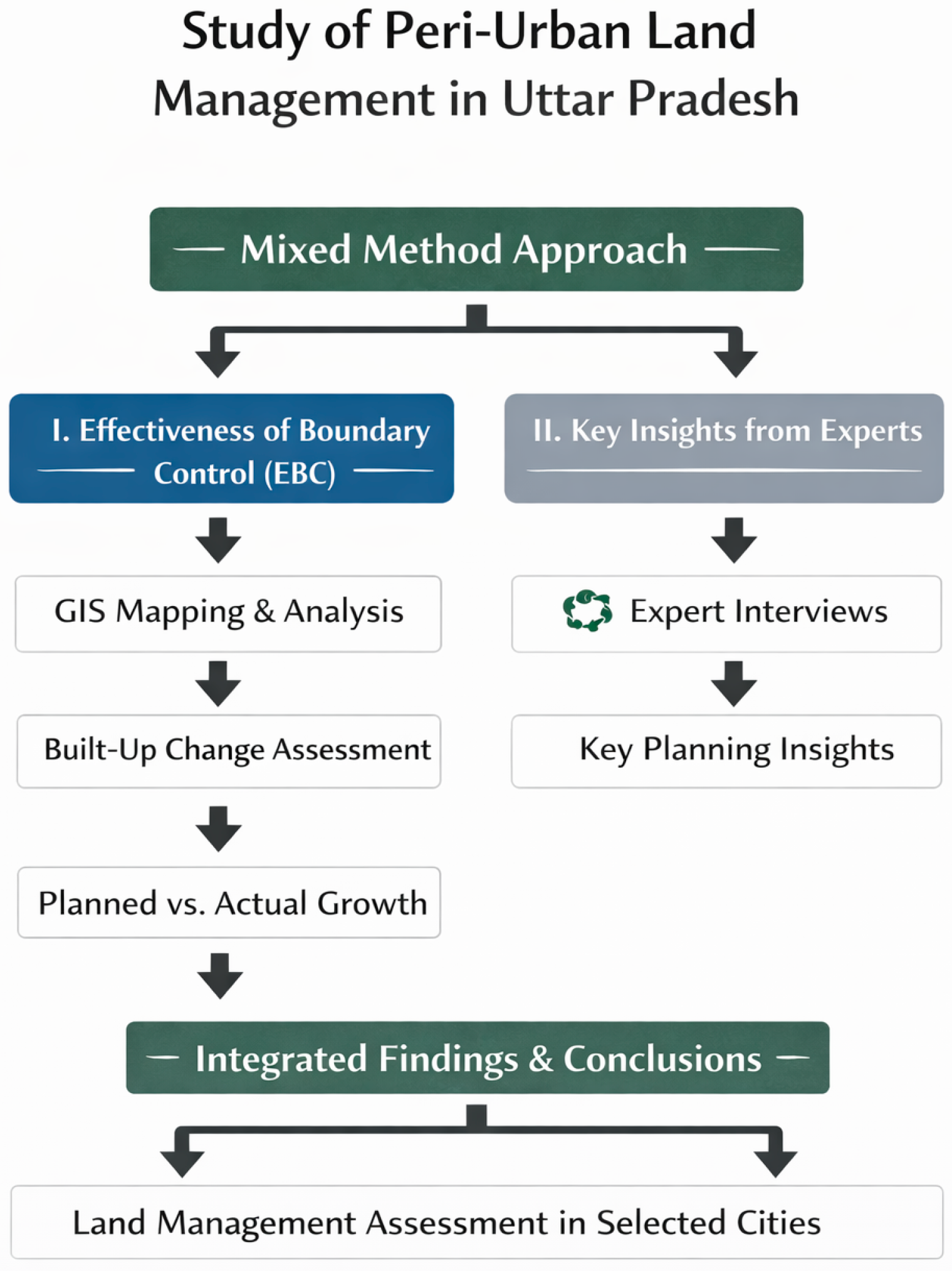
The research design is structured around two complementary components: (i) a GIS-based assessment of spatial conformity using the Effectiveness of Boundary Control (EBC), and (ii) expert interviews to interpret governance conditions shaping these spatial outcomes. Rather than operating independently, these components are analytically integrated to explain both where peri-urban expansion deviates from plans and why such deviations occur.
I.
GIS-Based Spatial Analysis: Spatial analysis was conducted using satellite imagery obtained from the Landsat program (USGS), with a spatial resolution of 30 m, for the years 2015 and 2025. These time points were selected to capture decadal trends in peri-urban expansion while aligning as closely as possible with available master plan periods across the three cities. Preprocessing included atmospheric normalization (where applicable), clipping to study area boundaries, and harmonization of classification schemes across all time periods. A supervised classification approach was applied in ArcGIS 10.8.2, using training samples to distinguish built-up and non-built-up classes. Land-use categories were reclassified into consistent classes to ensure temporal comparability. The classes are as follows: (i) Open Land/Vacant Land/Green Areas, (ii) Built Up Area, and (iii) Water Bodies (river, pond, drains). The calculations were based solely on built-up areas.
Classification accuracy was assessed using a confusion matrix based on ground-truth and reference data, yielding an overall accuracy of approximately 81%, indicating moderate reliability for spatial interpretation. While minor classification uncertainties remain, consistent methodology across years ensures that comparative trends in built-up expansion are robust. Differences in master plan timelines across cities were addressed by aligning satellite imagery years with the closest corresponding planning periods, thereby ensuring reasonable temporal comparability between planned and observed development patterns.
The Effectiveness of Boundary Control (EBC) is calculated as the ratio of built-up expansion within the statutory boundary (ADI) to that occurring in the peri-urban buffer (ADO). An EBC value ≈ 1 indicates balanced growth between planned and peripheral areas; values > 1 indicate higher growth outside planned limits (spatial non-conformity), while values < 1 indicate relatively contained urban expansion. It is employed as a quantitative indicator to assess the degree of conformity between planned urban expansion and observed built-up growth [38].
E B C = B u i l t- u p   g r o w t h   w i t h i n   p l a n n e d   b o u n d a r y   ( A D I ) B u i l t- u p   g r o w t h   o u t s i d e   p l a n n e d   b o u n d a r y   ( A D O )
To operationalize the analysis, a 5 km buffer was delineated around the statutory planning boundary of each city, based on the lower threshold recommended in the URDPFI guidelines for defining peri-urban areas in any city, to be taken from 5 km to 100 km in Indian cities [38,46]. This standardized buffer ensures comparability across cases while capturing immediate fringe dynamics where planning control is most contested. Sensitivity checks were conducted using alternative buffer distances to assess the robustness of results, and while minor variations were observed, the overall pattern of spatial divergence remained consistent. The EBC approach has certain limitations. It is sensitive to initial urban form, base built-up area, and spatial scale, which may influence cross-city comparability. Furthermore, it does not capture qualitative dimensions such as governance capacity, enforcement practices, or socio-economic drivers, necessitating complementary qualitative analysis.
II.
Key Insights from Experts: Expert interviews were conducted with nine participants from Varanasi, Prayagraj, and Kanpur, including Chief Town Planners, Town Planners, and Planning Consultants, using Snowball sampling techniques. Since there are only a few core planning experts within the authorities, these participants were chosen for their urban planning and land management expertise and role in the respective authorities. While the sample size is relatively small (n = 9), this is consistent with expert-based qualitative and mixed-method research, where the emphasis lies in depth of domain-specific knowledge rather than statistical representativeness [47,48]. Comparable studies in emerging policy domains, such as low-carbon transition research, have similarly relied on limited but highly specialized expert samples to generate analytically robust insights [49]. An expert opinion-based perspective on emerging policy and economic research priorities for advancing the low-carbon hydrogen sector [50]. In the context of Tier-II Indian cities, where the pool of senior planning professionals is inherently constrained, such a sample size is both methodologically appropriate and empirically justified [51,52]. The interview covered subjects such as master plan execution, peri-urban issues, and incorporating environmental factors into planning decisions, as derived from similar studies [37,38,43], to critically evaluate the coevolution of land development-management policies and strategies across the state and the three cities. Thus, the study seeks to provide quantitative insights into peri-urban land management efficacy and limits.
A semi-structured interview design was adopted to ensure flexibility in discussion while maintaining systematic coverage of key themes. Mixed Set of Questions: The instrument combined multiple question types to capture both qualitative depth and quantitative comparability: (a) open-ended questions: encouraged detailed, narrative responses, enabling respondents to share experiences, highlight context-specific challenges, and reveal insights that may not emerge through structured formats; (b) closed-ended questions: provided predefined response options, generating clear and comparable data that supports systematic analysis across respondents; (c) Likert-scale questions: structured rating scales were included to quantify perceptions and attitudes, organized into two segments: I. Assessment of peri-urban landscape changes, policies, and projects, and II. Evaluation of the perceived impacts of peri-urban interventions.
III.
Data Source and Processing: Satellite imagery for land-use analysis was obtained from Landsat data available through USGS. The analysis used imagery for 2015, 2020, and 2025 to assess changes in peri-urban built-up patterns over time. The imagery was processed in ArcGIS and classified using a supervised classification approach. Preprocessing steps included clipping the imagery to the study area boundary and reclassifying land-use categories to ensure consistency across all three time periods. Differences in master plan timelines were normalized by aligning the analysis years with the closest available planning periods. Land-use classification accuracy was validated using a confusion matrix derived from ground-truth and reference samples, resulting in an overall accuracy of 81%, indicating a moderate level of thematic reliability for subsequent spatial analysis. Temporal comparability for the 2015–2025 analysis was ensured by using the same classification scheme, consistent preprocessing, and uniform class definitions across both years.
IV.
Integration of Spatial and Qualitative Methods: The two methodological components are integrated to provide a more comprehensive understanding of peri-urban dynamics. The EBC analysis identifies spatial patterns of conformity and divergence, while expert interviews explain the institutional, policy, and governance factors underlying these patterns. Importantly, convergence between the two sources is not assumed; instead, divergences are treated as analytically meaningful. For instance, cases where spatial conformity appears strong but expert perceptions indicate governance challenges are interpreted as evidence that formal planning compliance does not necessarily reflect effective implementation. This integrative approach enables the study to move beyond descriptive spatial analysis and toward a more nuanced interpretation of peri-urban land management as a negotiated and context-dependent process.
The final methodological process is illustrated in Figure 1.

4. Findings

4.1. Effectiveness of Boundary Control (EBC)

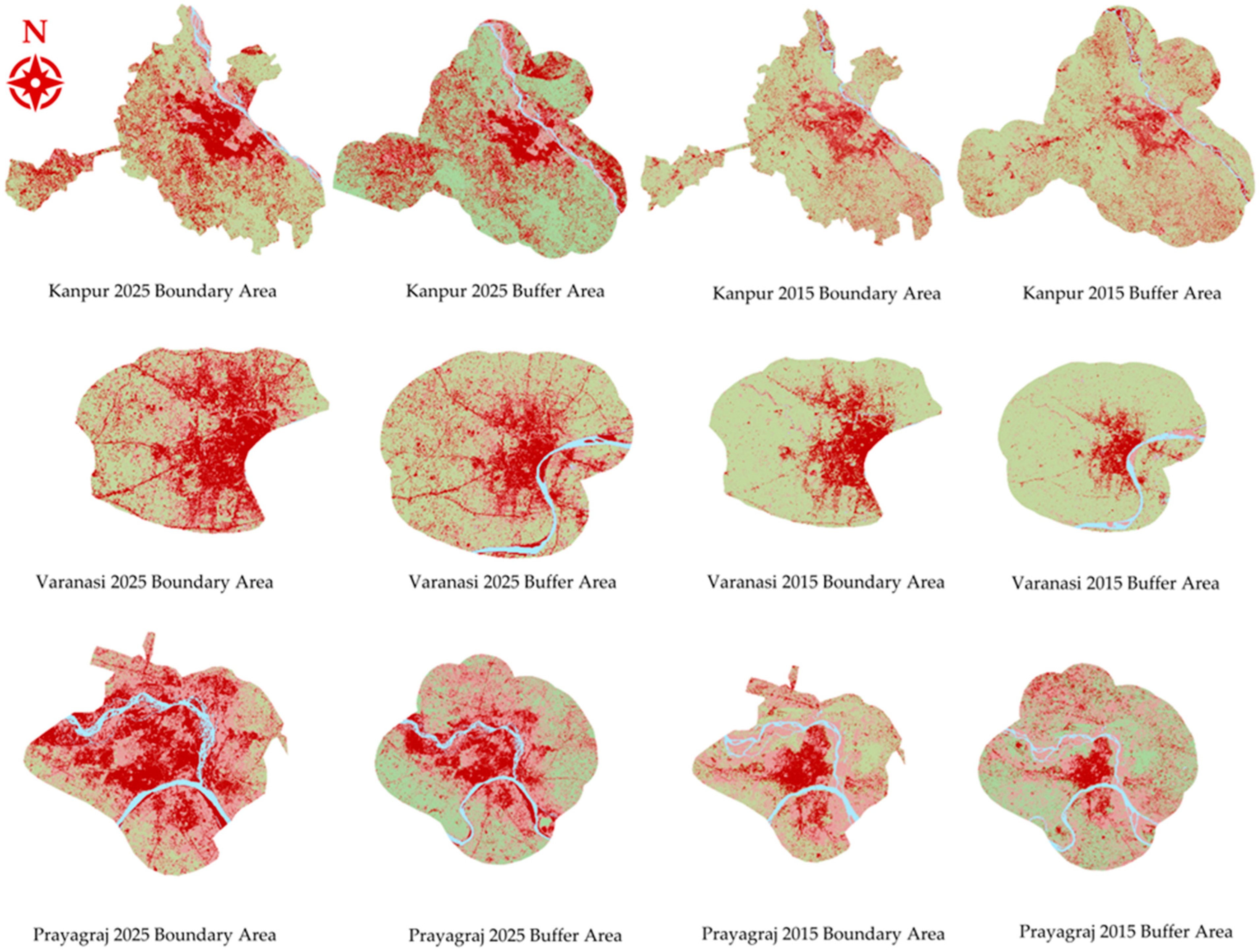
Land use and land cover maps for the three cities were created using ArcGIS 10.8.2 using Image classification. The maps were used to calculate changes in urban development over a decade, from 2015 to 2025. The effectiveness of boundary control (EBC) [38,53] was assessed by analyzing urban growth non-conformities within a 5 km buffer area around the metropolitan boundary derived from the minimum distance prescribed by the URDPFI guidelines for considering peri-urban areas (5–100 km) [54]. This evaluation considered built-up changes to identify increases inside and outside the development area boundary as illustrated in Figure 2. The objective was to assess the degree of alignment between land-use plans and real urban growth patterns [55]. Lower EBC results suggest stronger adherence to urban planning boundaries. A value of 1 indicates an equal balance between conformity and non-compliance, whereas values above 1 suggest higher non-conformity with planned urban expansion boundaries [32].
The results show that EBC values differ across the three cities, with Kanpur recording 2.23, Varanasi 2.06, and Prayagraj 1.04. There are significant differences in EBC among the cities of Varanasi, Kanpur, and Prayagraj, as discussed in Table 5. Varanasi has experienced significant urban expansion over the past decade, with notable divergence in growth rates between the city limits and surrounding areas. Also, Kanpur has experienced even more significant growth in its built-up area, both within the city limits and in the surrounding buffer zone, with the expansion outside the city boundaries exceeding the growth within. The rate of expansion beyond the city’s limits surpasses that within, indicating possible difficulties in monitoring and regulating urban sprawl. In Prayagraj, the built-up area expanded, although the growth differential between the inside boundary and the buffer of the city remains generally balanced. The slight variation indicates a controlled urban growth in terms of built-up change.

4.2. Expert Interview

The section elaborates on the opinions of experts about peri-urban land management. Professionals’ hands-on experience and domain expertise illuminate peri-urban land management and associated challenges. The professional perspective also highlights the interdependence of peri-urban phenomena with urban and rural settings. The experts’ opinions were collected via personal interviews by the authors in October 2025. The experts are of the following designations: three chief town planners from development authorities, two associate planners, the town and country planning office, two consultant planners (REPL Noida and NEPC Ahmedabad), and one research intern at the development authority. The questions are described in Appendix A.
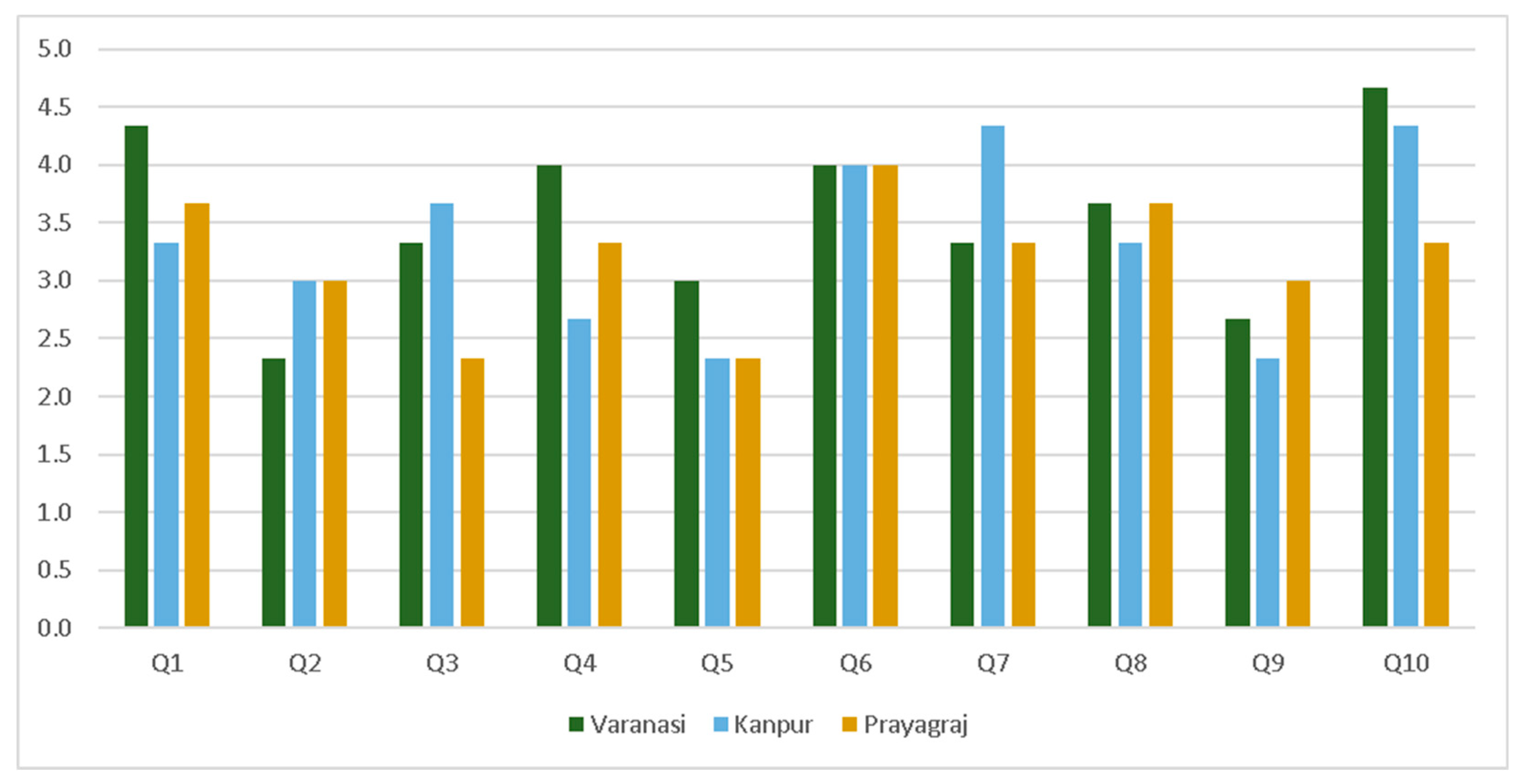
The interview responses were organized by city and covered policy effectiveness, awareness generation, resource allocation, stakeholder engagement, and the perceived impacts of peri-urban land interventions [56,57]. As illustrated in Figure 3, the expert perspectives on peri-urban land management practices in Varanasi, Kanpur, and Prayagraj demonstrate clear patterns that highlight variations and similarities in the perceived effectiveness of these strategies. Responses to initiatives and programs aimed at peri-urban development demonstrate a comparable pattern among experts. The consistently high ratings for Varanasi indicate favorable outcomes, whereas the mixed ratings for Kanpur and the varying scores for Prayagraj show a more complex impact.
Awareness campaigns introduce an additional aspect of divergence. Varanasi and Prayagraj have received modest scores, suggesting room for improvement in their communication strategies. Conversely, Kanpur has a better rating, indicating a more successful awareness effort. The effectiveness of resource allocation is considered average in the cities, suggesting that there is room for improvement in optimizing techniques for resource utilization. The reported ratings also show differences across the cities in stakeholder engagement, socio-cultural impacts, livelihoods, infrastructure, economic growth, agricultural land loss, spatial inequality, and fragmented development. Stakeholder engagement elicits a range of viewpoints: Varanasi shows varying degrees of engagement, Kanpur displays a mix of positive and negative evaluations, and Prayagraj indicates a moderate level of participation.
In Varanasi, the impact on individuals’ socio-cultural beliefs and standard of living is assessed to be 3.0, suggesting a moderate degree of influence. Experts in Varanasi have assigned a rating of 3.3 to the influence on economic development, which indicates a moderate impact. A relatively lower score of 2.7 is assigned to the city’s influence on spatial inequality, suggesting concerns regarding the attainment of balanced development. In contrast, the mean rating for the peri-urban undertaking in Kanpur is 2.7, signifying a diminished degree of contentment among experts. The impact on livelihoods and socio-cultural values has received the lowest rating of 2.3, implying potential challenges in these domains. However, Kanpur exhibits remarkable progress in the development of its infrastructure and services, and economic growth impact earning a grade of 4.0 and 4.3, respectively.
Prayagraj distinguishes itself by receiving an average rating of 2.7 for the results of the peri-urban initiative. The 2.3 rating assigned to the impact on socio-cultural values and livelihoods is comparable to the score achieved by Kanpur. Like Kanpur, Prayagraj consistently obtains a grade of 4.0 in its influence on infrastructural and service development. This indicates that the city is held in high regard. A moderate impact on economic growth is indicated by the value of 3.3 and a rating of 3.0 in its influence on spatial inequality, suggesting inequitable development.

4.3. Integrated Analysis: Interpreting Spatial–Institutional Synergies

While Section 4.1 and Section 4.2 present spatial and qualitative findings independently, their analytical value lies in their integration. This section synthesizes these insights by examining areas of convergence, divergence, and emergent interpretations across the three cities.
A clear convergence is observed in Kanpur, where high EBC values (2.23) align with expert assessments indicating fragmented development, socio-cultural disruption, and weak livelihood integration. This correspondence suggests that spatial non-conformity is not incidental but reflects systemic governance limitations, including weak enforcement, infrastructure lag, and piecemeal expansion. Here, the agreement between spatial and perceptual data strengthens confidence in the diagnosis of peri-urban dysfunction as both physically observable and institutionally experienced.
In Varanasi, the relationship is more nuanced. While the EBC value (2.06) indicates substantial deviation from planned boundaries, expert responses suggest moderate effectiveness in economic and infrastructural domains alongside concerns regarding spatial inequality and uneven participation. This partial convergence indicates that non-conformity does not uniformly translate into governance failure; instead, it reflects selective or uneven implementation of planning interventions. The divergence between spatial expansion and social outcomes suggests that planning mechanisms may be operational but not equitably distributed.
The most analytically significant case is Prayagraj, where the integration of methods reveals a clear contradiction. Despite a relatively low EBC value (1.04), suggesting strong spatial conformity, expert perceptions indicate fragmented development, housing deficits, and coordination challenges. This divergence demonstrates that spatial conformity can coexist with governance inefficiencies, thereby challenging the assumption that adherence to planned boundaries equates to effective peri-urban management. Instead, it suggests that controlled expansion may occur without corresponding improvements in institutional performance or socio-economic outcomes.
Taken together, these patterns reveal that EBC captures the extent of spatial alignment but not the depth or quality of governance processes. Conversely, expert insights illuminate institutional realities but lack spatial precision. Their integration, therefore, produces a more complete diagnostic framework, in which convergence reinforces findings, and divergence generates new analytical insights. Importantly, the contradictions identified, particularly in Prayagraj, should not be treated as inconsistencies but rather as evidence of the complex and non-linear relationship between planning instruments and development outcomes. These findings indicate that peri-urban growth is not simply a function of plan compliance, but is shaped by negotiation, institutional capacity, and socio-economic pressures.

5. Discussion

This study demonstrates that spatial conformity to planning boundaries and governance effectiveness do not necessarily coincide in peri-urban contexts. By critically analyzing the combined evidence from GIS-based master-plan conformance (EBC analysis) and expert interviews across three case cities: Varanasi, Kanpur, and Prayagraj. Rather than treating spatial deviation and governance challenges as discrete phenomena, the findings demonstrate that they are deeply co-constitutive. A key contribution of this research lies in showing how measurable spatial outcomes—such as expansion patterns—are directly produced by institutional behavior, financial constraints, and socio-political negotiations: dimensions that remain largely invisible in conventional plan-conformance studies.
The GIS-based analysis of EBC establishes how planning control varies across the three cities, yet its full analytical value emerges only when read alongside expert interviews. In Varanasi, the observed difference between growth within statutory limits and peri-urban expansion indicates weak boundary enforcement. The interviews deepen this explanation by revealing that this is not merely a regulatory failure, but a consequence of the contested implementation of Town Planning Schemes (TPS). Resistance to land pooling, particularly due to dissatisfaction with compensation and perceived inequities in betterment charges, has effectively slowed formal planning mechanisms, leading to informal or semi-regulated growth. Thus, what appears in spatial terms as “non-conformance” is, in practice, a negotiated resistance to state-led restructuring of land. This finding challenges the assumption in planning literature that stronger enforcement alone can ensure compliance; instead, it underscores the need for legitimacy and trust in planning instruments.
Kanpur represents a case where high spatial divergence aligns with uneven governance outcomes rather than systemic failure. While outward expansion exceeds planned growth, expert insights indicate that this expansion is selectively effective, driven by strong infrastructure provision and economic growth but accompanied by weak social and livelihood outcomes. This suggests that peri-urban development is being prioritized through market-led and infrastructure-driven logics, rather than integrated planning frameworks. The resulting spatial patterns—ribbon and leapfrog development—are therefore not accidental but reflect a structural bias toward economic expansion over spatial coherence and social equity. This divergence is critical: it reveals that peri-urban expansion in Kanpur is not failing in absolute terms but is selectively successful. Economic and infrastructural goals are being met, yet at the cost of social cohesion and equitable development. The interviews also identify land acquisition conflicts and speculative development as key drivers, suggesting that the city’s expansion is being shaped more by market forces than by planning intent. In this context, EBC does not merely indicate sprawl; it captures the spatial outcome of an economically driven but socially uneven urbanization process.
Prayagraj provides the most important analytical contrast. Despite relatively high spatial conformity, expert assessments indicate limited perceived effectiveness of peri-urban development. This divergence demonstrates that EBC captures formal compliance but not the quality or inclusiveness of development outcomes. The findings suggest that spatial balance may reflect lower development pressure or administrative constraint, rather than effective governance. This challenges the implicit assumption that better plan conformance necessarily indicates better planning performance.
Across all three cities, the Likert-scale assessments further reinforce the presence of systemic challenges. Awareness levels are moderate in Varanasi and Prayagraj but comparatively higher in Kanpur, suggesting uneven communication and outreach strategies. Resource allocation is consistently rated as average, pointing to inefficiencies in financial and administrative management. Most notably, there is a strong consensus on the need for capacity building, indicating that institutional limitations are a shared constraint across contexts. Stakeholder engagement emerges as highly variable—ranging from fragmented in Varanasi to mixed in Kanpur and moderate in Prayagraj—highlighting the absence of a standardized participatory framework. These findings align with broader critiques in planning literature that emphasize the gap between formal planning processes and stakeholder inclusion, but the present study adds specificity by quantifying these perceptions and linking them to spatial outcomes.
One of the most critical gaps identified through the interviews is the limited use of value-capture financing mechanisms. Despite the significant land-value increments associated with peri-urban expansion, all three cities rely predominantly on land sales for revenue generation. This has direct implications for planning effectiveness. The absence of instruments such as development charges, tax-increment financing, or public–private partnerships constrains the ability of local authorities to reinvest in infrastructure, thereby exacerbating the mismatch between growth and service provision. This financial limitation is not captured in GIS-based analysis but becomes evident through expert insights, demonstrating the importance of integrating economic dimensions into spatial studies. It also reveals a structural contradiction: cities are expanding spatially but lack the fiscal tools to manage that expansion sustainably.
The combined methodological approach thus addresses a key gap identified in earlier sections—the fragmentation between spatial and institutional analyses in peri-urban research. GIS-based EBC analysis provides a rigorous, replicable framework for measuring plan conformance, while expert interviews uncover the governance, financial, and socio-political drivers behind these patterns. Importantly, the two methods do not merely complement each other; they actively reinterpret each other’s findings. For example, the high infrastructure ratings in Kanpur and Prayagraj, when read alongside spatial expansion patterns, suggest that infrastructure provision is reactive rather than planned, following development rather than guiding it. Similarly, the moderate impact scores in Varanasi, combined with resistance to TPS, indicate that planning interventions are perceived as disruptive rather than beneficial, limiting their effectiveness.
However, this study also recognizes that the integration of GIS and expert interviews, while robust, is not exhaustive. The absence of community-level perspectives remains a limitation, particularly in understanding socio-cultural impacts that have received low ratings across all cities. Methods such as household surveys, participatory GIS, and ethnographic studies could provide deeper insights into lived experiences and informal practices. Additionally, temporal analysis using high-frequency remote sensing could capture the dynamics of leapfrog and speculative development more precisely. These methodological extensions would not replace the current approach but would further enrich it, reinforcing the argument that peri-urban complexity requires multi-layered analytical frameworks.
From a policy perspective, the findings challenge the assumption that stronger enforcement of master plans alone can address peri-urban challenges. The evidence clearly shows that planning effectiveness is contingent on institutional capacity, financial mechanisms, and stakeholder alignment. In Varanasi, improving compensation mechanisms and ensuring equitable implementation of TPS may enhance compliance. In Kanpur, addressing land-acquisition conflicts and regulating speculative development is critical. In Prayagraj, expanding planning coverage and streamlining administrative processes could improve outcomes. These are not generic recommendations, but context-specific interventions derived directly from the integration of spatial and qualitative evidence.
This study demonstrates that peri-urban expansion in Uttar Pradesh is not merely a spatial phenomenon but a reflection of deeper governance and economic processes. By combining GIS-based conformance analysis with expert-driven insights, it uncovers patterns and drivers that would remain hidden under single-method approaches. The findings affirm that planning failures are not absolute but differentiated, with each city exhibiting distinct strengths and weaknesses. More importantly, they establish that effective peri-urban management requires not only better plans but better institutions, more inclusive processes, and more innovative financial strategies.

6. Conclusions

6.1. Research Findings

This study examined peri-urban land management by comparing planned intentions with actual development outcomes in Kanpur, Varanasi, and Prayagraj. It demonstrates that the divergence between master plans and on-ground development is not accidental but structurally embedded within governance systems. Peri-urban growth is shown to be a negotiated outcome shaped by institutional constraints, land-market dynamics, and partial implementation of planning tools, rather than simply a failure of planning control. The study integrates GIS-based conformance analysis with expert insights to reveal that spatial patterns and governance processes are inseparable. While spatial analysis identifies where planning deviates, qualitative evidence explains why these deviations persist. Across all three cities, planning frameworks are mediated by fragmented institutional capacity, stakeholder resistance, and fiscal limitations. Importantly, the findings move beyond a binary understanding of success or failure, showing instead differentiated trajectories of peri-urbanization—where economic growth, spatial expansion, and social outcomes do not align uniformly. This establishes that plan conformance must be interpreted relationally, in connection with governance realities.

6.2. Policy Implication

The findings call for a shift from static master planning to implementation-focused peri-urban governance in Kanpur, Varanasi, and Prayagraj. This means embedding GIS-based boundary monitoring into routine decision-making so that deviations are detected early and acted upon quickly. Planning should be adaptive, with periodic revisions informed by observed growth patterns rather than fixed projections. City-specific responses are essential: Kanpur needs stronger controls on corridor-led sprawl and infrastructure preconditions; Varanasi requires inclusive land pooling, transparent compensation, and genuine participation; Prayagraj must address fragmentation, protect agricultural land, and streamline approvals. Financing should shift from land sales to active value capture, linking betterment charges and impact fees to high-growth zones identified through EBC. Dedicated peri-urban planning cells, stronger inter-agency coordination, and continuous stakeholder engagement will improve legitimacy and implementation. Together, these measures establish a data-driven, responsive, and locally grounded framework for managing rapid peri-urban transformation while ensuring that social equity and livelihoods remain central to planning decisions. Integrating spatial evidence with governance reforms can reduce conflicts, improve compliance, and align development with infrastructure capacity. Over time, institutionalizing these practices will enable cities to anticipate growth pressures, respond proactively, and deliver more balanced and sustainable peri-urban outcomes across evolving urban regions in the state.

6.3. Limitations

The expert-interview sample is relatively small, which may limit representativeness and introduce professional or institutional bias in the findings. The reliance on expert perspectives also excludes community-level experiences, particularly those of marginalized groups in peri-urban areas. Data collection was conducted in November 2025, capturing conditions at a specific point in time; given the rapid pace of peri-urban transformation, some dynamics may have since evolved. On the spatial side, the analysis is constrained by the limitations of satellite-derived land-use/land-cover (LULC) data, including classification errors, resolution constraints, and difficulty in capturing informal or transitional land uses. Temporal gaps in satellite imagery may also affect the precision of growth assessment. Moreover, it is important to note that EBC measures spatial conformity to planned boundaries but does not capture governance quality, institutional capacity, or socio-economic outcomes, which are instead interpreted through qualitative evidence from expert interviews. Additionally, causal relationships between planning interventions and observed outcomes cannot be definitively established, as multiple overlapping factors influence peri-urban development. The focus on three Tier-II cities further limits generalizability, although it strengthens contextual depth.

6.4. Future Research Direction

Future research should incorporate participatory and longitudinal approaches to better capture lived experiences and evolving peri-urban dynamics. Expanding comparative analyses to additional cities and integrating advanced geospatial techniques would enhance robustness. From a policy perspective, there is a need to pilot context-specific planning tools, strengthen data-driven decision-making, and institutionalize stakeholder engagement. Overall, the study establishes that peri-urban development is governed as much by institutional processes as by spatial dynamics. Addressing its challenges requires a shift towards integrated, context-sensitive, and implementation-oriented planning systems capable of managing the complexities of rapid urban transformation.

Author Contributions

Conceptualization: S.S., N.A., M.Z.A. and M.H.; methodology: S.S., N.A. and M.Z.A.; software: S.S.; formal analysis: S.S.; writing—original draft preparation: N.A., S.S. and M.Z.A.; writing—review and editing: S.S., M.H., M.Z.A. and N.A.; visualization: S.S.; supervision: M.H., S.S. and M.Z.A.; project administration: S.S. and M.H. All authors have read and agreed to the published version of the manuscript.

Funding

This research received no external funding.

Institutional Review Board Statement

Ethical review and approval were waived for this study as it does not involve any personally identifiable information.

Informed Consent Statement

Informed consent was obtained from all subjects involved in the study.

Data Availability Statement

The data supporting the reported results are available on reasonable request to the first author.

Conflicts of Interest

The authors declare no conflicts of interest.

Appendix A

Table A1. Expert interview questions.
No.Questions
Q1How would you rate the effectiveness of current policies and practices in addressing peri-urban land management challenges in Varanasi/Prayagraj on a scale of 1 to 5?
(1: Ineffective, 5: Highly effective)
Are there any specific initiatives or programs implemented to manage peri-urban land development in Varanasi/Kanpur/Prayagraj? If yes, please rate their outcomes on a scale of 1 to 5.
Q2 Is there any initiative from the local government to generate awareness among people with the existing laws and procedures regarding access to land in peri-urban areas.
(1 Low Impact- 5 High Impact)
Q3How would you rate the allocation of resources for peri-urban land development projects in Varanasi/Kanpur/Prayagraj on a scale of 1 to 5?
(1: Inadequate, 5: Sufficient)
Q4How effectively were various stakeholders engaged in the peri-urban project, including local communities, government agencies, and private sector entities?
(Rate on a scale of 1 to 5; 1: Poor engagement, 5: Excellent engagement)
Q5According to you, how is the impact of current land intervention practice in Peri-Urban Areas on Livelihoods and Socio- Cultural Values of Local Communities.
Q6According to you, how is the impact of current land intervention practice in Peri Urban Areas on Infrastructural and Service Development.
Q7According to you, how is the impact of current land intervention practice in Peri Urban Areas on Economic Growth.
Q8According to you, how is the impact of current land intervention practice in Peri Urban Areas on Loss of agricultural and open land.
Q9According to you, how is the impact of current land intervention practice in Peri Urban Areas on Spatial Inequality.
Q10According to you, how is the impact of current land intervention practice in Peri Urban Areas on Fragmented Development?

References

  1. Follmann, A. Geographies of peri-urbanization in the global south. Geogr. Compass 2022, 16, e12650. [Google Scholar] [CrossRef]
  2. Naikoo, M.W.; Rihan, M.; Shahfahad; Peer, A.H.; Talukdar, S.; Mallick, J.; Ishtiaq, M.; Rahman, A. Analysis of peri-urban land use/land cover change and its drivers using geospatial techniques and geographically weighted regression. Environ. Sci. Pollut. Res. 2022, 30, 116421–116439. [Google Scholar] [CrossRef] [PubMed]
  3. Salem, M.; Ravetz, J.; Sareen, S.; Dong, T.; Haque, M.; Bayoumi, W.; Tsurusaki, N.; Xu, G. Managing the urban-rural transition: A review of approaches and policies for peri-urban land use. J. Urban Manag. 2025, 14, 1115–1129. [Google Scholar] [CrossRef]
  4. Tesfay, S.M.; Gebregiorgis, G.A.; Ayele, D.G. Peri-Urban Land Transformation in the Global South: Revisiting Conceptual Vectors and Theoretical Perspectives. Land 2025, 14, 1483. [Google Scholar] [CrossRef]
  5. Chakraborty, S.; Maity, I.; Patel, P.P.; Dadashpoor, H.; Pramanik, S.; Follmann, A.; Novotný, J.; Roy, U. Spatio-temporal patterns of urbanization in the Kolkata Urban Agglomeration: A dynamic spatial territory-based approach. Sustain. Cities Soc. 2021, 67, 102715. [Google Scholar] [CrossRef]
  6. Fazal, S.; Banu, N.; Sultana, S. Expanding Cities, Contested Land: Role of Actors in the Context of Peri-Urban Interface. Curr. Urban Stud. 2015, 3, 187–198. [Google Scholar] [CrossRef]
  7. Mortoja, M.G.; Yigitcanlar, T. How does peri-urbanization trigger climate change vulnerabilities? An investigation of the dhaka megacity in Bangladesh. Remote Sens. 2020, 12, 3938. [Google Scholar] [CrossRef]
  8. Varkey, A.M.; Johny, E.; Chinnasamy, J. Peri-Urban Real Estate, Land-Use Changes, and Sustainability Challenges in Bangalore: Lessons from the Global South. Real Estate 2026, 3, 2. [Google Scholar] [CrossRef]
  9. Owino, F.O.; Konyango, C.O.; Hayombe, P.O.; Owino, F.O. Effectiveness of Planning Tools in Managing the Spatial Stability of Peri-Urban Areas. Archit. Res. 2021, 2021, 31–52. [Google Scholar] [CrossRef]
  10. Munnangi, A.K.; Lohani, B.; Misra, S.C. A review of land consolidation in the state of Uttar Pradesh, India: Qualitative approach. Land Use Policy 2020, 90, 104309. [Google Scholar] [CrossRef]
  11. Abid, N.; Noor, M.F.; Sareen, S.; Nayak, S. Smart for Whom? Reconciling EoLI/MPI with urban well-being in India. GeoJournal 2026, 91, 86. [Google Scholar] [CrossRef]
  12. Yadav, D.; Mahato, S.; Choudhary, A.; Joshi, P.K. Cultural heritage and urban morphology: Land use transformation in ‘Kumbh Mela’ of Prayagraj, India. Front. Urban Rural Plan. 2024, 2, 8. [Google Scholar] [CrossRef]
  13. Tiwari, N.; Mishra, P.K.; Tripathi, V.K. Assessment of spatio-temporal variation in seasonal land surface temperature and its relationship with spectral land use indices in Varanasi. Discov. Cities 2025, 2, 74. [Google Scholar] [CrossRef]
  14. Nayka, G.S.; Ramappa, K.B.; Thomas Felix, K.; Vinothkanna, S.; Nayak, A. Spatio-Temporal Dynamics of Land Use and Land Cover Competition in India: A GIS Based Study. In Sustainable Agriculture Development and Management Through Geospatial Technologies; Springer: Singapore, 2026; pp. 273–299. [Google Scholar] [CrossRef]
  15. Sareen, S.; Haque, M. Exploring the Evolution and Trends in the Peri-Urban Planning: A Bibliometric Overview. Int. J. Sustain. Dev. Plan. 2023, 18, 3855–3866. [Google Scholar] [CrossRef]
  16. Follmann, A.; Kennedy, L.; Pfeffer, K.; Wu, F. Peri-urban transformation in the Global South: A comparative socio-spatial analytics approach. Reg. Stud. 2023, 57, 447–461. [Google Scholar] [CrossRef]
  17. Mukhlis, I.; Fauzan, S.; Rahmawati, F.; de Silva, S.; Melati, I.S. Stakeholder dynamics and sustainable waste management in peri-urban settings: A case study of actor interactions in Indonesia. Front. Sustain. Cities 2025, 7, 1509601. [Google Scholar] [CrossRef]
  18. Wolff, S.; Mdemu, M.V.; Lakes, T. Defining the Peri-Urban: A Multidimensional Characterization of Spatio-Temporal Land Use along an Urban–Rural Gradient in Dar es Salaam, Tanzania. Land 2021, 10, 177. [Google Scholar] [CrossRef]
  19. Moussaoui, A.; Maataoui, I.; Ait Youssef, Y.; Sebari, I.; Aitelkadi, K. Mapping and Monitoring Peri-Urban Territorial Dynamics Using Multi-Source Geospatial Data: A Case of the Casablanca Region. Urban Sci. 2026, 10, 101. [Google Scholar] [CrossRef]
  20. Kookana, R.S.; Drechsel, P.; Jamwal, P.; Vanderzalm, J. Urbanisation and emerging economies: Issues and potential solutions for water and food security. Sci. Total Environ. 2020, 732, 139057. [Google Scholar] [CrossRef]
  21. Tiwari, P.; Vajpeyi, P. Knowledge mapping of research on peri urban areas: A bibliometric analysis. GeoJournal 2023, 88, 5353–5364. [Google Scholar] [CrossRef]
  22. Fazal, S.; Azharuddin, S.K.; Vashishtha, D. Dynamics of Land Use Trends and Patterns in Uttar Pradesh: A Sectoral Perspective. J. Land Rural Stud. 2022, 10, 196–219. [Google Scholar] [CrossRef]
  23. Adu-Gyamfi, A. Planning for peri urbanism: Navigating the complex terrain of transport services. Land Use Policy 2020, 92, 104440. [Google Scholar] [CrossRef]
  24. McFarland, P. The Peri-urban Land-Use Planning Tangle: An Australian Perspective. Int. Plan. Stud. 2015, 20, 161–179. [Google Scholar] [CrossRef]
  25. Patel, J.; Shukla, S. Urban Development in Uttar Pradesh: A Historical Study. Int. J. Multidiscip. Res. 2023, 5, 1–11. [Google Scholar]
  26. Gupta, A.; Tiwari, P. An analysis of land and property development models, and stakeholders: A case of National Capital Region, India. Land Use Policy 2022, 117, 106110. [Google Scholar] [CrossRef]
  27. TCPO. Dynamics of Peri-Urban Area: Prospects and Challenges of Sustainable Development—A Case Study of Lucknow; TCPO: New Delhi, India, 2020. [Google Scholar]
  28. Bali, B.; Bhatia, N. Development, Prosperity and Aspirations: A Narrative from the Peri-Urban Areas of Noida. J. Land Rural Stud. 2022, 10, 54–74. [Google Scholar] [CrossRef]
  29. Dutta, V. Land Use Dynamics and Peri-urban Growth Characteristics. Environ. Urban. ASIA 2012, 3, 277–301. [Google Scholar] [CrossRef]
  30. Paarcha, A.; Maithani, S.; Husain, M.; Suhanee, N.; Azad, R.K. Monitoring Urban Sprawl Using Geo-Spatial Technology: A Case Study of Kanpur City, India. In Advancements in Urban Environmental Studies; Springer: Cham, Switzerland, 2023; pp. 87–99. [Google Scholar] [CrossRef]
  31. Parmar, S.S.; Bansal, V.; Bansal, S.; Abid, N.; Sen, J.; Haque, M. City Core and Urban Sprawl. In Urban Metabolism and Climate Change; Springer International Publishing: Cham, Switzerland, 2023; pp. 93–109. [Google Scholar] [CrossRef]
  32. Arha, A.; Audichya, R.; Pant, D.C. Challenges in the Urban and Peri-urban Transition Zones and Strategies for Sustainable Cities: Experiences from Selected Cities. In The Security of Water, Food, Energy and Liveability of Cities; Springer: Dordrecht, The Netherlands, 2014. [Google Scholar] [CrossRef]
  33. Dutta, S.; Roy, M. An Enquiry into the Lack of Existing Rural-Urban Classification (RUC) and Definitions: A Global Overview. In Proceedings of the 5th International Conference on Urban Planning, Transport and Construction Engineering (ICUPTCE’17), Pattaya, Thailand, 2–4 May 2017; pp. 63–69. [Google Scholar] [CrossRef][Green Version]
  34. Jain, M.; Korzhenevych, A. Urbanisation as the rise of census towns in India: An outcome of traditional master planning? Cities 2020, 99, 102627. [Google Scholar] [CrossRef]
  35. Ratnam, R.; Kaur, R. Spatially Contextualizing Rural Land Transformation in Peri-Urban Area: A case of Jalandhar City, Punjab (India). Int. J. Geoinform. 2023, 19, 11–24. [Google Scholar] [CrossRef]
  36. Shahfahad; Naikoo, M.W.; Das, T.; Talukdar, S.; Asgher, M.S.; Asif; Rahman, A. Prediction of land use changes at a metropolitan city using integrated cellular automata: Past and future. Geol. Ecol. Landsc. 2022, 8, 287–305. [Google Scholar] [CrossRef]
  37. Jain, M.; Sikder, S.; Korzhenevych, A. Application of an interdisciplinary research framework for discerning land use transitions in the peri-urban areas of India. Appl. Geogr. 2023, 155, 102944. [Google Scholar] [CrossRef]
  38. Menzori, I.D.; Sousa, I.C.N.D.; Gonçalves, L.M. Urban growth management and territorial governance approaches: A master plans conformance analysis. Land Use Policy 2021, 105, 105436. [Google Scholar] [CrossRef]
  39. Patel, S.K.; Verma, P.; Shankar Singh, G. Agricultural growth and land use land cover change in peri-urban India. Environ. Monit. Assess. 2019, 191, 10661. [Google Scholar] [CrossRef]
  40. Sarif, M.O.; Gupta, R.D. Spatiotemporal mapping of Land Use/Land Cover dynamics using Remote Sensing and GIS approach: A case study of Prayagraj City, India (1988–2018). Environ. Dev. Sustain. 2022, 24, 888–920. [Google Scholar] [CrossRef]
  41. Hudalah, D.; Winarso, H.; Woltjer, J. Gentrifying the peri-urban: Land use conflicts and institutional dynamics at the frontier of an Indonesian metropolis. Urban Stud. 2016, 53, 593–608. [Google Scholar] [CrossRef]
  42. Jeon, J. Methodology and framework of comparative urban planning law. J. Prop. Plan. Environ. Law 2023, 15, 45–62. [Google Scholar] [CrossRef]
  43. Adam, A.G. Understanding competing and conflicting interests for peri-urban land in Ethiopia’s era of urbanization. Environ. Urban. 2020, 32, 55–68. [Google Scholar] [CrossRef]
  44. Ahani, S.; Dadashpoor, H. Land conflict management measures in peri-urban areas: A meta-synthesis review. J. Environ. Plan. Manag. 2021, 64, 1909–1939. [Google Scholar] [CrossRef]
  45. Sharifi, A.; Chiba, Y.; Okamoto, K.; Yokoyama, S.; Murayama, A. Can master planning control and regulate urban growth in Vientiane, Laos? Landsc. Urban Plan. 2014, 131, 1–13. [Google Scholar] [CrossRef]
  46. Li, L.; Tang, A.; Porter, N. Defining and Effectively Delineating the Peri-Urban Area: A Synthesis and Analysis from a Literature Review. J. Urban Plan. Dev. 2023, 149. [Google Scholar] [CrossRef]
  47. Morse, J.M. Determining Sample Size. Qual. Health Res. 2000, 10, 3–5. [Google Scholar] [CrossRef]
  48. Guest, G.; Bunce, A.; Johnson, L. How Many Interviews Are Enough? Field Methods 2006, 18, 59–82. [Google Scholar] [CrossRef]
  49. Dua, R.; Shabaneh, R. An expert opinion-based perspective on emerging policy and economic research priorities for advancing the low-carbon hydrogen sector. Energy Sustain. Dev. 2025, 88, 101774. [Google Scholar] [CrossRef]
  50. Dua, R.; Almutairi, S. A perspective on emerging policy and economics research priorities for enabling low-carbon trucking. Energy Res. Soc. Sci. 2025, 124, 104025. [Google Scholar] [CrossRef]
  51. Jain, A.; Babu, A. The Current Status of Green Residential Projects in Tier-II Cities of India. Urban Plan. Constr. 2025, 3, 17–27. [Google Scholar] [CrossRef]
  52. Handore, K.; Chaudhari, S. Analyzing and Comparing the Urban Sprawl in Tier-2 Cities of India: A GIS-Based Study. In Converging Horizons in Construction and the Built Environment: Digital, Sustainable, and Strategic Perspectives; Journal Press India: Delhi, India, 2025; pp. 130–143. [Google Scholar] [CrossRef]
  53. Li, J.; Li, G.; Li, J.; Liu, A. Integrating conformance and performance for the evaluation of urban planning implementation from a goal-oriented perspective. Environ. Plan. B Urban Anal. City Sci. 2022, 49, 737–753. [Google Scholar] [CrossRef]
  54. MoUD. Urban and Regional Development Plans Formulation and Implementation Guidelines; Town and Country Planning Organisation: New Delhi, India, 2015. [Google Scholar]
  55. Samat, N.; Mahamud, M.A.; Tan, M.L.; Tilaki, M.J.M.; Tew, Y.L. Modelling land cover changes in peri-urban areas: A case study of george town conurbation, Malaysia. Land 2020, 9, 373. [Google Scholar] [CrossRef]
  56. Adam, A.G.; Dadi, T.T. Perspectives for smooth bridging of dichotomized urban–rural land development in the peri-urban areas of Ethiopia: Toward a continuum approach. Reg. Sci. Policy Pract. 2024, 16, 12733. [Google Scholar] [CrossRef]
  57. Bulti, D.T.; Abebe, B.G. Analyzing the impacts of urbanization on runoff characteristics in Adama city, Ethiopia. SN Appl. Sci. 2020, 2, 1151. [Google Scholar] [CrossRef]
Figure 1. Methodology adopted in this study.
Sustainability 18 04701 g001
Figure 2. GIS analysis of Kanpur, Varanasi, and Prayagraj from 2015 to 2025.
Sustainability 18 04701 g002
Figure 3. Expert perspectives on peri-urban land management practices in Varanasi, Kanpur, and Prayagraj.
Sustainability 18 04701 g003
Table 1. Uttar Pradesh land governance acts.
ActYearPurpose and Key ProvisionsRelevance to Peri-Urban Governance
U.P. Municipalities Act, 19161916
  • Establishes the legal framework for municipal governance.
  • Defines powers, functions, and responsibilities of municipalities.
Outdated institutional scope, largely limited to statutory urban areas; lacks jurisdictional clarity in peri-urban zones, leading to governance vacuums beyond municipal limits.
U.P. (Regulation of Building Operations) Act, 19581958
  • Regulates building operations to ensure safety and compliance with construction standards.
  • Addresses related to building permissions and regulations.
Focused on plot-level compliance, with weak enforcement in peri-urban areas where informal subdivisions and unauthorized constructions dominate.
U.P. Housing and Development Board Act, 19651965
  • Provides the legal basis for the U.P. Housing and Development Board.
  • Governs planning, development, and management of housing projects in the state.
Project-based intervention, often disconnected from broader peri-urban spatial planning; limited influence on unplanned expansion.
U.P. Urban Planning and Development Act, 19731973
  • Focuses on urban planning and development, aiming for systematic and sustainable growth.
  • Empowers urban local bodies to create master plans that precisely outline land use, zoning regulations, and infrastructure strategies, and regulate urban areas.
Central planning instrument, but highly plan-centric and static; lacks mechanisms for dynamic monitoring and enforcement, reflected in spatial non-conformity (EBC divergence)
U.P. Special Area Development Authorities Act, 19861986
  • Facilitates the creation and operation of special area development authorities.
  • Aims to promote balanced and sustainable development in specific regions.
Creates parallel governance structures, often resulting in fragmented authority and weak coordination across peri-urban jurisdictions.
U.P. Apartment (Promotion of Construction, Ownership and Maintenance) Act, 20102010
  • Regulates the construction, ownership, and maintenance of apartment complexes.
  • Addresses concerns related to apartment ownership and common facilities.
Addresses formal housing markets only, with negligible relevance to informal and peri-urban land transformations.
The Real Estate (Regulation and Development) Act, 20162016
  • National legislation applicable in U.P., RERA regulates the real estate sector.
  • Enhances transparency, accountability, and efficiency in real estate transactions.
  • Establishes regulatory authorities for oversight and dispute resolution.
Improves market transparency but does not directly regulate land conversion or spatial expansion, limiting its role in controlling peri-urban growth patterns.
Table 2. Land related policies of Uttar Pradesh.
ParametersU.P. Township Policy—2023Land Pooling Scheme—2023 (Pilot)U.P. Bye-Pass/Ring Road DevelopmentModel TPS and LAP Schemes
Process and approachPlanned peripheral development through license-based private investment (12.5–500 acres)Landowner-led pooled development (min. 25 acres; 40% + 40% + 20%)Corridor-based development along transport infrastructure (TOD-linked)Area-based planning through TPS/LAP with a capacity-building focus
Critical ImplicationDeveloper-driven expansion reduces public control, encouraging fragmented peri-urban growthDependent on land aggregation efficiency; delays weaken spatial continuityInfrastructure-led growth precedes regulation, inducing linear and leapfrog expansionTechnically robust but institutionally weak, limiting on-ground implementation
Addresses SustainabilityNoMinimum 15% green/open space; solar and rainwater provisionsNoBlue-green elements (lakes, plantations), but selectively applied
Critical ImplicationSustainability largely absent in designSustainability remains compliance-based, not spatially enforcedGrowth prioritized over ecological regulationEnvironmental provisions not integrated into land development control
Urban–Rural Land IntegrationNoNoNoNo
Critical ImplicationReinforces binary planning, ignoring peri-urban hybriditySame limitation → weak transition managementAccelerates rural land conversion without planning integrationFails to address the rural–urban continuum structurally
Governance Model/InstitutionsPrivate consortium + UPAVPDevelopment Authority-ledMultiple agencies (NHAI/PWD/UPEIDA)Multi-level (ULB/UDA + MoHUA/TCPO)
Critical ImplicationPrivatization of planning authority, weak regulatory oversightModerate state role but coordination challenges persistFragmented authority leads to regulatory gapsComplex governance → slow execution and weak enforcement
Planning ObjectivesSelf-contained townships, affordable housingDevelopment without land acquisitionTransport-led growth (implicit)Planned expansion, VCF, institutional strengthening
Critical ImplicationFocus on enclaves → disconnect from the surrounding peri-urban fabricAims for inclusivity but implementation remains unevenGrowth logic driven by accessibility, not planning controlAmbitious objectives but limited translation into spatial outcomes
Instruments AdoptedLand assembly, TDR, land use swapping, single windowDevelopment agreements, TDRValue Capture Finance (VCF)Land readjustment, TOD, TDR, FSI, VCF
Critical ImplicationInstruments exist but weak enforcement reduces effectivenessTools constrained by landowner participation bottlenecksVCF rarely operationalized → limited fiscal-spatial linkageAdvanced tools remain largely unimplemented in practice
Property RightsDeveloper-focused, unclear for usersDefined in agreementsNot specifiedNot specified
Critical ImplicationWeak user rights → potential conflict and informalizationBetter clarity but limited scalabilityAbsence of clarity → speculative land transactionsAmbiguity undermines trust and participation
ParticipationNot mentionedLimited (layout feedback)NoneStakeholder consultation included
Critical ImplicationTop-down approach, low legitimacyPartial participation → limited consensus buildingNo participation → conflict-prone developmentParticipation exists but is weakly institutionalized
Main ChallengesRehabilitation and resettlement complexityLand fragmentation, ownership transferIllegal construction, rapid approvals, and land acquisition issuesDisplacement, funding conflicts, and cost-sharing disputes
Critical ImplicationSocial and procedural delays → slow formal development, faster informal growthFragmentation directly leads to non-conforming spatial patterns (high EBC)Weak enforcement → corridor sprawl and boundary violationsFinancial and institutional constraints → limited spatial impact
Data Source: Content of the policies and schemes collected from the different departments; U.P Housing and Development Board, Urban Development Department, Government of U.P., Town and Country Planning Department, U.P.
Table 3. Data for cities. Source: KDA, VDA, and PDA websites, master plans.
CitiesPopulation (Million)Area
(sq.km.)
Master Plan
Implementation Year
Additional Remark
Kanpur2.76580.782006 (MP 2021)MP 2031 is being drafted
Varanasi1.42179.272022 (MP 2031)MP 2031 has been drafted and awaits feedback.
Prayagraj1.23309.172006 (MP 2021)MP 2031 is Drafted
Table 4. Master plan comparison.
ParametersVaranasiKanpurPrayagraj
Participatory Land Use PlanningNot mentionedMentioned in the process at 2 stages in the form of
stakeholder consultation and 1 time in the Hearing/Disposal of
issues
Not mentioned
Land Tenure
Regularization
Not mentionedNot mentionedNot mentioned
Infrastructure
Development and Service
Provision Tool/Approach
Not mentionedLand Pooling policy 2009,
As per URDPFI, RADPFI.
Not mentioned
Economic Diversification and Livelihood SupportIndustrial development, mixed-use street—major roads/proposed ring roads, Bazaar StreetIndustrial development,
Bazaar Street and Art village approach
Industrial Development, Bazaar Street
Environmental Conservation
and Green Spaces
Green belts around the river, drain, and high-tension lines. Rejuvenation, restoration, and conservation of land along the river banks and flood plains, and buffer along drains.Green belts around the river, drain, and agricultural green belt.
Smart Technologies and
Data-Driven Planning
Not mentionedUse of LSA.Not mentioned
Social Housing and Affordable Housing ProgramsNot specifically mentionedState programs: RAY, BSUP, etc. Not specifically mentioned
Disaster Risk Reduction and Resilience BuildingFollowing the ISI Codes, NBC Codes for approval of building plans.Unintegrated with the toolFollowing the ISI Codes, NBC Codes for approval of building plans.
Specified Zonal Development PlanSpecified Zones.Specified zones. Plans are yet to be prepared.Zones Specified. Development of a single zone plan (Zone B4)
Rural developmentRural populations from 208 villages were counted in the
overall population for the plan (5.17%). No other detail is mentioned.
Specified RADPFI for infrastructural development Mentioned rural population
Special ProvisionMentioning multiple
Sub-Urban Center for
commercial activities
Highway facility zone None
Table 5. EBC calculation for three cities.
CitiesBuilt-Up Area
2015 (Sqm.)
Built-Up Area
2025 (Sqm.)
Built-Up Area
Difference Inside
(B2-B1) ADI
(Sqm.)
Built-Up Area
Difference Outside (F2-F1) ADO
(Sqm.)
EBC
(ADI/ADO)
Boundary (B1)Buffer (F1)Boundary (B2)Buffer (F2)
Kanpur156,814,000320,227,200287,013,200610,914,000130,199,200290,686,8002.23
Varanasi45,042,20057,412,30083,489,260136,838,00038,447,06079,425,7002.06
Prayagraj74,287,400131,665,000146,197,000206,879,00071,909,60075,214,0001.04
Disclaimer/Publisher’s Note: The statements, opinions and data contained in all publications are solely those of the individual author(s) and contributor(s) and not of MDPI and/or the editor(s). MDPI and/or the editor(s) disclaim responsibility for any injury to people or property resulting from any ideas, methods, instructions or products referred to in the content.