Climate Change Perceptions and Adaptation Options Among Coastal Small-Scale Fishers in the Asia-Pacific Region: Perspectives from Taiwan and Papua New Guinea



Abstract
1. Introduction
- (a)
- Exploring the situational livelihood and SES indicators of coastal fisheries and fishing communities in Taiwan and PNG.
- (b)
- Comparatively examining coastal fisheries vulnerabilities, including fishers’ perceptions on CC, CC-induced vulnerability drivers, and ramifications to SES functioning.
- (c)
- Assessing the existing resilience strategies and their effectiveness in the context of CC adaptation and food security needs of coastal fishing communities.
- (d)
- Drawing practical research and policy implications in the context of global and regional sustainability and blue transformation targets across vulnerable fishing regions.
2. Materials and Methods
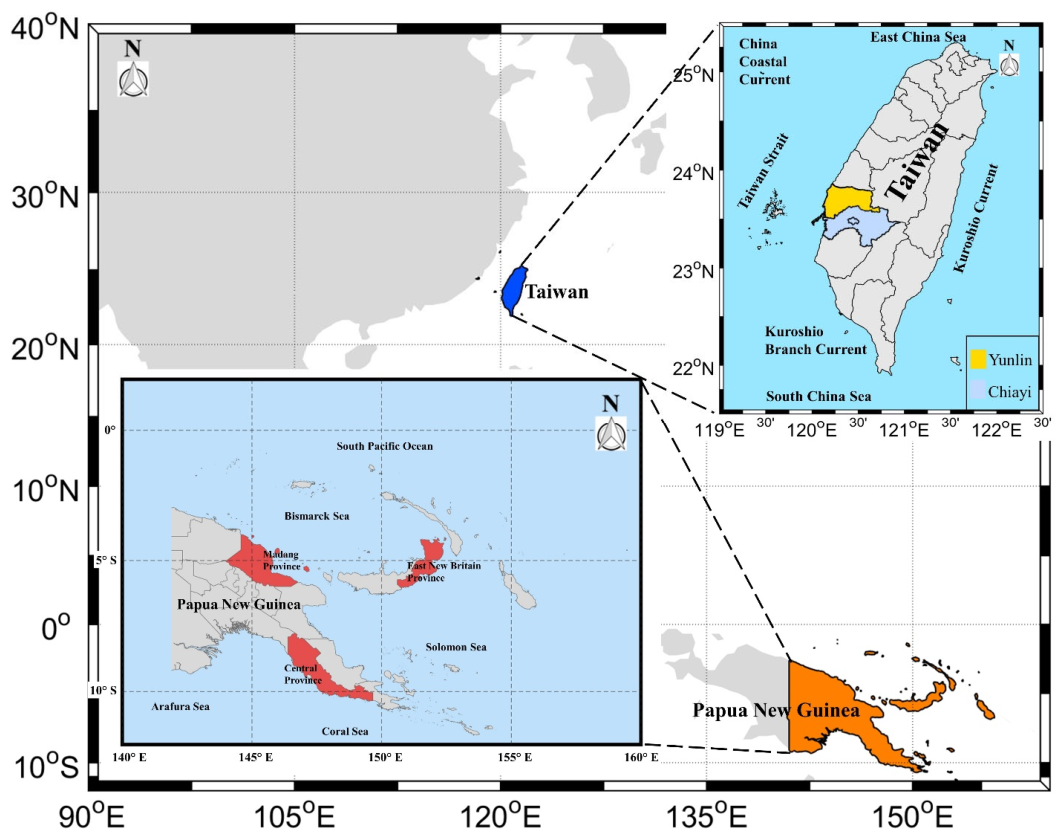
2.1. Case Studies and Rationale
2.2. Research Design and Rationale
2.3. Research Methods
2.4. Data Reporting and Basis for Comparison
3. Results
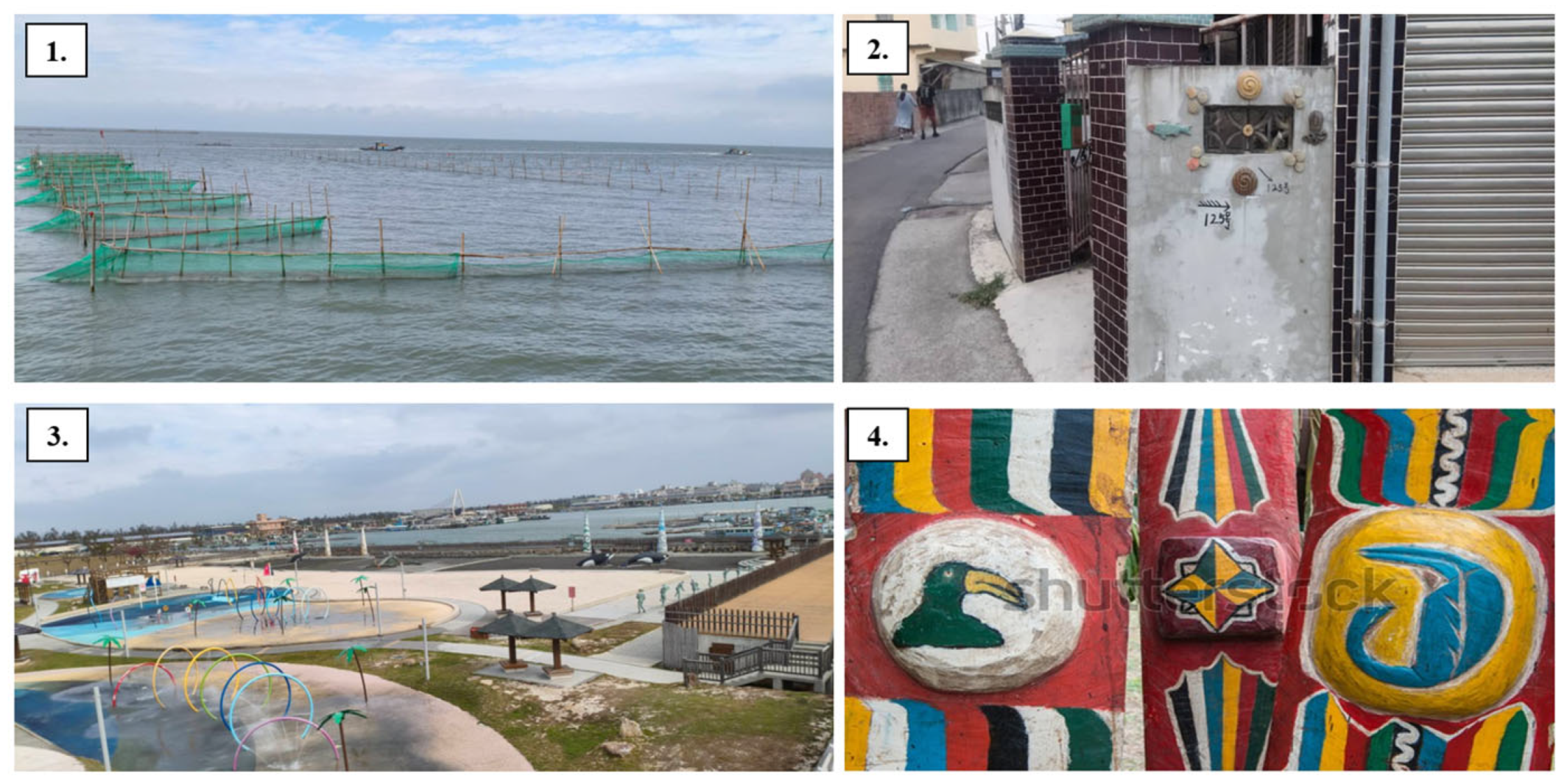
3.1. Comparative Coastal Fishers’ Livelihood and SES Indicators
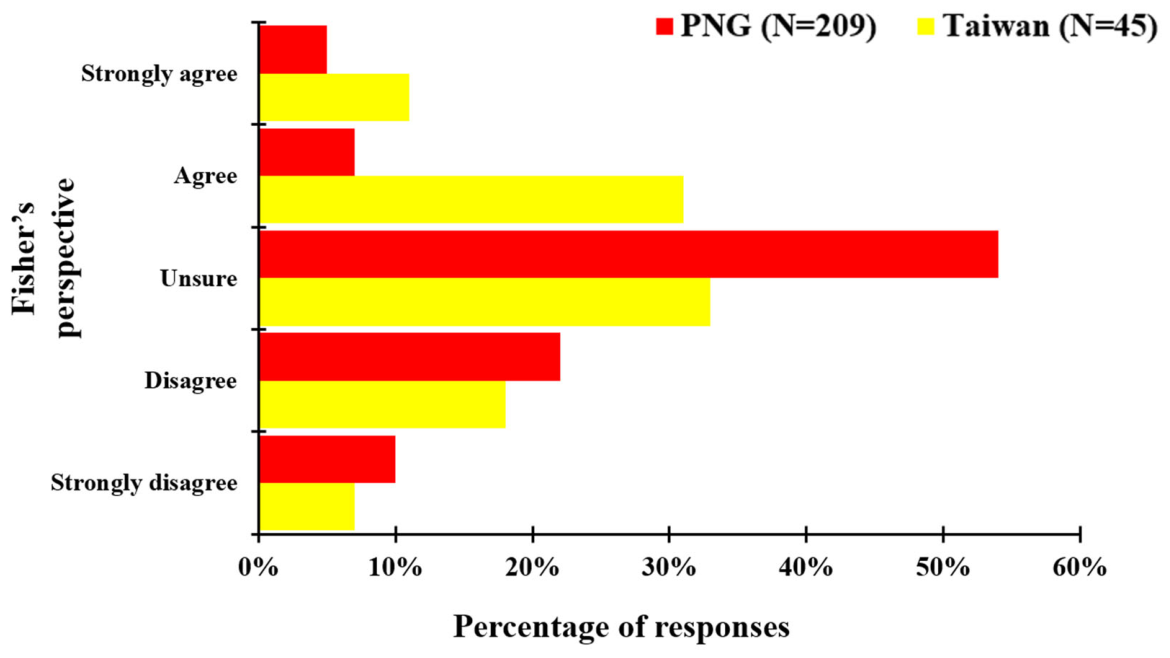
3.2. Coastal Fishers’ Vulnerabilities and Perceptions of CC-Induced Vulnerability Drivers and Ramifications
3.3. Resilience Strategies and Their Effectiveness in SES Functioning and Sustainable Livelihood
4. Discussion
4.1. Summary of the Study Findings
4.2. Key Observations and Surprises
4.3. Policy and Research Implications
- (a)
- Mainstreaming CC adaptation into fisheries governance: Policies must move beyond fragmented approaches and embed climate resilience within fisheries management plans. In PNG, for instance, government mechanisms can legitimize and recognize customary and traditional communal marine tenure systems as foundational pillars for community-led CC adaptation and resilience practices. In Taiwan, adaptation can be strengthened through buy-back programs for older fishers to sustain their incomes and increase their voluntary participation in CC adaptation and advocacy in fisher groups.
- (b)
- Blended knowledge spaces on CC adaptation and livelihood empowerment lend traditional seasonal wisdom with modern awareness of climate variability to sustain their livelihoods. Strengthening this integration—through community-led monitoring, education, and policy recognition—can offer the best path to resilience in the face of climate change. For instance, youths in Yunlin and Taiwan can utilize their digital knowledge to design digital platforms for early warning and alert systems for the elderly or fisher households and nearshore fishing sites in CC-prone zones.
- (c)
- Strengthening participatory governance. Key policymakers and actors should incorporate fishers’ voices and traditional ecological knowledge (TEK) into decision-making to enhance legitimacy and effectiveness. TEK can be strengthened by creating biodiversity registers, vulnerability maps, resource maps (based on community and geographic information systems (GIS) mapping), and community seasonal fishing calendars.
- (d)
- Regional cooperation. Island nations and coastal regions, especially in the APR, should collaborate on shared adaptation strategies, recognizing transboundary CC impacts. This can be through site visits and technology support, e.g., from Taiwan to PNG.
- (e)
- Capacity building and resource access. Strategic investment in infrastructure, financial mechanisms, and training is critical to empower fishers to adopt sustainable practices.
- (f)
- Alignment with global sustainability frameworks. National and local policies should explicitly integrate the FAO small-scale fisheries guidelines, ensuring coherence with international sustainability goals. For instance, Article 6.4 calls for participatory decision-making, yet in PNG and Taiwan, national fisheries plans rarely include traditional elders’ views. This can be done by embedding culturally rooted and community-based management practices and ecosystem-based approaches, all aligned with FAO’s Small-Scale Fisheries Guidelines. Elders’ knowledge can be leveraged in understanding seasonal closures and taboos, based on their knowledge of spawning cycles and adaptive fishing bans. This can be vital in local ecological monitoring, where fishers’ observations of stock changes complement scientific surveys and inform community-led zoning and voluntary enforcement.
4.4. Study Contributions
5. Conclusions
Study Limitations and Recommendations for Future Research
Author Contributions
Funding
Institutional Review Board Statement
Informed Consent Statement
Data Availability Statement
Acknowledgments
Conflicts of Interest
References
- Armitage, D.; Charles, A.; Berkes, F. Governing the Coastal Commons; Taylor & Francis: London, UK, 2017. [Google Scholar]
- Bartelet, H.A.; Barnes, M.L.; Cumming, G.S. Estimating and comparing the direct economic contributions of reef fisheries and tourism in the Asia-Pacific. Mar. Policy 2024, 159, 105939. [Google Scholar] [CrossRef]
- Bell, J.; Taylor, M. Building Climate-Resilient Food Systems for Pacific Islands; WorldFish: Bayan Lepas, Malaysia, 2015. [Google Scholar]
- Benham, C.F.; Daniell, K.A. Putting transdisciplinary research into practice: A participatory approach to understanding change in coastal social-ecological systems. Ocean Coast. Manag. 2016, 128, 29–39. [Google Scholar] [CrossRef]
- Bennett, N.J. Mainstreaming equity and justice in the ocean. Front. Mar. Sci. 2022, 9, 873572. [Google Scholar] [CrossRef]
- Biggs, R.; De Vos, A.; Preiser, R.; Clements, H.; Maciejewski, K.; Schlüter, M. The Routledge Handbook of Research Methods for Social-Ecological Systems; Taylor & Francis: London, UK, 2021; p. 526. [Google Scholar] [CrossRef]
- Bolesta, A. Asia-Pacific Small Island Developing States: Development Challenges and Policy Solutions; United Nations, ESCAP: Bangkok, Thailand, 2020. [Google Scholar]
- Barbier, E.B. Policies for Asia–Pacific developing country populations vulnerable to climate change. In Environmental Economics and Policy Studies; Springer: Berlin/Heidelberg, Germany, 2025; pp. 1–37. [Google Scholar] [CrossRef]
- Charlton, K.E.; Russell, J.; Gorman, E.; Hanich, Q.; Delisle, A.; Campbell, B.; Bell, J. Fish, food security and health in Pacific Island countries and territories: A systematic literature review. BMC Public Health 2016, 16, 285. [Google Scholar] [CrossRef] [PubMed]
- Chen, B.; Xu, G.; Coops, N.C.; Ciais, P.; Myneni, R.B. Satellite-observed changes in terrestrial vegetation growth trends across the Asia-Pacific region associated with land cover and climate from 1982 to 2011. Int. J. Digit. Earth 2016, 9, 1055–1076. [Google Scholar] [CrossRef]
- FAO. In Brief to the State of World Fisheries and Aquaculture 2024; Blue Transformation in Action; FAO: Rome, Italy, 2024. [Google Scholar] [CrossRef]
- FAO. Developing and Implementing a National Plan of Action for Small-Scale Fisheries—A Manual in Support of the Implementation of the Voluntary Guidelines for Securing Sustainable Small-Scale Fisheries in the Context of Food Security and Poverty Eradication; FAO: Rome, Italy, 2024. [Google Scholar] [CrossRef]
- Hanich, Q.; Wabnitz, C.C.; Ota, Y.; Amos, M.; Donato-Hunt, C.; Hunt, A. Small-scale fisheries under climate change in the Pacific Islands region. Mar. Policy 2018, 88, 279–284. [Google Scholar] [CrossRef]
- Ho, C.H. Climate risks and opportunities of the marine fishery industry: A case study in Taiwan. Fishes 2022, 7, 116. [Google Scholar] [CrossRef]
- Island Business. PNG National Fisheries Authority Clarifies Tuna Supply Issues. 2023. Available online: https://islandsbusiness.com/news-break/png-national-fisheries-authority-clarifies-tuna-supply-issues/ (accessed on 10 March 2026).
- ISSF. Status of the World Fisheries for Tuna; ISSF Technical Report 2024-07; International Seafood Sustainability Foundation: Pittsburgh, PA, USA, 2024; Available online: https://effop.org/wp-content/uploads/2024/12/ISSF-2024-07-Status-of-the-World-Fisheries-for-Tuna-November-2024.pdf (accessed on 10 March 2026).
- Johnson, J.E.; Allain, V.; Basel, B.; Bell, J.D.; Chin, A.; Dutra, L.X.; Hooper, E.; Loubser, D.; Lough, J.; Moore, B.R.; et al. Impacts of climate change on marine resources in the Pacific Island region. In Climate Change and Impacts in the Pacific; Springer International Publishing: Cham, Switzerland, 2020; pp. 359–402. [Google Scholar] [CrossRef]
- Korowi, L.G.; Mammel, M.; Matovu, B.; Huang, P.T.; Raj, A.; Hsiao, Y.J.; Lee, M.A. Small-Scale Fisherfolk in Papua New Guinea: Perspectives on Climate Variability and its impact on coastal fishing operations and activities. Environ. Chall. 2025, 20, 101221. [Google Scholar] [CrossRef]
- Lee, M.A.; Mammel, M.; Matovu, B.; Korowi, L.G.; Mondal, B.K.; Martins, I.; Mahata, S.; Sedanza, M.G. Exploring cross-country externalities, viable resilience, and sustainability options for small-scale fishing communities in the tropics. Front. Ocean Sustain. 2025, 3, 1541847. [Google Scholar] [CrossRef]
- Mallory, T.G. Fisheries in East Asia: Political, economic, and security challenges. In Routledge Handbook of Environment and Society in Asia; Routledge: New York, NY, USA, 2014; pp. 253–276. [Google Scholar]
- Michael, P.S. Current evidence and future projections: A comparative analysis of the impacts of climate change on critical climate-sensitive areas of Papua New Guinea. SAINS TANAH-J. Soil Sci. Agroclimatol. 2019, 16, 229–253. [Google Scholar] [CrossRef]
- Lam, V.W.; Allison, E.H.; Bell, J.D.; Blythe, J.; Cheung, W.W.; Frölicher, T.L.; Gasalla, M.A.; Sumaila, U.R. Climate change, tropical fisheries, and prospects for sustainable development. Nat. Rev. Earth Environ. 2020, 1, 440–454. [Google Scholar] [CrossRef]
- Petzold, J.; Magnan, A.K. Climate change: Thinking small islands beyond Small Island Developing States (SIDS). Clim. Chang. 2019, 152, 145–165. [Google Scholar] [CrossRef]
- Matovu, B.; Mammel, M.; Lee, M.A.; Hsieh, Y.L.; Lee, T.P.; Hsiao, Y.J.; Korowi, L.G.; Zhang, W.N.; Chen, J.L.; Beegum, S.; et al. Save Us Before We Die: Unmasking Socioecological Systems Complexities and Their Implications On Coastal Fishers’ Livelihoods in Select Regions of Yunlin, Taiwan. J. Environ. Dev. 2026, 5, 346–389. [Google Scholar] [CrossRef]
- Nayak, P.K. Fisher communities in transition: Understanding change from a livelihood perspective in Chilika Lagoon, India. Marit. Stud. 2017, 16, 13. [Google Scholar] [CrossRef]
- Partelow, S.; Schlüter, A.; Ban, N.C.; Batterbury, S.; Bavinck, M.; Bennett, N.J.; Bleischwitz, R.; Blythe, J.; Bogusz, T.; Breckwoldt, A.; et al. Five social science intervention areas for ocean sustainability initiatives. npj Ocean Sustain. 2023, 2, 24. [Google Scholar] [CrossRef]
- Spalding, A.K.; Grorud-Colvert, K.; Allison, E.H.; Amon, D.J.; Collin, R.; de Vos, A.; Friedlander, A.M.; Johnson, S.M.; Mayorga, J.; Paris, C.B.; et al. Engaging the tropical majority to make ocean governance and science more equitable and effective. npj Ocean Sustain. 2023, 2, 8. [Google Scholar] [CrossRef]
- Steenbergen, D.J.; Fabinyi, M.; Barclay, K.; Song, A.M.; Cohen, P.J.; Eriksson, H.; Mills, D.J. Governance interactions in small-scale fisheries market chains: Examples from the Asia-Pacific. Fish Fish. 2019, 20, 697–714. [Google Scholar] [CrossRef]
- Thorpe, A.; Reid, C.; Smith, S.F. Mainstreaming fisheries in development and poverty reduction strategies in the Asia-Pacific region. J. Asia Pac. Econ. 2008, 13, 518–541. [Google Scholar] [CrossRef]





| PNG | Taiwan |
|---|---|
| Artisanal coastal fishing, including reef fish, lobsters, trochus shells, and sea cucumbers (sandfish). | Aquaculture and aquavoltaics, involving oyster farming (especially in Yunlin and Chiayi), and integrated clam and milkfish cultivation with solar energy and seafood tourism projects. |
| Subsistence fishing (many coastal households rely on fishing for daily food security and income generation). | Nearshore fishing, mostly involving small-scale capture of mullet, squid, and other coastal species. |
| Tuna fisheries (coastal communities benefit indirectly through employment in processing and small-scale tuna fishing). | Mixed livelihoods, where many households combine fishing with agriculture due to declining fish stocks and aging fisher populations. |
| Aquaculture (emerging), involving small-scale projects for tilapia and other species, though less dominant than capture fisheries. | Home-based seafood processing (fisher households, including women who process and sell harvested fish to local or regional consumers). |
| Papua New Guinea | Taiwan |
|---|---|
| Traditional Ecological Knowledge strategies | Coastal fisheries innovation |
|
|
|
|
|
|
| Community-based resource management | Technological monitoring |
|
|
|
|
|
|
| Livelihood diversification | Sustainable practices |
|
|
|
|
|
|
|
|
| Adaptive fishing techniques | Economic and socio-cultural resilience |
|
|
|
|
|
|
|
|
|
|
Disclaimer/Publisher’s Note: The statements, opinions and data contained in all publications are solely those of the individual author(s) and contributor(s) and not of MDPI and/or the editor(s). MDPI and/or the editor(s) disclaim responsibility for any injury to people or property resulting from any ideas, methods, instructions or products referred to in the content. |
© 2026 by the authors. Licensee MDPI, Basel, Switzerland. This article is an open access article distributed under the terms and conditions of the Creative Commons Attribution (CC BY) license.
Share and Cite
Korowi, L.G.; Matovu, B.; Mammel, M.; Lee, M.-A. Climate Change Perceptions and Adaptation Options Among Coastal Small-Scale Fishers in the Asia-Pacific Region: Perspectives from Taiwan and Papua New Guinea. Sustainability 2026, 18, 4697. https://doi.org/10.3390/su18104697
Korowi LG, Matovu B, Mammel M, Lee M-A. Climate Change Perceptions and Adaptation Options Among Coastal Small-Scale Fishers in the Asia-Pacific Region: Perspectives from Taiwan and Papua New Guinea. Sustainability. 2026; 18(10):4697. https://doi.org/10.3390/su18104697
Chicago/Turabian StyleKorowi, Louis George, Baker Matovu, Mubarak Mammel, and Ming-An Lee. 2026. "Climate Change Perceptions and Adaptation Options Among Coastal Small-Scale Fishers in the Asia-Pacific Region: Perspectives from Taiwan and Papua New Guinea" Sustainability 18, no. 10: 4697. https://doi.org/10.3390/su18104697
APA StyleKorowi, L. G., Matovu, B., Mammel, M., & Lee, M.-A. (2026). Climate Change Perceptions and Adaptation Options Among Coastal Small-Scale Fishers in the Asia-Pacific Region: Perspectives from Taiwan and Papua New Guinea. Sustainability, 18(10), 4697. https://doi.org/10.3390/su18104697