Ecodesign Prioritization for BIPV Manufacturers Under ESPR Compliance: An LLM-Assisted Multi-Criteria Framework with Use Cases Application



Abstract
1. Introduction
2. Materials and Methods
- Multi-criteria decision analysis framework. The prioritization framework employs a weighted linear combination (WLC) method, a standard MCDA approach applied as proof-of-concept for sustainability assessment and new product development [16,17,18,19]. Three evaluation criteria were selected based on the feasibility–desirability–viability (F-D-A) scorecard framework, adapted from the design thinking methodology [20]:
- ○
- Feasibility (F): technical capability to implement with current manufacturing infrastructure and supply chain access.
- ○
- Desirability (D): market demand strength and regulatory compliance urgency.
- ○
- Affordability (A): economic accessibility considering capital investment and operational cost implications.
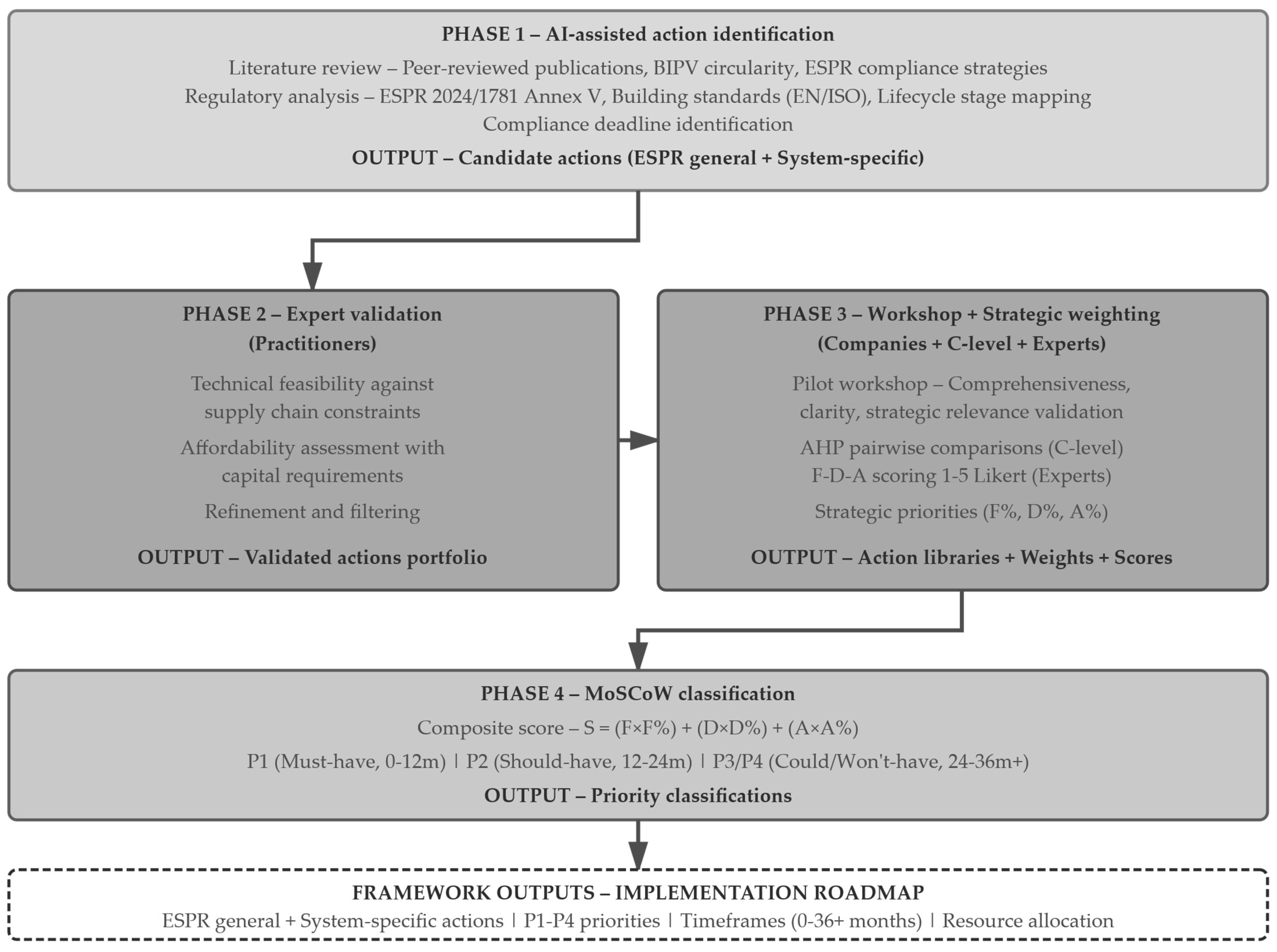
Scores represent expert judgment informed by company-specific operational knowledge rather than quantitative measurement, acknowledging this as a limitation requiring validation through implementation tracking. Technical feasibility assessments were grounded in peer-reviewed literature, industry standards, and technology readiness reports. Market desirability indicators incorporated regulatory analysis and near-zero energy building (nZEB), zero energy building (ZEB), and positive energy building (PEB) requirements [21]. Economic affordability estimates were based on industry benchmarks implementations, also including building product manufacturing, acknowledging these as practitioner estimates rather than empirically validated cost data [22,23,24]. Using return on investment (ROI) as the primary basis for the scoring process and product improvement projects is justified because manufacturing firms are expected to make financially efficient, benefit-driven decisions on process improvement investments. Each criterion was assessed on a 5-point Likert scale (1 = lowest, 5 = highest) [25] as described in Table 1 and developed iteratively with case study participants to ensure scoring consistency and practical relevance to building product manufacturing contexts.Criteria weights are determined through structured interviews with company leadership actors using AHP [26] pairwise comparison matrices with numbers 1, 3, 5, and 9; 1/3, 1/5, 1/9 are used to quantify the relative importance of different criteria. A score of “1” means criteria are of equal importance, while a score of “9” indicates the first criterion is extremely more important than the second, and vice versa, “1/9” indicates the first criterion is extremely less important than the second. The composite score (S) calculation iswhere S represents the weighted prioritization score (maximum = 5.0).S = (F × AHP %) + (D × AHP %) + (A × AHP %),To ensure logical coherence of pairwise comparison judgments, the maximum eigenvalue of the pairwise comparison matrix (λmax), consistency index (CI), and consistency ratio (CR) were calculated for each company’s AHP weighting matrix following Saaty’s methodology [26,27]. The consistency ratio quantifies whether decision-makers’ pairwise comparisons contain logical contradictions. Following Saaty’s widely adopted threshold, CR < 0.10 (10%) indicates acceptable consistency, meaning pairwise comparisons do not contain significant logical contradictions that would invalidate the derived priority weights. CRs are analyzed to check the consistency of AHP for the use cases. - Ecodesign actions identification. Ecodesign actions were systematically identified across 16 ESPR goal categories [1]. Each action was mapped to specific lifecycle stages (design, manufacturing, use, end-of-life) following ISO 14040 lifecycle assessment principles [28]. Action identification followed a four-stage hybrid human–AI process integrating LLM capabilities with expert validation (authors and industrial partners): (1) AI-assisted literature review (2015–2024): the LLM-powered analysis used 16 ESPR goal categories and Claude 4.5 Sonnet, Anthropic [29] to scout peer-reviewed publications on BIPV circularity, building product ecodesign, and ESPR compliance strategies with references to documents and reports (detailed prompt documentation provided in Appendix B); (2) analysis of ESPR 2024/1781 annex V requirements: these were cross-referenced with building product standards and nZEB/ZEB/PEB technical specifications, filtering to n.30 regulation-aligned actions with mapped lifecycle stages and desirability indicators (mandatory compliance deadlines, market access requirements); (3) practitioner evaluation: n.5 BIPV industry practitioners (manufacturers, façade engineers, sustainability consultants) evaluated AI-generated action portfolio, validating technical feasibility against real-world supply chain constraints (supplier availability, production line compatibility, capital investment requirements), filtering the n.30 implementable actions with corrected affordability estimates based on practitioner experience rather than AI-suggested generic benchmarks; (4) case study validation: case study companies checked action comprehensiveness, clarity and strategic relevance, finalizing 30 common ESPR actions (applicable across BIPV manufacturers) and sector-specific action templates (component-level vs. system-level interventions) with company-validated F-D-A scoring rubrics.
- Priority classification. (Table 2) Actions were classified using a hybrid approach combining MoSCoW prioritization (must-have, should-have, could-have, won’t-have) [30] with urgency–importance matrix analysis [31]. MoSCoW was selected over alternative prioritization frameworks (e.g., Kano model, RICE scoring) due to its (a) widespread adoption in project management [32]; (b) explicit time-horizon mapping (must/should/could/won’t in 0–12/12–24/24–36/>36 months) aligning with ESPR compliance deadlines; and (c) compatibility with regulatory mandate categorization (must-have = mandatory compliance, could-have = voluntary competitive advantage).
- Case study validation. The methodology was applied to two manufacturers as proof-of-concept case studies demonstrating framework usability and output differentiation. Full validation, including tracking of implementation sequences, inter-rater reliability testing, and cross-case generalization, is acknowledged as a limitation requiring future research. Complementary case studies represent vertically integrated segments of the BIPV supply chain: BIPV component manufacturing with BIPV system integration to building construction (end customer), providing validation of framework applicability across supply chain positions with differentiated strategic priorities and technical complexities for ecodesign practices. The case studies are
- Case study 1—BIPV-IGU manufacturer Glass to Power S.p.A. (G2P), Italy [33] (Figure 1). G2P is a technology-driven company specializing in the design and assembly of Building-Integrated Photovoltaic Insulating Glazing Units (BIPV-IGU). The company integrates monocrystalline silicon PV cells onto aluminum frames within insulating glass unit chambers, producing standardized and customized BIPV-IGU modules (typical dimensions 1000 mm × 1500 mm to 1500 mm × 3000 mm, power output 50–100 W/m2) for façade and skylight applications. Strategic positioning emphasizes product innovation (patent-pending PV mounting systems), architectural integration quality, and early-mover advantage in the Italian BIPV market. Primary customers include façade manufacturers like Gualini [34], architectural glazing contractors, and design-build firms for commercial/institutional projects.
- Case study 2—BIPV curtain wall façade system manufacturer Gualini S.r.l. (GUA), Italy [34] (Figure 2). Gualini is an established façade manufacturer producing unitized curtain wall systems for mid-to-high-rise commercial buildings across Europe and worldwide. The company specializes in custom-engineered aluminum–glass façade modules integrating building services (natural ventilation, solar shading, fire-rated compartmentation) with architectural esthetics. Gualini’s BIPV façade integrates G2P’s BIPV-IGU modules (or competitor equivalents) into unitized façade frames with pre-wired electrical conduits, junction boxes, and weather sealing. The company sources aluminum profiles (thermally broken extrusions), glass (via G2P or direct procurement for spandrel/vision areas), BIPV-IGU modules (G2P, other suppliers), electrical components (conduits, cable glands, junction boxes), and weatherproofing materials (EPDM gaskets, structural silicones) from diversified supply networks.
- Sensitivity analysis. To assess the robustness of prioritization outcomes to AHP weight variations, sensitivity analysis was conducted following standard MCDA practice [36]. Each criterion weight was varied by ±10% from its baseline value, with compensatory adjustments to other criteria maintaining the weight sum = 100%. Six sensitivity scenarios were tested per company (±10% variation for each of the three criteria F-D-A), recalculating composite scores (S) and priority classifications (P1–P4) for all actions under each scenario. Priority stability was quantified as the percentage of actions maintaining their baseline priority classification across all seven scenarios (baseline and 6 variations). Actions shifting priority classification in ≥3 scenarios were flagged as “boundary-sensitive,” indicating proximity to priority thresholds (S = 4.0, 3.5, or 3.0) where small weight changes materially affect implementation sequencing. The ±10% variation magnitude was selected to represent plausible strategic priority shifts while remaining within reasonable bounds of the original AHP judgment. Larger variations (>20%) would question the validity of the original AHP exercise itself.
- Framework definition (Figure 3). The framework comprises sequential phases integrating LLM-assisted action identification (Phase 1) with human expert validation (Phase 2), pilot workshop refinement and strategic weighting (Phase 3), and calculated priority classification (Phase 4). Strategic alignment is achieved through C-level AHP weighting, defining business priorities, and MoSCoW classification mapping actions to implementation timeframes. Framework outputs provide a business-aligned ESPR compliance roadmap with prioritized action sequences.
3. Results
3.1. AHP Weighting Profiles and Strategic Vision of Industrial Decision-Makers
3.2. Comparative Analysis: AHP Influence on Common Action Prioritization
3.3. Ecodesign Action Portfolios and Priority Distribution
3.4. System-Specific Actions: Supply Chain Differentiation
3.5. Sensitivity Analysis: Priority Robustness to AHP Weight Variations
4. Discussion
- BIPV upstream actors (PV cell manufacturers, glass producers). The common action library (C1–C30) addresses generic ESPR requirements applicable to any building product manufacturer (carbon footprinting, EPD certification, recycled content, SVHC documentation). Component suppliers would retain these actions while substituting system-specific portfolios (e.g., PV cell manufacturers might include “transition to silver-free metallization”, analogous to G2P’s silver-to-copper busbar action, or glass producers might prioritize “increase cullet content to 80%”, analogous to G2P8). The AHP weighting would reflect supplier-specific strategic contexts.
- BIPV downstream actors (installation contractors, building owners). While the current framework targets manufacturers, the methodological structure (stakeholder-weighted MCDA, action libraries, MoSCoW prioritization) could adapt to end-user contexts. Installation contractors might prioritize actions like “develop DPP-compliant installation documentation” (analogous to C9 disassembly documentation) or “establish maintenance service contracts” (analogous to GUA3), weighted toward feasibility if labor skills are the primary constraint. Building owners engaging in deep renovations might prioritize “specify BIPV-IGU with material passports for future recoverability” (analogous to C12), with AHP weighting reflecting total cost of ownership (affordability) versus ESG reporting requirements (desirability).
- Cross-sector applicability. The framework’s sector-agnostic methodological core (MCDA-AHP, MoSCoW, lifecycle stage mapping) suggests transferability to other multi-material building products other than BIPV facing ESPR compliance, such as insulated façade panels, smart windows, or modular building systems. Adaptation would require developing sector-specific action libraries (e.g., for insulated panels: “replace XPS foam with bio-based insulation”) while retaining the common ESPR actions applicable across building products. The key transferability criterion is multi-stakeholder supply chains with differentiated strategic priorities, a characteristic shared across construction product categories.
- Company size variations. Both G2P and Gualini are SMEs, and applicability to large multinational façade manufacturers with dedicated sustainability departments remains unvalidated. Larger organizations might find the framework’s simplicity insufficient, requiring integration with more sophisticated decision-support systems.
- Multi-stakeholder scoring validation. Replicating the framework with 3–5 additional BIPV manufacturers, employing multi-rater scoring (C-level and company decision-makers, such as CEO, technical director, and sustainability manager) with inter-rater reliability testing, would assess generalizability and scoring robustness.
- Market maturity contexts. Both companies operate in European markets with established ESPR regulatory frameworks. Applicability to regions with less stringent environmental regulations (where desirability for compliance may be lower) or more mature BIPV markets (where affordability pressures might differ) requires empirical validation.
- Framework validation under implementation. Implementation tracking with companies (e.g., G2P and Gualini) requires being checked with recurrent interviews documenting which P1–P2 actions were implemented, in what sequence, with what barriers encountered. This would validate predictive accuracy and refine scoring criteria based on implementation realities, also in the vision of the MCDA-LCA integration pilot, where high-priority actions (P1–P2 from the framework) undergo targeted LCA quantification (carbon footprint, embodied energy) to validate whether qualitatively prioritized actions also deliver quantitatively significant environmental benefits. This would bridge strategic prioritization with impact measurement.
5. Conclusions
Author Contributions
Funding
Institutional Review Board Statement
Informed Consent Statement
Data Availability Statement
Acknowledgments
Conflicts of Interest
Abbreviations
| AHP | Analytic Hierarchy Process |
| ASI | Aluminum Stewardship Initiative |
| BIM | Building Information Modeling |
| BIPV | Building-Integrated Photovoltaics |
| CE | Conformité Européenne (CE marking) |
| CEO | Chief Executive Officer |
| CPR | Construction Products Regulation (EU 305/2011) |
| CR | Consistency Ratio |
| DfD | Design for Disassembly |
| DfX | Design for X (generic design methodology) |
| DPP | Digital Product Passport |
| EN | European Norm (European Standard) |
| EPD | Environmental Product Declaration |
| EPDM | Ethylene Propylene Diene Monomer (rubber gasket material) |
| EPR | Extended Producer Responsibility |
| ESG | Environmental, Social, and Governance |
| ESPR | Ecodesign for Sustainable Products Regulation (EU 2024/1781) |
| EU | European Union |
| F-D-A | Feasibility–Desirability–Affordability |
| G2P | Glass to Power (BIPV-IGU manufacturer case study company) |
| GHG | Greenhouse Gas |
| GUA | GUALINI (façade manufacturer case study company) |
| IGU | Insulated Glazing Unit |
| IoT | Internet of Things |
| IP | Ingress Protection (rating for electrical enclosures) |
| ISO | International Organization for Standardization |
| LCA | Life Cycle Assessment |
| LCC | Life Cycle Costing |
| LLM | Large Language Model |
| MCDA | Multi-Criteria Decision Analysis |
| MoSCoW | Must-Have, Should-Have, Could-Have, Won’t-Have (prioritization method) |
| nZEB | Nearly Zero-Energy Building |
| O&M | Operations and Maintenance |
| P1, P2, P3, P4 | Priority Levels (Must-Have, Should-Have, Could-Have, Won’t-Have) |
| PCF | Product Carbon Footprint |
| PEB | Positive-Energy Building |
| PV | Photovoltaic |
| PV-IGU | Photovoltaic Insulated Glazing Unit |
| ROI | Return on Investment |
| SME | Small and Medium-Sized Enterprise |
| SVHC | Substances of Very High Concern |
| TOPSIS | Technique for Order of Preference by Similarity to Ideal Solution |
| TPE | Thermoplastic Elastomer |
| VOC | Volatile Organic Compound |
| WEEE | Waste Electrical and Electronic Equipment (EU Directive 2012/19) |
| ZEB | Zero-Energy Building |
Appendix A

| ID | Goals (ESPR 2024—Annex V) | Lifecycle Stage | Common/System-Specific | Objectives and Product-Specific Design Actions | F | D | A | S | P | Notes and References |
|---|---|---|---|---|---|---|---|---|---|---|
| C1 | Carbon footprint | All Lifecycle stages | ESPR General | Develop verified carbon footprint (PCF) for DPP | 4 | 5 | 4 | 4.66 | P1 | [37,47,48] |
| C2 | Carbon footprint | Manufacturing | ESPR General | Source low-carbon/local aluminum (<4 kg CO2e/kg) from suppliers | 5 | 5 | 3 | 4.63 | P1 | [37,49,50] |
| C3 | Carbon footprint | Manufacturing | ESPR General | Optimize transport mode selection (rail/truck) based on distance | 2 | 3 | 2 | 2.66 | P4 | [37,51,52] |
| C4 | Carbon footprint | Manufacturing | ESPR General | Source from suppliers with renewable energy credentials | 3 | 4 | 3 | 3.66 | P2 | [53,54,55] |
| G2P1 | Carbon footprint | Manufacturing | System-Specific (G2P Assembly) | Transition to 100% renewable energy for assembly facility | 5 | 4 | 5 | 4.34 | P1 | [53,54,55] |
| C5 | Durability | Design | ESPR General | Declare and extend warranty period (target 10–15 years) | 4 | 5 | 3 | 4.47 | P1 | [56,57,58] |
| G2P2 | Durability | Design | System-Specific (IGU) | Optimize thermal break design in IGU spacer system | 5 | 4 | 2 | 3.78 | P2 | [59,60] |
| G2P3 | Durability | Design | System-Specific (IGU) | Enhanced climate protection (tempered/laminated glass) | 5 | 4 | 4 | 4.16 | P1 | [61,62,63] |
| C6 | Energy | Manufacturing | ESPR General | Source low-embodied energy materials from supply chain | 3 | 5 | 3 | 4.31 | P1 | [49,64,65] |
| G2P4 | Energy | Use | System-Specific (PV) | Optimize PV cell arrangement for electrical efficiency | 4 | 4 | 4 | 4.00 | P1 | [58,66] |
| C7 | Maintenance | Design | ESPR General | Design for inspectability at critical points | 4 | 5 | 4 | 4.66 | P1 | [67,68] |
| C8 | Maintenance | Use | ESPR General | Integrate IoT remote monitoring system | 4 | 3 | 3 | 3.16 | P3 | [69,70,71] |
| G2P5 | Maintenance | Use | System-Specific (PV) | Establish preventive maintenance protocols for PV-IGU | 5 | 4 | 4 | 4.16 | P1 | [71,72,73] |
| C9 | Recoverability | End of Life | ESPR General | Document disassembly sequence in DPP | 4 | 3 | 4 | 3.34 | P3 | [1,74,75] |
| C10 | Recoverability | End of Life | ESPR General | Partner with glass recyclers for closed-loop recovery | 3 | 3 | 2 | 2.81 | P4 | [76,77,78] |
| C11 | Recoverability | End of Life | ESPR General | Establish WEEE-compliant take-back program | 2 | 4 | 2 | 3.31 | P3 | [79,80,81] |
| C12 | Recyclability | Design | ESPR General | Create material passport for DPP (materials inventory) | 4 | 3 | 4 | 3.34 | P3 | [82,83,84] |
| C13 | Recyclability | Design | ESPR General | Design dry fastening connections, eliminate permanent adhesives | 3 | 3 | 3 | 3.00 | P3 | [75,85,86] |
| G2P6 | Recyclability | Design | System-Specific (IGU) | Replace butyl sealant with mechanical/velcro-type connections for IGU assembly | 2 | 2 | 2 | 2.00 | P4 | [87,88] |
| G2P7 | Recyclability | Design | System-Specific (IGU) | Switch to low-VOC/certified structural silicone (avoiding non-recyclable sealants) | 4 | 3 | 3 | 3.16 | P3 | [89,90] |
| C14 | Recycled | Manufacturing | ESPR General | Source high recycled aluminum (≥75%) from suppliers | 4 | 4 | 3 | 3.81 | P2 | [91,92,93] |
| G2P8 | Recycled | Manufacturing | System-Specific (IGU) | Source glass with 40–60% recycled cullet from suppliers | 3 | 3 | 3 | 3.00 | P3 | [94,95,96] |
| G2P9 | Recycled | Manufacturing | System-Specific (IGU) | Source spacer bars with recycled content from suppliers | 3 | 2 | 2 | 2.16 | P4 | [37,97,98] |
| C15 | Reliability | Manufacturing | ESPR General | Obtain EPD certification (EN 15804+A2) for product | 5 | 5 | 3 | 4.63 | P1 | [1,37,45] |
| C16 | Reliability | Manufacturing | ESPR General | Implement quality control labeling (CE marking per CPR) | 5 | 5 | 4 | 4.81 | P1 | [99,100,101] |
| G2P10 | Remanufacturability | End of Life | System-Specific (IGU) | Design for IGU cavity refilling/upgrading (argon top-up, film insertion) | 3 | 3 | 3 | 3.00 | P3 | [88,102,103] |
| C17 | Repairability | Manufacturing and Use | ESPR General | Implement DPP system per ESPR Art. 9–13 | 4 | 5 | 3 | 4.47 | P1 | [1,104,105] |
| C18 | Repairability | Use | ESPR General | Publish repair/maintenance documentation via DPP | 5 | 4 | 5 | 4.34 | P1 | [1,71] |
| C19 | Repairability | Design | ESPR General | Design accessible junction boxes/electrical connections | 4 | 4 | 5 | 4.19 | P1 | [106,107,108] |
| C20 | Repairability | Design | ESPR General | Provide 3D models/digital twins for replaceable components | 3 | 2 | 4 | 2.53 | P4 | [109,110,111] |
| C21 | Resource | Design | ESPR General | Optimize component-to-frame ratio for material efficiency | 4 | 3 | 4 | 3.34 | P3 | [67,112] |
| C22 | Resource | Manufacturing | ESPR General | Implement nesting optimization, reduce scrap during cutting/machining | 4 | 3 | 4 | 3.34 | P3 | [113,114,115] |
| C23 | Reusability | Design | ESPR General | Standardize components across product variants (modular design) | 5 | 3 | 4 | 3.50 | P2 | [116,117,118] |
| G2P11 | Reusability | Design | System-Specific (IGU/PV) | Standardize PV frame components (junction boxes, cable glands, mounting pins) | 5 | 3 | 4 | 3.50 | P2 | [119,120] |
| C24 | Substances | Manufacturing | ESPR General | Source materials with VOC-free/low-VOC certifications from suppliers | 5 | 4 | 4 | 4.16 | P1 | [89,121,122] |
| C25 | Substances | Manufacturing | ESPR General | Document SVHC substances in DPP per ESPR Art. 7(5) | 4 | 3 | 4 | 3.34 | P3 | [123,124,125] |
| C26 | Upgradability | Design | ESPR General | Design modular electrical connections for future component upgrades | 3 | 4 | 3 | 3.66 | P2 | [62] |
| C27 | Waste | Manufacturing | ESPR General | Implement scrap recovery systems (Al to remelting, glass cullet return) | 4 | 3 | 4 | 3.34 | P3 | [4,93,114] |
| C28 | Waste | Manufacturing | ESPR General | Zero-waste-to-landfill target for manufacturing operations | 3 | 3 | 3 | 3.00 | P3 | [114,126,127] |
| C29 | Waste | End of Life | ESPR General | Design for selective demolition and component separation | 3 | 3 | 3 | 3.00 | P3 | [75,128,129] |
| C30 | Water | Manufacturing | ESPR General | Source ASI-certified aluminum (water stewardship criteria) | 5 | 3 | 4 | 3.50 | P2 | [92,130,131] |
| ID | Goals (ESPR 2024—Annex V) | Lifecycle Stage | Common/System-Specific | Objectives and Product-Specific Design Actions | F | D | A | S | P | Notes and References |
|---|---|---|---|---|---|---|---|---|---|---|
| C1 | Carbon footprint | All lifecycle stages | ESPR General | Develop verified carbon footprint (PCF) for DPP | 4 | 5 | 4 | 4.26 | P1 | [37,47,48] |
| C2 | Carbon footprint | Manufacturing | ESPR General | Source low-carbon/local aluminum (<4 kg CO2e/kg) from suppliers | 5 | 5 | 3 | 3.73 | P2 | [37,49,50] |
| C3 | Carbon footprint | Manufacturing | ESPR General | Optimize transport mode selection (rail/truck) based on distance | 4 | 4 | 5 | 4.63 | P1 | [37,51,52] |
| C4 | Carbon footprint | Manufacturing | ESPR General | Source from suppliers with renewable energy credentials | 3 | 4 | 3 | 3.26 | P3 | [53,54,55] |
| GUA1 | Carbon footprint | Manufacturing | System-Specific (Façade Assembly) | Transition to 100% renewable energy for assembly/off-site manufacturing facility | 5 | 4 | 5 | 4.74 | P1 | [53,54,55] |
| C5 | Durability | Design | ESPR General | Declare and extend warranty period (target 10–15 years) | 4 | 5 | 3 | 3.63 | P2 | [56,57,58] |
| GUA2 | Durability | Design | System-Specific (Façade) | Design polymer thermal break profiles for disassembly in façade frames | 3 | 3 | 3 | 3.00 | P3 | [132,133] |
| C6 | Energy | Manufacturing | ESPR General | Source low-embodied energy materials from supply chain | 4 | 4 | 3 | 3.37 | P3 | [49,64,65] |
| C7 | Maintenance | Design | ESPR General | Design for inspectability at critical points | 4 | 5 | 4 | 4.26 | P1 | [67,68] |
| C8 | Maintenance | Use | ESPR General | Integrate IoT remote monitoring system | 4 | 3 | 3 | 3.11 | P3 | [69,70,71] |
| GUA3 | Maintenance | Use | System-Specific (Façade) | Establish preventive maintenance service contracts with remote diagnostics for façade-integrated BIPV | 5 | 3 | 3 | 3.21 | P3 | [134,135,136] |
| C9 | Recoverability | End of Life | ESPR General | Document disassembly sequence in DPP | 4 | 3 | 4 | 3.74 | P2 | [1,74,75] |
| GUA4 | Recoverability | End of Life | System-Specific (Façade Supply Chain) | Coordinate with PV-IGU supplier (G2P) for closed-loop glass recovery | 3 | 4 | 3 | 3.26 | P3 | [94,95,96] |
| C10 | Recoverability | End of Life | ESPR General | Partner with glass recyclers for closed-loop recovery | 3 | 3 | 2 | 2.37 | P4 | [76,77,78] |
| C11 | Recoverability | End of Life | ESPR General | Establish WEEE-compliant take-back program | 2 | 4 | 2 | 2.52 | P4 | [79,80,81] |
| GUA5 | Recoverability | End of Life | System-Specific (Façade) | Partner with aluminum remelting facilities for closed-loop façade frame recovery | 5 | 3 | 4 | 3.85 | P2 | [137,138,139] |
| C12 | Recyclability | Design | ESPR General | Create material passport for DPP (materials inventory) | 4 | 3 | 4 | 3.74 | P2 | [82,83,84] |
| C13 | Recyclability | Design | ESPR General | Design dry fastening connections, eliminate permanent adhesives | 3 | 3 | 3 | 3.00 | P3 | [75,85,86] |
| GUA6 | Recyclability | Design | System-Specific (Façade) | Replace EPDM gaskets with thermoplastic elastomer (TPE) for façade sealing | 2 | 2 | 3 | 2.63 | P4 | [140,141] |
| GUA7 | Recyclability | Design | System-Specific (Façade) | Design junction boxes with tool-free access (quarter-turn latches, not glued seals) | 5 | 3 | 4 | 3.85 | P2 | [142,143,144] |
| C14 | Recycled | Manufacturing | ESPR General | Source high recycled aluminum (≥75%) from suppliers | 4 | 4 | 3 | 3.37 | P3 | [91,92,93] |
| C15 | Reliability | Manufacturing | ESPR General | Obtain EPD certification (EN 15804+A2) for product | 4 | 5 | 3 | 3.63 | P2 | [1,37,45] |
| C16 | Reliability | Manufacturing | ESPR General | Implement quality control labeling (CE marking per CPR) | 5 | 5 | 4 | 4.37 | P1 | [99,100,101,145] |
| GUA8 | Reliability | Manufacturing | System-Specific (Façade) | Develop supply chain qualification protocol for electrical component suppliers (EPD, SVHC, repairability data) | 3 | 4 | 3 | 3.26 | P3 | [65,130] |
| C17 | Repairability | Manufacturing and Use | ESPR General | Implement DPP system per ESPR Art. 9–13 | 3 | 5 | 3 | 3.52 | P2 | [1,104,105] |
| C18 | Repairability | Use | ESPR General | Publish repair/maintenance documentation via DPP | 5 | 4 | 5 | 4.74 | P1 | [1,71] |
| C19 | Repairability | Design | ESPR General | Design accessible junction boxes/electrical connections | 4 | 4 | 5 | 4.63 | P1 | [106,107,108] |
| GUA9 | Repairability | Design | System-Specific (Façade) | Use corrugated conduit with snap-fit cable routing (no permanent installation) | 5 | 4 | 5 | 4.74 | P1 | [146,147,148] |
| GUA10 | Repairability | Design | System-Specific (Façade) | Specify IEC 67/IP68 cable glands (not permanent sealants) for all electrical penetrations | 5 | 5 | 4 | 4.37 | P1 | [149,150,151] |
| C20 | Repairability | Design | ESPR General | Provide 3D models/digital twins for replaceable components | 3 | 2 | 4 | 3.37 | P3 | [109,110,111] |
| C21 | Resource | Design | ESPR General | Optimize component-to-frame ratio for material efficiency | 4 | 3 | 4 | 3.74 | P2 | [67,112] |
| C22 | Resource | Manufacturing | ESPR General | Implement nesting optimization, reduce scrap during cutting/machining | 5 | 4 | 4 | 4.11 | P1 | [113,114,115] |
| C23 | Reusability | Design | ESPR General | Standardize components across product variants (modular design) | 5 | 4 | 4 | 4.11 | P1 | [116,117,118] |
| C24 | Substances | Manufacturing | ESPR General | Source materials with VOC-free/low-VOC certifications from suppliers | 5 | 5 | 4 | 4.37 | P1 | [89,121,122] |
| C25 | Substances | Manufacturing | ESPR General | Document SVHC substances in DPP per ESPR Art. 7(5) | 4 | 4 | 4 | 4.00 | P1 | [123,124,125] |
| C26 | Upgradability | Design | ESPR General | Design modular electrical connections for future component upgrades | 3 | 4 | 3 | 3.26 | P3 | [62] |
| C27 | Waste | Manufacturing | ESPR General | Implement scrap recovery systems (Al to remelting, glass cullet return) | 4 | 3 | 4 | 3.74 | P2 | [4,93,114] |
| C28 | Waste | Manufacturing | ESPR General | Zero-waste-to-landfill target for manufacturing operations | 3 | 3 | 3 | 3.00 | P3 | [114,126,127] |
| C29 | Waste | End of Life | ESPR General | Design for selective demolition and component separation | 3 | 3 | 3 | 3.00 | P3 | [75,128,129] |
| C30 | Water | Manufacturing | ESPR General | Source ASI-certified aluminum (water stewardship criteria) | 5 | 3 | 4 | 3.85 | P2 | [92,130,131] |
Appendix B. LLM Prompt for BIPV Ecodesign Action Identification
Appendix B.1. LLM Tool Specification
- Model: Claude 4.5 Sonnet (Anthropic, October 2024 version).
- Access Method: Web interface (Claude.ai).
- Primary Use: Literature synthesis, regulatory text analysis, and structured action portfolio generation.
- Temperature/Settings: Default configuration (no custom parameter modifications).
Appendix B.2. Action Identification Prompt
- ESPR General actions—regulatory-mandated interventions applicable across all BIPV manufacturers
- System-specific actions—context-dependent interventions tailored to specific manufacturing stages or product types
- Company Type: [PV-IGU component manufacturer/BIPV façade system integrator]
- Product Description:
- -
- Main product: [Glass-to-glass PV modules with aluminum frames integrated into insulated glazing units/Prefabricated BIPV curtain wall systems]
- -
- Key materials: [Low-iron glass, monocrystalline silicon PV cells, aluminum extrusions, butyl sealant, structural silicone/Aluminum framing systems, IGU components, electrical conduits, junction boxes]
- -
- Manufacturing process: [Lamination, IGU assembly, electrical integration, quality testing/Off-site prefabrication, system integration, on-site installation coordination]
- -
- Supply chain position: [Component supplier to façade manufacturers/System integrator working with component suppliers and installers]
- Carbon footprint
- Durability
- Energy use and efficiency
- Maintenance and refurbishment
- Recoverability
- Recyclability
- Recycled content
- Reliability
- Remanufacturability
- Repairability
- Resource use efficiency
- Reusability
- Substances of concern
- Upgradability
- Waste generation
- Water use and efficiency
- Action ID: C1, C2, C3… (Common actions applicable across manufacturers)
- Goal Category: From ESPR Annex V list above
- Lifecycle Stage: Design/Manufacturing/Use/End of Life/All stages
- Action Description: Clear, concise statement (e.g., “Develop verified Product Carbon Footprint (PCF) for Digital Product Passport per ESPR Art. 7”)
- References: 2–3 authoritative sources (ISO standards, peer-reviewed publications with DOI, EU regulations, industry guidelines from IEA PVPS, European Aluminium, Glass for Europe)
- Unique to the manufacturing stage (component-level vs. system-level)
- Product-specific (IGU cavity management for component manufacturers/façade electrical integration for system integrators)
- Supply chain position-dependent (upstream material sourcing vs. downstream installation coordination)
- Action ID: [Company Code]1, [Company Code]2… (e.g., G2P1, GUA1)
- Goal Category: From ESPR Annex V
- Lifecycle Stage: Specify
- Action Description: Context-specific intervention explaining why it is unique to this manufacturing stage or product type
- References: Technical sources, case studies, supplier solutions, research publications
- Comprehensiveness: All 16 ESPR Annex V categories covered in ESPR General actions
- Specificity: Actions are concrete, implementable interventions (not vague sustainability principles)
- Regulatory Alignment: Direct references to ESPR 2024/1781, CPR 305/2011, WEEE 2012/19/EU, REACH, where applicable
- Actionability: Each action includes 2–3 authoritative references with hyperlinks where possible
- Differentiation: Clear distinction between ESPR General (cross-manufacturer applicability) vs. system-specific (context-dependent, non-transferable to other supply chain positions)
- Prioritize MANDATORY regulatory actions in ESPR General category (Digital Product Passport implementation, Environmental Product Declaration per EN 15804+A2, CE marking per CPR 305/2011, SVHC documentation per REACH/SCIP database)
- Include implementation timeline hints where relevant (e.g., “DPP mandatory 2026–2027” or “EPD increasingly required for public procurement”)
- Flag interdependencies between actions where one action is a prerequisite for another
- Highlight supply chain coordination needs (e.g., “Requires aluminum supplier renewable energy data”)
- Focus on EU regulatory context (ESPR, REACH, WEEE, CPR)
- BIPV specificity required—actions must reflect glass-aluminum-PV material combinations and building integration constraints, not generic photovoltaic modules
- Manufacturing stage differentiation—component suppliers vs. system integrators have different circular economy leverage points (material-level vs. assembly-level)
- Avoid generic sustainability advice—every action must be implementable within 0–36 months using existing or near-term commercially available technologies
- Reference quality matters—prioritize ISO/EN standards, peer-reviewed DOI publications, EU Official Journal regulations, established industry organizations (IEA PVPS Task 13/15, European Aluminium, Glass for Europe)
- All 16 ESPR Annex V goal categories represented in ESPR General actions
- Each action includes 2–3 authoritative references
- System-specific actions are genuinely non-applicable to other supply chain positions (justify why component-level vs. system-level distinction matters)
- Actions are specific interventions with clear implementation paths, not vague principles
- Regulatory deadlines mentioned where relevant (DPP 2026–2027, EPD market requirements, WEEE compliance)
- Lifecycle stages correctly assigned (Design/Manufacturing/Use/End of Life)
Appendix B.3. Implementation Details
- Iterations: 3 LLM prompt executions.
- ○
- Iteration 1: Initial generation based on ESPR 2024/1781 Annex V goal categories.
- ○
- Iteration 2: Regulatory alignment refinement (cross-reference with EN 15804+A2, CPR 305/2011, WEEE 2012/19/EU).
- ○
- Iteration 3: Reference validation and lifecycle stage verification.
- Output: 42 candidate ESPR General actions.
- Expert refinement: Authors and 5 BIPV industry practitioners reviewed candidates, eliminating redundancies and merging overlapping interventions.
- Final Output: 30 ESPR General actions (C1–C30).
- Glass to Power (G2P)—BIPV-IGU Component Manufacturer:
- ○
- Iterations: 2 LLM prompt executions with company-specific technical documentation.
- ○
- Output: 18 candidate system-specific actions.
- ○
- Expert Refinement: filtered to 12 actions (G2P1–G2P12).
- GUALINI—BIPV Façade System Integrator:
- ○
- Iterations: 2 LLM prompt executions with company-specific operational context.
- ○
- Output: 15 candidate system-specific actions.
- ○
- Expert Refinement: Filtered to 10 actions (GUA1–GUA10).
References
- European Parliament Regulation—EU—2024/1781—EN—EUR-Lex. Available online: https://eur-lex.europa.eu/eli/reg/2024/1781/oj/eng (accessed on 18 April 2025).
- Berger, K.; Cueli, A.B.; Boddaert, S.; Del Buono, M.; Delisle, V.; Fedorova, A.; Frontini, F.; Hendrick, P.; Inoue, S.; Ishii, H.; et al. International Definitions of “BIPV”; IEA PVPS: Paris, France, 2018. [Google Scholar]
- European Parliament. Directive—EU—2012/19—EN—EUR-Lex; European Parliament: Strasbourg, France, 2012. [Google Scholar]
- International Aluminium Institute Publishes Global Recycling Data. Available online: https://international-aluminium.org/international-aluminium-institute-publishes-global-recycling-data/ (accessed on 12 January 2026).
- Ministry of Housing, Spatial Planning and the Environment Communication Directorate. Eco-Indicator 99 Manual for Designers; PRé Sustainability: Amersfoort, The Netherlands, 2000. [Google Scholar]
- Schumacher, L. ReCiPe; PRé Sustainability: Amersfoort, The Netherlands, 2016. [Google Scholar]
- Circularity Assessment Framework. Available online: https://www.oneplanetnetwork.org/programmes/circular-built-environment/National-Circularity-Assessment-Framework (accessed on 26 November 2025).
- Material Circularity Indicator|Ellen MacArthur Foundation. Available online: https://www.ellenmacarthurfoundation.org/material-circularity-indicator (accessed on 26 November 2025).
- Circular Transition Indicators (CTI)|WBCSD. Available online: https://www.wbcsd.org/actions/circular-transition-indicators/ (accessed on 26 November 2025).
- Design Methodologies for Conventional and Additive Manufacturing. In Digital Manufacturing; Elsevier: Amsterdam, The Netherlands, 2022; pp. 97–143.
- The State of AI: Global Survey 2025|McKinsey. Available online: https://www.mckinsey.com/capabilities/quantumblack/our-insights/the-state-of-ai (accessed on 9 January 2026).
- Brynjolfsson, E.; Li, D.; Raymond, L.R. Generative AI at Work; NBER Working Paper Series; National Bureau of Economic Research: Cambridge, MA, USA, 2023. [Google Scholar]
- Ji, Z.; Lee, N.; Frieske, R.; Yu, T.; Su, D.; Xu, Y.; Ishii, E.; Bang, Y.J.; Madotto, A.; Fung, P. Survey of Hallucination in Natural Language Generation. ACM Comput. Surv. 2023, 55, 248. [Google Scholar] [CrossRef] [Scilit]
- Shneiderman, B. Human-Centered Artificial Intelligence: Reliable, Safe & Trustworthy. Int. J. Hum.–Comput. Interact. 2020, 36, 495–504. [Google Scholar] [CrossRef] [Scilit]
- European Commission; Joint Research Centre; European Commission. Directorate General for Internal Market, Industry, Entrepreneurship and SMEs. In Annual Report on European SMEs 2024/2025: SME Performance Review 2024/2025; Publications Office: Luxembourg, 2025. [Google Scholar]
- Optimization of the Weighted Linear Combination Method for Agricultural Land Suitability Evaluation Considering Current Land Use and Regional Differences. Available online: https://www.mdpi.com/2071-1050/12/23/10134 (accessed on 26 November 2025).
- Baloyi, V.D.; Meyer, L.D. The Development of a Mining Method Selection Model through a Detailed Assessment of Multi-Criteria Decision Methods. Results Eng. 2020, 8, 100172. [Google Scholar] [CrossRef] [Scilit]
- Malczewski, J. On the Use of Weighted Linear Combination Method in GIS: Common and Best Practice Approaches. Trans. GIS 2000, 4, 5–22. [Google Scholar] [CrossRef] [Scilit]
- Behzadian, M.; Khanmohammadi Otaghsara, S.; Yazdani, M.; Ignatius, J. A State-of the-Art Survey of TOPSIS Applications. Expert Syst. Appl. 2012, 39, 13051–13069. [Google Scholar] [CrossRef] [Scilit]
- Weighted Scoring Model: Step-by-Step Implementation Guide. Available online: https://productschool.com/blog/product-fundamentals/weighted-scoring-model (accessed on 21 November 2025).
- Nearly-Zero Energy and Zero-Emission Buildings—European Commission. Available online: https://energy.ec.europa.eu/topics/energy-efficiency/energy-performance-buildings/nearly-zero-energy-and-zero-emission-buildings_en (accessed on 26 November 2025).
- Alcorta, L.; Bazilian, M.; De Simone, G.; Pedersen, A. Return on Investment from Industrial Energy Efficiency: Evidence from Developing Countries. Energy Effic. 2012, 7, 43–53. [Google Scholar] [CrossRef] [Scilit]
- Taufik; Putri, N.T.; Kevin, M. Technical Evaluation and Financial Analysis of a Retrofitting Investment Project for Production Machinery in a Cement Plant. J. Optimasi Sist. Ind. 2023, 22, 215–229. [Google Scholar] [CrossRef] [Scilit]
- Wemmerlöv, U. The Retrospective Determination of Process Improvement’s Economic Value at the Individual Manufacturing Firm Level: Literature Review and Proposed Measurement Framework. J. Oper. Manag. 2021, 67, 182–211. [Google Scholar] [CrossRef] [Scilit]
- Likert, R. A Technique for the Measurement of Attitudes. Arch. Psychol. 1932, 22, 55. [Google Scholar]
- Saaty, R.W. The Analytic Hierarchy Process—What It Is and How It Is Used. Math. Model. 1987, 9, 161–176. [Google Scholar] [CrossRef] [Scilit]
- Saaty, T.L. The Hierarchy Analytic Process; McGraw-Hill International Book Company: New York, NY, USA, 1980. [Google Scholar]
- ISO 14040:2006; Environmental Management—Life Cycle Assessment—Principles and Framework. ISO: Geneva, Switzerland, 2006. Available online: https://www.iso.org/standard/37456.html (accessed on 26 November 2025).
- Home\Anthropic. Available online: https://www.anthropic.com/ (accessed on 9 January 2026).
- Clegg, D. Richard Barker Case Method Fast-Track: A Rad Approach. In AbeBooks; Addison-Wesley: London, UK, 1994; ISBN 978-0-201-62432-8. [Google Scholar]
- ProductPlan. Eisenhower Matrix; ProductPlan: Denver, CO, USA, 2013. [Google Scholar]
- Business, A. MoSCoW Prioritisation—DSDM Project Framework Handbook|Agile Business Consortium. Available online: https://www.agilebusiness.org/dsdm-project-framework/moscow-prioririsation.html (accessed on 31 December 2025).
- Glass to Power SpA—Vetrata Fotovoltaica Trasparente Isolante. Available online: https://www.glasstopower.com/ (accessed on 31 January 2025).
- Gualini|Facciate Continue e Finestre. Available online: https://www.gualini.eu/en (accessed on 31 December 2025).
- Heli-On: Insulating Photovoltaic Glazing—Glass to Power SpA. Available online: https://www.glasstopower.com/heli-on-insulatin-photovoltic-glazing/?lang=en (accessed on 31 January 2025).
- Triantaphyllou, E.; Sánchez, A. A Sensitivity Analysis Approach for Some Deterministic Multi-Criteria Decision-Making Methods. Decis. Sci. 1997, 28, 151–194. [Google Scholar] [CrossRef] [Scilit]
- EN 15804:2012+A2:2019; Sustainability of Construction Works—Environmental Product Declarations—Core Rules for the Product Category of Construction Products. UNI Ente Italiano Di Normazione: Milan, Italy, 2019. Available online: https://store.uni.com/en-15804-2012-a2-2019 (accessed on 13 January 2026).
- Agresti, A. Statistical Methods for the Social Sciences, Global Edition; Pearson Education Limited: London, UK, 2018. [Google Scholar]
- DiMaggio, P.J.; Powell, W.W. The Iron Cage Revisited: Institutional Isomorphism and Collective Rationality in Organizational Fields. Am. Sociol. Rev. 1983, 48, 147–160. [Google Scholar] [CrossRef] [Scilit]
- Hwang, C.-L.; Yoon, K. Multiple Attribute Decision Making; Lecture Notes in Economics and Mathematical Systems; Springer: Berlin, Heidelberg, 1981; Volume 186. [Google Scholar]
- Bocken, N.M.P.; de Pauw, I.; Bakker, C.; van der Grinten, B. Product Design and Business Model Strategies for a Circular Economy. J. Ind. Prod. Eng. 2016, 33, 308–320. [Google Scholar] [CrossRef] [Scilit]
- Porter, M.E.; van der Linde, C. Toward a New Conception of the Environment-Competitiveness Relationship. J. Econ. Perspect. 1995, 9, 97–118. [Google Scholar] [CrossRef] [Scilit]
- Gluch, P.; Baumann, H. The Life Cycle Costing (LCC) Approach: A Conceptual Discussion of Its Usefulness for Environmental Decision-Making. Build. Environ. 2004, 39, 571–580. [Google Scholar] [CrossRef] [Scilit]
- ISO 15686-5:2017; Buildings and Constructed Assets—Service Life Planning. ISO: Geneva, Switzerland, 2017. Available online: https://www.iso.org/standard/61148.html (accessed on 12 January 2026).
- LCA & EPDs for Construction & Manufacturing|One Click LCA. Available online: https://oneclicklca.com/en-gb/ (accessed on 9 January 2026).
- Tally. Available online: https://choosetally.com/ (accessed on 9 January 2026).
- ISO 14067:2018; Greenhouse Gases—Carbon Footprint of Products. ISO: Geneva, Switzerland, 2018. Available online: https://www.iso.org/standard/71206.html (accessed on 13 January 2026).
- Product Standard|GHG Protocol. Available online: https://ghgprotocol.org/product-standard (accessed on 13 January 2026).
- European Aluminium. Available online: https://european-aluminium.eu/ (accessed on 13 January 2026).
- Hydro REDUXA. Available online: https://www.hydro.com/it/global/Alluminio/products/alluminio-a-basso-tenore-di-carbonio-e-riciclato/alluminio-a-bassa-impronta-di-carbonio/reduxa/ (accessed on 13 January 2026).
- Corporate Value Chain (Scope 3) Standard|GHG Protocol. Available online: https://ghgprotocol.org/corporate-value-chain-scope-3-standard (accessed on 13 January 2026).
- EcoTransIT World. Available online: https://www.ecotransit.org/en/ (accessed on 13 January 2026).
- RE100—Join Hundreds of Ambitious Companies Committed to Using 100% Renewable Electricity. Available online: https://www.there100.org/ (accessed on 13 January 2026).
- CDP Supply Chain Membership. Available online: https://www.cdp.net/en/supply-chain (accessed on 13 January 2026).
- ISO 50001:2018; Energy Management Systems—Requirements with Guidance for Use. ISO: Geneva, Switzerland, 2018. Available online: https://www.iso.org/standard/69426.html (accessed on 13 January 2026).
- EN 13947:2006; Thermal Performance of Curtain Walling—Calculation of Thermal Transmittance. UNI Ente Italiano Di Normazione: Milan, Italy, 2006. Available online: https://http.uni.com/en-13947-2006 (accessed on 13 January 2026).
- Prieto-Castrillo, F.; Núñez, N.; Vázquez, M. Warranty Assessment of Photovoltaic Modules Based on a Degradation Probabilistic Model. Prog. Photovolt. 2020, 28, 1308–1321. [Google Scholar] [CrossRef] [Scilit]
- IEA-PVPS. Reliability and Performance of Photovoltaic Systems; IEA-PVPS: Paris, France, 2025. [Google Scholar]
- EN ISO 10077-2:2012; Thermal Performance of Windows, Doors and Shutters—Calculation of Thermal Transmittance—Part 2: Numerical Method for Frames. UNI Ente Italiano Di Normazione: Milan, Italy, 2012. Available online: https://store.uni.com/en-iso-10077-2-2012 (accessed on 16 February 2026).
- Glass for Europe—Trade Association of European Flat Glass Value Chain. Available online: https://glassforeurope.com/ (accessed on 16 February 2026).
- EN ISO 12543-1:2021; Glass in Building—Laminated Glass and Laminated Safety Glass—Part 1: Vocabulary and Description of Component Parts. UNI Ente Italiano Di Normazione: Milan, Italy, 2021. Available online: https://store.uni.com/en-iso-12543-1-2021 (accessed on 16 February 2026).
- Martín Chivelet, N.; Kapsis, C.; Frontini, F. Building-Integrated Photovoltaics: A Technical Guidebook, 1st ed.; Routledge: New York, NY, USA, 2024. [Google Scholar]
- EN 14449:2005; Glass in Building—Laminated Glass and Laminated Safety Glass—Evaluation of Conformity/Product Standard. UNI Ente Italiano Di Normazione: Milan, Italy, 2005. Available online: https://store.uni.com/en-14449-2005 (accessed on 16 February 2026).
- Embodied Carbon Footprint Database. Available online: https://circularecology.com/embodied-carbon-footprint-database.html (accessed on 13 January 2026).
- One Platform, Global Visibility. Your Sustainability Intelligence Software. Available online: https://ecovadis.com/ (accessed on 13 January 2026).
- Shahid, J.; Mittag, M.; Heinrich, M. A Multidimensional Optimization Approach to Improve Module Efficiency, Power and Costs. In Proceedings of the 35th European Photovoltaic Solar Energy Conference and Exhibition (EU PVSEC), Brussels, Belgium, 24–28 September 2018. [Google Scholar]
- Glass Structures & Engineering. Available online: https://link.springer.com/journal/40940 (accessed on 17 February 2026).
- Standard Guide for Conducting Inspections of Building Facades for Unsafe Conditions. Available online: https://store.astm.org/e2841-19.html (accessed on 17 February 2026).
- Ftirich, A.; Bouaziz, B.; Bacha, F. Real-Time Monitoring for a Building-Integrated Photovoltaic System Based on the Internet of Things and a Web Application. Eng. Technol. Appl. Sci. Res. 2024, 14, 15931–15937. [Google Scholar] [CrossRef] [Scilit]
- ISO 55000:2024; Asset Management—Vocabulary, Overview and Principles. ISO: Geneva, Switzerland, 2024. Available online: https://www.iso.org/standard/83053.html (accessed on 17 February 2026).
- IEA, Guidelines for Operation and Maintenance of Photovoltaic Power Plants in Different Climates; IEA-PVPS T13-25:2022; International Energy Agency: Paris, France, 2022.
- Walker, H.A. Best Practices for Operation and Maintenance of Photovoltaic and Energy Storage Systems, 3rd ed.; NREL/TP-7A40-73822; National Renewable Energy Laboratory (NREL): Golden, CO, USA, 2018; p. 1489002. [Google Scholar]
- IEC TS 62446-3:2017; IEC Technical Specification 62446-3. IEC: Geneva, Switzerland, 2017. Available online: https://webstore.iec.ch/en/publication/28628 (accessed on 16 February 2026).
- Circular Buildings Toolkit. Available online: https://ce-toolkit.dhub.arup.com/ (accessed on 17 February 2026).
- ISO 20887:2020; Sustainability in Buildings and Civil Engineering Works—Design for Disassembly and Adaptability—Principles, Requirements and Guidance. ISO: Geneva, Switzerland, 2020. Available online: https://www.iso.org/standard/69370.html (accessed on 17 February 2026).
- Treglas. The Circular Economy Is the Best Way to Reduce Emissions; Treglas: Tampere, Finland, 2024; Available online: https://treglas.com/en/the-circular-economy-is-the-best-way-to-reduce-construction-related-emissions/ (accessed on 29 April 2026).
- Glass for Europe, A Circular Economy Act to Support Flat Glass Closed-Loop Recycling Systems; Glass for Europe: Saint-Josse-ten-Noode, Belgium, 2025; Available online: https://glassforeurope.com/a-circular-economy-act-to-support-flat-glass-closed-loop-recycling-systems/ (accessed on 29 April 2026).
- Vlakglasrecycling Nederland—Home. Available online: https://www.vlakglasrecycling.nl/index.php?page=home-en (accessed on 17 February 2026).
- European Parliament Directive 2010/41/EU of the European Parliament and of the Council of 7 July 2010. In Core EU Legislation; Macmillan Education: London, UK, 2015; pp. 352–355.
- Governance—CdC RAEE|Centro Di Coordinamento RAEE. Available online: https://www.cdcraee.it/chi-siamo/governance/ (accessed on 17 February 2026).
- Compliance & Risks. EPR Take-Back Program Monitoring; Compliance & Risks: Cork, Ireland, 2025. [Google Scholar]
- Materials Passports. Available online: https://www.bamb2020.eu/topics/materials-passports/ (accessed on 17 February 2026).
- Pracucci, A.; Giovanardi, M. Design of a Sensor-Based Digital Product Passport for Low-Tech Manufacturing: Traceability and Environmental Monitoring in Bio-Block Production. Sensors 2025, 25, 5653. [Google Scholar] [CrossRef] [Scilit]
- End-of-Life Management Solar Photovoltaic Panels. Available online: https://www.irena.org/publications/2016/Jun/End-of-life-management-Solar-Photovoltaic-Panels (accessed on 17 February 2026).
- C2C Certified® Circularity—Cradle to Cradle Products Innovation Institute. Available online: https://c2ccertified.org/the-standard/circularity-certification (accessed on 17 February 2026).
- Hartwell, R.; Macmillan, S.; Overend, M. Circular Economy of Façades: Real-World Challenges and Opportunities. Resour. Conserv. Recycl. 2021, 175, 105827. [Google Scholar] [CrossRef] [Scilit]
- Automated Insulated Glass Separation with IG2Pieces. Available online: https://www.hegla.com/en/products/isolierglas-trennen-ig2pieces/ (accessed on 16 February 2026).
- Teich, M.; Scherer, C.; Schuster, M.; Brandenstein, M.; Elstner, M. Reuse and Remanufacturing of Insulated Glass Units. Glass Struct. Eng. 2024, 9, 339–356. [Google Scholar] [CrossRef] [Scilit]
- GEV Emicode. Available online: https://www.emicode.com/en/home/ (accessed on 16 February 2026).
- Low VOC Products for High Performing Buildings. Available online: https://www.dow.com/en-us/market/mkt-building-construction/sustainability/building-construction/low-voc-products.html (accessed on 16 February 2026).
- Hydro CIRCAL Recycled Aluminium. Available online: https://www.hydro.com/en/global/aluminium/products/low-carbon-and-recycled-aluminium/recycled-aluminium/hydro-circal/ (accessed on 14 October 2024).
- ASI Performance Standard. Available online: https://aluminium-stewardship.org/asi-standards/performance-standard (accessed on 17 February 2026).
- Recycling—European Aluminium. Available online: https://european-aluminium.eu/projets/recycling/ (accessed on 17 February 2026).
- Recycling Europe; FEAD; Ferver. From Flat to Circular: Rethinking Glass in Construction. 2025. Available online: https://euric.org/images/Position-papers/Final_Joint_Position_Paper_-_Recycling_Europe_FERVER_FEAD_3.11.2025.pdf (accessed on 29 April 2026).
- Glass for Europe. Recycling of End-of-Life Building Glass a Powerful Tool to Reduce CO2 Emissions; Glass for Europe: Saint-Josse-ten-Noode, Belgium, 2024. [Google Scholar]
- Towards a Quality Protocol for Enabling the Reuse of Post-Consumer Flat Glass|Glass Structures & Engineering|Springer Nature Link. Available online: https://link.springer.com/article/10.1007/s40940-023-00233-0 (accessed on 16 February 2026).
- Elegance Meets Responsibility: Warm Edge in All Black with Recycled Content. Available online: https://it.glassglobal.com/news/elegance-meets-responsibility-warm-edge-in-all-black-with-recycled-content-34359.html (accessed on 17 February 2026).
- Swisspacer_Ultimate-Nyxé. Available online: https://www.swisspacer.com/en/products/ultimate/ultimate-nyxe (accessed on 17 February 2026).
- EN 1279-5:2018; Glass in Building—Insulating Glass Units—Part 5. CEN: Brussels, Belgium, 2018. Available online: https://standards.iteh.ai/catalog/standards/cen/4440f830-5f8a-4514-840a-c2e03a758dfa/en-1279-5-2018?srsltid=AfmBOopsY8xgpdqpPQgVDUszV1SHrz-vJEM15OWCCCDoKhhcp8_c_1jd (accessed on 17 February 2026).
- Construction Products Regulation. Available online: https://eur-lex.europa.eu/legal-content/EN/TXT/HTML/?uri=CELEX:52016DC0445 (accessed on 19 March 2025).
- CE Marking—Internal Market, Industry, Entrepreneurship and SMEs. Available online: https://single-market-economy.ec.europa.eu/single-market/goods/ce-marking_en (accessed on 17 February 2026).
- Harrington, E.; Carmichael, C. Project Case Study: Empire State Building, 2009. Available online: https://rmi.org/wp-content/uploads/2017/04/Buildings_Retrofit_EmpireStateBuilding_CaseStudy_2009.pdf (accessed on 29 April 2026).
- Reuse and Remanufacturing of Insulated Glass Units|Glassonweb.Com. Available online: http://www.glassonweb.com/article/reuse-and-remanufacturing-insulated-glass-units (accessed on 17 February 2026).
- (EU) 2024/3110; Regulation. European Parliament: Strasbourg, France, 2024.
- CIRPASS—Digital Product Passport. Available online: https://cirpassproject.eu/ (accessed on 17 February 2026).
- Volberg, G. Junction Boxes for Photovoltaic Modules—Qualification and Tests. Available online: https://www.pv-tech.org/wp-content/uploads/legacy-publication-pdfs/cbeb6e199d-junction-boxes-for-photovoltaic-modules-qualification-and-tests.pdf (accessed on 29 April 2026).
- Photovoltaic Junction Box. Available online: https://www.telegaertner.com/en/product-highlights/photovoltaic-junction-box (accessed on 17 February 2026).
- ARUP. Guideline for Building Services Design; ARUP: Frankfurt, Germany, 2019. [Google Scholar]
- Wang, W.; Xu, K.; Song, S.; Bao, Y.; Xiang, C. From BIM to Digital Twin in BIPV: A Review of Current Knowledge. Sustain. Energy Technol. Assess. 2024, 67, 103855. [Google Scholar] [CrossRef] [Scilit]
- Thomsen, M.R.; Nicholas, P.; Chiujdea, R.-S.; Nielsen, S.D.; Sonne, K.; Eppinger, C. Additive Manufacturing for Repair: Continual Construction Through Bio-Based Materials. 3D Print. Addit. Manuf. 2025, 12, 112–121. [Google Scholar] [CrossRef] [Scilit]
- 3D Printing Cable Fasteners and Clicks—Raise3D: Reliable, Industrial Grade 3D Printer. Available online: https://www.raise3d.com/blog/3d-printing-cable-fasteners-and-clicks/ (accessed on 17 February 2026).
- Bakmohammadi, P.; Narjabadifam, N.; Jamshidi, M.; Gül, M. A Holistic Framework to Optimize Embedding PV Systems into Building Façades. Appl. Energy 2025, 382, 125288. [Google Scholar] [CrossRef] [Scilit]
- Abdou, K.; Schaaf, N.; Struckmeier, F.; Braun, J.; Bhat Keelanje Srinivas, P.; Ottnad, J.; Huber, M.F. Nestability: A Deep Learning Oracle for Nesting Scrap Prediction in Manufacturing Industry. Resour. Conserv. Recycl. 2024, 205, 107540. [Google Scholar] [CrossRef] [Scilit]
- UNI EN ISO 14001:2015+A1:2024—UNI Ente Italiano Di Normazione. Available online: https://store.uni.com/uni-en-iso-14001-2015-a1-2024 (accessed on 29 April 2026).
- Rausch, C.; Sanchez, B.; Haas, C. Topology Optimization of Architectural Panels to Minimize Waste during Fabrication: Algorithms for Panel Unfolding and Nesting. J. Constr. Eng. Manag. 2021, 147, 05021006. [Google Scholar] [CrossRef] [Scilit]
- EAD 130087-00-0204; Modular Construction Standard. EOTA: Brussels, Belgium, 2017.
- ISO 21723:2019; Buildings and Civil Engineering Works—Modular Coordination—Module. ISO: Geneva, Switzerland, 2019. Available online: https://www.iso.org/standard/71507.html (accessed on 17 February 2026).
- Azadi, S.; Nourian, P. GoDesign—A Modular Generative Design Framework for Mass-Customization and Optimization in Architectural Design. In Proceedings of the 39th eCAADe Conference 2021, Novi Sad, Serbia, 8–10 September 2021; pp. 285–294. [Google Scholar]
- IEA-PVPS. IEA-PVPS Task 15. In Advancing BIPV Standardization: Addressing Regulatory Gaps and Performance Challenges; IEA-PVPS: Paris, France, 2024. [Google Scholar]
- Chowdhury, P.; Chowdhury, H.; Chowdhury, T.; Corkish, R. Standardization as a Pathway to a Circular PV Industry: Addressing Material Recovery and Design Challenges. Sol. Energy Mater. Sol. Cells 2026, 296, 114067. [Google Scholar] [CrossRef] [Scilit]
- REACH VOC. Available online: https://echa.europa.eu/it/substances-restricted-under-reach (accessed on 17 February 2026).
- RoHS Directive—Environment—European Commission. Available online: https://environment.ec.europa.eu/topics/waste-and-recycling/rohs-directive_en (accessed on 17 February 2026).
- REACH SVHC. Available online: https://echa.europa.eu/it/candidate-list-table (accessed on 17 February 2026).
- SCIP—ECHA. Available online: https://echa.europa.eu/it/scip (accessed on 17 February 2026).
- (EC) 1907/2006; Regulation. European Parliament: Strasbourg, France, 2006.
- Zero Waste Europe. Available online: https://zerowasteeurope.eu/ (accessed on 17 February 2026).
- Home|GBCI True. Available online: https://true.gbci.org/ (accessed on 17 February 2026).
- CIB; W115—Achieving Circularity in the Built Environment. Available online: https://cibworld.org/cib-commissions/w115-achieving-circularity-in-the-built-environment/ (accessed on 17 February 2026).
- European Commission. Directorate General for Internal Market, Industry, Entrepreneurship and SMEs. In EU Construction & Demolition Waste Management Protocol Including Guidelines for Pre-Demolition and Pre-Renovation Audits of Construction Works: Updated Edition 2024; Publications Office: Luxembourg, 2024. [Google Scholar]
- ISO 20400:2017; Sustainable Procurement—Guidance. ISO: Geneva, Switzerland, 2017. Available online: https://www.iso.org/standard/63026.html (accessed on 17 February 2026).
- a4ws; Alliance for Water Stewardship. Available online: https://a4ws.org/ (accessed on 17 February 2026).
- Kim, M. Efficiency and Feasibility of the Disassembly Process for Curtain Wall Systems. Ph.D. Thesis, Delft University of Technology, Delft, The Netherlands, 2013. [Google Scholar]
- Piccioni, V.; Leschok, M.; Lydon, G.; Cheibas, I.; Hischier, I.; Dillenburger, B.; Kohler, M.; Gramazio, F.; Schlueter, A. Printing Thermal Performance: An Experimental Exploration of 3DP Polymers for Facade Applications. IOP Conf. Ser. Earth Environ. Sci. 2023, 1196, 012063. [Google Scholar] [CrossRef] [Scilit]
- Hamza, A.; Ali, Z.; Dudley, S.; Saleem, K.; Uneeb, M.; Christofides, N. A Multi-Stage Review Framework for AI-Driven Predictive Maintenance and Fault Diagnosis in Photovoltaic Systems. Appl. Energy 2025, 393, 126108. [Google Scholar] [CrossRef] [Scilit]
- Azcárate-Aguerre, J.F.; den Heijer, A.C.; Arkesteijn, M.H.; Vergara d’Alençon, L.M.; Klein, T. Facades-as-a-Service: Systemic Managerial, Financial, and Governance Innovation to Enable a Circular Economy for Buildings. Lessons Learnt from a Full-Scale Pilot Project in the Netherlands. Front. Built Environ. 2023, 9, 1084078. [Google Scholar] [CrossRef] [Scilit]
- ARUP; Ellen MacArthur Foundation. From Principles to Practices Realising the Value of Circular Economy in Real Estate. 2020. Available online: https://www.arup.com/globalassets/downloads/insights/from-principles-to-practices-realising-the-value-of-circular-economy-in-real-estate.pdf (accessed on 29 April 2026).
- Recycling Services: Future-Proof & Sustainable. Available online: https://www.speira.com/markets-products/recycling-services/ (accessed on 17 February 2026).
- Recycled Aluminium—The Endless Loop—TECHNAL. Available online: https://www.technal.com/en-int/professionals/explore/materials (accessed on 17 February 2026).
- Centroal—Chi Siamo|CENTROAL. Available online: https://www.centroal.it/capitolo.php?idSEZ=1 (accessed on 17 February 2026).
- Kraiburg TPE Outlines Circular Economy Pathways for Thermoplastic Elastomers|European Rubber Journal. Available online: https://www.european-rubber-journal.com/article/2098569/kraiburg-tpe-outlines-circular-economy-pathways-for-thermoplastic-elastomers (accessed on 17 February 2026).
- V.A.V. Group. EPDM vs TPE Differences; V.A.V. Group: Oulu, Finland, 2025; Available online: https://vav-group.com/en/epdm-vs-tpe-differences-4/ (accessed on 29 April 2026).
- Snap Fit Joints Design Guideline. Available online: https://www.eycpu.com/blog/snap-fit-joints-design-guideline/ (accessed on 17 February 2026).
- IronRidge. QuickMount® Components. Available online: https://www.ironridge.com/quickmount/quickmount/ (accessed on 17 February 2026).
- Quick Release Fasteners—Quarter Turn & Ball Lock Fasteners|Imao. Available online: https://www.imao.com/en/products/onetouchchakudatsu-en.html (accessed on 17 February 2026).
- EN 13830:2020; Curtain Walling. UNI: Milan, Italy, 2020. Available online: http://store.uni.com/catalogo/uni-en-13830-2020 (accessed on 29 April 2021).
- EVS-EN 61386-1:2008/A1:2019; Conduit Systems for Cable Management—Part 1: General Requirements. EVS: Tallinn, Estonia, 2019. Available online: https://www.evs.ee/en/evs-en-61386-1-2008-a1-2019 (accessed on 17 February 2026).
- Legrande RTA CONDUIT SYST EMS 2013. Available online: https://assets.legrand.com/general/legrand-exp/pfat/lch_doc/ad-exlg_rta13c.pdf (accessed on 29 April 2026).
- Cable Clips & Cleats|Essentra Components. Available online: https://www.essentracomponents.mx/en-us/fiber-wire-cable-management/cable-clips-cleats/ (accessed on 17 February 2026).
- CEI EN 60529; Gradi di protezione degli involucri (Codice IP). CEI: Milan, Italy, 1997. Available online: https://mycatalogo.ceinorme.it/cei/item/000003227?sso=y (accessed on 17 February 2026).
- CENELEC Cable Glands for Electrical Installations EN 50262:1998 + A1:2001 + A2:2004 E. 2004. Available online: https://www.easco.com.cn/uploadfiles/2023/11/EN50262-1999.pdf (accessed on 29 April 2026).
- HELUKABEL|Cable Glands. Available online: https://shop.helu.com/cn-en/cable-glands (accessed on 29 April 2026).


 LLM activity (Claude 4.5 Sonnet);
  human activity;
  process/calculation input/output.
LLM activity (Claude 4.5 Sonnet); human activity; process/calculation input/output.
process/calculation input/output.
LLM activity (Claude 4.5 Sonnet); human activity; process/calculation input/output.
| Score | Feasibility | Desirability | Affordability |
|---|---|---|---|
| 5 | Implementable with existing infrastructure; suppliers readily available | Mandatory compliance requirement with < 2-year deadline OR strong competitive advantage | ROI < 2 years |
| 4 | Minor adaptation required; 1–2 suppliers available | Regulatory trend or customer preference shift; moderate competitive advantage | ROI 2–4 years |
| 3 | Moderate changes needed; limited supplier availability | Industry best practice; neutral competitive position | ROI 4–6 years |
| 2 | Significant technical challenges; supplier development required | Emerging trend; uncertain market uptake | ROI 6–10 years |
| 1 | Not currently feasible; R&D breakthrough needed | No clear market demand; speculative value | ROI > 10 years or uncertain |
| Priority | Framework Basis | Timeframe | Criteria |
|---|---|---|---|
| P1 | MoSCoW “Must-Have” + High Urgency | 0–12 months | Score ≥ 4.0 OR regulatory deadline OR market access blocker |
| P2 | MoSCoW “Should-Have” | 12–24 months | Score 3.5–3.9 OR high competitive advantage |
| P3 | MoSCoW “Could-Have” | 24–36 months | Score 3.0–3.4 OR strategic positioning value |
| P4 | MoSCoW “Won’t-Have (now)” | 36+ months | Score < 3.0 OR requires significant R&D/investment |
| Company | F-Weight | D-Weight | A-Weight | λmax | CI | CR | Consistency Status |
|---|---|---|---|---|---|---|---|
| G2P | 15.6% | 65.9% | 18.5% | 3.029 | 0.0145 | 2.51% | Excellent |
| GUA | 10.5% | 25.8% | 63.7% | 3.037 | 0.0185 | 3.19% | Excellent |
| Priority | Timeframe | G2P Actions (n) | G2P Percentage | GUA Actions (n) | GUA Percentage |
|---|---|---|---|---|---|
| P1 | 0–12 months | 15 | 36.6% | 13 | 32.5% |
| P2 | 12–24 months | 7 | 17.1% | 11 | 27.5% |
| P3 | 24–36 months | 14 | 34.1% | 13 | 32.5% |
| P4 | 36+ months | 5 | 12.2% | 3 | 7.5% |
| ESPR Goal Category | G2P P1 Actions | GUA P1 Actions | Common Pattern |
|---|---|---|---|
| Carbon footprint | 3 (C1, C2, G2P1) | 3 (C1, C3, GUA1) | Mandatory PCF for DPP; transport optimization critical for Gualini due to large module shipments |
| Durability | 2 (C5, G2P3) | Warranty extension drives market competitiveness | |
| Energy | 2 (C6, G2P4) | G2P prioritizes PV efficiency | |
| Maintenance | 2 (C7, G2P5) | 1 (C7) | Inspectability essential for both; differentiated by component vs. façade accessibility |
| Reliability | 2 (C15, C16) | 1 (C16) | EPD certification for G2P and CE marking is mandatory compliance action for both |
| Repairability | 3 (C17, C18, C19) | 4 (C18, C19, GUA9, GUA10) | DPP implementation deadline 2026–2027 drives P1 urgency for G2P; Gualini adds snap-fit conduit (GUA9) for service business model |
| Resource | 1 (C22) | Optimization of large amount of materials for production | |
| Reusability | 1 (C23) | Standardized components for stock optimization | |
| Substances | 1 (C24) | 2 (C24, C25) | VOC-free materials baseline; Gualini elevates SVHC documentation (C25) to P1 due to system-level complexity |
| ID | Action Description | G2P Score | GUA Score | Δ Score | Δ Priority |
|---|---|---|---|---|---|
| C1 | Develop verified carbon footprint (PCF) for DPP | 4.66 | 4.26 | 0.39 | Same |
| C2 | Source low-carbon/local aluminum (<4 kg CO2e/kg) from suppliers | 4.63 | 3.73 | 0.89 | ↑1 level |
| C3 | Optimize transport mode selection (rail/truck) based on distance | 2.66 | 4.63 | −1.98 | ↓3 level |
| C4 | Source from suppliers with renewable energy credentials | 3.66 | 3.26 | 0.39 | ↑1 level |
| C5 | Declare and extend warranty period (10–15 years) | 4.47 | 3.63 | 0.84 | ↑1 level |
| C6 | Source low-embodied energy materials from supply chain | 4.31 | 3.37 | 0.94 | ↑2 level |
| C7 | Design for inspectability at critical points | 4.66 | 4.26 | 0.39 | Same |
| C8 | Integrate IoT remote monitoring system | 3.16 | 3.11 | 0.05 | Same |
| C9 | Document disassembly sequence in DPP | 3.34 | 3.74 | −0.39 | ↓1 level |
| C10 | Partner with glass recyclers for closed-loop recovery | 2.81 | 2.37 | 0.45 | Same |
| C11 | Establish WEEE-compliant take-back program | 3.31 | 2.52 | 0.79 | ↑1 level |
| C12 | Create material passport for DPP (materials inventory) | 3.34 | 3.74 | −0.39 | ↓1 level |
| C13 | Design dry fastening connections, eliminate permanent adhesives | 3.00 | 3.00 | 0.00 | Same |
| C14 | Source high recycled aluminum (≥75%) from suppliers | 3.81 | 3.37 | 0.45 | ↑1 level |
| C15 | Obtain EPD certification (EN 15804+A2) [37] for product | 4.63 | 3.63 | 1.00 | ↑1 level |
| C16 | Implement quality control labeling (CE marking per CPR) | 4.81 | 4.37 | 0.45 | Same |
| C17 | Implement DPP system per ESPR Art. 9–13 | 4.47 | 3.52 | 0.95 | ↑1 level |
| C18 | Publish repair/maintenance documentation via DPP | 4.34 | 4.74 | −0.39 | Same |
| C19 | Design accessible junction boxes/electrical connections | 4.19 | 4.63 | −0.45 | Same |
| C20 | Provide 3D models/digital twins for replaceable components | 2.53 | 3.37 | −0.84 | ↓1 level |
| C21 | Optimize component-to-frame ratio for material efficiency | 3.34 | 3.74 | −0.39 | ↓1 level |
| C22 | Implement nesting optimization, reduce scrap during cutting/machining | 3.34 | 4.11 | −0.76 | ↓2 level |
| C23 | Standardize components across product variants (modular design) | 3.50 | 4.11 | −0.60 | ↓1 level |
| C24 | Source materials with VOC-free/low-VOC certifications from suppliers | 4.16 | 4.37 | −0.21 | Same |
| C25 | Document SVHC substances in DPP per ESPR Art. 7(5) | 3.34 | 4.00 | −0.66 | ↓2 level |
| C26 | Design modular electrical connections for future component upgrades | 3.66 | 3.26 | 0.39 | ↑1 level |
| C27 | Implement scrap recovery systems (Al to remelting, glass cullet return) | 3.34 | 3.74 | −0.39 | ↓1 level |
| C28 | Establish zero-waste-to-landfill target for manufacturing operations | 3.00 | 3.00 | 0.00 | Same |
| C29 | Design for selective demolition and component separation | 3.00 | 3.00 | 0.00 | Same |
| C30 | Source ASI-certified aluminum (water stewardship criteria) | 3.50 | 3.85 | −0.34 | Same |
| Company | Priority | System-Specific (n) | System-Specific Percentage | ESPR General (n) | ESPR General Percentage |
|---|---|---|---|---|---|
| G2P | P1 | 4 | 36.4% | 11 | 36.7% |
| P2 | 2 | 18.2% | 5 | 16.7% | |
| P3 | 3 | 27.3% | 11 | 36.7% | |
| P4 | 2 | 18.2% | 3 | 10.0% | |
| GUA | P1 | 3 | 30.0% | 10 | 33.3% |
| P2 | 2 | 20.0% | 9 | 30.0% | |
| P3 | 4 | 40.0% | 9 | 30.0% | |
| P4 | 1 | 10.0% | 2 | 6.7% |
| Company | Baseline Priority | # Actions | # Stable | % Stable |
|---|---|---|---|---|
| G2P | P1 | 15 | 15 | 100% |
| P2 | 7 | 4 | 57% | |
| P3 | 14 | 14 | 100% | |
| P4 | 5 | 5 | 100% | |
| GUA | P1 | 13 | 13 | 100% |
| P2 | 11 | 10 | 91% | |
| P3 | 13 | 13 | 100% | |
| P4 | 3 | 3 | 100% |
| Tool/Method | Time | Cost (EUR) | Required Expertise | Primary Output | Use Case | Decision-Maker Level |
|---|---|---|---|---|---|---|
| LLM-MCDA-AHP (This Study) | 4–6 h (1-day workshop) + 2 weeks | €3–5k (facilitated) €0 (self) | CEO, technical managers | Roadmap (0–36 months) | Prioritization and sequencing | C-level/Strategic |
| Simplified LCA Tools (One Click LCA, Tally) | 2–4 weeks | €3k–15k | Environmental specialist or LCA-trained sustainability manager | Quantified carbon footprint (kg CO2e) Embodied energy (MJ) EPD-compliant results | Product LCA for EPDs, green building credits for single products/processes | Technical/Compliance |
| LCA (ISO 14040) [28] | 6–12 weeks | €5k–30k | Professional LCA practitioner | Full multi-impact profile, scenarios | Redesign, supplier comparison, regulatory dossiers for single products/processes | Technical/R&D |
| Life Cycle Costing (LCC) (ISO 15686-5) [44] | 3–6 weeks | €4k–28k | Financial analyst, technical input | Net Present Value (NPV) Total Cost of Ownership (TCO) Payback period ROI | CAPEX decisions and business cases for single products/processes | Financial/Investment Committee |
| TOPSIS Multi-Criteria | 1–2 weeks | €4k–10k | MCDA specialist | Ranking vs. ideal solution, sensitivity | Complex trade-offs (e.g., supplier or technology selection) for single products/processes | Technical/Procurement |
Disclaimer/Publisher’s Note: The statements, opinions and data contained in all publications are solely those of the individual author(s) and contributor(s) and not of MDPI and/or the editor(s). MDPI and/or the editor(s) disclaim responsibility for any injury to people or property resulting from any ideas, methods, instructions or products referred to in the content. |
© 2026 by the authors. Licensee MDPI, Basel, Switzerland. This article is an open access article distributed under the terms and conditions of the Creative Commons Attribution (CC BY) license.
Share and Cite
Pracucci, A.; Giovanardi, M. Ecodesign Prioritization for BIPV Manufacturers Under ESPR Compliance: An LLM-Assisted Multi-Criteria Framework with Use Cases Application. Sustainability 2026, 18, 4695. https://doi.org/10.3390/su18104695
Pracucci A, Giovanardi M. Ecodesign Prioritization for BIPV Manufacturers Under ESPR Compliance: An LLM-Assisted Multi-Criteria Framework with Use Cases Application. Sustainability. 2026; 18(10):4695. https://doi.org/10.3390/su18104695
Chicago/Turabian StylePracucci, Alessandro, and Matteo Giovanardi. 2026. "Ecodesign Prioritization for BIPV Manufacturers Under ESPR Compliance: An LLM-Assisted Multi-Criteria Framework with Use Cases Application" Sustainability 18, no. 10: 4695. https://doi.org/10.3390/su18104695
APA StylePracucci, A., & Giovanardi, M. (2026). Ecodesign Prioritization for BIPV Manufacturers Under ESPR Compliance: An LLM-Assisted Multi-Criteria Framework with Use Cases Application. Sustainability, 18(10), 4695. https://doi.org/10.3390/su18104695