Dynamic Clustering of Renewable Energy Capacity: A Comparative Study of the EU-27 and 15 RCEP Countries




Abstract
1. Introduction
- RQ1: Do EU-27 and RCEP countries form distinct, repeatable dynamic patterns of RES capacity development in the years 2015–2024?
- RQ2: Is the dynamic of the energy transition determined by regional affiliation (EU vs. RCEP), or rather by the scale and systemic capacity of the economy?
- RQ3: Did the year 2020 constitute an acceleration point in the energy transition in the analyzed countries?
2. Background of Analysis
2.1. Statistical Background
2.2. Literature Background
3. Materials and Methods
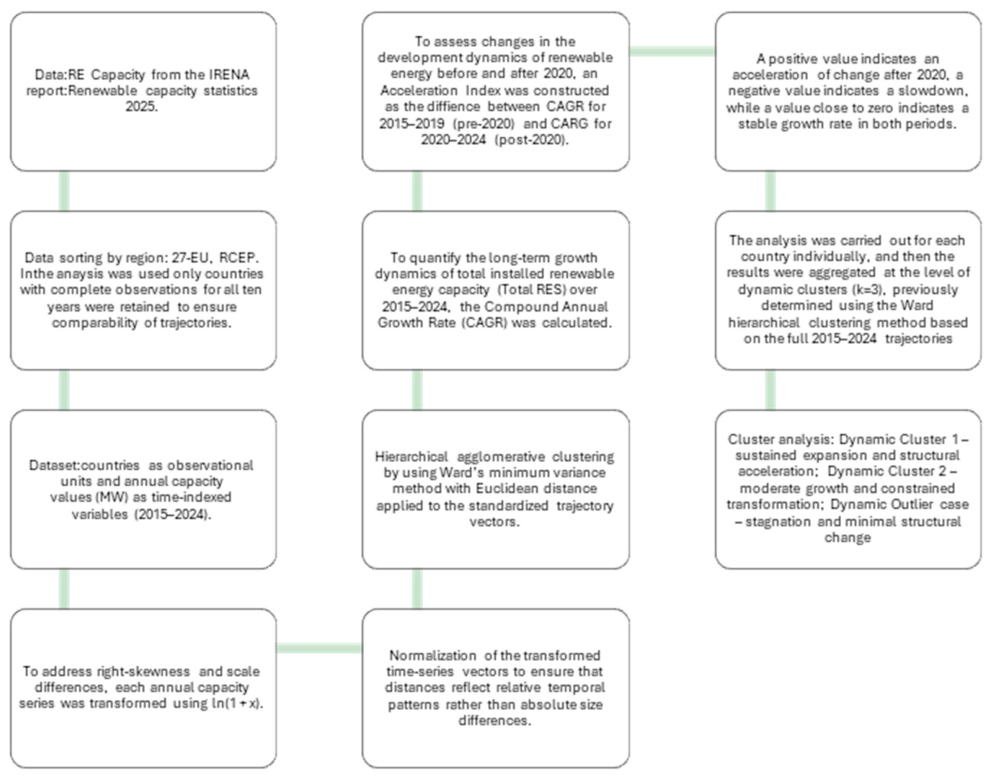
- —installed renewable energy capacity in 2015;
- —installed renewable energy capacity in 2024;
- 9—number of years of growth in the analyzed period (2015–2024).
- First, denotes the total installed renewable energy capacity in year t;
- Next, 4 denotes the number of annual increments in each sub-period.
4. Results
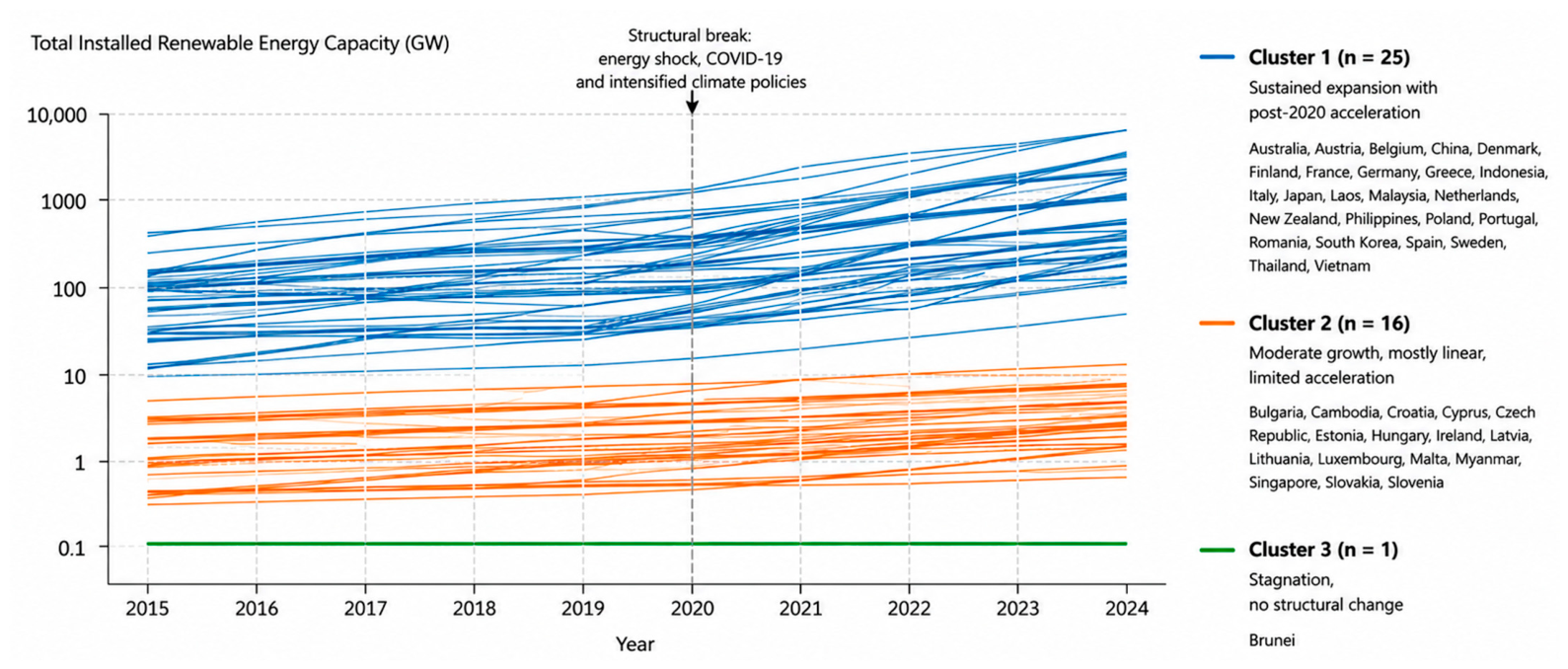
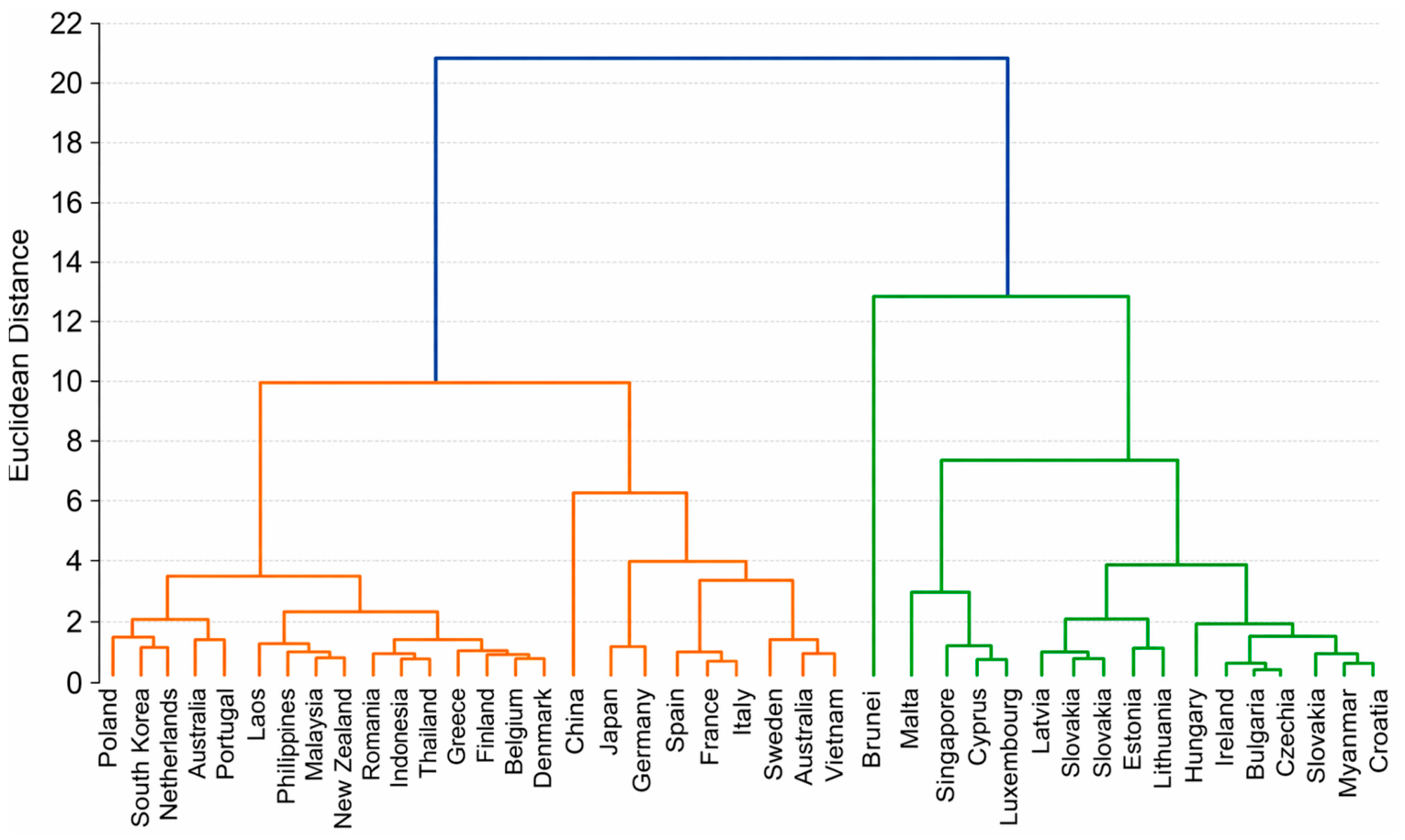
4.1. Description of the Clusters
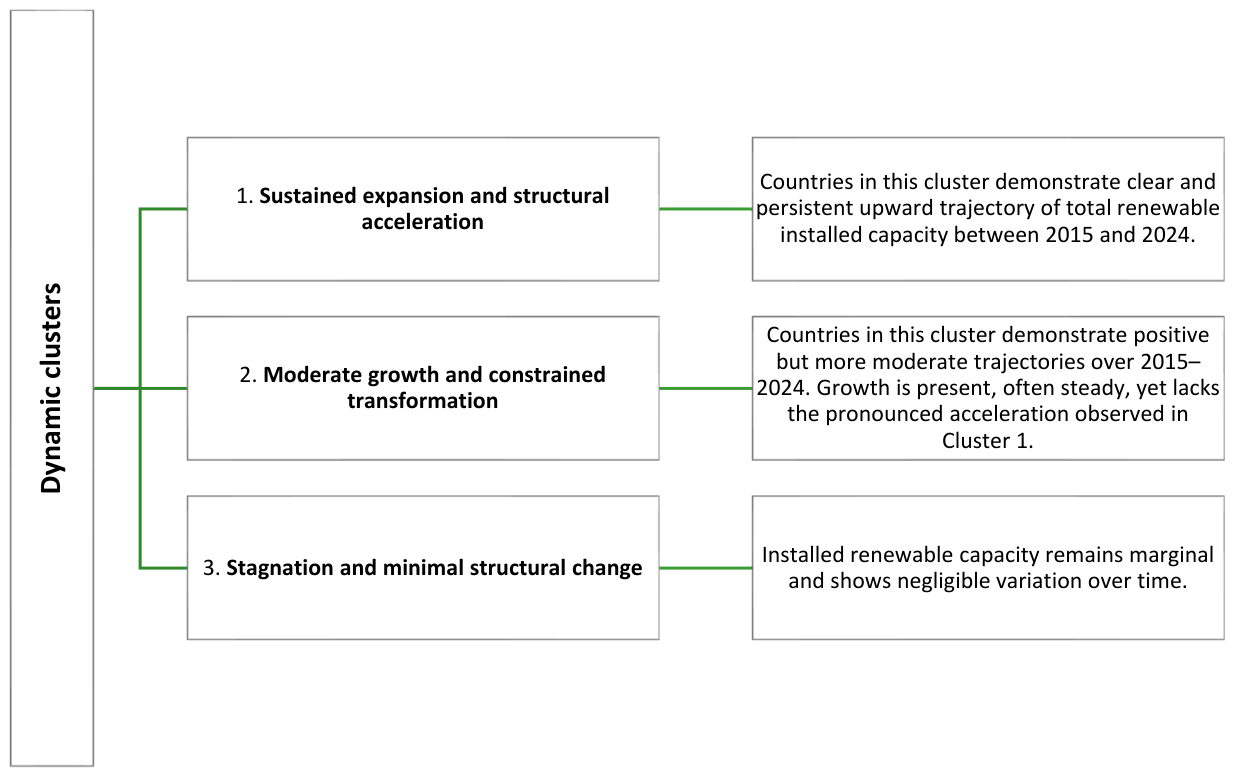
4.1.1. Dynamic Cluster 1: Sustained Expansion and Structural Acceleration
4.1.2. Dynamic Cluster 2: Moderate Growth and Constrained Transformation
4.1.3. Dynamic Outlier Case: Stagnation and Minimal Structural Change
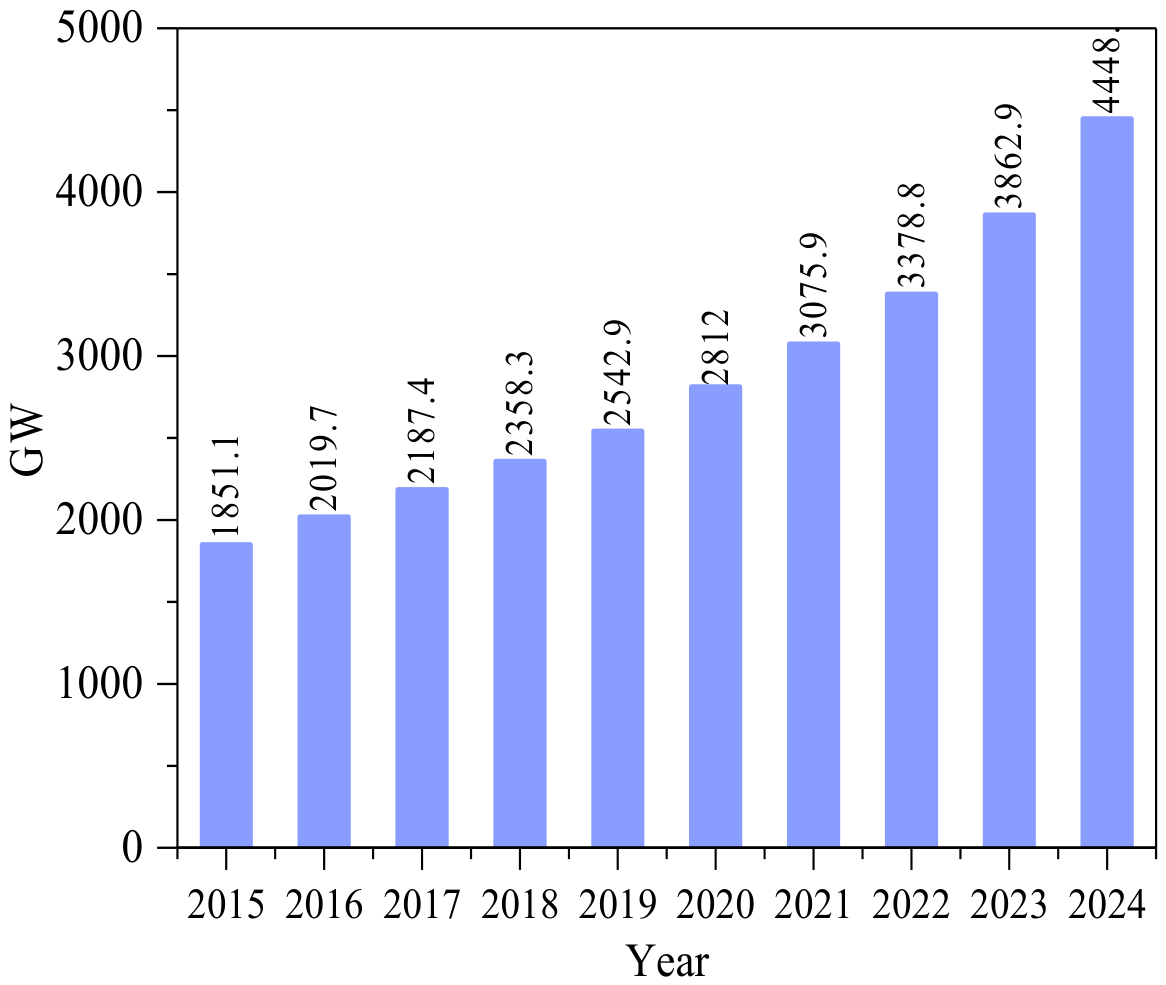
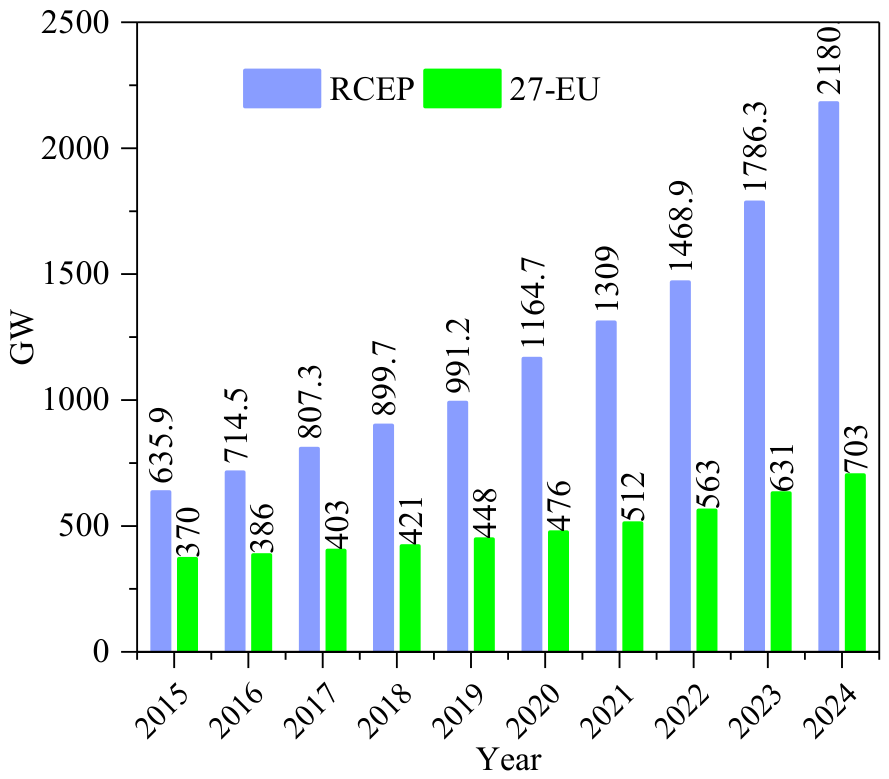
4.2. Comparative Analysis and CAGR
4.3. Analyzing by Acceleration Index
4.4. Comprehensive Cluster Analysis
4.4.1. Cluster 1: Systems of Durable and Scalable Transformation
4.4.2. Cluster 2: Incremental and Structurally Constrained Systems
4.4.3. Outlier Case
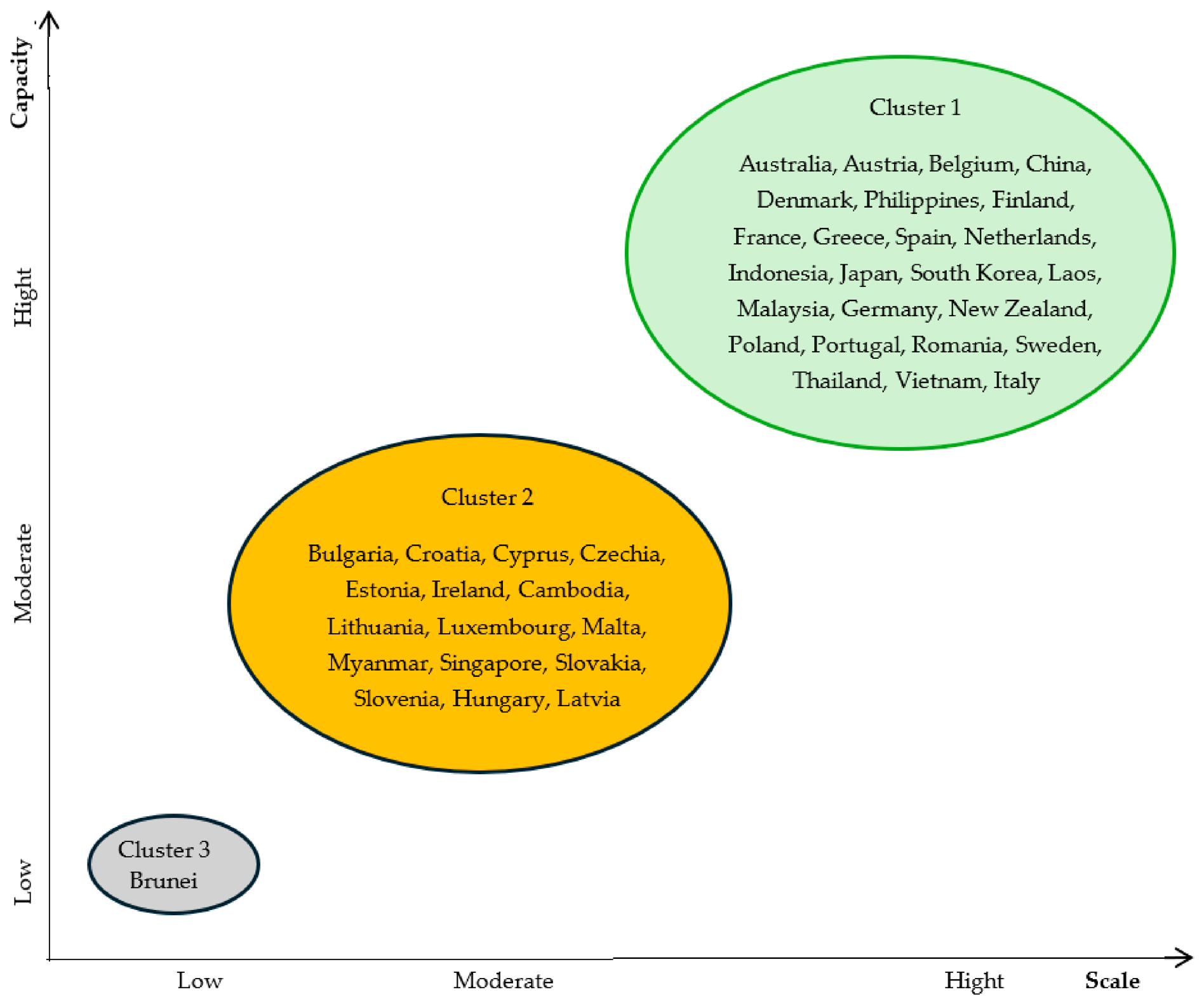
4.5. Summary of the Clustering Results
- Mature expansion model (Cluster 1)—moderate and stable growth rates combined with a very high-capacity base; strong ability to respond to post-2020 impulses.
- Incremental model (Cluster 2)—higher relative growth in selected cases, but with limited systemic scale; greater variability in post-2020 response.
- Marginal model (Outlier case)—absence of sustained dynamics, with only sporadic or point-based increases.
5. Discussion
6. Conclusions
Author Contributions
Funding
Data Availability Statement
Conflicts of Interest
Appendix A

| Country | 2015 | 2016 | 2017 | 2018 | 2019 | 2020 | 2021 | 2022 | 2023 | 2024 | Cluster |
|---|---|---|---|---|---|---|---|---|---|---|---|
| Australia | 17,641 | 18,889 | 20,975 | 26,114 | 31,911 | 38,563 | 43,535 | 49,437 | 55,504 | 63,510 | 1 |
| Sweden | 26,869 | 27,805 | 28,179 | 29,180 | 31,156 | 31,951 | 34,505 | 37,573 | 40,278 | 42,363 | 1 |
| Romania | 11,212 | 11,162 | 11,145 | 11,169 | 11,169 | 11,121 | 11,120 | 11,580 | 12,766 | 14,529 | 1 |
| Portugal | 12,160 | 13,229 | 13,581 | 13,803 | 14,186 | 14,298 | 15,245 | 17,280 | 18,503 | 20,476 | 1 |
| Poland | 6914 | 7872 | 7971 | 8275 | 9317 | 12,115 | 16,132 | 21,415 | 27,935 | 32,423 | 1 |
| Germany | 97,228 | 103,665 | 111,625 | 117,782 | 123,641 | 129,800 | 136,502 | 142,842 | 159,886 | 178,655 | 1 |
| Netherlands | 5748 | 7203 | 7933 | 9863 | 12,565 | 18,655 | 23,366 | 26,967 | 32,922 | 36,641 | 1 |
| Spain | 47,740 | 47,825 | 47,975 | 48,316 | 54,636 | 57,348 | 62,048 | 74,441 | 80,881 | 88,498 | 1 |
| Greece | 8138 | 8424 | 8632 | 8960 | 9843 | 10,807 | 12,252 | 13,355 | 15,518 | 18,231 | 1 |
| France | 42,706 | 44,676 | 47,526 | 50,090 | 52,819 | 55,055 | 58,534 | 62,080 | 67,447 | 74,340 | 1 |
| Finland | 6142 | 6744 | 7507 | 7560 | 7865 | 8724 | 9466 | 12,556 | 14,033 | 15,903 | 1 |
| Denmark | 7109 | 7410 | 8194 | 8902 | 9180 | 9656 | 10,867 | 12,167 | 12,779 | 13,539 | 1 |
| Belgium | 6345 | 6657 | 7399 | 8262 | 9397 | 11,153 | 11,810 | 13,078 | 14,771 | 16,275 | 1 |
| Austria | 18,475 | 19,340 | 19,599 | 20,378 | 20,774 | 21,150 | 22,113 | 23,510 | 26,409 | 28,864 | 1 |
| Italy | 50,252 | 51,022 | 51,944 | 52,963 | 54,126 | 55,195 | 56,541 | 59,478 | 64,777 | 72,115 | 1 |
| Thailand | 7903 | 9370 | 10,149 | 11,216 | 11,701 | 11,844 | 12,404 | 12,542 | 12,594 | 12,604 | 1 |
| China | 479,103 | 541,016 | 620,856 | 695,463 | 758,870 | 896,412 | 1,017,852 | 1,156,126 | 1,453,701 | 1,827,270 | 1 |
| Philippines | 5698 | 6342 | 6503 | 6681 | 6864 | 7082 | 7415 | 7777 | 7971 | 9300 | 1 |
| Indonesia | 8575 | 9065 | 9459 | 9807 | 10,303 | 10,465 | 11,533 | 12,596 | 13,325 | 14,295 | 1 |
| New Zealand | 7300 | 7309 | 7331 | 7375 | 7407 | 7465 | 7735 | 8128 | 8297 | 8933 | 1 |
| Japan | 66,905 | 75,563 | 83,598 | 90,723 | 98,685 | 107,935 | 115,170 | 122,922 | 128,782 | 132,317 | 1 |
| Malaysia | 7816 | 7930 | 7026 | 7460 | 7903 | 8563 | 8909 | 9295 | 9311 | 9471 | 1 |
| Laos | 4434 | 4910 | 5156 | 5543 | 6385 | 8185 | 9142 | 9832 | 9957 | 10,370 | 1 |
| South Korea | 7076 | 9163 | 11,173 | 13,444 | 17,621 | 22,092 | 24,422 | 27,271 | 30,504 | 33,782 | 1 |
| Vietnam | 16,990 | 18,271 | 18,296 | 18,713 | 26,084 | 38,386 | 43,000 | 44,691 | 47,799 | 49,015 | 1 |
| Slovenia | 1420 | 1408 | 1479 | 1474 | 1512 | 1612 | 1704 | 1863 | 2273 | 2562 | 2 |
| Slovakia | 2384 | 2397 | 2385 | 2329 | 2431 | 2377 | 2406 | 2433 | 2417 | 2691 | 2 |
| Malta | 77 | 96 | 113 | 134 | 156 | 185 | 200 | 214 | 230 | 237 | 2 |
| Latvia | 1782 | 1778 | 1796 | 1804 | 1826 | 1826 | 1823 | 1927 | 2165 | 2312 | 2 |
| Luxembourg | 239 | 301 | 318 | 324 | 386 | 430 | 504 | 572 | 727 | 861 | 2 |
| Ireland | 2748 | 3105 | 3672 | 4051 | 4553 | 4794 | 4911 | 5206 | 5951 | 6606 | 2 |
| Cambodia | 1000 | 1004 | 1087 | 1449 | 1546 | 1731 | 1792 | 1888 | 1892 | 2288 | 2 |
| Myanmar | 3259 | 3344 | 3358 | 3374 | 3417 | 3413 | 3439 | 3509 | 3509 | 3544 | 2 |
| Estonia | 594 | 607 | 615 | 609 | 716 | 829 | 1013 | 1140 | 1456 | 2204 | 2 |
| Hungary | 1077 | 1048 | 1224 | 1630 | 2288 | 3024 | 3906 | 5155 | 6819 | 8708 | 2 |
| Cyprus | 244 | 252 | 278 | 289 | 322 | 400 | 485 | 595 | 752 | 895 | 2 |
| Croatia | 2713 | 2793 | 2916 | 2979 | 3068 | 3255 | 3490 | 3585 | 3973 | 4403 | 2 |
| Bulgaria | 4136 | 4145 | 4289 | 4316 | 4319 | 4364 | 4532 | 5004 | 6177 | 7177 | 2 |
| Singapore | 215 | 266 | 286 | 331 | 437 | 494 | 657 | 861 | 1163 | 1374 | 2 |
| Lithuania | 691 | 765 | 788 | 843 | 886 | 1017 | 1325 | 1919 | 2894 | 4618 | 2 |
| Czech Republic | 4214 | 4212 | 4264 | 4257 | 4349 | 4403 | 4482 | 4717 | 5531 | 6453 | 2 |
| Brunei | 1 | 1 | 1 | 1 | 1 | 1 | 5 | 5 | 5 | 5 | 3 |
References
- IRENA. Renewable Capacity Statistics. 2025. Available online: https://www.irena.org/Publications/2025/Mar/Renewable-capacity-statistics-2025#:~:text=Renewable%20power%20generation%20capacity%20is,end%20of%20the%20calendar%20year (accessed on 10 January 2026).
- Semeraro, T.; Aretano, R.; Barca, A.; Pomes, A.; Giudice, C.D.; Gatto, E.; Lenucci, M.; Buccolieri, R.; Emmanuel, R.; Gao, A.; et al. A conceptual framework to design green infrastructure: Ecosystem services as an opportunity for creating shared value in ground photovoltaic systems. Land 2020, 9, 238. [Google Scholar] [CrossRef]
- Petitet, M.; Finon, D.; Janssen, T. Capacity adequacy in power markets facing energy transition: A comparison of scarcity pricing and capacity mechanism. Energy Policy 2017, 103, 30–46. [Google Scholar] [CrossRef]
- Bussar, C.; Moos, M.; Alvarez, R.; Wolf, P.; Thien, T.; Chen, H.; Cai, Z.; Leuthold, M.; Sauer, D.U.; Moser, A. Optimal allocation and capacity of energy storage systems in a future European power system with 100% renewable energy generation. Energy Procedia 2014, 46, 40–47. [Google Scholar] [CrossRef]
- European Commission. Fit for 55: Delivering the EU’s 2030 Climate Target on the Way to Climate Neutrality; COM (2021) 550 Final; European Commission: Brussels, Belgium, 2021; Available online: https://eur-lex.europa.eu/legal-content/EN/TXT/?uri=CELEX%3A52021DC0550 (accessed on 10 January 2026).
- European Commission. REPowerEU Plan; COM(2022) 230 Final; Communication REPowerEU Plan COM(2022)230 (europa.eu); European Commission: Brussels, Belgium, 2022; Available online: https://commission.europa.eu/publications/key-documents-repowereu_en (accessed on 10 January 2026).
- State Council of the People’s Republic of China. Working Guidance for Carbon Dioxide Peaking and Carbon Neutrality in Full and Faithful Implementation of the New Development Philosophy; State Council: Beijing, China, 2021. Available online: https://english.www.gov.cn/policies/latestreleases/202110/25/content_WS61760047c6d0df57f98e3c21.html (accessed on 2 March 2026).
- State Council of the People’s Republic of China. Action Plan for Carbon Dioxide Peaking Before 2030; State Council: Beijing, China, 2021. Available online: https://english.www.gov.cn/policies/latestreleases/202110/27/content_WS6178a47ec6d0df57f98e3dfb.html (accessed on 2 March 2026).
- Sangwan, G. Economic and Regional Studies—AGRO, 2024. Available online: http://agro.icm.edu.pl/agro/element/bwmeta1.element.agro-c59026f0-c1d8-41ed-ace4-69a380204258/c/446-462.pdf (accessed on 2 March 2026).
- Fitchner, S. How Does RCEP Affect the Global Photovoltaic Market. 2020. Available online: https://www.solarbeglobal.com/How-does-RCEP-affect-the-global-photovoltaic-market/ (accessed on 2 March 2026).
- Ember. Wind and Solar Generated More Power Than Fossil Fuels in the EU for the First Time in 2025. 2026. Available online: https://ember-energy.org/latest-updates/wind-and-solar-generated-more-power-than-fossil-fuels-in-the-eu-for-the-first-time-in-2025/ (accessed on 2 March 2026).
- Report IEA, International Energy Agency Photovoltaic Power Systems Programme. IEA PVPS. Task 1. Strategic PV Analysis and Outreach. 2025. Available online: https://iea-pvps.org/wp-content/uploads/2025/04/Snapshot-of-Global-PV-Markets_2025.pdf (accessed on 2 March 2026).
- Geels, F.W. Technological transitions as evolutionary reconfiguration processes: A multi-level perspective and a case-study. Res. Policy 2002, 31, 1257–1274. [Google Scholar] [CrossRef]
- Geels, F.W.; Schot, J. Typology of sociotechnical transition pathways. Res. Policy 2007, 36, 399–417. [Google Scholar] [CrossRef]
- Mol, A.P.J.; Spaargaren, G. Ecological modernization theory in debate: A review. Environ. Politics 2000, 9, 17–49. [Google Scholar]
- Mol, A.P.J.; Sonnenfeld, D.A. Ecological Modernization Around the World: Perspectives and Critical Debates; Routledge: Abingdon, UK, 2000. [Google Scholar]
- UNCCP. Reports and Decisions. COP28: What Was Achieved and What Happens Next? 2024. Available online: https://unfccc.int/cop28 (accessed on 2 March 2026).
- Renewables 2023—Analysis, IEA. Available online: https://www.iea.org/reports/renewables-2023 (accessed on 2 March 2026).
- Renewables 2024—Analysis, IEA. Available online: https://www.iea.org/reports/renewables-2024 (accessed on 2 March 2026).
- Chadly, A.; Moawad, K.; Salah, K.; Omar, M.; Mayyas, A. State of global solar energy market: Overview, China’s role, Challenges, and Opportunities. Sustain. Horiz. 2024, 11, 100108. [Google Scholar] [CrossRef]
- IEA. Special Report on Solar PV Global Supply Chains. 2022. Available online: https://www.iea.org/reports/solar-pv-global-supply-chains (accessed on 2 March 2026).
- Wei, W.; Li, J.; Chen, B.; Wang, M.; Zhang, P.; Guan, D.; Meng, J.; Qian, H.; Cheng, Y.; Xue, J.; et al. Embodied greenhouse gas emissions from building China’s large-scale power transmission infrastructure. Nat. Sustain. 2021, 4, 739–747. [Google Scholar]
- You, W.; Geng, Y.; Dong, H.; Wilson, J.; Pan, H.; Wu, R.; Sun, L.; Zhang, X.; Liu, Z. Technical and economic assessment of RES penetration by modelling China’s existing energy system. Energy 2018, 165, 900–910. [Google Scholar] [CrossRef]
- Japan Renewable Energy Market. Available online: https://www.kenresearch.com/japan-renewable-energy-market (accessed on 2 March 2026).
- 2024 Share of Electricity from Renewable Energy Resources in Japan [Preliminary Report] Institute for Sustainable Energy Policies (ISEP). 2025. Available online: https://www.isep.or.jp/en/1561/ (accessed on 2 March 2026).
- Rebbeck, M. Power for Good Australian Renewables Renewable Energy. Linkedin. Available online: https://www.linkedin.com/posts/res-group_powerforgood-australianrenewables-renewableenergy-activity-7374388390047358976-CCP3/ (accessed on 2 March 2026).
- IEA. Energy Mix by Counters. Available online: https://www.iea.org/countries/korea/energy-mix (accessed on 2 March 2026).
- European Parliament and Council. Directive (EU) 2018/2001 of the European Parliament and of the Council of 11 December 2018 on the promotion of the use of energy from renewable sources. Off. J. Eur. Union 2018, L328, 82–209. [Google Scholar]
- European Commission. The European Green Deal; COM(2019) 640 Final; European Commission: Brussels, Belgium, 2019. [Google Scholar]
- European Parliament and Council. Directive (EU) 2023/2413 of the European Parliament and of the Council of 18 October 2023 amending Directive (EU) 2018/2001, Regulation (EU) 2018/1999 and Directive 98/70/EC as regards the promotion of energy from renewable sources, and repealing Council Directive (EU) 2015/652. Off. J. Eur. Union 2023, L2023/2413, 1–77. [Google Scholar]
- European Parliament and Council. Directive 2003/87/EC Establishing a Scheme for Greenhouse Gas Emission Allowance Trading within the Community (EU ETS). Off. J. Eur. Union 2003, 275, 32–46. [Google Scholar]
- IEA. Renewables 2024: Analysis and Forecast to 2030; International Energy Agency: Paris, France, 2024. [Google Scholar]
- Szulecki, K.; Fischer, S.; Gullberg, A.T.; Sartor, O. Shaping the ‘Energy Union’: Between National Positions and Governance Innovation in EU Energy and Climate Policy. Clim. Policy 2016, 16, 548–567. [Google Scholar] [CrossRef]
- National Development and Reform Commission (NDRC). The 14th Five-Year Plan for Renewable Energy Development; NDRC: Beijing, China, 2021.
- Ministry of Economy, Trade and Industry (METI). Sixth Strategic Energy Plan; Government of Japan: Tokyo, Japan, 2021.
- Government of Japan. Green Growth Strategy Through Achieving Carbon Neutrality in 2050; Government of Japan: Tokyo, Japan, 2021.
- Ministry of Trade, Industry and Energy (MOTIE). Carbon Neutrality Strategy of the Republic of Korea; Government of the Republic of Korea: Seoul, Republic of Korea, 2020.
- Petri, P.A.; Plummer, M.G. The Economic Effects of the Regional Comprehensive Economic Partnership. Asian Econ. J. 2020, 34, 1–21. [Google Scholar]
- ASEAN Centre for Energy. ASEAN Plan of Action for Energy Cooperation (APAEC) 2016–2025; ASEAN Centre for Energy: Jakarta, Indonesia, 2020.
- Shao, H.; Wang, Y.; Lee, C.-C.; Wen, H. How does political stability affect renewable energy finance? International evidence. Energy 2024, 313, 133829. [Google Scholar] [CrossRef]
- Gajdzik, B.; Jaciow, M.; Hoffmann-Burdzińska, K.; Wolny, R.; Wolniak, R.; Grebski, W.W. Impact of Economic Awareness on Sustainable Energy Consumption: Results of Research in a Segment of Polish Households. Energies 2024, 17, 2483. [Google Scholar] [CrossRef]
- Gajdzik, B.; Wolniak, R.; Nagaj, R.; Grebski, W.W.; Romanyshyn, T. Barriers to Renewable Energy Source (RES) Installations as Determinants of Energy Consumption in EU Countries. Energies 2023, 16, 7364. [Google Scholar] [CrossRef]
- Aguirre, M.; Ibikunle, G. Determinants of Renewable Energy Growth: A Global Sample Analysis. Energy Policy 2014, 69, 374–384. [Google Scholar] [CrossRef]
- Papież, M.; Śmiech, S.; Frodyna, K. Determinants of the renewable energy development in the EU countries. A 20-year perspective. Renew. Sustain. Energy Rev. 2018, 91, 918–934. [Google Scholar] [CrossRef]
- Abid, I.; Gafsi, N. Drivers of Sustainable Economic Growth in Turkey: The Role of Renewable Energy, Innovation, Technical Assistance, and Fisheries Production. J. Renew. Energy Environ. 2026, 13, 13–24. [Google Scholar]
- Melis, N.; İçen, E. What are the determinants of renewable energy consumption? An application for variable selection. Renew. Energy 2025, 239, 122029. [Google Scholar]
- Narayan, S.; Doytch, N. An Investigation of Renewable and Non-Renewable Energy Consumption and Economic Growth Nexus Using Industrial and Residential Energy Consumption. Energy Econ. 2017, 68, 160–176. [Google Scholar] [CrossRef]
- Bilan, Y.; Streimikiene, D.; Vasylieva, T.; Lyulyov, O.; Pimonenko, T.; Pavlyk, A. Linking between Renewable Energy, CO2 Emissions, and Economic Growth: Challenges for Candidates and Potential Candidates for the EU Membership. Sustainability 2019, 11, 1528. [Google Scholar] [CrossRef]
- Gajdzik, B.; Wolniak, R.; Grebski, W.-W. Fuzzy Poland’s Renewable Energy Transition (2010–2023): A Fuzzy Time Series and Multi-Criteria Assessment of Transition Quality in Electricity Production. Energies 2026, 19, 1248. [Google Scholar]
- Skjærseth, J.B.; Eikeland, P.O. Governing EU low-carbon innovation: From strategic energy technology plan to European green deal. In Handbook on European Union Climate Change Policy and Politics; Edward Elgar Publishing: Cheltenham, UK, 2023; pp. 259–273. [Google Scholar]
- Maciulytie-Sniukiene, A.; Butkus, M. Does Infrastructure Development Contribute to EU Countries’ Economic Growth? Sustainability 2022, 14, 5610. [Google Scholar] [CrossRef]
- Santhi, A.R.; Muthuswamy, P. Industry 5.0 or industry 4.0S? Introduction to industry 4.0 and a peek into the prospective industry 5.0 technologies. Int. J. Interact. Des. Manuf. 2023, 17, 947–979. [Google Scholar] [CrossRef]
- Gajdzik, B.; Grabowska, S.; Saniuk, S.; Wieczorek, T. Sustainable Development and Industry 4.0: A Bibliometric Analysis Identifying Key Scientific Problems of the Sustainable Industry 4.0. Energies 2020, 13, 4254. [Google Scholar] [CrossRef]
- Usharani, S.; Manju Bala, P.; Ananth Kumar, T.; Rajmohan, R.; Pavithra, M. Smart Energy Management Techniques in Industries 5.0. In Hybrid Intelligent Approaches for Smart Energy: Practical Applications; Senthil, J., Mohan, K., Padmanaban, S., Hamid, Y., Eds.; Wiley: Hoboken, NJ, USA, 2022. [Google Scholar] [CrossRef]
- IRENA. Innovation Landscape Brief: Increasing Time Granularity in Electricity Markets; International Renewable Energy Agency: Abu Dhabi, United Arab Emirates, 2019. Available online: https://www.irena.org/-/media/Files/IRENA/Agency/Publication/2019/Jun/IRENA_Market_Design_Collection_2020 (accessed on 10 January 2026).
- Zhou, C.; Zhang, W.; Richardson-Barlow, C.; Zhang, Z. Navigating carbon neutrality: Policy pathways and consistency on industrial decarbonization in China. Carbon Balance Manag. 2025, 20, 66. [Google Scholar] [CrossRef]
- Zhou, C.; Richardson-Barlow, C.; Fan, L.; Cai, H.; Zhang, W.; Zhang, Z. Towards organic collaborative governance for a more sustainable environment: Evolutionary game analysis within the policy implementation of China’s net-zero emissions goals. J. Environ. Manag. 2025, 373, 123765. [Google Scholar]
- Gajdzik, B.; Jaciow, M.; Wolniak, R.; Wolny, R.; Grebski, W.W. Diagnosis of the Development of Energy Cooperatives in Poland—A Case Study of a Renewable Energy Cooperative in the Upper Silesian Region. Energies 2024, 17, 647. [Google Scholar] [CrossRef]
- Bourcet, C. Empirical determinants of renewable energy deployment: A systematic literature review. Energy Econ. 2020, 85, 104563. [Google Scholar] [CrossRef]
- Di Piazza, A.; Di Piazza, M.C.; Ragusa, A.; Vitale, G. Environmental data processing by clustering methods for energy forecast and planning. Renew. Energy 2011, 36, 1063–1074. [Google Scholar] [CrossRef]
- Apergis, N.; Payne, J.E. Renewable energy, output, CO2 emissions, and fossil fuel prices in Central America: Evidence from a nonlinear panel smooth transition vector error correction model. Energy Econ. 2014, 42, 226–232. [Google Scholar] [CrossRef]
- Sadorsky, P. Renewable energy consumption and income in emerging economies. Energy Policy 2009, 37, 4021–4028. [Google Scholar] [CrossRef]
- Marques, A.C.; Fuinhas, J.A.; Manso, J.R.P. Motivations driving renewable energy in European countries: A panel data approach. Energy Policy 2010, 38, 6877–6885. [Google Scholar] [CrossRef]
- Menegaki, A.N. Growth and renewable energy in Europe: A random effect model with evidence for neutrality hypothesis. Energy Econ. 2011, 33, 257–263. [Google Scholar] [CrossRef]
- Hinsch, A.; Krug, M.; Di Nucci, M.R.; Russell, L. Policy Brief 4: Short-Term Actions to Meet Long-Term Visions. Available online: https://come-res.eu/resource?uid=1472 (accessed on 20 March 2026).
- Bian, L.; Dikau, S.; Miller, H.; Pierfederici, R.; Stern, N.; Ward, B. China’s Role in Accelerating the Global Energy Transition Through Green Supply Chains and Trade; Grantham Research Institute on Climate Change and the Environment, London School of Economics and Political Science: London, UK, 2024. Available online: https://www.lse.ac.uk/granthaminstitute/wp-content/uploads/2024/02/Chinas-role-in-accelerating-the-global-energy-transition-through-green-supply-chains-and-trade.pdf (accessed on 25 April 2026).
- Nedopil, C.; Tumiwa, F.; Sayed, M.; Anis, M.A.; Isnarti, R.; Farooq, U. Green Independent Power Producer (IPP) Design and Negotiations in Asia; Griffith Asia Institute: Shanghai, China, 2025; Available online: https://greenfdc.org/wp-content/uploads/2025/07/Nedopil-et-al-2025_Green-IPP-Guidance-in-Asia.pdf (accessed on 25 April 2026).
- European Commission. Finland’s Draft Integrated National Energy and Climate Plan; European Commission: Brussels, Belgium, 2019; Available online: https://energy.ec.europa.eu/system/files/2019-02/finland_draftnecp_0.pdf (accessed on 25 April 2026).
- Lebrouhi, B.E.; Schall, E.; Lamrani, B.; Chaibi, Y.; Kousksou, T. Energy Transition in France. Sustainability 2022, 14, 5818. [Google Scholar] [CrossRef]
- Neumann, R.; Rakholiya, K. Solar Incentives and Subsidies in Germany: A Complete Guide for 2026; SurgePV: Ahmedabad, India, 2026; Available online: https://surgepv.com/blog/solar-incentives-subsidies-germany (accessed on 25 April 2026).
- PVKnowhow. Germany Renewable Energy Rules and Solar Manufacturing Framework; PVKnowhow: Freystadt, Germany, 2025; Available online: https://www.pvknowhow.com/countries/germany/germany-renewable-energy-rules-solar-manufacturing/ (accessed on 25 April 2026).
- Maniatis, Y.; Doukas, H.; Karagiannis, E. A Greek Green Deal: Building Energy Democracy and Fighting Energy Poverty; GreeSE Paper No. 181; Hellenic Observatory, London School of Economics and Political Science: London, UK, 2023; Available online: https://www.lse.ac.uk/Hellenic-Observatory/Assets/Documents/Publications/GreeSE-Papers/GreeSE-No181.pdf (accessed on 25 April 2026).
- Zhu, Y.; Salvalai, G.; Zangheri, P. Italian renewable energy communities: Status and prospect development analysis. Energy Build. 2025, 348, 116404. [Google Scholar] [CrossRef]
- Neumann, R.; Rakholiya, K. Italy Feed-in Tariffs and Rooftop Solar: GSE Programs, Scambio sul Posto and Ritiro Dedicato Explained; SurgePV: Ahmedabad, India, 2025; Available online: https://www.surgepv.com/blog/italy-feed-in-tariffs-rooftop-solar (accessed on 25 April 2026).
- Maekawa, J.; Shimada, K.; Takeuchi, A. Sustainability of renewable energy investment motivations during a feed-in-tariff scheme transition: Evidence from a laboratory experiment. Jpn. Econ. Rev. 2022, 73, 83–101. [Google Scholar] [CrossRef]
- Wen, D.; Gao, W.; Kuroki, S.; Gu, Q.; Ren, J. The effects of the new feed-in tariff act for solar photovoltaic (PV) energy in the wake of the Fukushima accident in Japan. Energy Policy 2021, 156, 112414. [Google Scholar] [CrossRef]
- Ministry of Economy, Trade and Industry (METI). Fundamental Review of Transition Finance; METI: Tokyo, Japan, 2025. Available online: https://www.meti.go.jp/policy/energy_environment/global_warming/transition/20250930.pdf (accessed on 25 April 2026).
- Aziz, M.H.A.; Miswan, N.S.; Mohd Kasran, F.A.; Muhamad Shokri, M.S.; Noran, M.N.; Abd Rahim, A. Pilot project on dynamic line rating (DLR) system for optimal use of Tenaga Nasional Berhad (TNB) grid capacity. In Proceedings of the 2020 International Conference on Communications, Information, Electronic and Energy Systems (CIEES), Bandung, Indonesia, 23–24 September 2020; Available online: https://ieeexplore.ieee.org/document/9249936/ (accessed on 20 April 2026).
- Narodowy Fundusz Ochrony Środowiska i Gospodarki Wodnej (NFOŚiGW). Program ”Mój Prąd”—Założenia Szczegółowe; NFOŚiGW: Warsaw, Poland, 2024. Available online: https://www.gov.pl/web/nfosigw/program-moj-prad--zalozenia-szczegolowe (accessed on 25 April 2026).
- United Nations Conference on Trade and Development (UNCTAD). Portugal Incentivizes Investments in Renewable Energy Technologies, Energy Source Diversification and Decarbonization; Investment Policy Monitor; UNCTAD: Geneva, Switzerland, 2024; Available online: https://investmentpolicy.unctad.org/investment-policy-monitor/measures/4720/portugal-incentivizes-investments-in-renewable-energy-technologies-energy-source-diversification-and-decarbonization (accessed on 25 April 2026).
- Park, W.Y.; Song, Y.H.; Abhyankar, N.; Moon, H.S.; Paliwal, U.; Kim, E.; Khanna, N.; Hong, S.; Kim, J.H.; Shiraishi, K.; et al. A clean energy Korea by 2035: Transitioning to 80% carbon-free electricity generation. Cell Rep. Sustain. 2025, 2, 100262. [Google Scholar] [CrossRef]
- Shirazi, S.Z.; Shirazi, S.M.Z. Review of Spanish renewable energy policy to encourage investment in solar photovoltaic. J. Renew. Sustain. Energy 2012, 4, 062702. [Google Scholar] [CrossRef]
- Fridolfsson, S.-O.; Tangerås, T. A Reexamination of Renewable Electricity Policy in Sweden; IFN Working Paper No. 921; Research Institute of Industrial Economics (IFN): Stockholm, Sweden, 2012; Available online: https://hdl.handle.net/10419/81395 (accessed on 25 April 2026).
- Sirasoontorn, P.; Koomsup, P. Energy Transition in Thailand: Challenges and Opportunities. 2021. Available online: https://www.researchgate.net/publication/354160719_Energy_Transition_in_Thailand_-_Challenges_and_Opportunities (accessed on 25 April 2026).
- Thanh Hang, M.T. Made in Vietnam Energy Plan 4.0; Energy Alliance: New York, NY, USA, 2025; Available online: https://energyalliance.org/wp-content/uploads/2025/06/EN-Made-in-Vietnam-Energy-Plan-4.0.pdf (accessed on 25 April 2026).
- Yan, H.; Acquah, S.J.; Zhang, C.; Wang, G.; Huang, S.; Zhang, H.; Zhao, B.; Wu, H. Energy Partitioning of Greenhouse Cucumber Based on the Application of Penman–Monteith and Bulk Transfer Models. Agric. Water Manag. 2019, 217, 201–211. [Google Scholar]
- Nguyen, T.P.; Duong, T.T.-T. Decoding the Environmental Effects of Green Finance, Renewable Energy, Financial Development, and Globalization through Quantile-on-Quantile and Wavelet Coherence Analysis. Discov. Sustain. 2026, 7, 167. [Google Scholar] [CrossRef]
- Aghaei, M.; Rezagholizadeh, M. The Role of Financial Development and Financial Technology in Driving Renewable Energy Technologies: Evidence from Developed and Developing Countries. J. Renew. Energy Environ. 2026, 13, 1–12. [Google Scholar] [CrossRef]
- Atutxa, E.; Calvo-Sotomayor, I.; Mendizabal, X. Governing beyond market and state: A grounded theory of public–commons partnerships in Spain’s energy transition. Energy Res. Soc. Sci. 2026, 131, 104528. [Google Scholar]
- Aasa, O.P.; Phoya, S.; Monko, R.J.; Musonda, I. A theory-based decision support framework for energy transition: Pluralized perspective. Front. Sustain. 2026, 6, 1703098. [Google Scholar] [CrossRef]
- Maitra, A.; Gururajan, M.P. Extracting rates and activation free energies of martensitic transitions using nanomechanical force statistics: Theory, models, and analysis. Sci. Rep. 2025, 15, 3008. [Google Scholar] [CrossRef]
- Taveira, E.R.; Ribas, L.M.; Paranhos Filho, A.C. Ecological modernization theory in the Pantanal: Environmental extra-taxation mechanisms for sustainable development. Teoria da modernização ecológica no Pantanal: Desafios da extrafiscalidade ambiental para o desenvolvimento sustentável. Rev. Direito 2025, 17, 1. [Google Scholar] [CrossRef]
- Wu, W.; Zhao, L. Building evaluation model for low-carbon transformation of power systems based on ecological modernization theory. In Proceedings of the 2025 IEEE International Symposium on the Application of Artificial Intelligence in Electrical Engineering (AAIEE 2025), Beijing, China, 25–28 April 2025; pp. 830–835. [Google Scholar]
- Provensi, T.; Marcon, M.L.; Schmidt, J.L.; de Oliveira Rodrigues, C.; Sehnem, S. Sustainability and innovation in the pet industry: An analysis from the perspective of ecological modernization theory|Sustentabilidade e inovação na indústria pet: Uma análise sob a perspectiva da teoria da modernização ecológica. RAE Rev. Adm. Empresas 2024, 64, e2023-0247. [Google Scholar]
- Pea-Assounga, J.B.B.; Bambi, P.D.R.; Apendi, D.A.O.A.; Mo, Y.; Zhu, Q.; Zhu, D. Impact of Agriculture, Industry, Food Production, Renewable Energy Consumption, Urbanization, and Consumer Price Index on Ecological Footprint: Evidence from Asian Economies. Front. Sustain. Food Syst. 2025, 9, 1653025. [Google Scholar] [CrossRef]
- Gajdzik, B.; Wolniak, R. Influence of Industry 4.0 Projects on Business Operations: Literature and Empirical Pilot Studies Based on Case Studies in Poland. J. Open Innov. Technol. Mark. Complex. 2022, 8, 44. [Google Scholar] [CrossRef]
- Kwiotkowska, A.; Gajdzik, B.; Wolniak, R.; Vveinhardt, J.; Gębczyńska, M. Leadership competencies in making industry 4.0 effective: The case of polish heat and power industry. Energies 2021, 14, 4338. [Google Scholar] [CrossRef]
- Stamps, J.A.; Biro, P.A. Time-specific convergence and divergence in individual differences in behavior: Theory, protocols and analyses. Ecol. Evol. 2023, 13, e10615. [Google Scholar] [CrossRef] [PubMed]
- Hornstra, L.; Stroet, K.; Rubie-Davies, C.; Flint, A. Teacher expectations and self-determination theory: Considering convergence and divergence of theories. Educ. Psychol. Rev. 2023, 35, 76. [Google Scholar] [CrossRef]
- Panagiotidou, O. Cognitive theories and Wittgenstein: Looking for convergence, not for divergence. In Wittgenstein and the Cognitive Science of Religion: Interpreting Human Nature and the Mind; Bloomsbury Academic: London, UK, 2023; pp. 93–108. [Google Scholar]
- Zhou, C.; Richardson-Barlow, C. A new framework for collaborative climate governance: Linking consensus building and collective action. Policy Politics 2026, 54, 1–22. [Google Scholar] [CrossRef]
- Zhou, C.; Richardson-Barlow, C. Climate promotion tournaments and collaborative governance: Central-local dynamics in China’s carbon neutrality policy implementation. J. Environ. Pol. Plan. 2026, 28, 1–18. [Google Scholar] [CrossRef]
- Gajdzik, B.; Burchart-Korol, D. Eco-innovation in manufacturing plants illustrated with an example of steel products development. Metalurgija 2011, 50, 63–66. [Google Scholar]
- Gajdzik, B. The road of polish steelworks towards market success—Changes after restructuring process. Metalurgija 2013, 52, 421–424. [Google Scholar]
- Zhang, S.; Bai, Y. Impact Mechanism of Green Electricity Consumption on China’s Coal Power Industry Chain Resilience. Sustainability 2026, 18, 2295. [Google Scholar] [CrossRef]
- Unruh, G.C. Understanding carbon lock-in. Energy Policy 2000, 28, 817–830. [Google Scholar] [CrossRef]
- Marinescu, Ș.A.; Oncioiu, I.; Ghibanu, A.-I. The digital transformation of healthcare through intelligent technologies: A path dependence-augmented—Unified theory of acceptance and use of technology model for clinical decision support systems. Healthcare 2025, 13, 1222. [Google Scholar] [CrossRef] [PubMed]
- Camuffo, A.; Gambardella, A.; Kazemi, S. A theory based analysis of path dependence. In Economics of Innovation and New Technology; Taylor and Francis: Abingdon, UK, 2025. [Google Scholar] [CrossRef]
- Li, D.; Qu, J.; Mo, Y.; Zhu, Q.; Zhu, D. Sizing Optimization of a Stand-Alone Multi-Energy Complementary Water Pumping System for Hose-Drawn Traveler in Typical Regions of China. Agriculture 2026, 16, 90. [Google Scholar]





| Program/Policy | Year | Instrument Type | Core Objectives | Time Horizon |
|---|---|---|---|---|
| European Green Deal | 2019 | Overarching strategic framework | Climate neutrality; systemic economic transformation; large-scale RES deployment; circular economy; just transition | 2050 |
| Fit for 55 | 2021 | Legislative package | At least 55% GHG reduction (vs. 1990); ETS reform; Carbon Border Adjustment Mechanism (CBAM); transport decarbonization | 2030 |
| REPowerEU | 2022 | Energy security and acceleration plan | Reduce dependence on Russian fossil fuels; accelerate renewable deployment; improve energy efficiency | 2030 |
| Renewable Energy Directive (RED III) | 2023 | Binding sectoral directive | Minimum 42.5% renewable energy share in final energy consumption (45% indicative target) | 2030 |
| EU Emissions Trading System (EU ETS) | 2005/revised 2023 | Market-based carbon pricing mechanism | Progressive emission caps in power and industry; extension to buildings and transport; strengthening carbon price signal | 2030+ |
| Just Transition Mechanism | 2020 | Financial and cohesion instrument | Support coal-dependent and carbon-intensive regions; socio-economic restructuring | 2021–2027 |
| Program/Policy | Country/Region | Instrument Type | Core Objectives | Time Horizon |
|---|---|---|---|---|
| Regional Comprehensive Economic Partnership | 15 Asia-Pacific countries | Trade and economic integration agreement | Trade liberalization; regional value chains (including clean energy technologies); industrial integration | Ongoing (since 2020) |
| Carbon Neutrality 2060 (“1 + N” framework) | China | National climate strategy | Emissions peak before 2030; carbon neutrality before 2060; structural energy transition | 2030/2060 |
| 14th Five-Year Plan | China | National development plan | Expansion of renewable capacity; grid modernization; energy security; industrial upgrading | 2021–2025 |
| Strategic Energy Plan | Japan | National energy strategy | 36–38% renewable electricity share; offshore wind expansion; hydrogen strategy | 2030 |
| Green Growth Strategy | South Korea | Long-term green development strategy | Low-carbon technological leadership; green industry development; carbon neutrality | 2050 |
| National Energy Transition Plans | ASEAN members (e.g., Indonesia, Vietnam, Malaysia, Thailand) | National policy frameworks | Gradual RES expansion; energy security; diversification of the energy mix | 2030–2060 |
| Dimension | European Union (EU) | RCEP Region |
|---|---|---|
| Institutional Structure | Supranational political and regulatory union with binding legislation | Intergovernmental trade agreement without supranational climate authority |
| Nature of Integration | Policy-driven and regulatory integration | Trade-driven and economic integration |
| Climate Target Structure | Legally binding collective targets for all Member States | Nationally determined targets; heterogeneous ambition levels |
| Carbon Neutrality Objective | 2050 (EU-wide commitment) | 2050 (Japan, South Korea); 2060 (China); varied or undefined in several ASEAN states |
| Emission Reduction Target (2030) | At least −55% vs. 1990 levels | Country-specific; no unified regional reduction target |
| Renewable Energy Target | 42.5% binding target (45% indicative) by 2030 | Country-specific renewable targets; no common regional RES quota |
| Carbon Pricing Mechanism | EU-wide Emissions Trading System (ETS); expansion to new sectors | National ETSs (e.g., China); no regional carbon market |
| Energy Security Strategy | Diversification, electrification, demand reduction, cross-border grids | Emphasis on supply security; coexistence of fossil fuels and renewables |
| Transformation Model | Regulatory-institutional and market-based decarbonization | Industrial production drives expansion of clean technologies |
| Role in Global Value Chains | Regulatory standard-setter; climate governance leader | Manufacturing hub for renewable technologies (especially solar PV supply chains) |
| Post-2020 Acceleration Logic | Reinforcement through crisis response (energy security + climate) | Acceleration primarily in large economies; uneven across smaller systems |
| Structural Determinant of Transition | Institutional maturity, policy coherence, internal market scale | Economic scale, industrial capacity, state-led investment strategies |
| Authors | Year | Spatial Scope | RES Indicator(s) | Methodological Approach | Main Findings |
|---|---|---|---|---|---|
| Bourcet [59] | 2020 | OECD countries | Share of RES in total energy supply | Literature review + comparative grouping | No clear consensus on determinants; strong role of political and regulatory variables |
| Apergis & Payne [61] | 2014 | 80 countries | Renewable energy consumption | Panel data models + causality tests | Heterogeneous RES–growth relationship across regions |
| Sadorsky [62] | 2009 | G7 countries | Renewable energy consumption per capita | Panel regression analysis | Income level and CO2 emissions significantly affect RES development |
| Marques et al. [63] | 2010 | EU-15 | Share of RES in electricity generation | K-means clustering | EU countries form distinct groups reflecting different transition trajectories |
| Menegaki [64] | 2011 | European countries | Renewable energy production | Panel econometric analysis | Weak and context-dependent relationship between economic growth and RES |
| Country | Key Accelerated Programs & Policies & Tools | Description | More on This & Additional Information |
|---|---|---|---|
| Belgium | Tax credits & tariff in grid use (Green, Amber, Red) & energy communities and others (Green Certificates, Green Loans (EIB), promoting EVs, regional programs for industry) | Belgium has increased tax credits for green investments: solar panels: 120% tax credit (compared to the standard 100%); heat pumps: 125% tax credit; electric vehicles: 120% tax credit. The energy supplier in this country offers three pricing tiers (green, amber, red) that reward consumers for using smart meters that adjust energy consumption to match grid demand and energy prices. In Belgium, as in other EU countries, regulations are in place that allow for active “energy communities,” enabling collective cost reduction, peer-to-peer sales, and energy sharing (e.g., in schools or among neighbors). In addition, the Belgian government has a streamlined permitting process for projects that meet environmental criteria. The European Investment Bank (EIB) offers low-interest loans through Belgian banks (Belfius, KBC, etc.) for renewable energy projects with a capacity of over 100 kW. Industry Decarbonization: regional programs, such as the Walloon Marshall Plan 4.0 and Flemish “Vlaanderen Circulair,” provide significant grants for industrial electrification and waste heat recovery. Electric vehicles (EVs): 100% electric company vehicles are 100% tax-deductible in 2026. | [65] |
| Chine | End of Feed-in Tariffs (FiTs & Green Electricity Certificate & “Quota Policy” | China has adopted a “grid parity” policy under which renewable energy competes directly with the prices of coal-fired power. China’s “Quota Policy” (2019) requires regions to meet renewable energy consumption targets (similar to renewable energy portfolio standards). It is currently supported by a thriving renewable energy certificate market that rewards renewable energy producers. In addition, the country is consistently modernizing its power grid: Investments in grid infrastructure, particularly in ultra-high-voltage (UHV) lines, are being made to transmit electricity from resource-rich regions in the west to energy-consuming centers in the east. The Chinese government actively supports private-sector involvement in energy infrastructure, allowing private companies to hold stakes in large-scale projects, although government-led projects remain the dominant form. | [66,67] |
| Finland | Green Transition Tax Credits & RENEWFM & others | The government is offering 20% tax credits (up to €150 million per company) for large-scale investments in renewable energy, energy storage, and industrial decarbonization. In addition, Business Finland awards grants for projects worth over EUR 30 million focused on industrial decarbonization and energy efficiency, and the Renewable Energy Financing Facility (RENEWFM) supports the development of photovoltaics. | [68] |
| France | EDF “Obligation d’Achat” (OA) & Feed-in Tariffs (FiTs) & Prime à l’Autoconsommation & Subsidies & Agri-PV Premium | This country has a feed-in tariff system (EDF) that is adjusted quarterly for solar systems with a capacity of less than 100 kWp. The FIT rates are set to encourage the integration of batteries and direct energy consumption. PV systems are also eligible for a capital subsidy (“bonus”) for self-consumption (systems up to 100 kWp). In addition, photovoltaic systems in agriculture covered by the OA scheme: a premium of 1.5–2.0 ct/kWh above standard rates until 2028. Private capital is actively involved in large-scale battery energy storage (e.g., Eiffel Investment Group) for battery energy storage systems (BESS). Public–private auctions (CRE) are also popular in France. Systems with a capacity exceeding 100 kWp typically participate in competitive bidding (CRE auctions) with a market premium, which encourages the development of larger and more efficient projects. | [69] |
| Germany | EEG 2026 & KfW Subsidies & Solarpaket 1 &) & energy communities and others | This country is transitioning from high feed-in tariffs (FiTs) to market-based premiums for large-scale projects; Germany continues to use KfW loans and grants to cover up to 30% of the costs of home energy storage and the expansion of photovoltaic systems. The Solarpaket I package further simplifies regulations regarding photovoltaic installations on balconies and reduces red tape. The government supports “energy communities,” enabling collective cost reductions, peer-to-peer sales, and the sharing of renewable energy. | [70,71] |
| Greece | Feed-in Premiums (FiPs) & Small Rooftop Solar Program | Feed-in Tariffs (FiTs): Larger solar power plants (>500 kW) and onshore wind farms (>3 MW) participate in competitive auctions to secure a “feed-in tariff” on top of the market price. Program for small rooftop photovoltaic installations: Starting in 2022, a 20-year guaranteed price of 0.087 EUR/kWh is offered for small rooftop photovoltaic installations (up to 6 kWp). | [72] |
| Italy | FER X/FER 2 & agrivoltaic incentives & energy communities & Energy Release 2.0 & “Bills Decree” 2026 (DL 21/2026) | The FER X/FER 2 decrees provide incentives for new renewable capacity (solar, wind, and agrivoltaic) through competitive tenders for bilateral CfD contracts, with tariffs paid by the Gestore dei Servizi Energetici (GSE). In addition, the Italian government has approved a program supporting agrivoltaic power plants. It includes capital grants (up to 40% of costs) and 20-year incentive tariffs. Italy also offers high premium tariffs (8–11 cents/kWh) for energy shared in RECs to encourage decentralized generation, especially in urban areas. Energy Liberation 2.0 (2026): Energy-intensive companies can purchase electricity from GSE at a fixed price (65 EUR/MWh) for 36 months in exchange for building new renewable capacity, which will repay this energy over 20 years. According to DL 21/2026 (February 2026), operators may benefit from a temporary reduction in the applicable guaranteed tariffs (Conto Energia) (a reduction of 15–30%) in exchange for extending incentive agreements aimed at managing grid saturation and promoting. | [73,74] |
| Japan | “GX 2040” & GX-ETS & others | The “GX 2040” Grant Program: Funding of up to 50% of investment costs for companies (including data centers) that use 100% decarbonized electricity and contribute to the development of regional economies. Regarding PV, Japan has amended its Energy Conservation Act; the law mandates the installation of solar panels on the roofs of new buildings and warehouses of a certain size starting in fiscal year 2026. In the area of decarbonization, Japan introduced an emissions trading system (GX-ETS) in April 2026. Japan is promoting the development of offshore wind projects in its exclusive economic zone (EEZ). | [75,76,77] |
| Malaysia | Dynamic Line Rating (DRL) | The real-time weather monitoring system used in this country increases the capacity of existing power lines by 10–50%, providing a cost-effective, smart grid solution for the energy sector. | [78] |
| Poland | “Mój Prąd Program” & energy communities and others (e.g., PPP) | This program provides substantial subsidies (up to 50% of costs) for residential solar installations, combined with a net metering system that operates at spot prices, thereby encouraging self-consumption. The program was announced on 23 July 2019. The “Mój Prąd Program” for 2024–2027 is currently underway. Moreover, the government supports “energy communities,” enabling collective cost reductions, peer-to-peer sales, and the sharing of renewable energy. | [79] |
| Portugal | Industrial Decarbonization & Green Tech: Ministerial Order No. 160/2024/1 & “Investment in Strategic Sectors” & Rooftop & Residential Solar Support & others (simplified licensing, Accelerated Implementation Zones (PSZAER)) | Ministerial Regulation No. 160/2024/1 provides for non-repayable grants for the production of climate-related equipment, including photovoltaic (PV) systems, wind turbines, batteries, and green hydrogen technologies. The country also offers grants for strategic sectors: the “Investments in Strategic Sectors” program (up to 35% of eligible costs) for the large-scale production and storage of energy from renewable sources, with up to €350 million available per project in designated regions. In addition, the government supports the purchase of solar panels for households and is launching a new tender for light electric vehicles. Portugal uses simplified environmental impact assessment licenses—they are no longer mandatory for photovoltaic projects with a capacity of less than 50 MW. The government is creating “Accelerated Implementation Zones” (PSZAER) for green renewable energy projects. In addition, the government is focusing on reducing grid connection costs for renewable energy sources and increasing flexibility in access to grid capacity. | [80] |
| South Korea | “Sunlight Income Village” & RE100 Industrial Complexes & Tax Incentive & The 12th Basic Power Supply Plan (2026–2040) | The South Korean government is promoting a proactive auction-based system, with increased public and private funding, to expand solar energy (particularly rooftop and agrivoltaic systems) and offshore wind energy. The “Sunlight Income Village” program is being implemented in this country, and its main goal is to establish 2500 village-scale community solar systems (with capacities ranging from 300 kW to 1 MW) by 2030, with a target of 500 systems by 2026. In terms of cooperation with the private sector, the government is promoting industrial parks where most, or all, of the energy needs are met by renewable sources (RE100 Industrial Complexes). In South Korea, there are tax incentives for investments in low-carbon manufacturing and photovoltaic installations that meet specific carbon dioxide emission thresholds. Carbon-neutral industrialization. Additionally, initiatives to co-locate renewable energy generation with industrial centers are supported to improve efficiency. An important direction for changes in South Korea’s RES policy is the 12th Basic Power Supply Plan (2026–2040): phasing out old coal-fired power plants while balancing them with nuclear energy. | [81] |
| Spain | European NextGenerationEU Funds & Direct Subsidies & RENOVAL 2 Program & PERTE-EHRA Initiative & IRPF & REER and others | The European Program is the cornerstone of Spain’s solar energy expansion, providing direct subsidies for rooftop and utility-scale photovoltaic installations, with a particular focus on battery energy storage. Meanwhile, the €355 million RENOVAL 2 Program (launched in January 2026) supports the production of renewable technology components. The PERTE-EHRA initiative, meanwhile, aims to mobilize over €12.25 billion in public–private investments by 2026 for green hydrogen and electricity storage. The country also offers tax incentives, including: Royal Decree-Law 18/2022, which allows for accelerated depreciation of renewable energy installations for self-consumption; an income tax (IRPF) deduction of up to 40% of the value of photovoltaic installations in residential buildings that reduce non-renewable energy consumption; property tax (IBI) relief of 25–50% for a period of 3–5 years; the REER (pay-as-bid) auction system, ensuring long-term revenue stability through variable guaranteed premiums, often referred to as contracts for difference (CfDs). | [82] |
| Sweden | Green Technology Deduction (Grön teknik-avdraget) & Sweden’s Climate Social Plan and green projects | Green Technology Tax Credit (Grön teknik-avdraget): Starting in early 2026, this will remain the primary form of support for private individuals, providing a 20% tax credit on the costs of materials and labor associated with the installation of solar panels. This program also includes a 50% tax credit for the installation of home batteries and electric vehicle (EV) charging stations. Additionally, to accelerate the development of wind energy, the Swedish government provides municipalities with financial support equal to property tax revenue for approving new wind farms. The Swedish Energy Agency is offering grants for green projects focusing on grid reliability, bio-combined heat and power, and energy storage. | [83] |
| Thailand | Power Development Plan (PDP) 2026–2050 & FiT & Rooftop Solar Incentives & Royal Decree (No. 805) & The Utility Green Tariff (UGT) program & others | Thailand aims to achieve a share of over 50% clean energy in its energy mix by 2037 (solar, wind, and bioenergy). The government is supporting structural reforms to increase the private sector’s participation (feed-in tariffs (FiTs)) in the transition. A new royal decree (No. 805), effective 3 March 2026, allows homeowners to deduct up to a certain amount of the costs of installing rooftop solar panels. In addition, individual users can sell surplus electricity back to the grid (MEA/PEA). The Community Solar Program (A 1500 MW “Quick Big Win”) enables public utilities to procure energy from local community projects. The Utility Green Tariff (UGT) for businesses allows corporate buyers to purchase renewable energy, particularly from hydroelectric power plants, through the grid. | [84] |
| Vietnam | National Power Development Plan VIII (PDP8) | The country aims to have renewable energy account for approximately 47% of total installed capacity by 2030, with a particular focus on offshore wind farms and rooftop solar panels. The government supports renewable energy projects and offers incentives for such projects: a 10% corporate income tax (CIT) rate, a four-year tax holiday, and a 50% CIT reduction for nine years. Additionally, the government provides incentives for rooftop photovoltaic installations on key buildings. | [85] |
| Cluster | Countries | Number of Countries | General Pattern of Trajectory |
|---|---|---|---|
| Cluster 1 | Australia, Austria, Belgium, China, Denmark, Finland, France, Germany, Greece, Indonesia, Italy, Japan, Laos, Malaysia, Netherlands, New Zealand, Philippines, Poland, Portugal, Romania, South Korea, Spain, Sweden, Thailand, Vietnam | 25 | Sustained expansion with post-2020 acceleration |
| Cluster 2 | Bulgaria, Cambodia, Croatia, Cyprus, Czech Republic, Estonia, Hungary, Ireland, Latvia, Lithuania, Luxembourg, Malta, Myanmar, Singapore, Slovakia, Slovenia | 16 | Moderate growth, mostly linear, limited acceleration |
| Outlier case | Brunei | 1 | Stagnation, no structural change |
| Country | CAGR (%) | Cluster |
|---|---|---|
| Netherlands | 22.85 | 1 |
| South Korea | 18.97 | 1 |
| Poland | 18.73 | 1 |
| China | 16.04 | 1 |
| Australia | 15.30 | 1 |
| Vietnam | 12.49 | 1 |
| Finland | 11.15 | 1 |
| Belgium | 11.03 | 1 |
| Laos | 9.90 | 1 |
| Greece | 9.38 | 1 |
| Japan | 7.87 | 1 |
| Denmark | 7.42 | 1 |
| Spain | 7.10 | 1 |
| Germany | 6.99 | 1 |
| France | 6.35 | 1 |
| Portugal | 5.96 | 1 |
| Indonesia | 5.84 | 1 |
| Philippines | 5.59 | 1 |
| Sweden | 5.19 | 1 |
| Austria | 5.08 | 1 |
| Thailand | 5.32 | 1 |
| Italy | 4.10 | 1 |
| Romania | 2.92 | 1 |
| New Zealand | 2.27 | 1 |
| Malaysia | 2.16 | 1 |
| Hungary | 26.14 | 2 |
| Lithuania | 23.50 | 2 |
| Singapore | 22.89 | 2 |
| Estonia | 15.68 | 2 |
| Cyprus | 15.54 | 2 |
| Luxembourg | 15.30 | 2 |
| Malta | 13.31 | 2 |
| Ireland | 10.24 | 2 |
| Cambodia | 9.63 | 2 |
| Slovenia | 6.78 | 2 |
| Bulgaria | 6.32 | 2 |
| Croatia | 5.53 | 2 |
| Czechia | 4.85 | 2 |
| Latvia | 2.94 | 2 |
| Slovakia | 1.36 | 2 |
| Myanmar | 0.94 | 2 |
| Brunei | 19.58 | 3 |
| Country | Capacity (GW) | Share in Global (%) |
|---|---|---|
| Australia | 63.51 | 1.43 |
| Brunei | 0.01 | 0.00 |
| China | 1827.27 | 41.08 |
| Philippines | 9.30 | 0.21 |
| Indonesia | 14.30 | 0.32 |
| Japan | 132.32 | 2.97 |
| Cambodia | 2.29 | 0.05 |
| South Korea | 33.78 | 0.76 |
| Laos | 10.37 | 0.23 |
| Malaysia | 9.47 | 0.21 |
| Myanmar | 3.54 | 0.08 |
| New Zealand | 8.93 | 0.20 |
| Singapore | 1.37 | 0.03 |
| Thailand | 12.60 | 0.28 |
| Vietnam | 49.02 | 1.10 |
| Austria | 28.86 | 0.65 |
| Belgium | 16.28 | 0.37 |
| Bulgaria | 7.18 | 0.16 |
| Croatia | 4.40 | 0.10 |
| Cyprus | 0.90 | 0.02 |
| Czechia | 6.45 | 0.15 |
| Denmark | 13.54 | 0.30 |
| Estonia | 2.20 | 0.05 |
| Finland | 15.90 | 0.36 |
| France | 74.34 | 1.67 |
| Greece | 18.23 | 0.41 |
| Spain | 88.50 | 1.99 |
| Netherlands | 36.64 | 0.82 |
| Ireland | 6.61 | 0.15 |
| Lithuania | 4.62 | 0.10 |
| Luxembourg | 0.86 | 0.02 |
| Latvia | 2.31 | 0.05 |
| Malta | 0.24 | 0.01 |
| Germany | 178.66 | 4.02 |
| Poland | 32.42 | 0.73 |
| Portugal | 20.48 | 0.46 |
| Romania | 14.53 | 0.33 |
| Slovakia | 2.69 | 0.06 |
| Slovenia | 2.56 | 0.06 |
| Sweden | 42.36 | 0.95 |
| Hungary | 8.71 | 0.20 |
| Italy | 72.12 | 1.62 |
| Cluster | Mean CAGR (%) | Median CAGR (%) | Std Dev (%) |
|---|---|---|---|
| 1 | 9.04 | 7.1 | 5.56 |
| 2 | 11.31 | 9.93 | 8.0 |
| 3 | 19.58 | 19.58 | - |
| Country | CAGR_Early | CAGR_Late | Acceleration | Cluster |
|---|---|---|---|---|
| Australia | 15.97 | 13.28 | −2.69 | 1 |
| Austria | 2.98 | 8.08 | 5.11 | 1 |
| Belgium | 10.32 | 9.91 | −0.41 | 1 |
| China | 12.18 | 19.49 | 7.3 | 1 |
| Denmark | 6.6 | 8.82 | 2.22 | 1 |
| Philippines | 4.76 | 7.05 | 2.28 | 1 |
| Finland | 6.38 | 16.2 | 9.82 | 1 |
| France | 5.46 | 7.8 | 2.34 | 1 |
| Greece | 4.87 | 13.97 | 9.1 | 1 |
| Spain | 3.43 | 11.46 | 8.03 | 1 |
| Netherlands | 21.59 | 18.38 | −3.21 | 1 |
| Indonesia | 4.7 | 8.11 | 3.41 | 1 |
| Japan | 10.2 | 5.22 | −4.98 | 1 |
| South Korea | 25.62 | 11.2 | −14.42 | 1 |
| Laos | 9.54 | 6.09 | −3.45 | 1 |
| Malaysia | 0.28 | 2.55 | 2.27 | 1 |
| Germany | 6.19 | 8.31 | 2.12 | 1 |
| New Zealand | 0.36 | 4.59 | 4.23 | 1 |
| Poland | 7.74 | 27.9 | 20.16 | 1 |
| Portugal | 3.93 | 9.39 | 5.47 | 1 |
| Romania | −0.1 | 6.91 | 7.01 | 1 |
| Sweden | 3.77 | 7.31 | 3.54 | 1 |
| Thailand | 10.31 | 1.57 | −8.74 | 1 |
| Vietnam | 11.31 | 6.3 | −5.01 | 1 |
| Italy | 1.87 | 6.91 | 5.04 | 1 |
| Bulgaria | 1.09 | 13.24 | 12.16 | 2 |
| Croatia | 3.12 | 7.84 | 4.72 | 2 |
| Cyprus | 7.18 | 22.3 | 15.12 | 2 |
| Czechia | 0.79 | 10.03 | 9.24 | 2 |
| Estonia | 4.78 | 27.69 | 22.91 | 2 |
| Ireland | 13.45 | 8.35 | −5.11 | 2 |
| Cambodia | 11.51 | 7.22 | −4.28 | 2 |
| Lithuania | 6.41 | 45.98 | 39.57 | 2 |
| Luxembourg | 12.73 | 18.96 | 6.22 | 2 |
| Malta | 19.3 | 6.39 | −12.92 | 2 |
| Myanmar | 1.19 | 0.95 | −0.24 | 2 |
| Singapore | 19.4 | 29.14 | 9.74 | 2 |
| Slovakia | 0.49 | 3.15 | 2.66 | 2 |
| Slovenia | 1.58 | 12.28 | 10.7 | 2 |
| Hungary | 20.73 | 30.27 | 9.54 | 2 |
| Latvia | 0.61 | 6.08 | 5.47 | 2 |
| Brunei | 0.0 | 49.53 | 49.53 | 3 |
Disclaimer/Publisher’s Note: The statements, opinions and data contained in all publications are solely those of the individual author(s) and contributor(s) and not of MDPI and/or the editor(s). MDPI and/or the editor(s) disclaim responsibility for any injury to people or property resulting from any ideas, methods, instructions or products referred to in the content. |
© 2026 by the authors. Licensee MDPI, Basel, Switzerland. This article is an open access article distributed under the terms and conditions of the Creative Commons Attribution (CC BY) license.
Share and Cite
Gajdzik, B.; Kumar, S.; Wolniak, R. Dynamic Clustering of Renewable Energy Capacity: A Comparative Study of the EU-27 and 15 RCEP Countries. Sustainability 2026, 18, 4651. https://doi.org/10.3390/su18104651
Gajdzik B, Kumar S, Wolniak R. Dynamic Clustering of Renewable Energy Capacity: A Comparative Study of the EU-27 and 15 RCEP Countries. Sustainability. 2026; 18(10):4651. https://doi.org/10.3390/su18104651
Chicago/Turabian StyleGajdzik, Bożena, Sunel Kumar, and Radosław Wolniak. 2026. "Dynamic Clustering of Renewable Energy Capacity: A Comparative Study of the EU-27 and 15 RCEP Countries" Sustainability 18, no. 10: 4651. https://doi.org/10.3390/su18104651
APA StyleGajdzik, B., Kumar, S., & Wolniak, R. (2026). Dynamic Clustering of Renewable Energy Capacity: A Comparative Study of the EU-27 and 15 RCEP Countries. Sustainability, 18(10), 4651. https://doi.org/10.3390/su18104651