1. Introduction
Third-party logistics providers (3PLPs) are defined as independent companies engaged in administering, directing, and fulfilling logistics operations on behalf of the sender [
1]. These providers have provided their clients with three key competitive advantages: cost reduction, accelerated delivery times, and enhanced reliability [
2]. Recently, 3PLPs have taken on increasingly significant roles, such as streamlining supply chains, developing specialized services, adapting to customer needs, and driving customer development [
3]. The logistics sector is one of the major drivers of worldwide greenhouse gas output [
4]. Consequently, logistics firms are under mounting pressure to implement sustainability measures in response to tighter rules and rising stakeholder expectations. Therefore, 3PLPs are increasingly prioritizing environmental sustainability [
5]. Sustainable 3PLPs contribute not only to operational efficiencies but also to the advancement of corporate sustainability objectives. Specifically, partnerships with sustainable 3PLPs help improve firms’ sustainability metrics [
6,
7]. Thus, choosing sustainable 3PLPs is no longer a peripheral concern but a strategic imperative that directly influences a company’s competitive advantage and brand reputation. The literature highlights the selection of sustainable 3PLPs as a key strategic consideration in supply chain management.
The literature identifies three main approaches for selecting 3PLPs: regression analysis [
8,
9], machine learning [
10,
11,
12], and multiple-criteria decision-making (MCDM) methods. While regression models may overlook non-quantifiable factors, such as sustainable practices and struggle with uncertain data, machine learning methods require a large amount of data and often lack transparency [
13]. MCDM methods are designed to incorporate subjective judgments, manage uncertainty, and offer intuitive decision-making. Therefore, MCDM techniques provide a more comprehensive and transparent solution for sustainability-driven 3PLP selection.
The literature review on MCDM applications in 3PLP selection reveals four key emerging trends. First, existing frameworks are insufficient for effectively evaluating the sustainability potential of 3PLPs. Prior studies mainly focused on the Triple Bottom Line (TBL) approach, including economic, social, and environmental dimensions, to assess sustainable 3PLPs [
14,
15]. Technical factors have emerged as critical drivers of both operational efficiency and sustainability performance within organizations [
16,
17]. Thus, they are important indicators to evaluate sustainable 3PLPs. Nonetheless, current frameworks inadequately incorporate the role of the technical dimension. Second, existing methodologies lack the capacity to concurrently model the hesitancy and incompleteness inherent in decision-makers’ (DMs’) evaluations. Due to limited and uncertain data, DMs may be unable to provide precise assessments with full confidence. Instead, they often express hesitancy among multiple evaluation levels. In this case, DM chose to use several values simultaneously to represent the performance of 3PLPs. Moreover, incomplete assessments arise when available data are insufficient to fully support their evaluations. The literature has proposed various approaches to address vagueness and uncertainty in subjective evaluations. Advanced fuzzy sets, such as Intuitionistic fuzzy sets [
18], Pythagorean fuzzy sets [
19], Fermatean fuzzy sets [
20], q-Rung orthopair fuzzy sets [
21], and single-valued neutrosophic sets [
22] capture ambiguous and uncertain information through multiple membership components. Moreover, hesitancy between evaluation levels is modeled using dual hesitant fuzzy linguistic term sets [
23] and the multi-granular probabilistic linguistic information model [
24]. Cheng et al. [
25] deals with incomplete assessments through triangular fuzzy multiplicative preference relations. However, these approaches offer limited capability in simultaneously managing hesitancy and incomplete judgment. Third, uncertainty can also lead to inconsistencies in DM’s evaluations; however, methods for addressing these issues remain underdeveloped. In human cognition, conflicting information can significantly undermine the reliability of the decision-making process [
26]. Traditional decision-making models often average out conflicting information, which may result in the loss of valuable insights during the aggregation process [
27]. Therefore, there is an urgent need to develop new methods to effectively address this challenge. Fourth, the use of objective criteria weighting methods becomes preferable under uncertain cases, as subjective approaches can introduce bias into the decision-making process [
19,
22]. Based on the aforementioned research gaps, this study proposes a novel model to address these issues, as described below.
This study proposes a model that integrates technological considerations into the traditional TBL approach to develop a more comprehensive assessment model. Moreover, the framework incorporates Dempster–Shafer theory to address uncertainties in DMs’ assessments. Dempster–Shafer theory addresses hesitancy and incomplete information through multiple subsets or the universal set of evaluation levels, respectively. Second, instead of averaging all evidence, the Dempster–Shafer combination rule explicitly captures the relationships and similarities among evaluations [
28]. However, when DMs’ evaluations exhibit high levels of conflict, the standard Dempster–Shafer combination rule may produce counterintuitive results. To mitigate this issue, the study adopts Murphy’s modified combination method [
29]. Furthermore, to objectively determine the weights of evaluation criteria, the model employs an innovative approach based on Deng entropy. This technique determines criteria weights based on the uncertainty of basic probability assignments (BPAs). Compared with Shannon entropy, the proposed technique demonstrates a superior ability to account for both sets and subsets, thus providing a more comprehensive assessment of uncertainty. Finally, the Combined Compromise Solution (CoCoSo) method is applied to select the best alternative. The CoCoSo method was chosen for its robustness to variations in alternatives and criteria, offering a reliable approach for handling uncertainty in decision-making contexts [
30]. Accordingly, this study aims to make four key contributions. First, it enhances the sustainable 3PLP selection literature by introducing an additional dimension to the traditional triple TBL framework. This extension enables a more comprehensive assessment of sustainability potential. Second, it extends the MCDM literature by proposing a novel hybrid model that simultaneously addresses multiple forms of uncertainty. Third, it incorporates an objective weighting method to reduce human bias and improve the robustness of results under uncertain conditions. Finally, it provides a practical decision-making framework to support firms in effectively selecting sustainable 3PLPs.
This study begins with a comprehensive review of the relevant literature on sustainable 3PLP selection under uncertainty. It subsequently introduces the proposed method, which includes the Dempster–Shafer theory, the Deng entropy weighting method, Murphy’s combination rule and the CoCoSo technique. A real-world case study is provided to illustrate the practical applicability of the model. Key findings are summarized, followed by a comparative analysis and sensitivity testing. The study concludes by discussing the implications of the results and acknowledging current limitations.
3. Proposed Models
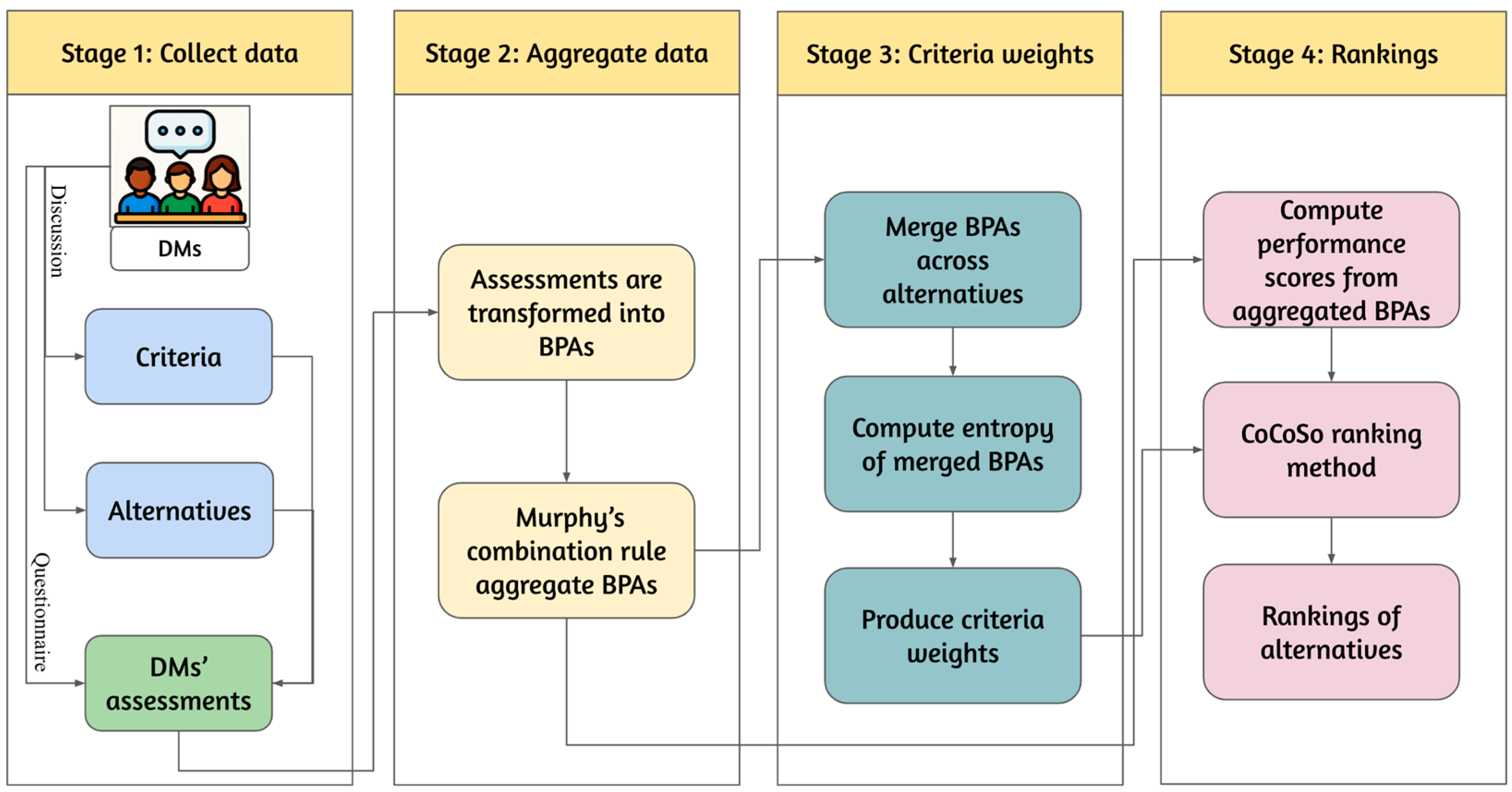
Our model includes four stages, as shown in
Figure 1. First, criteria and alternatives are identified through the literature review and discussions with the DMs. Questionnaires are distributed to collect their evaluations. Second, the DMs’ evaluations are transformed into discounted BPAs and subsequently combined using Murphy’s rule. Third, a Deng entropy-based method is used to determine the criteria weights. Fourth, the Dempster–Shafer-based CoCoSo method is used to rank the alternatives.
Table 1 displays the notations and their corresponding meanings to facilitate the presentation of the methods.
3.1. Define Evaluation Criteria, Alternatives and Collect Data
The first step is to define a set of criteria and alternatives. Evaluation criteria are derived from the literature based on an extended TBL approach, including economic, social, environmental and technical dimensions. The criteria are initially selected from the literature and then refined to suit the context through discussions with DMs. The DMs also suggest potential providers based on their expertise.
Following the construction of criteria and alternatives, DMs are invited to provide their assessments through structured questionnaires, comprising two sections: an evaluation section and a confidence level section. In the evaluation section, DMs indicated their preferences by assigning ratio values to one or several subsets of linguistic scales in
Table 2. There are five performance levels, denoted by
= {
e1,
e2,
e3,
e4,
e5}. In the confidence section, DMs expressed their confidence using the linguistic scales in
Table 3.
3.2. Using the Dempster–Shafer Approach to Integrate the Data
After gathering DMs’ evaluations for each alternative with respect to each criterion, we transform and aggregate the data to produce performance scores. In the MCDM context, DMs’ evaluations serve as evidence, represents performance levels of alternatives and the power set denotes all possible subsets of performance levels. This allows DMs to express their hesitancy. The mass belief of the entire frame of discernment, , represents incompleteness when DMs lack sufficient evidence to support any specific ez. Thus, denotes the missing part in the incomplete information. The process for aggregating DMs’ judgments based on Dempster–Shafer theory is outlined in the following steps.
First, ratio values are normalized to the [0, 1] range. The normalized value
is computed using Equation (1). The normalized values are then assigned to the corresponding subsets to generate initial BPAs.
Second, discounted BPAs are computed using Equations (2) and (3). Dempster–Shafer theory incorporates DMs’ confidence levels through this discounting method. The process is applied when DMs believe a BPA is reliable, with the confidence value of
. Under this condition, the discounted BPA
is computed according to the value of
as follows.
After discounted BPAs are generated, a combination rule is applied to aggregate the evaluations from DMs. According to the Dempster–Shafer combination rule, BPAs
m1 and
m2 from two different DMs are merged with the resulting combined mass function expressed as
with
However, the Dempster–Shafer combination rule has been criticized for producing unreasonable results when conflict levels are high [
51]. Moreover, it becomes ineffective when the evidence is completely contradictory. Consequently, alternative rules—such as those proposed by Yager [
52], Dubois and Prade [
53], and Murphy [
29] have been proposed. Yager’s rule is criticized for introducing high uncertainty in the outcomes, while Dubois and Prade’s rule is limited to cases with highly conflicting evidence, as explained by Yang and Xu [
54]. Therefore, this study applies Murphy’s combination rule given in Equations (4)–(6) to combine data, as it consistently yields reasonable results [
55,
56,
57]. A comparative example of the traditional Dempster–Shafer combination rule and Murphy’s rule is presented in
Appendix A to verify its advantages. Murphy’s rule first averages
k pieces of evidence from
k DMs using
After that, it employs the Dempster–Shafer combination process k − 1 times using Equations (4) and (5). The results are performance scores, xij, expressed as BPAs.
3.3. Use Deng Entropy Weighting Technique to Calculate Criteria Weights
The Deng entropy-based weighting method is employed to derive objective weights for criteria [
58]. Deng entropy extends the conventional Shannon entropy by enabling the quantification of uncertainty over subsets, thus offering a more comprehensive measure of information uncertainty [
59]. When subsets are not present, Deng entropy reduces to the standard Shannon entropy. Thus, the Deng entropy weighting method is suitable for a Dempster–Shafer-Based MCDM method. The technique is presented as follows. First, performance scores with respect to criteria
Cj are combined across alternatives using Murphy’s rule to produce a combined BPA, denoted by
Pj. Next, the Deng entropy is used to measure the uncertainty associated with
Pj through
where
DEj is the Deng entropy value of
Pj.
The resulting Deng entropy value
DEj is then normalized to a [0, 1] scale via
where
n signifies the number of criteria.
The weight of criteria C
j, denoted by
wj, is then calculated using Equation (9). Thus, criteria with higher entropy values are assigned lower weights due to their greater uncertainty, whereas criteria with lower entropy values receive higher weights, reflecting their lower levels of uncertainty.
3.4. Selecting the 3PLPs Using Dempster–Shafer-Based CoCoSo
The CoCoSo method is a novel ranking technique proposed by Yazdani et al. [
60]. The approach incorporates a distance measure based on the gray relational coefficient, designed to improve the adaptability and precision of the results. Studies indicate that the CoCoSo method provides greater consistency and robustness than other decision-making techniques [
61]. The proposed method is particularly suitable for decision-making under uncertain environments due to its stability when changes occur in the set of alternatives or criteria [
30]. Moreover, although relatively new, the CoCoSo method has been applied across various domains, including supply chain management [
62], risk management [
63], and sustainable energy [
64]. However, the CoCoSo method alone cannot adequately address uncertainty and therefore requires integration with complementary techniques. To this end, Dempster–Shafer theory is incorporated into the CoCoSo framework to account for uncertainties in the DMs’ evaluations prior to the ranking process. The detailed ranking procedure is described as follows.
Dempster–Shafer theory assigns belief to sets of possibilities rather than individual elements, which can complicate the decision-making process. To address this, the pignistic probability function [
65] is employed to transform a BPA into a probability distribution, as shown below.
where
l = 1, 2, …, 5.
Let the performance score
be defined based on a discrete set of performance levels, denoted by
= {
e1,
e2,
e3,
e4,
e5} and their numerical values are defined as 1, 2, 3, 4 and 5, respectively. Additionally, the probability distributions over these performance levels are
d1,
d2,
d3,
d4, and
d5, respectively. The expected value of
is then calculated as the weighted sum of the performance levels and their associated probabilities, as shown in Equation (11).
The decision matrix is then defined as
, where
m and
n denote the numbers of alternatives and criteria, respectively, as shown below
The values are normalized using Equation (13) for benefit criteria and Equation (14) for cost criteria.
The total weighted compatibility sequence and the total power weight of compatibility sequence are calculated in Equations (15) and (16), respectively.
where
wj is the weight of the
jth criteria.
Relative weights of alternatives are derived from three utility functions using
The final ranking is determined based on the value
ti (the larger the better), using
5. Discussion
This section is divided into two parts. First, we discuss the theoretical and managerial implications of the results. Then, we compare the proposed model with other existing models and conduct a sensitivity analysis.
5.1. Theoretical Contributions and Management Implications
This study makes several theoretical contributions to the field of sustainable 3PLP selection under uncertainty and the MCDM literature. By extending the conventional TBL framework to include technical infrastructure and technical manpower, the study addresses a significant gap in prior studies where the integration of technical capabilities into 3PLP evaluations has been insufficient. The inclusion of these criteria facilitates a more comprehensive framework for assessing sustainable 3PLPs, particularly as technology and sustainability converge within the context of Industry 5.0. Thus, this study can serve as a reference for future research on assessing sustainable 3PLPs. Moreover, the study advances the MCDM literature by incorporating Dempster–Shafer theory to effectively manage incomplete and uncertain data. For instance, Dempster–Shafer theory allows the representation of hesitancy among multiple evaluation levels, such as {
e3,
e4}, and enables the handling of incomplete information using {
}. The application of Murphy’s combination rule within Dempster–Shafer theory preserves critical information while mitigating counterintuitive aggregation results. The application of the Deng entropy weighting method enables the objective determination of criteria weights, reducing dependence on subjective judgments and enhancing the transparency and reliability of the evaluation process. The results indicate that the criteria weights are generally similar, with slight variations attributable to the comparable quality of information across the criteria. Consequently, the findings are consistent with previous studies employing entropy-based methods, such as Liao et al. [
24] and Chen et al. [
50]. Moreover, similar criteria weights are also echoed by subjective methods. For instance, Yuan et al. [
75] determined the criteria weights using the decision-making trial and evaluation laboratory method. However, the Analytical Hierarchy Process weighting approaches employed by Perçin [
76] and Qureshi et al. [
77] yield significant differences in the criteria weights.
From a managerial perspective, the proposed model offers a practical decision-support tool for logistics and procurement managers selecting sustainable 3PLPs under uncertain and conflicting information. By facilitating the balanced integration of economic, social, environmental, and technical perspectives, the framework aligns provider evaluations with the growing emphasis on sustainability and technological advancement. The framework provides a robust evaluation mechanism to enhance supplier selection processes, thereby mitigating the operational and reputational risks associated with unsustainable practices and supporting compliance with evolving environmental regulations. To implement this model operationally, firms can utilize Microsoft Excel to execute the computational steps. Excel is recommended due to its widespread availability and high interpretability, allowing managers to audit the logic behind each decision stage. By leveraging built-in logical and mathematical functions, all equations, including the BPA transformations and CoCoSo ranking, can be integrated into a dynamic template that facilitates real-time sensitivity analysis and group decision-making. The analysis results indicate that although company A4 is the best-performing option, its performance score for green packaging (C11) is significantly low compared to other companies. A4 can address this by executing a systematic packaging audit to identify material inefficiencies and volumetric excess, transitioning to recyclable or reusable substrates, and deploying targeted staff training for standardized recycling compliance. Moreover, it is important for 3PLPs to enhance sustainability to meet customers’ preferences as well as government regulations. Thus, 3PLPs need to improve not only economic criteria, such as cost efficiency and service quality, but also social and environmental criteria, including employee well-being, social responsibility, and waste management. Accordingly, firms should adopt sustainability strategies, such as green technologies, route optimization, employee welfare programs, and effective waste management practices.
5.2. Model Comparisons and Sensitivity Analysis
In this study, a novel framework is proposed for assessing sustainable 3PLPs, which considers incomplete assessments and refines the Dempster–Shafer rule using Murphy’s combination rule to ensure reasonable results. To evaluate its effectiveness, the proposed model is compared with two alternative models to examine differences in the resulting assessments:
- -
Model 1: When DMs’ evaluations are assumed to be complete.
- -
Model 2: When the conventional Dempster–Shafer combination is applied.
Table 13 summarizes the comparisons. The comparison reveals that the rankings of alternatives differ significantly between the proposed method and existing approaches. Notably, the most ideal 3PLP identified by the proposed model (
A4) is ranked second by the other methods. Instead,
A2 and
A1 are considered the best options in alternative models. Specifically, neglecting to consider DMs’ incomplete judgments may result in misleading conclusions; for instance, incorrectly prioritizing alternative
A1 over others. Moreover, through the integration of Murphy’s combination rule, the model avoids unreasonable results and prevents the selection of suboptimal alternatives such as option
A2, as shown in Model 2.
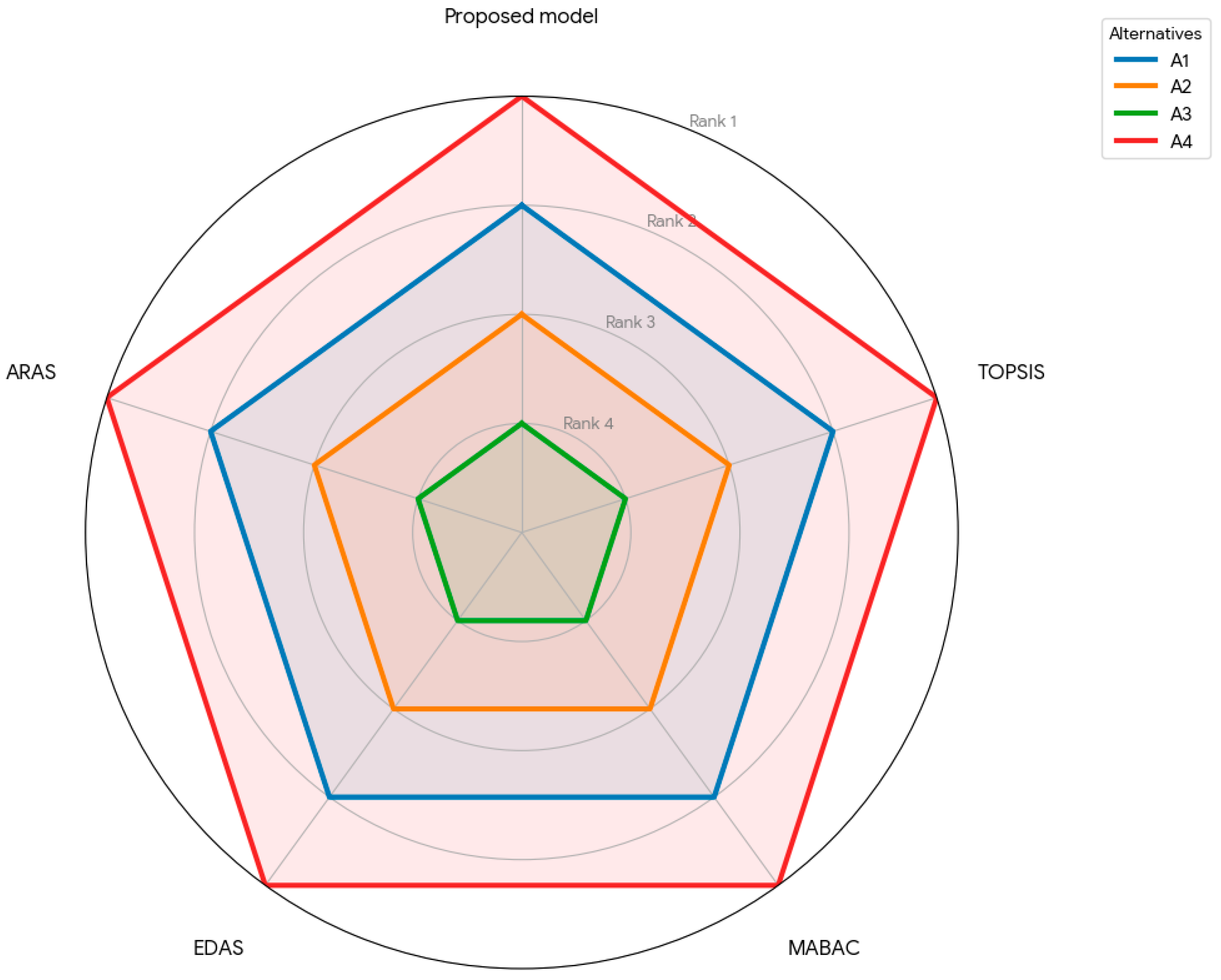
Moreover, to validate the reliability and robustness of the proposed model, it is compared with well-established ranking methods, including the Technique for Order Preference by Similarity to Ideal Solution (TOPSIS), Multi-Attributive Border Approximation Area Comparison (MABAC), Evaluation Based on Distance from Average Solution (EDAS), and Additive Ratio Assessment (ARAS), as illustrated in
Figure 2. The results indicate that the proposed model produces rankings that are largely consistent with those obtained from these benchmark methods, thereby demonstrating its reliability and robustness.
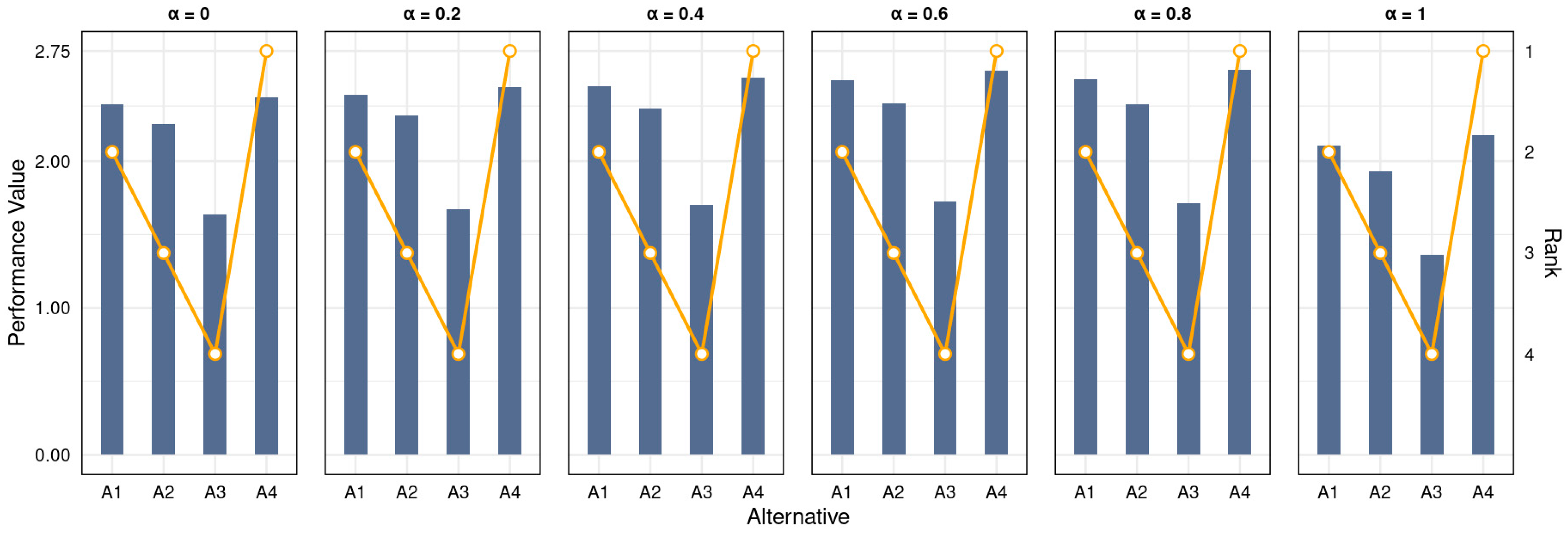
In addition to the model comparison, two sensitivity analyses were conducted. The first aimed to verify the robustness of the CoCoSo results by varying the
parameter in Equation (19). As illustrated in
Figure 3, while the performance scores of the alternatives exhibit slight variations across different
values, their overall ranking order remains consistent, thereby affirming the robustness and stability of the proposed CoCoSo model.
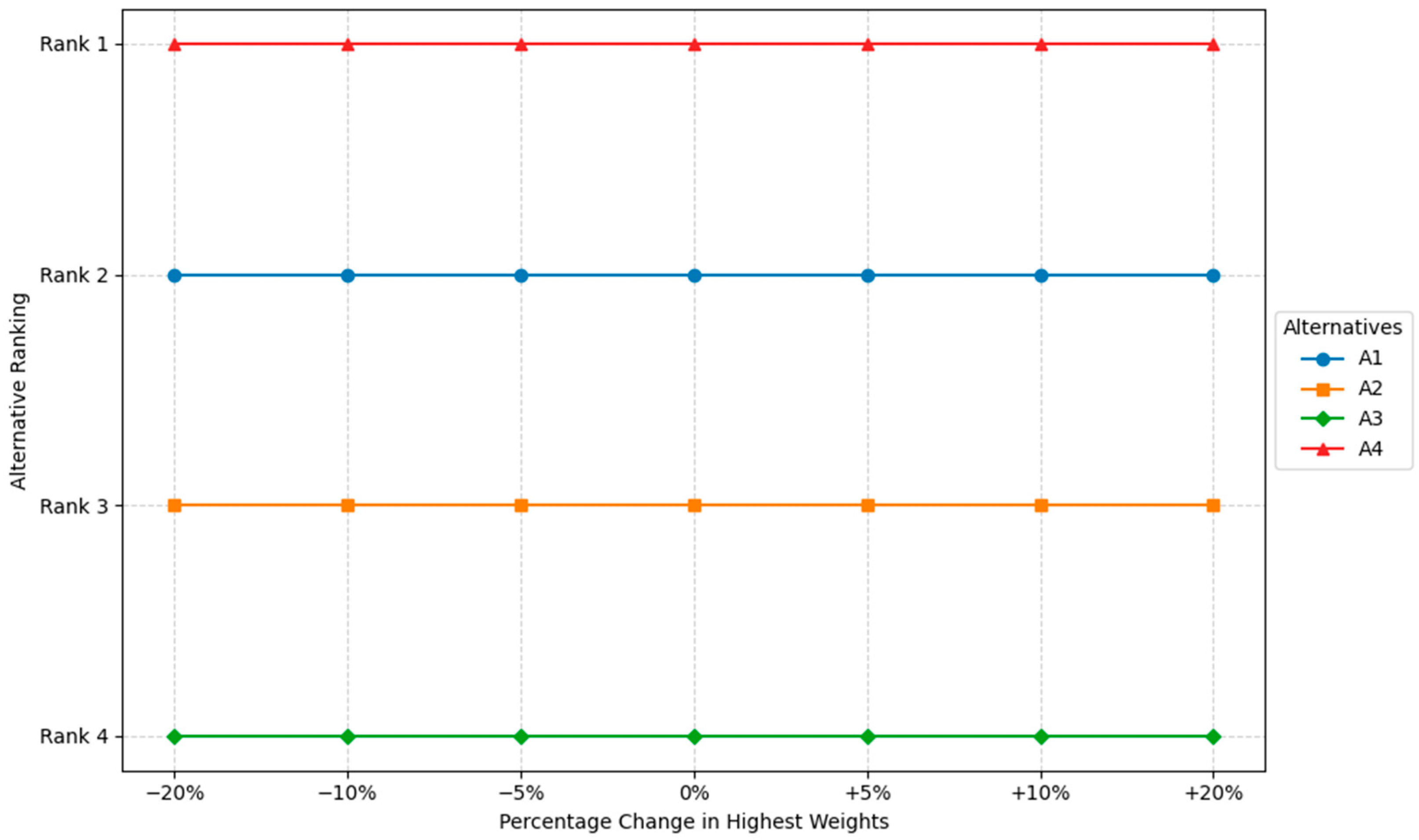
The second sensitivity analysis examines the impact of the criteria weights on the ranking outcomes, following the approach recommended by Sotoudeh-Anvari [
78]. A total of six scenarios are considered and compared with the baseline ranking results. These scenarios involve different weight configurations, in which the weight of the most influential criterion is decreased by 5%, 10%, and 20%, and increased by 5%, 10%, and 20%, respectively. The results are summarized in
Figure 4. As observed, the ranking results remain stable under variations in criteria weights, thereby demonstrating the robustness of the proposed model.
6. Conclusions and Remarks
The selection of sustainable 3PLPs is a complex and uncertain process. This study introduces an extended TBL framework and a novel decision-making model to address the limitations of traditional approaches, which often struggle with several critical uncertainty issues in sustainable 3PLP selection. The proposed model effectively addresses these challenges and enhances decision-making reliability by incorporating the Dempster–Shafer approach, Murphy’s combination rule, the Deng entropy weighting method, and the CoCoSo method. A case study involving a textile enterprise demonstrates the model’s practical applicability and its superiority over existing methods. This study provides valuable insights for companies to select sustainable 3PLPs under uncertainty with higher accuracy.
Although the proposed model addresses several limitations of prior studies, certain constraints remain and suggest directions for future research. First, although Dempster–Shafer theory is employed to incorporate DMs’ reliability, only subjective reliability is considered. This may introduce bias and potentially overemphasize less reliable judgments. Moreover, the mapping of qualitative reliability assessments into numerical values may further amplify this bias. Future research could integrate objective reliability measures based on DMs’ expertise to enhance the robustness and credibility of the model. Second, interrelationships among criteria, which are common in real-world decision-making, are not considered in this study. Future research could incorporate methods such as the CRITIC (Criteria Importance Through Intercriteria Correlation) technique to better capture these dependencies. Third, the computational complexity of Dempster–Shafer theory-based MCDM approaches remains relatively high. Therefore, developing more computationally efficient models would improve practical applicability. Fourth, the generalizability of the findings is limited as the study is based on a single case involving ten decision-makers and four alternatives. Future research should validate the model across diverse industries and larger samples. Fifth, the normalization techniques in the CoCoSo method assume linear relationships; in future studies, non-linear transformations could be incorporated to better capture diminishing returns, threshold effects, and more realistic preference structures among criteria. Finally, although this study considers four dimensions for evaluating sustainable 3PLPs, sustainability is a dynamic and evolving concept. Future studies could incorporate additional relevant dimensions and criteria to develop a more comprehensive evaluation framework.




 ,
,