

A Comparative Study of the Spatial Morphology of Traditional Villages as Sustainable Cultural Heritage: The Case of Jiangnan Region


Abstract
1. Introduction
- (1)
- We expand the village samples across the Jiangnan cultural belt while integrating regional diversity and cultural contexts, proposing a CSMFC framework that classifies spatial morphologies for heritage conservation, enabling sustainable preservation.
- (2)
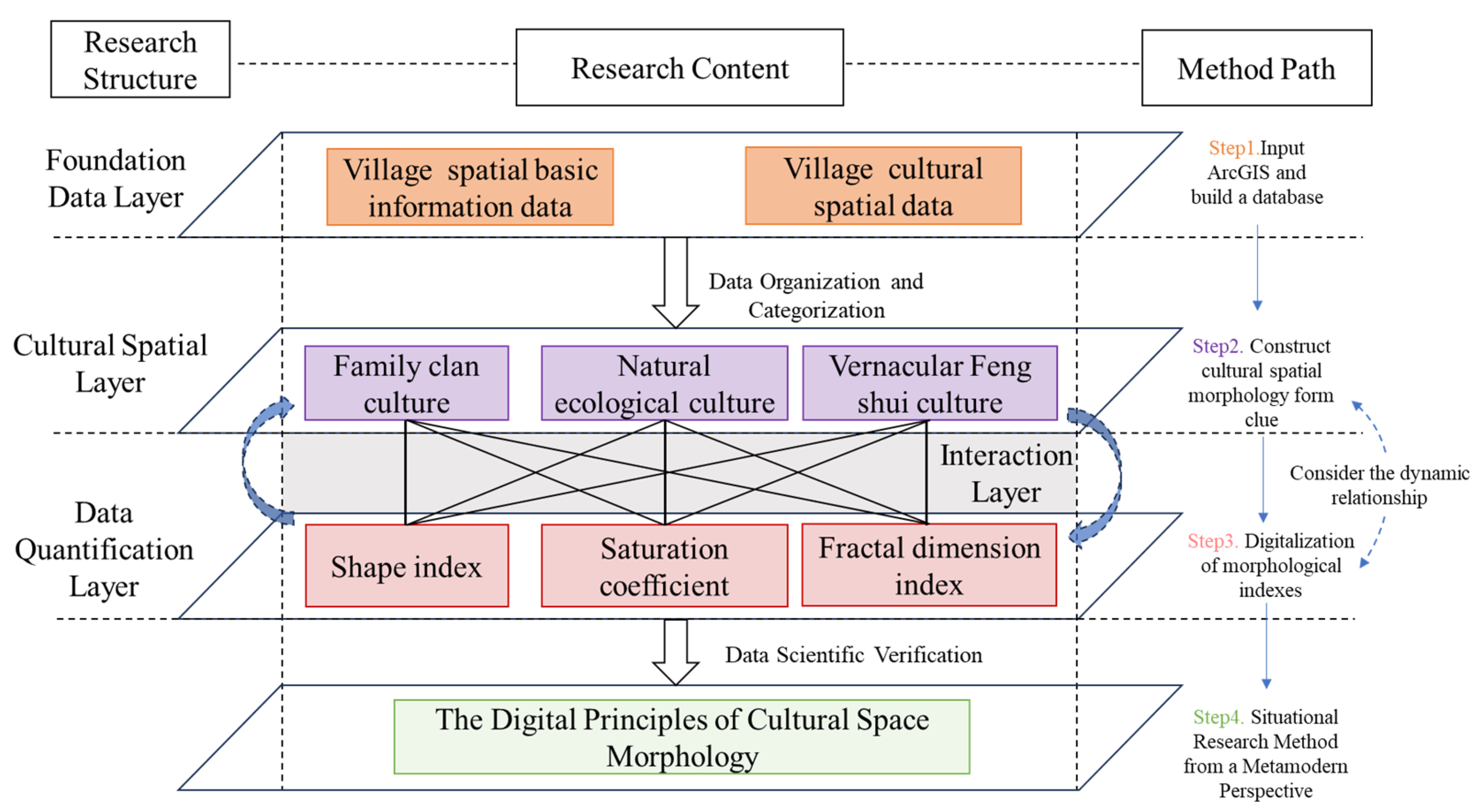
- Based on metamodern theory, we propose a situational research method (SRM) integrating digital quantification and cultural morphology to transcend the humanities–quantitative classification binary in heritage conservation.
- (3)
- Adopting a comparative perspective, we clarify key indices and attributes of local heritage and establish a Jiangnan cultural village heritage database to promote precise conservation methods.
2. Theoretical Framework
3. Methodology
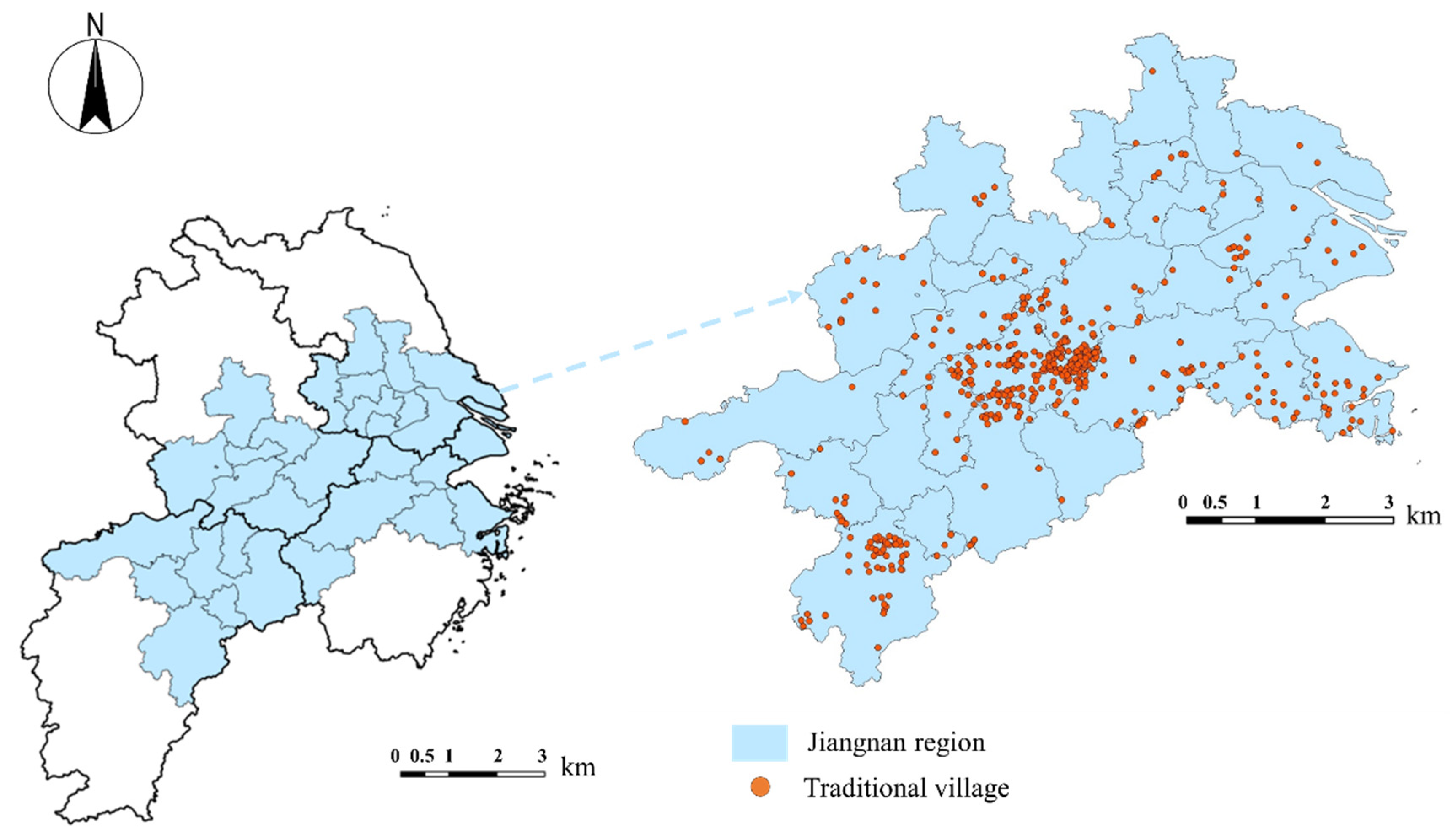
3.1. Research Area
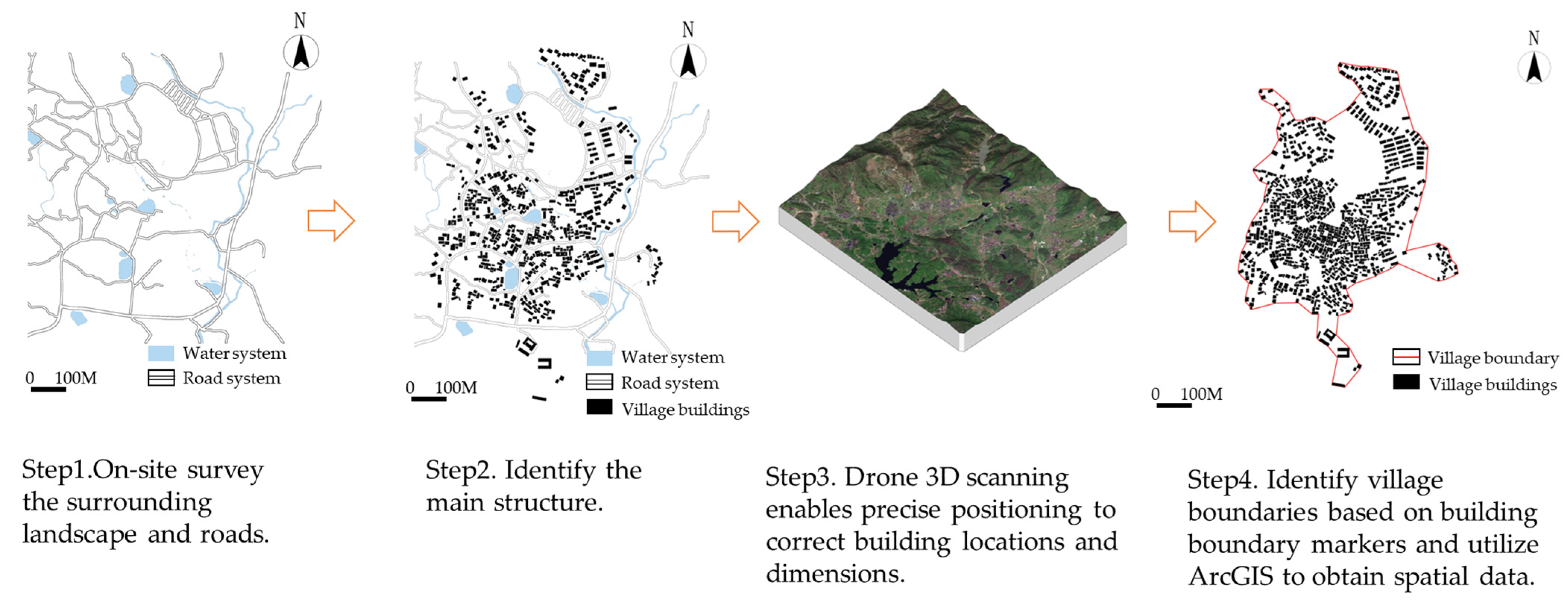
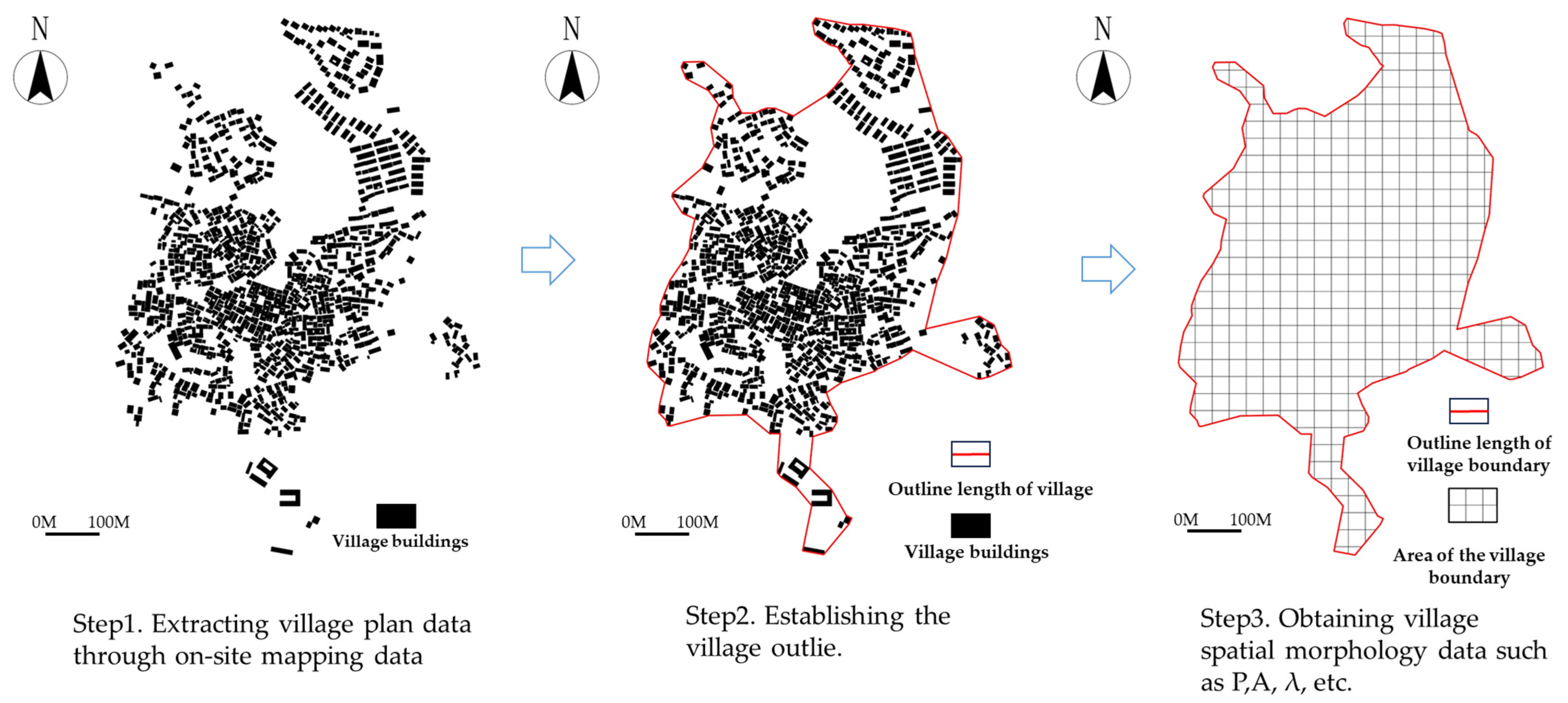
3.2. Data Resources

| Cultural Elements | Spatial Data Type | Data Sources | |
|---|---|---|---|
| Name | Text | Official website [29,30] and official statistical book [36,37,38] | |
| Village history and culture | Text | ||
| Village image | Int | Google map and drone tilt photography for spatial acquisition of traditional villages by unmanned aerial photographs (UAVs) | The data acquisition process is shown in Figure 3. |
| Village spatial outline | Int | ArcGIS10.2 draw | |
| Natural geographical | Float | ArcGIS Terrain Geomorphology Map Overlay | |
| Village space units | Int | On-site research and ArcGIS10.2 draw | |
| Village size | Int | ArcGIS measurement | |
| Create feng shui culture | Text | Local records, on-site surveys and field interview information | |
| Other qualitative description | Text | ||

3.3. Methods
3.3.1. Cultural Spatial Morphology Form Clue (CSMFC)
3.3.2. Digitalization of Morphological Indices
- (1)
- Shape index: S
- (2)
- Saturation coefficient: ϴ
- (3)
- Fractal dimension index: S2
3.3.3. The Situational Research Method (SRM)
4. Results
4.1. The Comparative Data Validation of Research
4.1.1. Principal Component Analysis (PCA)
4.1.2. K-Means Clustering
4.1.3. Analysis of Variance (ANOVA)
4.2. Morphological Quantification Statistics Analysis
4.2.1. The Level of the Quantitative Form Index
4.2.2. The Level of Cultural Qualitative Form
4.3. Digital Analysis of Cultural Morphology
4.3.1. Comparative Analysis of Village Morphological Complexity
- (1)
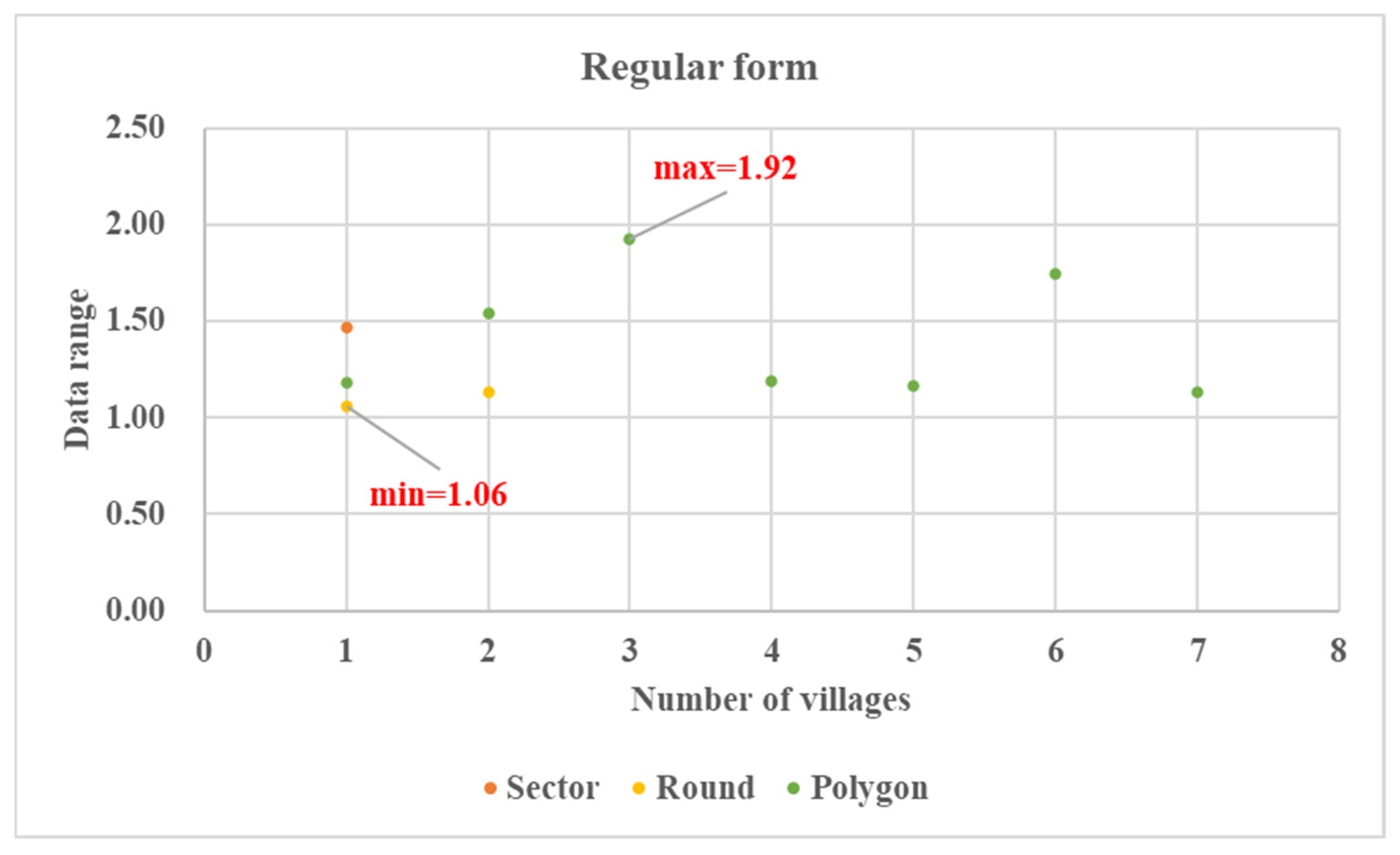
- The S of the regular form
- (2)
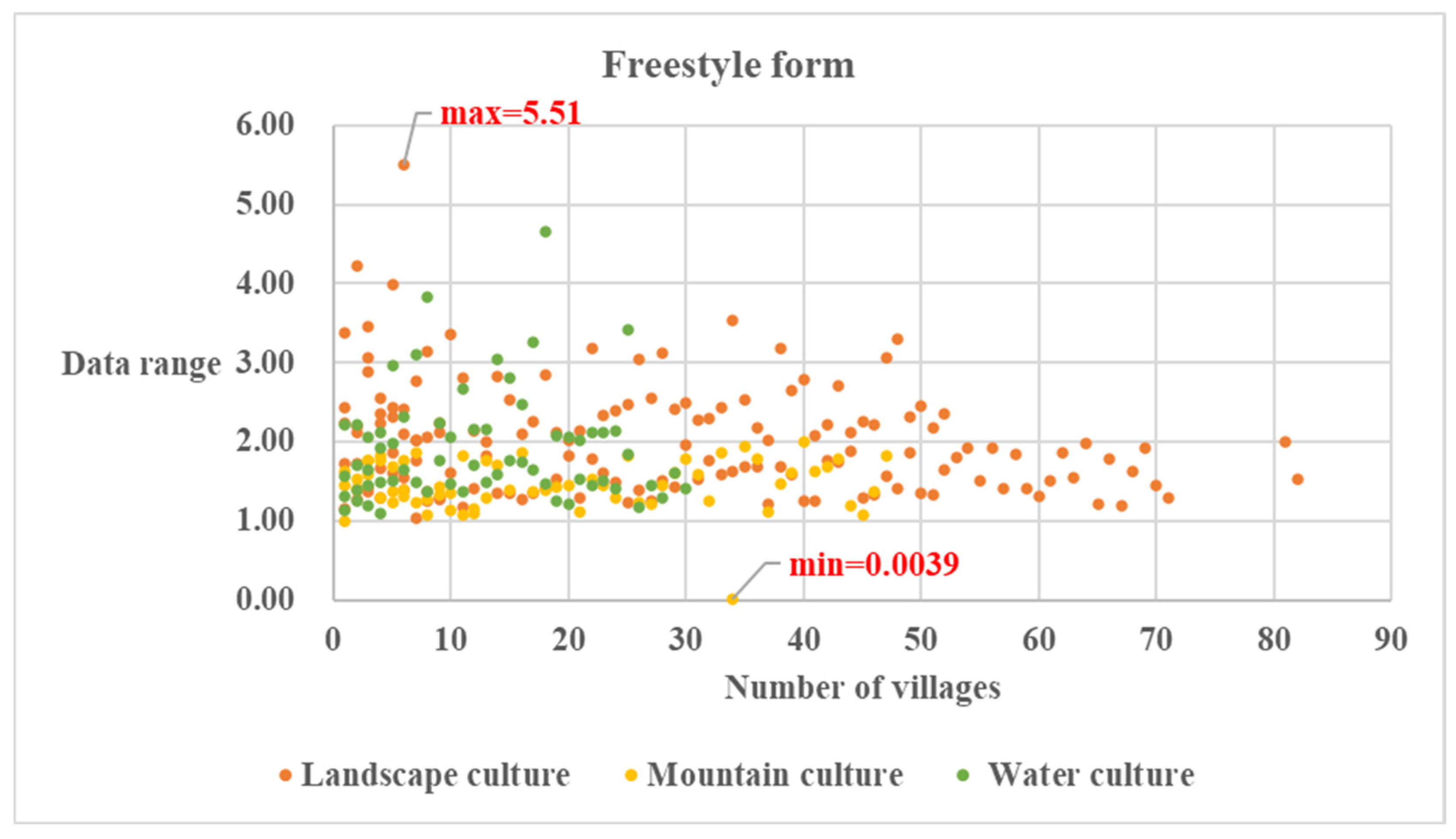
- The S of the freestyle form
- (3)
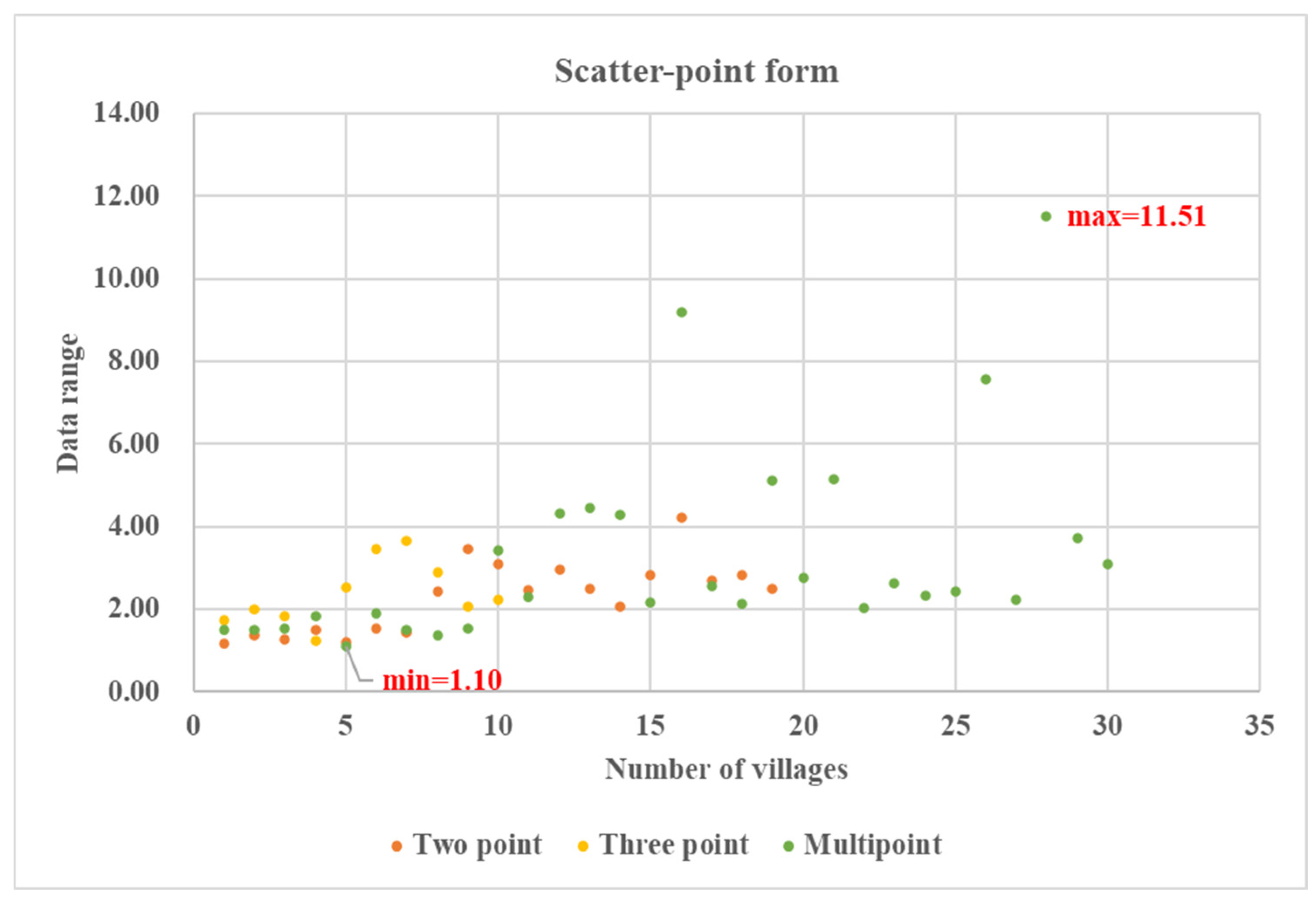
- The S of the Scatter-Point Form
- (4)
- The S of the line form
- (5)
- The S of artistic image form
4.3.2. Comparative Analysis of Village Form External Expansion Trend
- (a)
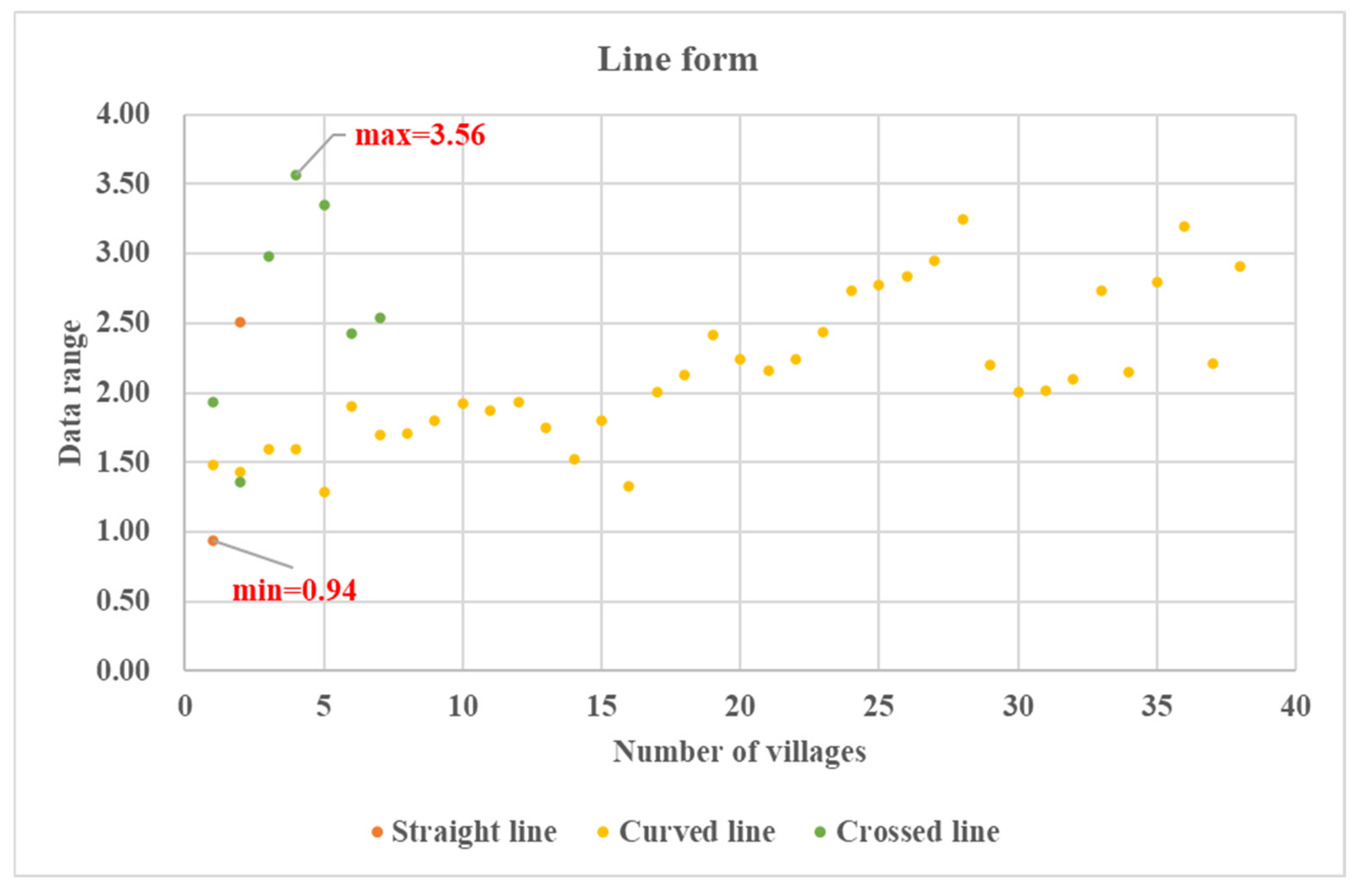
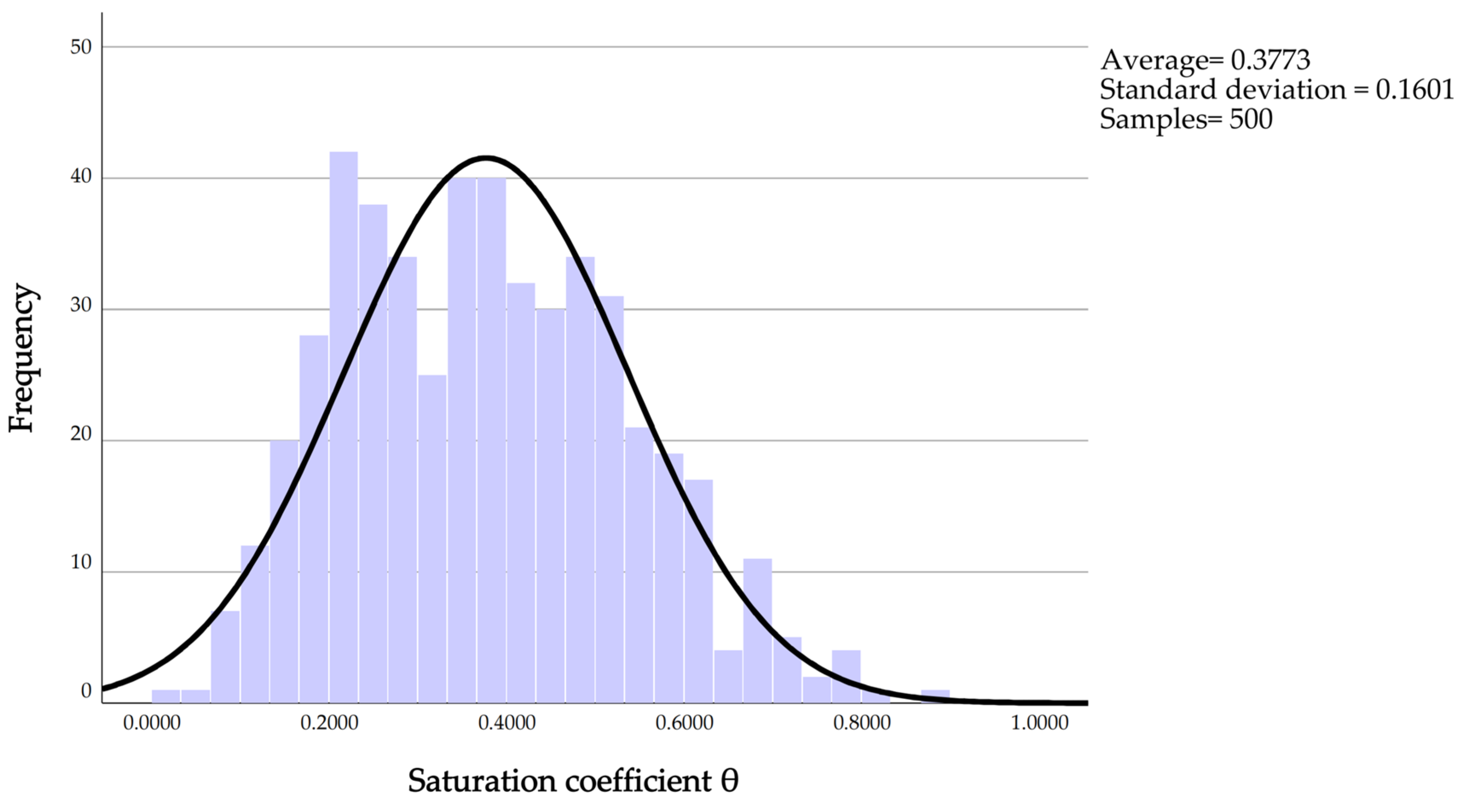
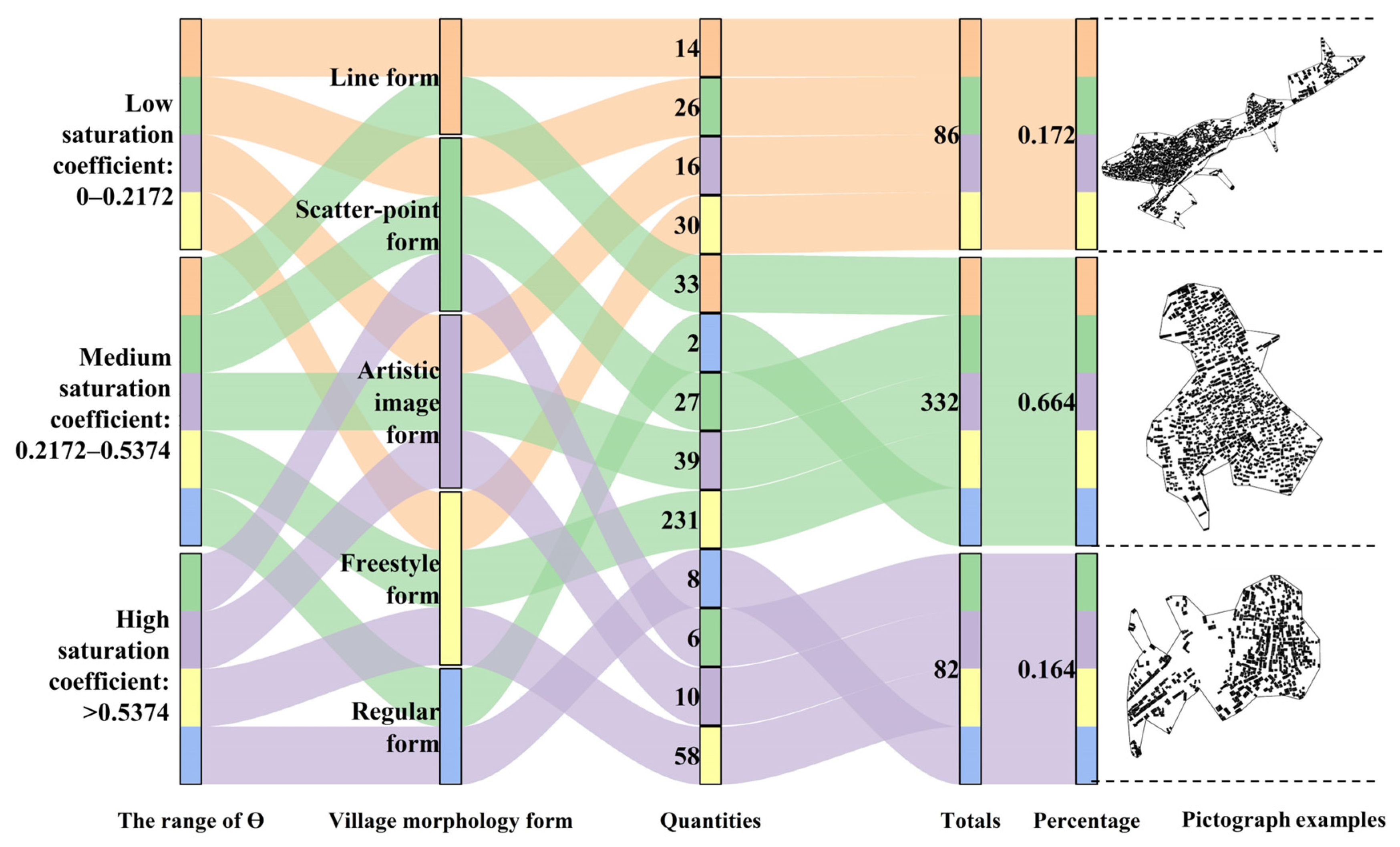
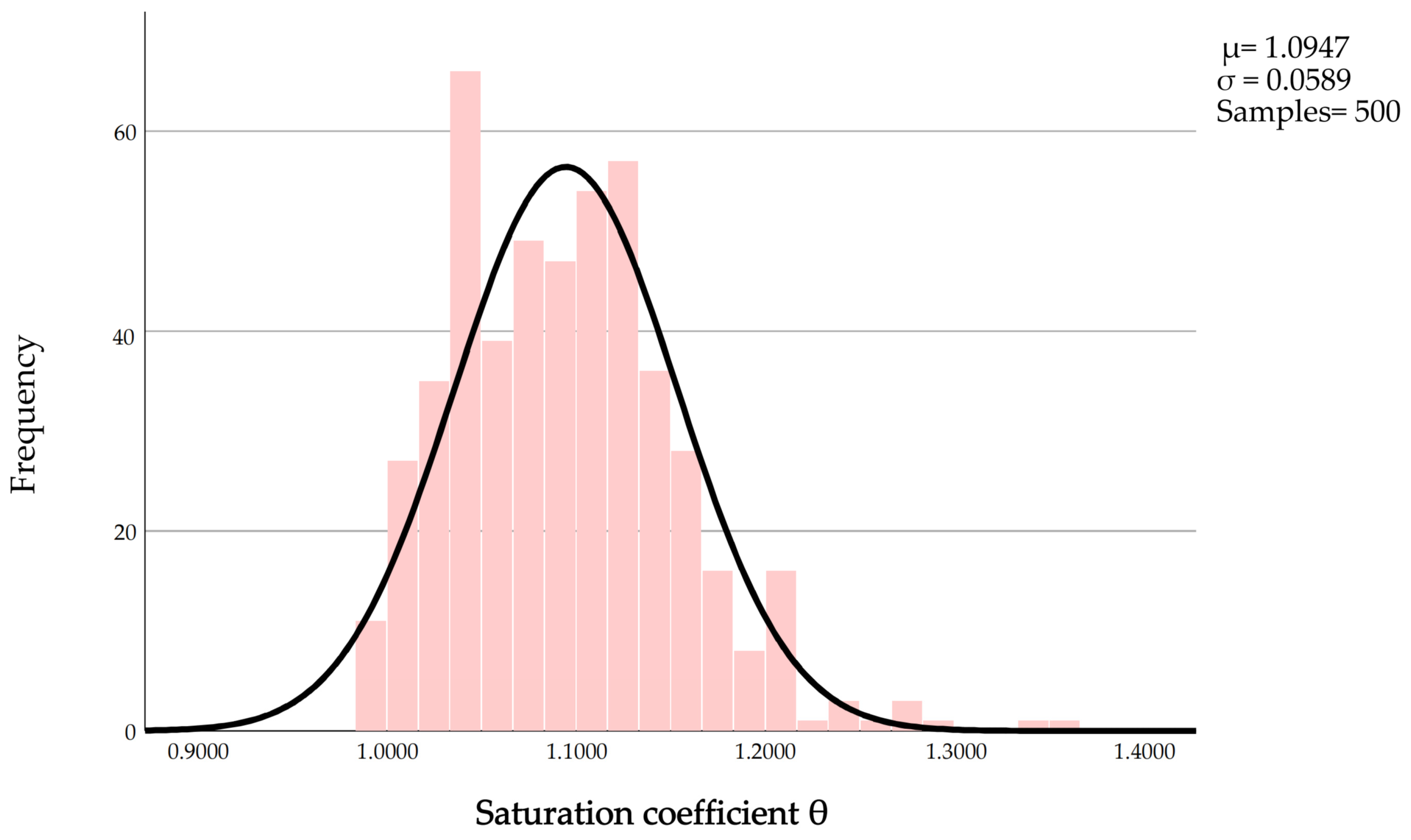
- The ϴ range of the line form village was 0.10–0.53. The changeable range of ϴ was the least, with all villages concentrated in the low-to-medium saturation coefficient, indicating that the external expansion trend was weak, and the morphological form was constrained by the linear environment.
- (b)
- The ϴ range of the scatter-point form villages was 0.03–0.67. The changeable range of ϴ was large, with 89.9% of villages concentrated in the low-to-medium saturation coefficient, indicating that the external expansion trend was weak and significantly constrained by the natural geographic conditions.
- (c)
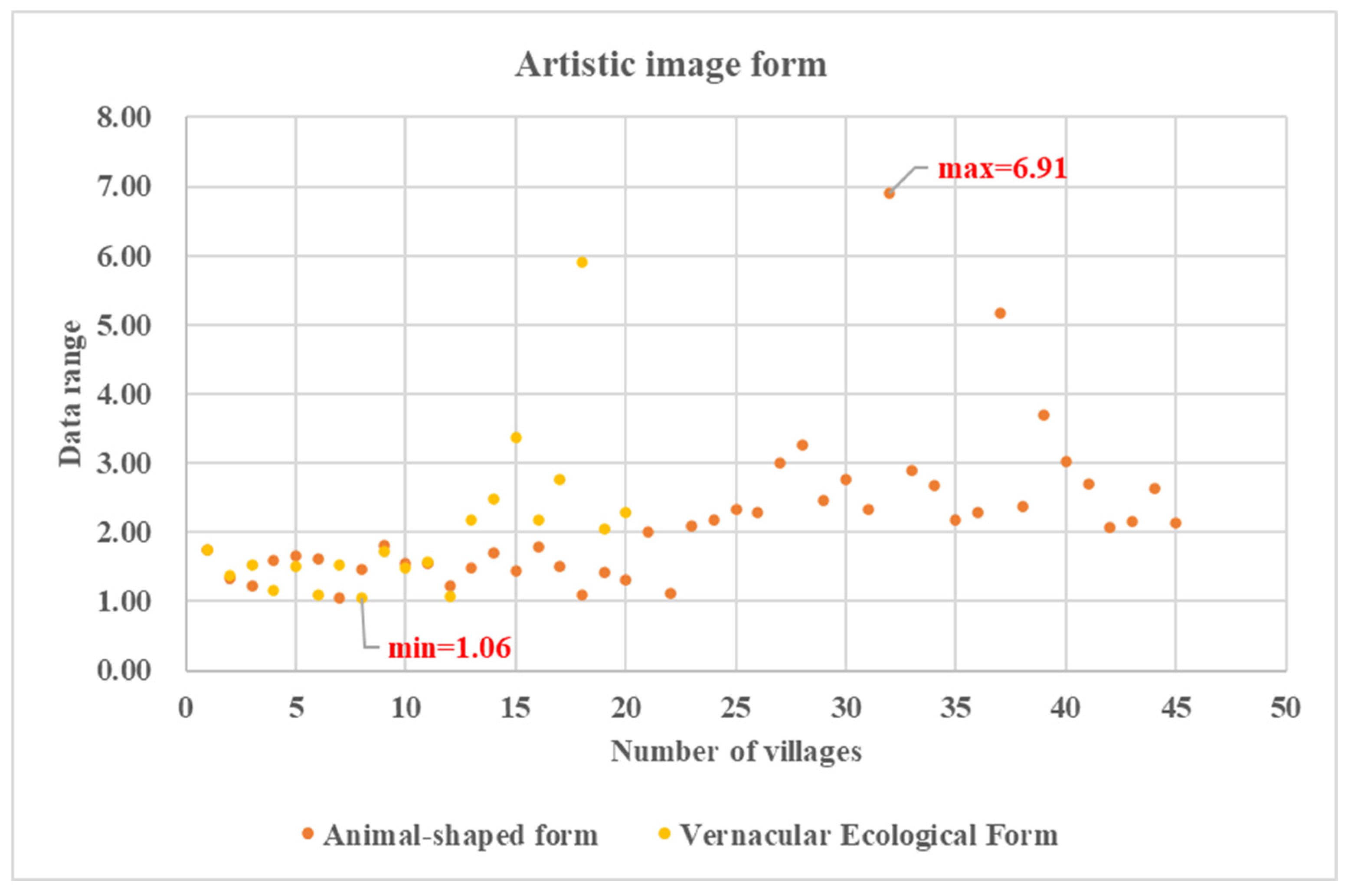
- The ϴ range of the artistic image form villages was 0.08–0.69. The changeable range of ϴ was substantial, with 75.4% of villages concentrated in the medium-to-high saturation coefficient, indicating that the external expansion trend was strong.
- (d)
- The ϴ range of freestyle form villages was 0.11–0.82. The changeable range of ϴ was the largest, with 90.6% concentrated in the medium-to-high saturation coefficient, exhibiting strong external expansion trends.
- (e)
- The ϴ range of regular form villages was 0.39–0.87. The changeable range of ϴ was small, with 100% concentrated in the medium-to-high saturation coefficient, which is a typical example of external expansion trends.
4.3.3. Comparative Analysis of Village Public Spatial Fragmentation
- (a)
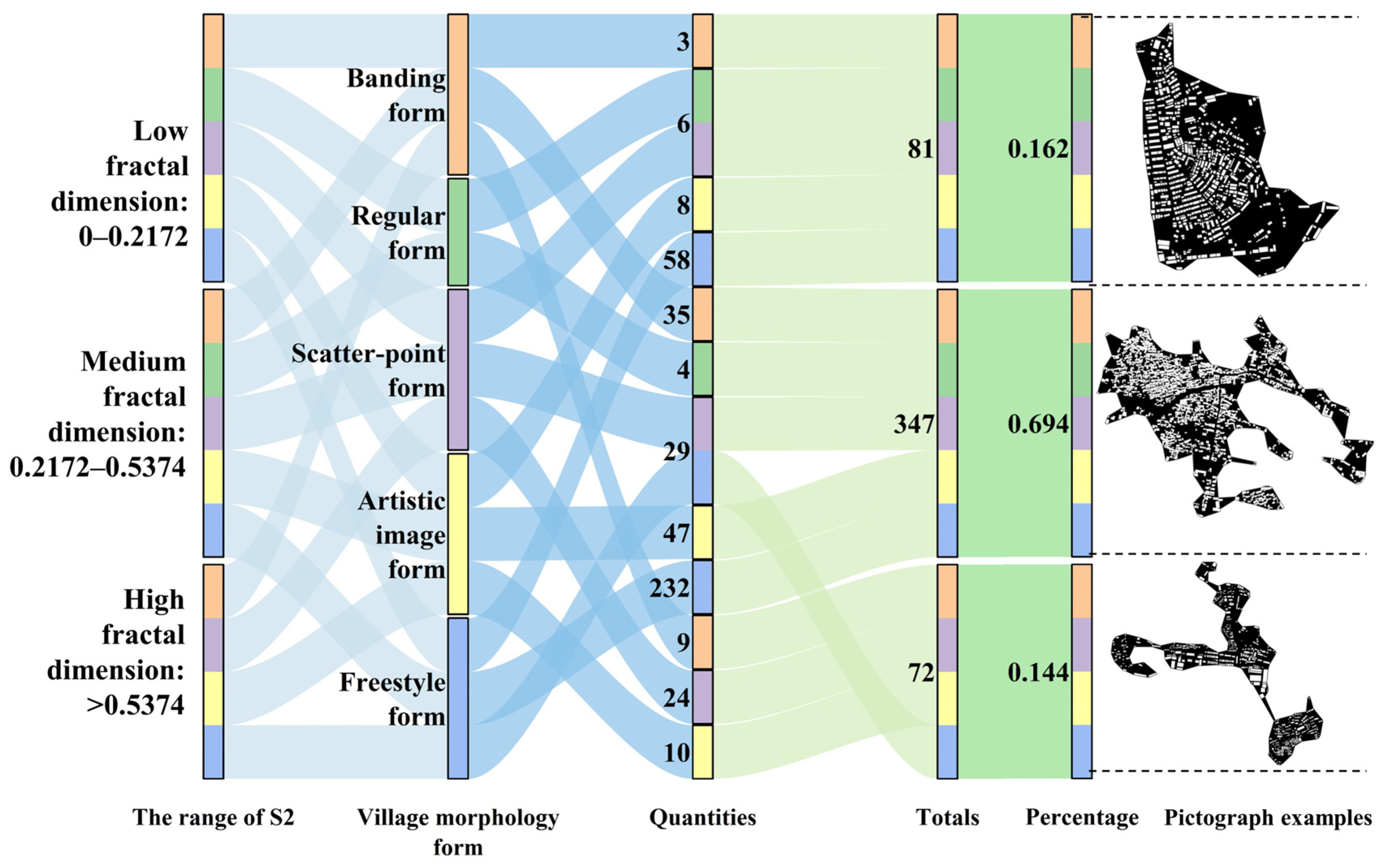
- The S2 range of the regular form villages was 0.99–1.08. The changeable range of S2 was the least, with villages concentrated in the low and medium fractal dimension indices, indicating that the public village space is stable, and the spatial structure is clear.
- (b)
- The S2 range of the line form villages was 1.00–1.21. The changeable range of S2 was moderate, with 93.6% of villages concentrated in medium and high fractal dimension indices, indicating that the public space of the village is complex, with high spatial tissue efficiency.
- (c)
- The S2 range of the scatter-point form villages was 1.00–1.36. The changeable range of S2 was the highest. Among them, 89.8% of villages are concentrated in the medium and high fractal dimension indices, exhibiting strong spatial tissue efficiency.
- (d)
- The S2 range of the artistic image was 0.99–1.28. The changeable range of S2 was substantial, with 87.7% of villages concentrated in the medium and high fractal dimension indices, indicating high public spatial fragmentation and a flexible spatial structure with strong spatial tissue efficiency.
- (e)
- The S2 range of the freestyle form villages was 0.99–1.26. The changeable range of S2 was large, with 81.8% concentrated in the medium and high fractal dimension indices, indicating that the village public space shows high fragmentation.
5. Discussion
- (1)
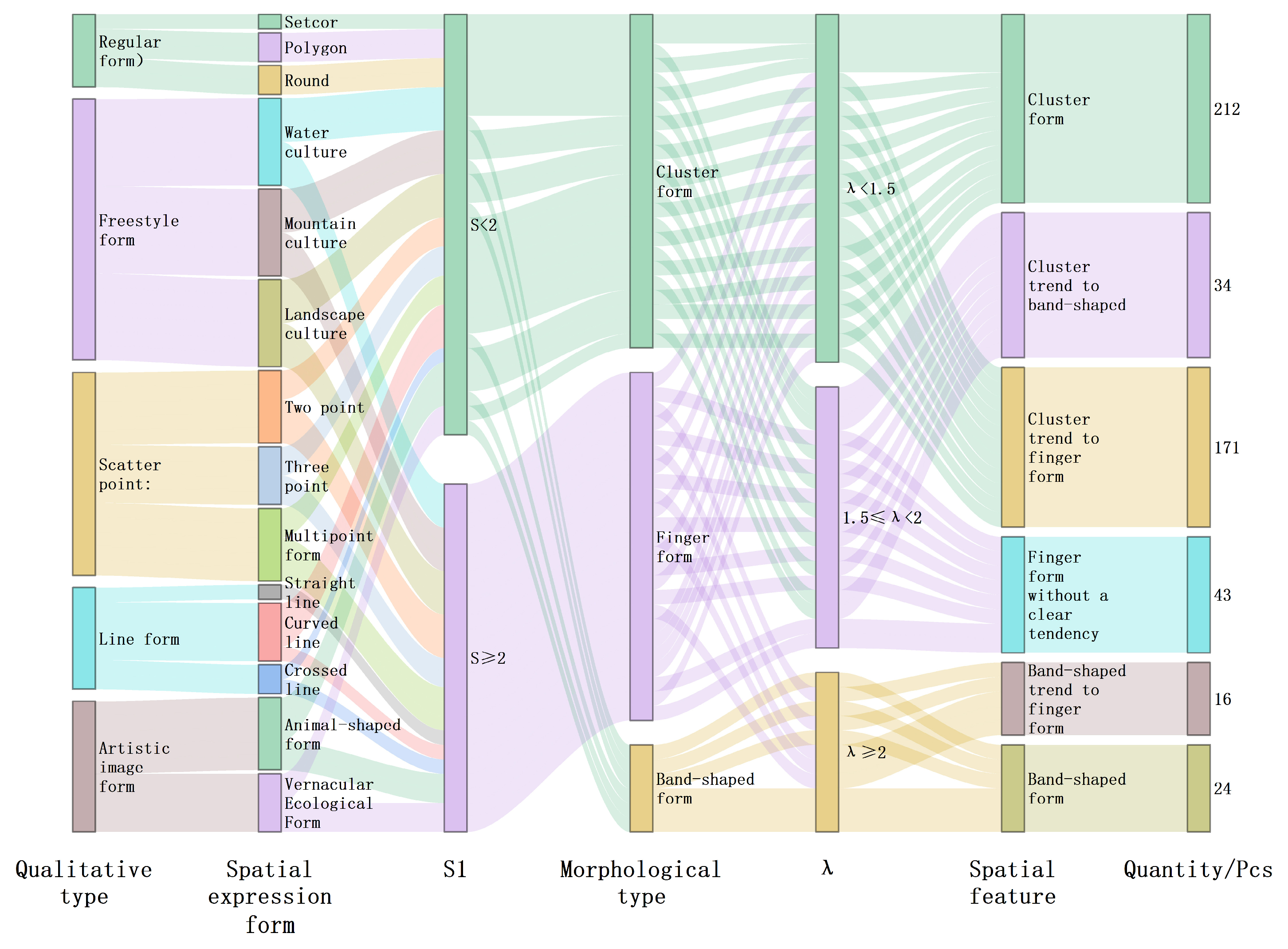
- Regular form villages all take the cluster form at the digital level. The S is the most stable, ϴ is smaller, and the S2 is the smallest. These data indicate that this village type exhibits the simplest, most stable spatial morphology, reflecting its inherent cohesion. This stable and cohesive anchoring pattern embodies that Chinese family culture’s moderate and orderly ritual logic has shaped village form.
- (2)
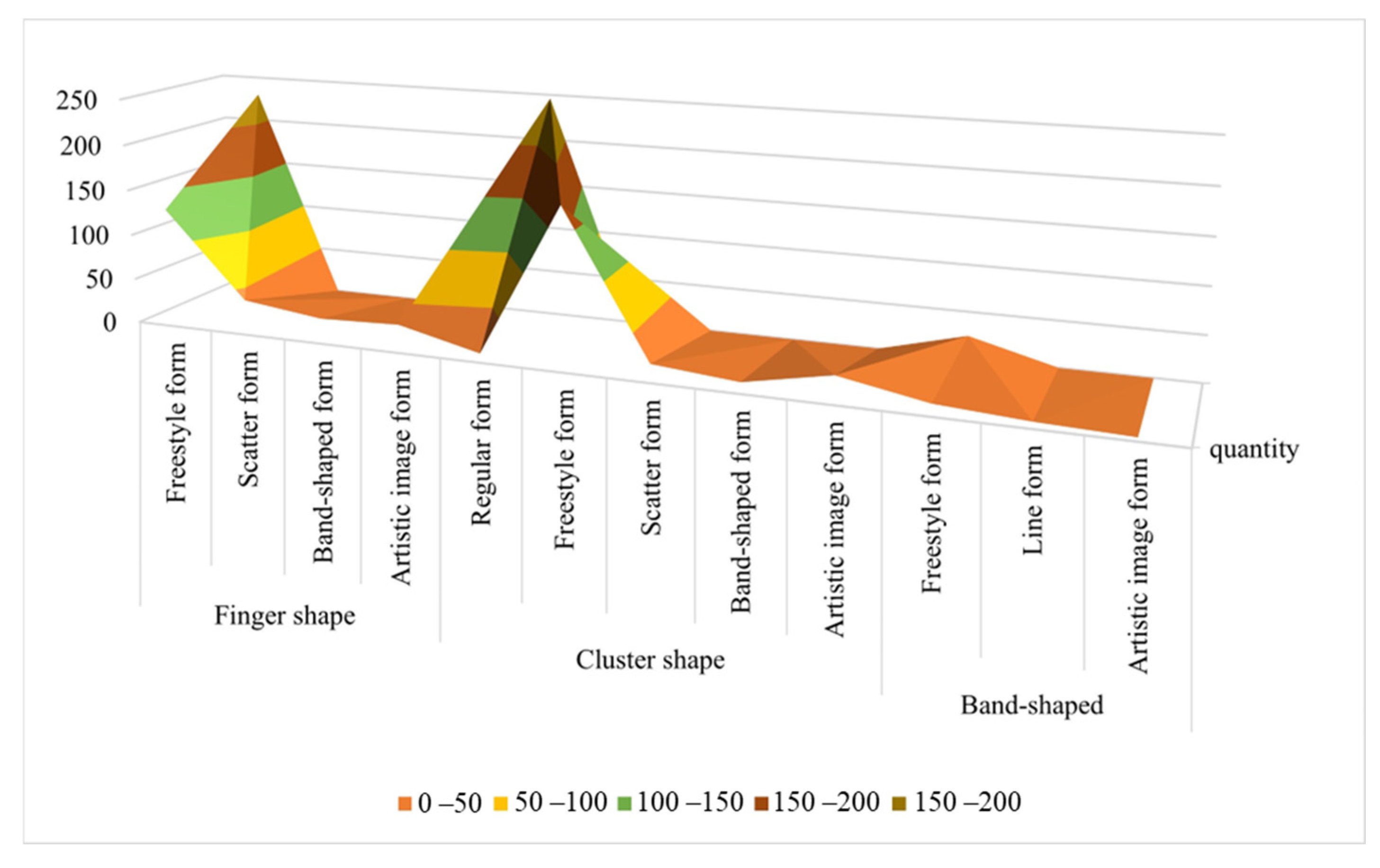
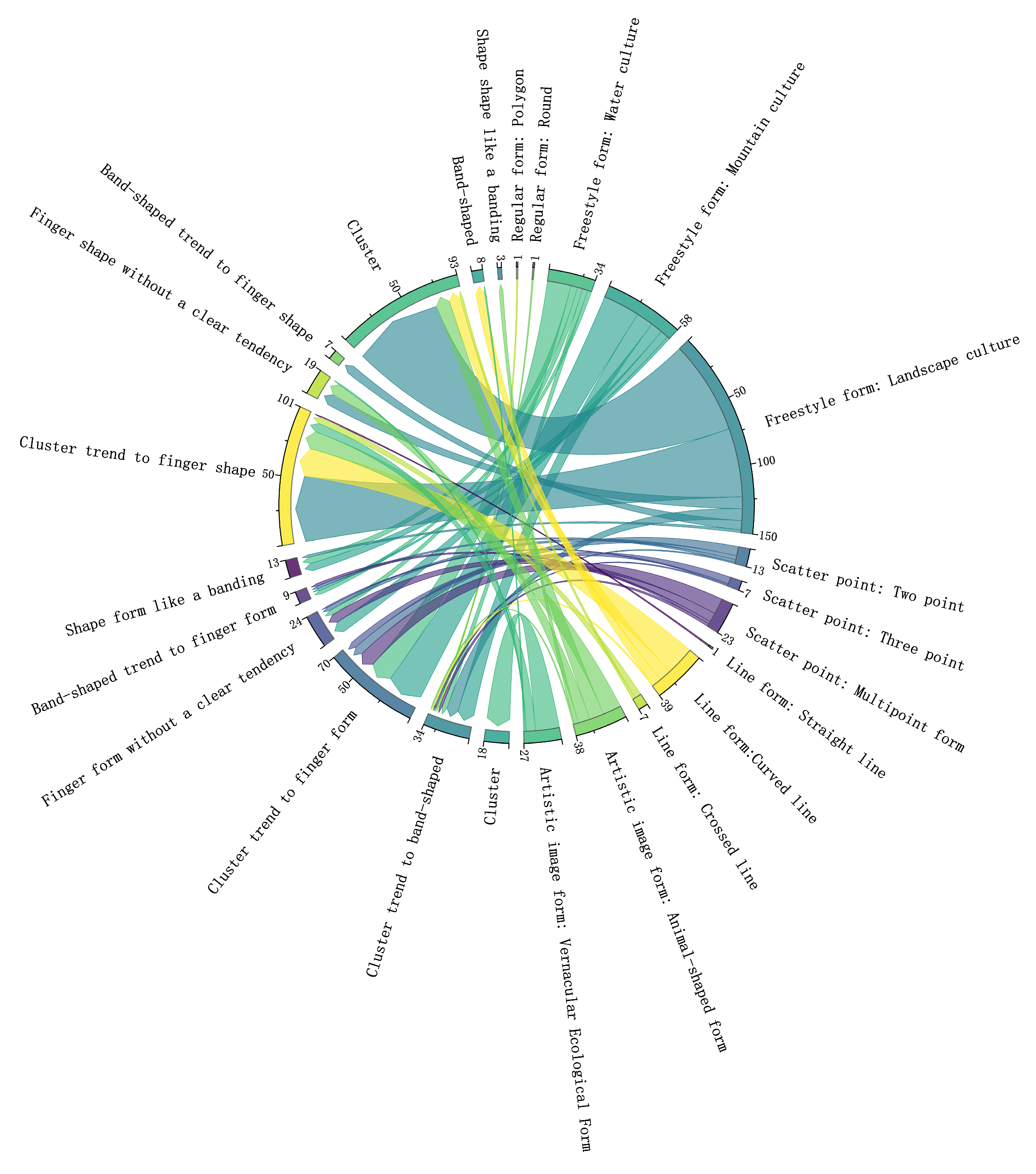
- Freestyle form villages can be divided evenly into finger form and cluster form at the digital level. The S is complex, the ϴ is larger, and the S2 is the largest. This indicates that village spatial morphology is flexible, the external expansion trend is most obvious, and public space fragmentation is relatively high. This further reflects the village’s spatial resilience within natural ecology, deeply embedded with cultural intelligence. Under the influence of a changeable landscape environment, it anchors a dynamic flexibility space within the natural culture context. The highest proportion of finger form villages at the digital level is concentrated in the most complicated landscape conditions. This confirms the metamodern hypothesis of positive coupling between the mathematical complexity of village space and cultural complexity.
- (3)
- In scatter-point form villages, there are no band-shaped form villages at the digital level, which would appear to be the obvious type of spatial morphology, with the largest value of S. This indicates that village spatial morphology is most complex for this village type. ϴ is the second largest, indicating a stronger external expansion trend, while S2 is the largest, indicating low public space fragmentation. This point-dispersed spatial pattern is shaped by cultural bonds and a holistic sense of identity with the natural environment, embodying a resilience that anchors cultural roots within dispersed spaces and generates dynamic spatial forms from fragmentation.
- (4)
- The line form villages have a lower S, which means that the spatial morphology is relatively stable. The range of changeable ϴ is the smallest and the S2 is the third largest. This indicates that, despite fragmented public spaces, cultural cohesion arises through linear space. This form, following terrain-adaptive routes, anchors ecological wisdom in natural rhythms, fostering deep cultural–environmental symbiosis by curbing uncontrolled expansion.
- (5)
- In artistic image form villages, the proportion of finger form villages is the largest, and the S is as high as 6.9, indicating high spatial morphology complexity. The range of changeable ϴ is larger, and S2 is the second largest. Under the influence of feng shui culture, the village space anchors local complexity and unique variability, fostering cultural dynamism within fragmented spatial arrangements.
- (1)
- At the digital level, for the line form village, only seven villages were deter-mined to have the band-shaped form. In the village construction of traditional culture, many shapes are curved or cross lined due to natural conditions. These are required to be considered when determining the natural conditions of the village inhabitants.
- (2)
- The quantitative indices for artistic image form villages do reflect the complexity and variability in the space to a certain extent, but they are still limited to the interpretation of cultural artistic shapes. Future work is required to incorporate local legend and feng shui culture details to advance this analysis.
- (3)
- In the scatter-point form villages, the specific number of architecture groups cannot be presented, and further analysis of the settlement culture and form of the local ethic culture needs to be undertaken.
6. Conclusions
Author Contributions
Funding
Data Availability Statement
Acknowledgments
Conflicts of Interest
Appendix A
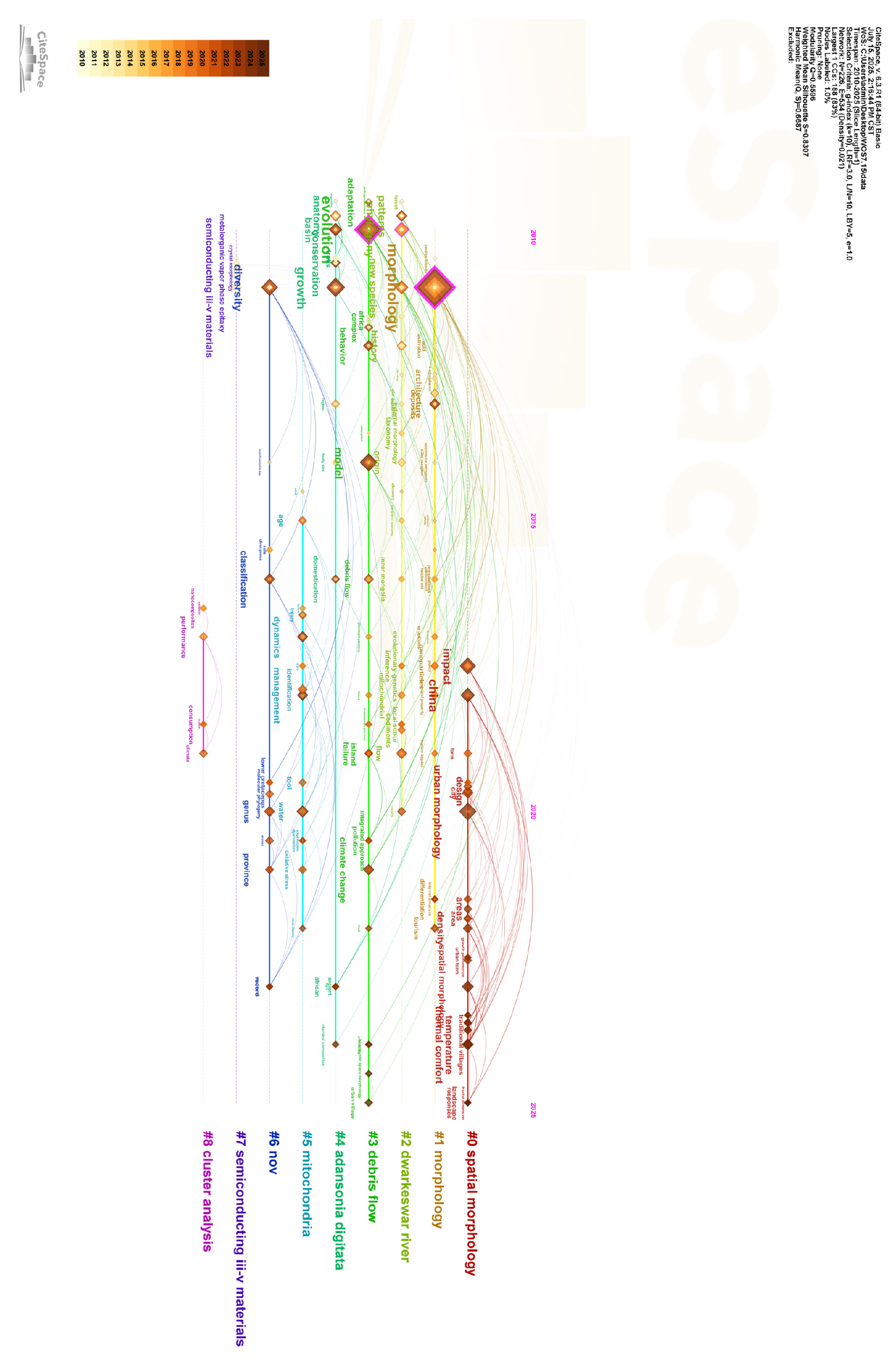
Appendix B
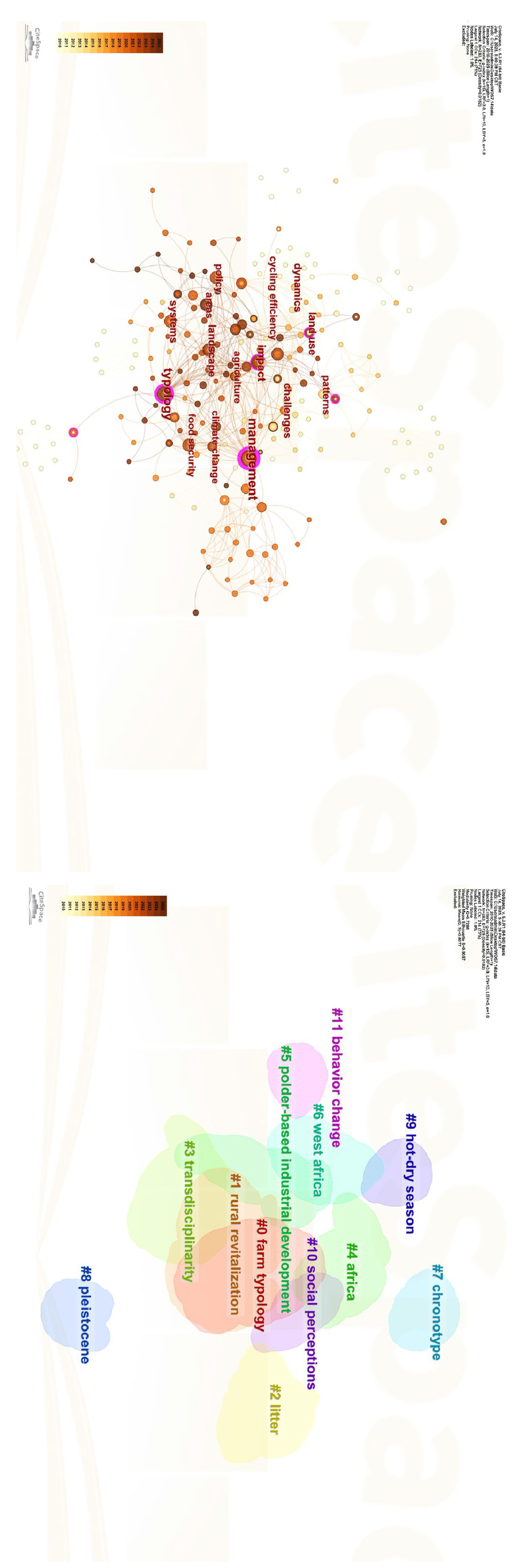
References
- Nie, Z.; Chen, C.; Pan, W.; Dong, T. Exploring the Dynamic Cultural Driving Factors Underlying the Regional Spatial Pattern of Chinese Traditional Villages. Buildings 2023, 13, 3068. [Google Scholar] [CrossRef]
- Mu, Q.; Aimar, F. How Are Historical Villages Changed? A Systematic Literature Review on European and Chinese Cultural Heritage Preservation Practices in Rural Areas. Land 2022, 11, 982. [Google Scholar] [CrossRef]
- Thinh, N.K.; Kamalipour, H.; Gao, Y. Mapping the Emerging Forms of Informality: A Comparative Morphogenesis of Villages-in-the-City in Vietnam. Habitat Int. 2023, 138, 102864. [Google Scholar] [CrossRef]
- Matlovič, R.; Matlovičová, K. The Metamodern Shift in Geographical Thought: Oscillatory Ontology and Epistemology, Post-Disciplinary and Post-Paradigmatic. Folia Geogr. 2025, 67, 22–69. [Google Scholar]
- Cao, Y.; Yuan, Q.; Bi, S.; Qin, L.; Yu, K. Research on the Regenerative Design and Practice of the Residential Architecture Atlases in Jiangnan during the Ming and Qing Dynasties: A Case Study of the Mingyue Bay Village in Suzhou. J. Asian Archit. Build. Eng. 2024, 24, 3381–3402. [Google Scholar] [CrossRef]
- Liu, X.; Li, Y.; Wu, Y.; Li, C. The Spatial Pedigree in Traditional Villages under the Perspective of Urban Regeneration—Taking 728 Villages in Jiangnan Region, China as Cases. Land 2022, 11, 1561. [Google Scholar] [CrossRef]
- Wang, T.; Chen, J.; Liu, L.; Guo, L. A Review: How Deep Learning Technology Impacts the Evaluation of Traditional Village Landscapes. Buildings 2023, 13, 525. [Google Scholar] [CrossRef]
- Wang, D.; Wei, X.; Yan, X.; Sohaib, O. A Study on Sustainable Design of Traditional Tujia Village Architecture in Southwest Hubei, China. Buildings 2024, 14, 128. [Google Scholar] [CrossRef]
- Wang, D.; Zhu, Y.; Zhao, M.; Lv, Q. Multi-Dimensional Hollowing Characteristics of Traditional Villages and Its Influence Mechanism Based on the Micro-Scale: A Case Study of Dongcun Village in Suzhou, China. Land Use Policy 2021, 101, 105146. [Google Scholar] [CrossRef]
- Chen, X.; Xie, W.; Li, H. The Spatial Evolution Process, Characteristics and Driving Factors of Traditional Villages from the Perspective of the Cultural Ecosystem: A Case Study of Chengkan Village. Habitat Int. 2020, 104, 102250. [Google Scholar] [CrossRef]
- Zhou, W.; Sun, Z.; Zhang, Y.; Tang, Y. Analysis of Spatial Genes and Research on Influencing Mechanisms of Oasis Rural Settlements on the Northern Slope of Tianshan Mountains. Chin. Landsc. Archit. 2024, 3, 55–61. [Google Scholar]
- Wang, Z.; Zhu, Z.; Zhou, S.; Tang, X.; Zhu, W.; Zhou, P.; Xiao, G. Mountainous Village Relocation Planning with 3D GIS Virtual Imaging Space Model and Neural Network. J. Asian Archit. Build. Eng. 2023, 22, 2392–2404. [Google Scholar] [CrossRef]
- Zhang, R.; Dai, Y.; Zan, P.; Zhang, S.; Sun, X.; Zhou, J. Research and Evaluation of the Mountain Settlement Space Based on the Theory of “Flânuer” in the Digital Age—Taking Yangchan Village in Huangshan City, Anhui Province, as an Example. J. Asian Archit. Build. Eng. 2024, 23, 57–73. [Google Scholar] [CrossRef]
- Zhang, X.; Yang, H.; An, Y. Spatial Morphology and Geographic Adaptability of Traditional Villages in the Hehuang Region, China. Buildings 2025, 15, 244. [Google Scholar] [CrossRef]
- Chang, R.; Wang, J.; Li, L.; Chen, D. Extraction and Analysis of the Spatial Morphology of a Heritage Village Based on Digital Technology and Weakly Supervised Point Cloud Segmentation Methods: An Innovative Application in the Case of Xisongbi Village in Jiexiu City, Shanxi Province. Sustainability 2025, 17, 3349. [Google Scholar] [CrossRef]
- Jia, W.; Wang, L. Morphological Typology Pedigree of Centripetal Spatial Schema in Traditional Chinese Settlements. Front. Archit. Res. 2024, 13, 1198–1214. [Google Scholar] [CrossRef]
- Rapoport, A. House Form and Culture; Prentice Hall: London, UK, 1969. [Google Scholar]
- Vellinga, M. Living Architecture: Re-Imagining Vernacularity in Southeast Asia and Oceania. Fabrications 2020, 30, 11–24. [Google Scholar] [CrossRef]
- Whelan, D. Built to Meet Needs: Cultural Issues in Vernacular Architecture—By Oliver, Paul. J. R. Anthropol. Inst. 2010, 16, 165–166. [Google Scholar] [CrossRef]
- Zhu, Q.; Liu, S. Spatial Morphological Characteristics and Evolution of Traditional Villages in the Mountainous Area of Southwest Zhejiang. ISPRS Int. J. Geo-Inf. 2023, 12, 317. [Google Scholar] [CrossRef]
- Huang, D.; Zhang, N.; Zhang, Y. Traditional Village Landscape Identification and Remodeling Strategy: Taking the Radish Village as an Example. Mob. Inf. Syst. 2022, 2022, 2350310. [Google Scholar] [CrossRef]
- Liu, X.; Shao, M.; Yang, H. Observing Meaning through Form and Transcending Images: Decoding the Artistic Intention of Creation Path of Contemporary Space Art in Traditional Jiangnan Villagesa. Des. Res. 2024, 15, 144–148. [Google Scholar]
- Zhu, J.; Xu, W.; Xiao, Y.; Shi, J.; Hu, X.; Yan, B. Temporal and Spatial Patterns of Traditional Village Distribution Evolution in Xiangxi, China: Identifying Multidimensional Influential Factors and Conservation Significance. Herit. Sci. 2023, 11, 261. [Google Scholar] [CrossRef]
- Pu, X.; Zhu, Z.; Dong, Y.; Lao, Y. Research on the Method of Generating Border Forms of Rural Settlements. Archit. Cult. 2024, 4, 80–83. [Google Scholar]
- Gao, W.; Xiao, D.; Zhao, Y.; Tao, J.; Zhuo, X.L. Study on the Cultural Landscape Characteristics and Influencing Factors of Traditional Villages and Dwellings in Central Yunnan Region. Archit. J. 2023, A1, 194–200. [Google Scholar]
- Zhou, J.; Xia, X.; Wu, S. Genetic Characteristics Evaluation and Planning Design of Traditional Village Cultural Landscape: Taking Dongmen Fishing Village in Xiangshan, Zhejiang Province as an Example. J. Asian Archit. Build. Eng. 2024, 24, 4572–4588. [Google Scholar] [CrossRef]
- Jiang, G.; Zhang, Y.; Li, C.; Xu, Q.; Yu, X. Mixed-Method Study of the Etiquette and Custom Cultural Activity Space and Its Construction Wisdom in Bubeibu Traditional Village, Yuxian County, China. J. Asian Archit. Build. Eng. 2024, 23, 2100–2114. [Google Scholar] [CrossRef]
- Nie, Z.; Li, N.; Pan, W.; Yang, Y.; Chen, W.; Hong, C. Quantitative Research on the Form of Traditional Villages Based on the Space Gene—A Case Study of Shibadong Village in Western Hunan, China. Sustainability 2022, 14, 8965. [Google Scholar] [CrossRef]
- Storm, J.A.J. Metamodernism. The Future of Theory; The University of Chicago Press: Chicago, IL, USA, 2021. [Google Scholar]
- Severynova, M.; Kharchenko, P.; Chibalashvili, A.; Bezuhla, R.; Putiatytska, O. Transformations of the Contemporary Art Practices in the Context of Metamodern Sensibility. Open Cult. Stud. 2025, 9, 20250053. [Google Scholar] [CrossRef]
- Lvov, A.A. The Practices of Historicism in Metamodern Condition. Vestn. Saint Petersbg. Univ. Philos. Confl. Stud. 2024, 40, 258–268. [Google Scholar] [CrossRef]
- Gaiduk, N.; Tarapatov, M. Theoretical Background to Metamodernism as the New Form of Modern Culture. Natl. Acad. Manag. Staff Cult. ARTS Her. 2022, 1, 30–35. [Google Scholar] [CrossRef]
- Huang, Y.; Ye, Z.; Zhang, Q.; Chen, Y.; Wu, W. Space Gene Quantification and Mapping of Traditional Settlements in Jiangnan Water Town: Evidence from Yubei Village in the Nanxi River Basin. Buildings 2025, 15, 2571. [Google Scholar] [CrossRef]
- Traditional Chinese Village Digital Museum. Available online: http://www.dmctv.cn/ (accessed on 30 December 2021).
- Research Center for the Protection and Development of Chinese Traditional Villages Chinese Traditional Village. Available online: http://www.chuantongcunluo.com/index.php/Home/Gjml/gjml/id/24.html (accessed on 7 June 2022).
- Hu, B.; Li, X.; Wang, X. 2017 Survey Report on the Protection of Traditional Villages in China; Social Sciences Academic Press: Beijing, China, 2017. [Google Scholar]
- China National Bureau of Statistics. China Rural Statistical Yearbook (2023); China Statistics Press: Beijing, China, 2023.
- Shi, D.; Qu, Y. China Rural Revitalization Yearbook 2022; Economy & Management Publishing House: Beijing, China, 2022. [Google Scholar]
- Angelidou, I. The Three States of the Architectural Fragment as a Collective Archive of Concepts: Tracing an Alternative Genealogy of Aldo Rossi’s Analogous Cities. Getty Res. J. 2022, 16, 137–168. [Google Scholar] [CrossRef]
- Bi, S.; Du, J.; Tian, Z.; Zhang, Y. Investigating the Spatial Distribution Mechanisms of Traditional Villages from the Human Geography Region: A Case Study of Jiangnan, China. Ecol. Inform. 2024, 81, 102649. [Google Scholar] [CrossRef]
- Duan, S.; Xie, J.; Wang, H.; Wu, H. Application and Indication of Confucianism in Environmental Planning of Chinese Traditional Dwellings. Chin. J. Agric. Resour. Reg. Plan. 2021, 42, 203–209. [Google Scholar]
- Bu, Y.; Lai, P. Research on the Morphological Typology of Traditional Villages in the Fujiang River Basin in the Multicultural Interlaced Area. Archit. J. 2024, A2, 16–21. [Google Scholar]
- Liu, H.; Fan, W.; Liu, L. Identification and Optimization of Traditional Village Morphology from the Perspective of Material-Cultural Interaction: A Case Study of Miaoxia Village, Chenzhou City, Hunan Province. J. Ecol. Rural Environ. 2025, 41, 86–98. [Google Scholar]
- Cao, H.; Yang, C. The Spatial Form of Traditional Villages DSM in Western Liaoning. J. Dalian Polytech. Univ. 2019, 5, 386–390. [Google Scholar]
- Liu, Q.; Liao, Z.; Wu, Y.; Degefu, D.M. Cultural Sustainability and Vitality of Chinese Vernacular Architecture: A Pedigree for the Spatial Art of Traditional Villages in Jiangnan Region. Sustainability 2019, 11, 6898. [Google Scholar] [CrossRef]
- Xiong, Y.; Zhang, J.; Yan, Y.; Sun, S.; Xu, X.; Higueras, E. Effect of the Spatial Form of Jiangnan Traditional Villages on Microclimate and Human Comfort. Sustain. Cities Soc. 2022, 87, 104136. [Google Scholar] [CrossRef]
- Zhang, L. Net Income Per Capita in Rural Wuxi, 1840s–1940s. J. Econ. Soc. Hist. Orient 2014, 57, 291–325. [Google Scholar] [CrossRef]
- Yao, X.; Yin, H.; Xin, X.; Ting, Z.; Ning, C.; Li, S.; Yun, Y. A Study on the Spatial Form of Traditional Villages in Jiangnan Region of China from the Perspective of Human Thermal Comfort: A Case Study of Nanjing, Jiangsu Province. PLoS ONE 2025, 20, e0323252. [Google Scholar] [CrossRef]
- Zhang, Y.; Tian, Z.; Du, J.; Bi, S. Multidimensional Evaluation of Traditional Villages in Jiangnan Region, China: Spatial Pattern, Accessibility and Driving Factors. Buildings 2024, 14, 823. [Google Scholar] [CrossRef]
- Chen, H.; Xiao, D.; Liu, Y. Spatial Morphology and Influencing Factors of Tunpu Traditional Villages in Anshun: A Comprehensive Study. J. Asian Archit. Build. Eng. 2024, 24, 3457–3470. [Google Scholar] [CrossRef]
- Zhao, Y.; Luo, Z.; Huang, K. Characterization of Public Space Forms in Traditional Chinese Villages Based on Spatial Syntax: Zhangli Village as an Example. J. Asian Archit. Build. Eng. 2024, 24, 3030–3051. [Google Scholar] [CrossRef]
- He, Y.; Chen, C.-P.; Chou, R.-J.; Luo, H.; Hou, J.-S. Exploring the Transformation in the ‘Spirit of Place’ by Considering the Changed and Unchanged Defensive Spaces of Settlements: A Case Study of the Wugoushui Hakka Settlement. Land 2021, 10, 490. [Google Scholar] [CrossRef]
- Xie, K.; Zhang, Y.; Han, W. Architectural Heritage Preservation for Rural Revitalization: Typical Case of Traditional Village Retrofitting in China. Sustainability 2024, 16, 681. [Google Scholar] [CrossRef]
- Huang, L.; Tian, L.; Zhou, L.; Jin, C.; Qian, S.; Jim, C.Y.; Lin, D.; Zhao, L.; Minor, J.; Coggins, C.; et al. Local Cultural Beliefs and Practices Promote Conservation of Large Old Trees in an Ethnic Minority Region in Southwestern China. Urban For. Urban Green. 2020, 49, 126584. [Google Scholar] [CrossRef]
- Li, M.; Yan, Y.; Ying, Z.; Zhou, L. Measuring Villagers’ Perceptions of Changes in the Landscape Values of Traditional Villages. ISPRS Int. J. Geo-Inf. 2024, 13, 60. [Google Scholar] [CrossRef]
- Zhang, Y. The Use of Heritage in the Place-Making of a Culture and Leisure Community: Liangzhu Culture Village in Hangzhou, China. Int. J. Herit. Stud. 2024, 30, 1423–1437. [Google Scholar] [CrossRef]
- Peng, P.; Fu, Y.; Zhou, X.; Wu, S.; Zhao, J.; Zhang, Y. Quantitative Research on the Degree of Disorder of Traditional Settlements: A Case Study of Liangjia Village, Jingxing, Hebei Province. Herit. Sci. 2024, 12, 109. [Google Scholar] [CrossRef]
- Zhao, G.; Ryan, C.; Deng, Z.; Gong, J. Creating a Softening Cultural-Landscape to Enhance Tourist Experiencescapes: The Case of Lu Village. Tour. Manag. Perspect. 2024, 53, 101245. [Google Scholar] [CrossRef]
- Ren, K.; Buyandelger, K. Construction of a Type Knowledge Graph Based on the Value Cognitive Turn of Characteristic Villages: An Application in Jixi, Anhui Province, China. Land 2023, 13, 9. [Google Scholar] [CrossRef]
- Zhang, S.; Zou, Y.; Yao, S.; Cao, X. Evaluation and Optimization of Cultural Ecosystem Services in Rural Areas from the Perspective of Residents:A Case Study of Sishili River Valley in Zhejiang Province. Acta Ecol. Sin. 2024, 21, 9458–9469. [Google Scholar]
- Huang, Y.; Li, E.; Xiao, D. Conservation Key Points and Management Strategies of Historic Villages: 10 Cases in the Guangzhou and Foshan Area, Guangdong Province, China. J. Asian Archit. Build. Eng. 2022, 21, 1320–1331. [Google Scholar] [CrossRef]
- Cheng, G.; Li, Z.; Xia, S.; Gao, M.; Ye, M.; Shi, T. Research on the Spatial Sequence of Building Facades in Huizhou Regional Traditional Villages. Buildings 2023, 13, 174. [Google Scholar] [CrossRef]
- Fang, Q.; Li, Z. Cultural Ecology Cognition and Heritage Value of Huizhou Traditional Villages. Heliyon 2022, 8, e12627. [Google Scholar] [CrossRef]
- Bian, J.; Chen, W.; Zeng, J. Spatial Distribution Characteristics and Influencing Factors of Traditional Villages in China. Int. J. Environ. Res. Public Health 2022, 19, 4627. [Google Scholar] [CrossRef]
- Tang, L.; Li, J.; Ding, W. Geomorphological Change and Rural Settlement Patterns: Study of the Formation Mechanisms of Strip Villages in Jiangsu, China. River Res. Appl. 2023, 39, 1300–1315. [Google Scholar] [CrossRef]
- Qi, T.; Ma, L.; Zhou, W.; Dai, L. Traditional Village Digital Archival Conservation: A Case Study from Gaoqian, China. Arch. Rec. J. Arch. Rec. Assoc. 2023, 44, 202–220. [Google Scholar] [CrossRef]

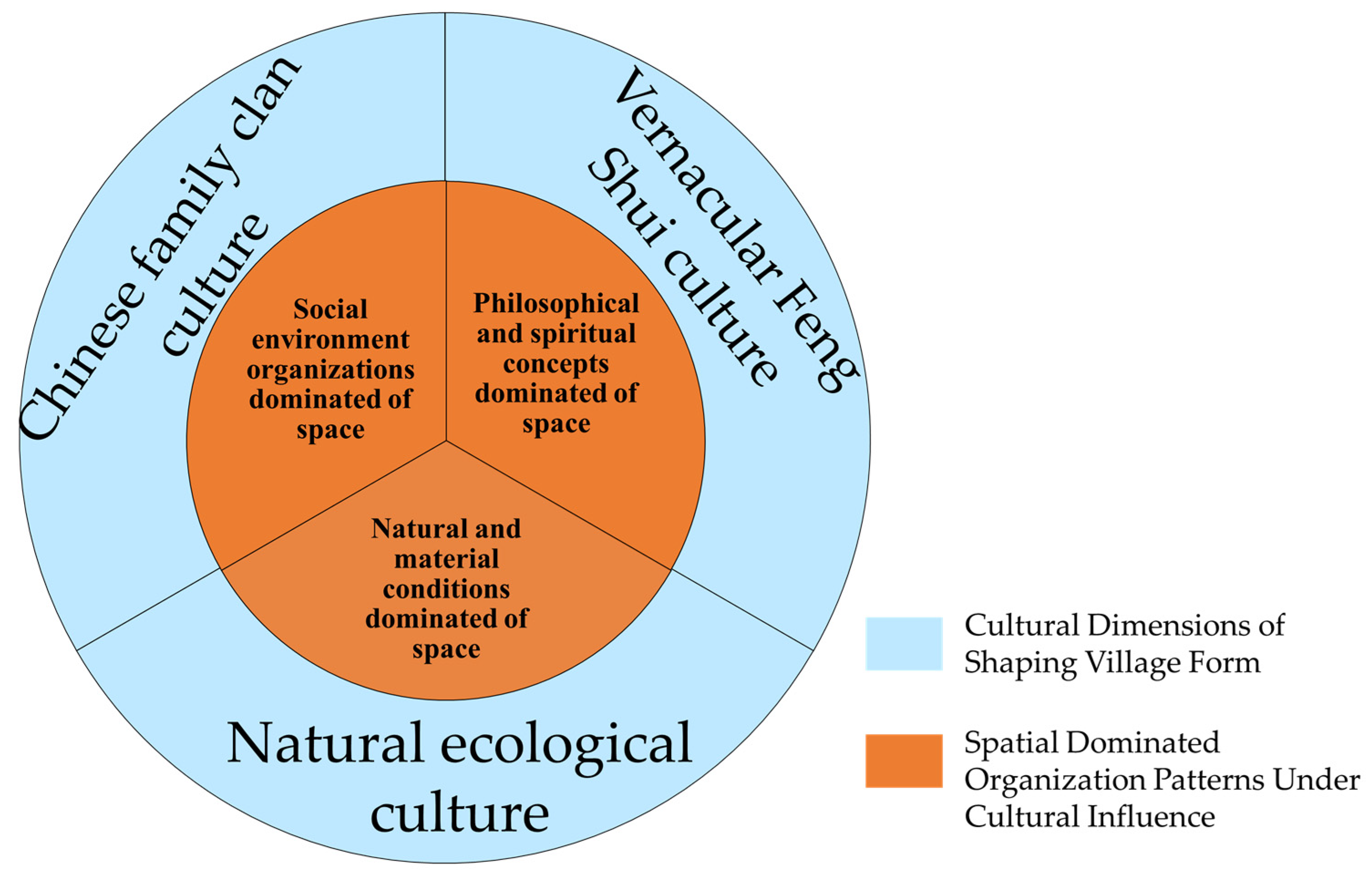
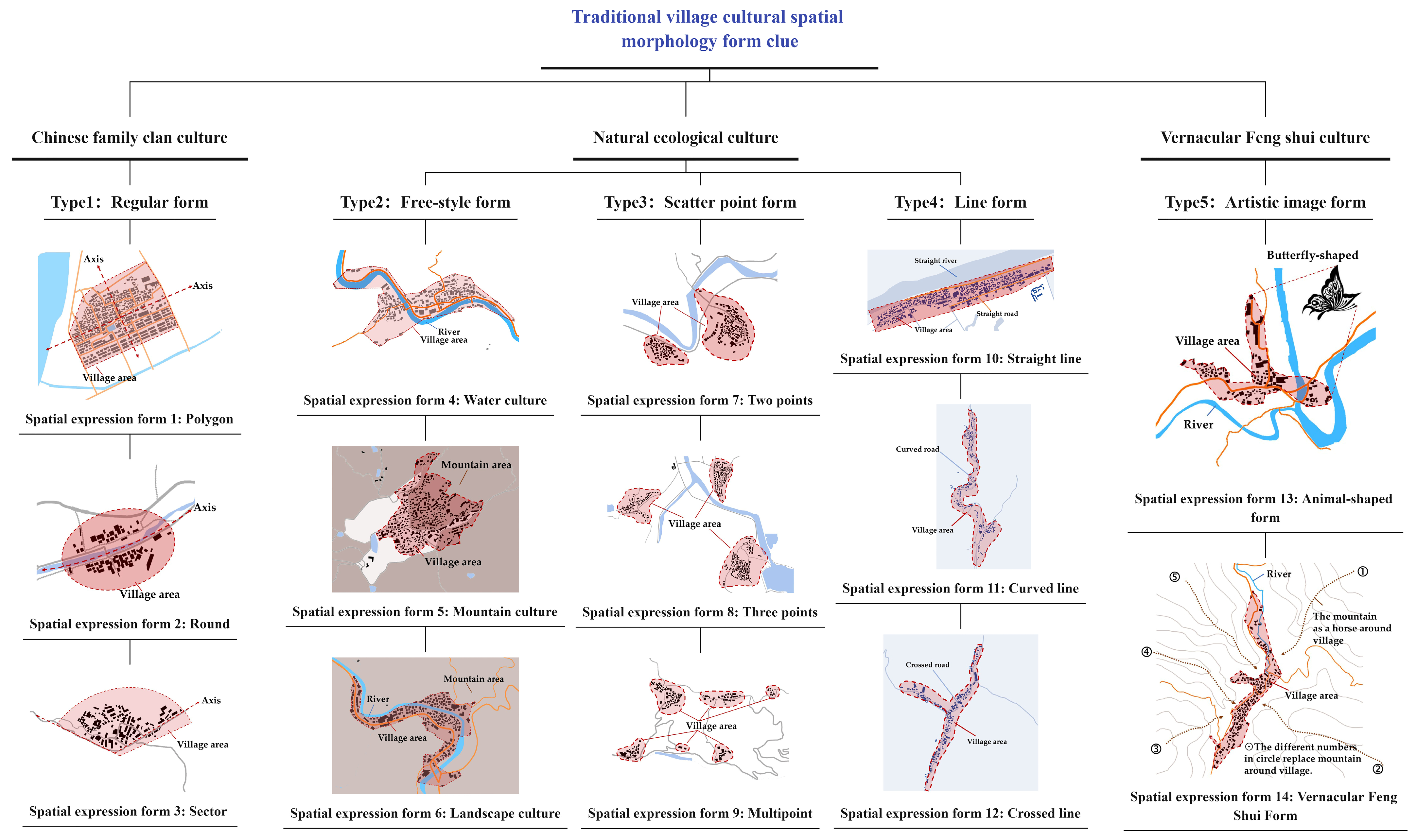

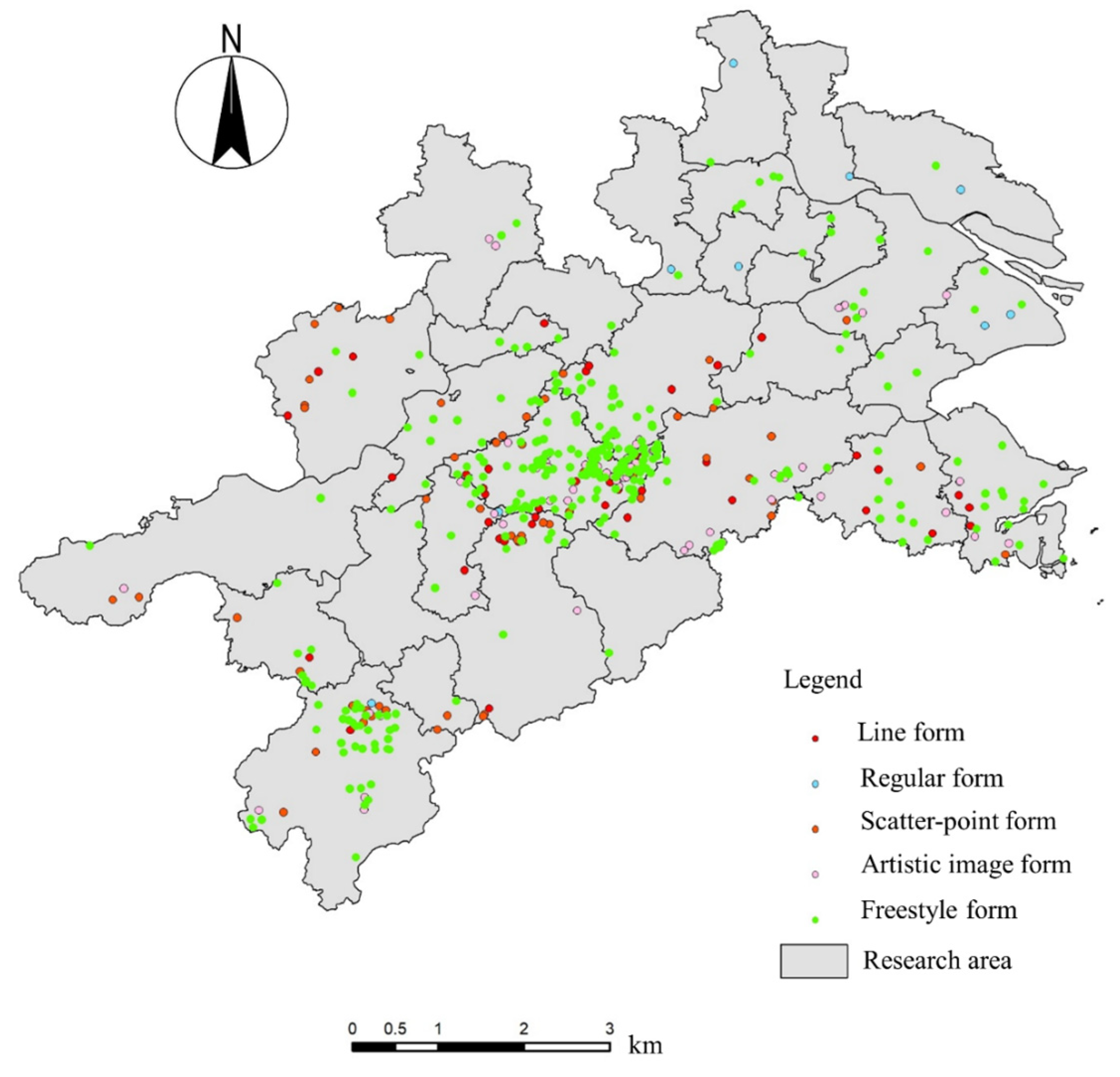

| Cultural Type | Cultural Spatial Type | Principles of Typology | Morphological Indices | |
|---|---|---|---|---|
| Chinese family clan culture: Focus on harmonization and balance of human inhabit space. | Type 1: Regular form | Spatial expression form 1: Polygon | The shape is regular, the center axis is symmetrical, and the boundary is a regular folding line, which has the cultural significance of the village of neutrality. | (1) Vertical central axis; (2) Straight road; (3) Regular outline. |
| Spatial expression form 2: Round | The boundary is shaped as a circle, with a cultural symbol of harmony and unity. | (1) Central axis; (2) Round/oval outline. | ||
| Spatial expression form 3: Sector | The village boundary is sector-shaped, with a cultural meaning of comfort and satisfaction. | (1) Angled axis; (2) Sector form outline. | ||
| Natural ecological culture: Focus on harmony between human environment and nature. | Type 2: Freestyle form | Spatial expression form 4: Water culture | The village space is constructed based on the water system, symbolizing wealth. | (1) Water element; (2) Space changed by water; (3) Irregular outline. |
| Spatial expression form 5: Mountain culture | The village space is characterized by the layered mountains, which symbolize tranquility and stability. | (1) Mountain element; (2) Space changed by mountain; (3) Irregular outline. | ||
| Spatial expression form 6: Landscape culture | The space embodies the dynamic integration of mountains and water, reflecting the ecological philosophy of harmony. | (1) Both water and mountain elements; (2) Roads are changeable and flexible; (3) Irregular outline. | ||
| Type 3: Scatter-point form | Spatial expression form 7: Two points | Restricted by the natural environment and climate, the village building clusters are dispersed in rows. The spatial layout is connected by roads or water systems, reflecting the natural ecological wisdom of stability through dispersion. | (1) Village consists of several clusters; (2) Number of village space units = 2; (3) Roads and water system are changeable and flexible. | |
| Spatial expression form 8: Three points | (1) Village consists of several clusters; (2) Number of village space units = 3; (3) Roads and water system are changeable and flexible. | |||
| Spatial expression form 9: Multipoint | (1) Village consists of several clusters; (2) Number of village space units > 3; (3) Roads and water system are changeable and flexible. | |||
| Type 4: Line form | Spatial expression form 10: Straight line | Influenced by topographical conditions, the village extends along a main street or river on both sides of it or follows the parallel contour of the mountain range to form a spatial belt shape. The village space shows the beauty of slender linear flow. | (1) Village road/water system is straight. | |
| Spatial expression form 11: Curved line | (1) Village road/water system is curved. | |||
| Spatial expression form 12: Crossed line | (1) Village road/water system is crossed. | |||
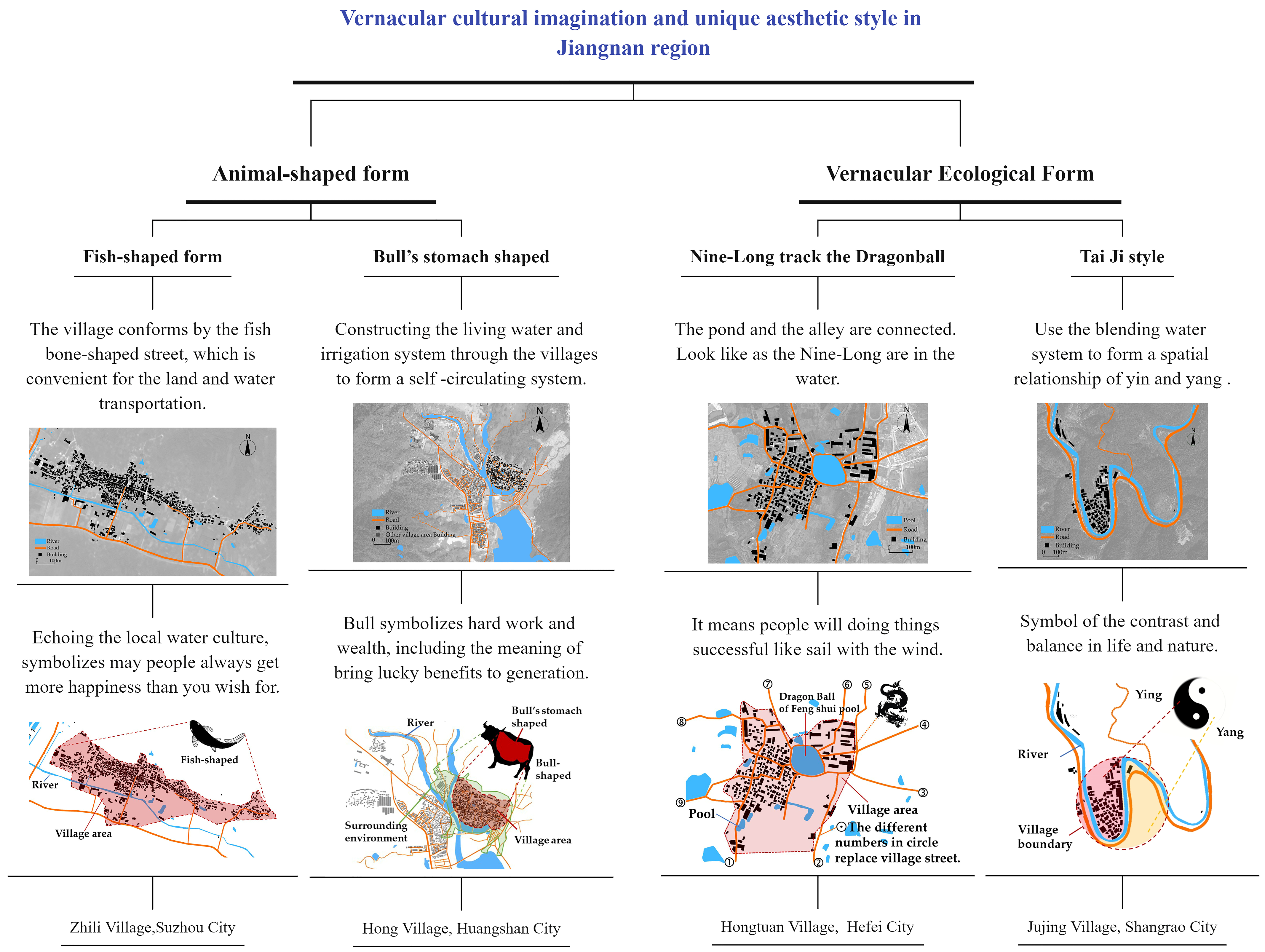
| Vernacular Feng shui culture: Promoting human health and well-being through feng shui spatial construction. | Type 5: Artistic image form | Spatial expression form 13: Animal-shaped form | The spatial design emphasizes the similarity between space and a specific animal shape in nature, reflecting the symbolism of goodness in nature. | (1) Natural animal worship; (2) Artistic spatial form interpretation of official documents. |
| Spatial expression form 14: Vernacular feng shui form | The image is taken from feng shui principles that are relevant to vernacular life, reflecting the harmony of people, environment, and culture. | (1) Feng shui planning principles; (2) Local art worship. | ||
| S1 | Morphology Type | λ | Sub-Type |
|---|---|---|---|
| S ≥ 2 | Finger form | λ < 1.5 | Cluster trend to finger form |
| 1.5 ≤ λ < 2 | Finger form without a clear tendency | ||
| λ ≥ 2 | Band-shaped trend to finger form | ||
| S < 2 | Cluster form | λ < 1.5 | Cluster |
| 1.5 ≤ λ < 2 | Cluster trend to band-shaped | ||
| Band-shaped form | λ ≥ 2 | Band-shaped |
| KMO and Bartlett’s Test | ||
|---|---|---|
| Kaiser–Meyer–Olkin (KMO) measure of sampling adequacy | 0.625 | |
| Bartlett’s test of sphericity | Chi-Square | 2422.311 |
| Degrees of freedom | 10 | |
| p-value | 0.000 | |
| Communality | ||
|---|---|---|
| Initial | Extraction | |
| Outline length of the village: P | 1.000 | 0.878 |
| Area of the village: A | 1.000 | 0.872 |
| Shape index: S | 1.000 | 0.924 |
| Fractal dimension index: S2 | 1.000 | 0.946 |
| Saturation coefficient: ϴ | 1.000 | 0.816 |
| Total Variance Explained | ||
|---|---|---|
| Variance % | Cumulative % | |
| 1 | 61.038 | 61.038 |
| 2 | 27.688 | 88.726 |
| ANOVA | ||||||
|---|---|---|---|---|---|---|
| Between Groups | Within Groups (Error) | F | p-Value | |||
| Mean Square | DF | Mean Square | DF | |||
| REGR factor score 1 for analysis 2 | 88.497 | 4 | 0.293 | 495 | 302.089 | 0.000 |
| REGR factor score 2 for analysis 2 | 93.539 | 4 | 0.252 | 495 | 370.881 | 0.000 |
| Final Cluster Center | |||||
|---|---|---|---|---|---|
| Between Groups | |||||
| 1 | 2 | 3 | 4 | 5 | |
| REGR factor score 1 for analysis 2 | 3.83406 | −3.38081 | −0.40726 | −0.64461 | 0.78761 |
| REGR factor score 2 for analysis 2 | 2.07827 | 15.59806 | 0.99084 | −0.24102 | −0.25458 |
| Robust Test for Equality of Means | |||||
|---|---|---|---|---|---|
| Statistics a | DF 1 | DF 2 | p-Value | ||
| REGR factor score 1 for analysis 1 | Welch’s | 14.890 | 4 | 52.638 | 0.000 |
| REGR factor score 2 for analysis 1 | Welch’s | 8.480 | 4 | 53.443 | 0.000 |
| Cultural Spatial Morphology Type | Minimum Value of S | Maximum Value of S | Change Interval Difference of S | Spatial Morphology Complexity |
|---|---|---|---|---|
| Regular form | 1.06 | 1.92 | 0.86 | Most stable |
| Freestyle form | 0.0039 | 5.51 | 5.5061 | Complex |
| Scatter-point form | 1.10 | 11.51 | 10.41 | Most complex |
| Line form | 0.94 | 3.56 | 2.62 | Relatively stable |
| Artistic image | 1.06 | 6.91 | 5.85 | Relatively complex |
| Cultural spatial morphology type | Minimum value of ϴ | Maximum value of ϴ | Difference in change range of ϴ | External expansion trend |
| Regular form | 0.39 | 0.87 | 0.48 | Smaller |
| Freestyle form | 0.11 | 0.82 | 0.71 | Largest |
| Scatter-point form | 0.03 | 0.67 | 0.64 | Second largest |
| Line form | 0.1 | 0.53 | 0.43 | Smallest |
| Artistic image | 0.08 | 0.69 | 0.61 | Larger |
| Cultural spatial morphology type | Minimum value of S2 | Maximum value of S2 | Change interval difference in S2 | Fragmentation of public space |
| Regular form | 0.99 | 1.08 | 0.09 | Smallest |
| Freestyle form | 0.99 | 1.26 | 0.27 | Larger |
| Scatter-point form | 1 | 1.36 | 0.36 | Largest |
| Line form | 1 | 1.21 | 0.21 | Third largest |
| Artistic image | 0.99 | 1.28 | 0.29 | Second largest |
Disclaimer/Publisher’s Note: The statements, opinions and data contained in all publications are solely those of the individual author(s) and contributor(s) and not of MDPI and/or the editor(s). MDPI and/or the editor(s) disclaim responsibility for any injury to people or property resulting from any ideas, methods, instructions or products referred to in the content. |
© 2025 by the authors. Licensee MDPI, Basel, Switzerland. This article is an open access article distributed under the terms and conditions of the Creative Commons Attribution (CC BY) license.
Share and Cite
Liu, X.; Shao, M.; Li, Y.; Fan, W.; Zhang, Y.; Zhang, A. A Comparative Study of the Spatial Morphology of Traditional Villages as Sustainable Cultural Heritage: The Case of Jiangnan Region. Sustainability 2026, 18, 403. https://doi.org/10.3390/su18010403
Liu X, Shao M, Li Y, Fan W, Zhang Y, Zhang A. A Comparative Study of the Spatial Morphology of Traditional Villages as Sustainable Cultural Heritage: The Case of Jiangnan Region. Sustainability. 2026; 18(1):403. https://doi.org/10.3390/su18010403
Chicago/Turabian StyleLiu, Xinqu, Mingzhi Shao, Yaowu Li, Wenhui Fan, Yiwei Zhang, and Anding Zhang. 2026. "A Comparative Study of the Spatial Morphology of Traditional Villages as Sustainable Cultural Heritage: The Case of Jiangnan Region" Sustainability 18, no. 1: 403. https://doi.org/10.3390/su18010403
APA StyleLiu, X., Shao, M., Li, Y., Fan, W., Zhang, Y., & Zhang, A. (2026). A Comparative Study of the Spatial Morphology of Traditional Villages as Sustainable Cultural Heritage: The Case of Jiangnan Region. Sustainability, 18(1), 403. https://doi.org/10.3390/su18010403