1. Introduction
In recent years, the marine industry has undergone significant upheaval, particularly at ports, where smart technology and environmental considerations are becoming increasingly important. With technologies such as big data, artificial intelligence, and the Internet of Things, smart ports are transforming logistics operations, making them more effective and sustainable. Although environmental and technological conditions have evolved, there is a notable lack of discussion on how these conditions relate to new technologies, sustainability, and the law, particularly in developing nations. Optimize supply chain and logistics operations at smart ports. This study compares China and Pakistan to investigate the relationships among sustainability, cutting-edge technology, and the legal framework [
1,
2]. The two countries are among the world’s top commercial powers, with Pakistan’s port economy having substantial development potential. China’s ports rank among the busiest in the world [
3]. How the port community and the broader economy can achieve sustainability goals, including carbon neutrality and resource optimization, through the intelligent integration of technology, such as lean efficiency, waste reduction, and process optimization, remains a question. Although smart port technologies have advanced significantly, China and Pakistan face particular challenges in implementing them [
4]. Regulatory barriers, varied national sustainability goals, and disparate degrees of technological infrastructure complicate the deployment of smart technology in ports.
Smart ports are those ports that utilize new technology, such as IoT, AI (artificial intelligence), big data, etc., to work effectively and efficiently in cutting the cost for logistics management and supply chain management. Sustainability-rich performance refers to an organization or entity’s ability to meet today’s needs while ensuring the well-being of the environment and society in the future and to maintain financial strength in line with sustainable development objectives. Legal drivers encompass the regulatory environments, laws, and policies that guide decision-making within sectors, leading to adherence to standards and driving outcomes such as environmental protection, respect for labor rights, and ensuring safety. Why were Pakistan and China selected for this comparative study? The rationale behind these choices involves influential roles in global maritime trade, port development, and the adoption of smart technologies in logistics and supply chains.
Furthermore, considering the close geographical proximity between the two countries, coupled with their strong, brotherly relationship, this comparison holds particular significance. These, in combination with existing gaps in research, provide a reasonable basis for making Pakistan and China a suitable focus for the present study. The adoption of technologies and policies across countries is examined, with the aim of understanding their impact on economic and environmental performance, with the intention of closing the research gap.
This study aims to compare the economic and ecological outcomes of port development in China and Pakistan, analyze the policy and legal framework supporting smart port business, and evaluate the role of smart technologies in the development of sustainable port logistics [
5]. It aims to guide industry leaders, port authorities, and policymakers on how to address the challenges of implementing cutting-edge, sustainable technologies in the global ports sector. The adoption of cutting-edge technologies, sustainability programs, and trade liberalization policies is driving significant change in the worldwide shipping and port sectors. The logistics and supply chain industries are undergoing a revolution thanks to the widespread deployment of smart ports [
6]. Ports can become more ecologically sustainable, economically efficient, and operationally efficient through these innovations [
7]. Two of the leading nations creating smart ports are China and Pakistan. China has invested heavily in port technology, especially in key marine cities such as Shenzhen, Ningbo, and Shanghai [
8].
The Hainan Free Trade Port, created as part of China’s broader effort to liberalize and modernize trade and port operations, is a prime example. Since its founding, Hainan has emerged as a leader in integrating green practices, trade facilitation, and smart technology, as well as in developing a streamlined and effective port ecosystem [
9]. The Hainan Free Trade Port optimized port operations, improved logistical transparency, and reduced carbon emissions by leveraging cutting-edge technologies, including blockchain, AI, and IoT, as well as implementing new regulations. As such, it is a case study that exemplifies best practices for evaluating the collaborations between smart technologies and sustainable port practices [
10]. Taking Gwadar Port and Karachi Port as its flagships, Pakistan’s port sector is still in its infancy when it comes to sustainable development and digitization. Infrastructure issues, along with financial and regulatory matters, have hindered port modernization efforts [
11]. The busiest port in Pakistan, Karachi Port, also implemented AI and automation pilot programs; however, adoption rates were below global norms.
The region’s commercial center, Gwadar Port, is falling behind in terms of technology and regulations [
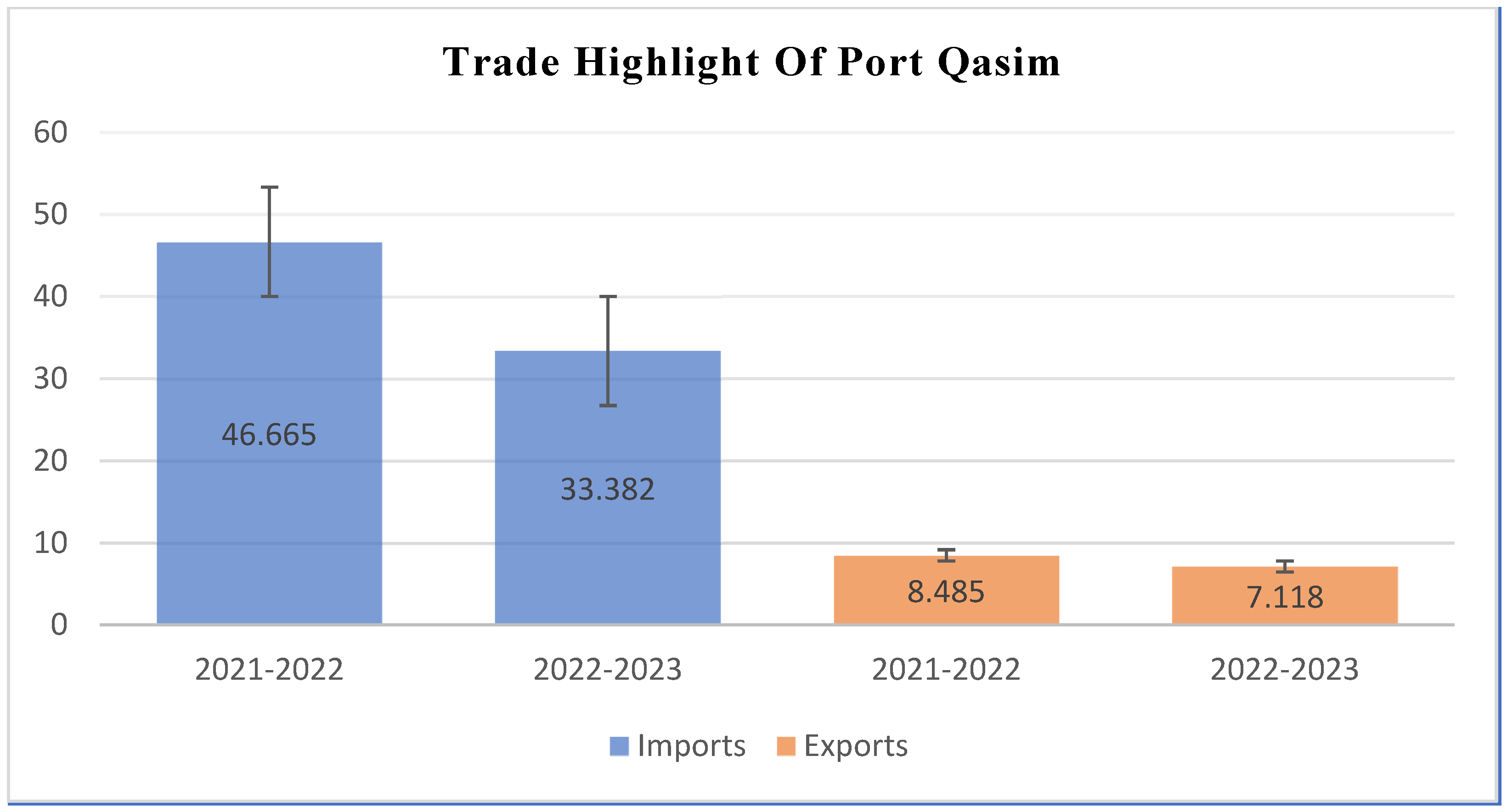
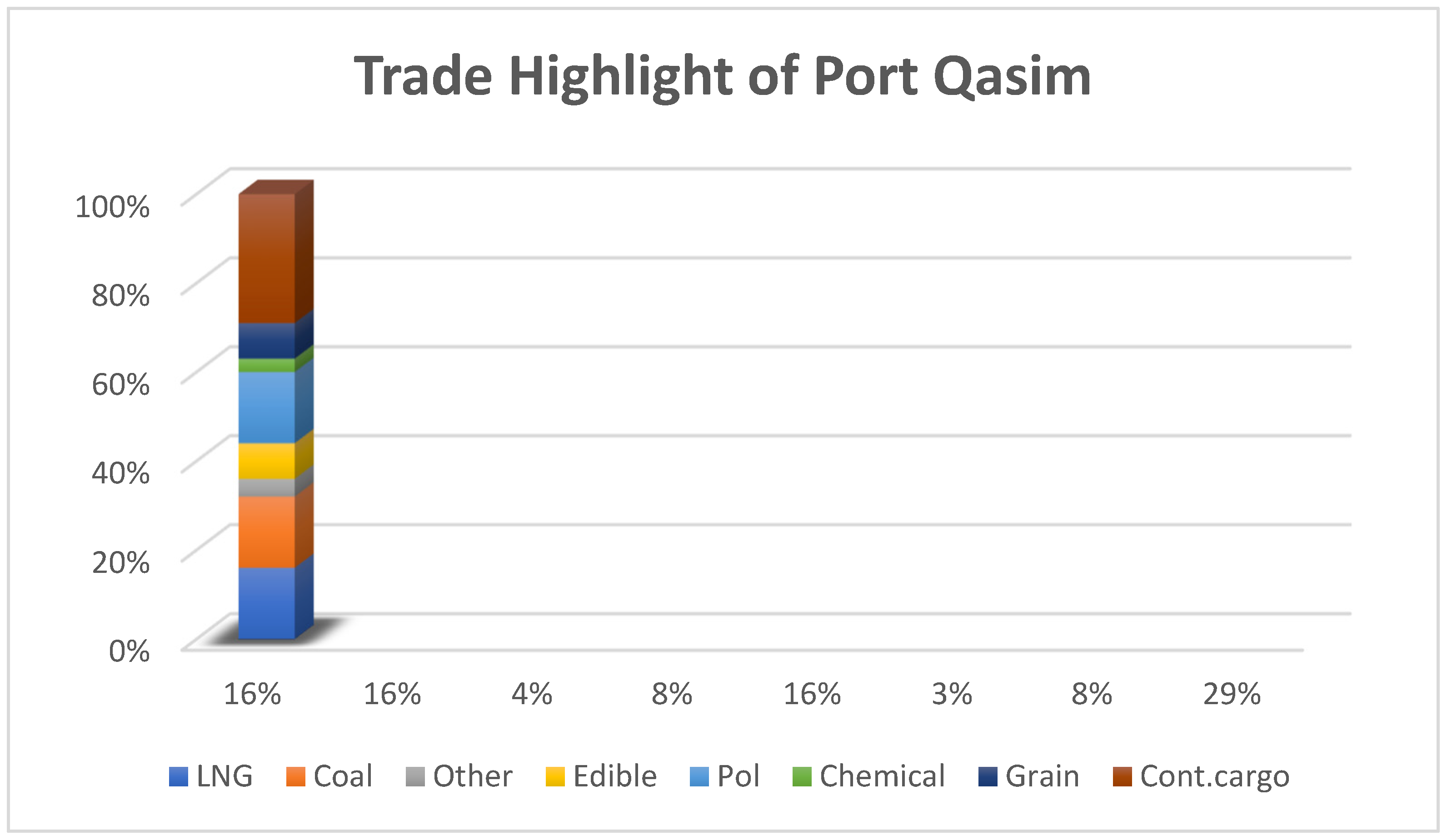
12]. A network of ports with distinct strategic and economic roles serves the Pakistani coast. The bulk and containerized cargo volumes are handled at Karachi Port, the country’s busiest and oldest commercial hub. Supported by a robust industry and urban conveniences, it serves as the nation’s gateway to global trade. The second-largest port in southeastern Karachi, Port Qasim, exports bulk goods, including fertilizer, coal, and grain. It is a part of the country’s industry because it is connected to the largest steel factory in the country and to the nearby industrial region. Baluchistan’s Port Gwadar is a cutting-edge deepwater port [
13]. The China–Pakistan Economic Corridor (CPEC) plays a strategic role in stimulating regionally focused development while serving as a major transshipment hub and an economic gateway to landlocked Central Asia.
The local fishing industry is the primary driver of the other two ports, Pasni and Jiwani. Furthermore, the Pakistan Navy’s defense and maritime security heavily depend on specialized naval bases, such as Karachi Naval Harbour and Ormara [
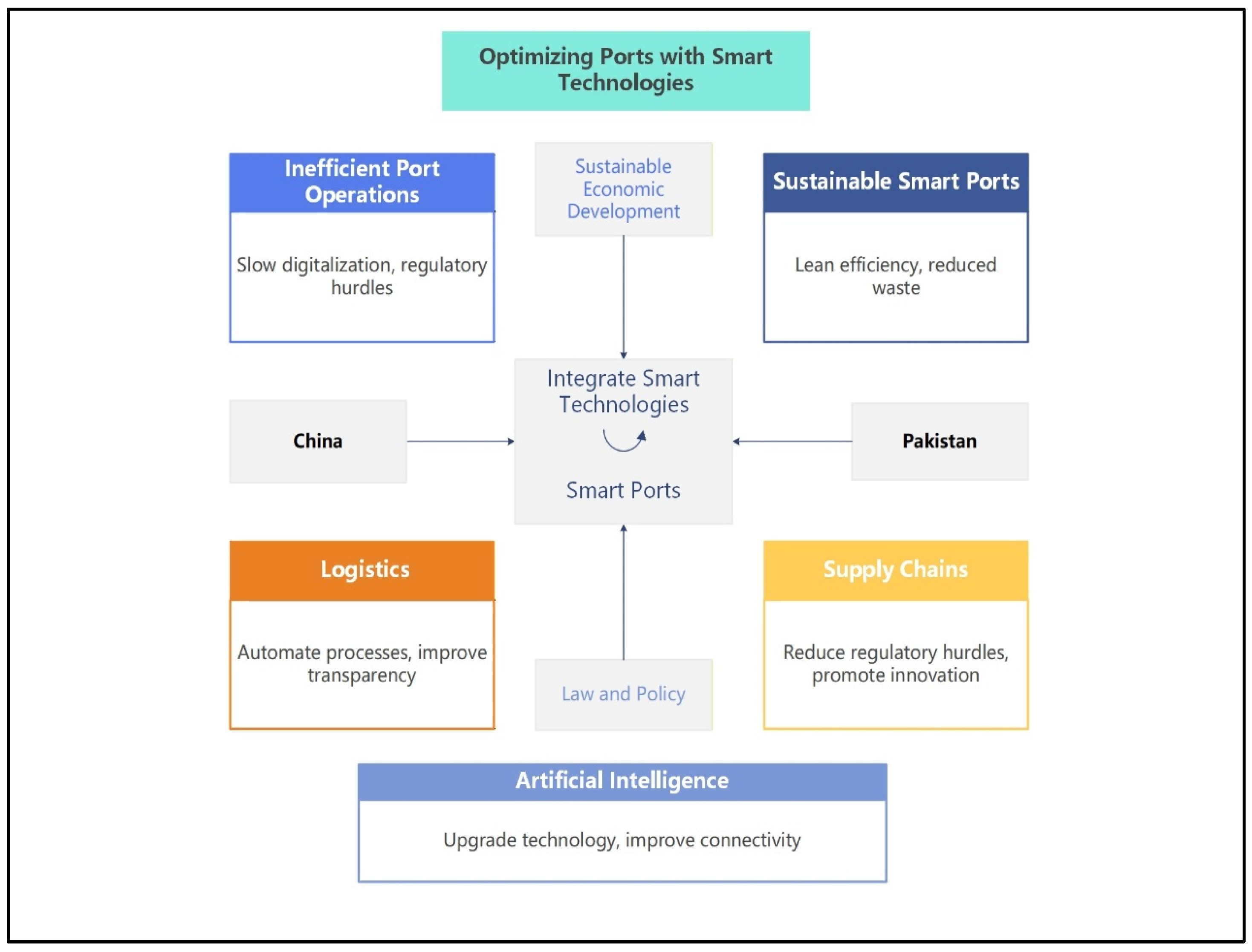
14]. Compare the supply chain and logistics development, sustainability initiatives, and smart technology in Chinese smart ports, with a focus on the Hainan FTP. This study examines the potential and drawbacks of these innovations, as well as their impact on improving economic and environmental performance in these nations (as shown in
Figure 1, which depicts the port-technology nexus), and the investigation seeks to provide essential insights into the role of regulatory frameworks and government support in fostering intelligent, sustainable, and effective port ecosystems by analyzing Hainan’s experience and that of other major ports [
15]. The remainder of this paper is organized as follows.
Section 2 presents the background and literature review, with a focus on marital studies research.
Section 3 discusses the data collection method and the data sources used in this study.
Section 4 presents the results, which are discussed and analyzed in detail. Finally,
Section 5 presents the conclusion, which includes this study’s findings, a discussion of this study’s limitations, recommendations for future research, and policy recommendations for Pakistan based on China’s successful model.
4. Comparative Study and Discussion
In comparing China and Pakistan’s development of smart ports, a pattern emerges of the two modern approaches. China serves as an illustration of the mature end of the generation model, fueled by high state capacity and vision [
1]. A shining example of technology and economic performance remains the key driving force for Chinese ports. Conversely, Pakistan’s ports denote a rising partnership facilitating model, where international investments and the CPEC play a vital role in the development process [
66]. The forces driving growth and development differ significantly in magnitude, speed, and the processes involved. For the first time, in both nations, a consensus grows for the integration of sustainability and economic aspirations. Pakistan gains the first-mover advantage in integrating sustainability into the port development process, whereas China pursues a technology-driven approach to facilitate the development of green ports [
67]. The legal bases are significantly dissimilar. Pakistan has the first-mover advantage concerning the integration of new technologies for the development process of ports. In contrast, China has a mature state-directed framework for the development process of ports [
68]. A disparity among the described nations regarding their legal frameworks reveals that no nation follows a similar strategy for development in smart ports. The trinity associated with technology, sustainability, and law remains the world’s constant.
The development of the China–Pakistan Economic Corridor and the ports at Gwadar and Karachi are key focuses for smarter ports in Pakistan, which are still in their nascent stage, yet hold strategic importance compared to Chinese ports. Being fueled by the financial support and accumulated experience behind the development process, it remains largely an external force in the development process within Pakistan [
69]. The aim behind the development of the Gwadar Port is to create a smarter, modern port that can facilitate the development process for neighboring nations and serve as a gateway for the China–Pakistan Economic Corridor. Therefore, the development process within Pakistan remains a slower process, focusing entirely on the development of the required infrastructure for the ports. Challenges abound for the development process of smarter ports within Pakistan, focusing on the development of a robust infrastructure, a lack of financial support, and limitations within the country regarding the development of its technologies [
70]. The development process within Pakistan may opt for the development of more innovative technologies compared to the prevailing processes at the initial, nascent level, focusing entirely on the primary phases of security and digitization. Therefore, the placement of smarter ports within the country’s development process presents an essential opportunity for the government to avoid certain phases in the development process of these ports [
71]. Its geostrategic location, concerning the developmental process within Chinese ports and the country’s need to enhance economic performance by acting as a gateway for neighboring nations, remains closely integrated within the development process of smarter ports in Pakistan.
The differences observed between China and Pakistan are significant because they illustrate how contextual factors influence the development and sustainability of smart ports. Advanced technological infrastructure, strong governmental support, and coordinated stakeholder engagement enable the rapid adoption of smart port initiatives, leading to improvements in performance efficiency, environmental friendliness, and resilience in China. Meanwhile, there is not much to show because technological readiness is low, policies are fragmented, and resources are limited, as in Pakistan. Therefore, this slows down the process of adopting strategies and makes them less effective in terms of performance efficiency, as well as in addressing environmental issues that can be improved through resilience enhancement. The comparison not only places a report against contrasts but also further establishes how sustainable smart port development is, which is influenced by policy measures, available technologies, and institutional capacity. It highlights the critical enablers and barriers, thereby providing practical lessons on strategy adjustment in different national settings. This cross-national view also serves to heighten awareness of smart port sustainability issues while offering information relevant to both emerging ports and more developed contexts.
4.1. Economic and Environmental Performance
The adoption of smart technologies and sustainable initiatives has significantly enhanced the economic performance of Chinese ports, particularly the Hainan Free Trade Port. The financial performance of the Haikou Port revealed a reduction of up to 15% in costs and an increase of up to 20% in the volume of processed cargo. The adoption of blockchain, AI-based demand forecasting, and energy-saving technologies has primarily contributed to the above improvements. Significant progress has also been made in terms of costs, sustainable performance, and port operations at the ports of Shenzhen and Tianjin [
72]. Inadequate operational performance continues to be a significant obstacle to the economic performance of Pakistan’s ports. Although considerable progress has been made, traffic congestion, energy, and infrastructure issues persist at the Karachi Port.
Meanwhile, the port throughput growth has stood at only 5% since 2018, in line with recent reports from the Pakistan Ports Authority, while operational costs remain high. In the same regard, the environmental aspect at the Karachi Port still lags, as there have been very few developments at the port concerning the exploitation of renewable energy sources and the reduction of emissions [
73]. From the comparison analysis above, it is apparent that the ports of China, specifically the Hainan Free Trade Port, have adopted smart revolution and sustainable development strategies to achieve superior economic and environmental performance. A great deal can be learned from the Hainan example for Pakistan’s ports to move in the right direction, although significant challenges still need to be addressed [
74].
4.2. Smart Technology Adoption in Ports
The implementation of more innovative technologies in ports has grown significantly in both China and Pakistan over the last decade, with remarkable progress achieved [
75]. Their major ports, such as those in Shanghai, Shenzhen, and Ningbo, as well as the newly formed Hainan Free Trade Port, have adopted technologies like artificial intelligence, IoT, and blockchain to enhance logistics and efficiency [
76]. For example, Shanghai Port has incorporated AI-based demand forecasting and blockchain technology to enable safer and more transparent supply chain management. Shanghai is targeting 70% automation of the operations, as per the China Ports and Harbors Association [
77]. Similarly, Ningbo Port has implemented IoT-based real-time monitoring of cargo streams, resulting in a 22% increase in operational throughput. For Hainan Free Trade Port, established as a national scheme to build an even more liberal and tech-enabled trade center, the region has been endeavoring to create an innovative port system. Ports of Hainan, led by Haikou Port, have been integrating AI and blockchain technologies since 2020 to improve customs clearance and logistics transparency. According to the Haikou Port Authority, Haikou Port has also implemented a top-level AI system for demand forecasting and cargo distribution, which has increased processing efficiency by 20% during the previous three years. The port has also been upgraded with automated cranes and driverless vehicles for container handling, serving as a benchmark for other Chinese ports to achieve complete automation [
78].
In Pakistan, the adoption of smart technologies has been slower but is gaining momentum, particularly in Karachi Port, the country’s busiest port. The Karachi Port Trust (KPT) has piloted IoT-based container tracking solutions and begun integrating AI into its scheduling and cargo management processes. However, as of 2025, only 15–20% of operations are end-to-end automated, and budget constraints and regulatory delays generally hamper the adoption of technology. At Gwadar Port, efforts to integrate AI-powered systems for controlling port traffic began in 2023, but the full deployment is still under consideration. Additionally, blockchain was considered for enhanced transparency and the prevention of fraud; however, the concept remains in the early stages at the moment [
79]. The rapid integration of smart technologies in China’s major ports, including the Hainan Free Trade Port, is primarily the result of support aimed at achieving global leadership in port digitization and automation. Hainan FTP, focusing on innovation, digitization, and seamless customs formalities, is an essential proving ground for the replicability of these technologies at the national level. Hainan would be the trailblazer for other ports in the country regarding the implementation of smart ports. The lack of investment, infrastructure, and effective regulations in Pakistan obstructs the development of technologies for ports in the country. Pakistan could greatly benefit from the achievements of Hainan’s successes in port development using information technology [
80].
4.3. Sustainability Practices in Ports
China remains among the leaders in implementing green port technologies worldwide, particularly within the country’s major ports and the Hainan Free Trade Port. Since 2019, Hainan Port has focused on energy conservation, specifically in green technology [
81]. Green energy technologies such as solar and wind energy are being implemented within the ports of Hainan. The Hainan Free Trade Port Authority claims that Haikou Port’s megadollar power plant, which was put into service in 2023, presently supplies 30% of its operating requirements. Additionally, the port plans to employ automated cargo-handling technologies, energy-efficient lighting, and electric cranes to cut its CO
2 emissions by 40% by 2030 [
82]. The Port of Tianjin and Ningbo Port also used green technologies and emission-reduction measures. For example, Tianjin Port’s CO
2 emissions decreased by 35% between 2018 and 2024 due to the installation of renewable energy systems and energy-efficient machinery [
83]. Sustainable practices are still in their early stages of development in Pakistan. The Karachi Port has launched several environmental initiatives, including the adoption of LED lighting and the installation of more energy-efficient cranes. However, such steps are only small, and the carbon emissions level associated with port operations remains higher compared to global requirements. The reduction in carbon emissions associated with port operations at the Port of Karachi and other small ports around the country has remained at only 5–10% since 2018, according to the Pakistan Maritime Security Agency [
84].
4.4. Legal and Policy Frameworks Governing Smart Ports
The ports of China, especially the Hainan Free Trade Port, are well-positioned to adopt smart technologies and green initiatives, given the well-developed frameworks that underpin them [
85]. The National Intelligent Port Development Plan provides a framework for developing the country’s intelligent ports, implementing automation technologies, and promoting sustainable development strategies. In this regard, the Hainan Free Trade Port offers a distinct framework for the development of the country’s ports, thus increasing their appeal and attracting foreign investors positively. By adhering to such guidelines, the Hainan Free Trade Port aims to develop sustainable ports for the intelligent operation of ports within the country [
86]. In fact, Hainan Port presents a policy framework for the development and implementation of blockchain initiatives for green and open logistics. At the same time, the Chinese Port Green Action Plan promotes the reduction of emissions within the port’s operational sphere.
The developmental framework for the intelligent development of ports in Pakistan is currently at a very rudimentary stage. Although the Pakistan Ports and Shipping Policy emphasizes the need for the development and digitization of ports within the country, it currently lacks policy measures for implementing intelligent technologies within the sphere of port activities. Additionally, recent technologies are hindered by the lack of an integrated framework for port development, including frameworks for sustainable port development, as well as technologies such as blockchain and artificial intelligence [
87]. A recent initiative by the Karachi Port Trust aimed to develop the country’s ports; however, the lack of support from other agencies has slowed down the development process at present. The Hainan Free Trade Port’s successful performance highlights the importance of well-coordinated public policy and law in the development of such technologies at present [
88].
5. Conclusions
Legal frameworks and smarter technologies play a crucial role in facilitating sustainable development within seaports, as observed in a comparison between China and Pakistan. Pakistan’s seaports are struggling to adopt smarter technologies and eco-friendly measures, although China fares well among the leaders in this regard. In particular, the Hainan Free Trade Port, Karachi Port, and the Gwadar Port are examined for their developments in adopting the benefits of smarter technologies, according to the publication, which highlights the fact that Pakistan needs to work on policy development, infrastructure development, and smarter technologies to improve the economic performance and sustainable development level of the country’s ports. The publication, for instance, notes that the Hainan Free Trade Port stands as an exemplary development within recent port development trends and has achieved remarkable growth in areas such as blockchain, artificial intelligence, and Internet of Things technologies. However, Pakistan’s seaports, such as the Karachi Port and the Gwadar Port, are struggling to fully embrace the benefits of the above technologies because of the absence of infrastructure and financial resources, in addition to the inefficient bureaucratic formalities within the country’s ports’ management at the time of this study’s publication.
However, modernization projects for such ports are still underway, and the Hainan example offers crucial lessons concerning the three aspects mentioned above. In general, the significance of technical development, a supportive policy framework, and environmental sustainability in transforming ports and establishing sustainable trade hubs worldwide cannot be overstated. Pakistan has the opportunity to enhance the functionality and level of sustainability associated with the country’s port infrastructure by learning from the Hainan Free Trade Port and other ports in China. Building up the quality of the global ‘smart ports’ essential for the advancement of economic growth and the conservation of the environment’s health will be contingent upon the proper planning and support from the global community.
5.1. Limitations
However, there are certain limitations to this study. Firstly, certain sensitive information regarding port operations and smart technologies may not have been considered, as this study relies solely on publicly available information. Second, this study was confined to the ports of Karachi, Gwadar, and the well-known Chinese ports, such as Hainan; a wider array of ports may provide more comprehensive information [
89]. Third, this study may not account for the effects of external economic conditions and geopolitical events, such as the global shipping crisis. Finally, the above research outlines the trend in port operations and the development of innovative technologies up to the year 2025.
5.2. Future Research Directions
Future studies could investigate the long-term effects of sustainable projects and smart technologies on the performance of ports, particularly in emerging countries like Pakistan. An analysis of the differences in the effects associated with green ports within emerging economies could be very informative from both the social and economic aspects. Additional research should be conducted regarding the role of relevant regulatory agencies within emerging economies and their interventions in public–private partnerships, particularly in the context of developing new technologies [
90]. Future studies should analyze the implications of integrating technologies by less developed ports alongside the transferability of the Hainan port approach.
5.3. Suggestion for Pakistan
A great deal can be learned from the Chinese experience, particularly from the establishment of the Hainan Free Trade Port and other major seaports in the country, as Pakistan also needs to develop modern seaports and leverage smart technology. The following recommendations are proposed for development in Pakistan’s seaports sector, based on the Chinese experience. To facilitate the development of intelligent ports, there must be policy and regulatory congruence [
91]. For example, the China National Intelligent Port Development Plan, in conjunction with local Hainan regulations, is expected to play a crucial role. To facilitate port management and promote sustainable development, Pakistan should adopt rules for the widespread implementation of automation, artificial intelligence, and eco-friendly technologies at ports. Faster adoption of new technologies has also benefited from government spending on infrastructure in China, especially the widespread development of the country’s ports by the government. To enhance performance, Pakistan should adopt public–private partnerships for the development of IoT, blockchain technology, and artificial intelligence. Contributing to the mitigation of the environmental effects of ports will be the development of wind and solar energy. Collaboration with other international nations for the promotion of technology adoption has benefited China’s international cooperation. For the country to be on the maritime ‘bleeding-edge’ brink and facilitate the use of innovative technologies, Pakistan must collaborate with international tech suppliers and conduct research. To effectively implement smart technologies, there is a need for capacity building. The success of China was attributed mainly to its proactive approach to developing the skills of its workers in digital technologies and port management [
92]. To boost productivity and competitiveness, Pakistan should offer workers training programs related to automation, data analysis, and intelligence at the ports. In the green port projects installed in Hainan and Tianjin Port, the focus has always been on sustainability; thus, the carbon footprint associated with the ports’ operations has dramatically diminished. Pakistan’s port operations should incorporate sustainable measures, such as the use of renewable energy sources, environmentally friendly cargo handling processes, and energy-saving equipment, at the ports of Karachi and Gwadar.