AI, Precision Agriculture and Tourism for Sustainable Regional Development: The Case of the Aegean Islands and Crete, Greece



Abstract
1. Introduction
- Land Use: The conversion of arable land for tourism infrastructure (e.g., hotels, resorts).
- Water Resources: Divergent demands for water between agricultural irrigation and tourist consumption.
- Sustainability: The tension between the sustainable stewardship of resources and their potential depletion due to overtourism, which also pressures local energy and transportation infrastructure.
- (i)
- Advancing a conceptual integration of AI, precision agriculture, and tourism specifically tailored to the conditions of insular regions, illustrating how these domains can be jointly leveraged to support ecological resilience and economic diversification.
- (ii)
- The application of the European Interoperability Framework (EIF) and the TAPIC governance model to the context of AI-enabled sustainable development. By embedding these frameworks within the discussion of data use, ethical deployment, and institutional coordination, the paper introduces an originality that extends beyond purely technological accounts of AI’s potential.
- (iii)
- The formulation of a Growth Pole-based regional development proposal that adapts Perroux’s theory to the contemporary digital and ecological challenges of island territories. The proposal outlines how AI-enhanced agriculture and tourism clusters may serve as catalysts for broader regional development, supported by national digital infrastructure investments and emerging EU-level initiatives such as common European data spaces and AI innovation hubs.
2. Research Design
Limitations and Scope
3. Literature Review
3.1. AI in Agriculture and Tourism
- Crop Management: Covering sowing, maintenance, harvesting, and distribution.
- Water Management: Optimizing irrigation and resource use.
- Soil Management: Enhancing plant nutrition.
- Fertigation: Integrating fertilizers into irrigation systems.
- Crop Prediction: Supporting logistical planning through yield forecasts.
- Crop Classification: Combining image processing and deep learning.
- Disease and Pest Management: Mitigating threats to crop yield and quality.
- High costs of implementation, particularly for small and medium-scale farms.
- Data privacy, ownership, and real-time quality concerns.
- Limited accessibility to advanced technologies in developing regions.
- Labor skill gaps in adopting AI-driven systems.
3.2. AI, Tourism, Precision Agriculture and Sustainability in Island Economies
- Enhance the visitor experience with more interactive, personalised experiences and seamless travel, while increasing responsiveness to demand with 24/7 and more personalised services.
- Improve accessibility and audience engagement with greater accessibility of content and a diversified offer of culture and recreation services.
- Enhance market intelligence and data use, as well as capacity for market segmentation and customer profiling.
- Optimise visitor flows and traffic management with real-time data and automated decision-making.
- Support price/cost optimisation, through predictive maintenance, resource use and procurement.
- Automate internal processes and basic customer services.
- Lack of spatial planning: The failure to complete the spatial planning framework and exceeding the carrying capacity creates significant problems. The ambiguity of land uses and the lack of integrated spatial planning led to an overconcentration of tourist units in specific areas.
- Degradation of public space: Intense construction and the degradation of public space, such as the occupation of public spaces and the lack of cleanliness, are significant issues.
- Urban planning violations: There are urban planning and spatial violations and exploitation of the cultural product, with unauthorized constructions in areas of cultural interest.
- Traffic and safety: Increased tourist traffic exacerbates traffic problems and creates safety issues, especially in urban centres.
- Accessibility: There are accessibility problems for people with disabilities in public spaces and buildings.
- Noise pollution: The operation of health interest establishments (Katastimata Ygeionomikou Endiaferontos/KYE) and outdoor events creates noise pollution, burdening the quality of life.
- Water resources: Tourist development increases water consumption, leading to problems of water scarcity and salinization, especially on the islands. The degradation of water quality is due to the age of the networks and over-pumping.
- Waste management: The uncontrolled disposal of waste causes pollution and environmental degradation. The inadequate operation of wastewater treatment plants and the non-implementation of the planned projects exacerbate the problem.
4. The Aegean Islands Context
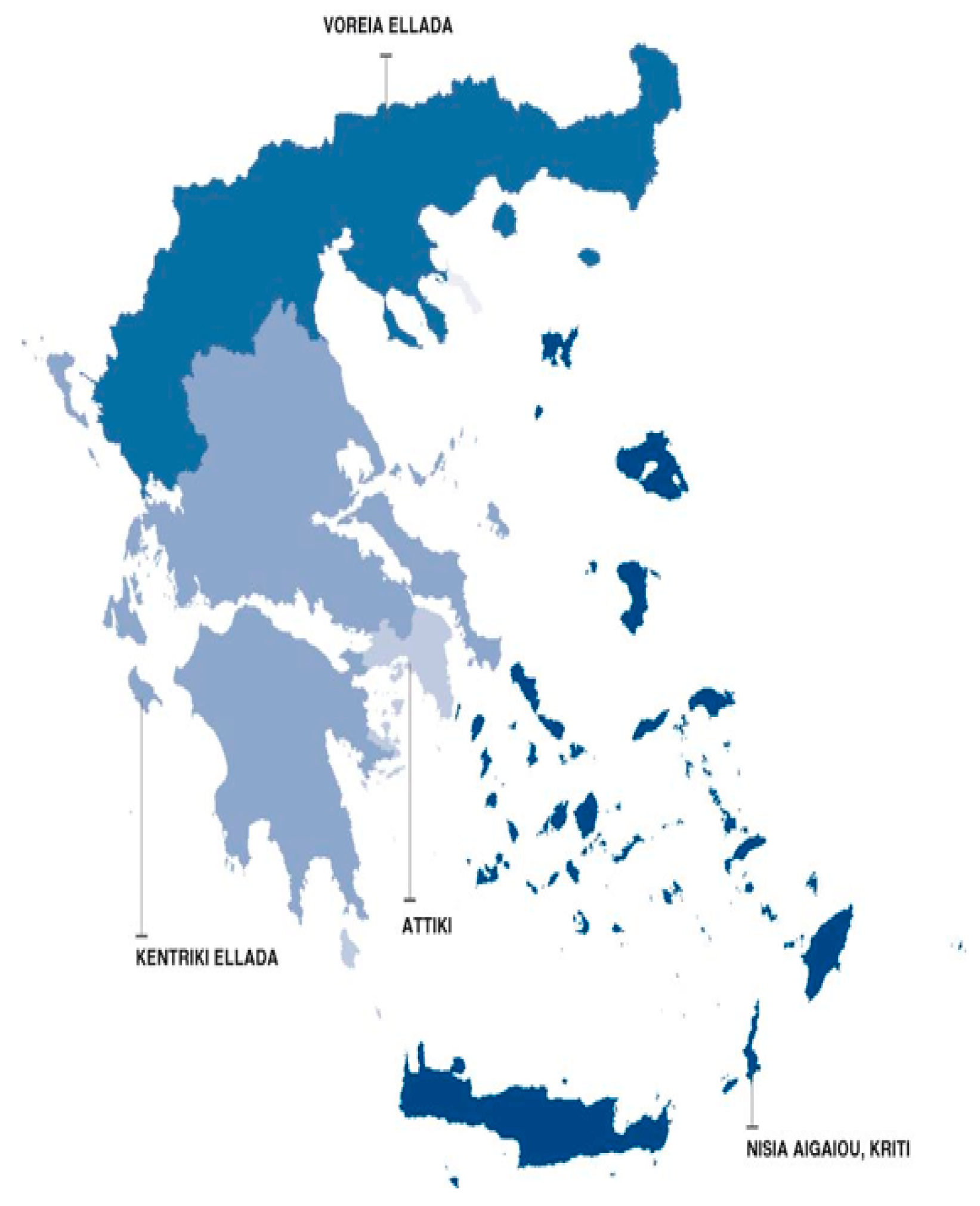
4.1. Geographic and Economic Overview
4.2. Current Agricultural Practices and Challenges
4.3. Tourism Landscape
5. AI and Precision Agriculture
5.1. AI Applications in Agriculture on the Aegean Islands
5.2. Sustainability Impacts
5.2.1. Water Efficiency
- Some of the audited entities do not apply reliable measurement systems and, as a result, lack a clear overview of the amounts of desalinated water generated by the units under their jurisdiction.
- Issues were identified with the power supply to the facilities, particularly during the summer months and on islands that are not yet connected to the Mainland High-Voltage Grid.
- Opportunities exist to reduce the environmental footprint of desalination plants, notably through assessing the feasibility of renewable energy integration and undertaking required studies to ensure brine discharge into an environmentally suitable recipient.
- While the expertise needed to operate and maintain the units is secured at the level of municipal water utilities, this is not the case for the municipalities themselves, which typically lack technical staff fully trained in desalination technology.
- No root-cause solution has been implemented to address the substantial water losses occurring in distribution networks, causing considerable waste of water.
- Although water quality parameters post-desalination are regularly checked, comprehensive monitoring systems to ensure the fitness-for-purpose of water reaching consumers remain incomplete.
- By boosting local water supplies in 2019–2020, these units proved that desalination can sustainably address water scarcity in vulnerable island communities.
5.2.2. Energy Efficiency
5.3. Carbon Sequestration and Emission Reduction
5.4. Biodiversity Enhancement Through AI-Informed Farming
5.5. Climate Adaptation: AI for Resilient Island Agriculture
5.6. Potential for Innovation
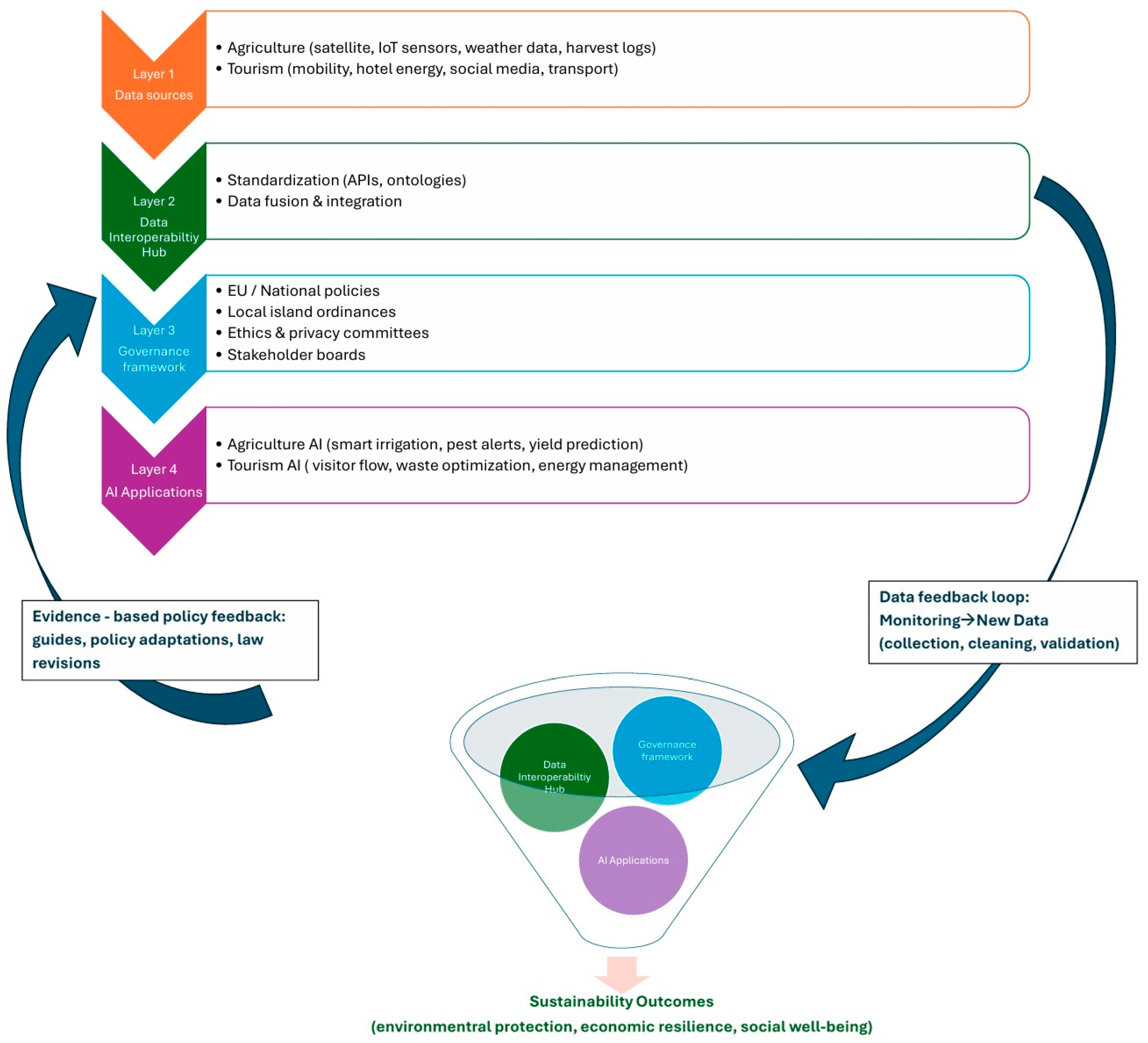
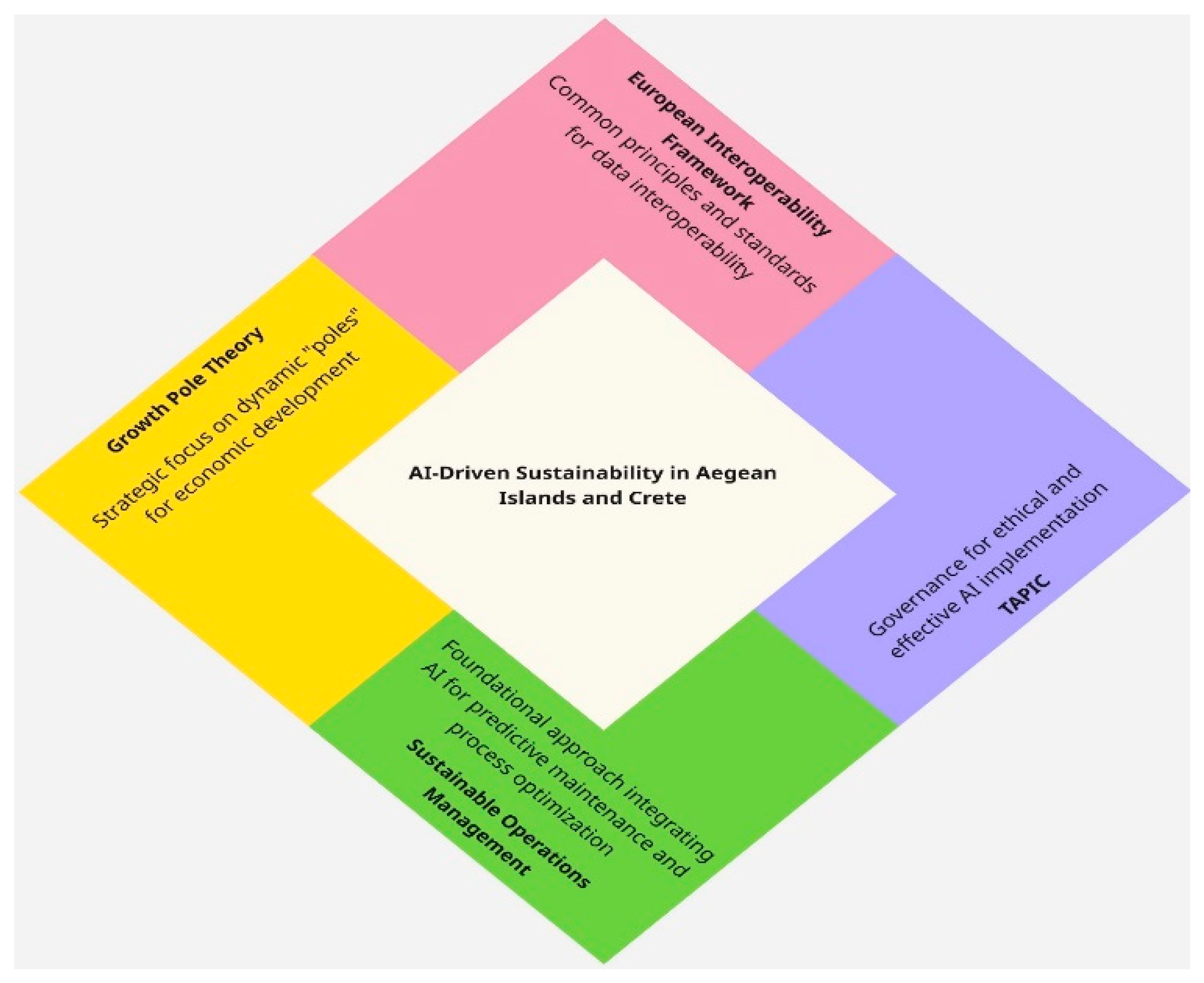
6. Governance and Policy Suggestions for AI-Driven Regional Development
6.1. Sustainable Operations Management
6.2. EIF—European Interoperability Framework
6.3. Implementation in AI, Agriculture, and Tourism for Sustainable Development
- CEADS seeks to enhance the creation of data spaces where data can flow freely between individuals and organisations, ultimately creating an internal market for data within the EU, irrespective of physical storage location. It aims to integrate both open and protected data while maintaining their distinct regulatory frameworks.
- It is outlined in the European Strategy for Data and is supported by key EU legislation, including the General Data Protection Regulation (GDPR) for personal data, the Open Data Directive for public sector information, the Data Governance Act to improve sharing conditions, and the Data Act, which clarifies data access and use from connected devices. This aims to make complying with data sharing rules effortless for smaller companies, like most farms.
- CEADS is designed to contain a wide array of agri-food data, from farm structures and processes to administrative and communication data, sourced from Earth Observation, smart machinery, and transactions. A core principle is adherence to FAIR principles (Findable, Accessible, Interoperable, and Reusable), with interoperability being a significant challenge, especially for agriculture. The European Interoperability Framework (EIF) provides foundational guidelines for achieving this.
- Expected benefits include optimised data management, new data-related services, more efficient and less costly public controls, and reduced administrative burden for farmers through automated data feeding and supporting their decision-making. However, its establishment is complex, facing economic, legal, technical, motivational, and governance barriers. Key challenges include low farmer awareness of data’s value, limited involvement in tool development, lack of trust, data quality issues, and concerns about digital skills, privacy, and technology dependency.
- A crucial aspect is a farm-centred strategy, ensuring that agri-food data spaces maximise benefits for farmers, address their concerns, and provide clear incentives for data sharing. This involves encouraging, rather than forcing, data sharing to build trust.
- Data-driven insights: AI and precision agriculture generate vast amounts of data (e.g., soil moisture, weather, crop health imagery). The EIF’s semantic interoperability ensures that this diverse data is consistently understood and exchanged between different systems and stakeholders (e.g., farmers, agronomists, AI models).
- Resource optimisation: AI-powered systems can optimise water usage, predict pest outbreaks, and recommend optimal crop rotations. This requires interoperability between sensors, IoT devices, and decision support systems to ensure seamless data flow and actionable insights. The EIF supports this by advocating for open specifications and data portability.
- Sustainability impacts: AI can enhance water and energy efficiency, reduce carbon footprint through precise fertiliser application, and support biodiversity. Interoperability facilitates the integration of various technologies and data sources to achieve these environmental benefits. For example, systems monitoring water desalination units and renewable energy production need to exchange data reliably.
- Addressing challenges: High implementation costs and data privacy concerns in agriculture can be mitigated by EIF principles. Reusability of solutions and open standards can reduce costs, and the EIF’s emphasis on security and privacy provides a framework for managing sensitive agricultural data responsibly.
- Economic diversification: Agritourism diversifies rural economies by connecting farming activities with tourism. Interoperability can link booking platforms, local farm produce inventories, and tourist information systems to create seamless experiences, enabling data exchange between different service providers (e.g., farmers, tour operators, hotels).
- Mitigating environmental pressures: Tourism in regions like the Aegean Islands can lead to water scarcity, waste management issues, and environmental degradation. AI applications can support sustainable tourism by optimising resource use and automating internal processes. The EIF’s focus on structured data exchange and common models can aid in monitoring and managing environmental impacts by integrating data from various sources related to consumption and waste.
- Policy and planning: Lack of spatial planning and uncontrolled waste disposal are problems in tourism development. The EIF, through its focus on organisational and legal interoperability, can help align different administrative entities and legal frameworks to implement integrated spatial planning and waste management strategies that support sustainable tourism [74].
- Promoting sustainable practices: Initiatives like the GR-eco Islands and “Paths of Greece” integrate sustainable farming and tourism. EIF supports this by fostering collaboration and sharing of best practices through common frameworks and platforms, ensuring that successful pilot projects can be scaled and replicated.
6.4. TAPIC—Transparency, Accountability, Participation, Integrity, Capacity
- Transparency
- Accountability
- Participation
- Integrity
- Capacity
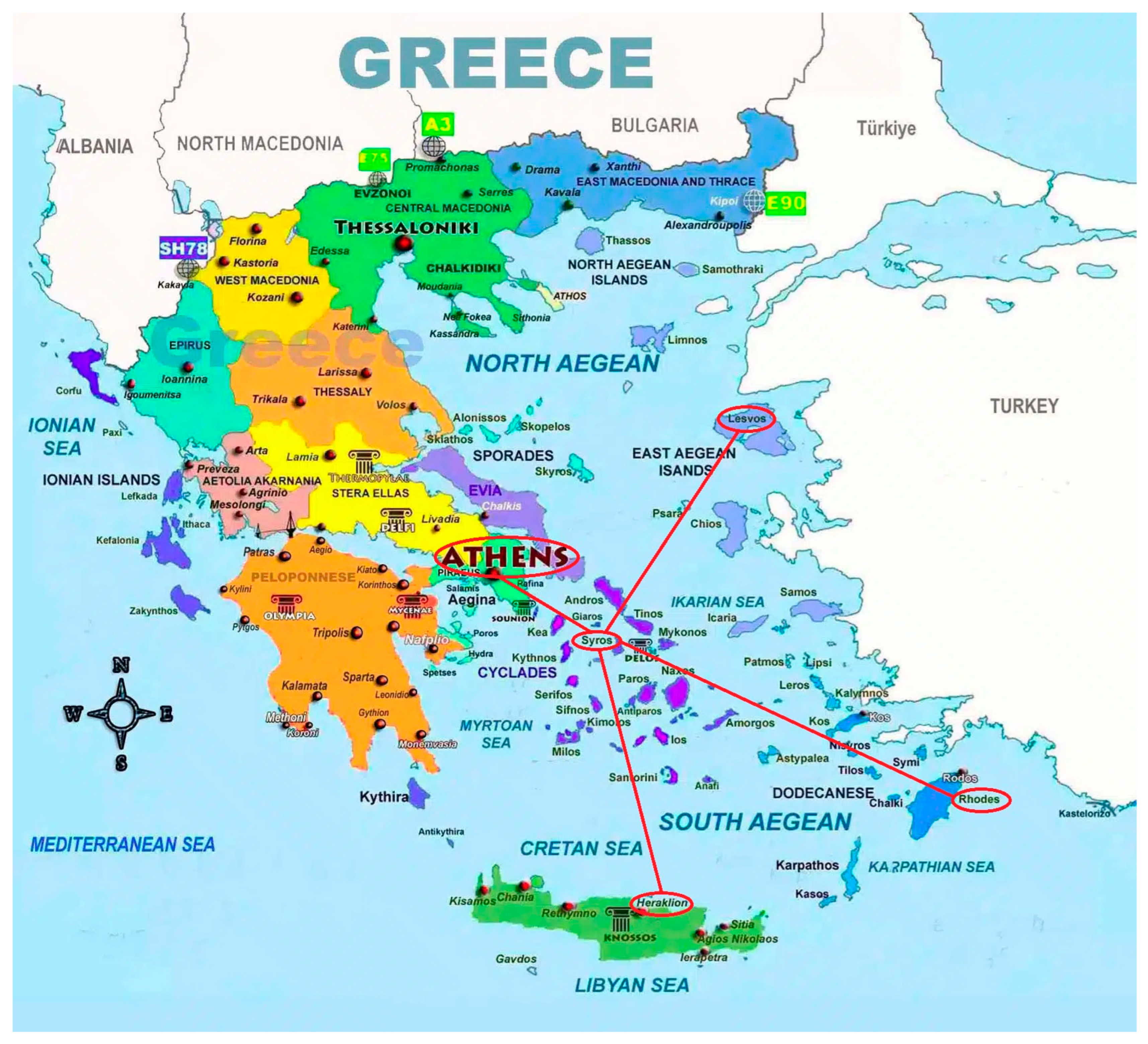
6.5. A Growth Pole Theory Proposal in the Aegean Context
- size of resident population;
- GDP/employment share;
- presence of AI-relevant institutions (universities, R&D centres, data centres);
- tourism intensity;
- transport connectivity.
7. Policy Pathways for Sustainable Development of the Aegean and Crete
7.1. Government Support and Investment
- Tourism: Data harvesting for effective development policies.
- Agriculture: Algorithmic crop health monitoring, proposed AI-powered precision irrigation systems.
- Health: Predictive analytics for chronic diseases and personalized care.
- Culture & Language: Preservation and promotion of cultural heritage.
- Sustainability: Renewable energy optimization and resource management.
7.2. Tourism and Agriculture Integration
7.3. Economic Diversification Through AI
8. Conclusions
Author Contributions
Funding
Institutional Review Board Statement
Informed Consent Statement
Data Availability Statement
Conflicts of Interest
References
- Scheraga, J. Discounting and Environmental Policy; Routledge: Abingdon, WV, USA, 2018; ISBN 978-1-351-77719-3. [Google Scholar]
- Hartwick, J.M. Substitution Among Exhaustible Resources and Intergenerational Equity. Rev. Econ. Stud. 1978, 45, 347–354. [Google Scholar] [CrossRef]
- Bishop, R.C. Economic Efficiency, Sustainability, and Biodiversity. Ambio 1993, 22, 69–73. [Google Scholar]
- Pearce, D.W.; Atkinson, G.D. Capital Theory and the Measurement of Sustainable Development: An Indicator of “Weak” Sustainability. In The Economics of Sustainability; Routledge: Abingdon, WV, USA, 2002. [Google Scholar]
- Goodland, R. The Concept of Environmental Sustainability. Annu. Rev. Ecol. Syst. 1995, 26, 1–24. [Google Scholar] [CrossRef]
- Marien, M. Environmental Problems and Sustainable Futures: Major Literature from WCED to UNCED. Futures 1992, 24, 731–757. [Google Scholar] [CrossRef]
- Tajbakhsh, A.; Nematollahi, M.; Shamsi Zamenjani, A. Migration to the Quadruple Bottom Line Framework for Achieving Sustainable Development Goals: The 4Ps of Sustainability. Ann. Oper. Res. 2024, 1–39. [Google Scholar] [CrossRef]
- Moser, L.E. The American Society of Agronomy: An Overview of One Hundred Years. In The American Society of Agronomy: 100 Years of History; John Wiley & Sons, Ltd.: Hoboken, NJ, USA, 2007; pp. 1–10. ISBN 978-0-89118-197-2. [Google Scholar]
- INSETE. Tourism’s Contribution to the Greek Economy 2020–2021. Available online: https://insete.gr/wp-content/uploads/2022/09/2020-2021_EN.pdf (accessed on 5 July 2025).
- Papadakis, N.; Kyvelou, S. Greek Islands in Crisis: Social Vulnerability and the Need for Integrated Territorial Development Strategies. Eur. Q. Political Attitudes Ment. 2017, 6, 67–88. [Google Scholar]
- Psycharis, Y.; Tselios, V.; Pantazis, P. Cohesion Policy and Household Income Inequality: Evidence from the Greek Regions. Ann. Reg. Sci. 2024, 73, 1563–1591. [Google Scholar] [CrossRef]
- A Blueprint for Greece’ s AI Transformation 2025. Available online: https://foresight.gov.gr/wp-content/uploads/2024/11/Blueprint_GREECES_AI_TRANSFORMATION.pdf (accessed on 5 July 2025).
- Lotsis, S.; Georgousis, I.; Papakostas, G.A. Big Data as a Reform Opportunity for Public Sector and Real Economy: The Case of Greece. F1000Research 2024, 13, 234. [Google Scholar] [CrossRef]
- Challenor, J.; Ma, M. A Review of Augmented Reality Applications for History Education and Heritage Visualisation. Multimodal Technol. Interact. 2019, 3, 39. [Google Scholar] [CrossRef]
- Alevizos, V.; Georgousis, I.; Simasiku, A.; Messinis, A.; Karypidou, S.; Malliarou, D. Evaluating the Inclusiveness of Artificial Intelligence Software in Enhancing Project Management Efficiency—A Review and Examples of Quantitative Measurement Methods. In Proceedings of the 2024 International Conference on Artificial Intelligence, Computer, Data Sciences and Applications (ACDSA), Victoria, Seychelles, 1–2 February 2024; pp. 1–11. [Google Scholar]
- Oliveira, R.C.d.; Silva, R.D.d.S.e. Artificial Intelligence in Agriculture: Benefits, Challenges, and Trends. Appl. Sci. 2023, 13, 7405. [Google Scholar] [CrossRef]
- van Klompenburg, T.; Kassahun, A.; Catal, C. Crop Yield Prediction Using Machine Learning: A Systematic Literature Review. Comput. Electron. Agric. 2020, 177, 105709. [Google Scholar] [CrossRef]
- Liu, S.Y. Artificial Intelligence (AI) in Agriculture. IT Prof. 2020, 22, 14–15. [Google Scholar] [CrossRef]
- Talaviya, T.; Shah, D.; Patel, N.; Yagnik, H.; Shah, M. Implementation of Artificial Intelligence in Agriculture for Optimisation of Irrigation and Application of Pesticides and Herbicides. Artif. Intell. Agric. 2020, 4, 58–73. [Google Scholar] [CrossRef]
- Su, J.; Zhu, X.; Li, S.; Chen, W.-H. AI Meets UAVs: A Survey on AI Empowered UAV Perception Systems for Precision Agriculture. Neurocomputing 2023, 518, 242–270. [Google Scholar] [CrossRef]
- Yadav, S.S.; Jadhav, S.M. Deep Convolutional Neural Network Based Medical Image Classification for Disease Diagnosis. J. Big Data 2019, 6, 113. [Google Scholar] [CrossRef]
- Liu, B.; Zhang, Y.; He, D.; Li, Y. Identification of Apple Leaf Diseases Based on Deep Convolutional Neural Networks. Symmetry 2018, 10, 11. [Google Scholar] [CrossRef]
- Sellam, V.; Poovammal, E. Prediction of Crop Yield Using Regression Analysis. Indian J. Sci. Technol. 2016, 9, 1–5. [Google Scholar] [CrossRef]
- Theodora, Y. Aegean Sea—Challenges and Dilemmas in Management and Planning for Local Development in Fragmented Insular Regions. Heritage 2019, 2, 1762–1784. [Google Scholar] [CrossRef]
- Phillip, S.; Hunter, C.; Blackstock, K. A Typology for Defining Agritourism. Tour. Manag. 2010, 31, 754–758. [Google Scholar] [CrossRef]
- Flanigan, S.; Blackstock, K.; Hunter, C. Agritourism from the Perspective of Providers and Visitors: A Typology-Based Study. Tour. Manag. 2014, 40, 394–405. [Google Scholar] [CrossRef]
- Tew, C.; Barbieri, C. The Perceived Benefits of Agritourism: The Provider’s Perspective. Tour. Manag. 2012, 33, 215–224. [Google Scholar] [CrossRef]
- OECD. OECD Artificial Intelligence and Tourism: G7/OECD Policy Paper; OECD Tourism Papers; OECD Publishing: Paris, France, 2024. [Google Scholar]
- Spilanis, I.; Vayanni, H. Sustainable Tourism: Utopia or Necessity? The Role of New Forms of Tourism in the Aegean Islands. In Coastal Mass Tourism; Bramwell, B., Ed.; Diversification and Sustainable Development in Southern Europe; Multilingual Matters & Channel View Publications: Bristol, UK, 2004; pp. 269–291. ISBN 978-1-873150-68-9. [Google Scholar]
- Swarbrooke, J. Sustainable Tourism Management; CABI: Wallingford, UK, 1999; ISBN 978-0-85199-314-0. [Google Scholar]
- The Greek Ombudsman. Sustainable Tourist Development—Framework, Infrastructure and Resources Special Report 2024. Available online: https://geotee.gr/2024/11/18/synigoros-tou-politiki-eidiki-ekthesi-gia-ti-viosimi-touristiki-anaptyxi-plaisio-ypodomes-poroi/ (accessed on 5 July 2025). (In Greek)
- Hellenic Statistical Authority. Survey on the Use of ICT in Households and by Individuals; Hellenic Statistical Authority: Athens, Greece, 2022. [Google Scholar]
- Hellenic Statistical Authority. Greece in Figures October–December 2023; Hellenic Statistical Authority: Athens, Greece, 2024. [Google Scholar]
- Gouta, P.; Konstantidelli, V.; Henderson, S.; Tzouramani, I. Mapping Stakeholders’ Perceptions of Agroecological Farming Practices Adoption in Crete, Greece. Environ. Sci. Policy 2025, 167, 104030. [Google Scholar] [CrossRef]
- Kizos, T.; Vakoufaris, H. Alternative Agri-Food Geographies? Geographic Indications in Greece. Tijdschr. Econ. Soc. Geogr. 2011, 102, 220–235. [Google Scholar] [CrossRef]
- Berg, H.; Maneas, G.; Salguero Engström, A. A Comparison between Organic and Conventional Olive Farming in Messenia, Greece. Horticulturae 2018, 4, 15. [Google Scholar] [CrossRef]
- OECD. Digital Opportunities for Better Agricultural Policies; OECD Publishing: Paris, France, 2019; ISBN 978-92-64-45984-7. [Google Scholar]
- Giannakis, E.; Bruggeman, A.; Djuma, H.; Kozyra, J.; Hammer, J. Water Pricing and Irrigation across Europe: Opportunities and Constraints for Adopting Irrigation Scheduling Decision Support Systems. Water Sci. Technol. Water Supply 2016, 16, 245–252. [Google Scholar] [CrossRef]
- Hadjigeorgiou, I. Sheep and goat farming and rural development in Greece. In Proceedings of the International Conference Celebrating Pastoral Life Heritage and Economic Development, Athens, Greece, 11–12 September 2014. [Google Scholar]
- Buhalis, D.; Costa, C.; Panyik, E. European Tourism Planning and Organisation Systems: The EU Member States; Costa, C., Ed.; Channel View Publications: Buffalo, NY, USA, 2014; ISBN 978-1-84541-432-0. [Google Scholar]
- Hege, A.; Lemke, M.K.; Apostolopoulos, Y.; Whitaker, B.; Sönmez, S. Work-Life Conflict among U.S. Long-Haul Truck Drivers: Influences of Work Organization, Perceived Job Stress, Sleep, and Organizational Support. Int. J. Environ. Res. Public Health 2019, 16, 984. [Google Scholar] [CrossRef]
- Andriotis, K. Tourism Planning and Development in Crete: Recent Tourism Policies and Their Efficacy. J. Sustain. Tour. 2001, 9, 298–316. [Google Scholar] [CrossRef]
- White, M. Digital Workplaces Vision and Reality. Bus. Inf. Rev. 2012, 29, 205–214. [Google Scholar]
- Gössling, S.; Hall, C.M.; Scott, D. Tourism and Water; Channel View Publications: Bristol, UK, 2015; ISBN 978-1-84541-500-6. [Google Scholar]
- Loukissas, P.J. The Tourism Activity Game: Concept and Applications. Tour. Manag. 1983, 4, 12–24. [Google Scholar] [CrossRef]
- Ayaz, M.; Ammad-Uddin, M.; Sharif, Z.; Mansour, A.; Aggoune, E.-H.M. Internet-of-Things (IoT)-Based Smart Agriculture: Toward Making the Fields Talk. IEEE Access 2019, 7, 129551–129583. [Google Scholar] [CrossRef]
- Mogili, U.R.; Deepak, B.B.V.L. Review on Application of Drone Systems in Precision Agriculture. Procedia Comput. Sci. 2018, 133, 502–509. [Google Scholar] [CrossRef]
- Liakos, K.G.; Busato, P.; Moshou, D.; Pearson, S.; Bochtis, D. Machine Learning in Agriculture: A Review. Sensors 2018, 18, 2674. [Google Scholar] [CrossRef]
- Deng, Y. Deep Learning on Mobile Devices: A Review. In Proceedings of the Mobile Multimedia/Image Processing, Security, and Applications 2019, Baltimore, MD, USA, 13 May 2019; SPIE: Bellingham, WA, USA; Volume 10993, pp. 52–66.
- Pearce, D.W.; David, W. Measuring Sustainable Development; Blueprint; Earthscan Publications: Oxford, UK, 1993. [Google Scholar]
- Hellenic Court of Auditors. Meeting the Water Supply Needs of Island Regions: Is the Operation of Desalination Units Efficient? 2021. Available online: https://www.Elsyn.Gr/Sites/Default/Files/ΕΚΘΕΣH%20ΕΛΕΓΧOΥ%205%20AΦAΛAΤΩΣΕΙΣ.Pdf (accessed on 5 July 2025). (In Greek)
- Winkler, D.; Haltmeier, M.; Kleidorfer, M.; Rauch, W.; Tscheikner-Gratl, F. Pipe Failure Modelling for Water Distribution Networks Using Boosted Decision Trees. Struct. Infrastruct. Eng. 2018, 14, 1402–1411. [Google Scholar] [CrossRef]
- Liu, W.; Xie, Z.; Song, Z. Predicting Water Pipe Failures Using Deep Learning Algorithms. J. Infrastruct. Syst. 2023, 29, 04023022. [Google Scholar] [CrossRef]
- Yang, A.; Zhang, H.; Stewart, R.A.; Nguyen, K. Enhancing Residential Water End Use Pattern Recognition Accuracy Using Self-Organizing Maps and K-Means Clustering Techniques: Autoflow v3.1. Water 2018, 10, 1221. [Google Scholar] [CrossRef]
- Gliozzo, A.D.; Ackerson, C.; Bhattacharya, R.; Goering, A.; Jumba, A.; Kim, S.Y.; Krishnamurthy, L.; Lam, T.; Littera, A.; McIntosh, I.; et al. Building Cognitive Applications with IBM Watson Services: Volume 1 Getting Started; IBM Redbooks: Poughkeepsie, NY, USA, 2017; ISBN 978-0-7384-4264-8. [Google Scholar]
- Hoseinzadeh, S.; Astiaso Garcia, D. Ai-Driven Innovations in Greenhouse Agriculture: Reanalysis of Sustainability and Energy Efficiency Impacts. Energy Convers. Manag. X 2024, 24, 100701. [Google Scholar] [CrossRef]
- Katsaprakakis, D.A.; Michopoulos, A.; Skoulou, V.; Dakanali, E.; Maragkaki, A.; Pappa, S.; Antonakakis, I.; Christakis, D.; Condaxakis, C. A Multidisciplinary Approach for an Effective and Rational Energy Transition in Crete Island, Greece. Energies 2022, 15, 3010. [Google Scholar] [CrossRef]
- Avtar, R.; Rinamalo, A.V.; Umarhadi, D.A.; Gupta, A.; Khedher, K.M.; Yunus, A.P.; Singh, B.P.; Kumar, P.; Sahu, N.; Sakti, A.D. Land Use Change and Prediction for Valuating Carbon Sequestration in Viti Levu Island, Fiji. Land 2022, 11, 1274. [Google Scholar] [CrossRef]
- Kroon, F.J.; Schaffelke, B.; Bartley, R. Informing Policy to Protect Coastal Coral Reefs: Insight from a Global Review of Reducing Agricultural Pollution to Coastal Ecosystems. Mar. Pollut. Bull. 2014, 85, 33–41. [Google Scholar] [CrossRef]
- Vourdoubas, J. Estimation of Carbon Emissions Due to Tourism in the Island of Crete, Greece. J. Tour. Hosp. Manag. 2019, 7, 24–32. [Google Scholar] [CrossRef]
- Brenneis, A. Assessing Dual Use Risks in AI Research: Necessity, Challenges and Mitigation Strategies—Andreas Brenneis. Res. Ethics 2024, 21, 302–330. Available online: https://www.semanticscholar.org/paper/Assessing-dual-use-risks-in-AI-research%3A-necessity%2C-Brenneis/0470ef928a87e781f31b6c77fa4d29d69e48a2d3 (accessed on 19 November 2025). [CrossRef]
- Williamson, H.F.; Brettschneider, J.; Caccamo, M.; Davey, R.P.; Goble, C.; Kersey, P.J.; May, S.; Morris, R.J.; Ostler, R.; Pridmore, T.; et al. Data Management Challenges for Artificial Intelligence in Plant and Agricultural Research. F1000Research 2023, 10, 324. [Google Scholar] [CrossRef] [PubMed]
- Jung, J.; Maeda, M.; Chang, A.; Bhandari, M.; Ashapure, A.; Landivar-Bowles, J. The Potential of Remote Sensing and Artificial Intelligence as Tools to Improve the Resilience of Agriculture Production Systems. Curr. Opin. Biotechnol. 2021, 70, 15–22. [Google Scholar] [CrossRef] [PubMed]
- Kalampokas, T.; Vrochidou, E.; Tzampazaki, M.; Papakostas, G.A. Harnessing AI in Precision Agriculture for Sustainable Kiwifruit Farming. J. Commun. Softw. Syst. 2025, 21, 120–131. [Google Scholar] [CrossRef]
- Barbir, J.; Lingos, A.; Foschi, E.; Stasiskiene, Z.; Skanavis, C.; Fletcher, C.; Leal Filho, W. Assessing the Readiness of Greek Municipalities to Manage Bioplastics in Municipal Waste Management Streams. Discov. Sustain. 2024, 5, 222. [Google Scholar] [CrossRef]
- Logothetis, I.; Kerchoulas, A.; Kourkoumpas, D.-S.; Mitsotakis, A.; Grammelis, P. An Integrated Approach to Air Quality and Waste Management Optimization for Sustainable Islands: A Case Study of Chalki, Southeast Aegean. Sustainability 2025, 17, 10842. [Google Scholar] [CrossRef]
- Alevizos, V.; Georgousis, I.; Kapodistria, A. Toward Climate Neutrality: A Comprehensive Overview of Sustainable Operations Management, Optimization, and Wastewater Treatment Methods. Pollutants 2023, 3, 521–543. [Google Scholar] [CrossRef]
- Papadopoulou, A.; Stefanakou, G.; Fougias, E. Promotion of Environmental Projects to Conform with UWWTD and Integrated Water Management. Water Pract. Technol. 2022, 17, 1421–1432. [Google Scholar] [CrossRef]
- Council Directive 91/271/EEC of 21 May 1991 Concerning Urban Waste-Water Treatment. 1991, Volume 135. Available online: https://eur-lex.europa.eu/eli/dir/1991/271/oj/eng (accessed on 21 September 2025).
- Hernandez, L.; Smith, S.R.; Schade, S. The Interoperable Europe Act: A Proposed Monitoring Framework; Publications Office of the European Union: Luxembourg, 2025; Available online: https://publications.jrc.ec.europa.eu/repository/handle/JRC139188 (accessed on 19 November 2025).
- Schmitz, A.; Pauken, C.; Kottmann, R.; Wimmer, M. Architecture Interoperability through Semantic Modelling: Domain-Driven Data Specification in Public Procurement. In Proceedings of the ECIS 2025 Proceedings, Amman, Jordan, 16 June 2025. [Google Scholar]
- Brunori, G.; Bacco, M.; Puerta-Piñero, C.; Borzacchiello, M.T.; Stormer, E. Agri-Food Data Spaces: Highlighting the Need for a Farm-Centered Strategy. Data Brief 2025, 59, 111388. [Google Scholar] [CrossRef]
- Hawkes, C.; Ruel, M.T. Understanding the Links Between Agriculture and Health; International Food Policy Research Institute: Washington, DC, USA, 2006. [Google Scholar] [CrossRef]
- Bachtler, J.; Mendez, C.; Wishlade, F. EU Cohesion Policy and European Integration: The Dynamics of EU Budget and Regional Policy Reform; Routledge: London, UK, 2016; ISBN 978-1-315-58063-0. [Google Scholar]
- Greer, S.L.; Vasev, N.; Jarman, H.; Wismar, M.; Figueras, J. It’s the Governance, Stupid! TAPIC: A Governance Framework to Strengthen Decision Making and Implementatio; European Observatory on Health Systems and Policies: Copenhagen, Denmark, 2019. [Google Scholar]
- Perroux, F. Economic Space: Theory and Applications. Q. J. Econ. 1950, 64, 89–104. [Google Scholar] [CrossRef]
- Marchand, B.; Cavin, J.S. Anti-urban Ideologies and Planning in France and Switzerland: Jean-François Gravier and Armin Meili. Plan. Perspect. 2007, 22, 29–53. [Google Scholar] [CrossRef]
- Kenney, M. Understanding Silicon Valley: The Anatomy of an Entrepreneurial Region; Stanford University Press: Redwood City, CA, USA, 2000; ISBN 978-0-8047-3734-0. [Google Scholar]
- Hansen, N.M. Development Pole Theory in a Regional Context. Kyklos 1967, 20, 709–727. [Google Scholar] [CrossRef]
- Gavrila-Paven, I.; Bele, I. Developing a Growth Pole: Theory and Reality. In Management, Organizations and Society; Routledge: Abingdon, WV, USA, 2017; ISBN 978-615-5666-04-9. Available online: https://real.mtak.hu/40590/1/Management_Organizations_and_Society-Agroinform-2017jan08-DOI_CrossRef-Chapter_3.6.pdf (accessed on 5 September 2025).[Green Version]
- Gajdošík, T.; Marciš, M. Artificial Intelligence Tools for Smart Tourism Development. In Artificial Intelligence Methods in Intelligent Algorithms; Silhavy, R., Ed.; Springer International Publishing: Cham, Switzerland, 2019; pp. 392–402. [Google Scholar]
- Agrawal, R.; Wankhede, V.A.; Kumar, A.; Luthra, S.; Huisingh, D. Big Data Analytics and Sustainable Tourism: A Comprehensive Review and Network Based Analysis for Potential Future Research. Int. J. Inf. Manag. Data Insights 2022, 2, 100122. [Google Scholar] [CrossRef]
- Adamashvili, N.; Zhizhilashvili, N.; Tricase, C. The Integration of the Internet of Things, Artificial Intelligence, and Blockchain Technology for Advancing the Wine Supply Chain. Computers 2024, 13, 72. [Google Scholar] [CrossRef]
- Caliskan, A.; Celebi, D.; Pirnar, I. Determinants of Organic Wine Consumption Behavior from the Perspective of the Theory of Planned Behavior. Int. J. Wine Bus. Res. 2020, 33, 360–376. [Google Scholar] [CrossRef]
- Ma, S. Enhancing Tourists’ Satisfaction: Leveraging Artificial Intelligence in the Tourism Sector. Pac. Int. J. 2024, 7, 89–98. [Google Scholar] [CrossRef]




| NUTS 2 Regions | Surface Area (km2) | Population Total (2021) | Population Total (2011) | Change (%) 2021/2011 |
|---|---|---|---|---|
| Northern Aegean | 3.854 | 194.943 | 199.231 | −2.2 |
| Southern Aegean | 5.305 | 327.820 | 309.015 | 6.1 |
| Crete | 8.340 | 624.408 | 623.065 | 0.2 |
| NUTS 2 Regions | Unemployment Rate (2011) | Unemployment Rate (2021) | Change (Percentage Points) 2021/2011 | GDP per Capita (2011) | GDP per Capita (2021) | Change (Thousand €) 2021/2011 |
|---|---|---|---|---|---|---|
| Northern Aegean | 15.0 | 13.8 | −1.2 | 14.500€ | 10.658€ | −3.8 |
| Southern Aegean | 15.2 | 18.8 | 3.6 | 20.600€ | 16.639€ | −4.0 |
| Crete | 15.8 | 16.3 | 0.5 | 16.000€ | 13.994€ | −2.0 |
| Category | Item/Program/Application | Brief Details |
|---|---|---|
| Currently Implemented or Piloted (Enablers and Existing Programs) | Hyperscaler Data Centers | Three hyperscalers are currently constructing large data centers in Greece to facilitate national and regional digital demand. |
| National Supercomputing Infrastructure | Greece has an existing national supercomputer and a national research and education network providing computing and cloud services to academic, research, and public institutions. | |
| “Daedalus” Supercomputer | Greece is investing in this new pre-exascale supercomputer, expected to be operational by 2025, providing necessary computational infrastructure for training and deploying advanced AI models. | |
| Pharos EU AI Factory | A strategic initiative anchored by the Daedalus supercomputer, designed to accelerate AI innovation, targeting startups and SMEs by providing access to high-quality datasets and model training capabilities. | |
| Regulatory Sandboxes | Established in various sectors (e.g., financial technology, sustainable development) to allow AI systems to be tested and refined in a controlled environment. | |
| Digital Platforms for Supply Chains (Piloted) | Platforms connecting island farmers with hotels and restaurants are currently being piloted under the GR-eco Islands program to reduce food miles and ensure fresher produce. | |
| Proposed AI Applications (Recommendations for the Aegean Islands and Crete) | AI-powered Precision Irrigation Systems | Proposed to optimize water usage in agriculture by analyzing soil moisture, weather forecasts, and crop requirements in real-time, delivering water precisely where and when needed. |
| Drones equipped with AI Algorithms | Proposed to monitor crop health, detect nutrient deficiencies, and identify pest infestations early by capturing and analyzing high-resolution images using machine learning. | |
| AI Models for Pest/Disease Prediction | Proposed to forecast outbreaks and disease spread by analyzing weather patterns and crop types, enabling farmers to take preventive measures and reduce reliance on chemical pesticides. | |
| AI-based Decision Support Systems (DSS) | Proposed to provide personalized agronomic recommendations (e.g., planting schedules, fertilizer application, crop rotation) by integrating data from satellite imagery, weather stations, and soil sensors. | |
| Offline AI Solutions/Edge Computing | Proposed as a strategy to overcome limited internet connectivity on the islands by processing AI models locally on devices like smartphones or drones. | |
| Low-tech AI Solutions (e.g., Farmer.chat analogy) | Proposed comparable AI-driven solutions to support olive growers in implementing precision irrigation and remotely monitoring greenhouse microclimates, helping to overcome digital literacy barriers. | |
| AI-driven Tourism Platforms | Proposed to provide personalized itineraries, optimize farm-based and cultural activities, and connect visitors with local producers. | |
| Visitor-flow Predictive Analytics (Santorini) | Proposed to optimize crowd management during peak tourism seasons, such as during the grape harvest. | |
| Blockchain-integrated AI systems (Crete) | Proposed to ensure product traceability, allowing tourists to follow agricultural products like olive oil or wine from the farm to the table. | |
| Heritage-focused Augmented Reality (Rhodes) | Proposed to provide a historical and cultural context of agricultural landscapes to tourists. | |
| Environmental Monitoring (Ikaria) | Proposed machine learning models and predictive scheduling to monitor and minimize the ecological footprint along herb trails and walking routes. |
| Growth Pole | Key Industries | Backward Linkages | Forward Linkages | Unique Advantage |
|---|---|---|---|---|
| Athens | AI Tech, Finance, Strategic Policy | Policy planning, software development, and academic coordination | Tourism services, export logistics, and AI research | National transport and AI hub (AEGEAN HQ) |
| Crete | Agri-tourism, Renewable Energy | Organic farming inputs, solar panel production | Farm-to-table tourism, energy exports, and AI research | 72.4% of Greece’s greenhouse tomatoes |
| Syros | Maritime, Public Administration | Shipbuilding, port infrastructure | Island-wide governance, cultural festivals | Capital of the Cyclades region |
| Lesvos | Olive Oil, Eco-tourism | Irrigation tech, packaging materials | Gastronomic tours, international exports | Proximity to the Turkish market |
| Rhodes | Cultural Tourism, Logistics | Heritage conservation, cruise ship services | Luxury resorts, medical tourism | UNESCO sites + 300 + sunshine days/year |
| Pole (Region/Island) | Population (2021 Census) | Presence of AI-Relevant/Institutional Capacity | Tourism Intensity/Sectoral Specialization 1 | Transport Connectivity (Airport/Port/Accessibility) |
|---|---|---|---|---|
| Attica (Athens) | Largest urban centre in Greece. (3,756.453) | National institutions, policy, and research centers concentrated in Athens (de facto central tech & governance hub) | Attica tops tourism revenues | National transport & connectivity hub: major airport, ports, infrastructure. |
| Crete | Largest-population Greek island (633.506) | Moderate: local economic structure includes agriculture, tourism, and fundamentals for development. | High tourism intensity: large share of hotel-bed capacity; second to national tourism receipts. | Strong connectivity: international airport(s), ports, and frequent transport links; substantial infrastructure for tourism and logistics. |
| Rhodes | Among the larger islands nationally (125.113) | Via tourism & services economy; potential to host supporting infrastructure (logistics, hospitality, heritage management) | Very high tourism intensity—part of a group of top tourist-destination islands in Greece, with strong historical/cultural tourism appeal. | Established transport connectivity—port infrastructure and airport, facilitating both cruise and air tourism. |
| Lesvos | Mid-sized island (83.755) | Some local economic activity; presence of agriculture (e.g., olive oil). | Potential for eco-tourism and agro-tourism, though tourism intensity appears lower than top-tier islands; recent efforts to boost charter arrivals. | Basic connectivity via port/regional transport; less intensive than major hubs but enough to support moderate tourism and trade. |
| Syros | Small island (21.124) | Administrative role (regional capital of Cyclades), local governance and port infrastructure may support development. | Cyclades islands show significant tourism demand, though some concentration in a few top-islands; Syros could leverage Cycladic tourism dynamics. | Port infrastructure and inter-island links (common for Cyclades) support connectivity, relevant for tourism and supplies. |
| Island | AI Tool/Application | Purpose/Use Case |
|---|---|---|
| Santorini | Visitor-flow predictive analytics | Optimize crowd management during peak tourism and grape harvest periods |
| Naxos | AI-driven agritourism platform | Personalize farm-to-table experiences, cheesemaking workshops, and vineyard visits |
| Ikaria | Environmental monitoring & predictive scheduling | Minimize ecological footprint along herb trails and walking routes |
| Rhodes | Heritage-focused AR | Provide historical and cultural context of agricultural landscapes |
| Crete | Blockchain-integrated supply tracing | Ensure traceability of agricultural products from farm to table |
Disclaimer/Publisher’s Note: The statements, opinions and data contained in all publications are solely those of the individual author(s) and contributor(s) and not of MDPI and/or the editor(s). MDPI and/or the editor(s) disclaim responsibility for any injury to people or property resulting from any ideas, methods, instructions or products referred to in the content. |
© 2025 by the authors. Licensee MDPI, Basel, Switzerland. This article is an open access article distributed under the terms and conditions of the Creative Commons Attribution (CC BY) license.
Share and Cite
Lotsis, S.; Georgousis, I.; Papakostas, G.A. AI, Precision Agriculture and Tourism for Sustainable Regional Development: The Case of the Aegean Islands and Crete, Greece. Sustainability 2026, 18, 249. https://doi.org/10.3390/su18010249
Lotsis S, Georgousis I, Papakostas GA. AI, Precision Agriculture and Tourism for Sustainable Regional Development: The Case of the Aegean Islands and Crete, Greece. Sustainability. 2026; 18(1):249. https://doi.org/10.3390/su18010249
Chicago/Turabian StyleLotsis, Sotiris, Ilias Georgousis, and George A. Papakostas. 2026. "AI, Precision Agriculture and Tourism for Sustainable Regional Development: The Case of the Aegean Islands and Crete, Greece" Sustainability 18, no. 1: 249. https://doi.org/10.3390/su18010249
APA StyleLotsis, S., Georgousis, I., & Papakostas, G. A. (2026). AI, Precision Agriculture and Tourism for Sustainable Regional Development: The Case of the Aegean Islands and Crete, Greece. Sustainability, 18(1), 249. https://doi.org/10.3390/su18010249