Integration of Digital Economy and Real Economy and the Transition Toward a Low-Carbon Economy: The Case of Chinese Provincial Regions, 2006–2023


Abstract
1. Introduction
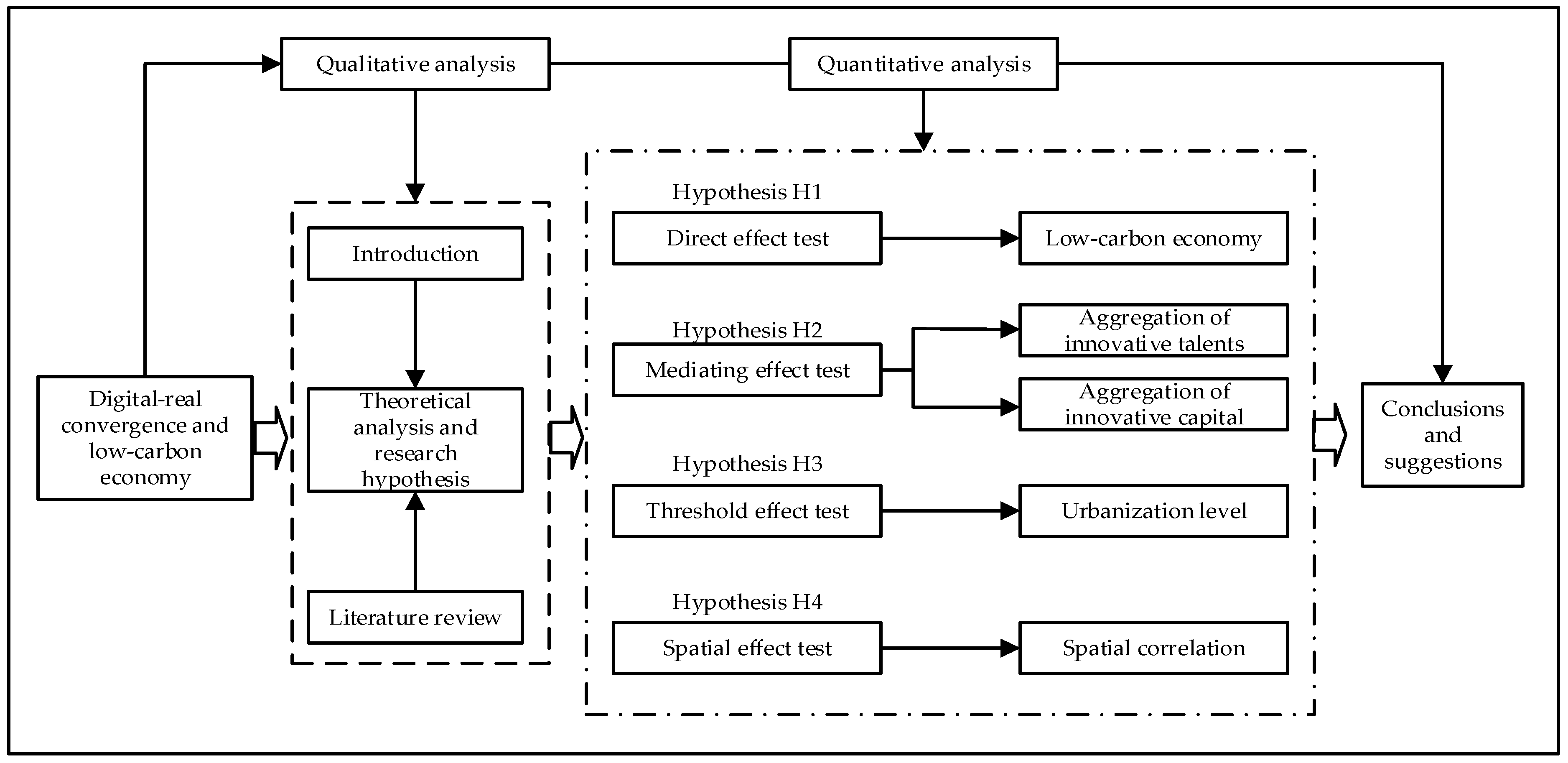
2. Theoretical Analysis and Research Hypothesis
2.1. Direct Effect Analysis
2.2. Indirect Effect Analysis
2.2.1. The Mediating Effect of Innovative Talent Aggregation
2.2.2. The Mediating Effect of Innovative Capital Agglomeration
2.3. Threshold Effect Analysis
2.4. Spatial Spillover Effect Analysis
3. Materials and Methods
3.1. Model Design
3.2. Variable Settings
3.2.1. Dependent Variable
3.2.2. Independent Variable
3.2.3. Mediating Variable
3.2.4. Threshold Variable
3.2.5. Control Variables
3.3. Data Sources
4. Empirical Result Analysis
4.1. Analysis of Benchmark Test Results
4.2. Analysis of Robustness Test Results
4.3. Analysis of Heterogeneity Test Results
4.4. Analysis of Mechanism Path Verification Results
5. Extended Discussion and Analysis
5.1. Analysis of the Threshold Effect of Urbanization Level
5.1.1. Construction of Panel Threshold Model
5.1.2. Analysis of Threshold Value Test Results
5.1.3. Analysis of Threshold Effect Test Results
5.2. Analysis of Spatial Spillover Effect
5.2.1. Model Construction
5.2.2. Analysis of Global Autocorrelation Test Results
5.2.3. Analysis of Spatial Spillover Effects
6. Conclusions
Supplementary Materials
Author Contributions
Funding
Institutional Review Board Statement
Informed Consent Statement
Data Availability Statement
Conflicts of Interest
References
- Liang, X.; Qiu, S.Y. Dilemmas in China’s low-carbon economic development and new opportunities under the “new normal”. Seek Truth 2016, 43, 54–61. [Google Scholar]
- Yuan, Z.; Lan, Y.; Zhuo, Q.; Hsu, S.C. Innovating for a greener future: Novelty in green patents and its impact on sustainable development goals in China’s construction sector. Resour. Conserv. Recycl. 2025, 213, 108025. [Google Scholar] [CrossRef]
- Zhang, X.C.; Cao, X.; Song, L.H. Research on the pollution reduction and carbon emission reduction effects of the carbon emission trading system—Empirical analysis based on the synthetic control method. J. Nat. Resour. 2024, 39, 712–730. [Google Scholar]
- Xing, B.Y. Practice, problems and countermeasures of low-carbon development in new cities and new areas in China. Macroecon. Manag. 2017, 33, 46–51. [Google Scholar] [CrossRef]
- Feng, L.L. Problems and suggestions in the construction of China’s carbon emission trading market under the “double carbon” goal. Environ. Prot. 2024, 52, 74–75. [Google Scholar]
- Ouyang, R.H. Theoretical logic and analytical framework of data factors promoting the in-depth integration of digital economy and real economy. Econ. Rev. J. 2024, 40, 67–78. [Google Scholar] [CrossRef]
- Klarin, T. The concept of sustainable development: From its beginning to the contemporary issues. Zagreb Int. Rev. Econ. Bus. 2018, 21, 67–94. [Google Scholar] [CrossRef]
- Manioudis, M.; Meramveliotakis, G. Broad strokes towards a grand theory in the analysis of sustainable development: A return to the classical political economy. J. Political Econ. 2022, 27, 866–878. [Google Scholar] [CrossRef]
- Pan, J.; Zhuang, G.; Zheng, Y.; Zhu, S.; Xie, Q. Clarification of the concept of a low-carbon economy and the analysis of its core elements. In Political Economy of China’s Climate Policy; Research Series on the Chinese Dream and China’s Development Path; Springer: Singapore, 2022. [Google Scholar] [CrossRef]
- Li, J.J.; Ma, X.F. China entering the era of low-carbon economy—Exploring a low-carbon path with Chinese characteristics. Soc. Sci. Guangdong 2009, 26, 43–49. [Google Scholar]
- Yao, X. Connotation and development trend of low-carbon economy in the new period. J. Shanxi Univ. (Philos. Soc. Sci. Ed.) 2011, 34, 140–144. [Google Scholar] [CrossRef]
- Yang, W.H.; Li, X.L.; Meng, H.Y. Evaluation of low-carbon economic development in cities of central and southern Hebei Province. China Popul. Resour. Environ. 2014, 24, 24–27. [Google Scholar]
- He, Y.; Guo, Q.Y.; Wu, B. Establishment and comprehensive evaluation of indicators for the development level of low-carbon economy. Stat. Decis. 2014, 30, 47–50. [Google Scholar] [CrossRef]
- Fu, J.F.; Zheng, L.C.; Cheng, X.L. Evaluation of domestic differences and international gaps in the development level of low-carbon economy. Resour. Sci. 2011, 33, 664–674. [Google Scholar]
- Zheng, L.C.; Fu, J.F.; Li, J.S. Evaluation of the development level and spatial process of low-carbon economy in China’s provinces. China Popul. Resour. Environ. 2011, 21, 80–85. [Google Scholar]
- Zhang, L. The impact of the digital economy on the high-quality development of Xi’an’s manufacturing industry. Appl. Math. Nonlinear Sci. 2024, 9, 1–15. [Google Scholar] [CrossRef]
- Subkhan, F.; Maarif, M.S.; Rochman, N.T.; Nugraha, Y. Digital economy: Reinforcing competitive economy of smart cities, a fuzzy-AHP approach. In Proceedings of the 2024 International Conference on ICT for Smart Society (ICISS), Bandung, Indonesia, 4–5 September 2024; pp. 1–10. [Google Scholar] [CrossRef]
- Zhou, X.H.; Liu, Y.Y.; Peng, L.Y. Digital economic development and improvement of green total factor productivity. Shanghai J. Econ. 2021, 41, 51–63. [Google Scholar] [CrossRef]
- Xu, W.X.; Zhou, J.P.; Liu, C.J. Spatial effect of digital economic development on urban carbon emissions. Geogr. Res. 2022, 41, 111–129. [Google Scholar]
- Wang, J.; Zhang, Y.; Ma, X. Digital economy, resource misallocation and total factor productivity. Financ. Trade Res. 2022, 33, 10–26. [Google Scholar] [CrossRef]
- Fang, D.L. Impact of digital economy on urban energy use efficiency in China—Based on the perspective of technological empowerment and technology spillover. Resour. Sci. 2023, 45, 296–307. [Google Scholar]
- Li, F. Inherent logic and path selection of industrial internet promoting industrial low-carbon development under the “double carbon” goal. Guizhou Soc. Sci. 2023, 44, 120–127. [Google Scholar] [CrossRef]
- Xiang, W.; Liu, T.; Gan, L. Spatiotemporal heterogeneity of the influence of industrial linkage on building carbon emission. J. Build. Eng. 2025, 100, 111772. [Google Scholar] [CrossRef]
- Li, Z.; Wang, J. The dynamic impact of digital economy on carbon emission reduction: Evidence from city-level empirical data in China. J. Clean. Prod. 2022, 351, 131570. [Google Scholar] [CrossRef]
- Fan, Y.X.; Xu, H. Can China’s digital economic development bring economic greening?—Empirical evidence from China’s inter-provincial panel data. Inq. Econ. Issues 2021, 42, 15–29. [Google Scholar]
- Lu, Y.; Yang, J. Research on the impact of technological change on corporate finance in the digital economy era. Econ. Sci. 2025, 47, 162–184. [Google Scholar]
- Li, L.; Zhang, B.; Xia, Q.Y.; Dong, J. Spatial effect and influence path of land resource misallocation on carbon emission efficiency—Empirical evidence from 108 cities in the Yangtze River Economic Belt. Resour. Sci. 2023, 45, 1059–1073. [Google Scholar] [CrossRef]
- Wang, L.; Zhou, X.Y.; Chen, M.Y. From “cultivator” to “influencer”: How digital transformation promotes green innovation development—A longitudinal case study of Inspur. China Soft Sci. 2023, 38, 146–163. [Google Scholar]
- Li, G.; Wang, Y.F.; Yan, T.W. Has digital transformation promoted rural innovation and entrepreneurship?—A quasi-natural experiment based on the “National Digital Village Pilot” policy. Economist 2024, 36, 114–124. [Google Scholar] [CrossRef]
- Xu, M.; Qi, Y.D.; Chen, S.J.; Yu, J.T. Digital economy, talent agglomeration and industrial chain modernization. Stat. Decis. 2025, 41, 105–110. [Google Scholar] [CrossRef]
- Han, S.J.; Su, J.Q. Construction of open innovation ecosystem for digitally transformed enterprises—Theoretical basis and future prospects. Stud. Sci. Sci. 2023, 41, 335–347. [Google Scholar] [CrossRef]
- Xu, B.; Guo, Q. Impact effect of digital economy on flexible employment: Based on the dual perspectives of quantity and quality. China Soft Sci. 2024, 39, 150–160. [Google Scholar]
- Rui, X.Q.; Niu, C.H.; Chen, X.G.; Fan, Y.P. Measurement and generation mechanism of the agglomeration effect of scientific and technological talents in innovation networks. Sci. Technol. Prog. Policy 2011, 28, 146–151. [Google Scholar]
- Bao, P.C.; Yin, C.J.; Yang, K. Can innovative talent agglomeration improve urban carbon emission performance?—Empirical evidence from Chinese prefecture-level cities. Res. Econ. Manag. 2025, 46, 24–42. [Google Scholar] [CrossRef]
- Wang, M.; Xu, M.; Ma, S.J. Corrigendum to “The effect of the spatial heterogeneity of human capital structure on regional green total factor productivity” [Structural Change and Economic Dynamics 59 (2021) 427–441]. Struct. Change Econ. Dyn. 2022, 61, 463–466. [Google Scholar] [CrossRef]
- Song, D.Y.; Chen, L. Research on the impact of digital technology application on enterprises’ total factor productivity—Also on solving the new “Solow Paradox”. Sci. Res. Manag. 2024, 45, 33–42. [Google Scholar] [CrossRef]
- Han, W.L.; Peng, Y.Y. Platform economic financialization and financial risk governance research. Contemp. Econ. Res. 2023, 34, 37–48. [Google Scholar]
- Huang, J.J.; Yuan, Y.J. Collaborative innovation, local official turnover and technological upgrading. Stud. Sci. Sci. 2018, 36, 1143–1152. [Google Scholar] [CrossRef]
- Han, C.; Li, C.Y. Development trend and policy orientation analysis of low-carbonization of China’s manufacturing industry. Qilu J. 2024, 51, 137–149. [Google Scholar]
- Liu, Y. The process, problems and trends of urbanization development in China. Res. Econ. Manag. 2011, 32, 20–26. [Google Scholar] [CrossRef]
- Lu, X.C. Giving play to the radiation-driven role of innovation agglomeration areas in central cities. Urban Manag. Sci. Technol. 2021, 22, 51–53. [Google Scholar] [CrossRef]
- Jin, Q.; Su, Q.X. Research on the mechanism of cross-border e-commerce platforms empowering the internationalization of small and medium-sized enterprises. Intertrade 2022, 41, 68–76. [Google Scholar] [CrossRef]
- Zhang, L.J.; Liang, Y.X.; Gong, R.R. Research on the dynamic impact of digital economy on the urban-rural income gap—Evidence from 31 provinces (autonomous regions and municipalities directly under the Central Government) in China. Inquiry Econ. Issues 2023, 44, 18–40. [Google Scholar]
- Wu, Y.H.; Xu, Q.X.; Yan, H.; Zheng, H. Digital empowerment for the open, inclusive and high-quality development of future education. Open Educ. Res. 2023, 29, 104–113. [Google Scholar] [CrossRef]
- Liu, Q.; Ma, Y.R.; Xu, S.X. Has the development of digital economy improved China’s green economic efficiency? China Popul. Resour. Environ. 2022, 32, 72–85. [Google Scholar]
- Chao, X.J.; Shen, L. Spatial spillover effect of new digital infrastructure on urban ecological efficiency in the Yellow River Basin—Analysis based on data of 97 cities along the line from 2013 to 2020. J. Shaanxi Norm. Univ. (Philos. Soc. Sci. Ed.) 2023, 52, 46–60. [Google Scholar]
- Dou, S.Q.; Wang, Q. Digital industry collaborative innovation, new quality productivity and common prosperity. Stat. Decis. 2025, 41, 18–23. [Google Scholar] [CrossRef]
- Wen, Z.L.; Zhang, L.; Hou, J.T.; Liu, H.Y. The mediating effect test procedure and its application. Acta Psychol. Sin. 2004, 49, 614–620. [Google Scholar]
- Zhou, M.; Wang, L.; Guo, J.H. Measurement and spatial-temporal comparison of the integration of digital and real economies under the background of new quality productivity—A study based on the patent co-classification method. J. Quant. Tech. Econ. 2024, 41, 5–27. [Google Scholar] [CrossRef]
- Feng, N.P.; Zhou, Y.Y.; Si, J.L.; Chen, S.Y. Analysis of the agglomeration level and development focus of regional innovation factors in China. East China Econ. Manag. 2016, 30, 80–87. [Google Scholar]
- Hansen, B.E. Threshold effects in non-dynamic panels: Estimation, testing, and inference. J. Econom. 1999, 93, 345–368. [Google Scholar] [CrossRef]


| First-Level Indicator | Second-Level Indicator | Third-Level Indicator/Units | Attribute | Weight |
|---|---|---|---|---|
| Sustainable development level of a low-carbon economy | Low-carbon output indicators | 1. Carbon productivity: GDP/carbon emissions (10,000 yuan/10,000 tons) | + | 0.0740 |
| 2. Energy processing and conversion efficiency: energy input/energy output (%) | + | 0.0720 | ||
| Low-carbon consumption indicators | 3. Carbon emissions from residents’ consumption: Carbon emissions/residents’ consumption expenditure (10,000 tons/10,000 yuan) | − | 0.0410 | |
| 4. Government consumption carbon emissions: calculated as carbon emissions divided by government consumption expenditure (10,000 tons/10,000 yuan) | − | 0.0420 | ||
| 5. Proportion of zero carbon energy: zero carbon energy consumption/energy consumption (%) | + | 0.0760 | ||
| Low-carbon resource indicators | 6. Energy carbon emission coefficient: carbon emissions/energy consumption (%) | − | 0.0330 | |
| 7. Carbon sink density: carbon sink amount/area (10,000 tons/1000 hectares) | + | 0.0730 | ||
| 8. Low-carbon economic development plan: with or without (/) | + | 0.1030 | ||
| 9. A carbon emissions monitoring, statistical, and regulatory system needs to be established: with or without (/) | + | 0.0740 | ||
| Low-carbon policy indicators | 10. Public popularization degree of low-carbon economy knowledge: popularization degree (%) | + | 0.0510 | |
| 11. The implementation rate of environmental and energy conservation standards: Implementation degree (%) | + | 0.0520 | ||
| 12. Carbon tax policy: with or without (/) | + | 0.2090 | ||
| Low-carbon environmental indicators | 13. Waste carbon emission intensity: waste carbon emissions/waste generation (%) | − | 0.0400 | |
| 14. Industrial three-waste treatment index: treatment rate (%) | + | 0.0600 |
| Element Category | Evaluation Index | Meaning of Indicators |
|---|---|---|
| Talent element | R&D personnel | 1. Personnel participating in research and experimental development activities measure the quantity and level of regional innovative talents |
| Researchers | 2. Within the R&D workforce, individuals holding intermediate (or higher) professional titles or doctoral qualifications represent the key talent pool for innovation initiatives. This group also serves as an indicator to gauge the quality of a region’s innovation-focused personnel | |
| Capital element | Intramural expenditure on R&D | 3. The real spending allocated by regional entities to their in-house R&D operations serves as a metric to assess the general scale of funds dedicated to innovation |
| Government funds | 4. The portion of R&D internal expenditure funds that comes from the government reflects the composition of innovation funds | |
| Foreign funds | 5. The portion of internal R&D expenditure funds sourced from abroad reflects the composition of innovation funds | |
| Other funds | 6. The portion of internal R&D expenditure funds derived from other sources reflects the composition of innovation funds | |
| Intensity of R&D funding input | 7. The proportion of R&D spending relative to a region’s GDP acts as an indicator to gauge how heavily that area is investing in innovation-related initiatives |
| Definition | Name | Symbol | Mean | Std | Min | Max | VIF |
|---|---|---|---|---|---|---|---|
| Dependent variable | Low-carbon economy | Low-car | 0.4840 | 0.2670 | 0.0724 | 0.9830 | 4.2500 |
| Independent variable | Digital-real convergence | Dig-rea | 0.0282 | 0.0523 | 0.0001 | 0.3050 | 1.6900 |
| Mediating variable | Innovation talents agglomeration | Inn-tal | 1.0290 | 1.0140 | 0.1850 | 5.5800 | 9.7800 |
| Innovation capital agglomeration | Inn-cap | 0.8420 | 0.5750 | 0.2010 | 3.4590 | 11.7500 | |
| Control variable | Economic development level | Econ | 10.6400 | 0.6350 | 9.1800 | 12.0700 | 3.2100 |
| Environmental regulation intensity | Envi | 0.0035 | 0.0032 | 0.0002 | 0.0167 | 1.4400 | |
| Population density | Popu | 5.4580 | 1.2820 | 2.0620 | 8.2700 | 1.9700 | |
| Financial development level | Fina | 1.3320 | 0.2680 | 0.8700 | 2.2230 | 1.8000 | |
| Human capital level | Huma | 0.0199 | 0.0064 | 0.0069 | 0.0378 | 2.3100 |
| Variable Name | Low-Carbon Economy | ||||
|---|---|---|---|---|---|
| Random Effects Model | Fixed Effect Model | IV | |||
| Dig-rea | 2.6290 *** (0.1752) | 0.8894 *** (0.1143) | 0.6005 *** (0.0732) | 0.4746 *** (0.0788) | 0.4912 *** (0.0743) |
| Econ | 0.1180 *** (0.0148) | −0.1047 *** (0.0282) | −0.1049 *** (0.0268) | ||
| Envi | −15.0473 *** (2.0472) | 2.7872 * (1.1355) | 2.7335 * (1.0794) | ||
| Popu | 0.0995 *** (0.0062) | 0.0647 (0.0565) | 0.0621 (0.0536) | ||
| Fina | 0.1443 *** (0.0263) | 0.0746 ** (0.0253) | 0.0744 ** (0.0240) | ||
| Huma | −6.2122 *** (1.6702) | 1.5885 (1.5601) | 1.6461 (1.4832) | ||
| Intercept term | 0.4103 *** (0.0114) | −1.3551 *** (0.1471) | 0.7057 *** (0.0166) | 1.1497 * (0.4976) | 1.1699 * (0.4731) |
| Obs | 540 | ||||
| Variable Name | Low-Carbon Economy | ||||||
|---|---|---|---|---|---|---|---|
| Lag Period | Increase Control | Exclude Samples | Quantile (25%, 50%, 75%) | ||||
| L. Dig-rea | 0.3922 *** (0.0822) | ||||||
| L2. Dig-rea | 0.3142 ** (0.0956) | ||||||
| Dig-rea | 0.5625 *** (0.0875) | 0.4960 *** (0.0937) | 0.6112 *** (0.1098) | 0.5176 *** (0.1243) | 0.4211 ** (0.1467) | ||
| Intercept term | 1.0640 * (0.4967) | 0.9223 (0.5440) | −0.8566 (0.6499) | 1.4075 ** (0.4432) | 1.3086 * (0.6550) | 1.2513 (0.7559) | 1.7330 (0.9564) |
| Obs | 510 | 480 | 540 | 468 | 540 | 540 | 540 |
| Variable Name | Eastern | Central | Western | Low-Carbon Economy | |
|---|---|---|---|---|---|
| Dig-rea | 0.2648 ** (0.0903) | −0.4647 (0.3823) | 2.4530 *** (0.4933) | ||
| Dig-dig | 0.4095 *** (0.0901) | ||||
| Rea-rea | 0.0068 * (0.0030) | ||||
| Intercept term | 1.2308 (0.8888) | −0.1584 (0.7828) | 0.6646 (0.5842) | 0.9262 (0.4972) | 0.6857 (0.4932) |
| Obs | 198 | 144 | 198 | 540 | 540 |
| Variable Name | Inn-Tal | Low-Car | Inn-Cap | Low-Car |
|---|---|---|---|---|
| Dig-rea | 2.6787 *** (0.4121) | 0.3811 *** (0.0859) | 0.6147 *** (0.1358) | 0.4344 *** (0.0814) |
| Inn-tal | 0.0349 ** (0.0113) | |||
| Inn-cap | 0.0655 ** (0.0211) | |||
| Intercept term | −6.0105 *** (1.5565) | 1.3595 ** (0.4970) | −0.0467 (0.8827) | 1.1527 * (0.5001) |
| Obs | 540 | |||
| Variable Name | Threshold Value | F Value | p Value | Critical Value | |||
|---|---|---|---|---|---|---|---|
| 10% | 5% | 1% | |||||
| Urba | The first threshold | 0.7351 | 12.3800 | 0.0950 | 11.6785 | 13.9025 | 24.4078 |
| The second threshold | 0.5550 | 9.0900 | 0.2300 | 11.8264 | 13.6759 | 18.5587 | |
| The third threshold | 0.5673 | 3.9200 | 0.7250 | 13.2446 | 16.0637 | 23.8739 | |
| Variable Name | Low-Car | Std | 95% CI | |
|---|---|---|---|---|
| Urba < 0.7351 | 0.1880 | (0.1519) | −0.1105 | 0.4865 |
| Urba ≥ 0.7351 | 1.5616 ** | (0.4781) | 0.6223 | 2.5009 |
| Intercept term | 1.2081 ** | (0.4149) | 0.3929 | 2.0234 |
| Obs | 540 | |||
| Year | Dig-Rea | Low-Car | ||||
|---|---|---|---|---|---|---|
| Moran Value | Z Value | p Value | Moran Value | Z Value | p Value | |
| 2006 | 0.2140 | 2.1230 | 0.0170 | 0.4450 | 3.8880 | 0.0000 |
| 2007 | 0.2380 | 2.3160 | 0.0100 | 0.3700 | 3.2720 | 0.0010 |
| 2008 | 0.2690 | 2.6010 | 0.0050 | 0.3850 | 3.3940 | 0.0000 |
| 2009 | 0.2570 | 2.5180 | 0.0060 | 0.4120 | 3.6120 | 0.0000 |
| 2010 | 0.2830 | 2.7560 | 0.0030 | 0.4650 | 4.0460 | 0.0000 |
| 2011 | 0.3330 | 3.4390 | 0.0000 | 0.3950 | 3.4840 | 0.0000 |
| 2012 | 0.3830 | 3.9150 | 0.0000 | 0.4740 | 4.1130 | 0.0000 |
| 2013 | 0.3660 | 4.1680 | 0.0000 | 0.4110 | 3.6000 | 0.0000 |
| 2014 | 0.3860 | 4.1780 | 0.0000 | 0.4120 | 3.6180 | 0.0000 |
| 2015 | 0.4020 | 4.1300 | 0.0000 | 0.3990 | 3.4980 | 0.0000 |
| 2016 | 0.3540 | 3.7900 | 0.0000 | 0.4040 | 3.5470 | 0.0000 |
| 2017 | 0.3440 | 3.3490 | 0.0000 | 0.4030 | 3.5440 | 0.0000 |
| 2018 | 0.3540 | 3.4720 | 0.0000 | 0.4680 | 4.0680 | 0.0000 |
| 2019 | 0.3170 | 3.2740 | 0.0010 | 0.4310 | 3.7670 | 0.0000 |
| 2020 | 0.3290 | 3.3270 | 0.0000 | 0.4080 | 3.5770 | 0.0000 |
| 2021 | 0.3180 | 3.1900 | 0.0010 | 0.4670 | 4.0600 | 0.0000 |
| 2022 | 0.3040 | 3.0190 | 0.0010 | 0.4240 | 3.7010 | 0.0000 |
| 2023 | 0.3190 | 3.1500 | 0.0010 | 0.4340 | 3.7920 | 0.0000 |
| Variable Name | Low-Car | W_x | Effect Decomposition | ||
|---|---|---|---|---|---|
| Direct | Indirect | Total | |||
| Dig-rea | 0.3264 *** (0.0825) | 0.4747 * (0.1979) | 0.3328 *** (0.0845) | 0.5035 * (0.1978) | 0.8363 *** (0.2135) |
| Econ | −0.1495 *** (0.0334) | 0.0576 (0.0754) | −0.1505 *** (0.0319) | 0.0515 (0.0745) | −0.0990 (0.0674) |
| Envi | 1.9743 (1.1202) | 5.1581 (2.8969) | 2.1130 * (1.0752) | 5.6646 (2.9768) | 7.7776 * (3.3154) |
| Popu | 0.1194 (0.0716) | −0.0845 (0.1549) | 0.1166 (0.0694) | −0.0708 (0.1544) | 0.0458 (0.1319) |
| Fina | 0.0645 ** (0.0204) | 0.0692 (0.0488) | 0.0654 *** (0.0198) | 0.0732 (0.0480) | 0.1386 ** (0.0509) |
| Huma | 0.8045 (1.4931) | 7.3347 (3.7494) | 0.9668 (1.4944) | 7.8870 * (3.7873) | 8.8538 * (4.1919) |
| Obs | 540 | ||||
| Variable Name | Low-Car | W_x | Effect Decomposition | ||
|---|---|---|---|---|---|
| Direct | Indirect | Total | |||
| Dig-rea | 0.3511 *** (0.0790) | 0.4594 ** (0.1411) | 0.3666 *** (0.0803) | 0.5059 *** (0.1415) | 0.8725 *** (0.1530) |
| Econ | −0.1475 *** (0.0315) | 0.0532 (0.0395) | −0.1477 *** (0.0300) | 0.0436 (0.0396) | −0.1041 ** (0.0404) |
| Envi | 1.9750 (1.0807) | 1.3368 (1.4555) | 2.1157 * (1.0403) | 1.6697 (1.4878) | 3.7854 * (1.9266) |
| Popu | 0.1629 * (0.0732) | −0.1319 (0.0975) | 0.1580 * (0.0702) | −0.1191 (0.0968) | 0.0389 (0.0848) |
| Fina | 0.0664 ** (0.0203) | 0.0153 (0.0294) | 0.0672 *** (0.0197) | 0.0203 (0.0295) | 0.0876 * (0.0368) |
| Huma | 1.6457 (1.5030) | 5.0599 ** (1.9523) | 1.8896 (1.4976) | 5.5972 ** (2.0327) | 7.4868 ** (2.6453) |
| Obs | 540 | ||||
Disclaimer/Publisher’s Note: The statements, opinions and data contained in all publications are solely those of the individual author(s) and contributor(s) and not of MDPI and/or the editor(s). MDPI and/or the editor(s) disclaim responsibility for any injury to people or property resulting from any ideas, methods, instructions or products referred to in the content. |
© 2025 by the authors. Licensee MDPI, Basel, Switzerland. This article is an open access article distributed under the terms and conditions of the Creative Commons Attribution (CC BY) license.
Share and Cite
Yu, T.; Wei, F.; Zhang, H. Integration of Digital Economy and Real Economy and the Transition Toward a Low-Carbon Economy: The Case of Chinese Provincial Regions, 2006–2023. Sustainability 2026, 18, 202. https://doi.org/10.3390/su18010202
Yu T, Wei F, Zhang H. Integration of Digital Economy and Real Economy and the Transition Toward a Low-Carbon Economy: The Case of Chinese Provincial Regions, 2006–2023. Sustainability. 2026; 18(1):202. https://doi.org/10.3390/su18010202
Chicago/Turabian StyleYu, Tingting, Fulin Wei, and Hong Zhang. 2026. "Integration of Digital Economy and Real Economy and the Transition Toward a Low-Carbon Economy: The Case of Chinese Provincial Regions, 2006–2023" Sustainability 18, no. 1: 202. https://doi.org/10.3390/su18010202
APA StyleYu, T., Wei, F., & Zhang, H. (2026). Integration of Digital Economy and Real Economy and the Transition Toward a Low-Carbon Economy: The Case of Chinese Provincial Regions, 2006–2023. Sustainability, 18(1), 202. https://doi.org/10.3390/su18010202