


Abstract
Industrial development is a fundamental driver of socio-economic progress, and industrial structure upgrading plays a vital role in advancing rural revitalization. Based on county-level panel data from Fujian Province from 2017 to 2022, this study employs Ordinary Least Squares (OLS) and spatial econometric models—including the Spatial Lag Model (SLM) and Spatial Error Model (SEM)—to empirically assess the impact of county-level industrial structure upgrading on rural revitalization, as well as its spatial transmission mechanisms. The findings reveal that: (1) an increase in the proportion of secondary and tertiary industries significantly enhances the rural revitalization development index at the 1% level of significance; (2) rural revitalization development exhibits strong spatial dependence and positive spatial spillover effects, indicating a “local club convergence” pattern among neighboring counties; and (3) the SEM outperforms OLS and SLM, suggesting that inter-county disparities in rural revitalization primarily result from spatial heterogeneities such as infrastructure and public service quality. Additionally, factors such as transportation accessibility, social public services, and per capita GDP have significant positive effects, while the impact of fiscal agricultural investment appears limited. This study provides empirical evidence to support coordinated development between industrial upgrading and rural revitalization strategies and offers policy insights for constructing an integrated and regionally synergistic framework for rural development in China.
1. Introduction
Rural revitalization represents a critical pathway toward achieving sustainable development, particularly in the context of global challenges such as climate change, resource depletion, and socio-economic inequalities [1,2]. As countries around the world strive to meet the Sustainable Development Goals (SDGs), promoting rural transformation through industrial upgrading and spatial collaboration has become an essential mechanism for fostering inclusive growth, strengthening ecological resilience, and ensuring long-term socio-economic sustainability [3]. In China, the rural revitalization strategy not only aims to address uneven development, but also aligns with broader sustainability objectives by integrating economic, social, and environmental dimensions into rural governance [4]. Against this sustainability-oriented academic backdrop, this study examines how industrial structural upgrading and its spatial spillover effects advance sustainable rural transformation at the county level.
The key to rural revitalization lies in industrial revitalization. China has issued key policy directives concerning the “three rural” issues (agriculture, rural areas, and farmers), emphasizing the need to actively develop rural wealth-generating industries, enhance agricultural efficiency, strengthen county economies, and broaden income channels for farmers. With the deepening of new-type industrialization and urban–rural integration, the county economy, serving as the core spatial unit for advancing agricultural modernization and rural revitalization, has garnered increasing attention as a driving force for development. Since the implementation of the rural revitalization strategy, improving the quality and efficiency of the county economy through industrial upgrading to achieve strong agriculture, a beautiful countryside, and prosperous farmers has become a central concern in both policy-making and academic research [5].
The prevailing view in the literature is that industrial structure upgrading promotes farmers’ income growth and mitigates the urban–rural income gap, thus serving as a crucial pathway toward advancing rural revitalization [6,7]. On the one hand, the expansion of secondary and tertiary industries at the county level, driven by industrial upgrading, helps absorb surplus rural labor, facilitates the orderly reallocation of agricultural resources toward non-agricultural sectors, and raises farmers’ income levels [8]. On the other hand, industrial upgrading entails the extension of county industrial chains and the enhancement of value chains, fostering the transformation of traditional industries through refinement, processing, and integration. This process encourages the redeployment of rural production factors and industrial capital within the county and strengthens the endogenous development capacity of both counties and rural areas [9]. Moreover, the upgrading and evolution of county industrial structures not only drive county-level economic growth but also significantly improve public service efficiency and social welfare, offering both economic support and institutional underpinnings for rural revitalization and development [10,11].
A substantial body of literature has examined the direct impact of industrial structure upgrading on rural revitalization. However, most of these studies explore the relationship without fully considering spatial dimensions, such as interregional interactions and the mechanisms through which rural revitalization effects are spatially transmitted [11]. In reality, rural revitalization at the county level is not an isolated process; rather, it is strongly shaped by spatial factors, including regional economic activities, policy diffusion, and resource flows. An increasing number of studies demonstrate that regional development exhibits significant spatial dependence and spillover effects, whereby the economic conditions in one region exert either positive or negative externalities on neighboring areas [12,13].
Although some studies have recognized the spatial spillover effects in rural revitalization and have applied spatial econometric models accordingly, important gaps remain. For instance, Shi and Yang (2022) analyzed data from nearly 40,000 townships nationwide to identify constraints on the sustainable development of China’s rural territorial system, using a mixed-methods approach to reveal patterns of differentiation [14]. Similarly, Xiang et al. (2024) applied a coupled coordination model to 2018 statistical data to measure the rural revitalization coordination index across China and used geodetectors to examine the spatial heterogeneity and its key influencing factors [15]. Nonetheless, the integration of spatial spillover mechanisms into analyses of how industrial structural upgrading drives rural development remains underexplored. In particular, empirical evidence supporting the full pathway of “industrial upgrading—spatial linkage—revitalization performance” is still limited.
In summary, although existing studies have documented the positive role of industrial upgrading in promoting rural development, three specific research gaps prevent a comprehensive understanding of how this process fosters sustainable rural revitalization within a spatial context. First, in terms of research methodology, most prior studies rely on non-spatial econometric models that implicitly assume regional independence [16]. Such an approach overlooks the inherent spatial interdependence of rural development, whereby revitalization outcomes in one county may influence those in neighboring counties through factor mobility, technology diffusion, and policy spillovers. Although some recent studies acknowledge spatial effects [14,15], they typically employ descriptive spatial analyses rather than inferential spatial econometric models, the latter of which can quantify the magnitude of spillovers and differentiate among various spatial mechanisms.
Second, regarding transmission mechanisms, the existing literature mainly examines the direct effects of industrial upgrading, offering limited insight into how these effects propagate through spatially mediated channels. Two important questions remain unresolved: Do counties with more advanced industrial structures generate positive externalities for surrounding areas (a “growth pole” effect), or do they attract resources away from neighboring regions (a “siphon” effect)? Moreover, is spatial correlation primarily driven by observable factors (such as shared infrastructure), or by unobserved common shocks that simultaneously affect adjacent areas?
Third, with respect to sustainability outcomes, prior studies often rely on narrow, economically oriented indicators of rural development (e.g., income growth, poverty reduction). This approach neglects the multidimensional nature of sustainable rural revitalization—including ecological livability, cultural vitality, and governance effectiveness—dimensions that are central to the sustainability agenda but whose spatial dynamics may differ from purely economic outcomes.
To address the existing research gaps, this study utilizes panel data from 75 agriculture-related counties in Fujian Province from 2017 to 2022. First, it evaluates and ranks the level of rural revitalization across counties by constructing a comprehensive rural revitalization evaluation index system and applying the entropy weight method. Second, it incorporates spatial econometric techniques—specifically, the Spatial Lag Model (SLM) and the Spatial Error Model (SEM)—to quantitatively examine the impact of industrial structure upgrading on rural revitalization. By establishing a theoretical framework that links industrial upgrading, spatial interaction, and revitalization outcomes, the study aims to provide a deeper understanding of the spatial mechanisms underlying rural development.
This paper contributes to the literature in two key ways. First, it enriches the evaluation system for rural revitalization performance by proposing a measurement framework that accounts for regional heterogeneity. Second, it introduces spatial econometric methods to uncover the spatial spillover effects of industrial upgrading at the county level. Based on empirical evidence from Fujian Province, the study identifies priority areas for synergistic development and differentiated policy design, offering both theoretical insights and practical guidance for promoting balanced and high-quality rural revitalization across regions.
Moreover, this study not only enhances the understanding of the relationship between industrial upgrading and rural revitalization, but also closely aligns with the broader sustainable development agenda by examining how county-level economic structural transformation fosters inclusive, resilient, and environmentally friendly rural development. By incorporating spatial spillover effects into the analytical framework, we demonstrate how regional collaboration can improve resource-use efficiency, reduce developmental disparities, and promote the long-term sustainability of rural areas. Accordingly, this research provides empirical evidence from a spatial perspective for sustainable rural transformation and offers direct policy relevance for scholars and policymakers committed to achieving the Sustainable Development Goals (SDGs), particularly those concerning poverty reduction, inclusive economic growth, and sustainable communities.
2. Theoretical Analysis and Research Hypotheses
2.1. Upgrading of County-Level Industrial Structure and Rural Revitalization
Industrial structure refers to the composition and proportional relationship among the three major sectors of the economy—primary, secondary, and tertiary—while industrial structure upgrading denotes the dynamic transformation and progressive advancement of industries during economic development. In the context of Chinese counties, this process is typically characterized by a transition from a primary industry-dominated economy to greater emphasis on secondary and tertiary industries. In traditional agricultural-based county economies, the primary sector offers limited technological value-added and a weak capacity to withstand external shocks, making it insufficient to support sustainable rural development [17]. In contrast, the secondary sector (e.g., manufacturing and processing) and the tertiary sector (e.g., services, cultural tourism, and modern logistics) exhibit greater potential for technical integration and value creation, serving as key pillars in driving industrial prosperity and improving living standards in rural areas [18,19]. Specifically, industrial structure upgrading encompasses two dimensions: the rationalization and advancement of industrial structure. The rationalization of industrial structure involves the efficient allocation and utilization of rural resources between agricultural and non-agricultural sectors, reflecting the degree of coordination among the three industries and achieving quantitative industrial optimization [20]. Advancement builds upon this foundation, representing the qualitative transformation of rural industries from low-value-added to high-value-added activities [21].
From the perspective of industrial structure rationalization, upgrading facilitates rural revitalization by fostering a diversified industrial system. Prior studies have identified industrial homogeneity as a major constraint on rural revitalization [14]. Rural areas, more so than cities, tend to concentrate on homogeneous industries that are highly dependent on climatic conditions, making outputs less predictable. Moreover, these regions primarily produce agricultural goods, which exhibit low income elasticity and generate limited earnings growth [22]. Rural producers often have weak bargaining power in the market and face significant risks [23]. Thus, a single, traditional agricultural model can no longer address the complex needs of rural development in the new era. Developing a diversified industrial system is critical to linking rural resources with economic growth and social vitality. According to Resource-Based Theory, a unique and hard-to-imitate combination of resources forms the basis for sustainable competitive advantage [24,25]. Rural areas possess distinctive natural, cultural, and ecological assets that, when activated, configured, and leveraged through industrial upgrading, can effectively promote rural revitalization.
Specifically, once industrial upgrading fosters the development of a diversified industrial system, the resilience and development potential of rural areas are significantly enhanced, laying a robust foundation for comprehensive rural revitalization. In traditional primary industry-based rural economies, production activities are heavily reliant on natural conditions and susceptible to market volatility, climate change, and other external uncertainties [22,26]. In the context of the digital economy, through the integration of secondary and tertiary industries, some villages have built industrial chains involving e-commerce, live streaming, and cold-chain logistics. These developments not only expand marketing channels but also help mitigate the challenges posed by fluctuations in output and employment [27]. Moreover, the establishment of a diversified industrial system can support social development in rural areas and strengthen the endogenous driving force for revitalization [28]. Diverse industries attract young talent, returning entrepreneurs, and social capital, fostering knowledge and technology spillovers. In particular, the rise in tertiary industries such as leisure agriculture, eco-tourism, and cultural and creative sectors has infused rural areas with a modern development ethos and has facilitated the modernization of rural governance practices [29].
From the perspective of industrial structure advancement, upgrading the industrial structure promotes rural revitalization by introducing modern technologies and enhancing inter-industry linkages in rural areas. First, industrial upgrading incorporates advanced production factors—such as technology, data, and management systems—thereby improving industrial efficiency [30]. For example, the use of sensing technologies in production, traceability and geolocation tools in distribution, and big data analytics in marketing can significantly enhance the added value of agricultural products. These technologies not only facilitate early detection of natural risks but also help resolve mismatches in supply and demand, enabling the precise delivery of high-quality agricultural goods tailored to market preferences [31]. At the same time, digital platforms such as e-commerce and mobile payment systems have expanded market access and restructured traditional agricultural sales channels, effectively addressing issues like “information silos” and “sales bottlenecks” [32]. According to endogenous growth theory, technological progress is the fundamental driver of long-term economic growth [33]. As the industrial structure shifts toward more technology-intensive sectors, the diffusion of advanced technologies promotes deeper utilization of rural resource endowments, revitalizes traditional industries, and generates new employment opportunities and business models, thus strengthening the endogenous momentum of rural revitalization [34].
Second, the advancement of industrial structure emphasizes higher-order integration and synergies across the primary, secondary, and tertiary sectors. In the practice of rural revitalization, this structural transformation has fostered stronger linkages between agriculture, industry, and services [35]. Emerging integration models such as “agriculture + processing,” “agriculture + tourism,” and “agriculture + e-commerce” not only extend the agricultural value chain but also create diversified employment opportunities and improve the rural labor allocation structure [8]. In this process, agriculture, traditionally positioned at the lower end of the value chain, has become a catalyst for attracting production factors to rural areas by extending into upstream and downstream industries. This has enhanced rural productivity, raised farmers’ incomes, and further propelled the process of rural revitalization [36]. Based on the above analysis, we propose the following research hypothesis:
H1.
The upgrading of county-level industrial structure significantly promotes rural revitalization.
2.2. Spatial Spillover Effects of County Rural Revitalization
In the theories of regional economics and geo-economics, space is not merely a neutral backdrop but a critical determinant of developmental disparities and regional interactions. As a comprehensive initiative involving multidimensional goals—spanning industry, ecology, organization, culture, and livelihood—the process of rural revitalization is profoundly influenced by spatial proximity. A growing body of research suggests that the level of rural revitalization in a given county is not solely determined by its internal resource endowment or policy execution capacity but is also significantly affected by the development levels of adjacent regions, exhibiting clear spatial dependence and spillover effects [37]. According to New Economic Geography theory, inter-county development does not occur in isolation due to factors such as economies of scale, transportation costs, and the agglomeration of production elements [38]. These dynamics allow economically dominant countries to exert a spillover effect on adjacent countries, particularly those with strong economic ties, thus catalyzing broader regional revitalization [39].
Similarly, the club convergence hypothesis posits that economic growth or social development indicators tend to converge among regions sharing structural similarities, developmental trajectories, or institutional environments [40]. In the context of rural revitalization, counties with geographic proximity, accessible transportation, cultural affinity, and similar policy support are more likely to form a “development club,” co-evolving along a shared developmental trajectory [41]. Specifically, as rural revitalization progresses in core counties, its radiating effect can spill over into neighboring areas via industrial value chain linkages, infrastructure interconnectivity, shared markets, and other mechanisms. These spillovers enable less developed countries to “hitchhike” on technology diffusion and resource flows, gradually closing development gaps and entering the same “club” [42]. Moreover, geographically adjacent counties often share similar institutional environments, governance models, and policy frameworks [43]. When one county achieves notable success in rural revitalization, neighboring regions frequently engage in policy learning and imitation, establishing comparable governance architectures and policy paths, which in turn foster synchrony in regional development.
These “local club group” characteristics are evident in numerous practical cases across China. For instance, in the Yangtze River Delta, counties in southern Jiangsu and northern Zhejiang have achieved high levels of synergy in agricultural modernization, ecological governance, and urban–rural integration by jointly developing rural revitalization demonstration zones. In the Chengdu–Chongqing Economic Circle, counties in eastern Sichuan and western Chongqing have established a “regional synergy–policy response–benefit sharing” mechanism through collaborative agricultural chain integration and environmental co-governance. In Shandong Province, the implementation of the “Qilu Model of Rural Revitalization” has fostered a path of synergistic development—characterized by brand agriculture, cultural–tourism integration, and village strengthening, in numerous counties on the Jiaodong Peninsula, reflecting distinct features of spatial linkage and development convergence. In conclusion, the revitalization outcomes of neighboring counties can significantly shape a county’s own developmental trajectory, facilitating the emergence of geographically based “development clubs” and reinforcing intra-group positive feedback through collaborative mechanisms. Based on the above analysis, we propose the following research hypothesis:
H2.
The higher the level of rural revitalization in neighboring counties, the higher the rural revitalization index in a given county, indicating the presence of a “local club group” effect.
2.3. Summary of the Theoretical Framework
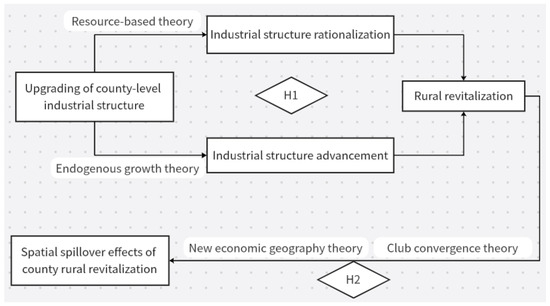
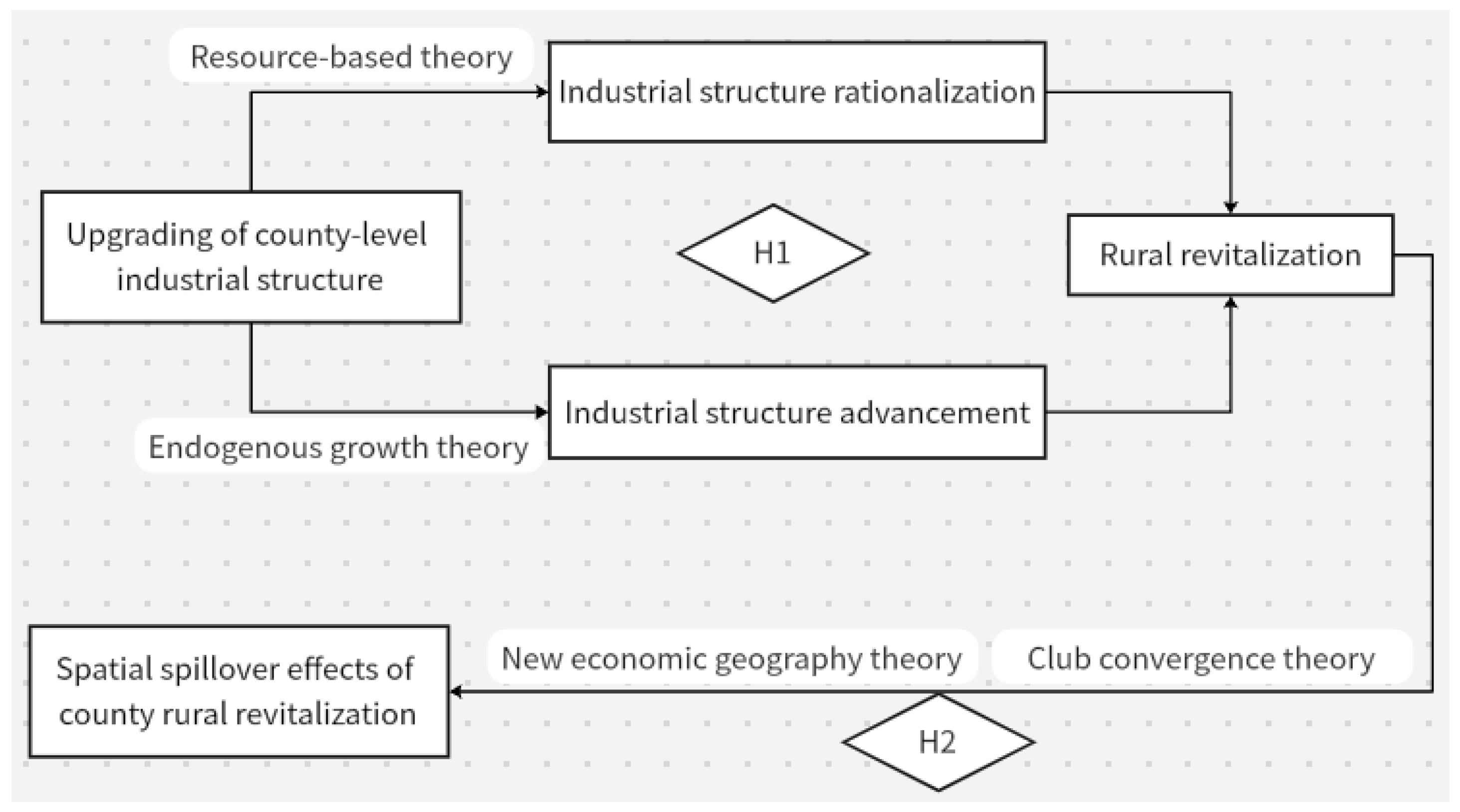
Taken together, the development of our hypotheses is grounded in four complementary theoretical foundations. First, the resource-based theory provides a micro-level foundation [24], positing that rural areas can transform their unique natural, cultural, and ecological endowments into sustainable competitive advantages through industrial restructuring. Second, endogenous growth theory highlights technological progress and knowledge spillovers—accelerated by industrial upgrading—as fundamental drivers of long-term rural development [33]. These two theories form the basis for deriving Hypothesis H1.
Third, new economic geography theory explains the spatial dimension by emphasizing how economies of scale [38], transportation costs, and factor mobility generate agglomeration effects and spatial interdependence across counties. Fourth, club convergence theory offers a macro-structural perspective [40], predicting that counties with similar initial conditions, institutional environments, and spatial linkages will converge toward comparable development trajectories. These two theories underpin the development of Hypothesis H2.
Drawing on these theoretical insights, we present Figure 1 to provide a clearer illustration of the logic linking the theoretical foundations to hypothesis development.
Figure 1.
Theoretical framework.
3. Research Design
3.1. Model Specification
3.1.1. General OLS Model
To investigate the factors influencing the rural revitalization development index across counties in Fujian Province, this study employs a spatial econometric approach grounded in the constant coefficient spatial regression framework proposed by Anselin et al. (2008) [44]. Specifically, we construct both the Spatial Lag Model (SLM) and the Spatial Error Model (SEM) to account for potential spatial dependence and spatial spillover effects. According to the research design, we first estimate a baseline Ordinary Least Squares (OLS) model to examine the impact of industrial structure upgrading on the rural revitalization index. The benchmark regression model is specified as follows:
where denotes the rural revitalisation development index for county i; is the constant term; denotes the coefficients corresponding to the core explanatory variables (), denotes some columns of control variables, and the random error terms are independent of each other and obey ∼(0, σ2) distribution.
3.1.2. Spatial Regression Model
Spatial Lag Model (SLM)
The spatial lag model (SLM) is used to study the spatial spillover effect of the development of the rural revitalization index of neighboring regions on the rural revitalization index of the county, integrating the above variables, the spatial lag model (SLM) of the impact of the upgrading level of the county industrial structure on the rural revitalization index can be set as follows:
Spatial Error Model (SEM)
The spatial error model (SEM) is mainly used to measure the degree of influence of the error shocks of the dependent variable in the neighboring regions on the observations in the region, and its general expression is as follows:
From Equation (4):
Substituting Equation (5) into Equation (3), the model expression is organized as:
The parameter λ measures the spatial dependence among observational units in the sample. Unlike the spatial lag model, which accounts for spatial dependence through the dependent variable itself, the spatial error model captures spatial dependence in the magnitude of the perturbation errors among observational units. This reflects the extent and direction of how error shocks in neighboring regions influence the dependent variable in a given region.
How can one determine whether a spatial lag model or a spatial error model is more appropriate? The literature generally proposes two main criteria. First, one may assess the statistical significance of the Lagrange multiplier for the spatial lag model (LMLAG) and the Lagrange multiplier for the spatial error model (LMERR). If LMLAG is more significant, the spatial lag model is preferred; otherwise, the spatial error model is selected. Second, according to Anselin et al. (2008) [44], model selection can be based on several goodness-of-fit indicators, including the coefficient of determination (R2), the natural log-likelihood function (LogL), the likelihood ratio (LR), the Akaike information criterion (AIC), and the Schwarz criterion (SC). Higher LogL values and lower AIC and SC values indicate a better model fit. These metrics are also used to compare the classical linear regression model estimated via ordinary least squares (OLS) with the spatial lag model (SLM) and the spatial error model (SEM), with the model exhibiting the highest LogL generally considered the best-fitting model.
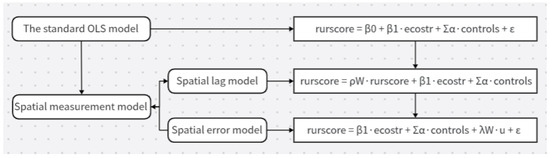
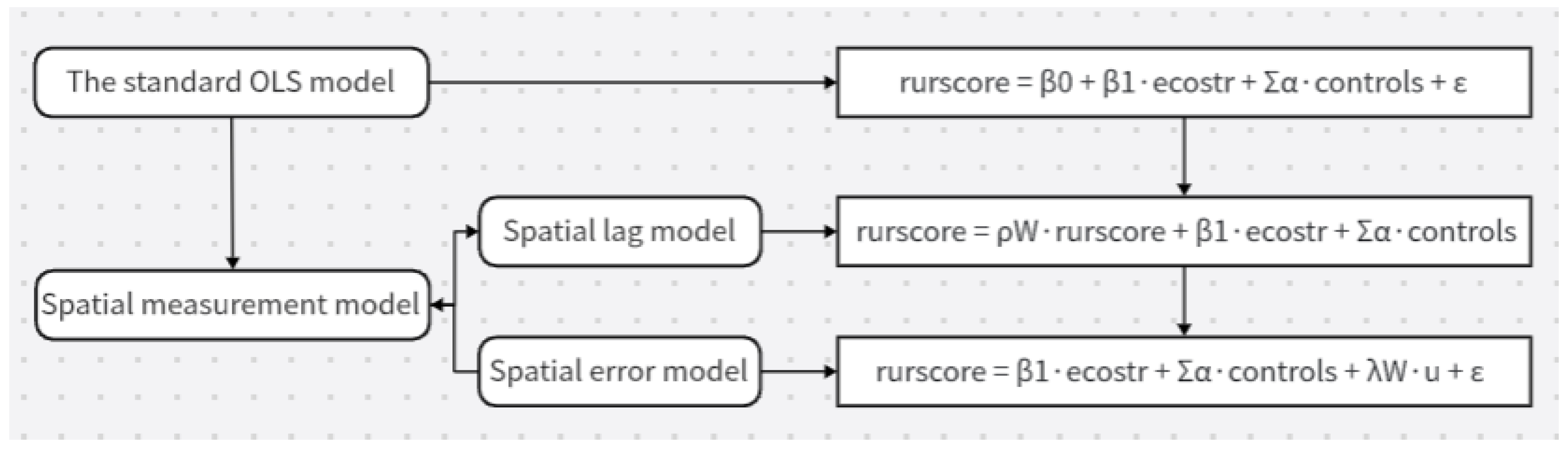
Figure 2 presents the conceptual framework of our modeling strategy. We adopt a hierarchical modeling approach: beginning with a baseline OLS model to establish the initial relationships, followed by spatial econometric models (SLM and SEM) to account for spatial interdependence. This structured approach ensures methodological rigor while maintaining transparency in our analytical choices.
Figure 2.
Model summary.
3.2. Variables
3.2.1. Explained Variable
The explained variable used in this study is the rural revitalization development index (rurscore). Drawing on existing literature on methods for measuring the level of rural revitalization in China [3,16,45], this paper constructs an evaluation system comprising five key dimensions of rural revitalization: industrial prosperity, ecological livability, a civilized countryside, effective governance, and an affluent life. These dimensions serve as subsystems and are measured using 25 specific indicators (see Table 1). Due to data limitations, the per capita indicators represent the average values of urban and rural areas at the county level. The entropy method is employed to conduct a comprehensive evaluation of rural revitalization development, offering the advantage of reducing the subjectivity associated with expert judgment and allowing for a more objective assessment of each indicator’s significance. The specific calculation procedure involves six steps: (1) standardize each indicator; (2) determine indicator weights via the entropy method; (3) calculate the entropy value; (4) compute the coefficient of variation; (5) determine the final weights; and (6) calculate the composite score.
Table 1.
Evaluation indicator system for county rural revitalisation development in Fujian.
3.2.2. Explanatory Variable
The core explanatory variable used in this study is county industrial structure upgrading (ecostr). Industrial structure upgrading refers to the process of transitioning from a lower to a higher stage of industrial development, aimed at achieving optimal county-level economic efficiency. This process is reflected in the transformation of the industrial structure toward more advanced sectors [46]. Following previous studies [9,17,46], this paper adopts the ratio of the combined output of secondary and tertiary industries to the county’s gross domestic product (GDP) as a proxy for the level of industrial structure upgrading. A higher ratio indicates a more advanced industrial structure, which is expected to drive rural development. Thus, the industrial hierarchy is anticipated to play a positive role in promoting rural revitalization at the county level.
3.2.3. Control Variables
To isolate the effect of industrial upgrading and control for other potential determinants, we incorporated four categories of control variables following the prior literature [16]. (1) County Economic Development: Key indicators include county per capita GDP and industrial structure. Per capita GDP is a comprehensive metric for assessing the level of economic development and is a foundational driver of rural revitalization. Generally, a higher per capita GDP corresponds to a more developed rural sector; hence, this indicator is expected to have a positive effect on rural revitalization. (2) Location Conditions: Transportation infrastructure significantly affects both economic performance and rural revitalization. This study uses highway density, measured as the ratio of rural road mileage to county land area, as a proxy for county traffic conditions. This indicator reflects the quality of regional infrastructure. Theoretically, better transportation conditions are associated with higher levels of rural development and are thus expected to positively influence the revitalization index. (3) Agricultural Development Conditions: Agricultural advancement often requires strong public support. Since the implementation of the rural revitalization strategy, government financial investment in agriculture has increased. This paper measures government support via the ratio of agricultural fiscal expenditure to total county fiscal expenditure, which is expected to have a positive effect. Additionally, to represent the agricultural production structure, we use the ratio of food crop to cash crop cultivation area. A higher ratio indicates a more undiversified rural economy and is expected to have a negative impact on the revitalization index. (4) Social Public Services: Two indicators are used to assess the quality of county-level social services. The level of education and culture is measured by the ratio of full-time rural teachers to the rural population. Social security is proxied by the ratio of rural pension insurance participants to the rural population. A higher value suggests stronger social protection, which is conducive to rural revitalization, and is therefore expected to positively influence the revitalization index.
3.3. Data Sources and Descriptive Statistics
Fujian is a predominantly hilly province characterized by long-term developmental constraints such as high population density, limited arable land, and dispersed resources, making it a representative case for agricultural modernization and county-level industrial optimization. In recent years, the province has actively advanced the development of “whole industry chain agriculture,” rural leisure tourism, agricultural product processing, and other emerging forms of rural business, leading to a structural evolution from a primarily primary-sector focus to a more diversified and integrated county industrial structure. At the same time, Fujian exhibits pronounced regional disparities, with marked differences in infrastructure, public services, and transportation conditions across counties and cities, thereby providing an ideal sample for the analysis of spatial linkage effects. To this end, this study constructs a balanced panel dataset covering 75 counties (or county-level cities) from nine prefectural-level cities in Fujian Province (excluding municipal districts) for the period 2017–2022. The data for relevant variables are drawn primarily from the Fujian Provincial Statistical Yearbook (2018–2023), the China County (City) Socio-Economic Statistical Yearbook, and statistical yearbooks of each prefectural-level city in Fujian. To control for the effects of inflation, all monetary variables are adjusted based on the 2016 constant price index. Descriptive statistics for all variables are presented in Table 2.
Table 2.
Descriptive statistics for key variables.
3.4. Other Statistical Results
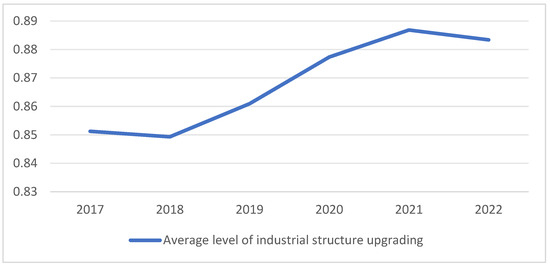
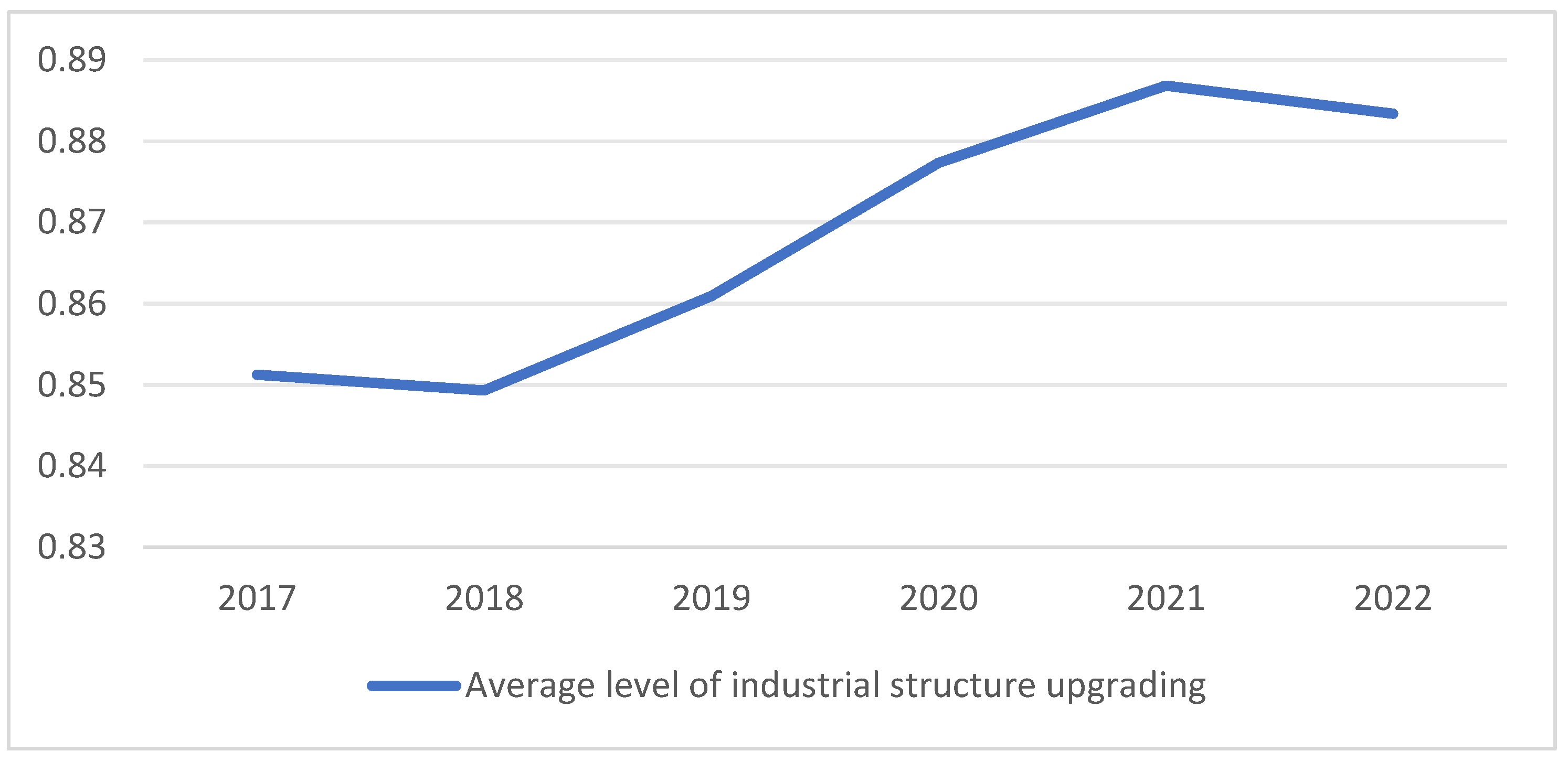
In this section, we present several key descriptive statistics to provide an initial foundation for the empirical findings. First, we calculate the average shares of the secondary and tertiary sectors across all counties during the sample period. As shown in Figure 3, the average proportions of both sectors exhibit an overall upward trend over time, indicating that the process of industrial upgrading is clearly observable in the time series for all counties in the sample.
Figure 3.
Average industrial structure upgrading status in counties.
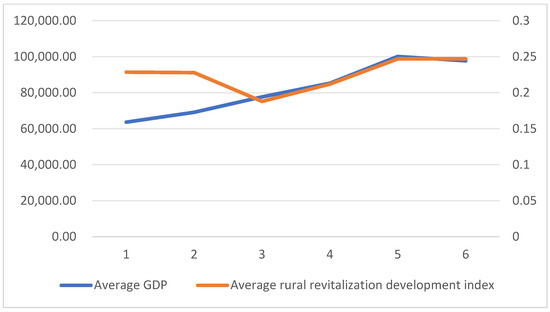
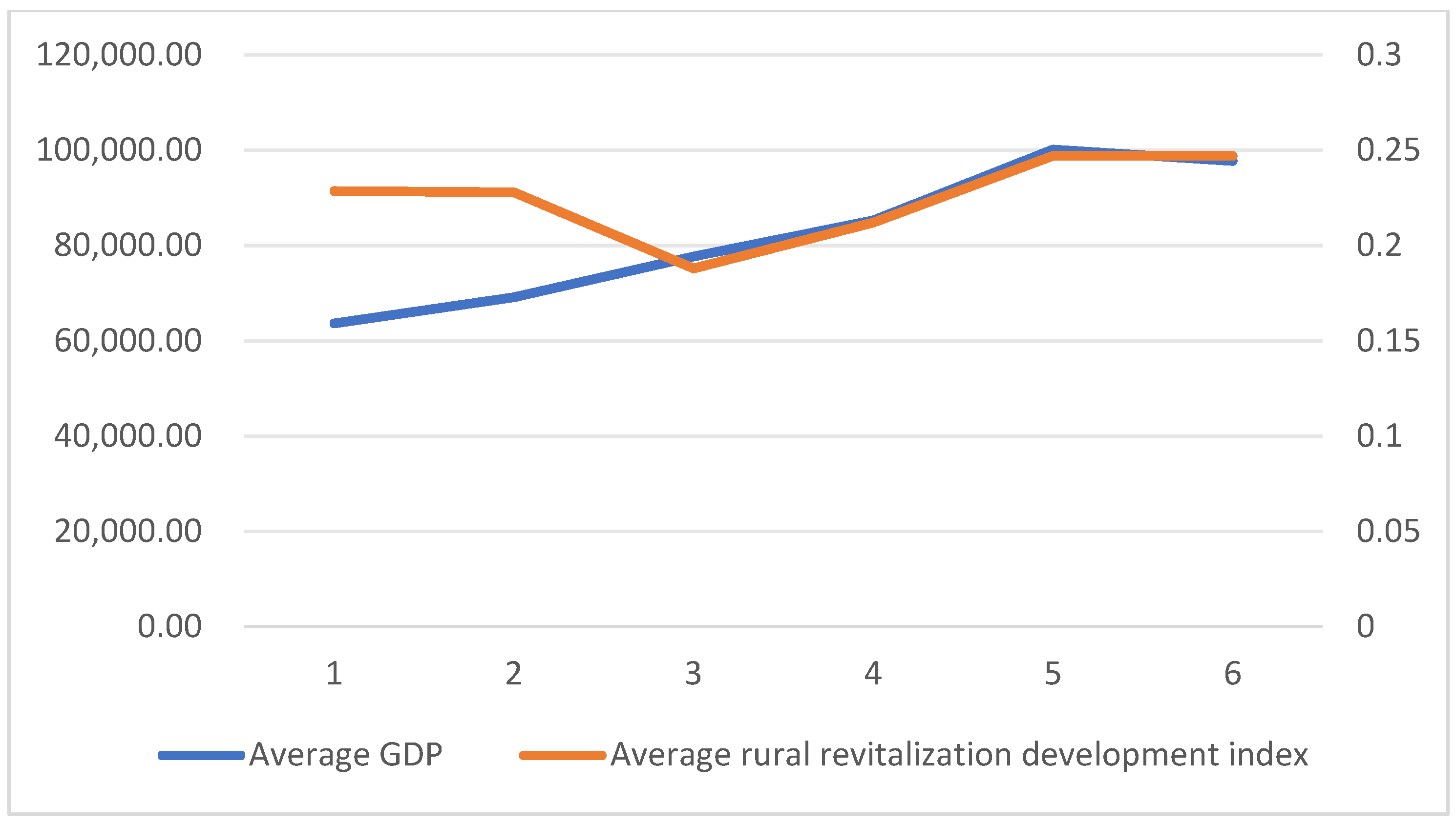
Second, we compute the average rural revitalization development index and the average county-level per capita GDP across all counties during the sample period to examine their respective trends. As shown in Figure 4, the overall trajectories of the average rural revitalization index and the average per capita GDP move in tandem over the sample period. This descriptive evidence provides preliminary support for the notion that rural revitalization is associated with broader economic development.
Figure 4.
Trends in average rural revitalization and per capita GDP across counties.
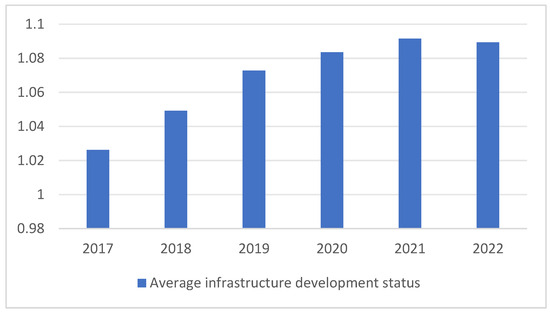
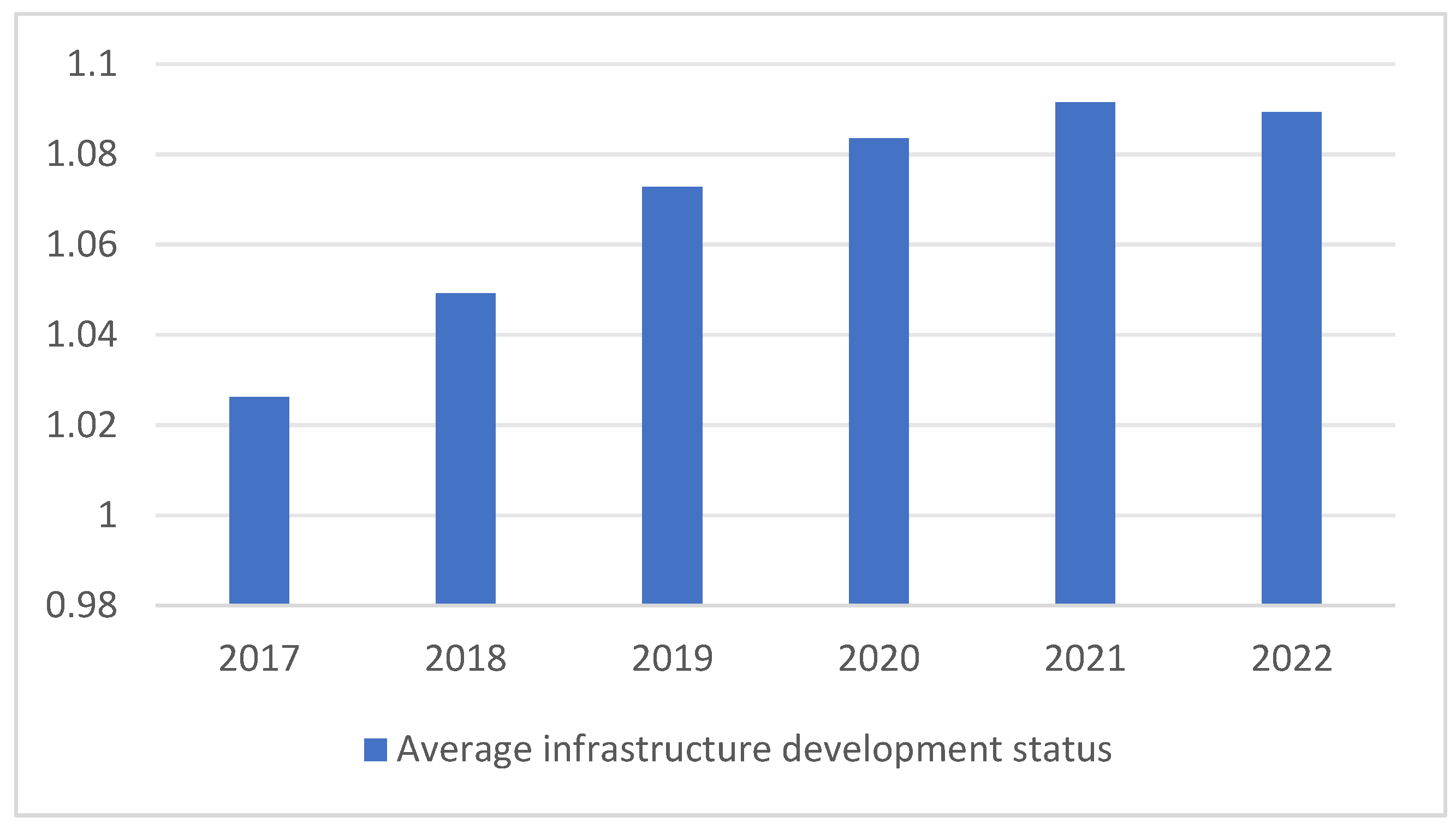
Third, we compute the average level of infrastructure development across counties during the sample period. As shown in Figure 5, the average county-level infrastructure exhibits a general upward trend over the sample period, indicating continuous improvements in infrastructure conditions.
Figure 5.
Average infrastructure development status in counties.
Finally, Fujian Province exhibits pronounced topographical characteristics that fundamentally shape its economic geography and rural development patterns, making it an ideal empirical setting for examining spatially mediated rural revitalization. Commonly described as “eight parts mountain, one part water, and one part farmland,” Fujian presents a developmental environment in which constraints and opportunities coexist at the county level. The province displays a clear coastal–inland dual structure. The southeastern coastal belt—including the Fuzhou–Zhangzhou–Quanzhou–Xiamen corridor—is characterized by relatively flat alluvial plains and basins. This terrain has historically facilitated the early development of transportation infrastructure, urbanization, and industrial agglomeration. In contrast, the northwestern inland region—encompassing the Wuyi and Daiyun mountain ranges—is marked by rugged terrain, deep valleys, and very limited arable land. Such physical segmentation restricts large-scale agriculture, raises infrastructure construction costs, and reduces inter-county connectivity.
This topographical divide is directly reflected in the province’s industrial patterns. Coastal counties, benefiting from accessible terrain and port conditions, have more successfully developed manufacturing, logistics, and service industries. Mountainous counties, constrained by their physical geography, have historically relied on forestry, agriculture, and resource extraction. Their industrial upgrading faces inherent geographic obstacles, helping to explain why structural transformation is spatially uneven.
Topography also profoundly shapes both the mechanisms and intensity of spatial spillovers. In the coastal plains, minimal physical barriers allow relatively free flows of labor, goods, and ideas, fostering the “local club convergence” observed in our SEM results. Adjacent counties can easily share infrastructure networks, supply chains, and markets. By contrast, in the mountainous inland region, high ridges and deep valleys act as natural barriers that fragment economic space. Even geographically adjacent counties may have weak functional connectivity due to poor transportation links across rugged terrain. This helps explain why spatial dependence in these areas operates more through shared structural constraints—captured by the error correlation in the SEM—rather than through direct economic interactions, which would have been more strongly reflected in the SLM.
4. Empirical Result
4.1. Model Judgement
This study employs empirical methods to estimate mixed OLS, spatial lag model (SLM), and spatial error model (SEM) specifications, including both spatial fixed effects and random effects models. The results are reported in Table 3. Compared to the ordinary panel data model, both the SLM and SEM, which account for spatial geographic influences, demonstrate superior model fit. This is likely due to the omission of spatial error autocorrelation in the OLS specification, which results in model misspecification—a finding consistent with the earlier spatial dependence tests. Therefore, spatial factors should not be ignored when analyzing the determinants of rural revitalisation and development. Although the two-way fixed effects models within both the SLM and SEM frameworks exhibit better log-likelihood values compared to other specifications, they fail to fully capture the influence of spatial effects. As such, this study focuses on time-fixed specifications of the SLM and SEM. The model selection is based on the log-likelihood criterion, where a higher value indicates a better fit. Given that the log-likelihood of the fixed-effects SEM (431.433) exceeds that of the corresponding SLM (383.419), the fixed-effects SEM is selected to interpret the determinants of the rural revitalisation development index.
Table 3.
Spatial lag model, spatial error model estimation results.
4.2. Main Results
In the spatial autocorrelation analysis of the county-level rural revitalisation development index, the results indicate that both the index and related indicators exhibit significant spatial autocorrelation. When selecting between fixed-effects and random-effects models for spatial panel estimation, the Hausman test is employed as the statistical basis. In combination with the characteristics of the 75 counties included in the cross-sectional dataset and drawing on the findings of prior research, the fixed-effects model emerges as the more appropriate specification relative to the random-effects model. Accordingly, this study focuses on the estimation results of the spatial lag model (SLM) and spatial error model (SEM) under fixed-effects settings. The corresponding results are presented in Table 3.
4.2.1. Hypothesis 1 Test: Industrial Upgrading and Rural Revitalization
The estimation results of both the spatial lag and spatial error models in Table 3 indicate that industrial structure upgrading at the county level exerts a significantly positive effect on rural revitalization, thereby providing support for our hypothesis H1. Specifically, the impact of the county industrial structure on the rural revitalization development index is statistically significant at the 1% level across both the OLS and spatial regression models. This suggests that a higher proportion of output value from secondary and tertiary industries within county economies is associated with a higher level of rural revitalization. As an integral component of the urban–rural territorial system, the growth of secondary and tertiary sectors enhances the circulation of production factors across urban and rural areas, thereby boosting rural household income and improving quality of life. Furthermore, as the county’s industrial structure advances, increased investments in rural education, healthcare, social security, and cultural infrastructure are likely to follow. Hence, industrial upgrading serves as a foundational driver of rural revitalization, underpinning its broader development trajectory.
4.2.2. Hypothesis 2 Test: Spatial Overflow and the “Local Club” Effect
Second, the spatial models reveal that geographic proximity exerts a significant positive influence on the rural revitalization index of counties in Fujian Province. Across all spatial regression models, the spatial autoregressive parameters ρ and λ are positive and significant at the 1% level, indicating that geographic proximity meaningfully promotes county-level rural revitalization. These findings provide empirical support for our hypothesis H2. This suggests a convergence trend in rural revitalization development across counties: when neighboring counties exhibit higher levels of rural revitalization, a given county is also likely to achieve better outcomes. This spatial dependence implies that the implementation of rural development policies under the rural revitalization strategy has strong demonstration and spillover effects, particularly influencing the industrial layout and development trajectories of adjacent counties. Conversely, counties surrounded by areas with low rural revitalization performance, such as those reliant on traditional agriculture or low-end manufacturing, may become trapped in a cycle of low-level industrial development and spatial agglomeration. This reflects a “local club convergence” phenomenon in the spatial distribution of rural revitalization. Comparing the two spatial models under fixed effects, the Spatial Error Model (SEM) demonstrates superior model fit, as indicated by a higher log-likelihood statistic and improved adjusted goodness-of-fit metrics compared to the Spatial Lag Model (SLM). In the SEM framework, spatial dependence is primarily captured through the error term, suggesting that inter-county impacts in Fujian are largely driven by structural differences in economic development levels, industrial structure, agricultural fiscal investment, infrastructure conditions, and agricultural production patterns.
4.2.3. Integrated Analysis
The control variables exhibit varying degrees of influence on rural revitalization development, as detailed below. First, the association between per capita GDP (lnpgdp) and rural revitalization exhibits substantial variation across model specifications. In the baseline OLS model, the coefficient is close to zero and statistically insignificant (−0.0009). However, in the spatial models, this association becomes positive and statistically significant, reaching 0.147 (p < 0.01) in the SEM specification. Several complementary explanations may account for this pattern. To begin with, the spatial models explicitly incorporate interdependence that the OLS specification neglects. When counties are treated as independent observations (as in OLS), the relationship between local economic development and rural revitalization may be obscured by spatial spillovers—more affluent counties may influence neighboring jurisdictions, generating complex cross-county interactions that OLS is unable to capture. Second, heterogeneous spatial mechanisms may be at work. The increase in both the magnitude and significance of the coefficient from the SLM to the SEM suggests that the association is driven more by shared structural conditions—captured through the spatial autocorrelation in the SEM error term—than by direct imitation effects. This implies that counties with similar levels of economic development, and thus comparable infrastructure, institutional quality, and public service provision, tend to exhibit similar rural revitalization outcomes because of these common underlying characteristics. Third, multicollinearity with other spatial factors may induce instability in the OLS estimates. Per capita GDP is plausibly correlated with infrastructure conditions (lndenload) and public service resources (lnmedic), and the spatial models may better disentangle such overlapping influences compared with OLS. Finally, given that the previously reported Hausman test supports the use of fixed effects, and the fixed-effects SEM produces the strongest positive association (0.147), the results collectively indicate that, after accounting for time-invariant county characteristics and spatial interdependence, within-county economic development over time is positively associated with improvements in rural revitalization.
Secondly, the effect of agriculture-related fiscal input structure on the rural revitalization development index of counties is not yet significant. The empirical results show that, aside from the OLS regression, where the coefficient for the proportion of agriculture-related fiscal expenditure is positive and marginally significant at the 10% level, the coefficients in all spatial regression models are statistically insignificant and even display a negative sign, contrary to expectations. This inconsistency may be attributed to issues related to the allocation direction and efficiency of agricultural fiscal support. Given agriculture’s fundamental, fragile, and quasi-public characteristics, it depends heavily on government subsidies. Ideally, public financial inputs should be directed toward advantageous rural industries, leveraging systemic advantages to mobilize innovative resources and local rural factors that contribute to revitalization. However, in practice, China’s agriculture-related fiscal inputs remain primarily focused on “blood-transfusion” style poverty alleviation, rather than transitioning toward “blood-generation” strategies that emphasize innovation and sustainable development. As a result, these fiscal interventions have yet to produce stable, long-term effects on rural revitalization outcomes.
Third, the conditions of county-level social and public services exert a substantial influence on rural revitalization development. From the perspective of social security, both the OLS and spatial regression models show that the coefficient of the rural social security variable is significantly positive at the 1% level. This indicates that higher coverage of rural social security is associated with a higher rural revitalization development index. A robust rural social security system enhances local social governance and contributes to the well-being and prosperity of rural residents. However, contrary to expectations, the level of educational resources appears to have a significant negative impact on the rural revitalization development index. Across the OLS, spatial lag (SLM), and spatial error (SEM) models, the coefficient for the proportion of rural teachers—a proxy for educational resource allocation—is consistently negative and statistically significant. This finding suggests that areas with richer educational resources may experience greater out-migration of the rural population, particularly the youth, leading to reduced local economic dynamism and development. Although educational resources serve as the foundation for talent revitalization and a critical component in supporting the rural revitalization strategy, their short-term effect on local development may be undermined by the associated loss of human capital.
Fourth, county location and infrastructure conditions also significantly promote rural revitalization. The regression results indicate that, in both spatial lag and spatial error models, the coefficients for variables representing county infrastructure, such as road coverage, are significantly positive. This suggests that counties with better infrastructure, especially in transportation, tend to achieve higher levels of rural revitalization development. Transportation infrastructure reflects not only improved physical accessibility but also often correlates with more favourable geographical and regional conditions. Enhanced road connectivity facilitates agricultural production, improves access to educational and medical services, and supports cultural and economic development in rural areas. It also expands income-generating opportunities for farmers and contributes to improved quality of life. Therefore, robust transport infrastructure is essential for advancing rural revitalization and modernizing rural living conditions.
This also helps to explain the earlier analysis regarding the relatively weaker rural revitalization development in eastern Fujian and certain other counties. A key reason lies in the province’s distinct topographical characteristics. Fujian is widely known as a region of “eight parts mountain, one part water, and one part farmland,” reflecting its predominantly mountainous and hilly terrain, with limited arable land. Such geographic conditions have historically been unfavourable for large-scale agricultural production, especially during the agrarian era when agricultural output heavily depended on land availability and suitability for cultivation. In terms of transportation, the mountainous landscape, particularly in northwestern Fujian, has historically posed significant barriers to connectivity both within the province and with other regions of China. Additionally, the province’s many rivers, while valuable natural resources, have further complicated transportation infrastructure development. These physical constraints have collectively contributed to the persistence of underdevelopment in rural revitalization efforts in parts of northwestern Fujian, making it a relatively lagging area in comparison to other counties in the province.
4.3. Diagnostic Tests for the Spatial Econometric Model
To examine the overall spatial clustering of the Rural Revitalization Index (rurscore), we calculate Moran’s I for each year from 2017 to 2022. The results, presented in Table 4, show that Moran’s I is positive and statistically significant (p < 0.01) for all years, confirming strong positive spatial autocorrelation. This indicates that counties with similar levels of rural revitalization tend to cluster geographically, justifying the use of a spatial econometric model.
Table 4.
Global spatial autocorrelation test results.
Next, to distinguish between the Spatial Lag Model (SLM) and the Spatial Error Model (SEM), we conduct both Lagrange Multiplier (LM) and robust LM tests. As shown in Table 5, the LM-Lag and LM-Error statistics are all highly significant (p < 0.01). Moreover, the robust LM-Error statistic is more significant than the robust LM-Lag statistic, indicating that the spatial dependence is better captured through the error structure. This finding further confirms that the SEM is preferable to the SLM, demonstrating the appropriateness of our methodological approach.
Table 5.
LM and robust LM tests results.
4.4. Comparative Analysis
Overall, we find that industrial structural upgrading (ecostr) exerts a significant positive effect on rural revitalization. This result is consistent with, yet extends beyond, the conclusions of previous studies. In line with Gereffi (1999) and Zhou and Li (2021) [6,9], we confirm that a shift toward secondary and tertiary industries drives rural development. However, whereas these studies primarily emphasize income growth, our multidimensional revitalization index demonstrates that industrial upgrading benefits not only economic prosperity but also ecological, cultural, and governance dimensions—providing a more comprehensive understanding aligned with the Sustainable Development Goals (SDGs). Furthermore, our county-level analysis offers more granular evidence compared with provincial- or national-level studies [18]. The sizable and significant coefficient (β = 1.036, p < 0.01 in the SEM-FE model) suggests that the effect is particularly strong at the county level, likely because counties serve as key nodes in urban–rural linkages where industrial transformation directly affects rural communities. Interestingly, the magnitude of our estimated effect exceeds that reported in some studies focusing solely on economic outcomes. This may be attributed to our composite dependent variable, which captures broader development benefits, or to the effective implementation of industrial policies in the specific institutional context of Fujian Province.
Second, the significant spatial spillover effects (ρ = 0.171 in the SLM; λ = 0.126 in the SEM) both confirm and refine insights from the existing spatial literature. While Shi and Yang identify spatial heterogeneity in rural sustainability, they do not quantify the magnitude of the spillovers [14]. Our estimates provide explicit parameters, showing that approximately 12.6–17.1% of a county’s rural revitalization performance is influenced by conditions in neighboring areas—an empirically grounded metric previously absent from the literature. The finding that the SEM outperforms the SLM adds important nuance. Although Sun et al. (2023) document significant spatial lag effects of green finance on rural revitalization [37], our results suggest that, for industrial upgrading in Fujian, spatial dependence operates more strongly through shared unobserved factors (captured by the SEM) rather than through direct imitation or diffusion processes (captured by the SLM). This may reflect the province’s mountainous terrain, which creates natural barriers that dampen direct spillovers while allowing structural commonalities to generate spatial correlation.
Regarding the control variables, our unexpected finding of a limited effect of agricultural fiscal investment (arginpt) contrasts with studies emphasizing the importance of government support [35]. This discrepancy may stem from differences in measurement (input ratios versus absolute expenditures) or from inefficiencies in fund allocation in certain counties. Similarly, the negative coefficient on educational resources aligns with concerns about talent outflow noted by Liu et al. (2022)—in the short run [28], educational attainment may facilitate population migration rather than immediate local development.
Specifically, although this association may initially appear counterintuitive, several important non-causal explanations merit consideration. First, endogenous selection may be at play. It may not be education that suppresses rural revitalization; rather, counties experiencing economic stagnation or population decline may exhibit higher teacher–population ratios because teacher staffing tends to remain relatively fixed despite shrinking student cohorts. Alternatively, individuals with higher educational attainment in rural areas often possess greater mobility, leading to selective out-migration—the so-called “brain drain” effect—which can simultaneously raise the teacher–population ratio while diminishing local development potential.
Second, temporal dynamics may account for the negative association. Returns to educational investment typically materialize only after substantial time lags, whereas our panel dataset covers a relatively short six-year window. In the short run, education may promote outward migration [16], while the long-term benefits—potentially realized through return migration or enhanced local entrepreneurship—may not yet be observable within the study period.
5. Conclusions and Discussion
5.1. Conclusions
Based on county-level data, this study empirically examines the relationship between industrial upgrading, spatial spillover effects, and rural revitalization development using Ordinary Least Squares (OLS) and spatial econometric models. The main findings are as follows:
First, the optimization and upgrading of the county-level industrial structure significantly promote rural revitalization development. Empirical results from both the baseline OLS model and the extended spatial econometric models consistently show that a higher proportion of output value from secondary and tertiary industries is positively associated with an improved rural revitalization development index. This relationship is statistically significant at the 1% level, underscoring the pivotal role of industrial structure transformation in driving rural revitalization.
Second, rural revitalization development exhibits strong spatial dependence and notable spillover effects. The analysis reveals a significant spatial autocorrelation in the rural revitalization index across counties—counties surrounded by more developed neighbors tend to exhibit higher levels of revitalization themselves. This pattern reflects a “local club convergence” effect, indicating that rural revitalization is not only shaped by internal factors but also closely linked to the economic, policy, and social dynamics of adjacent regions.
Third, the spatial error model (SEM) outperforms other estimation approaches in terms of model fit, suggesting that structural spatial heterogeneity plays a key role in explaining disparities in rural revitalization outcomes across counties. These structural differences—manifested in variations in regional infrastructure, social security systems, and the provision of public services—contribute significantly to the development level of rural revitalization. In particular, improvements in transportation infrastructure, social welfare coverage, and essential public services are shown to be critical drivers of enhanced rural revitalization outcomes.
In sum, our findings underscore the critical role of industrial upgrading and spatial coordination in advancing sustainable rural revitalization. The promotion of county-level industrial transformation toward the secondary and tertiary sectors not only enhances economic dynamism but also fosters more sustainable patterns of production and consumption. Furthermore, the identified spatial spillover effects suggest that regional cooperation helps optimize resource allocation, alleviate environmental pressures, and build more resilient rural systems. These insights enrich the literature on sustainable rural governance and offer a practical framework for designing integrated policies that balance economic growth, social equity, and environmental protection.
5.2. Policy Implications
Based on the conclusions of this study, we provide targeted policy implications for different stakeholders. For county- and township-level governments, efforts should focus on accelerating the transformation and upgrading of the local industrial structure and enhancing agricultural diversification and outward-oriented development capacity. Our findings show that a higher share of secondary and tertiary industries significantly promotes rural revitalization. Thus, counties should guide the transition from traditional primary sectors to higher-value-added industries. Specifically, governments may encourage the development of integrated industries such as modern agriculture, agricultural processing, leisure farming, and rural tourism, thereby increasing the proportion of secondary and tertiary industries and strengthening the overall sophistication of the county’s industrial structure. This, in turn, would enhance the economic foundation of rural revitalization. In addition, priority should be given to investments that improve transportation connectivity—especially “last-mile” rural road networks—and digital infrastructure to reduce spatial isolation. Given that the SEM results highlight the role of structural disparities, policy efforts should focus on narrowing basic service gaps between villages rather than merely increasing overall expenditure.
For central and provincial governments, it is essential to strengthen regional coordination mechanisms and overcome the “island effect” in rural development. Our study reveals significant spatial dependence and “club convergence” characteristics in county-level rural revitalization, indicating that macro-level policymaking should transcend administrative boundaries and reinforce regional collaboration. In practice, governments may explore establishing mechanisms such as “Integrated Rural Revitalization Development Zones” or “County Coordination Circles” to facilitate the cross-regional flow of transportation, markets, information, and technology, thereby enhancing collaborative effects and upgrading rural revitalization from fragmented, point-based initiatives to broader, area-wide synergies. Furthermore, a “strong county supporting weak county” mechanism may be promoted through fiscal transfers, paired assistance, and talent-sharing programs. We also propose the establishment of formal “Rural Revitalization Coordination Committees” for clusters of neighboring counties, supported by dedicated funds for joint infrastructure projects (e.g., inter-county highways, shared logistics hubs) and public service platforms (e.g., regional agricultural technology extension centers).
For the private sector and social organizations, as key drivers of industrial upgrading and service provision, firms and NGOs should develop cluster-based business models and form industry associations or cooperatives that span multiple counties to achieve economies of scale in procurement, processing, and marketing. For example, creating a “Fujian Mountain Tea Alliance” or a “Coastal Aquaculture Network” that integrates producers across administrative borders. Technology companies can also develop digital platforms that connect rural producers across counties with broader markets, while education-focused NGOs may establish mobile training units that serve multiple counties to mitigate the educational resource constraints identified in this study.
For rural communities and farmers, as both ultimate beneficiaries and active participants, communities should establish cross-village cooperatives that extend existing cooperative models beyond village boundaries to enhance bargaining power, improve shared resource utilization, and coordinate production planning with neighboring communities. Moreover, rural households should leverage spatial proximity by diversifying income sources across sectors and locations—for instance, combining local agricultural production with tourism-related activities or seasonal employment opportunities in nearby counties.
5.3. Limitations and Directions for Future Research
Although this study provides empirical evidence on industrial upgrading and spatial spillovers in the context of rural revitalization, several limitations warrant attention and point to fruitful avenues for future research. First, our measurement of industrial upgrading—the share of secondary and tertiary industries in GDP—while widely adopted in prior literature [46], represents a simplified operationalization. It captures quantitative shifts toward non-agricultural sectors but does not fully reflect qualitative dimensions such as technological sophistication, value-added intensity, or environmental sustainability within sectors. Future studies could incorporate more granular indicators, such as the proportion of high-technology industries or indices of green industrial development.
Second, our panel data span only six years (2017–2022), limiting our ability to analyze long-term structural transformation and potentially failing to fully capture the inherent time lags in rural development processes. The effects of industrial upgrading may unfold over decades rather than years; thus, our findings should be interpreted as medium-term associations rather than definitive long-run impacts. Regarding causal inference, although we employed fixed-effects models and spatial econometric techniques, residual endogeneity may still persist. Specifically, while our models mitigate spatial endogeneity, unobserved time-varying confounders could still bias the estimates. Future research could adopt quasi-experimental designs, such as natural experiments based on regional policy shocks or instrumental-variable strategies (e.g., historical industrial structures, geographic features), to strengthen causal claims.
Third, Fujian Province exhibits a distinct coastal–mountain dual structure and an early reform history, which may not fully represent other regions of China. The spatial dynamics observed here may differ in predominantly agricultural plains regions (e.g., Northeast China) or in arid western areas. Replication in diverse geographical contexts would enhance the generalizability of our findings, and future studies could undertake comparative analyses across provinces with varying geographic and institutional characteristics. Despite these limitations, our study provides valuable empirical insights and methodological contributions that deepen the understanding of spatially mediated rural development processes.
Author Contributions
Conceptualization, H.W., Y.H. and Y.L.; Methodology, H.W. and Y.H.; Software, H.W.; Formal analysis, Y.H.; Investigation, H.W. and Y.L.; Resources, Y.L.; Data curation, H.W. and Y.L.; Writing—original draft, H.W. and Y.L.; Writing—review & editing, H.W. and Y.H.; Visualization, H.W. and Y.L.; Supervision, H.W.; Project administration, H.W.; Funding acquisition, H.W. All authors have read and agreed to the published version of the manuscript.
Funding
This research was funded by the Special Project of Fujian Provincial Public Welfare Research Institutes [grant number: 2020R1033005 and 2024R1032002].
Institutional Review Board Statement
Not applicable.
Informed Consent Statement
Not applicable.
Data Availability Statement
The original contributions presented in this study are included in the article. Further inquiries can be directed to the corresponding author.
Conflicts of Interest
The authors declare no conflicts of interest.
References
- Zhang, Q.; Kim, E.; Yang, C.; Cao, F. Rural Revitalization: Sustainable Strategy for the Development of Cultural Landscape of Traditional Villages through Optimized IPA Approach. J. Cult. Herit. Manag. Sustain. Dev. 2023, 13, 66–86. [Google Scholar] [CrossRef] [Scilit]
- Chen, X.; Wang, J. The Impact of Regional Carbon Emission Reduction on Corporate ESG Performance in China. Sustainability 2024, 16, 5802. [Google Scholar] [CrossRef] [Scilit]
- Yin, X.; Chen, J.; Li, J. Rural Innovation System: Revitalize the Countryside for Sustainable Development. J. Rural. Stud. 2022, 93, 471–478. [Google Scholar] [CrossRef] [Scilit]
- Geng, Y.; Liu, L.; Chen, L. Rural Revitalization of China: A New Framework, Measurement and Forecast. Socio-Econ. Plan. Sci. 2023, 89, 101696. [Google Scholar] [CrossRef] [Scilit]
- Zhang, Y.; Pi, L.; Chen, Y.; Shi, R. Energy Transition Policy and Chinese Rural Revitalization: The Roles of Industrial Upgrading and Digital Economy. Financ. Res. Lett. 2024, 69, 106100. [Google Scholar] [CrossRef] [Scilit]
- Gereffi, G. International Trade and Industrial Upgrading in the Apparel Commodity Chain. J. Int. Econ. 1999, 48, 37–70. [Google Scholar] [CrossRef] [Scilit]
- Gereffi, G. Development Models and Industrial Upgrading in China and Mexico. Eur. Sociol. Rev. 2009, 25, 37–51. [Google Scholar] [CrossRef] [Scilit]
- Wang, J.; Peng, L.; Chen, J.; Deng, X. Impact of Rural Industrial Integration on Farmers’ Income: Evidence from Agricultural Counties in China. J. Asian Econ. 2024, 93, 101761. [Google Scholar] [CrossRef] [Scilit]
- Zhou, Q.; Li, Z. The Impact of Industrial Structure Upgrades on the Urban–Rural Income Gap: Evidence from China’s Provincial Panel Data. Growth Change 2021, 52, 1761–1782. [Google Scholar] [CrossRef] [Scilit]
- Lin, J.Y.; Yu, M. Industrial Upgrading and Poverty Reduction in China. In Structural Change and Industrial Development in the BRICS; Oxford University Press: Oxford, UK, 2015; pp. 93–118. [Google Scholar]
- Chen, X.; Li, J. Industrial Structure Transformation and Upgrading of Chinese Tourism Villages Based on Big Data Analysis. Mob. Inf. Syst. 2022, 2022, 1820098. [Google Scholar] [CrossRef] [Scilit]
- Anselin, L. Lagrange Multiplier Test Diagnostics for Spatial Dependence and Spatial Heterogeneity. Geogr. Anal. 1988, 20, 1–17. [Google Scholar] [CrossRef] [Scilit]
- Yu, N.; De Jong, M.; Storm, S.; Mi, J. Spatial Spillover Effects of Transport Infrastructure: Evidence from Chinese Regions. J. Transp. Geogr. 2013, 28, 56–66. [Google Scholar] [CrossRef] [Scilit]
- Shi, J.; Yang, X. Sustainable Development Levels and Influencing Factors in Rural China Based on the Rural Revitalization Strategy. Sustainability 2022, 14, 8908. [Google Scholar] [CrossRef] [Scilit]
- Xiang, H.; Zhai, B.; Yang, Y. The Realization Logic of Rural Revitalization: Coupled Coordination Analysis of Development and Governance. PLoS ONE 2024, 19, e0305593. [Google Scholar] [CrossRef] [Scilit] [PubMed]
- Liu, Y.; Dai, L.; Long, H.; Woods, M.; Fois, F. Rural Vitalization Promoted by Industrial Transformation under Globalization: The Case of Tengtou Village in China. J. Rural. Stud. 2022, 95, 241–255. [Google Scholar] [CrossRef] [Scilit]
- Kenessey, Z. The Primary, Secondary, Tertiary and Quaternary Sectors of the Economy. Rev. Income Wealth 1987, 33, 359–385. [Google Scholar] [CrossRef] [Scilit]
- Hong, M.; Zhang, W. Industrial Structure Upgrading, Urbanization and Urban–Rural Income Disparity: Evidence from China. Appl. Econ. Lett. 2021, 28, 1321–1326. [Google Scholar] [CrossRef] [Scilit]
- Chen, X.; Hu, F. Employee Pension Welfare and Corporate Risk-Taking: Evidence from the Enterprise Annuity System in China. Pac.-Basin Financ. J. 2025, 94, 102768. [Google Scholar] [CrossRef] [Scilit]
- Hu, L.; Yuan, W.; Jiang, J.; Ma, T.; Zhu, S. Asymmetric Effects of Industrial Structure Rationalization on Carbon Emissions: Evidence from Thirty Chinese Provinces. J. Clean. Prod. 2023, 428, 139347. [Google Scholar] [CrossRef] [Scilit]
- Krüger, J.J. Productivity and Structural Change: A Review of the Literature. J. Econ. Surv. 2008, 22, 330–363. [Google Scholar] [CrossRef] [Scilit]
- Islam, N.; Subramanian, A. Agricultural Exports of Developing Countries: Estimates of Income and Price Elasticities of Demand and Supply. J. Agric. Econ. 1989, 40, 221–231. [Google Scholar] [CrossRef] [Scilit]
- Courtois, P.; Subervie, J. Farmer Bargaining Power and Market Information Services. Am. J. Agric. Econ. 2015, 97, 953–977. [Google Scholar] [CrossRef] [Scilit]
- Acedo, F.J.; Barroso, C.; Galan, J.L. The Resource-Based Theory: Dissemination and Main Trends. Strateg. Manag. J. 2006, 27, 621–636. [Google Scholar] [CrossRef] [Scilit]
- Hu, F.; Chen, X.; Liu, X.; Yang, C. Do Employee-Friendly Practices Affect Executive Pay–Performance Sensitivity? Evidence from Corporate Annuity Systems in China. Appl. Econ. 2025, 1–18. [Google Scholar] [CrossRef] [Scilit]
- Ryser, L.; Halseth, G. Rural Economic Development: A Review of the Literature from Industrialized Economies. Geogr. Compass 2010, 4, 510–531. [Google Scholar] [CrossRef] [Scilit]
- Wang, S.; Peng, T.; Du, A.M.; Lin, X. The Impact of the Digital Economy on Rural Industrial Revitalization. Res. Int. Bus. Financ. 2025, 76, 102878. [Google Scholar] [CrossRef] [Scilit]
- Liu, Y.; Qiao, J.; Xiao, J.; Han, D.; Pan, T. Evaluation of the Effectiveness of Rural Revitalization and an Improvement Path: A Typical Old Revolutionary Cultural Area as an Example. Int. J. Environ. Res. Public Health 2022, 19, 13494. [Google Scholar] [CrossRef] [Scilit]
- Gao, J.; Wu, B. Revitalizing Traditional Villages through Rural Tourism: A Case Study of Yuanjia Village, Shaanxi Province, China. Tour. Manag. 2017, 63, 223–233. [Google Scholar] [CrossRef] [Scilit]
- Wang, F.; Wu, M.; Du, X. Does Industrial Upgrading Improve Eco-Efficiency? Evidence from China’s Industrial Sector. Energy Econ. 2023, 124, 106774. [Google Scholar] [CrossRef] [Scilit]
- Zhu, Z.; Bai, Y.; Dai, W.; Liu, D.; Hu, Y. Quality of E-Commerce Agricultural Products and the Safety of the Ecological Environment of the Origin Based on 5G Internet of Things Technology. Environ. Technol. Innov. 2021, 22, 101462. [Google Scholar] [CrossRef] [Scilit]
- Guo, J.; Jin, S.; Zhao, J.; Wang, H.; Zhao, F. Has COVID-19 Accelerated the E-Commerce of Agricultural Products? Evidence from Sales Data of E-Stores in China. Food Policy 2022, 112, 102377. [Google Scholar] [CrossRef] [Scilit] [PubMed]
- Romer, P.M. Endogenous Technological Change. J. Political Econ. 1990, 98, S71–S102. [Google Scholar] [CrossRef] [Scilit]
- Ahn, H.J.; Mah, J.S. Development of Technology-Intensive Industries in Korea. J. Contemp. Asia 2007, 37, 364–379. [Google Scholar] [CrossRef] [Scilit]
- Tian, X.; Wu, M.; Ma, L.; Wang, N. Rural Finance, Scale Management and Rural Industrial Integration. China Agric. Econ. Rev. 2020, 12, 349–365. [Google Scholar] [CrossRef] [Scilit]
- Ye, F.; Qin, S.; Nisar, N.; Zhang, Q.; Tong, T.; Wang, L. Does Rural Industrial Integration Improve Agricultural Productivity? Implications for Sustainable Food Production. Front. Sustain. Food Syst. 2023, 7, 1191024. [Google Scholar] [CrossRef] [Scilit]
- Sun, Y.; Ding, G.; Li, M.; Zhang, M.; Agyeman, F.O.; Liu, F. The Spillover Effect of Green Finance Development on Rural Revitalization: Evidence from China’s Provincial Panel Data. Environ. Sci. Pollut. Res. 2023, 30, 58907–58919. [Google Scholar] [CrossRef] [Scilit]
- Krugman, P. Increasing Returns and Economic Geography. J. Political Econ. 1991, 99, 483–499. [Google Scholar] [CrossRef] [Scilit]
- Su, M.; Yuan, M.; Ma, X.; Wang, Z.; Zhou, Z. The Organic Connection of Rural Revitalization and Poverty Alleviation from the Perspective of Spillover Effect. Int. J. Educ. Humanit. 2022, 5, 176–185. [Google Scholar] [CrossRef] [Scilit]
- Quah, D.T. Empirics for Economic Growth and Convergence. Eur. Econ. Rev. 1996, 40, 1353–1375. [Google Scholar] [CrossRef] [Scilit]
- Feser, E.; Isserman, A. Harnessing Growth Spillovers for Rural Development: The Effects of Regional Spatial Structure; Report to USDA Rural Development; University of Illinois at Urbana–Champaign: Champaign, IL, USA, 2006. [Google Scholar]
- Hou, L.; Tian, C.; Xiang, R.; Wang, C.; Gai, M. Research on the Impact Mechanism and Spatial Spillover Effect of Digital Economy on Rural Revitalization: An Empirical Study Based on China’s Provinces. Sustainability 2023, 15, 11607. [Google Scholar] [CrossRef] [Scilit]
- Döring, T.; Schnellenbach, J. What Do We Know about Geographical Knowledge Spillovers and Regional Growth? A Survey of the Literature. Reg. Stud. 2006, 40, 375–395. [Google Scholar] [CrossRef] [Scilit]
- Anselin, L.; Gallo, J.L.; Jayet, H. Spatial Panel Econometrics. In The Econometrics of Panel Data: Fundamentals and Recent Developments in Theory and Practice; Springer: Berlin/Heidelberg, Germany, 2008; pp. 625–660. [Google Scholar] [CrossRef] [Scilit]
- Liu, Y.; Li, Y. Revitalize the World’s Countryside. Nature 2017, 548, 275–277. [Google Scholar] [CrossRef] [Scilit]
- Cheong, T.S.; Wu, Y. The Impacts of Structural Transformation and Industrial Upgrading on Regional Inequality in China. China Econ. Rev. 2014, 31, 339–350. [Google Scholar] [CrossRef] [Scilit]

Disclaimer/Publisher’s Note: The statements, opinions and data contained in all publications are solely those of the individual author(s) and contributor(s) and not of MDPI and/or the editor(s). MDPI and/or the editor(s) disclaim responsibility for any injury to people or property resulting from any ideas, methods, instructions or products referred to in the content. |
© 2025 by the authors. Licensee MDPI, Basel, Switzerland. This article is an open access article distributed under the terms and conditions of the Creative Commons Attribution (CC BY) license.