


Abstract
Europe’s energy transition beyond 2025 faces a resilience gap as reconfigured pipeline flows, stricter methane rules, and rising variable renewables increase the need for seasonal flexibility and system adequacy. This study examines how Ukraine’s gas transmission network and underground gas storage—among the largest in Europe—can serve as a “seasonal battery” for the EU. We integrate a policy and market review with quantitative scenarios for 2026–2030. Methods include security-of-supply indicators (the rule that the system must keep operating even if its largest single infrastructure element fails, peak-day coverage, and winter adequacy), estimates of market-accessible storage volumes and withdrawal rates for European market participants, and a techno-economic screening of hydrogen-readiness comparing repurposing with new-build options. Methane intensity constraints and compliance with monitoring, reporting, and verification and leak detection and repair requirements are applied. The results indicate that reallocating part of Europe’s seasonal balancing to Ukrainian underground gas storage can enhance resilience to extreme winter demand and liquefied natural gas price shocks, reduce price volatility and the curtailment of variable renewables, and enable phased, cost-effective hydrogen corridors via repurposable pipelines and compressors. We outline a policy roadmap specifying transparent access rules, interoperable gas quality and methane standards, and risk mitigation instruments needed to operationalise cross-border storage and hydrogen-ready investments without carbon lock-in.
1. Introduction
Europe’s energy transition is reshaping gas system adequacy and flexibility requirements as electrification accelerates and variable renewables expand. The phase-out of Russian pipeline gas, tighter climate targets, and the electrification of demand are creating a structural “resilience gap”: the system must maintain the security of supply and seasonal balancing while overall gas use declines and infrastructure is repurposed. This makes the design and use of underground gas storage (UGS) and cross-border transmission capacity a central policy question for the late 2020s.
1.1. Policy and System Context
The policy and system-planning literature increasingly converges on a multi-vector model in which hydrogen infrastructure complements power grids to reduce system costs, hedge security-of-supply risks, and enable sector integration across industry, transport, and power [1,2]. Recent analyses argue that a pan-European hydrogen backbone and storage layer can deliver substantial cost savings versus a power-only approach, provided that planning moves from siloed assets to cross-sectoral networks and anticipatory investment frameworks (including the repurposing of existing gas assets where feasible) [3,4]. Within this perspective, import corridors are pivotal. Alongside North Seas and Mediterranean routes, policy road-mapping explicitly identifies a “Ukraine Corridor” that would leverage Ukraine’s geographic position, legacy transmission network, and renewable potential to channel molecules from Eastern to Central Europe and Germany [5].
At the same time, Europe has codified gas storage obligations after the 2022 supply shock. In the Energy Community (EnC), only Ukraine and Serbia possess underground gas storage (UGS) [6,7]. Ukraine’s operator Ukrtransgaz runs 10 UGS and was formally certified in 2023 under the adapted Storage Regulation; given Ukraine’s exceptionally large capacity relative to demand, the regulation applies a reduced 35% obligation (versus a 90% headline EU target) [8,9]. The average working capacity ≈ 24 billion cubic metres (bcm = 109 m3) (2020–2024), with withdrawal rates sufficient to cover a typical cold day load—an indicator of the system’s intrinsic resilience function. Compliance monitoring shows that EnC filling trajectories and intermediate targets guide injections; despite wartime stresses—including attacks on transmission, storage, and production facilities in 2024–2025—authorities enforced measures (e.g., obligations on state companies, use-it-or-lose-it capacity use, and leveraging Ukraine’s customs warehouse regime) to stabilise stocks, with both storage-owning parties exceeding the 1 November 2024 benchmark [10,11].
1.2. Role of Ukraine’s Gas Network and UGS
Against this policy and market background, Ukraine’s gas network and UGS emerge as a potentially systemic asset for the EU’s sustainable transition beyond 2025. According to the Gas Infrastructure Europe (GIE) Storage Database snapshot for 2021, Ukraine accounts for ~16.4% of Europe’s technical working gas volume (327.9 TWh, ≈30.4 bcm at 10.8 TWh/bcm), making it the largest single seasonal storage cluster on the continent. The aggregate withdrawal deliverability amounts to 2756 GWh d−1 (8.8% of Europe), while the injection deliverability totals 2674 GWh d−1 (13.6%), underscoring Ukraine’s role as a seasonal buffer rather than a high-swing asset [8,9]. On the hydrogen side, strategic documents highlight (i) the need to mesh pipeline and storage infrastructure with power system planning; (ii) the role of large-scale underground storage for seasonal balancing and industrial baseload; and (iii) the corridor approach for connecting supply and demand at a continental scale—where Ukraine is one of the three anchor routes [12,13]. On the security-of-supply side, the EnC storage regime demonstrates that rules, certification, and trajectories can transform storage from a domestic buffer into a regional adequacy instrument [14,15].
1.3. Research Gaps and Contributions
Yet, when we compare this policy and planning narrative with the existing academic and technical literature on European gas security, three elements are still insufficiently specified. First, most studies treat Ukrainian underground gas storage only as a large reserve of physical capacity, but they do not quantify how much of this capacity can actually be accessed by EU market participants under the current Energy Community storage regime, customs warehouse rules, and wartime operational constraints. Second, security-of-supply assessments after 2022 focus on liquefied natural gas diversification, reverse flows, and the enforcement of minimum filling targets, but they rarely test what happens to peak-day coverage and winter adequacy when part of seasonal balancing is relocated to storage located outside the EU customs and regulatory space. Third, recent EU hydrogen and methane regulations outline monitoring, reporting, and verification and leak detection and repair requirements for repurposed gas assets, but they do not provide a techno-economic screening of concrete cross-border corridors that would show where repurposing existing pipelines is realistic and where new-build infrastructure is preferable once methane intensity rules are applied [16,17,18,19,20,21,22,23].
This paper addresses these three gaps and makes three main contributions. First, it provides a policy- and market-based quantification of market-accessible storage volumes and withdrawal deliverability for European shippers under the current Energy Community framework, going beyond the aggregate capacity statistics in the GIE and EnC reports. This clarifies how much of Ukraine’s large UGS cluster can, in practice, act as a seasonal buffer for the EU under today’s regulatory and wartime constraints. Second, it applies established security-of-supply metrics—namely the N − 1 rule, peak-day coverage, and winter adequacy—to scenarios in which part of Europe’s seasonal balancing is relocated to Ukrainian storage for the 2026–2030 horizon. By explicitly testing cold-winter and LNG shock conditions with and without access to Ukraine’s network and UGS, the analysis reveals the incremental contribution of Ukrainian assets to Europe’s adequacy and market stability indicators. Third, it develops a corridor-level hydrogen-readiness screening for selected cross-border routes linked to Ukraine, comparing repurposing and new-build options in light of emerging hydrogen and methane regulations and recent EU cost assessments. This provides a concrete, techno-economic basis for prioritising “repurpose-first” corridors versus new infrastructure. Together, these contributions yield a decision-oriented roadmap that links access rules, gas quality, and methane compliance requirements with a practicable investment pathway, thereby positioning Ukraine’s gas infrastructure as both a seasonal buffer and a hydrogen-ready component of Europe’s post-2025 transition architecture.
2. Materials and Methods
2.1. Scope of the Study
The objective of this study is to assess the extent to which mobilising Ukraine’s gas transmission network and underground gas storage (UGS) can, over 2026–2030, reduce energy security risks for the European Union, enhance system adequacy during the heating season, and, in parallel, prepare hydrogen-ready cross-border corridors. The analysis is conducted at the transmission system level: we consider interconnection points with Poland, Slovakia, Hungary, Romania/Moldova, and the Trans-Balkan route, as well as UGS facilities and compressor stations; distribution networks and end-use demand lie outside the system boundary. The power sector is represented in aggregate via indicators of variable renewable energy sources (VRESs) and their seasonal effects, linking the need for seasonal flexibility to generation profiles [24].
Geographically, the study covers the EU-27 and the Energy Community (EnC), with a focus on Ukraine as a provider of seasonal flexibility. The temporal scope comprises model calibration for 2020–2024 and a scenario horizon for 2026–2030, with explicit detail for the cold period of November–March. Natural gas is treated as the primary energy vector, with hydrogen considered as a strategic option for future corridors; three degrees of integration are compared—S0 (No Ukraine), S1 (Partial Integration), and S2 (High Integration). Units and conventions are harmonised: volumes are reported in billion cubic metres (bcm, 109 m3) under the standard conditions of the respective data sources; withdrawal and interconnection capacities are expressed in GWh d−1; energy conversions are performed on a lower heating value (LHV) basis [25,26].
2.2. Study Design and Indicator Framework
Rather than introducing new mathematical models, this study deliberately builds on established security-of-supply indicators and screening concepts and adds value by applying them to Ukraine-centred integration scenarios. The methodological contribution lies in (i) defining market-accessible storage volumes (MASV) under today’s Energy Community and customs warehouse rules, (ii) combining ENTSOG-style adequacy indicators with stress tests that isolate the marginal effect of access to Ukraine’s network and UGS, and (iii) extending corridor-level hydrogen-readiness screening to specific cross-border routes linked to Ukraine.
Outputs are organised around a set of decision-relevant indicators. Security of supply is evaluated using the system-wide N − 1, peak-day coverage, and a winter adequacy index (share of critical winter days with supply ≥ demand under deliverability limits) [27,28,29,30,31,32,33]. Storage performance is summarised through market-accessible storage volumes and withdrawal deliverability curves. Market stability is proxied by weekly price volatility and the frequency of shock weeks. A qualitative methane integrity screen maps the readiness for monitoring, reporting, and verification (MRV) and leak detection and repair (LDAR) at compressor stations and UGS assets. Finally, a corridor-level hydrogen-readiness screen ranks cross-border segments by the relative feasibility of repurposing versus new-build. Data sources include ENTSOG, GIE, Eurostat, IEA, and ENTSO-E [34,35,36,37,38,39,40,41,42].
Indicator definitions: N − 1 is computed system-wide as the ratio of the maximum available supply after the removal of the single largest supply element (largest interconnector or withdrawal cluster) to peak demand in the same period. Peak-day coverage (PDC) is as follows:
where Wmax is the aggregate UGS withdrawal under deliverability limits, XIC is interconnector imports at capacity caps, Qnat is domestic production, and Dpeak is demand. Winter adequacy is the share of days in November–March with supply ≥ demand given W(S) and network constraints. Price volatility is proxied by the standard deviation of weekly log-returns and the frequency of “shock weeks” above the 90th percentile of the baseline distribution [37,38,39,40]. Capacities are reported in GWh d−1 and volumes in TWh (≈bcm using LHV 10.8 TWh/bcm, unless otherwise noted); all power-to-gas conversions use LHV consistently.
All quantitative inputs are derived from publicly available European datasets and official reports. Infrastructure capacities, flows, and storage characteristics are taken from ENTSOG and GIE transparency platforms and infrastructure reports; electricity system data and cross-border flows are taken from ENTSO-E; aggregate gas demand, fuel mixes, and macroeconomic assumptions are drawn from IEA and European Commission scenarios; and regulatory parameters (such as storage obligations, certification decisions, and monitoring reports) are obtained from the EU Gas Storage Regulation, its Energy Community adaptation, and associated Secretariat reports.
All calculations were performed with standard spreadsheet and statistical tools using the data sources listed above; no specialised hardware or proprietary software platforms were required, and the results are fully determined by the publicly available inputs and the algebraic relations documented in Section 2.
2.3. Scenario Set and Assumptions (2026–2030)
For baseline storage capacity and deliverability, we use the Gas Infrastructure Europe (GIE) Storage Database (2021 snapshot): Ukraine’s technical working gas volume (WGV) = 327.9 TWh (≈30.4 bcm at 10.8 TWh/bcm, LHV), with a technical withdrawal/injection deliverability of 2755.8/2673.8 GWh d−1. The implied days-to-empty at maximum withdrawal are ≈119 days (vs. ≈ 64 days for Europe overall), which motivates our treatment of Ukrainian UGS as seasonal adequacy rather than short-cycle flexibility [8,9].
The scenario design isolates the marginal contribution of access to Ukraine’s gas transmission network and UGS by holding exogenous market drivers constant across runs; only the degree of access varies across S0–S2. Winter demand is represented by weather-normalised load profiles with a fixed peak calibration, while LNG availability and price backdrops are held constant per weather year to avoid confounding effects [43,44].
Deliverability model and MASV: UGS behaviour follows a piecewise deliverability function W(S), derived from observed injection/withdrawal data and calibrated on 2020–2024 AGSI+ daily withdrawals with monotonicity and smoothness constraints; parameters are fixed across scenarios. Market-accessible storage volume (MASV) is defined as the technical WGV minus contractually committed volumes, further constrained by EU-facing interconnector capacities, pressure/quality requirements, and availability of third-party access (TPA).
Transmission flows comply with hourly/daily interconnector limits, minimum pressure requirements, and compressor operating ranges [45,46]. Methane integrity requirements—MRV and LDAR—are treated as binding operational constraints; assets or corridors that cannot demonstrate compliance are de-rated [47,48,49].
Hydrogen-readiness screen: Cross-border segments are ranked by a composite score (0–100) with weights: material/grade and fracture toughness (25%), maximum allowable operating pressure (MAOP) and pressure-cycling history (20%), compressor repurposability (15%), integrity/defect history (15%), permitting/right-of-way (ROW) risk (15%), and indicative CAPEX per km (10%). Scores are used only for relative prioritisation (repurposing vs. new-build) [50,51,52].
The weight vector reflects expert judgements informed by recent work on pipeline repurposing and underground hydrogen storage, which emphasises material class, pressure envelopes, and compressor convertibility as primary technical constraints, with integrity history, permitting, and CAPEX as secondary but still important dimensions [50,51,52]. Given the limited availability of fully harmonised integrity datasets across all corridors, we deliberately adopt a transparent, first-stage screening tool rather than a full multi-criteria optimisation.
To check that our results are not artefacts of a single weight choice, we perform simple sensitivity tests in which we vary individual weights within reasonable bounds (for example, doubling the MAOP weight and halving the compressor repurposability component, or reducing the material class weight from 25% to 15% and reallocating the difference to integrity and CAPEX). Across these variants, the relative ranking of the highest-scoring corridors (PL–SK, HU) and the intermediate status of RO/MD and the Trans-Balkan route remain stable. This suggests that the composite index captures robust structural differences between corridors rather than being driven by a single subjective parameter.
Stress tests: Two stresses are applied consistently to all scenarios to test robustness: (i) cold-winter demand, corresponding to the 90th percentile of Heating Degree Days over 2010–2024 (weather-normalised scale); (ii) LNG shock, implemented as a 20% reduction in available LNG imports for two consecutive months (January–February) at unchanged regasification caps, holding other imports constant [53].
Scenario simplification and sensitivity: The scenario setting is intentionally stylised. To isolate the marginal effect of access to Ukraine’s transmission system and UGS, we keep exogenous market drivers (weather-normalised demand profiles, LNG availability, and wholesale price levels) fixed within each weather year and do not attempt to endogenise additional geopolitical shocks, speculative dynamics, or demand–response behaviour. The framework should therefore be interpreted as a transparent, decision-oriented stress test rather than as a probabilistic forecast of future market conditions.
Because only the degree of access to Ukrainian infrastructure varies across S0–S2, any tightening of LNG supply or increase in winter demand would shift all scenarios in the same direction by reducing adequacy margins, while more benign conditions would reduce the absolute differences. Under both types of changes, the qualitative ordering of scenarios (S2 ≥ S1 > S0) is preserved by the construction: Ukrainian UGS can relax, but not tighten, the binding constraints defined in Section 2.2.
The overall methodological workflow is summarised in Figure 1.
Figure 1.
Research design and methodological workflow for the assessment of Ukraine’s gas network and UGS. The scenario-based framework proceeds from problem framing and definition of system boundaries through data collection and harmonisation, construction of access scenarios (S0–S2) and stress tests, computation of security-of-supply and market stability indicators (N − 1, PDC, winter adequacy, price volatility, shock weeks, MASV), and methane integrity and hydrogen-readiness screening to synthesis into a policy-relevant roadmap for the EU and Ukraine.
3. Results
This section first summarises the policy baseline and structural features of Europe’s storage layer (Section 3.1 and Section 3.2) and then presents the original quantitative results of the study (Section 3.3, Section 3.4 and Section 3.5). The core contribution lies in the stress-tested scenarios for 2026–2030, the evaluation of security-of-supply and market stability indicators with and without access to Ukraine’s UGS, and the corridor-level hydrogen-readiness screening.
3.1. Policy Baseline (2020–2025): From the European Green Deal to the Hydrogen and Gas Decarbonisation Package
The European Green Deal set a system-wide roadmap to reduce greenhouse gas emissions while modernising the economy and resource use. Two 2020 Communications—on Energy System Integration and on an EU Hydrogen Strategy—established a multi-vector paradigm in which hydrogen and decarbonised gases complement electricity grids and market rules evolve to decarbonise both the production and end-use of hydrogen and methane. These strategies framed cross-sector planning and anticipatory investment as prerequisites for least-cost transition and a security of supply [54].
The Hydrogen and Gas Decarbonisation Package—Directive (EU) 2024/1788 and Regulation (EU) 2024/1789—was adopted in June 2024, published in the Official Journal on 15 July 2024, and entered into force 20 days later; Member States must transpose the directive by mid-2026 [55]. The package updates the 2009 gas acquis and creates a dedicated regulatory framework for hydrogen networks and markets, including EU-level governance (ENNOH), tariff and access principles, and rules to integrate renewable and low-carbon gases. It also amends the Security of Gas Supply framework (Reg. 2017/1938) to reflect new risks (including cybersecurity) and the gradual inclusion of decarbonised gases into the existing grid. Greater transparency and capacity use at LNG terminals and storage sites are promoted to support flexible gas trade and cross-border balancing. Together, these measures aim to remove barriers to repurposing parts of the legacy gas system for hydrogen where efficient [56].
As part of the new governance, the European Network of Network Operators for Hydrogen (ENNOH) advanced in 2024–2025: the Commission issued its Opinion on ENNOH’s statutory documents on 4 April 2025, following ACER’s review, clarifying the expectations for cross-border coordination, stakeholder consultation, and interactions with third-country operators. This establishes the institutional anchor for integrated network planning alongside ENTSO-E and ENTSOG [57].
In parallel, the Commission’s preparedness assessment for the expiry of Russia–Ukraine transit on 31 December 2024 concluded that the ~14 bcm transiting Ukraine could be fully replaced via LNG and alternative pipeline routes (Germany-centred flows, the Poland–Slovakia corridor, Italy–Austria northbound, and the Trans-Balkan pathway), with a limited price impact given prior market adjustments. The assessment noted gas quality harmonisation efforts (CESEC MoU, 29 October 2024) to unlock interconnector use in border regions and highlighted Austria and Slovakia as the most exposed. These findings underscore the policy shift from point-to-point supply contracts to networked resilience under common rules, in which regional storage and cross-border access become adequate instruments [58].
Finally, the package complements the recast Renewable Energy Directive (EU) 2023/2413 and REPowerEU, tightening links between renewable deployment and gas market decarbonisation and aligning consumer protections and market transparency with electricity market norms. For our purposes, three implications follow: (i) hydrogen-ready repurposing is now a regulated pathway; (ii) storage and LNG transparency strengthen seasonal balancing across borders; and (iii) integrated network planning enables corridor-based approaches—within which the Ukraine Corridor can be assessed on a comparable regulatory footing with the North Seas and Mediterranean routes. This policy baseline motivates the quantitative structural analysis that follows [59].
3.2. Compliance with Storage Filling Objectives in the Energy Community (2024–2025)
Before turning to the scenario metrics, we first characterise the storage layer and recent compliance with filling rules, as these factors condition the market-accessible storage volume and deliverability. Figure 2 provides a structural snapshot of where underground gas storage (UGS) facilities are located, while Figure 3 tracks how the two Energy Community (EnC) parties with domestic UGS—Ukraine and Serbia—performed against the 2025 trajectories and milestones under the adapted Storage Regulation [60].
Figure 2.
Distribution of underground gas storage sites by country (share by count of facilities, GIE Storage Database 2021). Note: shares by count do not reflect capacity; Ukraine’s WGV is ~16.4% of the European total despite ≈ 5.5% of sites. Source: GIE 2021; author’s calculations.
Figure 2 depicts the distribution of UGS by the number of facilities. Germany accounts for the largest share of sites (≈26.6%), followed by Italy (≈12.1%) and France (≈10.2%); Ukraine represents ≈ 5.5% by count. As established in Section 3.1, however, site counts are a weak proxy for system relevance: despite a modest share by number, Ukraine holds ~16.4% of Europe’s technical working gas volume (WGV) and exhibits a long days-to-empty at maximum withdrawal—characteristics of a seasonal buffer rather than a high-swing storage profile (GIE 2021 snapshot) [61].
Figure 3.
Energy Community filling trajectories and observed inventories in 2024–2025 for Ukraine and Serbia under the Storage Regulation. Ukraine’s obligation applies at 35% of the five-year average consumption; Serbia follows the trajectory to 90% by 1 November. In 2025, Ukraine deviated by −7 pp (1 February) and −13 pp (1 May) before recovering; Serbia remained ≥ 58% at both milestones. Sources: Energy Community Secretariat Decision (6 November 2024) and 2025 monitoring report; author’s calculations [62,63].
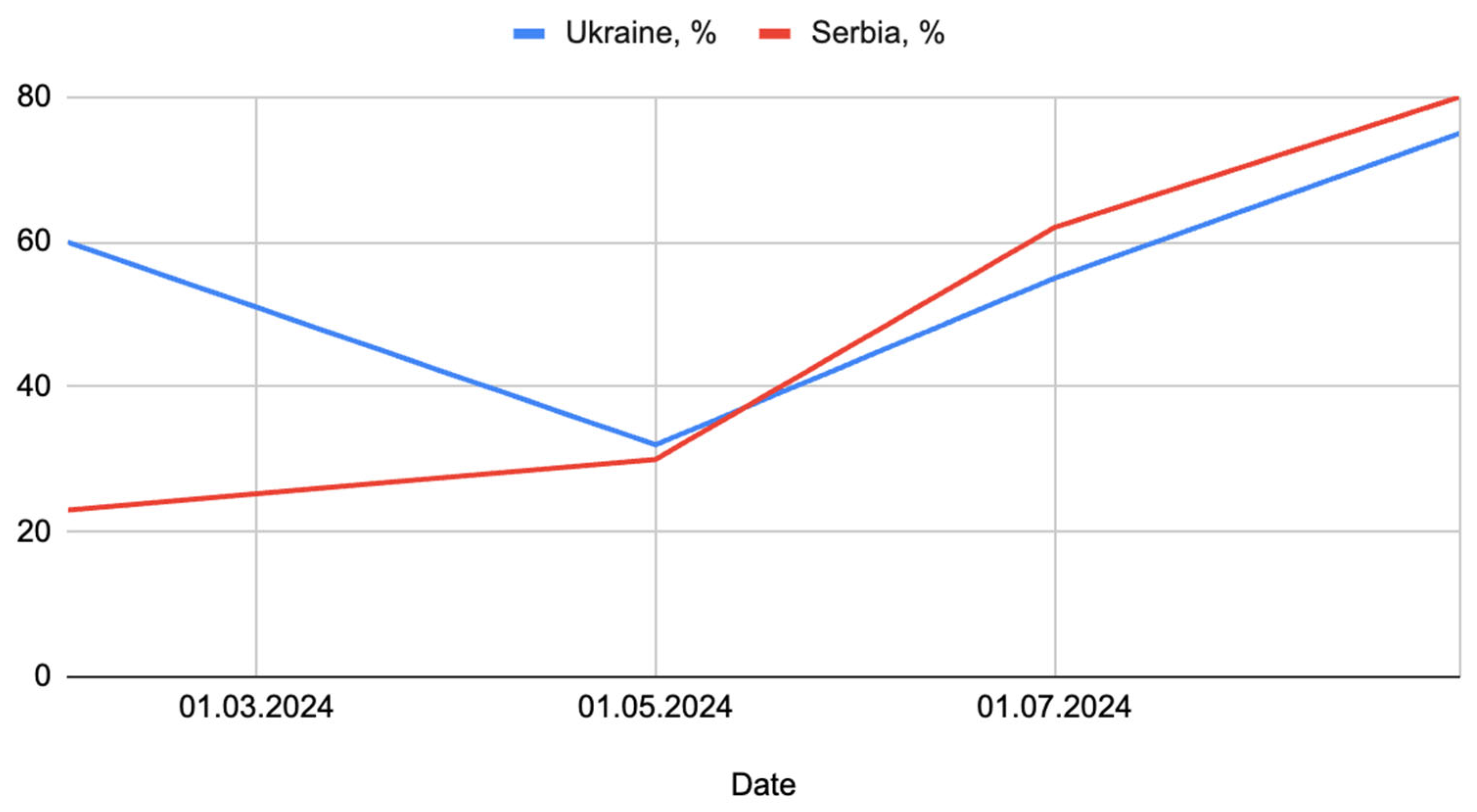
Figure 3 shows filling trajectories and observed inventories in 2024–2025 for Ukraine and Serbia. Both parties met the 1 November 2024 target. For 2025, Serbia’s Banatski Dvor remained above its intermediate milestones (≈58% on 1 February and 1 May). Ukraine—for which the Regulation applies a reduced obligation of 35% of the five-year average gas consumption because the national UGS capacity exceeds the annual demand—temporarily fell below the minimum trajectory by ~7 percentage points (1 February) and ~13 percentage points (1 May) amid wartime disruptions to transmission, storage, and upstream assets. Competent authorities implemented corrective actions (securing additional imports for storage and allocating funds), after which inventories recovered as the heating season ended in early April and temperatures normalised in March. The historical trough recorded in early spring did not translate into operational failures; notably, the end of Russian gas transit on 1 January 2025 did not impair system operation (Energy Community Secretariat, 2025) [64,65].
Taken together, these observations indicate that rule-based filling trajectories function as an early warning and coordination device, allowing deviations to be corrected before winter risk materialises. They also underscore that the timing of injections is critical for a high-volume seasonal portfolio such as Ukraine’s, whereas a single-site system like Serbia’s can still underpin compliance when embedded in cross-border rules and monitoring. These regulatory and operational patterns motivate the quantitative assessment that follows: Section 3.3 evaluates how access to Ukrainian UGS and interconnectors changes N − 1, peak-day coverage, and winter adequacy under scenarios S0–S2 and under cold-winter and LNG shock stresses [66,67].
3.3. Stress Test Results Under Cold-Winter and LNG Shock Conditions
We subject all three integration cases (S0–S2) to the two systemic stresses defined in Section 2.3—(i) a cold-winter realisation (90th-percentile Heating Degree Days, 2010–2024) and (ii) an LNG shock (−20% availability during January–February at unchanged regasification caps)—holding exogenous drivers constant across runs and enforcing the same operational constraints (deliverability function W(S), interconnector limits, pressure/quality requirements, and MRV/LDAR-based de-ratings). This design isolates the marginal contribution of access to Ukraine’s transmission network and UGS to security-of-supply indicators—N − 1, peak-day coverage (PDC), and winter adequacy—without conflating the results with price or demand–response feedbacks [68]:
- Cold-winter stress: Relative to the baseline, the cold-winter realisation compresses adequacy margins in all scenarios by elevating peak days and lengthening the sequences of high-load days in November–March. Under these conditions, scenarios with Ukrainian access (S1, S2) preserve a higher adequacy than S0 for two structural reasons. First, the additional seasonal withdrawal available under W(S) replaces short-notice LNG swings on the tightest days, so that the probability of the LNG regas cap becoming binding falls. Second, the aggregate days-to-empty of Ukraine’s high-volume portfolio sustains elevated withdrawal for longer, which reduces the chance of sequential “critical” days breaching deliverability envelopes. In directional terms, N − 1 and PDC remain at or above their baseline ranking (S2 ≥ S1 > S0), and the share of winter days with supply ≥ demand increases when partial (S1) or high (S2) access is granted. These results are most pronounced for routes with sufficient headroom to transmit seasonal withdrawal—particularly the PL–SK and HU connections—while corridors that are closer to their interconnector caps contribute less to stress-day relief [69].
- LNG shock stress: A uniform 20% shortfall in LNG availability during January–February tightens all cases but does not reverse the scenario ordering. Mechanistically, S0 becomes more frequently constrained by regasification limits on the highest-load weeks, whereas S1 and especially S2 substitute part of the foregone LNG with re-timed autumn injections and sustained winter withdrawal at W_max within compressor and pressure constraints. In N − 1 terms, the removal of the single largest supply element is less destabilising in S2 because the portfolio of “largest elements” is more diversified (EU storages ex-UA, UA withdrawal, non-UA interconnectors, domestic output), so the post-removal supply remains closer to peak demand than in S0. At the PDC level, S2 maintains the highest peak-day coverage across both stresses; S1 shows intermediate performance; and S0 exhibits the lowest headroom and the highest incidence of near-binding constraints [70].
- Corridor sensitivity and integrity constraints: Where methane integrity requirements (MRV/LDAR) lead to temporary de-ratings of specific compressor stations or UGS clusters, the magnitude—but not the direction—of the results is affected. Benefits concentrate along corridors that (i) can physically export seasonal withdrawal under quality/pressure specs, (ii) possess third-party access and capacity products that EU shippers can book, and (iii) are not already saturated by alternate flows in winter. In practical terms, the north-western (PL–SK) and central (HU) routes carry the largest fraction of effective withdrawals in stress periods, while the RO/MD and Trans-Balkan pathways add redundancy and routing optionality; if any one corridor is temporarily capacity-limited, the ranking S2 ≥ S1 > S0 persists, albeit with smaller absolute gains [71].
- Robustness and uncertainty: Three caveats frame interpretation. First, cold-winter and LNG shock stresses are applied separately; coincident realisations would compress margins further, yet the qualitative ordering remains intact because the underlying mechanism—the seasonal substitution of short-notice LNG by W(S)—does not change. Second, the results are conditional on holding exogenous drivers constant (prices, behavioural demand response, and upstream outages outside the defined stresses); relaxing these assumptions could amplify or dampen the gains but is unlikely to invert the scenario ranking. Third, interconnector headroom is decisive: if cross-border limits are binding for extended periods, the effective access to market-accessible storage volume (MASV) is curtailed; in such cases, operational measures (re-timed injections, firm capacity booking, and harmonised gas quality rules) become the locus of improvement [72].
Taken together, these caveats imply that our estimates of Ukraine’s “seasonal battery” role should be understood as directional and likely upper-bound under stylised but internally consistent stress conditions, rather than as precise point predictions across all conceivable geopolitical futures.
Stress test outcomes indicate that integrating Ukraine’s UGS into the EU-EnC framework functions as a seasonal risk transfer instrument: part of the adequacy burden shifts from short-notice LNG and day-ahead interconnectors to autumn injections and sustained winter withdrawal within a large, high-WGV portfolio. This reduces the likelihood that regasification or single-corridor constraints alone precipitate adequacy shortfalls on critical days. The next subsection examines whether these physical improvements translate into market stability—lower wholesale volatility and fewer shock weeks—when seasonal buffering and interconnector utilisation are smoothed over the heating season [73].
3.4. Market Stability Under Volatility and Shock-Week Conditions
The resilience value of infrastructure integration cannot be fully understood without considering market dynamics. Even if adequacy indicators remain positive under stress conditions (Section 3.3), sharp fluctuations in wholesale gas prices can undermine system stability, discourage investment, and erode consumer trust. Therefore, in addition to physical metrics, we evaluate whether access to Ukraine’s UGS and transmission corridors translates into a lower volatility and reduced incidence of “shock weeks” in the wholesale market [74]:
- Volatility trends: In the baseline case (S0), the absence of the Ukrainian capacity results in a higher reliance on LNG and short-cycle storages, both of which are more exposed to external price drivers. This configuration produces a greater variance in the weekly log-returns of hub prices, particularly during winter months when regasification limits or supply tightness bind. By contrast, in S1 and S2, seasonal withdrawals from Ukraine reduce the frequency with which LNG terminals operate at their technical caps. This substitution mechanism dampens short-term scarcity signals and narrows the distribution of weekly price changes. The volatility reduction is most visible in scenarios where market-accessible storage volume (MASV) is large relative to demand, and where interconnector headroom allows Ukrainian gas to reach price-forming hubs without congestion [75].
- Shock-week incidence: Beyond average volatility, systemic resilience depends on the occurrence of extreme weeks—defined here as those with price changes above the 90th percentile of the baseline distribution. In S0, such episodes are frequent during January–February, reflecting the combined effect of cold spells and LNG constraints. Under partial integration (S1), the number of shock weeks declines, as Ukrainian withdrawals offset deficits during tight windows. In the high-integration case (S2), shock weeks become rare, since deeper seasonal buffering smooths interconnector flows and prevents regasification bottlenecks from translating into price spikes. This finding suggests that the strategic use of Ukraine’s UGS can moderate not only average risk but also tail events, which are the most disruptive for markets and policy [76].
The stability effects documented here complement the adequacy gains from Section 3.3. They highlight that operationalising cross-border access to Ukraine’s storage is not merely a technical adequacy measure but a market-stabilising instrument. By lowering volatility and reducing the incidence of shock weeks, integration scenarios (S1–S2) improve investment conditions for renewable deployment, reduce hedging costs for shippers, and shield end-users from disruptive price swings. In policy terms, this aligns with the EU’s objectives of ensuring affordable, reliable, and sustainable energy during the transition. It also provides an economic rationale for accelerating regulatory harmonisation under the Energy Community framework, particularly for capacity allocation, interoperability standards, and methane intensity compliance [77].
A qualitative comparison with recent market episodes helps to interpret these stylised stability metrics. The volatility reductions and shorter sequences of “shock weeks” observed in S1–S2 are consistent with empirical evidence from the 2021–2022 European gas price crisis, where low storage levels and tight winter margins were associated with prolonged periods of price spikes and elevated volatility. In contrast, years with higher and more evenly distributed storage fillings exhibited fewer and less persistent stress episodes. Our framework does not aim to replicate the exact trajectory of TTF prices during the crisis, but the direction and approximate magnitude of the stabilising effect from improved seasonal adequacy are in line with these historical patterns.
3.5. Hydrogen-Readiness: Corridor Ranking and Repurposing Pathways
The transition from natural gas to hydrogen requires a careful balance between safeguarding immediate system adequacy and avoiding long-term carbon lock-in. Against this backdrop, we assess the hydrogen-readiness of cross-border corridors relevant to Ukraine by applying a composite feasibility screen that accounts for both technical integrity and regulatory risks. This approach complements the adequacy and market stability findings of Section 3.3 and Section 3.4, offering a forward-looking perspective on how today’s assets can be repurposed for tomorrow’s decarbonized energy system [78]:
- (1)
- Corridor screening approach: Each corridor is assessed against six weighted criteria: (i) pipeline material class and fracture toughness; (ii) maximum allowable operating pressure (MAOP) and pressure-cycling history; (iii) compressor convertibility for hydrogen blends or full repurposing; (iv) asset age and defect history; (v) permitting and right-of-way (ROW) risks; and (vi) indicative capital expenditure (CAPEX) per kilometre. Scores are normalised and combined into a 0–100 composite index, which allows relative ranking between corridors without presuming exact investment costs. This design highlights where “repurpose-first” windows exist and where new-build infrastructure may be unavoidable [79].
- (2)
- Ranking results: The screening suggests that the PL–SK and HU corridors achieve the highest relative scores, reflecting their more recent material classes, favourable MAOP ratings, and compressor stations that can be converted with moderate retrofitting. These segments thus qualify as “repurpose-first” candidates, offering immediate adequacy benefits while enabling phased hydrogen integration. By contrast, the RO/MD and Trans-Balkan corridors achieve intermediate scores: their asset age and permitting complexity reduce near-term feasibility, but they remain valuable as redundancy routes and as medium-term options for regional integration. Ukraine’s domestic transmission backbone, with its exceptionally high capacity, provides the scale needed for future hydrogen flows but requires selective repurposing prioritised along corridors with cross-border demand signals and financing potential [80].
Importantly, the corridor ordering is robust to reasonable changes in the weighting scheme discussed in Section 2.3. Sensitivity runs with alternative weight vectors preserve the leading position of the PL–SK and HU routes, while RO/MD and the Trans-Balkan pathway consistently occupy intermediate scores. This robustness indicates that the ranking is driven by underlying technical and regulatory characteristics rather than by any single modelling assumption.
The corridor ranking reinforces the view that Ukraine can function not only as Europe’s seasonal gas buffer but also as a hydrogen-ready bridge. Prioritising repurpose-first segments reduces CAPEX needs relative to full new-build projects, accelerates the creation of initial cross-border hydrogen corridors, and avoids stranded-asset risks. At the same time, addressing permitting bottlenecks and harmonising certification standards under the new EU Gas and Hydrogen Market Package and the emerging European Network of Network Operators for Hydrogen (ENNOH) will be decisive for implementation. This analysis therefore underlines the dual role of Ukraine’s infrastructure: delivering immediate adequacy gains in the late 2020s while enabling a no-regrets pathway towards hydrogen integration in the 2030s [81].
However, converting these corridors to hydrogen service is not risk-free and would require the explicit management of material integrity and leakage risks, as discussed in Section 4.2.
Section 4 discusses these results in the context of the recent literature, implementation constraints, and future research needs.
4. Discussion
The results of this study demonstrate that mobilising Ukraine’s gas transmission network and underground gas storage (UGS) can deliver measurable benefits for the European Union’s energy system adequacy and stability beyond 2025. By reallocating seasonal balancing to Ukraine’s large storage cluster, peak-day coverage and winter adequacy indices improve across integration scenarios, even under stress conditions such as cold-winter demand or LNG supply disruptions. This aligns with earlier findings that emphasised the systemic value of UGS in complementing variable renewable energy sources (VRESs) and mitigating seasonal volatility in Europe’s decarbonization pathway [82,83].
Compared to other major storage clusters in the EU, Ukraine’s UGS exhibits a distinctly seasonal rather than a high-swing profile, with an implied days-to-empty nearly twice the European average. This strengthens its role as a long-duration buffer rather than a short-cycle flexibility provider. Similar conclusions were drawn in studies on German and Italian facilities, which highlighted the strategic importance of high-volume storage for managing inter-seasonal mismatches rather than intraday balancing [83]. Our results extend these insights to the EnC context by showing that regulatory alignment—through certification, filling trajectories, and monitoring—can effectively transform the Ukrainian UGS into a regional adequacy instrument.
To avoid repeating the detailed numerical results from Section 3, Table 1 summarises the main scenario outcomes and their policy implications in a structured way.
Table 1.
Summary of scenario outcomes and policy implications.
The table highlights that the incremental contribution of Ukraine’s UGS and network is twofold: it strengthens winter adequacy and compliance with security-of-supply standards and it dampens market instability by reducing volatility and “shock weeks”. At the same time, the hydrogen-readiness screen shows that only a limited number of corridors (notably PL–SK and HU) are realistic repurpose-first candidates, which narrows down the set of credible investment options.
In terms of market dynamics, the decline in weekly volatility and the reduced incidence of “shock weeks” in integration scenarios S1–S2 confirm the buffering effect of seasonal storage. This is consistent with evidence from recent analyses of the European gas crisis, which found that insufficient storage volumes were strongly correlated with both elevated wholesale prices and market instability [84,85]. By leveraging Ukraine’s MASV and interconnector headroom, these results suggest a structural mechanism for smoothing price signals and mitigating consumer exposure to extreme events.
Finally, the hydrogen-readiness screening reveals that repurposing opportunities exist along key corridors (PL–SK, HU), while others may require partial new-build infrastructure due to material or permitting constraints. These findings resonate with European Hydrogen Backbone studies, which stress the cost and time advantages of repurposing existing gas assets over building dedicated hydrogen pipelines from scratch [86,87]. Importantly, our analysis highlights that Ukraine’s transmission network could form one of the anchor routes in the continental hydrogen map, provided interoperability standards, methane integrity rules (MRV/LDAR), and financing frameworks are in place. This complements the broader literature on the EU’s hydrogen corridors, reinforcing the idea of a phased, no-regrets pathway to decarbonization.
Taken together, these comparisons position Ukraine not only as a resilience provider for the EU’s current gas system but also as a strategic enabler of its hydrogen future. The discussion underscores the dual value of integrating Ukrainian infrastructure: immediate security-of-supply and adequacy benefits and a medium-term alignment with Europe’s decarbonization strategies.
4.1. Limitations, Constraints, and Future Research
This study has several limitations that should be considered when interpreting the results. First, the analysis relies on publicly available infrastructure and market data (ENTSOG, GIE, ENTSO-E, IEA, and national reports), which may not fully capture operational constraints at the level of individual compressor stations, storage caverns, or pipeline segments. Data gaps are particularly relevant for asset-level methane emissions, integrity records, and wartime damage, so some parameters necessarily remain stylised.
Second, the modelling framework is designed as a decision-oriented stress test rather than a full market equilibrium model. Exogenous assumptions on demand, prices, and LNG availability are held constant across scenarios, and the cold-winter and LNG shock stresses are applied separately. As a result, the simulations do not endogenise demand response, fuel switching, or feedbacks from price formation, and they cannot represent coincident multi-stress realisations in full detail.
Third, the scenario horizon is limited to 2026–2030 and focuses on a subset of cross-border corridors (PL–SK, HU, RO/MD, and the Trans-Balkan route). Longer-term structural changes in European gas and hydrogen demand, as well as alternative hydrogen supply routes, are only reflected indirectly through the policy baseline and cannot be fully explored within the present setup. Finally, practical constraints—including financing, permitting bottlenecks, and political risk—may slow down implementation even where the technical and regulatory conditions appear favourable.
Future research could therefore extend the present work in several directions. One avenue is to couple the adequacy–stress test framework with price-responsive demand and wholesale market models, in order to quantify welfare effects and distributional impacts alongside physical security-of-supply metrics. A second avenue is to integrate more detailed integrity and methane emission datasets for Ukrainian and EU assets, allowing for the explicit optimisation of MRV/LDAR interventions and repair schedules. Third, expanding the corridor screening to include alternative hydrogen routes and a longer time horizon would help benchmark the Ukraine Corridor against other candidate backbones in a fully decarbonised system. These extensions would enhance the robustness and policy relevance of the findings while preserving the decision-oriented nature of the present framework [88].
A further limitation concerns the hydrogen-readiness screen. The composite index and its weights are necessarily judgement-based, reflecting current engineering practice and the available public information rather than a formal preference elicitation. While our sensitivity checks suggest that the main corridor rankings are robust to plausible variations in the weight vector, a more rigorous calibration using the Analytic Hierarchy Process (AHP) or structured expert surveys would be a natural next step. Likewise, extending the screen to include a full lifecycle cost comparison between repurposed and new-build options at the corridor level would enhance the economic dimension of the analysis. These refinements fall beyond the scope of the present study but are essential for future investment-grade assessments.
4.2. Risk Assessment for Hydrogen Repurposing and Seasonal Flexibility
While the analysis highlights the potential of Ukraine’s network and UGS to provide seasonal flexibility and to host future hydrogen flows, repurposing legacy gas infrastructure for hydrogen is not without risks. From a technical integrity perspective, hydrogen can accelerate material degradation through embrittlement and corrosion, particularly in older steel grades, welded joints, and components that have already experienced significant pressure cycling. This may reduce fracture toughness and safety margins and can require derating the maximum allowable operating pressures, more frequent inspections, and the targeted replacement of critical segments.
In addition, the environmental implications of hydrogen leakage need to be taken into account. Hydrogen is not a classical long-lived greenhouse gas, but it acts as a short-lived indirect greenhouse gas by affecting atmospheric chemistry, including tropospheric ozone formation and the lifetime of methane. Leakage from repurposed pipelines, compressor stations, and underground storage facilities could therefore offset part of the climate benefits that hydrogen is intended to deliver if not properly managed. In the context of Ukraine’s UGS, any future hydrogen use would also have to consider subsurface processes, such as microbiological activity, potential impacts on cushion gas, and interactions with existing impurities.
These risks imply that hydrogen repurposing and the use of seasonal gas infrastructure as a “bridge” in the transition should be treated as a double-edged instrument. On the one hand, repurposing can reduce costs and avoid stranded assets; on the other hand, it can introduce new integrity and environmental failure modes if regulatory and technical safeguards are insufficient. In practice, any corridor identified as a repurpose-first candidate by our screening would need to undergo a detailed, asset-level risk assessment, including non-destructive testing, integrity management plans, and continuous leak detection, before investment decisions are made.
Against this background, the hydrogen-readiness index developed in this paper should be interpreted as a necessary but not sufficient condition for repurposing. It provides a structured way to prioritise corridors based on observable technical and regulatory characteristics, but it does not replace full quantitative risk analysis or project-level environmental impact assessment. Future work should therefore integrate probabilistic risk models and explicit leakage scenarios into the assessment of hydrogen corridors and seasonal flexibility options.
From a market dynamics perspective, our treatment of volatility and “shock weeks” is likewise deliberately stylised. The framework links price stability to structural adequacy conditions and storage trajectories, but it does not endogenise behavioural demand responses, speculative trading, fuel switching, policy interventions, or heterogeneous risk perceptions among market participants. As a result, the market stability results should be interpreted as structural effects associated with different seasonal balancing configurations rather than as a calibrated reconstruction of the 2022 price crisis. A natural extension of this work would be to couple the present adequacy framework with a price-responsive market model or agent-based simulations that explicitly capture demand elasticity, industrial curtailment, and expectation-driven dynamics.
4.3. Policy Implications and Practical Applications
The results have several concrete implications for energy system planning and industrial policy [88].
First, on the gas and electricity system side, the scenarios show that using Ukraine’s UGS as a seasonal buffer substantially improves winter adequacy and reduces deficit days under cold-winter and LNG shock conditions compared to a configuration without access to Ukraine (S0). Given that Ukraine accounts for about 16.4% of Europe’s technical working gas volume, integrating a clearly defined share of this capacity into European seasonal balancing could allow some Member States and Energy Community contracting parties to meet adequacy targets with less reliance on new short-cycle gas-fired capacity. In practical terms, the certified Ukrainian storage capacity could be allowed to count toward national or regional storage and adequacy obligations up to a capped fraction of annual demand, provided that access, deliverability, and interoperability requirements are fulfilled.
Second, for hydrogen and industrial decarbonisation policy, the hydrogen-readiness screen identifies a small set of repurpose-first corridor candidates (notably the PL–SK and HU routes) where existing pipelines can be converted at a lower technical and regulatory risk than alternative paths. These corridors should be explicitly prioritised in Ten-Year Network Development Plans (TYNDPs), hydrogen backbone roadmaps, and EU or Energy Community funding windows. Prioritisation could be operationalised by reserving dedicated budget lines for compressor retrofitting, integrity upgrades, and cross-border hydrogen capacity products along these routes, while using new-build infrastructure for lower-scoring or more uncertain corridors.
Third, for regulatory and market design, the analysis underscores that the stabilising effect of Ukraine’s UGS on price volatility comes from structurally higher and more robust winter storage levels. Policymakers could translate this into targeted cross-border storage products and contracts that explicitly rely on Ukrainian UGS for seasonal balancing—such as long-term bundled capacity and storage services for Central and Eastern European shippers—backed by appropriate guarantees or contracts for difference to crowd in private investment. This would align short-term security-of-supply needs with longer-term decarbonisation goals by leveraging existing infrastructure instead of building redundant domestic assets.
Finally, national energy and climate plans (NECPs) and regional risk assessments can treat access to Ukrainian storage and network capacity as an alternative to part of the planned investment in new gas-fired peaker plants or single-country storage expansions. Where our scenarios show significant improvements in winter adequacy and market stability under S1–S2, planners could quantify the corresponding reduction in the required backup capacity or storage additions, thereby using Ukraine’s infrastructure to reduce both system costs and stranded-asset risks in the transition.
5. Conclusions
This paper set out to address a persistent resilience gap in Europe’s gas system: how to safeguard the security of supply during the transition beyond 2025 and whether Ukraine’s gas transmission network and underground gas storage (UGS) can contribute to that goal as a strategic asset rather than a residual transit route. To do so, we developed a scenario-based stress test framework for the 2026–2030 horizon, combining adequacy and market stability indicators with a corridor-level screen for methane integrity and hydrogen-readiness under alternative assumptions of access to Ukraine’s infrastructure.
The results point to three main findings. First, when Ukraine’s UGS is used as a seasonal buffer, it materially improves winter adequacy by increasing the days-to-empty at maximum withdrawal, cutting the number of deficit days under cold-winter and LNG shock stress tests, and supporting compliance with security-of-supply standards. Second, maintaining a secure access to Ukraine’s transmission network and storage helps to stabilise markets by reducing price volatility and the frequency of “shock weeks”, thereby de-risking the transition for both EU Member States and Energy Community Parties as pipeline flows are reconfigured after the end of Russian gas transit. Third, the corridor-level hydrogen-readiness screen highlights repurpose-first options—in particular along the PL–SK and HU interconnections—that enable a phased integration of low-carbon hydrogen while avoiding additional carbon lock-in and preserving flexibility for future infrastructure choices.
Taken together, these findings suggest that Ukraine’s gas infrastructure can act both as a resilience buffer for the current gas system and as a hydrogen-ready bridge for Europe’s decarbonisation, provided that appropriate regulatory and investment frameworks are in place. Priority areas include transparent and predictable rules for access to UGS and cross-border capacity, stringent methane integrity regimes based on MRV/LDAR, and targeted financial instruments to crowd in public and private capital for repurposing and critical upgrades. Anchoring Ukraine’s network and storage more firmly within Europe’s transition architecture would reduce near-term security-of-supply risks while keeping open credible options for a low-carbon, hydrogen-compatible backbone in the longer term.
Author Contributions
Conceptualisation, S.L., S.D. and O.Z.; methodology, L.R., S.D., S.L. and O.Z.; software, D.J., V.P., S.L. and S.D.; validation, S.L., S.D. and L.R.; formal analysis, D.J., V.P., O.Z., S.L. and S.D.; investigation, S.L., L.R. and S.D.; resources, S.D., S.L. and L.R.; data curation, O.Z., S.L. and L.R.; writing—original draft preparation, O.Z., S.L. and S.D.; writing—review and editing, S.D., D.J., V.P. and L.R.; visualisation, S.D. and S.L.; supervision, S.L., S.D. and O.Z.; project administration, S.L. and S.D.; funding acquisition, S.D. All authors have read and agreed to the published version of the manuscript.
Funding
This research received no external funding.
Institutional Review Board Statement
Not applicable.
Informed Consent Statement
Not applicable.
Data Availability Statement
We are committed to promoting transparency and reproducibility in research. The data supporting the results reported in this article are available in accordance with MDPI’s data sharing policies. If no new data were created or if data availability is restricted due to privacy or ethical considerations, we affirm that this statement is still required for transparency. We have provided detailed information on how to access or obtain the data whenever possible, and we are willing to provide additional information upon request to ensure the reproducibility of our research.
Acknowledgments
We want to thank the Center for Interdisciplinary Research of Uzhhorod National University, Ukraine, which made this study and article publication possible. Their significant contribution was fundamental to the success of this research project. We would like to express our sincere gratitude for their continuous support in advancing scientific knowledge within the field of civil construction.
Conflicts of Interest
The authors declare no conflicts of interest.
References
- Hinkelman, K.; Flores Garcia, J.D.; Anbarasu, S.; Zuo, W. A Review of Multi-Energy Systems from Resiliency and Equity Perspectives. Energies 2025, 18, 4536. [Google Scholar] [CrossRef] [Scilit]
- Schnidrig, J.; Cherkaoui, R.; Calisesi, Y.; Margni, M.; Maréchal, F. On the role of energy infrastructure in the energy transition: Case study of an energy independent and CO2 neutral energy system for Switzerland. Front. Energy Res. 2023, 11, 1164813. [Google Scholar] [CrossRef] [Scilit]
- Onen, P.S.; Mokryani, G.; Zubo, R.H.A. Planning of Multi-Vector Energy Systems with High Penetration of Renewable Energy Source: A Comprehensive Review. Energies 2022, 15, 5717. [Google Scholar] [CrossRef] [Scilit]
- Cao, K.-K.; Pregger, T.; Haas, J.; Lens, H. To prevent or promote grid expansion? Analyzing the future role of power transmission in the European energy system. Front. Energy Res. 2021, 8, 541495. [Google Scholar] [CrossRef] [Scilit]
- Svitlana, D.; Hanna, M. Environmental and energy security on the way to rebuilding Ukraine on the principle of zero carbon footprint. In Ukraine’s Journey to Recovery, Reform and Post-War Reconstruction; Nate, S., Ed.; Contributions to Security and Defence Studies; Springer: Berlin/Heidelberg, Germany, 2025. [Google Scholar] [CrossRef] [Scilit]
- Pugliese, S. Rethinking Just Transition in Investment Law Perspective: Incentives against Climate Crisis between Sustainability, Economic Security, and Strategic Industrial Planning. Laws 2024, 13, 37. [Google Scholar] [CrossRef] [Scilit]
- Madžarević, A.R.; Ivezić, D.D.; Tanasijević, M.L.; Živković, M.A. The Fuzzy–AHP Synthesis Model for Energy Security Assessment of the Serbian Natural Gas Sector. Symmetry 2020, 12, 908. [Google Scholar] [CrossRef] [Scilit]
- Li, Q.; Li, Q.; Wang, F.; Xu, N.; Wang, Y.; Bai, B. Settling behavior and mechanism analysis of kaolinite as a fracture proppant of hydrocarbon reservoirs in CO2 fracturing fluid. Colloids Surf. A Physicochem. Eng. Asp. 2025, 724, 137463. [Google Scholar] [CrossRef] [Scilit]
- Oliveira, A.M.; Zhao, J.; Ma, C.; Wang, F.; Li, S.; Yang, S.; Zhang, Y.; Pacala, S.W.; Yu, M. Hydrate as a by-product in CO2 leakage during the long-term subseabed sequestration and its role in preventing further leakage. Environ. Sci. Pollut. Res. 2022, 29, 58262–58275. [Google Scholar] [CrossRef] [Scilit]
- Halser, C.; Paraschiv, F. Pathways to Overcoming Natural Gas Dependency on Russia—The German Case. Energies 2022, 15, 4939. [Google Scholar] [CrossRef] [Scilit]
- Leal Filho, W.; Eustachio, J.H.P.P.; Fedoruk, M.; Lisovska, T. War in Ukraine: An overview of environmental impacts and consequences for human health. Front. Sustain. Resour. Manag. 2024, 3, 1423444. [Google Scholar] [CrossRef] [Scilit]
- Barba, J.; Cañas-Carretón, M.; Carrión, M.; Hernández-Labrado, G.R.; Merino, C.; Muñoz, J.I.; Zárate-Miñano, R. Integrating Hydrogen into Power Systems: A Comprehensive Review. Sustainability 2025, 17, 6117. [Google Scholar] [CrossRef] [Scilit]
- Cozzolino, R.; Bella, G. A review of electrolyzer-based systems providing grid ancillary services: Current status, market, challenges and future directions. Front. Energy Res. 2024, 12, 1358333. [Google Scholar] [CrossRef] [Scilit]
- Qian, X.; You, S.; Wang, R.; Yue, Y.; Liao, Q.; Dai, J.; Tian, S.; Liu, X. Underground Hydrogen Storage in Salt Cavern: A Review of Advantages, Challenges, and Prospects. Sustainability 2025, 17, 5900. [Google Scholar] [CrossRef] [Scilit]
- Vivanco-Martín, B.; Iranzo, A. Analysis of the European Strategy for Hydrogen: A Comprehensive Review. Energies 2023, 16, 3866. [Google Scholar] [CrossRef] [Scilit]
- Proedrou, F. EU Decarbonization under Geopolitical Pressure: Changing Paradigms and Implications for Energy and Climate Policy. Sustainability 2023, 15, 5083. [Google Scholar] [CrossRef] [Scilit]
- Rosén, S.; Göransson, L.; Taljegård, M.; Lehtveer, M. Modeling of a “Hydrogen Valley” to investigate the impact of a regional pipeline for hydrogen supply. Front. Energy Res. 2024, 12, 1420224. [Google Scholar] [CrossRef] [Scilit]
- Tassielli, G.; Cananà, L.; Spalatro, M. Detection of Methane Leaks via a Drone-Based System for Sustainable Landfills and Oil and Gas Facilities: Effect of Different Variables on the Background-Noise Measurement. Sustainability 2024, 16, 7748. [Google Scholar] [CrossRef] [Scilit]
- Hritsyshyna, M.; Hutarevych, N. Legal Regulation of Hydrogen in Germany and Ukraine as a Precondition for Energy Partnership and Energy Transition. Energies 2021, 14, 8331. [Google Scholar] [CrossRef] [Scilit]
- Streimikiene, D.; Siksnelyte-Butkiene, I.; Lekavicius, V. Energy Diversification and Security in the EU: Comparative Assessment in Different EU Regions. Economies 2023, 11, 83. [Google Scholar] [CrossRef] [Scilit]
- Mahajan, D.; Tan, K.; Venkatesh, T.; Kileti, P.; Clayton, C.R. Hydrogen Blending in Gas Pipeline Networks—A Review. Energies 2022, 15, 3582. [Google Scholar] [CrossRef] [Scilit]
- Eparu, C.N.; Prundurel, A.P.; Doukeh, R.; Stoica, D.B.; Ghețiu, I.V.; Suditu, S.; Stan, I.G.; Rădulescu, R. Optimizing Underground Natural Gas Storage Capacity through Numerical Modeling and Strategic Well Placement. Processes 2024, 12, 2136. [Google Scholar] [CrossRef] [Scilit]
- Iwaszczuk, N.; Prytula, M.; Prytula, N.; Pyanylo, Y.; Iwaszczuk, A. Modeling of Gas Flows in Underground Gas Storage Facilities. Energies 2022, 15, 7216. [Google Scholar] [CrossRef] [Scilit]
- Rqiq, Y.; Luciani, L.; Aranda, J.; Ballestin, V. Assessment of the Robustness of the European Gas System to Massive Gas Outages and Evaluation of the Effect of Increased Energy Efficiency on the Security of Gas Coverage in Different Countries. Energies 2024, 17, 137. [Google Scholar] [CrossRef] [Scilit]
- Qin, B.; Shi, W.; Fang, R.; Wu, D.; Zhu, Y.; Wang, H. Underground energy storage system supported resilience enhancement for power system in high penetration of renewable energy. Front. Energy Res. 2023, 11, 1138318. [Google Scholar] [CrossRef] [Scilit]
- Kim, J.; Han, S.; Kim, D.; Lee, Y. Gas Pipeline Leak Detection by Integrating Dynamic Modeling and Machine Learning Under the Transient State. Energies 2024, 17, 5517. [Google Scholar] [CrossRef] [Scilit]
- Iwaszczuk, N.; Zapukhliak, I.; Iwaszczuk, A.; Dzoba, O.; Romashko, O. Underground Gas Storage Facilities in Ukraine: Current State and Future Prospects. Energies 2022, 15, 6604. [Google Scholar] [CrossRef] [Scilit]
- Hora, C.; Dan, F.C.; Secui, D.-C.; Hora, H.N. Systematic Literature Review on Pipeline Transport Losses of Hydrogen, Methane, and Their Mixture, Hythane. Energies 2024, 17, 4709. [Google Scholar] [CrossRef] [Scilit]
- Migliavacca, G.; Carlini, C.; Domenighini, P.; Zagano, C. Hydrogen: Prospects and Criticalities for Future Development and Analysis of Present EU and National Regulation. Energies 2024, 17, 4827. [Google Scholar] [CrossRef] [Scilit]
- Zumbraegel, T.; Kegel, A. Green tides: The Suez Canal as key hub and green corridor for a hydrogen future between the Middle East and Europe. Front. Energy Res. 2025, 13, 1538792. [Google Scholar] [CrossRef] [Scilit]
- Alms, K.; Ahrens, B.; Graf, M.; Nehler, M. Linking geological and infrastructural requirements for large-scale underground hydrogen storage in Germany. Front. Energy Res. 2023, 11, 1172003. [Google Scholar] [CrossRef] [Scilit]
- Wulf, C.; Zapp, P.; Schreiber, A. Review of power-to-x demonstration projects in Europe. Front. Energy Res. 2020, 8, 191. [Google Scholar] [CrossRef] [Scilit]
- Tremosa, J.; Jakobsen, R.; Le Gallo, Y. Assessing and modeling hydrogen reactivity in underground hydrogen storage: A review and models simulating the Lobodice town gas storage. Front. Energy Res. 2023, 11, 1145978. [Google Scholar] [CrossRef] [Scilit]
- European Network of Transmission System Operators for Gas. Transparency Platform. Available online: https://transparency.entsog.eu/ (accessed on 14 August 2025).
- Gas Infrastructure Europe. AGSI & ALSI Transparency Platforms. Available online: https://www.gie.eu/agsi-and-alsi-transparency-platforms/ (accessed on 12 August 2025).
- Gas Infrastructure Europe. Storage Database. Available online: https://www.gie.eu/transparency/databases/storage-database/ (accessed on 12 August 2025).
- Eurostat. Supply, Transformation and Consumption of Gas—Monthly Data. Available online: https://ec.europa.eu/eurostat/databrowser/view/nrg_cb_gasm/default/table?lang=en (accessed on 15 August 2025).
- International Energy Agency. Gas Market Report, Q3-2025. 22 July 2025. Available online: https://www.iea.org/reports/gas-market-report-q3-2025 (accessed on 16 August 2025).
- Agency for the Cooperation of Energy Regulators. Analysis of the European LNG Market Developments—2024 Market Monitoring Report. 2024. Available online: https://www.acer.europa.eu/monitoring/MMR/LNG_market_developments_2024 (accessed on 18 August 2025).
- European Network of Transmission System Operators for Electricity. Transparency Platform. Available online: https://transparency.entsoe.eu/ (accessed on 13 August 2025).
- JSC Ukrtransgaz. Customs Warehouse Service (UGS of Ukraine). Available online: https://utg.ua/en/utg/gas-transportation-system/customs-warehouse-service.html (accessed on 11 August 2025).
- Gas Transmission System Operator of Ukraine. Available Capacities at Interconnection Points. Available online: https://tsoua.com/en/transparency/available-capacities/ (accessed on 11 August 2025).
- Brkić, V.; Zelenika, I.; Mijić, P.; Medved, I. Underground Gas Storage Process Optimisation with Respect to Reservoir Parameters and Production Equipment. Energies 2021, 14, 4324. [Google Scholar] [CrossRef] [Scilit]
- Verga, F. What’s Conventional and What’s Special in a Reservoir Study for Underground Gas Storage. Energies 2018, 11, 1245. [Google Scholar] [CrossRef] [Scilit]
- Klopčič, N.; Stöhr, T.; Grimmer, I.; Sartory, M.; Trattner, A. Refurbishment of Natural Gas Pipelines towards 100% Hydrogen—A Thermodynamic-Based Analysis. Energies 2022, 15, 9370. [Google Scholar] [CrossRef] [Scilit]
- Abbas, A.J.; Haruna, S.K.; Burby, M.; John, I.J.; Yar’Adua, K.H. Transitioning to a Hydrogen Economy: Exploring the Viability of Adapting Natural Gas Pipelines for Hydrogen Transport through a Case Study on Compression vs. Looping. Gases 2024, 4, 74–96. [Google Scholar] [CrossRef] [Scilit]
- Wang, Y.; Song, F.; Feng, Q.; Qiao, W.; Dong, S.; Jiang, Y.; Ma, Q. Basic Theory and Applications of Oil and Gas Pipeline Non-Destructive Testing Methods. Energies 2024, 17, 6366. [Google Scholar] [CrossRef] [Scilit]
- Bhardwaj, U.; Teixeira, A.P.; Guedes Soares, C. Uncertainty in the Estimation of Partial Safety Factors for Different Steel-Grade Corroded Pipelines. J. Mar. Sci. Eng. 2023, 11, 177. [Google Scholar] [CrossRef] [Scilit]
- Kosowski, P.; Kosowska, K. Valuation of Energy Security for Natural Gas—European Example. Energies 2021, 14, 2678. [Google Scholar] [CrossRef] [Scilit]
- van der Linden, R.; Octaviano, R.; Blokland, H.; Busking, T. Security of Supply in Gas and Hybrid Energy Networks. Energies 2021, 14, 792. [Google Scholar] [CrossRef] [Scilit]
- Tsekeris, T. Transformations in the European Gas Supply Network Due to the Russia–Ukraine Conflict. Energies 2025, 18, 1709. [Google Scholar] [CrossRef] [Scilit]
- Ma, R.; Huang, Z. Evaluating the Robustness of the Global LNG Trade Network: The Impact of the Russia–Ukraine Conflict. Systems 2025, 13, 509. [Google Scholar] [CrossRef] [Scilit]
- Ilonze, C.; Wang, J.; Ravikumar, A.P.; Zimmerle, D. Methane Quantification Performance of the Quantitative Optical Gas Imaging (QOGI) System Using Single-Blind Controlled Release Assessment. Sensors 2024, 24, 4044. [Google Scholar] [CrossRef] [Scilit]
- European Commission. Powering a Climate-Neutral Economy: An EU Strategy for Energy System Integration (COM (2020) 299 Final). 8 July 2020. Available online: https://eur-lex.europa.eu/legal-content/EN/TXT/?uri=CELEX:52020DC0299 (accessed on 15 August 2025).
- European Parliament and the Council of the European Union. Directive (EU) 2024/1788 on Common Rules for the Internal Markets for Renewable Gas, Natural Gas and Hydrogen, Amending Directive (EU) 2023/1791 and Repealing Directive 2009/73/EC (Recast). 13 June 2024. Available online: https://eur-lex.europa.eu/eli/dir/2024/1788/oj/eng (accessed on 18 August 2025).
- Kneebone, J. The EU Hydrogen and Decarbonised Gas Market Package: An Inside Look into the Recently Adopted Gas Package. Florence School of Regulation. 27 May 2024. Available online: https://fsr.eui.eu/the-eu-hydrogen-and-decarbonised-gas-market-package/ (accessed on 18 August 2025).
- European Commission. Commission Opinion of 4 April 2025 on the Articles of Association, Rules of Procedure (Including the Rules on Consulting Stakeholders) and List of Members of the European Network of Network Operators for Hydrogen (C/2025/2773). Official Journal of the European Union, C/2025/2773. 20 May 2025. Available online: https://eur-lex.europa.eu/eli/C/2025/2773/oj/eng (accessed on 1 August 2025).
- Energy Community Secretariat. Report on the Implementation of Regulation (EU) 2022/1032 (The Storage Regulation) [Annual Report]. 20 May 2025. Available online: https://www.energy-community.org/dam/jcr:6221d999-5cb5-4f06-a128-bb1ecaf4dab5/ECS_Storage_Report_final2025.pdf (accessed on 13 August 2025).
- European Parliament and the Council of the European Union. Directive (EU) 2023/2413 Amending Directive (EU) 2018/2001, Regulation (EU) 2018/1999 and Directive 98/70/EC as Regards the Promotion of Energy from Renewable Sources, and Repealing Council Directive (EU) 2015/652. 18 October 2023. Available online: https://eur-lex.europa.eu/eli/dir/2023/2413/oj/eng (accessed on 14 August 2025).
- Fibbi, G.; Del Soldato, M.; Fanti, R. Review of the Monitoring Applications Involved in the Underground Storage of Natural Gas and CO2. Energies 2023, 16, 12. [Google Scholar] [CrossRef] [Scilit]
- Desideri, U.; Krayem, A.; Thorin, E. The Unprecedented Natural Gas Crisis in Europe: Investigating the Causes and Consequences with a Focus on Italy. Energies 2023, 16, 5954. [Google Scholar] [CrossRef] [Scilit]
- Kulušić, I.; Jukić, L.; Smajla, I.; Karasalihović Sedlar, D. The Role of Natural Gas in the Socio-Technical Transition to a Carbon-Neutral Society and a Review of the European Union’s Framework. Sustainability 2024, 16, 3791. [Google Scholar] [CrossRef] [Scilit]
- Stec, S.; Szymańska, E.J.; Stec-Rusiecka, J.; Osieczko-Potoczna, K.; Stec, A. Energy Security of Local Government Units in the Face of the Energy Crisis in 2022–2023. Energies 2025, 18, 2754. [Google Scholar] [CrossRef] [Scilit]
- Gai, L.; Sun, Y.; Li, H.; Zhu, K.; Yang, Y.; Qu, M.; Tian, Z. An optimization dispatching strategy for integrated electricity and natural gas systems with fast charging stations. Front. Energy Res. 2024, 12, 1393425. [Google Scholar] [CrossRef] [Scilit]
- Mura, J.; Ranchou-Peyruse, M.; Guignard, M.; Ducousso, M.; Larregieu, M.; Isaure, M.-P.; Le Hécho, I.; Hoareau, G.; Poulain, M.; de Souza Buruti, M.; et al. Experimental simulation of H2 coinjection via a high-pressure reactor with natural gas in a low-salinity deep aquifer used for current underground gas storage. Front. Microbiol. 2024, 15, 1439866. [Google Scholar] [CrossRef] [Scilit]
- Fan, L.; Wu, C.; Sun, J.; Li, M.; Wang, Z.; Lin, J. A methane monitoring station siting method based on WRF-STILT and genetic algorithm. Front. Environ. Sci. 2024, 12, 1394281. [Google Scholar] [CrossRef] [Scilit]
- Bretschneider, L.; Bollmann, S.; Houssin-Agbomson, D.; Shaw, J.; Howes, N.; Nguyen, L.; Robinson, R.; Helmore, J.; Lichtenstern, M.; Nwaboh, J.; et al. Concepts for drone-based pipeline leak detection. Front. Robot. AI 2024, 11, 1426206. [Google Scholar] [CrossRef] [Scilit]
- Ren, X.; Chen, Q.; Wang, K.; Zhang, Y.; Zheng, G.; Shang, C.; Song, D. Spatiotemporal Differentiation and Driving Factors Analysis of the EU Natural Gas Market Based on Geodetector. Sustainability 2025, 17, 6742. [Google Scholar] [CrossRef] [Scilit]
- IGU. IGU 2023 World LNG Report. Available online: https://www.igu.org/resources/lng2023-world-lng-report/ (accessed on 13 July 2025).
- National Energy and Climate Plan of Ukraine 2025–2030 (Project). 2024. Available online: https://www.me.gov.ua/Documents/Detail?lang=uk-UA&id=f7088035-142e-4912-9aa0-6fe2def80c1b&title=ProektNatsionalnogoPlanuZEnergetikiTaKlimatuUkraini2025-2030 (accessed on 17 August 2025).
- REpowerEU: A Plan to Rapidly Reduce Dependence on Russian Fossil Fuels and Fast Forward the Green Transition. Brussels. 2022. Available online: https://eur-lex.europa.eu/legal-content/EN/TXT/?uri=COM%3A2022%3A230%3AFIN&qid=1653033742483 (accessed on 21 August 2024).
- Yakovchuk, R.; Karabyn, V.; Tarnavskyi, A. Intehrovanyi pidkhid do pidhotovky fakhivtsiv iz zakhystu krytychnoi infrastruktury v Ukraini [An integrated approach to training specialists in critical infrastructure protection in Ukraine]. Soc. Dev. Secur. 2025, 15, 165–173. [Google Scholar] [CrossRef] [Scilit]
- Svitlana, D.; Malychkovych, O.; Hanna, M. Study of the state of environmental information security of Ukraine in the pre-war period and assessment of the consequences of environmental information manipulations in view of changes in the geopolitical landscape and new strategic risks. In Ukraine’s Journey to Recovery, Reform and Post-War Reconstruction; Nate, S., Ed.; Contributions to Security and Defence Studies; Springer: Cham, Switzerland, 2025. [Google Scholar] [CrossRef] [Scilit]
- Božić, F.; Karasalihović Sedlar, D.; Smajla, I.; Ivančić, I. Analysis of Changes in Natural Gas Physical Flows for Europe via Ukraine in 2020. Energies 2021, 14, 5175. [Google Scholar] [CrossRef] [Scilit]
- Nord Stream 2, Nord Stream 2-Construction. 2020. Available online: https://web.archive.org/web/20220301213224/https://www.nord-stream2.com/construction/overview/ (accessed on 24 July 2025).
- Guan, R.; Wang, A.; Liang, Y.; Fu, J.; Han, X. International Natural Gas Price Trends Prediction with Historical Prices and Related News. Energies 2022, 15, 3573. [Google Scholar] [CrossRef] [Scilit]
- Steen, M. Building a hydrogen infrastructure in the EU. In Compendium of Hydrogen Energy: Hydrogen Use, Safety and the Hydrogen Economy; Ball, M., Basile, A., Veziroglu, N., Eds.; Woodhead Publishing: Cambridge, UK, 2015; pp. 267–292. [Google Scholar] [CrossRef] [Scilit]
- European Commission. REPowerEU: Joint European Action for More Affordable, Secure and Sustainable Energy (COM (2022) 109 Final). 2022. Available online: https://energy.ec.europa.eu/repowereu-joint-european-action-more-affordable-secure-and-sustainable-energy_en (accessed on 29 July 2025).
- Lousada, S.; Khorolskyi, A.; Lendel, M.; Sviezhentseva, O.; Delehan, S. Urban Cultural Heritage Under Threat: Strategies for Sustainable Use and Modernisation in Non-EU Contexts; IntechOpen: London, UK, 2025. [Google Scholar] [CrossRef] [Scilit]
- Govdyak, R.M. Status and Prospects of Underground Gas Storages Construction in Ukraine. Explor. Dev. Oil Gas Fields 2013, 3, 7–13. Available online: http://elar.nung.edu.ua/bitstream/123456789/3202/1/3379p.pdf (accessed on 2 August 2025).
- Loures, L.; Castanho, R.A.; Naranjo Gomez, J.; Lousada, S.; Fernandez-Pozo, L.; Cabezas, J.; Loures, A. Impactos socioculturais da cooperação transfronteiriça (CT) no espaço europeu. J. Soc. Technol. Environ. Sci. 2019, 8, 292–312. [Google Scholar] [CrossRef] [Scilit]
- Cedigaz Insights. Underground Gas Storage in the World—2023 Status. Available online: https://www.cedigaz.org/category/cedigaz-insights/ (accessed on 14 August 2025).
- Vulevic, A.; Castanho, R.A.; Naranjo Gomez, J.M.; Lousada, S.; Loures, L.; Cabezas, J.; Fernandez-Pozo, L. Cross-border cooperation and adaptation to climate change in Western Balkans Danube area. In Governing Territorial Development in the Western Balkans (Advances in Spatial Science); Springer: Cham, Switzerland, 2021. [Google Scholar] [CrossRef] [Scilit]
- Atlas of Natural Conditions and Natural Resources of the Ukrainian SSR, Tectonic Map of Ukraine. 1978. Available online: https://geomap.land.kiev.ua/tectonic-950.html (accessed on 12 August 2025).
- Lousada, S.; Cabezas, J.; Castanho, R.A.; Gómez, J.M.N. Land-use changes in insular urban territories: A retrospective analysis from 1990 to 2018. The case of Madeira Island—Ribeira Brava. Sustainability 2022, 14, 16839. [Google Scholar] [CrossRef] [Scilit]
- Talukdar, M.; Blum, P.; Heinemann, N.; Miocic, J.J. Techno-economic analysis of underground hydrogen storage in Europe. iScience 2024, 27, 108771. [Google Scholar] [CrossRef] [Scilit]
- Lousada, S.; Castanho, R.A. The role of ports in tourism: Porto Santo Harbour. Water 2022, 14, 3176. [Google Scholar] [CrossRef] [Scilit]
- Lousada, S.; Silva, P.; Castanho, R.A.; Naranjo Gomez, J. Modelação de sistemas de abastecimento de água. O caso de Ilha da Madeira. Bitacora Urbano Territ. 2019, 29, 89–98. [Google Scholar] [CrossRef] [Scilit]
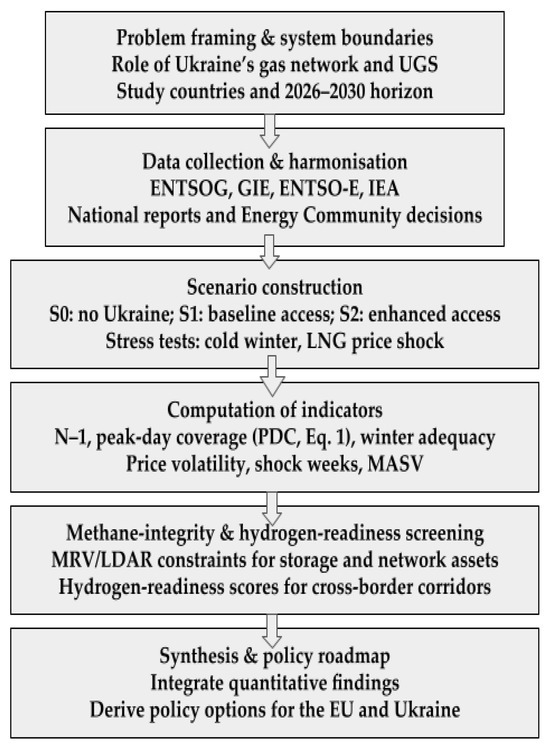
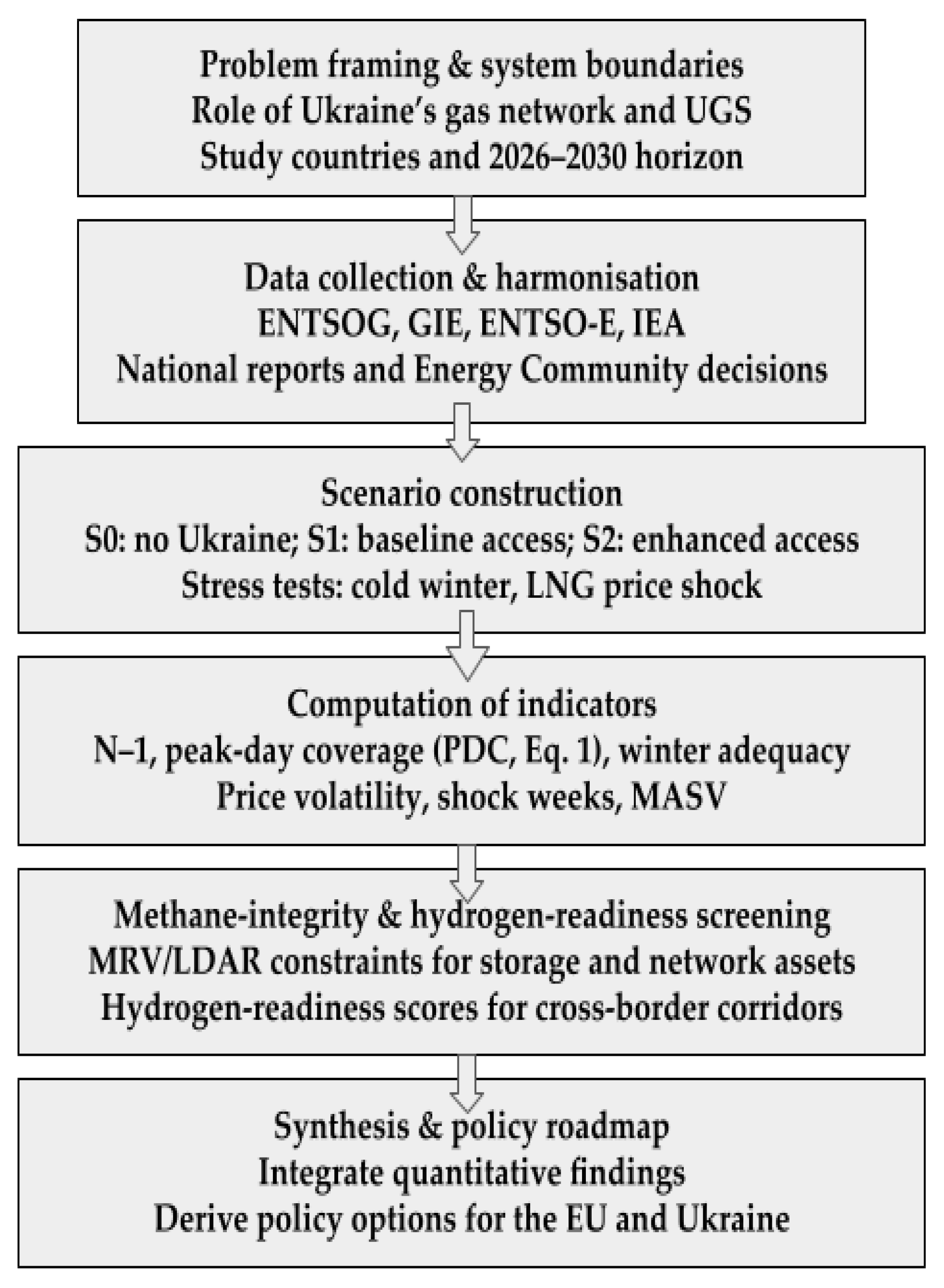
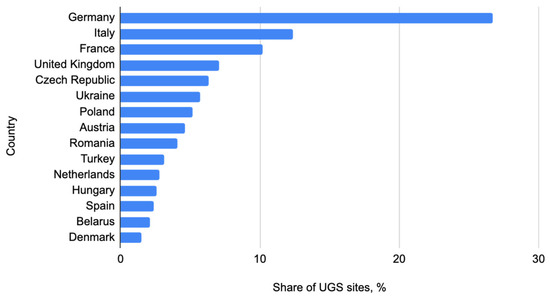
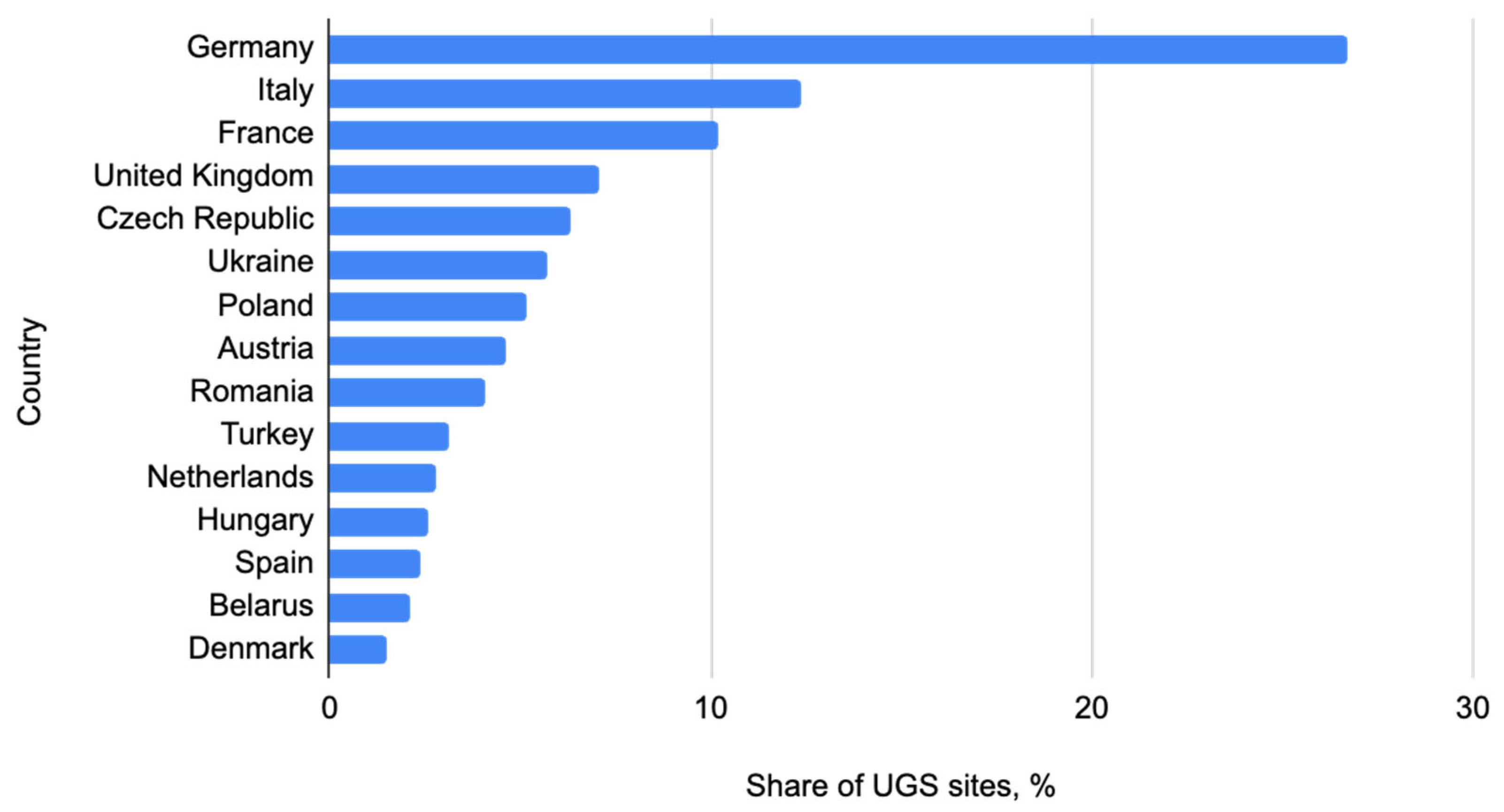

Disclaimer/Publisher’s Note: The statements, opinions and data contained in all publications are solely those of the individual author(s) and contributor(s) and not of MDPI and/or the editor(s). MDPI and/or the editor(s) disclaim responsibility for any injury to people or property resulting from any ideas, methods, instructions or products referred to in the content. |
© 2025 by the authors. Licensee MDPI, Basel, Switzerland. This article is an open access article distributed under the terms and conditions of the Creative Commons Attribution (CC BY) license.