Abstract
This study investigates the perceptions and practices of Portuguese higher education students regarding the circular economy (CE), emphasising their knowledge, attitudes, and behaviours toward sustainable resource management. Carried out by the Working Group on Circular Economy and Waste Management of the Portuguese Sustainable Campus Network (RCS), the research used an online survey targeting students from 20 higher education institutions (HEIs), resulting in 400 responses. The findings indicate that while students generally hold positive views of the CE, their understanding of its practical applications, such as waste reduction and resource efficiency, remains limited. Only a small proportion of students reported exposure to CE-related topics in their curriculum, revealing a gap in academic integration. This study also identifies significant demographic variations in CE awareness and practices, influenced by factors such as age, field of study, and employment status. These insights underscore the need for HEIs to strengthen CE education and actively involve students in hands-on sustainability initiatives, fostering a generation equipped to drive the transition toward a circular economy.
1. Introduction
It is recognised worldwide that the current consumption model is unsustainable in the long term [1,2]. The linear model of production follows a take–make–dispose approach, rapidly extracting raw materials that cannot be replenished. Some critical raw materials remain in constant demand, while waste and pollution continue to grow [3]. The circular economy (CE) emerges as an alternative. It offers the possibility of circulating products and materials, limiting the consumption of energy and raw materials, eliminating waste and pollution, and regenerating nature by mimicking the characteristics and dynamics of biological ecosystems [3,4,5]. In addition, the CE has been considered a way to achieve the 2030 Agenda for Sustainable Development Goals for Sustainable Development [6,7] to accelerate the environmental and economic goals across various sectors [3], and has been considered a key pillar of the European Green Deal [8]. The transition to the CE is complex and requires the engagement and participation of several actors. This transition must be supported by institutions that prepare future leaders and citizens to be more aware and engaged, such as higher education institutions (HEIs) [9,10], drivers of technological and societal progress through research, discovery, and knowledge creation. In addition, HEIs can mobilise policymakers, stakeholders, and business leaders to learn, think, and act differently [11]. Through teaching and learning, research and student actions, and procurement decisions [12], but also gathering stakeholders from both public and private sectors [11], HEIs can contribute to the proper knowledge, attitude, and perception and, therefore, to creating a blooming CE in society. Thus, HEIs are primarily strategic agents that must support the principles of the CE through their teaching activities, with teaching about the CE being a relevant topic among teaching activities, as highlighted by Serrano-Bedia and Perez-Perez [11]. However, there is still limited information on the competencies that need to be changed in HEIs’ curricula [11] and the competencies acquired by higher education students. Environmental awareness and perception of knowledge among higher education students are crucial because they are encouraged to change their behaviour towards environmentally sustainable action [13]. Environmental awareness of individuals includes the effect of environmental sustainability on health, ecosystems, and economic and social development [14]. This awareness is essential for driving actions toward sustainable development and the CE. Yang et al. [15] considered that an established long-term interactive relationship and positive attitudes toward CE products are created when higher education students’ environmental awareness is built on the CE. HEIs can undertake educational awareness actions, projects, and curricula to encourage behaviour change toward social and environmental responsibility and the CE. Ribeiro et al. [16] concluded that simply establishing initiatives does not guarantee increased student awareness of sustainable development. This finding has important implications for university managers and higher education decision-makers aiming to improve students’ understanding of sustainable development.
Few studies examine higher education students’ perceptions of the CE. Recently, Alves et al. [17] conducted a study on students’ knowledge, attitudes, and behaviour regarding the CE in selected Portuguese HEIs. However, they did not examine the relationship between knowledge, attitudes, and factors such as gender, age, level of study, field of study, or familiarity with CE concepts and practices. In a study related to solid waste management, Owojori et al. [13] concluded that there is a rural–urban divide in the transition to sustainable development among HEIs. This study showed that raising awareness and integrating environmental education into participatory programs are effective strategies for transitioning to a CE-focused HEI. Yang et al. [15] analysed data from 443 higher education students in Taiwan and Thailand to examine the environmental concern and awareness, relationship quality with CE products, and attitudes, identifying factors that influence students’ purchase intentions for CE products. They concluded that trust, commitment, and identification with CE products are key factors influencing higher education students’ purchase intentions, contributing to environmental sustainability. Based on this, more detailed information is necessary about (i) the knowledge, attitudes, and behaviours related to CE concepts; (ii) whether knowledge of the CE is a predictor of CE behaviours; and (iii) practices adopted by HEIs’ students to promote the CE. Accordingly, this study aims to learn about higher education students’ perceptions of the CE, extending the CE knowledge in Portuguese HEIs.
2. Materials and Methods
2.1. Data Collection
The data collection instrument was a questionnaire developed by the Working Group on Circular Economy and Waste Management (WGCEWM) of the Portuguese Sustainable Campus Network (RCS). Established in 2018, the RCS is a collaborative academic network focused on addressing sustainable development challenges. Its objectives include mobilising the academic community, developing sustainable strategies for HEIs, fostering cooperation among members, and promoting joint sustainability initiatives. Despite its informal nature, the RCS achieved a milestone in 2019, with most Portuguese HEIs committing to sustainability [18,19]. The network engages in activities such as meetings and conferences, and it has established 10 thematic Working Groups to drive cooperation on various sustainability themes, including the CE. The WGCEWM is committed to an education that addresses the new challenges of a circular society, seeking solutions to reduce and eliminate waste and making campus activities and supply chains more circular. The goal is to transform the economy and support HEIs in responding to the challenges of our planet.
The questionnaire received prior approval from an Ethics Committee and included a free informed consent form. This form explicitly stated that all collected data would remain anonymous and confidential, with use solely for academic purposes, and that participation was voluntary. Approval was also obtained from the students’ HEIs. Conducted online via EUSurvey, the questionnaire was available from October 2023 to May 2024. The survey link was distributed to students at 20 HEIs through email.
The questionnaire was divided into four thematic sections. The introductory section concerns the socio-demographic characterisation of the sample. The second section of questions deals with the students’ perceptions and attitudes towards the CE and sustainable management of waste and resources. The third section deals with the competencies developed by HEIs, their role, and measures on the campus. The last sections deal with students’ perspectives on the circular economy and waste management (CEWM) in future employment. Most questions are multiple-choice, with only one option to select, but some allow for selecting multiple options from a predefined list. Some questions were structured in a matrix format to capture various data points. A five-point Likert scale was used for specific questions to measure agreement with explicit statements, ranging from total rejection to full acceptance. A Likert scale was used as it is considered the best measurement scale for assessing an individual’s attitude towards an issue [20].
The questionnaire is available in Appendix A.
2.2. Data Analysis
Statistical analysis was conducted using SPSS software (version 29.0). Initially, descriptive statistical methods were applied to the data. All statistical tests were conducted with a significance level set at 0.05 (alpha). Likert scale questions were treated as ordinal data, with responses coded from 1 to 5. Descriptive statistics focused on the median and interquartile range (IQR) to capture the central tendency.
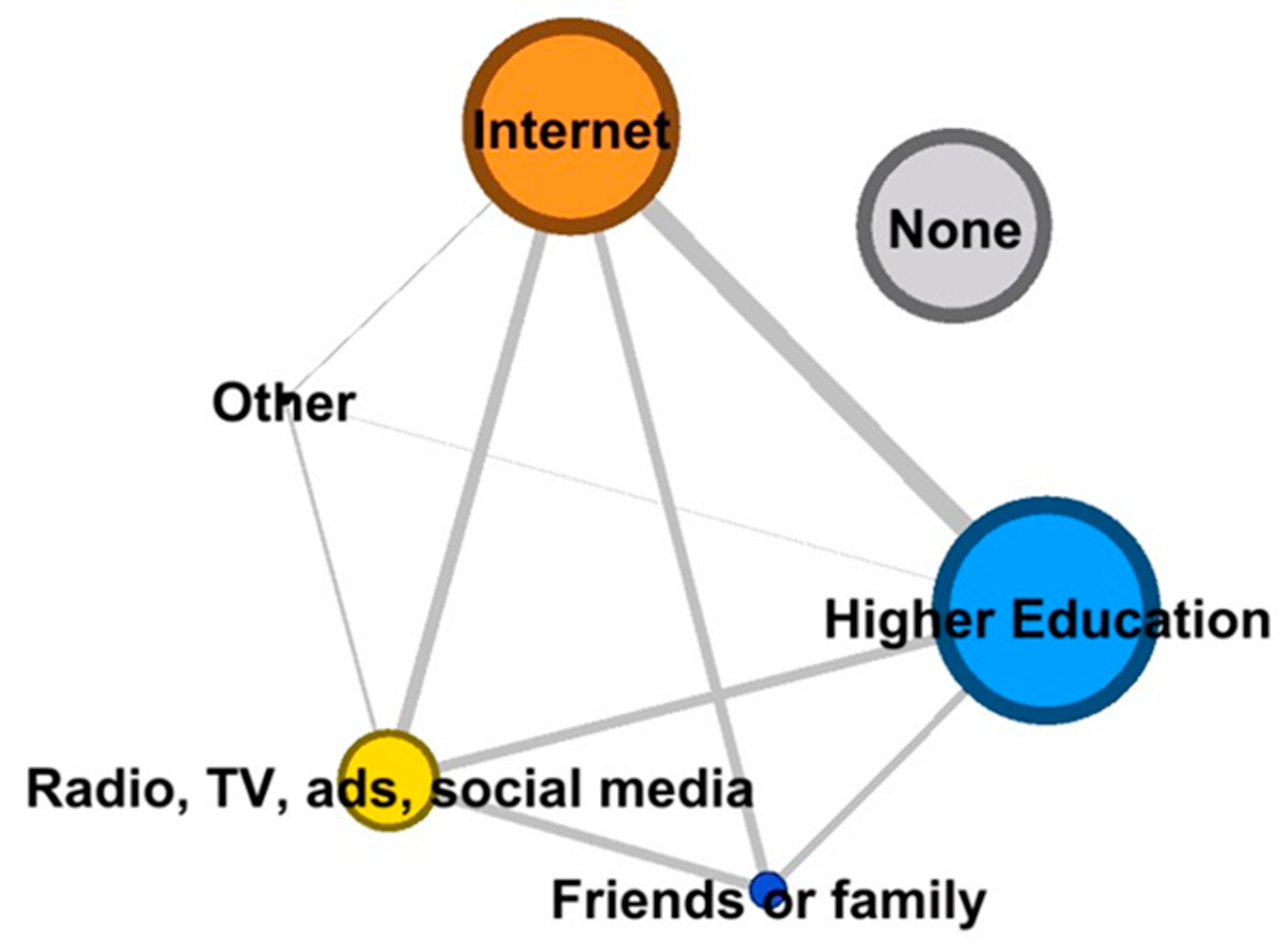
Differences in respondents’ academic degree (D), gender (G), age (A), scientific area (S), and student status—worker or non-worker (W)—were analysed using non-parametric tests, following confirmation of non-normality through the Kolmogorov–Smirnov and Shapiro–Wilk tests. Groups with fewer than 5% of respondents were excluded from this analysis. The Mann–Whitney U test was employed to determine if there were significant differences between the distributions of two groups for a specific factor. The Kruskal–Wallis test was used to compare distributions across three or more groups. Since these tests do not identify which groups differ significantly, multiple comparisons were conducted when significant differences were detected. Figure 1 and Figure 7 were obtained from Gephi open-source software (version 0.10). Gephi is capable of visualising all types of networks. The tool allows the graphical representation of a network diagram to be spatialised. This is achieved through analytical principles implemented in the software [21,22]. Gephi software is particularly suited to networks with node properties, where the latter are key-value pairs associated with each node or link [22].
Figure 1.
A combination of responses to Question 10 on how the students viewed the concept of the circular economy. The node size indicates the frequency of a single answer, while the line thickness reflects how many times that combination was selected.
3. Results and Discussion
3.1. Sample Characterisation
Portuguese HEIs are divided into two subsystems: universities and polytechnic institutes, which can be public or private. There are 28 universities (14 public and 14 private) and 20 polytechnic institutes (15 public and 5 private) [23]. The questionnaire was distributed to seven universities and nine polytechnic institutes, and 400 responses were obtained. Table 1 presents the characterisation of students from various HEIs involved in this research. Most responses (83%) came from students attending polytechnic HEIs. The respondents were 53% female, 44% male, and 3% either preferred not to disclose their gender or did not identify with the gender binary. Most of the students surveyed were between 18 and 21 years old (58%), 18% were over 30 years old, 17% were between 22 and 25 years old, and only 7% were between 26 and 30. According to the results, 78% of students dedicated themselves exclusively to their course (non-workers), while 22% also worked (workers). About 74% of the students attended one of the undergraduate courses in both subsystems, while the rest attended vocational higher education courses (VHECs) (12%), a master’s degree (10%), a PhD (3%), or a postgraduate degree (1%). Most students surveyed were born in Portugal (88%).
Table 1.
Sample characterisation (n = 400).
Table 2 reveals the students’ areas of knowledge. The most represented areas are ‘Engineering, Manufacturing and Construction’ (24%), ‘Business Administration and Law’ (16%), ‘Arts and Humanities’ (14%), and ‘Health and Welfare’ (11%). Respondents from the remaining areas correspond to less than 10% of the answers in each area of knowledge.
Table 2.
Students’ areas of knowledge considering the International Standard Classification Education (ISCE).
The areas of ‘Social Sciences, Journalism and Information’, ‘Environmental Studies’, ‘Architecture’, and ‘Services’ were excluded from the statistical analysis presented in the following sections, as they accounted for less than 5% of the sample. For the same reason, responses for the gender categorised as ‘Non-binary’ and ‘I prefer not to answer’ were not considered. Additionally, PhD and postgraduate degrees were not included in the ‘Grade’ category.
3.2. Students’ General Knowledge and Attitudes on the Circular Economy
In section two of the questionnaire, the students’ general understanding of the CE was assessed by combining questions based on a five-point Likert scale (Questions 8, 11, and 12), and selecting one of several statements on the concept of the CE (Question 9) and a question that allowed several answer options (Question 10).
Regarding the students’ understanding of the CE concept, Question 10 allowed multiple-choice answers: higher education, Internet, radio and/or TV, family and friends, and none. Figure 1 represents the different combinations of answers selected by students, where each link represents two answers selected together. The visualisation obtained with the Gephi software facilitates the non-linear process of discovering information, focusing on the visualisation of the network that connect the nodes in order to highlight the information that stands out from the other elements [22]. Most respondents, 74%, chose one option, while the remaining 26% chose more than one option. Of the respondents who chose more than one answer, 64% selected two options, 26% selected three, and 10% chose four answers. In Figure 1, the width of each connection represents the frequency with which each pair was selected (the thickness of the lines is directly proportional to the number of answers). The more frequent combinations were pairs among ‘Higher education’ and ‘Internet’. This multiple-choice question revealed that most students came into contact with the concept of the CE in an academic environment, followed by the Internet, radio, TV, and ads. As expected, and similarly to the studies conducted by Dewi, Arfani, and Herawan [24], Antovska-Mitev and Drangovska [25], and Alves et al. [17], students’ leading sources of information on the concept of the CE were academia and the Internet. Dewi, Arfani, and Herawan’s study [24] reveals equal percentages for these two sources, and Alves et al. [17] show that social media is the primary source. In contrast, the present study demonstrates that academia is students’ primary source of information. The answers also showed a significant percentage of students who have never heard about the CE (26%). Regarding HE students’ lack of knowledge of the concept of the CE, the Portuguese study by Alves et al. [17] indicates similar values. Other studies present lower percentages [24] and higher percentages for the lack of knowledge of HE students on the CE concept [13,26].
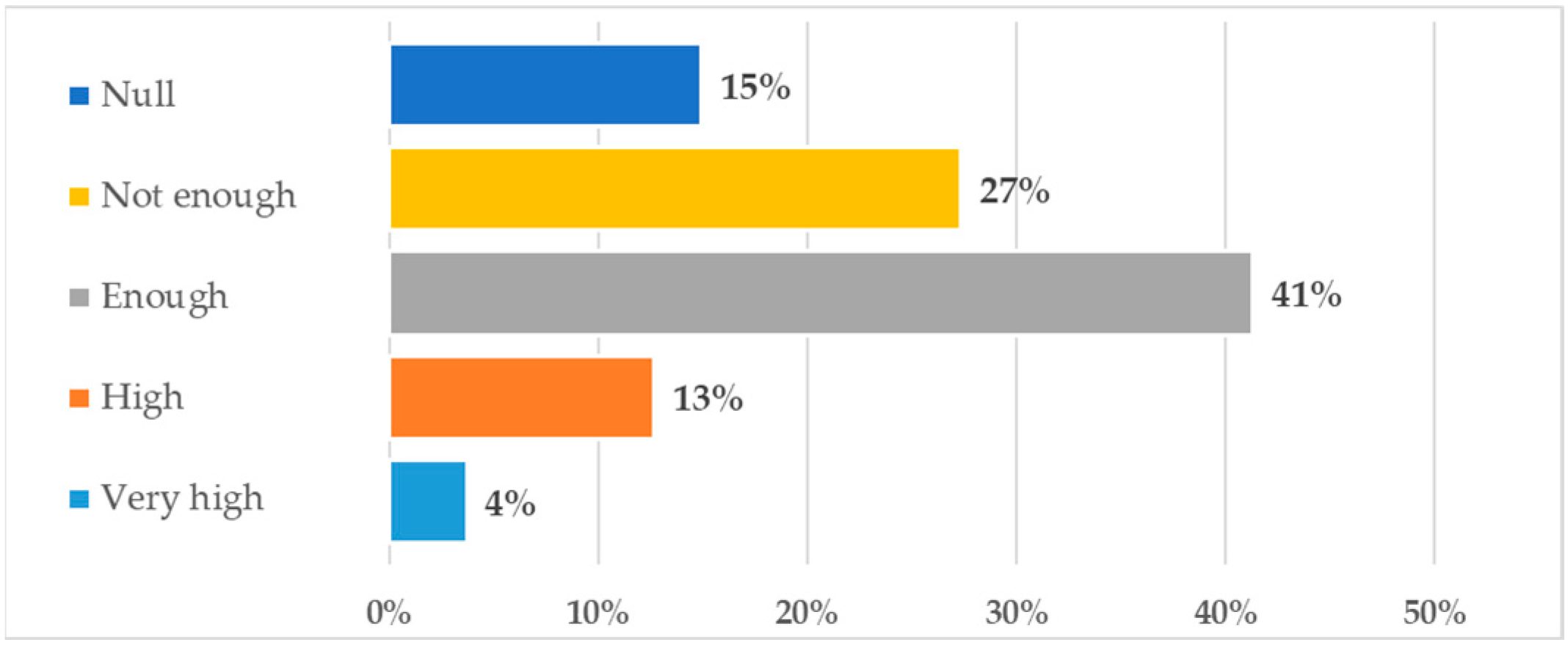
In Question 8, the students were asked to identify their level of knowledge of the concept of the CE (Figure 2). These results show that 41% of respondents stated they had sufficient (enough) knowledge of the CE; 17% stated they had very high knowledge (4%) or high knowledge (13%). However, 27% stated they did not have sufficient knowledge, and 15% stated they did not know (null) the concept of the CE. Question 8’s median is two, and the IQR is one. The median value for the older age group (over 30 years) and the scientific areas ’Business, administration, and law’ and ‘Agriculture, Forestry, Fisheries, and Veterinary’ is three. These results align with those of the study conducted by Alves et al. [17] on university students in Portugal, confirming that Portuguese HE students have a low to moderate level of understanding of the concept of the CE. These outcomes highlight the importance of integrating CE and sustainable development topics into the curricula of different courses at HEIs [27,28].
Figure 2.
Distribution of results on students’ perceptions of their knowledge of the circular economy concept (Question 8) (null means that the students have realised that they have no knowledge about the concept of the circular economy).
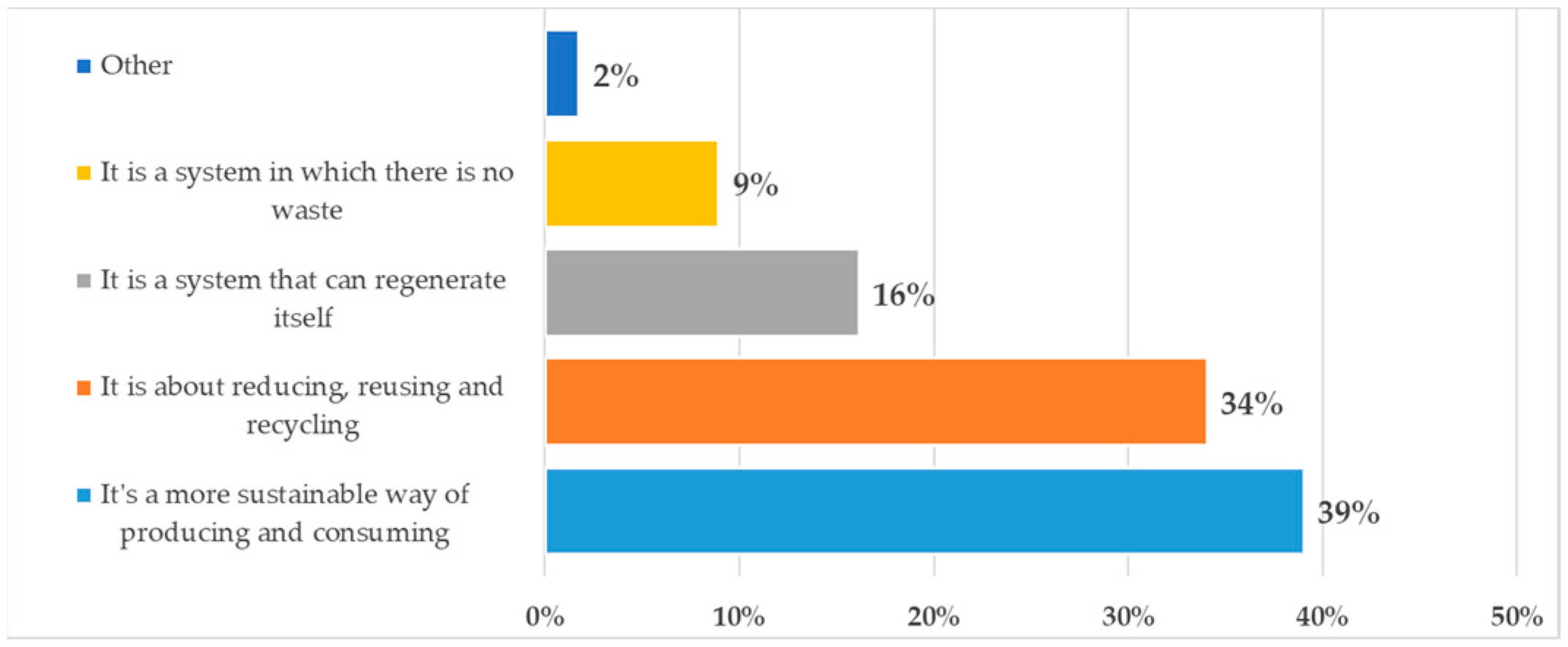
In Question 9, students were asked to choose one of four statements that, in their view, best suited the CE concept. Figure 3 presents the responses distribution: 39% of students associate the concept of the CE with a more sustainable way of producing and consuming, followed by 34% who stated it is about reducing, reusing, and recycling; 16% answered that it is a system that can regenerate itself; and only 9% responded that it is a system in which there is no waste. Respondents were also allowed to indicate another definition not included in these sentences, but these answers accounted for less than 2% (Figure 3).
Figure 3.
Distribution of responses to the statement ‘best fits the circular economy concept’ (Question 9).
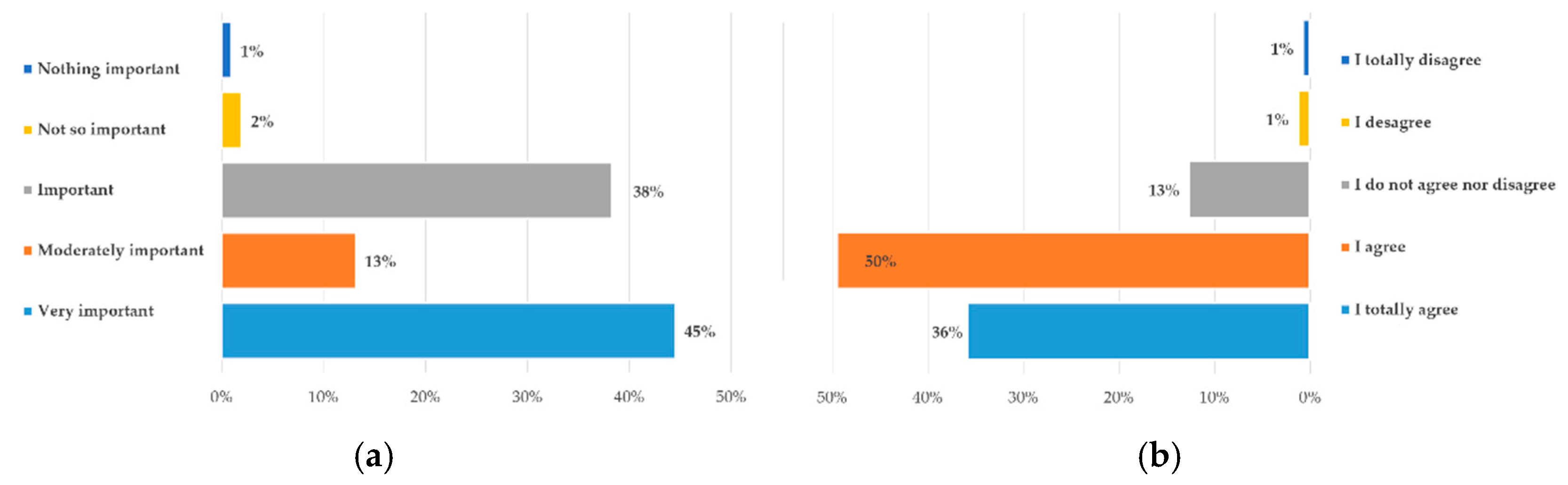
Concerning Question 11 (Figure 4a) on the importance of disseminating actions promoting the CE, a high percentage of students, 84%, stated it is ‘important’ (39%) or ‘very important’ (45%) to disseminate this kind of action. In comparison, only 3% of the students declared that these actions are ‘not so important’ (2%) or ‘nothing important’ (1%) (Figure 4a). Thus, it can be said that the students surveyed generally have a favourable attitude towards the importance of publicising actions related to the CE. The median value is four and the IQR is one. It should be noted that the majority of master’s students and older age groups (26 to 30 years and over 30) responded that, from their perspective, it is very important to publicise CE actions. It should be noted that most master’s students and the older age groups responded that, from their perspective, it is very important to disseminate CE actions, which reveals the concern of the older groups with disseminating this type of information. In the group of working and non-working students, the analysis of the median reveals values of 5 and 4, respectively, which shows that students in the labour market are more aware of the importance of disseminating CE actions.
Figure 4.
Distribution of responses to the following statement and question: (a) “The importance of disseminating actions on CE” (Question 11); (b) “Do you agree that CE actions can influence the direction of climate change?” (Question 12).
Question 12 (Figure 4b) revealed that most students surveyed establish a strong link between CE actions and the direction of climate change. About 85% of students agree (49%) or totally agree (36%) that CE actions influence climate change (Figure 4b). The median value is four and the IQR is one. It should be noted that in the area category (median = 4), the distribution is negatively asymmetrical, except for the ‘Information and Communication Technologies’ area, whose asymmetry is positive.
3.3. Students’ Practices Promoting the Circular Economy
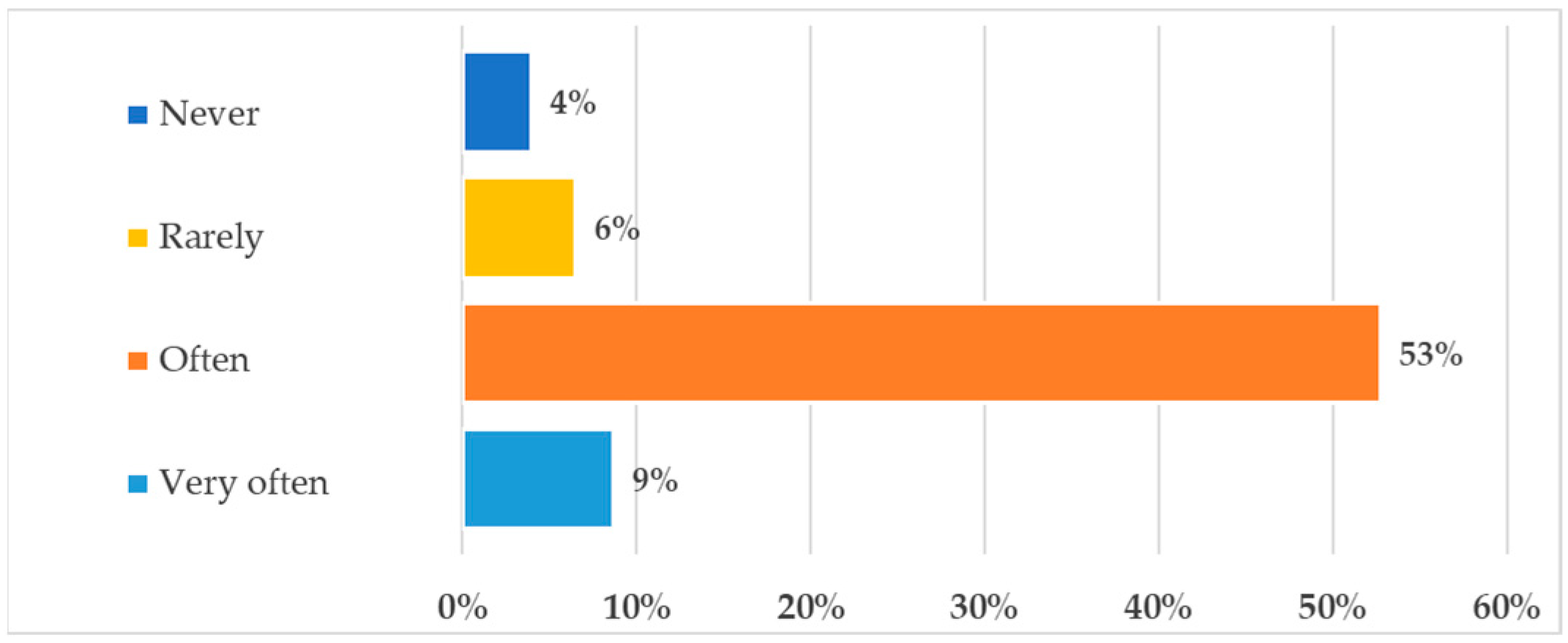
When students were asked how often they practice CE actions (Question 13, Figure 5), 62% answered ‘often’ (53%) or ‘very often’ (9%), while 10% answered ‘rarely’ (6%) or ‘never’ (4%). Figure 5 shows the response distribution on CE practices (median = 4; IQR = 1). It is worth noting that the results for master’s students and students over 30 revealed outliers. According to Alves et al. [17], the fact that students pursue higher education appears to influence respondents’ perception that they engage in a significant number of CE actions, a finding that this study seems to support. In a different research study, Ali et al. [29] also concluded that the higher the respondents’ knowledge about environmental threats, the greater the effect of changing organisational behaviour.
Figure 5.
Distribution of results on students’ circular economy practices (Question 13).
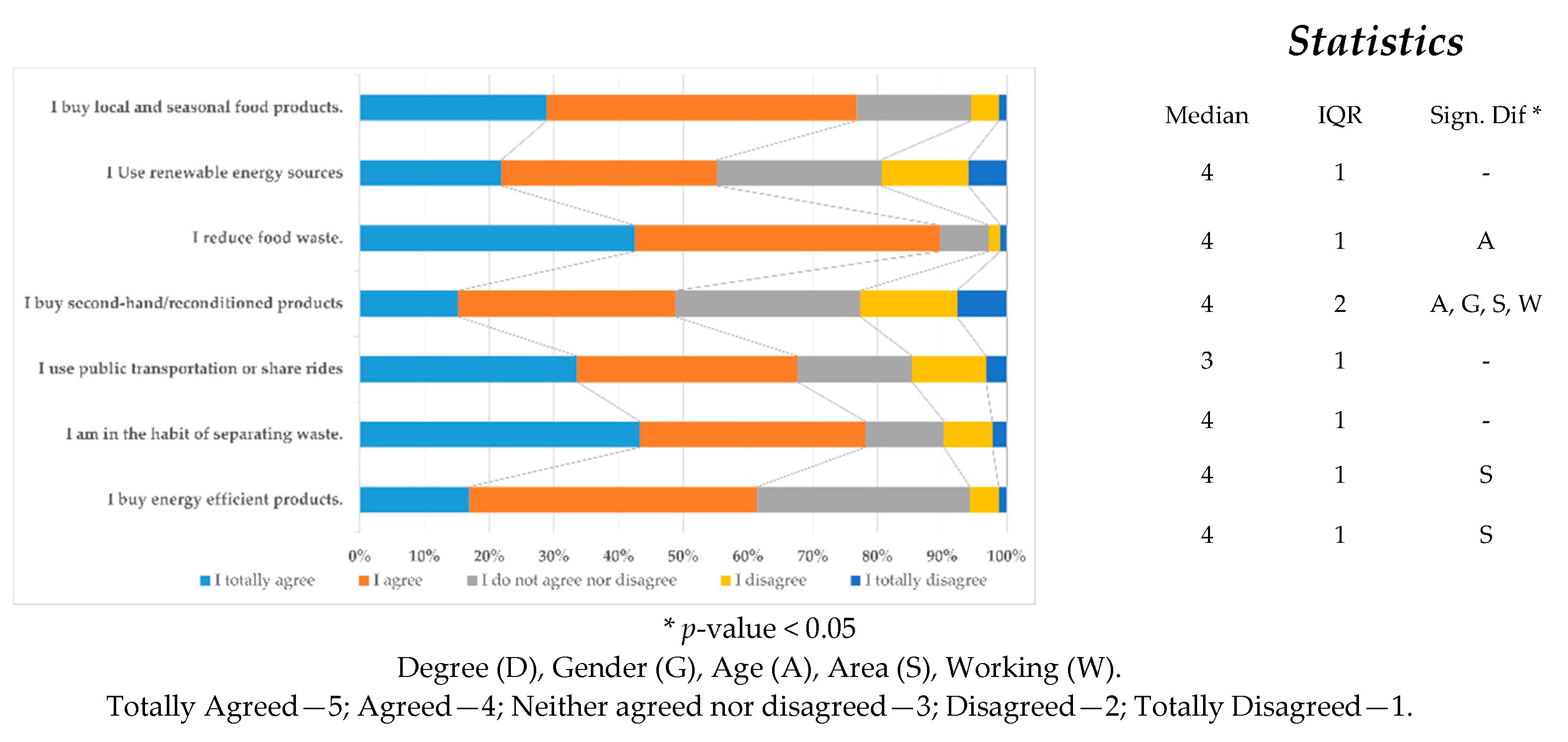
In Question 14, students were asked to rate their level of agreement or disagreement with seven different CE-related statements. Figure 6 shows the distribution of responses regarding student behaviour in terms of CE practices.
Figure 6.
Distribution of results on students’ circular economy practices (Question 14).
The CE practices most mentioned by students were “reducing food waste” (90%), “separating waste” (78%), “buying local and seasonal food” (77%), and “using public transport” (68%). Most answers demonstrated agreement (median = 4), except for the statement related to buying second-hand or reconditioned goods, in which most of the respondents revealed neutral answers (median = 3). The answers had IQR = 1, except for the statement about reducing food waste, which had a greater dispersion (IQR = 2). The distribution was equal in the categories of age, gender, scientific area, degree, and status of working/non-working students. As shown in Figure 6, most of the answers correspond to a simple agreement with the presented statements, which shows that the respondents recognise the importance of adopting habits related to the CE. As to whether they are in the habit of reducing food waste, significant differences were observed in the distribution of responses across age groups, genders, scientific areas, and working or non-working students. Students in the following groups were more likely to agree (Figure 6): age group of 17 to 21 years (60%), female gender (56%), scientific area of ‘Health and Welfare’ (62%), and non-working students (73%). Significant differences were observed in the distribution of responses across age groups on the statement related to using renewable energy sources. Students aged 17 to 21 years were more likely to agree (58%). When asked if they regularly separated waste, significant differences were observed in the response distribution across scientific areas. Students in the ‘Engineering, Manufacturing, and Construction’ field were more likely to agree (26%). Similarly, there were notable differences in response distributions across scientific areas regarding the question about purchasing energy-efficient products (26%). There were notable differences in the distribution of responses based on scientific area on the question related to buying energy-efficient products. Students in the scientific area of ‘Engineering, Manufacturing, and Construction’ were more likely to agree (28%).
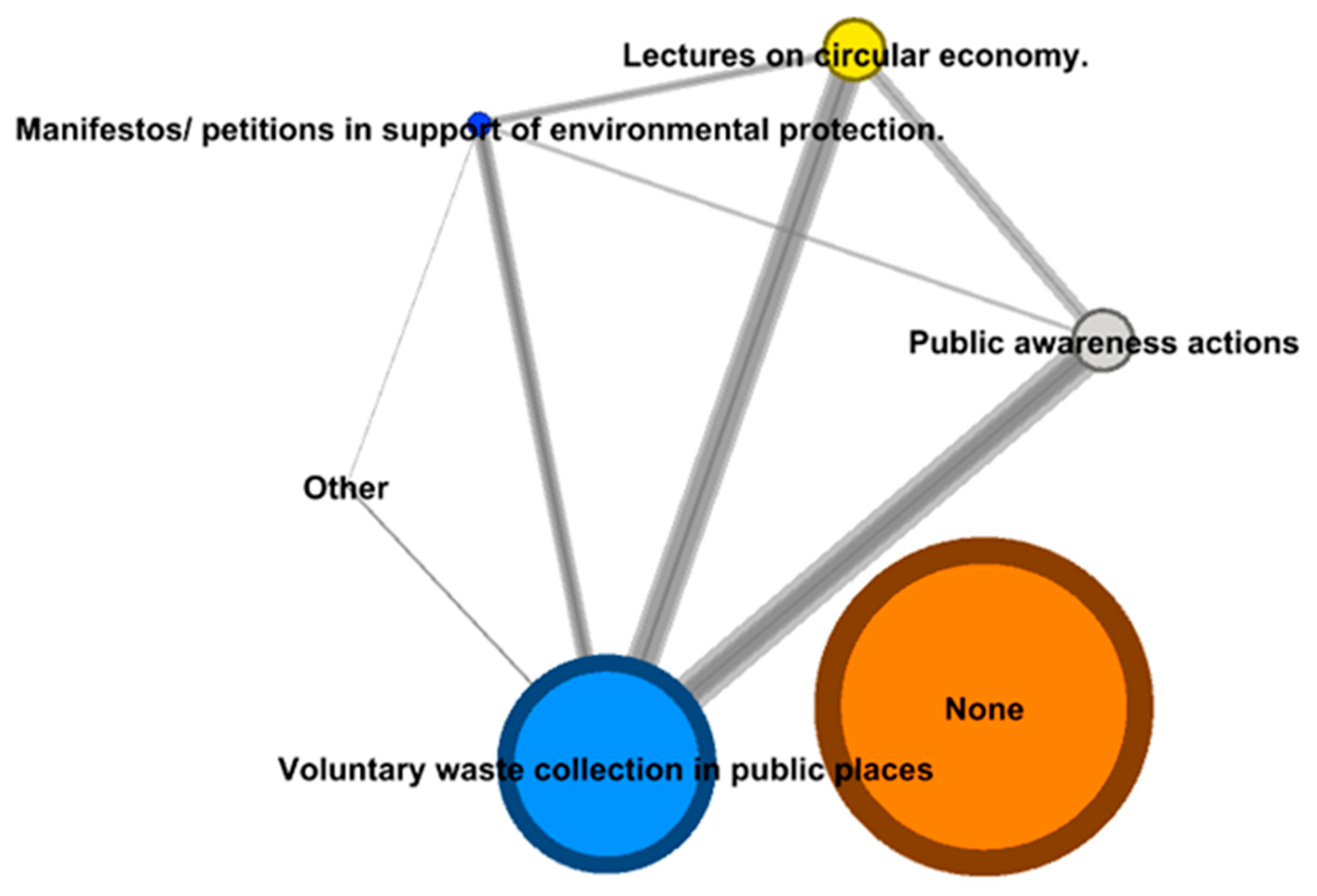
In Question 15, students were asked to indicate actions in which they had already been involved, and to this end, six options were given, including one in which they could describe a distinct action. This question allowed multiple-choice answers. Figure 7 represents the different combinations of answers selected by students: each link represents a pair of selected answers, with the thickness of the connection indicating how many times each pair was chosen (the thickness of the lines is directly proportional to the number of answers). Most respondents, 72%, chose a single option, while the remaining 28% chose two or more options. The results revealed that 34% of respondents had never taken part in any action related to CE or the protection of the environment. Overall, the most popular action is related to voluntary waste collection in public places, corresponding to 22% of the single answers. Of the respondents who chose more than one answer, 67% selected two options, 31% selected three, and 2% chose four or more answers. The more frequent combinations were pairs among ‘voluntary waste collection in public places’, ‘public awareness actions’, and ‘lectures on circular economy’.
Figure 7.
Combination of responses on actions in which students had already been involved (Question 15). The node size indicates the number of simple answers, while the line thickness reflects how often that combination was selected.
3.4. Skill Development: The Role of Higher Education Institutions
Section 3 of the survey aimed to find out the students’ opinions on the position of their educational institution regarding the CE. To this end, questions were asked about integrating the CE into the course curriculum and promoting CE practices. Students were also asked about teachers’ knowledge of the CE. Additionally, suggestions were requested for content related to the concepts of the CE in the Curricular Unit (CU) or implemented on campus.
3.4.1. Integration of the Course Curriculum and Circular Economy Practices into Higher Education Institutions
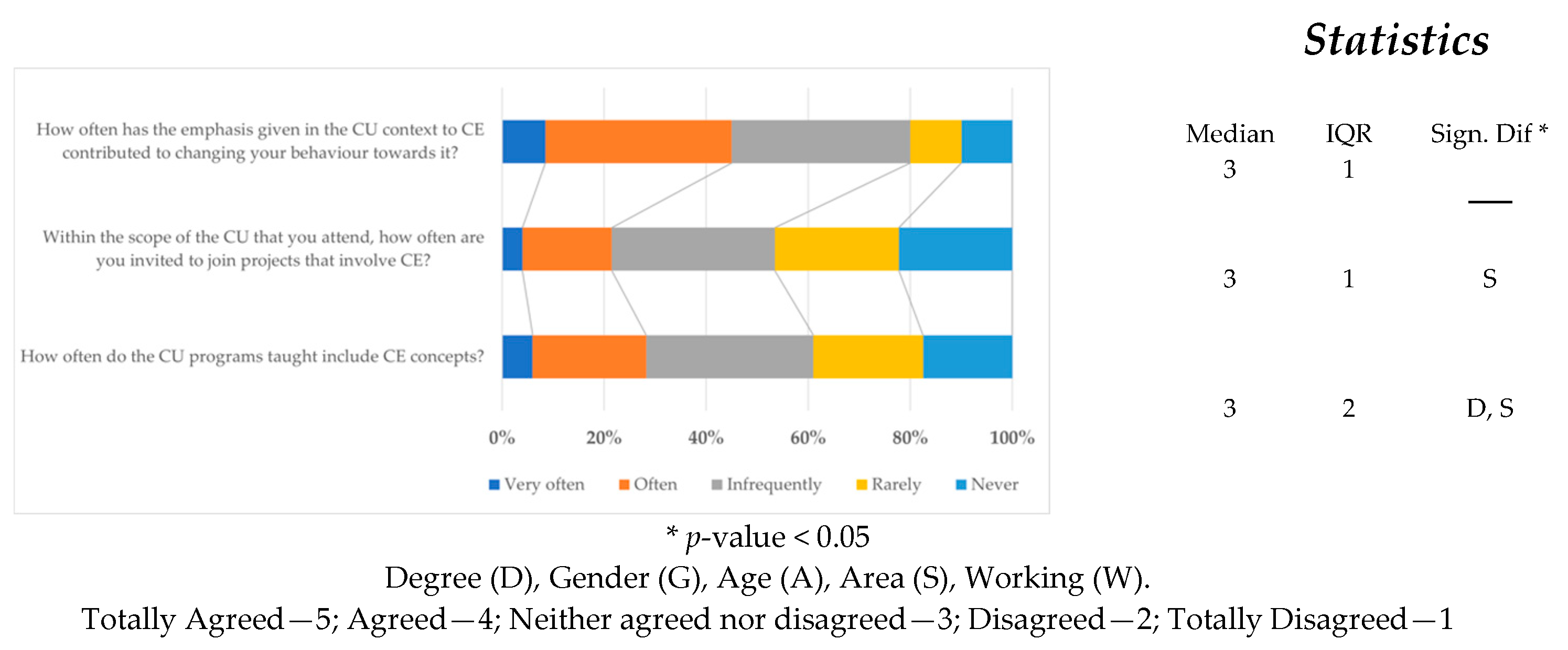
To assess students’ opinions on integrating the concept of the CE into the course curriculum and its contribution to changing their behaviour, Questions 16, 17, and 22 were asked. From the results (Figure 8), it can be concluded that students consider that the CE is not yet sufficiently included in curricular programs, nor are they invited to participate in projects in this area (median = 3). However, 45% of students who responded to the survey consider that the emphasis given in the CU context (program, activities developed) to the CE contributed to changing their behaviour. Regarding the dispersion of the results, the highest IQR value was obtained in Question 22 (IQR = 2).
Figure 8.
Students’ opinions on integrating the circular economy concept into the course curriculum (Questions 16, 17, and 22).
Significant differences were observed in the distribution of responses for this set of questions by degree and scientific area group.
Regarding Question 16, “How often do the Curricular Units programs taught include Circular Economy concepts?”, there were notable differences in the distribution of responses based on degree between VHEC and undergraduate students. For VHEC students, 82% of the responses fall into the median interval equal to or greater than 3. Meanwhile, for undergraduate students, that percentage is only 58%. In the knowledge area, the dispersion is higher. For students in ‘Information and Communication Technologies’ and ‘Social Sciences, Journalism, and Information’, the median is less than 3.
Significant differences in the distribution of responses by scientific area groups regarding participation in projects that involve the CE were observed (Question 17). For students in ‘Information and Communication Technologies’ and ‘Natural Sciences, Mathematics, and Statistics’, the median was 2.
CE concepts are increasingly being integrated into higher education curricular programs to promote sustainability and address environmental challenges.
Different studies and authors [30,31,32] have shown that HEIs play a crucial role in fostering knowledge and understanding of CE principles among students and the importance of developing appropriate skills and competencies related to CE challenges through academic offerings in this area. Furthermore, collaborative learning projects involving students and industry partners have been shown to generate value and drive innovation towards CE ways of working [33,34]. By integrating CE concepts into higher education curricula, institutions can prepare students to become active participants and catalysts in the transition towards a more sustainable and CE.
Raphaela Vidal et al., in their study [35], highlight that in Portugal, the integration of CE principles into Industrial Engineering and Management (IEM) programs, for example, is still emerging. A systematic search of Portuguese HEIs revealed that while some institutions have started to incorporate CE-related topics into their curricula, there is a significant gap in dedicated CE courses, particularly in IEM programs.
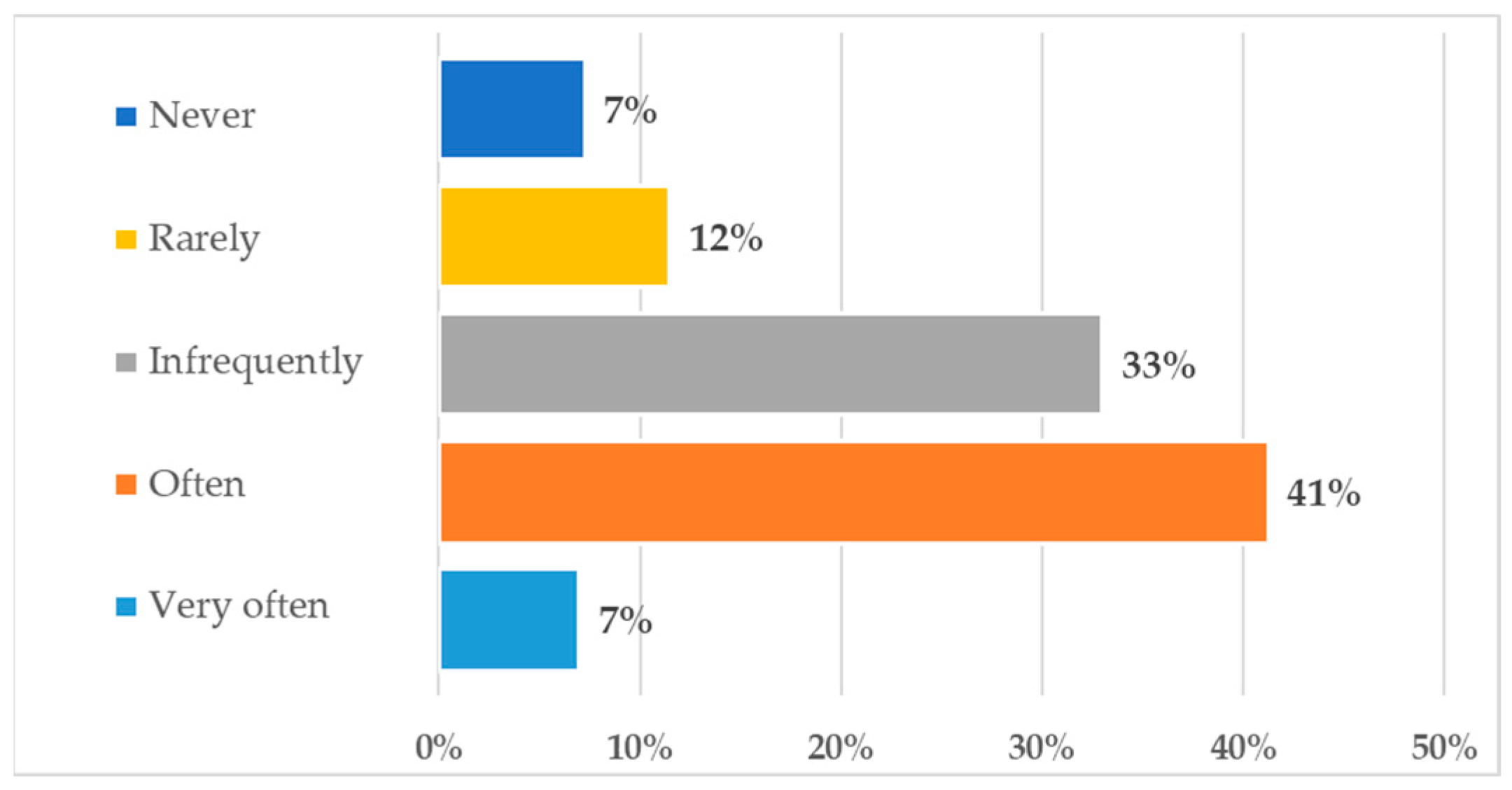
Figure 9 presents students’ opinions regarding promoting CE practices in their institution (Question 18). In Figure 9, it can be seen that 41% of students responded often and 7% responded very often. However, 52% of students responded infrequently, rarely, or never. In Question 18, the median value is 3 and the IQR is 1. For this question, no significant differences were observed in the distribution of responses across all variables.
Figure 9.
Distribution results on students’ opinions about circular economy practices in their higher education institutions (Question 18).
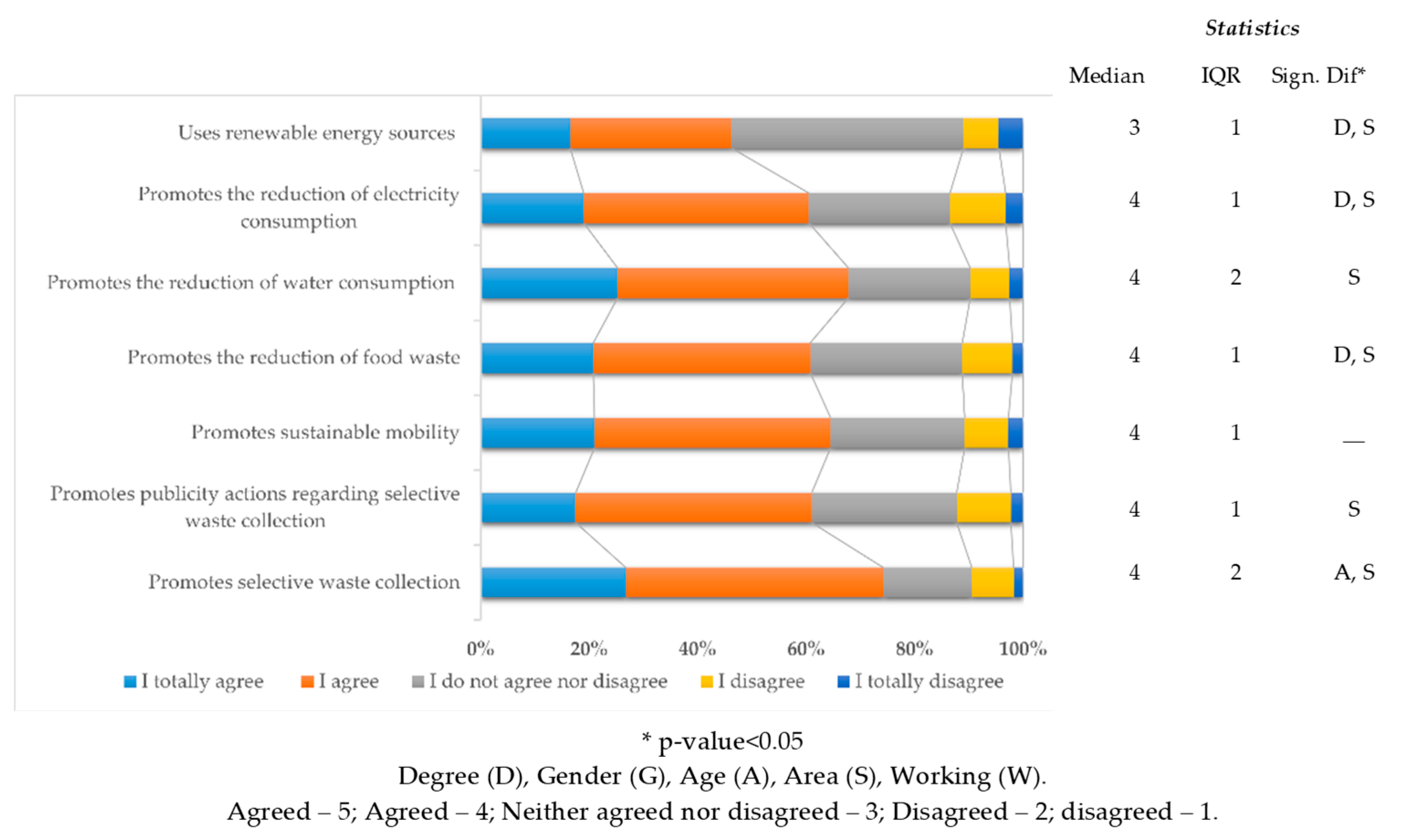
In Question 19, students were asked about CE practices in their HEI, which should involve the integration of sustainable principles into educational programs and campus operations to promote resource efficiency and environmental conservation. The results (Figure 10) show that, in general, students consider that HEIs already implement CE practices. In the students’ opinion, the use of renewable energy is the least implemented practice, as opposed to waste separation, which students consider the most implemented practice. The practice most mentioned by students was “Promotes selective waste collection” (74%), and the practice least mentioned by students was “Uses renewable energy sources” (46%). Regarding the distribution of the responses, most demonstrated agreement (median = 4), except for the statement “Uses renewable energy sources”, in which most of the respondents gave neutral answers (median = 3). The answers to this question had IQR = 1, except for the statement related to selective waste collection and the reduction of water consumption, which had a greater dispersion (IQR = 2).
Figure 10.
Results distribution on students’ opinions about higher education institution practices (Question 19).
For Question 19, there were notable differences in the distribution of responses. In the degree variable, significant differences in the distribution of responses were observed in statements 19.4, 19.6, and 19.7 between VHEC and undergraduate students. In general, it was observed that VHEC students tend to agree more with the statements of Question 19.
Regarding the variable age, significant differences in the distribution of responses were observed only in statement 19.1, between the 22–25 and <30 categories. It was observed that older students tended to agree more with the statements of the question.
Finally, for the area of knowledge variable, it was observed that, in general, students in the fields of ‘Business, Administration, and Law’, ‘Natural Sciences, Mathematics, and Statistics’, and ‘Agriculture, Forestry, Fisheries, and Veterinary’ tended to agree more. On the other hand, students in the ‘Arts and Humanities’ and ‘Information and Communication Technologies’ education areas tended to disagree more.
Several studies [4,36,37] have emphasised that the integration of CE practices into HEIs is increasingly recognised as essential for fostering sustainable development. HEIs serve as microcosms for CE, influencing future leaders and citizens through education, research, and campus operations. Case studies from institutions like Politecnico di Torino illustrate successful CE practices, emphasising waste reduction and resource efficiency as key components [38].
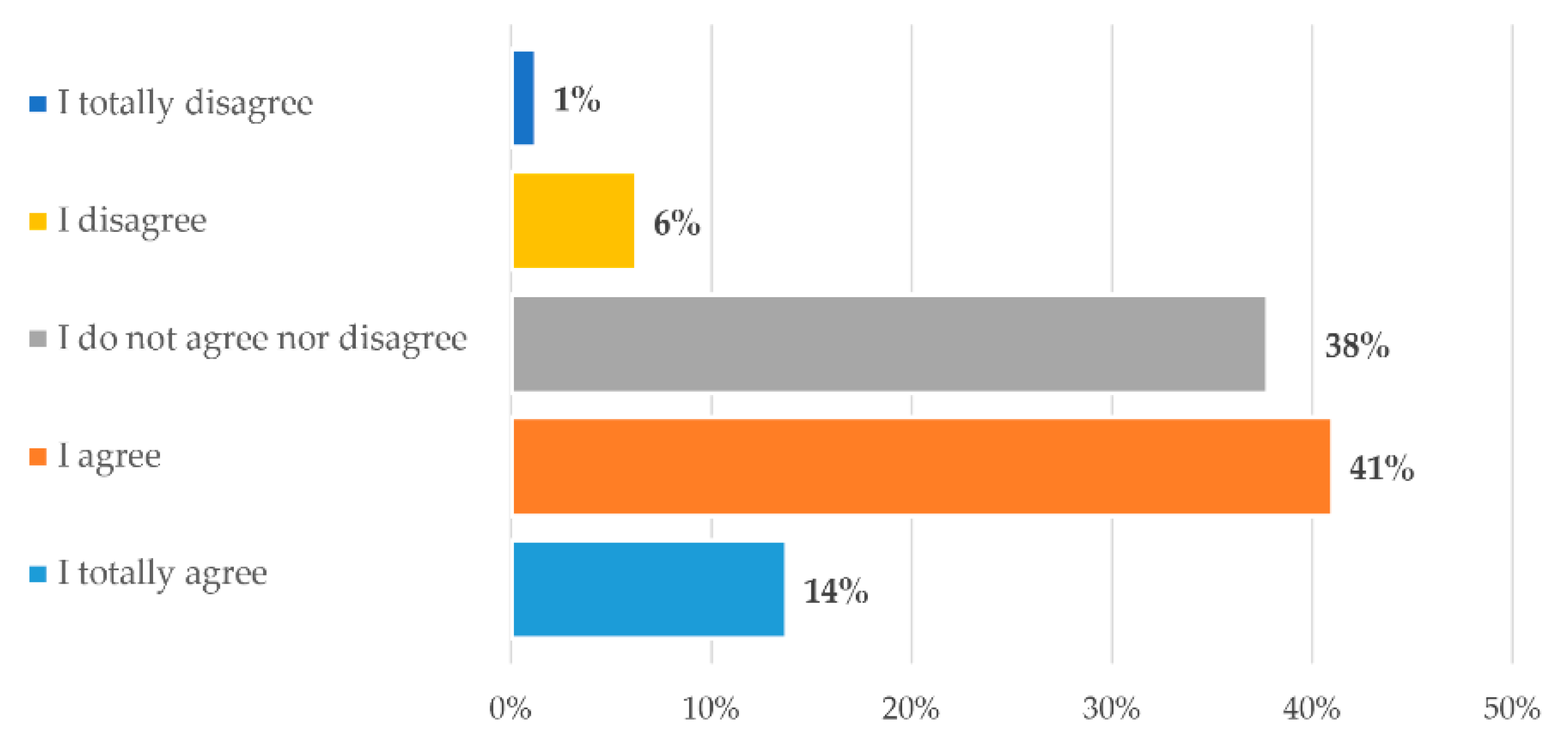
In Question 20, students were asked if, in their opinion, teachers have the knowledge to cover content related to the concepts of the CE. Figure 11 shows the distribution of responses, where it can be observed that 14% and 41% totally agree or agree, respectively, that teachers have the knowledge to cover content related to the concepts of the CE. However, of the total of 219 responses, only 74 students (18%) are from the ‘Environment’ and ‘Engineering, Manufacturing, and Construction’ areas.
Figure 11.
Distribution of results on students’ opinions about teachers’ knowledge equipping them to cover content related to the concepts of the circular economy (Question 20).
For Question 20, the median value is four and the IQR is one. Significant differences in the distribution of responses were observed for the scientific area variable. The median for students in the ‘Arts and Humanities’, ‘Natural Sciences, Mathematics, and Statistics’, and ‘Information and Communication Technologies’ was three or less.
Studies highlight the importance of teacher education in promoting sustainability and CE concepts [39,40,41,42]. Educational approaches like problem-based learning and interactive exercises have been successfully implemented to introduce undergraduates to the CE concept, receiving positive student feedback [43]. Furthermore, collaborative efforts among teachers have led to the development of practical activities and cases specifically designed to introduce CE principles at the university level, aiming to foster “circular thinking” among students [44]. These initiatives demonstrate the commitment of teachers to enhance their knowledge and effectively deliver content related to the CE in educational settings.
3.4.2. Students’ Perspectives on the Implementation of Content Related to Circular Economy Concepts in the Curricular Unit and Campus
In Question 21, (open question) about students’ suggestions for content related to CE concepts in the CU or implemented on campus (with 83% valid responses), the content analysis technique proposed by Bardin [45] was used, with the different stages organised into three poles:
In the pre-analysis, in which the floating reading was carried out, the responses were noted, enumerated, and classified by equivalence. The responses were coded in ascending order (P1, P2, P3…). Absolute frequency was used as the enumeration rule.
The data were organised into categories by two thematic areas: CU and campus. In each thematic area, the categories are presented according to the highest frequency of the registration units (Table 3).
Table 3.
Categories, registration units, and frequencies for the Curricular Unit and campus (n = 400).
The students’ suggestions for the CU were in four categories: (i) Contents, (ii) Methods, (iii) Pedagogical activities, and iv) Teaching materials.
Participants (59) reported that the content of the CU is not interesting and that they had no suggestions. These results align with the questionnaire responses, with an equal number of participants sharing the same opinion. These data reinforce what has already been said previously about the importance of integrating these themes into the curricula of different courses [27] and go against the recommendation by Sukiennik et al. [46], who consider education for sustainable development an essential component of general education and that the education process in this area should begin in the general school phase and end in higher education.
Other participants reported that the content should be well-founded and explain the advantages and contribution of the CE, as the selected responses reveal:
“Sustainable development [concept], to unite economy and sustainability, inspired in particular by notions of: economic permaculture, green economy, reuse economy, performance economy and industrial ecology” (P334), with “its contribution to combating climate change and preserving biodiversity” (P117). Moreover, participants added that the concept CE should be adapted “In each [course subject] in its curricular content [the concept of CE], it is adapted so that [the student] can have different perspectives, and all of them complement each other” (P319).
In the methods category, participants highlighted active methods with the student as the protagonist and involved in the learning process using similar practical activities in their daily lives, as revealed by the participants’ selected response: “Try to have simple activities involving students presented to the others, for example, the creation of a project by the students in which the other students participated. Something simple, quick, but fun and worthwhile” (P93). These findings corroborate the results by Rodríguez-Chueca, J. et al. [47], from a study conducted with higher education students, demonstrating that the implementation of new learning methodologies in innovative educational projects enhanced students’ motivation and the development of sustainability-related skills and the CE.
In the pedagogical activities category, study visits to places with good CE practices stand out, as revealed by the following answer by one participant: “Study visits to companies that use this type of philosophy/are certified, with practical examples” (P170).
In the teaching material category, the 3Rs sustainability strategy is implicit, as revealed by the following selected response, “Try to reuse classroom materials” (P19). However, these data are consistent with the answer to another question in the questionnaire (Question 9) on the concept of the CE.
In the students’ suggestions for the campus, three categories were found: (i) Communication, (ii) Waste management strategies, and (iii) Activities.
The communication category appears conveyed through digital communication and awareness campaigns with student involvement, as revealed by the participants’ selected response: “Creation of a podcast alluding to the CE, a way of adopting the technological evolution we live in today, based on the topic addressed” (P103) and “to invest in smart campi with intelligent energy use systems” (P326). The data reveal the importance of learning with digital communication due to the new paradigm shift, where ubiquitous learning (U-learning) is expanded to smart learning (S-learning). In “smart learning”, learning also uses technologies, such as virtual learning environments and social networks, for social and collaborative learning [48].
The participants also provided input through analogue communication, as the selected responses reveal: “workshops focused on thematic objectives within the CE that help the environment (…) students can participate in activities related to the CE and develop awareness campaigns with clear messages about the benefits of the CE, etc.” (P288). Once again, these data are consistent with the answer to another question in the questionnaire (Question 11) on the importance of disseminating actions on the CE.
In the category of waste management strategies, two areas related to the 3Rs of sustainability and waste separation appear, as reflected in the selected responses: “Reuse, transform the old into new” (P338) and “Information on the effect of global waste disposal in the absence of separation by recycling points” (P88).
In the end activities category, the following stand out: the ecological footprint with presentation of results “[implementation of the environmental footprint with students] for awareness, simulators, presenting global and specific statistics” (P97), respective impact on the future of the individual “[impact of ecological footprint] on future generations and our environment” (P395), and concern for future generations, volunteering with practical activities, and partnerships “Promote interdisciplinary working groups to promote activities whose target audience is the younger population.” (P80).
These data confirm the opinion of Rodríguez-Chueca, et al. [47] that collaboration between teachers and external experts, alongside contextualising course material, enhances students’ connection to social and business realities. This underscores the educational role of HEIs in collaborative projects with the business sector [33].
3.5. Behaviour in Future Working Life Related to the Circular Economy
Section 4 of the survey aimed to determine students’ opinions about their behaviour in future working life related to the CE (Questions 23 and 24).
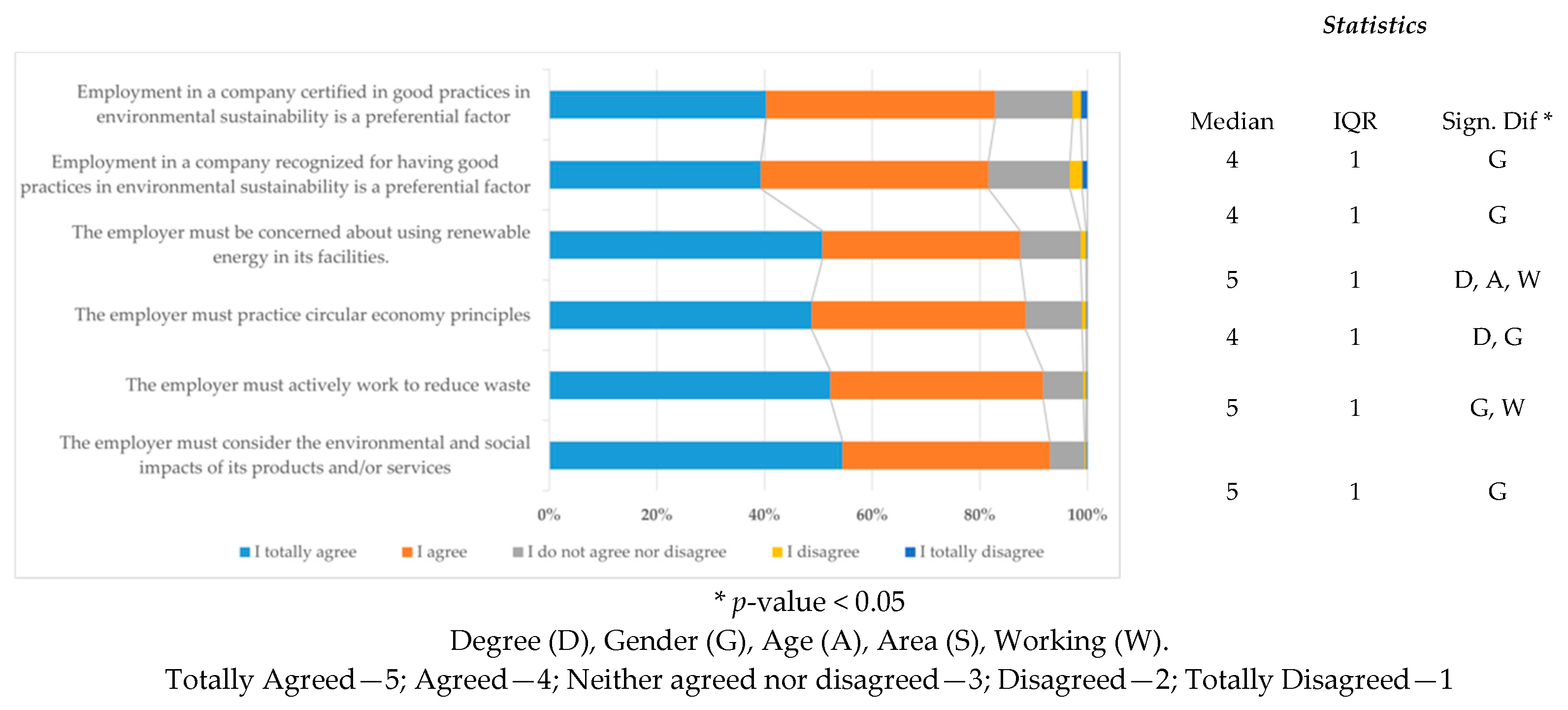
In Question 23, students were asked to classify, on a five-point Likert scale, their level of agreement/disagreement with the following four statements: The employer must consider the environmental and social impacts of its products and/or services (23.1); The employer must actively work to reduce waste (23.2); The employer must practice CE principles (23.3); The employer must be concerned about using renewable energy in its facilities (23.4). In Question 24, students were asked to classify, on a five-point Likert scale, their level of agreement/disagreement with the following two statements: Employment in a company recognised for having good practices in environmental sustainability is a preferential factor (24.1); Employment in a company certified in good practices in environmental sustainability is a preferential factor (24.2).
Figure 12 shows the distribution of responses. Responses show a median of five or five with very little dispersion (IQR = 1). When comparing the results obtained for Questions 23 and 24, it can be observed that, although students value good practices in terms of the CE on the part of companies, when they decide on future employment, students’ environmental awareness drops slightly. A similar behaviour has been observed by Todorova et al. [49] for students from Bulgaria and North Macedonia. Likewise, a comparable pattern among Portuguese HE students has also been reported regarding their efficient water use and other green practices [50]. This attitude can be explained by students’ apprehension and uncertainty regarding employment.
Figure 12.
Distribution results on students’ opinions about teachers’ knowledge equipping them to cover content related to the concepts of the circular economy (Question 23).
It can also be observed that a statistically significant difference appeared between the responses of the following categories:
- -
- Degree: In Questions 23.3 and 23.4, among undergraduate and master’s degrees, master’s students had a median of five while undergraduates had a median of four.
- -
- Age: In Question 23.4, among younger students (17 to 21) and elders (more than 30), the median youngest student dropped to four in the face of the overall average, which reflects the greater environmental awareness of older students regarding the energy issue.
- -
- Gender: There was a different distribution of answers for all questions for males and females. Generally, male responses had a median of four, while female responses had one of five, except for Questions 24.1 and 24.2, in which both groups had a median of four.
- -
- Scientific area: There were no differences in distribution.
- -
- Working/Student Status: In Questions 23.2 and 23.4, there were differences between the two groups. On both issues, the hardworking students presented a median of five in the face of four non-workers, which revealed that environmental awareness was high for both groups, though higher for worker students.
4. Conclusions
This study highlights the critical role of HEIs in fostering awareness, knowledge, and engagement with CE principles among students. In this research, an online survey was conducted among 20 Portuguese HEIs students and 400 responses were obtained. The findings reveal a strong awareness of the CE among students; however, a significant gap remains between theoretical understanding and practical application. While students recognise the CE’s importance in sustainability efforts, their involvement in specific actions and structured learning experiences remains limited. This study shows that, among student respondents, 41% stated having sufficient knowledge of the CE, and 17% rated their understanding as high or very high. Furthermore, when asked to define the CE, a large portion (39%) associated it with sustainable production and consumption, while 34% described it through the common “reduce, reuse, recycle” framework. However, only 9% accurately identified the CE as a system designed to eliminate waste. This suggests that while CE terminology is widely recognised, its deeper systemic implications are not well-understood by students. In short, this study shows that while students generally hold a positive attitude toward the CE and recognise its relevance in sustainability efforts, their practical understanding and application of the CE principle remain limited. Regarding students’ behavioural trends, over 62% of respondents indicated frequent participation in CE-related practices, including waste separation (78%) and food waste reduction (90%), while lower engagement was observed in other significant areas. The purchase of second-hand or reconditioned products was evidenced by a median engagement level of three on a five-point Likert scale. On a slightly higher level, with regards students’ CE practices, the respondents mentioned adopting public transportation, buying energy-efficient products, and separating waste. However, none of the questioned categories achieved the highest points on the presented Likert scale. This suggests that while students are inclined to embrace sustainable practices in waste management and food consumption, their consumer behaviours have not yet fully conformed to CE ideas. Another key finding relates to students’ participation in CE-related activities. The survey showed that approximately one-third (34%) of students had never been involved in sustainability initiatives, with the most common action being voluntary waste collection (22%), followed by participation in awareness campaigns and CE-related lectures. This low student engagement in the referred initiatives indicates that although the respondents may understand and perceive CE topics, the observed low participation highlights the need to integrate the CE into their practical learning experiences, enabling them to apply conceptual knowledge to real-world practices.
This research additionally explored the role of HEIs in promoting CE education. Students perceive that the CE is not sufficiently integrated into academic curricula, with a median response of three on a five-point Likert scale, indicating a neutral position about its integration. Additionally, only 14% of respondents fully agreed that their professors had the necessary expertise to teach CE concepts effectively. These findings suggest that many teachers lack the training or resources needed to incorporate CE topics into their courses, highlighting a clear opportunity for faculty development programs. If HEIs are to prepare students to become future sustainability leaders, they must equip teachers with the necessary knowledge and tools to integrate the CE across disciplines. Also, when considering the CE in professional contexts, students highlighted the importance of sustainability. The majority agreed that employers should actively work to reduce waste, adopt CE principles, and prioritise renewable energy. However, when referring to career decision-making, the respondent students were less enthusiastic about the role of the CE in their job selection process, suggesting that economic concerns and job security still take precedence over sustainability values. This points to a need for stronger connections between CE education and labour market opportunities, showing students how CE principles can be aligned with viable career paths.
The main implications of this research are that it highlights the role HEIs play in strengthening students’ CE awareness and adoption by bridging the gap between knowledge and practical application. To achieve this, HEIs should integrate CE more comprehensively into curricula across their courses. Expanding hands-on learning opportunities will enable students to apply CE principles in real-world contexts. Additionally, faculty training programs must be developed to equip teachers with up-to-date CE knowledge and teaching methodologies. Finally, by conveying the required competencies to students, HEIs can contribute to the development of a generation capable of leading the shift toward a more sustainable and CE. Through curriculum innovation, faculty development, and stronger collaborations with industry, HEIs can position themselves as key players in shaping a more sustainable and responsible workforce. Beyond academia, stronger industry collaborations are essential to preparing students for careers in the CE. HEIs should establish partnerships with businesses, companies, and research centres to offer sustainability-focused internships, apprenticeships, and collaborative research opportunities. By connecting students with real-world CE applications, universities can bridge the gap between theoretical learning and practical implementation, ensuring that graduates are equipped with the skills needed to drive sustainability in their future careers. While this study focuses on current student perceptions and engagement, the potential for long-term behavioural and career changes as a result of CE education should not be ignored. The integration of sustainability principles into higher education has the capacity to shape students’ lifelong habits by bridging knowledge and awareness with their daily practices, consumption patterns, and professional decisions. Even though these findings are specific to Portuguese HEIs, their widespread applicability to other international HEI contexts can be relevant to improving students’ engagement with CE principles.
Author Contributions
Conceptualisation, all authors; data curation, A.P. and V.M.; formal analysis, D.M.; investigation, all authors; methodology, D.M. and M.G.; resources, A.P. and A.M.; supervision, A.P., A.M. and M.A.P.D.; visualisation, A.P., A.M. and V.M.; writing—original draft, A.P., A.M. and M.G.; M.R.T., C.G., L.V. and D.M.; writing—review and editing, M.G., V.M. and M.A.P.D. All authors have read and agreed to the published version of the manuscript.
Funding
This research received no external funding.
Institutional Review Board Statement
The questionnaire was approved by the Ethics Committee of the Polytechnic University of Beja.
Informed Consent Statement
Informed consent was obtained from all subjects involved in the study.
Data Availability Statement
The data underlying this article will be shared upon reasonable request to the corresponding author.
Acknowledgments
The authors would like to acknowledge the Ethics Committee of the Polytechnic University of Beja for analysing the research proposal and ensuring compliance with ethical issues. The authors would also like to thank the Sustainable Campus Network—Portugal for creating the Working Group on Circular Economy and Waste Management, which includes the authors and made this research possible. This work acknowledges the support of: CREATE—Center for Sci-Tech Research in Earth System and Energy, 7000-671 Évora, Portugal; UID/05488/2020—Techn&Art Technology, Restoration and Arts Enhancement Center; “Laboratório HERCULES—Herança Cultural, Estudos e Salvaguarda” funded by FCT, under reference UIDB/04449/2020 (https://doi.org/10.54499/UIDB/04449/2020); “IN2PAST—Associate Laboratory for Research and Innovation in Heritage, Arts, Sustainability and Territory”; Foundation for Science and Technology (FCT) via the project CDRSP Base Funding (https://doi.org/10.54499/UIDB/04044/2020); FCT/MCTES (UIDB/05608/2020 and UIDP/05608/2020)—H&TRC; by FCT under reference LA/P/0132/2020 (https://doi.org/10.54499/LA/P/0132/2020) and the FCT within the framework of the UID/04292/MARE—Marine and Environmental Sciences Centre.
Conflicts of Interest
The authors declare no conflicts of interest.
Appendix A. Questionnaire
| First section: General information | |
| 1. Higher Education Institutions (HEIs) | |
| ‘Polytechnic Institute of Beja’ ‘Polytechnic Institute of Leiria’ ‘Polytechnic Institute of Lisbon’ ‘Polytechnic Institute of Tomar’ ‘Polytechnic Institute of Viana do Castelo’ ‘University of Lisboa’ ‘University of Évora’ | ‘University Fernando Pessoa’ ‘University of Algarve’ ‘Lusófona University’ ‘University of Minho’ ‘University of Porto’ ‘University of Trás-os-Montes e Alto Douro’ Other; which one__________________ |
| 2. Course level Undergraduate Master degree PhD degree Vocational Higher Education Course Postgraduate degree Other; which one______________ | |
| 3. Age 17 to 21 years old 22 to 25 years old 26 to 30 years old Over 30 years old | |
| 4. Gender Female Male Non-binary I prefer not say | |
| 5. Scientific domain of the course | |
| Agriculture, forestry and fishing Architecture and Construction Arts Business Sciences Computer Science Engineering and Related Techniques Environmental Protection Health Information and Journalism Law | Life Sciences Manufacturing Industries Maths and Statistics Personal Services Physical Sciences Security Services Social and Behavioural Sciences Social Services Transport Services Veterinary Sciences Other______________ |
| 6. Place of birth | |
| Aveiro Beja Braga Bragança Castelo Branco Coimbra Évora Faro Guarda Leiria Lisboa Portalegre Porto Santarém Setúbal | Viana do Castelo Vila Real Viseu Autonomous region of Madeira Autonomous region of Açores Africa Asia Australia and Oceania Central America Europe North America South America |
| 7. Worker student Yes, with statute. No. | |
| Second section: General knowledge and attitudes towards circular economy | |
| 8. Identify your level of knowledge about the concept of circular economy. ‘Very high’ ‘High’ ‘Enough’ ‘Not enough’ ‘Null’. | |
| 9. What do you think the circular economy is? It is a more sustainable way of producing and consuming. It is about reducing, reusing and recycling. It is a system that can regenerate itself. It is a system in which there is no waste. Other________________________________ | |
| 10. How did you get to know about circular economy? In the context of higher education (classes, lectures, workshops, …). Radio, television, commercial campaigns, social networks. In conversation with friends or family. Internet (Google, Yahoo, ChatGPT, or others). Other________________________________ None. | |
| 11. Do you consider it important to promote and publicise circular economy actions? ‘Very important’ ‘Moderately important’ ‘Important’ ‘Not so important’ ‘Nothing important’ | |
| 12. Do you agree that circular economy actions can influence the direction of climate change? ‘I totally agree’ ‘I agree’ ‘I do not agree nor disagree’ ‘I disagree’ ‘I totally disagree’ | |
| 13. In your opinion, how often do you carry out actions to promote the circular economy? ‘Very often’ ‘Often’ ‘Infrequently’ ‘Rarely’ ‘Never’ | |
14. Please indicate to what extent each of the following sentences reflects your behaviour in relation to a number of situations related to the concept of circular economy (Scale: ‘I totally agree’|‘I agree’|‘I do not agree nor disagree’|‘I disagree’|‘I totally disagree’):
| |
15. Indicate the initiatives in which you have already participated.
| |
| Third section: Skills development, the role of higher education institutions. | |
| 16. How often do the Curricular Units (CU) programs taught include Circular Economy concepts? ‘Very often’ ‘Often’ ‘Infrequently’ ‘Rarely’ ‘Never’ | |
| 17. Within the scope of the Curricular Units that you attend, how often are you invited to join projects that involve the Circular Economy (e.g., Learning based on Project-Based Learning/Problem-Based Learning; or others)? ‘Very often’ ‘Often’ ‘Infrequently’ ‘Rarely’ ‘Never’ | |
| 18. Do you consider that your HEI promotes circular economy practices? ‘Very often’ ‘Often’ ‘Infrequently’ ‘Rarely’ ‘Never’ | |
19. Indicate to what extent each of the following sentences reflects the practices of your HEI (Scale: ‘I totally agree’|‘I agree’|‘I do not agree nor disagree’|‘I disagree’|‘I totally disagree’):
| |
| 20. In your opinion, do teachers have the knowledge to cover content related to the concepts of Circular Economy? ‘I totally agree’ ‘I agree’ ‘I do not agree nor disagree’ ‘I disagree’ ‘I totally disagree’ | |
| 21. What suggestions do you have so that the content related to the concepts of Circular Economy addressed in the context of UC, or implemented on campus, can serve to better raise students’ awareness of this topic (ecological footprint, more sustainable environment and more balanced society, “smart campus”, “living labs”, etc.)? | |
| 22. How often has the emphasis given in the CU context to CE contributed to changing your behaviour towards it? ‘Very often’ ‘Often’ ‘Infrequently’ ‘Rarely’ ‘Never’ | |
| Fourth section: Behaviour in future professional life related to circular economy | |
23. In a future employment/effective employment situation, indicate how much you agree or disagree with the following statements (Scale: ‘I totally agree’| ‘I agree’| ‘I do not agree nor disagree’| I’ disagree’| ‘I totally disagree’):
| |
24. In a future employment/actual employment situation, indicate how much you agree or disagree with the following statements (Scale: ‘I totally agree’|‘I agree’|‘I do not agree nor disagree’|‘I disagree’|‘I totally disagree’):
| |
References
- Ellen MacArthur Foundation. Higher Education Resources; Ellen MacArthur Foundation: Isle of Wight, UK, 2020. [Google Scholar]
- Winans, K.; Kendall, A.; Deng, H. The History and Current Applications of the Circular Economy Concept. Renew. Sustain. Energy Rev. 2017, 68, 825–833. [Google Scholar] [CrossRef]
- Ellen MacArthur Foundation. Towards the Circular Economy; Ellen MacArthur Foundation: Isle of Wight, UK, 2013; Volume I. [Google Scholar]
- Vergani, F. Higher Education Institutions as a Microcosm of the Circular Economy. J. Clean. Prod. 2024, 435, 140592. [Google Scholar] [CrossRef]
- Mateus, D.M.R.; Pinho, H.J.O. Screening of Solid Waste as Filler Material for Constructed Wetlands. IOP Conf. Ser. Earth Environ. Sci. 2018, 182, 012001. [Google Scholar] [CrossRef]
- Garcia-Saravia Ortiz-de-Montellano, C.; Samani, P.; van der Meer, Y. How Can the Circular Economy Support the Advancement of the Sustainable Development Goals (SDGs)? A Comprehensive Analysis. Sustain. Prod. Consum. 2023, 40, 352–362. [Google Scholar] [CrossRef]
- Harris, E.; Carpentier, C.L.; de Hallgren, S.C.; Julca, A.; Goicoechea, S.R.; Gregorian, B.D.; Gnezale, D.; Vauzelle, S.; Virdee, A.S. Setting a Path Towards—New Economics for Sustainable Developmentan—Overview; United Nations: New York, NY, USA, 2023. [Google Scholar]
- EC. Communication from the Commission to the European Parliament, the Council, the Economic and Social Committee and the Committee of the Regions—A New Circular Economy Action Plan for a Cleaner and More Competitive Europe; European Commission: Brussels, Belgium, 2020. [Google Scholar]
- Ranta, V.; Aarikka-Stenroos, L.; Ritala, P.; Mäkinen, S.J. Exploring Institutional Drivers and Barriers of the Circular Economy: A Cross-Regional Comparison of China, the US, and Europe. Resour. Conserv. Recycl. 2018, 135, 70–82. [Google Scholar] [CrossRef]
- Amaral, A.R.; Rodrigues, E.; Gaspar, A.R.; Gomes, Á. A Review of Empirical Data of Sustainability Initiatives in University Campus Operations. J. Clean. Prod. 2020, 250, 119558. [Google Scholar] [CrossRef]
- Serrano-Bedia, A.-M.; Perez-Perez, M. Transition towards a Circular Economy: A Review of the Role of Higher Education as a Key Supporting Stakeholder in Web of Science. Sustain. Prod. Consum. 2022, 31, 82–96. [Google Scholar] [CrossRef]
- Ellen MacArthur Foundation. Driving the Circular Economy on a University Campus. Available online: https://www.ellenmacarthurfoundation.org/articles/driving-the-circular-economy-on-a-university-campus (accessed on 9 February 2025).
- Owojori, O.M.; Mulaudzi, R.; Edokpayi, J.N. Student’s Knowledge, Attitude, and Perception (KAP) to Solid Waste Management: A Survey towards a More Circular Economy from a Rural-Based Tertiary Institution in South Africa. Sustainability 2022, 14, 1310. [Google Scholar] [CrossRef]
- Opoku, E.E.O.; Dogah, K.E.; Aluko, O.A. The Contribution of Human Development towards Environmental Sustainability. Energy Econ. 2022, 106, 105782. [Google Scholar] [CrossRef]
- Yang, C.-H.; Chuang, M.-C.; Chen, D.-F. Role of Higher Education Students’ Environmental Awareness and Environmental Concern in the Purchase Intention of Circular Economy Products. Sustainability 2024, 16, 1979. [Google Scholar] [CrossRef]
- Pereira Ribeiro, J.M.; Hoeckesfeld, L.; Dal Magro, C.B.; Favretto, J.; Barichello, R.; Lenzi, F.C.; Secchi, L.; Montenegro de Lima, C.R.; Salgueirinho Osório de Andrade Guerra, J.B. Green Campus Initiatives as Sustainable Development Dissemination at Higher Education Institutions: Students’ Perceptions. J. Clean. Prod. 2021, 312, 127671. [Google Scholar] [CrossRef]
- Alves, M.N.; Seixas, C.; Castro, A.; Leitão, A. Promoting the Transition to a Circular Economy: A Study about Behaviour, Attitudes, and Knowledge by University Students in Portugal. Sustainability 2023, 16, 343. [Google Scholar] [CrossRef]
- Barreiros, A.M.; Durão, A.; Galvão, A.; Matos, C.; Mateus, D.; Araújo, I.; Neves, L.; Matos, M.; Mourato, S. Analyzing Green Behavior and the Rational Use of Water in Portuguese Higher Education Campi. Sustainability 2023, 15, 3035. [Google Scholar] [CrossRef]
- Barros, M.; Caeiro, S.; Disterheft, A.; Madeira, A.C.; Manteigas, V.; Martins, A.G.; Teixeira, M.R.; Soares, A.M. The Portuguese Sustainable Campus Network: A Knowledge Collaboration for Sustainability Transformation in Higher Education Institutions. In Higher Education for Sustainability: The Portuguese Case; Springer: Cham, Switzerland, 2023; pp. 1–34. [Google Scholar]
- Batterton, K.A.; Hale, C.K.N. The Likert Scale What It Is and How To Use It. Phalanx 2017, 2, 32–39. [Google Scholar]
- Bastian, M.; Heymann, S.; Jacomy, M. Gephi: An Open Source Software for Exploring and Manipulating Networks. Proc. Int. AAAI Conf. Web Soc. Media 2009, 3, 361–362. [Google Scholar] [CrossRef]
- Kannan, B.; Muthurathinam, P.V. A Web-Based System for Classifying Social Network Users Using GEPHI. Int. J. Emerg. Technol. Eng. Res. (IJETER) 2016, 4, 30–34. [Google Scholar]
- StudentNewsGroup Estudos Na Europa. Available online: https://universidades.estudarnaeuropa.eu (accessed on 18 January 2025).
- Dewi, R.; Arfani, J.W.; Herawan, D. A Study of Circular Economy Awareness in University Students: The Assessment of Knowledge, Attitude and Behavior. J. World Trade Stud. 2022, 7, 1–17. [Google Scholar] [CrossRef]
- Antovska-Mitev, M.; Drangovska, T. Awareness on Concept of Circular Economy in North Macedonia on the Example of First Cycle University Students. Econ. Stud. J. 2024, 161–180. [Google Scholar]
- Venugopal, P.; Kour, H. Integrating the Circular Economy into Engineering Programs in India: A Study of Students’ Familiarity with the Concept. Ind. High. Educ. 2021, 35, 264–269. [Google Scholar] [CrossRef]
- Mokski, E.; Leal Filho, W.; Sehnem, S.; de Andrade Guerra, J.B.S.O. Education for Sustainable Development in Higher Education Institutions: An Approach for Effective Interdisciplinarity. Int. J. Sustain. High. Educ. 2023, 24, 96–117. [Google Scholar] [CrossRef]
- Abo-Khalil, A.G. Integrating Sustainability into Higher Education Challenges and Opportunities for Universities Worldwide. Heliyon 2024, 10, e29946. [Google Scholar] [CrossRef] [PubMed]
- Ali, Q.; Parveen, S.; Yaacob, H.; Rani, A.N.; Zaini, Z. Environmental Beliefs and the Adoption of Circular Economy among Bank Managers: Do Gender, Age and Knowledge Act as the Moderators? J. Clean. Prod. 2022, 361, 132276. [Google Scholar] [CrossRef]
- Deda, D.; Barros, M.V.; Rigueiro, C.; Ribau Teixeira, M. From Linear to Circular Ideas: An Educational Contest. Sustainability 2022, 14, 11207. [Google Scholar] [CrossRef]
- Giannoccaro, I.; Ceccarelli, G.; Fraccascia, L. Features of the Higher Education for the Circular Economy: The Case of Italy. Sustainability 2021, 13, 11338. [Google Scholar] [CrossRef]
- Aming’a, M.; Marwanga, R.; Marendi, P. Circular Economy Educational Approaches for Higher Learning Supply Chains: A Literature Review. In Rethinking Management and Economics in the New 20’s; Santos, E., Ribeiro, N., Eugénio, T., Eds.; Springer Nature: Singapore, 2023; pp. 197–217. [Google Scholar]
- Whitehill, S.; Hayles, C.S.; Jenkins, S.; Taylour, J. Engagement with Higher Education Surface Pattern Design Students as a Catalyst for Circular Economy Action. Sustainability 2022, 14, 1146. [Google Scholar] [CrossRef]
- Mateus, D.M.R.; Costa, M.C.O.; Gomes, M.M.M.S.; Pinho, H.J.O. Promoting Education for Sustainable Development: A Collaborative Project Between a Higher Education Institution and the Surrounding School Community. In Handbook of Best Practices in Sustainable Development at University Level; Springer: Cham, Switzerland, 2022; pp. 411–433. [Google Scholar]
- Vidal, R.; Marques, P.C.; de Britto Vidal Filho, W.; Afzal, A. The Role of Higher Education Institutions in Training Engineers for the Era of Circular Economy: The Portuguese Case. Stud. Educ. Sci. 2024, 5, e6221. [Google Scholar] [CrossRef]
- Ayoush, M.; Rabayah, H.; Toumeh, A.; Aboushi, A.; Alawneh, R. Circular Economy Practices in Higher Education Institutions: Towards Sustainable Development. In Conference on Sustainability and Cutting-Edge Business Technologies; Springer: Cham, Switzerland, 2023; pp. 291–300. [Google Scholar]
- Alka, T.A.; Raman, R.; Suresh, M. Research Trends in Innovation Ecosystem and Circular Economy. Discov. Sustain. 2024, 5, 323. [Google Scholar] [CrossRef]
- Lombardi, P.; Genta, C.; Colaleo, V. Implementing Circular Economy in Universities. Successful Practices at Politecnico Di Torino (Italy). J. Sustain. Perspect. 2023, 3, 63–68. [Google Scholar] [CrossRef]
- Quinta e Costa, M.; Monteiro, I.; Rodrigues Ribeiro, V. Educar Para a Economia Circular—Uma Experiência Inovadora Na Formação de Professores Educating for the Circular Economy. Saber Educ. 2020. [Google Scholar] [CrossRef]
- Kowasch, M. Circular Economy, Cradle to Cradle and Zero Waste Frameworks in Teacher Education for Sustainability. Int. J. Sustain. High. Educ. 2022, 23, 1404–1425. [Google Scholar] [CrossRef]
- João, E. Educational Materials on Sustainability, Circular Economy and Bioeconomy for Schools, Colleges and Universities; BE-Rural Project: Berlin, Germany, 2020. [Google Scholar]
- Soto-Solier, P.M.; García-López, A.M.; Prados-Peña, M.B. Teacher Training and Sustainable Development: Study within the Framework of the Transdisciplinary Project RRREMAKER. Educ. Sci. 2023, 13, 794. [Google Scholar] [CrossRef]
- Kirchherr, J.; Piscicelli, L. Towards an Education for the Circular Economy (ECE): Five Teaching Principles and a Case Study. Resour. Conserv. Recycl. 2019, 150, 104406. [Google Scholar] [CrossRef]
- Scarpellini, S.; Portillo-Tarragona, P.; Marco-Fondevila, M.; Marín-Vinuesa, L.M.; Valero-Gil, J.; Llera-Sastresa, E.M.; Zabalza-Bribián, I.; Llena-Macarulla, F.; Aranda-Usón, J.A. Píldoras de Economía Circular En El Aula Para La Enseñanza Aplicada En Sostenibilidad Medioambiental. In Aprendizaje, Innovación y Cooperación Como Impulsores del Cambio Metodológico; Servicio de Publicaciones Universidad: Zaragoza, Spain, 2019; pp. 268–272. [Google Scholar]
- Bardin, L. Análise de Conteúdo; Edições 70, Lda.: Lisboa, Portugal, 2015; ISBN 978-972-44-1154-5. [Google Scholar]
- Sukiennik, M.; Zybała, K.; Fuksa, D.; Kęsek, M. The Role of Universities in Sustainable Development and Circular Economy Strategies. Energies 2021, 14, 5365. [Google Scholar] [CrossRef]
- Rodríguez-Chueca, J.; Molina-García, A.; García-Aranda, C.; Pérez, J.; Rodríguez, E. Understanding Sustainability and the Circular Economy through Flipped Classroom and Challenge-Based Learning: An Innovative Experience in Engineering Education in Spain. Environ. Educ. Res. 2020, 26, 238–252. [Google Scholar] [CrossRef]
- Schenatz, B.N.; Da Cunha, M.A.V.C.; Kugler, J.L.C. Smart Campus e Analytics Na Gestão de Instituições de Ensino Superior Para Redução Da Evasão e Promoção Da Permanência. Rev. Inteligência Compet. 2019, 9, 82–101. [Google Scholar] [CrossRef]
- Todorova, A.; Kostadinova, I.; Stevcevska Srbinoska, D. Student Attitudes towards the Circular Economy: A Comparison between Bulgaria and North Macedonia. In Proceedings of the International Conference on Economics and Social Sciences, Bucharest, Romania, 13–14 June 2024. [Google Scholar]
- Barreiros, A.M.; Durão, A.; Galvão, A.; Matos, C.; Mateus, D.; Araújo, I.; Neves, L.; Mourato, S. Higher Education Institutions’ Students’ Literacy in Sustainable Use of Potable Water. Sustainability 2024, 16, 5217. [Google Scholar] [CrossRef]
Disclaimer/Publisher’s Note: The statements, opinions and data contained in all publications are solely those of the individual author(s) and contributor(s) and not of MDPI and/or the editor(s). MDPI and/or the editor(s) disclaim responsibility for any injury to people or property resulting from any ideas, methods, instructions or products referred to in the content. |
© 2025 by the authors. Licensee MDPI, Basel, Switzerland. This article is an open access article distributed under the terms and conditions of the Creative Commons Attribution (CC BY) license (https://creativecommons.org/licenses/by/4.0/).