Article

The Impact of Energy Transition on Residents’ Health: Evidence from a Quasi-Natural Experiment of China’s New Energy Demonstration City Pilot Program

1
School of Economics, Guizhou University of Finance and Economics, Guiyang 550025, China
2
Institute of Energy, Environment and Economy, Tsinghua University, Beijing 100084, China
*
Authors to whom correspondence should be addressed.
Sustainability 2025, 17(24), 11360; https://doi.org/10.3390/su172411360
Submission received: 26 November 2025 / Revised: 15 December 2025 / Accepted: 16 December 2025 / Published: 18 December 2025
(This article belongs to the Section Energy Sustainability)

Abstract

Promoting the green transition of the energy structure is crucial for achieving climate mitigation and safeguarding public health. Using data from the China Family Panel Studies, this paper takes the New Energy Demonstration City pilot (NEDCP) program as a quasi-natural experiment to empirically examine energy transition’s impact on residents’ health. The results show that the NEDCP program significantly improves residents’ health, with benefits that are almost equal to those of regular physical exercise. This finding remains robust after a series of robustness and endogeneity checks. Mechanism analyses indicate that the NEDCP program promotes the substitution of traditional fossil energy with new energy, improving environmental quality, and thereby enhancing residents’ health. Moreover, rising carbon prices and stricter urban environmental regulation further amplify these health benefits. Heterogeneity analyses reveal that the impact of the NEDCP program on residents’ health is more pronounced among vulnerable populations, including smokers and older adults, as well as in resource-dependent, economically underdeveloped, and environmentally underregulated cities, highlighting the NEDCP program’s positive role in advancing health equity across different demographic groups and regions. This study offers valuable insights into how the NEDCP program promotes public health and advances health equity.

1. Introduction

According to the China Statistical Yearbook 2023, the mortality rate from respiratory diseases among urban residents in 2022 was 0.54‰, accounting for 8.45% of total deaths; the mortality rate from cardiovascular and cerebrovascular diseases was 1.40‰, accounting for 21.71%. These two categories constitute major threats to public health, with mortality rates second only to those of malignant tumors and heart disease. While the traditional energy sector has long served as a driving force of industrialization, it is also the primary source of carbon emissions. The use of fossil fuels, including coal, oil, and natural gas, directly results in large-scale emissions of carbon dioxide and fine particulate matter. Long-term exposure to such pollutants substantially increases the risks of respiratory illnesses, cardiovascular diseases, and other health problems [1]. In contrast, transitioning to new energy helps reduce regional air pollution, thereby lowering the incidence and mortality of related diseases and improving public health.
Ensuring healthy lives and promoting well-being is essential for achieving Sustainable Development Goal (SDG) 3, and the importance of environmental health has gained increasing public recognition. Scholars have suggested optimizing the energy structure by reducing reliance on fossil fuels and increasing the share of renewable and clean energy to keep environmental health [2]. However, the high cost of new energy and its limited public acceptance, together with the slow progress of technological development, hinder large-scale adoption [3]. For developing countries, improving the efficiency of traditional energy use while advancing the energy transition has become a realistic strategy to simultaneously achieve economic development and carbon neutrality [4]. A substantial body of research has examined environmental regulation in heavily polluting industries, covering topics such as technological innovation [5], industrial restructuring [6], and social equity [7]. In line with the “Porter Hypothesis,” moderate environmental regulation has been shown to spur firms to eliminate outdated technologies, encourage green innovation, and reduce pollution through deterrence effects, thereby improving environmental quality. However, excessive regulation may suppress economic growth, particularly in resource-based cities facing structural constraints [8]. Thus, during the energy transition, on the one hand, traditional energy must be steered toward low-carbon development with attention to social equity; on the other hand, the diffusion of new energy technologies must be accelerated by encouraging firms to increase investment in renewable energy R&D and by improving conversion and storage efficiency to reduce costs.
In theory, the energy transition contributes to improved health outcomes. On one hand, the combustion of fossil fuels generates substantial greenhouse gases and air pollutants, and exposure to these pollutants can adversely affect human health [9]. On the other hand, the use of cleaner fuels helps improve physical health, which in turn enhances labor productivity and income, thereby also supporting better mental well-being [10]. However, implementing an energy transition is far from straightforward. Liu and Chao [11] analyze energy legislation in 129 countries and find that such policies tend to be more effective in developed countries, whereas developing countries often face high costs of clean energy, immature technologies, and low public acceptance, all of which constrain the effective implementation of ambitious energy policies. China launched the New Energy Demonstration City program (NEDCP) in 2014, designating 81 cities to pilot the development of clean energy sources such as solar, wind, and biomass. Although existing studies have examined the program’s effects on emission reductions [12] and clean energy consumption [13], it remains unclear whether the policy has effectively advanced the energy transition and, in turn, generated health benefits for residents.
Using NEDCP program as a quasi-natural experiment, this study employs panel data from the 2010–2022 China Family Panel Studies (CFPS) to examine the impact of the energy transition on residents’ health. We further investigate the mediating role of environmental quality improvements and the moderating effects of carbon prices and environmental regulation. In addition, we reveal the heterogeneity of health benefits across population groups and regions.
The contributions of this paper are threefold. First, we provide an exogenous proxy of the energy transition. Existing studies typically measure the energy transition using indicators such as renewable energy consumption [14] or the share of renewable energy in total primary energy supply [15], but these measures are strongly correlated with production scale and therefore subject to substantial endogeneity. By exploiting China’s NEDCP program as a quasi-natural experiment, we overcome the endogeneity concerns associated with conventional measures of the energy transition. Second, we examine the effects of the energy transition on health outcomes and underlying mechanisms, which has received limited attention in the literature. Prior studies have primarily focused on macro-level outcomes such as energy efficiency and industrial upgrading, while the micro-level responses of firms and households, including changes in energy adoption behaviors and the resulting health consequences, remain underexplored. Leveraging detailed energy consumption data and panel datasets at the city, firm, and individual levels, we document that the energy transition promotes cleaner energy use, improves environmental quality, and enhances residents’ health. Finally, we extend our analyses to a health equity perspective and uncover broader distributional benefits. Heterogeneity analyses show that the health gains from the energy transition are more pronounced for vulnerable groups and in resource-constrained and economically disadvantaged regions. Given that these populations generally exhibit poorer baseline health, our findings suggest that the energy transition not only generates aggregate health benefits but also contributes to greater health equity.

2. Theoretical Framework and Research Hypothesis

The implementation of the NEDCP program signals to markets and society the central government’s commitment to accelerating the energy transition. By reshaping expectations and behaviors among market participants, this program helps optimize the energy market structure and improve environmental quality, ultimately contributing to better public health.

2.1. Market Substitution Effect of New Energy Demonstration City Pilot Program

Local governments tend to enhance the provision of public goods so as to improve regional attractiveness and influence the relocation decisions of residents and firms, which has been conceptualized into Tiebout model [16]. Following the wisdom of this conventional model, the NEDCP program creates incentives for local governments to expand the supply of public services by investing in and promoting cleaner energy development, thereby attracting more market participants to engage in technological R&D, product innovation, and business model exploration [17]. These activities stimulate technological progress and cost reductions, accelerating iterations in clean energy technologies such as wind and solar power [18], and enabling their cost advantages over fossil fuels to emerge more rapidly.
From a micro perspective, the NEDCP program shapes energy consumption preferences and behavioral patterns among both enterprises and households. For enterprises, the program exerts both “guidance” and “constraint” effects on energy use. According to the Porter Hypothesis, on the one hand, the NEDCP program serves as a supportive policy instrument that stimulates technological innovation, encouraging firms to adopt cleaner production technologies and energy-efficient equipment [19]. On the other hand, the regulatory pressure embedded in the program constrains reliance on traditional fossil fuels by increasing compliance costs [20]. For households, the NEDCP program fosters a shift toward cleaner energy consumption. As public awareness of the energy transition increases under the influence of the program, societal perceptions and attitudes gradually evolve. Based on the Theory of Planned Behavior, heightened awareness of the health risks associated with traditional fuels, strengthened social norms, and improved accessibility of clean energy infrastructure jointly shape household energy consumption decisions [21], promoting the adoption of cleaner energy sources [22].
From a macro perspective, the NEDCP program significantly optimizes the energy structure by reducing reliance on fossil fuels and increasing the share of renewables in energy production and consumption. Given the capital-intensive nature of clean energy technologies, enterprises face considerable financial pressure during the transition [23]. The NEDCP program helps lower the application costs of new energy technologies by affecting the cost structure of energy transition and shaping energy consumption behaviors [24,25,26]. At the same time, traditional fossil fuel use is increasingly subject to rigorous environmental reviews, making continued reliance on such fuels economically less attractive [27]. For investors and firms, NEDCP program certainty reshapes investment behavior and expectations, redirecting capital toward renewable energy R&D, manufacturing, and deployment. This accelerates technological progress in solar photovoltaics, wind power, and other renewables, enhancing their cost-effectiveness relative to fossil fuels [28] and reducing dependence on traditional energy [29].

2.2. Environmental Improvement Effect of Energy Transition

The NEDCP program alters the energy market landscape, and the substitution of new energy for traditional energy improves environmental quality In the residential sector, pilot cities promote the use of clean electricity, natural gas, and solar energy in heating and cooking, replacing coal-fired stoves and dispersed coal use. The combustion of traditional solid fuels is a major source of indoor air pollution, releasing large amounts of fine particulate matter, sulfur dioxide, and carbon monoxide [30]. Transitioning to clean energy significantly improves indoor air quality and directly reduces the incidence of respiratory diseases, cardiovascular diseases, and other chronic non-communicable diseases [31]. In the industrial sector, the NEDCP program encourages energy substitution and technological upgrading among high-energy-consuming and highly polluting enterprises, replacing coal with clean electricity or natural gas. These changes substantially reduce regional and even broader emissions of air pollutants and greenhouse gases [12].

2.3. Health Benefit Effect of Environmental Improvement

Improvements in urban air quality serve as a key mediator through which the market substitution effect translates into health benefits. PM10 and PM2.5 are major byproducts of coal-fired power generation and fossil fuel combustion. According to The Lancet, air pollution is one of the leading environmental risk factors for premature death worldwide, with PM2.5 being the most critical driver [32]. Existing studies show that long-term exposure to high concentrations of PM2.5 significantly increases the incidence and mortality of respiratory and cardiovascular diseases [33]. Epidemiological and toxicological evidence further demonstrates that PM2.5 is associated not only with carcinogenic, mutagenic, teratogenic, and reproductive risks, but also with chronic metabolic and neurological disorders such as diabetes and Alzheimer’s disease [34]. In addition, vulnerable populations including children, older adults, and pregnant women are more sensitive to PM2.5 exposure and suffer more severe health consequences [35]. Therefore, the improvement in air quality induced by the large-scale energy transition under the NEDCP program directly enhances residents’ health. Moreover, by promoting the adoption of clean energy, the NEDCP program reduces household reliance on coal heating, biomass burning, and other polluting energy sources, thereby lowering indoor pollutant exposure and further improving the health of affected residents.
Based on the above analyses, this paper proposes the following hypothesis:
Hypothesis 1a.
The NEDCP program can promote residents’ health.
Hypothesis 1b.
The NEDCP program enhances residents’ health by promoting the energy transition of both enterprises and households.
Hypothesis 1c.
The NEDCP program improves residents’ health by enhancing local environmental quality.

3. Research Design

3.1. Model Specification

Following Du et al. [36], this study adopts the following econometric model to evaluate the overall impact of the NEDCP program on residents’ health:
Health i t = β 0 + β 1 NEDCP c t + β 2 controls i t + γ t + μ i + ε i t
where i, t, and c denote individual, year, and city, respectively; Health i t represents the health status of individual i at time t ; NEDCP t c captures the implementation of the NEDCP program; controls i t is a vector of control variables; γ t represents year fixed effects; μ i denotes individual fixed effects; and ε i t is the error term. A significantly positive β 1 indicates that the NEDCP program improves residents’ health and generates welfare gains within pilot cities, while a significantly negative estimate would suggest adverse health effects.

3.2. Dependent Variable

The primary dependent variable in this study is self-rated health. Self-assessed health is widely used in the literature, as it captures both an individual’s physical condition and perceptions of external environmental factors, avoids the omission of unobservable health information, and circumvents the subjective weighting required for composite health indices. Moreover, self-rated health has been shown to be strongly correlated with objective indicators such as mortality [36]. In the CFPS survey, respondents are asked: “How would you rate your current health status?” Responses include “very unhealthy,” “unhealthy,” “fair,” “healthy,” and “very healthy,” which are assigned values from 1 to 5, respectively.

3.3. Key Independent Variable

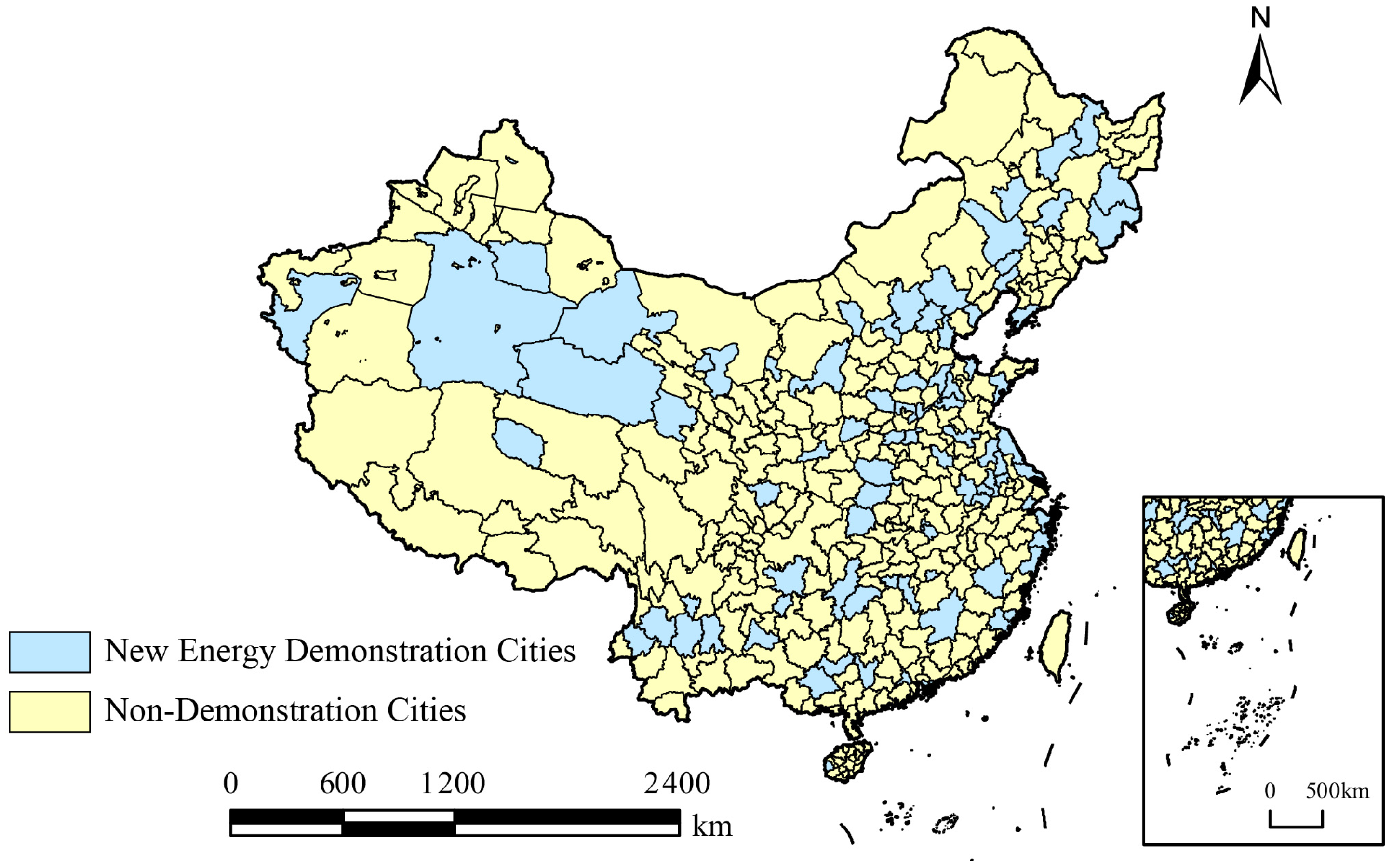
The key explanatory variable is the New Energy Demonstration City pilot program indicator ( NEDCP ). If the city where a resident lives is included in the New Energy Demonstration City pilot and the year is after the program was implemented in 2014, then NEDCP denotes 1; otherwise, 0. Our final treatment group consists of 4970 residential observations, accounting for approximately 14.12% of the total 35,197 observations during 2010–2022, providing sufficient variation for credible empirical identification. We have shown the scope of the pilot area for the New Energy Demonstration City in Figure 1.

3.4. Control Variables

Following Xu et al. [37], we select several control variables to reduce potential confounding. These controls consist of: (1) Individual characteristics, including age, the logarithm of age squared (age2), gender, marital status, and years of schooling (Eduy); (2) Household characteristics, including the logarithm of household income (Fincome) and household size (Familysize); and (3) City-level characteristics, including the logarithm of GDP per capita (Pergdp), the share of secondary industry in GDP (Is2), and the logarithm of the number of licensed physicians (Hospital).

3.5. Data Sources and Data Description

The data used in this study are drawn from the seven waves of the China Family Panel Studies (CFPS), conducted between 2010 and 2022 by the Institute of Social Science Survey at Peking University. CFPS provides rich multi-level information at the individual and household levels, making it well suited for the purposes of this research. In accordance with the research objectives and analytical requirements, the following data processing steps were undertaken: The CFPS individual and household economic databases were merged with data from the China City Statistical Yearbook, yielding a combined dataset containing individual characteristics, household characteristics, and city-level information. The descriptive statistics of the data are shown in Table 1.

4. Results

4.1. Baseline Regression

Table 2 reports the estimation results of Equation (1). The baseline findings indicate that the NEDCP program exerts a significant positive effect on residents’ health. Columns (1)–(4) present the regression results of the NEDCP program’s impact on health outcomes. All models include individual and year fixed effects, with standard errors clustered at the individual level; the t-statistics are reported in parentheses. Column (1) excludes control variables, while Columns (2)–(4) sequentially incorporate individual, household, and city-level characteristics.
Across all model specifications, the coefficient on the key explanatory variable remains consistently positive and statistically significant. As shown in the preferred estimate in Column (4) of Table 2, the implementation of the NEDCP program increases residents’ health by 0.079 units. Although the estimated value appears small, a comparison with prior studies indicates that the health gains from the NEDCP program are comparable to those typically attributed to physical exercise [38], highlighting its substantial contribution to improving residents’ health.
However, the health improvement effect of the NEDCP program on residents may still be underestimated. On one hand, health enhancement is a gradual process. Within a given period, if the increase in health levels may not reach residents’ perception threshold, they will not perceive direct changes in their health status [39]. On the other hand, the NEDCP program tends to be rolled out preferentially in areas with more fossil fuels, together with severe air pollution and persistent industrial activity that worsen health over time. If these time-varying confounders are not fully captured, the negative underlying trend in health will offset part of the program’s benefits, leading our empirical estimates to understate the true health gains from the NEDCP program. Therefore, in the robustness analysis, we further employ an instrumental variable approach to address this endogeneity concern.

4.2. Mechanism Tests

While the baseline regression confirms the health-promoting effect of the NEDCP program, it does not reveal how this effect occurs. The theoretical analysis suggests that the NEDCP program reshapes the energy structure and improves environmental conditions, thereby enhancing residents’ health. This section empirically examines these hypothesized mechanisms.

4.2.1. Market Substitution Effects

At the micro level, the NEDCP program may influence the energy consumption behavior of both enterprises and households, promoting a shift toward cleaner energy. On the enterprise side, to examine how the NEDCP program affects firms’ behavior, this study uses panel data of listed companies from 2000 to 2023. Following Loughran and McDonald [40], keywords were extracted from annual reports to construct a green transformation index. Results in Column (1) of Table 3 show that the NEDCP program significantly promotes firms’ green transformation. On the household side, to investigate how the NEDCP program affects household energy transition, this study uses CFPS household-level data from 2010 to 2022. Following Chen et al. [41], we set a bineary variable that equals to 1 if household adopts clean energy (solar, biogas, and electricity) and 0 if household adopts non-clean energy. Then we examine whether NEDCP program promotes the adoption of clean energy within residents. A two-way fixed-effects logistic model is estimated, with household- and city-level control variables consistent with the baseline regression. Column (2) shows that the NEDCP program significantly increases the household adoption of clean energy.
At the macro level, the NEDCP program promotes a structural shift in the energy consumption market toward cleaner energy, generating a market substitution effect. Using city-level panel data from 2010 to 2021 and following Cui et al. [42], this study measures traditional and new energy consumption using coal consumption calorific value, renewable electricity consumption (wind, hydropower, nuclear, and solar), and the proportion of renewable energy consumption (renewable calorific value/total energy calorific value). Columns (3)–(5) of Table 3 present the regression results, with standard errors clustered at the city level and control variables consistent with the baseline model. The results show that the NEDCP program significantly reduces coal consumption while increasing the consumption of renewable energy. These findings confirm the existence of a market substitution effect. The NEDCP program accelerates the shift of urban energy structures from fossil-based to cleaner alternatives and increases the share of wind, solar, and other non-fossil energy sources in electricity generation.

4.2.2. Environmental Improvement Effects

Changes in the energy consumption structure directly affect environmental quality, which in turn influences residents’ health. To test the environmental improvement effect of the energy transition, Table 4 uses city-level panel data from 2010 to 2021. Columns (1)–(4) take CO2 emissions, PM10, AQI, and PM2.5 as direct indicators of environmental pollution and examine the NEDCP program’s impact on environmental quality. Standard errors are clustered at the city level, and the set of city-level control variables matches those in the baseline model. The results show that the estimated coefficients of the NEDCP program are significantly negative at the 1% level across all pollution indicators. These findings suggest that the NEDCP program, through the market substitution effect, facilitates the shift from “black” to “green” energy consumption, significantly reduces environmental pollution, and thereby contributes to better health outcomes for residents.

4.3. Further Analysis

Although the NEDCP program improves residents’ health, variations in governmental regulatory stringency and market responses may affect the magnitude of these benefits. We therefore examine how the cost of carbon prices and the intensity of environmental regulation shape the effectiveness of the policy.
First, the use of fossil energy generates emissions and releases negative environmental externalities. To regulate these emissions, China has adopted market-based instruments that require firms to pay the carbon price in order to obtain emission permits [43,44]. As the cost of carbon emissions increases, the NEDCP program becomes more effective in encouraging the adoption of clean energy and reducing pollution. This enhanced substitution effect, in turn, delivers greater health benefits to residents. Therefore, we examine the moderating effects after mean-centering the carbon price variable. As shown in Column (1) of Table 5, the coefficient on the interaction term N E D C P × C a r b o n   P r i c e is positive and statistically significant. This indicates that a higher carbon price amplifies the environmental and health benefits of the NEDCP program, leading to more pronounced improvements in residents’ health.
Second, we examine how the stringency of environmental regulation affects the effectiveness of the NEDCP program. Guo et al. [45] suggest that environmental regulation constrains corporate carbon emissions and enhances energy efficiency. Strict implementation of environmental regulations significantly reduces the consumption of traditional fossil fuels, yielding substantial environmental benefits [46]. When combined with the NEDCP program, environmental regulation may yield even greater environmental improvements and associated health gains. To test this hypothesis, we introduce the intensity of environmental regulation [47] as a moderating variable and examine the role of environmental regulation in amplifying the health benefits of NEDCP program. As shown in Column (2) of Table 5, the coefficient on the interaction term N E D C P × E n v i r o n m e n t a l   R e g u l a t i o n is positive and statistically significant. This indicates that stricter environmental regulation amplifies the positive impact of the NEDCP program on residents’ health.

4.4. Heterogeneity Analysis

4.4.1. Individual-Level Heterogeneity

The health benefits of the NEDCP program may vary across individuals with different characteristics. To explore this hypothesis, we conduct heterogeneity analyses along three dimensions: smoking behavior, exercise habits, and age. The results of Table 6 show that the health-improving effect of the NEDCP program is more pronounced among smokers, individuals without regular exercise, and older adults aged 60 and above. These findings suggest that the environmental benefits of the NEDCP program primarily accrue to vulnerable groups with higher health risks and weaker health capital.
In Column (1), regarding smoking behavior, the effect of NEDCP program is significant among smokers but not among non-smokers. Smokers often suffer from impaired respiratory and lung function due to long-term exposure to tobacco smoke, making them more sensitive to air pollution. Thus, when the NEDCP program leads to improved air quality, smokers capture greater marginal health gains from each unit of pollution reduction. In contrast, non-smokers generally have healthier respiratory systems and higher tolerance to pollution; therefore, the immediate health benefits they perceive from initial improvements in air quality may be less substantial.
In Column (2), when grouped by exercise habits, the NEDCP program exhibits significant effects among individuals without regular exercise habits but not among those who exercise regularly. Individuals who exercise frequently typically possess stronger physical fitness and higher resistance to diseases, making their health less sensitive to environmental fluctuations. In the case of outdoor exercisers, the potential for increased pollutant inhalation during physical activity under polluted conditions may partially offset the benefits of air quality improvement. Conversely, for individuals who do not exercise regularly, the enhanced air quality brought about by the NEDCP program provides fundamental and critical protection.
In Column (3), when analyzing age heterogeneity, older adults (aged 60 and above) exhibit significantly larger health gains. Due to age-related declines in physiological function and the vulnerability of immune and cardiovascular systems, older adults represent a high-sensitivity group to air pollution. The environmental improvements produced by the NEDCP program thus offer essential external support, substantially reducing morbidity and mortality risks and generating substantial marginal health benefits. Younger individuals, by contrast, possess stronger physical resilience, resulting in less pronounced health improvements from the same degree of environmental enhancement.

4.4.2. City-Level Heterogeneity

Furthermore, we examine how the effectiveness of the NEDCP program varies across different regions. To do so, we conduct subsample regressions based on cities’ resource endowments, economic conditions, and environmental protection efforts.
In Column (1) of Table 7, when grouping by resource-based city status, the NEDCP program has a significantly positive impact on residents’ health in resource-based cities. These cities have long relied on highly polluting fossil fuels—particularly coal—resulting in a single industrial structure and more severe historical environmental problems. Residents are therefore exposed to higher long-term health risks. Consequently, when the NEDCP program is implemented in such cities, the scale of energy restructuring is larger, environmental improvements are more pronounced, and the resulting health gains are stronger. In contrast, non-resource-based cities typically have better baseline environments and more diversified energy structures, resulting in smaller marginal effects of the NEDCP program.
In Column (2), based on whether a city’s per capita GDP is above or below the sample mean, we find that the health effects of the NEDCP program are more significant in cities with lower per capita GDP. Wealthier cities typically possess stronger fiscal capacity and more comprehensive healthcare resources, ensuring relatively better health protection even in the absence of the NEDCP program. Hence, the incremental environmental benefits generated by the NEDCP program may be relatively limited. Conversely, in lower-income cities where public health investment is insufficient and governance gaps exist, the financial, technological, and managerial resources introduced through the NEDCP program can fill crucial gaps and generate substantial environmental and health improvements.
In Column (3), when grouping cities based on whether they are designated key environmental protection cities, the results show that the NEDCP program significantly improves residents’ health in non-key environmental protection cities. Key protection cities typically already maintain higher levels of new energy development and environmental quality, or have been on a continuous improvement trajectory due to existing regulatory frameworks. For non-key cities, where environmental regulations may be relatively lenient, the implementation of the NEDCP program effectively introduces a strong, development-oriented regulatory tool that substantially accelerates local environmental governance and thus generates more substantial health benefits.

4.5. Robustness Checks

4.5.1. Parallel Trend Test

The credibility of the baseline estimates relies on the parallel-trend assumption, which requires that residents in pilot and non-pilot cities exhibit similar pre-policy trends in health outcomes. To assess this assumption, we follow Luo and Zhou [48] to conduct an event-study parallel trend test. The estimated coefficients prior to the implementation of the NEDCP program are statistically insignificant with p-values of 0.222, indicating that the health trends of residents in pilot and non-pilot areas evolved similarly before policy implementation. This confirms the validity of the parallel trend assumption.

4.5.2. Placebo Test

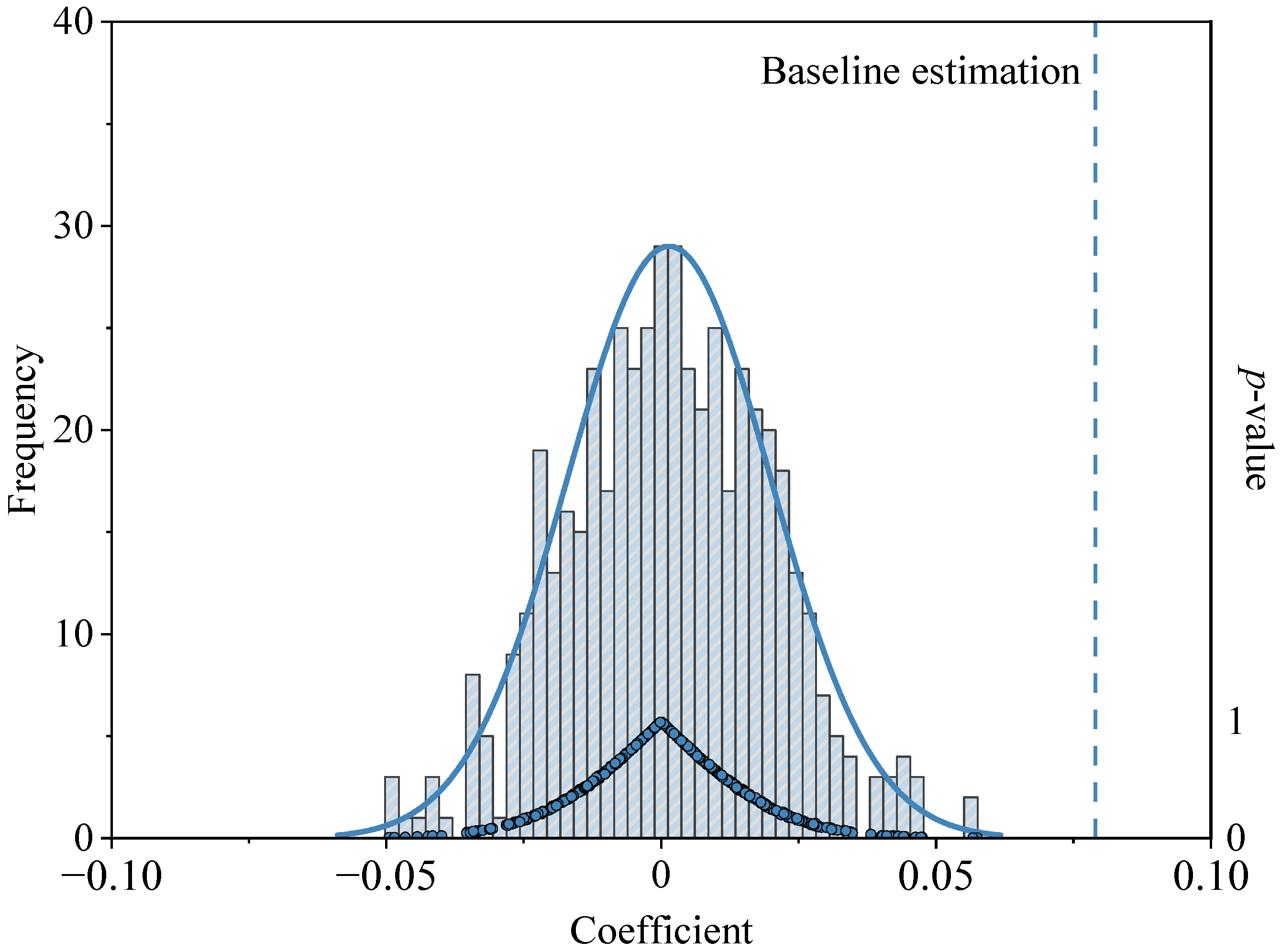
To rule out the possibility that the observed effects are driven by random shocks, the core treatment variable is replaced with a pseudo-policy indicator that is theoretically unrelated to the outcome. We randomly assign treatment and control groups within the sample and allocate to each resident a placebo policy value drawn from the empirical distribution of the actual policy variable. Based on this placebo assignment, we re-estimate Equation (1) for 500 iterations. Figure 2 reports the distribution of placebo coefficients centered around zero, clearly deviating from the baseline estimate (0.079). This confirms that the main findings are unlikely to be driven by chance and instead reflect a genuine causal relationship.

4.5.3. Propensity Score Matching

Because the selection of NEDCP program may not be random across regions, endogeneity concerns may arise. To address this, the study employs propensity score matching (PSM) to construct a control group comparable to the treatment group. After matching, the DID regression is re-estimated. Columns (1)–(2) in Table 8 report the results based on kernel matching and radius matching. The balance and common-support assumption are documented in the Appendix A and Appendix B. The estimated coefficients on the NEDCP program remain significantly positive across matching methods, supporting the robustness of the benchmark results.

4.5.4. Endogeneity Concerns

Although the NEDCP program was selected by the central government through a top-down process, potential endogeneity concerns still remain. Residents’ health is shaped by a wide range of social and economic factors, making it difficult to fully rule out omitted-variable bias. In addition, the NEDCP program is more likely to be implemented in areas with a strong reliance on fossil fuels. For example, Shanxi Province is the largest coal-producing region in China, and cities such as Yuncheng, Datong, and Changzhi are included in the New Energy Demonstration Cities. These areas often face intensive industrial activity and persistent legacy pollution, which continue to exert downward pressure on health outcomes. As a consequence, part of the program’s health benefits may be offset by these adverse local conditions, leading the baseline estimates to understate the true impact of the NEDCP program.
Therefore, we employ a two-stage least squares (2SLS) approach to mitigate endogeneity issues. Wind speed, a key natural determinant of wind power generation potential, serves as our selected instrumental variable (IV). Regions with higher annual average wind speed possess greater comparative advantages in developing wind energy and thus face higher probabilities of being selected as pilot cities, satisfying instrument relevance. Meanwhile, annual wind speed is determined by natural geography and is plausibly exogenous to short-run human activities, making it unlikely to directly affect residents’ health. To further reduce reverse causality concerns, the lagged one-year annual average wind speed is used as the IV. The results indicate that the model passes both the under-identification and weak-instrument tests. As shown in Column (3) of Table 8, the IV is significantly and positively associated with pilot designation in the first stage. In column (4), the second-stage estimates show that the NEDCP program significantly improves residents’ health, consistent with the baseline DID findings. The instrumental variable approach helps mitigate these endogeneity concerns and provides more reliable estimates.

4.5.5. Controlling for Other Policy Interference

To ensure that the results are not confounded by concurrent policies, the analysis further controls for three potential policy shocks. The first one is Low-Carbon City Pilot Policy (Lowcarbon). As industrial production and household consumption are major contributors to carbon emissions, the low-carbon city policy imposes environmental constraints that may affect health or emissions independently of the NEDCP program. The second one is Key Atmospheric Control Zone Policy (Aircontrol). Regulations such as clean fuel promotion, waste-to-energy initiatives, and reduced fossil-fuel dependence could generate substitution effects on the NEDCP program. The third one is Green Finance Reform Pilot Zone Policy (Greenfin). The establishment of green finance zones may promote green production, ease credit constraints for green enterprises, and induce industrial green upgrading, all potentially affecting emissions and health. Regression results shown in Columns (1)–(3) in Table 9 indicate that the main findings remain stable after controlling for these policies, suggesting that the estimated effects are not driven by policy interference.

4.5.6. Additional Robustness Checks

Several supplementary analyses are conducted. First, Winsorization of the dependent variable at the 1% level to reduce the influence of extreme values. Second, Exclusion of municipalities and provincial capitals to ensure that highly developed cities do not bias the estimates. Third, Replacing the dependent variable with residents’ medical expenditures. If the NEDCP program indeed improves health, medical spending should decrease accordingly. As reported in Table 10, all robustness checks yield results consistent with the baseline findings, further validating the study’s conclusions.

5. Conclusions and Discussion

Promoting the energy transition has become a crucial strategy for mitigating air pollution and improving public health. Understanding how the energy transition reshapes market dynamics is therefore essential for clarifying the mechanisms of new energy development, accelerating the low-carbon transition, and enhancing health outcomes. This study exploits the NEDCP program as a quasi-natural experiment and applies a difference-in-differences approach calibrated with data from the CFPS to examine the impact of the energy transition on household health and its underlying mechanisms. The results show that the NEDCP program significantly improves residents’ self-rated health, primarily through optimizing the energy structure and enhancing environmental quality. These findings remain robust after accounting for potential endogeneity and conducting multiple sensitivity checks. We further investigate how market costs and governmental regulation shape the effectiveness of energy transition. Increases in carbon prices and stricter environmental regulation are found to amplify the positive health effects of the NEDCP program. Finally, heterogeneity analyses across populations and regions reveal that the health benefits are most pronounced among vulnerable groups including smokers, individuals without regular exercise, and older adults, who face inherent health disadvantages. Similarly, cities with higher resource dependence, weaker economic foundations, and insufficient environmental protection exhibit lower baseline health levels but gain greater benefits from the NEDCP program. Overall, these findings indicate that promoting clean energy transition is an effective pathway to fostering coordinated regional development and reducing inequalities in environmental public health services. These results also offer meaningful insights for other developing countries seeking to advance energy transition and improve public health outcomes.
Based on these findings, several policy implications emerge. First, implement region-specific support to maximize health returns. NEDCP program resources should be strategically allocated toward resource-based and economically underdeveloped cities with higher potential health gains. Dedicated funding and technical assistance should be provided to accelerate their energy structure transformation, thereby realizing the greatest possible improvements in public health. Second, strengthen market-based mechanisms to ensure a sustainable transition. Policies should promote competition within the new energy market and enhance coordination with carbon trading and other market-oriented environmental instruments. Building such policy synergy can reduce long-term dependence on administrative subsidies and help establish market-driven, endogenous momentum for clean energy substitution. Third, incorporate public health benefits into the evaluation system of energy policies. When designing and assessing new energy and related environmental policies, health improvements—such as reduced medical burdens and enhanced well-being—should be treated as core evaluation metrics. Recognizing the substantial social value of energy transition will help strengthen public support and reinforce the legitimacy of clean energy policies.


Author Contributions

P.H.: Conceptualization, Data curation, Formal analysis, Software, Methodology, Resources, Validation, Writing—original draft. A.Y.: Conceptualization, Data curation, Software, Methodology, Validation, Writing—original draft, Writing—review and editing. C.L.: Conceptualization, Supervision, Validation, Writing—review and editing. All authors have read and agreed to the published version of the manuscript.

Funding

This work is supported by Think Tank Fundamental Research Program at Chinese Academy of Social Sciences, grant number ZKJC252609.

Institutional Review Board Statement

Not applicable.

Informed Consent Statement

Not applicable.

Data Availability Statement

Data are readily available upon request from the corresponding author.

Conflicts of Interest

The authors declare no conflicts of interest.

Appendix A

Appendix A.1

Table A1. Kernel matching Balancing Assumption test.
VariableMatch StatusMean% Bias% Reduct
|Bias|
t-Test
TreatedControltp > |t|
AgeUnmatched56.41456.0672.2 1.550.121
Matched56.41456.453−0.288.6−0.140.890
Age2Unmatched7.9817.9692.1 1.470.143
Matched7.9817.982−0.288.3−0.140.892
genderUnmatched0.5550.575−3.9 −2.780.005
Matched0.5550.558−0.587.8−0.270.789
marUnmatched0.8730.8545.3 3.750.000
Matched0.8730.8710.589.90.310.753
eduyUnmatched7.6037.699−2.2 −1.530.127
Matched7.6037.698−2.11.6−1.210.226
fincomeUnmatched10.41210.513−8.1 −5.790.000
Matched10.41210.484−5.728.9−3.250.001
familysizeUnmatched3.7063.6741.8 1.280.200
Matched3.7063.6920.858.10.430.670
pergdpUnmatched10.68910.6752.1 1.470.142
Matched10.68910.723−5.4−152.5−3.100.002
Is2Unmatched0.4480.42818.9 13.340.000
Matched0.4480.4434.675.92.690.007
Hospital2Unmatched9.3729.28111.2 7.400.000
Matched9.3729.386−1.685.5−0.930.350
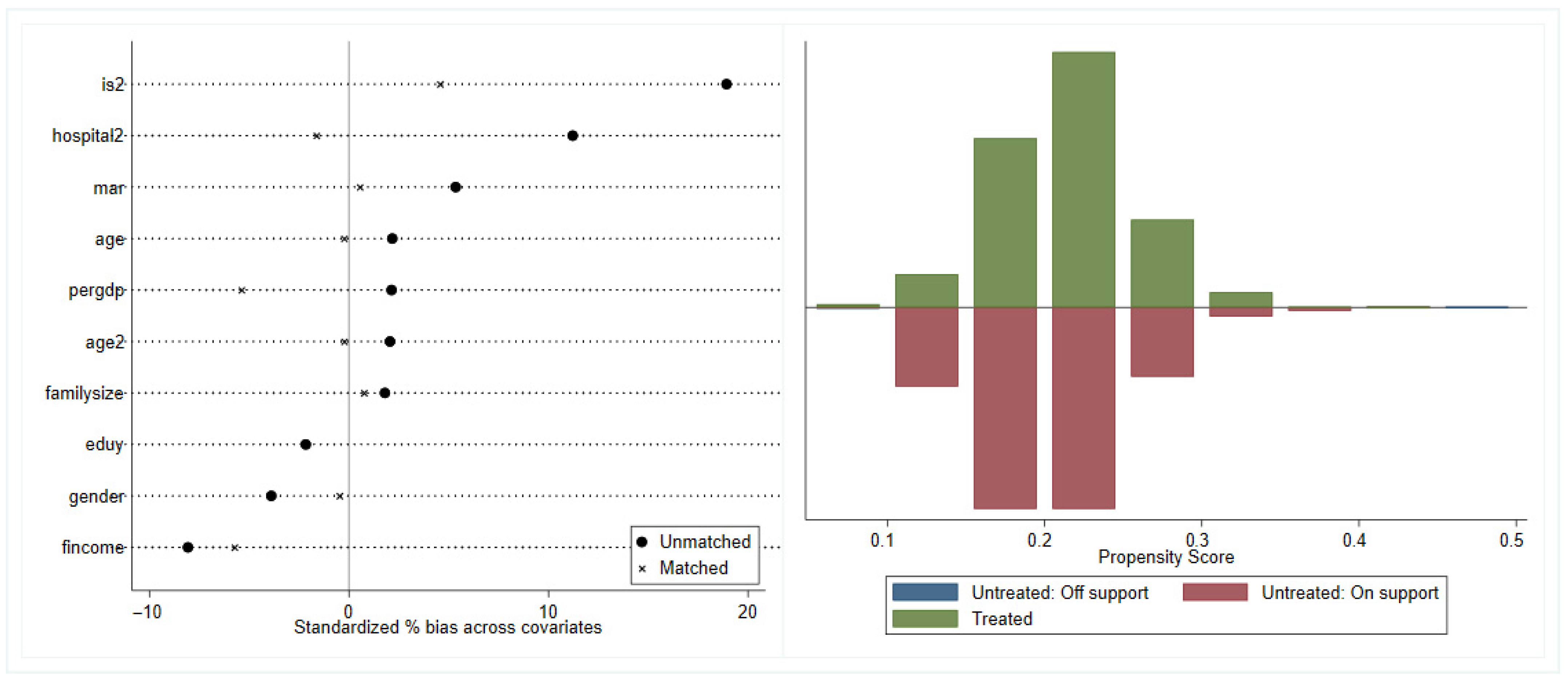
Note: Table A1 reports the Balancing Assumption test results based on kernel matching. After matching, the mean differences of all covariates between the treatment and control groups become statistically insignificant, indicating that the matched samples are comparable. Most standardized biases fall below the commonly accepted threshold of 10%, and the majority of the t tests fail to reject the null hypothesis of “no systematic difference between the treatment and control groups.” Therefore, the Balancing Assumption is satisfactorily met.

Appendix A.2

Figure A1 presents the graphical diagnostics for the balancing assumption and the common support assumption under kernel matching. The left panel is consistent with the results reported in Table A1, showing that the majority of covariates exhibit standardized biases below 10%, which are substantially smaller than those observed before matching. The right panel illustrates the common support condition, indicating that the vast majority of observations in both the treatment and control groups fall within the region of common support.
Figure A1. Kernel matching Balancing Assumption and Common Support Assumption test.
Sustainability 17 11360 g0a1

Appendix B

Appendix B.1

Table A2. Radius matching Balancing Assumption test.
VariableMatch StatusMean% Bias% Reduct
|Bias|
t-Test
TreatedControltp > |t|
AgeUnmatched56.41456.0672.2 1.550.121
Matched56.41456.436−0.193.6−0.080.938
Age2Unmatched7.9817.9692.1 1.470.143
Matched7.9817.982−0.193.5−0.080.940
genderUnmatched0.5550.575−3.9 −2.780.005
Matched0.5550.559−0.683.4−0.360.716
marUnmatched0.8730.8555.3 3.750.000
Matched0.8730.8710.786.90.410.684
eduyUnmatched7.6037.700−2.2 −1.530.127
Matched7.6037.702−2.2−2.3−1.260.209
fincomeUnmatched10.41210.514−8.1 −5.790.000
Matched10.41210.489−6.124.7−3.450.001
familysizeUnmatched3.7063.6741.8 1.280.200
Matched3.7063.6920.856.60.440.659
pergdpUnmatched10.68910.6752.1 1.470.142
Matched10.68910.722−5.3−148.8−3.050.002
Is2Unmatched0.4480.42818.9 13.340.000
Matched0.4480.4435.272.53.070.002
Hospital2Unmatched9.3729.28211.2 7.400.000
Matched9.3739.382−1.189.9−0.650.516
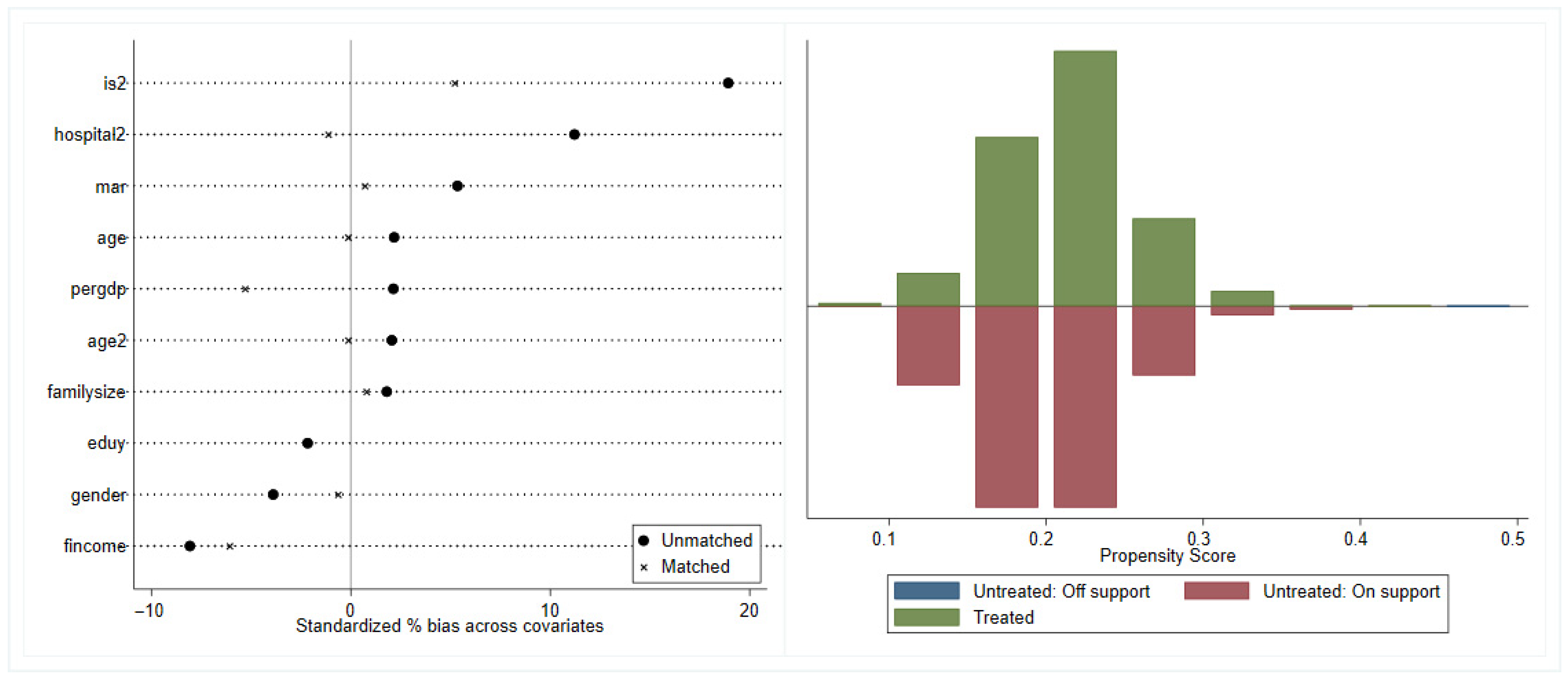
Note: Table A2 reports the Balancing Assumption test results based on radius matching. After matching, the mean differences of all covariates between the treatment and control groups become statistically insignificant, indicating that the matched samples are comparable. Most standardized biases fall below the commonly accepted threshold of 10%, and the majority of the t tests fail to reject the null hypothesis of “no systematic difference between the treatment and control groups.” Therefore, the Balancing Assumption is satisfactorily met.

Appendix B.2

Figure A2 presents the graphical diagnostics for the balancing assumption and the common support assumption under kernel matching. The left panel is consistent with the results reported in Table A2, showing that the majority of covariates exhibit standardized biases below 10%, which are substantially smaller than those observed before matching. The right panel illustrates the common support condition, indicating that the vast majority of observations in both the treatment and control groups fall within the region of common support.
Figure A2. Radius matching Balancing Assumption and Common Support Assumption test.
Sustainability 17 11360 g0a2

References

  1. Yang, S.; Fang, D.; Chen, B. Human health impact and economic effect for PM2.5 exposure in typical cities. Appl. Energy 2019, 249, 316–325. [Google Scholar] [CrossRef]
  2. Dietzenbacher, E.; Kulionis, V.; Capurro, F. Measuring the effects of energy transition: A structural decomposition analysis of the change in renewable energy use between 2000 and 2014. Appl. Energy 2020, 258, 114040. [Google Scholar] [CrossRef]
  3. Wu, Y.; Zhang, T.; Gao, R.; Wu, C. Portfolio planning of renewable energy with energy storage technologies for different applications from electricity grid. Appl. Energy 2021, 287, 116562. [Google Scholar] [CrossRef]
  4. Xu, G.; Dong, H.; Xu, Z.; Bhattarai, N. China can reach carbon neutrality before 2050 by improving economic development quality. Energy 2022, 243, 123087. [Google Scholar] [CrossRef]
  5. Sagar, A.D.; Van der Zwaan, B. Technological innovation in the energy sector: R&D, deployment, and learning-by-doing. Energy Policy 2006, 34, 2601–2608. [Google Scholar] [CrossRef]
  6. Zhou, Y.; Zhu, S.; He, C. How do environmental regulations affect industrial dynamics? Evidence from China’s pollution-intensive industries. Habitat Int. 2017, 60, 10–18. [Google Scholar] [CrossRef]
  7. Boone, C.G.; Fragkias, M.; Buckley, G.L.; Grove, J.M. A long view of polluting industry and environmental justice in Baltimore. Cities 2014, 36, 41–49. [Google Scholar] [CrossRef]
  8. Ruan, F.; Yan, L.; Wang, D. The complexity for the resource-based cities in China on creating sustainable development. Cities 2020, 97, 102571. [Google Scholar] [CrossRef]
  9. Jia, P.; Zhuang, J.; Lucero, A.M.V.; Li, J. Does the energy consumption revolution improve the health of elderly adults in rural areas? Evidence from China. Sci. Total Environ. 2022, 807, 150755. [Google Scholar] [CrossRef] [PubMed]
  10. Liu, P.; Han, C.; Teng, M. Does clean cooking energy improve mental health? Evidence from China. Energy Policy 2022, 166, 113011. [Google Scholar] [CrossRef]
  11. Liu, Y.; Feng, C. Promoting renewable energy through national energy legislation. Energy Econ. 2023, 118, 106504. [Google Scholar] [CrossRef]
  12. Che, S.; Wang, J.; Chen, H. Can China’s decentralized energy governance reduce carbon emissions? Evidence from new energy demonstration cities. Energy 2023, 284, 128665. [Google Scholar] [CrossRef]
  13. Zhang, Q.; Huang, X.; Xu, Y.; Bhuiyan, M.A.; Liu, P. New energy demonstration city pilot and green energy consumption: Evidences from China. Energy Rep. 2022, 8, 7735–7750. [Google Scholar] [CrossRef]
  14. Pereira, G.; Bell, M.L.; Honda, Y.; Lee, J.-T.; Morawska, L.; Jalaludin, B. Energy transitions, air quality and health. Environ. Res. Lett. 2021, 16, 020202. [Google Scholar] [CrossRef]
  15. Gielen, D.; Boshell, F.; Saygin, D.; Bazilian, M.D.; Wagner, N.; Gorini, R. The role of renewable energy in the global energy transformation. Energy Strategy Rev. 2019, 24, 38–50. [Google Scholar] [CrossRef]
  16. Banzhaf, H.S.; Walsh, R.P. Do people vote with their feet? An empirical test of Tiebout’s mechanism. Am. Econ. Rev. 2008, 98, 843–863. [Google Scholar] [CrossRef]
  17. Zhang, Z.; Luo, C.; Zhang, G.; Shu, Y.; Shao, S. New energy policy and green technology innovation of new energy enterprises: Evidence from China. Energy Econ. 2024, 136, 107743. [Google Scholar] [CrossRef]
  18. Yang, T.; Xing, C.; Li, X. Evaluation and analysis of new-energy vehicle industry policies in the context of technical innovation in China. J. Clean. Prod. 2021, 281, 125126. [Google Scholar] [CrossRef]
  19. Lueken, R.; Klima, K.; Griffin, W.M.; Apt, J. The climate and health effects of a USA switch from coal to gas electricity generation. Energy 2016, 109, 1160–1166. [Google Scholar] [CrossRef]
  20. Ryan, S.P. The costs of environmental regulation in a concentrated industry. Econometrica 2012, 80, 1019–1061. [Google Scholar] [CrossRef]
  21. Liao, L.; Kong, S.; Du, M. The effect of clean heating policy on individual health: Evidence from China. China Econ. Rev. 2025, 89, 102309. [Google Scholar] [CrossRef]
  22. Chen, H.; Geng, H.-P.; Ling, H.-T.; Peng, S.; Li, N.; Yu, S.; Wei, Y.-M. Modeling the coal-to-gas switch potentials in the power sector: A case study of China. Energy 2020, 192, 116629. [Google Scholar] [CrossRef]
  23. Calcaterra, M.; Aleluia Reis, L.; Fragkos, P.; Briera, T.; de Boer, H.S.; Egli, F.; Emmerling, J.; Iyer, G.; Mittal, S.; Polzin, F. Reducing the cost of capital to finance the energy transition in developing countries. Nat. Energy 2024, 9, 1241–1251. [Google Scholar] [CrossRef] [PubMed]
  24. Rode, A.; Carleton, T.; Delgado, M.; Greenstone, M.; Houser, T.; Hsiang, S.; Hultgren, A.; Jina, A.; Kopp, R.E.; McCusker, K.E. Estimating a social cost of carbon for global energy consumption. Nature 2021, 598, 308–314. [Google Scholar] [CrossRef] [PubMed]
  25. Liu, W.; Li, H. Improving energy consumption structure: A comprehensive assessment of fossil energy subsidies reform in China. Energy Policy 2011, 39, 4134–4143. [Google Scholar] [CrossRef]
  26. Wang, Z.; Wang, X.; Tao, H.; Li, H.; Rao, Y. China’s energy consumption trends and structural transition pathways under synergistic cost and carbon constraints: Based on the perspective of optimal steady economic growth. Energy 2025, 335, 138246. [Google Scholar] [CrossRef]
  27. Shao, S.; Hu, Z.; Cao, J.; Yang, L.; Guan, D. Environmental regulation and enterprise innovation: A review. Bus. Strategy Environ. 2020, 29, 1465–1478. [Google Scholar]
  28. Webb, J.; de Silva, H.N.; Wilson, C. The future of coal and renewable power generation in Australia: A review of market trends. Econ. Anal. Policy 2020, 68, 363–378. [Google Scholar] [CrossRef]
  29. Jiang, Z.; Lyu, P.; Ye, L.; wenqian Zhou, Y. Green innovation transformation, economic sustainability and energy consumption during China’s new normal stage. J. Clean. Prod. 2020, 273, 123044. [Google Scholar] [CrossRef]
  30. Wu, S. The health impact of household cooking fuel choice on women: Evidence from China. Sustainability 2021, 13, 12080. [Google Scholar] [CrossRef]
  31. Hystad, P.; Duong, M.; Brauer, M.; Larkin, A.; Arku, R.; Kurmi, O.P.; Fan, W.Q.; Avezum, A.; Azam, I.; Chifamba, J. Health effects of household solid fuel use: Findings from 11 countries within the prospective urban and rural epidemiology study. Environ. Health Perspect. 2019, 127, 057003. [Google Scholar] [CrossRef]
  32. Cohen, A.J.; Brauer, M.; Burnett, R.; Anderson, H.R.; Frostad, J.; Estep, K.; Balakrishnan, K.; Brunekreef, B.; Dandona, L.; Dandona, R. Estimates and 25-year trends of the global burden of disease attributable to ambient air pollution: An analysis of data from the Global Burden of Diseases Study 2015. Lancet 2017, 389, 1907–1918. [Google Scholar] [CrossRef]
  33. Xue, T.; Liu, J.; Zhang, Q.; Geng, G.; Zheng, Y.; Tong, D.; Liu, Z.; Guan, D.; Bo, Y.; Zhu, T. Rapid improvement of PM2.5 pollution and associated health benefits in China during 2013–2017. Sci. China Earth Sci. 2019, 62, 1847–1856. [Google Scholar] [CrossRef]
  34. Hvidtfeldt, U.A.; Geels, C.; Sørensen, M.; Ketzel, M.; Khan, J.; Tjønneland, A.; Christensen, J.H.; Brandt, J.; Raaschou-Nielsen, O. Long-term residential exposure to PM2.5 constituents and mortality in a Danish cohort. Environ. Int. 2019, 133, 105268. [Google Scholar] [CrossRef]
  35. Wu, H.; Kioumourtzoglou, M.-A.; Just, A.C.; Kloog, I.; Sanders, A.; Svensson, K.; McRae, N.; Tamayo-Ortiz, M.; Solano-González, M.; Wright, R.O. Association of ambient PM2·5 exposure with maternal bone strength in pregnant women from Mexico City: A longitudinal cohort study. Lancet Planet. Health 2020, 4, e530–e537. [Google Scholar]
  36. Du, K.; Li, M.; Wang, S.; Lin, B. The Impact of Coal Price Shocks and New Energy Business Expansion on Corporate Financing Constraints. Econ. Res. J. 2024, 59, 4–20. [Google Scholar]
  37. Xu, Q.; Li, X.; Dong, Y.; Guo, F. How digital infrastructure development affects residents’ health: A quasi-natural experiment based on the “Broadband China” strategy. Cities 2025, 157, 105611. [Google Scholar] [CrossRef]
  38. Gong, C.; Li, Y.; Chen, G. Relationship Between Physical Exercise and Risk of Depression: An Assessment of Intermediate Variables Through Self-Assessed Health Status and Life Satisfaction in the Chinese Family Tracking Survey (CFPS) Data. Risk Manag. Healthc. Policy 2024, 17, 3315–3325. [Google Scholar]
  39. Yokoo, H.-F.; Arimura, T.H.; Chattopadhyay, M.; Katayama, H. Subjective risk belief function in the field: Evidence from cooking fuel choices and health in India. J. Dev. Econ. 2023, 161, 103000. [Google Scholar] [CrossRef]
  40. Loughran, T.; McDonald, B. When is a liability not a liability? Textual analysis, dictionaries, and 10-Ks. J. Financ. 2011, 66, 35–65. [Google Scholar]
  41. Chen, J.; Liao, H.; Zhang, T. Empowering women substantially accelerates the household clean energy transition in China. Energy Policy 2024, 187, 114048. [Google Scholar] [CrossRef]
  42. Cui, J.; Wang, C.; Zhang, J.; Zheng, Y. The effectiveness of China’s regional carbon market pilots in reducing firm emissions. Proc. Natl. Acad. Sci. USA 2021, 118, e2109912118. [Google Scholar]
  43. Benz, E.; Trück, S. Modeling the price dynamics of CO2 emission allowances. Energy Econ. 2009, 31, 4–15. [Google Scholar] [CrossRef]
  44. Batten, J.A.; Maddox, G.E.; Young, M.R. Does weather, or energy prices, affect carbon prices? Energy Econ. 2021, 96, 105016. [Google Scholar] [CrossRef]
  45. Guo, R.; Yuan, Y. Different types of environmental regulations and heterogeneous influence on energy efficiency in the industrial sector: Evidence from Chinese provincial data. Energy Policy 2020, 145, 111747. [Google Scholar] [CrossRef]
  46. Aslam, N.; Yang, W.; Arslan, M.; Ashraf, B. Environmental regulations as a solution for energy security risk and energy gap: Evidence from highly energy intensive economies. Appl. Energy 2024, 374, 123992. [Google Scholar] [CrossRef]
  47. Xu, B.; Lin, B. What cause large regional differences in PM2.5 pollutions in China? Evidence from quantile regression model. J. Clean. Prod. 2018, 174, 447–461. [Google Scholar] [CrossRef]
  48. Luo, C.; Zhou, X. Carbon Abatement Effect of Chinese Certified Emission Reduction Projects in Agriculture and Forestry: An Empirical Study. Sustainability 2025, 17, 8772. [Google Scholar] [CrossRef]
Figure 1. Geographical locations of New Energy Demonstration City.
Sustainability 17 11360 g001
Figure 2. Placebo test. Notes: The dashed vertical line indicates the baseline estimate; the histogram and the solid curve depict the distribution of placebo coefficients and the corresponding fitted density; the dark blue dots represent the p-values of each placebo coefficient.
Sustainability 17 11360 g002
Table 1. Descriptive statistics of main variables.
VariableMeanSDMinMax
Health3.0531.3201.0005.000
NEDCP0.1410.3480.0001.000
Age55.96516.01216.000120.000
Age27.9650.5945.5459.575
Gender0.5720.4950.0001.000
Mar0.8550.3530.0001.000
Eduy7.5704.5360.00022.000
Fincome10.4771.2710.00016.248
Familysize3.6781.7911.00026.000
Pergdp10.6720.6518.57612.198
Is20.4350.1080.1580.822
Hospital9.2920.8806.80411.683
Table 2. Baseline regression.
(1)(2)(3)(4)
VARIABLESHealthHealthHealthHealth
NEDCP0.088 ***0.082 **0.083 **0.079 **
(2.673)(2.346)(2.305)(2.195)
Age −0.009 ***−0.010 ***−0.010 ***
(−2.715)(−2.875)(−2.886)
Age2 0.316 ***0.351 ***0.352 ***
(3.703)(3.902)(3.901)
Gender −0.374−0.426−0.428
(−1.425)(−1.490)(−1.494)
Mar 0.0620.0620.060
(1.618)(1.551)(1.503)
Eduy −0.012−0.013−0.013
(−1.353)(−1.471)(−1.470)
Fincome 0.0080.008
(1.063)(1.046)
Familysize 0.0120.012
(1.630)(1.611)
Pergdp 0.012
(0.236)
Is2 0.122
(0.597)
Hospital2 −0.010
(−0.237)
Constant3.041 ***1.276 **0.9510.869
(651.621)(2.181)(1.523)(1.046)
Individual FEYesYesYesYes
Year FEYesYesYesYes
ControlsYesYesYesYes
Observations35,19731,37230,00429,952
R-squared0.7110.7150.7170.717
Note: Standard errors are clustered at the individual level; all models include individual and year fixed effects; t-statistics are reported in parentheses; *** p < 0.01, ** p < 0.05.
Table 3. The market substitution effect of energy transition.
VARIABLESEnergy Transition at the Micro LevelEnergy Transition at the Macro Level
(1) Firms(2) Families(3) Coal(4) Renewable Energy(5) Renewable Energy/Total Energy
NEDCP0.019 **0.423 *−0.078 *0.124 *0.440 *
(2.140)(1.772)(−1.650)(1.769)(1.674)
Firm FEYesNoNoNoNo
Family FENoYesNoNoNo
City FENoNoYesYesYes
Year FEYesYesYesYesYes
ControlsYesYesYesYesYes
Observations45,8793839207020701852
R-squared0.447 0.9660.9210.940
Pseudo R2 0.254
Note: In Column (1) of Table 3, the dependent variable is the firm-level green transformation index, which is constructed based on the frequency of environmental and sustainability-related keywords extracted from annual reports in the CSMAR database. The index is then defined as the logarithm of the sum of these keywords’ frequencies. Representative keywords include: green building, recycling and regeneration, low-carbon construction, sustainable growth, low-pollution development, energy conservation, improved resource utilization, enhanced recycling efficiency, low-carbon lifestyle, green lifestyle, green production, green consumption, green finance, green governance, green construction, energy saving, resource saving, new energy development, ecological restoration, circular use, energy conservation and emission reduction, and conservation-first, etc. The control variables include enterprise characteristics and city characteristics. The city characteristics are consistent with the benchmark regression. The firm control variables include firm size, asset–liability ratio, net profit of total assets, return on equity, total asset turnover, cash flow ratio, inventory ratio, fixed-asset ratio, and revenue growth rate. Standard errors are clustered at the firm level. The control variables in Column (2) include the household level and the urban level, which are consistent with the benchmark regression. The regression results’ standard errors are clustered at the household level. The models in other columns all control the city characteristic variables, which are consistent with the benchmark regression. Standard errors are clustered at the city level. ** p < 0.05, * p < 0.1.
Table 4. The environmental improvement effect of energy transition.
VARIABLES(1)(2)(3)(4)
CO2PM10AQIPM2.5
NEDCP−0.052 ***−0.237 ***−0.270 ***−0.297 ***
(−3.119)(−4.759)(−5.534)(−3.578)
City FEYesYesYesYes
Year FEYesYesYesYes
ControlsYesYesYesYes
Observations2143214321432143
R-squared0.9910.8050.7230.703
Note: In Table 4, the models in all columns control the city characteristic variables, which are consistent with the benchmark regression. Standard errors are clustered at the city level. *** p < 0.01.
Table 5. Further analysis.
VARIABLES(1)(2)
HealthHealth
NEDCP0.067 *0.067 *
(1.833)(1.834)
Carbon Price−0.001 **
(−2.027)
Environmental Regulation −0.000
(−0.335)
NEDCP × Carbon Price0.002 *
(1.940)
NEDCP × Environmental Regulation 0.002 *
(1.645)
Individual FEYesYes
Year FEYesYes
ControlsYesYes
Observations29,95229,952
R-squared0.7180.718
Note: The variables of Carbon Price and Environmental Regulation are mean-centered. Standard errors are clustered at the individual level. ** p < 0.05, * p < 0.1.
Table 6. Individual-level heterogeneity analyses.
VARIABLESSmokeExerciseAge > 60
(1) Yes(2) No(3) Yes(4) No(5) Yes(6) No
NEDCP0.113 *0.045−0.0520.148 ***0.157 ***0.076
(1.776)(0.948)(−0.771)(2.806)(2.759)(1.101)
Individual FEYesYesYesYesYesYes
Year FEYesYesYesYesYesYes
ControlsYesYesYesYesYesYes
Observations959518,459938314,66416,3398370
R-squared0.7150.7250.7470.7280.7280.710
F statistics of Chow test11.06016.6309.720
(0.000)(0.000)(0.000)
Note: To rule out potential misinterpretations arising from between-group differences, we further conduct Chow tests to examine the significance of coefficient differences across subsample regressions. The F statistics of Chow test are reported in the table, with the p-values in parentheses. The results remain robust. Standard errors are clustered at the individual level. *** p < 0.01, * p < 0.1.
Table 7. City-level heterogeneity analyses.
VARIABLESResource-Based CityCity’s Per Capita GDPGreen City
(1) Yes(2) No(3) High(4) Low(5) Yes(6) No
NEDCP0.207 ***−0.023−0.0290.168 ***0.0050.182 ***
(3.589)(−0.495)(−0.390)(3.432)(0.107)(3.283)
Individual FEYesYesYesYesYesYes
Year FEYesYesYesYesYesYes
ControlsYesYesYesYesYesYes
Observations10,12519,79710,18116,99513,72316,176
R-squared0.7120.7210.7440.7170.7300.708
Chow test33.4704.60023.200
(0.000)(0.010) (0.000)
Note: Resource-based cities are a type of city that takes the exploitation and processing of natural resources such as minerals and forests in the local area as its leading industries. Standard errors are clustered at the individual level. *** p < 0.01.
Table 8. Robustness checks: propensity score matching and two-stage least squares methods.
VARIABLES(1) Kernel Matching(2) Radius Matching(3) First Stage(4) Second Stage
HealthHealthNEDCPHealth
NEDCP0.080 **0.079 ** 0.967 *
(2.206)(2.190) (1.840)
L.Wind Speed 0.048 ***
(6.870)
Individual FEYesYesYesYes
Year FEYes YesYesYes
ControlsYesYesYesYes
Observations29,93329,95125,91325,913
R-squared0.7170.717
Kleibergen Paap rk LM 45.002 ***
Kleibergen Paap rk Wald F statistics 47.136 > 10% critical value 16.380
Note: Standard errors are clustered at the individual level. *** p < 0.01, ** p < 0.05, * p < 0.1.
Table 9. Robustness checks: controlling for other policy interference.
VARIABLES(1)(2)(3)
HealthHealthHealth
NEDCP0.081 **0.081 **0.079 **
(2.238)(2.238)(2.174)
Lowcarbon−0.126 ***
(−4.320)
Aircontrol −0.067 ***
(−3.004)
Greenfin 0.105
(1.415)
Individual FEYesYesYes
Year FEYesYesYes
ControlsYesYesYes
Observations29,90729,95229,952
R-squared0.7180.7180.717
Note: Standard errors are clustered at the individual level. *** p < 0.01, ** p < 0.05.
Table 10. Robustness checks: additional robustness checks.
VARIABLES(1) Winsorization(2) Eliminate the Sample(3) Replace Variable
HealthHealthMedical Consumption
NEDCP0.079 **0.116 ***−0.421 *
(2.200)(2.840)(−1.680)
Individual FEYesYesYes
Year FEYesYesYes
ControlsYesYesYes
Observations29,95223,2648788
R-squared0.7170.7090.637
Note: Standard errors are clustered at the individual level. *** p < 0.01, ** p < 0.05, * p < 0.1.
Disclaimer/Publisher’s Note: The statements, opinions and data contained in all publications are solely those of the individual author(s) and contributor(s) and not of MDPI and/or the editor(s). MDPI and/or the editor(s) disclaim responsibility for any injury to people or property resulting from any ideas, methods, instructions or products referred to in the content.