Article

Research on the Synergistic Development Path of Enterprise Data Asset Trading and New Quality Productive Forces Under the TOE Framework—Empirical Evidence from China


School of Economics and Management, Jiangxi University of Science and Technology, Ganzhou 341000, China
*
Author to whom correspondence should be addressed.
Sustainability 2025, 17(24), 11362; https://doi.org/10.3390/su172411362
Submission received: 14 October 2025 / Revised: 9 December 2025 / Accepted: 15 December 2025 / Published: 18 December 2025

Abstract

In the digital economy, promoting enterprise data asset trading and cultivating enterprises’ new quality productive forces are systemic issues. The present paper employs a combined method of QCA and regression analysis to construct a complex mediation model, based on the TOE framework theory and from a configurational perspective. This study examines the driving mechanisms behind corporate data asset transactions and the development of new-quality productive forces among Chinese A-share listed companies from 2020 to 2024, focusing on the interplay of technological, organizational, and environmental factors. The study finds that there are three configurations for achieving high-level enterprise data asset trading: the “technology–organization–environment” synergistic-driven type, the “environmental constraint–technological compensation” driven type, and the “organizational operation–environmental ecology” driven type. Among them, the level of enterprise data elements, the structure of enterprise human capital, and urban data governance are key factors in achieving high disclosure of enterprise data asset trading and a leap in new quality productive forces. The research conclusions provide valuable insights for enterprises considering a development strategy that combines data asset trading with new quality productive forces.

1. Introduction

In the digital economy era, new quality productive forces are a form of productivity supported by digital, networked, and intelligent new technologies, driven by technological innovation as the core impetus, and characterized by the deep application of advanced technologies, with extensive permeability and integration (National Information Center of China, 2024). New quality productive forces are defined as advanced productivity generated by revolutionary technological breakthroughs and innovative industrial transformation and upgrading. They encompass qualitative changes in the optimised combination of new labourers, new means of labour and new objects of labour, with total factor productivity improvement as their core indicator. New-quality labourers are defined as those who possess strategic talents capable of creating new quality productive forces and applied talents proficient in utilising new-quality means of production. These laborers possess higher education levels, stronger learning abilities, and can adapt to modern digital and intelligent work environments, demonstrating comprehensive cross-disciplinary integration capabilities. New-quality means of labor primarily support sustainable corporate development through low input and high output. New-quality objects of labor include both physical objects and non-physical, permeable elements such as data, representing a further expansion beyond traditional labor and capital assets [1,2]. Compared to traditional productivity, new quality productive forces not only reflect technological advancements but also signify systemic and holistic upgrades and transformations in production methods, industrial structures, economic models, and other aspects. In contrast to the total factor productivity employed to evaluate technological levels and economic growth efficiency within the framework of neoclassical economic growth theory [3], the fundamental principle of new quality productive forces is predicated on the promotion of quality through innovation. This process entails the evolution of new productive forces and the repeated enhancement of existing ones, with a core emphasis on facilitating the advancement of factor endowments and augmenting total factor productivity [2,4].
The 2024 Central Economic Work Conference placed significant emphasis on the imperative to achieve a harmonious balance between multiple pivotal relationships. These relationships encompass an efficient market and a proactive government, aggregate supply and aggregate demand, the cultivation of novel growth drivers and the enhancement of existing ones, in addition to the optimisation of incremental resources and the revitalisation of existing stocks. The objective of these efforts is to facilitate the smooth circulation of goods and services within the national economy. Furthermore, the objective is to develop Enterprise’s new quality productive forces in accordance with local conditions, and to optimise resource allocation efficiency on a comprehensive scale. Data elements have been identified as the fifth major productive factor, following the traditional ones of land, labour, capital, and technology. In the digital economy era, data elements provide crucial support for the development of new quality productive forces [5]. However, prevalent issues such as data silos, underdeveloped data market entities, and misallocation of data elements constrain hinder the revitalization of existing data “stocks” and the optimization of new data “increments.” It is imperative to address the urgent need to ensure the seamless transmission of data elements, to fully realise the potential of various factor markets, and to establish conducive conditions for the development of new quality productive forces [3]. To this end, the Chinese government has issued a series of policy documents, including the “Opinions on Establishing a Fundamental Data System to Better Leverage the Role of Data Elements” (referred to as the “Data 20 Measures”), the “Interim Provisions on Accounting Treatment Related to Enterprise Data Resources,” and the “Three-Year Action Plan for ‘Data Elements ×’ (2024–2026).” The objective of these policies is to encourage the development of enterprise data asset trading, with a view to stimulating the growth of enterprises’ new quality and productive forces through top-level design.
This paper defines enterprise data asset trading as the process of exchanging compliant listed data assets, with the use of digital technologies such as blockchain to establish a consensus on price and facilitate circulation in the market. This definition is supported by research from the Shanghai Data Exchange and scholars in the field. It is a crucial approach to activating data assets and realizing their value. In the context of the digital economy, the promotion of enterprise data asset trading and the cultivation of enterprises’ new quality and productive forces represent a systematic issue: On one hand, new production factors represented by data elements and their innovative allocation are key to accelerating the formation and development of new quality productive forces. The multiplier effect and extensive radiating and driving effects of data elements contribute to the enhancement of new quality productive forces [3]. Therefore, pathways that drive enterprise data asset trading can enhance enterprise’s new quality productive forces. On the other hand, management may exploit its information advantage to use data assets as tools for speculation and manipulation [6], so pathways driving enterprise data asset trading may also inhibit the advancement of enterprise’s new quality productive forces. Thus, based on a systemic viewpoint and the TOE framework theory, this paper explores under what technological, organizational, and environmental factors the dual objectives of promoting enterprise data asset trading and enhancing enterprise’s new quality productive forces can be achieved, fully leveraging the value-multiplying effect of data assets to empower the leap in enterprise’s new quality productive forces. This represents both a significant practical issue demanding urgent resolution and a complex theoretical question requiring in-depth exploration.
Most existing literature focuses on the driving factors of enterprise’s new quality productive forces and the economic consequences of data trading platforms. On one hand, scholars have empirically demonstrated that factors such as the integration of producer services and manufacturing [7], corporate fundamental research [2], industry-university-research collaboration [8], the aggregation and marketization of data elements [9], intelligent transformation [10], and industrial platforms [11] can contribute to enhancing enterprise’s new quality productive forces. On the other hand, as a new infrastructure for enterprise data asset trading, data trading platforms can alleviate corporate financing constraints [12], improve total factor productivity [13], ESG performance [14], and carbon emission efficiency [15], while also promoting corporate digital technological innovation [16], urban green growth [17], and corporate digital transformation [18]. However, their development still faces practical challenges such as inadequate trading regulations and systems, difficulties in exploring industry application demands, underdeveloped market ecosystems, and insufficient technological support [19].
In summary, there is still room for further exploration regarding the mechanism of action between enterprise’s new quality productive forces and enterprise data asset trading, as well as their driving pathways under complex environments. Therefore, employing the TOE framework and a configurational perspective, the present paper utilises a combined method of QCA and regression analysis to construct a complex mediation model. The study explores the driving pathways of enterprise data asset trading and new quality productive forces under interactive effects of three factors: technological, organisational, and environmental. The research findings not only offer new research insights into the correlation theory between the two but also hold practical significance for listed enterprises in fully activating the market vitality of data asset trading and effectively cultivating development momentum for enterprise’s new quality productive forces amid complex external environments.

2. Theoretical Foundation and Research Framework

2.1. Driving Factors of Enterprise Data Asset Trading Under the TOE Framework: Complex Influence Mechanisms

The TOE framework theory proposes that the processes of organisational decision-making are influenced by a collective interaction of technological, organisational and environmental factors. Given that these three elements are not defined by specific variables, the theory can systematically analyze the operational logic of modern technologies within specific social contexts, demonstrating strong applicability [20]. In the extant field of data research, the TOE framework theory has seen extensive application in the exploration of factors that influence the level of public data openness and utilisation [21], the formulation of policies for the authorised operation of public data [22], and the digital transformation of cultural and tourism enterprises [23]. Considering the complexity and systemic nature of enterprise data asset trading, there often exist complex feedback relationships among various driving factors, necessitating a more comprehensive perspective for systematic consideration. Consequently, the TOE framework offers a theoretical foundation for the analysis of enterprise data asset trading mechanisms. Within this framework, conditions spanning the technological, organisational, and environmental domains interweave and synergistically propel enterprise data asset trading through coordinated matching.

2.1.1. Technological Conditions

Technological conditions have been identified as the primary driving forces propelling the trade of enterprise data assets. Specifically, technological conditions encompass two secondary conditions: the level of data elements and the intensity of R&D investment.
(1)
Level of enterprise data elements
The utilisation of data by enterprises has been demonstrated to facilitate the comprehensive realisation of the potential inherent within data elements [24], thereby enabling in-depth exploration of data value and the promotion of enterprise data asset trading. Therefore, both the “quantity” (scale accumulation) and “quality” (level disparity) of enterprise data elements jointly facilitate enterprise data asset trading. Firstly, it is imperative to acknowledge that the aggregation of data elements constitutes the fundamental principle underpinning enterprise data asset trading. As a key supplier, the scale of enterprise data elements can facilitate the dissemination and valorisation of data elements, thereby establishing a robust foundation for data asset trading [25]. The introduction of regulatory documents, such as the Interim Provisions on Accounting Treatment Related to Enterprise Data Resources, has clarified the scope of data asset recognition and accounting treatment standards, specifying the conditions for recognizing data elements as data assets [26]. This not only aids in constructing a measurement and value assessment system for data assets but also forms the basis for a unified and compliant market for data products and services. Therefore, when the scale accumulation of enterprise data elements reaches a certain threshold, it will facilitate the formation and improvement of the pricing mechanism for data asset trading. Secondly, the level disparity of data elements is the driving force behind enterprise data asset trading. According to dissipative structure theory, an open system, when far from equilibrium, will continuously exchange matter, energy, and information with the external environment, ultimately forming a stable structure in time, space, or function [27]. On one hand, when enterprise data resources accumulate beyond a critical point, they possess the momentum to release data energy externally, achieving a reduction in entropy and conversion into economic benefits through market transactions [25]. On the other hand, within the industrial ecosystem characterised by data elements, the uneven distribution of data resources gives rise to disparities in the level of data elements among enterprises. This disparity makes market circulation inevitable—where enterprises with higher levels of data elements are more inclined to become suppliers of data assets, actively outputting data products and services, while enterprises with lower levels of data elements, guided by market demand, are more likely to become demanders [25].
(2)
Intensity of enterprise R&D investment
Currently, enterprise data asset trading faces challenges such as “bottleneck” technological issues and insufficient trading activity. R&D innovation has been identified as a key factor in achieving high added value and high-quality development. Therefore, increased R&D investment positively promotes enterprise data asset trading. Firstly, high R&D intensity helps strengthen the core technological support for enterprise data asset trading. The level of R&D investment directly influences a company’s technological authority in data asset transactions. Enterprises with high R&D intensity typically possess a robust technological foundation, enabling them to fully capitalise on the value potential of data assets [28], propel breakthroughs in blockchain and privacy-removing technologies, and establish technological barriers in key aspects of data asset trading. Meanwhile, the knowledge absorption advantages of high R&D intensity are significant, aiding enterprises in rapidly achieving technological iteration and product upgrades [3], and fostering the emergence of more cutting-edge fintech products, thereby effectively enhancing their willingness to participate and market competitiveness in data asset trading. Secondly, high R&D intensity helps reduce market transaction costs for enterprise data asset trading. Based on transaction cost theory, both parties in market transactions incur pre-transaction and post-transaction costs during interactions [29]. High R&D intensity enterprises effectively address pre-transaction challenges such as data asset ownership confirmation and compliance review through technological integration and innovation, enhancing their tradability. Post-transaction, they leverage blockchain technology and smart contracts to create a trustworthy trading environment, automating contract execution and reducing fraud risks and supervision costs. Additionally, as the specificity of data assets increases, negotiation and adjustment costs between supply and demand sides also rise [29]. High R&D intensity enterprises, relying on their technological innovation capabilities, continuously expand the application scenarios of data assets, effectively weakening their specificity constraints and systematically optimizing transaction costs.

2.1.2. Organizational Conditions

Organizational conditions serve as the internal support for enterprise data asset trading. Specifically, organizational conditions encompass two secondary conditions: human capital structure and the degree of corporate financialization.
(1)
Enterprise human capital structure
The excavation of data asset value relies on the collaborative efforts of human capital [30,31], with the true value of data assets emerging through interaction and integration. Therefore, the human capital structure of an enterprise positively promotes data asset trading. Firstly, the human capital structure facilitates the strategic implementation of enterprise data asset trading. Effective data-driven value creation largely depends on an organization’s ability to assimilate and apply knowledge [32]. Optimizing the human capital structure enhances the knowledge spillover effect, enabling high-caliber talents with continuous learning capabilities to more efficiently absorb tacit knowledge within data assets [31], directly influencing the outcomes of data asset trading. Specifically, the determination of data asset ownership and valuation relies on composite skills. Enterprises with a high proportion of technical personnel, leveraging their talent pool, are better equipped to overcome challenges such as defining ownership, significantly lowering trading barriers. Additionally, technology-intensive enterprises typically have cross-departmental professional teams (including decision-making, finance, legal, and data business departments), whose collaborative approach systematically advances the process of incorporating data assets into financial statements, ensuring that data asset trading behaviors are strategic plans rather than short-term speculations. Secondly, the human capital structure of an enterprise aids in the value realization of data asset trading. Employees with high levels of creativity, strong execution skills and solid professional knowledge are the driving force behind the realisation of the value of enterprise data assets [30], and play a particularly crucial role in the process of value creation [26]. Specifically, tacit knowledge generated during the application of data assets is difficult to encode into explicit rules and relies on the continuous transmission and absorption by high-calibre employees, effectively breaking the “data dormancy dilemma” [30] and promoting the effective circulation and release of data assets.
(2)
Degree of enterprise financialization
The realisation of data asset value is contingent on the practice of financial innovation, which in turn promotes enterprise data asset trading. Therefore, corporate financialization positively facilitates enterprise data asset trading. Firstly, corporate financialization aids in exploring financial attributes and innovative practices. The essence of data assets is data capital with commercial and financial value [33]. Enterprises with a high degree of financialization are more inclined to tap into their financial attributes and drive innovative practices in financial products and services such as data asset credit, data trusts, data banking, and data securitization [34]. For instance, enterprises utilizing data products listed on data exchanges for pledge financing have become preferred collateral for banks, effectively promoting enterprise data asset trading. Secondly, corporate financialization contributes to rule adaptation and market construction. Financialised enterprises are typically more familiar with the operational rules of capital markets, enabling them to more efficiently engage in and direct the development and enhancement of the enterprise data asset trading market. Drawing upon their accumulated investment and financing experience through financialisation, these enterprises frequently engage third-party professional evaluation institutions to appraise the value of data assets. This practice fosters the establishment of fair market prices and serves to effectively mitigate information asymmetry during the trading process.

2.1.3. Environmental Conditions

Environmental conditions serve as the external guarantee for enterprise data asset trading. Specifically, environmental conditions encompass three secondary conditions: urban data governance, marketization level, and data trading platforms.
(1)
Urban data governance
The expansion of data scales and advancement of technology have led to an increased demand for compliance supervision and data governance. The implementation of effective data governance strategies has been shown to optimise data quality [35]. Therefore, urban data governance systematically promotes the standardized and efficient development of the data asset trading market, positively facilitating enterprise data asset trading. Firstly, urban data governance solidifies the institutional foundation for enterprise data asset trading and strengthens the foundation for data circulation. The development of a sophisticated digital infrastructure, serving as the primary conduit for the effective distribution of data elements, has the potential to markedly augment the immediacy and dependability of data collection, storage, and processing [31]. As the core of data governance, the government can effectively address market failures such as ambiguous property rights and a lack of standards by coordinating and constructing a unified big data center to promote centralized management and efficient analysis [36]. Meanwhile, government data governance focuses on macro-planning and continuously promotes the standardisation and normalisation of data governance. This helps reduce transaction costs and break down institutional barriers. It also ensures the safe and compliant sharing of data through policy and standard-setting. This provides a solid organisational guarantee for the ordered circulation of data [36]. Secondly, urban data governance creates a trading ecosystem for enterprise data asset trading and activates its value potential. On one hand, as the core of data element management, urban data governance utilizes big data processing technologies, AI algorithms, and intelligent analysis tools to deepen data mining and application, improve data quality and application efficiency, and drive the high-quality and efficient release of data element value [36]. On the other hand, by promoting the implementation of big data projects and constructing open data network platforms, urban data governance facilitates the flow and sharing of knowledge and technology among market entities, forming a cross-sectoral innovative collaboration network, bridging the digital divide [36], and supporting the construction of a data asset trading ecosystem.
(2)
Degree of marketization
To fully realize the market value of data as a form of property, it is necessary to establish a market system that supports the free circulation of data assets based on an efficient market, forming a collaborative mechanism where “the market is effective and the government is proactive” [37]. Therefore, the degree of marketization positively promotes enterprise data asset trading. Firstly, the degree of marketization helps improve the market adaptability of enterprise data asset trading. Data asset trading should adhere to market-led principles, respecting and utilizing market mechanisms such as price mechanisms. The price formation mechanism is essentially a reflection of the law of value in the market [37]. Regions with a high degree of marketization can establish a more scientific pricing system for data assets, facilitated by a mature market ecosystem, promoting their free circulation and enabling efficient matching between trading parties. Meanwhile, the data element market also relies on standardized systems and environments [37]. It is evident that regions that exhibit a high degree of marketisation characteristically possess a more advanced digital infrastructure and a robust legal environment. This effectively mitigates the transaction risks arising from ambiguous property rights definitions, thereby providing an effective market environment for data asset trading. Secondly, the degree of marketisation has been shown to stimulate the supply and demand for enterprise data asset trading. In those regions where marketisation is more advanced, the role of government intervention is minimal, and the barriers to trading in data assets are low. Enterprises in these regions also demonstrate strong market sensitivity and policy responsiveness, being more inclined to actively advance the process of data assetization for long-term development [38]. Furthermore, the enterprise data element market is composed of various trading units, requiring industry leadership and scenario-driven initiatives. Regions with a high level of marketization often take the lead in cultivating a mature data asset trading ecosystem, promoting the flow of data assets, enabling enterprises to more easily acquire high-quality data resources through market mechanisms, stimulating the creation and utilization of data assets [39], and serving as a positive regional demonstration.
(3)
Data trading platform
As a circulation carrier for data assets, data trading platforms help enterprises activate and match suitable data assets by aggregating a large amount of supply and demand information [40]. Therefore, data trading platforms positively promote enterprise data asset trading. Firstly, data trading platforms provide standardized trading mechanisms for enterprise data asset trading. At the foundational level, as crucial infrastructure [36], data trading platforms fill institutional gaps in data asset trading and establish a comprehensive mechanism system that encompasses market trust and safeguards rights and interests [3]. In terms of practical exploration, data trading platforms have begun to refine trading rules and systems. They establish data asset registration systems to provide legal registration certificates, explore the construction of multi-tiered valuation models, and create secure and compliant systems, thereby effectively alleviating obstacles throughout the trading process, such as property rights determination, pricing, and security [41]. Secondly, data trading platforms offer a specialized data business ecosystem for enterprise data asset trading. Regarding trading entities, the qualifications of trading parties undergo rigorous review by data trading platforms or other third-party professional institutions. This not only reduces the information search costs for both trading parties but also promotes the establishment and improvement of the “supply-intermediary-demand” trading model [37]. On the supply side, data trading platforms leverage the technological advantages of professional third-party data businesses to provide data development and value transformation services for enterprises with application scenarios but lacking operational capabilities, driving the processes of data property rights determination, value assessment, and assetization, and continuously enriching the trading ecosystem [3]. On the demand side, data trading platforms accurately match the diverse data needs of enterprises through product catalog navigation and intelligent recommendations, effectively stimulating market demand vitality [3].

2.2. Diverse Pathways to Promote Enterprise Data Asset Trading and Their Impact on Enterprise’s New Quality Productive Forces Under the TOE Framework: A Complex Mediation Model

Based on the TOE theory, the linkage and matching of the three elements—technology, organization, and environment—can form multiple pathways for enterprise data asset trading, which, in turn, indirectly influence enterprise’s new quality productive forces through compensatory and substitution effects. That is, enterprise data asset trading plays a mediating role. However, the mediating effect of enterprise data asset trading exhibits complexity. This complexity manifests in two dimensions: Firstly, from a configurational perspective, the three conditional variables—technology, organization, and environment—may possess multiple equivalent driving pathways that jointly promote enterprise data asset trading. Secondly, a complex mediating effect exists between the TOE factors driving enterprise data asset trading and the enterprise’s new quality and productive forces. Enterprise data asset trading is influenced by a number of factors, including the TOE. These factors can have a direct impact on the enterprise’s new quality and productive forces. The diverse driving pathways formed under the TOE framework generate differentiated technological empowerment, organisational synergy, and environmental adaptation. Technological advancement, organizational operation, and environmental support all directly impact new quality productive forces. Specifically, data elements serve as vital information resources for enhancing productivity levels [42], and enterprise R&D investment intensity, human capital structure upgrading, and new finance are important mechanisms for cultivating enterprise’s new quality productive forces [43,44]. Concurrently, a digital government and the data-driven allocation of market elements collectively establish a collaborative system for cultivating new productive forces, characterised by a ‘proactive government and efficient market’ [3,45]. In contrast, the TOE factors influencing enterprise data asset trading can form multiple configurations that drive enterprise data asset trading. This, in turn, has the indirect effect of influencing the enterprise’s new quality productive forces. Specifically, enterprise data asset trading contributes to enhancing enterprise’s new quality productive forces by improving the quality of laborers, expanding the scope of labor objects, and optimizing production tools. Firstly, data asset trading spurs demand for highly skilled laborers proficient in digital technologies within enterprises [9] and excludes low-skilled labor from the market, optimizing the labor structure. Secondly, enterprise data asset trading enables enterprises to gain more precise insights into the market, thereby expanding innovative directions and application scenarios. Thirdly, enterprise data asset trading has been shown to facilitate the circulation and sharing of data assets amongst enterprises, thereby promoting the deepening integration of data elements with other production materials, the optimisation of the integration of labour materials, and the enhancement of resource allocation efficiency. This, in turn, has been demonstrated to elevate the level of enterprise’s new quality productive forces [9]. However, caution must be exercised regarding the potential risks of managerial opportunistic behavior. In the context of commercial activity, the deliberate selection of disclosure, the provision of false information, and the manipulation of timing can have a significant impact on the value of data assets and the allocation of market resources. These practices can also have a detrimental effect on investor confidence, which can in turn hinder the development of new and innovative productive forces within the enterprise. The present study adopts a novel approach by utilising enterprise data asset trading as a mediating variable, thereby facilitating a comprehensive investigation into the intricate causal relationship between enterprise data asset trading and enterprise’s new quality productive forces.
The extant literature on the subject scarcely incorporates enterprise data asset trading and the development of enterprise’s new quality productive forces into the same research framework. This oversight results in a failure to analyse the complex effects and mechanisms by which different configurational pathways driving enterprise data asset trading directly or indirectly influence enterprise’s new quality productive forces. There is a lack of fine-grained research on the role played by enterprise data asset trading in this context. One potential explanation for this phenomenon is that the majority of studies utilise large-sample archival empirical methods, focusing on a single factor or employing normative research approaches to independently examine multiple factors. This approach elucidates the impact pathways of data element value transformation and market-oriented allocation on the development of new quality productive forces. The existing body of literature has failed to acknowledge the intricate interconnections between the various elements, resulting in a paucity of research on the complex mediating effects and configurational perspectives of enterprise data asset trading. This oversight is crucial for understanding the development of new quality and productive forces within enterprises.
In summary, based on a configurational perspective, this paper combines the QCA method with regression analysis to construct a complex mediation model that drives enterprise data asset trading and subsequently influences enterprise’s new quality productive forces (see Figure 1). Firstly, it explores, from a configurational standpoint, which pathways can effectively drive enterprise data asset trading under the combined influence of factors across the technological, organizational, and environmental dimensions. Secondly, the analysis examines the impact of diverse configurational pathways on the development of enterprises’ new quality productive forces, along with the complex mediating effects of enterprise data asset trading. The investigation is concerned with the identification of configurational pathways that have the capacity to both effectively promote enterprise data asset trading and significantly enhance enterprise quality and productive forces, as facilitated by the TOE matching mechanism.

3. Research Design

3.1. Data Sources

The study’s sample is Chinese A-share listed companies from 2020 to 2024. Accurate results require excluding listed companies in the financial and insurance sectors, those with ST or PT status, and those with missing key indicators. This yields 4275 observations. The Wind database is the primary source of data on enterprise human capital structure, with additional data from the annual reports of listed companies and the CSMAR database.

3.2. Variable Measurement

3.2.1. Conditional Variable

The present paper proposes a categorisation of the factors influencing enterprise data asset trading. The categorisation is based on the TOE framework model, and the factors are divided into three dimensions—technology, organisation, and environment. These three factors are further divided into seven antecedent conditional variables. Below are the measurement methods for these seven conditional variables.
First is the technological dimension. The first variable is the level of enterprise data elements (X1). Following the approach of Wang Wenju and Chen Yixuan (2025) [46], the level of enterprise data elements is measured by taking the natural logarithm of the difference obtained by subtracting fixed assets, financial assets, and intangible assets from market value. The second is the intensity of enterprise R&D investment (X2). Following the approach of Ren Shengce et al. (2025) [47], it is measured by the proportion of R&D investment in operating revenue, with a higher indicator indicating greater R&D investment intensity.
Next is the organizational dimension. The initial element under consideration is the structure of enterprise human capital (X3). The measurement of this index is derived from the proportion of technical personnel in the total number of employees, as outlined by Cheng Bo et al. (2025) [48]. An elevated indicator signifies a superior configuration of enterprise human capital. The second is the degree of enterprise financialisation (X4). In accordance with the approach adopted by Yu Nutao et al. (2023) [49], the scope of financial assets encompasses trading financial assets, derivative financial assets, net amounts of loans and advances, other equity instrument investments, other bond investments, debt investments, and investment property. The degree of financialisation of enterprises is measured by the ratio of total financial assets to total assets.
Finally, there is the environmental dimension. The first of these is urban data governance (X5). In accordance with the methodology established by Shen Zhixuan et al. (2025) [50], the “Guiding Opinions on Accelerating the Promotion of ‘Internet + Government Services’” promulgated by the State Council in 2016 delineated 80 cities as pilot cities. In the event that the region in which an enterprise is located falls within the scope of urban data governance pilot areas, this variable is assigned a value of 1; otherwise, it is assigned a value of 0. The second is the degree of marketisation (X6). The degree of marketisation in the province where an enterprise is located is calculated using the historical averaging method. This method is based on the average annual growth rate of the marketisation index over the years (Wu Zirun et al., 2024) [51]. The third is the data trading platform (X7). As posited by Xu Ye and Wang Zhichao (2024) [18], the establishment of a data trading platform in the city where an enterprise is located in a given year is assigned a value of 1, whereas the absence of such a platform is assigned a value of 0.

3.2.2. Mediating Variable

For enterprise data asset trading, following the approach of He Ying et al. (2024) [52], with data asset-related laws and regulations as the corpus, the words “digital,” “data,” “information,” and “network” were selected as seed words. The Skip-Gram model from the Word2Vec neural network and deep learning methods were employed to construct a set of similar words (see Table 1). Subsequently, word frequency statistics were conducted on the text of enterprise annual reports, and finally, the percentage of the sum of trading-related word frequencies in the annual reports to the total number of words in the reports was calculated.

3.2.3. Explained Variable

The new productive forces of enterprises can be described as innovation-driven and marked with a substantial rise in total factor productivity, achieved by optimising and combination of labourers, means of labour, and objects of labour. The entities in question are distinguished by their innovative spirit and unwavering commitment to quality, thereby embodying the pinnacle of advanced productive forces. These factors are closely associated with the significant increase in productivity observed within the Chinese context, deviating from the fundamental principles of total factor productivity. In essence, there is a fundamental difference between the theoretical positioning and connotative scope of new quality, productive forces and total factor productivity. Firstly, they differ in theoretical positioning: the former is an economic efficiency indicator that quantifies the contribution of intangible factors, such as technological progress, to output, while the latter is a strategic concept within the Chinese policy context that emphasizes qualitative transformation and leapfrogging in productive forces. Secondly, there is a divergence in content scope: total factor productivity is limited to measuring incremental output beyond traditional factors, excluding qualitative changes in factors or the restructuring of production relations. Conversely, new quality productive forces encompass comprehensive transformations, including factor upgrading, industrial innovation, and development model transformation. The present paper proposes a categorisation of new quality productive forces into three distinct categories: new quality labourers, new quality objects of labour, and new quality means of labour. Specifically, drawing on the approach of Li Xinru et al. (2024) [53] and the connotation of new quality productive forces, the entropic method is introduced to objectively assign weights and reduce dimensions to various indicators, ultimately forming the enterprise’s new quality productive forces (see Table 2).

3.2.4. Control Variable

To avoid the impact of omitted variables on data results, drawing on relevant research, this paper selects the cashflow, growth, firmage, Tobin’s Q, and HHI as control variables for the analysis of complex mediating effects. These variables control for factors influencing new quality productive forces at both the enterprise and regional levels.

4. Empirical Analysis

4.1. Analysis of the Necessity and Sufficiency of Technological, Organizational, and Environmental Factors for Enterprise Data Asset Trading

The present paper employs the direct method of calibration, establishing the 90th, 50th and 10th percentiles of the TOE factor as the reference points for full membership, crossover and non-membership, respectively. All data with a calibrated degree of membership of 0.5 are changed to 0.501 in order to prevent the loss of cases.

4.1.1. Analysis of the Necessity of Individual Conditions

The results of the aggregated consistency index and aggregated coverage for each conditional variable (see Table 3) indicate that the aggregated consistency for all conditional variables in both high and low levels of enterprise data asset trading is significantly below 0.9. This finding suggests that these conditional variables are not necessary conditions for the occurrence of the outcome variable (high enterprise data asset trading) [54]. When the adjustment range is less than 0.2, the aggregated consistency demonstrates enhanced accuracy. Consequently, it is imperative to undertake a more thorough examination of the necessity of causal associations with an inter-group adjustment distance greater than 0.2 (refer to Table 4). The findings indicate that the consistency for each of these five scenarios across all years is below 0.9, suggesting that none of them constitute necessary conditions. The findings from the necessity analysis suggest that, among the technological, organisational and environmental factors selected in this paper, no necessary conditions exist for generating high levels of enterprise data asset trading.

4.1.2. Sufficiency Analysis of Conditional Configurations

In the configuration analysis, the following types of parameter settings need to be clarified. Firstly, the paper sets the case frequency boundary at 2, the original consistency boundary at 0.8, and the PRI (proportional reduction in inconsistency) consistency boundary at 0.65, as previously determined by Peng Zhengyin et al. (2024) [55]. Antecedent configurations that simultaneously meet all three threshold conditions are identified as valid subsets of the outcome set for high-level enterprise data asset trading disclosure and are assigned a value of 1; configurations that fail to meet any of the threshold criteria are excluded from the valid set and assigned a value of 0. Secondly, given that extant research has not yielded a conclusive consensus on the directional impact of antecedent conditions on enterprise data asset trading, and considering the developmental differences among enterprises, a cautious approach is adopted in counterfactual analyses. The hypothesis is that the existence or non-existence of any factor—whether technological, organisational or environmental—may have a positive effect on high-level enterprise data asset trading. The present paper employs the intermediate solution as its fundamental point of reference, whilst also elucidating the interrelated nature of the intermediate and simplified solutions.
The configuration results for achieving high-level enterprise data asset trading, as demonstrated in Table 5, indicate an overall consistency for such trading of 0.846, which is significantly higher than the standard value of 0.8 [54], with an overall coverage of 0.339. This finding indicates that conditional configurations are adequate for the purpose of trading high-level enterprise data. The adjustment distances for consistency are shown below to be less than 0.2, thus demonstrating that the configuration paths are explanatory and sufficient for trading high-level enterprise data. It is proposed that configuration Z1 is the “technology–organization–environment” synergy-driven type, configuration Z2 the “environmental constraint–technological compensation” driven type, and configuration Z3 the “organizational operation–environmental ecology” driven type.
(1) The “Technology–Organization–Environment” Synergy-Driven Path for Achieving High-Level Enterprise Data Asset Trading. Configuration Z1 demonstrates a consistency of 0.880 and accounts for 20.6% of the sample cases involving high-level data asset trading, representing a significant and representative pathway. In this configuration, high levels of data elements, R&D investment intensity, human capital, financialization, and urban data governance serve as core conditions. It reveals that achieving high-level enterprise data asset trading disclosure requires coordinated efforts across technological, organizational, and environmental dimensions, representing the most comprehensive resource-endowed pathway. In the technological dimension, high data element levels and R&D investment intensity provide enterprises with the technological capital and innovative capabilities necessary for data assetization. Although innovation inherently involves trial and error, even the empirical data accumulated from failed technological innovations retains reference value [41]. Moreover, higher levels of technological breakthroughs further motivate enterprises to translate data R&D achievements into first-mover advantages in the market, forming a technological driving force for enterprise data asset trading. In the organizational dimension, high human capital levels and financialization constitute the organizational capital and financial capabilities required to transform technological potential into market value. Driven by profit motives, enterprises tend to offer high-quality data assets externally [40]. In this context, human capital becomes crucial for leveraging data assets to achieve value appreciation [26]. An increase in technological human capital stock enhances the efficiency of internal technological conversion [28], thereby promoting improvements in enterprise financial innovation. In the environmental dimension, high urban data governance levels provide a solid external institutional foundation and a trustworthy trading environment for enterprise data asset transactions. Under the synergy of “technology–organization–environment,” high-level enterprise data asset trading emerges as a natural outcome.
(2) The “Environmental Constraint–Technological Compensation” Driven Path for Achieving High-Level Enterprise Data Asset Trading. Configuration Z2 exhibits a consistency of 0.855 and explains 28.3% (the highest coverage) of sample cases involving high-level enterprise data asset trading. The core conditions in this configuration include high data element levels, high R&D investment intensity, high human capital levels, high urban data governance levels, and non-high marketization levels, with a unique coverage of 0.109. This reveals an important pathway where “enterprise resources” and an “active government” synergistically drive high-level enterprise data asset trading under specific environmental constraints. Digital technology serves as the core driver of data value creation, while data governance provides essential safeguards for realizing data value [56]. On one hand, enterprises require a certain resource foundation—namely, high-quality data resources available for trading and skilled personnel capable of managing these data assets. On the other hand, under constraints imposed by imperfect marketization systems, governments guide and regulate the development of data element markets through data governance [36], establishing institutional safeguards for enterprise data asset trading. In scenarios where enterprises possess relatively complete resource endowments, their technological capabilities and human capital are sufficient to support the successful completion of key processes such as data asset development, pricing, and disclosure. Simultaneously, the construction of a precise and efficient localized data governance system provides crucial safeguards for data asset trading by such enterprises. Therefore, during the initial stages of promoting the development of data element markets, government-led, targeted urban-level data governance investments often demonstrate greater efficiency advantages compared to passively awaiting the natural maturation of macro-market environments. This government-driven governance model can play an active guiding and promoting role in the early stages of data element market development, facilitating healthy and orderly market growth.
(3) The “Organizational Operation–Environmental Ecology” Driven Path for Achieving High-Level Enterprise Data Asset Trading. Configuration Z3 demonstrates the highest consistency at 0.905 (offering the most stable explanation for the outcomes) and accounts for 16.8% of sample cases involving high-level enterprise data asset trading. The core conditions in this configuration include high data element levels, high human capital levels, high financialization levels, high urban data governance levels, non-high marketization levels, and the presence of data trading platforms. This reveals a pathway for enterprises that focus on data asset application and trading rather than underlying technological R&D to achieve high-level data asset trading. In terms of organizational operations, high human capital levels provide enterprises with the capabilities for data management and strategic planning, while high financialization levels enable enterprises to deeply explore and leverage the financial value of data. When R&D investment intensity is not a core advantage, data trading platforms, as circulation channels for data assets, aggregate substantial data supply and demand information, offering enterprises convenient access to data elements through market transactions [40,41]. This not only helps enterprises effectively activate and match suitable data assets [3] but also significantly enhances their enthusiasm for participating in data asset trading. Notably, the synergy between high urban data governance levels and data trading platforms fosters a healthy data market ecosystem, effectively mitigating the shortcomings of imperfect macro-marketization and providing strong safeguards for enterprises to achieve high-level data asset trading.
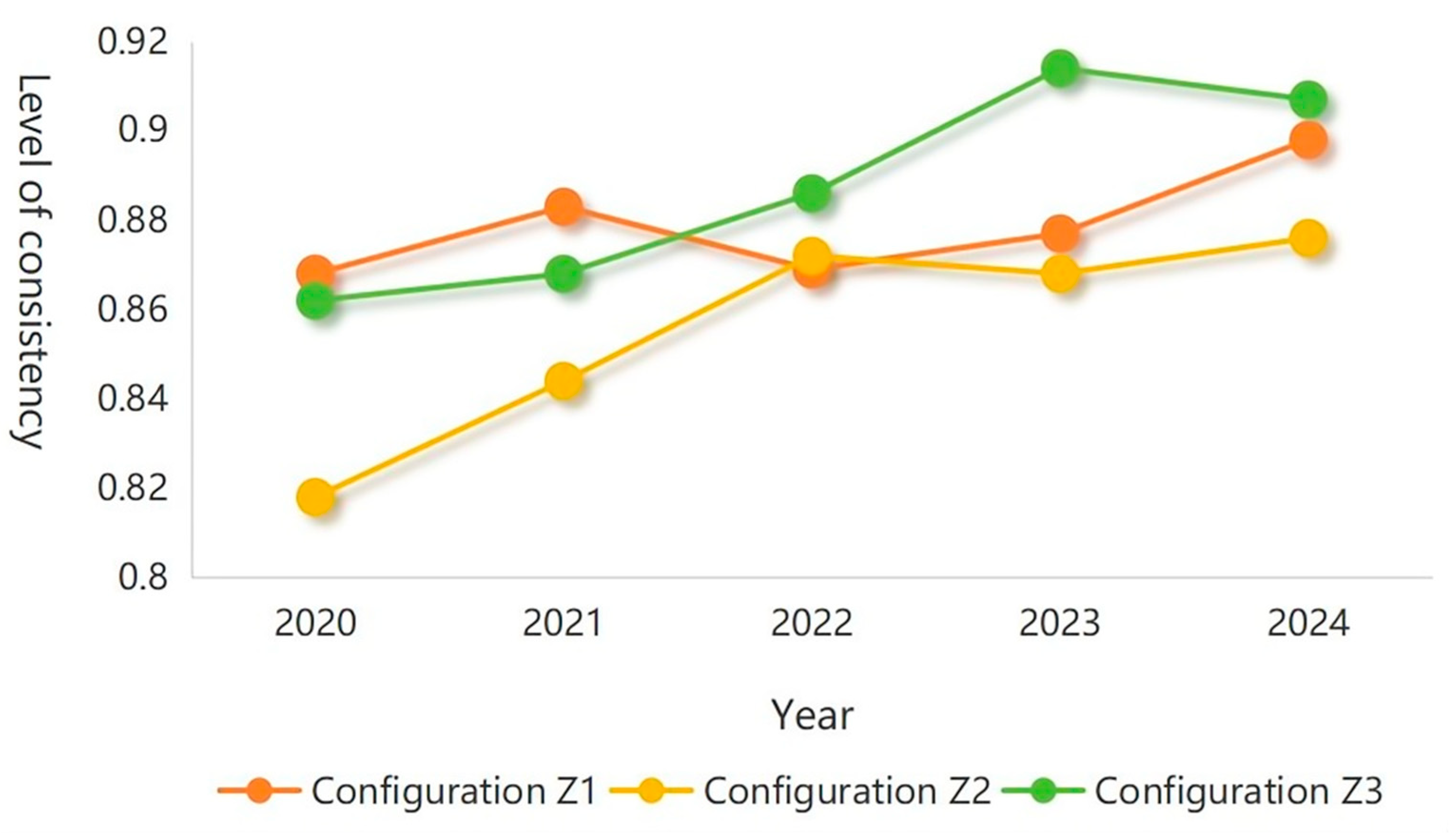
(4) Analysis of Inter-Configuration Results. Inter-configuration consistency reflects the cross-sectional consistency level across each year in the panel. As shown in Figure 2, from 2020 to 2024, the consistency of the three configurations driving high-level enterprise data asset trading disclosure generally exhibited an upward trend, indicating that the external institutional environment enhanced the effectiveness of these pathways. The consistency of Configuration Z1 rose from 0.868 (2020) to 0.898 (2024), with an overall increase of 0.03, demonstrating stable performance and reflecting the robustness of the “technology-organization-environment” synergy model. The consistency of Configuration Z2 increased from 0.818 (2020) to 0.876 (2024), with an overall growth of 0.058—the highest growth rate—indicating that the “environmental constraint-technological compensation” driven model strengthened as policies improved. The consistency of Configuration Z3 rose from 0.862 (2020) to 0.907 (2024), with an overall increase of 0.045, maintaining the highest level among the three configurations. Notably, the three curves converged between 2023 and 2024, with overall consistency trending toward equilibrium, suggesting enhanced complementarity among configurations and enabling enterprises to flexibly select combined strategies. This convergence may be related to the introduction of China’s “Three-Year Action Plan for Data Elements × (2024–2026),” which provides specific directions for enterprise data asset applications and serves as a guideline for enterprise data asset trading disclosure. The stability differences among the configuration pathways stem from their reliance on distinct core conditions, leading to inherent variations in their sensitivity to time (particularly external institutional environments). Specifically, Configuration Z1 suits resource-rich large enterprises requiring long-term investment in technological R&D and organizational development; it relies more on internal-external synergy, demonstrating moderate consistency but robust configuration stability. Configuration Z2 is suitable for regions with low marketization levels, where enterprises can leverage both enterprise resources and government governance; although its consistency is lower, its broad coverage makes it an optimal choice during transitional periods. Configuration Z3 fits enterprises with high financialization levels and access to urban data trading platforms; it exhibits the highest consistency but has high entry barriers, necessitating strengthened human capital and data trading ecosystems. Configurations Z2 and Z3 are significantly influenced by environmental constraints (e.g., marketization levels), while the high consistency of Configuration Z3 benefits from the intermediary role of data trading platforms, which reduce transaction costs. The phenomenon of sustainable high-level enterprise data asset trading is the result of a combination of technological, organisational and environmental factors. Enterprises should enhance their resource endowments, while policymakers should continue optimizing data governance and platform construction.

4.1.3. Robustness Test for Configuration Analysis

In order to enhance the reliability of the conclusions derived from the configuration analysis, the study implemented a robustness test. This involved raising the original consistency threshold, altering the case frequency, and adjusting the PRI consistency threshold (refer to Table 6, Table 7 and Table 8). The resulting configurations were largely consistent with those presented earlier, with any inconsistencies forming clear subsets, indicating that the research findings are relatively robust.

4.2. Regression Analysis on the Impact of Technological, Organizational, Environmental Factors and Enterprise Data Asset Trading on Enterprise’s New Quality Productive Forces

This section employs regression analysis to explore the complex relationships among technological, organisational and environmental factors in the context of high-level enterprise data asset trading. The analysis builds on the three configuration pathways that drive this trading. The study investigates the potential of three configuration pathways to drive enterprise data asset trading while concurrently enhancing the enterprise’s new quality productive forces. It also examines the pathways that may impede the development of the enterprise’s new quality productive forces during the process of enterprise data asset trading. Furthermore, the study unveils the potential mediating mechanisms involved in these processes.

4.2.1. Descriptive Analysis

The explanatory variables in this section are the three configuration pathways driving high-level enterprise data asset trading identified in the configurations. The degree of set membership for enterprises in each configuration pathway is measured; a higher degree of set membership indicates a stronger tendency for the enterprise to follow that pathway. See Table 9 for details of measurement methods and statistical results. Each configuration is analysed separately, and the variance inflation factor (VIF) is used to check for multicollinearity. All VIF values are below 10, indicating no significant multicollinearity.

4.2.2. Regression Analysis Results

As demonstrated in Table 10, the three configuration pathways have a considerable effect on the enterprise’s new quality and productive forces. Regression analysis indicates that the three configuration pathways that govern high-level enterprise data asset trading exert a considerably positive influence upon the enterprise’s new quality productive forces. This observation indicates that these pathways do not merely facilitate enterprise data asset trading, but also contribute to the enhancement of the enterprise’s new quality productive forces. It is evident that the “technology-organisation-environment” synergistic driving pathway (Configuration Z1) exerts the most pronounced effect in the enhancement of the enterprise’s new quality productive forces.

4.2.3. Robustness Test for Regression Analysis

Two kinds of test are performed to check the research results. First, extreme values are reduced to ensure reliable regression results. This is done by Winsorising the variable representing enterprise’s new quality productive forces, with 1% and 99% levels. Second, explained variables are substituted. Xie et al.’s methodology (2025) is used to test the enterprise’s new quality productive forces using TFP_OP, a proxy variable. Table 11 illustrate significant changes in enterprise’s new quality productive forces across regression configurations. These findings lend support to the established credibility and soundness of the research conclusions.

4.2.4. Mechanism Analysis

The present study employs a mediation model to analyse the effect of allocation pathways on enterprises’ new-quality productivity. This model integrates enterprise data asset transactions into regression analysis, with the objective of identifying the pathways through which these mechanisms influence new-quality productivity. The regression results are presented in Table 12. Specifically, Model 1 reports the correlation between the mediating variable and the dependent variable; Models 2–4 detail the direct impacts of allocation pathways upon enterprises’ new-quality productivity, whilst controlling for the mediating effect of enterprise data asset transactions.
Models 2–4 in Table 12 reveal three configuration pathways and the complex mediating effects between enterprise data asset trading and enterprise’s new quality productive forces. The regression coefficients of enterprise data asset trading are all found to be significantly positive, thus indicating that all three configuration pathways indirectly enhance the enterprise’s new quality productive forces by promoting enterprise data asset trading. It is evident that the aforementioned three pathways exert a considerable positive influence on the new quality and productive forces of enterprises. The combination of the configuration analysis results presented in Table 5 elucidates the intricate, multifaceted mechanisms by which the three configuration pathways influence the enterprise’s new quality productive forces.
(1) Indirect Promotion Mechanism. The findings of the aforementioned regression analysis, as presented in Table 12, suggest that the three configuration pathways can indirectly facilitate the development of the enterprise’s new quality and productive forces by facilitating the trading enterprise data assets. Combining these findings with the configuration analysis results, these three pathways share common technological factors (high levels of enterprise data elements), organizational factors (high levels of enterprise human capital), and environmental factors (urban data governance). It has been demonstrated that an increase in enterprise data element levels provides high-quality “raw materials” for data asset trading [41]. Furthermore, it has been shown that this increase can also enhance enterprise operational efficiency and innovation capabilities by optimising data resource allocation through data asset trading. This, in turn, can engender the emergence of new quality productive forces. High human capital levels ensure the enterprise’s ability to absorb, integrate, and internalize external data resources and knowledge, serving as a crucial driving factor for enterprises to leverage data assets for value appreciation [26]. This encourages enterprises to view data assets from a strategic rather than short-term financial perspective, actively exploring innovative applications of data, driving enterprise data asset trading, and embodying the “newness” in new quality productive forces. Urban data governance provides institutional safeguards for data asset trading by constructing trustworthy spaces and improving registration systems. Data asset trading, in turn, promotes enterprises to create high-skilled positions in data collection, processing, and analysis, thereby cultivating new types of workers skilled in using digital equipment and technologies [9], while low-skilled labor is crowded out from the market, ultimately achieving a leap in enterprise’s new quality productive forces.
(2) Direct Promotion Mechanism. The findings of the aforementioned regression analysis, as presented in Table 12, demonstrate that the three configurations can exert a direct and positive effect on the enterprise’s new quality and productive forces. It can thus be concluded that enterprises which demonstrate a higher degree of membership in the configuration pathways are able to achieve high levels of enterprise data asset trading, whilst concomitantly promoting the development of new quality productive forces. When these findings are combined with the results of the configuration analysis presented in Table 5, it becomes evident that both pathways reflect the mechanism of “technology-organization-environment” synergistically driving enterprise data asset trading under the TOE framework. It is evident that Configuration Z1 is conducive to the systematic and holistic enhancement of new quality productive forces through internal-external collaboration. Within the technological dimension, a considerable investment in R&D exerts a direct influence on the technological R&D process itself. This process constitutes a fundamental aspect of technological innovation, with the capacity to yield novel technologies and methodologies. Consequently, it serves as a catalyst for the advancement of enterprises, fostering the emergence of new and advanced productive forces. Meanwhile, high data element levels provide abundant “fuel” for data R&D, ensuring that technological breakthroughs have practical applicability. In the organizational dimension, high human capital levels ensure that enterprises possess a talent pool capable of mastering cutting-edge technologies and complex financial instruments, achieving efficient collaboration between talent and data elements. Conversely, high financialisation has been demonstrated to enhance capital allocation efficiency through the utilisation of financial instruments to support the application of data assets, thereby facilitating the “innovative allocation of production factors” for the development of new quality productive forces. In the context of environmental concerns, the establishment of robust data governance frameworks within urban settings has the potential to foster a reliable external institutional milieu for business ventures. This, in turn, has the potential to markedly curtail data transaction costs and uncertainties, while concomitantly accelerating the transformation process of data elements from resources to assets and, ultimately, to capital. Consequently, this contributes to the establishment of a robust institutional framework for the advancement of novel and innovative production capabilities. Configurations Z2 and Z3 are applicable to regions with relatively low marketization levels and high urban data governance levels. In regions with imperfect macro-institutional environments, the government can effectively compensate for market failures and accelerate the optimization process of local data element markets through precise interventions by a “proactive government.” This finding indicates the catalytic function of government data governance in cultivating enterprises’ new quality and productive forces during specific development stages. Configuration Z2 emphasizes the enterprise’s own technological strength (high data element levels, high R&D investment) and talent reserves (high human capital levels), building competitive advantages through technological hard power and directly promoting the independent R&D capabilities of key core technologies, highly aligning with the essential characteristics of new quality productive forces driven by technological innovation and achieving economic value appreciation. Configuration Z3, on the other hand, emphasizes the key role of the “data trading platform” as a new type of infrastructure, which significantly promotes the value release of data elements through dual pathways of reducing transaction costs and improving allocation efficiency, becoming a typical manifestation of enhancing the quality and efficiency of new quality productive forces.

5. Conclusions

5.1. Research Conclusions

(1) Driving Mechanisms of Enterprise Data Asset Trading. Firstly, an analysis showed that the seven antecedent conditions selected in this paper—enterprise data element level, enterprise R&D investment intensity, enterprise human capital structure, enterprise financialization degree, urban data governance, marketization degree, and data trading platform—do not constitute a single necessary condition for high levels of enterprise data asset trading. This indicates that high levels of enterprise data asset trading are essentially the result of the interaction of multiple factors. Secondly, there are three pathways driving high levels of enterprise data asset trading: the “technology–organization–environment” synergistic driving type, the “environmental constraint–technological compensation” driving type, and the “organizational operation–environmental ecology” driving type. This suggests that the ideal state requires the three-dimensional synergy of technology, organization, and environment to drive enterprise data asset trading. When one dimension is lacking, it needs to be compensated for by leveraging the advantages of other dimensions. Thirdly, enterprise data element level (technological factor), enterprise human capital structure (organizational factor), and urban data governance (environmental factor) are core conditions in all configuration pathways and serve as important cornerstones for achieving enterprise data asset trading.
(2) Complex Driving Mechanisms of Enterprise’s New Quality Productive Forces. Firstly, under the TOE framework, multiple equivalent configuration pathways exist that can promote high levels of enterprise data asset trading and indirectly cultivate enterprise’s new quality productive forces, with enterprise data asset trading playing an indirect promoting role in this process. Secondly, the “technology–organization–environment” synergistic driving type is the most significant pathway for enhancing enterprise’s new quality productive forces, reflecting the systemic advantages of integrating internal and external resources and being suitable for long-term by large enterprises with complete resource endowments. Thirdly, enterprise data element level (technological factor), enterprise human capital structure (organizational factor), and urban data governance (environmental factor) are key factors in achieving high levels of enterprise data asset trading disclosure and the leap in new quality productive forces. Consequently, enterprises are advised to meticulously select suitable pathways based on their own resource endowments, to thoroughly explore and release the multiplier effect of data assets, thereby driving a leap in the level of enterprise’s new quality productive forces.

5.2. Theoretical Contributions

(1) It enriches the theoretical research on how the perspective of data asset transaction disclosure promotes the development of enterprise’s new quality productive forces. The present study employs a configurational perspective of complex systems and the TOE framework theory to integrate the disclosure of enterprise data asset transactions and enterprise new quality productive forces into a unified research framework. The present study focuses on the disclosure of enterprise data asset transactions, exploring the underlying logic of its impact on the development of the enterprise’s new quality productive forces. To this end, a complex mediation model is employed to verify the mechanism of action. This study provides insights into the mechanisms that govern the transformation of enterprise data elements into value. In addition, it offers a novel research perspective on the factors that influence the enterprise’s new quality and productive forces.
(2) It expands the applied research on complex mediation models combining OCA and regression analysis. This paper proposes a novel integration of the QCA method with regression analysis, thereby constructing a complex mediation model. This model facilitates the exploration of the intricate driving mechanisms that simultaneously promote enterprise data asset trading and improve enterprise’s new quality productive forces. The application of this mixed method, to a certain extent, addresses the one-sidedness of relying solely on a single method to handle complex mediation relationships, fully considering the interactive relationships among various elements.

5.3. Practical Implications

(1) Enterprises are advised to prioritise the consolidation of data elements and the systematic cultivation of new quality productive forces. Enterprises must prioritize enhancing their data element levels, concentrating on pre-transaction aspects of enterprise data asset trading such as defining data resource ownership, valuing data assets, and recording data assets on financial statements, to systematically strengthen their enterprise data asset trading capabilities. Without a high-quality data asset base, any trading model would be like “water without a source.” However, enterprises must recognize that enterprise data asset trading itself does not necessarily translate into an engine for new quality productive forces. Pursuing short-term gains at the expense of technological innovation and quality and efficiency improvements is unsustainable. Enterprises should prioritise the “technology-organisation-environment” synergistic driving pathway, with a focus on investment intensity in R&D and human capital levels.
(2) Policymakers should focus on constructing a collaborative mechanism of “effective market + proactive government” to guide enterprises in exploring a development path that synergizes enterprise data asset trading with new quality productive forces. At the government governance level, top-level design should be strengthened to promote the forward-looking three-dimensional ecological construction of “technology–organization–environment,” such as providing policies like additional deductions for R&D expenses to incentivize enterprises to increase data-related R&D investments. Additionally, government-led data governance should be relied upon to compensate for insufficient marketization, while avoiding excessive administrative intervention. At the market operation level, standardized value exploration should be carried out in an orderly manner. It is imperative that relevant departments cultivate specialised trading platforms and market supply and demand entities, whilst simultaneously enhancing supervision and guidance. This should be done with a focus on guarding against speculative behaviours that merely create hype around concepts or shift focus from the tangible economy to the virtual sphere. Ensuring the efficient circulation of data elements and the steady development of new quality productive forces is also of the utmost importance.
(3) It is incumbent upon governments and enterprises to adopt a systemic perspective and to collaborate in order to optimise the “technology–organisation–environment” dimensions. This will guarantee that the value-multiplying effect of data assets is fully leveraged and that enterprises are empowered to make a significant advance in terms of their new quality productive forces. In the contemporary digital economy era, the promotion of enterprise data asset trading and the nurturing of enterprises’ new quality productive forces are intricate systemic issues. It is incumbent upon governments and enterprises to establish a complex systems perspective in unison, acknowledging that a solitary factor does not constitute a necessary condition for elevated levels of enterprise data asset trading. This phenomenon is primarily driven by the interplay of numerous factors. It is therefore the responsibility of both parties to enhance the synergy and interconnection among the three dimensions of “technology–organisation–environment”, activate enterprise data assets, invigorate the data element market, fully leverage the multiplier effect and extensive radiating and driving role of data assets, and establish a robust basis for the advancement of new quality productive forces.

Author Contributions

Conceptualization, Y.L.; methodology, Y.L.; software, Y.L.; validation, Y.L.; formal analysis, Y.L.; investigation, J.Z.; resources, J.Z.; data curation, J.Z.; writing—original draft preparation, J.Z.; writing—review and editing, J.Z.; visualization, J.Z.; supervision, M.Z.; project administration, M.Z.; funding acquisition, Y.L. All authors have read and agreed to the published version of the manuscript.

Funding

Special Research Project on Higher Education Management Reform under the “14th Five-Year Plan” for Educational Science in Jiangxi Province: “Research on the Cultivation of Digital Literacy among Undergraduate University Teachers in Jiangxi Province in the Digital Age” (Project No. 24GJZX027).

Institutional Review Board Statement

Not applicable.

Informed Consent Statement

Not applicable.

Data Availability Statement

The data presented in this study are available upon request from the corresponding author.

Conflicts of Interest

The authors declare no conflicts of interest.

References

  1. Huang, Q.H.; Sheng, F.F. New Quality Productive Forces System: Element Characteristics, Structural Bearing, and Functional Orientation. Reform 2024, 2, 15–24. [Google Scholar]
  2. Diao, H. Corporate Basic Research and the Cultivation of New-Quality Productive Forces. J. Quant. Tech. Econ. 2025, 42, 91–110. [Google Scholar]
  3. Xie, D.; Wang, R.; He, C. Market-Oriented Allocation of Data Elements Empowers the Development of New-Quality Productive Forces in Enterprises. Econ. Perspect. 2025, 5, 19–37. [Google Scholar]
  4. Li, Z.; Liao, X.D. The Triple Logic of Theory, History, and Reality in Developing ‘New Quality Productive Forces’. Rev. Political Econ. 2023, 14, 146–159. [Google Scholar]
  5. Xu, Z.; Zheng, H. Data Elements Empowering New-Quality Productive Forces: Intrinsic Mechanisms, Practical Obstacles, and Legal Approaches. Shanghai Econ. Rev. 2024, 5, 37–52. [Google Scholar]
  6. Li, S.; Zhao, C.; Xie, Y. Data Assets and Corporate Financialization: Data Governance or Conceptual Hype? Foreign Econ. Manag. 2025, 47, 21–38. [Google Scholar]
  7. Zhu, Z.; Huang, X.; Chen, H. Foreign Investment Openness in Producer Services and Manufacturing Innovation: Concurrent Discussion on the Institutional Openness Optimization Path for the Development of New-Quality Productive Forces. J. Financ. Res. 2024, 2, 76–93. [Google Scholar]
  8. Shang, L.; Li, D.; Han, S.; Jia, N. How Industry-University-Research Collaboration Stimulates the Development of New-Quality Productive Forces in Digital Native Enterprises: An Exploratory Single-Case Study from the Perspective of Knowledge Orchestration. China Ind. Econ. 2025, 1, 174–192. [Google Scholar]
  9. Liang, X.; Lü, K.; Chen, S. Research on the Impact of Market-Oriented Data Elements on the Level of New-Quality Productive Forces in Enterprises. Sci. Res. Manag. 2025, 46, 12–21. [Google Scholar]
  10. Chen, Y.; Hou, Y.; Ma, X.; Xu, B. Research on the Paths and Mechanisms of Intelligent Transformation Empowering High-Quality Development in Enterprises: From the Perspective of Developing New-Quality Productive Forces. Sci. Res. Manag. 2025, 46, 32–42. [Google Scholar]
  11. Guo, Y.; Chen, Y.; Chi, R. Research on the Systemic Structure of Industrial Platforms Empowering Traditional Industrial Clusters to Develop New-Quality Productive Forces. Sci. Res. Manag. 2025, 46, 22–31. [Google Scholar]
  12. Ouyang, Y.; Hu, M. The Impact of Data Elements Marketization on Corporate Financing Constraints: Quasi-Experimental Evidence from the Establishment of Data Trading Platforms in China. Financ. Res. Lett. 2024, 69, 106132. [Google Scholar] [CrossRef]
  13. Dai, K.; Wang, S.; Huang, Z. How Does the Construction of Data Trading Platforms Affect Corporate Total Factor Productivity? Econ. Perspect. 2023, 12, 58–75. [Google Scholar]
  14. Ge, S.; Tu, Z.; Chen, Y.; Chong, H.-Y. Data-Driven Sustainability: The Impact of Data Trading Platforms on Corporate ESG Performance. Int. Rev. Financ. Anal. 2025, 105, 104371. [Google Scholar] [CrossRef]
  15. Shen, N.; Zhou, J.; Zhang, G.; Wu, L.; Zhang, L. How Does Data Factor Marketization Influence Urban Carbon Emission Efficiency? A New Method Based on Double Machine Learning. Sustain. Cities Soc. 2025, 119, 106106. [Google Scholar] [CrossRef]
  16. Yang, Y.; Li, Y.; Liang, X. The Role of Data Trading Platforms (DTPs) in Digital Technology Innovation: Mechanisms & Evidence from China. J. Policy Model. 2025, 47, 1372–1396. [Google Scholar] [CrossRef]
  17. Dong, L.; Zhu, X.; Yang, L.; Jiang, J. Unleashing the Power of Data Element Markets: Driving Urban Green Growth through Marketization, Innovation, and Digital Finance. Int. Rev. Econ. Financ. 2025, 99, 104070. [Google Scholar] [CrossRef]
  18. Xu, Y.; Wang, Z. Market-Oriented Construction of Data Elements and Corporate Digital Transformation: A Quasi-Natural Experiment Based on Data Trading Platforms. Soft Sci. 2024, 38, 24–29+39. [Google Scholar]
  19. Chen, Z.; Zheng, Q.; Wu, Z. The Practical Dilemmas and Solutions for the Construction of Data Trading Platforms in China. Reform 2022, 2, 76–87. [Google Scholar]
  20. Chatterjee, S.; Rana, N.P.; Dwivedi, Y.K.; Baabdullah, A.M. Understanding AI Adoption in Manufacturing and Production Firms Using an Integrated TAM-TOE Model. Technol. Forecast. Soc. Change 2021, 170, 1–12. [Google Scholar] [CrossRef]
  21. Liu, C.; Sun, M. Analysis of Influencing Factors and Improvement Paths of the Level of Open Utilization of Public Data Based on the TOE Framework. J. Mod. Inf. 2024, 44, 105–119. [Google Scholar]
  22. Ren, M.; Geng, C.; Wu, Y. Driving Factors and Configuration Paths of Policy Formulation for Authorized Operation of Public Data: An Empirical Analysis Based on fsQCA. Library 2025, 11, 1–10. [Google Scholar]
  23. Lian, T.; Yang, S.; Wang, X. Research on Influencing Factors of Digital Transformation of Cultural and Tourism Enterprises in the Context of the Digital Economy: Based on the “TOE” Framework. J. Soochow Univ. (Philos. Soc. Sci. Ed.) 2025, 46, 116–129. [Google Scholar]
  24. Zhao, S.; Xu, H.; Gao, W.; Xu, Y. The Utilization Level of Corporate Data Elements, Digital Innovation, and the Modernization of Industrial Structure. China Soft Sci. 2024, S2, 398–407. [Google Scholar]
  25. Su, W.; Yu, S.; Ge, J. Research on the Configurational Effects of Motivational Factors for Corporate Data Element Supply. Sci. Technol. Prog. Policy 2024, 41, 89–98. [Google Scholar]
  26. Yu, X.; Niu, B.; Yuan, Z. Research on the Impact of “Human-Data” Synergy on High-Quality Development of Enterprises from the Perspective of the Value Chain. Sci. Res. Manag. 2025, 46, 60–68. [Google Scholar]
  27. Huo, C.; Yang, Y.; He, D.; Jing, S. The Generative Logic and Mechanism of Action of Lean Digitalization Empowering Organizational Resilience in Manufacturing Enterprises: A Multi-Case Study Based on Dissipative Structure. Sci. Technol. Prog. Policy 2025, 1–13. [Google Scholar]
  28. Yuan, Z.; Yu, X.; Li, M. Data Asset Information Disclosure, Heterogeneity of Institutional Investors, and Corporate Value. Mod. Financ. Econ. (J. Tianjin Univ. Financ. Econ.) 2022, 42, 32–47. [Google Scholar]
  29. Yuan, Q.; Zheng, L. Authorized Operation or Data Trading? Research on the Market-Oriented Circulation and Utilization Channels of Public Data: From the Perspectives of Asset Specificity and Descriptive Complexity. E-Government 2024, 10, 14–21. [Google Scholar]
  30. Yu, X.; Niu, B. Research on the Value Creation Effect of the Interaction Between Corporate Data Resources and Human Capital. Contemp. Financ. Econ. 2025, 6, 139–149. [Google Scholar]
  31. Mao, C.; Yan, Y.; Niu, J.; Wang, Q. How Data Assets Enhance Corporate Green Innovation Capability: Causal Inference Based on a Double Machine Learning Model. Sci. Technol. Prog. Policy 2025, 42, 1–10. [Google Scholar]
  32. Tang, M. Data Element Utilization and Firm Value. Int. Rev. Financ. Anal. 2025, 102, 104004. [Google Scholar] [CrossRef]
  33. Niu, B.; Du, Y.; Yu, X.; Zhao, N. Data Asset Information Disclosure and Bond Financing Costs. J. Guangdong Univ. Financ. Econ. 2024, 39, 88–101. [Google Scholar]
  34. Ouyang, R.; Sun, Y. The Theoretical Mechanism and Implementation Path of “Data Elements ×” Financial Services. Mod. Financ. Res. 2024, 29, 48–58+69. [Google Scholar]
  35. Bernardo, B.M.V.; São Mamede, H.; Barroso, J.M.P.; Santos, V.D.d. Data Governance & Quality Management—Innovation and Breakthroughs Across Different Fields. J. Innov. Knowl. 2024, 9, 100598. [Google Scholar] [CrossRef]
  36. Wang, X.; Liu, D.; Wang, S. Riding the “Wave of Data”: Government Data Governance Empowers the Integration of Digital and Real Economies. J. Hainan Univ. (Humanit. Soc. Sci. Ed.) 2025, 1–11. [Google Scholar]
  37. Liu, Y.; Zhang, Y. Restrictive Factors and Breakthrough Paths in the Cultivation of the Data Elements Market. Reform 2023, 9, 21–33. [Google Scholar]
  38. Yang, F.; Ai, Y.; Li, J. The Dual Improvement of Data Assetization on Pricing Efficiency and Stability in the Capital Market: An Empirical Test Based on Corporate Stock Price Synchronicity and Volatility. West. Forum 2025, 35, 17–31. [Google Scholar]
  39. Yao, H.; Zhang, J. Research on the Impact of Corporate Data Assets on Total Factor Productivity. Econ. Surv. 2024, 41, 107–119. [Google Scholar]
  40. Chen, L.; Dong, H. Can Transactional Data Assets Promote Corporate Breakthrough Innovation? Evidence from A-Share Listed Companies. J. Hubei Univ. (Philos. Soc. Sci. Ed.) 2025, 52, 147–156+196. [Google Scholar]
  41. Li, C.; Zhang, S.; Wang, M. Research on the Impact of Data Elements Market Construction on Corporate Innovation. Sci. Res. Manag. 2025, 1–17. [Google Scholar]
  42. Wang, C.; Wang, X. The Relationship and Impact Between the Development of New-Quality Productive Forces and Data Elements Exploitation. Library 2025, 8, 49–55+90. [Google Scholar]
  43. Chen, H.; Wei, S.; Xie, W. The Effect and Mechanism of Innovation-Incentive Tax Reductions in Promoting the Development of New-Quality Productive Forces in Enterprises: Evidence from A-Share Listed Companies from 2015 to 2022. Tax. Res. 2025, 5, 104–113. [Google Scholar]
  44. Han, W.; Tang, X. The Theoretical Logic and Practical Path of New Finance in Promoting the Development of New-Quality Productive Forces. J. Lanzhou Univ. (Soc. Sci. Ed.) 2025, 53, 15–26. [Google Scholar]
  45. Wang, X.; Yang, Y.; Chen, Y.; Li, H. Can Digital Government Construction Improve Corporate Breakthrough Innovation Performance? Based on the Mediating Effect of New-Quality Productive Forces. Sci. Technol. Prog. Policy 2025, 42, 84–93. [Google Scholar]
  46. Wang, W.J.; Chen, Y.X. Research on the Synergistic Effect of Data Elements on Enterprise Carbon Emission Reduction. J. Northeast. Norm. Univ. (Philos. Soc. Sci. Ed.) 2025, 6, 1–10. [Google Scholar]
  47. Ren, S.; Du, M.; Cao, Y. Managerial Short-Termism Fluctuations, Diversification Strategies, and Corporate Input. Manag. Rev. 2025, 37, 200–213. [Google Scholar]
  48. Cheng, B.; Xu, Y.; Liu, Z. State-Owned Enterprise Reform and Human Capital Structure Optimization. Collect. Essays Financ. Econ. 2025, 1, 106–117. [Google Scholar]
  49. Yu, N.; Zhang, H.; Liu, H. Non-Controlling Major Shareholders and Corporate Financialization: A Reservoir or an Arbitrage Tool? Nankai Bus. Rev. 2023, 26, 96–107. [Google Scholar]
  50. Shen, Z.; Zhu, S.; Wen, Q.; Tang, C. Empowering an Efficient Market with a Proactive Government: Government Digital Governance and Corporate Investment Efficiency. World Econ. 2025, 48, 166–195. [Google Scholar]
  51. Wu, Z.; Li, Q.; Zhao, R. Provincial Unified Management of Personnel, Finances, and Assets in Local Courts Promotes Cross-Regional Investment. China Econ. Q. 2024, 24, 1308–1324. [Google Scholar]
  52. He, Y.; Chen, L.; Du, Y. Can Data Assetization Alleviate Financing Constraints for “Specialized, Sophisticated, Unique, and Innovative” Small and Medium-Sized Enterprises? China Ind. Econ. 2024, 8, 154–173. [Google Scholar]
  53. Li, X.R.; Tian, Z.R.; Chang, B.Q. New Quality Productive Forces, Resource Utilization, and Enterprise Organizational Resilience. West. Forum 2024, 34, 35–49. [Google Scholar]
  54. Zhang, M.; Du, Y. The Application of QCA Method in Organizational and Management Research: Positioning, Strategies, and Directions. Chin. J. Manag. 2019, 16, 1312–1323. [Google Scholar]
  55. Peng, Z.; Hao, Y.; Bao, F. Research on the Value Creation Path Driven by the Innovation Ecosystem of Industrial Internet Platforms Derived from Manufacturing Enterprises: A Configurational Analysis Based on fsQCA. J. Guizhou Univ. Financ. Econ. 2024, 3, 11–20. [Google Scholar]
  56. Zhang, E.; Li, Z. The Path and Mechanism of Digital Technology Innovation Driving the Growth of Corporate Data Assets. China Bus. Mark. 2025, 39, 100–114. [Google Scholar]
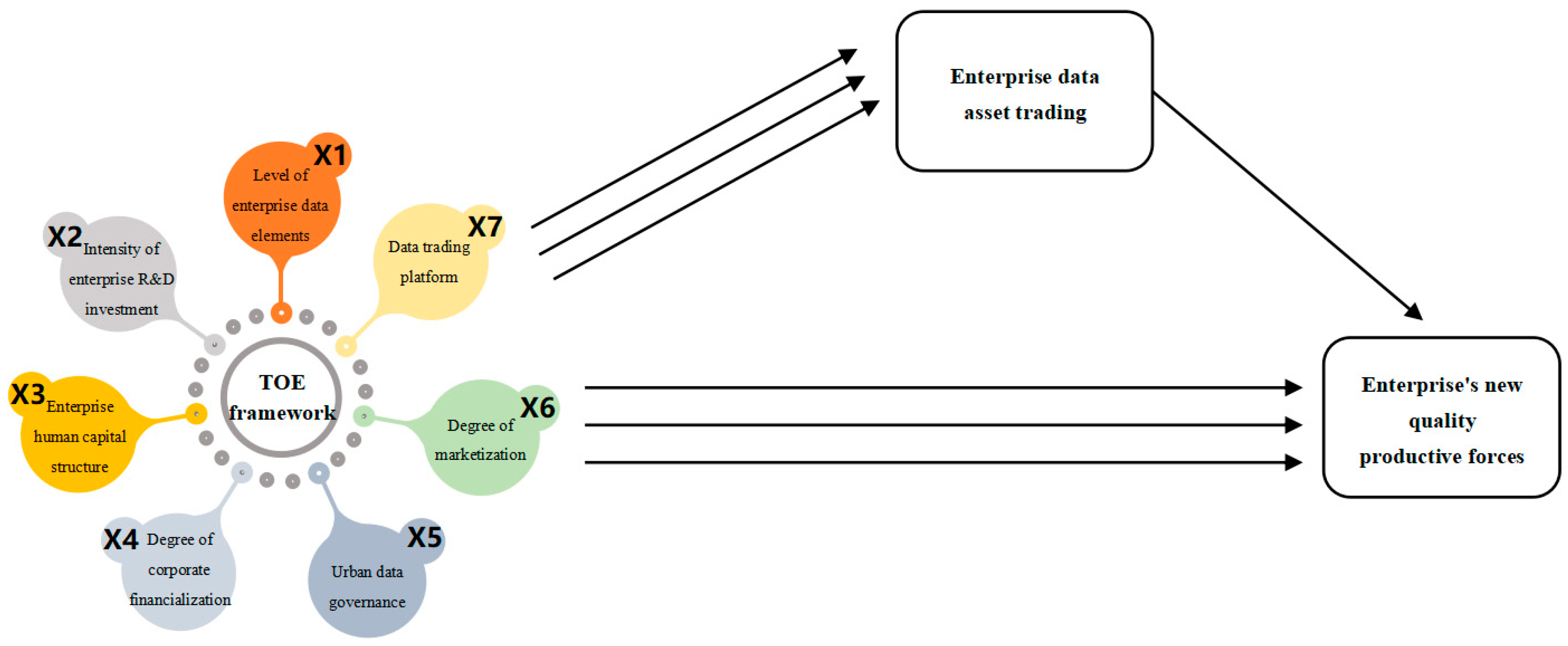
Figure 1. Theoretical Framework Diagram for the Synergistic Development of Enterprise Data Asset Trading and Enterprise’s New Quality Productive Forces under the TOE Framework.
Sustainability 17 11362 g001
Figure 2. Trends in Inter-Configuration Consistency Levels Across Conditions from 2020 to 2024 for Disclosure of Enterprise Data Asset Transactions.
Sustainability 17 11362 g002
Table 1. Glossary for Enterprise Data Asset Trading.
KeywordsLexicon
DigitalDigital platform; Digital trade; Digital consumption; Digital currency; Digital product security; Digital certification; Digital products
DataData platform; Data cooperation; Data trading; Data circulation and sharing; Data application services; Data hosting; Data usage rights; Data security; Data service provider; Data disclosure; Data exchange.
InformationInformation platform; sharing; services; consumption
Resource sharing; interconnection; interoperability; system; exchange; level; platform
NetworkOnline transaction; online sales; network data security; information security; security performance; risks; provision of networks; service provision; network interconnection; network convergence; interoperability; network service provider; cyberspace sovereignty
Table 2. Enterprise’s New Quality Productive Forces.
Primary IndicatorSecondary IndicatorTertiary IndicatorCalculation Method
New Quality LaborersEmployee QualityProportion of R&D PersonnelNumber of R&D personnel/Total number of employees
Proportion of Highly Educated PersonnelNumber of employees with postgraduate degrees or above/Total number of employees
Management QualityGreen Awareness of Executivesln (Frequency of green development keywords in annual reports + 1)
Overseas Background of ManagementAssigned a value of 1 if any executives have an overseas background; otherwise, 0
New Quality Objects of LaborEcological EnvironmentEnvironmental Governance ScoreE indicator from Huazheng ESG ratings, with 9 levels assigned values from 1 to 9 respectively
Future DevelopmentProportion of Fixed AssetsFixed assets/Total assets
Capital Accumulation RateGrowth in owner’s equity for the current year/Owner’s equity at the beginning of the year
New Quality Means of LaborTechnological Means of LaborInnovation Levelln (Number of patent grants + 1)
Digital Means of LaborDegree of Digitalizationln (Frequency of digital keywords in annual reports + 1)
Proportion of Intangible AssetsIntangible assets/Total assets
Green Means of LaborGreen Technology Levelln (Number of green patent grants + 1)
Proportion of Green PatentsNumber of green patent grants/Total number of patent grants
Table 3. Results of necessity analysis.
Conditional VariableHigh-Level Enterprise Data Asset TradingLow-Level Enterprise Data Asset Trading
Aggregated ConsistencyAggregated CoverageInter-Group Consistency Adjustment DistanceIntra-Group Consistency Adjustment DistanceAggregated ConsistencyAggregated CoverageInter-Group Consistency Adjustment DistanceIntra-Group Consistency Adjustment Distance
X10.6410.5620.0460.4870.5640.6440.0430.037
~X10.5940.5110.0550.4540.6160.6910.0430.033
X20.6840.6410.0580.4220.4870.5960.1010.043
~X20.5690.4600.0550.4870.7070.7440.0580.027
X30.7580.6760.0170.3890.4630.5380.0410.051
~X30.4820.4080.0320.5520.7210.7950.0230.025
X40.5680.5590.0260.4870.5140.6590.0380.035
~X40.6530.5070.0200.4220.6560.6640.0350.033
X50.8520.4730.0200.5190.7290.5270.0140.031
~X50.1480.2950.1161.8500.2710.7050.0380.029
X60.5780.4930.2960.4870.6380.7080.2900.031
~X60.6570.5820.2930.4540.5430.6270.3510.037
X70.7480.4870.0460.6810.6050.5130.0840.031
~X70.2520.3280.1361.3300.3950.6720.1280.030
Note: The symbol “~” represents “NOT” in logical operations, used to indicate the state where a certain condition is not of a high level.
Table 4. Causal combinations where the intergroup consistency adjustment distance exceeds 0.2.
Causal Combination ScenarioIndicator20202021202220232024
X6/YInter-group Consistency0.3660.4760.5720.6580.726
Inter-group Coverage0.5590.5140.4840.4590.498
~X6/YInter-group Consistency0.8900.7960.6810.5650.466
Inter-group Coverage0.5230.5660.5920.5970.666
X6/~YInter-group Consistency0.4010.5420.6470.7240.798
Inter-group Coverage0.8320.7800.7300.6970.633
~X6/~YInter-group Consistency0.7880.6620.5420.4370.367
Inter-group Coverage0.6280.6280.6280.6380.608
Note: The symbol “~” represents “NOT” in logical operations, used to indicate the state where a certain condition is not of a high level.
Table 5. Outcomes of achieving high-level enterprise data asset trading.
Conditional VariableConfiguration Analysis—High-Level Enterprise Data Asset Trading
Configuration Z1Configuration Z2Configuration Z3
Level of enterprise data elements (X1)
Intensity of enterprise R&D investment (X2)
Enterprise human capital structure (X3)
Degree of corporate financialization (X4)
Urban data governance (X5)
Degree of marketization (X6)
Data trading platform (X7)
Consistency0.8800.8550.887
PRI0.7100.7180.731
Coverage0.2060.2830.168
Unique Coverage0.0320.1090.024
Inter-group Consistency Adjustment Distance0.0170.0320.029
Intra-group Consistency Adjustment Distance0.1620.1950.162
Overall Consistency0.846
Overall PRI0.707
Overall Coverage0.339
The case frequency is 2, the original consistency threshold is 0.8, and the PRI threshold is 0.65.
Note: 1. ⊗ signifies a low level of antecedent conditions, while ● denotes a high level of antecedent conditions. 2. Large circles are indicative of core conditions, small circles are indicative of peripheral conditions, and blank spaces signify that the antecedent conditions are not essential for the occurrence of the outcome.
Table 6. Results of robustness test (original consistency = 0.85).
Conditional VariableConfiguration Analysis—High-Level Enterprise Data Asset Trading
Configuration Z1Configuration Z2Configuration Z3
Level of enterprise data elements (X1)
Intensity of enterprise R&D investment (X2)
Enterprise human capital structure (X3)
Degree of corporate financialization (X4)
Urban data governance (X5)
Degree of marketization (X6)
Data trading platform (X7)
Consistency0.8800.8590.887
PRI0.7100.7260.731
Coverage0.2060.2360.168
Unique Coverage0.0610.0920.024
Inter-group Consistency Adjustment Distance0.0170.0320.029
Intra-group Consistency Adjustment Distance0.1620.1950.162
Overall Consistency0.851
Overall PRI0.712
Overall Coverage0.322
Note: 1. ⊗ signifies a low level of antecedent conditions, while ● denotes a high level of antecedent conditions. 2. Large circles are indicative of core conditions, small circles are indicative of peripheral conditions, and blank spaces signify that the antecedent conditions are not essential for the occurrence of the outcome.
Table 7. Results of robustness test (case frequency = 3).
Conditional VariableConfiguration Analysis—High-Level Enterprise Data Asset Trading
Configuration Z1Configuration Z2Configuration Z3
Level of enterprise data elements (X1)
Intensity of enterprise R&D investment (X2)
Enterprise human capital structure (X3)
Degree of corporate financialization (X4)
Urban data governance (X5)
Degree of marketization (X6)
Data trading platform (X7)
Consistency0.8800.8550.887
PRI0.7100.7180.731
Coverage0.2060.2830.168
Unique Coverage0.0320.1090.024
Inter-group Consistency Adjustment Distance0.0170.0320.029
Intra-group Consistency Adjustment Distance0.1620.1950.162
Overall Consistency0.846
Overall PRI0.707
Overall Coverage0.339
Note: 1. ⊗ signifies a low level of antecedent conditions, while ● denotes a high level of antecedent conditions. 2. Large circles are indicative of core conditions, small circles are indicative of peripheral conditions, and blank spaces signify that the antecedent conditions are not essential for the occurrence of the outcome.
Table 8. Results of robustness test (PRI = 0.7).
Conditional VariableConfiguration Analysis—High-Level Enterprise Data Asset Trading
Configuration Z1Configuration Z2Configuration Z3
Level of enterprise data elements (X1)
Intensity of enterprise R&D investment (X2)
Enterprise human capital structure (X3)
Degree of corporate financialization (X4)
Urban data governance (X5)
Degree of marketization (X6)
Data trading platform (X7)
Consistency0.9010.8590.887
PRI0.7380.7260.731
Coverage0.0310.2360.168
Unique Coverage0.0310.0920.024
Inter-group Consistency Adjustment Distance0.0640.0320.029
Intra-group Consistency Adjustment Distance0.0650.1950.162
Overall Consistency0.860
Overall PRI0.725
Overall Coverage0.291
Note: 1. ⊗ signifies a low level of antecedent conditions, while ● denotes a high level of antecedent conditions. 2. Large circles are indicative of core conditions, small circles are indicative of peripheral conditions, and blank spaces signify that the antecedent conditions are not essential for the occurrence of the outcome.
Table 9. Descriptive statistics.
Variable TypeVariable NameMeasurement MethodNMeanStd. Dev.MinMax
Explained variableEnterprise’s new quality productive forcesSee Table 2 for details.43480.1670.0740.0210.380
Explanatory VariableConfiguration Z1The degree of set membership for each enterprise in the corresponding configuration43480.1020.1570.0000.900
Configuration Z243480.1440.2050.0000.910
Configuration Z343480.0830.1450.0000.820
Mediating variableEnterprise data asset tradingConstruct dictionaries of seed words and similar terms for “digital,” “data,” “information,” and “network,” and measure them using the ratio of the total frequency of these words to the total word frequency in annual reports.43480.4340.3400.0501.000
Control variableCashflowNet cash flow from operating activities/Total assets43480.0390.069−0.3550.545
Growth(Current year’s operating revenue amount—amount from the same period last year)/Amount from the same period last year43480.1160.664−1.44527.080
FirmageCurrent year—Establishment year434820.0046.6494.00068.000
Tobin’s QMarket capitalization/Total assets43482.4441.6890.64141.081
HHIMain business revenue’s market share in the industry43480.0740.1070.0231.000
Table 10. The impacts of the three configuration paths on enterprise’s new quality productive forces.
VariableExplained Variable: Enterprise’s New Quality Productive Forces
Model 1Model 2Model 3
Configuration Z10.0545 ***
(7.9361)
Configuration Z2 0.0489 ***
(8.6826)
Configuration Z3 0.0394 ***
(5.1114)
ControlsYESYESYES
YearYESYESYES
_cons0.1772 ***
(37.1180)
0.1739 ***
(35.9362)
0.1793 ***
(37.4782)
N434843484348
adj. R20.07660.08090.0694
Note: *** indicates significance at the 1% level. Robust standard errors are shown in parentheses.
Table 11. Robustness test.
VariableReplace the Dependent Variable;Remove Extreme Values.
Model 1Model 2Model 3Model 1Model 2Model 3
Configuration Z10.1439 **
(2.2542)
0.0556 ***
(7.9001)
Configuration Z2 0.0972 *
(1.8965)
0.0489 ***
(8.6096)
Configuration Z3 0.4627 ***
(6.2532)
0.0401 ***
(5.1307)
ControlsYESYESYESYESYESYES
YearYESYESYESYESYESYES
_cons6.3686 ***
(117.9018)
6.3666 ***
(116.1273)
6.3442 ***
(118.7827)
0.1771 ***
(37.1617)
0.1740 ***
(36.0361)
0.1793 ***
(37.5495)
N420542054205434843484348
adj. R20.05620.05600.06250.07660.08060.0694
Note: *, **, and *** indicate significance at the 10%, 5%, and 1% levels, respectively. Robust standard errors are shown in parentheses.
Table 12. The impacts of the three configuration paths and corporate data asset transactions on a firm’s new-quality productive forces.
VariableModel 1Model 2Model 3Model 4
Configuration Z1 0.0461 ***
(6.3701)
Configuration Z2 0.0419 ***
(6.9712)
Configuration Z3 0.0294 ***
(3.6721)
Enterprise data asset trading0.0207 ***
(6.5752)
0.0152 ***
(4.6168)
0.0121 ***
(3.6182)
0.0176 ***
(5.3636)
ControlsYESYESYESYES
YearYESYESYESYES
_cons0.1750 ***
(35.5428)
0.1726 ***
(35.2643)
0.1709 ***
(34.6465)
0.1739 ***
(35.4080)
N4348434843484348
adj. R20.07220.08080.08330.0751
Note: *** indicates significance at 1% level. Robust standard errors are shown in parentheses.
Disclaimer/Publisher’s Note: The statements, opinions and data contained in all publications are solely those of the individual author(s) and contributor(s) and not of MDPI and/or the editor(s). MDPI and/or the editor(s) disclaim responsibility for any injury to people or property resulting from any ideas, methods, instructions or products referred to in the content.