Lithium Enrichment Mechanisms in Geothermal Waters of Xiamen, Southeastern China, Revealed by SOM Classification and Hydrogeochemical Analysis

 ,
, 
Abstract
1. Introduction
2. Materials and Methods
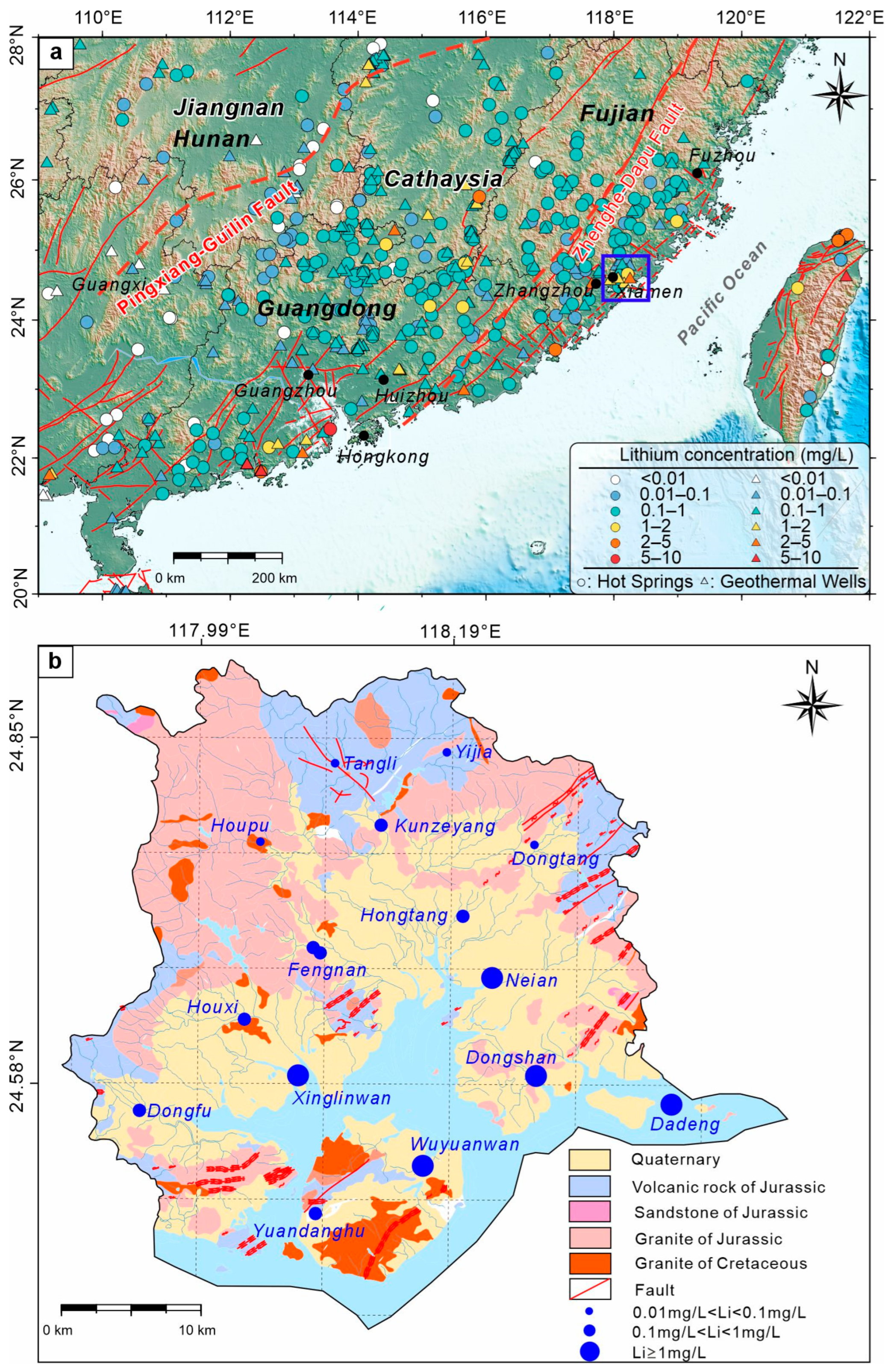
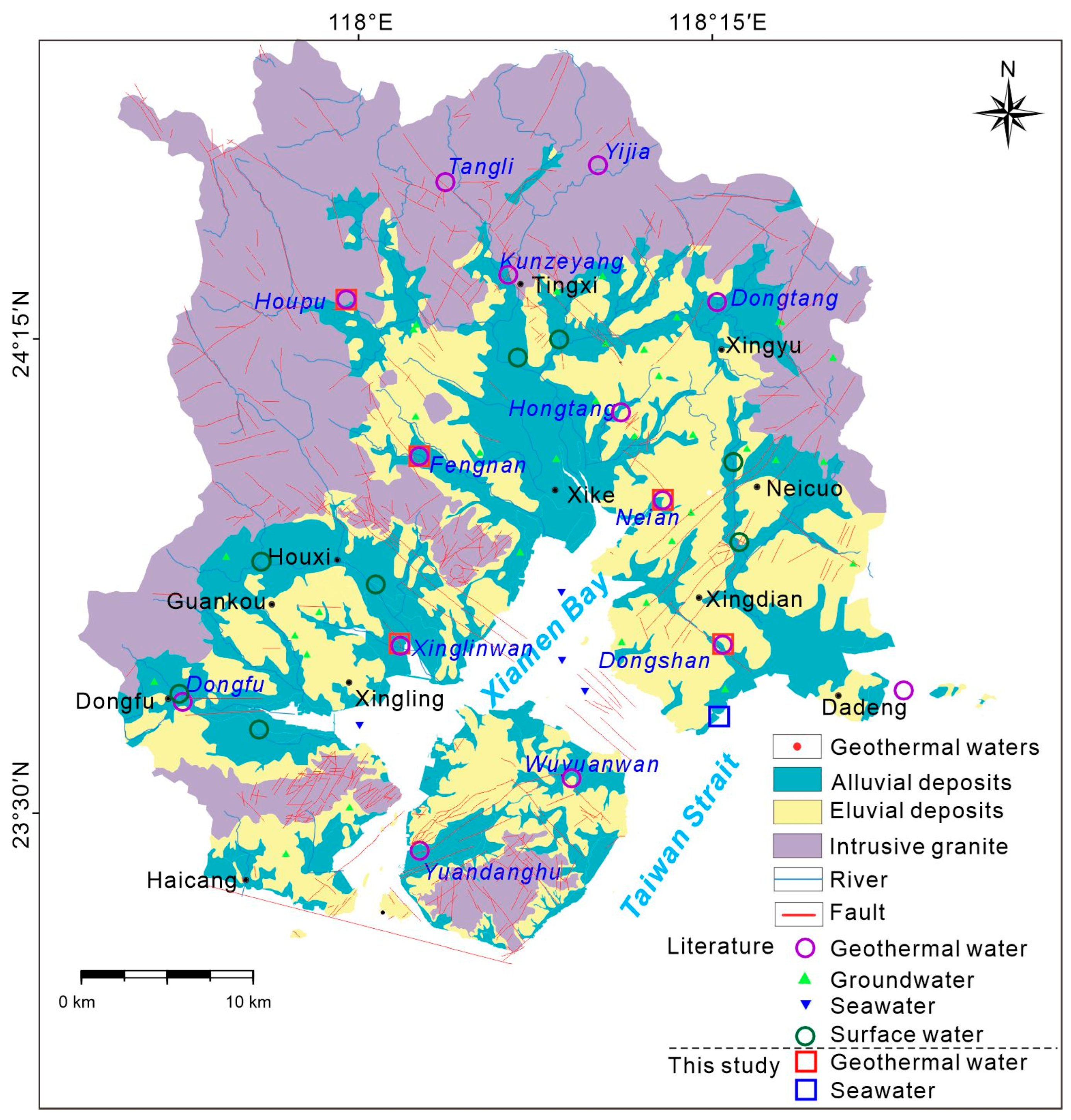
2.1. Study Area
2.2. Sample Collection and Testing Analysis
2.3. Data Processing and Analytical Method
2.3.1. Self-Organizing Map (SOM) and K-Means Clustering
2.3.2. Isotopic Analysis and Water Source Identification
2.3.3. Three End-Member Mass Balance Model
- Seawater fraction () calculation:
- 2.
- Li concentration from mixed water sources ():
- 3.
- Rock end-member contribution:
- 4.
- Estimation of rock leaching amount:
2.3.4. Statistical and Hydrochemical Analysis
3. Result
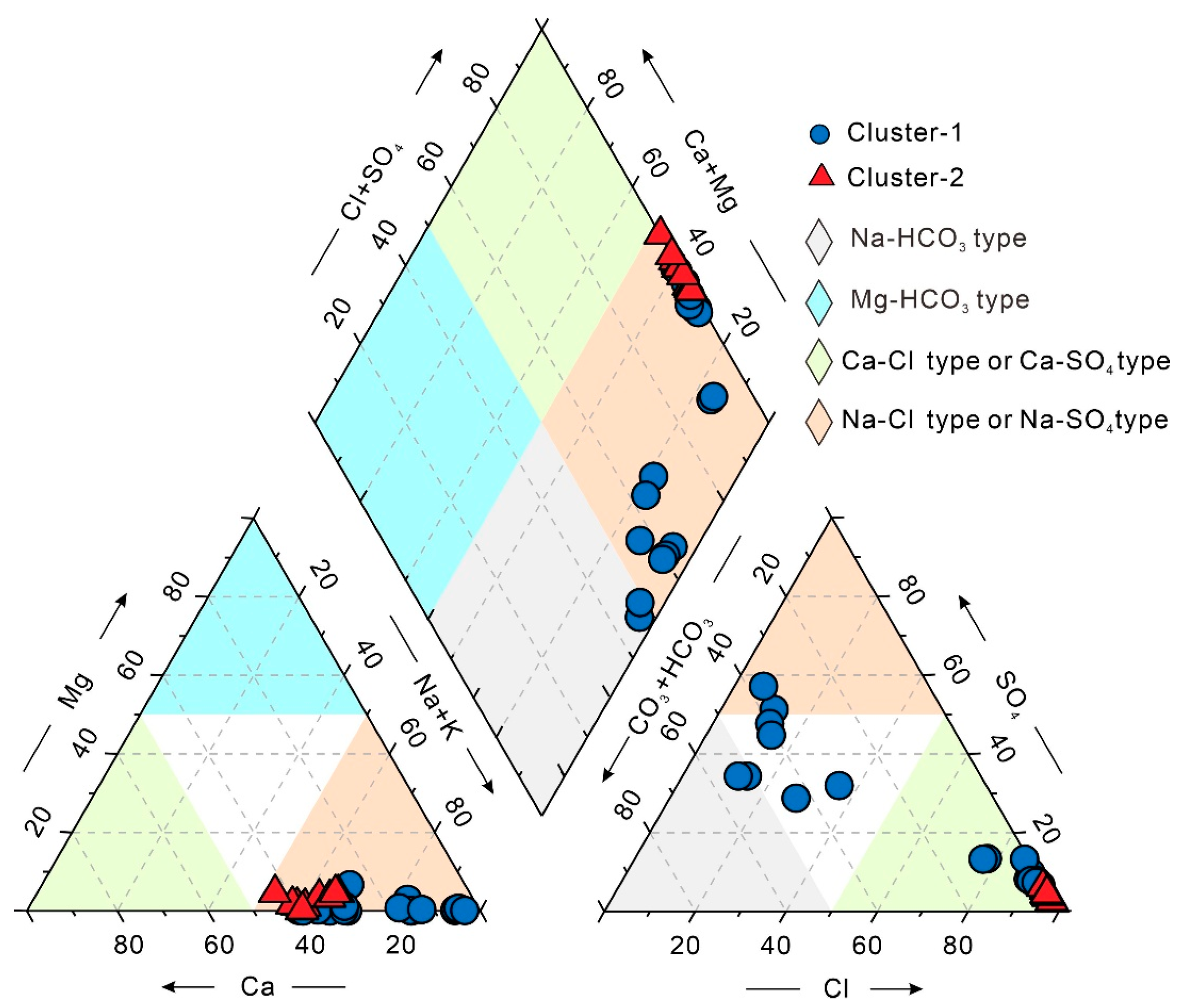
3.1. Hydrochemical Characteristics
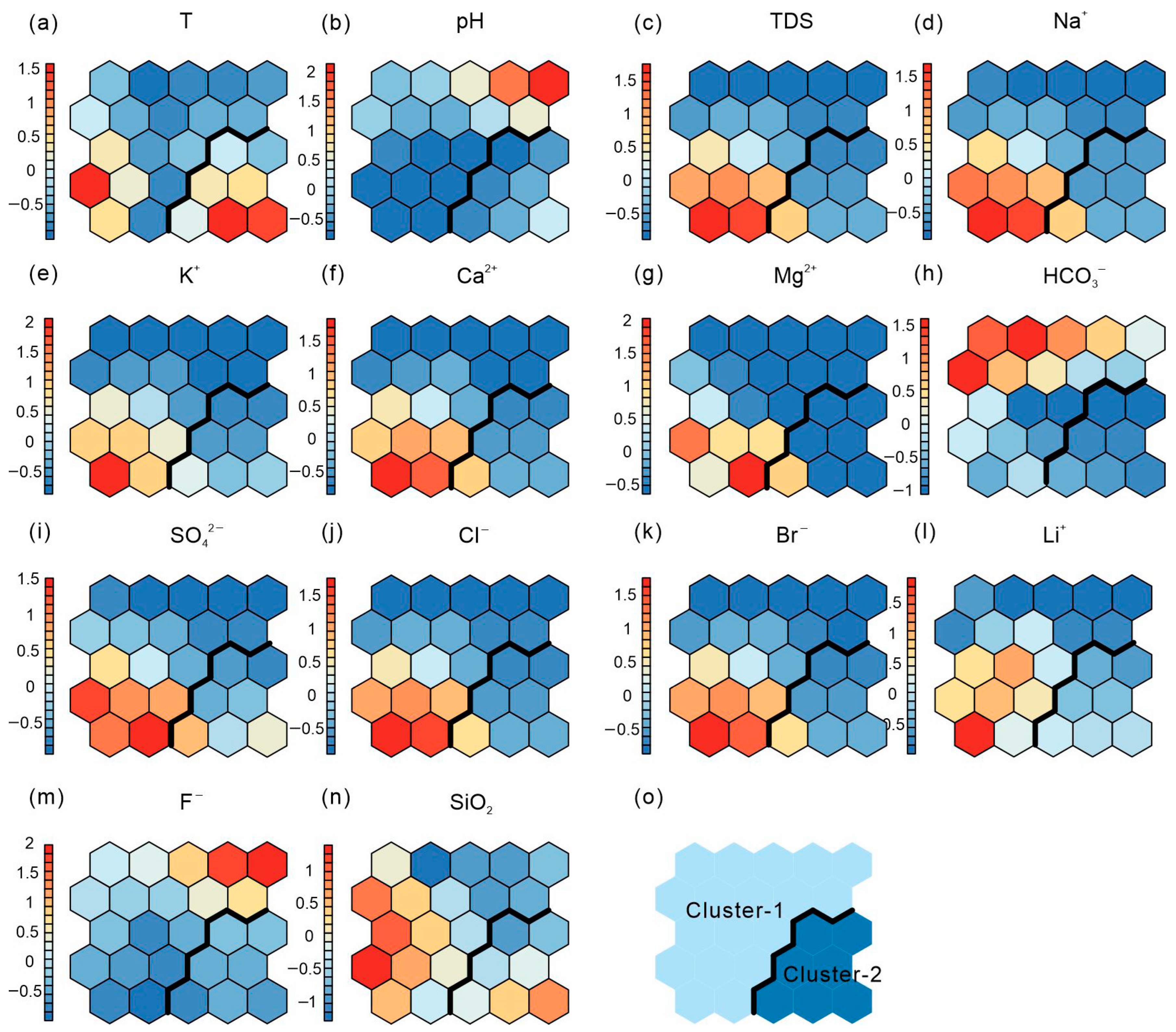
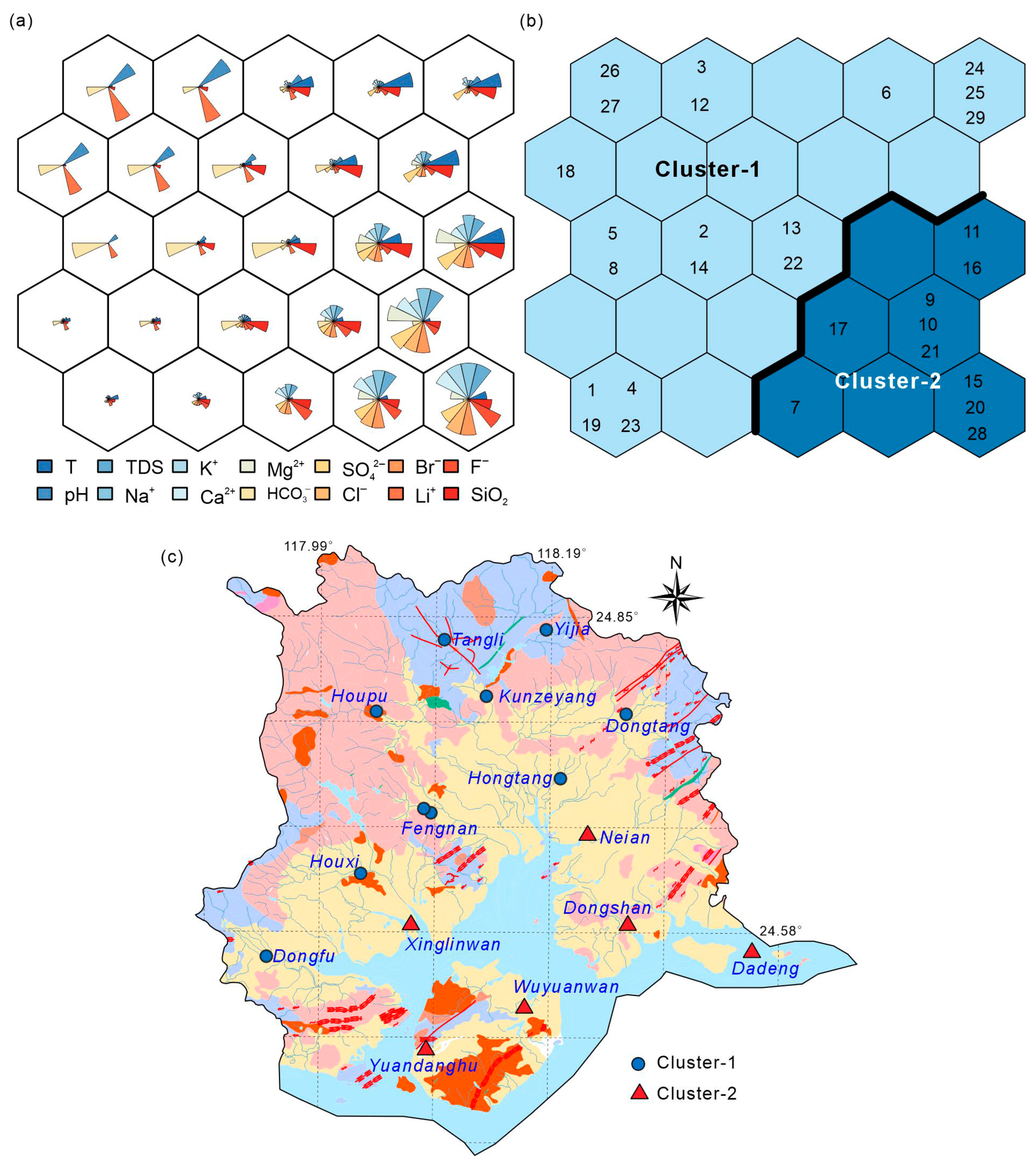
3.2. SOM and K-Means Clustering Results
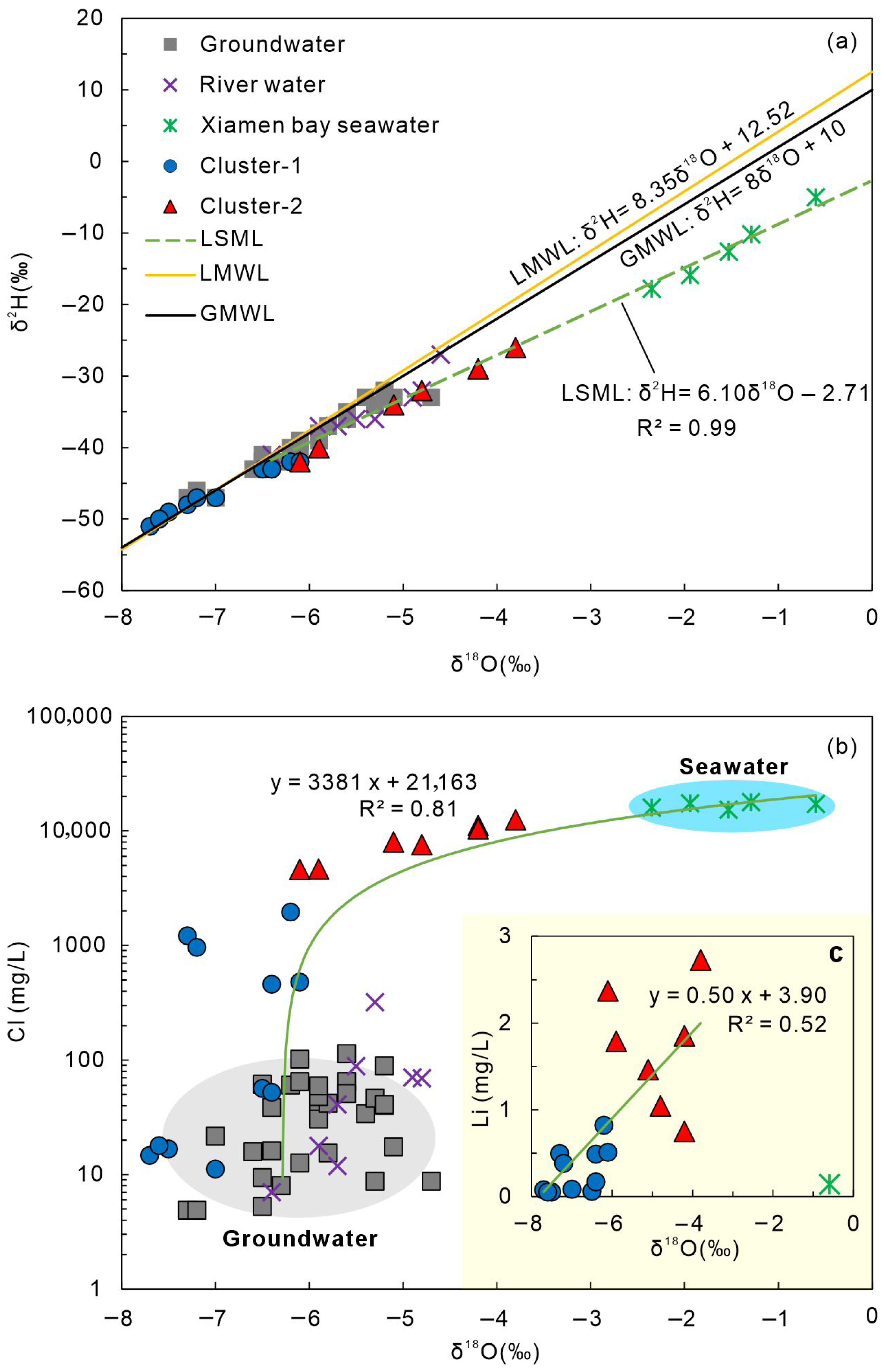
3.3. Hydrogen and Oxygen Isotopic Characteristics
4. Discussion
4.1. Integration of SOM Clustering and Hydrochemical Types
4.2. Source of Geothermal Water
4.3. Factors Influencing Li Enrichment
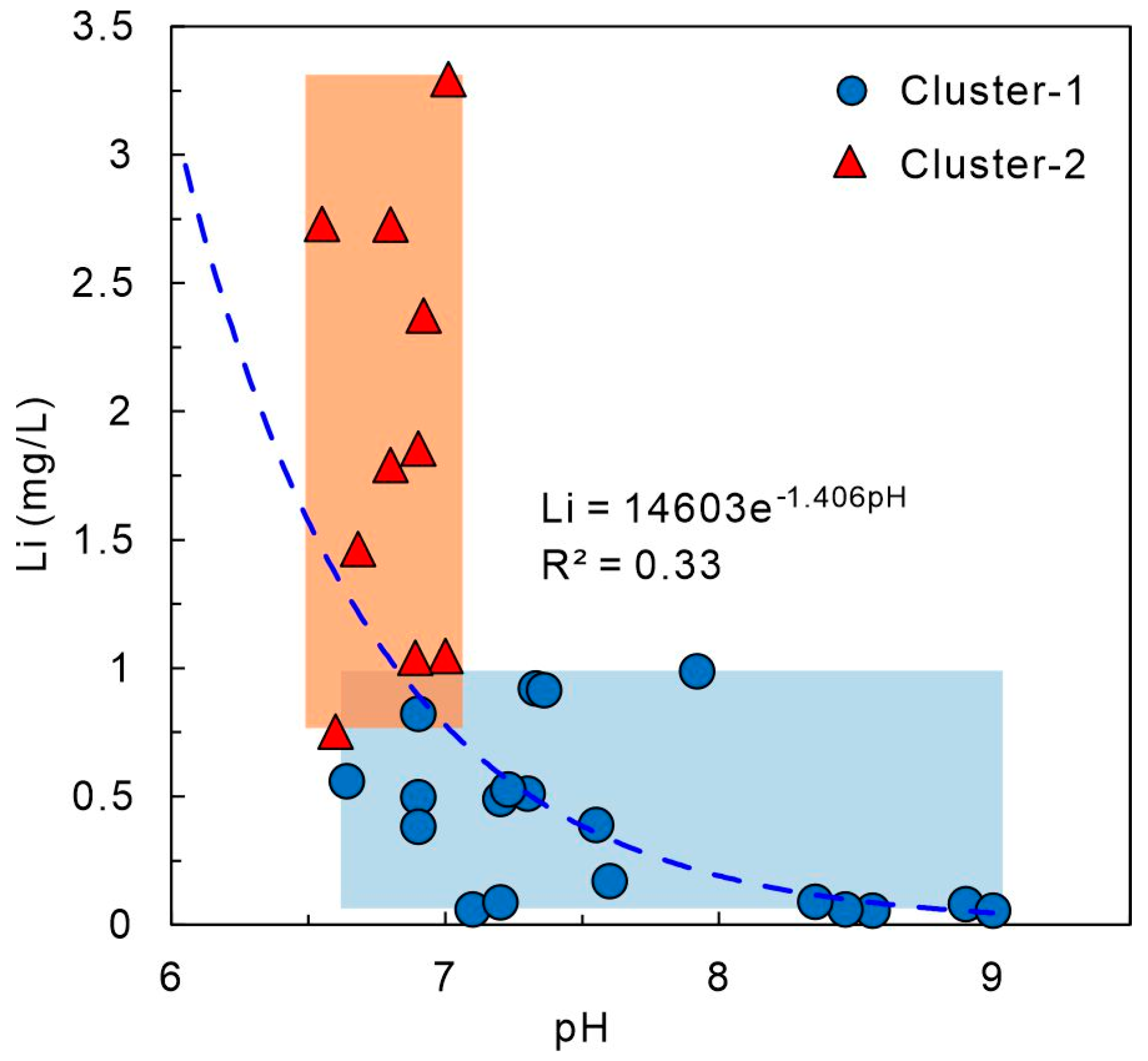
4.3.1. pH
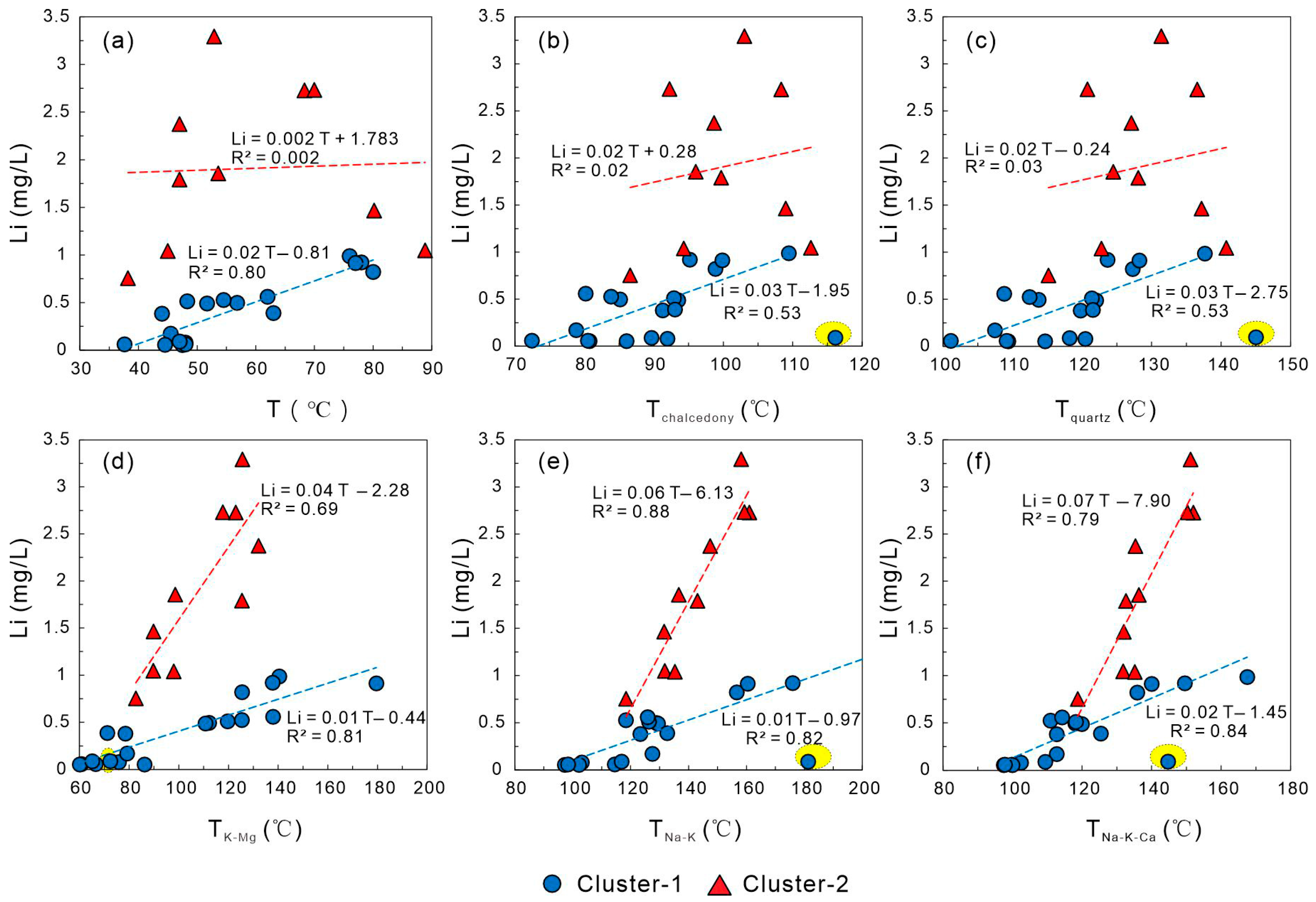
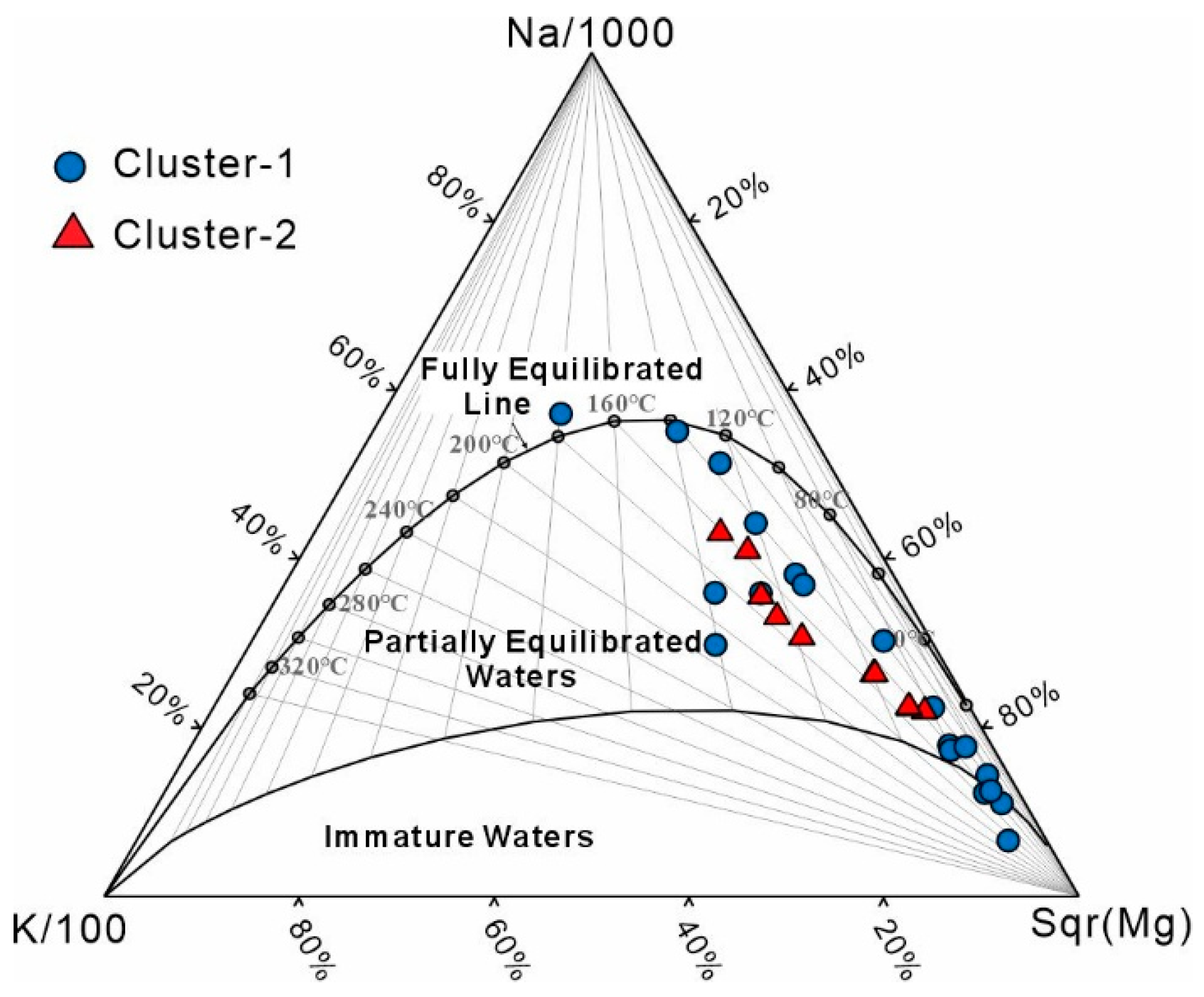
4.3.2. Temperature
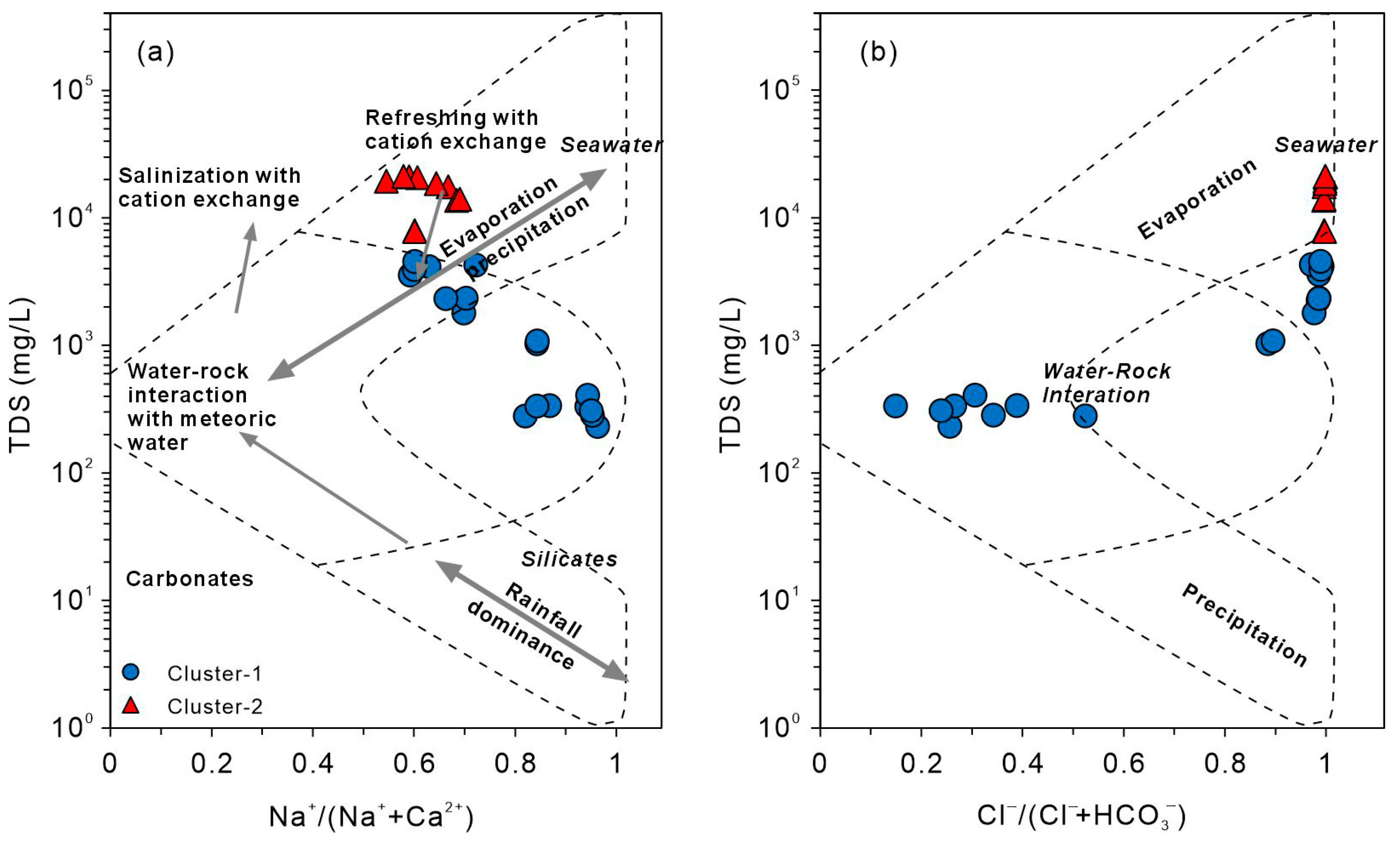
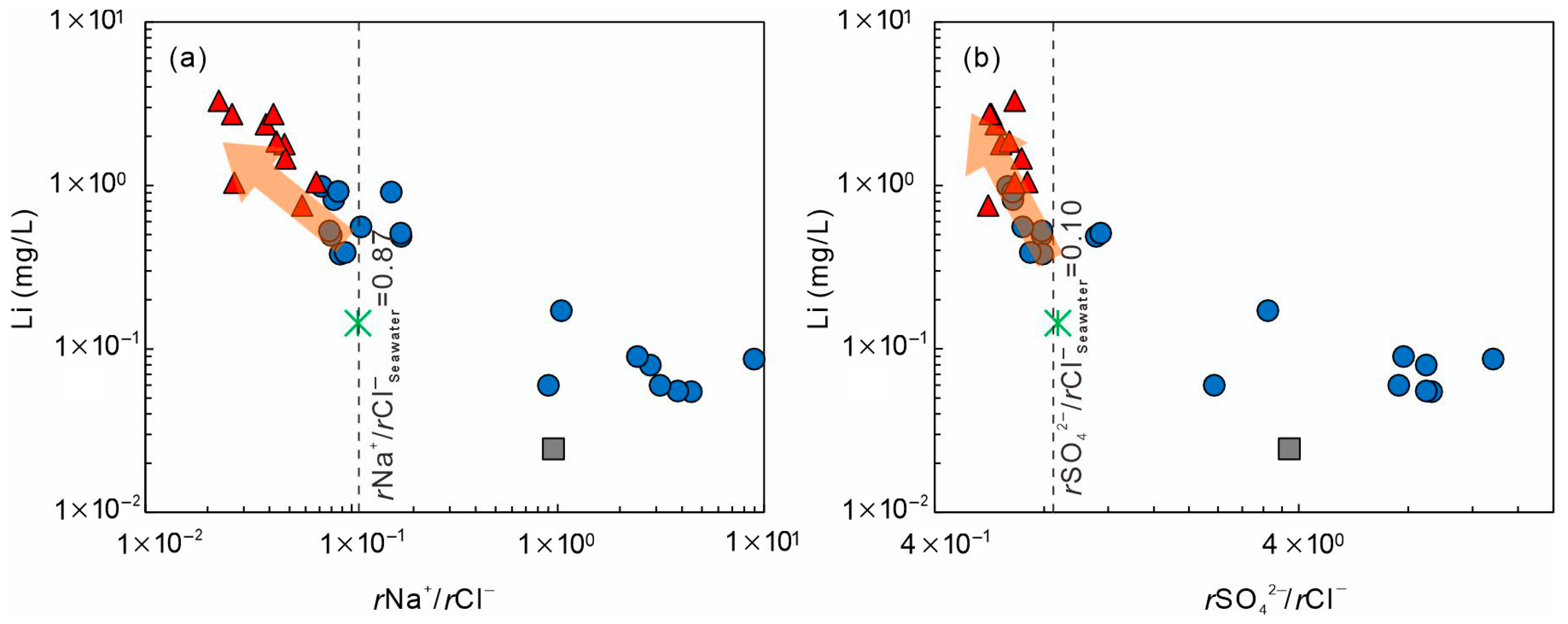
4.3.3. Water–Rock Interactions
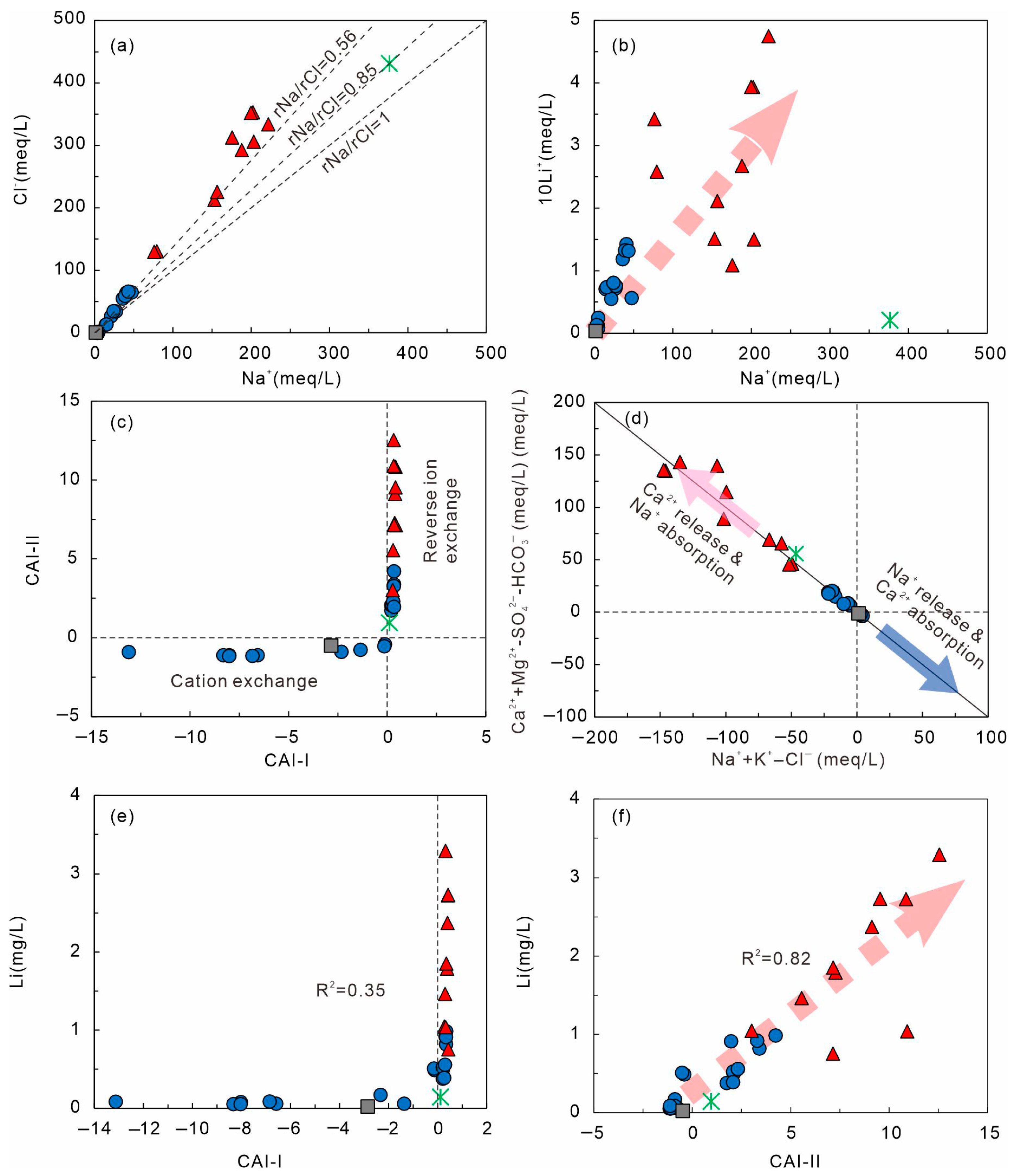
4.3.4. Cation Exchange
4.4. Lithium Sources and End-Member Contributions
4.5. Enrichment Mechanisms of Lithium
5. Conclusions
- (1)
- SOM–K-means clustering divides the geothermal waters into two distinct types: inland low-salinity Cluster-1 and coastal high-salinity Cluster-2. The δ2H–δ18O data and Br/Cl ratios indicate that coastal samples are influenced by the mixing of meteoric water and seawater. However, seawater acts mainly as a modifier of ionic composition and chemical evolution, not as a direct Li source.
- (2)
- Temperature, pH, ionic strength, and water–rock interactions jointly influence Li behavior. Elevated temperature promotes the leaching of silicate minerals and the desorption of Li from clays, while relatively low pH enhances Li mobility through acid-promoted reactions. In contrast, high pH conditions favor Li adsorption or incorporation into secondary minerals.
- (3)
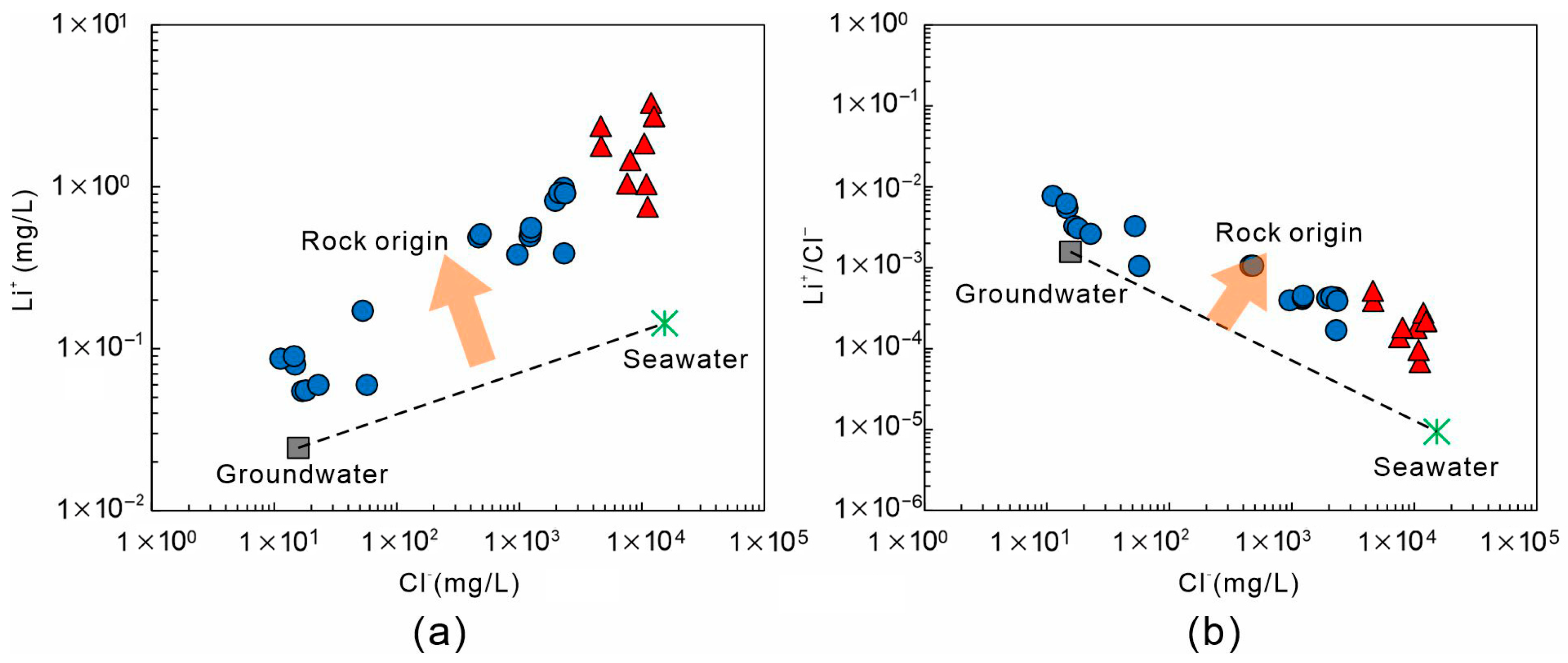
- The three-end-member mass balance model reveals that seawater and groundwater mixing explain only 2–45% of the measured Li concentration, whereas rock leaching contributes more than 55%, reaching up to 97% in certain samples. Only 0.002–0.187 kg of granite leaching per liter of geothermal water is required to reproduce the observed Li levels, confirming the dominant contribution of granitic reservoirs.
- (4)
- Li enrichment in the Xiamen geothermal system is governed by a Source–Facilitation–Synergy–Regulation framework in which temperature-dependent rock leaching provides the Li source; seawater mixing enhances ionic strength and reaction kinetics; reverse cation exchange (Na+ adsorption–Ca2+/Mg2+ release) promotes Li desorption; and pH regulates the balance between mobilization and adsorption. Together, these processes explain the high Li concentrations observed in Cluster-2 geothermal waters and provide a quantitative understanding of Li behavior and resource potential in coastal geothermal environments.
Author Contributions
Funding
Institutional Review Board Statement
Informed Consent Statement
Data Availability Statement
Conflicts of Interest
Correction Statement
Appendix A

| Sampling Site | Type | Cluster | T (°C) | pH | TDS (mg/L) | Na+ (mg/L) | K+ (mg/L) |
| Yijia (2) | Geothermal water | Cluster-1 | 47.0–48.0 (47.5) | 8.35–8.90 (8.62) | 231.63–306.69 (269.16) | 72.65–85.17 (78.91) | 1.36–1.51 (1.44) |
| Dongtang (1) | Geothermal water | Cluster-1 | 37.6 | 7.1 | 279.59 | 86 | 1.71 |
| Dongfu (4) | Geothermal water | Cluster-1 | 76.0–80.0 (77.8) | 6.90–7.92 (7.38) | 3575.30–4551.03 (4055.33) | 828.40–995.81 (916.28) | 33.44–70.59 (48.68) |
| Dongshan (3) | Geothermal water | Cluster-2 | 52.9–70.0 (63.7) | 6.55–7.01 (6.79) | 20,740.00–21,092.93 (20,957.53) | 4595.07–5106.00 (4785.07) | 193.22–211.00 (201.67) |
| Wuyuanwan (1) | Geothermal water | Cluster-2 | 53.6 | 6.9 | 17,572.29 | 4322.04 | 127.02 |
| Neian (2) | Geothermal water | Cluster-2 | 47.0–47.0 (47.0) | 6.80–6.92 (6.86) | 7816.00–7951.11 (7883.56) | 1758.00–1832.01 (1795.00) | 59.88–61.60 (60.74) |
| Fengnan (4) | Geothermal water | Cluster-1 | 44.0–62.0 (54.3) | 6.64–7.23 (6.92) | 1797.29–2346.00 (2178.26) | 491.30–628.00 (574.38) | 11.47–15.94 (13.62) |
| Houpu (3) | Geothermal water | Cluster-1 | 44.5–48.0 (46.7) | 8.46–9.00 (8.67) | 283.25–406.35 (341.20) | 100.70–110.81 (105.17) | 1.43–1.63 (1.56) |
| Houxi (1) | Geothermal water | Cluster-1 | 63 | 7.55 | 4284 | 1094 | 30.02 |
| Kunzeyang (1) | Geothermal water | Cluster-1 | 45.5 | 7.6 | 338.13 | 111.8 | 2.81 |
| Dadeng (1) | Geothermal water | Cluster-2 | 45 | 6.89 | 18,570.95 | 4674.06 | 134.28 |
| Xinglinwan (2) | Geothermal water | Cluster-2 | 80.2–88.9 (84.5) | 6.68–7.00 (6.84) | 13,713.54–14,030.00 (13,871.77) | 3520.03–3602.00 (3561.02) | 95.30–97.10 (96.20) |
| Tangli (1) | Geothermal water | Cluster-1 | 48.5 | 7.2 | 334.79 | 99.17 | 5.72 |
| Hongtang (1) | Geothermal water | Cluster-1 | 51.7 | 7.2 | 1032.47 | 331.5 | 8.62 |
| Yuangdanghu (1) | Geothermal water | Cluster-2 | 38.2 | 6.6 | 19,350.64 | 4042.05 | 86.42 |
| Unnamed (1) | Geothermal water | Cluster-1 | 48.3 | 7.3 | 1082.84 | 356.1 | 8.76 |
| All Geothermal water (29) | Geothermal water | 37.6–88.9 (56.86) | 6.55–9 (7.33) | 231.63–21,092.93 (6749.15) | 72.65–5106 (1607.58) | 1.36–211 (54.52) | |
| Xiamenwan (1) | Sea water | 25 | 7.64 | 28,260 | 8659 | 324 | |
| Cold Groundwater (2) | Groundwater | 25–25.1 (25.05) | 6.9–7.92 (7.41) | 186–251 (218.5) | 17.33–58.59 (37.96) | 0.71–2.39 (1.55) | |
| Dongshan rock (1) | Rock | / | / | / | / | / | |
| Sampling Site | Ca2+ (mg/L) | Mg2+ (mg/L) | HCO3− (mg/L) | SO42− (mg/L) | Cl− (mg/L) | Br− (mg/L) | Li+ (mg/L) |
| Yijia (2) | 2.84–3.33 (3.08) | 0.08–0.25 (0.16) | 73.22–79.22 (76.22) | 47.38–55.77 (51.58) | 14.43–14.67 (14.55) | 0.01–0.03 (0.02) | 0.08–0.09 (0.08) |
| Dongtang (1) | 16.43 | 0.47 | 88.47 | 69 | 56.58 | 0.01 | 0.06 |
| Dongfu (4) | 481.60–576.18 (518.67) | 0.10–2.30 (1.24) | 33.40–48.81 (42.08) | 216.20–493.22 (294.06) | 1947.02–2344.09 (2170.28) | 6.25–8.01 (7.03) | 0.82–0.99 (0.91) |
| Dongshan(3) | 2813.02–2907.83 (2866.28) | 51.00–71.48 (59.13) | 43.90–48.81 (45.70) | 365.00–706.50 (506.30) | 11,837.00–12,522.07 (12,280.10) | 40.25–49.17 (44.31) | 2.73–3.29 (2.92) |
| Wuyuanwan (1) | 1872.12 | 117.8 | 84.81 | 609.4 | 10,374.15 | 38.69 | 1.86 |
| Neian (2) | 1017.00–1057.00 (1037.00) | 2.90–4.17 (3.54) | 31.10–36.61 (33.86) | 239.00–297.00 (268.00) | 4593.00–4628.00 (4610.50) | 15.20–16.51 (15.86) | 1.79–2.37 (2.08) |
| Fengnan (4) | 184.60–247.74 (224.96) | 0.10–4.61 (1.41) | 30.50–40.88 (34.14) | 114.00–185.68 (140.00) | 957.02–1234.32 (1157.10) | 2.95–4.80 (3.99) | 0.38–0.56 (0.49) |
| Houpu (3) | 4.40–5.80 (5.28) | 0.05–0.35 (0.22) | 55.53–88.57 (76.47) | 92.40–100.60 (96.46) | 16.77–22.70 (19.12) | 0.01–0.06 (0.04) | 0.06–0.06 (0.06) |
| Houxi (1) | 366.5 | 58.13 | 121.4 | 289.4 | 2300 | 8.35 | 0.39 |
| Kunzeyang (1) | 14.81 | 0.26 | 141.6 | 73.82 | 52.39 | 0.01 | 0.17 |
| Dadeng (1) | 2248.39 | 138.19 | 51.43 | 397.4 | 10,854.2 | 40.8 | 1.04 |
| Xinglinwan (2) | 1405.00–1413.21 (1409.10) | 129.40–133.00 (131.20) | 64.00–67.12 (65.56) | 518.00–690.10 (604.05) | 7545.23–8005.00 (7775.12) | 27.03–27.20 (27.12) | 1.05–1.46 (1.26) |
| Tangli (1) | 16.16 | 1.9 | 109.8 | 135.6 | 11.18 | 0.01 | 0.09 |
| Hongtang (1) | 53.87 | 0.23 | 103.7 | 107.8 | 459.3 | 1.17 | 0.49 |
| Yuangdanghu (1) | 2940.04 | 184.5 | 45.76 | 865.5 | 11,090.04 | 35.28 | 0.75 |
| Unnamed (1) | 57.46 | 0.13 | 97.63 | 112.6 | 480.3 | 1.5 | 0.51 |
| All Geothermal water (29) | 2.84–2940.04 (830.12) | 0.05–184.5 (33.1) | 30.5–141.6 (64.39) | 47.38–865.5 (277.66) | 11.18–12,522.07 (3816.75) | 0.01–49.17 (13.41) | 0.055–3.294 (0.92) |
| Xiamenwan (1) | 329 | 1055 | 140 | 2226 | 15,311 | 56.1 | 0.144 |
| Cold Groundwater (2) | 25.83–29.31 (27.57) | 0.54–4.06 (2.3) | 122–140.3 (131.15) | 6.48–33.49 (19.99) | 9.43–21.66 (15.55) | 0.1–0.1 (0.1) | 0.007–0.042 (0.0245) |
| Dongshan rock (1) | / | / | / | / | / | / | 15 |
| Sampling Site | F− (mg/L) | SiO2 (mg/L) | CO32− (mg/L) | NO3− (mg/L) | Br/Cl | Reference | |
| Yijia (2) | 12.44–12.89 (12.66) | 70.00–73.19 (71.60) | 11.64 | 4.11 | 0.0007–0.0021 (0.0014) | [21,38] | |
| Dongtang (1) | 4.72 | 49.26 | <0.01 | <0.01 | 0.0002 | [21] | |
| Dongfu (4) | 2.91–3.39 (3.25) | 77.80–100.80 (86.71) | 0 | <0.2 | 0.0027–0.0038 (0.0033) | [21,36,40] | |
| Dongshan (3) | 2.09–4.07 (2.88) | 73.63–98.88 (87.50) | 0 | 205.2 | 0.0032–0.0039 (0.0036) | [21,39], This study | |
| Wuyuanwan (1) | 0.29 | 79.07 | <0.01 | 6.82 | 0.0037 | [21] | |
| Neian (2) | 2.55–2.67 (2.61) | 83.08–84.65 (83.86) | <0.01 | <0.01 | 0.0033–0.0036 (0.0034) | [21], This study | |
| Fengnan (4) | 3.85–4.19 (3.97) | 57.92–72.22 (64.15) | <0.01 | <0.01 | 0.0031–0.0039 (0.0034) | [21,24,35], This study | |
| Houpu (3) | 11.50–13.06 (12.52) | 58.31–65.25 (60.72) | 11.74 | <0.2 | 0.0006–0.0036 (0.0021) | [21,37], This study | |
| Houxi (1) | 2.69 | 74.73 | 0 | / | 0.0036 | [34] | |
| Kunzeyang (1) | 8.03 | 56.32 | <0.01 | 2.83 | 0.0002 | [21] | |
| Dadeng (1) | 3 | 76.54 | 0 | <0.2 | 0.0038 | [33] | |
| Xinglinwan (2) | 2.65–4.45 (3.55) | 100.00–106.52 (103.26) | <0.01 | 218 | 0.0034–0.0036 (0.0035) | [21], This study | |
| Tangli (1) | 7.98 | 114.25 | <0.01 | 1.68 | 0.0009 | [21] | |
| Hongtang (1) | 5.21 | 75.39 | <0.01 | 10.93 | 0.0025 | [21] | |
| Yuangdanghu (1) | 1.3 | 65.92 | <0.01 | 7.23 | 0.0032 | [21] | |
| Unnamed (1) | 5.64 | 74.5 | <0.01 | 9.43 | 0.0031 | [21,24] | |
| All Geothermal water (29) | 0.29–13.06 (5.23) | 49.26–114.25 (76.95) | / | / | / | ||
| Xiamenwan (1) | 0.024 | 2.92 | <5 | 0.91 | 0.0037 | This study | |
| Cold Groundwater (2) | / | 37.85–45.41 (41.63) | / | / | / | [24] | |
| Dongshan rock (1) | / | / | / | / | / | This study | |
References
- Han, S.; Ma, Z.; Liu, M.; Yang, X.; Wang, X. Global supply sustainability assessment of critical metals for clean energy technology. Resour. Policy 2023, 85, 103994. [Google Scholar] [CrossRef]
- Liu, M.; Kong, Y.; Guo, Q. Sources and enrichment mechanisms of lithium, rubidium, and cesium in waters of magmatic–hydrothermal systems. Earth-Sci. Rev. 2025, 270, 105241. [Google Scholar] [CrossRef]
- Pan, S.; Zhao, P.; Zhang, H.; Yang, Z.; Li, Y.; Yue, Y.; Liu, X.; Gao, S.; Sun, Y.; Dor, J. Hydrogeochemical mechanism of Li–Cs-rich thermal springs in the Karakoram Fault, Qinghai–Xizang Plateau: New insights from multiple stable isotopes. Sci. Total Environ. 2025, 958, 178083. [Google Scholar] [CrossRef]
- Flexer, V.; Baspineiro, C.F.; Galli, C.I. Lithium recovery from brines: A vital raw material for green energies with potential environmental impacts in its mining and processing. Sci. Total Environ. 2018, 639, 1188–1204. [Google Scholar] [CrossRef] [PubMed]
- Kesler, S.E.; Gruber, P.W.; Medina, P.A.; Keoleian, G.A.; Everson, M.P.; Wallington, T.J. Global lithium resources: Relative importance of pegmatite, brine, and other deposits. Ore Geol. Rev. 2012, 48, 55–69. [Google Scholar] [CrossRef]
- Kölbel, L.; Kölbel, T.; Herrmann, L.; Kaymakci, E.; Ghergut, I.; Poirel, A.; Schneider, J. Lithium extraction from geothermal brines in the Upper Rhine Graben: A case study of potential and current state of the art. Hydrometallurgy 2023, 221, 106131. [Google Scholar] [CrossRef]
- Sajkowski, L.; Turnbull, R.; Blundy, J.; Rogers, K. Experimental assessment of sustainable lithium extraction from geothermal reservoirs. Geothermics 2025, 132, 103448. [Google Scholar] [CrossRef]
- Sajkowski, L.; Turnbull, R.; Rogers, K. A review of critical element concentrations in high-enthalpy geothermal fluids in New Zealand. Resources 2023, 12, 68. [Google Scholar] [CrossRef]
- Dobson, P.; Araya, N.; Brounce, M.; Busse, M.M.; Camarillo, M.K.; English, L.; Humphreys, J.; Kalderon-Asael, B.; McKibben, M.A.; Millstein, D. Characterizing the Geothermal Lithium Resource at the Salton Sea; Lawrence Berkeley National Laboratory (LBNL): Berkeley, CA, USA, 2023. [Google Scholar]
- Sanjuan, B.; Gourcerol, B.; Millot, R.; Rettenmaier, D.; Jeandel, E.; Rombaut, A. Lithium-rich geothermal brines in Europe: An update on geochemical characteristics and implications for potential Li resources. Geothermics 2022, 101, 102385. [Google Scholar] [CrossRef]
- Cullen, J.T.; Hurwitz, S.; Barnes, J.D.; Lassiter, J.C.; Penniston-Dorland, S.; Kasemann, S.A.; Thordsen, J.J. Temperature-dependent variations in mineralogy, major element chemistry and the stable isotopes of boron, lithium and chlorine resulting from hydration of rhyolite: Constraints from hydrothermal experiments at 150–350 °C and 25 MPa. Geochim. Cosmochim. Acta 2019, 261, 269–287. [Google Scholar] [CrossRef]
- Wang, W.; Jiang, S.Y.; Xiao, Y. Fluid–rock interaction effects on Li isotope behavior in continental geothermal systems. Chem. Geol. 2023, 631, 121525. [Google Scholar] [CrossRef]
- Millot, R.; Hegan, A.; Négrel, P. Geothermal waters from the Taupo Volcanic Zone, New Zealand: Li, B and Sr isotopes characterization. Appl. Geochem. 2012, 27, 677–688. [Google Scholar] [CrossRef]
- Bernal, N.F.; Gleeson, S.A.; Dean, A.S.; Liu, X.-M.; Hoskin, P. The source of halogens in geothermal fluids from the Taupo Volcanic Zone, North Island, New Zealand. Geochim. Cosmochim. Acta 2014, 126, 265–283. [Google Scholar] [CrossRef]
- Tan, H.; Shi, Z.; Cong, P.; Xue, F.; Chen, G. The spatial distribution law of B, Li, Rb and Cs elements and supernormal enrichment mechanism in Tibet geothermal system. Sediment. Geol. Tethyan Geol. 2023, 43, 404–415. [Google Scholar] [CrossRef]
- Liu, Y.; Liu, W.; Zhang, M.; Xie, X.G.; Chen, B.; Dan, Z.; Ellam, R.M.; Xu, S. Assessing magmatic contributions to rift-related geothermal systems in collisional orogens: Insights from the Sangri–Cona rift, southern Tibetan Plateau. J. Asian Earth Sci. 2024, 270, 106193. [Google Scholar] [CrossRef]
- Liu, C.L.; Lu, C.M.; Li, Y.S.; Hao, Q.C.; Cao, S.W. Genetic model and exploration target area of geothermal resources in Hongtang Area, Xiamen, China. J. Groundw. Sci. Eng. 2022, 10, 128. [Google Scholar] [CrossRef]
- Gan, H.N.; Lin, W.J.; Yue, G.F.; Wang, X.; Ma, F.; Wang, G.L. Research on the fault-controlling mechanism of geothermal water in Zhangzhou Basin. J. Groundw. Sci. Eng. 2017, 5, 19–28. [Google Scholar] [CrossRef]
- Wei, Z.A.; Shao, H.; Tang, L.; Deng, B.; Li, H.; Wang, C. Hydrogeochemistry and geothermometry of geothermal waters from the Pearl River Delta region, South China. Geothermics 2021, 96, 102164. [Google Scholar] [CrossRef]
- Yuan, J.; Xu, F.; Zheng, T. The genesis of saline geothermal groundwater in the coastal area of Guangdong Province: Insight from hydrochemical and isotopic analysis. J. Hydrol. 2022, 605, 127345. [Google Scholar] [CrossRef]
- Li, J.; Liu, C.; Cao, S.; Lin, X.; Ma, Q.; Li, Y. Multi-isotope characteristics and residence time of saline geothermal waters in the coastal area of Xiamen Bay, Southeast China. J. Hydrol. Reg. Stud. 2025, 59, 102363. [Google Scholar] [CrossRef]
- Arrofi, D.; Abu-Mahfouz, I.S.; Prayudi, S.D. Lithium enrichment in high-enthalpy geothermal systems influenced by seawater, Indonesia. Sci. Rep. 2024, 14, 24093. [Google Scholar] [CrossRef] [PubMed]
- Wei, S.; Zhang, W.; Fu, Y.; Liu, F.; Yuan, R.; Yan, X.; Liao, Y.; Wang, G. Distribution characteristics and resource potential evaluation of lithium in geothermal water in China. Geol. China 2024, 51, 1527–1553. [Google Scholar] [CrossRef]
- Li, Y.; Liu, C.; Cao, S.; Miao, Q.; Dong, Y.; Jiang, Z. Br/Cl ratio, Zn and radon constraints on the origin and fate of geothermal fluids in the coastal region of southeastern China. Hydrogeol. J. 2021, 29, 2211–2218. [Google Scholar] [CrossRef]
- Dotsika, E. Isotope and hydrochemical assessment of the Samothraki Island geothermal area, Greece. J. Volcanol. Geotherm. Res. 2012, 233–234, 18–26. [Google Scholar] [CrossRef]
- Toupal, J.; Zhu, C.; Zaccarini, F.; Vigliaturo, R.; Servetto, G.P.; Gieré, R. Experimental leaching of lithium ores in simulated environmental conditions. Geochemistry 2024, 84, 126132. [Google Scholar] [CrossRef]
- Siregar, R.N.; Sismanto, S.; Triyana, K.; Harijoko, A.; Iqbal, M.; Antarnusa, G.; Putra, F.G.; Umam, R. Lithium enrichment in high radiogenic geothermal systems originating from lithospheric water due to water-rock interactions. Geothermics 2026, 134, 103499. [Google Scholar] [CrossRef]
- Gilder, S.A.; Gill, J.; Coe, R.S.; Zhao, X.; Liu, Z.; Wang, G.; Yuan, K.; Liu, W.; Kuang, G.; Wu, H. Isotopic and paleomagnetic constraints on the Mesozoic tectonic evolution of South China. J. Geophys. Res. Solid Earth 1996, 101, 16137–16154. [Google Scholar] [CrossRef]
- Lin, W.; Chen, X.; Gan, H.; Yue, G. Geothermal, geological characteristics and exploration of hot dry rock in the Xiamen bay–Zhangzhou Basin, southeast China. Acta Geol. Sin. 2020, 94, 2066–2077. [Google Scholar] [CrossRef]
- Zhang, J.; Wang, B.; Tang, X.; Dong, M.; Ai, Y. Temperature structure and dynamic background of crust and mantle beneath the high heat flow area of the South China continental margin. Chin. J. Geophys. 2018, 61, 3917–3932. [Google Scholar] [CrossRef]
- Liu, C.; Li, Y.; Cao, S.; Wang, W.; Li, J. Effects of seawater recharge on the formation of geothermal resources in coastal areas: A case study of Xiamen City, Fujian Province, China. Front. Earth Sci. 2022, 10, 872620. [Google Scholar] [CrossRef]
- Liu, C.L.; Zheng, J.H.; Li, Z.H.; Li, Y.S.; Hao, Q.C.; Li, J.F. Analysis of water resources supply and demand in small and medium-sized river basin cities along the southeast coast of China: A case study of Xiamen. J. Groundw. Sci. Eng. 2021, 9, 350. [Google Scholar] [CrossRef]
- Dai, J.J.; Zheng, J.; Chen, X.H.; Zheng, Y.C.; Lin, D.T.; Huang, J.M. Pre-Feasibility Study Report on the Underground Hot Water Resources in Dadeng Mining Area, Xiang’an District, Xiamen City, Fujian Province; National Geological Archives of China: Beijing, China, 2012. [Google Scholar]
- Zheng, J.; Guan, Z.Q.; Huang, J.M.; Zheng, Y.C. Investigation and Evaluation Report on Geothermal Resources in Xiamen Area, Fujian Province; National Geological Archives of China: Beijing, China, 2015. [Google Scholar]
- Zheng, J.; Huang, J.M. Feasibility Study Report on Underground Hot Water Resources in Fennan Farm Mining Area, Tong’an District, Xiamen City, Fujian Province; National Geological Archives of China: Beijing, China, 2012. [Google Scholar]
- Zheng, J.; Wang, W.T. Feasibility Study Report on Geothermal Resources in Dongfu Mining Area (Expanded Scope), Haicang District, Xiamen City, Fujian Province; National Geological Archives of China: Beijing, China, 2016. [Google Scholar]
- Zheng, J.; Chen, X.H.; Dai, J.J.; Lu, L.B.; Huang, J.M.; Zheng, Y.C.; Lin, D.T. Feasibility Study Report on Underground Hot Water Resources in Houpu Mining Area, Tong’an District, Xiamen City, Fujian Province; National Geological Archives of China: Beijing, China, 2012. [Google Scholar]
- Huang, J.M.; Chen, X.H.; Zheng, Y.C.; Lu, L.B.; Lin, D.T.; Zheng, J.; Dai, J.J. Feasibility Study Report on Underground Hot Water Resources in Yijia Mining Area, Tong’an District, Xiamen City, Fujian Province; National Geological Archives of China: Beijing, China, 2012. [Google Scholar]
- Zheng, Y.C.; Lin, D.T.; Chen, X.H.; Huang, J.M.; Dai, J.J.; Zheng, J.; Lu, L.B. Exploration Report on Underground Hot Water Resources in Dongshan Area, Xiang’an District, Xiamen City, Fujian Province; National Geological Archives of China: Beijing, China, 2008. [Google Scholar]
- Zheng, J.; Huang, J.M. Exploration Report on Underground Hot Water Resources in Dongyao Area, Haicang District, Xiamen City, Fujian Province; National Geological Archives of China: Beijing, China, 2010. [Google Scholar]
- GB/T 14506.30-2010; Methods for chemical analysis of silicate rocks—Part 30: Determination of 44 Elements. Standards Press of China: Beijing, China, 2010.
- HJ 776-2015; Water Quality—Determination of 32 Elements—Inductively Coupled Plasma Optical Emission Spectrometry. Ministry of Environmental Protection of the People’s Republic of China: Beijing, China, 2015.
- HJ 84-2016; Water Quality-Determination of Inorganic Anions (F−, Cl−, NO2−, Br−, NO3−, PO43−, SO32−, SO42−)-Ion Chromatography. Ministry of Environmental Protection of the People’s Republic of China: Beijing, China, 2016.
- DZ/T 0064.49-2021; Methods for Analysis of Groundwater Quality—Part 49: Determination of Carbonate, Bicarbonate Ions, Hydroxy—Titration. Ministry of Natural Resources of the People’s Republic of China: Beijing, China, 2021.
- DZ/T 0064.62-2021; Methods for Analysis of Groundwater Quality—Part 62: Determination of Silicic Acid—Silicon Molybdenum Yellow Spectrophotometry. Ministry of Natural Resources of the People’s Republic of China: Beijing, China, 2021.
- JCZX-BZ-002-2015; Determination of Hydrogen and Oxygen Isotopes in Water by Spectroscopy. Ministry of Industry and Information Technology of the People’s Republic of China: Beijing, China, 2015.
- Mao, H.; Wang, G.; Rao, Z.; Liao, F.; Shi, Z.; Huang, X.; Chen, X.; Yang, Y. Deciphering spatial patterns of groundwater chemistry and nitrogen pollution in the Poyang Lake Basin (eastern China) using self-organizing maps and multivariate statistics. J. Clean. Prod. 2021, 329, 129697. [Google Scholar] [CrossRef]
- Kohonen, T. Self-organized formation of topologically correct feature maps. Biol. Cybern. 1982, 43, 59–69. [Google Scholar] [CrossRef]
- Zhuang, S.; Wang, G.; Zhou, X.; Shi, Z.; Yuan, D.; Tian, J.; He, M.; Zeng, Z.; Yan, Y.; Yao, B.; et al. Deciphering the distribution and enrichment of arsenic in geothermal water in the Red River Fault Zone, southwest China. J. Hazard. Mater. 2025, 485, 136756. [Google Scholar] [CrossRef]
- Zeng, Z.; Yang, L.; Cui, Y.; Zhou, X.; He, M.; Wang, Y.; Yan, Y.; Yao, B.; Hu, X.; Shao, W.; et al. Assessment of geothermal waters in Yunnan, China: Distribution, quality and driving factors. Geothermics 2025, 130, 103323. [Google Scholar] [CrossRef]
- Vesanto, J.; Alhoniemi, E. Clustering of the self-organizing map. IEEE Trans. Neural Netw. 2000, 11, 586–600. [Google Scholar] [CrossRef]
- Céréghino, R.; Park, Y.-S. Review of the self-organizing map (SOM) approach in water resources: Commentary. Environ. Model. Softw. 2009, 24, 945–947. [Google Scholar] [CrossRef]
- Davies, D.L.; Bouldin, D.W. A cluster separation measure. IEEE Trans. Pattern Anal. Mach. Intell. 2009, PAMI-1, 224–227. [Google Scholar] [CrossRef]
- Craig, H. Isotopic variations in meteoric waters. Science 1961, 133, 1702–1703. [Google Scholar] [CrossRef]
- Chen, Y.; Du, W.; Chen, J.; Xu, L. Composition of hydrogen and oxygen isotopic of precipitation and source apportionment of water vapor in Xiamen Area. Acta Sci. Circumstantiae 2016, 36, 667–674. [Google Scholar] [CrossRef]
- Sheng, D. Chronology and Geochemistry of Intermediate Dikes Host Granitoids and Enclaves in the Xiamen-Zhangzhou Area. Master’s Thesis, China University of Geosciences (Beijing), Beijing, China, 2012. [Google Scholar]
- Scholler, H. Qualitative evaluation of groundwater resources: Methods and techniques of groundwater investigation and development. Water Resour. Ser. 1967, 33, 44–52. [Google Scholar]
- Gibbs, R.J. Mechanisms controlling world water chemistry. Science 1970, 170, 1088–1090. [Google Scholar] [CrossRef] [PubMed]
- Rahman, A.T.M.S.; Kono, Y.; Hosono, T. Self-organizing map improves understanding of hydrochemical processes in aquifer systems. Sci. Total Environ. 2022, 846, 157281. [Google Scholar] [CrossRef] [PubMed]
- Cai, M.; Huang, Y.; Chen, M.; Liu, G.; Jin, D. The study of hydrogen and oxygen isotopes of coastal groundwater in Xiamen Island. Mar. Sci. 2003, 27, 1–6. [Google Scholar] [CrossRef]
- Zhang, X.; Zhao, J.; Li, Y.; An, D.; Cheng, H.; Ma, Y.; Song, H. Mineral phase transformation and leaching behavior during the roasting–acid–leaching process of clay-type lithium ore in the Qaidam Basin. Minerals 2025, 15, 777. [Google Scholar] [CrossRef]
- Dugamin, E.J.M.; Cathelineau, M.; Boiron, M.-C.; Richard, A.; Despinois, F. Lithium enrichment processes in sedimentary formation waters. Chem. Geol. 2023, 635, 121626. [Google Scholar] [CrossRef]
- Li, J.; Zhang, H.; Zhang, Y.; Wang, L.; Zhang, Z. Enrichment mechanism of lithium in geothermal waters from a bedrock reservoir in Xiong’an New Area, China. Water 2023, 15, 3518. [Google Scholar] [CrossRef]
- Arnórsson, S. Chemical equilibria in Icelandic geothermal systems—Implications for chemical geothermometry investigations. Geothermics 1983, 12, 119–128. [Google Scholar] [CrossRef]
- Fournier, R.O. Chemical geothermometers and mixing models for geothermal systems. Geothermics 1977, 5, 41–50. [Google Scholar] [CrossRef]
- Giggenbach, W.F. Geothermal solute equilibria: Derivation of Na-K-Mg-Ca geoindicators. Geochim. Cosmochim. Acta 1988, 52, 2749–2765. [Google Scholar] [CrossRef]
- Fournier, R.O. A revised equation for the Na/K geothermometer. Trans. Geotherm. Resour. Counc. 1979, 3, 221–224. [Google Scholar]
- Fournier, R.O.; Truesdell, A.H. An empirical Na-K-Ca geothermometer for natural waters. Geochim. Cosmochim. Acta 1973, 37, 1255–1275. [Google Scholar] [CrossRef]
- Marandi, A.; Shand, P. Groundwater chemistry and the Gibbs diagram. Appl. Geochem. 2018, 97, 209–212. [Google Scholar] [CrossRef]
- Wei, Z.; Huang, S.; Xu, J.; Yuan, C.; Zhang, M.; Wang, C. Geochemical evolution of geothermal waters in the Pearl River Delta region, South China: Insights from water chemistry and isotope geochemistry. J. Hydrol. Reg. Stud. 2024, 51, 101670. [Google Scholar] [CrossRef]
- Eid, M.H.; Pinjung, Z.; Mikita, V.; Bence, C.; Szűcs, P. A novel integration of self-organizing maps and NETPATH inverse modeling to trace uranium and toxic metal contamination risks in West Mecsek, Hungary. J. Hazard. Mater. 2025, 496, 139291. [Google Scholar] [CrossRef]
- Shoedarto, R.M.; Tada, Y.; Kashiwaya, K.; Koike, K.; Iskandar, I. Advanced characterization of hydrothermal flows within recharge and discharge areas using rare earth elements: A case study of a two-phase reservoir geothermal field in southern Bandung, West Java, Indonesia. Geothermics 2022, 105, 102507. [Google Scholar] [CrossRef]
- Zhang, S.; Liu, K.; Yu, C.; Deng, Y.; Zhang, Y.; Jia, W. Identifying the genetic mechanism of medium–low-temperature fluoride-enriched geothermal groundwater by the self-organizing map and evaluating health risk in the Wugongshan area, southeast China. Environ. Geochem. Health 2024, 46, 274. [Google Scholar] [CrossRef]
- Yan, Y.; Zhang, Y.; Yang, S.; Wei, D.; Zhang, J.; Li, Q.; Yao, R.; Wu, X.; Wang, Y. Optimized groundwater quality evaluation using unsupervised machine learning, game theory, and Monte-Carlo simulation. J. Environ. Manag. 2024, 371, 122902. [Google Scholar] [CrossRef]
- Marrugo-Negrete, J.; Paternina-Uribe, R.; Enamorado-Montes, G.; Herrera-Arango, J.; Rosso-Pinto, M.; Ospino-Contreras, J.; Pinedo-Hernández, J. Groundwater quality assessment in the La Mojana region of northern Colombia: Implications for consumption, irrigation, and human health risks. Appl. Water Sci. 2024, 14, 96. [Google Scholar] [CrossRef]


| Sampling Site | (%) (Mean ± SD) | (%) (Mean ± SD) | (%) (Mean ± SD) | Rock (kg/L) (Mean ± SD) |
|---|---|---|---|---|
| Yijia (2) | 0.00 ± 0.00 | 28.92 ± 1.70 | 71.08 ± 1.70 | 0.004 ± 0.000 |
| Dongtang (1) | 0.64 ± 0.00 | 40.72 ± 0.00 | 58.63 ± 0.00 | 0.002 ± 0.000 |
| Dongfu (4) | 2.23 ± 0.10 | 2.32 ± 0.18 | 95.45 ± 0.21 | 0.058 ± 0.004 |
| Dongshan (3) | 4.00 ± 0.44 | 0.17 ± 0.00 | 95.84 ± 0.44 | 0.187 ± 0.000 |
| Wuyuanwan (1) | 5.26 ± 0.00 | 0.43 ± 0.00 | 94.32 ± 0.00 | 0.117 ± 0.000 |
| Neian (2) | 2.12 ± 0.30 | 0.84 ± 0.12 | 97.04 ± 0.42 | 0.135 ± 0.019 |
| Fengnan (4) | 2.20 ± 0.10 | 4.72 ± 0.77 | 93.08 ± 0.86 | 0.031 ± 0.004 |
| Houpu (3) | 0.06 ± 0.04 | 43.19 ± 1.69 | 56.75 ± 1.65 | 0.002 ± 0.000 |
| Houxi (1) | 5.51 ± 0.00 | 5.34 ± 0.00 | 89.14 ± 0.00 | 0.023 ± 0.000 |
| Kunzeyang (1) | 0.20 ± 0.00 | 14.21 ± 0.00 | 85.59 ± 0.00 | 0.010 ± 0.000 |
| Dadeng (1) | 9.81 ± 0.00 | 0.69 ± 0.00 | 89.50 ± 0.00 | 0.062 ± 0.000 |
| Xinglinwan (2) | 5.95 ± 0.82 | 0.99 ± 0.19 | 93.05 ± 1.01 | 0.078 ± 0.014 |
| Tangli (1) | 0.00 ± 0.00 | 28.16 ± 0.00 | 71.84 ± 0.00 | 0.004 ± 0.000 |
| Hongtang (1) | 0.85 ± 0.00 | 4.85 ± 0.00 | 94.29 ± 0.00 | 0.031 ± 0.000 |
| Yuangdanghu (1) | 13.83 ± 0.00 | 0.90 ± 0.00 | 85.28 ± 0.00 | 0.043 ± 0.000 |
| Unnamed (1) | 0.85 ± 0.00 | 4.64 ± 0.00 | 94.51 ± 0.00 | 0.032 ± 0.000 |
Disclaimer/Publisher’s Note: The statements, opinions and data contained in all publications are solely those of the individual author(s) and contributor(s) and not of MDPI and/or the editor(s). MDPI and/or the editor(s) disclaim responsibility for any injury to people or property resulting from any ideas, methods, instructions or products referred to in the content. |
© 2025 by the authors. Licensee MDPI, Basel, Switzerland. This article is an open access article distributed under the terms and conditions of the Creative Commons Attribution (CC BY) license (https://creativecommons.org/licenses/by/4.0/).
Share and Cite
Wei, S.; Yan, X.; Yuan, R.; Liu, F.; Wang, G.; Li, L.; Fu, Y.; Zhang, W. Lithium Enrichment Mechanisms in Geothermal Waters of Xiamen, Southeastern China, Revealed by SOM Classification and Hydrogeochemical Analysis. Sustainability 2025, 17, 11352. https://doi.org/10.3390/su172411352
Wei S, Yan X, Yuan R, Liu F, Wang G, Li L, Fu Y, Zhang W. Lithium Enrichment Mechanisms in Geothermal Waters of Xiamen, Southeastern China, Revealed by SOM Classification and Hydrogeochemical Analysis. Sustainability. 2025; 17(24):11352. https://doi.org/10.3390/su172411352
Chicago/Turabian StyleWei, Shuaichao, Xiaoxue Yan, Ruoxi Yuan, Feng Liu, Guiling Wang, Long Li, Yong Fu, and Wei Zhang. 2025. "Lithium Enrichment Mechanisms in Geothermal Waters of Xiamen, Southeastern China, Revealed by SOM Classification and Hydrogeochemical Analysis" Sustainability 17, no. 24: 11352. https://doi.org/10.3390/su172411352
APA StyleWei, S., Yan, X., Yuan, R., Liu, F., Wang, G., Li, L., Fu, Y., & Zhang, W. (2025). Lithium Enrichment Mechanisms in Geothermal Waters of Xiamen, Southeastern China, Revealed by SOM Classification and Hydrogeochemical Analysis. Sustainability, 17(24), 11352. https://doi.org/10.3390/su172411352