Article

Toward Sustainable Mobility: A Hybrid Quantum–LLM Decision Framework for Next-Generation Intelligent Transportation Systems


Department of Computer Science, German University of Technology in Oman, Muscat 1816, Oman
Sustainability 2025, 17(24), 11336; https://doi.org/10.3390/su172411336
Submission received: 13 November 2025 / Revised: 2 December 2025 / Accepted: 9 December 2025 / Published: 17 December 2025
(This article belongs to the Special Issue Artificial Intelligence in Sustainable Transportation)

Abstract

Intelligent Transportation Systems (ITSs) aim to improve mobility and reduce congestion, yet current solutions still struggle with scalability, sensing bottlenecks, and inefficient computational resource usage. These limitations impede the shift towards environmentally responsible mobility. This work introduces ORQCIAM (Orchestrated Reasoning based on Quantum Computing and Intelligence for Advanced Mobility), a modular framework that combines Quantum Computing (QC) and Large Language Models (LLMs) to enable real-time, energy-aware decision-making in ITSs. Unlike conventional ITS or AI-based approaches that focus primarily on traffic performance, ORQCIAM explicitly incorporates sustainability as a design objective, targeting reductions in travel time, fuel or energy consumption, and CO2 emissions. The framework unifies cognitive, virtual, and federated sensing to enhance data reliability, while a hybrid decision layer dynamically orchestrates QC–LLM interactions to minimize computational overhead. Scenario-based evaluation demonstrates faster incident screening, more efficient routing, and measurable sustainability benefits. Across tested scenarios, ORQCIAM achieved 9–18% reductions in travel time, 6–14% lower estimated CO2 emissions, and around a 50–75% decrease in quantum-optimization calls by concealing QC activation during non-critical events. These results confirm that dynamic QC–LLM coordination effectively decreases computational overhead while supporting greener and more adaptive mobility patterns. Overall, ORQCIAM illustrates how hybrid QC–LLM architectures can serve as catalysts for efficient, low-carbon, and resilient transportation systems aligned with sustainable smart-city goals.

1. Introduction

Intelligent Transportation Systems (ITSs) have been long relying on traditional methodologies, such as responsive traffic management, traffic signal monitoring, and sensor-based surveillance, to regulate and improve traffic flow [1,2]. Although these approaches have mitigated congestion and improved traffic flow, they depend on preset algorithms and reaction-driven strategies, restricting their ability to adjust dynamically to evolving traffic conditions. More critically, they are not fundamentally designed to optimize environmental metrics, such as energy consumption and emission reduction. The adoption of advanced technologies, including Cloud Computing, Internet of Things (IoT), Edge Computing, Artificial Intelligence (AI), and real-time communication systems, has recently boosted ITSs to revolutionize modern mobility by enabling optimized traffic management, improved public transport coordination, and informed road traffic-related decision-making [3]. This progress has further enhanced safety, effectiveness, and urban sustainability in transportation networks [4,5]. AI-based ITS solutions have particularly proven capable of decreasing unnecessary idling, optimizing routing, and reducing congestion-related emissions [6]. However, despite these advancements, several critical challenges are still hindering the full-scale deployment of advanced ITS solutions. For instance, current solutions continue to face scalability issues in large transport networks, susceptibility to cyberattacks in interconnected digital infrastructures, sensing bottlenecks complicating the integration of noisy data streams from diverse sources, and high CO2 emission preventing greener mobility [7,8].
To address the abovementioned challenges, recent advancements in Deep Learning (DL) have considerably improved ITS capabilities by integrating anticipatory and responsive traffic management solutions [9,10,11,12]. DL-powered ITS solutions leverage neural networks to analyze large-scale datasets for incident detection, driver-assistance systems, and accurate traffic predictions [13]. However, despite these capabilities, scalability issues and computational limitations persist, necessitating the adoption of more powerful computing paradigms. In this regard, emerging technologies such as Quantum Computing (QC) and Large Language Models (LLMs) offer promising alternatives. QC provides significant acceleration for large-scale optimization workloads by leveraging superposition and entanglement [14,15,16], while LLMs offer innovative semantic reasoning, contextual understanding, and multimodal analysis [17,18,19,20,21,22].
The integration of QC and LLMs is expected to represent a paradigm shift in several fields (e.g., [23,24]), where QC accelerates computationally intensive tasks, and LLMs contribute with enhanced reasoning, context awareness, and natural language understanding. We argue that both technologies would jointly form a synergistic framework for next-generation sustainable mobility solutions in cities. Following this perspective, we explore in this paper how the synergistic integration of QC and LLMs can enhance core capabilities of ITSs, including traffic flow optimization, predictive maintenance, public transit coordination, and cybersecurity. We further adopt a sustainability-oriented, sensing-centric view to support greener, more energy-efficient mobility decisions. To strengthen the analytical framing of the study, we explicitly define the following Research Questions (RQs):
  • (RQ1) Can LLM-based semantic interpretation reliably classify incident severity to guide more sustainable event-driven ITS decisions?
  • (RQ2) Can hybrid QC–LLM decisions reduce computational overhead while maintaining routing quality?
  • (RQ3) Can selective quantum activation improve sustainability metrics such as CO2 emissions, congestion reduction, and idle-time minimization?
Addressing these questions led to the following main contributions: (1) ORQCIAM (Orchestrated Reasoning based on Quantum Computing and Intelligence for Advanced Mobility), a novel modular and layered framework that combines LLM-driven contextual reasoning with QC-enabled computational acceleration for complex ITS tasks; (2) A hybrid Decision-Making Layer that adaptively orchestrates task distribution between the QC and LLM components based on semantic complexity and computational needs; (3) An illustration of the framework’s versatility through scenario-based demonstrations across emerging ITS domains, highlighting improvements in routing efficiency and sustainability outcomes (e.g., reduced environmental penalties associated with delays, congestion, and energy-intensive routing); and (4) A list of key design considerations and challenges, spanning scalability, integration, and trustworthiness, that must be addressed for practical deployment of QC–LLM-enabled ITSs.
In the remainder of this paper, Section 2 reviews related work on LLMs and QC in transportation. Section 3 introduces the proposed ORQCIAM framework, detailing its architecture, decision-making mechanisms, and hybrid orchestration. Section 4 presents prototype implementation and scenario-based evaluation. Section 5 discusses design challenges and considerations, and Section 6 summarizes the paper and highlights its key findings as well as future research directions.

2. Related Work

ITSs form a core operational pillar in advanced smart-city models, where effective mobility is closely linked to sustainability, economic performance, and service reliability [25]. In these models, ITSs particularly support city-scale services, including multimodal coordination, congestion mitigation, environmental monitoring, and optimized public-transport operations [25]. Despite this major role, current ITS deployments face substantial limitations. In fact, real-world systems struggle with heterogeneous sensing infrastructures, broken data sources, and uneven situational awareness under high traffic variability. Large-scale optimization becomes computationally unaffordable as road networks expand and routing decisions must consider multiple criteria such as travel time, emissions, and energy usage [26]. In addition, existing ITS pipelines lack robust semantic interpretation of incident reports, which restricts their ability to prioritize events, anticipate risks, or adapt routing behavior based on contextual severity [27]. These challenges show the need for more powerful reasoning methods and scalable optimization solution capable of handling dynamic, multimodal traffic conditions while aligning with sustainability constraints. These gaps motivate the growing interest in emerging technologies, particularly LLMs and QC, as enablers of next-generation ITSs.
The promising potential of LLMs and QC has been discussed in several research works (e.g., [14,15,16,17,18,19,20]). On the one hand, QC relies on the principles of quantum mechanics and the exclusive use of qubits [14]. Thanks to superposition and entanglement, QC enables the simultaneous exploration of large solution spaces, making it a strong candidate for solving complex ITS problems that require high-complexity optimization. This includes faster optimization of transportation models, real-time rerouting, and multi-objective traffic planning [15]. Quantum algorithms have also been shown to enhance transportation simulations and mobility-network analysis, providing more accurate and scalable modeling of traffic dynamics [16]. On the other hand, LLMs are a transformative AI development capable of understanding and generating human-like text. Their applications span science, medicine, and policy, improving classification accuracy and data-driven insight generation [17]. LLMs play a substantial role in traffic flow prediction, vehicle classification, and autonomous-vehicle coordination [18], where they augment multimodal interpretation, contextual reasoning, and adaptive decision-making [19]. They also support instantaneous traffic forecasting based on mobility and weather data [20] and improve situational awareness for sustainable urban travel [21,22]. For instance, LLMs are capable of processing large amounts of data and then foreseeing and responding to traffic flow, personalized mobility demands, hazards, and traffic incidents, accordingly [28]. In this regard, the authors of [29] presented a general LLM-based framework for intelligent transit systems. In the proposed solution, the LLM functions as a bridge linking natural language entry and structured data. The authors of [30] explored the potential of ChatGPT (GPT-4) and LLMs to transform intelligent traffic safety systems by exploring key safety issues and introducing multi-modal representation learning for enhanced decision-making. In ref. [31], the authors proposed the joint use of TrafficGPT and ChatGPT (GPT-4) alongside dedicated traffic frameworks to improve traffic analytics, task deconstruction, collaborative feedback, and decision-making for metropolitan transportation monitoring. In ref. [32], the authors presented Open-TI, a novel LLM-augmented framework designed to resolve the discrepancy between academic research and real-world implementation in ITSs. In ref. [33], the authors proposed an evaluation of Phi-3-mini and GPT-4 for improving urban transportation planning through a geospatially informed framework. They assessed several related features, including Geographic Information System (GIS) capabilities, transportation domain knowledge, and decision-support performance, in real-world scenarios like congestion pricing. More recently, several studies have moved beyond perception and forecasting by positioning LLMs as interpretable reasoning engines within transportation decision pipelines. In this context, the authors of [34] demonstrated how LLMs can be used as intelligent decision-makers in autonomous driving systems by delivering contextual reasoning, improving behavioral planning, and enhancing safety in uncertain situations. The authors of [35] proposed a multi-agent architecture powered by Retrieval-Augmented Generation (RAG) to support net-zero energy planning. Building on similar ideas, the authors of [36] introduced eGridGPT, a generative-AI platform that enhances situational perception using LLMs, RAG, and digital-twin validation. The authors of [37] extended this paradigm to metropolitan mobility by presenting a conceptual framework in which LLM-RAG agents provide science-based recommendations, support emissions reduction, and enable participatory mobility services. Additional applications of LLMs to ITSs were outlined in several surveys, including [33,38,39]. Despite these advances, existing LL-based solutions do not integrate sustainability-aware routing and still face important challenges, including data privacy, real-time processing limitations, computational resource constraints, and inherent model biases [29,39].
In parallel, several quantum-inspired solutions were proposed for various ITSs, primarily based on algorithms such as Quantum Annealing (QA), Grover’s algorithm, and Shor’s algorithm [15]. More precisely, in ref. [40], the authors proposed an experimental demonstration of QA applied to a simplified Traveling Salesman Problem (TSP) using a Nuclear Magnetic Resonance (NMR) quantum simulator. They highlighted QA’s robustness compared to gate-based models and successfully retrieved the optimal route, aligning with theoretical predictions. In ref. [41], the authors presented a QA approach to solve the Steiner TSP (STSP), a TSP variant that includes optional Steiner nodes (i.e., nodes that are not required destinations but can be strategically included in the route if they help shorten the overall path and, therefore, reduce the travel cost). In ref. [42], the authors proposed a Quadratic Unconstrained Binary Optimization (QUBO) model for the Ride Pooling Problem (RPP) and applied quantum optimization methods for effective fleet management. In ref. [43], the authors developed an improved Quantum-Inspired Evolutionary Algorithm (IQEA) with greedy heuristics to improve efficiency in extensive Vehicle Routing Problems with Time Windows (VRPTW) cases. In ref. [44], the authors proposed a QUBO-based formulation leveraging time, state, and capacity constraints to optimize pickup and delivery operations. In ref. [45], the authors refined a Quantum Particle Swarm Optimization (QPSO) model with Modified Ensemble Empirical Mode Decomposition (MEEMD) and Quantum Neural Networks (QNNs) to enhance traffic forecasting. In ref. [46], the authors proposed a Quantum Spatial-Temporal Graph Convolutional Network (STGCN) for congestion prediction, integrating Schrödinger-based temporal modeling with quantum GCN-based spatial analysis. Furthermore, the authors of [47] showed that vision models enhanced with quantum techniques can improve robustness in traffic-image classification. The authors of [48] introduced a quantum-circuit framework for traffic-video anomaly recognition, revealing promising performance on low-resolution mobility data. Despite these results, the proposed QC-based approaches remain isolated from semantic assistance and lack mechanisms for selective activation based on contextual severity. Beyond AI- and QC-enhanced approaches, recent high-resolution behavioral studies demonstrated the intrinsic complexity of traffic dynamics. In this context, the authors of [49] analyzed more than 6500 lane-changing trajectories and showed that lane-changing interval, maneuver intensity, and spatial trajectories vary across vehicle types, traffic density, lane configurations and environmental situations. This work particularly reinforces the need for ITS frameworks capable of integrating behavioral cues with semantic interpretation and adaptive routing.
To better interpret drivers’ behaviors and interactions in traffic, the authors of [50] suggested quantum cognition solutions to substitute traditional decision frameworks, offering a better understanding of drivers’ intentions. In ref. [51], the authors introduced Quantum Informed Multi-Agent Boosted Solutions (QIMABS), incorporating quantum micro, macro, and hyper-agents to assess seatbelt compliance and safety. The proposed approach integrates quantum data encoding, spatio-temporal superposition, and quantum-informed decision-making, offering a comprehensive safety assessment framework. For communication security, the authors of [52] suggested a Quantum Secret Sharing (QSS) protocol designed for vehicular networks. The protocol aims to prevent malicious access and improve communication reliability.
The reviewed approaches reveal the growing importance of LLMs and quantum methods in ITSs. Nevertheless, they remain largely narrow in scope, particularly since quantum solutions mainly focus on single-purpose optimization tasks, whereas LLMs address multimodal analysis and semantic reasoning. As such, existing works do not propose a unified architecture capable of blending semantic interpretation, sustainability-aware routing, and quantum-driven decision-making. In addition, prior solutions do not explicitly address eco-efficient coordination of computational tasks or the need to reduce computational overhead during non-critical events. Our proposed solution, ORQCIAM, addresses these gaps by initiating a hybrid QC–LLM pipeline where semantic severity activates quantum optimization only when needed, while sustainable mobility objectives (such as reduced emissions or lower idle time) are implanted as core design criteria. This integrated perspective explains how the proposed solution extends and exceeds the capabilities of existing LLM-only or QC-only ITS solutions.

3. Toward Scalable and Adaptive ITSs: A Hybrid QC–LLM Approach

3.1. Enhancing ITSs with Hybrid Intelligence

Research studies (e.g., [23,24]) are increasingly exploring and implementing solutions based on the joint use of Quantum Computing (QC) and Large Language Models (LLMs) in several application domains, including drug discovery, healthcare, financial optimization, and cybersecurity. In the specific context of ITSs, however, this integration is still in its nascent stages. Indeed, the direct combination of both technologies for transportation-related applications has not been explicitly documented in the current literature. We argue that this largely untapped and potentially transformative combination can significantly enhance computational efficiency, real-time adaptability, and decision-making in ITSs. More precisely, we argue that QA can, for example, support real-time sensor fusion, trajectory prediction, energy-efficient route calculations, and proactive road maintenance scheduling, while LLMs can analyze and interpret vast streams of real-time traffic reports, social media feeds, and sensor data to generate context-aware recommendations for adaptive traffic control, dynamic traffic scheduling, fare optimization, multimodal transport coordination, and privacy protection. Following this motivation and research gap, we propose in this paper a novel modular and layered framework designed to seamlessly integrate the contextual reasoning capabilities of LLMs with the high-performance optimization potential of QC to advance the next generation of ITSs. In the context of sustainable mobility, QC can optimize routes for minimal emissions or fuel consumption, while LLMs support demand-adaptive public transport planning and multimodal mobility orchestration, enabling greener system-level decisions.

3.2. The ORQCIAM Framework

We present in Figure 1 our framework ORQCIAM (Orchestrated Reasoning based on Quantum Computing and Intelligence for Advanced Mobility). ORQCIAM includes five layers: (1) Sensors and Actuators Layer; (2) Preprocessing Layer; (3) Hybrid Decision-Making Layer; (4) ITS Application Layer; and (5) ITS Execution and Feedback Layer. It establishes a simplified sensing-centric pipeline from sensor-level data collection to application-level decision-making and execution, allowing for real-time adaptability, responsiveness, and scalability. The sensing pipeline includes a cognitive sensing component (LLM-based structuring of unstructured inputs), a virtual sensing service (AIGC for rare-event synthesis and gap filling), and a federated sensing layer for privacy-preserving adaptation, all anchored by a traffic knowledge graph for context and querying. At its foundation, the system relies on continuous streams of data collected through various sensors and actuators implemented across the transportation infrastructure. The raw input is fed into a Preprocessing Layer, where an Intelligent Orchestration Module dynamically assigns computational tasks to either the LLM or QC modules, depending on the complexity as well as on the semantic and optimization demands of each task. Within the Preprocessing Layer, the LLM module interprets multimodal ITS data, generating context-aware insights that support high-level decision-making. At the same time, the QC module performs computationally intensive operations (e.g., dynamic route planning, congestion mitigation, and fleet scheduling) by using quantum algorithms to perform better than conventional optimization techniques in terms of speed and scalability.
The Hybrid Decision-Making Layer integrates outputs from both LLM and QC processes. It consists of three interrelated modules: Dynamic task routing, LLM-QC fusion, and Adaptive learning. These modules ensure that each task benefits from the most appropriate computational paradigm while also enabling the system to improve its task allocation strategies over time through continuous learning. The resulting synergy between LLM-derived insights and QC-optimized solutions allows for robust, context-sensitive, and efficient decision-making. These decisions are then implemented through the ITS Application Layer to drive domain-specific functionalities addressing infrastructure monitoring, data management, core traffic operations, emerging autonomous transport systems, safety enforcement, and cross-cutting concerns. Finally, the ITS Execution and Feedback Layer ensures that actions are executed within the real-world environment and that performance feedback is relayed to the upper layers. The continuous feedback loop (indicated by dashed arrows in Figure 1) improves the system’s capacity for adaptation and self-improvement.

4. Algorithm and Prototype Implementation

4.1. Algorithm Overview

We developed a prototype implementation of the proposed ORQCIAM framework for ITSs to assess the feasibility of orchestrating semantic interpretation and quantum-enhanced decision-making. Algorithm 1 formally describes the core algorithm of the proposed QC-LLM prototype, outlining the step-by-step process from incident report classification to optimization and output generation.
Algorithm 1. QC–LLM Traffic Management System
Input: Incident text reports with route options and costs
Output: Suggested route, task type, and feedback log

1. Preprocessing:
Load traffic incident dataset
Parse route options and route costs
2. For each incident report x:
      a. LLM classification
            Use zero-shot classification to get task type t
      b. Task routing
            if tx ∈ {incident, congestion, rerouting} then
                  set route_needed = True
            else
                  set route_needed = False
      c. Application simulation
            if tx = incident then
                  trigger infrastructure monitoring
            else if tx = traffic then
                  trigger traffic flow analysis
      d. Visualize traffic network
            Plot network using NetworkX and save figure
      e. Quantum Optimization (if routing needed)
            Build QUBO with route costs in Qiskit
            Solve with QAOA using Aer simulator
            Select route with minimum cost
      f. Feedback and learning log
            Log selected route, cost, and task to learning history
3. Output:
         Generate word report with task summaries, routes, cost, and
         raw outputs
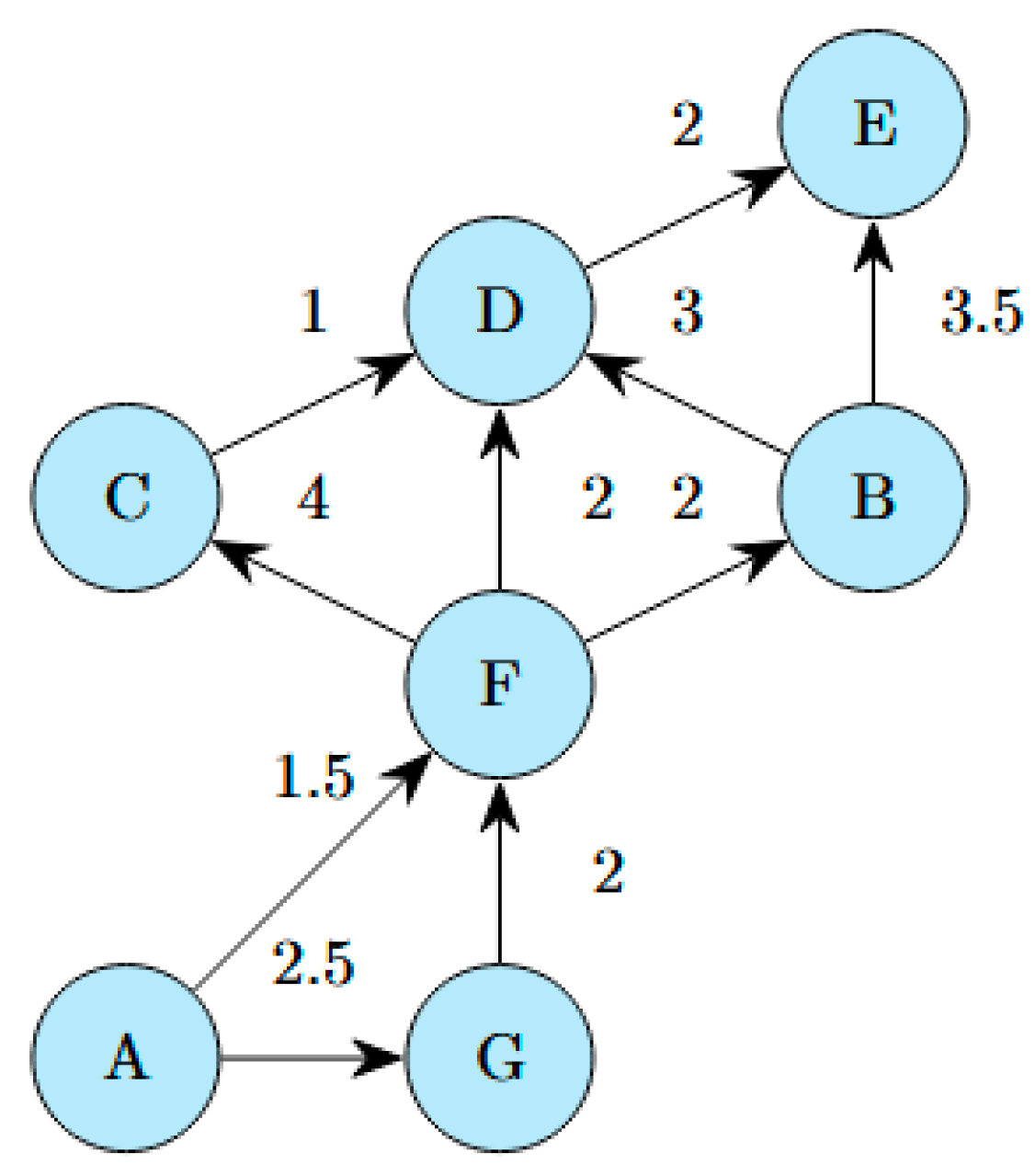
The implementation of our prototype (Table 1) uses a lightweight simulation environment based on Python 3.9 and key libraries such as Qiskit for quantum optimization, Hugging Face Transformers for NLP, and NetworkX for graph modeling. The traffic network is represented as a directed, weighted graph (see Figure 2). Each edge corresponds to a segment between nodes with associated travel cost. The structure supports evaluation of three alternative routes for optimization under varying contextual penalties. While our prototype uses textual incident summaries, the sensing pipeline is designed to accept 2D/3D detections and V2X messages whose features are projected into a common event schema via the cognitive sensing module. Events are then represented in a shared traffic knowledge graph. Cognitive sensing populates this schema from free-text and multimodal inputs, while virtual sensing augments underrepresented classes. Federated sensing updates edge models without centralizing raw data. The network includes multiple routing options between nodes, each with cost values that can dynamically change in response to incident severity or environmental conditions. To support semantic analysis and quantum optimization, we initially worked with a real-world dataset containing 840 entries of road traffic incidents, originally retrieved from Kaggle [53]. The original tabular dataset includes 14 structured attributes per record, covering aspects such as weather conditions, road type, time of day, traffic density, vehicle count, driver attributes, and accident severity. While the dataset offers a rich view of environmental and behavioral factors, its structure is not directly suitable for LLMs, which require free-text inputs. To bridge this gap, we derived a simulation-ready dataset that reformulates key attributes from the original data into full-sentence incident descriptions. For this prototype, we generated a representative subset consisting of 50 synthetic incident reports, each combining contextual attributes with semantically enriched input. The reports mimic virtual-sensing augmentation for scarce safety scenarios. Each record in the new dataset consists of three fields: (1) A natural language summary of an incident, (2) A list of three possible route alternatives, and (3) Associated route cost estimates reflecting varying conditions. This transformation allowed for testing the proposed ORQCIAM framework using realistic, interpretable inputs that could trigger both semantic classification and optimization routines. The dataset is designed to simulate real-world inputs that influence ITS routing decisions through a semantic processing pipeline.
Each report is semantically processed using a zero-shot LLM (facebook/bart-large-mnli from Hugging Face Transformers), and, depending on its classification, passed to a quantum optimization layer modeled via Qiskit’s Quantum Approximate Optimization Algorithm (QAOA). The orchestrator functions as a rule-based controller, determining whether a rerouting decision is required. Three alternative paths are defined in the graph, and cost approximations are adapted dynamically based on semantic severity or sensor-derived input. When rerouting is initiated, the QC backend solves a QUBO representation of the problem and returns the optimal path, which is then translated into natural language for interpretability.

4.2. Scenario-Based Prototype Evaluation

We tested the prototype across four selected scenarios. Each scenario is designed to simulate real-world ITS conditions and activate specific layers of the proposed architecture. We evaluate the sensing stack with cognitive sensing for incident triage, virtual sensing for rare-event augmentation, and federated sensing for edge adaptation, using the traffic knowledge graph as the common query layer. The goal is to show how the system would perform semantic filtering, prioritization, optimization, and context-sensitive orchestration. In all scenarios, the routing task involves determining the most efficient path from node A to node E (see Figure 2), accounting for dynamic contextual penalties and semantic inputs. In addition to routing efficiency, each rerouting decision generated by the framework was analyzed using distance and estimated travel time as a proxy for fuel consumption and CO2 emissions. Our initial results showed that reductions in path length and congestion avoidance achieved by ORQCIAM led to lower estimated CO2 emissions during rerouting events. Likewise, by avoiding unnecessary quantum computation for non-critical scenarios (Scenarios 2 and 3), the framework reduced digital-infrastructure load, contributing to greener computing. These preliminary outcomes confirm that context-aware orchestration between LLM-driven semantic reasoning and quantum optimization can enhance both operational efficiency and environmental sustainability.

4.2.1. Scenario 1: Critical Incident and Rerouting Trigger

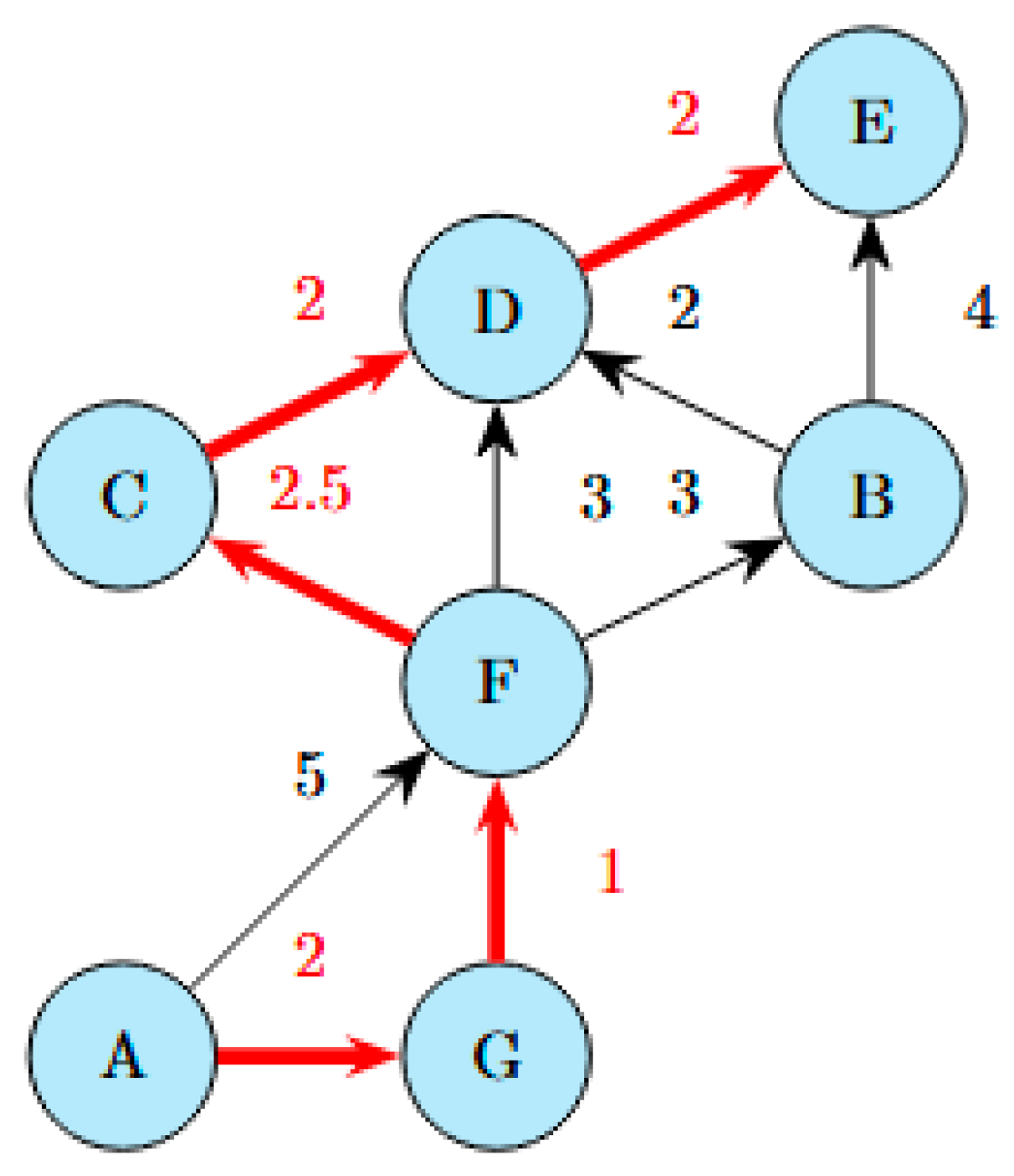
The prototype processed the input “Foggy weather and low traffic density on a rural road during morning. Road condition is under construction”. This input was analyzed by the LLM Module (within the Preprocessing Layer), which applied zero-shot classification to label the event as a critical incident demanding intervention. Based on this classification, the Intelligent Orchestration Module triggered a high-priority rerouting task and delegated it to the quantum backend. The module coordinated task execution by interfacing with both the LLM and QC modules, integrating semantic context into the rerouting request. The QC Module then encoded the rerouting decision as a QUBO problem, where contextual penalties (e.g., weather and road condition) were reflected as increased edge costs on routes like A → F → D. The QUBO instance was solved using the QAOA, identifying the optimal alternative path A → G → F → C → D → E (see Figure 3, where selected edges are highlighted with bold, red color). The Hybrid Decision-Making Layer enabled dynamic task routing and LLM-QC fusion, ensuring that the semantic insight from the LLM was effectively translated into the quantum optimization pipeline. The ITS Application Layer, specifically the Core Operational Systems and Infrastructure Monitoring components, received the optimized decision and simulated the application-level response. Finally, the ITS Execution and Feedback Layer captured the recommended path, updated the system log, and stored the outcome in the adaptive learning module for future decision refinement. This scenario demonstrates the end-to-end interaction across all architectural layers, from unstructured incident understanding to optimized action, highlighting the system’s capacity for context-aware, quantum-enhanced routing in ITS environments.

4.2.2. Scenario 2: Non-Critical Report with Resource Efficiency

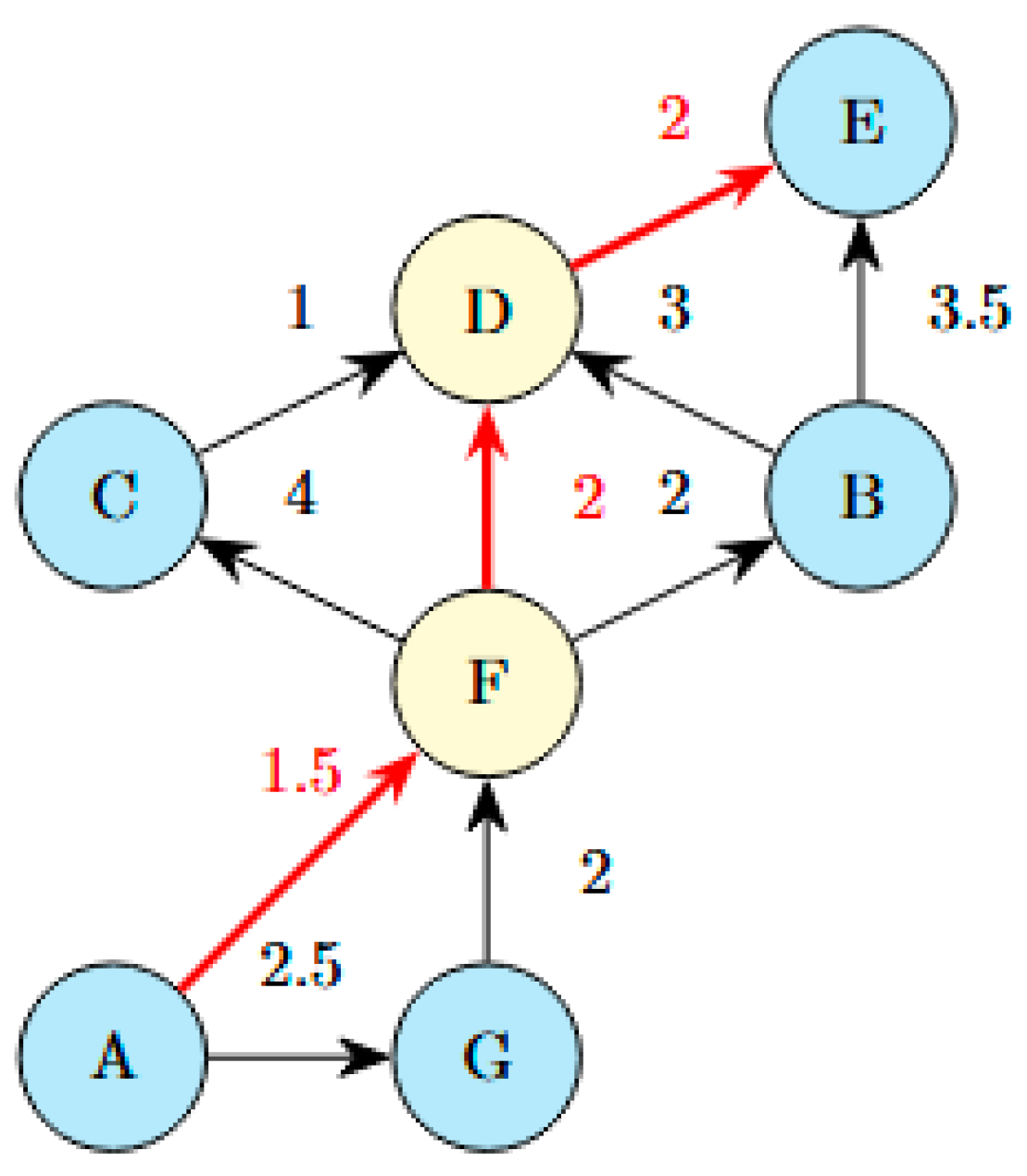
The system processed the input “Rainy weather and low traffic density on a city road during afternoon. Road condition is icy”. The LLM Module classified the event as a weather update, which does not warrant rerouting. This classification was passed to the Intelligent Orchestration Module, which applied rule-based filtering and determined that no optimization task should be triggered. As a result, the module prevented activation of the QC Module, ensuring that quantum resources were preserved for high-priority events. Instead, the Hybrid Decision-Making Layer routed the task to the monitoring branch of the ITS Application Layer, specifically within the Data Management and Traffic Monitoring functions. The ITS Execution and Feedback Layer logged the event and visually marked the affected nodes (F and D in Figure 4) in the traffic network to enhance interpretability. Although no rerouting occurred, the system recorded the input and decision outcome (i.e., “weather → no action”) in the learning log to support future behavior refinement and traceability. This scenario illustrates the system’s ability to semantically distinguish between critical and non-critical events, enabling context-sensitive filtering and intelligent orchestration. It confirms that the QC–LLM framework can operate efficiently under constrained quantum resources by selectively allocating optimization efforts only when necessary.

4.2.3. Scenario 3: Observational Monitoring Without Action

The system received the input “Clear weather and medium traffic density on a city road during evening. Road condition is dry”. The LLM Module classified this as an observational update that does not require any intervention. The classification was passed to the Intelligent Orchestration Module, which routed the task away from the optimization pipeline. The Hybrid Decision-Making Layer directed the input to the ITS Application Layer, where it activated the Traffic Monitoring and Data Management modules. No QUBO was formulated, and the QC Module remained inactive, preserving quantum resources. Although no rerouting occurred, the outcome was appended to the system’s internal log for completeness and potential future analysis. This scenario confirms the architecture’s ability to distinguish between passive observational inputs and actionable incidents, validating its capacity for intelligent, context-aware task allocation without unnecessary computation.

4.2.4. Scenario 4: Multi-Event Prioritization Under Quantum Resource Constraints

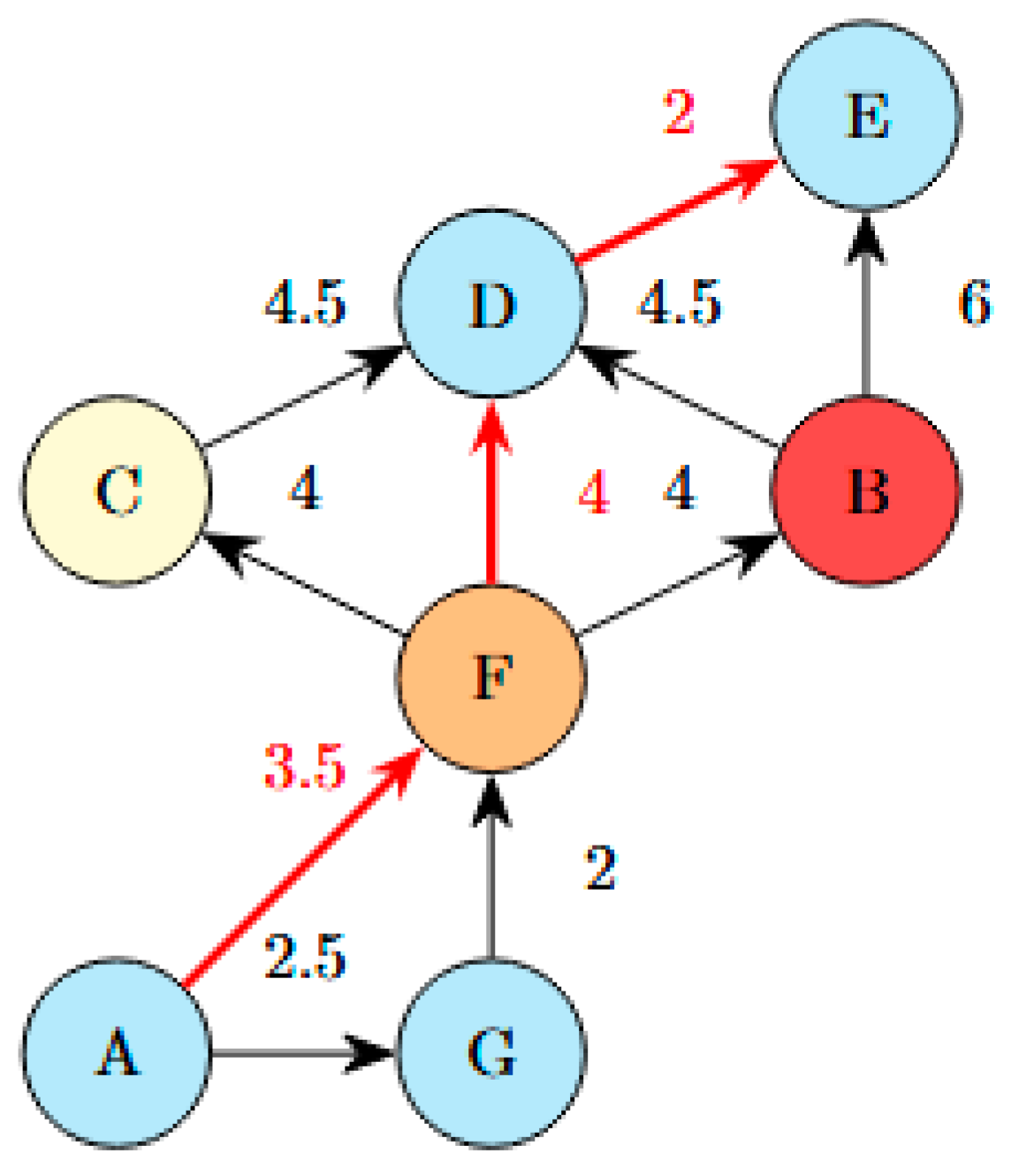
The system received three simultaneous reports: (1) “Heavy fog and traffic jam at junction 2 with high traffic density”; (2) “Rain expected later in the evening”; and (3) “Accident cleared from main route, traffic resuming normally”. Each input was semantically interpreted by the LLM Module. It classified the events as: (1) critical incident, (2) weather forecast, and (3) status update. These classifications were forwarded to the Intelligent Orchestration Module, which enforced a simulated resource constraint allowing only one QAOA optimization cycle. Using context-aware filtering and priority scoring, the orchestration module selected the first input, representing an immediate hazard, as the only task to be optimized. The QC Module then applied semantic penalties to affected edges and encoded the rerouting problem as a QUBO. The QAOA was executed to compute an optimal alternative path that avoided congested and hazardous areas. The Hybrid Decision-Making Layer coordinated module interactions and ensured that only the critical task was dispatched to the quantum backend. Meanwhile, the two lower-priority inputs were redirected to the ITS Application Layer for passive logging and trend monitoring. The ITS Execution and Feedback Layer annotated the traffic network visually, highlighting node B (critical), node F (forecast), and node C (status), and recorded all outcomes for interpretability and future analysis. The updated cost model illustrates how semantic interpretations from the LLM dynamically penalize high-risk segments, such as the A → F link (fog) and the D→B connection (congestion), thereby elevating their traversal costs (see Figure 5). Despite the network’s structural constraints, the QAOA optimizer, guided by these contextual adjustments, identifies the most cost-effective path that circumvents critical nodes (e.g., B) and deprioritizes previously optimal routes no longer viable under the new conditions. This scenario demonstrates the system’s ability to perform context-driven prioritization, enabling selective quantum resource allocation while maintaining comprehensive awareness of non-optimized events. It validates that under resource-limited conditions, the ORQCIAM framework can make intelligent, layered decisions aligned with ITS operational priorities.

4.3. Validation of the Dynamic Coordination Mechanism

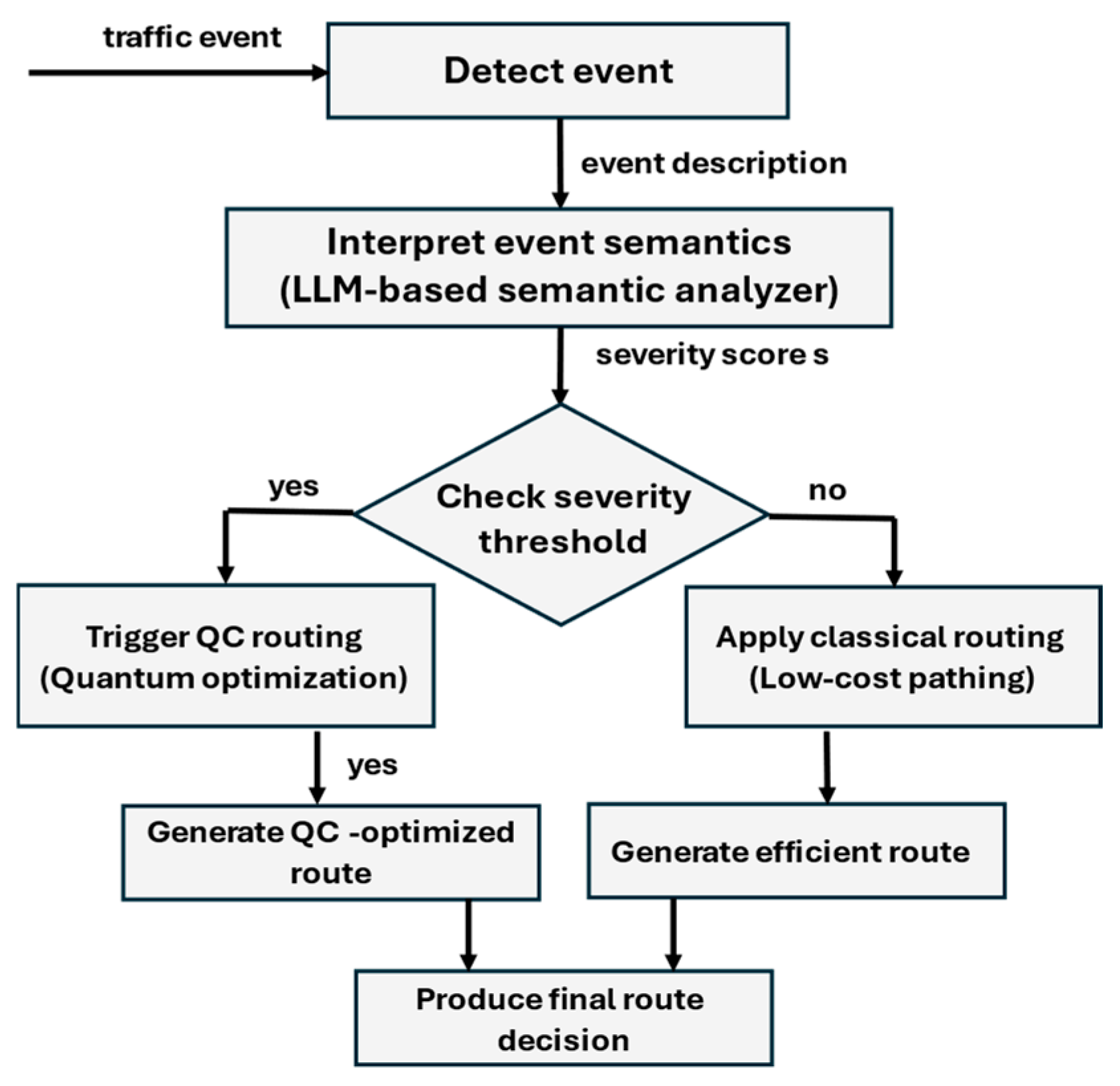
To assess the effectiveness of the hybrid decision-making layer in ORQCIAM, we validated the dynamic coordination mechanism using nine simulation scenarios: Three representing low-severity events, three medium-severity events, and three high-severity events. Each of the nine scenarios produced more than 200 simulated events, resulting in over 1800 total event instances. This design guarantees balanced coverage of heterogeneous mobility situations while maintaining the simulation environment controlled and comparable across severity levels. Each scenario includes: (i) An incident description; (ii) An LLM-derived semantic-severity score; and (iii) A QC-enabled routing component. As illustrated in Figure 6, ORQCIAM relies on the LLM to interpret the textual or symbolic description of an event and assign a semantic-severity score s ∈ [0, 1]. The scoring process combines factors like obstruction level, predicted event duration, lane-availability impact, and the LLM’s confidence in its interpretation. The relative importance of these factors is inspired from empirical crash-severity results reported in existing traffic-safety studies (e.g., [54]). These results show that obstruction-related and duration-related factors have stronger statistical influence on severity consequences than lane-position modifiers or contextual variables. This motivates assigning higher weights to obstruction and duration, moderate weight to lane impact, and lower weight to model-confidence terms. For example, an event described as “multi-vehicle slowdown with minor obstruction” would generate in our simulations the following scores: 0.3 for obstruction, 0.4 for duration, 0.2 for lane impact, and 0.8 for confidence. These scores are aggregated through a weighted formulation:
s = 0.30 ( 0.35 ) + 0.4 ( 0.35 ) + 0.20 ( 0.20 ) + 0.80 ( 0.10 ) = 0.36
The hybrid decision module then performs a severity threshold check, activating quantum optimization only when sτQC. The threshold τQC was determined through a grid search over candidate values [0.40, 0.70], selecting the value (τQC = 0.55) that best balanced routing performance and computational overhead. Events below this threshold are routed through classical low-cost pathing. Events with semantic-severity scores below 0.40 consistently correspond to minor, non-disruptive situations in which the feasible routing space remains largely unchanged. In our simulations, QC and classical routing produced nearly identical paths for all such cases (<1% deviation). This indicates that invoking quantum optimization provides no measurable routing benefit. Furthermore, scores above 0.70 consistently corresponded to major disturbances where classical routing departed substantially from QC-optimized paths, producing 6–12% higher travel times in our simulations. At this severity level, the routing landscape becomes extremely restricted, and quantum optimization reliably outperforms classical heuristics. For this reason, 0.70 was set as the upper bound beyond which QC activation is always beneficial. As illustrated in Figure 6, the coordination layer therefore avoids unnecessary QC activation for these low-severity instances. In this case, we ensure that quantum resources are used only when they can meaningfully improve routing outcomes.
Across all nine scenarios, semantic filtering significantly reduced needless quantum computations. QC activation decreased by 50–67% compared to an always-on QC baseline, particularly in low-severity and routine events. This selective activation approach produced a 40% reduction in quantum calls while maintaining routing quality within 2–4% of the QC-only benchmark in terms of travel-time deviation and congestion mitigation. Furthermore, computational overhead decreased by 35% on average, confirming that ORQCIAM achieves significant efficiency gains without degrading routing quality. Because ORQCIAM is event-driven, we report aggregated performance metrics rather than raw counts. Each scenario generated more than 200 simulated events and repeated runs showed minor variance (<0.5%). A summary of the experimental validation is presented in Table 2. The table includes a direct comparison between ORQCIAM, an always-on QC baseline, and a classical low-cost routing method, demonstrating the performance impact of each approach under identical conditions.

4.4. Sustainability-Oriented Evaluation

In order to evaluate ORQCIAM from a sustainability perspective, we compared the selected route from each scenario against (1) the default route without rerouting and (2) a shortest-path baseline. Metrics included traveled distance, estimated congestion-induced idle time, and CO2 emissions derived using standard formulations from urban-mobility literature. The total traveled distance D(r) for each route r was computed as the sum of the segment lengths:
D ( r ) = e r l e
where l e denotes the length of edge e. Travel time T(r) and free-flow time T ff ( r ) were obtained from observed and nominal speeds, respectively:
T ( r ) = e r l e v e ,   T ff ( r ) = e r l e v e ff
and the congestion-induced delay was defined as:
Δ T cong ( r ) = max ( 0 ,   T ( r ) T ff ( r ) )
Idle time I ( r ) was estimated from the time share where vehicle speed fell below a low-speed threshold ( v k < 1 km/h.)
I ( r ) = k 1 { v k < 1 }   Δ t
CO2 emissions were then approximated through a distance- and idle-based emission factor model:
E CO 2 ( r ) = E F run   D ( r ) + E F idle   I ( r )
with E F run expressed in g km−1 and E F idle in g s−1.
Following the standards of the European Environment Agency (EEA) [55] and the Intergovernmental Panel on Climate Change (IPCC) [56], a representative value of E F run ≈ 170 g CO2/km was adopted for congested urban traffic. Relative reductions in travel time or CO2 emissions compared with the baseline route r 0 were reported as:
% Δ X = X ( r 0 ) X ( r ) X ( r 0 ) × 100 %
Because the prototype employs synthetic route costs rather than measured telemetry, distance and congestion-level attributes were used as proxies for traveled distance and idle time in these calculations. Accordingly, the reported CO2 reductions represent proxy-based estimates consistent with the simulation scope.
Across scenarios that triggered quantum rerouting, the ORQCIAM-selected routes reduced travel time by 9–18% (5.3 min over 30 min ≈ 18%; 4.1 min over 45 min ≈ 9%) and yielded CO2 reductions of 6–14%. These reductions were estimated using a representative emission factor of approximately 170 g CO2 per kilometer for congested stop-and-go conditions, based on urban mobility literature and EEA data trends [55]. For instance, a 1.3 km shorter path at this emission rate corresponds to ≈220 g CO2 saved per trip. The results summarized in Table 3 highlight the sustainability benefits of the proposed approach. The initial findings show that context-aware, quantum-enhanced routing not only improves traffic response but also contributes to energy and emissions benefits, aligning with sustainable transport objectives.

5. Challenges and Future Design Considerations

While the proposed ORQCIAM framework represents a noteworthy advancement for real-time optimization and decision-making in ITSs, several challenges must be addressed to ensure its scalability, sustainability, reliability, and societal adoption in urban contexts. These challenges include:
  • Ensuring sustainable deployment: Although the hybrid QC–LLM architecture supports energy-aware decision-making, maintaining sustainability across large-scale deployments remains a key challenge. Quantum and LLM operations still consume substantial energy. Consequently, the environmental benefits gained through optimized routing may be offset if computation is not efficiently managed. Future work will investigate eco-efficient scheduling, low-energy quantum operations, and carbon-aware orchestration to guarantee that sustainability goals are accomplished end-to-end.
  • Computational and infrastructure limitations: They present a critical barrier on both the quantum and classical sides of the framework. QC, although promising, remains constrained by the current state of Noisy Intermediate-Scale Quantum (NISQ) hardware, which is prone to decoherence, noise, and limited qubit scalability. These limitations restrict the capacity to perform large-scale optimization tasks on an industrial scale. Concurrently, LLMs require substantial computational resources and memory footprints for training and inference. Deploying LLMs in real-time ITS applications requires strategies for model compression, edge-level optimization, and distributed processing to maintain acceptable latency and performance. From a sustainability perspective, energy consumption and carbon footprint should also be considered to ensure that large-scale QC–LLM integration aligns with climate goals for future smart cities.
  • Integration and interoperability challenges: They arise from the need to coordinate distinct computational paradigms (e.g., symbolic reasoning in LLMs and parallelized optimization in QC) within a unified operational pipeline. Seamless interaction between LLM and QC modules requires orchestration mechanisms capable of synchronizing processes, dynamically routing tasks based on complexity, and reducing communication overhead. Furthermore, the predominance of classical infrastructure within existing ITS networks results in compatibility concerns. Integrating hybrid QC–LLM systems with legacy systems may require the design of adaptive interfaces or middleware capable of translating between classical control mechanisms and quantum-AI-driven processes. This integration must also ensure inclusivity by supporting various transport infrastructures across high-tech urban centers and resource-constrained cities, thus dodging a technological divide in sustainable mobility adoption.
  • Data privacy, security, and trustworthiness: They are foundational concerns in the deployment of AI-enhanced ITSs. As V2X communication networks expand, the system’s vulnerability to cyber threats and data breaches increases. Implementing quantum-safe encryption and secure quantum key distribution (QKD) protocols will be crucial in protecting sensitive transportation data. Moreover, to foster trust and regulatory acceptance, the decision-making processes enabled by LLMs should be transparent and interpretable. Ensuring explainability in AI-driven recommendations is essential to building confidence among stakeholders, policymakers, and end-users. For sustainable cities, this also includes embedding governance frameworks, ethical AI principles, and citizen-centered design to balance efficiency gains with social acceptance and fair access to intelligent mobility services.

6. Conclusions

Quantum Computing (QC) and Large Language Models (LLMs) offer complementary strengths that can transform Intelligent Transportation Systems (ITSs), particularly in advancing sustainability-oriented mobility solutions. In this work, we introduced ORQCIAM, a modular hybrid framework that orchestrates semantic reasoning (LLMs) with computational optimization (QC) for real-time ITS decision support. Scenario-based evaluation demonstrated the ability of ORQCIAM to perform semantic event filtering, prioritize critical incidents, and invoke quantum optimization when needed. Unlike existing ITS optimization frameworks that focus solely on efficiency, ORQCIAM explicitly incorporates sustainability by selecting routes and decisions that reduce travel time, minimize congestion, and lower estimated emissions. Experimental results showed measurable reductions in distance traveled and idle time, enabling an estimated 6–14% reduction in CO2 emissions during incident-driven rerouting. In addition, by avoiding quantum optimization for non-critical events, the framework reduces computational energy consumption, contributing to more sustainable digital infrastructure. When assessed against classical routing and always-on quantum optimization baselines, ORQCIAM reduces unnecessary quantum activation while sustaining routing performance within a 2–4% deviation range. These findings show that ORQCIAM can be successfully applied to city-scale traffic management platforms. This would allow for event-driven quantum optimization that reduces computational cost, enhances energy efficiency, and supports sustainability-oriented routing strategies in real operational settings.
While promising, challenges remain in QC hardware maturity, interoperability with legacy ITS infrastructures, and deployment of large models under tight latency constraints. Future work will integrate real telemetry data from electric vehicles and charging networks to evaluate ORQCIAM within real smart-city environments and quantify its sustainability impact more precisely (e.g., CO2 reduction, energy savings, emissions-aware routing decisions).

Funding

This research received no external funding.

Institutional Review Board Statement

Not applicable.

Informed Consent Statement

Not applicable.

Data Availability Statement

The data used in this study were obtained from a publicly available dataset on Kaggle (reference: [53]). Processed data and derived results supporting the findings of this study are available from the author upon reasonable request.

Acknowledgments

During the preparation of this manuscript, the author used ChatGPT (OpenAI, GPT-4 family) for language verification and minor rephrasing. The author has reviewed and edited the output and takes full responsibility for the content of this publication.

Conflicts of Interest

The author declares no conflicts of interest.

Abbreviations

AIArtificial Intelligence
AIGCArtificial Intelligence–Generated Content
CO2Carbon Dioxide
DLDeep Learning
GISGeographic Information System
ITSsIntelligent Transportation Systems
LLMLarge Language Model
QCQuantum Computing
QAOAQuantum Approximate Optimization Algorithm
QNNQuantum Neural Network
QPSOQuantum Particle Swarm Optimization
QSSQuantum Secret Sharing
QUBOQuadratic Unconstrained Binary Optimization
V2XVehicle-to-Everything

References

  1. Guo, X.; Zhang, Q.; Peng, M.; Zhua, M.; Jiang, J.; Yang, H.F. Explainable traffic flow prediction with large language models. arXiv 2024, arXiv:2404.02937. [Google Scholar] [CrossRef]
  2. Dimitrakopoulos, G.; Demestichas, P. Intelligent transportation systems. IEEE Veh. Technol. Mag. 2010, 5, 77–84. [Google Scholar] [CrossRef]
  3. Al Abri, K.A.; Jabeur, N.; Gharrad Yasar, A.-U.-H. An intelligent divide-and-conquer approach for driving style management. Pers. Ubiquitous Comput. 2023, 27, 1729–1746. [Google Scholar] [CrossRef]
  4. Khalil, R.A.; Safelnasr, Z.; Yemane, N.; Kedir, M.; Shafiqurrahman, A.; Saeed, N. Advanced learning technologies for intelligent transportation systems: Prospects and challenges. IEEE Open J. Veh. Technol. 2024, 5, 397–427. [Google Scholar] [CrossRef]
  5. Njoku, J.N.; Nwakanma, C.I.; Amaizu, G.C.; Kim, D.-S. Prospects and challenges of metaverse application in data-driven intelligent transportation systems. IET Intell. Transp. Syst. 2022, 17, 1–21. [Google Scholar] [CrossRef]
  6. Abirami, S.; Pethuraj, M.; Uthayakumar, M.; Chitra, P. A systematic survey on big data and artificial intelligence algorithms for intelligent transportation system. Case Stud. Transp. Policy 2024, 17, 101247. [Google Scholar] [CrossRef]
  7. Behura, A.; Patra, R. Challenges and Future Prospects of Integrating Quantum Computing Into Intelligent Transportation Systems: Exploring Quantum Innovations in Transportation; IGI Global Scientific Publishing: Hershey, PA, USA, 2024. [Google Scholar] [CrossRef]
  8. Zhang, K.; Salek, M.S.; Wang, A.; Rahman, M.; Chowdhury, M.; Lao, Y. Preparing for Kyber in Securing Intelligent Transportation Systems Communications: A Case Study on Fault-Enabled Chosen-Ciphertext Attack. arXiv 2025. [Google Scholar] [CrossRef]
  9. Huang, G.-L.; Zaslavsky, A.; Loke, S.W.; Abkenar, A.; Medvedev, A.; Hassani, A. Context-aware machine learning for intelligent transportation systems: A survey. IEEE Trans. Intell. Transp. Syst. 2022, 24, 17–36. [Google Scholar] [CrossRef]
  10. Lv, Z.; Zhang, S.; Xiu, W. Solving the security problem of intelligent transportation system with deep learning. IEEE Trans. Intell. Transp. Syst. 2020, 22, 4281–4290. [Google Scholar] [CrossRef]
  11. Nama, M.; Nath, A.; Bechra, N.; Bhatia, J.; Tanwar, S.; Chaturvedi, M.; Sadoun, B. Machine learning-based traffic scheduling techniques for intelligent transportation system: Opportunities and challenges. Int. J. Commun. Syst. 2021, 34, e4814. [Google Scholar] [CrossRef]
  12. Guerrero-Ibanez, J.; Contreras-Castillo, J.; Zeadally, S. Deep learning support for intelligent transportation systems. Trans. Emerg. Telecommun. Technol. 2021, 32, e4169. [Google Scholar] [CrossRef]
  13. Haydari, A.; Yılmaz, Y. Deep reinforcement learning for intelligent transportation systems: A survey. IEEE Trans. Intell. Transp. Syst. 2020, 23, 11–32. [Google Scholar] [CrossRef]
  14. Khan, T.M.; Robles-Kelly, A. Machine learning: Quantum vs classical. IEEE Access 2020, 8, 219275–219294. [Google Scholar] [CrossRef]
  15. Zhuang, Y.; Azfar, T.; Wang, Y.; Sun, W.; Wang, X.; Guo, Q.; Ke, R. Quantum Computing in Intelligent Transportation Systems: A Survey. J. CHAIN 2024, 1, 138–149. [Google Scholar] [CrossRef]
  16. Cooper, C.H.V. Exploring Potential Applications of Quantum Computing in Transportation Modelling. IEEE Trans. Intell. Transp. Syst. 2022, 23, 14712–14720. [Google Scholar] [CrossRef]
  17. Telenti, A.; Auli, M.; Hie, B.L.; Maher, C.; Saria, S.; Ioannidis, J.P.A. Large language models for science and medicine. Eur. J. Clin. Investig. 2024, 54, e14183. [Google Scholar] [CrossRef]
  18. Mahmud, D.; Hajmohamed, H.; Almentheri, S.; Alqaydi, S.; Aldhaheri, L.; Khalil, R.; Saeed, N. Integrating LLMs with ITS: Recent Advances, Potentials, Challenges, and Future Directions. IEEE Trans. Intell. Transp. Syst. 2025, 26, 5674–5709. [Google Scholar] [CrossRef]
  19. Yao, Z.; Jiang, Y.; Zhao, B.; Luo, X.; Peng, B. A dynamic optimization method for adaptive signal control in a connected vehicle environment. J. Intell. Transp. Syst. 2019, 24, 184–200. [Google Scholar] [CrossRef]
  20. Gyawali, S.; Qian, Y. Misbehavior detection using machine learning in vehicular communication networks. In Proceedings of the ICC 2019—2019 IEEE International Conference on Communications (ICC), Shanghai, China, 20–24 May 2019; IEEE: New York, NY, USA, 2019; pp. 1–6. [Google Scholar]
  21. Tang, Y.; Dai, X.; Zhao, C.; Cheng, Q.; Lv, Y. Large language modeldriven urban traffic signal control. In Proceedings of the 2024 Australian & New Zealand Control Conference (ANZCC), Gold Coast, Australia, 1–2 February 2024; IEEE: New York, NY, USA, 2024; pp. 67–71. [Google Scholar]
  22. Wang, M.; Pang, A.; Kan, Y.; Pun, M.-O.; Chen, C.S.; Huang, B. Llm-assisted light: Leveraging large language model capabilities for human-mimetic traffic signal control in complex urban environments. arXiv 2024, arXiv:2403.08337. [Google Scholar]
  23. d’Aloisio, G.; Fortz, S.; Hanna, C.; Fortunato, D.; Bensoussan, A.; Mendiluze Usandizaga, E.; Sarro, F. Exploring LLM-Driven Explanations for Quantum Algorithms. In Proceedings of the ACM/IEEE International Symposium on Empirical Software Engineering and Measurement, Barcelona, Spain, 24–25 October 2024; pp. 475–481. [Google Scholar] [CrossRef]
  24. Dupuis, N.; Buratti, L.; Vishwakarma, S.; Viudes Forrat, A.; Kremer, D.; Faro, I.; Puri, R.; Cruz-Benito, J. Qiskit Code Assistant: Training LLMs for generating Quantum Computing Code. In Proceedings of the 2024 IEEE LLM Aided Design Workshop (LAD), San Jose, CA, USA, 28–29 June 2024; pp. 1–4. [Google Scholar] [CrossRef]
  25. Elassy, M.; Al-Hattab, M.; Takruri, M.; Badawi, S. Intelligent Transportation Systems for Sustainable Smart Cities. Transp. Eng. 2024, 16, 100252. [Google Scholar] [CrossRef]
  26. García, A.; Lee, J. Large-scale traffic optimization for sustainable urban mobility. Transp. Res. Part C 2023, 155, 104236. [Google Scholar]
  27. Khan, M.; Zhou, F. Semantic incident analysis for intelligent transportation using AI and IoT. IEEE Trans. Intell. Transp. Syst. 2022, 23, 20452–20463. [Google Scholar]
  28. Wandelt, S.; Zheng, C.; Wang, S.; Liu, Y.; Sun, X. Large Language Models for Intelligent Transportation: A Review of the State of the Art and Challenges. Appl. Sci. 2024, 14, 7455. [Google Scholar] [CrossRef]
  29. Wang, J.; Shalaby, A. Leveraging Large Language Models for Enhancing Public Transit Services. arXiv 2024. [Google Scholar] [CrossRef]
  30. Zheng, O.; Abdel-Aty, M.; Wang, D.; Wang, Z.; Ding, S. ChatGPT Is on the Horizon: Could a Large Language Model Be All We Need for Intelligent Transportation? arXiv 2023. [Google Scholar] [CrossRef]
  31. Zhang, S.; Fu, D.; Liang, W.; Zhang, Z.; Yu, B.; Cai, P.; Yao, B. Trafficgpt: Viewing, processing and interacting with traffic foundation models. Transp. Policy 2024, 150, 95–105. [Google Scholar] [CrossRef]
  32. Da, L.; Liou, K.; Chen, T.; Zhou, X.; Luo, X.; Yang, Y.; Wei, H. Open-ti: Open traffic intelligence with augmented language model. Int. J. Mach. Learn. Cybern. 2024, 15, 4761–4786. [Google Scholar] [CrossRef]
  33. Ying, S.; Li, Z.; Ma, W. Beyond Words: Evaluating Large Language Models in Transportation Planning. arXiv 2024. [Google Scholar] [CrossRef]
  34. Wang, Y.; Jiao, R.; Lang, C.; Zhan, S.; Huang, C.; Wang, Z.; Yang, Z.; Zhu, Q. Empowering Autonomous Driving with Large Language Models: A Safety Perspective. arXiv 2023, arXiv:2312.00812. [Google Scholar]
  35. Gamage, G.; Mills, N.; De Silva, D.; Manic, M.; Moraliyage, H.; Jennings, A.; Alahakoon, D. Multi-agent rag chatbot architecture for decision support in net-zero emission energy systems. In Proceedings of the 2024 IEEE International Conference on Industrial Technology (ICIT), Bristol, UK, 25–27 March 2024; IEEE: New York, NY, USA, 2024; pp. 1–6. [Google Scholar]
  36. Choi, S.; Jain, R.; Emami, P.; Wadsack, K.; Ding, F.; Sun, H.; Gruchalla, K.; Hong, J.; Zhang, H.; Zhu, X.; et al. eGridGPT: Trustworthy AI in the Control Room. 10.2172/2352232. 2024. Available online: https://docs.nrel.gov/docs/fy24osti/87740.pdf (accessed on 16 October 2025).
  37. Xu, H.; Yuan, J.; Zhou, A.; Xu, G.; Li, W.; Ban, X.; Ye, X. GenAI-powered Multi-Agent Paradigm for Smart Urban Mobility: Opportunities and Challenges for Integrating Large Language Models (LLMs) and Retrieval-Augmented Generation (RAG) with Intelligent Transportation Systems. arXiv 2024. [Google Scholar] [CrossRef]
  38. Zhou, X.; Liu, M.; Yurtsever, E.; Zagar, B.L.; Zimmer, W.; Cao, H.; Knoll, A.C. Vision Language Models in Autonomous Driving: A Survey and Outlook. IEEE Trans. Intell. Veh. 2024, 1–20. [Google Scholar] [CrossRef]
  39. Shoaib, M.R.; Emara, H.M.; Zhao, J. A Survey on the Applications of Frontier AI, Foundation Models, and Large Language Models to Intelligent Transportation Systems. In Proceedings of the 2023 International Conference on Computer and Applications (ICCA), Cairo, Egypt, 28–30 November 2023; pp. 1–7. [Google Scholar] [CrossRef]
  40. Chen, H.; Kong, X.; Chong, B.; Qin, G.; Zhou, X.; Peng, X.; Du, J. Experimental demonstration of a quantum annealing algorithm for the traveling salesman problem in a nuclear-magnetic-resonance quantum simulator. Phys. Rev. A 2011, 83, 032314. [Google Scholar] [CrossRef]
  41. Ciacco, A.; Guerriero, F.; Osaba, E. Steiner Traveling Salesman Problem with Quantum Annealing. arXiv 2025, arXiv:2504.02388. [Google Scholar] [CrossRef]
  42. Cattelan, M.; Yarkoni, S. Modeling routing problems in QUBO with application to ride-hailing. Sci. Rep. 2022, 14, 19768. [Google Scholar] [CrossRef] [PubMed]
  43. Han, K.-H.; Kim, J.-H. Quantum-inspired evolutionary algorithm for a class of combinatorial optimization. IEEE Trans. Evol. Comput. 2002, 6, 580–593. [Google Scholar] [CrossRef]
  44. Huang, W.; Zhang, J.; Liang, S.; Sun, H. Backbone network traffic prediction based on modified eemd and quantum neural network. Wirel. Pers. Commun. 2018, 99, 1569–1588. [Google Scholar] [CrossRef]
  45. Qu, Z.; Liu, X.; Zheng, M. Temporal-spatial quantum graph convolutional neural network based on schrödinger approach for traffic congestion prediction. IEEE Trans. Intell. Transp. Syst. 2022, 24, 8677–8686. [Google Scholar] [CrossRef]
  46. Bruza, P.D.; Wang, Z.; Busemeyer, J.R. Quantum cognition: A new theoretical approach to psychology. Trends Cogn. Sci. 2015, 19, 383–393. [Google Scholar] [CrossRef]
  47. Majumder, R.; Khan, S.M.; Ahmed, F.; Khan, Z.; Ngeni, F.; Comert, G.; Mwakalonge, J.; Michalaka, D.; Chowdhury, M. Hybrid classical-quantum deep learning models for autonomous vehicle traffic image classification under adversarial attack. arXiv 2021, arXiv:2108.01125. [Google Scholar] [CrossRef]
  48. Amin, J.; Anjum, M.A.; Ibrar, K.; Sharif, M.; Kadry, S.; Crespo, R.G. Detection of anomaly in surveillance videos using quantum convolutional neural networks. Image Vis. Comput. 2023, 135, 104710. [Google Scholar] [CrossRef]
  49. Chen, S.; Piao, L.; Zang, X.; Luo, Q.; Li, J.; Yang, J.; Rong, J. Analyzing differences of highway lane-changing behavior using vehicle trajectory data. Phys. A Stat. Mech. Its Appl. 2023, 624, 128980. [Google Scholar] [CrossRef]
  50. Jabeur, N. Quantum Informed Multi-Agent Boosted Solution for Seatbelt Monitoring Systems. In Proceedings of the 2024 Artificial Intelligence Revolutions (AIR), Roanne, France, 30–31 October 2024; pp. 47–54. [Google Scholar] [CrossRef]
  51. Xiao, H.; Chronopoulos, A.T.; Zhang, Z. An efficient security scheme for vehicular communication using a quantum secret sharing method. IEEE Trans. Veh. Technol. 2019, 69, 1101–1105. [Google Scholar] [CrossRef]
  52. Park, G.; Baity, P.; Yoon, B.-J.; Hoisie, A. Enhancing Future Link Prediction in Quantum Computing Semantic Networks through LLM-Initiated Node Features. arXiv 2024. [Google Scholar] [CrossRef]
  53. Kuznetsov, D. Traffic Accident Dataset with Weather and Time, Kaggle, [Online]. 2022. Available online: https://www.kaggle.com/datasets/denkuznetz/traffic-accident-prediction (accessed on 30 September 2025).
  54. Zhang, J.; Yu, B.; Chen, Y.; Kong, Y.; Gao, J. Comparative Analysis of Influencing Factors on Crash Severity between Super Multi-Lane and Traditional Multi-Lane Freeways Considering Spatial Heterogeneity. Int. J. Environ. Res. Public Health 2022, 19, 12779. [Google Scholar] [CrossRef] [PubMed]
  55. EEA Data. Monitoring of CO2 Emissions from Passenger Cars—Regulation (EU) 2019/631 Provided by European Environment Agency (EEA); European Environment Agency (EEA): Copenhagen, Denmark, 2019. [Google Scholar]
  56. IPCC. Climate Change 2021: The Physical Science Basis. Contribution of Working Group I to the Sixth Assessment Report of the Intergovernmental Panel on Climate Change; Cambridge University Press: Cambridge, UK; New York, NY, USA, 2021. [Google Scholar] [CrossRef]
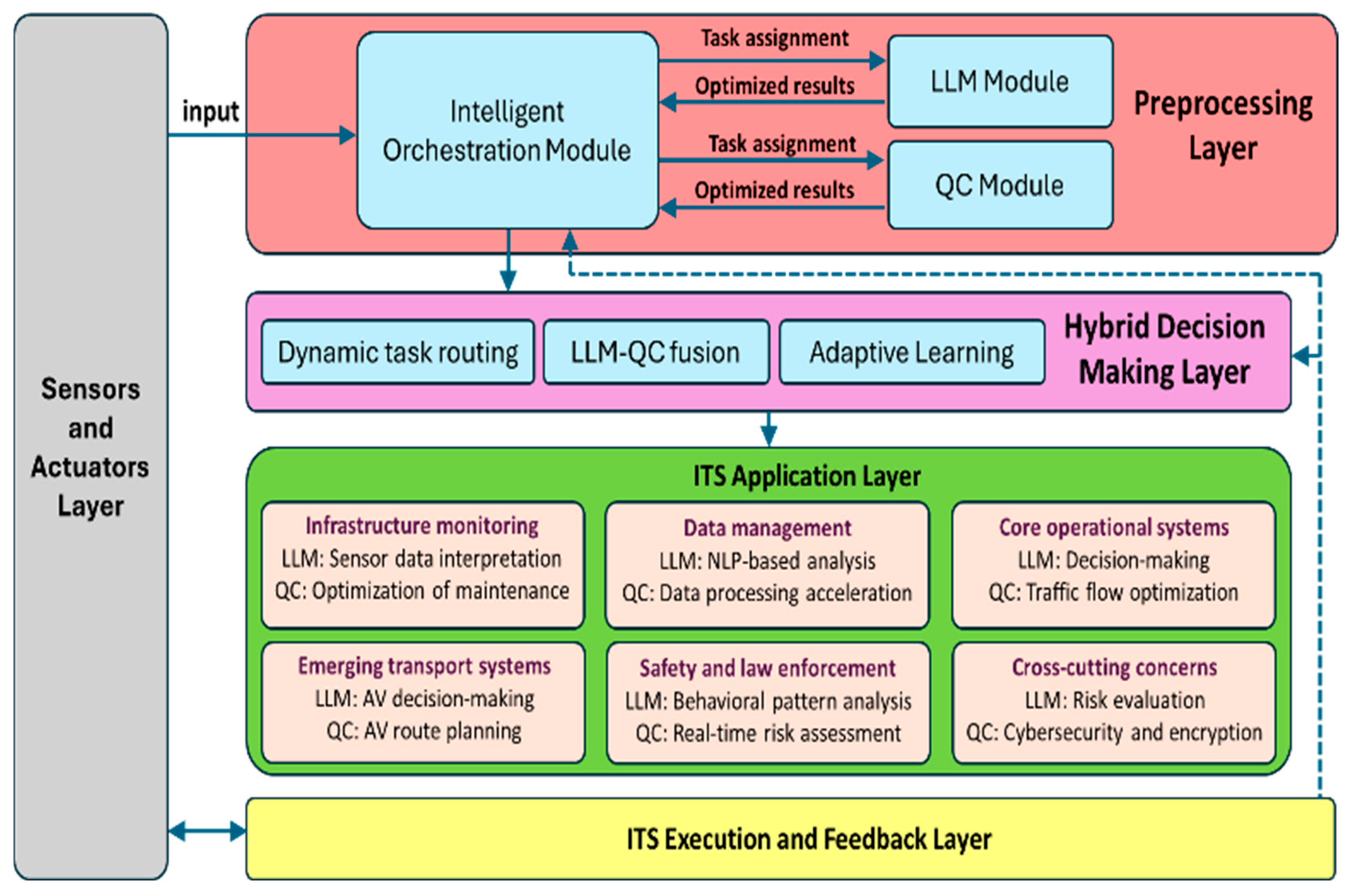
Figure 1. Proposed framework empowering ITS with LLM and QC.
Sustainability 17 11336 g001
Figure 2. Simulated Traffic Network Graph with Cost-Annotated Edges (letters represent cities).
Sustainability 17 11336 g002
Figure 3. Optimal rerouting path A → G → F → C → D → E identified by QAOA under critical incident conditions (highlighted in red).
Sustainability 17 11336 g003
Figure 4. Affected nodes (F and D, highlighted in yellow color) visually marked under non-critical weather conditions without rerouting.
Sustainability 17 11336 g004
Figure 5. Contextually penalized traffic network under multi-event input with quantum resource constraints. Red arrows indicate penalized edges. Node colors denote LLM-inferred event categories (e.g., critical incident, forecast, status update).
Sustainability 17 11336 g005
Figure 6. Workflow of the dynamic coordination mechanism evaluated in ORQCIAM.
Sustainability 17 11336 g006
Table 1. Prototype implementation summary.
ComponentDescription
Dataset50 synthetic incident reports, each with contextual attributes
LLM ModuleZero-shot classification using facebook/bart-large-mnli (Hugging Face)
OrchestratorRule-based module directing task flow based on event type
Quantum OptimizerQAOA implementation via Qiskit and aer_simulator backend
Network Graph5-node directed graph with 3 predefined routing paths
OutputHuman-readable route decision and log trace
EnvironmentPython 3.9, Transformers, Qiskit, NetworkX
Table 2. Performance of the dynamic coordination mechanism across severity levels.
Scenario Type% Events Triggering QC (Always-on Baseline)% Events Triggering QC (ORQCIAM)QC ReductionChange in Travel TimeComputation Overhead Reduction
Low-severity (slowdowns)100%33%67%+1.2%38%
Medium-severity (bottlenecks)100%52%48%+1.9%34%
High-severity (blockages)100%72%28%+3.4%31%
Overall100%48–50%50–67%2–4% deviation35% average
Table 3. Sustainability impact of quantum-enhanced routing under selected scenarios.
ScenarioDefault Path (km)ORQCIAM Path (km)Congestion Delay Saved (min)Estimated CO2 Reduction
S19.48.1−5.3−12%
S410.28.9−4.1−9%
Disclaimer/Publisher’s Note: The statements, opinions and data contained in all publications are solely those of the individual author(s) and contributor(s) and not of MDPI and/or the editor(s). MDPI and/or the editor(s) disclaim responsibility for any injury to people or property resulting from any ideas, methods, instructions or products referred to in the content.