




Conceptualizing the Foundational Economy as a Cornerstone of Biodiversity Conservation and Restoration

Abstract
1. Introduction
2. The Foundational Economy and the Environment: A Brief Overview
2.1. Basic Conceptualizations of the Foundational Economy

| Unpaid | Paid economic activities (registered in the national accounts and statistics) | Paid economic activities (profits concealed & taxes avoided, often not in national accounts) | ||||
| Everyday Economy | Export-oriented market economy (international competition) | Extractive/rentier economies | ||||
| Core economy: Care, reproduction, voluntary work | Foundational Economy (FE) * Material foundational economy, * Providential foundational economy, * Contested FE | Non-essential local provisioning | ||||
| (Public/not-for-profit) infrastructure (technical/network, social infrastructure) | Essential local provisioning systems | Non-market free provisioning & access (Nature’s contributions, cultural goods & services) | ||||
| Examples of the different areas of the economy | ||||||
| Unpaid care work (family work, community), reproductive household duties, child care, civil society engagement (e.g., NGOs) | Utilities (water, waste management), health, care, education, energy | Food, pharmacies, local/retail banks, repair, local production of essential goods (e.g., clothing) | Recreation areas, biodiversity conservation, public spaces, cultural institutions | Restaurants, hair dresser, books, furniture | Cars, computers, machinery, chemicals | Financial products, services, markets; high frequency trading, financialized services, resources trading & speculation |
| Spatial importance | ||||||
| Local, small-scale | Local/regional, domestic economies | Local/regional, domestic economies | Mostly local/regional | Local/regional, domestic economies | International/global | Global |
| Temporal dimension | ||||||
| Long-term (reproduction cycles, generational perspectives) | Long-term provisioning, long technical life span | Long-term business models | Long-term, intergenerational | Both short- & long-term business models | Short- & medium-term investment & development cycles | (Very) short-term |
| Basic means of provisioning (supply-side) | ||||||
| Reciprocity, altruism, solidarity | Public, not-for-profit, limited-profit, strongly regulated markets | Local/regional regulated markets | Public planning & provisioning (including funding) | Local/regional regulated markets | Markets, (international) trade between companies, trade agreements | (Financial) markets, appropriation, value extraction, Regulatory Capture |
| Basic means of need satisfaction/use/consumption (demand side) | ||||||
| Non-monetary, no markets or public provisioning involved | Basic everyday use of goods and services of general interest | Everyday use | Use and non-use values, co-production | Consumption of comfort goods and services, important for inclusion/social participation | Private status/luxury consumption | Extraction of values for wealth accumulation & redistribution |
| Strategies and potential policy approaches from the view of social-ecological transformation and a “good life within planetary boundaries” | ||||||
| Improvement of overall conditions, social acceptance & recognition, potential incentives/support for safeguarding the provisioning systems | Expansion, complementing fields, decommodification, municipalization, decommodification, ecologicalization, Improvement of the working conditions | Expansion (e.g., biodiversity loss, climate change), precautionary principle (e.g. mental health), decommodification, democratic governance & local inclusion | Support of local/regional provisioning & production, differentiated policies of ecologicalization and inclusion | Substantial structural changes necessary, selective growth & shrinkage | Significant restrictions & reduction of extractive business models that are detrimental to the environment and social justice | |
| Connections to biodiversity conservation & restauration (production & supply side) | ||||||
| Low material inputs, human care labor, personal services with low environmental impacts; personal information & education enhancing ecological knowledge & awareness for biodiversity | Satisfaction of basic needs within planetary boundaries: large economies of scale and scope, minimized use of land & resources, planning & regulation can restrict biodiversity loss | Local provisioning systems can be seasonal & regional (for most goods), potential for resource-saving circular economy, negative impacts on biodiversity immediately noticeable | Biodiversity conservation & restoration central to non-market goods & services; essential for recreation, education & caring about biodiversity | Local & regional systems within planetary boundaries & circular economy, regulation of land & resource use, planning for biodiversity conservation & regulation | Circular economy difficult to achieve (global value chains), remote & distant resource extraction & mining, international regulation of biodiversity with obstacles & ineffective | Value extraction for wealth accumulation leads to high overconsumption of wealthy households responsible for disproportionally huge environmental impacts such biodiversity loss (per capita & in absolute terms) |
| Connections to biodiversity conservation & restauration (demand side) | ||||||
| Social security, equity & fairness, welfare, coverage of universal basic needs, and trust all increase acceptance of biodiversity conservation & restoration policies, even at the cost of reductions in income/output. | International competition may locally & regionally increase insecurity and the believe of a “race to the bottom” | Inequality, wealth accumulation decrease trust & social cohesion, and undermine democratic institutions and governance, thus is detrimental to biodiversity conservation | ||||
2.2. Concepts and Values of Biodiversity Conservation: Connections to the Foundational Economy
- -
- “Enhance green spaces and urban planning for human well-being and biodiversity”: Target 12 focuses, e.g., on biodiversity-inclusive urban planning.
- -
- “Integrate biodiversity in decision-making at every level” (target 14): The GBF explicitly addresses the consideration of biodiversity values in regulations, and in planning and development processes.
- -
- “Enable Sustainable Consumption Choices to Reduce Waste and Overconsumption”: Target 16 aims at a significant and equitable reduction of consumption, in order “for all people to live well with Mother Earth”.
2.3. Embedding the Foundational Economy, and Potential Connections to Biodiversity Conservation
2.4. Foundational Economy and Environmental Improvements
3. The Foundational Economy and Biodiversity: An Ecological–Economic Conceptualization
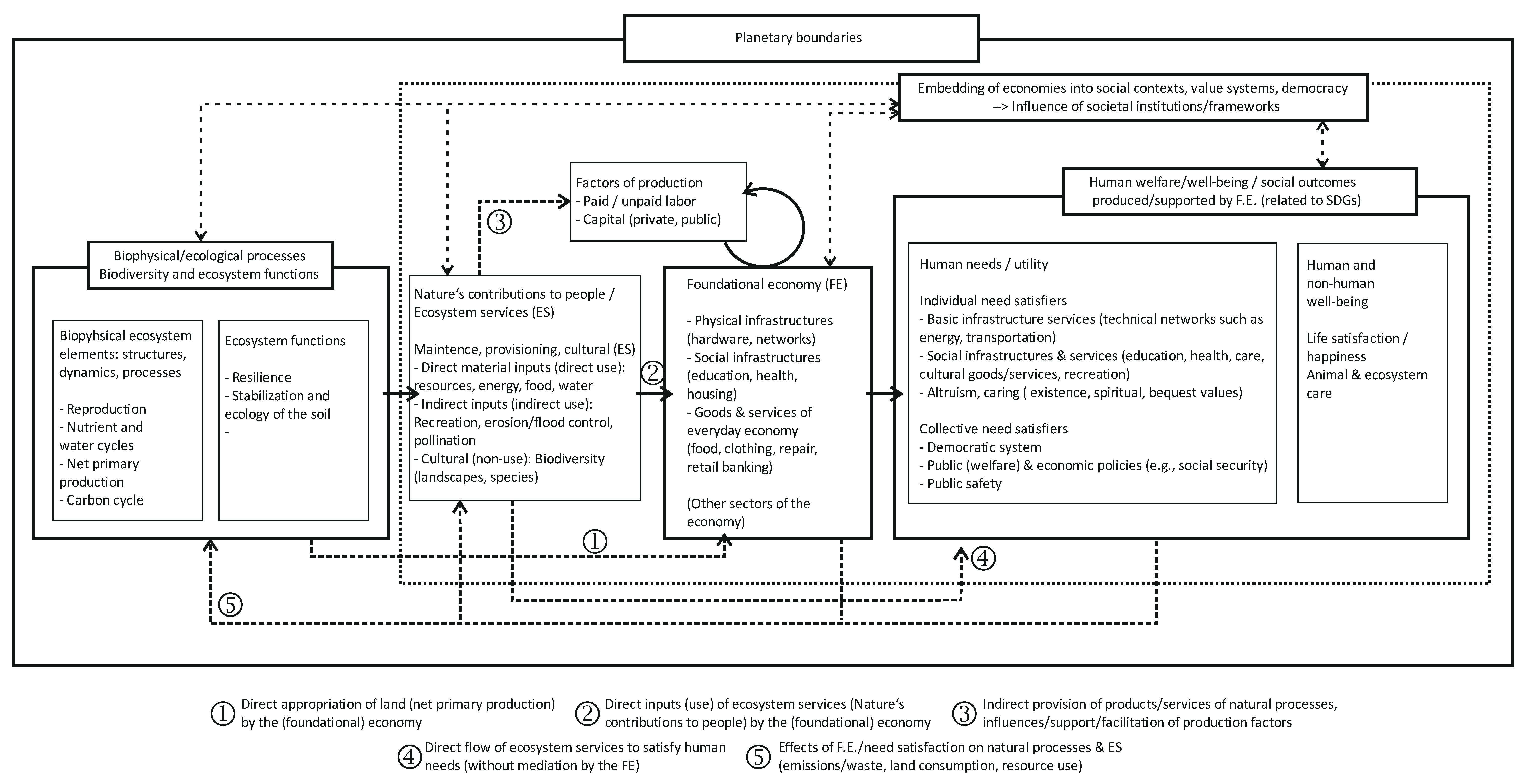
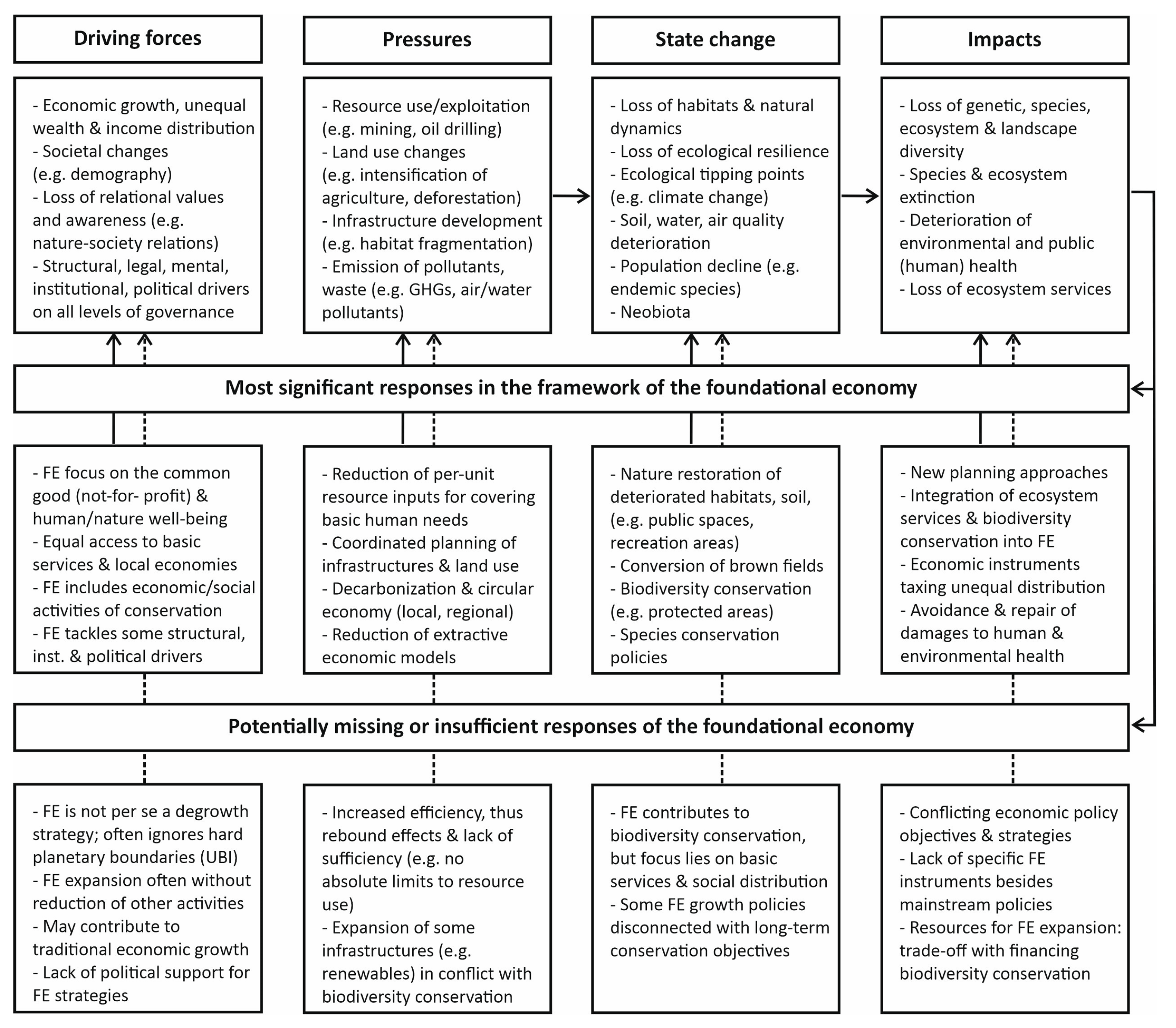
- -
- Essential local provisioning systems (see Table 1): Food systems are an essential part of the foundational economy [38]. However, designing food systems sustainably towards organic and local/regional agriculture may require the extension of areas for agriculture and could potentially conflict with biological conservation. Thus, such a transformation would not only change production systems but also make it necessary to alter consumption patterns, e.g., changing dietary habits [118,119,120]. FE models thus need complementary policies such as greening food systems and decarbonizing production to be effective in reducing the pressures on biodiversity.
- -
- Public infrastructures: For a sustainable mobility system, the FE would consider the improvement and expansion of public transport and bicycling infrastructure, some of which would need more resources and increase pressures on biodiversity (e.g., extension of rail networks). However, changing travel behaviors of households and shifting to green mobility also requires the reduction in private car use by means of sustainable transport policies, such as the reduction in environmentally counterproductive subsidies, taxing carbon emissions from private car use, electrification and reducing the capacities of public roads for car use (e.g., [121]).
4. FE Strategies Supporting Biodiversity Conservation
- Managing the socio-ecological transformation, including biodiversity conservation and restoration, requires good basic (foundational) services for all. This implies an expansion of public services of general interest based on “social rights” to satisfy human needs (cf. [40]). The FE is considered more resource-efficient and environmentally friendly on both the supply (production) and the demand side, compared to other economic models of provisioning (see the discussion in Section 2 in reference to Table 1). These effects of the FE directly reduce pressures on biodiversity.
- Expanding (public) services of general interest requires integrated, socially just, and ecologically sustainable approaches to minimize resource consumption and respect planetary boundaries, especially in regard to biodiversity conservation and restoration, and climate protection. A secure provision of everyday services has been shown to increase the willingness to devote resources to environmental causes, such as biodiversity conservation.
- The responsibility of the public sector (state, planning) and a focus on the common good and the public interest (i.e., not-for-profit/limited-profit) are fundamental prerequisites for future-oriented public services. This includes the remunicipalization of foundational services (see [118,122]) that are currently commodified or financialized (e.g., in the healthcare, care, housing sectors). Biodiversity conservation can be enhanced by reducing pressures and increasing resources for dealing with the impacts of biodiversity loss through reducing extractive business models and improving public planning.
- The expansion of public services of general interest should go hand-in-hand with democratizing them, and be accompanied by greater participation, more opportunities for co-creation, and co-design. Greater public responsibility for expanding services of general interest requires effective, formative public planning, which can increase citizens’ trust in public institutions and consequently, in environmental policies.
- The expansion and strengthening of the public interest/not-for-profit orientation of the foundational economy must also be anchored in international market and trade arrangements, such as the European Union (EU) regulatory (single market) frameworks.
5. Discussion, Summary, and Conclusions: Is the FE Biodiversity-Enhancing?
Funding
Institutional Review Board Statement
Informed Consent Statement
Data Availability Statement
Acknowledgments
Conflicts of Interest
References
- IPBES; Brondizio, E.; Diaz, S.; Settele, J.; Ngo, H.T. (Eds.) Global Assessment Report on Biodiversity and Ecosystem Services of the Intergovernmental Science-Policy Platform on Biodiversity and Ecosystem Services; Version 1; IPBES Secretariat: Bonn, Germany, 2019. [Google Scholar] [CrossRef]
- CBD. Convention on Biological Diversity; Secretariat for the Convention on Biological Diversity (CBD)/United Nations Environment Programme (UNEP): Montreal, QC, Canada, 2019. [Google Scholar]
- Perrings, C.; Naeem, S.; Ahrestani, F.S.; E Bunker, D.; Burkill, P.; Canziani, G.; Elmqvist, T.; Fuhrman, J.A.; Jaksic, F.M.; Kawabata, Z.; et al. Ecosystem services, targets, and indicators for the conservation and sustainable use of biodiversity. Front. Ecol. Environ. 2011, 9, 512–520. [Google Scholar] [CrossRef]
- Butchart, S.H.M.; Walpole, M.; Collen, B.; Van Strien, A.; Scharlemann, J.P.W.; Almond, R.E.A.; Baillie, J.E.M.; Bomhard, B.; Brown, C.; Bruno, J.; et al. Global Biodiversity: Indicators of Recent Declines. Science 2010, 328, 1164–1168. [Google Scholar] [CrossRef] [PubMed]
- Chandra, A.; Idrisova, A. Convention on Biological Diversity: A review of national challenges and opportunities for implementation. Biodivers. Conserv. 2011, 20, 3295–3316. [Google Scholar] [CrossRef]
- Damiani, M.; Sinkko, T.; Caldeira, C.; Tosches, D.; Robuchon, M.; Sala, S. Critical review of methods and models for biodiversity impact assessment and their applicability in the LCA context. Environ. Impact Assess. Rev. 2023, 101, 107134. [Google Scholar] [CrossRef]
- Schirpke, U.; Tasser, E.; Borsky, S.; Braun, M.; Eitzinger, J.; Gaube, V.; Getzner, M.; Glatzel, S.; Gschwantner, T.; Kirchner, M.; et al. Past and future impacts of land-use changes on ecosystem services in Austria. J. Environ. Manag. 2023, 345, 118728. [Google Scholar] [CrossRef]
- CBD. Kunming-Montreal Global Biodiversity Framework; Secretariat for the Convention on Biological Diversity (CBD): Montreal, QC, Canada, 2022; Available online: https://cbd.int/doc/decisions/cop-15/cop-15-dec-04-en.pdf (accessed on 15 August 2025).
- Boran, I.; Pettorelli, N. The Kunming–Montreal Global Biodiversity Framework and the Paris Agreement need a joint work programme for climate, nature and people. J. Appl. Ecol. 2024, 61, 1991–1999. [Google Scholar] [CrossRef]
- Hughes, A.C.; Grumbine, R.E. The Kunming-Montreal Global Biodiversity Framework: What it does and does not do, and how to improve it. Front. Environ. Sci. 2023, 11, 1281536. [Google Scholar] [CrossRef]
- Obura, D. The Kunming-Montreal Global Biodiversity Framework: Business as usual or a turning point? One Earth 2023, 6, 77–80. [Google Scholar] [CrossRef]
- Fanning, A.L.; O’Neill, D.W.; Büchs, M. Provisioning systems for a good life within planetary boundaries. Glob. Environ. Change 2020, 64, 102135. [Google Scholar] [CrossRef]
- Vogel, J.; Steinberger, J.K.; O’NEill, D.W.; Lamb, W.F.; Krishnakumar, J. Socio-economic conditions for satisfying human needs at low energy use: An international analysis of social provisioning. Glob. Environ. Change 2021, 69, 102287. [Google Scholar] [CrossRef]
- European Communities. Council Directive 92/43/EEC of 21 May 1992 on the conservation of natural habitats and of wild fauna and flora. Off. J. Eur. Communities 1992, 206, 50. Available online: https://eur-lex.europa.eu/legal-content/EN/TXT/PDF/?uri=OJ:L:1992:206:FULL (accessed on 15 August 2025).
- European Union. Directive 2009/147/EC of the European Parliament and of the Council of 30 November 2009 on the conservation of wild birds. Off. J. Eur. Union 2010, 20. Available online: https://eur-lex.europa.eu/legal-content/EN/TXT/PDF/?uri=OJ:L:2010:020:FULL (accessed on 15 August 2025).
- Jones-Walters, L.; Čivić, K. European protected areas: Past, present and future. J. Nat. Conserv. 2013, 21, 122–124. [Google Scholar] [CrossRef]
- Orlikowska, E.H.; Roberge, J.-M.; Blicharska, M.; Mikusiński, G. Gaps in ecological research on the world’s largest internationally coordinated network of protected areas: A review of Natura 2000. Biol. Conserv. 2016, 200, 216–227. [Google Scholar] [CrossRef]
- Portaccio, A.; Campagnaro, T.; Sitzia, T. Birds and Natura 2000: A review of the scientific literature. Bird Conserv. Int. 2022, 33, e20. [Google Scholar] [CrossRef]
- European Union. Regulation (EU) 2024/1991 of the European Parliament and of the Council of 24 June 2024 on nature restoration and amending Regulation (EU) 2022/869. Off. J. Eur. Union 2024. Available online: https://eur-lex.europa.eu/legal-content/EN/TXT/PDF/?uri=OJ:L_202401991 (accessed on 15 August 2025).
- The Foundational Economy Collective. Foundational Economy: The Infrastructure of Everyday Life; Manchester University Press: Manchester, UK, 2020. [Google Scholar]
- Competence Centre for Infrastructure Economics, Public Services and Social Provisioning. About The Economy We Need Every Day; Competence Centre for Infrastructure Economics, Public Services and Social Provisioning: Vienna, Austria. Available online: https://en.alltagsoekonomie.at/ (accessed on 21 August 2025).
- Bärnthaler, R.; Novy, A.; Plank, L. The Foundational Economy as a Cornerstone for a Social–Ecological Transformation. Sustainability 2021, 13, 10460. [Google Scholar] [CrossRef]
- Galvin, R.; Sunikka-Blank, M. Economic Inequality and Household Energy Consumption in High-income Countries: A Challenge for Social Science Based Energy Research. Ecol. Econ. 2018, 153, 78–88. [Google Scholar] [CrossRef]
- Kallis, G.; Hickel, J.; O’neill, D.W.; Jackson, T.; A Victor, P.; Raworth, K.; Schor, J.B.; Steinberger, J.K.; Ürge-Vorsatz, D. Post-growth: The science of wellbeing within planetary boundaries. Lancet Planet. Health 2025, 9, e62–e78. [Google Scholar] [CrossRef]
- Dengler, C.; Strunk, B. The Monetized Economy Versus Care and the Environment: Degrowth Perspectives On Reconciling an Antagonism. Fem. Econ. 2017, 24, 160–183. [Google Scholar] [CrossRef]
- Bärnthaler, R.; Gough, I. Provisioning for sufficiency: Envisaging production corridors. Sustain. Sci. Pr. Policy 2023, 19, 2218690. [Google Scholar] [CrossRef]
- Raworth, K. A Doughnut for the Anthropocene: Humanity’s compass in the 21st century. Lancet Planet. Health 2017, 1, e48–e49. [Google Scholar] [CrossRef]
- Berry, C. Labour’s ‘Everyday Economy’: Why, How, and for Whom? Political Q. 2022, 93, 691–699. [Google Scholar] [CrossRef]
- Getzner, M.; Damjanovic, D.; Dowling, E.; Plank, L.; Strickner, A.; Damböck, C.; Evers, P.; Kalhorn, A.F.; Pöchhacker, T. Daseinsvorsorge 2030: Gute Grundversorgung für Alle Innerhalb Planetarer Grenzen; Verlag Arbeiterkammer Wien: Vienna, Austria, 2024. [Google Scholar]
- Riepl, T.; Grabow, S. Assessing livability through human need theory: Insights from Vienna. Cities 2025, 167, 106336. [Google Scholar] [CrossRef]
- Costanza, R.; Fisher, B.; Ali, S.; Beer, C.; Bond, L.; Boumans, R.; Danigelis, N.L.; Dickinson, J.; Elliott, C.; Farley, J.; et al. Quality of life: An approach integrating opportunities, human needs, and subjective well-being. Ecol. Econ. 2007, 61, 267–276. [Google Scholar] [CrossRef]
- Akinci, M. Inequality and economic growth: Trickle-down effect revisited. Dev. Policy Rev. 2017, 36, O1–O24. [Google Scholar] [CrossRef]
- Riepl, T.; Schaffartzik, A.; Grabow, S.; Banabak, S. Living well with the foundational economy: Assessing the spatial accessibility of foundational infrastructures in Vienna and the relationship to socio-economic status. Ecol. Econ. 2025, 232, 108558. [Google Scholar] [CrossRef]
- Crisp, R.; Waite, D.; Green, A.; Hughes, C.; Lupton, R.; MacKinnon, D.; Pike, A. ‘Beyond GDP’ in cities: Assessing alternative approaches to urban economic development. Urban Stud. 2023, 61, 1209–1229. [Google Scholar] [CrossRef]
- Earle, J.; Froud, J.; Johal, S.; Williams, K. Foundational economy and foundational politics. Welsh Econ. Rev. 2018, 26, 38. [Google Scholar] [CrossRef]
- Sissons, P.; Green, A. Facing up to the foundational economy: Regional development, public policy and employment in Wales. Reg. Stud. 2025, 59, 2435521. [Google Scholar] [CrossRef]
- Shin, Y.; Midgley, G.F.; Archer, E.R.M.; Arneth, A.; Barnes, D.K.A.; Chan, L.; Hashimoto, S.; Hoegh-Guldberg, O.; Insarov, G.; Leadley, P.; et al. Actions to halt biodiversity loss generally benefit the climate. Glob. Change Biol. 2022, 28, 2846–2874. [Google Scholar] [CrossRef] [PubMed]
- Engelen, E.; Froud, J.; Johal, S.; Salento, A.; Williams, K. The grounded city: From competitivity to the foundational economy. Camb. J. Reg. Econ. Soc. 2017, 10, 407–423. [Google Scholar] [CrossRef]
- Thompson, M. Whatever happened to municipal radicalism? Trans. Inst. Br. Geogr. 2023, 48, 603–618. [Google Scholar] [CrossRef]
- Essletzbichler, J. Engaging with precarious urban futures: From entrepreneurial to grounded cities. Eur. Urban Reg. Stud. 2022, 29, 419–439. [Google Scholar] [CrossRef]
- Amador-Cruz, F.; Figueroa-Rangel, B.L.; Olvera-Vargas, M.; Mendoza, M.E. A systematic review on the definition, criteria, indicators, methods and applications behind the Ecological Value term. Ecol. Indic. 2021, 129, 107856. [Google Scholar] [CrossRef]
- Johansson, P.-O. Cost-Benefit Analysis of Environmental Change, 1st ed.; Cambridge University Press (CUP): Cambridge, UK, 1993. [Google Scholar] [CrossRef]
- Kumar, P. (Ed.) The Economics of Ecosystems and Biodiversity: Ecological and Economic Foundations; Earthscan: London, UK, 2010. [Google Scholar]
- Himes, A.; Muraca, B. Relational values: The key to pluralistic valuation of ecosystem services. Curr. Opin. Environ. Sustain. 2018, 35, 1–7. [Google Scholar] [CrossRef]
- Himes, A.; Puettmann, K.; Muraca, B. Trade-offs between ecosystem services along gradients of tree species diversity and values. Ecosyst. Serv. 2020, 44, 101133. [Google Scholar] [CrossRef]
- Intergovernmental Science-Policy Platform on Biodiversity and Ecosystem Services; Balvanera, P.; Pascual, U.; Christie, M.; González-Jiménez, D. Methodological Assessment of the Diverse Values and Valuation of Nature of the Intergovernmental Science-Policy Platform on Biodiversity and Ecosystem Services; IPBES Secretariat: Bonn, Germany, 2022. [Google Scholar] [CrossRef]
- Plank, L.; Krisch, A.; Novy, A.; Blaas, W. Die Leistungsträgerinnen des Alltagslebens; Kammer für Arbeiter und Angestellte für Wien: Vienna, Austria, 2020; Available online: http://hdl.handle.net/20.500.12708/107941 (accessed on 1 September 2025).
- Getzner, M.; Jungmeier, M.; Lange, S.; Croft, R. People, Parks and Money: Stakeholder Involvement and Regional Development: A Manual for Protected Areas; Johannes Heyn: Klagenfurt, Austria, 2010. [Google Scholar]
- Götmark, F. Habitat management alternatives for conservation forests in the temperate zone: Review, synthesis, and implications. For. Ecol. Manag. 2013, 306, 292–307. [Google Scholar] [CrossRef]
- Bärnthaler, R.; Mang, S.; Hickel, J. Toward a post-growth industrial policy for Europe: Navigating emerging tensions and long-term goals. Globalizations 2025, 22, 1124–1148. [Google Scholar] [CrossRef]
- Antal, M.; Plank, B.; Mokos, J.; Wiedenhofer, D. Is working less really good for the environment? A systematic review of the empirical evidence for resource use, greenhouse gas emissions and the ecological footprint. Environ. Res. Lett. 2020, 16, 013002. [Google Scholar] [CrossRef]
- Sorrell, S.; Gatersleben, B.; Druckman, A. The limits of energy sufficiency: A review of the evidence for rebound effects and negative spillovers from behavioural change. Energy Res. Soc. Sci. 2020, 64, 101439. [Google Scholar] [CrossRef]
- Prieto, Á.M.; Zofío, J.L.; Álvarez, I. Cost economies, urban patterns and population density: The case of public infrastructure for basic utilities. Pap. Reg. Sci. 2015, 94, 795–817. [Google Scholar] [CrossRef]
- Wudu, K.; Abegaz, A.; Ayele, L.; Ybabe, M. The impacts of climate change on biodiversity loss and its remedial measures using nature based conservation approach: A global perspective. Biodivers. Conserv. 2023, 32, 3681–3701. [Google Scholar] [CrossRef]
- Cong, R.-G.; Thomsen, M. Review of ecosystem services in a bio-based circular economy and governance mechanisms. Ecosyst. Serv. 2021, 50, 101298. [Google Scholar] [CrossRef]
- Barbera, F. Material and “providential” social infrastructures: A foundational economy perspective. In Handbook of Social Infrastructure; Renner, A.-T., Plank, L., Getzner, M., Eds.; Edward Elgar Publishing: Cheltenham, UK, 2024; pp. 350–363. [Google Scholar] [CrossRef]
- Ayassamy, P. The Relationship between Biodiversity, Circular Economy, and Institutional Investors in the Sustainable Transition: A Mixed Review. Circ. Econ. Sustain. 2024, 4, 3171–3182. [Google Scholar] [CrossRef]
- Díaz, S.; Malhi, Y. Biodiversity: Concepts, Patterns, Trends, and Perspectives. Annu. Rev. Environ. Resour. 2022, 47, 31–63. [Google Scholar] [CrossRef]
- Haines-Young, R. Land use and biodiversity relationships. Land Use Policy 2009, 26, S178–S186. [Google Scholar] [CrossRef]
- Goldenberg, S.U.; Nagelkerken, I.; Marangon, E.; Bonnet, A.; Ferreira, C.M.; Connell, S.D. Ecological complexity buffers the impacts of future climate on marine consumers. Nat. Clim. Change 2018, 8, 229–233. [Google Scholar] [CrossRef]
- Lim, F.K.S.; Carrasco, L.R.; McHardy, J.; Edwards, D.P. Perverse Market Outcomes from Biodiversity Conservation Interventions. Conserv. Lett. 2017, 10, 506–516. [Google Scholar] [CrossRef]
- Polasky, S.; Costello, C.; McAusland, C. On trade, land-use, and biodiversity. J. Environ. Econ. Manag. 2004, 48, 911–925. [Google Scholar] [CrossRef]
- Balmford, A.; Ball, T.S.; Balmford, B.; Bateman, I.J.; Buchanan, G.; Cerullo, G.; D’aLbertas, F.; Eyres, A.; Filewod, B.; Fisher, B.; et al. Time to fix the biodiversity leak. Science 2025, 387, 720–722. [Google Scholar] [CrossRef]
- Renwick, A.R.; Bode, M.; Venter, O. Reserves in Context: Planning for Leakage from Protected Areas. PLoS ONE 2015, 10, e0129441. [Google Scholar] [CrossRef]
- Pan, W.; Kim, M.-K.; Ning, Z.; Yang, H. Carbon leakage in energy/forest sectors and climate policy implications using meta-analysis. For. Policy Econ. 2020, 115, 102161. [Google Scholar] [CrossRef]
- Getzner, M. Public Recreation Areas as Social Infrastructure: Empirical Results from Vienna. In Handbook of Social Infrastructure; Renner, A.-T., Plank, L., Getzner, M., Eds.; Edward Elgar Publishing: Cheltenham, UK, 2024; pp. 273–286. [Google Scholar]
- Sordello, R.; Cornuau, J.; Coulon, A.; Paquier, F.; Reyjol, Y.; Vanpeene, S. Manifesto for multidimensional ecological networks: A perspective to better account for the complexity of habitat loss and fragmentation. Landsc. Ecol. 2025, 40, 110. [Google Scholar] [CrossRef]
- Crona, B.; Peterson, G.; Meacham, M.; Parlato, G.; Lade, S.J.; Rocha, J.C.; Galaz, V. A systems approach to sustainable finance: Actors, influence mechanisms, and potentially virtuous cycles of sustainability. iScience 2025, 28, 112785. [Google Scholar] [CrossRef] [PubMed]
- Mar’i, M.; Seraj, M.; Tursoy, T. Investigating the Causality Between Financial Development and Carbon Emissions: A Quantile-Based Analysis. Environ. Sci. Pollut. Res. 2023, 30, 92983–93001. [Google Scholar] [CrossRef] [PubMed]
- Schaffartzik, A.; Pichler, M.; Pineault, E.; Wiedenhofer, D.; Gross, R.; Haberl, H. The transformation of provisioning systems from an integrated perspective of social metabolism and political economy: A conceptual framework. Sustain. Sci. 2021, 16, 1405–1421. [Google Scholar] [CrossRef]
- Carroll, W.K.; Sapinski, J.P. Organizing the 1%: How Corporate Power Works; Fernwood Publishing: Black Point, NS, Canada, 2018. [Google Scholar]
- Vogel, J.; Guerin, G.; O’Neill, D.W.; Steinberger, J.K. Safeguarding livelihoods against reductions in economic output. Ecol. Econ. 2023, 215, 107977. [Google Scholar] [CrossRef]
- Kumlin, S.; Stadelmann-Steffen, I.; Haugsgjerd, A. Trust and the Welfare State; Uslaner, E.M., Ed.; Oxford University Press (OUP): Oxford, UK, 2017; Volume 1. [Google Scholar] [CrossRef]
- Inglehart, R.F. Changing Values among Western Publics from 1970 to 2006. West Eur. Politics 2008, 31, 130–146. [Google Scholar] [CrossRef]
- Si, W.; Jiang, C.; Meng, L. The Relationship between Environmental Awareness, Habitat Quality, and Community Residents’ Pro-Environmental Behavior—Mediated Effects Model Analysis Based on Social Capital. Int. J. Environ. Res. Public Health 2022, 19, 13253. [Google Scholar] [CrossRef]
- Davidovic, D.; Harring, N.; Jagers, S.C. The contingent effects of environmental concern and ideology: Institutional context and people’s willingness to pay environmental taxes. Environ. Politics 2019, 29, 674–696. [Google Scholar] [CrossRef]
- Harring, N.; Jagers, S.C. Should We Trust in Values? Explaining Public Support for Pro-Environmental Taxes. Sustainability 2013, 5, 210–227. [Google Scholar] [CrossRef]
- Sjöstrand, S. Social and environmental protection: The effects of social insurance generosity on the acceptance of material sacrifices for the sake of environmental protection. J. Soc. Policy 2024, 54, 249–269. [Google Scholar] [CrossRef]
- Jones, N.; Malesios, C.; Botetzagias, I. The influence of social capital on willingness to pay for the environment among european citizens. Eur. Soc. 2009, 11, 511–530. [Google Scholar] [CrossRef]
- Koch, M.; Fritz, M. Building the Eco-social State: Do Welfare Regimes Matter? J. Soc. Policy 2014, 43, 679–703. [Google Scholar] [CrossRef]
- Hasanaj, V. The shift towards an eco-welfare state: Growing stronger together. J. Int. Comp. Soc. Policy 2023, 39, 42–63. [Google Scholar] [CrossRef]
- Parth, A.-M.; Vlandas, T. The welfare state and support for environmental action in Europe. J. Eur. Soc. Policy 2022, 32, 531–547. [Google Scholar] [CrossRef]
- Schroeder, S.K. The Impacts of Climate Change on Industries and Financial Fragility. J. Econ. Issues 2024, 58, 1057–1065. [Google Scholar] [CrossRef]
- Armitage, D.; Mbatha, P.; Muhl, E.; Rice, W.; Sowman, M. Governance principles for community-centered conservation in the post-2020 global biodiversity framework. Conserv. Sci. Pr. 2020, 2, e160. [Google Scholar] [CrossRef]
- Bosák, V.; Slach, O.; Paszová, L.; Hýllová, L.; Mykhnenko, V.; Krtička, L.; Nováček, A. Coping with peripheralization in small cities. What is the role of human agency? Eur. Plan. Stud. 2023, 32, 2360–2380. [Google Scholar] [CrossRef]
- Bahers, J.-B.; Rutherford, J. Urban infrastructures, metabolic resource flows and the contradictions of circular economy ‘solutions’ in Nantes and Gothenburg. Urban Stud. 2024, 62, 1897–1918. [Google Scholar] [CrossRef]
- Arboleda, M. In the Nature of the Non-City: Expanded Infrastructural Networks and the Political Ecology of Planetary Urbanisation. Antipode 2015, 48, 233–251. [Google Scholar] [CrossRef]
- Krausmann, F. A City and Its Hinterland: Vienna’s Energy Metabolism 1800–2006. In Long Term Socio-Ecological Research; Singh, S.J., Haberl, H., Chertow, M., Mirtl, M., Schmid, M., Eds.; Springer: Dordrecht, The Netherlands, 2013; pp. 247–268. [Google Scholar] [CrossRef]
- Bringezu, S.; Potočnik, J.; Schandl, H.; Lu, Y.; Ramaswami, A.; Swilling, M.; Suh, S. Multi-Scale Governance of Sustainable Natural Resource Use—Challenges and Opportunities for Monitoring and Institutional Development at the National and Global Level. Sustainability 2016, 8, 778. [Google Scholar] [CrossRef]
- Christiansen, J.; Irvine-Broque, A.; Dempsey, J.; Nelson, S.; Shapiro-Garza, E.; Bigger, P.; Islar, M. Off the charts? Reasons to be skeptical of the growth in biodiversity finance. Curr. Opin. Environ. Sustain. 2025, 75, 101544. [Google Scholar] [CrossRef]
- Seto, K.C.; Davis, S.J.; Mitchell, R.B.; Stokes, E.C.; Unruh, G.; Ürge-Vorsatz, D. Carbon Lock-In: Types, Causes, and Policy Implications. Annu. Rev. Environ. Resour. 2016, 41, 425–452. [Google Scholar] [CrossRef]
- Brand, U.; Hausknost, D.; Brad, A.; Eyselein, G.; Krams, M.; Maneka, D.; Pichler, M.; Schneider, E. Structural limitations of the decarbonization state. Nat. Clim. Change 2025, 15, 927–934. [Google Scholar] [CrossRef]
- Brand-Correa, L.I.; Steinberger, J.K. A Framework for Decoupling Human Need Satisfaction From Energy Use. Ecol. Econ. 2017, 141, 43–52. [Google Scholar] [CrossRef]
- Rydin, Y. A postgrowth response to Savini’s degrowth vision. Plan. Theory 2024, 24, 183–187. [Google Scholar] [CrossRef]
- Savini, F. Degrowth, legitimacy, and the foundational economy: A response to Rydin. Plan. Theory 2024, 24, 188–192. [Google Scholar] [CrossRef]
- Savini, F. Strategic planning for degrowth: What, who, how. Plan. Theory 2024, 24, 141–162. [Google Scholar] [CrossRef] [PubMed]
- Bonfert, B. ‘We like sharing energy but currently there’s no advantage’: Transformative opportunities and challenges of local energy communities in Europe. Energy Res. Soc. Sci. 2023, 107, 103351. [Google Scholar] [CrossRef]
- Calafati, L.; Froud, J.; Haslam, C.; Johal, S.; Williams, K. Meeting Social Needs on a Damaged Planet: Foundational Economy 2.0 and the Careful Practice of Radical Policy; Working Paper No. 8/2021; Foundational Economy Collective: 2021. Available online: https://foundationaleconomy.com/wp-content/uploads/2021/01/fe-wp8-meeting-social-needs-on-a-damaged-planet.pdf (accessed on 20 August 2025).
- Ekkel, E.D.; de Vries, S. Nearby green space and human health: Evaluating accessibility metrics. Landsc. Urban Plan. 2017, 157, 214–220. [Google Scholar] [CrossRef]
- Büchs, M. Sustainable welfare: How do universal basic income and universal basic services compare? Ecol. Econ. 2021, 189, 107152. [Google Scholar] [CrossRef]
- Coote, A. Towards a Sustainable Welfare State: The Role of Universal Basic Services. Soc. Policy Soc. 2021, 21, 473–483. [Google Scholar] [CrossRef]
- Getzner, M. On the Public Provision of Universal Basic Services (Ubs) Compared to Universal Basic Income (UBI); Vienna University of Technology: Vienna, Austria, 2024. [Google Scholar] [CrossRef]
- Thompson, M. Money for everything? Universal basic income in a crisis. Econ. Soc. 2022, 51, 353–374. [Google Scholar] [CrossRef]
- Coenen, L.; Morgan, K. Evolving geographies of innovation: Existing paradigms, critiques and possible alternatives. Nor. Geogr. Tidsskr. Nor. J. Geogr. 2019, 74, 13–24. [Google Scholar] [CrossRef]
- Edgerton, D. Why the Everyday Economy is the Innovation Labour Needs. Political Q. 2022, 93, 683–690. [Google Scholar] [CrossRef]
- Russell, B.; Beel, D.; Jones, I.R.; Jones, M. Placing the Foundational Economy: An emerging discourse for post-neoliberal economic development. Environ. Plan. A Econ. Space 2022, 54, 1069–1085. [Google Scholar] [CrossRef]
- Rainnie, A. (Far) beyond smart specialisation to the foundational economy in Australia? Econ. Labour Relations Rev. 2023, 34, 594–609. [Google Scholar] [CrossRef]
- Plank, L. Reframing Public Ownership in the Foundational Economy: (Re)discovering a Variety of Forms. In The Foundational Economy and Citizenship; Barbera, F., Jones, I.R., Eds.; Policy Press: Bristol, UK, 2020; pp. 51–72. [Google Scholar]
- Flaherty, E. Complexity and Resilience in the Social and Ecological Sciences; Palgrave Macmillan: London, UK, 2019. [Google Scholar] [CrossRef]
- Landi, P.; Minoarivelo, H.O.; Brännström, Å.; Hui, C.; Dieckmann, U. Complexity and stability of ecological networks: A review of the theory. Popul. Ecol. 2018, 60, 319–345. [Google Scholar] [CrossRef]
- Maurer, B.A. Untangling Ecological Complexity: The Macroscopic Perspective; University of Chicago Press: Chicago, IL, USA, 1999. [Google Scholar]
- Weiskopf, S.R.; E Myers, B.J.; Arce-Plata, M.I.; Blanchard, J.L.; Ferrier, S.; A Fulton, E.; Harfoot, M.; Isbell, F.; A Johnson, J.; Mori, A.S.; et al. A Conceptual Framework to Integrate Biodiversity, Ecosystem Function, and Ecosystem Service Models. BioScience 2022, 72, 1062–1073. [Google Scholar] [CrossRef] [PubMed]
- Díaz, S.; Pascual, U.; Stenseke, M.; Martín-López, B.; Watson, R.T.; Molnár, Z.; Hill, R.; Chan, K.M.A.; Baste, I.A.; Brauman, K.A.; et al. Assessing nature’s contributions to people. Science 2018, 359, 270–272. [Google Scholar] [CrossRef]
- Mori, A.S.; Furukawa, T.; Sasaki, T. Response diversity determines the resilience of ecosystems to environmental change. Biol. Rev. 2012, 88, 349–364. [Google Scholar] [CrossRef] [PubMed]
- Dasgupta, P. The Economics of Biodiversity: The Dasgupta Review: Full Report; HM Treasury: London, UK, 2021.
- Haines-Young, R.; Potschin, M. The links between biodiversity, ecosystem services and human well-being. In Ecosystem Ecology: A New Synthesis, 1st ed.; Raffaelli, D.G., Frid, C.L.J., Eds.; Cambridge University Press: Cambridge, UK, 2012; pp. 110–139. [Google Scholar] [CrossRef]
- O’nEill, D.W.; Fanning, A.L.; Lamb, W.F.; Steinberger, J.K. A good life for all within planetary boundaries. Nat. Sustain. 2018, 1, 88–95. [Google Scholar] [CrossRef]
- Schlesier, H.; Schäfer, M.; Desing, H. Measuring the Doughnut: A good life for all is possible within planetary boundaries. J. Clean. Prod. 2024, 448, 141447. [Google Scholar] [CrossRef]
- Erb, K.-H.; Matej, S.; Haberl, H.; Gingrich, S. Sustainable land systems in the Anthropocene: Navigating the global land squeeze. One Earth 2024, 7, 1170–1186. [Google Scholar] [CrossRef]
- Desing, H.; Widmer, R.; Beloin-Saint-Pierre, D.; Hischier, R.; Wäger, P. Powering a Sustainable and Circular Economy—An Engineering Approach to Estimating Renewable Energy Potentials within Earth System Boundaries. Energies 2019, 12, 4723. [Google Scholar] [CrossRef]
- Gallo, M.; Marinelli, M. Sustainable Mobility: A Review of Possible Actions and Policies. Sustainability 2020, 12, 7499. [Google Scholar] [CrossRef]
- McDonald, D.A. Landscapes of Remunicipalization: A Critical Literature Review. Urban Aff. Rev. 2024, 60, 1898–1930. [Google Scholar] [CrossRef]
- Walker, C.C.; Druckman, A.; Jackson, T. A critique of the marketisation of long-term residential and nursing home care. Lancet Healthy Longev. 2022, 3, e298–e306. [Google Scholar] [CrossRef]
- Millward-Hopkins, J.; Steinberger, J.K.; Rao, N.D.; Oswald, Y. Providing decent living with minimum energy: A global scenario. Glob. Environ. Change 2020, 65, 102168. [Google Scholar] [CrossRef]
Disclaimer/Publisher’s Note: The statements, opinions and data contained in all publications are solely those of the individual author(s) and contributor(s) and not of MDPI and/or the editor(s). MDPI and/or the editor(s) disclaim responsibility for any injury to people or property resulting from any ideas, methods, instructions or products referred to in the content. |
© 2025 by the author. Licensee MDPI, Basel, Switzerland. This article is an open access article distributed under the terms and conditions of the Creative Commons Attribution (CC BY) license (https://creativecommons.org/licenses/by/4.0/).
Share and Cite
Getzner, M. Conceptualizing the Foundational Economy as a Cornerstone of Biodiversity Conservation and Restoration. Sustainability 2025, 17, 11296. https://doi.org/10.3390/su172411296
Getzner M. Conceptualizing the Foundational Economy as a Cornerstone of Biodiversity Conservation and Restoration. Sustainability. 2025; 17(24):11296. https://doi.org/10.3390/su172411296
Chicago/Turabian StyleGetzner, Michael. 2025. "Conceptualizing the Foundational Economy as a Cornerstone of Biodiversity Conservation and Restoration" Sustainability 17, no. 24: 11296. https://doi.org/10.3390/su172411296
APA StyleGetzner, M. (2025). Conceptualizing the Foundational Economy as a Cornerstone of Biodiversity Conservation and Restoration. Sustainability, 17(24), 11296. https://doi.org/10.3390/su172411296

