Toward Fair and Sustainable Regional Development: A Multidimensional Framework for Allocating Public Investments in Türkiye


Abstract
1. Introduction
2. Materials and Methods
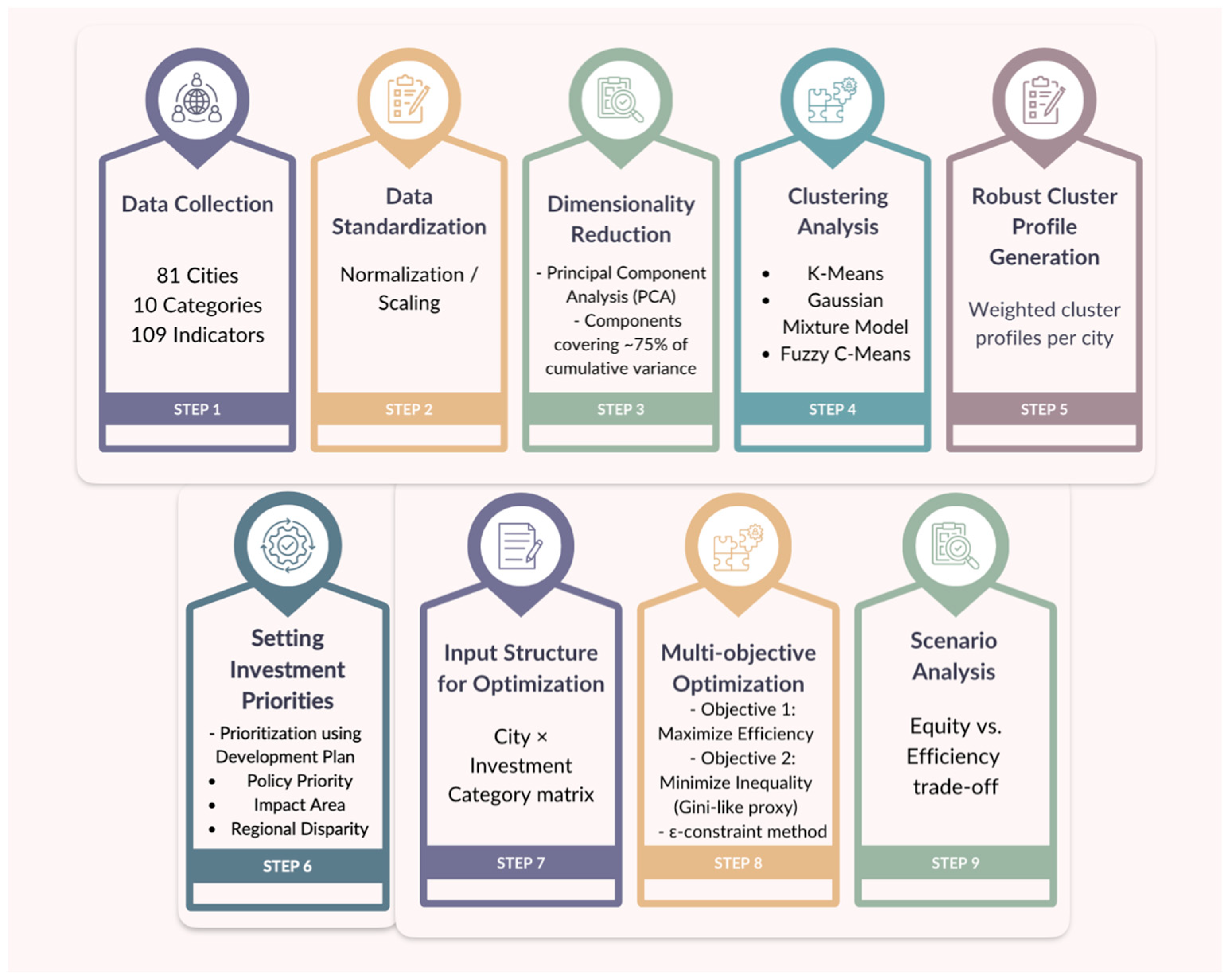
2.1. Data Processing and PCA-Based Dimensionality Reduction
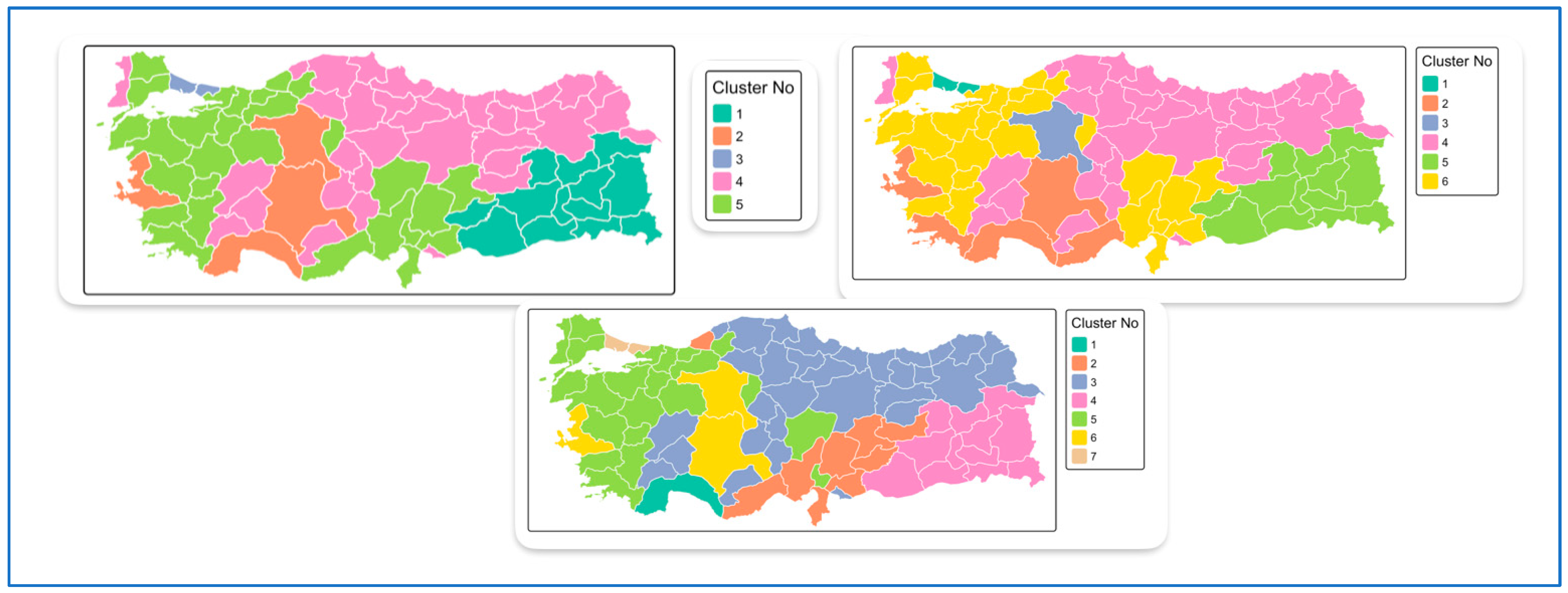
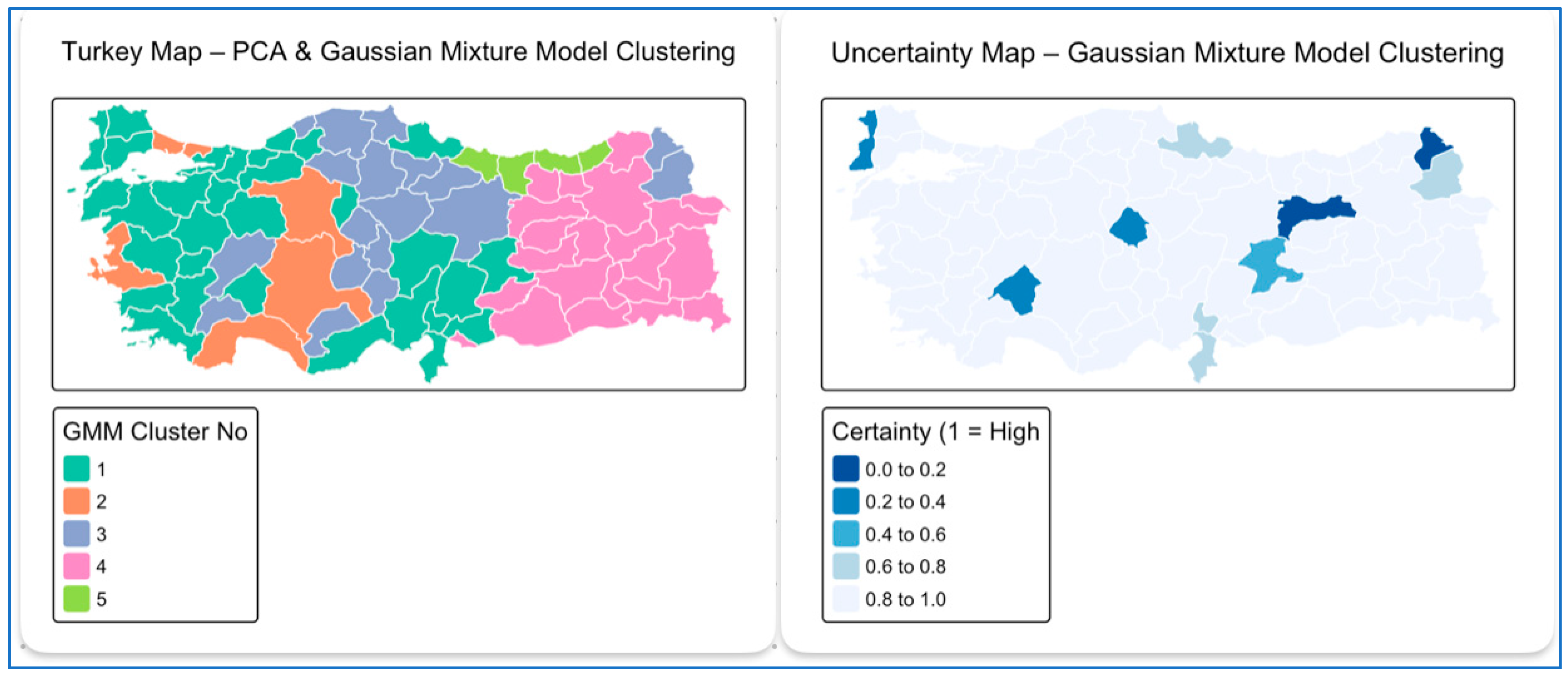
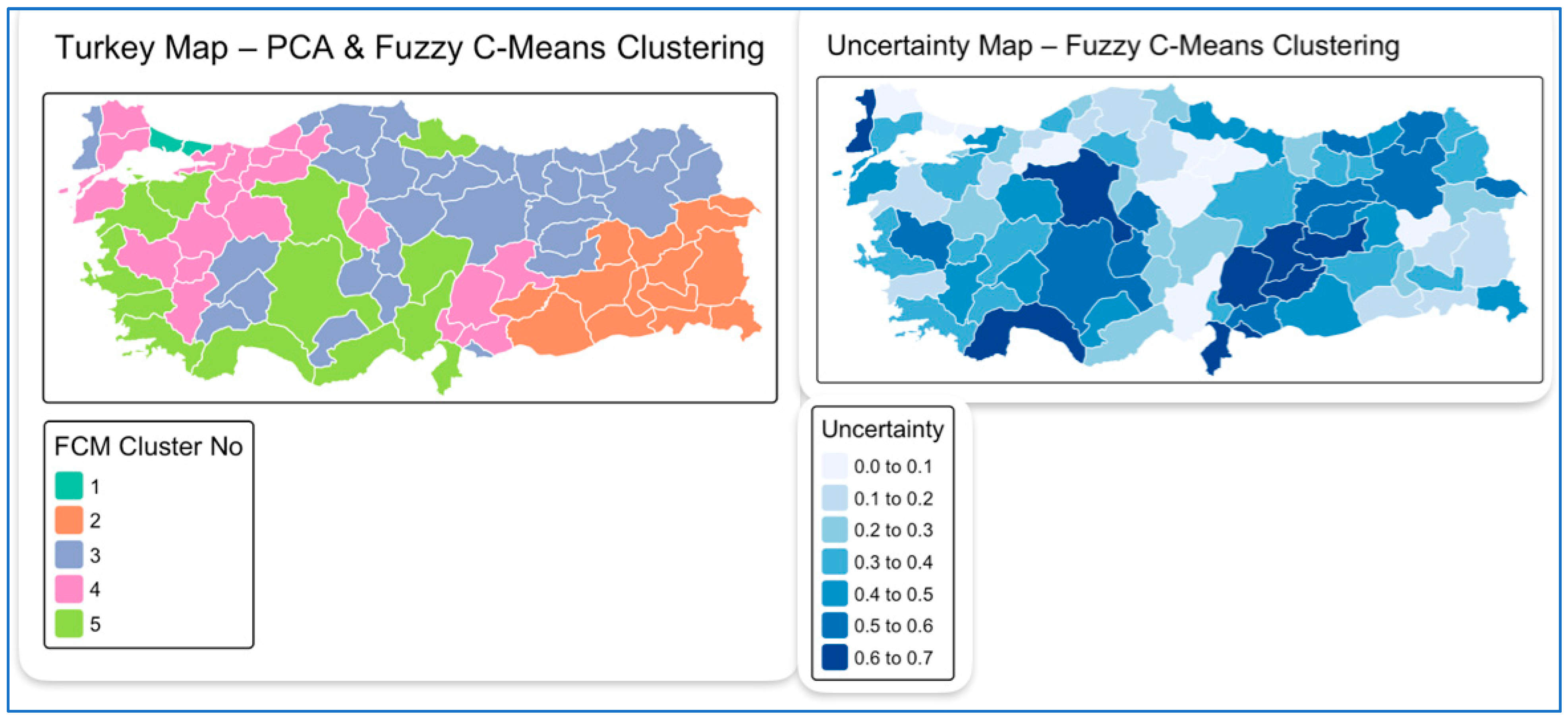
2.2. Clustering Analysis and Robust Profile Generation
2.3. Setting Investment Priorities Based on the 12th Development Plan
- Policy Priority (1–3): this demonstrates the degree to which the development plan strategically highlighted the investment area:
- “High-priority” (3 points) areas are covered in the Priority Policies’ and Transformation Areas’ parts of the development plan and supported by independent action plans (such as Education, Industry and Technology, and Digitalization).
- “Moderate-priority” (2 points) areas are mentioned in the plan in a limited number of targets.
- “Low-priority” (1 point) domains are mentioned indirectly or have relatively low weight in the overall policy framework.
- Impact Area (1–3): this shows how widely the economic and social impacts of the investment are distributed over the region and sector:
- “High-impact” (3 points) categories (like Education, Transportation) impact more than one sector and create regional synergy.
- “Moderate-impact” (2 points) categories (like Tourism, Energy, and Agriculture) generate a strong regional impact; however, they show limited cross-sectoral diffusion.
- “Low-impact” (1 point) categories (like Justice, Administration) represent investments whose influence is narrower in social and economic terms.
- Regional Disparity (1–3): this measures the potential impact of reducing interregional development gaps:
- “High-potential” (3 points) categories (like Agriculture and Rural Development, Infrastructure, and Education) have a strong capacity to reduce regional asymmetries.
- “Moderate-potential” (2 points) categories (like Industry, Digitalization) tend to concentrate in city centers; however, they provide moderate spatial diffusion.
- “Low-potential” (1 point) categories (like Justice, Security) are more uniformly distributed across the country but have very limited ability to reduce spatial disparities among the provinces.
2.4. Calculating Province Investment Weights
- Direct effects: Subcategories classified as direct effects are those that influence an investment area through an immediate and domain-specific mechanism. These indicators represent capacities or needs that are directly targeted by the investment category and that can be altered through policy intervention within that domain. For example, “Years of Schooling” directly reflects educational attainment and therefore corresponds to the Education and Human Capital investment area.
- Indirect or supporting effects: Subcategories classified as indirect effects influence an investment domain through secondary, enabling, or demographic pathways rather than through a direct functional mechanism. These indicators shape the context within which an investment area operates and can affect the efficiency or effectiveness of public investments, but they are not themselves the primary target of such investments. For example, “Population Change” influences long-term demand for Health and Social Services, yet it is not a direct measure of health system capacity.
- Subcategories with positive impacts (such as “Educational Attainment”, “Employment Rate”).
- Subcategories with negative impacts (such as “Unemployment”, “Crime Rate”).
2.5. Multi-Objective Optimization: Efficiency vs. Equity Model
- (1)
- Efficiency—maximizing the public utility of the total government investment.
- (2)
- Equity—minimizing the disparities in investment distribution across provinces.
- The mathematical model is formulated as below:
- Index Sets:
- Parameters:
Benefit score of allocating investment to province in category Weight factor representing diminishing returns for investment segment s (lower segments receive higher weights). . Upper boundary (breakpoint) of segment s in the piecewise investment function. Minimum required share for investment category j based on policy priorities. . Equity tolerance parameter, determining the maximum acceptable disparity between provinces. . Total investment budget (normalized to 100).
| Total amount of investment allocated to province in category | |
| Portion of investment allocated to segment s (piecewise representation). | |
| Total investment assigned to province . | |
| Cluster-level investment plan for category shared by all provinces within cluster ). |
- Objective function:
- Constraints:
- Piecewise segmentation
- 2.
- Cluster based allocation
- 3.
- Budget constraint
- 4.
- Minimum investment share per province–category
- 5.
- Province-level min–max bounds
- 6.
- Category-level minimum
- 7.
- Equity constraint (Gini-like proxy)
- 8.
- Nonnegativity constraints
3. Results
3.1. PCA and Clustering Descriptive Results
3.2. Robust Provincial Profiles and Investment Potentials
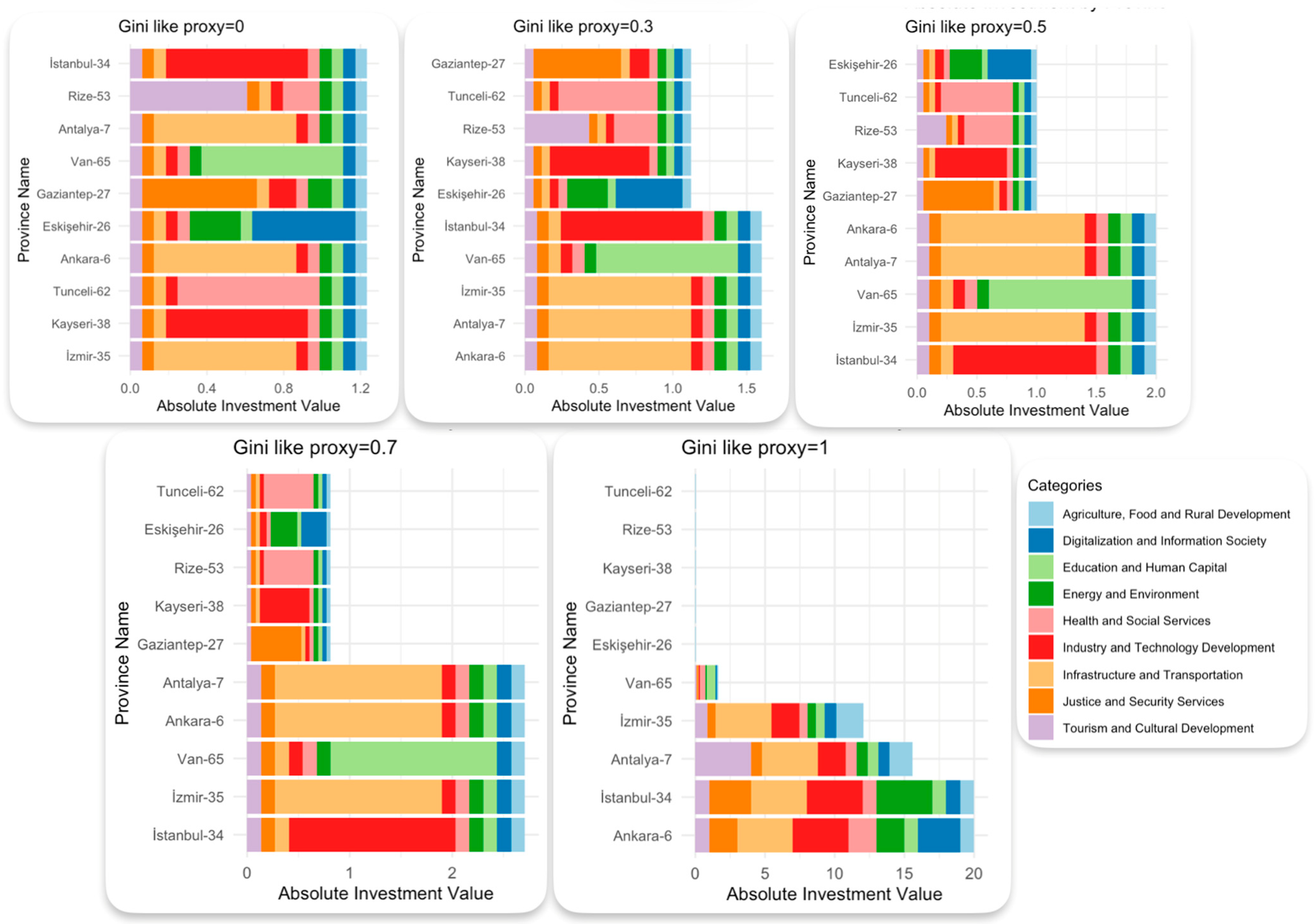
3.3. Scenario-Based Optimization and Equity–Efficiency Trade-Off
- Supplementary Material—SA: Raw indicator dataset containing the original provincial values for all 109 indicators.
- Supplementary Material—SC: Investment allocation tables for each G value, including both category-level and total investment allocations for all provinces.
4. Discussion and Implications
- (1)
- Province-level needs identification: With PCA + multiple clustering algorithms (K-Means, GMM, FCM), the socioeconomic structures of the provinces were extracted as robust provincial profiles. This approach goes beyond only income-level-based criteria and represents the multidimensional capacity and need structures of the provinces.
- (2)
- Policy-aligned investment prioritization: The document-based content assessment for the 12th Development Plan is a policy-integrated investment classification that is rarely used in the literature. Thus, investment categories were modeled in a quantified manner in line with national strategies.
- (3)
- Normative multi-objective optimization: The model, which includes an adjustable equity constraint (G-parameter), clearly reveals efficiency–equity trade-off behavior at different inequality tolerance levels. In this respect, this study offers a normative and practical decision support tool by going beyond the explanatory character of the previous literature.
- i.
- The transition from ex post explanatory models to an ex ante optimization approach.
- ii.
- The transition from one-dimensional indicators to the use of multidimensional provincial profiles.
- iii.
- The transition from general regional analyses to province-specific investment allocation.
5. Conclusions
Supplementary Materials
Funding
Institutional Review Board Statement
Informed Consent Statement
Data Availability Statement
Conflicts of Interest
Abbreviations
| PCA | Principal Component Analysis |
| PC | Principal Component |
| GMM | Gaussian Mixture Model |
| FCM | Fuzzy C-Means |
| TSI | Turkish Statistical Institute |
| BIC | Bayesian Information Criterion |
| SPV | Subcategory Profile Vector |
Appendix A

| Category | Subcategory | Indicator | Category | Subcategory | Indicator |
|---|---|---|---|---|---|
| Economic Performance/Macro Indicators | Macro-economic indicator | GDP per Capita, Value (2009-based) (2019–2023) | Economic Performance/Sectoral Composition of GDP | Professional, Technical and Support Services/GDP | Share of GDP (2009-Based) at Current Prices—M_N. Professional, Scientific, Technical, Administrative and Support Services (% change last year) |
| Economic Performance/Macro Indicators | Macro-economic indicator | GDP per Capita, Value (2009-based) (Average % Change) | Economic Performance/Sectoral Composition of GDP | Public, Education, Health, Social Services/GDP | Share of GDP (2009-Based) at Current Prices—OTQ. Public Administration, Defense, Education, Health and Social Services (% change last year) |
| Economic Performance/Macro Indicators | Macro-economic indicator | GDP per Capita, Value (2009-based) (% Change in Last Year) | Economic Performance/Sectoral Composition of GDP | Other Sectors/GDP | Share of GDP (2009-Based) at Current Prices—RTU. Other Services (% change last year) |
| Economic Performance/Macro Indicators | Agriculture, Forestry, and Fishing/GDP | GDP Value (2009-based), Thousand TRY, Chain-linked Volume—A. Agriculture, Forestry and Fishing | Labor Market Indicators | Unemployment | Unemployment Rate (2024) |
| Economic Performance/Macro Indicators | Mining, Quarrying, and Other Industries/GDP | GDP Value (2009-based), Thousand TRY, Chain-linked Volume—BTE. Mining, Quarrying and Other Industries | Labor Market Indicators | Unemployment | Unemployment Rate (2022–2024) |
| Economic Performance/Macro Indicators | Manufacturing Industry/GDP | GDP Value (2009-based), Thousand TRY, Chain-linked Volume—C. Manufacturing Industry | Labor Market Indicators | Employment and Participation | Employment Rate (2024) |
| Economic Performance/Macro Indicators | Construction/GDP | GDP Value (2009-based), Thousand TRY, Chain-linked Volume—F. Construction | Labor Market Indicators | Employment and Participation | Employment Rate (2022–2024) |
| Economic Performance/Macro Indicators | Trade, Transport, Accommodation, Food/GDP | GDP Value (2009-based), Thousand TRY, Chain-linked Volume—GTI. Wholesale, Retail, Transport, Accommodation | Labor Market Indicators | Employment and Participation | Labor Force Participation Rate (2024) |
| Economic Performance/Macro Indicators | Information and Communication/GDP | GDP Value (2009-based), Thousand TRY, Chain-linked Volume—J. Information and Communication | Labor Market Indicators | Employment and Participation | Labor Force Participation Rate (2022–2024) |
| Economic Performance/Macro Indicators | Finance and Insurance/GDP | GDP Value (2009-based), Thousand TRY, Chain-linked Volume—K. Finance and Insurance Activities | Education Indicators | Years of Schooling | Mean years of schooling (2023) |
| Economic Performance/Macro Indicators | Real Estate Activities/GDP | GDP Value (2009-based), Thousand TRY, Chain-linked Volume—L. Real Estate Activities | Education Indicators | Years of Schooling | Mean years of schooling, males (2023) |
| Economic Performance/Macro Indicators | Professional, Technical, and Support Services/GDP | GDP Value (2009-based), Thousand TRY, Chain-linked Volume—M_N. Professional, Scientific, Technical Services | Education Indicators | Years of Schooling | Mean years of schooling, females (2023) |
| Economic Performance/Macro Indicators | Public, Education, Health, Social Services/GDP | GDP Value (2009-based), Thousand TRY, Chain-linked Volume—OTQ. Public, Education, Health, Social Work | Education Indicators | Years of Schooling | Mean years of schooling, gender parity index (2023) |
| Economic Performance/Macro Indicators | Other Sectors/GDP | GDP Value (2009-based), Thousand TRY, Chain-linked Volume—RTU. Other Services | Education Indicators | Years of Schooling | Mean years of schooling (2019–2023) |
| Economic Performance/Growth Trends | Agriculture, Forestry, and Fishing/GDP | GDP YoY % Change (2009-Based, Chain Volume)— A. Agriculture, Forestry and Fishing (2019–2023) | Education Indicators | Years of Schooling | Mean years of schooling, males (2019–2023) |
| Economic Performance/Growth Trends | Mining, Quarrying, and Other Industries/GDP | GDP YoY % Change (2009-Based, Chain Volume)—BTE. Mining, Quarrying and Other Industries (2019–2023) | Education Indicators | Years of Schooling | Mean years of schooling, females (2019–2023) |
| Economic Performance/Growth Trends | Manufacturing Industry/GDP | GDP YoY % Change (2009-Based, Chain Volume)—C. Manufacturing Industry (2019–2023) | Education Indicators | Gender Parity Index | Mean years of schooling, gender parity index (2019–2023) |
| Economic Performance/Growth Trends | Construction/GDP | GDP YoY % Change (2009-Based, Chain Volume)—F. Construction (2019–2023) | Education Indicators | Educational Attainment (Age 15+) | Attained education level, population 15 years of age and over (2023), illiterate or literate without a diploma |
| Economic Performance/Growth Trends | Trade, Transport, Accommodation, Food/GDP | GDP YoY % Change (2009-Based, Chain Volume)—GTI. Trade, Transport, Accommodation and Food Services (2019–2023) | Education Indicators | Educational Attainment (Age 15+) | Attained education level, population 15 years of age and over (2023), primary and secondary School |
| Economic Performance/Growth Trends | Information and Communication/GDP | GDP YoY % Change (2009-Based, Chain Volume)—J. Information and Communication (2019–2023) | Education Indicators | Educational Attainment (Age 15+) | Attained education level, population 15 years of age and over (2023), university or other higher educational institutions |
| Economic Performance/Growth Trends | Finance and Insurance/GDP | GDP YoY % Change (2009-Based, Chain Volume)—K. Financial and Insurance Activities (2019–2023) | Education Indicators | Educational Attainment (Age 15+) | Attained education level, population 15 years of age and over (2023), master or doctorate |
| Economic Performance/Growth Trends | Real Estate Activities/GDP | GDP YoY % Change (2009-Based, Chain Volume)—L. Real Estate Activities (2019–2023) | Demographic Indicators | Population | Total Population (2024) |
| Economic Performance/Growth Trends | Professional, Technical, and Support Services/GDP | GDP YoY % Change (2009-Based, Chain Volume)— M_N. Professional, Scientific, Technical, Administrative and Support Services (2019–2023) | Demographic Indicators | Population | Male Population (2024) |
| Economic Performance/Growth Trends | Public, Education, Health, Social Services/GDP | GDP YoY % Change (2009-Based, Chain Volume)—OTQ. Public Administration, Defense, Education, Health and Social Work Activities (2019–2023) | Demographic Indicators | Population | Female Population (2024) |
| Economic Performance/Growth Trends | Other Sectors/GDP | GDP YoY % Change (2009-Based, Chain Volume)—RTU. Other Services (2019–2023) | Demographic Indicators | In-Migration | In-Migration to Regions (2024) |
| Economic Performance/Growth Trends | Agriculture, Forestry, and Fishing/GDP | GDP YoY % Change (2009-Based, Chain Volume)— A. Agriculture, Forestry and Fishing (Last year % change) | Demographic Indicators | Out-Migration | Out-Migration from Regions (2024) |
| Economic Performance/Growth Trends | Mining, Quarrying, and Other Industries/GDP | GDP YoY % Change (2009-Based, Chain Volume)—BTE. Mining, Quarrying and Other Industries (Last year % change) | Demographic Indicators | Dependency Ratios | Youth Dependency Ratio (Ages 0–14) (2024) |
| Economic Performance/Growth Trends | Manufacturing Industry/GDP | GDP YoY % Change (2009-Based, Chain Volume)—C. Manufacturing Industry (Last year % change) | Demographic Indicators | Dependency Ratios | Elderly Dependency Ratio (Ages 65+) (2024) |
| Economic Performance/Growth Trends | Construction/GDP | GDP YoY % Change (2009-Based, Chain Volume)—F. Construction (Last year % change) | Urbanization and Infrastructure | Densely Populated Areas | Densely Populated Areas (2024) |
| Economic Performance/Growth Trends | Trade, Transport, Accommodation, Food/GDP | GDP YoY % Change (2009-Based, Chain Volume)—GTI. Trade, Transport, Accommodation and Food Services (Last year % change) | Urbanization and Infrastructure | Intermediate-Density Areas | Intermediate-Density Areas (2024) |
| Economic Performance/Growth Trends | Information and Communication/GDP | GDP YoY % Change (2009-Based, Chain Volume)—J. Information and Communication (Last year % change) | Urbanization and Infrastructure | Thinly Populated Areas | Thinly Populated Areas (2024) |
| Economic Performance/Growth Trends | Finance and Insurance/GDP | GDP YoY % Change (2009-Based, Chain Volume)—K. Financial and Insurance Activities (Last year % change) | Urbanization and Infrastructure | Municipal Services Coverage | Proportion of Municipal Population Served by Waste Collection Services (%) (2022) |
| Economic Performance/Growth Trends | Real Estate Activities/GDP | GDP YoY % Change (2009-Based, Chain Volume)—L. Real Estate Activities (Last year % change) | Urbanization and Infrastructure | Municipal Services Coverage | Proportion of Municipal Population Served by Wastewater Treatment Plants (%) (2022) |
| Economic Performance/Growth Trends | Professional, Technical, and Support Services/GDP | GDP YoY % Change (2009-Based, Chain Volume)— M_N. Professional, Scientific, Technical, Administrative and Support Services (Last year % change) | Urbanization and Infrastructure | Municipal Services Coverage | Proportion of Municipal Population Served by Drinking and Utility Water Treatment Plants (%) (2022) |
| Economic Performance/Growth Trends | Public, Education, Health, Social Services/GDP | GDP YoY % Change (2009-Based, Chain Volume)—OTQ. Public Administration, Defense, Education, Health and Social Work Activities (Last year % change) | Urbanization and Infrastructure | Municipal Services Coverage | Proportion of Municipal Population Served by Drinking and Utility Water Supply Network (%) (2022) |
| Economic Performance/Growth Trends | Other Sectors/GDP | GDP YoY % Change (2009-Based, Chain Volume)—RTU. Other Services (Last year % change) | Urbanization and Infrastructure | Municipal Services Coverage | Proportion of Municipal Population Served by Sewerage Network (%) (2022) |
| Economic Performance/Sectoral Composition of GDP | Agriculture, Forestry, and Fishing/GDP | Share of GDP (2009-Based) at Current Prices—A. Agriculture, Forestry and Fishing (2019–2023) | Health Services | Health Infrastructure | Number of Physicians per 1000 People (2023) |
| Economic Performance/Sectoral Composition of GDP | Mining, Quarrying, and Other Industries/GDP | Share of GDP (2009-Based) at Current Prices—BTE. Mining, Quarrying and Other Industries (2019–2023) | Health Services | Health Infrastructure | Number of Hospitals (2023) |
| Economic Performance/Sectoral Composition of GDP | Manufacturing Industry/GDP | Share of GDP (2009-Based) at Current Prices—C. Manufacturing Industry (2019–2023) | Health Services | Health Infrastructure | Number of Hospital Beds (2023) |
| Economic Performance/Sectoral Composition of GDP | Construction/GDP | Share of GDP (2009-Based) at Current Prices—F. Construction (2019–2023) | Health Services | Health Infrastructure | Number of Hospital Beds per 100,000 People (2023) |
| Economic Performance/Sectoral Composition of GDP | Trade, Transport, Accommodation, Food/GDP | Share of GDP (2009-Based) at Current Prices—GTI. Trade, Transport, Accommodation and Food Services (2019–2023) | Economic Performance | Industry | Total Number of Industrial Enterprises (2023) |
| Economic Performance/Sectoral Composition of GDP | Information and Communication/GDP | Share of GDP (2009-Based) at Current Prices—J. Information and Communication (2019–2023) | Economic Performance | Agriculture | Crop Production Value (Thousand TL) (2021) |
| Economic Performance/Sectoral Composition of GDP | Finance and Insurance/GDP | Share of GDP (2009-Based) at Current Prices—K. Financial and Insurance Activities (2019–2023) | Economic Performance | Agriculture | Value of Livestock (Thousand TL) (2021) |
| Economic Performance/Sectoral Composition of GDP | Real Estate Activities/GDP | Share of GDP (2009-Based) at Current Prices—L. Real Estate Activities (2019–2023) | Economic Performance | Agriculture | Value of Animal Products (Thousand TL) (2020) |
| Economic Performance/Sectoral Composition of GDP | Professional, Technical, and Support Services/GDP | Share of GDP (2009-Based) at Current Prices—M_N. Professional, Scientific, Technical, Administrative and Support Services (2019–2023) | Economic Performance | Agriculture | Number of Cattle (Head) (2024) |
| Economic Performance/Sectoral Composition of GDP | Public, Education, Health, Social Services/GDP | Share of GDP (2009-Based) at Current Prices—OTQ. Public Administration, Defense, Education, Health and Social Services (2019–2023) | Economic Performance | Agriculture | Number of Sheep and Goats (Head) (2024) |
| Economic Performance/Sectoral Composition of GDP | Other Sectors/GDP | Share of GDP (2009-Based) at Current Prices—RTU. Other Services (2019–2023) | Economic Performance | Agriculture | Greenhouse Fruit and Vegetable Production (Tons) (2024) |
| Economic Performance/Sectoral Composition of GDP | Agriculture, Forestry, and Fishing/GDP | Share of GDP (2009-Based) at Current Prices—A. Agriculture, Forestry and Fishing (% change last year) | Economic Performance | Agriculture | Production of Cereals and Other Crops (Tons) (2024) |
| Economic Performance/Sectoral Composition of GDP | Mining, Quarrying, and Other Industries/GDP | Share of GDP (2009-Based) at Current Prices—BTE. Mining, Quarrying and Other Industries (% change last year) | Economic Performance | Agriculture | Total Cultivated Agricultural Area (Hectares) (2024) |
| Economic Performance/Sectoral Composition of GDP | Manufacturing Industry/GDP | Share of GDP (2009-Based) at Current Prices—C. Manufacturing Industry (% change last year) | Economic Performance | Tourism | Total Number of Overnight Stays (2021) |
| Economic Performance/Sectoral Composition of GDP | Construction/GDP | Share of GDP (2009-Based) at Current Prices—F. Construction (% change last year) | Economic Performance | Tourism | Total Number of Tourist Arrivals (People) (2021) |
| Economic Performance/Sectoral Composition of GDP | Trade, Transport, Accommodation, Food/GDP | Share of GDP (2009-Based) at Current Prices—GTI. Trade, Transport, Accommodation and Food Services (% change last year) | Economic Performance | Tourism | Number of Overnight Stays by Foreign Tourists (2021) |
| Economic Performance/Sectoral Composition of GDP | Information and Communication/GDP | Share of GDP (2009-Based) at Current Prices—J. Information and Communication (% change last year) | Economic Performance | Tourism | Number of Foreign Tourist Arrivals (People) (2021) |
| Economic Performance/Sectoral Composition of GDP | Finance and Insurance/GDP | Share of GDP (2009-Based) at Current Prices—K. Financial and Insurance Activities (% change last year) | Justice | Crime and Sentencing | Number of Convicted Prisoners by Province of Crime (2020) |
| Economic Performance/Sectoral Composition of GDP | Real Estate Activities/GDP | Share of GDP (2009-Based) at Current Prices—L. Real Estate Activities (% change last year) |
References
- Prud’homme, R.; Lee, C.-W. Size, Sprawl, Speed and the Efficiency of Cities. Urban Stud. 1999, 36, 1849–1858. [Google Scholar] [CrossRef]
- Melo, P.C.; Graham, D.J.; Levinson, D.; Aarabi, S. Agglomeration, accessibility and productivity: Evidence for large metropolitan areas in the US. Urban Stud. 2016, 54, 179–195. [Google Scholar] [CrossRef]
- Prud’Homme, R. The dangers of decentralization. World Bank Res. Obs. 1995, 10, 201–220. [Google Scholar] [CrossRef]
- Castells-Quintana, D.; Royuela, V. Tracking positive and negative effects of inequality on long-run growth. Empir. Econ. 2017, 53, 1349–1378. [Google Scholar] [CrossRef]
- Rodríguez-Pose, A.; Garcilazo, E. Quality of Government and the Returns of Investment: Examining the Impact of Cohesion Expenditure in European Regions. Reg. Stud. 2015, 49, 1274–1290. [Google Scholar] [CrossRef]
- Alexiadis, S.; Eleftheriou, K. The ‘Trade-off’ between Spatial Equity and Economic Efficiency Revisited: Evidence from the US States; MPRA Paper No. 24372; MPRA: Fort Leonard Wood, MO, USA, 2010. [Google Scholar]
- Saygılı, H.; Özdemir, K.A. Regional economic growth in Turkey: The effects of physical, social and financial infrastructure investment. Empir. Econ. 2021, 60, 2039–2061. [Google Scholar] [CrossRef]
- Saygılı, H. Do Investment Incentives Promote Regional Growth and Income Convergence in Turkey? Cent. Bank Repub. Turk. Work. Pap. 2020, 20, 13. [Google Scholar]
- Iammarino, S.; Rodriguez-Pose, A.; Storper, M. Regional inequality in Europe: Evidence, theory and policy implications. J. Econ. Geogr. 2019, 19, 273–298. [Google Scholar] [CrossRef]
- Yamano, N.; Ohkawara, T. The regional allocation of public investment: Efficiency or equity? J. Reg. Sci. 2000, 40, 205–229. [Google Scholar] [CrossRef]
- Castells, A.; Solé-Ollé, A. The regional allocation of infrastructure investment: The role of equity, efficiency and political factors. Eur. Econ. Rev. 2005, 49, 1165–1205. [Google Scholar] [CrossRef]
- Monastiriotis, V.; Psycharis, Y. Between equity, efficiency and redistribution: An analysis of revealed allocation criteria of regional public investment in Greece. Eur. Urban Reg. Stud. 2014, 21, 445–462. [Google Scholar] [CrossRef]
- Vasilakos, N.; Pitelis, A.T.; Horsewood, N.; Pitelis, C. Place-based public investment in regional infrastructure, the locational choice of firms and regional performance: The case of India. Reg. Stud. 2023, 57, 1055–1068. [Google Scholar] [CrossRef]
- Baffo, I.; Leonardi, M.; D’alberti, V.; Petrillo, A. Optimizing public investments: A sustainable economic, environmental, and social investment multi-criteria decision model (SEESIM). Reg. Sci. Policy Pract. 2024, 16, 100140. [Google Scholar] [CrossRef]
- Shang, K.; Wang, F. Optimization of regional economic resources combined with artificial intelligence technology and multi-factor analysis in belt and road environment. J. Comb. Math. Comb. Comput. 2025, 127, 17. [Google Scholar] [CrossRef]
- Lee, J. Efficiency or Equity? Determinants of Regional Allocation of Infrastructure Investment in the Republic of Korea. Korean Econ. Rev. 2022, 38, 73–108. [Google Scholar]
- Aray, H.; Pacheco-Delgado, J. Public investment allocation across Ecuadorian Provinces. Socio-Econ. Plan. Sci. 2020, 71, 100830. [Google Scholar] [CrossRef]
- Albalate, D.; Bel, G.; Fageda, X. Beyond the efficiency-equity dilemma: Centralization as a determinant of government investment in infrastructure. Pap. Reg. Sci. 2012, 91, 599–615. [Google Scholar] [CrossRef]
- Mikelbank, B.A.; Jackson, R.W. Equity vs. efficiency: Public capital investment in Ohio, 1988–1992. Prof. Geogr. 1999, 51, 196–209. [Google Scholar] [CrossRef]
- Aray, H.; Martinez-Vazquez, J. A General Model for the Distribution of Public Investment Among Jurisdictions; International Center for Public Policy, Andrew Young School of Policy Studies, Georgia State University: Atlanta, GA, USA, 2024. [Google Scholar]
- Beck, R.; Di Nino, V.; Stracca, L. Globalisation and the efficiency-equity trade-off. J. Int. Money Financ. 2024, 148, 103157. [Google Scholar] [CrossRef]
- TSI. Turkish Statistical Institute Statistics Database. 2024. Available online: https://data.tuik.gov.tr (accessed on 30 April 2025).
- SBB. 12th Development Plan of Türkiye (2024–2028); Presidency of Strategy and Budget: Ankara, Turkey, 2023. Available online: https://www.sbb.gov.tr/wp-content/uploads/2023/12/On-Ikinci-Kalkinma-Plani_2024-2028_11122023.pdf (accessed on 15 May 2025).


| Study | Country/Context | Methodology | Main Focus | Key Findings |
|---|---|---|---|---|
| Yamano and Ohkawara (2000) [10] | Japan | Econometric modelling using regional production functions and simulation of alternative public investment allocation rules. | Efficiency–equity trade-off in the regional allocation of public investment; simulation of alternative allocation scenarios. | Public investment in Japan historically prioritizes equity over efficiency; marginal productivity of public capital is declining in depressed regions but rising in developed ones; efficiency-oriented allocation raises national GDP but increases regional inequality. |
| Castells and Solé-Ollé (2005) [11] | Spain | Dynamic panel data modelling, production function-based investment equation, political economy variables, inequality–efficiency trade-off estimation. | Determinants of regional infrastructure investment—equity, efficiency, and political drivers. | Efficiency considerations play only a limited role; infrastructure allocation is strongly shaped by regional needs and political incentives (electoral productivity, swing voters, pivotal regions). |
| Monastiriotis and Psycharis (2014) [12] | Greece | Descriptive and semi-parametric analysis. | Revealed allocation criteria (equity, efficiency, redistribution, geography) in regional public investment over time. | Public investment allocations in Greece show high inertia, lack of functional or spatial targeting, weak links to equity, efficiency, or redistribution, and no stable spatial patterns—suggesting unsystematic and ad hoc allocation practices. |
| Vasilakos et al. (2023) [13] | India | Panel data econometrics + comparative relative infrastructure specification based on a Dixit–Stiglitz-type theoretical model. | Impact of place-based public infrastructure (national highways, state highways, electricity-generating capacity) on firm location choices and regional economic performance. | National highways and electricity capacity significantly increase firm concentration and manufacturing output, while state highways show no robust effect; infrastructure differences between neighboring regions generate strong spatial spillovers. |
| Baffo et al. (2024) [14] | Italy | AHP-based MCDM. | Design and application of a sustainable public investment evaluation framework integrating economic efficiency, environmental sustainability, and social impact. | SEESIM provides a transparent, replicable, and multidimensional framework enabling policymakers to evaluate public projects holistically and ensure alignment with long-term sustainability goals. |
| Shang and Wang (2025) [15] | Belt and Road regions | Multi-objective optimization model + multi-factor analysis + AI-supported regional resource allocation. | Optimization of regional economic resource distribution under Belt and Road context. | Demonstrates that integrating multi-factor data with AI-driven optimization significantly improves the coherence, rationality, and effectiveness of regional resource allocation. |
| Lee (2022) [16] | South Korea | Dynamic panel + structural allocation model. | Determinants of regional infrastructure investment allocation. | Allocation is predominantly equity-oriented rather than efficiency-driven, influenced by political and fiscal factors. |
| Aray and Pacheco-Delgado (2020) [17] | Ecuador | Econometric panel data modelling grounded in a theoretical social welfare maximization framework. | Determinants of public investment allocation across provinces, considering efficiency, redistribution, congestion indicators, and political factors. | Central government partially balances efficiency and equity; investment grows faster in lower-income provinces and where productivity of investment is high, but political alignment also influences distribution. |
| Albalate et al. (2012) [18] | Spain | Econometric panel regressions using provincial transport investment data. | Determinants of regional infrastructure investment beyond the classic efficiency–equity framework, specifically testing the effect of political centralization. | Investment in network infrastructures (roads, rail) is strongly concentrated near the political capital (Madrid), independent of mobility demand or equity considerations; centralization emerges as a distinct and powerful allocation criterion. |
| Mikelbank and Jackson (1999) [19] | US—State of Ohio | Descriptive spatial analysis and data visualization. | Assessment of whether the distribution of public capital investment aligns with equity (worst-first rule) or efficiency (highest return regions) principles. | Public capital investment patterns in Ohio are overwhelmingly equity-driven: per capita investment is highest in the most socioeconomically distressed (high-poverty, high-unemployment) counties, while total investment levels concentrate in large urban counties where distress levels are also high. |
| Aray and Martinez-Vazquez (2024) [20] | Spain | Theoretical optimization model based on a Social Welfare Function + panel data econometrics. | Bridging the gap between theoretical and empirical criteria for public investment allocation, specifically introducing “output density” alongside efficiency and equity. | The derived theoretical model confirms that optimal allocation depends on efficiency, redistribution, and spatial criteria; empirical results for Spain show that policymakers heavily weight spatial output density, not just per capita output. |
| Beck et al. (2024) [21] | Global (71 advanced and emerging countries) | Local projections panel model using exogenous “globalization shocks”. | Re-visiting the “efficiency–equity trade-off” hypothesis in the context of globalization and economic integration shocks over the past 50 years. | Globalization shocks generally increase trade openness and often income (efficiency) but do not consistently lead to higher inequality (equity loss), challenging the assumption of a strict efficiency–equity trade-off. |
| Component | Dominant Indicators | Main Theme | Interpretation |
|---|---|---|---|
| PC1 | Higher education, hospitals, migration (+); agricultural GDP share (–) | Human Capital and Services | Urban–educated vs. agricultural–rural divide |
| PC2 | Manufacturing share (–); public sector and dependency ratio (+) | Sectoral and Demographic Structure | Industrial vs. public service economies |
| PC3 | Agricultural and livestock production (+); infrastructure and ICT (–) | Agro-Rural vs. Infrastructure | Rural production vs. urban service infrastructure |
| PC4 | Employment and agriculture (+); industry share and unemployment (–) | Employment–Industrial Balance | Labor-intensive rural vs. industrial high-unemployment regions |
| PC5 | Tourism and services (+); education duration (–) | Tourism–Service vs. Education | Tourism-driven economies vs. education-based provinces |
| PC6 | Agricultural land and livestock (+); tourism intensity (–) | Agriculture vs. Tourism | Agricultural production regions vs. tourism-focused economies |
| PC7 | Manufacturing and health (+); construction and real estate (–) | Productive Growth vs. Construction Cycle | Stable industrial/service growth vs. volatile construction-driven economies |
| PC8 | Finance and public sector (+); agriculture, construction (–) | Sectoral Growth Volatility | Financially balanced vs. production-driven fluctuating economies |
| PC9 | Water and sewerage coverage (+); retail/service growth (–) | Urban Infrastructure Quality | Developed infrastructure vs. rapidly expanding service economies |
| PC10 | Manufacturing and finance growth (+); waste service coverage (–) | Sectoral Growth Diversity vs. Environmental Services | Multi-sectoral dynamic economies vs. infrastructure-focused stable regions |
| Government Investment Areas | Policy Priority (1–3) | Impact Area (1–3) | Regional Disparity (1–3) | Total Weight |
|---|---|---|---|---|
| Education and Human Capital | 3 | 3 | 3 | 9 |
| Health and Social Services | 3 | 3 | 2 | 8 |
| Transportation Infrastructure | 2 | 3 | 3 | 8 |
| Industry and Technology Development | 3 | 2 | 2 | 7 |
| Agriculture and Rural Development | 2 | 2 | 3 | 7 |
| Energy and Environment | 3 | 2 | 2 | 7 |
| Digitalization and Information Society | 3 | 2 | 2 | 7 |
| Tourism and Cultural Development | 2 | 2 | 2 | 6 |
| Justice and Security Services | 2 | 2 | 1 | 5 |
| Government Investment Areas | Direct Effect | Indirect/Supporting Effect |
|---|---|---|
| Education and Human Capital | Years of Schooling Gender Parity Index Educational Attainment (Age 15+) Employment and Participation Unemployment | Public, Education, Health, Social Services/GDP Industry Information and Communication/GDP Manufacturing Industry/GDP Population Other Sectors/GDP |
| Health and Social Services | Health Infrastructure Dependency Ratios Public, Education, Health, Social Services/GDP | Municipal Services Coverage Unemployment Population In-Migration Out-Migration Gender Parity Index |
| Infrastructure and Transportation | Construction/GDP Trade, Transport, Accommodation, Food/GDP Intermediate-Density Areas Thinly Populated Areas Municipal Services Coverage | Densely Populated Areas Industry Tourism Population In-Migration Out-Migration Manufacturing Industry/GDP |
| Industry and Technology Development | Manufacturing Industry/GDP Industry Professional, Technical and Support Services/GDP Information and Communication/GDP Years of Schooling Educational Attainment (Age 15+) | Macro-Economic indicator Finance and Insurance/GDP Gender Parity Index |
| Agriculture, Food and Rural Development | Agriculture Agriculture, Forestry and Fishing/GDP Thinly Populated Areas | Municipal Services Coverage Dependency Ratios Out-Migration In-Migration |
| Tourism and Cultural Development | Tourism Trade, Transport, Accommodation, Food/GDP | Municipal Services Coverage Health Infrastructure Real Estate Activities/GDP |
| Energy and Environment | Municipal Services Coverage Industry Information and Communication/GDP Mining, Quarrying and Other Industries/GDP Manufacturing Industry/GDP | Population Densely Populated Areas Macro-Economic indicator |
| Justice and Security Services | Crime and Sentencing Unemployment Educational Attainment (Age 15+) Dependency Ratios | Densely Populated Areas Population |
| Digitalization and Information Society | Information and Communication/GDP Years of Schooling Educational Attainment (Age 15+) | Employment and Participation Professional, Technical and Support Services/GDP Other Sectors/GDP |
| Subcategories | |||||||||||
|---|---|---|---|---|---|---|---|---|---|---|---|
| #1 | #2 | #3 | #4 | … | #8 | #9 | #10 | … | #30 | ||
| Cluster | Agriculture | Agriculture, Forestry and Fishing/GDP | Construction/GDP | Crime and Sentencing | … | Employment and Participation | Finance and Insurance/GDP | Gender Parity Index | … | Years of Schooling | |
| K-Means (5 Clusters) | 2 | 2.2482 | 0.3045 | 0.0892 | 1.9298 | 0.5995 | 0.3928 | 1.1698 | 1.4481 | ||
| K-Means (6 Clusters) | 2 | 1.6538 | 0.3605 | 0.3925 | 1.3322 | 0.5072 | 0.1461 | 1.2137 | 0.9578 | ||
| K-Means (7 Clusters) | 6 | 2.4676 | 0.2854 | 0.0284 | 1.9759 | 0.3073 | 0.4678 | 1.0340 | 1.4565 | ||
| Gaussian Mixture Model | 2 | 1.6817 | 0.0117 | 0.3454 | 2.9556 | 0.6841 | 1.3417 | 1.2634 | 1.5434 | ||
| Fuzzy C-Means | 5 | 0.4132 | 0.0348 | 0.1254 | 0.3676 | 0.1463 | −0.0700 | 0.5119 | 0.3881 | ||
| Robust SPV | Average | 1.6929 | 0.1994 | 0.1962 | 1.7122 | 0.4489 | 0.4557 | 1.0386 | 1.1588 | ||
| Province | Strong Dimensions | Weak Dimensions | Profile Summary |
|---|---|---|---|
| İstanbul | Infrastructure and Transportation; Industry and Technology; Digitalization and Information Society | Agriculture and Rural Development; Education | Highly industrialized and digitalized metropolitan hub; national economic core with low agricultural capacity. |
| Ankara | Health and Social Services; Education and Human Capital; Infrastructure and Transportation | Tourism and Cultural Development; Agriculture | Administrative and educational capital; balanced development with strong social infrastructure. |
| İzmir | Infrastructure and Transportation; Industry and Technology; Agriculture; Tourism | Justice and Security; Digitalization (Moderate) | Diversified regional economy integrating industry, tourism, and agriculture; balanced investment potential. |
| Antalya | Tourism and Cultural Development; Infrastructure and Transportation | Education; Industry and Technology | Tourism-driven coastal province; high seasonal economy and logistics focus. |
| Gaziantep | Industry and Technology; Agriculture and Rural Development; Energy and Environment | Tourism; Digitalization | Export-oriented industrial hub of Southeastern Anatolia; strong manufacturing base with growing energy sector. |
| Kayseri | Industry and Technology; Infrastructure and Transportation; Energy and Environment | Tourism; Digitalization | Industrial and trade-oriented central Anatolian city; high production and logistics potential. |
| Eskişehir | Education and Human Capital; Industry and Technology; Energy and Environment | Agriculture; Justice and Security | University and innovation-oriented province; strong RandD and human capital base. |
| Van | Education; Health and Social Services; Agriculture and Rural Development | Industry and Technology; Digitalization | Underdeveloped eastern province with high potential in public services and rural development. |
| Tunceli | Education; Health and Social Services | Industry and Technology; Infrastructure and Transportation | Small-scale province with strong public service provision and limited industrial capacity. |
| Rize | Agriculture and Rural Development (Tea Sector); Health and Social Services | Industry and Technology; Digitalization | Coastal and agriculture-oriented province; limited diversification beyond primary sectors. |
Disclaimer/Publisher’s Note: The statements, opinions and data contained in all publications are solely those of the individual author(s) and contributor(s) and not of MDPI and/or the editor(s). MDPI and/or the editor(s) disclaim responsibility for any injury to people or property resulting from any ideas, methods, instructions or products referred to in the content. |
© 2025 by the author. Licensee MDPI, Basel, Switzerland. This article is an open access article distributed under the terms and conditions of the Creative Commons Attribution (CC BY) license (https://creativecommons.org/licenses/by/4.0/).
Share and Cite
Ekinci, E. Toward Fair and Sustainable Regional Development: A Multidimensional Framework for Allocating Public Investments in Türkiye. Sustainability 2025, 17, 11288. https://doi.org/10.3390/su172411288
Ekinci E. Toward Fair and Sustainable Regional Development: A Multidimensional Framework for Allocating Public Investments in Türkiye. Sustainability. 2025; 17(24):11288. https://doi.org/10.3390/su172411288
Chicago/Turabian StyleEkinci, Esra. 2025. "Toward Fair and Sustainable Regional Development: A Multidimensional Framework for Allocating Public Investments in Türkiye" Sustainability 17, no. 24: 11288. https://doi.org/10.3390/su172411288
APA StyleEkinci, E. (2025). Toward Fair and Sustainable Regional Development: A Multidimensional Framework for Allocating Public Investments in Türkiye. Sustainability, 17(24), 11288. https://doi.org/10.3390/su172411288