Article

“Feel the Flow, See the Value”: S–O–R Model of Consumer Responses to ESG Advertising

1
Department of Business Administration, National Changhua University of Education, Changhua City 500208, Taiwan
2
Department of Finance, National Changhua University of Education, Changhua City 500208, Taiwan
*
Author to whom correspondence should be addressed.
Sustainability 2025, 17(24), 11282; https://doi.org/10.3390/su172411282
Submission received: 14 October 2025 / Revised: 10 December 2025 / Accepted: 12 December 2025 / Published: 16 December 2025
(This article belongs to the Special Issue The Impact of ESG on Corporate Sustainable Operations)

Abstract

While ESG goals are now central to corporate strategy, disclosures often fail to engage consumers. This study identifies which message elements in ESG goal advertisements best translate disclosures into consumer responses through social media. Using an S–O–R-based advertising value model, we test the effects of advertising value and flow experience on attitudes toward the advertisement and purchase intention. Based on CFA and SEM of survey data from 364 consumers who had previously read corporate sustainability reports, we found that (1) entertainment, credibility, and message relevance positively affect advertising value; (2) entertainment and message relevance positively affect flow experience; (3) advertising value positively affects attitude toward the advertisement; and (4) both flow experience and attitude toward the advertisement positively affect purchase intention. Mediation analyses reveal two routes to purchase intention: (i) an attitudinal path, in which message elements increase advertising value, thereby improving attitude toward the advertisement and, in turn, purchase intention; and (ii) an immersive path, in which message elements increase flow experience, thereby increasing purchase intention. Advertisements of ESG goals can translate disclosure into demand by prioritizing entertainment and message relevance, linking ESG communication to market responses that support sustainability-oriented operations.

1. Introduction

As attention toward environmental, social, and governance (ESG) issues and Sustainable Development Goals (SDGs) grows globally, firms are shifting from compliance-based, expert-led reporting to market-facing sustainability actions. However, most current sustainability reports use technical content and standardized formats [1], which rarely engage ordinary consumers [2], creating a translation gap between disclosure and action. The impact of corporate social responsibility (CSR) depends on customer awareness, as its value depends primarily on customer recognition [3]. Effective CSR communication requires that message content, communication channels, and the attributes of the company and its stakeholders are clear [4]. Therefore, management must convert ESG technical information into accessible, clear, and emotionally relevant messages [5].
How ESG information works in consumer markets remains underexplored. Non-financial reporting has expanded, yet practices remain heterogeneous and geared toward regulators and investors rather than consumers, which diminishes lay comprehension and connection to market value [6]. Survey and experimental data reveal that only 9% of consumers use an ESG report in making a purchase decision and 78% are unaware of their existence, revealing a disconnect [7]. Therefore, in this paper, we examine ESG goal advertisements. Advertising is a standard marketing tool for building awareness and translating company information into consumer-oriented cues [3]. We analyze how short-, medium-, and long-term ESG goal advertisements link disclosure to consumer psychology and behavior and identify which information most effectively converts disclosures into responses that enhance firms’ sustainability strategies and amplify the impact of sustainability.
We use the Stimulus–Organism–Response (S–O–R) framework to model how external stimuli induce internal states that lead to certain behaviors. The framework has been widely used in research on consumer behavior and advertising effectiveness [8]. Within this framework, we integrate three aspects consistent with S–O–R: (1) external stimuli, (2) organismic states (psychological and affective), and (3) behavioral responses. We also use the advertising value model (AVM) to operationalize external stimuli by specifying how ESG goal advertisements construct messages that are informative, entertaining, irritating, credible, and relevant and how they elicit audience responses [9,10,11]. We treat advertising value, flow experience, and attitude toward the advertisement as organismic routes. Consumers cognitively evaluate advertisements’ informational and hedonic utility [9], and their attitude toward the advertisement produces an evaluative judgment that mediates persuasive effects [12]. Furthermore, flow experience is included because motivation often operates through pleasure and enjoyment [13]. We model purchase intention as the behavioral response through which effective ESG communication leads to market outcomes [14]. The upshot is that advertising ESG goals can function as a sustainability-operations strategy, adding social returns and helping to build a sustainability-oriented value chain.
We employ a cross-sectional design and align the empirical model with the stimulus– organism–response sequence to connect consumer-facing communication with corporate sustainable operations. In this view, ESG goal advertisements act not only as a motivator for consumer purchasing behavior but also as communicative levers that can support firms’ sustainability performance.
This study has four objectives:
  • Link advertising to market outcomes. We test whether ESG goal advertisements increase purchase intention and clarify how consumer-facing sustainability communication contributes to sustainable operations through market responses.
  • Identify effective message elements. We determine which message elements—informativeness, entertainment, irritation, credibility, and message relevance—are most effective in increasing advertising value and flow experience in a digital social media context.
  • Explain how internal states shape evaluations. We explore how advertising value and flow experience shape attitudes toward the advertisement and compare the importance of the two conditions in short-attention, high-clutter conditions.
  • Connect internal states to behavior. We estimate how advertising value, flow experience, and attitude toward the advertisement influence purchase intention and delineate the mediation paths through which message elements operate through internal states to shape behavioral intention.

2. Literature Review and Research Hypothesis

2.1. ESG Goal Advertisements and the S–O–R Framework

We define ESG goal advertisements as consumer-facing paid or owned media communications that explicitly present a firm’s short-, medium-, and long-term ESG goals, such as targets, timelines, and performance measures, by advertising the firm’s non-financial reporting. These may include social media displays, videos, or native formats [4]. Conceptually, this construct is narrower than general ESG or green image advertising because it is goal-oriented as opposed to generic value assertions or retrospective claims about past initiatives [15]. In our model, ESG goal advertisements are embedded in the Stimulus–Organism–Response (S–O–R) framework, which is often adopted in online consumer research to specify how external stimuli impact internal states and result in certain behaviors [8,16,17,18,19]. Extant research in marketing also shows robust links between environmental cues (stimuli), internal evaluations/affect (organism), and subsequent behavioral intentions (response); accordingly, we treat ESG goal advertising as a stimulus that activates organismic states and, in turn, consumer responses [20]. The advertising value model specifies stimuli via elements including informativeness, entertainment, irritation, credibility, and message relevance. Organismic states include advertising value, flow experience, and attitude toward the advertisement. Advertising value is the cognitive appraisal of informational and hedonic utility, and it has been shown to predict persuasion outcomes [9]. Flow experience encompasses absorptive engagement that arises under focused attention and a challenge–skill balance; evidence from online marketing demonstrates that such states strengthen persuasive effects [21]. Attitude toward the advertisement, an evaluative judgment directed at a specific advertisement rather than the brand, is shaped by message features and predicts downstream outcomes, such as brand attitude and purchase intention, often serving as a proximal mediator in persuasion processes [12,22,23]. The response is purchase intention, which can be effectively shaped by ESG communications and contribute to firms’ sustainable operations via market impact [24,25]. Recent green/ESG advertising studies further show that higher information quality and credibility in sustainability communications improve attitudes and purchase intentions, reinforcing the path from well-formed stimuli to favorable responses [26].

2.2. Advertising Value Model, Advertising Value, and Flow Experience

The advertising value model conceptualizes advertising value as consumers’ overall evaluation of an advertisement. We apply the model to examine how ESG goal advertisements create advertising values and to identify under which message conditions exposure elicits flow experience.
In the advertising value model (AVM), informativeness is a primary antecedent of advertising value [9,27]. Informativeness captures the extent to which a message provides useful, accurate, and timely information that enables better decision making [28,29,30,31,32]. It is conceptually different from affective appeals [33]. In a digital context, informative content gratifies information-seeking motives, which shapes overall judgments of the advertisement. In social media contexts, informativeness also lowers search costs and elevates audiences’ value perceptions, allowing consumers to expend less effort searching for additional information. This mechanism equally applies to consumer-facing sustainability messages, as ESG information that is clear and easy to understand reduces the difficulty of searching for and interpreting sustainability claims [34]. Consequently, advertisements that are perceived as rich in information are more likely to enhance consumers’ evaluations of advertising value, thereby supporting more favorable advertising evaluations [13,35]. Accordingly, greater informativeness is associated with greater advertising value [27,35].
An increasing number of consumers rely on social media for entertainment [36], and consumers expect advertisements to be entertaining [13]. Entertainment is defined as the extent to which consumers satisfy their entertainment and hedonic needs [37]. It can serve as a means of amusement and escapism from daily stress [38], help alleviate anxiety and release emotions [39], and generate greater interest and attention [40,41]. Studies have shown that entertainment has a positive effect on advertising value in web-based contexts [9,42,43,44], online video advertising [45,46], and social media advertising [47,48]. Accordingly, incorporating entertainment into ESG goal advertisements helps capture attention and interest and fulfills consumers’ hedonic needs by providing enjoyment and escapism and helping to alleviate anxiety and release emotions, further enhancing consumers’ evaluations of advertising [9,37,38,49,50,51].
Irritation can be described as the degree to which advertising content is perceived as confusing, chaotic, or annoying [52]. When advertisements employ annoying, offensive, or overly manipulative tactics, consumers are more likely to perceive them as unwelcome and intrusive [53,54]. In the context of social media advertising, irritation may arise from pop-up advertisements [53], frequent advertisement exposure [55], and SMS advertisements sent without prior permission [56]. Research consistently shows that irritation is negatively related to advertising value, thereby reducing advertising effectiveness and consumers’ perceived advertising value [9,27] and eliciting negative responses [13,57,58]. Thus, when advertisements are perceived as intrusive, disruptive, or offensive, irritation induces a negative affect and lowers perceived advertising value.
Credibility is commonly defined as the degree to which consumers perceive advertising messages as reliable and trustworthy [11,59]. It includes perceived reliability, which encompasses consumers’ perceptions of the reliability of a firm’s brand, products, or services [60]. It also involves source credibility, including the credibility of the advertising source and the product information conveyed [12,61]. Credibility is further shaped by the sponsoring firm’s reputation and the plausibility of the advertisement’s claims [11,12,59]. In the sustainability domain in particular, third-party certifications, transparency, and verifiability serve as key indicators for establishing credibility [62]. Taken together, advertising credibility is regarded as a central determinant among advertising elements [37]. Empirical research shows that credibility significantly influences consumers’ evaluations of advertising and their behavioral intentions [13,63]. When credibility is low, consumers tend to respond with skepticism and dismiss the message, which weakens their motivation to process it and reduces responsiveness. When credibility is high, they are more willing to attend to, elaborate on, and respond favorably to advertising messages. Within the advertising value framework, credibility therefore operates as a key antecedent of perceived advertising value, as consumers evaluate the value of advertising partly through the perceived credibility of its claims.
Message relevance is defined as the extent to which the information conveyed in an advertisement fits consumers’ needs and is perceived as valuable [64]. In social media advertising, consumers make subjective judgments about whether the information in an advertisement matches their needs, goals, or current situation. When consumers perceive a higher degree of fit between their needs and the information provided, message relevance is higher, and the likelihood that the advertisement will be noticed increases [65]. Once noticed, relevant information strongly shapes consumers’ evaluations of advertising value and their attitudes toward the advertisement. In the context of sustainability advertising, ESG-related information that is closely connected to consumers’ everyday lives and current concerns strengthens perceptions that the message is relevant and useful at present, which in turn enhances consumers’ subjective evaluation of the advertisement’s value [66]. Recent studies further indicate that message relevance is a key determinant of perceived advertising value when consumers form purchase intentions [10,13,67]. In digital contexts, message relevance is a prerequisite for effective targeting [11,64]. Greater message relevance raises perceived importance and resonance, increasing the advertisement’s value [13]. Based on these theoretical grounds, we propose the following hypothesis:
H1: 
Based on the advertising value model, informativeness, entertainment, credibility, and message relevance have a significant positive effect on advertising value, whereas irritation has a significant negative effect on advertising value.
Flow experience is a subjective, optimal state in which individuals are fully immersed in an activity such that nothing else seems to matter [68]. In digital settings, flow tends to arise when users sustain focused attention, feel a sense of control, and clearly understand what is happening and why [40,69]. When these conditions are not met, individuals become bored or frustrated and disengage; when they are met, individuals remain deeply involved and report intrinsic enjoyment [70]. Flow experience has been applied across domains. In mobile videos, flow reflects the experiential nature of video content [70]. In information technology, flow experience together with satisfaction shapes user engagement [71]. In online shopping, flow experience filters out irrelevant cognitive stimuli [72]. In social media, flow experience increases consumer engagement directly and indirectly through trust and favorable attitudes.
Beyond affective appeals, informativeness, defined as useful, accurate, and timely information, shapes consumer attention and choice by providing value-adding content, lowering perceived uncertainty and search costs, and increasing perceived value [13,31,32,42,73]. When messages align with consumers’ information needs, audiences focus on relevant details, concentrate, and filter out irrelevant thoughts. These comprehension-driven and attention-sustaining states reduce uncertainty and facilitate entry into flow [69,74,75]. In social media contexts, clear and informative advertising or branded content sustains attention to message details and elicits positive, engaged processing consistent with flow [35,76,77,78]. Accordingly, informativeness also helps maintain attention to message details, supporting immersive processing and flow experience [74].
Because entertaining advertising can divert consumers’ attention, allowing them to become absorbed in the moment and lose track of time [39], embedding entertaining content in advertisements can further focus consumers’ attention and filter out irrelevant thoughts [9,50], thereby approximating a self-forgetful optimal state akin to flow experience. Consequently, many marketers have incorporated entertainment into advertising as an eye-catching device that offers a new route to drawing consumers into an immersive state [79]. Additionally, in the context of sustainability marketing, gamification functions as a form of entertainment and, by providing rewarding mechanisms that generate a sense of achievement, helps to establish flow [80,81]. Therefore, entertaining advertising can stimulate consumers’ interest and excitement, thereby reshaping their psychological responses [33] and further facilitating the immersive processing from which flow experience arises.
Irritating advertising distracts consumers and creates confusion, thereby undermining their overall experience [9,82]. When firms adopt offensive or overly manipulative tactics, the resulting irritation makes it difficult for consumers to ignore potential threats embedded in the message [83] and the negative experiences it evokes [72]. This disrupts the process of immersion, leads to a loss of perceived control, and triggers unpleasant emotions. To minimize these negative effects, consumers are likely to respond by withdrawing or exiting the interaction [84]. Accordingly, irritating advertisements may divert attention, increase impatience or overload, and prevent immersion and flow experience [54,82,85].
MacKenzie and Lutz (1989) defined advertising credibility as the degree to which consumers perceive claims about a brand or company as truthful and believable, and they further identified several determinants of credibility, including honesty, clarity, the level of detail provided, commitment, urgency, and shared values [12]. In the sustainability domain, the same logic applies, and credibility depends on clearly demonstrating the environmental characteristics of products and production processes, supported by specific factual evidence [86]. When credibility is low, consumers experience greater uncertainty and a sense of risk [87]. In contrast, credible advertising messages reduce perceptions of threat and allow consumers to engage more fully in flow experience [88]. Under such conditions, consumers’ cognitive evaluations of a product’s value are elevated; for example, in marketing videos, credible and authentic storytelling can build trust and enhance immersion [89]. Beyond its role in advertising, credibility also helps to build long-term trust and perceived reliability, both of which are crucial for maintaining favorable consumer attitudes. Accordingly, credibility directly affects both advertising value and flow experience [31], as when credibility is high, entry into flow experience is also more likely [88,90].
People tend to prioritize information that is personally relevant to them. Accordingly, message relevance can be regarded as a prerequisite for effective communication and for advertising elements to function as intended [91]. Consumers expect to receive messages that correspond to their preferences and goals; when message relevance is high, they are more likely to evaluate the advertisement positively and respond favorably, whereas low message relevance makes them more inclined to reject both the advertisement and the associated brand [67]. Higher message relevance also indicates a deeper connection with consumers, which can reduce the perceived intrusiveness of advertising [92], enhance enjoyment, foster positive emotional bonds, and help consumers focus more quickly on the message [76]. In social media contexts, when digital advertising satisfies consumers’ informational needs, consumers’ connection with the message and its perceived importance increase, which helps maintain focused attention and encourages deeper, immersive processing that can give rise to flow experience [64,67,93]. Therefore, greater message relevance helps sustain engaged attention characteristic of flow experience [13]. Based on these theoretical grounds, we propose the following hypothesis:
H2: 
Based on the advertising value model, informativeness, entertainment, credibility, and message relevance have a significant positive effect on flow experience, whereas irritation has a significant negative effect on flow experience.
Building on the two core hypotheses, H1 and H2, we derive a set of message element hypotheses for informativeness, entertainment, irritation, credibility, and message relevance (H1a to H2e). The full set of element-level hypotheses and the test results are summarized in Appendix C (Table A7).

2.3. Advertising Value and Attitude Toward the Advertisement

Advertising value is “a subjective evaluation of the relative worth or utility of advertising to consumers” [9]. It is widely used as an indicator of advertising effectiveness [53]. It also influences consumers’ attitudes toward advertising [27,94], which encompass the evaluative response that arises as consumers process an advertisement through both cognitive and affective reactions [95]. Attitude toward the advertisement is typically assessed along two dimensions—cognitive appraisal (e.g., perceived value and utility) and affective liking—to capture how audiences interpret and feel about the overall execution [22]. Within this framework, advertising value captures the cognitive evaluation of a message’s usefulness and should shape subsequent evaluative judgments. Accordingly, when consumers perceive an advertisement as valuable, they are more likely to form positive attitudes toward the advertisement [27,94,96]. Therefore, the following hypothesis is proposed:
H3: 
Advertising value has a significant positive effect on attitude toward the advertisement.

2.4. Flow Experience and Attitude Toward the Advertisement

Flow experience was originally defined as “the holistic sensation that people feel when they act with total involvement” [97]. Subsequent work describes flow experience as a subjective state that individuals experience while performing a task, typically associated with pleasure, enjoyment, and a sense of control [68]. The literature identifies multiple dimensions for assessing flow experience, such as feeling in control, focused attention on the activity, curiosity and autotelic experience, intrinsic interest, a balance between challenge and skill, clear goals and feedback, loss of self-consciousness, time distortion, and enjoyment [69,98,99,100,101,102]. Considering this study’s aim to extend the application of the flow experience construct to the context of ESG goal advertising, we operationalize flow experience using four indicators: focused attention, loss of awareness of time, total involvement, and feeling capable of addressing ESG-related challenges. However, limited attention has been given to the direct effect of flow experience on attitudes toward the advertisement, although prior research has found that flow experiences during online activities can influence users’ cognition, attitudes, and behavioral intentions [103]. According to our framework, when ESG goal advertising is perceived as meaningful, engaging, and matched to consumers’ abilities, it is more likely to elicit deep concentration, reduced awareness of distractions, and a sense of involvement, which together characterize flow experience [13,104]. Flow experience is treated as an effective response to the advertising environment that reflects consumers’ overall emotional reaction to the advertisement rather than their analytic evaluation of specific message elements [22]. Consequently, once consumers enter a state of flow experience, their attitudes toward the advertisement tend to become more favorable. In other words, flow experience is expected to have a positive effect on attitude toward the advertisement. Therefore, the following hypothesis is proposed:
H4: 
Flow experience has a significant positive effect on attitude toward the advertisement.

2.5. The Mediating Role of Attitude Toward Advertising

Attitude toward the advertisement has increasingly been recognized as a mediator of advertising effects [105]. In marketing research, attitude is consequential because it captures consumers’ evaluative responses—formed through both cognitive and affective processing—to products or advertising stimuli [95]. In social media advertisements, different presentations of message elements lead consumers to appraise those elements and form distinct attitudes toward the advertisement [37]. Although positive attitudes toward the advertisement are known to influence brand perceptions and purchase intention [106], relatively few studies have examined the mediating role of attitude between advertising value and purchase intention, particularly in digital settings [57,91]. Therefore, we propose the following hypothesis:
H5: 
Attitude toward the advertisement significantly mediates the relationships among advertising value, flow experience, and purchase intention.
Element-level specifications (H5a, H5b) appear in Appendix C (Table A7).

2.6. Message Elements and Dual Mediation of Purchase Intention
Advertising can shape market behavior when message processing converts exposure into intention through evaluative and experiential mechanisms [47,107,108]. On the evaluative side, when consumers judge an advertisement favorably—that is, when perceived advertising value is higher—they are more inclined to act on it; studies in digital and social media settings consistently link advertising value to purchase intention, often through downstream attitudinal judgments. On the experiential side, flow experience—an absorptive and enjoyable state that sustains attention and readiness to choose—promotes approach behaviors; online interactions, including ESG goal advertisements on social-media platforms, can facilitate flow experience and increase purchase likelihood [68,109]. More broadly, understanding how flow experience shapes affective, cognitive, and behavioral outcomes has become central in interactive advertising research [110].
In sustainability-related consumer communication, both routes are salient. Research in social/mobile advertising shows that message elements from the advertising value model—informativeness, entertainment, irritation, credibility, and message relevance—increase consumer evaluations and intentions in digital media; engaging content likewise sustains attention and shapes choices [42,45]. Prior work also highlights the role of advertising value in facilitating flow experience and, in turn, enhancing purchase intention [41].
Based on this evidence, we advance a dual-mediation view of ESG goal advertisements: message elements influence purchase intention indirectly via (i) an evaluative route operating through advertising value (often continuing through attitude toward the advertisement) and (ii) an experiential route operating through flow experience.
H6: 
Advertising value significantly mediates the relationship between message elements in ESG goal advertisements and purchase intention.
H7: 
Flow experience significantly mediates the relationship between message elements in ESG goal advertisements and purchase intention.
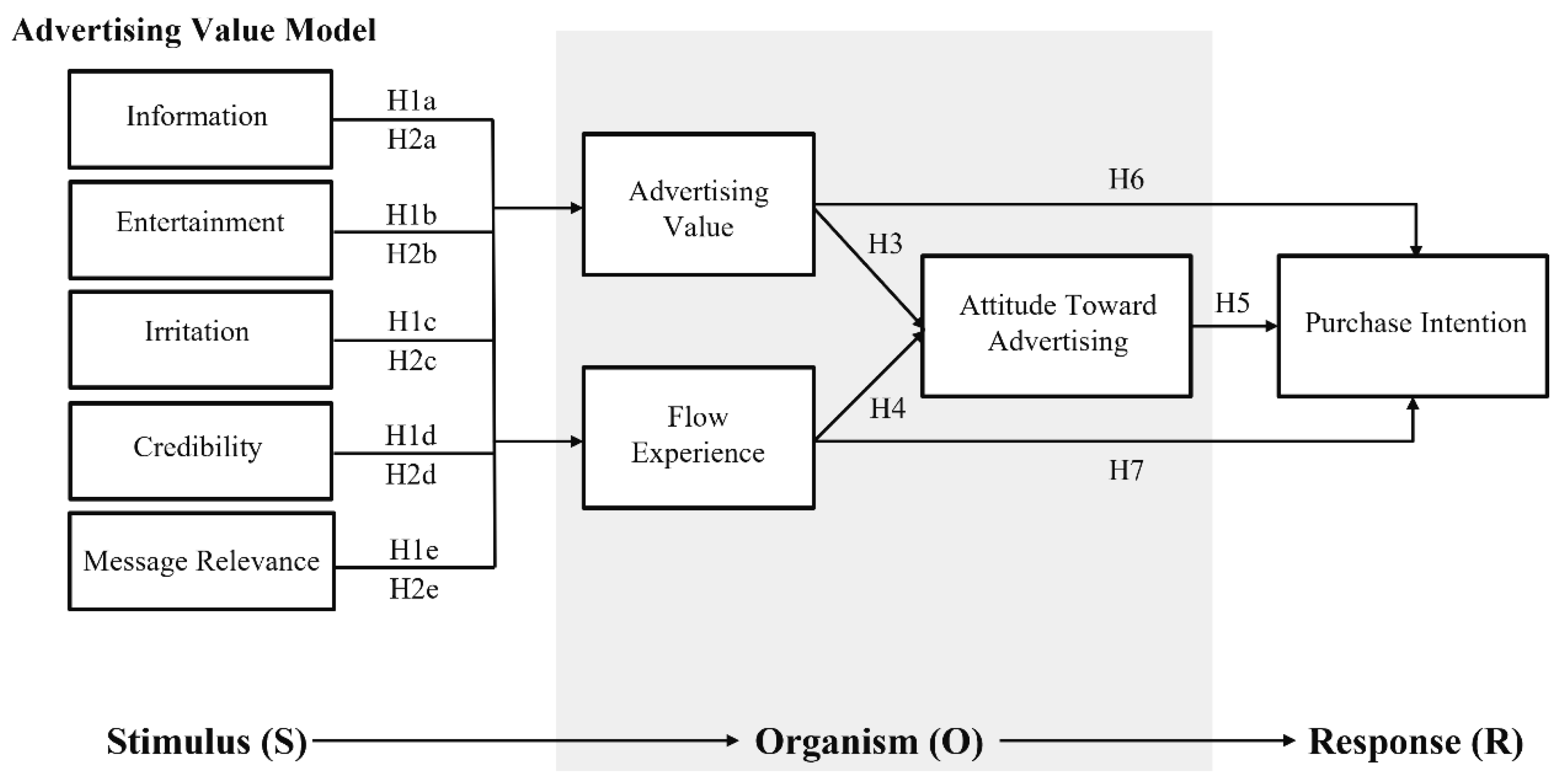
In accordance with these hypotheses, Figure 1 depicts the relationships among ESG goal advertisement message elements (informativeness, entertainment, irritation, credibility, message relevance), advertising value, flow experience, attitude toward the advertisement, and purchase intention. Element-level specifications for each message element (H6a–H6e; H7a–H7e) and test results are summarized in Appendix C (Table A7).
Figure 1. Conceptual model and hypotheses. Note. The gray-shaded region denotes the Organism domain.
Sustainability 17 11282 g001

3. Research Methods

3.1. Research Sample and Data Collection

We fielded an online SurveyCake questionnaire targeting consumers who had previously read corporate sustainability reports. The survey ran for a 15-day period and was disseminated via social media platforms (Facebook, Dcard, Instagram, LINE, and Threads). A total of 417 questionnaires were collected (Table 1). After data quality screening, including reverse-coded attention checks and standard validity checks, 53 invalid samples were eliminated, resulting in 364 valid responses, for an effective response rate of 87%. Descriptive statistics for respondent gender, age, education, prior exposure to ESG goal advertising, and recency and quantity of last purchase are listed in Appendix A, Table A1.
Table 1. Summary of questionnaire distribution and collection.
Number of ResponsesPercentage (%)
Total Distributed417100.00
Total Collected417100.00
Invalid Samples5312.71
Valid Samples36487.29

3.2. Determination of Variables and Formulation of Questionnaires

Guided by the S–O–R framework, we constructed a structured questionnaire drawing on established scales from the prior literature. To support respondents’ understanding of case advertising and the concept of ESGs, we embedded an example of an ESG advertisement from Chunghwa Telecom in the questionnaire. We selected Chunghwa Telecom because it is a widely recognized Taiwanese brand, which reduces novelty-related confounders and improves message comprehensibility in the local language and context. The stimulus emphasized ESG content rather than product features, reducing product-related bias while controlling exposure. The advertisement is provided by Chunghwa Telecom Co., Ltd., Taipei City, Taiwan and is available in Supplementary Material Video S1.
The questionnaire comprised five sections: (1) ESG background and introduction; (2) external stimulus variables (informativeness, entertainment, irritation, credibility, message relevance); (3) organismic states (advertising value, flow experience, attitude toward the advertisement); (4) behavioral response (purchase intention); and (5) demographics for segmentation analysis. All items used a five-point Likert scale (1 = strongly disagree; 5 = strongly agree). To ensure methodological rigor and valid results, we used validated, mature scales and, in light of the development status of high-tech enterprises and the aims of this study, we made appropriate wording adjustments while preserving original meanings. Before launch, we conducted a qualitative pretest using open-ended probes; pretest data were excluded from the final analysis. The operationalization, wording, and literature sources for all constructs are summarized in Table 2. Measurement items for each construct appear in the offending estimates test (Appendix B, Table A4).
Table 2. Variables and measurement items.
ConstructItemQuestionReference
Information
(INF)
INF1This advertisement provides relevant information about the product or service.Martins, Costa [13];
Liu, Sinkovics [31]
INF2This advertisement delivers timely information about the company’s products or services.
INF3This advertisement offers a convenient way to understand the company’s ESG goals.
INF4This advertisement provides information needed for future purchases of the company’s products or services.
Entertainment
(ENT)
ENT1This ESG goal advertisement by the company is interesting.Martins, Costa [13];
Liu, Sinkovics [31]
ENT2This ESG goal advertisement by the company is emotionally pleasant.
ENT3This ESG goal advertisement by the company attracts my attention.
ENT4This ESG goal advertisement by the company is more appealing than similar ads.
Irritation
(IRR)
IRR1This ESG goal advertisement by the company is annoying.Martins, Costa [13];
Liu, Sinkovics [31]
IRR2This ESG goal advertisement by the company is irritating.
IRR3This ESG goal advertisement by the company is intrusive.
Credibility (CRED)CRED1This ESG goal advertisement by the company is persuasive.Martins, Costa [13];
Liu, Sinkovics [31]
CRED2The content of this ESG goal advertisement by the company is truthful.
CRED3This ESG goal advertisement by the company is reliable.
CRED4This ESG goal advertisement by the company is trustworthy.
Message
Relevance
(MR)
MR1This ESG goal advertisement by the company provides the information I want to know.Tseng & Teng [93];
Sharma, Dwivedi [91]
MR2This ESG goal advertisement by the company is relevant to my needs.
MR3This ESG goal advertisement by the company is useful to me.
Advertising Value
(AV)
AV1This ESG goal advertisement by the company is meaningful.Martins, Costa [13],
Liu, Sinkovics [31]
AV2This ESG goal advertisement by the company does not disappoint me.
AV3This ESG goal advertisement by the company makes me feel a sense of identity.
Flow
Experience
(FE)
FE1While watching this advertisement, I feel more attentive and involved with the content.Martins, Costa [13];
Ho and Kuo [111]
FE2While watching this advertisement, I lose track of time and become fully immersed.
FE3While watching this advertisement, I am completely engaged in the advertisement’s scenario.
FE4While watching this advertisement, I feel capable of addressing the ESG challenges raised by the company.
Attitude Toward Advertising
(ATT)
ATT1Overall, I like the idea of the company producing an ESG goal advertisement.Xu [112];
Liu, Sinkovics [31]
ATT2Overall, the company’s ESG goal advertisement is a good idea.
ATT3Overall, I have a positive view of the company’s ESG goal advertisement.
ATT4Overall, the ESG goal advertisement helps me find products/services that match my personality and interests.
ATT5Overall, the ESG goal advertisement helps improve our quality of life.
Purchase
Intention
(PI)
PI1I think purchasing the product/service shown in the company’s ESG goal advertisement is worthwhile.Martins, Costa [13], Hsu and Lin [113]
PI2I will frequently purchase products/services promoted through the company’s ESG goal advertisements.
PI3I intend to continue purchasing products/services promoted in the company’s ESG goal advertisements.
PI4 I will strongly recommend others to purchase products/services promoted in the company’s ESG goal advertisements.

3.3. Reliability and Validity Test

We conducted confirmatory factor analysis (CFA) on nine constructs, including informativeness, entertainment, irritation, credibility, message relevance, advertising value, flow experience, attitude toward the advertisement, and purchase intention, using SPSS 27 and AMOS 27. Internal consistency was satisfactory, with Cronbach’s α for all constructs exceeding 0.70 (range 0.824–0.909; Table 3).
Table 3. Results obtained from testing the reliability and validity of each variable.
VariateItemLoadCronbach’s αCRAVE
INFINF10.780.8240.8290.553
INF20.84
INF30.53
INF40.78
ENTENT10.740.8700.8720.630
ENT20.74
ENT30.86
ENT40.82
IRRIRR10.800.8780.8840.719
IRR20.92
IRR30.80
CREDCRED10.730.8930.8970.687
CRED20.79
CRED30.87
CRED40.90
MRMR10.770.8670.8700.690
MR20.83
MR30.88
AVAV10.740.8290.8360.630
AV20.88
AV30.75
FEFE10.750.8750.8780.644
FE20.89
FE30.88
FE40.66
ATTATT10.720.8620.8640.560
ATT20.80
ATT30.81
ATT40.72
ATT50.68
PIPI10.800.9090.9090.714
PI20.86
PI30.88
PI40.85
For convergent validity, we computed composite reliability (CR) and average variance extracted (AVE) from the standardized loadings. All constructs met conventional thresholds (CR ≥ 0.70; AVE ≥ 0.50), with CR = 0.829–0.909 and AVE = 0.553–0.719 (Table 3).
For discriminant validity, we first applied the Fornell and Larcker [114] criterion by comparing each construct’s √AVE with the absolute correlations with other constructs [115]. In every case, √AVE was larger (e.g., the highest √AVE for irritation was 0.848 and the lowest √AVE for informativeness was 0.743), which satisfies the criterion (Table 4).
We then used the heterotrait–monotrait ratio (HTMT) as the primary test following Henseler et al. [116]. Using a conservative reference bound of 0.85 and a liberal bound of 0.90 for conceptually close constructs [117], all constructed pairs of HTMT values were below 0.85. The highest pair, entertainment and flow experience, yielded HTMT = 0.812 with a 95% bootstrap percentile confidence interval of 0.771 to 0.850 based on 2000 resamples, and every confidence interval upper bound was below 1.00, which supports discriminant validity (Appendix B, Table A2).
Taken together, HTMT [116] serves as the primary evidence for discriminant validity, and the Fornell–Larcker [114] check provides consistency. Along with satisfactory internal consistency and convergent validity, the measurement model demonstrates strong reliability and adequate validity and is suitable for structural modeling.
Table 4. Pearson correlation coefficients and discriminant validity.
Construct123456789
INF0.743
ENT0.482 **0.794
IRR−0.175 **−0.376 **0.848
CRED0.549 **0.625 **−0.367 **0.829
MR0.669 **0.679 **−0.287 **0.720 **0.831
AV0.550 **0.750 **−0.397 **0.741 **0.736 **0.794
FE0.526 **0.769 **−0.272 **0.628 **0.684 **0.738 **0.802
ATT0.486 **0.603 **−0.370 **0.638 **0.630 **0.705 **0.613 **0.748
PI0.531 **0.629 **−0.242 **0.635 **0.635 **0.692 **0.675 **0.695 **0.845
** Correlation is significant at the 0.01 level (2-tailed). Bold diagonal values represent the square roots of AVE for each construct.

3.4. SEM Assumptions and Overall Model Fit

Before testing structural hypotheses, we examined multivariate normality, offending estimates, and overall model fit. Following Bollen [118], the critical value for Mardia’s coefficient is p(p + 2). With 34 observed indicators (critical value = 1224), the observed value of Mardia’s coefficient was 53.126, well below the threshold; item-level skewness and kurtosis indicated univariate normality (Appendix B, Table A3), suggesting no material departures from multivariate normality.
Checks for offending estimates showed no negative error variances, no standardized loadings ≥ 0.95, and all relevant t-values > 1.96 (p < 0.05), indicating a well-behaved measurement model (Appendix B, Table A4). Regarding overall fit, incremental and residual-fit indices were acceptable (CFI = 0.949; TLI = 0.940; SRMR = 0.061), whereas RMSEA was marginal (RMSEA = 0.086, 90% CI [0.082, 0.090]; p-close = 0.000) (Appendix B, Table A6).
We therefore interpret overall fit based on converging evidence across indices rather than any single statistic. For estimation and inference, we used ML estimation in AMOS with 2000 bootstrap resamples to obtain bias-corrected (BC) and percentile (PC) confidence intervals for indirect effects. Overall fit was evaluated primarily via CFI/TLI, RMSEA (90% CI and p-close), and SRMR [119,120]. Given χ2’s sensitivity to sample size and model complexity, χ2 is reported descriptively rather than as a pass/fail rule. Robustness checks using Bollen–Stine bootstrap yielded p = 0.000, consistent with the reported fit pattern.

4. Observational Outcomes

4.1. Hypothesis Testing and Analysis

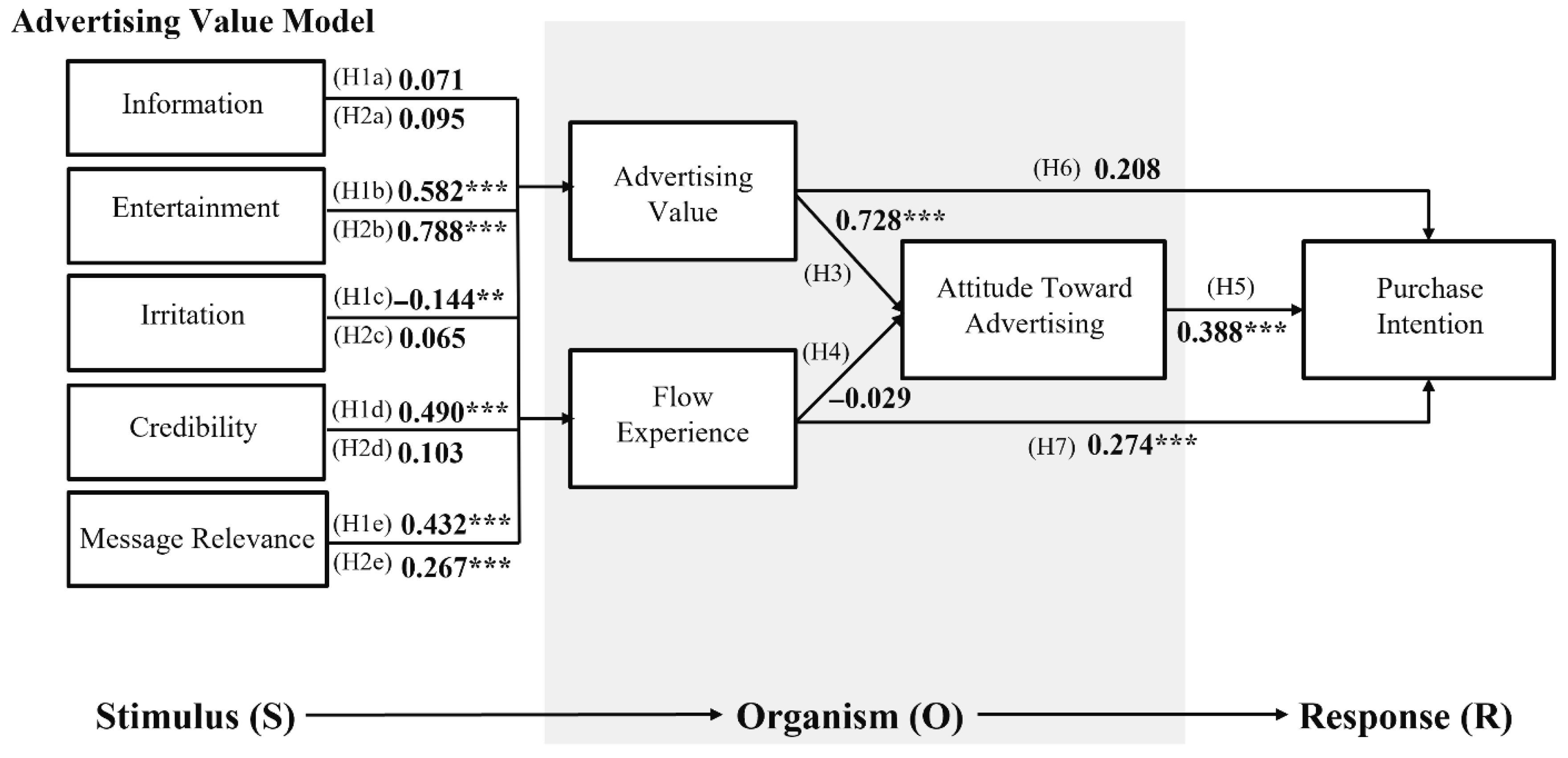
We estimated the structural model in AMOS using maximum-likelihood estimation with bootstrap inference (2000 resamples; percentile and bias-corrected 95% confidence intervals). Following SEM reporting guidelines [119,121], we required p < 0.01 and |t| ≥ 2.58, together with confidence intervals excluding zero, to determine path significance and mediation. Under these criteria, nine of the fifteen hypothesized paths were supported. Entertainment increased advertising value and flow experience; irritation reduced advertising value; credibility increased advertising value; message relevance increased advertising value and flow experience; advertising value improved attitude toward the advertisement; and both flow experience and attitude toward the advertisement increased purchase intention. In contrast, informativeness did not significantly affect advertising value or flow experience; irritation did not affect flow experience; credibility did not affect flow experience; flow experience did not improve attitude toward the advertisement; and advertising value did not significantly predict purchase intention (p = 0.034 > 0.01). For completeness under directional hypotheses, we also inspected one-tailed criteria. Using BC bootstrap 90% CIs for AV → PI (β = 0.208), the interval still crossed zero; thus, the direct link remains non-significant (see Appendix B, Table A5).
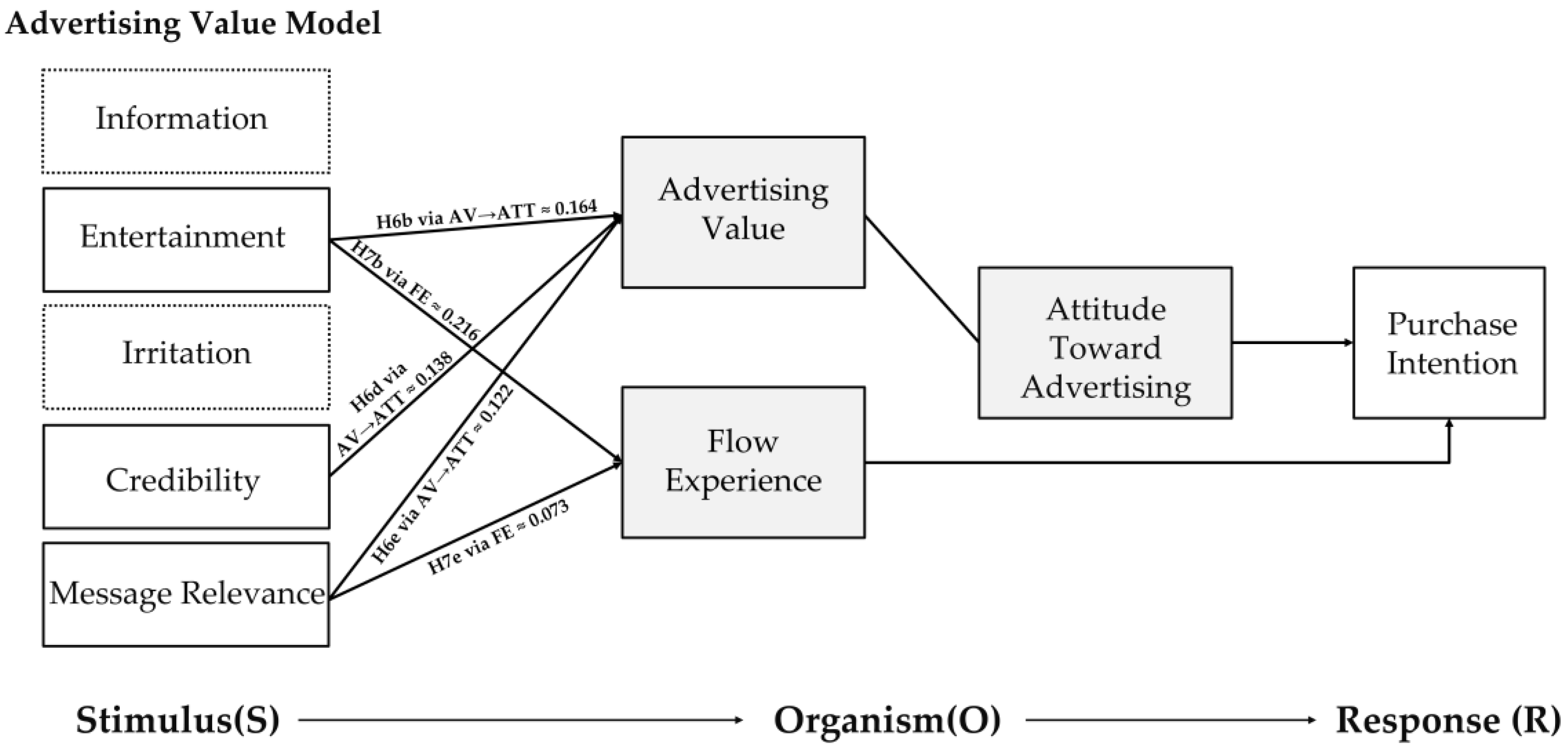
Indirect or mediation effects were tested using the bootstrap procedure. The results supported two complementary mechanisms. Consistent with this dual-mediation pattern, we present the findings along two routes. The first route is an attitudinal path (partial mediation). The message elements—entertainment, irritation, credibility, and message relevance—affected purchase intention indirectly through advertising value and attitude toward the advertisement. The second route is an immersive path (significant mediation). The message elements—entertainment and message relevance—affected purchase intention indirectly through flow experience. The model explained substantial variations in the endogenous construct (R2 = 0.792 for advertising value, 0.716 for flow experience, 0.504 for attitude toward the advertisement, 0.546 for purchase intention). Complete standardized direct, indirect, and total effects are reported in Table 5, and the supported links are visualized in Figure 2.
Table 5. Summary of total, direct, and indirect effects in the structural model.
Latent Independent VariableLatent Dependent VariableDirect EffectIndirect EffectTotal Effect
INFAV0.0710.071
FE0.0950.095
ATT0.0490.049
PI0.0600.060
ENTAV0.5820.582
FE0.7880.788
ATT0.4010.401
PI0.4930.493
IRRAV−0.144−0.144
FE0.0650.065
ATT−0.107−0.107
PI−0.054−0.054
CREDAV0.4900.490
FE0.1030.103
ATT0.3530.353
PI0.2680.268
MRAV0.4320.432
FE0.2670.267
ATT0.3070.307
PI0.0600.060
AVATT0.7280.728
PI0.2080.2830.491
FEATT−0.029−0.029
PI0.274−0.011
ATTPI0.3880.388
Notes. Direct effects are shown only for hypothesized links. Indirect effects aggregate all specific mediated paths. “—” indicates a path not specified in the model and therefore not estimated. Total effect = direct + indirect. Path coefficients are reported in Appendix B, Table A5.
Figure 2. Path coefficient. *** p < 0.001 (two-tailed); ** p < 0.01 (two-tailed). Note. The gray-shaded region denotes the Organism domain.
Sustainability 17 11282 g002
Considering that our SEM specifies multiple predictors for each endogenous construct, we conducted additional simple linear regression analyses for each path that was non-significant in the multivariate model to better understand potential suppression or competition among correlated predictors. In these diagnostics, the dependent variable was regressed on the focal predictor only using the same ML bootstrap settings noted above (2000 resamples; bias-corrected confidence intervals). The results of the simple linear regression analyses indicate a strong and statistically significant relationship between advertising value and purchase intention (β = 0.712, p < 0.001; 95% BC CI [0.604, 0.793]), with similar patterns for information → advertising value (β = 0.620), informativeness → flow experience (β = 0.555), irritation → flow experience (β = −0.277), credibility → flow experience (β = 0.178), and flow experience → attitude toward the advertisement (β = 0.657). Full results are reported in Appendix D, Table A8. Overall, these results indicate that while many of the relationships identified in the bivariate analyses are meaningful, as indicated in the literature, they lose significance when all other predictors are included in a multivariate SEM because more proximal or stronger predictors are entered simultaneously and absorb variance in the same outcomes.

4.2. Discussion

Both H1 (message elements → advertising value) and H2 (message elements → flow experience) imply that entertainment, irritation, credibility and message relevance significantly shape advertising value (H1b–H1e supported). In social feeds with minimal attention spans, entertainment, credibility cues, and personally relevant messages tend to dominate advertising value and immersion [13,87]. Meanwhile, entertainment and message relevance significantly improve flow experience (supporting H2b and H2e), indicating that entertaining and personally relevant executions are pivotal for immersion in digital environments [38,93].
In contrast to these expected patterns, informativeness did not display the expected positive effects on either advertising value or flow experience (H1a, H2a not supported). A plausible explanation is that informativeness must be presented concisely and in a diagnostic structure to avoid overloading receivers’ limited processing capacity. Under the limited capacity model of motivated mediated messages (LC4MP), when informational content is too dense or complex, it is more likely to be compressed or filtered out, as it can induce stress and fatigue and may impair decision quality and immersion, thereby weakening the informativeness → advertising value and informativeness → flow experience paths [9,33,46,122,123]. Consistent with this pattern, informativeness, irritation, and credibility did not significantly influence flow experience (H2a, H2c, and H2d not supported). In social media contexts, brief interruptions and arousal may also redirect attention, and different audiences exhibit markedly different thresholds for irritating stimuli [53,55]. Additionally, credibility is primarily a cognitive evaluation that tends to influence perceived value and attitudes rather than flow experience. As a result, when credibility-oriented executions attempt to drive immersion mainly through interactivity and telepresence, the direct path from credibility to flow experience may be null or weak [124].
For H3–H4 (internal states → attitude toward the advertisement), H3 was supported, as higher advertising value improved attitude toward the advertisement [27,94]. H4 was not supported, as flow experience did not directly improve attitude toward the advertisement, implying that involvement alone is not adequate to create evaluative judgment without additional evaluative cues or linkages [103,125]. Previous work suggests flow experience is often more proximally influential on intentions and behaviors and that flow experience does not improve attitudes toward the advertisement in the absence of clear evaluative cues, including perceived efficacy, benefits, or credibility. As a result, consumers may be deeply immersed in the experience while their evaluative judgment remains largely unchanged [126].
Mediation results clarify the consumer–market path. H5 tests showed that higher advertising value promoted purchase intention via attitude toward the advertisement (H5a partially supported) This finding aligns with classical advertising research in which attitude toward the advertisement serves as a key evaluative link between advertising value and purchasing intentions. At the same time, the mediation was only partial, which is plausible in short-form social media environments where consumers can act on simple heuristics or shortcuts (by clicking, saving, or following) without engaging in a full evaluative appraisal of the advertisement; in such cases, some of the impact of advertising value on purchase intention may bypass attitude toward the advertisement, and the strength of the indirect effect is likely to vary across executions and task demands [33]. Furthermore, H5b was not supported, as flow experience did not significantly affect purchase intention through attitude toward the advertisement. This finding is consistent with the view that flow experience is primarily an affective and experiential state that often drives intentions or behavior directly but does not necessarily translate into changes in attitude toward the advertisement [40,71,126].
For H6, advertising value mediates the effects of entertainment, credibility, and message relevance on purchase intention (H6b, H6d, H6e supported) but not those of informativeness or irritation (H6a, H6c not supported), reinforcing the primacy of engaging, relevant content for value-based persuasion [9,91,127,128]. For H6a, non-significant mediation was consistent with the rationale that advertising value relies not on the amount of advertised information but concise and high-quality information relative to consumers’ needs. When information is too detailed or dense, informational overload may occur, limiting evaluative processing and weakening the informativeness → advertising value → purchase intention chain [129]. Similarly, the lack of mediation for H6c can be understood by considering how irritation disrupts the evaluation process in social media environments. Forced exposure and high-frequency repetition of pop-up windows, intrusive banner formats, or deliberately “glitchy” executions can interrupt message processing and trigger perceptions of intrusiveness and psychological reactance, leading consumers to exit the interaction before forming a stable value judgment. This makes the negative irritation → advertising value path unstable or non-significant across different stimuli and funnel stages [53].
For H7, flow experience mediated the effects of entertainment and message relevance on purchase intention (H7b, H7e partially supported), underscoring the roles of pleasant experiences and situational absorption in triggering certain behaviors [68,130]. Conversely, flow experience paths from informativeness, irritation, and credibility to purchase intention were not significant (H7a, H7c, H7d not supported). A plausible explanation is that flow experience in digital contexts is more likely to trigger amusement through interactive and personally relevant messaging, whereas informativeness and credibility are cognitive evolutional dimensions that operate as ‘value and attitude’ rather than being mediated through immersive experience. In addition, irritation is more likely to disrupt immersion than facilitate it [46,124]. When informational content is dense or complex, it can overload limited processing capacity and weaken the informativeness → flow experience → purchase intention chain, while intrusive formats and high-frequency exposure increase perceived irritation and psychological reactance, prompting consumers to abandon or shift away from the message [53,55]. In contrast, entertaining executions with engaging emotional pacing and personally relevant messages are more likely to sustain concentration and experiential involvement, thereby enabling flow experience to partially transmit their effects to purchase intention.
Managers should prioritize raising advertising value to improve or reinforce attitude toward the advertisement, which would convert attitude toward the advertisement into purchase intention. This attitude-oriented lever helps stabilize demand for sustainability-oriented products and supports firms’ sustainability trajectories. In parallel, designs should build both perceived value and enjoyable engagement to elicit flow experience, thereby cultivating a positive corporate image and encouraging more consumers to participate in the firm’s sustainability initiatives. Using these two levers—the attitudinal path (advertising value and attitude toward the advertisement) and the immersive path (flow experience)—will help translate ESG disclosure into market responses that enable sustainable strategic operations aligned with the SDGs.
Complete hypothesis evaluation results are summarized in Appendix C (Table A7), which reports the confirmatory tests of H1–H7 and their element-level extensions, including whether each hypothesis was supported, not supported, or partially supported.

5. Conclusions and Insights

5.1. Main Research Findings

Objective 1—Linking ESG goal advertisements to market responses.
ESG goal advertisements increase purchase intention primarily through an attitudinal path, as higher advertising value improves attitudes toward the advertisement, which in turn increases purchase intention [94]. This clarifies how communicating ESG goals can translate disclosure into demand that supports sustainability-oriented operations [3].
Objective 2—Identifying effective message elements.
Entertainment, credibility, and message relevance significantly increase advertising value, and entertainment and message relevance increase flow experience. Informativeness is not significant in short-attention social feeds, and irritation reduces advertising value. Technical ESG goals should therefore be reframed as brief, enjoyable, and personally relevant micro-stories rather than data-heavy, context-bound messages [9,37,38,93].
Objective 3—How internal states shape evaluation.
Attitude toward the advertisement is strongly driven by advertising value, whereas flow experience does not directly improve attitude toward the advertisement in this setting. Enjoyable absorption is distinct from evaluative judgment [68,131].
Objective 4—The movement from internal states to intention.
The results reveal a chain in which internal evaluations give rise to certain behaviors. The value–attitude chain culminates in purchase intention. From a managerial standpoint, raising perceived advertising value improves attitudes toward the advertisement, which in turn supports stable demand for sustainability-oriented products [3]. In parallel, when advertisements are entertaining and personally relevant, flow experience directly and positively predicts shopping or purchase intention in digital settings, thereby cultivating a positive corporate image and encouraging more consumers to participate in the firm’s sustainability initiatives [132,133,134].

5.2. Theoretical Contributions and Managerial Implications

5.2.1. Theoretical Contributions

(1)
From disclosure to demand: a process theory for ESG communications.
We adapt the S–O–R framework to ESG goal advertisements by specifying how message-construction elements—especially entertainment, credibility, and message relevance—shape organismic states (advertising value, flow experience, and attitude toward the advertisement) that culminate in purchase intention. This offers a traceable account of how advertisement design converts ESG disclosure into market reactions that support sustainability-oriented operations by directly linking consumer psychology to operational outcomes.
(2)
Two paths for inducing consumer action.
We identify two simultaneous mechanisms. Through the attitudinal path, advertising value increases attitude toward the advertisement, which then increases purchase intention. Through the immersive path, flow experience increases purchase intention. In short-attention social media contexts, flow experience does not directly improve attitude toward the advertisement; advertising value is the principal driver of attitude, while flow experience primarily advances purchase intention directly. This clarifies the boundary conditions for using flow experience in cluttered feeds and explains why attitude formation is led by evaluation rather than immersion.
(3)
Refining the Advertising Value Model for ESG creatives.
In mobile, high-clutter environments, increasing informativeness alone does not reliably raise advertising value. Instead, entertainment, credibility, and message relevance become the dominant factors. This information helps refine the AVM for ESG communication with contextual insights; when messages compete on small screens, lighten the informational load and emphasize enjoyable, credible, and personally relevant cues.
(4)
A translatable general mechanism.
Treating attitude toward the advertisement as the main channel provides a general mechanism in which advertising value improves attitude toward the advertisement, which in turn increases purchase intention. This mechanism is portable to other sustainable issues, digital formats, and high-clutter, persuasive settings where evaluative and immersive conditions coexist, extending the mapping of the S–O–R framework without altering core constructs.
(5)
An integrated model for a cluttered social media landscape.
By integrating the AVM, flow experience, consumer behavior outcomes, and the S–O–R process, the model explains how short-form ESG creatives can both engage (via flow experience) and convert (via advertising value and attitude toward the advertisement). This integration helps firms reach consumers whose attention is scarce and strengthens market support for sustainability-oriented operations.
The pattern of supported routes (Appendix C, Figure A1) shows that entertainment and message relevance exert their impact primarily via flow, while the value → attitude path provides an additional evaluative conduit (see Table 5).

5.2.2. Practical Applications

In this section, we offer actionable guidance through a four-step process—Strategy, Design, Evidence, and Conversion/Feedback—that connects ESG goal advertisements with a progression from disclosure to demand and back to operations.
(1)
Strategy—Connect disclosure to demand.
Position ESG goal advertisements as a two-way bridge between business and consumers by translating complex disclosures and performance targets into understandable, visible, and emotionally tangible messages. Tailor executions to the target audience to capture attention and deepen engagement, ensuring that the message resonates with evaluative and affective processing and stimulates demand.
(2)
Design—Apply the S–O–R logic to executions.
Apply creative stimuli to turn short-, medium-, and long-term ESG goals (e.g., net-zero, reducing plastic packaging, responsible sourcing timelines) into short-form narratives or micro-stories anchored in everyday benefits. Advertising execution should (i) increase advertising value and improve attitude toward the advertisement by making the firm’s future sustainability blueprint concrete and salient or (ii) produce a flow experience that immerses the consumer in the envisioned sustainable environment. Both approaches aim to stimulate demand in support of the firm’s sustainability efforts, expressed through purchase intention and subsequent purchase.
(3)
Evidence—What is effective in this context.
In fast, scroll-based environments, consumers rely on cues that are easy to process, personally relevant, and trustworthy. Creative decisions that simplify the message and link ESG goals to everyday advantages gain attention and facilitate perceived usefulness; credible signals then convert that attention into evaluation and intent. Repeated use of this bridge shifts brand relationships from single exposure to one that builds trust over time. Clear, verifiable substantiation—e.g., kilograms of plastic diverted, kilowatt hours saved, and kilograms of CO2 avoided per purchase—translates abstract ESG goals into concrete, personally actionable evaluation choices.
(4)
Conversion/Feedback—From attention to action and back to operations.
When entertainment and message relevance encourage individuals to pause, comprehend, and share, consideration stemming from that momentary attention in social media feeds can build long-term preference and action. Over time, clear outcomes communicated through ESG goal advertisements reinforce investment in low-carbon products, circular solutions, and responsible supply chains, strengthening the progression from disclosure to understanding, attitude formation, action, and operations.

5.3. Limitations and Outlook

This study provides a theoretical foundation and empirical evidence to better understand how ESG goal advertisements shape consumer psychology and behavior. Several limitations suggest avenues for future work.
(1)
Sample representativeness: The sample was purposively characterized to target younger and middle-aged digitally engaged social media users, with respondents aged 20–25 forming the largest group and those aged 26–40 and 41–60 also substantially represented. As a result, the findings are most appropriately generalized to younger and middle-aged social media users and should be extrapolated with caution to non-users or populations with very different age structures. Future research should use probability, stratified sampling, and multi-group SEM to test whether the proposed model is invariant across age and life stage and how different strata support demand for sustainability-oriented products.
(2)
Geographic and cultural scope: Evidence was generated in Taiwan’s media and cultural context. Cross-national studies, as well as multi-group measurement invariance tests, can establish where ESG messaging is effective and how it supports product-level sustainability across markets.
(3)
ESG familiarity limitations: Participants were restricted to respondents who had previously read corporate sustainability reports to ensure a minimum level of sustainability literacy and reduce noise in the interpretation of “ESG goal advertising.” This strengthens internal validity but limits external validity; results may differ for low-involvement or novice consumers. Future research should compare familiarity cohorts (e.g., readers vs. non-readers) and examine segment heterogeneity (e.g., demographics, prior exposure) via multi-group SEM or interaction models to test whether the model is robust across different sustainability literacy levels.
(4)
Stimulus and category constraints: We used a single, well-known telecom brand and one ESG goal advertisement as the stimulus to control for brand-level factors and support comprehension. This choice improves control but also raises the possibility of stimulus-specific effects, so the findings may not be generalizable to other brands or ESG appeal formats. Replication across brands, categories, and goal types, including multiple executions from the same brand and brands with comparable equity and familiarity, is warranted to test the robustness of the value–attitude chain and the immersive (flow-experience-based) path and to assess other sustainability levers.
(5)
Operations-linked outcomes: We analyzed purchase intention rather than operational KPIs. Future research should link communication effects to firm-level outcomes (e.g., low-carbon product sales, circularity metrics, responsible-sourcing indicators) and use longitudinal or field designs to trace the progression from disclosure to evaluation, behavior, and operations over time.

Supplementary Materials

The following supporting information can be downloaded at https://www.youtube.com/watch?v=LY-8phhLApc (accessed on 10 March 2024); Video S1: Chunghwa Telecom|Corporate Image Video—Advancing Across Generations, Sustaining Brilliance.

Author Contributions

Conceptualization, H.-J.C., H.-W.W. and C.-H.H.; data curation, H.-J.C.; formal analysis, H.-J.C. and C.-H.H.; investigation, H.-J.C.; methodology, H.-J.C., H.-W.W. and C.-H.H.; project administration, H.-W.W.; resources, H.-W.W.; software, H.-J.C. and H.-W.W.; supervision, H.-W.W.; validation, H.-J.C. and C.-H.H.; visualization, H.-J.C.; writing—original draft, H.-J.C.; writing—review and editing, H.-J.C., H.-W.W. and C.-H.H. All authors have read and agreed to the published version of the manuscript.

Funding

This research received no external funding.

Institutional Review Board Statement

Ethical review and approval were waived for this study due to its anonymous, minimal-risk, and non-interventional design involving competent adults and the fact that no identifiable data were collected. The study was conducted in accordance with the Declaration of Helsinki. Under Taiwan’s Human Subjects Research Act (HSRA), Article 5, human subject research requires prior IRB approval unless it falls within exemption categories announced by the competent authority; this protocol meets the conditions set out in the Ministry of Health and Welfare (MOHW) Announcement “Scope of Research Eligible for Exemption from IRB Review”.

Informed Consent Statement

An information statement preceded the questionnaire; proceeding to the survey constituted electronic implied consent. Therefore, informed consent for participation was not required as per local legislation (HSRA, Art. 5; MOHW Announcements No. 1010265075 and No. 1010265083 “Scope of Research Eligible for Exemption from Obtaining Participant Consent,” 5 July 2012).

Data Availability Statement

De-identified data, the survey instrument, and a codebook are available at https://drive.google.com/drive/folders/1S-xPG6ZMmz7AtsWfvFDbPVal5-kfIS6i?usp=sharing (accessed on 24 November 2025).

Acknowledgments

Research expenses and the article processing charge were personally supported by co-author Chung-Hsien Hung.

Conflicts of Interest

The authors declare no conflicts of interest. Personal funding was provided by co-author Chung-Hsien Hung in his capacity as an author; this financial support conferred no additional decision authority beyond his disclosed CRediT contributions and did not influence editorial handling, peer review, or the acceptance decision.

Appendix A

Table A1. Sample demographics.
Demographic VariableCategoryFrequencyPercentage (%)
GenderMale14740.38
Female21759.62
AgeUnder 20113.02
20–25 years10829.67
26–30 years4712.91
31–35 years5815.93
36–40 years4311.81
41–45 years318.52
46–50 years297.97
51–55 years205.49
56–60 years71.92
Over 60 years102.75
Education LevelJunior high school or below41.10
Senior high/vocational school 339.10
Junior college184.95
University20756.87
Graduate school or above10228.02
OccupationStudent11030.22
Manufacturing5815.93
Other service industries236.32
Professional, scientific, and technical services236.32
Education226.04
Freelance215.77
Wholesale and retail trade164.40
Healthcare and social work services154.12
Arts, entertainment, and recreation123.30
Accommodation and food services102.75
Homemaker102.75
Finance and insurance82.20
Publishing, audiovisual, and ICT82.20
Public administration and defense; compulsory social security82.20
Transportation and storage71.92
Real estate71.92
Support services30.82
Agriculture, forestry, fishing, and animal husbandry20.55
Mining and quarrying10.27
Exposure to Corporate
Image Advertisements on Social Media
Never seen123.30
Rarely seen6618.13
Sometimes seen13236.26
Often seen13737.64
Very often seen174.67
Most Recent Purchase from Social Media AdvertisingOne day ago174.67
Three days ago215.77
One week ago6016.48
Three weeks ago3710.16
One month ago6016.48
Three months ago328.79
Six months ago4111.26
One year ago215.77
More than one year ago7520.60
Average Spending on Purchases from Social Media AdsUnder NT 1007420.33
NT 101–5009225.27
NT 501–10009526.10
NT 1001–15004512.36
NT 1501–2000256.87
Above NT 2000215.77
Above NT 500061.65
Over NT 10,00061.65

Appendix B

Table A2. Heterotrait–monotrait (HTMT) ratios for discriminant validity.
Construct 1Construct 2HTMT Value95% CI (Lower)95% CI (Upper)
INFENT0.5190.4370.593
INFIRR0.1910.1050.291
INFCRED0.5920.5120.663
INFMR0.7120.6470.765
INFAV0.5960.5190.663
INFFE0.5730.4940.645
INFATT0.5300.4460.605
INFPI0.5690.4930.642
ENTIRR0.3920.3010.482
ENTCRED0.6580.5940.718
ENTMR0.7070.6470.758
ENTAV0.7850.7350.827
ENTFE0.8120.7710.850
ENTATT0.6880.6240.746
ENTPI0.7400.6840.789
IRRCRED0.4700.3620.569
IRRMR0.2940.1930.388
IRRAV0.2760.1800.375
IRRFE0.3110.2130.415
IRRATT0.2530.1440.353
IRRPI0.2270.1310.329
CREDMR0.6230.5480.686
CREDAV0.7790.7280.820
CREDFE0.7310.6680.783
CREDATT0.6400.5690.704
CREDPI0.6440.5760.703
MRAV0.7640.7140.811
MRFE0.7180.6580.768
MRATT0.6570.5890.714
MRPI0.6790.6130.733
AVFE0.7760.7270.821
AVATT0.7460.6910.793
AVPI0.7210.6630.769
FEATT0.6550.5860.716
FEPI0.7100.6510.764
ATTPI0.7330.6740.782
Table A3. Results of normality tests.
ConstructVariableSkewnessC.R. (Skew)KurtosisC.R. (Kurtosis)
INFINF1−0.771−6.0010.6242.430
INF2−0.703−5.4770.2040.795
INF3−0.752−5.860 0.941 3.664
INF4−0.645 −5.025 0.112 0.436
ENTENT1−0.137−1.064−0.145−0.556
ENT2−0.392−3.0540.1240.485
ENT3 −0.709−5.5210.2150.839
ENT4−0.587−4.7520.1180.459
IRRIRR10.6234.8560.0180.072
IRR20.9177.1450.7863.063
IRR30.9857.6701.0464.072
CREDCRED1−0.719−5.5970.8583.343
CRED2−0.554−4.3170.8853.445
CRED3−0.320−2.4930.0410.160
CRED4−0.393−3.0620.2271.079
MRMR1−0.517−4.0250.0820.320
MR2−0.338−2.632−0.071−0.276
MR3−0.491−3.882−0.054−0.212
AVAV1−0.887−6.9061.5305.960
AV2−0.429−3.3430.2570.999
AV3−0.347−2.706−0.189−0.734
FEFE1−0.704−5.4860.5582.290
FE2−0.220−1.717−0.706−2.750
FE3−0.291−2.226−0.412−1.605
FE4−0.518−4.031−0.017−0.066
ATTATT1−0.802−6.2241.2264.776
ATT2−0.904−7.0381.9467.580
ATT3−1.051−8.1872.59110.090
ATT4−0.542−4.2210.0940.367
ATT5−0.581−4.5270.3391.320
PIPI1−0.540−4.2060.5252.043
PI2−0.273−2.125−0.336−1.310
PI3−0.198−1.546−0.385−1.500
PI4−0.217−1.692−0.487−1.897
Following Hair [115], we conducted an offending estimates test to ensure that the model did not contain inadmissible parameter estimates. Offending estimates refer to parameter values that fall outside of theoretically or statistically acceptable ranges and thus call into question the adequacy of the model’s estimation. Three main types of offending estimates were examined: (1) negative error variances (Heywood cases), (2) standardized factor loadings greater than 0.95, which typically indicate excessively high redundancy or correlations among items and may require item revision or deletion, and (3) excessively large standard errors, which increase the likelihood of Type II errors and may cause paths that should be statistically significant to appear non-significant. In practice, large standard errors can be identified by inspecting standardized factor loadings and their associated t values; when loadings are significant and t values are large, standard errors are correspondingly small, and the estimates are considered stable.
In this study, we therefore inspected error variances, standardized factor loadings, and their significance levels to assess whether any offending estimates were present. The results showed that none of the three problematic conditions occurred: all error variances were positive, all standardized factor loadings were below 0.95, and, at the p < 0.05 significance level, all t values exceeded 1.96. These findings indicate that the measurement model passed the offending estimates test and that no inadmissible estimates were detected.
Table A4. Offending estimates test.
ParameterError VarianceStandard
Error
Standardized
Factor Loading
t-Value
INF10.2800.1810.7816.600
INF20.2840.2000.8417.914
INF30.4350.1830.5310.163
INF40.3580.2040.7816.570
ENT10.3090.1740.7416.093
ENT20.2980.1720.7416.213
ENT30.2750.1910.8619.185
ENT40.3050.1920.8218.404
IRR10.3130.1910.8017.528
IRR20.1050.1650.9221.457
IRR30.2780.1800.8017.509
CRED10.2620.1570.7317.857
CRED20.2150.1530.7917.632
CRED30.1640.1540.8720.021
CRED40.1200.1500.9021.449
MR10.3230.1860.7716.669
MR20.2620.1800.8317.893
MR30.1920.1920.8820.354
AV10.2430.1080.747.659
AV20.2290.1230.887.979
AV30.3270.1290.757.739
FE10.2840.1210.7511.638
FE20.3420.1500.8912.181
FE30.2720.1450.8812.397
FE40.4370.1260.6610.316
ATT10.3910.1330.7211.166
ATT20.2470.1230.8011.219
ATT30.2320.1230.8111.542
ATT40.3240.1470.7211.652
ATT50.3260.1430.6811.313
PI10.2090.1130.8014.462
PI20.2390.1290.8615.195
PI30.2170.1250.8815.351
PI40.2700.1390.8515.298
Table A5. S–O–R model paths: standardized coefficients (β) with BC bootstrap 95% CIs.
Path (Hypothesis)β (std.)p (Two-Tailed)95% BC CI [LL, UL]
(H1a) INF → AV0.0710.332[−0.077, 0.234]
(H1b) ENT → AV0.5820.001[0.423, 0.729]
(H1c) IRR → AV−0.1440.013[−0.263, −0.035]
(H1d) CRED → AV0.4900.001[0.351, 0.621]
(H1e) MR → AV0.4320.001[0.272, 0.585]
(H2a) INF → FE0.0950.205[−0.041, 0.238]
(H2b) ENT → FE0.7880.000[0.695, 0.873]
(H2c) IRR → FE0.0650.202[−0.036, 0.146]
(H2d) CRED → FE0.1030.163[−0.046, 0.268]
(H2e) MR → FE0.2670.001[0.101, 0.448]
(H3) AV → ATT0.7280.002[0.515, 0.914]
(H4) FE → ATT−0.0290.848[−0.248, 0.203]
(H5) ATT → PI0.3880.010[0.099, 0.626]
(H6) AV → PI0.2080.175[−0.106, 0.503]
(H7) FE → PI0.2740.001[0.106, 0.447]
Notes. N = 364; estimation through ML in AMOS with 2000 bootstrap resamples. Standardized coefficients (β) are shown. AMOS p-values are two-tailed by default; when directional hypotheses are considered, one-tailed values equal p/2. Confidence intervals are bias-corrected (BC) bootstrap, and 90% CIs correspond to one-tailed α = 0.05 and 95% CIs to two-tailed α = 0.05. Intervals not crossing zero indicate significance at the corresponding α level.
In structural equation modeling (SEM), overall fit evaluates the consistency between the model-implied and observed covariance matrices. We pre-specified CFI/TLI, RMSEA (with 90% CI and p-close), and SRMR as the primary criteria; other indices are reported for transparency. Given the χ2 test’s sensitivity to N and model complexity, χ2 is treated as descriptive rather than a pass/fail rule.
Table A6. Overall model fit indices.
Fit Index ResultDecision
Absolute Fit
Indices
X2622.345
(p = 0.000)
Informative only
X2/df2.239Informative only
GFI0.883Informative only
AGFI0.852Informative only
RMR0.046Informative only
SRMR0.061Within acceptable range
RMSEA0.058Within acceptable range
Incremental Fit IndicesNFI0.912Informative only
(TLI)
NNFI
0.940Within acceptable range
CFI0.949Within acceptable range (near target)
RFI0.897Informative only
IFI0.949Informative only
Parsimony Fit IndicesPNFI0.780Informative only
PGFI0.699Informative only
PCFI0.812Informative only
Notes. Model adequacy is judged primarily by CFI/TLI (targets ≥ 0.95; acceptable ≥ 0.90), RMSEA with 90% CI and p-close (target ≤ 0.06; acceptable ≤ 0.08), and SRMR ≤ 0.08 [120,135]. We report χ2 (and Δχ2 for nested comparisons) and other indices (GFI/AGFI, NFI/RFI/IFI, PNFI/PGFI/PCFI) for transparency only given their sensitivity or historical status [118,136,137].

Appendix C

Table A7. Summary of hypotheses and test results.
HypothesisTest Results
H1Based on the advertising value model, informativeness, entertainment, credibility, and message relevance have a significant positive effect on advertising value, whereas irritation has a significant negative effect on advertising value.
H1aThe informativeness of ESG goal advertisements has a significant positive effect on advertising value.Not supported
H1bThe entertainment value of ESG goal advertisements has a significant positive effect on advertising value.Not supported
H1cThe irritation caused by ESG goal advertisements has a significant negative effect on adver-tising value.Supported
H1dThe credibility of ESG goal advertisements has a significant positive effect on advertising value.Supported
H1eThe message relevance ESG goal advertisements has a significant positive effect on adver-tising value.Supported
H2Based on the advertising value model, informativeness, entertainment, credibility, and message relevance have a significant positive effect on flow experience, whereas irritation has a significant negative effect on flow experience.
H2aThe informativeness of ESG goal advertisements has a significant positive effect on flow ex-perience.Not supported
H2bThe entertainment value of ESG goal advertisements has a significant positive effect on flow experience.Supported
H2cThe irritation caused by ESG goal advertisements has a significant negative effect on flow experience.Not supported
H2dThe credibility of ESG goal advertisements has a significant positive effect on flow experi-ence.Supported
H2eThe message relevance of ESG goal advertisements has a significant positive effect on flow experience.Supported
H3Advertising value has a significant positive effect on attitude toward the advertisement.Supported
H4Flow experience has a significant positive effect on attitude toward the advertisement.Not supported
H5Attitude toward the advertisement significantly mediates the relationships among advertising value, flow experience, and purchase intention.
H5aAttitude toward the advertisement significantly mediates the relationship between advertis-ing value and purchase intention.Partially
supported
H5bAttitude toward the advertisement significantly mediates the relationship between flow ex-perience and purchase intention.Not supported
H6Advertising value significantly mediates the relationship between message elements in ESG goal adver-tisements and purchase intention.
H6aAdvertising value significantly mediates the relationship between informativeness and purchase intention.Not supported
H6bAdvertising value significantly mediates the relationship between entertainment and pur-chase intention.Supported
H6cAdvertising value significantly mediates the relationship between irritation and purchase intention.Not supported
H6dAdvertising value significantly mediates the relationship between credibility and purchase intention.Supported
H6eAdvertising value significantly mediates the relationship between message relevance and purchase intention.Supported
H7Flow experience significantly mediates the relationship between message elements in ESG goal advertise-ments and purchase intention.
H7aFlow experience significantly mediates the relationship between informativeness and pur-chase intention.Not supported
H7bFlow experience significantly mediates the relationship between entertainment and pur-chase intention.Partially
supported
H7cFlow experience significantly mediates the relationship between irritation and purchase in-tention.Not supported
H7dFlow experience significantly mediates the relationship between credibility and purchase intention.Not supported
H7eFlow experience significantly mediates the relationship between message relevance and purchase intention.Partially
supported
Notes. Diagram highlights supported total effects (direct + indirect). Numerical totals and components (with 95% BC/PC bootstrap CIs; 2000 resamples) are reported in Table 5.
Values annotate supported indirect paths as products of standardized constituent coefficients. “via AV → ATT” denotes element → Advertising Value → Attitude Toward Advertising → Purchase Intention; “via FE” denotes element → Flow Experience → Purchase Intention. Exact total, direct, and indirect estimates (with 95% BC/PC bootstrap CIs for indirect effects) are reported in Table 5. Non-significant paths are omitted for clarity.
Figure A1. Total effects overview (supported direct and indirect paths).
Sustainability 17 11282 g0a1

Appendix D

This appendix presents simple (bivariate) regressions only for the SEM paths that were non-significant in the multivariate SEM as a diagnostic check for suppression/competition among correlated predictors. We list standardized coefficients (β), two-tailed p-values, and BC bootstrap 95% CIs using the same estimation settings as the main analysis. In isolation, while the six paths presented individually produce results that suggest the expected direction and probability of a reliable association, the fact that none of the paths produced significant results in the multivariate SEM indicates that the variance was absorbed by the stronger or more important predictors, as opposed to there being no zero-order effect of those predictors.
Table A8. Simple regressions for non-significant SEM paths.
Pathb (unstd.)S.E.C.R.p (Two-Tailed)β (std.)95% BC CI
for β [LL, UL]
R2
AV ← INF0.5420.0579.498<0.0010.620[0.494, 0.741]0.384
FE ← INF0.5670.0648.833<0.0010.555[0.415, 0.675]0.308
FE ← IRR−0.2460.052−4.717<0.001−0.277[−0.397, −0.142]0.077
FE ← CRED0.1200.0442.7040.0070.178[0.023, 0.340]0.433
ATT ← FE0.5970.0659.231<0.0010.657[0.561, 0.737]0.432
PI ← AV0.9460.1019.368<0.0010.712[0.604, 0.793]0.506
Notes. N = 364; ML with 2000 bootstrap resamples in AMOS. Entries are β, p (two-tailed), and BC 95% CI. Path notation is written as Outcome ← Predictor (arrow points from predictor to dependent variable). Results are diagnostic and supplementary; the multivariate SEM remains the basis for inference.

References

  1. Smeuninx, N.; De Clerck, B.; Aerts, W. Measuring the readability of sustainability reports: A corpus-based analysis through standard formulae and NLP. Int. J. Bus. Commun. 2020, 57, 52–85. [Google Scholar] [CrossRef]
  2. Bazrafshan, E. The Role of ESG Ranking in Retail and Institutional Investors’ Attention and Trading Behavior. Financ. Res. Lett. 2023, 58, 104462. [Google Scholar] [CrossRef]
  3. Servaes, H.; Tamayo, A. The Impact of Corporate Social Responsibility on Firm Value: The Role of Customer Awareness. Manag. Sci. 2013, 59, 1045–1061. [Google Scholar] [CrossRef]
  4. Du, S.; Bhattacharya, C.B. Maximizing Business Returns to Corporate Social Responsibility (CSR): The Role of CSR Communication. Int. J. Manag. Rev. 2010, 12, 8–19. [Google Scholar] [CrossRef]
  5. Troise, C.; Camilleri, M.A. The use of digital media for marketing, CSR communication and stakeholder engagement. In Strategic Corporate Communication in the Digital Age; Emerald Publishing Limited: Leeds, UK, 2021; pp. 161–174. [Google Scholar]
  6. Huang, J.; Wang, D.D.; Wang, Y. Textual Attributes of Corporate Sustainability Reports and ESG Ratings. Sustainability 2024, 16, 9270. [Google Scholar] [CrossRef]
  7. Leonelli, S.; Muhn, M.; Rauter, T.; Sran, G.S. How Do Consumers Use ESG Disclosure? Evidence from a Randomized Field Experiment with Everyday Product Purchases. J. Account. Econ. 2025, 101811. [Google Scholar] [CrossRef]
  8. Arif, I.; Aslam, W.; Siddiqui, H. Influence of brand related user-generated content through Facebook on consumer behaviour: A stimulus-organism-response framework. Int. J. Electron. Bus. 2020, 15, 109. [Google Scholar] [CrossRef]
  9. Ducoffe, R.H. How consumers assess the value of advertising. J. Curr. Issues Res. Advert. 1995, 17, 1–18. [Google Scholar] [CrossRef]
  10. Jebarajakirthy, C.; Maseeh, H.I.; Morshed, Z.; Shankar, A.; Arli, D.; Pentecost, R. Mobile advertising: A systematic literature review and future research agenda. Int. J. Consum. Stud. 2021, 45, 1258–1291. [Google Scholar] [CrossRef]
  11. Sharma, A.; Dwivedi, R.; Mariani, M.M.; Islam, T. Investigating the effect of advertising irritation on digital advertising effectiveness: A moderated mediation model. Technol. Forecast. Soc. Change 2022, 180, 121731. [Google Scholar] [CrossRef]
  12. MacKenzie, S.B.; Lutz, R.J. An empirical examination of the structural antecedents of attitude toward the ad in an advertising pretesting context. J. Mark. 1989, 53, 48–65. [Google Scholar] [CrossRef]
  13. Martins, J.; Costa, C.; Oliveira, T.; Gonçalves, R.; Branco, F. How smartphone advertising influences consumers’ purchase intention. J. Bus. Res. 2019, 94, 378–387. [Google Scholar] [CrossRef]
  14. Sheth, J.N.; Newman, B.I.; Gross, B.L. Why we buy what we buy: A theory of consumption values. J. Bus. Res. 1991, 22, 159–170. [Google Scholar] [CrossRef]
  15. Carlson, L.; Grove, S.J.; Kangun, N. A Content Analysis of Environmental Advertising Claims: A Matrix Method Approach. J. Advert. 1993, 22, 27–39. [Google Scholar] [CrossRef]
  16. Eroglu, S.; Machleit, K.; Davis, L. Empirical Testing of a Model of Online Store Atmospherics and Shopper Responses. Psychol. Mark. 2003, 20, 139–150. [Google Scholar] [CrossRef]
  17. Peng, C.; Kim, Y.G. Application of the stimuli-organism-response (SOR) framework to online shopping behavior. J. Internet Commer. 2014, 13, 159–176. [Google Scholar] [CrossRef]
  18. Reynolds, F.D.; Crask, M.R.; Wells, W.D. The Modern Feminine Life Style. J. Mark. 1977, 41, 38–45. [Google Scholar] [CrossRef]
  19. Mehrabian, A.; Russell, J.A. An Approach to Environmental Psychology; MIT Press: Cambridge, MA, USA, 1974. [Google Scholar]
  20. Vieira, V.A. Stimuli–organism-response framework: A meta-analytic review in the store environment. J. Bus. Res. 2013, 66, 1420–1426. [Google Scholar] [CrossRef]
  21. Obadă, D.R. Flow Theory and Online Marketing Outcomes: A Critical Literature Review. Procedia Econ. Financ. 2013, 6, 550–561. [Google Scholar] [CrossRef]
  22. MacKenzie, S.B.; Lutz, R.J.; Belch, G.E. The Role of Attitude toward the Ad as a Mediator of Advertising Effectiveness: A Test of Competing Explanations. J. Mark. Res. 1986, 23, 130–143. [Google Scholar] [CrossRef]
  23. Brown, S.P.; Stayman, D.M. Antecedents and Consequences of Attitude toward the Ad: A Meta-analysis. J. Consum. Res. 1992, 19, 34–51. [Google Scholar] [CrossRef]
  24. Dawkins, J. Corporate responsibility: The communication challenge. J. Commun. Manag. 2004, 9, 108–119. [Google Scholar] [CrossRef]
  25. Jeong, J.; Kim, D.; Li, X.; Li, Q.; Choi, I.; Kim, J. An Empirical Investigation of Personalized Recommendation and Reward Effect on Customer Behavior: A Stimulus–Organism–Response (SOR) Model Perspective. Sustainability 2022, 14, 15369. [Google Scholar] [CrossRef]
  26. Wang, J.; Li, A. The Impact of Green Advertising Information Quality Perception on Consumers’ Response: An Empirical Analysis. Sustainability 2022, 14, 13248. [Google Scholar] [CrossRef]
  27. Ducoffe, R.H. Advertising value and advertising on the Web. J. Advert. Res. 1996, 36, 21–35. [Google Scholar] [CrossRef]
  28. Rotzoll, K.B.; Haefner, J.E.; Hall, S.R. Advertising in Contemporary Society: Perspectives Toward Understanding; University of Illinois Press: Champaign, IL, USA, 1996. [Google Scholar]
  29. Chen, J.; Teng, L.; Yu, Y.; Yu, X. The effect of online information sources on purchase intentions between consumers with high and low susceptibility to informational influence. J. Bus. Res. 2016, 69, 467–475. [Google Scholar] [CrossRef]
  30. Shaheen, M.; Rab Nawaz, L.; Zahid, M.; Hina, A. Factors influencing consumers’ attitude, intention and behavior towards short message service—Based mobile advertising in Pakistan. IUP J. Brand Manag. 2017, 14, 24. [Google Scholar]
  31. Liu, C.-L.E.; Sinkovics, R.R.; Pezderka, N.; Haghirian, P. Determinants of Consumer Perceptions toward Mobile Advertising—A Comparison between Japan and Austria. J. Interact. Mark. 2012, 26, 21–32. [Google Scholar] [CrossRef]
  32. Scharl, A.; Dickinger, A.; Murphy, J. Diffusion and success factors of mobile marketing. Electron. Commer. Res. Appl. 2005, 4, 159–173. [Google Scholar] [CrossRef]
  33. Lee, J.; Hong, I.B. Predicting positive user responses to social media advertising: The roles of emotional appeal, informativeness, and creativity. Int. J. Inf. Manag. 2016, 36, 360–373. [Google Scholar] [CrossRef]
  34. Pombinho, M.; Fialho, A.; Novas, J. Readability of Sustainability Reports: A Bibliometric Analysis and Systematic Literature Review. Sustainability 2024, 16, 260. [Google Scholar] [CrossRef]
  35. Yang, K.-C.; Huang, C.-H.; Yang, C.; Yang, S.Y. Consumer attitudes toward online video advertisement: YouTube as a platform. Kybernetes 2017, 46, 840–853. [Google Scholar] [CrossRef]
  36. Liu, Q.-X.; Fang, X.-Y.; Wan, J.-J.; Zhou, Z.-K. Need satisfaction and adolescent pathological internet use: Comparison of satisfaction perceived online and offline. Comput. Hum. Behav. 2016, 55, 695–700. [Google Scholar] [CrossRef]
  37. Lütjens, H.; Eisenbeiss, M.; Fiedler, M.; Bijmolt, T. Determinants of consumers’ attitudes towards digital advertising—A meta-analytic comparison across time and touchpoints. J. Bus. Res. 2022, 153, 445–466. [Google Scholar] [CrossRef]
  38. Lee, C.S.; Ma, L. News sharing in social media: The effect of gratifications and prior experience. Comput. Hum. Behav. 2012, 28, 331–339. [Google Scholar] [CrossRef]
  39. McQuail, D. McQuail’s Mass Communication Theory; Sage Publications: Los Angeles, CA, USA, 2010. [Google Scholar]
  40. Novak, T.P.; Hoffman, D.L.; Yung, Y.-F. Measuring the customer experience in online environments: A structural modeling approach. Mark. Sci. 2000, 19, 22–42. [Google Scholar] [CrossRef]
  41. Sari, D.; Suziana, S.; Games, D. An evaluation of social media advertising for Muslim millennial parents. J. Islam. Mark. 2020, 12, 1835–1853. [Google Scholar] [CrossRef]
  42. Kim, Y.J.; Han, J. Why smartphone advertising attracts customers: A model of Web advertising, flow, and personalization. Comput. Hum. Behav. 2014, 33, 256–269. [Google Scholar] [CrossRef]
  43. Ameen, M.; Hosain, M. The role of online advertising on purchase intention of smartphones: Mediating effects of flow experience and advertising value. J. Contemp. Mark. Sci. 2020, 3, 1–26. [Google Scholar] [CrossRef]
  44. Br Sembiring, A.W.; Fahlevi, R. The Influence of Online Advertising on Smartphone Purchase Intentions During Covid-19 Pandemic. Husnayain Bus. Rev. 2023, 3, 33–42. [Google Scholar] [CrossRef]
  45. Firat, D. YouTube advertising value and its effects on purchase intention. J. Glob. Bus. Insights 2019, 4, 141–155. [Google Scholar] [CrossRef]
  46. Dehghani, M.; Niaki, M.K.; Ramezani, I.; Sali, R. Evaluating the influence of YouTube advertising for attraction of young customers. Comput. Hum. Behav. 2016, 59, 165–172. [Google Scholar] [CrossRef]
  47. Hamouda, M. Understanding social media advertising effect on consumers’ responses: An empirical investigation of tourism advertising on Facebook. J. Enterp. Inf. Manag. 2018, 31, 426–445. [Google Scholar] [CrossRef]
  48. Mahmut, B.; Huseyin, K.; Selin, S.F.; Ozlem, A. Determinants of Consumer Attitudes Towards Social Media Advertising: Evidence from the Turkish Airline Industry. Stud. Bus. Econ. 2022, 17, 5–23. [Google Scholar] [CrossRef]
  49. Ul Haq, Z. Attitude toward SMS advertising: A survey with reference to Indian consumers. J. Internet Commer. 2012, 11, 271–290. [Google Scholar] [CrossRef]
  50. Le, T.D.; Nguyen, B.-T.H. Attitudes toward mobile advertising: A study of mobile web display and mobile app display advertising. Asian Acad. Manag. J. 2014, 19, 87. [Google Scholar]
  51. Sternthal, B.; Craig, C.S. Humor in advertising. J. Mark. 1973, 37, 12–18. [Google Scholar] [CrossRef]
  52. Eighmey, J.; McCord, L. Adding value in the information age: Uses and gratifications of sites on the World Wide Web. J. Bus. Res. 1998, 41, 187–194. [Google Scholar] [CrossRef]
  53. Edwards, S.M.; Li, H.; Lee, J.-H. Forced Exposure and Psychological Reactance: Antecedents and Consequences of the Perceived Intrusiveness of Pop-Up Ads. J. Advert. 2002, 31, 83–95. [Google Scholar] [CrossRef]
  54. Sigurdsson, V.; Menon, R.G.V.; Hallgrímsson, A.G.; Larsen, N.M.; Fagerstrøm, A. Factors affecting attitudes and behavioral intentions toward in-app mobile advertisements. J. Promot. Manag. 2018, 24, 694–714. [Google Scholar] [CrossRef]
  55. Todri, V.; Ghose, A.; Singh, P.V. Trade-offs in online advertising: Advertising effectiveness and annoyance dynamics across the purchase funnel. Inf. Syst. Res. 2020, 31, 102–125. [Google Scholar] [CrossRef]
  56. Tsang, M.M.; Ho, S.-C.; Liang, T.-P. Consumer attitudes toward mobile advertising: An empirical study. Int. J. Electron. Commer. 2004, 8, 65–78. [Google Scholar] [CrossRef]
  57. Herrando, C.; Martín-De Hoyos, M.J. Influencer endorsement posts and their effects on advertising attitudes and purchase intentions. Int. J. Consum. Stud. 2022, 46, 2288–2299. [Google Scholar] [CrossRef]
  58. Korgaonkar, P.K.; Wolin, L.D. A multivariate analysis of web usage. J. Advert. Res. 1999, 39, 53–68. [Google Scholar] [CrossRef]
  59. Goldsmith, R.E.; Lafferty, B.A.; Newell, S.J. The Impact of Corporate Credibility and Celebrity Credibility on Consumer Reaction to Advertisements and Brands. J. Advert. 2000, 29, 43–54. [Google Scholar] [CrossRef]
  60. Flavián, C.; Guinalíu, M.; Gurrea, R. The role played by perceived usability, satisfaction and consumer trust on website loyalty. Inf. Manag. 2006, 43, 1–14. [Google Scholar] [CrossRef]
  61. Zimand-Sheiner, D.; Ryan, T.; Kip, S.M.; Lahav, T. Native advertising credibility perceptions and ethical attitudes: An exploratory study among adolescents in the United States, Turkey and Israel. J. Bus. Res. 2020, 116, 608–619. [Google Scholar] [CrossRef]
  62. Chang, C. Feeling Ambivalent About Going Green. J. Advert. 2011, 40, 19–32. [Google Scholar] [CrossRef]
  63. Zhang, J.; Mao, E. Understanding the acceptance of mobile SMS advertising among young Chinese consumers. Psychol. Mark. 2008, 25, 787–805. [Google Scholar] [CrossRef]
  64. Khasawneh, M.H.A.; Shuhaiber, A. Developing and validating a comprehensive model of factors influencing consumer acceptance of SMS advertising: Empirical evidence using SEM-PLS. Int. J. Bus. Inf. Syst. 2018, 27, 298–330. [Google Scholar] [CrossRef]
  65. Chen, S.; Wu, Y.; Deng, F.; Zhi, K. How does ad relevance affect consumers’ attitudes toward personalized advertisements and social media platforms? The role of information co-ownership, vulnerability, and privacy cynicism. J. Retail. Consum. Serv. 2023, 73, 103336. [Google Scholar] [CrossRef]
  66. Park, Y.-N.; Shin, M.; Back, K.-J. Effect of message concreteness and self-relevance on willingness to engage in ESG goals: The mediating effect of temporal proximity focus. J. Hosp. Tour. Manag. 2025, 64, 101250. [Google Scholar] [CrossRef]
  67. Lin, T.T.; Bautista, J.R. Content-related factors influence perceived value of location-based mobile advertising. J. Comput. Inf. Syst. 2018, 60, 184–193. [Google Scholar] [CrossRef]
  68. Csikszentmihalyi, M. Flow: The Psychology of Optimal Experience; Harper Perennial: New York, NY, USA, 1990. [Google Scholar]
  69. Hoffman, D.L.; Novak, T.P. Marketing in Hypermedia Computer-Mediated Environments: Conceptual Foundations. J. Mark. 1996, 60, 50–68. [Google Scholar] [CrossRef]
  70. See-To, E.W.K.; Papagiannidis, S.; Cho, V. User experience on mobile video appreciation: How to engross users and to enhance their enjoyment in watching mobile video clips. Technol. Forecast. Soc. Change 2012, 79, 1484–1494. [Google Scholar] [CrossRef]
  71. Calvo-Porral, C.; Faíña-Medín, A.; Nieto-Mengotti, M. Exploring technology satisfaction: An approach through the flow experience. Comput. Hum. Behav. 2017, 66, 400–408. [Google Scholar] [CrossRef]
  72. Hyun, H.; Thavisay, T.; Lee, S.H. Enhancing the role of flow experience in social media usage and its impact on shopping. J. Retail. Consum. Serv. 2022, 65, 102492. [Google Scholar] [CrossRef]
  73. Agarwal, R.; Karahanna, E. Time Flies When You’re Having Fun: Cognitive Absorption and Beliefs About Information Technology Usage1. Manag. Inf. Syst. Q. 2000, 24, 665–694. [Google Scholar] [CrossRef]
  74. Li, D.; Browne, G.J. The role of need for cognition and mood in online flow experience. J. Comput. Inf. Syst. 2006, 46, 11–17. [Google Scholar]
  75. Koufaris, M. Applying the Technology Acceptance Model and Flow Theory to Online Consumer Behavior. Inf. Syst. Res. 2002, 13, 205–223. [Google Scholar] [CrossRef]
  76. Mo, L.; Zhang, X.; Lin, Y.; Yuan, Z.; Peng, Z. Consumers’ Attitudes towards Online Advertising: A Model of Personalization, Informativeness, Privacy Concern and Flow Experience. Sustainability 2023, 15, 4090. [Google Scholar] [CrossRef]
  77. Ozkara, B.Y.; Ozmen, M.; Kim, J.W. Exploring the relationship between information satisfaction and flow in the context of consumers’ online search. Comput. Hum. Behav. 2016, 63, 844–859. [Google Scholar] [CrossRef]
  78. Shin, D. Online social-networking services: A cross-national study. Online Inf. Rev. 2010, 34, 473–495. [Google Scholar] [CrossRef]
  79. Kotler, P.; Armstrong, G.M. Principles of Marketing; Pearson Education India: Noida, India, 2010. [Google Scholar]
  80. Hamari, J.; Koivisto, J. Measuring flow in gamification: Dispositional flow scale-2. Comput. Hum. Behav. 2014, 40, 133–143. [Google Scholar] [CrossRef]
  81. Whittaker, L.; Mulcahy, R.; Russell-Bennett, R. ‘Go with the flow’ for gamification and sustainability marketing. Int. J. Inf. Manag. 2021, 61, 102305. [Google Scholar] [CrossRef]
  82. Okazaki, S. How do Japanese consumers perceive wireless ads? A multivariate analysis. Int. J. Advert. 2004, 23, 429–454. [Google Scholar] [CrossRef]
  83. Lin, J.; Lin, S.; Turel, O.; Xu, F. The buffering effect of flow experience on the relationship between overload and social media users’ discontinuance intentions. Telemat. Inform. 2020, 49, 101374. [Google Scholar] [CrossRef]
  84. Cao, X.; Sun, J. Exploring the effect of overload on the discontinuous intention of social media users: An S-O-R perspective. Comput. Hum. Behav. 2018, 81, 10–18. [Google Scholar] [CrossRef]
  85. Huang, G. Variation matters: How to curb ad intrusiveness for native advertising on Facebook, Twitter, and Instagram. Internet Res. 2019, 29, 1469–1484. [Google Scholar] [CrossRef]
  86. Leonidou, L.C.; Leonidou, C.N.; Hadjimarcou, J.S.; Lytovchenko, I. Assessing the greenness of environmental advertising claims made by multinational industrial firms. Ind. Mark. Manag. 2014, 43, 671–684. [Google Scholar] [CrossRef]
  87. Gefen, D.; Karahanna, E.; Straub, D.W. Trust and TAM in online shopping: An integrated model. MIS Q. 2003, 27, 51–90. [Google Scholar] [CrossRef]
  88. Choi, Y.K.; Hwang, J.-S.; McMillan, S.J. Gearing up for mobile advertising: A cross-cultural examination of key factors that drive mobile messages home to consumers. Psychol. Mark. 2008, 25, 756–768. [Google Scholar] [CrossRef]
  89. Tzeng, S.-Y.; Huang, K.J.; Wong, W.M. From screen to plate: The role of narrative transportation in shaping destination food perceptions. Asia Pac. J. Mark. Logist. 2025, 1–19, advance online publication. [Google Scholar] [CrossRef]
  90. Yang, B.; Kim, Y.; Yoo, C. The integrated mobile advertising model: The effects of technology- and emotion-based evaluations. J. Bus. Res. 2013, 66, 1345–1352. [Google Scholar] [CrossRef]
  91. Sharma, A.; Dwivedi, Y.K.; Arya, V.; Siddiqui, M.Q. Does SMS advertising still have relevance to increase consumer purchase intention? A hybrid PLS-SEM-neural network modelling approach. Comput. Hum. Behav. 2021, 124, 106919. [Google Scholar] [CrossRef]
  92. Krishnamurthy, S. A Comprehensive Analysis of Permission Marketing. J. Comput.-Mediat. Commun. 2006, 6, JCMC623. [Google Scholar] [CrossRef]
  93. Tseng, F.-C.; Teng, C.-I. Carefulness matters: Consumer responses to short message service advertising. Int. J. Electron. Commer. 2016, 20, 525–550. [Google Scholar] [CrossRef]
  94. Brackett, L.K.; Carr, B.N. Cyberspace Advertising vs. Other Media: Consumer vs. Mature Student Attitudes. J. Advert. Res. 2001, 41, 23–32. [Google Scholar] [CrossRef]
  95. Gardner, M.P.; Mitchell, A.A.; Russo, J.E. Low Involvement Strategies for Processing Advertisements. J. Advert. 1985, 14, 4–56. [Google Scholar] [CrossRef]
  96. Shareef, M.A.; Mukerji, B.; Dwivedi, Y.K.; Rana, N.P.; Islam, R. Social media marketing: Comparative effect of advertisement sources. J. Retail. Consum. Serv. 2019, 46, 58–69. [Google Scholar] [CrossRef]
  97. Csikszentmihalyi, M. Beyond Boredom and Anxiety; Jossey-Bass Publishers: San Francisco, CA, USA, 1975. [Google Scholar]
  98. Csikszentmihalyi, M. Finding Flow: The Psychology of Engagement with Everyday Life; Basic Book: New York, NY, USA, 1997. [Google Scholar]
  99. Trevino, L.K.; Webster, J. Flow in computer-mediated communication: Electronic mail and voice mail evaluation and impacts. Commun. Res. 1992, 19, 539–573. [Google Scholar] [CrossRef]
  100. Moneta, G.B.; Csikszentmihalyi, M. The effect of perceived challenges and skills on the quality of subjective experience. J. Personal. 1996, 64, 275–310. [Google Scholar] [CrossRef] [PubMed]
  101. Hsu, C.-L.; Lu, H.-P. Why do people play on-line games? An extended TAM with social influences and flow experience. Inf. Manag. 2004, 41, 853–868. [Google Scholar] [CrossRef]
  102. Wu, J.J.; Chang, Y.S. Towards understanding members’ interactivity, trust, and flow in online travel community. Ind. Manag. Data Syst. 2005, 105, 937–954. [Google Scholar] [CrossRef]
  103. Kamis, A.; Stern, T.; Ladik, D.M. A flow-based model of web site intentions when users customize products in business-to-consumer electronic commerce. Inf. Syst. Front. 2010, 12, 157–168. [Google Scholar] [CrossRef]
  104. Csikszentmihalyi, M.; Csikszentmihalyi, I.S. Optimal Experience: Psychological Studies of Flow in Consciousness; Cambridge University Press: Cambridge, UK, 1992. [Google Scholar]
  105. Shimp, T.A.; Andrews, J.C. Advertising Promotion and Other Aspects of Integrated Marketing Communications; Cengage Learning: Independence, KY, USA, 2012. [Google Scholar]
  106. Mitchell, A.A.; Olson, J.C. Are Product Attribute Beliefs the Only Mediator of Advertising Effects on Brand Attitude? J. Mark. Res. 1981, 18, 318–332. [Google Scholar] [CrossRef]
  107. Han, M.-C. How social network characteristics affect users’ trust and purchase intention. Int. J. Bus. Manag. 2014, 9, 122–132. [Google Scholar] [CrossRef]
  108. Van-Tien Dao, W.; Nhat-Hanh Le, A.; Ming-Sung Cheng, J.; Chao Chen, D. Social media advertising value: The case of transitional economies in Southeast Asia. Int. J. Advert. 2014, 33, 271–294. [Google Scholar] [CrossRef]
  109. Hsu, C.-L. How vloggers embrace their viewers: Focusing on the roles of para-social interactions and flow experience. Telemat. Inform. 2020, 49, 101364. [Google Scholar] [CrossRef]
  110. Hofacker, C.F.; de Ruyter, K.; Lurie, N.H.; Manchanda, P.; Donaldson, J. Gamification and Mobile Marketing Effectiveness. J. Interact. Mark. 2016, 34, 25–36. [Google Scholar] [CrossRef]
  111. Ho, L.-A.; Kuo, T.-H. How can one amplify the effect of e-learning? An examination of high-tech employees’ computer attitude and flow experience. Comput. Hum. Behav. 2010, 26, 23–31. [Google Scholar] [CrossRef]
  112. Xu, D.J. The influence of personalization in affecting consumer attitudes toward mobile advertising in China. J. Comput. Inf. Syst. 2006, 47, 9–19. [Google Scholar]
  113. Hsu, C.-L.; Lin, J.C.-C. What drives purchase intention for paid mobile apps?—An expectation confirmation model with perceived value. Electron. Commer. Res. Appl. 2015, 14, 46–57. [Google Scholar] [CrossRef]
  114. Fornell, C.; Larcker, D.F. Evaluating Structural Equation Models with Unobservable Variables and Measurement Error. J. Mark. Res. 1981, 18, 39–50. [Google Scholar] [CrossRef]
  115. Hair, J.F. Multivariate Data Analysis; Prentice Hall: Saddle River, NJ, USA, 1998; 730p. [Google Scholar]
  116. Henseler, J.; Ringle, C.M.; Sarstedt, M. A new criterion for assessing discriminant validity in variance-based structural equation modeling. J. Acad. Mark. Sci. 2015, 43, 115–135. [Google Scholar] [CrossRef]
  117. Cheung, G.W.; Cooper-Thomas, H.D.; Lau, R.S.; Wang, L.C. Reporting reliability, convergent and discriminant validity with structural equation modeling: A review and best-practice recommendations. Asia Pac. J. Manag. 2024, 41, 745–783. [Google Scholar] [CrossRef]
  118. Bollen, K.A. Structural Equations with Latent Variables; John Wiley & Sons: Oxford, UK, 1989; pp. xiv + 514. [Google Scholar]
  119. Kline, R.B. Principles and Practice of Structural Equation Modeling, 2nd ed.; Guilford Press: New York, NY, USA, 2005; pp. xviii + 366. [Google Scholar]
  120. Hu, L.T.; Bentler, P.M. Cutoff criteria for fit indexes in covariance structure analysis: Conventional criteria versus new alternatives. Struct. Equ. Model. A Multidiscip. J. 1999, 6, 1–55. [Google Scholar] [CrossRef]
  121. Byrne, B.M. Structural Equation Modeling with AMOS: Basic Concepts, Applications, and Programming, 2nd ed.; Routledge/Taylor & Francis Group: New York, NY, USA, 2010; 416p. [Google Scholar]
  122. Aitken, R.; Gray, B.; Lawson, R. Advertising effectiveness from a consumer perspective. Int. J. Advert. 2008, 27, 279–297. [Google Scholar] [CrossRef]
  123. Lang, A. Using the Limited Capacity Model of Motivated Mediated Message Processing to Design Effective Cancer Communication Messages. J. Commun. 2006, 56, S57–S80. [Google Scholar] [CrossRef]
  124. Lim, W.M. Understanding the Influence of Online Flow Elements on Hedonic and Utilitarian Online Shopping Experiences: A Case of Online Group Buying. J. Inf. Syst. 2014, 28, 287–306. [Google Scholar] [CrossRef]
  125. Hutson, P.; Hutson, J. Enhancing Flow States in Neurodivergent Individuals Through Cognitive Network Integration; GHES: Ghes, India, 2024. [Google Scholar]
  126. Ozkara, B.Y.; Ozmen, M.; Kim, J.W. Examining the effect of flow experience on online purchase: A novel approach to the flow theory based on hedonic and utilitarian value. J. Retail. Consum. Serv. 2017, 37, 119–131. [Google Scholar] [CrossRef]
  127. Cahyani, N.I.; Artanti, Y. The Influence of Informativeness, Entertainment and E-mail Marketing Irritation on Online Buying Intentions with Attitude Toward Advertising as Mediation Variable. SENTRALISASI 2020, 9, 77. [Google Scholar] [CrossRef]
  128. Adzani, R.A.A.K.; Premananto, G.C. The Influence of Advertising Creativity, Credibility, Lack of Irritation, Informativeness, And Entertainment on Consumer Attitudes Towards Brand on Gojek Advertising. Southeast Asian Bus. Rev. 2023, 1, 19–32. [Google Scholar] [CrossRef]
  129. Peng, M.; Xu, Z.; Huang, H. How Does Information Overload Affect Consumers’ Online Decision Process? An Event-Related Potentials Study. Front. Neurosci. 2021, 15, 695852. [Google Scholar] [CrossRef]
  130. Elena Brambilla, K.S.; Sundling, V.; Calogiuri, G. Nature engagement outcomes of viewing nature through a 360° video or a tablet screen: Randomized trial. JMIR Serious Games 2025, 13, e63424. [Google Scholar] [CrossRef] [PubMed]
  131. Hoffman, D.L.; Novak, T.P. Flow online: Lessons learned and future prospects. J. Interact. Mark. 2009, 23, 23–34. [Google Scholar] [CrossRef]
  132. Zheng, C.; Ling, S.; Cho, D.; Kim, Y. How Social Presence Influences Engagement in Short Video-Embedded Advertisements: The Serial Mediation Effect of Flow Experience and Advertising Avoidance. J. Theor. Appl. Electron. Commer. Res. 2024, 19, 705–724. [Google Scholar] [CrossRef]
  133. Ruangkanjanases, A.; Khan, A.; Sivarak, O.; Rahardja, U.; Chen, S.-C. Modeling the Consumers’ Flow Experience in E-commerce: The Integration of ECM and TAM with the Antecedents of Flow Experience. Sage Open 2024, 14, 21582440241258595. [Google Scholar] [CrossRef]
  134. Meijers, M.H.C.; Lemmens, J.S.; Lu, Y.; Newman-Grigg, E.R.; Lan, X.; Blanken, T.; Hendriks, H. Let’s talk about climate change: How immersive media experiences stimulate climate conversations. J. Environ. Psychol. 2025, 104, 102610. [Google Scholar] [CrossRef]
  135. MacCallum, R.C.; Browne, M.W.; Sugawara, H.M. Power analysis and determination of sample size for covariance structure modeling. Psychol. Methods 1996, 1, 130–149. [Google Scholar] [CrossRef]
  136. Bentler, P.M.; Bonett, D.G. Significance tests and goodness of fit in the analysis of covariance structures. Psychol. Bull. 1980, 88, 588–606. [Google Scholar] [CrossRef]
  137. Mulaik, S.; James, L.R.; Van Alstine, J.; Bennett, N. Evaluation of Goodness-of-Fit Indices for Structural Equation Models. Psychol. Bull. 1989, 105, 430–445. [Google Scholar] [CrossRef]
Disclaimer/Publisher’s Note: The statements, opinions and data contained in all publications are solely those of the individual author(s) and contributor(s) and not of MDPI and/or the editor(s). MDPI and/or the editor(s) disclaim responsibility for any injury to people or property resulting from any ideas, methods, instructions or products referred to in the content.