Review

Challenges in Operating a Microbial Electrolysis Cell (MEC): Translating Biofilm Activity to Electron Flow and Hydrogen


by
Naufila Mohamed Ashiq
,
Alreem Ali Juma Al Rahma Aldarmaki
,
Mariam Salem Saif Alketbi
,
Haya Aadel Abdullah Alshehhi
,
Alreem Salem Obaid Alkaabi
,
Noura Suhail Mubarak Saeed Alshamsi
and
Ashraf Aly Hassan
*
Department of Civil and Environmental Engineering, UAE University, Al Ain P.O. Box 15551, United Arab Emirates
*
Author to whom correspondence should be addressed.
Sustainability 2025, 17(24), 11216; https://doi.org/10.3390/su172411216
Submission received: 25 October 2025 / Revised: 4 December 2025 / Accepted: 11 December 2025 / Published: 15 December 2025

Abstract

Microbial electrolysis cells (MECs) are bioreactors that utilize electroactive microorganisms to catalyze the oxidation of organic substrates in wastewater, generating electron flow for hydrogen production. Despite the concept, a persistent performance gap exists where metabolically active anodic biofilms frequently fail to achieve expected current densities by the flow of electrons to produce hydrogen. This review examines the multiple causes that lead to the disconnect between robust biofilm development, electron transfer, and hydrogen production. Factors affecting biofilm generation (formation, substrate selection, thickness, conductivity, and heterogeneity) are discussed. Moreover, factors affecting electron transfer (electrode configuration, mass transfer constraints, key electroactive species, and metabolic pathways) are discussed. Also, substrate diffusion limitations, proton accumulation causing inhibitory pH gradients in stratified biofilms, elevated internal resistance, electron diversion to competing processes like hydrogenotrophic methanogenesis consuming H2, and detrimental biofilm aging, impacting hydrogen production, are studied. The critical roles of electrode materials, reactor configuration, and biofilm electroactivity are analyzed, emphasizing advanced electrochemical (CV, EIS, LSV), imaging (CLSM, SEM, AFM), and omics (metagenomics, transcriptomics, proteomics) techniques essential for diagnosing bottlenecks. Strategies to enhance extracellular electron transfer (EET) (advanced nanomaterials, redox mediators, conductive polymers, bioaugmentation, and pulsed electrical operation) are evaluated for bridging this performance gap and improving energy recovery. The review presents an integrated framework connecting biofilm electroactivity, EET kinetics, and hydrogen evolution efficiency. It highlights that conventional biofilm metrics may not reflect actual electron flow. Combining electrochemical, microelectrode, and omics insights allows precise evaluation of EET efficiency and supports sustainable MEC optimization for enhanced hydrogen generation.

1. Introduction

Bioelectrochemical systems (BESs) use microorganisms as biocatalysts for the production of energy and wastewater treatment [1]. Electrons are either received from the cathode for reduction processes or transferred from the oxidized substrate to the anode in these systems’ microbially catalyzed electrode reactions [2]. Many microorganisms have recently been found to have electrochemical activity, which allows them to survive while exchanging electrons with an electrode. BESs are now positioned as a promising sustainable energy and chemical production technology as a result of this breakthrough, which has generated a lot of research interest [3].
Microbial fuel cells (MFCs), which produce electricity, and MECs, which consume electrons and produce energy, are the two main types of BESs. Even though the oxidation reactions in the anode are similar for both systems, the cathode reactions are different. While MECs need an external energy input to drive the reaction and produce desired products, MFCs generate electrical energy through thermodynamically favorable reactions [4,5]. MECs are a cutting-edge technology that can treat wastewater and produce clean hydrogen. In contrast to conventional techniques, MECs use bacteria to break down organic waste and produce high-purity hydrogen gas from it, including sewage, agricultural residues, and industrial byproducts [6]. As organic material is being broken down by specialized bacteria inside the anode chamber, protons, electrons, and carbon dioxide are released as byproducts. While the protons move through the system in the direction of the cathode, the released electrons move through an external circuit [7]. MECs need a small external voltage input, usually at least 0.2 volts, to enable hydrogen generation at the cathode, in contrast to MFCs, which generate electricity naturally. Direct current (DC) can be used to provide this required power input [5].
The anodic biofilm serves as the fundamental biocatalytic engine within MECs. This structured community of microorganisms adheres to the electrode surface, forming a conductive matrix embedded within extracellular polymeric substances (EPSs) [8]. Its primary role is the oxidation of organic substrates, liberating electrons and protons. Crucially, the biofilm facilitates the transfer of these liberated electrons to the anode via mechanisms such as direct contact through outer-membrane cytochromes, conductive microbial nanowires, or soluble redox shuttles [9]. The efficiency of this EET process, governed by the biofilm’s composition, structure, thickness, and electroactivity, directly dictates the overall current generation and, consequently, the hydrogen production efficiency at the cathode [10]. Therefore, understanding the formation, function, and limitations of anodic biofilms is paramount for optimizing MEC performance, particularly when addressing the observed disconnect between robust biofilm growth and suboptimal electrochemical output.
MECs demonstrate versatility in utilizing a wide range of organic substrates from wastewater and biomass [11]. These include simple molecules like glucose, lactate, and ethanol, as well as complex organics such as cellulose, proteins, lipids, and even real wastewater matrices like domestic sewage or food processing effluent [12]. However, acetate (CH3COO) has emerged as the predominant and most extensively studied substrate in fundamental MEC research [13]. Its preference stems from several key advantages: it serves as a direct electron donor for well-characterized exoelectrogenic bacteria, especially those belonging to the genus Geobacter, undergoes straightforward oxidation without requiring complex fermentation steps, offers high reproducibility for mechanistic studies, and is a prevalent intermediate in anaerobic digestion and many wastewaters [14]. Consequently, acetate functions as a model substrate, simplifying the investigation of core electron transfer mechanisms and performance bottlenecks, which is the central focus of this review examining the disconnect between biofilm activity and electron flow to the cathode for hydrogen production [15].
The observed decoupling between high biofilm activity and low current or hydrogen output is one of the most puzzling and frequent problems in the functioning of MECs [16]. Robust biofilm formation on the anode surface initially indicates ideal conditions for EET and system performance. This is frequently verified by dense microbial colonization, high cellular viability, and active metabolic indicators [17]. The actual electrochemical outputs, such as current density and hydrogen production, however, are far below theoretical or expected values, according to several studies, even when the biofilm appears to be healthy and electroactive. Quantitative analyses from previous MEC studies clearly highlight this disparity. Laboratory-scale systems have reported current densities of only 0.5 to 0.8 A m−2 despite active and well-developed anodic biofilms, compared with theoretical expectations exceeding 1.5 to 2.0 A m−2. Corresponding hydrogen recoveries were typically limited to 50–65%, indicating that even metabolically active biofilms often fail to achieve efficient electron transfer, underscoring the magnitude of the biofilm–hydrogen performance gap discussed throughout this review [5,18]. The disconnect is due to the combination of physical, chemical, and biological elements. For instance, when a biofilm becomes too thick or layered, it can create redox gradients that leave the inner layers inactive from an electrochemical standpoint. As a result, there are fewer actively metabolizing cells available to transfer electrons to the anode [19]. Also, the restrictions in mass transfer within the biofilm and at the electrode interface can create localized regions where there is not enough substrate and where protons accumulate. This leads to pH gradients that inhibit performance, which can finally raise the internal resistance of the system [20]. Moreover, localized substrate depletion zones and proton accumulation may result from mass transfer restrictions in the biofilm and at the electrode interface, producing inhibitory pH gradients and raising the system’s internal resistance [21]. To make matters worse, the hydrogen generated at the cathode may be lost through diffusion or eaten by hydrogenotrophic methanogens, which would lower net hydrogen recovery [22]. These elements highlight the fact that MEC performance cannot be accurately predicted by microbial activity alone, which is frequently assessed using biomass density or enzymatic markers. Biologically active biofilms are necessary for a high-performing MEC system, but so are precisely calibrated electrochemical interfaces, ideal electrode arrangements, and low transport resistances. Since improving biofilm growth without addressing related inefficiencies may paradoxically reduce rather than increase energy recovery, the conundrum thus emphasizes the urgent need for more integrative and system-level approaches to optimize MECs. The advancement of MECs supports sustainable development goals (SDGs), particularly SDG 6 (Clean Water and Sanitation) and SDG 7 (Affordable and Clean Energy), by combining wastewater treatment with renewable hydrogen generation [11].
This review examines the causes underlying the frequent discrepancy in MECs, where active biofilms exhibit robust growth but generate suboptimal current density and hydrogen yield, using acetate as a model substrate. It critically analyzes key factors contributing to this performance gap, including proton and substrate transport dynamics, electron-transfer mechanisms within biofilms, and the influence of electrode materials and system architecture on overall performance. Despite extensive progress in biofilm cultivation and electrode engineering, most existing reviews treat biofilm electroactivity and hydrogen generation as parallel phenomena rather than interdependent processes. Several reviews have examined biofilm behavior, electron-transfer mechanisms, and hydrogen production in MECs, but most address these elements separately rather than as coupled system phenomena. Sleutels et al. (2012) discussed biofilm activity and hydrogen generation independently, without analyzing their mechanistic correlation [1]. Lapinsonnière et al. (2012) compared enzymatic and microbial biocatalysts but did not quantitatively link biofilm electron transfer to hydrogen yield [2]. Logan et al. (2019) synthesized advances in electroactive microorganisms but did not connect biofilm redox behavior to hydrogen production [3]. Swaminathan et al. (2024) reviewed MECs for wastewater treatment and hydrogen recovery, yet treated biofilm electroactivity and hydrogen output as distinct performance indicators [11]. Call et al. (2009) reported both biofilm activity and hydrogen yield, but did not integrate these data into explaining observed discrepancies [18].
The apparent disconnect between strong biofilm activity and poor electrochemical performance arises from unquantified inefficiencies in electron transfer per unit of metabolic activity. To systematically interpret this relationship, a coupled electrochemical–biological diagnostic framework is introduced that integrates cyclic voltammetry (CV) and electrochemical impedance spectroscopy (EIS) signatures with microelectrode-derived redox/pH gradients and multi-omics indicators of microbial metabolism. By correlating these datasets with hydrogen output, the framework provides a quantitative measure of biofilm-specific EET efficiency, transforming observational discrepancies into diagnosable system bottlenecks. This review thereby establishes an analytical perspective and serves as a comprehensive resource for advancing MEC efficiency toward practical applications in wastewater treatment and sustainable hydrogen production [3,23].

2. Working Principle of MEC

MECs use a closely coordinated series of microbial and electrochemical processes to convert biodegradable organics into hydrogen and other products with added value. It is essential to base the discussion on the fundamental workings of MECs because this review centers on the perplexing discrepancy between high biofilm activity and low electrical output. Therefore, this section (i) describes the half-cell reactions that propel proton and electron flows, (ii) explains the energetic and thermodynamic framework that sets MECs apart from traditional water electrolysis.

2.1. Anode and Cathode Reactions in MECs

The core aspect of MECs is the two separate half-reactions. In the anode chamber, electroactive microorganisms break down the substrate provided and utilize it to generate energy, but also result in the release of protons and electrons in the process:
CH 3 CO O   +   4 H 2 O     2 HC O 3   +   9 H +   +   8 e
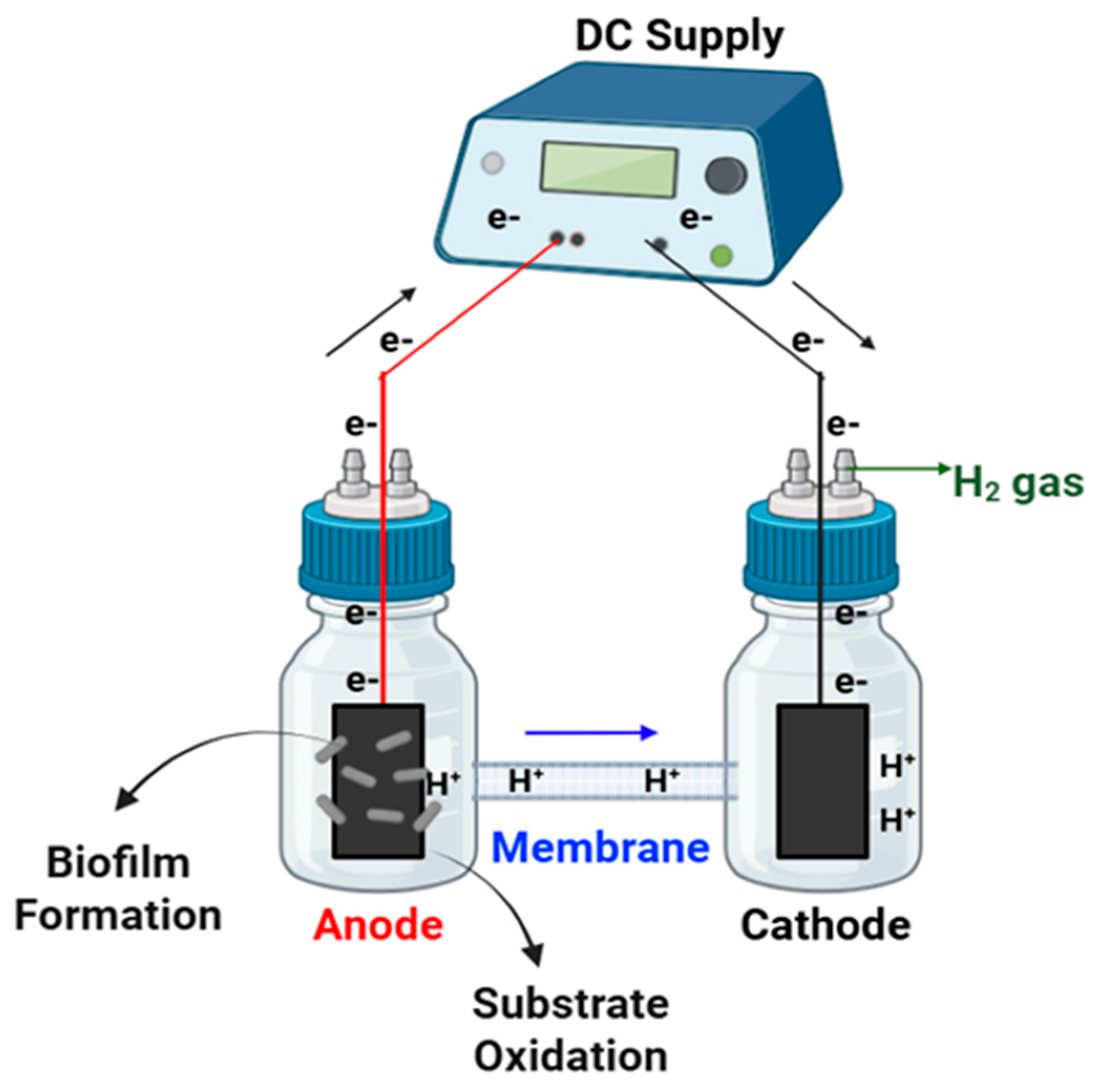
In a biofilm, the transfer of electrons generated by oxidation occurs in several ways, including direct contact, conductive pili, cytochromes, and redox mediators. As shown in Figure 1, electrons travel from the biofilm to the anode, then to the cathode through an external circuit. To keep everything balanced, the protons, along with other cations, move across the proton-exchange membrane or electrolyte. When a small external voltage manages to overcome kinetic barriers, the electrons and protons come together at the cathode, resulting in the production of hydrogen gas:
8 H +   +   8 e     4 H 2  
Net overall reaction:
CH 3 CO O   +   4 H 2 O     2 HC O 3   +   4 H 2  
The cell is powered by electron flow, and ohmic losses are determined by the internal ionic circuit, which is made up of protons and other ions. These losses can be increased by excessive biofilm thickness or electrolyte resistance, which also decouples microbial activity from detectable current [24].

2.2. Thermodynamics and Energy Inputs

The oxidation of acetate (substrate) is strongly exergonic (ΔG°′ ≈ −847 kJ mol−1) from a thermodynamic perspective, giving microbes plenty of metabolic energy. To move reaction (2) forward, an external bias (usually 0.1–1.0 V) must be applied because proton reduction to H2 is endergonic at biological pH (E0′ ≈ −0.41 V versus standard hydrogen electrode (SHE)) [25]. Since this bias is significantly less than the 1.23 V needed for water electrolysis, MECs are inherently more energy-efficient [26]. However, in reality, the real energy input is increased by concentration polarization within thick biofilms, ohmic resistance across the electrolyte and membrane, and activation overpotentials at both electrodes [27]. It is crucial to accurately analyze these voltage losses to comprehend why a metabolically active biofilm can still produce low electrical yields.

3. Factors Contributing to the Disconnect Between Biofilm, Electron Transfer Mechanism, and Hydrogen Production

The factors that contribute to ineffective electron transfer from anode to cathode and production of hydrogen at the cathode, even though there is an active biofilm formation at the anode, are examined in this section. Although biofilm activity is necessary, system-level performance and effective EET are not always ensured by it. The three interconnected factors are discussed, which depend on biofilm, electron transfer mechanisms, and hydrogen production.

3.1. Factors Affecting Biofilm Development

Biofilm development at the anode is the first critical step governing microbial attachment, substrate utilization, and overall current generation in MECs.

3.1.1. Stages of Biofilm Formation

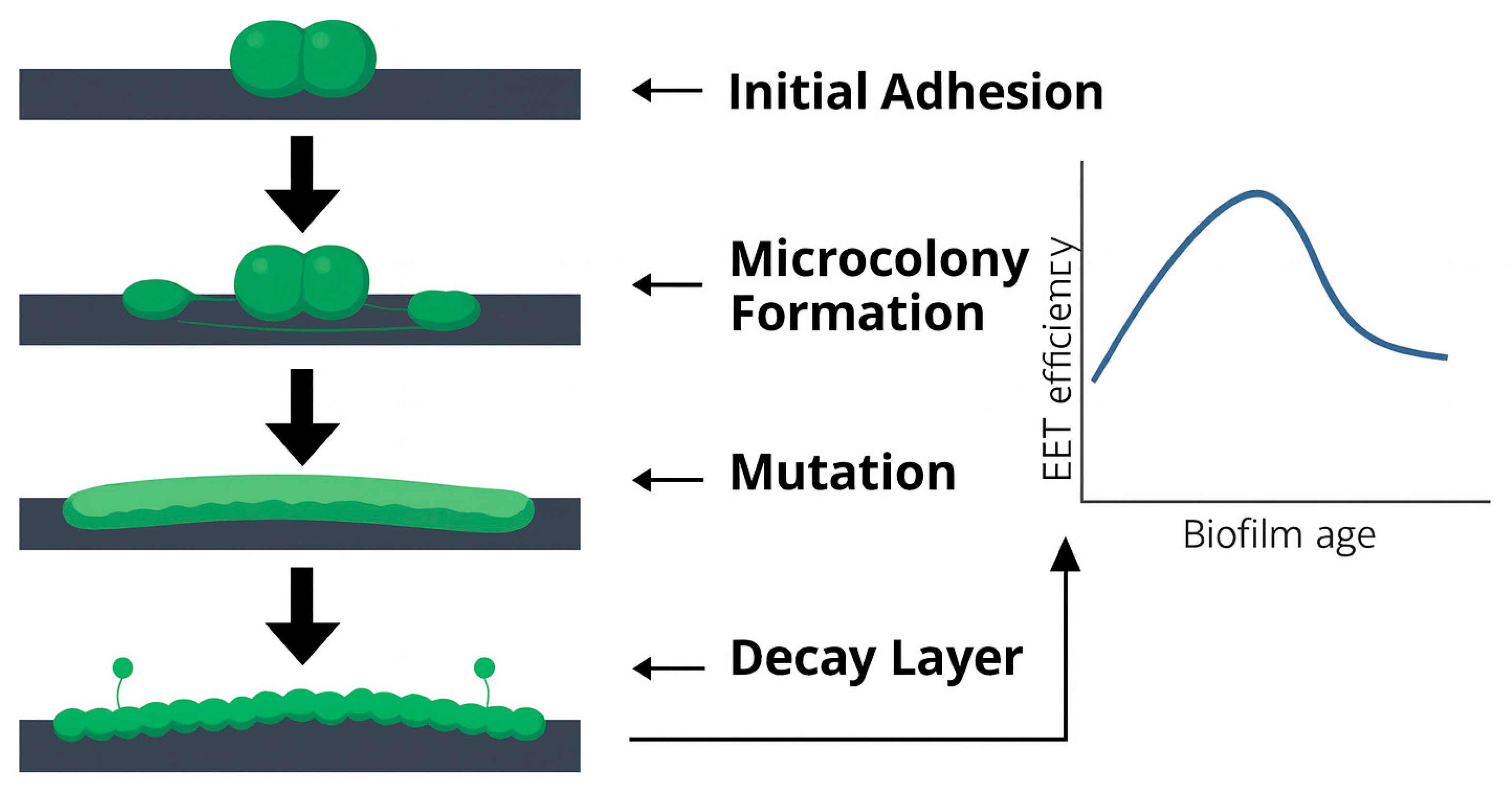
The development of biofilms on conductive surfaces follows a predictable sequence of events: (i) initial adhesion, in which planktonic cells attach using pili and van der Waals forces [28]; (ii) microcolony formation, which is characterized by rapid cell division and the onset of EPS secretion [29]; (iii) mutation, in which a three-dimensional architecture rich in EPS and water channels emerges [30]; and (iv) late-stage consolidation or dispersal, where shear stress or nutrient limitations cause cell death, sloughing, or phenotypic changes [31]. Each stage in MECs influences the community’s electrical connectivity; mature biofilms provide longer conduction paths but higher ohmic losses, while early monolayers maximize direct anode contact. Figure 2 highlights this progression visually, showing how the initially porous and metabolically active biofilm transitions into a denser structure with restricted water-channel networks, which corresponds to the reduced EET efficiency and increased internal resistance observed in mature and aging biofilms. The selection of suitable microbial species plays a pivotal role in ensuring successful biofilm formation and electrochemical performance in MECs. Electroactive bacteria used for anodic colonization must possess several essential characteristics, including strong adhesion to conductive anodes, high EET capability via direct or mediated pathways, tolerance to anaerobic conditions, and metabolic flexibility toward substrates. Among the most studied exoelectrogenic bacteria, Geobacter sulfurreducens and Desulfuromonas acetoxidans form dense, conductive biofilms and perform DET using outer-membrane c-type cytochromes (OmcZ, OmcS) and conductive pili (nanowires) [32,33]. These species achieve high coulombic efficiencies of greater than 90% and current densities exceeding 1.5 A·m−2 when acetate is used as the electron donor [21]. Shewanella oneidensis also exhibits EET ability through MET using self-secreted flavins and quinones, enabling biofilm growth under variable redox conditions [3,34].
Non-exoelectrogenic but robust biofilm formers such as Pseudomonas aeruginosa contribute to biofilm stability via abundant EPS production, which improves adhesion and mechanical resilience [35,36]. Mixed culture inocula from wastewater environments often outperform pure cultures by combining fermentative, syntrophic, and exoelectrogenic species such as Geobacter, Shewanella, and Pseudomonas, providing a greater substrate utilization range and enhanced system stability [37,38].

3.1.2. Selection of Substrate in MEC

Substrate selection is a critical factor shaping biofilm development, community structure, and EET efficiency in MECs. Using acetate as a simple, readily oxidizable substrate, the researchers observed the formation of dense, homogeneous biofilms dominated by specialist exoelectrogens such as Geobacter sulfurreducens. These biofilms exhibited high current densities and efficient EET, primarily through direct electron transfer (DET) mechanisms involving outer-membrane cytochromes and conductive nanowires [32]. In contrast, complex substrates, such as sucrose or wastewater, lead to the development of stratified biofilms composed of syntrophic consortia, including fermenters and anaerobes. This stratification results in heterogeneous metabolic zones within the biofilm, increasing mass transfer resistance, creating redox gradients, and intensifying competition for electrons. Consequently, more energy is diverted toward fermentation processes rather than direct anode respiration, which can reduce overall MEC efficiency [39]. Therefore, substrate type directly impacts biofilm architecture, electroactivity, and the hydrogen yield.

3.1.3. Biofilm Thickness, Conductivity, and Heterogeneity

Internal diffusion limitations arise when biofilms thicken beyond 50 to 100 µm: protons produced at the anode must escape, while substrate must pass through EPS matrices [40]. The percentage of cells that contribute electrons can be reduced by creating an electrochemically inert inner core through steep substrate and pH gradients [41]. In addition, the density and alignment of cytochromes determine the biofilm’s bulk conductivity; a heterogeneous distribution of these structures results in spatially varying resistances [33]. Excess EPS, metal precipitates, or dead biomass further hinder charge transport [42]. Recent redox mapping studies confirmed that internal potential and pH gradients strongly control biofilm conductivity and electron flux [43]. Therefore, there is an ideal biofilm thickness where conductive path length and electron-generation capacity are balanced; going over this threshold results in decreasing current even with high microbial activity. However, a 50 to 100 µm threshold is not universal and can vary with substrate type, hydrodynamic regime, and anode potential. Thicker biofilms (up to 150 µm) can remain active under high-flow or complex-substrate conditions, whereas thinner layers (50 µm) perform better under diffusion-limited or high-potential environments [40,44]. Quantitative studies have shown that biofilm architecture has a substantial impact on mass transfer and electron conduction. Zhang et al. (1994) reported that biofilm porosity can decrease substantially with depth, from 0.84 to 0.93 in upper layers to 0.58 to 0.67 in deeper, compacted regions, which correspondingly lowers the effective diffusivity ratio from 68–81% to 38–45%, representing more than a 50% reduction in diffusivity in denser zones [45]. Torresi et al. (2017) [46] further demonstrated that thin, less porous biofilms (porosity 75%) exhibit diffusivity factors (f) of less than 0.1. In contrast, thicker and more porous biofilms (porosity > 90%) achieve f-values of 0.2 to 0.8, indicating improvements in mass-transfer capacity [46]. Such reductions in porosity and water-channel openness restrict proton and substrate mobility, increase electron-transfer resistance, and can decrease bulk biofilm conductivity by up to an order of magnitude. The activity decline illustrated in Figure 2 mirrors the quantitative trends, where increased thickness and compaction reduce diffusivity and electron-transfer pathways.
Therefore, controlling biofilm structure and composition is essential, as excessive growth or poor conductivity can initiate the redox and mass-transfer bottlenecks that lower MEC efficiency.

3.2. Factors Affecting Electron Transfer Mechanisms

Even with well-developed biofilms, inefficient electron transfer between microorganisms and the anode remains a major cause of low current and hydrogen output.

3.2.1. Electrode Material and Configuration

The density of biofilm colonization, the strength of microbial adhesion, and the effectiveness of electron transfer are all significantly influenced by the anode’s material and surface architecture [47]. Because of their high conductivity, stability, and biocompatibility, carbon-based materials such as graphite rods, carbon cloth, and carbon felt are used extensively [48]. However, these materials’ specific surface area, porosity, and roughness can differ greatly, which affects the electroactivity and morphology of biofilms [49]. Carbon nanotube (CNT) sponges and graphene-coated foams are examples of high-surface-area structures that offer more colonization sites and allow for three-dimensional growth, which may increase current output [50]. As summarized in Table 1, materials with higher surface area and conductivity, such as carbon felt, carbon cloth, and CNT/graphene composites, consistently produce higher normalized current densities, reinforcing the correlation between electrode microstructure and EET performance. However, if these intricate structures are not appropriately optimized, they can also trap dead biomass and produce mass transfer dead zones [51].
Table 1. Comparison of commonly used carbon-based anode materials in MECs with respect to surface area, conductivity, and biofilm compatibility.
Anode MaterialSurface Area (m2g−1)Conductivity (S cm−1)Biofilm CompatibilityReference
Graphite Rod0.5–110–100Good; supports mature biofilms[52]
Carbon Felt10–2010–100Excellent; promotes dense, uniform biofilms [52,53]
Carbon Cloth5–1010–100Very good; rapid biofilm formation and high current generation [52,54]
Carbon Paper5–1010–100Good; higher current density than graphite rod [52]
CNT/Graphene100–2042.51.32–204Excellent; enhances electron transfer and microbial attachment[55,56]

3.2.2. Mass Transfer Limitations Through the Connections and the Membrane

Mass transfer limitations in the movement of substrates like acetate and products such as protons and hydrogen through the biofilm matrix and electrolyte can affect MEC efficiency [57]. As biofilms thicken, the transport of acetate to deeper layers slows and becomes the limiting factor [15]. At the same time, protons generated during acetate oxidation accumulate in the biofilm, causing steep pH gradients [58]. A lower pH in the inner biofilm can hinder redox enzyme activity and microbial metabolism, leading to reduced electron transfer and current density even when outer layers function well [34]. Beyond the challenges within the biofilm, poor fluid mixing near the electrode surface creates stagnant diffusion boundary layers and decreases mass transport [59]. The situation is intense in MECs using cation exchange membranes; slow proton transfer leads to counter-ion accumulation and increased internal resistance [60].

3.2.3. Key Electroactive Species

Usually, obligate anaerobes that are well-known for their EET dominate MEC anodes [61]. DET is a speciality of Geobacter sulfurreducens, which can achieve high coulombic efficiencies under optimal conditions through dense networks of conductive pili and c-type cytochromes [62,63]. Although it can withstand slightly higher salinity, Desulfuromonas acetoxidans plays a similar role [64]. Although facultative anaerobes like Shewanella oneidensis can colonize anodes, they typically play a supporting role when a particular substrate is the only carbon source because they depend on soluble flavins for mediated electron transfer (MET) [65]. Hydrogenotrophic methanogens that compete for electrons or fermenters that cross-feed substrate can also be found in mixed-culture systems [66]. A recent review also highlights how electrode potential influences EET gene regulation and microbial community structure [67].
In mixed-culture MEC biofilms, the balance between direct electron transfer DET and MET varies with substrate composition, anode potential, and microbial community structure [68,69]. DET typically dominates in acetate-fed systems enriched with Geobacter species, where cytochromes and conductive pili support efficient electron conduction with minimal diffusion losses [70,71]. In contrast, complex substrates promote the activity of fermenters and syntrophic partners that increase secretion of soluble redox mediators, elevating the contribution of MET. But it reduces the overall electron transfer efficiency due to mediator diffusion, instability, and redox cycling losses [10,72]. Anode potential also modulates pathway dominance, with more positive potentials promoting cytochrome expression and DET, whereas lower potentials increase mediator release and MET activity [73]. Each pathway introduces characteristic efficiency losses where DET is limited by redox cofactor density and increased internal resistance in thick or heterogeneous biofilms. Moreover, MET suffers from diffusion constraints, mediator instability, and lower coulombic recovery [71]. These interacting factors explain why mixed-culture biofilms can exhibit high metabolic activity yet inadequate electron delivery to the anode. Overall, biofilm conductivity and electron sink competition are determined by the relative abundance of these guilds.

3.2.4. Metabolic Pathways of Substrate-Oxidizing Exoelectrogens

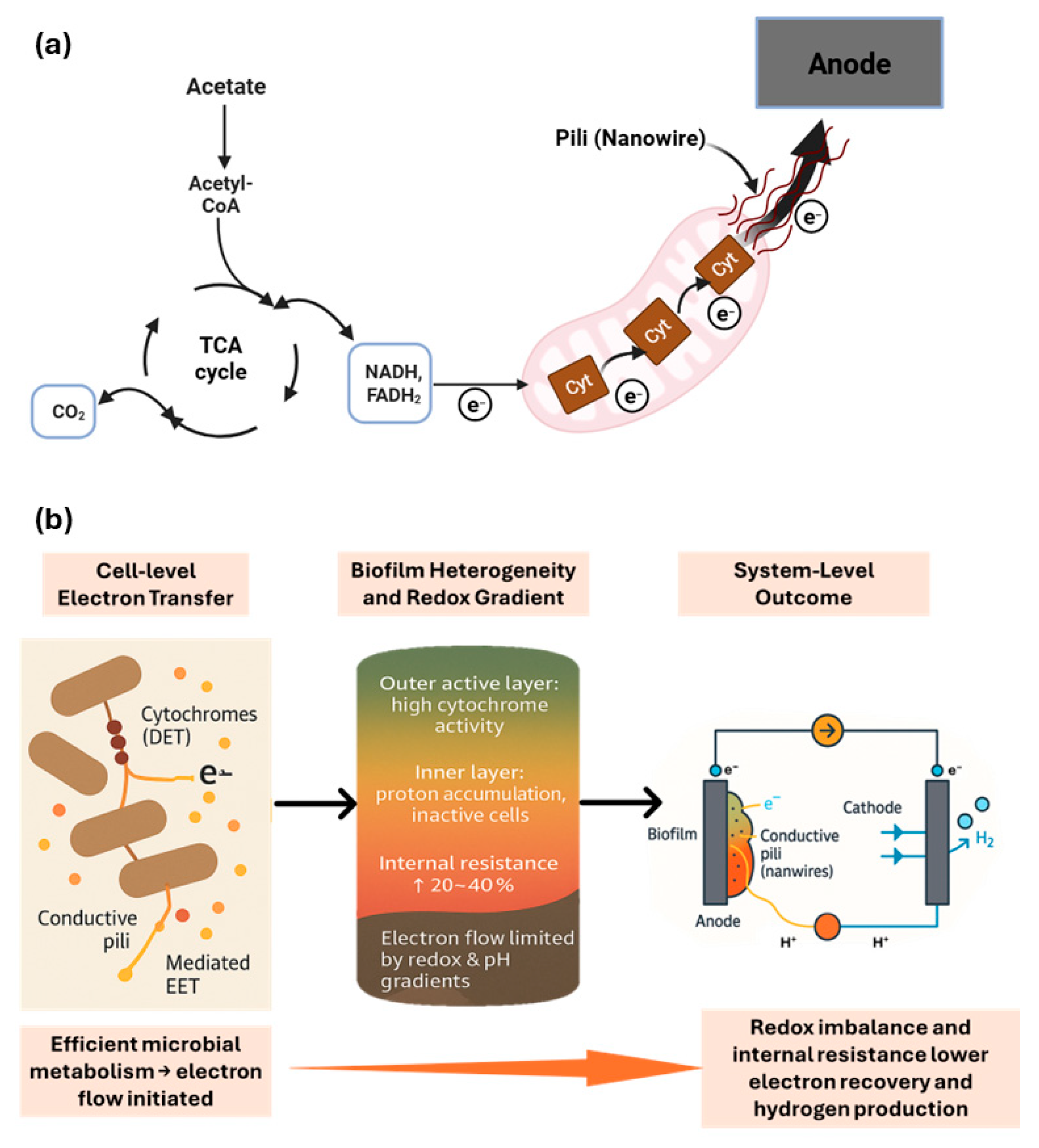
Specialized exoelectrogens with the capacity to transfer electrons straight to an electrode are the main agents responsible for oxidation in MECs. The most well-known of these are the species of Desulfuromonas and Geobacter [70]. These microorganisms use the tricarboxylic acid cycle (TCA) to metabolize acetate, a model substrate. Acetyl-CoA (Acetyl coenzyme A) is initially produced from acetate, then it enters the TCA cycle and is oxidized to CO2. As a result, reduced cofactors such as NADH (Nicotinamide adenine dinucleotide) and FADH2 (Flavin adenine dinucleotide) are produced, which are subsequently utilized to propel electron transfer via an electron transport chain that is membrane-bound (Figure 3a) [74]. Figure 3a visually summarizes this pathway by mapping acetate oxidation, NADH/FADH2 generation, and subsequent electron transfer through membrane-bound carriers, clarifying the sequence of biochemical reactions. The dominance of DET or MET directly shapes the net electron flux entering the anode, especially in mixed-culture systems where fermenters, methanogens, and exoelectrogens compete for electrons under different substrate and potential regimes. Hari et al. (2016) [75] reported that more positive anode potentials and acetate-rich environments favor DET, resulting in higher current outputs. In contrast, fermentable substrates and lower anode potentials promote methanogenic competition and increase reliance on MET, leading to greater electron diversion to methane and reduced coulombic efficiency [75]. Geobacter sulfurreducens can transfer electrons through outer-membrane c-type cytochromes or conductive pili, also referred to as nanowires [62]. DET is made possible by these structures, which physically join the bacteria to the anode surface [76]. High-resolution cryo-electron microscopy (cryo-EM) and spectroscopic studies show that Geobacter forms multi-heme cytochrome filaments (OmcS, OmcE, OmcZ) with stacked hemes that create conductive electron-tunneling paths [77,78]. Recent reviews on exoelectrogenic communities emphasize how multi-omics and imaging tools clarify these EET networks [79]. These coexist with type IV pili (PilA), which anchor cells and align redox proteins for efficient contact [80]. The balance between cytochrome-based conduction and pili-assisted interfaces depends on anode potential and biofilm conditions. Pili provide structural linkage, while OmcZ or OmcS filaments act as high-conductance pathways, especially at the biofilm–electrode boundary. This cooperation enhances long-range EET but can lead to transport bottlenecks where internal redox gradients limit electron flow despite high microbial activity [81].
In thick biofilms, electron flow becomes limited by redox and mass-transfer constraints rather than by microbial metabolic potential alone. Across biofilms ranging from tens to hundreds of micrometers, redox and pH gradients can create zones with unfavorable potentials for outer-membrane cytochromes, thereby lowering effective EET per cell. Microelectrode and CLSM mapping at varying anode potentials demonstrate spatial stratification of electroactivity and potential-dependent enrichment of specific anodic populations, clarifying why high biomass does not always correspond to proportional current output [82]. Furthermore, some exoelectrogens generate soluble redox mediators that transfer electrons to the electrode [83].
The overall efficiency of these molecular-scale EET pathways ultimately governs the electrochemical performance of the entire MEC system. In thick biofilms, spatially uneven cytochrome- and pili-mediated electron transfers lead to the formation of localized redox and pH gradients that generate potential drops across the biofilm matrix. Such gradients can increase anode internal resistance by approximately 20 to 40%, resulting in noticeable reductions in current density and hydrogen yield. Consequently, even metabolically active biofilms may underperform electrochemically because heterogeneity in redox conditions and limited conductivity restrict effective electron flow. Previous studies have confirmed that uneven redox potentials and proton accumulation diminish biofilm conductivity and constrain EET efficiency [84,85]. This coupling between molecular-level activity and system-scale behavior is illustrated in Figure 3b, which complements Figure 3a by linking cytochrome-driven electron transfer and redox stratification to overall reactor-level hydrogen generation.
Understanding these electron transfer limitations is crucial for developing targeted electrode modifications and microbial strategies to enhance EET performance.

3.3. Factors Affecting the Production of Hydrogen at the Cathode

Hydrogen generation efficiency at the cathode depends not only on electron availability but also on redox balance, mass transport, and competing biological reactions.

3.3.1. Redox Imbalance and Internal Resistance

Efficient EET relies on a delicately balanced redox environment. When the anode potential is overly positive compared to the redox potential of microbial electron carriers, like c-type cytochromes, EET becomes thermodynamically challenged [85]. This redox mismatch from factors like biofilm overgrowth, surface fouling, or voltage fluctuations can trap electrons or divert them through less efficient pathways, reducing MEC performance [86]. The overall efficiency in MECs is significantly compromised by internal resistance, including ohmic resistance from the electrolyte and separator, activation overpotential at the electrode interface, and concentration overpotential from local substrate depletion [87]. These resistive losses in MECs absorb part of the external voltage, leaving less energy available for current generation and hydrogen evolution [88].

3.3.2. Hydrogen Losses and Methanogenesis

Even when electrons successfully reach the cathode, hydrogen yield is not guaranteed. Hydrogen generated at the cathode can diffuse back or cross over to the anode, where it may be consumed by hydrogenotrophic microorganisms, reducing the hydrogen yield [89]. Among these, methanogens, particularly hydrogenotrophic types, convert H2 into CH4 in MECs, thereby reducing both coulombic and hydrogen recovery efficiencies [89,90]. This biological short-circuiting is more pronounced in mixed-culture MECs and during extended operation without selective microbial enrichment [18]. Additionally, some hydrogen is physically lost by leakage or solubilization into the electrolyte [91].
Cui et al. (2019) reported that, under uninhibited mixed-culture conditions, hydrogen content in the biogas decreased from 85 to 90% to nearly 0%, while methane increased to greater than 94%, demonstrating almost complete diversion of H2 to methanogenesis [92]. Hou et al. (2014) similarly showed that hydrogen yield declined from 3.78 to 0.03 mol H2 mol−1 acetate when methanogenesis was active, corresponding to 99% hydrogen loss [93]. He et al. (2022) summarized that methanogenesis typically accounts for 40 to 60% of total hydrogen losses in MECs, where H2 purity dropped from 83% to 25% and from 93% to 6%, accompanied by CH4 increases from 9% to 66% and 5.5% to 94%, respectively [94]. Beyond biological consumption, physical diffusion and crossover of H2 through membranes, tubing, and imperfect seals can further reduce apparent recovery. Bibliometric and content analysis by Zhao et al. (2020) highlighted that decreasing internal resistance and H2 diffusion is crucial for improving MEC hydrogen yields, particularly in single-chamber and poorly sealed systems [95]. Collectively, these studies confirm that methanogenic hydrogen consumption represents the primary cause of H2 loss in mixed-culture MECs, frequently exceeding losses from physical diffusion.

3.3.3. Biofilm Stratification and Aging

Internal stratification in thickened anodic biofilms leads to substrate starvation and metabolic byproduct accumulation in inner layers, with only outer layers remaining metabolically active [96]. Spatially differentiated activity in biofilms leads to a decline in the fraction of electroactive cells contributing to current, even though total biomass may continue to increase [39]. Furthermore, the buildup of EPS and dead cells in deeper biofilm layers forms a dense, poorly conductive matrix that hinders mass transport and increases resistance [97]. As a result of these aging effects, which are summarized in Table 2, microbial activity of the biofilm gradually becomes decoupled from functional outputs such as hydrogen evolution or current density [98].
Table 2. Changes in biofilm viability, EPS concentration, and conductivity with biofilm age.
Biofilm AgeViability (Live/Dead Ratio)EPS Concentration (mgg−1 Biofilm)Conductivity (Sm−1)Reference
Young (early)High(>80% live)ModerateHigh[84,97,99]
MatureModerate (~60–70% live)Increased (protective response)Moderate[84,97,99]
Aged (late)Low(<40% live, dead core)High (thick EPS layer)Lower (Dead layer may remain conductive)[84,97,99]
Hence, improving cathodic reactions requires simultaneous control of biofilm activity, internal resistance, and hydrogen losses to competing microbial pathways. Overall, the observed gap between biofilm activity and hydrogen yield arises from these interacting factors, providing a clear foundation for the diagnostic and optimization strategies discussed in the following sections.

4. Monitoring and Characterization Techniques of Biofilm Performance

To identify performance bottlenecks in MECs and direct focused enhancements, accurate evaluation of biofilm function is crucial. Modern characterization approaches cover three complementary domains: electrochemical probes that quantify real-time electron transfer; imaging techniques that reveal biofilm architecture; and high-throughput omics that decode community composition and metabolic potential. A comprehensive understanding of how structural, electrochemical, and genetic factors interact to affect current and hydrogen yields is made possible by combining these tools.

4.1. Electrochemical Techniques: CV, EIS, and LSV

Electrochemical methods offer rapid, non-destructive insights into the redox behavior and resistive losses of living biofilms. Cyclic voltammetry (CV) scans the anode potential to identify redox-active peaks associated with outer-membrane cytochromes and soluble mediators, allowing evaluation of electron-transfer kinetics. The shape and height of CV peaks can indicate biofilm health. Sharp, well-defined peaks suggest efficient redox coupling, whereas flattened curves often signal fouling or redox imbalance [100]. Electrochemical impedance spectroscopy (EIS) applies small-amplitude AC perturbations over a frequency range to resolve charge-transfer resistance, double-layer capacitance, and mass-transfer diffusion elements to monitor biofilm development and aging [101]. Linear sweep voltammetry (LSV) is used to map anode polarization behavior and determine onset potentials [102]. Together, CV, EIS, and LSV build a quantitative fingerprint of biofilm electroactivity that can be tracked over time or compared across electrode materials.
Several emerging in situ techniques now provide direct insight into electron-transfer processes within MEC biofilms. Plasmonic imaging enables label-free, real-time visualization of cytochrome redox activity at the single-cell level, revealing spatial heterogeneity in EET [103]. In situ Raman spectroscopy can monitor the redox state of outer-membrane cytochromes within intact, hydrated biofilms during current generation [104]. Oblique Incident Reflectivity Difference (OIRD) offers spatially resolved, real-time mapping of EET flux at the biofilm–electrode interface [105]. Cyclic voltammetry coupled with microsensors has also been applied to semi-quantitatively track electron-transfer activity and hydrogen involvement directly within living biofilms [106].
In addition, recent in situ studies tracking biofilm behavior under different anode potentials clarify how start-up voltage and operating regime shape electroactivity and stability in MEC systems [107,108].

4.2. Microscopic and Imaging Methods: CLSM, SEM, and AFM

When analyzing electrochemical data, it is crucial to visualize the morphology of biofilms. Confocal laser scanning microscopy (CLSM) enables non-destructive, three-dimensional visualization and quantification of biofilm thickness, porosity, and structure in hydrated biofilms [109]. Scanning electron microscopy (SEM) provides high-resolution images of conductive pili networks, mineral precipitates, and cell-to-electrode contact points in dehydrated biofilm samples [63]. Atomic force microscopy (AFM) measures biofilm stiffness, adhesion forces, and surface topography in liquid environments relevant to MECs. By combining CLSM volumetrics with AFM nanomechanics and SEM ultrastructure, scientists can link spatial differences in electron-transfer efficiency to physical heterogeneity.

4.3. Omics Tools: Metagenomics, Transcriptomics, and Proteomics

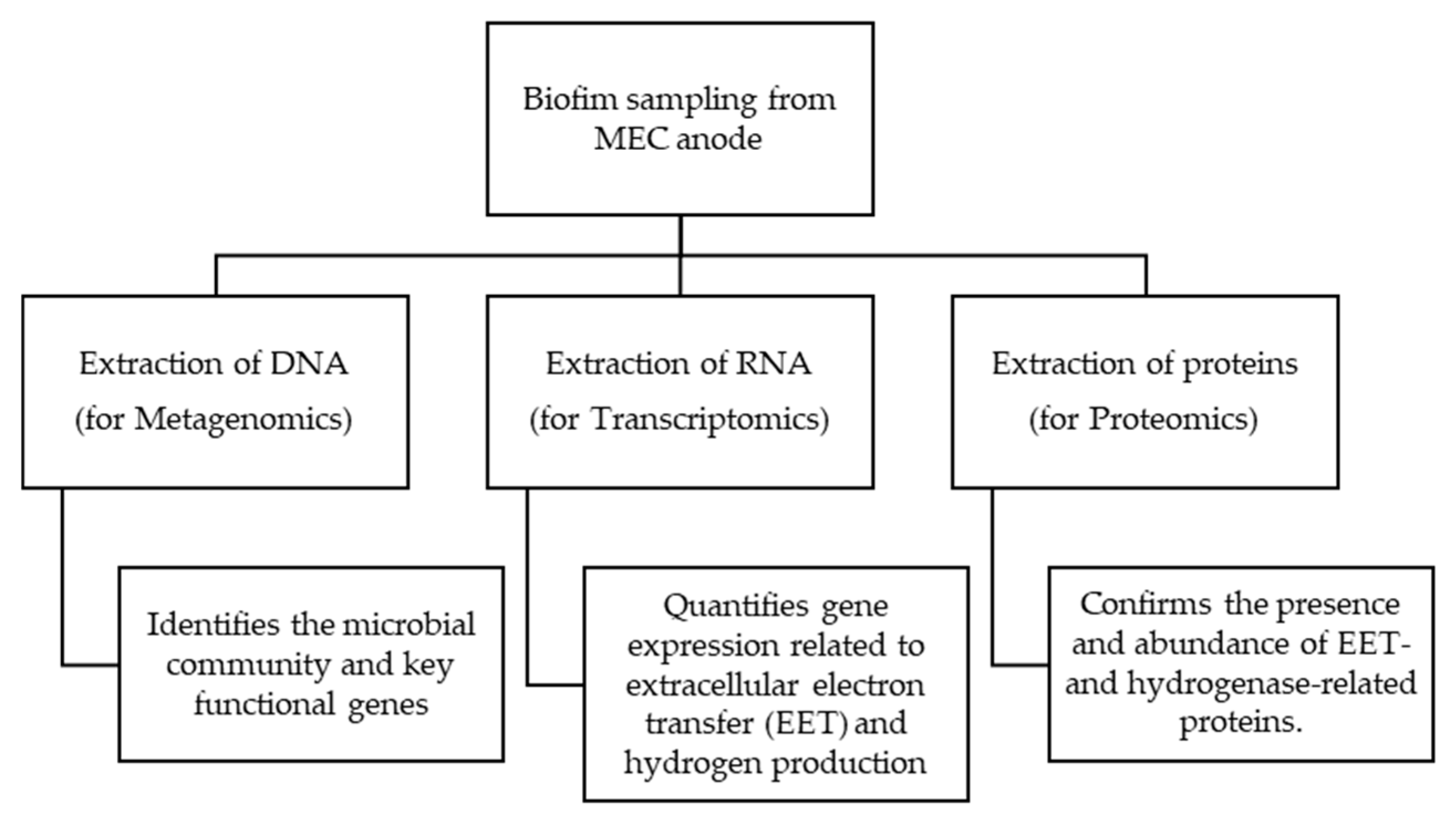
In addition to what can be inferred from electrochemistry and imaging alone, high-throughput omics can reveal the genetic and functional blueprint of biofilms in MECs [110]. Metagenomics can identify key microbial groups and gene abundances related to hydrogenotrophs, fermenters, exoelectrogenic taxa, and important pathways like pilin assembly, hydrogenase expression, and c-type cytochrome production [111]. Transcriptomic (RNA-sequencing) analysis can identify gene expression responses to oxidative stress and cell membrane changes under different electrical and redox conditions [112]. Proteomics provides the strongest correlation with phenotype by confirming the presence and activity of metabolic enzymes and redox proteins [113]. Combining these layers or multi-omics approaches (Figure 4) in MECs can identify key microbial groups, gene abundances, gene expression changes, and active proteins, revealing functional bottlenecks such as increased methanogenic hydrogenases and inhibited cytochrome synthesis [114].
Collectively, these electrochemical, imaging, and omics techniques provide the diagnostic basis for identifying electron-transfer inefficiencies and guiding process improvements.

5. Techniques for Enhancing the Electron Transfer Mechanism and Hydrogen Production

Recent studies have been dedicated to addressing the limitations associated with MECs by improving the efficiency of EET between electroactive microbes and electrodes. While the activity of microorganisms is crucial, the overall performance of the system relies on how effectively electrons are transferred from microbial metabolism to the external circuit. This section discusses several promising approaches that have emerged to enhance EET, including the development of advanced anode materials, the use of redox mediators and conductive polymers, the strategic modification of microbial communities through bioaugmentation, and the implementation of novel electrical inputs employing pulsed or alternating voltage methods.

5.1. Acetate as Model Substrate

Acetate is a preferred substrate in MEC research due to the consistent electrochemical behavior and abundance in wastewater. For exoelectrogenic bacteria, especially those belonging to the genus Geobacter, which are renowned for their effective EET mechanisms, acetate, a short-chain volatile fatty acid, is the perfect electron donor [115]. In MECs, acetate is oxidized, which releases electrons that are transported to the anode via the biofilm. Hence, acetate is highly suitable for researching the direct relationship between electrochemical outputs like current density and hydrogen production and microbial metabolic activity [116]. Additionally, unlike longer-chain or aromatic organics, acetate does not require complex enzymatic degradation, which reduces confounding variables in experimental designs [117]. The widespread use of acetate in wastewater treatment streams and anaerobic fermentation processes gives its application in MECs an additional practical significance [118]. Four useful benefits account for acetate’s dominance as a research substrate. (i) Simple metabolism: because it is a two-carbon molecule, it can undergo direct oxidation through the TCA without going through the hydrolytic or fermentative processes [119]. (ii) Compatibility: canonical exoelectrogens with well-characterized extracellular electron-transfer (EET) pathways, like Desulfuromonas acetoxidans and Geobacter sulfurreducens, grow robustly on acetate [70]. (iii) reproducibility: standardizing performance metrics and facilitating mechanistic comparisons across laboratories using the same, simple substrate [120]. (iv) Significance: Since acetate is widely present in municipal wastewaters and fermentation effluents, laboratory results are consistent with actual feedstocks [121]. Because of these benefits, acetate is perfect for examining basic EET issues and locating systemic bottlenecks that more complex organics might obscure. In addition to making system operation simpler, the direct use of acetate eliminates the need for fermentation intermediates and offers a more controlled platform for researching how electrode materials, system architecture, and environmental factors affect MEC performance.
Regardless of the benefits, the use of acetate has some other difficulties, including inadequate scalability, biofilm stratification, and disparities between hydrogen yield and microbial activity [122]. These problems show that although acetate makes the biological environment simpler, it also reveals more profound system-level inefficiencies pertaining to internal resistances, mass transport constraints, and electron transfer kinetics [123]. Therefore, when transferring bench-scale insights to practical applications, acetate’s limitations must be carefully considered, even though it is still a crucial model substrate for basic MEC research [124]. Also, acetate-based MECs often fail to replicate the complexity of real wastewater systems, where mixed substrates and microbial interactions can cause lower reproducibility. Thus, while acetate serves as an excellent model substrate for mechanistic studies, its scalability to real environmental applications remains limited [70].

5.2. Advanced Electrode Materials

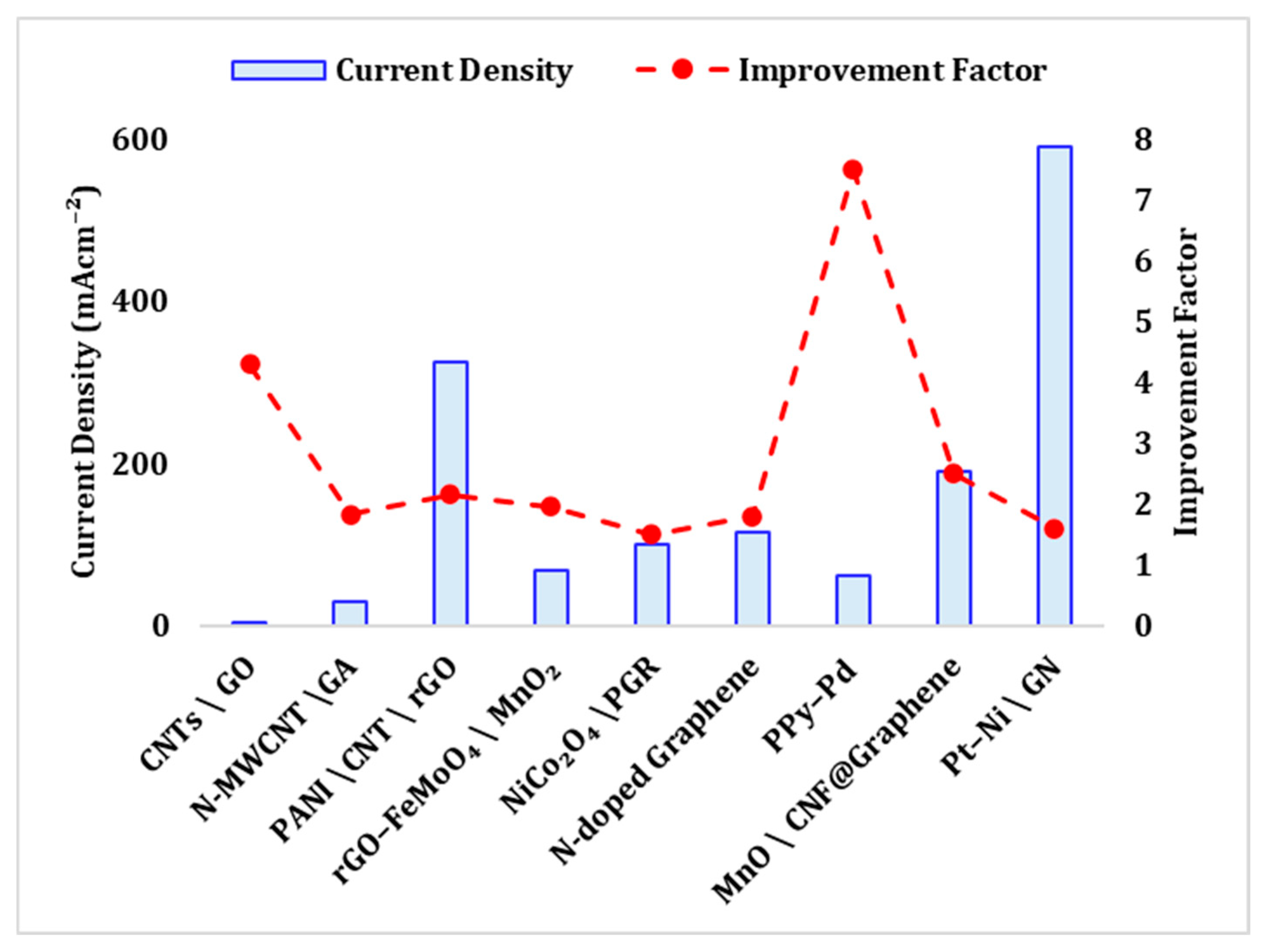
Microbial attachment and biofilm integrity can be enhanced by surface functionalisation, such as the addition of carboxylic, hydroxyl, or amine groups to the anode [125]. Advanced carbon-based nanomaterials with their remarkable properties, such as high surface area, excellent conductivity, and customizable surface chemistry, enhance the performance of MECs [126]. A study illustrated that the use of graphene, known for its unique two-dimensional honeycomb structure, stands out due to its ultra-low electron resistance and large surface area, which promote superior and consistent microbial colonization [127]. Interfacial charge-transfer resistance can also be decreased by covering the anode with metal oxides [128,129]. Indirect effects of electrode geometry and spacing on ion transport can also affect the efficiency of electron recovery [130]. Graphene-based composites with metal oxides or polymers enable tunable surface charge and wettability, supporting superior microbial colonization and electrochemical performance [131]. On the other hand, CNTs provide a highly conductive 3D scaffold that enhances microbial adhesion and shortens charge transfer distances [132]. A study reported that electrodes modified with CNTs or graphene oxide increased current density from 7.5 A m−2 to 32.5 A m−2 (≈ 4.33-fold) compared with unmodified electrodes [50]. Recent advances in surface-functionalized nanocarbons and transition-metal composites further enhance electron transport and microbial adhesion [23]. Figure 5 compiles the current densities reported for various nanostructured electrodes, including CNT/GO composites, N-MWCNT/graphene aerogels, PANI/CNT/rGO hybrids, rGO–FeMoO4/MnO2 composites, NiCo2O4-coated graphite rods, N-doped graphene, PPy–Pd nanohybrids, MnO/CNF@graphene membranes, and Pt–Ni/graphene nanoplatelets. These data illustrate the wide performance range achievable through nanomaterial-based electrode engineering. It shows that CNT and graphene-based hybrid electrodes exhibit the highest current densities, while PPy–Pd nanohybrids achieve the largest relative improvement despite moderate absolute performance. In contrast, Pt–Ni/graphene nanoplatelets provide the highest absolute current density, reflecting their superior catalytic activity but smaller fold-increase over baseline. Collectively, these trends illustrate how nanomaterial composition, catalytic functionality, and structural design jointly determine the magnitude of MEC performance enhancement. The combination of high conductivity and optimal biofilm interaction positions these materials as exceptional candidates for enhancing electron harvesting.
Despite their excellent performance, many advanced materials face cost and scalability barriers. Long-term stability, potential leaching of nanoparticles, and challenges in large-scale synthesis may restrict their industrial use. Therefore, optimization must balance performance gains with environmental and economic sustainability [23].

5.3. Improving Reactor Mixing, Biofilm Architecture, and Electrode Design

To improve electron transfer efficiency in MECs, addressing mass transfer limitations is crucial. Enhancing reactor mixing through mechanical stirring, gas sparging, or flow recirculation can reduce stagnant boundary layers. Moreover, it can increase the turbulence near the electrode surface, which improves substrate and proton transport throughout the system. These interventions improve substrate and proton transport throughout the system, supporting higher current densities and more stable MEC operation. Real-time, in situ biofilm monitoring was used to identify optimal biofilm thickness (100–150 μm) for maximum current generation [140]. Better mixing also facilitates the uniform distribution of microbial communities and prevents massive accumulation or deposition of inhibitory byproducts. A study demonstrates that, under flow conditions, an increased diversity within the biofilm community and higher levels of EPSs contributed to greater microbial resilience against heavy metal stress. This enhanced mixing mitigated the negative effects of toxic byproducts, such as copper ions [141]. Developing controlled, thinner biofilms through periodic shear stress, hydraulic control, or quorum-sensing inhibitors can ensure better penetration of the substrate (acetate) into the inner layers, minimize pH gradients, and maintain optimal conditions for microbial metabolism and redox enzyme activity. Thinner biofilms also allow faster diffusion of protons away from the anode, preventing acidic microenvironments that hinder electron transfer [142].
Additionally, integrating engineered microchannel electrodes or 3D-structured materials not only increases surface area for biofilm growth but also enhances convective flow and nutrient access at the micro-scale level. Such architectures shorten diffusion distances within the electrode-biofilm interface and improve electron collection efficiency [143]. Researchers investigated the use of 3D-printed anode electrodes with precisely defined geometries, including microchannels in the hundreds of micrometer range. These electrodes were fabricated using advanced additive manufacturing techniques with conductive copper-based Electrifi filament, and sometimes they were further enhanced with surface modifications to improve electrochemical activity. The research demonstrated that spiral-shaped 3D-printed electrodes significantly improved mass transport and biofilm colonization compared to traditional designs, leading to up to 2.6 times higher current density and a fivefold increase in hydrogen production rate. The one-cycled spiral electrode exhibited a maximum current density of 13 A m−2, compared with 3.8 A m−2 for the rod electrode, and achieved a hydrogen generation rate of approximately 0.71 L H2 m−2 h−1, exceeding the rod electrode’s 0.14 L H2 m−2 h−1, confirming its superior electrochemical and hydrogen-evolution performance. The enhanced performance was attributed to the increased surface area, improved contact between the electrode and electrolyte, and more efficient charge transfer enabled by the engineered microchannel structures [144]. Advanced designs may incorporate hydrophilic coatings, such as poly(3,4-ethylenedioxythiophene)/polystyrene sulfonate (PEDOT/PSS), to three-dimensional carbon felt anodes, significantly enhancing both mass transfer and microbial attachment. The super-hydrophilic surface created by the coating improves water penetration and gas release, which increases the effective surface area available for biofilm growth and accelerates hydrogen production [53]. These strategies collectively aim to reduce internal resistance, stabilize the electrochemical environment, maintain uniform pH, and ensure consistent electron delivery from microbes to the anode.
Excessive mixing or shear stress may detach biofilms and disrupt electron pathways, reducing system stability. Reactor designs must therefore be optimized to enhance mass transfer without compromising biofilm integrity or increasing energy input [145].

5.4. Use of Redox Mediators and Conductive Polymers

Researchers have investigated redox mediators and conductive polymers as they can enhance the connection between microbial electron donors and electrode surfaces [146]. Redox mediators like neutral red, flavins, and humic acids facilitate indirect electron transfer by shuttling electrons from microbial cells to the anode and are beneficial in situations with thick or poorly connected biofilms [147,148,149]. However, concerns about stability and toxicity arise with the use of synthetic mediators [147]. Conversely, conductive polymers such as polyaniline (PANI) and polypyrrole (PPy) create biocompatible, electroactive films on electrode surfaces, enhancing microbial adherence and electron flow [150,151]. These polymer coatings can drastically lower activation overpotentials and help maintain long-term biofilm stability [152].
The use of synthetic mediators introduces toxicity and cost concerns, while conductive polymer coatings may degrade under prolonged operation. Selecting stable, biocompatible materials or exploring naturally secreted mediators can minimize these drawbacks [153].

5.5. Use of Hydrophobic Membrane, Methanogen Inhibitors, and Selective Electrocatalysts

To minimize hydrogen losses caused by methanogenesis and diffusion, several targeted strategies have been developed. One effective approach is the use of hydrophobic membranes, which act as selective barriers. A study demonstrated that using gas-permeable hydrophobic membranes enables rapid and selective extraction of hydrogen gas. Also, it effectively prevents the hydrogen loss to methanogenesis and back-diffusion. By actively harvesting hydrogen through gas-permeable hydrophobic membranes under vacuum, the system maintained a high hydrogen partial pressure at the cathode and completely suppressed methane formation, achieving hydrogen yields 3.2-fold higher (0.74 to 2.35 L H2 m−2 h−1) than those obtained by traditional spontaneous gas release. Switching to active membrane-based harvesting immediately halted ongoing methanogenesis, increased current density by 36% (from 4.46 to 6.07 A m−2), and enhanced overall energy efficiency, rendering the process energy-positive. It allows hydrogen gas to be collected more efficiently while limiting its crossover to the anode, where it could otherwise be consumed by hydrogenotrophic methanogens [154].
The use of methanogen inhibitors like 2-bromoethanesulfonate (2-BES) is a suitable method to selectively suppress methanogenic archaea, thereby minimizing hydrogen losses without significantly affecting exoelectrogenic bacteria. A recent study demonstrated that adding 2-bromoethanesulfonate (2-BES) to MECs effectively inhibits methanogenesis, resulting in a 79.5% reduction in methane production and a 145.5% increase in hydrogen yield compared to controls. Importantly, the use of 2-BES did not significantly alter the exoelectrogenic bacterial community, indicating that it selectively suppresses methanogenic archaea without harming the bacteria responsible for electron transfer and hydrogen production. The study also found that even low concentrations of 2-BES (500 μM) were sufficient to achieve these effects, allowing for rapid and targeted control of electron flow toward hydrogen rather than methane [155]. In addition to chemical inhibition, periodic cathode sterilization or selective biofilm removal techniques, such as in situ magnetic scraping, can effectively prevent the establishment and persistence of methanogens on the cathode surface during long-term operation. For example, a study demonstrated that in situ biofilm removal from cathodes using magnets significantly reduced biofilm thickness and improved power output, indicating that regular biofilm management can help maintain optimal microbial communities and system performance [156].
Additionally, cathode materials modified with selective electrocatalysts, like cobalt phosphide on nickel foam (CoP-NF), have been shown to favor the hydrogen evolution reaction (HER) while resisting microbial colonization. A study demonstrated that the CoP-NF catalyst improved hydrogen production rates to three times that of bare nickel foam, increased energy efficiency, and maintained superior stability during long-term operation, making it highly effective for boosting coulombic efficiency and overall hydrogen recovery [157]. Similarly, biocathode-based MECs have achieved high hydrogen yields with reduced energy input by coupling electrocatalysis and biofilm activity [158]. Other commonly used materials for hydrogen evolution catalysts include Pt/C, Ni- and Co-based catalysts, and a range of non-precious metal electrocatalysts such as transition-metal phosphides (e.g., CoP, Ni2P), and carbides (e.g., Mo2C, WC), all of which offer favorable activity under neutral and alkaline MEC conditions [159,160,161,162]. Cobalt phosphide nanoparticles grown on pristine graphene have demonstrated outstanding HER activity, with onset potentials as low as 7 mV, overpotentials of 91 mV at 10 mA cm−2, and excellent durability over 2000 CV cycles [163]. Similarly, mixed Co–W phosphide nanoparticles self-assembled on graphene have achieved exceptionally low overpotentials and high stability in both acidic and alkaline conditions, outperforming many non-noble-metal HER catalysts [164]. Such catalysts offer high intrinsic activity, good cycling stability, and compatibility with low-cost supports, making them promising candidates for improving cathodic hydrogen evolution in MECs. Collectively, these strategies contribute to reducing biological hydrogen losses and improving the energy output and reliability of MECs.
While these methods improve hydrogen recovery, chemical inhibitors such as 2-BES raise operational costs and may harm beneficial microbial populations. Similarly, membrane maintenance and catalyst deactivation present long-term challenges that must be addressed before field implementation [165].

5.6. Bioaugmentation Strategies

To enhance the EET capabilities of the electroactive ecosystem of native communities, high-performing electroactive microorganisms are added through a method called bioaugmentation [166]. Strains like Shewanella oneidensis and Geobacter sulfurreducens have been effectively integrated into mixed-culture systems, resulting in improved startup times and increased current generation [37]. Furthermore, creating syntrophic co-cultures, such as pairing Geobacter with hydrogen-producing fermenters, can enable a consistent flow of electrons [167]. Bioaugmentation also allows for adaptation to challenging conditions such as high salinity and the presence of toxic compounds, improving both pollutant removal and energy production [168].
Nevertheless, challenges remain in ensuring the long-term survival and integration of these introduced species, especially in open systems where ecological competition and drift occur. Successful application requires maintaining balance within the native community to prevent ecological instability [145].

5.7. Pulsed or Alternate Voltage Strategies

Electrically modulating the anode potential alters microbial community composition and activity, thereby stimulating microbial electroactivity and influencing biofilm dynamics [86]. Pulsed voltage, where voltage is periodically applied on and off or values are alternated, disrupts EPS buildup, enhances mass transport, and stimulates electrogenic gene expression by increasing the electroactivity of biofilm proteins [169]. It also prevents biofilm overgrowth and improves substrate penetration by maintaining a more homogeneous and active biofilm layer [99]. Pulsed-electric-field treatment enhanced anodic performance, increasing the maximum current density from 1.3 to 3.1 A m−2, corresponding to approximately a 2.4-fold improvement in electrochemical activity [170]. Alternate current overlays or low-frequency square waves can also promote redox cycling of microbial electron carriers such as cytochromes, ferredoxin, quinones, and flavins [171]. However, tuning pulse duration, frequency, and amplitude is always critical to avoid electrochemical damage or microbial inhibition [172]. Electrical modulation improves biofilm activity but may also cause electrode corrosion or stress responses in microorganisms if not properly tuned. Optimizing pulse frequency and intensity is therefore crucial to avoid detrimental side effects [11]. Combining electrical modulation with adaptive control systems may offer an effective way to maintain optimal performance in real time.

5.8. MEC Optimization in Complex Wastewater

While MECs are promising for integrating wastewater treatment with hydrogen production, the effectiveness of optimization strategies in real, complex wastewaters containing heavy metals, high salinity, and refractory organics has been only partially demonstrated. Elevated concentrations of Cu2+, Ni2+, and Zn2+ ions can deform microbial cells, disrupt membrane potential, and suppress enzymatic electron transfer, leading to reduced biofilm electroactivity and lower hydrogen yields. However, enhanced hydrodynamic mixing and enrichment of metal-tolerant microbial consortia can mitigate these effects. Under flow conditions, MECs maintained approximately 47% performance under high Cu2+ stress, compared to only 14% under static conditions, due to increased EPS production and microbial diversity that improved heavy-metal resistance [141,173,174]. Salinity fluctuations can similarly alter microbial community structure and decrease charge-transfer efficiency, yet selective enrichment of halotolerant exoelectrogens has restored stable performance. Salinity-adapted MECs achieved up to 91% organic removal efficiency and a 1.57–1.70 increase in hydrogen production compared with non-adapted systems [175,176]. Industrial wastewaters containing recalcitrant compounds, such as etching terminal wastewater (ETW), have also been successfully treated using MECs, achieving simultaneous heavy-metal removal and mineralization of complex organics with mineralization rates of 42.2 mg L−1 h−1 and hydrogen generation rates of 0.1138 m3m−2d−1 [174,177,178]. These findings collectively indicate that optimization strategies, such as enhanced mixing, advanced electrode materials, and microbial adaptation, are adaptable to challenging wastewater matrices, though further long-term pilot studies are required to validate their performance under industrial-scale conditions.
These integrated material, biological, and operational strategies address the root causes of poor EET and hydrogen loss, forming the basis for next-generation MEC optimization. Although nanomaterials and advanced reactor architectures significantly enhance EET efficiency and hydrogen generation, these performance gains often come with notable scalability constraints. Nanostructured electrodes, such as CNT-, graphene-, or metal-oxide-modified surfaces, offer high conductivity and large surface areas, but their large-scale production remains cost-intensive and energy-demanding, with additional concerns about nanoparticle leaching and environmental persistence [11,23]. Complex 3D-printed or multilayer reactor designs improve mass transfer and biofilm distribution but introduce higher fabrication complexity, increased material consumption, and challenges in long-term hydraulic stability and fouling management [144]. Another study further emphasizes that nanomaterial-coated electrodes may suffer performance deterioration under extended operation due to mechanical detachment, surface oxidation, or loss of catalytic activity [179]. These findings underscore that while advanced materials and engineered architectures deliver measurable performance benefits in controlled laboratory settings, practical implementation requires careful consideration of cost, durability, environmental compatibility, and manufacturability to ensure scalable and sustainable MEC deployment.

6. Future Research Directions

Future research should concentrate on combining cutting-edge diagnostics, creative bioengineering techniques, and extensive system-level enhancements to address persistent issues in microbial electrochemical cells (MECs). This will aid in bridging the gap between the overall efficacy of the system and biofilm performance.

6.1. Better In Situ Biofilm Characterization

Current diagnostic tools may hinder the delicate structure of living biofilms or provide only limited data. There are microsensors, such as microelectrodes for redox, pH, and H2 gradients, that provide continuous, minimally invasive insight [180]. Combining these sensors with optical coherence tomography (OCT) or digital holographic microscopy (DHM) may enable the acquisition of real-time 3D maps of biofilm morphology and internal mass transfer [181]. Concatenating sensor data with computational fluid dynamics (CFD) models can enable predictive control of biofilm architecture and activity [180]. Emerging research on integrated microbial–electrode architectures and 3D printing approaches is redefining future MEC scalability [182].

6.2. Real-Time Metabolic Activity Monitoring

Tracking metabolic fluxes dynamically is essential for understanding them; structural data alone is not enough. Surface-enhanced Raman spectroscopy (SERS), especially when combined with machine learning, offers a fast and sensitive way to identify microbes and track their metabolic activity in real time [183]. Recent studies also show some potential of combining SERS with other technologies such as mass spectrometry and microfluidics. These combined techniques can help in understanding metabolism at the single-cell level [184]. Machine-learning-based models have recently been employed to predict current density and hydrogen production in MECs from multi-parameter datasets, enabling data-driven optimization of system performance [185]. These approaches allow researchers to track metabolic activity more dynamically than structural data alone.

6.3. Engineering of Synthetic Microbial Consortia

With each microorganism playing its unique role, whether it is producing hydrogen, generating electricity, or altering extracellular polymer substances (EPS), synthetic biology is opening exciting possibilities for crafting specialized microbial communities [10]. The design of such synthetic consortia typically involves metabolic modeling to predict cooperative interactions, genetic circuit engineering to regulate redox enzyme or cytochrome expression, and adaptive co-culture optimization to maintain community stability. Recent studies have employed CRISPR-based gene editing and quorum-sensing control to fine-tune microbial interactions and enhance extracellular electron transfer [186,187]. Advances in synthetic biology now enable the rational design of genetic circuits that can activate EPS-degrading enzymes when conductivity decreases or upregulate cytochrome expression in Geobacter at specific anode potentials [188]. This level of engineering enables the development of tailored solutions that could have a significant impact on environmental and energy challenges. Moreover, electron transfer can be boosted by pairing electrogenic microbes with fermentative partners that produce electron shuttles, such as flavins. It is important to create metabolic dependencies or use quorum-sensing kill switches to keep the group balanced, ensuring that these microbial communities remain stable and effective [16]. New perspectives suggest that co-culturing electrogens and methanogens under controlled redox regimes can enhance EET balance and system stability [189]. Furthermore, deep-learning-based control frameworks have been proposed to automatically adjust voltage and environmental conditions in MECs, improving hydrogen yield and operational stability [190].

6.4. Integrative System-Level Diagnostic Framework for Bridging the Biofilm–Electron–Hydrogen Gap

To unify electrochemical, biological, and reactor-scale observations, an integrated diagnostic model linking microbial metabolic activity to real hydrogen productivity can be proposed. This model couples the following:
  • Electrochemical metrics: CV/EIS parameters reflecting redox kinetics and internal resistance [23].
  • Physicochemical gradients: microelectrode measurements of redox potential, pH, and dissolved H2 across biofilm depth [82,84].
  • Omics-based activity indicators: expression of c-type cytochromes, conductive pili genes (e.g., omcZ, pilA), and hydrogenase enzymes identified via metagenomic or proteomic analysis [85].
By normalizing current generation and hydrogen yield to these biological and electrochemical variables, the framework enables calculation of a Biofilm-Specific EET Efficiency (BSEE), a metric representing electrons successfully transferred to the anode per unit of microbial metabolic activity. Implementing this quantitative approach can allow predictive modeling of MEC performance, early identification of redox bottlenecks, and adaptive control of biofilm thickness and potential regime for maximal hydrogen evolution. These future research directions emphasize predictive control, synthetic consortia, and sustainable system integration, directly supporting the problem–cause–solution framework of this review. Future MEC work should assess sustainability indicators such as life-cycle energy use, carbon reduction, and material recyclability. Integrating MECs with wastewater and bioenergy infrastructures can accelerate their contribution to clean-energy and circular-economy goals. Emerging advances in electrochemical reactor engineering and catalyst design, such as recent developments in CO2-conversion electrocatalysis and high-pressure electrolysis systems, provide useful conceptual parallels that may inspire future MEC scale-up strategies [191,192].

7. Conclusions

The persistent disconnect between robust biofilm activity and suboptimal hydrogen output in MECs stems from multiple factors that disrupt electron flow from anode to cathode. Biofilm architecture, particularly thickness more than 50–100 µm, induces severe mass transfer constraints, where substrate starvation and proton accumulation create an acidic environment, which leads to the inactivation of inner layers. Concurrently, electron transfer efficiency and hydrogen production efficiency are compromised by redox imbalances at the anode interface, ohmic losses from electrolyte resistance, and the diversion of electrons toward methanogens rather than hydrogen evolution. These factors collectively decouple metabolic activity from measurable current, revealing that biofilm viability alone cannot guarantee system performance. Advanced monitoring and characterization techniques are pivotal in diagnosing these issues. The techniques include electrochemical methods such as CV, EIS, and LSV, which quantify electron transfer kinetics and resistive losses; imaging tools such as CLSM, SEM, and AFM used to visualize stratified biofilms and dead zones; and multi-omics approaches, which can decode genetic imbalances like upregulated methanogenic hydrogenases. These diagnostics transform observational anomalies into actionable targets, revealing that biofilm viability alone cannot predict system performance.
Strategies to bridge this gap can make the entire system efficient. Advanced electrode materials like graphene-CNT hybrids enhance microbial adhesion and shorten electron transfer paths, boosting current densities by 2.6–4.3-fold. Optimizing the process, including pulsed voltage regimes, reactor mixing, and 3D-printed microchannel anodes, can mitigate mass transfer barriers and maintain electroactive biofilms. Biological interventions, such as selective methanogen suppression (e.g., 2-BES inhibitors increasing H2 yield by 145%) and bioaugmentation with Geobacter, further redirect electrons toward hydrogen production.
Future advancements demand integrated approaches. Future systems need built-in sensors to track biofilm behavior and nutrient flow. Real-time diagnostics combining microsensors, OCT, and machine learning could dynamically map biofilm metabolism and transport limitations, enabling predictive control. Engineered synthetic consortia, programmed via genetic circuits to optimize EET pathways or EPS management, may sustain electroactivity under industrial conditions. Ultimately, translating MECs into viable energy solutions requires the co-design of materials, microbiology, and reactor engineering, prioritizing not only peak performance but also economic viability and long-term resilience for the conversion of organic substrates to hydrogen valorization. Collectively, this review reframes the MEC performance problem through a system-level diagnostic lens. Rather than viewing biofilm growth, electron transfer, and hydrogen evolution as separate elements, it connects them via a measurable BSEE metric. Integrating electrochemical (CV, EIS), microelectrode (pH/redox profiling), and omics (gene/protein expression) data provides the basis for real-time mapping of energy losses and redox imbalances. This conceptual framework offers a path to predictive control of MEC operation, where dynamic feedback between microbial metabolism and electrochemical signals can optimize hydrogen yield while minimizing internal resistance. In summary, MECs bridge environmental protection and renewable energy generation, aligning with SDGs 6 and 7. Their dual role in wastewater treatment and hydrogen production underscores their relevance for sustainable development.

Author Contributions

Conceptualization, N.M.A.; methodology, A.A.H.; resources, N.M.A., A.A.J.A.R.A., and M.S.S.A.; data curation, N.M.A., H.A.A.A., A.S.O.A., and N.S.M.S.A.; writing—original draft preparation, N.M.A.; writing—review and editing, N.M.A. and A.A.H.; supervision, A.A.H. All authors have read and agreed to the published version of the manuscript.

Funding

This research was funded by the UAE University SDG Research Program, grant number 12N280. The APC was funded by the same grant.

Institutional Review Board Statement

Not applicable.

Informed Consent Statement

Not applicable.

Data Availability Statement

The original contributions presented in this study are included in the article.

Acknowledgments

During the preparation of this manuscript, the author(s) used https://BioRender.com for the purpose of creating images. The authors have reviewed and edited the output and take full responsibility for the content of this publication.

Conflicts of Interest

The authors declare no conflicts of interest.

Abbreviations

The following abbreviations are used in this manuscript:
BESBioelectrochemical system
MECMicrobial electrolysis cell
MFCMicrobial fuel cell
SDGSustainable development goal
EPSExtracellular polymeric substance
EETExtracellular electron transfer
SHEStandard hydrogen electrode
CNTCarbon nanotube
DETDirect electron transfer
METMediated electron transfer
Acetyl-CoAAcetyl coenzyme A
TCATricarboxylic acid cycle
NADHNicotinamide adenine dinucleotide
FADH2Flavin adenine dinucleotide
fEffective diffusivity factor
Cryo-EMCryo-electron microscopy
CVCyclic voltammetry
EISElectrochemical impedance spectroscopy
LSVLinear sweep voltammetry
CLSMConfocal laser scanning microscopy
SEMScanning electron microscopy
AFMAtomic force microscopy
OIRDOblique Incident Reflectivity Difference
RNARibonucleic acid
PEDOT/PSSPoly(3,4-ethylenedioxythiophene)/polystyrene sulfonate
PANIPolyaniline
PPyPolypyrrole
2-BES2-bromoethanesulfonate
CoP-NFCobalt phosphide on nickel foam
OCTOptical coherence tomography
DHMDigital holographic microscopy
CFDComputational fluid dynamics
SERSSurface-enhanced Raman spectroscopy
CRISPRClustered Regularly Interspaced Short Palindromic Repeats
BSEEBiofilm-Specific EET Efficiency

References

  1. Sleutels, T.H.J.A.; Ter Heijne, A.; Buisman, C.J.N.; Hamelers, H.V.M. Bioelectrochemical Systems: An Outlook for Practical Applications. ChemSusChem 2012, 5, 1012–1019. [Google Scholar] [CrossRef]
  2. Lapinsonnière, L.; Picot, M.; Barrière, F. Enzymatic versus Microbial Bio-Catalyzed Electrodes in Bio-Electrochemical Systems. ChemSusChem 2012, 5, 995–1005. [Google Scholar] [CrossRef] [PubMed]
  3. Logan, B.E.; Rossi, R.; Ragab, A.; Saikaly, P.E. Electroactive Microorganisms in Bioelectrochemical Systems. Nat. Rev. Microbiol. 2019, 17, 307–319. [Google Scholar] [CrossRef]
  4. Logan, B.E.; Hamelers, B.; Rozendal, R.; Shroder, U.; Keller, J.; Freguia, S.; Aelterman, P.; Verstraete, W.; Rabaey, K. Critical Review Microbial Fuel Cells: Methodology and Technology. Environ. Sci. Technol. 2006, 40, 5181–5192. [Google Scholar] [CrossRef]
  5. Logan, B.E.; Call, D.; Cheng, S.; Hamelers, H.V.M.; Sleutels, T.H.J.A.; Jeremiasse, A.W.; Rozendal, R.A. Microbial Electrolysis Cells for High Yield Hydrogen Gas Production from Organic Matter. Environ. Sci. Technol. 2008, 42, 8630–8640. [Google Scholar] [CrossRef]
  6. Jia, Y.H.; Choi, J.Y.; Ryu, J.H.; Kim, C.H.; Lee, W.K.; Tran, H.T.; Zhang, R.H.; Ahn, D.H. Hydrogen Production from Wastewater Using a Microbial Electrolysis Cell. Korean J. Chem. Eng. 2010, 27, 1854–1859. [Google Scholar] [CrossRef]
  7. Liang, D.W.; Peng, S.K.; Lu, S.F.; Liu, Y.Y.; Lan, F.; Xiang, Y. Enhancement of Hydrogen Production in a Single Chamber Microbial Electrolysis Cell through Anode Arrangement Optimization. Bioresour. Technol. 2011, 102, 10881–10885. [Google Scholar] [CrossRef] [PubMed]
  8. Hemdan, B.A.; El-Taweel, G.E.; Naha, S.; Goswami, P. Bacterial Community Structure of Electrogenic Biofilm Developed on Modified Graphite Anode in Microbial Fuel Cell. Sci. Rep. 2023, 13, 1255. [Google Scholar] [CrossRef]
  9. Naaz, T.; Kumar, A.; Vempaty, A.; Singhal, N.; Pandit, S.; Gautam, P.; Jung, S.P. Recent Advances in Biological Approaches towards Anode Biofilm Engineering for Improvement of Extracellular Electron Transfer in Microbial Fuel Cells. Environ. Eng. Res. 2023, 28, 220666. [Google Scholar] [CrossRef]
  10. Roy, A.S.; Sharma, A.; Thapa, B.S.; Pandit, S.; Lahiri, D.; Nag, M.; Sarkar, T.; Pati, S.; Ray, R.R.; Shariati, M.A.; et al. Microbiomics for Enhancing Electron Transfer in an Electrochemical System. Front. Microbiol. 2022, 13, 868220. [Google Scholar] [CrossRef]
  11. Swaminathan, P.; Ghosh, A.; Sunantha, G.; Sivagami, K.; Mohanakrishna, G.; Aishwarya, S.; Shah, S.; Sethumadhavan, A.; Ranjan, P.; Prajapat, R. A Comprehensive Review of Microbial Electrolysis Cells: Integrated for Wastewater Treatment and Hydrogen Generation. Process Saf. Environ. Prot. 2024, 190, 458–474. [Google Scholar] [CrossRef]
  12. Kim, H.J.; Nam, J.Y.; Kim, H.W.; Jwa, E. Evaluation of a Mixture of Livestock Wastewater and Food Waste as a Substrate in a Continuous-Flow Microbial Electrolysis Cell. Sci. Total Environ. 2024, 955, 176884. [Google Scholar] [CrossRef] [PubMed]
  13. Yang, N.; Hafez, H.; Nakhla, G. Impact of Volatile Fatty Acids on Microbial Electrolysis Cell Performance. Bioresour. Technol. 2015, 193, 449–455. [Google Scholar] [CrossRef] [PubMed]
  14. Choi, Y.; Kim, D.; Choi, H.; Cha, J.; Baek, G.; Lee, C. Comparative Study of Exoelectrogenic Utilization Preferences and Hydrogen Conversion among Major Fermentation Products in Microbial Electrolysis Cells. Bioresour. Technol. 2024, 393, 130032. [Google Scholar] [CrossRef]
  15. Khodaparastasgarabad, N.; Couture, M.; Greener, J. A Microfluidic Study of Acetate Conversion Kinetics in a Microbial Electrolysis Cell: The Role of Age, Concentration and Flow on Biofilm Permeability. Sens. Actuators B Chem. 2024, 412, 135779. [Google Scholar] [CrossRef]
  16. Cai, W.; Zhang, Z.; Ren, G.; Shen, Q.; Hou, Y.; Ma, A.; Deng, Y.; Wang, A.; Liu, W. Quorum Sensing Alters the Microbial Community of Electrode-Respiring Bacteria and Hydrogen Scavengers toward Improving Hydrogen Yield in Microbial Electrolysis Cells. Appl. Energy 2016, 183, 1133–1141. [Google Scholar] [CrossRef]
  17. Wen, L.; Huang, L.; Wang, Y.; Yuan, Y.; Zhou, L. Facet-Engineered Hematite Boosts Microbial Electrogenesis by Synergy of Promoting Electroactive Biofilm Formation and Extracellular Electron Transfer. Sci. Total Environ. 2022, 819, 153154. [Google Scholar] [CrossRef] [PubMed]
  18. Call, D.F.; Wagner, R.C.; Logan, B.E. Hydrogen Production by Geobacter Species and a Mixed Consortium in a Microbial Electrolysis Cell. Appl. Environ. Microbiol. 2009, 75, 7579–7587. [Google Scholar] [CrossRef]
  19. Korth, B.; Rosa, L.F.M.; Harnisch, F.; Picioreanu, C. A Framework for Modeling Electroactive Microbial Biofilms Performing Direct Electron Transfer. Bioelectrochemistry 2015, 106, 194–206. [Google Scholar] [CrossRef]
  20. Wang, H.; Zheng, Y.; Zhu, B.; Zhao, F. In Situ Role of Extracellular Polymeric Substances in Microbial Electron Transfer by Methylomonas sp. LW13. Fundam. Res. 2021, 1, 735–741. [Google Scholar] [CrossRef]
  21. Strycharz, S.M.; Malanoski, A.P.; Snider, R.M.; Yi, H.; Lovley, D.R.; Tender, L.M. Application of Cyclic Voltammetry to Investigate Enhanced Catalytic Current Generation by Biofilm-Modified Anodes of Geobacter sulfurreducens Strain DL1 vs. Variant Strain KN400. Energy Environ. Sci. 2011, 4, 896–913. [Google Scholar] [CrossRef]
  22. Hu, H.; Fan, Y.; Liu, H. Hydrogen Production Using Single-Chamber Membrane-Free Microbial Electrolysis Cells. Water Res. 2008, 42, 4172–4178. [Google Scholar] [CrossRef]
  23. Grover, S.; Doyle, L.E. Advanced Electrode Materials for Microbial Extracellular Electron Transfer. Trends Chem. 2024, 6, 144–158. [Google Scholar] [CrossRef]
  24. Hallenbeck, P.C. Microbial Technologies in Advanced Biofuels Production; Springer: Berlin/Heidelberg, Germany, 2012; 272p. [Google Scholar] [CrossRef]
  25. Chae, K.J.; Choi, M.J.; Lee, J.; Ajayi, F.F.; Kim, I.S. Biohydrogen Production via Biocatalyzed Electrolysis in Acetate-Fed Bioelectrochemical Cells and Microbial Community Analysis. Int. J. Hydrogen Energy 2008, 33, 5184–5192. [Google Scholar] [CrossRef]
  26. Hamburg, E.; Zondaka, Z.; Punning, A.; Johanson, U.; Aabloo, A. Some Electrochemical Aspects of Aqueous Ionic Polymer-Composite Actuators. In Electroactive Polymer Actuators and Devices (EAPAD) 2016; SPIE: Bellingham, WA, USA, 2016; Volume 9798, p. 979815. [Google Scholar] [CrossRef]
  27. Ki, D.; Popat, S.C.; Torres, C.I. Reduced Overpotentials in Microbial Electrolysis Cells through Improved Design, Operation, and Electrochemical Characterization. Chem. Eng. J. 2016, 287, 181–188. [Google Scholar] [CrossRef]
  28. Jin, X.; Marshall, J.S. Influence of Cell Interaction Forces on Growth of Bacterial Biofilms. Phys. Fluids 2020, 32, 091902. [Google Scholar] [CrossRef]
  29. Zhuang, Z.; Yang, G.; Mai, Q.; Guo, J.; Liu, X.; Zhuang, L. Physiological Potential of Extracellular Polysaccharide in Promoting Geobacter Biofilm Formation and Extracellular Electron Transfer. Sci. Total Environ. 2020, 741, 140365. [Google Scholar] [CrossRef]
  30. Pasternak, G.; Greenman, J.; Ieropoulos, I. Dynamic Evolution of Anodic Biofilm When Maturing under Different External Resistive Loads in Microbial Fuel Cells. Electrochemical Perspective. J. Power Sources 2018, 400, 392–401. [Google Scholar] [CrossRef]
  31. Godain, A.; Vogel, T.M.; Fongarland, P.; Haddour, N. Influence of Shear Stress on Electroactive Biofilm Characteristics and Performance in Microbial Fuel Cells. Biosens. Bioelectron. 2024, 244, 115806. [Google Scholar] [CrossRef] [PubMed]
  32. Torres, C.I.; Krajmalnik-Brown, R.; Parameswaran, P.; Marcus, A.K.; Wanger, G.; Gorby, Y.A.; Rittmann, B.E. Selecting Anode-Respiring Bacteria Based on Anode Potential: Phylogenetic, Electrochemical, and Microscopic Characterization. Environ. Sci. Technol. 2009, 43, 9519–9524. [Google Scholar] [CrossRef] [PubMed]
  33. Reguera, G. Microbial Nanowires and Electroactive Biofilms. FEMS Microbiol. Ecol. 2018, 94, fiy086. [Google Scholar] [CrossRef] [PubMed]
  34. Patil, S.A.; Harnisch, F.; Koch, C.; Hübschmann, T.; Fetzer, I.; Carmona-Martínez, A.A.; Müller, S.; Schröder, U. Electroactive Mixed Culture Derived Biofilms in Microbial Bioelectrochemical Systems: The Role of PH on Biofilm Formation, Performance and Composition. Bioresour. Technol. 2011, 102, 9683–9690. [Google Scholar] [CrossRef]
  35. Xiao, Y.; Zhao, F. Electrochemical Roles of Extracellular Polymeric Substances in Biofilms. Curr. Opin. Electrochem. 2017, 4, 206–211. [Google Scholar] [CrossRef]
  36. Liu, Q.; Wu, Q.; Liu, J.; Xu, T.; Liu, J.; Wu, Q.; Malakar, P.K.; Zhu, Y.; Zhao, Y.; Zhang, Z. New Insights into the Mediation of Biofilm Formation by Three Core Extracellular Polysaccharide Biosynthesis Pathways in Pseudomonas aeruginosa. Int. J. Mol. Sci. 2025, 26, 3780. [Google Scholar] [CrossRef]
  37. Engel, C.; Schattenberg, F.; Dohnt, K.; Schröder, U.; Müller, S.; Krull, R. Long-Term Behavior of Defined Mixed Cultures of Geobacter sulfurreducens and Shewanella oneidensis in Bioelectrochemical Systems. Front. Bioeng. Biotechnol. 2019, 7, 60. [Google Scholar] [CrossRef] [PubMed]
  38. Hengsbach, J.-N.; Sabel-Becker, B.; Ulber, R.; Holtmann, D. Microbial Electrosynthesis of Methane and Acetate—Comparison of Pure and Mixed Cultures. Appl. Microbiol. Biotechnol. 2022, 106, 4427–4443. [Google Scholar] [CrossRef]
  39. Xue, L.; Wang, N.; Gao, Y.; Liu, J.; Li, N.; Feng, Y.; He, W. Nonconductive Anode-Associated Biocarrier Achieved Differentiated Functional Bacteria Enrichment and Relieved the Competitive Pressure on Anodic Biofilm of Microbial Electrolysis Cells. Chem. Eng. J. 2023, 453, 139766. [Google Scholar] [CrossRef]
  40. Pereira, J.; Wang, G.; Sleutels, T.; Hamelers, B.; ter Heijne, A. Maximum Thickness of Non-Buffer Limited Electro-Active Biofilms Decreases at Higher Anode Potentials. Biofilm 2022, 4, 100092. [Google Scholar] [CrossRef]
  41. Dhar, B.R.; Sim, J.; Ryu, H.; Ren, H.; Santo Domingo, J.W.; Chae, J.; Lee, H.S. Microbial Activity Influences Electrical Conductivity of Biofilm Anode. Water Res. 2017, 127, 230–238. [Google Scholar] [CrossRef]
  42. Pereira, J.; Mediayati, Y.; van Veelen, H.P.J.; Temmink, H.; Sleutels, T.; Hamelers, B.; Ter Heijne, A. The Effect of Intermittent Anode Potential Regimes on the Morphology and Extracellular Matrix Composition of Electro-Active Bacteria. Biofilm 2022, 4, 100064. [Google Scholar] [CrossRef] [PubMed]
  43. Liang, G.; Gao, C.; Wu, J.; Hu, G.; Li, X.; Liu, L. Enhancing Electron Transfer Efficiency in Microbial Electrochemical Systems for Bioelectricity and Chemical Production. Bioresour. Technol. 2025, 428, 132445. [Google Scholar] [CrossRef]
  44. Greenman, J.; Gajda, I.; You, J.; Mendis, B.A.; Obata, O.; Pasternak, G.; Ieropoulos, I. Microbial Fuel Cells and Their Electrified Biofilms. Biofilm 2021, 3, 100057. [Google Scholar] [CrossRef]
  45. Zhang, T.C.; Bishop, P.L. Evaluation of Tortuosity Factors and Effective Diffusivities in Biofilms. Water Res. 1994, 28, 2279–2287. [Google Scholar] [CrossRef]
  46. Torresi, E.; Polesel, F.; Bester, K.; Christensson, M.; Smets, B.F.; Trapp, S.; Andersen, H.R.; Plósz, B.G. Diffusion and Sorption of Organic Micropollutants in Biofilms with Varying Thicknesses. Water Res. 2017, 123, 388–400. [Google Scholar] [CrossRef]
  47. Abadikhah, M.; Liu, M.; Persson, F.; Wilén, B.M.; Farewell, A.; Sun, J.; Modin, O. Effect of Anode Material and Dispersal Limitation on the Performance and Biofilm Community in Microbial Electrolysis Cells. Biofilm 2023, 6, 100161. [Google Scholar] [CrossRef]
  48. Gao, X.; Qiu, S.; Lin, Z.; Xie, X.; Yin, W.; Lu, X. Carbon-Based Composites as Anodes for Microbial Fuel Cells: Recent Advances and Challenges. Chempluschem 2021, 86, 1322–1341. [Google Scholar] [CrossRef]
  49. Liu, Y.; Harnisch, F.; Fricke, K.; Schröder, U.; Climent, V.; Feliu, J.M. The Study of Electrochemically Active Microbial Biofilms on Different Carbon-Based Anode Materials in Microbial Fuel Cells. Biosens. Bioelectron. 2010, 25, 2167–2171. [Google Scholar] [CrossRef] [PubMed]
  50. Yi, G.; Cui, D.; Yang, L.; Fang, D.; Chang, Z.; Cheng, H.; Shao, P.; Luo, X.; Wang, A. Bacteria-Affinity Aminated Carbon Nanotubes Bridging Reduced Graphene Oxide for Highly Efficient Microbial Electrocatalysis. Environ. Res. 2020, 191, 110212. [Google Scholar] [CrossRef] [PubMed]
  51. Fu, Q.; He, Y.; Li, Z.; Li, J.; Zhang, L.; Zhu, X.; Liao, Q. Direct CO2 Delivery with Hollow Stainless Steel/Graphene Foam Electrode for Enhanced Methane Production in Microbial Electrosynthesis. Energy Convers. Manag. 2022, 268, 116018. [Google Scholar] [CrossRef]
  52. Kong, S.; Zhao, J.; Li, F.; Chen, T.; Wang, Z. Advances in Anode Materials for Microbial Fuel Cells. Energy Technol. 2022, 10, 270–277. [Google Scholar] [CrossRef]
  53. Park, S.G.; Rhee, C.; Jadhav, D.A.; Eisa, T.; Al-Mayyahi, R.B.; Shin, S.G.; Abdelkareem, M.A.; Chae, K.J. Tailoring a Highly Conductive and Super-Hydrophilic Electrode for Biocatalytic Performance of Microbial Electrolysis Cells. Sci. Total Environ. 2023, 856, 159105. [Google Scholar] [CrossRef]
  54. Rozenfeld, S.; Ouaknin Hirsch, L.; Gandu, B.; Farber, R.; Schechter, A.; Cahan, R. Improvement of Microbial Electrolysis Cell Plasma-Pretreated Carbon Cloth and Stainless Steel. Energies 2019, 12, 1968. [Google Scholar] [CrossRef]
  55. Lascu, I.; Gheorghiu, C.C.; Bucur, I.C.; Tanase, A.M.; Dumitru, A. Influence of Polypyrrole-Derived Nitrogen-Doped Carbon Nanostructure Morphology on the Microbial Composition of Anodic Biofilms and Microbial Fuel Cell Performance. Surf. Interfaces 2025, 56, 105586. [Google Scholar] [CrossRef]
  56. Zhou, Y.; Tan, W.; Ye, J.; Xiao, Y.; Liu, Y.; Liu, C.; Feng, Q.; Xu, L. Nickel-Doped Porous Carbon Anode Microbial Fuel Cell to Enhance the Performance in Wastewater Treatment. J. Water Process Eng. 2025, 69, 106592. [Google Scholar] [CrossRef]
  57. Verea, L.; Savadogo, O.; Verde, A.; Campos, J.; Ginez, F.; Sebastian, P.J. Performance of a Microbial Electrolysis Cell (MEC) for Hydrogen Production with a New Process for the Biofilm Formation. Int. J. Hydrogen Energy 2014, 39, 8938–8946. [Google Scholar] [CrossRef]
  58. Torres, C.I.; Marcus, A.K.; Rittmann, B.E. Proton Transport inside the Biofilm Limits Electrical Current Generation by Anode-Respiring Bacteria. Biotechnol. Bioeng. 2008, 100, 872–881. [Google Scholar] [CrossRef]
  59. Singh, L.; Miller, A.G.; Wang, L.; Liu, H. Scaling-up up-Flow Microbial Electrolysis Cells with a Compact Electrode Configuration for Continuous Hydrogen Production. Bioresour. Technol. 2021, 331, 125030. [Google Scholar] [CrossRef] [PubMed]
  60. Sleutels, T.H.J.A.; Hamelers, H.V.M.; Rozendal, R.A.; Buisman, C.J.N. Ion Transport Resistance in Microbial Electrolysis Cells with Anion and Cation Exchange Membranes. Int. J. Hydrogen Energy 2009, 34, 3612–3620. [Google Scholar] [CrossRef]
  61. Kato, S. Biotechnological Aspects of Microbial Extracellular Electron Transfer. Microbes Environ. 2015, 30, 133–139. [Google Scholar] [CrossRef] [PubMed]
  62. Uekia, T. Cytochromes in Extracellular Electron Transfer in Geobacter. Appl. Environ. Microbiol. 2021, 87, e03109-20. [Google Scholar] [CrossRef]
  63. Liu, X.; Walker, D.J.F.; Nonnenmann, S.S.; Sun, D.; Lovley, D.R. Direct Observation of Electrically Conductive Pili Emanating from Geobacter sulfurreducens. MBio 2021, 12, 1110–1128. [Google Scholar] [CrossRef]
  64. Alshehri, A.N.Z. Formation of Electrically Conductive Bacterial Nanowires by Desulfuromonas Acetoxidans in Microbial Fuel Cell Reactor. Int. J. Curr. Microbiol. Appl. Sci. 2017, 6, 1197–1211. [Google Scholar] [CrossRef]
  65. Tokunou, Y.; Tongu, H.; Kogure, Y.; Okamoto, A.; Toyofuku, M.; Nomura, N. Colony-Based Electrochemistry Reveals Electron Conduction Mechanisms Mediated by Cytochromes and Flavins in Shewanella oneidensis. Environ. Sci. Technol. 2024, 58, 4670–4679. [Google Scholar] [CrossRef] [PubMed]
  66. Parameswaran, P.; Torres, C.I.; Lee, H.S.; Krajmalnik-Brown, R.; Rittmann, B.E. Syntrophic Interactions among Anode Respiring Bacteria (ARB) and Non-ARB in a Biofilm Anode: Electron Balances. Biotechnol. Bioeng. 2009, 103, 513–523. [Google Scholar] [CrossRef]
  67. Jiang, Z.; Liu, M.; Chen, Y.; Qian, X.; Dai, Q.; Yao, J.; Chen, J. Extracellular Electron Transfer in Bioelectrochemical System and Its Role in Denitrification: Mechanisms, Enhancement Strategies, and Application Prospects. Bioresour. Technol. 2025, 437, 133188. [Google Scholar] [CrossRef]
  68. Michalska, K.; Brown, R.K.; Schröder, U. Carbon Source Priority and Availability Limit Bidirectional Electron Transfer in Freshwater Mixed Culture Electrochemically Active Bacterial Biofilms. Bioresour. Bioprocess. 2023, 10, 64. [Google Scholar] [CrossRef]
  69. Uria, N.; Ferrera, I.; Mas, J. Electrochemical Performance and Microbial Community Profiles in Microbial Fuel Cells in Relation to Electron Transfer Mechanisms. BMC Microbiol. 2017, 17, 208. [Google Scholar] [CrossRef] [PubMed]
  70. Sapireddy, V.; Katuri, K.P.; Muhammad, A.; Saikaly, P.E. Competition of Two Highly Specialized and Efficient Acetoclastic Electroactive Bacteria for Acetate in Biofilm Anode of Microbial Electrolysis Cell. npj Biofilms Microbiomes 2021, 7, 47. [Google Scholar] [CrossRef] [PubMed]
  71. Virdis, B.; Millo, D.; Donose, B.C.; Lu, Y.; Batstone, D.J.; Krömer, J.O. Analysis of Electron Transfer Dynamics in Mixed Community Electroactive Microbial Biofilms. RSC Adv. 2016, 6, 3650–3660. [Google Scholar] [CrossRef]
  72. Storck, T.; Virdis, B.; Batstone, D.J. Modelling Extracellular Limitations for Mediated versus Direct Interspecies Electron Transfer. ISME J. 2016, 10, 621–631. [Google Scholar] [CrossRef]
  73. Pinto, D.; Coradin, T.; Laberty-Robert, C. Effect of Anode Polarization on Biofilm Formation and Electron Transfer in Shewanella oneidensis/Graphite Felt Microbial Fuel Cells. Bioelectrochemistry 2018, 120, 1–9. [Google Scholar] [CrossRef]
  74. Kimura, Z.I.; Okabe, S. Acetate Oxidation by Syntrophic Association between Geobacter sulfurreducens and a Hydrogen-Utilizing Exoelectrogen. ISME J. 2013, 7, 1472–1482. [Google Scholar] [CrossRef]
  75. Hari, A.R.; Katuri, K.P.; Logan, B.E.; Saikaly, P.E. Set Anode Potentials Affect the Electron Fluxes and Microbial Community Structure in Propionate-Fed Microbial Electrolysis Cells. Sci. Rep. 2016, 6, 38690. [Google Scholar] [CrossRef]
  76. Abbaszadeh Amirdehi, M.; Saem, S.; Zarabadi, M.P.; Moran-Mirabal, J.M.; Greener, J. Microstructured Anodes by Surface Wrinkling for Studies of Direct Electron Transfer Biofilms in Microbial Fuel Cells. Adv. Mater. Interfaces 2018, 5, 1800290. [Google Scholar] [CrossRef]
  77. Wang, F.; Craig, L.; Liu, X.; Rensing, C.; Egelman, E.H. Microbial Nanowires: Type IV Pili or Cytochrome Filaments? Trends Microbiol. 2023, 31, 384–392. [Google Scholar] [CrossRef] [PubMed]
  78. Wang, F.; Chan, C.H.; Suciu, V.; Mustafa, K.; Ammend, M.; Si, D.; Hochbaum, A.I.; Egelman, E.H.; Bond, D.R. Structure of Geobacter OmcZ Filaments Suggests Extracellular Cytochrome Polymers Evolved Independently Multiple Times. Elife 2022, 11, e81551. [Google Scholar] [CrossRef] [PubMed]
  79. Jayathilake, C.; Piyumika, G.; Nazeer, Z.; Wijayawardene, N.; Rajakaruna, S.; Kumla, J.; Fernando, E. Recent Progress in the Characterization and Application of Exo-Electrogenic Microorganisms. Antonie Van Leeuwenhoek 2024, 117, 10. [Google Scholar] [CrossRef]
  80. Filman, D.J.; Marino, S.F.; Ward, J.E.; Yang, L.; Mester, Z.; Bullitt, E.; Lovley, D.R.; Strauss, M. Cryo-EM Reveals the Structural Basis of Long-Range Electron Transport in a Cytochrome-Based Bacterial Nanowire. Commun. Biol. 2019, 2, 19–24. [Google Scholar] [CrossRef]
  81. Baquero, D.P.; Cvirkaite-Krupovic, V.; Hu, S.S.; Fields, J.L.; Liu, X.; Rensing, C.; Egelman, E.H.; Krupovic, M.; Wang, F. Extracellular Cytochrome Nanowires Appear to Be Ubiquitous in Prokaryotes. Cell 2023, 186, 2853–2864.e8. [Google Scholar] [CrossRef]
  82. Wu, X.; Yang, G.; Guo, J.; Zhuang, L. Redox Potential Shapes Spatial Heterogeneity of Mixed-Cultured Electroactive Biofilm Treating Wastewater. Bioelectrochemistry 2025, 161, 108836. [Google Scholar] [CrossRef]
  83. Cheng, Q.; Call, D.F. Developing Microbial Communities Containing a High Abundance of Exoelectrogenic Microorganisms Using Activated Carbon Granules. Sci. Total Environ. 2021, 768, 144361. [Google Scholar] [CrossRef] [PubMed]
  84. Sun, D.; Cheng, S.; Wang, A.; Li, F.; Logan, B.E.; Cen, K. Temporal-Spatial Changes in Viabilities and Electrochemical Properties of Anode Biofilms. Environ. Sci. Technol. 2015, 49, 5227–5235. [Google Scholar] [CrossRef] [PubMed]
  85. Ishii, S.; Suzuki, S.; Tenney, A.; Nealson, K.H.; Bretschger, O. Comparative Metatranscriptomics Reveals Extracellular Electron Transfer Pathways Conferring Microbial Adaptivity to Surface Redox Potential Changes. ISME J. 2018, 12, 2844–2863. [Google Scholar] [CrossRef]
  86. Zakaria, B.S.; Lin, L.; Dhar, B.R. Shift of Biofilm and Suspended Bacterial Communities with Changes in Anode Potential in a Microbial Electrolysis Cell Treating Primary Sludge. Sci. Total Environ. 2019, 689, 691–699. [Google Scholar] [CrossRef]
  87. Cario, B.P.; Rossi, R.; Kim, K.Y.; Logan, B.E. Applying the Electrode Potential Slope Method as a Tool to Quantitatively Evaluate the Performance of Individual Microbial Electrolysis Cell Components. Bioresour. Technol. 2019, 287, 121418. [Google Scholar] [CrossRef]
  88. Merrill, M.D.; Logan, B.E. Electrolyte Effects on Hydrogen Evolution and Solution Resistance in Microbial Electrolysis Cells. J. Power Sources 2009, 191, 203–208. [Google Scholar] [CrossRef]
  89. Lee, H.S.; Torres, C.I.; Parameswaran, P.; Rittmann, B.E. Fate of H2 in an Upflow Single-Chamber Microbial Electrolysis Cell Using a Metal-Catalyst-Free Cathode. Environ. Sci. Technol. 2009, 43, 7971–7976. [Google Scholar] [CrossRef]
  90. Ruiz, Y.; Baeza, J.A.; Guisasola, A. Revealing the Proliferation of Hydrogen Scavengers in a Single-Chamber Microbial Electrolysis Cell Using Electron Balances. Int. J. Hydrogen Energy 2013, 38, 15917–15927. [Google Scholar] [CrossRef]
  91. Wang, B.; Liu, Y.; Wang, X.; Sun, P. Overcoming Hydrogen Loss in Single-Chamber Microbial Electrolysis Cells by Urine Amendment. Water Res. 2023, 247, 120755. [Google Scholar] [CrossRef]
  92. Cui, W.; Liu, G.; Zeng, C.; Lu, Y.; Luo, H.; Zhang, R. Improved Hydrogen Production in the Single-Chamber Microbial Electrolysis Cell with Inhibition of Methanogenesis under Alkaline Conditions. RSC Adv. 2019, 9, 30207–30215. [Google Scholar] [CrossRef] [PubMed]
  93. Hou, Y.; Luo, H.; Liu, G.; Zhang, R.; Li, J.; Fu, S. Improved Hydrogen Production in the Microbial Electrolysis Cell by Inhibiting Methanogenesis Using Ultraviolet Irradiation. Environ. Sci. Technol. 2014, 48, 10482–10488. [Google Scholar] [CrossRef]
  94. He, K.; Li, W.; Tang, L.; Li, W.; Lv, S.; Xing, D. Suppressing Methane Production to Boost High-Purity Hydrogen Production in Microbial Electrolysis Cells. Environ. Sci. Technol. 2022, 56, 11931–11951. [Google Scholar] [CrossRef]
  95. Zhao, N.; Liang, D.; Meng, S.; Li, X. Bibliometric and Content Analysis on Emerging Technologies of Hydrogen Production Using Microbial Electrolysis Cells. Int. J. Hydrogen Energy 2020, 45, 33310–33324. [Google Scholar] [CrossRef]
  96. Cao, M.; Feng, Y.; Wang, N.; Li, Y.; Li, N.; Liu, J.; He, W. Electrochemical Regulation on the Metabolism of Anode Biofilms under Persistent Exogenous Bacteria Interference. Electrochim. Acta 2020, 340, 135922. [Google Scholar] [CrossRef]
  97. Zakaria, B.S.; Dhar, B.R. Changes in Syntrophic Microbial Communities, EPS Matrix, and Gene-Expression Patterns in Biofilm Anode in Response to Silver Nanoparticles Exposure. Sci. Total Environ. 2020, 734, 139395. [Google Scholar] [CrossRef] [PubMed]
  98. Lee, H.S.; Xin, W.; Katakojwala, R.; Venkata Mohan, S.; Tabish, N.M.D. Microbial Electrolysis Cells for the Production of Biohydrogen in Dark Fermentation—A Review. Bioresour. Technol. 2022, 363, 127934. [Google Scholar] [CrossRef]
  99. Sun, D.; Cheng, S.; Zhang, F.; Logan, B.E. Current Density Reversibly Alters Metabolic Spatial Structure of Exoelectrogenic Anode Biofilms. J. Power Sources 2017, 356, 566–571. [Google Scholar] [CrossRef]
  100. Marsili, E.; Rollefson, J.B.; Baron, D.B.; Hozalski, R.M.; Bond, D.R. Microbial Biofilm Voltammetry: Direct Electrochemical Characterization of Catalytic Electrode-Attached Biofilms. Appl. Environ. Microbiol. 2008, 74, 7329–7337. [Google Scholar] [CrossRef]
  101. Kim, T.; Kang, J.; Lee, J.H.; Yoon, J. Influence of Attached Bacteria and Biofilm on Double-Layer Capacitance during Biofilm Monitoring by Electrochemical Impedance Spectroscopy. Water Res. 2011, 45, 4615–4622. [Google Scholar] [CrossRef] [PubMed]
  102. Jafary, T.; Wan Daud, W.R.; Ghasemi, M.; Abu Bakar, M.H.; Sedighi, M.; Kim, B.H.; Carmona-Martínez, A.A.; Jahim, J.M.; Ismail, M. Clean Hydrogen Production in a Full Biological Microbial Electrolysis Cell. Int. J. Hydrogen Energy 2019, 44, 30524–30531. [Google Scholar] [CrossRef]
  103. Liu, Y.-N.; Lv, Z.-T.; Lv, W.-L.; Liu, D.-F.; Liu, X.-W. Label-Free Optical Imaging of the Electron Transfer in Single Live Microbial Cells. Nano Lett. 2023, 23, 558–566. [Google Scholar] [CrossRef]
  104. Krige, A.; Sjöblom, M.; Ramser, K.; Christakopoulos, P.; Rova, U. On-Line Raman Spectroscopic Study of Cytochromes’ Redox State of Biofilms in Microbial Fuel Cells. Molecules 2019, 24, 646. [Google Scholar] [CrossRef] [PubMed]
  105. Fang, C.; Li, J.; Feng, Z.; Li, X.; Cheng, M.; Qiao, Y.; Hu, W. Spatiotemporal Mapping of Extracellular Electron Transfer Flux in a Microbial Fuel Cell Using an Oblique Incident Reflectivity Difference Technique. Anal. Chem. 2022, 94, 10841–10849. [Google Scholar] [CrossRef] [PubMed]
  106. Cai, W.; Liu, W.; Wang, B.; Yao, H.; Guadie, A.; Wang, A. Semiquantitative Detection of Hydrogen-Associated or Hydrogen-Free Electron Transfer within Methanogenic Biofilm of Microbial Electrosynthesis. Appl. Environ. Microbiol. 2020, 86, e01056-20. [Google Scholar] [CrossRef]
  107. Wang, X.-T.; Zhao, L.; Zhang, Q.; Wang, B.; Xing, D.; Nan, J.; Ren, N.-Q.; Lee, D.-J.; Chen, C. Linking Performance to Dynamic Migration of Biofilm Ecosystem Reveals the Role of Voltage in the Start-up of Hybrid Microbial Electrolysis Cell-Anaerobic Digestion. Bioresour. Technol. 2024, 411, 131242. [Google Scholar] [CrossRef] [PubMed]
  108. Cristiani, L.; Zeppilli, M.; Brutti, S.; Puig, S.; Salvatori, G.; Petrangeli Papini, M.; Villano, M. Impact of Extended Starvation Conditions on Bioelectrocatalytic Activity of a Methane-Producing Microbial Electrolysis Cell. Bioresour. Technol. 2024, 413, 131491. [Google Scholar] [CrossRef]
  109. Frühauf, H.M.; Stöckl, M.; Holtmann, D. R-Based Method for Quantitative Analysis of Biofilm Thickness by Using Confocal Laser Scanning Microscopy. Eng. Life Sci. 2022, 22, 464–470. [Google Scholar] [CrossRef]
  110. Szydlowski, L.; Ehlich, J.; Szczerbiak, P.; Shibata, N.; Goryanin, I. Novel Species Identification and Deep Functional Annotation of Electrogenic Biofilms, Selectively Enriched in a Microbial Fuel Cell Array. Front. Microbiol. 2022, 13, 951044. [Google Scholar] [CrossRef]
  111. Marshall, C.W.; Ross, D.E.; Handley, K.M.; Weisenhorn, P.B.; Edirisinghe, J.N.; Henry, C.S.; Gilbert, J.A.; May, H.D.; Norman, R.S. Metabolic Reconstruction and Modeling Microbial Electrosynthesis. Sci. Rep. 2017, 7, 8391. [Google Scholar] [CrossRef]
  112. Zhang, S.; Sun, W.L.; Song, H.L.; Zhang, T.; Yin, M.; Wang, Q.; Zuo, X.J. Effects of Voltage on the Emergence and Spread of Antibiotic Resistance Genes in Microbial Electrolysis Cells: From Mutation to Horizontal Gene Transfer. Chemosphere 2022, 291, 132703. [Google Scholar] [CrossRef]
  113. Liu, Y.; Kim, H.; Franklin, R.R.; Bond, D.R. Linking Spectral and Electrochemical Analysis to Monitor C-Type Cytochrome Redox Status in Living Geobacter sulfurreducens Biofilms. ChemPhysChem 2011, 12, 2235–2241. [Google Scholar] [CrossRef]
  114. Li, D.; Ping, Q.; Mo, R.; Guo, W.; Zhang, S.; Wang, L.; Li, Y. Revealing Synergistic Mechanisms of Biochar-Assisted Microbial Electrolysis Cells in Enhancing the Anaerobic Digestion Performance of Waste Activated Sludge: Extracellular Polymeric Substances Characterization, Enzyme Activity Assay, and Multi-Omics Analy. Water Res. 2024, 267, 122501. [Google Scholar] [CrossRef] [PubMed]
  115. Butler, J.E.; Young, N.D.; Lovley, D.R. Evolution of Electron Transfer out of the Cell. BMC Genom. 2010, 11, 40. [Google Scholar] [CrossRef] [PubMed]
  116. Liu, H.; Grot, S.; Logan, B.E. Electrochemically Assisted Microbial Production of Hydrogen from Acetate. Environ. Sci. Technol. 2005, 39, 4317–4320. [Google Scholar] [CrossRef]
  117. Haske-Cornelius, O.; Pellis, A.; Tegl, G.; Wurz, S.; Saake, B.; Ludwig, R.; Sebastian, A.; Nyanhongo, G.S.; Guebitz, G.M. Enzymatic Systems for Cellulose Acetate Degradation. Catalysts 2017, 7, 287. [Google Scholar] [CrossRef]
  118. Huang, L.; Pan, X.-R.; Wang, Y.-Z.; Li, C.-X.; Chen, C.-B.; Zhao, Q.-B.; Mu, Y.; Yu, H.-Q.; Li, W.-W. Modeling of Acetate-Type Fermentation of Sugar-Containing Wastewater under Acidic PH Conditions. Bioresour. Technol. 2018, 248, 148–155. [Google Scholar] [CrossRef]
  119. Mcmillan, P.J.; Mortensen, R.A. The Metabolism of Brain Pyruvate and Acetate in the Tricarboxylic Acid Cycle. J. Biol. Chem. 1963, 238, 91–93. [Google Scholar] [CrossRef]
  120. Nesterov, S.V.; Turta, O.; Han, C.; Mäki, M.; Lisinen, I.; Tuunanen, H.; Knuuti, J. C-11 Acetate Has Excellent Reproducibility for Quantification Ofmyocardial Oxidative Metabolism. Eur. Heart J. Cardiovasc. Imaging 2015, 16, 500–506. [Google Scholar] [CrossRef]
  121. Brison, A.; Rossi, P.; Gelb, A.; Derlon, N. The Capture Technology Matters: Composition of Municipal Wastewater Solids Drives Complexity of Microbial Community Structure and Volatile Fatty Acid Profile during Anaerobic Fermentation. Sci. Total Environ. 2022, 815, 152762. [Google Scholar] [CrossRef]
  122. Rader, G.K.; Logan, B.E. Multi-Electrode Continuous Flow Microbial Electrolysis Cell for Biogas Production from Acetate. Int. J. Hydrogen Energy 2010, 35, 8848–8854. [Google Scholar] [CrossRef]
  123. Miller, A.; Singh, L.; Wang, L.; Liu, H. Linking Internal Resistance with Design and Operation Decisions in Microbial Electrolysis Cells. Environ. Int. 2019, 126, 611–618. [Google Scholar] [CrossRef]
  124. Hasibar, B.; Ergal, I.; Abreu Dias, S.; Bochmann, G.; Rittmann, S.K.M.R.; Fuchs, W. Competing Acetate Consumption and Production inside a Microbial Electrolysis Cell. J. Environ. Chem. Eng. 2020, 8, 103847. [Google Scholar] [CrossRef]
  125. Katuri, K.P.; Kamireddy, S.; Kavanagh, P.; Muhammad, A.; Conghaile, P.; Kumar, A.; Saikaly, P.E.; Leech, D. Electroactive Biofilms on Surface Functionalized Anodes: The Anode Respiring Behavior of a Novel Electroactive Bacterium, Desulfuromonas Acetexigens. Water Res. 2020, 185, 116284. [Google Scholar] [CrossRef]
  126. Pérez-Pi, G.; Luque-Rueda, J.; Bosch-Jimenez, P.; Camps, E.B.; Martínez-Crespiera, S. Free-Standing Carbon Nanofiber Films with Supported Cobalt Phosphide Nanoparticles as Cathodes for Hydrogen Evolution Reaction in a Microbial Electrolysis Cell. Nanomaterials 2024, 14, 1849. [Google Scholar] [CrossRef]
  127. Pareek, A.; Shanthi Sravan, J.; Venkata Mohan, S. Exploring Chemically Reduced Graphene Oxide Electrode for Power Generation in Microbial Fuel Cell. Mater. Sci. Energy Technol. 2019, 2, 600–606. [Google Scholar] [CrossRef]
  128. Cheng, X.; Wang, Y.; Qiu, Y.; Wang, Y.; Yu, M.; Ma, Z.; Sun, T.; Liu, S. Biocompatible and Capacitive PDA-Ov-Co3O4@CC Anode Augmented Exoelectrogens Enrichment and Extracellular Electron Transfer in Microbial Fuel Cells. Electrochim. Acta 2024, 503, 144924. [Google Scholar] [CrossRef]
  129. Geetanjali; Rani, R.; Kumar, S. High-Capacity Polyaniline-Coated Molybdenum Oxide Composite as an Effective Catalyst for Enhancing the Electrochemical Performance of the Microbial Fuel Cell. Int. J. Hydrogen Energy 2019, 44, 16933–16943. [Google Scholar] [CrossRef]
  130. Cheng, S.; Logan, B.E. High Hydrogen Production Rate of Microbial Electrolysis Cell (MEC) with Reduced Electrode Spacing. Bioresour. Technol. 2011, 102, 3571–3574. [Google Scholar] [CrossRef] [PubMed]
  131. Kirubaharan, C.J.; Wang, J.W.; Abbas, S.Z.; Shah, S.B.; Zhang, Y.; Wang, J.X.; Yong, Y.C. Self-Assembly of Cell-Embedding Reduced Graphene Oxide/ Polypyrrole Hydrogel as Efficient Anode for High-Performance Microbial Fuel Cell. Chemosphere 2023, 326, 138413. [Google Scholar] [CrossRef] [PubMed]
  132. Delord, B.; Neri, W.; Bertaux, K.; Derre, A.; Ly, I.; Mano, N.; Poulin, P. Carbon Nanotube Fiber Mats for Microbial Fuel Cell Electrodes. Bioresour. Technol. 2017, 243, 1227–1231. [Google Scholar] [CrossRef] [PubMed]
  133. Jin, S.; Feng, Y.; Jia, J.; Zhao, F.; Wu, Z.; Long, P.; Li, F.; Yu, H.; Yang, C.; Liu, Q.; et al. Three-Dimensional N-Doped Carbon Nanotube/Graphene Composite Aerogel Anode to Develop High-Power Microbial Fuel Cell. Energy Environ. Mater. 2023, 6, e12373. [Google Scholar] [CrossRef]
  134. Ranjith, K.S.; Raju, G.S.R.; Chodankar, N.R.; Ghoreishian, S.M.; Kwak, C.H.; Huh, Y.S.; Han, Y.K. Electroactive Ultra-Thin Rgo-Enriched FeMoO4 Nanotubes and MnO2 Nanorods as Electrodes for High-Performance All-Solid-State Asymmetric Supercapacitors. Nanomaterials 2020, 10, 289. [Google Scholar] [CrossRef] [PubMed]
  135. Ibupoto, Z.H.; Tahira, A.; Shah, A.A.; Aftab, U.; Solangi, M.Y.; Leghari, J.A.; Samoon, A.H.; Bhatti, A.L.; Bhatti, M.A.; Mazzaro, R.; et al. NiCo2O4 Nanostructures Loaded onto Pencil Graphite Rod: An Advanced Composite Material for Oxygen Evolution Reaction. Int. J. Hydrogen Energy 2022, 47, 6650–6665. [Google Scholar] [CrossRef]
  136. Faisal, S.N.; Haque, E.; Noorbehesht, N.; Zhang, W.; Harris, A.T.; Church, T.L.; Minett, A.I. Pyridinic and Graphitic Nitrogen-Rich Graphene for High-Performance Supercapacitors and Metal-Free Bifunctional Electrocatalysts for ORR and OER. RSC Adv. 2017, 7, 17950–17958. [Google Scholar] [CrossRef]
  137. Wang, J.; Li, C.; Yang, Z.; Chen, D. Chemical Vapor Deposition-Assisted Fabrication of a Graphene-Wrapped MnO/Carbon Nanofibers Membrane as a High-Rate and Long-Life Anode for Lithium Ion Batteries. RSC Adv. 2017, 7, 50973–50980. [Google Scholar] [CrossRef]
  138. Serrano-Jiménez, J.; de la Osa, A.R.; Rodríguez-Gómez, A.; Sánchez, P.; Romero, A.; de Lucas-Consuegra, A. Graphene-like Materials as an Alternative to Carbon Vulcan Support for the Electrochemical Reforming of Ethanol: Towards a Complete Optimization of the Anodic Catalyst. J. Electroanal. Chem. 2022, 921, 116680. [Google Scholar] [CrossRef]
  139. Ghosh, S.; Das, S.; Mosquera, M.E.G. Conducting Polymer-Based Nanohybrids for Fuel Cell Application. Polymer 2020, 12, 2993. [Google Scholar] [CrossRef]
  140. Netsch, A.; Latussek, I.; Horn, H.; Wagner, M. Detecting Excess Biofilm Thickness in Microbial Electrolysis Cells by Real-Time In-Situ Biofilm Monitoring. Biotechnol. Bioeng. 2025, 122, 2049–2062. [Google Scholar] [CrossRef] [PubMed]
  141. Zhang, Y.; Pan, Y.; Zhao, C.; Lv, M.; Jiang, Q.; Wang, F.; Li, Y.; Gao, S.; Shi, K. Flow Condition Mitigates the Inhibition of High Concentration Cu2+ on the Sulfate Reduction Performance of Microbial Electrolysis Cell. Environ. Technol. 2025, 3330, 1–12. [Google Scholar] [CrossRef]
  142. Taşkan, B.; Taşkan, E. Inhibition of AHL-Mediated Quorum Sensing to Control Biofilm Thickness in Microbial Fuel Cell by Using Rhodococcus sp. BH4. Chemosphere 2021, 285, 131538. [Google Scholar] [CrossRef]
  143. Zhu, Y.; Zhang, L.; Gu, R.; Tian, Y.; Liang, D.; He, W.; Feng, Y. Hierarchically Porous Structure Based on Humic Acid Endogenous Modified Carbon Electrodes for Microbial Electrochemical System Energy Recovery and Electroactive Biofilm Conditioning. Chem. Eng. J. 2024, 497, 154540. [Google Scholar] [CrossRef]
  144. Baş, F.; Kaya, M.F. 3D Printed Anode Electrodes for Microbial Electrolysis Cells. Fuel 2022, 317, 123560. [Google Scholar] [CrossRef]
  145. Corona-Martínez, D.A.; Martínez-Amador, S.Y.; Rodríguez-De la Garza, J.A.; Laredo-Alcalá, E.I.; Pérez-Rodríguez, P. Recent Advances in Scaling up Bioelectrochemical Systems: A Review. BioTech 2025, 14, 8. [Google Scholar] [CrossRef]
  146. Kaneko, M.; Ishihara, K.; Nakanishi, S. Redox-Active Polymers Connecting Living Microbial Cells to an Extracellular Electrical Circuit. Small 2020, 16, 2001849. [Google Scholar] [CrossRef] [PubMed]
  147. Chen, H.; Yu, Y.; Yu, Y.; Ye, J.; Zhang, S.; Chen, J. Exogenous Electron Transfer Mediator Enhancing Gaseous Toluene Degradation in a Microbial Fuel Cell: Performance and Electron Transfer Mechanism. Chemosphere 2021, 282, 131028. [Google Scholar] [CrossRef]
  148. Ying, Z.; Chen, H.; He, Z.; Hu, Y.; Huang, Z.; Gao, J.; Wang, X.; Ye, J.; Zhao, J.; Zhang, S.; et al. Redox Mediator-Regulated Microbial Electrolysis Cell to Boost Coulombic Efficiency and Degradation Activity during Gaseous Chlorobenzene Abatement. J. Power Sources 2022, 528, 231214. [Google Scholar] [CrossRef]
  149. Liu, X.; Shi, L.; Gu, J.D. Microbial Electrocatalysis: Redox Mediators Responsible for Extracellular Electron Transfer. Biotechnol. Adv. 2018, 36, 1815–1827. [Google Scholar] [CrossRef]
  150. Cao, R.; Lu, X.; He, X.; Wang, Z.; Tan, Z.; Hou, M.; Normal, N. Silver Nanowire-Doped Conductive Polymer Hydrogel Anode for Increasing Electron Transfer and COD Removal Rate Simultaneously in Microbial Fuel Cell. Electrochim. Acta 2024, 497, 144566. [Google Scholar]
  151. Luo, H.; Qi, J.; Zhou, M.; Liu, G.; Lu, Y.; Zhang, R.; Zeng, C. Enhanced Electron Transfer on Microbial Electrosynthesis Biocathode by Polypyrrole-Coated Acetogens. Bioresour. Technol. 2020, 309, 123322. [Google Scholar] [CrossRef]
  152. Zhang, P.; Zhou, X.; Qi, R.; Gai, P.; Liu, L.; Lv, F.; Wang, S. Conductive Polymer–Exoelectrogen Hybrid Bioelectrode with Improved Biofilm Formation and Extracellular Electron Transport. Adv. Electron. Mater. 2019, 5, 1900320. [Google Scholar] [CrossRef]
  153. Ibrahim, I.; Salehmin, M.N.I.; Balachandran, K.; Hil Me, M.F.; Loh, K.S.; Abu Bakar, M.H.; Jong, B.C.; Lim, S.S. Role of Microbial Electrosynthesis System in CO2 Capture and Conversion: A Recent Advancement toward Cathode Development. Front. Microbiol. 2023, 14, 1192187. [Google Scholar] [CrossRef]
  154. Lu, L.; Hou, D.; Wang, X.; Jassby, D.; Ren, Z.J. Active H2 Harvesting Prevents Methanogenesis in Microbial Electrolysis Cells. Environ. Sci. Technol. Lett. 2016, 3, 286–290. [Google Scholar] [CrossRef]
  155. Park, S.G.; Rhee, C.; Shin, S.G.; Shin, J.; Mohamed, H.O.; Choi, Y.J.; Chae, K.J. Methanogenesis Stimulation and Inhibition for the Production of Different Target Electrobiofuels in Microbial Electrolysis Cells through an On-Demand Control Strategy Using the Coenzyme M and 2-Bromoethanesulfonate. Environ. Int. 2019, 131, 105006. [Google Scholar] [CrossRef] [PubMed]
  156. Rossi, R.; Yang, W.; Zikmund, E.; Pant, D.; Logan, B.E. In Situ Biofilm Removal from Air Cathodes in Microbial Fuel Cells Treating Domestic Wastewater. Bioresour. Technol. 2018, 265, 200–206. [Google Scholar] [CrossRef] [PubMed]
  157. Liang, D.; Zhang, L.; He, W.; Li, C.; Liu, J.; Liu, S.; Lee, H.S.; Feng, Y. Efficient Hydrogen Recovery with CoP-NF as Cathode in Microbial Electrolysis Cells. Appl. Energy 2020, 264, 114700. [Google Scholar] [CrossRef]
  158. Noori, M.T.; Rossi, R.; Logan, B.E.; Min, B. Hydrogen Production in Microbial Electrolysis Cells with Biocathodes. Trends Biotechnol. 2024, 42, 815–828. [Google Scholar] [CrossRef]
  159. Ke, S.; Zhao, Y.; Min, X.; Zhu, X.; Li, X.; Yang, B.; Yang, F.; Wu, X.; Mi, R.; Liu, Y.; et al. Tailoring the D-Band Center in Pt-Based Catalysts for Hydrogen Evolution via Transition Metals Incorporation. Int. J. Hydrogen Energy 2025, 105, 806–816. [Google Scholar] [CrossRef]
  160. Wang, K.; He, S.; Li, B.; Du, H.; Wang, T.; Du, Z.; Xie, L.; Ai, W. Relaying Alkaline Hydrogen Evolution over Locally Amorphous Ni/Co-Based Phosphides Constructed by Diffusion-Limited Phase-Transition. Appl. Catal. B Environ. 2023, 339, 123136. [Google Scholar] [CrossRef]
  161. Bhunia, K.; Chandra, M.; Kumar Sharma, S.; Pradhan, D.; Kim, S.-J. A Critical Review on Transition Metal Phosphide Based Catalyst for Electrochemical Hydrogen Evolution Reaction: Gibbs Free Energy, Composition, Stability, and True Identity of Active Site. Coord. Chem. Rev. 2023, 478, 214956. [Google Scholar] [CrossRef]
  162. Yang, C.; Zhao, R.; Xiang, H.; Wu, J.; Zhong, W.; Li, W.; Zhang, Q.; Yang, N.; Li, X. Ni-Activated Transition Metal Carbides for Efficient Hydrogen Evolution in Acidic and Alkaline Solutions. Adv. Energy Mater. 2020, 10, 2002260. [Google Scholar] [CrossRef]
  163. Wang, X.; Yuan, W.; Yu, Y.; Li, C.M. Synthesis of Cobalt Phosphide Nanoparticles Supported on Pristine Graphene by Dynamically Self-Assembled Graphene Quantum Dots for Hydrogen Evolution. ChemSusChem 2017, 10, 1014–1021. [Google Scholar] [CrossRef]
  164. Wang, X.; Le, J.B.; Fei, Y.; Gao, R.; Jing, M.; Yuan, W.; Li, C.M. Self-Assembled Ultrasmall Mixed Co–W Phosphide Nanoparticles on Pristine Graphene with Remarkable Synergistic Effects as Highly Efficient Electrocatalysts for Hydrogen Evolution. J. Mater. Chem. A 2022, 10, 7694–7704. [Google Scholar] [CrossRef]
  165. Sikarwar, D.; Das, I.; Ganta, A.; Nambi, I.M.; Erable, B.; Das, S. Microbial Electrolysis Cells: Fuelling the Future with Biohydrogen–A Review. Sustain. Chem. Environ. 2025, 9, 100224. [Google Scholar] [CrossRef]
  166. Ochiai, I.; Harada, T.; Jomori, S.; Kouzuma, A.; Watanabe, K. Bioaugmentation of Microbial Electrolysis Cells with Geobacter sulfurreducens YM18 for Enhanced Hydrogen Production from Starch. Bioresour. Technol. 2023, 386, 129508. [Google Scholar] [CrossRef]
  167. Klein, E.; Wurst, R.; Rehnlund, D.; Gescher, J. Elucidating the Development of Cooperative Anode-Biofilm-Structures. Biofilm 2024, 7, 100193. [Google Scholar] [CrossRef]
  168. Pugazhendi, A.; Jamal, M.T.; Al-Mur, B.A.; Jeyakumar, R.B. Bioaugmentation of Electrogenic Halophiles in the Treatment of Pharmaceutical Industrial Wastewater and Energy Production in Microbial Fuel Cell under Saline Condition. Chemosphere 2022, 288, 132515. [Google Scholar] [CrossRef]
  169. Jiang, Z.; Yu, Q.; Zhao, Z.; Song, X.; Zhang, Y. Reason for the Increased Electroactivity of Extracellular Polymeric Substances with Electrical Stimulation: Structural Change of α-Helix Peptide of Protein. Water Res. 2023, 238, 119995. [Google Scholar] [CrossRef]
  170. Ki, D.; Parameswaran, P.; Popat, S.C.; Rittmann, B.E.; Torres, C.I. Effects of Pre-Fermentation and Pulsed-Electric-Field Treatment of Primary Sludge in Microbial Electrochemical Cells. Bioresour. Technol. 2015, 195, 83–88. [Google Scholar] [CrossRef]
  171. Kracke, F.; Vassilev, I.; Krömer, J.O. Microbial Electron Transport and Energy Conservation-The Foundation for Optimizing Bioelectrochemical Systems. Front. Microbiol. 2015, 6, 575. [Google Scholar] [CrossRef] [PubMed]
  172. Baek, G.; Shi, L.; Rossi, R.; Logan, B.E. The Effect of High Applied Voltages on Bioanodes of Microbial Electrolysis Cells in the Presence of Chlorides. Chem. Eng. J. 2021, 405, 126742. [Google Scholar] [CrossRef]
  173. Shi, X.; Duan, Z.; Wang, J.; Zhou, W.; Jiang, M.; Li, T.; Ma, H.; Zhu, X. Simultaneous Removal of Multiple Heavy Metals Using Single Chamber Microbial Electrolysis Cells with Biocathode in the Micro-Aerobic Environment. Chemosphere 2023, 318, 137982. [Google Scholar] [CrossRef]
  174. Huang, L.; Wan, H.; Song, S.; Liu, D.; Li Puma, G. Complete Removal of Heavy Metals with Simultaneous Efficient Treatment of Etching Terminal Wastewater Using Scaled-up Microbial Electrolysis Cells. Chem. Eng. J. 2022, 439, 135763. [Google Scholar] [CrossRef]
  175. Zhu, J.; Zhang, Q.; Li, M.; Sun, F.; Liu, H.; Cui, M.; Chen, C. The Microbial Electrolysis Cell Combined with Anaerobic Digestion for High Salinity Landfill Leachate Treatment: Operation Parameter Optimization, Microbial Analysis and Degradation Pathways. J. Water Process Eng. 2024, 65, 105795. [Google Scholar] [CrossRef]
  176. Pang, H.; Qin, Q.; Jiao, Q.; He, J.; Pang, Z.; Wang, L. New Insight into Na+-Promoted Microbial Electrolysis Cell towards Hydrogen Energy Recovery: Feasibility and Dual Mechanism in Salt-Containing Wastewater Treatment. Chem. Eng. J. 2024, 496, 153623. [Google Scholar] [CrossRef]
  177. Zhang, J.; Wang, Q.; Wan, H.; Shi, Y.; Huang, L. Enhanced Etching Terminal Wastewater Treatment and H2 Production by In-Situ Deposited Heavy Metals on Carbon Dots/g-C3N4 Photocathode Microbial Electrolysis Cells. J. Hazard. Mater. 2023, 459, 132178. [Google Scholar] [CrossRef]
  178. Gai, Z.; Zhang, Y.; Wang, Q.; Shi, Y.; Yang, J.; Tan, F.; Huang, L. Combined Effect of Temperature and Illumination on Treatment of Etching Terminal Wastewater in Single-Chamber Microbial Electrolysis Cells. Chem. Eng. Sci. 2024, 298, 120399. [Google Scholar] [CrossRef]
  179. Kim, B.; Yang, E.; Kim, B.; Obaid, M.; Jang, J.K.; Chae, K.J. Recent Application of Nanomaterials to Overcome Technological Challenges of Microbial Electrolysis Cells. Nanomaterials 2022, 12, 1316. [Google Scholar] [CrossRef]
  180. de Smit, S.M.; Langedijk, J.J.H.; van Haalen, L.C.A.; Lin, S.H.; Bitter, J.H.; Strik, D.P.B.T.B. Methodology for In Situ Microsensor Profiling of Hydrogen, PH, Oxidation-Reduction Potential, and Electric Potential throughout Three-Dimensional Porous Cathodes of (Bio)Electrochemical Systems. Anal. Chem. 2023, 95, 2680–2689. [Google Scholar] [CrossRef] [PubMed]
  181. Kaufman, D.; Chen, C.Y.; Tsao, C.Y.; Zhao, Z.; Lavon, A.; Payne, G.F.; Bentley, W.E.; Ben-Yoav, H. Redox-Mediated Biomolecular Information Transfer in Single Electrogenetic Biological Cells. Biosens. Bioelectron. 2024, 262, 116546. [Google Scholar] [CrossRef] [PubMed]
  182. Thengumthottathil, V.; Ponnusamy, K.; Naina Mohamed, S. Bioelectrochemical Systems: Exploring Microbial Communities, Interactions, and Electron Transfer. Biochem. Eng. J. 2024, 211, 109442. [Google Scholar] [CrossRef]
  183. Cui, L.; Zhang, D.D.; Yang, K.; Zhang, X.; Zhu, Y.G. Perspective on Surface-Enhanced Raman Spectroscopic Investigation of Microbial World. Anal. Chem. 2019, 91, 15345–15354. [Google Scholar] [CrossRef]
  184. Akanny, E.; Bonhommé, A.; Bessueille, F.; Bourgeois, S.; Bordes, C. Surface Enhanced Raman Spectroscopy for Bacteria Analysis: A Review. Appl. Spectrosc. Rev. 2021, 56, 380–422. [Google Scholar] [CrossRef]
  185. Yoon, J.; Cheong, D.-Y.; Baek, G. Predicting Current and Hydrogen Productions from Microbial Electrolysis Cells Using Random Forest Model. Appl. Energy 2024, 371, 123641. [Google Scholar] [CrossRef]
  186. Jeong, S.H.; Lee, H.J.; Lee, S.J. Recent Advances in CRISPR-Cas Technologies for Synthetic Biology. J. Microbiol. 2023, 61, 13–36. [Google Scholar] [CrossRef]
  187. Zeng, X.; Zou, Y.; Zheng, J.; Qiu, S.; Liu, L.; Wei, C. Quorum Sensing-Mediated Microbial Interactions: Mechanisms, Applications, Challenges and Perspectives. Microbiol. Res. 2023, 273, 127414. [Google Scholar] [CrossRef]
  188. Zhang, J.; Li, F.; Liu, D.; Liu, Q.; Song, H. Engineering Extracellular Electron Transfer Pathways of Electroactive Microorganisms by Synthetic Biology for Energy and Chemicals Production. Chem. Soc. Rev. 2024, 53, 1375–1446. [Google Scholar] [CrossRef]
  189. Sharma, M.; Muwakhidah, I.I.; Thakur, N.; Alalawy, A.I.; Kulshrestha, S.; Hassan, S.H.A.; Alreshidi, M.A.; Salama, E.-S. Advancements in Bioelectrochemical Systems: Electrogens and Methanogens Behaviour, Stress Adaptation, and Artificial Intelligence-Driven Approaches for Sustainable Bioenergy. Renew. Sustain. Energy Rev. 2026, 226, 116336. [Google Scholar] [CrossRef]
  190. Venkatesh, P.; Chowdhury, M.R.; Rajasekhar, N.; Radhakrishnan, T.K.; Samsudeen, N. Deep Learning Based Modelling and Control of a Microbial Electrolysis Cell for Enhanced Bio Hydrogen Production. Int. J. Hydrogen Energy 2025, 137, 1308–1321. [Google Scholar] [CrossRef]
  191. Huang, A.; Zhou, T.; Zhang, J.; Zhang, Y.; Wu, Y.; Wang, Y.; Luo, W. Competing CO and HCOOH Pathways in CO2 Electroreduction. ChemCatChem 2024, 16, e202400504. [Google Scholar] [CrossRef]
  192. Huang, L.; Gao, G.; Zhao, J.; Roberts, W.L.; Lu, X. Electrocatalytic Upcycling of High-Pressure Captured CO2 to Ethylene. Nat. Catal. 2025, 8, 968–976. [Google Scholar] [CrossRef]
Figure 1. Schematic of electron and proton flow in a MEC, showing biofilm-mediated substrate oxidation at the anode, proton migration through the electrolyte, and hydrogen evolution at the cathode (Created in https://BioRender.com).
Sustainability 17 11216 g001
Figure 2. Timeline of biofilm formation on anode surface and its influence on electron transfer performance, illustrating how biofilm aging leads to decreased EET efficiency (Created in https://BioRender.com).
Sustainability 17 11216 g002
Figure 3. (a) Metabolic pathway of acetate oxidation in exoelectrogens showing the TCA cycle, electron carrier flow (NADH/FADH2), and direct EET via cytochromes and pili. (b) Schematic linking molecular-level EET mechanisms (cytochromes and conductive pili) with biofilm-scale redox gradients and system-level performance losses in MECs. Biofilm heterogeneity increases internal resistance (20–40%) and lowers hydrogen yield (30–70% of theoretical) despite high microbial activity (Created in https://BioRender.com).
Sustainability 17 11216 g003
Figure 4. Workflow diagram of combined metagenomics, transcriptomics, and proteomics for MEC biofilm analysis.
Sustainability 17 11216 g004
Figure 5. Reported current densities and improvement factors for advanced electrode materials used in MECs and related electrochemical systems [8,50,133,134,135,136,137,138,139].
Sustainability 17 11216 g005
Disclaimer/Publisher’s Note: The statements, opinions and data contained in all publications are solely those of the individual author(s) and contributor(s) and not of MDPI and/or the editor(s). MDPI and/or the editor(s) disclaim responsibility for any injury to people or property resulting from any ideas, methods, instructions or products referred to in the content.