
Renewable Energy Sources in Healthcare as a Factor in Sustainable Development in EU Countries




Abstract
1. Introduction
- Does the use of RESs translate into better functioning of the healthcare system as measured by the HI?
- Is there a relationship between the EPI and the HI?
- Is there a relationship between environmental health outcomes and the HI?
- Do countries with higher EPI values have higher healthcare indicators?
2. Literature Review
3. Materials and Methods
4. Results
5. Discussion
6. Conclusions
- (1)
- Government subsidies, tax incentives, and grants for renewable energy projects in healthcare facilities can encourage wider use of renewable energy. These measures should be complemented by low-interest loans and public–private partnerships to finance the energy transition.
- (2)
- Clear and enforceable policies are needed to integrate renewable energy into healthcare operations. This includes setting renewable energy targets for hospitals, clinics, and other healthcare providers, as well as establishing energy efficiency standards.
- (3)
- Investments in research and development can stimulate innovation in renewable energy technologies, making them more cost-effective and accessible. Joint efforts between academia, industry, and government can accelerate the implementation of renewable energy in healthcare facilities.
- (4)
- Training programs for healthcare workers and facility managers can raise awareness of the benefits of renewable energy and equip them with the skills needed to implement energy-efficient practices. Awareness campaigns can also build support for renewable energy initiatives.
Author Contributions
Funding
Institutional Review Board Statement
Informed Consent Statement
Data Availability Statement
Acknowledgments
Conflicts of Interest
References
- Dincer, I. Renewable energy and sustainable development: A crucial review. Renew. Sustain. Energy Rev. 2000, 4, 157–175. [Google Scholar] [CrossRef]
- Mazzeo, D.; Baglivo, C.; Panico, S.; Manieri, M.; Matera, N.; Congedo, P.M. Eco-Sustainable Energy Production in Healthcare: Trends and Challenges in Renewable Energy Systems. Energies 2023, 16, 7285. [Google Scholar] [CrossRef]
- Salgado, M.; Madureira, J.; Mendes, A.; Torres, A. Environmental determinants of population health in urban settings: A systematic review. BMC Public Health 2020, 20, 853. [Google Scholar] [CrossRef] [PubMed]
- Gibson, L.; Wilman, E.N.; Laurance, W.F. How Green is “Green Energy”? Trends Ecol. Evol. 2017, 32, 922–935. [Google Scholar] [CrossRef]
- Soto, E.A.; Hernandez-Guzman, A.; Vizcarrondo-Ortega, A.; McNealey, A.; Bosman, L.B. Solar Energy Implementation for Health-Care Facilities in Developing and Underdeveloped Countries: Overview, Opportunities, and Challenges. Energies 2022, 15, 8602. [Google Scholar] [CrossRef]
- Olatomiwa, L.; Sadiq, A.A.; Longe, O.M.; Ambafi, J.G.; Jack, K.E.; Abd’azeez, T.A.; Adeniyi, S. An Overview of Energy Access Solutions for Rural Healthcare Facilities. Energies 2022, 15, 9554. [Google Scholar] [CrossRef]
- World Health Organization (WHO). Quality of Care. Available online: https://www.who.int/health-topics/quality-of-care#tab=tab_1 (accessed on 4 December 2025).
- Aparicio-Martínez, P.; Martínez-Jiménez, M.P.; Perea-Moreno, A.-J. Health Environment and Sustainable Development. Int. J. Environ. Res. Public Health 2022, 19, 8175. [Google Scholar] [CrossRef]
- Romanello, M.; Napoli, C.D.; Green, C.; Kennard, H.; Lampard, P.; Scamman, D.; Walawender, M.; Ali, Z.; Ameli, N.; Ayeb-Karlsson, S.; et al. The 2023 report of the Lancet Countdown on health and climate change: The imperative for a health-centred response in a world facing irreversible harms. Lancet 2023, 402, 2346–2394. [Google Scholar] [CrossRef] [PubMed]
- Ani, V.A. Powering primary healthcare centers with clean energy sources. Renew. Energy Environ. Sustain. 2021, 6, 7. [Google Scholar] [CrossRef]
- Corvalan, C.; Villalobos Prats, E.; Sena, A.; Campbell-Lendrum, D.; Karliner, J.; Risso, A.; Wilburn, S.; Slotterback, S.; Rathi, M.; Stringer, R.; et al. Towards Climate Resilient and Environmentally Sustainable Health Care Facilities. Int. J. Environ. Res. Public Health 2020, 17, 8849. [Google Scholar] [CrossRef]
- Demirtas, O. Evaluating the Best Renewable Energy Technology for Sustainable Energy Planning. Int. J. Energy Econ. Policy 2013, 3, 23–33. Available online: https://www.econjournals.com/index.php/ijeep/article/view/571 (accessed on 4 December 2025).
- Koijen, R.S.J.; Philipson, T.J.; Uhlig, H. Financial Health Economics. Econometrica 2016, 84, 195–242. [Google Scholar] [CrossRef]
- Sala, M.; Alcamo, G.; Nelli, L.C. Energy-Saving Solutions for Five Hospitals in Europe. In Mediterranean Green Buildings & Renewable Energy; Sayigh, A., Ed.; Springer International Publishing: Cham, Switzerland, 2017; pp. 1–17. [Google Scholar] [CrossRef]
- Mammadov, N.S.; Ganiyeva, N.A.; Aliyeva, G.A. Role of Renewable Energy Sources in the World. J. Renew. Energy Electr. Comput. Eng. 2022, 2, 63–67. [Google Scholar] [CrossRef]
- Haldorai, A. A Survey of Renewable Energy Sources and Their Contribution to Sustainable Development. J. Enterp. Bus. Intell. 2022, 2, 211–222. [Google Scholar] [CrossRef]
- International Renewable Energy Agency (IRENA). Renewable Power Generation Costs in 2024—Executive Summary. Available online: https://www.irena.org/publications (accessed on 12 October 2025).
- McKee, M. Global sustainable healthcare. Medicine 2018, 46, 383–387. [Google Scholar] [CrossRef]
- Dion, H.; Evans, M.; Farrell, P. Hospitals Management Transformative Initiatives: Towards Energy Efficiency and Environmental Sustainability in Healthcare Facilities. J. Eng. Des. Technol. 2023, 21, 552–584. [Google Scholar] [CrossRef]
- Psillaki, M.; Apostolopoulos, N.; Makris, I.; Liargovas, P.; Apostolopoulos, S.; Dimitrakopoulos, P.; Sklias, G. Hospitals’ Energy Efficiency in the Perspective of Saving Resources and Providing Quality Services through Technological Options: A Systematic Literature Review. Energies 2023, 16, 755. [Google Scholar] [CrossRef]
- Moldovan, F.; Blaga, P.; Moldovan, L.; Bataga, T. An Innovative Framework for Sustainable Development in Healthcare: The Human Rights Assessment. Int. J. Environ. Res. Public Health 2022, 19, 2222. [Google Scholar] [CrossRef]
- Marques, A.C.; Fuinhas, J.A.; Pereira, D.A. Have Fossil Fuels Been Substituted by Renewables? An Empirical Assessment for 10 European Countries. Energy Policy 2018, 116, 257–265. [Google Scholar] [CrossRef]
- Martins, F.; Felgueiras, C.; Smitková, M. Fossil Fuel Energy Consumption in European Countries. Energy Procedia 2018, 153, 107–111. [Google Scholar] [CrossRef]
- Martins, F.; Felgueiras, C.; Smitková, M.; Caetano, N. Analysis of Fossil Fuel Energy Consumption and Environmental Impacts in European Countries. Energies 2019, 12, 964. [Google Scholar] [CrossRef]
- Filipiak, B.Z.; Wyszkowska, D. Determinants of Reducing Greenhouse Gas Emissions in European Union Countries. Energies 2022, 15, 9561. [Google Scholar] [CrossRef]
- Gołasa, P.; Wysokiński, M.; Bieńkowska-Gołasa, W.; Gradziuk, P.; Golonko, M.; Gradziuk, B.; Siedlecka, A.; Gromada, A. Sources of Greenhouse Gas Emissions in Agriculture, with Particular Emphasis on Emissions from Energy Used. Energies 2021, 14, 3784. [Google Scholar] [CrossRef]
- Wojtaszek, H.; Miciuła, I.; Modrzejewska, D.; Stecyk, A.; Sikora, M.; Wójcik-Czerniawska, A.; Smolarek, M.; Kowalczyk, A.; Chojnacka, M. Energy Policy until 2050—Comparative Analysis between Poland and Germany. Energies 2024, 17, 421. [Google Scholar] [CrossRef]
- García-Sanz-Calcedo, J.; Al-Kassir, A.; Yusaf, T. Economic and Environmental Impact of Energy Saving in Healthcare Buildings. Appl. Sci. 2018, 8, 440. [Google Scholar] [CrossRef]
- Alotaiby, R.; Krenyácz, É. Energy efficiency in healthcare institutions. Soc. Econ. 2023, 45, 494–511. [Google Scholar] [CrossRef]
- Bakker, C.A.; Wever, R.; Teoh, C.; De Clercq, S. Designing cradle-to-cradle products: A reality check. Int. J. Sustain. Eng. 2010, 3, 2–8. [Google Scholar] [CrossRef]
- Dominiak, N.; Oleszczyk, N. The use of renewable energy sources in Poland against a European Union background. Ann. Pol. Assoc. Agric. Aribus. Econ. 2019, XXI, 106–115. [Google Scholar] [CrossRef][Green Version]
- Marks-Bielska, R.; Bielski, S.; Pik, K.; Kurowska, K. The Importance of Renewable Energy Sources in Poland’s Energy Mix. Energies 2020, 13, 4624. [Google Scholar] [CrossRef]
- Senay, E.; Landrigan, P.J. Assessment of Environmental Sustainability and Corporate Social Responsibility Reporting by Large Health Care Organizations. JAMA Netw. Open 2018, 1, e180975. [Google Scholar] [CrossRef] [PubMed]
- Dion, H.; Evans, M. Strategic Frameworks for Sustainability and Corporate Governance in Healthcare Facilities: Approaches to Energy-Efficient Hospital Management. Benchmarking Int. J. 2024, 31, 353–390. [Google Scholar] [CrossRef]
- Pous De La Flor, J.; Castañeda, M.C.; Pous Cabello, J. Energy Storage Developing Circular Economy in Existing Facilities for Renewable Energy Use. In Circular Economy on Energy and Natural Resources Industries; Mora, P., Acien Fernandez, F.G., Eds.; Springer International Publishing: Cham, Switzerland, 2024; pp. 19–36. [Google Scholar] [CrossRef]
- Janik-Karpińska, E.; Brancaleoni, R.; Niemcewicz, M.; Wojtas, W.; Foco, M.; Podogrocki, M.; Bijak, M. Healthcare Waste—A Serious Problem for Global Health. Healthcare 2023, 11, 242. [Google Scholar] [CrossRef] [PubMed]
- Rehman, M.L.U.; Iqbal, A.; Chang, C.; Li, W.; Ju, M. Anaerobic digestion. Water Environ. Res. 2019, 91, 1253–1271. [Google Scholar] [CrossRef]
- Obileke, K.; Nwokolo, N.; Makaka, G.; Mukumba, P.; Onyeaka, H. Anaerobic digestion: Technology for biogas production as a source of renewable energy—A review. Energy Environ. 2021, 32, 191–225. [Google Scholar] [CrossRef]
- Kenny, C.; Priyadarshini, A. Review of current healthcare waste management methods and their effect on global health. Healthcare 2021, 9, 284. [Google Scholar] [CrossRef]
- Chías, P.; Abad, T. Green hospitals, green healthcare. Int. J. Energy Prod. Manag. 2017, 2, 196–205. [Google Scholar] [CrossRef]
- Hou, H.; Lu, W.; Liu, B.; Hassanein, Z.; Mahmood, H.; Khalid, S. Exploring the role of fossil fuels and renewable energy in determining environmental sustainability: Evidence from OECD countries. Sustainability 2023, 15, 2048. [Google Scholar] [CrossRef]
- Eurostat. Database. Available online: https://ec.europa.eu/eurostat/data/database (accessed on 12 October 2025).
- Central Statistical Office in Warsaw. Statistical Yearbook of Warsaw 2023. Available online: https://warszawa.stat.gov.pl/publikacje-i-foldery/roczniki-statystyczne/rocznik-statystyczny-warszawy-2023,6,20.html (accessed on 12 October 2025).
- European Environment Agency. World Energy Outlook 2023—Analysis. Available online: https://www.iea.org/reports/world-energy-outlook-2023 (accessed on 17 October 2025).
- Khosla, R.; Miranda, N.D.; Trotter, P.A.; Mazzone, A.; Renaldi, R.; McElroy, C.; Cohen, F.; Jani, A.; Perera-Salazar, R.; McCulloch, M. Cooling for sustainable development. Nat. Sustain. 2020, 4, 201–208. [Google Scholar] [CrossRef]
- Ruggerio, C.A. Sustainability and sustainable development: A review of principles and definitions. Sci. Total Environ. 2021, 786, 147481. [Google Scholar] [CrossRef] [PubMed]
- Energy in Bulgaria, Between Past and Future. Osservatorio Balcani e Caucaso. Available online: https://www.balcanicaucaso.org/eng/Areas/Bulgaria/Energy-in-Bulgaria-between-past-and-future-233520 (accessed on 28 September 2025).
- Quitmann, C.; Terres, L.; Maun, A.; Sauerborn, R.; Reynolds, E.; Bärnighausen, T.; Franke, B. Assessing greenhouse gas emissions in hospitals: The development of an open-access calculator and its application to a German case-study. Clean. Environ. Syst. 2025, 16, 100262. [Google Scholar] [CrossRef]
- Nowlan, J.; Miller, F.A. Estimating greenhouse gas emissions from the health sector in Canada: Mind the gap. Healthc. Manag. Forum 2025, 38, 339–345. [Google Scholar] [CrossRef] [PubMed]
- Kara, S.; Hauschild, M.; Sutherland, J.; McAloone, T. Closed-loop systems to circular economy: A pathway to environmental sustainability? CIRP Ann. 2022, 71, 505–528. [Google Scholar] [CrossRef]
- Kukuła, K. Dynamics of Producing Renewable Energy in Poland and EU-28 Countries within the Period of 2004–2012. Folia Oecon. Stetin. 2015, 15, 167–176. [Google Scholar] [CrossRef][Green Version]
- Rashid, S.; Malik, S.H. Transition from a Linear to a Circular Economy. In Renewable Energy in Circular Economy; Bandh, S.A., Malla, F.A., Hoang, A.T., Eds.; Springer International Publishing: Cham, Switzerland, 2023; pp. 1–20. [Google Scholar] [CrossRef]
- Tee, N.C.H.; Yeo, J.-A.; Choolani, M.; Poh, K.K.; Ang, T.L. Healthcare in the era of climate change and the need for environmental sustainability. Singap. Med. J. 2024, 65, 204–210. [Google Scholar] [CrossRef]
- NHS England. Five Years of a Greener NHS: Progress and Forward Look. Available online: https://www.england.nhs.uk/publication/five-years-of-a-greener-nhs-progress-and-forward-look (accessed on 28 November 2025).
- Numbeo: Health Care. Available online: https://www.numbeo.com/health-care (accessed on 28 November 2025).
- European Environment Agency. EEA Datahub—Environmental Data Portal. Available online: https://www.eea.europa.eu/en/datahub/datahubitem-view/1fd08152-1371-4274-8091-b50467738376 (accessed on 28 November 2025).
- Block, S.; Emerson, J.W.; Esty, D.C.; de Sherbinin, A.; Wendling, Z.A. 2024 Environmental Performance Index; Yale Center for Environmental Law & Policy: New Haven, CT, USA, 2024; pp. 1–300. Available online: https://epi.yale.edu (accessed on 28 November 2025).
- Yale Center for Environmental Law & Policy. Environmental Performance Index—Environmental Health (HLT). Available online: https://epi.yale.edu/measure/2024/HLT (accessed on 28 November 2025).
- Yale Center for Environmental Law and Policy (YCELP). Available online: https://envirocenter.yale.edu/ (accessed on 12 October 2025).
- Misra, R.; Jaffer, H. Solar Powering Public Health Centers: A Systems Thinking Lens. Sol. Compass 2023, 7, 100052. [Google Scholar] [CrossRef]
- Imasiku, K. Comprehensive approaches to electrifying rural health facilities: Integrating renewable energy and financial mechanisms in Sub-Saharan Africa. Energy Strateg. Rev. 2025, 59, 101736. [Google Scholar] [CrossRef]
- Al-Rawi, O.F.; Bicer, Y.; Al-Ghamdi, S.G. Sustainable solutions for healthcare facilities: Examining the viability of solar energy systems. Front. Energy Res. 2023, 11, 1220293. [Google Scholar] [CrossRef]
- Teklemariam, S.K.; Schiasselloni, R.; Cattani, L.; Bozzoli, F. Solar Energy Solutions for Healthcare in Rural Areas of Developing Countries: Technologies, Challenges, and Opportunities. Energies 2025, 18, 3908. [Google Scholar] [CrossRef]


| RES | Applications in Healthcare Facilities | Benefits | Challenges |
|---|---|---|---|
| Solar | Powering medical equipment and lighting. | Reduces dependence on fossil fuels. | Currently contributes only 24.6% to the national energy mix. |
| Heating water using solar panels. | Increases energy efficiency. | Requires government incentives for expansion. | |
| Ensures a steady supply of energy. | |||
| Wind energy | On-site turbines for electricity generation. | Largest contribution to renewable energy in Poland (50.4%). | High potential in northern Poland near the Baltic Sea. |
| Supports decarbonization goals. | Depending on geographical feasibility. | ||
| Hydroelectric power plants | Small hydro installations for specific facilities. | Cheapest and cleanest source of energy. | Limited contribution due to Poland’s geographical constraints. |
| Low environmental impact. | Potential for small-scale expansion. | ||
| Biomass | Biomass boilers for heating. | Utilizes organic waste, such as agricultural waste. | Contributes to ~16.8% of the energy mix. |
| Conversion of waste into energy. | Reduces waste and promotes sustainable development. | Requires reliable sourcing of biomass materials. | |
| Waste-to-energy conversion | Anaerobic fermentation of organic waste (e.g., hospital kitchen waste). | Converts waste into usable energy. | Requires specialized equipment and facilities. |
| Energy recovery from combustion. | Reduces waste disposal costs and energy dependence. |
| Country | Independent Variables | Dependent Variable | ||
|---|---|---|---|---|
| Total RES Usage (%) | Environmental Performance Index (EPI) | Environmental Health Score (EHS) | Healthcare Index (HI) | |
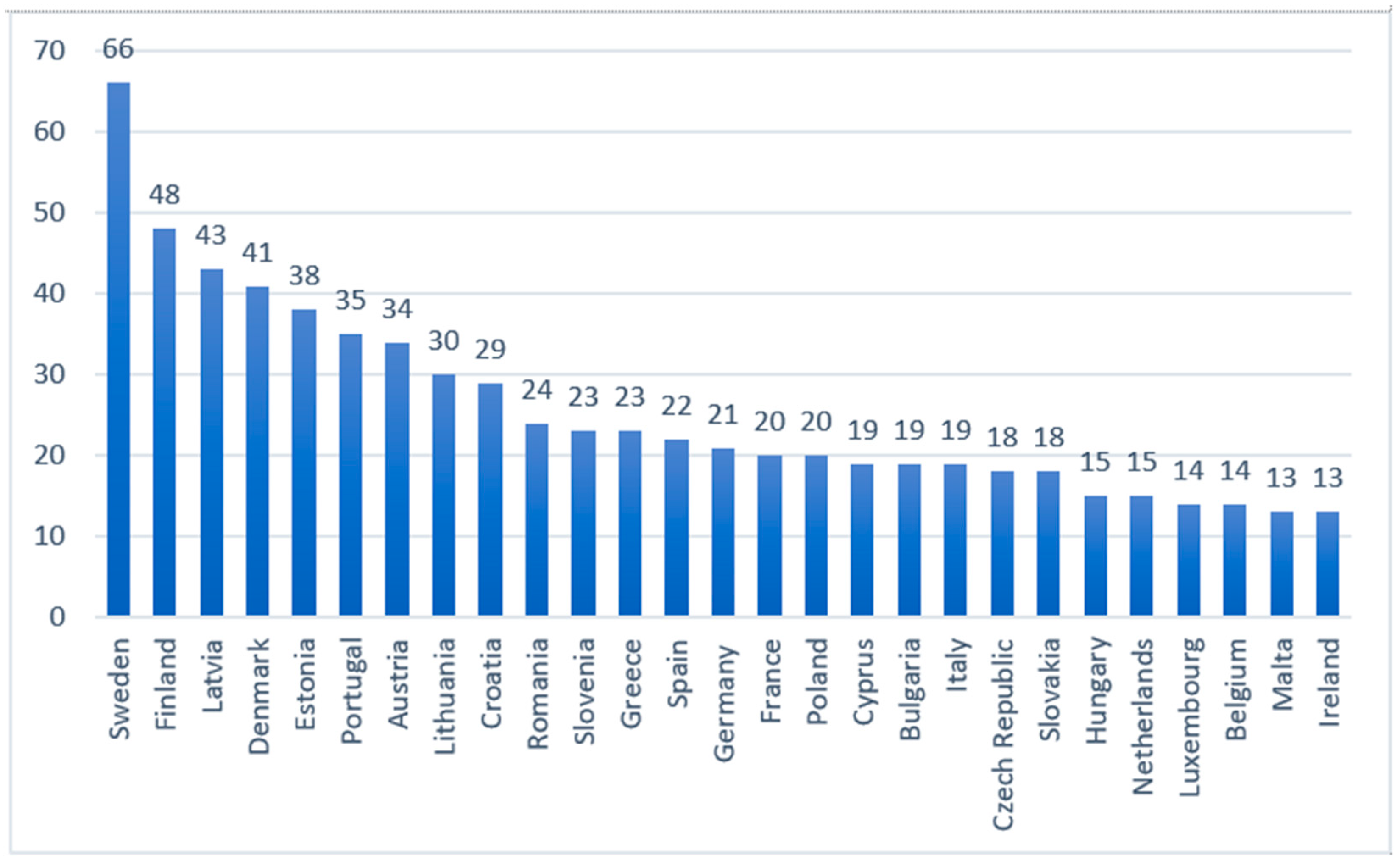
| Austria | 33.75 | 68.9 | 71 | 76.6 |
| Belgium | 13.75 | 66.8 | 72.2 | 75.3 |
| Bulgaria | 19.09 | 56.2 | 42.6 | 57.2 |
| Croatia | 29.35 | 62.3 | 51.8 | 65.1 |
| Cyprus | 19.42 | 53.9 | 62.8 | 56.8 |
| Czechia | 18.19 | 65.5 | 58.9 | 75.5 |
| Denmark | 41.60 | 67.7 | 77.5 | 78 |
| Estonia | 38.47 | 75.7 | 65.8 | 76.3 |
| Finland | 47.88 | 73.8 | 86.6 | 77.3 |
| France | 20.26 | 67 | 72.3 | 78.1 |
| Germany | 20.79 | 74.5 | 76.1 | 71.7 |
| Greece | 22.67 | 67.3 | 63.1 | 57.3 |
| Hungary | 15.19 | 59.8 | 48.3 | 54 |
| Ireland | 13.10 | 65.8 | 81.6 | 51.8 |
| Italy | 19.00 | 60.3 | 64.2 | 65.6 |
| Latvia | 43.31 | 60.2 | 54.6 | 62.6 |
| Lithuania | 29.59 | 64.1 | 59.8 | 74.4 |
| Luxembourg | 14.35 | 75.1 | 76.1 | 76.3 |
| Malta | 13.40 | 66.9 | 73 | 52.3 |
| Netherlands | 14.97 | 66.9 | 74.8 | 78.9 |
| Poland | 16.87 | 64.2 | 50.1 | 55.4 |
| Portugal | 34.67 | 61.9 | 68.9 | 72.7 |
| Romania | 24.14 | 57.3 | 46.6 | 56.3 |
| Slovakia | 17.50 | 65.1 | 60.7 | 59.2 |
| Slovenia | 22.93 | 62.4 | 59.2 | 66.5 |
| Spain | 22.16 | 64 | 65.6 | 77.6 |
| Sweden | 66.00 | 70.3 | 85.5 | 68.6 |
| Hypotheses | Value | Strength and Direction | p-Value | 95% CI Lower | 95% CI Upper |
|---|---|---|---|---|---|
| H1 | 0.317 | Not significant | 0.107 | - | - |
| H2 | 0.549 | Moderately strong positive correlation | 0.003 | 0.317 | 0.731 |
| H3 | 0.475 | Moderately strong positive correlation | 0.012 | 0.203 | 0.726 |
| N (significant cases) | 27 | – | – | – | – |
| Hypotheses | Regression Weights | Beta Coefficient | R2 | F | p-Value | Durbin-Watson |
|---|---|---|---|---|---|---|
| H2 | EPI → HI | 0.425 | 0.317 | 5.577 | 0.010 | 2.064 |
| H3 | EHS → HI | 0.176 |
Disclaimer/Publisher’s Note: The statements, opinions and data contained in all publications are solely those of the individual author(s) and contributor(s) and not of MDPI and/or the editor(s). MDPI and/or the editor(s) disclaim responsibility for any injury to people or property resulting from any ideas, methods, instructions or products referred to in the content. |
© 2025 by the authors. Licensee MDPI, Basel, Switzerland. This article is an open access article distributed under the terms and conditions of the Creative Commons Attribution (CC BY) license (https://creativecommons.org/licenses/by/4.0/).
Share and Cite
Vovk, V.; Kister, A.; Latif, F.; Maican, S.Ș. Renewable Energy Sources in Healthcare as a Factor in Sustainable Development in EU Countries. Sustainability 2025, 17, 11194. https://doi.org/10.3390/su172411194
Vovk V, Kister A, Latif F, Maican SȘ. Renewable Energy Sources in Healthcare as a Factor in Sustainable Development in EU Countries. Sustainability. 2025; 17(24):11194. https://doi.org/10.3390/su172411194
Chicago/Turabian StyleVovk, Viktoriia, Agnieszka Kister, Faran Latif, and Silvia Ștefania Maican. 2025. "Renewable Energy Sources in Healthcare as a Factor in Sustainable Development in EU Countries" Sustainability 17, no. 24: 11194. https://doi.org/10.3390/su172411194
APA StyleVovk, V., Kister, A., Latif, F., & Maican, S. Ș. (2025). Renewable Energy Sources in Healthcare as a Factor in Sustainable Development in EU Countries. Sustainability, 17(24), 11194. https://doi.org/10.3390/su172411194