Abstract
Supply chains play a crucial role in achieving the Sustainable Development Goals (SDGs) through the improvement of ESG performance. From the perspective of synergy between national auditing and corporate governance, this study integrates the SDGs into the supply chain ESG strategy and evaluates the spillover effects of national auditing on supply chain ESG performance, drawing on the quasi-natural experiment of China’s National Audit Office (NAO) auditing state-owned enterprises (SOEs). The findings illustrate that national auditing has a significant positive spillover effect on the ESG performance of supply chains. These findings remain robust after addressing potential endogeneity via placebo tests, PSM-DID, and Heckman two-step method. Heterogeneity analysis highlights that supply chains with strong cooperation stability, high concentration, and presence in the same industry have more pronounced ESG spillover effects. Mechanism analysis further demonstrates that national auditing enhances the ESG performance of supply chains by exerting imitative, mandatory, and normative pressures. Moreover, audit regulatory agencies should establish a mechanism for sharing audit results to exert mandatory institutional pressure, thereby ensuring this mechanism enables audits to fully fulfill their role in improving supply chain ESG performance.
1. Introduction
Environmental, social, and governance (ESG) principles underscore that enterprises ought to incorporate environmental and social considerations into their business practices. Regarding ESG responsibility fulfillment, enterprises’ behavior is assessed by examining the interplay of environmental, social, and governance performance [1].
ESG not only requires companies to reduce carbon emissions, but also encourages them to pursue sustainable development. With rising expectations for corporate responsibility, supply chain ESG has gradually evolved from an “optional extra” to a “mandatory requirement”. The Corporate Sustainability Reporting Directive (CSRD) and the associated European Sustainability Reporting Standard (ESRS) both require companies to disclose sustainability-related information, including environmental and social risks within their supply chains. China’s stock exchanges have also issued sustainability reporting guidelines, setting explicit requirements for listed companies to disclose ESG activities in their supply chains. These policies make enterprises enhance their ESG management, which helps advance sustainable development. As an important component of the national governance system, national auditing should play a vital role in achieving the SDGs [2]. The “Research on ESG Evaluation System of State-owned Enterprises Holding Listed Companies,” guided by the Research Center of the State-owned Assets Supervision and Administration Commission of China in 2024, has officially begun, further demonstrating the Chinese government’s emphasis on ESG.
However, a gap exists between policy mandates and practical implementation: According to the NAO’s 2024 Annual Report, 82% of ESG violations in SOE supply chains from 2021 to 2023 originated from upstream suppliers or downstream clients (not the SOEs themselves), and these violations were not covered by national auditing—leading to systemic risks such. Globally, China’s SOE supply chains score 18 points lower in ESG performance than their European and American counterparts (Bloomberg ESG Ranking, 2023), highlighting an urgent need to explore whether national auditing can improve supply chain ESG. China’s SOEs dominate critical sectors, with supply chains involving thousands of partners—ESG violations here cause systemic disruptions. Aligned with SASAC’s 2024 ESG evaluation, our study fills the empirical gap between national auditing and policy demands. Unlike SOEs’ competitive peers, supply chain partners share interdependent interests and contractual ESG clauses, making them the key spillover carriers. Two channels link audits to third-party partners’ actions: risk mitigation (partners rectify loopholes to retain cooperation) and reputational contagion (partners act to avoid legitimacy damage amid public audit results).
In current practice, Chinese exchanges have required listed companies to disclose their supply chain-related ESG activities. However, there are still three major pain points: First, disclosure often focuses on a single enterprise dimension, with insufficient attention to the synergistic effects of upstream and downstream supply chain partners. Second, relying on data from a single rating agency results in insufficient disclosure quality and comparability. Third, there is a lack of empirical support for how auditing can promote ESG adoption in supply chains during policy implementation.
In China, national auditing is an important component of the national supervision system, as the NAO publishes audit results on its official website after auditing some SOEs. By reviewing the literature, it is found that national auditing can produce both monetary and non-monetary consequences. For example, it can significantly improve the green innovation ability of enterprises [3], increase regional innovation input levels [4], and enhance corporations’ sustainability by raising green awareness and standardizing business practices [5]. Additionally, national auditing can promote green development in supply chains [6] and improve the governance mechanism of supply chain enterprises [7]. Therefore, it is essential to figure out if national auditing has an impact on the ESG performance of supply chain enterprises in the context of sustainable development.
From a theoretical perspective, existing research on regulatory spillovers primarily focuses on the ‘focal firm-peer competitors’ channel [1] and rarely extends to supply chains—the core carriers of ESG risks. Additionally, while institutional theory (IT) and resource dependence theory (RDT) are widely used in ESG studies, their integration to analyze ‘national auditing pressure-supply chain power dependence-ESG response’ remains underexplored, especially in China’s state-led governance context. To fill this gap, this study addresses three core research questions: (1) Does NAO auditing of SOEs have a positive spillover effect on the ESG performance of supply chain partners (suppliers/clients)? (2) What mechanisms (mimetic/coercive/normative pressure) drive this spillover? (3) Does the spillover effect vary with supply chain characteristics (cooperation stability, concentration, and industry correlation)? Answering these questions not only enriches the theoretical boundary of regulatory spillovers but also provides empirical evidence for SASAC and CSRC to optimize supply chain ESG auditing policies.
This study aims to empirically examine the spillover effect of China’s NAO auditing (national auditing of SOEs) on the ESG performance of listed supply chain partners (suppliers and customers). It further seeks to reveal the underlying mechanisms and heterogeneous effects, thereby filling the gap in the literature on the contextualized application of regulatory spillover in China’s supply chain ESG field. The contributions of this article are as follows:
First, it reveals the unique spillover mechanism of China’s NAO auditing—distinct from general regulation, its ‘public accountability + policy linkage’ (audit results published on official websites, aligned with SASAC’s ESG assessment) generates dual pressures, enriching Chinese contextual evidence for the reputational contagion literature. Second, it integrates resource dependence theory with institutional theory to construct an analytical framework of ‘regulatory pressure—supply chain power dependence—ESG response,’ breaking the limitation of single-theory application. Third, it refines the localized characteristics of institutional pressure in China, such as audit-driven ESG clauses in SOEs’contracts and government-led stakeholder expectations, deepening understanding of regulatory spillovers in supply chains of transitional economies.
2. Theoretical Analysis and Hypotheses Development
2.1. National Auditing and the ESG Performance of Supply Chains
The core characteristics distinguishing China’s NAO auditing from international regulatory tools are as follows: public accountability (audit results are publicly disclosed through official channels, generating a ‘public shaming’ effect) and policy linkage (directly linking to SASAC’s ESG assessment and CSRC’s disclosure requirements, compelling SOEs to transmit regulatory pressure). Building on this, this study integrates resource dependence theory with institutional theory: supply chain partners’resource dependence on SOEs (e.g., revenue reliance, access to key resources) determines the intensity of their response to audit signals, while mimetic, coercive, and normative pressures under institutional theory are differentially transmitted through this power relationship—together laying the theoretical foundation for auditing’s impact on supply chain ESG.
Suppliers and clients are closely related to audited enterprises because they share benefits through financial exchange and supply-demand relationship, and the common objective drives them to share information and resources [8], which creates opportunities for national auditing to exert ESG spillover effect in the supply chain. National auditing will produce an anti-driving effect based on institutional pressure. Through the transmission mechanism in the supply chain, the auditing behavior will push all partners to regulate their business activities, including upstream suppliers and downstream clients. For upstream suppliers, in order to maintain the cooperation with auditees, they need to recognize possible non-compliances in processes such as the production process and quality management to avoid loss caused by supply chain disruption. For downstream clients, the compliance performance has become one of the most important factors for auditees to consider when choosing partners, so audited enterprises prefer to work with those who have proven compliance records to ensure the legitimacy and security in their supply chain.
After auditing, supply chain enterprises can check whether they have similar irregularities or management loopholes as auditees [7]. In order to build credibility, preserve a good reputation, and maintain a stable cooperation with auditees, supply chain enterprises will take a series of positive measures to regulate their own behaviors and try to keep in step with auditees [9]. These measures include, but are not limited to, the following: adjusting strategic objectives to better align with industry trends and policy directions; conducting self-inspection to identify and rectify potential compliance issues; strengthening the internal management system to ensure the compliance of business activities. It has been pointed out that national auditing can reflect institutional deficiencies and management gaps, while giving advice from corporate environmental, social, and governance perspectives [10]. Furthermore, national auditing can help enterprises establish a sound internal control system to promote the overall management level. Therefore, when a company is included in the national auditing scope and accepts rigorous scrutiny, its upstream suppliers and downstream clients, to avoid potential negative ripple effects, will strategically align with this company. This phenomenon is called the ESG spillover effect. More audited enterprises bring a greater deterrent to those not yet being audited, prompting them to take self-prevention measures actively and improve their ESG performance. Given the analysis of the relationships above, we formulate Hypothesis H1 to capture how spillover effects manifest in this context.
H1.
National auditing has a significant positive effect on the ESG performance of supply chains.
2.2. The Mechanism Between National Auditing and the ESG Performance of Supply Chains
Institutional pressure, mainly coming from the external institutional environment, will put significant pressure on enterprises’ behavioral patterns. It includes mimetic, coercive, and normative pressures, leading to increasingly homogeneous business behaviors [11].
First, the mimetic pressure mainly originates from the perception of organizational behaviors or competitor behaviors within an enterprise’s social network [12]. Considering the influence from various aspects such as supply chain partners, mimetic behavior helps supply chain enterprises make strategies at minimal cost within a highly uncertain environment and ambiguous objectives by learning from audited companies [13]. On the one hand, supply chain enterprises will focus on the advantages brought by ESG responsibility, thus paying more attention to and imitating ESG practices. On the other hand, as ESG concepts become mainstream, enterprises may be more pressured to follow this trend regardless of their current situation.
Second, the coercive pressure mainly comes from law and regulations [14]. Work Plan for Improving the Quality of Listed Companies Controlled by Central Enterprises requires ESG-specific disclosure, which, to some extent, led to collaboration among supply chain enterprises to safeguard their legitimacy, bringing an atmosphere in which upstream and downstream partners will play a similar role as auditees [15,16]. This move then helps enhance the ESG performance of supply chain enterprises.
Third, the normative pressure comes from non-governmental informal institutions, organizations, and individuals [17,18]. Corporate fulfillment of ESG responsibility depends to some extent on the endorsement of social norms. Over time, the auditee will generate standards that encourage others to follow. In addition, enterprises that do not positively respond to normative pressure may tell the market their irresponsibility and lead to stakeholder dissatisfaction, thus losing trading opportunities and being eliminated [19]. Given the analysis of the mechanisms above, we put forward the following hypotheses:
H2a.
National auditing improves the ESG performance of supply chains by exerting mimetic pressure.
H2b.
National auditing improves the ESG performance of supply chains by exerting coercive pressure.
H2c.
National auditing improves the ESG performance of supply chains by exerting normative pressure.
2.3. The Heterogeneity Between National Auditing and ESG Performance of Supply Chains
2.3.1. The Heterogeneity of Cooperation Stability Among Supply Chain Enterprises
The stability of cooperation is measured by the average frequency of suppliers/customers appearing among the top five partners in the past year. Samples above the average are classified as the high stability group, while those below the average are classified as the low stability group. Cooperative relationship is an important factor influencing the ESG spillover effect in the supply chain [20]. Under this framework, supply chain enterprises would like to build an interdependent, synergistic, and complementary community [21], where they face market fluctuations and opportunities together. Different stability levels between auditees and their partners (suppliers and clients) may vary the ESG spillover effects level significantly. Long-term cooperation is often built on a solid foundation of trust and a shared strategic vision. Through repeated transactions, all parties in one supply chain can understand each other’s business models, product characteristics, and market demands better, thus building a better trust foundation and a closer interest community [22]. A stable cooperation makes information exchange smoother and the risk-sharing mechanism more improved. Meanwhile, it promotes resource sharing and advantage complementarity within the supply chain. In this process, audited enterprises can grasp customer needs and adjust products and services more accurately to cater to market changes, while suppliers can continuously optimize the supply chain based on feedback from enterprises, reduce costs, and improve product quality. Therefore, high-stability supply chains have a strong trust foundation and efficient information transmission, enabling ESG norms from audit spillovers to spread more easily. In contrast, information asymmetry in short-term cooperation weakens this effect. Therefore, Hypothesis H3a is proposed:
H3a.
National auditing has a more significant improving effect on the ESG performance of supply chains with higher cooperation stability.
2.3.2. The Heterogeneity of Concentration Among Supply Chains
The overall performance of enterprises no longer relies solely on internal management, but also on close collaboration with upstream and downstream partners because their ability to obtain resources and funds is crucial to sustainable development. Supply chain concentration, as one of the core elements in supply chain management, directly relates to various business activities. It is composed of two dimensions: supplier concentration and client concentration. These two dimensions complement each other, jointly shaping the overall structure of the supply chain. Supplier concentration refers to the degree of reliance an enterprise places on a few major suppliers during the procurement process. Client concentration, meanwhile, refers to how concentrated an enterprise is in obtaining sales revenue and business volume from a few major clients.
On the one hand, rising supply chain concentration leads to higher dependence on suppliers or clients. When these partners dominate the supply chain, they can influence an auditee’s operational cost and revenue structure by changing price, delivery terms, or product quality, which will diminish its bargaining power, increase risks, and cause heavy profit fluctuations [23]. Business performance reflects market competitiveness and represents a company’s short-term objective. When short-term goals remain unattainable, the pursuit of long-term objectives may be compromised. Due to limited resources, the company may prioritize solving urgent problems rather than medium-to-long-term sustainability targets, such as ESG performance [24]. Consequently, when national auditing enhances the ESG performance of supply chain enterprises, the impact is more obvious in those with high supply chain concentration.
On the other hand, higher supply chain concentration creates tighter interests among firms. Any non-compliance issues within one entity can ripple through the entire supply chain system, exerting far-reaching consequences on related enterprises and even the entire industry [25]. Therefore, when national auditing ferrets out violations in one company, itself as well as all the involved partners will take measures to enhance compliance and transparency to avoid unnecessary loss or skepticism. This process will, in turn, create a reversal effect, amplifying the impact of national auditing on improving the ESG performance of supply chain enterprises. Based on the above analysis, hypothesis H3b is proposed:
H3b.
National auditing has a more significant improving effect on the ESG performance of supply chains with higher concentration.
2.3.3. The Heterogeneity of Supply Chain Enterprises Across Different Industries
National auditing can significantly influence enterprises on environmental, social, and governance aspects. By learning from other companies, an enterprise can receive additional information, especially from those in the same industry [26]. Within the same industry, frequent business interactions bring industry consensus easily.
First, the audited enterprise will interact closely with its suppliers or clients when they are in the same industry. This kind of close business relationship makes peer companies particularly attentive to the auditee’s ESG performance, thus prompting them to prioritize ESG management to avoid potential risk and loss. Second, within the same industry, the auditee and its partners will share the same understanding of specific ESG standards. It is because when the enterprise operates in one industry for a long period, it will have a more comprehensive knowledge of ESG standards, regulations, and policies in that specific industry. After national auditing reveals ESG-related issues of one company, peers can swiftly grasp the underlying risks and opportunities, thereby adjusting their own ESG strategies. Finally, when the audited enterprise is in the same industry as its suppliers or clients, information dissemination and sharing will occur rapidly among peers, which will accelerate the promotion of ESG performance [27]. As national auditing results are public, enterprises within the industry will obtain and share information through multiple channels. This not only can help enterprises stay informed about ESG trends, but also promote the learning process among them [28]. Based on the above analysis, hypothesis H3c is proposed:
H3c.
National auditing has a more significant improving effect on the ESG performance of supply chains in the same industry.
3. Research Design
3.1. Data Sources and Processing
We choose China as the research context for three interconnected reasons tied to its global economic role and institutional distinctiveness. First, China’s state-owned enterprises (SOEs) are economic pillars, and their supply chains dominate critical global sectors like energy, manufacturing, and infrastructure—making ESG spillovers here impactful for global sustainability. Second, China’s 2024 ESG regulatory overhaul creates a unique institutional setting: national auditing is explicitly linked to policy mandates, in contrast to the fragmented regulatory frameworks of other economies. Third, as the world’s largest developing economy, China’s “state-led ESG” model offers a novel contrast to market-driven approaches—providing insights for global emerging markets grappling with supply chain ESG oversight.
The NAO started to disclose auditing results from 2010 in China, and the latest announcement was updated to 2018. Therefore, this article uses A-share listed SOEs and their controlled supply chain enterprises from 2009 to 2022 as research samples. Some samples were excluded: enterprises labeled as ST or ST*, those in the financial or insurance sector, those with a gearing ratio exceeding 1, and those with severely missing financial data.
The announcement in 2010 reflects auditing findings in 2009, which show the operational status of audited entities in 2008, so the actual auditing intervention should be one year prior to the announcement. Therefore, the year 2009 in this study refers to the commencement of auditing activities, while the collection year starts from 2010.
When constructing the annual data set of the audited enterprise-supplier (client), the “company-year” data of A-share enterprises was the raw sample. Meanwhile, we retained the information of the top five suppliers and clients, and kept the sample where both suppliers and clients are listed as well. If the auditee had multiple suppliers or clients, we then constructed the “audited enterprise-supplier-year” and “audited enterprise-client-year” observations. Ultimately, 1262 audited enterprise-supplier-year observations and 1395 audited enterprise-client-year observations were obtained. Moreover, we performed winsorization at the 1st and 99th percentiles on all continuous variables to avoid bias caused by extreme values in the data set.
Suppliers are identified based on the “Listed Company Supplier-Client Relationship” module in the CSMAR database. We selected the top five suppliers disclosed by audited state-owned enterprises (SOEs)—a requirement mandated by China’s Securities Regulatory Commission (CSRC) for listed companies to disclose key upstream partners. To ensure data validity, we further matched suppliers by their official enterprise names and Unified Social Credit Codes (USCCs), retaining only those that are A-share listed companies. Following the same logic as supplier identification, we extracted the top five clients disclosed by audited SOEs from the CSMAR database, verified their A-share listed status by matching official names and USCCs, and excluded non-listed clients to maintain consistency with our research design.
Considering the time span, data integrity, and agency reputation, we selected ESG performance data from Bloomberg and Huazheng, national auditing data from reports released on the NAO official website, and other data from CSMAR (China Stock Market & Accounting Research) and Wind database.
A caveat worth noting is that our sample is restricted to listed suppliers and clients, primarily due to limited data availability: unlisted firms lack publicly available ESG and financial data. This may introduce selection bias: unlisted small-to-medium enterprises (SMEs) in the supply chain often face higher ESG risks but are excluded. Thus, our findings likely reflect the spillover effect on visible, already more compliant firms, and may potentially underestimate the true impact of national auditing on the entire supply chain.
Specifically, unlisted small-to-medium enterprises (SMEs) in the supply chain typically face higher ESG risks—such as insufficient environmental investment and incomplete social responsibility disclosure—due to weaker regulatory constraints and limited resource inputs. Excluding these SMEs means our identified spillover effect mainly captures the response of listed firms (which are inherently more transparent and ESG-compliant), rather than the high-risk segments of the supply chain that are more in need of regulatory intervention. This limitation also implies that the spillover intensity we measured may be a ‘lower-bound estimate’ of the true impact of national auditing on the entire supply chain.
3.2. Variable Descriptions
3.2.1. Dependent Variable
ESG performance in this study refers to both the ESG performance of auditees’ suppliers (S_ESG) and clients (C_ESG). According to the study by Shangguan et al. [29], we expect to form indicators that can truly reflect the ESG performance of enterprises by using the entropy method to integrate domestic data from Huazheng and foreign data from Bloomberg. The specific operations are as follows:
Step 1: Sample dimensionless. To achieve data comparability, Formula (1) is constructed to analyze the ESG data from Huazheng and Bloomberg. Here, Ztij represents the value of indicator i after dimensionless processing, and Xtij denotes the value of the j indicator of the i enterprise in year t. Xmax and Xmin are the maximum and minimum values of different indicator j among all evaluation objects.
Step 2: Normalize indicators and calculate the entropy value for the probability distributions of scores from two rating agencies separately. Formulas (2) and (3) are constructed to determine weights and compute entropy values. Here, Ptij indicates normalized indicators, Ej indicates the entropy value of ESG rating data from Huazheng and Bloomberg, h and m, respectively, indicate the number and the year of sample enterprises, and k = 1/ln(h × m).
Step 3: Construct Formula (4) to calculate the difference in entropy values for each indicator, while Formula (5) is to calculate the weight. Here, Dj indicates the difference coefficient for each indicator, and Wj indicates the weight of the two agencies. Since the entropy value can reflect the uncertainty and information volume, a larger difference coefficient will have a greater influence on the importance and weighting in the evaluation.
Step 4: Formulate (6) is to calculate the overall score of Huazheng and Bloomberg. SESG indicates the ESG performance score for enterprise i in year t; a higher score represents a better ESG performance. Next, the ESG performance of the audited companies’ suppliers (S_ESG) and customers (C_ESG) was separately calculated using this formula:
To validate the composite ESG score, we conducted two tests: (1) Correlated the score with objective corporate outcomes (e.g., environmental investment intensity, amount of social responsibility donations) to ensure it reflects actual ESG practices. (2) Compared regression results using the composite ESG score, Huazheng single ESG score, and Bloomberg single ESG score to demonstrate its robustness.
The empirical results of the two validation tests are reported in Appendix A, which confirm the validity and reliability of the entropy-weighted composite ESG metric. First, the composite score shows a significant positive correlation with objective ESG practices: the Pearson correlation coefficient with environmental investment intensity (environmental dimension) is 0.542 (p < 0.01), and with social responsibility donation amount (social dimension) is 0.609 (p < 0.01), as shown in Table A1. This indicates that the composite metric is closely aligned with firms’ actual ESG behaviors, rather than being a purely symbolic score. Second, the robustness comparison of regression results shows that the coefficient of the core explanatory variable AuditPost is significantly positive when using the composite metric, Huazheng single score, and Bloomberg single score in Table A2. The consistent magnitude and significance of the coefficients demonstrate that the composite metric does not distort the core relationship between national auditing and supply chain ESG performance.
The superiority of the composite metric lies in its ability to mitigate the bias of a single rating agency: Huazheng’s score is more focused on China’s policy-oriented ESG indicators (e.g., state-owned enterprise compliance), while Bloomberg’s score emphasizes international ESG standards (e.g., carbon emissions disclosure). By integrating the two via entropy weighting, the composite metric captures both domestic and international dimensions of ESG performance, making it more comprehensive for evaluating Chinese listed firms’ ESG practices in the supply chain context.
3.2.2. Explanatory Variable
National auditing (AuditPost): following previous research [30], this study employed web scraping software to extract audited enterprises from auditing reports published by NAO. By searching for “listed company” or “investor relations” section on corporate official websites and shareholder information in annual reports, we complete the matching of audited enterprises with their holding listed companies. If an enterprise was audited, we set AuditPost to 1; otherwise, it is set to 0. If an enterprise has undergone multiple audits during the sample period, the first result is taken. The first and subsequent years are set to 1, while the remaining years are set to 0.
3.2.3. Control Variables
To minimize interference from missing variables and other potential factors, this study uses return on equity (ROE), revenue growth rate (Growth), proportion of independent directors (Indep), board duality (Dual), Top 1 (Top 1), Big Four or not (Big4), Tobin’s Q (TobinQ) as control variables. In addition, we fixed the provincial, annual, and industrial effects. Specific definition and description of the variables are shown in Table 1.
Table 1.
Description of the main variables.
3.3. Empirical Model
A staggered difference-in-differences (DID) model was employed for the regression analysis. We chose staggered DID for three key reasons: (1) Need for causal identification: NAO auditing of SOEs is a quasi-natural experiment with staggered implementation (different SOEs are audited in different years), which avoids endogeneity arising from reverse causality (i.e., ESG performance affecting audit selection). Staggered DID can compare the “pre- and post-audit” changes in the treatment groups (the supply chains of audited SOEs) with those in the control groups (the supply chains of unaudited SOEs), isolating the net effect of auditing. (2) Contextual adaptability: Unlike single-period DID, staggered DID fits China’s NAO practice—audits are not implemented uniformly across SOEs but are rolled out annually, ensuring sufficient variation in treatment timing. (3) Superiority over alternative methods: Compared with OLS or fixed-effects models, staggered DID better addresses omitted variable bias (e.g., macro ESG policies). Compared with GMM, it avoids over-identification issues when instruments for auditing are scarce.
Formula (7) examines the impact of national auditing on auditees’ supplier ESG performance, while Formula (8) examines client ESG performance. The specific models are as follows:
Here, AuditPosti,t is a dummy variable; S_ESGm,t indicates the ESG performance of supplier m of audited enterprise i in year t; C_ESGn,t indicates the ESG performance of client n of audited enterprise i in year t; Controls is a set of control variables influencing ESG performance of enterprises; Province, Industry, and Year, respectively, represents for provincial, industrial, and annual dummy variables; and is the random error term.
4. Empirical Results and Analysis
4.1. Descriptive Statistics
Table 2 presents the descriptive statistics of the main variables. The result shows that the maximum S_ESG value is 0.936, while the minimum is 0.029; the maximum C_ESG value is 0.957, while the minimum is 0.106. These figures suggest a significant difference in ESG aspects among both suppliers and clients of the audited enterprises. In the sample, S_AuditPost has a mean of 0.070, while C_AuditPost exhibits a lower mean of 0.033. Both are relatively low, indicating that the actual scope of auditing activities is narrow and only effectively covers a small number of listed companies. This phenomenon may lead to potential risks, resulting in a “bad money drives out good” situation in the market. Additionally, all other variables vary within a reasonable range.
Table 2.
Descriptive statistics of the main variables.
4.2. Analysis of the Results of the Baseline Regression Results
The baseline regressions were based on Formulas (7) and (8), and controlled for three fixed effects at the provincial, industrial, and time level. Meanwhile, we clustered individual enterprises to calculate standard errors. As shown in Table 3, all AuditPost coefficients are positive and statistically significant at the 10% significance level. This result identifies that the influence and impact of national auditing activities extend far beyond auditing itself, demonstrating an obvious ESG spillover effect. This effect can serve as a warning to supply chain enterprises of auditees and help prevent similar issues. Thus, hypothesis H1 is affirmed.
Table 3.
Results of the baseline regression.
4.3. Robustness Test
4.3.1. Parallel Trend Test
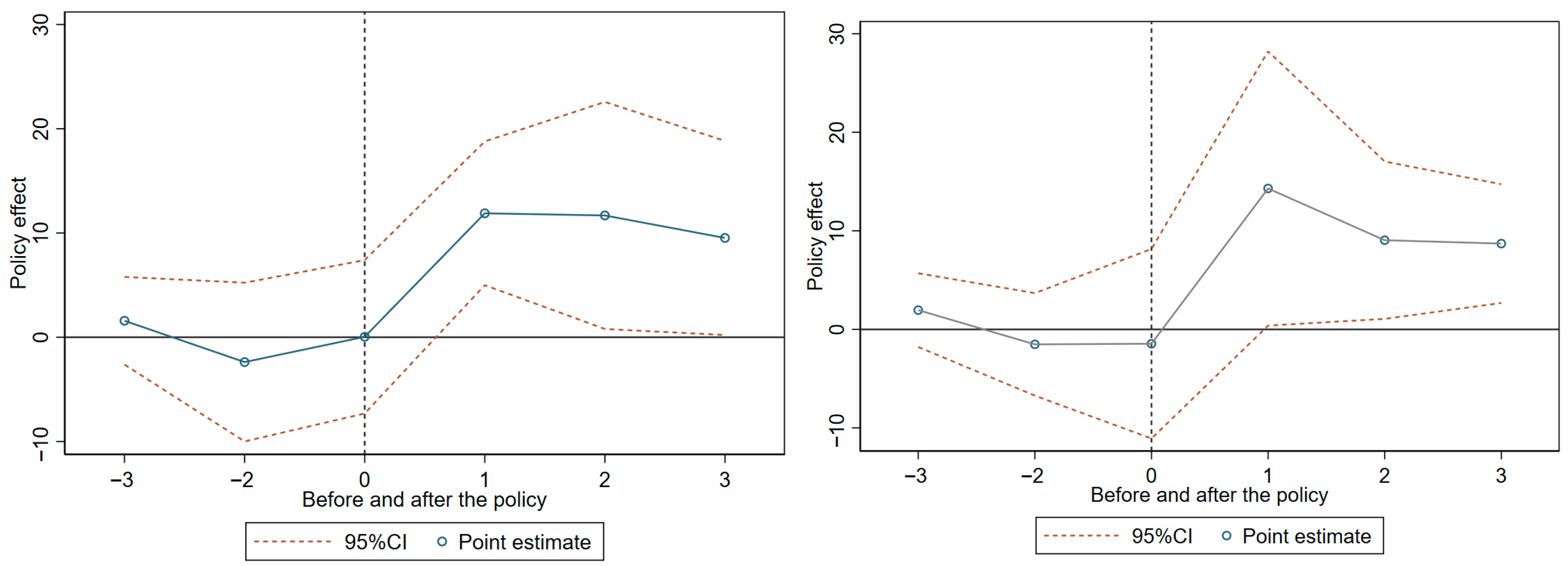
In the DID model, the parallel trend test is a key prerequisite for empirical testing, which requires a consistent trend in key variables of treatment and control groups before auditing. In order to test whether the sample data meet the parallel trend hypothesis and to ensure a sufficient time window to observe the changes in variables before and after auditing, this paper takes the year before auditing as the base year and conducts the parallel trend test on the previous, current, and subsequent data. The results are shown in Figure 1.
Figure 1.
Results of the parallel trend test. Notes: The horizontal axis denotes the years relative to the NAO audit of SOEs (0 = audit year, −3 = 3 years before audit, 3 = 3 years after audit); the vertical axis denotes the coefficient of the audit dummy variable.
The figure on the left represents the parallel trend test result of auditees’ suppliers; the figure on the right represents the parallel trend test result of auditees’ clients. Same as below. As shown in Figure 1, the 95% confidence intervals for all pre-audit coefficients include zero, which means there is no statistically significant difference in ESG performance trends between the treatment group and the control group before the NAO audit. This result strongly validates the parallel trend assumption—a key prerequisite for the difference-in-differences (DID) model. After the audit, the coefficients of the audit dummy variable turn positive, and their 95% confidence intervals no longer include zero. This indicates that the positive spillover effect of national auditing on supply chain ESG performance is statistically significant and has a sustained impact. The time lag in the significant effect is consistent with the reality that supply chain enterprises need time to adjust their ESG practices in response to audit signals.
It is shown that, before national auditing, no matter whether suppliers or clients, there are no remarkable differences between the ESG performance of treatment and control groups. After national auditing, the coefficients show an obvious upward trend. As illustrated in the figure, there exists a time lag in the ESG spillover effect of national auditing on suppliers and clients. The reason might be that since the government does not audit directly, enterprises need time to identify potential problems and then take necessary regulatory measures.
4.3.2. Placebo Test
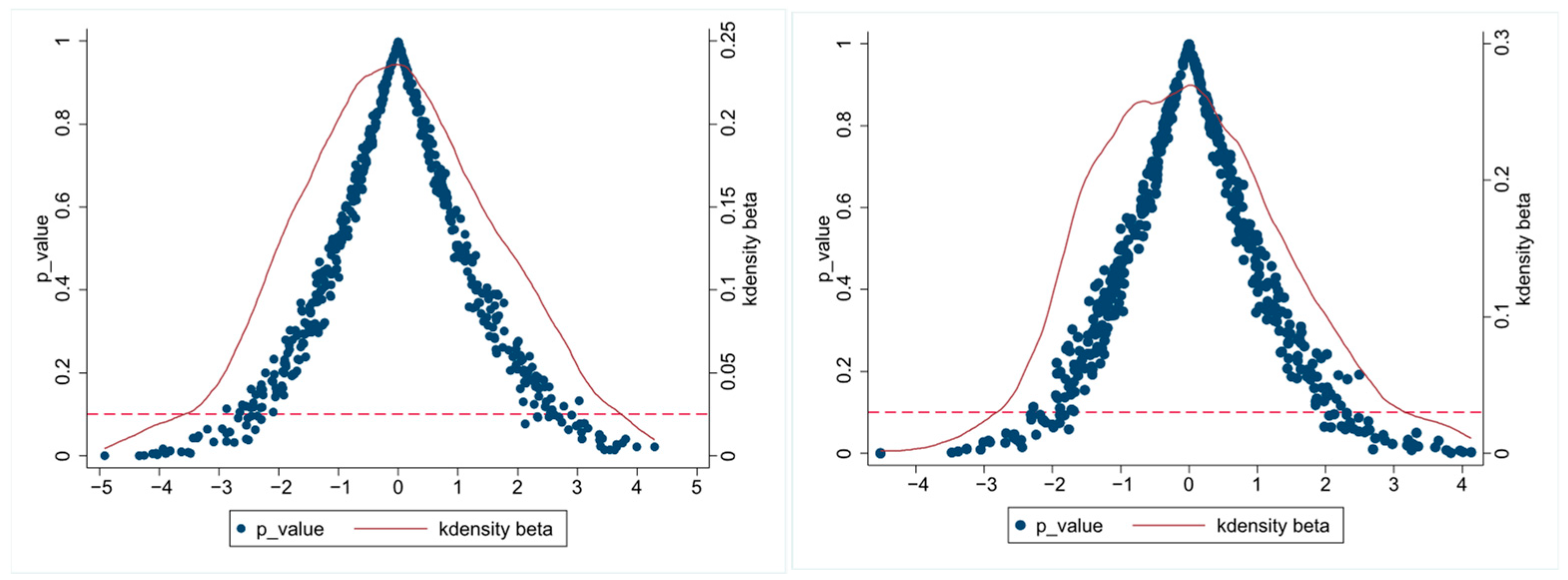
To mitigate the interference of extraneous factors, a random matching approach is applied in this study for the placebo test. A portion of the sample was randomly assigned to the treatment group, while the rest constituted the control group; regression analyses were then carried out with models (7) and (8). We repeated this process 500 times, and Figure 2 presents the resulting p-values and kernel density distribution. The findings reveal that the mean of the coefficients estimated from random assignments is close to zero and follows a normal distribution overall, which verifies that the ESG spillover effect of national auditing is validated by the placebo test.
Figure 2.
Results of the placebo test.
4.3.3. PSM-DID Test
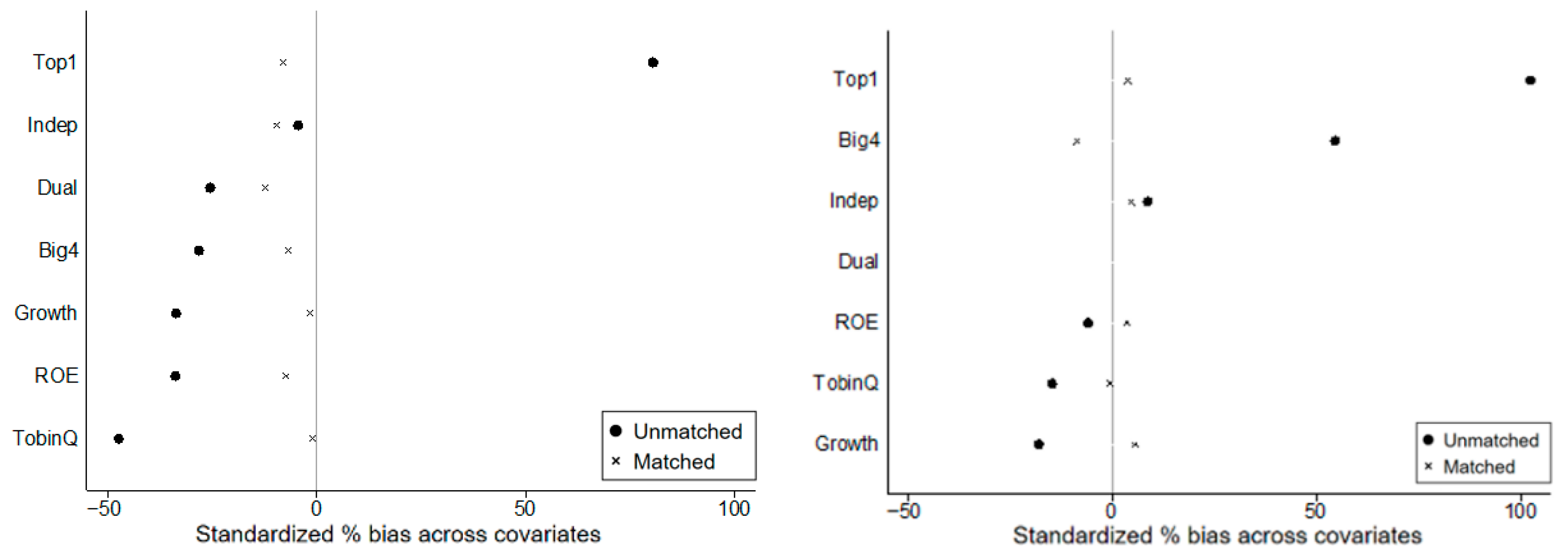
When using DID analysis to evaluate national auditing, selection bias may exist between the treatment group and control group, potentially leading to inaccurate test results. Therefore, this study uses PSM-DID for secondary verification. Propensity scores are calculated by a Logit model, which incorporates key control variables as covariates. Later, samples are matched in a 1:4 nearest neighbor matching approach. Before the PSM-DID test, the reliability of matching results must be ensured. As shown in Figure 3, each variable is far from the zero line before matching, while after matching, they are relatively close, and all the absolute values of standard error are less than 10%.
Figure 3.
The standard errors before and after matching.
This means a high matching quality that effectively reduced the differences between treatment groups and control groups.
On the premise of a reliable matching result, we performed regression analysis on propensity-score matched samples with the PSM-DID method. The result is shown in Table 4, where the coefficients of national auditing are significantly positive at the 10% level and are consistent with the benchmark regression result. Therefore, after excluding possible self-selection problems among samples, it is shown that national auditing can improve the ESG performance of auditees’ suppliers and clients.
Table 4.
Results of the PSM-DID regression.
4.3.4. Changing the Measurement Method of the Explanatory Variable
The implicit assumption of national auditing measurement in benchmark regression is that the impact of national auditing is continuous, that is, auditing activities not only affect enterprises in the current audit period, but also continuously implement them in the subsequent operation process, and form a long-term supervision mechanism. This hypothesis suggests that one or more national audits can help enterprises establish a better internal control system, improve compliance awareness and risk management capability, thereby effectively curbing misconduct and enhancing overall operational efficiency and ESG performance. However, in reality, over time, enterprises may have “audit fatigue”, so they will resist auditing and even take a negative attitude towards it. If there is no new auditing force to intervene in enterprises and continuously supervise their follow-up operation, the effect of national auditing will gradually weaken or even fade. Therefore, we use the directors’ term as the boundary, re-constructing Audit 3 and Audit 6 to retest the effect of national auditing based on different periods. Audit 3 represents the influence in the second year after auditing, while Audit 6 represents the fifth year in Table 5. Other periods are set to 0. The result shows that national auditing does have a significant ESG spillover effect, whether measured by three years or six years, and can improve the ESG performance of suppliers and clients of audited enterprises.
Table 5.
Results of changing the measurement method of the explanatory variable.
4.3.5. GMM Regression
Since there might be a certain path dependence on enterprise ESG performance, current ESG practices may be affected by previous practices and show continuous dynamics. Therefore, to effectively control endogenous problems, we introduce lag terms of explanatory variables as instrumental variables based on models (7) and (8), extend them into a dynamic regression model, and use Generalized Method of Moments (GMM) to test. As shown in Table 6, test values of AR (1) are all less than 0.1, indicating that first-order autocorrelation exists in model perturbation terms. Meanwhile, test values of AR (2) are greater than 0.1, indicating that there is no second-order sequence correlation. In addition, the Hansen test value exceeds 0.1, representing an effective GMM and a reliable estimation result. The coefficients of AuditPost are 0.025 and 0.151, both significantly positive at least at the 5% significance level, which supports the robustness of this study’s conclusion.
Table 6.
Results of the GMM regression.
4.3.6. Heckman Two-Step Method
Audit institutions will focus on government work when performing audits and conduct preliminary surveys on relevant enterprises at first, so national auditing may not follow the principle of random sampling, leading to sample selection bias and accompanying endogenous problems. To address these issues, this study employs the Heckman two-step correction method. In the first stage, we construct a Probit model with national auditing as the explanatory variable. We selected control variables consistent with those in the baseline regression, employed annual audit coverage rates (MAudit) as exogenous variables, and then performed regression analysis to calculate the inverse Mills ratio (IMR). At the second stage, we added IMR into the model for regression analysis to address sample selection bias. The results are presented in Table 7. After controlling for IMR, the coefficients of AuditPost remain significantly positive at the 1% significance level in the regression models that treat S_ESG and C_ESG as dependent variables. This proves that national auditing can improve the ESG performance of the auditees’ supplier enterprises and exhibits an obvious ESG spillover effect from the audited entities to their suppliers.
Table 7.
Results of Heckman’s two-step method.
4.4. Heterogeneity Analysis
4.4.1. The Heterogeneity Test of Cooperation Stability
Drawing on the research of Zhao and Li [31]—a widely cited study on supply chain cooperation stability—and combining it with our sample data availability, we defined cooperation duration based on the average frequency of a supplier/client appearing in the top 5 cooperative partners of the audited state-owned enterprise (SOE) over three consecutive years. The calculation steps are as follows:
- Step 1: Extract the list of the top 5 suppliers/clients disclosed annually by each audited SOE from the “Supplier-Client Relationship” module of the CSMAR database.
- Step 2: For each supplier/client matched with the audited SOE, count how many times it appears in the top 5 list over three consecutive years.
- Step 3: Calculate the 3-year average appearance frequency.
Based on the distribution of the 3-year average appearance frequency in our sample and industry-specific cooperation norms, we set the following cutoff points: Short-term cooperation is defined as a 3-year average appearance frequency < 2 times, indicating sporadic collaboration—where the partner appears in the top 5 list for less than 2 years out of 3, reflecting weak cooperation continuity. Medium-to-long-term cooperation is defined as a 3-year average appearance frequency of ≥2 times.
Using the above calculations, we divided the enterprise samples into a short-term cooperation group and a medium-to-long-term cooperation group; the regression results are shown in Table 8.
Table 8.
Results of the heterogeneity test on cooperation stability.
Columns (1) and (2) illustrate that when enterprises build a medium-to-long-term partnership with suppliers, the regression coefficient of AuditPost is 0.271 and significant at 10%; while under short-term collaboration, this coefficient is 0.075 and not significant. Columns (3) and (4) show that when enterprises build a medium-to-long-term cooperation with clients, the regression coefficient of AuditPost is 0.105 and significant at 10%; while under short-term collaboration, this coefficient is not significant. The reason might be: an enterprise with high cooperation stability has a more mature cooperative mechanism and trust foundation, which will reduce the information asymmetry. On the contrary, an enterprise with low cooperation stability may have more friction and uncertainty. Therefore, Hypothesis H3a is certified.
4.4.2. The Heterogeneity Test of Concentration
Referring to the study of Power and Damien [32], supply chain concentration of suppliers (clients) can be indicated by the proportion of the procurement amount of the largest supplier (client) to the total procurement amount. Based on the average value of supply chain concentration, we divided enterprises into a high-reliability group and a low-reliability group. Regression results are shown in Table 9.
Table 9.
Results of the heterogeneity test on concentration.
It can be learnt from columns (1) and (2) that when the supply chain concentration of suppliers is high, the coefficient of AuditPost is 0.057 and significant at 10%, while with a low concentration, this coefficient is 0.050 and not significant. Columns (3) and (4) tell that when the supply chain concentration of clients is high, the coefficient of AuditPost is 0.301 and significant at 10%, while with a low concentration, this coefficient is 0.027 and not significant. The reason might be: enterprises with high supply chain concentration are confronted with greater information disclosure pressure because of the reliance on key suppliers or clients. This kind of pressure may urge enterprises to improve the quality of information disclosure and relieve information asymmetry, thus benefiting national auditing, exerting its ESG spillover effect. Therefore, Hypothesis H3b is certified.
4.4.3. The Heterogeneity Test on Supply Chains Across Different Industries
Industry correlation among enterprises plays a vital role in a complex market environment and affects other related companies. Therefore, this study conducts industry matching for audited enterprises and their suppliers (clients). If they are in the same industry, we set it as 1; otherwise, we set it as 0. Regression results are shown in Table 10.
Table 10.
Results of the heterogeneity test across different industries.
Based on Table 10, when suppliers are in the same industry as the audited enterprises and when clients are in the same industry as the audited enterprises, the regression coefficients of AuditPost are 0.242 and 0.255, respectively, both significant at the 10% level. Oppositely, the coefficients are 0.028 and 0.006, respectively, and are both not significant. The reason might be: enterprises in the same industry share similar production technology, raw material supply, market demands, and market context. This industrial similarity brings great interplay and constraining force among enterprises. Imitation, learning, and competition among them will be more obvious as well. Therefore, hypothesis H3c is certified.
4.5. Further Discussion: Mechanism Analysis
The selection of proxies for mimetic, coercive, and normative pressure aligns with established literature and data availability constraints in the Chinese context—ensuring the operationalization of theoretical constructs is both empirically feasible and academically rigorous. Specifically, (1) mimetic pressure (MP) is measured by the Herfindahl Index (inverse of market competition). Following Clemens & Douglas (2005) [11], market competition reflects firms’ incentives to imitate peers’ ESG practices: in highly competitive markets (low Herfindahl Index), supply chain enterprises face stronger pressure to mimic the ESG behaviors of audited SOEs to avoid losing cooperation opportunities or competitive disadvantage. (2) Coercive pressure (CP) is measured by industry-level environmental investment (proportion of waste gas/wastewater treatment investment to industrial output value). This proxy aligns with Henisz et al. (2019) [14], who argue that industry-wide environmental regulation creates mandatory compliance pressure for firms—higher industry-level environmental investment indicates stricter regulatory requirements, which directly increase the coercive pressure on supply chain enterprises to improve ESG performance. (3) Normative pressure (NP) is measured by the logarithm of net intangible assets. Drawing on Giese et al. (2019) [19], intangible assets (e.g., brand reputation, intellectual property) increase firms’ sensitivity to social norms and stakeholder expectations: enterprises with more intangible assets have stronger incentives to comply with ESG norms to protect their reputational capital.
While these proxies are indirect measures of theoretical constructs, they are widely adopted in supply chain ESG and institutional theory research [10,13] and are the most feasible indicators given the limited availability of direct micro-level data on institutional pressure in China.
Market competition can be used to characterize the mimetic pressure (MP) faced by enterprises. The measurement method of market competition is related to the Herfindahl Index. The larger index means less market competition, so if a supply chain enterprise is under great mimetic pressure, its Herfindahl Index will be small. To measure the coercive pressure (CP), we used the proportion of the amount invested in waste gas and wastewater treatment by listed companies to the total amount of industrial output value in the same year. The larger the ratio, the higher the degree of environmental regulation in that industry, and the greater coercive pressure perceived by managers. Moreover, we used the logarithm of net intangible assets to measure normative pressure (NP).
Table 11 shows the regression result of mimetic pressure. Columns (1) and (4) tell that the improved ESG performance significantly enhances market competition, which preliminarily supports the inference of this study. Furthermore, taking the median Herfindahl Index as the baseline, enterprises with an index above the median are classified as a less mimetic pressure group, while those below the median are put into greater mimetic pressure group. Then, we tested the impact of national auditing on ESG performance under different levels of mimetic pressure. The results are shown in columns (2), (3), (5), and (6). The overall result illustrates that, no matter whether suppliers or clients, in a less mimetic pressure group, the regression coefficients of enterprises are significant at least 10%, while those in a greater mimetic pressure group are not significant. This conclusion further validates the above theory, and Hypothesis H2a is verified.
Table 11.
Results of the mechanism test on mimetic pressure.
Table 12 illustrates the regression result of coercive pressure groups. Columns (1) and (4) show that if an enterprise has good ESG performance, it is under great environmental pressure, which preliminarily supports the inference of this study. Further, we used the median of the Environmental Regulation Index as the baseline to divide all samples into greater coercive pressure groups and less coercive pressure groups, and tested the impact of national auditing on ESG performance under different kinds of coercive pressure. The test results are shown in columns (2), (3), (5), and (6), respectively. According to overall results, no mater suppliers or clients, regression coefficients of enterprises in the less coercive pressure group are significant at 10%, while those in the greater coercive pressure group are not significant. This conclusion further validates the above theory, and Hypothesis H2b is verified.
Table 12.
Results of the mechanism test on coercive pressure.
Table 13 is the regression result of normative pressure groups. Columns (1) and (4) indicate that the improvement of ESG performance helps increase normative pressure significantly, which preliminarily supports the inference of this study. Furthermore, we used the median of the logarithm of net intangible assets as the baseline to divide all samples into greater normative pressure groups and less normative pressure groups, and tested the impact of national auditing on ESG performance. The results are shown in columns (2), (3), (5), and (6). It is shown that no matter whether suppliers or clients, the regression coefficients of enterprises in the less normative pressure group are significant at 5%, while not significant in the other group. This conclusion further validates the above theory, and Hypothesis H2c is verified.
Table 13.
Results of the mechanism test on normative pressure.
5. Conclusions
With rising expectations for ESG, supply chain ESG has gradually evolved from an “optional extra” to a “mandatory requirement”. At the same time, as an important component of China’s national governance system, China’s NAO has been conducting audits on central SOEs since 2010, discovering problems and announcing them through the official website of the NAO. This background emphasizes the urgent need to evaluate how national audits affect supply chain ESG performance. To meet this requirement, based on previous research by Shangguan et al. [9], we introduced a new ESG responsibility indicator using a quasi-natural experimental model. This method takes into account industry characteristics and ownership structures. In addition, we addressed potential endogeneity issues using methods such as PSD-DID and the Heckman two-stage approach, ensuring the reliability of our results.
Our findings suggest that national auditing has a positive spillover effect on the ESG performance of supply chains, primarily among large, listed Chinese firms. Notably, this spillover effect may underestimate the true impact of national auditing on the entire supply chain, as unlisted SMEs (with higher ESG risks) are excluded from the sample due to limited data availability (consistent with the sample selection discussion in Section 3.1). This effect is more pronounced in supply chains with high cooperation stability, moderate concentration, and same-industry partnerships—though these results are suggestive rather than definitive, as they are constrained by our methodological choices. Globally, our findings offer a state-led ESG model for emerging economies, while the staggered DID framework provides a replicable tool for supply chain regulatory spillover research—valuable for global sustainability and value chain resilience.
We respond to the neglect of supply chains in regulatory spillover research by verifying the cross-organizational ESG spillover of NAO auditing to suppliers and customers. To fill the gap of overemphasizing market-driven supply chain ESG, we highlight China’s state-led supervision as a non-market complementary perspective. We address the oversight of supply chain power asymmetry in institutional theory by integrating it with resource dependence theory, revealing the moderating role of dependence in pressure transmission. It is important to emphasize that the mechanism results (mimetic/coercive/normative pressure) are suggestive rather than definitive: the proxies used (e.g., Herfindahl Index for mimetic pressure) are approximate measures of theoretical constructs, and residual greenwashing in ESG data may slightly affect the precision of mechanism identification.
We make three theoretical contributions related to the literature discussion: (1) Extending regulatory spillover literature: Unlike prior studies focusing on focal firms or peer competitors, we preliminarily expand the spillover scope to supply chain ESG performance (under the current listed-firm sample), revealing a potential cross-organizational effect of state-led audits and enriching the boundaries of regulatory spillover research. (2) Supplementing supply chain ESG perspectives: Existing studies emphasize market-driven ESG diffusion, while we highlight China’s state-led supervision (NAO auditing) in emerging economies, offering a non-market complementary perspective primarily for economies with similar state-led governance structures. (3) Integrating institutional and resource dependence theories: Previous applications of institutional theory in ESG overlook supply chain power asymmetry. We integrate it with resource dependence theory to explain how dependence moderates pressure transmission, providing a preliminary analytical basis to extend the applicability of both theories in China’s supply chain ESG context.
Based on our findings, we put forward the following recommendations, grounded in the spillover effects of national auditing on supply chain ESG performance: First, for regulatory authorities and governments, institutional support for audit departments should be strengthened to amplify the spillover effects of national auditing for reference in emerging economies with state-led ESG—specifically, efforts should focus on enhancing the imitation, mandatory, and normative pressures exerted by audit results. Second, given that the spillover effects are more pronounced in the supply chains with a higher concentration and closer cooperation stability, strategies to streamline the supply chain structure and deepen collaborative ties should be prioritized for listed supply chain firms (consistent with our sample scope). This includes policies and incentives to promote moderate concentration and stable supply chain cooperation. Finally, supply chain enterprises (especially listed ones in China’s critical sectors) should tailor their strategies to align with higher concentration and stronger cooperation stability, as such adjustments can directly boost ESG performance and sustainable development capacity. Additionally, enterprises should proactively engage with ESG evaluations and collaborative initiatives.
To ensure the cautious interpretation of findings and avoid overgeneralization of practical recommendations, three methodological limitations (closely tied to the study’s empirical design) require explicit clarification: First, the sample selection bias constraint: The sample is restricted to A-share listed suppliers and clients, with unlisted SMEs excluded due to unavailable ESG/financial data. This exclusion may lead to an underestimation of the spillover effect—since the identified impact only reflects the response of listed firms (more transparent and ESG-compliant by nature) rather than high-risk non-listed entities in the supply chain (which face greater ESG risks but are not captured). Second, mechanism proxy approximation: Proxies for mimetic pressure (Herfindahl Index), coercive pressure (industry-level environmental investment), and normative pressure (net intangible assets) are indirect measures of theoretical constructs. For example, the Herfindahl Index reflects market competition but not direct mimetic behavior between supply chain partners. Third, residual greenwashing risk in ESG data: The composite ESG score relies on public disclosures by listed firms, and strategic greenwashing (e.g., exaggerated environmental investment figures or incomplete social responsibility reporting) may overstate actual performance. While integrating Huazheng and Bloomberg scores mitigates single-agency bias, residual greenwashing may still slightly distort the dependent variable, affecting the precision of mechanism identification.
Despite yielding meaningful insights, this research is not without limitations. First, our analysis is based on a sample of Chinese A-share listed companies, which limits the extent to which our findings can be generalized to international markets and different legal and cultural settings. Second, there may be sample selection bias. By focusing on listed partners, we exclude unlisted SMEs with greater ESG risk exposure. This could lead to an underestimation of audit spillover effects, as the identified impact is confined to more transparent and compliant firms rather than high-risk entities in the supply chain. Third, our analysis lacks an in-depth exploration of national auditing’s specific impact on the individual dimensions of ESG (i.e., environmental, social, and governance) within supply chains. Fourth, ESG data quality is susceptible to greenwashing risks. The ESG scores used in this study rely on public disclosures by Chinese listed firms, which may overstate the firms’ actual ESG performance due to strategic greenwashing (e.g., exaggerated environmental investments or incomplete social responsibility reporting). This could bias the dependent variable (S_ESG/C_ESG) and reduce the accuracy of our findings.
Our conclusions are most generalizable to listed firms in China’s critical sectors (e.g., energy, manufacturing), where ESG disclosure is relatively standardized. However, when extending to unlisted SMEs—especially those in labor-intensive or high-pollution industries with weaker ESG awareness—the spillover effect may differ significantly, as these firms face stronger resource constraints in responding to audit signals. For international markets, the ‘state-led national auditing’ context in China is distinct from market-driven regulatory frameworks, so direct generalization of our findings requires careful consideration of institutional differences.
In order to mitigate these research constraints, subsequent research may seek to examine the long-run implications for supply chain ESG performance and utilize quasi-natural experiments to probe a wider range of sustainability-associated issues. Firstly, these research efforts can be extended to different regions and industries, including both developed and developing markets, as well as companies of various sizes and types. Secondly, it is crucial to conduct in-depth research on individual ESG dimensions and examine the independent and collective impacts of national auditing on them. For example, future studies could investigate how improving environmental practices can reduce costs, or how social responsibility activities can enhance brand value, consumer loyalty, and reputation. Furthermore, it is necessary to investigate potential “greenwashing” behaviors and use text analysis and interviews to understand how companies use language and disclosure strategies that are inconsistent with actual business practices and ethical standards to shape their ESG image. Finally, evaluating the long-term impact of ESG practices on supply chain reputation through tracking and market research can also provide valuable insights into public perception and its implications for supply chain reputation and value assessment.
Author Contributions
Conceptualization, X.S. and Y.L.; methodology, H.W.; software, X.S. and Y.L.; validation, X.S., H.W. and X.Z.; formal analysis, X.S. and H.W.; investigation, X.S. and X.Z.; data curation, H.W. and Y.L.; writing—original draft, H.W. and X.Z.; project administration, X.S. All authors have read and agreed to the published version of the manuscript.
Funding
This research was funded by the Henan Province Higher Education Teaching Reform Research and Practice Project, grant number 2024SJGLX139, and the Henan Province Soft Science Project, grant number 252400410315.
Institutional Review Board Statement
Not applicable.
Informed Consent Statement
Not applicable.
Data Availability Statement
The original data involved in this study can be obtained through the databases indicated in the article. Core analysis results are included in the article; further inquiries can be directed to the corresponding author.
Conflicts of Interest
The authors declare no conflicts of interest.
Appendix A
Table A1.
Results of the correlation test between the composite metric and objective corporate performance.
Table A1.
Results of the correlation test between the composite metric and objective corporate performance.
| Composite Metric | Environmental Investment | Social Donation | Corporate Governance | |
|---|---|---|---|---|
| Composite Metric | 1 | 0.542 *** (0.000) | 0.609 *** (0.000) | 0.255 *** (0.002) |
| Environmental Investment | 0.513 *** (0.000) | 1 | 0.373 *** (0.000) | 0.208 ** (0.013) |
| Social Donation | 0.682 *** (0.000) | 0.163 ** (0.038) | 1 | 0.184 ** (0.027) |
| Corporate Governance | 0.502 *** (0.000) | 0.937 *** (0.000) | 0.144 *** (0.067) | 1 |
Note: The lower left corner shows the correlation coefficient related to the supplier; The correlation coefficient related to the customer is located in the upper right corner. Statistical significance is indicated as follows: *** for 1%, ** for 5% levels; standard errors are reported in parentheses.
Table A2.
Regression results of composite and single (Huazheng, Bloomberg) ESG scores.
Table A2.
Regression results of composite and single (Huazheng, Bloomberg) ESG scores.
| Variable | S_ESG | ||
|---|---|---|---|
| Composite Metric | Huazheng | Bloomberg | |
| AuditPost | 0.068 * (0.037) | 0.335 * (0.194) | 5.088 *** (1.502) |
| Controls | Yes | Yes | Yes |
| N | 1262 | 1262 | 1262 |
| Adj_R2 | 0.650 | 0.312 | 0.730 |
| Variable | C_ESG | ||
| CompositeMetric | Huazheng | Bloomberg | |
| AuditPost | 0.035 * (0.020) | 0.313 * (0.183) | 2.700 * (1.500) |
| Controls | Yes | Yes | Yes |
| N | 1395 | 1395 | 1395 |
| Adj_R2 | 0.345 | 0.091 | 0.665 |
Note: Controls: Same as Table 1. Statistical significance is indicated as follows: *** for 1%,* for 10% levels; standard errors are reported in parentheses.
References
- Edmans, A. The end of ESG. Financ. Manag. 2023, 52, 3–17. [Google Scholar] [CrossRef]
- Wei, S.; Jiang, F.; Pan, J.; Cai, Q. Financial innovation, government auditing and corporate high-quality development: Evidence from China. Financ. Res. Lett. 2023, 58, 104567. [Google Scholar] [CrossRef]
- Fang, Q.; Zhang, Y. National auditing informatization and green innovation in state-owned enterprises: A quasi-natural experiment based on the establishment of specialized institutions for audit informatization. Audit Res. 2024, 4, 30–42. [Google Scholar]
- Xing, W.; Gao, Y. National auditing and regional innovation input: An analysis based on provincial panel data. J. Audit Econ. 2024, 39, 22–31. [Google Scholar]
- Kane, A.D.; Soar, J.; Armstrong, R.A.; Kursumovic, E.; Davies, M.T.; Oglesby, F.C. Patient characteristics, anaesthetic workload and techniques in the UK: An analysis from the 7th National Audit Project (NAP7) activity survey. Anaesthesia 2023, 78, 701–711. [Google Scholar] [CrossRef]
- Chen, X. Thoughts of conducting departure auditing on natural resources assets of leading cadres. Audit Res. 2014, 5, 15–19. [Google Scholar]
- Chu, J.; Fang, J.; Qin, X. Can government auditing promote innovation in state-owned enterprises? J. Audit Econ. 2018, 33, 10–21. [Google Scholar]
- Vazquez Melendez, E.I.; Bergey, P.; Smith, B. Blockchain technology for supply chain provenance: Increasing supply chain efficiency and consumer trust. Supply Chain Manag. Int. J. 2024, 29, 706–730. [Google Scholar] [CrossRef]
- Shangguan, X.; Shi, G.; Yu, Z. ESG performance and enterprise value in China: A novel approach via a regulated intermediary model. Sustainability 2024, 16, 3247. [Google Scholar] [CrossRef]
- Martiny, A.; Taglialatela, J.; Testa, F.; Iraldo, F. Determinants of environmental social and governance (ESG) performance: A systematic literature review. J. Clean. Prod. 2024, 456, 142213. [Google Scholar] [CrossRef]
- Clemens, B.W.; Douglas, T.J. Understanding strategic responses to institutional pressures. J. Bus. Res. 2005, 58, 1205–1213. [Google Scholar] [CrossRef]
- Khan, M.; Lockhart, J.; Bathurat, R. The institutional analysis of CSR: Learnings from an emerging country. Emerg. Mark. Rev. 2021, 46, 100–752. [Google Scholar] [CrossRef]
- Baratta, A.; Cimino, A.; Longo, F.; Solina, V.; Verteramo, S. The impact of ESG practices in industry with a focus on carbon emissions: Insights and future perspectives. Sustainability 2023, 15, 6685. [Google Scholar] [CrossRef]
- Henisz, W.; Koller, T.; Nuttall, R. Five ways that ESG creates value. McKinsey Q. 2019, 4, 1–12. [Google Scholar]
- Tsai, F.M.; Kurrahman, T.; Chiu, A.S.; Fan, S.K.S.; Lim, M.K.; Tseng, M.L. Optimization techniques for green supply chain practice challenges: A systematic hybrid approach. Eng. Optim. 2025, 57, 19–43. [Google Scholar] [CrossRef]
- Abbasi, S.; Choukolaei, H.A. A systematic review of green supply chain network design literature focusing on carbon policy. Decis. Anal. J. 2023, 6, 100189. [Google Scholar] [CrossRef]
- Wang, Y.; Li, L.; Wang, P. Research on institutional pressure and group behavior of green technology diffusion in enterprises. Chin. Soft Sci. 2024, 5, 197–209. [Google Scholar]
- Khababa, N.; Jalingo, M.U. Impact of green finance, green investment, green technology on SMEs sustainability: Role of corporate social responsibility and corporate governance. Int. J. Econ. Financ. Stud. 2023, 15, 438–461. [Google Scholar] [CrossRef]
- Giese, G.; Lee, L.E.; Melas, D.; Nagy, Z.; Nishikawa, L. Foundations of ESG investing: How ESG affects equity valuation, risk, and performance. J. Portf. Manag. 2019, 45, 69–83. [Google Scholar] [CrossRef]
- Peng, X.; Wang, X. Does customer stock price crash risk have a contagious effect on suppliers? J. Financ. Econ. 2018, 44, 141–153. [Google Scholar] [CrossRef]
- Dubey, R.; Bryde, D.J.; Dwivedi, Y.K.; Graham, G.; Foropon, C.; Papadopoulos, T. Dynamic digital capabilities and supply chain resilience: The role of government effectiveness. Int. J. Prod. Econ. 2023, 258, 108790. [Google Scholar] [CrossRef]
- Shukla, R.K.; Garg, D.; Agarwal, A. Understanding of supply chain: A literature review. Int. J. Eng. Sci. Technol. 2011, 3, 2059–2072. [Google Scholar]
- Cao, Y.; Dong, Y.; Ma, D.; Sun, L. Customer concentration and corporate risk-taking. J. Financ. Stab. 2021, 54, 100890. [Google Scholar] [CrossRef]
- Asif, M.; Searcy, C.; Castka, P. ESG and Industry 5.0: The role of technologies in enhancing ESG disclosure. Technol. Forecast. Soc. Change 2023, 195, 122806. [Google Scholar] [CrossRef]
- Mu, W.; Liu, K.; Tao, Y.; Ye, Y. Digital finance and corporate ESG. Financ. Res. Lett. 2023, 51, 103426. [Google Scholar] [CrossRef]
- Farida, I.; Setiawan, D. Business strategies and competitive advantage: The role of performance and innovation. J. Open Innov. Technol. Mark. Complex. 2022, 8, 163. [Google Scholar] [CrossRef]
- Chen, Y.; Zhang, T.; Ma, C. Spillover effects of descriptive innovation information disclosure by peer companies: Based on machine learning and text analysis. Sci. Technol. Prog. Policy 2024, 41, 22–32. [Google Scholar]
- Pfotenhauer, S.M.; Wentland, A.; Ruge, L. Understanding regional innovation cultures: Narratives, directionality, and conservative innovation in Bavaria. Res. Policy 2023, 523, 104704. [Google Scholar] [CrossRef]
- Shangguan, X.; Wang, X.; Li, Y. Green credit policy, financing structure and enterprise ESG responsibility fulfillment: A quasi-natural experiment based on the Green Credit Guidelines. Rev. Investig. Stud. 2024, 43, 82–98. [Google Scholar]
- Pan, X.; Fu, C. Can government auditing improve enterprise social responsibility performance? Empirical evidence from the audit of central enterprises by the national audit office. J. Audit Econ. 2020, 35, 12–21. [Google Scholar]
- Zhao, S.; Li, G. Dispersion or concentration: Client concentration and enterprise performance. Manag. Rev. 2023, 35, 294–305. [Google Scholar] [CrossRef]
- Power, D. Supply chain management integration and implementation: A literature review. Supply Chain Manag. Int. J. 2005, 10, 252–263. [Google Scholar] [CrossRef]
Disclaimer/Publisher’s Note: The statements, opinions and data contained in all publications are solely those of the individual author(s) and contributor(s) and not of MDPI and/or the editor(s). MDPI and/or the editor(s) disclaim responsibility for any injury to people or property resulting from any ideas, methods, instructions or products referred to in the content. |
© 2025 by the authors. Licensee MDPI, Basel, Switzerland. This article is an open access article distributed under the terms and conditions of the Creative Commons Attribution (CC BY) license (https://creativecommons.org/licenses/by/4.0/).