Decarbonization is one of the most relevant topics within the construction sector and urban planning policies, and is a major part of the environmental strategies of many European Union countries and the Sustainable Development Goals.
In order to achieve a complete transformation of the global energy system, a progressive transition from fossil energy sources to zero-carbon alternatives is crucial, ranging from (both heavy and light) transportation areas to the use of zero-carbon fuels, such as hydrogen and ammonia, across all sectors.
In this framework, a wide range of development and conservation strategies can help to protect the natural environment and, at the same time, make cities more attractive, livable, and economically stable; these strategies are currently being significantly promoted. Therefore, new urban design concepts should presuppose the inclusion and the reintroduction of biodiversity into the built environment, by recognizing the central role that urban green spaces could play in the mitigation of an expected warmer climate, the saving of soil consumption, and, in social terms, providing effective aggregation collective public places.
Urban planning should constantly act in synergy with the evaluation disciplines to obtain city models that are consistent with genuine communities’ needs and the broader aims of central governments in relation to a drastic reduction in energy and resource use and the creation of smart cities that are capable of self-generating at least half of their required energy, meeting the changing requirements of the population.
The present Special Issue is seeks to explore innovative support decision-making tools that can guide the processes for the development of effective urban regeneration initiatives. In particular, this Special Issue encourages researchers and scholars, through theoretical, methodological, and application contributions, to reflect on the implementation of strategies for real estate dynamics analysis and the definition of urban planning choices from the perspective of urban sustainability.
A total of fifteen papers have been published in this Special Issue: fourteen original research articles and one systematic review. These contributions offer a wide range of points of view—both conceptual and empirical—on emerging practices and tools to guide the transition toward more sustainable, inclusive, and energy-efficient urban environments.
The topics addressed include the following: (i) urban planning; (ii) smart cities; (iii) low-carbon resilience; (iv) decarbonization; (v) sustainable development goals; (vi) decision support methods; (vii) urban regeneration; (viii) built environment; (ix) soil saving; (x) evaluation tools.
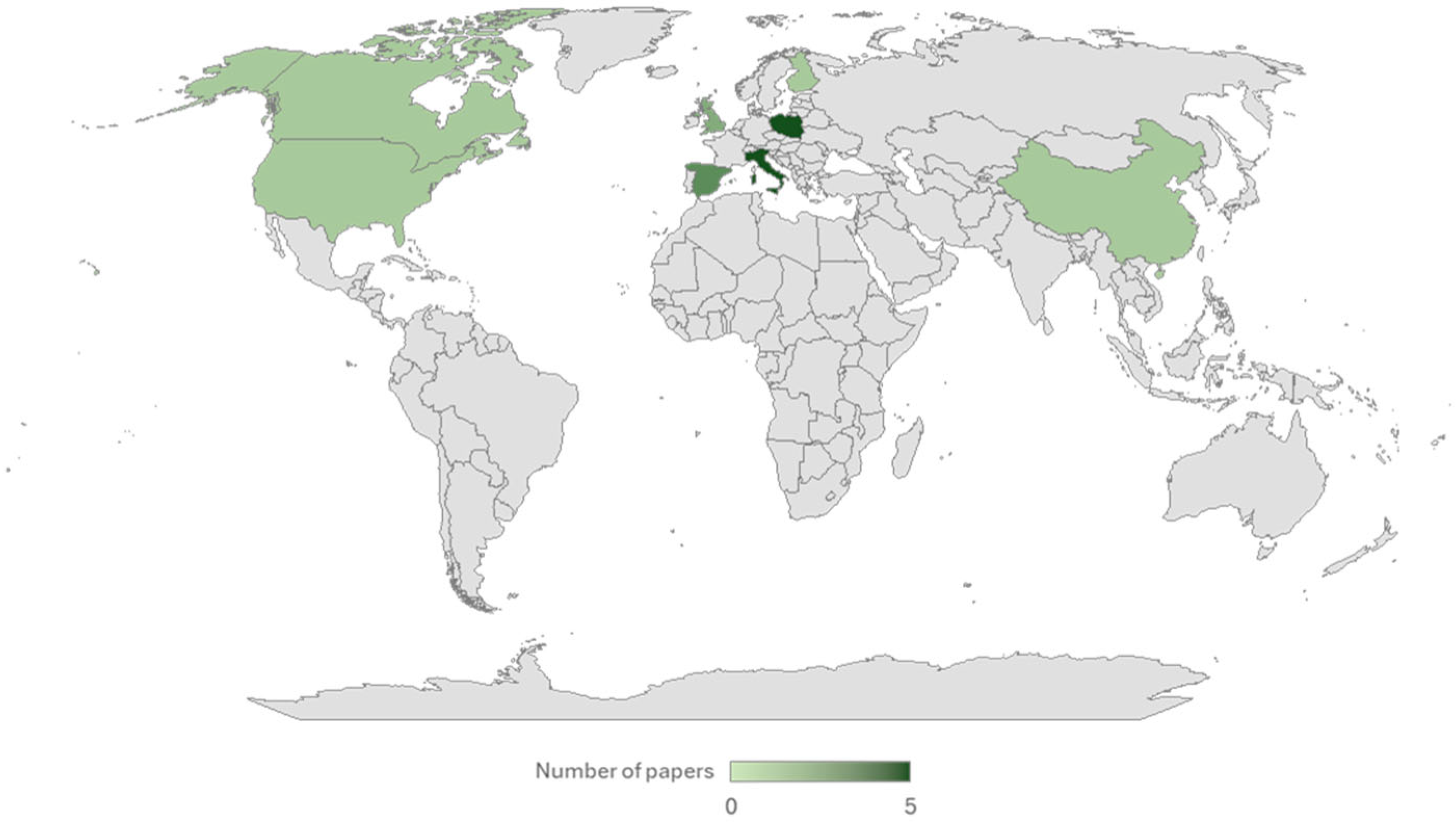
With reference to the different countries of the authors’ affiliations, this Special Issue is international in nature, exploring the issues related to this topic on a global scale. The universities or research institutions to which the authors belong are distributed throughout the world: Poland, Spain, Italy, Finland and the United Kingdom in Europe; China and Korea in Asia; Illinois in the United States of America; and, finally, Canada.
The countries affiliated with the authors of the published papers are illustrated in
Figure 1.
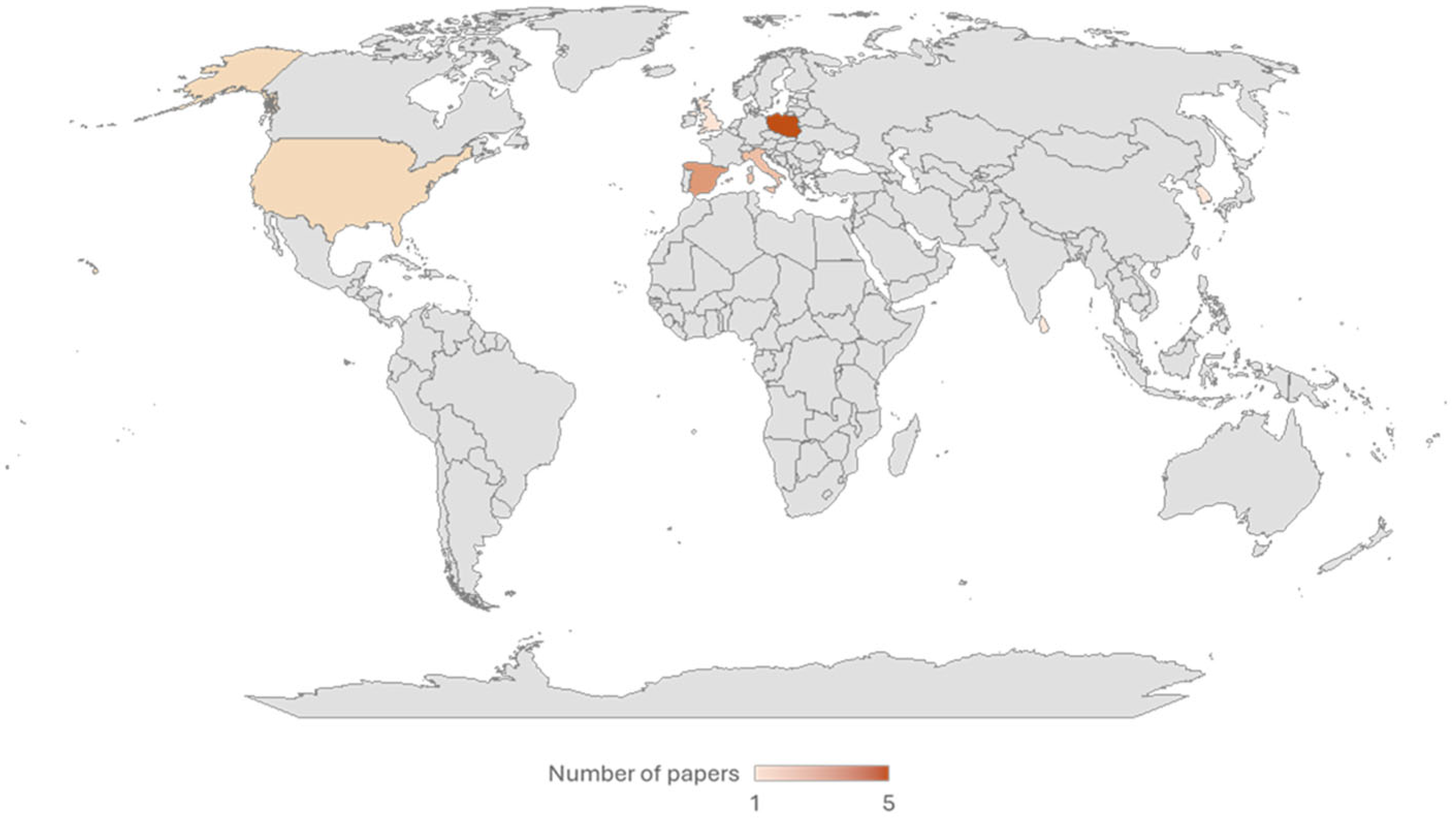
The same international approach has characterized the contexts of analysis of the fourteen empirical papers. In
Figure 2, the geographical distribution of the analysis contexts is presented.
The core themes addressed in the published papers align closely with the aims of this Special Issue. They highlight the importance of advancing knowledge and innovation concerning the main practices and policy approaches that guide the development of more sustainable, inclusive, and energy-efficient urban environments.
A detailed overview of the individual contributions is presented below. At the end of this Editorial, concluding remarks are made that describe the main insights emerging from the collected research. This includes broader recommendations for future strategies, practical applications, and research directions related to decarbonization and urban environmental programs.
In “Identifying Pandemic Stress-Vulnerable Social Groups in Selected Polish Cities: A Geospatial Approach to Building Resilience”, Lidia Mierzejewska and Natallia Zhukouskaya identify urban social groups most vulnerable to pandemic-related stress, focusing on demographic and socio-economic characteristics and their spatial distribution. Based on a geosurvey conducted in three Polish cities, key differentiating factors in stress levels included gender, age, employment status and profession. Women, individuals over sixty years old, economically inactive people, and workers in sectors such as tourism were most affected. These groups were mainly concentrated in densely built-up urban areas. The findings aim to inform urban planning and governance strategies to enhance public health, improve stress resilience and better prepare cities for future crises such as pandemics [
1].
Studying the same territory of Poland, in “How to Create Healthy, Stress-Resilient Post-Pandemic Cities”, Magdalena Wdowicka, Lidia Mierzejewska, Marta Szejnfeld, Bogusz Modrzewski, Kamila Sikorska-Podyma, Adam Wronkowski, and Ewa Lechowska explore how urban size, density and spatial characteristics influenced stress dynamics in three Polish cities during and after the COVID-19 pandemic. Using geo-surveys, statistical analysis and GIS tools, the study demonstrates that while city size does not directly affect stress levels, it shapes residents’ preferences for post-pandemic urban development. Cities with abundant green infrastructure—especially those following the garden city model—exhibit lower stress and greater resilience. The findings highlight the importance of sustainable urban planning and effective management tools in creating low-carbon, nature-integrated and psychologically resilient cities in the post-pandemic period [
2].
With reference to the similar national context, in “The Central Functions of Cities in Poland in Light of Administrative Reform”, Katarzyna Przybyła, Maria Hełdak, Marian Kachniarz, David Ramsey, Alina Kulczyk-Dynowska, and Katarzyna Szara analyze how Poland’s 1999 administrative reform affected the central functions of major cities over 22 years (1998–2019). The outcomes show that former provincial capitals experienced different functional dynamics compared to cities that retained their status. The reform largely reinforced pre-existing socio-economic patterns rather than initiating new ones, revealing the interplay of multiple factors shaping urban evolution. The results contribute to understanding how administrative structures influence sustainable urbanization [
3] and the long-term trajectories of regional and urban development in Poland.
Regarding the post-industrial city of Knurów in Poland, in the study carried out by Joachim Bronder, Anna Kurianowicz, Joanna Piasecka, Janusz Krupanek, and Jacek Krzyżak, a GIS-based method using the analytical hierarchy process was developed to identify areas most vulnerable to climate-related hazards. This approach highlighted the importance of green infrastructure in mitigating thermal and hydrological risks. By identifiying vulnerable zones with limited green spaces, their method supports urban planning and climate adaptation efforts aimed at reducing climate change impacts [
4], by contributing to decarbonization strategies through the promotion of more sustainable land management and enhancing resilience to climate threats.
Concerning the capital of Poland, in “Risk Management Model of Urban Resilience Under a Changing Climate”, Agnieszka Blokus-Dziula and Przemysław Dziula introduce a multi-criteria model for assessing climate-related risks in cities by estimating the probability and impact of various threats on urban systems. The model evaluates exposure and vulnerability of assets, infrastructure, and communities, integrating Bayesian probability theory to account for uncertainty in predicting hazardous events. It also incorporates vulnerability drivers and resilience factors to analyze their influence on the functioning of the City of Warsaw and its residents’ well-being. The framework supports urban risk management and strategic planning, helping strengthen resilience and improve preparedness for future climate-related challenges [
5].
In “Breaking Silos: A Systemic Portfolio Approach and Digital Tool for Collaborative Urban Decarbonisation”, Manuel Alméstar, Sara Romero-Muñoz and Nieves Mestre introduce a systemic and digital framework for managing urban decarbonization portfolios in Spain aligned with the EU Mission for Climate-Neutral and Smart Cities. Combining systems thinking and portfolio theory, this study presents an analytical taxonomy and interactive tool that improve coordination, collaboration, and adaptive decision-making. Validated through Madrid’s Climate City Contract, the framework maps interdependencies among projects and stakeholders via co-creation, interviews and prototyping. Results show that most initiatives target climate adaptation and knowledge generation. The digital portfolio fosters systemic innovation, transparency, and governance integration, despite challenges in data, institutional capacity and politics, offering a replicable approach for mission-oriented urban governance [
6].
Focusing on the same geographic setting, the research by José Marín-Nicolás, Mª Paz Sáez-Pérez, Francesco Tajani, and Francesco Sica evaluates the current and potential accessibility through an accessibility improvement index, measuring how physical spaces can be strengthened by removing architectural barriers. Applied to twenty-five heritage buildings used as museums, the analysis shows that barrier removal is feasible for over 75% of spaces, reaching 100% in some cases. These results demonstrate the potential to extend such analyses to other urban and built environments, supporting equal access for all [
7].
In “Socio-Economic Development and Eco-Education for Urban Planning Committed to Sustainability”, Ana Cano-Ortiz, Carmelo Maria Musarella, and Eusebio Cano investigate how rapid technological progress and accelerating climate change challenge cities to ensure livable environments. Rising temperatures and prolonged droughts, especially in Mediterranean regions reaching 48–50 °C, demand adaptation strategies that safeguard well-being and reduce energy use through clean sources. Key actions include decarbonization, expansion of urban green spaces, peri-urban parks and reforestation to enhance carbon sequestration. Urban greening should prioritize biodiversity by using native, water-efficient species while avoiding invasive plants. By involving undergraduate students and future teachers enrolled in the Knowledge of the Natural Environment course at the Faculty of Education, Complutense University of Madrid, this study highlights how achieving sustainable adaptation also requires strong societal engagement and environmental education to promote awareness, collective responsibility and behavioral change, supporting a resilient, low-carbon urban future [
8].
In “Developing a Community-Based Carbon Footprint Questionnaire: Towards a Dynamic Understanding of How Personal Behaviour Interacts with Policy and Economic Change”, Philip Haynes develops a community carbon footprint questionnaire to help individuals reflect on reducing emissions within their social and economic contexts. Implemented in an Anglican church community in United Kingdom, it measures three components: transportation, accommodation energy use, and consumer behavior. Among forty-two participants, the average footprint is 5.8 tonnes per year, with older adults scoring higher due to larger homes and car dependence. Accommodation energy use is the biggest contributor, followed by transport. Participants are most willing to change consumer habits like recycling and reducing meat consumption. Policy insights highlight major emission limitation through renewable electricity, smaller shared housing, and sustainable mobility choices [
9].
The Italian context is investigated by Pierluigi Morano, Francesco Tajani, Felicia Di Liddo e Paola Amoruso in “A Feasibility Analysis of Energy Retrofit Initiatives Aimed at the Existing Property Assets Decarbonisation” with the aim of evaluating the financial and economic feasibility of sustainable construction within the framework of resilient, low-carbon urban development [
10]. The research examines the potential changes associated with energy retrofit interventions in existing buildings, with a focus on the economic impact of these improvements (in terms of demolition/retrofit/reconstruction costs, operational cost reductions, and property value increase). Through this analysis, effective management tools and planning models that align environmental benefits with economic viability are identified, to support innovative strategies for sustainable urban planning, fostering low-carbon, resource-efficient cities consistent with the European Commission’s objectives for climate-conscious urban transformation.
Similarly, with reference to the Italian city of Turin, in “Concrete Self-Healing for Sustainable Buildings: A Focus on the Economic Evaluation from a Life-Cycle Perspective”, Andres Miguel Panza Uguzzoni, Elena Fregonara, Diego Giuseppe Ferrando, Giovanni Anglani, Paola Antonaci, and Jean-Marc Tulliani propose a methodology to assess the economic and environmental sustainability of innovative construction materials, focusing on self-healing concrete as a key element for resilient cities. Using the Life-Cycle Costing (LCC) approach [
11] combined with the Factor Method, three wall component solutions are compared. The results demonstrate that self-healing concrete extends service life, reduces maintenance costs and environmental impacts, and increases residual value, providing an effective model for sustainable urban planning and efficient management of long-lasting, low-emission infrastructures.
In “Carbon Emission Reduction Strategies in Urban Water Sectors: A Case Study in Incheon Metropolitan City, South Korea”, Gyumin Lee, Hyunjung Kim, Kyoungwon Min, Taemun Hwang, Eunju Kim, Juwon Lee, and Doosun Kang consider achieving carbon neutrality by 2050 as a key goal for South Korea. This study examines strategies to reduce carbon emissions in Incheon Metropolitan City’s urban water cycle systems, which are major energy consumers within urban infrastructure. Analyzing water abstraction, treatment, and wastewater plants, the research develops carbon reduction scenarios targeting water, energy and carbon management. A calculation model assesses emissions under different strategies. The results show that renewable energy use and efficiency improvements achieve the greatest reductions, validating national initiatives for clean energy [
12]. Although water use reduction offers lower emission benefits, it remains cost-effective.
Always referring to the Asian context, in “Sustainable Urban Heat Risk Resilience: Lessons on Opportunities and Barriers to Action from Colombo, Sri Lanka”, Shifana Simath, Rohinton Emmanuel, and Eeva Aarrevaara explore how urban climate knowledge can better inform climate-sensitive planning in Sri Lanka. Through expert discussions with the country’s urban planning community, six key themes—insights, integration, specification, exhortation, commitment, and continuity—are identified as both barriers and opportunities for improving heat risk resilience. The research maps the roles of various agencies and stakeholders essential for a comprehensive resilience strategy and offers broader lessons to strengthen heat health planning and bridge practical gaps in sustainable urban climate mitigation and adaptation [
13].
In “A Landscape Approach to Understanding Carbon Sequestration Assets at a State-Wide Scale for Sustainable Urban Planning”, Siqi Lai, Le Zhang, Yijun Zeng, and Brian Deal advance the sustainable urban planning by spatially identifying carbon sequestration assets in Illinois, crucial for resilient low-carbon cities. Using landscape analysis, deep learning, Kriging interpolation and i-Tree Planting tools, they evaluate forest carbon sequestration potential with species-specific precision. Their results reveal spatial variability and significant carbon sinks, especially in Southern Illinois, emphasizing biodiversity’s fundamental role in carbon cycling. This approach indicates effective management tools for informed forest conservation and carbon neutrality strategies [
14], demonstrating how innovative spatial methods promote ecological quantification and support climate-resilient urban development.
Belonging to the category of literature reviews within the set of papers collected in this Special Issue, the study carried out by Zhengzheng Luo, Lia Marchi and Jacopo Gaspari examines the impacts of climate change on urban public open spaces (POSs) and their usability [
15]. It reviews current progress, methodologies, and findings and introduces a critical framework analyzing sixty-two key factors across environmental, spatial, social, and behavioral domains, organized into twelve categories. Using a co-occurrence matrix, the analysis highlights how spatial elements—such as amenities, greenery, and walkability—interact with temporal conditions like temperature, sunlight, and wind to influence user behavior. Understanding these interactions is essential for designing climate-resilient, user-centered POSs. The findings provide evidence-based recommendations for urban planners to enhance adaptability and long-term functionality in response to climate change.
Decarbonization is emerging as one of the most critical challenges in the fields of urban planning and construction. As cities continue to grow and evolve, the need to reduce carbon emissions has become central to both policy-making and project implementation, aligning closely with the Sustainable Development Goals (SDGs) promoted by the European Union and other global frameworks [
16]. A complete transformation of the global energy system requires a strategic and progressive transition from fossil-based sources to zero-carbon alternatives. This includes the decarbonization of transportation and heavy industry, as well as the adoption of clean fuels such as hydrogen and ammonia across all sectors of the built environment.
In this context, a wide range of urban development and conservation strategies are being promoted to both protect the natural environment and support low-carbon resilience in cities. These strategies are essential not only for reducing environmental impact but also for making cities more livable, economically stable and socially inclusive. The reintroduction of biodiversity and green infrastructure into the urban fabric is crucial. Urban green spaces play a vital role in mitigating the effects of a warming climate, promoting soil saving and creating inclusive public areas that foster community interaction and well-being.
As moving toward the creation of smart cities, urban planning must operate in close synergy with evaluation tools and multidisciplinary approaches to ensure that future city models reflect the real needs of communities [
17]. This includes embracing technological innovation and decision support methods that can guide effective urban policies and project assessments. Cities must also be capable of self-generating a significant share of their energy demand, thereby promoting sustainability, resilience and adaptability in the face of changing socio-economic and environmental conditions.
The published papers in this Special Issue analyze different aspects of the sustainable planning and management of territories, aiming to provide different insights on one of the most relevant topics of public debate. In this sense, sustainable urban planning and effective management instruments are essential for developing resilient, low-carbon cities, addressing interconnected social, economic, cultural, environmental, and energy challenges. The body of the works in this Special Issue emphasizes cities as the central focus, exploring diverse themes through a variety of methodological approaches and analytical tools that examine urban dynamics, real estate mechanisms and related phenomena across multiple international contexts.
Recent transformations in urban development and the real estate sector have highlighted the need for robust scientific frameworks to guide the study of sustainable urban growth and the evolution of the built environment. The contributions included in this collection provide innovative methodologies and analytical techniques to better understand urban processes at different scales, supporting evidence-based planning and decision-making. Authored by leading international scholars, these papers not only expand the theoretical understanding of sustainable urbanization but also offer actionable strategies and management tools that can be applied in practice, helping cities to become more adaptive, low-carbon and resilient in the face of ongoing social, environmental, and economic challenges.