


Abstract
Extreme heat disrupts labour, infrastructure, and health systems, yet most response frameworks intervene after clinical impact is confirmed. This review analyzes documented cases across sectors and regions to determine where heat effects are first detected and why intervention timing varies. The analysis used institutional reports, epidemiological summaries and occupational data to map how early functional signals appear across systems. A conceptual matrix is proposed to permit action to be authorized at the earliest sign of functional stress, using mortality, productivity, service instability, vulnerability, and adaptive capacity as operational inputs rather than retrospective outcomes. The analysis suggests that heat becomes observable first through reduced work capacity or infrastructure strain, not through hospital data, and that systems with predefined activation criteria engage earlier and with less irreversible loss. The matrix provides a transferable basis for integrating occupational, infrastructural, and clinical information into a unified heat response mechanism. This approach supports a transition from post-impact validation to forward-based decision logic, particularly in settings where vulnerable workers remain outside formal surveillance.
1. Introduction
Global assessments confirm that extreme heat is one of the fastest intensifying climate risks of the 21st century. The Intergovernmental Panel on Climate Change (IPCC) states that global mean surface temperature has already increased by 1.1 °C relative to pre-industrial levels, with heat events becoming more frequent, longer, and geographically widespread [1]. The World Meteorological Organization (WMO) notes that 2024 ranks among the hottest years on record, projecting further intensification under all emission scenarios [2]. The World Health Organization (WHO) classifies heat exposure as an immediate systemic risk to workforce functioning and labour sustainability [3].
Occupational exposure pathways magnify this risk beyond environmental discomfort. More than 2.4 billion people work in conditions with significant heat exposure, with annual occupational outcomes estimated at nearly 19,000 deaths and over 22 million injuries [4]. Heat stress accounts for 2–4% of global working-hour losses and is projected to exceed 11% by the end of the century, predominantly affecting agriculture, construction, and manufacturing [5,6]. Unlike general climate impacts, heat acts as an operational constraint, disrupting physical endurance, decision-making accuracy, and time-sensitive task execution.
Physiological mechanisms underlying heat-related hazards are well documented. Thermal strain leads to dehydration, hypohydration-induced cardiovascular load, endocrine disruption, and loss of thermoregulatory control [7]. These reactions alter metabolic regulation, impair cognitive function, and increase vulnerability to renal injury [8]. Chronic kidney disease of nontraditional origin is now recognized in agricultural communities repeatedly exposed to high heat and forced dehydration cycles [9]. Experimental and field evidence show that heat exposure reduces vigilance, delays reaction time, and increases accident probability in physically demanding jobs [10,11].
Sensitivity and adaptive capacity are not uniform across the workforce. Older workers, pregnant women, individuals with chronic health conditions, and migrant or informal labourers exhibit lower physiological resilience and socio-economic ability to implement protective strategies [9]. Urban heat island amplification, coupled with particulate air pollution, further elevates cardiovascular and respiratory strain, reshaping risk profiles even in regulated labour markets [12]. Heat acts as a compound stressor, interacting with demographic, socioeconomic, and infrastructural determinants.
Institutional frameworks include heat stress, but response mechanisms are fragmented. WHO global governance assessments show that heat is inconsistently treated as an occupational determinant, often categorized as a general environmental hazard rather than a work-specific operational risk [12]. Regulatory reviews indicate that heat thresholds and workload adjustment criteria are rarely codified into enforceable occupational safety planning [13]. Existing safety management systems regulate workplace risk but do not define heat exposure thresholds or operational protocols for real-time adaptive response [14].
Traditional occupational safety and health (OSH) risk assessments still use semi-quantitative methods developed for general industrial hazards and not for dynamic climate-related exposure [15]. Sector-specific applications, including methane flow modelling in mining operations, continue to follow static risk estimation frameworks that do not account for escalating thermal stress [16].
Emerging frameworks demonstrate progress toward integrated governance models. The joint WMO-WHO-ILO guidance on integrated heat-health information systems proposes an alignment of meteorological intelligence, worker protection protocols, and early warning systems tailored to labour conditions [17]. However, implementation across national systems remains uneven, with limited translation into workplace decision-making instruments, fragmented coordination, and weak operational links between epidemiological evidence, economic impact modelling, and policy response.
These gaps indicate the absence of a framework that connects environmental, physiological, and occupational dimensions of heat risk. Existing evidence is largely descriptive, with limited utility for prioritization, resource allocation, or planning preventive interventions. A comparative approach is necessary to align the epidemiological impact, economic consequences, and governance mechanisms into a transferable reference model for informed decision-making.
Extreme heat influences several United Nations Sustainable Development Goals through its effects on health, labour capacity, and essential services. SDG 3 (Good Health and Well-Being) is related to higher morbidity, increased demand on health services, and excess mortality during heat periods. SDG 8 (Decent Work and Economic Growth) is associated with reduced work capacity, work-hour losses, and a higher risk in outdoor or high-effort tasks. SDG 9 (Industry, Innovation and Infrastructure) and SDG 11 (Sustainable Cities and Communities) are influenced when electricity supply, cooling demand, transport, or water distribution reach operational strain during extreme heat. SDG 13 (Climate Action) is connected to the need for operational thresholds and adaptation processes that are implemented differently across national systems. These relationships indicate that occupational heat risk extends beyond the workplace and form the context for this analysis.
The analysis addresses three main objectives: identifying the earliest points at which heat effects become detectable across labour, infrastructure, and clinical systems, examining how variation in monitoring capacity influences activation timing across governance structures, and defining an operational framework that uses functional indicators to determine when preventive action must initiate in occupational and intersectoral settings.
Previous reviews on heat risk focus on clinical outcomes, meteorological warning systems, or sector-specific effects [5,7,10]. These reviews document morbidity, mortality, or productivity changes but do not analyze how operational signals from labour, health services, and infrastructure behave in parallel or how they can be integrated into a unified decision structure. This analysis addresses that gap by examining where early deviations are first recorded across systems and by mapping how routine operational indicators are currently collected in governance structures. These indicators can be grouped into a functional sequence that shows when system stability begins to decline. The contribution of this work is a governance-oriented decision structure that uses this sequence to determine the operational point at which heat-related measures must start.
2. Materials and Methods
2.1. Study Design
This review followed the PRISMA framework, adapted for institutional and policy-based evidence rather than interventional trials. A scientific matrix-based narrative review approach was used to examine how extreme heat is monitored, interpreted, and governed in occupational systems. The review consolidates standardized, validated indicators from authoritative global monitoring systems, making them comparable across epidemiological, economic, and adaptation domains. The design extracts relevant evidence rather than descriptive summaries and serves as the basis of a decision-oriented analytical matrix.
2.2. Search Strategy and Data Sources
The search covered institutional repositories from the World Health Organization (WHO), International Labour Organization (ILO), World Meteorological Organization (WMO), Pan American Health Organization (PAHO), United Nations, and the Lancet Countdown initiative, supplemented by peer-reviewed scientific databases including Web of Science, PubMed, and ScienceDirect. A Boolean strategy was applied, combining heat exposure and occupational governance terms, for example: (“extreme heat” OR “occupational heat exposure” OR “heat stress”) AND (“worker safety” OR “OSH” OR “labour productivity” OR “surveillance” OR “governance adaptation”). Only documents presenting quantitative or semi-quantitative indicators were considered. Preliminary advisories, non-validated reports, and opinion-based materials were excluded.
2.3. Inclusion and Exclusion Criteria
Documents were included if they were published between 2017 and 2025, explicitly addressed heat exposure in relation to occupational safety, labour productivity, or governance, and provided empirical epidemiological, economic, or institutional response data. Peer-reviewed journal articles and official institutional reports from WHO, ILO, WMO, PAHO, UN, or The Lancet Countdown were eligible. Documents were excluded if they lacked occupational relevance, did not present verifiable or formally reported data, or focused on climate risks unrelated to heat exposure. Documents were included if they contained (i) explicit reference to occupational or labour-relevant heat exposure, (ii) epidemiological, economic, or adaptive governance data, and (iii) defined methodology or recognized monitoring framework. Exclusion applied to reports limited to climate modeling without epidemiological linkage, descriptive narratives with no numeric indicators, or non-traceable methodological structure. Updated or overlapping publications within the same institutional series were consolidated, retaining the most recent and complete version.
2.4. Data Synthesis and Integration
The synthesis combined epidemiological, economic, and institutional evidence into an integrative analytical framework. Findings were organized into four domains: population burden, institutional governance, operational capacity, and regional adaptation. Quantitative indicators were examined against corresponding policy and regulatory provisions to identify convergence or discrepancy between documented impacts and implemented measures. A conceptual integration matrix was developed to connect mortality, productivity loss, and adaptation responses, outlining how exposure intensity, socioeconomic burden, and institutional capacity interact within national and sectoral systems.
2.5. Study Selection and Data Extraction
Screening and eligibility assessment were conducted independently by two reviewers following a predefined, PRISMA-aligned protocol. The process consisted of two stages. First, executive summaries and abstracts were examined to confirm explicit relevance to occupational heat exposure and documented health, productivity, or governance implications. In the second stage, the full content of each document was reviewed to verify methodological transparency, clarity of indicator definitions, and the traceability of underlying data. Sources grounded in recognized institutional monitoring frameworks or peer-reviewed scientific validation were retained.
Data extraction was performed using an analytical template applied uniformly across all included sources. For each publication, information was recorded on publication year, institutional origin, geographic or sectoral scope, type of heat exposure, epidemiological indicators such as mortality, morbidity, or labour-hour loss, economic metrics including productivity or GDP impact, and the nature of institutional response mechanisms, such as surveillance systems, heat–health early warning protocols, adaptation plans, or regulatory enforcement instruments. Extracted values were cross-checked between narrative sections and annexed datasets to avoid discrepancies across sources.
2.6. Data Analysis and Matrix Construction
A cross-institutional comparative approach was applied. Quantitative indicators were normalized, where feasible, using population or GDP baselines for regional comparability. Qualitative evidence was processed through thematic coding, focusing on institutional coordination mechanisms, surveillance architecture, workforce protection measures, and OSH integration within national climate adaptation frameworks. Extracted data were organized into a three-axis analytical matrix connecting (i) epidemiological burden, (ii) economic impact, and (iii) institutional response capacity, enabling an operational assessment of alignment between risk severity and governance readiness at the national and sectoral level.
2.7. Risk of Bias and Ethical Considerations
Traditional clinical bias assessment tools were not applicable. Instead, institutional authority, methodological transparency, and data traceability were used as validity criteria. Peer-reviewed publications were considered scientifically validated. Institutional reports were included if they originated from globally recognized monitoring systems and presented explicitly sourced or standardized indicators. All included materials were publicly available, and no personal or confidential data were accessed. No ethics approval was required.
3. Results
3.1. Data Identification and Selection Process
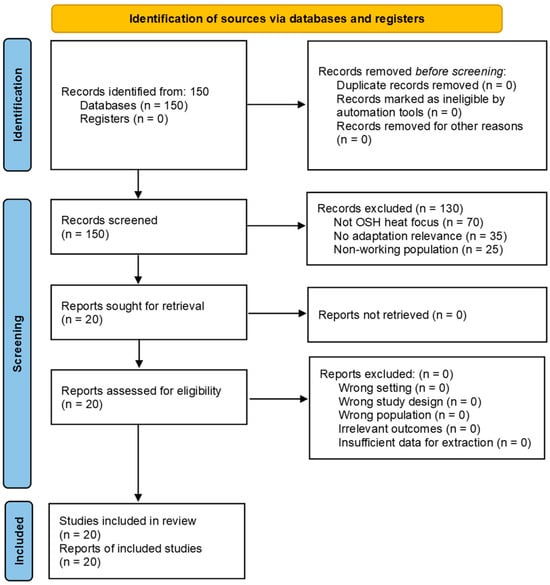
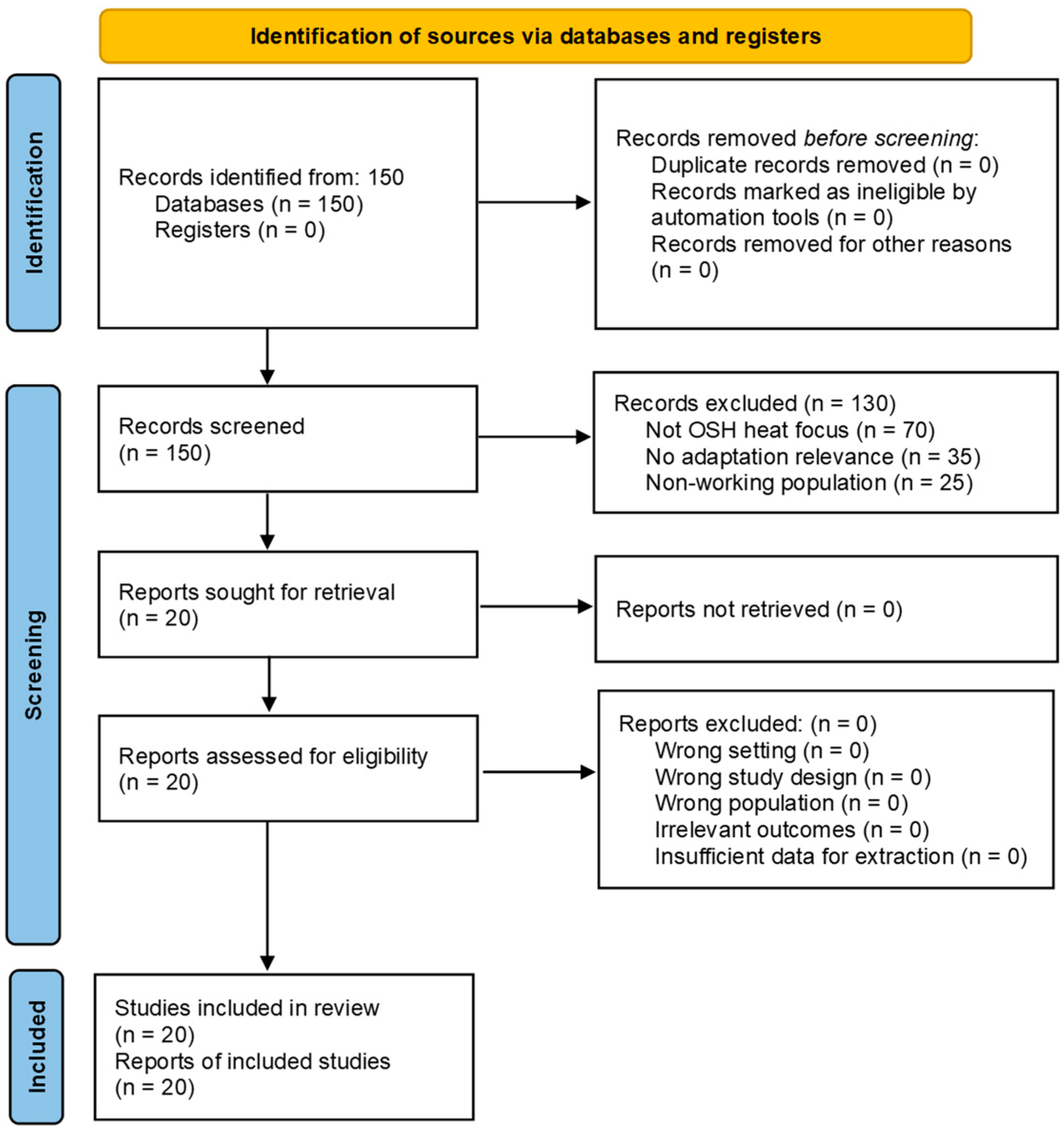
This review followed the PRISMA structure, adapted for institutional and policy-based evidence [18]. The objective was to consolidate comparable evidence on health outcomes, occupational risks, and socioeconomic effects of extreme heat from sources published between 2017 and 2025. Institutional reports and peer-reviewed studies were screened. These sources provide epidemiological, economic, and governance evidence relevant to occupational heat exposure. The selection process adheres to PRISMA standards for transparency and reproducibility. Each stage, identification, screening, eligibility, and inclusion, was documented to ensure procedural traceability. The process is summarized in Figure 1.
Figure 1.
Flowchart of the study screening and selection process.
The final corpus of 20 sources covers three evidence domains: (i) governance and systemic adaptation frameworks issued by WHO, WMO, ILO, and UN agencies; (ii) regional risk assessments and monitoring reports from the Lancet Countdown and WHO regional offices; and (iii) peer-reviewed conceptual and physiological analyses of occupational heat exposure [19,20,21,22,23,24,25,26,27,28,29,30,31,32,33,34,35,36,37,38]. They represent a set of institutional evidence currently available, encompassing global, regional, and thematic dimensions of extreme heat. Collectively, they form an analytical base for evaluating sustainable risk management approaches. Their main characteristics are summarized in Table 1.
Table 1.
Main characteristics of the included sources.
3.2. Governance and Systemic Adaptation Frameworks
The 2021 WHO Health and Climate Change Global Survey reports that 79% of 95 responding Member States had developed a National Adaptation Plan (NAP), but only 33% integrated health as a component, and fewer than 10% included workforce or occupational risk measures [32]. The 2025 WHO global review of 59 NAPs and 27 Health National Adaptation Plans (HNAPs) reports that most plans acknowledge heat risk, but do not define activation thresholds, financing instruments, or accountable institutions for occupational heat exposure [28].
The 2024 WHO scoping guidance on maternal and child health outlines indicator requirements for heat-related morbidity but notes that no countries have integrated real-time surveillance or standardized national reporting systems [23]. The 2025 WHO review on displaced and migrant populations reveals that most national adaptation plans do not include migrants in warning, housing, or emergency response systems for extreme heat [25]. The 2017 WHO strategic framework for Small Island Developing States indicates that health adaptation measures were identified as priorities but were not supported by dedicated funding mechanisms [26].
At the occupational level, the 2019 ILO global report estimates that heat stress accounted for productivity losses equivalent to more than 2% of total working hours in worst-affected economies, yet no G20 country has enforced binding WBGT-based exposure limits at the national regulatory level, with existing measures remaining largely voluntary or employer-driven [36]. The 2024 ILO global review notes that current measures are predominantly employer-driven and that Occupational Heat Action Plans (OHAPs) are not mandated in most jurisdictions [30]. WHO and WMO technical guidance published in 2025 defines criteria for workplace surveillance and heat action protocols, but reports limited adoption beyond pilot implementations [24].
WHO’s 2024 operational guidance on climate-resilient health care facilities presents explicit thermal performance criteria, continuity-of-operations requirements, and infrastructure resilience standards, but country-level implementation status is not systematically documented [33]. The 2021 WHO Europe regional assessment documents formal Heat–Health Action Plans (HHAPs) in multiple EU Member States, with activation protocols and interagency coordination frameworks, but confirms that occupational heat exposure is generally excluded from mandatory response mechanisms [37].
3.3. Regional Heat-Related Burden and Labour Impact
An estimated 61,672 excess heat-related deaths occurred in 2022, representing a twofold increase compared with the early 2000s, with the steepest rise in mortality recorded over the past decade [35]. Documented productivity impacts span agriculture, construction, transport, and manufacturing sectors, yet no EU Member State has adopted legally binding national thermal exposure limits for workers. Rising heat-related mortality trends have been reported since 2000, with productivity losses disproportionately affecting outdoor informal workers, and investment in adaptation measures and policy implementation remaining insufficient across all assessed countries [34].
Annual economic losses exceeding 1% of national GDP in select cases, primarily due to productivity decline and emergency response costs, with formal labour protection frameworks rarely addressing heat-specific risk conditions [27]. Displaced and migrant populations are systematically excluded from early warning systems and occupational protection schemes, experiencing higher exposure to outdoor heat due to inadequate housing and lack of institutional coverage [25]. Chronic kidney disease of non-traditional origin (CKDnt) among agricultural workers is associated with repeated heat exposure under informal working conditions, with no regulatory thresholds applied in field operations [31].
Work-hour losses due to occupational heat exposure reach over 5% of total annual potential working hours in peak agricultural periods, while national heat protection measures remain largely voluntary or employer-dependent [36]. In regions where mortality surveillance is limited, exposure is estimated from economic or productivity-based indicators rather than health data, indicating differences in data availability across regions [30,32].
3.4. Conceptual and Physiological Mechanisms of Occupational Heat Stress
Occupational heat stress is determined by environmental heat load, metabolic workload, and exposure duration, monitored using the Wet Bulb Globe Temperature (WBGT) index. Productivity loss is reported once WBGT exceeds 26–28 °C in moderate workloads and rises above 20% when WBGT surpasses 30 °C in outdoor manual labour [21,29]. Documented physiological effects include dehydration, core temperature increase, cardiovascular load, reduced attention, motor coordination decline, and higher accident rates [19]. Indoor industrial settings may reach critical thermal strain below outdoor WBGT values when radiant heat or poor ventilation is present, and work intensity cannot be adjusted. In informal or unregulated settings, work pace and rest are adjusted individually rather than through formal control protocols [21].
Recurrent exposure without regulated hydration or cooling has been associated with chronic kidney disease of non-traditional origin (CKDnt) in agricultural workers [31]. Heat strain increases when thermoregulation can no longer be maintained through self-paced work or fluid intake during high metabolic workloads [30]. In informal outdoor work, there are no mandated rest breaks or cooling protocols, and workers interrupt activity only when physical discomfort forces them to stop.
3.5. Alignment Between Heat-Related Burden, Economic Impact, and Institutional Response Capacity
Regions with the highest quantifiable burden report either documented excess mortality, projected work-hour productivity losses exceeding 5% annually, or economic losses above 1% of national GDP attributable to heat exposure [27,31,34,36]. Europe is one of the regions with formal excess mortality surveillance connected to national reporting systems [33], whereas most non-European regions quantify impact primarily through economic losses or productivity modelling rather than health surveillance data.
WHO and ILO guidance specifies WBGT-based activation levels, workload classification, and the use of work-rest cycles and cooling measures once WBGT reaches 28–32 °C, depending on metabolic workload [24,30]. These operational thresholds are formally adopted as institutional standards in high-income countries with pre-existing Heat–Health Action Plans, but without any mechanism to ensure compliance, allocate funding, or extend coverage to the labour market [32,37]. Most national adaptation plans do not include heat-specific occupational activation mechanisms associated with surveillance indicators or productivity metrics [28,30,34].
The comparative analysis shows systematic decoupling between quantified burden and institutional enforcement capacity. Regions reporting the highest excess mortality or work-hour productivity losses are those without binding WBGT thresholds, without activation mechanisms based on surveillance indicators, and without integration of occupational heat exposure into national adaptation plans [25,27,34,36]. Epidemiological or economic indicators are collected but are not operationalized as activation variables within formal governance or labour protection mechanisms [28,30].
3.6. Conceptual Decision-Activation Matrix for Occupational Heat Response
This study proposes a quantitative decision-support matrix to connect epidemiological, economic, and institutional dimensions through measurable activation thresholds. The framework is designed to translate observed heat-related burden into activation decisions across clinical, occupational, and social protection systems. Includes five indicators. Four (EHM, L, Z, T) are calculated separately, while a fifth (S) functions as a composite prioritization index. Each indicator is defined by a quantitative function that relates health and economic burden to governance activation logic.
Excess heat mortality (EHM) expresses additional deaths per 100,000 population during heat events and is calculated as [2,12]:
where = observed deaths, = expected baseline deaths, = population. In this framework, values exceeding 1 death per 100,000 population during a heat event are interpreted as a signal for emergency health service mobilization.
Productivity loss function (L) estimates cumulative work-hour loss and is defined as [5,6]:
where = number of workers, = daily working hours, = number of heat days, and = fractional loss of work capacity. The ILO reports cumulative work-hour losses due to heat; here, the function is introduced to operationalize this relationship. Weekly losses ≥ 5% of potential work hours indicate the need for regulatory intervention, including reduced exposure time or mandatory rest cycles.
Health service surge index (Z) reflects abnormal health system demand during heat events and is computed as [32,33]:
where = number of health service visits during the heat event, = historical mean, and = standard deviation. A Z-score ≥ 2 indicates abnormal demand and signals the need for hospital surge protocols in WHO surveillance frameworks.
Composite vulnerability score (S) combines mortality, service disruption, and demographic exposure [12]:
where = excess heat mortality in the region , = surge index, = proportion of the vulnerable population, and = weighting coefficients. The weighting coefficients α, β, and γ are set during calibration. The calibration uses national or regional data. α reflects the contribution of excess mortality. β reflects the service utilization signal. γ reflects the share of the vulnerable population. The coefficients are normalized so that α + β + γ = 1. This keeps the index comparable across regions and allows local adjustment. This metric integrates mortality, service demand, and demographic vulnerability into a single index to prioritize communication and resource allocation. This index is used to prioritize communication, resource allocation, and targeted intervention.
Adaptation-adjusted threshold (T) introduces resilience as a modifying parameter [33]:
where = baseline activation threshold, = adaptation index (0–1), and = scaling factor. This function is introduced as a new way to account for resilience, adjusting thresholds dynamically according to adaptation capacity. The adaptation index A uses data reported in national adaptation plans and heat-health action frameworks. It includes four elements: surveillance coverage, early warning protocols, workplace heat measures, and financing instruments. Each element is coded on a 0–1 scale. A higher value indicates earlier capacity to act. The form reflects the shift in activation point when adaptation mechanisms are present. This structure follows the operational logic used in climate-resilience assessments, where adaptation reduces the exposure level required for activation. The threshold can be updated when new adaptation data become available. This structure follows standard resilience modelling practices used in public-health and disaster-risk systems, where adaptation capacity modifies activation thresholds.
These indicators are mapped in a proposed operational matrix connecting quantitative burden to institutional response domains (see Table 2). The model is applicable for transferability across national systems and facilitates activation thresholds to be adjusted on the basis of observed mortality, productivity loss, health service surge, and local adaptation capacity.
Table 2.
Matrix connecting quantitative burden indicators with institutional response mechanisms.
A numerical example illustrates how the matrix operates. Consider a sector with 320 workers assigned to high-effort tasks, a health service that records 180 outpatient visits during a hot day compared with a baseline of 120, and meteorological data indicating a WBGT of 30 °C. The labour component reaches its deviation point when more than 250 workers perform high-effort tasks. The health-service component exceeds its deviation point when daily visits rise by more than 40 above baseline. The exposure component exceeds its deviation point when WBGT surpasses 28 °C. In this configuration, the first deviation appears in the health-service component when outpatient visits exceed the baseline. The sequence shows how routine indicators can be classified and how the operational decision point is identified when multiple components deviate.
4. Discussion
Extreme heat does not follow a uniform escalation pathway. Its first measurable effect depends on which domain is monitored. In outdoor manual work, the earliest signal is a reduction in work capacity rather than a rise in hospital admissions [30]. Physiological strain develops through dehydration or subclinical renal stress but remains undetected where workplace monitoring is absent [31].
In systems where response capacity depends on infrastructure (e.g., cooling, ventilation, transport), stress appears first in cooling demand, grid stability, or water supply before clinical data changes [22]. These operational signals are often not treated as valid criteria for intervention in systems without predefined escalation protocols. In systems where early activation thresholds operate autonomously, small fluctuations in emergency admissions are sufficient to initiate a response before labour or infrastructure effects become visible [23]. Impact sequence reflects monitoring architecture, not exposure intensity.
Where meteorological, occupational, and clinical data are integrated, escalation is intercepted before it affects economic or social functions [23]. Where this is not the case, heat progresses first in domains outside institutional observation, such as informal labour or decentralized infrastructure, and response occurs after impact is already systemic [30].
Across contexts, heat initially causes functional degradation such as reduced labour capacity, infrastructure strain, or service disruption before acute health effects appear [31]. Intervention timing depends on whether the affected domain is institutionally recognized. In agricultural work where occupational heat is not monitored, productivity loss can accelerate under sustained high wet-bulb globe temperature without any protective response being activated [28]. In systems with predefined clinical activation thresholds, response can begin at very early variation levels [24].
Heat impact varies by labour formality and socioeconomic position. Informal or migrant workers often experience productivity and physiological loss before any indicator is detected at the national level [28]. In urban settings, impact first appears through energy stress or behavioral adaptation rather than clinical escalation [25]. In systems equipped with real-time operational monitoring, infrastructure stress can be detected early, while in other settings it is registered once failure has already occurred [22].
These patterns indicate that escalation follows monitoring blind spots, not vulnerability intensity. Systems that act when early functional change is detected maintain stability. Those who wait for crisis-stage confirmation incur avoidable loss. Early signals must be treated as activation points, not preliminary warnings.
Observed outcomes suggest that extreme heat does not follow a single-entry point or uniform escalation pathway, making static exposure-based thresholds inadequate for operational governance. A response model that activates only on mortality or hospital surge does not reflect how systemic stress actually emerges [30]. Risk must be assessed by exposure intensity and by the point at which heat first interacts with system vulnerability, surveillance coverage, and adaptive capacity.
The key question for decision-making is no longer “how hot is it?” but “how close is the system to functional instability?” Intervention must be authorized before damage becomes irreversible based on early functional deviation rather than confirmed harm. This requires labour, infrastructure, and clinical signals to be treated as co-equal activation domains, weighted by system absorption capacity and informed by cumulative exposure dynamics rather than isolated peak events [23]. The conceptual matrix introduced in this study translates this principle into a practical decision framework.
The proposed matrix is a decision model that defines when intervention should start based on the first sign of system deviation. Excess heat mortality (EHM), productivity loss (PL), service surge (Z), population vulnerability (V), and adaptation level (T) are used as dynamic operational signals. None is conclusive on its own by design. Their use depends on how they intersect to indicate loss of functional stability. EHM and PL indicators represent simultaneous signals from different domains. Z indicates disruption of essential services before clinical outcomes. V represents susceptibility to stress before measurable loss occurs. T determines how early intervention is justified according to the system’s absorption capacity. In this model, the indicators act as decision points rather than observational metrics.
The matrix can be implemented into OSH regulations. National OSH rules may require employers to adjust work-rest schedules once on-site WBGT measurements exceed the threshold corresponding to the metabolic workload category. The same matrix can determine when hydration breaks, shaded rest areas, or task rotation become mandatory based on observed decline in work output or measurable decrease in work capacity, even before workers report symptoms.
Heat is treated as context-dependent. Its relevance depends on which system domain is affected first. Intervention is authorized when early functional change is detected, not when clinical overload appears. Early warning has an operational role. The same exposure can result in different activation points depending on whether adaptive reserves are low or stability has already been demonstrated.
Differences across governance models reflect how systems define the acceptable point of intervention. In settings with predefined institutional thresholds, even moderate excess mortality (e.g., 5 per 100,000) is sufficient to initiate an immediate response [23]. Where response is based on labour productivity, action begins after losses exceed measurable work-hour thresholds such as 5% of total capacity [27]. In systems where infrastructure stability is the primary constraint, a service surge (Z ≥ 2) activates intervention before clinical escalation occurs [22].
Activation priority is determined by the earliest probability of functional loss, not by absolute hazard level. In systems with predefined escalation criteria, intervention begins before measurable impact is recorded [23]. Where intervention depends on productivity decline, action is initiated after a significant reduction in workforce capacity is observed [27]. In infrastructure-dependent models, activation follows early stress signals in services such as cooling, power, or water supply [22].
This sequence determines when intervention becomes justified. Intervention is initiated once early functional deviation is observed in any monitored domain. The matrix aligns labour, infrastructure, and health indicators within a single escalation sequence so that action is initiated at the earliest operational sign of instability, not after impact has already occurred.
Early warning systems continue to operate, but their function is to authorize intervention before escalation rather than to confirm impact after it occurs [24]. Occupational safety and infrastructure management follow real-time operational indicators instead of awaiting clinical surveillance signals [30].
Beyond occupational and infrastructure-related systems, the same activation logic can also apply to settings where heat disrupts financial stability, energy distribution, or supply chain continuity. In such environments, deviation may first appear through market fluctuations, energy imbalance, or transport delay rather than direct health or labour effects, while the modular structure remains consistent in determining the first activation point.
Existing systems in OSH and climate adaptation use separate criteria for heat-related decisions. Heat governance relies on several operational signals, yet each capture only a part of the decision process. Heat-Health Action Plans use meteorological thresholds and changes in health-system activity, signals suitable for population-level alerts but without information on workload or labour capacity [17]. In parallel, OSH guidance uses WBGT classes to define work-rest rules, although these classes do not include epidemiological data or service utilization [30]. Climate-health guidance applies forecast-based alert levels, but these levels do not include procedures for occupational settings [36]. National adaptation plans and regional assessments add further elements, but they include few occupational indicators and only partial coverage of vulnerability metrics relevant for workers [32,35]. Overall, these systems use useful but isolated signals and do not place them in a shared decision structure. The model developed in this study brings these signals into a single decision rule and sets the exposure point at which workplace measures must start. The rule anchors these elements in a conceptual threshold that supports timely decisions in labour environments. The application illustrates how the matrix operates in practice. When health services record a deviation above routine activity while WBGT exceeds workload-specific limits, the health-service axis reaches its activation point first. This sequence shows how different domains signal functional stress and how the earliest deviation becomes the starting point for intervention.
Countries with limited surveillance can apply the matrix using minimum datasets from each domain. Labour inputs can use workforce size and workload categories reported at the sector level, even when individual exposure measurements are absent. Health-system inputs can rely on basic activity counts, such as daily outpatient visits or emergency consultations, which are routinely collected in most settings. Exposure inputs can use temperature series or WBGT records from national meteorological services, without requiring workplace sensors. The matrix accepts these inputs in separate form and updates the decision point as additional data becomes available. This stepwise use mirrors the way many countries expand heat-health and OSH monitoring systems and permits application even when surveillance is fragmented.
Applying the matrix in workplace settings requires basic training for occupational health practitioners and labour inspectors. This training covers the ability to identify physical effort categories, read WBGT or temperature records, and interpret routine activity data from health services. Staff must classify inputs by domain and mark the point at which workplace measures must start. These tasks reflect procedures already used in OSH inspections, exposure assessment, and health-service monitoring, which limits the training required. Short training modules can explain the input structure, the decision rule, and the steps required when additional information enters the system. Studies on decision environments shaped by digital tools show that institutional capacity depends on the ability to interpret structured information and avoid systematic decision errors, reinforcing the need for targeted training in OSH settings [39].
The model can be transferred to existing OSH systems by using indicators already collected in routine practice. OSH inspections report physical effort categories, exposure conditions, and basic health documentation, while national services provide temperature and WBGT records. These inputs can be mapped to the components of the decision rule. Countries can use the matrix alongside current OSH procedures, such as heat-risk checklists, WBGT-based rules, or inspectorate reporting forms. This approach allows the model to function as an added decision layer without changing existing regulations. Transferability depends on the ability to classify inputs by domain and to update the decision point as new data become available.
The findings of this review have implications at the micro and macro levels. At the micro level, the results indicate how heat alters the way tasks are carried out, how workers maintain their capacity during the day, and how health services respond to routine demand, clarifying when operational adjustments are required in workplace settings. At the macro level, the results specify how heat pressure affects labour availability, demand on health services, and the functioning of infrastructure, factors that shape economic output and system stability. These findings are relevant for international policies because they clarify how system strain emerges during heat periods. This sequence can guide adjustments to operational steps in the WHO and ILO heat-related guidance. Recent OSH ontologies provide methods for organizing safety information and integrating various indicators into operational decisions, supporting the type of cross-domain alignment required in heat governance [40]. The sequence identified in this review can be used to align activation points across WHO heat-health action plans, ILO OSH guidance, and national adaptation plans by clarifying which functional deviations should trigger action in labour, health-service, or infrastructure systems.
This study has some limitations. The analysis is based on secondary international data, so its precision depends on the quality and completeness of existing institutional reporting. Many countries do not record early functional indicators such as productivity loss, infrastructure stress, or subclinical effects, which constrains the ability to identify the initial phase of system disruption. There is no globally standardized framework for cross-sector heat surveillance, which reduces comparability across contexts. Future work should test this model in national operational systems to verify whether activation based on functional deviation occurs earlier than the current practice.
5. Conclusions
This review maps the point at which extreme heat first becomes observable across labour, infrastructure, and clinical systems, showing that in most systems, escalation arises where monitoring is absent or delayed. Current governance models frequently recognize impact after functional degradation has already begun, rather than at the first loss of system stability [41]. The conceptual matrix defines when intervention should begin at the earliest detectable deviation, independent of sector. This approach can support heat governance on the basis of real-time operational conditions instead of predefined exposure thresholds and offers a transferable model that can be implemented in occupational safety systems and intersectoral response planning.
Countries that have not adopted heat-related standards or activation parameters include systems in which OSH regulation focuses on general risk assessment without temperature-specific criteria, settings where WBGT-based rules are absent from national legislation, and health service reporting is not synchronized with meteorological alerts. These systems can introduce control parameters by using measurable elements already collected in routine administration, such as workforce size by sector, documented physical effort categories, daily activity in outpatient care, and basic temperature or humidity records from national meteorological services.
Future research should examine how these control parameters function in real-time decision processes, how activation timing varies across regulatory structures with different inspection capacity, and how operational thresholds interact with national labour codes, enforcement practices, and sectoral workforce composition. Testing the matrix within heat protocols already used by labour inspectorates, such as daily work shift adjustment procedures, can show whether it prompts earlier corrective measures compared with current WBGT-based rules. A second direction is the comparison of matrix-derived thresholds with those used in national heat health alert systems to assess how integrating labour and health service indicators modifies the activation sequence.
Author Contributions
Conceptualization, D.O.B., D.C.D. and L.-I.C.; methodology, D.O.B., D.C.D. and L.-I.C.; validation, D.C.D., L.-I.C. and C.B.; formal analysis, D.O.B.; investigation, D.O.B., C.B., A.F. and A.M.P.; resources, C.B.; data curation, D.O.B., A.F. and A.M.P.; writing—original draft preparation, D.O.B.; writing—review and editing, D.O.B., D.C.D. and L.-I.C.; visualization, D.O.B., D.C.D., L.-I.C., C.B., A.F. and A.M.P.; supervision, D.C.D. and L.-I.C. All authors have read and agreed to the published version of the manuscript.
Funding
This research received no external funding.
Institutional Review Board Statement
Not applicable.
Informed Consent Statement
Not applicable.
Data Availability Statement
All data generated or analyzed during this study are included in this published article.
Conflicts of Interest
The authors declare no conflicts of interest.
References
- Intergovernmental Panel on Climate Change (IPCC). Sixth Assessment Report: Impacts, Adaptation, and Vulnerability; IPCC: Geneva, Switzerland, 2022; Available online: https://www.ipcc.ch/report/sixth-assessment-report-working-group-ii/ (accessed on 11 October 2025).
- World Meteorological Organization (WMO). State of the Global Climate 2024; World Meteorological Organization: Geneva, Switzerland, 2025; Available online: https://public.wmo.int/en/our-mandate/climate/wmo-statement-state-of-global-climate (accessed on 27 September 2025).
- World Health Organization (WHO). Global Strategy on Occupational Health for All: The Way to Health at Work; World Health Organization: Geneva, Switzerland, 1995; Available online: https://www.who.int/publications/i/item/global-strategy-on-occupational-health-for-all-the-way-to-health-at-work (accessed on 27 September 2025).
- International Labour Organization (ILO). Ensuring Safety and Health at Work in a Changing Climate; International Labour Office: Geneva, Switzerland, 2024; Available online: https://www.ilo.org/publications/ensuring-safety-and-health-work-changing-climate (accessed on 27 September 2025).
- Varghese, B.M.; Hansen, A.; Bi, P.; Pisaniello, D. Are Workers at Risk of Occupational Injuries Due to Heat Exposure? A Comprehensive Literature Review. Saf. Sci. 2018, 110, 380–392. [Google Scholar] [CrossRef] [Scilit]
- Xiang, J.; Hansen, A.; Pisaniello, D.; Bi, P. Workers’ perceptions of climate change related extreme heat exposure in South Australia: A cross-sectional survey. BMC Public Health 2016, 16, 549. [Google Scholar] [CrossRef] [Scilit] [PubMed]
- Sawka, M.N.; Leon, L.R.; Montain, S.J.; Sonna, L.A. Integrated physiological mechanisms of exercise performance, adaptation, and maladaptation to heat stress. Compr. Physiol. 2011, 1, 1883–1928. [Google Scholar] [CrossRef] [Scilit] [PubMed]
- Kjellstrom, T.; Briggs, D.; Freyberg, C.; Lemke, B.; Otto, M.; Hyatt, O. Heat, human performance, and occupational health: A key issue for the assessment of global climate change impacts. Annu. Rev. Public Health 2016, 37, 97–112. [Google Scholar] [CrossRef] [Scilit] [PubMed]
- Pan American Health Organization (PAHO). Chronic Kidney Disease in Agricultural Communities in Central America: Final Report; Pan American Health Organization: Washington, DC, USA, 2023; Available online: https://www.paho.org/sites/default/files/2023-06/ce172-inf-8-e-chronic-kidney-disease-final-report.pdf (accessed on 11 October 2025).
- Flouris, A.D.; Dinas, P.C.; Ioannou, L.G. Workers’ health and productivity under occupational heat strain: A systematic review and meta-analysis. Lancet Planet. Health 2018, 2, e521–e531. [Google Scholar] [CrossRef] [Scilit] [PubMed]
- Ramsey, J.D.; Burford, C.L.; Beshir, M.Y.; Jensen, R.C. Effects of workplace thermal conditions on safe work behavior. J. Saf. Res. 1983, 14, 105–114. [Google Scholar] [CrossRef] [Scilit]
- World Health Organization (WHO). Global Climate and Health Governance Survey; World Health Organization: Geneva, Switzerland, 2023. [Google Scholar]
- Hansen, A.; Pisaniello, D.; Varghese, B.; Rowett, S.; Hanson-Easey, S.; Bi, P.; Nitschke, M. What Can We Learn about Workplace Heat Stress Management from a Safety Regulator Complaints Database? Int. J. Environ. Res. Public Health 2018, 15, 459. [Google Scholar] [CrossRef] [Scilit] [PubMed]
- ISO 45001:2018; Occupational Health and Safety Management Systems—Requirements with Guidance for Use. International Organization for Standardization (ISO): Geneva, Switzerland, 2018.
- Băbuț, G.B.; Moraru, R.I.; Cioca, L.I. “Kinney methods”: Useful or harmful tools in risk assessment and management process? In Proceedings of the 5th International Conference on Manufacturing Science and Education (MSE 2011), Sibiu, Romania, 1–3 June 2011; Volume 2. pp. 315–318. [Google Scholar]
- Moraru, R.I.; Băbuţ, G.B.; Cioca, L.I. Study of methane flow in caved goafs ajacent to longwall faces in Valea Jiului coal basin. In Proceedings of the 13th International Multidisciplinary Scientific Geoconference, SGEM 2013, Albena, Bulgaria, 16–22 June 2013; Geoconference on Science and Technologies in Geology, Exploration and Mining, SGEM 2013. pp. 731–738. [Google Scholar]
- World Meteorological Organization (WMO); World Health Organization (WHO); International Labour Organization (ILO). Integrated Heat–Health Information Systems: Technical Guidance for National Implementation; WMO/WHO/ILO Joint Publication: Geneva, Switzerland, 2024; Available online: https://www.who.int/publications/i/item/9789240086531 (accessed on 27 September 2025).
- Trifu, A.; Smîdu, E.; Badea, D.O.; Bulboacă, E.; Haralambie, V. Applying the PRISMA Method for Obtaining Systematic Reviews of Occupational Safety Issues in Literature Search. MATEC Web Conf. 2022, 354, 00052. [Google Scholar] [CrossRef] [Scilit]
- Adamopoulos, I.; Syrou, N.; Mpourazanis, G.; Constantinidis, T.C.; Dounias, G. The Association of Global Climate Crisis with Environmental Risks and the Impact of Heat Stress on Occupational Safety, Health, and Hygiene. Med. Sci. Forum 2025, 33, 2. [Google Scholar] [CrossRef] [Scilit]
- Schulte, P.A.; Jacklitsch, B.L.; Bhattacharya, A.; Chun, H.; Edwards, N.; Elliott, K.C.; Flynn, M.A.; Guerin, R.; Hodson, L.; Lincoln, J.M.; et al. Updated assessment of occupational safety and health hazards of climate change. J. Occup. Environ. Hyg. 2023, 20, 183–206. [Google Scholar] [CrossRef] [Scilit] [PubMed]
- Nunfam, V.F.; Adusei-Asante, K.; Van Etten, E.J.; Oosthuizen, J.; Adams, S.; Frimpong, K. The nexus between social impacts and adaptation strategies of workers to occupational heat stress: A conceptual framework. Int. J. Biometeorol. 2019, 63, 1693–1706. [Google Scholar] [CrossRef] [Scilit] [PubMed]
- World Health Organization. A Framework for the Quantification and Economic Valuation of Health Outcomes Originating from Climate Change Mitigation and Adaptation; WHO: Geneva, Switzerland, 2023; Available online: https://www.who.int/publications/i/item/9789240057906 (accessed on 30 September 2025).
- World Health Organization. Report of a Scoping Meeting for the Selection of Indicators to Monitor the Impact of Extreme Heat on Maternal, Newborn and Child Health; Geneva, Switzerland, 24–25 April 2023, World Health Organization: Geneva, Switzerland, 2024; Available online: https://www.who.int/publications/i/item/9789240079830 (accessed on 30 September 2025).
- World Health Organization; World Meteorological Organization. Climate Change and Workplace Heat Stress: Technical Report and Guidance; World Health Organization: Geneva, Switzerland, 2025; World Meteorological Organization: Geneva, Switzerland, 2025; Available online: https://www.who.int/publications/i/item/9789240099814 (accessed on 30 September 2025).
- World Health Organization. Health System Strengthening Interventions to Improve the Health of Displaced and Migrant Populations in the Context of Climate Change; World Health Organization: Geneva, Switzerland, 2025; Available online: https://www.who.int/publications/i/item/9789240112452 (accessed on 30 September 2025).
- World Health Organization. Climate Change and Health in Small Island Developing States: A Strategic Vision; World Health Organization: Geneva, Switzerland, 2017; Available online: https://www.who.int/publications/i/item/9789290618669 (accessed on 30 September 2025).
- Gordon-Strachan, G.M.; Parker, S.Y.; Harewood, H.C.; A Méndez-Lázaro, P.; Saketa, S.T.; Parchment, K.F.; Walawender, M.; O Abdulkadri, A.; Beggs, P.J.; Buss, D.F.; et al. The 2024 Small Island Developing States Report of the Lancet Countdown on Health and Climate Change. Lancet Glob. Health 2025, 13, e146–e166. [Google Scholar] [CrossRef] [Scilit] [PubMed]
- World Health Organization. Health at the Heart of National Adaptation Planning: A Global Review of National Adaptation Plans and Health National Adaptation Plans: Executive Summary; World Health Organization: Geneva, Switzerland, 2025; Available online: https://www.who.int/publications/i/item/B09395 (accessed on 30 September 2025).
- Kjellstrom, T.; Holmer, I.; Lemke, B. Workplace heat stress, health and productivity—An increasing challenge for low- and middle-income countries during climate change. Glob. Health Action 2009, 2, 2047. [Google Scholar] [CrossRef] [Scilit] [PubMed]
- International Labour Organization. Heat at Work: Implications for Safety and Health; International Labour Organization: Geneva, Switzerland, 2024; Available online: https://www.ilo.org/publications/heat-work-implications-safety-and-health (accessed on 30 September 2025).
- Wesseling, C.; Glaser, J.; Rodríguez-Guzmán, J.; Weiss, I.; Lucas, R.; Peraza, S.; da Silva, A.S.; Hansson, E.; Johnson, R.J.; Hogstedt, C.; et al. Chronic kidney disease of non-traditional origin in Mesoamerica: A disease primarily driven by occupational heat stress. Rev. Panam. Salud Pública 2020, 44, e15. [Google Scholar] [CrossRef] [Scilit] [PubMed]
- World Health Organization. 2021 WHO Health and Climate Change Global Survey Report; World Health Organization: Geneva, Switzerland, 2021; Available online: https://www.who.int/publications/i/item/9789240038509 (accessed on 30 September 2025).
- World Health Organization. Safe, Climate-Resilient and Environmentally Sustainable Health Care Facilities: An Overview; World Health Organization: Geneva, Switzerland, 2024; Available online: https://www.who.int/publications/i/item/B09119 (accessed on 30 September 2025).
- Hartinger, S.M.; Palmeiro-Silva, Y.K.; Llerena-Cayo, C.; Blanco-Villafuerte, L.; Escobar, L.E.; Diaz, A.; Sarmiento, J.H.; Lescano, A.G.; Melo, O.; Rojas-Rueda, D.; et al. The 2023 Latin America report of the Lancet Countdown on health and climate change: The imperative for health-centred climate-resilient development. Lancet Reg. Health Am. 2024, 33, 100746. [Google Scholar] [CrossRef] [Scilit] [PubMed]
- van Daalen, K.R.; Tonne, C.; Semenza, J.C.; Rocklöv, J.; Markandya, A.; Dasandi, N.; Jankin, S.; Achebak, H.; Ballester, J.; Bechara, H.; et al. The 2024 Europe report of the Lancet Countdown on health and climate change: Unprecedented warming demands unprecedented action. Lancet Public Health 2024, 9, e495–e522. [Google Scholar] [CrossRef] [Scilit] [PubMed]
- International Labour Organization. Working on a Warmer Planet: The Impact of Heat Stress on Labour Productivity and Decent Work; International Labour Organization: Geneva, Switzerland, 2019; Available online: https://www.ilo.org/publications/major-publications/working-warmer-planet-effect-heat-stress-productivity-and-decent-work (accessed on 30 September 2025).
- World Health Organization Regional Office for Europe. Heat and Health in the WHO European Region: Updated Evidence for Effective Prevention; World Health Organization Regional Office for Europe: Copenhagen, Denmark, 2021; Available online: https://www.who.int/europe/publications/i/item/9789289055406 (accessed on 30 September 2025).
- Abubakar, I.; Aldridge, R.W.; Devakumar, D.; Orcutt, M.; Burns, R.; Barreto, M.L.; Dhavan, P.; Fouad, F.M.; Groce, N.; Guo, Y.; et al. The UCL–Lancet Commission on Migration and Health: The health of a world on the move. Lancet 2018, 392, 2606–2654. [Google Scholar] [CrossRef] [Scilit] [PubMed]
- Iordache, R.; Cioca, V.; Mihaila, D.; Štreimikienė, D.; Ionescu, Ș. An analysis on leadership and decision making errors in the new artificial intelligence influenced organizational environment. Pol. J. Manag. Stud. 2025, 31, 123–137. [Google Scholar] [CrossRef] [Scilit]
- Badea, D.; Cioca, V.; Darabont, D.; Chiș, T.; Iordache, R. Ontology-based occupational safety and health management for workers with disabilities. Pol. J. Manag. Stud. 2024, 30, 24–41. [Google Scholar] [CrossRef] [Scilit]
- Kato, K.; Nishi, T.; Lee, S.; Li, L.; Evans, N.; Kiyono, K. Evaluating Heat Stress in Occupational Setting with No Established Safety Standards Using Collective Data from Wearable Biosensors. Sensors 2025, 25, 1832. [Google Scholar] [CrossRef] [Scilit] [PubMed]

Disclaimer/Publisher’s Note: The statements, opinions and data contained in all publications are solely those of the individual author(s) and contributor(s) and not of MDPI and/or the editor(s). MDPI and/or the editor(s) disclaim responsibility for any injury to people or property resulting from any ideas, methods, instructions or products referred to in the content. |
© 2025 by the authors. Licensee MDPI, Basel, Switzerland. This article is an open access article distributed under the terms and conditions of the Creative Commons Attribution (CC BY) license (https://creativecommons.org/licenses/by/4.0/).