3.1. Water Activity
Ensuring the microbiological safety of food, particularly dried meat products, is a key requirement in food processing. The microbiological stability of such food depends on the drying process parameters as well as any added spices and functional additives [
32]. Historically, for many years, the main indicator determining the safety of dried jerky meat products was the moisture protein ratio (MPR), whose limit value at the required level of 0.75 or lower was established by the U.S. Department of Agriculture’s Food Safety and Inspection Service (USDA-FSIS) [
33]. At the request of the North American Meat Institute (NAMI), in September 2025, USDA-FSIS removed this value, recognizing that the MPR is not an essential indicator of food safety, and that the product’s water activity (
aw) is a scientifically accurate and more reliable indicator of shelf-stability [
34]. For dried meat products, implementing HACCP, the value of this indicator was set at
aw < 0.85 [
35]. Given the above, water activity was determined in this study for all dried meat products. Values from 0.62 ± 0.01 to 0.65 ± 0.01 were obtained for dried wild boar and from 0.64 ± 0.01 to 0.68 ± 0.01 for dried red deer. The results indicate that microbiological stability was achieved for all tested samples. Differences in the values for individual samples are insignificant (as shown by statistical analysis) because all drying processes were controlled by weight and continuously maintained at approximately the same final water content (
u = 0.11 kg H
2O/kg d.m.). Similar a
w values, although slightly higher, were obtained by Veselá et al. [
36], who examined 46 samples of commercial dried meat of various types used as snacks such as “jerky” and “biltong”. All
aw values were obtained <0.8, specifically for beef “biltong” 0.760, while for “yerky” products: 0.722 for beef, 0.748 for pork, 0.682 for chicken, 0.740 for turkey and 0.765 for red deer.
3.2. Drying Curves
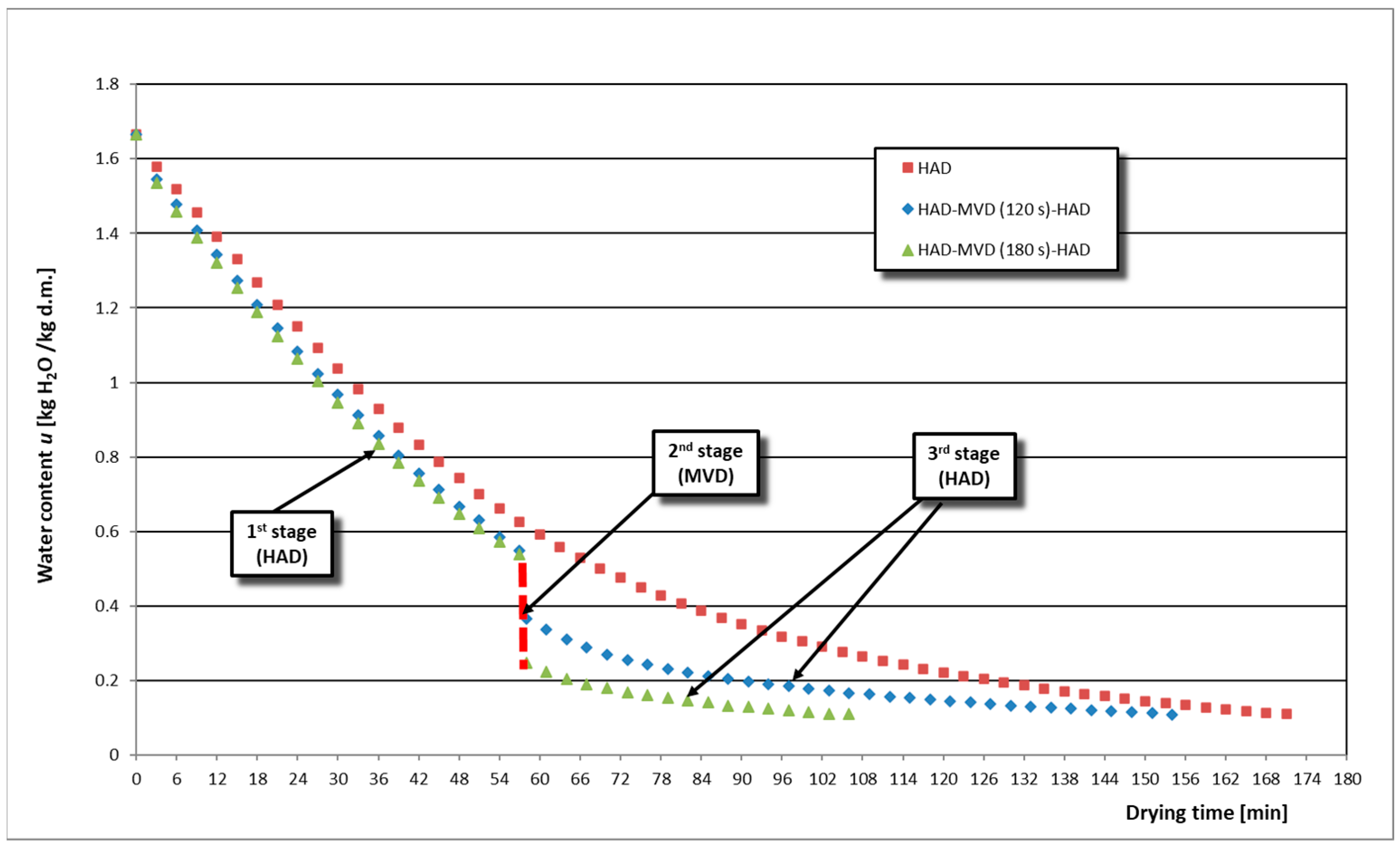
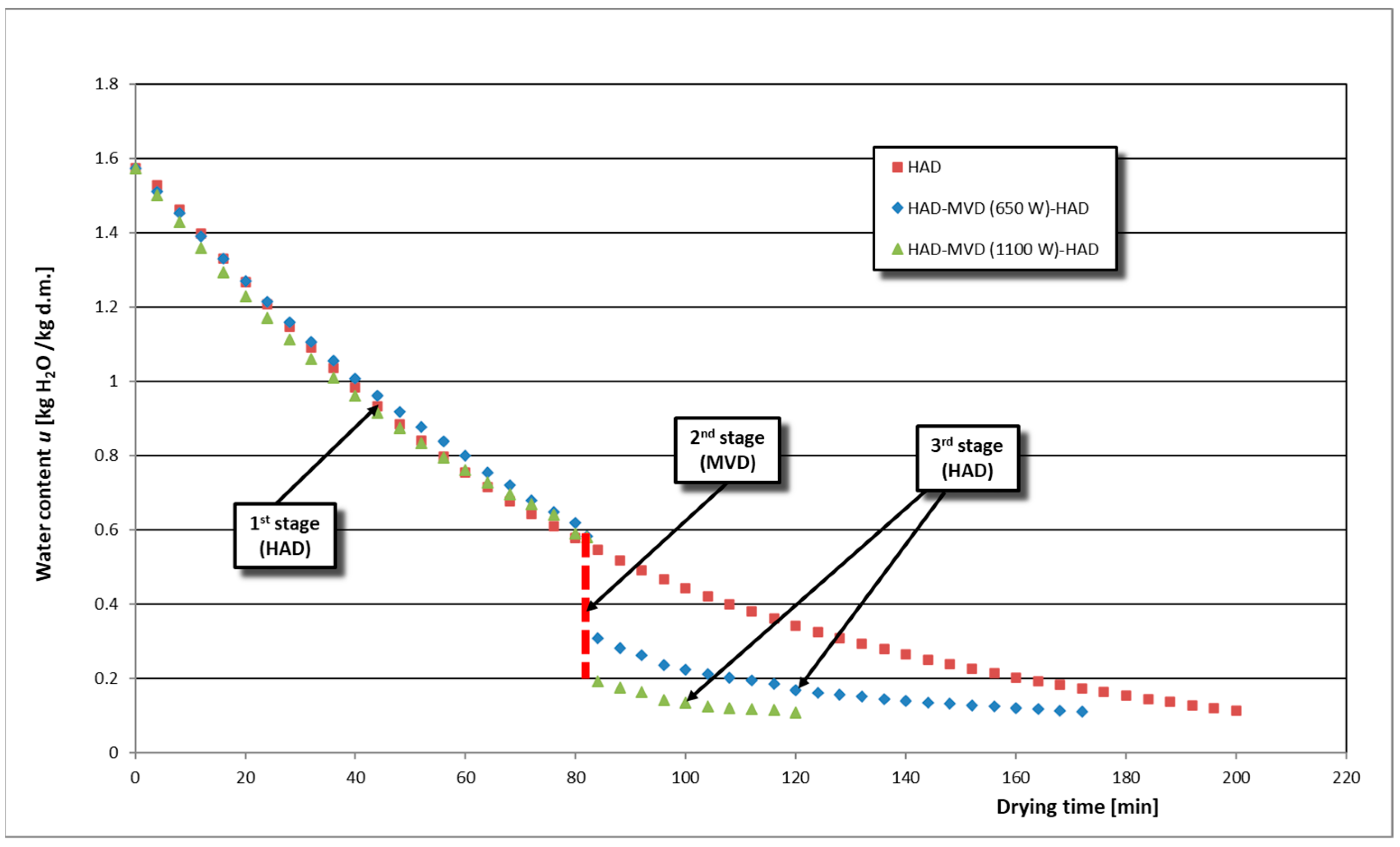
Drying curves illustrating three-stage hybrid drying with the corresponding single-stage control sample are presented in
Figure 3 for wild boar meat and in
Figure 4 for red deer meat. In both cases, drying processes at
T = 70 °C and
v = 1.4 m/s in the 1st and 3rd drying stages (HAD) were selected for presentation. In the 2nd drying stage (MVD), two process durations were presented for wild boar meat: 120 and 180 s at a constant microwave power of 650 W, and for red deer meat, two different microwave powers: 650 and 1300 W at a constant process duration of 120 s. Each drying curve shown in
Figure 3 and
Figure 4 represents a single selected trial. The shape of the curves indicates approximately typical drying curves with two different periods: the first with a constant drying rate and the second with a decreasing drying rate. The red dashed line marks the 2nd stage of hybrid drying (MVD), which causes a large decrease in the water content of the dried meat in a short time. For wild boar meat, a decrease from
u = 0.54 kg H
2O/kg d.m. (35% w.b.) to
u = 0.37 and 0.25 kg H
2O/kg d.m. (27 and 20% w.b.) was noted, and for red deer meat to
u = 0.31 and 0.19 kg H
2O/kg d.m. (24 and 16% w.b.). This is related to the so-called “puffing” process occurring when a large amount of heat is supplied via microwaves, which causes the rapid evaporation of significant amounts of water. Water converted into vapor under pressure causes the dried meat samples to expand, which results in loosening their shrunken structure during the first stage of drying (HAD). This effect helps improve the crispiness of the dried meat obtained, which is desired by consumers.
Furthermore, it is worth noting that in the case of MVD of wild boar meat, extending the process time by 50% (from 120 s to 180 s) increased water evaporation in this process by approximately 70%, whereas in the case of red deer meat, increasing the microwave power in MVD by 100% (from 650 W to 1300 W) resulted in an increase in water evaporation by only 50%. This indicates that increasing the microwave power in MVD without providing adequate time to allow vapor to evaporate from the material is disadvantageous.
Comparing the drying kinetics of both types of meat, hot air drying (HAD) of red deer meat is a slower process. It might seem that due to its higher fat content, the drying of wild boar meat should be slower, but the opposite is true. This is most likely due to differences in the meat’s tissue structure, which may make water removal from red deer more difficult. In the case of the MVD process, on the other hand, the second stage of hybrid drying removes significantly more water from red deer meat. This may suggest that the delicate structure of red deer meat makes it more susceptible to drying shrinkage during the first stage of HAD, which slows down the process. The second stage of drying (MVD), through the puffing effect, may significantly improve/loosen the structure of red deer meat than of wild boar meat, leading to more rapid evaporation in the case of red deer meat.
The course of the determined drying curves for wild boar and red deer meat is similar to the course of HAD obtained by Mewa et al. [
37] for beef slices of the same thickness (5 mm). In this study, for a drying temperature of
T = 60 °C, a drying time of
τ = 260 s was achieved (at a final moisture content of approx. 15% w.b.), whereas in the single-stage HAD processes presented in
Figure 3 and
Figure 4 for
T = 70 °C, significantly shorter drying times were achieved, i.e., 153 and 172 min for wild boar and red deer meat, respectively. The differences result primarily from different process temperatures, while for red deer meat, a temperature of
T = 60 °C was also tested and a drying time of
τ = 224 min was achieved, which confirms that the HAD process of red deer meat was faster than the beef drying. This may be due to possible differences in the air flow velocity, as it was not precisely given in the study by Mewa et al. [
37], but it may also result from differences in the final moisture content of the product as well as differences in the composition of red deer meat and beef meat. In other studies conducted by Ren and Sun [
38] and Kamiloğlu et al. [
39], in which 5 mm thick beef slices were dried at a drying temperature of 70 °C, significantly longer drying times were achieved, i.e., 420 and 510 min, respectively. In the first case [
38], a higher water content was also achieved (17.43% w.b.), while in the second [
39], drying to a constant mass was achieved (water content close to 0%). Most likely, such large differences in drying time may result from differences in air flow rate, dryer design, and the structure of the meat tissue of a given sample.
3.3. Sensory Quality Index (SQI)
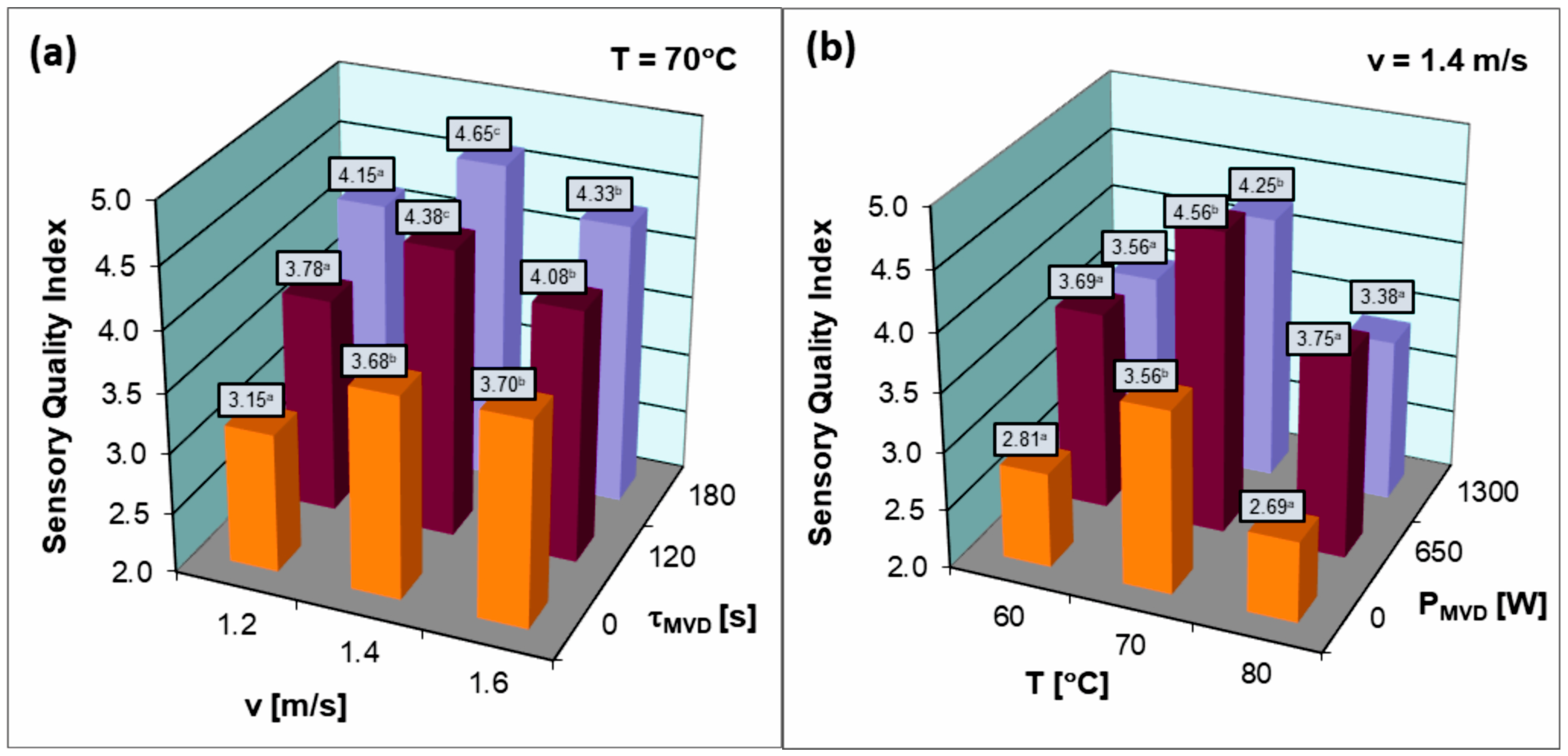
The results of sensory analysis, expressed as mean SQI values of the obtained dried meat for various process parameters, are presented in
Figure 5, and their standard deviations in
Tables S1 and S2. In the case of drying wild boar meat at a constant temperature
T = 70 °C, different airflow rates were tested in HAD processes and different MVD process times (
Figure 5a), whereas in the case of drying red deer meat at a constant airflow velocity
v = 1.4 m/s, different drying temperatures were tested in HAD processes and different microwave power in MVD processes. For both types of dried meat, their quality expressed in SQI was significantly lower in single-stage HAD processes (from 2.69 ± 0.23 to 3.70 ± 0.23) compared to all hybrid three-stage HAD-MVD-HAD processes (from 3.38 ± 0.09 to 4.65 ± 0.13). When analyzing and comparing the effects of both main HAD process parameters, i.e., temperature and airflow velocity, a greater effect on the SQI value was noted for temperature than for airflow velocity. However, for both parameters the variability is similar; i.e., the highest quality indicators were recorded for intermediate values, i.e., for
T = 70 °C (from 3.56 ± 0.06 to 4.56 ± 0.14) and
v = 1.4 m/s (from 3.68 ± 0.23 to 4.65 ± 0.13). Higher temperatures and airflow velocity accelerate the drying process but also intensify the degradation of the dried material, both thermal and related to the air’s carrying and oxidizing properties. This degradation can result in changes in consistency, color, flavor, and aroma, loss of nutritional and bioactive values, protein denaturation, fat oxidation and nonenzymatic browning reactions [
7,
37,
40], which is directly reflected in the qualitative sensory evaluation. However, lowering the drying temperature and airflow velocity, on the one hand, makes the drying conditions more gentle and less destructive in many respects, but on the other hand, significantly lengthens the drying time, which also plays a significant role in the mechanisms of destruction during food processing. It is precisely this significantly extended time of meat exposure to temperature and the flushing flow of hot air that ultimately leads to similar destruction as with higher values of temperature and air flow velocity. Therefore, practically every trend of variation shown in
Figure 5a,b has a maximum in its course. In summary, the optimal parameters for the 1st and 3rd stages of drying, in terms of the resulting dried meat quality, should be considered a temperature of
T = 70 °C and an airflow velocity of
v = 1.4 m/s.
Regarding the different conditions of the 2nd drying stage, i.e., MVD, it can be concluded that increasing the process time by 50% at moderate microwave power (
P = 650 W) improves the quality of dried wild boar meat (
Figure 5a), while doubling the microwave power (to
P = 1300 W) does not improve the quality of deer meat; on the contrary, it causes a slight decrease (
Figure 5b). In summary, when optimizing the 2nd drying stage (MVD) for the quality of dried game meat, it is better to intensify the process by gradually extending the process time at moderate microwave power. This is most likely due to the fact that the rapid supply of a large amount of energy greatly intensifies the heat transfer process, while the mass transfer process (i.e., the evacuation of water vapor from the material) does not keep pace with it. This can lead to local overheating of the dried material, which is consequently reflected in the qualitative sensory evaluation.
In summary, with optimal parameters of the three-stage hybrid processes, the use of MVD to support the HAD process enabled an increase in SQI from 3.68 ± 0.23 to 4.65 ± 0.13 and from 3.56 ± 0.06 to 4.56 ± 0.14 for drying wild boar and red deer meat, respectively. In another study for turkey meat, also with MVD to support the HAD process, the highest SQI value (determined using the same 5-point methodology) was achieved at a similarly high level of 4.50 [
13], while in a similar study for pork meat, lower values were achieved, ranging from 3.24 to 3.94 [
14]. Comparing the quality indicators obtained in single-stage HAD processes from 3.15 ± 0.16 to 3.70 ± 0.23 for wild boar and from 2.69 ± 0.23 to 3.56 ± 0.06 for red deer), in another study of HAD of beef at 60 °C (for the same slice thickness) the sensory evaluation result was 7.06 on a 9-point scale [
37]. On the same 9-point scale, Veselá et al. conducted a sensory evaluation of 46 samples of commercial dried meat of various types used as snacks such as “jerky” and “biltong”, obtaining significantly lower scores: 5.24 for beef, 5.26 for pork, 6.35 for chicken, 4.87 for turkey and 4.67 for red deer [
36].
3.4. Energy Consumption of Drying Processes
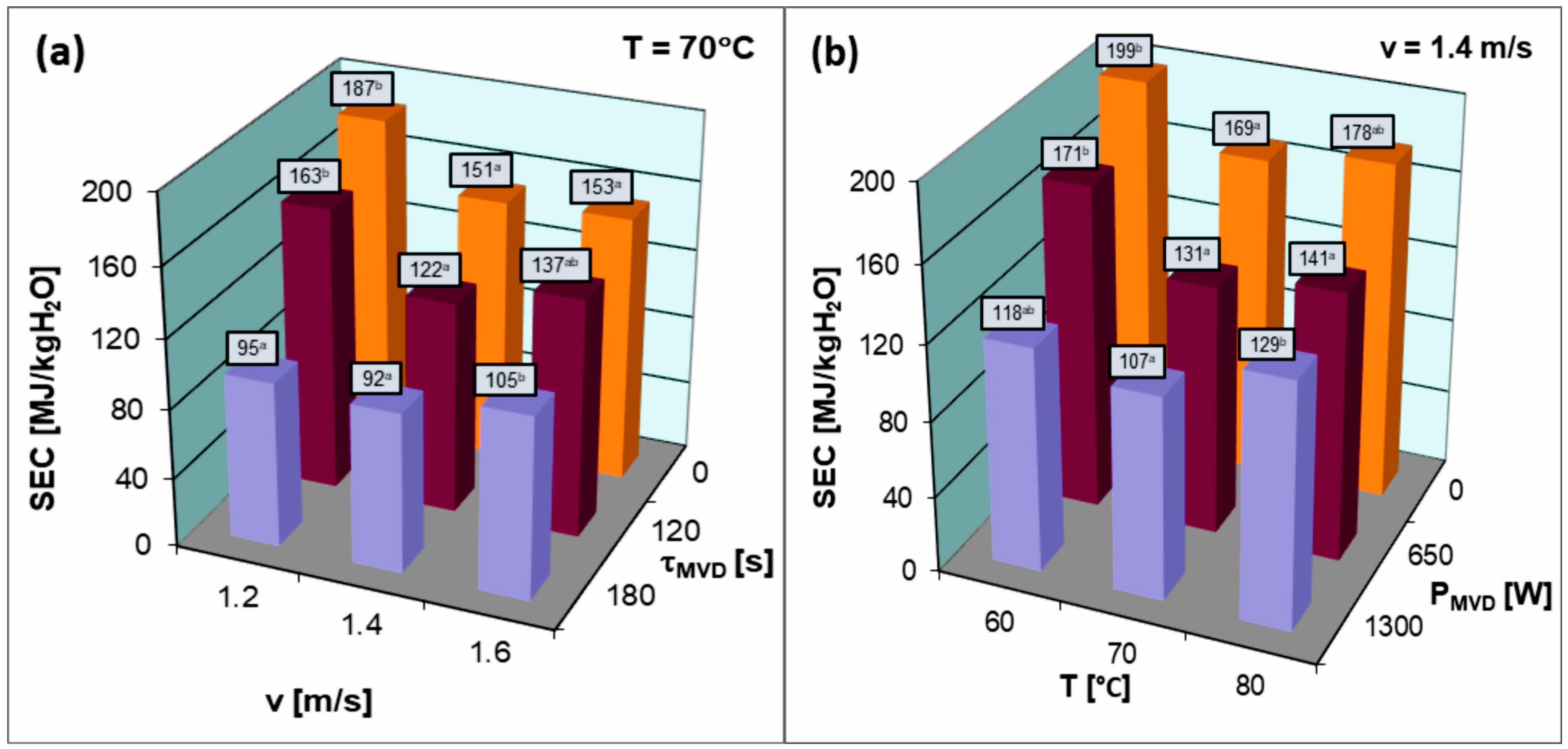
The specific energy consumption (SEC) for the entire hybrid three-stage game meat drying process is shown in
Figure 6a for wild boar and in
Figure 6b for red deer meat. In both cases, the highest energy consumption rates were recorded for single-stage drying (HAD), regardless of the drying conditions. For these processes, SEC was obtained in the range from 151 ± 4 to 187 ± 6 MJ/kg H
2O for wild boar meat and from 169 ± 6 to 199 ± 5 MJ/kg H
2O for deer meat. Martynenko and Alves Vieira [
41], in their analysis of the sustainability of food drying technology, compared typical SEC values achieved for various drying methods of biological materials. For HAD, a range of 7.9–79.9 MJ/kg H
2O was presented, which is much lower than those obtained in this study. However, in specific example studies, SEC was obtained in the range of 61.7–210.7 MJ/kg H
2O for cornelian cherry fruits [
42], 63.8–142.6 MJ/kg H
2O for terebinth [
43], 233.3–405.1 MJ/kg H
2O for white coconut shreds [
44], 94.5–267.6 MJ/kg H
2O for pear slices [
45]. It should be emphasized that the SEC values are compared with processes that differ in the specificity of the dried material, but above all in the final moisture level of the material, which may have a significant impact on the differences in the achieved SEC. Regarding the effect of HAD temperature, in both the single-stage and three-stage processes, the highest energy consumption was recorded at the lowest temperature (
T = 60 °C) due to the longest process time (
Figure 6b). Increasing the temperature to 70 °C resulted in a significant reduction in SEC for the individual drying processes, while further increases to 80 °C did not result in a decrease in energy consumption; on the contrary, a reversal was observed. It can be concluded that despite the statistical analysis showing insignificant differences, further temperature increases will result in a significant increase in energy consumption. This is due to the fact that as the temperature increases, the drying rate increases, but also the energy consumption for heating the air to a higher temperature increases and this aspect begins to predominate.
In the case of the effect of drying airflow velocity on SEC, certain trends are partially similar (
Figure 6a). Specifically, for the single-stage and three-stage hybrid processes with a shorter MVD duration (
τ = 120 s), SEC is highest at the lowest airflow velocity
v = 1.2 m/s. As the airflow velocity increases to 1.4 m/s, SEC also decreases significantly, but, similarly to temperature, with a further increase (to
v = 1.6 m/s), the trend changes to a slightly upward one. In this case, the increase in energy consumption due to increased fan speed and the energy consumption for heating a larger volume of air begins to outweigh the effect of energy savings with a shorter drying time. In the case of three-stage hybrid drying with a longer MVD duration (
τ = 180 s), the variability is slightly different. For air flow velocities of 1.2 and 1.4 m/s, practically the same value of SEC was recorded, while for the highest air flow velocity
v = 1.6 m/s, as in the other cases, a higher value was recorded.
Regarding the different conditions of the second stage of drying (MVD), it is clearly visible that the use of this drying stage reduces the SEC of the entire process regardless of the conditions used. However, both a longer MVD time (
Figure 6a) and higher microwave power (
Figure 6b) reduce energy consumption to a greater extent. It should also be noted that extending the MVD process time by 50% (at a moderate microwave power of P = 650 W), as in the case of drying wild boar meat, significantly reduces energy consumption more effectively than increasing the power by 100% (from
P = 650 W to 1300 W, while maintaining
τ = 120 s). These effects are consistent with the observed drying curves, which revealed significantly higher water evaporation during the longer MVD process time and lower microwave power.
When comparing the drying of the two types of meat, slightly higher energy consumption rates were observed for red deer than for wild boar. This correlates with the drying curves described above, which showed a longer drying process for red deer meat, which translates into higher energy consumption. These differences are not significant because the longer HAD processes are partially compensated by higher water evaporation during the 2nd drying stage (MVD), which is also described in the subsection on drying curves. This mechanism is related to the more delicate structure of red deer meat, which is more susceptible to drying shrinkage. The MVD process between the 1st and 3rd drying stages (HAD) produces a “puffing” effect, which loosens the structure and aids in further HAD.
Referring to other studies, in an analogous three-stage hybrid HAD-MVD-HAD process (
T = 70 °C,
v = 1.3 m/s,
PMVD = 400 W) for turkey meat, significantly higher SEC (221–237 MJ/kg H
2O) [
13] was obtained in comparison to the SEC in this study (for
T = 70 °C,
v = 1.4 m/s,
PMVD = 650 W), which reached values from 122 ± 4 to 131 ± 7 MJ/kg H
2O. Much higher energy indices for turkey meat may be caused by lower air flow velocity and microwave power, but mainly by the fact that in study [
13] at the end of drying there was a significantly lower water content (6% w.b.) in comparison to this study (10% w.b.). Differences in the final moisture content of the dried material can significantly influence the occurrence of large differences in the SEC of the processes, because the final stages of drying at lower moisture levels are increasingly slower, which increases the SEC. In this study, a 16% reduction in SEC was achieved compared to single-stage HAD, while in the present study, significantly greater energy savings were achieved, ranging from 12% to 49% for wild boar and from 14% to 41% for red deer. Detailed links between energy savings, process parameters, and the quality of the resulting dried meat are discussed in the next subsection (
Section 3.5).
In a sustainability analysis of food drying technology by Martynenko and Alves Vieira [
41], the SEC value for hybrid HAD-MVD processes was reported to be 38.7 MJ/kg H
2O, which is significantly lower than that obtained for meat drying. For other hybrid drying processes (i.e., HAD assisted by other methods), various energy savings were achieved. For example, in the HAD process of green peas in a rotating drum assisted by microwaves (MW), the SEC achieved was in the range of 27.01–109.91 MJ/kg H
2O [
46], and for 5 mm thick carrot slices in a similar process, the SEC value was 88 MJ/kg H
2O [
47]. When analyzing the quantitative (relative) effects of the obtained energy savings in studies dealing with hybrid food drying, and specifically HAD assisted by another drying method, it is worth citing several studies. For example, in the case of HAD of pear slices (6 mm thick) at 70 °C, Kaveh et al. [
45] obtained an SEC value of 175.3 MJ/kg H
2O, and supporting the HAD process with the IR process (500 W) resulted in energy savings of 47.7%, and supporting the same process with the MW process (270 W)–by 77.2%. Other researchers also tested the effect of assisted drying with microwaves (MW), comparatively assisted drying with ultrasound in air (US) and their combinations (MW-US). Musielak et al. [
48] in the drying of apple cubes (10 × 10 mm) recorded an SEC for the single-stage HAD process (
T = 70 °C) of approx. 125 MJ/kg H
2O, for the US-assisted process (200 W) of approx. 114 MJ/kg H
2O (9% energy savings), for the MW-assisted process (100 W) of approx. 44 MJ/kg H
2O (65% energy savings) and MW (250 W) of approx. 32 MJ/kg H
2O (74% energy savings). However, when both techniques were supported: US (200 W) and MW (100 W), no synergistic effect was observed, as the SEC achieved was approx. 52 MJ/kg H
2O (58% energy savings). In similar processes, Mierzwa and Szadzińska [
49] for drying kale leaves achieved an SEC value for the HAD process at
T = 70 °C of approximately 130 MJ/kg H
2O, and by using hybrid processes they achieved: 80% energy savings for the MW-assisted process and 82% for the HAD process supported by two processes simultaneously (US + MW).
3.5. Optimal Drying Conditions—Quality and Sustainability
Based on the research and trends identified, an analysis was conducted to determine the optimal drying conditions for minimizing energy consumption and maximizing product quality. The use of an additional drying stage, MVD, as an interstage process in the HAD process had a positive impact on both the quality of the dried meat and the energy consumption indicators, regardless of the specific drying conditions used. Analyzing the hot air drying (HAD) conditions, it was determined that the optimal conditions were a temperature of T = 70 °C and a drying airflow velocity of v = 1.4 m/s. These parameters resulted in the lowest specific energy consumption (SEC) and the highest quality scores (SQI) for both wild boar and red deer meat. For the single-stage HAD process, SQIs of 3.68 ± 0.23 and 3.56 ± 0.06 were achieved for wild boar and red deer meat, respectively, with SECs of 151 ± 4 and 169 ± 6 MJ/kg H2O. By using an additional interstage MVD stage, creating a hybrid three-stage drying process, SEC was reduced while simultaneously improving the quality of the dried meat products. In the case of drying wild boar meat, a maximum reduction in energy consumption by 39% (from 151 ± 4 to 92 ± 3 MJ/kg H2O) and an improvement in SQI from 3.68 ± 0.23 to 4.65 ± 0.13 were achieved. These indicators were achieved with the following parameters of the 2nd drying stage (MVD): microwave power P = 650 W and process time τ = 180 s. In the case of deer meat, at the same microwave power (P = 650 W) but a shorter process time (τ = 120 s), an 22% reduction in energy consumption (from 169 ± 6 to 131 ± 7 MJ/kg H2O) and an improvement in SQI from 3.56 ± 0.06 to 4.56 ± 0.14 were achieved. In the case of red deer meat, a longer MVD process time was not tested, but a twice as high microwave power (P = 1300 W), which achieved greater energy savings, i.e., 37% (from 169 ± 6 to 107 ± 5 MJ/kg H2O), but this came at the cost of a loss in product quality, as the SQI was achieved at 4.25 ± 0.16. As already described above, in general it is more beneficial to use lower microwave power with a longer process time.
In summary, the most favorable conditions for hybrid three-stage drying of game meat are: a HAD process temperature of 70 °C, an airflow velocity of 1.4 m/s, and an MVD process duration of 180 s at a microwave power of P = 650 W. With these parameters, approximately 39% energy savings are realistic compared to the most popular single-stage hot air drying (HAD) process while maintaining high-quality dried meat products at an SQI of >4.5 on a 5-point scale. The obtained results confirm the suitability of game meat as an alternative to dried farmed meat, used both as dried food ingredients and as snacks between meals. Furthermore, the energy consumption results of the designed processes confirmed that the proposed concept of popularizing game meat as a raw material for the production of dried meat products is fully consistent with the concept of sustainability. Achieving nearly 40% energy savings in game meat processing significantly enhances the entire concept of replacing dried farmed meat. Ultimately, considering the low carbon footprint of sourcing meat from wild animals, their high population density in the natural environment, and the additional use of energy-efficient drying processes, the multi-vector consistency of the entire concept with sustainability can be confirmed.
3.6. Limitations and Directions for Future Research
The idea of popularizing dried game meat products presented in this study has significant application potential, but it also has many limitations and uncertainties that need to be resolved or minimized in future research. Some of these limitations are highlighted below, along with directions for future research.
When designing new food products, the safety of the produced food is a key issue. Game meat carries specific microbiological risks that differ from those of farm animals. Therefore, it is worthwhile to pursue research in this area in the context of hybrid drying technology, particularly assessing the microbial load and survival of key pathogens (e.g., Salmonella, E. coli, Listeria, Trichinella, tapeworms, and other parasites associated with game meat). Furthermore, obtaining game meat from forest resources is unique and requires assessing and minimizing the risk of contamination associated with hunting, trading, and transporting wild animals.
There is also significant research potential in the area of nutritional and bioactive properties of game meat, particularly in maximizing the retention of these properties during drying and other processing steps. For example, game meat typically contains a higher proportion of polyunsaturated fatty acids (PUFA) and is more susceptible to lipid oxidation during processing and storage. Therefore, future research should include assessment of lipid oxidative stability in game meat (e.g., peroxide value, TBARS, shelf-life evaluation).
This study also has limitations in its methodology. For example, the source of the research material from which the dried meat product samples were obtained for evaluation is a limitation. The study was conducted on randomly collected wild animals (one animal of each species), making it difficult to claim full representativeness. Similarly, due to the limited amount of research material, the number of experimental replications was limited to only two. Therefore, there is potential in this area to expand the scope of research, which would consequently be more representative. Furthermore, regarding drying processes, it should be emphasized that the research was conducted on a laboratory scale (especially the MVD process), and validation would be worthwhile, at least on a semi-technical scale. HAD processes scale well to various materials, whereas MVD processes are significantly less feasible. Larger-scale processes are widely known for fruit and vegetables, but for meat, the path to further development is open. Repeatability and homogeneity across a large batch may be problematic, and these will need to be addressed. The same applies to determining the SEC. In this study, the SEC was determined on a laboratory scale and compared with other studies also conducted on a laboratory scale. These results are often significantly overestimated compared to SEC values on a semi-technical and industrial scale. Therefore, it would be worthwhile to continue research in this area on a larger scale, e.g., a semi-technical scale.
Regarding the final quality of the dried game meats obtained in this study, the quality assessment in the form of the SQI was performed by an expert team, but this never fully reflects broader consumer testing, so it would be worthwhile to conduct this analysis across various social groups. The results of such evaluations would certainly aid in the final design of the dried game meat, ultimately achieving high consumer desirability.