


Abstract
This study develops and psychometrically validates the Neuroplasticity Literacy in Working Life Scale (NLWLS), designed to evaluate employees’ engagement in enrichment activities and deliberate cognitive renewal practices. Based on a theoretical framework, neuroplasticity literacy is conceptualized through two behavioral dimensions: Enrichment Behaviors (EB) and Deliberate Cognitive Renewal (DCR). The scale was developed via a two-stage process involving expert evaluation, pilot testing, exploratory factor analysis, and confirmatory factor analysis using robust maximum likelihood estimation. Findings from two independent samples (n = 120; n = 164) consistently support the two-factor structure, demonstrating high internal consistency, strong convergent and discriminant validity, and satisfactory model fit indices. The NLWLS offers a methodologically rigorous instrument for measuring neuroplasticity-related behaviors at work, contributing to understanding employees’ cognitive renewal capacity, learning agility, and sustainable learning outcomes. These results support the integration of neuroscience-based behavioral indicators into organizational learning research and provide a theoretical–practical foundation for future studies.
1. Introduction
In today’s rapidly evolving business landscape, traditional ways of working and fixed skill sets are no longer sufficient [1]. Organizations must invest in learning agility to enable employees to acquire new skills and competencies, highlighting the importance of a culture that supports continuous development [2]. In VUCA environments, agility and adaptability are critical for maintaining competitive advantage [3] and these dynamic capabilities reflect the cognitive and behavioral manifestations of neuroplasticity at both individual and organizational levels.
Neuroplasticity refers to the brain’s capacity to reorganize its structure and function in response to experiences, learning, or environmental demands [4,5,6]. This lifelong adaptability underlies individuals’ ability to acquire new skills, regulate emotions, and modify behaviors. In professional contexts, neuroplasticity supports cognitive flexibility, creativity, and the capacity to cope with change, forming a foundation for sustainable learning at work [7]. By fostering awareness and application of these mechanisms, employees can enhance both their personal and organizational performance [8].
Practical activities such as learning a musical instrument, engaging in visual arts, acquiring a new language, or practicing meditation can stimulate neuroplastic processes, enhancing cognitive flexibility, attention, and problem-solving skills [9,10,11,12]. In workplace settings, these processes support employees’ adaptability, creativity, and resilience, which are essential for sustainable learning and organizational development. The Neuroplasticity Literacy in Working Life Scale (NLWLS) was developed to operationalize this concept, providing a reliable tool to measure employees’ engagement in behaviors that reflect cognitive enrichment and deliberate renewal, thereby linking neuroplasticity principles directly to sustainable professional growth.
Despite growing interest in neuroplasticity within organizational contexts, there is a lack of systematic instruments to measure employees’ awareness, understanding, and engagement in neuroplasticity-related behaviors. Existing studies have primarily focused on educational or clinical settings, leaving a gap in applied workplace research. This study addresses this gap by developing and validating the NLWLS, a psychometrically sound instrument designed to assess behaviors that reflect cognitive enrichment and deliberate cognitive renewal. By providing both a conceptual and practical tool, the NLWLS enables organizations to evaluate and foster sustainable learning, adaptability, and cognitive growth among employees.
2. Theoretical Framework and NLWLS Conceptualization
The capacity of environmental experiences to reshape brain structure and function has opened up significant areas of application, particularly within organizational contexts [13]. Understanding neuroplasticity provides organizations with opportunities to enhance employees’ ability to cope with change and adapt to new conditions. Neuroplasticity holds substantial potential for improving human resource practices within organizational settings [14]. From a Sustainable Human Resource Management perspective [15], employees’ continuous development of cognitive and emotional capacities, regulation of behaviors, and engagement in adaptive learning processes support organizational resilience and sustainable performance.
From the Dynamic Capabilities Theory perspective [16], employees’ ability to reconfigure cognitive and behavioral resources strengthens the organization’s capacity to sense and respond to environmental changes. Similarly, Organizational Learning Theory [17,18] emphasizes that sustainable performance relies on employees’ continuous updating of knowledge structures and active participation in learning processes, which are supported by neuroplastic mechanisms facilitating cognitive flexibility and behavioral adaptation.
Organizational change is often challenging because long-standing habits are deeply embedded in the basal ganglia, and forming new neural pathways is an energy-intensive process. In this context, the power of focused attention emerges as a central factor, and neuroplasticity offers a valuable theoretical framework for explaining behavioral change within organizational settings [19]. Neuro-management integrates the principles of neuroplasticity into leadership practices, transforming decision-making processes [20] and leadership development has been shown to be positively associated with neuroplasticity [21], enabling leaders to cultivate cognitive flexibility and continuously reorganize neural pathways [22]. Within this framework, the NLWLS operationalizes neuroplasticity literacy by measuring engagement in enrichment behaviors and deliberate cognitive renewal, linking individual cognitive and behavioral adaptation directly to organizational learning, agility, and long-term sustainable performance. By providing this mechanism, the scale establishes clear conceptual boundaries and demonstrates how individual-level adaptations translate into collective, organizational-level benefits (Figure 1).
Figure 1.
NLWLS Logic Model.
3. Neuroplasticity Literacy in Working Life (NLWLS)
In this context, the concept of NLWLS refers to an employee’s awareness and understanding of neuroplasticity, as well as their ability to consciously harness this capacity. Neuroplasticity encompasses not only cognitive development, but also multidimensional transformation processes such as emotional regulation, habit modification, skill acquisition, and the enhancement of psychological flexibility and adaptive capacity [23].
In its operationalized form within this study, neuroplasticity literacy is reflected through observable behaviors that represent enrichment and cognitive renewal processes, rather than self-reported intentions or motivations. This conceptual refinement leads to the two behavioral dimensions measured by the scale: Enrichment Behaviors (EB), which include engaging in activities that foster cognitive flexibility, and Deliberate Cognitive Renewal (DCR), which encompasses intentional learning and mental practices that promote continuous cognitive growth.
Although teaching neuroplasticity fosters a growth mindset in individuals, leading to positive effects on motivation and achievement, the existing literature predominantly focuses on measuring beliefs, awareness, or knowledge related to neuroplasticity [24]. Despite growing interest in organizational behavior, a systematic instrument to measure and evaluate the behavioral application of this phenomenon in organizational contexts has yet to be developed.
To address this gap, the present study aims to develop a Likert-type scale—referred to as the NLWLS—that enables the measurement of neuroplasticity applications within the workplace. The NLWLS will allow neuroplasticity to be examined not only in clinical or educational contexts but also in organizational behavior and human resource management, facilitating the investigation of its relationship with constructs such as well-being, creativity, cognitive flexibility, and innovativeness.
4. Empirical Synthesis: Behavioral Foundations of Scale Items
Neuroplasticity is regarded not only as a mechanism for pathological recovery (such as following traumatic brain injury) but also as a process that enables lasting changes through skill acquisition and mental practices in daily life. Chronic stress and depression impair neuroplasticity, negatively affecting learning and memory functions, underscoring the importance of organizational support to sustain the brain’s capacity for reorganization [25].
The specific scale items comprising the EB and DCR subdimensions were developed based on empirical findings from research demonstrating which specific activities induce neuroplastic change.
4.1. Enrichment Behaviors (EB)
Musical training leads to lasting changes in brain structure and function [9,10]. String instrument players exhibit enlarged representations in the somatosensory cortex, and music education leads to tangible neuroplastic changes in brain structures linked to superior executive functioning [11,26]. Visual art education induces learning-related neuroplastic changes in regions associated with cognitive control and supports neuroplastic processes related to creative thinking [27,28]. These findings justify the inclusion of items related to playing a musical instrument and engaging in visual arts activities.
4.2. Deliberate Cognitive Renewal (DCR)
Acquiring new skills and intensive foreign language training leads to structural changes in cortical regions and the hippocampus [9,29]. For instance, long-term intensive spatial memory use increases the volume of the posterior hippocampus, demonstrating lifelong structural adaptation to environmental demands [30]. This justifies items related to learning new languages and acquiring new skills.
Neuroplasticity can be triggered through mental practice; participants who mentally rehearsed piano sequences exhibited measurable changes in the motor cortex [31,32]. This supports the item on regularly reviewing and reinforcing learned knowledge or skills.
Regular aerobic exercise slows cognitive decline and supports neuroplasticity by inducing increases in hippocampal volume [33]. Short-term meditation practices have been shown to enhance attention, self-regulation, and emotional control, producing neuroplasticity-supporting effects [12]. These practices justify the items on regular physical exercise and meditation practice. The specific scale items used to measure these behaviors were developed based on these empirical findings; the full items are provided in Appendix A.1 and Appendix A.2.
5. Methods
5.1. Data Collection
The survey form prepared as a data collection tool consisted of three sections. The first section included four questions regarding gender, age, marital status, and educational background. The second section comprised three awareness questions, focusing on whether participants had previously heard of the concept of neuroplasticity, understood its meaning, and were aware of its implications in working life. The third section included the NLWLS, which consists of 9 items. The scale items were developed based on findings from scientific research on neuroplasticity. It is a 5-point Likert-type scale ranging from 1 = Strongly disagree to 5 = Strongly agree.
Content validity determines the extent to which a measurement instrument represents the intended construct, and this process typically involves expert judgment [34]. Similarly, to ensure content validity, researchers are advised to seek feedback from subject-matter experts on whether the items adequately reflect the underlying concept [35]. Accordingly, expert opinions were obtained on the items of the NLWLS from health professionals (including specialists in neurosurgery, pediatrics, psychology, and emergency medical services) as well as from scholars in organizational behavior.
During the scale development process, a pretest was conducted to assess the linguistic and conceptual clarity of the items. At this stage, it is essential to clearly state that the sample was used solely for testing comprehensibility, that these participants were excluded from the final analysis, and that any item revisions were made based on the feedback received [34,35,36]. Initially, the scale was administered to 2 individuals. In line with the aforementioned guidelines, the pilot study was conducted exclusively to evaluate the clarity of the items, these participants were not included in the main dataset, and linguistic adjustments were made to relevant items based on participant feedback. Feedback indicated that, due to the use of present tense in the scale items, it was unclear whether the scale measured attitudes or past behaviors. Accordingly, the items were revised to explicitly reflect the measurement of behaviors. Using the finalized version of the scale, a survey was administered to 286 participants. The final scale consists of two dimensions: the first includes three items measuring EB and the second includes six items measuring DCR.
The sampling process was conducted in Turkey. The participants represented a heterogeneous group of employees from various sectors, including education, healthcare, service, and trade. Data were collected through face-to-face surveys administered by trained researchers, who confirmed that all respondents were currently employed. Participation was entirely voluntary, and no financial or material incentives were provided. A post hoc power analysis based on the RMSEA approach [37] with df = 10, α = 0.05, and n = 164 indicated a statistical power of 0.84, exceeding the recommended threshold of 0.80. Therefore, the sample size was considered sufficient for detecting moderate model misspecifications in the CFA.
5.2. Procedure and Participants
In scale development and validity–reliability analyses, it is recommended that the sample size be at least five to ten times the number of items included in the scale [38]. In this study, the target population was defined as employees currently working in any occupation in Turkey. During the data collection phase, a convenience sampling method was employed. Data were collected through face-to-face surveys between 5 September and 10 October 2025. A total of 120 participants were reached for Study 1 and 164 participants for Study 2. Accordingly, the number of participants reached is deemed sufficient for the 9 item NLWLS.
5.3. Translation and Adaptation Process
The two-stage translation method, consisting of forward and backward translation, is a globally recognized standard approach in scale adaptation studies to ensure linguistic, conceptual, and semantic equivalence [39,40,41]. Since the original language of the NLWLS was Turkish, the adaptation process into English was conducted using this two-stage method. First, the scale items were translated from Turkish into English by two linguists who are experts in the field. Then, the English version was back-translated into Turkish by an independent translator. The two versions were compared by another expert for semantic and conceptual equivalence. Necessary revisions were made to the inconsistent items, and the final English version of the scale was established.
5.4. Strategy of Analysis
The analyses of the NLWLS were conducted in accordance with methodological best practices in scale development, utilizing both Exploratory Factor Analysis (EFA) and Confirmatory Factor Analysis (CFA) on separate samples. This approach minimizes the possibility of chance capitalization, strengthens construct validity, and allows for cross-validation of the factor structure across independent data sets [38,42,43]. Accordingly, the dataset collected from a total of 286 participants was divided into two subgroups for the EFA (n = 122) and CFA (n = 164). This division ensured that the resulting factor structure was not specific to a particular sample.
6. Data Analysis
In this study, data analyses were conducted using IBM SPSS Statistics Version 26 (IBM Inc., Armonk, NY, USA) and AMOS 24 (Scientific Software International, Skokie, IL, USA). Initially, descriptive statistics related to the participants’ socio-demographic characteristics (e.g., gender, educational level), as well as the mean, standard deviation, skewness, and kurtosis values of the scale items, were calculated.
The mean scores for the NLWLS and its two subdimensions were analyzed based on the distribution of responses on the 5-point Likert scale. Accordingly, average scores were calculated for each item, and overall mean scores were determined. To interpret these averages, commonly accepted score intervals for 5-point Likert-type scales were used.
In the reliability analysis, the internal consistency reliability of the scale was assessed. The internal consistency of the scale was evaluated by calculating the Cronbach’s alpha coefficient. According to commonly accepted thresholds, a Cronbach’s alpha coefficient is considered unacceptable if it falls between 0.00–0.49, poor between 0.50–0.59, questionable between 0.60–0.69, acceptable between 0.70–0.79, good between 0.80–0.89, and excellent between 0.90–1.00 [44,45].
Skewness and kurtosis values within the ±2 range indicate that the assumption of univariate normality is met [46].
In order to determine the factor structure of the scale, both Exploratory Factor Analysis (EFA) and Confirmatory Factor Analysis (CFA) were conducted. Prior to EFA, the suitability of the data set for factor analysis was evaluated using the Kaiser-Meyer-Olkin (KMO) measure of sampling adequacy and Bartlett’s test of sphericity. For CFA analyses, the Maximum Likelihood Estimation (MLE) method was employed. Within the scope of CFA, model fit was assessed using several fit indices, including the Chi-square/degrees of freedom ratio (CMIN/DF), Root Mean Square Residual (RMR), Comparative Fit Index (CFI), Incremental Fit Index (IFI), Adjusted Goodness of Fit Index (AGFI), Goodness of Fit Index (GFI), Normed Fit Index (NFI), and the Root Mean Square Error of Approximation (RMSEA).
To assess convergent and discriminant validity, the values of Composite Reliability (CR), Average Variance Extracted (AVE), the square root of AVE (√AVE), Maximum Shared Variance (MSV), and Average Shared Variance (ASV) were calculated. The internal consistency of the scale was evaluated using Cronbach’s alpha coefficient.
7. Findings
7.1. Study 1
A total of 122 individuals participated in the study; however, two questionnaire forms (less than 3% of the total sample) were deemed unsuitable for analysis because the majority of survey items were left unanswered. Thus, analyses were conducted based on data from 120 participants. Of the participants, 50.4% (n = 60) were male and 49.6% (n = 59) were female. Regarding marital status, 56% (n = 66) were single and 44% (n = 53) were married. In terms of educational attainment, 66% (n = 79) held a bachelor’s degree, 10% (n = 12) had an associate degree, another 10% (n = 12) completed secondary education, 9% (n = 11) held a master’s degree, and 4% (n = 5) had a doctorate. The average age of participants was approximately 32 years. Additionally, one participant did not respond to the gender and marital status items, while two participants left the educational status and age questions unanswered.
To assess participants’ awareness levels regarding the concept of neuroplasticity, three questions were administered. These questions were as follows: “Have you heard of the concept of neuroplasticity before?”, “Do you know what neuroplasticity means?”, and “Are you aware of the effects of neuroplasticity on working life?” Three participants did not respond to the first question, while four participants left the second and third questions unanswered.
Among the respondents, 66% (n = 79) stated that they had not heard of the concept of neuroplasticity before, whereas 34% (n = 41) indicated that they had. Furthermore, 73% (n = 88) reported that they did not know what the concept referred to, while 27% (n = 32) claimed they did. Additionally, 82% (n = 98) of the participants stated that they were not aware of the effects of neuroplasticity on working life, while 18% (n = 22) indicated that they had such awareness.
Following these questions on neuroplasticity awareness, participants were provided with a brief definition of the concept. In the survey note, neuroplasticity was defined as “the brain’s capacity to reorganize its structure and function in response to environmental stimuli such as new experiences, learning, or injuries.”
Table 1 presents the means, standard deviations, Cronbach’s alphas, and factor loadings for the items of the NLWLS.
Table 1.
Means, standard deviations, Cronbach’s alphas, and factor loadings of the NLWLS (n = 120).
Descriptive statistics regarding the NLWLS indicated that the overall mean score of the scale was below the midpoint (M = 1.86, SD = 1.08), suggesting that participants’ general neuroplasticity literacy and engagement in related behaviors are relatively limited. Similarly, both subdimensions—EB (M = 1.64, SD = 1.03) and DCR (M = 1.96, SD = 1.22)—also yielded means below the scale midpoint. These results indicate that participants rarely engage in cognitive EB and demonstrate minimal DCR behaviors, although some limited engagement in DCR was observed. Overall, the findings reflect relatively low levels of neuroplasticity-related awareness and behaviors compared to the potential scale range (Table 1).
To examine the underlying factor structure of the NLWLS, an EFA was conducted on the Study 1 dataset (n = 120). The data were suitable for factor analysis, as indicated by the Kaiser-Meyer-Olkin measure of sampling adequacy (KMO = 0.865) and Bartlett’s test of sphericity (χ2 = 1119.504, df = 36, p < 0.001).
Principal Axis Factoring (PAF) was employed as the extraction method. An oblique rotation (Promax) was applied, given that the two subdimensions (EB and DCR) were expected to be correlated. Promax rotation is particularly appropriate for moderately sized samples and allows for correlated factors, providing a more accurate representation of the latent structure than orthogonal rotations.
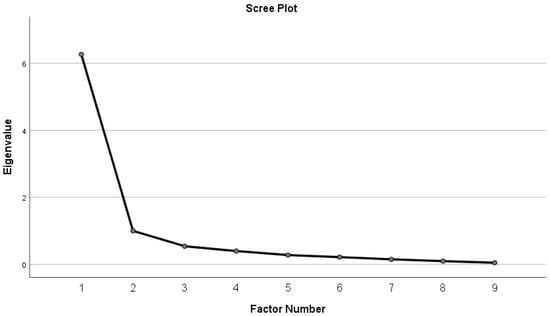
Communalities ranged from 0.558 to 0.924, indicating that all items shared sufficient variance with the extracted factors. The EFA revealed two factors with eigenvalues greater than 1 (Factor 1 = 6.042; Factor 2 = 0.789), explaining 75.90% of the cumulative variance. Pattern and structure matrices (Table 1) show that all items loaded primarily on their respective factors, with cross-loadings examined and found to be minor relative to primary loadings, supporting the two-factor solution.
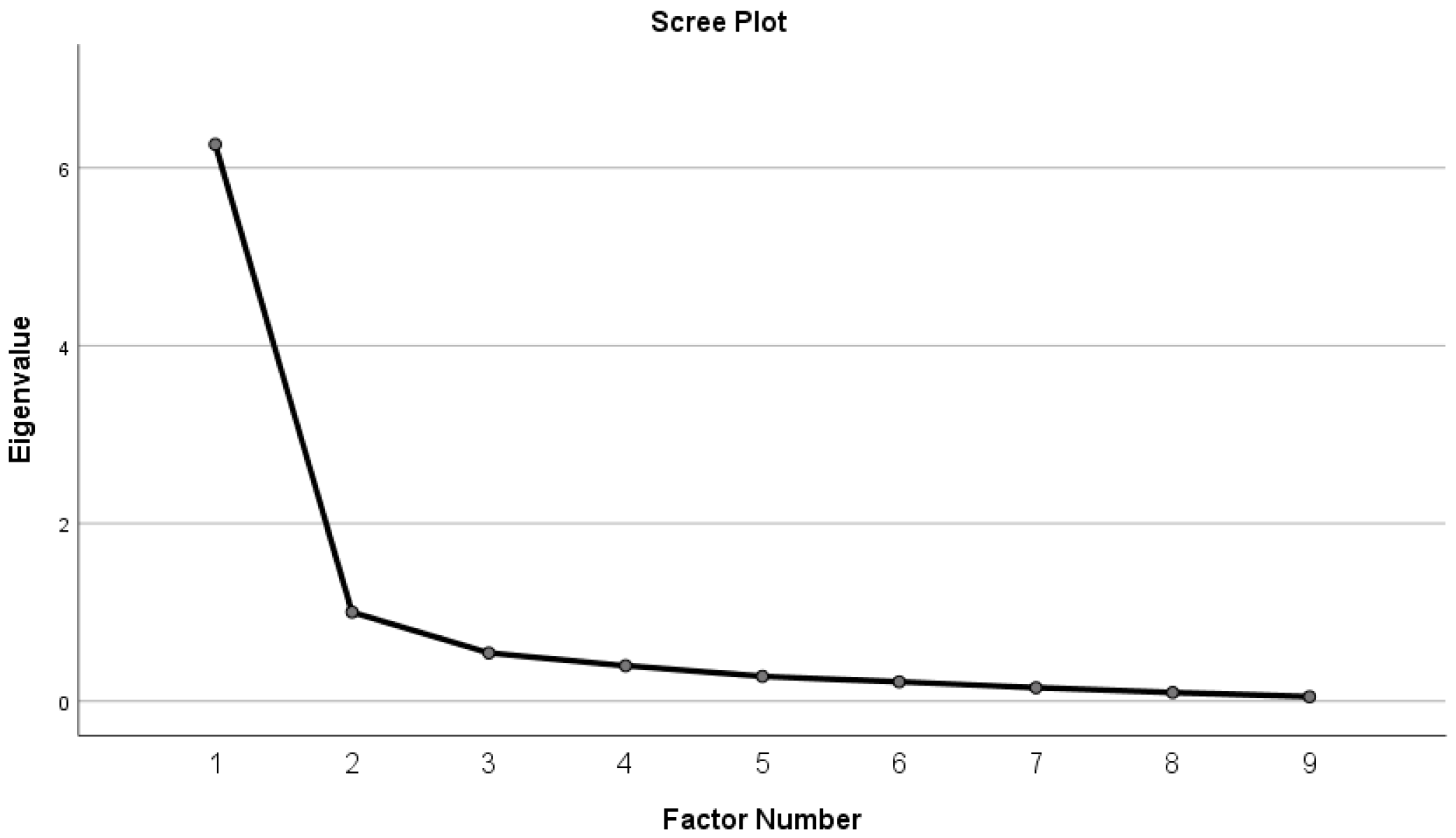
The factor structure is visually confirmed by the scree plot (Figure 2), which shows a clear inflection point after the second factor, further supporting the two-factor solution. Pattern and structure matrices (Table 1) show that all items loaded primarily on their respective factors, with cross-loadings examined and found to be minor relative to primary loadings, supporting the two-factor solution.
Figure 2.
Scree Plot.
To further validate the factor structure, a parallel analysis with 100 randomly generated datasets was conducted. Only two factors had eigenvalues exceeding the 95th percentile of the random data (Factor 1 = 6.042 > 0.677; Factor 2 = 0.789 > 0.486), whereas subsequent factors did not exceed the random threshold, confirming the appropriateness of the two-dimensional solution (EB and DCR).
According to the reliability analysis, the overall Cronbach’s alpha coefficient for the NLWLS was α = 0.95, indicating excellent internal consistency. At the subdimension level, the DCR subscale also demonstrated excellent reliability (α = 0.95), while the EB subscale showed good reliability (α = 0.87). All factor loadings for the scale items exceeded 0.70, indicating a high level of construct validity (Table 1).
Item-level mean scores ranged from 1.53 to 2.09. This indicates that participants’ responses to the scale items were generally concentrated within the “low” range of agreement. Overall, the findings support that the NLWLS is a psychometrically reliable and structurally valid measurement instrument (Table 1). Table 2 presents the normality analysis.
Table 2.
Normality Tests for Study 1.
The skewness and kurtosis values for the NLWLS and its subdimensions indicate that the dataset demonstrates statistically acceptable levels of normality. For the overall scale, the skewness coefficient was 1.01 and the kurtosis coefficient was −0.11. In the EB subdimension, the skewness was 1.68 and the kurtosis was 2.05, while in the DCR subdimension, the skewness was 0.95 and the kurtosis was −0.36 (Table 2).
According to the reference range of ±2, all skewness and kurtosis values fall within acceptable limits. These results indicate that the data distribution conforms statistically to a normal distribution and support the applicability of factor analysis and other parametric tests for the scale.
7.2. Study 2
Within the scope of Study 2, a total of 164 individuals participated in the research. Among them, one participant did not respond to the question about marital status, two participants did not answer the education level question, and eight participants did not provide their age.
Among the participants, 59% (n = 96) were women and 41% (n = 68) were men. Regarding marital status, 53% (n = 86) of the participants were married and 47% (n = 78) were single. In terms of educational background, 67% (n = 109) held a bachelor’s degree, 17% (n = 28) had an associate degree, 9% (n = 15) completed secondary education, and 7% (n = 12) had a master’s degree. The average age of participants was approximately 31 years.
To assess participants’ awareness of the concept of neuroplasticity, three questions were posed: “Have you heard of the concept of neuroplasticity before?”, “Do you know what neuroplasticity means?”, and “Do you know the effects of neuroplasticity on working life?” Three participants did not respond to the first question, four did not respond to the second, and four did not respond to the third.
A total of 68% of participants (n = 111) stated that they had not heard of the concept of neuroplasticity before, while 32% (n = 53) reported that they had. Regarding the meaning of the concept, 71% (n = 117) indicated that they did not know what neuroplasticity referred to, whereas 29% (n = 47) claimed to be familiar with it. Additionally, 77% (n = 126) of participants stated that they were not aware of the effects of neuroplasticity on working life, while 23% (n = 38) reported being knowledgeable on the subject.
Following the awareness questions, a brief explanation of the concept of neuroplasticity was provided to participants. In the informative note included in the questionnaire, neuroplasticity was defined as “the brain’s capacity to reorganize its structure and function in response to environmental stimuli such as new experiences, learning, or damage.”
Table 3 presents the means, standard deviations, Cronbach’s alphas, and factor loadings for the items of the NLWLS.
Table 3.
Means, standard deviations, Cronbach’s alphas, and factor loadings of the NLWLS (n = 164).
Descriptive statistics for the NLWLS indicated that the overall mean score of the scale was low (M = 2.35, SD = 1.03). At the subdimension level, the EB subscale (M = 2.10, SD = 1.14) and the DCR subscale (M = 2.48, SD = 1.08) also exhibited similarly low mean values. These results suggest that participants’ engagement in or awareness of neuroplasticity-related activities is limited (Table 3).
According to the reliability analysis, the overall Cronbach’s alpha coefficient for the NLWLS was α = 0.93, indicating excellent internal consistency. Among the subdimensions, the DCR subscale demonstrated excellent reliability (α = 0.91), while the EB subscale showed good reliability (α = 0.89). The two-dimensional structure of the scale was maintained, and all items had factor loadings exceeding 0.70 (Table 3).
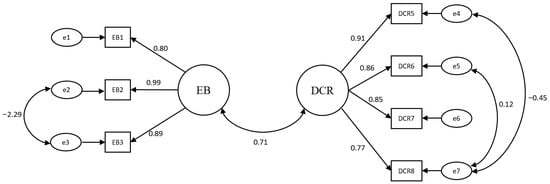
All standardized factor loadings were significant and exceeded 0.70 (ranging from 0.769 to 0.989), and the item R2 values ranged from 0.59 to 0.98. The two latent factors—EB and DCR—were strongly but not excessively correlated (r = 0.714), confirming their conceptual distinctiveness (Table 3).
Item-level mean scores ranged from 2.05 to 2.68, indicating that participants’ responses to the scale items were generally concentrated within the “low” range of the 5-point Likert scale. Overall, these findings support that the NLWLS is a reliable measurement instrument with high internal consistency and a valid factor structure (Table 3). Table 4 presents the normality analysis.
Table 4.
Normality Tests for Study 2.
The skewness and kurtosis values for the NLWLS and its subdimensions indicate that the data meet the assumption of normal distribution. For the overall scale, the skewness was 0.45 and the kurtosis was −0.63. In the EB subdimension, skewness was 0.71 and kurtosis −0.55, whereas in the DCR subdimension, skewness was 0.28 and kurtosis −0.78 (Table 4).
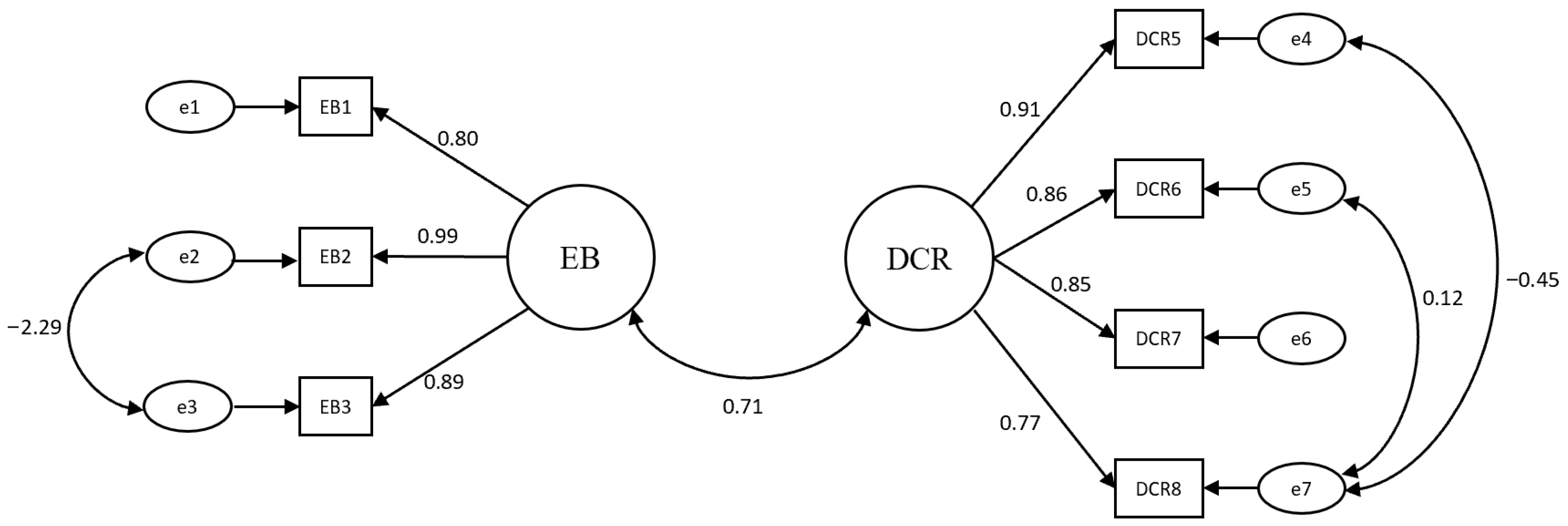
All skewness and kurtosis values fall within the ±2 reference range, indicating that they are within acceptable limits. These findings suggest that the data distribution conforms statistically to a normal distribution and satisfies the necessary assumptions for factor analysis and other parametric tests. Figure 3 presents the CFA diagram.
Figure 3.
CFA.
Table 5 presents the CFA fit indices, convergent validity, and discriminant validity analyses.
Table 5.
CFA fit indices, convergent validity, and discriminant validity.
To validate the factorial structure of the NLWLS, a CFA was conducted using robust maximum likelihood estimation with bootstrap correction, appropriate for ordinal five-point items with mild skewness. The analysis results indicated (Table 5) that the hypothesized two-factor model demonstrated a good fit to the data (χ2(10) = 17.894, p = 0.057; CMIN/DF = 1.789; SRMR = 0.026; CFI = 0.991; IFI = 0.991; GFI = 0.971; TLI = 0.980; NFI = 0.979; RMSEA = 0.070).
Model comparison confirmed the superiority of the two-factor solution over a one-factor alternative (Δχ2(4) = 150.201, p < 0.001). Thus, a unidimensional structure could not adequately represent the data.
For the EB subdimension, AVE = 0.799, CR = 0.922, √AVE = 0.894; for DCR, AVE = 0.718, CR = 0.910, √AVE = 0.848. All AVE values exceeded 0.50 and CR values surpassed 0.70, indicating strong convergent validity [47]. Additionally, the MSV and ASV values (0.510) were lower than the corresponding AVE values, supporting discriminant validity. Discriminant validity was further verified through the HTMT ratio (<0.85) and by inspecting standardized residual covariances (<0.30).
Although one item (EB2) displayed a very high standardized loading (0.989), the sensitivity analysis excluding this item yielded nearly identical fit indices, demonstrating the robustness of the model. Reliability indices were satisfactory, with all Composite Reliability (CR > 0.70) and Average Variance Extracted (AVE > 0.50) values exceeding recommended thresholds.
Overall, the CFA results confirmed that the two-factor NLWLS model exhibits excellent model fit as well as strong convergent and discriminant validity, providing empirical support for the scale’s psychometric soundness and theoretical structure.
8. Results
This study presents a valid and reliable measurement instrument for the NLWLS, which aims to assess employees’ cognitive renewal and enrichment behaviors exhibited in the work context. The two-dimensional structure of the scale—EB and DCR—demonstrated strong alignment with both the theoretical framework and the conducted factor analyses. The comprehensive scale revisions revealed that a behavior-based approach represents neuroplasticity literacy in a more coherent and measurable manner.
The findings indicate that employees generally engage at low levels in cognitive enrichment and renewal behaviors. This suggests that sustainable learning within organizations is closely linked not only to institutional resources but also to individuals’ behavioral repertoires related to cognitive development. From an organizational perspective, the NLWLS provides a practical tool both for identifying employees’ developmental needs and for structuring interventions that support learning.
Overall, the NLWLS offers an original and applicable instrument for assessing the cognitive processes that support sustainable learning in organizations, providing a valuable foundation for understanding employees’ cognitive flexibility, renewal, and enrichment behaviors.
8.1. Discussion and Implications
This study provides important findings as one of the first scale development attempts to evaluate neuroplasticity literacy in organizational contexts through a behavior-based structure. The consistently low NLWLS scores observed in both samples indicate that employees do not sufficiently engage in enrichment behaviors, cognitive renewal practices, or activities that support continuous learning. This points to a significant gap in the literature on sustainable human resource management [48] and learning organizations [49]. Employees’ cognitive flexibility, creativity, and adaptive capacity are critically important for enabling organizations to respond to changing environmental demands [50]. Therefore, low NLWLS scores have important implications not only at the individual level but also for institutional learning capacity and adaptive performance.
Several contextual explanations emerge in light of the findings. First, the concept of neuroplasticity being relatively new to most participants—as also evidenced by the awareness data—may lead to an underestimation of the value of practices such as cognitive renewal, stimulation through art and music, or reflective thinking. The literature shows that employees have difficulty routinizing developmental behaviors for which they lack conceptual awareness [51]. Second, workload, time pressure, limited autonomy, and the absence of structured time allocated for learning may reduce employees’ engagement in cognitive enrichment activities [52,53]. Third, the output-oriented culture dominant in many organizations may overshadow the importance of reflective thinking, learning breaks, creative activities, or mindfulness practices [54].
These findings highlight the importance of making behaviors that support neuroplasticity visible and accessible in order for organizations to strengthen their sustainable learning capacity. Micro-learning applications, short daily learning modules, regular reflective sessions, leadership communication styles that foster cognitive flexibility, and work environments that encourage creativity can serve this purpose [55,56]. Providing access to art, music, language learning, and mindfulness-based stress reduction programs may also enhance the continuity of behaviors that support neuroplasticity [57]. The NLWLS can be used as a practical assessment tool to identify developmental needs and monitor employees’ adaptive capacity within these processes.
This study contains several methodological limitations. First, the sample was collected in Turkey using convenience sampling, which limits its representativeness. Considering the influence of culture on cognitive renewal behaviors [58], validation studies conducted in different cultural contexts will strengthen the scale’s validity.
Second, the similarity in the phrasing of scale items may increase the likelihood of social desirability bias. To address this issue, future research may incorporate reverse items or employ multi-method approaches such as behavioral observation data [59].
Third, the absence of criterion-related validity analyses limits the claims regarding the scale’s predictive validity. Testing the associations of the NLWLS with variables such as cognitive flexibility [60], creativity [61], learning agility [62], and well-being [63] would strengthen the theoretical positioning and utility of the scale.
Overall, this study offers a holistic foundation for measuring neuroplasticity literacy and demonstrates that low NLWLS scores indicate areas requiring development in organizational learning and adaptation processes. Future research should focus on cross-cultural validation, reverse items, behavioral measures, multiple data sources, and criterion-related validity analyses to enhance the theoretical and practical value of the scale.
8.2. Limitations and Future Research
Several limitations of this study should be acknowledged. First, the use of cross-sectional data does not allow for causal inferences. Second, the sample consisted of employees in Turkey and was obtained through convenience sampling; therefore, the generalizability of the findings to different cultural contexts and more representative populations may be limited. Additionally, data were collected via self-report, which introduces potential perceptual bias and common method variance. Some participants may not have been previously familiar with the concept of neuroplasticity, which could have influenced how they interpreted the survey items and affected their responses. Future studies could address these potential limitations by providing standardized pre-survey information or employing indirect behavioral measures. Future studies are recommended to examine test–retest reliability and external criterion validity (e.g., behavioral performance indicators or managerial assessments).
Future research could also examine NLWLS scores longitudinally to track changes in employees’ neuroplasticity literacy over time. Additionally, integrating NLWLS with behavioral performance measures or neurological data (e.g., cognitive tasks, neuroimaging) would provide external validation and deeper insights into how self-reported behaviors correspond to measurable cognitive and brain-based changes. Research applying the scale in different countries would allow for the investigation of cross-cultural measurement invariance, thereby strengthening generalizability.
Some items in the NLWLS are double-barreled, combining both knowledge acquisition and regular practice. This may violate the assumption of one-dimensionality at the item level, potentially inflating reliability estimates and complicating the interpretation of individual items. Future research could consider separating these components into distinct items to better capture the cognitive and behavioral aspects of neuroplasticity literacy.
To contribute to the generalization of the NLWLS, validity and reliability studies can be conducted in other countries, including those with different cultural contexts. Comparisons can also be made across sectors or occupational groups. While the current study focused on employees’ NLWLS-related practices, future research could assess attitudes toward or expectations of such practices. Future studies should also complement the behavioral measurement of neuroplasticity literacy with cognitive components such as objective knowledge, beliefs, and self-efficacy related to neuroplasticity principles.
In practice, organizations can leverage NLWLS scores to design interventions that foster cognitive enrichment—such as creative workshops, music or language training and deliberate cognitive renewal, including mentoring, structured learning programs, and mindfulness exercises. HR practitioners may integrate these scores into individual development plans, monitor engagement in neuroplasticity-enhancing behaviors, and support sustainable learning and adaptability across teams and the organization.
In this regard, multilevel models (e.g., multilevel SEM) examining the effects of cultural and sectoral differences on neuroplasticity awareness may provide a rich avenue for future research.
8.3. General Conclusions
The NLWLS is a valid and reliable instrument that can be used to identify employees’ engagement in neuroplasticity-related practices. The scale can also be applied to examine students’ perceptions across different variables.
In conclusion, the NLWLS provides the means to assess cognitive renewal and learning potential at both the individual and organizational levels, offering a meaningful contribution to bridging the fields of neuroscience and management sciences.
Funding
This research received no external funding.
Institutional Review Board Statement
The study was conducted in accordance with the Declaration of Helsinki, and approved by the ethics committee of the Şırnak University (protocol code E-74546226-204.01.07-142920 and 4 September 2025 of approval).
Informed Consent Statement
Informed consent was obtained from all subjects involved in the study.
Data Availability Statement
The raw data supporting the conclusions of this article will be made available by the author on request.
Conflicts of Interest
The author declares no conflicts of interest.
Appendix A
Appendix A.1. English Version
| Enrichment Behaviors (EB) |
|
|
|
| Deliberate Cognitive Renewal (DCR) |
|
|
|
|
|
|
Appendix A.2. Turkish Version
| Zenginleştirici Davranışlar (EB) |
|
|
|
| Kasıtlı Bilişsel Yenilenme (DCR) |
|
|
|
|
|
|
References
- Gürbüz, S. İnsan Kaynakları Yönetimi: Teori, Araştırma ve Uygulama [Human Resource Management: Theory, Research and Practice]; Seçkin Yayıncılık: Ankara, Türkiye, 2017. [Google Scholar]
- Nayak, L.; Malik, P.; Meher, J.R.; Patel, G. Developing competencies of Gen Z: Role of organizational learning culture and learning agility. J. Organ. Eff. People Perform. 2025. [Google Scholar] [CrossRef] [Scilit]
- Atanassova, I.; Bednar, P.; Khan, H.; Khan, Z. Managing the VUCA environment: The dynamic role of organizational learning and strategic agility in B2B versus B2C firms. Ind. Mark. Manag. 2025, 125, 12–28. [Google Scholar] [CrossRef] [Scilit]
- Doidge, N. The Brain That Changes Itself; Penguin Putnam Inc.: New York, NY, USA, 2007. [Google Scholar]
- Puderbaugh, M.; Emmady, P.D. Neuroplasticity. In StatPearls; StatPearls Publishing: Treasure Island, FL, USA, 2023. Available online: http://www.ncbi.nlm.nih.gov/books/NBK557811/ (accessed on 5 September 2025).
- Öner, K. The Role and Importance of Neuroplasticity in Developing Psychological Resilience. J. Educ. Res. Nurs. 2024, 21, 250–253. [Google Scholar] [CrossRef] [Scilit]
- Fuchs, E.; Flügge, G. Adult Neuroplasticity: More Than 40 Years of Research. Neural Plast. 2014, 2014, 541870. [Google Scholar] [CrossRef] [Scilit] [PubMed]
- Zientz, J.; Spence, J.S.; Chung, S.S.E.; Nanda, U.; Chapman, S.B. Exploring how brain health strategy training informs the future of work. Front. Psychol. 2023, 14, 1175652. [Google Scholar] [CrossRef] [Scilit]
- Elbert, T.; Pantev, C.; Wienbruch, C.; Rockstroh, B.; Taub, E. Increased Cortical Representation of the Fingers of the Left Hand in String Players. Science 1995, 270, 305–307. [Google Scholar] [CrossRef] [Scilit]
- Hyde, K.L.; Lerch, J.; Norton, A.; Forgeard, M.; Winner, E.; Evans, A.C.; Schlaug, G. Musical Training Shapes Structural Brain Development. J. Neurosci. 2009, 29, 3019–3025. [Google Scholar] [CrossRef] [Scilit]
- Zuk, J.; Benjamin, C.; Kenyon, A.; Gaab, N. Behavioral and Neural Correlates of Executive Functioning in Musicians and Non-Musicians. PLoS ONE 2014, 9, e99868. [Google Scholar] [CrossRef] [Scilit]
- Tang, Y.-Y.; Ma, Y.; Wang, J.; Fan, Y.; Feng, S.; Lu, Q.; Yu, Q.; Sui, D.; Rothbart, M.K.; Fan, M.; et al. Short-term meditation training improves attention and self-regulation. Proc. Natl. Acad. Sci. USA 2007, 104, 17152–17156. [Google Scholar] [CrossRef] [Scilit]
- Vaidya, N.; Marquand, A.F.; Nees, F.; Siehl, S.; Schumann, G. The impact of psychosocial adversity on brain and behaviour: An overview of existing knowledge and directions for future research. Mol. Psychiatry 2024, 29, 3245–3267. [Google Scholar] [CrossRef] [Scilit] [PubMed]
- Khaneja, S.; Arora, T. The potential of neuroscience in transforming business: A meta-analysis. Future Bus. J. 2024, 10, 77. [Google Scholar] [CrossRef] [Scilit]
- Ehnert, I. Sustainable Human Resource Management; Contributions to Management Science; Physica-Verlag HD: Heidelberg, Germany, 2009; ISBN 978-3-7908-2187-1. [Google Scholar] [CrossRef] [Scilit]
- Teece, D.J. Business models and dynamic capabilities. Long Range Plan. 2018, 51, 40–49. [Google Scholar] [CrossRef] [Scilit]
- Argyris, C.; Schön, D.A. Organizational Learning II: Theory, Method, and Practice; Addison-Wesley: Boston, MA, USA, 1996; ISBN 978-0201629835. Available online: https://www.amazon.com/Organizational-Learning-II-Theory-Practice/dp/0201629836 (accessed on 24 November 2025).
- Senge, P.M. The Fifth Discipline: The Art & Practice of the Learning Organization; Doubleday: New York, NY, USA, 2006; Available online: https://www.amazon.com/Fifth-Discipline-Practice-Learning-Organization/dp/0385517254 (accessed on 24 November 2025).
- Rock, D.; Schwartz, J. The Neuroscience of Leadership. In Strategy + Business; Booz Allen Hamilton: McLean, VA, USA, 2006; pp. 1–10. Available online: https://www.strategy-business.com/article/06207 (accessed on 8 September 2025).
- Bratianu, C.; Staneiu, R.-M. The Emergence of Neuroleadership in the Knowledge Economy. Encyclopedia 2024, 4, 1100–1116. [Google Scholar] [CrossRef] [Scilit]
- Rao, P.B.; Inampudi, V.B.R.; Meegada, V.B.R.; Sathyanarayana, N. The Application of Neuroscience in Leadership Development. In Advances in Business Strategy and Competitive Advantage; Saluja, S., Kukreja, J., Sharma, S., Eds.; IGI Global: Hershey, PA, USA, 2024; pp. 113–129. ISBN 979-8-3693-1785-3. [Google Scholar] [CrossRef] [Scilit]
- Gee, R.O.W. From Neurons to Organisations: Awakening Regenerative Mindsets with Neuroplasticity, AI & Systemic Consciousness. J. Biotechnol. Biomed. 2025, 8, 21–58. [Google Scholar] [CrossRef] [Scilit]
- Gkintoni, E.; Vassilopoulos, S.P.; Nikolaou, G. Brain-Inspired Multisensory Learning: A Systematic Review of Neuroplasticity and Cognitive Outcomes in Adult Multicultural and Second Language Acquisition. Biomimetics 2025, 10, 397. [Google Scholar] [CrossRef] [Scilit]
- Sarrasin, J.B.; Nenciovici, L.; Foisy, L.-M.B.; Allaire-Duquette, G.; Riopel, M.; Masson, S. Effects of teaching the concept of neuroplasticity to induce a growth mindset on motivation, achievement, and brain activity: A meta-analysis. Trends Neurosci. Educ. 2018, 12, 22–31. [Google Scholar] [CrossRef] [Scilit]
- Pittenger, C.; Duman, R.S. Stress, Depression, and Neuroplasticity: A Convergence of Mechanisms. Neuropsychopharmacology 2008, 33, 88–109. [Google Scholar] [CrossRef] [Scilit] [PubMed]
- Moreno, S.; Farzan, F. Music training and inhibitory control: A multidimensional model. Ann. N. Y. Acad. Sci. 2015, 1337, 147–152. [Google Scholar] [CrossRef] [Scilit] [PubMed]
- Schlegel, A.; Alexander, P.; Fogelson, S.V.; Li, X.; Lu, Z.; Kohler, P.J.; Riley, E.; Tse, P.U.; Meng, M. The artist emerges: Visual art learning alters neural structure and function. NeuroImage 2015, 105, 440–451. [Google Scholar] [CrossRef] [Scilit]
- Griffith, F.J.; Bingman, V.P. Drawing on the brain: An ALE meta-analysis of functional brain activation during drawing. Arts Psychother. 2020, 71, 101690. [Google Scholar] [CrossRef] [Scilit]
- Mårtensson, J.; Eriksson, J.; Bodammer, N.C.; Lindgren, M.; Johansson, M.; Nyberg, L.; Lövdén, M. Growth of language-related brain areas after foreign language learning. NeuroImage 2012, 63, 240–244. [Google Scholar] [CrossRef] [Scilit]
- Maguire, E.A.; Gadian, D.G.; Johnsrude, I.S.; Good, C.D.; Ashburner, J.; Frackowiak, R.S.J.; Frith, C.D. Navigation-related structural change in the hippocampi of taxi drivers. Proc. Natl. Acad. Sci. USA 2000, 97, 4398–4403. [Google Scholar] [CrossRef] [Scilit]
- Pascual-Leone, A.; Nguyet, D.; Cohen, L.G.; Brasil-Neto, J.P.; Cammarota, A.; Hallett, M. Modulation of muscle responses evoked by transcranial magnetic stimulation during the acquisition of new fine motor skills. J. Neurophysiol. 1995, 74, 1037–1045. [Google Scholar] [CrossRef] [Scilit] [PubMed]
- Draganski, B.; Gaser, C.; Busch, V.; Schuierer, G.; Bogdahn, U.; May, A. Changes in grey matter induced by training. Nature 2004, 427, 311–312. [Google Scholar] [CrossRef] [Scilit] [PubMed]
- Erickson, K.I.; Voss, M.W.; Prakash, R.S.; Basak, C.; Szabo, A.; Chaddock, L.; Kim, J.S.; Heo, S.; Alves, H.; White, S.M.; et al. Exercise training increases size of hippocampus and improves memory. Proc. Natl. Acad. Sci. USA 2011, 108, 3017–3022. [Google Scholar] [CrossRef] [Scilit]
- DeVellis, R.F.; Thorpe, C.T. Scale Development: Theory and Applications; SAGE Publications: Thousand Oaks, CA, USA, 2021. [Google Scholar]
- Boateng, G.O.; Neilands, T.B.; Frongillo, E.A.; Melgar-Quiñonez, H.R.; Young, S.L. Best Practices for Developing and Validating Scales for Health, Social, and Behavioral Research: A Primer. Front. Public Health 2018, 6, 149. [Google Scholar] [CrossRef] [Scilit]
- Hinkin, T.R. A Brief Tutorial on the Development of Measures for Use in Survey Questionnaires. Organ. Res. Methods 1998, 1, 104–121. [Google Scholar] [CrossRef] [Scilit]
- MacCallum, R.C.; Browne, M.W.; Sugawara, H.M. Power analysis and determination of sample size for covariance structure modeling. Psychol. Methods 1996, 1, 130–149. [Google Scholar] [CrossRef]
- Worthington, R.L.; Whittaker, T.A. Scale Development Research: A Content Analysis and Recommendations for Best Practices. Couns. Psychol. 2006, 34, 806–838. [Google Scholar] [CrossRef] [Scilit]
- Beaton, D.E.; Bombardier, C.; Guillemin, F.; Ferraz, M.B. Guidelines for the Process of Cross-Cultural Adaptation of Self-Report Measures. Spine 2000, 25, 3186–3191. [Google Scholar] [CrossRef] [Scilit]
- Brislin, R.W. Translation and content analysis of oral and written materials. In Handbook of Cross-Cultural Psychology; Allyn & Bacon: Boston, MA, USA, 1980; Volume 2, pp. 389–444. Available online: https://www.scirp.org/reference/referencespapers?referenceid=30333 (accessed on 15 October 2025).
- Sousa, V.D.; Rojjanasrirat, W. Translation, adaptation and validation of instruments or scales for use in cross-cultural health care research: A clear and user-friendly guideline. J. Eval. Clin. Pract. 2011, 17, 268–274. [Google Scholar] [CrossRef] [Scilit]
- Gerbing, D.W.; Hamilton, J.G. Viability of exploratory factor analysis as a precursor to confirmatory factor analysis. Struct. Equ. Model. Multidiscip. J. 1996, 3, 62–72. [Google Scholar] [CrossRef] [Scilit]
- Kline, R.B. Principles and Practice of Structural Equation Modeling, 4th ed.; The Guilford Press: New York, NY, USA, 2016; ISBN 978-1-4625-2334-4. [Google Scholar]
- George, D.; Mallery, P. SPSS for Windows Step by Step: A Simple Guide and Reference, 4th ed.; Allyn & Bacon: Boston, MA, USA, 2003; Available online: https://www.scirp.org/reference/ReferencesPapers?ReferenceID=1457632 (accessed on 16 October 2025).
- Nunnally, J.C.; Bernstein, I.H. Psychometric Theory; McGraw-Hill: New York, NY, USA, 1994; Available online: https://www.scirp.org/reference/ReferencesPapers?ReferenceID=1017362 (accessed on 16 October 2025).
- West, S.G.; Finch, J.F.; Curran, P.J. Structural equation models with nonnormal variables: Problems and remedies. In Structural Equation Modeling: Concepts, Issues, and Applications; Sage Publications: Thousand Oaks, CA, USA, 1995; pp. 56–75. Available online: https://psycnet.apa.org/record/1995-97753-004 (accessed on 16 October 2025).
- Fornell, C.; Larcker, D.F. Evaluating Structural Equation Models with Unobservable Variables and Measurement Error. J. Mark. Res. 1981, 18, 39–50. [Google Scholar] [CrossRef] [Scilit]
- Kramar, R. Sustainable human resource management: Six defining characteristics. Asia Pac. J. Hum. Resour. 2022, 60, 146–170. [Google Scholar] [CrossRef] [Scilit]
- Senge, P.M. The art and practice of the learning organization. In The New Paradigm in Business: Emerging Strategies for Leadership and Organizational Change; Tarcher: New York, NY, USA, 1993. [Google Scholar]
- Ling, B.; Liu, Z.; Chen, D.; Sun, L. Team Flexibility in Organizational Change Context: Antecedents and Consequences. Psychol. Res. Behav. Manag. 2021, 14, 1805–1821. [Google Scholar] [CrossRef] [Scilit]
- Chae, H.; Choi, J.N. Routinization, free cognitive resources and creativity: The role of individual and contextual contingencies. Hum. Relat. 2019, 72, 420–443. [Google Scholar] [CrossRef] [Scilit]
- Jang, E.; Kim, Y.C. Autonomy Constrained: The Dynamic Interplay Among Job Autonomy, Work Engagement, and Innovative Behavior Under Performance Pressure. Adm. Sci. 2025, 15, 97. [Google Scholar] [CrossRef] [Scilit]
- Van Ruysseveldt, J.; Van Dijke, M. When are workload and workplace learning opportunities related in a curvilinear manner? The moderating role of autonomy. J. Vocat. Behav. 2011, 79, 470–483. [Google Scholar] [CrossRef] [Scilit]
- Hermida, Y.; Clem, W.; Güss, C.D. The Inseparable Three: How Organization and Culture Can Foster Individual Creativity. Front. Psychol. 2019, 10, 2133. [Google Scholar] [CrossRef] [Scilit] [PubMed]
- Saikrishna, M.B.; Suresh, J.A. Microlearning as a catalyst for agile leadership: A framework for hybrid workplaces. Dev. Learn. Organ. Int. J. 2025. [Google Scholar] [CrossRef] [Scilit]
- Kwon, S.-H.; Kim, J.-S. Relationship Between Participative Decision-Making Within an Organization and Employees’ Cognitive Flexibility, Creativity, and Voice Behavior. Behav. Sci. 2025, 15, 51. [Google Scholar] [CrossRef] [Scilit] [PubMed]
- Hyde, K.L.; Lerch, J.; Norton, A.; Forgeard, M.; Winner, E.; Evans, A.C.; Schlaug, G. The Effects of Musical Training on Structural Brain Development: A Longitudinal Study. Ann. N. Y. Acad. Sci. 2009, 1169, 182–186. [Google Scholar] [CrossRef] [Scilit]
- Zheng, J.; Wu, G.; Xie, H.; Li, H. Leadership, organizational culture, and innovative behavior in construction projects: The perspective of behavior-value congruence. Int. J. Manag. Proj. Bus. 2019, 12, 888–918. [Google Scholar] [CrossRef] [Scilit]
- Seitz, T.; Wetzel, E.; Hilbig, B.E.; Meiser, T. Using the multidimensional nominal response model to model faking in questionnaire data: The importance of item desirability characteristics. Behav. Res. Methods 2024, 56, 8869–8896. [Google Scholar] [CrossRef] [Scilit]
- Dennis, J.P.; Vander Wal, J.S. The Cognitive Flexibility Inventory: Instrument Development and Estimates of Reliability and Validity. Cogn. Ther. Res. 2010, 34, 241–253. [Google Scholar] [CrossRef] [Scilit]
- Benedek, M.; Jauk, E.; Sommer, M.; Arendasy, M.; Neubauer, A.C. Intelligence, creativity, and cognitive control: The common and differential involvement of executive functions in intelligence and creativity. Intelligence 2014, 46, 73–83. [Google Scholar] [CrossRef] [Scilit]
- De Meuse, K.P. Learning agility: Its evolution as a psychological construct and its empirical relationship to leader success. Consult. Psychol. J. Pract. Res. 2017, 69, 267–295. [Google Scholar] [CrossRef] [Scilit]
- Keyes, C.L.M. Mental Illness and/or Mental Health? Investigating Axioms of the Complete State Model of Health. J. Consult. Clin. Psychol. 2005, 73, 539–548. [Google Scholar] [CrossRef] [Scilit] [PubMed]



Disclaimer/Publisher’s Note: The statements, opinions and data contained in all publications are solely those of the individual author(s) and contributor(s) and not of MDPI and/or the editor(s). MDPI and/or the editor(s) disclaim responsibility for any injury to people or property resulting from any ideas, methods, instructions or products referred to in the content. |
© 2025 by the author. Licensee MDPI, Basel, Switzerland. This article is an open access article distributed under the terms and conditions of the Creative Commons Attribution (CC BY) license (https://creativecommons.org/licenses/by/4.0/).