


Article

Hermetia illucens L. Frass in Promoting Soil Fertility in Farming Systems

1
Unidade Estratégica de Investigação e Serviços dos Sistemas Agrários e Florestais e Sanidade Vegetal, Instituto Nacional de Investigação Agrária e Veterinária, Av. da República, Quinta do Marquês, 2780-159 Oeiras, Portugal
2
GREEN-IT Bioresources for Sustainability, Instituto de Tecnologia Química e Biológica-NOVA, 2780-157 Oeiras, Portugal
3
Linking Landscape, Environment, Agriculture and Food Research Centre, Terra Associate Laboratory, Instituto Superior de Agronomia, Universidade de Lisboa, Tapada da Ajuda, 1349-017 Lisboa, Portugal
4
Unidade Estratégica de Investigação e Serviços dos Sistemas Agrários e Florestais e Sanidade Vegetal, Instituto Nacional de Investigação Agrária e Veterinária, Lab. Químico-Agrícola Rebelo da Silva, Tapada da Ajuda, 1349-018 Oeiras, Portugal
5
Marine and Environmental Sciences Centre, Department of Environmental Sciences and Engineering, NOVA School of Science and Technology, NOVA University Lisbon, 2829-516 Caparica, Portugal
6
Unidade Estratégica de Produção de Investigação de Produção e Saúde Animal, Polo de Inovação da Fonte Boa—INIAV, Av. Professor Vaz Portugal, Quinta da Fonte Boa, 2005-048 Vale de Santarém, Portugal
7
GeoBioTec Research Center, FCT-NOVA, Campus da Caparica, 2829-516 Caparica, Portugal
8
EntoGreen, Ingredient Odyssey SA, Industrial Zone of Santarém, 2005-079 Santarém, Portugal
9
Centro de Investigação Interdisciplinar Egas Moniz, Quinta da Granja, 2829-511 Monte da Caparica, Portugal
10
Centro de Investigação Interdisciplinar em Sanidade Animal, Faculdade de Medicina Veterinária, Universidade de Lisboa, Av. da Universidade Técnica, 1300-477 Lisboa, Portugal
11
Laboratório Associado AL4AnimalS, Faculdade de Medicina Veterinária, Universidade de Lisboa, 1300-477 Lisboa, Portugal
*
Author to whom correspondence should be addressed.
Sustainability 2025, 17(24), 11058; https://doi.org/10.3390/su172411058
Submission received: 22 October 2025 / Revised: 24 November 2025 / Accepted: 3 December 2025 / Published: 10 December 2025

Abstract

Following a pot trial with annual ryegrass (Lollium multiflorum Lam. (Pooideae: Poaceae)), where the effect of chemical fertilization was compared with organic fertilization with Black Soldier Fly larvae frass (BSFF), obtained by bio-digestion of cattle production effluents, and with mixed fertilization in proportions of 25%, 50%, and 75% of BSFF, the effect on crop production and soil fertility was tested in three soils of different textures, namely, sandy soil (Gleyic podzol), calcareous soil (Haplic calcisol), and clay soil (Haplic fluvisol). On top of the previous experimental device, a second year of testing was carried out with sowing of the same crop, but without any fertilizer input in all the residual soils for the different further modalities. With regard to the second sowing cycle production, the results are supportive of the expectation that fertilization with BSFF has a superior capacity for soil fertility resilience (assessed in terms of the ability to maintain or even increase soil production in the following year, in the absence of any fertilizer application) in all the soils tested in this experiment, with a significantly greater difference in the treatment corresponding to fertilization with only BSFF compared to the exclusively chemical treatment, in all the soils tested. Furthermore, BSFF, preferably as a mixed fertilizer (in a proportion until 75%), is shown to be a promising alternative for Gleyic podzol in the production of ryegrass as in the resilience and promotion of soil productivity. As far as more fertile soils are concerned (as in the case of Haplic calcisol and Haplic fluvisol), BSFF has not proved promising in terms of immediate crop production.

1. Introduction

Among the various constraints currently overshadowing our planet at a global level, the agricultural sector has a significant role to play in contributing to the mitigation of food insecurity and environmental pollution, as well as to the adoption of appropriate management to reconcile these goals with an economy compatible with market demands. To this end, farming holdings are a favored place for management in so-called “circular economy” systems, in which polluting waste is recycled into production factors.
In pursuit of this goal, a great deal of research has been carried out, particularly into the composting of livestock and agricultural waste in order to return it to the soil as organic fertilizer, with the implicit reduction in chemical fertilizers, as long as cash crop yields and the resilience of soil fertility (assessed in terms of the ability to maintain or even increase soil production in the following year, in the absence of any fertilizer application) are not impaired. The importance of this effort is undeniable, particularly with regard to waste composting techniques, in order to increase its fertilizing effect and suppress any possible polluting or antagonistic effect on crop development.
But maximizing production does not always correspond to maximizing crop revenue, given the preponderance of the cost of production factors. In the pursuit of any of these aims, however, two factors of production are often overlooked: one, negative, is the exhaustion of soil fertility through intensive exploitation with chemical fertilizers in unsuitable formulations; the other, positive, is the potential for promoting soil fertility through organic fertilizers in proportions suited to the many specific situations of the “soil/crop” binomial.
From this perspective, insect frass has been introduced as an organic fertilizer and, within this context, Hermetia illucens L. (Diptera: Stratiomyidae), commonly known as Black Soldier Fly (BSF)—either due to its prolificacy or its voracity, which significantly reduces composting time, or because of its ability to digest a wide range of waste materials [1,2]—has proven to be a good option for the bio-digestion of agricultural and livestock waste, in particular, effluents from intensive livestock farming, due to its extremely negative environmental impact, avoiding the consequent burden of its safe disposal, which is intended to be profitable, as a by-product to be included in the economic circuit of the agricultural holding itself, in the case of circular economy systems.
However, although the potential of organic fertilizers, and, in particular, BSF frass (BSFF), in addition to supplying plant nutrients, has an undeniable contribution to the structural and biological properties of soils—contributing to the resilience of their fertility—the fact is that, in the context of maximizing production, most experimental evaluations report a positive contribution only when applied in mixed fertilization in complementary proportions for limits of around 75% [3], and may even be an obstacle to maximizing production in some soils with high fertility [4].
On the other hand, the mandatory safe disposal of effluents from bovine farming requires costly treatment methods—including bio-digestion by BSF, due to its multiple functions within a circular economy [5]—with the obvious destination for these effluents being their use in organic fertilization of crops. To this end, and in the context of complex soil–plant interactions, it is of utmost importance to take a preliminary approach in very different soil situations in order to inform future research in more specific “soil/plant” combinations.
In the context of the above, and in order to assess the most suitable soil situations for the use of BSFF, this study presents a preliminary evaluation of the potential residual fertilizing effect of BSFF, obtained by the bio-digestion of an effluent from intensive cattle farming in a second consecutive year of annual ryegrass cultivation without any fertilization, in a pot experiment, in three soils with different textures and fertility levels.

2. Material and Methods

2.1. Greenhouse Experiment

The present trial overlaps the experimental device of a pot trial, described by Rehan et al. [4], with the annual ryegrass crop (Lollium multiflorum L.) in three soils of different texture, namely; sandy soil (Gleyic podzol), calcareous soil (Haplic calcisol), and clay soil (Haplic fluvisol). Five different treatments were then applied to each of these soils, all of them containing a total of N equivalent to 140 kg N ha−1, specifically: an exclusively mineral fertilization with ammonium nitrate (MT), an exclusively organic fertilization (OT), and three mixed fertilizations with different proportions of mineral and organic (MOT(75:25), MOT(50:50), and MOT(25:75)).
This work refers to a subsequent sowing, with the same species (annual ryegrass), superimposed on the aforementioned experimental device [4], now without any type of fertilization, in order to assess the residual productivity for the modalities corresponding to the previous treatments.
The soils of each treatment were just subjected to sowing for a second season, with ryegrass, at a rate of 40 kg seeds/ha, corresponding to 0.10 g of seeds per pot. Throughout the plant growth cycle, the temperature inside the greenhouse varied between 18 and 25 °C, and the pots were regularly watered with deionized water, in order to maintain the soil moisture near to 60% of water holding capacity, estimated by weight difference. Lighting and temperature were ensured naturally, and shading screens were used on sunny days.
The ryegrass was cut twice throughout the second cycle (on 2 March and 27 April 2023). In each of the cuts, the plant material was cut 2 cm from the ground. Plant biomass, fresh and dry weight (FW and DW, respectively), was registered by weighting the material collected before and after drying, respectively. Dry weight was estimated after washing the biomass with deionized water and oven drying at 65 °C, for about 48 h, until reaching constant weight.
At the end of the growth cycle, soil samples were collected from each replicate, dried at 40 °C, sieved through a 2 mm mesh, and analyzed for their chemical properties. Soil pH was determined by suspending samples in deionized water at a 1:2.5 soil-to-water ratio and measuring with a glass electrode pH meter. Soil organic matter (SOM) content was measured using the dichromate oxidation (Walkley–Black) method followed by molecular absorption spectroscopy (MAS). Available phosphorus (P) was determined using the Olsen method, and potassium (K), was extracted with ammonium lactate and quantified by flame photometry. Iron (Fe), manganese (Mn), zinc (Zn), and copper (Cu) were extracted using EDTA and analyzed by flame atomic absorption spectrometry (AAS). Soil moisture content was determined according to [6], and total nitrogen (N) was measured by dry combustion using an elemental analyzer (Thermo Fisher Scientific, FlashSmart NC Soil).
Soil dehydrogenase activity (DHA) was also evaluated at the end of the experiment in three randomly selected replicates per treatment using soil samples that had been air dried at room temperature before analysis. The activity was determined by the reduction of 2,3,5-triphenyltetrazolium chloride (TTC) to triphenyl formazan (TPF), using a modification of the method of Casida et al. [7], as described by Menino et al. [8].

2.2. Data Analyses

The data were analyzed statistically using a one-way AOV with a significance level of p < 0.05. The Tukey HSD test for mean comparison was performed (for a 95% confidence level). Results were statistically analyzed by Statistica 12, Analytical Software.
To explore patterns in soil chemical and biological properties under different fertilization treatments, we performed a principal component analysis (PCA). This was then performed separately for each soil type to evaluate treatment effects within each soil (podzol, calcisol, fluvisol), considering their inherent differences in terms of soil texture and baseline fertility. The quantitative variables used in the analysis were yield (both fresh weight and dry weight), soil N, P, K (expressed as K2O), SOM, micronutrients (Cu, Fe, Zn, Mn), and DHA. Data were standardized prior to PCA to ensure variables with different units and ranges contributed equally to the analysis. PCA was conducted using the “prcomp” function in R (version 4.5.1), and biplots were generated with the “facto extra” package.

3. Results and Discussion

In Table 1 are shown the fresh and dry weight production values for each of the different treatments carried out, on each type of soil, in the first year of the trial and for the modalities in the second year of the trial (without any fertilization).
As expected, there was a significant decrease in production from the first to the second year, both in terms of fresh and dry weight, in the modalities in the study. This is due to the lack of fertilization in the second year, because, although the frass is an organic fertilizer which is rich in nutrients in its organic form [9], these are released slowly (either in amount or opportunity) and, therefore, the intrinsic fertility of the soil was not sufficient to fully sustain plant growth.
With regard to the analysis of the values recorded for the second year of the trial, the following points are noteworthy:
  • In the podzol, fresh weight production was consistently, and significantly, higher in the mixed and exclusively organic treatments, despite the fact that the dry weight production in the same treatments did not differ significantly from that of the exclusively chemical treatment.
  • In the calcisol, there were no significant differences between treatments, both for fresh and dry weight.
  • In the fluvisol, as for the calcisol, there were no significant differences for fresh weight production. However, dry mass production was consistently higher in the mixed and exclusively organic treatments, although only the MOT(75:25) treatment was significantly higher than the exclusively chemical treatment, in contrast to what was registered in the first year of the trial.
In all cases, fresh mass production was consistently higher in the modalities preceded by exclusively biological fertilization than in the modalities preceded by exclusively chemical fertilization, confirming the fact that there is a slow release of the nutrients contained in the frass [10].
With regard to chemical parameters related to soil fertility, Table 2 shows the average values recorded for SOM, N, P, and K (as K2O) in the first and second year after plants harvesting.
For the assessment of the residual P content of the soil in the second year, it was not possible to gather a sufficient sample from each repetition, so the results shown in Table 2 refer to the mixture of all the repetitions of each treatment and, as such, it was not possible to carry out a statistical analysis.
With regard to residual SOM content in the soil after the second year, we can observe the following:
In the podzol, in all the modalities preceded by mixed or exclusively organic treatments with BSFF, levels were significantly higher than those recorded for MT, with the OT modality standing out. In the calcisol, the situation showed the same trend, despite the fact that the modalities with BSFF content below 50% did not show significant differences from the MT modality. Finally, in the fluvisol, all the modalities preceded by treatments including BSFF showed significantly higher SOM levels than those recorded for the method preceded by exclusively chemical fertilization, without showing the aforementioned trend of direct proportionality to the BSFF content in the fertilizer.
As for the N content:
In the podzol, all the methods preceded by fertilization including BSFF had a significantly higher residual N content than the method preceded by mineral fertilization alone, with a statistically significant increase from MOT(50:50) to MOT(25:75) and from this to OT. In the calcisol, the MOT(25:75) and OT modalities showed significantly higher contents than the other modalities, and the difference in N content between the MOT(50:50) and the MT modalities was also statistically significant. In the fluvisol, with the exception of MOT(25:75), the other modalities preceded by treatments containing BSFF (MOT(75:25), MOT(50:50) and OT) recorded significantly higher values than MT.
Regarding the K content:
In the podzol, the OT modality had a significantly higher content than the other modalities, between which there were no significant differences. Also, for the calcisol, the OT modality had a significantly higher content of this element than the other modalities, despite the fact that there were also significantly greater differences between the MOT(25:75) modality and the MOT(50:50) and MT modalities. As for the fluvisol, the MT modality had a significantly lower K content than the other modalities, while the MTO(75:25) modality had a significantly higher K content than the other modalities.
Reconciling these results with those for fresh mass production suggests that BSFF has an increased potential for fertility resilience, particularly, in the Gleyic podzol.
When comparing the first and the second year, we can see that there was an increase in SOM in all treatments with BSFF, probably not only due to the frass added in the previous year, but also by the root biomass produced by the plants [11].
Overall, these results indicate that residual soil fertility, particularly SOM, N, and K, mediated the observed yield responses, with BSFF-based treatments enhancing fertility resilience and sustaining crop production, most notably in the nutrient-limited podzol.
Table 3 shows the results of the soil endowments for some of the minor nutrients, namely, Cu, Fe, Zn, and Mn, assessed after harvesting at the end of each of the two years of the trial.
Concerning the behavior of micronutrients in the soil, there was a significant increase in Cu, Fe, and Zn from the first to the second year. As regards the second year, although there were significant differences between treatments, there was not a linear behavior that could justify the use of frass in opposition of the mineral fertilizer.
However, the increase in the micronutrient concentration may be due not only to nutrient cycling through vegetation but also due to the increase in soil microbial activity as it was registered for all the soils and treatments, through the values obtained for dehydrogenase activity (DHA) (Table 4), since DHA is strongly associated with nutrient mineralization processes. Increased microbial respiration means the mineralization of nutrients, making them available to plants [12,13].
The agronomic use of BSFF derived from the bio-digestion of livestock effluents may introduce trace metals or pathogens into the soil environment. Recent studies in Longyan (China) have shown that soil characteristics can strongly influence trace metal concentrations in crops [14]. These observations highlight the need for long-term monitoring to assess the risk of trace metal behavior in agricultural systems using BSFF to ensure sustainable practices.
The levels of DHA in the different soils followed the previously observed pattern from the first year, with significantly lower values in the podzol compared to the calcisol and fluvisol [4], correlating with the average SOM content in each soil type [15]. This is in accordance with the observation from Salazar et al. [16] as they state that SOM, being a nutrient sink and source with the consequent enhancement of soil physical and chemical properties, is an indicator of soil quality, as it promotes microbial activity. And according to Błońska et al. [17], there is a positive correlation between DHA and SOM content, and practices that increase SOM, namely, organic amendments, tend to enhance DHA, whereas SOM depletion under intensive management reduces it [18].
In the first year, significant differences among treatments (p < 0.05) were only verified in the pots containing the podzol soil. Higher activity of this enzyme was verified when an exclusive organic fertilization with BSFF was carried out in this soil type with 1.016 µg TPF/g dry soil h, while the other treatments showed an average 0.304 µg TPF/g dry soil h. However, in the second year, the opposite occurred and significant differences among treatments (p < 0.05) were registered for the calcisol and for the fluvisol, with higher activity of this enzyme verified, respectively, for the OT modality and for the MOT, with the proportions of 75:25 and 25:75.
Comparing both years, a significant increase on the DHA was registered for the podzol, from the first to the second year, particularly in the mixed treatments. The opposite was observed in the fluvisol, whereas the calcisol only showed a significant increase in DHA for OT.
DHA plays a crucial role in biogeochemical cycles, including nutrient mineralization and organic matter decomposition. The increase in DHA from the first to the second year, especially in the less fertile podzol and in mixed treatments with high proportions of BSFF, suggests that, in such conditions, BSFF may promote a more active and resilient microbial environment, with a positive impact on overall soil health.

4. Principal Component Analysis

The PCA biplots in Figure 1 summarize the relationships between the selected soil chemical and biological properties, plant biomass production (both FW and DW), and the fertilization treatments, across the three types of soil used in this experiment.
In the podzol in the first year (Figure 1A), PC1 was strongly associated with K, P, SOM, Fe, Zn, and DHA, while PC2 was defined by FW, DW, and Cu. Considering treatment clustering, this indicated that the modalities preceding both BSF and chemical fertilization (MOT(75:25), MOT(50:50), MOT(25:75)), along with exclusively preceding chemical fertilization (MT), were linked with higher yield and Cu, while the modality preceding exclusively with BSF (OT) was linked with more soil fertility. In the second year in the same soil (Figure 1D), PC1 was defined by most of soil chemical and biological properties, as well as yield (mainly FW), while PC2 was mostly defined by Cu, Zn, and DW. This indicated that the OT modality was linked with higher soil fertility and enzyme activity, resulting in higher fresh weight. This outcome was indicative of a higher water holding capacity in the exclusively BSF fertilization (OT) modality, due to higher SOM content. Therefore, it is safe to assume that residual effect of fertilization was higher in this modality.
In the calcisol in the first year (Figure 1B), PC1 was driven by most of the soil characteristics, except for Cu, which drove PC2. Plant biomass, especially DW, impacted both principal components (PC1 and PC2). This finding was similar to that obtained in the podzol, where the OT modality was mostly associated with higher soil fertility, i.e., higher nutrient content. However, in this soil, the mixed modalities, along with the exclusively chemical modality, were associated with higher yield, showcasing how the difference in baseline soil fertility impacts the response to different fertilization treatments. In the second year for the calcisol (Figure 1E), PC1 was driven by all soil and plant variables, except Zn, while PC2 was mainly defined by Zn and Cu. The treatments separated clearly along PC1, with OT and MOT(25:75) aligning with higher SOM, N, and DHA, indicating greater residual soil fertility and microbial activity, while the MT and MOT(75:25) modalities clustered on the opposite side, linked with lower soil fertility. Despite this, plant biomass variables (FW and DW) were more evenly distributed, reflecting the overall higher baseline fertility of the calcisol, where the effect of frass on plant production was less pronounced compared to the podzol but still detectable in terms of soil properties.
In the fluvisol, PC1 and PC2 together explained 52.2% of the variance (PC1 = 34.7%, PC2 = 17.5%), reflecting a more heterogeneous system (Figure 1C). OT was associated with K, P, and SOM, whereas MOT(75:25), MOT(50:50), MOT(25:75), and MT overlapped considerably and were linked to DW, FW, Cu, Mn, Zn, and N. The weaker treatment separation suggests that treatment effects were less pronounced in this soil type. Nevertheless, the general pattern persisted: OT aligned with mineral nutrients, while the other treatments aligned with biomass and organic-related fertility variables. In the second year in the same soil (Figure 1F), PC1 explained more than 50% of the variance and was strongly defined by SOM, N, and DHA, while PC2 was associated with K and P. Here, OT and MOT(25:75) treatments clustered with higher SOM, N, and microbial activity, showing the residual effect of BSF-based fertilization even without fresh inputs, whereas MT clustered apart with lower fertility parameters. However, as in the calcisol, plant biomass variables showed weaker separation across treatments, reinforcing that in these more fertile soils BSFF’s effect persists mainly in the soil’s biological and chemical properties rather than in biomass production.
Across all soils, OT consistently stood apart, associated with mineral nutrients (K, P, Fe, Zn) and SOM, while MOT(75:25), MOT(50:50), MOT(25:75), and MT clustered together with variables linked to plant growth (FW, DW), N, Cu, and Mn. The strength of treatment separation varied with soil type: strongest in the podzol, intermediate in the calcisol, and weakest in the fluvisol. This indicates that the effects of treatments depended strongly on soil properties, with mineral-nutrient-driven contrasts most pronounced in the podzol.
Comparing the two years, the overall treatment patterns remain consistent, but the separation becomes clearer in the second year, particularly in the calcisol and fluvisol. However, the degree of treatment separation shifted. The podzol maintained strong mineral-driven contrasts across both years, reflecting its constrained fertility and high responsiveness to nutrient inputs. By contrast, separation sharpened considerably in the calcisol and fluvisol in the second year, indicating that the effects of organic and mixed modalities intensified over time in these more fertile soils. This temporal shift suggests cumulative improvements in soil biological fertility and nutrient-use efficiency under organic and mixed treatments, consistent with findings that organic amendments often require time to build up effects on soil organic matter and microbial communities [19,20,21].
These results align with previous studies. Mineral (inorganic) fertilization typically increases the short-term availability of inorganic nutrients and can drive rapid gains in aboveground biomass, but it does not necessarily increase SOM or stimulate soil biological activity unless combined with organic inputs [19,22]. By contrast, organic and mixed fertilization strategies (e.g., composts, manures, residue return) tend to build SOM, increase microbial biomass and enzyme activities, and improve nutrient retention and cycling, which are processes that commonly promote more sustained yield responses over time [20,23]. The magnitude and direction of these responses are strongly modulated by soil properties (texture, pH, baseline fertility); nutrient-poor, acidic, or coarse-textured soils (e.g., podzols) often exhibit sharper contrasts between mineral and organic treatments than more fertile, fine-textured soils such as many calcisols and fluvisols [21].
PCA patterns reflect underlying soil processes that promote fertility and nutrient dynamics under different fertilization conditions. In the podzol, the combination of organic treatments with SOM, P, K, and DHA shows an increase in OM cycling and microbial activation, likely due to an increased rate of nutrient mineralization and water retention capacity in this type of low-fertility soil. In the calcisol, the mixed and mineral treatments clustered with the productivity variables, indicating that the high basal level of nutrients limited the additional gains provided by the organic inputs, while the amendments derived from BSF acted mainly on nutrient cycling mediated by microorganisms, rather than reflecting immediate increases in biomass. In the fluvisol, the smaller separation between treatments suggests that inner soil fertility attenuated their effects; however, the clustering of OT with SOM and DHA points to the persistent stimulation of biological fertility. The relationships obtained by PCA highlight the fact that the agronomic and ecological responses to fertilization with BSFF are governed by soil-specific interactions between OM decomposition, nutrient availability, and microbial activity.

5. Conclusions

The results are in accordance with the hypothesis that growing ryegrass on Gleyic podzol (sandy-textured, low-fertility soils) will produce preferential returns with BSFF compared to more fertile soils, whether in terms of immediate green mass production or soil residual productivity.
However, the results are also consistent with the expectation that fertilizing crops with BSFF, in a context compatible with that of this trial, points to a greater capacity for resilience (and promotion) of soil fertility, across the broad spectrum of its current productive potential here rehearsed.
As expected, the residual SOM content in the second year of the test was higher in Haplic calcisol and Haplic fluvisol than in Gleyic podzol, given the competition from the mineral colloids in those soils and did not differ markedly from that seen at the end of the first year, while in Gleyic podzol the disproportion in its favor was considerable.

Author Contributions

Conceptualization, R.M. (Regina Menino) and P.F.; methodology, R.M. (Regina Menino), P.F., R.M. (Raquel Mano); software, R.M. (Regina Menino), C.E., P.F., and J.A.; validation, R.M. (Regina Menino), C.E. and J.A.; formal analysis, R.M. (Regina Menino), C.E., P.F., R.M. (Raquel Mano), J.A. and I.R.; investigation, R.M. (Regina Menino), C.E., P.F. and J.A.; resources, R.M. (Regina Menino), O.M. and D.M.; data curation, R.M. (Regina Menino), C.E., P.F., J.A. and I.R.; writing—original draft preparation, R.M. (Regina Menino), C.E. and J.A.; writing—review and editing, R.M. (Regina Menino), C.E. and J.A.; supervision, R.M. (Regina Menino), O.M.; project administration, D.M. and O.M.; funding acquisition, D.M. and O.M. All authors have read and agreed to the published version of the manuscript.

Funding

This work was supported by PRR through the project (C632327738-00466948: InsectERA) and by FCT—Fundação para a Ciência e a Tecnologia, I.P., through the R&D Unit “GREEN-IT—Bioresources for Sustainability”—UIDB/04551/2020 (DOI 10.54499/UIDB/04551/2020); UIDP/04551/2020 (DOI 10.54499/UIDP/04551/2020) and ARNET (UIDB/04292/2020, UIDP/04292/2020), and MARE (UIDB/04292/2020, UIDP/04292/2020).

Institutional Review Board Statement

Not applicable.

Informed Consent Statement

Not applicable.

Data Availability Statement

The original contributions presented in this study are included in the article. Further inquiries can be directed to the corresponding author.

Conflicts of Interest

Author Daniel Murta was employed by the company Entrogreen. The remaining authors declare that the research was conducted in the absence of any commercial or financial relationships that could be construed as a potential conflict of interest. The authors declare that this study received funding from PRR through the project C632327738-00466948: InsectERA. The funder had the following involvement with the study: financial support.

References

  1. van Huis, A.; Van Itterbeeck, J.; Klunder, H.; Mertens, E.; Halloran, A.; Muir, G.; Vantomme, P. Edible Insects—Future Prospects for Food and Feed Security; FAO Forestry Paper; Food and Agriculture Organization: Rome, Italy, 2013; p. 171. [Google Scholar]
  2. Parry, N.J.; Weldon, C.W. Nutritional content and bioconversion efficiency of Hermetia illucens (Diptera: Stratiomyidae): Harvest as larvae or prepupae? Austral Entomol. 2021, 60, 707–712. [Google Scholar] [CrossRef]
  3. Timsina, J. Can organic sources of nutrients increase crop yields to meet global food demand? Agronomy 2018, 8, 214. [Google Scholar] [CrossRef]
  4. Rehan, I.; Lopes, I.G.; Murta, D.; Lidon, F.; Fareleira, P.; Esteves, C.; Moreira, O.; Menino, R. Agronomic potential of Hermetia illucens frass in the cultivation of ryegrass in distinct soils. J. Insects Food Feed 2024, 11, 803–818. [Google Scholar] [CrossRef]
  5. Lomonaco, G.; Franco, A.; De Smet, J.; Scieuzo, C.; Salvia, R.; Falabella, P. Larval Frass of Hermetia illucens as Organic Fertilizer: Composition and Beneficial Effects on Different Crops. Insects 2024, 15, 293. [Google Scholar] [CrossRef] [PubMed]
  6. ISO 11465:1993; Soil Quality—Determination of Dry Matter and Water Content on a Mass Basis—Gravimetric Method. International Organization Standardization: Genève, Switzerland, 1993.
  7. Casida, L.E.; Klein, D.A.; Santoro, T. Soil Dehydrogenase Activity. Soil Sci. 1964, 98, 371–376. [Google Scholar] [CrossRef]
  8. Menino, R.; Felizes, F.; Castelo-Branco, M.A.; Fareleira, P.; Moreira, O.; Nunes, R.; Murta, D. Agricultural value of Black Soldier Fly larvae frass as organic fertilizer on ryegrass. Heliyon 2021, 7, e05855. [Google Scholar] [CrossRef] [PubMed]
  9. Setti, L.; Francia, E.; Pulvirenti, A.; Gigliano, S.; Zaccardelli, M.; Pane, C.; Caradonia, F.; Bortolini, S.; Maistrello, L.; Ronga, D. Use of black soldier fly (Hermetia illucens (L.), Diptera: Stratiomyidae) larvae processing residue in peat-based growing media. Waste Manag. 2019, 95, 278–288. [Google Scholar] [CrossRef] [PubMed]
  10. Lopes, I.G.; Braos, L.B.; Cruz, M.C.P.; Vidotti, R.M. Valorization of animal waste from Aquaculture through composting: Nutrient recovery and nitrogen mineralization. Aquaculture 2021, 531, 735859. [Google Scholar] [CrossRef]
  11. Kuzyakov, Y.; Schneckenberger, K. Review of estimation of plant rhizodeposition and their contribution to soil organic matter formation. Arch. Agron. Soil Sci. 2004, 50, 115–132. [Google Scholar] [CrossRef]
  12. Allison, S.; Wallenstein, M.; Bradford, M. Soil-carbon response to warming dependent on microbial physiology. Nat. Geosci. 2010, 3, 336–340. [Google Scholar] [CrossRef]
  13. Burns, R.G.; DeForest, J.L.; Marxsen, J.; Sinsabaugh, R.L.; Stromberger, M.E.; Wallenstein, M.D.; Weintraub, M.N.; Zoppini, A. Soil enzymes in a changing environment: Current knowledge and future directions. Soil Biol. Biochem. 2013, 58, 216–234. [Google Scholar] [CrossRef]
  14. Xi, W.; Ping, Y.Y.; Cai, H.Y.; Tan, Q.; Liu, C.; Shen, J.; Zhang, Y.W. Effects of Soil Properties on Pb, Cd, and Cu Contents in Tobacco Leaves of Longyan, China, and Their Prediction Models. Int. J. Anal. Chem. 2023, 9216995, 11. [Google Scholar] [CrossRef] [PubMed]
  15. Wolinska, A.; Stepniewsk, Z. Dehydrogenase activity in the soil environment. In Dehydrogenases; Canuto, R.A., Ed.; InTech: London, UK, 2012. [Google Scholar] [CrossRef]
  16. Salazar, S.; Sanchez, L.; Alvarez, J.; Valverde, A.; Galindo, P.; Igual, J.; Peix, A.; Santa-Regina, I. Correlation Among Soil Enzyme Activities Under Different Forest System Management Practices. Ecol. Eng. 2011, 37, 1123–1131. [Google Scholar] [CrossRef]
  17. Błońska, E.; Lasota, J.; Gruba, P. Effect of Temperate Forest Tree Species on Soil Dehydrogenase and Urease Activities in Relation to Other Properties of Soil Derived from Loess and Glaciofluvial Sand. Ecol. Res. 2016, 31, 655–664. [Google Scholar] [CrossRef]
  18. Zuber, S.M.; Villamil, M.B. Meta-analysis approach to assess effect of tillage on microbial biomass and enzyme activities. Soil Biol. Biochem. 2016, 97, 176–187. [Google Scholar] [CrossRef]
  19. Geisseler, D.; Scow, K.M. Long-term effects of mineral fertilizers on soil microorganisms—A review. Soil Biol. Biochem. 2014, 75, 54–63. [Google Scholar] [CrossRef]
  20. Bünemann, E.K.; Bongiorno, G.; Bai, Z.; Creamer, R.E.; De Deyn, G.; de Goede, R.; Fleskens, L.; Geissen, V.; Kuyper, T.W.; Mäder, P.; et al. Soil quality—A critical review. Soil Biol. Biochem. 2018, 120, 105–125. [Google Scholar] [CrossRef]
  21. Xu, X.; Thornton, P.E.; Post, W.M. A global analysis of soil microbial biomass carbon, nitrogen and phosphorus in terrestrial ecosystems. Glob. Ecol. Biogeogr. 2020, 29, 1745–1758. [Google Scholar] [CrossRef]
  22. Kallenbach, C.; Frey, S.; Grandy, A. Direct evidence for microbial-derived soil organic matter formation and its ecophysiological controls. Nat. Commun. 2016, 7, 13630. [Google Scholar] [CrossRef] [PubMed]
  23. Drinkwater, L.E.; Snapp, S.S. Nutrients in agroecosystems: Re-thinking the management paradigm. Adv. Agron. 2007, 92, 163–186. [Google Scholar] [CrossRef]
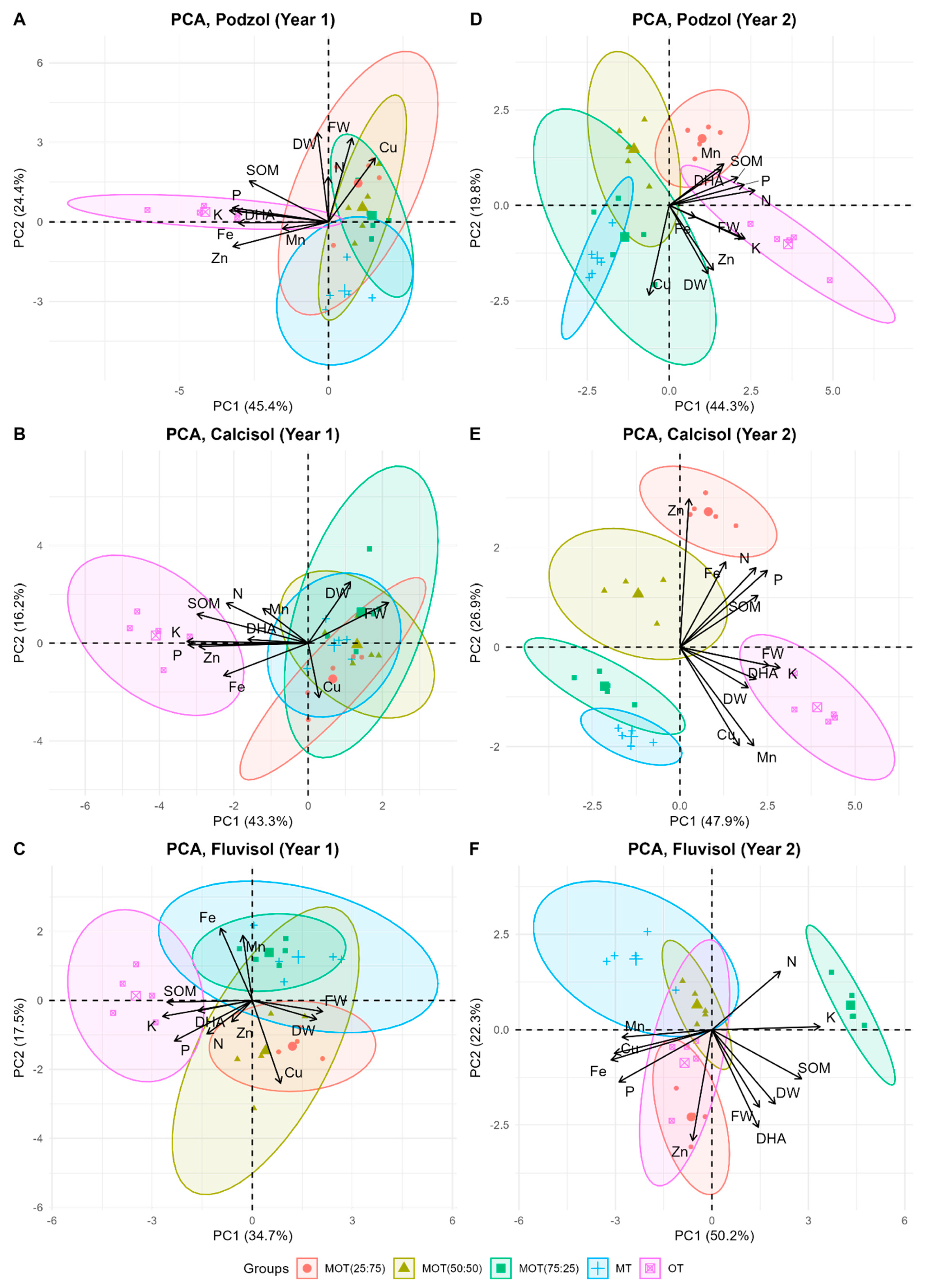
Figure 1. Principal component analysis (PCA) biplots showing the distribution of fertilization treatments and selected soil and plant variables. This analysis was performed for each soil type, podzol (A,D), calcisol (B,E), and fluvisol (C,F), and comprises data from the first year (AC) and the second year (DF) of the experiment. In the biplots, ellipses (95% confidence level) were added color-coded around fertilization treatments to visualize clustering patterns. The legend of the axes was with the principal components (PC1 and PC2) along with the respective percentage of variance explained. MT—soil fertilized with mineral fertilizer; MOT(75:25)—soil fertilized with 75% mineral and 25% organic fertilizers; MOT(50:50)—soil fertilized with 50% mineral and 50% organic fertilizers—MOT(25:75)—soil fertilized with 25% mineral and 75% organic fertilizers; OT—soil fertilized with organic fertilizer; FW—yield in fresh weight; DW—yield in dry weight; SOM—soil organic matter; DHA—dehydrogenase. N, P, K, Cu Fe, Zn, Mn—soil macro- and micronutrients.
Sustainability 17 11058 g001
Table 1. Mean values for total plant fresh and dry weight (FW and DW, respectively), expressed in g per pot, in the different soils and treatments, in the first year, with fertilization treatments [4], and in the second year (without any fertilization).
Treatment1st Year (g pot−1)2nd Year (g pot−1)
FWDWFWDW
Gleyic Podzol
MT34 ± 8.3 b5 ± 1.44 b14 ± 2.44 b3.3 ± 0.64 ab
MOT(75:25)61 ± 5.7 a11 ± 2.10 a16 ± 1.72 b3.4 ± 0.74 ab
MOT(50:50)64 ± 10.6 a13 ± 1.88 a16 ± 1.49 b2.8 ± 0.34 b
MOT(25:75)65 ± 21.8 a13 ± 3.57 a15 ± 1.29 b2.9 ± 0.28 b
OT53 ± 3.3 ab12 ± 1.09 a23 ± 3.47 a3.9 ± 0.53 a
Haplic Calcisol
MT89 ± 11.6 ab17 ± 1.42 ns21 ± 1.57 b4.1 ± 0.67 ns
MOT(75:25)109 ± 5.2 a20 ± 4.90 ns23 ± 2.78 b4.4 ± 0.75 ns
MOT(50:50)103 ± 5.6 a18 ± 1.37 ns23 ± 4.61 b4.2 ± 0.96 ns
MOT(25:75)90 ± 21.4 ab17 ± 1.79 ns25 ± 2.98 b4.3 ± 0.61 ns
OT80 ± 7.8 b16 ± 2.60 ns32 ± 2.30 a5.5 ± 1.02 ns
Haplic Fluvisol
MT112 ± 22.7 a22 ± 5.26 ns19 ± 2.62 c3.3 ± 0.64 b
MOT(75:25)115 ± 13.3 a20 ± 2.39 ns25 ± 3.42 ab4.6 ± 0.62 a
MOT(50:50)112 ± 10.9 a21 ± 3.97 ns20 ± 2.65 bc3.6 ± 0.48 ab
MOT(25:75)111 ± 9.5 a20 ± 2.00 ns23 ± 2.22 abc4.2 ± 0.41 ab
OT91 ± 3.6 b16 ± 1.90 ns27 ± 3.84 a4.2 ± 0.61 ab
FW—fresh weight; DW—dry weight; MT—soil fertilized with mineral fertilizer; MOT(75:25)—soil fertilized with 75% mineral and 25% organic fertilizers; MOT(50:50)—soil fertilized with 50% mineral and 50% organic fertilizers—MOT(25:75)—soil fertilized with 25% mineral and 75% organic fertilizers; OT—soil fertilized with organic fertilizer; ns—not significant; means in the same column, for each type of soil, with the same small letter do not differ significantly (p ≤ 0.05), as judged by the Tukey test.
Table 2. Mean values (n = 5) for SOM, N, P, and K (expressed as K2O) in the soils, for each treatment, at the end of the experiment, for each year.
TreatmentSOM (%)N (%)P (mg kg−1)K2O (mg kg−1)
1st Year2nd Year1st Year2nd Year1st Year2nd Year1st Year2nd Year
Gleyic Podzol
MT0.36 ± 0.05 cnd b0.03 ± 0.01 nsA0.02 ± 0.003 dB9.2 ± 1.05 bc9.013 ± 2.11 b16 ± 1.31 b
MOT(75:25)0.39 ± 0.09 bcB0.57 ± 0.03 aA0.04 ± 0.02 ns0.03 ± 0.005 c8.0 ± 1.22 cnd14 ± 0.52 bB16 ± 1.07 bA
MOT(50:50)0.46 ± 0.01 bcB0.56 ± 0.04 aA0.03 ± 0.01 ns0.03 ± 0.001 c8.7 ± 0.83 c12.716 ± 1.69 b17 ± 0.00 b
MOT(25:75)0.47 ± 0.05 aB0.61 ± 0.02 aA0.04 ± 0.01 ns0.04 ± 0.005 b12.5 ± 3.13 b18.715 ± 3.58 b17 ± 0.00 b
OT0.59 ± 0.04 aB0.73 ± 0.03 aA0.04 ± 0.01 nsB0.05 ± 0.005 aA19.9 ± 2.25 a25.999 ± 13.1 aA36 ± 2.94 aB
Haplic Calcisol
MT1.28 ± 0.05 b1.39 ± 0.09 b0.11 ± 0.02 b0.11 ± 0.003 c6.7 ± 0.47 cnd88 ± 8.44 bA48 ± 1.07 cB
MOT(75:25)1.32 ± 0.15 b1.39 ± 0.14 b0.12 ± 0.01 ab0.11 ± 0.006 bc7.3 ± 1.22 cnd75 ± 3.16 bA42 ± 1.31 dB
MOT(50:50)1.27 ± 0.02 bB1.56 ± 0.15 abA0.11 ± 0.01 b0.12 ± 0.001 b8.1 ± 0.87 bc9.675 ± 4.77 bA46 ± 1.70 cB
MOT(25:75)1.25 ± 0.08 bB1.64 ± 0.07 aA0.10 ± 0.01 bB0.15 ± 0.013 aA10.7 ± 1.96 b14.883 ± 6.29 bA50 ± 2.94 bB
OT1.78 ± 0.11 a1.72 ± 0.10 a0.14 ± 0.02 a0.15 ± 0.014 a21.9 ± 2.41 a16.6129 ± 18.9 aA63 ± 1.07 aB
Haplic Fluvisol
MT2.01 ± 0.03 cB2.18 ± 0.10 cA0.15 ± 0.02 ns0.14 ± 0.002 b49.8 ± 1.55 b40.2203 ± 15.0 cA152 ± 2.01 dB
MOT(75:25)2.19 ± 0.05 bB2.76 ± 0.11 aA0.14 ± 0.01 nsB0.18 ± 0.005 aA51.7 ± 3.99 b23.9238 ± 9.40. bcA290 ± 13.1 aA
MOT(50:50)2.22 ± 0.16 bcB2.42 ± 0.08 bA0.15 ± 0.04 ns0.17 ± 0.003 a59.8 ± 4.92 b45.9238 ± 12.9 bcA171 ± 3.13 cB
MOT(25:75)1.95 ± 0.09 cB2.48 ± 0.13 bA0.15 ± 0.02 nsA0.13 ± 0.007 bB56.3 ± 9.10 b46.8253 ± 27.8 bA184 ± 4.62 bB
OT2.57 ± 0.14 a2.54 ± 0.15 b0.17 ± 0.01 ns0.17 ± 0.026 a70.1 ± 4.71 a44.5352 ± 30.2 aA178 ± 2.94 bcB
SOM—soil organic matter; N—nitrogen; P—phosphorous; K2O—potassium oxide; MT—soil fertilized with mineral fertilizer; MOT(75:25)—soil fertilized with 75% mineral and 25% organic fertilizers; MOT(50:50)—soil fertilized with 50% mineral and 50% organic fertilizers—MOT(25:75)—soil fertilized with 25% mineral and 75% organic fertilizers; OT—soil fertilized with organic fertilizer; ns—not significant; nd—not detected; means in the same column, for each type of soil, with the same small letter do not differ significantly (p ≤ 0.05), as judged by the Tukey test; means in the same line, for each parameter, with the same capital letter do not differ significantly (p ≤ 0.05), as judged by the Tukey test.
Table 3. Mean values (n = 5) for Cu, Fe, Zn and Mn, for each treatment, at the end of the experiment, in each year.
TreatmentCu (mg kg−1)Fe (mg kg−1)Zn (mg kg−1)Mn (mg kg−1)
1st Year2nd Year1st Year2nd Year1st Year2nd Year1st Year2nd Year
Gleyic Podzol
MT2.2 ± 0.30 cB4.6 ± 0.38 aA42 ± 3.86 bB96 ± 8.23 aA10.6 ± 1.75 b9.7 ± 0.42 b18 ± 1.56 ns17 ± 0.30 d
MOT(75:25)2.8 ± 0.18 abcB4.7 ± 0.25 aA38 ± 3.21 bB63 ± 1.39 cA7.4 ± 0.29 cB9.6 ± 0.33 bA18 ± 0.87 ns21 ± 1.03 b
MOT(50:50)2.9 ± 0.59 abB3.9 ± 0.22 bcA42 ± 2.52 bB81 ± 4.41 bA7.3 ± 0.32 cB8.6 ± 0.13 cA20 ± 5.43 ns19 ± 0.52 c
MOT(25:75)3.4 ± 0.37 a3.8 ± 0.22 c38 ± 2.95 bB87 ± 1.90 abA7.3 ± 1.05 cB9.6 ± 0.05 bA15 ± 0.55 ns24 ± 0.89 a
OT2.3 ± 0.24 bcB4.3 ± 0.16 abA54 ± 12.0 aB92 ± 8.90 aA14.0 ± 1.95 aA10.1 ± 0.28 aB21 ± 7.98 ns21 ± 1.15 b
Haplic Calcisol
MT2.9 ± 0.13 B5.6 ± 0.14 aA68 ± 5.85 abc102 ± 7.06 b2.7 ± 0.32 b3.7 ± 0.10 d89 ± 6.54 a87 ± 2.37 b
MOT(75:25)2.9 ± 0.67 B4.5 ± 0.30 bA63 ± 5.79 cB90 ± 3.79 cA2.7 ± 0.69 bB4.7 ± 0.03 cA89 ± 12.8 a81 ± 3.54 c
MOT(50:50)3.0 ± 0.66 B4.0 ± 0.20 cA66 ± 5.97 bcB94 ± 4.91 bcA2.5 ± 0.54 bB6.3 ± 0.05 bA65 ± 5.09 b70 ± 1.94 d
MOT(25:75)3.3 ± 0.28 B4.6 ± 0.15 bA73 ± 6.88 abB127 ± 9.84 aA2.8 ± 0.65 bB7.9 ± 0.11 aA59 ± 4.06 b75 ± 1.92 d
OT2.9 ± 0.14 B5.9 ± 0.22 aA77 ± 3.40 aB105 ± 3.01 bA4.2 ± 0.08 a4.6 ± 0.10 c88 ± 2.17 a105 ± 2.50 a
Haplic Fluvisol
MT3.6 ± 0.21 bB7.1 ± 0.18 abA303 ± 13.9 aB381 ± 47.5 abA3.4 ± 0.283.7 ± 0.14 e314 ± 8.69 b324 ± 16.2 ab
MOT(75:25)4.0 ± 0.23 bB5.9 ± 0.17 dA275 ± 18.8 abc261 ± 5.73 c3.1 ± 0.76 B4.2 ± 0.08 dA379 ± 23.4 aA253 ± 6.00 cB
MOT(50:50)6.9 ± 0.44 a6.5 ± 0.25 c262 ± 20.7 bcB343 ± 10.6 bA3.2 ± 0.92 B6.1 ± 0.03 bA298 ± 9.72 b308 ± 6.35 b
MOT(25:75)6.3 ± 0.35 a6.8 ± 0.15 bc252 ± 8.42 cB394 ± 25.8 a3.8 ± 1.14 B9.3 ± 0.29 aA297 ± 21.8 b298 ± 10.5 b
OT3.9 ± 0.60 bB7.2 ± 0.24 aA300 ± 25.3 abB414 ± 9.79 aA3.8 ± 0.965.6 ± 0.28 c322 ± 35.2 b349 ± 34.0 a
Cu—copper; Fe—iron; Zn—zinc; Mn—manganese; MT—soil fertilized with mineral fertilizer; MOT(75:25)—soil fertilized with 75% mineral and 25% organic fertilizers; MOT(50:50)—soil fertilized with 50% mineral and 50% organic fertilizers—MOT(25:75)—soil fertilized with 25% mineral and 75% organic fertilizers; OT—soil fertilized with organic fertilizer; ns—not significant; means in the same column, for each type of soil, with the same small letter do not differ significantly (p ≤ 0.05), as judged by the Tukey test; means in the same line, for each element, with the same capital letter do not differ significantly (p ≤ 0.05), as judged by the Tukey test.
Table 4. Mean values for dehydrogenase activity (DHA expressed in µg TPF/g dry soil h), in each year, in the tested soils with different treatments.
TreatmentDHA (µg TPF/g Dry Soil Hour)
In the End of the 1st Year
DHA (µg TPF/g Dry Soil Hour)
In the End of the 2nd Year
Gleyic Podzol
MT0.314 ± 0.05 b0.478 ± 0.17 ns
MOT(75:25)0.348 ± 0.05 bB0.503 ± 0.11 nsA
MOT(50:50)0.117 ± 0.06 bB0.623 ± 0.13 nsA
MOT(25:75)0.416 ± 0.17 bB0.756 ± 0.24 nsA
OT1.073 ± 0.17 a0.743 ± 0.19 ns
Haplic Calcisol
MT4.593 ± 0.45 ns5.619 ± 1.01 b
MOT(75:25)4.834 ± 1.88 ns4.941 ± 0.52 b
MOT(50:50)6.040 ± 0.10 ns6.095 ± 0.83 b
MOT(25:75)5.775 ± 0.75 ns5.440 ± 0.99 b
OT6.351 ± 1.06 nsB8.108 ± 0.84 aA
Haplic Fluvisol
MT5.146 ± 0.55 nsA3.471 ± 0.31 dB
MOT(75:25)6.754 ± 0.84 nsA5.292 ± 0.59 abB
MOT(50:50)7.357 ± 1.20 nsA4.432 ± 0.46 cB
MOT(25:75)4.902 ± 0.44 nsB5.947 ± 0.37 aA
OT7.076 ± 1.43 nsA4.904 ± 0.41 bcB
DHA—dehydrogenase activity; MT—soil fertilized with mineral fertilizer; MOT(75:25)—soil fertilized with 75% mineral and 25% organic fertilizers; MOT(50:50)—soil fertilized with 50% mineral and 50% organic fertilizers—MOT(25:75)—soil fertilized with 25% mineral and 75% organic fertilizers; OT—soil fertilized with organic fertilizer; ns—not significant; means in the same column, for each type of soil, with the same small letter do not differ significantly (p ≤ 0.05), as judged by the Tukey test; means in the same line, for each element, with the same capital letter do not differ significantly (p ≤ 0.05), as judged by the Tukey test.
Disclaimer/Publisher’s Note: The statements, opinions and data contained in all publications are solely those of the individual author(s) and contributor(s) and not of MDPI and/or the editor(s). MDPI and/or the editor(s) disclaim responsibility for any injury to people or property resulting from any ideas, methods, instructions or products referred to in the content.



