Success Factors of IT Project Management in a Country Developing an Innovative and Sustainable Economy—The Case of Kazakhstan


Abstract
1. Introduction
2. Literature Review
2.1. Standards of Project Management
2.2. Comparative Analysis Between Selected Countries Using Project Management
2.3. Prospects for Success in IT Project Management
3. Materials and Methods
3.1. Challenges of IT Project Management During the Transition to Innovative and Sustainable Economy in Kazakhstan in the Period of Digitalization
3.2. Methodology and Sample Description
- The organization maintains a structural unit (e.g., a project office) responsible for IT project implementation.
- The organization employs certified or experienced project managers within this project office.
- The project office staff have prior experience implementing IT projects using a project-based approach.
- Part A: Respondents rated the impact of PM practices on project success using a six-point scale (from “highly positive” to “negative influence” or “no opinion”).
- Part B: Respondents indicated whether specific practices were applied in their enterprises (“yes”, “no”, “don’t know”).
4. Results
4.1. Analysis of In-Depth Interviews with Experts
4.2. Analysis of the Survey Results
4.2.1. The Quality of Project Management in the Surveyed Enterprises
- communicating project goals and plans,
- distributing work within the team,
- tracking project progress,
- conducting stakeholder meetings,
- participating in client-requested events, and
- monitoring tasks against the project plan.
- Initiating—defining and authorizing the project;
- Planning—determining scope, strategy, and resource allocation;
- Executing—delivering outputs and achieving objectives;
- Monitoring and Controlling—tracking progress and managing change;
- Closing—formally completing project work and documenting outcomes.
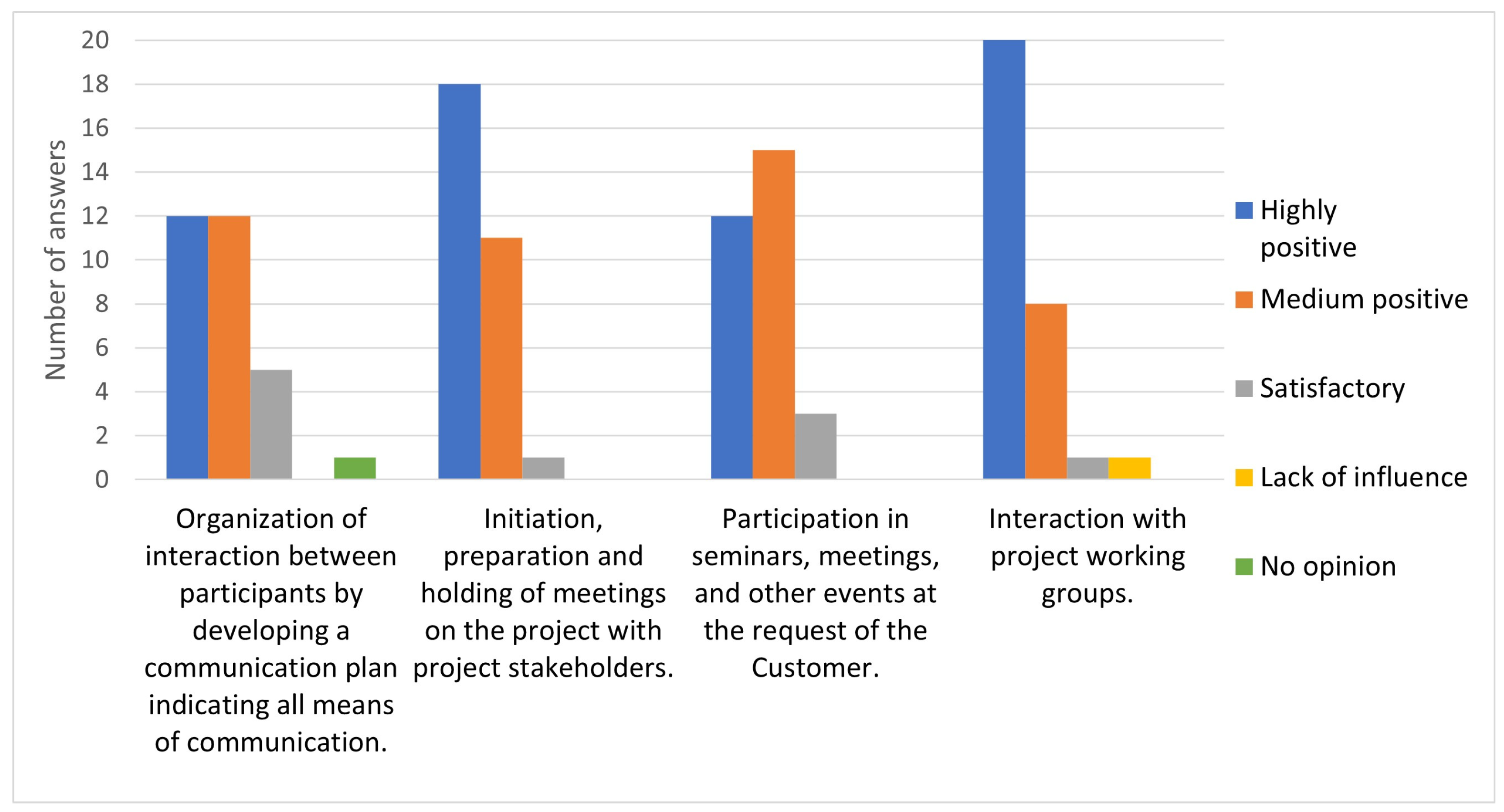
- interaction with project teams (reported in 9 out of 13 enterprises, 20 mentions),
- stakeholder meetings (conducted in 7 enterprises, 18 mentions).
4.2.2. Evaluation of Project Management in the Surveyed Enterprises
- Clear documentation of project objectives;
- Informing the team about project goals and plans;
- Team discussions on work distribution;
- Tracking project progress;
- Meetings with stakeholders;
- Participation in client-requested events;
- Monitoring tasks according to the project plan.
- Definition of environmental and technical requirements;
- Product quality management;
- Integration-stage planning (e.g., preparation of production environments, downtime budgeting, overtime pay, and managerial supervision).
4.2.3. The Relationship Between the Declared Rank of Key Project Management Processes and the Degree of Their Implementation
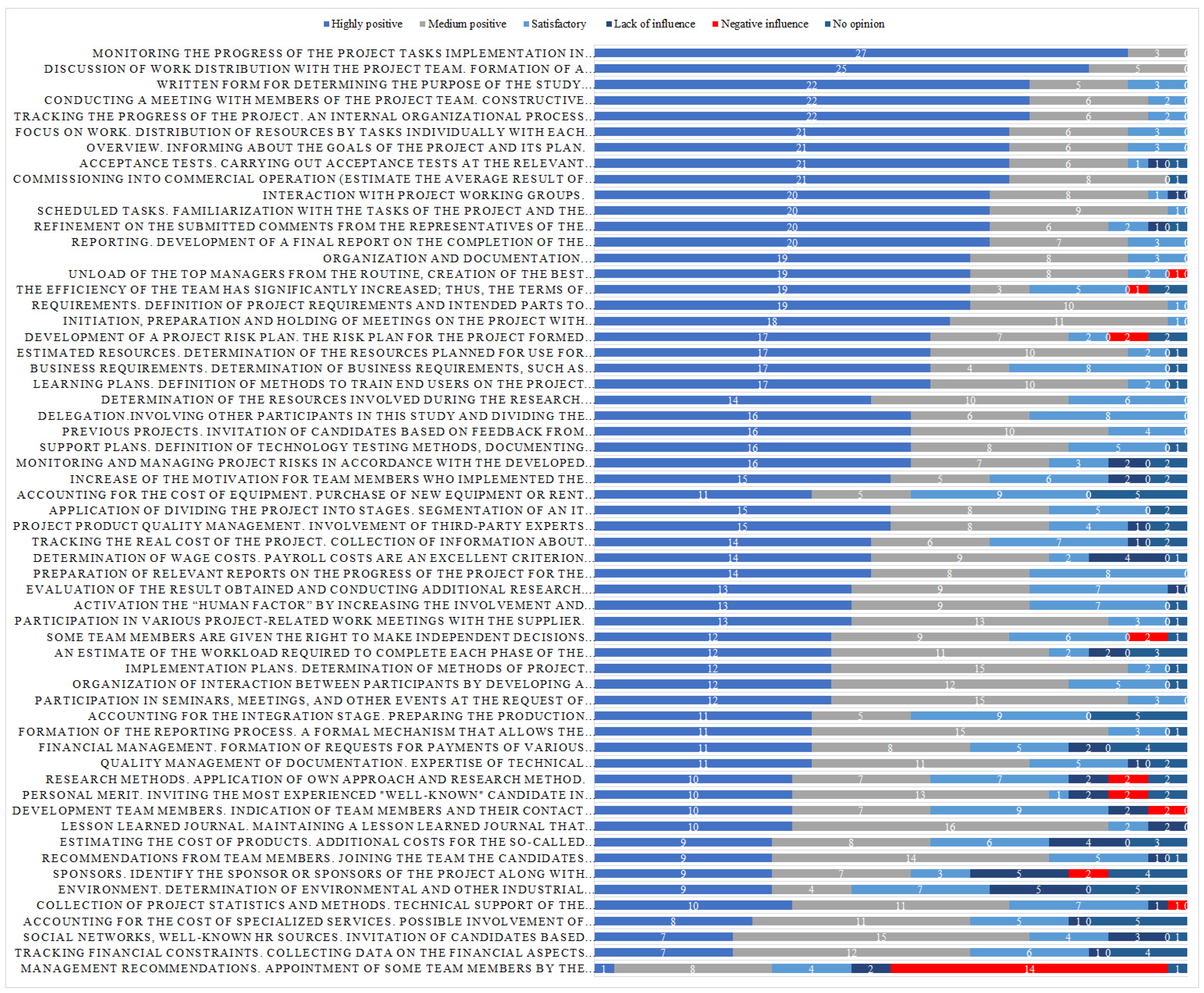
- highly positive,
- moderately positive,
- satisfactory,
- no influence,
- negative influence,
- no opinion.
5. Discussion
6. Conclusions
Author Contributions
Funding
Institutional Review Board Statement
Informed Consent Statement
Data Availability Statement
Conflicts of Interest
Appendix A
- How experienced are you as a Project Manager? (number of years)
- Do you have a project management qualification, certification, or membership?
- What is the most desired skill that is required to become a successful project manager according to your experience? Please give a couple of examples regarding your past projects.
- 4.
- How mature do you think your organization is in terms of project management?
- 5.
- What’s your preferred project management methodology?
- 6.
- What project management software (tools) do you prefer?
- 7.
- Which specific products do you currently use?
- 8.
- What methods would help you deliver projects better?
- 9.
- Did you have a difficult project in your experience? What was this complex project about, and how did you manage to implement it?
- 10.
- What are the greatest challenges in delivering projects?
- 11.
- How do you deal when you’re overwhelmed or underperforming?
- 12.
- Have you managed remote teams and outsourced resources?
- 13.
- Work from home has become the new reality in the post-COVID-19 world. How well are you prepared to manage a remote team?
- 14.
- What difficulties did you encounter while working remotely? (team, Internet, communication)
- 15.
- Do you think that remote project management work can be as effective as office (traditional) work?
- 16.
- What is your communication style with your team?
- 17.
- What were the communication challenges during your projects?
- 18.
- How do you manage team members who are not working to their full potential?
- 19.
- What is your strategy for working with an underperforming team member?
- 20.
- Do you report “bad” news? If yes, how do you report bad news?
- 21.
- How have you handled disgruntled employees?
- 22.
- What are some examples of times you’ve kept your promise even when that might have been difficult?
- 23.
- How do you ensure you and your team deliver or exceed customer expectations?
- 24.
- Suppose the project has gone off the rails. What steps would you take to get it back on track?
- 25.
- Suppose the customer is not happy about the quality of the project outcomes. How do you handle the situation? What is your way of handling an unhappy stakeholder?
- 26.
- How do you go about managing the performance of your team?
- 27.
- How do you motivate team members?
- 28.
- What are some of the tools and resources you’ve used to develop your team?
- 29.
- Do you delegate?
- 30.
- How easily do you delegate responsibility?
- 31.
- How do you monitor and review the delegated responsibilities?
- 32.
- How do you set goals for your team? How do you track these goals?
- 33.
- What are the techniques you may use to define the scope of a project?
- 34.
- Describe the team forming process you follow in project management.
- 35.
- What general metrics do you use to determine if a project is progressing on track?
- 36.
- Describe two areas in your current project, where there is a high level of uncertainty. How do you tackle these uncertainties?
- 37.
- How do you control changes to your project?
- 38.
- Do you seek help outside of the project team?
- 39.
- What approach do you take when a project hits a roadblock and does not go according to plan, despite the team’s best efforts?
- 40.
- How do you ensure that your project is always on track?
- 41.
- What tools do you use as a manager to plan your activities as well as that of your team?
- 42.
- How do you help the team prioritize competing or simultaneously urgent tasks?
- 43.
- How do you prioritize tasks on a project?
- 44.
- What is your strategy for prioritizing the tasks?
- 45.
- Give a few examples of proactive decision-making in your past projects
- 46.
- Can you give a few examples of a time when you made a tough decision, and it backfired?
- 47.
- What is your strategy to deal with internal conflicts among the team members?
- 48.
- Do conflicts affect the overall project outcome?
- 49.
- How do you gain agreement with teams?
Appendix B
- Written form for determining the purpose of the study.
- 2.
- Determination of the resources involved during the research.Maintaining a list of viewed publications. Information sources include the following:
- -
- previous experience;
- -
- the experience of other people;
- -
- proven and high-quality Internet sites;
- -
- specialized magazines;
- -
- professional literature on relevant topics.
- 3.
- Delegation.
- 4.
- Research methods.
- 5.
- Organization and documentation.
- 6.
- Evaluation of the result obtained and conducting additional research.
- Unload of the top managers from the routine, creation of the best conditions for solving strategic management tasks.
- Activation the “human factor” by increasing the involvement and interest of the project team.
- Some team members are given the right to make independent decisions that were effectively reflected in the result of the project.
- The efficiency of the team has significantly increased; thus, the terms of the project were met on time for the Customer.
- Increase in the motivation for team members who implemented the project and were able to reveal new professional qualities of team members.
- Application of dividing the project into stages. Segmentation of an IT project into its component parts, which makes it easier to determine characteristic points and estimate the amount of work at each stage.
- Accounting for the integration stage. Preparing the production environment for the implementation of the project requires budgeting for system shutdown times, delays, overtime payment and time required for the project manager to supervise the work carried out on schedule.
- An estimate of the workload required to complete each phase of the project. Tariff rates for time tracking of each team member are planned at each stage of the project.
- Accounting for the cost of specialized services. Possible involvement of consulting or subcontracting team members.
- Accounting for the cost of equipment. Purchase of new equipment or rent of host premises and servers for the deployment of an IT project.
- Estimating the cost of products. Additional costs for the so-called “office work” that are required at all stages of the IT project.
- Development of a project risk plan. The risk plan for the project formed during the study.
- Previous projects. Invitation of candidates based on feedback from colleagues from previous projects. Selection of candidates based on the opinion of colleagues.
- Personal merit. Inviting the most experienced “well-known” candidate in the field of IT to give a future project a certain status or fame.
- Management recommendations. Appointment of some team members by the management despite some lack of competence of these candidates in the part of the project that is planned in the future.
- Recommendations from team members. Joining the team the candidates invited by the team members, who recommended them.
- Social networks, well-known HR sources. Invitation of candidates based on submitted CVs from Internet sources. Based on the results of the interview, a general project team is formed.
- Overview. Informing about the goals of the project and its plan.
- Sponsors. Identify the sponsor or sponsors of the project along with their contact information.
- Development team members. Indication of team members and their contact information.
- Requirements. Definition of project requirements and intended parts to be supplied.
- Scheduled tasks. Familiarization with the tasks of the project and the work division scheme. May contain a chart.
- Estimated resources. Determination of the resources planned for use for the implementation of the project. Resources include users, equipment and services.
- Environment. Determination of environmental and other industrial requirements for the project plan.
- Business requirements. Determination of business requirements, such as accounted business cycles, anticipated project deliverables, and meeting schedule.
- Implementation plans. Determination of methods of project implementation to the state of industrial use.
- Support plans. Definition of technology testing methods, documenting methods, and support methods by own- or third-party companies.
- Learning plans. Definition of methods to train end users on the project supplied parts.
- Discussion of work distribution with the project team. Formation of a responsible team, whose members build trusting relationships with each other. Regular general meeting defined by formal regulations, as well as the use of informal types of communication with the team.
- Focus on work. Distribution of resources by tasks individually with each member of the project team.
- Conducting a meeting with members of the project team. Constructive meeting on project tasks with the ability to present reports from each member of the project team on the work performed.
- Tracking the progress of the project. An internal organizational process for team reporting on completed tasks, which reflects the progress of the project and allows to analyze the amount of work done, the budget and the time remaining until the completion of the project.
- Formation of the reporting process. A formal mechanism that allows the team to regularly report to the manager on the progress of the project schedule.
- Collection of project statistics and methods. Technical support of the process of collecting data on the spent working time and the percentage of tasks completed. The methods can be different, for example, e-mail, spreadsheets, web application (form), Microsoft project, Microsoft Project Central, etc.
- Tracking financial constraints. Collecting data on the financial aspects of the project by the project manager for the project sponsor.
- Financial management. Formation of requests for payments of various nature related to the project, purchase orders, payments, invoices, etc.
- Tracking the real cost of the project. Collection of information about payment of invoices to vendors and consultants, as well as the time spent by team members on tasks already completed.
- Determination of wage costs. Payroll costs are an excellent criterion for constantly checking the completion of a project against the budget cost of the project.
- Organization of interaction between participants by developing a communication plan indicating all means of communication.
- Initiation, preparation and holding of meetings on the project with project stakeholders.
- Participation in seminars, meetings, and other events at the request of the Customer.
- Interaction with project working groups.
- Monitoring the progress of the project tasks implementation in accordance with the project work plan.
- Participation in various project-related work meetings with the Supplier.
- Preparation of relevant reports on the progress of the project for the Sponsor and the Customer of the project.
- Monitoring and managing project risks in accordance with the developed risk plan.
- Quality management of documentation. Expertise of technical documentation at an accredited laboratory that has an appropriate license for these types of work.
- Project product quality management. Involvement of third-party experts with a “fresh eye” to carry out work on testing the completed project work, which will help in improving the quality of the software.
- Acceptance tests. Carrying out acceptance tests at the relevant organizations and putting into commercial operation.
- Refinement on the submitted comments from the representatives of the tested laboratory.
- Commissioning into commercial operation (estimate the average result of commissioning into commercial operation).
- Reporting. Development of a final report on the completion of the project, indicating the achieved goals of the project.
- Lesson learned journal. Maintaining a lesson learned journal that reflects all the challenges the team and project manager faced.
References
- Trocki, M. Modern Project Management; PriceWaterhouseCoopers: Warsaw, Poland, 2012. [Google Scholar]
- Samid, G. Too much project management: A vice in disguise (and how to minimize it). Cost Eng. 1995, 37, 18. [Google Scholar]
- Kaplan, R.S.; Norton, D.P. The Balanced Scorecard—Measures that drive Performance. Harv. Bus. Rev. 1992, 70, 71–79. [Google Scholar]
- Trocki, M. Project Management Methods and Standards; PriceWaterhouseCoopers: Warsaw, Poland, 2017. [Google Scholar]
- Carlson, R.; Turner, R. Review of Agile Case Studies for Applicability to Aircraft Systems Integration. Procedia Comput. Sci. 2013, 16, 469–474. [Google Scholar] [CrossRef][Green Version]
- Pohler, D.; Willness, C. Balancing interests in the search for occupational legitimacy: The HR professionalization project in Canada. Hum. Resour. Manag. 2014, 53, 467–488. [Google Scholar] [CrossRef]
- Chen, Y.-S.; Chang, B.-G.; Lee, C.-C. The association between continuing professional education and the financial performance of public accounting firms. Int. J. Hum. Resour. Manag. 2008, 19, 1720–1737. [Google Scholar] [CrossRef]
- Lundin, R.A.; Söderholm, A. A theory of the temporary organization. Scand. J. Manag. 1995, 11, 437–455. [Google Scholar] [CrossRef]
- Marcelino-Sádaba, S.; Pérez-Ezcurdia, A.; González-Jaen, L.F. Using project management as a way to sustainability. J. Clean. Prod. 2015, 99, 1–16. [Google Scholar] [CrossRef]
- Sabini, L.; Muzio, D.; Alderman, N. 25 years of ‘sustainable projects’: What we know and what the literature says. Int. J. Proj. Manag. 2019, 37, 820–838. [Google Scholar] [CrossRef]
- Silvius, G.; Schipper, R. Sustainability in project management: A literature review and impact analysis. Soc. Bus. 2014, 4, 63–96. [Google Scholar] [CrossRef]
- Zakrzewska, M.; Piwowar-Sulej, K.; Jarosz, S.; Sagan, A.; Sołtysik, M. The linkage between Agile project management and sustainable development: A theoretical and empirical view. Sustain. Dev. 2022, 30, 855–869. [Google Scholar] [CrossRef]
- Ahmad, M.O.; Al-Baik, O. Fostering social sustainability in large-scale agile projects: Insights from Swedish software companies. J. Decis. Syst. 2025, 34, 2464749. [Google Scholar] [CrossRef]
- Kyriakogkonas, P.; Garefalakis, A.; Pappa, E.; Kagias, P. Sustainable Project Management under the Light of ESG Criteria: A Theoretical Approach. Theor. Econ. Lett. 2022, 12, 1517–1538. [Google Scholar] [CrossRef]
- Ebirim, W.; Usman, F.O.; Montero, D.; Ninduwezuor-Ehiobu, N.; Olu-lawal, K.; Emmanuel, E. Project management strategies for implementing energy-efficient cooling solutions in emerging data center markets. World J. Adv. Res. Rev. 2024, 21, 1802–1809. [Google Scholar] [CrossRef]
- Pantović, V.; Vidojević, D.; Vujičić, S.; Sofijanić, S.; Jovanović-Milenković, M. Data-Driven Decision Making for Sustainable IT Project Management Excellence. Sustainability 2024, 16, 3014. [Google Scholar] [CrossRef]
- Gaweł, B.; Rębiasz, B.; Paliński, A. Integrating Probability and Possibility Theory: A Novel Approach to Valuing Real Options in Uncertain Environments. Appl. Sci. 2025, 15, 7143. [Google Scholar] [CrossRef]
- Rehman, I.U.; Ullah, S.; Rauf, A.; Shahid, A.A. Scope management in agile versus traditional software development methods. In Proceedings of the 2010 National Software Engineering Conference, Rawalpindi, Pakistan, 4–5 October 2010; pp. 1–6. [Google Scholar]
- Marnada, P.; Raharjo, T.; Hardian, B.; Prasetyo, A. Agile project management challenge in handling scope and change: A systematic literature review. Procedia Comput. Sci. 2022, 197, 290–300. [Google Scholar] [CrossRef]
- Kerzner, H.; Saladis, F. Value-Driven Project Management; Wiley & Sons: Hoboken, NJ, USA, 2009. [Google Scholar]
- Project Management Institute. A Guide to the Project Management Body of Knowledge (PMBOK Guide), 6th ed.; Project Management Institute: Newtown Square, PA, USA, 2017. [Google Scholar]
- Project Management Institute. The Standard for Portfolio Management, 4th ed.; Project Management Institute: Newtown Square, PA, USA, 2017. [Google Scholar]
- Project Management Institute. The Standard for Program Management, 4th ed.; Project Management Institute: Newtown Square, PA, USA, 2017. [Google Scholar]
- Taizhanova, Z.A. Kazakhstan on the way to Project Management. In Proceedings of the 1st International Congress of Project Managers in the Republic of Kazakhstan, Almaty, Kazakhstan, 1 February 2015; p. 79. [Google Scholar]
- International Standard ISO 9000; Quality Management. Cert Academy: Puchong, Malaysia, 2015.
- APM. Association for Project Management Body of Knowledge; APM: London, UK, 2013. [Google Scholar]
- Serbskaya, O.V. Modern methods of project management. J. Mater. Afanasyev Read. 2016, 128–132. Available online: https://cyberleninka.ru/article/n/sovremennye-metody-upravleniya-proektami.pdf (accessed on 30 August 2025).
- Beck, K.; Beedle, M.; van Bennekum, A.; Cockburn, A.; Cunningham, W.; Fowler, M.; Grenning, J.; Highsmith, J.; Hunt, A.; Jeffries, R.; et al. Manifesto for Agile Software Development. 2001. Available online: https://agilemanifesto.org/ (accessed on 30 August 2025).
- Bohinc, T. Grundlagen des Projektmanagements: Methoden, Techniken und Tools für Projektleiter; GABAL: Offenbach, Germany, 2019. [Google Scholar]
- Brechner, E. Agile Project Management with Kanban; Microsoft Press: Redmond, WA, USA, 2015. [Google Scholar]
- Sutherland, J.; Sutherland, J.J. Scrum: The Art of Doing Twice the Work in Half the Time; Crown Publishing: New York, NY, USA, 2015. [Google Scholar]
- Preubig, J. Agiles Projektmanagement: Agilität und Scrum im Klassischen Projektumfeld; Haufe Lexware: Freiburg, Germany, 2018. [Google Scholar] [CrossRef]
- Wysocki, R.K. Effective Project Management: Traditional, Agile, Extreme, 7th ed.; Wiley: Hoboken, NJ, USA, 2014. [Google Scholar]
- Axelos. PRINCE2 Agile; The Stationery Office: London, UK, 2017. [Google Scholar]
- Alecsandrova, T.V. Improving effectiveness of project management in organizations based on flexible Agile methodology. J. Econ. Bus. 2019, 9, 11. [Google Scholar]
- Terentyeva, Z.S.; Khalizova, I.A. Flexible project management methods. Azimuth Sci. Res. Econ. Adm. 2019, 1, 374–375. Available online: https://cyberleninka.ru/article/n/gibkie-metody-upravleniya-proektami-analiz-i-sravnenie/viewer (accessed on 30 August 2025).
- Surzhikov, M.A. Improvement of foreign trade using the Six Sigma methodology. Bull. Rostov State Econ. Univ. 2010, 3, 38–41. [Google Scholar]
- Schoeneberg, K.-P. Komplexitätsmanagement in Unternehmen; Gabler: Wiesbaden, Germany, 2014. [Google Scholar]
- Productlab. Top 7 Project Management Methods: Agile, Scrum, Kanban, PRINCE2 and Others. 2025. Available online: https://www.pmservices.ru/project-management-news/top-7-metodov-upravleniya-proektami-agile-scrum-kanban-prince2-i-drugie/ (accessed on 11 March 2025).
- Ohara, S. P2M: A Guidebook of Project and Program Management for Enterprise Innovation; Project Management Association of Japan: Tokyo, Japan, 2001. [Google Scholar]
- Dolezal, J.; Lacko, B.; Machal, P. Project Management According to IPMA; Grada Publishing: Prague, Czech Republic, 2012. [Google Scholar]
- Dvorak, D.; Repal, M.; Marecek, M. Project Portfolio Management: The Best Practise of Portfolio Management; Computer Press: Brno, Czech Republic, 2011. [Google Scholar]
- Mironenko, N.V.; Leonova, O.V. Evolution of project management development in Russia and abroad. Adm. Consult. 2017, 6. [Google Scholar] [CrossRef]
- Blažević, G.; Mišić, S.; Šimac, M. Importance of managing PMO in Croatian PM market. Procedia Soc. Behav. Sci. 2014, 119, 949–956. [Google Scholar] [CrossRef][Green Version]
- Medeubaeva, M. How to Implement Project Management in Kazakhstan. 2019. Available online: https://inbusiness.kz/ru/news/kak-vnedrit-proektnoe-upravlenie-v-kazahstane (accessed on 2 November 2020).
- Omar, B.K. Analysis of project management in Kazakhstan. J. Econ. Res. Amp; Bus. Adm. 2014, 2, 214–219. Available online: https://be.kaznu.kz/index.php/math/article/view/91 (accessed on 30 August 2025).
- Crawford, L.; Hassner-Nahmias, A.H. Competencies for managing change. Int. J. Proj. Manag. 2010, 28, 405–412. [Google Scholar] [CrossRef]
- Sirisomboonsuk, P.; Gu, V.C.; Cao, R.Q.; Burns, J.R. Relationships between project governance and information technology governance and their impact on project performance. Int. J. Proj. Manag. 2018, 36, 288–299. [Google Scholar] [CrossRef]
- Aapaoja, A.; Herrala, M.; Pekuri, A.; Haapasalo, H. The characteristics of and cornerstones for creating integrated teams. Int. J. Manag. Proj. Bus. 2013, 6, 695–713. [Google Scholar] [CrossRef]
- Bedwell, W.; Wildman, J.; DiazGranados, D.; Salazar, M.; Kramer, W. Collaboration at work: An integrative multilevel conceptualization. Hum. Resour. Manag. Rev. 2012, 22, 128–145. [Google Scholar] [CrossRef]
- Susskind, L.; Camacho, A.; Schenk, T. A critical assessment of collaborative adaptive management in practice. J. Appl. Ecol. 2011, 49, 47–51. [Google Scholar] [CrossRef]
- Kanwal, N.; Zafar, M.S.; Bashir, S. The combined effects of managerial control, resource commitment, and top management support on the successful delivery of information systems projects. Int. J. Proj. Manag. 2017, 35, 1459–1465. [Google Scholar] [CrossRef]
- Zulch, B.G. Communication: The foundation of project management. Procedia Technol. 2014, 16, 1000–1009. [Google Scholar] [CrossRef]
- Mastrogiacomo, S.; Missonier, S.; Bonazzi, R. Talk before it’s too late: Reconsidering the role of conversation in information systems project management. J. Manag. Inf. Syst. 2014, 31, 44–78. [Google Scholar] [CrossRef]
- Martinsuo, M.; Hoverfält, P. Change program management: Toward a capability for managing value-oriented, integrated multi-project change in its context. Int. J. Proj. Manag. 2017, 36, 134–146. [Google Scholar] [CrossRef]
- Mao, J.Y.; Lee, J.N.; Deng, C.P. Vendors’ perspectives on trust and control in offshore information systems outsourcing. Inf. Manag. 2008, 45, 482–492. [Google Scholar] [CrossRef]
- El-Sabaa, S. The skills and career path of an effective project manager. Int. J. Proj. Manag. 2001, 19, 1–3. [Google Scholar] [CrossRef]
- Rehman, R.; Shahzad, M.; Farooq, M.S.; Javaid, M.U. Impact of leadership behavior of a project manager on his/her subordinate’s job attitudes and job outcomes. Asia Pac. Manag. Rev. 2020, 25, 38–39. [Google Scholar] [CrossRef]
- Kostalova, J.; Tetrevova, L.; Svedikc, J. Support of Project Management Methods by Project Management Information System. Procedia Soc. Behav. Sci. 2015, 210, 97. [Google Scholar] [CrossRef]
- Ahlemann, F. Towards a conceptual reference model for project management information systems. Int. J. Prod. Manag. 2009, 27, 19–30. [Google Scholar] [CrossRef]
- Ferreira, A.; Otley, D. The design and use of performance management systems: An extended framework for analysis. Manag. Account. Res. 2009, 20, 263–282. [Google Scholar] [CrossRef]
- Sakka, O.; Barki, H.; Cote, L. Interactive and diagnostic uses of management control systems in IS projects: Antecedents and their impact on performance. Inf. Manag. 2013, 50, 265–274. [Google Scholar] [CrossRef]
- Ireland, L.R. Customer satisfaction: The project manager’s role. Int. J. Proj. Manag. 1992, 10, 123–127. [Google Scholar] [CrossRef]
- Blindenbach-Driessen, F.; Van den Ende, J. Innovation in project-based firms: The context dependency of success factors. Res. Policy 2006, 35, 545–561. [Google Scholar] [CrossRef]
- Bassellier, G.; Reich, B.H.; Benbasat, I. Information technology competence of business managers: A definition and research model. J. Manag. Inf. Syst. 2001, 17, 159–182. [Google Scholar] [CrossRef]
- Nazarbayev, N.A. Strategy Kazakhstan—2050. New Political Course of the Established State: Message of the President of the Republic of Kazakhstan. 2012. Available online: https://www.akorda.kz/en/addresses/addresses_of_president/address-by-the-president-of-the-republic-of-kazakhstan-leader-of-the-nation-nnazarbayev-strategy-kazakhstan-2050-new-political-course-of-the-established-state (accessed on 11 November 2020).
- ISO 21500:2012; Guidance on Project Management—National Standard of the Republic of Kazakhstan. ISO: Geneva, Switzerland, 2012.
- Karmazina, L.I.; Nekrassova, N.A.; Bolatzhanuly, T. Project management technology development in the Republic of Kazakhstan: Current situation and problems. Actual Probl. Econ. 2014, 12, 180–189. Available online: www.irbis-nbuv.gov.ua (accessed on 30 August 2025).
- Esengeldina, A.S. The Project management: Problems and perspectives of development in RK. Bull. Natl. Acad. Sci. Repub. Kazakhstan 2015, 4, 59–64. [Google Scholar]
- State Program of Industrial and Innovative Development of the Republic of Kazakhstan for 2015–2019. Available online: https://policy.asiapacificenergy.org/node/309 (accessed on 11 September 2025).
- Kuprava, T.A. Project Management. Introductory Course: Textbook; RUDN Publishing House: Moscow, Russia, 2008; p. 121. [Google Scholar]
- Zerde. National Info Communication Holding Zerde. 2020. Available online: https://zerde.kz (accessed on 30 August 2020).
- Rosenthal, M. Qualitative research methods: Why, when, and how to conduct interviews and focus groups in pharmacy research. Curr. Pharm. Teach. Learn. 2016, 8, 509–516. [Google Scholar] [CrossRef]
- ST RK 2014; National Standard of the Republic of Kazakhstan “Guidance on Project Management” СТ РК ISO 21500-2014. ISO 21500:2012 Guidance on project management: Astana, Kazakhstan, 2014.
- Uluocak, B. Critical Success Factors (CSFs) Affecting Project Performance in Turkish IT Sector; Paper presented at PMI® Global Congress 2013—EMEA, Istanbul, Turkey; Project Management Institute: Newtown Square, PA, USA, 2013. [Google Scholar]


| Standard | Function |
|---|---|
| Project Management Body of Knowledge (PMBoK) [21] | Provides a foundational framework of processes and knowledge areas for planning, executing, monitoring, and closing projects across industries |
| The Standard for Project Portfolio Management (PPM) [22] | Defines processes for selecting, prioritizing, and governing a portfolio of projects to align investments with organizational strategy and optimize value |
| The Standard for Program Management [23] | Guides the coordinated management of related projects to realize benefits, manage interdependencies, and achieve outcomes not attainable by projects alone |
| Organizational Project Management Maturity Model (OPM3) | Provides a maturity framework for assessing and improving enterprise capabilities in project, program, and portfolio management to support strategic goals |
| ISO International Standards (ISO 9000 series) [25] | Establishes quality-management principles and requirements that standardize processes and drive continual improvement across the organization |
| Association for Project Management (APM) Body of Knowledge [26] | Defines a professional competency and knowledge framework for project management practice, methods, and governance |
| Key Factor | Brief Description | Number of Answers |
|---|---|---|
| Communication | Open and continuous communication drives project success | 5 |
| Motivation | Financial, psychological, and personal involvement sustain team motivation | 5 |
| Constructive Discussion | Gathering input and suggestions from all team members fosters inclusion | 5 |
| Tools | A multifunctional PMIS streamlines and accelerates the entire project workflow | 5 |
| Delegation | Assigning authority appropriately reduces workload and supports goal achievement | 4 |
| Work Format | Traditional in-person collaboration minimizes misunderstandings with clients | 4 |
| Team Building | Informal meetings strengthen team spirit and reduce stress and conflicts | 4 |
| Mentoring | Experienced members mentor junior colleagues to build competence | 3 |
| Change Management | Integrating change management into project planning mitigates disruption | 2 |
| Risk Management | Identifying and balancing risks ensures better preparedness | 2 |
| Interim Results | Presenting intermediate results increases client confidence | 2 |
| Team Composition | Matching team roles to individual psychotypes improves collaboration | 2 |
| Domain Analysis | Conducting a thorough survey of the project domain and client needs | 2 |
| Process Group | Characteristic | Details | Number of Answers | ||
|---|---|---|---|---|---|
| Yes | No | Don’t Know | |||
| Initiation | Determining of project requirements | Written form for determining the purpose of the study | 30 | 0 | 0 |
| Determination of the resources involved during the research | 26 | 4 | 0 | ||
| Delegation | 25 | 4 | 1 | ||
| Research methods | 18 | 9 | 3 | ||
| Organization and documentation | 29 | 1 | 0 | ||
| Evaluation of the result obtained and conducting additional research | 22 | 6 | 2 | ||
| Planning | Budget planning | Application of dividing the project into stages | 21 | 4 | 5 |
| Accounting for the integration stage | 5 | 18 | 7 | ||
| An estimate of the workload required to complete each phase of the project | 16 | 10 | 4 | ||
| Accounting for the cost of specialized services | 20 | 4 | 6 | ||
| Accounting for the cost of equipment | 19 | 4 | 7 | ||
| Estimating the cost of products | 15 | 9 | 6 | ||
| Development of a project risk plan | 22 | 6 | 2 | ||
| Formation of an IT project development team | Previous projects | 23 | 3 | 4 | |
| Personal merit | 13 | 13 | 4 | ||
| Management recommendations | 16 | 9 | 5 | ||
| Recommendations from team members | 21 | 5 | 4 | ||
| Social networks, well-known HR sources | 19 | 8 | 3 | ||
| Project planning | Overview | 30 | 0 | 0 | |
| Sponsors | 17 | 8 | 5 | ||
| Development team members | 24 | 5 | 1 | ||
| Requirements | 28 | 0 | 2 | ||
| Scheduled tasks | 28 | 1 | 1 | ||
| Estimated resources | 27 | 0 | 3 | ||
| Environment | 8 | 14 | 8 | ||
| Business requirements | 28 | 0 | 2 | ||
| Implementation plans | 25 | 2 | 3 | ||
| Support plans | 19 | 6 | 5 | ||
| Learning plans | 26 | 1 | 3 | ||
| Project implementation | Implementation of an IT project | Discussion of work distribution with the project team | 30 | 0 | 0 |
| Focus on work | 26 | 4 | 0 | ||
| Conducting a meeting with members of the project team | 28 | 2 | 0 | ||
| Tracking the progress of the project | 30 | 0 | 0 | ||
| Formation of the reporting process | 26 | 2 | 2 | ||
| Collection of project statistics and methods | 25 | 3 | 2 | ||
| Tracking financial constraints | 13 | 11 | 6 | ||
| Financial management | 20 | 6 | 4 | ||
| Tracking the real cost of the project | 20 | 5 | 5 | ||
| Determination of wage costs | 20 | 6 | 4 | ||
| Communications | Communication plan | 19 | 9 | 2 | |
| Meetings with project stakeholders | 30 | 0 | 0 | ||
| Participation in meetings | 30 | 0 | 0 | ||
| Interaction with project working groups | 27 | 3 | 0 | ||
| The relationship of the project manager with the project team | Unload of the top managers from the routine, creation of the best conditions for solving strategic management tasks | 24 | 6 | 0 | |
| Increasing the involvement and interest of the project team | 25 | 4 | 1 | ||
| Independent decisions that were effectively reflected in the result of the project | 23 | 6 | 1 | ||
| The efficiency of the team has significantly increased | 24 | 4 | 2 | ||
| Increase in the motivation for team members | 17 | 8 | 5 | ||
| Quality assurance | Quality management of documentation | 18 | 10 | 2 | |
| Project product quality management | 10 | 14 | 6 | ||
| Monitoring | Project execution and control | Monitoring the progress of the project tasks | 30 | 0 | 0 |
| Participation in various project-related work meetings with the Supplier | 28 | 1 | 1 | ||
| Preparation of relevant reports | 29 | 1 | 0 | ||
| Monitoring and managing project risks | 24 | 4 | 2 | ||
| Completion | Project completion | Acceptance tests | 24 | 5 | 1 |
| Refinement on the submitted comments from the representatives of the tested laboratory | 23 | 3 | 4 | ||
| Commissioning into commercial operation | 26 | 3 | 1 | ||
| Reporting | 28 | 2 | 0 | ||
| Lesson learned journal | 19 | 8 | 3 | ||
| Process | Process Group | Highly Positive Responses | Number of Enterprises Applying Processes |
|---|---|---|---|
| Tracking task progress against the project plan | Monitoring | 27 | 9 |
| Work distribution discussed with project team | Planning | 25 | 9 |
| Written statement defining the study’s purpose | Planning | 22 | 9 |
| Holding meetings with the project team | Development | 22 | 9 |
| Tracking overall project progress | Development | 22 | 7 |
| Project overview and goal briefing | Planning | 21 | 9 |
| Task-focused resource allocation discussed individually with each team member | Planning | 21 | 9 |
| Acceptance tests conducted at relevant organizations before commercial launch | Implementation and testing | 21 | 8 |
| Average outcome of commissioning into commercial operation | Completion | 21 | 9 |
| Project-Management Process Pairs | Correlation Coefficient |
|---|---|
| Research methods. Application of own approach and research method/Preparation of relevant reports on the progress of the project for sponsors and customers of the project | 0.72 |
| Activation the “human factor” by increasing the involvement and interest of the project team/Focus on work. Distribution of resources by tasks individually with each member of the project team | 0.88 |
| The efficiency of the team has significantly increased; thus, the terms of the project were met on time for the Customer/Focus on work. Distribution of resources by tasks individually with each member of the project team | 0.78 |
| Accounting for the cost of specialized services. Possible involvement of consulting or subcontracting team members/Accounting for the cost of equipment. Purchase of new equipment or rent of host premises and servers for the deployment of an IT project | 0.78 |
| Implementation plans. Determination of methods of project implementation to the state of industrial use/Learning plans. Definition of methods to train end users on the project supplied parts | 0.80 |
| Support plans. Definition of technology testing methods, documenting methods, and support methods by own- or third-party companies/Learning plans. Definition of methods to train end users on the project supplied parts | 0.80 |
| Learning plans. Definition of methods to train end users on the project supplied parts/Personal merit. Inviting the most experienced “well-known” candidate in the field of IT to give a future project a certain status or fame | 0.80 |
| Learning plans. Definition of methods to train end users on the project supplied parts/Management recommendations. Appointment of some team members by the management despite some lack of competence of these candidates in the part of the project that is planned in the future | 0.75 |
| Learning plans. Definition of methods to train end users on the project supplied parts/Social networks, well-known HR sources. Invitation of candidates based on submitted CVs from Internet sources. Based on the results of the interview, a general project team is formed | 0.85 |
| Participation in various project-related work meetings with the Supplier/Acceptance tests. Carrying out acceptance tests at the relevant organizations and putting into commercial operation | 0.79 |
| Process in the Survey | Number of Respondents (Rating the Process as Important But Not Used) |
|---|---|
| Accounting for the integration stage. Preparing the production environment for the implementation of the project requires budgeting for system shutdown times, delays, overtime payment and time required for the project manager to supervise the work carried out on schedule. | 13 |
| Personal merit. Inviting the most experienced “well-known” candidate in the field of IT to give a future project a certain status or fame. | 10 |
| Project product quality management. Involvement of third-party experts with a “fresh eye” to carry out work on testing the completed project work, which will help in improving the quality of the software. | 9 |
| An estimate of the workload required to complete each phase of the project. Tariff rates for time tracking of each team member are planned at each stage of the project. | 8 |
| Environment. Determination of environmental and other industrial requirements for the project plan. | 7 |
| Lesson learned journal. Maintaining a lesson learned journal that reflects all the challenges the team and project manager faced. | 7 |
| Tracking financial constraints. Collecting data on the financial aspects of the project by the project manager for the project sponsor. | 6 |
| Organization of interaction between participants by developing a communication plan indicating all means of communication. | 5 |
| Support plans. Definition of technology testing methods, documenting methods, and support methods by own or third-party companies. | 5 |
| Quality management of documentation. Expertise of technical documentation at an accredited laboratory that has an appropriate license for these types of work. | 5 |
| Increase in the motivation for team members who implemented the project and were able to reveal new professional qualities of team members. | 5 |
| Variable (Success Factor) | Implementation | |||||
|---|---|---|---|---|---|---|
| I | II | III | IV | V | ||
| Declaration | I | 0.03 | 0.10 | 0.34 | 0.39 | 0.07 |
| II | −0.26 | −0.13 | −0.09 | 0.23 | −0.08 | |
| III | −0.17 | −0.17 | 0.18 | 0.09 | −0.23 | |
| IV | −0.27 | 0.04 | 0.30 | 0.27 | −0.12 | |
| V | −0.12 | −0.09 | 0.26 | 0.16 | 0.34 | |
Disclaimer/Publisher’s Note: The statements, opinions and data contained in all publications are solely those of the individual author(s) and contributor(s) and not of MDPI and/or the editor(s). MDPI and/or the editor(s) disclaim responsibility for any injury to people or property resulting from any ideas, methods, instructions or products referred to in the content. |
© 2025 by the authors. Licensee MDPI, Basel, Switzerland. This article is an open access article distributed under the terms and conditions of the Creative Commons Attribution (CC BY) license (https://creativecommons.org/licenses/by/4.0/).
Share and Cite
Agaisina, S.; Paliński, A. Success Factors of IT Project Management in a Country Developing an Innovative and Sustainable Economy—The Case of Kazakhstan. Sustainability 2025, 17, 11052. https://doi.org/10.3390/su172411052
Agaisina S, Paliński A. Success Factors of IT Project Management in a Country Developing an Innovative and Sustainable Economy—The Case of Kazakhstan. Sustainability. 2025; 17(24):11052. https://doi.org/10.3390/su172411052
Chicago/Turabian StyleAgaisina, Salima, and Andrzej Paliński. 2025. "Success Factors of IT Project Management in a Country Developing an Innovative and Sustainable Economy—The Case of Kazakhstan" Sustainability 17, no. 24: 11052. https://doi.org/10.3390/su172411052
APA StyleAgaisina, S., & Paliński, A. (2025). Success Factors of IT Project Management in a Country Developing an Innovative and Sustainable Economy—The Case of Kazakhstan. Sustainability, 17(24), 11052. https://doi.org/10.3390/su172411052