Article

The Impact of Controversial Events on Corporate Resilience: The Chain-Mediating Role of ESG and Value-at-Risk


School of Business Administration, Capital University of Economics and Business, 121 Zhangjialukou, Beijing 100070, China
*
Author to whom correspondence should be addressed.
Sustainability 2025, 17(24), 11032; https://doi.org/10.3390/su172411032
Submission received: 11 November 2025 / Revised: 3 December 2025 / Accepted: 6 December 2025 / Published: 9 December 2025
(This article belongs to the Section Sustainable Management)

Abstract

In volatile economic environments, corporate resilience is a prerequisite for sustainable development. This study explores the non-linear impact of controversial events on corporate resilience using a sample of 4430 listed Chinese firms from 2018 to 2023. By applying the Double Machine Learning (DML) framework and Generalized Additive Models (GAMs), we uncover a distinct non-linear effect: mild controversies act as “stress tests” enhancing resilience, while severe events diminish it. Furthermore, we validate a novel “Controversial Events→ESG→VaR→Resilience” chain-mediating mechanism, where ESG improvements translate into reduced financial tail risk (VaR). Theoretically, this research bridges the gap between non-financial performance and financial risk management, while methodologically overcoming linear model limitations by pinpointing crisis “tipping points”. Practically, the findings imply that managers should prioritize ESG disclosure as a strategic “risk buffer” to stabilize market expectations. For policymakers and investors, the study suggests that regulatory frameworks and capital allocation strategies must account for the non-linear dynamics of controversies to foster long-term sustainability.

1. Introduction

Environmental, social, and governance (ESG) ratings have become increasingly central to investors, regulators, and other stakeholders in assessing corporate value and long-term sustainability [1]. Firms’ value and sustainability are core indicators that measure their long-term success and market competitiveness. The higher a firm’s value and sustainability performance, the better its reputation and image. However, business challenges are often associated with controversies. Extant research perceives that controversial events could damage corporate reputation, trigger stock price declines, and disrupt supply chains [2,3]. To mitigate these adverse impacts, corporate resilience, defined as the capacity for rapid recovery and sustained growth under external shocks, becomes critical [4,5]. While prior studies have examined controversies and resilience independently, the dynamic relationship between them remains inconclusive. Some findings suggest a strictly negative impact, whereas others imply that controversies may conversely enhance resilience by stimulating governance improvements and advancing sustainability practices [6]. Accordingly, the specific non-linear nature of this relationship requires further verification.
From a resource-based perspective, a higher ESG rating generally suggests that a firm has a richer pool of strategic assets, which could bolster its resilience and ability to recover from controversial events [7]. This mechanism is especially pronounced in emerging markets and developing economies (EMDEs), where financial markets tend to be less developed than those in advanced economies [8]. Characterized by higher levels of volatility, these markets are typically populated by investors who are more sensitive to risk. As a result, their investment behaviors are more easily influenced by controversial events. Firms in EMDEs tend to display greater resilience during global crises. However, the strategies that these firms employ to manage specific controversies, as well as the roles of ESG ratings and value-at-risk (VaR) in shaping these strategies, remain largely underexplored [9].
Within the complex and dynamic contemporary business environment, VaR, as a tool to quantify risk, is increasingly gaining prominence. VaR often quantifies the firm’s maximum loss at a certain confidence level [10,11]. Previous studies on VaR have primarily concentrated on risks related to oil price fluctuations, banking sector volatility, supply chain disruptions, and similar domains. However, the mediating role of VaR in the relationship between controversial events and corporate resilience has yet to be fully explored [12,13,14].
Despite these advancements, critical gaps remain in the existing literature. First, prior studies predominantly rely on linear regression models, which fail to capture the complex, non-linear “tipping points” where the impact of controversies shifts from constructive to destructive. Second, while the independent roles of ESG and VaR are well-documented, the precise transmission mechanism linking non-financial strategic input (ESG) to financial risk outcome (VaR) and subsequently to resilience remains underexplored. To address these gaps, this study proposes three specific research questions: (1) Is the impact of controversial events on corporate resilience linear or non-linear? (2) Do ESG ratings and VaR act as a chain-mediating channel? (3) How do ownership and regional differences moderate these effects?
To address these gaps, this study applies the Double Machine Learning (DML) framework and the Generalized Additive Model (GAM). This methodological choice departs from the traditional linear regression approaches dominant in prior research [6,15]. Standard linear models often assume constant marginal effects, potentially masking critical “tipping points” in crisis management. By utilizing the GAM [16], we can visualize non-linear thresholds, allowing for a precise identification of when mild controversies shift to destructive shocks. Furthermore, to address the challenge of high-dimensional confounders in complex market environments, we employ the DML framework [17]. This approach mitigates regularization bias inherent in conventional machine learning, ensuring robust causal inference for the “Controversial Events ( C E )→ESG→VaR→Resilience ( C R )” chain.
The findings offer practical guidance for policymakers and corporate strategists who aim to enhance ESG ratings, refine risk assessment, and bolster corporate resilience in turbulent environments. These insights are valuable for rapidly industrializing and green-transitioning economies, where sustainable practices are critical for firms’ long-term competitiveness and sustainable growth.
The remainder of this paper is organized as follows: Section 2 reviews the relevant literature and develops testable hypotheses. Section 3 outlines the data sources and methodological approach. Section 4 presents the empirical results. Section 5 provides a detailed discussion of the findings in light of prior literature. Finally, Section 6 concludes the study by summarizing theoretical contributions and managerial implications, along with limitations and future research directions.

2. Literature Review and Hypotheses

2.1. Controversial Events and Corporate Resilience

In dynamic market environments, controversial events, ranging from environmental violations to governance scandals, pose significant threats to organizational survival. While previous research has documented the negative impacts on reputation and stock prices [3,15], the fundamental mechanism affecting corporate resilience is the erosion of strategic resources. Drawing on stakeholder theory, controversies damage the critical trust between a firm and its stakeholders. This not only escalates financial costs but also weakens the relational assets necessary for organizational resilience [18,19]. Consequently, repeated exposure to controversy acts as a drain on the firm’s resource base, limiting its operational flexibility and adaptive capacity.
However, firms respond to controversy differently. From the perspective of the resource-based view (RBV), abundant human capital, agile strategic capabilities, and effective risk management capabilities constitute key components of a firm’s internal resource base. Firms endowed with strong internal resources demonstrate greater capacity to withstand external shocks and exhibit enhanced resilience in recovering from crises [20,21]. However, when controversial events occur frequently or escalate in severity, corporate resilience may be substantially weakened [22]. In light of the prior analysis, we introduce the subsequent hypothesis:
Hypothesis 1.
The relationship between controversial events and corporate resilience exhibits a nonlinear pattern, featuring an inflection point.

2.2. The Mediating Effects of ESG and VaR

Beyond their impact on short-term financial performance, ESG and VaR are intrinsic drivers of corporate resilience. High ESG ratings serve as a proxy for a firm’s adaptive capability. By integrating environmental and social considerations into strategy, firms build deeper “moral capital” and stakeholder loyalty [23]. This accumulated capital acts as a resilience mechanism, allowing firms to retain customer support and investor confidence even during turbulent periods [19]. Conversely, VaR represents the firm’s financial stability threshold and serves as a critical metric for quantifying tail risk exposure [24]. A lower VaR indicates a robust financial buffer and reduced contribution to systemic risk [25], providing the necessary slack resources for a firm to absorb shocks without facing immediate liquidity crises. Therefore, ESG (adaptive capacity) and VaR (financial buffer) collectively determine a firm’s ability to recover.
Although ESG and VaR represent non-financial and financial dimensions, respectively, they are not unrelated concepts but serve as the “cause” and “effect” in the risk management process. Drawing on the risk management theory, ESG performance acts as a leading indicator of a firm’s risk exposure. Specifically, high ESG ratings imply better internal control, transparency, and stakeholder trust, which function as “moral capital” [26]. When external shocks occur, this accumulated capital reduces information asymmetry and market panic, directly leading to a decrease in the firm’s downside risk. Since VaR is the standard metric for quantifying this maximum potential loss (tail risk), improved ESG performance theoretically and empirically leads to a lower VaR [23]. Therefore, we argue that ESG and VaR are not separate parallel factors but form a causal chain: “ B e t t e r   E S G L o w e r   V a R H i g h e r   R e s i l i e n c e ”. Based on this logic, we posit that ESG ratings negatively affect VaR, and together they form a chain mediation path. This research proposes the subsequent hypothesis:
Hypothesis 2.
ESG and VaR mediate the relationship between controversial events and corporate resilience.

2.3. Corporate Ownership and Regional Differences

Owing to differences in ownership structures and regional contexts, firms may encounter substantial variations in policy incentives and resource endowments, which act as boundary conditions for corporate resilience. In the context of China, state-owned enterprises (SOEs) and non-SOEs operate under different institutional logics. SOEs often bear more policy burdens but enjoy implicit government guarantees, making their ESG strategies more responsive to regulatory mandates rather than market signals. This distinct logic likely alters how ESG and risk (VaR) function as mediators. Consequently, due to these factors, state-owned firms (SOEs) are different from non-state-owned firms (non-SOEs) in ESG and VaR management.
As key entities in fulfilling corporate social responsibility, SOEs possess the capacity to pursue economic interests and tend to face more significant regulatory pressure. In addition, SOEs may have certain advantages in terms of resource allocation and policy support, which can help them implement ESG strategies [27]. In contrast, non-SOEs mainly prioritize profit maximization. They take a more autonomous approach to social responsibility.
From a regional perspective, variations in corporate ownership and regions may exert different mediating effects on ESG ratings and VaR. The Eastern Region exhibits strong economic vitality and has a superior institutional environment. Firms are encountering intensified pressure concerning their ESG practices, stemming from both elevated public demands and increasingly rigorous governmental oversight [28]. However, the relatively slow economic development of the Central and Western Regions causes businesses to be less accepting of ESG. Concurrently, state guidance aimed at achieving sustainable development in resource-based cities also promotes the adoption of ESG practices within resource-based firms. This impact is particularly evident in non-SOEs, firms in the Central Region, and pollution-intensive industries [29].
Hypothesis 3.
The mediating effects of ESG ratings and VaR vary significantly across different structures of corporate ownership.
Hypothesis 4.
The mediating effects of ESG ratings and VaR vary significantly across different geographic regions.

2.4. ESG, VaR and the Chain-Mediating Role

Building on the “Cause–Effect” framework established in Section 2.2, we further explicate the transmission mechanism. Grounded in signaling theory, higher ESG ratings typically indicate greater corporate transparency and reputation, serving as signals to garner stakeholder trust [30]. While this reputational benefit provides a form of insurance against risk shocks, prior research notes that this protective effect exhibits certain temporal validity following major events, and its buffering role may gradually decay over time [31]. Nevertheless, empirical evidence from the COVID-19 crisis confirms that ESG-themed portfolios generally offer superior downside protection compared to traditional assets [32].
Specifically, within the chain mechanism, we posit that controversial events initially degrade a firm’s ESG rating. As institutional investors and analysts commonly integrate ESG into risk pricing, this degradation signals heightened future uncertainty, mechanically driving up VaR. In turn, elevated VaR acts as a financial constraint, limiting the access to capital and operational flexibility needed for recovery. Consequently, the initial shock is amplified through this “ C E E S G V a R C R ” pathway. Accordingly, we propose the following hypotheses:
Hypothesis 5.
The risk-mitigating effect of ESG ratings on VaR is more pronounced for firms with lower ESG ratings.
Hypothesis 6.
ESG and VaR play a chain-mediating role in the relationship between controversial events and corporate resilience.
Figure 1 shows this paper’s theoretical framework.

2.5. Gaps in Existing Literature and Research Contributions

Despite the extensive literature regarding corporate resilience and controversial events, several critical gaps remain. First, existing studies predominantly rely on traditional linear regression models to assess the impact of negative events [3,15]. These approaches often assume a constant marginal effect, failing to capture the complex, dynamic nature of how firms respond to varying intensities of controversy. This study addresses this methodological gap by employing the Generalized Additive Model (GAM) and Double Machine Learning (DML) framework, which allows for the identification of non-linear thresholds and “tipping points” where the impact of controversy shifts from beneficial adaptation to detrimental disruption.
Second, while the “insurance-like” effect of ESG and the risk-signaling role of VaR have been studied independently [10,26], the precise transmission mechanism linking these factors remains underexplored. Few studies have integrated non-financial performance (ESG) and financial tail risk (VaR) into a unified framework to explain corporate resilience. By establishing the “ C E E S G V a R C R ” chain-mediating model, this paper offers a novel theoretical perspective on how firms can convert sustainability practices into tangible risk management capabilities, thereby contributing to the broader discourse on corporate sustainability in emerging markets.

3. Data and Model Building

3.1. Data Sources and Sample Selection

This study investigates Chinese A-share listed firms using data from the WIND database, a leading financial data provider in China. The sample period spans from 2018 to 2023. This specific window was selected for two strategic reasons beyond data availability. First, 2018 marked a pivotal institutional turning point with the inclusion of China A-shares in the MSCI Emerging Markets Index, which fundamentally altered international investor attention and risk pricing. Second, the China Securities Regulatory Commission (CSRC) introduced stricter ESG disclosure guidelines in late 2018, significantly enhancing the quality and comparability of ESG data.
To ensure the reliability of our empirical results, we applied the following data cleaning procedures: (1) We excluded firms designated as “Special Treatment” (ST or *ST) due to their abnormal financial status; (2) Missing values were handled using listwise deletion to ensure that only observations with complete data for all key variables (Controversial Events, ESG, VaR, and Controls) were included in the final analysis; (3) To mitigate the influence of extreme outliers, we winsorized all continuous variables at the 1st and 99th percentiles. The final unbalanced panel dataset comprises 4430 unique firms observed from 2018 to 2023, resulting in 18,740 valid observations.

3.2. Variable Definitions and Descriptions

3.2.1. Dependent Variable: Corporate Resilience

Corporate resilience is defined as a firm’s dynamic capacity to withstand external shocks and recover its evolutionary path. Unlike static financial ratios, resilience is a multidimensional construct. Following established methodologies, we constructed a composite Corporate Resilience Index. This index aggregates seven key financial and operational indicators: stock price recovery rate, quick ratio, average return rate, R&D investment, cash operation index, total asset turnover rate, and maximum withdrawal rate. To ensure objectivity, we employed the CRITIC (Criteria Importance Through Intercriteria Correlation) weight method to assign weights to these indicators based on the contrast intensity and conflict of the evaluation criteria.

3.2.2. Independent Variable: Controversial Events

The core independent variable is the severity of Controversial Events. We utilize the “ESG Controversy Score” provided by the WIND database. This variable captures the frequency and severity of negative news exposure across environmental (e.g., pollution spills), social (e.g., labor disputes, product safety), and governance (e.g., executive misconduct) domains. A higher score indicates a more severe controversy impact. In our machine learning models, this is treated as a continuous variable to capture the non-linear dynamics of crisis impact.

3.2.3. Mediating Variables: ESG and VaR

1.
ESG Ratings.
We use the comprehensive ESG rating score sourced from the WIND database, which evaluates firms based on their performance in environmental protection, social responsibility, and corporate governance.
2.
Value-at-Risk.
To quantify financial tail risk, we utilize the Value-at-Risk (VaR) metric sourced directly from the WIND database. VaR measures the maximum potential loss a firm’s stock is expected to suffer over a specific holding period at a given confidence level. In this study, we adopt the 95% historical VaR provided by WIND, which is calculated based on daily stock returns over a rolling window.

3.2.4. Control Variables

To isolate the effects of controversial events, we control for a set of firm-level characteristics that may influence resilience. These include firm size (Total Assets), leverage (Proportion of Liabilities), profitability (Net Profit Margin), operational efficiency (Turnover Rate), liquidity (Cash Flow Ratio), growth potential (Operating Income Growth), and governance structure (Board Size, Independent Directors). Detailed definitions of all variables are summarized in Table A1 (Appendix A).

3.3. Methodology

This study applies the Double Machine Learning (DML) method to examine the direct and indirect impact of controversial events on corporate resilience and the chain-mediating role in this relationship. Moreover, to investigate the effect of ESG ratings on VaR, this study utilizes the Generalized Additive Model (GAM).

3.3.1. Model Implementation and Parameter Settings

To ensure the reproducibility and robustness of our empirical results, all models were implemented using the R (version: 4.4.1; R Foundation for Statistical Computing, Vienna, Austria) statistical computing environment. For the Double Machine Learning (DML) framework, we utilized the DoubleML package (version 1.0.2) integrated with the mlr3 (version 1.3.0) machine learning ecosystem. We addressed missing data using listwise deletion (complete.cases), ensuring a consistent sample for causal inference. The DML estimation employed a 5-fold cross-fitting procedure (default setting in DoubleML) to prevent overfitting and mitigate regularization bias. We evaluated multiple algorithms, including Random Forest (version 0.17.0), Support Vector Machine (SVM, version 1.7.16), XGBoost (version 3.1.2.1), and Lasso (version 4.1.10). Ultimately, the Random Forest learner (regr.ranger) was selected for the main analysis due to its superior predictive performance on this dataset. The model was configured with 500 trees (num.trees = 500) and standard split criteria to capture complex interactions.
For the Generalized Additive Model (GAM), we utilized the mgcv package (version 1.9.1). The model smoothing parameters were estimated using Restricted Maximum Likelihood (REML) to avoid overfitting. We applied thin plate regression splines with a basis dimension of k = 5 for the smoothing terms of control variables to capture non-linearities efficiently. The interaction terms in the GAM were explicitly modeled to visualize the marginal effects of ESG ratings on VaR across different groups. All codes and data preprocessing steps utilize a fixed random seed (42) to guarantee replicability.

3.3.2. The Double Machine Learning Model

First proposed in 2018, DML has since been widely used in many fields [17]. It exhibits compatibility with various modern machine-learning methods for estimating the interference parameters. Furthermore, it could handle nonlinear data and avoid the model misspecification issues commonly associated with traditional approaches. The methodology involved several key steps. First, the partially linear DML model is constructed as follows:
Y = θ 0 D q t + h ( X q t ) + L q t
E ( L q t | D q t , X q t ) = 0
By jointly estimating Equations (1) and (2), we derive the estimator for the disposal coefficient as follows:
θ = ( 1 n q = Q , t = T D q t 2 ) 1 1 n q = Q , t = T D q t ( Y q t h ^ ( X q t ) )
The study further examines estimation bias based on the obtained results, as follows:
n ( θ ^ 0 θ 0 ) = ( 1 n q = Q , t = T D q t 2 ) 1 1 n q = Q , t = T D q t L q t + ( 1 n q = Q , t = T D q t 2 ) 1 1 n q = Q , t = T D q t [ h ( X q t ) h ^ ( X q t ) ]
To increase the convergence rate and ensure that the estimator of the disposal rate is unbiased in small datasets, an auxiliary regression is formulated as follows:
D q t = m ( X q t ) + V q t
E ( V q t | X q t ) = 0
The algorithm follows three main steps. First, the DML method estimates the auxiliary regression function m ^ ( X q t ) and computes the residuals V ^ q t = D q t m ^ ( X q t ) . Second, it estimates h ^ ( X q t ) , reformulating the primary regression as Y h ^ ( X q t ) = θ 0 D q t + L q t . Finally, a regression using V ^ q t as an instrumental variable for D q t produces consistent and asymptotically unbiased estimators for the coefficients, as formally stated below:
θ 0 = ( 1 n q = Q , t = T V ^ q t D q t ) 1 1 n q = Q , t = T V ^ q t ( Y h ^ ( X q t ) )
Equation (7) can be approximated as follows:
n ( θ ^ 0 θ 0 ) = [ E ( V q t V 2 ) ] 1 1 n q = Q , t = T V q t L q t + [ E ( V q t V 2 ) ] 1 1 n q = Q , t = T [ m ( X q t ) m ^ ( X q t ) ] [ h ( X q t ) h ^ ( X q t ) ]
Equations (1)–(8) outline the full DML derivation, serving as the foundation for rigorously testing Hypotheses 1–4 and Hypothesis 6.

3.3.3. The Generalized Additive Model

Introduced in 1987, the GAM offers great flexibility, and it is well-suited for capturing complex nonlinear relationships between predictors and the response variable [16]. By incorporating smooth functions for each predictor ( s ( ) ), the GAM could effectively model intricate data patterns. The basic model formulation is as follows:
V a R ~ s ( E S G ,   b y = E S G G r o u p ) + s ( S i z e ) + s ( L e v ) + s ( R O A ) + s ( A T O ) + s ( C a s h f l o w ) + s ( G r o w t h ) + s ( B o a r d ) + s ( I n d e p ) + s ( B a l a n c e 2 ) + s ( T o b i n Q ) + s ( L i s t A g e ) + s ( F I X E D )
In Equation (9), E S G , b y = E S G G r o u p denotes the classification of ESG ratings into High and Low categories based on the median value of ESG ratings. This equation is used to test Hypotheses 1 and 5. The detailed interpretation of the equation is provided in Equation (A1) of Appendix B.

3.3.4. The Total Indirect Effect

Building on prior research, this study uses DML to estimate the total indirect effect of controversial events on corporate resilience through the pathway C E E S G V a R C R . Equation (10) is specifically used to test Hypothesis 6. The formulation is as follows:
T h e   T o t a l   I n d i r e c t   E f f e c t = ( C E E S G ) × ( E S G V a R ) × ( V a R C R )

4. Results

4.1. H1 Test Results: The Non-Linear Impact of Controversial Events

Before presenting the causal inference results, we first examine the descriptive characteristics of our sample to ensure data suitability. As shown in the descriptive statistics, the dependent variable, Corporate Resilience ( C R ), exhibits considerable variation across firms, with a mean of −0.027 and a standard deviation of 0.503. The independent variable, Controversial Events ( C E ), has a mean score of 2.920 and a standard deviation of 0.093, indicating a concentrated but distinct distribution of controversy intensity. Regarding the mediating mechanisms, the average ESG rating is 6.086, while the average Value-at-Risk is 6.839, reflecting the general risk profile of the sampled Chinese firms. We also conducted a Pearson correlation test to check for multicollinearity; the results confirm that the correlation coefficients between key variables are within reasonable limits. Detailed descriptive statistics and the complete bivariate correlation matrix are reported in Table A2 of Appendix C. While prior studies often use event study methods to assess the impact of controversial events on corporate resilience, few studies treat these events as continuous variables. However, the effect of such events is inherently dynamic and may vary with intensity. To address this gap, this study innovatively models controversial event ratings as a continuous variable, allowing for a more nuanced and comprehensive evaluation of their evolving impact on corporate resilience.
To rigorously examine the nonlinearity proposed in Hypothesis 1, we adopt three approaches. First, from a theoretical perspective, this study posits that the impact of controversial events on corporate resilience is moderated by event severity. Specifically, mild controversies may prompt firms to improve adaptive capacity and enhance resilience. In contrast, severe controversies tend to destabilize firms and weaken resilience. Therefore, a simple linear relationship is insufficient to capture the complexity of this dynamic.
Second, this study compares models’ performance. To examine the relationship between C E and C R , we compare goodness-of-fit metrics— R 2 , Akaike Information Criterion (AIC), and Bayesian Information Criterion (BIC)—between the linear regression model and the GAM. As shown in Table 1, the GAM yields approximately 0.86% higher R 2 and lower AIC and BIC values than the linear model, indicating a better fit and greater ability to capture the nonlinear relationship between C E and C R .
Third, we employed the DML framework to test the causal relationship. To reduce redundancy and enhance clarity, the main text reports results derived from the Random Forest algorithm, which demonstrated the highest predictive accuracy in our cross-validation steps. Results for other algorithms (Lasso, XGBoost, and SVM) are consistent with these findings and are detailed in Appendix E for robustness verification.
As shown in Panel A of Table 2, the direct effect of Controversial Events ( C E ) on Corporate Resilience ( C R ) is significantly positive ( D i r e c t   E f f e c t   E s t i m a t e = 0.240 ,   p < 0.001 ). In terms of economic magnitude, this coefficient suggests that, on average, a one-unit increase in the intensity of a controversial event is associated with a 0.240-unit increase in the corporate resilience score. Given that the standard deviation of resilience is 0.503, this represents an effect size of approximately 0.48 standard deviations, indicating that mild controversies act as substantial “stressors” that stimulate organizational adaptability.
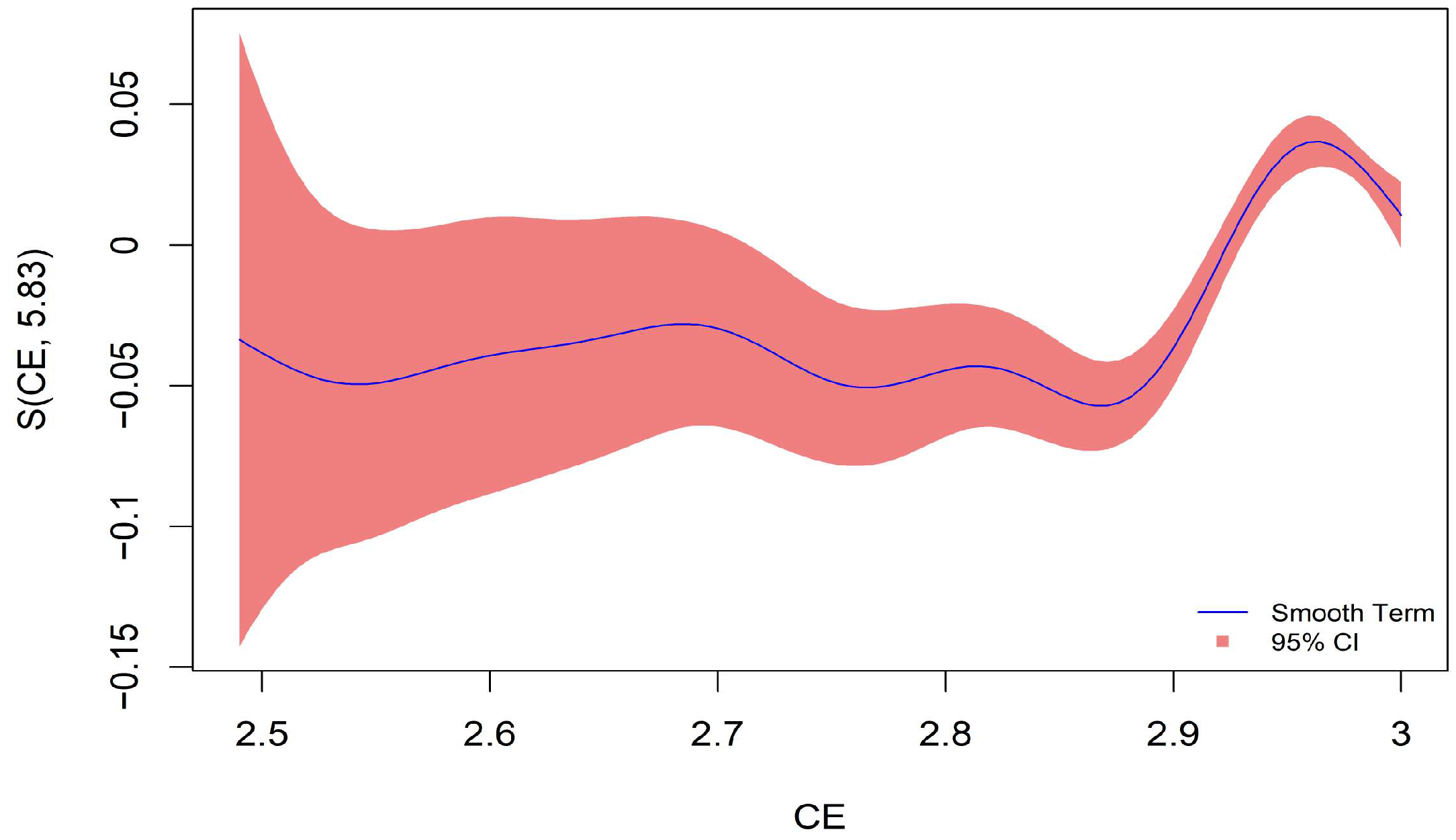
However, Panel C of Table 2 and the GAM visualization in Figure 2 reveal the non-linear nature of this relationship. The impact follows an inverted U-shape or fluctuating pattern. Specifically, once the controversy score exceeds a critical threshold, the marginal effect turns negative. This confirms Hypothesis 1, demonstrating that while mild shocks build resilience (“anti-fragility”), severe shocks overwhelm the firm’s resource base.

4.2. H2 Test Results: The Chain-Mediating Role of ESG and VaR

This section tests Hypothesis 2 regarding the mediating mechanisms. As presented in Table 3, controversial events exert a dual indirect influence on resilience. First, the mediating effect via ESG ratings is significantly positive ( M e d i a t i n g   E f f e c t   E s t i m a t e = 1.001 ,   p < 0.001 ). Economically, this implies that firms capable of achieving a one-level upgrade in their ESG ratings in response to controversies can expect a corresponding 1.001-unit increase in their resilience score. This suggests that ESG acts as a primary buffer, where “moral capital” effectively counteracts reputational damage.
Second, the mediating effect via VaR is significantly negative ( M e d i a t i n g   E f f e c t   E s t i m a t e = 0.984 ,   p < 0.001 ). This indicates that a one-unit increase in Value-at-Risk (indicating higher tail risk) reduces corporate resilience by nearly 0.98 units. This strong negative coefficient highlights that financial instability is a major channel through which controversies degrade resilience.
Collectively, these opposing indirect effects confirm Hypothesis 2, showing that resilience outcomes depend on the net balance between the protective role of ESG and the destructive role of financial risk (VaR).
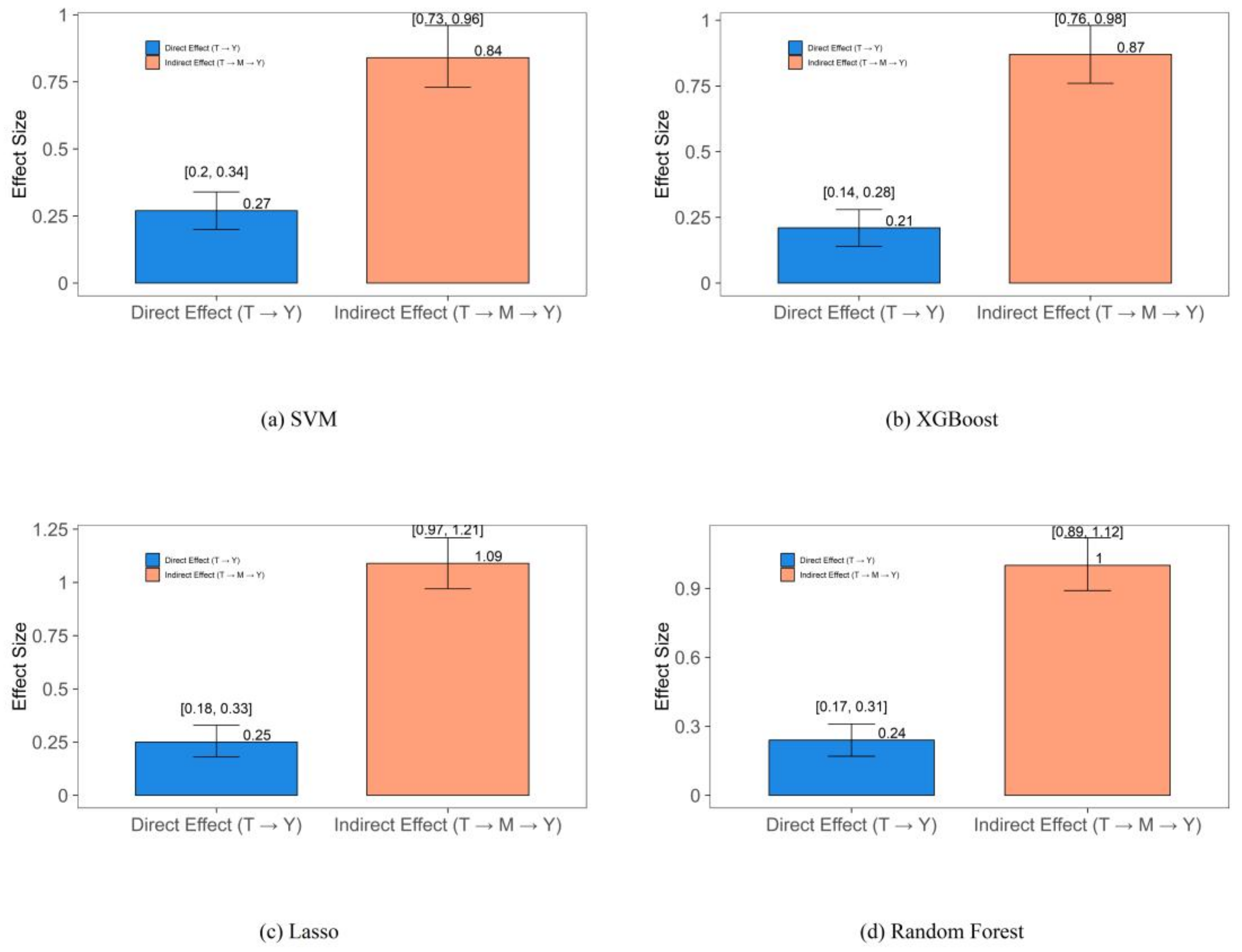
For instance, as illustrated in Figure 3d, the Random Forest algorithm within the DML framework yields consistent findings. The direct effect of C E on C R was estimated at 0.240, with a 95% confidence interval of [0.17, 0.31]. Meanwhile, the indirect effect of C E on C R through ESG ratings was 1.001, with a confidence interval of [0.89, 1.12]. These estimates are consistent with the results presented in Table 2 and Table 3, further confirming the positive mediating role of ESG ratings in the relationship between C E and C R . Higher ESG ratings enhance reputational capital and brand equity, providing protective buffers during crises, while also reflecting stronger risk governance that improves resilience to external shocks.
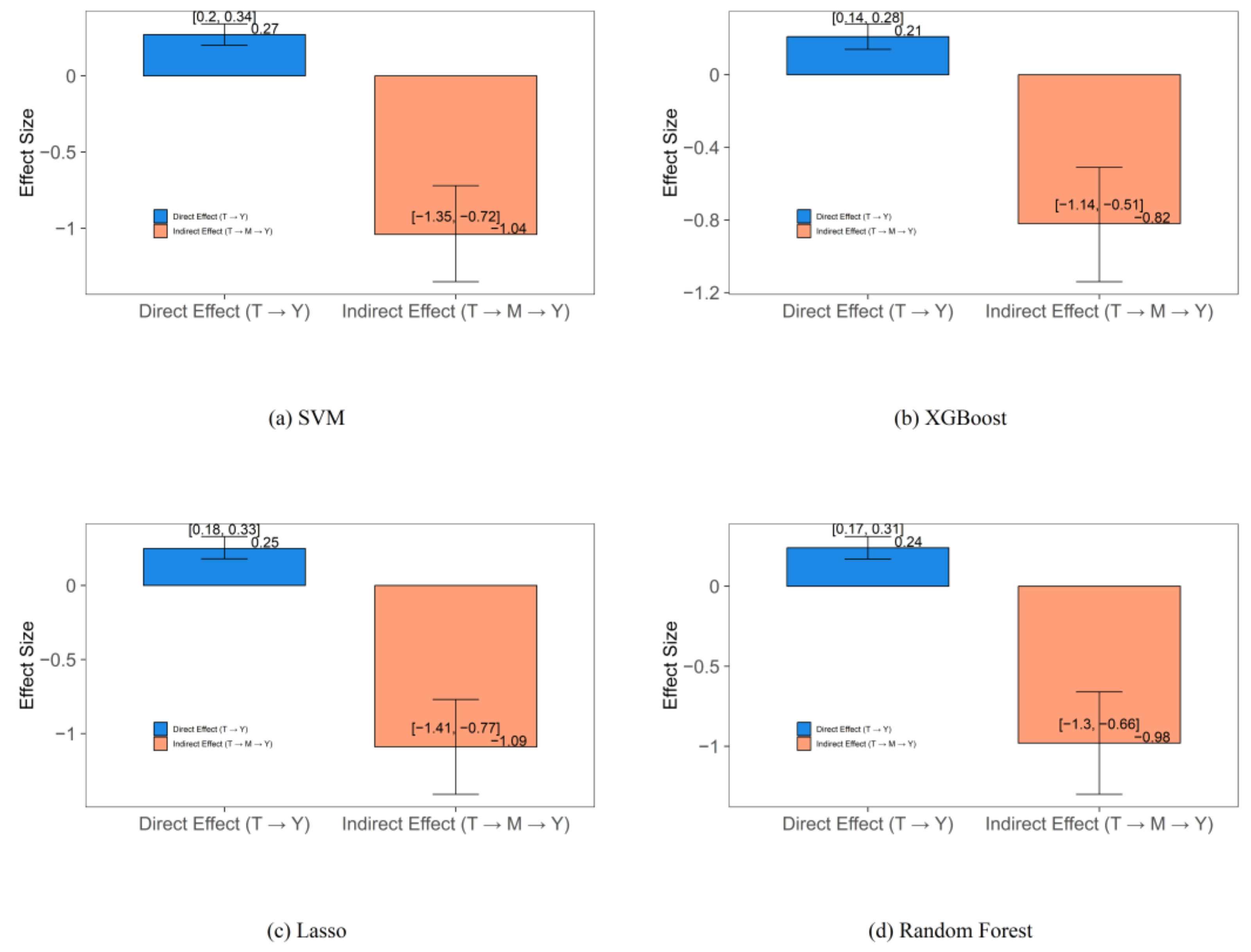
For example, Figure 4d displays results the Random Forest algorithm within the DML framework. The direct effect of C E on C R was estimated at 0.240, with a corresponding 95% confidence interval of [0.17, 0.31]. In contrast, the indirect effect through VaR was estimated at −0.984, with a corresponding 95% confidence interval of [−1.30, −0.66]. This significant negative mediation suggests that VaR negatively influences the relationship between C E and C R . C E may heighten adverse market expectations, increasing firm-specific risk exposure. Elevated risk levels may lead to higher financing costs and reduced investor confidence, ultimately weakening corporate resilience.

4.3. H3 and H4 Test Results: Heterogeneity Analysis

To test Hypothesis 3, we examined how ownership structure moderates the chain mechanism. Panel A of Table 4 reveals significant differences between State-Owned Enterprises (SOEs) and non-SOEs. While the direct impact of controversies is stronger for non-SOEs ( E s t i m a t e = 0.264 ) compared to SOEs ( E s t i m a t e = 0.145 ), the mediating mechanisms are notably more pronounced in SOEs. Specifically, the positive mediating effect of ESG ( E s t i m a t e = 1.025 ) and the negative mediating effect of VaR ( E s t i m a t e = 1.046 ) in SOEs exceed those in non-SOEs ( M e d i a t i n g   E f f e c t   E s t i m a t e = 0.956 and M e d i a t i n g   E f f e c t   E s t i m a t e = 0.983 , respectively). Managerially, this divergence stems from structural variations: Non-SOEs, prioritizing brand equity, are more susceptible to immediate reputational damage and customer loss. In contrast, SOEs leverage their institutional legitimacy to focus on long-term stability, utilizing VaR as a strategic tool aligned with broader sustainability mandates. These results confirm Hypothesis 3, demonstrating that ownership structure acts as a critical boundary condition for the “ C E E S G V a R C R ” mechanism.
Beyond ownership structures, this study also examines the influence of regional heterogeneity. As shown in Panel B of Table 4, regional economic development and industrial composition differentially affect the key relationships. In the Central Region, a homogeneous industrial structure, high supply chain concentration, rigid business models, and limited risk absorption capacity amplify the observed effects. Consequently, both the direct effect of C E ( E s t i m a t e = 0.246 ,   p < 0.001 ) and the negative mediating effect of VaR ( E s t i m a t e = 0.970 ,   p < 0.001 ) are stronger in this region. Economically, this suggests that firms in less developed markets lack the financial depth to buffer against tail risks.
In contrast, the positive mediating effect of ESG ratings ( E s t i m a t e = 1.019 ,   p < 0.001 ) is more pronounced in the Eastern Region, likely due to its more advanced economy and greater financial resources. This implies that in advanced economic zones, ESG investments yield the highest marginal return in terms of resilience. These findings provide empirical support for Hypothesis 4 and highlight that the “sustainability premium” is contingent on the maturity of the regional institutional environment.

4.4. H5 Test Results: The Impact of ESG on VaR

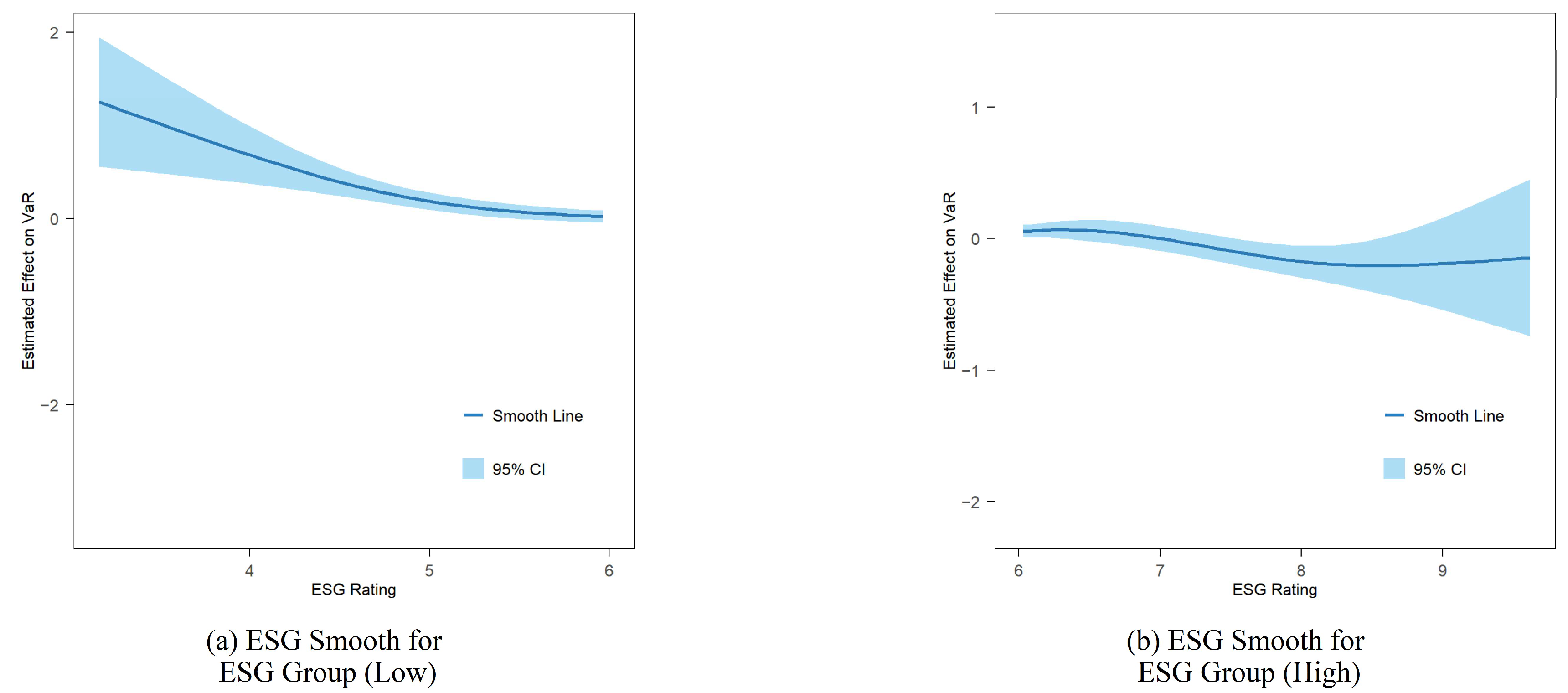
Hypothesis 5 posits that ESG ratings negatively affect VaR, particularly for lower-rated firms. To test this, we applied the Generalized Additive Model (GAM) to capture the non-linear dynamics, dividing the sample into “Low ESG” and “High ESG” groups based on the median rating. The results in Table 5 confirm that the smoothing terms for ESG are statistically significant for both groups ( p < 0.01 ). However, the visualization in Figure 5 reveals a crucial structural difference in how ESG impacts financial risk.
As illustrated in Figure 5a, for firms in the “Low ESG” group, the curve exhibits a steep downward slope. Economically, this indicates a high marginal return on ESG investment: for firms with weak sustainability profiles (laggards), even a small improvement in ESG practices leads to a sharp reduction in financial tail risk (VaR). This implies that for these firms, establishing foundational ESG practices is essential to effectively mitigate their elevated risk exposure.
In contrast, Figure 5b shows a much flatter curve for the “High ESG” group. This implies diminishing marginal benefits: once a firm achieves a high sustainability standard, further improvements yield smaller reductions in VaR, as their risk profiles are likely already optimized and increasingly driven by external market conditions rather than internal governance issues. These findings support Hypothesis 5, highlighting that different ESG ratings have varying effects on VaR. They also suggest that improving ESG ratings can provide greater risk mitigation benefits for firms with low ESG ratings, underscoring the value of targeted sustainability strategies in risk management.

4.5. H6 Test Results: Total Indirect Effects

Finally, to test Hypothesis 6, this study uses the DML approach to estimate the total indirect effect of C E on C R , operating through the pathway C E E S G V a R C R . Lagged terms of C E , ESG, and VaR are included to account for potential temporal dependencies. Results are summarized in Table 6, and Figure A1 of Appendix D presents a path diagram with coefficient estimates for each segment of the indirect pathway.
As shown in Table 6, the DML estimate of the total indirect effect is positive and statistically significant ( E s t i m a t e = 0.015 ), indicating that C E enhances C R through the chain-mediating role of ESG ratings and VaR. Economically, while this coefficient magnitude is modest, it statistically confirms the existence of the transmission channel: a portion of the resilience gain is specifically attributable to the risk-reduction benefits of ESG improvements.
Specifically, firms often respond to controversies by proactively improving their ESG ratings. Such improvements may reduce VaR, thereby strengthening corporate reputation and resilience. Moreover, disclosing high-quality ESG information after controversial events can enhance corporate transparency and aid in rebuilding public trust. These strategic actions reinforce stakeholder confidence, shape positive market perceptions, and reduce perceived risks key factors that collectively boost corporate resilience. Overall, these results provide strong support for Hypothesis 6.

4.6. Robustness Test and Endogeneity Test

To ensure the reliability and validity of our empirical findings, this study conducts a comprehensive robustness and endogeneity assessment using four analytical approaches within the DML framework. This paper uses Random Forest as an example to illustrate the computation, and the results are presented below.
  • Moderating Effect of Corporate Ownership and Industry Characteristics.
This section examines how corporate ownership structures and industry characteristics jointly moderate the relationship between C E and C R . Results reveal a statistically significant positive direct effect of C E on C R ( D i r e c t   E f f e c t   E s t i m a t e = 0.240 ,   p < 0.001 ). Additionally, both ESG ratings and VaR exhibit significant mediating roles, with ESG showing a positive effect ( M e d i a t i n g   E f f e c t   E s t i m a t e = 1.001 ,   p < 0.001 ) and VaR a negative effect ( M e d i a t i n g   E f f e c t   E s t i m a t e = 0.984 ,   p < 0.001 ). As shown in the Panel A of Table 7, the positive relationship between C E and C R remains robust after accounting for the moderating effects of ownership structures and industry characteristics. Furthermore, the mediating roles of ESG and VaR persist under these conditions, supporting the overall robustness of the theoretical model.
2.
Adjusting Sample Partition Size.
To further validate the robustness of our findings, we adjust the original sample partition ratio from 1:4 to 1:9 and re-estimate the model. As shown in the Panel B of Table 7, the nonlinear relationship between C E and C R remains significant ( D i r e c t   E f f e c t   E s t i m a t e = 0.235 ,   p < 0.001 ), indicating that C E positively influence C R up to a certain threshold.
Additionally, the mediating effects of ESG ratings ( M e d i a t i n g   E f f e c t   E s t i m a t e = 1.001 ,   p < 0.001 ) and VaR ( M e d i a t i n g   E f f e c t   E s t i m a t e = 0.996 ,   p < 0.001 ) remain significant under the new partition setting. These results indicate that both factors contribute to C R , with ESG ratings showing a slightly stronger effect (by approximately 0.5%) than VaR. This small difference may stem from the more immediate influence of C E on ESG ratings. Higher ESG ratings typically reflect greater capacity to manage external shocks, thereby enhancing C R .
3.
Mediation Test of Quadratic Term Method with Control Variables.
In the third robustness test, we introduce quadratic terms of control variables to capture potential nonlinearities. As reported in the Panel C of Table 7, the direct effect of C E and C R remains significant ( E s t i m a t e = 0.237 ,   p < 0.001 ). Moreover, ESG ratings continue to act as a significant mediator ( M e d i a t i n g   E f f e c t   E s t i m a t e = 0.990 ,   p < 0.001 ), while VaR shows a negative mediating effect ( M e d i a t i n g   E f f e c t   E s t i m a t e = 1.003 ,   p < 0.001 ). These findings suggest that proactive ESG management and effective VaR mitigation strategies can significantly enhance C R in response to C E .
4.
Endogeneity Test: Instrumental Variable Approach.

To address potential endogeneity due to omitted variable bias or reverse causality, we employ an instrumental variable (IV) approach. The instrument used is the deviation of a firm’s controversial event rating from the industry average rating. As shown in the Panel D of Table 7, the mediating effects of ESG ratings ( M e d i a t i n g   E f f e c t   E s t i m a t e = 2.831 ,   p < 0.001 ) and VaR ( M e d i a t i n g   E f f e c t   E s t i m a t e = 2.919 ,   p < 0.001 ) remain significant and become even stronger after applying the IV method.
These results highlight the crucial role of ESG ratings and VaR in strengthening C R . Strategic ESG management and effective risk control reflected in lower VaR could enhance a firm’s relational capital with stakeholders, enabling it to better navigate external challenges arising from C E .
Table 7. The Robustness Test and Endogeneity Test of C E and C R .
PanelAlgorithmEffectEstimateStd. Errort ValuePr (>|t|)
Panel ARandom ForestDirect0.2400.0366.6980.000
Mediating (ESG)1.0010.05817.1800.000
Mediating (VaR)−0.9840.163−6.0440.000
Panel BRandom ForestDirect0.2350.0366.5480.000
Mediating (ESG)1.0010.05817.2600.000
Mediating (VaR)−0.9960.163−6.1190.000
Panel CRandom ForestDirect0.2370.0366.6470.000
Mediating (ESG)0.9900.05817.0800.000
Mediating (VaR)−1.0030.162−6.1760.000
Panel DRandom ForestDirect0.7300.1056.9760.000
Mediating (ESG)2.8310.17116.5800.000
Mediating (VaR)−2.9190.476−6.1350.000

5. Discussion

This study investigates the impact of controversial events on corporate resilience, utilizing a machine learning approach to unravel the mediating roles of ESG and VaR. The findings offer a nuanced understanding of how firms navigate crises to achieve long-term sustainability.

5.1. The Non-Linear Dynamics of Controversy and Resilience

Our empirical results from the GAM analysis challenge the conventional view that controversial events invariably damage corporate value [3,15]. Instead, we identify a significant non-linear relationship. We find that low-intensity controversies can act as a “stress test”, stimulating organizational adaptability and enhancing resilience. This aligns with the “anti-fragility” perspective but contradicts linear models that predict a monotonic decline in performance [15]. However, consistent with the resource-based view [20], once the severity of events exceeds a critical threshold, the depletion of reputational and financial resources outweighs the adaptive benefits, leading to a sharp decline in resilience. This finding underscores the importance of methodology; traditional linear regressions would likely miss this “turning point”, potentially leading to biased managerial inferences.

5.2. The “Insurance” Mechanism of ESG and VaR

A key contribution of this study is the validation of the chain-mediating mechanism: “ C E E S G V a R C R ”. This finding extends Godfrey’s [26] theory of the “insurance-like” effect of CSR. While Godfrey posited that social responsibility generates moral capital, our study concretizes this mechanism by showing that this moral capital specifically translates into reduced financial tail risk (lower VaR). High ESG ratings serve as a credible signal of sustainability to investors, stabilizing market expectations during turbulent times [30]. Unlike prior studies that examined ESG or risk separately [23,24], our integrated model demonstrates that ESG is not merely a compliance cost but a strategic tool for financial risk mitigation. This is particularly relevant for sustainability, as it suggests that maintaining high ESG standards provides the financial stability required for long-term sustainable development.

5.3. Heterogeneity and Contextual Factors

Our heterogeneity analysis reveals that State-Owned Enterprises (SOEs) exhibit stronger mediating effects of ESG and VaR compared to non-SOEs. This diverges from the assumption that private firms are more market-sensitive. In the context of China’s emerging market, SOEs often face stricter regulatory scrutiny regarding sustainability [27], compelling them to leverage ESG as a primary legitimization strategy. Furthermore, the regional analysis highlights that the buffering effect of ESG is most effective in economically developed regions, suggesting that the “sustainability premium” is contingent on the maturity of the institutional environment. These insights enrich the literature on the boundary conditions of corporate resilience in emerging economies [9,29].

6. Conclusions

In volatile economic environments, achieving corporate resilience is a prerequisite for sustainable development. This study applied the Double Machine Learning framework to a sample of 4430 Chinese listed firms to decode the complex relationship between controversial events and resilience. We conclude that this relationship is non-linear, characterized by a distinct tipping point where the impact shifts from constructive to destructive. Furthermore, we confirm that ESG ratings and VaR act as a chain-mediating channel, bridging the gap between non-financial sustainability efforts and financial risk outcomes.

6.1. Theoretical Implications

This study advances the literature in two significant ways. First, it bridges the gap between non-financial performance and financial risk management by identifying the “chain-mediating” mechanism of “ C E E S G V a R C R ”. While prior studies have independently examined ESG or risk (VaR), this study theoretically integrates them, providing empirical evidence for the “insurance-like” effect of ESG: proactive ESG improvements reduce financial tail risk (VaR), which in turn preserves corporate resilience. Second, methodologically, this paper moves beyond linear assumptions by applying the Generalized Additive Model (GAM) and DML. This approach allows for the precise identification of the “tipping point” in the impact of controversial events, offering a more nuanced theoretical understanding of how crises affect organizational sustainability compared to traditional linear regression models.

6.2. Managerial and Policy Implications

The findings offer strategic guidance for corporate managers and policymakers. First, managers should recognize that ESG investment is not merely a compliance cost but a strategic “risk buffer”. Proactive ESG disclosure can effectively lower market risk expectations (VaR) when controversies occur, thereby stabilizing stock prices and preserving resilience. Second, empirical results show that the risk mitigation effect of ESG is more pronounced for firms with initially lower ESG ratings. Therefore, resource allocation towards ESG improvement is particularly critical for these firms to achieve significant marginal gains in risk reduction. Third, regulators should consider the non-linear nature of controversies and differentiated regional impacts when formulating disclosure requirements, encouraging firms to build resilience before crises hit.

6.3. Limitations and Future Research

Despite these contributions, this study has limitations that open avenues for future research. First, the sample is limited to Chinese A-share listed firms. While China rep-resents a key emerging market, future research could expand this inquiry to cross-country comparisons to test the generalizability of the findings in different institutional contexts. Second, although DML helps address endogeneity, the measurement of controversial events relies on public media data, which may be subject to coverage bias. Future studies could incorporate internal firm data or alternative sentiment analysis techniques to refine the measurement of controversy severity. Finally, future research could apply more advanced machine learning techniques to predictive risk modeling, enhancing the ability to anticipate specific types of controversies and their distinct impacts on resilience.

Author Contributions

Conceptualization, J.Z.; methodology, J.Z. and D.D.W.; writing—original draft preparation, J.Z.; writing—review and editing, J.Z. and D.D.W. All authors have read and agreed to the published version of the manuscript.

Funding

This research received no external funding.

Institutional Review Board Statement

Not applicable.

Informed Consent Statement

Not applicable.

Data Availability Statement

Data will be made available on request.

Conflicts of Interest

The authors declare no conflicts of interest.

Appendix A. Variable Definitions

The variable definitions for this paper are provided in Table A1.
Table A1. Variable definitions.
TypeNameMeaningMeasurement MethodData Source
Dependent variable C R Corporate Resilience Scores First ,   the   index   weight   is   calculated   using   the   CRITIC   method .   Sec ond ,   the   C R is weighted by indicators such as “Stock price recovery rate”, “Quick ratio”, “Average return rate”, “R&D investment”, “Cash operation index”, “Total asset turnover rate”, and “Maximum withdrawal rate”.Wind
Independent variable C E Ratings of controversial events
Mediating variable,
Independent variable
E S G ESG ratings
Mediating variable, Dependent variable V a R value-at-risk
Control variables S i z e Firm total assets S i z e = l n ( T o t a l   a s s e t s )
L e v Proportion of liabilities to assets
R O A Net profit margin of total assets
A T O Turnover rate of total assets
C a s h f l o w Cash flow to current liabilities ratio
G r o w t h Operating income growth rate
B o a r d Number of board members B o a r d = l n ( S i z e   o f   t h e   b o a r d )
I n d e p Proportion of independent directors
B a l a n c e 2 Equity balance degree B a l a n c e 2 = ( s h a r e h o l d i n g   r a t i o   o f sec o n d   s h a r e h o l d e r + t h i r d   s h a r e h o l d e r + f o u r t h   s h a r e h o l d e r + f i f t h s h a r e h o l d e r ) t h e   f i r s t   s h a r e h o l d e r
T o b i n Q Tobin’s Q value
L i s t A g e Listed years
F I X E D Proportion of fixed assets
Control variables,
Categorical variables
A r e a Location of the company E a s t e r n   R e g i o n = 2 ; C e n t r a l   R e g i o n = 1 ; W e s t e r n   R e g i o n = 0 .
S O E Corporate governance structure S t a t e O w n e d   f i r m s = 1 ; N o n S t a t e O w n e d   f i r m s = 0 .
I n d u s t r y IndustryAssigning natural numbers to industry code in order.CSRC Industry Classification;
E v e n t S t a t e Share Price Recovery = (The date of the peak stock price within one year-the date of the trough stock price within one year). If the Share Price Recovery >0, it indicates that the stock price has recovered within one year. This is then recorded as EventState = 1; otherwise, it is recorded as EventState = 0. T h e   r e c o v e r   o n e = 1 ; T h e   u n r e c o v e r   o n e = 0 . Wind
Instrumental variable C E D There is a disparity among companies in how they score controversial events within the industry. C E D = ( C E S c o r i n g   o f   i n d u s t r y c o n t r o v e r s i a l   e v e n t s ) S c o r i n g   o f   i n d u s t r y   c o n t r o v e r s i a l   e v e n t s Wind

Appendix B. Description of the Equation

We use the GAM to estimate the direct effect of different ESG ratings on VaR. The basic model formulation is as follows:
V a R ~ s ( E S G , b y = E S G G r o u p ) + s ( S i z e ) + s ( L e v ) + s ( R O A ) + s ( A T O ) + s ( C a s h f l o w ) + s ( G r o w t h ) + s ( B o a r d ) + s ( I n d e p ) + s ( B a l a n c e 2 ) + s ( T o b i n Q ) + s ( L i s t A g e ) + s ( F I X E D )
In Equation (A1), VaR stands for value-at-risk, while s ( E S G , b y = E S G G r o u p ) is a smoothing term categorized by ESG median. s ( S i z e ) is a smoothing term for company size, s ( L e v ) for leverage, s ( R O A ) for return on assets, and s ( A T O ) for asset turnover. s ( C a s h f l o w ) is the smooth term of the cash flow. s ( G r o w t h ) is the smoothing term of the growth rate. s ( B o a r d ) is the smoothing term for board size, s ( I n d e p ) for the percentage of independent directors, s ( B a l a n c e 2 ) for the asset-liability ratio, s ( T o b i n Q ) for Tobin’s Q, s ( L i s t A g e ) for listing age, and s ( F I X E D ) for the share of fixed assets. This model employs smoothing terms to capture the nonlinear relationships between each variable and VaR.

Appendix C. Descriptive Statistics and Bivariate Correlation

Descriptive statistics and bivariate correlations are presented in Table A2.
Table A2. Descriptive statistics and bivariate correlation.
MeanSD12345678910
1 .   C R −0.0270.503
2 .   C E 2.9200.0930.044
(0.000)
3 .   E S G 6.0860.7680.053
(0.000)
0.106
(0.000)
4 .   V a R 6.8392.094−0.522
(0.000)
−0.008
(0.253)
−0.081
(0.000)
5 .   S i z e 22.2981.2990.137
(0.000)
−0.203
(0.000)
0.192
(0.000)
−0.287
(0.000)
6 .   L e v 0.4010.192−0.074
(0.000)
−0.222
(0.000)
−0.046
(0.000)
−0.066
(0.000)
0.496
(0.000)
7 .   R O A 0.0400.0600.191
(0.000)
0.140
(0.000)
0.099
(0.000)
−0.024
(0.001)
0.011
(0.117)
−0.333
(0.000)
8 .   A T O 0.6020.3390.199
(0.000)
0.000
(0.982)
−0.009
(0.215)
−0.002
(0.745)
0.084
(0.000)
0.186
(0.000)
0.240
(0.000)
9 .   C a s h f l o w 0.0530.0630.151
(0.000)
0.041
(0.000)
0.071
(0.000)
−0.063
(0.000)
0.087
(0.000)
−0.133
(0.000)
0.469
(0.000)
0.194
(0.000)
10 .   G r o w t h 0.0980.2590.086
(0.000)
0.027
(0.000)
0.044
(0.000)
0.081
(0.000)
0.038
(0.000)
0.063
(0.000)
0.336
(0.000)
0.217
(0.000)
0.079
(0.000)
11 .   B o a r d 2.0910.1980.048
(0.000)
−0.033
(0.000)
0.060
(0.000)
−0.096
(0.000)
0.284
(0.000)
0.143
(0.000)
0.012
(0.095)
0.007
(0.313)
0.038
(0.000)
0.007
(0.318)
12 .   I n d e p 37.9665.585−0.007
(0.310)
−0.039
(0.000)
0.033
(0.000)
0.017
(0.021)
−0.013
(0.073)
−0.008
(0.262)
−0.023
(0.002)
−0.013
(0.085)
−0.001
(0.890)
−0.004
(0.550)
13 .   B a l a n c e 2 0.8140.628−0.067
(0.000)
−0.021
(0.004)
0.024
(0.001)
0.060
(0.000)
−0.102
(0.000)
−0.063
(0.000)
−0.006
(0.386)
−0.045
(0.000)
−0.028
(0.000)
0.023
(0.002)
14 .   T o b i n Q 1.8210.890−0.022
(0.003)
0.000
(0.953)
0.064
(0.000)
0.182
(0.000)
−0.334
(0.000)
−0.247
(0.000)
0.191
(0.000)
−0.023
(0.001)
0.108
(0.000)
0.125
(0.000)
15 .   L i s t A g e 2.0780.8700.118
(0.000)
−0.173
(0.000)
0.002
(0.736)
−0.220
(0.000)
0.487
(0.000)
0.342
(0.000)
−0.206
(0.000)
0.034
(0.000)
0.013
(0.071)
−0.100
(0.000)
16 .   F I X E D 0.1980.1420.013
(0.066)
−0.017
(0.020)
0.014
(0.059)
−0.099
(0.000)
0.137
(0.000)
0.111
(0.000)
−0.046
(0.000)
0.043
(0.000)
0.190
(0.000)
0.014
(0.054)
17 .   S O E 0.2860.4520.109
(0.000)
−0.050
(0.000)
0.029
(0.000)
−0.128
(0.000)
0.367
(0.000)
0.252
(0.000)
−0.091
(0.000)
−0.003
(0.729)
−0.029(
0.000)
−0.046
(0.000)
18 .   A r e a 1.6450.6550.002
(0.773)
0.021
(0.003)
0.047
(0.000)
0.023
(0.002)
−0.055
(0.000)
−0.055
(0.000)
0.003
(0.661)
0.043
(0.000)
0.004
(0.615)
0.000
(0.982)
19 .   I n d u s t r y 3.0844.009−0.035
(0.000)
−0.069
(0.000)
−0.026
(0.000)
0.036
(0.000)
0.099
(0.000)
0.048
(0.000)
−0.088
(0.000)
−0.149
(0.000)
−0.057
(0.000)
−0.039
(0.000)
20 .   E v e n t S t a t e 0.4490.4970.342
(0.000)
−0.037
(0.000)
−0.034
(0.000)
0.112
(0.000)
−0.036
(0.000)
0.034
(0.000)
0.042
(0.000)
0.044
(0.000)
0.042
(0.000)
0.140
(0.000)
111213141516171819
1 .   C R
2 .   C E
3 .   E S G
4 .   V a R
5 .   S i z e
6 .   L e v
7 .   R O A
8 .   A T O
9 .   C a s h f l o w
10 .   G r o w t h
11 .   B o a r d
12 .   I n d e p −0.559
(0.000)
13 .   B a l a n c e 2 0.025
(0.001)
−0.025
(0.001)
14 .   T o b i n Q −0.106
(0.000)
0.047
(0.000)
0.079
(0.000)
15 .   L i s t A g e 0.194
(0.000)
−0.009
(0.238)
−0.145
(0.000)
−0.087
(0.000)
16 .   F I X E D 0.094
(0.000)
−0.010
(0.178)
−0.080
(0.000)
−0.122
(0.000)
0.140
(0.000)
17 .   S O E 0.266
(0.000)
−0.043
(0.000)
−0.208
(0.000)
−0.165
(0.000)
0.428
(0.000)
0.127
(0.000)
18 .   A r e a −0.095
(0.000)
0.037
(0.000)
0.057
(0.000)
0.015
(0.038)
−0.139
(0.000)
−0.113
(0.000)
−0.168
(0.000)
19 .   I n d u s t r y 0.037
(0.000)
0.016
(0.028)
0.006
(0.387)
0.015
(0.043)
0.056
(0.000)
−0.181
(0.000)
0.140
(0.000)
0.003
(0.713)
20 .   E v e n t S t a t e 0.004
(0.626)
−0.011
(0.126)
−0.018
(0.012)
0.153
(0.000)
0.081
(0.000)
0.012
(0.083)
0.031
(0.000)
−0.018
(0.013)
−0.023
(0.001)
Note: Table A2 provides the descriptive statistics for the variables used in the DML analysis. To address potential multicollinearity issues, a Pearson pairwise correlation test was conducted. The correlation coefficients are presented as the values outside the parentheses, while the p-values are indicated within the parentheses.

Appendix D. The Effect of Each Variable
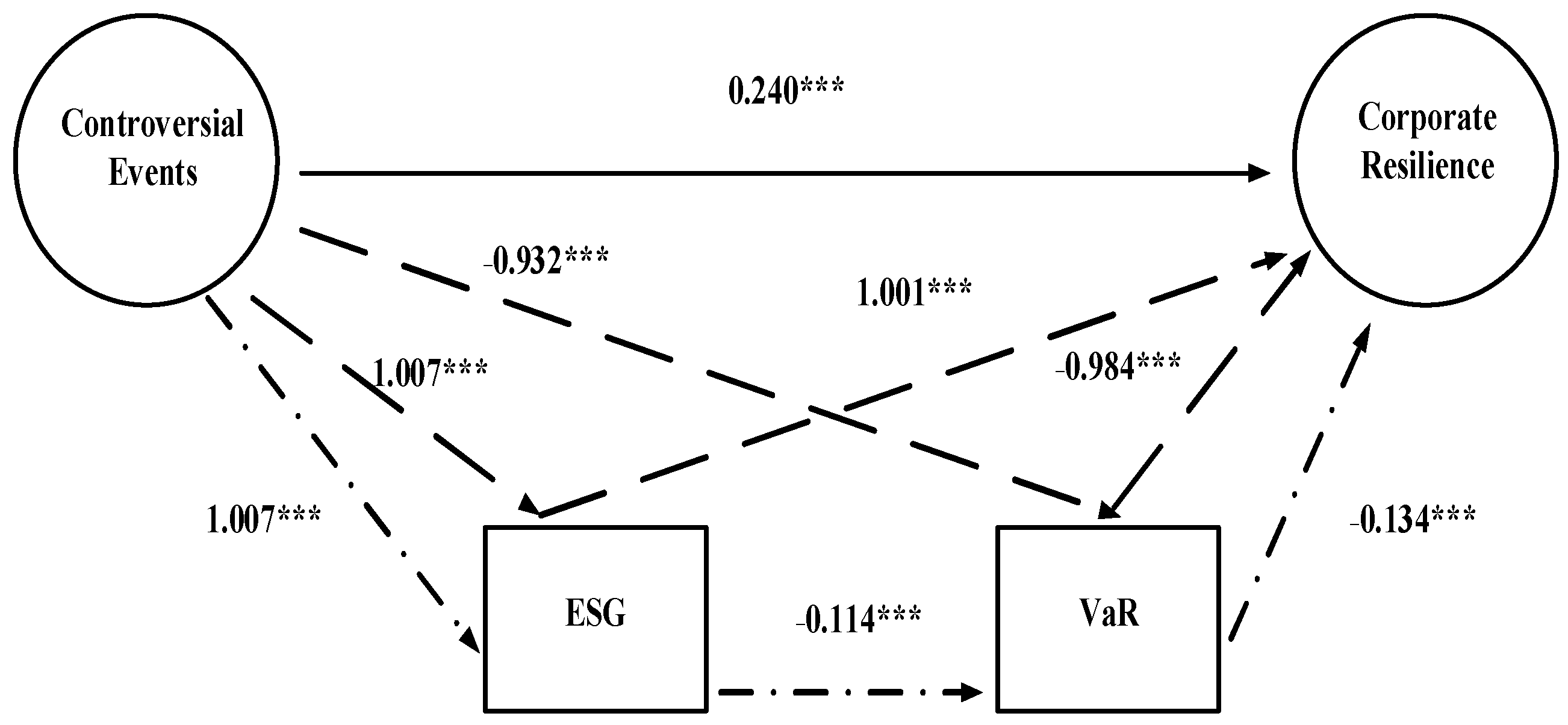
The effects of each variable are presented in Figure A1.
Figure A1. The effect of each variable. The effect value is calculated by Random Forest in DML framework (*** p < 0.01 ).
Sustainability 17 11032 g0a1

Appendix E. Other Algorithms’ Results

Results from other algorithms (Lasso, XGBoost, SVM) are consistent and provided in Table A3, Table A4 and Table A5 for robustness checks.
Table A3. Relationship between C E and C R based on DML.
PanelAlgorithmIndependent VariableEstimateStd. Errort ValuePr (>|t|)
Panel A
Direct effect
Lasso C E 0.2530.0376.8220.000
XGBoost C E 0.2130.0356.0730.000
SVM C E 0.2730.0357.7370.000
Table A4. Mediating effects of ESG and VaR.
EffectAlgorithmEstimateStd. Errort ValuePr (>|t|)
Mediating effect of ESG
( C E E S G C R )
Lasso1.0880.06217.5400.000
XGBoost0.8700.05715.2000.000
SVM0.8420.05914.2800.000
Mediating effect of VaR
( C E V a R C R )
Lasso−1.0930.163−6.7150.000
XGBoost−0.8240.160−5.1480.000
SVM−1.0360.160−6.4690.000
Table A5. Total effect of chained mediation.
ClassificationEffectEstimateStd. Errort ValuePr (>|t|)
C E E S G Lasso1.0890.06217.5520.000
XGBoost0.8930.05815.3370.000
SVM0.8330.05914.0230.000
E S G V a R Lasso−0.0890.019−4.6220.000
XGBoost−0.8620.020−4.1580.000
SVM−0.1040.020−5.2420.000
V a R C R Lasso−0.1360.001−94.4520.000
XGBoost−0.1190.001−84.0820.000
SVM−0.1330.001−93.7420.000
Total indirect effectLasso0.013---
XGBoost0.011---
SVM0.012---

References

  1. Weber, O. Environmental, Social and Governance Reporting in China. Bus. Strategy Environ. 2014, 23, 303–317. [Google Scholar] [CrossRef]
  2. Dorobantu, S.; Henisz, W.J.; Nartey, L. Not All Sparks Light a Fire: Stakeholder and Shareholder Reactions to Critical Events in Contested Markets. Adm. Sci. Q. 2017, 62, 561–597. [Google Scholar] [CrossRef]
  3. Cretu, A.E.; Brodie, R.J. The Influence of Brand Image and Company Reputation Where Manufacturers Market to Small Firms: A Customer Value Perspective. Ind. Mark. Manag. 2007, 36, 230–240. [Google Scholar] [CrossRef]
  4. DesJardine, M.; Bansal, P.; Yang, Y. Bouncing Back: Building Resilience through Social and Environmental Practices in the Context of the 2008 Global Financial Crisis. J. Manag. 2019, 45, 1434–1460. [Google Scholar] [CrossRef]
  5. Tosun, O.K.; Eshraghi, A.; Muradoglu, G. Staring Death in the Face: The Financial Impact of Corporate Exposure to Prior Disasters. Br. J. Manag. 2021, 32, 1284–1301. [Google Scholar] [CrossRef]
  6. Foulon, B.; Marsat, S. Does Environmental Footprint Influence the Resilience of Firms Facing Environmental Penalties? Bus. Strategy Environ. 2023, 32, 6154–6168. [Google Scholar] [CrossRef]
  7. Marsat, S.; Pijourlet, G.; Ullah, M. Does Environmental Performance Help Firms to Be More Resilient against Environmental Controversies? International Evidence. Financ. Res. Lett. 2022, 44, 102028. [Google Scholar] [CrossRef]
  8. Aldawsari, S.H. Does ESG Uncertainty Disrupt Inventory Management? Evidence from an Emerging Market. Sustainability 2025, 17, 9791. [Google Scholar] [CrossRef]
  9. Abiad, A.; Bluedorn, J.; Guajardo, J.; Topalova, P. The Rising Resilience of Emerging Market and Developing Economies. World Dev. 2015, 72, 1–26. [Google Scholar] [CrossRef]
  10. Basak, S.; Shapiro, A. Value-at-Risk-Based Risk Management: Optimal Policies and Asset Prices. Rev. Financ. Stud. 2001, 14, 371–405. [Google Scholar] [CrossRef]
  11. Bodnar, G.M.; Hayt, G.S.; Marston, R.C. 1998 Wharton Survey of Financial Risk Management by US Non-Financial Firms. Financ. Manag. 1998, 27, 70–91. [Google Scholar] [CrossRef]
  12. Berkowitz, J.; Christoffersen, P.; Pelletier, D. Evaluating Value-at-Risk Models with Desk-Level Data. Manag. Sci. 2009, 57, 2213–2227. [Google Scholar] [CrossRef]
  13. David Cabedo, J.; Moya, I. Estimating Oil Price ‘Value at Risk’ Using the Historical Simulation Approach. Energy Econ. 2003, 25, 239–253. [Google Scholar] [CrossRef]
  14. Gupta, S.; Väätänen, J.; Khaneja, S. Value Added Reseller or Value at Risk: The Dark Side of Relationships with VARs. Ind. Mark. Manag. 2016, 55, 110–118. [Google Scholar] [CrossRef]
  15. Groening, C.; Kanuri, V.K. Investor Reaction to Positive and Negative Corporate Social Events. J. Bus. Res. 2013, 66, 1852–1860. [Google Scholar] [CrossRef]
  16. Hastie, T.; Tibshirani, R. Generalized Additive Models: Some Applications. J. Am. Stat. Assoc. 1987, 82, 371–386. [Google Scholar] [CrossRef]
  17. Chernozhukov, V.; Chetverikov, D.; Demirer, M.; Duflo, E.; Hansen, C.; Newey, W.; Robins, J. Double/Debiased Machine Learning for Treatment and Structural Parameters. Econom. J. 2018, 21, C1–C68. [Google Scholar] [CrossRef]
  18. Chaudhuri, R.; Ivkovíc, Z.; Trzcinka, C. Cross-Subsidization in Institutional Asset Management Firms. Rev. Financ. Stud. 2018, 31, 638–677. [Google Scholar] [CrossRef]
  19. Lins, K.V.; Servaes, H.; Tamayo, A. Social Capital, Trust, and Firm Performance: The Value of Corporate Social Responsibility during the Financial Crisis. J. Finance 2017, 72, 1785–1824. [Google Scholar] [CrossRef]
  20. Williams, T.A.; Gruber, D.A.; Sutcliffe, K.M.; Shepherd, D.A.; Zhao, E.Y. Organizational Response to Adversity: Fusing Crisis Management and Resilience Research Streams. Acad. Manag. Ann. 2017, 11, 733–769. [Google Scholar] [CrossRef]
  21. Yeoh, P.-L.; Roth, K. An Empirical Analysis of Sustained Advantage in the U.S. Pharmaceutical Industry: Impact of Firm Resources and Capabilities. Strateg. Manag. J. 1999, 20, 637–653. [Google Scholar] [CrossRef]
  22. Jiang, S.; Yeung, A.C.L.; Han, Z.; Huo, B. The Effect of Customer and Supplier Concentrations on Firm Resilience during the COVID-19 Pandemic: Resource Dependence and Power Balancing. J. Oper. Manag. 2023, 69, 497–518. [Google Scholar] [CrossRef]
  23. Albuquerque, R.; Koskinen, Y.; Zhang, C. Corporate Social Responsibility and Firm Risk: Theory and Empirical Evidence. Manag. Sci. 2018, 65, 4451–4469. [Google Scholar] [CrossRef]
  24. Bianconi, M.; Yoshino, J.A. Risk Factors and Value at Risk in Publicly Traded Companies of the Nonrenewable Energy Sector. Energy Econ. 2014, 45, 19–32. [Google Scholar] [CrossRef]
  25. Hautsch, N.; Schaumburg, J.; Schienle, M. Financial Network Systemic Risk Contributions*. Rev. Financ. 2015, 19, 685–738. [Google Scholar] [CrossRef]
  26. Godfrey, P.C. The Relationship Between Corporate Philanthropy And Shareholder Wealth: A Risk Management Perspective. Acad. Manag. Rev. 2005, 30, 777–798. [Google Scholar] [CrossRef]
  27. Cheng, Z.; Gao, H.; Liu, Z.; Treepongkaruna, S. Strategic Choices in Going Public: ESG Performance Implications in China. Bus. Strategy Environ. 2024, 33, 7708–7728. [Google Scholar] [CrossRef]
  28. Wang, L.; Le, Q.; Peng, M.; Zeng, H.; Kong, L. Does Central Environmental Protection Inspection Improve Corporate Environmental, Social, and Governance Performance? Evidence from China. Bus. Strategy Environ. 2023, 32, 2962–2984. [Google Scholar] [CrossRef]
  29. Wang, K.; Chen, X.; Wang, C. The Impact of Sustainable Development Planning in Resource-Based Cities on Corporate ESG–Evidence from China. Energy Econ. 2023, 127, 107087. [Google Scholar] [CrossRef]
  30. Zhou, G.; Liu, L.; Luo, S. Sustainable Development, ESG Performance and Company Market Value: Mediating Effect of Financial Performance. Bus. Strategy Environ. 2022, 31, 3371–3387. [Google Scholar] [CrossRef]
  31. Eisenkopf, J.; Juranek, S.; Walz, U. Responsible Investment and Stock Market Shocks: Short-Term Insurance without Persistence. Br. J. Manag. 2023, 34, 1420–1439. [Google Scholar] [CrossRef]
  32. Huang, Y. Do ESG ETFs Provide Downside Risk Protection during COVID-19? Evidence from Forecast Combination Models. Int. Rev. Financ. Anal. 2024, 94, 103320. [Google Scholar] [CrossRef]
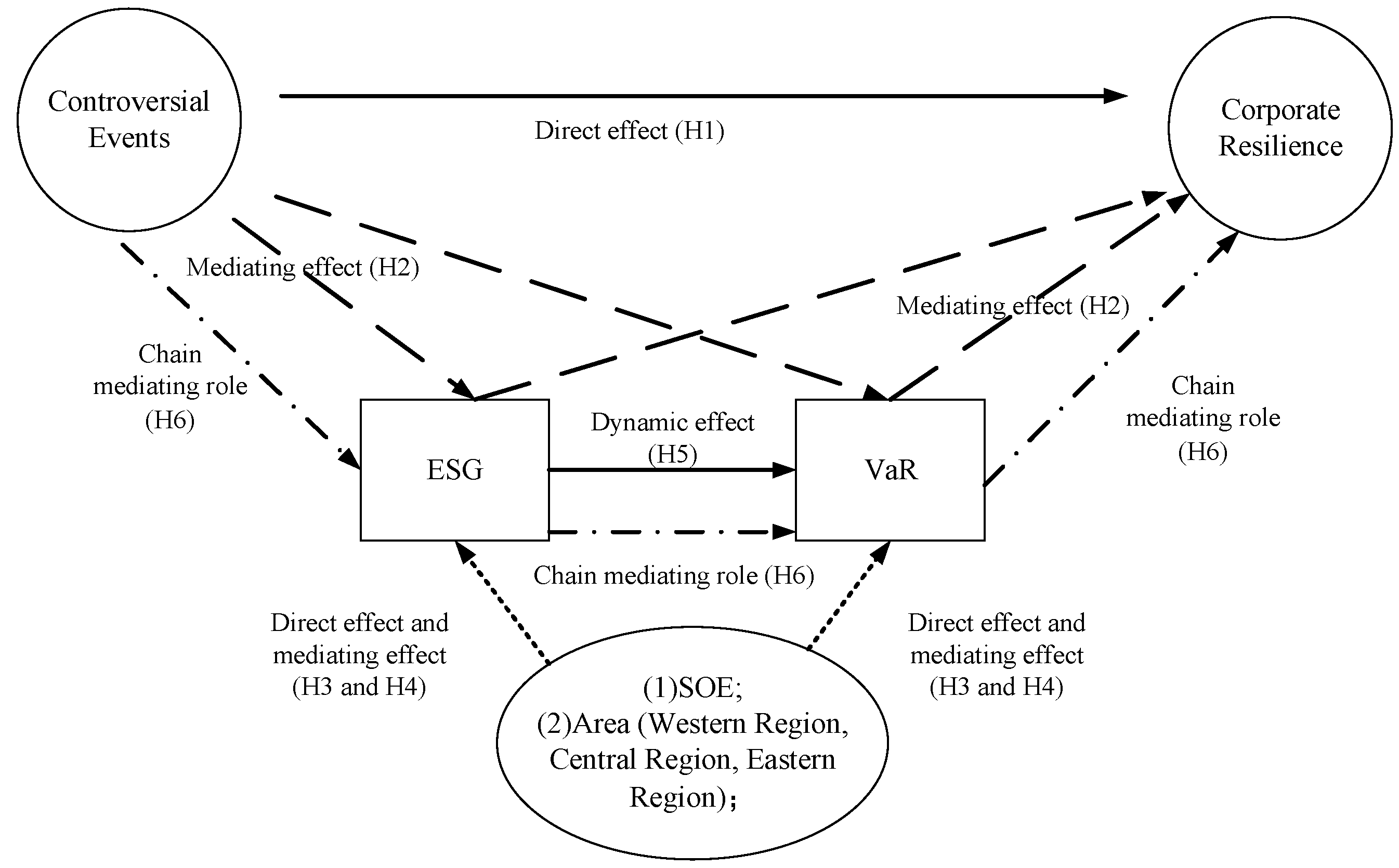
Figure 1. Theoretical framework.
Sustainability 17 11032 g001
Figure 2. The relationship between controversial events ( C E ) and corporate resilience ( C R ).The smooth term S ( C E , 5.83 ) represents the estimated effect of C E at the value 5.83. The blue line shows the fitted nonlinear relationship using the GAM, while the red shaded areas indicate the 95% confidence intervals.
Sustainability 17 11032 g002
Figure 3. Direct and indirect effects via ESG ratings. This figure presents computational results from four machine learning (ML) algorithms under the DML framework. Blue bars indicate the direct effect of C E on C R ( T Y ), while orange bars show the indirect effect through ESG ratings ( T M Y ). Error bars denote corresponding confidence intervals.
Sustainability 17 11032 g003
Figure 4. Direct and indirect effects via VaR. This figure illustrates computational results from four ML algorithms under the DML framework. Blue bars represent the direct effect of C E on C R ( T Y ), while orange bars show the indirect effect through VaR ( T M Y ). Error bars indicate the corresponding confidence intervals, reflecting statistical uncertainty in effect size estimates.
Sustainability 17 11032 g004
Figure 5. The impact of ESG on VaR. This figure employs the GAM to investigate the nonlinear relationship between categorized ESG ratings and VaR. The sample is categorized into high and low ESG groups based on the median ESG rating.
Sustainability 17 11032 g005
Table 1. Comparison of results between linear regression model and the GAM.
Model Type R 2 AICBIC
Linear Regression Model0.23322,506.7322,655.66
GAM0.23522,460.0822,653.84
Table 2. Relationship between C E and C R based on DML (Random Forest).
PanelAlgorithmIndependent VariableEstimateStd. Errort ValuePr (>|t|)
Panel A
Direct effect
Random Forest C E 0.2400.0366.6980.000
Panel B
Direct effect
( By   severity   of   C E )
Random Forest C E ( H i g h ) −1.2160.312−3.8960.000
C E ( L o w ) 0.2330.0474.9160.000
Panel C
Direct effect
( By   severity   of   C E , with interaction terms)
Random Forest C E ( H i g h ) −2.7930.744−3.7540.000
C E ( L o w ) 0.2080.0902.3310.020
Note: Panel B and Panel C are classified based on the median split of C E ratings, distinguishing firms into High and Low groups. Panel C builds on Panel B by adding interaction terms between C E and High Severity, as well as between C E and Low Severity, thereby enhancing the robustness of the results.
Table 3. Mediating effects of ESG and VaR (Random Forest).
EffectAlgorithmEstimateStd. Errort ValuePr (>|t|)
Mediating effect of ESG
( C E E S G C R )
Random Forest1.0010.05817.1800.000
Mediating effect of VaR
( C E V a R C R )
Random Forest−0.9840.163−6.0440.000
Table 4. Comparison of the relationship between C E and C R across different corporate ownership and regions.
PanelClassificationEffectEstimateStd. Errort ValuePr (>|t|)
Panel A:
Corporate ownership
S O E = 1 Direct0.1450.0642.2760.023
Mediating (ESG)1.0250.09910.3350.000
Mediating (VaR)−1.0460.280−3.7390.000
S O E = 0 Direct0.2640.0446.0350.000
Mediating (ESG)0.9560.07113.3820.000
Mediating (VaR)−0.9830.201−4.8910.000
Panel B:
Regions
A r e a = 2 Direct0.2310.0366.4370.000
Mediating (ESG)1.0190.05917.2300.000
Mediating (VaR)−0.9690.163−5.9540.000
A r e a = 1 Direct0.2460.0366.8600.000
Mediating (ESG)1.0000.05917.0460.000
Mediating (VaR)−0.9700.163−5.9490.000
A r e a = 0 Direct0.2370.0366.6030.000
Mediating (ESG)1.0060.05917.0620.000
Mediating (VaR)−0.9640.163−5.9130.000
Note: S O E = 1 indicates state-owned firms, while S O E = 0 denotes non-state-owned firms. The variable A r e a is categorized as follows: A r e a = 2 refers to the Eastern Region, A r e a = 1 corresponds to the Central Region, and A r e a = 0 signifies the Western Region.
Table 5. The impact of different grouped ESG ratings on VaR.
VariableTypeEdfRef.dfF Valuep Value
s ( E S G ) : E S G G r o u p H i g h Smoothing term2.4162.7605.2250.009
s ( E S G ) : E S G G r o u p L o w 2.3092.6447.0910.000
Note: This study categorizes ESG ratings using a median split ( s ( E S G ) : E S G G r o u p H i g h vs. s ( E S G ) : E S G G r o u p L o w ), and employs the GAM to estimate its impact on VaR. Results show the intercept term is statistically significant ( T h e   I n t e r c e p t   T e r m   E s t i m a t e = 6.782 , S E = 0.059 , t = 115.500 ,   p < 0.001 ).
Table 6. Total effect of chained mediation (Random Forest).
ClassificationEffectEstimateStd. Errort ValuePr (>|t|)
C E E S G Random Forest1.0070.05817.3200.000
E S G V a R −0.1140.021−5.5390.000
V a R C R −0.1340.001−96.2560.000
Total indirect effect0.015---
One-period Lag Effect
C E E S G Random Forest0.2620.0663.9890.000
E S G V a R −0.0660.023−2.9030.004
V a R C R −0.0180.002−9.6320.000
Total indirect effect0.0004---
Note: A one-period lag is applied to C E , ESG, and VaR to account for potential temporal dependencies in the estimation.
Disclaimer/Publisher’s Note: The statements, opinions and data contained in all publications are solely those of the individual author(s) and contributor(s) and not of MDPI and/or the editor(s). MDPI and/or the editor(s) disclaim responsibility for any injury to people or property resulting from any ideas, methods, instructions or products referred to in the content.