Article

Population Growth–Decline Differentiation and Regional Inequality in the Yangtze River Delta: Implications for Sustainable Regional Development

1
School of Public Administration, Hohai University, Nanjing 211100, China
2
Institute of Population Research, Hohai University, Nanjing 211100, China
*
Author to whom correspondence should be addressed.
Sustainability 2025, 17(24), 11011; https://doi.org/10.3390/su172411011
Submission received: 28 October 2025 / Revised: 27 November 2025 / Accepted: 3 December 2025 / Published: 9 December 2025
(This article belongs to the Special Issue Regional Economics, Policies and Sustainable Development)

Abstract

During China’s transition toward negative population growth, spatial differentiation in demographic change has become increasingly pronounced, revealing deep-seated disparities that challenge sustainable development efforts. This study examines patterns of population growth and decline in the Yangtze River Delta (YRD) from 2000 to 2024 at the provincial level and for 2010–2020 at the city and county levels. Using decennial population census data together with annual series from provincial and municipal statistical yearbooks, the analysis combines population growth rates with inequality indices and spatial autocorrelation measures to identify disparities and redistribution dynamics. The results show a marked deceleration of overall growth, with natural growth turning negative and mechanical growth becoming the dominant driver. They also reveal a pronounced core–periphery structure in which core metropolitan areas and urban districts continue to attract residents, while many ordinary counties and peripheral cities experience persistent shrinkage. Population inequality remains modest between provinces but widens within provinces, driven mainly by divergence between cities and counties. These findings are consistent with SDG 10 and SDG 11 on reducing spatial disparities and promoting inclusive, sustainable urbanization, underscoring the need to balance metropolitan concentration with policies that strengthen demographic resilience in shrinking regions.

1. Introduction

Over the past few decades, uneven population redistribution has emerged as a critical challenge for sustainable development. Rapid expansion in core metropolitan areas contrasts with stagnation and decline in peripheral and rural regions, generating pronounced spatial polarization and regional inequality [1]. According to the United Nations World Urbanization Prospects (2018), more than half of the world’s population currently lives in urban areas, and this share is projected to approach two-thirds by 2050 [2]. While urbanization has stimulated economic growth and modernization, it has also intensified disparities in population distribution and access to public services. Such unbalanced development directly undermines the 2030 Agenda for Sustainable Development, especially Goal 10 (Reduced Inequalities) and Goal 11 (Sustainable Cities and Communities), which emphasize spatial equity, balanced growth, and regional resilience [3].
China has recently entered a stage of slowing population growth and increasing spatial differentiation. Major urban agglomerations have become the principal destinations of population inflows, whereas many peripheral or less-developed regions face persistent stagnation or decline. This transition combines structural fertility decline, accelerated aging, and selective migration, and thus represents a long-term transformation rather than a short-term fluctuation. Within this context, the Yangtze River Delta (YRD) stands out due to its advanced urbanization, intensive economic linkages, and marked internal heterogeneity in demographic change. The region simultaneously exhibits strong population concentration in core metropolitan areas and heightened risks of contraction in peripheral and county-level territories, making it a representative case for examining multiscale demographic inequality under conditions of negative population growth.
Existing studies have provided important insights into shrinking cities, metropolitan expansion, and regional demographic divergence, but several gaps remain. First, most research either focuses on single metropolitan systems or uses broad core–periphery contrasts, offering limited evidence on how population concentration and decline operate across multiple administrative scales within the same megaregion. Second, studies on China’s demographic contraction often remain at either a national or highly localized scale, thereby paying insufficient attention to how provincial, municipal, and county-level dynamics interact. Third, few works systematically combine spatial autocorrelation techniques with inequality measures to assess the degree and evolution of multiscale demographic disparities, nor do they explicitly connect these patterns to the SDG framework.
To address these gaps, this study investigates the spatiotemporal dynamics of population growth and decline in the YRD from 2000 to 2020. By integrating demographic indicators, spatial statistical methods, and inequality metrics, this study aims to:
  • identify spatial clustering patterns of population change;
  • measure regional inequality across provincial, municipal, and county levels;
  • assess how these patterns relate to the objectives of balanced and inclusive development under SDG 10 and SDG 11.
This study provides a comprehensive multiscale assessment of population differentiation in one of the world’s most dynamic megaregions, offering empirical evidence for understanding regional inequality, megaregional governance, and sustainable spatial development under conditions of demographic slowdown and emerging negative growth.

2. Literature Review and Theoretical Framework

2.1. Literature Review

Internationally, research on shrinking cities and regional demographic divergence shows that simultaneous metropolitan expansion and peripheral decline has become a common pattern in advanced economies [4,5]. Population loss is increasingly interpreted as the outcome of deep structural forces—such as industrial restructuring, demographic aging, and the spatial concentration of innovation and high-skilled employment—rather than short-term fluctuations, and often triggers cumulative cycles of fiscal stress, service withdrawal, and reduced opportunity that widen regional disparities [6,7,8]. In East Asia, monocentric metropolitan systems such as Tokyo and Seoul exhibit particularly strong spatial polarization, as core areas continue to attract migrants despite national-level contraction, while rural and small-city regions face sustained population loss [9]. However, most of this work focuses on single metropolitan systems or broad core–periphery contrasts, offering limited evidence on how population concentration and decline unfold simultaneously across multiple spatial scales within the same megaregion.
In China, the demographic transition has shifted from rapid growth to structural slowdown and emerging negative growth since the early 2000s, with recent studies emphasizing the combined roles of fertility decline, aging, and selective migration [10,11,12,13]. A growing body of work documents the timing and geography of demographic contraction, distinguishing different types of shrinking regions and revealing marked regional heterogeneity in contraction intensity and persistence [14,15]. At the same time, internal migration has become the dominant force reshaping population redistribution, with strong concentration in provincial capitals, coastal zones, and major urban agglomerations such as the Yangtze River Delta (YRD), Pearl River Delta, Beijing–Tianjin–Hebei region, and the Greater Bay Area, and persistent decline in many resource-based cities, small and medium-sized cities, county-level units, and rural areas in Northeast, central, and western China [12,16,17,18,19,20]. Yet most studies either remain at an aggregate national scale or focus on highly localized case studies, and thus only partially capture how demographic growth and contraction differ and interact across China’s provincial, municipal, and county-level hierarchy.
Within this broader context, the YRD has attracted increasing attention as China’s most developed and densely populated megaregion. Existing research shows that innovation-oriented core cities such as Shanghai, Suzhou, Hangzhou, and Nanjing continue to gain population, while many peripheral counties in northern Jiangsu and northern Anhui face weak growth or sustained decline [21,22]. Although the region as a whole maintains demographic momentum, intraregional disparities—especially between municipal districts and county-level units—have widened [23]. However, the literature remains fragmented: municipal-level studies emphasize agglomeration advantages in core cities, whereas county-level studies focus on shrinkage risks in peripheral areas. Few contributions integrate these perspectives to examine how population concentration and decline jointly unfold across provincial, municipal, and county levels within a single megaregion using a consistent analytical framework. Moreover, only a limited number of studies combine spatial autocorrelation techniques with inequality measures to assess the degree and evolution of multiscale demographic disparities, and even fewer explicitly relate these findings to the goals of reducing territorial inequalities and promoting sustainable urbanization under the SDG framework.

2.2. Three Theoretical Principles

To interpret the multiscale demographic dynamics in the mega-city region, this study draws on three complementary theoretical principles that link population change to urban–regional structural evolution:

2.2.1. Core–Periphery Structure

Originating from Friedmann’s regional development theory (1966; 1973) [24,25], the core–periphery principle posits that economic activities, innovation resources, and institutional advantages tend to concentrate in core regions. Through cumulative causation, core areas attract labor, capital, and population, while peripheral regions—plagued by weak industrial bases, limited public services, and poor accessibility—face persistent out-migration and demographic decline. This principle highlights the structural disparities between dominant core and dependent peripheral areas as a key driver of uneven population distribution.

2.2.2. Urban Hierarchy System

Based on Christaller’s central place theory (1933) and Berry’s urban system research (1964) [26,27], the urban hierarchy principle argues that cities are organized into a hierarchical structure with distinct functional divisions. Higher-tier cities (e.g., megacities, provincial capitals) possess superior economic functions, broader labor markets, and stronger public service capacities, enabling them to attract population more effectively than lower-tier cities (e.g., county-level cities, towns). This hierarchical differentiation shapes the direction and intensity of population mobility within regional systems.

2.2.3. Urbanization Saturation Effect

Supplementing the urban hierarchy principle, the urbanization saturation effect—proposed by scholars such as Richardson (1977) and Champion (2001) [28,29]—suggests that the largest metropolitan areas may eventually encounter capacity constraints. Rising housing costs, traffic congestion, environmental pressures, and policy regulations reduce their population attraction, potentially triggering net outmigration. This effect leads to a redistribution of population toward secondary cities, suburban districts, or exurban areas, modifying the traditional hierarchical concentration pattern.

2.3. Framework for Population Growth and Decline in Mega-City Region

Integrating the core–periphery structure, urban hierarchy system, and urbanization saturation effect, this framework constructs four conceptual propositions to interpret the multiscale demographic dynamics of the mega-city region.
Proposition 1:
Aligns with core–periphery theory: population growth advantages will cluster in core regions, weaken progressively in transitional areas, and diminish significantly in peripheries, driven by cumulative causation and structural disparities.
Proposition 2:
Reflects urban hierarchy logic: higher-tier cities will demonstrate stronger population attraction, more stable mechanical growth, and delayed demographic decline compared to lower-tier counterparts.
Proposition 3:
Embodies the saturation effect: megacities and top-tier metropolises will show early signs of demographic saturation (e.g., slowing mechanical growth or incipient population loss) due to rising living costs, spatial constraints, and regulatory pressures, shifting growth momentum to secondary cities and suburbs.
Proposition 4:
Highlights the structural disadvantage of low-tier areas: county-level units and rural townships are prone to stagnation or contraction, constrained by limited economic functions, weak institutional support, and inadequate public services.
These four propositions collectively form a coherent analytical lens for decoding the multiscale spatial differentiation of population growth and decline in the YRD.

3. Materials and Methods

3.1. Overview of the Study Area

The Yangtze River Delta (YRD), located in eastern China between 27°02′–35°20′ N and 117°03′–123°25′ E, covers an area of approximately 359,000 km2 (Figure 1). It encompasses Shanghai Municipality and the provinces of Jiangsu, Zhejiang, and Anhui, comprising 41 prefecture-level cities and 305 county-level administrative units. The region is dominated by low-lying alluvial plains with dense river and canal networks and a long coastline along the East China Sea. In 2024, the YRD had a permanent population of about 240 million—roughly 17% of China’s total—and generated nearly one-quarter of national GDP, making it one of the country’s most urbanized and economically dynamic regions [30].
Functioning as the core area of both the Yangtze River Economic Belt and the Belt and Road Initiative, the region has been designated as a national demonstration zone for integrated development. Over the past two decades, intensified population mobility, rapid metropolitan expansion, and ongoing regional restructuring have reshaped its internal spatial organization. The region exhibits strong functional differentiation between major metropolitan centers—such as Shanghai, Suzhou, Hangzhou, and Nanjing—and peripheral inland areas, particularly northern Jiangsu and northern Anhui. These differences reflect substantial variation in economic opportunities, infrastructure, and accessibility. Such structural contrasts make the YRD an exemplary setting for examining the spatial differentiation of population growth and decline within a highly integrated megaregion. Its pronounced core–periphery configuration and multilevel administrative heterogeneity provide an ideal basis for assessing demographic patterns across provincial, municipal, and county scales. Understanding these multiscale dynamics is essential for promoting balanced and sustainable regional development, consistent with the objectives of SDG 10 and SDG 11.

3.2. Data Sources and Processing

This study draws primarily on official census and statistical yearbook data compiled by the National Bureau of Statistics of China and the statistical bureaus of Shanghai [31], Jiangsu [32], Zhejiang [33], and Anhui [34]. The Sixth (2010) and Seventh (2020) National Population Censuses provide core information on permanent population [35,36], registered population, and natural growth rates at the prefectural and county levels under unified definitions and enumeration procedures, forming the main basis for longitudinal analysis. Provincial statistical yearbooks are used only as supplementary sources to cross-check and extend census information, support trend analysis in non-census years, and ensure internal consistency, while avoiding direct cross-year comparisons that may be affected by changes in reporting practices or statistical standards.
To ensure spatial comparability, all data are harmonized to the 2020 administrative division system. County-to-district conversions, city mergers, and other boundary changes are adjusted according to official reclassification documents. Where one-to-one correspondence is not available, population figures are aggregated or proportionally allocated based on official statistical reports. After harmonization, the dataset includes 41 prefecture level units and 296 county-level units, which form a unified county level framework derived from the 2020 boundaries.
Administrative boundary data are obtained from the Standard Map Service of the Ministry of Natural Resources of China (Approval No. GS (2024) 0650). All spatial analyses are conducted under the Asia Lambert Conformal Conic projection to preserve area and distance for regional mapping. The resulting dataset provides a consistent empirical foundation for examining population growth, spatial clustering, and regional inequality across multiple scales in the YRD.

3.3. Indicator System and Analytical Methods

The analytical framework integrates three dimensions that capture different aspects of demographic dynamics in the YRD, namely population growth measurement, spatial autocorrelation, and regional inequality. Population growth indicators (absolute population change, growth rate, and the shift component of shift–share analysis) measure the scale and direction of demographic change. Spatial autocorrelation statistics (Global Moran’s I and Local Indicators of Spatial Association, LISA) identify spatial dependence and clustering. Inequality indices (Coefficient of Variation, Hoover Index, and Theil Index) evaluate the degree and structure of population imbalance across administrative levels.
These indicators not only provide a coherent basis for multiscale comparison but also operationalize key concepts in the Sustainable Development Goals. Growth and shift measures relate to territorial advantage and disadvantage under SDG 10.2, spatial autocorrelation reflects the spatial efficiency and expansion of urban areas under SDG 11.3, and inequality indices quantify spatial equity in population distribution.

3.3.1. Population Growth Indicators

These indicators describe the magnitude and rate of population change and help distinguish regions of expansion and contraction.
  • Absolute Population Change (ΔP
    Δ P i = P i t 2 P i t 1 ,
     where P i , t 1 and P i , t 2 are the permanent populations of region i in 2010 and 2020, respectively. It is used mainly for descriptive purposes, whereas comparative assessments rely on relative measures.
  • Population Growth Rate (r
    r i = P i t 1 P i t 0 P i t 0
     where r i denotes the population growth rate of region i. This indicator expresses the relative intensity of change and facilitates comparison across units with different population sizes and development levels.
  • Shift–Share Analysis (Shifti
    Shift i = Absgr i Share i = POP it 1 i = 1 n POP it 1 i = 1 n POP it 0 × POP it 0 ,
    where Absgr i , Share i , and Shift i represent the absolute growth, share growth, and shift effect of region i between t 0 and t 1 , respectively. The share growth denotes the expected increase if region i had grown at the same rate as the whole region, while the shift effect captures the deviation from the average growth—reflecting a region’s relative population advantage or disadvantage.

3.3.2. Spatial Autocorrelation Indicators

Spatial autocorrelation analysis measures the spatial dependence of population change, capturing whether similar growth patterns cluster geographically.
  • Global Moran’s I 
    Moran s   I = n i = 1 n j = 1 n x i x ¯ x j x ¯ i = 1 n j = 1 n w ij i = 1 n x i x ¯ 2 ,
    where n    is the number of regions, x i  and   x j  are population growth rates, and  w ij denotes the spatial weight. A significantly positive I indicates spatial clustering (high–high or low–low), while a negative I suggests spatial dispersion. This provides a global perspective on spatial dependence in population dynamics. In this study, the spatial weight matrix   W = w ij is constructed using a first-order queen contiguity scheme, in which two administrative units are considered neighbors if they share a common boundary or vertex. The matrix is row-standardized, and no distance-based or hierarchical weighting structures are applied.
  • Local Indicators of Spatial Association (LISA) 
    I i = x i x ¯ j w ij x j x ¯ ,
    where I i denotes the local Moran’s I for region i, and w ij is the spatial weight between regions i and j. The LISA statistic identifies local clusters, distinguishing high–high (HH), low–low (LL), high–low (HL), and low–high (LH) patterns. It reveals localized population hotspots and shrinking belts, highlighting the internal heterogeneity of regional systems.

3.3.3. Regional Inequality Indicators

To evaluate disparities in population distribution and spatial imbalance, three complementary inequality indices are employed.
  • Coefficient of Variation (CV
    CV = σ x ¯ = 1 n i = 1 n ( x i x ¯ ) 2 x ¯ ,
    where σ is the standard deviation of the indicator across regions, and x ¯ is the mean. The CV measures the dispersion of population distribution relative to the mean, offering a simple yet effective representation of inequality.
  • Theil Index (T)
    T = i = 1 n x i x ¯ l n ( x i x ¯ ) ,
    where T denotes the Theil inequality index, represents the value of the indicator (e.g., population) for region i, x ¯ is the mean value of the indicator across all regions. The Theil index, derived from information entropy, quantifies the degree of inequality and can be decomposed into within group and between group components, which is suitable for multilevel comparisons across provinces, cities, and counties.
  • Hoover Index (H
    H = 1 2 i = 1 n x i X a i A ,
    where x i / X and a i / A represent the shares of population and land area, respectively. The Hoover index intuitively reflects the degree of spatial concentration versus dispersion, making it a useful indicator for evaluating territorial balance in population allocation.

4. Regional Differentiation of Population Growth and Decline in the YRD

4.1. Population Growth Trends (2000–2024)

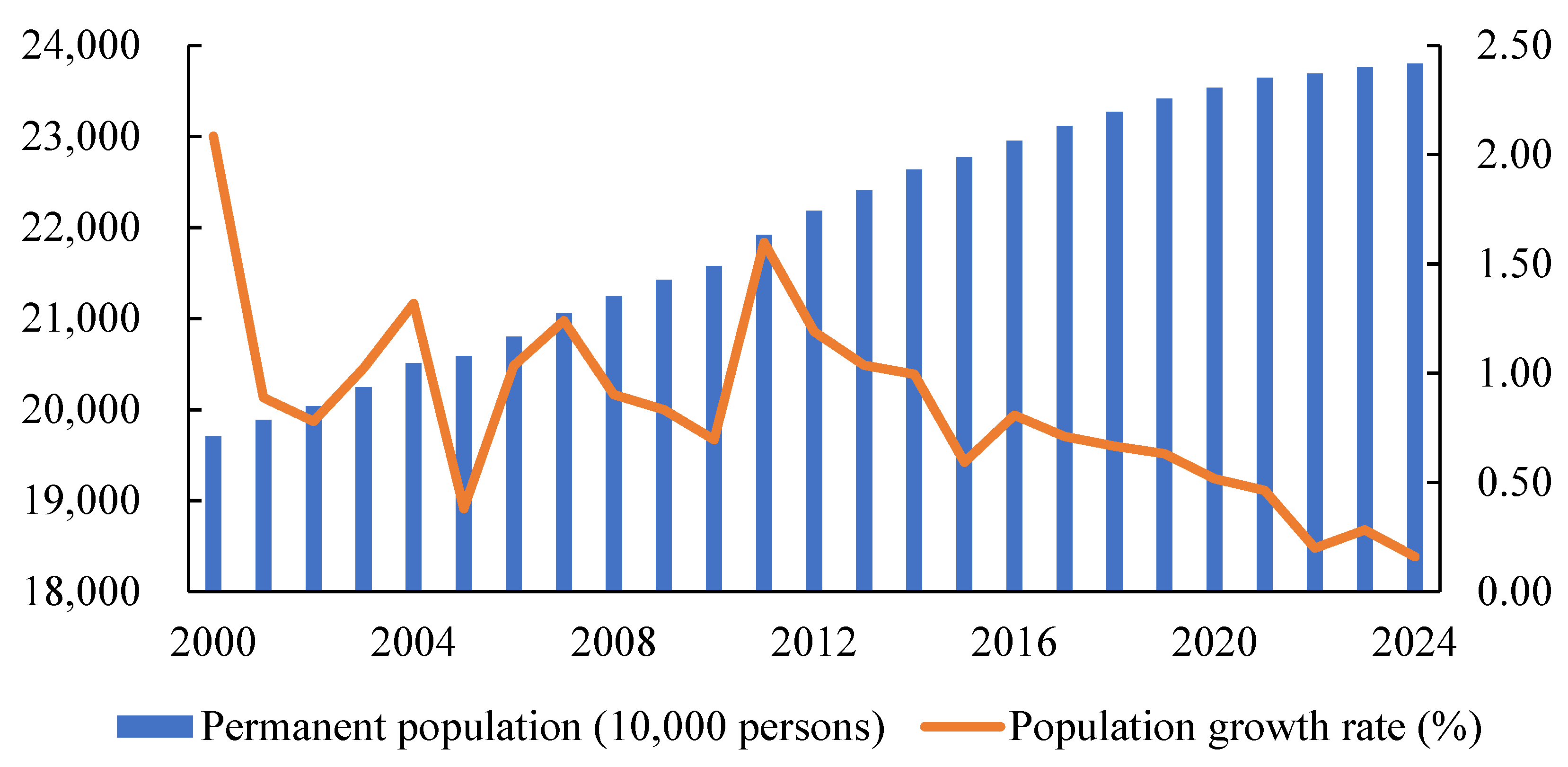
Drawing on annual statistical yearbook data, this study conducts a longitudinal analysis of population change and growth trends in the Yangtze River Delta (YRD) from 2000 to 2024. As shown in Figure 2, the overall population trajectory can be divided into two distinct stages: a phase of rapid and volatile growth (2000–2011) and a slow-growth phase with stable deceleration (2012–2024).

4.1.1. Rapid and Volatile Growth Phase (2000–2011)

During this period, the YRD population increased from 197.09 million in 2000 to 219.21 million in 2011, with a net increase of 22.12 million. Despite this rapid expansion, the growth rate fluctuated significantly. Following China’s accession to the WTO in 2001, the YRD became a primary destination for global industrial relocation, supported by its favorable location, infrastructure, and abundant labor supply. Export-oriented manufacturing thrived, attracting massive inflows of migrant workers and fueling a large wave of migrant worker inflows. Rising labor costs in the mid-2000s and the gradual depletion of surplus rural labor contributed to a slowdown in low-skilled in-migration, reflecting early signs of structural adjustment in the regional labor market [37]. The 2008 global financial crisis exacerbated this trend, as collapsing export orders forced many migrants to return to their hometowns. With the subsequent recovery and the launch of the 2010 YRD Regional Plan promoting integrated development, population growth briefly accelerated toward the end of the period.

4.1.2. Slow-Growth and Decelerating Phase (2012–2024)

Since 2012, the YRD’s total population has continued to grow—from 221.82 million to 237.99 million in 2024—while its growth rate has declined from 1.19% to just 0.16%. This deceleration reflects broader demographic and structural transitions. The weakening of natural population growth, driven by sustained fertility decline and population aging, has reduced endogenous momentum. Meanwhile, industrial upgrading and automation have decreased demand for low-skilled migrant labor, lowering in-migration intensity. Migration to core cities has also moderated due to rising living costs and institutional adjustments that prioritize population quality over scale. Although total population growth has persisted, the degree of deceleration has varied substantially across spatial units, a pattern that will be examined in detail in the subsequent spatial analysis.

4.2. Provincial-Level Population Changes in the YRD

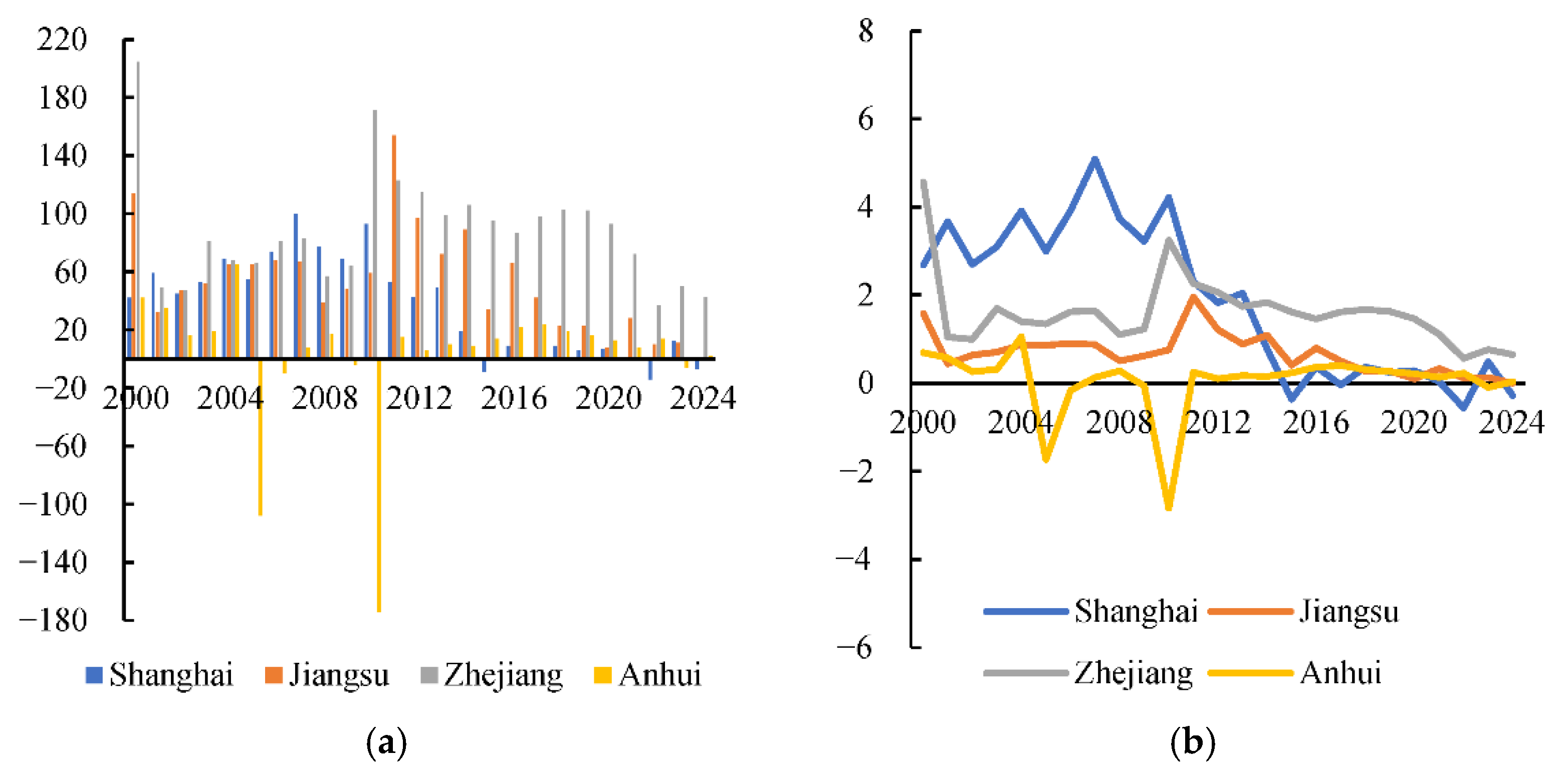
At the provincial level, population change in the Yangtze River Delta (YRD) shows a clear redistribution gradient (Figure 3). Between 2000 and 2024, Zhejiang added nearly 20 million residents (1.5% annually) and maintained a consistently positive deviation in the shift–growth pattern (Table 1), making it the main engine of regional demographic expansion. Jiangsu’s population increased by about 12 million (0.6% annually), but its growth momentum weakened after 2020. Shanghai gained roughly 8.7 million residents (1.8% annually), yet its growth rate decelerated sharply after 2011 and turned negative in 2015, indicating saturation of megacity capacity. Anhui recorded an increase of only about 0.3 million before shifting to negative growth in 2023, reflecting persistent net out-migration. Taken together, these trajectories form a stepped gradient from continued expansion in Zhejiang, through slowing growth in Jiangsu, to incipient saturation in Shanghai and sustained outflow in Anhui. Absolute population change captures the overall scale of redistribution, while the shift–growth decomposition highlights differences in population absorption and development paths across provinces and reveals the core–periphery configuration of the regional system.
This provincial gradient reflects economic and institutional asymmetries rather than purely demographic forces. Cumulative advantages in coastal and metropolitan cores—such as diversified private economies, dense urban networks and relatively flexible residency regimes in Zhejiang and southern Jiangsu—have strengthened their ability to attract and retain population. By contrast, high housing and living costs, land constraints and tighter migration controls have limited Shanghai’s additional absorption capacity, even as it remains at the apex of the regional hierarchy. Anhui’s slower industrial upgrading, lower income levels and weaker access to higher-tier public services reinforce its position as a hinterland and net sending area within the YRD. Together, these mechanisms illustrate how cumulative causation and long-standing structural disparities shape provincial demographic roles.
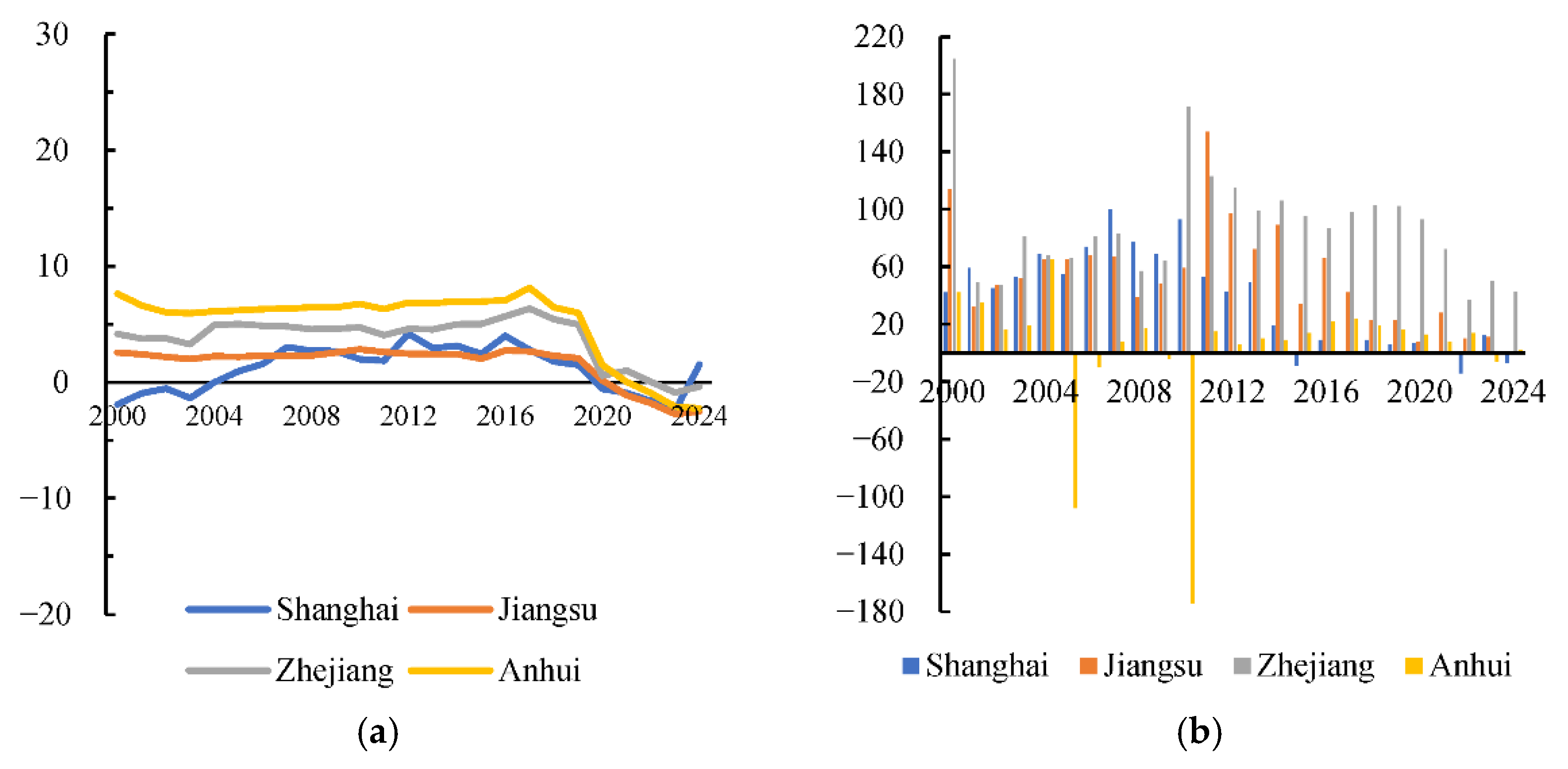
Regarding growth dynamics, all four provinces show a marked decline in natural increase and a near-simultaneous shift toward negative natural growth (Figure 4). Shanghai entered negative natural growth as early as the early 2000s and has since remained constrained by low fertility and rapid ageing. Jiangsu, Zhejiang and Anhui crossed the zero-growth threshold around 2021–2023. As natural growth weakened, net migration became the main driver of demographic change. Shanghai’s early primate-city advantage generated large inflows, but net migration reversed under rising living costs and tighter hukou policies. Zhejiang, supported by a dynamic private and digital economy and more flexible residency rules, emerged as the leading migrant destination. Jiangsu maintained modest net in-migration with pronounced north–south disparities, while Anhui experienced some return migration linked to industrial relocation and transport improvements yet remained a net outflow area. These trends indicate that population redistribution is increasingly governed by differentiated economic strength and urban absorptive capacity, with core areas consolidating population and peripheral areas facing growing demographic vulnerability.
In summary, the YRD’s provincial population structure has evolved from a single-core concentration to a multi-polar but spatially unbalanced configuration. Intensified growth in core provinces and stagnation or decline in peripheral ones reflect disparities in development capacity, institutional accessibility and social infrastructure, posing a major challenge to achieving balanced and sustainable regional development as envisaged in SDG 10 (Reduced Inequalities) and SDG 11 (Sustainable Cities and Communities).

4.3. City-Level Population Redistribution and Spatial Differentiation

At the prefecture-level scale, population dynamics in the Yangtze River Delta (YRD) reveal pronounced spatial heterogeneity. Drawing on the 2010 and 2020 national census data, this section examines three key indicators—population increase, population growth rate, and the shift–growth amount—to illustrate the evolving core–periphery hierarchy within the YRD and discuss its implications for regional inequality and sustainable development.

4.3.1. Spatial Patterns of Population Increase and Growth Rate

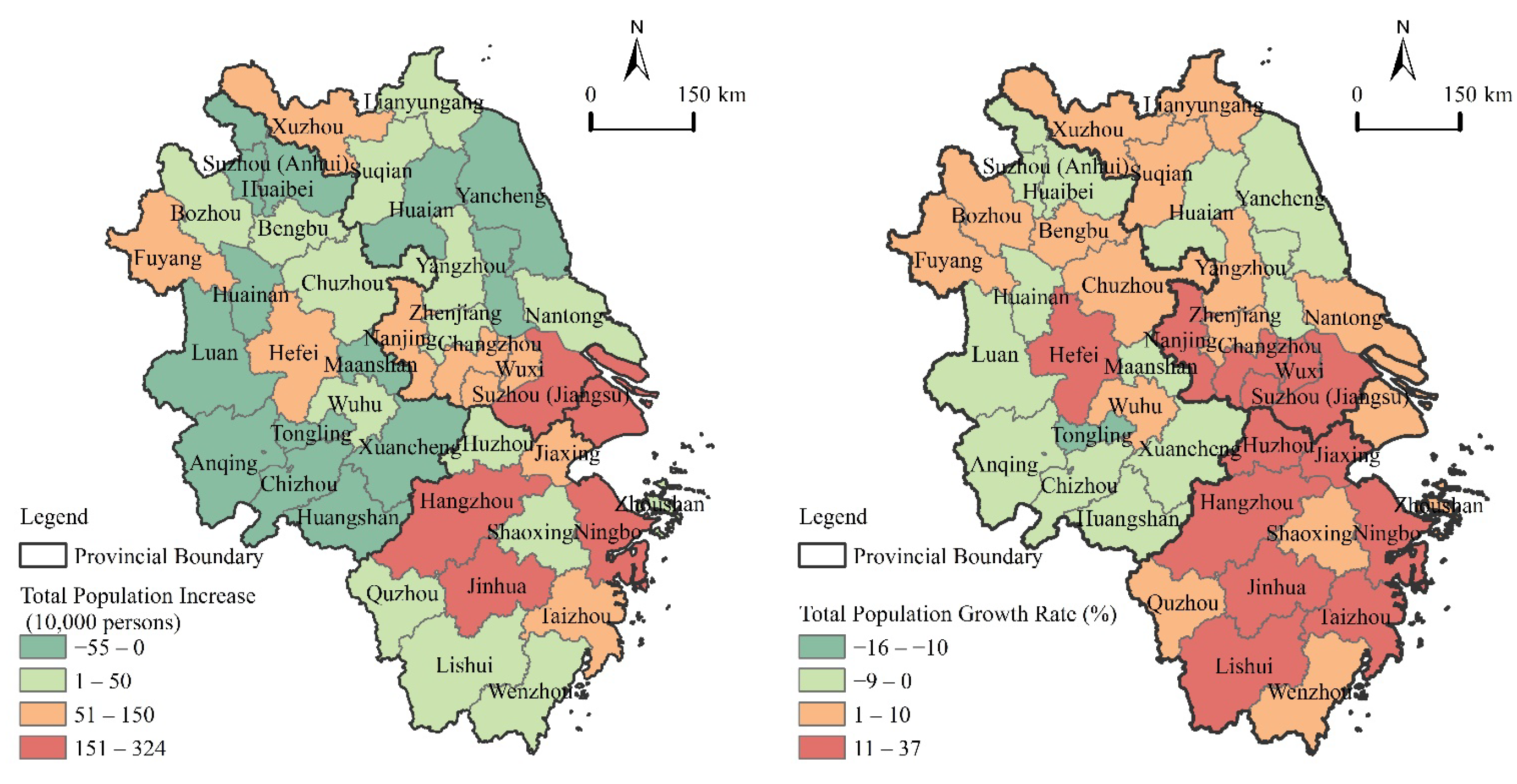
Population increase and growth rates jointly reveal both the scale and intensity of demographic change. Between 2010 and 2020, population growth across the 41 prefecture-level cities in the Yangtze River Delta (YRD) displayed marked spatial variation (Figure 5). The most pronounced increases were concentrated in a southern urban growth corridor formed by several rapidly expanding cities. Hangzhou recorded the highest growth rate (37.2%), reflecting its strengthened position as a regional innovation hub and its expanding influence within the metropolitan economy. Suzhou (21.9%) also sustained robust growth, supported by its advanced manufacturing base and close integration with the Shanghai metropolitan area. Ningbo (23.6%), benefiting from its port-centered economy and industrial upgrading, likewise exhibited strong population expansion. Jinhua (31.5%) is particularly noteworthy. Despite being an inland mid-sized city, its demographic expansion has been closely associated with the development of the Yiwu-centered e-commerce and logistics ecosystem, which has created substantial employment opportunities and attracted large migrant inflows. Its performance positions it among the most dynamic cities in the southern YRD, illustrating the demographic implications of emerging digital economy nodes.
Conversely, Yancheng (−7.6%) and Ma’anshan (−6.3%), located within the “metropolitan shadow zone,” experienced population contraction, largely reflecting limited industrial capacity and the negative spillover effects of core cities [38]. Meanwhile, Huainan (−9.2%) and Tongling (−16.1%), as resource-exhausted and traditional industrial cities undergoing transformation difficulties, exhibited more pronounced structural population loss.
Overall, the spatial distribution of growth rates reveals a distinct south–north gradient: rapidly expanding southern metropolitan centers contrast with stagnant or shrinking cities in northern Jiangsu and parts of Anhui. This divergence underscores increasing differentiation in urban vitality and provides a basis for examining the structural components of population change through shift–share analysis in the Section 4.3.2.

4.3.2. Shift–Share Analysis: Population Redistribution and Core Reinforcement

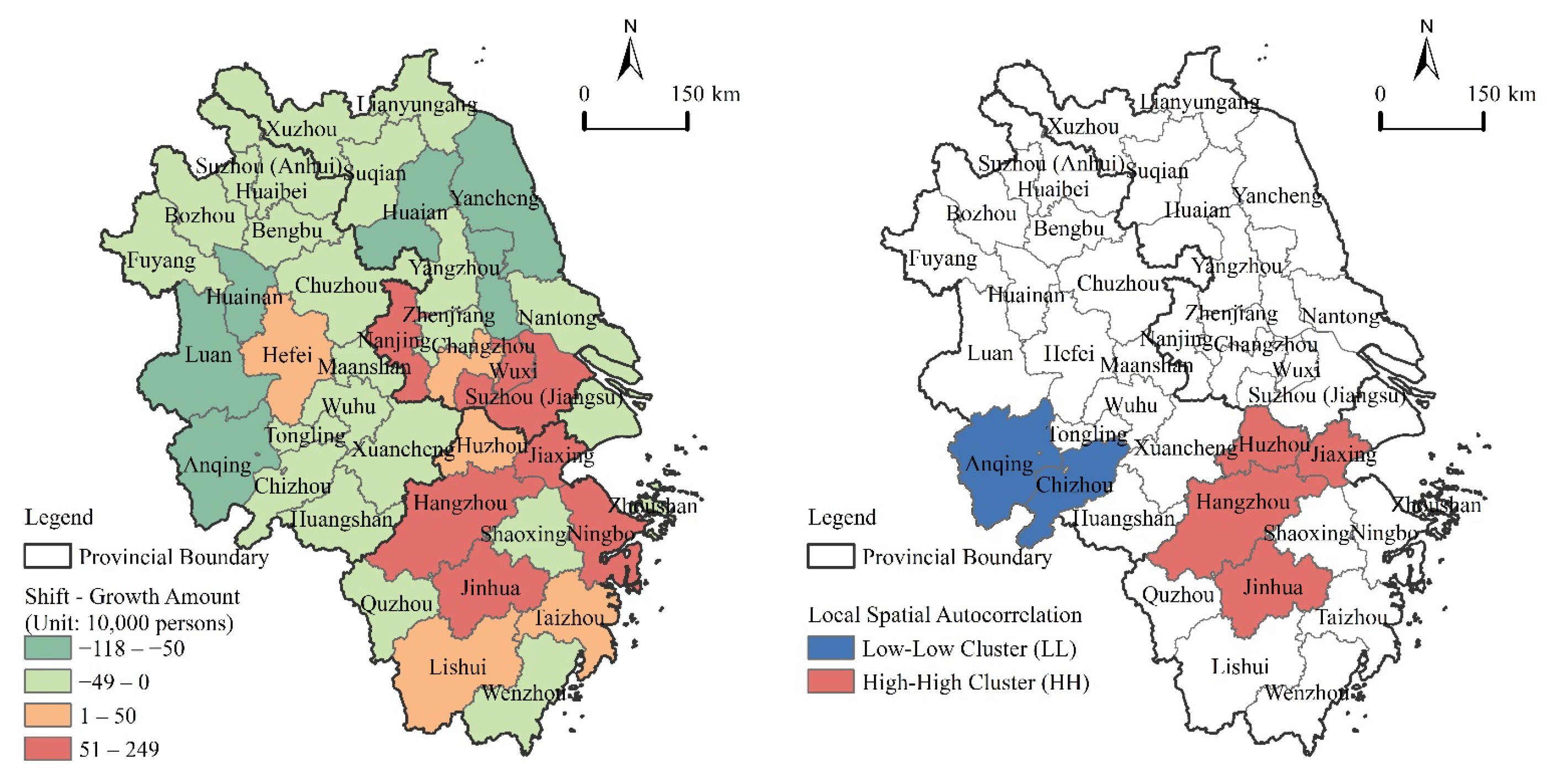
The shift–share analysis reveals distinct spatial patterns of population redistribution across the Yangtze River Delta (Figure 6). Approximately one-third of the cities exhibit positive shift effects, predominantly clustering around metropolitan centers and provincial capitals. In Zhejiang Province, cities such as Hangzhou, Ningbo, Jinhua, Jiaxing, Huzhou, Lishui, and Taizhou; in Jiangsu Province, Nanjing, Changzhou, Wuxi, and Suzhou; and in Anhui Province, Hefei each show population growth exceeding their respective provincial averages, signifying a pronounced process of core reinforcement. These strong positive shifts are consistent with the cities’ economic upgrading, diversified industry structures, and improved accessibility within the regional transport network, whereas peripheral areas exhibit relatively weaker demographic dynamics.
Specifically, the shift–share results show that Hangzhou recorded a shift effect of 2.49 million, Suzhou an effect of 1.39 million, and both Jinhua and Ningbo around 1.2 million each, identifying these cities as the primary demographic attractors within the Yangtze River Delta. In contrast, most other cities exhibited negative shift effects—notably Anqing, Lu’an, and Huainan in Anhui, as well as Huai’an, Taizhou, and Yancheng in Jiangsu—each experiencing a population loss exceeding 0.5 million. Shanghai also showed a slight negative shift effect, indicating demographic saturation and a gradual transition toward population stabilization.
Overall, these findings indicate that population redistribution within the YRD has become increasingly centripetal, with human and economic resources concentrating in innovation-driven metropolitan hubs. While this spatial concentration enhances regional competitiveness and economic efficiency, it simultaneously intensifies spatial inequality and diminishes regional resilience. For sustainable development, policy efforts should focus on enhancing the absorptive capacity of secondary cities, improving access to education, housing, and healthcare, and creating inclusive institutional conditions to mitigate excessive concentration in the urban cores.

4.4. County-Level Population Growth Analysis in the YRD

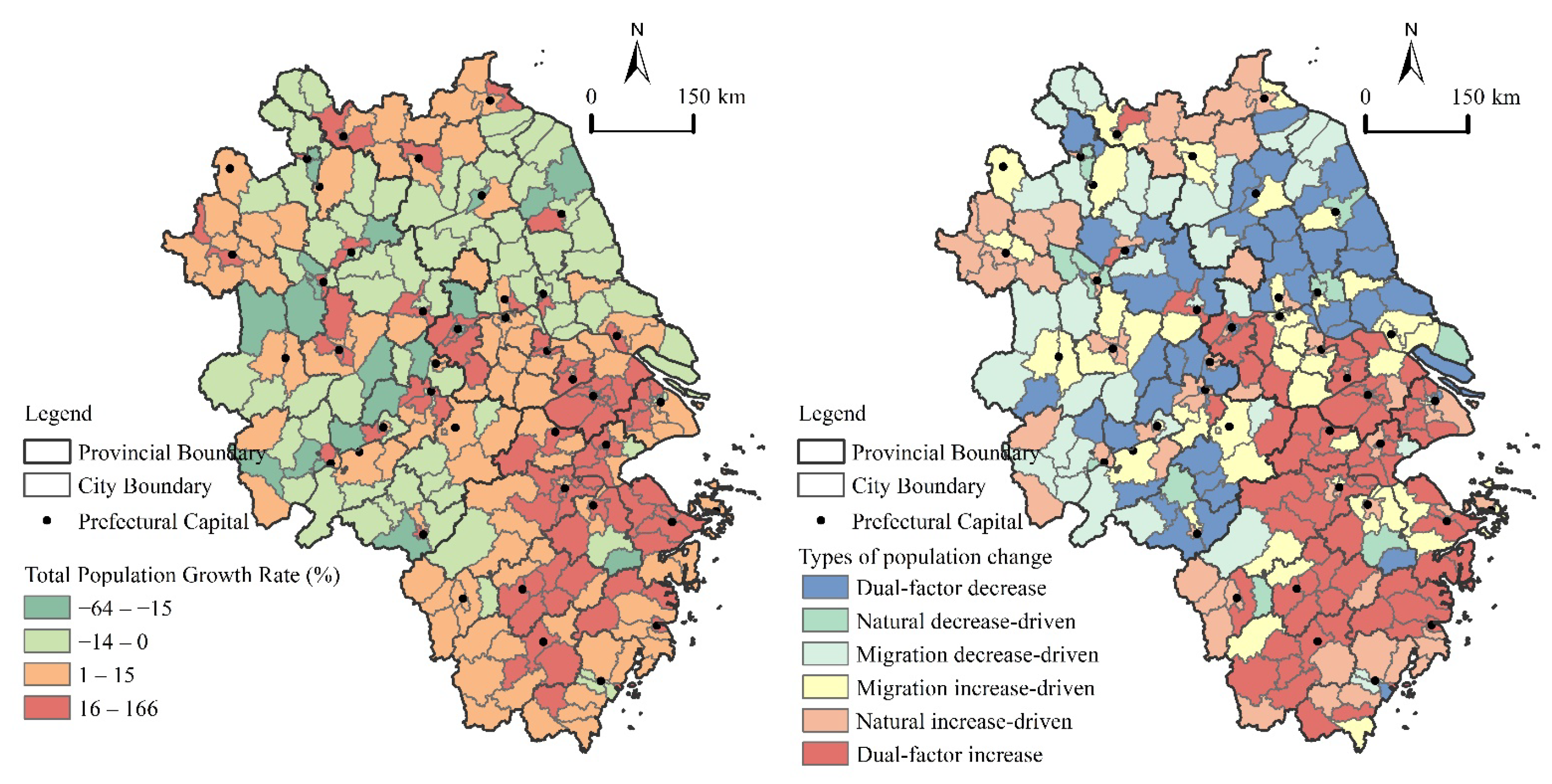
At the county level, population changes in the Yangtze River Delta (YRD) from 2010 to 2020 exhibit pronounced spatial heterogeneity (Figure 7). This study includes 296 county-level units—comprising urban districts, county-level cities, and ordinary counties—based on the 2020 administrative boundaries. To ensure comparability, several merged administrative units were adjusted accordingly. The results reveal a clear administrative gradient: urban districts recorded the strongest growth momentum, with an average population growth rate of 18.44%, followed by county-level cities (5.95%), while ordinary counties experienced an average decline of −1.11% (Table 2). These findings indicate that population growth in the YRD has been primarily driven primarily by urban expansion, whereas traditional rural counties continue to experience population contraction and aging.
Spatially, approximately two-thirds of the county-level units recorded population growth, while the remaining one-third experienced decline. Growth was most pronounced in the core metropolitan areas of the YRD, where urban clusters formed contiguous high-growth zones. By contrast, peripheral areas in northern Jiangsu and western Anhui witnessed widespread population loss. In these regions, although urban districts maintained some growth momentum, surrounding counties and small cities showed persistent population shrinkage. This urban–rural divergence underscores the increasing concentration of population in metropolitan centers and the weakening demographic base in peripheral hinterlands.
To further elucidate the drivers of county-level population differentiation, the total population change was decomposed into natural growth (births minus deaths) and net migration components. Following the classification framework proposed by Qiu and Cao [18], six types of counties were identified based on the relative direction and magnitude of these two drivers (Figure 7): dual-factor decrease, natural decrease-driven, migration decrease-driven, migration increase-driven, natural increase-driven, dual-factor increase. This typology provides a dynamic analytical framework for understanding the underlying demographic processes that shape population redistribution within the YRD.
The results indicate a distinct spatial correspondence between county type and regional hierarchy. The core areas of Shanghai, Nanjing, and Hangzhou, along with their suburban counties, are dominated by dual-factor increase, showing both positive natural growth and strong net in-migration. In contrast, northern Jiangsu and western Anhui are characterized mainly by migration decrease-driven or dual-factor decrease types, reflecting the dual pressures of population outflow and fertility decline. Notably, Hefei and its surrounding areas in Anhui display a migration-driven growth pattern, underscoring the rising attraction of provincial capitals in regional migration systems. Overall, these spatial patterns reveal a typical core–periphery structure, in which labor and population resources are continuously reallocated toward dynamic urban centers.
From a sustainable development perspective, this intra-regional imbalance presents significant challenges for achieving Sustainable Development Goal (SDG) 10 (Reduced Inequalities) and SDG 11 (Sustainable Cities and Communities). The county-level polarization of population growth in the YRD indicates that regional economic prosperity does not automatically translate into demographic equilibrium. Future policy efforts should therefore look beyond the prioritization of high-growth urban centers and promote inclusive growth across the urban–rural continuum. Strengthening local employment opportunities, improving rural living environments, and enhancing inter-county transport connectivity will be essential for achieving a more balanced and resilient population system across the Yangtze River Delta.

4.5. Spatial Inequality Analysis

From a multiscale perspective, regional inequality in population distribution within the Yangtze River Delta (YRD) expanded significantly between 2010 and 2020 (Table 3). Overall, population distribution remained relatively balanced at the provincial level, but disparities were consistently highest at the city level and increased most rapidly at the county level. This pattern suggests that population inequality in the YRD is increasingly shaped by intra-provincial differences at finer spatial scales rather than by differences between provinces.
The CV and Theil indices in Table 4 jointly show that provincial-level inequality is the lowest and most stable, with the provincial Theil index increasing only slightly from 0.070 to 0.076. City-level inequality remains persistently high, with the Theil index rising from 0.201 to 0.215, indicating the continued dominance of major metropolitan centers. County-level inequality exhibits the largest increase over time: the county-level Theil index increases from 0.190 to 0.209, and the CV likewise rises noticeably. Hoover indices at the provincial, city, and county scales also increase—most markedly at the city and county levels—corroborating the trend toward stronger population concentration. The relatively larger change in county-level indicators suggests that growing disparities among counties within provinces are becoming the main driver of changes in regional inequality.
At the county scale, the Theil index measures overall inequality in population distribution among 296 county-level units. To further identify the sources of this inequality, the county-level Theil index is decomposed additively into inter-provincial and intra-provincial components. The overall county-level Theil index is denoted by T and is decomposed into an inter-provincial component TB and an intra-provincial component TW. T reflects overall inequality among all counties, TB captures the contribution of differences in average population size between provinces, and TW captures the contribution of differences among counties within each province (Table 4).
The overall county-level Theil index T increased from 0.190 in 2010 to 0.209 in 2020, indicating a general rise in inequality across counties. More importantly, the internal composition of this inequality has changed. The inter-provincial component TB declined from 0.084 to 0.071, suggesting that differences in average population size between the four provincial units have narrowed. By contrast, the intra-provincial component TW increased from 0.019 to 0.024, implying that disparities among counties within the same province have become more pronounced. The increase in county-level inequality is therefore driven primarily by growing intra-provincial divergence rather than by widening gaps between provinces. The dominant source of regional inequality in the YRD is gradually shifting from inter-provincial size differences to intra-provincial structural disparities.

5. Conclusions and Implications for Sustainable Development

5.1. Conclusions

Based on population data of the Yangtze River Delta (YRD) from 2000 to 2024 (provincial/municipal levels/county level), this study explores the staged evolution, spatial differentiation, and multiscale inequality of population growth and decline under China’s demographic transition, anchored in core–periphery theory, urban hierarchy theory, and urbanization saturation effect. The findings strongly validate the four theoretical propositions, revealing the YRD’s transition from rapid, diffuse expansion to slow, structured polarization—an evolution shaped by multiscale core–periphery dynamics.
(1)
Population growth has shifted from industrialization-driven surge to quality-oriented stable expansion, with demographic dividend decline and aging marking a structural turn toward sustainability. Spatial polarization intensifies across scales: provincial disparities remain modest, but city- and county-level inequalities widen sharply. Core metropolises (Shanghai, Suzhou, Nanjing, Hangzhou, Hefei) sustain growth as high–high clusters, while peripheral counties in northern Jiangsu and Anhui face stagnation or decline (low–low clusters), reflecting cumulative causation in core–periphery structures.
(2)
Higher-tier cities demonstrate stronger demographic resilience via stable mechanical growth, aligning with urban hierarchy theory, while megacities exhibit early saturation signals—slowing migration, central district stabilization—driving growth spillover to secondary cities and suburban hinterlands. Notably, county-level inequality dominates overall imbalance, with intra-provincial disparities (not inter-provincial gaps) becoming the primary driver of demographic unevenness, as peripheral counties and rural townships suffer structural contraction due to limited economic and institutional support.
(3)
Migration, though slightly more diffuse, remains concentrated in metropolitan cores, failing to alleviate peripheral shrinkage. This study underscores that under national low-growth conditions, the YRD’s demographic transition reinforces multiscale hierarchical reallocation rather than spatial equilibrium. These findings enrich theoretical understanding of megaregional demographic dynamics and provide normative implications for reconciling efficiency and equity in sustainable urbanization under the SDG framework.

5.2. Implications for Sustainable Development

The YRD’s multiscale population differentiation—core agglomeration vs. peripheral shrinkage—deepens regional imbalance, posing critical challenges to SDG 10 (reduced inequalities) and SDG 11 (sustainable urbanization). This structural divergence risks reinforcing “core-periphery” disparities, undermining inclusive growth and territorial resilience, demanding targeted regulatory strategies.
(1)
For saturated core metropolises, policies should shift from population attraction to high-quality, inclusive governance. Prioritize compact urban development, expand affordable housing, and equalize public services (education, healthcare) for registered and migrant residents to mitigate segregation and infrastructure overload. Leverage growth spillover to secondary cities and suburbs via transit integration and industrial relocation, avoiding unsustainable sprawl.
(2)
For shrinking peripheral counties (e.g., northern Jiangsu/Anhui), urgent measures are needed to break the downward spiral of population loss, aging, and service withdrawal. Safeguard basic public service thresholds, consolidate essential infrastructure, foster diversified local economies, and enhance physical/digital connectivity to core areas, enabling residents to access opportunities without relocation.
(3)
At the regional scale, governance should focus on intra-provincial inequality—strengthening cross-level coordination to rebalance resource allocation between core and peripheral areas. Use multiscale inequality indicators to monitor progress, aligning population dynamics with land use and infrastructure planning. These strategies will reconcile efficiency and equity, guiding the YRD toward spatially just, resilient development consistent with the 2030 Agenda.

Author Contributions

Data curation, Formal analysis, Visualization, Writing—Original Draft Preparation, J.Y.; Conceptualization, Methodology, Funding, Supervision, Validation, Writing—Reviewing and Editing, X.Q. All authors have read and agreed to the published version of the manuscript.

Funding

This research was funded by the Humanities and Social Sciences Foundation of the Ministry of Education in China (Project No. 17YJC630115) and the Jiangsu Provincial Population Association High-Quality Think Tank Project (Project No. SRK202404).

Institutional Review Board Statement

Not applicable.

Informed Consent Statement

Not applicable.

Data Availability Statement

The data used in this study are derived from the statistical yearbook data of cities and states in Jiangsu Province, Zhejiang Province, Anhui Province and Shanghai, China and the seventh census data and other relevant statistical data. The administrative division data comes from the National Geographic Information Resource Directory Service System. https://www.stats.gov.cn/; http://tj.jiangsu.gov.cn; http://tjj.zj.gov.cn; http://tj.ah.gov.cn; http://tjj.sh.gov.cn.

Acknowledgments

We are grateful for the basic data provided by the statistical bureaus and the National Basic Geographic Information Center in China.

Conflicts of Interest

The authors declare no conflicts of interest.

Abbreviation

The following abbreviation is used in this manuscript:
YRDYangtze River Delta

References

  1. Wolff, M.; Wiechmann, T. Urban Growth and Decline: Europe’s Shrinking Cities in a Comparative Perspective 1990–2010. Eur. Urban Reg. Stud. 2018, 25, 122–139. [Google Scholar] [CrossRef]
  2. World Urbanization Prospects 2018|Population Division. Available online: https://www.un.org/development/desa/pd/news/world-urbanization-prospects-2018 (accessed on 27 October 2025).
  3. 2030 Agenda for Sustainable Development. Available online: https://www.unhcr.org/hk/en/2030-agenda-sustainable-development (accessed on 23 October 2025).
  4. Kim, S.; Kim, E. Population Decline in Small and Medium-Sized Cities and Spatial Economic Patterns: Spatial Probit Model of South Korea. Appl. Econ. Lett. 2024, 32, 3141–3146. [Google Scholar] [CrossRef]
  5. Salvati, L. Demographic Dynamics, Urban Cycles and Economic Downturns: A Long-Term Investigation of a Metropolitan Region in Europe, 1956–2016. Popul. Res. Policy Rev. 2020, 39, 549–575. [Google Scholar] [CrossRef]
  6. Lichter, D.T.; Brown, D.L.; Parisi, D. The Rural–Urban Interface: Rural and Small Town Growth at the Metropolitan Fringe. Popul. Space Place 2021, 27, e2415. [Google Scholar] [CrossRef]
  7. Balandi, J.B.; To Hulu, J.P.P.M.; Sambieni, K.R.; Sikuzani, Y.U.; Bastin, J.-F.; Musavandalo, C.M.; Nguba, T.B.; Molo, J.E.L.; Selemani, T.M.; Mweru, J.-P.M.; et al. Urban Sprawl and Changes in Landscape Patterns: The Case of Kisangani City and Its Periphery (DR Congo). Land 2023, 12, 2066. [Google Scholar] [CrossRef]
  8. Talkhabi, H.; Ghalehteimouri, K.J.; Mehranjani, M.S.; Zanganeh, A.; Karami, T. Spatial and Temporal Population Change in the Tehran Metropolitan Region and Its Consequences on Urban Decline and Sprawl. Ecol. Inform. 2022, 70, 101731. [Google Scholar] [CrossRef]
  9. Xu, X.; Ma, J.; Sho, K.; Seta, F. Are East Asian “Shrinking Cities” Falling into a Loop? Insights from the Interplay between Population Decline and Metropolitan Concentration in Japan. Cities 2024, 155, 105445. [Google Scholar] [CrossRef]
  10. Lu, J. The Era of Negative Population Growth: Characteristics, Risks, and Coping Strategies. J. Soc. Dev. 2019, 6, 21–32. [Google Scholar]
  11. Tao, T.; Jin, G.; Guo, Y. A Comparison of Two Types of Negative Population Growth: Definition, Demographic Implications and Economic Impacts. Popul. Res. 2021, 45, 14–28. [Google Scholar]
  12. Zhai, Z.; Huang, Z.; Zhang, Y. An Analysis of Special Factors Influencing China’s Low Fertility Level. Popul. Res. 2025, 49, 52–65. [Google Scholar]
  13. Zhai, Z.; Jin, G. China’s Negative Population Growth: Characteristics, Challenges, and Responses. Popul. Res. 2023, 47, 11–20. [Google Scholar]
  14. Jin, G.; Guo, Y.; Tao, T. The Connotation Evolution, Multi-dimensional Differentiation, and Economic Impact Pathways of Negative Population Growth. Lanzhou Acad. J. 2024, 2, 64–76. [Google Scholar]
  15. Mao, Z.; Mo, H. The Historical Evolution and Urban-Rural Differences of Population Momentum in China. Chin. J. Popul. Sci. 2024, 38, 83–97. [Google Scholar]
  16. Qiu, Y.; Cao, G. A Structural Analysis and Spatio-temporal Pattern of Regional Population Growth and Decline Differentiation in China. Acta Geogr. Sin. 2025, 80, 1482–1501. [Google Scholar]
  17. Liu, T.; Peng, R.; Zhuo, Y.; Cao, G. The Evolution of Population Distribution Pattern and Its Influencing Factors in China from 2000 to 2020. Acta Geogr. Sin. 2022, 77, 381–394. [Google Scholar]
  18. Du, Z. Spatial Characteristics and Influencing Factors of Population Shrinkage in Towns and Villages of Small and Medium-sized Cities in China. Geogr. Res. 2025, 44, 1534–1550. [Google Scholar]
  19. Wu, Z.; Su, Y. Spatiotemporal Evolution of Economic Disparities among 23 Cities in Guangdong Province, Hong Kong, and Macau: A Comprehensive Study. J. Urban Plan. Dev. 2024, 150, 04023052. [Google Scholar] [CrossRef]
  20. Xu, J.; Zeng, Z.; Xi, Z.; Peng, Z.; Chen, G.; Zhu, X.; Chen, X. Research on Sustainable Urban-Rural Integration Development: Measuring Levels, Influencing Factors, and Exploring Driving Mechanisms-Taking Eight Cities in the Greater Bay Area as Examples. Sustainability 2024, 16, 3357. [Google Scholar] [CrossRef]
  21. Yan, D.; Sun, W.; Wang, Y.; Xu, S. Evolution, Shift-Share Growth, and Influencing Factors of Population Distribution in the Yangtze River Delta. Prog. Geogr. 2020, 39, 2068–2082. [Google Scholar] [CrossRef]
  22. Ma, X.; Zhang, Z. Research on the Spatial Evolution Characteristics and Trends of the Yangtze River Delta Region Based on Population Flow. Urban Plan. Forum 2020, 5, 47–54. [Google Scholar]
  23. Wang, Y.; Zhu, M.; Meng, X.; Niu, X. Characteristics of Population Element Flow and Spatial Governance Strategies in the Su-Xi-Chang Metropolitan Area. Planners 2022, 38, 27–33. [Google Scholar]
  24. Friedmann, J. Regional Development Policy: A Case Study of Venezuela; M.I.T. Press: Cambridge, MA, USA, 1966. [Google Scholar]
  25. Friedmann, J. A General Theory of Polarized Development. In Growth Centers in Regional Economic Development; Hansen, N.M., Ed.; Free Press: New York, NY, USA, 1972; pp. 82–107. [Google Scholar]
  26. Christaller, W. Central Places in Southern Germany; Baskin, C.W., Translator; Prentice-Hall: Englewood Cliffs, NJ, USA, 1966. [Google Scholar]
  27. Berry, B.J.L. Cities as Systems within Systems of Cities. Pap. Reg. Sci. 1964, 13, 147–163. [Google Scholar] [CrossRef]
  28. Richardson, H.W. City Size and National Spatial Strategies in Developing Countries; World Bank: Washington, DC, USA, 1977. [Google Scholar]
  29. Champion, T. Urbanization, Suburbanization, Counterurbanization and Reurbanization. In Handbook of Urban Studies; Paddison, R., Ed.; Sage: London, UK, 2001; pp. 143–161. [Google Scholar]
  30. National Bureau of Statistics of China, 2025; Statistical Bulletin on National Economic and Social Development of the People’s Republic of China in 2024. Available online: https://www.stats.gov.cn/sj/zxfb/202502/t20250228_1958817.html (accessed on 25 November 2025).
  31. China Statistics Press. Shanghai Statistical Yearbook 2000–2024; China Statistics Press: Shanghai, China, 2000–2024. [Google Scholar]
  32. China Statistics Press. Jiangsu Statistical Yearbook 2000–2024; China Statistics Press: Nanjing, China, 2000–2024. [Google Scholar]
  33. China Statistics Press. Zhejiang Statistical Yearbook 2000–2024; China Statistics Press: Hangzhou, China, 2000–2024. [Google Scholar]
  34. China Statistics Press. Anhui Statistical Yearbook 2000–2024; China Statistics Press: Hefei, China, 2000–2024. [Google Scholar]
  35. China Statistics Press. Tabulation on the 2010 Population Census of China; China Statistics Press: Beijing, China, 2012. [Google Scholar]
  36. China Statistics Press. Tabulation on the 2020 Population Census of China; China Statistics Press: Beijing, China, 2022. [Google Scholar]
  37. Hou, D.; Wang, D.; Bai, N.; Qian, W.; Xie, C.; Zhou, Z. From “Migrant Worker Shortage” to “Returning Tide”: Has China’s Lewis Turning Point Arrived? Popul. Res. 2009, 33, 32–47. [Google Scholar]
  38. Sun, D.; Zhang, J.; Hu, Y.; Zhou, L.; Jiang, J. Analysis of the Formation Mechanism of Jiaxing City as a “Metropolitan Shadow Area”: A Comparative Study with the Development Difference of Suzhou City. Hum. Geogr. 2014, 29, 66–71. [Google Scholar]
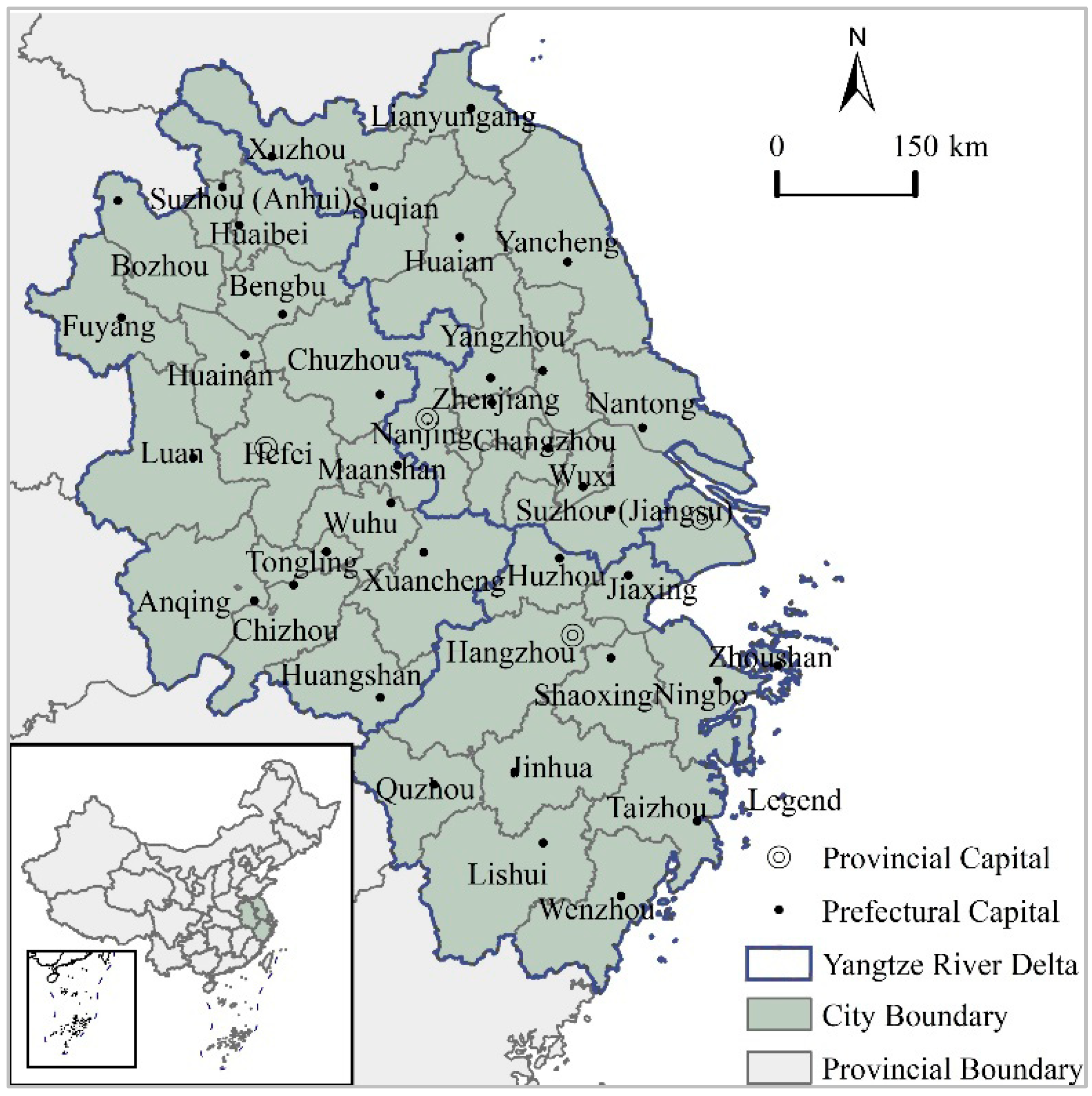
Figure 1. Location of the study area in the Yangtze River Delta (YRD).
Sustainability 17 11011 g001
Figure 2. Population change in the YRD, 2000–2024.
Sustainability 17 11011 g002
Figure 3. Permanent population growth in the four provinces and municipalities of the YRD, 2000–2024. (a) Population growth by region (Unit: 10,000 persons); (b) Population growth rate by region (Unit: %).
Sustainability 17 11011 g003
Figure 4. Natural and mechanical population growth in the YRD, 2000–2024 (Unit: 10,000 persons). (a) Natural growth rate (Unit: %); (b) Mechanical growth rate (Unit: %).
Sustainability 17 11011 g004
Figure 5. Spatial distribution of population growth and decline in prefecture-level cities of the YRD, 2010–2020.
Sustainability 17 11011 g005
Figure 6. Population shift–growth amount and local spatial autocorrelation (LISA) results of prefecture-level cities in the YRD.
Sustainability 17 11011 g006
Figure 7. Population increase and decline in county-level units in the YRD, 2010–2020.
Sustainability 17 11011 g007
Table 1. Population shift–growth amount at the provincial level in the YRD, 2000–2024 (Unit: 10,000 persons).
Region2000–20112011–20202000–2024
Shanghai566.42−77.84537.10
Jiangsu−126.33−184.34−321.49
Zhejiang364.75622.811018.81
Anhui−804.84−360.63−1234.42
Note: Authors’ compilation based on the Statistical Yearbooks of Shanghai, Jiangsu, Zhejiang, and Anhui (2000–2024).
Table 2. Population growth by county-level administrative type in the YRD, 2010–2020.
Administrative TypeNumber of UnitsShare of Population (%)Population Growth Rate (%)
Urban Districts14453.318.44
County-Level Cities5120.65.95
Ordinary Counties10126.1−1.11
Total2961007.76
Table 3. Regional inequality indicators of population distribution across provincial, city, and county levels in the YRD, 2010–2020.
LevelYearCVTheilHoover
Provincial20100.4110.0700.138
20200.4240.0760.144
City-level20100.7380.2010.234
20200.7390.2150.254
County-level20100.6710.1900.239
20200.7220.2090.244
Table 4. Decomposition of the county-level Theil index into inter-provincial and intra-provincial components in the YRD, 2010–2020.
YearT (Overall)TB (Inter-Provincial)TW (Intra-Provincial)
20100.1900.0840.019
20200.2090.0710.024
Disclaimer/Publisher’s Note: The statements, opinions and data contained in all publications are solely those of the individual author(s) and contributor(s) and not of MDPI and/or the editor(s). MDPI and/or the editor(s) disclaim responsibility for any injury to people or property resulting from any ideas, methods, instructions or products referred to in the content.