Abstract
In recent decades, the flexible job shop scheduling problem (FJSP) has been widely studied. In the context of green manufacturing, objectives related to energy consumption and sustainability have emerged as essential components of the contemporary production landscape. These scheduling objectives present new obstacles for workshop coordination, routing, and process planning. Among various green scheduling targets, energy consumption objectives constitute a substantial share. Therefore, this paper focuses on the dynamic flexible job shop scheduling problem (DFJSP) with an emphasis on energy consumption. First, this paper reviews the literature on DFJSP that considers energy consumption over the past decade. Second, this paper categorizes the dynamic constraints and dynamic event handling strategies in the indexed literature. Additionally, this paper examines the current methods for addressing this complex scheduling problem and compares and evaluates their advantages and disadvantages. Finally, this paper proposes new insights for future research from the perspectives of algorithms and energy-saving strategies.
1. Introduction
The flexible job shop scheduling problem (FJSP) aims to find a suitable scheduling solution for customers to produce jobs with the goal of minimizing both the lead time and production costs [1]. As an extension of the job shop scheduling problem (JSP), it is likewise an important combinatorial optimization problem for a wide variety of domains, e.g., semiconductor manufacturing, automotive manufacturing, and textile manufacturing [2,3,4]. A competent scheduling planner is the key to improving customer satisfaction and production efficiency [5]. It is well known that the JSP is a typical NP-hard problem, and the FJSP is also an NP-hard problem [6,7]. Meanwhile, the FJSP also needs to determine the machine routes (i.e., which machine is assigned to each operation) in addition to the traditional scheduling decisions (i.e., determining the start time of each operation) [8]. This implies that the FJSP is more diverse and flexible in terms of scheduling schemes compared to the JSP.
Most countries around the world are increasingly concerned about the recent problems of global warming, depletion of fossil fuels, and environmental pollution [9]. Especially during the last 50 years, energy has accounted for a large share of production costs for manufacturing companies [10]. As an important component of manufacturing systems, the energy-efficient flexible job shop scheduling problem (EFJSP) has been widely studied by both industry and academia [11,12]. The EFJSP is a typical example of current production scheduling, which is involved in many industrial sectors, e.g., aerospace [13], cranes [14], automobile assembly [15], and healthcare [16].
Currently, there are four main approaches to handling EFJSPs. Exact methods, such as constraint planning, have been used to determine the optimal scheduling solution for FJSPs but are often only applicable to small-scale combinatorial problems due to their inefficiency [17,18]. Heuristics such as scheduling rules have been widely used to optimize machine scheduling functions; however, a single scheduling rule often fails to yield a better scheduling solution. Moreover, designing effective scheduling heuristics requires domain knowledge from experts, which is not always available [19,20,21]. Moreover, manually designed scheduling heuristics are only applicable to a particular scenario for which they were designed but are ineffective in other scenarios [22].
To cope with the above limitations, it is particularly important to automatically generate effective combinatorial scheduling rules by means of hyper-heuristic algorithms [23]. Metaheuristics are mainly categorized into Evolutionary Computation (EC) and Swarm Intelligence (SI), whereby the former employs the idea of genetic operators to guide the search, while SI utilizes synergistic mechanisms among individuals to determine optimal values [24]. Examples include genetic algorithms [25,26,27], particle swarm optimization [28,29,30], forbidden search [31], and algorithms such as artificial bee colony [32,33,34] and gray wolf optimization [35,36,37]. During the last decade or so, researchers have conducted many studies to improve the performance of these methods in EFJSPs by various means, such as improving genetic operators [38], designing domain structures [39], and so on.
More importantly, with the development of machine learning algorithms in recent years, combining machine learning with these methods has shown promising results, e.g., agents [40], feature selection [41], reinforcement learning [42], and multi-objective optimization [43]. Therefore, this review puts machine learning in a separate category to better summarize the study of this method. It is worth noting that in this review, we only focus on the EFJSP, which targets a broad category of energy consumption (e.g., energy consumption, energy efficiency, carbon emissions, and electricity consumption).
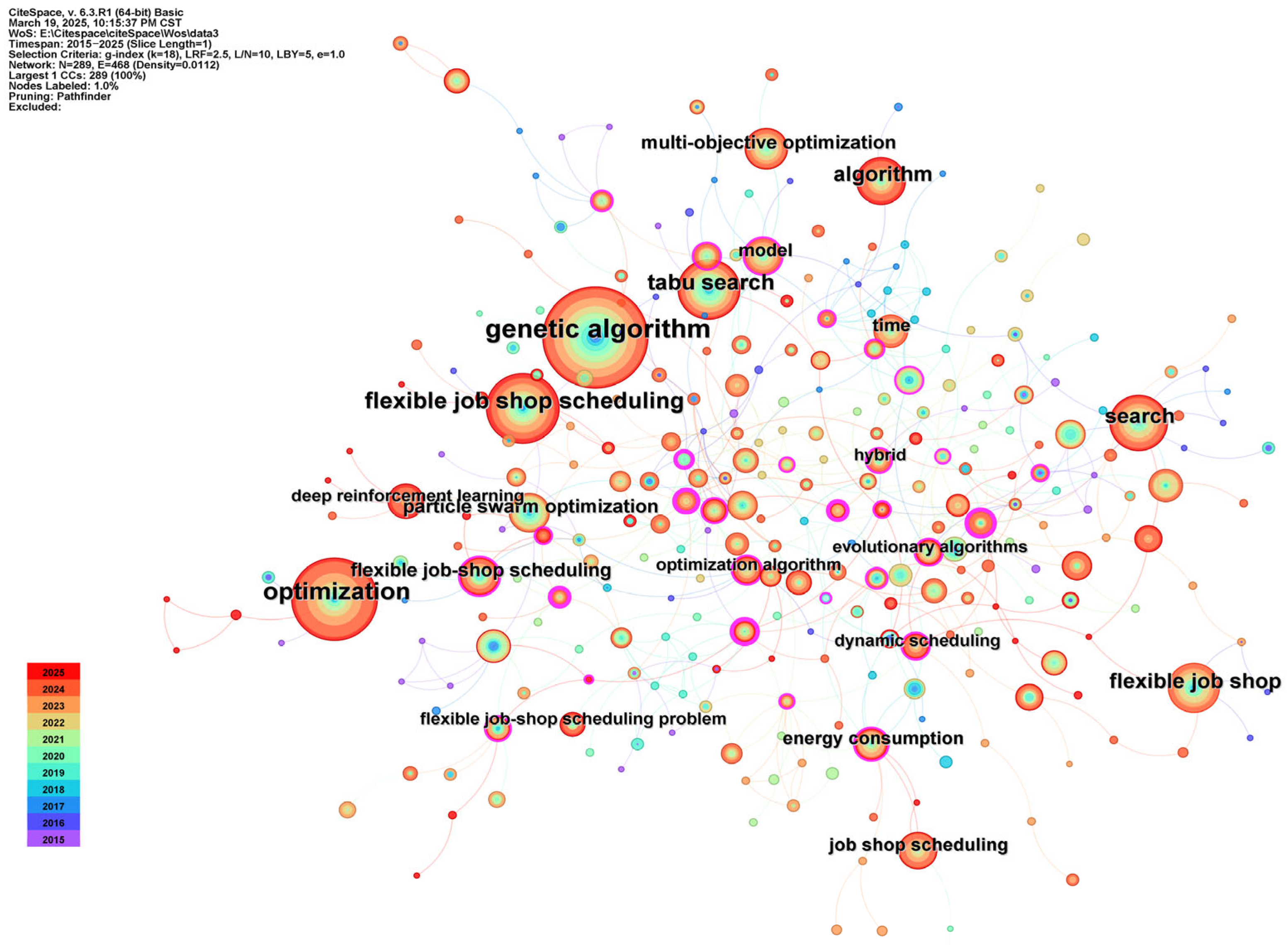
Therefore, in this review, “Flexible Job Shop Scheduling” or the “FJSP” was set as the subject term, and the type of literature was set as journal papers. A total of 974 related papers were retrieved by searching in the Web of Science core database. After screening, there were 3 retracted articles, 38 articles that did not match the search topic, 13 review articles, and 9 duplicates. The 911 documents were imported into CiteSpace v.6.3.R1 Basic [44,45] and processed to obtain the keyword knowledge map (Figure 1) and the 10 most cited keywords (Table 1).
Figure 1.
Keyword Clustering Map Based on the WOS Database.
Table 1.
Ten most cited keywords.
In Figure 1, the closer the color of these circular cluster diagrams is to red, the more recent the year of the research; their size represents the number of related papers published by the researchers. Thus, the top 12 clusters are genetic algorithm, optimization, flexible job shop scheduling, tabu search, algorithm, search, particle swarm optimization, multi-objective optimization, model, job shop scheduling, energy consumption, and system.
From the keyword clustering rankings, it can be seen that for EFJSP research, foreign countries mainly focus on algorithms, search strategies, and deep learning to solve energy saving, emission reduction, and productivity of the multi-objective optimization problems.
Although deep learning and other technologies have become the current research hotspots, in the context of global energy saving and emission reduction and sustainable development, domestic and foreign research scholars still look at the energy consumption problem in the first place [46,47]. Energy consumption optimization in flexible job shop scheduling not only helps to reduce production costs and improve resource utilization but also plays a key role in reducing greenhouse gas emissions and promoting green manufacturing [12]. Therefore, studying the combination of energy conservation and scheduling optimization has significant scientific and industrial significance.
This article aims to help the manufacturing industry understand the interaction mechanism between scheduling strategies and energy-saving technologies by systematically organizing and analyzing research results on energy consumption and flexible workshop scheduling problems in the past 15 years. By identifying the advantages and limitations of existing optimization methods, this study may help practitioners choose appropriate scheduling strategies and design energy-saving production control systems.
Compared with similar publications, this article provides a new perspective on energy-saving development in this field through in-depth discussions on algorithms and energy-saving strategies. The specific contributions of this article are as follows: (1) It provides a detailed introduction to the scheduling model of flexible workshops and describes the optimization objectives of the workshops; (2) classifies dynamic events and describes response strategies; (3) analyzes and discusses algorithms and energy-saving strategies; and (4) proposes prospective research approaches for future exploration, particularly regarding physical modeling and industrial validation.
The remainder of this paper is organized as follows: Section 2 introduces the methodology of the research and statistically analyzes the retrieved EFJSPs. Section 3 describes the standard FJSP model, provides a detailed overview of commonly used optimization objectives, and classifies the types of disturbances as well as the corresponding response strategies. Section 4 describes the current mainstream methods for solving EFJSPs and discusses the advantages and disadvantages of these methods. Section 5 discusses current issues and challenges in order to suggest promising areas and directions for the future.
2. Research Methodology
2.1. Literature Search Strategy
After defining the research scope, we searched for published papers on topics related to flexible job shops in terms of energy consumption over the last 15 years. Because of the extensive amount of literature, this review focused solely on articles classified as such in the Web of Science core database. At the same time, papers that only consider the dynamic flexible job shop scheduling problem with energy consumption, the rest of the shop, or those that do not consider the energy consumption beyond the target are not part of the research scope of this paper.
This study devised a comprehensive search method to ensure the relevance and scientific integrity of the literature within the interdisciplinary domain of “energy consumption dynamic scheduling flexible job shop”. This article exclusively examines literature on dynamic flexible job shop scheduling problems that pertain to energy consumption, omitting studies unrelated to the scheduling issues of the flexible job shop or those that do not address energy consumption. Initially, we delineated the primary search keywords, encompassing “Energy consumption,” “Flexible job shop scheduling problem,” and “Dynamic scheduling.” Consequently, we integrated Boolean logic to enhance the retrieval formula, aiming to attain equilibrium between relevance and coverage. For instance, employing “AND” to restrict search results to the intersection of terms (e.g., “flexible job shop Scheduling AND Energy Consumption”) guarantees that the literature addresses both fundamental areas concurrently; utilizing “OR” broadens the search parameters (e.g., “Energy Consumption” or “Energy saving”) to prevent the omission of potentially pertinent material; and utilizing “NOT” eliminates topics irrelevant to the research subject.
Therefore, the search operation is as follows: In the core database of the WOS, set “flexible job shop” OR “FJSP” as the first-level topic and set “energy consumption” OR “energy conservation” OR “energy-saving” OR “carbon emission” OR “electricity” as the secondary topic. The year published is set as “2010–2025”. Meanwhile, to narrow down the scope, “document type” is set as “article”.
The specific retrieval formula is as follows: TS = (“flexible job shop” OR “FJSP”) AND TS = (“energy consumption” OR “energy conservation” OR “energy-saving” OR “carbon emission” OR “electricity”) AND PY = (2010–2025) AND DT = (Article).
To ensure the relevance and quality of the literature included in this review, a two-stage screening process was rigorously implemented based on predefined criteria.
- Stage 1:
- Initial Screening (Title and Abstract)
The initial 241 records retrieved from the database were screened based on their titles and abstracts. The inclusion criteria required studies to satisfy the following:
- Focus on scheduling problems within a flexible job shop environment.
- Explicitly consider energy consumption (or related terms such as energy-saving and carbon emission) as one of the optimization objectives.
Studies were excluded if they met the following criteria:
- Focused on other production systems.
- Did not set energy consumption as an objective.
- Were review articles, retracted publications, or not journal articles.
Through screening, 5 review papers, 1 paper on flexible manufacturing systems, 13 papers on flow shops or hybrid flow shops, 2 papers on remanufacturing systems, 1 paper on integrated process planning and scheduling, 2 papers on single machine shops, 4 papers on parallel machine shops, 2 papers on multi-objective vehicle routing problems, 1 paper on assembly line scheduling, 2 papers on job shops, 3 papers not setting energy consumption as an objective, 3 retracted publications, 1 paper on integrated scheduling of distributed production and distribution, 1 paper on cell production system, and 1 paper on collaborative scheduling of part integrated energy and container logistics for parts were removed.
- Stage 2:
- Full-Text Assessment
The remaining 198 articles underwent a full-text review to confirm their eligibility. At this stage, articles were further excluded if they did not consider dynamic uncertainty factors. This step ensured that the final corpus of literature was precisely aligned with the core focus of this review: the energy-efficient dynamic flexible job shop scheduling problem (EDFJSP). Following this systematic screening, 45 papers were identified as directly relevant and formed the basis for the subsequent in-depth analysis in this review.
2.2. Analysis of Literature
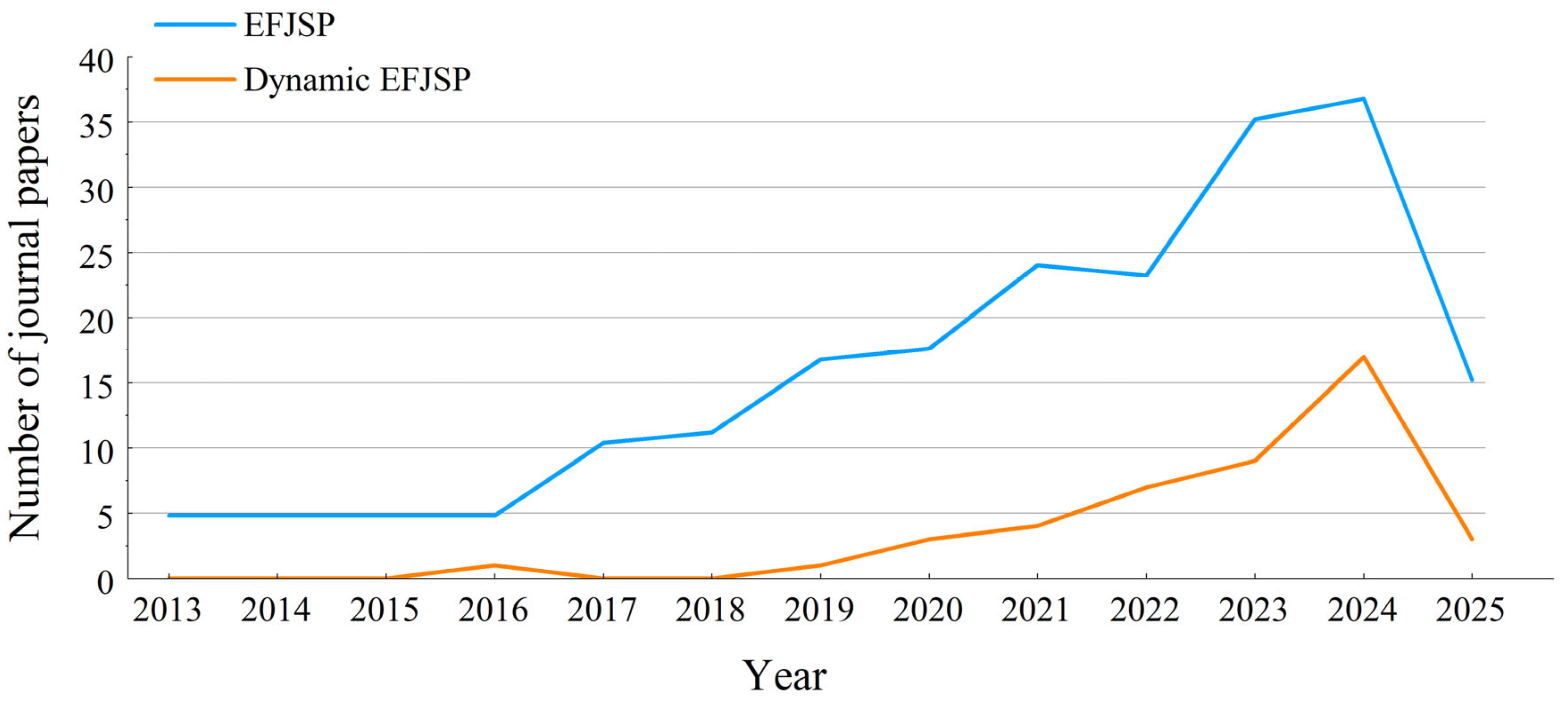
Early research on the problem of energy-efficient dispatch dates back to the 1990s [48]. However, energy-efficient scheduling has only become a popular topic of research in recent years [49]. Figure 2 illustrates the number of papers published on the dynamic flexible job shop scheduling problem considering energy consumption. The statistics cover the period from 2013 to the first quarter of 2025. As shown in Figure 2, the number of papers on related topics has been increasing year by year, especially after 2019.
Figure 2.
Publication of FJSP papers considering energy consumption from 2013 to 2025.
These 45 papers were published in 25 journals. However, only 9 journals have published 2 or more papers on related topics. All in all, 29 papers were published in these 9 journals, more than half of the papers screened. The details of these core journals and their publication counts are summarized in Table 2.
Table 2.
Publication titles of EDFJSP papers with more than 2 publications from 2013 to 2025 (Q1).
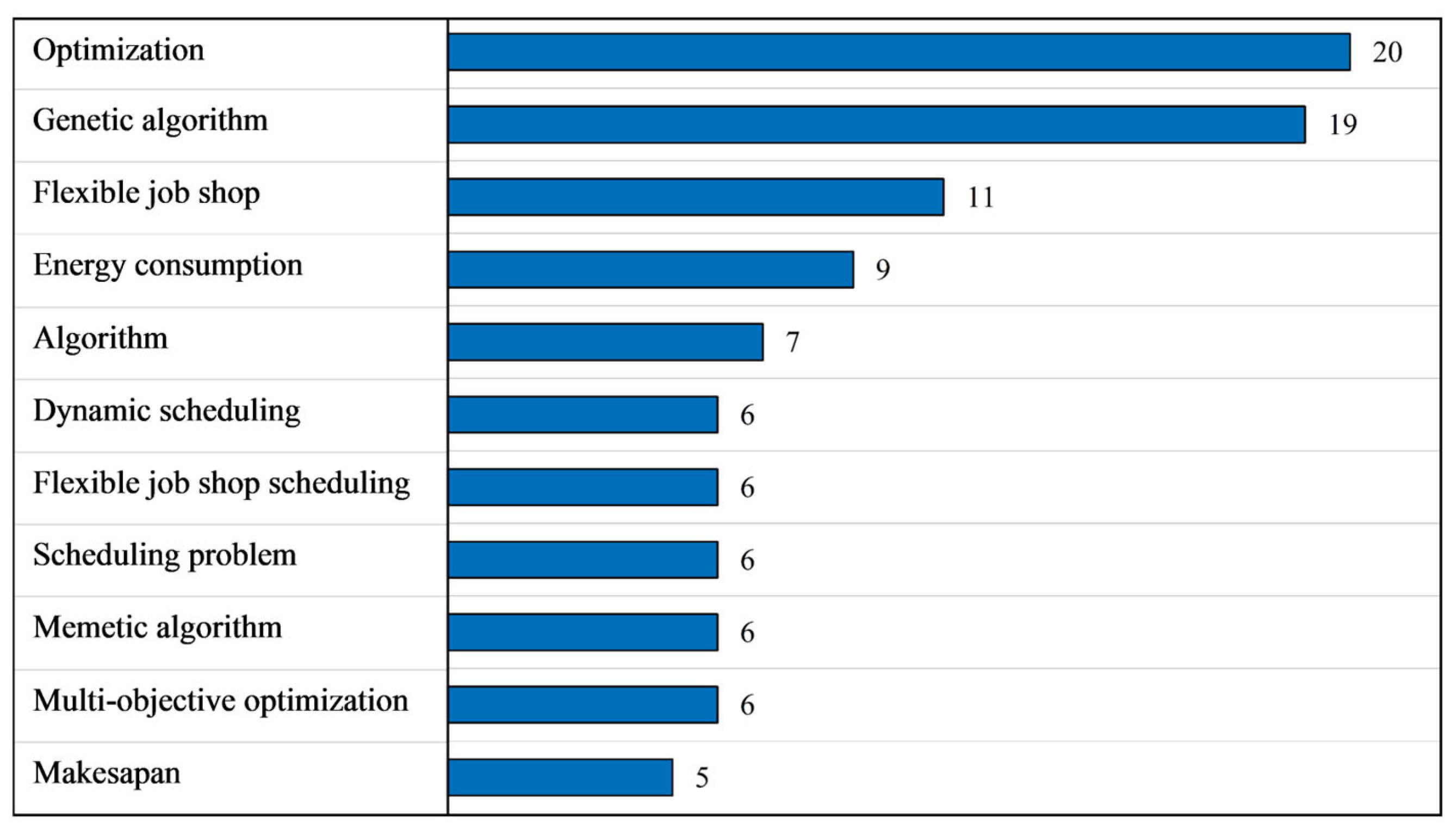
At the same time, the keyword usage of the 45 analyzed papers was examined in depth. Through the WOS database bibliometric tool, the authors’ keywords were extracted from each paper, and the high-frequency terms were visualized. Figure 3 clearly shows the keywords with a frequency of five or more occurrences. Unsurprisingly, “Optimization” and “Genetic algorithm” are at the top of the list, each with the highest frequency of occurrence, highlighting their central position in scheduling optimization research. This shows how important optimization theories and methods are for solving these problems, while the genetic algorithm, being a well-established and commonly used approach, also demonstrates its effectiveness in tackling complex scheduling issues. This is followed by “Flexible job shop”, which clearly indicates that flexible job shop scheduling is an important and challenging research object in the current research field.
Figure 3.
Frequency of keyword occurrence by authors.
It is worth noting that the high frequency of “Energy consumption” highlights that energy efficiency and energy saving have become key considerations for scheduling optimization in the modern industrial context. In addition, “Algorithm”, as a generic but basic keyword, further emphasizes that the core of the research lies in the design, development and application of various algorithms.
Among the keywords with the same frequency of 6 occurrences, we see “Dynamic scheduling”, “Flexible job shop scheduling”, “Scheduling problem”, “Memetic algorithm”, and “Multi-objective optimization”. Specifically, “Dynamic scheduling” and “Flexible job shop scheduling” are further refinements of flexible job shop scheduling in specific contexts (e.g., dynamically changing environments). “Scheduling problem” is undoubtedly the fundamental starting point and core focus of all related research. “Memetic algorithm”, as a kind of intelligent algorithm integrating global search and local optimization, indicates the solution to the problem. And the frequent appearance of “Multi-objective optimization” vividly reflects that the actual scheduling problem is often complex and multi-dimensional, which needs to seek a balance and optimum between the conflicting objectives of maximizing productivity, minimizing cost, optimizing resource allocation, and so on.
Finally, “Makespan” (completion time), as a key indicator of production efficiency, also appears five times, confirming that it is one of the most frequently focused on and optimized objectives in scheduling optimization.
In conclusion, EDFJSP-related publications have shown a clear upward trend over time, and there are many current FJSP reviews, including a review of FJSP considering transportation vehicles [50], a review of solving FJSP with swarm intelligence and evolutionary algorithms [51], a critical review of the objective function of FJSP [52], a review of genetic algorithms for solving FJSP [53], a review of Gene Expression Programming to solve the FJSP [54], and other FJSP reviews [55,56,57], but there are few reviews of the DFJSP considering energy consumption, especially the fact that the only energy saving-related reviews are those on the broad category of manufacturing systems [58,59,60,61,62].
Moreover, the scope of existing surveys primarily focuses on FJSPs or manufacturing systems, with only a handful of review papers specifically addressing EDFJSPs [63]. In order to fill this gap, we aim to provide a comprehensive survey of all literature dealing with EDFJSPs and discuss possible future challenges and promising areas. In addition, unlike existing reviews, this review will also illustrate how the current approaches to solving this workshop are applied with the EDFJSP as a way to help researchers systematically understand each approach.
3. Problem Description
3.1. Workshop Scheduling Model
The FJSP is described as follows: A batch of jobs will be processed on a set of m machines . Each job consists of one or more processes, and the sequence of operations is predetermined. The processing routes for each job are different, and each process can be processed on several different machines. The processing time for each process varies from machine to machine. The scheduling objective is to select the machine for each operation and determine its processing sequence and start time on each machine. Thus, the flexible shop scheduling problem consists of two subproblems: determining the machine on which each job is to be processed (machine selection subproblem) and determining the processing order on each machine (operation sequencing subproblem). The meaning of the main symbols used in this model is summarized in Table 3. In addition, the following constraints need to be satisfied during processing:
Table 3.
Meaning of symbols.
Equations (1) and (2) denote the process sequence constraints for each job; (3) denotes the job completion time constraints, i.e., the completion time of each job cannot exceed the total completion time; (4) and (5) denote that only one process can be processed by the same machine at the same moment; (6) denotes the machine constraints, i.e., the same process can only be processed by one machine at the same moment; (7) and (8) denote the sequential processing order of the process on the machine; and (9) indicates that each parameter variable must be positive.
3.2. Scheduling Goal
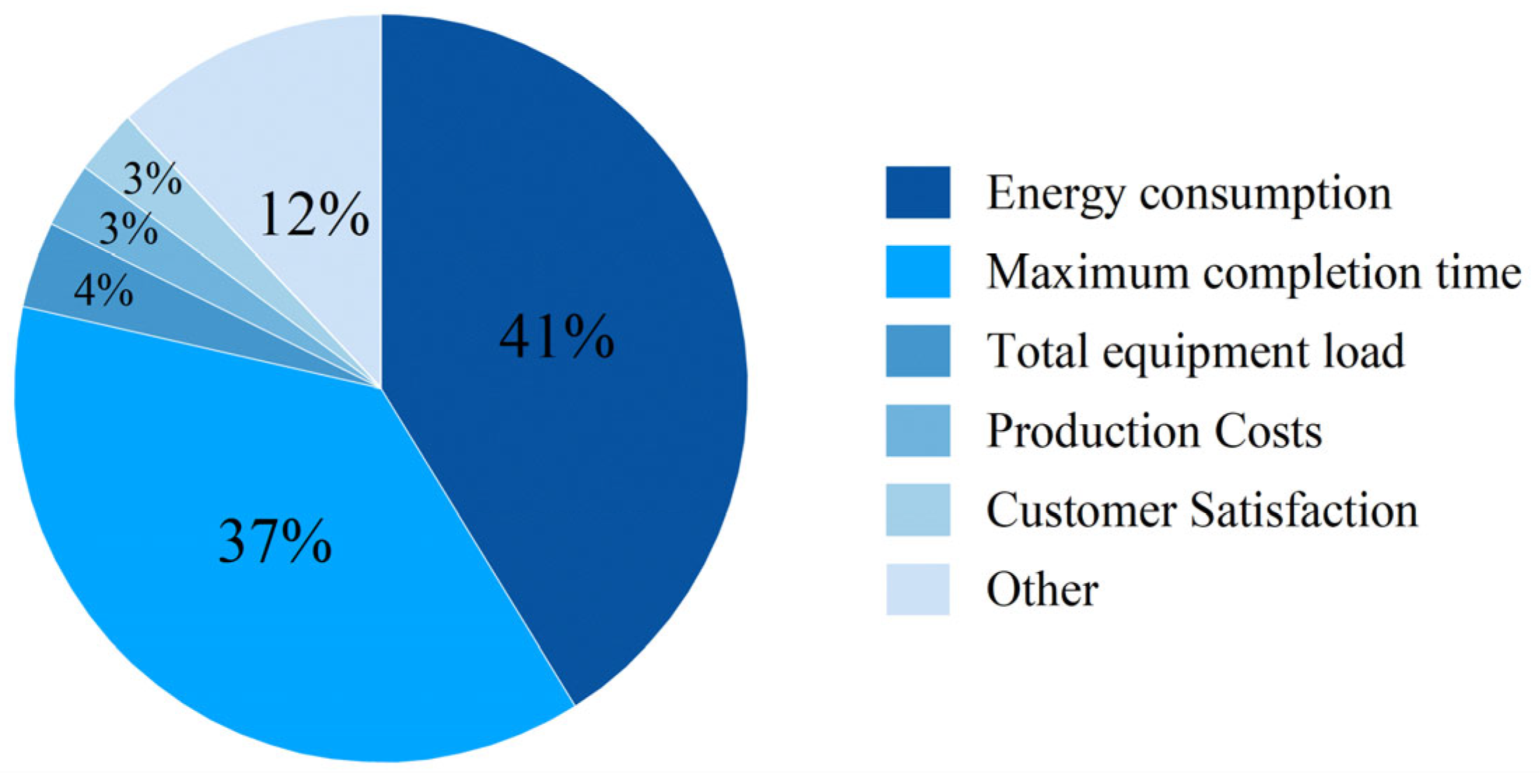
The research topic of this review is the EDFJSP. Therefore, we selected the literature by considering the broad category regarding energy consumption as a required scheduling objective. Common scheduling objectives in the reviewed papers include maximum completion time, energy consumption, maximum workload, lead/delay time, production cost, and customer satisfaction. As shown in Figure 4, since the topic of this paper is energy consumption, this means that energy consumption is used as an important screening objective for our review, and therefore, its frequency is the highest. Second is maximum completion time. Production costs and customer satisfaction have the lowest proportions, though “lowest” here refers only to their ranking in the chart. In fact, both production costs and customer satisfaction appeared three times each, while metrics like machine idle rate, workload deviation, and processing quality appeared only once or twice, hence being grouped under “Other.”
Figure 4.
Frequency of occurrence of each scheduling target.
3.2.1. Maximum Completion Time
Maximum completion time (Makespan) is one of the most commonly used performance metrics in dynamic flexible job shop scheduling problems [64,65]. It refers to the latest time required for all jobs to be completed, i.e., the time when the last job is completed. Maximum completion time reflects the total duration of the entire production schedule, which is directly related to production efficiency and resource utilization. It is defined as follows:
3.2.2. Energy Consumption
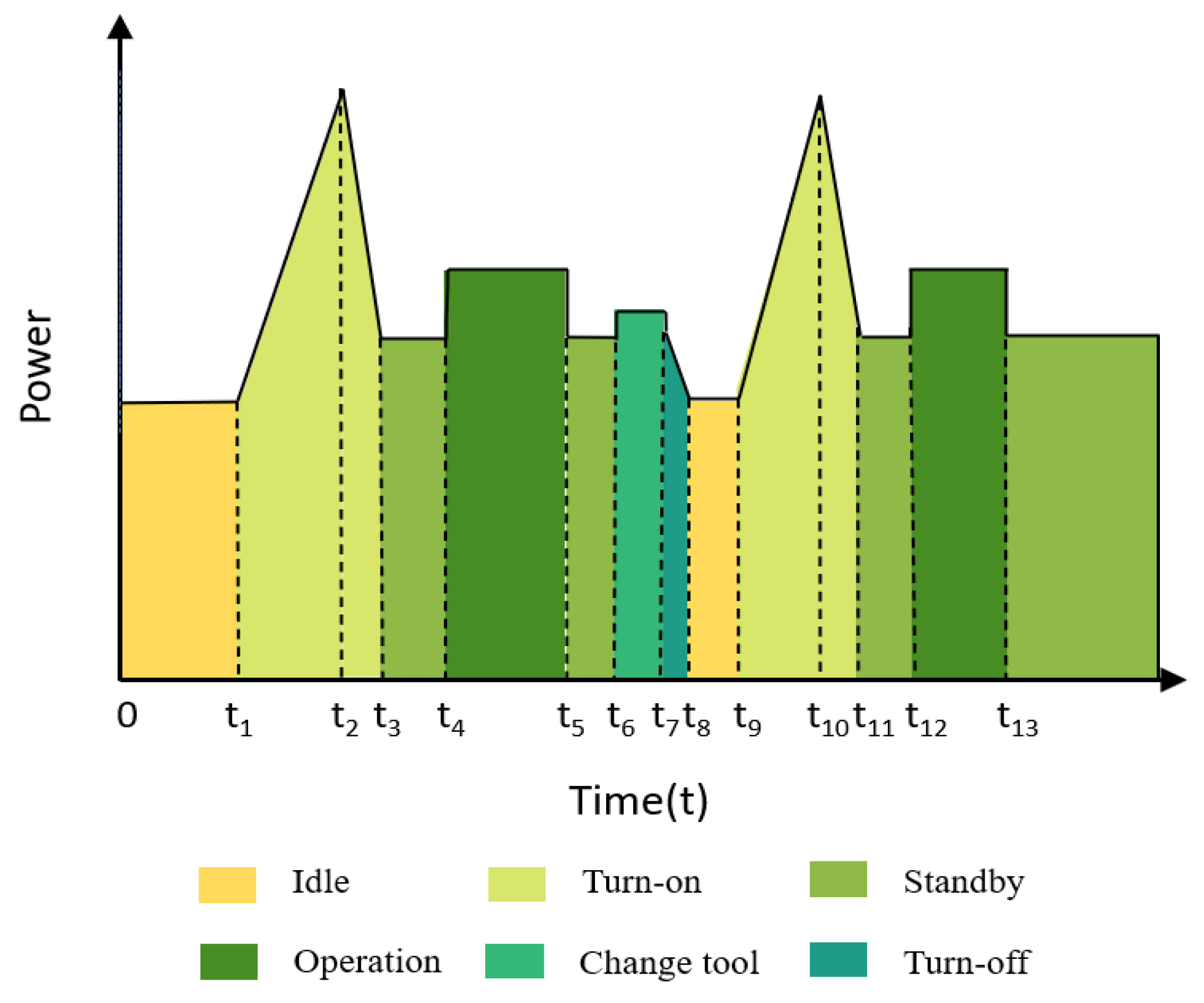
In the actual production workshop, the energy consumption generated during the job machining process is often very complex. The power of the machine tools varies at different stages, so the total energy consumption of the workshop is divided into five parts based on the five stages of the workshop, the machining energy consumption generated on each machine tool, which also involves the energy consumption generated when the machine tool is ready for machining, the energy consumption for the transportation of materials between the machines, the idle energy consumption of the machine tools when they are not machined, and the public energy consumption of the whole workshop. Figure 5 illustrates the energy consumption of the machine tools at different stages [66,67].
Figure 5.
Distribution of machine energy consumption at different stages.
Thus, the total energy consumption for an FJSP schedule is given by
where REc, PEc, TEc, IEc, and CEc represent the Ready energy consumption, Processing energy consumption, Transport energy consumption, Idle energy consumption, and Common energy consumption, respectively, measured in kWh.
- (1)
- Ready Energy consumption (REc): This refers to the energy consumed during equipment startup before processing, shutdown after processing completion, and tool changes. It can be expressed as:where , , and denote the power consumption during machine start-up, shutdown, and tool change, respectively; , , and represent the time durations for startup, shutdown, and tool change, respectively. denotes the number of machine start-up/shut-down events, and is a binary variable indicating whether a tool change is required, where if a tool change is needed, and otherwise.
- (2)
- Processing Energy Consumption (PEc): This refers to the energy consumed during the actual processing of jobs. It can be expressed as:where and denote the power consumption rate and processing time during machine processing, respectively.
- (3)
- Transmission Energy consumption (TEc): It refers to the energy consumption incurred when transferring jobs between two adjacent processing machines. Assuming that the first machine does not generate any transportation energy consumption, it can be expressed as:where and denote the power consumption rate and the time required for transporting the job, respectively. is a binary variable indicating whether the job requires transportation: if transportation is needed, and otherwise.
- (4)
- Idle Energy consumption (IEc): It refers to the energy consumption incurred when machines are idle and waiting to process jobs. It can be expressed as:where and denote the power consumption rate and time duration when the machine is idle, respectively.
- (5)
- Common Energy consumption (CEc): It refers to the energy consumption generated by the workshop environment, primarily including lighting, ventilation, air conditioning, and other auxiliary equipment. As this type of energy consumption remains relatively stable, it can be expressed as:where denotes the total power consumption rate of the workshop’s auxiliary systems, and represents the total processing time.
3.2.3. Total Equipment Load
The total equipment load is the sum of the working time of all equipment in the whole scheduling cycle during the scheduling process. It reflects the total amount of processing tasks undertaken by the equipment in completing all operational tasks and is an important indicator of equipment utilization and production load balance, so researchers also use this scheduling goal as a link in multi-objective scheduling [68]. It can be expressed as:
where denotes the time overrun for processing the hth course of the jth job at the ith machine. If , it means that the hth pass of the jth job is processed at the ith machine; otherwise, it is 0.
3.2.4. Production Costs
Production cost is a key optimization objective in dynamic flexible job shop scheduling and typically includes a variety of aspects such as equipment operating costs, energy costs, labor costs, equipment maintenance costs, and lag costs due to operational delays [69]. This indicator comprehensively reflects the economic expenditures required to complete all production tasks. By optimizing the scheduling strategy and rationally allocating operations and resources, unnecessary waste and expenditure in the production process can be effectively reduced, thus achieving cost control and efficiency improvement. In practical application, production cost control often needs to be balanced and optimized under the premise of meeting the constraints of delivery, efficiency, and resources. It can be expressed as:
where denotes the cost required to process j jobs on a single machine.
3.2.5. Customer Satisfaction
Customer satisfaction is an important indicator of the quality of a scheduling program’s services and usually reflects the customer’s overall perception of delivery time, product quality, and service responsiveness [70]. In dynamic flexible job shop scheduling, key factors affecting customer satisfaction include whether or not deliveries are made on time (or as far in advance as possible), whether or not individualized customization needs are met, and the ability to respond quickly to urgent orders. It can be expressed as:
where denotes the completion time window of job j, denotes acceptable delivery window of job j, and denotes the overlap area between the completion time and delivery date of job j.
3.2.6. Other Scheduling Goals
Furthermore, in addition to the five core objectives mentioned above (e.g., completion time), researchers also consider factors such as “delay time”, “machine workload”, “system stability”, and “process quality” in scheduling optimization. Although these objectives are important in specific studies, they are infrequently mentioned in the existing literature. Thus, this paper categorizes them as “other objectives” and will not discuss them in detail.
3.3. Dynamic Event
With the continuous advancement of technology and the increasing complexity of industrial production environments, researchers have gradually introduced more realistic stochastic events in the field of scheduling optimization so that the research work can be more closely matched to the needs of the actual job shop scheduling environment [71,72]. This kind of scheduling problem with uncertainty is often called the Dynamic Job Shop Scheduling Problem (DJSP).
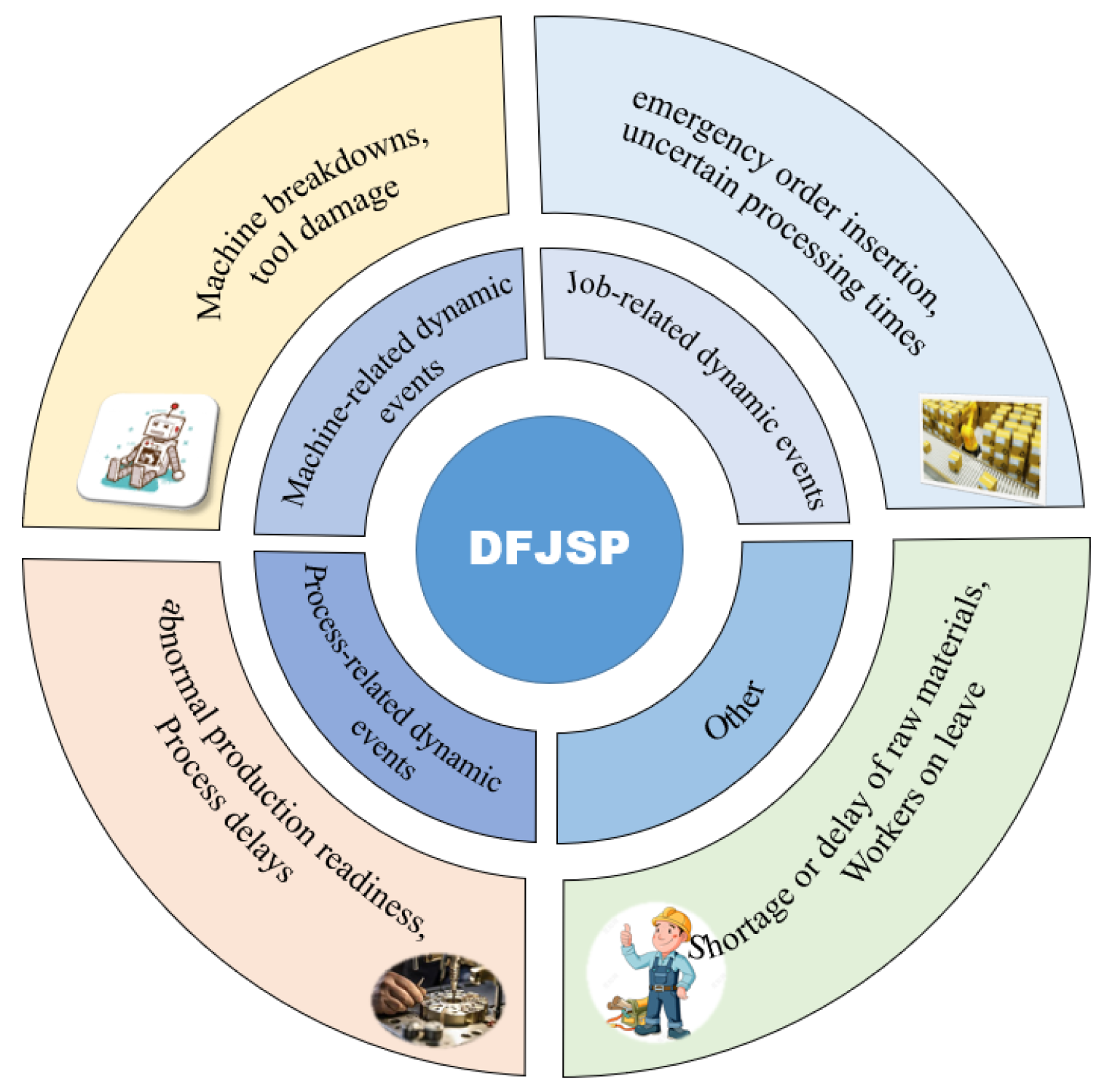
The DJSP involves a wide variety of dynamic events. Table 4 shows the dynamic event types of the referenced EDJSPs. Dynamic events can be broadly categorized into the following four types: machine-related events (e.g., machine breakdowns and maintenance), job-related events (e.g., new order arrivals and job queues), process-related events (e.g., machining time changes and process reworks), and other unpredictable events (e.g., worker vacations and raw material shortages). In response to these dynamic events, efficient dynamic scheduling algorithms and techniques can achieve timely detection and response to random perturbations. They can also flexibly adjust and optimize the existing scheduling scheme to minimize its negative impact on production planning and overall scheduling performance. Figure 6 visualizes these common types of dynamic events.
Table 4.
EDFJSP considering different dynamic events.
Figure 6.
Classification of Dynamic Disturbance Events in the FJSP.
In addition, a review of the literature reveals that the consideration of dynamic events in existing studies appears to be mixed. If each dynamic event is discussed in a separate categorization, it will not only result in a large amount of cross-repetition but also not be conducive to the overall grasp of the problem. In view of this, this paper further divides dynamic events into two main categories: single dynamic events (i.e., only one type of dynamic perturbation is considered at a time) and multi-dynamic events (i.e., two or more types of dynamic perturbations are considered at the same time) in order to analyze and explore them in a more systematic way.
3.3.1. Job-Related Dynamic Events
- Random Job Arrivals: In practice, jobs do not always arrive according to a fixed schedule. Instead, new orders may arrive unpredictably, requiring real-time schedule adjustments [87]. Failure to respond promptly can result in increased lead times and decreased system responsiveness.
- Uncertain Processing Times: Variability in processing times may arise due to heterogeneity in jobs, operator performance, or subtle environmental changes [73]. This uncertainty can lead to inaccurate schedule execution and degraded machine utilization.
- Due Date Modifications: Due dates may change due to evolving customer requirements or upstream supply chain disruptions [74]. Early or delayed deadlines necessitate rescheduling to minimize tardiness and ensure service level agreements.
- Rush Orders (Emergency Insertions): High-priority jobs that must be inserted into the schedule at short notice can severely disrupt the current plan [75]. Handling such events requires real-time rescheduling methods that can balance urgency with minimal disturbance to existing jobs.
- Order Cancellations: The sudden cancellation of orders results in wasted scheduling effort and can create idle times in machines and labor resources [88]. An adaptive system should be able to reallocate the released capacity efficiently.
3.3.2. Machine-Related Dynamic Events
- Machine Breakdowns: Unexpected machine failures necessitate immediate rescheduling and may lead to bottlenecks or complete stoppages in production lines [85]. Robust scheduling approaches often include redundancy, machine reallocation, or predictive maintenance scheduling.
- Preventive Maintenance: While scheduled in advance, preventive maintenance windows can interfere with planned schedules, especially if not properly synchronized [99]. Effective integration into the scheduling model helps to avoid unnecessary production delays.
- Tool Wear or Breakage: Tool-related issues, such as wear or unexpected damage, can result in lower machining accuracy or process interruptions [100]. Integration of tool condition monitoring with scheduling systems is a promising direction to enhance reliability.
3.3.3. Process-Related Dynamic Events
- Process Delays: Operations may take longer than planned due to technical bottlenecks, human factors, or incomplete work instructions. Delays in early operations can propagate, leading to significant schedule deviations [76].
- Quality Issues: Rework or scrap due to quality defects not only consumes extra processing time but also disrupts the downstream schedule [89]. Incorporating feedback from quality inspection systems can enhance schedule robustness.
- Abnormal Production Setup: Setup processes may deviate from standard times due to incorrect parameter settings, lack of proper tooling, or operator errors. Accurate setup modeling and operator training are vital to reduce such occurrences [90].
3.3.4. Other Dynamic Events
Beyond job, machine, and process domains, certain external factors can also impact scheduling performance. These include the following: (1) Worker absences or operator unavailability due to leave or illness can reduce the effective capacity of the system, especially in labor-intensive tasks [91]. A flexible workforce or skill-based assignment strategy can help mitigate this issue. (2) Material shortages or delivery delays: Raw material unavailability due to supply chain disruptions affects job release and sequencing [77]. Integrating inventory status and supplier reliability into the scheduling system enhances responsiveness.
In sum, external dynamic events present additional layers of complexity to the scheduling problem. Unlike internal disruptions, their sporadic and sometimes systemic nature (e.g., labor strikes and logistics crises) necessitates a broader perspective that combines scheduling with human resource management, supply chain coordination, and even organizational policy. Developing robust, integrated scheduling architectures capable of withstanding such multi-source variability remains a critical challenge and opportunity for future research in smart manufacturing.
3.4. Category of Dynamic Scheduling
Facing the frequent dynamic disturbance events in flexible job shops, researchers have proposed various dynamic scheduling strategies to improve the responsiveness and robustness of the system. Currently, the existing dynamic scheduling strategies can be broadly classified into three categories: completely reactive scheduling, predictive-reactive scheduling, and robust scheduling.
3.4.1. Completely Reactive Scheduling
Completely reactive scheduling is real-time scheduling based on the current actual situation of the shop, in which there is no pre-set scheduling plan for the shop; therefore, completely reactive scheduling is also called real-time scheduling or online scheduling [101]. It is worth noting that, since it is real-time scheduling, there is an urgent need for real-time scheduling models that have access to information about the state of the shop floor so that the scheduling plan can be continuously updated [102]. The availability of these data is achieved by collecting detailed information about machines and jobs in real time through technologies such as Industry 4.0 [103,104,105], the Internet of Things (IoT) [78,106,107], Digital Twins (DTs) [108,109,110], and so on.
3.4.2. Predictive–Reactive Scheduling
Predictive–reactive scheduling is one of the most commonly used dynamic scheduling methods in manufacturing systems today, which is actually the process of scheduling/rescheduling the shop floor in response to the effects of various dynamic events. Predictive-responsive scheduling can generally be divided into two steps: first, the shop develops a pre-scheduling program without considering various disturbances, and second, after the dynamic event occurs, the pre-scheduling program is modified to obtain a new scheduling program.
The following two types of dynamic scheduling strategies are usually used: periodic rescheduling strategies and event-driven rescheduling strategies [111]. For the first class of strategies, the dynamic problem is decomposed into smaller static problems, which means that this requires rescheduling the shop floor system at a defined moment in time and implementing the generated plan on a rolling horizon [79]. For the second class of strategies, any system disturbance triggers rescheduling, which translates into an increase in computational requirements, and stability is compromised [112].
3.4.3. Robust Scheduling
Robust scheduling refers to the scheduling process that takes into full consideration the various dynamic events that may occur during the production process on the shop floor, generates a scheduling plan in advance based on existing or future information, and ensures that the scheduling plan will not unduly degrade performance when the various dynamic events occur [113]. Robust scheduling emphasizes that certain precautions are taken before the occurrence of a dynamic event, such as inserting a certain amount of idle time on the device to reduce frequent repair and rescheduling during the execution of the schedule [114]. Therefore, robust scheduling schemes are designed to accommodate certain dynamic event effects and are also referred to as proactive scheduling.
Overall, fully reactive scheduling is suitable for environments with high real-time requirements and frequent disturbances but low task complexity. In contrast, pre-reactive scheduling has become the most widely used dynamic scheduling strategy in industry due to its flexibility and ease of integration with existing systems [80]. Finally, robust scheduling is more suitable for production scenarios with high requirements for schedule stability and a certain degree of predictability of disturbances [81,82]. As industrial intelligence improves, the exploration of hybrid scheduling methods has emerged as a promising direction. This approach aims to balance the responsiveness and stability of scheduling while realizing globally optimal control in dynamic environments.
In order to cope with the different types of dynamic scheduling requirements mentioned above, researchers have proposed a large number of algorithmic models to improve scheduling efficiency and adaptability. The next chapter will systematically introduce the existing mainstream exact methods, heuristic algorithms, and artificial intelligence algorithms in energy-driven dynamic scheduling problems.
4. Algorithms for Solving the EDFJSP
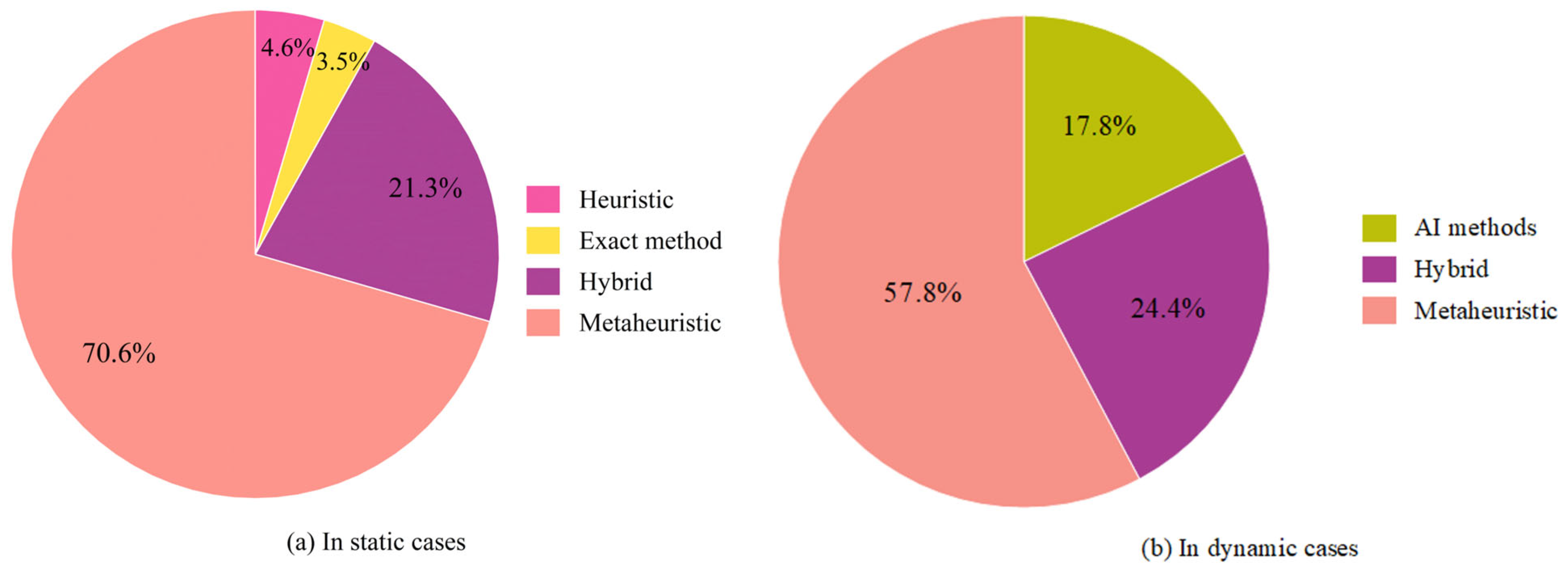
Considering the dynamic flexible job shop scheduling problem in terms of energy consumption as a complex multi-objective optimization problem, the mainstream methods for solving this problem are exact methods, heuristic algorithms, and metaheuristic algorithms. Figure 7 illustrates the methods used in the literature for screening. It is clear that for the static EFJSP, about 71% of the literature used metaheuristic algorithms, and 21% or so used hybrid methods, such as the combination of genetic algorithms with techniques such as reinforcement learning. In contrast, facing dynamic EFJSPs, the percentage of metaheuristic algorithms decreases to about 58%, while the percentage of hybrid and AI approaches increases, concurrently demonstrating the effectiveness of AI approaches in dealing with real-time scheduling problems. From Figure 7, it can be seen that in the face of dynamic EFJSPs, there is no longer any separate use of heuristic or exact methods for solving the problem, but artificial intelligence methods are being used instead.
Figure 7.
Resolution method used in the case of static or dynamic EFJSPs, based on the 197 articles selected.
Currently, metaheuristic algorithms, such as genetic algorithms, particle swarm optimization, and ant colony optimization, are still the most actively researched solutions. With their strong global search capabilities and adaptability, they play a dominant role in numerous studies. However, it is worth noting that these algorithms still face bottlenecks in parameter selection and problem generalization. With the introduction of data-driven and learning mechanisms, AI methods (e.g., reinforcement learning, graph neural networks, and deep learning) are rapidly emerging. Notably, 27 out of 55 papers published in 2024 and 2025 dealt with AI methods, demonstrating their excellent adaptability and transferability in complex scheduling environments, making them a focus of current research.
4.1. Exact Method and Heuristic Algorithm
Exact algorithms, including branch and bound and mathematical programming, are recognized for their theoretical assurance of identifying the global best solution. This advantage renders them indispensable when there are stringent demands for optimal scheduling outcomes and the problem size is generally modest or static. Nonetheless, the FJSP is classified as NP-hard, and its combinatorial explosion results in an exponential increase in the computational complexity of exact algorithms as the number of jobs, processes, and machines escalates. This often results in the “dimension problem” in large-scale applications, complicating the attainment of a solution within a reasonable timeframe.
In contrast, heuristic algorithms frequently necessitate that specialists manually formulate dispatching rules (DRs), a process that is typically time-consuming and arduous, imposing significant demands on designers [14]. Methods such as genetic programming (GP) and genetic gene expression programming (GEP) circumvent the necessity of rule creation, therefore attracting the attention of academics.
Researchers have implemented numerous enhancements to mitigate the shortcomings of heuristic algorithms for population quality and variety. Nguyen et al. [115] employed genetic programming to develop variable selectors applicable in Constraint Programming, hence allowing the system to autonomously produce more efficient search criteria. Nonetheless, the terminal set and function set of this technique require manual configuration, hence constraining the algorithm’s exploration space. Zhang et al. [116] proposed an efficient gene expression programming algorithm (eGEP) to enhance population diversity, which integrates a multi-gene coding structure into the conventional GEP framework and includes energy consumption-related features such as process energy consumption, machine load, and equipment start–stop in the terminal set design. This considerably enhances comprehension and energy optimization efficacy without elevating algorithmic complexity.
Simultaneously, due to GEP’s incapacity to directly acquire viable solutions, it is frequently essential to employ discrete event simulation to assess scheduling strategies, which sometimes requires substantial computational resources. Zhang et al. [117] developed a parallel gene expression planning framework (PGEP) that improves population diversity via multi-population collaborative evolution and migration mechanisms, employing a distributed simulation system to concurrently assess candidate solutions, thereby substantially alleviating the computational load during the evaluation phase.
Although this GP or GEP utilizes intelligent methods to avoid simple heuristics that require experts to manually design scheduling rules, both still heavily rely on experts’ professional knowledge to select the appropriate set of terminals to ensure the quality of solutions in the search space. Moreover, GP and GEP do not directly search for corresponding solutions in the solution space, but first mine scheduling rules in the rule space. This means that they require a large amount of computing resources to verify the performance of the mined scheduling rules. Therefore, many researchers have turned their attention to metaheuristic algorithms in order to avoid search space limitations caused by human factors.
4.2. Metaheuristic Algorithm
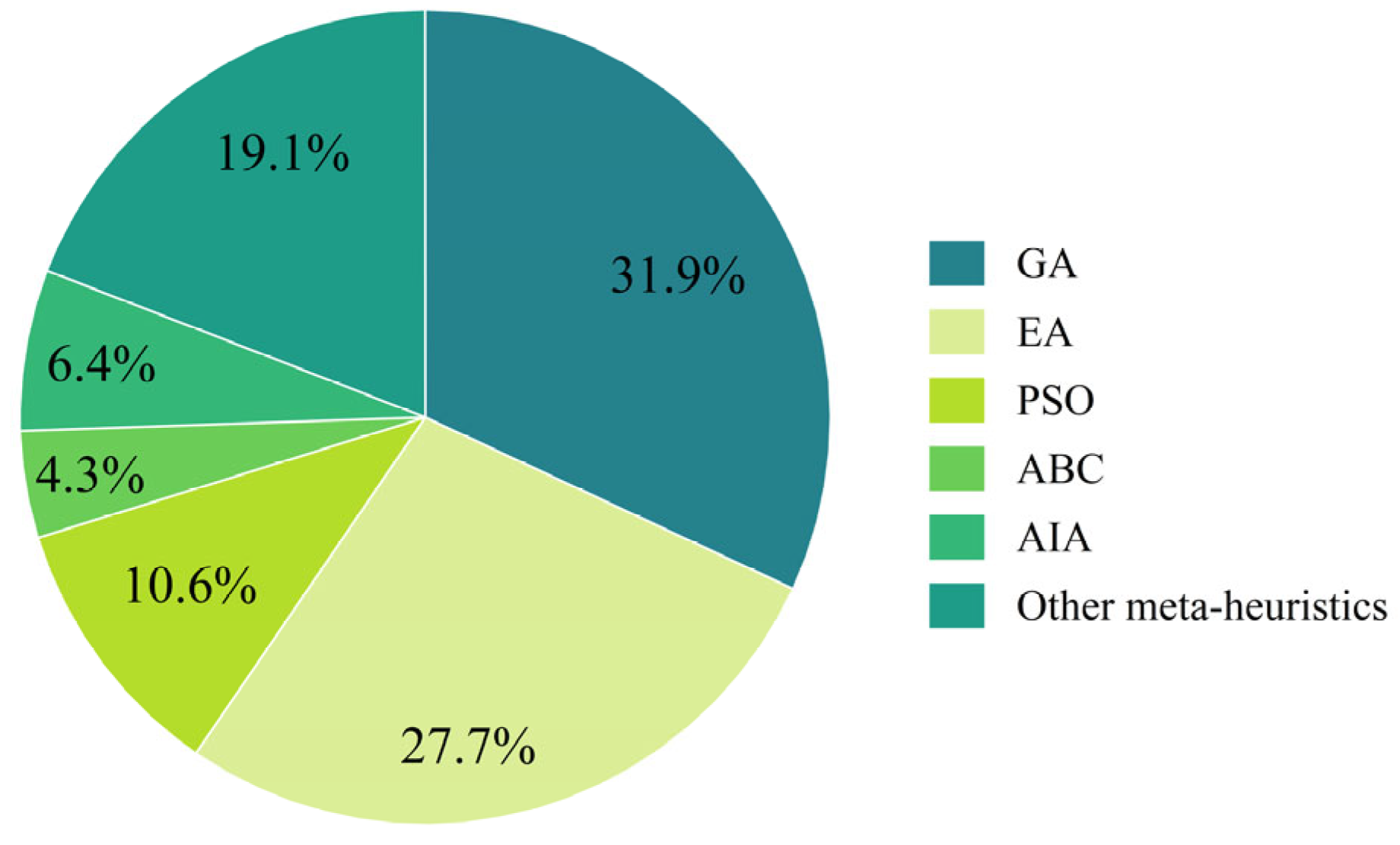
Compared to heuristic methods, metaheuristic methods no longer rely on manually designed rules and avoid the problem of high evaluation costs caused by GP and GEP searching for rules in the rule space. Metaheuristic algorithms simulate natural phenomena or biological behaviors and, with stronger global search capabilities and good adaptability to complex objective functions, can directly optimize in the solution space and have stronger adaptability under multi-objective conflicts and dynamic disturbances. They can be subdivided into evolutionary algorithms and swarm intelligence optimization algorithms. As shown in Figure 8, for EDFJSP, genetic algorithms (GA) and evolutionary algorithms (EA) ranked first and second, respectively, accounting for 31.9% and 27.7% of the total. The remaining algorithms were swarm-based optimization methods with relatively lower frequencies, such as particle swarm optimization (PSO), artificial bee colony (ABC), and artificial immune algorithm (AIA).
Figure 8.
Frequency of Application of Metaheuristic Algorithms for Solving the EDFJSP.
4.2.1. GA
The GA and its variants have been employed for an extended period to address multi-objective optimization challenges in flexible job shop scheduling, owing to their robust search capabilities and adaptable framework. In establishing energy consumption targets, researchers primarily concentrate on two fundamental aspects to enhance the GA. First, the enhancement of population quality and diversity during the encoding and initialization phases to augment the search capability for energy consumption-related features. Second, the improvement of convergence speed and adaptability to dynamic disturbances through operator design, local search, or hybrid strategies.
For example, Wei et al. [118] proposed various energy-saving regulations, including speed modulation and idle strategies, in response to the initial category of issues. These regulations were founded on energy consumption estimation models and were integrated into a genetic framework to directly influence chromosome decoding and evaluation processes, thus facilitating energy consumption optimization while maintaining production efficiency. Jia et al. [119] proposed a four-layer encoding technique that incorporates operational, machine, time, and allocation data into chromosomal representation to augment the diversity of the initial population and promote the joint optimization of energy consumption and cost. The Hybrid Search Genetic Algorithm (HSGA) introduced by Hao et al. [120] enhances search breadth and local development efficacy through mechanisms including cluster initialization, sparse individual screening, and adaptive crossover/mutation while incorporating multi-strategy neighborhood search. Furthermore, to augment the algorithm’s robustness in uncertain or dynamic contexts, Wei et al. [121] enhanced it through the use of the metaheuristic MA, developed a novel two-layer encoding mechanism, and devised three initialization procedures to elevate the quality of the initial answer. An adaptive mutation approach and local search mechanism have been developed as genetic operators to improve responsiveness to dynamic occurrences, including machine failures and emergency insertions.
4.2.2. EA
The EA is extensively utilized in energy-focused flexible job shop scheduling due to its global search capabilities and scalability. The EA is more effective at addressing multi-objective conflicts, such as decreasing total energy consumption while maximizing production efficiency, compared to traditional heuristics. The EA continues to face three primary challenges in energy utilization scheduling: (1) The energy consumption objective function is intricate and possesses several scales, potentially leading to convergence challenges within the solution space; (2) a singular population exhibiting inferior quality; and (3) absence of an adaptive adjustment mechanism in dynamic situations. Consequently, researchers primarily concentrate on these three aspects for enhancement.
Wu et al. [122] suggested an adaptive population NSGA-III integrated with a dual control method to collaboratively optimize completion time and energy usage, exhibiting commendable stability in managing multi-objective trade-offs. Xiao et al. [123] suggested an enhanced CT-NSGA-II method that broadened the model’s applicability by refining the dominant sorting mechanism and increasing search efficiency in intricate scheduling contexts. Luan et al. [124] developed an improved NSGA-II to tackle multi-objective flexible scheduling issues, markedly enhancing the algorithm’s efficacy regarding solution set uniformity and diversity. Zhang et al. [92] introduced an enhanced NSGA-II for dynamic flexible workshops, addressing emergency duties and AGV mobility and has shown its efficacy in dynamic event reaction and resilience. Feng et al. [93] introduced a two-stage individual feedback NSGA-III (TSIF-NSGA-III) to address the dynamic multi-objective flexible job shop scheduling problem (DMaFJSP), which markedly improves the algorithm’s global search efficacy and dynamic adaptability via an individual feedback mechanism and an adaptive non-dominated sorting strategy.
Moreover, several scientists have proposed strategies for minimizing energy consumption. Duan and Wang [94] utilized NSGA-II to address the dynamic flexible workshop scheduling issue amongst machine failure constraints, effectively reducing idle energy consumption through the application of two energy conservation strategies: machine idle time modification and speed grading regulation.
4.2.3. PSO
The PSO algorithm attains global optimization in continuous or discrete spaces via information exchange and collaborative search among particles. Owing to its few parameters, straightforward implementation, and rapid convergence rate, PSO is extensively utilized in EFJSP.
Recently, researchers have developed effective rescheduling solutions to address dynamic occurrences, such as machine failures and the introduction of new jobs, to assure the resilience and real-time efficacy of scheduling. Nouiri et al. [28] introduced a green rescheduling technique (GRM) that used PSO to create initial schedules and swiftly reallocates work through heuristics and system routing flexibility in response to dynamic disruptions, aiming to balance numerous objectives. Conversely, integrating PSO with other methodologies, such as heuristics and arithmetic optimization algorithms, enables each algorithm to capitalize on its unique strengths, thus harmonizing global exploration with local refinement and yielding superior outcomes in multi-objective optimization. Duan and Wang [95] developed a differentiated rescheduling strategy by incorporating two robustness indicators, “system reusability” and “task repeatability,” to mitigate the effects on the original scheme. They also proposed a hybrid algorithm, PSAO, which integrates PSO and arithmetic optimization algorithm (AOA) to achieve a balance between global exploration and local development.
4.2.4. ABC
ABC is a colony intelligence optimization algorithm that simulates the foraging behavior of honeybees proposed by Karaboga in 2005 [125]. The algorithm achieves a global search of the solution space of the optimization problem by simulating the collaboration mechanism of bees in finding and sharing food sources. The ABC algorithm consists of three types of “swarms”: employed bees, onlooker bees, and scout bees. Employed bees are responsible for localized searches around known food sources, onlooker bees select high-quality food sources based on pheromones and further excavate them, and scout bees randomly search for new areas after the food sources are depleted, thus achieving a balance between search and exploitation. Therefore, researchers primarily concentrate on optimizing and enhancing these three categories of bee colonies in their studies of this algorithm.
The hybrid artificial bee colony (HABC) developed by Gu et al. [126] improves population diversity via a two-layer coding strategy and incorporates multi-parent crossover and adaptive crossover in the hiring bee phase. The incorporation of adaptive variable neighborhood search in the bee observation stage has demonstrated effective performance in low-carbon multi-objective problems, with carbon emissions serving as the third objective. Jiang et al. [127] presented a mechanism for generating high-quality initial solutions based on process trees in industrial contexts, incorporating crossover and mutation operations during the hiring bee stage to enhance the initial population quality. Subsequently, the algorithm was tested in Plant Simulation, which showed that it was stable and worked well for complicated assembly scheduling problems.
Tian et al. [32] introduced the Dual Population Differential ABC (BDABC) for dynamic disturbances and large-scale scenarios. This method incorporates a differential evolution strategy and a boundary elastic repair technique via population splitting and merging, along with a reconnaissance bee stage, thereby preserving search direction memory and improving robustness in large-scale instances. Experimental results indicate that stability improves with increasing problem size. Hu et al. [33] incorporated reinforcement learning into the ABC framework (MLABC), employing Q-learning to dynamically select local search operators based on bee observations. They aligned these operators with problem-specific initialization and destruction/reconstruction strategies, showing a notable improvement in convergence speed for energy-aware flexible assembly workshop problems.
4.2.5. AIA
The AIA is an intelligent optimization algorithm inspired by the biological immune system, and its basic idea originates from the recognition, memory, and learning mechanism of the immune system for foreign antigens [128]. The algorithm simulates the process of antibody generation, cloning, mutation, and selection to find the optimal solution to the problem. Currently, research in this domain primarily concentrates on two avenues of enhancement: (1) integrating with other algorithms to improve search efficacy and (2) refining algorithmic structure and the antibody evolution operator mechanism to optimize energy efficiency.
For example, Shi et al. [96] proposed a rolling window rescheduling strategy to tackle the dynamic flexible job shop scheduling problem, incorporating fuzzy delivery times and machine failures. An enhanced immune genetic algorithm (IGA) is introduced, which initializes the population according to machine efficiency and adaptively modifies the crossover and mutation probabilities, facilitating the collaborative optimization of energy savings and production efficiency. Li et al. [83] were the first to incorporate type-2 fuzzy values into flexible job shop scheduling problems characterized by high uncertainty. They developed several innovative methods, including a novel affinity calculation, four initialization heuristics, six local search strategies, simulated annealing to improve exploration capability, and a population diversity maintenance mechanism based on crowding degree.
These methods enhance the algorithm’s search capability and solution diversity in addressing the trade-off between energy consumption and completion time. This literature represents a pioneering examination of optimization problems involving type-2 fuzzy values, demonstrating an effective methodology and significant potential for addressing high-order uncertainties. This demonstrates the feasibility of employing IT2FS for modeling and optimization in highly uncertain environments and offers a reference technical framework for future research via systematic algorithm design.
Furthermore, many studies have endeavored to integrate immune algorithms with Q-learning to enhance the decision-making precision and model flexibility of the algorithm in unpredictable energy consumption contexts. For instance, Chen et al. [97] streamlined the fuzzy processing time from Type-2 fuzzy sets to the computation of more efficient triangular fuzzy numbers, building on Li’s research, and introduced a multi-objective immune approach that incorporates Q-learning. They developed a predictive reactive model for dynamic and static rescheduling to efficiently address new job arrivals and machine fault disturbances.
4.2.6. Other Metaheuristics
In addition, there are some novel metaheuristics that have been applied in the study of DEFJSP. Most of these studies address energy-saving challenges in multi-objective optimization by introducing novel mechanisms for simulating biological or physical phenomena, or by deeply integrating them with other algorithms and energy-saving strategies.
For example, Qu et al. [129] identified manufacturing scope, total energy consumption, and production cost as multiple objectives and innovatively integrated carbon dioxide emissions (WCE) and inverted processing power efficiency (IPPE) indicators to develop a more comprehensive sustainability optimization model. At the algorithmic level, they proposed an enhanced electromagnetic mechanism algorithm (IEMA) that incorporates an archival mechanism to retain the Pareto solution set and devises a magnetic deflection operation to augment global search efficacy, thereby effectively preventing the algorithm from becoming ensnared in local optima.
Meng et al. [130] introduced an effective multi-objective mixed shuffling frog leaping algorithm (MO-HSFLA) for the flexible job shop scheduling issue with controllable processing time (FJSP-CPT). The algorithm developed a decoding mechanism during the decoding phase that incorporates three energy conservation strategies: machine deceleration, power on/off, and delay, alongside an embedded multi-objective variable neighborhood search (MO-VNS) to improve local development capabilities, thereby achieving collaborative optimization of manufacturing efficiency and energy consumption.
To address the issue of diminished energy efficiency resulting from the disjunction of process planning and scheduling, Zhang et al. [35] introduced an enhanced Gray Wolf Optimization Algorithm (IGWO). This algorithm harmonizes global exploration with local development through the implementation of dynamic adaptive inertia weights and the formulation of various neighborhood search strategies to augment population diversity, thereby effectively attaining integrated scheduling optimization for parallel disassembly, flexible reprocessing, and parallel reassembly.
Akram et al. [84] were the pioneers in applying the Black Widow Spider Algorithm (BWSA) to the dynamic flexible job shop scheduling problem. They markedly improved population diversity and convergence efficacy of the algorithm in dynamic environments by devising a novel S-shaped weighted instability function and introducing a mixed crowding index that integrates variable space discrepancies with the cosine distance of the target space, offering innovative solutions for dynamic scheduling challenges.
However, metaheuristic algorithms still have several limitations that cannot be ignored. Firstly, although the global search capability is strong, its performance depends on a large number of parameter settings (such as population size, crossover rate, mutation rate, etc.), often requiring researchers to retest parameters when workshop constraints change, which limits the algorithm’s generalization ability. Secondly, many metaheuristic algorithms are still prone to slow convergence or stagnation, requiring the use of complex hybrid frameworks to maintain search quality. Therefore, some researchers have shifted their focus to artificial intelligence methods.
4.3. AI Methods
Compared to metaheuristic algorithms, AI methods have significant data-driven and adaptive advantages, no longer relying on manually setting complex parameters or a large number of heuristic rules, nor requiring maintenance of population diversity through extensive iterations. AI methods can continuously learn strategies from scheduling environments, exhibit stronger real-time response capabilities under multi-source dynamic disturbances, and have excellent scalability and robustness in distributed environments, complex energy consumption characteristics, and other problems. Especially with deep reinforcement learning and multi-agent frameworks, the system has the ability to transfer across scenarios, adapt to high-dimensional state spaces, and achieve end-to-end decision learning. At present, commonly used AI methods include expert systems, reinforcement learning (RL), neural networks (NNs), and multi-agent systems (MASs).
4.3.1. Expert Systems
The expert system, as a knowledge-driven, artificial intelligence-based method, provides effective intelligent decision-making support for achieving energy savings and emission reduction and optimal resource allocation. The system simulates the mindset of scheduling experts to reason and solve complex production scheduling problems by constructing a green knowledge base including process flow, equipment energy efficiency, and carbon emission rules. Its reasoning machine not only supports traditional logical derivation but also integrates a multi-objective optimization mechanism to dynamically balance the relationship between production efficiency and environmental performance.
In recent years, academics have extensively incorporated domain knowledge into metaheuristic algorithms, markedly enhancing their performance and issue specificity. Luo et al. [85] introduced a knowledge-driven two-stage meme algorithm (KTMA) during the algorithm initialization and search phases, which produces high-quality populations via a mixed initialization strategy and formulates variable neighborhood search operators utilizing problem-specific knowledge, thereby enhancing the algorithm’s convergence. Yu et al. [131] developed a knowledge-guided dual population evolutionary algorithm that used critical path-based knowledge to enhance neighborhood structure and integrates speed regulation mechanisms to minimize energy consumption while maintaining production efficiency. Pan et al. [132] introduced a knowledge-based two-level optimization algorithm (KBOA) for distributed scheduling issues with transportation constraints, effectively addressing multi-objective problems through tailored knowledge initialization and search techniques at distinct levels. Tian et al. [133] employed a knowledge-guided local search method (KLSM) to adaptively modify parameters and optimize batch splitting strategies according to issue features, thereby markedly enhancing the diversity and convergence of the solution.
4.3.2. RL
RL, a machine learning paradigm that acquires knowledge through trial and error via environmental interaction, is increasingly utilized to address energy-efficient flexible job shop scheduling challenges due to its distinctive benefits in dynamic decision-making and adaptive optimization. The fundamental concept is to empower agents to acquire optimal strategies via interaction with the environment, aiming to optimize long-term cumulative rewards, particularly in addressing uncertainty and dynamic occurrences in scheduling processes.
Recently, researchers have mostly integrated reinforcement learning with conventional metaheuristic algorithms to improve flexibility and search efficiency. To address the issue of parameter and operator selection, which traditionally depends on expert experience and is statically fixed in conventional algorithms, researchers have developed a dynamic selection mechanism utilizing reinforcement learning. Li et al. [2] integrated reinforcement learning (RL) with a memetic algorithm (MA) to create a parameter adaptive approach that allows the system to autonomously modify parameters in accordance with the search state. Zhuang et al. [100] developed a parameter modification strategy utilizing a two-stage reinforcement learning approach to enhance genetic algorithms. Shi et al. [134] integrated Q-learning into the multi-objective decomposition evolutionary algorithm (MOEA/D) to facilitate the dynamic modification of population characteristics. Moreover, Jiang et al. [135] employed Q-learning to dynamically choose the biogeographic transfer algorithm (BMA) search strategy, thereby circumventing blind searches and enhancing evolutionary efficiency.
In response to dynamic disruptions like machine malfunctions and the introduction of new tasks, reinforcement learning can develop and implement effective rescheduling techniques. Naimi et al. [86] introduced a Q-learning rescheduling technique that employs Q-learning to train a model for addressing machine faults subsequent to the creation of an initial scheduling scheme via a genetic algorithm. The ideal scheduling action is determined by the system’s real-time status, hence improving its robustness.
4.3.3. NNs
The advancement of data-driven technology has enabled NNs, particularly deep learning and graph neural networks (GNNs), to offer a novel end-to-end solution framework for addressing energy-efficient flexible job shop scheduling challenges. This method, in contrast to conventional metaheuristic algorithms, can directly learn intricate dynamics of production systems from raw data and autonomously make scheduling decisions, particularly in high-dimensional state spaces with complex constraints, demonstrating significant potential [136]. In recent years, researchers have predominantly integrated neural networks with reinforcement learning to develop deep reinforcement learning (DRL) models capable of directly generating scheduling methods.
Tang et al. [137] introduced a deep reinforcement learning approach utilizing a low-carbon graph attention network (LCGAN), which directly acquires scheduling strategies from the disjunction graph model via a multi-head attention mechanism and graph pooling technology, thereby enhancing the model’s generalization capability and solving efficiency. Rui et al. [138] developed a heterogeneous disjunction graph that amalgamates production and electricity attributes, employing a hybrid graph neural network scheduler to accomplish multi-objective collaborative optimization of completion time, total energy consumption, total electricity cost, and peak demand within the framework of industrial demand response. This strategy decreased the generalized electricity consumption index by as much as 14.44% and 2.22% in actual cases.
4.3.4. MASs
Multi-agent systems (MASs) further advance this paradigm by facilitating distributed decision-making frameworks [139]. This is achieved by leveraging neural networks and deep learning techniques to enhance scheduling decisions through end-to-end intelligence. In contrast to centralized control by a singular scheduler, MASs conceptualize diverse components of the production system—such as machines, jobs, and tasks—as intelligent agents endowed with autonomous decision-making abilities. This framework attains global optimization objectives through dynamic collaboration and negotiation among the agents, presenting a highly promising methodology for addressing large-scale, dynamic scheduling challenges [140].
Recently, academics have integrated multi-agent systems with theories like deep reinforcement learning and game theory to develop more robust distributed scheduling systems. To maximize the perception and decision-making skills of deep learning, researchers integrate models like GNN into multi-agent frameworks. Wang et al. [141] introduced an end-to-end multi-agent near end policy optimization (MAPPO) method, wherein each agent employs a GNN to assess the workshop state and adeptly addresses the conflict among multiple objectives, including completion time, transportation time, and total energy consumption, through the collaborative learning of local and global critic networks. This approach integrates centralized training with distributed execution, markedly enhancing the algorithm’s generalization capacity and computing efficiency while preserving superior solution quality.
To address dynamic disruptions and improve the system’s real-time responsiveness, researchers have employed game theory to synchronize the actions of intelligent agents. Hu et al. [98] developed a real-time energy-efficient scheduling solution utilizing a dual-layer multi-agent framework and a bargaining game. This method establishes a collaborative scheduling framework between the workshop layer and the service unit layer, incorporating a multi-customer bargaining game mechanism that allows agents to dynamically modify strategies in both competitive and cooperative contexts, thus significantly optimizing global energy consumption and enhancing decision-making robustness.
However, AI methods still have significant limitations in energy consumption scheduling problems. Firstly, model training typically requires a large amount of interactive data; however, real-world factories find it difficult to provide high-risk, repeatable perturbation experimental environments for models. Therefore, many algorithms have to rely on simulation platforms for training, leading to difficulties in transferring simulations to reality. Secondly, AI methods are far weaker in model interpretability than traditional optimization methods, and their strategy decision-making process is opaque, posing challenges for actual industrial deployment. Therefore, exploring the deep integration of AI methods with other algorithms, knowledge-based reinforcement learning frameworks, and scheduling strategies driven by digital twins are key points for further upgrading at the algorithm level in the future. A comparative summary of selected studies addressing energy-efficient scheduling is presented in Table 5.
Table 5.
Normalized Quantitative Evaluation of Algorithms.
5. Discussion
Among the various approaches to solving the flexible job shop scheduling problem (FJSP), as shown in Table 6, each one possesses its own unique strengths and limitations, and its applicability scenarios vary accordingly.
Table 6.
Comparison of methods.
5.1. Evolution and Challenges of Algorithmic Paradigms
Upon examining the algorithms discussed in Section 4.1, Section 4.2 and Section 4.3, it becomes evident that their evolution is characterized not by linear advancement but by two concurrent and intertwined trajectories: the first involves enhancing performance within the existing algorithmic framework, while the second entails the proactive incorporation of methodologies from disparate fields, such as machine learning, in an effort to construct more robust intelligent systems through cross-domain integration. A comprehensive analysis of these two developments uncovers the obstacles confronting the existing research paradigm: excessive refinement may result in diminished generality, whereas superficial integration may fail to yield significant advancements in capabilities.
A substantial body of research has focused on optimizing known algorithmic paradigms such as the GA and EA, so as to yield major localized outcomes. For instance, by developing progressively intricate multidimensional encoding schemes (such as the four-layer encoding in reference [119]) and energy-efficient operators closely aligned with the physical mechanisms of the problem (such as the energy-conserving decoding mechanism in reference [130]), the algorithm’s efficiency and accuracy in addressing specific benchmark problems have been significantly enhanced.
However, a critical review reveals (1) Gap 1: The Fragility and Generality Conflict. Algorithm performance is significantly contingent upon exact compliance with designated energy consumption models and issue frameworks. When the physical attributes, cost framework, or real-world limitations diverge, these complex systems may rapidly collapse, resulting in the fragility of the solution.
Furthermore, this method of integrating knowledge into the algorithm hinders its adaptability to new production processes, equipment, or management objectives, significantly compromising the algorithm’s portability and scalability. Consequently, research efforts may become overly focused on the optimization of an abstract mathematical model, progressively diverging from actual industrial contexts instead of addressing genuine industrial challenges. This may necessitate revision and validation due to varying production conditions, resulting in a considerable reduction in the algorithm’s adaptability.
To transcend the constraints of a singular paradigm, researchers are increasingly integrating several methodologies, seeking to augment their efficacy through the synergistic benefits of various approaches. Technologies such as reinforcement learning, expert knowledge, and graph neural networks have been integrated into conventional metaheuristic algorithms to enhance their adaptability and learning capabilities.
Notwithstanding its extensive potential, this trajectory exposes (2) Gap 2: The “Physical Ignorance” of Intelligent Agents. The existing fusion model frequently exhibits mechanical and superficial characteristics in application, and its outcomes have not quite fulfilled anticipations. Many studies, as outlined in Section 4.3.2, employ reinforcement learning to dynamically select operators or modify parameters; nonetheless, this typically constitutes external behavioral guidance. Reinforcement learning agents lack a genuine comprehension of the inherent physical principles of scheduling; they merely base their decisions on statistical patterns derived from historical performance, which is far from authentic state-based intelligent decision-making.
For instance, an RL agent may opt for the action of “shutting down” upon recognizing from historical data that this action can diminish energy consumption and consequently yield substantial rewards. Nonetheless, this intelligent agent lacks comprehension of the physical implications of the action of “shutting down,” including the potential for gadget wear and tear and the necessity of warm-up time upon restarting.
Conversely, end-to-end methods exemplified by DRL (as delineated in Section 4.3.3) possess a significant latent risk due to their inherent “physical ignorance.” The model depends on extensive and high-quality training data, which is challenging to obtain in practice, and it cannot ensure the dependability and safety of its decisions under unfamiliar working situations or disruptions.
(3) Gap 3: The Validation Disconnect. A significant issue is the disconnect between the mathematical models utilized by most research algorithms and the physical laws, uncertainties, and multi-objective trade-offs present in actual industrial environments. For instance, many researchers validate these models solely in benchmark or randomly generated cases, rather than through empirical testing in real workshop scenarios.
Consequently, the ongoing enhancement of the algorithm, the integration of cross-domain algorithms, and empirical validation in authentic industrial contexts collectively represent the principal challenge of dynamic flexible job shop scheduling aimed at addressing energy conservation issues in this domain.
5.2. Evolution and Challenges of Energy-Saving Strategies
Energy-efficient operation at the machine level is the most immediate method of regulating energy consumption, with the controllable aspects of energy usage mostly derived from the machine’s operational status and process parameter settings. At this stage, researchers generally integrate the machine’s switch activation, speed modulation, and starting duration with the operational sequence and critical path via a scheduling system to attain localized and prompt energy savings [142]. This method primarily addresses two forms of wasteful consumption: inactive machinery and superfluous high-speed operation. Energy consumption can be diminished by deactivating equipment, postponing startup, or by decreasing processing speed during idle intervals, without substantially interrupting the operational plan. In contrast to system-level electricity price scheduling or process planning optimization, machine-level operations offer the benefits of brief feedback cycles and minimal execution resistance [143]. Furthermore, the physical economic mapping of this layer is explicit: delays or decelerations incur time costs, shutdowns entail start-up energy and wear costs, and load regulation directly influences peak power levels.
Despite the extensive research findings, current machine-level energy-saving strategies still face several fundamental limitations in their modeling assumptions, physical validity, and engineering applicability. These limitations can be summarized into three explicit gaps:
(1) Gap 1: Simplification of Energy Models. Primarily, several studies conceptualize the start–stop behavior as a binary switch and utilize “idle energy consumption exceeding start-up energy consumption” as the exclusive decision criterion [144]. This simplification overlooks aspects such as tool degradation, temperature stability, hydraulic system inertia, and energy consumption of auxiliary equipment, resulting in a systematic overestimation of energy-saving advantages in experimental settings. Furthermore, common models often assume fixed energy coefficients and ignore discrepancies in machine architecture, aging, and load-dependent dynamics.
And several studies neglect the nonlinear correlation between machine damage and start–stop frequency, complicating the appropriate evaluation of the indirect effects of energy-saving practices on equipment longevity and maintenance expenses. While speed regulation is regarded as a flexible energy-saving strategy, a reduction in processing speed frequently results in prolonged project timelines, scheduling difficulties, and bottleneck transfers. These impacts are diminished or entirely disregarded in the majority of models, leading to a deficiency in the robustness of the optimum solutions in dynamic production.
(2) Gap 2: Lack of Adaptive Response to Real-Time Conditions. Current research frequently employs static assumptions to manage time-of-use electricity pricing and peak limitations [145,146], thereby reducing energy consumption or costs within a predetermined price range, but it inadequately addresses real-time price volatility and demand response. This static embedding renders the scheduling model incapable of swiftly adjusting to fluctuations in energy market signals. Simultaneously, essential physical characteristics, like start-up energy consumption, minimum shutdown threshold, and the relationship between speed and mass energy coupling, continue to depend on empirical configurations rather than measured calibrations, thereby diminishing the model’s transferability between devices and its engineering usefulness.
(3) Gap 3: Transition from Automatic to Intelligent Decision-Making. Currently, most energy-saving strategies still rely on fixed rules for “automatic decision-making” and have not achieved “intelligent decision-making” with perception, learning, and autonomous optimization capabilities. Although advanced frameworks such as reinforcement learning have been introduced to pursue dynamic energy conservation [147], their decision-making processes often lack multi-objective collaborative considerations of physical constraints, equipment lifespan, and production quality, leading to algorithms potentially learning “efficient but unsafe” strategies such as frequent start–stop. In addition, digital twins and data-driven methods should have been the path to achieving intelligent decision-making [148], but they are limited by data quality, model generalization ability, and physical consistency, which mostly remain at the level of simulation verification, making it difficult to support reliable and interpretable intelligent decision-making in real industrial scenarios.
5.3. Future Prospects
A primary difficulty in contemporary research is the deficiency of intelligence in algorithms during decision-making processes. The algorithms, via iterative engagement with the environment, have acquired proficiency in the statistical principles of “which behaviors can produce substantial returns,” yet lack comprehension of the physical implications underlying those behaviors. This could result in the formulation of an “energy-efficient yet hazardous” strategy, demonstrating vulnerability under unforeseen operational circumstances [149]. Therefore, the first key direction for future work is as follows:
- (1)
- Advancing from data-driven to physics-informed intelligent decision-making. Future algorithms should evolve from opaque models toward transparent, physics-aware decision systems that deeply incorporate domain knowledge and mechanistic principles. This entails building a hybrid intelligence paradigm that integrates physical constraints, empirical models, and data-driven learning. A particularly interesting technological avenue is the enhanced integration of neural networks and multi-agent systems [150,151]. Processes including equipment energy consumption, mechanical wear, and operator fatigue can be integrated into the loss function of neural networks [152]. For instance, while determining whether to deactivate a briefly inactive device, a solely data-driven reinforcement learning agent may execute this action only based on the observation that “shutdown” has historically led to reduced energy use. An intelligent agent’s decisions will account for the degradation of essential component lifespan due to device cycling, as well as the effect of current on the power grid during the restart phase [153]. Consequently, by optimizing energy consumption, the scheduling system will inherently evaluate and penalize “suboptimal” decisions that may conserve energy in the short term but compromise equipment health or stability in the long term, thus producing more physically viable and economically sound scheduling solutions.
- (2)
- System level energy management. Section 5.2 indicates that contemporary research predominantly implements energy-saving strategies, such as on/off control and speed regulation, in isolation for individual devices, neglecting their cascading effects on the overall production system. Future studies must develop a more complete multi-scale energy model that systematically integrates energy usage with the energy ecology of the entire workshop. This encompasses environmental energy consumption, transportation energy consumption, processing energy consumption, idle energy consumption, and machine on/off energy consumption [154]. Therefore, it is necessary to develop a more sophisticated nonlinear cost model. For equipment start–stop operations, it is essential to move away from the simplistic “switch” paradigm and implement a full cost function that incorporates preheating duration, instantaneous power effects at starting, and equipment wear associated with start–stop cycles. This will encourage the scheduling mechanism to achieve a more realistic equilibrium between “idle energy consumption” and “total cost of start-stop operations.”
- (3)
- Transitioning from benchmark-driven evaluation to empirical validation in real industrial settings. The efficacy of most contemporary algorithms has been substantiated solely in highly simplified simulation environments, rendering them susceptible to the complexities and uncertainties of the real world [155]. To effectively transition from theoretical research to practical applications, future investigations must prioritize empirical proof. The essence is constructing high-fidelity digital twins as virtual simulation environments for algorithms [156]. This digital twin transcends a mere 3D visualization model; it must function as a dynamic system powered by a multi-physics simulation engine and calibrated in real-time using actual production line sensor data. It can precisely emulate physical phenomena, including heat effects, tool degradation, and equipment deterioration during milling and can replicate numerous stochastic disturbances encountered in reality, such as machine malfunctions, job insertion, and worker fatigue impacts. Evaluating algorithms in a meticulously tested high-fidelity twin environment will yield reliability that significantly surpasses that of simulations derived from abstract mathematical models. Ultimately, research will effectively contribute to the green, low-carbon, and sustainable advancement of the manufacturing sector, transitioning from theoretical invention to practical implementation.
6. Conclusions
This study presents a review of the energy-efficient dynamic flexible job shop scheduling problem, concentrating on research that prioritizes energy consumption as a principal objective from 2010 to 2025. It specifically highlights the integration of solution algorithms (exact, heuristic/metaheuristic, and AI methods) and energy conservation strategies (shutdown/sleep, speed regulation, delayed start, load limitation, etc.) in the context of dynamic disturbances (insertion, failure, etc.). We extracted data from the WOS core library to discover pertinent literature collections that satisfy energy and dynamic criteria for analysis and comparison.
The findings demonstrate a substantial growth in pertinent research since 2019, with an anticipated continuation of this trend until the first quarter of 2025. The 45 selected publications were published among 25 journals, with nine journals each disseminating two or more pieces, suggesting an initial clustering effect. The co-occurrence of keywords indicates that “Optimization” and “Genetic Algorithm” exhibit the highest frequency, underscoring the central role of the optimization paradigm and GA in this issue. The recurrent mention of “energy consumption” signifies that energy consumption objectives have emerged as a crucial factor in contemporary factory scheduling. “Dynamic scheduling”, “Memetic Algorithm”, and “multi-objective optimization” are also at high frequency, illustrating the dynamic nature of practical issues and the attributes of multi-objective trade-offs. Research hotspots are progressively shifting from conventional algorithms to dynamic optimization and multi-objective collaboration for energy objectives.
It is worth noting that there are still some obvious limitations in current research: firstly, the continuous optimization of algorithms through cross domain fusion leads to a decrease in generalization ability; secondly, the physical ignorance of artificial intelligence methods in energy-saving strategies; thirdly, most of the achievements are only validated in benchmark cases or randomly generated cases, lacking support from real industrial scenarios; and fourth, the energy consumption model neglects the impact of thermal effects, tool wear, and equipment degradation on machine energy consumption.
Compared with previous similar publications, this article systematically reviews the dynamic flexible workshop scheduling problem considering energy consumption and discusses it from the algorithmic and energy-saving strategy perspectives in the Section 5, providing a new perspective for promoting energy-saving development in this field. The specific contributions of this article are as follows: (1) It provides a detailed introduction to the scheduling model of flexible workshops and describes the optimization objectives of the workshops; (2) dynamic events are classified and response strategies are described; (3) algorithms and energy-saving strategies are analyzed and discussed; and (4) prospective research avenues for future exploration are proposed, particularly concerning physical modeling and industrial validation.
Through the above contributions, this article hopes to help the manufacturing industry understand how scheduling strategies interact with energy-saving technologies through this work. Simultaneously identifying the advantages, disadvantages, and limitations of optimization methods, these studies may help practitioners choose appropriate scheduling strategies, design energy-efficient factory control systems, and guide investment in intelligent manufacturing infrastructure.
This study has yielded specific results; nonetheless, it is not without limitations: (1) This review is confined to the domain of production scheduling, specifically addressing the DFJSP that incorporates energy as an optimization aim, excluding other planning issues within the manufacturing sector. (2) The research materials primarily comprise articles and exclude proceedings papers, letters, and similar documents. (3) The varying energy consumption models and disturbance parameters in the literature hinder definitive summary inferences, rendering direct comparisons of algorithmic performance unfeasible.
Notwithstanding these constraints, this study adhered to a coherent methodology and effectively accomplished the anticipated objectives.
Author Contributions
Conceptualization, A.S. and G.W.; methodology, A.S.; investigation, G.W. and Y.Y.; resources, Y.Y.; writing—original draft preparation, A.S. and G.W.; writing—review and editing, A.S., A.W. and Y.C.; visualization, A.W. and G.W.; supervision, P.M. and Y.Y.; project administration, Y.Y.; funding acquisition, A.S., and Y.Y. All authors have read and agreed to the published version of the manuscript.
Funding
This research was funded by the Xinjiang Uygur Autonomous Region Natural Science Foundation—Young Scientists Fund (no. 2023D01C177), the Innovation-driven Development Pilot Zone of the Silk Road Economic Belt and the Science and Technology Development Plan of the Urumqi–Changji–Shihezi National Independent Innovation Demonstration Zone (no. 2024LQ01002), the Xinjiang Uygur Autonomous Region Natural Science Foundation (no. 2023D01C30), and Xinjiang Uygur Autonomous Region Science and Technology Plan Project—Key Research and Development Special Project (no. 2023B01027-2).
Institutional Review Board Statement
Not applicable.
Informed Consent Statement
Not applicable.
Data Availability Statement
This research does not involve data research.
Conflicts of Interest
The authors declare that there are no competing financial interests or personal relationships that could have appeared to have influenced the work reported in this paper. The funders had no role in the design of the study; in the collection, analysis, or interpretation of the data; in the writing of the manuscript; or in the decision to publish the results.
Abbreviations
| JSP | Job Shop Scheduling Problem |
| DJSP | Dynamic Job Shop Scheduling Problem |
| FJSP | Flexible Job Shop Scheduling Problem |
| EFJSP | Energy-efficient Flexible Job Shop Scheduling Problem |
| EDFJSP | Energy-efficient Dynamic Flexible Job Shop Scheduling Problem |
| EC | Evolutionary Computation |
| SI | Swarm Intelligence |
| REc | Ready Energy consumption |
| PEc | Processing Energy consumption |
| TEc | Transmission Energy consumption |
| IEc | Idle Energy consumption |
| CEc | Common Energy consumption |
| IoT | Internet of Things |
| DT | Digital Twin |
| GP | Genetic Programing |
| GEP | Gene Expression Programming |
| CP | Constraint Programming |
| DRs | Dispatching Rules |
| GA | Genetic Algorithm |
| SA | Simulated Annealing |
| EA | Evolutionary Algorithm |
| NSGA-II | Non-dominated Sorting Genetic Algorithm II |
| NSGA-III | Non-dominated Sorting Genetic Algorithm III |
| MA | Memetic Algorithm |
| PSO | Particle Swarm Optimization |
| AOA | Arithmetic Optimization Algorithm |
| ABC | Artificial Bee Colony |
| AIA | Artificial Immune Algorithm |
| EMA | Electromagnetism-like Mechanism Algorithm |
| FLA | Frog-Leaping Algorithm |
| GWO | Gray Wolf Optimization |
| BWSA | Black Widow Spider Algorithm |
| KBEA | Knowledge-guided Bi-population Evolutionary Algorithm |
| KBOA | Knowledge-based Bi-hierarchical Optimization Algorithm |
| MOEA/D | Multi-Objective Evolutionary Algorithm with Decomposition |
| RL | Reinforcement Learning |
| DRL | Deep Reinforcement Learning |
| NN | Neural Network |
| GNN | Graph Neural Network |
| GRL | Graph Reinforcement Learning |
| PPO | Proximal Policy Optimization |
| MAS | Multi-Agent System |
References
- Lei, K.; Guo, P.; Zhao, W.; Wang, Y.; Qian, L.; Meng, X.; Tang, L. A multi-action deep reinforcement learning framework for flexible Job-shop scheduling problem. Expert Syst. Appl. 2022, 205, 117796. [Google Scholar] [CrossRef]
- Li, R.; Gong, W.; Lu, C.; Wang, L. A learning-based memetic algorithm for energy-efficient flexible job-shop scheduling with type-2 fuzzy processing time. IEEE Trans. Evol. Comput. 2022, 27, 610–620. [Google Scholar] [CrossRef]
- Brucker, P.; Schlie, R. Job-shop scheduling with multi-purpose machines. Computing 1990, 45, 369–375. [Google Scholar] [CrossRef]
- Jain, A.S.; Meeran, S. Deterministic job-shop scheduling: Past, present and future. Eur. J. Oper. Res. 1999, 113, 390–434. [Google Scholar] [CrossRef]
- Zhang, Q.; Cao, M.; Zhang, F.; Liu, J.; Li, X. Effects of corporate social responsibility on customer satisfaction and organizational attractiveness: A signaling perspective. Bus. Ethics A Eur. Rev. 2020, 29, 20–34. [Google Scholar] [CrossRef]
- Chen, R.; Yang, B.; Li, S.; Wang, S. A self-learning genetic algorithm based on reinforcement learning for flexible job-shop scheduling problem. Comput. Ind. Eng. 2020, 149, 106778. [Google Scholar] [CrossRef]
- Zhang, G.; Gao, L.; Shi, Y. An effective genetic algorithm for the flexible job-shop scheduling problem. Expert Syst. Appl. 2011, 38, 3563–3573. [Google Scholar] [CrossRef]
- Gao, J.; Sun, L.; Gen, M. A hybrid genetic and variable neighborhood descent algorithm for flexible job shop scheduling problems. Comput. Oper. Res. 2008, 35, 2892–2907. [Google Scholar] [CrossRef]
- Caldeira, R.H.; Gnanavelbabu, A.; Vaidyanathan, T. An effective backtracking search algorithm for multi-objective flexible job shop scheduling considering new job arrivals and energy consumption. Comput. Ind. Eng. 2020, 149, 106863. [Google Scholar] [CrossRef]
- Mouzon, G.; Yildirim, M.B.; Twomey, J. Operational methods for minimization of energy consumption of manufacturing equipment. Int. J. Prod. Res. 2007, 45, 4247–4271. [Google Scholar] [CrossRef]
- Ding, J.; Xia, J.; Yang, Y.; Zhou, J.; Chen, M.; Li, K. Energy-Efficient Shop Scheduling Using Space-Cooperation Multi-Objective Optimization. IEEE Trans. Sustain. Comput. 2024, 10, 601–615. [Google Scholar] [CrossRef]
- Li, W.; Li, H.; Han, Y.; Wang, Y. An improved multi-objective evolutionary algorithm for the low-carbon flexible job shop scheduling with automated guided vehicles. Appl. Soft Comput. 2025, 175, 113048. [Google Scholar] [CrossRef]
- Li, J.; Zhang, W.; Li, J. Solving multi-objective energy-efficient flexible job shop problems by a dual-level NSGA-II algorithm. Memetic Comput. 2025, 17, 10. [Google Scholar] [CrossRef]
- Chen, X.; Li, J.; Wang, Z.; Li, J.; Gao, K. A genetic programming based cooperative evolutionary algorithm for flexible job shop with crane transportation and setup times. Appl. Soft Comput. 2025, 169, 112614. [Google Scholar] [CrossRef]
- Li, X.; Wu, C.; Wu, R.; Tang, H. Multi-objective fuzzy green scheduling optimization method of special vehicle body-in-white prototype shop considering equipment preventive maintenance. J. Clean. Prod. 2024, 462, 142660. [Google Scholar] [CrossRef]
- Guo, C.; Luo, W.; Zhang, W. Fuzzy flexible job shop dynamic scheduling considering machine remaining processing capacity. Proc. Inst. Mech. Eng. Part B J. Eng. Manuf. 2024, 239, 09544054241289976. [Google Scholar] [CrossRef]
- Park, M.J.; Ham, A. Energy-aware flexible job shop scheduling under time-of-use pricing. Int. J. Prod. Econ. 2022, 248, 108507. [Google Scholar] [CrossRef]
- Ham, A.; Park, M.J.; Kim, K.M. Energy-Aware Flexible Job Shop Scheduling Using Mixed Integer Programming and Constraint Programming. Math. Probl. Eng. 2021, 2021, 8035806. [Google Scholar] [CrossRef]
- Lim, J.; Chae, M.J.; Yang, Y.; Park, I.B.; Lee, J.; Park, J. Fast scheduling of semiconductor manufacturing facilities using case-based reasoning. IEEE Trans. Semicond. Manuf. 2015, 29, 22–32. [Google Scholar] [CrossRef]
- Zhu, H.; Chen, M.; Zhang, Z.; Tang, D. An adaptive real-time scheduling method for flexible job shop scheduling problem with combined processing constraint. IEEE Access 2019, 7, 125113–125121. [Google Scholar] [CrossRef]
- Teymourifar, A.; Ozturk, G.; Ozturk, Z.K.; Bahadir, O. Extracting new dispatching rules for multi-objective dynamic flexible job shop scheduling with limited buffer spaces. Cogn. Comput. 2020, 12, 195–205. [Google Scholar] [CrossRef]
- Zhang, F.; Mei, Y.; Nguyen, S.; Zhang, M. Survey on genetic programming and machine learning techniques for heuristic design in job shop scheduling. IEEE Trans. Evol. Comput. 2023, 28, 147–167. [Google Scholar] [CrossRef]
- Gil-Gala, F.J.; Sierra, M.R.; Mencía, C.; Varela, R. Genetic programming with local search to evolve priority rules for scheduling jobs on a machine with time-varying capacity. Swarm Evol. Comput. 2021, 66, 100944. [Google Scholar] [CrossRef]
- Zhao, S.; Zhou, H. Learning-driven memetic algorithm for solving integrated distributed production and transportation scheduling problem. Swarm Evol. Comput. 2025, 96, 101945. [Google Scholar] [CrossRef]
- Mokhtari, H.; Hasani, A. An energy-efficient multi-objective optimization for flexible job-shop scheduling problem. Comput. Chem. Eng. 2017, 104, 339–352. [Google Scholar] [CrossRef]
- Wu, X.; Sun, Y. A green scheduling algorithm for flexible job shop with energy-saving measures. J. Clean. Prod. 2018, 172, 3249–3264. [Google Scholar] [CrossRef]
- Zhang, H.; Qin, C.; Xu, G.; Chen, Y.; Gao, Z. An energy-saving distributed flexible job shop scheduling with machine breakdowns. Appl. Soft Comput. 2024, 167, 112276. [Google Scholar] [CrossRef]
- Nouiri, M.; Bekrar, A.; Trentesaux, D. An energy-efficient scheduling and rescheduling method for production and logistics systems. Int. J. Prod. Res. 2020, 58, 3263–3283. [Google Scholar] [CrossRef]
- Dong, Y.; Jin, Y.; Li, Z.; Ji, H.; Liu, J. Scheduling optimization of a wheel hub production line based on flexible scheduling. Int. J. Ind. Eng. 2020, 27. [Google Scholar] [CrossRef]
- Chen, Z.; Zou, J.; Wang, W. Digital twin-oriented collaborative optimization of fuzzy flexible job shop scheduling under multiple uncertainties. Sādhanā 2023, 48, 78. [Google Scholar] [CrossRef]
- Xu, W.; Hu, Y.; Luo, W.; Wang, L.; Wu, R. A multi-objective scheduling method for distributed and flexible job shop based on hybrid genetic algorithm and tabu search considering operation outsourcing and carbon emission. Comput. Ind. Eng. 2021, 157, 107318. [Google Scholar] [CrossRef]
- Tian, Z.; Jiang, X.; Liu, W.; Li, Z. Dynamic energy-efficient scheduling of multi-variety and small batch flexible job-shop: A case study for the aerospace industry. Comput. Ind. Eng. 2023, 178, 109111. [Google Scholar] [CrossRef]
- Hu, Y.; Zhang, L.; Zhang, Z.; Li, Z.; Tang, Q. Matheuristic and learning-oriented multi-objective artificial bee colony algorithm for energy-aware flexible assembly job shop scheduling problem. Eng. Appl. Artif. Intell. 2024, 133, 108634. [Google Scholar] [CrossRef]
- Du, Z.; Li, J.; Li, J. Hybrid Multi-Objective Artificial Bee Colony for Flexible Assembly Job Shop with Learning Effect. Mathematics 2025, 13, 472. [Google Scholar] [CrossRef]
- Zhang, W.; Zheng, Y.; Ahmad, R. An energy-efficient multi-objective scheduling for flexible job-shop-type remanufacturing system. J. Manuf. Syst. 2023, 66, 211–232. [Google Scholar] [CrossRef]
- Zhou, K.; Tan, C.; Wu, Y.; Yang, B.; Long, X. Research on low-carbon flexible job shop scheduling problem based on improved Grey Wolf Algorithm. J. Supercomput. 2024, 80, 12123–12153. [Google Scholar] [CrossRef]
- Zhang, H.; Chen, Y.; Zhang, Y.; Xu, G. Energy-Saving Distributed Flexible Job Shop Scheduling Optimization with Dual Resource Constraints Based on Integrated Q-Learning Multi-Objective GreyWolf Optimizer. Comput. Model. Eng. Sci. 2024, 140, 1459–1483. [Google Scholar]
- Zhu, N.; Gong, G.; Lu, D.; Huang, D.; Peng, N.; Qi, H. An effective reformative memetic algorithm for distributed flexible job-shop scheduling problem with order cancellation. Expert Syst. Appl. 2024, 237, 121205. [Google Scholar] [CrossRef]
- Yang, J.; Xu, H.; Cheng, J.; Li, R.; Gu, Y. A decomposition-based memetic algorithm to solve the biobjective green flexible job shop scheduling problem with interval type-2 fuzzy processing time. Comput. Ind. Eng. 2023, 183, 109513. [Google Scholar] [CrossRef]
- Li, Y.; Gu, W.; Yuan, M.; Tang, Y. Real-time data-driven dynamic scheduling for flexible job shop with insufficient transportation resources using hybrid deep Q network. Robot. Comput.-Integr. Manuf. 2022, 74, 102283. [Google Scholar] [CrossRef]
- Zhang, F.; Mei, Y.; Nguyen, S.; Zhang, M. Evolving scheduling heuristics via genetic programming with feature selection in dynamic flexible job-shop scheduling. IEEE Trans. Cybern. 2020, 51, 1797–1811. [Google Scholar] [CrossRef] [PubMed]
- Zhang, F.; Mei, Y.; Nguyen, S.; Tan, K.C.; Zhang, M. Task relatedness-based multitask genetic programming for dynamic flexible job shop scheduling. IEEE Trans. Evol. Comput. 2022, 27, 1705–1719. [Google Scholar] [CrossRef]
- Yang, Z.; Hu, X.; Li, Y.; Liang, M.; Wang, K.; Wang, L.; Tang, H.; Guo, S. A Q-learning-based improved multi-objective genetic algorithm for solving distributed heterogeneous assembly flexible job shop scheduling problems with transfers. J. Manuf. Syst. 2025, 79, 398–418. [Google Scholar] [CrossRef]
- Azam, A.; Ahmed, A.; Wang, H.; Wang, Y.; Zhang, Z. Knowledge structure and research progress in wind power generation (WPG) from 2005 to 2020 using CiteSpace based scientometric analysis. J. Clean. Prod. 2021, 295, 126496. [Google Scholar] [CrossRef]
- Liu, X.; Zhao, S.; Tan, L.; Tan, Y.; Wang, Y.; Ye, Z.; Hou, C.; Xu, Y.; Liu, S.; Wang, G. Frontier and hot topics in electrochemiluminescence sensing technology based on CiteSpace bibliometric analysis. Biosens. Bioelectron. 2022, 201, 113932. [Google Scholar] [CrossRef]
- Chen, Y.; Liao, X.; Chen, G.; Hou, Y. Dynamic intelligent scheduling in low-carbon heterogeneous distributed flexible job shops with job insertions and transfers. Sensors 2024, 24, 2251. [Google Scholar] [CrossRef]
- Li, H.; Cao, Y.; Lei, Y.; Cao, H.; Peng, J.; Jia, Y. Energy-aware dynamic rescheduling of flexible manufacturing system using edge-cloud collaborative decision-making method. Int. J. Comput. Integr. Manuf. 2025, 38, 434–449. [Google Scholar] [CrossRef]
- Özdamar, L.; Birbil, Ş.İ. A hierarchical planning system for energy intensive production environments. Int. J. Prod. Econ. 1999, 58, 115–129. [Google Scholar] [CrossRef]
- Zhang, H.; Dai, Z.; Zhang, W.; Zhang, S.; Wang, Y.; Liu, R. A New Energy-Aware Flexible Job Shop Scheduling Method Using Modified Biogeography-Based Optimization. Math. Probl. Eng. 2017, 2017, 7249876. [Google Scholar] [CrossRef]
- Xin, B.; Lu, S.; Wang, Q.; Deng, F. A review of flexible job shop scheduling problems considering transportation vehicles. Front. Inf. Technol. Electron. Eng. 2025, 26, 332–353. [Google Scholar] [CrossRef]
- Gao, K.; Cao, Z.; Zhang, L.; Chen, Z.; Han, Y.; Pan, Q. A review on swarm intelligence and evolutionary algorithms for solving flexible job shop scheduling problems. IEEE/CAA J. Autom. Sin. 2019, 6, 904–916. [Google Scholar] [CrossRef]
- Pei, F.; Zhang, J.; Mei, S.; Song, H. Critical review on the objective function of flexible job shop scheduling. Math. Probl. Eng. 2022, 2022, 8147581. [Google Scholar] [CrossRef]
- Amjad, M.K.; Butt, S.I.; Kousar, R.; Ahmad, R.; Agha, M.H.; Zhang, F.; Faping, Z.; Anjum, N.; Asgher, U. Recent research trends in genetic algorithm based flexible job shop scheduling problems. Math. Probl. Eng. 2018, 2018, 9270802. [Google Scholar] [CrossRef]
- Chang, D.; Shi, H.; Han, C.; Meng, F. Research on production scheduling optimization of flexible job shop production with buffer capacity limitation based on the improved gene expression programming algorithm. Int. J. Precis. Eng. Manuf. 2023, 24, 2317–2336. [Google Scholar] [CrossRef]
- Dauzère-Pérès, S.; Ding, J.; Shen, L.; Tamssaouet, K. The flexible job shop scheduling problem: A review. Eur. J. Oper. Res. 2024, 314, 409–432. [Google Scholar] [CrossRef]
- Jiang, B.; Ma, Y.; Chen, L.; Huang, B.; Huang, Y.; Guan, L. A review on intelligent scheduling and optimization for flexible job shop. Int. J. Control Autom. Syst. 2023, 21, 3127–3150. [Google Scholar] [CrossRef]
- Chaudhry, I.A.; Khan, A.A. A research survey: Review of flexible job shop scheduling techniques. Int. Trans. Oper. Res. 2016, 23, 551–591. [Google Scholar] [CrossRef]
- Renna, P.; Materi, S. A literature review of energy efficiency and sustainability in manufacturing systems. Appl. Sci. 2021, 11, 7366. [Google Scholar] [CrossRef]
- Gao, K.; Huang, Y.; Sadollah, A.; Wang, L. A review of energy-efficient scheduling in intelligent production systems. Complex Intell. Syst. 2020, 6, 237–249. [Google Scholar] [CrossRef]
- Li, M.; Wang, G.G. A review of green shop scheduling problem. Inf. Sci. 2022, 589, 478–496. [Google Scholar] [CrossRef]
- Bänsch, K.; Busse, J.; Meisel, F.; Rieck, J.; Scholz, S.; Volling, T.; Wichmann, M.G. Energy-aware decision support models in production environments: A systematic literature review. Comput. Ind. Eng. 2021, 159, 107456. [Google Scholar] [CrossRef]
- Qasim, M.; Wong, K.Y.; Saufi, M.S.R.M. Production planning approaches: A review from green perspective. Environ. Sci. Pollut. Res. 2023, 30, 90024–90049. [Google Scholar] [CrossRef] [PubMed]
- Destouet, C.; Tlahig, H.; Bettayeb, B.; Mazari, B. Flexible job shop scheduling problem under Industry 5.0: A survey on human reintegration, environmental consideration and resilience improvement. J. Manuf. Syst. 2023, 67, 155–173. [Google Scholar] [CrossRef]
- Pan, Z.; Lei, D.; Wang, L. A bi-population evolutionary algorithm with feedback for energy-efficient fuzzy flexible job shop scheduling. IEEE Trans. Syst. Man Cybern. Syst. 2021, 52, 5295–5307. [Google Scholar] [CrossRef]
- Quan, Z.; Wang, Y.; Ji, Z. Multi-objective optimization scheduling for manufacturing process based on virtual workflow models. Appl. Soft Comput. 2022, 122, 108786. [Google Scholar] [CrossRef]
- Tian, Y.; Gao, Z.; Zhang, L.; Chen, Y.; Wang, T. A multi-objective optimization method for flexible job shop scheduling considering cutting-tool degradation with energy-saving measures. Mathematics 2023, 11, 324. [Google Scholar] [CrossRef]
- Li, L.; Li, C.; Tang, Y.; Yi, Q. Influence factors and operational strategies for energy efficiency improvement of CNC machining. J. Clean. Prod. 2017, 161, 220–238. [Google Scholar] [CrossRef]
- Gao, L.L.; Zha, J.; Feng, Z.Y.; Liu, S.F.; Wu, S.S.; Zhu, Z.Y. Flexible job shop rescheduling scheme selection using improved TOPSIS. Int. J. Simul. Model. 2024, 23, 507–518. [Google Scholar] [CrossRef]
- Luan, F.; Li, R.; Liu, S.Q.; Tang, B.; Li, S.; Masoud, M. An improved sparrow search algorithm for solving the energy-saving flexible job shop scheduling problem. Machines 2022, 10, 847. [Google Scholar] [CrossRef]
- Wang, Z.; Liao, W.; Zhang, Y. Rescheduling optimisation of sustainable multi-objective fuzzy flexible job shop under uncertain environment. Int. J. Prod. Res. 2024, 62, 8904–8920. [Google Scholar] [CrossRef]
- Lv, Y.; Li, C.; Tang, Y.; Kou, Y. Toward energy-efficient rescheduling decision mechanisms for flexible job shop with dynamic events and alternative process plans. IEEE Trans. Autom. Sci. Eng. 2021, 19, 3259–3275. [Google Scholar] [CrossRef]
- Zhou, G.; Chen, Z.; Zhang, C.; Chang, F. An adaptive ensemble deep forest based dynamic scheduling strategy for low carbon flexible job shop under recessive disturbance. J. Clean. Prod. 2022, 337, 130541. [Google Scholar] [CrossRef]
- Li, R.; Gong, W.; Wang, L.; Lu, C.; Jiang, S. Two-stage knowledge-driven evolutionary algorithm for distributed green flexible job shop scheduling with type-2 fuzzy processing time. Swarm Evol. Comput. 2022, 74, 101139. [Google Scholar] [CrossRef]
- Li, J.; Li, J.; Gao, K.; Duan, P. Two-level balancing multi-objective algorithm for trapezoidal type-2 fuzzy flexible job shop problems. Inf. Sci. 2024, 678, 121011. [Google Scholar] [CrossRef]
- Wang, J.; Li, Y.; Zhang, Z.; Wu, Z.; Wu, L.; Jia, S.; Peng, T. Dynamic integrated scheduling of production equipment and automated guided vehicles in a flexible job shop based on deep reinforcement learning. Processes 2024, 12, 2423. [Google Scholar] [CrossRef]
- García Gómez, P.; Vela, C.R.; Gonzalez-Rodriguez, I. Neighbourhood search for energy minimisation in flexible job shops under fuzziness. Nat. Comput. 2023, 22, 685–704. [Google Scholar] [CrossRef]
- Li, J.Q.; Li, J.K.; Gao, K.Z.; Xu, Y. A double-Q network collaborative multi-objective optimization algorithm for precast scheduling with curing constraints. Swarm Evol. Comput. 2024, 89, 101619. [Google Scholar] [CrossRef]
- Wang, J.; Yang, J.; Zhang, Y.; Ren, S.; Liu, Y. Infinitely repeated game based real-time scheduling for low-carbon flexible job shop considering multi-time periods. J. Clean. Prod. 2020, 247, 119093. [Google Scholar] [CrossRef]
- Abdullah, S.; Abdolrazzagh-Nezhad, M. Fuzzy job-shop scheduling problems: A review. Inf. Sci. 2014, 278, 380–407. [Google Scholar] [CrossRef]
- Yang, X.; Zeng, Z.; Wang, R.; Sun, X. Bi-objective flexible job-shop scheduling problem considering energy consumption under stochastic processing times. PLoS ONE 2016, 11, e0167427. [Google Scholar] [CrossRef]
- Li, J.; Han, Y.; Gao, K.; Xiao, X.; Duan, P. Bi-population balancing multi-objective algorithm for fuzzy flexible job shop with energy and transportation. IEEE Trans. Autom. Sci. Eng. 2023, 21, 4686–4702. [Google Scholar] [CrossRef]
- Huang, K.; Gong, W.; Lu, C. An enhanced memetic algorithm with hierarchical heuristic neighborhood search for type-2 green fuzzy flexible job shop scheduling. Eng. Appl. Artif. Intell. 2024, 130, 107762. [Google Scholar] [CrossRef]
- Li, J.Q.; Liu, Z.M.; Li, C.; Zheng, Z.X. Improved artificial immune system algorithm for type-2 fuzzy flexible job shop scheduling problem. IEEE Trans. Fuzzy Syst. 2020, 29, 3234–3248. [Google Scholar] [CrossRef]
- Akram, K.; Bhutta, M.U.; Butt, S.I.; Jaffery, S.H.I.; Khan, M.; Khan, A.Z.; Faraz, Z. A Pareto-optimality based black widow spider algorithm for energy efficient flexible job shop scheduling problem considering new job insertion. Appl. Soft Comput. 2024, 164, 111937. [Google Scholar] [CrossRef]
- Luo, C.; Gong, W.; Lu, C. Knowledge-driven two-stage memetic algorithm for energy-efficient flexible job shop scheduling with machine breakdowns. Expert Syst. Appl. 2024, 235, 121149. [Google Scholar] [CrossRef]
- Naimi, R.; Nouiri, M.; Cardin, O. A Q-learning rescheduling approach to the flexible job shop problem combining energy and productivity objectives. Sustainability 2021, 13, 13016. [Google Scholar] [CrossRef]
- Albayrak, E.; Onuet, S. Energy-efficient scheduling for a flexible job shop problem considering rework processes and new job arrival. Int. J. Ind. Eng. Comput. 2024, 15, 871–886. [Google Scholar] [CrossRef]
- Chen, R.; Wu, B.; Wang, H.; Tong, H.; Yan, F. A Q-Learning based NSGA-II for dynamic flexible job shop scheduling with limited transportation resources. Swarm Evol. Comput. 2024, 90, 101658. [Google Scholar] [CrossRef]
- Zhu, K.; Gong, G.; Peng, N.; Zhang, L.; Huang, D.; Luo, Q.; Li, X. Dynamic distributed flexible job-shop scheduling problem considering operation inspection. Expert Syst. Appl. 2023, 224, 119840. [Google Scholar] [CrossRef]
- Zhao, S.; Zhou, H.; Zhao, Y.; Wang, D. DQL-assisted competitive evolutionary algorithm for energy-aware robust flexible job shop scheduling under unexpected disruptions. Swarm Evol. Comput. 2024, 91, 101750. [Google Scholar] [CrossRef]
- Wang, J.; Liu, Y.; Ren, S.; Wang, C.; Wang, W. Evolutionary game based real-time scheduling for energy-efficient distributed and flexible job shop. J. Clean. Prod. 2021, 293, 126093. [Google Scholar] [CrossRef]
- Zhang, H.; Qin, C.; Zhang, W.; Xu, Z.; Xu, G.; Gao, Z. Energy-saving scheduling for flexible job shop problem with AGV transportation considering emergencies. Systems 2023, 11, 103. [Google Scholar] [CrossRef]
- Feng, Y.; Lin, Y.; Yang, Z.; Xu, Y.; Li, D.; Li, X.; Yang, D. A two-stage individual feedback NSGA-III for dynamic many-objective flexible job shop scheduling problem. IEEE Trans. Autom. Sci. Eng. 2024, 22, 1673–1683. [Google Scholar] [CrossRef]
- Duan, J.; Wang, J. Energy-efficient scheduling for a flexible job shop with machine breakdowns considering machine idle time arrangement and machine speed level selection. Comput. Ind. Eng. 2021, 161, 107677. [Google Scholar] [CrossRef]
- Duan, J.; Wang, J. Robust scheduling for flexible machining job shop subject to machine breakdowns and new job arrivals considering system reusability and task recurrence. Expert Syst. Appl. 2022, 203, 117489. [Google Scholar] [CrossRef]
- Shi, D.L.; Zhang, B.B.; Li, Y. A multi-objective flexible job-shop scheduling model based on fuzzy theory and immune genetic algorithm. Int. J. Simul. Model. 2020, 19, 123–133. [Google Scholar] [CrossRef]
- Chen, X.L.; Li, J.Q.; Xu, Y. Q-learning based multi-objective immune algorithm for fuzzy flexible job shop scheduling problem considering dynamic disruptions. Swarm Evol. Comput. 2023, 83, 101414. [Google Scholar] [CrossRef]
- Hu, M.; Qin, S.; Wang, S.; Zhang, J.; Ding, G. An energy-saving real-time scheduling method based on bi-level multi-agent architecture with bargaining game for flexible job shops. Expert Syst. Appl. 2025, 269, 126527. [Google Scholar] [CrossRef]
- Wang, H.; Sheng, B.; Lu, Q.; Yin, X.; Zhao, F.; Lu, X.; Luo, R.; Fu, G. A Novel Multi-Objective Optimization Algorithm for the Integrated Scheduling of Flexible Job Shops Considering Preventive Maintenance Activities and Transportation Processes. Soft Comput. 2021, 25, 2863–2889. [Google Scholar] [CrossRef]
- Zhuang, M.; Zhang, W.; Tang, H.; Li, X.; Wang, K. A multi-objective genetic algorithm based on two-stage reinforcement learning for green flexible shop scheduling problem considering machine speed. Expert Syst. Appl. 2024, 258, 125189. [Google Scholar] [CrossRef]
- Jimenez, S.H.; Trabelsi, W.; Sauvey, C. Multi-Objective Production Rescheduling: A Systematic Literature Review. Mathematics 2024, 12, 3176. [Google Scholar] [CrossRef]
- Ham, M.; Lee, Y.H.; Kim, S.H. Real-time scheduling of multi-stage flexible job shop floor. Int. J. Prod. Res. 2011, 49, 3715–3730. [Google Scholar] [CrossRef]
- Tariq, A.; Khan, S.A.; But, W.H.; Javaid, A.; Shehryar, T. An IoT-enabled real-time dynamic scheduler for flexible job shop scheduling (FJSS) in an industry 4.0-based manufacturing execution system (MES 4.0). IEEE Access 2024, 12, 49653–49666. [Google Scholar] [CrossRef]
- Li, M.; Li, M.; Ding, H.; Ling, S.; Huang, G.Q. Graduation-inspired synchronization for industry 4.0 planning, scheduling, and execution. J. Manuf. Syst. 2022, 64, 94–106. [Google Scholar] [CrossRef]
- Ghaleb, M.; Zolfagharinia, H.; Taghipour, S. Real-time production scheduling in the Industry-4.0 context: Addressing uncertainties in job arrivals and machine breakdowns. Comput. Oper. Res. 2020, 123, 105031. [Google Scholar] [CrossRef]
- Tian, S.; Wang, T.; Zhang, L.; Wu, X. An energy-efficient scheduling approach for flexible job shop problem in an internet of manufacturing things environment. IEEE Access 2019, 7, 62695–62704. [Google Scholar] [CrossRef]
- Ding, H.; Li, M.; Zhong, R.Y.; Huang, G.Q. Multistage self-adaptive decision-making mechanism for prefabricated building modules with IoT-enabled graduation manufacturing system. Autom. Constr. 2023, 148, 104755. [Google Scholar] [CrossRef]
- Li, Y.; Tao, Z.; Wang, L.; Du, B.; Guo, J.; Pang, S. Digital twin-based job shop anomaly detection and dynamic scheduling. Robot. Comput.-Integr. Manuf. 2023, 79, 102443. [Google Scholar] [CrossRef]
- Moon, J.Y.; Park, J. Smart production scheduling with time-dependent and machine-dependent electricity cost by considering distributed energy resources and energy storage. Int. J. Prod. Res. 2014, 52, 3922–3939. [Google Scholar] [CrossRef]
- Wang, J.; Liu, Y.; Ren, S.; Wang, C.; Ma, S. Edge computing-based real-time scheduling for digital twin flexible job shop with variable time window. Robot. Comput.-Integr. Manuf. 2023, 79, 102435. [Google Scholar] [CrossRef]
- Pfund, M.E.; Fowler, J.W. Extending the boundaries between scheduling and dispatching: Hedging and rescheduling techniques. Int. J. Prod. Res. 2017, 55, 3294–3307. [Google Scholar] [CrossRef]
- Ghaleb, M.; Taghipour, S.; Zolfagharinia, H. Real-time integrated production-scheduling and maintenance-planning in a flexible job shop with machine deterioration and condition-based maintenance. J. Manuf. Syst. 2021, 61, 423–449. [Google Scholar] [CrossRef]
- Xiong, J.; Xing, L.N.; Chen, Y.W. Robust scheduling for multi-objective flexible job-shop problems with random machine breakdowns. Int. J. Prod. Econ. 2013, 141, 112–126. [Google Scholar] [CrossRef]
- Fan, C.; Wang, W.; Tian, J. Flexible job shop scheduling with stochastic machine breakdowns by an improved tuna swarm optimization algorithm. J. Manuf. Syst. 2024, 74, 180–197. [Google Scholar] [CrossRef]
- Nguyen, S.; Thiruvady, D.; Zhang, M.; Tan, K.C. A genetic programming approach for evolving variable selectors in constraint programming. IEEE Trans. Evol. Comput. 2021, 25, 492–507. [Google Scholar] [CrossRef]
- Zhang, L.; Tang, Q.; Wu, Z.; Wang, F. Mathematical modeling and evolutionary generation of rule sets for energy-efficient flexible job shops. Energy 2017, 138, 210–227. [Google Scholar] [CrossRef]
- Zhang, S.; Zhong, J.; Yang, H.; Li, Z.; Liu, G. A study on PGEP to evolve heuristic rules for FJSSP considering the total cost of energy consumption and weighted tardiness. Comput. Appl. Math. 2019, 38, 185. [Google Scholar] [CrossRef]
- Wei, Z.; Liao, W.; Zhang, L. Hybrid energy-efficient scheduling measures for flexible job-shop problem with variable machining speeds. Expert Syst. Appl. 2022, 197, 116785. [Google Scholar] [CrossRef]
- Jia, S.; Yang, Y.; Li, S.; Wang, S.; Li, A.; Cai, W.; Liu, Y.; Hao, J.; Hu, L. The green flexible job-shop scheduling problem considering cost, carbon emissions, and customer satisfaction under time-of-use electricity pricing. Sustainability 2024, 16, 2443. [Google Scholar]
- Hao, L.; Zou, Z.; Liang, X. Solving multi-objective energy-saving flexible job shop scheduling problem by hybrid search genetic algorithm. Comput. Ind. Eng. 2025, 200, 110829. [Google Scholar]
- Wei, S.; Tang, H.; Li, X.; Lei, D.; Wang, X.V. An improved memetic algorithm for multi-objective resource-constrained flexible job shop inverse scheduling problem: An application for machining workshop. J. Manuf. Syst. 2024, 74, 264–290. [Google Scholar] [CrossRef]
- Wu, M.; Yang, D.; Zhou, B.; Yang, Z.; Liu, T.; Li, L.; Wang, Z.; Hu, K. Adaptive population nsga-iii with dual control strategy for flexible job shop scheduling problem with the consideration of energy consumption and weight. Machines 2021, 9, 344. [Google Scholar] [CrossRef]
- Xiao, Y.; Yin, S.; Ren, G.; Liu, W. Study on flexible job shop scheduling problem considering energy saving. J. Intell. Fuzzy Syst. 2024, 46, 5493–5520. [Google Scholar] [CrossRef]
- Luan, F.; Zhao, H.; Liu, S.Q.; He, Y.; Tang, B. Enhanced NSGA-II for multi-objective energy-saving flexible job shop scheduling. Sustain. Comput. Inform. Syst. 2023, 39, 100901. [Google Scholar] [CrossRef]
- Karaboga, D. An Idea Based on Honey Bee Swarm for Numerical Optimization; Technical Report-tr06; Erciyes University, Engineering Faculty, Computer Engineering Department: Kayseri, Turkey, 2005; pp. 1–10. Available online: https://abc.erciyes.edu.tr/pub/tr06_2005.pdf (accessed on 1 December 2025).
- Gu, X. Application research for multiobjective low-carbon flexible job-shop scheduling problem based on hybrid artificial bee colony algorithm. IEEE Access 2021, 9, 135899–135914. [Google Scholar] [CrossRef]
- Jiang, X.; Tian, Z.; Liu, W.; Suo, Y.; Chen, K.; Xu, X.; Li, Z. Energy-efficient scheduling of flexible job shops with complex processes: A case study for the aerospace industry complex components in China. J. Ind. Inf. Integr. 2022, 27, 100293. [Google Scholar] [CrossRef]
- Hofmeyr, S.A.; Forrest, S. Architecture for an artificial immune system. Evol. Comput. 2000, 8, 443–473. [Google Scholar] [CrossRef]
- Qu, M.; Zuo, Y.; Xiang, F.; Tao, F. An improved electromagnetism-like mechanism algorithm for energy-aware many-objective flexible job shop scheduling. Int. J. Adv. Manuf. Technol. 2022, 119, 4265–4275. [Google Scholar] [CrossRef]
- Meng, L.; Zhang, C.; Zhang, B.; Gao, K.; Ren, Y.; Sang, H. MILP modeling and optimization of multi-objective flexible job shop scheduling problem with controllable processing times. Swarm Evol. Comput. 2023, 82, 101374. [Google Scholar] [CrossRef]
- Yu, F.; Lu, C.; Zhou, J.; Yin, L.; Wang, K. A knowledge-guided bi-population evolutionary algorithm for energy-efficient scheduling of distributed flexible job shop problem. Eng. Appl. Artif. Intell. 2024, 128, 107458. [Google Scholar] [CrossRef]
- Pan, Z.; Wang, L.; Wang, J.; Yu, Y.; Li, R. Distributed energy-efficient flexible manufacturing with assembly and transportation: A knowledge-based bi-hierarchical optimization approach. IEEE Trans. Autom. Sci. Eng. 2024, 22, 7463–7479. [Google Scholar] [CrossRef]
- Tian, Z.; Jiang, X.; Tian, G.; Li, Z.; Liu, W. Knowledge-based lot-splitting optimization method for flexible job shops considering energy consumption. IEEE Trans. Autom. Sci. Eng. 2023, 21, 4864–4875. [Google Scholar] [CrossRef]
- Shi, J.; Liu, W.; Yang, J. An enhanced multi-objective evolutionary algorithm with reinforcement learning for energy-efficient scheduling in the flexible job shop. Processes 2024, 12, 1976. [Google Scholar] [CrossRef]
- Jiang, T.; Liu, L.; Zhu, H. A Q-learning-based biology migration algorithm for energy-saving flexible job shop scheduling with speed adjustable machines and transporters. Swarm Evol. Comput. 2024, 90, 101655. [Google Scholar] [CrossRef]
- Du, Y.; Li, J.; Li, C.; Duan, P. A reinforcement learning approach for flexible job shop scheduling problem with crane transportation and setup times. IEEE Trans. Neural Netw. Learn. Syst. 2022, 35, 5695–5709. [Google Scholar] [CrossRef]
- Tang, Y.; Shen, L.; Han, S. Low-Carbon Flexible Job Shop Scheduling Problem Based on Deep Reinforcement Learning. Sustainability 2024, 16, 4544. [Google Scholar] [CrossRef]
- Rui, Z.; Zhang, X.; Liu, M.; Ling, L.; Wang, X.; Liu, C.; Sun, M. Graph reinforcement learning for flexible job shop scheduling under industrial demand response: A production and energy nexus perspective. Comput. Ind. Eng. 2024, 193, 110325. [Google Scholar] [CrossRef]
- Wang, J.; Zhang, Y.; Liu, Y.; Wu, N. Multiagent and bargaining-game-based real-time scheduling for internet of things-enabled flexible job shop. IEEE Internet Things J. 2018, 6, 2518–2531. [Google Scholar] [CrossRef]
- Zhang, S.; Wong, T.N. Flexible job-shop scheduling/rescheduling in dynamic environment: A hybrid MAS/ACO approach. Int. J. Prod. Res. 2017, 55, 3173–3196. [Google Scholar] [CrossRef]
- Wang, R.; Jing, Y.; Gu, C.; He, S.; Chen, J. End-to-end multi-target flexible job shop scheduling with deep reinforcement learning. IEEE Internet Things J. 2024, 12, 4420–4434. [Google Scholar] [CrossRef]
- Qu, H.; Tong, X.; Cai, M.; Shi, Y.; Lan, X. Energy-saving scheduling strategy for variable-speed flexible job-shop problem considering operation-dependent energy consumption. Expert Syst. Appl. 2024, 256, 124952. [Google Scholar] [CrossRef]
- Liu, C.; Han, Y.; Wang, Y.; Li, J.; Liu, Y. Multi-population coevolutionary algorithm for a green multi-objective flexible job shop scheduling problem with automated guided vehicles and variable processing speed constraints. Swarm Evol. Comput. 2024, 91, 101774. [Google Scholar] [CrossRef]
- Wang, Z.; He, M.; Wu, J.; Chen, H.; Cao, Y. An improved MOEA/D for low-carbon many-objective flexible job shop scheduling problem. Comput. Ind. Eng. 2024, 188, 109926. [Google Scholar] [CrossRef]
- Zhao, F.; Wang, W.; Zhu, N.; Xu, T. An inverse reinforcement learning algorithm with population evolution mechanism for the multi-objective flexible job-shop scheduling problem under time-of-use electricity tariffs. Appl. Soft Comput. 2025, 170, 112764. [Google Scholar] [CrossRef]
- Geng, K.; Liu, L.; Wu, S. A reinforcement learning based memetic algorithm for energy-efficient distributed two-stage flexible job shop scheduling problem. Sci. Rep. 2024, 14, 30816. [Google Scholar] [CrossRef]
- Du, Y.; Li, J.Q.; Chen, X.L.; Duan, P.Y.; Pan, Q.K. Knowledge-based reinforcement learning and estimation of distribution algorithm for flexible job shop scheduling problem. IEEE Trans. Emerg. Top. Comput. Intell. 2022, 7, 1036–1050. [Google Scholar] [CrossRef]
- Yang, J.; Zheng, Y.; Wu, J. Towards sustainable production: An adaptive intelligent optimization genetic algorithm for solid wood panel manufacturing. Sustainability 2024, 16, 3785. [Google Scholar] [CrossRef]
- Zhao, F.; Du, Y.; Zhuang, C.; Wang, L.; Yu, Y. An iterative greedy algorithm for solving a multiobjective distributed assembly flexible job shop scheduling problem with fuzzy processing time. IEEE Trans. Cybern. 2025, 55, 2302–2315. [Google Scholar] [CrossRef]
- Zhang, Q.; Shao, W.; Shao, Z.; Pi, D. Graph-based reinforced multi-objective optimization for distributed heterogeneous flexible job shop scheduling problem under nonidentical time-of-use electricity tariffs. Expert Syst. Appl. 2025, 290, 128428. [Google Scholar] [CrossRef]
- Zhang, Z.Q.; Fang, M.H.; Qian, B.; Hu, R.; Chen, W. A Hierarchical Collaborative Multi-Agent Deep Reinforcement Learning Framework for Distributed Flexible Job Shop Scheduling Problems Considering Energy Efficiency and Dynamic Disruption in IIoTs. Appl. Soft Comput. 2025, 186, 113992. [Google Scholar] [CrossRef]
- Zhang, Z.Q.; Li, X.W.; Qian, B.; Jin, H.P.; Hu, R.; Yang, J.B. Multi-Agent Cooperative Multi-Network Group Framework for Energy-Efficient Distributed Fuzzy Flexible Job Shop Scheduling Problem. Appl. Soft Comput. 2025, 181, 113474. [Google Scholar] [CrossRef]
- Wang, W.; Zhao, J. An enhanced memetic algorithm for energy-efficient and low-carbon flexible job shop scheduling problem considering machine restart. J. Manuf. Syst. 2025, 80, 457–478. [Google Scholar] [CrossRef]
- Li, L.; Chai, Z. Energy-saving distributed flexible job-shop scheduling with fuzzy processing time in IIoT: A novel evolutionary multitasking algorithm. J. Ind. Inf. Integr. 2025, 45, 100829. [Google Scholar] [CrossRef]
- Cheng, W.; Zhang, C.; Meng, L.; Zhang, B.; Gao, K.; Sang, H. Deep reinforcement learning for solving efficient and energy-saving flexible job shop scheduling problem with multi-AGV. Comput. Oper. Res. 2025, 181, 107087. [Google Scholar] [CrossRef]
- Gao, Q.; Fu, G.U.; Li, L.; Guo, J. A framework of cloud-edge collaborated digital twin for flexible job shop scheduling with conflict-free routing. Robot. Comput.-Integr. Manuf. 2024, 86, 102672. [Google Scholar] [CrossRef]
Disclaimer/Publisher’s Note: The statements, opinions and data contained in all publications are solely those of the individual author(s) and contributor(s) and not of MDPI and/or the editor(s). MDPI and/or the editor(s) disclaim responsibility for any injury to people or property resulting from any ideas, methods, instructions or products referred to in the content. |
© 2025 by the authors. Licensee MDPI, Basel, Switzerland. This article is an open access article distributed under the terms and conditions of the Creative Commons Attribution (CC BY) license (https://creativecommons.org/licenses/by/4.0/).