Article

Non-Linear Dynamics: ESG Investment and Financial Performance Heterogeneity in the Tourism Industry


1
Department of International Business, Ming Chuan University, No. 250, Section 5, Zhongshan North Rd., Shihlin District, Taipei City 111, Taiwan
2
Faculty of Social Sciences, Beijing Institute of Technology, No. 6 Jinfeng Road, Tangjiawan, Zhuhai 519088, China
*
Author to whom correspondence should be addressed.
Sustainability 2025, 17(24), 11010; https://doi.org/10.3390/su172411010
Submission received: 16 October 2025 / Revised: 23 November 2025 / Accepted: 28 November 2025 / Published: 9 December 2025
(This article belongs to the Special Issue Environmental Economics and Sustainability)

Abstract

Prior ESG-tourism research predominantly documents performance effects through stakeholder theory, yet relies on aggregated samples and mean-based regression methods that may obscure sectoral variation and non-linear dynamics. This study examines how Environmental, Social, and Governance practices affect firm financial performance across three distinct tourism subsectors in Taiwan, including food service, hotel service, and general tourism service, addressing these methodological and contextual gaps. Employing Quantile-on-Quantile regression on data from Taiwan’s tourism corporation from 2015 to 2023, we capture asymmetric effects across both ESG and performance distributions, integrating Stakeholder theory, reputational benefits, and cost-of-capital theoretical perspectives. Food service firms experience predominantly negative ESG-performance relationships (coefficients −0.40 to −0.10 at lower quantiles), where compliance costs exceed stakeholder benefits, given thin profit margins and transactional customer relationships. Hotels demonstrate positive correlations at performance extremes (quantiles 0.05–0.25 and 0.70–0.95) through operational efficiency gains and brand differentiation. The service sector exhibits volatile mixed patterns reflecting operational diversity. Findings demonstrate that ESG’s contribution to sustainable tourism development depends critically on sectoral operational characteristics and resource capabilities, suggesting that differentiated regulatory frameworks would better facilitate sustainability transitions than uniform ESG mandates.

1. Introduction

Environmental, Social, and Governance (ESG) considerations have emerged as critical factors in contemporary business practices, with global sustainable investments reaching $35.3 trillion in 2020 [1]. This global shift towards sustainable development reflects growing awareness of climate change, social responsibility, and corporate governance among stakeholders, investors, and consumers [2]. The tourism industry faces unique environmental and social challenges, accounting for approximately 8% of global carbon emissions and significantly impacting local communities, natural resources, and cultural heritage sites worldwide [3,4]. Moreover, the tourism industry’s economic significance cannot be understated, contributing about 10% to global GDP [4]. Understanding the relationship between ESG implementation and business performance in the tourism industry is therefore essential, as it affects not only individual companies but also broader sustainable development goals.
The implementation of ESG practices in the tourism industry presents unique characteristics and challenges that distinguish it from other sectors. Tourism businesses differ from manufacturing or technology firms through their direct daily interactions with natural environments and local communities [5,6]. These distinctive characteristics make the tourism industry an ideal context for examining ESG implementation effects [7,8]. The impact of ESG on tourism industry performance manifests through various channels, with empirical evidence showing complex relationships. Reputational capital theory suggests that strong ESG practices enhance brand value, supported by studies showing that hotels with sustainability certifications command 7–12% higher room rates [9,10]. The resource-based view indicates that developing unique ESG capabilities creates competitive advantages, with sustainable hotels reporting higher occupancy rates compared to non-certified properties [11]. However, these benefits must be weighed against considerable costs. Cost-of-capital theory suggests ESG imposes financial burdens [12,13,14]. Companies with superior ESG ratings experience reduced debt financing costs, attributable to enhanced credibility and improved information disclosure [15]. Understanding these nuanced relationships is essential for developing effective ESG strategies that balance performance enhancement with cost management in the tourism industry.
Nevertheless, current research on ESG impact in tourism predominantly focuses on average effects across firms, potentially masking significant variations in how different types of tourism businesses experience ESG-related benefits. Most existing studies employ traditional regression methods that capture only the mean relationship between ESG practices and firm performance [16,17,18,19,20], overlooking the possibility that ESG initiatives might have varying impacts across different performance quantiles. Furthermore, the relationship between ESG practices and firm outcomes may exhibit U-shaped or inverted U-shaped patterns [21,22,23]. This complex interplay between asymmetric effects and non-linear relationships requires more sophisticated analytical approaches to fully understand the impact of ESG practices in the tourism industry.
This research makes three distinct contributions addressing critical gaps in ESG-tourism literature through analyzing Taiwan Stock Exchange-listed tourism companies from 2015 to 2023: First, at the theoretical level, we reconcile contradictory findings where stakeholder theory predicts positive ESG-performance relationships [19,24] while cost-of-capital theory suggests negative effects [12]. Our analysis of Taiwan’s tourism sector demonstrates that both mechanisms operate simultaneously but dominate in different settings: stakeholder and reputational benefits mechanisms prevail in capital-intensive sectors (hotels), generating operational efficiencies and brand differentiation, while cost mechanisms dominate in thin-margin sectors (food services) where compliance costs exceed benefits. This advances ESG theory beyond binary debates toward understanding when and why each mechanism prevails.
Second, at the methodological level, we address aggregation bias in traditional mean-based regression that assumes homogeneous ESG effects across all firms. Prior research using OLS or standard quantile regression systematically underestimates effect magnitudes and misses distributional asymmetries [25] By employing QQ regression across all ESG-performance quantile combinations, we capture interaction dynamics invisible to conventional methods. Our comparative analysis shows QQ coefficients are 2–3 times larger than traditional estimates, correcting substantial underestimation bias.
Third, at the practical level, we provide differentiated recommendations for three stakeholder groups. For policymakers, we demonstrate that uniform ESG mandates are inefficient, recommending instead: (i) financial incentives (15–20% tax credits) for resource-constrained food services experiencing negative ESG-performance relationships; (ii) tiered certification systems for hotels; and (iii) adaptive frameworks for volatile tourism services. For operators, food services should prioritize cost-efficient ESG, hotels at performance extremes should aggressively invest in ESG as a competitive advantage, while middle-quantile hotels should exercise caution. For investors, high ESG scores signal value creation in hotels at performance extremes but potential resource misallocation in food services at lower quantiles.
The remainder of this paper proceeds as follows. Section 2 reviews the relevant literature and develops our research hypotheses. Section 3 describes our data sources and empirical methodology. Section 4 presents the empirical findings. Section 5 concludes with policy implications.

2. Background of ESG—A Literature Review and Hypothesis Development

2.1. The Overview of ESG Companies in Tourism of Taiwan

Environmental, Social, and Governance is a framework encompassing three core pillars: the Environmental dimension addresses a firm’s impact on natural systems, the Social dimension covers stakeholder relationships and community welfare, and the Governance dimension examines corporate leadership and ethical practices. Taiwan’s development in the ESG domain can be traced back to the increasing focus on sustainable development and corporate social responsibility in recent years. With the global rise of the ESG concept, Taiwanese companies and investors have come to realize the impact of ESG factors on corporate value and long-term stability. Here are several key stages in the development of ESG in Taiwan. During the period from 2010 to 2013, Taiwanese companies began to take notice of the emerging global trends in ESG. The concept of Corporate Social Responsibility gained popularity, leading companies to shift their focus towards environmental, social, and governance issues. On 6 February 2010, the Financial Supervisory Commission (FSC) released the “Practical Guidelines for Corporate Social Responsibility of Listed and OTC Companies,” initiating the requirement for companies to disclose their social responsibility information, although it was initially encouraged rather than mandatory.
On 26 November 2014, the Taiwan Stock Exchange and the Taipei Exchange separately formulated the “Operation Directions for Preparation and Filing of Corporate Social Responsibility Reports by Listed Companies” and the “Operation Directions for Preparation and Filing of Corporate Social Responsibility Reports by OTC Companies.” These regulations mandated certain industries and companies with a paid-in capital of over NT$10 billion to compile social responsibility reports. The regulations were amended on 4 January 2019, lowering the threshold to companies with a paid-in capital of over NT$5 billion, and further revised on 7 December 2021, lowering the threshold to NT$2 billion and set to take effect in 2023. Table 1. In 2020, the ESG disclosure rate of Taiwanese companies revealed a positive correlation with corporate value. Companies with higher valuations exhibited higher disclosure rates. This phenomenon can be attributed not only to government-mandated disclosure policies but also signifies that, in a landscape where peer companies are transparent about their ESG information, failure to disclose may be perceived as an indicator of heightened risk. The trend suggests that ESG disclosure is not only a regulatory requirement but is increasingly viewed as a strategic imperative, emphasizing the importance of transparency and risk management in the eyes of investors and stakeholders. These reports not only enhance corporate transparency but also strengthen their market competitiveness and brand image. Major tourism companies such as Lion Travel and Taiwan High Speed Rail have begun demonstrating how to effectively compile and disclose these reports to meet international standards and fulfill investors’ and consumers’ ESG expectations. According to 2023 data, among the 44 listed companies in Taiwan’s tourism and hospitality industry, 24 have submitted sustainability reports.
Starting in 2025, the requirement to prepare sustainability reports will be extended to all listed companies, which will have a profound impact on Taiwan’s tourism industry. Companies will need to disclose their environmental, social, and governance impacts and measures in their reports for stakeholder assessment. With global emphasis on net-zero emission policies, tourism operators are also facing pressure from carbon fee collection. Research suggests that companies failing to effectively address ESG challenges may face risks of declining market share and reduced investor confidence. Therefore, Taiwan’s tourism operators need to actively engage in ESG practices to ensure their long-term sustainable development.

2.2. Literature Review and Hypothesis

This study builds upon and extends three foundational theoretical perspectives in ESG research: stakeholder theory, reputation theory, and cost-of-capital theory. Each theory offers distinct predictions about ESG-performance relationships.
Stakeholder theory [26] provides our primary theoretical lens for understanding positive ESG effects. This theory posits that firms create value by managing relationships with multiple stakeholders—customers, employees, communities, investors, and regulators—beyond shareholders alone. In tourism, stakeholder theory is particularly appropriate because the industry operates at the intersection of environmental preservation, local communities, and visitor experiences. ESG practices strengthen these relationships: environmental initiatives preserve natural assets, social programs enhance community relations, and governance improvements build investor confidence. Prior tourism research validates stakeholder theory’s applicability [19,27], demonstrating how ESG practices translate into reputational capital and firm value. However, our theoretical extension predicts that stakeholder mechanisms operate differently across firm resource capabilities and performance levels.
Reputation theory complements stakeholder theory by explaining how ESG practices generate reputational capital that translates into competitive advantages. Grounded in signaling theory [28,29], this perspective argues that ESG practices serve as credible signals of firm quality and social responsibility to external stakeholders. In tourism, reputational benefits are particularly salient because the industry depends heavily on consumer perceptions and brand image. Strong ESG performance attracts sustainability-conscious travelers willing to pay premiums, enhances employee retention, and builds investor confidence. This theoretical lens explains heterogeneity in ESG effectiveness: high-visibility firms (e.g., international hotel chains) can effectively leverage ESG into reputational capital commanding price premiums, while low-visibility firms (e.g., small food service operators) face limited reputational returns due to lower brand recognition.
Cost-of-capital theory provides the theoretical foundation for understanding negative ESG effects. Grounded in financial economics, this perspective argues that ESG investments impose direct costs (environmental equipment, social programs, governance systems) and opportunity costs that may exceed financial benefits, particularly in thin-margin industries [12,14]. This theory is appropriate for tourism because the industry encompasses diverse subsectors with different cost structures and margin levels. For resource-constrained food service firms operating on 3–6% margins, ESG compliance costs represent disproportionate burdens without corresponding revenue enhancement. Cost-of-capital theory thus predicts negative ESG-performance relationships where compliance costs exceed stakeholder-mediated benefits.
Therefore, the relationship between ESG practices and firm performance in the tourism industry has garnered significant attention in academic research, with various theoretical frameworks offering different perspectives on this complex relationship. Stakeholder Theory suggests that ESG implementation can enhance firm performance through improved stakeholder relationships and reputational benefits, particularly in the tourism industry, where customer perception and community relations play essential roles. In the broad business context, extensive literature documents positive relationships between ESG and firm performance. Friede et al. [30] conducted a comprehensive meta-analysis of over 2000 empirical studies, finding that approximately 90% of studies report a non-negative ESG-CFP relation, with the majority showing positive effects. This finding is supported by numerous other scholars [31,32,33,34,35,36,37,38]. Recent research further elucidates the multifaceted mechanisms through which ESG influences corporate value. Ma [39] demonstrates that robust ESG practices attract better investment, improve risk management, and secure sustained economic benefits through investor expectations and long-term value creation. Li [10] provides complementary evidence showing that strong ESG performance positively impacts firm valuation through multiple channels, including investor demand for sustainable investments, effective risk management strategies, and enhanced brand reputation. Li et al. [15] show that superior ESG performance significantly reduces bond financing costs through improved information transparency and reduced default risk.
Within the tourism industry, recent research provides strong evidence of ESG’s positive impact on firm performance across various subsectors. Theodoulidis et al. [19] evaluated strategic stakeholder models across airlines, casinos, hotels, and restaurants during 2005–2014, demonstrating how CSR positively interacts with firm strategy and financial performance. Abdelsalam et al. [40] analyzed 247 international tourism firms (2002–2018), finding that stronger ESG performance significantly reduces earnings volatility and failure probability. Tahmid et al. [41] and Yoon et al. [42] documented significant positive impacts of ESG scores on firm value and performance. Recent studies focusing on specific tourism contexts provide additional support. Habib and Mourad [27] analyzed 406 U.S. firms during 2016–2020, finding that enhanced ESG practices correlate with better performance measures. Ionescu et al. [7] specifically investigated travel and tourism companies, finding that governance factors particularly enhance market value across different geographic regions. Abdi et al. [43] studied 38 airlines worldwide (2009–2019), revealing that governance initiatives improve market-to-book ratios, while social and environmental activities enhance financial efficiency. Xue et al. [24] surveyed 804 Chinese tourism enterprises, confirming positive ESG-value relationships. Da Hyun et al. [12] analyzed 1383 global hospitality firms (2002–2022), finding stronger ESG-performance relationships in more economically developed countries. Specific case studies by Ding and Tseng [44] in Chinese international hotels and Lee et al. [45] at Incheon International Airport further support these positive relationships.
These collective findings suggest that ESG initiatives not only benefit general industry performance but are particularly valuable in the tourism industry, where stakeholder relationships and reputation play important roles in business success. The evidence indicates that tourism companies can enhance their performance through strategic ESG implementation, particularly in areas of stakeholder management, with mediating mechanisms including media visibility, green innovation, and investor expectations playing crucial roles in translating ESG practices into firm value [10,24,39]. For these reasons, we propose the following hypothesis:
Hypothesis 1.
ESG practices in tourism firms have a positive relationship with firm performance.
The empirical evidence increasingly suggests that ESG implementation may negatively impact firm performance through various mechanisms. According to the cost-of-capital reduction perspective, ESG investments can lead to increased operational costs and adverse economic consequences, ultimately resulting in decreased market values. Recent empirical studies provide substantial support for this perspective. This finding aligns with the Duque-Grisales and Aguilera-Caracuel [13] analysis of 104 Latin American multinationals, which revealed a significant negative relationship between ESG implementation and financial performance. Matsali et al. [46] examined 154 listed tourism firms (2017–2021), finding that Environmental, Social, and Governance scores each have significant negative effects on ROA.
The negative impact appears particularly pronounced in high-risk or environmentally sensitive industries. Semenova and Hassel [14] demonstrated that environmental management in polluting industries significantly increases operational costs and reduces company performance. This finding is further supported by Wasiuzzaman et al. [47], who examined 668 firms in the global energy sector and found that ESG disclosure had a significant negative impact on firm profitability. In the financial sector, Buallay [12] analyzed 342 financial institutions across 20 leading countries in sustainable development, confirming that ESG negatively affects both financial and operational performance. The mechanism behind these negative effects can be traced to market reactions and investor behavior. Konar and Cohen [48] found that environmentally conscious investors may penalize companies in polluting industries by increasing their cost of capital and decreasing market values. Similarly, Herremans et al. [49] documented that companies with poor social responsibility reputations, particularly those operating in industries with higher social conflict, experienced lower stock market returns compared to their counterparts in industries with less social conflict. More recently, Zhong et al. [50] investigated greenwashing governance mechanisms using Chinese listed firms from 2009 to 2022, finding that ESG greenwashing provokes heightened criticism from retail investors on social media, which subsequently reduces stock returns. Based on this evidence, we hypothesize:
Hypothesis 2.
ESG practices in tourism firms have a negative relationship with firm performance.
Early research by Herremans et al. [49] established foundational evidence for asymmetric ESG effects, demonstrating that companies with poor social responsibility reputations experienced lower stock market returns, particularly in industries with higher social conflict. This early finding suggested that ESG effects vary systematically across different industry contexts and market conditions. Recent studies have employed more sophisticated methodological approaches to examine these asymmetric relationships. Bhattacherjee et al. [25] conducted a comprehensive analysis of regional ESG equity markets from 2017 to 2022, using quantile regression to reveal distinct patterns in return connectedness. Their findings showed that market uncertainties have varying impacts across different market conditions: crude oil and bond market uncertainties negatively affect returns during bearish, normal, and bullish periods, while uncertainties in stock, gold, and exchange rate markets demonstrate positive effects. They notably found that negative returns intensified during the COVID-19 period.
The asymmetric nature of ESG effects extends beyond simple return relationships to volatility patterns. Li et al. [15] found an inverted U-shaped relationship between ESG and debt structure, confirming that non-linear models better capture these complex relationships than linear approaches. Zarafat et al. [51] found that riskier firms are particularly susceptible to asymmetric volatility behavior, with firm leverage playing a significant role in this relationship. This finding was complemented by the Wu and Qin [52] investigation of asymmetric dynamic volatility spillovers in China’s ESG-related markets, where they developed an innovative approach to measure volatility connectedness among new energy, ESG, green bond, and carbon markets. More specific analyses of market dynamics have revealed additional dimensions of asymmetry. Herremans et al. [49] utilized asymmetric multifractal detrended fluctuation analysis to compare regional ESG market efficiency before and during the COVID-19 crisis, while Lin et al. [15] examined asymmetric spillover network connectedness between policy uncertainty, fossil fuel markets, and global ESG investment through time-frequency domain analysis. These studies collectively demonstrate that the relationship between ESG and firm returns is characterized by significant asymmetries that vary across multiple dimensions. The evidence suggests that treating ESG effects as uniform across all conditions may miss important variations in how ESG practices influence firm performance and market behavior. We therefore posit:
Hypothesis 3.
ESG implementation in tourism firms has asymmetric effects on firm performance across different performance quantiles.

3. Data Collection and Methodology

3.1. Data

We obtained ESG rating data from the Taiwan Economic Journal (TEJ) database to assess Taiwan’s tourism corporate ESG performance. The TEJ database systematically collects ESG disclosure information from listed companies in Taiwan through various channels, including publicly available reports on company websites. Our study spans the period from 2015 to 2023, with all other variable data downloaded from the Taiwan Economic Journal database. The ESG rating system comprises three primary dimensions—Environmental (E), Social (S), and Governance (G)—sourced from financial statements, shareholder meeting annual reports, and sustainability reports. The company’s ESG score ranges from 0 to 100, with 0 indicating the lowest and 100 denoting the highest performance.
Our study analyzes three distinct tourism subsectors: food service, hotel service, and general tourism service firms. This tripartite classification is grounded in empirical realities of Taiwan’s tourism industry structure, reflecting fundamental differences in operational characteristics. The classification follows Taiwan’s official industry categorization system as defined by the Taiwan Stock Exchange (TWSE), which groups publicly listed tourism-related firms into three primary categories based on the Standard Industrial Classification (SIC) codes: (1) Food service sector includes restaurants, catering services, and food service management companies; (2) Hotel service sector encompasses hotels, resorts, and lodging establishments; and (3) Tourism service sector covers travel agencies, tour operators, recreational facilities, and tourism management services. This official classification ensures consistency with government statistical reporting, regulatory frameworks, and prior Taiwan tourism research, facilitating comparison with industry benchmarks and policy contexts.
Our dependent variable, Tobin’s Q, serves as the primary measure of firm market valuation and was calculated by dividing the sum of market value of equity and book value of debt by the book value of total assets. The selection of appropriate performance metrics is critical in ESG studies, as different measures capture distinct dimensions of firm value creation. In the tourism literature, firm performance has been operationalized through multiple approaches: market-based measures (Tobin’s Q, stock returns, market-to-book ratio). Each metric offers unique insights into ESG-performance relationships. Market-based measures like Tobin’s Q reflect forward-looking investor expectations and are particularly sensitive to intangible assets and reputational capital generated by ESG practices [40,42]. Our study employs Tobin’s Q as the primary performance measure for several reasons specific to our research context. First, Tobin’s Q captures market perceptions of long-term value creation from ESG investments, which is particularly relevant for tourism firms where brand reputation and stakeholder relationships generate intangible value not immediately reflected in accounting profits. Second, Tobin’s Q enables cross-sectoral comparison across our three tourism subsectors (food service, hotels, tourism services) despite different asset intensity and margin structures. Third, the metric’s distributional properties make it well-suited for quantile-based analysis, allowing us to examine how ESG effects vary across high-performing versus low-performing firms.
This metric captures the market’s assessment of a firm’s value relative to its asset replacement cost, making it particularly suitable for examining how ESG practices influence investor perceptions across different performance levels. We include Return on Assets (ROA), calculated as net income divided by total assets, as a control variable to account for operational profitability and ensure that our results reflect valuation effects beyond fundamental accounting performance.
The comparative descriptive statistics reveal substantial inter-sectoral heterogeneity in ESG practices and firm valuations across tourism subsectors (Table 2). Hotel firms demonstrate the highest ESG commitment (Mean = 54.67), particularly excelling in social performance (S = 53.46) and governance (G = 58.03), while food service firms lag significantly behind (ESG = 47.36, S = 43.68). Paradoxically, food service firms exhibit the highest market valuations (Tobin’s Q = 1.58) despite lower ESG scores, whereas hotels show the lowest market premiums (Tobin’s Q = 1.31) despite superior ESG performance. Service firms occupy an intermediate position in both dimensions (ESG = 53.29, Tobin’s Q = 1.34). The substantial standard deviations in Tobin’s Q (0.84–1.07) and wide distributional ranges underscore significant within-sector valuation dispersion.

3.2. Methodology

This research introduces a novel application of the QQ approach to examine the asymmetric impacts of ESG initiatives on tourism industry dynamics. While conventional methods focus on average effects, our methodology captures the nuanced relationships between varying levels of ESG implementation and their corresponding effects on firm Tobin’s Q across different quantiles.
The QQ approach extends beyond traditional quantile regression by mapping the relationship between different quantiles of the predictor and response variables. This methodology, originally developed by Sim and Zhou [53], allows us to capture complex, non-linear relationships in the tourism industry. The basic framework can be expressed through the following equations:
T o b i n s Q i , t = β θ E S G i , t + u i , t θ
Here, T o b i n s Q i , t represents firm i’s performance metrics at time t, and E S G i , t indicates the ESG rating for firm i at time t. The parameter β θ represents the θth quantile effects, while u i , t θ is the corresponding error term with the θth conditional quantile equal to zero.
To implement the QQ approach, we linearize the unknown function β θ (·) through first-order Taylor expansions:
β θ E S G i , t β θ E S G i φ + β θ E S G i φ ( E S G i , t E S G i φ )
where β θ is the partial derivative of β θ E S G i , t with respect to ESG, also called marginal effect or response, and is similar in interpretation to the slope coefficient in a linear regression model.
A prominent feature of Equation (2) can be rewritten as follows:
β θ E S G i , t β 0 θ ,   φ + β 1 θ ,   φ ( E S G i , t E S G i φ )
This approximation leads to our primary estimation equations:
T o b i n s Q = β 0 θ ,   φ + β 1 θ ,   φ E S G i , t E S G i φ ( * ) + u i , t θ
The part (*) of Equation (5) is the θ t h conditional quantile of Tobin’s Q. To estimate Equation (4) requires replacing E S G i , t and E S G i φ with their estimated counterparts E S G i , t ^ and E S G i ^ φ , respectively. The local linear regression estimates of the parameters b 0 and b 1 , which are the estimates of β 0 and β 1 . The parameters are estimated through the following optimization problem:
min b 0 , b 1 i = 1 n ρ θ Y i , t b 0 b 1 E S G i , t ^ E S G i ^ φ × K F n E S G i , t ^ φ h
where Y i , t represents T o b i n s Q i , t , ρ θ (·) is the quantile loss function, K(·) is a kernel function, and h denotes the bandwidth parameter. Interested readers can refer to Sim and Zhou [53] in detail.

4. Empirical Results

4.1. The Tourism-Related Food Service Sector

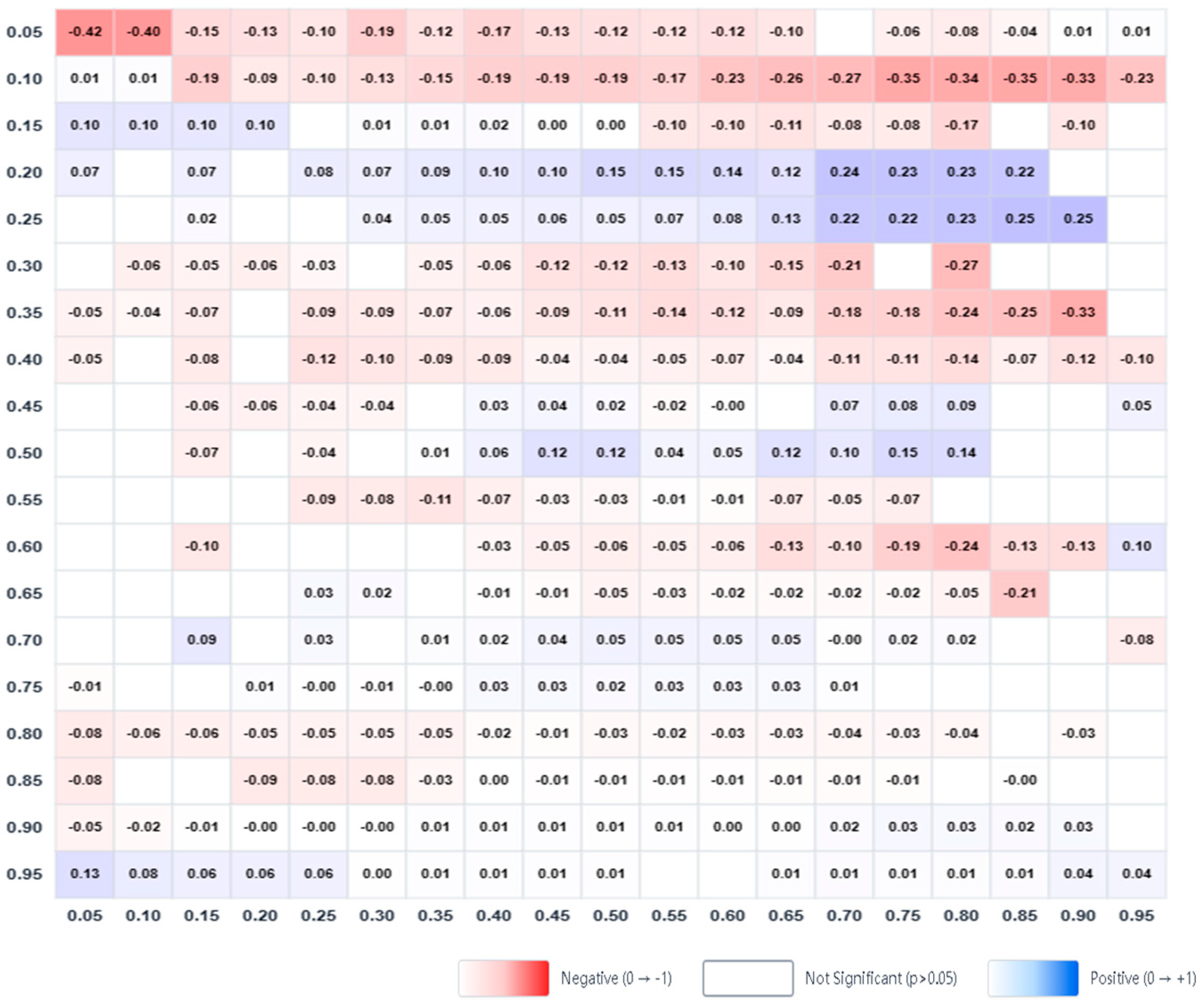
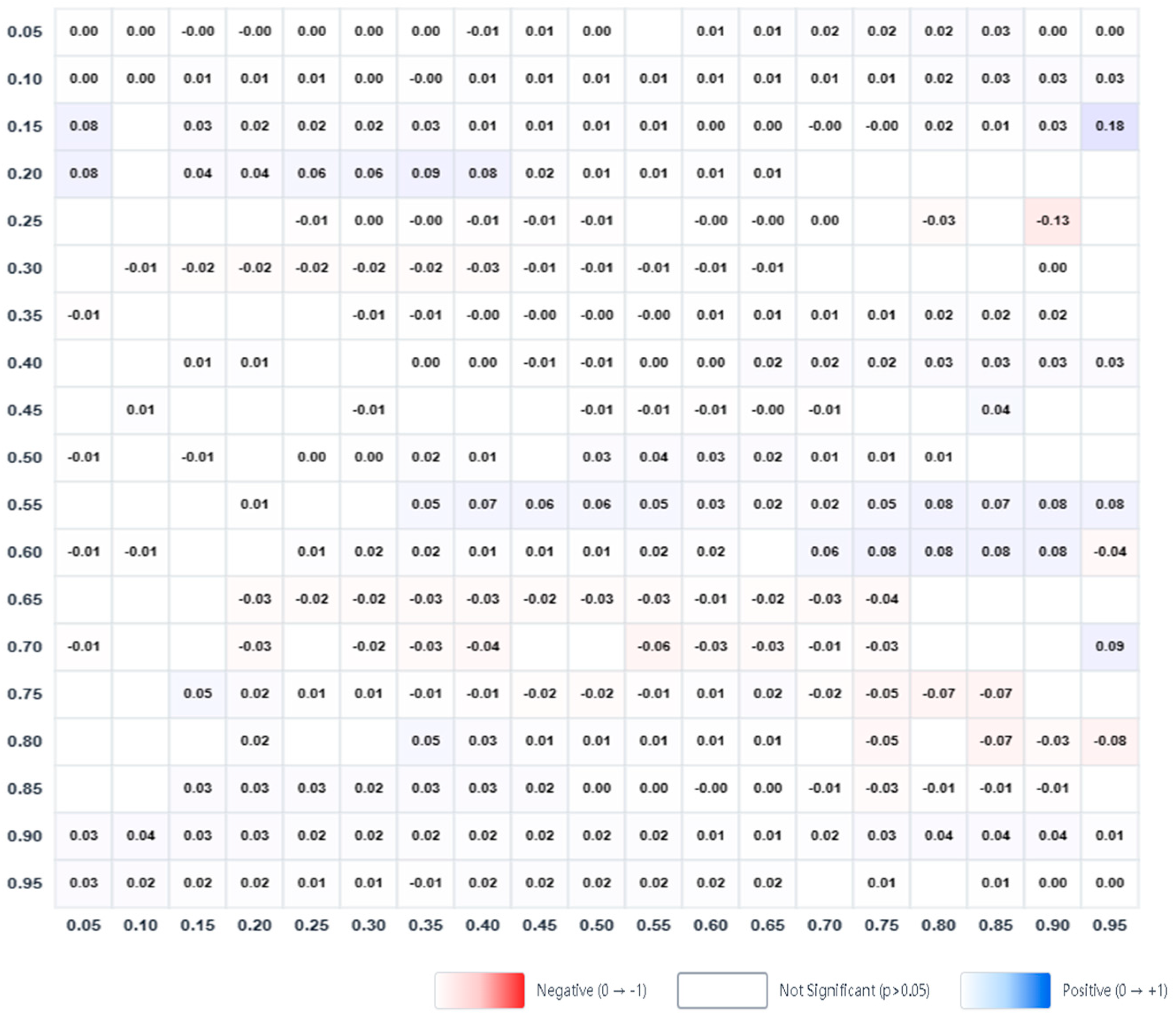
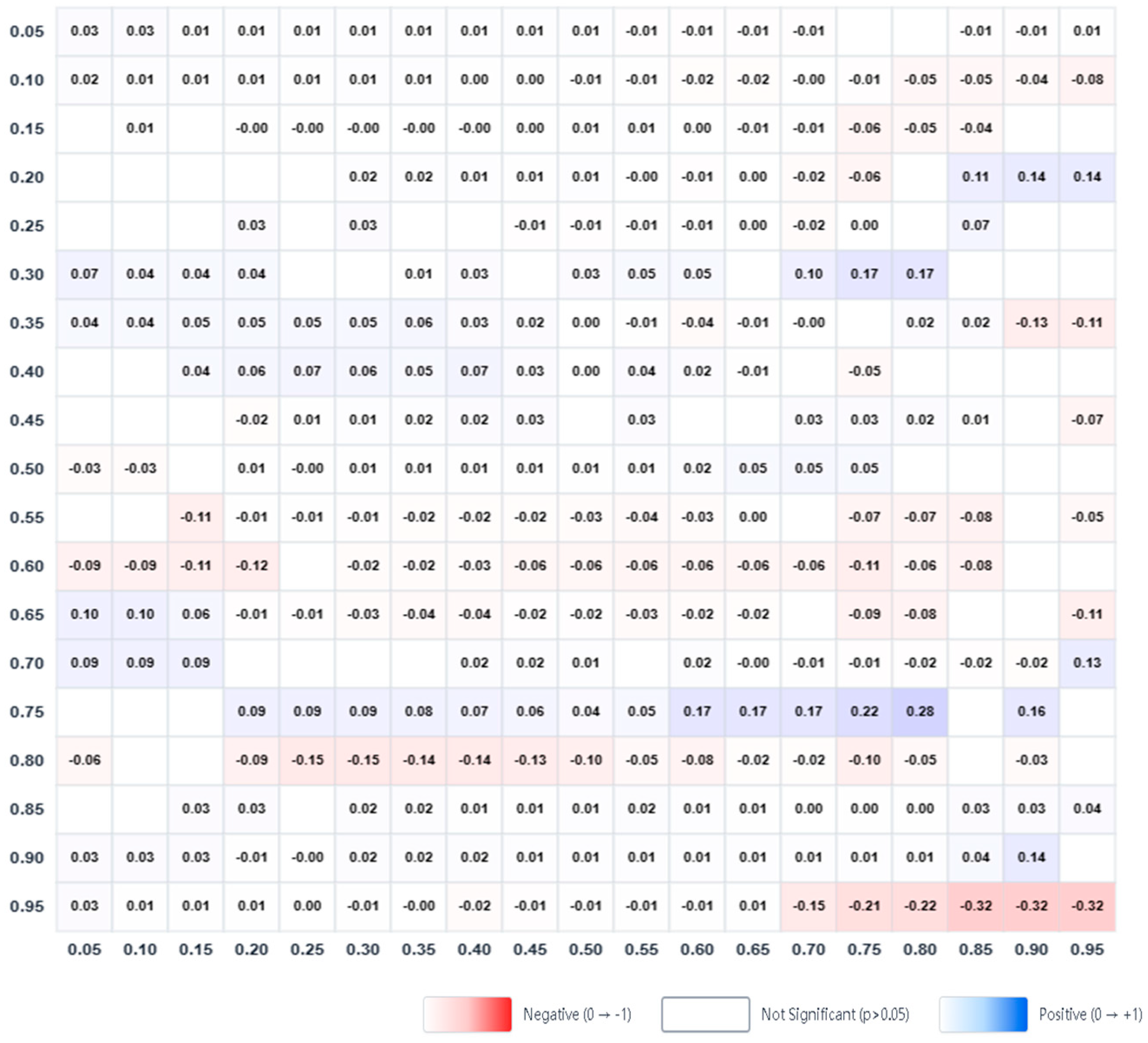
Figure 1 presents the quantile correlation heatmap between ESG scores and Tobin’s Q in the tourism-related food service sector, showing a nuanced relationship that supports our conceptual framework. The results demonstrate significant heterogeneity across the performance distribution. At lower quantiles (0.05–0.15), ESG practices exhibit predominantly negative correlations with Tobin’s Q, indicated by red cells showing coefficients ranging from −0.40 to −0.10. This pattern supports Hypothesis 2, suggesting that ESG investments may impose financial burdens on underperforming firms through compliance costs and resource constraints, consistent with findings by Duque-Grisales and Aguilera-Caracuel [13] , who documented negative relationships between ESG scores and firm performance. Conversely, at higher quantiles (0.90–0.95), the correlations shift to positive (blue cells), with coefficients reaching 0.04 to 0.10, validating Hypothesis 1. High-performing firms appear better positioned to convert ESG initiatives into competitive advantages and stakeholder value, aligning with the meta-analysis findings of Friede et al. [30] and the tourism-specific research by Tahmid et al. [41] and Yoon et al. [42]. The middle quantiles (0.30–0.75) display mixed patterns with both positive and negative correlations, revealing complex non-linear dynamics. This heterogeneous pattern strongly supports Hypothesis 3, confirming that ESG implementation generates asymmetric effects contingent upon firms’ baseline performance levels, as documented by Bhattacherjee et al. [25] and Zarafat et al. [51]. These findings underscore the importance of considering firm-specific contexts when evaluating ESG-performance relationships, challenging the assumption of uniform ESG benefits across all firms.
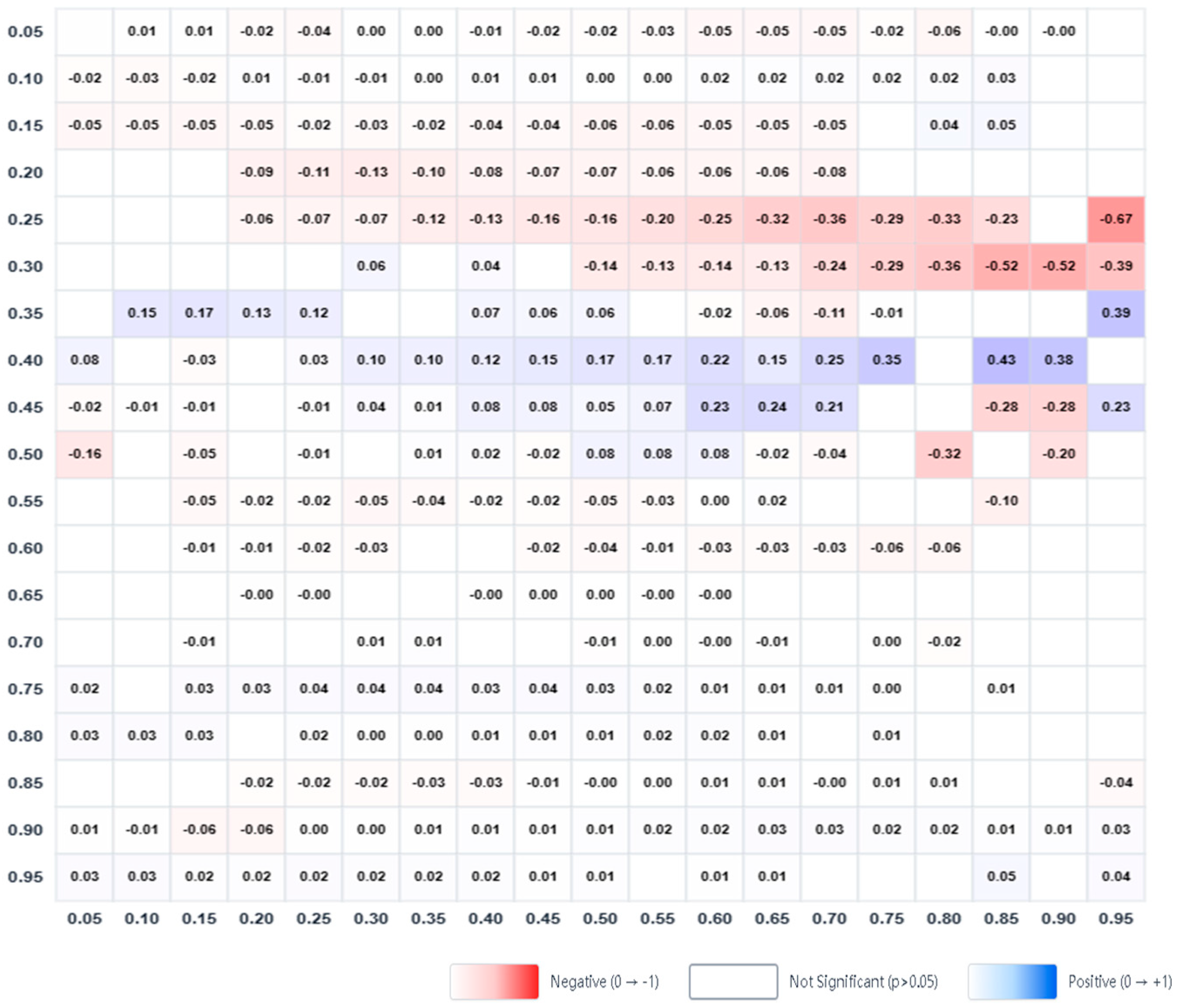
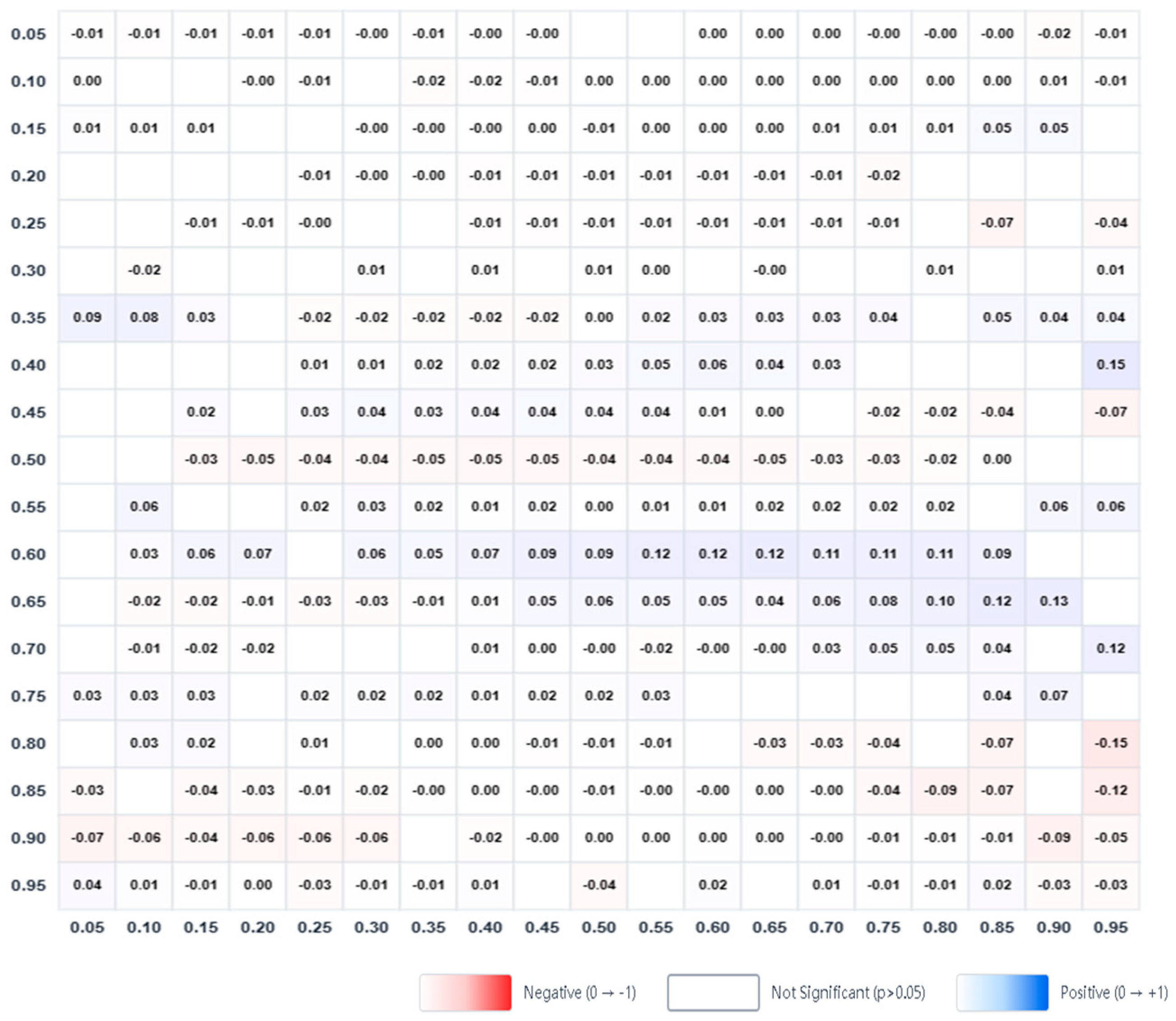
Figure 2 shows the QQ correlations between Environmental scores and Tobin’s Q in tourism-related food service firms, revealing heterogeneous relationships across the performance distribution. At lower Tobin’s Q quantiles (0.05–0.25), Environmental practices exhibit negative correlations (coefficients ranging from −0.67 to −0.16), suggesting resource constraints burden underperforming firms, consistent with the Semenova and Hassel [14] findings that environmental management significantly increases operational costs and reduces company performance in certain industries. The middle quantiles (0.30–0.55) display mixed results with both positive and negative coefficients clustering near zero, indicating transitional dynamics. In contrast, higher quantiles (0.70–0.95) show positive correlations, demonstrating that high-performing firms successfully convert environmental investments into competitive advantages, supporting the positive ESG-performance relationships documented by Alareeni and Hamdan [31] and Aouadi and Marsat [32]. This asymmetric pattern validates the context-dependent nature of environmental sustainability’s financial implications, as emphasized by Wasiuzzaman et al. [47] in their analysis of the energy sector.
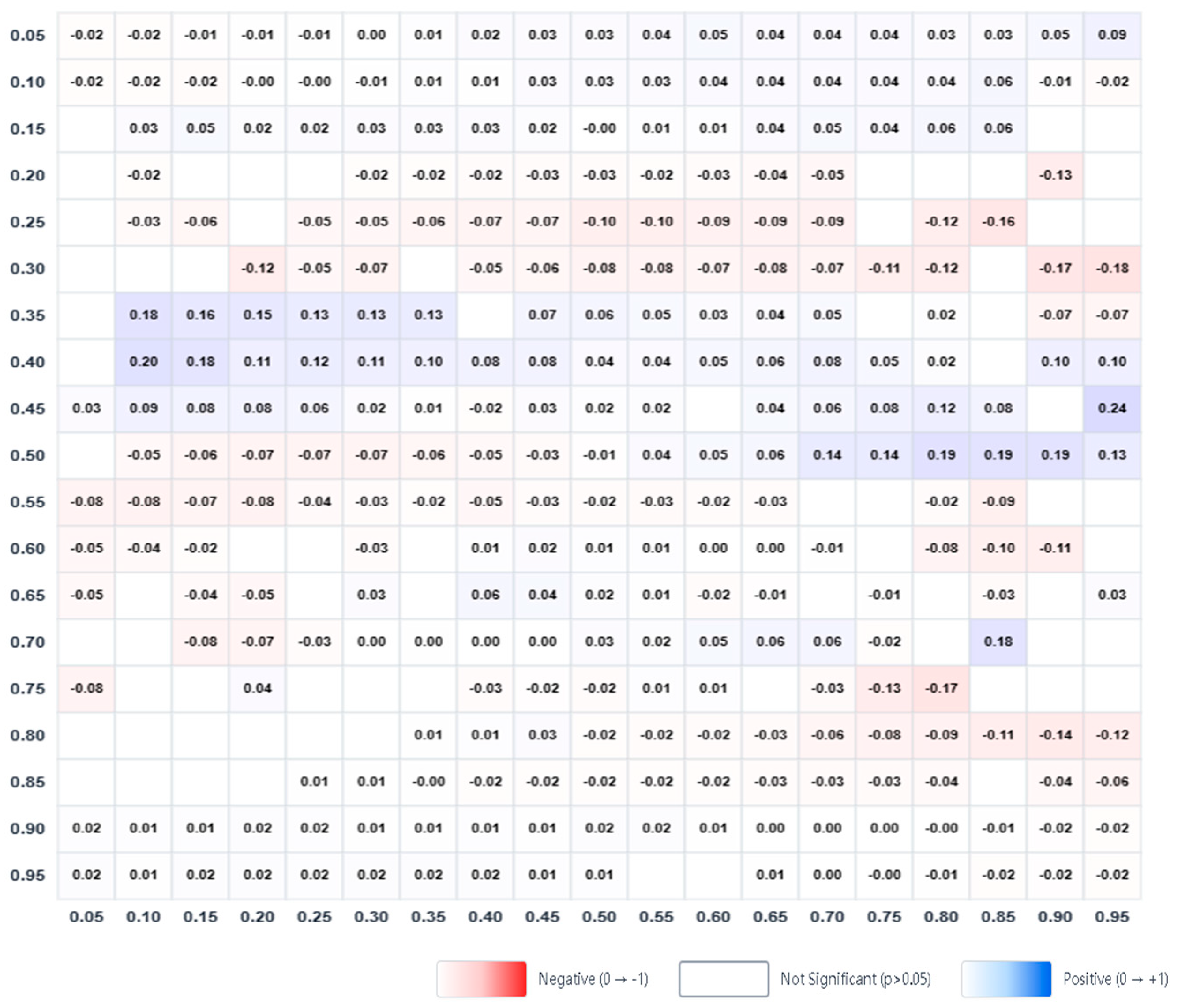
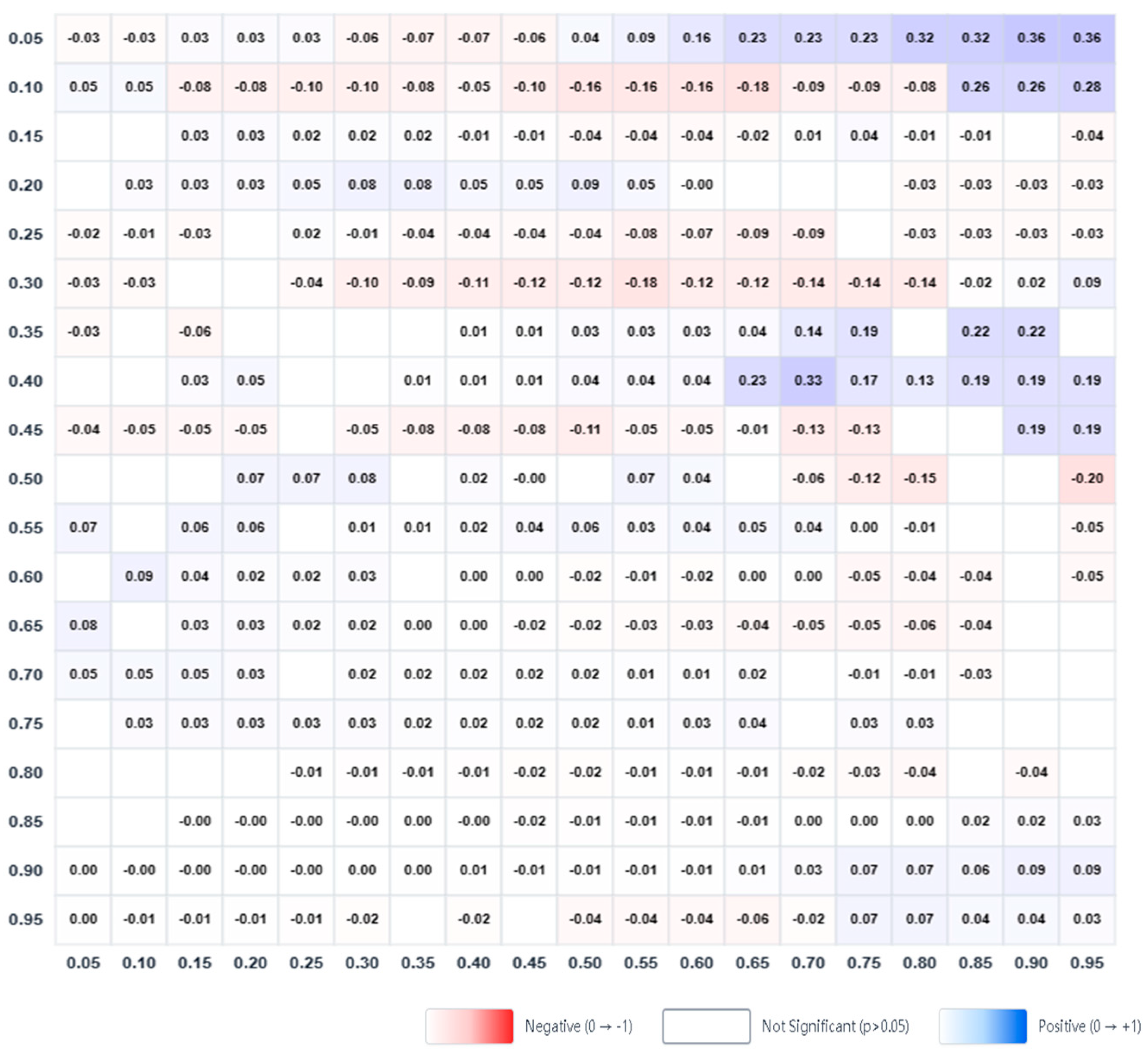
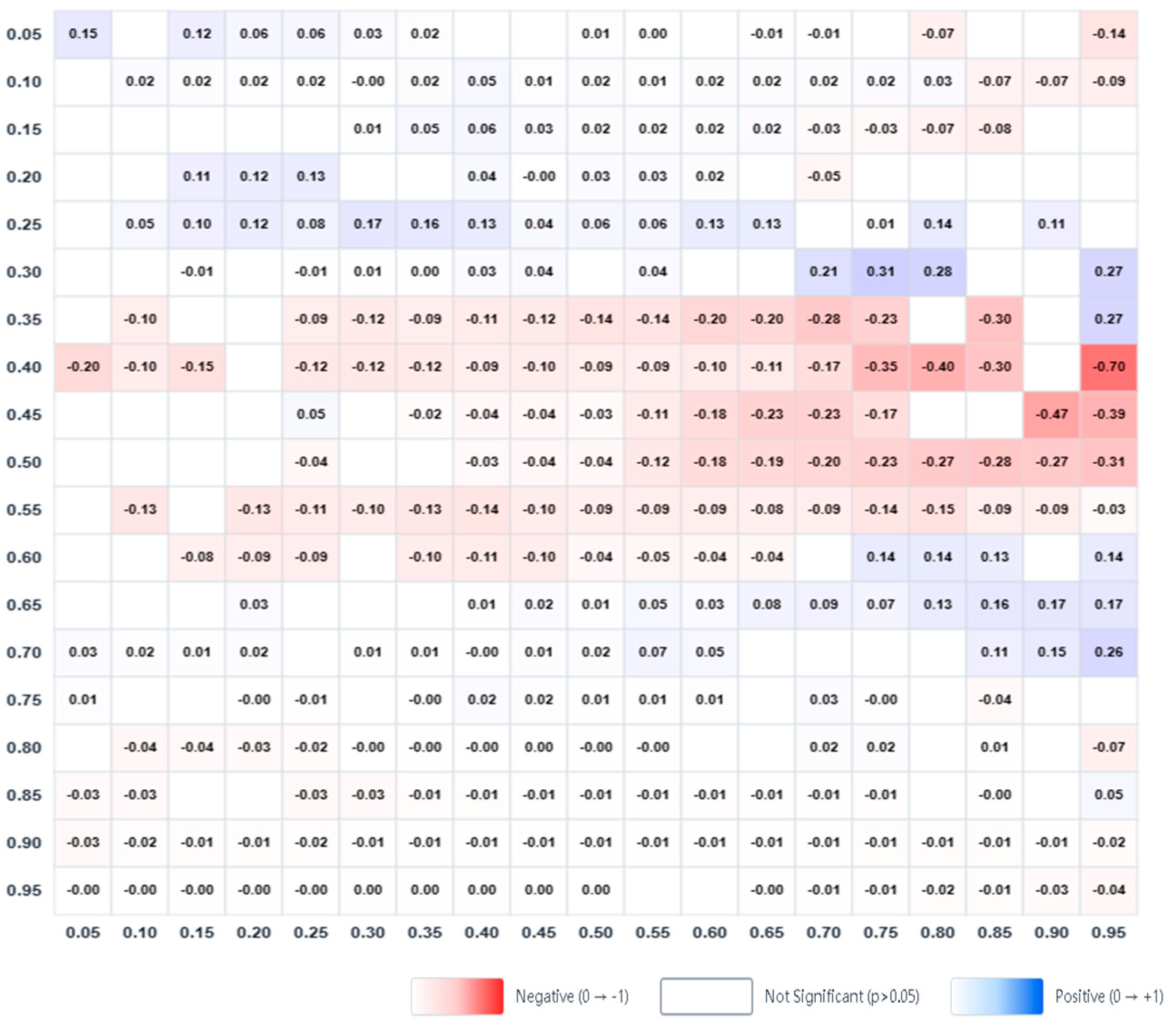
As shown in Figure 3, the QQ correlations between Social scores and Tobin’s Q in tourism-related food service firms reveal a distinctive inverted pattern. Lower Tobin’s Q quantiles (0.05–0.25) exhibit mixed correlations with both positive and negative coefficients near zero, indicating uncertain social investment outcomes for struggling firms. The middle quantiles (0.30–0.50) demonstrate positive correlations (up to 0.27), suggesting that moderately performing firms benefit from social capital through stakeholder engagement and reputation enhancement, consistent with Theodoulidis et al. [19] findings that CSR positively interacts with firm strategy and financial performance across tourism subsectors. This aligns with Stakeholder Theory’s emphasis on the importance of stakeholder relationships in tourism firms [24]. Surprisingly, higher quantiles (0.55–0.95) display negative correlations (reaching −0.70), implying that top-performing firms may face diminishing returns or opportunity costs from excessive social investments that divert resources from core competitive strategies, reflecting the asymmetric effects documented by Herremans et al. [49] regarding social responsibility impacts across different firm contexts.
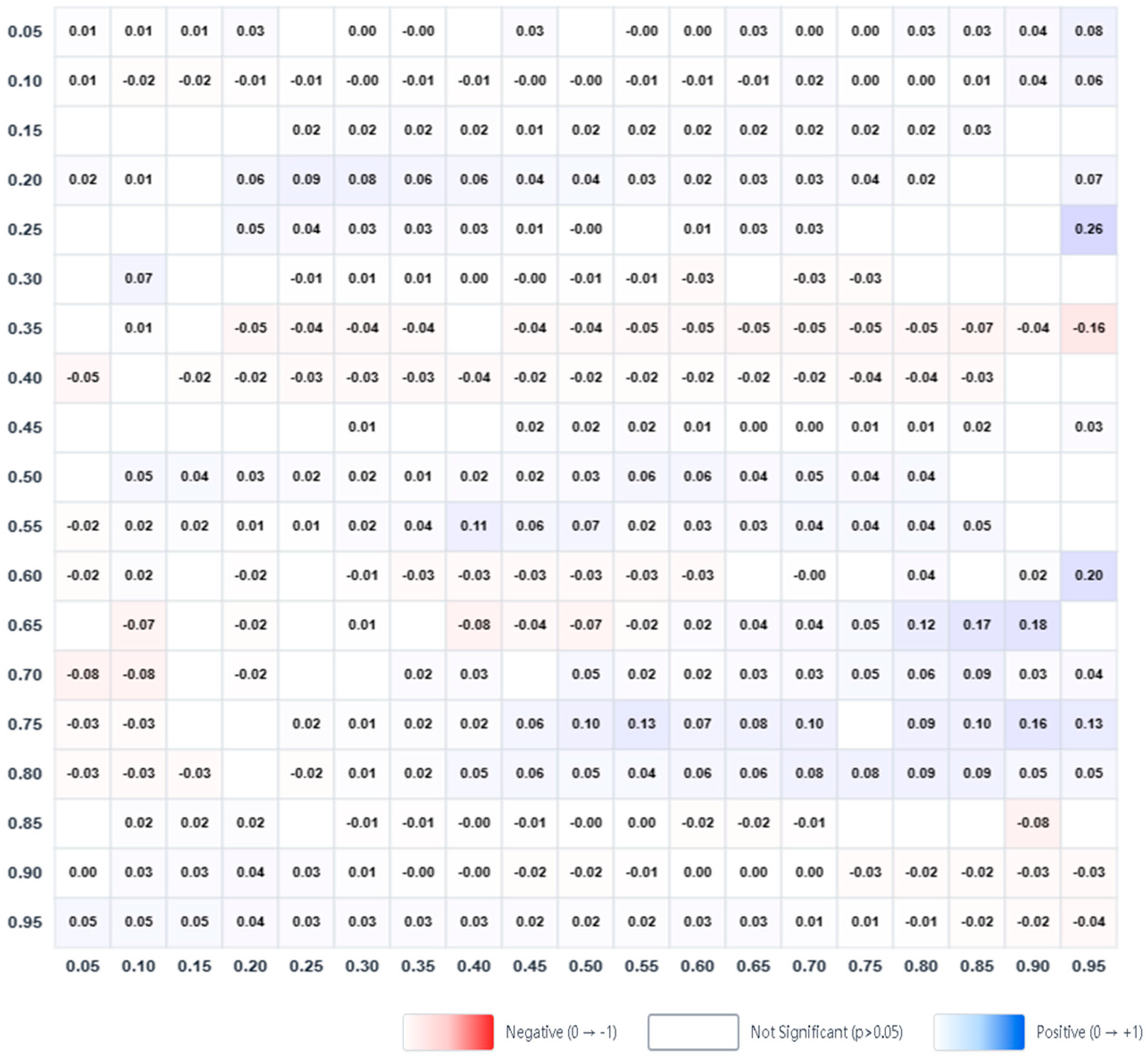
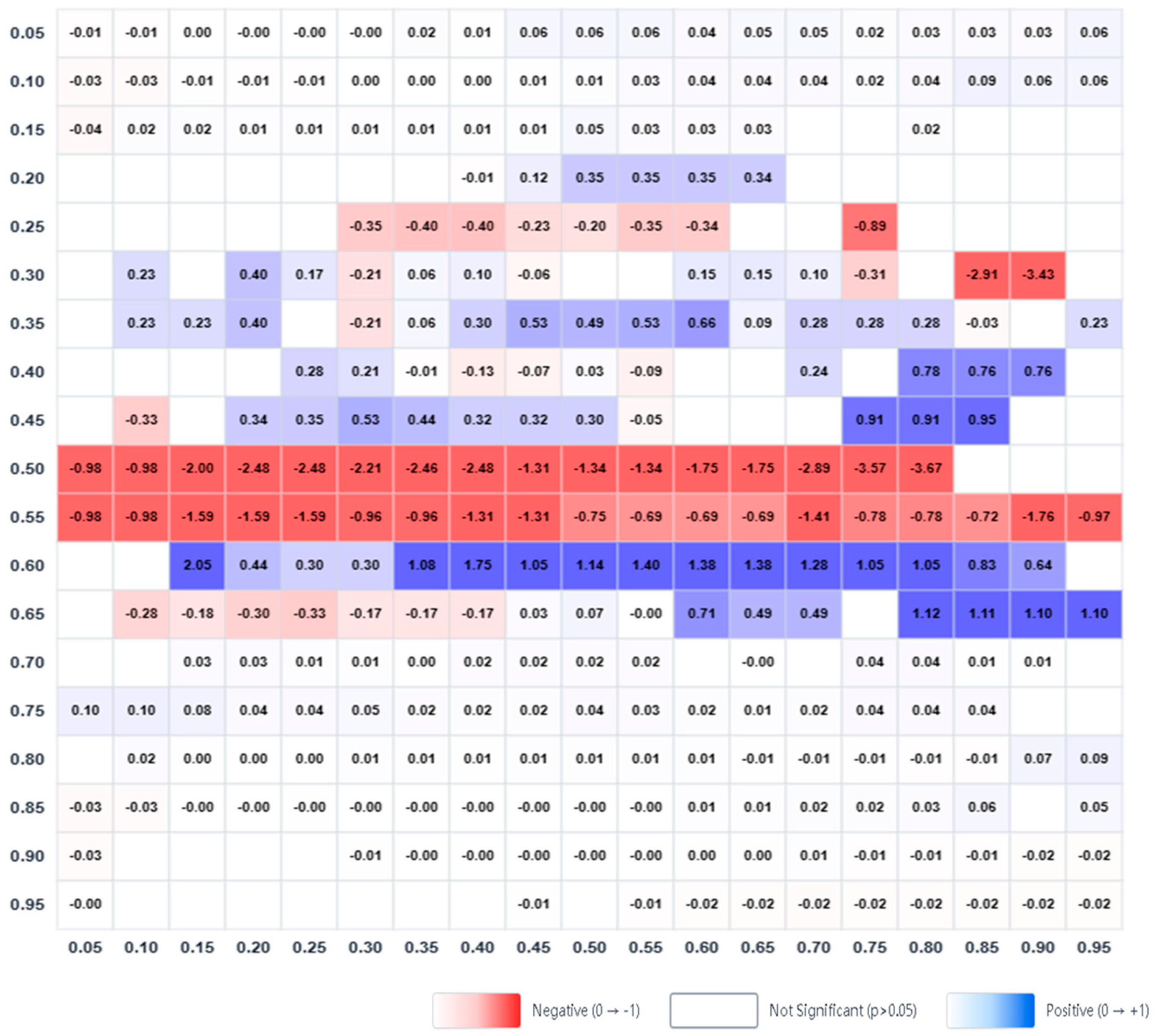
The QQ analysis reveals a nuanced relationship between Governance scores and Tobin’s Q in tourism-related food service firms. Lower Tobin’s Q quantiles (0.05–0.25) display mixed correlations with coefficients fluctuating between −0.19 and 0.05, suggesting heterogeneous governance effects for underperforming firms. Notably, middle quantiles (0.30–0.45) exhibit modest positive correlations (up to 0.24), indicating that moderately performing firms benefit from improved board structures, transparency, and internal controls, supporting Ionescu et al. [7] findings that governance factors particularly enhance market value across different contexts. This pattern also aligns with the Abdi et al. [43] research on airlines, showing that governance initiatives improve market-to-book ratios. Still, Figure 4 shows that higher quantiles (0.60–0.95) return to mixed patterns with predominantly weak or insignificant relationships, implying that governance improvements provide limited marginal value for top performers who may already possess robust governance mechanisms, consistent with the asymmetric dynamic patterns identified by Wu and Qin [52] in ESG-related markets.

4.2. The Tourism-Related Hotel Service Sector

Figure 5 shows a contrasting pattern in the tourism-related hotel service sector compared to food service firms. Lower Tobin’s Q quantiles (0.05–0.25) display positive correlations (up to 0.26), supporting Hypothesis 1 and suggesting that struggling hotels benefit from ESG investments through operational efficiency and brand differentiation, consistent with the findings of Xue et al. [24] in Chinese tourism enterprises and Da Hyun et al. [12] in global hospitality firms. Middle quantiles (0.30–0.60) exhibit negative correlations (reaching −0.16), aligning with Hypothesis 2 as these firms face resource allocation challenges similar to the cost burdens documented by Buallay [12] in other sectors. Higher quantiles (0.70–0.95) return to positive relationships (up to 0.20), again confirming Hypothesis 1. This distinct pattern strongly validates Hypothesis 3, demonstrating sector-specific asymmetric effects where hotels, unlike food service providers, show positive ESG-performance relationships at performance extremes, reflecting the asymmetric patterns identified by Bhattacherjee et al. [25] and Zarafat et al. [51] across different market conditions.
Figure 6 indicates distinct environmental performance dynamics in tourism-related hotel service firms. Lower Tobin’s Q quantiles (0.05–0.30) exhibit mixed correlations with coefficients ranging from −0.34 to 0.28, indicating heterogeneous environmental investment outcomes for underperforming hotels, similar to the context-dependent effects found by Semenova and Hassel [14] in environmentally sensitive industries. The middle quantiles (0.35–0.65) also display mixed patterns but notably feature strong positive correlations (reaching 0.60), suggesting that moderately performing hotels can effectively capitalize on environmental initiatives through energy efficiency, waste reduction, and green branding that resonate with eco-conscious travelers, supporting the positive environmental effects documented by Abdi et al. [43] in their study of global airlines. This aligns with the Ding and Tseng [44] findings in Chinese international hotels regarding environmental strategy effectiveness. Higher quantiles (0.70–0.95) return to mixed relationships with weaker correlations, implying diminishing marginal returns as top-performing hotels may have already optimized their environmental strategies or face saturation effects in green market positioning.
The QQ analyses reveal contrasting dynamics between Social and Governance indicators in tourism-related hotel service firms. Figure 7 demonstrates that social scores exhibit positive correlations at both performance extremes: lower quantiles (0.05–0.25) show coefficients up to 0.18, while higher quantiles (0.75–0.95) reach 0.18, suggesting that social investments benefit hotels at performance boundaries through stakeholder engagement and reputation building, consistent with Theodoulidis et al. [19] findings that CSR positively interacts with firm strategy in tourism subsectors including hotels. This pattern also supports the stakeholder relationship emphasis by Habib and Mourad [27] in U.S. tourism firms. However, middle quantiles (0.30–0.65) display mixed patterns with weak correlations near zero, indicating limited social capital effectiveness for moderately performing hotels facing resource constraints. In contrast, Figure 8 presents an inverted pattern for Governance scores. Lower quantiles (0.05–0.30) exhibit weak mixed correlations, while middle quantiles (0.35–0.60) show modest positive relationships (up to 0.15), suggesting governance improvements benefit average performers through enhanced operational efficiency, aligning with Ionescu et al. [39] findings that governance factors enhance market value in travel and tourism companies. Higher quantiles (0.70–0.95) return to negative correlations (reaching −0.15), implying that top-performing hotels face opportunity costs from excessive governance investments that may constrain strategic flexibility, reflecting the asymmetric patterns documented by Abou Lin et al. [15]. These contrasting S and G patterns highlight dimension-specific mechanisms in hotel sector performance dynamics.

4.3. The Tourism-Related Service Sector

Figure 9 reveals distinctive characteristics of ESG-performance relationships in tourism-related service firms, predominantly exhibiting mixed correlations across the entire performance distribution. Lower Tobin’s Q quantiles (0.05–0.30) show mixed patterns with coefficients ranging from −0.18 to 0.36, supporting both Hypotheses 1 and 2 simultaneously within underperforming firms, reflecting the dual nature of ESG effects documented by both Friede et al. [30], who found predominantly positive effects. Middle quantiles (0.35–0.65) continue displaying mixed correlations with weak intensities near zero, while higher quantiles (0.70–0.95) similarly present heterogeneous relationships. This pervasive mixed-correlation pattern across all quantiles strongly validates Hypothesis 3, demonstrating that service sector firms experience highly context-dependent and asymmetric ESG effects, consistent with the asymmetric patterns identified by Bhattacherjee et al. [25] and Zarafat et al. [51] across different market conditions. Unlike food and hotel sectors with clearer directional patterns, service firms face greater uncertainty in ESG value creation due to their intangible service nature and diverse stakeholder expectations, highlighting the sector’s unique operational challenges [8,40].
As shown in Figure 10, the complex environmental performance dynamics in tourism-related service firms are predominantly characterized by mixed correlations throughout the distribution. Lower Tobin’s Q quantiles (0.05–0.30) exhibit mixed patterns with coefficients ranging from −0.04 to 0.06, reflecting the heterogeneous outcomes found by Semenova and Hassel [14] regarding environmental management impacts, while higher quantiles (0.65–0.95) similarly display heterogeneous relationships. Most notably, middle quantiles reveal extreme volatility: the 0.50–0.55 range shows strong negative correlations (reaching −3.67), immediately followed by strong positive correlations at 0.60 (up to 2.05). This dramatic oscillation within adjacent quantiles exemplifies the pervasive mixed-correlation pattern and strongly validates Hypothesis 3, confirming that environmental initiatives in service firms generate highly asymmetric and context-dependent effects across different performance levels, consistent with the non-linear relationships documented by Nollet et al. [23], and Attia et al. [21]. This volatility reflects the sector’s intangible nature and operational diversity, where environmental impacts are less tangible than in accommodation or food services [3].
The QQ analyses reveal pervasive complexity in the Social and Governance dimensions for tourism-related service firms, both exhibiting predominantly mixed correlation patterns across performance distributions. Figure 11 demonstrates that social scores show mixed relationships throughout: lower quantiles (0.05–0.30) display heterogeneous coefficients ranging from −0.14 to 0.16, middle quantiles (0.35–0.60) continue with mixed patterns including some moderate negative correlations (around −0.22), and higher quantiles (0.65–0.95) similarly present weak mixed relationships. This pervasive heterogeneity suggests that social investments in service firms face high uncertainty across all performance levels, contrasting with the more consistent positive social effects found by Theodoulidis et al. [19] in other tourism subsectors and reflecting the complex stakeholder dynamics emphasized by Habib and Mourad [27]. Figure 12 presents Governance scores with comparable mixed-correlation patterns. Lower quantiles (0.05–0.30) show weak mixed relationships (coefficients from −0.11 to 0.17), while middle quantiles (0.35–0.65) exhibit mixed patterns with some moderate negative correlations, aligning with the Buallay [12] findings of negative governance effects in certain contexts. Higher quantiles (0.70–0.95) display predominantly positive but weak correlations (up to 0.29), suggesting modest governance benefits for top performers similar to Ionescu et al. [7] findings in travel and tourism companies. These consistently mixed S and G patterns across all quantiles underscore the service sector’s operational diversity and intangible nature, where stakeholder management and governance effectiveness remain highly context-dependent and difficult to systematize, reflecting the sector’s unique challenges in balancing ESG implementation costs with performance benefits [13,49].

4.4. Comparing QQ and Traditional Quantile Regression

To validate our analytical framework, we employ the QQ regression methodology, which demonstrates substantial advantages over conventional quantile regression techniques when examining ESG-Tobin’s Q relationships. The QQ approach enables comprehensive exploration of distributional dependencies by estimating coefficients across all possible combinations of conditional quantiles for both dependent and independent variables. This methodology captures nuanced interaction effects that traditional quantile regression overlooks by examining only how the dependent variable’s distribution responds to changes in the independent variable’s mean. The slope parameters from the QQ framework can be aggregated to generate coefficients comparable to standard quantile regression, following the formulation:
β 1 ¯ = θ = ( 1 / s ) φ β 1 ^ ( θ ,   φ )
where s represents the total number of quantiles and φ encompasses the range [0.05, 0.10, …, 0.90, 0.95]. Our empirical results demonstrate that QQ estimation reveals more pronounced coefficient patterns and clearer directional relationships between ESG practices and firm valuation across performance strata. The enhanced sensitivity of this approach proves particularly valuable for identifying the asymmetric and context-dependent effects hypothesized in our theoretical framework, providing robust evidence that would remain obscured under traditional estimation methods.
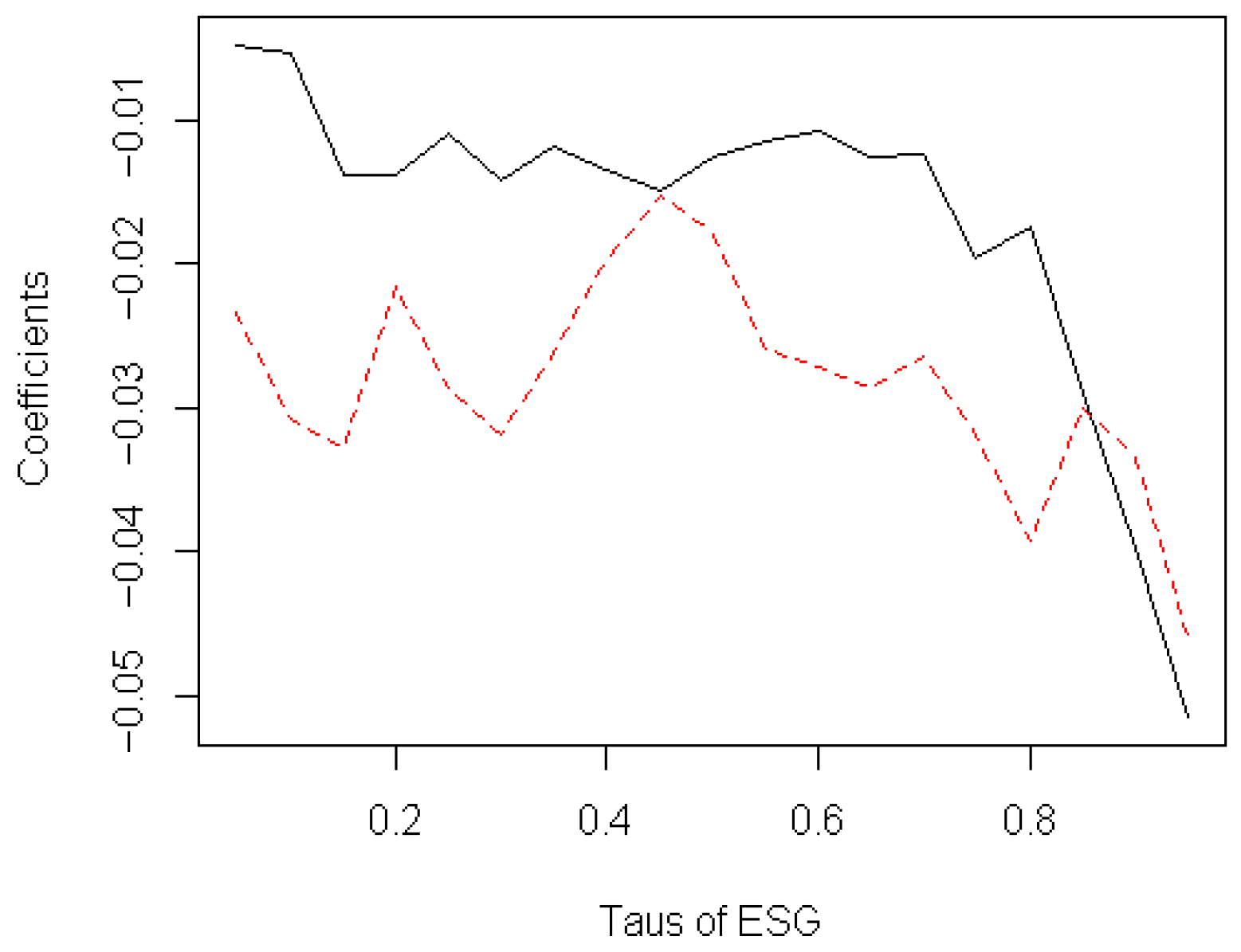
The QQ approach (red dashed line) consistently reveals more pronounced coefficients and enhanced sensitivity to distributional changes compared to traditional quantile regression (black solid line) across all three tourism subsectors. Figure 13 demonstrates this methodological advantage most clearly in the food service sector, where both estimation methods show negative ESG-Tobin’s Q relationships throughout the distribution. Nevertheless, the QQ approach exhibits substantially larger negative coefficients, particularly at lower quantiles (0.05–0.30) with values reaching −0.04, and displays steeper declines at higher quantiles (0.80–0.95) dropping to −0.05. The traditional QR method shows a more compressed pattern with coefficients remaining between −0.01 and −0.02 across most quantiles. This amplified sensitivity of the QQ framework captures nuanced distributional dependencies that the QR approach overlooks, revealing that ESG investments impose more severe performance penalties on food service firms across the entire performance spectrum than conventional estimation would suggest.
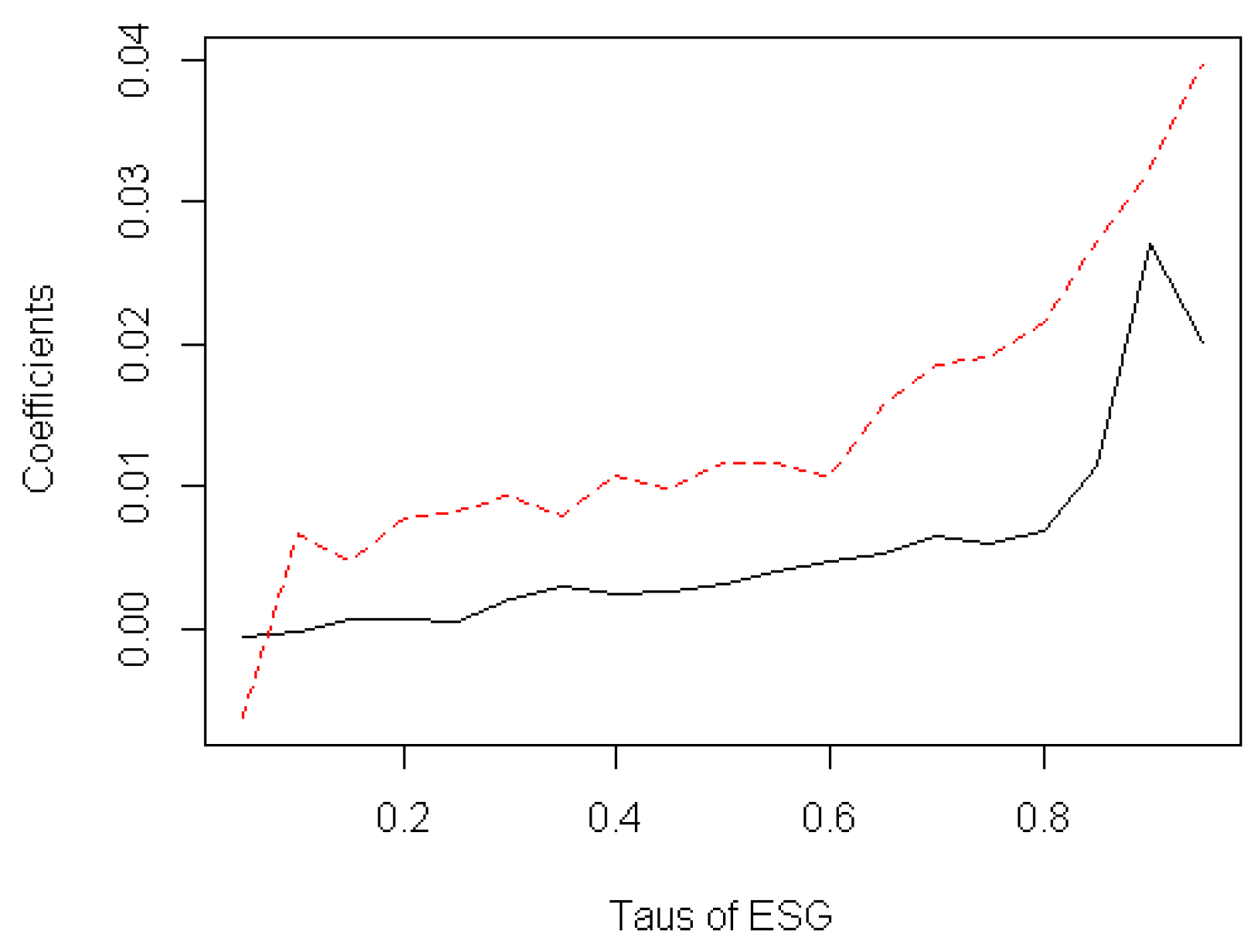
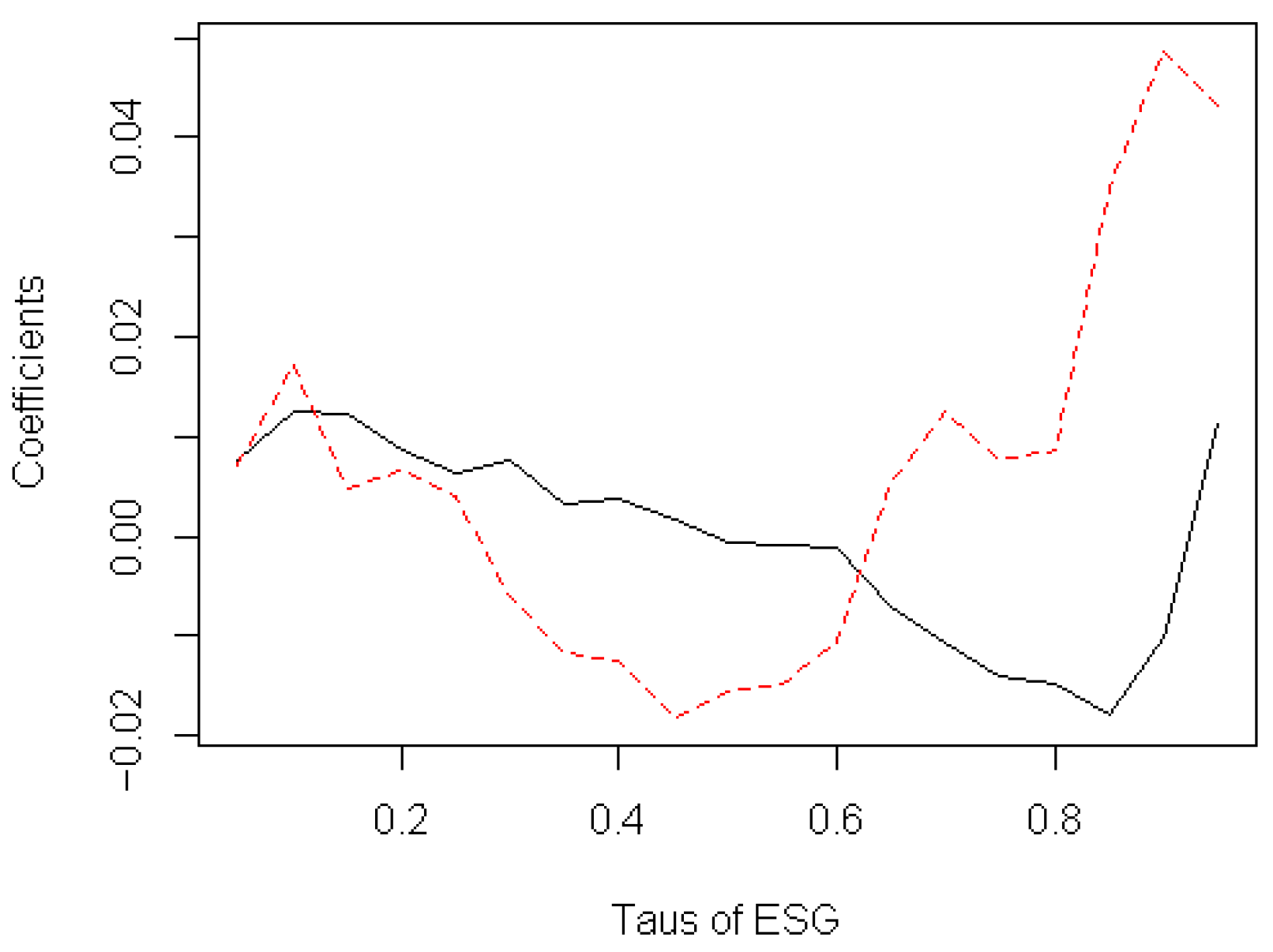
The sectoral heterogeneity becomes evident when comparing Figure 14 and Figure 15. In the hotel sector (Figure 14), both methods capture positive ESG-performance relationships, but the QQ approach reveals dramatically amplified effects, with coefficients rising from 0.00 at lower quantiles to 0.04 at the highest quantiles, while QR estimates remain relatively flat near 0.00–0.01. This suggests that QQ methodology uncovers substantial upside potential from ESG practices in hotels that traditional regression misses. By contrast, the service sector (Figure 15) exhibits the most complex pattern: QR shows modest positive coefficients (0.00–0.01) across most quantiles, whereas QQ demonstrates volatile dynamics with initial positive values (0.02), declining to negative territory (−0.02) at middle quantiles, then sharply rebounding to strong positives (0.04) at upper quantiles. This pronounced volatility captured by QQ reflects the service sector’s heterogeneous operational contexts and validates the necessity of employing distributional-sensitive methodologies.

5. Conclusions, Discussion, and Limitations

5.1. Conclusions

This study employs QQ regression to examine ESG-performance relationships across three tourism subsectors in Taiwan. Our findings reveal substantial sectoral heterogeneity, challenging the conventional wisdom of uniform ESG benefits. The food service sector experiences predominantly negative ESG-performance relationships, with compliance costs and resource constraints outweighing potential benefits. By contrast, the hotel sector demonstrates positive relationships at performance extremes, as hospitality firms convert sustainability initiatives into competitive advantages through operational efficiency and brand differentiation. The service sector exhibits complex mixed correlations reflecting operational diversity and intangible service characteristics. These asymmetric patterns strongly support Hypothesis 3 regarding context-dependent ESG effects across different market conditions and performance levels. Our comparison between QQ and traditional quantile regression further reveals that the QQ approach captures more pronounced coefficient patterns and enhanced distributional sensitivities, uncovering nuanced relationships that conventional methods overlook. From an environmental economics perspective, these findings underscore that tourism’s contribution to global carbon emissions cannot be addressed through one-size-fits-all ESG policies, as the financial implications vary dramatically across subsectors and performance levels.

5.2. Discussion

The sectoral heterogeneity in our findings requires interpretation through competing theoretical frameworks. Negative ESG-performance relationships in food services align with cost-of-capital theory predictions [14], where ESG compliance costs exceed stakeholder benefits. Conversely, positive relationships at hotel performance extremes validate stakeholder theory and Reputation theory [12,19,21], enabling ESG investments to generate operational efficiencies and brand premiums. Mixed patterns in tourism services reflect operational diversity highlighted by Inoue and Lee [7]. Our findings reconcile contradictory theoretical predictions by demonstrating context-dependent mechanism dominance. Stakeholder mechanisms may prevail in capital-intensive sectors with sufficient resources, while cost mechanisms dominate in resource-constrained sectors. This advances ESG theory beyond binary debates toward understanding when and why each mechanism prevails. These asymmetric patterns align with recent research demonstrating context-dependent ESG effects [25,51]. From an environmental economics perspective, tourism’s 8% contribution to global carbon emissions [3] requires context-sensitive policy approaches, extending distributional analysis to different tourism contexts.

5.3. Limitations

We acknowledge that potential bidirectional causality between ESG practices and firm performance represents an important limitation of our study. Additionally, unobserved factors such as managerial quality or corporate culture may simultaneously influence both ESG adoption and financial performance. Future research should employ causal identification strategies such as instrumental variables, lagged ESG measures, or propensity score matching to establish the direction of ESG effects on firm performance in the tourism sector. While our QQ regression analysis reveals substantial sectoral heterogeneity in ESG-performance relationships, our study does not formally test these mediating pathways through structural equation modeling. This represents an important avenue for future research.

Author Contributions

Methodology, C.-M.W.; software, C.-M.W. and T.-P.W.; formal analysis, C.-M.W.; investigation, T.-P.W.; resources, C.-M.W.; data curation, C.-M.W.; writing—original draft preparation, C.-M.W. and T.-P.W.; writing—review and editing, C.-M.W. and T.-P.W. All authors have read and agreed to the published version of the manuscript.

Funding

This research received no external funding.

Institutional Review Board Statement

Not applicable.

Informed Consent Statement

Not applicable.

Data Availability Statement

The raw data supporting the conclusions of this article will be made available by the authors on request.

Conflicts of Interest

The authors declare no conflict of interest.

References

  1. Global Sustainable Investment Alliance. Global Sustainable Investment Review 2022. 2022. Available online: https://www.gsi-alliance.org/members-resources/gsir2022/ (accessed on 22 January 2025).
  2. Soni, M.; Dawar, S.; Soni, A. Probing consumer awareness & barriers towards consumer social responsibility: A novel sustainable development approach. Int. J. Sustain. Dev. Plan. 2021, 16, 89–96. [Google Scholar] [CrossRef]
  3. Lenzen, M.; Sun, Y.-Y.; Faturay, F.; Ting, Y.-P.; Geschke, A.; Malik, A. The carbon footprint of global tourism. Nat. Clim. Change 2018, 8, 522–528. [Google Scholar]
  4. Liu, D.; Ji, J.; Wu, M. Tourism Carbon Emissions: A Systematic Review of Research Based on Bibliometric Methods. J. Qual. Assur. Hosp. Tour. 2023, 26, 2266861. [Google Scholar] [CrossRef]
  5. Back, K.-J. ESG for the hospitality and tourism research: Essential demanded research area for all. Tour. Manag. 2024, 105, 104954. [Google Scholar] [CrossRef]
  6. Legendre, T.S.; Ding, A.; Back, K.-J. A bibliometric analysis of the hospitality and tourism environmental, social, and governance (ESG) literature. J. Hosp. Tour. Manag. 2024, 58, 309–321. [Google Scholar] [CrossRef]
  7. Inoue, Y.; Lee, S. Effects of different dimensions of corporate social responsibility on corporate financial performance in tourism-related industries. Tour. Manag. 2011, 32, 790–804. [Google Scholar] [CrossRef]
  8. Kang, K.H.; Lee, S.; Huh, C. Impacts of positive and negative corporate social responsibility activities on company performance in the hospitality industry. Int. J. Hosp. Manag. 2010, 29, 72–82. [Google Scholar] [CrossRef]
  9. Kholijah, S. Analysis of Economic and Environmental Benefits of Green Business Practices in the Hospitality and Tourism Sector. Involv. Int. J. Bus. 2024, 1, 60–74. [Google Scholar] [CrossRef]
  10. Li, M. A Study of the Relationship Between ESG Performance and Firm Valuation. Adv. Econ. Manag. Political Sci. 2024, 74, 259–267. [Google Scholar]
  11. Gutiérrez, I.; Alcaraz, J.M.; Susaeta, L.; Suarez, E.; Pin, J. Managing sustainability for competitive advantage: Evidence from the hospitality industry. SSRN Electron. J. 2015. Available online: https://www.researchgate.net/publication/314557628_Managing_Sustainability_for_Competitive_Advantage_Evidence_from_the_Hospitality_Industry (accessed on 22 January 2025). [CrossRef]
  12. Da Hyun, S.H.; Song, H.J.; Lee, S.; Kang, K.H. The moderating role of national economic development on the relationship between ESG and firm performance in the global hospitality industry. Int. J. Hosp. Manag. 2024, 120, 103788. [Google Scholar] [CrossRef]
  13. Duque-Grisales, E.; Aguilera-Caracuel, J. Environmental, social and governance (ESG) scores and financial performance of multilatinas: Moderating effects of geographic international diversification and financial slack. J. Bus. Ethics 2021, 168, 315–334. [Google Scholar]
  14. Semenova, N.; Hassel, L.G. Financial outcomes of environmental risk and opportunity for US companies. Sustain. Dev. 2008, 16, 195–212. [Google Scholar] [CrossRef]
  15. Li, H.; Li, X.; Zhang, Y. ESG Performance, Heterogeneous Creditors, and Bond Financing Costs: Firm-Level Evidence. Financ. Res. Lett. 2024, 66, 105527. [Google Scholar]
  16. Bae, J.-H. Developing ESG evaluation guidelines for the tourism sector: With a focus on the hotel industry. Sustainability 2022, 14, 16474. [Google Scholar] [CrossRef]
  17. Kim, M.; Kim, Y. Corporate social responsibility and shareholder value of restaurant firms. Int. J. Hosp. Manag. 2014, 40, 120–129. [Google Scholar] [CrossRef]
  18. Lee, S.; Seo, K.; Sharma, A. Corporate social responsibility and firm performance in the airline industry: The moderating role of oil prices. Tour. Manag. 2013, 38, 20–30. [Google Scholar] [CrossRef]
  19. Theodoulidis, B.; Diaz, D.; Crotto, F.; Rancati, E. Exploring corporate social responsibility and financial performance through stakeholder theory in the tourism industries. Tour. Manag. 2017, 62, 173–188. [Google Scholar] [CrossRef]
  20. Youn, H.; Hua, N.; Lee, S. Does size matter? Corporate social responsibility and firm performance in the restaurant industry. Int. J. Hosp. Manag. 2015, 51, 127–134. [Google Scholar] [CrossRef]
  21. Attia, E.F.; Tobar, R.; Fouad, H.F.; Ezz Eldeen, H.H.; Chafai, A.; Khémiri, W. The Nonlinear Relationship between Corporate Social Responsibility and Hospitality and Tourism Corporate Financial Performance: Does Governance Matter? Sustainability 2023, 15, 15931. [Google Scholar] [CrossRef]
  22. El Khoury, R.; Nasrallah, N.; Alareeni, B. ESG and financial performance of banks in the MENAT region: Concavity–convexity patterns. J. Sustain. Financ. Investig. 2023, 13, 406–430. [Google Scholar] [CrossRef]
  23. Nollet, J.; Filis, G.; Mitrokostas, E. Corporate social responsibility and financial performance: A non-linear and disaggregated approach. Econ. Model. 2016, 52, 400–407. [Google Scholar] [CrossRef]
  24. Xue, Y.; Lakkanawanit, P.; Suttipun, M.; Huang, S.-Z. ESG Performance and Enterprise Value in Chinese Tourism Companies: The Chained Mediating Roles of Media Attention and Green Innovation. Sustainability 2024, 16, 10372. [Google Scholar] [CrossRef]
  25. Bhattacherjee, P.; Mishra, S.; Bouri, E. Does asset-based uncertainty drive asymmetric return connectedness across regional ESG markets? Glob. Financ. J. 2024, 61, 100972. [Google Scholar] [CrossRef]
  26. Freeman, R.E. Strategic Management: A Stakeholder Approach; Pitman: Boston, MA, USA, 1984. [Google Scholar]
  27. Habib, A.M.; Mourad, N. The Influence of Environmental, Social, and Governance (ESG) Practices on US Firms’ Performance: Evidence from the Coronavirus Crisis. J. Knowl. Econ. 2024, 15, 2549–2570. [Google Scholar] [CrossRef]
  28. Deephouse, D.L.; Carter, S.M. An examination of differences between organizational legitimacy and organizational reputation. J. Manag. Stud. 2005, 42, 329–360. [Google Scholar] [CrossRef]
  29. Fombrun, C.; Shanley, M. What’s in a name? Reputation building and corporate strategy. Acad. Manag. J. 1990, 33, 233–258. [Google Scholar] [CrossRef]
  30. Friede, G.; Busch, T.; Bassen, A. ESG and financial performance: Aggregated evidence from more than 2000 empirical studies. J. Sustain. Financ. Investig. 2015, 5, 210–233. [Google Scholar] [CrossRef]
  31. Alareeni, B.A.; Hamdan, A. ESG impact on performance of US S&P 500-listed firms. Corp. Gov. 2020, 20, 1409–1428. [Google Scholar] [CrossRef]
  32. Aouadi, A.; Marsat, S. Do ESG Controversies Matter for Firm Value? Evidence from International Data. J. Bus. Ethics 2018, 151, 1027–1047. [Google Scholar] [CrossRef]
  33. Brogi, M.; Lagasio, V. Environmental, social, and governance and company profitability: Are financial intermediaries different? Corp. Soc. Responsib. Environ. Manag. 2019, 26, 576–587. [Google Scholar] [CrossRef]
  34. Giese, G.; Lee, L.-E.; Melas, D.; Nagy, Z.; Nishikawa, L. Foundations of ESG Investing: How ESG Affects Equity Valuation, Risk, and Performance. JPM 2019, 45, 69–83. [Google Scholar] [CrossRef]
  35. Long, W.; Li, S.; Wu, H.; Song, X. Corporate social responsibility and financial performance: The roles of government intervention and market competition. Corp. Soc. Responsib. Env. 2020, 27, 525–541. [Google Scholar] [CrossRef]
  36. Okafor, A.; Adeleye, B.N.; Adusei, M. Corporate social responsibility and financial performance: Evidence from U.S tech firms. J. Clean. Prod. 2021, 292, 126078. [Google Scholar] [CrossRef]
  37. Qureshi, M.A.; Kirkerud, S.; Theresa, K.; Ahsan, T. The impact of sustainability (environmental, social, and governance) disclosure and board diversity on firm value: The moderating role of industry sensitivity. Bus. Strat. Environ. 2020, 29, 1199–1214. [Google Scholar] [CrossRef]
  38. Velte, P. Does ESG performance have an impact on financial performance? Evidence from Germany. J. Glob. Responsib. 2017, 8, 169–178. [Google Scholar] [CrossRef]
  39. Ma, Q. Exploring the Multi-Dimensional Effects of ESG on Corporate Valuation: Insights into Investor Expectations, Risk Mitigation, and Long-Term Value Creation. Corp. Soc. Responsib. Environ. Manag. 2024, 103, 8–15. [Google Scholar] [CrossRef]
  40. Abdelsalam, O.; Chantziaras, A.; Grougiou, V.; Leventis, S.; Tsileponis, N. Sustainability Performance and Corporate Risk: Evidence From the Tourism Industry. Int. J. Financ. Econ. 2025. [Google Scholar] [CrossRef]
  41. Tahmid, T.; Hoque, M.N.; Said, J.; Saona, P.; Azad, M.D.A.K. Does ESG initiatives yield greater firm value and performance? New evidence from European firms. Cogent Bus. Manag. 2022, 9, 2144098. [Google Scholar] [CrossRef]
  42. Yoon, B.; Lee, J.H.; Byun, R. Does ESG performance enhance firm value? Evidence from Korea. Sustainability 2018, 10, 3635. [Google Scholar] [CrossRef]
  43. Abdi, Y.; Li, X.; Càmara-Turull, X. Exploring the impact of sustainability (ESG) disclosure on firm value and financial performance (FP) in airline industry: The moderating role of size and age. Environ. Dev. Sustain. 2022, 24, 5052–5079. [Google Scholar] [CrossRef]
  44. Ding, X.; Tseng, C.-J. Relationship between ESG strategies and financial performance of hotel industry in China: An empirical study. Nurture 2023, 17, 439–454. [Google Scholar] [CrossRef]
  45. Lee, S.; Park, J.-W.; Chung, S. The Effects of Corporate Social Responsibility on Corporate Reputation: The Case of Incheon International Airport. Sustainability 2022, 14, 10930. [Google Scholar] [CrossRef]
  46. Matsali, C.; Skordoulis, M.; Papagrigoriou, A.; Kalantonis, P. ESG Scores as Indicators of Green Business Strategies and Their Impact on Financial Performance in Tourism Services: Evidence from Worldwide Listed Firms. Adm. Sci. 2025, 15, 208. [Google Scholar] [CrossRef]
  47. Wasiuzzaman, S.; Ibrahim, S.A.; Kawi, F. Environmental, social and governance (ESG) disclosure and firm performance: Does national culture matter? Meditari Account. Res. 2023, 31, 1239–1265. [Google Scholar] [CrossRef]
  48. Konar, S.; Cohen, M.A. Does the market value environmental performance? Rev. Econ. Stat. 2001, 83, 281–289. [Google Scholar] [CrossRef]
  49. Herremans, I.M.; Akathaporn, P.; McInnes, M. An investigation of corporate social responsibility reputation and economic performance. Account. Organ. Soc. 1993, 18, 587–604. [Google Scholar] [CrossRef]
  50. Zhong, M.; Zhu, Y.; Li, R.; Liu, Z.Y.R. ESG Greenwashing and Retail Investor Criticisms. Res. Int. Bus. Financ. 2025, 79, 103034. [Google Scholar] [CrossRef]
  51. Zarafat, H.; Liebhardt, S.; Eratalay, M.H. Do ESG ratings reduce the asymmetry behavior in volatility? J. Risk Financ. Manag. 2022, 15, 320. [Google Scholar] [CrossRef]
  52. Wu, R.; Qin, Z. Asymmetric volatility spillovers among new energy, ESG, green bond and carbon markets. Energy 2024, 292, 130504. [Google Scholar] [CrossRef]
  53. Sim, N.; Zhou, H. Oil prices, US stock return, and the dependence between their quantiles. J. Bank. Financ. 2015, 55, 1–8. [Google Scholar] [CrossRef]
Figure 1. Heatmap of Quantile Correlations between ESG Scores and Financial Performance in the tourism-related food service sector. Note: The heatmap displays correlation coefficients across quantiles (0.05–0.95). Blue cells indicate positive correlations, red cells indicate negative correlations, and white cells represent non-significant relationships (p > 0.05). Only significant correlations (p ≤ 0.05) show coefficient values.
Sustainability 17 11010 g001
Figure 2. Heatmap of Quantile Correlations between E Scores and Financial Performance in the tourism-related food service sector. Note: The heatmap displays correlation coefficients across quantiles (0.05–0.95). Blue cells indicate positive correlations, red cells indicate negative correlations, and white cells represent non-significant relationships (p > 0.05). Only significant correlations (p ≤ 0.05) show coefficient values.
Sustainability 17 11010 g002
Figure 3. Heatmap of Quantile Correlations between S Scores and Financial Performance in the tourism-related food service sector. Note: The heatmap displays correlation coefficients across quantiles (0.05–0.95). Blue cells indicate positive correlations, red cells indicate negative correlations, and white cells represent non-significant relationships (p > 0.05). Only significant correlations (p ≤ 0.05) show coefficient values.
Sustainability 17 11010 g003
Figure 4. Heatmap of Quantile Correlations between G Scores and Financial Performance in the tourism-related food service sector. Note: The heatmap displays correlation coefficients across quantiles (0.05–0.95). Blue cells indicate positive correlations, red cells indicate negative correlations, and white cells represent non-significant relationships (p > 0.05). Only significant correlations (p ≤ 0.05) show coefficient values.
Sustainability 17 11010 g004
Figure 5. Heatmap of Quantile Correlations between ESG Scores and Financial Performance in the tourism-related hotel service sector. Note: The heatmap displays correlation coefficients across quantiles (0.05–0.95). Blue cells indicate positive correlations, red cells indicate negative correlations, and white cells represent non-significant relationships (p > 0.05). Only significant correlations (p ≤ 0.05) show coefficient values.
Sustainability 17 11010 g005
Figure 6. Heatmap of Quantile Correlations between E Scores and Financial Performance in the tourism-related hotel service sector. Note: The heatmap displays correlation coefficients across quantiles (0.05–0.95). Blue cells indicate positive correlations, red cells indicate negative correlations, and white cells represent non-significant relationships (p > 0.05). Only significant correlations (p ≤ 0.05) show coefficient values.
Sustainability 17 11010 g006
Figure 7. Heatmap of Quantile Correlations between S Scores and Financial Performance in the tourism-related hotel service sector. Note: The heatmap displays correlation coefficients across quantiles (0.05–0.95). Blue cells indicate positive correlations, red cells indicate negative correlations, and white cells represent non-significant relationships (p > 0.05). Only significant correlations (p ≤ 0.05) show coefficient values.
Sustainability 17 11010 g007
Figure 8. Heatmap of Quantile Correlations between G Scores and Financial Performance in the tourism-related hotel service sector. Note: The heatmap displays correlation coefficients across quantiles (0.05–0.95). Blue cells indicate positive correlations, red cells indicate negative correlations, and white cells represent non-significant relationships (p > 0.05). Only significant correlations (p ≤ 0.05) show coefficient values.
Sustainability 17 11010 g008
Figure 9. Heatmap of Quantile Correlations between ESG Scores and Financial Performance in the tourism-related service sector. Note: The heatmap displays correlation coefficients across quantiles (0.05–0.95). Blue cells indicate positive correlations, red cells indicate negative correlations, and white cells represent non-significant relationships (p > 0.05). Only significant correlations (p ≤ 0.05) show coefficient values.
Sustainability 17 11010 g009
Figure 10. Heatmap of Quantile Correlations between E Scores and Financial Performance in the tourism-related service sector. Note: The heatmap displays correlation coefficients across quantiles (0.05–0.95). Blue cells indicate positive correlations, red cells indicate negative correlations, and white cells represent non-significant relationships (p > 0.05). Only significant correlations (p ≤ 0.05) show coefficient values.
Sustainability 17 11010 g010
Figure 11. Heatmap of Quantile Correlations between S Scores and Financial Performance in the tourism-related service sector. Note: The heatmap displays correlation coefficients across quantiles (0.05–0.95). Blue cells indicate positive correlations, red cells indicate negative correlations, and white cells represent non-significant relationships (p > 0.05). Only significant correlations (p ≤ 0.05) show coefficient values.
Sustainability 17 11010 g011
Figure 12. Heatmap of Quantile Correlations between G Scores and Financial Performance in the tourism-related service sector. Note: The heatmap displays correlation coefficients across quantiles (0.05–0.95). Blue cells indicate positive correlations, red cells indicate negative correlations, and white cells represent non-significant relationships (p > 0.05). Only significant correlations (p ≤ 0.05) show coefficient values.
Sustainability 17 11010 g012
Figure 13. Comparison of Quantile Regression (QR) and Quantile-on-Quantile (QQ) Estimates: ESG Impact on Tobin’s Q in Tourism-Related Food Service Sector. The red dashed line and black solid line indicate the coefficient estimates for the QQ approach and traditional quantile regression, respectively.
Sustainability 17 11010 g013
Figure 14. Comparison of Quantile Regression (QR) and Quantile-on-Quantile (QQ) Estimates: ESG Impact on Tobin’s Q in Tourism-Related Hotel Service Sector. The red dashed line and black solid line indicate the coefficient estimates for the QQ approach and traditional quantile regression, respectively.
Sustainability 17 11010 g014
Figure 15. Comparison of Quantile Regression (QR) and Quantile-on-Quantile (QQ) Estimates: ESG Impact on Tobin’s Q in Tourism-Related Service Sector. The red dashed line and black solid line indicate the coefficient estimates for the QQ approach and traditional quantile regression, respectively.
Sustainability 17 11010 g015
Table 1. Corporate ESG Disclosure in 2020.
Corporate ValueTotal NumberNumber of
Disclosed
Disclosure Ratio
Over 100 billion737096%
Over 10 billion to 100 billion39227470%
Over 5 billion to 10 billion27411141%
Over 1 billion to 5 billion72413218%
Less than 1 billion231198%
Table 2. Summary Statistics of Key Variables Across Sectors.
VariableSectorMeanStd DevMinMedianMax
ESGFood47.367.8028.7247.0464.71
Hotel54.678.7437.9254.6681.60
Service53.298.0932.9152.6870.28
E (Environmental)Food47.149.2225.0145.4176.48
Hotel52.9611.7432.0951.6690.42
Service52.457.6629.8751.5189.28
S (Social)Food43.689.5526.0242.6375.41
Hotel53.4611.7031.6452.8982.53
Service53.5510.6032.4553.9872.39
G (Governance)Food52.6011.0424.4753.0679.55
Hotel58.0311.7528.5557.2081.07
Service53.9211.0627.4954.5577.07
ROA (%)Food9.3511.40−34.9611.4338.68
Hotel5.535.73−24.515.2219.75
Service3.889.09−28.793.0122.59
Tobin’s QFood1.580.940.391.284.95
Hotel1.310.840.181.003.94
Service1.341.070.331.118.49
Disclaimer/Publisher’s Note: The statements, opinions and data contained in all publications are solely those of the individual author(s) and contributor(s) and not of MDPI and/or the editor(s). MDPI and/or the editor(s) disclaim responsibility for any injury to people or property resulting from any ideas, methods, instructions or products referred to in the content.