Article

Microplastic Accumulation in Commercially Important Black Sea Fish and Shellfish: European Sprat (Sprattus sprattus), Mussels (Mytilus galloprovincialis) and Rapa Whelks (Rapana venosa)

by
Andreea-Mădălina Ciucă
1,2,
Lucica Barbeș
2,3,
Elena-Daniela Pantea
1,
George-Emanuel Harcotă
1,
Cristian Sorin Danilov
4,
Adrian Filimon
1 and
Elena Stoica
1,*
1
Ecology and Marine Biology Department, National Institute for Marine Research and Development “Grigore Antipa”, 300 Mamaia Blvd., 900581 Constanta, Romania
2
Doctoral School Biotechnical Systems Engineering, National University of Science and Technology POLITEHNICA Bucharest, 313 Splaiul Independentei, 060042 Bucharest, Romania
3
Faculty of Applied Sciences and Engineering, “Ovidius” University of Constanța, 124 Mamaia Blvd., 900527 Constanta, Romania
4
Marine Living Resources Department, National Institute for Marine Research and Development “Grigore Antipa”, 300 Mamaia Blvd., 900581 Constanta, Romania
*
Author to whom correspondence should be addressed.
Sustainability 2025, 17(24), 11006; https://doi.org/10.3390/su172411006
Submission received: 13 November 2025 / Revised: 30 November 2025 / Accepted: 5 December 2025 / Published: 9 December 2025
(This article belongs to the Special Issue Sustainable Water Management: Innovations in Wastewater Treatment)

Abstract

Microplastics (<5 mm) have become a pervasive pollutant because of their persistence, bioavailability, and risk of trophic transfer. The present work provides new evidence on microplastic contamination in three economically important species from the Romanian Black Sea coast: Mytilus galloprovincialis, Rapana venosa, and Sprattus sprattus. Microplastics were extracted using 10% potassium hydroxide (KOH) chemical digestion and examined under a stereomicroscope. Microplastics frequency of occurrence (FO%) ranged from 66.7% to 93.3%, with mean abundances per individual being 3.06 ± 3.71 in mussels, 3.26 ± 2.08 in rapa whelks, and 3.13 ± 2.44 in sprats. Fibers were the dominant type, followed by fragments, with blue, black, and transparent colours most common. Most particles were within the 1–5 mm and 330 µm−1 mm size classes, with smaller fractions between 100 and 330 µm, indicating ingestion of particles large enough to accumulate rather than be rapidly egested. The microplastic contamination found in predatory R. venosa suggests trophic transfer of microplastics from bivalve prey. As all three species are consumed by humans, they represent potential pathways for microplastic exposure. These results emphasize the urgent necessity for additional research on sources, environmental pathways, and possible health risks of microplastics in the Black Sea.

1. Introduction

Nowadays, the ocean is facing multiple interconnected environmental challenges, with pollution, climate change, and biodiversity loss threatening climate resilience, key species, and long-term sustainability, leaving no part of the ocean untouched [1,2]. While up to 35.7 million metric tons of plastics are fabricated worldwide annually, most of the items are not biodegradable, leading to accumulation and long-term environmental impact [3,4].
Plastics exist across a wide size range, from large macrofragments to nanoscale particles [5,6]. Microplastics (<5 mm) have attracted particular attention because of their small size, allowing them to enter and transfer through the food chain, ultimately highlighting the possible implications for human health [7]. Microplastics can be transferred through the food web when predators consume contaminated prey [8], with the magnitude and dynamics of this trophic transfer determined by factors such as the size, shape, and type of microplastic particles, the route of exposure, the retention time of particles in the digestive system or tissues, and the specific feeding strategies and biological traits of the predator species [9]. Primary microplastics, specifically designed for industrial or personal applications, originate from industrial emissions and plastic dust released during product use [10,11], while secondary microplastics originate from the weathering and fragmentation of large plastic items [5]. Regardless of their type or origin, microplastics exert physical effects on marine organisms through ingestion and translocation within tissues, and chemical effects resulting from substances inherent in their composition or adsorbed onto their surfaces [12].
Enclosed seas with densely populated coasts, intense maritime traffic, and high river inputs, such as the Black Sea, tend to be the most susceptible to litter pollution, particularly plastic (macro- and microplastics) [13]. This is supported by several studies reporting significant plastic contamination in various environmental matrices. In the water column, Öztekin et al. [14] found microplastics abundance varying from 5.58 ± 6.12–8.12 ± 9.17 pieces/m3 in the protected area of Hamsilos Bay, southern Black Sea, and 1.74 ± 0.80–21.07 ± 3.84 pieces/m3 between all selected stations. High quantities of floating litter (60.3–93.8 items/km2) were also observed on the western part of the basin, in Bulgaria, with artificial polymers comprising 90–100% of the total observed items [15]. Microplastics were detected in all surface water samples from the southern Black Sea, as reported by Terzi et al. [16], with mean abundance of 18.68 ± 3.01 particles/m3 and peak densities up to 55 ± 9.72 particles/ m3. More than 70% of the observed microplastics were represented by particles smaller than 2.5 mm, which, because of their reduced size, are more bioavailable and have high trophic transfer potential.
Densities up to 64.06 ± 8.95 microplastics/kg were recorded in the beach sediments [16], in the southern part of the basin, less than the mean of 108 microplastics/kg reported by Akkan et al. [17] for the same area. Similar to the microplastics found in surface waters [13], in the sediments, particles smaller than 2.5 mm were also found to be predominant [17]. Even with a 48% decrease in macro litter distribution on Bulgarian beaches 462 ± 147 items/100 m in 2021 to 753 ± 97 items/100 m in 2023, plastic items still accounted for up to 88.62% of all litter [18].
Microplastics ingestion has also been observed in Black Sea’s biota, starting with key zooplankton species as Calanus euxinus and Acartia (Acartiura) clausi, which are considered to act as transfer vectors for plastics and associated chemical substances [19]. Evidence of microplastics has also been observed in fish species [20], but also in the Black Sea’s top predators such as marine birds (Larus cachinnans and Phalacrocorax carbo) [21], and cetaceans (Tursiops truncatus spp. ponticus and Phocoena phocoena spp. relicta) [22].
The widespread presence of microplastics in fish (Merlangius merlangus, Engraulis encrasicolus, Mullus barbatus, Sprattus sprattus, Mesogobius batrachocephalus) [20,23] and shellfish (Mytillus galloprovincialis, Rapana venosa, Bittium reticulatum, Palaemon adspersus) [23,24,25,26], key components of both the Black Sea ecosystem and the human diet, has raised significant concern regarding their potential for bioaccumulation and the associated risks to ecological balance and human health [26,27], particularly given their recent detection in economically important species and the consequent implications for human consumption. Molluscs, such as Mytilus galloprovincialis (Lamarck, 1819), or Rapana venosa, are efficiently used as bioindicators for heavy metals, PAHs, and PCBs pollution in the marine environment [28,29]. Feeding behaviour influences the microplastics ingestion rate, with the filter-feeding species accumulating the highest number of particles [30]. Having superior meat quality and being widely spread across the Black Sea, including the Romanian coastal zone, mussels have become an important economic resource [31].
The rapa whelk (Rapana venosa, Valenciennes, 1846), originally a non-indigenous species, is a predator that played a major role in the decline of mussel and oyster populations in the Black Sea [32,33]. Over time, however, it has become an important economic resource [34]. Today, the rapa whelk is commercially harvested and accounts for 2.9% (11,574 tonnes) of the Black Sea’s annual fishery catch [35].
The European sprat (Sprattus sprattus, Linnaeus, 1758) is the fish species most captured in the Black Sea after the European anchovy (Engraulis encrasicolus), accounting for 13% (51,550 tonnes) of the total annual catch [35]. Small pelagic fish, as the European sprat and anchovy, play key-stone roles in the marine ecosystem, constituting a major part of the diet for multiple species, and humans too [36]. Mizrali et al. [37] found that omnivorous fish contained a considerably higher number of microplastics, most likely due to their mixed diet, compared to herbivorous and carnivorous species.
Under the Marine Strategy Framework Directive, monitoring microplastic ingestion is necessary to support the attainment of Good Environmental Status (GES). Descriptor 10, which addresses marine litter, specifies in criterion D10C3 that “The amount of litter and micro-litter ingested by marine animals is at a level that does not adversely affect the health of the species concerned” [38]. Research on microplastic ingestion in marine organisms is therefore fundamental for generating the data required to monitor compliance with Descriptor 10, while also advancing sustainability more broadly. By clarifying the impacts of micro-litter on species health, such studies contribute to the protection of marine biodiversity, the sustainable use of living resources, and the long-term resilience of ecosystems that support human well-being [39,40].
Although the accumulation of microplastics and their effects on commercially important species are well documented globally and in the southern and south-eastern parts of the Black Sea basin, for the Romanian sector the existing information is largely missing, is limited or fragmented, highlighting the need for more extensive research capable of providing a detailed picture of the prevalence, types, sizes, and impact of microplastics on the local marine ecosystem and on economically important species.
The primary objective of this research was to assess the concentration and the typology of microplastics in three key species from the Romanian Black Sea coast: Rapana venosa (rapa whelk), Mytilus galloprovincialis (Mediterranean mussel), and Sprattus sprattus (European sprat).
By analyzing these species, with high economic value, different ecological roles and feeding strategies (M. galloprovincialis being a filter-feeding bivalve, R. venosa a predatory gastropod and S. sprattus a pelagic planktivorous fish) our study fills a critical regional gap and provides a comparative analysis required to understand species-specific accumulation patterns.

2. Materials and Methods

2.1. Specimen Collection

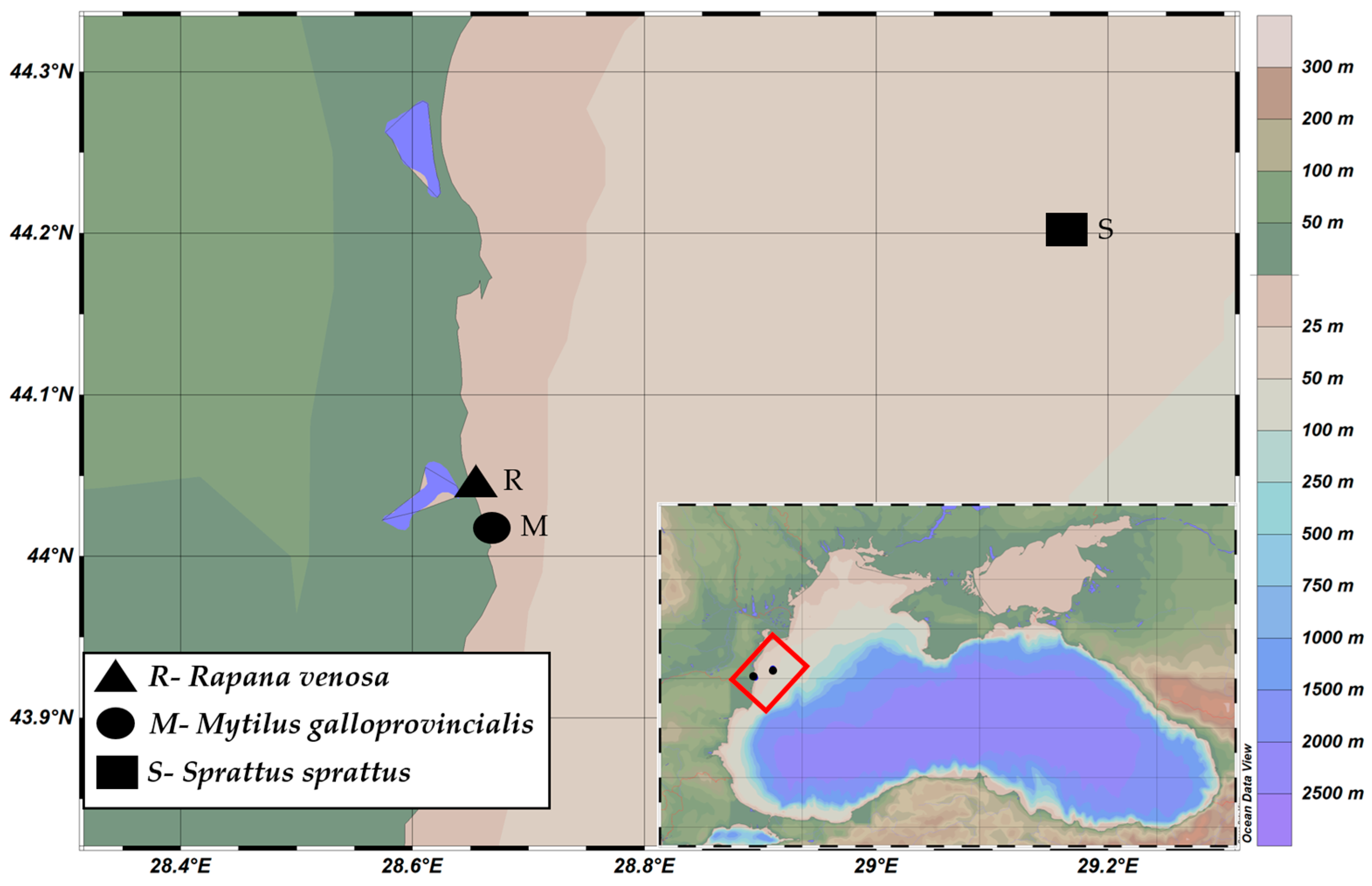
Mussels (Mytilus galloprovincialis, n = 15) were collected by divers from the coastal area of Tuzla (44.01592° N, 28.67224° E; 3.8 m depth), and Rapa whelks (Rapana venosa, n = 15) were collected from Eforie (44.04680° N, 28.65558° E; 6.6 m depth) 26 March 2025. Sprats (Sprattus sprattus, n = 30) were obtained during scientific fishing operations aboard the RV Steaua de Mare, using a pelagic trawl (44.201944° N, 29.172222° E; 34.5 m) (Figure 1) on 26 February 2025.
Specimens were placed in zip-lock plastic bags and kept at −20 °C prior to analysis.

2.2. Sample Preparation and Microplastics Identification

Tissue selection for analysis was based on a combination of human dietary habits and the organs in which microplastics are most likely to accumulate, ensuring meaningful comparisons across species. While the entire tissue of mussels is consumed by humans, only the muscular foot of the rapa whelk is edible. To ensure comparability between species, we analysed the digestive organs (digestive gland and stomach), where microplastics typically accumulate, separately from the soft tissues. In sprats, microplastics primarily accumulate in gills and gastrointestinal tracts, organs that are usually discarded prior to cooking. However, as small fish are often consumed whole, we analysed these organs separately to assess potential human exposure.
Length and width (cm) of each mussel and rapa whelk were recorded using digital callipers accurate to 0.1 mm, and wet weight (g) was measured with a digital scale; then the shells were separated from the soft tissues. In mussels, the digestive gland was collected, weighed, and stored in glass recipients. The remaining soft tissues, consisting of muscle and the remaining organs, were also stored in separate glass containers for the analysis [41]. Similarly, for the rapa whelks, the stomach was dissected, weighed, and stored separately, while the remaining soft tissues, muscle, and the remaining organs, preserved for further analysis. Similarly, sprats were measured (cm) and weighted (g), then dissected to collect the gastrointestinal tracts and gills, which were weighed and stored individually for the analysis [42,43].
All samples were treated with a 10% potassium hydroxide (KOH) solution at a 1:3 (sample:solution) ratio and incubated at 60 °C for 24–48 h to digest organic matter and isolate microplastics [42,43]. Although 10% KOH may affect the integrity of cellulose acetate polymers, it has been shown to offer the best compromise for the efficient extraction and identification of microplastics from biological matrices [44].
Following the incubation period, samples were vacuum-filtered using 2.7 µm Whatman glass microfiber filters (Cytiva–Whatman, Little Chalfont, UK), transferred to glass Petri dishes (Labbox Labware, Premià de Dalt, Spain), and allowed to air-dry at room temperature for 24–48 h.
An Olympus SZX10 stereomicroscope fitted with an SC50 camera (Olympus Co., Hachioji, Tokyo, Japan) was used to visually examine the filters, and CellSens Entry software (version 1.16) was used to measure all identified plastics.
Suspected items were confirmed as plastic using a hot needle test, with melting, deformation, or curling indicating plastic [45]. We acknowledge that the hot-needle test and visual identification, without the confirmation of polymer composition of the identified microplastics, may lead to false-positive results and represent a methodological limitation of our study.
Each item’s colour and length were noted, and the microplastics were subsequently sorted into size classes (1–5 mm, 330 µm–1 mm, 100–330 µm), including <100 µm microplastics and 5–20 mm mesoplastics [42,46]. Shapes were categorised as fibers, filaments, fragments, films, pellets, foam, or granules [42,43].

2.3. Quality Assurance and Quality Control Measures

Rigorous quality assurance and quality control (QA/QC) measures were implemented to minimize contamination from airborne particles. All analyses were performed in a laboratory that had been previously cleaned, and every surface was treated with ethanol. Metal, glass, and wooden tools, pre-rinsed with ultrapure water and wrapped in aluminium foil, were the only instruments utilized to minimize contamination [47]. White cotton lab coats and nitrile gloves were worn by all researchers, and laboratory access was confined only to the study team. All solutions were filtered prior to use and kept in glass containers sealed with aluminium foil [48].
Damp filters in Petri dishes were employed as contamination controls during the dissection, filtration, and microscopic assessment of samples. In addition, blank samples, comprising only KOH solution, were processed and analysed alongside each sample batch for each species. Particles present in blanks and control samples were first tested with a hot needle and then characterized by their colour, morphological shape, and count [49].
To correct the data, any particles corresponding in size, colour, and structure to those in control and blank samples were subtracted [50,51].
No microplastics were detected in the blank samples analysed for mussels and rapana. For sprat, four fibres (n = 4; one black, two transparent, and one blue) were observed in the control filter placed beside the stereomicroscope during visual analysis. All fibres fell within the 1–5 mm size category. To correct for potential contamination, fibres in the sprat samples that matched the characteristics of those observed in the control (size class and colour) were subtracted on a one-to-one basis from the corresponding sample counts; thus, the data presented for sprat refer to the dataset after applying these corrections. Given the very low level of contamination detected in the control samples (n = 4), we consider it important to note that such contamination is unlikely to have influenced the overall fibre/fragment pattern observed in the study.

2.4. Statistical Analysis

The sample size used in this study (mussels, n = 15; whelks, n = 15; sprats, n = 30) was chosen based on logistic constraints and to achieve sufficient statistical power, while also providing a preliminary assessment of microplastic contamination in rapa whelks and sprats, which have not previously been analyzed for microplastics along the Black Sea coast.
Basic statistical analyses, including frequency of occurrence (FO%), mean, standard deviation (SD), and standard error (SE), were performed using Microsoft Excel.
JASP version 0.95.4.0 JASP 0.95.4.0 (JASP Team, 2025; Goss-Sampson, 2024) [52,53], R software (Version 4.4.2, 31 October 2024 ucrt), RStudio (2025.05.0 + 496), and PRIMER 7 version 7.0.24 [54] were employed for particular statistical analyses. The Shapiro–Wilk test was used to evaluate the assumption of normality for all data sets, and Levene’s test was employed to evaluate the homogeneity of variances. A series of statistical analyses was performed to assess differences in organism counts across species (M. galloprovincialis, R. venosa, S. sprattus) and compartments: digestive gland (DG)/stomach (S) vs. soft tissue (ST); gastrointestinal tract (GIT) vs. gills (G). First, a one-way Analysis of Variance test (ANOVA) was conducted separately for each species to test whether mean values differ significantly between compartments. When significant effects were detected, a Tukey Honestly Significant Difference (HSD) post hoc test was applied to identify the specific pairwise differences. Subsequently, interspecific comparisons were performed using ANOVA within each compartment (GD and ST separately) to examine differences between M. galloprovincialis and R. venosa. Data that do not meet the assumptions of normality and homogeneity of variance were analysed using the nonparametric Kruskal–Wallis test, followed by Dunn’s post hoc test for multiple pairwise comparisons. Statistical significance was accepted at p < 0.05.
Model adequacy and assumptions were checked for all analyses prior to interpretation. Data were also plotted using Non-metric Multidimensional Scaling (nMDS) based on resemblance D1 Euclidean distance, a multivariate ordination technique used to visualise patterns of similarity or dissimilarity among tissues and species (Clarke and Gorley, 2015) [54].

3. Results

Morphometric measurements for each of the analysed species are presented in Table 1. Values are presented as ranges followed by means (±SD, ±SE).
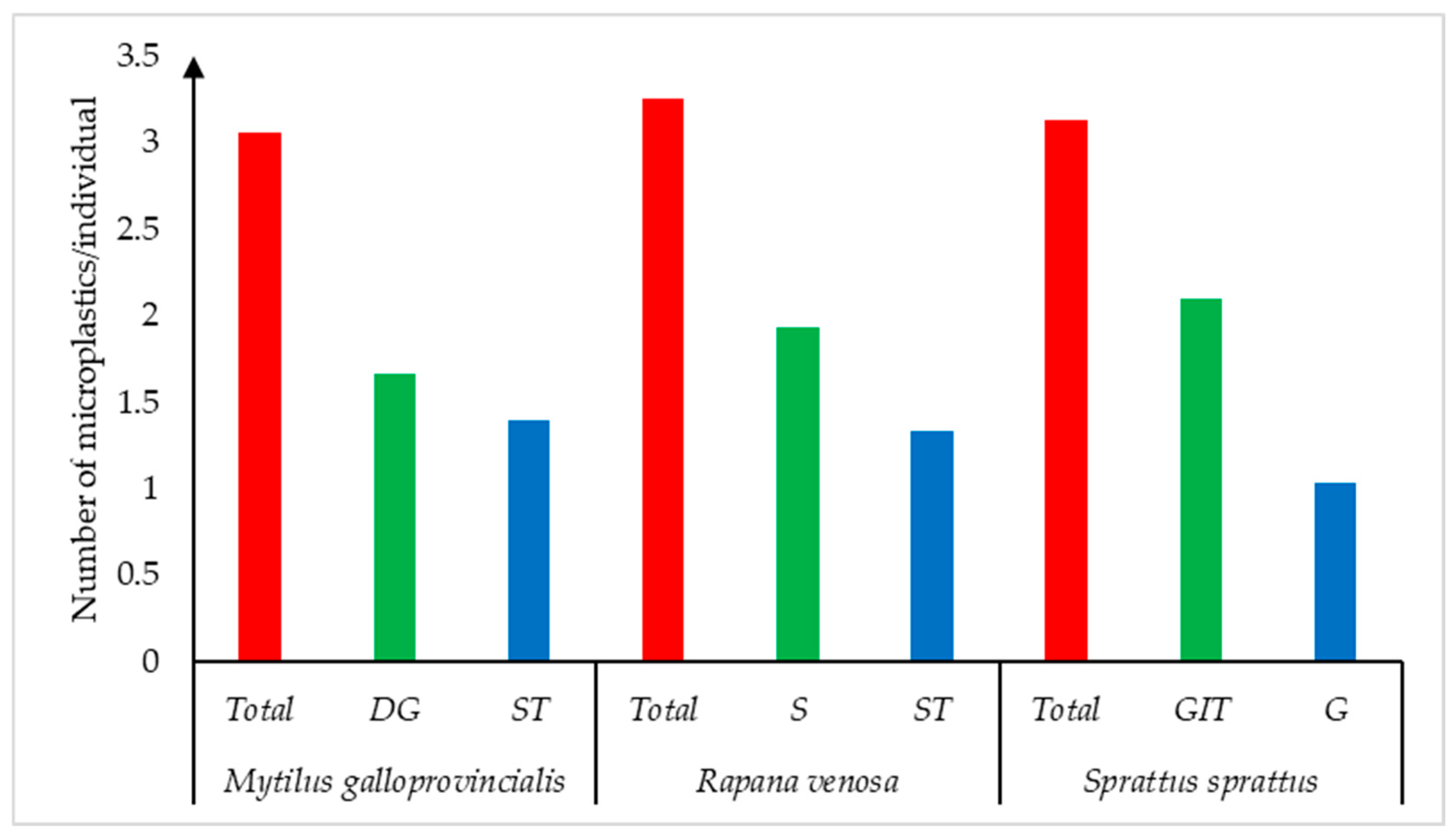
Microplastics were detected in all three species, and the mean number of particles per individual differed between species (Figure 2). Mussels contained a total of 46 microplastics (n = 15) and exhibited an average of 3.06 ± 3.71 microplastics per individual, increasing to 4.18 ± 3.76 microplastics when considering only individuals in which microplastics were detected (n = 10). Rapa whelks contained a total of 49 microplastics (n = 15) and an average of 3.26 ± 2.08 microplastics per individual, and 3.50 ± 1.95 microplastics when excluding those without plastic particles (n = 14). Sprats (n = 30) contained a total of 94 microplastics, corresponding to a mean abundance of 3.13 ± 2.44 microplastics per individual, or 3.35 ± 2.37 microplastics when only individuals containing microplastics were considered (n = 28).
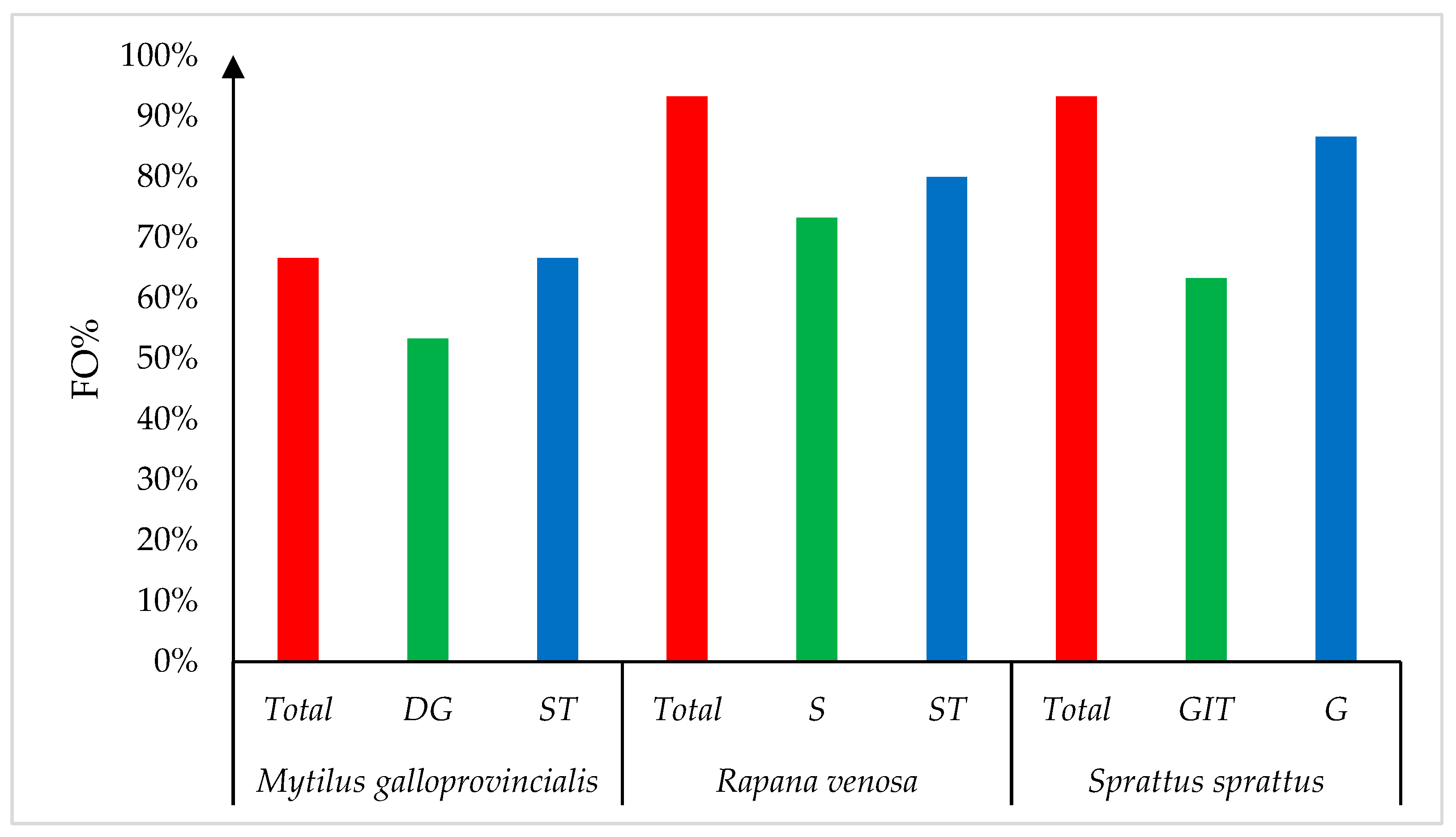
The frequency of microplastic occurrence (FO%) was 66.7% in mussels and 93.3% in both rapa whelks and sprat. When examined at the organ level, occurrence rates were lower, ranging from 53.3% to 80% (Figure 3). In all species, FO% in the digestive organs (digestive gland, stomach, and gastrointestinal tract) was lower, ranging from 53.3% to 73.3%, compared to the soft tissue and gills, which showed higher values of 66.7% to 86.7%.
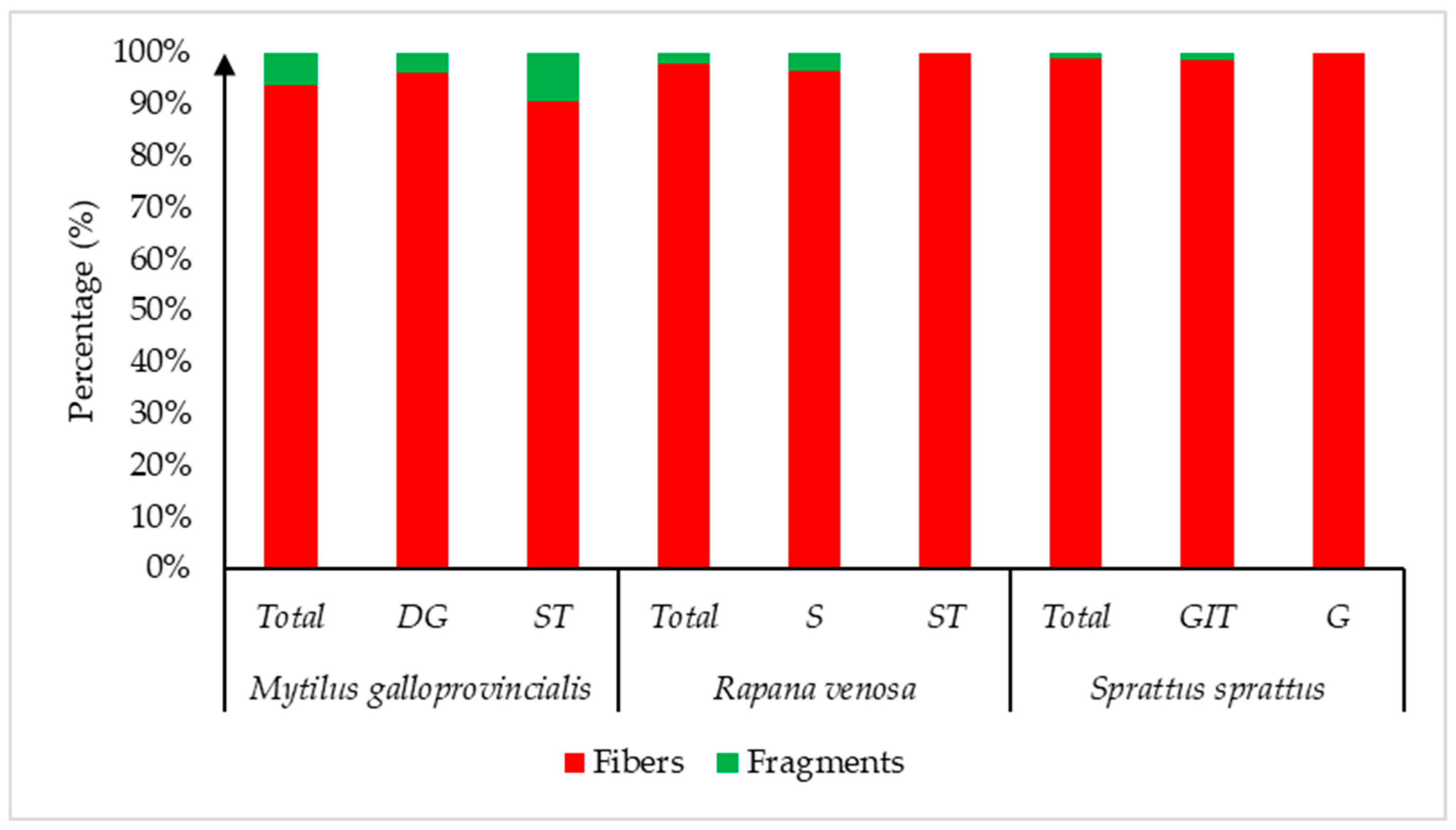
Fibers accounted for 93%, 98%, and 99% of the total microplastics identified in mussels, rapa whelks, and sprats, respectively, whereas fragments represented only 7%, 2%, and 1% (Figure 4). The proportion of fibers varied among species and organs: in mussels, fibers comprised 96% of the particles in the digestive gland and 90% in the soft tissue; in rapa whelks, 97% of particles in the stomach were fibers, while only fibers were detected in the soft tissue; and in sprats, fibers represented 98% of particles in the gastrointestinal tract, with only fibers observed in the gills.
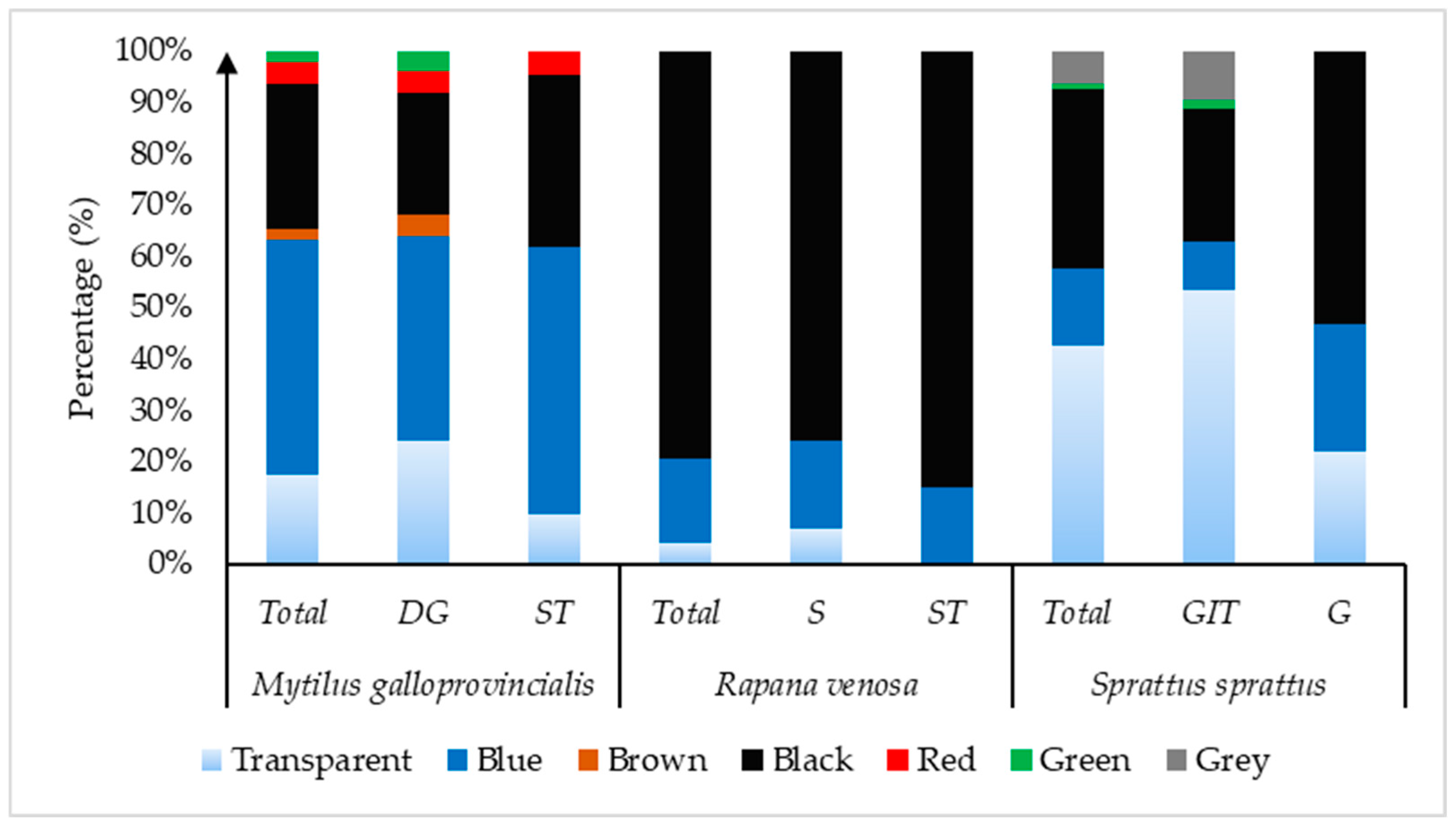
Black, blue, and transparent microplastics represented the majority of particles found in all three species, though their relative proportions varied (Figure 5, Table 2). Across species, the dominant particle colors differed markedly, with mussels characterized primarily by blue particles, rapa whelks by black particles, and sprats by transparent particles, demonstrating clear species-level contrasts in the composition of ingested microplastics.
At the organ level, each species showed internally consistent patterns—mussels displaying similar color distributions between digestive gland and soft tissue, rapa whelks maintaining a strong predominance of black particles in both stomach and soft tissue, and sprats exhibiting a uniform dominance of transparent particles in both gastrointestinal tract and gills—indicating structured variation in particle composition within species.
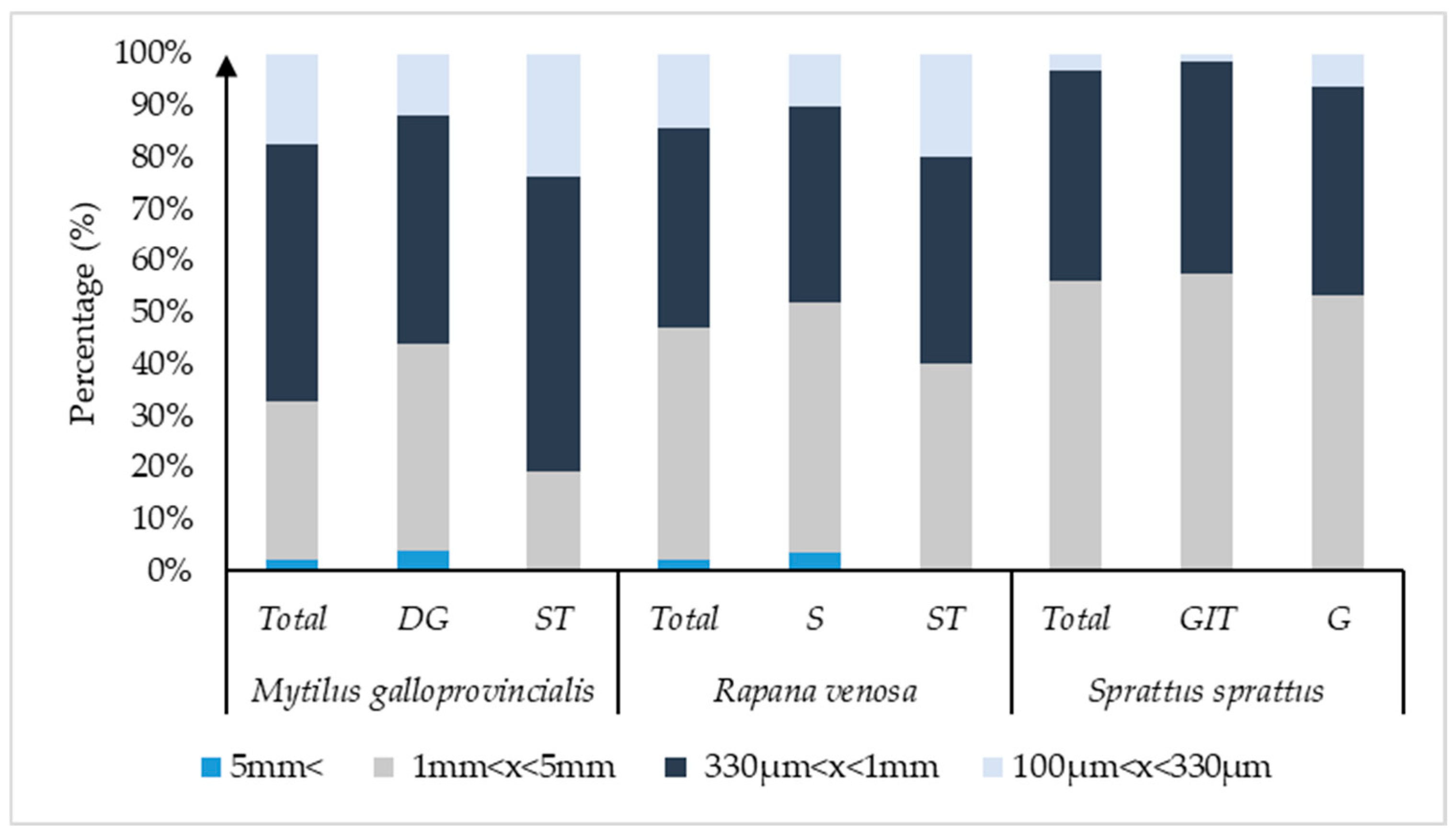
Across three species, microplastic size distributions showed clear differences, with mussels dominated by particles in the 330 µm−1 mm range, rapa whelks by particles between 1 and 5 mm, and sprats by similarly large particles (1–5 mm), indicating distinct size profiles among the three organisms (Figure 6, Table 2).
Within species, the organ-level patterns were consistent: in all three taxa, digestive tissues contained a higher proportion of larger particles and showed greater mean particle lengths than other sampled tissues, reflecting a structured distribution of particle sizes across body compartments.
The mean particle length varied among species and tissues: 1006.79 µm in mussels (digestive gland 1351.61 µm; soft tissue 596.29 µm), 1383.29 µm in rapa whelks (stomach 1587.68 µm; soft tissue 1086.94 µm), and 1380.16 µm in sprats (gastrointestinal tract 1390.92 µm; gills 1359 µm). Overall, longer microplastic particles tended to accumulate in digestive tissues compared to other body parts across all studied species.
ANOVA and Tukey HSD statistical analyses performed to compare individual counts between compartments (digestive gland, stomach, gastrointestinal tract, gills and soft tissue) for each species revealed no significant differences for M. galloprovincialis (digestive gland vs. soft tissue; ANOVA: F(1, 28) = 0.094, p = 0.761) or R. venosa (stomach vs. soft tissue; ANOVA: F(1, 28) = 1.046, p = 0.315), while S. sprattus showed a significant reduction in the number of microplastics in gills compared to the gastrointestinal tract (ANOVA: F(1, 58) = 6.987, p = 0.0105). Interspecific comparisons within each compartment revealed no significant differences between M. galloprovincialis and R. venosa, confirming similar distributions across the digestive gland or stomach and soft tissue. Significant differences were found between M. galloprovincialis and S. sprattus (digestive gland vs. gastrointestinal tract; Kruskal–Wallis: (H(2) = 9.161, p = 0.003).
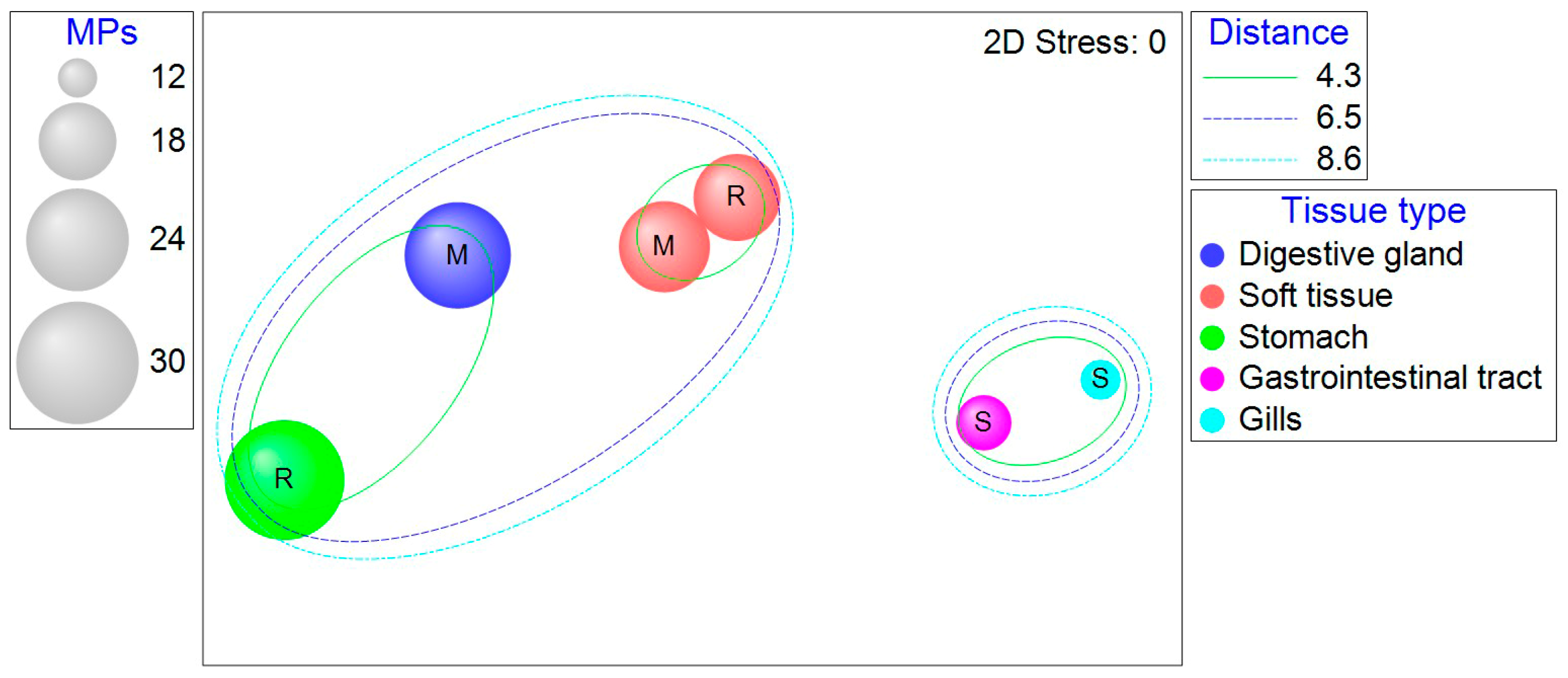
The bidimensional output of the Non-metric Multidimensional Scaling (nMDS) analysis is presented in Figure 7. The nMDS analysis of microplastic abundance across different species and tissue compartments, combined with a cluster analysis based on the D1 Euclidean distance resemblance measure, revealed a clear separation of samples into two distinct groups according to tissue microplastic abundance. The first group comprised Mytilus galloprovincialis and Rapana venosa, while the second group included Sprattus sprattus.
Microplastic abundance patterns indicate that the filter-feeding M. galloprovincialis and the predatory R. venosa form a similar group due to comparable microplastic levels, especially in their soft tissues, with the highest concentrations found in the stomach of R. venosa and the digestive gland of M. galloprovincialis. In contrast, planktivorous S. sprattus forms a separate group, showing overall lower microplastic loads, with its highest levels occurring in the gastrointestinal tract. The overlap in feeding habits and the consumption of contaminated prey likely contribute to the comparable microplastic burdens detected in R. venosa and M. galloprovincialis tissues. However, due to its feeding behaviour and ecological niche, S. sprattus exhibited a lower overall microplastic burden compared to filter-feeding mussels and predatory R. venosa.

4. Discussion

This study provides new evidence on the occurrence of microplastics in three edible and economically important species from the Black Sea: Mytilus galloprovincialis, Rapana venosa, and Sprattus sprattus. For the first time, data on microplastic types and abundance in sprat (S. sprattus) and rapa whelk (R. venosa) from Romania’s coast are reported. These findings are particularly significant, as all three species play key economic and ecological roles in the region and across the wider Black Sea. Establishing such baseline data is crucial for assessing pollution levels, potential ecosystem impacts, and risks to seafood safety.
Microplastics have been observed in mussels, rapa whelks, and sprats worldwide. Our results show a higher frequency of occurrences (FO%) of microplastics for all three species, than found in Bulgaria, in Varna and Burgas Bay, for the gastrointestinal tract (GIT) of sprat (33.4%), respectively, the soft tissue of mussels (63.33%) and rapa whelk (46.67%) [23]. Ibryamova et al. [24] reported 100% FO in Black mussels from the northern Bulgarian Coast, western Black Sea, with microplastics ranging from 10 to 40 per individual, with pellets being the most encountered, followed by fibers.
The elevated microplastic occurrence (%FO) in the tissues of the analysed species may be linked to their proximity to the Danube River discharge, positioned in the northern area of the Romanian shoreline, which transports up to 4.2 tons of plastics daily [55]. Depending on the constituent polymer type of litter, when exposed to UV-degradation for 28–56 days, polystyrene (PS) released 1.8–31 particles/cm2, polyethylene terephthalate (PET) released 3.3–16 particles/cm2 and polypropylene (PP) up to 58 particles/cm2, with the number of particles increasing with exposure time. Generated microplastics also exhibited further fragmentation processes, from smaller pieces to undetectable dimensions (<10 μm) [56].
In this study, we analysed the digestive gland and stomach of M. galloprovincialis and R. venosa separately, while the remaining soft tissue—comprising the muscular and the rest of the organs—was examined as a combined sample.
By feeding on contaminated prey, predator species are the most prone to microplastics contamination through trophic transfer [57]. Consequently, as we observed among the three species analysed, the predator, R. venosa had a higher contamination rate (3.26 ± 2.08 microplastics/individual), followed by particulate-feeding S. sprattus (3.13 ± 2.44 microplastics/individual) and filter-feeding M. galloprovincialis (3.06 ± 3.71 microplastics/individual).
Regarding mussels, our results are consistent with other studies from different world regions. For example, within a study conducted in Asturias, Spain, located in the southeastern Bay of Biscay, Masiá et al. [58] found an average of 2.56 microplastics/individual when analysing mussels, sand, and water. The concentrations were consistently higher in mussels than in the surrounding environment at all sites examined, with blue fibers being the most numerous. In comparison, Dambrosio et al. [59] and Liu et al. [60] reported microplastic concentrations in mussels that were approximately double than those observed in our study (3.06 ± 3.71 microplastics/individual), with 6.51 ± 4.32 particles per individual in mussels from Bari fish markets (Apulia, Italy) and 6.40 ± 2.99 particles per individual in mussels from Yantai, China, respectively.
Similar studies from other parts of the Black Sea report lower values of 1.69–4 microplastics/individual in the south of the basin, with blue fibers also being predominant [27], respectively, 1.13 ± 1.11 microplastics/individual in the western part, in Bulgaria [25]. In contrast, Pojar et al. [26] reported as many as 6.05 microplastics per individual in mussels collected from Agigea Harbor, on the Romanian coastline, Western Black Sea—about twice the amount observed in our study.
In terms of retention time in the mussels’ organism, Kolandhasamy et al. [61] determined that irregularly shaped microplastics (e.g., microfibers) tend to last longer and even accumulate, compared to spherical particles, also through adhering to the surface of the tissue of the organs, and not only through ingestion. Mussels entrap microplastics in their feces, effectively removing them from the water column [62]. This process reduces the availability of microplastics to pelagic and mesopelagic organisms while increasing their exposure to benthic species. Microplastics embedded in mussel fecal matter can sink up to three orders of magnitude faster than free particles, with sinking speed rising as particle density increases and decreases with smaller microplastic sizes [63]. Kovačić et al. [64] found that most of the that microplastics in the digestive glands were predominantly 21–25 μm in size. As sessile filter-feeders, the size of microplastics ingested by these organisms likely reflects the size distribution of microplastics present in the surrounding environment [65].
As far as we are aware, this is the first report of microplastics in R. venosa from Romania’s coast. In our study, we found an average of 3.26 microplastics per individual, present in 93% of the sampled whelks. In the Black Sea area adjacent to Bulgaria, Rapana venosa showed a lower frequency of occurrence (FO%) of 46.67%, with an average of 0.6 ± 0.83 microplastics detected per soft tissue sample [23]. Compared to other regions worldwide, our results indicate lower microplastic contamination than, for example, in Yantai, China, where studies have shown an average of 10.10 ± 6.24 microplastics/individual [60].
The foraging strategy plays a key role in microplastic accumulation, with omnivores and predator species showing about 16% higher concentrations than filter feeders [66,67,68]. Characterised as an active predator that feeds exclusively on live individuals and utilises a pursuit feeding strategy, the rapa whelk preys mostly on bivalves, thereby increasing the likelihood of microplastic accumulation [69,70,71]. Our results support this observation, as we also found slightly higher microplastic loads in rapa whelks compared to mussels, their primary prey, indicating that microplastics may bioaccumulate along the food chain.
Environmental contamination is also an important factor in the accumulation of microplastics in rapa whelks. Unlike mussels, whelks (R. venosa) are mostly protected by their shell, interacting with microplastics mainly via their ventral surface. As a benthic species, they can directly take up microplastics from sediments during foraging or while handling their prey. The degree of sediment contamination amplifies this effect, with average abundances at 106.7 items/kg and peak densities in the northwestern Black Sea up to tenfold higher than in the deeper sediments [72].
As far as we know, this is the first report of microplastics in sprat (S. sprattus) from the Romanian coastline, with 93% of individuals affected and an average of 3.13 microplastics/individual. Along the Bulgarian coast of the Black Sea, sprats exhibited the lowest particles in the gastrointestinal tract, 0.4 ± 0.63, amongst the studied fish species, but the highest particles/muscle, respectively 2.01 ± 2.56 microplastics/g of muscle [25]. Sprats exhibited a high FO% (93%) and a mean number of 3.13 microplastics/individual. Beer et al. [73] reported an average of 0.21 ± 0.47 particles per fish in sprats, in a 28-year case study in the Baltic Sea, also noting that the ingested microplastics mirrored both the types and concentrations in the surrounding environment.
We found a noticeable difference in microplastic accumulation between the gastrointestinal tract (2.1 particles per individual) and the gills (1.03 particles per individual) of sprat. Microplastics in the digestive system are primarily ingested, as fish often mistake them for food [64]. Visually oriented planktivorous species, such as Seriolella violacea, tend to capture and ingest microplastics that resemble food in colour or are located near actual food sources. This unselective feeding pattern suggests that microplastic intake is largely accidental, driven by visual and gustatory cues rather than active selection [74]. In contrast, microplastics detected in the gills are typically not selectively ingested, but result from accidental capture, with their presence largely influenced by particle size and the spacing between gill rakers and filtration surfaces [75].
The condition of the environment is crucial, as it serves as the primary pathway through which microplastics enter organisms. Our findings of fibers being the most common shape of microplastics in the studied species, then fragments, are in accordance with several other environmental studies that have found a high abundance in submerged sediments [76,77] and water samples from the Black Sea [14,78,79], underscoring their role as a significant source of environmental contamination in the area. Moreover, review studies on microplastics in different biota representants show that fibers (67.3%), followed by fragments (25.7%) are the most ingested plastics [80].
We believe that the primary source of fibrous microplastics in the studied species originates from a combination of riverine input and local sources. Previous studies indicate that the Danube River acts as a major pathway for microplastic pollution, transporting an estimated 46–51 tons per year into the adjacent coastal waters [81]. Local sources of fibers pollution, such as textile washing have been well documented in many studies [82,83,84,85]. For instance, a single clothing item can release >1900 fibres/wash [86], and a 6 kg washing load can release up to 728,789 fibers [87]. The presence of fibers in the water column poses significant environmental risks, as their low density allows them to remain suspended longer than other morphological types, such as fragments, increasing their availability for ingestion by marine organisms [88]. When compared to trophic transfer models, our results support the concept that microplastics can move through food webs [8,19], with predators (R. venosa) potentially accumulating particles indirectly via contaminated prey (M. galloprovincialis).
Fragments form through weathering processes of larger plastic pieces. Studies show that after 122 days of accelerated experimental weathering conditions all assessed polymers exhibited increased particle numbers, with polystyrene and polylactic acid generating up to 92,465 particles/mL (1–60 µm size class), respectively, 11.6 × 10⁶ particles/mL (0.6–18 µm size class) [89].
In our study, blue, black, and transparent microplastics were the predominant colors across mussels, rapa whelks and sprats, although the order and relative proportions varied among species. We believe that this pattern—blue, black, and transparent microplastics dominating—reflects both the environmental availability of these colors and potential species-specific ingestion patterns. Our observations align with prior studies indicating that blue and black are common colors among marine organisms [90]. Plastics with shorter-wavelength colors, such as blue, absorb ultraviolet light less effectively, degrade faster under sunlight, thus explaining the abundance of smaller bluish microplastics in the environment [91,92]. Black microplastics, primarily originating from tire wear, have received relatively little attention despite their prevalence [93], particularly since they have been shown to contain persistent organic pollutants [94]. They are among the least recycled plastics and make up a significant portion of total plastic waste and environmental microplastics [95]. Light, transparent, and white plastic, originating from single-use containers or packaging, are among the most ingested by marine organisms [96,97].
Across all three species in our study, most microplastics fell into the size classes of 1–5 mm and 330 µm−1 mm, with smaller fractions in the 100–330 µm range. Our findings are consistent with reports from marine biota studies, which describe microplastic sizes ranging from a few tens of micrometers to several millimeters, with retention and translocation processes being strongly influenced by particle size [80,98]. The predominance of microplastics within 1–5 mm and 330 µm−1 mm in our samples suggests that all three investigated species ingest microplastics big enough to accumulate in the body, rather than being eliminated through excretion processes. Larger microplastics in digestive tissues indicate slower passage and longer retention in organs compared to soft tissue [98]. Our findings are consistent with previous studies indicating that the Danube River is a major source of microplastics to the Black Sea coastal waters [99], with particles < 5 mm commonly detected in sediments and coastal waters of this region [100,101], and that the size of microplastics observed in the studied species (330 µm−1 mm and 1–5 mm size) aligns with those found in the surrounding environment, reflecting broader environmental contamination.
Bivalves represent an important pathway for human exposure to microplastics and other pollutants, as they are typically eaten whole, including their digestive organs, where pollutants tend to accumulate. Likewise, small fish species such as anchovies and sprats are often consumed whole, without gut or head removal, increasing the risk of transferring ingested particles to humans. In the case of Rapa whelks, consumption focuses on the soft tissues, particularly the foot and the muscular portions of the mantle, which can also contain accumulated pollutants. The translocation of microplastics into the edible tissues of fish has been reported in several species [102,103,104,105], with most detected particles being fibrous in shape and typically exceeding 100–150 µm in length [106,107]. Sprats exhibited the highest oxidative stress (+2), consistent with high levels of microplastics accumulated, amongst all studied species assessed by [23]. Conversely, mussels and rapa whelk showed effective stress balance. Micro- and mesoplastics made of polypropylene (PP) and polyethylene terephthalate (PET) were found in canned sardines and sprats, likely resulting from particle migration into edible tissues, incomplete gutting, or contamination during processing. Even though their abundance was low, particularly for particles larger than 149 μm, their presence still highlights the potential impact on human health [108] (Karami et al., 2018). It was estimated that 1–10 µm microplastics can accumulate in human’s body tissue in the order of 8.32 × 10³ particles/capita by the age of 18, and 5.01 × 10⁴ particles/capita by the age of 70 [109]. While these findings indicate potential pathways for human exposure, the study did not include exposure load estimates, FAO/WHO guideline comparisons, or local consumption data, aspects highlighted recently in global reviews [110], and regional seafood consumption studies from the Black Sea [111]. The focus was placed on occurrence data, providing a foundation for future investigations. Subsequent studies should integrate occurrence results with dietary intake surveys and international safety benchmarks to enable a more comprehensive evaluation of human health risks in the Romanian Black Sea region.

5. Conclusions

This research contributes to the sustainability of Black Sea ecosystems and fisheries by generating essential data on microplastic accumulation in commercially important species. Our study presents new data on microplastic contamination for three economically and ecologically significant species from the Romanian Black Sea coast: Mytilus galloprovincialis, Rapana venosa, and Sprattus sprattus. Our results also provide the first documented microplastic occurrence, types, and quantities in sprats and rapa whelks from this area, highlighting the widespread presence of microplastics in both benthic and pelagic species.
All three species examined were found to contain microplastics, with blue, black, and transparent fibers being the most common. Our findings support previous research indicating that trophic transfer plays a significant role in microplastic accumulation, particularly in higher trophic level predators.
Most microplastics detected were 1–5 mm and 330 µm−1 mm, indicating that particles of this size are readily ingested and retained in tissues across all three studied species.
All three species are consumed by humans, either whole or in part, and therefore have the potential to transfer microplastics and other accumulated pollutants through the seafood supply. Considering that humans encounter microplastics from a variety of environmental and dietary sources, extensive research is needed to assess the risks associated with seafood consumption; to date, no studies have evaluated the health impacts of microplastic ingestion in the Black Sea, highlighting the urgency of such investigations.
Our results further support the observations that microplastic pollution is widespread throughout the Black Sea and may accumulate within the marine food chain. These insights are essential for guiding regional policies on marine pollution, promoting responsible seafood production, and advancing marine-related sustainable development objectives.
Ongoing research is vital to track long-term patterns and to understand the human health and ecological effects of this contamination. Consistent monitoring of key bioindicators, particularly fish and bivalves, along with sediment analysis, will be essential for gaining deeper insight into and mitigating the risks that microplastics present to this ecologically important marine environment.

Author Contributions

Conceptualization, A.-M.C., E.S. and E.-D.P.; methodology, A.-M.C.; validation, A.-M.C. and E.S.; formal analysis, A.-M.C., E.-D.P. and G.-E.H.; investigation, A.-M.C.; resources, A.-M.C., C.S.D. and A.F.; data curation, A.-M.C. and E.S.; writing—original draft preparation, A.-M.C.; writing—review and editing, A.-M.C., L.B., E.S., E.-D.P., A.F. and C.S.D.; visualization, A.-M.C., E.-D.P. and G.-E.H.; supervision, E.S. and L.B.; project administration, E.S.; funding acquisition, E.S. All authors have read and agreed to the published version of the manuscript.

Funding

The research was fully funded by the Romanian Ministry of Research, Innovation, and Digitization within the National Nucleu Program SMART-BLUE (grant no. PN23230104/33N/2023).

Institutional Review Board Statement

Because the fish, rapa whelks, and mussels were gathered through scientific fishing activities, no ethical approval was required. Research was conducted on dead individuals.

Informed Consent Statement

Not applicable.

Data Availability Statement

Data are contained within the article.

Conflicts of Interest

The authors declare no conflicts of interest.

Abbreviations

The following abbreviations are used in this manuscript:
KOHPotassium hydroxide
FOFrequency of occurrence
PAHPolycyclic Aromatic Hydrocarbons
PCBPolychlorinated Biphenyls
QA/QCQuality assurance and quality control
PETPolyethylene terephtatale
PPPolypropylene
PSPolystyrene
DGDigestive gland
STSoft tissue
SStomach
GITGastrointestinal tract
GGills
N/ANot Applicable
ANOVAAnalysis of Variance

References

  1. Von Schuckmann, K.; Gues, F.; Moreira, L.; Liné, A.; de Pascual Collar, Á. Global Ocean Change in the Era of the Triple Planetary Crisis. State Planet 2025, 6-osr9, 2. [Google Scholar] [CrossRef]
  2. United Nations Environment Programme Making Peace with Nature: A Scientific Blueprint to Tackle the Climate, Biodiversity and Pollution Emergencies. UN Environment Programme: Nairobi, Kenya, 2021. Available online: https://www.unep.org/resources/making-peace-nature (accessed on 3 November 2025).
  3. Pinto da Costa, J.; Rocha-Santos, T.; Duarte, A.C. The Environmental Impacts of Plastics and Micro-Plastics Use, Waste and Pollution: EU and National Measures; European Parliament: Brussels, Belgium, 2020; Available online: http://www.europarl.europa.eu/supporting-analyses (accessed on 28 October 2025).
  4. U.S. Environmental Protection Agency (EPA). Plastics: Material-Specific Data; EPA: Washington, DC, USA, 2024. Available online: https://www.epa.gov/facts-and-figures-about-materials-waste-and-recycling/plastics-material-specific-data (accessed on 28 October 2025).
  5. Arthur, C.; Baker, J.; Bamford, H. Proceedings of the International Research Workshop on the Occurrence, Effects, and Fate of Microplastic Marine Debris; NOAA Technical Memorandum NOS-OR&R-30; National Oceanic and Atmospheric Administration: Silver Spring, MD, USA, 2009. [Google Scholar]
  6. Bhat, M.A.; Gaga, E.O. Unveiling the Invisible: First Discovery of Micro- and Nanoplastic Size Segregation in Indoor Commercial Markets Using a Cascade Impactor. Air Qual. Atmos. Health 2025, 18, 1–13. [Google Scholar] [CrossRef]
  7. Cverenkárová, K.; Valachovičová, M.; Mackuľak, T.; Žemlička, L.; Bírošová, L. Microplastics in the Food Chain. Life 2021, 11, 1349. [Google Scholar] [CrossRef]
  8. Nelms, S.E.; Galloway, T.S.; Godley, B.J.; Jarvis, D.S.; Lindeque, P.K. Investigating Microplastic Trophic Transfer in Marine Top Predators. Environ. Pollut. 2018, 238, 999–1007. [Google Scholar] [CrossRef]
  9. Au, S.Y.; Lee, C.M.; Weinstein, J.E.; van den Hurk, P.; Klaine, S.J. Trophic Transfer of Microplastics in Aquatic Ecosystems: Identifying Critical Research Needs. Integr. Environ. Assess. Manag. 2017, 13, 505–509. [Google Scholar] [CrossRef]
  10. Van Cauwenberghe, L.; Devriese, L.; Galgani, F.; Robbens, J.; Janssen, C.R. Microplastics in Sediments: A Review of Techniques, Occurrence and Effects. Mar. Environ. Res. 2015, 111, 5–17. [Google Scholar] [CrossRef]
  11. Meng, X.; Yuan, J.; Huang, Q.; Liu, R.; Yang, Y.; Yang, X.; Wang, K. A Review of Sources, Hazards, and Removal Methods of Microplastics in the Environment. Water 2025, 17, 102. [Google Scholar] [CrossRef]
  12. Wang, J.; Tan, Z.; Peng, J.; Qiu, Q.; Li, M. The Behaviors of Microplastics in the Marine Environment. Mar. Environ. Res. 2016, 113, 7–17. [Google Scholar] [CrossRef] [PubMed]
  13. Stanev, E.V.; Ricker, M. The Fate of Marine Litter in Semi-Enclosed Seas: A Case Study of the Black Sea. Front. Mar. Sci. 2019, 6, 660. [Google Scholar] [CrossRef]
  14. Öztekin, A.; Üstün, F.; Bat, L.; Tabak, A. Microplastic Contamination of the Seawater in the Hamsilos Bay of the Southern Black Sea. Water Air Soil Pollut. 2024, 235, 325. [Google Scholar] [CrossRef]
  15. Berov, D.; Klayn, S. Microplastics and Floating Litter Pollution in Bulgarian Black Sea Coastal Waters. Mar. Pollut. Bull. 2020, 156, 111225. [Google Scholar] [CrossRef]
  16. Terzi, Y.; Gedik, K.; Eryaşar, A.R.; Öztürk, R.Ç.; Şahin, A.; Yılmaz, F. Microplastic Contamination and Characteristics Spatially Vary in the Southern Black Sea Beach Sediment and Sea Surface Water. Mar. Pollut. Bull. 2022, 174, 113228. [Google Scholar] [CrossRef]
  17. Akkan, T.; Gedik, K.; Mutlu, T. Protracted Dynamicity of Microplastics in the Coastal Sediment of the Southeast Black Sea. Mar. Pollut. Bull. 2023, 188, 114722. [Google Scholar] [CrossRef]
  18. Bekova, R.; Prodanov, B. Spatiotemporal Variation in Marine Litter Distribution along the Bulgarian Black Sea Sandy Beaches: Amount, Composition, Plastic Pollution, and Cleanliness Evaluation. Front. Mar. Sci. 2024, 11, 1416134. [Google Scholar] [CrossRef]
  19. Aytan, U.; Esensoy, F.B.; Senturk, Y. Microplastic Ingestion and Egestion by Copepods in the Black Sea. Sci. Total Environ. 2022, 806, 150921. [Google Scholar] [CrossRef] [PubMed]
  20. Eryaşar, A.R.; Gedik, K.; Mutlu, T. Ingestion of Microplastics by Commercial Fish Species from the Southern Black Sea Coast. Mar. Pollut. Bull. 2022, 177, 113535. [Google Scholar] [CrossRef] [PubMed]
  21. Ciucă, A.-M.; Manea, M.; Barbeş, L.; Stoica, E. Marine Birds’ Plastic Ingestion: A First Study at the Northwestern Black Sea Coast. Estuar. Coast. Shelf Sci. 2025, 313, 109032. [Google Scholar] [CrossRef]
  22. Mihova, S.; Doncheva, V.; Stefanova, K.; Stefanova, E.; Popov, D.; Panayotova, M. Plastic Ingestion by Phocoena phocoena and Tursiops truncatus from the Black Sea. In Environmental Protection and Disaster Risks; Dobrinkova, N., Nikolov, O., Eds.; EnviroRISKs 2022, Lecture Notes in Networks and Systems; Springer: Cham, Switzerland, 2023; Volume 638, pp. 295–307. [Google Scholar] [CrossRef]
  23. Alexandrova, A.; Mihova, S.; Tsvetanova, E.; Andreeva, M.; Pramatarov, G.; Petrov, G.; Chipev, N.; Doncheva, V.; Stefanova, K.; Grandova, M.; et al. Distribution and Uptake of Microplastics in Key Species of the Bulgarian Black Sea Ecosystem and Their Effects from a Stress Ecology Viewpoint. Preprints 2025. [Google Scholar] [CrossRef]
  24. Ibryamova, S.; Toschkova, S.; Bachvarova, D.C.; Lyatif, A.; Stanachkova, E.; Ivanov, R.; Natchev, N.; Ignatova-Ivanova, T. Assessment of the bioaccumulation of microplastics in the Black Sea mussel Mytilus galloprovincialis L., 1819. J. IMA-Annu. Proceeding Sci. Pap. 2022, 28, 4676–4682. [Google Scholar] [CrossRef]
  25. Alexandrova, A.; Mihova, S.; Tsvetanova, E.; Andreeva, M.; Pramatarov, G.; Petrov, G.; Chipev, N.; Doncheva, V.; Stefanova, K.; Grandova, M.; et al. Microplastic Bioaccumulation and Oxidative Stress in Key Species of the Bulgarian Black Sea: Ecosystem Risk Early Warning. Microplastics 2025, 4, 50. [Google Scholar] [CrossRef]
  26. Pojar, I.; Dobre, O.; Baboș, T.; Lazăr, C. Quantitative Microfiber Evaluation in Mytilus Galloprovincialis, Western Black Sea, Romania. Geoecomarina 2022, 28, 65–71. [Google Scholar]
  27. Şentürk, Y.; Başak Esensoy, F.; Öztekin, A.; Aytan, Ü. Microplastics in Bivalves in the Southern Black Sea. In Marine Litter in the Black Sea; Aytan, Ü., Pogojeva, M., Simeonova, A., Eds.; Turkish Marine Research Foundation (TUDAV): Istanbul, Turkey, 2020; Volume 56, pp. 303–313. [Google Scholar]
  28. Bat, L.; Öztekin, H.C. Heavy Metals in Mytilus Galloprovincialis, Rapana Venosa and Eriphia Verrucosa from the Black Sea Coasts of Turkey as Bioindicators of Pollution. Walailak J. Sci. Technol. WJST 2016, 13, 715–728. [Google Scholar]
  29. Apetroaei, M.-R.; Samoilescu, G.; Nedelcu, A.; Pazara, T. Significance of Bioindicators in Evaluating Pollution Factors on the Romanian Black Sea Coast: A Minireview. In Proceedings of the “Research-Innovation-Innovative Entrepreneurship”. International Congress, 2nd ed., Chişinău, Moldova, 17–18 May 2024; Ion Creangă Pedagogical State University: Chișinău, Moldova, 2024; pp. 360–372. [Google Scholar]
  30. Setälä, O.; Norkko, J.; Lehtiniemi, M. Feeding Type Affects Microplastic Ingestion in a Coastal Invertebrate Community. Mar. Pollut. Bull. 2016, 102, 95–101. [Google Scholar] [CrossRef]
  31. Sirbu, R.; Paris, S.; Cadar, E.; Cherim, M.; Mustafa, A.; Luascu, N. Mytilus Galloprovincialis—A Valuable Resource of the Black Sea Ecosystem. Eur. J. Med. Nat. Sci. 2024, 7, 41–49. [Google Scholar] [CrossRef]
  32. Drapkin, E. Effect of Rapana Bezoar Linné (Mollusca, Muricidae) on the Black Sea Fauna. Dokl. Akad. Nauk. SRR 1963, 151, 700–703. [Google Scholar]
  33. Zolotarev, V. The Black Sea Ecosystem Changes Related to the Introduction of New Mollusc Species. Mar. Ecol. 1996, 17, 227–236. [Google Scholar] [CrossRef]
  34. Danilov, C.-S.; Tiganov, G.; Anton, E.; Nenciu, M.-I.; Nita, V.N.; Cristea, V. Rapana Venosa—New exploitable resource at the Romanian Black Sea coast. Sci. Pap. Ser. D Anim. Sci. 2018, LXI, 274–279. [Google Scholar]
  35. FAO. The State of Mediterranean and Black Sea Fisheries 2023—Special Edition; General Fisheries Commission for the Mediterranean: Rome, Italy, 2023. [Google Scholar] [CrossRef]
  36. Fanelli, E.; Da Ros, Z.; Menicucci, S.; Malavolti, S.; Biagiotti, I.; Canduci, G.; De Felice, A.; Leonori, I. The Pelagic Food Web of the Western Adriatic Sea: A Focus on the Role of Small Pelagics. Sci. Rep. 2023, 13, 14554. [Google Scholar] [CrossRef]
  37. Mizraji, R.; Ahrendt, C.; Perez-Venegas, D.; Vargas, J.; Pulgar, J.; Aldana, M.; Patricio Ojeda, F.; Duarte, C.; Galbán-Malagón, C. Is the Feeding Type Related with the Content of Microplastics in Intertidal Fish Gut? Mar. Pollut. Bull. 2017, 116, 498–500. [Google Scholar] [CrossRef]
  38. European Commission. Directive 2008/56/EC of the European Parliament and of the Council of 17 June 2008 Establishing a Framework for Community Action in the Field of Marine Environmental Policy (Marine Strategy Framework Directive). Off. J. Eur. Union 2008, L164, 19–40. [Google Scholar]
  39. Yu, R.-S.; Singh, S. Microplastic Pollution: Threats and Impacts on Global Marine Ecosystems. Sustainability 2023, 15, 13252. [Google Scholar] [CrossRef]
  40. Das, B.K.; Das, S.; Kumar, V.; Roy, S.; Mitra, A.; Mandal, B. Microplastics in Ecosystems: Ecotoxicological Threats and Strategies for Mitigation and Governance. Front. Mar. Sci. 2025, 12, 1672484. [Google Scholar] [CrossRef]
  41. Digka, N.; Tsangaris, C.; Torre, M.; Anastasopoulou, A.; Zeri, C. Microplastics in Mussels and Fish from the Northern Ionian Sea. Mar. Pollut. Bull. 2018, 135, 30–40. [Google Scholar] [CrossRef] [PubMed]
  42. Matiddi, M.; Pham, C.K.; Anastasopoulou, A.; Andresmaa, E.; Avio, C.G.; Bianchi, J.; Chaieb, O.; Palazzolo, L.; Darmon, G.; de Lucia, G.A.; et al. Monitoring Micro-Litter Ingestion in Marine Fish: A Harmonized Protocol for MSFD & RSCs Areas; INDICIT II Project Report; Wageningen University & Research: Wageningen, The Netherlands, 2021; Available online: https://accedacris.ulpgc.es/bitstream/10553/114417/1/Report_Monitoring-microlitter-ingestion-in-marine-fish.pdf (accessed on 20 August 2025).
  43. Galgani, F.; Ruiz-Orejon, L.F.; Ronchi, F.; Tallec, K.; Fischer, E.K.; Matiddi, M.; Anastasopoulou, A.; Andresmaa, E.; Angiolillo, M.; Bakker Paiva, M.; et al. Guidance on the Monitoring of Marine Litter in European Seas—An Update to Improve the Harmonised Monitoring of Marine Litter Under the Marine Strategy Framework Directive; Publications Office of the European Union: Luxembourg, 2023; p. 193. [Google Scholar]
  44. Dehaut, A.; Cassone, A.-L.; Frère, L.; Hermabessiere, L.; Himber, C.; Rinnert, E.; Rivière, G.; Lambert, C.; Soudant, P.; Huvet, A.; et al. Microplastics in Seafood: Benchmark Protocol for Their Extraction and Characterization. Environ. Pollut. 2016, 215, 223–233. [Google Scholar] [CrossRef]
  45. Lusher, A.L.; Bråte, I.L.N.; Munno, K.; Hurley, R.R.; Welden, N.A. Is It or Isn’t It: The Importance of Visual Classification in Microplastic Characterization. Appl. Spectrosc. 2020, 74, 1139–1153. [Google Scholar] [CrossRef]
  46. Barnes, D.K.A.; Galgani, F.; Thompson, R.C.; Barlaz, M. Accumulation and Fragmentation of Plastic Debris in Global Environments. Philos. Trans. R. Soc. B Biol. Sci. 2009, 364, 1985–1998. [Google Scholar] [CrossRef]
  47. Bhat, M.A.; Gaga, E.O.; Gedik, K. How Can Contamination Be Prevented during Laboratory Analysis of Atmospheric Samples for Microplastics? Environ. Monit. Assess. 2024, 196, 159. [Google Scholar] [CrossRef]
  48. Gao, W.; Deng, X.-J.; Zhang, J.; Qi, L.; Zhao, X.-Q.; Zhang, P.-Y. Assessment of Quality Control Measures in the Monitoring of Microplastic: A Critical Review. Environ. Pollut. Bioavailab. 2023, 35, 2203349. [Google Scholar] [CrossRef]
  49. Sá, S.; Torres-Pereira, A.; Ferreira, M.; Monteiro, S.S.; Fradoca, R.; Sequeira, M.; Vingada, J.; Eira, C. Microplastics in Cetaceans Stranded on the Portuguese Coast. Animals 2023, 13, 3263. [Google Scholar] [CrossRef]
  50. Lusher, A.L.; O’Donnell, C.; Officer, R.; O’Connor, I. Microplastic Interactions with North Atlantic Mesopelagic Fish. ICES J. Mar. Sci. 2016, 73, 1214–1225. [Google Scholar] [CrossRef]
  51. Avio, C.G.; Gorbi, S.; Regoli, F. Experimental Development of a New Protocol for Extraction and Characterization of Microplastics in Fish Tissues: First Observations in Commercial Species from Adriatic Sea. Mar. Environ. Res. 2015, 111, 18–26. [Google Scholar] [CrossRef]
  52. JASP Team. JASP (Version 0.95.4.0); JASP Team: Amsterdam, The Netherlands, 2025. [Google Scholar]
  53. Gross-Sampson, M.A. Statistical Analysis in JASP—A Guide for Students, version 0.18.3; JASP: Amsterdam, The Netherlands, 2019; p. 185. [Google Scholar]
  54. Clarke, K.R.; Gorley, R.N. PRIMER v7: User Manual/Tutorial; Plymouth Routines in Multivariate Ecological Research (PRIMER-e): Plymouth, UK, 2015. [Google Scholar]
  55. Lechner, A.; Keckeis, H.; Lumesberger-Loisl, F.; Zens, B.; Krusch, R.; Tritthart, M.; Glas, M.; Schludermann, E. The Danube so Colourful: A Potpourri of Plastic Litter Outnumbers Fish Larvae in Europe’s Second Largest River. Environ. Pollut. 2014, 188, 177–181. [Google Scholar] [CrossRef] [PubMed]
  56. Öborn, L.; Österlund, H.; Svedin, J.; Nordqvist, K.; Viklander, M. Litter in Urban Areas May Contribute to Microplastics Pollution: Laboratory Study of the Photodegradation of Four Commonly Discarded Plastics. J. Environ. Eng. 2022, 148, 06022004. [Google Scholar] [CrossRef]
  57. Justino, A.K.S.; Lenoble, V.; Pelage, L.; Ferreira, G.V.B.; Passarone, R.; Frédou, T.; Lucena Frédou, F. Microplastic Contamination in Tropical Fishes: An Assessment of Different Feeding Habits. Reg. Stud. Mar. Sci. 2021, 45, 101857. [Google Scholar] [CrossRef]
  58. Masiá, P.; Ardura, A.; Garcia-Vazquez, E. Microplastics in Seafood: Relative Input of Mytilus Galloprovincialis and Table Salt in Mussel Dishes. Food Res. Int. 2022, 153, 110973. [Google Scholar] [CrossRef]
  59. Dambrosio, A.; Cometa, S.; Capuozzo, F.; Ceci, E.; Derosa, M.; Quaglia, N.C. Occurrence and Characterization of Microplastics in Commercial Mussels (Mytilus Galloprovincialis) from Apulia Region (Italy). Foods 2023, 12, 1495. [Google Scholar] [CrossRef] [PubMed]
  60. Liu, J.; Zhu, X.; Teng, J.; Zhao, J.; Li, C.; Shan, E.; Zhang, C.; Wang, Q. Pollution Characteristics of Microplastics in Mollusks from the Coastal Area of Yantai, China. Bull. Environ. Contam. Toxicol. 2021, 107, 693–699. [Google Scholar] [CrossRef]
  61. Kolandhasamy, P.; Su, L.; Li, J.; Qu, X.; Jabeen, K.; Shi, H. Adherence of Microplastics to Soft Tissue of Mussels: A Novel Way to Uptake Microplastics beyond Ingestion. Sci. Total Environ. 2018, 610–611, 635–640. [Google Scholar] [CrossRef]
  62. Fernández, B.; Albentosa, M. Insights into the Uptake, Elimination and Accumulation of Microplastics in Mussel. Environ. Pollut. 2019, 249, 321–329. [Google Scholar] [CrossRef]
  63. Piarulli, S.; Airoldi, L. Mussels Facilitate the Sinking of Microplastics to Bottom Sediments and Their Subsequent Uptake by Detritus-Feeders. Environ. Pollut. 2020, 266, 115151. [Google Scholar] [CrossRef]
  64. Kovačić, I.; Štefanko, K.; Špada, V.; Pustijanac, E.; Buršić, M.; Burić, P. Microplastics in Mediterranean Mussel Mytilus galloprovincialis: Comparison between Cultured and Wild Type Mussels from the Northern Adriatic. Appl. Sci. 2024, 14, 2056. [Google Scholar] [CrossRef]
  65. Patterson, J.; Jeyasanta, K.I.; Laju, R.L.; Edward, J.K.P. Microplastic Contamination in Indian Edible Mussels (Perna perna and Perna viridis) and Their Environs. Mar. Pollut. Bull. 2021, 171, 112678. [Google Scholar] [CrossRef]
  66. Mason, V.G.; Skov, M.W.; Hiddink, J.G.; Walton, M. Microplastics Alter Multiple Biological Processes of Marine Benthic Fauna. Sci. Total Environ. 2022, 845, 157362. [Google Scholar] [CrossRef] [PubMed]
  67. Naji, A.; Nuri, M.; Vethaak, A.D. Microplastics Contamination in Molluscs from the Northern Part of the Persian Gulf. Environ. Pollut. 2018, 235, 113–120. [Google Scholar] [CrossRef] [PubMed]
  68. Bour, A.; Avio, C.G.; Gorbi, S.; Regoli, F.; Hylland, K. Presence of Microplastics in Benthic and Epibenthic Organisms: Influence of Habitat, Feeding Mode and Trophic Level. Environ. Pollut. 2018, 243, 1217–1225. [Google Scholar] [CrossRef]
  69. Savini, D.; Occhipinti-Ambrogi, A. Consumption Rates and Prey Preference of the Invasive Gastropod Rapana Venosa in the Northern Adriatic Sea. Helgol. Mar. Res. 2006, 60, 153–159. [Google Scholar] [CrossRef]
  70. Harding, J.M.; Mann, R. Observations on the Biology of the Veined Rapa Whelk, Rapana Venosa, (Valenciennes, 1846) in the Chesapeake Bay. J. Shellfish Res. 1999, 18, 9–17. [Google Scholar]
  71. Hughes, R.N. Optimal Foraging Theory in the Marine Context. Ocean. Mar. Biol. Ann. Rev. 1980, 18, 423–481. [Google Scholar]
  72. Cincinelli, A.; Scopetani, C.; Chelazzi, D.; Martellini, T.; Pogojeva, M.; Slobodnik, J. Microplastics in the Black Sea Sediments. Sci. Total Environ. 2021, 760, 143898. [Google Scholar] [CrossRef]
  73. Beer, S.; Garm, A.; Huwer, B.; Dierking, J.; Nielsen, T.G. No Increase in Marine Microplastic Concentration over the Last Three Decades—A Case Study from the Baltic Sea. Sci. Total Environ. 2018, 621, 1272–1279. [Google Scholar] [CrossRef]
  74. Ory, N.C.; Gallardo, C.; Lenz, M.; Thiel, M. Capture, Swallowing, and Egestion of Microplastics by a Planktivorous Juvenile Fish. Environ. Pollut. 2018, 240, 566–573. [Google Scholar] [CrossRef]
  75. Collard, F.; Gilbert, B.; Eppe, G.; Roos, L.; Compère, P.; Das, K.; Parmentier, E. Morphology of the Filtration Apparatus of Three Planktivorous Fishes and Relation with Ingested Anthropogenic Particles. Mar. Pollut. Bull. 2017, 116, 182–191. [Google Scholar] [CrossRef]
  76. D’Hont, A.; Gittenberger, A.; Leuven, R.S.E.W.; Hendriks, A.J. Dropping the Microbead: Source and Sink Related Microplastic Distribution in the Black Sea and Caspian Sea Basins. Mar. Pollut. Bull. 2021, 173, 112982. [Google Scholar] [CrossRef]
  77. Bobchev, N.; Berov, D.; Klayn, S.; Karamfilov, V. High Microplastic Pollution in Marine Sediments Associated with Urbanised Areas along the SW Bulgarian Black Sea Coast. Mar. Pollut. Bull. 2024, 209, 117150. [Google Scholar] [CrossRef]
  78. Tunç Dede, Ö.; Tepe, Y. An Overview on Microplastic Pollution in the Black Sea Coastal Waters of Türkiye. Reg. Stud. Mar. Sci. 2025, 89, 104319. [Google Scholar] [CrossRef]
  79. Aytan, U.; Valente, A.; Senturk, Y.; Usta, R.; Esensoy Sahin, F.B.; Mazlum, R.E.; Agirbas, E. First Evaluation of Neustonic Microplastics in Black Sea Waters. Mar. Environ. Res. 2016, 119, 22–30. [Google Scholar] [CrossRef] [PubMed]
  80. Ugwu, K.; Herrera, A.; Gómez, M. Microplastics in Marine Biota: A Review. Mar. Pollut. Bull. 2021, 169, 112540. [Google Scholar] [CrossRef]
  81. Procop, I.; Calmuc, M.; Pessenlehner, S.; Trifu, C.; Ceoromila, A.C.; Calmuc, V.A.; Fetecău, C.; Iticescu, C.; Musat, V.; Liedermann, M. The First Spatio-Temporal Study of the Microplastics and Meso–Macroplastics Transport in the Romanian Danube. Environ. Sci. Eur. 2024, 36, 154. [Google Scholar] [CrossRef]
  82. Akyildiz, S.H.; Fiore, S.; Bruno, M.; Sezgin, H.; Yalcin-Enis, I.; Yalcin, B.; Bellopede, R. Release of Microplastic Fibers from Synthetic Textiles during Household Washing. Environ. Pollut. 2024, 357, 124455. [Google Scholar] [CrossRef] [PubMed]
  83. Tedesco, M.C.; Fisher, R.M.; Stuetz, R.M. Emission of Fibres from Textiles: A Critical and Systematic Review of Mechanisms of Release during Machine Washing. Sci. Total Environ. 2024, 955, 177090. [Google Scholar] [CrossRef] [PubMed]
  84. Świątek, O.; Dąbrowska, A. A Feasible and Efficient Monitoring Method of Synthetic Fibers Released during Textile Washing. Microplastics 2024, 3, 67–81. [Google Scholar] [CrossRef]
  85. Novotna, J.; Tunak, M.; Militky, J.; Kremenakova, D.; Wiener, J.; Novakova, J.; Sevcu, A. Release of Microplastic Fibers from Polyester Knit Fleece during Abrasion, Washing, and Drying. ACS Omega 2025, 10, 14241–14249. [Google Scholar] [CrossRef] [PubMed]
  86. Browne, M.A.; Crump, P.; Niven, S.J.; Teuten, E.; Tonkin, A.; Galloway, T.; Thompson, R. Accumulation of Microplastic on Shorelines Woldwide: Sources and Sinks. Environ. Sci. Technol. 2011, 45, 9175–9179. [Google Scholar] [CrossRef] [PubMed]
  87. Napper, I.E.; Thompson, R.C. Release of Synthetic Microplastic Plastic Fibres from Domestic Washing Machines: Effects of Fabric Type and Washing Conditions. Mar. Pollut. Bull. 2016, 112, 39–45. [Google Scholar] [CrossRef]
  88. Tursi, A.; Baratta, M.; Easton, T.; Chatzisymeon, E.; Chidichimo, F.; De Biase, M.; De Filpo, G. Microplastics in Aquatic Systems, a Comprehensive Review: Origination, Accumulation, Impact, and Removal Technologies. RSC Adv. 2022, 12, 28318–28340. [Google Scholar] [CrossRef] [PubMed]
  89. Lambert, S.; Wagner, M. Formation of Microscopic Particles during the Degradation of Different Polymers. Chemosphere 2016, 161, 510–517. [Google Scholar] [CrossRef]
  90. Rezania, S.; Park, J.; Md Din, M.F.; Mat Taib, S.; Talaiekhozani, A.; Kumar Yadav, K.; Kamyab, H. Microplastics Pollution in Different Aquatic Environments and Biota: A Review of Recent Studies. Mar. Pollut. Bull. 2018, 133, 191–208. [Google Scholar] [CrossRef]
  91. Zhao, X.; Wang, J.; Yee Leung, K.M.; Wu, F. Color: An Important but Overlooked Factor for Plastic Photoaging and Microplastic Formation. Environ. Sci. Technol. 2022, 56, 9161–9163. [Google Scholar] [CrossRef]
  92. Martí, E.; Martin, C.; Galli, M.; Echevarría, F.; Duarte, C.M.; Cózar, A. The Colors of the Ocean Plastics. Environ. Sci. Technol. 2020, 54, 6594–6601. [Google Scholar] [CrossRef]
  93. Kole, P.J.; Löhr, A.J.; Van Belleghem, F.; Ragas, A. Wear and Tear of Tyres: A Stealthy Source of Microplastics in the Environment. Int. J. Environ. Res. Public Health 2017, 14, 1265. [Google Scholar] [CrossRef]
  94. Frias, J.P.G.L.; Sobral, P.; Ferreira, A.M. Organic Pollutants in Microplastics from Two Beaches of the Portuguese Coast. Mar. Pollut. Bull. 2010, 60, 1988–1992. [Google Scholar] [CrossRef] [PubMed]
  95. Huang, Y.; Xu, E.G. Black Microplastic in Plastic Pollution: Undetected and Underestimated? Water Emerg. Contam. Nanoplastics 2022, 1, 14. [Google Scholar] [CrossRef]
  96. Wen, B.; Jin, S.-R.; Chen, Z.-Z.; Gao, J.-Z.; Liu, Y.-N.; Liu, J.-H.; Feng, X.-S. Single and Combined Effects of Microplastics and Cadmium on the Cadmium Accumulation, Antioxidant Defence and Innate Immunity of the Discus Fish (Symphysodon aequifasciatus). Environ. Pollut. 2018, 243, 462–471. [Google Scholar] [CrossRef] [PubMed]
  97. Crawford, C.B.; Quinn, B. The Biological Impacts and Effects of Contaminated Microplastics. In Microplastic Pollutants; Elsevier: Amsterdam, The Netherlands, 2017; pp. 159–178. [Google Scholar]
  98. Lusher, A. Microplastics in the Marine Environment: Distribution, Interactions and Effects. In Marine Anthropogenic Litter; Springer International Publishing: Cham, Switzerland, 2015; pp. 245–307. [Google Scholar]
  99. Pojar, I.; Stănică, A.; Stock, F.; Kochleus, C.; Schultz, M.; Bradley, C. Sedimentary Microplastic Concentrations from the Romanian Danube River to the Black Sea. Sci. Rep. 2021, 11, 2000. [Google Scholar] [CrossRef]
  100. Baboș, T.; Dobre, O.; Lazăr, C.; Palcu, D.V.; Pojar, I. Characterisation of Floating Microplastic in Romanian Coastal Waters. Geoecomarina 2025, 31, 51–58. [Google Scholar]
  101. Glevitzky, M.; Dumitrel, G.-A.; Rusu, G.I.; Toneva, D.; Vergiev, S.; Corcheş, M.-T.; Pană, A.-M.; Popa, M. Microplastic Pollution on the Beaches of the Black Sea in Romania and Bulgaria. Appl. Sci. 2025, 15, 4751. [Google Scholar] [CrossRef]
  102. Abbasi, S.; Soltani, N.; Keshavarzi, B.; Moore, F.; Turner, A.; Hassanaghaei, M. Microplastics in Different Tissues of Fish and Prawn from the Musa Estuary, Persian Gulf. Chemosphere 2018, 205, 80–87. [Google Scholar] [CrossRef]
  103. Conger, E.; Dziobak, M.; Berens McCabe, E.J.; Curtin, T.; Gaur, A.; Wells, R.S.; Weinstein, J.E.; Hart, L.B. An Analysis of Suspected Microplastics in the Muscle and Gastrointestinal Tissues of Fish from Sarasota Bay, FL: Exposure and Implications for Apex Predators and Seafood Consumers. Environments 2024, 11, 185. [Google Scholar] [CrossRef]
  104. Di Giacinto, F.; Di Renzo, L.; Mascilongo, G.; Notarstefano, V.; Gioacchini, G.; Giorgini, E.; Bogdanović, T.; Petričević, S.; Listeš, E.; Brkljača, M.; et al. Detection of Microplastics, Polymers and Additives in Edible Muscle of Swordfish (Xiphias Gladius) and Bluefin Tuna (Thunnus Thynnus) Caught in the Mediterranean Sea. J. Sea Res. 2023, 192, 102359. [Google Scholar] [CrossRef]
  105. Hossain, M.B.; Pingki, F.H.; Azad, M.A.S.; Nur, A.-A.U.; Banik, P.; Paray, B.A.; Arai, T.; Yu, J. Microplastics in Different Tissues of a Commonly Consumed Fish, Scomberomorus Guttatus, from a Large Subtropical Estuary: Accumulation, Characterization, and Contamination Assessment. Biology 2023, 12, 1422. [Google Scholar] [CrossRef]
  106. Akhbarizadeh, R.; Moore, F.; Keshavarzi, B. Investigating a Probable Relationship between Microplastics and Potentially Toxic Elements in Fish Muscles from Northeast of Persian Gulf. Environ. Pollut. 2018, 232, 154–163. [Google Scholar] [CrossRef]
  107. Barboza, L.G.A.; Lopes, C.; Oliveira, P.; Bessa, F.; Otero, V.; Henriques, B.; Raimundo, J.; Caetano, M.; Vale, C.; Guilhermino, L. Microplastics in Wild Fish from North East Atlantic Ocean and Its Potential for Causing Neurotoxic Effects, Lipid Oxidative Damage, and Human Health Risks Associated with Ingestion Exposure. Sci. Total Environ. 2020, 717, 134625. [Google Scholar] [CrossRef]
  108. Karami, A.; Golieskardi, A.; Choo, C.K.; Larat, V.; Karbalaei, S.; Salamatinia, B. Plastic and microplastic contamination in canned sardines and sprats. Sci. Total Environ. 2017, 612, 1380–1386. [Google Scholar] [CrossRef]
  109. Mohamed Nor, N.H.; Kooi, M.; Diepens, N.J.; Koelmans, A.A. Lifetime Accumulation of Microplastic in Children and Adults. Environ. Sci. Technol. 2021, 55, 5084–5096. [Google Scholar] [CrossRef]
  110. FAO. Microplastics in Food Commodities—A Food Safety Review on Human Exposure Through Dietary Sources; Food and Agriculture Organization of the United Nations: Rome, Italy, 2022. [Google Scholar] [CrossRef]
  111. Merdzhanova, A.; Raykov, V.; Stancheva, R.; Stanchev, P. Consumption of Fish and Fishery Products in Bulgaria: Trends and Perspectives in the Context of the Black Sea Region. Sustainability 2021, 13, 10487. [Google Scholar] [CrossRef]
Figure 1. Locations of sampling stations for the studied species: R. Rapana venosa, M. Mytilus galloprovincialis and S. Sprattus sprattus (Ocean Data View, Version 5.3.0, 2023, Schlitzer, R., 2023).
Sustainability 17 11006 g001
Figure 2. Microplastic abundance per individual in mussels (Mytilus galloprovincialis; DG—digestive gland, ST—soft tissue), rapa whelks (Rapana venosa; S—stomach, ST—soft tissue) and sprats (Sprattus sprattus; GIT—gastrointestinal tract, G—gills).
Sustainability 17 11006 g002
Figure 3. The frequency of occurrence (FO%) of encountered microplastics in mussels (Mytilus galloprovincialis; DG—digestive gland, ST- soft tissue), rapa whelks (Rapana venosa; S—stomach, ST—soft tissue) and sprats (Sprattus sprattus; GIT—gastrointestinal tract, G—gills).
Sustainability 17 11006 g003
Figure 4. The morphological types of encountered microplastics in mussels (Mytilus galloprovincialis; DG—digestive gland, ST—soft tissue), rapa whelks (Rapana venosa; S—stomach, ST—soft tissue) and sprats (Sprattus sprattus; GIT—gastrointestinal tract, G—gills).
Sustainability 17 11006 g004
Figure 5. The colors of encountered microplastics in mussels (Mytilus galloprovincialis; DG—digestive gland, ST—soft tissue), rapa whelks (Rapana venosa; S—stomach, ST—soft tissue) and sprats (Sprattus sprattus; GIT—gastrointestinal tract, G—gills).
Sustainability 17 11006 g005
Figure 6. The size of encountered microplastics in mussels (Mytilus galloprovincialis; DG—digestive gland, ST—soft tissue), rapa whelks (Rapana venosa; S—stomach, ST—soft tissue) and sprats (Sprattus sprattus; GIT—gastrointestinal tract, G—gills).
Sustainability 17 11006 g006
Figure 7. Non-metric Multidimensional Scaling (nMDS) ordination plot of D1 Euclidean distance resemblance based on microplastic abundance per tissue compartment and species, overlaid with cluster analysis (2D stress value < 0.01). M—Mytilus galloprovincialis; R—Rapana venosa; S—Sprattus sprattus.
Sustainability 17 11006 g007
Table 1. Range and mean values of the morphometric measurements of Mytilus galloprovincialis, Rapana venosa, and Sprattus sprattus.
Length (cm)Width (cm)Weight (g)
RangeMeanRangeMeanRangeMean
Mytilus galloprovincialis4.08–5.354.67
±0.4 SD
±0.1 SE
2.84–1.962.23
±0.24 SD
±0.06 SE
2.43–6.053.59
±0.94 SD
±0.24 SE
Rapana venosa3.91–5.524.62
±0.41 SD
±0.1 SE
3.29–4.113.47
±0.35 SD
±0.09 SE
5.02–9.277.02
±1.11 SD
±0.28 SE
Sprattus sprattus6.7–8.97.75
±0.65 SD
±0.11 SE
N/AN/A1.72–3.892.66
±0.65 SD
±0.12 SE
Table 2. Percentage distribution of microplastics by color and size class in mussels (Mytilus galloprovincialis; DG—digestive gland, ST—soft tissue), rapa whelks (Rapana venosa; S—stomach, ST—soft tissue) and sprats (Sprattus sprattus; GIT—gastrointestinal tract, G—gills).
Colors (%)Size (%)
SpeciesTransparentBlueBlackRedGreenBrownGrey100–330 µm330 µm−1 mm1–5 mm>5 mm
Mytilus galloprovincialis
Whole organism17.445.728.34.42.172.17017.45030.432.17
DG24402444401244404
ST9.5252.433.34.800023.8157.1419.050
Rapana Venosa
Whole organism4.0816.379.6000014.2938.7844.892.04
S 6.917.275.9000010.3437.9348.283.45
ST 158500002040400
Sprattus sprattus
Whole organism42.5514.935.101.0606.383.2340.8655.910
G53.239.6725.801.6109.686.2540.6253.130
GIT21.882553.100001.634157.370
Disclaimer/Publisher’s Note: The statements, opinions and data contained in all publications are solely those of the individual author(s) and contributor(s) and not of MDPI and/or the editor(s). MDPI and/or the editor(s) disclaim responsibility for any injury to people or property resulting from any ideas, methods, instructions or products referred to in the content.