Article

Hurricanes and Human Health in Louisiana: Insights from Hurricanes Laura, Delta, and Ida

by
Shobha Kumari Yadav
1,*,
Robert V. Rohli
2,3,
M. E. Betsy Garrison
4,
Elisabeth Ponce-Garcia
5,
Nazla Bushra
2,3,6 and
Charleen McNeill
7
1
Department of Geography, Texas A&M University, College Station, TX 77843, USA
2
Department of Oceanography & Coastal Sciences, Louisiana State University, Baton Rouge, LA 70803, USA
3
Coastal Studies Institute, Louisiana State University, Baton Rouge, LA 70803, USA
4
School of Human Environmental Sciences, University of Arkansas, Fayetteville, AR 72701, USA
5
Department of Family & Preventative Medicine, University of Oklahoma Health Sciences Center, Oklahoma City, OK 73104, USA
6
Louisiana Office of State Climatology, Louisiana State University, Baton Rouge, LA 70803, USA
7
College of Nursing and Health Professions, University of Southern Mississippi, Hattiesburg, MS 39406, USA
*
Author to whom correspondence should be addressed.
Sustainability 2025, 17(24), 10944; https://doi.org/10.3390/su172410944
Submission received: 28 October 2025 / Revised: 2 December 2025 / Accepted: 3 December 2025 / Published: 7 December 2025

Abstract

Louisiana is one of the most disaster-prone states, with hurricanes ranking among the most destructive hazards. Hurricanes impede sustainability by straining hospital infrastructure, overwhelming emergency departments, and disrupting continuity of care. Louisiana’s healthcare system, characterized by high uninsured rates, limited rural access, and notable racial and socioeconomic disparities, is particularly vulnerable during disasters. This research explores trends of mental and respiratory health in Louisiana surrounding Hurricanes Laura (2020), Delta (2020), and Ida (2021). Analysis reveals a substantial increase in admissions after landfall of all three storms, with mental health conditions showing a larger surge than respiratory ones in already-vulnerable communities. Gender disparities were evident, with female patients accounting for a higher percentage across all three hurricanes and across all age groups. The results suggest the importance of considering social determinants of health during disasters and ensuring adequate resources for older populations with complex medical needs, thereby promoting more sustainable health systems. These results underscore how critical preparedness and recovery planning are for hospitals in hurricane-prone areas. Incorporating resilience measures such as reliable power systems, clearer evacuation pathways, and better coordination of post-disaster care can help protect patients and providers in the future.

1. Introduction

Even though the total number of hurricanes in the Gulf–Caribbean–Atlantic development region continues to fluctuate annually [1] and weaker hurricanes in this area became less common between 1979 and 2017, the most intense (i.e., Category 4–5) hurricanes have increased in frequency in the Gulf–Caribbean–Atlantic region in recent years [2]. Such catastrophic storms set off a chain reaction of disasters rather than having a single type of impact. These downstream impacts are increasing over time as the storms strengthen and interact with increasing coastal populations and wealth.
Warmer ocean temperatures, which raise atmospheric moisture capacity, energize storms with stronger winds and potentially heavier rainfall [3], particularly in vulnerable places like the U.S. Gulf Coast, amid a changing climate [4], thereby increasing the expected impacts at least through the end of this century [5]. Some have suggested that Category 4–5 hurricanes may increase in frequency more than sevenfold by the century’s end [3,6], under a scenario of heavy fossil fuel use, limited technological change, and minimal climate policy intervention [7]. Others suggest a possible doubling of Category 4–5 hurricane frequency with each 1 °C rise in global mean surface temperature [8,9,10,11], with marked interannual and intra-annual variability [12].
These ominous projections are particularly troubling for Louisiana, where the unique geography and climate deepen already-worrisome socioeconomic vulnerabilities. Located along the U.S. Gulf Coast, Louisiana is one of the most disaster-prone U.S. states, experiencing frequent tropical cyclone landfalls that bring destructive storm surges and extreme rainfall [13]. The region has experienced 11 federally declared “major” disasters in just five years alone (2019–2024) [14]. Furthermore, the humid subtropical climate, characterized by high precipitation and recurring severe weather, amplifies exposure to flood hazards [15]. In recent decades, rising temperatures and warming ocean waters have fueled more-intense hurricanes with heavier rainfall across the Gulf Coast [4,16]. The state’s recent hurricane history mirrors broader patterns of intensifying storms. Since 2000, the state has been struck by numerous catastrophic hurricanes, including Katrina and Rita (2005), Gustav and Ike (2008), Isaac (2012), Laura and Delta (2020), and Ida (2021), several of which delivered record-breaking rainfall and storm surges [17,18]. In 2020 alone, Louisiana experienced five named storms (including three hurricanes), an extraordinary concentration suggesting an era of heightened hurricane activity [19]. Even-more-intense hurricane-induced downpours have recently been observed, such as in nearby Houston, Texas, where Hurricane Harvey in 2017 dumped more than 60 inches of rain, causing widespread flooding [20]. In Louisiana, this extreme precipitation is compounded by land subsidence and rising sea levels, meaning that even moderate storms can result in severe and/or widespread inundation [21] and associated impacts.
One such downstream impact of hurricanes is public health challenges. Hurricanes not only cause loss of lives but also repeatedly strain hospital infrastructure, overwhelm emergency departments, and disrupt care continuity, thereby indirectly causing further loss of lives [22] and serving as an often-overlooked obstacle to disaster sustainability in the form of human health. Sustainability refers to the ability to meet the needs of the present generation without compromising the ability of future generations to meet their own needs. It emphasizes the balanced integration of environmental protection, economic development, and social well-being to ensure long-term resilience and equity [23]. Moreover, hurricane-affected regions create standing water that fosters mosquito-borne diseases such as West Nile, dengue, and Zika [24]. In addition, warmer temperatures in the wake of the storm increase transmission potential by shortening mosquito development cycles and accelerating viral replication [25,26].
For example, the natural and human-exacerbated impacts of Hurricane Katrina in 2005 included the widespread destruction of healthcare facilities in New Orleans and surrounding areas, displacing tens of thousands of patients and severely limiting access to essential medical services [27]. Following Katrina, many individuals reported persistent cough, sinus irritation, and other respiratory symptoms referred to as “Katrina cough” [28]. This informal term described a constellation of symptoms thought to be associated with exposure to mold and contaminated dust [29]. The major Louisiana hurricanes of 2020 and 2021 (i.e., Laura, Delta, and Ida) provide a unique opportunity to study similar respiratory and mental health impacts with better data and the ongoing COVID-19 pandemic.
Respiratory illnesses are also significantly influenced by acute environmental exposures following other hurricanes, as well as by broader climate variability [30,31]. In Louisiana’s hurricane-prone communities, post-storm flooding frequently damages homes, leading to the growth of mold fueled by warm, wet conditions and prolonged power outages [32]. Various studies concluded that individuals with pre-existing conditions such as asthma, allergic responses, or chronic sinusitis experienced worsened “Katrina cough” symptoms and, in some cases, more serious conditions like hypersensitivity pneumonitis or “toxic mold syndrome” in the post-disaster environment [29,32,33]. Additionally, displaced populations housed in crowded shelters face elevated risks of infectious respiratory disease transmission; following Katrina, a cluster of methicillin-resistant Staphylococcus aureus (MRSA) skin infections was documented among evacuees in a Texas shelter, demonstrating how disaster-related crowding can amplify communicable disease risks [34]. Furthermore, extreme heat, increasingly common in Louisiana, has been associated with spikes in emergency room visits for asthma and other pulmonary conditions due to elevated ground-level ozone and smog formation [25,35,36,37,38]. Climate-driven shifts also lengthen pollen seasons and increase airborne allergens, potentially worsening allergic rhinitis and asthma [39,40].
Similarly, the mental health impacts of hurricanes have been noted [41,42]. For example, He et al. revealed a spike in psychiatric emergency department visits after Hurricane Sandy (2012), up to 4 to 6 months [41]. But Licciardi et al. only observed a spike lasting 1–3 months after landfall [42]. Sandy is also known to have caused widespread trauma, with long-lasting consequences for survivors in its path along the mid-Atlantic U.S. coast [43]. In Louisiana, mental health impacts from Hurricane Ida (2021) have been noted, but the storm is still too recent to reach conclusions about its long-term effects [44].
In the intermediate- to long-term aftermath of hurricanes, visits for mental health-related reasons such as acute stress, anxiety, and grief often progress into chronic conditions such as post-traumatic stress disorder (PTSD), depression, and substance abuse [45,46]. More frequent and severe disasters, including hurricane activity, threaten to intensify this psychological burden, straining systemic capacity to address mental health needs, including PTSD, depression, anxiety, domestic violence, and suicide [47,48]. Additionally, chronic climate-related stressors such as displacement from rising seas, heat-related mood disturbances, and eco-anxiety pose mounting risks, especially for youth growing up amid escalating environmental instability [49]. Moreover, heat itself has been linked to increased hospitalizations for mental illness and higher suicide rates due to heat stress [50].
Yet hurricanes also cause other ripples throughout the healthcare system besides respiratory and mental health hospitalizations. For example, flooding during hurricanes results in infrastructure damage to hospitals and waste management facilities, and damage to agricultural land can include acceleration of chemical and pathogen runoff, resulting in risk of various infectious diseases [29,51]. Examples include viral gastroenteritis after Hurricane Sandy and cholera cases in Haiti after Hurricane Matthew in 2016 [52,53]. Hurricanes also trigger skin and soft tissue infections, respiratory and zoonotic infections, and vector-borne diseases [54]. In the aftermath of hurricanes, health systems struggle to provide consistent care, especially for those with chronic conditions. Delays in treatment and follow-up care due to infrastructure damage can lead to disease progression, increased mortality, and greater utilization of emergency services.
Louisiana is vulnerable to many different post-disaster health effects as described above, not only because of the health issues themselves but also because of their impact in a state with high uninsured rates, limited rural access, and notable racial and socioeconomic disparities. The large, direct, and increasing mental and respiratory impacts intertwined with the COVID-19 pandemic during the Louisiana hurricanes call for analysis as a special case of compounded disaster vulnerability. Investigating how disaster periods alter healthcare delivery and outcomes in Louisiana is essential for informing disaster resilience planning, equitable resource allocation, and healthcare system reform. Identifying specific vulnerabilities across geography, age, insurance status, and race/ethnicity supports targeted interventions and informs policies for a more resilient, equitable health system. These challenges are only exacerbated by compounding multi-hazards, both natural and human-induced, such as the COVID-19 pandemic, which complicated the Hurricane Laura (2020) evacuation in southwestern Louisiana [55].
Therefore, the goal of this research is to explore how Hurricanes Laura (2020), Delta (2020), and Ida (2021) influenced the patterns of mental and respiratory health in Louisiana during the COVID-19 pandemic. Specifically, the research provides an innovative analysis of hospital data on psychological conditions (e.g., PTSD, depression, and anxiety) and respiratory illnesses following each disaster amid the compounded COVID-19 crisis. This paper contributes to the literature by showing how repeated landfalling hurricanes in proximity not only create a compound health threat on each other but also compound an ongoing non-meteorological health threat in the form of the COVID-19 pandemic. Although the circumstances may have been unique in the historical record, they may provide a useful analog that could enhance healthcare preparation and decision-making for future meteorological events compounded with a non-meteorological disaster.

2. Materials and Methods

2.1. Hospital Data

We utilized hospital admissions data recorded between 26 August 2020 and 28 August 2021 from the Louisiana Department of Health (LDH). The dataset includes admission/discharge dates, diagnosis codes, patient demographics (age, race/ethnicity/gender), parish of residence, facility location, discharge status, and length of stay (LOS). The data received were cleaned and grouped by using internationally standardized ICD-10 codes for respiratory illnesses (J00–J99) and mental health disorders (F01–F99) in excel (Office 2016). The spreadsheet was cleaned by mapping the listed code to the correct code, with a decimal point in the proper place. Once each code was identified and the proper placement of the decimal was looked up in the ICD-10, a “find” and “replace” function was utilized to change each one. To examine the health impacts following Hurricanes Laura, Delta, and Ida, we used three time periods: “before,” defined as 28 days before to 1 day before; “during,” 0–4 weeks; and “after,” 5–12 weeks. This time window aligns with previous studies examining the immediate human health impact of hurricanes [32,56].

2.2. Hurricane Intensity

Laura (2020), Delta (2020), and Ida (2021) fell into Saffir–Simpson Category 4, 2, and 4, respectively, at landfall, with maximum sustained winds of 150, 100, and 150 mph, maximum reported storm surges of approximately 10, 8, and 14 ft, and generated maximum storm-total rainfall in Louisiana of 11.74, 17.57, and 15.04 inches, respectively [15,56,57]. Hurricane Laura made landfall on 27 August 2020, and Hurricane Delta made landfall on 9 October 2020, whereas Hurricane Ida made landfall on 29 August 2021 [58]. Such extreme winds and precipitation significantly contributed to prolonged flooding, which likely exacerbated infrastructure disruption and delayed access to care, thereby increasing emergency department visits, exacerbating chronic conditions, and heightening vulnerability among displaced populations. Furthermore, published climate modeling studies, as listed in Table 1, indicate that the proportion of higher-category hurricanes in the Gulf is projected to increase by 2100 under warmer climate conditions.

2.3. Analytical Approach

Our analytic approach uses interrupted time-series (ITS) analyses to provide both explanatory and predictive insights, including detection of shifts in hospitalization trends such as admissions, LOS, and discharge outcomes for before, during, and after disaster events during the COVID-19 pandemic. In the ITS model, the intercept represented the estimated baseline level of weekly admissions at the start of the study period, while the slope change represented the change in the weekly trend after the hurricane compared with the pre-event trajectory. Given a small analytical window, such as 28 days before and 12 weeks after the landfall of the disaster, the influence of the seasonal cycle was not accounted for. Hence, the study did not model seasonality, but rather focused on short-term changes, nor did it account for underlying trends because doing so would require several years of data. Therefore, our estimations are based on short-term deviations rather than long-term shifts. ITS analysis is a robust quasi-experimental method frequently used to assess the health impacts of sudden, large-scale events such as hurricanes [59,60]. We combine demographic stratification of the population into different strata based on characteristics such as age, race, gender, income, and education, with interaction terms to identify differing access to health outcomes, resources, and exposure to environmental risk relative to the disaster. Stratification helps clarify who is most affected, while interaction terms reveal how these groups experience and navigate their social positions and health vulnerabilities [61,62]. We used R version 4.4.2 for all statistical analyses. R is an open-source language widely used for statistical analysis and visualization [63]. The main packages used in the analysis are tidyverse, lubridate, stringr, readr, dplyr, ggplot2, forcats, purrr, and janitor.

3. Results: Impacts on Mental and Respiratory Health

3.1. Pre- and Post-Hospital Admission

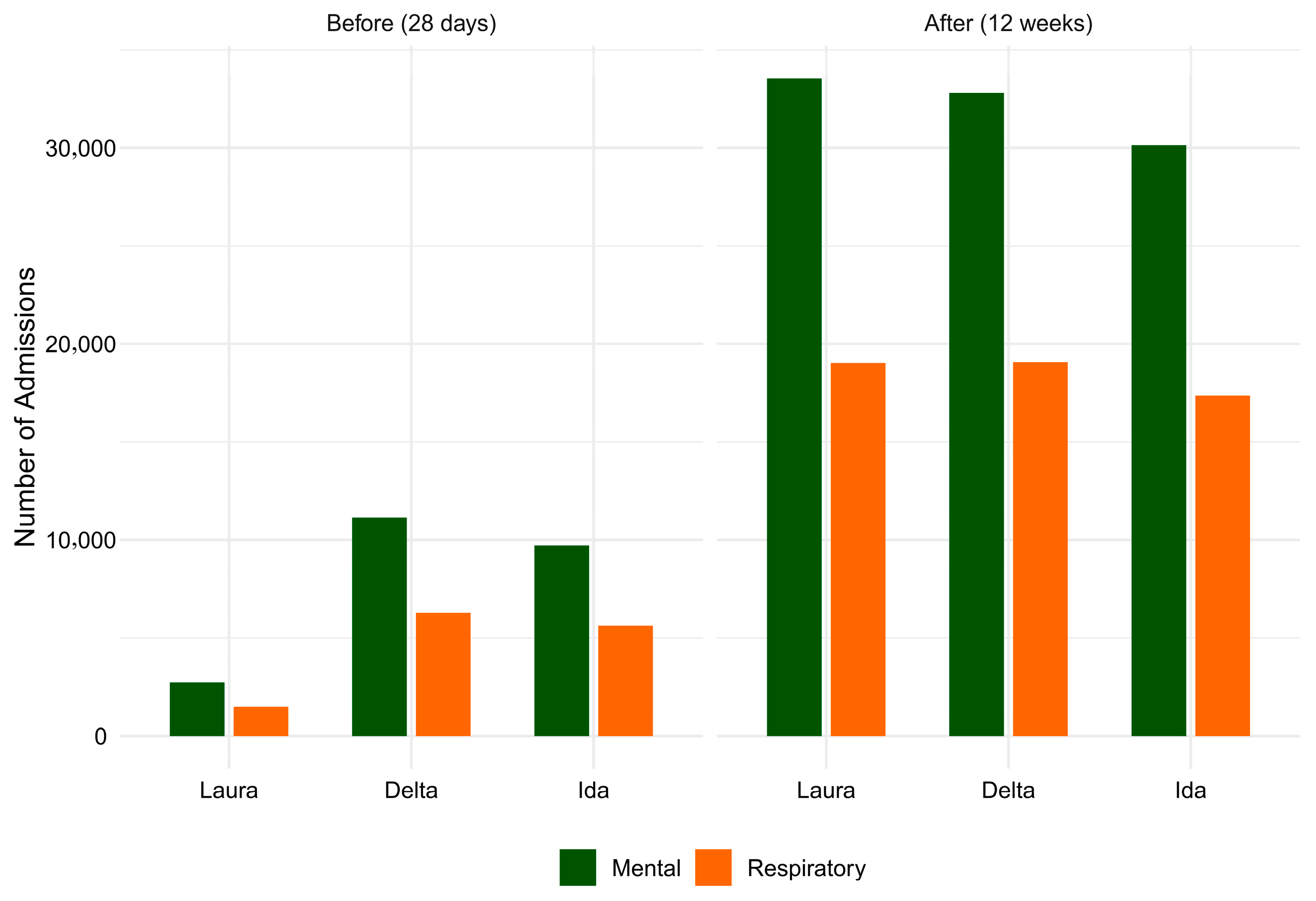
For all three storms, mental health-related admissions exceeded respiratory health-related ones, whether in the period before, during, or after landfall, with a strong increase in hospital admissions for both mental and respiratory health between pre- and post-event periods (Figure 1). Hurricane Laura shows the highest increase of 1100% for mental and respiratory health. This result reflects the combined effects of a low pre-event baseline and overlap with Delta’s subsequent landfall period, and further disruptions from the COVID-19 pandemic. These combined impacts suppressed pre-storm admissions and increased post-storm admissions. Hurricane Delta, on the other hand, indicates moderate increases for mental and respiratory health, accounting for 194% and 223%, respectively. Similarly, significant increases of 283% in mental health and 147% in respiratory health were observed following the hurricane. However, it is important to consider the analysis window while interpreting the results. Overall, Figure 1 highlights a significant rise in healthcare utilization for both mental and respiratory conditions after major hurricanes.
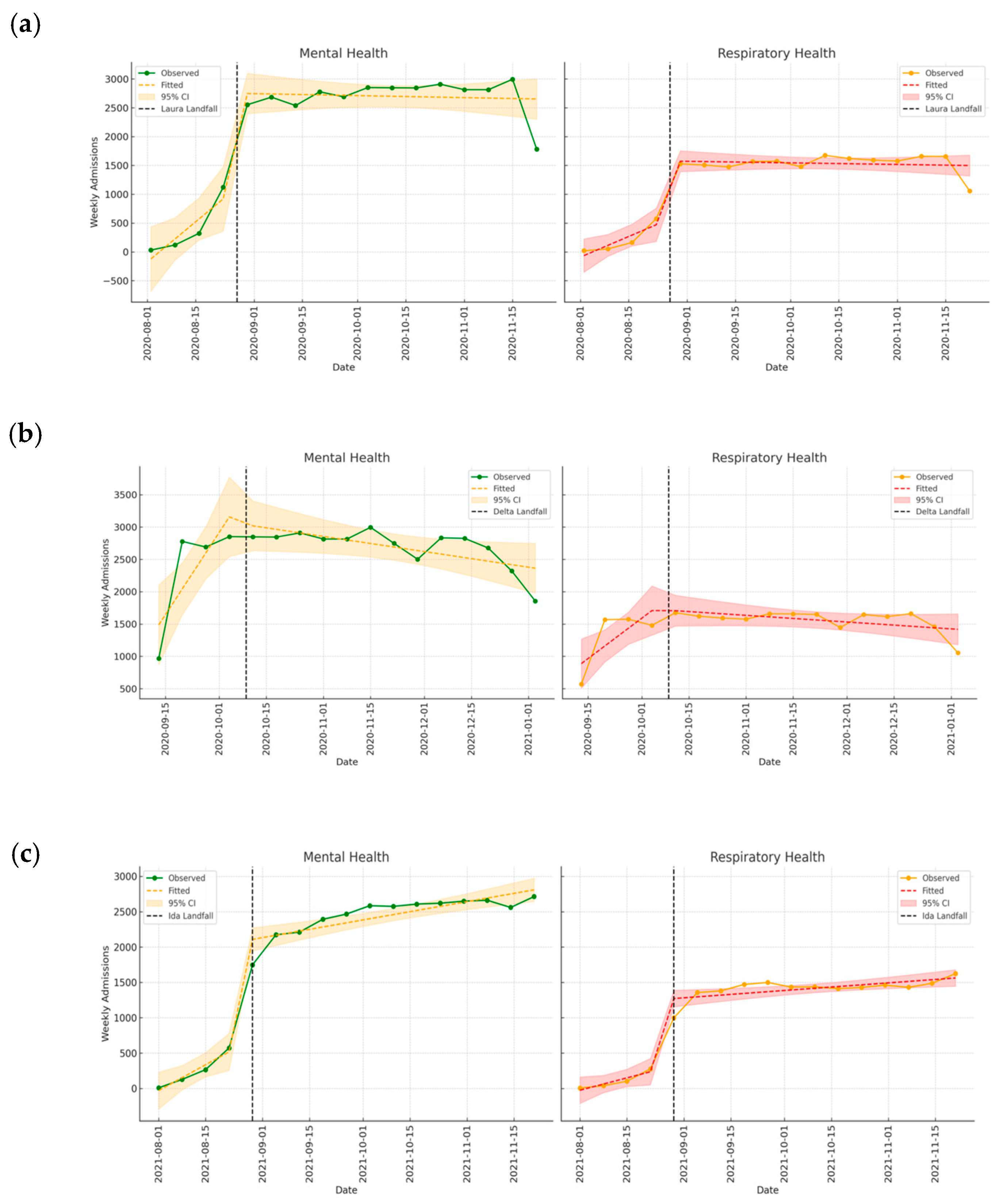
The spike in admissions is evident in more detail in the ITS analysis of weekly hospital admission data averaged for every seven days in Louisiana across three categories—mental health, respiratory conditions, and total admissions (Figure 2). Again, all three storms show higher mental health than respiratory health admissions and were associated with a sharp rise in mental and respiratory health-related admissions near the time of landfall. The model shows that immediately after the hurricanes, hospital admissions were similar to what was expected. Still, the divergence of the 95% confidence interval toward the end of the timeline, as shown in the counterfactual projection (Figure 2), suggests that short-term effects may appear modest. Still, longer-term health impacts are likely underestimated, especially when compounded by COVID-19. The widening CI indicates that as we move in time, the model becomes less certain in terms of hospital admissions without the hurricane. Immediately after landfall of hurricanes, an accurate estimation can be made, but uncertainty increases after weeks have passed. This suggests that the longer-term health effects of hurricanes may be larger than what the average estimate shows. This implies that the true burden on hospitals could be underestimated.
For Hurricane Laura (Figure 2a), we observe a marked rise in admissions at landfall for mental health and respiratory conditions, where both the level and slope increased. Mental health admissions remained higher than usual for about ten weeks, while respiratory admissions showed only a slight increase and then gradually returned to normal. For Delta, mental health admissions again increased, but this time well before landfall, and remained elevated for an even longer period than occurred for Laura, perhaps due to the compounding effect of Laura and Delta, and respiratory admissions also rose noticeably before falling steadily, much earlier than for mental health admissions (Figure 2b). Ida caused the sharpest rise in mental health admissions at landfall, beginning in the landfall week and remaining high for nearly the full 12 weeks afterward, and respiratory admissions increased briefly but tended to decrease quickly.
Overall, the results suggest that mental health hospitalizations amid the compound effects of COVID-19 and hurricane landfalls tend to spike immediately after major hurricanes and often stay elevated for weeks, while respiratory impacts are smaller and short-lived (Figure 2c). In general, Figure 1 and Figure 2 reflect the broad impact of the hurricane on overall health system utilization, amid the challenges already posed by COVID-19, likely due to storm-related injuries, exacerbation of chronic conditions, and disruptions in access to care.

3.2. Length of Stay After Hurricane

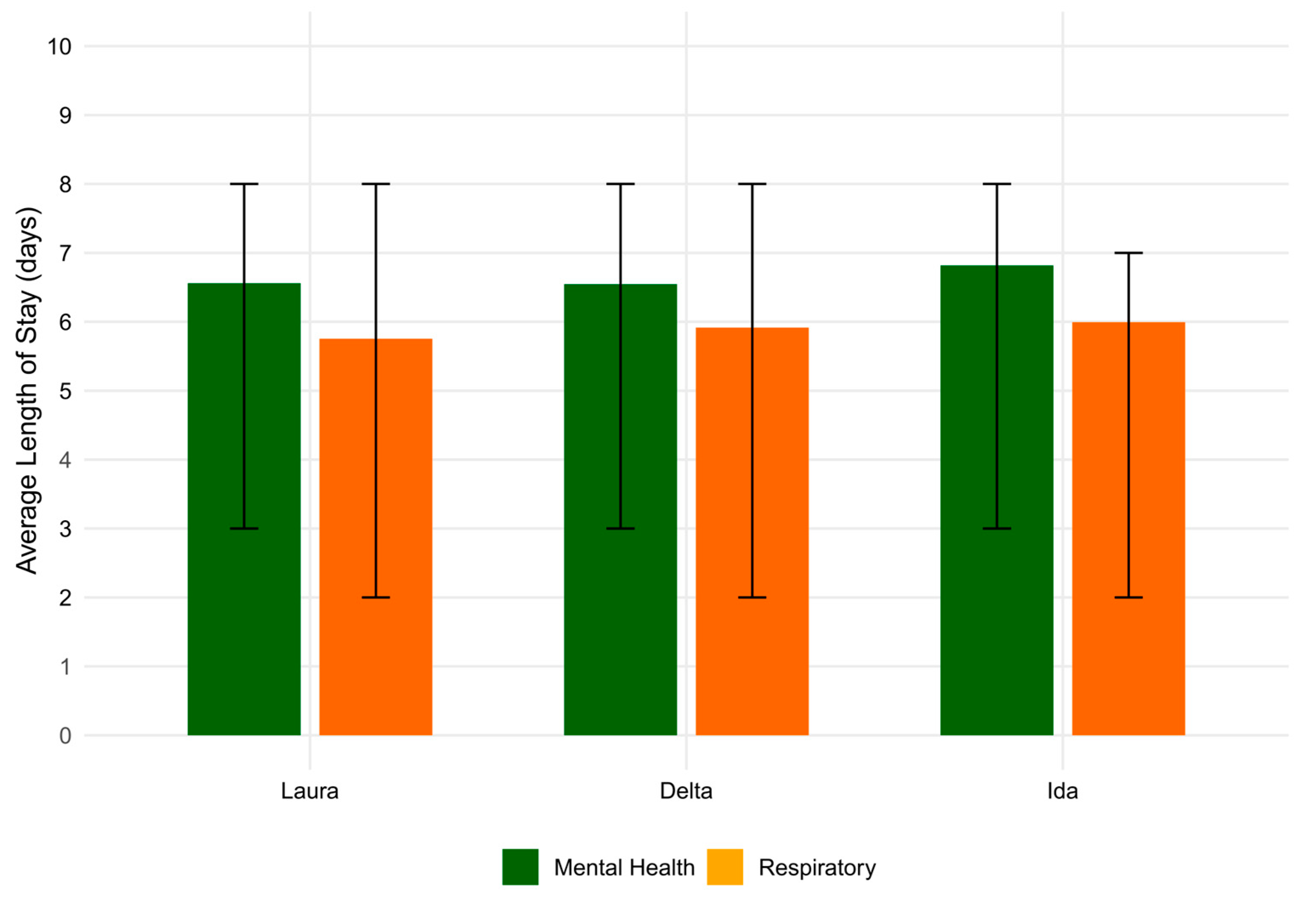
The mean LOS for mental and respiratory health-related illness is shown in Figure 3. In all three hurricanes, patients with mental health issues stayed slightly longer on average than those with respiratory health issues. Mental health stays averaged around 6.2 to 6.5 days, with Hurricane Delta showing the longest duration, suggesting that psychiatric care following this event may have been more complex or required prolonged stabilization, perhaps because of the cumulative effects of both COVID-19 and Laura. In contrast, respiratory health remained relatively stable at approximately 5.9–6.0 days across all three hurricanes. The error bars show that the actual length of stay varied extensively among patients, even though the mean values are stable, indicating high variability. The result revealed that there was a vast difference between mental and respiratory health admissions rates for all hurricanes. The findings indicate that while respiratory admissions remained consistent regardless of the hurricane, mental health admissions not only lasted longer but were also more sensitive to disaster context, with Delta standing out as the event associated with the greatest burden on psychiatric inpatient care.
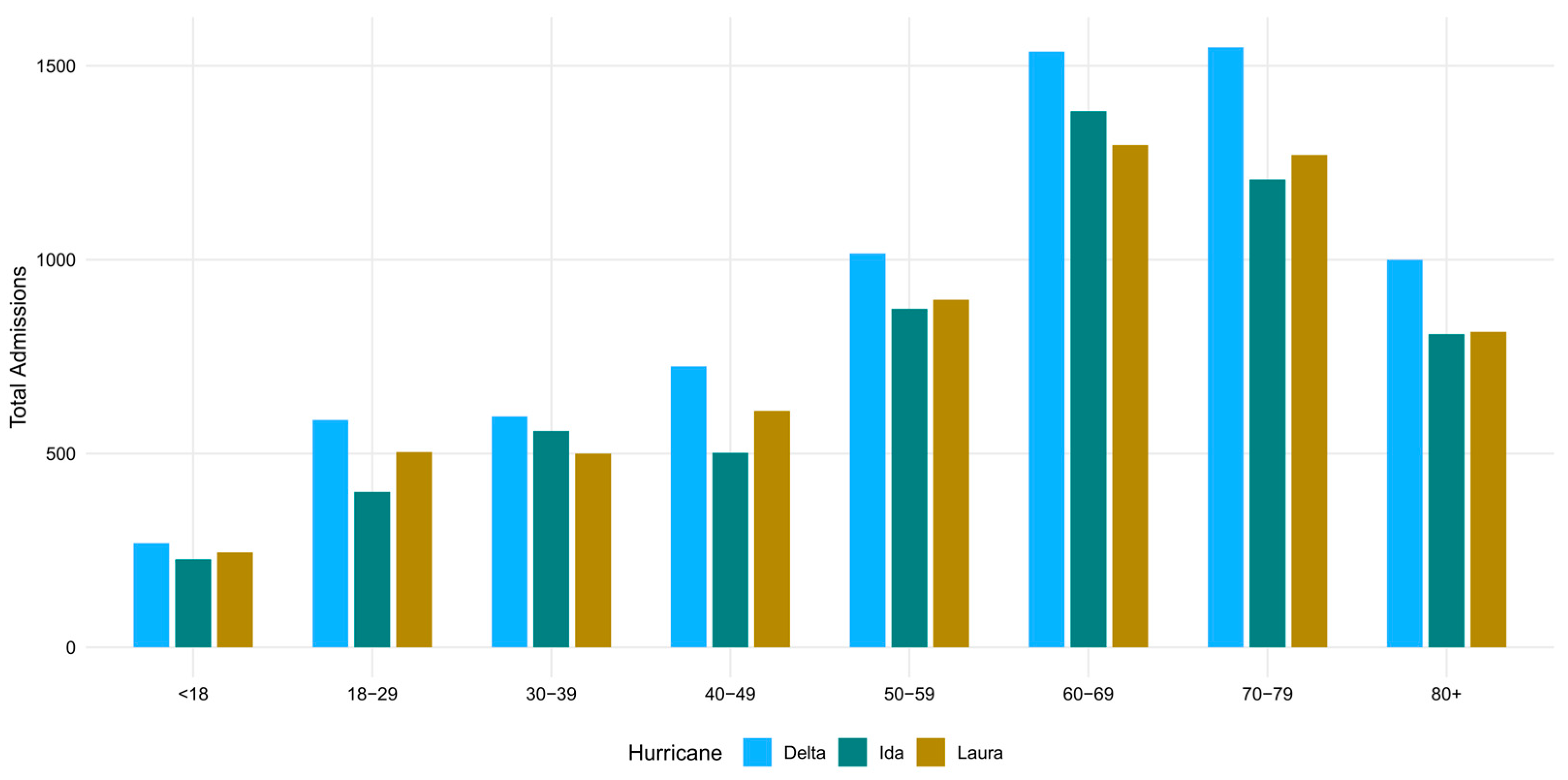
Figure 4 shows a more detailed distribution of the number of hospital admissions by age group during the three hurricanes. The age distribution follows a similar pattern, with most admissions concentrated among older adults in all three storms. Notably, the age group from 60 to 69 contributes a significant percentage of all admissions, accounting for 22.3%, while the 70–79 group adds another ~20%, the 50–59-year group contributes ~14.9%, and the 80+ group accounts for around 12.7%, highlighting the increased vulnerability of elderly populations. In contrast, younger groups under 18 and aged 18–29 together make up only about 12% of admissions, with smaller proportions in middle-aged groups from 30 to 49 years. The highest overall admissions were recorded for Delta, followed by Laura and Ida; however, the proportional distribution across age groups remained remarkably consistent. This stability underscores that older populations consistently face the greatest healthcare burden during hurricane–COVID-19 + compound events, and that it is important to prioritize continuity of care for older adults during evacuation planning.

3.3. Gender Disparities

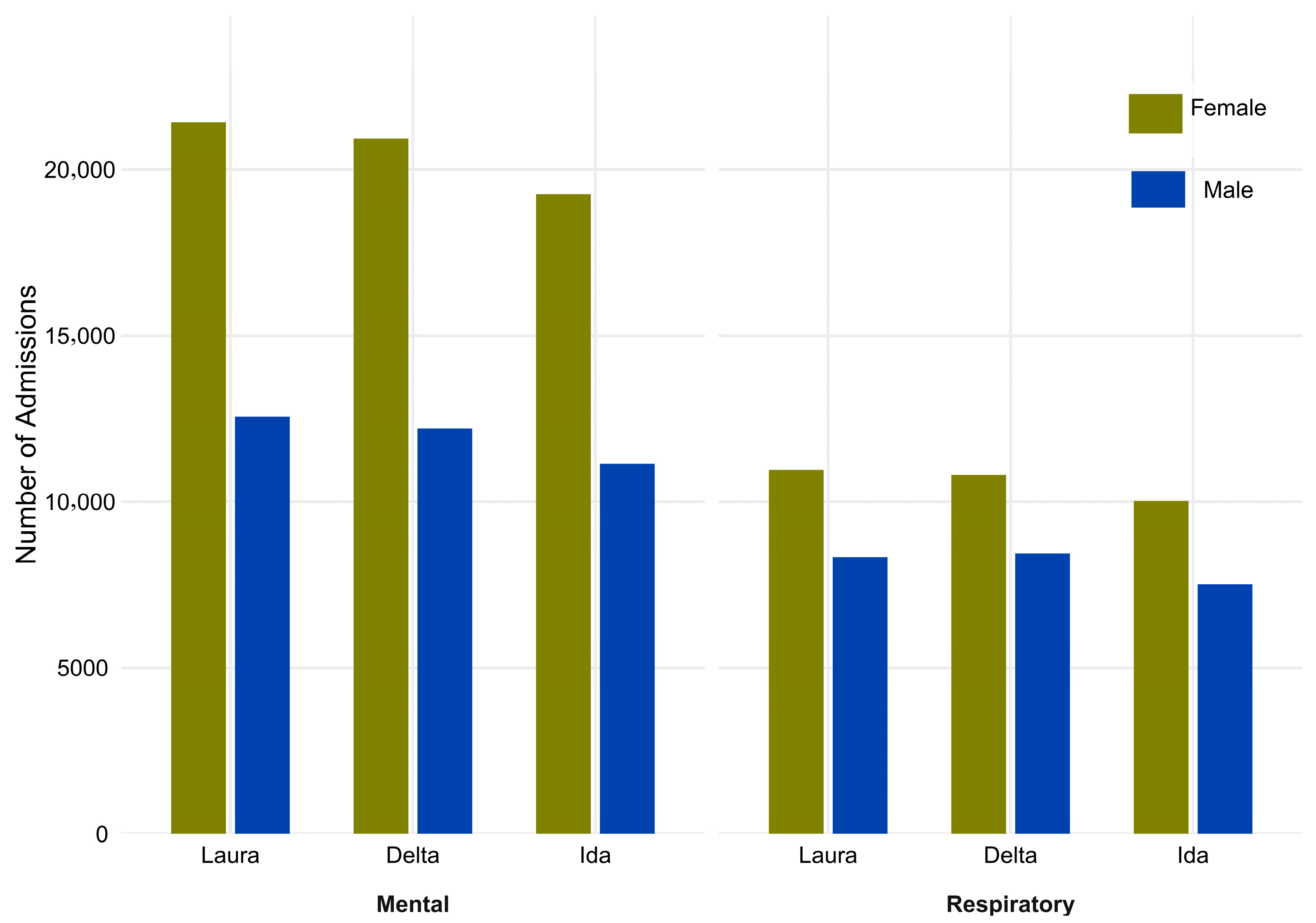
The distribution of hospital admissions by gender displays a similar pattern for the three hurricanes. While female admissions outnumber male admissions for all three storms, the differences are greater for mental health (Figure 5). Respiratory health admissions showed a smaller but still apparent gender gap (Table 2).
In all three hurricanes, female patients consistently outnumbered males across nearly all LOS categories, particularly in the 2–3-day and 4–5-day groups. The difference was especially noticeable among the youngest patients (under 18) and the oldest patients (80+), where women accounted for more than 60% of cases. Among middle-aged groups (30–59 years old), the gap between men and women was smaller but still showed that more women were affected.
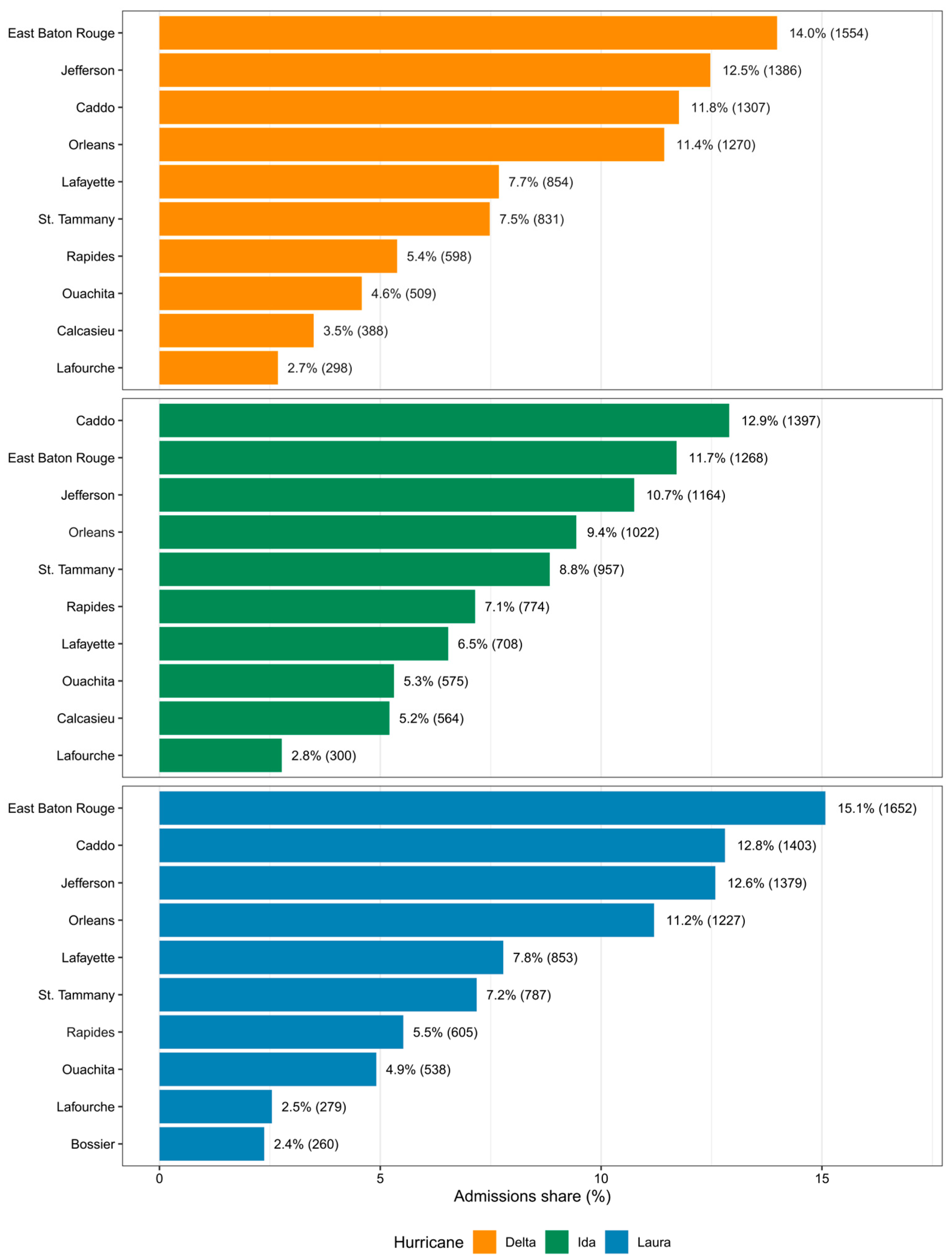
The highest rate of hospital admissions in Louisiana in the top 10 parishes during Hurricanes Laura, Delta, and Ida is shown in Figure 6. The analysis revealed a higher number of admissions concentrated in East Baton Rouge, followed by Jefferson, Orleans, Caddo, and Lafayette, for all three hurricanes. Moreover, parishes such as St. Tammany, Rapides, and others, such as Ouachita, Calcasieu, and Lafourche, also share a significant burden in terms of hospital admissions, but not as many of them. The analysis further highlights the fact that the majority of hospital admissions were concentrated in large urban areas such as East Baton Rouge, Jefferson, Orleans, Caddo, and Lafayette, while rural parishes shared a smaller burden, indicating the disproportionate strain on urban healthcare systems compared to rural areas.
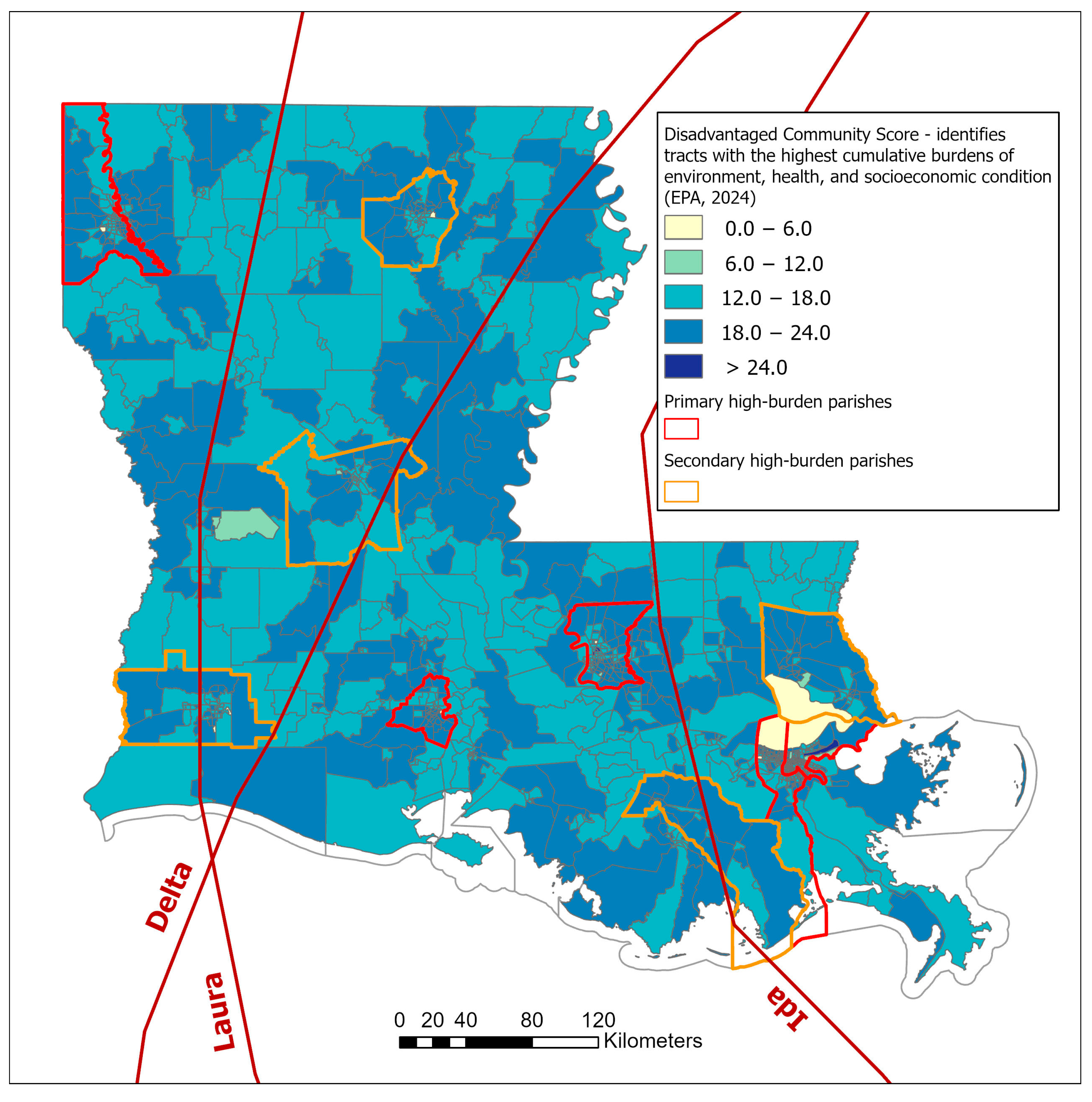
Figure 7 shows the spatial distribution of the EPA’s Disadvantaged Community Score across Louisiana census tracts and highlights parishes with elevated health impacts during Hurricanes Laura, Delta, and Ida. The overlap between storm paths, heightened social vulnerability, and elevated hospitalization emphasizes that communities facing pre-existing socioeconomic challenges experienced the most severe mental and respiratory health impacts.

4. Discussion

4.1. Compounded Disasters and Carryover Effects

The findings clearly demonstrate how compounded emergencies, COVID-19 layered with consecutive hurricanes (Laura, Delta, and Ida), magnify health system strain and population vulnerability. Delta’s hospital surge, occurring shortly after Laura, reflects not only storm severity but also the cumulative effects of disrupted infrastructure, delayed recovery, and newly accumulated debris that hindered access to care. These interacting stressors likely suppressed some admissions (e.g., blocked roadways) while simultaneously inflating others by exacerbating pre-existing conditions [64]. This compounded risk landscape supports broader resilience and disaster science evidence showing that sequential disasters amplify vulnerabilities far beyond the sum of individual events.

4.2. Mental Health Impacts: Trauma, Displacement, and Systemic Stressors

Across storms, mental health-related admissions consistently surged more dramatically and persisted longer than respiratory admissions, consistent with evidence that hurricanes can trigger mental health challenges that extend well beyond the immediate aftermath [33,65]. This pattern underscores the chronic psychological toll of displacement, infrastructure damage, social isolation, and disrupted support systems, all intensified by the COVID-19 pandemic, fear of infection, and economic instability [66]. The prolonged length of stay (LOS) for mental health admissions reflects the complexity of trauma-related disorders (PTSD, depression, anxiety), which demand sustained, resource-intensive care [65]. These findings reinforce the need for disaster frameworks that prioritize mental health as a critical, long-term dimension of public health response. These results supplement those of several studies that reported heightened symptoms of depression, anxiety, PTSD, and suicide in different age groups over displacement related to an event [67,68,69,70,71,72,73]. Additionally, these results are consistent with the recent literature suggesting that compound, cascading, and/or complex disasters accumulate vulnerabilities on both mental and physical health [74,75].

4.3. Respiratory Health Burdens: Environmental Exposures and Acute Exacerbations

Hurricanes triggered significant spikes in respiratory admissions due to mold proliferation, poor air quality, sanitation breakdowns, and disrupted continuity of care, all occurring within a population already sensitized by respiratory concerns during COVID-19. Although respiratory-related LOS tended to be shorter, likely due to standardized treatment pathways, the volume of admissions provides compelling evidence that environmental exposures in the aftermath of storms remain an acute and ongoing threat, particularly in flooded or poorly ventilated structures. Respiratory health impacts, although sometimes shorter in LOS, likely due to more standardized treatment protocols and faster resolution, remain significant as they reflect acute exacerbations from storm-related exposures [76].

4.4. Gendered Dimensions of Disaster Vulnerability

Women consistently experienced higher hospitalization rates across all storms, particularly within the working- and caregiving-age ranges (30–59). These disparities may stem from heightened caregiving responsibilities, pre-existing health disparities, increased psychological stress exposure, or gendered differences in health-seeking behavior. Biological susceptibility to certain respiratory conditions may also contribute [30,77,78,79,80]. These gendered patterns highlight the importance of incorporating gender-sensitive strategies into preparedness and recovery operations, ensuring women are adequately represented and empowered within disaster planning and response systems [30,77]. The sharp increase in admissions for the caregiving-age groups (Figure 4) supports this idea. Biological differences, including a higher prevalence of certain respiratory conditions among women, may also contribute to greater hospital admissions following storm-related exposures such as mold, poor air quality, and disrupted access to medications [80].

4.5. Age-Related Vulnerability and Stability Across Storms

Although overall admission volumes varied by storm, the proportional distribution across age groups remained notably stable. Older adults consistently bear the greatest burden of hospitalization, reaffirming their elevated vulnerability to both physical and psychological impacts of disasters. The combination of chronic illness, mobility limitations, and social isolation, intensified by COVID-19, underscores the necessity for targeted public health strategies, including proactive outreach and continuity-of-care planning for older populations at risk of heightened health impacts [77]. Although Delta resulted in the highest overall admissions, followed by Laura and then Ida, the proportional distribution across age groups remained remarkably consistent.

4.6. Health System Strain, COVID-19 Synergy, and Hospital Capacity Limits

The intersection of hurricane response and COVID-19 altered health-seeking behaviors and overwhelmed Louisiana’s healthcare infrastructure. Hospitals were unable to execute typical evacuation and surge strategies and faced staffing shortages, supply chain disruptions, and limited shelter capacity [81]. The widening uncertainty in counterfactual LOS projections suggests that aggregated measures may obscure subgroup-specific burdens. Moreover, stable LOS despite rising admissions may reflect constrained capacity, triage decisions, or prioritization protocols masking deeper systemic strain. This convergence likely led to longer hospital stays, higher demands for healthcare personnel, and delays in elective or preventive care [79]. Compared across storms, Hurricane Ida produced the largest spike in both mental health and respiratory admissions, likely reflecting its overlap with the COVID-19 pandemic, which compounded both psychological stress and respiratory vulnerabilities [41].
Louisiana’s health system faced a compounded crisis: the destructive impact of the storm layered atop an already-overwhelming COVID-19 surge. Hospitals, already at or near capacity due to COVID-19, were unable to relocate patients as they normally would during hurricane preparations [82]. During Hurricane Ida, Louisiana also reported over 197,000 cases and 2900 deaths in August and September 2021 [41]. The study shows a 24.3% increase in reported cases of thoughts of suicide and a 28.4% increase in stress and anxiety in the first four weeks following the storm. Delta and Laura displayed similar trajectories, as strong winds, storm surges, and inland flooding led to catastrophic impacts, destroying houses and infrastructure, disrupting water systems, necessitating a near-total rebuilding of the electric grid, and severely damaging essential infrastructure. Additionally, the COVID-19 pandemic hindered the hurricane response because the already-limited emergency shelter options were further weakened by interrupted critical supply chains and strained healthcare facilities. During Laura and Delta, all testing facilities were temporarily disrupted by Louisiana’s COVID-19 response, resulting in only a small fraction of evacuees in shelters being tested for COVID-19 [41].

4.7. Structural Vulnerabilities and Social Determinants of Health

Compounded impacts highlight the broader social determinants that shape disaster vulnerability. As depicted in Figure 7, many of the hardest-hit parishes across all hurricanes overlap with communities experiencing increased environmental, health, and socioeconomic burdens. These include caregiving roles, socioeconomic status, access to safe housing, employment instability, and chronic disease burden. Intersectional and cumulative risk models suggest that these factors interact multiplicatively, affecting both exposure and access to protective resources [74,75]. Marginalized groups, for instance, may face greater barriers to evacuation, healthcare, or recovery [83]. Demographic stratification and interaction together provide a multidimensional lens for understanding hospitalizations, considering both COVID-19 and hurricane landfalls. The consistency across multiple hurricanes suggests that such patterns are not isolated to a single event but are indicative of broader systemic vulnerabilities. These findings reinforce the need for resilience frameworks that operate across ecological levels: individual, household, community, and system.

4.8. Environmental and Climate Conditions: Inland Flooding and “Brown Ocean” Effects

Significant precipitation and inland flooding expanded the geographic footprint of health impacts, possibly due to the “brown ocean effect,” which allows storms to maintain strength farther inland [84]. These hydrological hazards are projected to worsen under 21st-century climate scenarios, creating an urgent call for integrated adaptation strategies that address both acute storm risk and chronic flood vulnerability [85,86]. These projections highlight the urgent need for integrated adaptation strategies that address both chronic and acute risks. In the absence of such measures, the compounding nature of these hazards, along with future non-meteorological hazards such as pandemics, is likely to impose escalating socioeconomic and environmental costs on coastal populations throughout the 21st century.

4.9. Limitations

Several limitations should be taken into consideration. First, the study period spans from August 2020 to Aug 2022, coinciding with the COVID-19 surge and recovery period; attributing fluctuations in hospital admissions, LOS, and disposition to a single driver is difficult without explicit time-series controls. Therefore, we were unable to disentangle hurricane-related health effects from those of the COVID-19 pandemic due to the lack of parish-level COVID-19 indicators, such as weekly COVID-19 admissions or test positivity rates, which were not available for the full study period. Also, because Hurricanes Laura and Delta occurred only 43 days apart, portions of their study periods overlapped. As a result, there is potential for temporal collinearity between these two exposure periods. Second, there is a potential for misclassification when using ICD prefixes to define outcome families, which could produce bias in the result. Thirdly, due to a lack of hospital admission data for a sufficiently long period following each hurricane, the lagged health effects were not assessed. Because of this limitation, the findings may underestimate longer-term health impacts that can emerge from months to years after disaster exposure. Lastly, seasonal variation in hospitalization patterns, particularly for respiratory illnesses that typically increase during colder months and may fluctuate due to school cycles or viral outbreaks, was not accounted for. Hence, some observed changes following hurricanes may reflect seasonal trends rather than disaster-specific impacts, especially for ITS analysis.

4.10. Research Gaps and Future Directions

Future research should extend the time period of data to capture pre- and post-hurricane comparison adequately, as some of the adverse health effects, such as mental disorders, may not surface until many months after the hurricanes. Furthermore, incorporating risk-adjusted models of LOS and discharge disposition by diagnosis and geography will help to identify hotspots at the parish level. Moreover, location-specific longitudinal data on the intensity of the hurricane impact, health outcomes, and changes in socio-physical and biochemical stressors are needed to explore the complete disease burden of hurricanes. Future interdisciplinary work linking climate model output with hospital data more directly is warranted.

5. Conclusions

This study explores how Hurricanes Laura, Delta, and Ida influenced the patterns of mental and respiratory health in Louisiana, amid the ongoing COVID-19 emergency, using the peer-reviewed literature and interrupted time-series (ITS) analyses of pre- and post-hurricane hospital admissions for mental health and respiratory conditions around the time of a hurricane disaster as indicators. A consistent and substantial increase in admissions after landfall was observed, with mental health conditions showing the largest surge across all three disasters. Mental health conditions also generally exhibited slightly longer stays compared to respiratory illnesses and remained elevated for at least 10–12 weeks post-landfall. Gender disparities were evident, with female patients representing a larger proportion of total admissions for mental and respiratory health. Not surprisingly, older adults were the most affected by the events. These findings emphasize the need for disaster response frameworks that integrate long-term psychological support with acute respiratory care, ensuring health systems can address both immediate and prolonged impacts of extreme weather events, thereby moving disaster-impacted societies closer to climate-resilient health systems on their path to sustainability. Building on this work, future analyses will link hospital and climate records statewide to anticipate where surge capacity is likely to fail—and how Louisiana’s hospitals can prepare to meet this challenge.

Author Contributions

Conceptualization, R.V.R., C.M., M.E.B.G. and E.P.-G.; methodology, S.K.Y.; software, S.K.Y.; validation, S.K.Y. and N.B.; formal analysis, S.K.Y. and C.M.; investigation, S.K.Y.; resources, R.V.R.; data curation, S.K.Y. and N.B.; writing—original draft preparation, S.K.Y.; writing—review and editing, R.V.R., E.P.-G., C.M. and M.E.B.G.; visualization, S.K.Y.; supervision, R.V.R., C.M., M.E.B.G. and E.P.-G.; project administration, R.V.R. All authors have read and agreed to the published version of the manuscript.

Funding

This research received no external funding.

Institutional Review Board Statement

Not applicable.

Informed Consent Statement

Not applicable.

Data Availability Statement

Health data are not available for public use and require an application review process and a data use agreement. Readers interested in obtaining these data can contact the Louisiana Department of Health.

Acknowledgments

We would like to acknowledge the Louisiana Department of Health for providing a comprehensive, retrospective dataset of hospital administrative records from August 2020 to August 2022.

Conflicts of Interest

The authors declare no conflicts of interest.

References

  1. Méndez-Tejeda, R.; Hernández-Ayala, J.J. Links between Climate Change and Hurricanes in the North Atlantic. PLoS Clim. 2023, 2, e0000186. [Google Scholar] [CrossRef] [Scilit]
  2. Kossin, J.P.; Knapp, K.R.; Olander, T.L.; Velden, C.S. Global Increase in Major Tropical Cyclone Exceedance Probability over the Past Four Decades. Proc. Natl. Acad. Sci. USA 2020, 117, 11975–11980. [Google Scholar] [CrossRef] [Scilit]
  3. Bhatia, K.; Vecchi, G.A.; Murakami, H.; Underwood, S.; Kossin, J. Projected Response of Tropical Cyclone Intensity and Intensification in a Global Climate Model. J. Clim. 2018, 31, 8281–8303. [Google Scholar] [CrossRef] [Scilit]
  4. Garner, A.J. Observed Increases in North Atlantic Tropical Cyclone Peak Intensification Rates. Sci. Rep. 2023, 13, 16299. [Google Scholar] [CrossRef] [Scilit]
  5. Stocker, T.F.; Qin, D.; Plattner, G.-K.; Tignor, M.; Allen, S.K.; Boschung, J.; Nauels, A.; Xia, Y.; Bex, V.; Midgley, P.M. (Eds.) Climate Change 2013: The Physical Science Basis; Intergovernmental Panel on Climate Change (IPCC); Cambridge University Press: Cambridge, UK; New York, NY, USA, 2013; p. 1535. [Google Scholar] [CrossRef] [Scilit]
  6. Knutson, T.R.; Camargo, S.J.; Chan, J.C.; Emanuel, K.; Ho, C.-H.; Kossin, J.; Mohapatra, M.; Satoh, M.; Sugi, M.; Walsh, K.; et al. Tropical cyclones and climate change assessment: Part II: Projected response to anthropogenic warming. Bull. Am. Meteorol. Soc. 2020, 101, E303–E322. [Google Scholar] [CrossRef] [Scilit]
  7. Riahi, K.; Rao, S.; Krey, V.; Cho, C.; Chirkov, V.; Fischer, G.; Kindermann, G.; Nakicenovic, N.; Rafaj, P. RCP 8.5—A Scenario of Comparatively High Greenhouse Gas Emissions. Clim. Change 2011, 109, 33–57. [Google Scholar] [CrossRef] [Scilit]
  8. Emanuel, K. Response of Global Tropical Cyclone Activity to Increasing CO2: Results from Downscaling CMIP6 Models. J. Clim. 2021, 34, 57–70. [Google Scholar] [CrossRef] [Scilit]
  9. Field, C.B.V.; Barros, T.F.; Stocker, D.; Qin, D.J.; Dokken, K.L.; Ebi, M.D.; Mastrandrea, K.J.; Mach, G.-K.; Plattner, S.K.; Allen, M.T.; et al. (Eds.) Managing the Risks of Extreme Events and Disasters to Advance Climate Change Adaptation; Intergovernmental Panel on Climate Change (IPCC); Cambridge University Press: Cambridge, UK, 2012; Available online: https://www.ipcc.ch/report/managing-the-risks-of-extreme-events-and-disasters-to-advance-climate-change-adaptation/ (accessed on 3 September 2025).
  10. Summers, J.K.; Lamper, A.; McMillion, C.; Harwell, L.C. Observed Changes in the Frequency, Intensity, and Spatial Patterns of Nine Natural Hazards in the United States from 2000 to 2019. Sustainability 2022, 14, 4158. [Google Scholar] [CrossRef] [Scilit] [PubMed]
  11. Walsh, K.; Camargo, S.J.; Knutson, T.; Kossin, J.; Lee, T.-C.; Murakami, H.; Patricola, C. Tropical Cyclones and Climate Change. Trop. Cyclone Res. Rev. 2019, 8, 240–250. [Google Scholar] [CrossRef] [Scilit]
  12. Mudd, L.; Wang, Y.; Letchford, C.; Rosowsky, D. Assessing Climate Change Impact on the U.S. East Coast Hurricane Hazard: Temperature, Frequency, and Track. Nat. Hazards Rev. 2014, 15, 04014001. [Google Scholar] [CrossRef] [Scilit]
  13. Keim, B.D.; Fontenot, R.; Tebaldi, C.; Shankman, D. Hydroclimatology of the U.S. Gulf Coast Under Global Climate Change Scenarios. Phys. Geogr. 2011, 32, 561–582. [Google Scholar] [CrossRef] [Scilit]
  14. Federal Motor Carrier Safety Administration (FMCSA). Louisiana Emergency Declaration 1.20.2025. U.S. Department of Transportation, Washington, DC, USA. Available online: https://www.fmcsa.dot.gov/emergency/louisiana-emergency-declaration-1202025 (accessed on 30 June 2025).
  15. Pendleton, E.A.; Barras, J.A.; Williams, S.J.; Twichell, D.C. Coastal Vulnerability Assessment of the Northern Gulf of Mexico to Sea-Level Rise and Coastal Change, U.S. In Geological Survey Open-File Report 2010-1146; U.S. Geological Survey: Reston, VA, USA, 2010. [Google Scholar] [CrossRef] [Scilit]
  16. Salarieh, B.; Ugwu, I.A.; Salman, A.M. Impact of Changes in Sea Surface Temperature due to Climate Change on Hurricane Wind and Storm Surge Hazards across U.S. Atlantic and Gulf Coast Regions. SN Appl. Sci. 2023, 5, 205. [Google Scholar] [CrossRef] [Scilit]
  17. Beven, J.L., II; Hagen, A.; Berg, R. Tropical Cyclone Report: Hurricane Ida (AL092021), 26 August–1 September 2021; National Hurricane Center, National Oceanic and Atmospheric Administration: Miami, FL, USA, 2022. Available online: https://www.nhc.noaa.gov/data/tcr/AL092021_Ida.pdf (accessed on 19 August 2025).
  18. Bucci, L.; Alaka, L.; Hagen, A.; Delgado, S.; Beven, J. Tropical Cyclone Report: Hurricane Ian (AL092022), 23–30 September 2022; National Hurricane Center, National Oceanic and Atmospheric Administration: Miami, FL, USA, 2023. Available online: https://www.nhc.noaa.gov/data/tcr/AL092022_Ian.pdf (accessed on 19 August 2025).
  19. Louisiana Department of Insurance. 2020 Hurricane Season Costs $10.6 Billion; Surplus Line Reporter, 5 November 2021. Available online: https://www.surpluslinereporter.com/2020-hurricane-season-costs-10-6-billion/ (accessed on 19 August 2025).
  20. van Oldenborgh, G.J.; van der Wiel, K.; Sebastian, A.; Singh, R.; Arrighi, J.; Otto, F.E.L.; Haustein, K.; Li, S.; Vecchi, G.; Cullen, H. Attribution of extreme rainfall from Hurricane Harvey, August 2017. Environ. Res. Lett. 2017, 12, 124009. [Google Scholar] [CrossRef] [Scilit]
  21. Kolker, A.S.; Allison, M.A.; Hameed, S. An evaluation of subsidence rates and sea-level variability in the northern Gulf of Mexico. Geophys. Res. Lett. 2011, 38, L21404. [Google Scholar] [CrossRef] [Scilit]
  22. Balaguru, K.; Xu, W.; Chang, C.-C.; Leung, L.R.; Judi, D.R.; Hagos, S.M.; Wehner, M.F.; Kossin, J.P.; Ting, M. Increased U.S. Coastal hurricane risk under climate change. Sci. Adv. 2023, 9, eadf0259. [Google Scholar] [CrossRef] [Scilit]
  23. World Commission on Environment and Development. Our Common Future (The Brundtland Report); Oxford University Press: Oxford, UK, 1987. [Google Scholar]
  24. Coalson, J.E.; Anderson, E.J.; Santos, E.M.; Garcia, V.M.; Romine, J.K.; Luzingu, J.; Dominguez, B.; Richard, D.M.; Little, A.C.; Hayden, M.H.; et al. The complex epidemiological relationship between flooding events and human outbreaks of mosquito-borne diseases: A scoping review. Environ. Health Perspect. 2021, 129, 096002. [Google Scholar] [CrossRef] [Scilit]
  25. Ebi, K.L.; Vanos, J.; Baldwin, J.W.; Bell, J.E.; Hondula, D.M.; Errett, N.A.; Hayes, K.; Reid, C.E.; Saha, S.; Spector, J.; et al. Extreme weather and climate change: Population health and health system implications. Annu. Rev. Public Health 2021, 42, 293–315. [Google Scholar] [CrossRef] [Scilit]
  26. Delwel, I.O.; Mordecai, E.A. Molecules to spillover: How climate warming impacts mosquito-borne viruses. Curr. Opin. Virol. 2025, 72, 101473. [Google Scholar] [CrossRef] [Scilit]
  27. U.S. Government Accountability Office. Hurricane Katrina: Status of the Health Care System in New Orleans and Difficult Decisions Related to Efforts to Rebuild it Approximately 6 Months After Hurricane Katrina (GAO-06-576R); U.S. Government Accountability Office: Washington, DC, USA, 2006. [Google Scholar]
  28. Shurety, E. Moldy homes: Toxicity, race, and the geographies of domestic mold. Prog. Environ. Geogr. 2025, 4, 3–23. [Google Scholar] [CrossRef] [Scilit]
  29. Rando, R.J.; Lefante, J.J.; Freyder, L.M.; Jones, R.N. Respiratory health effects associated with restoration work in post-Hurricane Katrina New Orleans. J. Environ. Public Health 2012, 2012, 462478. [Google Scholar] [CrossRef] [Scilit] [PubMed]
  30. Waddell, S.L.; Jayaweera, D.T.; Mirsaeidi, M.; Beier, J.C.; Kumar, N. Perspectives on the health effects of hurricanes: A review and challenges. Int. J. Environ. Res. Public Health 2021, 18, 2756. [Google Scholar] [CrossRef] [Scilit]
  31. Foreman, A.M.; Omari, A.; Marks, K.J.; Troeschel, A.N.; Haas, E.J.; Moore, S.M.; Fechter-Leggett, E.; Park, J.-H.; Cox-Ganser, J.M.; Damon, S.A.; et al. Knowledge, attitudes, and practices related to mold remediation following Hurricane Ida in Southeast Louisiana. Int. J. Environ. Res. Public Health 2024, 21, 1412. [Google Scholar] [CrossRef] [Scilit]
  32. Centers for Disease Control and Prevention (CDC). Health concerns associated with mold in water-damaged homes after Hurricanes Katrina and Rita — New Orleans area, Louisiana, October 2005. MMWR Morb. Mortal. Wkly. Rep. 2006, 55, 39–42. [Google Scholar]
  33. Baldea, C. The highlighting of fluffy-type colonies for molds. Ann. Univ. Oradea Fascicle Ecotoxicol. Anim. Sci. Food Sci. Technol. 2024, 23, 86–90. [Google Scholar]
  34. Centers for Disease Control and Prevention (CDC). Infectious disease and dermatologic conditions in evacuees and rescue workers after Hurricane Katrina—Multiple States, August–September, 2005. MMWR Morb. Mortal. Wkly. Rep. 2005, 54, 961–964. [Google Scholar]
  35. Ito, K.; De Leon, S.F.; Lippmann, M. Associations between ozone and daily mortality: Analysis and meta-analysis. Epidemiology 2005, 16, 446–457. [Google Scholar] [CrossRef] [Scilit] [PubMed]
  36. Reid, C.E.; O’Neill, M.S.; Gronlund, C.J.; Brines, S.J.; Brown, D.G.; Diez-Roux, A.V.; Schwartz, J. Mapping community determinants of heat vulnerability. Environ. Health Perspect. 2009, 117, 1730–1736. [Google Scholar] [CrossRef] [Scilit]
  37. Lo, Y.T.E.; Mitchell, D.M.; Gasparrini, A. Compound mortality impacts from extreme temperatures and the COVID-19 pandemic. Nat. Commun. 2024, 15, 4289. [Google Scholar] [CrossRef] [Scilit] [PubMed]
  38. Chou, C.K.; Winker, R.; Rebuli, M.E.; Moran, T.; Rager, J.E. Respiratory health impacts from natural disasters and other extreme weather events: The role of environmental stressors on asthma and allergies. Curr. Allergy Asthma Rep. 2025, 25, 25. [Google Scholar] [CrossRef] [Scilit]
  39. Ziska, L.H.; Knowlton, K.; Rogers, C.A.; Dalan, D.; Tierney, N.; Elder, M.A.; Filley, W.; Shropshire, J.; Ford, L.B.; Hedberg, C.; et al. Recent warming by latitude associated with increased length of ragweed pollen season in central North America. Proc. Natl. Acad. Sci. USA 2011, 108, 4248–4251. [Google Scholar] [CrossRef] [Scilit] [PubMed]
  40. Park, J.-H.; Lee, E.; Fechter-Leggett, E.D.; Williams, E.; Yadav, S.; Bakshi, A.; Ebelt, S.; Bell, J.E.; Strosnider, H.; Chew, G.L. Associations of emergency department visits for asthma with precipitation and temperature on thunderstorm days: A time-series analysis of data from Louisiana, USA, 2010–2012. Environ. Health Perspect. 2022, 130, 087003. [Google Scholar] [CrossRef] [Scilit]
  41. Wertis, L.; Runkle, J.D.; Sugg, M.M.; Singh, D. Examining Hurricane Ida’s impact on mental health: Results from a quasi-experimental analysis. GeoHealth 2023, 7, e2022GH000707. [Google Scholar] [CrossRef] [Scilit] [PubMed]
  42. Miller, V.E.; Fitch, K.V.; Swilley-Martinez, M.E.; Agha, E.; Alam, I.Z.; Kavee, A.L.; Cooper, T.; Gaynes, B.N.; Carey, T.S.; Goldston, D.B.; et al. Impact of Hurricanes and Floodings on Mental Health Outcomes Within the United States: A Systematic Review and Meta-Analysis. Disaster Med. Public Health Prep. 2025, 18, e335. [Google Scholar] [CrossRef] [Scilit]
  43. He, F.T.; De La Cruz, N.L.; Olson, D.; Lim, S.; Seligson, A.L.; Hall, G.; Jessup, J.; Gwynn, C. Temporal and spatial patterns in utilization of mental health services during and after Hurricane Sandy: Emergency department and inpatient hospitalizations in New York City. Disaster Med. Public Health Prep. 2016, 10, 512–517. [Google Scholar] [CrossRef] [Scilit] [PubMed]
  44. Licciardi, K.; Bodic, M.; Taub, A.; Homel, P.; Jacob, T. Rising to the challenge: The response to Hurricane Sandy in a psychiatric emergency room. J. Psychiatr. Pract. 2016, 22, 141–148. [Google Scholar] [CrossRef] [Scilit] [PubMed]
  45. Begum, T.F.; Lin, Z.; Primeau, M.; Lin, S. Assessing short-term and long-term mental health effects among older adults after Hurricane Sandy. Sci. Total Environ. 2022, 825, 153753. [Google Scholar] [CrossRef] [Scilit]
  46. Centers for Disease Control and Prevention (CDC). Surveillance for illness and injury after Hurricane Katrina—Three counties, Mississippi, September 5–October 11, 2005. Morb. Mortal. Wkly. Rep. 2006, 55, 231. [Google Scholar]
  47. Galea, S.; Brewin, C.R.; Gruber, M.; Jones, R.T.; King, D.W.; King, L.A.; McNally, R.J.; Ursano, R.J.; Kessler, R.C. Exposure to hurricane-related stressors and mental illness after Hurricane Katrina. Arch. Gen. Psychiatry 2007, 64, 1427–1434. [Google Scholar] [CrossRef] [Scilit]
  48. Clayton, S.; Manning, C.M.; Krygsman, K.; Speiser, M. Mental Health and Our Changing Climate: Impacts, Implications, and Guidance; American Psychological Association and ecoAmerica. 2017. Available online: https://medsocietiesforclimatehealth.org/reports/mental-health-changing-climate-impacts-implications-guidance/ (accessed on 1 December 2025).
  49. Shibesh, B.F.; Nagabhatla, N. Addressing climate resilience in the African region: Prioritizing mental health and psychosocial well-being in disaster preparedness and response planning for mainstream communities and migrants. Climate 2025, 13, 139. [Google Scholar] [CrossRef] [Scilit]
  50. Cunsolo, A.; Ellis, N.R. Ecological grief as a mental health response to climate change–related loss. Nat. Clim. Change 2018, 8, 275–281. [Google Scholar] [CrossRef] [Scilit]
  51. Burke, M.; González, F.; Baylis, P.; Heft-Neal, S.; Baysan, C.; Basu, S.; Hsiang, S. Higher temperatures increase suicide rates in the United States and Mexico. Nat. Clim. Change 2018, 8, 723–729. [Google Scholar] [CrossRef] [Scilit]
  52. Bera, G.; Camargo, K.; Sericano, J.; Liu, Y.; Sweet, S.; Horney, J.; Jun, M.; Chiu, W.; Rusyn, I.; Wade, T.; et al. Baseline data for distribution of contaminants by natural disasters: Results from a residential Houston neighborhood during Hurricane Harvey flooding. Heliyon 2019, 5, e02860. [Google Scholar] [CrossRef] [Scilit]
  53. Gaither, J.B.; Page, R.; Prather, C.; Paavola, F.; Garrett, A.L. Impact of a hurricane shelter viral gastroenteritis outbreak on a responding medical team. Prehospital Disaster Med. 2015, 30, 355–358. [Google Scholar] [CrossRef] [Scilit]
  54. Hulland, E.; Subaiya, S.; Pierre, K.; Barthelemy, N.; Pierre, J.S.; Dismer, A.; Juin, S.; Fitter, D.; Brunkard, J. Increase in reported cholera cases in Haiti following Hurricane Matthew: An interrupted time series model. Am. J. Trop. Med. Hyg. 2019, 100, 368–373. [Google Scholar] [CrossRef] [Scilit]
  55. Liang, S.Y.; Messenger, N. Infectious diseases after hydrologic disasters. Emerg. Med. Clin. N. Am. 2018, 36, 835–851. [Google Scholar] [CrossRef] [Scilit] [PubMed]
  56. Waldrop, T. COVID-19 Adds Extra Headache to Hurricane Laura Evacuations. CNN, 26 August 2020. Available online: https://www.cnn.com/2020/08/26/us/laura-evacuations-covid-19/index.html (accessed on 8 September 2025).
  57. Runkle, J.D.; Michael, K.D.; Stevens, S.E.; Sugg, M.M. Quasi-experimental evaluation of text-based crisis patterns in youth following Hurricane Florence in the Carolinas, 2018. Sci. Total Environ. 2021, 750, 141702. [Google Scholar] [CrossRef] [Scilit] [PubMed]
  58. Pasch, R.J.; Berg, R.; Roberts, D.P.; Papin, P.P. Tropical Cyclone Report: Hurricane Laura (AL132020), 20–29 August 2020; National Hurricane Center, National Oceanic and Atmospheric Administration: Miami, FL, USA, 2021. Available online: https://www.nhc.noaa.gov/data/tcr/AL132020_Laura.pdf (accessed on 18 August 2025).
  59. Geophysical Fluid Dynamics Laboratory (GFDL). Climate Change Is Probably Increasing the Intensity of Tropical Cyclones. GFDL Bulletin—Spring 2021; NOAA: Princeton, NJ, USA, 2021. Available online: https://www.gfdl.noaa.gov/wp-content/uploads/2021/06/GFDL_Spring_Bulletin_2021.pdf (accessed on 1 December 2025).
  60. Marazzi, M.; Miloucheva, B.; Bobonis, G.J. Mortality of Puerto Ricans in the USA post Hurricane Maria: An interrupted time series analysis. BMJ Open 2022, 12, e058315. [Google Scholar] [CrossRef] [Scilit] [PubMed]
  61. Suárez-Ramos, T.; Verganza, S.; Pagán-Santana, Y.; Castañeda-Avila, M.A.; Torres-Cintrón, C.R.; Santiago-Rodríguez, E.J.; Ortiz-Ortiz, K.J. Evaluating the impact of hurricanes and the COVID-19 pandemic on colorectal cancer incidence in Puerto Rico: An interrupted time-series analysis. Cancer 2025, 131, e35793. [Google Scholar] [CrossRef] [Scilit]
  62. R Core Team. R: A Language and Environment for Statistical Computing; R Foundation for Statistical Computing: Vienna, Austria, 2023; Available online: https://www.r-project.org/ (accessed on 16 July 2025).
  63. Carter, M.J.; Lamoreaux, L.V. Symbolic Interactionism and Global Public Health. In Handbook of Social Sciences and Global Public Health; Springer: Cham, Switzerland, 2022. [Google Scholar] [CrossRef] [Scilit]
  64. Cangialosi, J.P.; Berg, R. Tropical Cyclone Report: Hurricane Delta (AL262020), 4–10 October 2020; National Hurricane Center, National Oceanic and Atmospheric Administration: Miami, FL, USA, 2021. Available online: https://www.nhc.noaa.gov/data/tcr/AL262020_Delta.pdf (accessed on 8 September 2025).
  65. Xiao, J.; Huang, M.; Zhang, W.; Rosenblum, A.; Ma, W.; Meng, X.; Lin, S. The immediate and lasting impact of Hurricane Sandy on pregnancy complications in eight affected counties of New York State. Sci. Total Environ. 2019, 678, 755–760. [Google Scholar] [CrossRef] [Scilit]
  66. Homier, V.; Dandavino, M.; DiGenova, T.; Ferrante, M.; Traversy-Drolet, M. Admission Criteria and Successful Care of Adults in a Tertiary Care Pediatric Hospital During the COVID-19 Pandemic. Panor. Emerg. Med. 2025, 3. [Google Scholar] [CrossRef] [Scilit]
  67. La Greca, A.M.; Silverman, W.K.; Lai, B.; Jaccard, J. Hurricane-related exposure experiences and stressors, other life events, and social support: Concurrent and prospective impact on children’s persistent posttraumatic stress symptoms. J. Consult. Clin. Psychol. 2010, 78, 794–805. [Google Scholar] [CrossRef] [Scilit]
  68. Bidhendi-Yarandi, R.; Biglarian, A.; Karlstad, J.L.; Moe, C.F.; Bakhshi, E.; Khodaei-Ardakani, M.R.; Behboudi-Gandevani, S. Prevalence of depression, anxiety, stress, and suicide tendency among individuals with long-COVID and determinants: A systematic review and meta-analysis. PLoS ONE 2025, 20, e0312351. [Google Scholar] [CrossRef] [Scilit]
  69. Pietrzak, R.H.; Van Ness, P.H.; Fried, T.R.; Galea, S.; Norris, F.H. Trajectories of posttraumatic stress symptomatology in older persons affected by a large-magnitude disaster. J. Psychiatr. Res. 2013, 47, 520–526. [Google Scholar] [CrossRef] [Scilit]
  70. Felton, J.W.; Cole, D.A.; Martin, N.C. Effects of rumination on child and adolescent depressive reactions to a natural disaster: The 2010 Nashville flood. J. Abnorm. Psychol. 2013, 122, 64–73. [Google Scholar] [CrossRef] [Scilit]
  71. Ruggiero, K.J.; Gros, K.; McCauley, J.L.; Resnick, H.S.; Morgan, M.; Kilpatrick, D.G.; Muzzy, W.; Acierno, R. Mental health outcomes among adults in Galveston and Chambers counties after Hurricane Ike. Disaster Med. Public Health Prep. 2012, 6, 26–32. [Google Scholar] [CrossRef] [Scilit] [PubMed]
  72. Bell, J.E.; Brown, C.L.; Conlon, K.; Herring, S.; Kunkel, K.E.; Lawrimore, J.; Luber, G.; Schreck, C.; Smith, A.; Uejio, C. Changes in extreme events and the potential impacts on human health. J. Air Waste Manag. Assoc. 2018, 68, 265–287. [Google Scholar] [CrossRef] [Scilit]
  73. Strough, J.; Parker, A.M.; Ayer, L.; Parks, V.; Finucane, M.L. Aging and emotional well-being after disasters: Vulnerability and resilience. Gerontologist 2024, 64, gnad099. [Google Scholar] [CrossRef] [Scilit] [PubMed]
  74. Cutter, S.L. Compound, cascading, or complex disasters: What’s in a name? Environ. Sci. Policy Sustain. Dev. 2018, 60, 16–25. [Google Scholar] [CrossRef] [Scilit]
  75. Hahn, M.B.; Van Wyck, R.; Lessard, L.; Fried, R. Compounding effects of social vulnerability and recurring natural disasters on mental and physical health. Disaster Med. Public Health Prep. 2022, 16, 1013–1021. [Google Scholar] [CrossRef] [Scilit]
  76. Salas, R.N.; Shultz, J.M.; Solomon, C.G.; Galea, S. The climate crisis and COVID-19—A major threat to the pandemic response. N. Engl. J. Med. 2020, 383, e70. [Google Scholar] [CrossRef] [Scilit]
  77. Erman, A.; Robbe, S.A.D.; Thies, S.F.; Kabir, K.; Maruo, M. Gender Dimensions of Disaster Risk and Resilience: Existing Evidence; International Bank for Reconstruction and Development/The World Bank: Washington, DC, USA, 2021; Available online: https://srhr.dspace-express.com/server/api/core/bitstreams/bb8ad2f9-31c4-4568-8f53-ce30b15008bb/content (accessed on 20 August 2025).
  78. Luber, G.; Knowlton, K.; Balbus, J.; Frumkin, H.; Hayden, M.; Hess, J.; McGeehin, M.; Sheats, N.; Backer, L.; Beard, C.B.; et al. Human health. In Climate Change Impacts in the United States: The Third National Climate Assessment; Melillo, J.M., Richmond, T.C., Yohe, G.W., Eds.; U.S. Global Change Research Program: Washington, DC, USA, 2014; pp. 220–256. [Google Scholar] [CrossRef] [Scilit]
  79. Norris, F.H.; Friedman, M.J.; Watson, P.J. 60,000 disaster victims speak: Part II. Summary and implications of the disaster mental health research. Psychiatry 2002, 65, 240–260. [Google Scholar] [CrossRef] [Scilit]
  80. Brown, J.S.; Cherry, K.E.; Marks, L.D.; Jackson, E.M.; Volaufova, J.; Lefante, C.; Jazwinski, S.M. After Hurricanes Katrina and Rita: Gender Differences in Health and Religiosity in Middle-Aged and Older Adults. Health Care Women Int. 2010, 31, 965–980. [Google Scholar] [CrossRef] [Scilit] [PubMed]
  81. Osofsky, H.J.; Osofsky, J.D.; Kronenberg, M.; Brennan, A.; Hansel, T.C. Posttraumatic stress symptoms in children after Hurricane Katrina: Predicting the need for mental health services. Am. J. Orthopsychiatry 2009, 79, 212–220. [Google Scholar] [CrossRef] [Scilit] [PubMed]
  82. Deslatte, M. Analysis: Laura Reminds of Louisiana’s Fragile Water Systems. AP News 2020, September 13. Available online: https://apnews.com/article/technology-storms-hurricane-laura-hurricanes-louisiana-758347b3c08c0fec5cc1de7f13f48453 (accessed on 1 December 2025).
  83. Shultz, J.M.; Trapido, E.J.; Kossin, J.P.; Fugate, C.; Nogueira, L.; Apro, A.; Patel, M.; Torres, V.J.; Ettman, C.K.; Espinel, Z.; et al. Hurricane Ida’s impact on Louisiana and Mississippi during the COVID-19 Delta surge: Complex and compounding threats to population health. Lancet Reg. Health 2022, 12, 100286. [Google Scholar] [CrossRef] [Scilit] [PubMed]
  84. Shultz, J.M.; Kossin, J.P.; Hertelendy, A.; Burkle, F.; Fugate, C.; Sherman, R.; Bakalar, J.; Berg, K.; Maggioni, A.; Espinel, Z.; et al. Mitigating the twin threats of climate-driven Atlantic hurricanes and COVID-19 transmission. Disaster Med. Public Health Prep. 2020, 14, 494–503. [Google Scholar] [CrossRef] [Scilit]
  85. Rami, F.; Thompson, L.; Solis-Cortes, L. Healthcare disparities: Vulnerable and marginalized populations. In COVID-19: Health Disparities and Ethical Challenges Across the Globe; Springer: London, UK, 2023; pp. 111–145. [Google Scholar] [CrossRef] [Scilit]
  86. Shepherd, M.; Andersen, T. What Is a “Brown Ocean” and How Did It Turn Ida into Such a Monster Hurricane? WUSF Public Media 2021, September 11. Available online: https://www.wusf.org/weather/2021-09-11/what-is-a-brown-ocean-and-how-did-it-turn-ida-into-such-a-monster-hurricane (accessed on 18 September 2025).
Figure 1. Hospital admissions for mental health (green) and respiratory health (orange) before and after Hurricanes Laura, Delta, and Ida.
Sustainability 17 10944 g001
Figure 2. Weekly hospital admissions for mental and respiratory disease categories during the -28-day-to-+12-week window surrounding Hurricanes Laura (27 August 2020) (a), Delta (9 October 2020) (b), and Ida (29 August 2021) (c). Week 0 is the landfall week (vertical dashed line).
Sustainability 17 10944 g002
Figure 3. Average length of stay (LOS) due to mental and respiratory health for Laura, Delta, and Ida.
Sustainability 17 10944 g003
Figure 4. Total number of admissions after Hurricanes Laura, Delta, and Ida, by age group, for mental and respiratory health.
Sustainability 17 10944 g004
Figure 5. Admission counts after Hurricanes Laura, Delta, and Ida by gender, for mental and respiratory health.
Sustainability 17 10944 g005
Figure 6. Top 10 parishes in Louisiana by hospital admission share (%) for Hurricanes Laura, Delta, and Ida. Bars are color-coded by hurricane: orange = Delta; green = Ida; blue = Laura. The total admissions are shown in parentheses.
Sustainability 17 10944 g006
Figure 7. Spatial relationship between hurricane exposure, social vulnerability, and health outcomes in Louisiana. The map displays the tracks of Hurricanes Laura, Delta, and Ida overlaid on the Social Vulnerability Index. Parishes with the greatest post-hurricane hospital admission burden—East Baton Rouge, Jefferson, Orleans, Caddo, and Lafayette—and parishes with moderate admission burden—St. Tammany, Rapides, Ouachita, and Calcasieu—are highlighted.
Sustainability 17 10944 g007
Table 1. Projected proportion of Gulf–Caribbean–Atlantic hurricanes by Saffir–Simpson category 20th based on published records.
Direction of ChangeModelSource
Category 1–2Reduction in weaker storms as intensity distribution shifts upwardMulti-model ensemble assessments including higher-resolution GCMs, regional dynamical downscaling, and hybrid/statistical models[2,5,6]
Category 3Mixed/uncertain; some models are stable; others show slight increases or decreasesMulti-model ensemble [2]
Category 4–5Increase in highly intense storms (medium–high confidence)Single high-resolution coupled model (HiFLOR); high-resolution GFDL hurricane model formed by an ensemble of 18 GCMs; multi-model ensemble assessments[3,5,6,58]
Table 2. Gender-disaggregated hospital admissions for both mental and respiratory health conditions following Hurricanes Laura, Delta, and Ida.
HurricaneConditionGenderAdmissions
LauraMentalMale12,559
Female21,419
RespiratoryMale8335
Female10,963
DeltaMentalMale12,197
Female20,928
RespiratoryMale8440
Female10,800
IdaMentalMale11,141
Female19,260
RespiratoryMale7510
Female10,022
Disclaimer/Publisher’s Note: The statements, opinions and data contained in all publications are solely those of the individual author(s) and contributor(s) and not of MDPI and/or the editor(s). MDPI and/or the editor(s) disclaim responsibility for any injury to people or property resulting from any ideas, methods, instructions or products referred to in the content.