Article

Assessing Climate Regulation Ecosystem Services for Sustainable Management: A Multidimensional Framework to Inform Regional Pathways

1
College of Geography and Environmental Sciences, Guizhou Normal University, Guiyang 550025, China
2
Guizhou Provincial Key Laboratory of Intelligent Processing and Application of Remote Sensing Big Data, Guiyang 550025, China
*
Author to whom correspondence should be addressed.
These authors contributed equally to this work and should be considered co-first authors.
Sustainability 2025, 17(24), 10918; https://doi.org/10.3390/su172410918 (registering DOI)
Submission received: 7 November 2025 / Revised: 28 November 2025 / Accepted: 3 December 2025 / Published: 6 December 2025
(This article belongs to the Special Issue Geographical Information System for Sustainable Ecology)

Abstract

Climate regulation ecosystem services (CRESs) play a crucial role in maintaining ecological balance and promoting regional sustainability. Previous studies have primarily focused on the total volume or per-unit-area quantity of CRESs, with limited attention given to their underlying driving mechanisms. This neglect overlooks their multidimensional attributes and dynamic complexity. Such simplifications often overlook the multidimensional attributes and dynamic complexity inherent in these services. Therefore, this study introduces a multidimensional evaluation framework to reveal the characteristic of the spatiotemporal evolution of CRESs. By integrating a multiscale geographically weighted regression (MGWR) model, the intensity and effective distance of theireffects are quantitatively identified, thereby providing a scientific and refined cognitive foundation for regional sustainable development. The results showed the following: (1) Between 2002 and 2022, CRESs in Guizhou Province showed an upward trend, with 64% of counties experiencing positive trends, whereas 51% of counties remained below average in terms of output and efficiency. (2) The spatial pattern of CRESs varied significantly, with stabilization in hotspots, improvement in coldspots, and the highest proportion of “A progress zones” in the east (45%). (3) Vegetation cover and annual precipitation were the two mainpositive factors that most strongly influenced the intensity of the CRESs, with values of 1.494 and 1.196, respectively; GDP had the most significant negative effect, with a value of −0.189; and population density had the largest range of effects, with a bandwidth of 1629. (4) Except for annual rainfall and aspect, the remaining eight influencingfactors, including population density, GDP, altitude, NPP, vegetation cover, annual temperature, and annual humidity, had positive and negative bidirectional effects on CRESs. Overall, this study emphasizes the need for differentiated, sustainability-oriented management strategies to better integrate ecosystem service evaluations into regional planning and sustainable policy development.

1. Introduction

Ecosystem services serve as the indispensable cornerstone for advancing sustainable societal development. They sustain the well-being of humanity via crucial functions such as moderating the global climate, conserving soil and water resources, and facilitating carbon–oxygen exchange [1,2,3]. Among them, climate regulation ecosystem services (CRESs)—defined as the capacity of ecosystems to regulate regional and global climate systems via processes such as greenhouse gas regulation, aerosol modulation, surface albedo alteration, and hydrothermal transport—act as a critical line of defense for mitigating climate risks and enhancing societal resilience [4,5,6]. Climate regulation services hold a significant position in ecosystem service assessments. In the pioneering global assessment by Costanza et al. [7], climate regulation services accounted for 85% of the total value; in Ma Guoxia’s national-scale calculation of ecosystem service values, they constituted 43.6% [8]; and in Ouyang Zhiyun et al.’s assessment of ecosystem service values in Guizhou Province, climate regulation represented 38.7% of the total ecosystem service value [9]. However, under the pressure of intensifying human activities, approximately 40% of the global population currently faces the threat of ecological degradation [10]. The consequent loss of regulatory functions not only exacerbates regional climate instability (e.g., frequent extreme heat and droughts) but also results in economic losses exceeding the global economic output [10,11,12]; for instance, ecological degradation cost China approximately 3.9% of its GDP in 2015 [8]. Therefore, in the context of escalating global climate change and the growing demand for sustainable development, precise quantification of CRESs and parsing of their driving mechanisms from the perspective of regional sustainable management are imperative to construct a robust ecological security barrier.
In the 1970s, the SCEP report first introduced the concept of “environmental services”, with climate regulation services being a key component [13]. Since the 1990s, ecosystem service assessment has gradually become a research hotspot [14]. Costanza et al. [7] assessed global ecosystem services across 16 biogeographic regions and 17 ecosystem service categories, establishing a fundamental framework for evaluating climate regulation services. They emphasized that climate regulation represents the ultimate objective of ecosystem service functions [15,16,17]. Although a consensus on the importance of CRESs has been achieved within the academic community, existing assessment systems still exhibit shortcomings in their accounting methodologies. Mainstream research predominantly focuses on biogeochemical processes such as “carbon sequestration and oxygen release” [9,18,19,20] While this perspective is critical for mitigating global-scale greenhouse effects [21,22], it often fails to capture the immediate biophysical regulation—specifically, the surface cooling and humidifying effects driven by energy balance and water cycling (i.e., evapotranspiration)—of local or regional thermal environments [23,24,25]. For spatial planning at the municipal and regional scales, the energy-based assessment method derived from actual evapotranspiration (AET) directly quantifies the physical mechanism by which ecosystems consume solar radiation to cool the environment [26,27]. However, existing ET simulations often oversimplify surface processes, resulting in the incomplete characterization of complex energy exchange processes within the complex land surface [28,29,30].
In terms of spatiotemporal analyses, most recent assessments of climate regulation services within ecosystem service evaluations have adopted the assessment framework established by the multiscale analysis (MA) [10,31,32]. These assessments span various scales—global, national, provincial/municipal, watershed, and plot—and include both single-period evaluations and multi-period dynamic assessments [18,33,34,35]. The primary focus is on the total volume of CRESs and their spatial distribution. This singular perspective based on an aggregate volume often obscures spatial variations in efficiency and lacks dynamic tracking of service evolution trends. Neglecting multidimensional diagnostics that consider both “efficiency” and “trends” makes a determination of the level of land use intensification difficult and prevents the effective identification of dynamic trajectories in changes in ecosystem services (such as recovery or degradation). This limitation restricts its application in refined spatial governance.
Furthermore, analyzing the spatial effects of driving factors serves as a prerequisite for formulating differentiated management strategies. CRESs are influenced by the non-linear interactions of multiple factors, including topography, climate, and socioeconomic conditions [36]. In traditional analyses, methods such as correlation analysis and linear regression typically assume that relationships among variables are spatially uniform and stationary, rendering them unable to explain spatial heterogeneity [37,38,39]. Although spatial statistical tools like Geodetector and geographically weighted regression (GWR) have been widely used to capture such spatial variations [40,41,42,43,44] they generally rely on the assumption that all driving factors operate at a uniform spatial scale. However, real-world ecological–social systems exhibit significant multiscale variability; neglecting these differences in scale can lead to misjudgments regarding the driving mechanisms. Therefore, introducing a comprehensive analytical method capable of identifying the specific operating ranges of different driving factors is of decisive significance for revealing the formation mechanisms of CRESs and guiding precise policymaking.
As a critical ecological security barrier for the upper reaches of the Yangtze and Pearl Rivers and the core of the South China Karst, Guizhou Province is characterized by a highly fragmented landscape and significant ecological fragility. These attributes render it a representative case for parsing the spatiotemporal heterogeneity of CRESs in complex environments. Therefore, in this study, Guizhou Province, a typical mountainous Karst region, was selected as the empirical study area. This research focuses on overcoming the limitations of traditional single-scale assessments to precisely reveal the spatiotemporal heterogeneity of CRESs and their multi-scale driving mechanisms. To ensure data quantifiability and authority, we estimated actual evapotranspiration based on the Budyko curve and quantified CRESs through the energy consumed by evapotranspiration. Drawing on the multidimensional assessment framework proposed by Shi et al. [37], we integrated the indicators of total output (P), efficiency (Q), and development trend (D) to systematically investigate the spatiotemporal evolution of CRESs. Furthermore, the multiscale geographically weighted regression (MGWR) model was employed to determine the intensity of the influence and operating range of different factors across various spatial scales. This study aims to bridge existing gaps in multidimensional characterization and multiscale driver analysis, thereby providing a scientific basis for the refined management of CRESs and the formulation of regional sustainable development pathways.

2. Materials and Methods

2.1. Study Area

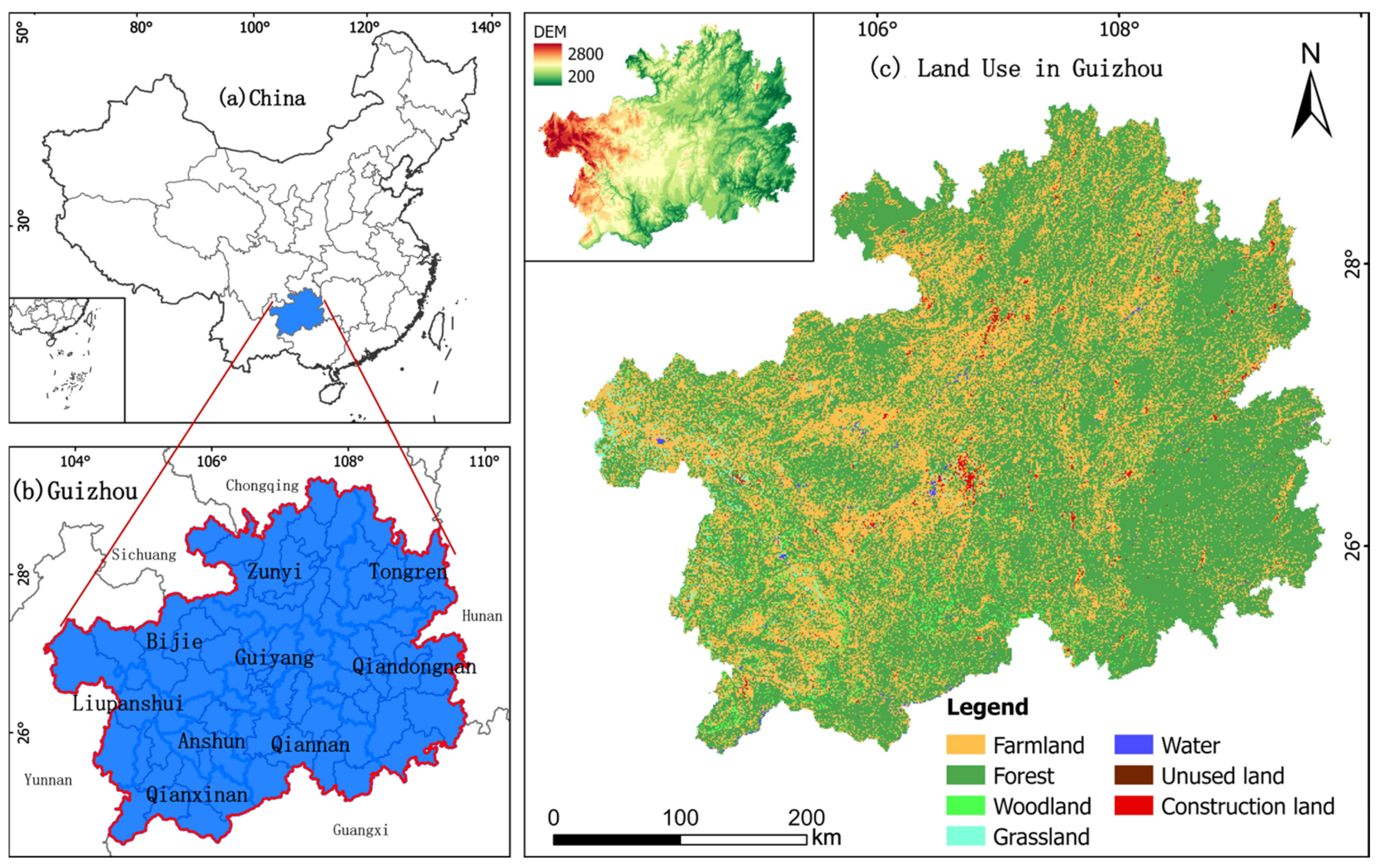
Guizhou Province (103°36′–109°35′ E, 24°37′–29°13′ N), located in southwestern China (Figure 1), has a typical mountainous karst landscape with a total area of approximately 1.76 × 10⁵ km2 and a topography that is high in the west and low in the east, and its average elevation isapproximately 1100 m. The climate is a subtropical humid monsoon climate with an average annual temperature of 10–18 °C, an annual precipitation of 1000–1500 mm, and moderate temperature and humidity, and the thermal and moisture conditions vary with elevation, creating complex microclimates. With diverse ecosystem types, high forest coverage (62.81% in 2022), and a favorable ecological background, Guizhou Province performs a strong ecological regulatory function and is susceptible to natural and anthropogenic perturbations.

2.2. Data Sources

The land use data used in this study were obtained from the China Land Cover Dataset (CLCD) published by Xin Huang’s team at Wuhan University [45], with a spatial resolution of 30 m. The soil data with a spatial resolution of 1 km were obtained from the China Soil Database (http://vdb3.soil.csdb.cn/, accessed on 2 December 2025). Elevation, slope, and aspect data with a spatial resolution of 90 m were downloaded from the Geospatial Data Cloud website (http://www.gscloud.cn/search, accessed on 2 December 2025). Net primary productivity (NPP) data with a spatial resolution of 0.5 km were obtained from the Google Earth Engine (GEE) data platform. Rainfall, potential evapotranspiration, humidity, and temperature data with a spatial resolution of 1 km were obtained from the National Tibetan Plateau Science Data Center (https://data.tpdc.ac.cn/, accessed on 2 December 2025) [46,47]. The 2022 GDP data for counties and cities in Guizhou Province were obtained from the China Statistical Yearbook—National Bureau of Statistics (stats.gov.cn). Population density data with a spatial resolution of 1 km were obtained from LandScan Population Data (https://landscan.ornl.gov, accessed on 2 December 2025). To ensure data consistency, all the raster data were uniformly projected to the WGS_1984 coordinate system; the spatial resolution was unified to 1 km × 1 km; and all the raster data were subjected to spatial matching processing and masking.
To ensure data consistency, all raster datasets were uniformly projected to the WGS_1984 coordinate system and standardized to a unified spatial resolution of 1 km× 1 km. Specifically, the land use data were applied to categorical data to preserve dominant landscape types, while bilinear interpolation was used for DEM and NPP to maintain the continuity of physical gradients. Finally, all raster data were subjected to spatial matching processing and masking to align the extent of the analysis.

2.3. Methods

The analytical workflow of this study is structured into three sequential phases. Phase 1 involves the biophysical quantification of CRESs based on energy. Phase 2 focuses on the multidimensional diagnosis of spatiotemporal patterns using the P-Q-D indicators and spatial statistics. Phase 3 applies the MGWR model to attribute spatial heterogeneity to specific multiscale drivers. The specific calculation procedures are detailed below.

2.3.1. CRESs Calculation Method

The core factor in CRESs assessment is evapotranspiration, through which the climate regulation value is quantified. Since actual evapotranspiration is difficult to obtain directly, the Budyko curve was used in this study for the calculation [48,49].
A E T i P = 1 + ω R 1 + ω R + 1 R
where A E T i represents the actual evapotranspiration in mm; P represents the monthly rainfall in mm; ω represents the ratio of plant available water storage to expected precipitation [50]; and R represents the ecosystem Budyko index.
R = k × E T 0 i P
where k represents the crop or plant coefficient that can be obtained from the InVEST 3.2.0 user’s guide and has a value between 0 and 1.5 [51], andcan be determined according to different vegetation cover types, and E T 0 i is the potential evapotranspiration in mm.
The watershed parameter ω is calculated using the dynamic parameterization scheme reported by Zhang et al., which physically couples soil properties with climatic conditions [52]:
ω = z × A W C P
where z is the rainfall characterization tensor coefficient reflecting the region, and its value in this study is 3.172 [53], and A W C is the effective plant water content (%).
A W C = 54.509 0.132 × S A N 2 0.055 × S I L 0.006 × S I L 2 0.738 × C L A + 0.007 × C L A 2 2.688 × C + 0.501 × C 2
A W C is calculated using a standard pedotransfer function, where S A N , S I L , C L A , and C are the percentages of sand, silt, clay, and organic carbon, respectively.
Although the Budyko framework is traditionally applied at the annual scale, the integration of A W C into Equation (3) allows the parameter ω to be adjusted dynamically based on monthly soil moisture conditions. This modification serves as a proxy for the soil water storage capacity, making the model applicable for capturing seasonal variations in evapotranspiration [52,54].
A E T a = i = 1 n A E T i
where A E T a is the actual annual evapotranspiration in mm, and n is 12.
Considering the contributions of both terrestrial and water surfaces to climate regulation, we utilized the total energy consumed by evapotranspiration as the functional metric for climate regulation ecosystem services [9,54]. The conversion to energy units is fundamentally based on the thermodynamic principle of latent heat flux. Evapotranspiration involves the phase change of water from liquid to vapor, a process that consumes a significant amount of solar radiation and effectively removes sensible heat from the surface. By converting the total volume of evaporated water into the energy required for this phase change, we quantify the ecosystem’s physical capacity to regulate local air temperature functioning analogously to the cooling effect of anthropogenic air conditioning.
E Q c r = E Q e c o + E Q w a
E Q e c o = A E T a × A × 2450 × 1000 3600
E Q w a = A E T a × A × 2450 × 1000 3600 + A E T a 2450 × y
where E Q c r is the functional quantity of the climate regulation ecosystem, with a unit of kWh ; E Q e c o is the terrestrial ecosystem climate regulation energy consumed, with a unit of kWh ; A is the area, with units of km 2 ; and 2450 is the conversion factor, representing the heat required for water surface evaporation when the water temperature is 100 °C, and the standard atmospheric pressure required for surface evaporation of 1 kg of water, which has a value of 2450 kJ kg 1 . E Q w a is the energy consumed by the surfaces of lakes, rivers, reservoirs, and other surface climate regulation ecosystems, with a unit of kWh ; y is the humidity that transforms 1 m 3 of water into steam power, and the market common appliance conventional power is 32 W , which converts to 125 kWh [12,55].

2.3.2. Multidimensional Assessment Framework

CRESs exhibit spatial heterogeneity and temporal variability, and a single indicator cannot fully reveal their ecological functional status. Therefore, this paper introduces the multidimensional assessment framework proposed by Shi et al. [37], which includes total output (P), efficiency (Q), and development trend (D). To comprehensively evaluate the status of CRESs for regional management, these indicators were calculated at the county level (88 administrative units). The specific definitions are described below.
The total output (P) reflects the overall size of the regional CRESs; the efficiency (Q) represents the number of CRESs per unit area, where disturbances due to spatial area are removed; and the development trend (D) reflects the dynamics of the number of CRESs per unit area.
Q = P S
D = Q e n d Q s t a r t t
where S is the area of the county, t represent the beginning and end years of each five-year period (e.g., 2002 and 2007).To achieve comparability of indicators between different periods and spatial units, the three indicators were standardized (with a mean of 0 and a standard deviation of 1) to form a multidimensional assessment index, which was calculated as follows:
P i j = P i j P ¯ j σ P j
Q i j = Q i j Q ¯ j σ Q j
where P i j , Q i j , and D i j are the total number of CRESs, the number of CRESs per unit area, and the annual variation in the number of CRESs per unit area, respectively; P ¯ j , Q ¯ j , and D ¯ j are the mean values for the study area, σ P j , σ Q j , and σ D j , and are the standardized variance of the amount of climate modulation.
The status of CRESs in different regions can be identified by jointly determining the relative values of P, Q, and D. For example, if a region shows positive values for P, Q, and D in a year and an increasing trend in recent years, this indicates that its ecosystem as a whole is in a “progressive state” of benign development; in contrast, the system behaves in a “degraded state” if the values are negative. In the actual analysis, inconsistencies in the indicators of the dimensions are common, e.g., if the development trend is negative (D < 0) in a region despite high total output and unit efficiency (P > 0, Q > 0), this reuslt suggests a trend of degradation in the current level of service, although it is high.
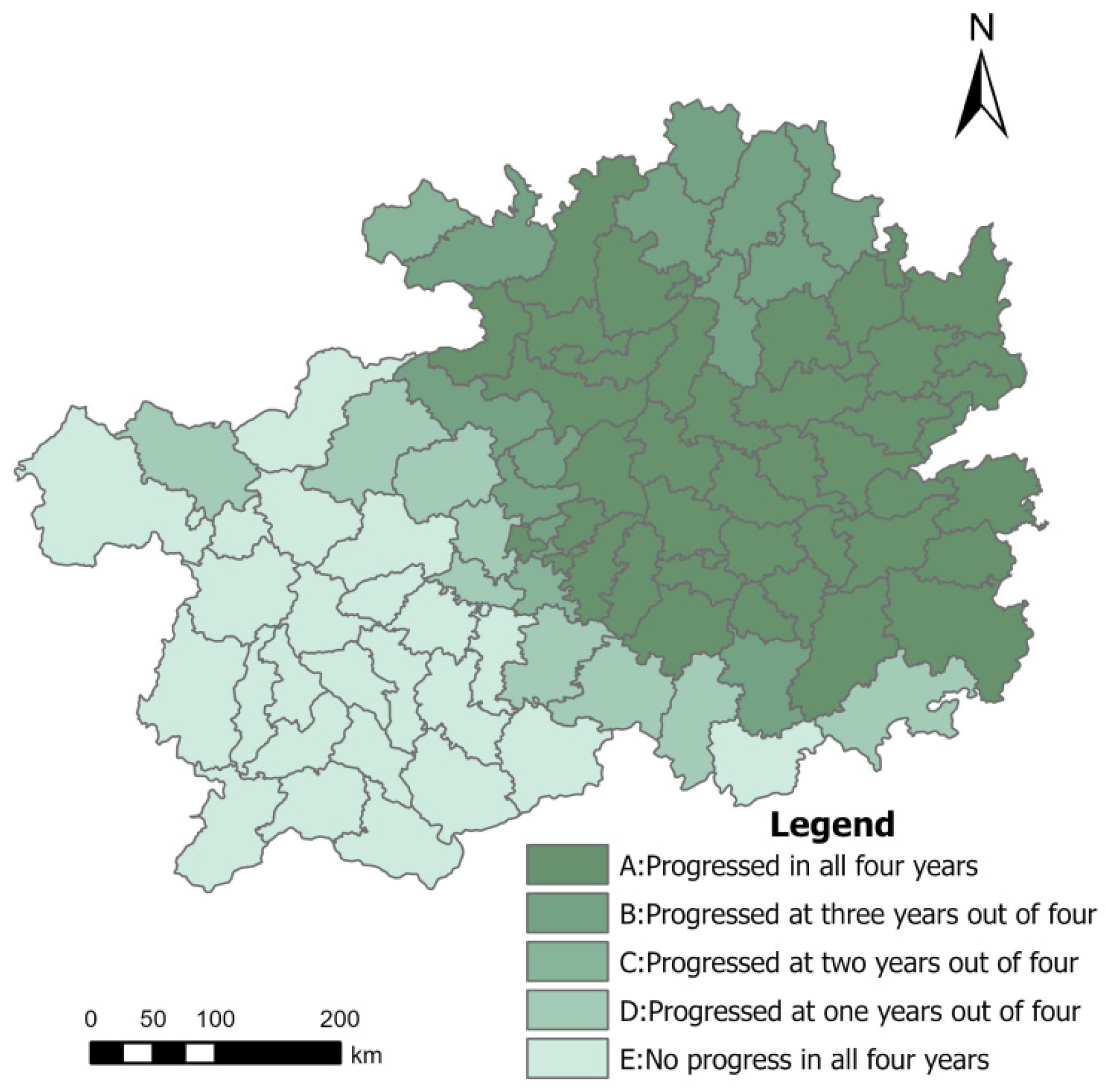
Accordingly, based on the number of times each county (city) had a positive D in the study year, the study area was categorized into five types of progress zones: Category A, where progress occurred in all four years; Category B, where progress occurred in three years; Category C, where progress occurred in two years; Category D, where progress occurred in one year; and Category E, where no progress occurred (Figure 2). This zoning approach helps reveal the long-term dynamics of changes in regional ecosystem services changes and governance priorities.

2.3.3. Exploratory Spatial Data Analysis

Exploratory spatial data analysis (ESDA) focuses on detecting spatial autocorrelation and clustering patterns in geographic data. In this study, Moran’s I and the Getis-Ord Gi* statistic were used to examine the spatial heterogeneity of the CRESs.
Moran’s I index is used to assess the degree of spatial aggregation or disaggregation of elements, and was calculated using the following formula:
I = n i = 1 n j = 1 n W i j ( x i x ¯ ) ( x j x ¯ ) i = 1 n j = 1 n W i j i = 1 n ( x i x ¯ ) 2
Moran’s I > 0 indicates the presence of a positive spatial correlation; Moran’s I < 0 indicates the presence of a negative spatial correlation; and Moran’s I = 0 indicates no spatial correlation.
Hotspot analysis is a mapping technique based on the Getis-Ord General G* index that focuses on identifying spatial aggregation phenomena for spatial clustering. Its mathematical model can be expressed as follows in Equation (15):
G i * = j = 1 n w i j x j x ¯ j = 1 n w i j j = 1 n x j 2 n 1 x 2 n j = 1 n w i j w ( j = 1 n w i j ) n 1
A positive value indicates a hotspot where high values are clustered; a negative value indicates a coldspot where low values are clustered.
In the calculation of spatial autocorrelation, a first-order Queen Contiguity spatial weight matrix was constructed. For global Moran’s I, the statistical significance was assessed using Monte Carlo randomization with 999 permutations. For the hotspot analysis (Getis-Ord G i * ), cluster significance was identified at confidence levels of 90% (p < 0.1), 95% (p < 0.05), and 99% (p < 0.01).

2.3.4. Multiscale Geographically Weighted Regression

In terms of spatial relationships, a multiscale geographically weighted regression (MGWR) model was introduced in this study to explore the roles of different influencing factors in CRESs.
Multiscale geographically weighted regression (MGWR) is an extension of the traditional geographically weighted regression (GWR) model, and it is designed to better capture spatial heterogeneity in the relationships between response and explanatory variables. Unlike GWR, which applies a uniform bandwidth to all variables, MGWR allows each explanatory variable to have its own optimal bandwidth. This flexibility enables more accurate modeling of spatially varying effects, improving estimation reliability and revealing localized differences—such as the varying direction and strength of a factor’s impact on CRESs across regions.
The basic formula for the MGWR model is as follows:
y i = β 0 μ i , ν i + j = 1 m β b w j μ i , ν i X i j + ε i
Compared with the GWR model, where β b w j μ i , ν i is the regression coefficient of the j -th predictor variable, b w j is the optimal bandwidth of the j -th predictor variable.
In this study, the MGWR model was calibrated using the Adaptive Bisquare Kernel function. The optimal bandwidth for each covariate was determined using the Golden Section Search method based on the minimization of the Corrected Akaike Information Criterion (AICc). To ensure the statistical robustness, the Variance Inflation Factor (VIF) was calculated to check forassess multicollinearity (VIF < 10).
To implement this model for empirical analysis, the most recent year, 2022, was chosen to study influencing factors, given its relevance as a guide to current practice. Referring to the theoretical and empirical research results on the accounting of ecosystem services and climate regulation services in the literature, and combining the availability and representativeness of the data, the influencing factors were screened from four perspectives [30,36,56,57,58]: (1) climatic factors, including annual humidity, annual precipitation, and annual temperature; (2) topographic factors, including elevation, slope, and slope direction; (3) vegetation factors, including vegetation cover and net primary productivity (NPP); and (4) socioeconomic factors, including population density and gross domestic product (GDP).

3. Results

3.1. Trends of Variations in CRESs

3.1.1. Evolutionary Trends in the Province

Using the methods described in Section 2.3.2, the CRESs of Guizhou Province were calculated, including the CRESs per unit area and the total CRESs of Guizhou Province (Table 1). The overall trend of CRESs numbers in Guizhou Province is increasing.

3.1.2. County-Level Multidimensional Assessment of the Distribution

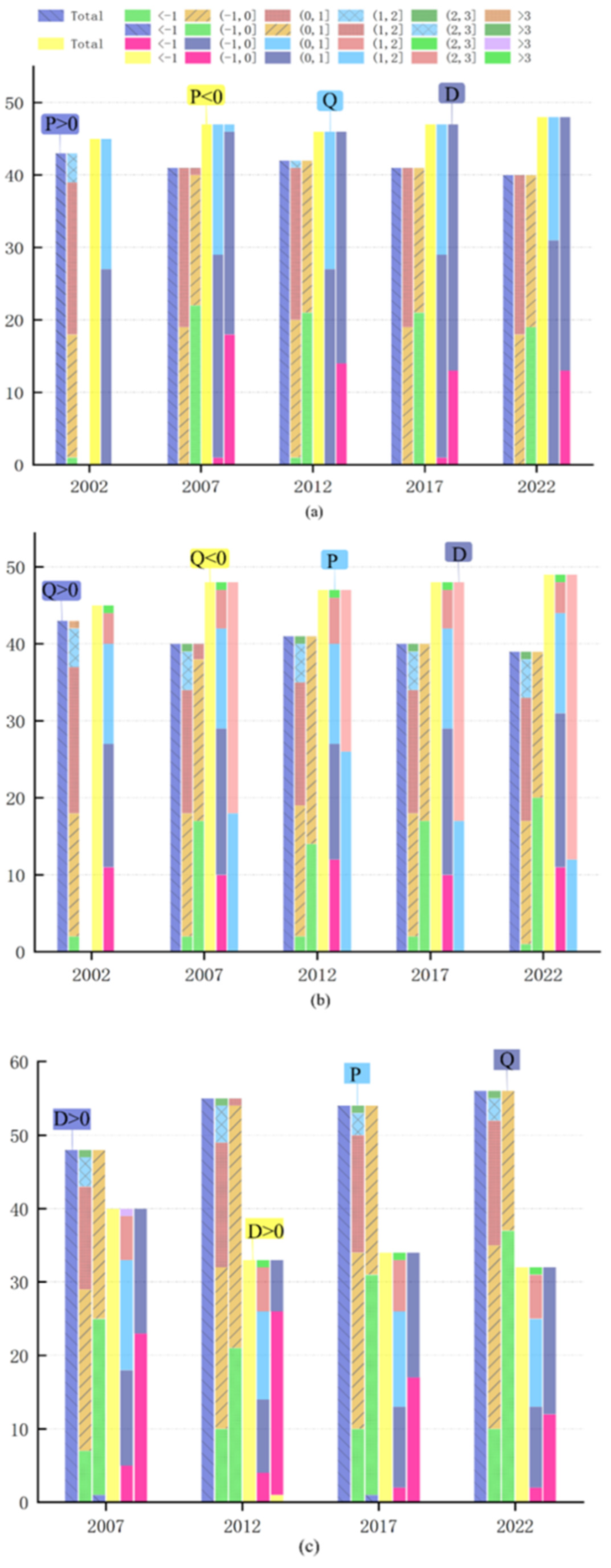
In this study, the equal interval method was used to assess the total output index (P), efficiency index (Q), and development trend index (D) in a hierarchical manner, revealing the characteristics of the differences among counties in the output–efficiency–development trend dimension (Figure 2).
From 2002 to 2022, the CRESs in Guizhou Province generally showed a positive development trend, but P and Q of the province remained low (Figure 2). Statistics showed that, on average, more than 51% of the counties in the province consistently had P and Q values below the average level, and approximately 64% of the counties had D values above the average level, which indicates that CRESs in Guizhou Province are developing in a positive direction overall, despite the low baseline level.
There was a correlation between P and Q (Figure 2a). When P was above average, its Q was generally in the positive range around the average. In contrast, when P was below average, its Q was low, with approximately 31% of counties having below average Q values, suggesting that insufficient output is a cause of inefficiency.
High efficiency does not necessarily lead to a high output or sustained positive evolution, whereas inefficiency may inhibit output and development dynamics (Figure 2b). When Q was above average, approximately 19% of counties still had below-average P and D values, suggesting that, despite the high unit efficiency, this group of counties may have had insufficient output and developmental fluctuations due to resource or size constraints. In contrast, when Q < 0, 31% of counties had P < 0 and 14% had D < 0, reflecting the negative transmission effect of inefficiency on the climate-regulated output and sustainable evolution of ecosystems.
The D of the CRESs had a key effect on P and Q (Figure 2c). When D was above average (D > 0), P and Q were generally higher in the county and showed a slightly positive trend over the study period. However, even with the positive trend, approximately 33 percent of counties with D > 0 still had below-average total output P values, and 24 percent of counties with D > 0 had below-average efficiency Q. This indicates that the improvement in CRESs has been uneven across regions, and that sustainable improvements require local weaknesses to be addressed and the promotion of a balanced ecological regulation capacity rather than relying solely on overall upward trends.

3.2. Analysis of Spatial Variation in CRESs

3.2.1. CRESs Output

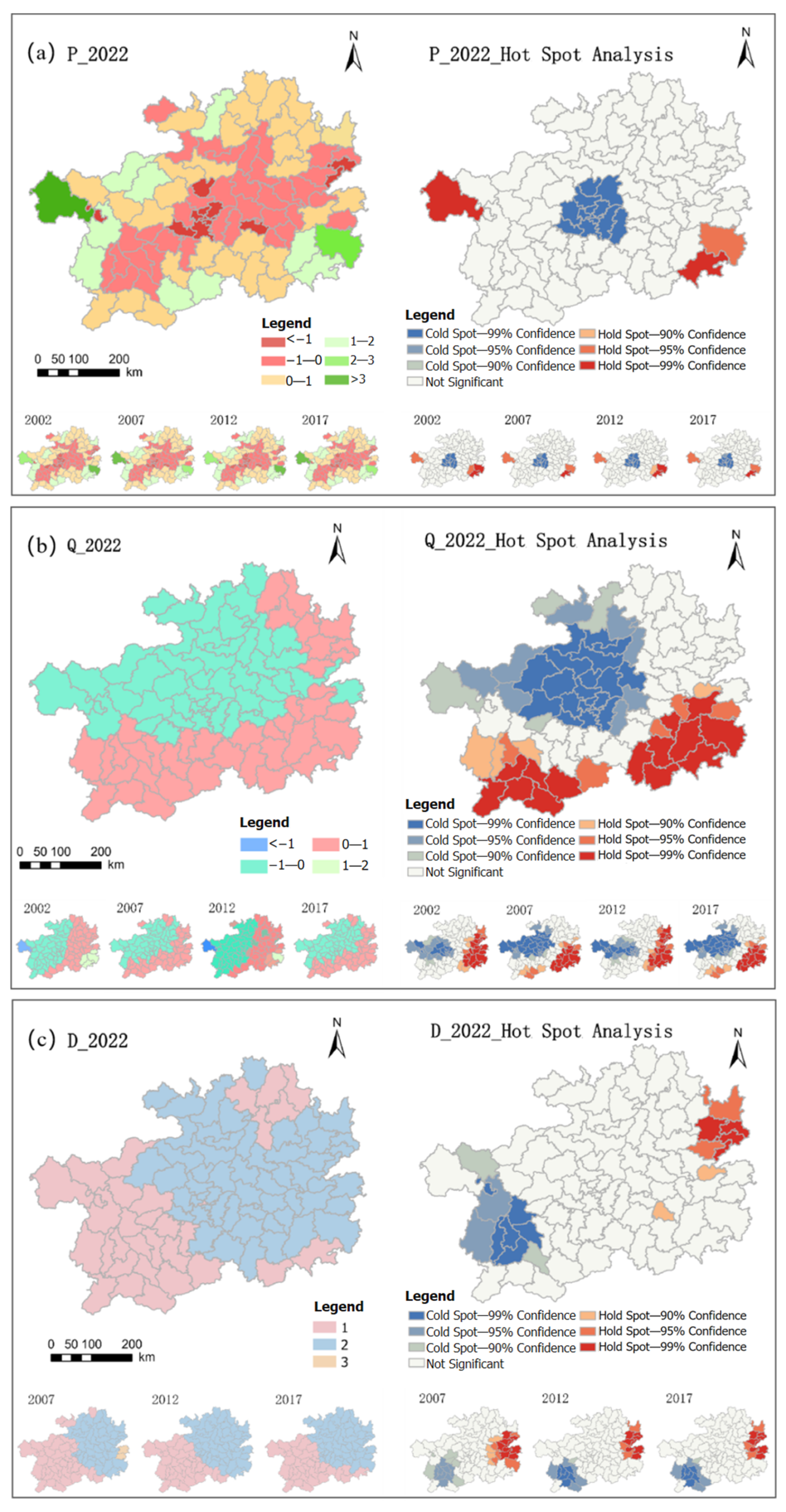
The total output showed a stable spatial distribution with significant spatial differences. The above-average regions were located mainly in the west and south of Guizhou Province (Figure 3a), with Weining County ranking first in the province in terms of total CRESs output. The below-average counties were concentrated in the central part of Guizhou Province, especially in Guiyang city. Compared with the past four years, the spatial distribution pattern of the output index (P) generally remained stable, and the differences among regions were basically consistent. Through a hotspot analysis, the results revealed a continuous and significant spatial aggregation of CRESs, forming two stable hotspot areas and one coldspot area (Figure 3a). Particularly noteworthy is the more stable distribution of hotspot regions and the narrowing trend of coldspot regions, indicating an increase in the output of CRESs in the region.

3.2.2. CRESs Efficiency

CRESs efficiency showed significant spatial heterogeneity within Guizhou Province. The Q was generally high in the southern region, whereas the Q value in the central and northern regions was mostly below average (Figure 3b). Weining County appeared to have aQ value less than −1 in 2002 and 2012, indicating the low efficiency of CRESs in the region; Qiandongnan Miao and Dong Autonomous Prefecture demonstrated high efficiency with Q value greater than 1 in 2002; and Liping County was again outstanding in 2012, showing high efficiency of climate regulation. The hotspot areas gradually migrated from the east to the south, whereas the coldspot areas tended to spread from the west to the north. Stable and efficient hotspot areas formed in the southern and eastern regions, and significant coldspot areas formed in the northern region of the province (Figure 3b).

3.2.3. CRESs Development Trends

The spatial distribution pattern of D in the CRESs generally remained stable. Counties in southern and western regions exhibited lower development trends in terms of efficiency, and those in the eastern and northern regions exhibited higher development trends (Figure 3c). The Ddevelopment trends in Jinping County and Tianzhu County exceeded 1 in 2007, indicating a high level of development trends in efficiency. By 2022, D in the northern region was less than 1, and its value was close to 0. Combined with the map of the hotspot analysis (3(c)), the efficiency development trends of the CRESs in Guizhou Province showed a significant spatial aggregation of coldspots and hotspots. Significant hotspot areas formed in the northeastern region, and stable coldspot areas formed in the southwestern region.

3.2.4. Identification of Progression Zones in CRESs

To visualize the long-term evolution of the CRESs in each county, this study categorized the indices of development trends using the methods described in Section 2.3.2 (Figure 4). Progress zones gradually changed from west to east from Category E to A. Category A progress zones were the most numerous, accounting for 45% of the total number of counties, and they were clustered in the eastern part of Guizhou Province. While Category B and E progress zones dominated in other counties, the concentration of Category E zones in a few counties in the western and central areas of the country indicated a chronic lack of effective ecological regulation in these areas. Strengthening ecosystem restoration, land management, and adaptive governance in these areas is therefore essential to achieving balanced and sustainable CRESs development across the province.

3.3. Multiscale Analysis of Factors That Impact CRESs

OLS, GWR, and MGWR models were constructed to analyze the spatial effects of different drivers on CRESs within the study area. The R2 and adjusted R2 values determined using MGWR were greater than those determined using OLS and GWR (Table 2), indicating that MGWR can effectively reveal the quantitative effects of the considered factors on CRESs.
Before analyzing the driving mechanisms, we verified the reliability of the model. As shown in Table 3, the Variance Inflation Factor (VIF) for all factors ranged from 1.2 to 5.6, indicating no severe multicollinearity. While Table 2 confirms the superior fitting performance of MGWR, we further tested the model residuals using Moran’s I. The result was 0.018, confirming that spatial autocorrelation was effectively eliminated and the residuals were randomly distributed.
In terms of the intensity of the impact, the top two influencing factors were vegetation cover and annual precipitation, which were also significant factors. The intensity of influence in descending order was GDP > elevation > annual temperature > annual humidity > slope > population density > aspect > NPP.
In terms of the range of influence, population density had the largest range of influence, followed by GDP and elevation; these factors were defined as long-distance influencing factors. The NPP, slope, vegetation cover, and aspect were defined as medium-distance influencing factors; and the annual temperature, annual precipitation, and annual humidity were identified as short-distance influencing factors (Table 3).

3.3.1. Analysis of the Impacts of Long-Distance Factors

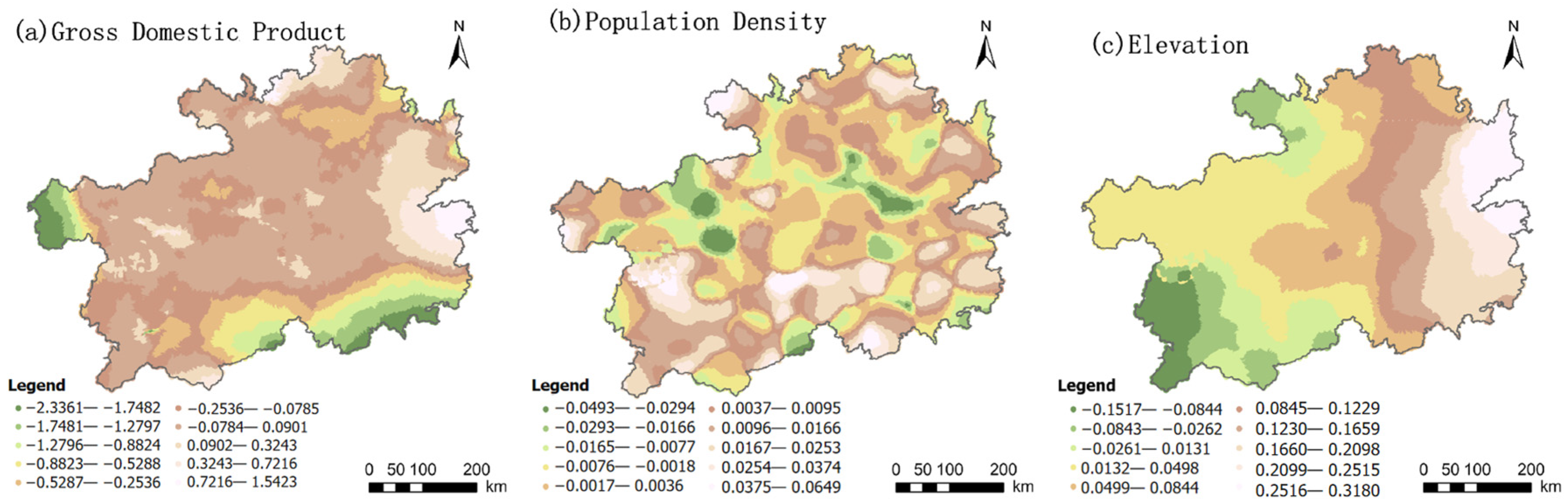
Among the long-distance influencing factors, GDP had the most significant influence on CRESs, with a mean coefficient of −0.189, which was significantly greater than that of 0.002 for population density and 0.072 for elevation. This result suggests that CRESs changed by −0.189%, 0.002%, and 0.072% when GDP, population density, and elevation increased by 1%, respectively (Table 3).
The intensity of the impact of the GDP was low in southeastern and western Guizhou Province. In contrast, in Tianzhu County in the east and Tongzi County in the north, the intensity of the impact of GDP was high, and most of the other areas had medium impact intensities (Figure 5a). The negative impact of GDP was the greatest, and the pressure of economic activities on CRESs was greater.
In contrast, population density had less of aninfluence on the CRESs in Guizhou Province, and the spatial distribution was more fragmented. Overall, the trend of spreading outward in a circular pattern with low or high values as the center point was more obvious (Figure 5b). Since Guizhou has a typical karst landscape with rugged surfaces and uneven population distributions across the country, this circular spatial feature reflects the localized effect of population density on CRESs in local areas, but the overall effect was more limited.
Elevation had a slight positive effect on CRESs, and its spatial distribution pattern was more consistent with the topographic features of Guizhou Province (Figure 5c). From east to west, the intensity of the effect of elevation gradually decreased, and the eastern region exhibited a characteristic strip-like distribution, whereas the western region was dominated by a large median area. This distribution pattern showed that elevation changes potentially modulated CRESs, with more significant effects on the eastern low-elevation regions and weaker effects on the western high-elevation regions.

3.3.2. Analysis of the Impacts of Medium-Distance Influencing Factors

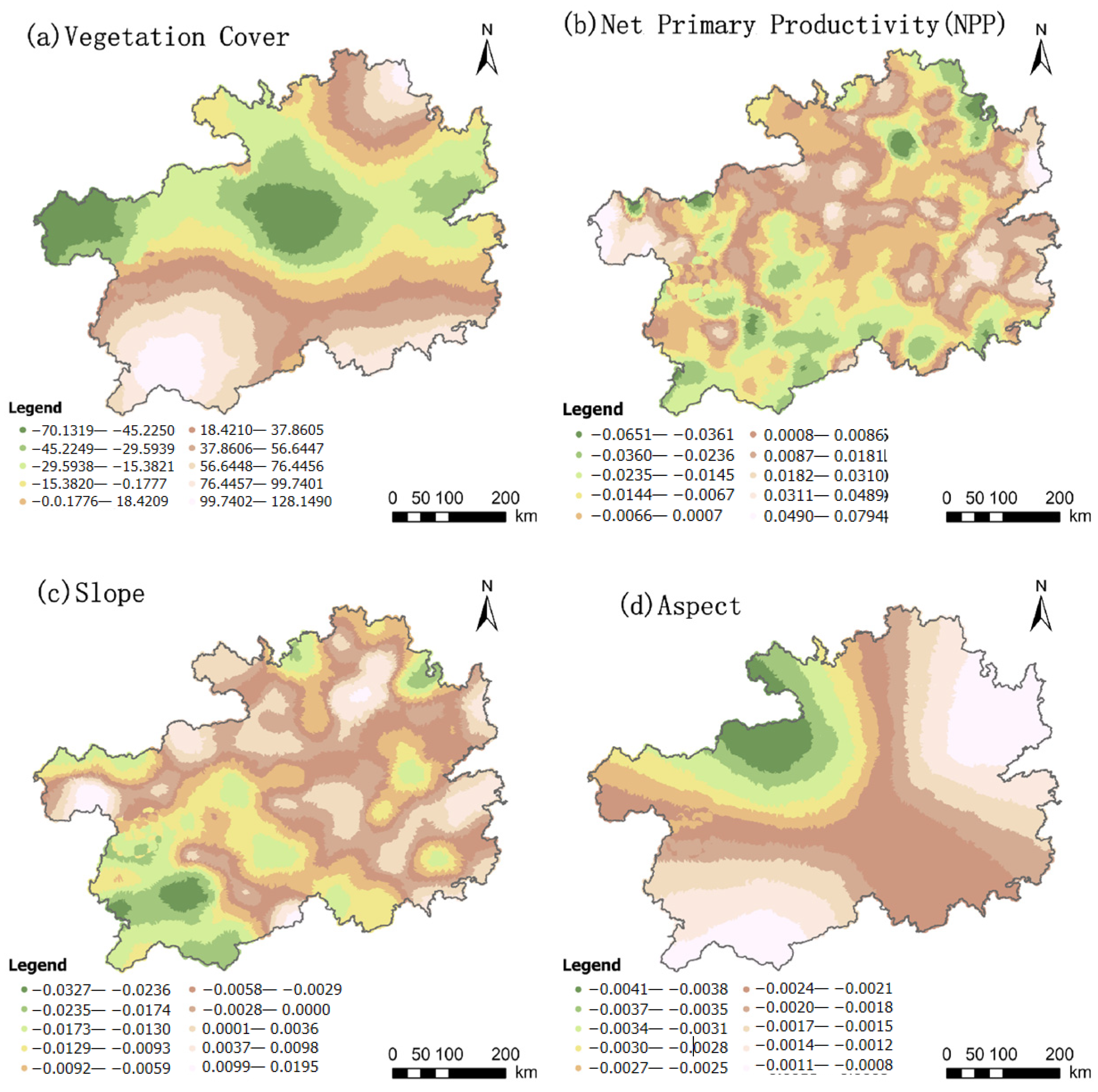
Among the medium-distance influencing factors, vegetation cover had the greatest influence on the CRESs, with an average coefficient of 1.494, which was significantly greater than the value of −0.001 for NPP, −0.006 for slope, and −0.002 for aspect (Table 3). This suggests that each 1% increase in vegetation cover resulted in an average increase of 1.494% in CRES numbers, whereas NPP, slope, and aspect resulted in average decreases of 0.001%, 0.006%, and 0.002%, respectively, in CRES numbers.
Vegetation cover had the most significant effect on the CRESs, indicating the importance of vegetation cover for the value of ecosystem services. Its high-impact intensity zone was mainly concentrated in southwestern Guizhou Province, extending in a band to the north, and a significant impact was also observed in Yanhe County in the north (Figure 6a). Wudang District, Kaiyang County, Xifeng County in the central region, and Weining County in the west exhibited zones of low impact intensity. This reflects the positive contribution of the degree of vegetation cover to CRESs, especially in the densely vegetated karstic mountainous areas, where the soil and water conservation capacity and microclimate regulation of vegetation in this region are more significant.
In contrast, the overall distributions of NPP and slope were more dispersed and did not show significant spatial patterns (Figure 6b,c); however, overall, the impact was greater in the northeast and less intense in the southwest regions of Guizhou Province.
Aspect had a slight negative effect on CRESs. The intensity of the effect of aspect showed obvious spatial symmetry, with a symmetrical distribution of lower-intensity influences on CRESs in the northwest to southeast direction (Figure 6d). The low-value areas were concentrated in the northwest, whereas the high-value areas appeared in the southwest and northeast. This distribution reflects the intrinsic relationship between the aspect and Guizhou’s topography, which results in a difference in climate regulation effects in the northwest and southeast regions bounded by the aspect.

3.3.3. Analysis of the Impacts of Short-Distance Influencing Factors

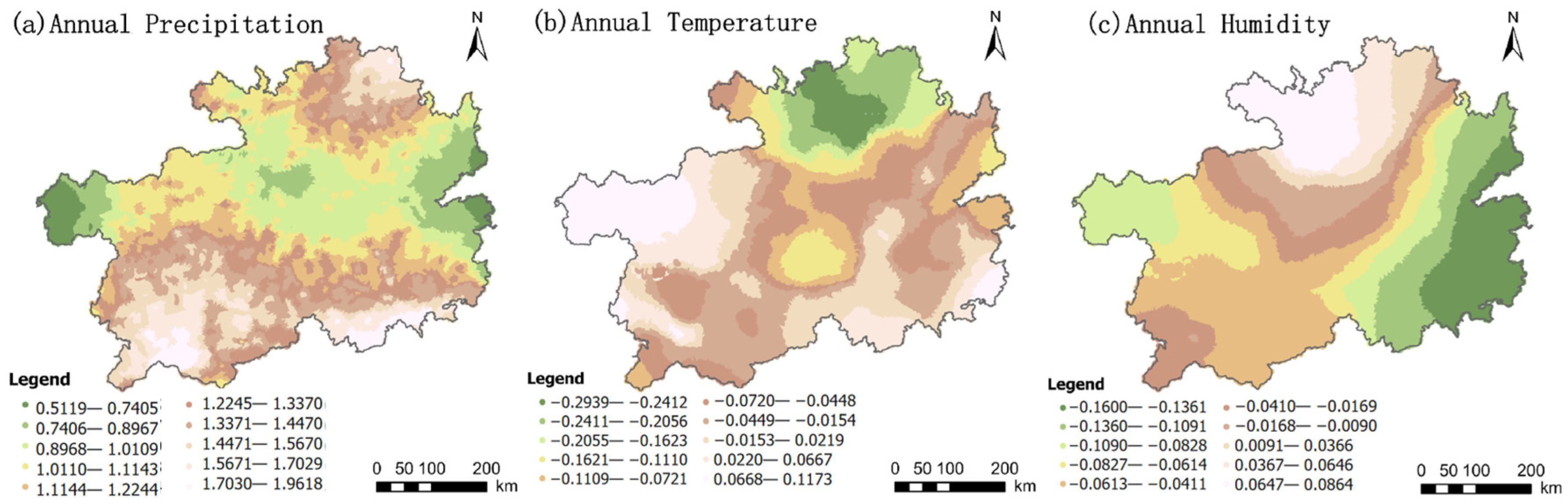
In the analysis of short-distance influencing factors, annual precipitation had the most significant influence on CRESs in Guizhou Province, with a mean coefficient of 1.196, which was significantly greater than the values of −0.053 for annual temperature and −0.050 for annual humidity (Table 3). This indicates that when the mean annual precipitation increased by 1%, CRES numbers increased by an average of 1.196%, whereas the annual temperature and annual humidity resulted in average decreases in CRES numbers of −0.053% and −0.050%, respectively.
Annual precipitation had a stable positive effect on the CRESs, and the distribution pattern was very similar to that of vegetation cover (Figure 7a), with the main high-value zones concentrated in southwestern and southern Guizhou Province, extending in a band to the north, and forming high-value zones in Yanhe County. In addition, Tianzhu County in the east and Weining County in the west exhibited low impact intensities and limited contributions to the CRESs.
The high-impact zones of annual temperature were observed in the western region of Guizhou Province (Figure 7b), which are mostly high-altitude areas with relatively low temperatures and high impact intensities on climate regulation. The low-impact zones were concentrated in northern Guizhou Province.
The high-impact zones of annual humidity were concentrated in the northwest and exhibited a northeast-southwest-oriented belt distribution (Figure 7c). In the southwestern region, the pattern was mainly a low-impact intensity zone, and the southwestern region mostly had a moderate impact intensity.

4. Discussion

4.1. Applicability and Scientific Basis of the Energy-Based Assessment

The scientific quantification of climate regulation ecosystem services requires a clear distinction between biogeochemical and biophysical mechanisms. The selection of the energy-based assessment in this study is driven by the need to bridge the functional gap between global climate mitigation targets and local thermal regulation needs.
Mainstream tools, such as the InVEST Carbon module, predominantly focus on the long-term sequestration of greenhouse gases (biogeochemical processes). While carbon sequestration is vital for mitigating global warming, it does not directly represent the immediate physical cooling capacity required to mitigate local heat islands. To address this limitation, this study adopts an energy-based assessment method derived from actual evapotranspiration (AET), referencing relevant technical specifications [59,60] and regional studies by Deng et al. [54]. Instead of relying on indirect proxies, our approach calculates the energy consumed during the water evaporation process (kWh). This metric directly quantifies the ecosystem’s physical capacity to absorb surface heat and lower regional temperatures. Effectively, this method provides a measure of the ecosystem’s “natural air-conditioning” efficiency, offering a more relevant and actionable indicator for spatial planning aimed at improving regional microclimates than carbon storage metrics.
Furthermore, the reliability of our results is validated through comparison with existing local research. Our estimated CRESs values are consistent in magnitude with those reported by Deng et al. [55] for forest ecosystems in the Guanshanhu District of Guizhou. Although specific values differ slightly due to the broader spatial scope and the inclusion of diverse ecosystem types beyond forests, this consistency confirms the robustness of energy-based accounting for regional management.

4.2. Diagnostic Value of the Multidimensional Framework for Regional Heterogeneity

Traditional ecosystem service assessments often prioritize total output (P), treating the aggregate magnitude of services as the primary indicator of ecological health. However, in the highly heterogeneous karst landscape, this “stock-oriented” perspective can be misleading. It often conflates the influence of the administrative area size with actual ecological function, thereby masking spatial disparities in efficiency (Q) and development trends (D). The multidimensional framework addresses this limitation by decoupling these dimensions, providing a more granular diagnosis of the regional ecological status.
The necessity of this multi-lens approach is exemplified by the distinct spatial discrepancy observed in Weining County. As shown in the results, Weining County ranks first in the province for total output (P), identifying it as a “hotspot” for service provision. Based solely on this metric, policymakers might erroneously classify it as a pristine ecological haven requiring minimal intervention. However, the efficiency (Q) dimension reveals a contradictory reality: Weining is simultaneously a “coldspot” for unit-area service intensity. This discrepancy indicates that its high total output is largely an artifact of its vast administrative area rather than superior ecological quality. In reality, the region’s biophysical regulatory capacity per unit of land is severely constrained, likely by the prominent rocky desertification and soil water deficits typical of the western karst plateau.
Furthermore, the integration of the development trend (D) dimension allows for the identification of evolutionary trajectories that static snapshots miss. By overlaying these three dimensions, we can distinguish between “high-quality stable zones” (high P, high Q, and positive D) and “inefficient degrading zones” (low Q and negative D). This diagnostic capability is critical for avoiding “pseudo-optimization” in regional management, where the total service value increases merely due to area expansion (e.g., afforestation quantity) while ecological efficiency (quality) remains stagnant or declines.

4.3. Multiscale Spatial Heterogeneity of Influencing Factors

The MGWR analysis identified significant variations in the operating scales (bandwidths) of different driving factors, ranging from 44 to 1629 (Table 3). This multiscale heterogeneity reveals that the influence of climatic, vegetation, topographic, and socioeconomic factors on CRESs operates at distinct spatial levels.
Localized effects of climatic factors, including annual humidity, precipitation, and temperature, exhibited the smallest bandwidths while exerting the strongest positive impact intensity. This finding provides a critical refinement to the “scale dependence” hypothesis [29]. Unlike the broad climatic patterns observed at continental scales, the highly fragmented topography in Guizhou creates complex vertical climate zones. Our results suggest that, in such heterogeneous terrain, hydrothermal conditions vary significantly over short distances, forming localized microclimates. Consequently, climatic drivers act as decisive microscale constraints, requiring localized parameter estimates to accurately capture their driving effects.
Vegetation factors and topographic factors operated at intermediate regional scales. This indicates that land cover patterns and geomorphological features influence CRESs primarily at the watershed or landscape level. This scale aligns with the physical continuity of mountain ranges and vegetation belts, which bridge the gap between local micro-climates and broad regional trends. The significant positive influence of vegetation cover further corroborates the findings of Sun et al. [30], who identified natural geography as a dominant determinant of the ecosystem service distribution.
In contrast, socioeconomic drivers such as GDP and population density operated at global scales with consistent negative influences. This suggests that anthropogenic disturbances exert a relatively spatially stationary pressure across the province. Economic development and population aggregation in Guizhou are often driven by macro-level government planning and regional infrastructure networks. These policy-driven forces impose a consistent trade-off relationship between economic growth and ecological protection that transcends local topographic boundaries.
Overall, the driving mechanism of CRESs is characterized by a hierarchical structure: microscale climatic conditions determine the local potential, watershed-scale vegetation and topography shape the regional pattern, and macroscale socioeconomic policies impose a background constraint. This understanding highlights that ecological management requires a multitiered approach, matching specific governance measures to the operating scales of different drivers.

4.4. Differentiated Regional Pathways for Sustainable Management

The positive trend in CRESs has been driven by robust policy frameworks. For instance, the China Adaptation to Climate Change Project Phase II launched in 2015 and the establishment of the Guizhou Project Leadership Group in 2016 have significantly strengthened institutional capacity for climate resilience. In addition, ecological restoration programs such as the Chishui River Basin Horizontal Ecological Compensation Agreement have demonstrated the success of cross-regional coordination [61]. These efforts align with the broad spatial influence of socioeconomic drivers identified in our model and have laid a solid foundation for the province’s ecological security.
However, relying solely on uniform macro-policies is insufficient to address the local heterogeneity of the karst landscape. To resolve spatial discrepancies such as the high quantity but low efficiency observed in Weining County, management strategies must shift from maintaining aggregate magnitude to improving ecological quality in these “efficiency coldspots”. Our analysis indicates that high total service values in the western karst plateau are largely artifacts of vast administrative areas rather than superior ecological conditions. Therefore, policymakers should not be misled by high aggregate numbers. Interventions in these zones should prioritize comprehensive rocky desertification control and improved ecosystem quality to boost the unit-area biophysical regulatory capacity.
Since socioeconomic drivers like the GDP and population density operate at global scales, their impacts are spatially consistent. Management should remain centralized at the provincial level to optimize the spatial layout of economic development and minimize trade-offs with ecological protection. In contrast, climatic factors exert dominant influences at local scales. This implies that ecological management cannot be uniform. Authority should be decentralized to local administrative units to implement site-specific conservation measures that align with the unique hydrothermal conditions of local micro-catchments. By integrating these macro-foundations with micro-precision strategies, Guizhou can transition from quantity-based growth to quality-based sustainability.

4.5. Limitations and Future Studies

Despite the robust insights provided by the multidimensional framework and MGWR model, several limitations inherent to the methodological assumptions and data constraints must be acknowledged. First, regarding hydrological mechanisms, the application of the Budyko framework at a monthly resolution simplifies the water balance by assuming negligible changes in soil water storage. Although the AWC-based parameterization compensates for surface retention, uncertainties may persist during dry–wet transition periods. Additionally, while our forward calculation approach isolates soil layer evapotranspiration from underground leakage, the potential feedback of deep karst hydrological processes on surface energy exchange warrants further investigation. Second, regarding data precision, the unification of multisource datasets (ranging from 30 m to 500 m) to a 1 km resolution was necessary for model compatibility but introduces scaling effects. This resolution inevitably smooths the high heterogeneity of karst micro-landscapes, such as the mosaic of rock outcrops and soil patches. Third, regarding the analytical method, the MGWR model is fundamentally an additive model designed to isolate the spatial scale of individual drivers. While it effectively captures spatial non-stationarity, it does not explicitly quantify the complex interaction effects among driving factors.
To bridge these gaps and deepen the scientific impact on sustainable management, future research should focus on integrating multisource data fusion and expanding the assessment scope. Specifically, combining process-based biophysical models with ground-based observations, such as eddy covariance flux towers, will be essential to validate the “energy–water” coupling mechanism at the micro-catchment scale, thereby refining the accuracy of regional assessments. In addition, future studies should employ complementary methods, such as Geodetectors, to quantitatively investigate the non-linear interactions between natural and socioeconomic drivers. Finally, to formulate actionable regional pathways, future work must extend beyond the supply side to the demand side of ecosystem services. This includes quantifying the ecosystem service flows from supply zones to beneficiary areas and analyzing the complex trade-offs and synergies between CRESs and other services, such as water provision and food security. Integrating these dimensions will be crucial for constructing a comprehensive human–nature coupled model to optimize regional ecological security patterns.

5. Conclusions

In this study, we conducted a more comprehensive analysis to synthesize the total output, efficiency, and development trends of CRESs, to explore the strength and scope of the roles of influencing factors, and to fulfill the objective of providing a robust basis for sustainable management.
The following results were obtaineds. (1) Over the past 20 years, the CRESs numbers in Guizhou Province have shown a generally favorable trend, but an imbalance of a “low output–low efficiency–high development trend” has been observed among counties. (2) There is a strong correlation between total output (P) and efficiency (Q), while development trends (D) are largely oriented toward improving these baseline conditions. (3) The spatial pattern of CRESs varies significantly, and dynamic characteristics of stabilizing hotspot zones and improving coldspot zones were observed. (4) The “progress areas” show a clear gradient from west to east, with Category A areas concentrated in the east, whereas Category E areas are located mainly in the west. (5) In terms of the intensity of the influence, vegetation cover and annual precipitation were identified as the strongest positive drivers. In terms of the range of influence, population density and GDP exhibited the broadest spatial scales (global effects). (6) The drivers of CRESs display significant spatial non-stationarity, manifesting as banding or regional aggregation patterns. Specifically, rainfall exerts a consistent positive effect, while slope orientation shows a slight negative effect. The remaining factors (e.g., GDP and temperature) exhibit bidirectional effects, varying between positive and negative effects on different regions.
Based on these findings, we propose the following sustainable management strategies: (1) Differentiated Optimization—Given the pronounced spatial heterogeneity, management strategies must be differentiated. Urgent attention to the western regions is needed to increase the CRES levels through targeted ecological restoration. (2) Multiscale Coordination—Governance should align with the operating scales of drivers. Broad-scale socioeconomic pressures require unified provincial planning, while local climatic and vegetation constraints necessitate microscale adaptive management. This multiscale coordination is essential for advancing regional ecological civilization and achieving sustainable development goals.

Author Contributions

L.Z.: Investigation, Software, Visualization, Writing—original draft preparation. M.L.: Data curation, Investigation, Methodology, Software, Visualization, Writing—original draft preparation. G.Y.: Conceptualization, Supervision, Validation, Writing—review and editing. O.D.: Conceptualization, Supervision, Writing—review and editing. All authors have read and agreed to the published version of the manuscript.

Funding

This research was funded by the Guizhou Provincial Key Technology R&D Program—Guizhou Provincial Key Laboratory of Intelligent Processing and Application of Remote Sensing Big Data (No. Qiankehe platform ZSYS [2025]014), the Guizhou Provincial Major Scientific and Technological Program—Research on key technologies of intelligent mining and application services of remote sensing big data (No. Qiankehe Major [2022]001), the Guizhou Provincial Key Technology R&D Program—Research on Spatio-Temporal Data Service of Large-Scale Energy Infrastructure Constructions Based on Hierarchical Data Normalization (No. Qiankehe Key [2024]normal 138), and the Guizhou Provincial Basic Research Program(Natural Science)Program—Intelligent calculation method based on deep learning and remote sensing for assessment of soil and water conservation carbon sink capacity in karst area of Guizhou Province (No. Qiankehe base-ZK [2024]normal 445).

Institutional Review Board Statement

Not applicable.

Informed Consent Statement

Not applicable.

Data Availability Statement

The raw data supporting the conclusions of this article will be made available by the authors on request.

Conflicts of Interest

The authors declare no conflicts of interest.

References

  1. Wood, S.L.; Jones, S.K.; Johnson, J.A.; Brauman, K.A.; Chaplin-Kramer, R.; Fremier, A.; Girvetz, E.; Gordon, L.J.; Kappel, C.V.; Mandle, L. Distilling the role of ecosystem services in the Sustainable Development Goals. Ecosyst. Serv. 2018, 29, 70–82. [Google Scholar] [CrossRef]
  2. Bakure, B.Z.; Hundera, K.; Abara, M. Review on the effect of climate change on ecosystem services. IOP Conf. Ser. Earth Environ. Sci. 2022, 1016, 012055. [Google Scholar] [CrossRef]
  3. Jiang, W.; Wu, T.; Fu, B. The value of ecosystem services in China: A systematic review for twenty years. Ecosyst. Serv. 2021, 52, 101365. [Google Scholar] [CrossRef]
  4. Li, F.; Wang, F.; Liu, H.; Huang, K.; Yu, Y.; Huang, B. A comparative analysis of ecosystem service valuation methods: Taking Beijing, China as a case. Ecol. Indic. 2023, 154, 110872. [Google Scholar] [CrossRef]
  5. Rudel, T.K.; Coomes, O.T.; Moran, E.; Achard, F.; Angelsen, A.; Xu, J.; Lambin, E. Forest transitions: Towards a global understanding of land use change. Glob. Environ. Change 2005, 15, 23–31. [Google Scholar] [CrossRef]
  6. House, J.I.; Brovkin, V.; Betts, R.A.; Constanza, R.; Dias, M.A.F.; Holland, E.A.; Quéré, C.L.; Sasaki, N.; Riebesell, U.; Scholes, M. Climate and Air Quality; Publisher Island Press: Washington, DC, USA, 2006; Volume 1. [Google Scholar]
  7. Costanza, R.; d’Arge, R.; De Groot, R.; Farber, S.; Grasso, M.; Hannon, B.; Limburg, K.; Naeem, S.; O’neill, R.V.; Paruelo, J. The value of the world’s ecosystem services and natural capital. Nature 1997, 387, 253–260. [Google Scholar] [CrossRef]
  8. Ma, G.-X.; Yu, F.; Wang, J.-N.; Zhou, X.-F.; Yuan, J.; Mou, X.-H.; Zhou, Y.; Yang, W.; Peng, F. Measuring gross ecosystem product (GEP) of 2015 for terrestrial ecosystems in China. China Environ. Sci. 2017, 37, 1474–1482. [Google Scholar]
  9. Ouyang, Z.; Zhu, C.; Yang, G.; Xu, W.; Zheng, H.; Zhang, Y.; Xiao, Y. Gross ecosystem product: Concept, accounting framework and case study. Acta Ecol. Sin 2013, 33, 6747–6761. [Google Scholar] [CrossRef]
  10. UNEP; FAO. Ecosystem Restoration for People, Nature and Climate: Becoming #GenerationRestoration. 2021. Available online: https://www.unep.org/resources/ecosystem-restoration-people-nature-climate (accessed on 2 December 2025).
  11. Bing, L.-F.; Wang, J.-Y.; Yin, Y.; Xi, F.-M.; Zhang, W.-F.; Ma, M.-J.; Niu, L. Evaluation of climate regulation service at prefecture-level city: A case study of Fuzhou City, China. J. Appl. Ecol. 2022, 33, 1966–1974. [Google Scholar]
  12. Zheng, H.; Wu, T.; Ouyang, Z.; Polasky, S.; Ruckelshaus, M.; Wang, L.; Xiao, Y.; Gao, X.; Li, C.; Daily, G.C. Gross ecosystem product (GEP): Quantifying nature for environmental and economic policy innovation. Ambio 2023, 52, 1952–1967. [Google Scholar] [CrossRef] [PubMed]
  13. SCEP. Man’s Impact on the Global Environment; MIT Press: Cambridge, UK, 1970. [Google Scholar]
  14. Guo, X.; Yang, C.; Wang, Z.; Wang, L. Ecosystem Services in Northeast China’s Cold Region: A Comprehensive Review of Patterns, Drivers, and Policy Responses. Sustainability 2025, 17, 7352. [Google Scholar] [CrossRef]
  15. Mengist, W.; Soromessa, T.; Feyisa, G.L. A global view of regulatory ecosystem services: Existed knowledge, trends, and research gaps. Ecol. Process. 2020, 9, 40. [Google Scholar] [CrossRef]
  16. Costanza, R.; de Groot, R.; Sutton, P.; van der Ploeg, S.; Anderson, S.J.; Kubiszewski, I.; Farber, S.; Turner, R.K. Changes in the global value of ecosystem services. Glob. Environ. Change 2014, 26, 152–158. [Google Scholar] [CrossRef]
  17. Engel, S.; Pagiola, S.; Wunder, S. Designing payments for environmental services in theory and practice: An overview of the issues. Ecol. Econ. 2008, 65, 663–674. [Google Scholar] [CrossRef]
  18. Xiao, J.; Zhang, Y.; Xu, H. Response of ecosystem service values to land use change, 2002–2021. Ecol. Indic. 2024, 160, 111947. [Google Scholar] [CrossRef]
  19. Wang, J.; Zhou, W.; Guan, Y. Optimization of management by analyzing ecosystem service value variations in different watersheds in the Three-River Headwaters Basin. J. Environ. Manag. 2022, 321, 115956. [Google Scholar] [CrossRef]
  20. Qiu, Z.; Guan, Y.; Zhou, K.; Kou, Y.; Zhou, X.; Zhang, Q. Spatiotemporal Analysis of the Interactions between Ecosystem Services in Arid Areas and Their Responses to Urbanization and Various Driving Factors. Remote Sens. 2024, 16, 520. [Google Scholar] [CrossRef]
  21. Forster, P.; Ramaswamy, V.; Artaxo, P.; Berntsen, T.; Betts, R.A.; Fahey, D.W.; Haywood, J.M.; Lean, J.; Lowe, D.C.; Myhre, G.; et al. Changes in Atmospheric Constituents and in Radiative Forcing; Cambridge University Press: Cambridge, UK, 2007. [Google Scholar]
  22. Ma, R.; Xie, M.; Yun, W.; Zhu, D. Evaluating responses of temperature regulating service to landscape pattern based on ‘Source-Sink’ theory. ISPRS Int. J. Geo-Inf. 2020, 9, 295. [Google Scholar] [CrossRef]
  23. ten Brink, P. (Ed.) The Economics of Ecosystems and Biodiversity in National and International Policy Making; Earthscan: London, UK; Washington, DC, USA, 2011. [Google Scholar]
  24. Sánchez, J.J.; Marcos-Martinez, R.; Srivastava, L.; Soonsawad, N. Valuing the impacts of forest disturbances on ecosystem services: An examination of recreation and climate regulation services in U.S. national forests. Trees For. People 2021, 5, 100123. [Google Scholar] [CrossRef]
  25. Wong, C.P.; Jiang, B.; Bohn, T.J.; Lee, K.N.; Lettenmaier, D.P.; Ma, D.; Ouyang, Z. Lake and wetland ecosystem services measuring water storage and local climate regulation. Water Resour. Res. 2017, 53, 3197–3223. [Google Scholar] [CrossRef]
  26. Smith, P.; Ashmore, M.R.; Black, H.I.J.; Burgess, P.J.; Evans, C.D.; Quine, T.A.; Thomson, A.M.; Hicks, K.; Orr, H.G.; Angeler, D. REVIEW: The role of ecosystems and their management in regulating climate, and soil, water and air quality. J. Appl. Ecol. 2012, 50, 812–829. [Google Scholar] [CrossRef]
  27. Zardo, L.; Geneletti, D.; Pérez-Soba, M.; Van Eupen, M. Estimating the cooling capacity of green infrastructures to support urban planning. Ecosyst. Serv. 2017, 26, 225–235. [Google Scholar] [CrossRef]
  28. Takács, Á.; Kiss, M.; Hof, A.; Tanács, E.; Gulyás, Á.; Kántor, N. Microclimate Modification by Urban Shade Trees—An Integrated Approach to Aid Ecosystem Service Based Decision-making. Procedia Environ. Sci. 2016, 32, 97–109. [Google Scholar] [CrossRef]
  29. Serna-Chavez, H.M.; Kissling, W.D.; Veen, L.E.; Swenson, N.G.; van Bodegom, P.M. Spatial scale dependence of factors driving climate regulation services in the Americas. Glob. Ecol. Biogeogr. 2018, 27, 828–838. [Google Scholar] [CrossRef]
  30. Jie, S.; Meng-jia, X.; Dong, L.; Li, S.; Yue, Y. Impact Analysis of the Spatial Change of Ecosystem Climate Regulation Services in the Yangtze River Delta. J. Ecol. Rural Environ. 2024, 40, 1121–1133. [Google Scholar]
  31. Grêt-Regamey, A.; Weibel, B. Global assessment of mountain ecosystem services using earth observation data. Ecosyst. Serv. 2020, 46. [Google Scholar] [CrossRef]
  32. Wu, C.; Ma, G.; Yang, W.; Zhou, Y.; Peng, F.; Wang, J.; Yu, F. Assessment of Ecosystem Service Value and Its Differences in the Yellow River Basin and Yangtze River Basin. Sustainability 2021, 13, 3822. [Google Scholar] [CrossRef]
  33. Liang, L.-N.; Siu, W.S.; Wang, M.-X.; Zhou, G.-J. Measuring gross ecosystem product of nine cities within the Pearl River Delta of China. Environ. Chall. 2021, 4, 100105. [Google Scholar] [CrossRef]
  34. He, S.; Wang, J.; Li, J.; Sha, J.; Zhou, J.; Jiao, Y. Quantification and Simulation of the Ecosystem Service Value of Karst Region in Southwest China. Land 2024, 13, 812. [Google Scholar] [CrossRef]
  35. Zhu, W.; Huang, J.; Yang, S.; Liu, W.; Dai, Y.; Huang, G.; Lin, J. Spatiotemporal Evolution, Driving Mechanisms, and Zoning Optimization Pathways of Ecosystem Health in China. Forests 2024, 15, 1987. [Google Scholar] [CrossRef]
  36. Zhang, J.; Jiang, C.; Qu, J.; Shi, J.; Ma, Y.; Liu, D.; Wang, R. Spatiotemporal evolution and influencing factors of ecosystem services on Hainan Island from 1985 to 2022: Insights from long-term annual assessments and spatial econometric models. J. Environ. Manag. 2025, 382, 125450. [Google Scholar] [CrossRef]
  37. Shi, D.; Wu, Q.; Shi, Y.; Li, Z.; Xia, B.; Chen, Y.; Zhang, N.; Meng, J.; Li, Y. Multidimensional assessment of soil conservation ecosystem services and multiscale analysis of influencing mechanisms. J. Clean. Prod. 2022, 381, 135162. [Google Scholar] [CrossRef]
  38. Li, Y.; Wang, X.H.; Wan, Y.X.; Xu, B. Spatial pattern evolution and driving forces of ecosystem service value in the Yellow River Basin. Front. Environ. Sci. 2025, 13, 1562274. [Google Scholar] [CrossRef]
  39. Liu, J.; Pei, X.; Zhu, W.; Jiao, J. Understanding the intricate tradeoffs among ecosystem services in the Beijing-Tianjin-Hebei urban agglomeration across spatiotemporal features. Sci. Total Environ. 2023, 898, 165453. [Google Scholar] [CrossRef] [PubMed]
  40. Wang, S.; Jiao, J.; Wang, A.; Xu, C. Multi-Scale Analysis of Changes in Ecosystem Service Values Driven by Land Use Transformation: A Case Study of the Zhengzhou Metropolitan Area. Sustainability 2025, 17, 9842. [Google Scholar] [CrossRef]
  41. Xu, X.; Yu, J.; Wang, F. Analysis of ecosystem service drivers based on interpretive machine learning: A case study of Zhejiang Province, China. Environ. Sci. Pollut. Res. 2022, 29, 64060–64076. [Google Scholar] [CrossRef]
  42. Luo, D.; Zhou, Z.; Zhang, L.; Chen, Q.; Huang, D.; Feng, Q.; Wu, T.; Wu, L. Evolution and driver analysis of forest carbon stocks in karst mountainous areas of southwest China in the context of rocky desertification management. Catena 2024, 246, 108335. [Google Scholar] [CrossRef]
  43. Wang, J.; Han, G.; You, J.; Zhu, L.; Li, Y.; Zhou, X. Analysis of the Spatial Relationship between Ecosystem Regulation Services and Rural Tourism. Int. J. Environ. Res Public Health 2023, 20, 3888. [Google Scholar] [CrossRef] [PubMed]
  44. Zhang, Z.; Zhang, J.; Liu, L.; Gong, J.; Li, J.; Kang, L. Spatial–Temporal Heterogeneity of Urbanization and Ecosystem Services in the Yellow River Basin. Sustainability 2023, 15, 3113. [Google Scholar] [CrossRef]
  45. Yang, J.; Huang, X. 30 m annual land cover and its dynamics in China from 1990 to 2019. Earth Syst. Sci. Data Discuss. 2021, 2021, 1–29. [Google Scholar]
  46. Zhang, H. A 1 km high-resolution atmospheric moisture index collection over China, 2003–2020. Zenodo 2023, 8070140. [Google Scholar] [CrossRef]
  47. Peng, S.; Ding, Y.; Liu, W.; Li, Z. 1 km monthly temperature and precipitation dataset for China from 1901 to 2017. Earth Syst. Sci. Data 2019, 11, 1931–1946. [Google Scholar] [CrossRef]
  48. Gentine, P.; D’Odorico, P.; Lintner, B.R.; Sivandran, G.; Salvucci, G. Interdependence of climate, soil, and vegetation as constrained by the Budyko curve. Geophys. Res. Lett. 2012, 39, L19404. [Google Scholar] [CrossRef]
  49. Budyko, M.I. Climate and Life; Academic: San Diego, CA, USA, 1974; pp. 508–510. [Google Scholar]
  50. Donohue, R.J.; Roderick, M.L.; McVicar, T.R. Roots, storms and soil pores: Incorporating key ecohydrological processes into Budyko’s hydrological model. J. Hydrol. 2012, 436, 35–50. [Google Scholar] [CrossRef]
  51. Sharp, R.; Tallis, H.T.; Ricketts, T.; Guerry, A.; Wood, S.A.; Chapin-Kramer, R.; Nelson, E.; Ennaanay, D.; Wolny, S.; Olwero, N.; et al. InVEST 3.2.0 User’s Guide; The Natural Capital Project; Stanford University: Stanford, CA, USA; University of Minnesota: Minneapolis, MN, USA; The Nature Conservancy: Arlington County, VA, USA; World Wildlife Fund: Gland, Switzerland, 2015. [Google Scholar]
  52. Zhang, L.; Dawes, W.; Walker, G. Response of mean annual evapotranspiration to vegetation changes at catchment scale. Water Resour. Res. 2001, 37, 701–708. [Google Scholar] [CrossRef]
  53. Canqiang, Z.; Wenhua, L.; Biao, Z.; Moucheng, L. Water yield of Xitiaoxi river basin based on InVEST modeling. J. Resour. Ecol. 2012, 3, 50–54. [Google Scholar] [CrossRef]
  54. Deng, O.; Li, Y.; Li, R.; Yang, G. Estimation of Forest Ecosystem Climate Regulation Service Based on Actual Evapotranspiration of New Urban Areas in Guanshanhu District, Guiyang, Guizhou Province, China. Sustainability 2022, 14, 10022. [Google Scholar] [CrossRef]
  55. Li, R.; Zheng, H.; O’Connor, P.; Xu, H.; Li, Y.; Lu, F.; Robinson, B.E.; Ouyang, Z.; Hai, Y.; Daily, G.C. Time and space catch up with restoration programs that ignore ecosystem service trade-offs. Sci. Adv. 2021, 7, eabf8650. [Google Scholar] [CrossRef]
  56. Luo, Q.; Zhou, J.; Li, Z.; Yu, B. Spatial differences of ecosystem services and their driving factors: A comparation analysis among three urban agglomerations in China’s Yangtze River Economic Belt. Sci. Total Environ. 2020, 725, 138452. [Google Scholar] [CrossRef]
  57. Yang, R.; Ren, F.; Xu, W.; Ma, X.; Zhang, H.; He, W. China’s ecosystem service value in 1992–2018: Pattern and anthropogenic driving factors detection using Bayesian spatiotemporal hierarchy model. J. Environ. Manag. 2022, 302, 114089. [Google Scholar] [CrossRef]
  58. Zhang, S.; Liu, J.; Chen, Y.; Pei, W.; Xuan, L.; Wang, Y. Investigating the Dynamic Change and Driving Force of Isolated Marsh Wetland in Sanjiang Plain, Northeast China. Land 2024, 13, 1969. [Google Scholar] [CrossRef]
  59. Ministry of Ecology and Environment of China. The Technical Guideline on Gross Ecosystem Product (GEP) (Version 1.0); Chinese Academy of Environmental Planning/Research Center for Eco-Environmental Sciences, CAS: Beijing, China, 2020.
  60. Guizhou Administration for Market Regulation. Technical Specification for Gross Ecosystem Product (GEP) Accounting; Guizhou Administration for Market Regulation: Guiyang, China, 2021.
  61. Jiang, K.; Zhang, J.; Zhang, L.; Wang, D.; Wang, Y. Sustainable cooperation in the watershed ecological compensation public-private partnership project: Lessons from China’s Chishui river basin. Socio-Econ. Plan. Sci. 2023, 90, 101730. [Google Scholar] [CrossRef]
Figure 1. Maps showing the geographical information of the study area. (a) The geographical location of Guizhou in China. (b) The position of Guizhou within China’s administrative division. (c) Land use distribution in Guizhou. (Base map data were adapted from GS(2024) 0650, http://bzdt.ch.mnr.gov.cn/, accessed on 2 December 2025).
Sustainability 17 10918 g001
Figure 2. County-level distribution of CRESs in Guizhou Province based on the multidimensional assessment framework indicators (2002–2022). (a) Distribution of Efficiency (Q) and Development Trend (D) indices for counties categorized by Total Output (P); (b) Distribution of Total Output (P) and Development Trend (D) indices for counties categorized by Efficiency (Q); (c) Distribution of Total Output (P) and Efficiency (Q) in-dices for counties categorized by Development Trend (D). The stacked bars illustrate the propor-tion of counties falling into different value intervals for the corresponding indicators.
Sustainability 17 10918 g002
Figure 3. Spatiotemporal distributions of total output, efficiency, and development trends: (a) spatial and temporal distributions of total output; (b) spatial and temporal distributions of efficiency; and (c) spatial and temporal distributions of development trends. (Base map data were adapted from GS(2024) 0650, http://bzdt.ch.mnr.gov.cn/, accessed on 2 December 2025).
Sustainability 17 10918 g003
Figure 4. Spatial distributions of the CRES progress zones. (Base map data were adapted from GS(2024) 0650, http://bzdt.ch.mnr.gov.cn/, accessed on 2 December 2025).
Sustainability 17 10918 g004
Figure 5. Analysis of the effects of long-distance factors: (a) spatial distribution of gross domestic product; (b) spatial distribution of population density; and (c) spatial distribution of elevation. (Base map data were adapted from GS(2024) 0650, http://bzdt.ch.mnr.gov.cn/, accessed on 2 December 2025).
Sustainability 17 10918 g005
Figure 6. Analysis of the impacts of medium-distance influencing factors: (a) spatial distribution of vegetation cover; (b) spatial distribution of net primary productivity; and (c) spatial distribution of slope; (d) spatial distribution of aspect. (Base map data were adapted from GS(2024) 0650, http://bzdt.ch.mnr.gov.cn/, accessed on 2 December 2025).
Sustainability 17 10918 g006
Figure 7. Analysis of the impacts of short-distance influencing factors: (a) spatial distribution of annual precipitation; (b) spatial distribution of annual temperature; and (c) spatial distribution of annual humidity. (Base map data were adapted from GS(2024) 0650, http://bzdt.ch.mnr.gov.cn/, accessed on 2 December 2025).
Sustainability 17 10918 g007
Table 1. Statistical analysis of CRESs in Guizhou Province.
20022007201220172022
CRESs per unit area (106 KWh)6.477.137.427.848.10
Total CRESs (109 KWh)2.572.832.943.123.24
Table 2. Regression model coefficient and statistics.
Model TypeR2Adjusted R2AICc
OLS0.5360.5345064.368
GWR0.9760.964239.174
MGWR0.9790.971−722.747
Table 3. Coefficients and bandwidths of the MGWR.
Influencing FactorsMinimum CoefficientMaximum CoefficientMean CoefficientBandwidthVIFScaleSignificance Ratio (%)
Population density−0.0490.0650.0021629 4.2Global 62.1%
Gross domestic product (GDP)−2.3361.542−0.18910105.6Global 68.4%
Net primary productivity (NPP) −0.0650.079−0.0014322.9Regional79.5%
Vegetation cover−70.132128.1491.4943521.8Regional85.6%
Elevation−0.1520.3180.0726762.1Global 75.3%
slope−0.0330.019−0.0063701.3Regional82.1%
Aspect−0.004−0.001−0.0022461.2Regional88.4%
Annual temperature−0.2940.117−0.053683.5Local91.8%
Annual precipitation0.5121.9621.196484.2Local94.5%
Annual humidity−0.1600.086−0.05443.8Local96.2%
Disclaimer/Publisher’s Note: The statements, opinions and data contained in all publications are solely those of the individual author(s) and contributor(s) and not of MDPI and/or the editor(s). MDPI and/or the editor(s) disclaim responsibility for any injury to people or property resulting from any ideas, methods, instructions or products referred to in the content.