


How an Ergonomic Approach Supports Sustainability and ESG Goals: From Green Ergonomics to Sustainability Through Ergonomic Excellence



Abstract
1. Introduction
- What are the trends in the literature regarding the relationship between ergonomics and sustainable development?
- Which ESG goals are particularly supported by actions in the field of ergonomics?
- What ergonomic practices are useful for achieving ESG goals according to the evidence-based literature?
- How can these practices be organized within companies?
2. Materials and Methods
- −
- Addressed ESG/sustainability (for example, environment, energy, waste, CSR, SDGs) without engaging with ergonomics/HFE;
- −
- Fell outside both domains, offering no relevant link to either ergonomics or ESG (e.g., generic proceedings descriptions, unrelated reviews, peripheral topics);
- −
- Discussed ergonomics/HFE (e.g., usability, UX, human factors, safety, cognitive load) without linking it to ESG goals or standards;
- −
- Mentioned both ergonomics and ESG without articulating how a specific ergonomic intervention fulfills an ESG requirement, standard, or metric (e.g., GRI, SDGs, S/G policies);
- −
- Consisted of conference proceedings or overviews lacking an operational connection between ergonomics and ESG.
- −
- Referred to related but distinct approaches (e.g., Lean, WELL certification, workforce diversity, general well-being)
- −
- Emphasized other research areas (e.g., parametric design, multi-criteria optimization) without demonstrating a systematic role of concrete ergonomic interventions in meeting ESG requirements;
- −
- Presented case studies treating ergonomics as an ad hoc factor in a single sustainability dimension (e.g., efficiency in traditional vs. eco-friendly fishing; risk reduction in agriculture) without a systemic framing and without linking to ESG standards/metrics;
- −
- Claimed that “ergonomics/human factors” lead to “sustainable development” in general terms, but did not specify how ergonomic actions support the implementation of ESG standards/metrics in organizations.
- −
- Modifying the ‘field’ of ergonomics and extending its applicability to the role of creating human-centered environments/organizations; thus, pointing to the potential of ergonomics in the design of integrated management systems, emphasizing the importance of human factors as an element of competitive advantage and social responsibility [22,23].
- −
- Multi-criteria optimization and functional models that have the potential to balance social, economic, and technological aspects, where the ergonomic approach is treated as an auxiliary, indicating that it considers the needs of diverse groups of recipients in different domains in a broader way [13,24].
- −
- The validity of their statements, eliminating, in this case, so-called “wishful thinking” and statements not supported by research or relevant literature references;
- −
- the practical nature of ergonomic activities, i.e., only those items that specified a specific course of action within ergonomics were listed, rather than merely declaring the field’s general application.
3. Review of the Literature
3.1. Identified Systematic Literature Reviews on the Role of Ergonomics in Sustainable Development
3.2. Research Trends in the Role of Ergonomics in Sustainable Development
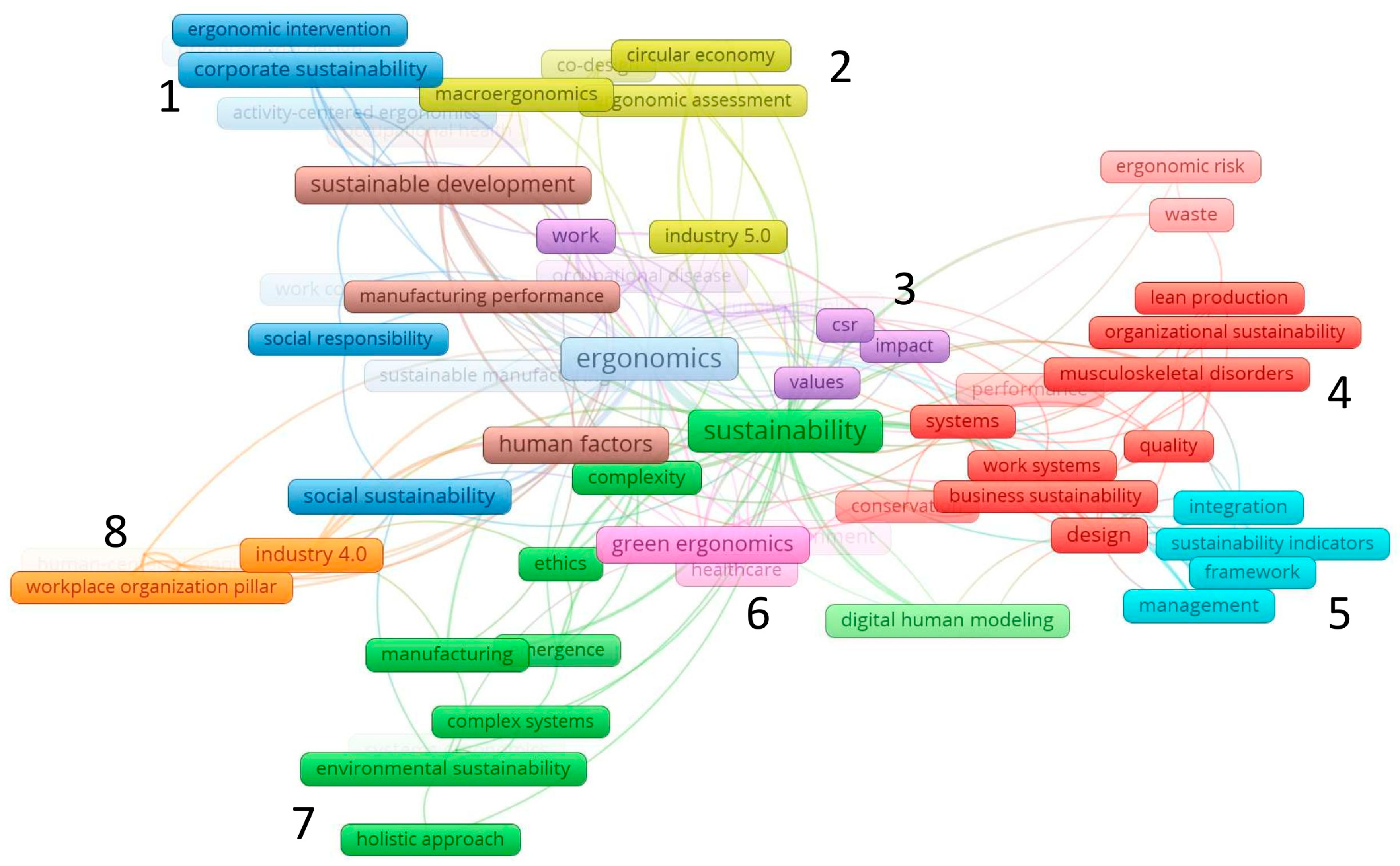
- Ergoecology;
- Green ergonomics;
- Environmental ergonomics;
- Immaterial (Intangible) ergonomics.
4. Results of the Study—Achieving ESG Goals Through Ergonomics
5. Sustainability Through Ergonomic Excellence Model (StEEM)
5.1. Green Ergonomic Practices—The Contribution of Ergonomics to Sustainability
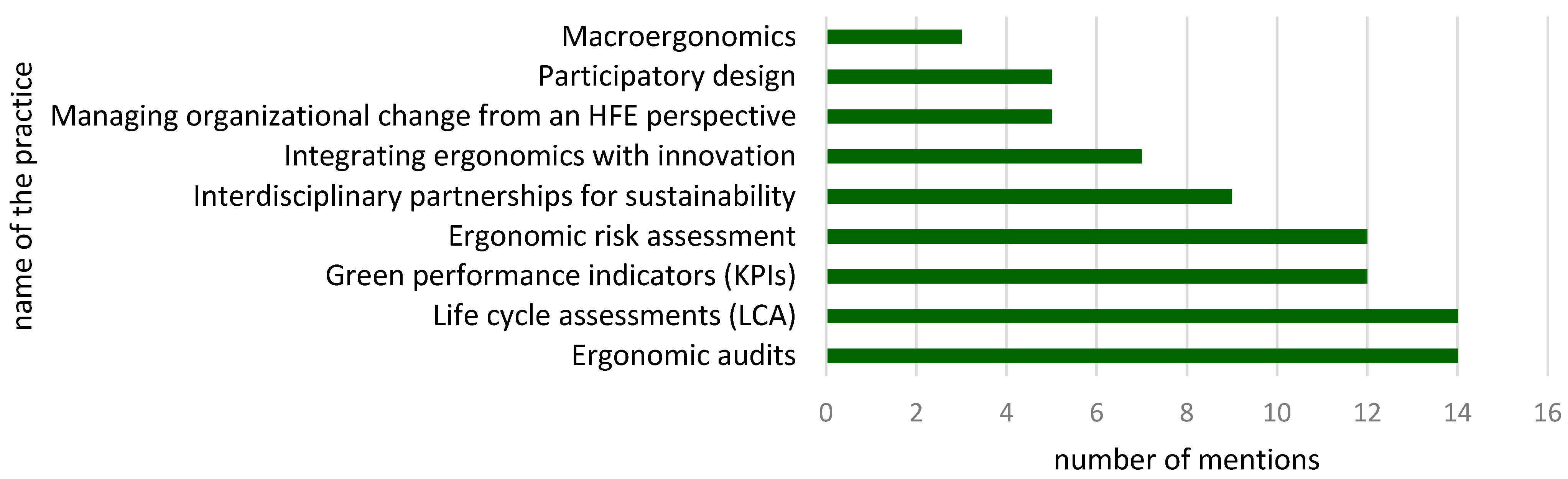
- Ergonomic audits—systematic reviews of workstations, processes, and organizational systems to adapt them to human psychophysical capabilities, while simultaneously identifying phenomena in the analyzed system that have a negative impact on the environment.
- Life-cycle assessments (LCA)—analysis of the impact of a product, process, or service on users and the environment throughout its entire lifecycle (i.e., all roles that humans will have to fulfill), enabling the identification of ergonomic solutions consistent with the principles of the circular economy.
- Green performance indicators (KPIs)—metrics tracking an organization’s ergonomic processes in terms of productivity, quality, employee safety, and health, as well as human activity with identified environmental impacts and ESG reporting.
- Ergonomic risk assessment—identification, analysis, and estimation of threats to human well-being (health, work-related discomforts), along with the assessment of scenarios (improvement proposals) for sustainable development (energy consumption and environmental impacts).
- Interdisciplinary partnerships for sustainability—creating a network of collaborations between science, business, and public institutions to implement ergonomics on a broad scale, particularly in areas that support social and environmental changes related to human behavior.
- Integrating ergonomics with innovation—utilizing ergonomics in the design of innovative products and services that support sustainable development goals and environmentally friendly technologies while simultaneously improving health and well-being at work.
- Organizational change management with an HFE perspective—incorporating ergonomics into organizational transformation processes, including ESG strategies and pro-environmental policies, to ensure sustainability and acceptance of change.
- Participatory design—engaging users and employees in the ergonomic design process to increase the fit and acceptability of solutions, while simultaneously reducing negative environmental impact.
- Macroergonomics—designing organizational structures and management processes to integrate employee health with social and environmental aspects, supporting sustainable development goals.
- 10.
- Ergonomic education and training—developing competencies and awareness in ergonomics and sustainable development, both in formal education and within organizations, to foster a pro-environmental culture and human-centered organizations. This also includes the potential for creating competency models for sustainable ergonomics—frameworks defining the knowledge, skills, and attitudes necessary to perform tasks in a way that promotes employee well-being, as well as environmental and social goals.
- 11.
- Cost–Benefit analysis—an economic evaluation of ergonomic implementations, including their impacts on productivity, employee health, and environmental and social outcomes.
5.2. The Concept of a Model Supporting Sustainable Development Through Ergonomics
5.3. Future Research Agenda
- Development of a taxonomy and metrics related to ergonomics and its impact on organizational sustainability, and development of consistent, comparable KPIs for ESG performance. This series of actions would require the development of cross-industry benchmarks and ergonomic maturity models and thresholds for key components in line with ESRS.
- Development of scientific methodology to check how micro-ergonomic interventions comply with macro-environmental and social effects and build compelling proof-of-concepts for decision-makers. This requires the development of a methodology and a rigorous approach towards its observed results.
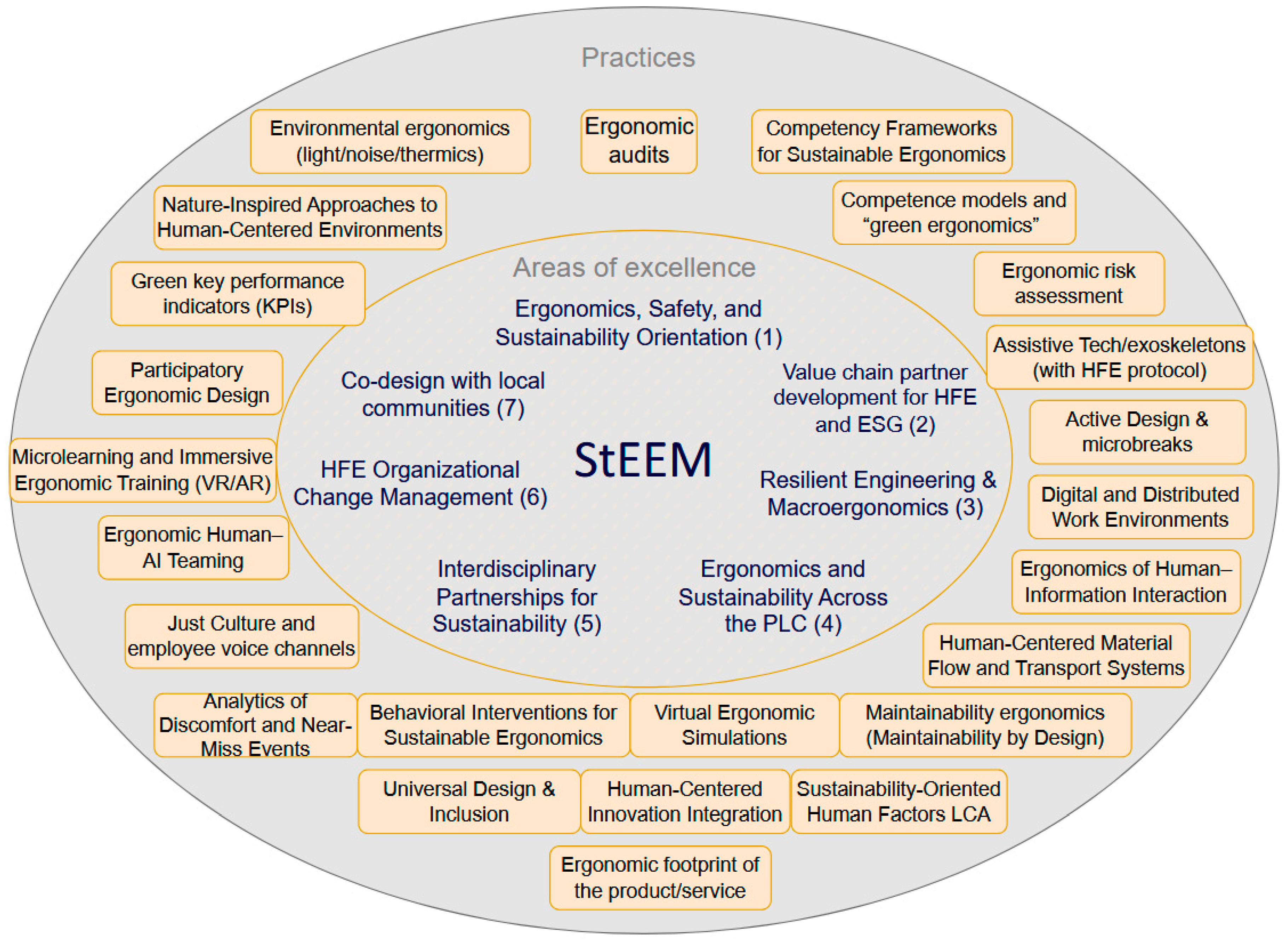
- Developing the StEEM framework and its triad: (1) measurement and standards; (2) design and interventions; (3) governance and scaling—as the overarching directions for integrating ergonomics with ESG.
- Research on user-centered design as a means towards efficiency and reducing environmental impacts in processes.
- Developing strategies for the responsible implementation of Industry 5.0 solutions (AI/robotics/cobots) with a focus on human–automation interaction and ESG values.
- Developing the DfX directions supporting the circular economy (repairability, disassembly, serviceability) and the role of well-being, participation, and competences as “engines” of ESG outcomes.
- Research on ergonomics education and training that develops a pro-ecological culture and competency models for sustainable ergonomics in organizations and formal education. requires a coherent research program that defines robust green-HFE metrics, rigorously tests real-world interventions, and establishes governance to scale proven solutions across value chains.
- Cost–benefit analyses of ergonomic implementations in different economies, taking into account productivity, employee health, and environmental and social impacts.
6. Discussion
7. Conclusions
Supplementary Materials
Funding
Institutional Review Board Statement
Informed Consent Statement
Data Availability Statement
Conflicts of Interest
References
- Pandve, H.T. Historical milestones of ergonomics: From ancient human to modern human. J. Ergon. 2017, 7, 169. [Google Scholar] [CrossRef]
- Hendrick, H.W. Future directions in macroergonomics. Ergonomics 1995, 38, 1617–1624. [Google Scholar] [CrossRef]
- World Commission on Environment and Development. Report of the World Commission on Environment and Development: Our Common Future (The Brundtland Report). Med. Confl. Surviv. 1988, 4, 17–25. [Google Scholar] [CrossRef]
- Robinson, N.A. (Ed.) Agenda 21: Earth’s Action Plan. 1993. Available online: https://unesdoc.unesco.org/ark:/48223/pf0000097430 (accessed on 30 November 2025).
- Grote, G. Adding a strategic edge to human factors/ergonomics: Principles for the management of uncertainty as cornerstones for system design. Appl. Ergon. 2014, 45, 33–39. [Google Scholar] [CrossRef] [PubMed]
- Martin, K.; Legg, S.; Brown, C. Designing for sustainability: Ergonomics Carpe diem. Ergonomics 2013, 56, 365–388. [Google Scholar] [CrossRef]
- Zink, K.J. Designing sustainable work systems: The need for a systems approach. Appl. Ergon. 2014, 45, 126–132. [Google Scholar] [CrossRef] [PubMed]
- Walsh, P.P.; Banerjee, A.; Murphy, E. The UN 2030 agenda for sustainable development. In Partnerships and the Sustainable Development Goals; Springer International Publishing: Cham, Switzerland, 2022; pp. 1–12. [Google Scholar] [CrossRef]
- Dekker, S.W.A.; Hancock, P.A.; Wilkin, P. Ergonomics and sustainability: Towards an embrace of complexity and emergence. Ergonomics 2013, 56, 357–364. [Google Scholar] [CrossRef]
- Thatcher, A.; Zink, K.J.; Fischer, K. How Has HFE Responded to the Global Challenges of Sustainability? In Human Factors for Sustainability: Theoretical Perspectives and Global Applications; CRC Press: Boca Raton, FL, USA, 2019. [Google Scholar] [CrossRef]
- Kovács, G. Combination of Lean value-oriented conception and facility layout design for even more significant efficiency improvement and cost reduction. Int. J. Prod. Res. 2020, 58, 2916–2936. [Google Scholar] [CrossRef]
- McArthur, J.J.; Powell, C. Health and wellness in commercial buildings: Systematic review of sustainable building rating systems and alignment with contemporary research. Build. Environ. 2020, 171, 106635. [Google Scholar] [CrossRef]
- Hussain, A.; Marshall, R.; Summerskill, S.; Case, K. Workforce diversity and ergonomic challenges for sustainable manufacturing organizations. In Advances in Ergonomics in Manufacturing; CRC Press: Boca Raton, FL, USA, 2012. [Google Scholar] [CrossRef]
- Scafà, M.; Papetti, A.; Brunzini, A.; Germani, M. How to improve worker’s well-being and company performance: A method to identify effective corrective actions. Procedia CIRP 2019, 81, 162–167. [Google Scholar] [CrossRef]
- López-López, D.; Serrano-Jiménez, A.; Gavilanes, J.; Ventura-Blanch, F.; Barrios-Padura, Á.; Díaz-López, C. A Study on the Parametric Design Parameters That Influence Environmental Ergonomics and Sustainability. Sustainability 2023, 15, 6304. [Google Scholar] [CrossRef]
- Delice, E.K.; Can, G.F. A new approach for ergonomic risk assessment integrating KEMIRA, best–worst and MCDM methods. Soft Comput. 2020, 24, 15093–15110. [Google Scholar] [CrossRef]
- Celestino, J.E.M.; De Souza Bispo, C.; Saldanha, M.C.W.; Da Costa Mattos, K.M. Ergonomics and environmental sustainability: A case study of raft fisherman activity at Ponta Negra Beach, Natal-RN. Work 2012, 41 (Suppl. S1), 648–655. [Google Scholar] [CrossRef] [PubMed]
- Ehlers, J.; Palermo, T. Community partners for healthy farming intervention research. J. Agric. Saf. Health 2005, 11, 193–203. [Google Scholar] [CrossRef]
- Drury, C.G.; Hancock, P.A. For a Sustainable World, What Should HFE Optimize? In Human Factors for Sustainability: Theoretical Perspectives and Global Applications; CRC Press: Boca Raton, FL, USA, 2019. [Google Scholar] [CrossRef]
- Paz, M.; Sellers, B.C.; Fiore, S.M.; Richards, L. Integrating principles of environmental sustainability into human factors education: A recommendation. Proc. Hum. Factors Ergon. Soc. 2012, 56, 1832–1836. [Google Scholar] [CrossRef]
- Thatcher, A.; Yeow, P.H.P. Human factors for a sustainable future. Appl. Ergon. 2016, 57, 1–7. [Google Scholar] [CrossRef]
- Dul, J.; Bruder, R.; Buckle, P.; Carayon, P.; Falzon, P.; Marras, W.S.; Wilson, J.R.; van der Doelen, B. A strategy for human factors/ergonomics: Developing the discipline and profession. Ergonomics 2012, 55, 377–395. [Google Scholar] [CrossRef]
- Neves, J.C.B.; Vidal, M.C.R.; de Carvalho, P.V.R. Ergonomics management model based on good practices of large industrial companies: Structured elements through the fuzzy set theory. Work 2023, 76, 803–820. [Google Scholar] [CrossRef]
- Ciccarelli, M.; Papetti, A.; Germani, M.; Leone, A.; Rescio, G. Human work sustainability tool. J. Manuf. Syst. 2022, 62, 76–86. [Google Scholar] [CrossRef]
- Radjiyev, A.; Qiu, H.; Xiong, S.; Nam, K.H. Ergonomics and sustainable development in the past two decades (1992–2011): Research trends and how ergonomics can contribute to sustainable development. Appl. Ergon. 2015, 46 Part A, 67–75. [Google Scholar] [CrossRef] [PubMed]
- Bolis, I.; Brunoro, C.M.; Sznelwar, L.I. Mapping the relationships between work and sustainability and the opportunities for ergonomic action. Appl. Ergon. 2014, 45, 1225–1239. [Google Scholar] [CrossRef]
- Bolis, I.; Sigahi, T.F.A.C.; Thatcher, A.; Saltorato, P.; Morioka, S.N. Contribution of ergonomics and human factors to sustainable development: A systematic literature review. Ergonomics 2023, 66, 303–321. [Google Scholar] [CrossRef]
- Sarbat, I.; Tasan, S.O. Ergonomics indicators: A proposal for sustainable process performance measurement in ergonomics. Ergonomics 2021, 65, 3–38. [Google Scholar] [CrossRef]
- Dutra, M.F.K.; Dutra, A.R.d.A. Ergonomia e sustentabilidade nas empresas: A construção de um framework de avaliação. Rev. De Gestão E Secr. (Manag. Adm. Prof. Rev.) 2023, 14, 2424–2436. [Google Scholar] [CrossRef]
- Rathore, B.; Biswas, B.; Gupta, R.; Biswas, I. A retrospective analysis of the evolution of ergonomics for environmental sustainability (2011–2021). Ergonomics 2023, 66, 730–748. [Google Scholar] [CrossRef]
- García-Acosta, G.; Pinilla, M.H.S.; Larrahondo, P.A.R.; Morales, K.L. Ergoecology: Fundamentals of a new multidisciplinary field. Theor. Issues Ergon. Sci. 2012, 15, 111–133. [Google Scholar] [CrossRef]
- Saravia-Pinilla, M.H.; Daza-Beltrán, C.; Ivorra-Peñafort, L.R. Ergoecological Criteria to Achieve Corporate Sustainability. In Human Factors for Sustainability: Theoretical Perspectives and Global Applications; CRC Press: Boca Raton, FL, USA, 2019. [Google Scholar] [CrossRef]
- Lange-Morales, K.; Thatcher, A.; García-Acosta, G. Towards a sustainable world through human factors and ergonomics: It is all about values. Ergonomics 2014, 57, 1603–1615. [Google Scholar] [CrossRef] [PubMed]
- Thomas, A.; Ma, S.; Rehman, A.U. Innovative Approach to Identify the Readiness Factors to Realize Green Ergonomics in Sustainable Service Organizations. Sustainability 2024, 16, 6160. [Google Scholar] [CrossRef]
- Hanson, M.A. Green ergonomics: Challenges and opportunities. Ergonomics 2013, 56, 399–408. [Google Scholar] [CrossRef] [PubMed]
- Pilczuk, D.; Barefield, K. Green ergonomics: Combining sustainability and ergonomics. Work 2014, 49, 357–361. [Google Scholar] [CrossRef]
- Thatcher, A. Green ergonomics: Definition and scope. Ergonomics 2013, 56, 389–398. [Google Scholar] [CrossRef]
- Thatcher, A. Early variability in the conceptualisation of “sustainable development and human factors”. Work 2012, 41 (Suppl. S1), 3892–3899. [Google Scholar] [CrossRef]
- Sabara, Z.; Afiah, I.N.; Umam, R. Integration of Green Ergonomics in Robust Decision Making Approach in Water Resources Management in Makassar City. Int. J. Technol. 2022, 13, 264–273. [Google Scholar] [CrossRef]
- Norton, T.A.; Ayoko, O.B.; Ashkanasy, N.M. A socio-technical perspective on the application of green ergonomics to open-plan offices: A review of the literature and recommendations for future research. Sustainability 2021, 13, 8236. [Google Scholar] [CrossRef]
- Poon, W.C.; Herath, G.; Sarker, A.; Masuda, T.; Kada, R. River and fish pollution in Malaysia: A green ergonomics perspective. Appl. Ergon. 2016, 57, 80–93. [Google Scholar] [CrossRef]
- Hilliard, A.; Jamieson, G.A. Winning solar races with interface design. Ergon. Des. 2008, 16, 6–11. [Google Scholar] [CrossRef]
- Claumann, J.R.H.; Lupion, M.R.; Pereira, R.M.; Scabello, G.M. Natural fiber as sustainable technology and ecologic and economically right alternative in making supporting device of ramble: An experimental research. In Proceedings of the International Ergonomics Association 17th Triennial Congress, Beijing, China, 9–14 August 2009. [Google Scholar]
- Sanquist, T.; Vine, E.; Meier, A.; Diamond, R.; Sheridan, T. Transforming the Energy Economy—The Role of Behavioral and Social Science. Proc. Hum. Factors Ergon. Soc. Annu. Meet. 2010, 54, 763–765. [Google Scholar] [CrossRef]
- Mandavilli, S.; Rys, M.J.; Russell, E.R. Environmental impact of modern roundabouts. Int. J. Ind. Ergon. 2008, 38, 135–142. [Google Scholar] [CrossRef]
- Adem, A.; Çakıt, E.; Dağdeviren, M. A fuzzy decision-making approach to analyze the design principles for green ergonomics. Neural Comput. Appl. 2021, 34, 1373–1384. [Google Scholar] [CrossRef]
- Parsons, K.C. Environmental ergonomics: A review of principles, methods and models. Appl. Ergon. 2000, 31, 581–594. [Google Scholar] [CrossRef]
- Altomonte, S.; Rutherford, P.; Wilson, R. Human factors in the design of sustainable built environments. Intell. Build. Int. 2014, 7, 224–241. [Google Scholar] [CrossRef]
- Zadjafar, M.A.; Gholamian, M.R. A sustainable inventory model by considering environmental ergonomics and environmental pollution, case study: Pulp and paper mills. J. Clean. Prod. 2018, 199, 444–458. [Google Scholar] [CrossRef]
- Hubault, F.; De Gasparo, S.; Du Tertre, C. Sustainable Development, Arguments for an Immaterial Ergonomics. Adv. Intell. Syst. Comput. 2019, 825, 702–706. [Google Scholar] [CrossRef]
- Imada, A.S. Achieving Sustainability through Macroergonomic Change Management and Participation. In Corporate Sustainability as a Challenge for Comprehensive Management; Zink, K.J., Ed.; Contributions to Management Science; Springer Physica-Verlag HD: Berlin/Heidelberg, Germany, 2008; pp. 129–138. [Google Scholar] [CrossRef]
- Andreoni, G.; Arslan, P.; Costa, F.; Muschiato, S.; Romero, M. Ergonomics and design for sustainability in healthcare: Ambient assisted living and the social-environmental impact of patients lifestyle. Work 2012, 41 (Suppl. S1), 3883–3887. [Google Scholar] [CrossRef]
- Lin, C.J.; Efranto, R.Y.; Santoso, M.A. Identification of workplace social sustainability indicators related to employee ergonomics perception in Indonesian industry. Sustainability 2021, 13, 11069. [Google Scholar] [CrossRef]
- Thatcher, A.; Lange-Morales, K.; García-Acosta, G. A Future Ethical Stance for HFE toward Sustainability. In Human Factors for Sustainability: Theoretical Perspectives and Global Applications; CRC Press: Boca Raton, FL, USA, 2019. [Google Scholar] [CrossRef]
- Thatcher, A.; Yeow, P.H.P. A sustainable system of systems approach: A new HFE paradigm. Ergonomics 2015, 59, 167–178. [Google Scholar] [CrossRef]
- Lange-Morales, K.; García-Acosta, G.; Bruder, R. Conceptual framework for the design and development of sustainability-oriented products: Toward EQUID 4.0. Theor. Issues Ergon. Sci. 2023, 25, 615–641. [Google Scholar] [CrossRef]
- Attaianese, E. A broader consideration of human factor to enhance sustainable building design. Work 2012, 41 (Suppl. S1), 2155–2159. [Google Scholar] [CrossRef]
- Brunoro, C.M.; Bolis, I.; Sznelwar, L.I. Exploring work-related issues on corporate sustainability. Work 2016, 53, 643–659. [Google Scholar] [CrossRef]
- Gottesman, D.; Rempel, D.R.D.; Thatcher, A.; Maguire, A.S.; Macht, G.A.; Duroha, J.C.; Witt, J.K.; Baldwi, C.; Chan, C.; Riggs, S.L. Supporting Environmental Sustainability with Human Factors and Ergonomics: Territories, Opportunities and Considerations. Proc. Hum. Factors Ergon. Soc. 2022, 66, 1020–1022. [Google Scholar] [CrossRef]
- Yparraguirre, I.T.R.; Lima, G.B.A.; Zotes, L.P.; Leal Filho, W. Analysis of the contribution of ergonomics to the management system and organizational governance. Braz. J. Oper. Prod. Manag. 2023, 20, 1845. [Google Scholar] [CrossRef]
- Abundes-Recilla, A.N.; Seuret-Jiménez, D.; Contreras-Valenzuela, M.R.; Nieto-Jalil, J.M. Fuzzy Logic Method for Measuring Sustainable Decent Work Levels as a Corporate Social Responsibility Approach. Sustainability 2024, 16, 1791. [Google Scholar] [CrossRef]
- Xu, H.; Micheli, G.J.L.; Ambrosini, E.; Caragnano, G.; Sessa, R.; Vitrano, G. Norms and Standards related to ergonomic risk assessment: A literature review. In Proceedings of the XXIX SUMMER SCHOOL “Francesco Turco”–Industrial Systems Engineering, Otranto, Italy, 11–13 September 2024; pp. 1–7. [Google Scholar]
- Neumann, W.P.; Dixon, S.M.; Nordvall, A.C. Consumer demand as a driver of improved working conditions: The “Ergo-Brand” proposition. Ergonomics 2014, 57, 1113–1126. [Google Scholar] [CrossRef]
- Rodríguez-Gámez, I.F.; Maldonado-Macías, A.A.; Lagarda-Leyva, E.A.; Hernández-Arellano, J.L.; Rodríguez, Y.; Naranjo-Flores, A. Ergonomics Management Evaluation Model for Supply Chain: An Axiomatic Design Approach. Sustainability 2025, 17, 5458. [Google Scholar] [CrossRef]
- Fischer, K.; Zink, K.J. Defining elements of sustainable work systems—A system-oriented approach. Work 2012, 41 (Suppl. S1), 3900–3905. [Google Scholar] [CrossRef] [PubMed]
- Brunoro, C.M.; Bolis, I.; Sigahi, T.F.A.C.; Kawasaki, B.C.; Sznelwar, L.I. Defining the meaning of “sustainable work” from activity-centered ergonomics and psychodynamics of Work’s perspectives. Appl. Ergon. 2020, 89, 103209. [Google Scholar] [CrossRef] [PubMed]
- Butlewski, M.; Czernecka, W. Social sustainability in practice: Bridging the gap from declarations to real-world scenarios on sustainability driven by ergonomics. Sustainability 2024, 16, 6019. [Google Scholar] [CrossRef]
- Gajšek, B.; Draghici, A.; Boatca, M.E.; Gaureanu, A.; Robescu, D. Linking the Use of Ergonomics Methods to Workplace Social Sustainability: The Ovako Working Posture Assessment System and Rapid Entire Body Assessment Method. Sustainability 2022, 14, 4301. [Google Scholar] [CrossRef]
- Miller, L.; Dorsey, J.; Jacobs, K. The importance of ergonomics to sustainability throughout a building’s life cycle. Work 2012, 41 (Suppl. S1), 2129–2132. [Google Scholar] [CrossRef]
- Cao, Y.; Wang, S.; Yi, L.; Zhou, J. A social sustainability assessment model for manufacturing systems based on ergonomics and fuzzy inference system. Smart Innov. Syst. Technol. 2016, 52, 639–648. [Google Scholar] [CrossRef]
- Bezerra, I.X.B.; De Carvalho, R.J.M. Construction and application of an indicator system to assess the ergonomic performance of large and medium-sized construction companies. Work 2012, 41 (Suppl. S1), 3798–3805. [Google Scholar] [CrossRef]
- Genaidy, A.M.; Sequeira, R.; Rinder, M.M.; A-Rehim, A.D. Determinants of business sustainability: An ergonomics perspective. Ergonomics 2009, 52, 273–301. [Google Scholar] [CrossRef]
- Prasetyo, Y.T.; Belmonte, Z.J.A.; Ong, A.K.S.; Rebosura, K.J.U.; Ocampo, L.; Nadlifatin, R. Determining ergonomics-based sustainability for public utility vehicles: Integrating higher-order structural equation modelling and random forest classifier. Ergonomics 2025, 1–24. [Google Scholar] [CrossRef] [PubMed]
- Lin, C.J.; Belis, T.T.; Kuo, T.C. Ergonomics-based factors or criteria for the evaluation of sustainable product manufacturing. Sustainability 2019, 11, 4955. [Google Scholar] [CrossRef]
- Gajšek, B.; Dukić, G.; Butlewski, M.; Opetuk, T.; Cajner, H.; Kač, S.M. The impact of the applied technology on health and productivity in manual “picker-to-part” systems. Work 2020, 65, 525–536. [Google Scholar] [CrossRef] [PubMed]
- Moore, D.; Barnard, T. With eloquence and humanity? Human factors/ergonomics in sustainable human development. Hum. Factors 2012, 54, 940–951. [Google Scholar] [CrossRef]
- Trstenjak, M.; Benešova, A.; Opetuk, T.; Cajner, H. Human factors and ergonomics in industry 5.0—A Systematic literature review. Appl. Sci. 2025, 15, 2123. [Google Scholar] [CrossRef]
- Zink, K.J.; Fischer, K. Do we need sustainability as a new approach in human factors and ergonomics? Ergonomics 2013, 56, 348–356. [Google Scholar] [CrossRef]
- García-Acosta, G.; Lange-Morales, K. Beyond Product Life Cycles: An Introduction to Product Sociotechnical Cycles (PstC) as an Alternative for HFE toward Sustainability in Product Design and Development. In Human Factors for Sustainability: Theoretical Perspectives and Global Applications; CRC Press: Boca Raton, FL, USA, 2019. [Google Scholar] [CrossRef]
- Zink, K.J. Crowd work, outsourcing, and sustainable work systems. In Human Factors for Sustainability: Theoretical Perspectives and Global Applications; CRC Press: Boca Raton, FL, USA, 2019; pp. 99–122. [Google Scholar]
- Hoque, I.; Hasle, P.; Maalouf, M.M. Buyer–supplier role in improving ergonomics in garment supplier factories: Empirical evidence from the garment industry of Bangladesh. Sustainability 2022, 14, 492. [Google Scholar] [CrossRef]
- Ivascu, L.; Draghici, A.; Gaureanu, A.; Bere-Semeredi, I. Rethinking the condition of ergonomics for sustainable development. Acta Tech. Napoc.-Ser. Appl. Math. Mech. Eng. 2021, 64. [Google Scholar]
- Tosi, F. Ergonomics and sustainability in the design of everyday use products. Work 2012, 41 (Suppl. S1), 3878–3882. [Google Scholar] [CrossRef] [PubMed]
- Fargnoli, M.; De Minicis, M.; Tronci, M. Design Management for Sustainability: An integrated approach for the development of sustainable products. J. Eng. Technol. Manag. 2014, 34, 29–45. [Google Scholar] [CrossRef]
- Carlisle, K.; Gruby, R.L. Polycentric systems of governance: A theoretical model for the commons. Policy Stud. J. 2019, 47, 927–952. [Google Scholar] [CrossRef]
- ISO 27501:2019; The Human-Centred Organization—Guidance for Managers. International Organization for Standardization (ISO): Geneva, Switzerland, 2019.
- ISO 27500:2016; The Human-Centred Organization—Rationale and general principles. International Organization for Standardization (ISO): Geneva, Switzerland, 2016.
- ISO 14001:2015; Environmental Management Systems—Requirements with Guidance for Use. International Organization for Standardization (ISO): Geneva, Switzerland, 2015.
- Butlewski, M. A non-utopian approach to human-centred organisations: A conceptual framework for ergonomics-driven enterprises. Saf. Sci. 2026, 195, 107061. [Google Scholar] [CrossRef]
- European Sustainability Reporting Standards (ESRS), European Financial Reporting Advisory Group. 2023. Available online: https://www.unepfi.org/impact/interoperability/european-sustainability-reporting-standards-esrs/ (accessed on 20 September 2025).

| Keywords Area | Contribution to the Area |
|---|---|
| Ergonomics | TITLE-ABS-KEY (“ergonomics” OR “ergonomic practices” OR “ergonomic interventions” OR “human factors” OR “human-centered design” OR “work design” OR “ergonomic intervention” OR “ergonomic risk assessment” OR “engineering controls” OR “workstation redesign” OR “task redesign” OR “manual handling intervention” OR “participatory ergonomics” OR “activity-centered ergonomics” OR “physical ergonomics intervention” OR “ergonomic hazard control” OR “ergonomic job analysis” OR “ergonomic solution implementation” OR “macroergonomic” OR “sociotechnical systems approach” OR “organizational ergonomics” OR “work system design” OR “human-centered systems” OR “work-related musculoskeletal disorders” OR “musculoskeletal injury prevention” OR “manual handling risk reduction” OR “repetitive motion prevention” OR “physical workload reduction” OR “biomechanical risk factors” OR “postural load intervention” OR “workplace strain prevention” OR “occupational injury prevention”) |
| Environmental Social Governance | (“ESG” OR “Environmental Social Governance” OR “ESG reporting” OR “ESG strategy” OR “sustainability” OR “sustainability reporting” OR “corporate social responsibility” OR “CSR” OR “social responsibility” OR “social sustainability” OR “corporate sustainability” OR “governance”) |
| Keywords Area | Scopus | Web of Science |
|---|---|---|
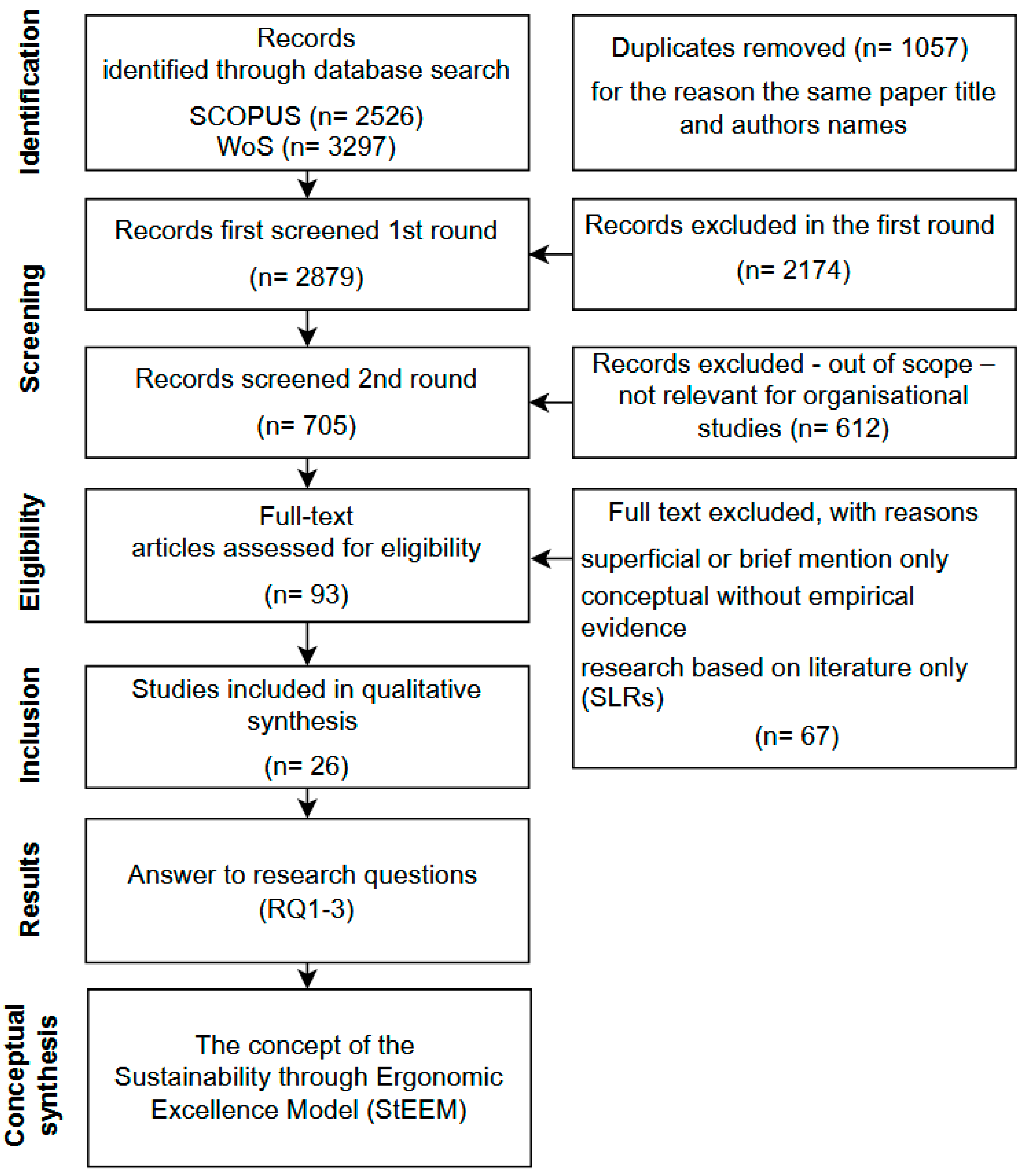
| Number of records identified | 2526 | 1310 |
| Number of records after duplicates are removed | 2779 | |
| Number of records screened (title and abstract) 1st phase | 2779 | |
| Number of records screened (title and abstract) 2nd phase | 705 | |
| Number of full-text articles assessed for eligibility | 93 | |
| Number of full-text records evaluated in detail (found) | 77 | |
| Number of studies included in the review | 26 | |
| Publication (Authors) | Keywords Used by the Authors | Databases | Time Span |
|---|---|---|---|
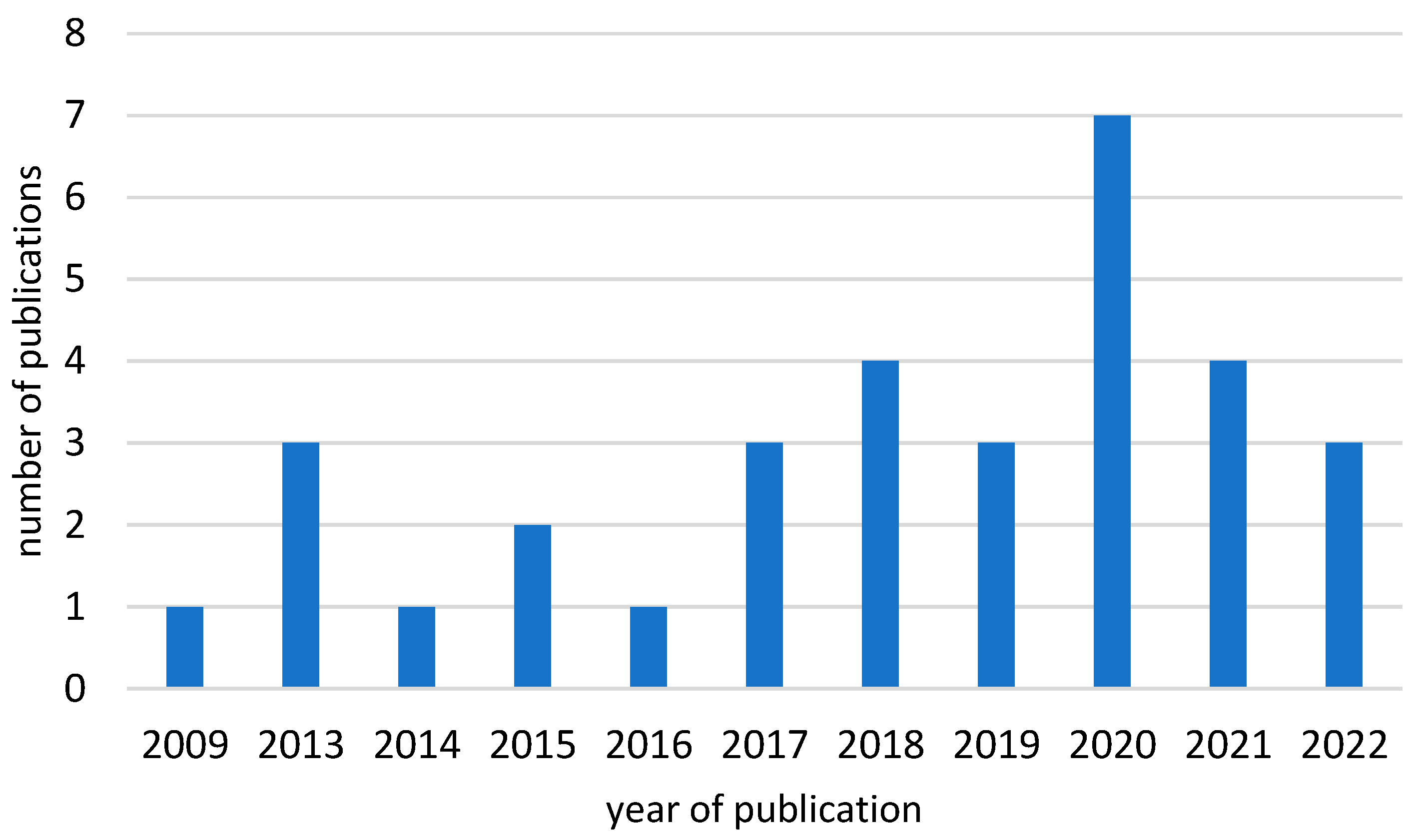
| (Radjiyev et al., 2015) [25] | sustainable development OR sustainable design OR eco design | 11 journals related to ergonomics were searched in the WoS databases EBSCO PubMed | 1992–2011 |
| (Martin et al., 2013) [6] | ‘ergonom AND sustainab’ OR ‘human factor AND sustainab’ | Scopus; Business Source Complete; Google Scholar; Emerald Publishing; Academic Search Premiere; WoS; Discover; Ergonomics | 1995–2012 |
| (Bolis et al., 2014) [26] | keywords related to work and sustainability: Labor practices (LP); Work procedure (WP); Work design (WD); Ergonomics (ER); Employee (EM); Work practices (WT); Task (T); Worker (W); Process (P); Sustainability (S); Sustainable development (SD); Social responsibility (SR); Sustainable job (SJ); Sustainable work (SW); Sustainable labor (SL). | Scopus | 2007–2012 |
| (Bolis et al., 2023) [27] | “ergonomic” OR “human factors”) AND, sustainab”—search in fields TITLE/KEY/SRCTITLE | Scopus | until March 2021 |
| (Sarbat & Ozmehmet Tasan, 2022) [28] | ergonomics indicators; sustainability indicators; integration; lagging indicators; leading indicators; process performance measurement | WoS, Scopus, Google Scholar | 2015–2020 |
| (Dutra & Dutra, 2023) [29] | (ergonomics OR “ergonomic analysis”) AND sustainability | WoS, Scopus | 2014–2022 |
| (Rathore et al., 2023) [30] | KEY (ergonomics OR human factors) AND KEY (green OR environmental) | Scopus | 2011 and 2021 |
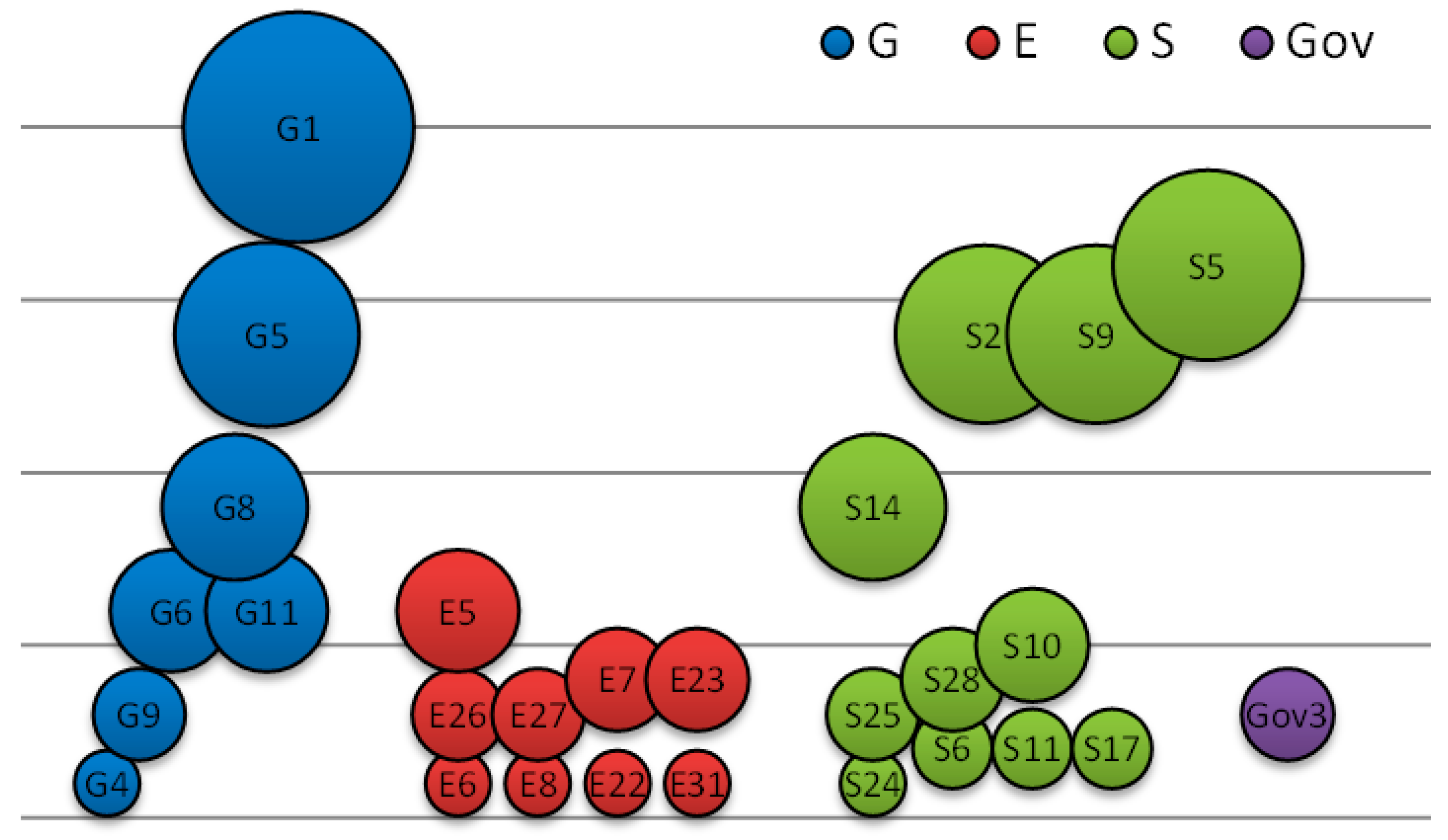
| ID | Reporting Area | Total Number of Occurrences |
|---|---|---|
| G4 | ESG policies (key documents and objectives) | 2 |
| E6 | Share of renewable energy | 2 |
| E8 | Climate change adaptation measures | 2 |
| E22 | Amount of waste generated | 2 |
| E31 | Environmental reduction targets | 2 |
| S24 | Equality policies | 2 |
| S6 | Training and development | 3 |
| S11 | Supplier audits | 3 |
| S17 | Social projects and local investments | 3 |
| G9 | Measurement and reporting methodology | 4 |
| E26 | Eco-innovation and circular economy | 4 |
| E27 | Total environmental impact throughout the product life cycle | 4 |
| S25 | Employee engagement in ESG | 4 |
| Gov3 | Ethics and compliance policy | 4 |
| E7 | Climate neutrality plan | 5 |
| E23 | Recycling and material recovery | 5 |
| S28 | Work–life balance and flexible working | 5 |
| S10 | Supply chain labor standards | 6 |
| G6 | Value chain—upstream and downstream impact | 7 |
| G11 | Impact on stakeholders | 7 |
| E5 | Total energy consumption | 7 |
| G8 | ESG objectives and indicators (KPIs) | 10 |
| S14 | Impact on local communities | 10 |
| S2 | Accidents at work and occupational diseases | 15 |
| S9 | Employee satisfaction | 15 |
| G5 | ESG risk and opportunity management | 16 |
| S5 | Health and safety policy | 17 |
| G1 | Business model and ESG strategy | 25 |
| ESG | G1 | G4 | G5 | G6 | G8 | G9 | G11 | E5/6 | E22/23 | E26/27 | E31 | S2 | S5 | S6 | S9 | S10/11 | S14 | S17 | S24 | S25 | S28 | Gov3 | |
|---|---|---|---|---|---|---|---|---|---|---|---|---|---|---|---|---|---|---|---|---|---|---|---|
| Pract. | |||||||||||||||||||||||
| 1. Ergo audit | + | + | + | + | + | + | + | + | + | ||||||||||||||
| 2. Life cycle | + | + | + | + | + | + | + | + | |||||||||||||||
| 3. Green Ergo-KPI | + | + | + | + | + | + | + | + | + | ||||||||||||||
| 4. Ergo risk | + | + | + | + | + | + | |||||||||||||||||
| 5. Sust. partners | + | + | + | + | + | + | + | ||||||||||||||||
| 6. Ergo -innov | + | + | + | + | + | + | + | ||||||||||||||||
| 7. HFE change | + | + | + | + | + | + | |||||||||||||||||
| 8. Co -design | + | + | + | + | + | + | |||||||||||||||||
| 9. Macroergonomics | + | + | + | + | + | + | + | + | + | ||||||||||||||
Disclaimer/Publisher’s Note: The statements, opinions and data contained in all publications are solely those of the individual author(s) and contributor(s) and not of MDPI and/or the editor(s). MDPI and/or the editor(s) disclaim responsibility for any injury to people or property resulting from any ideas, methods, instructions or products referred to in the content. |
© 2025 by the authors. Licensee MDPI, Basel, Switzerland. This article is an open access article distributed under the terms and conditions of the Creative Commons Attribution (CC BY) license (https://creativecommons.org/licenses/by/4.0/).
Share and Cite
Butlewski, M.; Broda, M. How an Ergonomic Approach Supports Sustainability and ESG Goals: From Green Ergonomics to Sustainability Through Ergonomic Excellence. Sustainability 2025, 17, 10893. https://doi.org/10.3390/su172410893
Butlewski M, Broda M. How an Ergonomic Approach Supports Sustainability and ESG Goals: From Green Ergonomics to Sustainability Through Ergonomic Excellence. Sustainability. 2025; 17(24):10893. https://doi.org/10.3390/su172410893
Chicago/Turabian StyleButlewski, Marcin, and Marta Broda. 2025. "How an Ergonomic Approach Supports Sustainability and ESG Goals: From Green Ergonomics to Sustainability Through Ergonomic Excellence" Sustainability 17, no. 24: 10893. https://doi.org/10.3390/su172410893
APA StyleButlewski, M., & Broda, M. (2025). How an Ergonomic Approach Supports Sustainability and ESG Goals: From Green Ergonomics to Sustainability Through Ergonomic Excellence. Sustainability, 17(24), 10893. https://doi.org/10.3390/su172410893

