1. Introduction
Open public data has evolved into a vital strategic asset for advancing the “Digital China “initiative and fostering high-quality development within regional economies [
1]. The 14th Five-Year Plan of China (2021–2025) and the Outline of the Long-Range Goals Through 2035 explicitly regard integrating the integration of public data services into the national public service framework as a priority, establish a harmonized and standardized national public data open platform, aim at fully releasing the latent capacity of public data factors. As noted in “2024 China Local Public Data Open Utilization Report”, as of July 2024, 243 local administrations had set up data open portals, comprising 24 at the provincial level and 219 at the municipal level [
2]. This figure represents an increase of approximately 8% compared to the second half of 2023. As a production factor on par with land, labor, capital, and technology, public data is poised to play an increasingly pivotal role in future advancement.
This paper mainly used the fixed-effects model to study the impact mechanism of public data opening on the high-quality and sustainable development of regional economy. This study combined the theories of data elements, regional economic growth, and the connotations of new development concepts to investigate the economic effects of public data openness, and elaborates on its unique role in promoting regional innovation collaboration, green and low-carbon development, etc. It is a beneficial supplement and deepening enrichment to the theory of information economics, providing theoretical support for data governance to empower regional development. From a practical perspective, the opening of public data is not only an important part of data governance but also a key approach to enhancing governance capabilities.
While the existing literature has extensively documented the economic outcomes of open data in domains such as urban innovation, public trust, and total factor productivity of enterprises [
3], empirical evidence on its broader economic effects and underlying transmission mechanisms remains comparatively scarce. Significant research gaps persist, particularly concerning the dynamic relationship between public data as a production factor and high-quality development, as well as the multi-dimensional pathways through which it exerts influence. To address these gaps, this study is structured around three core research questions: (1) Does public data openness significantly promote high-quality regional economic development? (2) Does business environment optimization mediate this relationship? (3) Does improved factor allocation efficiency serve as an additional mediating channel? Correspondingly, we propose three research hypotheses (H1–H3), which are tested using a fixed-effects model and mediation analysis. By doing so, we move beyond establishing a mere correlation and delve into the causal mechanisms, thereby providing a more nuanced understanding of how PDO contributes to sustainable and high-quality economic outcomes, as called for by recent research [
4,
5].
This study makes the following contributions. Firstly, recognizing the unique role of public data in advancing high-quality regional economic development within the framework of the Digital China initiative, the study incorporates data elements derived from public data openness into a fixed-effects model. This approach clarifies the dynamic causal relationship between data elements and economic quality, thereby providing a concise and rigorous mathematical analysis framework for measuring and interpreting the economic effects of public data openness—an area largely overlooked in prior research. Secondly, this study clarifies the transmission path through which public data opening policies affect the regional economic upgrading by combining theoretical analysis with empirical identification. Specifically, it has established a logical framework based on a mechanism chain, linking four core mechanisms: economic structure optimization, innovation-driven growth, promotion of a low-carbon environment, and improvement of shared welfare. This framework makes up for the deficiencies of the existing integrated analysis models, especially the lack of mechanism elaboration. At the same time, it expands the generation logic chain and research perspective on value creation through the opening of public data. Thirdly, by combining the quality attributes of these platforms with the heterogeneous characteristics of regional economic development, the multi-dimensional assessment perspective of the economic impact of public data disclosure has been broadened. This study accurately fits the strategic need of unifying the national market and provides a practical path for bridging the development gap through data factor flow.
3. Hypothesis Development
Data has become a novel element exerting influence across the entire spectrum of economic development. In driving high-quality economic development, public data transcends the physical constraints imposed by traditional inputs. Through the evolutionary pathway of resource conversion, it profoundly drives regional economic advancement.
First, during the first phase, diverse raw information generated throughout economic activities undergoes digitization and processing to become structured public data resources with economic relevance. These resources support policy formulation, performance evaluation, risk monitoring, and analytical applications [
23]. Secondly, in the “assetization of public data” phase, advanced processing techniques such as cleansing, deduplication, classification, and storage enhance the quality of raw data. This process enables the deep extraction of latent value, transforming data resources into economically valuable data assets. Thirdly, in the “capitalization of public data” phase, data assets are integrated with capital markets through market trading mechanisms. When public data elements are embedded as capital within production functions, market entities can accumulate knowledge and expand innovation boundaries through data element accumulation, thereby further enhancing economies of scale. The value leap trajectory of public data not only reconfigures the traditional logic of factor allocation but also significantly boosts total factor productivity through the spillover effects of data elements, providing a powerful impetus for economic advancement.
Specifically, public data’s enabling effect on high-quality economic development manifests across three levels. At the micro level, public data openness supports optimized decision-making by providing market entities with rich information, thereby reducing decision-making costs, strengthening internal corporate controls, and enhancing market competitiveness. At the meso level, data integration via public platforms facilitates industrial chain coordination, enabling dynamic production adjustment, precise energy management, and structural optimization, while also catalyzing new business models. At the macro level, analyzing data on R&D expenditure, intensity of fiscal spending on science and technology, and technological achievements commercialization rates helps optimize the allocation of financial resources, enhance the public funds utilization efficiency, and guide the rational distribution of innovation resources, thus fostering a robust innovation ecosystem. Theoretical analyses demonstrate that it is required for this study to confirm the first key hypothesis.
Hypothesis 1. Public data openness can significantly boost high-quality regional economic development.
Public data openness promotes high-quality regional economic development by optimizing the business climate, which operates primarily through three pathways. Firstly, reducing the cost of data acquisition. Public data openness platforms integrate government operational data networks spanning various functional departments and public service institutions. Various users can directly access standardized public data through the platform, significantly reducing information collection and acquisition costs while enhancing platform usability and user experience. Secondly, it breaks down information silos. Market entities utilizing the public data open platform to access data will resolve information asymmetry issues, thereby preventing problems such as industry monopolies and adverse selection. This facilitates better analysis of market dynamics and reduces decision-making errors caused by information gaps. Thirdly, it standardizes administrative conduct. The public may utilize public data platforms to scrutinize governmental actions and monitor the exercise of governmental authority, thereby promoting greater transparency in the exercise of public power and enhancing public trust in open data.
A favorable business environment can enhance the effectiveness of government subsidies and enterprises’ risk-taking capabilities, thereby promoting technological innovation. Furthermore, the improvement of the business environment has a significant positive impact on enterprises’ green innovation, fostering green innovation conditions by promoting digital transformation of enterprises [
24,
25].
At the macroeconomic and fiscal levels, optimizing the business environment helps promote economic structural transformation and upgrading, and ultimately reduces the actual tax burden on enterprises by improving the quality of regional tax sources and alleviating the pressure of tax plans [
26]. The business environment has become an effective path to stimulate development and promote low-carbon transformation. Its improvement in carbon efficiency is mainly achieved by promoting green technological progress and stimulating the entry of new enterprises, especially in cities with strict environmental regulations and sufficient environmental fiscal expenditures [
27].
From the perspective of social development and sharing, a good business environment means a reasonable tax burden standard, which can stimulate the investment vitality. At the same time, it can attract investment, expand the tax base, enhance the financial capacity of local governments, and thereby increase the level of public spending on education, healthcare, and other areas, as well as accelerate the construction of infrastructure networks such as transportation. Moreover, the industrial structure upgrade driven by the business environment can expand the production scale of enterprises, increase employees’ income, and promote the proportion of labor remuneration to rise in GDP growth slowdown, facilitating the sharing of achievements. Theoretical analyses demonstrate that it is required for this study to confirm the second hypotheses.
Hypothesis 2. Public data openness can significantly boost high-quality regional economic development by optimizing the business environment.
Public data openness also boosts high-quality economic advancement by enhancing factor allocation efficiency, manifested through three key channels.
Firstly, it increases the efficiency of labor factor allocation. Public data openness achieves this by optimizing the labor market information environment, improving the accuracy of talent and job matching, and reducing HR management decision-making costs, thereby improving labor factor allocation efficiency [
28]. Regarding optimizing the market information environment, public data openness significantly alters the previously fragmented landscape of public data utilization. Enterprises and job seekers can make more scientific decisions through cross-regional and cross-industry talent supply and demand information, salary distribution patterns and occupational skills demand trends provided by the public data open platform, thus reducing friction costs in the matching process [
14]. This also helps alleviate information asymmetry and promotes income growth for urban and rural residents [
29]. From the perspective of enhancing the accuracy of talent and job matching, public data openness has enhanced the flexibility and mobility of the labor market, and enterprises can more accurately assess the actual abilities of job seekers which promotes a smoother flow of talent and a more accurate matching of jobs [
30]. Businesses experience significantly reduced costs in accessing information about operations in other regions, thereby helping bridge the regional “digital divide” [
31]; The provision of enterprise credit data through public channels streamlines background verification processes, thereby improving the efficiency and effectiveness of corporate due diligence. Furthermore, centralized access to reliable corporate information and compliance documents such as labor regulations and social security policies enhances the transparency of enterprise operations. This integrated approach to public data disclosure not only reduces institutional transaction costs but also fosters a more predictable and investment-friendly environment for human capital development, thereby providing robust support for a thriving human resources market [
7,
15].
Secondly, it enhances land resource allocation efficiency. Public data openness primarily improves land resource allocation efficiency by optimizing the land market information environment and enhancing land matching and utilization efficiency. Public data openness platform provides market entities with a unified and transparent information platform by integrating data on land ownership, planned use and market transaction prices, enabling enterprises and investors to swiftly identify available resources. Simultaneously, data-sharing platforms dynamically monitor supply-demand dynamics, publishing real-time regional land availability metrics to assist governments in precisely regulating land supply rhythms, thereby enhancing land matching and utilization efficiency.
Thirdly, it enhances capital factor allocation efficiency. Public data openness primarily enhances capital allocation efficiency by optimizing the information environment and improving capital flow efficiency. Regarding information environment optimization, real-time publication of regional industrial investment trends and technology innovation conversion rates reduces investment-financing information asymmetry, refines capital allocation decision-making environments, directs capital towards high-potential sectors, and enables financial institutions to accurately assess enterprise risk and growth potential. Public data openness can also stimulate innovation in financial instruments and services. For instance, opening data across industrial chains facilitates precise matching of supply chain finance with core enterprises’ credit resources, enhancing capital flow efficiency and supporting sustainable local economic development [
4,
22,
23].
The efficiency of factor allocation effectively enhances total factor productivity by optimizing the flow and combination of production factors such as capital, labor, and technology. In the field of innovation, efficient factor allocation can distribute innovation resources to the most needed links, reduce resource waste during the innovation process, and overall enhance innovation efficiency. Meanwhile, distortions in the factor market can curb enterprises’ R&D investment, while optimized allocation helps to reduce transaction costs and further stimulate innovation vitality [
32].
At the level of structural optimization, the reallocation of factors can effectively promote the upgrading of the industrial structure towards high-end manufacturing and services, achieving the rationalization and high-level development of the industrial structure. However, its environmental impact depends on the flow of factors. If factors are concentrated in high-carbon sectors, it may inhibit the low-carbon transformation in the short term. Conversely, if it is directed towards the field of green technology, it can significantly promote carbon reduction.
In addition, the reform of the marketization of factors of production helps expand employment opportunities by promoting cross-regional labor mobility and increases workers’ income through industrial upgrading. It is necessary to be vigilant that if the allocation of factors is unbalanced, for instance, capital is overly concentrated in areas such as real estate, it may squeeze the input of resources in the field of people’s livelihood. And promoting the inclination of factors towards public services can help enhance the sustainability of social welfare sharing [
33].
Theoretical analyses demonstrate that it is required for this study to confirm the third hypotheses.
Hypothesis 3. Public data openness can significantly boost high-quality regional economic development by enhancing the efficiency of factor allocation.
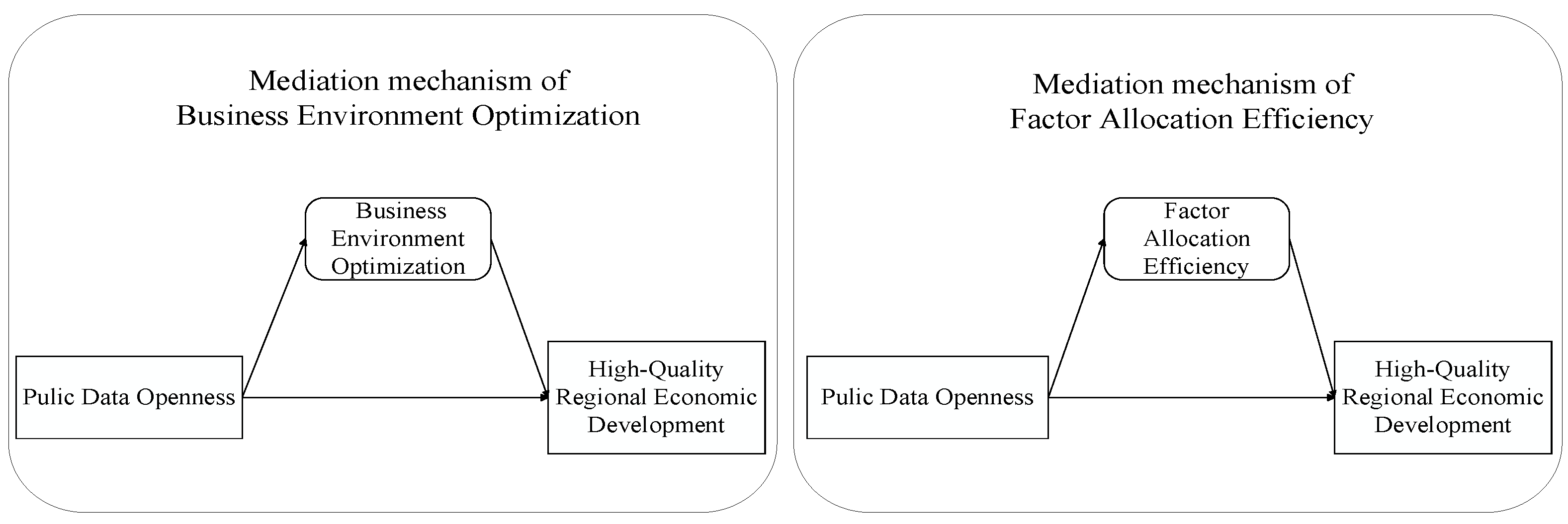
Based on the theoretical analysis in the previous text, the theoretical framework of this research is proposed in
Figure 1.
4. Research Design
4.1. Model Specification
This paper employed public data openness as a quasi-natural experiment to precisely, scientifically, and effectively identify its specific role in high-quality regional economic development. When conducting empirical investigations, this research utilizes balanced panel data from 31 provincial-level regions across China spanning 2017–2024. The baseline model can be specified as:
REHQDL denotes the dependent variable, namely regional economic high-quality development; PDO represents the core explanatory variable, namely public data openness; Controls signifies control variables; represents province fixed effects; constitutes the random disturbance term; denotes the constant term; and both denote coefficients. Given that the opening of public data across regions exhibits phased and geographically heterogeneous characteristics and may be influenced by phased deployment decisions at the prefecture and city levels, this study incorporates a region-by-year interaction fixed effect () in the benchmark regression. This approach rigorously controls for spatiotemporal heterogeneity shocks, thereby enhancing the reliability of estimates and mitigating confounding effects arising from phased implementation across provinces and municipalities.
To examine the underlying mechanisms, we further employ a mediation analysis following the approach of Di et al. [
34]. The model is constructed as follows:
M denotes the mediating variable; represents the coefficient and other variables retain the same meanings as in Equation (1).
4.2. Variable Selection
The Dependent Variable is Regional Economic High-Quality Development Level (REHQDL). Academic research on measuring provincial-level high-quality economic development primarily uses two approaches: employing total factor productivity (TFP) calculations for assessment, or constructing multidimensional indicator systems for measurement. In practical applications, factors such as measurement volatility and dimensional singularity render TFP alone an overly simplistic metric for assessing high-quality economic development level. Consequently, this research establishes a multidimensional indicator evaluation system to accurately gauge regional high-quality economic development levels. Considering the scarcity of existing research on measuring provincial-level high-quality economic development and its tendency to focus on specific regional scopes, this paper adopts the guiding principles of the new development philosophy. Drawing upon the existing evaluation system in the new era [
4,
28] and “2024 China Urban District High-Quality Economic Development Research Report”, comprehensively considering the rationality and representativeness of provincial-level indicator selection. It constructs a regional high-quality economic development indicator system across four dimensions: stimulation of innovation vitality, economic structure optimization, low-carbon environmental advancement, shared public welfare. The system employs the CRITIC weighting method for measurement, with the formula detailed in
Section 4.3. CRITIC weighting method is a more commonly used objective weighting method, it is generally believed that CRITIC weighting method is better than entropy weighting method or standard deviation method, and can better avoid the defects of ignoring the data’s own attributes for indicator evaluation [
35]. The specific indicator system is presented in
Table 1.
The Core Explanatory Variable is Public Data Openness (PDO). The China Open Data Forest Index is the nation’s first specialized index dedicated to evaluating government data openness. It encompasses four dimensions—readiness, platform layer, data layer, and utilization layer—along with multiple subordinate indicators, developed by Fudan University’s Digital and Mobile Governance Laboratory. Its expert evaluation committee comprises over seventy specialists. Grounded in China’s public data openness policy requirements and local practices, and drawing upon fundamental principles and academic research in data openness alongside international assessment methodologies, the index system demonstrates systematic professionalism. Consequently, this paper employs the provincial open data forest index from the “2024 China Local Government Data Openness Report” to measure public data openness levels [
2].
The Mediating Variables select Business Environment optimization (Envir) and Factor Allocation Efficiency (Alloca). Theoretical analysis in this paper indicates that public data openness primarily boosts high-quality regional economic advancement by optimizing the business environment and enhancing factor allocation efficiency. Consequently, this study introduces these two mediating variables. The business environment indicators are sourced from the “China Provincial Marketisation Index Report” [
32,
33], which is published by the National Institute of Economic Research, and since the index is counted every three years, and there are only the data of 2019 and 2022 in the sample period of this paper, we borrowed from the practice of Bai [
36], and used the linear interpolation method to complement the Doing Business index of all provinces in the country in other years.
This study measures factor allocation efficiency via the degree of market distortion, following the approach of Huang [
37]. The metric is calculated as the ratio of a region’s factor market development score to the highest score in the sample, utilizing data from the Report on China’s Sub-Provincial Marketisation Index. In line with Yu et al. [
38], these data are projected through 2024 using an average annual growth rate. Theoretically, a higher distortion value indicates a greater deviation from optimal allocation, signaling inefficiency. To align with the theoretical framework of neoclassical growth theory, which posits that misallocation reduces total factor productivity, the raw distortion metric is inverted. This yields a direct, positive measure of efficiency, a transformation that is both methodologically sound and theoretically grounded.
Given that regional economic development is influenced by multiple factors such as institutions, governance, factors, and structure, this study introduces five control variables into the model to more accurately identify the net effect of Public Data Openness (PDO) on high-quality economic development.
- (1)
Tax level (Tax)
Grounded in the economic logic of the Laffer curve and Barro’s “tax threshold”, the impact of taxation on high-quality development is non-linear, exhibiting a distinct inverted U-shape. This relationship is operationalized using provincial annual tax revenue, which reflects institutional resource constraints. At moderate levels, taxation fuels development by financing public goods that promote economic vitality and innovation; beyond a critical point, however, it becomes detrimental by compressing corporate investment in R&D and hindering productivity gains.
- (2)
Government Size (Size)
North’s institutional economics theory provides the framework for analyzing the non-linear impact of government size, which is measured by the share of local government expenditures in regional GDP. The theory posits an inverted U-shaped relationship: an optimal scale is posited to yield necessary public goods and institutional support, whereas beyond this point, fiscal crowding-out, bureaucratic inefficiencies, and misallocation of resources impede high-quality development.
- (3)
Quality of Labor Force (Quality)
Measured by the proportion of the population with higher education or above, it reflects the level of regional human capital. Labor quality is the core driving force for innovation and total factor productivity improvement, and has a significant positive effect on high-quality development. High-quality labor promotes the diffusion of innovation and industrial upgrading by strengthening knowledge absorption and technology application capabilities.
- (4)
Industrial Structure Advancement (ISA)
Measured by the ratio of the added value of the tertiary industry to that of the secondary industry, this indicator reflects the upgrading and optimization level of the regional industrial structure. A higher ratio indicates a transition from an industry-dominated to a service-oriented economy, which is an essential feature of structural upgrading. Under the framework of public data openness, data-intensive service sectors, such as information transmission, software, and technology services, will benefit significantly from accessible government data. Open data reduces data acquisition costs and enhances innovation capacity, accelerating the shift toward high-efficiency and high value-added industries.
In summary, the five control variables comprehensively capture the key external conditions influencing high-quality regional development across four dimensions: institutional constraints (Tax), government governance (Size), human capital (Quality), and industrial structure (ISA). Among them, there is a non-linear inverted U-shaped relationship between tax level and government size expectations, while other variables show a positive effect on high-quality economic development. Incorporating these controls helps isolate the independent impact of PDO and enhances the robustness and explanatory power of the empirical analysis.
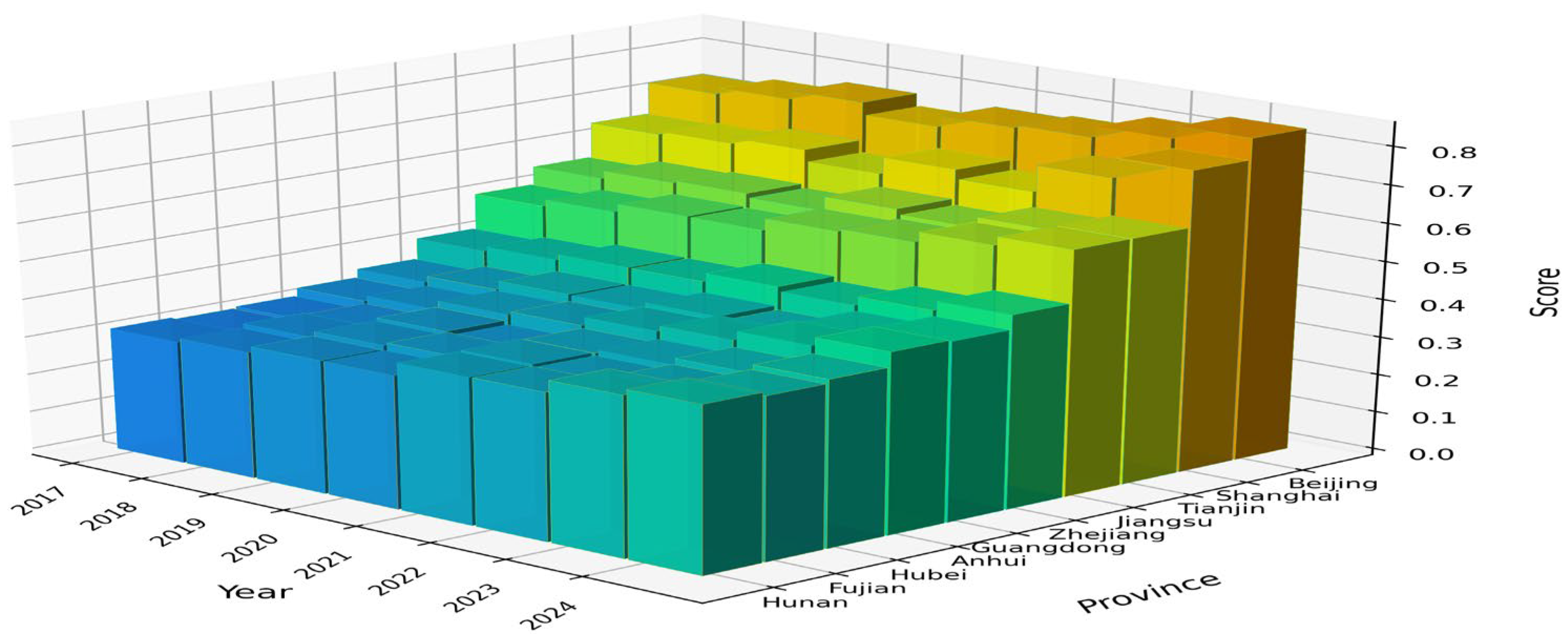
This research employed Python 3.12 software to construct a three-dimensional stacked bar chart to show the score changes the top ten provinces in China’s regional economic high-quality development level from 2017 to 2024. A lighter color corresponds to a higher level of high-quality regional economic development. It can be seen in
Figure 2 that the scores of each province generally showed a continuous upward trend during this period. The first-tier municipalities such as Beijing, Shanghai and Tianjin were already in a relatively high score range in 2017 and their scores have continued to rise in subsequent years. Economic powerhouses such as Jiangsu, Zhejiang and Guangdong have maintained a stable growth trend. This pattern reflects the imbalance among different provinces in terms of resource endowment, industrial foundation, policy support, etc., providing an intuitive visual support for analyzing regional development momentum and future potential.
4.3. CRITIC Method for Determining Indicator Weights
- (1)
Standardization of Indicators
Assume the original data matrix is X = , where = 1,2,…, denotes the evaluation objects and = 1,2,…, denotes the evaluation indicators. To eliminate dimensional differences, the indicators are standardized as follows:
After normalization, the standardized matrix is denoted as:
- (2)
Calculation of Standard Deviation
The standard deviation describes the degree of dispersion of each indicator across the sample, reflecting its discriminating ability:
where
(mean of the
th standardized indicator).
- (3)
Construction of the Correlation Coefficient Matrix
The correlation coefficient between indicators is calculated using the Pearson correlation formula:
- (4)
Calculation of the Information Content (Information Effect)
The information content of each indicator is determined by both its standard deviation and its “conflict” (degree of independence) with other indicators:
- (5)
Determination of Indicator Weights
Weights are computed according to the information content of each indicator:
- (6)
Calculation of the Comprehensive Score
After determining the weights, the comprehensive evaluation score for each object is calculated as:
4.4. Data Sources and Processing
This study used data from 31 provinces in China between 2017 and 2024 as the research sample. High-quality economic development index data is mainly obtained from the previous editions of China Statistical Yearbook, provincial statistical yearbooks, EPS database, China Economy Net statistical database and the National Bureau of Statistics (NBS) official website. The data related to public data openness are mainly extracted from China Local Government Data Openness Report, and some data are confirmed and supplemented by Baidu search and other means. Some data points are supplemented by interpolation based on factors such as data availability and indicator definitions.
5. Empirical Analysis
5.1. Benchmark Regression Analysis
Table 2 reports the regression results for the core explanatory variable (PDO) and the control variables. The coefficient of PDO is consistently positive and statistically significant at the 1% level across both models, confirming that greater public data openness significantly promotes high-quality economic development. This positive relationship remains robust after introducing additional control variables.
Regarding the control variables, government size (Size) shows a significant negative effect, suggesting that an excessive fiscal scale may crowd out private investment and reduce resource allocation efficiency, thus hindering high-quality growth. Quality (Quality) exerts a strong positive influence, implying that regions with higher levels of human capital tend to achieve more sustainable and innovation-driven development. However, industrial structure advancement (ISA) displays a significant and positive coefficient confirming that industrial upgrading toward high-value-added sectors is an important channel for achieving high-quality economic development.
The models demonstrate high explanatory power, indicating excellent overall model fit. Collectively, these findings provide strong empirical support for Hypothesis 1.
5.2. Robustness Tests
This research employed the following three methods to validate the robustness and reliability of the preceding findings, with results showed in
Table 3.
- (1)
Winsorization. Winsorization reduces the distortion caused by outliers by proportionally trimming extreme values at both ends of the data distribution. In this study, at the 1st and 99th percentiles was applied to all continuous variables to enhance the robustness of the model estimates.
- (2)
Exclusion of municipalities directly under central government. Municipalities exhibit significant differences from provinces in economic scale and policy treatment, possessing unique characteristics in their economic development models and data. Excluding these cities can avoid the deviation of the regression results caused by the unique nature of the rapidly developing cities. Consequently, this study excluded data from the four municipalities—Beijing, Shanghai, Chongqing and Tianjin—from the original sample, retaining only provincial data for the regression analysis.
- (3)
Core explanatory variables lagged by one period. This study introduced the lag term of the core explanatory variable to control for endogeneity that may be caused by simultaneous causal relationships—regressing the PDO data of the previous year against the REHQDL data of the current year.
This study employed the above three methods for robustness tests, finding that the regression coefficients remain statistically significant. Constant terms and R2 metrics also remained robust and reliable across all three testing approaches. These pieces of evidence indicate that Hypothesis 1 still holds true and the empirical results remain robust.
5.3. Mechanism Analysis
Table 4 presents the mechanism analysis results, with the core test focusing on the dual transmission effects of the Business Environment (Envir) and Factor Allocation Efficiency (Alloca). All analyses controlled for relevant confounding factors.
Regarding the transmission pathway through the business environment, the regression coefficient for PDO on the business environment is significantly positive. This indicates that public data openness can provide robust support for optimizing the regional business environment by enhancing information transparency and reducing information asymmetry between government and enterprises. Upon incorporating the business environment into the analytical framework, PDO continues to exert a significant positive influence on REHQDL. Concurrently, the business environment significantly drives improvements in REHQDL, confirming its partial mediating effect in this relationship. PDO thus directly empowers high-quality development while also generating indirect propulsion through business environment optimization.
Regarding the transmission pathway of factor allocation efficiency, PDO significantly enhances this efficiency. The core logic lies in data openness, which dismantles information barriers in factor markets, thereby directing resources, such as capital, towards efficient entities. After incorporating factor allocation efficiency into the analysis, PDO’s direct effect on REHQDL remains significant, while factor allocation efficiency has a pronounced and exceptionally positive influence on REHQDL. This indicates that factor allocation efficiency constitutes another crucial partial mediating variable, forming a key pathway through which PDO empowers high-quality development.
In summary, these findings clearly validate the transmission mechanism whereby PDO promotes high-quality regional economic development through optimizing the business environment and enhancing factor allocation efficiency. The proposed hypotheses H2 and H3 are thus fully supported.
To quantify the relative importance of the two mediating pathways, this study employed a Bootstrap mediation effect test with 1000 resamples. This methodology allows for a more precise evaluation of each pathway’s contribution and yields robust statistical evidence regarding both the existence and magnitude of these mechanisms. The results are shown in
Table 5.
Both indirect effects passed statistical significance tests, supporting the effectiveness of mediating variables. This indicates that PDO indeed influences REHQDL through these two channels. The mediation proportion through the factor allocation efficiency pathway (50.86%) significantly surpasses that of the business environment optimization pathway (22.12%), suggesting that PDO’s impact on REHQDL is more heavily reliant on the factor allocation efficiency transmission channel. Additionally, the direct effects corresponding to both pathways remain statistically significant, reinforcing the earlier conclusion of partial mediation effects. This means that PDO not only indirectly influences REHQDL through these mediating pathways but also exerts independent direct effects.
Bootstrap mediation analysis not only confirms the results of traditional mechanism analysis, but also provides quantitative evidence to support hypotheses 2 and 3. The results indicate that governments should adopt a “dual-engine” strategy to promote economic high-quality development. On the one hand, deepening digital governance reforms to optimize the business environment; On the other hand, enhancing factor allocation efficiency through digital transformation. Additionally, improving factor allocation efficiency should be regarded as a key direction and strategic priority in future policy formulation.
5.4. Heterogeneous Analysis of High-Quality Economic Development by Dimension
Table 6 reports the heterogeneous effects of PDO across four dimensions of high-quality economic development. The results indicate that PDO exerts a significant positive impact on economic structural optimization, low-carbon environmental improvement and shared public welfare, whereas its effects on innovation dynamism is relatively weak.
PDO has demonstrated a significant positive impact on economic structural, the advancement of low-carbon and environmentally sustainable development, and the fair distribution of public welfare. These outcomes confirm that data openness enhances factor allocation efficiency, supports the equitable delivery of public services, and contributes to improved environmental governance—particularly as open datasets, such as those related to energy consumption and emissions, can improve energy efficiency and facilitate the development of emission-reduction technologies [
39].
However, the direct impact of PDO on innovation vitality was not statistically significant. This indicates that, as a foundational institutional arrangement, the innovation benefits of data openness depend on certain “transformation thresholds.” Achieving innovation relies not only on access to data but also on an entity’s ability to absorb data, its R&D capabilities, and effective technology transfer systems. Still, enterprises that effectively leverage public datasets can optimize R&D decision-making, improve the efficiency of research translation, and enhance overall innovation [
40,
41].
These findings have policy implications. Promoting data openness should be paired with multidimensional support systems. Emphasis on policy guidance and institutional safeguards for innovation capacity building is essential to fully unlock the economic value of data.
6. Discussion
This study verified the direct positive effect of public data openness on high-quality economic development, which echoes existing studies, but also further broadened the coverage of the direct effect. This study is not limited to the green or coordinated dimension, but encompasses the core dimensions of high-quality economic development, including innovation, efficiency, and sharing. From the perspective of the logic of action, the direct effect arises from two keys. Firstly, PDO reduces the cost of information acquisition for market players, and enterprises can directly access data such as industry trends and user needs through the open platform without investing additional resources in information search, which in turn leads to rapid adjustment of production and innovation. Secondly, the non-competitive characteristics of public data can be reused by multiple subjects. For example, public data on meteorology and soil in the field of agriculture can help farmers optimize their planting programs, provide research and development direction for agricultural enterprises, and assist the government in formulating industrial plans, thereby sharing the value of data among multiple stakeholders and directly promoting economic development. The transformation of governance models catalyzed by PDO, is fundamentally driven by more efficient government decision-making, enhanced administrative efficacy, and a fairer business environment. This paradigm shift, in turn, democratizes knowledge and cultivates the rise in economic ecosystems that are more open, competitive, and driven by innovation.
Mediation analysis illuminates that while PDO drives high-quality development through both business environment optimization and factor allocation efficiency, with both demonstrating significant full mediation. The factor allocation pathway is decisively more pronounced. Accounting for 50.86% of the effect, it substantially surpasses the 22.12% contribution of the business environment pathway. This underscores that although PDO’s impact on the business environment may be more direct, the enhancement of factor allocation efficiency holds superior explanatory power within the overall transmission mechanism.
Specifically, the opening of government data on approval processes and regulatory standards compels administrative behavior to become more transparent, reducing problems such as opaque approvals and selective enforcement, and thereby fostering a fair and competitive market environment. Meanwhile, the disclosure of market credit, enterprise registration, and other types of data helps reduce information asymmetry among enterprises. For instance, suppliers can quickly assess the performance capabilities of purchasers through open credit data, thereby shortening cooperation and negotiation cycles and reducing transaction risk costs. At the same time, the reduction in data access costs enables enterprises to obtain the necessary information to operate at a lower threshold and optimize their business environment [
42].
Furthermore, empirical findings position the enhancement of factor allocation efficiency as the principal conduit through which PDO influences high-quality development. This is achieved via a systemic reduction in information barriers and the facilitation of data-driven matching, which collectively guide the flow of labor, capital, and technology toward higher-efficiency sectors. Consequently, this process optimizes resources across regions and industries. The mechanism operates through improved labor market matching, refined capital allocation precision, and accelerated diffusion of technological innovations, all of which mitigate factor mismatch and elevate total factor productivity. This research extends the existing literature, which has separately acknowledged the role of open data in optimizing resource allocation [
5] and improving job matching [
40], by integrating these multifaceted influences into a unified analytical framework that demonstrates the versatile applicability of open data across diverse economic contexts.
From a broader perspective, the findings suggest that PDO plays a crucial role in driving the optimization of economic structure. The availability of public data can foster more efficient economic decision-making and facilitate a more balanced and sustainable economic structure [
43]. In addition to its economic impact, PDO also has a notable positive influence on the sharing of public welfare. The openness of data helps to break down informational barriers in public services, enabling more equitable distribution of public resources. Consequently, this enhances the overall level of public welfare sharing and highlights the potential of data openness to foster greater social equity. Furthermore, PDO supports the advancement of a low-carbon environment. Specifically, the availability of environmental data, such as energy consumption and pollution emissions, provides valuable insights for both government regulation and the development of green technologies by businesses. As a result, this supports more effective low-carbon development strategies at the regional level, showing that data openness is a critical enabler for sustainable environmental practices.
However, the effect of PDO on stimulating innovation vitality is less clear. While PDO provides resources for innovation by offering access to valuable data, converting this data into actual innovative outcomes requires additional supporting factors. For example, a firm’s capacity to absorb and process information and substantial investments in research and development are necessary. Without these complementary mechanisms, the direct impact of PDO on innovation remains limited. Thus, while PDO has potential in fostering innovation, its effectiveness in this domain depends on the presence of an innovation ecosystem that can fully leverage the open data.
7. Conclusions
7.1. Research Findings
This study took the provincial panel data of 31 provinces from 2017 to 2024 as the research sample. By constructing an evaluation framework for the high-quality development level of regional economies and conducting empirical analysis applying the fixed-effects model, it systematically examined the impact of public data opening on regional economic development and its path of action. Findings indicate that public data openness can enhance high-quality economic development level. This conclusion remains robust after conducting analyses, including adjusting sample size and lagging core explanatory variables by one period. Analysis of the underlying mechanisms confirms that PDO operates through two principal pathways: enhancing the business environment and improving factor allocation efficiency. The mediation proportion through the factor allocation efficiency pathway (50.86%) significantly surpasses that of the business environment optimization pathway (22.12%). Heterogeneity examination reveals starkly differential outcomes across dimensions. The positive impacts of PDO are strongly felt in the realms of economic structural optimization, low-carbon development and shared public welfare.
7.2. Policy Suggestions
Based on the above conclusions, the following policy suggestions are put forward. Firstly, further expand the scope and coverage of public data dissemination, and strive to improve the quality, availability and accuracy of data. Based on the characteristics of the industry, formulate differentiated data opening strategies. For instance, in strategic fields such as low-carbon environmental protection and economic transformation, the accessibility of data needs to be further deepened in both breadth and depth. At the breadth level, expand data resources in core areas such as energy consumption, carbon emission monitoring, and green technology application to eliminate information silos. At the depth level, it is necessary to enhance the granularity, timeliness and standardization of data to support precise policy assessment and market decision-making. In the fields of innovation-driven development and public services, it is necessary to enhance the collaborative cooperation among the government, enterprises and social organizations, and establish a collaborative governance mechanism among the three parties. By establishing a data sharing platform and standardized interfaces, it promotes the deep integration of public data and the R&D service system, and accelerates the iteration and transformation of green technologies. For instance, it can create data-driven application scenarios in fields such as clean energy and the circular economy. By opening up data like environmental monitoring and carbon footprint tracking, it can guide market entities to optimize resource allocation and cultivate low-carbon industrial chains and consumption patterns. In terms of data quality management, the data quality certification system should be improved. Relying on the government data resource directory system, a three-level quality control framework covering the raw layer, cleaning layer and application layer should be constructed. The original layer should enhance the standardization and completeness of data collection. The cleaning layer should unify the technical standards for data cleaning, annotation and fusion. The application layer should achieve effective authentication of data availability, timeliness and consistency, thereby comprehensively ensuring that open data meets business application requirements.
In addition, it is crucial to establish and continually improve the legal framework for data governance to ensure a balance between data security and individual rights. For instance, improving the data classification and grading mechanism, as well as the privacy protection framework, can unlock the value of data while avoiding potential risks. This approach addresses issues such as information security, data privacy, and anti-monopoly compliance, and provides institutional guarantees for responsible data sharing. To prevent unauthorized disclosure, theft, or forgery of critical data, measures such as data encryption and access control should be implemented [
3]. This path not only facilitates the transformation of the economic structure towards a green and low-carbon one, but also contributes Chinese wisdom and practical models to achieving the global sustainable development goals.
Secondly, establishing and improving a data opening mechanism oriented towards the business environment. The core of this mechanism lies in building a demand-responsive data supply system. Specifically, it can be led by the provincial big data management department to establish a list of data demand responses for market entities and conduct quarterly surveys on enterprise data demands on a regular basis. In terms of the scope of data opening, priority should be given to covering high-frequency application fields of small and medium-sized enterprises, such as administrative approval process data and historical public resource transaction information, to achieve precise matching between data supply and the actual application scenarios of enterprises. At the same time, efforts should be made to actively promote innovative data service models, draw on the pilot experience of Shenzhen’s “data sandbox”, and provide enterprises with a mechanism for safely testing data applications in a controlled environment. This type of sandbox environment can support enterprises in exploring data integration and application development under the premise of compliance, effectively reducing the cost of innovation and trial and error. An inclusive and prudent environment for data innovation should also be created. A negative list for data usage and a fault-tolerant filing mechanism should be established and improved. While clarifying the boundaries of behavior, space for rectification should be provided for non-malicious violations to encourage enterprises. In addition, efforts should be made to integrate multiple resources from the government, colleges and universities, enterprises, research institutes and other parties, and build a synergistic development of the innovation ecology. Through talent aggregation and policy support, the regional economy should be promoted to transform towards green, digital and high-end development [
44].
Thirdly, to deepen the integration of data applications and enhance the factor allocation efficiency, it is necessary to promote in a coordinated manner from three dimensions: basic platform construction, dynamic application support, and improvement of institutional guarantees, ultimately achieving the strategic value of sustainable development. Building a cross-departmental industrial element connection platform is the fundamental support for this work. Data from key fields should be integrated to build a national-level industrial element platform, achieving horizontal data connection across departments and vertical traceability throughout the entire process. On this basis, a dynamic element map can be constructed by relying on the multi-source data aggregated by the platform to provide real-time decision support for the government and enterprises. The factor map should be dynamically updated to promptly reflect changes in factor supply and demand, price fluctuations, and policy environment. Through forms such as visual dashboards, it should provide precise references for various market entities and regulatory authorities, helping enterprises identify bottlenecks in the industrial chain and optimize factor allocation, thereby empowering high-quality enterprise development. To fully activate the value of data elements, it is necessary to actively explore pilot projects for the market-based allocation of data elements and establish an incentive mechanism based on the correlation between contribution and benefit. For instance, government departments that provide public data can be granted fiscal transfer payment rewards or special subsidies based on indicators such as the frequency of data usage and value assessment. For enterprises engaged in data processing and productization, a certain period of exclusive rights to data revenue can be granted to encourage data innovation and commercial application.
7.3. Limitations and Future Research Directions
Although this study explored the impact of public data openness on promoting sustained economic growth through empirical research and ensured the credibility of the conclusions through robustness tests, there are still some limitations. For example, the sample data used in this study is provincial-level panel data, which is relatively macro. Future research could focus on specific county or city units or micro-entity enterprises for a more detailed analysis. Additionally, the moderating effects of variables such as digital literacy and regional data sharing degree on mechanisms with weaker sharing dimension effects have not been deeply explored. In the future, consideration could be given to incorporating more moderating or policy variables to expand the research perspective and explore policy synergistic effects. Research could be conducted on the synergistic effects of public data openness with other policies, such as the combined effects of data openness and the reform of “streamlining administration, delegating power, combining regulation and management, and optimizing services” as well as rural revitalization policies.