Systematic Review

A Review on the Impact of Condenser Technologies on Solar Still Productivity

by
Mudhar A. Al-Obaidi
1,*,
Farhan Lafta Rashid
2,
Ahmed Jasim Hashim
1,
Sura S. Al-Musawi
3,
Qais Almaamari
4 and
Iqbal M. Mujtaba
5,*
1
Technical Instructor Training Institute, Middle Technical University, Baghdad 10074, Iraq
2
Petroleum Engineering Department, College of Engineering, University of Kerbala, Karbala 56001, Iraq
3
College of Engineering, Al-Naji University, Baghdad 10074, Iraq
4
Administrative Science Department, College of Administrative and Financial Science, Gulf University, Sanad 26489, Bahrain
5
Department of Chemical Engineering, Faculty of Management, Sciences and Engineering, University of Bradford, Bradford BD7 1DP, UK
*
Authors to whom correspondence should be addressed.
Sustainability 2025, 17(23), 10786; https://doi.org/10.3390/su172310786
Submission received: 20 September 2025 / Revised: 14 November 2025 / Accepted: 28 November 2025 / Published: 2 December 2025

Abstract

To scientifically address the low productivity issue of traditional solar desalination systems, the current review intends to investigate the effect of design changes and performance improvement of solar stills with external and internal condensers. This review highlights that elements such as coolant techniques, the geometry of the condenser, and material features (e.g., nanofluids or surfaces of wettability) have a pivotal impact on maximising output. The results show that the combination of external condensers in solar stills is remarkably effective, where the efficiency ranges between 24% and 165% in distillate yield depending on the design modifications, which include the use of nanofluids, reflectors, and phase change materials (PCMs). In this regard, internal condensers explicitly display significant performance advances, with water production improvements of more than 150% in improved stepped designs and 60% in capillary film designs. To guarantee the maximum production of fresh water, this review proposes a number of adjustments to elevate the overall performance of solar stills, such as condensers with enhanced mechanisms of heat transfer or passive cooling strategies, which enable solar stills to be more practical in achieving the sustainable desalination of water across a wide range of climatic regions. Indeed, the enhancement of the efficiency of solar desalination technologies would support the United Nations Sustainable Development Goal 6 (Clean Water and Sanitation), providing access to safe and affordable drinking water for all.

1. Introduction

Among the prime environmental problems of the 21st century is the cumulative scarcity of freshwater resources, affecting billions of people globally and limiting economic development in several regions [1]. Indeed, the introduction of sustainable and desalination methods is gaining increasing attention as a consequence of population growth, climate change, and industrialisation, which have undoubtedly placed increased pressure on fresh water resources [2]. In this regard, solar desalination stands out as mostly successful, due to its reliance on a renewable energy source, compared to other desalination methods. Successfully, solar desalination is commonly used in remote sites and arid climates where conventional desalination techniques are unfeasible or economically impracticable [3,4]. Basically, solar desalination systems were designed in various configurations and technologies, starting from simple passive solar stills to sophisticated multi-effect distillation systems. This technology comprises several components, including a basin (to collect saline water) that is covered by a transparent glazing cover. This cover permits sunlight to enter while lessening the heat loss via evaporation. Also, internal or external condensation can occur inside the still. In this regard, heat transfer can be improved via the internal condensers while permitting the vapour to condense on surfaces within the still. Furthermore, the vapour is collected outside the basin using the external condensers, which can enhance the overall performance. Reflectors are also used in the solar stills to add direct further sunlight onto the still, which enhances the heating effect. PCMs can also be deployed to store heat and therefore provide stable temperature control during variable solar conditions. Wettability-enhancing coatings can also be employed to increase the amount of water evaporation, therefore enhancing the desalination process.
Recently, solar still devices have experienced a flood of research activity, which has led to notable enhancements in solar-driven hybrid desalination systems; specifically, those based on adsorption and humidification–dehumidification (HDH) processes. Broadly speaking, HDH processes have been regarded as the most recent progressions in solar water purification technology, representing a move from simple evaporation–condensation cycles to multifaceted, multi-stage processes that are both energy-effective and capable of high water production [5,6]. Therefore, these processes have received significant consideration as one of the most promising upgraded solar desalination techniques [7].
Several configurations of solar HDH systems have been demonstrated by many scientists, including innovative designs that combine subsurface condensers to improve heat transfer and system efficacy [8]. Commonly, these systems operate via a closed-loop cycle where air is humidified through contact with heated saline water and consequently cooled and moisture-reduced to produce fresh water. Noticeably, a marker of success in achieving high water production rates is the outcome of the combination of solar heating with HDH processes, in addition to preserving energy competence [9]. The use of smart materials and improved heat transfer methods was the slogan of the achieved development in solar desalination. In this regard, the deployment of metal–organic frameworks in thin-film evaporation processes is a clear example of an extraordinary technique for fostering solar desalination. Specifically, this development can be attributed to the greater mass and heat transfer characteristics of metal–organic frameworks [10]. Furthermore, a high surface area and adjustable characteristics are the tailored advantages of smart materials. In turn, these materials present an excellent opportunity to enhance evaporation rates and overall system efficiency. In this context, it should be noted that the utilisation of coolant techniques, including nanofluids, can efficiently enhance heat transfer and progressive distillate yield [11]. Also, optimising the design of the condenser, characterised by optimal surface area and heat exchange, can increase the overall production of water. The material properties of the condenser, such as thermal conductivity and wettability, can openly impact the overall performance and promote solar absorption and thermal retention [12]. Unquestionably, these parameters have a clear impact on enhancing the efficiency and sustainability of solar desalination systems, making them more practical in generating fresh water.
Regarding thermo-economic and environmental research, solar still systems present a practical alternative with a lower environmental impact compared to traditional desalination technologies. The utilisation of solar-powered multi-effect distillation (MED) technology is a primitive improvement in this area [13]. These systems are characterised by repetitive cycles of evaporation and condensation to improve the generation of thermal energy, therefore increasing water production per amount of energy consumption [14].
More recently, Thilagan et al. (2025) [15] conducted several experimental and simulation studies that ascertained the practicality of advanced solar MED systems. By integrating thermal vapour compression into solar MED layouts, they achieved lower energy consumption and boosted desalination efficiency [16]. Filippini et al. (2019) [17] introduced a prosperous hybrid system of combined multiple solar-driven desalination approaches that replicated this potential performance. The integration of solar air and water heaters with HDH is another effective approach, proposing improved operational flexibility and projections for optimum performance [18]. Generally, it can be ascertained that the aforementioned hybrid systems can energetically regulate inlet operating conditions in response to various solar irradiation levels, making them adaptable to various climatic and geographic conditions. Specific enhancements like stepped configurations and corrugated surfaces were applied to conventional single-basin solar stills and indicated an improvement of heat transfer mechanisms [19,20,21].
The improved material-based adsorption of silica gel-based composites was established by Younes et al. [22]. This study presented an effective solar desalination method. These materials are characterised by high thermal characteristics and mechanical strength, affording improved heat storage. Another study was also introduced by Younes et al. [23], who demonstrated coolants based on adsorbent–adsorbate systems and presented valuable insights into the effect of material selection on solar desalination [21]. In addition to this, the thorough investigation of the interaction between the materials enabled the optimum system performance of solar stills to be obtained. The efficiency of stepped solar stills was appraised by Kabeel et al. [24], who demonstrated it as a ground-breaking and innovative technique in the desalination sector. Predominantly, the optimum configuration design for effective heat transfer is specifically dependent on boosting water production at limited specific energy consumption. For example, Younes et al. [25] conducted research on half-barrel and corrugated wick solar stills techniques with the aim of increasing the evaporation surface area while maintaining compact system dimensions. With regard to this, the high performance of solar stills has been verified by numerous published studies when compared to the traditional flat-basin solar still design. Potential improvements in water production at reduced specific energy consumption were also clearly highlighted by Younes et al. [26], who presented a successful example of wick-type solar stills equipped with half-barrel or ribbed absorbers. Also, the improvement of evaporation was the consequence of advanced tray-based designs. Tray solar stills, which increase the operative evaporation surface area and improve water distribution, have been documented as an effective technology for boosting the overall efficiency [27]. Specifically, the incorporation of corrugated wick absorbers, nano-enhanced PCMs, and photovoltaic-powered heaters has increased the overall performance gains [28]. Indeed, a new avenue for improving solar still efficiency is the integration of external components and auxiliary systems.
Ward [29] introduced the earliest important contribution to the development of solar stills, a plastic solar water purifier, which established the feasibility of high levels of water production at low operational cost. In this regard, modified stepped solar stills have been demonstrated as an example of optimum design parameters with the maximum achievement of performance indicators [30]. The utilisation of internal and external reflectors is a simple advancement for managing solar radiation. The presence of internal reflectors in stepped solar stills has exposed a positive contribution to enhanced overall performance via the management of radiation [31]. Following enhancements using both internal and external reflectors have obtained greater performance indicators, underlining the significance of detailed radiation strategies [32]. Slight developments in heat transfer and flexible design were seen in the use of tubular solar stills, which led to the development of a high-performance solar desalination system. Furthermore, rotating drums have been introduced as a successful water desalination method with a substantial improvement in water production [33].
The utilisation of copper tubes filled with PCMs was presented as a method to increase both daytime and nighttime distillate productivity, which can be considered a novel solution for energy storage and use [34,35]. In particular, several augmentation practices were demonstrated to assure an enhanced tubular solar still design. The optimum design of laboratory-scale rotating cylinders, nanoparticle-coated surfaces, parabolic solar concentrators, and PCMs ascertained considerable performance improvements in solar stills [36]. Further techniques, including the use of tilting glass cylinders, nano-coatings, and nano-PCM applications, were indicated to be effective alternatives to boost the overall performance of solar stills [37]. Hussein et al. [38] and Abdullah et al. [39] investigated the feasibility of a pyramid solar still after being enhanced using V-corrugated absorber plates and PCMs for thermal storage. These systems resulted in remarkably enhanced daily water production at mitigated energy consumption. Kabeel et al. [40] conducted a number of experiments on square pyramid stills while considering different vertical wick materials. In turn, this practice was able to provide an optimal selection of material and optimum design. Furthermore, dangled cord systems were introduced with variable wick materials in pyramid stills to advance water production. Saravanan and Murugan [41] suggested innovative practical mechanisms that generate a greater evaporation rate at elevated system performance. In particular, the presence of rotating cylinders and electric heaters in pyramid designs promoted their adaptability to different operational conditions and afforded progressive performance rates, as depicted by Alawee et al. (2021) [42]. Also, the combination of cooling systems and external auxiliary components has established its superiority in terms of enhanced competence. In this respect, Alawee et al. [43] conducted a set of experiments on upgraded solar stills equipped with cooling units and external flat-plate reflectors, which reflected perceptible progress in water production with a limited use of energy. Also, the combination of thermal energy storage units and reflectors can be determined as the complete technological arrangement for the optimum performance of solar stills. As an example, Ketabchi et al. (2021) [44] experimented with disc-type solar stills combined with thermal storage and reflectors and found a noticeable growth in system reliability, i.e., water production. The aforementioned improvements highlight the importance of hybrid methods in the design and operation of solar desalination technologies.
To the authors’ knowledge, Najjar et al. (2024) [45] have only undertaken a comprehensive review appraising the water production of solar stills with the addition of condensers based on several experimental and numerical investigations. This review indicated an increase of 50% in solar still competence by combining external condensers and nanofluids. However, an increase of 52% in water daily production was achieved by using an internal heat sink condenser with black steel fibres. However, this review did not include the effects of integrating advanced materials like nanofluids and PCMs into solar stills, which would lead to important competence gains. Also, it did not delve into inventive techniques such as passive cooling strategies. To address these issues, this current review critically evaluates recent enhancements in solar stills that integrate internal and external condensers, resolving the associated challenge of low productivity of fresh water in conventional solar desalination systems. This systematic review focuses on appraising the effect of design improvements and innovative methods, such as nanofluids, reflectors, PCMs, and hybrid layouts, on the performance metrics of solar stills, including water production and thermal efficacy. Similarly, this review will focus on demonstrating the most effective condenser layouts, cooling methodologies, and material enhancements. It will explicitly compare the performance indicators of internal condensers against external condensers while distinguishing the primitive trends in water production. Last but not least, this review will present a number of solid insights to lead future investigation, besides explaining the most common barriers linked to this issue, such as material degradation, climate sensitivity, and economic feasibility. Overall, this review aims to contribute to the improvement of sustainable solar desalination technologies.

2. Method of Review

The methodology used in the current review is characterised by detailing and synthesising the outcomes of studies published between 2011 and 2025 that focused on the integration of internal and external condensers into solar stills. With this aim, the scientific databases of Scopus, Web of Science, ScienceDirect, and Google Scholar were searched to locate the most closely related peer-reviewed journal articles. The selected studies were evaluated based on a set of performance metrics such as condenser type, water production, and thermal efficiency. The selection of the appropriate articles was subject to the presence of keywords such as nanofluids, PCMs, reflectors, and cooling strategies. The gathered studies were categorised into two key groups: solar stills with external condensers and solar stills with internal condensers. These groups were evaluated to investigate the enhancements obtained in water production, thermal performance, and economic feasibility. The synthesised data were used to identify technological trends, highlight optimal design strategies, and pinpoint existing limitations, thereby enabling a comprehensive evaluation of the state of the art of solar desalination systems over the past 14 years.

2.1. Systematic Review Protocol: PRISMA-Based Literature Review

The PRISMA guidelines were systematically used in the current review of the literature, while considering a broad search in a wide range of academic databases (see Supplementary Material). Specifically, the selection strategy was based on peer-reviewed journal and conference papers that obviously discussed internal and external condenser technologies in solar still devices. The strategy was also to exclude those studies that were published in non-English languages or that specifically focused on process modelling or did not demonstrate performance measures. The PRISMA flow diagram is given in Figure 1, which details the demanding methodology deployed to choose relevant studies. The collection began with 388 registered studies, 316 from databases and 57 from other relevant sources, which were then reduced to 244 after eliminating duplicate studies. PRISMA shows the screening stage, which began with 189 articles and abstracts and led to the removal of 50 other studies as they were not closely related to the main scope of this review. The remaining articles (124) were appraised for eligibility while filtering and excluding 50 articles as a result of specific reasons like deficient data, lacking crucial performance metrics, being out of the main scope (scope not relevant), or inaccessible full text. In this aspect, the certainty of the selected articles was assured while investigating factors such as study limitations, inconsistency, indirectness, and inaccuracy. In turn, this suggested the overall confidence level (high, moderate, low, or very low) for the outcomes based on the synthesised data and risk of bias assessments. In this stage, 59 high-quality articles were included based on a specific sensitivity analysis that excluded lower-quality articles and re-assessed the overall performance metrics, such as the distillate yield and thermal efficiency, to determine if the findings were reliable across various scenarios. Therefore, the initial 388 articles were reduced to 59 articles, which reflect the firm filtering principles applied and highlight studies that openly cover internal and external condensers in solar still technology to improve the reliability of the synthesised findings. Considering the assessment of risk of bias, it should be mentioned that two independent reviewers were selected to assess each article to ensure consistency and reliability. In this regard, disagreements were resolved via discussion or by a third reviewer. Furthermore, the results of each selected article were assessed for potential reporting biases like selective reporting of results.
Referring to the selected articles, several essential performance indicators of solar stills will be the focus of the current review. These include the distillate yield, which denotes the volume of fresh water produced per unit area over a specific time, as reported by L/m2 per day. This index can evaluate water production under different operating conditions. Thermal efficiency can be noted as another important performance indicator, as it denotes the ratio of useful heat gained by the water to the solar energy obtained by the still. Thus, this indicator can reflect the conversion of solar energy into heat for water evaporation. Payback period can also be introduced as a performance indicator of solar stills, as it represents the time required to save energy in the production of fresh water to offset the initial investment. Last but not least, several researchers considered water quality to be an indicator to ensure the standards of drinking water.

2.2. Solar Stills with External Condensers

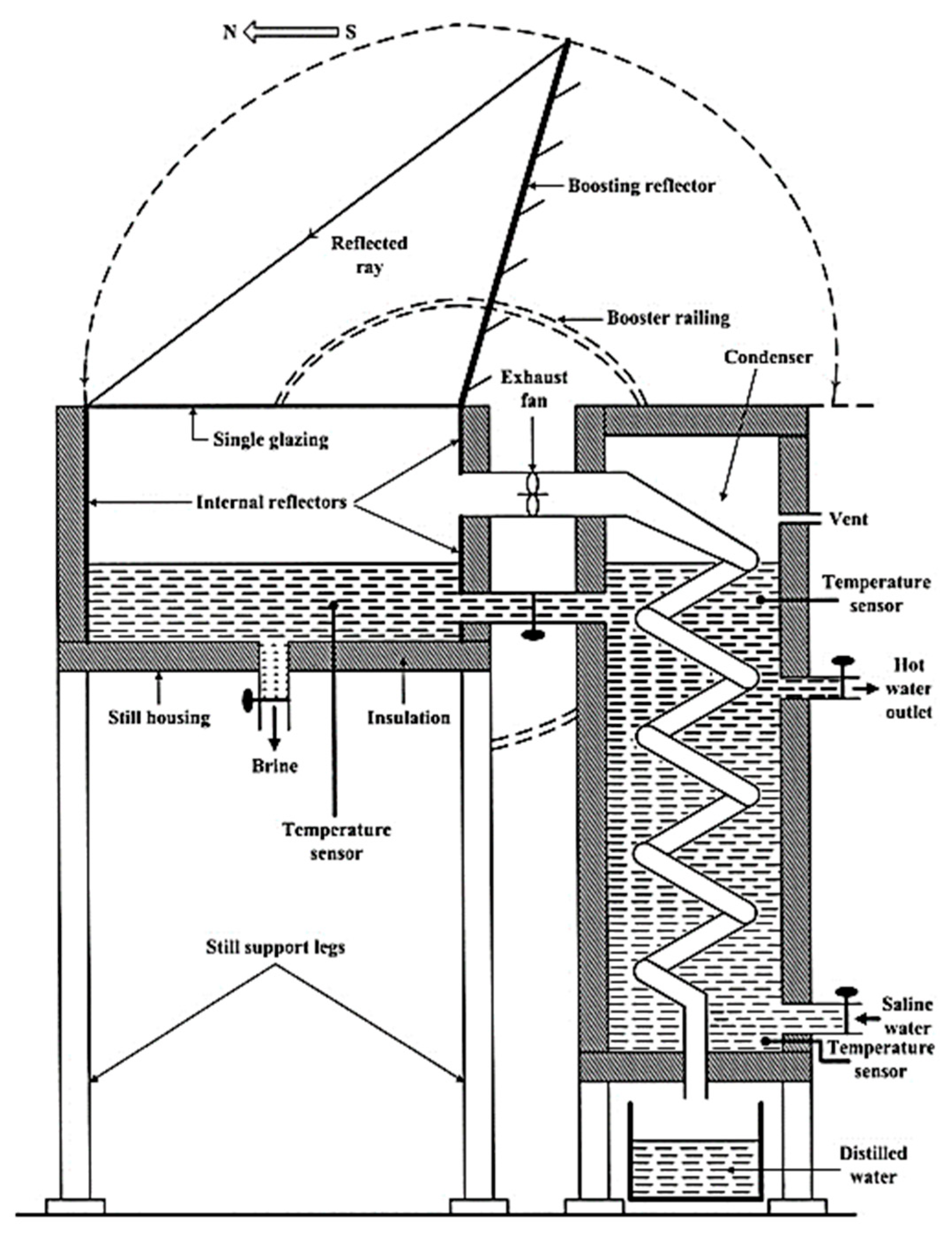
Monowe et al. (2011) [46] proposed an innovative design for a portable thermal solar still that integrates an external reflective booster along with an outdoor condenser (Figure 2). This configuration effectively minimises latent heat loss to the surrounding environment by capturing and redirecting the condensation heat into the external condenser. The recovered thermal energy can subsequently be utilised either for preheating saline water for domestic applications or to sustain the operation of the still during nighttime hours. The findings suggested that the effectiveness of the still can reach up to 77% when the recovered heat is used for domestic water preheating, and up to 85% when the heat is reused to operate the still at night, allowing it to be filled and primed for the next desalination cycle.
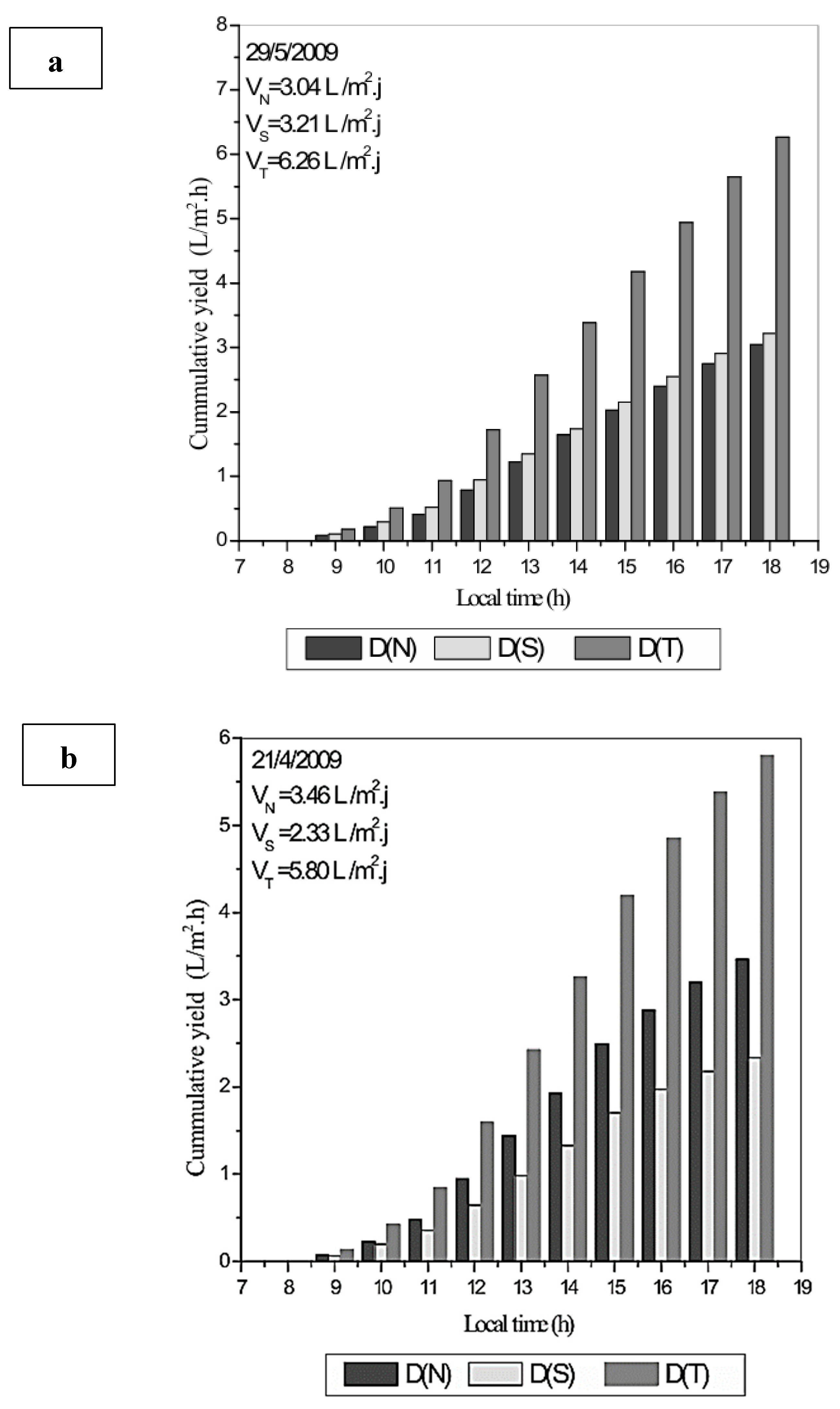
Zeroual et al. (2011) [47] conducted experiments on a pilot-scale double-slope solar still operated by solar energy in Ouargla, southern Algeria. Several experiments were conducted. In the first set of experiments, the productivity of the still was enhanced by cooling the condenser using flowing water over the north-facing glass cover, which resulted in a temperature reduction of 11.82 °C and a corresponding increase in distillate yield. In the second set, productivity was evaluated under periodic shading conditions (from 12:00 to 14:00), where the north glass cover was shaded using a rectangular screen positioned 0.9 m above the still. However, this approach led to only a modest rise in productivity of 2.94%. The total distilled water production was approximately 6.26 L/m2 per day, with nearly equal distribution between the north and south slopes, as shown in Figure 3a. However, Figure 3b illustrates that the north side produced a slightly higher amount of distillate compared to the south side.
Kabeel et al. (2014) [48] explored design changes in a single-basin solar still aimed at enhancing freshwater production by utilising nanofluids and an external condenser. The researchers focused on the suspension of aluminium oxide (Al2O3) nanoparticles in water to improve thermal conductivity, heat transfer, and the evaporation rate in comparison to normal water. Additionally, the external condenser served to reduce convective heat loss from the water to the glass cover by acting as an active heat and mass sink. The researchers also explored vapour extraction velocities. The results showed that the integration of a solar still with an external condenser can increase water production by 53.2%; in comparison, the incorporation of nanofluids in conjunction with the condenser improved water production by around 116%.
El-Samadony et al. (2014) [49] conducted an experimental contrast between an improved stepped solar still, equipped with internal and external reflectors, an external condenser, and a suction fan, and a conventional solar still (CSS). The findings showed that the stepped still with only a condenser produced 66% more water in comparison to the traditional technology. However, the incorporation of reflectors and an external condenser was shown to increase water production by 165%.
Refalo et al. (2016) [50] investigated the utilisation of a solar chimney and an external condenser to increase the convective air currents and improve the condensation rate of solar stills. The condenser was designed to enable vapour passage via immersed ducting in the condenser medium. This enhanced design of solar still was tested under natural environmental conditions with an open comparison against the performance of a CSS unit. The results showed that the upgraded design can achieve a greater efficiency by 8.8% at a water production of 5.1 L/m2 per day in comparison to the baseline unit of 4.7 L/m2 per day. Remarkably, 59% of the generated water was collected in the condenser, representing enhanced convection and condensation rates and highlighting this as an essential technique to enhance the distillation rate of solar stills.
The result of using a passive condenser in plastic channels was demonstrated by Bhardwaj et al. (2016) [51], who evaluated the overall performance of an inflatable solar still of 1.8 m2 of basin area. The researchers conducted the experiments in controlled laboratory conditions at different water operational temperatures. The solar still attained a water production of 0.75 L/h at 73 °C. Also, the water production was increased to 0.95 L/h after directing airflow towards the condenser to simulate wind. Also, the addition of a water-soaked tissue was confirmed in this research to increase evaporative cooling. These results concluded that passive condenser enhancements can meaningfully increase distillation competence.
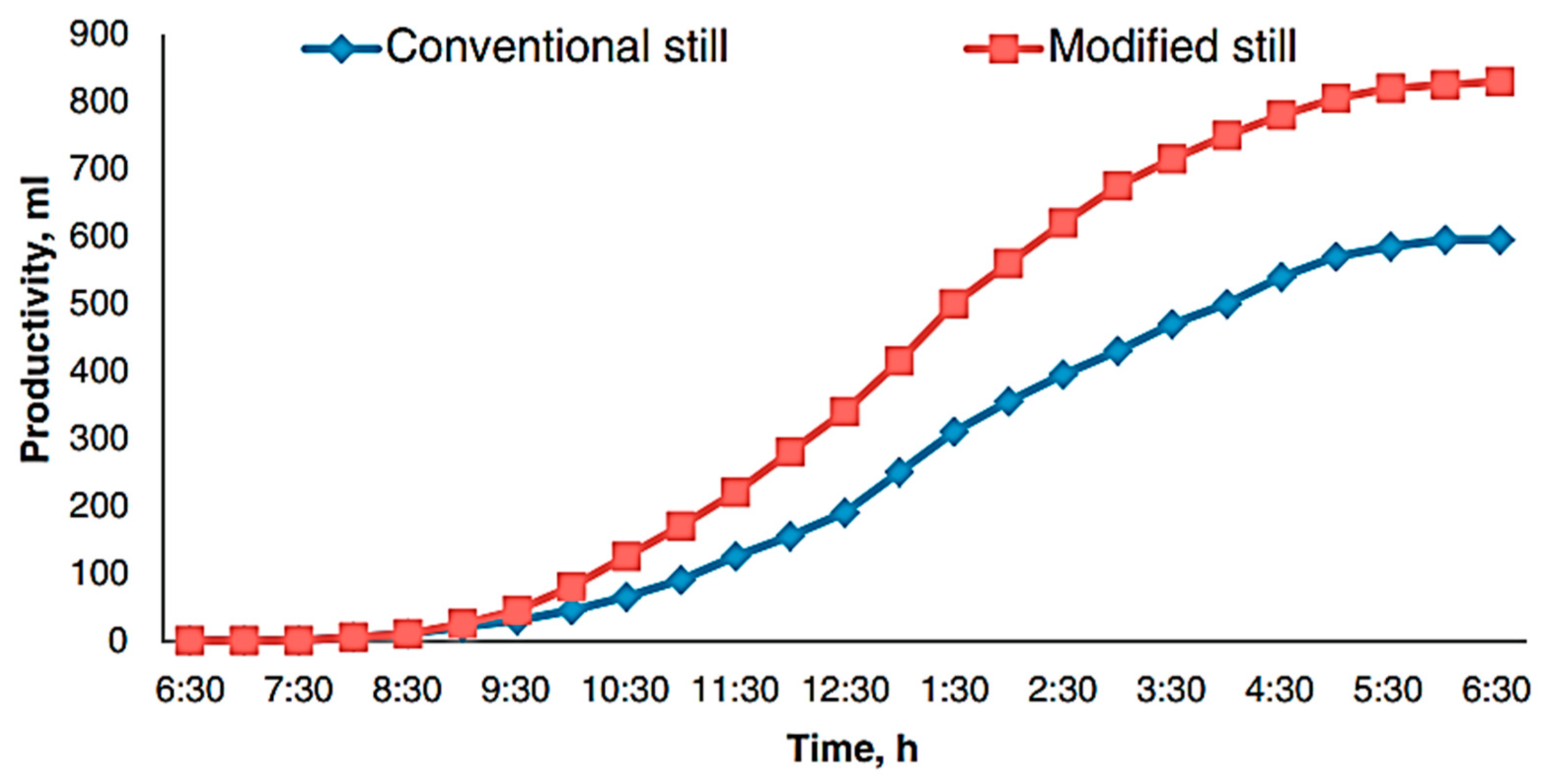
An experimental analysis was conducted by Kumar et al. (2016) [52] to contrast the efficacy of CSS and modified single-basin, single-slope solar stills. Two similar stills were built, with one modified to include water agitation and external condensation. A DC motor-driven agitator was deployed to disturb the thermal boundary layer, thus raising the air–water contact surface. An exhaust fan directed vapour to an external condenser, enabling airflow and condensation. The redesigned still reached a 39.49% increase in distillate yield compared to the conventional design under identical operating conditions (Figure 4). The integrated use of agitation and external condensation notably enhanced competence, and the enhanced system established improved cost-effectiveness compared to the original design.
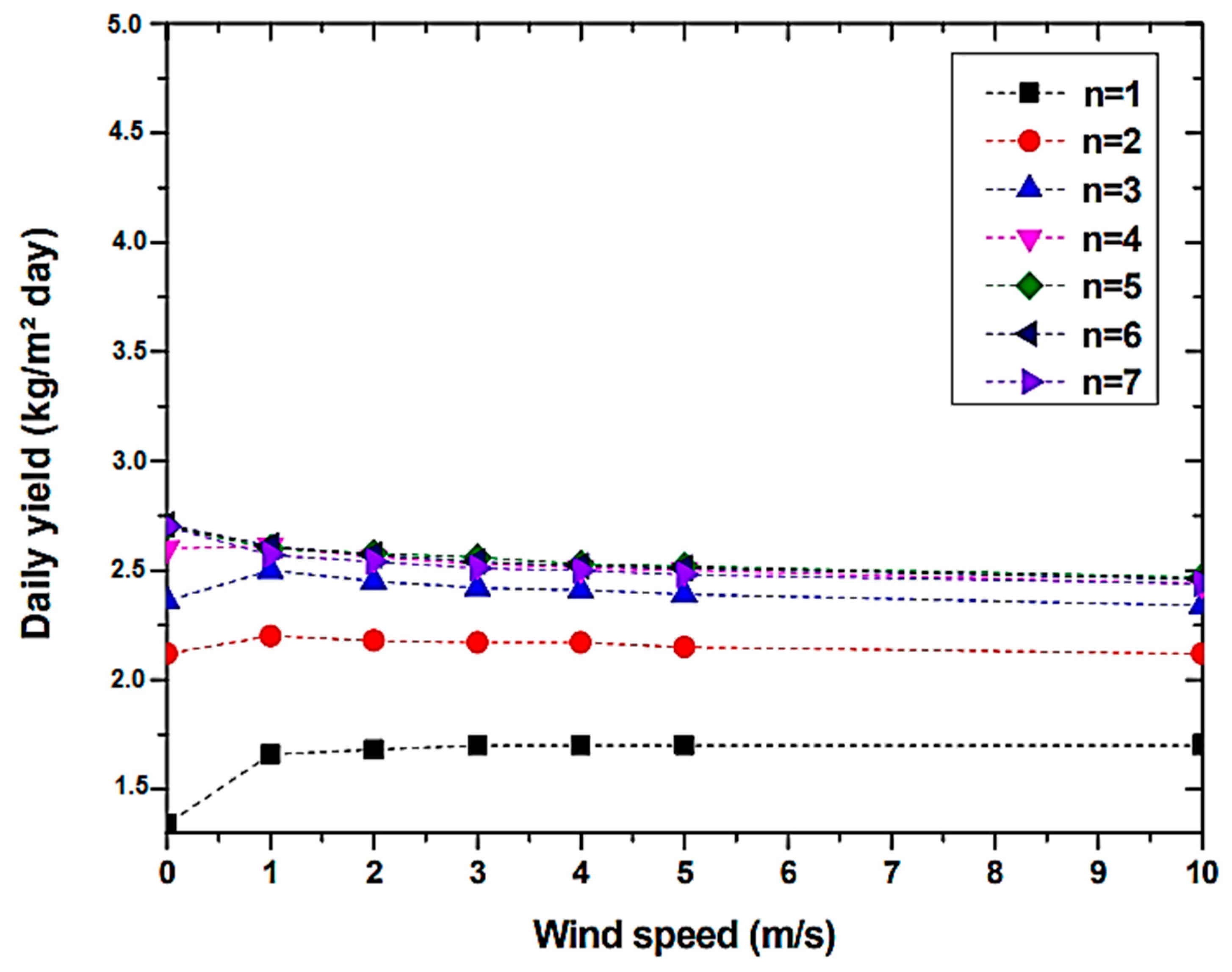
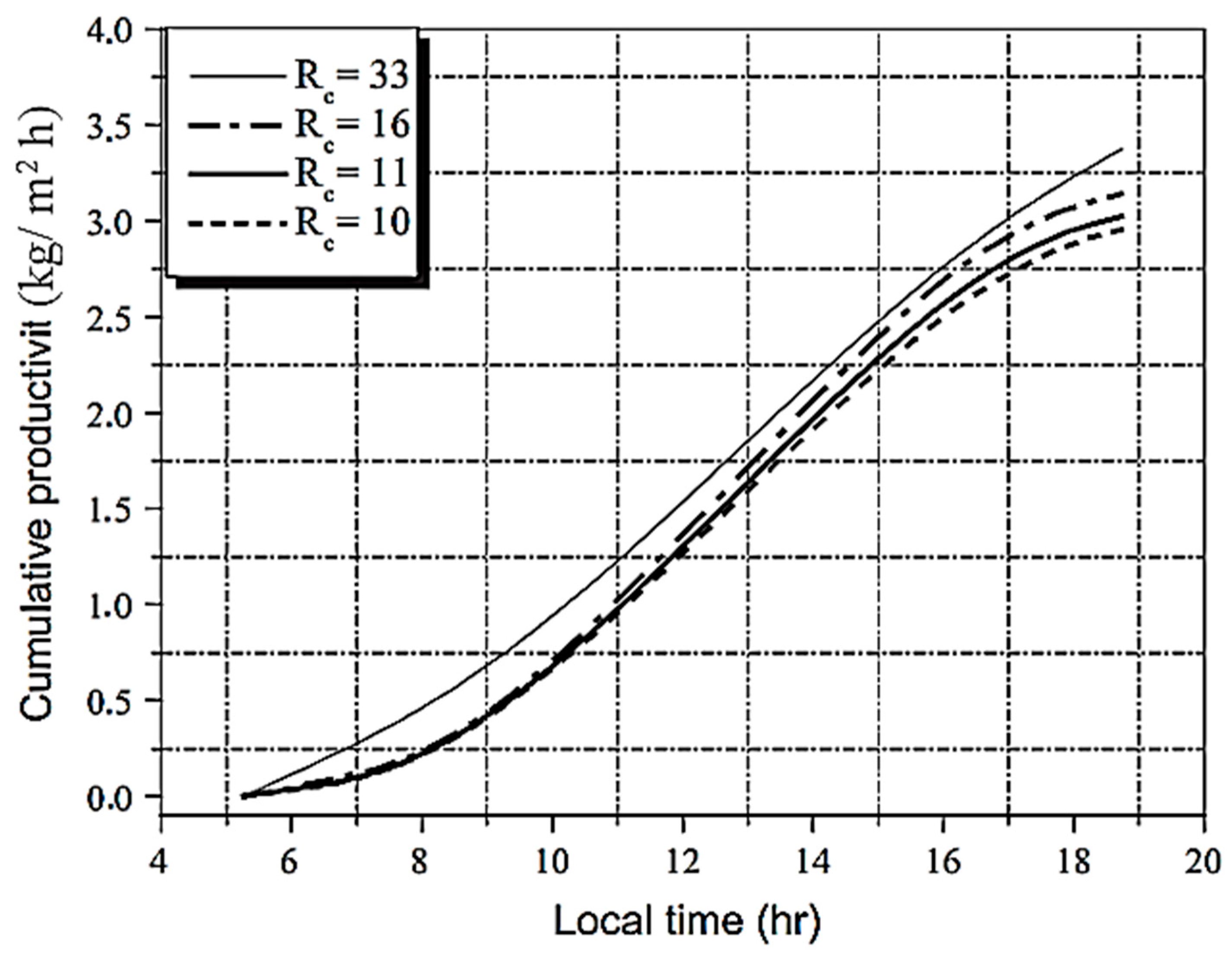
To investigate the influence of the surface of the condenser on the performance of a Natural Circulation Loop (NCL) solar still under typical winter/summer conditions, Rahmani and Boutriaa (2017) [53] conducted both numerical and experimental studies. The researchers developed a computer model to simulate the transient thermal performance of the system and to estimate how variations in condenser size and wind speed affect daily water yield. The results indicated that increasing the condenser area initially improves productivity; however, beyond a certain point, the marginal gains diminish. Conversely, wind speed was found to have a more pronounced effect on productivity when smaller condensers were used. The researchers reported maximum daily distillate yields of 4.73 kg/m2 in summer and 2.71 kg/m2 in winter, attributing the seasonal difference to reduced solar radiation and lower ambient temperatures during the winter months, as shown in Figure 5.
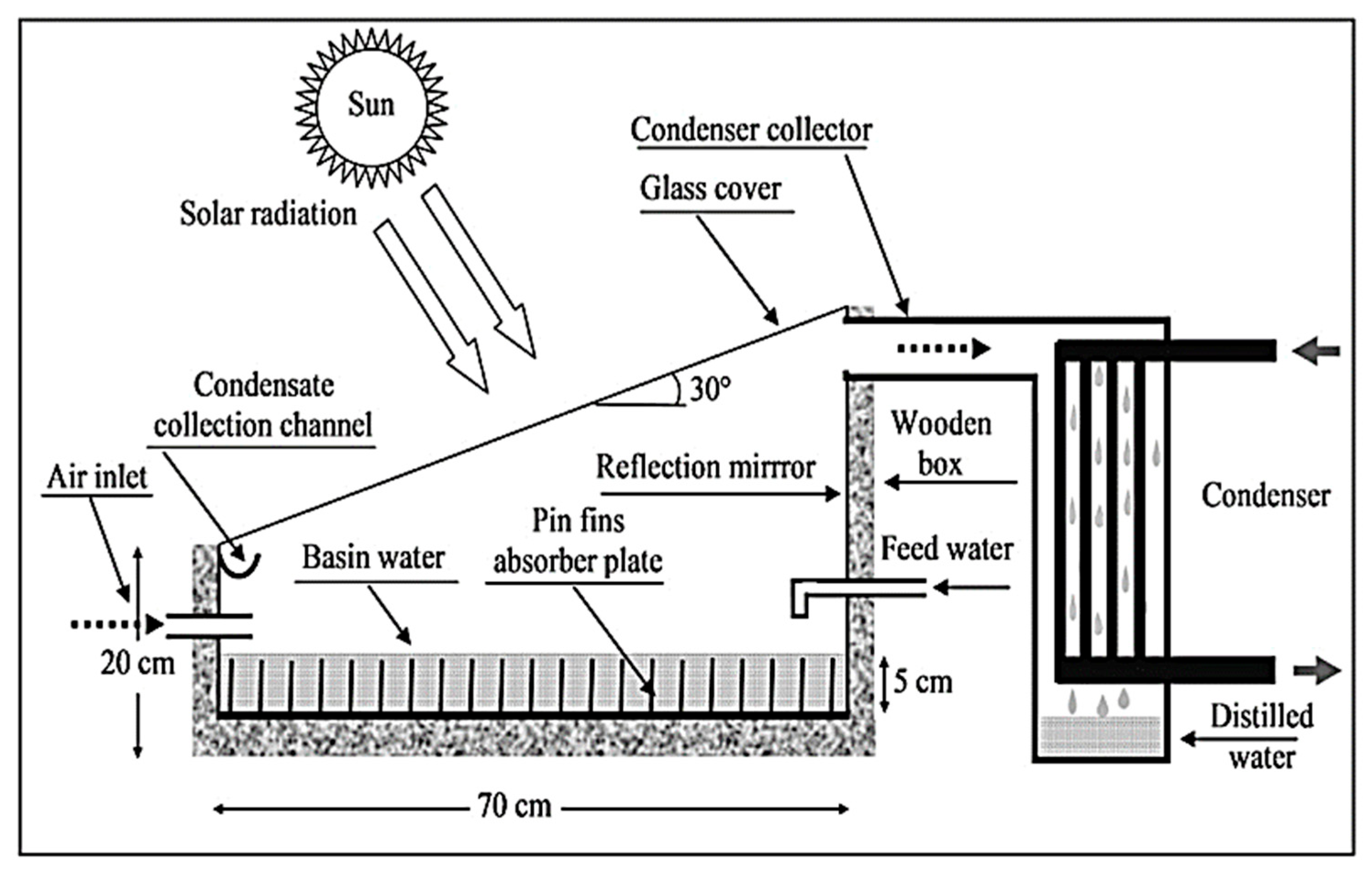
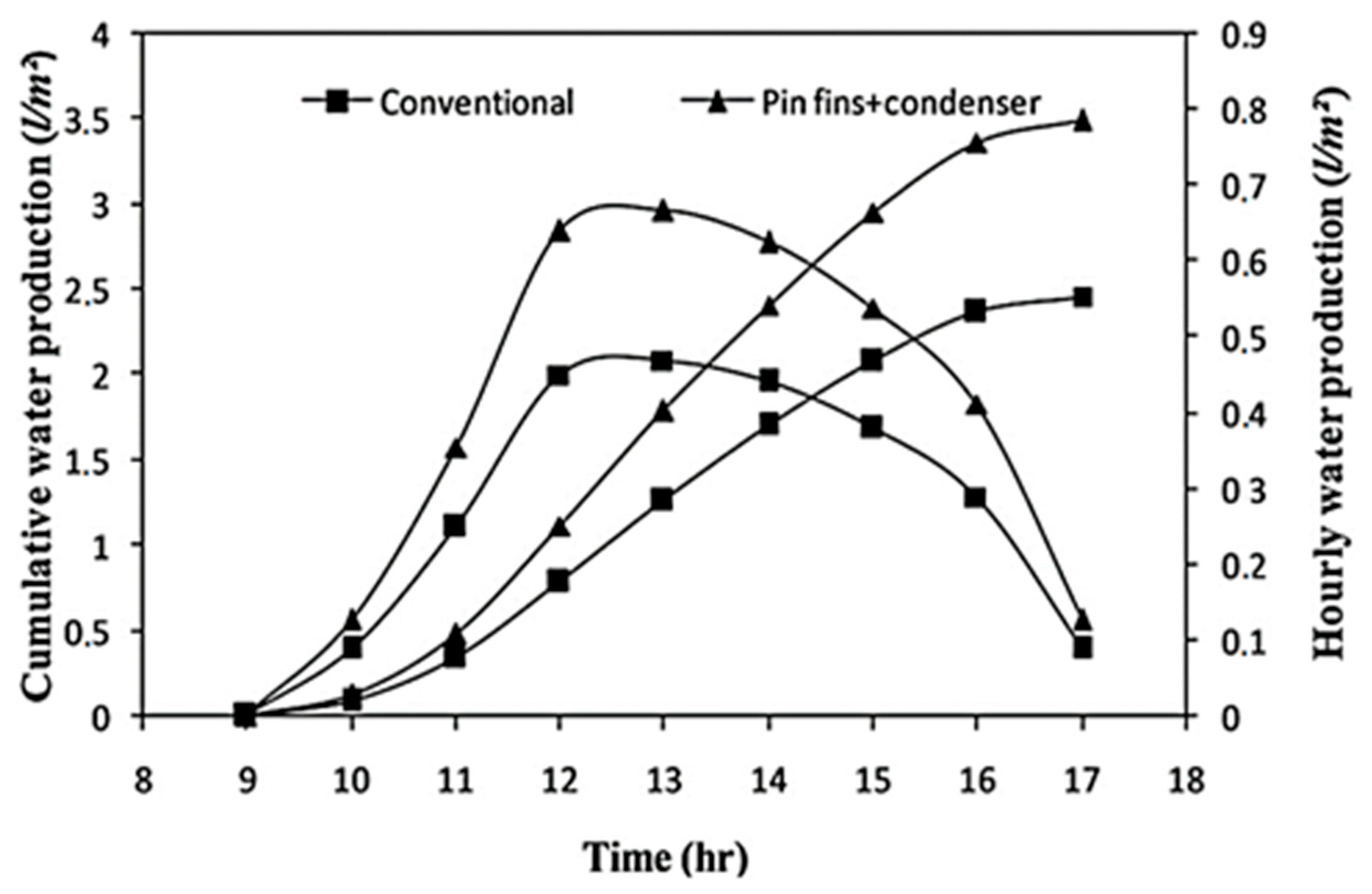
Rabhi et al. (2017) [54] suggested an improved solar still design that integrates a pin-finned absorber and an external condenser, presenting a direct comparison with two other layouts: a still with a pin-finned absorber and a CSS (Figure 6). The objective was to evaluate thermal performance by monitoring absorber and glass temperatures, as well as freshwater production, under the meteorological conditions of Gafsa, Tunisia. The experiments were conducted on 26, 27, and 29 January 2016. The findings revealed that the largest hourly water yield per unit absorber surface, recorded at 13:00, was 0.47 L/m2 for the CSS and 0.667 L/m2 for the modified still equipped with both pin fins and an external condenser. The researchers concluded that the combination of a pin fin absorber and an external condenser significantly enhances freshwater production (Figure 7).
Hassan and Abo-Elfadl (2017) [55] conducted a study to judge the effect of different condensers and saline water media on the performance of a south-facing single-slope solar still. Four types of condensers were tested: (i) glass, (ii) aluminium plate, (iii) aluminium heat sink with pin fins, and (iv) an aluminium plate covered with a 20 cm-wide umbrella. Additionally, four saline water media were evaluated: (i) plain saline water, (ii) black steel fibre layers, (iii) saline-saturated sand, and (iv) a combination of sand and black steel fibres saturated with saline water. The results demonstrated that the heat sink condenser produced a higher saline water temperature and a greater temperature differential between the basin water and the condenser surface compared to the glass condenser. Moreover, using black steel fibres in the basin with a glass condenser increased daily freshwater production by 35%, while the heat sink condenser achieved productivity improvements of 31% with plain saline water and 52% when paired with black steel fibres. However, attaching an umbrella to the aluminium plate condenser reduced daily productivity by 26%.
Kabeel et al. (2017) [56] conducted numerical research to appraise the effect of using nanofluids and an external condenser on solar still performance, in addition to comparing the overall competence of the enhanced system with a traditional one under similar climatic conditions. Considering the case study of Kafrelsheikh, Egypt, the researchers developed a numerical model of heat and mass transfer, which was used for simulation. Accordingly, the effects of different concentrations of nanoparticles on water production in low-pressure environments were assessed. They examined Al2O3 and Cu2O nanofluids at concentrations of up to 0.3% and 0.02%, respectively. The findings represented a precise correlation between the simulation and experimental results, which indicated the possibility of having 84.16% daily thermal efficiency when a fan was used with Cu2O and 73.85% with Al2O3 nanofluids. Furthermore, the altered system was shown to achieve 46.23% efficiency even under low-pressure conditions without a fan. Specifically, this is greater than the efficiency of the CSS, of only 34%.
Rahman et al. (2019) [57] designed a solar still optimised for solar irradiation and condensation using an external condenser. The system featured absorber plates with rectangular and triangular channels designed to maximise heat transfer surface area and improve the surface-to-volume ratio. The condenser, cooled by feed water, consisted of copper tubes maintained below the dew point to enhance condensation, compensating for the reduced glass surface condensation caused by film formation. Latent heat released during condensation was captured by the external condenser and utilised to preheat the feed water, which was subsequently heated by a solar collector before entering the basin. Experiments were conducted under variable weather conditions in Rajshahi, Bangladesh, and indicated that the triangular-channelled absorber plate can achieve the highest average distillate output of 3.15 L/m2 per day. The incorporation of the external condenser resulted in productivity enhancements of between 24 and 30%.
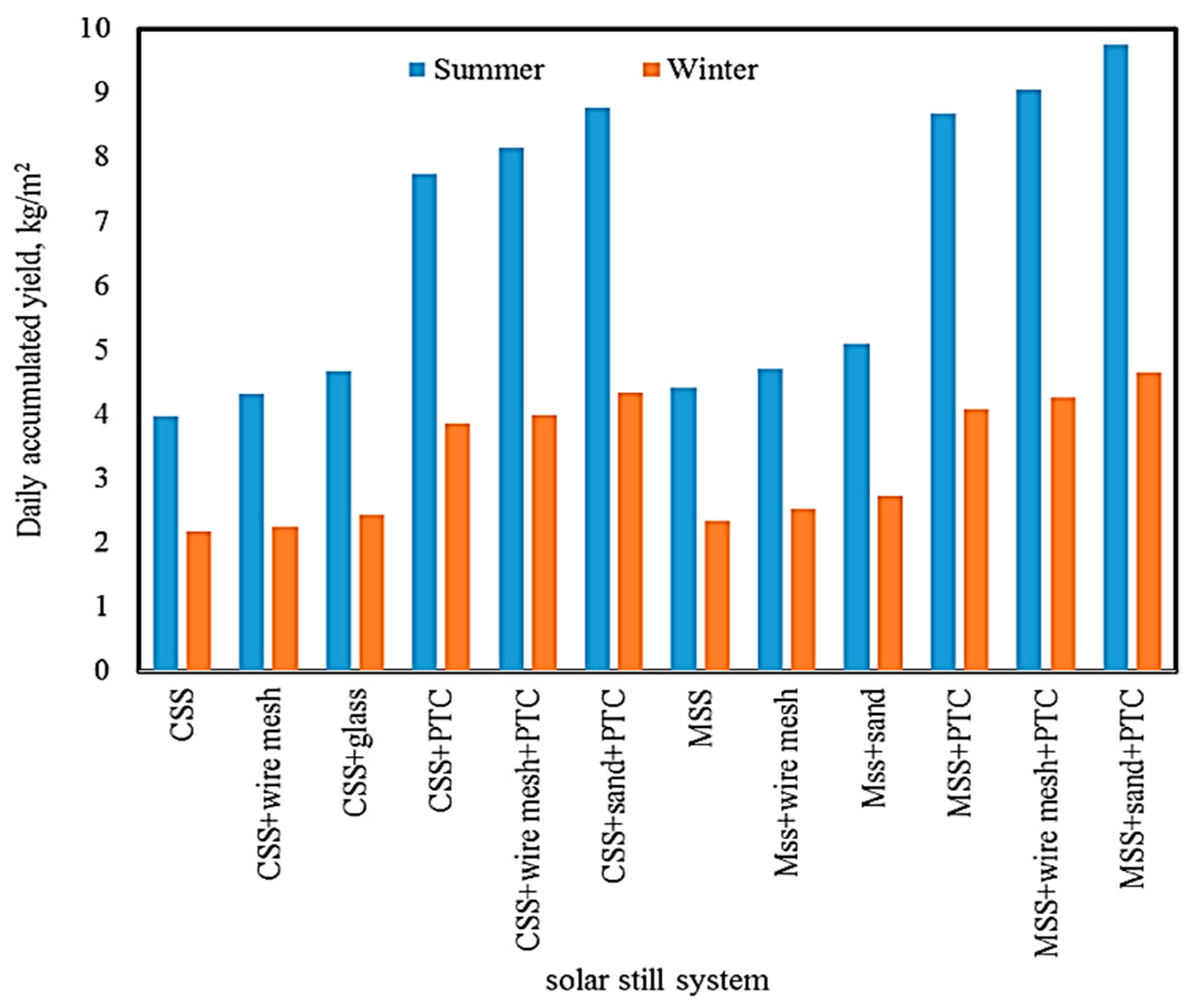
Hassan et al. (2020) [58] appraised the performance of a solar still that used three saline water media: pure saline water, sand saturated with saline water, and steel wire mesh immersed in saline water. The research was conducted under both standalone and parabolic trough collector (PTC)-integrated conditions in cold and hot climates of Egypt. The findings indicated that the inclusion of wire mesh, sand, and a heat sink condenser (HSC) can meaningfully enhance both water production and system competence. During summer, the productivity increased by 67, 7.3, and 6% with PTC, HSC, and sand, respectively, compared to a CSS with a glass condenser. The modified still (MSS) demonstrated greater efficiency in summer than in winter, with the HSC improving efficiency of 8% in winter and also by 11.6% in summer relative to the CSS. As illustrated in Figure 8, the minimum daily production of the CSS was 3.96 kg/m2 in summertime and 2.18 kg/m2 in wintertime, while the MSS with PTC and sand achieved the highest yields of 9.75 kg/m2 and 4.65 kg/m2, representing productivity increases of 146% and 113%, respectively, over the CSS.
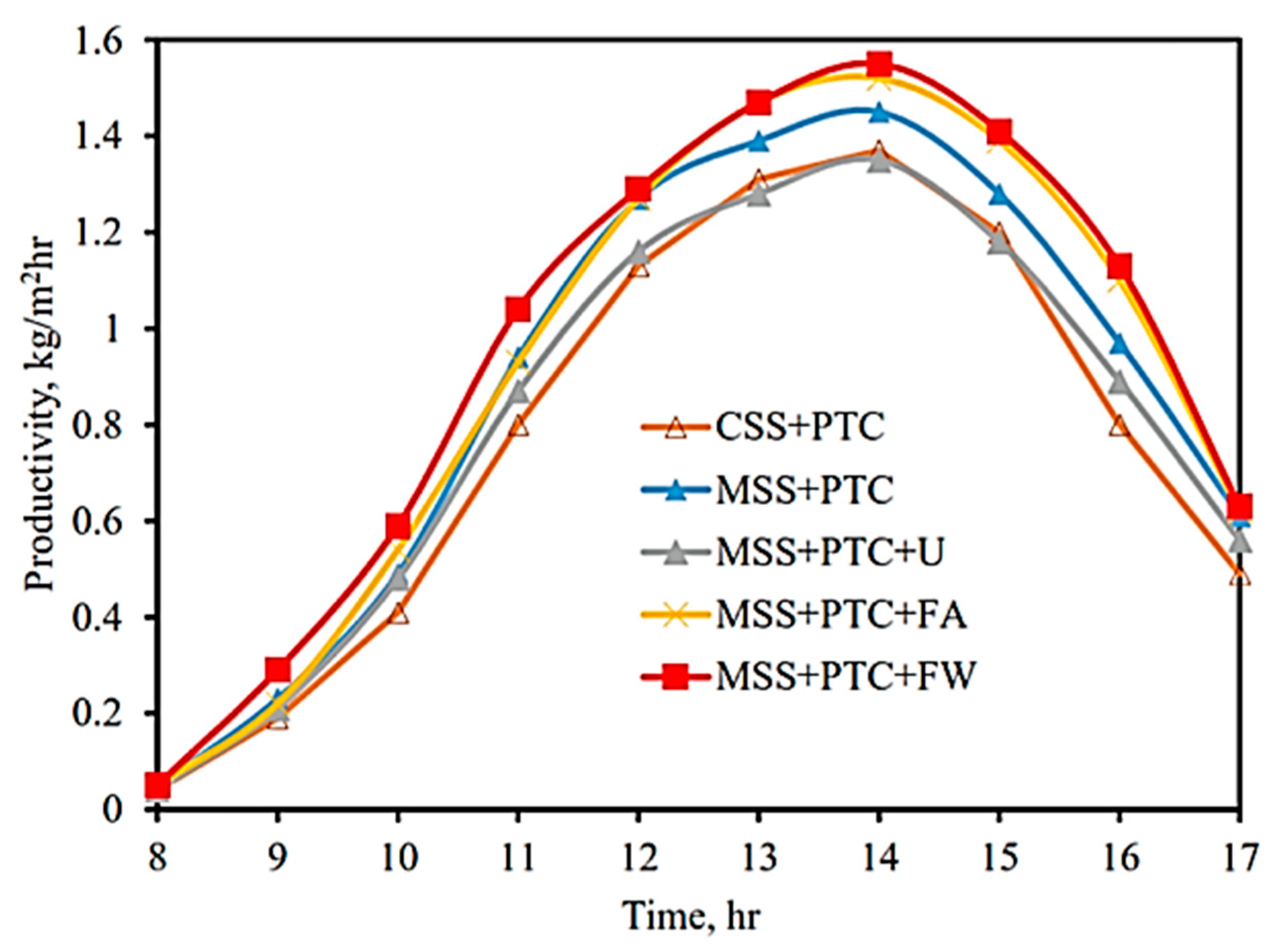
Hassan et al. (2020) [59] carried out experiments to investigate the effectiveness of solar stills integrated with a parabolic trough solar collector (PTSC) under variable cooling conditions. The researchers evaluated exergy, energy, exergo-economic, and enviro-economic performance across several system configurations. These included a CSS, an MSS with a heat sink condenser, an MSS coupled with PTSC (MSS + PTSC), an MSS with an umbrella and PTSC (MSS + PTSC + U), an MSS with PTSC and forced air cooling (MSS + PTSC + FA), and an MSS with PTSC and forced water cooling (MSS + PTSC + FW). Conducted in Sohag, Egypt, under hot climatic conditions, the experiments demonstrated that freshwater yields during summer increased progressively across the configurations. The researchers recorded yields of 7.74 kg/m2 for CSS + PTSC, 8.02 kg/m2 for MSS + PTSC + U, 8.68 kg/m2 for MSS + PTSC, 9.11 kg/m2 for MSS + PTSC + FA, and 9.45 kg/m2 for MSS + PTSC + FW. The condenser’s heat transfer efficiency also improved with increasing solar intensity, with a maximum efficiency of 14.8% recorded for the MSS + PTSC + FW setup, which employed an HSC and forced water cooling (Figure 9).
Parsa et al. (2020) [60] carried out a comparative investigation of solar stills employing different settings, including one with thermoelectric heating in the basin, another combining thermoelectric heating with nanofluids, and a third configuration that incorporated thermoelectric heating, nanofluids, and a double-slope external condenser cooled by both a water film and a thermoelectric module. Silver nanoparticles (0.03 wt.%) were selected due to their thermal enhancement properties and water disinfection capability. Several experiments conducted during a week in June 2019 demonstrated that the solar still incorporating both nanofluids and the external condenser achieved a 100.5% increase in daily distillate yield and a thermal efficiency of 26.7%, compared to the baseline system. In comparison, the system with only nanofluids (without a condenser) achieved improvements of 50.8% in yield and 30.6% in efficiency. The configuration with both nanofluids and a condenser exhibited the highest productivity, reaching 7760 cc/m2 per day. Glass-side productivity in this configuration was 16.5% and 47.6% higher than in the other designs. Moreover, the external condenser contributed 26.3% of the total water output, with the thermoelectric-cooled side of the condenser producing more than five times the amount produced by the water-film-cooled side.
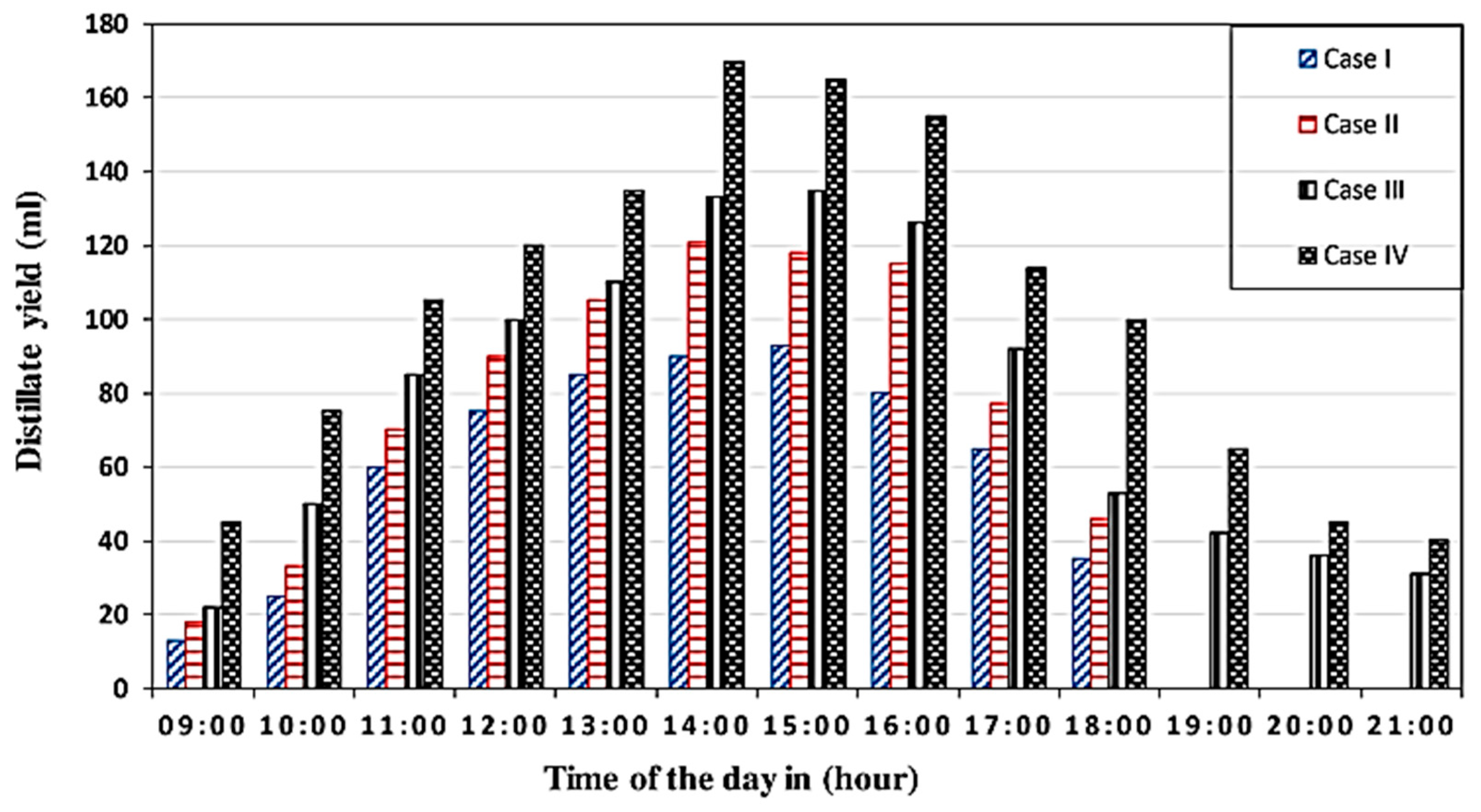
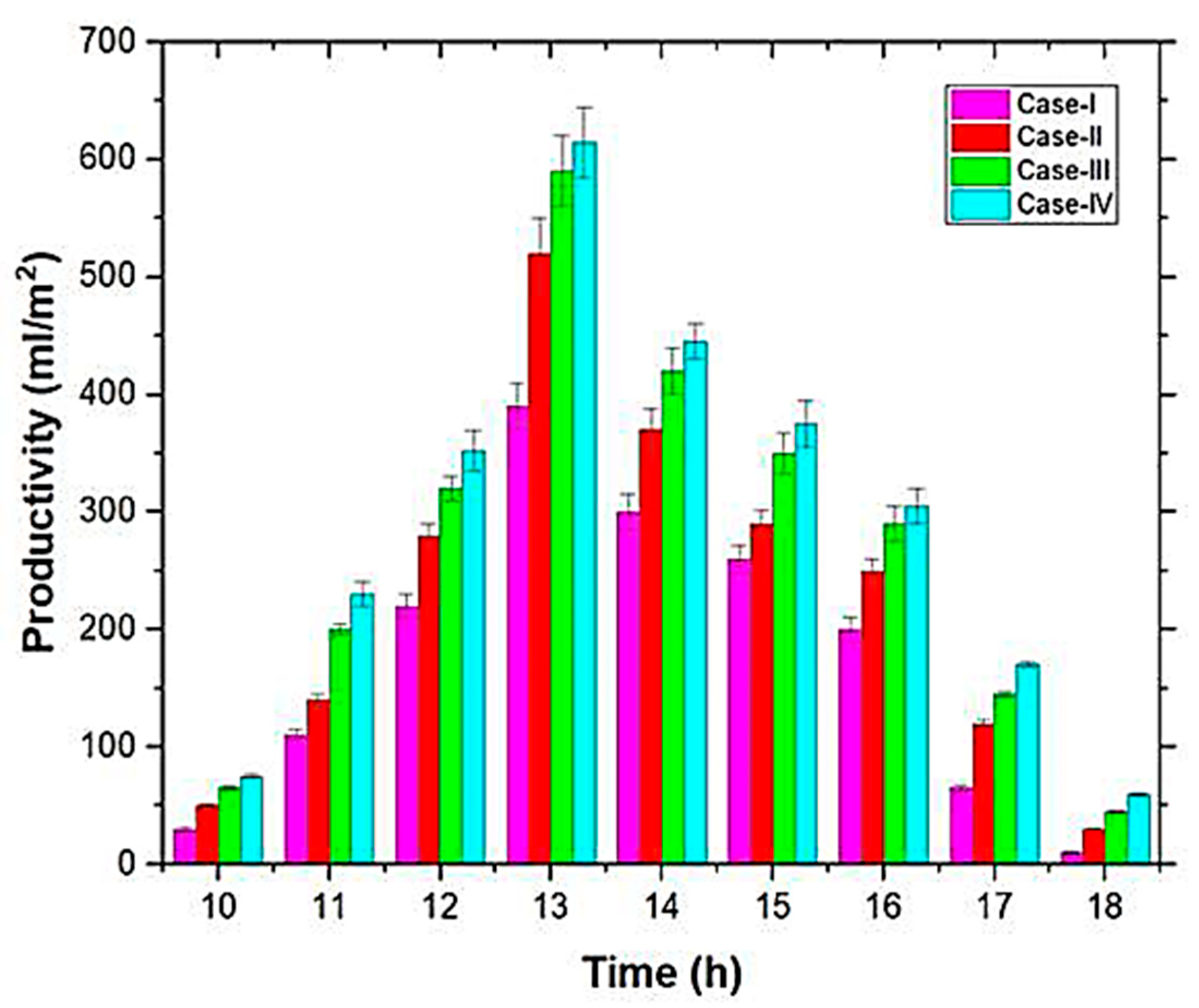
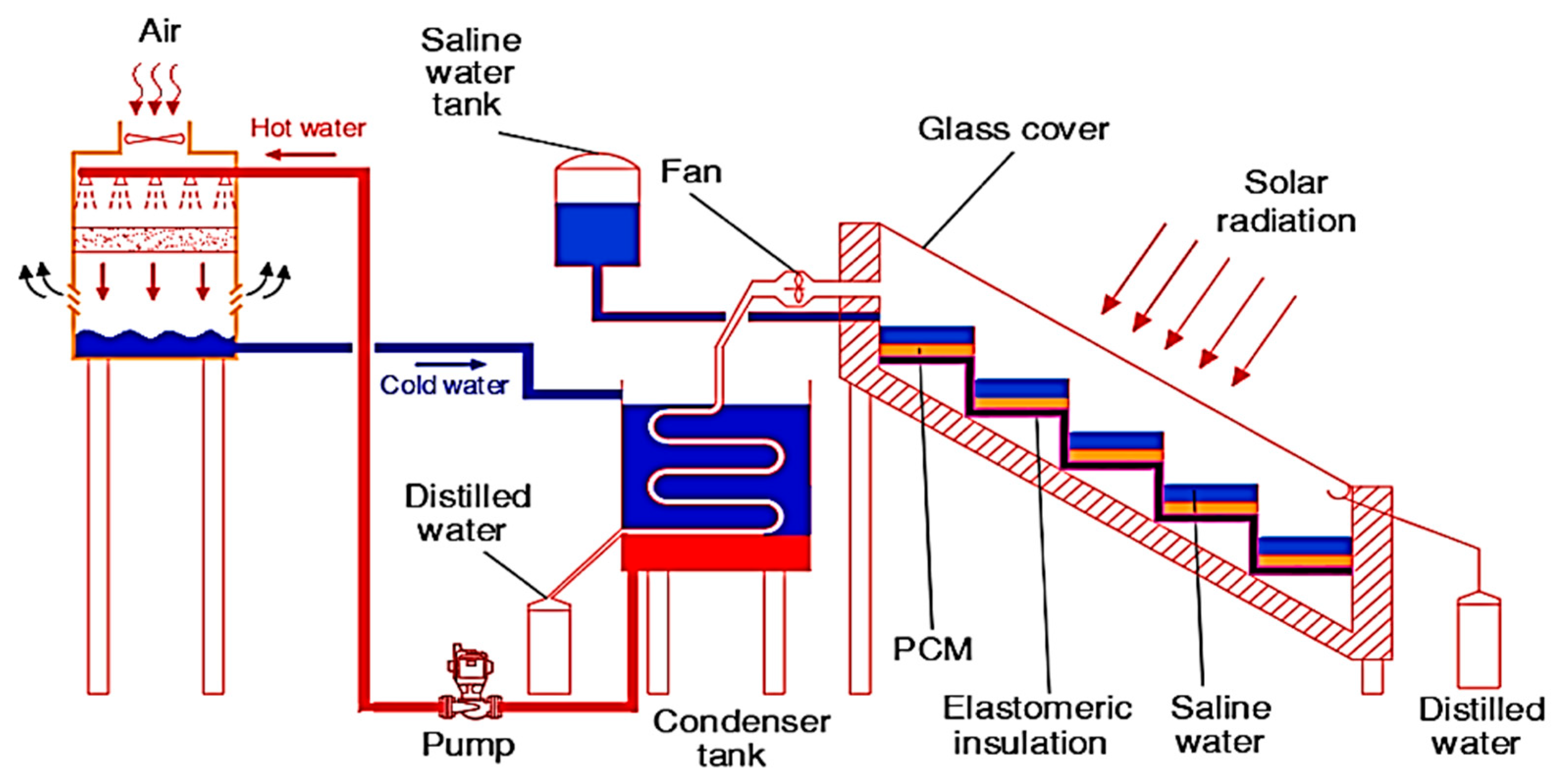
Toosi et al. (2021) [61] increased the water production of a stepped solar still by combining additional performance enhancement strategies (Figure 10). Specifically, they designed and fabricated PCM chambers that can store latent heat during the day and continue the distillation process after sunset. In the same experiments, the addition of an external condenser was also tested to appraise its contribution in supporting the overall performance. Four layouts were tested under stable weather conditions in Iran, including the baseline system (referred to as Case I), which was a conventional stepped solar still. Case II included an external condenser, Case III included PCM chambers, and lastly, Case IV integrated both PCM and an external condenser. The baseline configuration achieved a thermal efficiency of 28.21%. Relative to Case I, the productivity improvements for Cases II, III, and IV were 26%, 43%, and 104%, respectively, as illustrated in Figure 11.
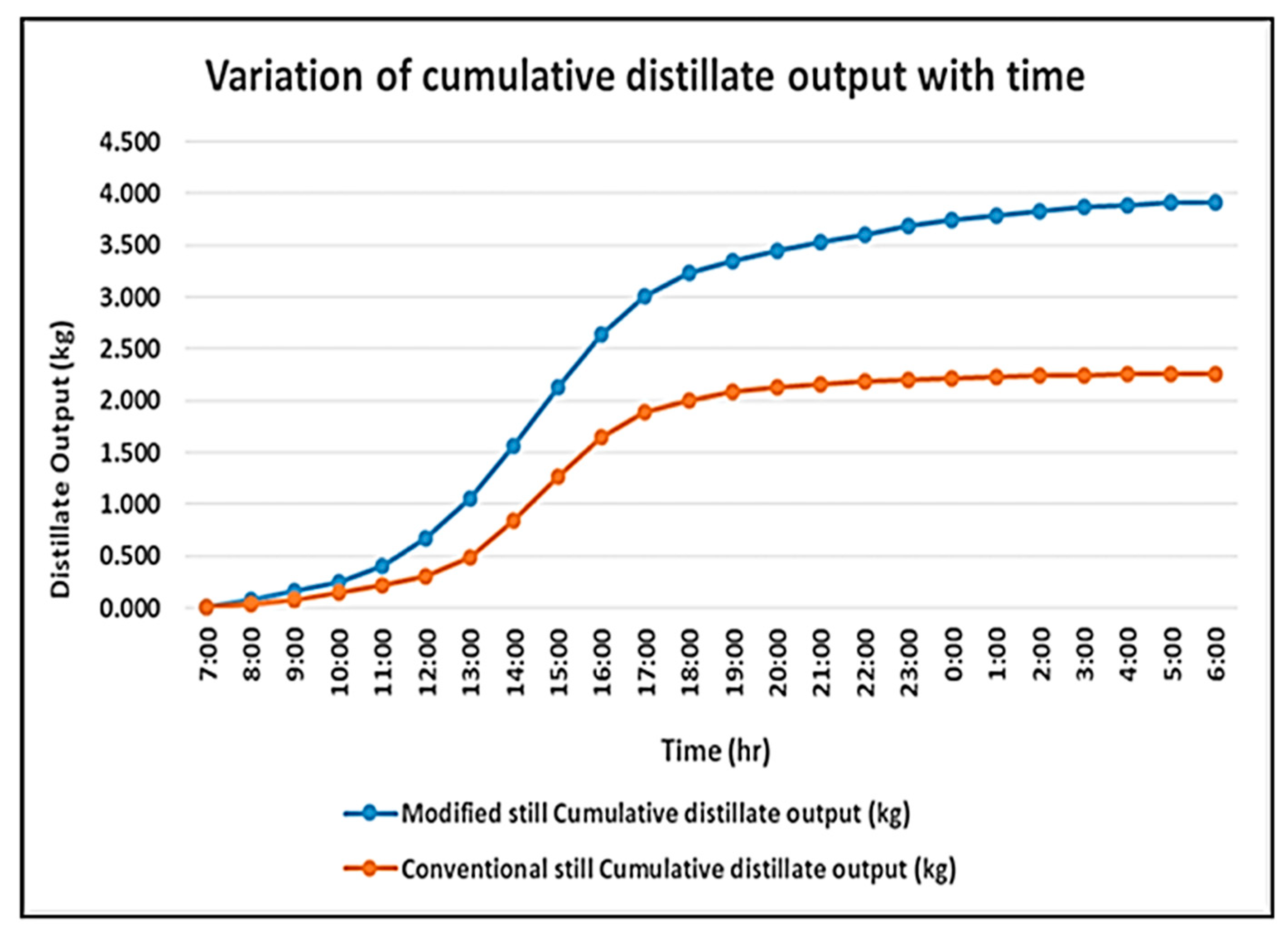
An experimental study was conducted by Mevada et al. (2021) [62] in Gandhinagar, Gujarat, India (23.21° N, 72.63° E), to compare the distillate productivity of a CSS and an MSS. The MSS was equipped with evacuated tubes and a zigzag-finned air-cooled condenser to enhance performance. The results indicated that the MSS achieved higher water temperatures (69.21 °C) compared to the CSS (63.75 °C), while the inner glass cover temperatures were similar (54.93 °C for MSS versus 54.37 °C for CSS). Thus, the MSS maintained water temperatures approximately 6 °C higher than those of the CSS. In terms of distillate yield, the CSS and MSS achieved maximum productions of 2.26 kg/m2 and 3.92 kg/m2, respectively, corresponding to a 73.45% increase in productivity for the MSS. Thermal analysis further revealed that the MSS exhibited higher fractional exergy of evaporation and greater thermal efficiency, validating the effectiveness of the implemented modifications in enhancing solar still performance. These comparative results are illustrated in Figure 12.
Patel et al. (2021) [63] enhanced the efficiency of a desalination system designed to produce potable water from polluted Gomti River water by incorporating an external partial cooling coil condenser into an ultra-modified double-slope solar still. The system was engineered to ensure complete condensation of the vapour generated during operation. Experiments were carried out during both summer and winter between 07:00 and 19:00 h. The highest ambient temperature and solar radiation were registered at 47.1 °C and 955 W/m2, respectively, at 14:00, with the solar still inclined at an angle of 15°. The highest hourly productivity was 1709 mL/h, while peak daily yields reached 11,499 mL in summer and 8212 mL in winter. The corresponding system efficiencies were 76.66% and 54.74%, respectively.
Rahmani et al. (2021) [64] conducted a number of experiments to inspect the potential negative impact of an external condenser on the efficiency of a CSS. An innovative external condenser design was applied in a single-slope, basin-type CSS. The comparative study was conducted under similar outdoor environmental conditions. The outcomes showed that the external condenser does not always improve the performance of the CSS, and its efficiency is extremely dependent on ambient weather conditions. In particular, while the external condenser enhanced water production by 29% under moderate climates, it led to a reduction of 16.5% under very hot or cold conditions in comparison to the unmodified CSS. Moreover, natural circulation was found to contribute significantly to vapour transport, accounting for 63–80% of the mass transfer to the external condenser. These results highlighted that the impact of the external condenser is context-dependent and, under certain conditions, can negatively impact the system’s competence.
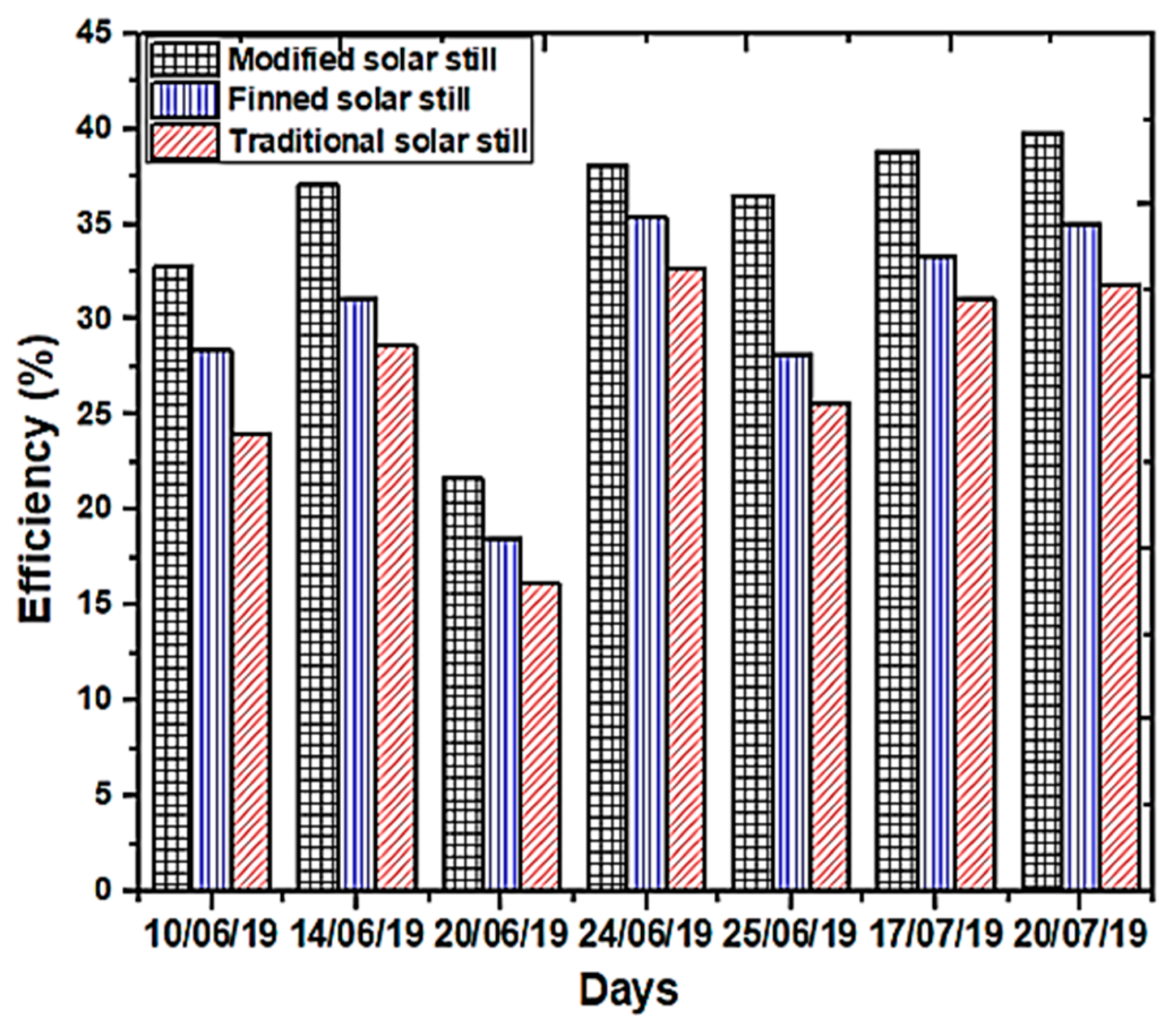
Tuly et al. (2021) [65] examined various strategies to improve fresh water production in an enhanced double-slope solar still by combining a rectangular solid fin, paraffin-based thermal storage, a black cotton wick, and an external condenser. The research compared the effectiveness of three double-slope solar still designs—finned, modified, and traditional—under five different operating conditions. Maximum daily productivity was recorded as 3.07, 2.70, and 2.46 L/m2 for the modified, finned, and traditional systems, respectively. The optimised modified solar still achieved the highest thermal efficiencies, reaching 39.74% with an external condenser and 30.00% without it, representing a 10% increase in productivity due to the condenser. Additionally, the modified solar still demonstrated an average daily efficiency improvement of 14.23% and 22.33% over the finned and traditional systems, respectively. The lowest recorded efficiencies were 21.62% for the modified system, 18.51% for the finned system, and 16.18% for the traditional system, as shown in Figure 13.
Abdelgaied et al. (2021) [66] evaluated the potential of pin fins and an external condenser to increase the effectiveness of tubular solar distillers. Their experimental work comprised two main parts. The first part focused on assessing the influence of pin fins on distillate yield and determining the optimal fin orientation to minimise shadow effects within the basin. Three designs were evaluated under similar conditions: a conventional tubular solar still (CTSS), a modified system with vertical pin fins, and another with inclined pin fins (MTSS-IPF). The second part assessed the joint impact of inclined pin fins and an external condenser by contrasting the CTSS to a system with both features (MTSS-IPF + Condenser). The outcomes showed that vertical and inclined pin fins enhanced the yield by 18% and 27.6%, respectively, in comparison to the CTSS.
The incorporation of a passive external condenser and a stepped evaporator design was the target of Sivaram et al. (2021) [67], who sought to examine the efficiency enhancement in solar stills. The researchers stated a remarkable improvement in overall competence, with the passive condenser increasing system performance by 12.2% in winter and 10.6% in summer if compared to conventional solar systems. In other words, the configuration with a stepped evaporator and external condenser performed better during winter, whereas the stepped still without a condenser was more efficient in summer. A detailed heat transfer analysis was also conducted, ensuring the condenser’s contribution to thermal performance. Accordingly, the findings ascertained the promise of passive condensers in optimising solar still operation under various climatic conditions.
Alawee et al. (2022) [68] conducted a detailed experimental work on a CSS and an MSS, combining different enhancements, such as a copper water heating coil, an external condenser, and nano-enhanced PCM with silver nanoparticles (nano-PCM-Ag). In this aspect, the three experimental groups were investigated under similar meteorological conditions to assess gains in water production and thermal efficacy. The MSS with the heating coil indicated a 76% growth in water production and 45.4% in thermal efficiency. However, the MSS with an external condenser showed an increase of 120% in water production and 52% in thermal efficacy. The MSS integrated with a nano-PCM-Ag achieved an increase of 111% in water production and 50.7% in thermal efficiency. Furthermore, the productivity of the MSS with the heating coil was further increased by 35% and 44% when a PCM or an external condenser was involved, respectively. An economic analysis exposed that the MSS with an external condenser had the lowest cost for distilled water production, at 0.022 USD/L, followed by the MSS with PCM at 0.024 USD/L, and the CSS at 0.029 USD/L, highlighting the cost-effectiveness of the improved designs.
Moghadam and Samimi (2022) [69] considered a solar still system that used an evacuated tube collector as the basin, integrated into a cube-shaped glass condenser mounted at the top to simplify vapour condensation. The principal goal was to assess how the condenser’s geometry, such as its volume, surface area, and wall thickness, impacted fresh water production. The researchers deployed response surface methodology utilising a Box–Behnken design to signify the optimum operating conditions for maximum freshwater production. The outcomes indicated that all selected parameters significantly influenced the desalination yield. The maximum water production was 7.231 kg/m2 per day, attained when the condenser volume was 2940 cm3, the wall thickness was 4 mm, and the surface area was 3360 cm2. The coefficient of determination (R2 = 0.993) assured its strong predictive accuracy, validating the design’s suitability for improved solar desalination performance.
To address the concern of low productivity in solar stills, Hussein and Jassim (2022) [70] suggested a unique design that combined a separate condenser into a CSS, alongside structural dividers and a DC fan to assess thermal performance. The researchers experienced four still configurations under the climatic conditions of Baghdad during April and May 2021: a conventional model, two with individual condensers, and one with a specialised condenser. The systems with a separate condenser and a specially designed condenser indicated an increase in water production of 39.33% and 31.75%, respectively, in comparison to the conventional still. Also, the use of internal dividers enhanced water production by 3% to 9%, contingent on the design. Nevertheless, the presence of a DC fan negatively affected performance, dropping daily water production by 20.28% in comparison to the fanless version, likely due to excessive cooling or altered vapour dynamics.
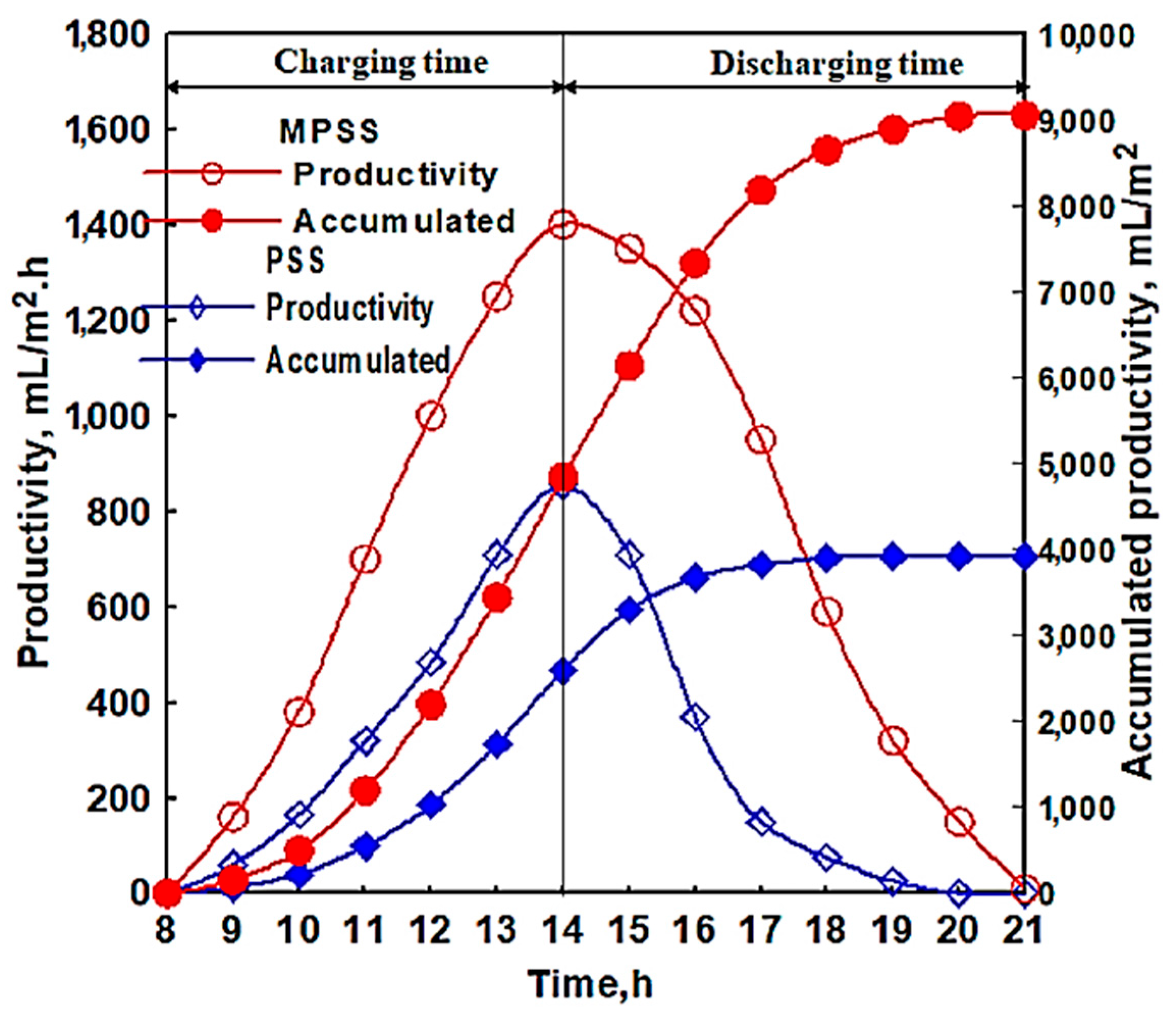
The performance of pyramid solar stills was improved by Sharshir et al. (2022) [71], who integrated evacuated tubes, an external condenser, nanoparticles, and ultrasonic foggers. The researchers experimentally evaluated the effects of these modifications in a comparison to a conventional pyramid solar still (CPSS). The enhanced pyramid solar still, comprised of six evacuated tubes and an external condenser, presented notable performance improvement, with an increase of 91.09% in water production, 18.48% in energy effectiveness, and 45.26% in exergy efficiency compared to the CPSS. Further improvement was achieved by adding 1 wt.% carbon black nanoparticles, resulting in performance advances of 132.86%, 28.22%, and 75.43%, respectively. The incorporation of three ultrasonic foggers together with the nanoparticles led to even greater performance improvements: 162.15% in freshwater production, 34.26% in energy efficiency, and 81.51% in exergy efficiency. Economic analysis ascertained the feasibility of these modifications, showing a 32.04% reduction in the production cost of freshwater compared to CPSS. Environmental analysis revealed that the fully modified MPSS was associated with the highest CO2 offset, reaching 1.379 tons per year.
Darabi et al. (2022) [72] conducted experiments on a novel, low-cost, single-slope tilted wick solar still featuring a channelled absorber sheet, external condenser, and reflector. The absorber was constructed from a black, twin-wall plastic sheet, significantly reducing production cost while maintaining performance. The researchers focused on evaluating the effect of the reflector on key performance indicators, including daily productivity, freshwater output, and economic viability. The system with the reflector attained a daily efficacy of 46.13%, in comparison to 30.1% without the reflector. Average freshwater production also increased, reaching 1710 mL with the reflector versus 1095 mL without. Economic analysis indicated that the cost of fresh water was mitigated to 0.041 USD/L with the reflector, compared to 0.047 USD/L without, verifying the reflector’s success in refining performance and cost-efficacy.
Nehar et al. (2022) [73] explored a hybrid solar still integrating two absorber plate designs, triangular and rectangular channels, and an external copper condenser to improve the productivity of fresh water. The enhanced absorber plates produced a higher surface area, causing enhanced heat transfer and greater evaporation rates, while the external copper condenser augmented the condensation surface area. Five configurations were contrasted over a seven-day period in October: a CSS; a solar still with triangular channels, with and without an external copper condenser; and a solar still with rectangular channels, with and without an external copper condenser. The configuration with triangular channels and an external copper condenser attained the greatest average water production of 1.7 ± 0.1 L/m2 per day; the greatest average overall efficacy, at 17.86 ± 0.6%; and an instantaneous efficacy of 18.2 ± 1.6%. The use of the external copper condenser increased average water production by 0.66 L/m2 and overall efficiency by 7.52% in comparison to the CSS.
Tuly et al. (2022) [74] appraised the performance of an enhanced double-slope solar still integrating fins, PCM, an external condenser, and wick material, using an inclusive set of analyses, energy, exergy, economic, exergo-economic, exergo-environmental, and sustainability assessments. The results showed that the fully modified system (Case V) improved daily productivity by 32.46% compared to the conventional system (Case I), which had a baseline yield of 2.28 L/m2 per day. Energy efficiency gains were observed across all configurations; Case II (fins) achieved an improvement of 3.49%, Case III (fins + PCM) showed 14.51%, Case IV (fins + PCM + external condenser) reached 28.21%, and Case V (all modifications) achieved 39.36%. Exergy analysis ascertained that Case V was the most efficient at 5.26%, which was 12.88%, 25.84%, 41.78%, and 64.90% higher than Cases IV, III, II, and I, respectively. Payback periods for the different designs ranged between 0.81 and 1.23 years based on energy analysis, and between 10.22 and 12.64 years according to exergy-based evaluation.
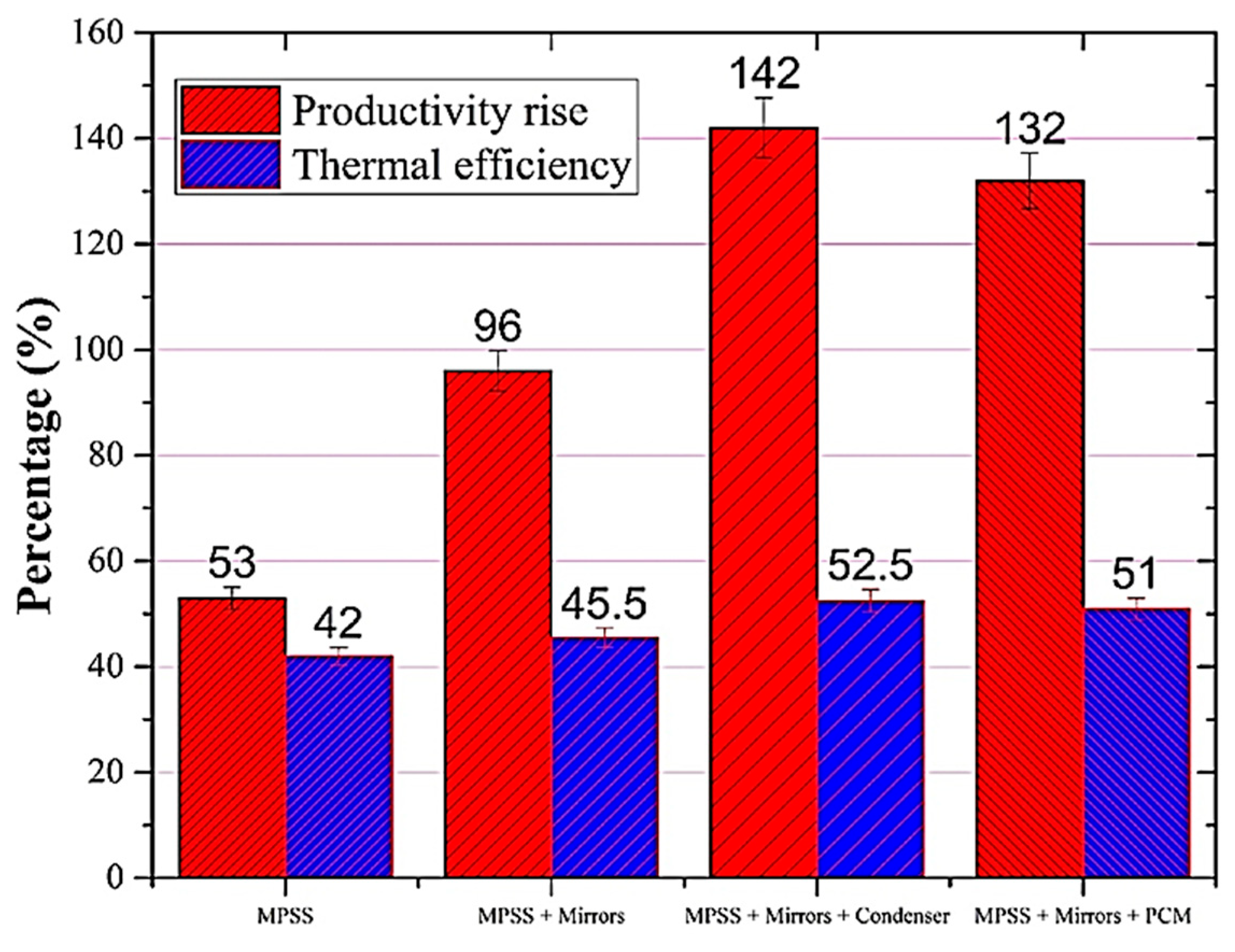
Essa et al. (2022) [75] aimed to enlarge the vaporisation surface area of a pyramid solar still by replacing the flat absorber with a pyramidal one. Various wick materials, jute and cotton cloth, were tested on the modified pyramidal absorber, and additional enhancements included the use of external condensers, mirrors for solar energy concentration, and paraffin wax PCM infused with silver nanoparticles beneath the absorber. Experimental results showed a 40% increase in evaporative surface area with the modified absorber, and that jute outperformed cotton as the wick material. The highest system performance was recorded using both mirrors and an external condenser, achieving 52.5% efficiency and a 142% increase in productivity (Figure 14). The combination of mirrors and PCM also yielded a substantial improvement, with a 132% increase in productivity and 51% in efficiency (Figure 15).
Naveenkumar et al. (2023) [76] investigated the performance enhancement of a single-basin, glasswool-insulated, double-slope solar still by incorporating a solar-powered vacuum fan, an external condenser, and nanofluids (0.1% volume fraction) containing CuO, Al2O3, and ZnO. The researchers aimed to maximise the production rate, distillate exergy, and energy efficiency. The solar still, constructed from aluminium and tested under peak summer conditions, showed substantial performance improvements with the addition of the vacuum fan and external condenser. Compared to a CSS, energy efficiency increased by 28.37%, exergy efficiency by 78.60%, and cumulative water production by 64.29%. Further enhancement was observed with the addition of nanofluids alone. Specifically, the CuO, Al2O3, and ZnO nanofluids enhanced energy efficacy by 20.96%, 18.01%, and 10.76%, respectively, and increased exergy efficacy by 52.53%, 38.52%, and 30.35%, respectively, in comparison to CSS without nanofluids.
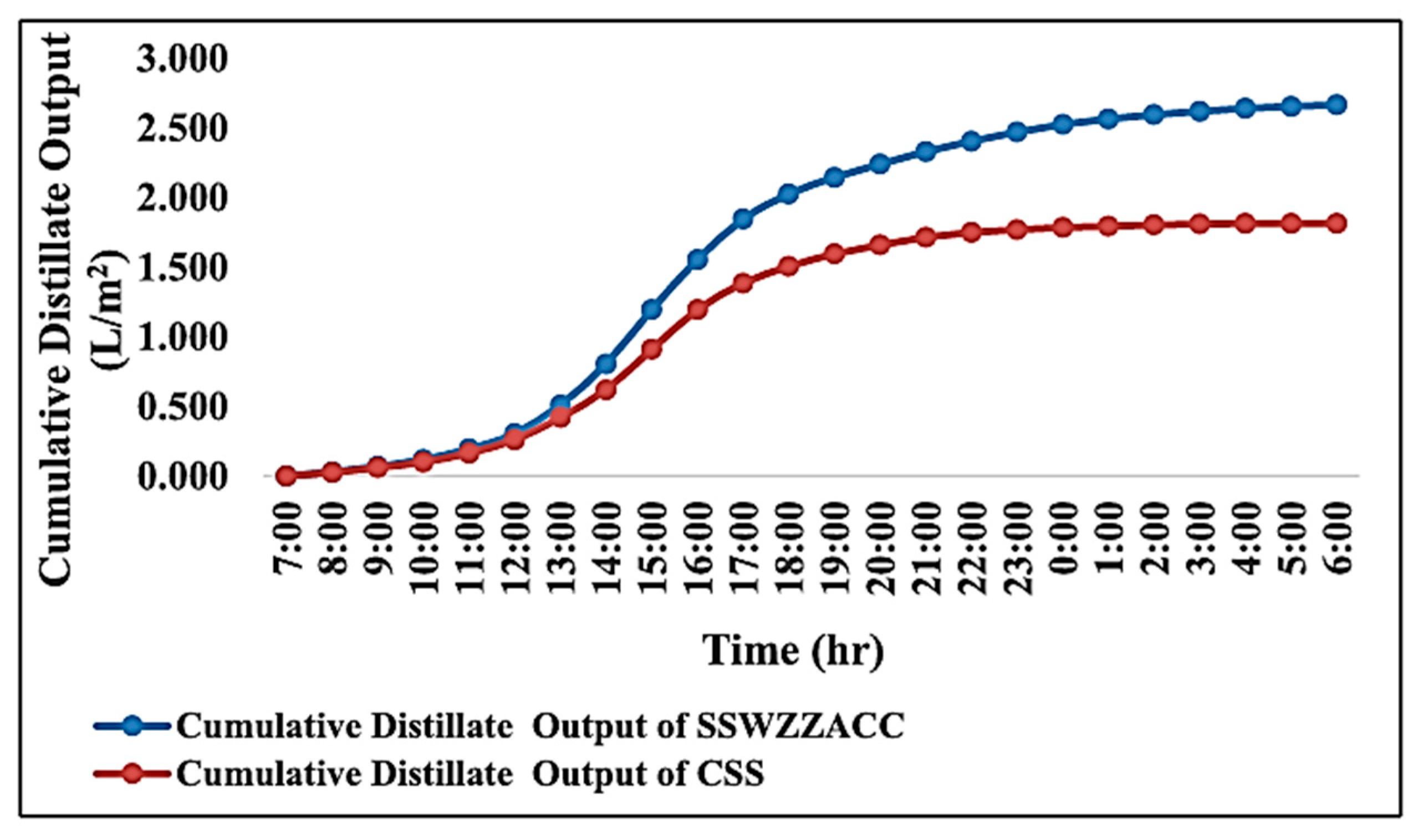
The improvement of a solar still was conducted by Mevada et al. (2023) [77], who integrated a zigzag-shaped air-cooled condenser (ZZACC) and CuO nanoparticles. Experiments were conducted in Gandhinagar, Gujarat, India, between September and November 2020. The researchers compared the performance of a CSS with that of a modified solar still integrating both ZZACC and CuO nanofluids (SSWZZACC). The findings indicated that the CuO-enhanced SSWZZACC could improve water production by 46.83% and daily energy efficacy by 45.98% compared to a CSS. The improved system also displayed higher exergy efficiency and prolonged latent heat of vaporisation, attributed to the improved evaporative heat transfer coefficient displayed by CuO. Cost analysis presented that the SSWZZACC lessened the cost of water production by 27.77% per litre in comparison to the CSS. The greatest recorded energy and exergy efficacies for CSS ranged between 2.36% and 25.75%, respectively, while those for SSWZZACC ranged between 3.90% and 37.59%. The corresponding maximum distillate productivities were 1.815 L/m2 for CSS and 2.665 L/m2 for SSWZZACC (Figure 16).
Abdullah et al. (2023) [78] conducted experimental research comparing an MSS to a CSS. The MSS was equipped with a copper water heating coil, internal and external reflectors, nano-PCM-Ag, and an external condenser. Five test configurations were evaluated under identical climatic conditions. The MSS with a heating coil exhibited a 76% increase in productivity and a thermal efficiency of 45.4%. When reflectors were added (MSS-R), productivity and efficiency increased to 134% and 54.1%, respectively. The MSS with reflectors and an external condenser (MSS-R-EC) reached 191% productivity and 62% efficiency, while the configuration incorporating PCM (MSS-R-PCM) achieved a 175% productivity and 60.2% efficiency. Notably, the external reflector enhanced the yield of the MSS with an internal reflector by 42%, and the external condenser improved the performance of the MSS-R by 57%. Additionally, PCM increased productivity by 41% in systems lacking it. Economic analysis showed the cost of freshwater production was USD 0.029/L for the CSS, USD 0.018/L for the MSS-R and MSS-R-EC, and USD 0.024/L for the MSS-R-PCM.
Saleh et al. (2024) [79] sought to enhance the desalination efficiency of stepped solar stills, which offer high productivity but limited commercial viability. Their approach involved incorporating nano-PCM (NPCM) and a condenser into the system. A conventional stepped solar still (CSSS) and a modified version (MSSS) were tested under identical conditions. The MSSS achieved a water yield of 4800 mL/m2 per day, representing a 60% increase over the CSSS (3000 mL/m2 per day). When nano-PCM was included, the MSSS water production was 5150 mL/m2 per day in comparison to 2700 mL/m2 per day for the CSSS, an improvement of 90%. The greatest water production was verified when MSSS was utilised with both NPCM and a condenser, generating 5950 mL/m2 per day, a 110% enhancement over the CSSS operating under the same conditions (2850 mL/m2 per day). Estimated CO2 emissions for the MSSS + NPCM and MSSS + NPCM + condenser systems were 31.9 and 30.8 tons/year, respectively, while the corresponding enviro-economic benefits were estimated at USD 462.5/year and USD 446.6/year, respectively.
Several approaches to advance the performance of a coiled solar still (COSS) were demonstrated by Elamy et al. (2024) [80], who introduced the addition of a vertical wick solar still (VWSS) with reflectors, a fan, an independent condenser, and nanomaterial-infused paraffin wax placed beneath the base. The standalone COSS yielded 76% more distillate than the CSS. Incorporating a heating coil and internal reflectors boosted productivity by 92%. The modified configuration (MCOSS), combining the COSS with VWSS and internal reflectors, achieved a 209% productivity increase relative to the CSS. With the addition of a heating coil, VWSS, and an external condenser, productivity rose to 269%. Furthermore, system efficiency increased by 68% with the integration of a fan. The highest improvement, 246%, was observed in the MCOSS that included VWSS and PCM-Ag (paraffin wax infused with silver nanoparticles), demonstrating the significant potential of these combined enhancements.
Diarra et al. (2024) [81] evaluated the functionality of a prototype mobile wick solar still equipped with a passive external condenser. The system, developed by the company IPFH2O, was designed to convert non-potable water into potable water using solar energy, particularly for communities with limited access to clean drinking water. Experimental testing took place over four days between October and December 2021 at the University of Rennes 1, located in Brittany, France—a region characterised by a sub-oceanic climate. The system was manually monitored hourly to assess its real-world performance. Key data collected included component temperatures, ambient relative humidity, solar radiation, and hourly water production rates. The results provided insight into the viability and effectiveness of the system for water purification in underserved regions.
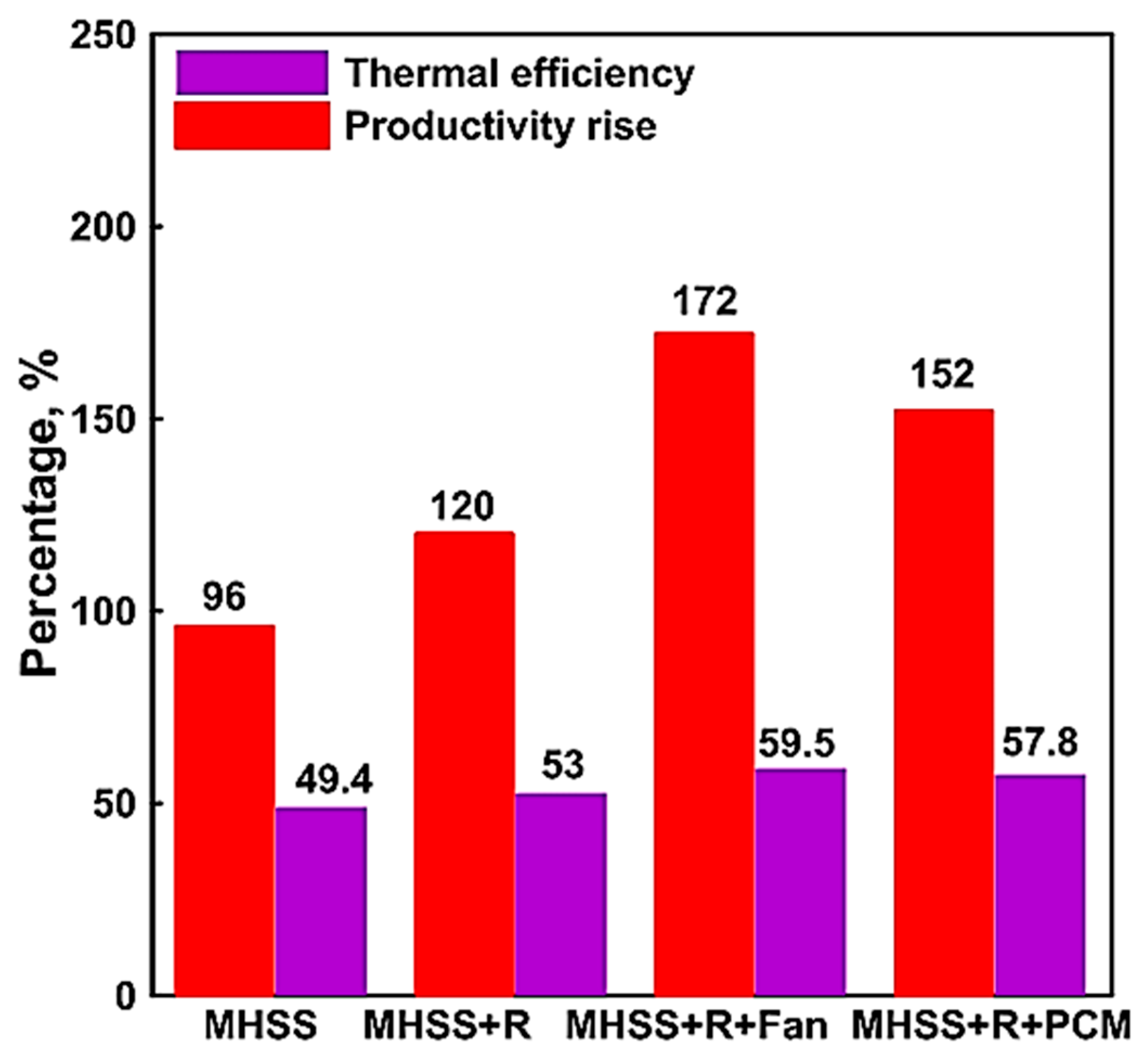
Alqsair et al. (2024) [82] enhanced the desalination performance of a hemispherical solar still (HSS) by designing a modified version (MHSS) with a 35 cm radius hemispherical absorber to increase solar exposure and vaporisation surface area. The system was tested under various design improvements, including wick material (with jute cloth outperforming cotton), rear reflectors (which provided a 120% productivity boost), fan integration (yielding a 172% improvement, from 4100 to 11,150 mL/m2 per day), and paraffin wax infused with silver nanoparticles (PCM-Ag) placed beneath the basin. The highest productivity increase of 152% was recorded when both the fan and PCM-Ag were used, achieving a daily yield of 10,500 mL compared to 4150 mL from the unmodified HSS. The thermal efficiency of the MHSS reached 49.4%, a 96% improvement over the 36% efficiency of the standard HSS, as illustrated in Figure 17.
Diabil et al. (2025) [83] experimentally evaluated three system configurations: (i) a CSS serving as the baseline, (ii) a CSS integrated with one to three external condensers (CSS + 1–3 EC), and (iii) a CSS equipped with three external condensers combined with a compound parabolic solar concentrator (CSS + 3 EC + CPSC). The results indicated that the integration of external condensers significantly increased the condensation rate by expanding the surface area available for vapour condensation. Furthermore, the addition of the CPSC enhanced heat transfer performance by capturing a greater amount of solar radiation, which in turn elevated water temperature and accelerated the evaporation process. Among the tested configurations, the CSS with three external condensers and a CPSC yielded the highest water production, reaching 5.8995 L/m2/day, which corresponds to a 128.6% increase compared to the baseline CSS. Hourly thermal efficiency improved by 101.1%, while exergy efficiency experienced a 226.91% enhancement, peaking at 12.65%. From an economic standpoint, the configuration employing copper pipes and three external condensers was identified as the most cost-effective, delivering water at a production cost of USD 0.0251/L.
Rahman et al. (2025) [84] suggested several layouts of solar stills with modifications to increase the overall performance. These comprised the utilisation of floating aluminium fins (FAF) to improve the evaporation rate, and two types of external condensers—a single rectangular condenser (REC) and a multi-cylinder external condenser (MCEC)—to increase the condensation rate. Four layouts were tested in this research, including Case I (CSS), Case II (CSS + FAF), Case III (CSS + FAF + REC), and Case IV (CSS + FAF + MCEC). Case IV, which combined FAF and MCEC, outpaced all other layouts, attaining a daily water production of 2725 mL/day, an 80.36% increase compared to the CSS. It also registered a high thermal efficacy of 39.7% and an exergy efficacy that was roughly double that of the baseline system. Figure 18 shows that Case IV results in the greatest water production across all performance metrics. Referring to environmental aspects, Case IV offset a projected 420 kg of CO2 emissions throughout its operational time, earning USD 135 in carbon credits. These savings aided in compensating for the greater manufacturing emissions linked to the developed system, which were predicted at 1450 kg CO2.
Essa et al. (2025) [85] evaluated the effectiveness of pyramid solar stills by integrating a vertically mounted triangular absorber coupled with a single-axis solar tracker. Three enhanced layouts were presented: a pyramid distiller with a triangular absorber, a corrugated triangular absorber, and a combination of the corrugated absorber with solar tracking. These alterations led to a rise in water production of 32%, 61%, and 102%, respectively, compared to the CPSS. Afterwards, the researchers directed an optimisation study based on the integration of reflectors and solar tracking, which subsequently improved the water production of the corrugated triangular absorber by 130%. The peak water production of 10,400 mL/m2 per day was achieved using the active system, which comprises a corrugated triangular absorber, reflectors, and PCM. Statistically, this corresponded to an increase of 166% beyond the performance of the baseline CPSS. More importantly, the energy analysis indicated improvements for the utilised layouts. These were 39.6% for the triangular absorber, 44.2% for the corrugated triangular absorber, 49% for the tracked corrugated absorber, 50.5% with the addition of reflectors, and 59% when a fan was integrated.
Amin et al. [86] presented an innovative strategy to increase the thermal efficiency of solar distillation systems via combining a spiral coil condenser with a parabolic dish concentrator. The spiral coil was used to obtain optimum heat transfer at stable vapour pressure, thus enhancing condensation rate and water production. Two layouts of the developed system were appraised: one integrating a coolant fluid enclosure and one without. The addition of the enclosure led to an increase of 12.59% in water production, achieving 15.2 L/m2 per day in comparison to 13.5 L/m2 per day in the unenclosed layout. Additionally, the average water production rate improved to 3.89 × 10⁻² L/h, up from 3.58 × 10⁻² L/h, and thermal efficiency rose from 17.7% to 18%. A ten-year economic analysis projected the cost of clean water production to be USD 0.07/L with the enclosure and USD 0.08/L without it. Also, the system was able to reduce CO2 emissions by 3.7 tons over its operational life.
Several modifications were utilised by Ghanaat et al. (2025) [87] to enhance the performance of multi-stage solar desalination systems combined with photovoltaic (PV) panels. The researchers introduced the addition of water-collecting grooves—12, 24, or 36 grooves—at condenser angles of 30°, 45°, 55°, and 65°, along with the deployment of vibrations at five frequencies, ranging up to 63.49 Hz. They stated that combining 36 grooves at a 65° angle in both condenser stages can increase water production by 31% if compared to the baseline system. Also, adding a cooling fan with a vibration frequency of 63.49 Hz at 3200 rpm can boost freshwater production by 87.5% compared to a traditional four-stage system. Another improvement was also achieved for exergy efficiency, as it increases from 27.9% in the reference system to 40% in the optimised system integrating grooves, a fan, and vibration. Table 1 contains a summary of the most closely associated studies on solar stills equipped with external condensers.

2.3. Solar Stills with Internal Condensers

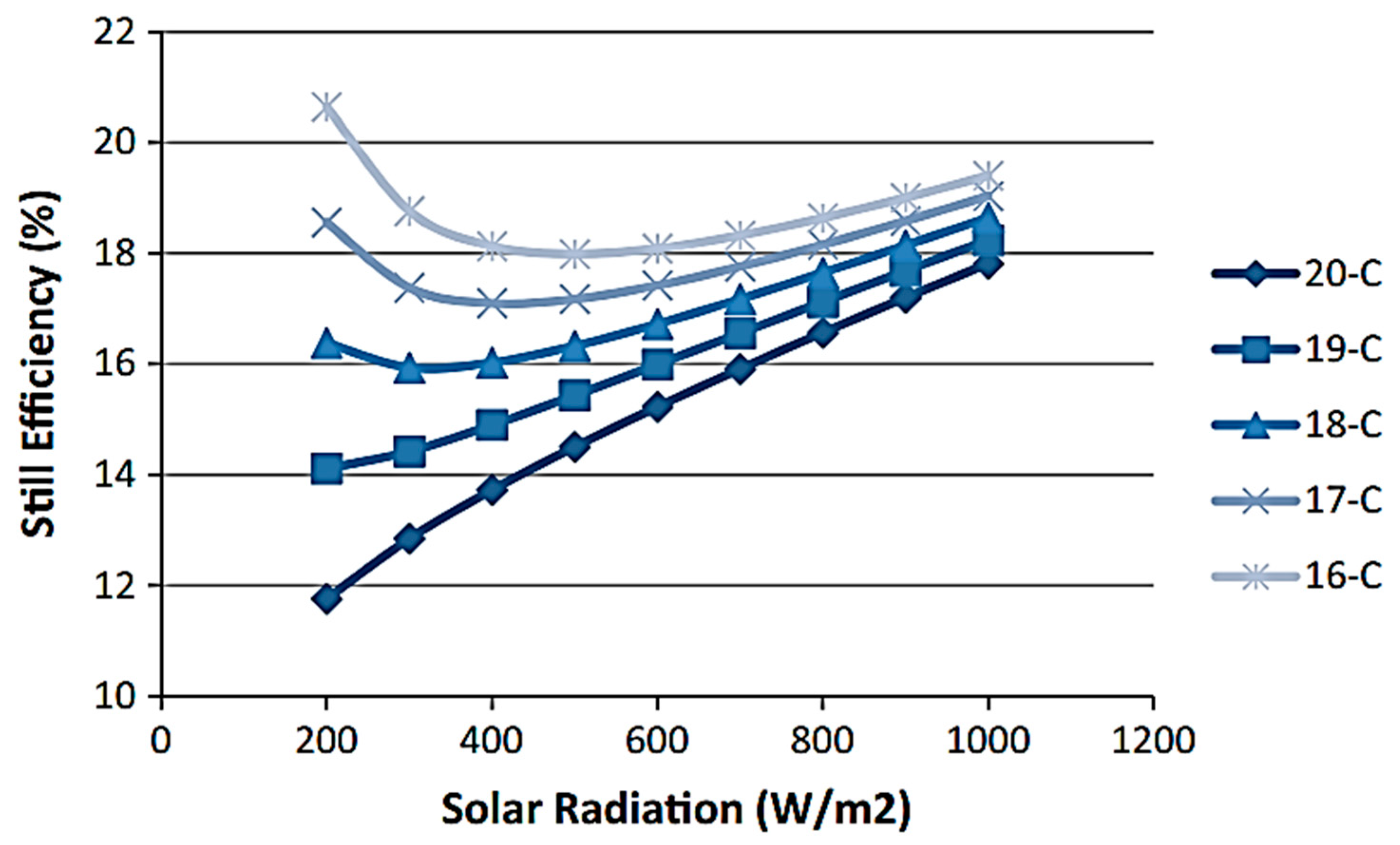
A novel solar still design incorporating solar concentration, porous evaporation, internal condensation, and thermo-syphonic circulation was proposed by Al-Nimr and Dahdolan (2015) [88]. The researchers developed and modelled a steady-state simulation, presenting the results graphically to demonstrate system efficiency and distillate production rates. The simulation revealed that low wind speeds and lower condenser temperatures can enhance both the efficiency and distillate output of the system, while higher ambient temperatures also contribute positively to performance. Additionally, an increase in solar intensity can improve the distillation rate; however, the efficiency did not increase monotonically with solar intensity. Figure 19 indicates the correlation between solar still efficacy and solar intensity at different condenser temperatures. In this aspect, the efficacy was consistently increased with solar intensity when the condenser temperature was equal to the ambient temperature. On the contrary, the efficacy was decreased in the low-intensity range and consequently increased as solar intensity became higher at temperature differences between 1 °C and 4 °C.
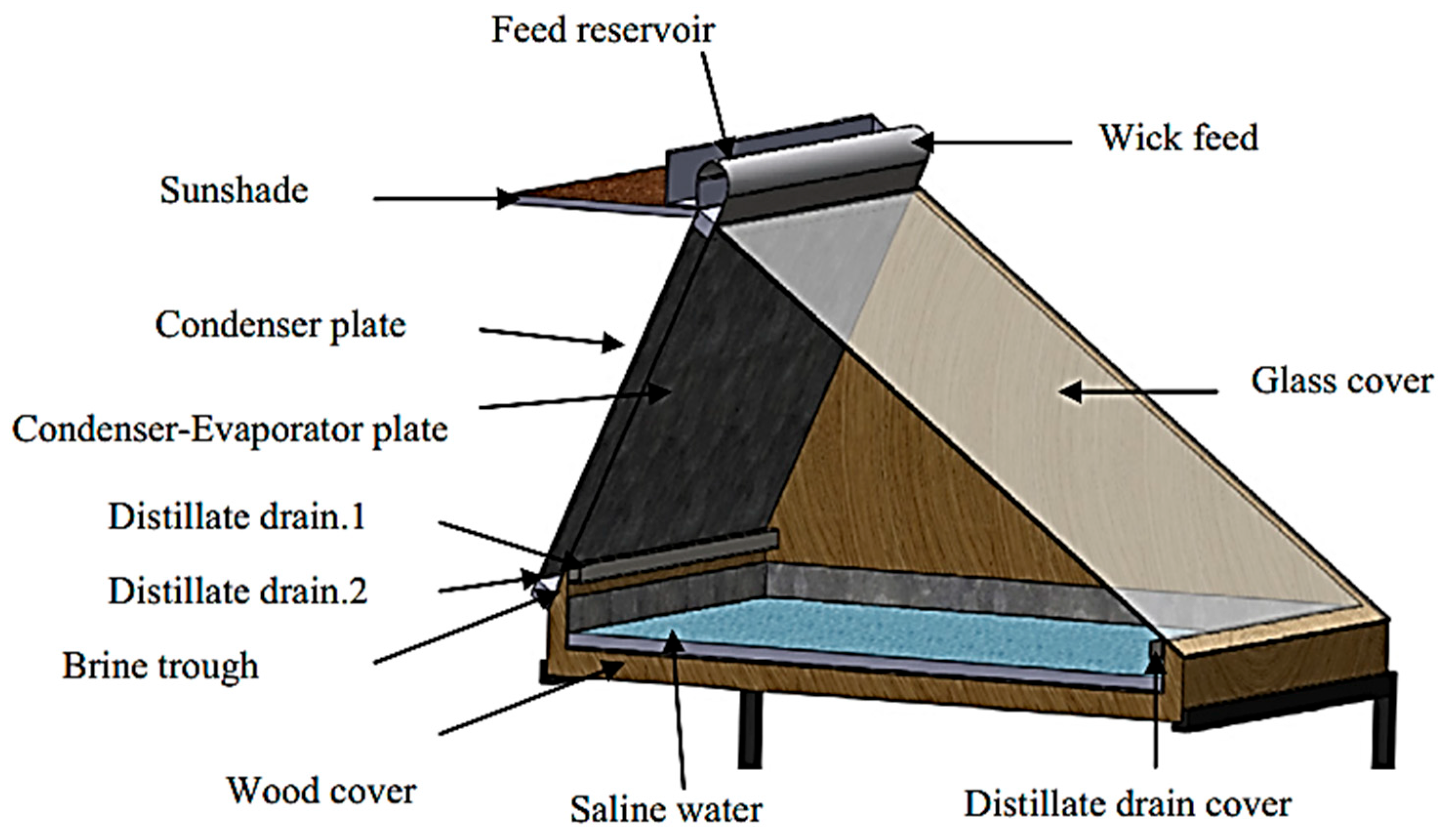
Belhadj et al. (2015) [89] conducted numerical research on a modified solar still characterised by a condensation cell combined with a two-slope design and a single basin (Figure 20). In this system, saline water was directly heated by solar radiation, leading to evaporation. The resulting vapour condensed partially on the inner glass cover and primarily on an external metal plate. Measurements were taken for solar radiation, ambient temperature, and component temperatures, and the system’s performance was compared to that of a CSS under identical weather conditions. The proposed design demonstrated high efficiency, achieving a daily distillate productivity of 7.15 kg/m2 per day, nearly double that of both conventional and capillary film solar stills. The glass cover, metal plate, and condenser plate contributed 43%, 18%, and 39% of the total distillate yield, respectively. The researchers also noted that capillary film solar stills were highly sensitive to the feed water flow rate in terms of productivity. As shown in Figure 21, increasing the gap between the plates to 0.05 m can lead to a reduction in distilled output by 20% (to 3 kg/m2 per day) and 16.67% (to 2.5 kg/m2 per day), respectively, compared to a 0.02 m spacing.
Feilizadeh et al. (2019) [90] evaluated the performance of an innovative active solar still that utilised evacuated tube solar collectors for solar energy absorption and a modified condenser to enhance distillate yield. The system allowed water to be introduced into the basin, the condenser, or both, resulting in four possible operational configurations: one with an empty basin and empty condenser (BECE), one with a filled basin and empty condenser (BFCE), one with an empty basin and filled condenser (BECF), and one a with filled basin and filled condenser (BFCF). The findings revealed daily distillate yields of 10.22, 11.86, 15.25, and 16.98 kg/m2 per day for BECE, BFCE, BECF, and BFCF, respectively. The temperature difference between the basin and the condenser was created by filling the condenser, which enhanced water production by 46%. However, increasing the evaporation area was achieved by filling only the basin, which increased the water production by 14%. The simultaneous filling of both the basin and condenser was enough to generate the maximum water production of 66% compared to the base case (BECE). The corresponding system efficiencies were 28.2%, 34.7%, 43.9%, and 49.9%, highlighting that condenser filling contributed more meaningfully to overall efficacy compared to the scenario of basin filling alone.
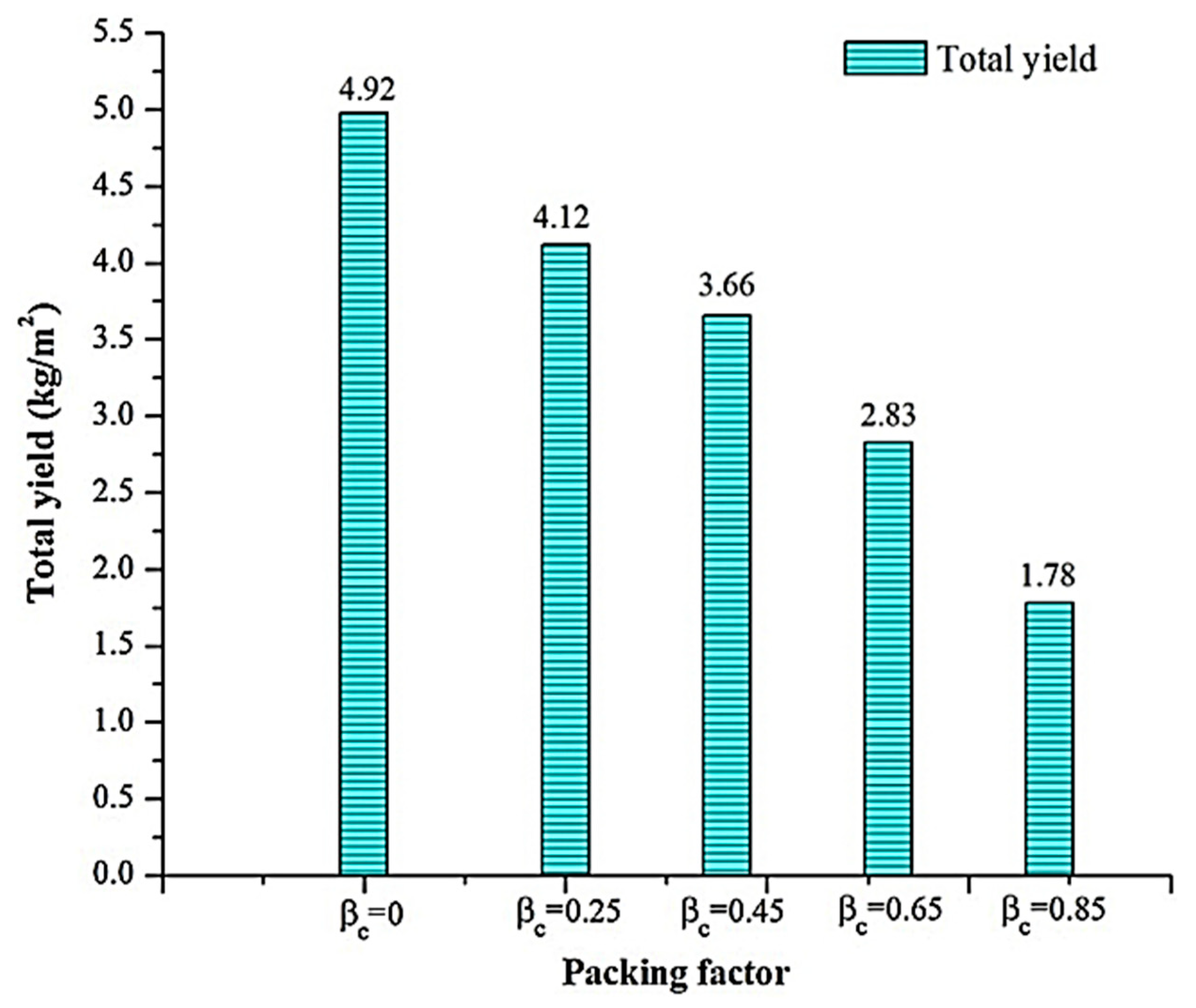
Saini et al. (2019) [91] assessed the efficiency of a single-slope solar still combined with a passive condenser and a solar photovoltaic (SPV) unit for the hot climatic conditions of New Delhi, India. The researchers used a robust theoretical model to evaluate system behaviour and associated performance indicators. In particular, the analysis concentrated on how different packing factors (0, 0.25, 0.45, 0.65, and 0.85) can influence the energy efficiency of various PV modules, including crystalline silicon (c-Si), polycrystalline silicon (p-Si), amorphous silicon (a-Si), copper indium gallium selenide (CIGS), and cadmium telluride (CdTe). The findings indicated that the energy efficiencies for the c-Si SPV module are 57.5%, 53.4%, 55.2%, 53.1%, and 41.4% while using packing factors of 0.85, 0.65, 0.45, 0.25, and 0, respectively. The system was deemed self-sustaining and cost-effective for rural applications, with its electrical, thermal, and overall energy performance controllable by adjusting the packing factor. Figure 22 shows a reduction in water productivity as a result of an increase in the packing factor, which is attributed to the decrease in transparent area on the top cover (occupied by the SPV module), which limited solar radiation absorption.
Mohaisen et al. (2021) [92] suggested a passive single-slope solar distillation unit combined with a condenser to improve the condensation rate and water production. The system’s performance was further improved by the addition of external fins to increase condenser efficiency. Experimental testing was conducted over seven consecutive summer days in Mashhad (36°18′56.12″ N, 59°34′4.66″ E), and the results were compared to those from a CSS tested in Tehran. The findings showed that the addition of fins resulted in a 35% increase in condensate yield. However, due to an 8% reduction in distillate collected on the glass cover, the net productivity increased by 5%. The modified unit achieved up to 92.3% (with fins) and 86% (without fins) of the daily productivity relative to the CSS, while its thermal efficiency was nearly twice that of the conventional design.
Abo-Elfadl et al. (2021) [93] experimentally evaluated the performance of several passive condenser configurations in a solar distillation unit. The researchers analysed productivity, exergy, energy efficiency, and economic and environmental metrics, including energy–economic, exergy–economic, and enviro-economic indicators. Five condenser types were investigated: (i) glass plate condenser (GC/CSS), (ii) corrugated aluminium sheet heat sink condenser (CHS), (iii) aluminium heat sink condenser with vertical rectangular pin fins on the outer surface (RHS), (iv) aluminium heat sink condenser with pin fins on the outer surface (PHS), and (v) aluminium heat sink condenser with pin fins on both inner and outer surfaces (DPHS). The findings showed that while a progressive condensation rate initially enhances the water production, extreme condensation can negatively impact the overall water production. Statistically, it was observed that CSS with a glass condenser can reduce the water production, compared to the PHS condenser, which achieved the greatest water production, 54% higher than that of the GC system. The DPHS condenser experienced the greatest water production cost, whereas the PHS and CHS systems were the most cost-effective. Also, the PHS-based distiller was indicated to be the most environmentally friendly, achieving a decrease in CO2 of 1.82 tons/year.
Amiri (2022) [94] used a modified stepped solar still that incorporates an internal passive condenser. The developed system was divided into two parallel chambers, with a centrally placed stepped absorber composed of several basins. The lower chamber served as the condensation area while the upper chamber functioned as the evaporation zone. Solar radiation heated the saline water, initiating evaporation. Some vapour condensed on the glass cover, while the remaining vapour naturally circulated downward into the condenser chamber. Two slits, located at the top and bottom of the absorber, facilitated airflow between the chambers. The improved system was tested under the climatic conditions of Kerman during June and October and was compared with a conventional stepped solar still of identical dimensions. The results showed that the improved stepped solar still achieved 30% to 150% higher daily output than the solar stills, with a peak daily thermal efficiency of 36%.
A triangular solar still (TrSS) improved with an external PVC pipe solar water heater and an internally separated condenser was examined by Emran et al. (2022) [95], who intended to promote water production under Malaysian climatic conditions. The results showed that the active solar still can generate 24% more distilled water daily compared to its passive counterpart. The daily water production of both systems was intensely affected by key environmental factors, comprising ambient air temperature, basin water temperature, internal relative humidity, and solar radiation intensity. Also, strong relationships were observed between the main environmental factors and system performance, particularly between solar radiation intensity and water yield, ambient temperature and productivity, as well as average water temperature and output. Referring to an economic aspect, the system elaborated feasibility, with the cost per litre of desalinated water deemed affordable. These results ascertained the potential of the proposed system as a sustainable solution for potable water production in regions with equivalent climatic conditions.
The thermo-economic performance of a solar still was significantly improved through a series of modifications made by Kandeal et al. (2022) [96]. In this regard, two types of condensers were tested to improve the condensation rate: Type-A (active water/active vapour) and Type-B (passive water/active vapour). In this aspect, the researchers examined different operational times, fan speeds, and power levels to allocate the optimum layout. In turn, the water production, energy efficiency, and exergy efficiency were increased by 31%, 30%, and 12.56%, respectively, for Type-B, in comparison to Type-A, which showed increases of 21.3%, 26.1%, and 8.79%. Thus, Type-B was nominated for further optimisation while refining the fan settings. Afterward, 1 wt.% CuO nanofluid was included in the solar basin, and three ultrasonic foggers were included to obtain mist at an enhanced evaporation rate. Statistically, the practice of adding nanofluid alone enhanced the water production, energy efficacy, and exergy efficiency by 42.8%, 46%, and 54.85%, respectively. However, the inclusion of ultrasonic foggers resulted in increases of 59.1%, 65.5%, and 63.8%, respectively. More importantly, these improvements indicated the potential reduction of CO2 emissions by more than 23.58 tons (energy-based) and 1.44 tons (exergy-based).
Rajasekaran and Kulandaivelu (2022) [97] synthesised and experimentally appraised a traditional single-basin, single-slope solar still and its integration into a condenser and agitator. The findings demonstrated an increase in water production by 98.69%, which is 4.856 L/m2 per day in comparison to 2.44 L/m2 per day obtained by a traditional solar still system under similar ambient conditions. The evaporation rate was specifically improved by the presence of an agitator, while the improved condensation rate was the result of increasing the condenser area, even while maintaining a similar evaporation surface area. Referring to the energy analysis, the obtained results ascertained that the improved system was 24.42% more effective, with an energy efficiency of 4.82% compared to 2.04% for the traditional solar still design.
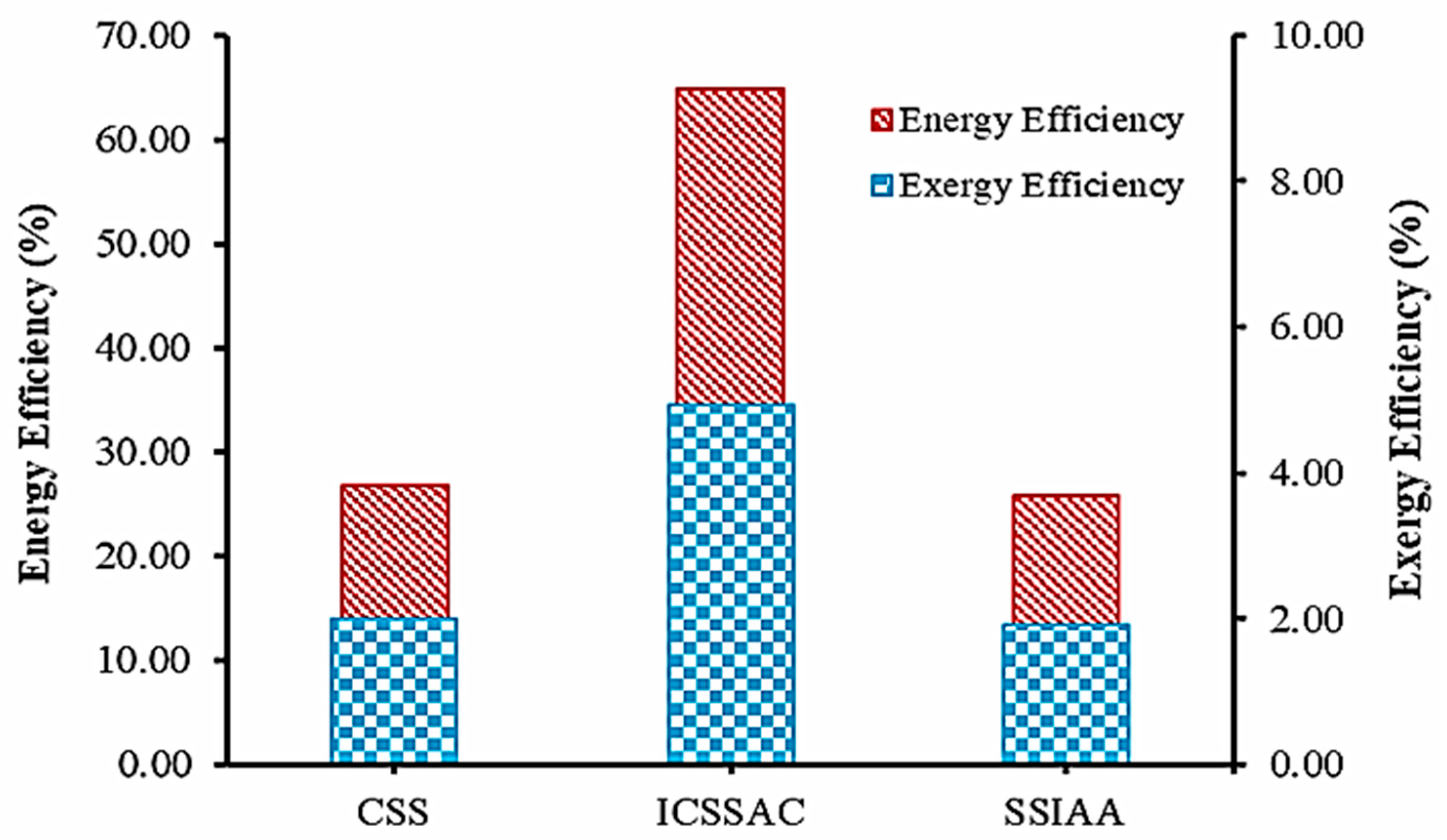
Rajasekaran and Kulandaivelu (2023) [98] analysed the performance of three solar still configurations: a CSS, an inbuilt condenser solar still with agitator and condensing fans (ICSSAC), and a solar still with an enlarged absorber area (SSIAA). The ICSSAC, powered by a solar PV panel, incorporated both an agitator and condensing fans, whereas the SSIAA was designed with an increased absorber surface area. Among the three, the ICSSAC attained the greatest daily yield of 1.445 L/day, followed by the SSIAA (0.690 L/day) and the CSS (0.595 L/day), all tested under similar experimental conditions. The greater performance of the ICSSAC was ascribed to improved mixing from the agitator, the expanded condenser area, and efficient glass cover cooling. In terms of energy efficiency, the ICSSAC recorded 38.10% and 39.01% higher efficiency compared to the CSS (26.70%) and SSIAA (25.79%), respectively, as illustrated in Figure 23. Exergy analysis also confirmed the ICSSAC’s advantage, with efficiencies 2.93% and 3% higher than those of the CSS and SSIAA, respectively.
A 3D transient computational fluid dynamics (CFD) model of a solar desalination system was developed by Asgari et al. (2023) [99], which simulates the effect of a subsurface condenser. Data from experiments were used to validate their CFD model. The simulation was used to assess the effects of various operational parameters on the system’s efficiency, which enabled the optimum inlet conditions to be found, as well as the simulation of the operation of a solar still over one year of operation under optimum conditions. The researchers showed that the inlet velocity of the condenser had the most significant effect on both daily water yield and the gain output ratio (GOR). While the configuration with the highest water yield exhibited a very low GOR, the optimised system achieved a 1120% increase in GOR, albeit with a 60% reduction in daily water yield. Furthermore, the researchers determined that approximately 40% of the vapour generated in the humidifier bypassed condensation in the condenser and was therefore not converted into freshwater.
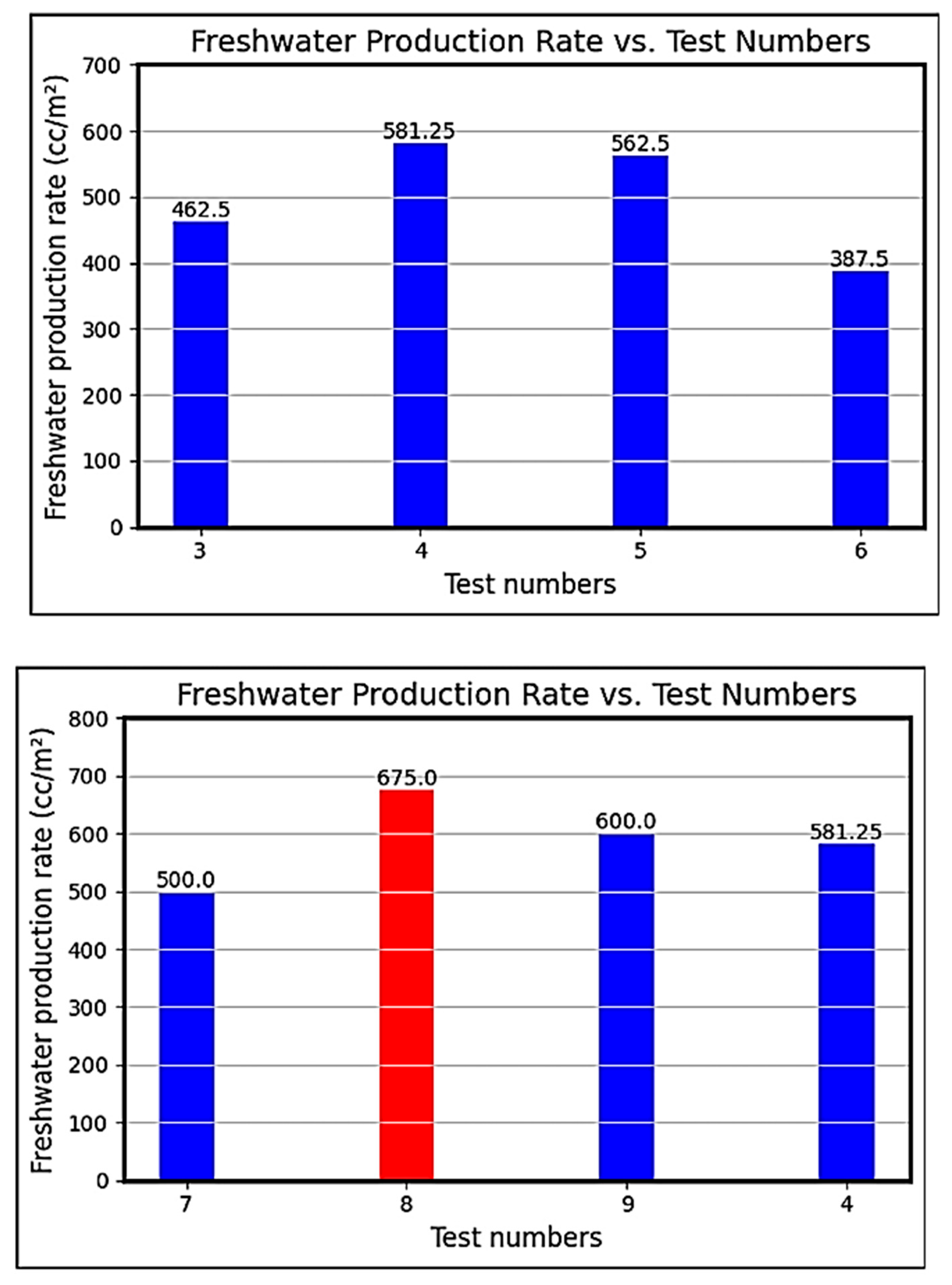
An experimental investigation was carried out by Bakhshi et al. (2024) [100] to evaluate the effect of condenser surface wettability on the performance of a vertical solar still employing air-gap membrane distillation. Three types of condenser surfaces were evaluated: hydrophobic, hydrophilic, and a hybrid combining both surface characteristics. The droplet dynamics on each surface type were analysed to evaluate their influence on freshwater production. In this regard, seven different cases of condensers of hydrophilic and hydrophobic region thickness of leaf-shaped pattern were studies as elucidated in Table 2. The findings revealed that the hydrophilic surface outperformed the hydrophobic one in terms of water yield. Inspired by natural leaf surface structures, the researchers designed a hybrid surface with alternating hydrophilic and hydrophobic regions, which enhanced freshwater generation by 17% in comparison to the purely hydrophilic surface and by 35% relative to the hydrophobic surface. As shown in Figure 24, the optimal hybrid configuration (Case 8), with hydrophilic and hydrophobic layer thicknesses of 1.5 mm and 1.25 mm, respectively, produced the highest freshwater output.
Amiri (2024) [101] developed a comprehensive transient thermal model of an improved stepped solar still by applying energy and mass balance equations to different components, including the solar still body, saline water, absorber, insulation layer, glass cover, back plate, condenser plate, and humid air within both the evaporator and condenser chambers. The model was implemented and solved using MATLAB 2018a. The simulated results closely resembled the experimental data under all test conditions, with a maximum relative error of 3.7% in predicting daily freshwater production. The root mean square errors (RMSE) for temperature prediction were 4.7 °C for the glass cover, 2.9 °C for the absorber, and 2.7 °C for the brine water. The model was further used to analyse the effects of meteorological, design, and operational parameters on improved stepped solar still performance. It was observed that a ±20% change in solar intensity can lead to a proportional ±20% change in daily water output.
Ghazy (2024) [102] investigated the performance of a glass solar water heater (SWH) integrated with a passive single-basin double-slope distiller (PSDD), aiming to recover useful thermal energy from hot water byproducts and to utilise unavoidable condensation losses occurring on the rear glass cover. The researchers numerically modelled the short-term thermal performance of the PSDD-SWH under real weather conditions and compared it against a conventional PSDD. The results demonstrated that the PSDD-SWH achieved an 18.83% increase in thermal efficiency during daylight hours compared to the standard design. Additionally, increasing the heater water mass from 3 kg to 18 kg enhanced thermal efficiency by 50%, with less than a 1% decrease in total distillate yield. The thermal performance was further improved by covering the glass windows of the PSDD-SWH with insulation during non-sunlight hours.
Mohaisen et al. (2025) [103] proposed a modified passive single-slope solar still equipped with an integrated condenser and enhanced through the use of multi-cavity partitions to improve condensation efficiency and overall productivity. The system was experimentally evaluated in Najaf, Iraq (31°59′29.1″ N, 44°20′17.6″ E), over a seven-day summer period, and its performance was compared with that of a CSS under identical climatic conditions. The results indicated that dividing the condenser into two separate partitions improved total productivity by 16.7%. Freshwater yield from the condenser alone increased by 83.5%, although condensation on the glass cover decreased by 10%. The single-cavity (SCCS) and double-cavity condenser systems (DCCS) enhanced daytime productivity by 24% and 44.8%, respectively, compared to the conventional design (Figure 25).
Rozza et al. (2025) [104] introduced a special solar still that incorporates a high-capillarity jute wick mounted on an adjustable platform, which allows the jute fabric to be positioned at different distances from a polycarbonate cover. The goal of this research was to explore the impact of gap spacing on distillate yield. To systematically conduct this investigation, the researchers deployed various gap layouts to find the optimum spacing that can maximise water production. This, in turn, has introduced a chance to compare the efficiency of the modified system with that of a traditional basin-type solar still. The results stated a strong relationship between water output and gap size. Statistically, the water productions of 3800 mL, 4600 mL, and 5625 mL corresponded to gap heights of 15 cm (H1), 10 cm (H2), and 5 cm (H3), respectively. Also, the researchers demonstrated that a superior energy yield can be obtained using the floating wick design in addition to having greater hourly energy and exergy efficiency with lower operating costs in comparison to conventional solar stills. H1, H2, and H3 configurations achieved cost savings of 4.1%, 20.5%, and 34.2%, respectively. Furthermore, the distillate yield of nighttime was indicated to be 1878 mL/m2, 1770 mL/m2, and 1600 mL/m2 for the PTrPSS-H3, PTrPSS-H2, and PTrPSS-H1 layouts, respectively. Table 3 provides a brief overview of associated studies of integrated internal condensers into solar stills.

3. Critical Evaluation of Solar Stills with External and Internal Condensers

The combination of external or internal condensers with solar stills has meaningfully improved the overall desalination performance. However, a number of imperative concerns and challenges remain. The current review elucidated the possibility of having a considerable water production of more than 165% by using external condensers in solar stills [49]. These systems enable the maintenance of high performance at low condensation temperatures, thus improving the temperature gradient, which increases the vapour condensation. However, these systems present a high level of design complexity, such as the request for a large amount of space as well as the necessity of having fans or water circulation as active cooling systems [43]. This strategy can obscure the widespread employment of external condensers in solar stills due to the intensive requirements of energy input and increased manufacturing costs. Thus, it can be a challenge to utilise these systems in resource-constrained regions, where auxiliary power sources may be limited, denoting another challenge. On the other hand, incorporating internal condensers into solar stills delivers a more compact and passive solution, as they can be constructed into the still structure. In particular, an improvement of water production of more than 150% was reported after utilising the stepped or capillary film designs, i.e., the optimal layout of the solar still [94]. However, the performance of these systems is more susceptible to fluctuations in ambient conditions and to internal airflow dynamics, despite not requiring external infrastructure. In other words, the performance of these systems is notably sensitive to internal humidity levels and ambient environmental conditions, as well as airflow dynamics, which makes them less reliable in various climates. Moreover, long-term maintenance challenges are still related to both internal and external condenser systems. These specifically include the possibility of surface fouling, as well as the degradation of working materials like the nanofluids and PCMs. This necessitates the use of additional enhancements such as reflectors, wick materials, or nanostructured coatings within hybrid systems of internal and external condensers within solar stills, which offer promising contributions to maximise the overall distillation efficiency while ensuring economic feasibility.
The revised aspect of exergy–energy analyses ascertained a notable energy loss, particularly in latent heat recovery, despite the improvements made in thermal efficacy. To systematically resolve this issue, further investigations should highlight the development of cost-efficient materials, modular construction methods, and adaptive control systems to maximise the evaporation and condensation rates at a minimum overhead. Future research should place emphasis on allocating optimum trade-offs among performance, durability, and cost to improve the performance of solar stills with integrated internal and external condensers.
The inclusion of external and internal condensers in solar stills has been proven to viably reduce the emissions of CO2, with improved energy payback time. Specifically, the combination of external condensers like those integrated with evacuated tubes or spiral coils can lead to a significant decrease in CO2 emissions of more than 1.379 tons per year as a result of enhanced water production and thermal competence. Also, these configurations have resulted in lower energy payback times due to improved condensation rates and optimised heat transfer mechanisms, which emphasise the effective use of solar energy, as well as the achievement of greater yield at lessened operating costs.
Referring to the comparison of economic and life-cycle aspects with regard to external and internal condensers in solar stills, several studies displayed improved productivity and cost-effectiveness. For instance, Alawee et al. (2022) [68] showed that the multi-slope solar still with an external condenser achieved the greatest water production increase of 120%, with a water production cost of USD 0.022/L. However, Abdullah et al. (2023) [78] found a dramatic increase of 191% in water production for the modified solar still with reflectors and an external condenser with an associated water production cost of USD 0.018/L, highlighting improved economic feasibility. Recently, Diabil et al. (2025) [83] underscored that the integration of external condensers with a compound parabolic solar concentrator can produce an extraordinary water production of 5.8995 L/m2 per day with a water production cost of USD 0.0251/L. Remarkably, the obtained financial indicators were documented together with enhanced thermal and exergy effectiveness, allowing solar still systems to sustainably and efficiently harness solar energy. Compared to internal condensers, the presence of external condensers in solar stills can fruitfully increase the distillate yield while mitigating the cost of producing fresh water.
Table 4 provides a summary of the main differences between external and internal condenser systems, considering the metrics of water production, design complexity, and practical applicability.

4. Further Enhancements and Accompanying Challenges

Recent studies have introduced advanced modifications to further improve the yield and efficiency of solar stills with internal and external condensers. One promising direction involves the use of hybrid nanomaterials (e.g., graphene oxide or carbon nanotubes) in the basin water or on condenser surfaces to enhance thermal conductivity and evaporation rates. Another notable improvement is multi-stage condensation, where vapour passes through a series of chambers to maximise freshwater recovery. Solar tracking mechanisms have also been adopted to optimise solar input, while machine learning algorithms have been deployed to dynamically adjust fan speeds and coolant flow for optimal condensation performance. Additionally, biomimetic condenser surfaces, inspired by structures such as lotus leaves, have been shown to improve droplet formation and shedding, thereby reducing re-evaporation losses. More thermally stable PCMs, such as composite paraffin wax infused with nanoparticles, extend the working hours of the still by storing surplus solar energy for use during nighttime distillation. Collectively, these innovations (enhancements) push the boundaries of solar distillation technology, with some designs reporting performance enhancements exceeding 116% over conventional systems [48].
Despite these advancements, several obstacles hinder the large-scale adoption of enhanced solar stills. Material degradation remains a concern; nanoparticles may agglomerate in nanofluids and PCMs can leak over time. In low-income regions, manufacturing costs pose a noteworthy barrier, predominantly when innovative materials (e.g., graphene-coated condensers) or precision components (e.g., solar trackers) are compulsory. Maintenance complexity is another issue, worsened by surface fouling, corrosion in saline environments, and the request for consistent cleaning or replacement of components such as wicks and reflectors. A further dilemma concerns energy trade-offs; while active cooling mechanisms (e.g., fans or thermoelectric modules) enhance condensation, they increase power dependence, undermining system sustainability. Climate sensitivity presents yet another challenge, as humid or cloudy conditions reduce condensation efficiency, and extreme heat accelerates material degradation. Moreover, the lack of standardised performance metrics, such as discrepancies in reporting daily yield versus thermal or exergy efficiency, makes cross-study comparisons difficult and impedes industrial adoption. To address these issues, a multidisciplinary approach is essential. Future designs must prioritise cost-effectiveness, durability, and climate resilience while being informed by real-world operating conditions.
Table 5 depicts critical enhancements to combat associated challenges that must be carefully resolved to guarantee scalable and sustainable solar desalination.

5. Conclusions

This detailed review specifically appraised the improvements, challenges, and future scenarios of solar stills equipped with external and internal condensers. This review comprises several experimental and theoretical investigations published between 2011 and 2025. Accordingly, a number of useful insights into efficiency improvement, design optimisation, and practical limitations were deduced. The most important conclusions are listed below:
  • Greater water production was achieved compared to traditional solar still systems by integrating external and internal condensers into solar stills. Statistically, an improvement of water production between 24% and 165% was reported for external condensers and between 30% and 150% for internal condensers.
  • High-temperature gradients for condensation were ascertained using external condensers. However, they necessitate additional space, while consuming auxiliary energy and requiring frequent maintenance. However, internal condensers are more susceptible to ambient conditions and internal airflow dynamics as they passively operate, i.e., fail to efficiently operate in humid or low-sunlight environments.
  • The integration of nanofluids and PCMs has augmented the evaporation and condensation rates, introducing an efficient improvement of more than 116%. Nonetheless, long-term stability and operational cost were demonstrated as being related issues to be resolved. In this regard, the integration of condensers with reflectors, wick materials, and solar tracking mechanisms can be introduced as a successful solution.
  • Long-term reliability can be challenged by fouling, corrosion, and degradation of condenser surfaces, particularly in systems using nanofluids. There is a need for innovative anti-fouling coatings and durable materials.
  • The high cost of advanced materials (e.g., graphene, thermoelectric modules) and components (e.g., solar trackers) limits scalability, especially in low-resource settings and developing countries.

Supplementary Materials

The following supporting information can be downloaded at: https://www.mdpi.com/article/10.3390/su172310786/s1, File S1: PRISMA Checklist [105].

Author Contributions

M.A.A.-O.: conceptualization, writing—original draft, writing—review and editing, visualisation, formal analysis, supervision, project administration. F.L.R.: writing—original draft, conceptualization, visualisation, formal analysis. A.J.H.: visualisation, formal analysis, resources. S.S.A.-M.: visualisation, formal analysis, resources. Q.A.: visualisation, conceptualization, writing—original draft, writing—review and editing. I.M.M.: visualisation, formal analysis, project administration. All authors have read and agreed to the published version of the manuscript.

Funding

This research received no external funding.

Institutional Review Board Statement

Not applicable.

Informed Consent Statement

Not applicable.

Data Availability Statement

Not applicable.

Acknowledgments

The authors gratefully acknowledge the support of Middle Technical University and Al-Naji University, which sponsored this research as part of its commitment to advancing scientific knowledge and fostering academic excellence.

Conflicts of Interest

The authors declare no conflicts of interest.

Nomenclature

SymbolDefinition
CFDComputational fluid dynamics
COSSCoiled solar still
CPSSConventional pyramid solar still
CSSConventional solar still
CTSSConventional tubular solar still
ECExternal condenser
FAFFloating aluminium fins
GORGain output ratio (desalination efficiency metric)
HDHHumidification–dehumidification (desalination process)
HSCHeat sink condenser
MCECMultiple cylindrical external condensers
MCOSSModified coiled solar still
MEDMulti-effect distillation
MHSSModified hemispherical solar still
MOFMetal–organic framework
MSSModified solar still
NCLNatural circulation loop
NPCMNano-enhanced phase change material
PCMPhase change material
PSDDPassive single-basin double-slope distiller
PTC/PTSCParabolic trough (solar) collector
PVPhotovoltaic
RECRectangular external condenser
RMSERoot-mean-square error
SPVSolar photovoltaic
SWHSolar water heater
VWSSVertical wick solar still

References

  1. Al-Obaidi, M.A.; Rasn, K.H.; Aladwani, S.H.; Kadhom, M.; Mujtaba, I.M. Flexible design and operation of multi-stage reverse osmosis desalination process for producing different grades of water with maintenance and cleaning opportunity. Chem. Eng. Res. Des. 2022, 182, 525–543. [Google Scholar] [CrossRef]
  2. Essa, F.A.; Saleh, B.; Algethami, A.A.; Oyedepo, S.O.; Omara, Z.M.; El-Sebaey, M.S. Enhanced solar desalination via hemispheric distiller with thermal storage, heaters, and condensation: Exergoeconomic and environmental analysis. Sol. Energy Mater. Sol. Cells 2025, 285, 113529. [Google Scholar] [CrossRef]
  3. Hussein, A.K.; Rashid, F.L.; Rasul, M.K.; Basem, A.; Younis, O.; Homod, R.Z.; Attia, M.E.H.; Al-Obaidi, M.A.; Hamida, M.B.B.; Ali, B.; et al. A review of the application of hybrid Nanofluids in solar still energy systems and guidelines for future prospects. Sol. Energy 2024, 272, 112485. [Google Scholar] [CrossRef]
  4. Rashid, F.L.; Al-Obaidi, M.A.; Hussein, A.K.; Akkurt, N.; Ali, B.; Younis, O. Floating solar stills and floating solar-driven membranes: Recent advances and overview of designs, performance, and modern combinations. Sol. Energy 2022, 247, 355–372. [Google Scholar] [CrossRef]
  5. Sonkar, M.; Kanathala, Y.; Naik, B.K. Recent developments in solar-driven adsorption and humidification-dehumidification based hybrid desalination system: A state-of-the-art review. Sol. Compass 2025, 15, 100125. [Google Scholar] [CrossRef]
  6. Al-Obaidi, M.A.; Alsadaie, S.; Alsarayreh, A.; Sowgath, M.T.; Mujtaba, I.M. Integration of Renewable Energy Systems in Desalination. Processes 2024, 12, 770. [Google Scholar] [CrossRef]
  7. Luberti, M.; Capocelli, M. Enhanced humidification–dehumidification (HDH) systems for sustainable water desalination. Energies 2023, 16, 6352. [Google Scholar] [CrossRef]
  8. Asgari, B.; Bizhani, M.; Hakkaki-Fard, A.; Hannani, S.K. Performance evaluation of different configurations of solar humidification-dehumidification desalination system with subsurface condenser. Energy Convers. Manag. 2022, 269, 116186. [Google Scholar] [CrossRef]
  9. Amori, K.E.; Alsaady, S.M. Solar-Powered Humidifiers for Humidification–Dehumidification Desalination Systems: A Review. Heat Transfer 2025, 54, 2703–2727. [Google Scholar] [CrossRef]
  10. Sharshir, S.W.; Abdo, M.R.; Yusuf, K.; El-Naggar, A.A.; Joseph, A.; Ismail, M.; Elsaid, A.M.; Abdelfatah, M.; El-Shaer, A.; Yuan, Z. Thermo-economic and environmental evaluation of thin film evaporation using novel metal-organic frameworks to enhance solar desalination performance. Process Saf. Environ. Prot. 2025, 199, 107223. [Google Scholar] [CrossRef]
  11. Rashid, F.L.; Al-Obaidi, M.A.; Dulaimi, A.; Bahlol, H.Y.; Hasan, A. A review of the current situation and prospects for nanofluids to improve solar still performance. J. Therm. Anal. Calorim. 2024, 149, 13511–13531. [Google Scholar] [CrossRef]
  12. Zanganeh, P.; Goharrizi, A.S.; Ayatollahi, S.; Feilizadeh, M.; Dashti, H. Efficiency improvement of solar stills through wettability alteration of the condensation surface: An experimental study. Appl. Energy 2020, 268, 114923. [Google Scholar] [CrossRef]
  13. Al-Hamzawi, H.A.H.; Al Sailawi, A.S.A. Optimised multi-generation system for sustainable desalination and power production using solar-driven Multi-Effect Distillation (MED) in Basra, Iraq. Energy Sustain. Dev. 2025, 85, 101684. [Google Scholar] [CrossRef]
  14. Al-Hotmani, O.M.A.; Al-Obaidi, M.A.; Li, J.P.; John, Y.M.; Patel, R.; Mujtaba, I.M. A multi-objective optimisation framework for MED-TVC seawater desalination process based on particle swarm optimisation. Desalination 2022, 525, 115504. [Google Scholar] [CrossRef]
  15. Thilagan, K.; Advaith, S.; Mani, A. Simulation studies and experimental validation on solar multi-effect desalination system. Sol. Compass 2025, 13, 100110. [Google Scholar] [CrossRef]
  16. Harby, M.; Hanafi, A.; Hamed, A. Exergetic investigation of solar powered multiple effect desalination with thermal vapor compression. Sol. Energy 2025, 298, 113636. [Google Scholar] [CrossRef]
  17. Filippini, G.; Al-Obaidi, M.A.; Manenti, F.; Mujtaba, I.M. Design and economic evaluation of solar-powered hybrid multi effect and reverse osmosis system for seawater desalination. Desalination 2019, 465, 114–125. [Google Scholar] [CrossRef]
  18. Tiwari, A.; Kumar, A. Humidification-dehumidification desalination system based on solar air and water heaters. Sol. Energy 2025, 297, 113637. [Google Scholar] [CrossRef]
  19. Rashid, F.L.; Kaood, A.; Al-Obaidi, M.A.; Mohammed, H.I.; Alsarayreh, A.A.; Al-Muhsen, N.F.; Abbas, A.S.; Zubo, R.H.; Mohammad, A.T.; Alsadaie, S.; et al. A review of the configurations, capabilities, and cutting-edge options for multistage solar stills in water desalination. Designs 2023, 7, 67. [Google Scholar] [CrossRef]
  20. El-Gazar, E.F.; Yousef, M.S.; Elshaer, A.M.; Khattab, M.A.; Mouneer, T.A.; Hawwash, A.A. Enhancing solar still performance with hybrid nanofluid: A comprehensive assessment of energy, exergy, economics, and environmental impact using a novel fractional model. Environ. Dev. Sustain. 2024, 24, 1–28. [Google Scholar] [CrossRef]
  21. Murad, M.E.; Alawee, W.H.; Dhahad, H.A. Application of Advanced Techniques in Double Slope Solar Stills: An Experimental Study in Iraqi Climates. Heat Transf. 2025, 54, 3564–3575. [Google Scholar] [CrossRef]
  22. Younes, M.M.; El-Sharkawy, I.I.; Kabeel, A.E.; Uddin, K.; Miyazaki, T.; Saha, B.B. Characterization of silica gel-based composites for adsorption cooling applications. Int. J. Refrig. 2020, 118, 345–353. [Google Scholar] [CrossRef]
  23. Younes, M.M.; El-Sharkawy, I.I.; Kabeel, A.E.; Saha, B.B. A review on adsorbent-adsorbate pairs for cooling applications. Appl. Therm. Eng. 2017, 114, 394–414. [Google Scholar] [CrossRef]
  24. Kabeel, A.E.; Omara, Z.M.; Younes, M.M. Techniques used to improve the performance of the stepped solar still—A review. Renew. Sustain. Energy Rev. 2015, 46, 178–188. [Google Scholar] [CrossRef]
  25. Younes, M.M.; Abdullah, A.S.; Essa, F.A.; Omara, Z.M. Half barrel and corrugated wick solar stills–Comprehensive study. J. Energy Storage 2021, 42, 103117. [Google Scholar] [CrossRef]
  26. Younes, M.M.; Abdullah, A.S.; Essa, F.A.; Omara, Z.M.; Amro, M.I. Enhancing the wick solar still performance using half barrel and corrugated absorbers. Process Saf. Environ. Prot. 2021, 150, 440–452. [Google Scholar] [CrossRef]
  27. Abdullah, A.S.; Younes, M.M.; Omara, Z.M.; Essa, F.A. New design of trays solar still with enhanced evaporation methods–comprehensive study. Sol. Energy 2020, 203, 164–174. [Google Scholar] [CrossRef]
  28. Abdullah, A.S.; Omara, Z.M.; Essa, F.A.; Younes, M.M.; Shanmugan, S.; Abdelgaied, M.; Amro, M.I.; Kabeel, A.E.; Farouk, W.M. Improving the performance of trays solar still using wick corrugated absorber, nano-enhanced phase change material and photovoltaics-powered heaters. J. Energy Storage 2021, 40, 102782. [Google Scholar] [CrossRef]
  29. Ward, J. A plastic solar water purifier with high output. Sol. Energy 2003, 75, 433–437. [Google Scholar] [CrossRef]
  30. Kabeel, A.E.; Khalil, A.; Omara, Z.M.; Younes, M.M. Theoretical and experimental parametric study of modified stepped solar still. Desalination 2012, 289, 12–20. [Google Scholar] [CrossRef]
  31. Omara, Z.M.; Kabeel, A.E.; Younes, M.M. Enhancing the stepped solar still performance using internal reflectors. Desalination 2013, 314, 67–72. [Google Scholar] [CrossRef]
  32. Omara, Z.M.; Kabeel, A.E.; Younes, M.M. Enhancing the stepped solar still performance using internal and external reflectors. Energy Convers. Manag. 2014, 78, 876–881. [Google Scholar] [CrossRef]
  33. Essa, F.A.; Abdullah, A.S.; Omara, Z.M.; Younes, M.M. Improving the performance of tubular solar still using rotating drum–experimental and theoretical investigation. Process Saf. Environ. Prot. 2021, 148, 579–589. [Google Scholar] [CrossRef]
  34. Kabeel, A.E.; Abdelgaied, M.; Harby, K.; Eisa, A. Augmentation of diurnal and nocturnal distillate of modified tubular solar still having copper tubes filled with PCM in the basin. J. Energy Storage 2020, 32, 101992. [Google Scholar] [CrossRef]
  35. Rashid, F.L.; Al-Obaidi, M.A.; Dulaimi, A.; Bahlol, H.Y.; Hasan, A. Recent advances, development, and impact of using phase change materials as thermal energy storage in different solar energy systems: A review. Designs 2023, 7, 66. [Google Scholar] [CrossRef]
  36. Ihnayyish, I.L.; Ahmed, A.Q.; Mohammad, A.T.; Al-Syyab, A.K.S. Numerical study to investigate the performance of U-shaped flat plate solar collector using phase change materials (PCMs). J. Tech. 2023, 5, 74–80. [Google Scholar] [CrossRef]
  37. Thalib, M.M.; Manokar, A.M.; Essa, F.A.; Vasimalai, N.; Sathyamurthy, R.; Garcia Marquez, F.P. Comparative study of tubular solar stills with phase change material and nano-enhanced phase change material. Energies 2020, 13, 3989. [Google Scholar] [CrossRef]
  38. Hussein, A.K.; Rashid, F.L.; Abed, A.M.; Sultan, H.S.; Togun, H.; Attia, M.E.H.; Manokar, A.M.; Hamida, M.B.B.; Ali, B.; Younis, O.; et al. Review of recent designs, performance, and configurations for the pyramid solar still. Int. J. Energy Water Res. 2024, 9, 1145–1176. [Google Scholar] [CrossRef]
  39. Abdullah, A.S.; Alawee, W.H.; Mohammed, S.A.; Alqsair, U.F.; Dhahad, H.A.; Essa, F.A.; Omara, Z.M.; Younes, M.M. Performance improvement of tubular solar still via tilting glass cylinder, nano-coating, and nano-PCM: Experimental approach. Environ. Sci. Pollut. Res. 2022, 29, 65088–65099. [Google Scholar] [CrossRef]
  40. Kabeel, A.E.; Teamah, M.A.; Abdelgaied, M.; Aziz, G.B.A. Modified pyramid solar still with v-corrugated absorber plate and PCM as a thermal storage medium. J. Clean. Prod. 2017, 161, 881–887. [Google Scholar] [CrossRef]
  41. Saravanan, A.; Murugan, M. Performance evaluation of square pyramid solar still with various vertical wick materials–an experimental approach. Therm. Sci. Eng. Prog. 2020, 19, 100581. [Google Scholar] [CrossRef]
  42. Alawee, W.H.; Essa, F.A.; Mohammed, S.A.; Dhahad, H.A.; Abdullah, A.S.; Omara, Z.M.; Gamiel, Y. Improving the performance of pyramid solar distiller using dangled cords of various wick materials: Novel working mechanism of wick. Case Stud. Therm. Eng. 2021, 28, 101550. [Google Scholar] [CrossRef]
  43. Alawee, W.H.; Mohammed, S.A.; Dhahad, H.A.; Abdullah, A.S.; Omara, Z.M.; Essa, F.A. Improving the performance of pyramid solar still using rotating four cylinders and three electric heaters. Process Saf. Environ. Prot. 2021, 148, 950–958. [Google Scholar] [CrossRef]
  44. Ketabchi, F.; Gorjian, S.; Sabzehparvar, S.; Shadram, Z.; Ghoreishi, M.S.; Rahimzadeh, H. Experimental performance evaluation of a modified solar still integrated with a cooling system and external flat-plate reflectors. Sol. Energy 2019, 187, 137–146. [Google Scholar] [CrossRef]
  45. Azm Najjar, M.N.; AlMallahi, M.N.; Elgendi, M. Evaluating the effect of external and internal condensers on the productivity of solar stills: A review. Energy Convers. Manag. X 2024, 24, 100763. [Google Scholar] [CrossRef]
  46. Monowe, P.; Masale, M.; Nijegorodov, N.; Vasilenko, V. A portable single-basin solar still with an external reflecting booster and an outside condenser. Desalination 2011, 280, 332–338. [Google Scholar] [CrossRef]
  47. Zeroual, M.; Bouguettaia, H.; Bechki, D.; Boughali, S.; Bouchekima, B.; Mahcene, H.J.E.P. Experimental investigation on a double-slope solar still with partially cooled condenser in the region of Ouargla (Algeria). Energy Procedia 2011, 6, 736–742. [Google Scholar] [CrossRef]
  48. Kabeel, A.E.; Omara, Z.M.; Essa, F.A. Enhancement of modified solar still integrated with external condenser using Nanofluids: An experimental approach. Energy Convers. Manag. 2014, 78, 493–498. [Google Scholar] [CrossRef]
  49. El-Samadony, Y.A.F.; Abdullah, A.S.; Omara, Z.M. Experimental Study of Stepped Solar Still Integrated with Reflectors and External Condenser. Exp. Heat Transfer 2014, 28, 392–404. [Google Scholar] [CrossRef]
  50. Refalo, P.; Ghirlando, R.; Abela, S. The use of a solar chimney and condensers to enhance the productivity of a solar still. Desalination Water Treat. 2016, 57, 23024–23037. [Google Scholar] [CrossRef]
  51. Bhardwaj, R.; Ten Kortenaar, M.V.; Mudde, R.F. Inflatable plastic solar still with passive condenser for single family use. Desalination 2016, 398, 151–156. [Google Scholar] [CrossRef]
  52. Kumar, R.A.; Esakkimuthu, G.; Murugavel, K.K. Performance enhancement of a single basin single slope solar still using agitation effect and external condenser. Desalination 2016, 399, 198–202. [Google Scholar] [CrossRef]
  53. Rahmani, A.; Boutriaa, A. Numerical and experimental study of a passive solar still integrated with an external condenser. Int. J. Hydrogen Energy 2017, 42, 29047–29055. [Google Scholar] [CrossRef]
  54. Rabhi, K.; Nciri, R.; Nasri, F.; Ali, C.; Bacha, H.B. Experimental performance analysis of a modified single-basin single-slope solar still with pin fins absorber and condenser. Desalination 2017, 416, 86–93. [Google Scholar] [CrossRef]
  55. Hassan, H.; Abo-Elfadl, S. Effect of the condenser type and the medium of the saline water on the performance of the solar still in hot climate conditions. Desalination 2017, 417, 60–68. [Google Scholar] [CrossRef]
  56. Kabeel, A.E.; Omara, Z.M.; Essa, F.A. Numerical investigation of modified solar still using Nanofluids and external condenser. J. Taiwan Inst. Chem. Eng. 2017, 75, 77–86. [Google Scholar] [CrossRef]
  57. Rahman, M.T.; Nehar, L.; Sarker, M.R.I.; Tuly, S.S.; Beg, R.A. Performance test of a solar still for different surface to volume ratio absorber plate with an external condenser. AIP Conf. Proc. 2019, 2121, 130003. [Google Scholar] [CrossRef]
  58. Hassan, H.; Ahmed, M.S.; Fathy, M.; Yousef, M.S. Impact of salty water medium and condenser on the performance of single acting solar still incorporated with parabolic trough collector. Desalination 2020, 480, 114324. [Google Scholar] [CrossRef]
  59. Hassan, H.; Yousef, M.S.; Fathy, M.; Ahmed, M.S. Impact of condenser heat transfer on energy and exergy performance of active single slope solar still under hot climate conditions. Sol. Energy 2020, 204, 79–89. [Google Scholar] [CrossRef]
  60. Parsa, S.M.; Rahbar, A.; Koleini, M.H.; Aberoumand, S.; Afrand, M.; Amidpour, M. A renewable energy-driven thermoelectric-utilized solar still with external condenser loaded by silver/nanofluid for simultaneously water disinfection and desalination. Desalination 2020, 480, 114354. [Google Scholar] [CrossRef]
  61. Toosi, S.S.A.; Goshayeshi, H.R.; Heris, S.Z. Experimental investigation of stepped solar still with phase change material and external condenser. J. Energy Storage 2021, 40, 102681. [Google Scholar] [CrossRef]
  62. Mevada, D.; Panchal, H.; Sadasivuni, K.K. Investigation on evacuated tubes coupled solar still with condenser and fins: Experimental, exergo-economic and exergo-environment analysis. Case Stud. Therm. Eng. 2021, 27, 101217. [Google Scholar] [CrossRef]
  63. Patel, S.K.; Singh, D.; Devnani, G.L.; Sinha, S.; Singh, D. Potable water production via desalination technique using solar still integrated with partial cooling coil condenser. Sustain. Energy Technol. Assess. 2021, 43, 100927. [Google Scholar] [CrossRef]
  64. Rahmani, A.; Khemmar, F.; Saadi, Z. Experimental investigation on the negative effect of the external condenser on the conventional solar still performance. Desalination 2021, 501, 114914. [Google Scholar] [CrossRef]
  65. Tuly, S.S.; Rahman, M.S.; Sarker, M.R.I.; Beg, R.A. Combined influence of fin, phase change material, wick, and external condenser on the thermal performance of a double slope solar still. J. Clean. Prod. 2021, 287, 125458. [Google Scholar] [CrossRef]
  66. Abdelgaied, M.; Harby, K.; Eisa, A. Performance improvement of modified tubular solar still by employing vertical and inclined pin fins and external condenser: An experimental study. Environ. Sci. Pollut. Res. 2021, 28, 13504–13514. [Google Scholar] [CrossRef]
  67. Sivaram, P.M.; Dinesh Kumar, S.; Premalatha, M.; Sivasankar, T.; Arunagiri, A. Experimental and numerical study of stepped solar still integrated with a passive external condenser and its application. Environ. Dev. Sustain. 2021, 23, 2143–2171. [Google Scholar] [CrossRef]
  68. Alawee, W.H.; Abdullah, A.S.; Mohammed, S.A.; Majdi, A.; Omara, Z.M.; Younes, M.M. Testing a single slope solar still with copper heating coil, external condenser, and phase change material. J. Energy Storage 2022, 56, 106030. [Google Scholar] [CrossRef]
  69. Moghadam, H.; Samimi, M. Effect of condenser geometrical feature on evacuated tube collector basin solar still performance: Productivity optimisation using a Box-Behnken design model. Desalination 2022, 542, 116092. [Google Scholar] [CrossRef]
  70. Hussein, A.A.; Jassim, N.A. Experimental investigation of solar still with separate condenser coupled. Mater. Today Proc. 2022, 60, 1611–1622. [Google Scholar] [CrossRef]
  71. Sharshir, S.W.; Kandeal, A.W.; Algazzar, A.M.; Eldesoukey, A.; El-Samadony, M.O.A.; Hussien, A.A. 4-E analysis of pyramid solar still augmented with external condenser, evacuated tubes, nanofluid and ultrasonic foggers: A comprehensive study. Process Saf. Environ. Prot. 2022, 164, 408–417. [Google Scholar] [CrossRef]
  72. Darabi, M.A.; Pasha, G.; Ebrahimpour, B.; Guodarzi, A.M.; Morshedsolouk, F.; Roshan, H.H.; Shafaghat, R. Experimental investigation of a novel single-slope tilted wick solar still with an affordable channeled absorber sheet, an external condenser, and a reflector. Sol. Energy 2022, 241, 650–659. [Google Scholar] [CrossRef]
  73. Nehar, L.; Rahman, T.; Tuly, S.S.; Rahman, M.S.; Sarker, M.R.I.; Beg, M.R.A. Thermal performance analysis of a solar still with different absorber plates and external copper condenser. Groundw. Sustain. Dev. 2022, 17, 100763. [Google Scholar] [CrossRef]
  74. Tuly, S.S.; Hassan, R.; Das, B.K.; Sarker, M.R.I. Investigating the energetic, exergetic, and sustainability aspects of a solar still integrating fins, wick, phase change materials, and external condenser. J. Energy Storage 2022, 55, 105462. [Google Scholar] [CrossRef]
  75. Essa, F.A.; Alawee, W.H.; Mohammed, S.A.; Dhahad, H.A.; Abdullah, A.S.; Alqsair, U.F.; Omara, Z.M.; Younes, M.M. Improving the pyramid solar distiller performance by using pyramidal absorber, mirrors, condenser, and thermal storing material. Case Stud. Therm. Eng. 2022, 40, 102515. [Google Scholar] [CrossRef]
  76. Naveenkumar, R.; Shanmugam, S.; Veerappan, A. Performance and exergy analysis of solar-operated vacuum fan and external condenser integrated double-slope solar still using various nanofluids. Environ. Sci. Pollut. Res. 2023, 30, 12883–12902. [Google Scholar] [CrossRef]
  77. Mevada, D.; Panchal, H.; Nayyar, A.; Sharma, K.; Manokar, A.M.; El-Sebaey, M.S.; Hussien, A.G. Experimental performance evaluation of solar still with zig-zag shape air-cooled condenser: An energy–exergy analysis approach. Energy Rep. 2023, 10, 1198–1210. [Google Scholar] [CrossRef]
  78. Abdullah, A.S.; Alawee, W.H.; Mohammed, S.A.; Majdi, A.; Omara, Z.M.; Younes, M.M. Utilizing a single slope solar still with copper heating coil, external condenser, phase change material, along with internal and external reflectors—Experimental study. J. Energy Storage 2023, 63, 106899. [Google Scholar] [CrossRef]
  79. Saleh, B.; Ahmed, M.H.; Shanmugan, S.; Elsheikh, A.H.; El-Sebaey, M.S.; Stephen, M.T.; Oyedepo, S.O.; Raja, V.; Essa, F.A. Enhancing desalination performance of a stepped solar still using nano-enhanced phase change material and condenser integration. Sol. Energy Mater. Sol. Cells 2024, 277, 113141. [Google Scholar] [CrossRef]
  80. Elamy, M.I.; Mohammed, S.A.; Basem, A.; Alawee, W.H.; Abdullah, A.S.; Aldabesh, A.; Majdi, H.S.; Omara, Z.M.; Essa, F.A. Enhancing coiled solar still performance with vertical wick distiller, reflectors, nanomaterial-infused PCM, and condenser integration. Case Stud. Therm. Eng. 2024, 61, 104912. [Google Scholar] [CrossRef]
  81. Diarra, S.; Sokhna, S.M.; Faye, S.; Byrne, P.; Sow, O. Data on the experimental characterization of a mobile wick solar still with external condenser tested under the climatic conditions of Rennes, France. Data Brief 2024, 54, 110395. [Google Scholar] [CrossRef] [PubMed]
  82. Alqsair, U.F.; Abdullah, A.S.; Younes, M.M.; Omara, Z.M.; Essa, F.A. Augmenting hemispherical solar still performance: A multifaceted approach with reflectors, external condenser, advanced wick materials, and nano-PCM integration. Case Stud. Therm. Eng. 2024, 61, 104890. [Google Scholar] [CrossRef]
  83. Diabil, H.A.N.; Hameed, H.G.; Al-Manaa, A.; Alahmer, A. Enhancing solar still productivity and efficiency using external condensers and a copper pipe solar collector. Therm. Sci. Eng. Prog. 2025, 103652. [Google Scholar] [CrossRef]
  84. Rahman, T.; Nehar, L.; Prodhan, Y.; Shahed, S.; Al Hasib, S.; Rahman, M.S.; Tuly, S.S. Enhancing solar still performance using external condensers and floating fins: A comparative study. Clean. Chem. Eng. 2025, 11, 100167. [Google Scholar] [CrossRef]
  85. Essa, F.A.; Basem, A.; Gadallah, H.Y.; El-Sebaey, M.S.; Alawee, W.H.; Majdi, H.S.; Omara, Z.M. Experimental multi-faceted approach for enhance pyramidal solar still productivity: Tracking, corrugated absorber, reflectors, external condenser, and phase change material integration. Process Saf. Environ. Prot. 2025, 197, 107061. [Google Scholar] [CrossRef]
  86. Amin, M.; Umar, H.; Rizal, T.A.; Amir, F.; Abdullah, N.A.; Ginting, S.F.; Mahlia, T.I. Thermal performance improvement of a solar distillation system using a spiral coil condenser with a parabolic dish. J. Water Process Eng. 2025, 71, 107353. [Google Scholar] [CrossRef]
  87. Ghanaat, S.; Safarzadeh, S.; Eidgah, E.E.F.; Ghafurian, M.M.; Passandideh-Fard, M.; Niazmand, H. Improving multi-stage solar desalination efficiency through vibration-induced frequencies and grooved condenser technology. J. Clean. Prod. 2025, 490, 144623. [Google Scholar] [CrossRef]
  88. Al-Nimr, M.A.; Dahdolan, M.E. Modeling of a novel concentrated solar still enhanced with a porous evaporator and an internal condenser. Sol. Energy 2015, 114, 8–16. [Google Scholar] [CrossRef]
  89. Belhadj, M.M.; Bouguettaia, H.; Marif, Y.; Zerrouki, M. Numerical study of a double-slope solar still coupled with capillary film condenser in south Algeria. Energy Convers. Manag. 2015, 94, 245–252. [Google Scholar] [CrossRef]
  90. Feilizadeh, M.; Estahbanati, M.K.; Khorram, M.; Rahimpour, M.R. Experimental investigation of an active thermosyphon solar still with enhanced condenser. Renew. Energy 2019, 143, 328–334. [Google Scholar] [CrossRef]
  91. Saini, V.; Sahota, L.; Jain, V.K.; Tiwari, G.N. Performance and cost analysis of a modified built-in-passive condenser and semitransparent photovoltaic module integrated passive solar distillation system. J. Energy Storage 2019, 24, 100809. [Google Scholar] [CrossRef]
  92. Mohaisen, H.S.; Esfahani, J.A.; Ayani, M.B. Improvement in the performance and cost of passive solar stills using a finned-wall/built-in condenser: An experimental study. Renew. Energy 2021, 168, 170–180. [Google Scholar] [CrossRef]
  93. Abo-Elfadl, S.; Yousef, M.S.; Hassan, H. Energy, exergy, economic and environmental assessment of using different passive condenser designs of solar distiller. Process Saf. Environ. Prot. 2021, 148, 302–312. [Google Scholar] [CrossRef]
  94. Amiri, H. Enhancing the stepped solar still performance using a built-in passive condenser. Sol. Energy 2022, 248, 88–102. [Google Scholar] [CrossRef]
  95. Emran, N.Y.; Ahsan, A.; Al-Qadami, E.H.; El-Sergany, M.M.; Shafiquzzaman, M.; Imteaz, M.; Ng, A.W.M.; Tariq, M.A.U.R.; Idrus, S.; Mustaffa, Z.; et al. Efficiency of a triangular solar still integrated with external PVC pipe solar heater and internal separated condenser. Sustain. Energy Technol. Assess. 2022, 52, 102258. [Google Scholar] [CrossRef]
  96. Kandeal, A.W.; Xu, Z.; Peng, G.; Hamed, M.H.; Kabeel, A.E.; Yang, N.; Sharshir, S.W. Thermo-economic performance enhancement of a solar desalination unit using external condenser, nanofluid, and ultrasonic foggers. Sustain. Energy Technol. Assess. 2022, 52, 102348. [Google Scholar] [CrossRef]
  97. Rajasekaran, A.K.; Murugavel Kulandaivelu, K. Performance comparison of solar still with inbuilt condenser and agitator over conventional solar still with energy and exergy analysis. Environ. Sci. Pollut. Res. 2022, 29, 83378–83388. [Google Scholar] [CrossRef]
  98. Rajasekaran, A.K.; Kulandiavelu, K.M. Performance study on solar still with agitator, inbuilt condenser and fans using energy, exergy and economic analysis. Desalination Water Treat. 2023, 306, 22–32. [Google Scholar] [CrossRef]
  99. Asgari, B.; Hakkaki-Fard, A.; Hannani, S.K. On the performance of solar humidification-dehumidification desalination system with subsurface condenser. Appl. Therm. Eng. 2023, 220, 119721. [Google Scholar] [CrossRef]
  100. Bakhshi, M.M.; Esmaili, Q.; Ramiar, A. Improved performance of vertical solar still by bio-inspired hybrid wettability condenser surface. Case Stud. Thermal Eng. 2024, 64, 105263. [Google Scholar] [CrossRef]
  101. Amiri, H. Development and application of a thermal model for the improved stepped solar still with a built-in passive condenser. Sol. Energy 2024, 270, 112378. [Google Scholar] [CrossRef]
  102. Ghazy, A. Mathematical study of a double-slope passive solar distiller with water heater condenser. Desalination Water Treat. 2024, 320, 100854. [Google Scholar] [CrossRef]
  103. Mohaisen, H.S.; Alhusseny, A. Enhancing productivity and cost-effectiveness of single-slope solar stills using a multi-cavity built-in condenser: Experimental and performance analysis. Clean. Eng. Technol. 2025, 26, 100970. [Google Scholar] [CrossRef]
  104. Rozza, M.A.; Sharaby, M.R.; Abdullah, A.S.; Elashmawy, M.; Abdelaziz, G.B.; Abd EL-Gawaad, N.S.; Sharshir, S.W. A study of different gap spaces and polycarbonate condenser cover on a novel trapezoidal solar still performance. J. Therm. Anal. Calorim. 2025, 1–17. [Google Scholar] [CrossRef]
  105. Page, M.J.; McKenzie, J.E.; Bossuyt, P.M.; Boutron, I.; Hoffmann, T.C.; Mulrow, C.D.; Shamseer, L.; Tetzlaff, J.M.; Akl, E.A.; Brennan, S.E.; et al. The PRISMA 2020 statement: An updated guideline for reporting systematic reviews. BMJ 2021, 372, n71. [Google Scholar] [CrossRef] [PubMed]
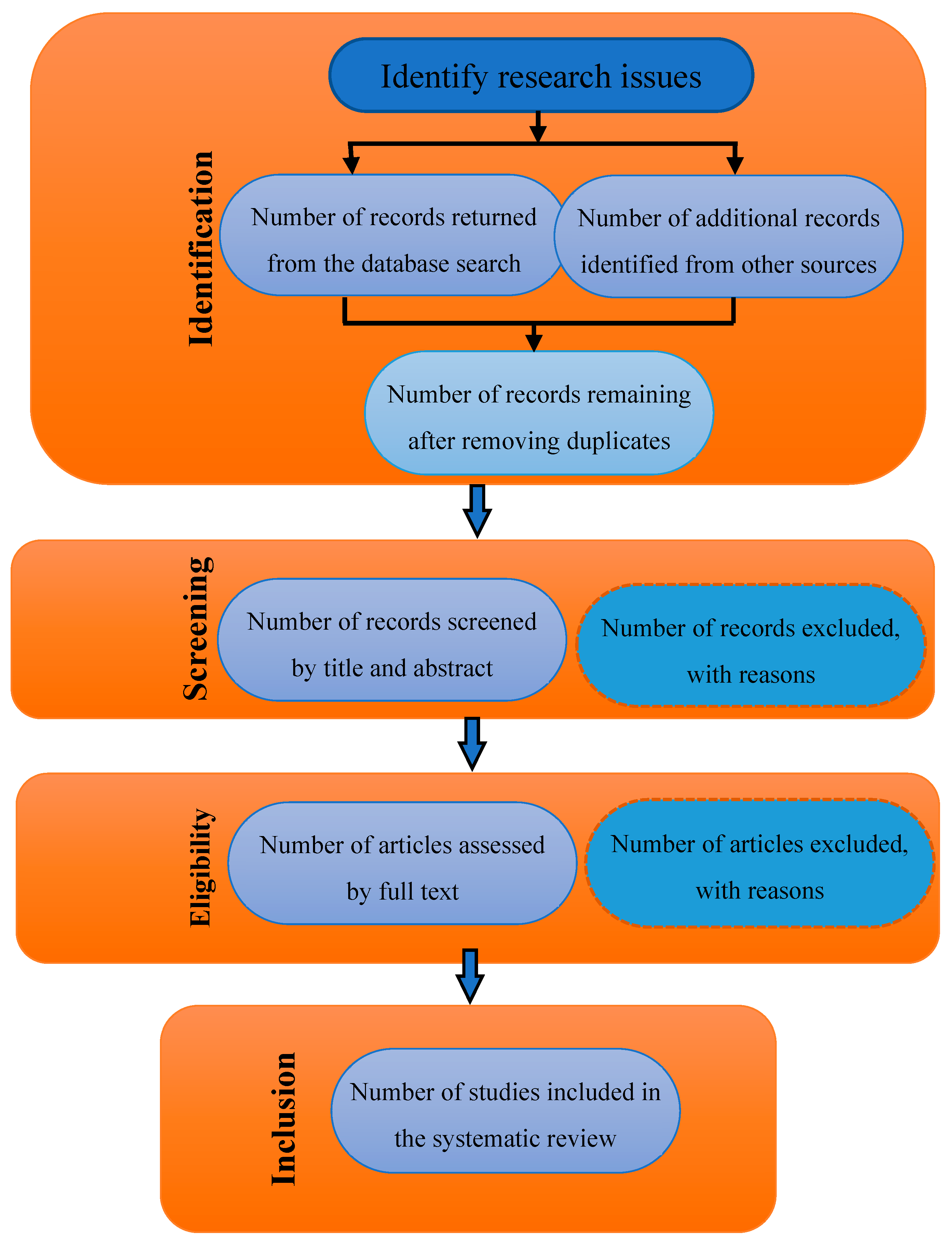
Figure 1. A schematic diagram of the PRISMA protocol to represent the included and excluded articles at each stage of the systematic review.
Sustainability 17 10786 g001
Figure 2. Design of the combined thermal–electrical solar still incorporating boosting reflector [46].
Sustainability 17 10786 g002
Figure 3. Total yield per unit surface per day. Shaded cooling (a) and water cooling (b) [47].
Sustainability 17 10786 g003
Figure 4. Productivity comparison between modified and standard stills [52].
Sustainability 17 10786 g004
Figure 5. Effect of wind speed and condenser surface on the daily water production of a solar still throughout the winter [53].
Sustainability 17 10786 g005
Figure 6. A systematic diagram of the modified solar still [54].
Sustainability 17 10786 g006
Figure 7. Cumulative and hourly water production against operational time for the conventional solar still and the enhanced solar still with an absorber and a pin fin condenser [54].
Sustainability 17 10786 g007
Figure 8. Daily total production of various solar still systems under study [58].
Sustainability 17 10786 g008
Figure 9. Freshwater yield changes with time throughout the summer [59].
Sustainability 17 10786 g009
Figure 10. Schematic of stepped solar still with PCM and external condenser [61].
Sustainability 17 10786 g010
Figure 11. Case I: single-stepped solar still; Case II: stepped solar still with external condenser; Case III: stepped solar still with PCM (stearic acid); Case IV: stepped solar still with PCM and external condenser. All involved daily distillation of water for various experimental modes [61].
Sustainability 17 10786 g011
Figure 12. CSS and MSS’s differences in distillation production [62].
Sustainability 17 10786 g012
Figure 13. Comparison of modified, finned, and CSSs’ daily efficiency [65].
Sustainability 17 10786 g013
Figure 14. Comparison of PSS and MPSS yields with PCM on an hourly and daily basis [75].
Sustainability 17 10786 g014
Figure 15. Under test settings, PSS and MPSS yield increases and thermal efficacy [75].
Sustainability 17 10786 g015
Figure 16. Comparison of the total amount of distillate produced by CSS and SSWZZACC on 14 September 2020 [77].
Sustainability 17 10786 g016
Figure 17. Under different working circumstances, the energy efficiency and yield increase for HSS and MHSS [82].
Sustainability 17 10786 g017
Figure 18. Water production against operational time [84].
Sustainability 17 10786 g018
Figure 19. Efficiency and sun intensity relationship for a 20 °C ambient temperature, a 10 m/s wind speed, and various condenser temperatures [88].
Sustainability 17 10786 g019
Figure 20. A systematic diagram of the design elements [89].
Sustainability 17 10786 g020
Figure 21. Impact of cell diffusion gap on the total production rate [89].
Sustainability 17 10786 g021
Figure 22. Water production against variable packing factors of c-Si solar still cell [91].
Sustainability 17 10786 g022
Figure 23. Energy and exergy efficiencies against different types of solar stills [98].
Sustainability 17 10786 g023
Figure 24. The impact of the leaf-shaped pattern’s hydrophilic and hydrophobic zone thickness on the pace of freshwater generation [100].
Sustainability 17 10786 g024
Figure 25. Total distillate produced over time in the DCCS, SCCS, and CS [103].
Sustainability 17 10786 g025
Table 1. A summary of relevant studies related to solar stills with external condensers.
Authors (Year) [Reference]Type of Solar StillModificationKey Performance MetricsResults and Remarks
Monowe et al. (2011) [46]Portable single-basinExternal reflecting booster and outside condenserEfficiency, distillate rateEfficiency up to 77–85% with preheated saline water.
Zeroual et al. (2011) [47]Double-slopeCooling by flowing water or shading on the north glass coverDaily yield, productivityCooling by water improved yield by 11.82%.
Kabeel et al. (2014) [48]Single basinNanofluids (Al2O3) and external condenserProductivity, efficiencyNanofluids improved productivity by 116%.
El-Samadony et al. (2014) [49]SteppedInternal and external reflectors with external condenserDaily productivityProductivity increased by 165% with reflectors and condenser.
Refalo et al. (2016) [50]Solar still with solar chimneySolar chimney and condensers with seawater-cooled tubesEfficiency, yield8.8% better efficiency with condenser.
Bhardwaj et al. (2016) [51]InflatablePlastic channels as passive condenserProduction rate0.95 L/h with air flow over condenser.
Kumar et al. (2016) [52]Single basin single slopeAgitation effect and external condenser with exhaust fanProductivity39.49% higher productivity with condenser.
Rahmani and Boutriaa (2017) [53]Natural Circulation Loop (NCL)External condenser with varying area and wind velocityDaily yieldProductivity increased with condenser area.
Rabhi et al. (2017) [54]Modified single basinPin fins absorber and external condenserHourly water productionPin fins and condenser increased yield.
Hassan and Abo-Elfadl (2017) [55]Single slopeHeat sink condenser and saline water mediums (steel fibres, sand)Daily productivityHeat sink condenser increased yield by 52%.
Kabeel et al. (2017) [56]Single basinNanofluids (Cu2O, Al2O3) and external condenser with low-pressure fanDaily efficiency84.16% efficiency with Cu2O Nanoparticles.
Rahman et al. (2019) [57]Modified with absorber plateAbsorber plate with triangular/rectangular channels and external condenserAverage yield24–30% increase with external condenser.
Hassan et al. (2020) [58]Single slope with PTCPTC, heat sink condenser, and porous mediaDaily yield, efficiency67% yield increase in summer with PTC.
Hassan et al. (2020) [59]Solar still with PTSCPTSC with heat sink condenser and forced air/water coolingFreshwater yield14.8% improvement with HSC and FW cooling.
Parsa et al. (2020) [60]Stepped with thermoelectricThermoelectric heating, Nano fluid (Ag), and double-slope external condenserDaily yield100.5% improvement with Nano fluid/condenser.
Toosi et al. (2021) [61]Stepped with PCMPCM and external condenserProductivity rate104% improvement with PCM and condenser.
Mevada et al. (2021) [62]Modified with fins and condenserFins, evacuated tubes, and zig-zag air-cooled condenserDistillate output73.45% higher productivity.
Patel et al. (2021) [63]Ultra-modified double slopeExternal partial cooling coil condenserDaily yield, efficiency76.66% efficiency in summer.
Rahmani et al. (2021) [64]Single-slope basinNew external condenser design (weather-dependent performance)Productivity29% improvement in moderate weather.
Tuly et al. (2021) [65]Double slope with modificationsRectangular fins, paraffin wax, wick material, and external condenserDaily efficiency39.74% efficiency with condenser.
Abdelgaied et al. (2021) [66]TubularPin fins (inclined/vertical) and external condenserAccumulative yield27.6% improvement with inclined fins and condenser.
Sivaram et al. (2021) [67]Stepped with condenserStepped evaporator with passive external condenserEfficiency12.2% improvement in winter.
Alawee et al. (2022) [68]Modified with PCM and condenserCopper heating coil, external condenser, and Nano-PCM (Ag)Productivity, efficiency120% productivity increase.
Moghadam and Samimi (2022) [69]Evacuated tube collectorEvacuated tube collector with cube-shaped glass condenserWater production7.231 kg.m−2.day−1 with optimal condenser.
Hussein and Jassim (2022) [70]Solar still with separate condenserSeparate condenser with dividers and D.C. fanProductivity39.329% higher yield.
Sharshir et al. (2022) [71]Pyramid with modificationsEvacuated tubes, external condenser, Nanoparticles, and ultrasonic foggersFreshwater output, efficiency91.09% higher output with condenser.
Darabi et al. (2022) [72]Tilted wick with reflectorChannelled twin-wall plastic absorber, external condenser, and reflectorDaily efficiency46.13% efficiency with reflector.
Nehar et al. (2022) [73]Double slope with absorber platesTriangular/rectangular channelled absorber plates and external copper condenserProductivity, efficiency17.86% overall efficiency.
Tuly et al. (2022) [74]Double slope with fins, PCM, etc.Fins, PCM, external condenser, and wick materialsEnergy, exergy, economic metrics32.46% improvement in productivity.
Essa et al. (2022) [75]Pyramid with modificationsPyramidal absorber, jute/cotton wick, external condenser, and reflectorsProductivity, efficiency142% improvement with mirrors and condenser.
Naveenkumar et al. (2023) [76]Double-slope with vacuum fanSolar-operated vacuum fan, external condenser, and Nanofluids (CuO, Al2O3, ZnO)Energy, exergy efficiency64.29% higher production.
Mevada et al. (2023) [77]Solar still with zig-zag condenserZig-zag air-cooled condenser and CuO NanoparticlesDistillate output, efficiency46.83% higher productivity.
Abdullah et al. (2023) [78]Single slope with modificationsCopper heating coil, internal/external reflectors, Nano-PCM, and external condenserProductivity, efficiency191% productivity increase with condenser.
Saleh et al. (2024) [79]Stepped with NPCM and condenserNPCM and condenserDesalination yield110% improvement with NPCM and condenser.
Elamy et al. (2024) [80]Coiled with vertical wickVertical wick distiller, reflectors, nanomaterial-infused PCM, and condenserDistillate output269% increase with condenser and fan.
Diarra et al. (2024) [81]Mobile wickMobile wick solar still with passive external condenserHourly productionTested under sub-oceanic climate.
Alqsair et al. (2024) [82]Hemispherical with modificationsHemispherical absorber, jute wick, reflectors, fan, and Nano-PCMProductivity, efficiency172% productivity increase with fan.
Diabil et al. (2025) [83]Solar still with modificationsMultiple external condensers and copper pipe solar collectorProductivity, efficiency128.6% higher yield with three condensers.
Rahman et al. (2025) [84]Modified with fins and condenserFloating aluminium fins and multiple cylindrical external condensersDaily yield, efficiency80.36% higher yield with multiple cylindrical external condensers.
Essa et al. (2025) [85]Pyramid with modificationsTriangular-shaped absorber, tracking, reflectors, external condenser, and PCMProductivity, efficiency166% increase with PCM.
Amin et al. (2025) [86]Solar distillation with spiral coilSpiral coil condenser with parabolic dish concentrator and coolant fluidWater production rate12.59% higher yield with coolant.
Ghanaat et al. (2025) [87]Multi-stage with PV panelsWater-collecting grooves in condenser and vibration frequenciesFreshwater production31% improvement with grooves.
Table 2. Seven different cases of condensers with different thickness.
Case NumberContact Angle in Hydrophilic Regions (Degree)Contact Angle in Hydrophobic Regions (Degree)Thickness
Hydrophilic Regions (mm)Hydrophobic Regions (mm)
35 ± 5125 ± 512
45 ± 5125 ± 51.52
55 ± 5125 ± 522
65 ± 5125 ± 52.52
75 ± 5125 ± 51.51
85 ± 5125 ± 51.51.25
95 ± 5125 ± 51.51.5
Table 3. A summary of relevant studies related to solar stills with internal condensers.
Authors (Year) [Reference]Type of Solar StillModificationKey Performance MetricsResults and Remarks
Al-Nimr and Dahdolan (2015) [88]Novel design with porous evaporatorInternal condenser and thermo-sephonic circulationEfficiency, distillate rateEfficiency increased with lower condenser temperature.
Belhadj et al. (2015) [89]Double-slope with capillary filmCondensation cell attached to the stillDaily yield60% higher productivity than CSS.
Feilizadeh et al. (2019) [90]Thermo-syphon activeEnhanced condenser and basin/condenser filling optionsDistillate production66% increase with filled basin and condenser.
Saini et al. (2019) [91]Passive with solar photovoltaic moduleBuilt-in passive condenser and semi-transparent PV moduleEnergy efficiency57.5% efficiency with high packing factor.
Mohaisen et al. (2021) [92]Passive single-slopeIncorporated condenser with external finsDaily productivity92.3% increase with fins.
Abo-Elfadl et al. (2021) [93]Solar distillerVarious condenser designs (e.g., pin fins, corrugated sheets)Energy, exergy, economic metrics54% yield increase with PHS condenser.
Amiri (2022) [94]Improved steppedBuilt-in passive condenser and divided evaporation/condensation chambersDaily yield, efficiency30–150% higher yield than standard still.
Emran et al. (2022) [95]Triangular with PVC heaterInternal separated condenserDaily water production24% higher yield in active still.
Kandeal et al. (2022) [96]Solar still with modificationsActive/passive condensers and Nano fluidYield, energy efficiency31% yield increase with type-B condenser.
Rajasekaran and Kulandaivelu (2022) [97]Modified with inbuilt condenserAgitator and extended condensing areaProductivity98.69% more productivity than conventional.
Rajasekaran and Kulandiavelu (2023) [98]Inbuilt condenser with agitatorSolar PV-powered agitator and condensing fansEnergy, exergy efficiency38.10% higher efficiency than conventional.
Asgari et al. (2023) [99]Solar humidification–dehumidificationSubsurface condenserDaily water yield, GOR1120% higher GOR in optimum system.
Bakhshi et al. (2024) [100]Vertical solar stillHybrid hydrophilic/hydrophobic condenser surfacesFreshwater production rate17% improvement with hybrid surface.
Amiri (2024) [101]Improved steppedTheoretical model validation for built-in condenserDaily yield, RMSE3.7% relative error in yield estimation.
Ghazy (2024) [102]Double-slope passiveCondensation losses recovered to heat water in solar water heaterThermal efficiency18–83% efficiency increase.
Mohaisen et al. (2025) [103]Passive single-slopeMulti-cavity built-in condenserNet daytime productivity44.8% improvement with double-cavity.
Rozza et al. (2025) [104]Trapezoidal with jute wickAdjustable gap between absorber and condenser coverProductivity, cost34.2% lower cost at 5 cm gap.
Table 4. Comparison between solar stills with external and internal condensers.
ParameterExternal CondenserReferencesInternal CondenserReferences
Productivity Increase24–165%[49,95]30–150%[94]
Design ComplexityHigher design complexity as it requires additional components-Lower design complexity as it integrates within the still-
Energy DependencyMay need active cooling (e.g., fans)[43]Mostly passive[51]
Space RequirementLarger footprint-Compact-
Climate changeLess affected by ambient conditions[64]More sensitive to internal airflow[94]
Cost ImplicationsHigher initial cost due to added components[52]More economical in basic configurations[91]
Table 5. Main improvements against associated challenges.
EnhancementPotential BenefitMajor Challenge
Hybrid nanomaterialsHigher thermal conductivity, faster evaporationNanoparticle settling, high cost
Multi-stage condensationIncreased freshwater recoveryComplex design, space requirements
Solar tracking systemsOptimised solar absorptionMechanical wear, energy consumption
Machine learning controlsAdaptive performance optimisationHigh technical expertise needed
Biomimetic condenser surfacesImproved droplet sheddingFabrication difficulty, durability concerns
Nano-enhanced PCMsExtended operational hoursPhase segregation, thermal degradation
Disclaimer/Publisher’s Note: The statements, opinions and data contained in all publications are solely those of the individual author(s) and contributor(s) and not of MDPI and/or the editor(s). MDPI and/or the editor(s) disclaim responsibility for any injury to people or property resulting from any ideas, methods, instructions or products referred to in the content.