1. Introduction
Public transportation is a system that we use frequently in our daily lives and that has an important share in the economy and development of the country. The effects of technological developments experienced today are seen in the field of public transportation systems, as in every field. Especially with the emergence of Industry 4.0, transportation systems are among the most significant areas that have undergone transformation, and there are serious breakthroughs in smart transportation systems. Moreover, the worldwide energy crisis, especially climate change in urban areas, and the advancement in multiple powertrain technologies have triggered the electrification of public transport [
1]. A large part of these developments is the use of alternative fuel systems to fossil fuels. The use of environmentally friendly electric and hybrid vehicles is being developed and now being integrated from individual transportation to public transportation.
Today, change is happening quickly in many sectors, particularly in industry. In this process, the demands of societies also change, and this change in needs inevitably causes the emergence of new products or changes in the management strategies of existing products [
2]. Industry 4.0 is one of the important breaking points in terms of digitization and is a major transformation process in the technological field. The other known name of the concept of Industry 4.0, whose foundations were laid in Germany, is the 4th industrial revolution [
3]. Industry 4.0 has emerged in recent years as a key tool that businesses may use to boost performance due to the growing demand and speed towards digitizing industrial operations [
4]. Industry 4.0’s central tenet is the deep integration of business and engineering processes using technological developments to enable flexible, effective, and sustainable production with a long-term high quality and low cost [
2].
One of the most important outputs of the fourth industrial revolution (Industry 4.0), where smart production is realized, is seen in public transportation systems. The interaction between businesses, nations, partners, and competitors is made possible by technologies, which include advanced robotics and artificial intelligence, sophisticated sensors, Big Data analytics, 3D printing, cloud-based business models, powerful mobile devices, and algorithms for driving vehicles (navigation tools, car sharing applications, autonomous vehicles, and last-mile delivery services) [
5]. These modifications will unavoidably have an impact on how the transportation system as a whole will develop.
Industry 4.0 has been a process that brings together issues such as sustainability, efficiency, and the environment. Sustainability is the ability of any system to continue its existence in the future while accounting for social, economic, and environmental factors without endangering the lives of other living things. Continued population growth and rapid urbanization processes pose a challenge to sustainable development. In particular, the public transportation system is one of the biggest sustainability challenges in cities, and it has become an emergency to find transportation solutions that provide quality, efficient, and ecological service in urban areas today [
6]. Public transport is one of the main challenges for the sustainable development of cities, especially in developing countries [
7].
One of the most crucial elements that must be taken into consideration in order to produce a sustainable system and keep up with the rapid advancement of technology is quality. The term “quality” refers to the degree of customer satisfaction and may be comprehended by examining certain indicators of service quality [
8]. Travel behavior decisions in public transportation are important for selecting suitable transportation alternatives for passengers [
9]. For managers and officials, achieving a high degree of customer satisfaction is a crucial responsibility [
10]. Customers’ perceptions are evaluated by analyzing the level of service quality. Today, in order to provide quality and sustainable service, many public transportation system managers have tended to increase the service quality by giving more importance to customer satisfaction. Especially in large cities with high population density, analyzing and improving the service quality of the public transportation system is of great importance for development.
Izmir is the third most populous city in Turkey, with a population of 4,425,789, located in the Aegean Region. With an area of 11,891 km
2, it is one of the leading metropolitan cities in Turkey in terms of economic, historical, and socio-cultural aspects [
11].
The Izmir Metropolitan Municipality offers services, with public transportation options such as the bus, metro, suburban tram, ferry, and Bisim. In Izmir, the ESHOT General Directorate is responsible for managing urban public transportation. In developing countries, rubber-tired systems are used frequently for urban public transit systems. According to the ESHOT 2021 annual report [
12], in only the second half of 2021, a total of 205 million passenger boardings took place in rubber-tired public transportation, of which there were 163 million passengers. The ESHOT General Directorate provides service, with approximately 2000 buses as of 2022. As of 2022, 20 electric buses serve on different lines in the Izmir public transportation system. In addition, according to the 2020–2024 Strategic Plan Report of the Izmir Metropolitan Municipality, it is seen that there are studies and targets on the “Establishment of Electric Vehicle Stations” and “Expansion of the Vehicle Fleet Working with Clean Energy”.
A few studies in the literature evaluate public transportation systems’ service quality using the SERVQUAL method. De Ruyter and Wetzels (1996) [
13] developed a new methodology called SERVCON for the evaluation of public transport service quality in the Netherlands. Too and Earl (2010) [
14] use a SERVQUAL method to measure public transport services within a master-planned community in Australia; the original SERVQUAL structure is modified to measure service quality. Lupo (2013) [
15] proposes a hybrid SERVQUAL methodology to strategically analyze the Italian public transport service sector, defines the overall service quality structure, and determines the elements affecting the service quality of the sector. Mikhaylov et al. (2015) [
16], using the SERVQUAL method to assess the quality of city bus services in Kaliningrad, Russia, based on customer evaluation, aimed to identify the main bottlenecks from the customer perspective. In their study, Iran Nejad Parizi and Khedmati (2016) [
17] use the standard SERVQUAL method to assess the satisfaction of BRT users on the Chamran Highway. In their study, Vega et al. (2017) [
18] apply the SERVQUAL method to examine the difference between expectances and perceptions of service quality in the public bus transportation system in Bogota. In their study, Sam et al. (2018) [
19] use the SERVQUAL method to analyze how public bus transport passengers perceive and expect service quality and how this affects their overall satisfaction with Kumasi’s public transportation system. In their study, Man et al. (2018) [
20], using the SERVQUAL model, aim to determine the difference between the service quality expectations of service providers and customers for the ride-hailing service in the city of Kuala Lumpur. In his article, Chaudhary (2020) [
21] analyzes whether BRTS vehicles’ perceptions of service quality differ between different demographic groups and utilizes the SERVQUAL method. In their study, Tumsekcali et al. (2021) [
22] evaluate the performance of the Istanbul public transportation system in terms of service quality and customer satisfaction throughout the pandemic era, and they propose the P-SERVQUAL 4.0 model. In their study, Chuenyindee et al. (2022) [
23] analyze the service quality of PUV vehicles in f the COVID-19 outbreak using the AHP (Analytical Hierarchy Process) and the SERVQUAL model. Taran’s (2022) [
24] study deals with the measurement and evaluation of the service quality level of the shuttle bus in the Albayt University campus using the SERVQUAL model. Jou et al. (2023) [
25] aim to analyze the level of service provided by bus transit in Occidental Mindoro during the COVID-19 outbreak using the AHP (Analytical Hierarchy Process) and the SERVQUAL model. Kewate and Grand (2024) [
26] presented a study that integrated the Response Surface Model (RSM) and SERVQUAL model to analyze customer requirements and evaluate the performance of the public transportation system in detail. Ong et al. (2024) [
27] used a 5-dimensional SERVQUAL model integrated with Structural Equation Modeling (SEM) to assess the service quality and customer satisfaction of motorcycle taxis or MTHS in the Philippines. In their study, Flores et al. (2025) [
28] implemented applications using the 5-dimensional SERVQUAL model and Structural Equation Modeling (SEM) to evaluate the satisfaction of the Doha Metro Rail System and measure the service quality of the public transportation system for a sustainable public transportation system in Qatar [
12]. In addition, the MCDM methods used in the evaluation of the public transportation system, the purpose of the studies, and the literature gaps, including a literature review, are presented in
Table 1.
This study discusses the problems of evaluating service quality and choosing the best alternative using multi-criteria decision-making techniques for a public transportation bus system with a heterogeneous fleet that includes electric buses. In other words, it is aimed at evaluating the service quality for public transportation bus alternatives, to identify the deficiencies and to rank the alternatives from the best to the worst. In addition, it is aimed at determining which criteria are important in terms of service quality. Thus, it is aimed at assisting municipal managers in their investment decisions by providing a quick and detailed study for municipal managers who want to renew their bus fleet with large investments in Izmir, one of Turkey’s major metropolitan cities. For this reason, a new SPT SERVQUAL 4.0 model, which takes into account the integration of sustainability and Industry 4.0 criteria, is proposed for the evaluation of public transport systems’ service quality. Two new main criteria, namely “Sustainability” and “Industry 4.0”, are added to the SERVQUAL model, and a model structured according to a three-level criteria hierarchy is proposed. The problem is considered as a multi-criteria decision-making problem, and the criteria weights for each level are determined through the Bayesian BWM; then, the Picture Fuzzy WASPAS method is used to rank the alternatives. The outcomes of an actual case study on the Izmir Metropolitan Municipality’s public transportation bus alternatives, including electric buses, hybrid buses, diesel buses, gasoline buses, and gas-powered buses, are presented.
This study aims to fill the following research gaps in the literature:
To present a public transportation service quality assessment study that can be implemented by both managers and customers;
To present a study that evaluates different bus options not only based on bus brand but also fuel type;
To introduce a new three-level SERVQUAL model for public transportation systems, adding and updating criteria based on current conditions such as sustainability and Industry 4.0;
To implement SERVQUAL, Bayesian BWM, and Picture Fuzzy WASPAS methods as a hybrid model for the first time in the literature.
Measuring the service quality of a public transportation system and supporting it with multi-criteria decision-making techniques can also contribute to public transportation network design and strategic decision-making. It is important to design a useful and simple tool that can eliminate line design complexities and help planners generate rapid and efficient solutions [
45,
46]. From this perspective, the study is significant because it provides content that can contribute to public transportation planners.
The remainder of the paper is structured as follows:
Section 2 describes the structure of the hybrid methodology, called SPT-SERVQUAL 4.0, the Bayesian Best–Worst Model, Picture fuzzy set, and Picture Fuzzy WASPAS methods.
Section 3 applies a real case study to the Izmir Metropolitan Municipality public transportation system. The conclusions and discussion are presented in
Section 4.
2. Materials and Methods
In this study, service quality assessment and a multi-criteria decision-making problem for a heterogeneous fleet public transportation system, including electric buses, are discussed.
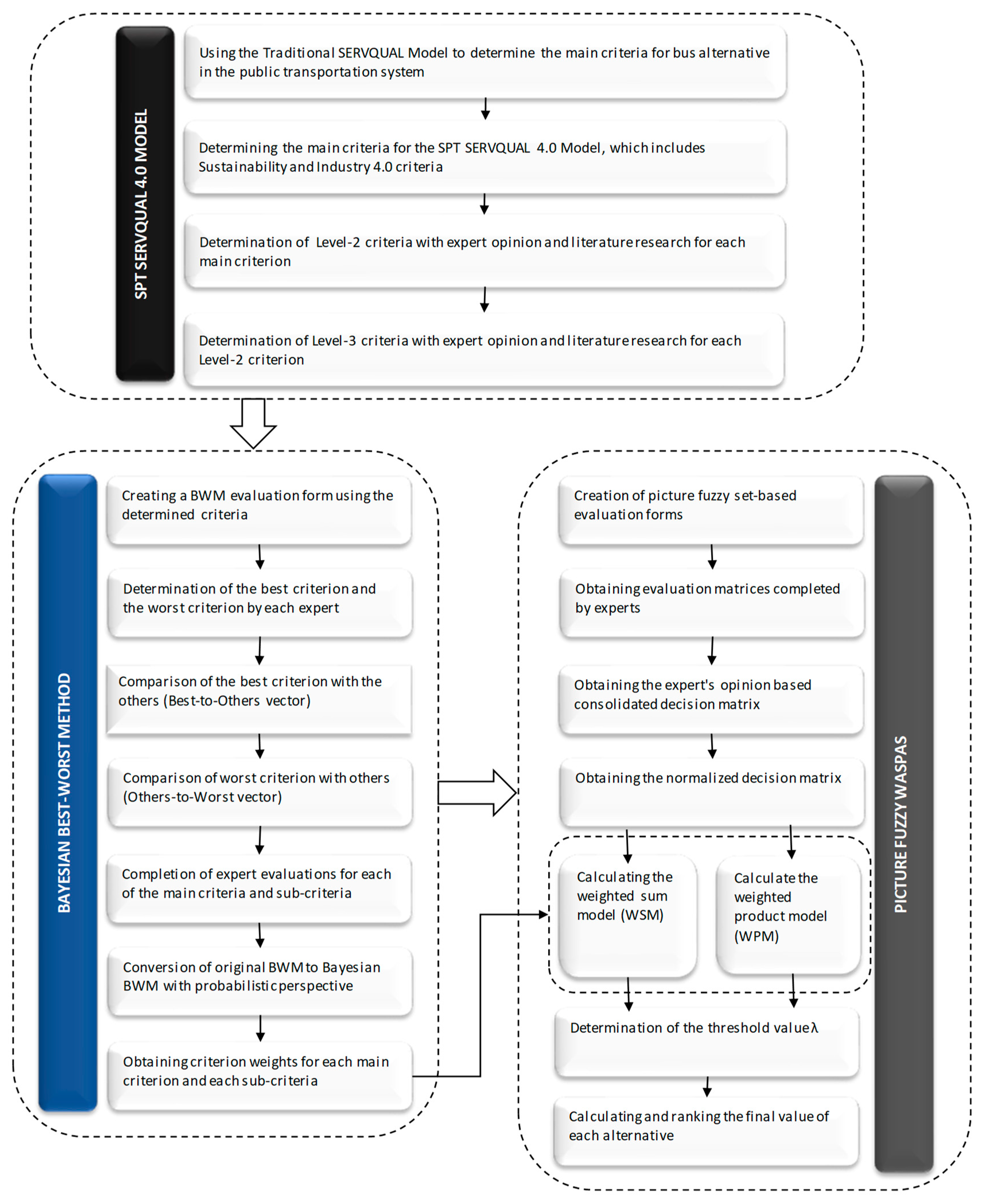
In this context, first of all, a model named SPT SERVQUAL 4.0 (Sustainable Public Transport SERVQUAL 4.0) is proposed, and a three-level criteria hierarchy is structured, incorporating the criteria and the dimensions of Industry 4.0 and sustainability. Then, the Picture Fuzzy WASPAS method is used to evaluate five different public transport bus alternatives after the criteria for each level of the model are weighted using the Bayesian BWM. The hybrid, multi-criteria decision-making methodology, consisting of the three-level SERVQUAL Model, Bayesian BWM, and Picture Fuzzy WASPAS methods proposed in the study, has been a source of motivation, as it will be applied for the first time in the literature.
The proposed hybrid methodology is shown in
Figure 1, and the following subsections provide theoretical details of the methodology.
2.1. The New Model SPT SERVQUAL 4.0 (Sustainable Public Transport SERVQUAL 4.0)
The SERVQUAL model, a prominent technique for evaluating service quality, is used in almost every industry. The SERVQUAL method, which is effective and has a wide range of criteria, evaluates the gap caused by the discrepancy between customer expectations and customer perceptions [
47]. The SERVQUAL model was first developed by Parasuraman, who established 10 qualities of service (criteria), comprising credibility, security, accessibility, communication, consumer understanding, tangibles, reliability, responsiveness, competence, and courtesy. After that, Parasuraman reduced the ten criteria to just five. These five criteria of the SERVQUAL model are tangibles, responsiveness, reliability, assurance, and empathy [
48]. Today’s world is changing quickly, and this change affects every industry. For this reason, using just these five criteria, the traditional SERVQUAL methodology might not be adequate to assess service quality in the modern world. The most important and new features that determine service quality in our age are Industry 4.0 and sustainability. Therefore, within the scope of the study, these two features are accepted as criteria, and a new SERVQUAL model is proposed to be used in the evaluation of service quality. The name of this model is SPT SERVQUAL 4.0. With this model proposed within the scope of the study, the evaluation of bus types in the public transportation system in terms of sustainable service quality and compatibility with Industry 4.0 is discussed. The model is structured using a three-level hierarchy of criteria. There are 6 main criteria, 13 Level-2 sub-criteria, and 51 Level-3 sub-criteria in the model.
Table 2 shows the three-level structure for the SPT SERVQUAL 4.0 model. Each of the criteria are then thoroughly explained.
The main criterion of “Tangibles” consists of the “Modern and comfortable vehicles” sub-criterion and “Personnel and empathy” sub-criterion.
The “Modern and comfortable vehicles” criterion has five sub-criteria:
- ❖
The “Number of vehicles” sub-criterion expresses whether the number of public transport vehicles is sufficient to meet the passenger demand.
- ❖
The sub-criterion “Enough seat, comfort and cleanness of seat” expresses the qualities that affect the satisfaction of all kinds of passengers and determine the adequacy of the interior quality of the vehicles.
- ❖
The sub-criterion “Suitability of vehicles for disabled” refers to the level of designing the physical capabilities of the vehicles for disabled passengers.
- ❖
The sub-criterion “Vehicle conditions are ergonomically friendly, clean, hygienic, and comfortable” expresses the level of providing hygiene, cleanliness, and comfort conditions in vehicles, which have become important in our lives, especially with the pandemic.
- ❖
The sub-criterion “The air conditioning of the vehicle and the temperature inside the vehicle are satisfactory” refers to the availability and quality of the ventilation and heating systems of the vehicles.
The “Personnel and empathy” criterion has four sub-criteria:
- ❖
The sub-criterion “Individual attention to passenger” expresses the level of being able to deal with the individual wishes of each passenger in the vehicle.
- ❖
The sub-criterion “Listening to customer needs” expresses the level of listening to customer requests and needs.
- ❖
The sub-criterion “Understanding customer needs” means understanding customer needs correctly and providing service in vehicles at the appropriate level.
- ❖
The sub-criterion of “Having operating hours convenient for all customers” refers to the number of vehicles and physical and technical features that can meet customer demands at any time of the day.
The main criterion of “Responsiveness” consists of the sub-criterion “Service availability” and the sub-criterion “Easily accessed information”.
There are three sub-criteria of the “Service availability” criterion:
- ❖
The “Safety service” sub-criterion states that the vehicle is safe during the entire trip.
- ❖
The sub-criterion “Prompt handling of request” refers to the ability to quickly meet the demand from the service provider to the customer.
- ❖
The sub-criterion “Vehicles are easily accessible even during rush hour” states that vehicles can easily meet the demand and are accessible even during rush hours.
There are two sub-criteria for the “Easily accessed information” criterion:
- ❖
The sub-criterion “Willingness to help” expresses the willingness to help customers in vehicles and to provide prompt service.
- ❖
The sub-criterion “Adequate information about the bus service schedule and routes” states that informative announcements and texts, such as the service schedule and routes on the vehicles, are sufficient.
The main criterion of “Assurance” consists of the “The knowledge of the drivers and personnel” sub-criterion and the “Travel safety” sub-criterion.
The criterion of “The knowledge of drivers and personnel” has two sub-criteria:
- ❖
The sub-criterion “The driving ability of drivers” states that vehicle drivers have good driving skills and their behavior gives confidence to passengers.
- ❖
The sub-criterion of “Personnel have training and knowledge” states that vehicle drivers are educated and have the technical knowledge and hardware information required for the vehicles.
There are six sub-criteria of the “Travel safety” criterion:
- ❖
The “Adherence to quality standards in vehicle” sub-criterion expresses the obligation of vehicles to comply with the general standards determined for public transportation systems.
- ❖
The sub-criterion “Passengers and passengers’ belongings secured” means that passengers and their belongings are free from danger, risk, and doubt.
- ❖
The sub-criterion “Security in the vehicle” states that there are adequate security measures against crime in vehicles.
- ❖
The “Effective and correct emergency management” sub-criterion expresses a fast and accurate emergency response in the case of an accident in the vehicle.
- ❖
The “Range anxiety” sub-criterion expresses the fear that the battery/fuel will run out before reaching the charge/fuel point.
- ❖
The “Ease of access to charging/fuel point” sub-criterion expresses the ease of access of vehicles to charging/fuel points in possible emergency or risky situations.
The “Reliability” main criterion consists of the “On-time performance” sub-criterion and “Operational quality” sub-criterion.
The “On-time performance” criterion has two sub-criteria:
- ❖
The sub-criterion “Vehicles arriving at the destination punctually” states that there is no loss of time in traffic and that customers are satisfied with the journey by reaching the destination on time.
- ❖
The sub-criterion “Vehicles arriving at the stations punctually” is associated with the reduction in customers’ waiting times at stops and shorter queues.
The “Operational quality” criterion has three sub-criteria:
- ❖
The “Frequency of service” sub-criterion states that the number of vehicle trips and service duration are in accordance with customer demands.
- ❖
The sub-criterion “Vehicles do not break down easily or experience mechanical failure on the road” refers to the durability of vehicles against deterioration or failure, that is, the quality of the vehicles.
- ❖
The sub-criterion “Easy operation of vehicles on sloping roads” expresses the suitability of the technical features of the vehicles for driving on sloping roads.
The “Digital Technology” main criterion consists of the “Innovation” sub-criterion and “Information” sub-criterion.
The “Innovation” criterion has five sub-criteria:
- ❖
The “Real-time transmission” sub-criterion expresses the ability to monitor passenger mobility with the information obtained through mobile applications and services based on instant real data.
- ❖
The “Smart transportation” sub-criterion represents new generation digital payment and ticketing systems, autonomous vehicles, integration (multimodal), etc. It refers to the smart transportation features that directly affect the public transportation system.
- ❖
The “Integration with Industry 4.0” sub-criterion includes tools such as advanced robotics, Internet of Things (IoT), artificial intelligence (AI), Automatic Identification, Real-Time Locating, Intelligent Sensing, Networking, etc., and states that it has Industry 4.0 technologies.
- ❖
The “Transportation technologies” sub-criterion should include free internet, camera usage, GPS systems, etc., in vehicles. It refers to the use of advanced technologies.
- ❖
The sub-criterion “Digitalization and data security, cyber security, privacy, transparency, and accountability” refers to activities aimed at improving security as well as improving the technological infrastructure in public transportation.
The “Information” criterion has four sub-criteria:
- ❖
The sub-criterion “Information during travel” is the current location of the vehicles, current and next stops, time, remaining time, etc., and contains current information.
- ❖
The “Information before travel” sub-criterion is the route, length, duration, etc., of the trip for passengers. This refers to the information available on the website, terminal, or vehicle.
- ❖
The sub-criterion “Website and mobile applications” refers to the integration of the information in the tools with the website and mobile applications.
- ❖
The sub-criterion “Information system competency” is related to the competence of the information systems of the services in the vehicles.
The “Sustainability” main criterion consists of the “Environmental” sub-criterion, “Economic” sub-criterion, and “Social” sub-criterion.
The “Environmental” criterion has five sub-criteria:
- ❖
The sub-criterion of “Clean energy use” refers to the realization of renewable, zero-emission, and environmentally friendly energy consumption while providing public transportation services by vehicles.
- ❖
The “Waste management and recycling” sub-criterion refers to zero waste and energy savings through recycling.
- ❖
The “Energy consumption” sub-criterion refers to the unit energy consumption of vehicles.
- ❖
The sub-criterion of “Carbon emission reduction and tackling the climate crisis” expresses the unit emissions of vehicles while they are operating and thus the level of combating the climate crisis.
- ❖
The “Noise emissions” sub-criterion refers to the disturbing sounds emitted by vehicles.
The “Economic“ criterion has five sub-criteria:
- ❖
The “Financial strength” sub-criterion expresses the cost of the vehicles.
- ❖
The “Material cost/selling price” sub-criterion expresses the profitability of a firm, which includes all direct and indirect fixed and variable costs and net/gross profit taken into account when choosing a vehicle in the public transportation system.
- ❖
The “Energy consumption cost” sub-criterion expresses the energy cost of vehicles consumed per unit of road.
- ❖
The sub-criterion “Lack of infrastructure and its cost” refers to all kinds of infrastructure elements and costs required for the use of vehicles in the mass transit system.
- ❖
The sub-criterion “Operational and maintenance cost” refers to the operating and vehicle maintenance costs arising from the use of vehicles.
The “Social” criterion has five sub-criteria:
- ❖
The “CRM capability” sub-criterion expresses the ability to understand and meet customers’ wishes and needs in terms of sustainability.
- ❖
The “Competitiveness” sub-criterion expresses the power of the vehicles used to compete with their competitors in all aspects.
- ❖
The “Green risk” sub-criterion expresses the expectation of negative environmental and social consequences in the eyes of the users of the vehicles.
- ❖
The sub-criterion “Public awareness level” expresses the public awareness level of the positive or negative effects of the type of vehicle used in public transportation.
- ❖
The sub-criterion “Workers’ health and safety” refers to the level of protection for personnel in vehicles from conditions that may harm their health.
The table indicating the reference sources for the Level-3 criteria newly added by the proposed SPT SERVQUAL 4.0 model is shown in
Table 3.
2.2. Preliminaries of Picture Fuzzy Sets
The properties of Picture fuzzy sets are explained by the following definitions:
Definition 1. Let a Picture fuzzy set be defined in universe X. The representation of the defined set A is as in Equation (1) [
71,
76].
where
is called the degree of positive membership in A for x;
is the neutral membership degree in A for x; and
is the negative membership degree in A for x. These three defined membership degrees satisfy the following condition in Equation (2) [
71]:
In other words, they indicate the degrees of membership, uncertainty, and non-membership, respectively. In addition to these, there is also the degree of rejection of the membership of x in A, which is calculated as in Equation (3) [
59].
Picture fuzzy sets are a direct extension of fuzzy sets and intuitionistic fuzzy sets (IFSs). When
in the Picture fuzzy set, the Picture fuzzy set turns into an intuitionistic fuzzy set. If
, the Picture fuzzy set now reverts to the classical fuzzy set. The integration of the neutral membership degree
in Picture fuzzy sets allows a better handling of uncertainty and enhances the quality and accuracy of the results obtained [
71].
Definition 2. For the Picture fuzzy set
in the universe X, its complement is represented as in Equation (4) [
74].
Definition 3. Let there be three Picture fuzzy numbers, defined as
, , and
. It is also defined as
. Under these data, the operation rules of Picture fuzzy numbers are defined as in the equations below [
71,
77]
: Definition 4. Let
be a Picture fuzzy number. To obtain a net value from the Picture fuzzy number, the defuzzification procedure is applied as in Equation (9).
The net value y is calculated as follows [
74]:
2.3. Bayesian Best–Worst Method
The novel multi-criteria decision-making method, known as the Best-Worst Method (BWM) developed by Rezaei [
78], offers many advantages over existing comparison-based methods [
79]:
BWM is an approach that is simple to comprehend and use.
BWM makes the comparisons in a methodical approach.
BWM results in more trustworthy weights/ranks, since comparisons are made more consistently.
BWM utilizes input data effectively.
Different multi-criteria decision problems with qualitative and quantitative criteria can be solved with BWM.
BWM is adaptable to a wide range of different multi-criteria decision-making techniques now in use.
BWM involves fewer comparison steps, making it a time-efficient method.
BWM naturally promotes consensus building.
Despite all the advantages of the method listed above, BWM cannot combine the preferences of more than one expert and is only suitable for individual decision-making. Bayesian BWM is introduced to mitigate the negative effects of traditional ways of collecting expert opinions in group decision-making problems [
79].
In this section, a probabilistic hierarchical model, called the Bayesian BWM, and a literature search are presented to find the weights of the determined criteria based on the evaluations of multiple experts using the Best–Worst comparison framework.
Recently, the Bayesian BWM has been applied in many fields. In their study, Chauhan et al. (2022) [
80] include the selection of suppliers for pharmaceutical drug materials by distributors in the COVID-19 pandemic through a hybrid methodology including Bayesian BWM and MABAC methods. In their study, Hashemkhani et al. (2022) [
81] define and apply a methodology including Bayesian BWM and MARCOS methods, which they developed to research the best country to produce batteries on behalf of companies producing batteries for electric vehicles in the USA. In their study, Chauhan et al. (2022) [
82] evaluate six hospitals providing telemedicine services using DEMATEL, Bayesian BWM, and VIKOR methods. Gul and Yucesan (2022) [
83] use TOPSIS and Bayesian BWM methods in their study to evaluate the performance of universities in Turkey. Yalcin Kavus et al. (2022) [
84] propose a hybrid site selection model using WASPAS and Bayesian BWM methods. In their study, Ahmed et al. (2022) [
85] present an integrated approach, including the Delphi method and Bayesian BWM, to identify and evaluate the importance of key flexible sustainable supply chain strategies for the footwear industry in the emerging market. In Huang et al. (2021)’s study [
86], a new Bayesian BWM model using a modified PROMETHEE technique is proposed to assess airport resilience (for risk analysis). The applicability and effectiveness of the model have been proven in practice, taking airports in Taiwan as an example. In their work, Hsu et al. (2021) [
87] present an epidemic prevention framework and also explore the importance and priority of epidemic prevention efforts. Then, they apply their framework in various universities and colleges in Taiwan and use the Bayesian BWM. In their study, Chen et al. (2020) [
88] propose an integrated model including the ELECTRE III method and Bayesian BWM. Then, they design a case study on medical waste management and demonstrate the effectiveness and advantages of the proposed method. In their work, Mohammadi and Rezaei (2020b) [
89] present a new evaluation and comparison methodology based on multiple performance measures that meet the preferences of experts through the Bayesian BWM, and their application is on the evaluation and comparison of ontology alignment systems. Mohammadi and Rezaei (2020a) [
79] introduce the probability-based Bayesian BWM methodology to find the aggregated final weights of criteria for one group of decision-makers at a time. Yang et al. (2020) [
90] propose a model integrating Bayesian BWM and Rough DEMATEL methods in their study and implement this model to include the concept of sustainable development in sports tourism. In order to investigate potential sports tourism attractions in Taiwan, Yang et al. (2020) [
91] plan to develop a hybrid multi-criteria decision-making model and a sustainable sports tourism assessment framework. In this model, they integrate Bayesian BWM and VIKOR methods.
The following are the steps in the Bayesian BWM calculation [
79]:
Step 1. Determining the criteria and sub-criteria to be evaluated: The criteria are determined as a result of an expert evaluation or a literature review, and their scope is specified. The criteria set is created.
Step 2. A questionnaire is created in accordance with the BWM structure so that the experts can evaluate. A form is prepared for the decision-makers to determine the best and worst criteria, and scoring matrices are made in which the best and worst criteria can be compared with other criteria.
Step 3. Each expert determines the most important (best) and least important (worst) criteria from the C criteria set. The best and worst criteria for expert-k are shown as and , respectively.
Step 4. The best criterion is compared with the other criteria using a rating scale from 1 to 9, and the Best-to-Others vector
is generated for each expert. While the criteria with performance close to the best criterion have relatively low values in the scoring made between 1 and 9, when the best criterion is compared with the worst criterion, it takes the highest value in the scoring made between 1 and 9. The vector
is expressed by Equation (10).
Step 5. The worst criterion is compared with the other criteria using a rating scale of 1 to 9, and the Others-to-Worst vector
is generated for each expert. The vector
is expressed by Equation (11).
where K is the number of experts and
represents the pairwise comparison between the worst criterion by expert-k and the other
criteria.
Step 6. Vectors
and
are used as input vectors for calculations from the probability perspective proposed by Mohammadi and Rezaei for BWM (2020a) [
79].
where the multinomial distribution is written as multinomial in the equations.
where
is the aggregated weight matrix. Probability distributions of W are criterion weights based on decision-makers’ evaluations. Dir (1) and Gamma (0.1, 0.1) are Dirichlet and Gamma distributions, respectively. To solve this Bayesian BWM model, one of the most used Monte Carlo techniques, JAGS (just another Gibbs sampler), is used, and the credit order is identified through the procedure proposed by Mohammadi and Rezaei (2020a) [
79].
2.4. Picture Fuzzy WASPAS
The WASPAS method includes the weighted sum model (WSM) and the weighted product model (WPM), two popular multi-criteria decision-making methodologies today. According to Zavadskas et al. (2012), the effectiveness of the WASPAS approach is superior to using only WSM or only WPM [
92]. In this section, the WASPAS method using Picture fuzzy numbers is discussed, its steps are explained, and the literature research is presented.
The number of studies in which the Picture fuzzy sets and the WASPAS method are integrated is very few. In their study, Senapati et al. (2022) [
93] propose and implement a model using the WASPAS multi-criteria decision-making approach under the Picture fuzzy sets to determine the appropriate ventilation system in a hospital. In their study, Jin et al. (2021) [
94] developed a hybrid risk analysis method including WASPAS, linear programming, and FMEA methods under Picture fuzzy sets for a pallet rack change risk analysis. Finally, Simic et al. (2021) [
74] present a multi-criteria decision problem by using the WASPAS method under the Picture fuzzy sets for the first time to solve the last-mile delivery (LMD) mode selection problem.
The calculation steps of the Picture Fuzzy WASPAS method are as follows:
Step 1. Using the linguistic scales given in
Table 4 with Picture fuzzy numbers, an evaluation matrix is created to evaluate the alternatives according to the criteria that each expert evaluator will fill in. The Picture fuzzy number values that will form the matrix are expressed as
, and
is defined by the expert-k as the value of the alternative j according to the criterion i [
57].
Step 2. After each expert’s evaluation matrix is created, the experts’ consolidated decision evaluation matrix is obtained using the formulation in Equation (17) [
84]. In addition, the sum of the weights of all experts is defined as 1, that is,
.
where
is the Picture fuzzy number value of alternative j according to the criterion i in the consolidated decision matrix of the experts, and
represents the weight of expert-k.
Step 3. Each criterion in the expert consolidated decision matrix obtained is determined as a benefit criterion and a cost criterion, and, while the benefit criterion values remain the same, cost criterion values are normalized by taking their complement, as seen in Equation (18) [
74]. Equation (4) is used while creating the normalized matrix.
If is a cost criterion, its value when normalized is . If A is a benefit criterion, it remains the same, that is, it is written as in the normalized matrix.
Step 4. For each alternative, the value of
is calculated using the weighted sum model (WSM) in Equation (19).
Step 5. For each alternative, the
value is calculated using the weighted product model (WPM) in Equation (20).
Step 6. The threshold value coefficient (λ) is ascertained. The weighted sum model and the weighted product models are combined with λ, and the
value is calculated for each alternative according to Equation (21).
where the coefficient λ takes values ranging from 0 to 1 and is generally used as 0.5 [
95].
Step 7. In order to determine the final score of every alternative, the defuzzification procedure in Equation (9) is applied to clarify the score of each alternative, which is the Picture fuzzy number, one by one.
Step 8. Finally, the alternatives are ranked according to the scores obtained.
3. Real Case Study
Increasing people’s quality of life through sustainable customer satisfaction and a well-functioning public transportation system is one measure of progress in today’s society. For this purpose, applying Industry 4.0 technology and sustainability fundamentals is crucial if you want to compete with other highly developed public transportation systems worldwide, make the right decisions by making the right assessments, and increase customer satisfaction. Within the scope of the study, a hybrid multi-criteria decision-making methodology is proposed to assist in making managerial decisions in public transport systems and to evaluate the service quality by taking into account the concepts of Industry 4.0 and sustainability.
One of the most popular techniques for evaluating the service quality of public transportation systems is the SERVQUAL model. This study proposes a new model called SPT SERVQUAL 4.0 and improves the traditional SERVQUAL model. The newly proposed SPT SERVQUAL 4.0 model is structured by adding two new main criteria, “Sustainability” and “Industry 4.0”, to the traditional SERVQUAL model. Additionally, the SPT SERVQUAL 4.0 model has a three-level hierarchy of criteria. In the study, a hybrid multi-criteria decision-making problem is discussed in order to evaluate the service quality of the public transportation system in Izmir and to determine the best public transportation bus alternative among five different alternatives, taking into account both the concept of sustainability and the conditions of Industry 4.0. For this purpose, Picture fuzzy sets are used as linguistic variable scales to take into account uncertainties in the decision-making process. The Bayesian BWM is applied to determine the criteria weights, and then the Picture Fuzzy WASPAS method is applied to rank all the alternatives and select the best one. The application is built with a real case study on the public transportation system of the Izmir Metropolitan Municipality.
In order to implement the proposed hybrid model, as explained in the Methodology section, first of all, the main criteria, 2nd level, and 3rd level criteria are determined via a literature review and expert interviews. There are five experts in total whose opinions and evaluations are consulted during the implementation. Expert opinions were collected and consolidated using the modified Delphi method when determining the criteria. The aim is to reach a consensus on a topic and select the criteria through group thinking. The experts interviewed in the study were asked to reach a common group decision. In other words, the process continued until a single consensus was reached by all experts. Thus, only the criteria agreed upon by the experts were included in the study.
The primary purpose of this study is to assist the Izmir Metropolitan Municipality in making the right decision regarding the significant investment it will make in its public transportation bus fleet to improve service quality. Therefore, the experts selected for this study were selected from public and private sector executives and academics. One of the experts is a Professor in the Department of Industrial Engineering with publications on public transportation systems; the other two are Dr. Lecturers in the Department of Industrial Engineering, with publications on public transportation systems; the other expert is working as a mechanical engineer in the R&D department on sustainable product design in a white goods company; and the last expert works on efficiency and process improvement at the Izmir Metropolitan Municipality Transportation Department. To avoid any conflicts of interest, the experts were not selected from fields such as purchasing or finance. Therefore, when selecting the experts, we carefully selected experts working on innovation and efficiency in relevant fields. When we examined the studies in the literature on multi-criteria decision-making in public transportation systems, we found that three to seven experts are typically used, so we used five experts in this study [
22,
33,
35,
36,
40,
41,
96]. Experts provided their judgments independently to minimize bias and potential group influence. Clear instructions, detailed definitions, and structured assessment forms were distributed to all participants to standardize the input and improve consistency. While obtaining the expert evaluation, the weight of each expert was considered equal, that is, no distinction was made according to the characteristics or jobs of the experts.
3.1. Calculation of Criteria Weights
The priorities of the determined main criteria and sub-criteria are evaluated with the Bayesian BWM methodology. In addition, the weights of all criteria are determined using the Bayesian BWM. Hence, the Bayesian BWM steps are applied. Using the main criteria weight determination, the weights of the Level-2 and Level-3 criteria are calculated. Five experts are consulted to express their views on the importance of the criteria, and the prepared Bayesian BWM evaluation questionnaire is applied to each. Firstly, every expert determines the best (most important) and worst (least important) main criteria, as shown in
Table 5. As a result of the evaluation, it is seen that the best main criterion for four experts is “Tangibles” and the worst main criterion is “Responsiveness”. For only one expert, it is seen that the best main criterion is “Sustainability” and the worst main criterion is “Responsiveness”. This evaluation is applied to all Level-2 and Level-3 sub-criteria after the main criteria.
Then, the Best-to-Others vectors and Others-to-Worst vectors are obtained for the main criteria according to the expert opinions given in
Table 6, where a rating scale from 1 to 9 is used. All of these vectors calculated for the main criteria are also obtained for all sub-criteria, and, in
Table 7, the vectors obtained for the Level-2 sub-criteria and, in
Table 8, for the Level-3 sub-criteria are shown.
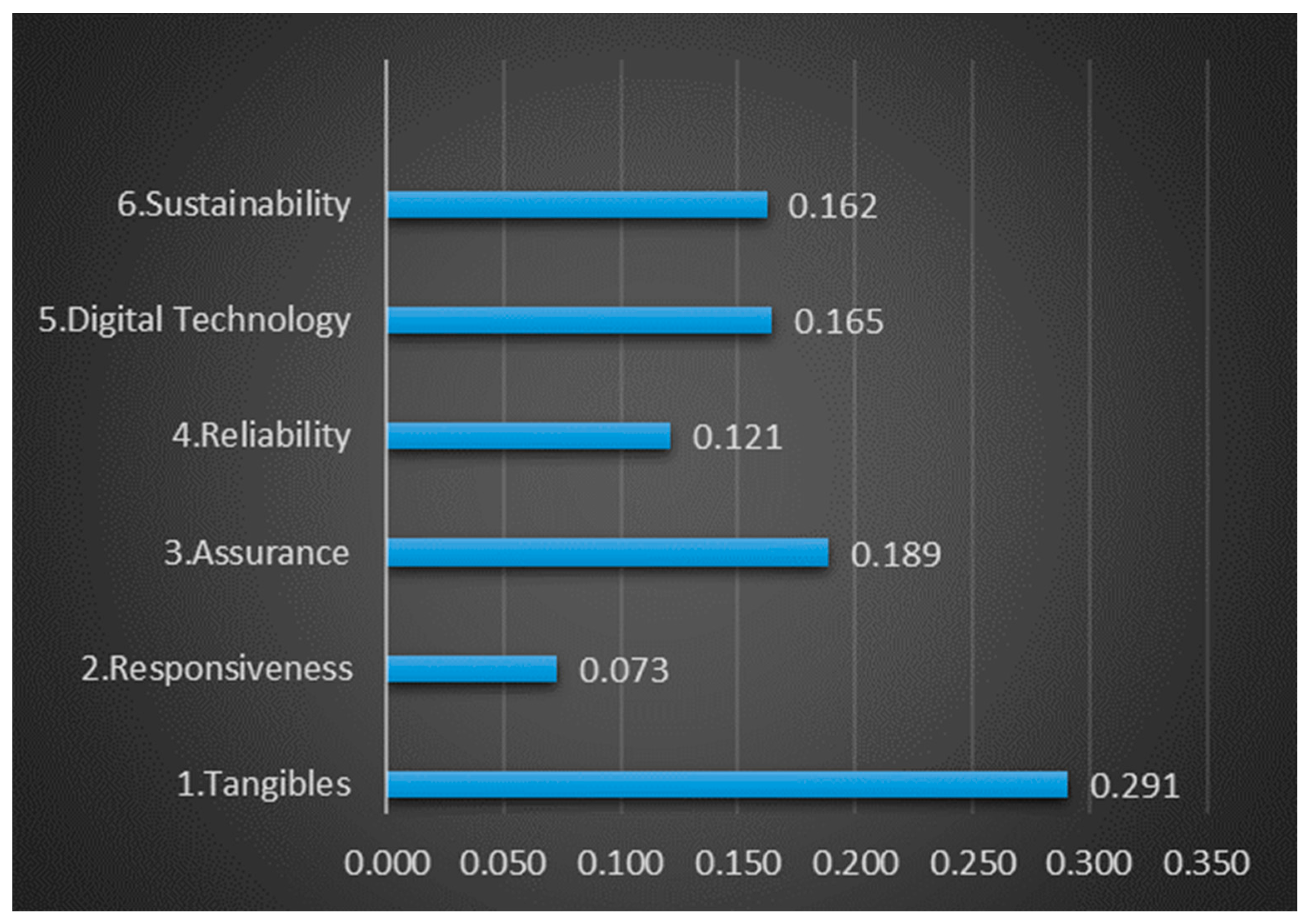
These evaluation vectors, which are obtained based on expert opinions, are inputs utilized to determine the criteria weights using the Bayesian BWM, and the weights of the main criteria are calculated as in
Figure 2. Considering the weights presented in
Figure 2, “Tangibles” is determined to be the best criterion, with a weight value of 0.29071388 among the main criteria; with a weight value of 0.07261194, “Responsiveness” is determined as the worst criterion. Thus, it can be said that the “Tangibles” and “Assurance” criteria play key roles in determining service quality in the Izmir public transportation system.
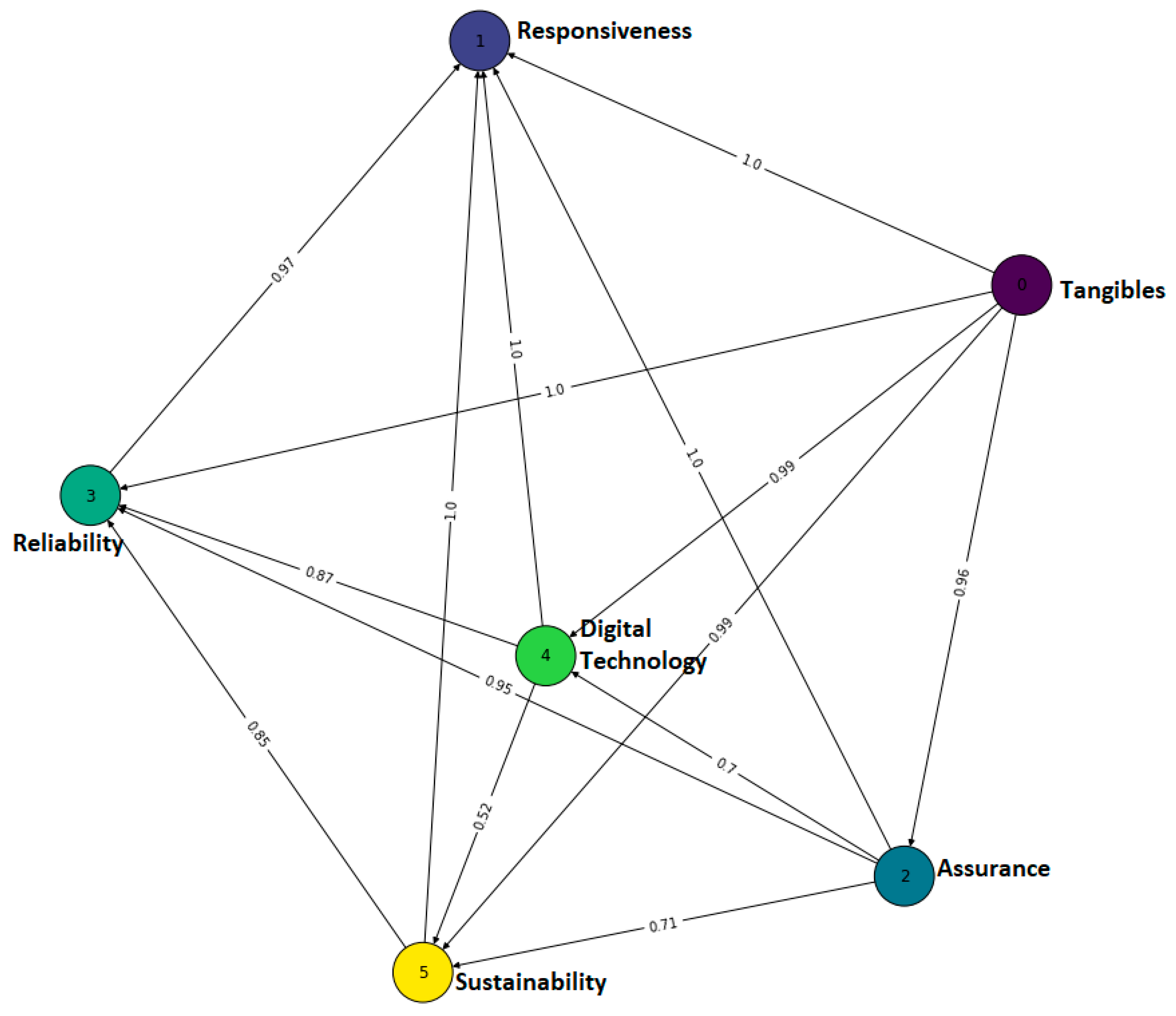
Difficulties may be experienced when ordering the criteria in group decision-making problems, and the ordering needs to be performed much more carefully. At this point, credit rank plays an important role and shows how superior one criterion is to another. The credit ranking for the main criteria is shown in
Figure 3. The values indicated next to the arrows in
Figure 3 demonstrate that criterion A is more important than criterion B on the basis of the r value (
). The value of r can take a value between 0 and 1 and represents a probability value. For example, the Reliability criterion is definitely more important than the Responsiveness criterion because its r value is calculated as 0.97.
By applying the Bayesian BWM, the weights of each main criterion and each sub-criterion are calculated. The weights of the sub-criteria are multiplied by the respective main criteria weights, and the final weights of the sub-criteria are obtained. The obtained Level-1 and Level-2 criterion weights are shown in
Table 9, and the weights of the Level-3 criteria are given in
Table 10. In addition, information on the order of importance of the criteria according to their weights is also included in the tables. Accordingly, “Number of vehicles” is the most important Level-3 sub-criterion, while “CRM capability” is the least important one.
3.2. Evaluation of Bus Alternatives in the Public Transport System
The Picture Fuzzy WASPAS method is applied in order to rank the Izmir Metropolitan Municipality public transportation bus alternatives. The same five experts evaluated five alternative bus types in the Izmir public transportation system, namely, electric buses, hybrid buses, diesel buses, gasoline buses, and gas-powered buses, with a Picture fuzzy cluster-based linguistic scaling questionnaire. The Picture fuzzy set-based alternative evaluation of experts is given in
Table 11. The linguistic terms requested from the experts are formed according to
Table 4.
After obtaining the evaluation matrices of each expert, a single consolidate decision evaluation matrix of the experts is obtained. Then, the criteria values with cost criteria are determined, and the normalization process is applied. Determining the contributions of criteria to the goal is crucial. Some criteria may be benefit-related, while others may be cost-related. In other words, criteria that contribute positively to the goal are considered benefit criteria, while criteria that work against the goal are considered cost-related. For example, a vehicle’s high energy consumption negatively contributes to the goal—that is, it is not beneficial—and, therefore, it is a cost-related criterion. In the application, a total of nine cost criteria were determined, including range anxiety, energy consumption, noise emissions, financial strength, material cost/selling price, energy consumption cost, lack of infrastructure and its cost, operational and maintenance cost, and green risk. Then, the weighted normalized matrix is calculated.
A weighted sum model (WSM) is calculated for each alternative. Then again, the weighted product model (WPM) is obtained for each alternative. The results obtained using WSM and WPM are shown in
Table 12. The threshold coefficient is taken as λ = 0.5 in order to combine the models fairly [
22]. The WASPAS method used to rank the alternatives includes the WSM and WPM methods. When λ is 0, WASPAS converts to the WPM method; when λ is 1, WASPAS converts to the WSM method. Therefore, to ensure an equal weighting for both methods, a λ value of 0.5 is generally selected.
In order to combine the models fairly, λ is set to 0.5 [
22]. The Picture fuzzy numbers obtained as a result of combining WSM and WPM for each alternative are given in
Table 13. These fuzzy numbers are then clarified and ranked after the net final score is obtained. The final scores with the ranking are shown in
Table 14.
As shown in
Table 14, the electric bus alternative, which is found to be the best among the public transportation bus alternatives of the Izmir Metropolitan Municipality, is obtained as a result of the proposed hybrid methodology. Additionally, the gas-powered bus alternative is found to be the worst alternative.
3.3. Sensivity Analysis
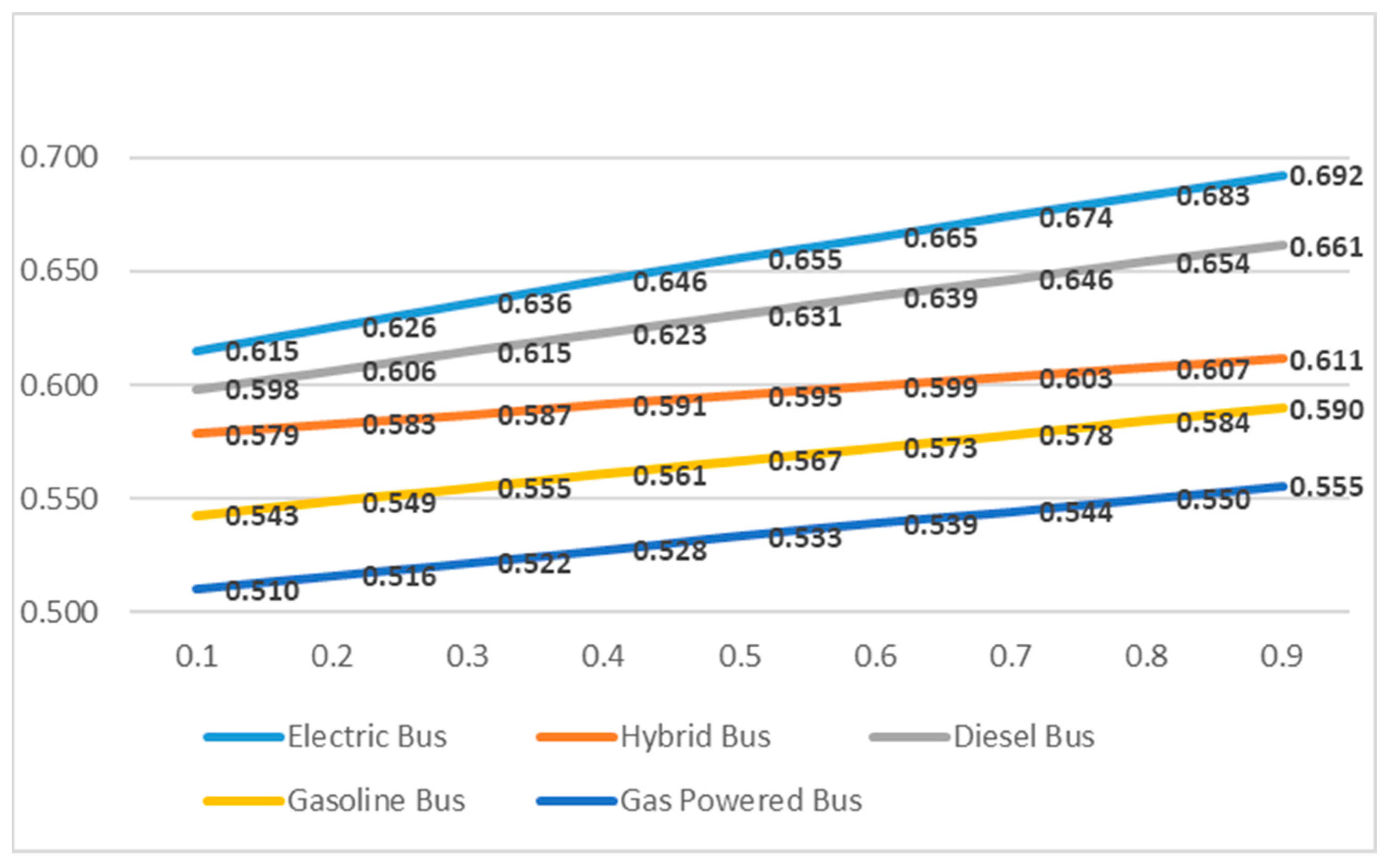
A sensitivity analysis is carried out in this section in order to show the feasibility and reliability of the suggested hybrid decision-making methodology in light of the parameter changes and their effect on the final result. In the study, a sensitivity analysis is performed with the threshold value (λ) change in the WASPAS method applied to rank the alternatives. For each scenario in the analysis, this threshold increases by 0.1 and changes from 0.1 to 0.9.
Figure 4 presents the final weights of all public transportation bus alternatives based on different threshold values.
A sensitivity analysis is used to measure the effect of changing threshold values on the alternative ranking. It concludes that, in every scenario, the alternatives ranked based on the results of the sensitivity analysis remained the same ranking.
Figure 4 illustrates how the order of alternatives for public transport remains unchanged as the threshold value changes. However, only as the threshold increases, the difference between the ranking scores of the alternatives increases. Finally, looking at the sensitivity analysis results given in
Figure 4, it is seen that the best alternative for Izmir is electric vehicles in each scenario and the worst alternative is gas-powered buses.
3.4. Comparative Analysis
A comparative analysis was conducted to evaluate the alternatives and assess the robustness of the methodology. The Picture Fuzzy TOPSIS methodology was used to verify the robustness of the Picture Fuzzy WASPAS method. Weights derived from the Bayesian BWM were used to ensure consistency during the analysis. We are using the same expert-aggregated decision matrix. The same cost/benefit approach, linguistic terms, and scales were used throughout the analysis. The Picture Fuzzy TOPSIS procedures were then applied as follows:
- (i)
Perform a Picture fuzzy normalization of the decision matrix using Equation (18),
- (ii)
Obtain the weighted matrix using criterion weights (using Equation (7)),
- (iii)
Create positive and negative ideal solutions, respectively, at Equations (22) and (23) [
97],
- (iv)
Calculate the distances of each alternative to two ideals,
- (v)
Calculate the closeness coefficients for each alternative (m) [
97],
- (vi)
Rank the alternatives according to the closeness coefficient values.
As a result of the Picture Fuzzy TOPSIS methodology, the score value for each alternative and the final ranking of the alternatives are given in
Table 15.
According to the results obtained with the Picture Fuzzy TOPSIS methodology, the diesel bus has the highest score, with 0.541 points. The best alternative determined in this method is different from the best alternative determined in the Picture Fuzzy WASPAS application. However, the electric bus, which was identified as the best alternative by the Picture Fuzzy WASPAS methodology, was ranked as the second-best alternative in the comparative analysis. This small difference is due to the similar weight scores for these two alternatives in both methods. There is no significant, or even marginal, difference between the two methodologies. Therefore, it can be said that electric and diesel buses are the best public transport bus options in terms of the applied hybrid methodology. The alternative with the worst service quality ranking in both methodologies is gas-powered buses.
4. Conclusions and Discussion
While evaluating the service quality of public transportation systems, the development of the systems and the structure of the systems that can be integrated with sustainability and Industry 4.0, which are factors that significantly affect the quality, are taken into account. Within the scope of the study, a service quality assessment model is proposed for public transportation systems that take into account the integration of sustainability and Industry 4.0. With the addition of two additional new main criteria, “Sustainability” and “Industry 4.0”, to the traditional SERVQUAL model, the new SPT SERVQUAL 4.0 model is structured based on a three-level criteria hierarchy. Thus, many new criteria important to both customers and managers today can be calculated and evaluated in terms of service quality. They can be interpreted through quantitative assessment results. In other words, we can obtain more detailed evaluation results than the traditional method with this new structure.
The problem is considered as a multi-criteria decision-making problem, and criteria weights for each level are determined using the Bayesian BWM, and then the Picture Fuzzy WASPAS method is used to rank the alternatives. A real case study is conducted for Izmir Metropolitan Municipality public transportation bus alternatives.
According to the results of the SPT SERVQUAL methodology, the best public transportation bus alternative in Izmir is found to be the electric bus. The electric bus is followed by diesel bus, hybrid bus, and gasoline bus alternatives, respectively. The worst alternative is the gas-powered bus. As a result of the ranking, the main reason for electric buses to come first and diesel buses to come second is that electric buses are new, technological, and environmentally friendly. It has been deduced that the reason why there is not a big difference between them in the final scores is that, despite the advantages of electric buses, they are physically insufficient in the Izmir public transportation system, since there are 20 electric buses actively used in the Izmir Metropolitan Municipality and they are insufficient in number compared to diesel vehicles. This situation is also reflected in the service quality evaluations.
Considering the criteria weights, the most important main criteria are found as “Tangibles” and “Assurance”, respectively; the least important main criterion is “Responsiveness”. Among the Level-2 criteria, the most important ones are “Modern and comfortable vehicles”, “Innovation”, and “Travel safety”, respectively; the least important criterion is found to be “Social”. Looking at the Level-3 criteria, the most important criteria are “Number of vehicles”, “Vehicle conditions are ergonomically friendly, clean, hygienic, and comfortable”, and “The driving ability of drivers”; the least significant criterion is found to be “CRM capability”.
Izmir, Turkey’s third-largest city, is a developed metropolitan area. Because it is a densely populated city, its public transportation system is actively used. The Izmir Metropolitan Municipality’s public transportation infrastructure is well-developed and sufficient. It also has a sufficient number of employees and budget. Given the increasing number of people using the public transportation system in Izmir and the need to update aging vehicles in its fleet, the study will be beneficial to the municipality. This study will help the municipality quickly and cost-effectively decide on the type of buses to purchase. It will also provide an opportunity to update itself by applying the hybrid model proposed in the study to its customers and receiving feedback on service quality. Additionally, by ranking the criteria in the application according to their importance, the municipality will be able to decide which areas need improvement. All of these implications will benefit the municipality in its strategic and investment planning. Furthermore, with the hybrid model, the municipality will be able to identify areas where it may be lacking, improve itself, and begin providing more sustainable and technologically advanced services.
4.1. Implications for Management
The study’s practical implications include using the proposed SPT SERVQUAL 4.0 methodology for evaluating the service quality of public transportation systems and the impact of sustainability and Industry 4.0, as well as evaluating the different public transportation alternatives identified. Given the methodology applied, this study has significant implications regarding developing a strategy and implementing policy interventions aimed at enhancing the quality of the public transportation system and encouraging public transportation.
The conclusions regarding the effects of the findings determined as a result of the applied hybrid methodology on management, customers, and the environment are as follows: (1) it ensures that the management realizes the problems in the public transportation system and that the management takes measures; (2) the results of the study can be beneficial and guide when big budget managerial decisions are to be made for the public transportation system; (3) the increase in the service quality of the public transportation system will be reflected in customer satisfaction and, indirectly, in revenues; (4) when the service quality increases, customers will prefer the public transportation system instead of private vehicles; as a result, transportation costs decrease for the customer, and parking and traffic problems are resolved; (5) in particular, the inclusion of Industry 4.0 and sustainability criteria in the evaluation will positively affect the service quality and provide an advantage in terms of competitiveness with competitors; (6) with the sustainability dimension, it will be possible to make service quality improvements in a more environmentally friendly way; (7) decision-makers can determine investment alternatives according to the order of importance of the criteria resulting from the application; (8) the hybrid model proposed in the study can also be adapted to other public transportation modes, such as the metro and ferries; the hybrid methodology can also be adapted to other cities with different infrastructure conditions; (9) the hybrid model proposed in the study can be adapted to evaluate service quality in different sectors by updating some criteria according to sector requirements.
4.2. Implications for the Literature
The contributions of the proposed hybrid methodology to the literature are as follows: (1) Both the sustainability and Industry 4.0 dimensions are integrated into the SERVQUAL model at the same time. To enhance their service strategy, public and private public transportation companies can utilize the newly introduced SPT SERVQUAL 4.0 model. (2) The most important criteria for the quality of public transportation services are identified and grouped into a three-level hierarchical structure. (3) The service quality assessment model is treated as an MCDM problem. (4) The main criteria and sub-criteria are weighted through the Bayesian BWM. (5) This study presents the Bayesian BWM-integrated Picture Fuzzy set-WASPAS methodology to the literature for the first time. (6) To demonstrate the applicability of the proposed SPT SERVQUAL 4.0 model, a real application is presented to evaluate public transportation bus alternatives in Izmir, Turkey.
4.3. Research Limitations and Future Research
Considering the main limitations of the application, the first one is that the proposed methodology is applied only to one metropolitan city, namely Izmir. Another limitation is that only five different public transportation alternatives are selected. The application’s last limitation is that the expert group is only five people.
In future studies, the proposed methodology can also be adapted to the assessment of the service quality of different types of public transportation (such as the metro, ferry, air transport, taxi, etc). The methodology is even applicable to intercity transportation. This study can be evaluated by having a larger number of experts or by interviewing experts from different professions. It can also be expanded by conducting a survey with customers using the public transportation system. Apart from the methods used in the hybrid methodology proposed in the study, it is possible to obtain results with different methods and compare them. Because the proposed hybrid model is based on subjective judgments, the findings obtained with optimization models and cost analysis studies can be supported in future studies.
Future studies could also obtain results by selecting a larger number of customers using the public transportation system as experts, rather than simply selecting managers as experts. This could allow for a consistency analysis (e.g., Kendall’s W) between manager and customer evaluations.