
Article

The Link Between ESG Factors and Corporate Profitability: Evidence from Resource-Intensive Industries in Europe and the USA


by
Aurelija Burinskienė
*,
Virginija Grybaitė
* and
Giedrė Lapinskienė
Faculty of Business Management, Vilnius Gediminas Technical University, Saulėtekio al. 11, LT-10223 Vilnius, Lithuania
*
Authors to whom correspondence should be addressed.
Sustainability 2025, 17(23), 10714; https://doi.org/10.3390/su172310714
Submission received: 12 September 2025 / Revised: 13 November 2025 / Accepted: 27 November 2025 / Published: 29 November 2025
(This article belongs to the Special Issue Corporate Social Responsibility and Sustainable Economic Development)

Abstract

Recently, the role of businesses in advancing sustainable development has drawn growing attention from governments, investors, and a wide range of stakeholders. This increased focus has led enterprises to incorporate environmental, social, and governance (ESG) considerations into their strategic and operational decisions, driven by evolving regulatory frameworks, increasing investor scrutiny, and rising consumer expectations. Despite this shift toward sustainability-oriented practices, the relationship between ESG performance and financial results remains a subject of considerable debate and empirical uncertainty. The research examines the links between separate ESG pillars and the financial performance of enterprises operating within resource-intensive industries, such as energy, industrials, materials, and utilities across Europe and the USA, based on a sample of 384 companies, using data from 2015 to 2024. The study focuses on differences between regions and further examines whether differences in the influence of individual ESG dimensions on the financial results of enterprises are evident within specific industries. The research findings present identified positive and statistically significant relationships with the environmental pillar of ESG for both Europe and the US regions. There are differences between the social and governance pillars of ESG and the financial performance of the resource-intensive industries of Europe and the USA. In Europe, there is a positive influence of social-related factors on financial performance, while in the USA, there is a negative impact. However, the governance-related factor shows that a statistically significant relationship exists with financial performance in the USA, and a negative one in Europe. These findings show the different focus directions of Europe and the USA regions.

1. Introduction

In the EU, sustainable accountability is moving in a strong direction, aiming to establish common standards and a system similar to financial reporting. Despite an unfavorable political situation for sustainable development, the EU endeavors to go further. In the US, where a market approach prevails with some strict regulations in specific areas, there are also attempts to exert pressure on companies to improve their sustainability implementation and reporting. The most challenging transformation occurs in old, resource-intensive industries. Such areas need a lot of investment to change old technologies and reengineer processes to be sustainable and favorable. In these areas, significant investment is required to replace outdated technologies and redesign processes to make them sustainable, as well as to facilitate sustainable reporting. The disclosure of corporate information linked with the impact of corporate activities on the environment and society has been influenced not only by the emergence and constantly changing, tightening legislation, especially in European Union countries, related to the implementation of ESG principles and, accordingly, disclosure obligations across various sectors, but also by growing awareness of various stakeholders in sustainability issues. As [1] noted, businesses strive to meet the expectations of different stakeholder groups through sustainability reporting.
In academia, the discussions on the link between corporate financial performance or companies’ market value and sustainability have been ongoing since the concept of sustainability started to be integrated into business activities worldwide. Furthermore, there is an increasing acknowledgment of the necessity to incorporate special quick tactical decisions related to climate change and the green economy into business practices.
Previously published studies can generally be divided into two broad categories. The first one examines the analysis of accounting ratios, such as EBIT, ROA, and ROE, together with the ESG scores or their individual pillars [2,3]. The second category focuses on the relationship between share indicators and ESG performance [4,5,6,7,8,9]. In many cases, researchers combine market-based and accounting indicators to analyze data from listed companies over extended periods [10,11,12,13]. The findings in these studies are mixed: some report a positive relationship, suggesting benefits for all stakeholders [12,14]; others find a negative relationship, interpreting sustainability as an additional cost [10,13,15]; while some do not identify a significant link at all [16]. In addition, the inclusion of firms from all industries within a single sample, commonly performed to ensure robust regression analysis, often complicates the interpretation and explanation of these results.
The comparison between the EU and the USA has also attracted many researchers who seek to determine whether the approach (market or regulatory) yields better corporate performance [17].
Short data complicate sectoral analysis. Many researchers focus on the financial sector [18,19,20,21]. In the industrial sector analysis, the researchers also obtained mixed results: in manufacturing, the social and governance pillars were positively rated by [11]; in utilities, negatively rated by [22]; in oil and gas and mining, negatively rated by [23]; in energy, positively rated by [24]; in materials and key social areas, positively rated; in energy, the environmental pillars were positively rated by [25].
According to [26], different rating agencies utilize varied methodologies to develop ESG performance indices, which can influence investor decision-making due to the absence of standardized and comparable data necessary for effectively identifying ESG-related risks and opportunities. Additionally, [27] highlights the issue of a lack of universally recognized ESG frameworks and commonly applied ESG indicators.
In order to satisfy stakeholders’ expectations, adopt ESG practices, and comply with regulations, companies face a rise in costs and capital investments linked to the incorporation of sustainability practices.
Limited research exists regarding the effect of ESG integration on the performance of companies in various sectors, especially those that are resource-intensive. Furthermore, most studies focused predominantly on the aggregate ESG score, and there is limited research on the relationship between individual ESG pillars and company performance.
Resource-intensive sectors face numerous sustainability challenges (high emissions, mature markets, environmental risks, etc.). The relationship between financial outputs and ESG in resource-intensive industries remains highly relevant in the EU and the USA. Sustainability may reduce EBIT in the short term, but it usually supports higher or more stable EBIT in the long term. In resource-intensive industries, capital investments (e.g., renewable energy plants or green factories) are substantial and often take a long time to yield returns. Long-term analysis should show how ESG affects EBIT. The article tries to expand this research area.
There are not many articles analyzing resource-intensive industries, especially when comparing the US and EU regions, and the existing ones present conflicting results. Refs. [11,24] conducted studies in the US region, finding that ESG indicators had a positive impact on financial performance. Ref. [25] fixed a positive impact on the European materials and energy sectors. Global studies [22,23] have concluded that ESG ratings have no impact, while [23] has recorded negative results in the oil industry. Few studies also assess separate aspects of ESG [11]. Many studies examine the impact of ESG on corporate performance or long-term profitability, for which return on assets (ROA) is a perfectly suitable measure. There are not many studies that focus primarily on operating results or interregional analysis (where taxes/financing differ), and in this case, EBIT is a more accurate choice for regional comparison.
This study explores the relationship between corporate performance and distinct environmental, social, and governance (ESG) pillars within industries characterized by high resource intensity. The paper is organized into six distinct sections. Section 2 outlines the theoretical background, presenting the concept of environmental, social, and governance (ESG), and provides a comprehensive literature review on the relationship between ESG and financial performance, focusing on European and American regions. Section 3 applies regression analysis to test the model; Section 4 and Section 5 present the results and discussions. Finally, the work ends with a section of conclusions (Section 6).

2. Theoretical Background

The study follows the stakeholder theory, the institutional theory, and the resource-based view (RBV) and links them directly to ESG integration, regional variation (Europe and the USA), and financial implications. These three theories support the explanation of ESG integration and its financial implications: the stakeholder theory captures the stakeholder pressures for ESG adoption; the institutional theory explains how regulation and cultural contexts shape ESG practices; and the resource-based view theory clarifies how these practices can evolve into strategic actions that enhance competitive advantage and profitability. In the case of resource-intensive industries, where environmental and social impacts are particularly pronounced, these theories jointly explain how firms adopt ESG strategies differently across Europe and the USA regions, and how such strategies can affect financial outcomes over time.
In addition, the literature review section focuses on presenting the concept of environmental, social, and governance regulation of ESG, and studies evidence on ESG and financial results in Europe and the USA by presenting a review of empirical studies.

2.1. Environmental–Social–Governance Concept

The contemporary conceptualization of ESG (environmental, social, governance) factors originated in the 2000s. The term “ESG” was originally referenced in 2004 within a report. The acronym “ESG” was first mentioned in 2004 in the report titled Who Cares Wins, which was a United Nations initiative. This initiative aimed to involve financial institutions in the development of a tool to monitor companies’ ESG performance [28].
However, environmental issues and the obligation of businesses to mitigate environmental impact were topics of discourse before this era [21]. The discourse was substantially initiated by Milton Friedman, who has asserted since 1970 that the “social responsibility of business is to increase its profit” [29]. As noted by [30], the purpose of business is evolving, and reflects the aspirations of interest groups for companies to contribute to societal well-being, demonstrate social responsibility, and preserve the environment.
In essence, ESG aims to facilitate the identification of potential risks and opportunities by investors. The ESG covers three core pillars: environmental, social, and governance. The initial component of ESG, namely the environmental domain and its associated principles, primarily focuses on a corporation’s impact on its surrounding ecosystem. The environmental pillar delineates the threats and regions impacted by increasing environmental challenges, particularly climate change. As presented in the Who Cares Wins document, examples of environmental issues include climate change, water scarcity-associated risks and opportunities, localized environmental pollution and waste management, emerging regulations that broaden the scope of environmental product liability, and emerging markets for environmental services and eco-friendly products. Environmental principles seek to alleviate the increasingly acute effects of climate change, endorse sustainable use of natural resources, minimize pollution, safeguard biodiversity, and improve adaptive capacity to changing environmental conditions [28]. Regarding environmental principles, it is crucial to acknowledge that the principles of the ESG environmental pillar are inherently sector-specific. Companies operating in varied activities have the potential to exert distinctly different impacts on their surrounding environment. Consequently, the principles of environmental ESG must be understood and applied more individually, considering the specificities and inherent risks of the respective sectors of activity.
The secondary group of ESG principles pertains to the realm of social responsibility. Recognizing that corporations operate within diverse communities, social principles are closely tied to a company’s interactions and standing with the institutions and individuals within its communities. The social issues addressed encompass workplace health and safety, knowledge and human capital, labor and human rights concerns within companies and their supply chains, as well as governmental and community relations [28]. The third aspect of ESG relates to governance. Any corporation must maintain effective governance, as a lack of good corporate governance can lead to various problematic outcomes, including corruption and bribery incidents, negligence of corporate entities, fraudulent activities, and a lack of accountability. Failure to implement corporate governance principles poses risks, including business stagnation, financial challenges to a corporation, and the perpetration of fraud by corporate members. Consequently, the principles of ESG have been developed to address matters related to the allocation of responsibilities and the independence of corporate entities, the prevention of bribery and corruption incidents, and the establishment of frameworks to ensure sound business ethics and culture. Governance issues encompass the following: board structure and accountability; accounting and disclosure practices, transparency; executive compensation; and the management of corruption and bribery issues [28].
As presented in Figure 1, the conceptual framework elucidates the mechanism through which each environmental, social, and governance (ESG) pillar can impact financial performance.
The environmental dimension has a significant influence on profitability, achieved through the enhancement of resource efficiency, the promotion of green innovation, and the mitigation of climate-related risks. The social dimension has been demonstrated to enhance productivity, product safety, employee relations, and brand reputation. The governance dimension has been demonstrated to enhance financial outcomes by improving board effectiveness, risk management, investor trust, and access to capital.

2.2. ESG Regulation

ESG considerations are gaining growing significance on a global scale, with notable shifts towards more stringent regulatory measures. It is imperative to acknowledge that regulations about ESG data vary between different jurisdictions. For example, historically, the United States abstained from imposing stringent regulations on ESG data disclosure, favoring a market-driven approach instead [31]. Consequently, companies were permitted to voluntarily disclose ESG data. Nevertheless, taking into account climate-related challenges, new initiatives are emerging that address the obligations of enterprises to provide information related to environmental, social, and governance concerns [32].
On the contrary, the EU is increasingly implementing stricter standards related to companies’ environmental, social, and governance (ESG) performance and disseminating ESG data. In 2019, the European Commission suggested the European Green Deal strategy, which aims to transform the EU into a resource-efficient, greenhouse-gas-emissions-free, and competitive economy by 2050, making Europe the first climate-neutral continent [33]. This document reformulated the European commitment to tackle climate and environmental problems on a new basis, aiming to achieve the targets of the energy and climate strategy already established at the legislative level in the Clean Energy Package. In June 2019, the European Commission announced the additional guidelines on reporting climate-related information, which integrated recommendations related to the Task Force on Climate-related Financial Disclosures. In the EU, sustainability regulation began with Directive 2014/95/EU, the Non-Financial Reporting Directive (NFRD), which was adopted in 2014 and came into force in 2017. The directive required certain companies to include social and environmental information in their reports. Following the Green Deal strategy, the European Union released regulations concerning ESG issues. In 2023, the NFRD was replaced by the Corporate Sustainability Reporting Directive (CSRD), which introduced a phased implementation (starting with large companies in 2024). Together with the CSRD, the European Sustainability Reporting Standards (ESRS) were also introduced.
Additionally, the [34] aims to promote sustainable and accountable corporate practices within company operations and throughout their international value chains, among other documents. It should be noted that these directives not only apply to EU enterprises but also regulate the activities of EU-based companies and companies conducting business within the EU. The European Union ESG regulation impacts business globally, including thousands of firms in the United States [35].
Furthermore, in 2021, the EU Sustainable Finance Disclosure Regulation (SFDR) was implemented, requiring asset managers to disclose comprehensive information about the sustainability attributes of their investment products. It also requires the disclosure of the integration of ESG factors into investment decision-making processes and the compatibility of products with specific sustainability objectives. This system aims to ensure investor safety, protect private investors from greenwashing practices, and assist companies in becoming more environmentally friendly, directing investments to areas where they are most needed.
Compared to the European Union, the US ESG regulation remains fragmented and politically contested, but some rules are strict and mandatory (Table 1). Climate disclosure at the federal level is uncertain. The U.S. Securities and Exchange Commission (SEC) proposed rules for public companies to disclose environmental-related information, enhancing transparency on greenhouse gas emissions and environmental risks. However, the proposed rules face legal challenges and are currently in place. At the federal level, the Department of Labor permits the consideration of ESG factors in retirement plan investments under the Employment Retirement Income Security Act (ERISA), reversing previous restrictions. Simultaneously, there are differences at the state level. Some states encourage the integration of ESG, while others limit the incorporation of ESG factors in public investment (like California, which has more strict disclosure regulations seeking the vision to reach zero emissions). According to [36], the US ESG regulatory landscape is evolving, with significant uncertainty surrounding the implementation and scope of future requirements.
The EU regime is predominantly mandatory, harmonized, and enforcement-backed. According to [35], the regulatory framework of the European Union provides a more effective and democratic pathway to sustainability compared to the US shareholder-oriented approaches, which depend on inconsistent support from mutual funds and affect public firms primarily.

2.3. Research Evidence on ESG and Financial Performance

Despite the growing number of studies that seek to analyze the link between environmental, social, and governance factors (ESG) and the financial success of corporations, there remains significant room for further investigation.
The impact of ESG factors on a company’s financial performance remains uncertain. Researchers have obtained mixed results, with some papers revealing a positive link between ESG and company profitability, while others show the opposite, indicating no clear correlation between ESG and company profitability.
The study conducted by [38] examined the impact of environmental, social, and governance (ESG) scores on various financial parameters, including return on assets (ROA), profitability, market valuation, liabilities, and assets. This analysis employed a fixed-effects model utilizing data from Bloomberg and MSCI ESG spanning from 2007 to 2019. The findings indicate that ESG disclosure positively influences profitability, whereas ESG-related actions have a significant effect on market valuation, as measured by Tobin’s Q. However, the research did not ascertain which factor—disclosure or action—holds greater significance. A related investigation [39] utilized the Hausman–Taylor model to assess the relationship between ROA and Tobin’s Q in the context of ESG practices, with a particular emphasis on environmental disclosure and the evaluation of 20 ESG performance indicators. The research analyzed publicly traded Turkish companies from 2007 to 2017. The authors conclude that environmental disclosures tend to have an adverse effect on financial outputs, which may be attributed to the absence of regulatory requirements and obligatory sustainability reporting in Turkey’s financial markets. However, indices related to social and governance dimensions show a positive correlation with financial performance. Ref. [22] analyzed 325 companies in the global utility sector from 2010 to 2019, concluding that ESG factors do not exert a significant influence on the financial performance of these companies. Ref. [17] analyzed over 850 European and US companies over the period 2007–2021. The results of the study show that the environmental dimension is more strongly correlated with EBIT than the social or governance dimensions.
Additionally, the study reveals divergent results between Europe and the US that can be attributed to differing regulatory frameworks. Ref. [40] study focuses on Chinese multinational companies within the manufacturing industry, covering the period from 2014 to 2021. Employing an overall ESG score and using fixed and moderated effects models [40] demonstrates that ESG significantly and positively affects corporate profitability.
The research conducted by [41] examines the banking sector, using data from the year 2023. The study identifies a positive correlation between ESG practices and banking performance. However, employing panel data covering 1207 corporations from 59 countries in 19 sectors between 2013 and 2015, the study by [42] suggests a negative impact of corporate governance on financial results. The [43] study encompasses 3332 listed organizations worldwide from 2011 to 2020. The findings indicate that ESG ratings positively affect corporate financial performance. The influence of ESG ratings on corporate performance is particularly significant for large-scale companies, while it is negligible for small-scale enterprises. The study by [23] focused on seven industries, utilizing data from Thomson Reuters Eikon, to investigate potentially industry-specific characteristics related to ESG and company financial outputs. The [23] research results reveal a negative impact of ESG on the financial results of brown industries (oil, gas, and mining), suggesting that companies within these sectors lack the incentive to invest in ESG practices, as it negatively affects their financial performance. The results obtained by the researchers have been summarized in Table 2.
It should be noted that studies vary considerably in scope, focus, or methodology applied. Furthermore, different periods are covered in the studies. Some studies adopt a global approach that includes companies in different countries and in various industries [17,38,42,43]. However, some studies are restricted to analyses within a single country [39,40,41]. In addition, studies vary in terms of the industries they examine, with a predominant focus on the financial sector [18,19,20,21,40,41].
Our research concentrated on Europe and the US regions, emphasizing the specifics of energy, industrial, materials, and utilities sectors, and investigating the links in the two regions between ESG and financial results.
The industrial, materials, energy, and utility sectors are recognized as highly resource-intensive and exert significant environmental impact within the global economy. These sectors are inherently linked to carbon emissions, natural resource utilization, and broader sustainability concerns.
Ref. [44] observed that the global energy system is the main contributor to carbon dioxide (CO2) emissions. As reported by [45], 70 percent of annual greenhouse gas emissions are attributable to the transformation, distribution, and utilization of energy, including the energy requirements of various industries. In addition, 10 percent are associated with direct greenhouse gas emissions during production. The primary sources of industrial emissions are attributable to manufacturing materials that require substantial energy input, such as iron and steel, chemicals, petrochemicals, and non-ferrous metals [45]. Activities in the energy sector contribute to global warming through pollution and deforestation [46].
Organizations face challenges that arise from the need to generate profit, achieve profitability, and demonstrate social responsibility. Organizations must utilize resources in a manner consistent with environmental responsibility and social welfare. The energy, materials, industrials, and utilities sectors are vulnerable to reputational risks related to employee safety, environmental impacts, and the possibility of unanticipated social or environmental disasters or events [47,48]. In the contemporary business landscape, companies operating in these sectors face pressure from various stakeholders to disclose information about their environmental impact. This demand for transparency extends to the practices and policies that companies employ to ensure adequate working conditions, respect for human rights, non-discrimination, diversity, and inclusion.
The main studies analyzing resource-intensive industries in relation to ESG are presented below (Table 3).
From the generalized analysis, the authors used the ESG score and the pillars to test the influence of the implemented ESG strategy on financial performance. The summary analysis presents that the authors used ESG ratings and individual aspects to verify the impact of the implemented ESG strategy on financial results. Due to limited data availability, which complicates regression analysis, only a few articles are related to the analysis of specific industries. The results are mixed and do not show strong positive trends in the impact of ESG on financial performance (Table 3).

2.3.1. Review of Empirical Studies on ESG and Financial Performance in Europe

Ref. [49] employs various machine learning models to analyze approximately 400 firms comprising the EuroStoxx-600 index, covering the period from 2011 to 2020, aiming to assess whether the ESG score has a significant impact on the companies’ profitability, measured by EBIT. The findings [49] show that the ESG score influences the enterprises’ profitability. Furthermore, the authors suggest that companies should adopt a more proactive stance on sustainability and invest in adapting business models to enhance profitability. Analyzing a sample of 263 Italian corporations from various sectors for 2011–2020, the [50] study reveals a positive link between the disclosure of separate ESG components and companies’ performance, as indicated by EBIT. Ref. [50] claims that companies investing in sustainable environmental projects, human resource management, and company governance improve company performance. Furthermore, consumers’ and clients’ preferences are oriented towards businesses that demonstrate commitment to sustainability.
Ref. [51] investigated the influence of ESG (overall score) on firm profitability in various enterprises in different sectors from 2010 to 2019, identifying a negative effect. According to [51], observed outcomes are associated with the strategic disclosure behavior of companies. Achieving high ESG ratings is contingent upon a robust commitment to ESG practices, complemented by comprehensive disclosure. Alternatively, achieving high ESG ratings may be feasible through the selective disclosure of certain ESG practices, accompanied by strategic partial disclosure. Such behaviors, including greenwashing and social washing, have the potential to distort ESG assessments and skew true sustainability performance. To account for potential biases, the authors introduced a penalty for low disclosure transparency, contributing to lower actual financial results. Ref. [51] further stressed the importance of considering the quality of disclosures in ESG assessments.
Ref. [52] used panel ordinary least squares (OLS) regression with fixed effects on data from 620 companies in Western Europe for the period of 2010–2019 and determined a negative impact of ESG factors on financial performance of these companies’ explaining the findings that expenses associated with ESG practices can restrict investment opportunities and overall performance and impose a cost on shareholders.
The study [15] employed the ordinary least squares regression technique to evaluate the performance of the top 600 firms listed in the STOXX Europe Index from 2012 to 2022. A comprehensive regression framework was implemented to examine the correlation between ESG factors, profitability, and market share metrics. The findings were mixed, showing that higher ESG scores generally correlated with lower financial outcomes, with the exception of the governance score’s relation to EBIT. This discrepancy prompts the authors to recommend further research on this issue [15]. A study by [16] analyzed data from fifty European companies included in the EURO STOXX 50 Index, covering various sectors such as automobiles, consumer products, energy, financial services, and manufacturing, while excluding personal care, drug and grocery stores, real estate, retail, and telecommunications. The findings indicate that companies with higher ESG scores achieved better ROA and ROE outcomes. Nonetheless, the researchers found no definitive link between ESG and profit margin. The study conducted by [53] focused on examining the effects of ESG on financial outputs, specifically return on assets (ROA), among 2083 publicly listed European companies from 2011 to 2022. These results indicate that the costs associated with ESG investments frequently exceed their immediate benefits, suggesting the need for further analysis to understand the long-term implications of ESG integration.
Ref. [54] used data from 2019 to 2023 from nine companies in the energy sector and found a negative influence of environmental and governance dimensions on financial results, as indicated by ROA. However, the authors stress that the limited sample size of the study can compromise its reliability, thus complicating the interpretation of the findings. Ref. [55] utilized data from 85 European energy sector companies for the period of 1995–2020 and obtained results similar to those of [54] regarding the environmental dimension. However, these results were contrary to the findings of [54], as the study observed a positive, but not significant, impact of the social and governance dimensions on the financial performance of companies, as measured by ROA.
To revise the correlation between ESG and company financial results, ref. [56] used data from the largest European energy companies from 2018 to 2022. Their findings reveal a positive link between ESG and investor returns. However, as the authors acknowledged, the validity of the results is questionable due to the limited sample size.
The analysis of the link between environmental, social, and governance (ESG) criteria and financial performance in Europe suggests that ESG factors generally have a positive effect on companies’ financial results. In the European Union, where regulatory frameworks related to sustainability have become more stringent, the trends are largely favorable. Nonetheless, it is crucial to acknowledge that there is no absolute evidence in every case that ESG considerations have enhanced financial outcomes.

2.3.2. Review of Empirical Studies on ESG and Financial Performance in the United States

The approaches toward sustainability in the USA and Europe differ. In the EU, stringent regulations require companies to provide ESG-related disclosures, whereas in the USA, there is a greater reliance on voluntary guidelines, although changes to regulations are underway. Hence, American companies are adopting ESG practices to attract investors and earn consumer trust. The authors [13] studied the link between financial performance measures (such as ROA, ROE, and Tobin’s Q) and ESG metrics among S&P 500 companies in the USA from 2009 to 2018. The findings demonstrated a negative association between the disclosure of environmental and social information and financial performance, which could be attributed to the increased costs incurred by more socially responsible activities, resulting in lower financial performance.
Furthermore, disclosures related to corporate governance have a negative relationship with ROE. Focusing on the utility sector, ref. [57] examined the relations between the quality of sustainability reporting and the performance of ESG and indicated a deficiency in transparency with respect to the disclosure of environmental indicator information. Moreover, ref. [57] observed that the reputational risk associated with the disclosure of adverse information may surpass the expenses related to adopting new strategies.
Focusing on US tech companies from 2017 to 2022, ref. [58] indicated the positive influence of environmental elements and the negative influence of social and governance elements on company financial outputs. According to [58], research results indicate that a firm’s expenditure on labor, human rights, community engagement, and product accountability may not produce the anticipated positive effects on financial results.
Using the S&P Capital IQ—Compustat database from 1991 to 2013 for various industries, ref. [12] performed a regression analysis with return on assets as the dependent variable and ESG as the independent variable. The findings reveal that the total ESG score and the governance dimension positively impact the firms’ profitability, implying that robust corporate governance practices could lead to favorable outcomes for the financial performance of a company.
Considering the aggregate ESG score, ref. [59] obtains similar results showing that a high total ESG score positively impacts a firm’s financial results. Analyzing the link between ESG scores and the financial performance of 150 US enterprises from 2017 to 2020, the authors employed five models using the following indicators: return on sales, return on assets ROA, return on capital employed ROCE, operating income, sales, and growth rate.
Analyzing US companies within the energy and renewable energy industries, applying the LSEG Asset 4 Database covering the years from 2013 to 2023, ref. [24] indicated that the aggregate ESG score has a positive impact on ROA in both green and brown industries. Analysis of the link between the separate ESG dimensions and ROA as a financial performance indicator reveals a positive impact only for the social ESG dimension.
Ref. [11] research focused on US companies in the manufacturing and service industries. Using a dynamic panel data model with the system generalized method of moments, ref. [11] investigated the impact of ESG pillars on financial performance across SP-500 non-financial companies (Bloomberg and Thomson Reuters). Their study indicates a positive impact of the social and governance pillars on ROA. However, the environmental dimension showed significance only in the stock market analysis of Tobin’s Q. To investigate any differences between the manufacturing and services industries, ref. [11] categorized them and found positive and statistically significant linear effects of the social and governance pillars on ROA in the manufacturing industry. Higher governance disclosure scores characterize the manufacturing industry, and the higher the disclosure of ESG, the higher the financial results. An analysis of the US market shows trends very similar to those in Europe, despite different approaches to regulation.
A comprehensive review of existing research on the impact of ESG dimensions on corporate financial performance indicates that ESG influences companies’ financial results. Nevertheless, the degree to which this influence is regarded as positive or negative depends on the nature of the analysis, the utilization of diverse datasets, and the methods employed. Furthermore, an examination of the literature reveals a deficiency in research on the impact of ESG on the financial results of firms within specific sectors, such as energy, industry, materials, and utilities. This indicates a need for additional research in this domain.
Building on the theoretical foundations of the stakeholder theory, the institutional theory, and the resource-based view, this study aims to empirically examine how the three dimensions of ESG affect corporate financial performance, measured using EBIT results.
The literature review suggests that the link between ESG factors and financial outputs remains inconclusive, with results varying across different regions, industries, and time periods. In Europe, where sustainability regulations are more stringent and stakeholder expectations are higher, ESG engagement is often associated with long-term value creation and improved financial outcomes. Conversely, in the USA, where ESG adoption is more market-driven and voluntary, the financial implications may differ due to institutional, regulatory, and cultural variations.
Given these contextual differences and sector-specific characteristics, this study formulates two main hypotheses. The first examines the overall relationship between individual ESG pillars and EBIT in Europe and the USA. The second investigation examines how these relationships vary across resource-intensive industries, including energy, industrials, materials, and utilities.
H1. 
What is the relationship between EBIT and individual ESG pillars in Europe and in the USA, 2015–2024?
H1a. 
The E–EBIT relationship is positive in Europe but weak in the USA.
H1b. 
The S–EBIT relationship is positive in Europe and negative in the USA.
H1c. 
The G–EBIT relationship is positive and strong in the USA and positive but weak in Europe.
H2. 
What are the differences in this relationship between EBIT and individual ESG pillars in separate sectors (industrials, materials, energy, utilities) in Europe and the USA, 2015–2024?
H2a. 
The E–EBIT, S–EBIT, and G–EBIT relationships are positive in the energy sector in both regions (a strong sector).
H2b. 
The E–EBIT, S–EBIT, and G–EBIT relationships are positive in the industrial sector in Europe and less significant in the USA (especially S).
H2c. 
The E–EBIT, S–EBIT, and G–EBIT relationships are positive in the materials sector in Europe (with a weaker G–EBIT) and less significant in the USA (with weaker E– and S–EBIT).
H2d. 
The E–EBIT, S–EBIT, and G–EBIT relationships are positive in the utilities sector in Europe (with a weaker E– and G–EBIT) and less significant in the USA (with weaker E– and G–EBIT).

3. Materials and Methods

To ensure methodological consistency and comparability with prior empirical research, this study adopts an analytical approach similar to that employed in previous investigations of the ESG–financial performance nexus [11,17,49]. In line with these studies, earnings before interest and taxes (EBIT) is used as the dependent variable, reflecting the core operational profitability of firms irrespective of financing and tax structures. Independent variables consist of individual ESG pillars (i.e., environmental, social, and governance) scores derived from the Bloomberg database [60], which provides standardized and verified sustainability metrics widely applied in financial research [12,61].
The application of robust linear regression (RLM) is motivated by its suitability for handling non-normal data distributions and potential outliers, common in ESG datasets covering diverse industries and regions. Similar methodological approaches have been used by [23,50] to ensure the robustness of cross-regional ESG analyses. This design enables a reliable estimate of the link between ESG dimensions and corporate profitability across Europe and the USA, consistent with established research practice.
Following this, the research uses an ESG ratings dataset commonly used by researchers [11,61,62].
ESG ratings were downloaded from the Bloomberg data lake and are the most widely used and empirically validated metrics in sustainability research [13,25,38], ensuring consistency with existing studies and facilitating cross-regional benchmarking.
The use of disaggregated ESG pillars, rather than an aggregated ESG index, enables a more granular analysis of how each dimension individually impacts financial results. This technique provides a deeper understanding of the heterogeneity between ESG drivers, especially within resource-intensive sectors where environmental and social challenges differ significantly. This study examines 4 sectors—the industrial, energy, materials, and utilities performance in Europe and the United States. It includes EBIT and ESG data for a group of 384 companies: in particular, the industrial sector includes 127 companies from 16 European countries and 68 USA corporations; materials sector—61 companies from 17 European countries and 28 USA companies; energy sector—16 companies from 10 European countries and 24 USA companies; utility sector—29 companies from 11 European countries and 31 USA companies. The study utilizes data covering the period from 2015 to 2024.
The panel data of companies’ EBIT and ESG was used for the research. Within the framework of Bloomberg’s industry classification, the energy sector comprises enterprises engaged in the extraction, capturing, or processing of energy-producing resources. The industrial sector encompasses organizations responsible for manufacturing, distributing, and providing industrial goods and services. The materials sector refers to entities involved in the extraction or production of raw materials, semi-finished, and commoditized products for diverse manufacturing industries. The utilities sector comprises firms that generate, distribute, or market electricity, water, or natural gas resources utilizable by consumers.
In this study, the authors used earnings before interest and taxes (EBIT) as the dependent variable for the financial performance of corporations, in line with previous studies [17,41,49,50]. EBIT is recognized as one of the most important and widely used financial indicators to measure a firm’s performance. It demonstrates its ability to profit from its main operations, irrespective of its financing structure or tax environment.
The goal of this research was to determine statistically whether the disclosure of information on individual ESG dimensions positively or negatively impacts a firm’s financial performance.
The methodology of the research was designed to obtain the answers (Table 4). The research methodology that allows for the formation of a robust linear model was employed, and a forecast was formulated to predict EBIT development. The revision of the formulated hypothesis was performed in the second step of the research methodology.
In this paper, we provide empirical evaluation and validation, seeking to investigate the influence of separate ESG factors on financial results expressed in EBIT.
EBIT is calculated solely from the income statement and reflects the company’s core operating profit, excluding the impact of financing and taxes. It is a useful tool for evaluating and comparing companies with different capital structures, financing costs, or tax environments, as it focuses solely on the profitability of core business activities. A review of the links between ESG factors and EBIT allows for a more sensitive assessment of the likely impact and makes a more realistic comparison across different regions.
The authors provide a regression analysis. The Python v3.13.1 is used for this purpose. Before further processing, the discrepancies in data were revised. For example, Gsector = Gactual/Gaverage_sector, where G sector is a governance indicator adjusted to sector average. An additional adjustment was taken to help easily distinguish sector leaders (Gsector > 1) and laggards (Gsector < 1). Such an adjustment of data was organized in the following steps:
  • Fill-up of empty fields with adjacent data.
  • Normalization of performance.
Steps used before the setup of a robust linear model:
  • Formulation of equations by using the robust linear regression method and their validation.
  • Outlier removal and revision of probability changes in such cases.
  • Validation of equations.
A general theoretical equation for estimating the considered economic relationship is given below.
E B I T t = α + β 1 E t + β 2 S t + β 3 G t + ε t
herein EBITt—a dependent variable specified by time t;
Et—the environmental factor score for the country specified by time t;
St—the social factor score for the country specified by time t;
Gt—the governance factor score for the country specified by time t;
βi—a regression coefficient;
εt—an error.
For model validation, such characteristics were used:
  • R2 and adjusted R2.
  • p-values of Fisher and Student tests.
The presentation of results is provided in the Results Section 4.

4. Results

For the research, the authors covered the data about 384 companies in the industrial, energy, materials, and utility sectors in Europe and the USA. European firms show better results in the governance pillar (average 6.31) than in the environmental factor case (average 4.09), and lower results representing social performance (average 3.35). The USA firms show better results in the governance factor case (average 7.32) than in social performance (average 3.87), and lower results representing environmental performance (average 3.67). These numbers indicate that the highest focus is on the governance pillar in both regions, with US firms prevailing. Regarding other pillars, European enterprises tend to focus more on environmental aspects, while American firms prioritize social aspects.
A multitude of signals indicate a slow orientation to the green economy. A data analysis was performed using the data aggregated on the sector level.
The robustness of the model was measured using the median absolute deviation as the scale estimator. Significance coefficients and p-values (lower than 0.05) indicate the reliability of the relationships concerning the factors: LOG_S, LOG_E, and LOG_G.

4.1. Relationship Between EBIT and the Pillars of ESG: European and USA Cases

The authors of the paper constructed several equations representing the European and the USA regions’ cases.
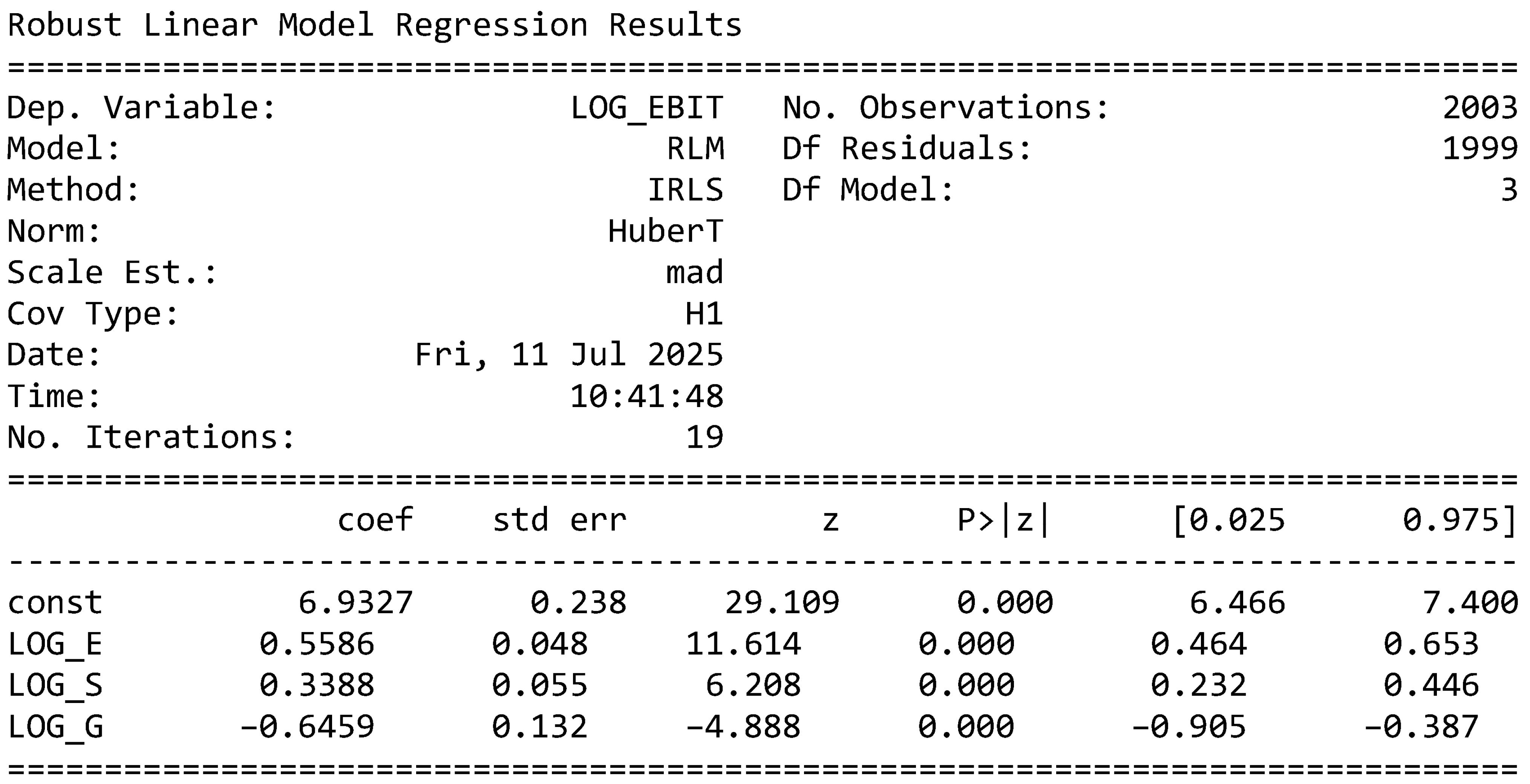
The first equation for the European region case is presented below:
L O G _ E B I T = 6.9327 + 0.3388 × L O G _ S + 0.5586 × L O G _ E 0.6459 × L O G _ G
The t-statistics of Equation (2) are provided in Table 5. All explanatory variables included in the RLM are highly significant (p < 0.001), which means that their effects are unlikely to be due to chance.
The mean value of the residuals is +0.0367, which is extremely low and close to zero, indicating that the model is unbiased, though there is a very small positive drift. The standard deviation of residuals is 1.2993, which is larger than one, indicating that the spread of prediction errors is slightly wider than in a perfectly standardized model.
The range of residuals spans from −6.09 to +4.01, indicating that while most predictions are close to the actual values, there are a few outliers; however, they remain within a reasonable and symmetric range.
Finally, the model converged after 19 iterations under the IRLS (iteratively reweighted least squares) algorithm, demonstrating efficient convergence, which indicates that the optimization reached stability without encountering computational issues.
The equation is a robust and interpretable model with strong coefficients and efficient convergence; the residuals are well-distributed.
From the results of the application of the robust linear regression method, we see (Figure 2) that the dependent variable is the logarithmed EBIT (LOG_EBIT). The RLM was revised using iteratively reweighted least squares (IRLS) with a Huber-T norm, guaranteeing robustness against outliers.
The constant (with β0 = 6.9327, p = 0.000) indicates the baseline value of LOG_EBIT when all independent variables are equal to zero. Among the independent variables, there are such results:
LOG_S (β = 0.3388, p = 0.000) has a positive and statistically significant link with LOG_EBIT, suggesting that the increase in social performance is associated with higher EBIT achievements.
LOG_E (β = 0.5586, p = 0.000) shows the strongest positive influence on LOG_EBIT, indicating that environmental gains have the most significant impact on firm profitability among all ESG factors studied.
LOG_G (β = −0.6459, p = 0.000) presents a negative and statistically significant link with LOG_EBIT, implying that governance-related achievements (as specified in Appendix A) might adversely affect EBIT numbers in the context of this dataset, but require further investigations. This somewhat counterintuitive result may highlight the compliance and administrative costs associated with implementing and maintaining robust management systems, particularly in the stringent EU regulatory environment.
The model specified results show that LOG_E has the highest positive effect on LOG_EBIT, while LOG_G has a pronounced negative influence. Such findings highlight the distinct roles of separate ESG factors in influencing EBIT.
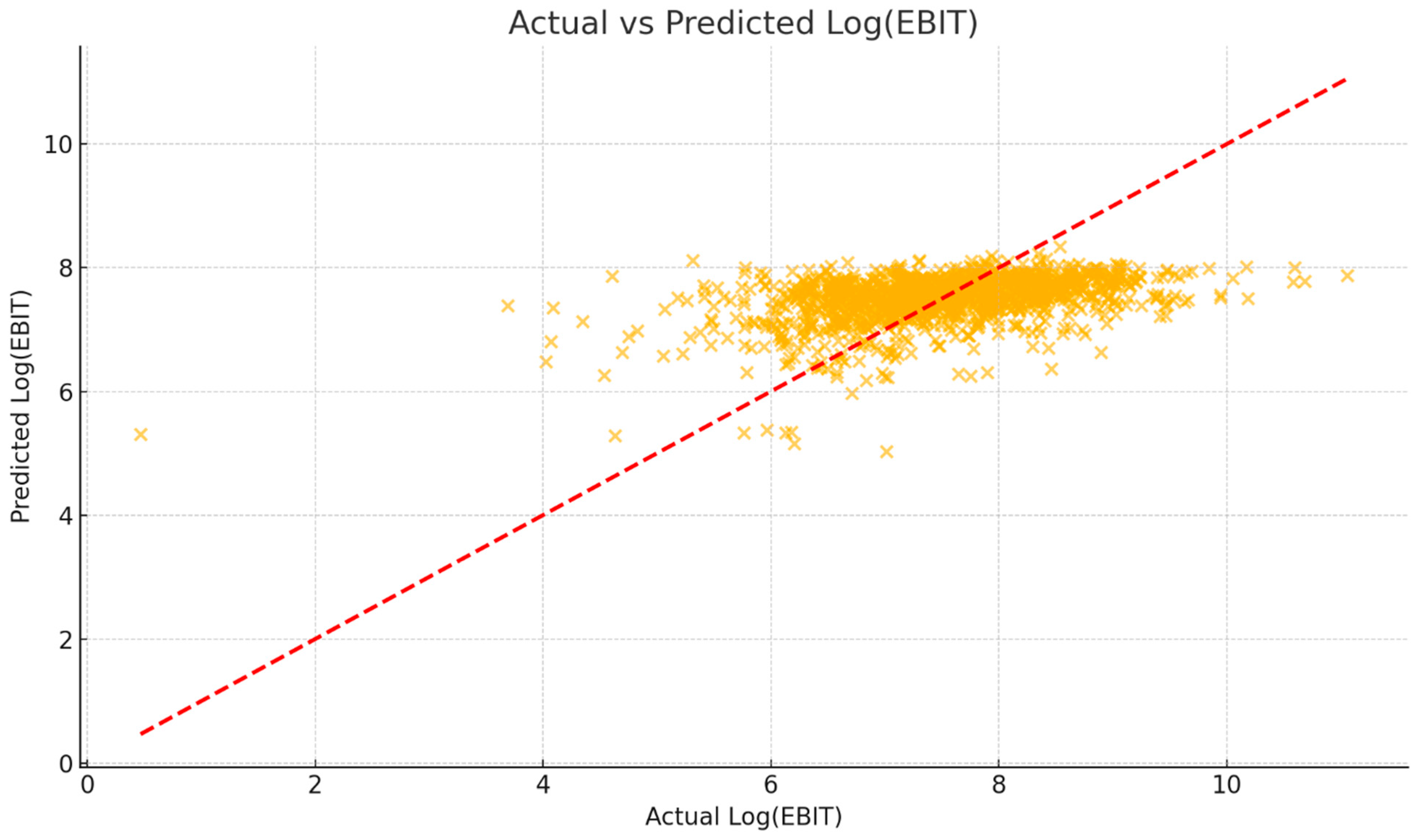
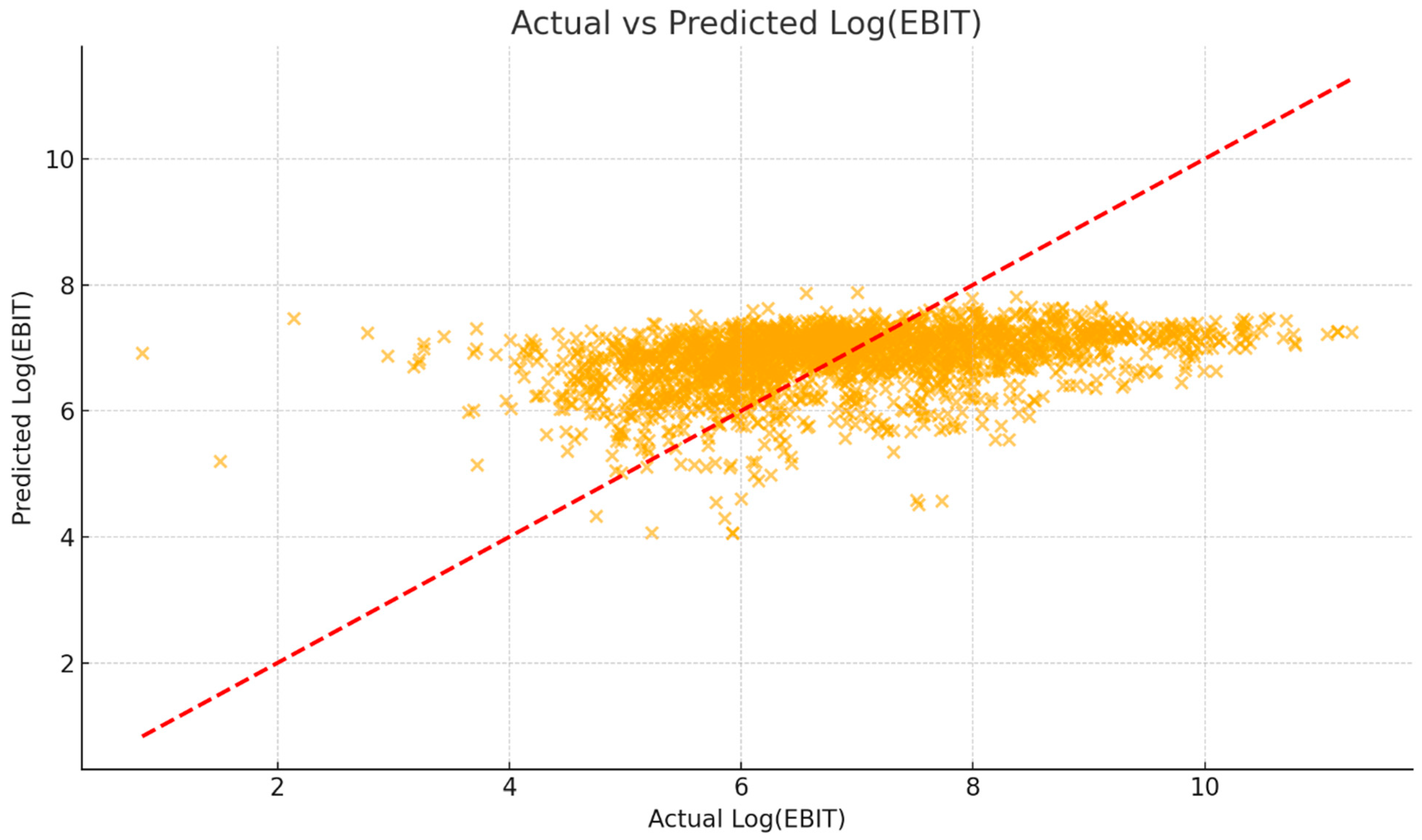
This statistically strong and stable model has highly significant predictors, minimal bias, and a well-behaved residual structure. However, a slightly higher residual variance suggests that there may be some heterogeneity or complexity in the data that is not fully captured. The results generated using Equation (2) were compared with the actual results for the dependent variable LOG_EBIT. The comparison of such analysis is presented in Figure 3.
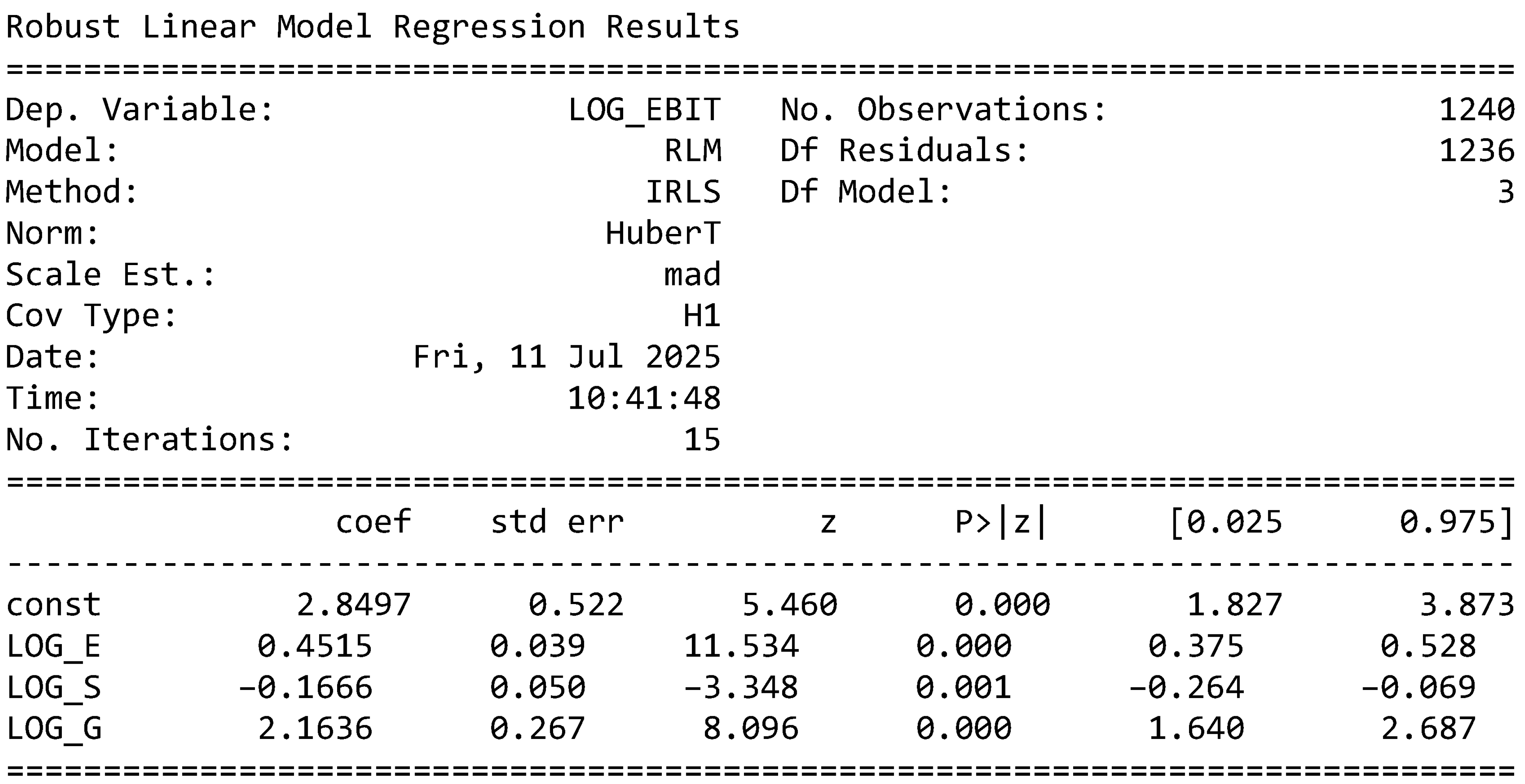
The second equation was formed for the USA region case:
L O G _ E B I T = 2.8497 0.1666 × L O G _ S + 0.4515 × L O G _ E + 2.1636 × L O G _ G
The t-statistics of Equation (3) are presented below in Table 6. All variables included are statistically significant (p < 0.01), as supported by z-statistics greater than three, indicating strong effects that are well above the noise level.
Residual diagnostics show a mean of −0.0036, essentially zero, confirming that predictions are not systematically biased upward or downward. The standard deviation of residuals is 0.8830, slightly below one, suggesting that the predictions are fairly tight and not overly dispersed.
The residual range (−4.84 to +3.18) is moderate and symmetric, with no extreme outliers dominating the model’s performance.
The model converged smoothly after 15 IRLS (iteratively reweighted least squares) iterations, which signals numerical stability and efficient optimization.
The equation is a robust, interpretable model with strong coefficients, reasonable residual distribution, and fast convergence.
The dependent variable in the USA region case is the logarithm of EBIT (LOG_EBIT). The regression (Figure 4) equation was constructed using three independent variables: LOG_S, LOG_E, and LOG_G.
The constant (with β0 = 2.8497, p = 0.000) shows the baseline level of LOG_EBIT when all independent variables are equal to zero. However, it is not statistically significant. Among the independent variables, there are such investigations:
LOG_S (with β = −0.1666, p = 0.001) has a negative and statistically significant link with LOG_EBIT. A 1% positive change in the social factor leads to a 0.1666% negative change in LOG_EBIT, showing that social performance may impose costs that negatively affect profitability.
LOG_E (with β = 0.4515, p = 0.000) indicates a positive and highly significant link with LOG_EBIT. A 1% positive change in the environmental factor shows a 0.4515% increase in LOG_EBIT, highlighting the beneficial impact of environmental gains on enterprise profitability.
LOG_G (with β = 2.1636, p = 0.000) indicates a strong positive and statistically significant link with LOG_EBIT. A 1% increase in governance factors means a 2.1636% positive change i LOG_EBIT, showing that governance is a substantial driver of financial outputs in this dataset. This contrasting result compared to the EU may indicate that a more flexible and market-oriented regulatory framework is less costly.
The model outputs show that LOG_G leads to the highest positive impact on LOG_EBIT, in regard to LOG_E, while LOG_S has the opposite effect, which is a significant negative impact on LOG_EBIT. Such results indicate to us the differentiated impact of separate ESG factors on companies’ financial results.
This statistically sound model has significant predictors, minimal bias, and stable residuals. The predictions are well-centered with acceptable variability, making the model reliable and efficient. Results generated using Equation (3) were compared with actuals for the dependent variable LOG_EBIT. The comparison of such an analysis is presented in Figure 5.
In the Europe region case, (1) LOG_E shows the highest positive effect on LOG_EBIT, while LOG_G indicates a negative impact. (2) The coefficient of LOG_S is positive and shows a positive contribution of social performance to EBIT. (3) The negative coefficient of LOG_G means that governance performance might increase costs in the European region case.
In the USA region case, (1) LOG_G link with LOG_EBIT is the highest positive and significant, indicating that governance is a substantial driver of financial results. (2) LOG_E has a strong positive impact, emphasizing the importance of environmental improvements. (3) The negative coefficient of LOG_S shows that social performance might require an increase in costs that negatively affect EBIT. Table 7 presents the summary of all independent coefficients.
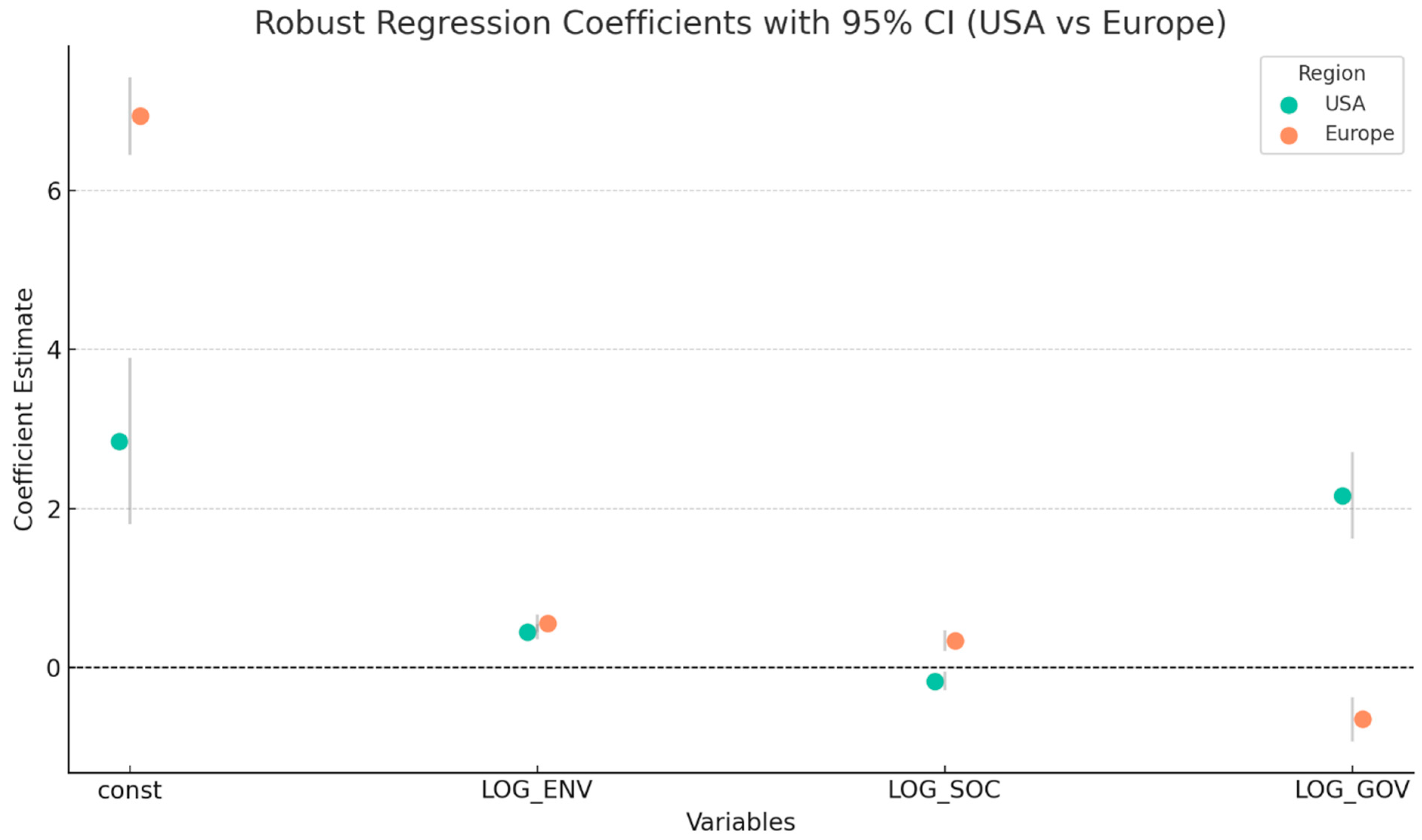
The research results are summarized in Table 7 and visualized in Figure 6 to see which variable in which region is dominating and the differences in this relationship between EBIT and the individual ESG pillars in Europe and the USA for all four sectors.
Figure 6 presents the results of robust regression models comparing coefficient estimates in the USA and Europe, with 95% confidence intervals and the answer to hypothesis No. 2. Several patterns are evident herein:
The intercept is substantially higher for Europe (~7.0) than for the USA (~2.8), suggesting systematic baseline differences between the two regions even after accounting for covariates. Taking into account all independent variables (covariates), expected EBIT is higher in Europe than in the US. This indicates that a sustainable environment in Europe, characterized by stricter regulatory frameworks, increased investor confidence, and broader public acceptance of ESG practices, fosters a more favorable environment for companies. For international companies, this signals that ESG-oriented investments can yield faster or more visible returns in Europe, while in the US market, achieving similar results can require more conscious communication, investor engagement, or governance improvements to compensate for the lower baseline.
Both regions show positive and relatively similar coefficients (~0.5), indicating that environmental factors consistently influence the contexts.
The coefficients diverge: negative in the USA (~−0.1) but positive in Europe (~0.3). This points to a potential contextual difference in the way social variables are linked to the outcome, with Europe showing a more supportive role.
Stronger in the USA (2.2) than in Europe (−0.6), with non-overlapping confidence intervals. This suggests that governance-related variables play a much more significant and positive role in the USA, whereas in Europe, the association is weaker and possibly negative.
The analysis reveals commonalities (e.g., environmental effects) and context-specific divergences (e.g., social and governance influences) between the USA and Europe. These findings highlight the importance of considering regional differences when interpreting regression outcomes, especially in cross-national comparative research.
Multinational companies can standardize their environmental strategies (with a positive impact in both regions) across all subsidiaries to achieve economies of scale and a unified sustainability image. According to the study, environmental options such as carbon reduction programs, resource efficiency, green innovation, etc., create financial and reputational value regardless of region. Social factors (positive in Europe, slightly negative in the USA) show that social initiatives are more valued and rewarded in Europe than in the USA. Companies could localize their social strategies, focusing more on stakeholder engagement and community programs in Europe. In the USA, they could focus on targeted social initiatives related to productivity, customer loyalty, or risk management, although these aspects are also important in all regions. Strong governance is a key driver of financial outputs in the USA, but less so in Europe (regulations may impact such phenomena). This suggests that European companies may face declining returns, so more attention needs to be paid to the governance aspect, while USA companies can gain a significant competitive advantage by further enhancing this aspect. Therefore, multinational companies should not apply a uniform ESG strategy to both regions. Environmental initiatives can be standardized, while social policy should be more detailed in Europe and more performance-based in the USA. Governance structures should be strengthened in the USA, but optimized for the European context.
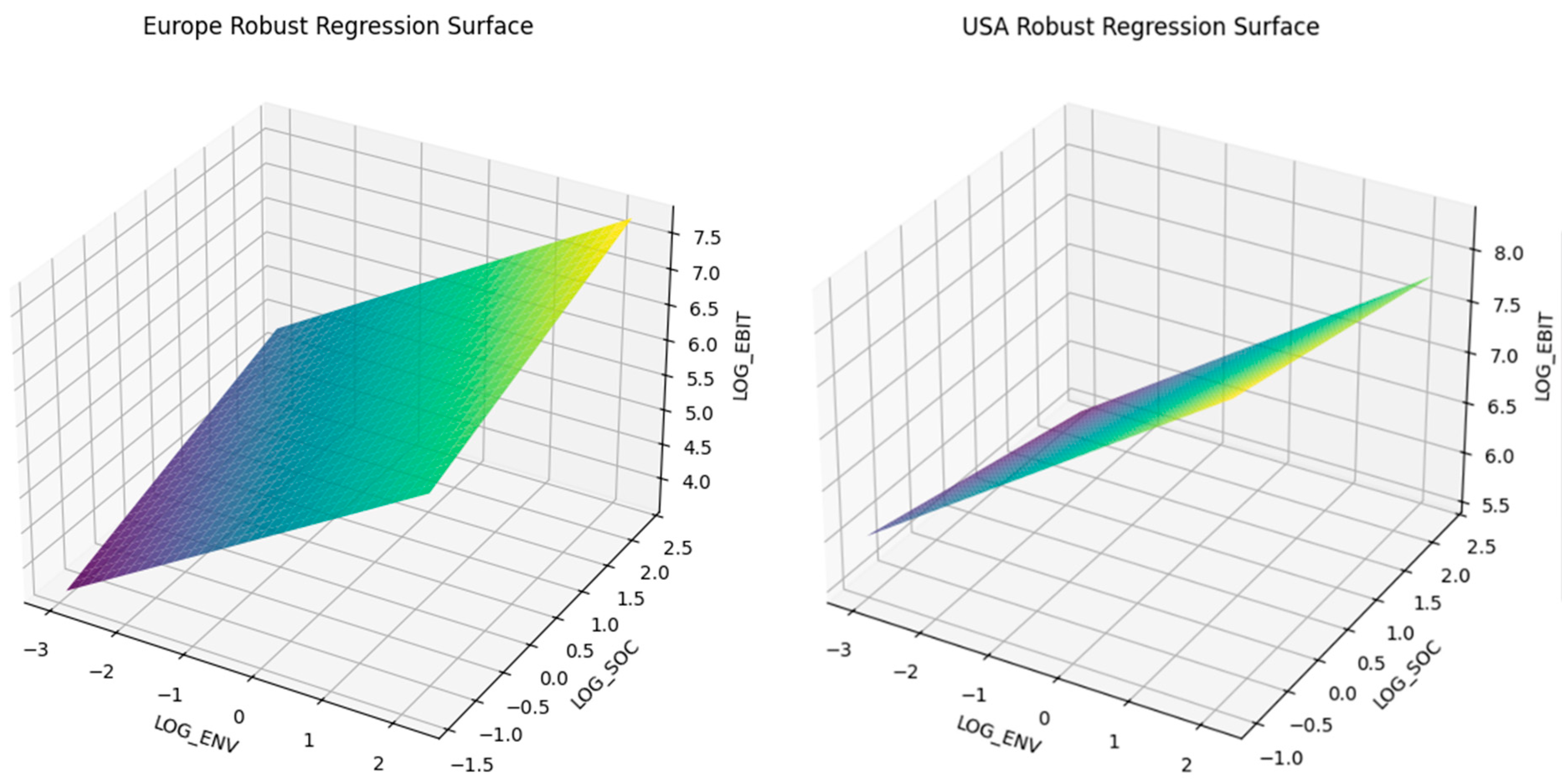
The research results present the strength and direction of links on the company’s EBIT by separate pillars of the ESG scores or their variations, as presented in Figure 7.
The 3D regression surfaces illustrate how environmental (LOG_E) and social (LOG_S) factors jointly influence economic performance (LOG_EBIT) in Europe and the USA. In Figure 7, the colour gradient on each surface indicates the fitted level of LOG_EBIT, with cooler colours representing lower predicted values and warmer colours higher predicted values.
The regression surface on the left side of Figure 7 (specifically dedicated to Europe) exhibits a clear upward slope with respect to environmental and social variables. This indicates that increases in LOG_E and LOG_S are associated with higher LOG_EBIT, reflecting a synergistic positive effect. The gradient is steeper along LOG_S, suggesting that social factors have a relatively stronger impact on European economic outcomes.
The surface on the right side of Figure 7 (dedicated to the USA) is comparatively flatter, with only a mild positive slope. This suggests that while LOG_E and LOG_S have some positive influence, their marginal effects on LOG_EBIT are weaker compared to Europe. The dominance of other factors (e.g., governance, as seen in earlier coefficient plots) likely explains this limited surface variation.
In summary, Europe’s economic performance (LOG_EBIT) appears to be more sensitive to social and environmental drivers, with strong reinforcing effects. The relationship for the USA is less pronounced, suggesting that other institutional or governance-related variables play a more significant role in shaping outcomes. This contrast supports the interpretation that Europe’s socio-environmental context contributes more directly to economic sustainability, while in the USA, economic performance is more governance-driven.

4.2. Comparison of Sectors by Region (USA and Europe): Sector–Region RLM Analysis and Robustness Results

This section compares how each sector’s robust linear model coefficients vary between Europe and the USA, highlighting differences in performance drivers (Environmental, Social, Governance factors) across regions.
Energy Sector: Europe versus the USA. In the Energy sector, the European model indicates that performance is strongly driven by Social and Governance factors. The Social coefficient is large and positive (β ≈ 1.747) and highly significant (p < 0.001), and the Governance coefficient is also positive and significant (β ≈ 2.461, p < 0.001). In contrast, the Environmental factor in Europe’s Energy model has a near-zero effect and is not statistically significant (β ≈ 0.082, p = 0.657). The U.S. Energy sector shows a different pattern: the Environmental coefficient is positive and significant (β ≈ 0.645, p < 0.001), while the Social factor’s effect is much smaller and only marginally significant (β ≈ 0.429, p = 0.054). Governance remains a significant positive driver in U.S. Energy (β ≈ 2.432) with a substantial impact (p ≈ 0.021). Thus, Europe’s Energy performance is more influenced by Social factors, whereas in the U.S., Environmental factors play a bigger role (with Governance significant in both regions). Hypothesis H2a was confirmed with exceptions for E–EBIT in Europe.
Industrial Sector: Europe versus the USA. The Industrials sector exhibits notable regional contrasts. In Europe, the robust model finds a strongly positive Environmental influence (β ≈ 0.580, p < 0.001) and a significant negative effect of Governance (β ≈ −1.247, p < 0.001). The Social factor in the European Industrial sector is positive but small and is not statistically significant (β ≈ 0.139, p = 0.071). By contrast, in the USA Industrial sector, the Environmental and Governance coefficients are positive and highly significant (β_env ≈ 0.397, β_gov ≈ 3.035; p < 0.001 for each). Notably, the USA Industrials model shows a significant negative coefficient for the Social variable (β ≈ −0.330, p ≈ 1.0 × 10⁻⁵), indicating that higher social scores are correlated with lower performance in the USA Industrial sector. In summary, while environmental factors boost industrial performance in both regions, the effect of governance is the opposite (negative in Europe vs. positive in the USA), and the social dimension is neutral in Europe but detrimental in the USA’s industrial sector. Hypothesis H2b was partially confirmed, except for the negative G–EBIT in Europe. The results of this sector confirm the trends identified in previous sections.
Materials Sector: Europe versus the USA. Both models of both regions agree that Environmental performance is a significant positive driver in the Materials sector. The Environmental coefficient is positive and highly significant in Europe (β ≈ 0.683, p < 0.001) and similarly significant in the United States (β ≈ 0.542, p < 0.001). However, the regions differ in the influence of Social and Governance factors. The European Materials model shows a modest positive Social effect (β ≈ 0.229) that is statistically significant (p = 0.013), while the U.S. Materials model finds the Social coefficient to be near zero and not significant (β ≈ 0.051, p = 0.579). Conversely, the Governance factor is important in the U.S. Materials sector but not in Europe: the U.S. model has a substantial positive Governance coefficient (β ≈ 1.666) of high significance (p = 0.003), while Europe’s Materials model shows no significant governance effect (β ≈ −0.328, p = 0.125). This indicates that in Europe, Social aspects play a larger role for Materials companies, whereas in the USA, Governance quality is a stronger determinant of performance in this sector (with both regions agreeing on the importance of Environmental factors). Hypothesis H2c was partially confirmed, except for the negative G–EBIT in Europe and for the negative S–EBIT, but positive E–EBIT in the USA. The results of this sector also confirm the trends identified in previous sections.
Utilities Sector: Europe versus the USA. For the Utilities sector, robust models show some commonality between regions and differences. Environmental factors have a significant positive impact on utilities’ performance in both Europe (β ≈ 0.387, p < 0.001) and the USA (β ≈ 0.424, p < 0.001), indicating that better environmental performance is associated with better outcomes for utilities in both markets. However, the Social dimension diverges: the European utilities model has a significant positive Social coefficient (β ≈ 0.338, p = 0.010), suggesting that social factors contribute to the performance of the European utility sector, while the U.S. Utilities model’s Social coefficient is smaller and not statistically significant (β ≈ 0.243, p = 0.068). In both regions, the Governance factor has no meaningful effect on Utilities—the Governance coefficient is near zero and not significant in Europe (β ≈ 0.305, p = 0.48) and similarly insignificant in the USA (β ≈ −0.066, p = 0.891). Thus, for Utilities, Environmental performance is a key positive driver in both regions, Social performance matters only in Europe, and Governance appears to have no significant impact in either region for this sector. Hypothesis H2d was rejected, as a high impact of aspect E and a weak impact of aspect G were observed in both regions.
Robustness Check Results for the RLMs. To verify the stability of these findings, we constructed robust linear models (RLMs) for each region–sector combination. Table 8 summarizes the regression coefficients (β) for the independent variables—log (Environmental), log (Social), and log (Governance)—along with their p-values and number of observations (N) for each model. These RLMs were fit using an M-estimation (iteratively reweighted least squares) approach to downweigh outliers. The results show which factors are statistically significant in each model and are consistent with the patterns described above.
The coefficients and significance of each robust model in Table 7 confirm the insights from the region-by-region comparisons. For instance, the table shows that in Europe’s Energy sector, Social and Governance coefficients are both significant (p < 0.001) while Environmental is not, while in the USA Energy sector, Environmental and Governance are significant and Social is marginal (p ≈ 0.054). Similarly, the opposite signs are evident on the Governance coefficient for the Industrial sector (−1.247 in Europe vs. +3.035 in the USA), as is the significantly negative Social coefficient in the USA Industrial sector. These robust regression results highlight the regional disparities in how ESG factors influence performance within each sector.
In terms of model diagnostics, all robust regressions appear to be well-behaved. The mean of the residuals is essentially zero in every model (the mean residuals range from −0.05 to +0.07), indicating that there is no systematic bias in the fits. The robust scale (a measure of residual standard deviation) varies between models, generally being lower for the USA sectors (scale ≈ 0.54–1.13) than for the European sectors (scale ≈ 1.07–1.31). This suggests that the USA data had less variability or fewer extreme outliers, especially in Materials and Utilities (with smaller residual spreads, e.g., standard residual ≈ 0.58 in the USA Utilities), compared to some European cases (standard residual ≈ 1.34 in the European Industrial sector). The residual ranges (minimum to maximum) were on the order of a few standard deviations for most models (typically within approximately −3 to +3), although the Energy and Industrial sectors of Europe had some larger negative outliers (residual_min ≈ −6.16 and −5.79, respectively). These more extreme outliers in the European data likely motivated the use of robust regression. All models converged in a reasonable number of iterations of the IRLS algorithm (14–21 iterations in most cases), except for the Europe Materials model, which required 31 iterations to converge. The higher iteration count for that case may indicate the presence of influential outliers or higher complexity in that dataset, but ultimately, convergence was achieved. Overall, the robustness check via RLM demonstrates that the observed relationships between the ESG factors and sector performance are stable and not unduly influenced by outliers; the significant coefficients remain significant and maintain their signs across this robust estimation, thereby reinforcing confidence in the results.
The findings show that ESG strategies may differ, emphasizing different ESG aspects in Europe and the USA, and there are also differences between sectors: energy, industry, materials, and utilities. In both regions, all ESG aspects in the energy sector should be strengthened, as their positive impact has been confirmed. The energy sector is strong in many countries and has taken a leading position in the green transformation. Governance is not a significant factor in Europe’s industrial, materials, and utilities sectors, suggesting that governance-related investments may be ineffective in improving operational performance. In the industrial, materials, and utilities sectors in the United States, the social aspect has a minor or insignificant impact on EBIT, which is in line with general trends in the region. For multinational companies, these results can encourage ESG investment trends in Europe and the United States, as well as different ESG strategies for different sectors.

5. Discussion

The majority of earlier research has concentrated on the entire sample, with limited direct comparative research conducted specifically between Europe and the USA in the group of resource-intensive sectors. Two different approaches to sustainability regulation require ongoing and detailed research.
This regression analysis examines the connection between environmental, social, and governance data and the EBIT of companies within resource-intensive industries. A key finding of this study, aligned with the first hypothesis, is the evident and steady positive relationship between the disclosure of environmental and social data and EBIT in resource-intensive sectors in both Europe and the USA. This result corroborates previous research suggesting that companies engaging in environmentally responsible practices gain tangible advantages, including enhanced operational efficiency, decreased environmental risk exposure, and improved reputations among stakeholders [24,25,63,64]. In certain sectors, the environmental impact can be considerable; proactively addressing these issues usually helps reduce compliance and operational costs while attracting an increasing number of sustainability-oriented investors. Examining the link between social data disclosure and the financial performance of companies in selected sectors reveals differing outcomes: a positive effect on European firms’ financial performance (consistent with [25]) but a negative effect in the United States. This discrepancy likely stems from variations in how companies are expected to function within their institutional and cultural environments. The concept that companies have responsibilities not only to shareholders but also to a broader range of stakeholders is more deeply ingrained in Europe. Social responsibility is often encouraged or mandated by regulations, and companies investing in social issues like employee well-being or community involvement may build long-term trust and credibility. Conversely, in the USA, the focus is more on maximizing shareholder returns, and such social investments might be viewed as unnecessary or costly, particularly if the financial benefits are not immediately apparent.
On the other hand, we see opposite results in governance: a negative impact in Europe and a very positive one in the USA (in line with [11]). The different impact of the governance aspect on individual regions (Europe and USA samples) may indicate a certain specificity of the regions (Table 1). The governance aspect in the EU may be related to the implementation of various regulations, suggesting that stronger governance mechanisms are associated with lower EBIT among European firms. Companies with more extensive governance reporting and oversight mechanisms may incur higher monitoring, disclosure, and audit costs, which can temporarily reduce their operating profitability. Investments in governance are more related to long-term sustainability. In the short term, this can limit flexibility and strategic risk-taking and lead to a short-term decline in profits. The US management system is generally more focused on increasing shareholder value and voluntary disclosure of information. This practice can lead to increased operational efficiency, particularly in a short period.
The application of robust linear regression in evaluating the influence of specific ESG factors on EBIT has demonstrated that ESG pillars’ data exerts a positive influence on the EBIT performance of companies in Europe and the USA. The findings, which utilize disaggregated panel data at the company level and estimation models, corroborate the advantageous effects of monetary policy on EBIT [65,66]. With the tightening of regulations, companies, particularly in developed nations, are increasingly obligated to partake in environmental initiatives.
The research focuses on 384 companies in the industrial, energy, materials, and utility sectors across the USA and Europe, emphasizing a sector that has received less exploration but holds considerable potential for ESG impact. The study employs a parallel analytical approach, utilizing the same methodology for both Europe and the USA. This methodological consistency facilitates a straightforward comparison of the impacts of ESG on profitability. The study covers the period from 2015 to 2024, utilizing Bloomberg ESG ratings in conjunction with financial performance indicators such as EBIT, thereby offering a comprehensive temporal perspective. The paper provides valuable insights for investors, policymakers, and managers by identifying regional strategies where ESG investments are more or less likely to enhance profitability.
The robust linear modeling results of the second hypothesis highlight substantial regional differences in how ESG (environmental, social, governance) factors relate to sector-level performance. Although environmental indicators emerge as consistently positive drivers across most sectors (except in the energy sector in Europe) in both regions, particularly in materials and utilities, the influence of social and governance dimensions varies sharply between Europe and the USA. For example, social factors positively impact performance in the European energy and utilities sectors but exhibit a negative relationship with the USA industrial sector. Conversely, governance scores show strong positive effects in the USA, like in the industrial and materials sectors, but appear less influential or negatively associated with performance in their European counterparts. These divergences may reflect underlying institutional, regulatory, or investor preference differences across regions, suggesting that ESG strategies must be tailored to each region to maximize both financial and societal value.
Additionally, the presence of sector-specific patterns, such as the particularly strong and consistent role of environmental factors in the utilities sector, points to the importance of accounting for industry context when evaluating ESG impact. The negative coefficient of social factors in the USA industrial sector is especially notable, possibly reflecting short-term costs or signaling effects that diverge from investor expectations.

6. Conclusions

A review of the extant literature reveals a paucity of studies that enhance comprehension of how environmental, social, and governance (ESG) data disclosure affects the financial performance of companies within resource-intensive sectors in Europe and the USA. The disparities observed among regions and industries in the research provide a theoretically substantiated rationale for the varied relationships between ESG and financial performance.
This paper explores the potential link between the disclosure of environmental, social, and governance (ESG) information and the performance of companies in the resource-intensive sectors of Europe and the USA from 2015 to 2024. The authors employ robust regression techniques and fixed-effect panel data to assess the impact of ESG data disclosure on company profitability, specifically measured by EBIT (earnings before interest and taxes). The findings of this research contribute to the expanding body of literature on how ESG data disclosure affects corporate financial performance. The study employs a robust linear regression model based on established methodologies to evaluate the influence of individual ESG pillars on firm profitability, as indicated by EBIT.
The research indicates a positive correlation between the disclosure of environmental information and financial performance in resource-intensive companies across Europe and the United States. It has been demonstrated that enterprises that engage in practices that are conducive to environmental sustainability experience a number of concrete advantages. These include enhanced operational efficiency, decreased vulnerability to environmental risks, and an improved reputation with stakeholders. However, the correlation between social data disclosure and EBIT demonstrates varied outcomes. European companies experience a positive effect on financial performance, whereas in the United States, the effect is negative. This discrepancy is presumably attributable to the divergent institutional and cultural expectations observed within the researched regions.
In the European context, the strong and positive effect of environmental and social dimensions on EBIT aligns with the stakeholder theory, which emphasizes that firms addressing stakeholder interests and regulations benefit from long-term performance. Conversely, the negative impact of governance factors in Europe may reflect the compliance and reporting costs associated with stringent EU regulations, consistent with the view of institutional theory of coercive pressures.
In the United States, governance-related factors have been shown to have a statistically significant correlation with financial performance. Conversely, in Europe, governance factors may exert a minor influence on EBIT and result in additional expenses. Nevertheless, further analysis of financial performance is essential to determine which variable that affects the governance score is the predominant determinant of financial performance in Europe.
In contrast, the USA results indicate a strong positive relationship between governance and financial performance, suggesting that effective governance structures serve as strategic resources that enhance investor confidence and operational efficiency, in line with the resource-based view. The weaker or negative effects of social factors in the United States also correspond to its more market-driven approach to sustainability, where social investments are not always financially rewarded in the short term.
The empirical findings support several of the formulated hypotheses. The environmental pillar (E) shows a consistently positive relationship with EBIT in both regions, confirming H1a and highlighting the financial benefits of green transformation and resource efficiency. The social pillar (S) demonstrates a positive impact in Europe but a negative one in the USA, confirming H1b and reflecting regional differences in stakeholder expectations and social norms. The governance pillar (G) exhibits a strong positive effect in the USA but a negative one in Europe, partially confirming H1c, suggesting that governance enhances investor confidence in market-driven contexts but may impose administrative costs in regulatory-heavy environments.
Sectoral analysis (H2 series) revealed that the energy sector benefits the most strongly from ESG engagement in both regions, while other sectors show varied results depending on regulatory, market, and cultural factors.
Methodologically, the study demonstrates that the use of robust linear regression provides reliable and stable results even in the presence of data variability and outliers. However, limitations remain, including the reliance on Bloomberg ESG data and the lack of qualitative assessment of firm-specific sustainability practices.
In general, this study provides empirical evidence that the relationship between ESG and financial performance is multidimensional and context-dependent, varying between institutional environments, industries, and the ESG pillars. These findings underline the importance of tailoring ESG strategies to regional and sectoral conditions to achieve both sustainability and profitability.
Policymakers, investors, and managers should consider these differences when designing ESG-related strategies or performance evaluation frameworks. Future research could investigate the mechanisms underlying these regional divergences, including variations in stakeholder priorities, regulatory frameworks, or the level of ESG integration within corporate governance practices. Additionally, dynamic or longitudinal models could be used to assess whether these relationships persist or evolve.
Future research should extend the analysis to other regions, incorporate alternative ESG datasets, and explore non-linear or dynamic relationships between ESG and profitability. Incorporating qualitative measures, such as sustainability disclosure narratives or stakeholder perceptions, could further enhance understanding of how ESG practices translate into financial performance.

Limitations, Future Research, and Practical Implications

The period from 2015 to 2024 is generally sufficient and meaningful for the regression analysis of ESG analysis, as the origins of this concept are relatively recent. Around 2015, the Paris Climate Agreement, the UN Sustainable Development Goals, the emergence of ESG rating agencies, and the increased availability of standardized data were key events that initiated the transformation of corporate sustainability. The limitation is that the last five years are the period during which most companies have fully adopted ESG strategies. Only the last five years have been the most productive for ESG analysis. In addition, COVID-19, which occurred during this period, also affected the data series for companies’ activities. The selected financial indicator—EBIT—better reflects the sensitivity of operating profit, but at the same time, the exclusion of other financial variables limits the analysis.
The anticipated future progress in gathering and sharing environmental, social, and governance (ESG) data, driven by regulatory changes or increased investor interest, is expected to give rise to a vastly expanded and detailed data repository. This evolving database will likely integrate complex ESG-related dimensions, capturing a broader array of companies, including previously underrepresented small-cap firms. By categorizing companies by industry and clearly distinguishing ESG frontrunners from those lagging, it becomes possible to identify particular ESG characteristics. These characteristics can then be subjected to a more comprehensive and nuanced analysis, facilitating deeper insights and an enriched comprehension of ESG performance indicators across different sectors.
Furthermore, data analysis can be extended based on newly issued regulations; however, in this case, the period would be too short for regression analysis.
From a practical perspective, this analysis could be useful for multinational companies operating in two regions. The specific characteristics of different ESG aspects impact EBIT signals related to various strategic and tactical decisions. European companies should focus on improving the efficiency of ESG compliance processes from a management perspective, while USA-based companies can leverage management flexibility even more to strengthen strategic outcomes and investor confidence. Meanwhile, policymakers in the USA could be bolder in strengthening the regulatory framework. For politicians, such an analysis demonstrates the sensitivity of markets and, at the same time, their ability to adapt to significant events.

Author Contributions

V.G.: research identification; G.L.: conceptualization and data collection; A.B.: research methods application. All authors have read and agreed to the published version of the manuscript.

Funding

This research received no external funding.

Institutional Review Board Statement

Not applicable.

Informed Consent Statement

Not applicable.

Data Availability Statement

Data were obtained from Bloomberg through the university’s institutional license and are not publicly available due to licensing restrictions. The same data are available from Bloomberg to researchers with a subscription.

Conflicts of Interest

The authors declare no conflicts of interest.

Appendix A

Table A1. Variables forming ESG scores (Bloomberg, 2024) [60].
ESG PillarIndicator CategoriesExamples of Variables
EnvironmentalEmissions and Energy Use;
Water and Waste Management; Environmental Policies and Initiatives; Sustainability and Climate Actions
Direct CO2 Emissions; Water Consumption; Emissions Reduction Initiatives; Climate Risk Mitigation, Investments in Sustainability
SocialWorkforce and Employee Relations; Product Safety and Quality; Labor and Supply Chain Standards; Human Rights and Ethics; Training and DevelopmentEmployee Turnover %; Product Responsibility; Social Supply Chain Management; Equal Opportunity Policy; Employee Training Cost
GovernanceBoard Structure and Composition; Board Activity and Committees; Executive and Board Compensation; Ethics, Compliance, and CertificationsIndependent Directors %; Number of Board Meetings; ESG-linked Compensation for Executives; Business Ethics Policy

References

  1. Hahn, R.; Kühnen, M. Determinants of sustainability reporting: A review of results, trends, theory, and opportunities in an expanding field of research. J. Clean. Prod. 2013, 59, 5–21. [Google Scholar] [CrossRef]
  2. Chen, Z.; Xie, G. ESG disclosure and financial performance: Moderating role of ESG investors. Int. Rev. Financ. Anal. 2022, 83, 102291. [Google Scholar] [CrossRef]
  3. Ali, N.B.M.; Ali Hussin, H.A.A.; Mohammed, H.M.F.; Mohmmed, K.A.A.H.; Almutiri, A.A.S.; Ali, M.A. The Effect of Environmental, Social, and Governance (ESG) Disclosure on the Profitability of Saudi-Listed Firms: Insights from Saudi Vision 2030. Sustainability 2025, 17, 2977. [Google Scholar] [CrossRef]
  4. Naseer, M.M.; Guo, Y.; Zhu, X. ESG trade-off with risk and return in Chinese energy companies. Int. J. Energy Sect. Manag. 2024, 18, 1109–1126. [Google Scholar] [CrossRef]
  5. Cao, X.; Mei, T.; Li, S. Research on the relationship between ESG disclosure quality and stock liquidity of Chinese listed companies. Green Financ. 2024, 6, 24. [Google Scholar] [CrossRef]
  6. Dorothy, P.; Endri, E. Environmental, Social and Governance Disclosure and Firm Value in The Energy Sector: The Moderating Role of Profitability. Probl. Perspect. Manag. 2024, 22, 588–599. [Google Scholar] [CrossRef]
  7. Conca, L.; Manta, F.; Morrone, D.; Toma, P. The impact of direct environmental, social, and governance reporting: Empirical evidence in European-listed companies in the agri-food sector. Bus. Strategy Environ. 2021, 30, 1080–1093. [Google Scholar] [CrossRef]
  8. Yu, E.P.Y.; Guo, C.Q.; Luu, B.V. Environmental, social and governance transparency and firm value. Bus. Strategy Environ. 2018, 27, 987–1004. [Google Scholar] [CrossRef]
  9. Al Amosh, H.; Khatib, S.F. Environmental, social and governance performance disclosure and market value: Evidence from Jordan. Bus. Perspect. Res. 2024, 12, 539–554. [Google Scholar] [CrossRef]
  10. Agoraki, M.-E.K.; Giaka, M.; Konstantios, D.; Patsika, V. Firms’ sustainability, financial performance, and regulatory dynamics: Evidence from European firms. J. Int. Money Financ. 2023, 131, 102785. [Google Scholar] [CrossRef]
  11. Alfalih, A.A. ESG disclosure practices and financial performance: A general and sector analysis of S&P 500 nonfinancial companies and the moderating effect of economic conditions. J. Sustain. Financ. Invest. 2022, 13, 1506–1533. [Google Scholar] [CrossRef]
  12. Kim, S.; Li, Z. Understanding the Impact of ESG Practices in Corporate Finance. Sustainability 2021, 13, 3746. [Google Scholar] [CrossRef]
  13. Alareeni, B.A.; Hamdan, A. ESG impact on performance of US S&P 500-listed firms. Corp. Gov. Int. J. Bus. Soc. 2020, 20, 1409–1428. [Google Scholar] [CrossRef]
  14. Rossi, F.; Harjoto, M.A. Corporate nonfinancial disclosure, firm value, risk, and agency costs: Evidence from Italian listed companies. Rev. Manag. Sci. 2020, 14, 1149–1181. [Google Scholar] [CrossRef]
  15. Candio, P. The effect of ESG and CSR attitude on financial performance in Europe: A quantitative re-examination. J. Environ. Manag. 2024, 354, 120390. [Google Scholar] [CrossRef] [PubMed]
  16. Koundouri, P.; Pittis, N.; Plataniotis, A. The impact of ESG performance on the financial performance of European area companies: An empirical examination. Environ. Sci. Proc. 2022, 15, 13. [Google Scholar] [CrossRef]
  17. Palynska, M.; Medda, F.; Caivano, V.; Di Stefano, G.; Scalese, F. The Impact of the ESG Factor on Industrial Performance. An Analysis using Machine Learning Techniques. CONSOB Sustain. Financ. Ser. 2024, 4, 1–35. [Google Scholar] [CrossRef]
  18. Gholami, A.; Sands, J.; Rahman, H.U. Environmental, social and governance disclosure and value generation: Is the financial industry different? Sustainability 2022, 14, 2647. [Google Scholar] [CrossRef]
  19. Al-Jalahma, A.; Al-Fadhel, H.; Al-Muhanadi, M.; Al-Zaimoor, N. Environmental, Social, and Governance (ESG) disclosure and firm performance: Evidence from GCC Banking sector. In Proceedings of the 2020 International Conference on Decision Aid Sciences and Application (DASA), Sakheer, Bahrain, 8–9 November 2020; pp. 54–58. [Google Scholar] [CrossRef]
  20. Buallay, A. Is sustainability reporting (ESG) associated with performance? Evidence from the European banking sector. Manag. Environ. Qual. Int. J. 2019, 30, 98–115. [Google Scholar] [CrossRef]
  21. Loew, E.; Endres, L.; Xu, Y. How ESG Performance Impacts a Company’s Profitability and Financial Performance; European Banking Institute Working Paper Series No. 162; EBI: Frankfurt, Germany, 2024. [Google Scholar] [CrossRef]
  22. Şeker, Y.; Güngör, N. Does ESG Performance Impact Financial Performance? Evidence From the Utilities Sector. Muhasebe Bilim Dünyası Dergisi 2022, 24, 160–183. [Google Scholar] [CrossRef]
  23. Egorova, A.; Petrov-Nerling, G. Systemic ESG risks: Industrial analysis. Procedia Comput. Sci. 2023, 221, 1110–1114. [Google Scholar] [CrossRef]
  24. Hyusein, A.; Cek, K. ESG strategies and corporate financial performance: A comparison of the US energy and renewable energy industries. Int. J. Energy Sect. Manag. 2025, 19, 977–999. [Google Scholar] [CrossRef]
  25. Egorova, A.; Pitenko, K.; Karminsly, A. Analysis of the Industry-Specific Characteristics of ESG Components in Company Ratings. Procedia Comput. Sci. 2024, 242, 1206–1217. [Google Scholar] [CrossRef]
  26. Khan, M.A. ESG disclosure and firm performance: A bibliometric and meta analysis. Res. Int. Bus. Financ. 2022, 61, 101668. [Google Scholar] [CrossRef]
  27. Eskantar, M.; Zopounidis, C.; Doumpos, M.; Galariotis, E.; Guesmi, K. Navigating ESG complexity: An in-depth analysis of sustainability criteria, frameworks, and impact assessment. Int. Rev. Financ. Anal. 2024, 95, 103380. [Google Scholar] [CrossRef]
  28. Knoepfel, I.; Hagart, G. Future Proof?: Embedding Environmental, Social and Governance Issues in Investment Markets: Outcomes of the Who Cares Wins Initiative, 2004–2008; United Nations: New York, NY, USA, 2009; Available online: https://digitallibrary.un.org/record/681662?ln=en&v=pdf (accessed on 14 June 2025).
  29. Friedman, M. The social responsibility of business is to increase its profits. The New York Times Magazine, 13 September 1970; p. 17. [Google Scholar]
  30. Serafeim, G. Purpose and Profit: How Business Can Lift Up the World; HarperCollins: New York, NY, USA, 2022; 224p. [Google Scholar]
  31. Bolognesi, E.; Burchi, A.; Goodell, J.W.; Paltrinieri, A. Stakeholders and regulatory pressure on ESG disclosure. Int. Rev. Financ. Anal. 2025, 103, 104145. [Google Scholar] [CrossRef]
  32. Global Legal Insights. Environmental, Social & Governance Law USA. 2025. Available online: https://iclg.com/practice-areas/environmental-social-and-governance-law/usa (accessed on 14 September 2025).
  33. European Commission. Corporate Sustainability Reporting. 2025. Available online: https://finance.ec.europa.eu/capital-markets-union-and-financial-markets/company-reporting-and-auditing/company-reporting/corporate-sustainability-reporting_en#what (accessed on 14 September 2025).
  34. European Parliament & Council of the European Union. Directive (EU) 2024/1760 on Corporate Sustainability due Diligence and Amending Directive (EU) 2019/1937 and Regulation (EU) 2023/2859. 13 June 2024. Available online: https://eur-lex.europa.eu/eli/dir/2024/1760/oj/eng (accessed on 14 September 2025).
  35. Schwartz, J. Transnational ESG: The Impact of EU Sustainability Directives on US Law and Policy. J. Law Political Econ. 2025, 5, 352–371. [Google Scholar] [CrossRef]
  36. Nchako, T.; Benjamin, L. ESG Backlash in the United States-Investor Concerns or “Red Scare”? J. Law Political Econ. 2025, 5, 268. [Google Scholar] [CrossRef]
  37. California Legislature. California Transparency in Supply Chains Act of 2010; Cal. Civ. Code § 1714.43; California Legislature: Sacramento, CA, USA, 2010. [Google Scholar]
  38. Yoo, S.; Managi, S. Disclosure or action: Evaluating ESG behavior towards financial performance. Financ. Res. Lett. 2022, 44, 102108. [Google Scholar] [CrossRef]
  39. Saygili, E.; Arslan, S.; Birkan, A.O. ESG practices and corporate financial performance: Evidence from Borsa Istanbul. Borsa Istanb. Rev. 2022, 22, 525–533. [Google Scholar] [CrossRef]
  40. Xu, X.; Liu, Z. ESG, Cultural Distance and Corporate Profitability: Evidence from Chinese Multinationals. Sustainability 2023, 15, 6771. [Google Scholar] [CrossRef]
  41. Oanh, V.T.K.; Thao, T.P.; Anh, N.T.; Chi, N.H.; Nhi, D.T.Y.; Trang, M.T.H. Banks’ financial performance: A study of environmental, social, and governance dimensions. Risk Gov. Control Financ. Mark. Inst. 2025, 15, 59–68. [Google Scholar] [CrossRef]
  42. Paniagua, J.; Rivelles, R.; Sapena, J. Corporate governance and financial performance: The role of ownership and board structure. J. Bus. Res. 2018, 89, 229–234. [Google Scholar] [CrossRef]
  43. Chen, Y.; Li, T.; Zeng, Q.; Zhu, B. Effect of ESG performance on the cost of equity capital: Evidence from China. Int. Rev. Econ. Financ. 2023, 83, 348–364. [Google Scholar] [CrossRef]
  44. Clarke, L.; Wei, Y.-M.; De La Vega Navarro Garg, A.; Garg, A.; Hahmann, A.N.; Khennas, S.; Azevedo, I.M.L.; Löschel, A.; Singh, A.K.; Steg, L.; et al. Energy Systems. In Climate Change 2022: Mitigation of Climate Change. Contribution of Working Group III to the Sixth Assessment Report of the Intergovernmental Panel on Climate Change; Shukla, P.R., Skea, J., Slade, R., Al Khourdajie, A., van Diemen, R., McCollum, D., Pathak, M., Some, S., Vyas, P., Fradera, R., et al., Eds.; Cambridge University Press: Cambridge, UK; New York, NY, USA, 2022. [Google Scholar] [CrossRef]
  45. Cobal, M.; Lughi, V. Sustainability in the Energy System and in the Industrial System. In Quantitative Sustainability; Fantoni, S., Casagli, N., Solidoro, C., Cobal, M., Eds.; Springer: Cham, Switzerland, 2024. [Google Scholar] [CrossRef]
  46. Simionescu, M.; Radulescu, M.; Cifuentes-Faura, J. Pollution and electricity price in the EU Central and Eastern European countries: A sectoral approach. Environ. Sci. Pollut. Res. 2023, 30, 95917–95930. [Google Scholar] [CrossRef] [PubMed]
  47. Beelitz, A.; Cho Ch Michelon, G.; Patten, D.M. Measuring CSR Disclosure when Assessing Stock Market Effects. Account. Public Interest 2021, 21, 1–22. [Google Scholar] [CrossRef]
  48. Baran, M.; Kuźniarska, A.; Makieła, Z.J.; Sławik, A.; Stuss, M.M. Does ESG Reporting Relate to Corporate Financial Performance in the Context of the Energy Sector Transformation? Evidence from Poland. Energies 2022, 15, 477. [Google Scholar] [CrossRef]
  49. D’Amato, V.; D’Ecclesia, R.; Levantesi, S. Firms’ profitability and ESG score: A machine learning approach. Spec. Issue Probabilistic Stat. Methods Commod. Risk Manag. 2023, 40, 243–261. [Google Scholar] [CrossRef]
  50. Carnini Pulino, S.; Ciaburri, M.; Magnanelli, B.S.; Nasta, L. Does ESG Disclosure Influence Firm Performance? Sustainability 2022, 14, 7595. [Google Scholar] [CrossRef]
  51. Cerciello, M.; Busato, F.; Taddeo, S. The effect of sustainable business practices on profitability. Accounting for strategic disclosure. Corp. Soc. Responsib. Environ. Manag. 2023, 30, 802–819. [Google Scholar] [CrossRef]
  52. Zahid, R.A.; Khan, M.K.; Anwar, W.; Maqsood, U.S. The role of audit quality in the ESG-corporate financial performance nexus: Empirical evidence from Western European companies. Borsa Istanb. Rev. 2022, 22, S200–S212. [Google Scholar] [CrossRef]
  53. Demiraj, R.; Demiraj, E.; Dsouza, S. The Moderating Role of Worldwide Governance Indicators on ESG–Firm Performance Relationship: Evidence from Europe. J. Risk Financ. Manag. 2025, 18, 213. [Google Scholar] [CrossRef]
  54. Meireles, M.; Falcão, L.; Robaina, M.; Madaleno, M. The Impact of ESG Factors on Financial Performance in the European Energy Sector. In Proceedings of the 21st International Conference on the European Energy Market (EEM), Lisbon, Portugal, 27–29 May 2025; pp. 1–5. [Google Scholar] [CrossRef]
  55. Makridou, G.; Doumpos, M.; Lemonakis, C. Relationship between ESG and corporate financial performance in the energy sector: Empirical evidence from European companies. Int. J. Energy Sect. Manag. 2024, 18, 873–895. [Google Scholar] [CrossRef]
  56. Wanday, J.; Ajour El Zein, S. Higher expected returns for investors in the energy sector in Europe using an ESG strategy. Front. Environ. Sci. 2022, 10, 1031827. [Google Scholar] [CrossRef]
  57. Imperiale, F.; Pizzi, S.; Lippolis, S. Sustainability reporting and ESG performance in the utilities sector. Util. Policy 2023, 80, 101468. [Google Scholar] [CrossRef]
  58. Balsalobre-Lorente, D.; Nur, T.; Topaloglu, E.E. Environmental, Social, and Governance Sustainability Management and Financial Outcomes: Evidence from US Tech Companies. In Assessment of Social Sustainability Management in Various Sectors; Environmental Footprints and Eco-design of Products and Processes Series; Muthu, S.S., Ed.; Springer: Cham, Switzerland, 2025. [Google Scholar] [CrossRef]
  59. Ademi, B.; Klungseth, N.J. Does it pay to deliver superior ESG performance? Evidence from US S&P 500 companies. J. Glob. Responsib. 2022, 13, 421–440. [Google Scholar] [CrossRef]
  60. Bloomberg. ESG Indicators for Sectors. Data Set. Bloomberg Database. 2024. Available online: https://libguides.utsa.edu/c.php?g=1293624&p=9763131 (accessed on 15 November 2024).
  61. Wong, W.C.; Batten, J.A.; Mohamed-Arshad, S.B.; Nordin, S.; Adzis, A.A. Does ESG certification add firm value? Financ. Res. Lett. 2021, 39, 101593. [Google Scholar] [CrossRef]
  62. Wang, Z.; Sarkis, J. Corporate social responsibility governance, outcomes, and financial performance. J. Clean. Prod. 2017, 162, 1607–1616. [Google Scholar] [CrossRef]
  63. von Rosing, M.; Shepperson, L.; Czichos, H. Chapter 44—External ESG auditing: The what, why, who, and how. In The Sustainability Handbook; von Rosing, M., Ed.; Elsevier: Amsterdam, The Netherlands, 2025; Volume 1, pp. 661–669. [Google Scholar] [CrossRef]
  64. Ferri, S.; Tron, A.; Colantoni, F.; Savio, R. Sustainability disclosure and IPO performance: Exploring the impact of ESG reporting. Sustainability 2023, 15, 5144. [Google Scholar] [CrossRef]
  65. Chen, M.; Yang, D.; Zhang, W.; Wang, Q. How does ESG disclosure improve stock liquidity for enterprises—Empirical evidence from China? Environ. Impact Assess. Rev. 2023, 98, 106926. [Google Scholar] [CrossRef]
  66. Chen, S.; Song, Y.; Gao, P. Environmental, social, and governance (ESG) performance and financial outcomes: Analyzing the impact of ESG on financial performance. J. Environ. Manag. 2023, 345, 118829. [Google Scholar] [CrossRef] [PubMed]
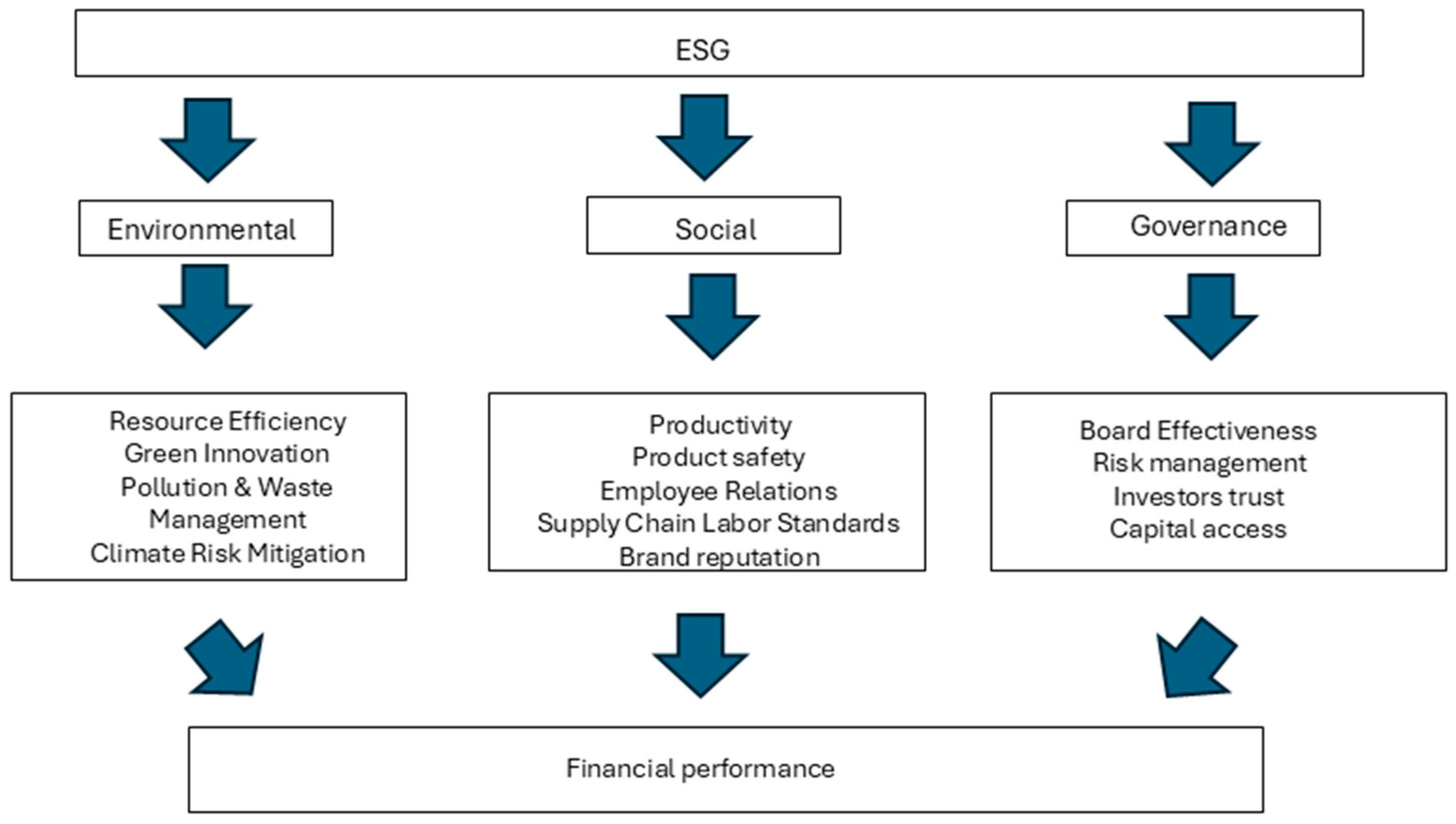
Figure 1. Linking ESG pillars to financial performance. Source: Appendix A.
Sustainability 17 10714 g001
Figure 2. Results for the European region case.
Sustainability 17 10714 g002
Figure 3. Comparison of results for the European region case: Actual vs. predicted Log(EBIT). In Figure 3 each orange “×” marks one observation (European region firm-year) with its actual and model-predicted Log(EBIT). The red dashed line represents the 45-degree line where predicted values would exactly equal actual values; deviations from this line indicate the size and direction of prediction errors.
Sustainability 17 10714 g003
Figure 4. Results for the USA region case.
Sustainability 17 10714 g004
Figure 5. Comparison of results for the analysis of the USA case. In Figure 5 each orange “×” marks one observation (USA region firm-year) with its actual and model-predicted Log(EBIT). The red dashed line represents the 45-degree line where predicted values would exactly equal actual values; deviations from this line indicate the size and direction of prediction errors.
Sustainability 17 10714 g005
Figure 6. Comparison of robust regression coefficients for the Europe and the USA cases.
Sustainability 17 10714 g006
Figure 7. Influence of ESG scores on EBIT in the Europe (left) and the USA cases (right).
Sustainability 17 10714 g007
Table 1. Main sustainability control mechanisms in the EU and the USA.
AspectsEUUS
Corporate sustainability reportingCSRD + ESRS (double-materiality assessment and value-chain data).
EU Taxonomy—criteria for environmentally sustainable activities.
Disclosure obligations are largely driven by the SEC, stock exchange listing rules, and voluntary frameworks (such as GRI, SASB, and TCFD).
Sustainable chain controlCSDDD—requires large EU and certain non-EU companies with substantial EU turnover to implement risk-based human rights and environmental due diligence across their “chain of activities,” maintain grievance mechanisms, and adopt transition plans.Regional level—[37] companies face due diligence duties primarily regarding conflict minerals, forced labor, and imports linked to human rights violations (fragmented).
Emission managementThe EU Emission Trading System was launched in 2005 and is still in force to control the emission levels of companies.Regional programs and state-level initiatives that serve as the closest equivalents (California Cap-and-Trade, etc.).
Made by authors.
Table 2. Summary of obtained results by overall ESG score and separate dimensions—E (Environmental), S (Social), and G (Governance).
Impact on Financial Performance
Region/
Country
SectorESG (Overall)ESGSource
ChinaManufacturingPositiveN/AN/AN/A[40]
VietnamBankingPositiveN/AN/AN/A[41]
GlobalMixedPositiveN/AN/AN/A[43]
Europe and the USA (combined)MixedU-shaped (negative at first, positive later)PositiveU-shaped (negative at first, positive later)U-shaped (negative at first, positive later)[17]
GlobalUtilityNo impactNo impactNo impactNo impact[22]
GlobalMixedNegative on oil, gas, and miningNegativeN/AN/A[23]
TurkeyMixedN/ANegativePositivePositive[39]
GlobalMixedN/AN/AN/ANegative[42]
Table 3. Summary of articles on resource-intensive industries.
AuthorsData, Methods, DatabasesPeriodIndicatorsResultsKeywords (Sector, Result)
[11]US companies in the manufacturing and service industries.
SP-500, dynamic panel data model, Bloomberg, and Thomson Reuters.
2010–2019ROA, ESG pillarsSocial and governance pillars positively impacted ROA.Manufacturing—S, G positive
[22]325 companies worldwide are listed in Refinitiv’s Thomson Reuters ASSET4, EIKON, and Datastream of the utilities sector; regression analysis.2010–2019ROA, ESG scoreESG performances of the companies have no impact on their financial performance.Utility—negative
[23]270 global companies in selected industries; regression analysis, Thomson Reuters.2007–2021EBIT, ESG scoreIn the oil, gas, and mining sectors, ESG scores have been linked to poorer financial outcomes.Oil, gas, and mining —negative
[24]US energy and renewable energy industry companies; panel data model.2013–2023ROA, ESG scoreIn both sectors, overall ESG scores had a positive impact on ROA.Energy—positive
[25]According to Thomson Reuters, there are 60 companies from European countries in the Schengen area.2015–2022ROA, ESG pillarsThe materials and essential goods industry—impact is positive.
Energy industry E—positive impact.
Materials—positive.
Energy—positive
Table 4. The two-step methodology.
StepsAimOutputsComments
1. Revise the panel dataRetrieve the data available at the Bloomberg (2024) [60] data lake and normalize it.The data describing the European and the USA regions were grouped for further investigations.ESG scores describing the European and the USA regions were analyzed.
2. Formation of a robust linear model (RLM)Identify ESG impact on EBIT and check the formulated hypothesis.Revision of regression results and evaluation of the impact’s significance.Analyze ESG impact by regions.
Table 5. Test statistics of Equation (2).
StatisticValueInterpretation
Observations2003Excellent sample size
p-values (all variables)<0.001All terms are highly significant
Mean of residuals+0.0367Near-zero; slightly positive bias
Std. dev. of residuals1.2993Slightly higher dispersion than one
Residual range−6.09 to +4.01Still well-distributed
Iterations (IRLS)19Efficient convergence
Table 6. Test statistics of Equation (3).
StatisticValueInterpretation
Observations1240Good sample size
p-values (all variables)<0.01Statistically significant
z-statistics> 3
Mean of residuals−0.0036Near-zero → good centering
Std. dev. of residuals0.8830Acceptable dispersion
Residual range−4.84 to +3.18No extreme outliers dominate
Iterations (IRLS)15Stable convergence
Table 7. Comparison results of formed equations.
FactorEuropean Region (β, p-Value)USA Region (β, p-Value)Interpretation Comments
LOG_Sβ = 0.338, p = 0.000β = −0.166, p = 0.001Positive effect in the European region case and negative effect in the USA region case, suggesting differences among the regions and the relationship with the social factor (H1b confirmed).
LOG_ELβ = 0.558, p = 0.000β = 0.451, p = 0.000Positive and statistically significant effect is evident in both regions. Environmental gains consistently have positive effect on profitability (H1a confirmed).
LOG_Gβ = −0.645, p = 0.000β = 2.163, p = 0.000Strongly negative in Europe and strongly positive in the USA, reflecting contrasting governance impacts across regions (H1c confirmed in the USA, rejected in the European case).
Table 8. Robust linear regression coefficients by sector and region (with p-values in parentheses).
RegionSectorNLog_E Coefficient (p)Log_S Coefficient (p)Log_G Coefficient (p)
EuropeEnergy1360.082 (0.657)1.747 (8.45 × 10⁻¹³)2.461 (1.14 × 10⁻⁵)
EuropeIndustrial10970.580 (1.45 × 10⁻²⁰)0.139 (0.071)−1.247 (6.36 × 10⁻¹²)
EuropeMaterials5240.683 (4.64 × 10⁻¹¹)0.229 (0.013)−0.328 (0.125)
EuropeUtilities2460.387 (4.14 × 10⁻⁴)0.338 (0.010)0.305 (0.482)
USAEnergy1740.645 (9.48 × 10⁻⁴)0.429 (0.054)2.432 (0.021)
USAIndustrial5410.397 (1.54 × 10⁻¹⁴)−0.330 (1.01 × 10⁻⁵)3.035 (8.47 × 10⁻¹⁴)
USAMaterials2480.542 (2.01 × 10⁻⁸)0.051 (0.579)1.666 (0.003)
USAUtilities2770.424 (6.53 × 10⁻⁸)0.243 (0.068)−0.066 (0.891)
Herein: N—the number of firm–year observations in each sector–region dataset.
Disclaimer/Publisher’s Note: The statements, opinions and data contained in all publications are solely those of the individual author(s) and contributor(s) and not of MDPI and/or the editor(s). MDPI and/or the editor(s) disclaim responsibility for any injury to people or property resulting from any ideas, methods, instructions or products referred to in the content.