1. Introduction
Microfinance institutions (MFIs) have been embraced by many developing countries for the specific role they play in providing financial services (credit, loans, training and insurance) to the poor to alleviate poverty [
1]. Sustainable microfinance programmes play a pivotal role in promoting financial inclusion and poverty alleviation in developing economies. In South Africa, rural areas such as the OR Tambo Coastal District continue to face high unemployment, limited access to financial services, and weak institutional support structures [
2]. Understanding the factors that underpin the sustainability of microfinance programmes in such regions is therefore vital for ensuring long-term access to credit and promoting local entrepreneurship.
Sustainability in this regard refers to the institutional ability to maintain financial viability in their programmes through consistent loan repayment and institutional creditworthiness, while simultaneously delivering social value by empowering clients and providing support to enhance client’s resilience [
2].
Different definitions of microfinance have emerged from people and institutions. The author of the work [
3] has defined microfinance as the delivery of financial services to low-income earners, poor communities, and small businesses who are unable to access formal banking services and whose living conditions fall below the poverty line with the aim of breaking the circle of poverty. Microfinance is also defined as a programme that provides small loans to poor individuals or groups, usually without collateral [
4]. Microfinance is defined from the angle of its services as the delivery of deposits, loans, payments and insurance to poor households and their businesses [
5]. Therefore, microfinance is an arrangement designed to channel financial and non-financial resources to the poor to support their business ventures and pull them out of poverty.
In addition to its financial and institutional relevance, the sustainability of microfinance programmes contributes directly to the broader agenda of sustainable development [
6]. Microfinance plays a vital role in promoting inclusive economic growth by extending financial services to marginalised populations, empowering women, and supporting micro- and small-scale businesses in rural communities [
7]. These outcomes align with the social and economic pillars of sustainability and correspond to several United Nations Sustainable Development Goals (SDGs), including SDG 1 (No Poverty), SDG 8 (Decent Work and Economic Growth), and SDG 10 (Reduced Inequalities) [
6]. Understanding how microfinance may remain sustainable in underserved rural locations, such as the Eastern Cape, provides critical insight into how a combination of financial and non-financial services might support long-term sustainable development in developing nations.
The purpose of microfinance is to provide critical services for the underserved populations with the aim of empowering the financially excluded individuals, especially those in low-income and economically disadvantaged areas such as the OR Tambo Coastal District, Eastern Cape, South Africa. This captures the vision of Professor Muhammad Yunus, who started the Grameen Bank in 1976 in Bangladesh. Professor Yunus redefined a microcredit method used for breaking the cycle of poverty and developed a specific method that boosted the efficiency of microcredit, with the desire to alleviate poverty in Bangladesh [
4]. The amount of money given to the poor usually falls within the range of R1000 to R15,000, and it is given as a loan for a short period of six to 12 months, for them to start up businesses [
7].
Microfinance institutions have been praised globally for their enormous contributions to poverty reduction [
5]. For example, research carried out in South Asia and Bangladesh on the impact of microfinance on the wellbeing of the poor and household income shows a significant increase in education, income, employment, consumption and purchasing power [
8]. Lawanson’s study in Nigeria shows that the provision of small loans to small-scale enterprises were positive [
9]. The provision of microfinance in Santa village in Cameroon motivated young men to embark on tomato farming and improved their household finances [
10]. Significant changes were noted in the research by [
11] on a microfinance initiative in the Ba-Phalaborwa municipality in South Africa. The beneficiaries constructed houses and purchased sewing machines, roof and tile equipment, brick and bread manufacturing machines, and other equipment [
11]. The authors of the work [
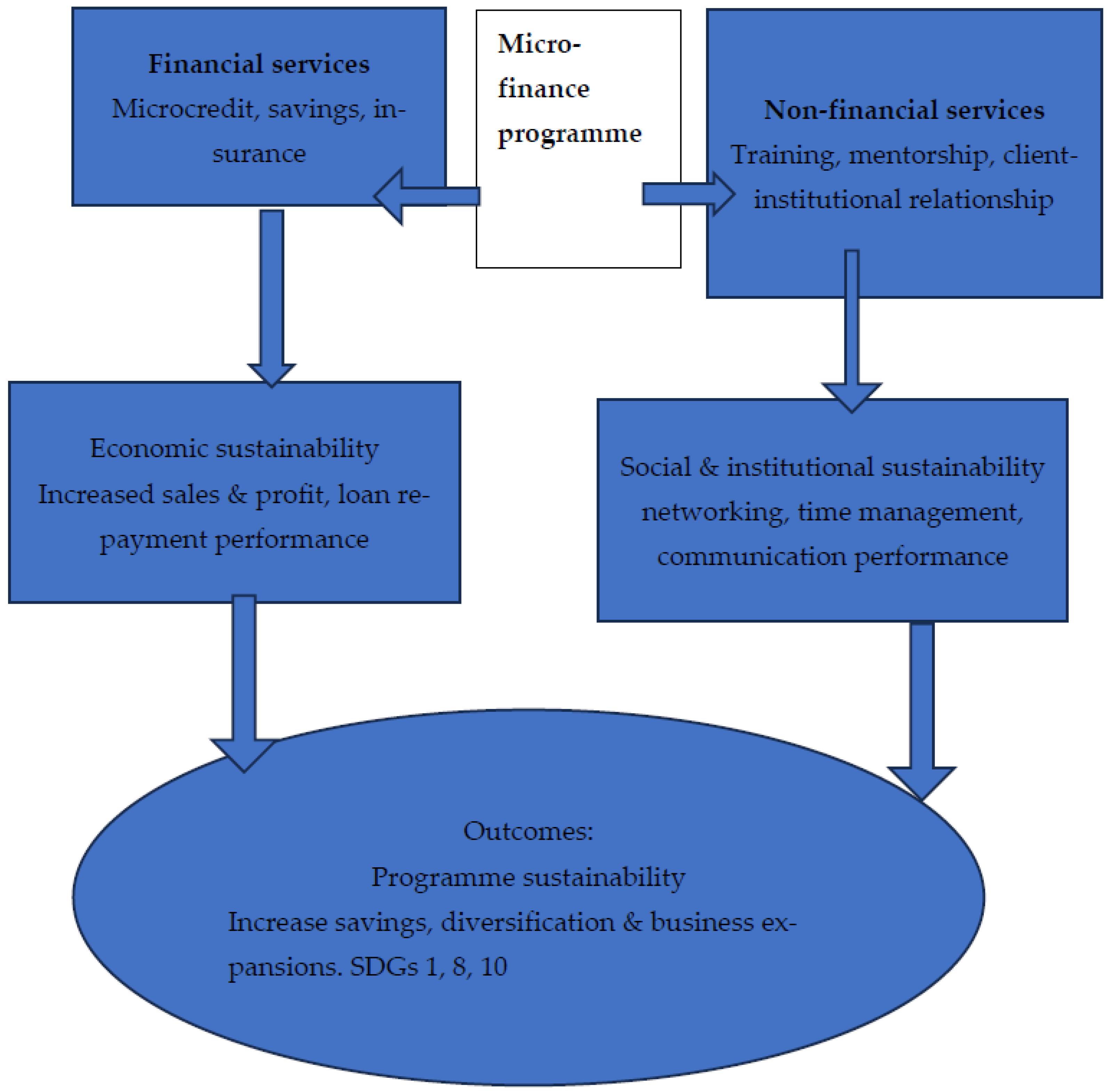
9] highlighted an important aspect of microfinance, in that their programmes go beyond the provision of small loans to the poor and provide a wider spectrum of services to low-income households and their businesses. The broad range of services can be divided into two categories: financial services and non-financial services. The former includes loan size and type, which are offered to microfinance clients to facilitate the operation of their businesses or other projects [
12]. To maintain long-term sustainability, the institution also used non-financial services such as project and time management, planning and finance training, business and skills development strategy, leadership, motivation, and communication [
13]. Unlike earlier studies [
2,
14] that separately examined financial or non-financial dimensions, this study focuses on the interaction between financial and non-financial service types as experienced by clients within a rural South African context. Little is known about how both non-financial and financial services affect the long-term viability of microfinance initiatives within the context of the OR Tambo Coastal District (ORTCD), Eastern Cape. Access to capacity-building services is limited in this part of the country, and it is an area with limited research on microfinance initiatives. While global studies acknowledge that training supplements credit management, little empirical research has been conducted to demonstrate how such integration works in neglected rural communities of the Eastern Cape. The present study, therefore, examines how the design and delivery of both financial and non-financial services jointly shape loan repayment behaviour and programme sustainability in the OR Tambo Coastal District. This work contributes an interactional model that demonstrates how financial and interpersonal relationships influence repayment and sustainability under rural constraints.
This study will explore whether the financial and non-financial services offered to microfinance clients can facilitate the sustainability of microfinance programmes, with a focus on the Eastern Cape province of South Africa. This study used the following research questions: RQ1: How do combinations of financial and non-financial services interact to influence loan repayment practices among microfinance clients in the O R Tambo Coastal District? RQ2: In what ways do these service interactions shape the sustainability of microfinance programmes in the OR Tambo Coastal District?
The paper is structured as follows:
Section 2 reviews the literature on microfinance sustainability;
Section 3 presents the research methodology;
Section 4 presents the results;
Section 5 provides the discussion; and
Section 6 provides conclusions and practical recommendations.
3. Research Methodology
3.1. Research Design
The study adopted a qualitative research design and explored how financial and non-financial services affect loan repayment and the sustainability of microfinance programmes in the OR Tambo Coastal District of Eastern Cape, South Africa. Qualitative design was selected to capture the lived experiences and subjective perceptions of microfinance clients, which are often under-represented in quantitative models. While a mixed-methods approach could enhance generalisability, this exploratory phase focused on depth, interpretation, and meaning-making rather than numerical measurement. To ensure reliability, the research applied credibility techniques, including collecting data from different MFIs and departments of agriculture in different geographical locations (data triangulation) within the OR Tambo Coastal District in the Eastern Cape, member checking, and enhancing the robustness of qualitative interpretation. The research population for this study was narrowed down to clients of microfinance in the rural areas of the OR Tambo Coastal District of the Eastern Cape due to time constraints and limited resources. The inclusion criteria are as follows: The research participants were selected using no other means than that the participants were beneficiaries of microfinance loans. They were involved in small business operations. The business they operate had to be within the ORTCD. The participant should be 18 years and above.
To obtain first-hand information, purposive sampling was employed in the study to find possible clients of microfinance services. This non-probability sampling technique was employed to ensure that participants could effectively address the financial and non-financial services they received, as well as their implications for loan repayment and institutional sustainability. A non-probability sampling method was used to arrive at a determination that Marang Financial Services, Finbond Microfinance Institution and the Department of Agriculture and Agrarian Reform were enough to assist in identifying potential participants. A key concern was that Marang Financial Services and Finbond Microfinance Institution were in the best position to provide the names of group leaders or individual members who were directly involved in microfinance projects, as they deal with loan disbursements and other financial services. The Department of Agriculture and Agrarian Reform was chosen on the basis that the names of group leaders and the members who were directly involved in the microfinance project would be obtained because they supply farm inputs (seeds, fertilisers and other farm equipment) to small farmer groups of women and other people who were directly involved in microfinance programmes in the ORTCD. The researcher made use of purposive sampling and snowball sampling to reach the hard-to-reach population.
The required minimum and maximum numbers of participants in the sample size in qualitative research remain an issue of debate. A sample of less than 20 respondents was recommended by [
38]. The author of as [
39] suggested a sample size of 10 to be adequate for a homogenous population. A sample size of 50 interviews was sufficient for a qualitative study [
40], while a sample size of 20 to 30 was sufficient for a qualitative study [
41]. The researcher was able to collect a sample of 19 people, all of whom had received microloans from specific microfinance institutions in the OR Tambo Coastal District. The sample size (n = 19) was established by data saturation, which occurred when no new information emerged after analysis [
42]. Despite its small size, this sample provided sufficient information power given the study’s targeted purpose, unique context, and rich in-depth interview data. Although the sample (n = 19) was not statistically representative, participants were purposefully selected to capture variation in gender, age, and business sectors, which increases representational breadth within the ORTCD microfinance community. Given the study’s exploratory qualitative design, the focus was on information richness rather than statistical representativeness [
42].
Before commencing with the interviews, an ethics certificate was obtained from the Research Ethics Committee of the University of South Africa. Participants were informed in advance that this study was voluntary and that they could leave the interview at any time. Informed consent was collected from all the participants before the interviews began. Anonymity was maintained by replacing participants’ names with codes during transcription and analysis.
3.2. Data Collection and Analysis
A semi-structured interview schedule was used in face-to-face interviews to collect data over a period of five weeks, which allowed for both consistency in core questions and flexibility to probe deeper into participants’ individual experiences. The interviews took place in the participant’s setting with the use of an audio recorder (with consent) and lasted between 30 and 60 min. The recorded interviews were later transcribed verbatim for analysis. The use of semi-structured interviews resulted in rich, descriptive data while remaining focused on the research aims. The study adopted Braun and Clarke’s six-phase framework to identify, organise, describe and report themes found within the dataset [
43]. In the application of the Braun and Clarke framework, the researcher started with:
Data familiarisation: The researcher familiarised himself with the collected data by reading through the dataset several times and transcribed the verbal data [
44].
Generating initial codes: This phase includes generating codes (words or short sentences) that spot important features of the data appropriate to answering the research question [
44]. The researcher used ATLAS.ti 9 software and coded the participant responses. The full dataset was coded, and, after that, the codes were grouped under the corresponding code categories for later stages of analysis.
Searching for themes: In this phase, the codes are read, organised and categorised into broader patterns of meaning (themes). With the use of ATLAS.ti 9 software, the researcher was able to arrange the different code groups into themes. This helped the researcher to work with the data and check the viability of each candidate theme [
44]. After coding all the respondents’ documents, the researcher grouped the codes under the corresponding themes.
Reviewing themes: This includes checking the main themes against the dataset to verify that they tell a substantial story of the data, thereby answering the research question. At this stage, themes are normally refined; some of the themes are either split, combined, or cast off [
44]. At this stage, the researcher discarded codes that did not properly address the research question. A list of themes was emailed to the supervisor for checking.
Defining and naming themes: Here, the researcher worked on developing a detailed analysis of each theme [
44]. The researcher identified the scope and the focus of each theme and determined the story of each. The researcher also decided on an informative name for each theme. A detailed analysis of the refined database information was achieved with the help of ATLAS.ti 9 software.
Producing the report: This final phase involves communicating the findings to your audience [
44]. The researcher tabulated the coded themes and presented the findings in writing. The use of Braun and Clarke’s six-phase framework alongside ATLAS.ti 9 allows close interaction with the data and ensures a nuanced interpretation of emerging themes related to financial services, non-financial services, loan repayment, and sustainability. The loan repayment performance was assessed qualitatively based on participants’ descriptions of repayment behaviour, challenges, and experiences with repayment support. Programme sustainability was explored through respondents’ perceptions of institutional reliability and service continuity. This approach allowed for an in-depth understanding of how financial and non-financial services influence microfinance sustainability from the clients’ perspectives.
3.3. Bias Management
In obtaining the sample for this study, purposive and snowball sampling techniques were used. This is believed to have introduced selection bias because participants were drawn from MFIs that did not represent all the microfinance clients in the ORTCD. However, this was mitigated by drawing participants from multiple institutions (financial service cooperatives (FSCs), the Small Enterprise Foundation (SEF), Marang Financial Service and the Department of Agriculture), including small business owners and farmers within the ORTCD. Additionally, the recruitment method implemented by MFIs and the Department of Agriculture most likely preferred active or performing clients, perhaps removing dropouts or defaulters. While this introduces selection bias, it allows for an adequate comprehension of repayment behaviour among active participants, which is a critical first step before expanding to less engaged groups in future studies.
Researcher bias was another area of concern as researcher perceptions could have influenced how questions were asked, interpreted and considered [
45]. To eliminate researcher bias, the researcher employed a semi-structured interview guide, which allowed the researcher to keep the questions consistent. Additionally, all the interviews were recorded and transcribed verbatim to reduce selective interpretation. Furthermore, the researcher assured all participants of confidentiality and conducted the interviews in a participant setting to minimise response bias.
4. Results
4.1. Demographic Presentation
A total of 19 microfinance beneficiaries participated in the study. The demographic descriptive analysis data for these beneficiaries are presented in
Table 1 below.
According to the results from the field survey, most of the participants were female; 12 out of 19 were female, and seven were male, for a total of 63.2% females and 36.8% males. This information indicates that most microfinance beneficiaries in the ORTCD are women. Five out of 19 participants (26%) are between the ages of 26 and 35. The data also revealed that 12 respondents (63%) were between the ages of 36 and 45 years old. Two of the participants were between the ages of 46 and 55, and there were no participants aged 18 to 25. This demonstrates that most microfinance loan recipients were over the age of 25 years.
Four (21%) of the 19 participants had primary education, 10 (53%) out of 19 had secondary education, and five (26%) participants had university education. This suggests that all the participants had some level of schooling. The participants were all involved in small-scale business operations such as apparel, vegetable gardening, poultry farming, and retail.
Key Concepts and Description
The key concepts that guided the analysis, along with supporting evidence from participants, are presented in
Table 2. As shown in the table, financial services relate to access to loans and repayment flexibility, while non-financial services include training and management support, both illustrated with direct participant quotations.
4.2. Analysis of the Meaning Theme
In this section, the thematic analysis followed Braun and Clarke’s six-step process alongside ATLAS.ti9. Initial open coding was conducted using ATLAS.ti 9 software to capture participants’ own words. Similar codes were merged and placed into clusters. The clusters were placed into categories that reflected recurrent meanings, from which the final themes emerged. To ensure credibility, coding consistency was checked by the supervisor, and emerging themes were compared against raw data to confirm that they originated empirically rather than from preconceived concepts.
Table 3 below provides an overview of the themes generated from the analysis in relation to each research question. As shown in the table, Research Question 1 produced themes related to financial characteristics of the microfinance programmes, including loan type, loan structure, and loan size. Research Question 2 generated themes linked to non-financial support mechanisms, such as technical assistance, training, and client–institutional relationships.
By using Braun and Clarke’s six-phase framework alongside Atlas.ti 9, the codes of meaning from the analysis of interviews with 19 microfinance clients were sorted. Similar codes were merged and placed into clusters (sub-themes). The grouping of the sub-themes gave rise to the research themes. The emerging themes include loan type and loan size for financial services, technical assistance, and client-institutional relationship for non-financial services.
4.2.1. Financial Services
As can be seen from the data given in
Table 4, the financial service themes identified in the analysis are represented along with their corresponding sub-categories and codes. The theme of loan type is reflected through categories such as loan disbursement and loan structure. Participants expressed different preferences for repayment duration, with most favouring short-term loans, followed by long-term loans, and some indicating flexibility regarding repayment periods. Loan structure codes indicate that individual loans were more common than group loans. The theme of loan size also emerged strongly, with participants reporting loan amounts ranging from R13,000 to R14,000, and a smaller number receiving loans above R47,000.
Loan Type
Loan type, with two sub-themes, i.e., loan disbursement period and loan structure, appeared as one of the data’s major themes. These factors were perceived by participants as influential in shaping their experiences with repayment and institutional engagement. The findings revealed that participants had different preferences for loan disbursement and repayment, which was critical in shaping both client experiences and institutional performance. Several participants favoured short-term loans, viewing them as a way to remain disciplined and debt-free sooner. A participant indicated as such: Participant 8: “I do not have a problem with the time. I like the short-term repayment time. When you repay your loan quickly, your head gets rest.” From the client’s perspective, the loan was timely received and supported income-generating activities. However, a short-term loan might affect repayment ability in a situation where business is slow, and the clients are faced with increasing financial strain. One important part of the short term was that it helped maintain repayment discipline, improve repayment reliability, and reduce default risk. Longer-term loans were described as offering more flexibility, especially for slower businesses. Participants suggested that having the choice of repayment duration allowed them to align repayment schedules with cashflow and business cycles. These views highlight the perceived importance of flexibility and communication between clients and institutions rather than a uniform effect of loan length on repayment. However, maintaining programme sustainability will depend on the disbursement period, the length of repayment periods, effective monitoring and good client-institutional trust.
The study of the data also revealed two sorts of lending structures: group loans and individual loans. The data revealed that a small number of participants acquired loans in groups, while the majority obtained loans on an individual basis. A few participants, such as Participant 3 (“group loan”), participated in group lending, describing it as a system that fosters mutual accountability and peer support. However, the majority reported receiving individual loans (Participant 1: “individual loan”), which they associated with greater autonomy and privacy in managing funds. The high number of individual loan recipients signals a change in lending patterns in the area. It also indicates a progressive transition away from group-based lending, demonstrating that clients’ credit management skills, personal control, and accountability are improving. As a result, client preferences have shifted away from group financing. An increase in individual loans could be ascribed to diminishing trust and social cohesion among group members, increasing reluctance to accept common responsibility. Nonetheless, specific loan types did not lead to loan default, as participants stated that they recorded business profits and increased business performance, thereby improving their loan repayment capabilities. Participant 13 said, “I repay the loan from the profit I made from the business.” As a result, providing loans on a group and individual basis increases client happiness, engagement, and retention. Overall, participants perceived that both structures can be effective when aligned with client characteristics and trust dynamics. Group lending was seen as beneficial for community solidarity and mutual encouragement, while individual lending was associated with independence and personal responsibility.
Loan Size
Loan size emerged as a key theme influencing how participants perceived their ability to invest and meet repayment obligations. Reported loan amounts ranged from approximately R13,000 to over R47,000. Participant 2 noted, “Received up to R13,000,” while Participant 4 reported “more than R47,000.” These differences illustrate the range of financial engagement across clients. The varying loan amount may influence the sustainability and repayment differently because small loans carry low risk, although they may offer limited returns to clients. For instance, participant 18 explained, “The loan is small. This is because it is my first time. I must manage it well and pay the loan back so that when I apply again, they will have confidence in me and give me a bigger loan.” According to the participant’s explanation, the participant intends to borrow a larger amount of money, but being a new client raises concerns because the institution may consider it risky to begin with a significant amount of loans. Small loans may also jeopardise a client’s capacity to invest in a viable business that can generate more profit. A less profitable business may also impede a client’s ability to repay a loan, jeopardising the viability of microfinance programmes. Conversely, participants who accessed medium or larger loans associated them with opportunities for business expansion and higher returns, though they also recognised the accompanying financial risk if the funds were not well managed. These perspectives indicate that the effect of loan size on repayment and sustainability is perceived as conditional, shaped by prior experience, institutional trust, and repayment history, rather than uniform across borrowers.
4.2.2. Non-Financial Services
Regarding no-financial services in promoting loan repayment and contributing to the sustainability of microfinance programmes, three key themes emerged from the data, namely, technical assistance, client-institutional relationships and shock-mitigating mechanisms.
Table 5 below reflects the theme of technical assistance in two main sub-categories: management and training. Codes under management indicate that beneficiaries received support in business management and financial advice. Training-related codes show that participants learnt how to attract clients, invest better, save more effectively, and improve or diversify their business offerings. The second theme, client–institutional relationship, captures participants’ perceptions of how the institution interacts with them. Codes indicate concerns such as lack of follow-up on clients’ problems, an impression that the institution is mainly concerned about receiving its money, and isolated experiences of clients not receiving the assistance they expected.
Technical Assistance
Technical assistance in the form of management and training appeared as one of the data’s major themes. Participants emphasised that business training and management had increased their confidence in managing loan funds. “I learnt to save money, diversify the items in my business, attract more clients, treat my clients well, and upgrade my business after the training,” stated Participant 1, suggesting that technical assistance plays a pivotal role in shaping repayment discipline. The findings revealed that most of the participants obtained business and financial advice before loans were disbursed. This was to ensure that the participants were equipped with basic business, budgeting, and loan repayment knowledge. Participant 13 said, “They ask you about your plans for the loan you want, and when you tell them, then they advise you how to invest wisely and also practice saving money”. In addition, Participant 5 said, “Before they gave me the loan, they asked me what I want to do with the money and advised me well in the direction I want to use the money for and then they give the money”. This demonstrates how crucial mentoring and coaching on better money management were to the clients. It also demonstrates how important business management and financial guidance were in boosting the client’s ability to plan and execute effective business operations, thereby improving loan repayment capabilities.
The findings also revealed that during the programmes, the participants were given some sort of training to support their business operations. The participants indicated as follows: Participant1 “I learned on how to save money and how to add varieties of items in my business to attract more clients. I learned how to treat my clients nice and how to upgrade my business”. Participant 8: “They advise on how to handle your clients. That is, being nice to all your clients, save money and buys different type of goods.” Giving clients the tools they need through training workshops is essential to the development of their business because it increases their ability to manage money wisely, increases their shock resistance, and guarantees that loans are used for meaningful purposes. Training not only prepares clients for business initiatives, but it also demonstrates that the institution cares about its clients. These narratives suggest that technical assistance contributed to improving participants’ financial awareness and business management skills, which, in turn, may support more disciplined repayment behaviour. However, not all participants experienced the same intensity of training or follow-up, indicating variability in institutional delivery. Rather than asserting a direct causal link, the findings highlight that technical assistance functions as an enabling condition, it facilitates better financial decision-making and fosters client confidence, but its impact depends on consistent delivery and contextual alignment.
Client-Institutional Relationship
The client-institutional relationship emerged as a major theme in the data related to non-financial services, reflecting its influence on loan management and repayment behaviour. The findings revealed discrepancies in participants’ responses, as some indicated that they had not received fair treatment from microfinance institutions because no follow-ups were made on their problems. The participants elucidated: Participant 2: “The way I see things with these people, they don’t play with their money, and it is like they are more interested in making profit.” This demonstrates that clients felt unsupported after accepting loans from the institutions. These examples imply that loan repayment is more essential to the institution than loan performance. Additionally, Participant 16 explained: “These people do not care to understand the challenges one faced. All they want is their money. They call you so many times if you happen to delay bringing their money.” These perceptions suggest that clients viewed the institution as prioritising repayment enforcement over relational support. Once participants believe that the institution is more concerned with their loan than with their clients’ well-being, they may become hesitant to return loans or discouraged from borrowing more money. It further indicates a lack of intensive communication between microfinance institutions and their clients. Communication breakdown is a negative factor in the loan management process; it damages trust and accountability. When clients feel unsupported, it drives a strong perception that what matters the most is money, not their wellbeing. Lack of follow-up on a client’s problem poses a high risk not only to the clients who might misuse their funds but also may hamper the client’s willingness to repay loans. Such practices might undermine long-term client retention, reduce additional borrowing and damage the reputation of MFIs in their areas of operation.
5. Discussion
This study adopted a qualitative research design to explore how financial and non-financial services affect loan repayment and the sustainability of microfinance programmes in the OR Tambo Coastal District of Eastern Cape, South Africa. The study adopted Braun and Clarke’s six-phase framework alongside ATLAS.ti 9 for thematic analysis. The study identified that both the structure and design of financial services (loan type and loan size) and the quality of non-financial services (technical assistance and client-institutional relationship) play crucial roles in loan repayment performance and programme sustainability. These findings not only support previous findings on financial services and programme sustainability [
4,
8,
46] but also offer deeper insight into why these factors matter. A well-structured lending system increases client choice between group and individual loans, enhancing clients’ abilities to engage with microfinance institutions on their own terms, thereby improving satisfaction and loyalty. A well-structured lending system further enhances clients’ engagement, improves retention, reduces repayment pressure and fosters a sense of ownership. All these show that the sustainability of microfinance programmes does not rely solely on financial services but also on solid client-institutional relationships, trust and responsiveness. These findings extend earlier studies by showing that a well-organised loan meets the needs of clients as a key driver of repayment reliability within the context of rural South Africa. Each of these findings addresses the first research question. A recurrent concern in the microfinance literature is the risk of client over-indebtedness. While most participants described positive credit experiences, a few expressed anxieties about multiple borrowing to sustain their enterprises. This finding underscores the need for responsible lending frameworks and financial literacy interventions to prevent excessive debt burdens.
In addressing the second research question, two themes, i.e., technical assistance and client-institutional relationships, emerged as critical factors of non-financial services that influence the sustainability of microfinance programmes. The findings show that technical assistance enhanced clients’ ability to handle funds effectively, thereby reducing the risk of defaulting. However, contradictory dynamics were uncovered in the case of the client-institutional relationship. Participants echoed a communication breakdown, which damages trust and accountability and hampers loan repayment. This contradiction suggests that even a well-established financial system can fail if the client-institutional communication channel is undermined. Previous studies [
31,
33,
34] acknowledged the role of client engagement in microfinance operations, but this study captures communication breakdown not just as an operational issue, it also highlights that it destroys the social aspect upon which microfinance depends. This emphasises how crucial it is to strengthen client-institution relationships, communicate openly, and handle clients’ issues with urgency and cultural sensitivity. The study contributes to microfinance sustainability theory by placing the financial and non-financial service nexus within a rural African context. While earlier research has examined these links within national contexts, this article shows how local institutional practices, trust dynamics, and resource restrictions impact sustainability results in underserved areas. Therefore, the study broadens previous frameworks by emphasising community-based realities above simply institutional criteria.
By capturing borrower perspectives through a qualitative approach, the study provides a greater understanding of microfinance sustainability. Although this qualitative study did not quantify repayment improvements, previous studies in South Africa [
2,
14] show that programmes integrating financial and training services achieve repayment rates of 10 to 20% higher than those offering credit alone. This aligns with participants’ perceptions in the present study. The study revealed that the interconnectedness of financial and non-financial services influences programme success: loan design without individual assistance is unstable, and training without proper loan arrangements is unproductive. The findings are believed to have provided both theoretical insight and practical guidance for designing holistic, client-responsive microfinance models in underserved communities. The findings of this study reveal that the combination of financial and non-financial services enhances loan repayment and the long-term viability of microfinance programmes. This relationship extends beyond institutional performance, as it supports the social and economic sustainability of rural livelihoods. Improved repayment rates and programme continuity contribute to community resilience, job creation, and poverty reduction. In this sense, microfinance sustainability represents an important pathway for achieving inclusive development in disadvantaged regions. By strengthening entrepreneurial capacity and building trust between clients and financial institutions, microfinance programmes foster sustainable income generation and align with the broader sustainable development agenda.
6. Conclusions
This paper explored the factors that influence the sustainability of microfinance programmes using the case of the OR Tambo Coastal District, Eastern Cape, South Africa. The findings have revealed the structuring of financial services, the role of non-financial support mechanisms, client-institution relationships, and repayment behaviour as critical. These factors collectively shed light on how the interdependence of financial and social services shapes microfinance sustainability. Therefore, the paper established that the sustainability of microfinance programmes was influenced by the interdependent role of financial services (loan type and loan size) and non-financial services (technical assistance and client-institutional relationships). The study contributes to the limited body of literature on microfinance projects in South Africa and offers an understanding of the sustainability of microfinance programmes in underserved rural areas of the Eastern Cape Province. While other studies have focused their attention on the financial services of microfinance, this study has shown the interdependent role of financial and non-financial services of microfinance in fostering the sustainability of microfinance programmes. By capturing borrower perspectives through a qualitative approach, the study advances an integrated framework of microfinance sustainability. The findings are believed to have provided both theoretical insight and practical guidance for designing holistic, client-responsive microfinance models in underserved communities. Overall, the study demonstrates that microfinance sustainability extends beyond financial viability to include the social and institutional factors, as reflected in participants’ accounts of how mentorship, business and financial advice and trust-based relationships strengthened their repayment capacity and long-term engagement with institutions. Participants described how access to small loans, combined with mentoring and technical guidance, enabled them to grow small businesses, increase profits, and improve repayment outcomes, all of which contribute to community empowerment and local livelihood sustainability, as well as the achievement of key Sustainable Development Goals. These insights highlight that financial inclusion is not merely an economic objective but also a social and developmental imperative that strengthens the foundation for long-term sustainability. Therefore, the sustainability of microfinance programmes should be viewed as an essential component of the global effort toward inclusive and equitable development.
Based on participants’ experiences, the study suggests practical guidance for microfinance institutions operating within rural contexts. Firstly, integrating financial and non-financial services can be institutionalised through structured mentorship programmes accompanying every loan disbursement. Secondly, staff should receive periodic training in financial literacy facilitation and client relationship management. Thirdly, programme sustainability can be strengthened by monitoring client progress using participatory evaluation tools that capture both financial and behavioural outcomes.
This study was limited in that it covered only the OR Tambo Coastal District with a sample size of 19 participants; therefore, the findings cannot be generalised beyond the study population. Nevertheless, the findings provide detailed insight and understanding of the experience of microfinance clients and how these experiences shape the sustainability of microfinance programmes in underserved rural areas of the Eastern Cape Province. The study focused on the client perspective to understand microfinance sustainability on the beneficiary level. Future research could include MFI representatives to provide institutional insights into portfolio performance, loan recovery strategies, and internal sustainability practices.
A qualitative approach was used in the study; therefore, the same study can be conducted using quantitative or mixed-method research on the subject. Further studies should explore the factors influencing individual borrowing over traditional group borrowing in microfinance institutions.